WO2013048177A2 - 셀레노펜-접합 방향족 화합물, 및 이의 제조 방법 - Google Patents
셀레노펜-접합 방향족 화합물, 및 이의 제조 방법 Download PDFInfo
- Publication number
- WO2013048177A2 WO2013048177A2 PCT/KR2012/007905 KR2012007905W WO2013048177A2 WO 2013048177 A2 WO2013048177 A2 WO 2013048177A2 KR 2012007905 W KR2012007905 W KR 2012007905W WO 2013048177 A2 WO2013048177 A2 WO 2013048177A2
- Authority
- WO
- WIPO (PCT)
- Prior art keywords
- formula
- group
- optionally substituted
- substituted
- selenophene
- Prior art date
- Legal status (The legal status is an assumption and is not a legal conclusion. Google has not performed a legal analysis and makes no representation as to the accuracy of the status listed.)
- Ceased
Links
- 0 C*c(cc(C(N1c2cc(O*)c(ccc(*)c3)c3c2C(C*)C1)=O)[s]1)c1S#CC Chemical compound C*c(cc(C(N1c2cc(O*)c(ccc(*)c3)c3c2C(C*)C1)=O)[s]1)c1S#CC 0.000 description 8
Images


Classifications
-
- C—CHEMISTRY; METALLURGY
- C07—ORGANIC CHEMISTRY
- C07D—HETEROCYCLIC COMPOUNDS
- C07D517/00—Heterocyclic compounds containing in the condensed system at least one hetero ring having selenium, tellurium, or halogen atoms as ring hetero atoms
- C07D517/02—Heterocyclic compounds containing in the condensed system at least one hetero ring having selenium, tellurium, or halogen atoms as ring hetero atoms in which the condensed system contains two hetero rings
- C07D517/04—Ortho-condensed systems
-
- A—HUMAN NECESSITIES
- A61—MEDICAL OR VETERINARY SCIENCE; HYGIENE
- A61P—SPECIFIC THERAPEUTIC ACTIVITY OF CHEMICAL COMPOUNDS OR MEDICINAL PREPARATIONS
- A61P35/00—Antineoplastic agents
-
- C—CHEMISTRY; METALLURGY
- C07—ORGANIC CHEMISTRY
- C07D—HETEROCYCLIC COMPOUNDS
- C07D345/00—Heterocyclic compounds containing rings having selenium or tellurium atoms as the only ring hetero atoms
-
- C—CHEMISTRY; METALLURGY
- C07—ORGANIC CHEMISTRY
- C07D—HETEROCYCLIC COMPOUNDS
- C07D421/00—Heterocyclic compounds containing two or more hetero rings, at least one ring having selenium, tellurium, or halogen atoms as ring hetero atoms
- C07D421/02—Heterocyclic compounds containing two or more hetero rings, at least one ring having selenium, tellurium, or halogen atoms as ring hetero atoms containing two hetero rings
- C07D421/06—Heterocyclic compounds containing two or more hetero rings, at least one ring having selenium, tellurium, or halogen atoms as ring hetero atoms containing two hetero rings linked by a carbon chain containing only aliphatic carbon atoms
-
- C—CHEMISTRY; METALLURGY
- C09—DYES; PAINTS; POLISHES; NATURAL RESINS; ADHESIVES; COMPOSITIONS NOT OTHERWISE PROVIDED FOR; APPLICATIONS OF MATERIALS NOT OTHERWISE PROVIDED FOR
- C09K—MATERIALS FOR MISCELLANEOUS APPLICATIONS, NOT PROVIDED FOR ELSEWHERE
- C09K11/00—Luminescent materials, e.g. electroluminescent or chemiluminescent
- C09K11/06—Luminescent materials, e.g. electroluminescent or chemiluminescent containing organic luminescent materials
-
- C—CHEMISTRY; METALLURGY
- C09—DYES; PAINTS; POLISHES; NATURAL RESINS; ADHESIVES; COMPOSITIONS NOT OTHERWISE PROVIDED FOR; APPLICATIONS OF MATERIALS NOT OTHERWISE PROVIDED FOR
- C09K—MATERIALS FOR MISCELLANEOUS APPLICATIONS, NOT PROVIDED FOR ELSEWHERE
- C09K2211/00—Chemical nature of organic luminescent or tenebrescent compounds
- C09K2211/10—Non-macromolecular compounds
- C09K2211/1018—Heterocyclic compounds
- C09K2211/1025—Heterocyclic compounds characterised by ligands
- C09K2211/1029—Heterocyclic compounds characterised by ligands containing one nitrogen atom as the heteroatom
-
- C—CHEMISTRY; METALLURGY
- C09—DYES; PAINTS; POLISHES; NATURAL RESINS; ADHESIVES; COMPOSITIONS NOT OTHERWISE PROVIDED FOR; APPLICATIONS OF MATERIALS NOT OTHERWISE PROVIDED FOR
- C09K—MATERIALS FOR MISCELLANEOUS APPLICATIONS, NOT PROVIDED FOR ELSEWHERE
- C09K2211/00—Chemical nature of organic luminescent or tenebrescent compounds
- C09K2211/10—Non-macromolecular compounds
- C09K2211/1018—Heterocyclic compounds
- C09K2211/1025—Heterocyclic compounds characterised by ligands
- C09K2211/1088—Heterocyclic compounds characterised by ligands containing oxygen as the only heteroatom
-
- C—CHEMISTRY; METALLURGY
- C09—DYES; PAINTS; POLISHES; NATURAL RESINS; ADHESIVES; COMPOSITIONS NOT OTHERWISE PROVIDED FOR; APPLICATIONS OF MATERIALS NOT OTHERWISE PROVIDED FOR
- C09K—MATERIALS FOR MISCELLANEOUS APPLICATIONS, NOT PROVIDED FOR ELSEWHERE
- C09K2211/00—Chemical nature of organic luminescent or tenebrescent compounds
- C09K2211/10—Non-macromolecular compounds
- C09K2211/1018—Heterocyclic compounds
- C09K2211/1025—Heterocyclic compounds characterised by ligands
- C09K2211/1092—Heterocyclic compounds characterised by ligands containing sulfur as the only heteroatom
-
- C—CHEMISTRY; METALLURGY
- C09—DYES; PAINTS; POLISHES; NATURAL RESINS; ADHESIVES; COMPOSITIONS NOT OTHERWISE PROVIDED FOR; APPLICATIONS OF MATERIALS NOT OTHERWISE PROVIDED FOR
- C09K—MATERIALS FOR MISCELLANEOUS APPLICATIONS, NOT PROVIDED FOR ELSEWHERE
- C09K2211/00—Chemical nature of organic luminescent or tenebrescent compounds
- C09K2211/10—Non-macromolecular compounds
- C09K2211/1018—Heterocyclic compounds
- C09K2211/1025—Heterocyclic compounds characterised by ligands
- C09K2211/1096—Heterocyclic compounds characterised by ligands containing other heteroatoms
Definitions
- the present application relates to a selenophene-fused aromatic compound and a method for producing the selenophene-fused aromatic compound.
- 'Benzocellonophene' a kind of compound containing selenium (Se) element in the aromatic ring, has a structure similar to indole, benzothiophene, and benzofuran.
- the selenophene-conjugated aromatic compound including the benzoselenophene is a material having high applicability in various fields, but according to the prior art, it is not easy to synthesize derivatives, and thus is used as an intermediate or a material of a pharmaceutical, or a semiconductor property. Eggplant was difficult to use as a material.
- indole or benzothiophene which are structurally similar to benzoselenophene, and have been commercialized as therapeutic agents for various diseases such as anticancer agents, hormone replacement agents, immunomodulatory agents, and obesity diabetes treatment.
- Benzoselenophene is expected to have excellent anticancer effects due to its structural similarity to indole or benzothiophene, and its applicability as photochemical therapy for the treatment of alum and psoriasis is highly evaluated. It has not yet reached the commercialization stage.
- the present application provides a method for producing derivatives of selenophene-conjugated aromatic compounds having various substituents more easily and economically.
- the present application can be used in various applications, such as intermediates of anti-bacterial or anti-cancer substances, indicators that vary in color depending on the solvent, fluorescent materials, and the like. To give a compound.
- a first aspect of the present application provides a selenophene-fused aromatic compound represented by Formula 1 below:
- R 1 is —CO 2 H, —CO 2 R, 4-NO 2 —Ph, 4-CN-Ph, 4-RO 2 C-Ph, 4-X-Ph, or Formula A:
- R 2 is H, —NO 2 , —NHCOR, CX 3 , —OR, —diOR, a substituted alkyl group, a substituted alkoxy group, a substituted alkylene-dioxy group, a substituted amino group, A halo group or a substituent represented by formula (B):
- X is halo
- R 3 is —H, —OH, —NH 2, an alkyl group which may be substituted, or an aryl group which may be substituted,
- R 4 and R 5 are each independently N, O, S, C, bond, or non-bonding
- R 6 is H, or an alkoxy group which may be substituted
- R 7 is H, -CONR 17 R 20 , or ego,
- R 17 and R 20 are each independently H or an alkyl group which may be substituted
- R 21 is C, O, N, or S,
- R 8 is a halo group
- R 9 is O, NH, S, or Se
- R 10 is a substituted alkyl group, a substituted alkoxy group, a halo group, —NO 2 , or —NHCOR,
- R is H, an optionally substituted alkyl group, an optionally substituted aryl group, an optionally substituted amino group, an optionally substituted amino group, an optionally substituted peptide group, an optionally substituted C 1-7 alkoxy group, or Residues of carbohydrates or carbohydrate derivatives that may be substituted.
- a second aspect of the present application provides a reaction mixture comprising a diselenide compound represented by the general formula R 11 -CH 2 -Se-Se-CH 2 -R 11 , a solvent, and a reducing agent;
- a method of preparing a selenophene-conjugated aromatic compound represented by the following Chemical Formula 2, comprising adding and reacting the aromatic starting material represented by the following Chemical Formula 2a to the reaction mixture, and a base:
- Z is -COR 15 , or -CN
- R 15 is —H, a substituted alkyl group, a substituted aryl group, or a substituted alkoxy group,
- R 3 is —H, —OH, —NH 2 , an alkyl group which may be substituted, or an aryl group which may be substituted,
- R 11 is —CO 2 H, —CO 2 R, 4-NO 2 —Ph, 4-CN-Ph, 4-RO 2 C-Ph, or 4-X-Ph,
- R 12 is H, —NO 2 , —NHCOR, CX 3 , —OR, —diOR, a substituted alkoxy group, a substituted alkylene-dioxy group, a substituted amino group, or a halo group,
- X is halo
- R is H, an optionally substituted alkyl group, an optionally substituted aryl group, an optionally substituted amino group, an optionally substituted amino group, an optionally substituted peptide group, an optionally substituted C 1-7 alkoxy group, or Residues of carbohydrates or carbohydrate derivatives that may be substituted.
- an aromatic starting material represented by the following Chemical Formula 7a, and R 11 CH 2 X are heated to form a reaction intermediate represented by the following Chemical Formula 7b; It provides a method for producing a selenophene-fused aromatic compound represented by the following formula (7), including the reaction by adding a solvent and a base to the reaction intermediate:
- R 4 and R 5 are each independently N, O, S, C, a bond or a non-bonding
- R 11 is —CO 2 H, —CO 2 R, 4-NO 2 —Ph, 4-CN-Ph, 4-RO 2 C-Ph, or 4-X-Ph,
- R 12 is H, —NO 2 , —NHCOR, CX 3 , —OR, —diOR, a substituted alkoxy group, a substituted alkylene-dioxy group, a substituted amino group, or a halo group,
- X is halo
- R 13 is an alkyl group which may be substituted
- R is H, an optionally substituted alkyl group, an optionally substituted aryl group, an optionally substituted amino group, an optionally substituted amino group, an optionally substituted peptide group, an optionally substituted C 1-7 alkoxy group, or Residues of carbohydrates or carbohydrate derivatives that may be substituted.
- a fourth aspect of the present application is represented by the following formula (10a) MCBI (7-methoxy-1,2,9,9a-tetrahydrocyclopropa [c] benz [e] indol-4-one) compound, and Provided is a process for preparing a selenophene-conjugated aromatic compound represented by the following Chemical Formula 10, comprising reacting a selenium-containing aromatic compound:
- R 2 is an alkyl group which may be substituted, an alkoxy group which may be substituted, a halo group, —NO 2 , —NHCOR, or a substituent represented by the following Formula B,
- R 4 and R 5 are each independently C, O, N, S, a bond, or a non-bonding
- R 6 is H, or an alkoxy group which may be substituted
- R 7 is H, -CONR 17 R 20 , or ego,
- R 17 and R 20 are each independently H or an alkyl group which may be substituted
- R 21 is C, O, N, or S,
- R 8 is a halo group
- R is H, an optionally substituted alkyl group, an optionally substituted aryl group, an optionally substituted amino group, an optionally substituted amino group, an optionally substituted peptide group, an optionally substituted C 1-7 alkoxy group, or Residues of carbohydrates or carbohydrate derivatives that may be substituted:
- R 9 is O, NH, S, or Se
- R 10 is a substituted alkyl group, a substituted alkoxy group, a substituted halo group, -NO 2 , or -NHCOR,
- R is H, an optionally substituted alkyl group, an optionally substituted aryl group, an optionally substituted amino group, an optionally substituted amino group, an optionally substituted peptide group, an optionally substituted C 1-7 alkoxy group, or Residues of carbohydrates or carbohydrate derivatives that may be substituted.
- a fifth aspect of the present application is a method for producing a selenophene-conjugated aromatic compound represented by the following Chemical Formula 11, comprising reacting an MCBI compound represented by the following Chemical Formula 11a, and a selenium-containing aromatic compound represented by the following Chemical Formula 11b.
- R 2 is an alkyl group which may be substituted, an alkoxy group which may be substituted, a halo group, —NO 2 , —NHCOR, or a substituent represented by the following Formula B,
- R 4 and R 5 are each independently C, O, N, S, a bond, or a non-bonding
- R 6 is H or an alkoxy group which may be substituted
- R is H, an optionally substituted alkyl group, an optionally substituted aryl group, an optionally substituted amino group, an optionally substituted amino group, an optionally substituted peptide group, an optionally substituted C 1-7 alkoxy group, or Residues of carbohydrates or carbohydrate derivatives that may be substituted:
- R 9 is O, NH, S, or Se
- R 10 is a substituted alkyl group, a substituted alkoxy group, a halo group, —NO 2 , or —NHCOR,
- R is H, an optionally substituted alkyl group, an optionally substituted aryl group, an optionally substituted amino group, an optionally substituted amino group, an optionally substituted peptide group, an optionally substituted C 1-7 alkoxy group, or Residues of carbohydrates or carbohydrate derivatives that may be substituted.
- a sixth aspect of the present disclosure provides an anti-bacterial composition comprising a selenophene-conjugated aromatic compound according to the first aspect of the present disclosure.
- a seventh aspect of the present application provides an indicator composition comprising a selenophene-conjugated aromatic compound according to the first aspect of the present application, which can be used as an indicator whose color varies depending on the solvent.
- An eighth aspect of the present application provides a fluorescent composition comprising a selenophene-conjugated aromatic compound according to the first aspect of the present application.
- a ninth aspect of the present application provides an anticancer composition comprising a selenophene-conjugated aromatic compound according to the first aspect of the present application.
- benzoselenophene derivatives having various substituents can be produced more easily and economically.
- the present invention enables easy and economical preparation of the selenophene-conjugated aromatic compound, it is possible to increase the possibility that the selenophene-conjugated aromatic compound can be commercialized for various uses such as anti-bacterial compositions, anticancer agents, and the like. have.
- the selenophene-conjugated aromatic compound can be obtained in high yield by appropriately selecting the diselenide compound, the solvent, the reducing agent, and the base, which are materials necessary for preparing the selenophene-conjugated aromatic compound, respectively.
- the type of aromatic starting material that is used as a starting material when preparing the selenophene-conjugated aromatic compound can also be varied.
- the selenophene-conjugated aromatic compounds prepared according to the present disclosure may possess various useful properties according to their specific formula.
- selenophene-conjugated aromatic compounds with anti-bacterial properties can be synthesized, in which case they can be utilized as medical substances.
- a selenophene-conjugated aromatic compound having a characteristic of changing color depending on the solvent may be synthesized, and in this case, it may be utilized as an indicator.
- some selenophene-conjugated aromatic compounds possess fluorescence properties, in which case they can be utilized as intermediates in the synthesis of organic semiconductors.
- it can be usefully used as an anticancer agent or a precursor thereof.
- the selenophene-conjugated aromatic compound may exhibit anticancer effects through DNA alkylating, and cytotoxicity tests on various cancer cells have shown that IC 50 exhibits a very strong anticancer effect as nM or pM units. Confirmed.
- the types of applicable cancer is also various, such as breast cancer, central nervous system cancer, colon cancer, non-small cell lung cancer, kidney cancer, prostate cancer, ovarian cancer, etc.
- the selenophene-conjugated aromatic compound according to the present application is an anticancer agent for various cancers It is expected to be usefully used as.
- 1 is a spectrum showing the fluorescence properties of a selenophene-conjugated aromatic compound prepared according to entry 26 in the Examples herein.
- FIG. 2 is a spectrum showing the fluorescence properties of selenophene-conjugated aromatic compounds prepared according to entry 27 in the Examples herein.
- FIG. 4 is an absorption spectrum showing solvent discoloration characteristics of the selenophene-conjugated aromatic compound prepared according to entry 17 of the Examples herein.
- the term "combination of these" included in the expression of the makushi form means one or more mixtures or combinations selected from the group consisting of constituents described in the expression of the makushi form, wherein the constituents It means to include one or more selected from the group consisting of.
- an "alkyl” or “alkyl group” may be a linear or branched, saturated or unsaturated, alkyl group having 1 to 10, 1 to 7 or 1 to 5 carbon atoms, for example, It may include, but is not limited to, methyl, ethyl, propyl, butyl, pentyl, hexyl, hepyl, octyl, nonyl, decyl, or isomers thereof. When substituted, the alkyl group may be substituted with up to four substituents as listed below at any particular point of attachment (at any given carbon atom).
- Hydroxyl groups carboxylates, oxo, halogens (eg F, Cl, Br, I), haloalkyls (eg CCl 3 or CF 3 ), alkyloxycarbonyl (-C (O) R), alkylcarbons Carbonyloxy (-OCOR), carbamoyl (-NHCOOR- or -OCONHR-), urea (-NHCONHR-), thiol, cyano, nitro, amino, acylamino, C 1 -C 6 alkylthio, arylthio, C 1 -C 6 alkyl, C 1 -C 6 alkoxy, aryloxy, alkylcarbonyloxy, arylcarbonyloxy, C 3 -C 6 cycloalkyl, C 3 -C 6 cycloalkyloxy, C 2 -C 6 alkenyl , C 3 -C 6 alkynyl, aryl, aminocarbonyl, C 1 -C 6 alky
- alkyl group when the alkyl group is substituted with an alkyl group, it is used in the same sense as the "branched chain alkyl group".
- Preferred alkyl groups contain 1 to 6 carbon atoms.
- Alkylene as used herein refers to a crosslinked alkyl group of formula (CH 2 ) n. For example, CH 2 , -CH 2 CH 2- , -CH 2 CH 2 CH 2 -and the like.
- aryl or “aryl group”, alone or as part of another group, refers to a monocyclic or bicyclic aromatic ring such as phenyl, substituted phenyl, as well as conjugated groups. Such as, for example, naphthyl, phenanthrenyl, indenyl, tetrahydronaphthyl and indanyl, and the like.
- the "aryl” or “aryl group” contains one or more rings having 6 or more atoms, there may be 5 or less rings containing 22 or less atoms, and adjacent carbon atoms or Double bonds may be present alternately (resonance) between suitable heteroatoms.
- the "aryl” or “aryl group” may be phenyl, phenyl substituted as described above, phenyl, naphthyl, or naphthyl substituted as described above, but is not limited thereto.
- alkoxy or “alkoxy group” may include, but is not limited to, an alkoxy group having an oxygen atom bonded to the "alkyl group” defined above.
- Alkoxy groups are bonded to the main chain, aryl or heteroaryl groups via oxygen bridges. Alkoxy groups may be straight or branched, but straight chains are preferred. Examples include methoxy, ethyloxy, propoxy, butyloxy, t-butyloxy, i-propoxy and the like.
- Preferred alkoxy groups contain 1 to 6 carbon atoms and particularly preferred alkoxy groups contain 1 to 3 carbon atoms.
- an "alkylene-dioxy group” may be an alkylene group positioned between two oxygens, and the “alkylene group” may be an alkylene group having 1 to 10, 1 to 7, or 1 to 5 carbon atoms. May be, for example, methylene, ethylene, propylene, butylene, pentylene, hexylene, hepylene, octylene, nonylene, decylene, or isomers thereof, but is not limited thereto. .
- amine group or “amino group”, alone or as part of another group, means -NH 2
- the "amine group” or “amino group” may be the same or different. 1 or 2 substituents such as alkyl, aryl, arylalkyl, alkenyl, alkynyl, heteroaryl, heteroarylalkyl, cycloheteroalkyl, cycloheteroalkylalkyl, cycloalkyl, cycloalkylalkyl, haloalkyl, hydroxyalkyl, Optionally alkoxyalkyl, thioalkyl, carbonyl or carboxyl.
- amino acid group refers to an amino acid comprising ⁇ -amino acid, ⁇ -amino acid and ⁇ -amino acid, which amino acid may be L-isomer or D-isomer, preferably L- Isomers.
- amino acids include glycine, alanine, valine, leucine, isoleucine, methionine, proline, phenylalanine, tryptophan, serine, threonine, cysteine, tyrosine, asparagine, glutamine, aspartic acid, glutamic acid, lysine, arginine, histidine, ⁇ May include, but is not limited to, alanine and ornithine.
- peptide group means a group produced by a reaction between many natural and / or non-natural amino acids.
- carbohydrate or “carbohydrate derivative” is, for example, a polyhydroxy aldehyde, polyhydroxy ketone, or a polyol or an organic group derived therefrom, and a simple chemical modification, for example, By compounds that can be converted to such groups by hydrolysis, oxidation or reduction.
- groups may include, but are not limited to, sugars, starches, cellulose and gums, for example.
- substitution has the meaning of including all acceptable substituents of organic compounds.
- Acceptable substituents can include acyclic and cyclic, branched and unbranched, carbocyclic and heterocyclic, aromatic and nonaromatic substituents of organic compounds, and the permissible substituents can be one or more.
- substituted when combined with any of the above groups, refers to acyl, amino (including simple amino, mono and dialkylamino, mono and diarylamino and alkylarylamino), acylamino (carr Barmoyl, and ureido), alkylcarbonyloxy, aryl, arylcarbonyloxy, alkoxycarbonyloxy, alkoxycarbonyl, carboxy, carboxylate, aminocarbonyl, mono and dialkylaminocarbonyl, sia Furnace, azido, halogen, hydroxyl, nitro, trifluoromethyl, thio, alkylthio, arylthio, alkylthiocarbonyl, thiocarboxylate, lower alkyl, lower alkenyl, lower alkynyl, cycloalkyl, hetero Cycloalkyl, aryl, heteroaryl, lower alkoxy, aryloxy, aryloxycarbonyloxy, benzy
- a first aspect of the present application provides a selenophene-fused aromatic compound represented by Formula 1 below:
- R 1 is —CO 2 H, —CO 2 R, 4-NO 2 —Ph, 4-CN-Ph, 4-RO 2 C-Ph, 4-X-Ph, or Formula A:
- R 2 is H, —NO 2 , —NHCOR, CX 3 , —OR, —diOR, a substituted alkyl group, a substituted alkoxy group, a substituted alkylene-dioxy group, a substituted amino group, A halo group or a substituent represented by formula (B):
- R 3 is —H, —OH, —NH 2 , an alkyl group which may be substituted, or an aryl group which may be substituted,
- R 4 and R 5 are each independently N, O, S, C, a bond or a non-bonding
- R 6 is H, or an alkoxy group which may be substituted
- R 7 is H, -CONR 17 R 20 , or ego,
- R 17 and R 20 are each independently H or an alkyl group which may be substituted
- R 21 is C, O, N, or S,
- R 8 is a halo group
- R 9 is O, NH, S, or Se
- R 10 is a substituted alkyl group, a substituted alkoxy group, a halo group, —NO 2 , or —NHCOR,
- R is H, an optionally substituted alkyl group, an optionally substituted aryl group, an optionally substituted amino group, an optionally substituted amino group, an optionally substituted peptide group, an optionally substituted C 1-7 alkoxy group, or Residues of carbohydrates or carbohydrate derivatives that may be substituted.
- Chemical Formula 1 may include one selected from Chemical Formula 2 to Chemical Formula 6, but is not limited thereto.
- R 3 is as defined in Formula 1,
- R 11 is —CO 2 H, —CO 2 R, 4-NO 2 —Ph, 4-CN-Ph, 4-RO 2 C-Ph, or 4-X-Ph,
- R 12 is H, —NO 2 , —NHCOR, CX 3 , —OR, —diOR, a substituted alkoxy group, a substituted alkylene-dioxy group, a substituted amino group, or a halo group,
- X is halo
- R is H, an optionally substituted alkyl group, an optionally substituted aryl group, an optionally substituted amino group, an optionally substituted amino group, an optionally substituted peptide group, an optionally substituted C 1-7 alkoxy group, or Residues of carbohydrates or carbohydrate derivatives that may be substituted.
- Chemical Formula 1 may include one selected from Chemical Formulas 7 to 9, but is not limited thereto.
- R 4 and R 5 are each independently N, O, S, C, a bond or a non-bonding
- R 11 is —CO 2 H, —CO 2 R, 4-NO 2 —Ph, 4-CN-Ph, 4-RO 2 C-Ph, or 4-X-Ph,
- R 12 is H, —NO 2 , —NHCOR, CX 3 , —OR, —diOR, a substituted alkoxy group, a substituted alkylene-dioxy group, a substituted amino group, or a halo group,
- X is halo
- R is H, an optionally substituted alkyl group, an optionally substituted aryl group, an optionally substituted amino group, an optionally substituted amino group, an optionally substituted peptide group, an optionally substituted C 1-7 alkoxy group, or Residues of carbohydrates or carbohydrate derivatives that may be substituted.
- Chemical Formula 1 may include one selected from Chemical Formula 10 to Chemical Formula 12, but is not limited thereto.
- R 2 is H, —NO 2 , —NHCOR, CX 3 , —OR, —diOR, an alkyl group which may be substituted, an alkoxy group which may be substituted, an alkylene-dioxy group which may be substituted, an amino group which may be substituted, A halo group or a substituent represented by formula (B):
- R 4 and R 5 are each independently C, O, N, S, a bond or a non-bonding
- R 6 is H, or an alkoxy group which may be substituted
- R 7 is H, -CONR 17 R 20 , or ego,
- R 17 and R 20 are each independently H or an alkyl group which may be substituted
- R 21 is C, O, N, or S,
- R 8 is a halo group
- R 9 is O, NH, S, or Se
- R 10 is a substituted alkyl group, a substituted alkoxy group, a halo group, —NO 2 , or —NHCOR,
- L is a linker
- R is H, an optionally substituted alkyl group, an optionally substituted aryl group, an optionally substituted amino group, an optionally substituted amino group, an optionally substituted peptide group, an optionally substituted C 1-7 alkoxy group, or Residues of carbohydrates or carbohydrate derivatives that may be substituted.
- the linker comprises -NHCO-R 19 -CONH-, wherein R 19 may be an alkyl group of C 1-7 , but is not limited thereto.
- the linker is -NHCO-CH 2 -CONH-, -NHCO-CH 2 CH 2 -CONH-, -NHCO-CH 2 CH 2 CH 2 -CONH-, -NHCO-CH 2 CH 2 CH 2 CH 2 -CONH-, -NHCO-CH 2 CH 2 CH 2 CH 2 CH 2 -CONH-, -NHCO-CH 2 CH 2 CH 2 CH 2 CH 2 CH 2 -CONH-, or -NHCO-CH 2 CH 2 CH 2 CH 2 CH 2 CH 2 -CONH-, but is not limited thereto.
- the selenophene-conjugated aromatic compound represented by Formula 12 of the present application may be formed by connecting two selenophene-conjugated aromatic compounds represented by Formula 10 of the present application to a left-right symmetric structure and connected by the linker. It can be manufactured, but is not limited thereto.
- a second aspect of the present application provides a reaction mixture comprising a diselenide compound represented by the general formula R 11 -CH 2 -Se-Se-CH 2 -R 11 , a solvent, and a reducing agent;
- a method for preparing a selenophene-conjugated aromatic compound represented by the following Chemical Formula 2 comprising adding and reacting the aromatic starting material represented by the following Chemical Formula 2a, and a base to the reaction mixture:
- Z is -COR 15 , or -CN
- R 15 is —H, a substituted alkyl group, a substituted aryl group, or a substituted alkoxy group,
- R 3 is —H, —OH, —NH 2 , an alkyl group which may be substituted, or an aryl group which may be substituted,
- R 11 is —CO 2 H, —CO 2 R, 4-NO 2 —Ph, 4-CN-Ph, 4-RO 2 C-Ph, or 4-X-Ph,
- R 12 is H, —NO 2 , —NHCOR, CX 3 , —OR, —diOR, a substituted alkoxy group, a substituted alkylene-dioxy group, a substituted amino group, or a halo group,
- X is halo
- R is H, an optionally substituted alkyl group, an optionally substituted aryl group, an optionally substituted amino group, an optionally substituted amino group, an optionally substituted peptide group, an optionally substituted C 1-7 alkoxy group, or Residues of carbohydrates or carbohydrate derivatives that may be substituted.
- Formula 2a may include Formula 3a, and Formula 2 may include, but is not limited to:
- X, R 11 , and R 12 are as defined above in Chemical Formulas 2a and 2, respectively.
- Formula 2a may include Formula 4a, and Formula 2 may include, but is not limited to:
- X, R 11 , and R 12 are as defined above in Chemical Formulas 2a and 2, respectively.
- Chemical Formula 2a may include Chemical Formula 5a
- Chemical Formula 2 may include, but is not limited to:
- X, R 11 , and R 12 are as defined above in Chemical Formulas 2a and 2, respectively.
- Chemical Formula 2a may include Chemical Formula 6a
- Chemical Formula 2 may include, but is not limited to:
- X, R 11 , and R 12 are as defined above in Chemical Formulas 2a and 2, respectively.
- the base may be added sequentially after adding the aromatic starting material to the reaction mixture, but is not limited thereto.
- the base used to prepare the selenophene-conjugated aromatic compound may be added sequentially after stirring by adding the aromatic starting material to the reaction mixture, but is not limited thereto.
- the stirring time may be 10 minutes or more, but is not limited thereto.
- reaction for producing the thiolate anion using a reducing agent containing a thiol group as the reducing agent can be illustrated as the following reaction mechanism:
- the thiolate anion when the thiolate anion is present with an aromatic starting material, there is a problem that it can cause a substitution reaction while competing with the selenolate nucleophile. That is, when the base is added from the step of preparing a reaction mixture, which is the first step of the reaction, or when the base is added to the reaction mixture together with the aromatic starting material, the thiolate anion is more than the aromatic starting material. By first reacting with the diselenide compound, the yield of the final target product can be lowered. Therefore, the problem is solved by adding the aromatic starting material and stirring for a predetermined time, and then adding the base in the middle of the reaction so that the thiolate anion selectively firstly causes the nucleophilic substitution reaction with the aromatic starting material. The yield of the product can be improved.
- a method for preparing a selenophene-conjugated aromatic compound in which the aromatic starting material is added to the reaction mixture, followed by stirring, and then the base is added sequentially.
- the base is added after stirring for a predetermined time, the halo group position included in the aromatic starting material within a few minutes. It was observed that the nucleophilic substitution reaction was preferred at, with the formation of the desired reaction product, selenophene-conjugated aromatic compound.
- the solvent is dimethylformaldehyde (DMF), dimethyl sulfoxide (DMSO), tetrahydrofuran (THF), CH 2 Cl 2 , CH 3 CN, CH 3 NO 2 , CHCl 3 , ClCH 2 CH 2 Cl, alcohols, aromatic solvents, and combinations thereof may be selected from the group consisting of, but is not limited thereto.
- the alcohols may include methanol, ethanol, propanol, or butanol
- the aromatic solvent may include benzene, toluene, or derivatives thereof, but is not limited thereto.
- the solvent may be selected and used without particular limitation as long as it can easily dissolve the diselenide compound and the reducing agent included in the reaction mixture.
- the reducing agent may include a thiol group, but is not limited thereto.
- the reducing agent may include a material containing one or more thiol groups, but is not limited thereto.
- the reducing agent may include a substance containing one or two thiol groups, for example, dithiothreitol (DTT), an isomer of dithiothreitol, cysteine, N -acetylcysteine , N-balk-cysteine (N -Boc-cysteine) and, but could be to include alkane dithiols such as a derivative, or 1,4-butane dithiol or 1,6-dithiol nucleic acid of a similar cysteine, limited to It is not.
- DTT dithiothreitol
- N -Boc-cysteine N-balk-cysteine
- the base is K 2 CO 3 , KHCO 3 , Na 2 CO 3 , NaHCO 3 , NaOEt, NH 4 OH, DBU (1,8-diazabicyclo [5,4,0] undec-7 -ene), KOH, NaOH, Ca (OH) 2 , Ba (OH) 2 , KOtBu, and combinations thereof may be included, but is not limited thereto.
- the base may be DBU (1,8-diazabicyclo [5,4,0] undec-7-ene), KOH, NaOH, Ca (OH) 2 , Ba (OH) 2 , KOtBu, or a combination thereof.
- the base may be a strong base selected from the group consisting of, but is not limited thereto.
- the base may be a weak base selected from the group consisting of K 2 CO 3 , KHCO 3 , Na 2 CO 3 , NaHCO 3 , NaOEt, NH 4 OH, or a combination thereof, but is not limited thereto.
- Which material is selected as the base can affect the yield of the selenophene-conjugated aromatic compound. For example, when using a substance containing an electron donating substituent as the aromatic starting material, it is difficult to obtain a desired product using a weak base such as NaOEt, while using a strong base such as DBU to produce a desired product in high yield. May be, but is not limited thereto.
- preparing the reaction mixture and reacting by adding the aromatic starting material and the base to the reaction mixture may be each independently performed at room temperature to about 100 °C, but is not limited thereto. It doesn't happen.
- the selection of the reaction temperature does not have a direct effect on obtaining a desired product in high yield in the reaction, and thus the reaction temperature can be selected without particular limitation as long as it is not in a temperature range that does not greatly limit the reactivity.
- the reaction mixture is prepared and stirred at room temperature, the aromatic starting material is added to the reaction mixture and stirred at room temperature for a predetermined time, and then the base is added and the mixture is stirred at room temperature. It can be prepared, but is not limited thereto.
- the diselenide compound represented by the general formula R 11 -CH 2 -Se-Se-CH 2 -R 11 included in the reaction mixture is reduced by the reducing agent to R 11 -CH 2 -Se-form a celecoxib play rate nucleophile (selenolate nucleophile) as shown
- the Selenium play rate nucleophile is the celecoxib nopen by nucleophilic substitution reaction with the aromatic starting material - but may be to form a joint compound, this It is not limited.
- the mechanism of the reaction in which the diselenide compound is reduced by the reducing agent to form the selenoleate nucleophile is shown in the following scheme.
- the following reaction scheme is represented using dimethyldiselenide (DMDS) as the diselenide compound and dithiothreitol (DTT) as the reducing agent, but the present application is not limited thereto.
- DMDS dimethyldiselenide
- DTT dithiothreitol
- an aromatic starting material represented by the following Chemical Formula 7a, and R 11 CH 2 X are heated to form a reaction intermediate represented by the following Chemical Formula 7b; It provides a method for producing a selenophene-fused aromatic compound represented by the following formula (7), including the reaction by adding a solvent and a base to the reaction intermediate:
- R 4 and R 5 are each independently N, O, S, C, a bond or a non-bonding
- R 11 is —CO 2 H, —CO 2 R, 4-NO 2 —Ph, 4-CN-Ph, 4-RO 2 C-Ph, or 4-X-Ph,
- R 12 is H, —NO 2 , —NHCOR, CX 3 , —OR, —diOR, a substituted alkoxy group, a substituted alkylene-dioxy group, a substituted amino group, or a halo group,
- X is halo
- R 13 is an alkyl group which may be substituted
- R is H, an optionally substituted alkyl group, an optionally substituted aryl group, an optionally substituted amino group, an optionally substituted amino group, an optionally substituted peptide group, an optionally substituted C 1-7 alkoxy group, or Residues of carbohydrates or carbohydrate derivatives that may be substituted.
- R 4 when R 4 is "bond”, it means that two carbons located on both sides of R 4 are directly connected by a carbon bond, and when R 5 is “bond”, both sides of R 5 It means that two carbons located are directly connected by a carbon bond.
- Formula 7a includes Formula 8a
- Formula 7b includes Formula 8b
- Formula 7 may include, but is not limited to:
- R 11 , R 12 , and R 13 are as defined above in Chemical Formulas 7a, 7b, and 7, respectively.
- Formula 7a includes Formula 9a
- Formula 7b includes Formula 9b
- Formula 7 may include, but is not limited to:
- R 4 , R 5 , R 11 , R 12 , and R 13 are as defined above in Chemical Formulas 7a, 7b, and 7, respectively.
- the base may be added sequentially after the solvent is added to the reaction intermediate, but is not limited thereto.
- the solvent by adding the solvent after the addition of the solvent to the reaction intermediate, there is an advantage that the side reaction in which the thiol group is replaced by the starting material can be reduced.
- the solvent is dimethylformaldehyde (DMF), dimethyl sulfoxide (DMSO), tetrahydrofuran (THF), CH 2 Cl 2 , CH 3 CN, CH 3 NO 2 , CHCl 3 , ClCH 2 CH 2 Cl, alcohols, aromatic solvents, and combinations thereof may be selected from the group consisting of, but is not limited thereto.
- the alcohols may include methanol, ethanol, propanol, or butanol
- the aromatic solvent may include benzene, toluene, or derivatives thereof, but is not limited thereto.
- the solvent may be selected and used without particular limitation as long as it can easily dissolve the reaction intermediate and the base.
- the base is K 2 CO 3 , KHCO 3 , Na 2 CO 3 , NaHCO 3 , NaOEt, NH 4 OH, DBU (1,8-diazabicyclo [5,4,0] undec-7 -ene), KOH, NaOH, Ca (OH) 2 , Ba (OH) 2 , KOtBu, and combinations thereof may be included, but is not limited thereto.
- the base may be DBU (1,8-diazabicyclo [5,4,0] undec-7-ene), KOH, NaOH, Ca (OH) 2 , Ba (OH) 2 , KOtBu, or a combination thereof.
- the base may be a strong base selected from the group consisting of, but is not limited thereto.
- the base may be a weak base selected from the group consisting of K 2 CO 3 , KHCO 3 , Na 2 CO 3 , NaHCO 3 , NaOEt, NH 4 OH, or a combination thereof, but is not limited thereto.
- Which material is selected as the base can affect the yield of the selenophene-conjugated aromatic compound. For example, when using a substance containing an electron donating substituent as the aromatic starting material, it is difficult to obtain a desired product using a weak base such as NaOEt, while using a strong base such as DBU to produce a desired product in high yield. May be, but is not limited thereto.
- the heating reaction for forming the reaction intermediate may be performed at about 100 ° C. to about 150 ° C., but is not limited thereto.
- the heating reaction for preparing the reaction intermediate is performed at about 100 ° C. to about 150 ° C. to facilitate the reaction and to generate the reaction intermediate, but is not limited thereto.
- a fourth aspect of the present application is represented by the following formula (10a) MCBI (7-methoxy-1,2,9,9a-tetrahydrocyclopropa [c] benz [e] indol-4-one) compound, and Provided is a process for preparing a selenophene-conjugated aromatic compound represented by the following Chemical Formula 10, comprising reacting a selenium-containing aromatic compound:
- R 2 is an alkyl group which may be substituted, an alkoxy group which may be substituted, a halo group, —NO 2 , —NHCOR, or a substituent represented by the following Formula B,
- R 4 and R 5 are each independently C, O, N, S, a bond or a non-bonding
- R 6 is H, or an alkoxy group which may be substituted
- R 7 is H, -CONR 17 R 20 , or ego,
- R 17 and R 20 are each independently H or an alkyl group which may be substituted
- R 21 is C, O, N, or S,
- R 8 is a halo group
- R is H, an optionally substituted alkyl group, an optionally substituted aryl group, an optionally substituted amino group, an optionally substituted amino group, an optionally substituted peptide group, an optionally substituted C 1-7 alkoxy group, or Residues of carbohydrates or carbohydrate derivatives that may be substituted:
- R 9 is O, NH, S, or Se
- R 10 is a substituted alkyl group, a substituted alkoxy group, a substituted halo group, -NO 2 , or -NHCOR,
- R is H, an optionally substituted alkyl group, an optionally substituted aryl group, an optionally substituted amino group, an optionally substituted amino group, an optionally substituted peptide group, an optionally substituted C 1-7 alkoxy group, or Residues of carbohydrates or carbohydrate derivatives that may be substituted.
- the selenophene-conjugated aromatic compound represented by Formula 10 of the present application may include the NH portion of MCBI represented by Formula 10a and the carboxyl group of the selenium-containing aromatic compound represented by Formula 10b under EDCI and a solvent. It may be easily prepared by condensation polymerization reaction, but is not limited thereto. As described above, by easily and economically preparing the selenophene-conjugated aromatic compound, it is possible to promote the commercialization of the selenophene-conjugated aromatic compound.
- the MCBI compound represented by Chemical Formula 10a may include, but is not limited to, one prepared under acidic conditions from the MCBI compound represented by Chemical Formula 10c below:
- R 6 , R 7 , and R 8 are each as defined in Formula 10a.
- the MCBI compound represented by Chemical Formula 10c is included in “Boc-MCBI Compound”, and the MCBI compound represented by Chemical Formula 10a is included in “seco-MCBI Compound”.
- the seco-MCBI compound may be prepared according to a conventional method using the Boc-MCBI compound as a starting material, but is not limited thereto.
- the seco-MCBI compound may be easily prepared by treating HCl and EtOAc with the Boc-MCBI compound, but is not limited thereto.
- the process of preparing the MCBI compound represented by Chemical Formula 10a from the MCBI compound represented by Chemical Formula 10c may be performed under acidic conditions, but is not limited thereto.
- the acidic conditions can be formed by treating an organic acid such as HCl, but are not limited thereto.
- the selenium-containing aromatic compound represented by Chemical Formula 10b may include one prepared under basic conditions from the selenium-containing aromatic compound represented by the following Chemical Formula 10d, but is not limited thereto. :
- R 2 , R 4 , and R 5 are as defined in Chemical Formula 10b,
- R 18 is an alkyl group which may be substituted, an alkoxy group which may be substituted, —NO 2 , or —NHCO 2 H.
- R 18 may be an alkyl group, an alkoxy group, —NO 2 , or —NHCO 2 H, but is not limited thereto.
- the selenium-containing aromatic compound represented by Formula 10b may be easily prepared by hydrolyzing the -CO 2 R 18 portion of the selenium-containing aromatic compound represented by Formula 10d, but is not limited thereto. It is not.
- LiOH and THF-H 2 O-MeOH may be treated and reacted, but is not limited thereto.
- the process of preparing the selenium-containing aromatic compound represented by Chemical Formula 10b from the selenium-containing aromatic compound represented by Chemical Formula 10d may be performed under basic conditions, but is not limited thereto.
- the basic conditions can be formed by treating a basic substance such as LiOH, but are not limited thereto.
- reacting the MCBI compound represented by Chemical Formula 10a and the selenium-containing aromatic compound represented by Chemical Formula 10b may include, but is not limited to being performed in the presence of EDCI.
- reacting the MCBI compound represented by Chemical Formula 10a with the selenium-containing aromatic compound represented by Chemical Formula 10b may include performing the dissolution of the MCBI compound in a solvent. It is not limited to this.
- the solvent is dimethylformaldehyde (DMF), dimethyl sulfoxide (DMSO), tetrahydrofuran (THF), CH 2 Cl 2 , CH 3 CN, CH 3 NO 2 , CHCl 3 , ClCH 2 CH 2 Cl, alcohols, aromatic solvents, and combinations thereof may be selected from the group consisting of, but is not limited thereto.
- the alcohols may include methanol, ethanol, propanol, or butanol
- the aromatic solvent may include benzene, toluene, or derivatives thereof, but is not limited thereto.
- the solvent may be selected and used without particular limitation as long as it can easily dissolve the MCBI compound.
- a fifth aspect of the present application is a method for producing a selenophene-conjugated aromatic compound represented by the following Chemical Formula 11, comprising reacting an MCBI compound represented by the following Chemical Formula 11a, and a selenium-containing aromatic compound represented by the following Chemical Formula 11b.
- R 2 is an alkyl group which may be substituted, an alkoxy group which may be substituted, a halo group, —NO 2 , —NHCOR, or a substituent represented by the following Formula B,
- R 4 and R 5 are each independently C, O, N, S, a bond or a non-bonding
- R 6 is H or an alkoxy group which may be substituted
- R is H, an optionally substituted alkyl group, an optionally substituted aryl group, an optionally substituted amino group, an optionally substituted amino group, an optionally substituted peptide group, an optionally substituted C 1-7 alkoxy group, or Residues of carbohydrates or carbohydrate derivatives that may be substituted:
- R 9 is O, NH, S, or Se
- R 10 is a substituted alkyl group, a substituted alkoxy group, a halo group, —NO 2 , or —NHCOR,
- R is H, an optionally substituted alkyl group, an optionally substituted aryl group, an optionally substituted amino group, an optionally substituted amino group, an optionally substituted peptide group, an optionally substituted C 1-7 alkoxy group, or Residues of carbohydrates or carbohydrate derivatives that may be substituted.
- the selenophene-conjugated aromatic compound represented by Formula 11 of the fifth aspect of the present application may be an NH moiety of MCBI represented by Formula 11a and a carboxyl group part of a selenium-containing aromatic compound represented by Formula 11b. It can be easily prepared by condensation polymerization reaction under EDCI and a solvent, but is not limited thereto. As described above, by easily and economically preparing the selenophene-conjugated aromatic compound, it is possible to promote the commercialization of the selenophene-conjugated aromatic compound.
- the MCBI compound represented by Chemical Formula 11a may be prepared from acidic conditions from the MCBI compound represented by Chemical Formula 11c, but is not limited thereto.
- R 6 is as defined above in Formula 11a.
- the MCBI compound represented by Formula 11c is included in the "Boc-MCBI compound", and the MCBI compound represented by Formula 11a is included in "seco-MCBI compound".
- the seco-MCBI compound may be prepared according to a conventional method using the Boc-MCBI compound as a starting material, but is not limited thereto.
- the seco-MCBI compound may be easily prepared by treating HCl and EtOAc with the Boc-MCBI compound, but is not limited thereto.
- the process of preparing the MCBI compound represented by Chemical Formula 11a from the MCBI compound represented by Chemical Formula 11c may be performed under acidic conditions, but is not limited thereto.
- the acidic conditions can be formed by treating an organic acid such as HCl, but are not limited thereto.
- the selenium-containing aromatic compound represented by Chemical Formula 11b may include one prepared under basic conditions from the selenium-containing aromatic compound represented by the following Chemical Formula 11d, but is not limited thereto. :
- R 2 , R 4 , and R 5 are the same as defined in Chemical Formula 11b,
- R 18 is an alkyl group which may be substituted, an alkoxy group which may be substituted, —NO 2 , or —NHCO 2 H.
- R 18 may be an alkyl group, an alkoxy group, —NO 2 , or —NHCO 2 H, but is not limited thereto.
- the selenium-containing aromatic compound represented by Formula 11b may be easily prepared by hydrolyzing the -CO 2 R 18 portion of the selenium-containing aromatic compound represented by Formula 11d, but is not limited thereto. It is not.
- LiOH and THF-H 2 O-MeOH may be treated and reacted, but is not limited thereto.
- the process of preparing the selenium-containing aromatic compound represented by Formula 11b from the selenium-containing aromatic compound represented by Formula 11d may be performed under basic conditions, but is not limited thereto.
- the basic conditions can be formed by treating a basic substance such as LiOH, but are not limited thereto.
- reacting the MCBI compound represented by Chemical Formula 11a and the selenium-containing aromatic compound represented by Chemical Formula 11b may include, but is not limited to being performed in the presence of EDCI.
- reacting the MCBI compound represented by Chemical Formula 11a and the selenium-containing aromatic compound represented by Chemical Formula 11b may include performing the dissolution of the MCBI compound in a solvent. It is not limited to this.
- the solvent is dimethylformaldehyde (DMF), dimethyl sulfoxide (DMSO), tetrahydrofuran (THF), CH 2 Cl 2 , CH 3 CN, CH 3 NO 2 , CHCl 3 , ClCH 2 CH 2 Cl, alcohols, aromatic solvents, and combinations thereof may be selected from the group consisting of, but is not limited thereto.
- the alcohols may include methanol, ethanol, propanol, or butanol
- the aromatic solvent may include benzene, toluene, or derivatives thereof, but is not limited thereto.
- the solvent may be selected and used without particular limitation as long as it can easily dissolve the MCBI compound.
- a sixth aspect of the present disclosure provides an anti-bacterial composition comprising a selenophene-conjugated aromatic compound according to the first aspect of the present disclosure. If the selenophene-conjugated aromatic compound has anti-bacterial properties, it can be used as an intermediate or finished product of a medicament.
- a seventh aspect of the present application provides an indicator composition comprising a selenophene-conjugated aromatic compound according to the first aspect of the present application, which can be used as an indicator whose color varies depending on the solvent.
- the color change depending on the solvent is called solvent discoloration (solvatochromic), in the case of the material having the solvent discoloration characteristics can be used for the indicator, solvent discoloration ink and the like.
- solvent discoloration solvatochromic
- the following compound is mentioned, for example.
- the following compounds which have solvent discoloration properties and can be used as indicators are those compounds that correspond to entry 17 in Table 1 described in the Examples herein:
- Figure 4 of the present application is an absorption spectrum showing the solvent discoloration characteristics of the selenophene-conjugated aromatic compound prepared according to entry 17 in the Examples of the present application, the concentration of the compound was 60.4 ⁇ M upon spectral measurement.
- An eighth aspect of the present application provides a fluorescent composition comprising a selenophene-conjugated aromatic compound according to the first aspect of the present application.
- the selenophene-conjugated aromatic compound having fluorescence properties can be used as an intermediate of organic semiconductor synthesis.
- the following compound is mentioned, for example.
- the following compounds, which have fluorescence properties and can be used as intermediates in organic semiconductor synthesis, are the compounds corresponding to entries 26, 27, and 30 of Table 2 described in the Examples herein, respectively:
- FIGS. 1 to 3 herein is a spectrum showing the fluorescence properties of each of the selenophene-conjugated aromatic compounds prepared according to entries 26, 27, and 30 in the examples herein.
- a ninth aspect of the present application provides an anticancer composition
- a selenophene-conjugated aromatic compound according to the first aspect of the present application.
- the selenophene-conjugated aromatic compound may exhibit anticancer effects through DNA alkylating, and cytotoxicity tests on various cancer cells have shown that IC 50 exhibits a very strong anticancer effect as nM or pM units. Confirmed. This is described in detail in the Examples herein.
- the types of applicable cancer is also various, such as breast cancer, central nervous system cancer, colon cancer, non-small cell lung cancer, kidney cancer, prostate cancer, ovarian cancer, etc.
- the selenophene-conjugated aromatic compound according to the present application is an anticancer agent for various cancers It is expected to be usefully used as.
- a diselenide compound, a solvent, and a reducing agent represented by the general formula R 11 -CH 2 -Se-Se-CH 2 -R 11 were prepared.
- the diselenide compound represented by the general formula R 11 -CH 2 -Se-Se-CH 2 -R 11 in the reaction mixture include (SeCH 2 COOEt) 2 , (p-NO 2 PhCH 2 Se) 2 , ( Various materials such as p-CNPhCH 2 Se) 2 were used, and the diselenide compound is shown in [Table 1].
- 0.6 equivalent of the diselenide compound was used.
- Anhydrous dimethylformaldehyde (DMF) was used as the solvent.
- 0.6 equivalent of dithiothreitol (DTT) was used as the reducing agent.
- reaction mixture was prepared by adding the diselenide compound represented by the general formula R 11 -CH 2 -Se-Se-CH 2 -R 11 and the reducing agent to 2 mL of the solvent.
- the reaction mixture was stirred for 1 hour, and the temperature was maintained at 60 °C when stirring.
- an aromatic compound which is a starting material for preparing the selenophene-conjugated aromatic compound, was added to the reaction mixture at once and stirred for 30 minutes.
- the temperature at the time of stirring was maintained at 60 degreeC also in this case.
- Weak base K 2 CO 3 was used as the base to be added after the starting material was added to the reaction mixture and stirred.
- the base was added to the reaction mixture by 2.5 equivalents at room temperature and stirred for 24 hours. The temperature during the stirring was maintained at 60 ° C. in this case as well.
- the manufacturing process of the selenophene-conjugated aromatic compound of entries 1 to 17 is shown as a scheme.
- the term 'entry' is a subdivision of the present embodiment according to the aromatic starting material and the diselenide compound used, and specifically, which aromatic starting material and diselenide compound are used in [Table 1]. Indicated:
- an aromatic starting material and R 11 CH 2 X were prepared.
- the aromatic starting material was used in 1 equivalent, and the R 11 CH 2 X was used in 20 equivalents.
- the type of specific aromatic starting material and the chemical formula of R 11 CH 2 X are shown in [Table 2].
- reaction intermediate a mixture of the aromatic starting material and the R 11 CH 2 X was placed in a heating box and heated at 130 ° C. for 17 hours. Thereafter, the solution was cooled and the reaction intermediate in the form of a solid was obtained by removing the solvent under vacuum conditions.
- reaction intermediate was dissolved in anhydrous DMF as a solvent, and 2.5 equivalents of weak base K 2 CO 3 was added thereto, followed by stirring at room temperature for 24 hours.
- the manufacturing process of the selenophene-conjugated aromatic compound of entries 21 to 37 is shown as a scheme.
- the to "entry” as used herein is the above aromatic starting materials used and the R 11 in accordance with the CH 2 X as a segment of the embodiment of the present invention, is specifically any aromatic starting material with R 11 CH 2 X used in Table 2 ]:
- the selenophene-conjugated aromatic compound of entries 38 to 41 was prepared by carrying out an addition reaction to the compound having a nitro group in the selenophene-conjugated aromatic compound of entries 1 to 37, and a specific production method was carried out as follows. .
- reaction solution was decompressed to remove MeOH and acidic with 2N HCl solution.
- the mixture was extracted with dichloromethane, and extracted.
- the organic solvent layer was concentrated, and silica gel chromatography using EA / Hex (1: 1) gave the title 39 compound in 89% yield.
- the entry 40 compound a reaction similar to the method for synthesizing the entry 39 compound from the entry 38 compound was performed.
- 200 mg of the amine derivative was dissolved in 10 mL of pyridine, and 0.184 mL (1.5 equivalents) of butyric anhydride was added thereto to react and purify at room temperature to obtain 227 mg of butylamide derivative in 89% yield, of which 166 mg was taken to give entry 39 Hydrolysis in the same manner as in synthesis yielded 150 mg of entry 40 compound.
- the entry 41 compound was prepared by dissolving 300 mg of an amine derivative in 10 mL of pyridine, adding 0.424 mL (3.0 equiv) of nucleic acid oic acid and 347 mg (1.5 equiv) of DCC, and reacting at room temperature for 4 hours. 264 mg of the nuclear silamide derivative were obtained in 64% yield. This compound was hydrolyzed and purified in the same manner as for entry 39 synthesis to give 232 mg of entry 41 compound in 95% yield.
- the selenophene-conjugated aromatic compound of entries 42 to 43 was prepared by carrying out an addition reaction to the selenophene-conjugated aromatic compound of entries 1 to 37, and the specific preparation method was carried out as follows.
- This intermediate was dissolved in 10 mL of 20% TFA-methylene chloride (1: 4) solution and reacted at 0 ° C. for 2 hours.
- the solvent was concentrated under reduced pressure, then dissolved in 50 mL of DEA-methylene chloride (1: 1) solution. Stirred for time.
- the solvent was concentrated under reduced pressure, dissolved in 10 mL of pyridine, 0.24 mL (3 equiv) of acetic anhydride was added thereto, and the mixture was stirred at room temperature for 3 hours.
- the reaction solution was concentrated under reduced pressure, dissolved in 20 mL of MeOH-H 2 O (9: 1), NaOH (5 equiv) was added thereto, and the resultant was stirred at room temperature for 24 hours. 2 mL of 20% HCl solution was added, acidified, concentrated using lyophilizer, and separated by silica gel chromatography using MeOH-CH 2 Cl 2 (1: 4) to obtain 20 mg of Entry 45 compound.
- entry 49 was carried out by dissolving 50 mg of 6-methoxy benzoselenophene derivative in 10 mL of anhydrous methylene chloride and adding 94 mg of aluminum chloride (4 equivalents) and 0.037 mL (3 equivalents) of acetyl chloride and stirring for 3 hours. Water was added to the reaction solution, and extracted three times with 200 mL of methylene chloride. The organic layer was concentrated and separated by silica gel chromatography using EA-Hex (1: 4) to obtain 8.7 mg of the entry 49 compound.
- the selenophene-conjugated aromatic compound of entry 17 showed solvent discoloration characteristics, and the absorption spectrum was shown in FIG. 4 when the concentration of the compound of entry 17 was 60.4 ⁇ M. It was like
- the selenophene-conjugated aromatic compound of entries 59 to 84 was prepared as follows.
- (+)-Boc-MCBI and (+)-Boc-CBI are described in J. Org. Chem. 1996, 61, 1710), 30 mg or 50 mg of starting material was mixed with 3 mL of 4N HCl-EtOAc and stirred at -40 ° C for 30 minutes, after which the room temperature was It was left as possible. Then, the reaction solution was concentrated by blowing with nitrogen gas. The remaining material was dried for at least 15 minutes under reduced pressure.
- the reaction mixture was prepared by adding 1.0 mL of DMF and adding 1.1 equivalents of benzoselenophen-2-carboxylic acid and 3.0 equivalents of EDCI. The reaction mixture was stirred at 25 ° C. for 10 hours. After stirring, 3 mL of water was added to the reaction mixture, which was extracted with 4 x 5 mL of EtOAc. The organic layers were collected, dried over Na 2 SO 4 , and concentrated under reduced pressure.
Landscapes
- Chemical & Material Sciences (AREA)
- Organic Chemistry (AREA)
- Health & Medical Sciences (AREA)
- Life Sciences & Earth Sciences (AREA)
- General Health & Medical Sciences (AREA)
- Nuclear Medicine, Radiotherapy & Molecular Imaging (AREA)
- General Chemical & Material Sciences (AREA)
- Pharmacology & Pharmacy (AREA)
- Chemical Kinetics & Catalysis (AREA)
- Animal Behavior & Ethology (AREA)
- Medicinal Chemistry (AREA)
- Public Health (AREA)
- Veterinary Medicine (AREA)
- Engineering & Computer Science (AREA)
- Materials Engineering (AREA)
- Heterocyclic Carbon Compounds Containing A Hetero Ring Having Oxygen Or Sulfur (AREA)
- Pharmaceuticals Containing Other Organic And Inorganic Compounds (AREA)
- Organic Low-Molecular-Weight Compounds And Preparation Thereof (AREA)
Abstract
셀레노펜-접합 방향족(selenophene-fused aromatic) 화합물, 및 상기 셀레노펜-접합 방향족 화합물의 제조 방법에 관한 것이다.
Description
본원은, 셀레노펜-접합 방향족(selenophene-fused aromatic) 화합물, 및 상기 셀레노펜-접합 방향족 화합물의 제조 방법에 관한 것이다.
방향족 고리에 셀레늄(Se) 원소를 포함하는 화합물의 일종인 '벤조셀로노펜'은 인돌, 벤조티오펜, 벤조퓨란과 유사한 구조를 갖는 물질로서, 본원의 '셀레노펜-접합 방향족 화합물'은 벤조셀레노펜, 피리도셀레노펜, 티아졸로셀레노펜, 및 퓨라노셀레노펜 등을 의미하는 것이다. 즉, 상기 벤조셀레노펜은 '셀레노펜-접합 방향족 화합물'에 속하는 물질이다. 상기 벤조셀레노펜을 포함하는 셀레노펜-접합 방향족 화합물은 다양한 분야에서 높은 활용가능성을 보유한 물질이나, 종래 기술에 따를 경우 유도체 합성이 용이하지 않아서, 의약품의 중간체 또는 재료로서 사용되거나, 또는 반도체 성질을 가지는 재료로서 활용되는데 어려움이 있었다.
벤조셀레노펜과 구조적으로 유사한 인돌 또는 벤조티오펜에 대해서는 이미 많은 합성 방법이 개발되어 있고, 항암제, 호르몬 대체제, 면역조절, 비만 당뇨 치료제 등 여러 질병에 대한 치료제로서 상용화되는 단계에 이르렀다. 벤조셀레노펜의 경우, 인돌 또는 벤조티오펜과의 구조적 유사성 때문에 항암효과가 뛰어날 것으로 예상되며, 백반이나 건선 치료에 이용되는 광화학 요법제로서의 이용가능성도 높이 평가되고 있으나, 합성 방법에 대한 개발이 미비하여 아직까지 상용화 단계에 이르지는 못하고 있다.
상기 벤조셀레노펜을 포함한 셀레노펜-접합 방향족 화합물의 유도체의 합성에 대하여 몇 가지 방법이 알려져 있으며, 예를 들어, "치환 벤조디티오펜 및 벤조디셀레노펜 (대한민국공개특허 제10-2009-0033909호)" 등에서 이에 대하여 다루고 있다. 그러나 종래에 알려진 방법들을 이용하여 벤조셀레노펜 유도체를 합성하는 경우, 여러 단계 반응을 거쳐야 벤조셀레노펜 유도체의 합성이 가능하다는 단점이 있었으며, 특히 벤조셀레노펜의 방향족 부분에 치환기를 포함하는 유도체의 경우에는 합성 가능한 유도체의 종류가 매우 제한적이라는 문제점이 있었다.
본원은, 다양한 치환기를 가지는 셀레노펜-접합 방향족 화합물의 유도체를 보다 용이하고 경제적으로 제조하는 방법을 제공한다.
또한, 본원은, 항-박테리아(Anti-bacterial) 또는 항암물질의 중간체, 용매에 따라 발색이 달라지는 지시약, 또는 형광 물질 등의 다양한 용도로서 활용될 수 있는, 본원에 따라 제조된 셀레노펜-접합 방향족 화합물을 제공한다.
그러나, 본 발명이 해결하고자 하는 과제는 이상에서 언급한 과제로 제한되지 않으며, 언급되지 않은 또 다른 과제들은 아래의 기재로부터 당업자에게 명확하게 이해될 수 있을 것이다.
본원의 제 1 측면은, 하기 화학식 1로써 표시되는, 셀레노펜-접합 방향족(selenophene-fused aromatic) 화합물을 제공한다:
[화학식 1]

상기 식 중,
R1은 -CO2H, -CO2R, 4-NO2-Ph, 4-CN-Ph, 4-RO2C-Ph, 4-X-Ph, 또는 하기 화학식 A이고:
[화학식 A]

R2는 H, -NO2, -NHCOR, CX3, -OR, -diOR, 치환될 수 있는 알킬기, 치환될 수 있는 알콕시기, 치환될 수 있는 알킬렌-디옥시기, 치환될 수 있는 아미노기, 할로기, 또는 하기 화학식 B로써 표시되는 치환기이고:
[화학식 B]

X는 할로기이고,
R3는 -H, -OH, -NH2, 치환될 수 있는 알킬기, 또는 치환될 수 있는 아릴기이고,
R4 및 R5 는 각각 독립적으로 치환될 수 있는 N, O, S, C, 결합(bond), 또는 비결합이고,
R6은 H, 또는 치환될 수 있는 알콕시기이고,
R7은 H, -CONR17R20, 또는  이고,
이고,
R17 및 R20은 각각 독립적으로 H, 또는 치환될 수 있는 알킬기이고,
R21은 C, O, N, 또는 S이고,
R8은 할로기이고,
R9는 O, NH, S, 또는 Se이고,
R10은 치환될 수 있는 알킬기, 치환될 수 있는 알콕시기, 할로기, -NO2, 또는 -NHCOR이고,
R은 H, 치환될 수 있는 알킬기, 치환될 수 있는 아릴기, 치환될 수 있는 아미노기, 치환될 수 있는 아미노산기, 치환될 수 있는 펩타이드기, 치환될 수 있는 C1-7의 알콕시기, 또는 치환될 수 있는 탄수화물 또는 탄수화물 유도체의 잔기임.
본원의 제 2 측면은, 일반식 R11-CH2-Se-Se-CH2-R11로써 표시되는 디셀레나이드(diselenide) 화합물, 용매, 및 환원제를 포함하는 반응혼합물을 준비하고; 상기 반응혼합물에 하기 화학식 2a로써 표시되는 방향족 출발물질, 및 염기를 첨가하여 반응시키는 것을 포함하는, 하기 화학식 2로써 표시되는 셀레노펜-접합 방향족 화합물의 제조 방법을 제공한다:
[화학식 2a]

[화학식 2]

상기 식들 중,
Z는 -COR15, 또는 -CN이고,
R15은 -H, 치환될 수 있는 알킬기, 치환될 수 있는 아릴기, 또는 치환될 수 있는 알콕시기이고,
R3는 -H, -OH, -NH2, 치환될 수 있는 알킬기, 또는 치환될 수 있는 아릴기이고,
R11은 -CO2H, -CO2R, 4-NO2-Ph, 4-CN-Ph, 4-RO2C-Ph, 또는 4-X-Ph이고,
R12는 H, -NO2, -NHCOR, CX3, -OR, -diOR, 치환될 수 있는 알콕시기, 치환될 수 있는 알킬렌-디옥시기, 치환될 수 있는 아미노기, 또는 할로기이고,
X는 할로기이고,
R은 H, 치환될 수 있는 알킬기, 치환될 수 있는 아릴기, 치환될 수 있는 아미노기, 치환될 수 있는 아미노산기, 치환될 수 있는 펩타이드기, 치환될 수 있는 C1-7의 알콕시기, 또는 치환될 수 있는 탄수화물 또는 탄수화물 유도체의 잔기임.
본원의 제 3 측면은, 하기 화학식 7a로써 표시되는 방향족 출발물질, 및 R11CH2X를 가열 반응시켜 하기 화학식 7b로써 표시되는 반응중간체를 형성하고; 상기 반응중간체에 용매, 및 염기를 첨가하여 반응시키는 것을 포함하는, 하기 화학식 7로써 표시되는 셀레노펜-접합 방향족(selenophene-fused aromatic) 화합물의 제조 방법을 제공한다:
[화학식 7a]

[화학식 7b]

[화학식 7]

상기 식들 중,
R4 및 R5는 각각 독립적으로 치환될 수 있는 N, O, S, C, 결합(bond) 또는 비결합이고,
R11은 -CO2H, -CO2R, 4-NO2-Ph, 4-CN-Ph, 4-RO2C-Ph, 또는 4-X-Ph이고,
R12는 H, -NO2, -NHCOR, CX3, -OR, -diOR, 치환될 수 있는 알콕시기, 치환될 수 있는 알킬렌-디옥시기, 치환될 수 있는 아미노기, 또는 할로기이고,
X는 할로기이고,
R13은 치환될 수 있는 알킬기이고,
R은 H, 치환될 수 있는 알킬기, 치환될 수 있는 아릴기, 치환될 수 있는 아미노기, 치환될 수 있는 아미노산기, 치환될 수 있는 펩타이드기, 치환될 수 있는 C1-7의 알콕시기, 또는 치환될 수 있는 탄수화물 또는 탄수화물 유도체의 잔기임.
본원의 제 4 측면은, 하기 화학식 10a로써 표시되는 MCBI(7-methoxy-1,2,9,9a-tetrahydrocyclopropa[c]benz[e]indol-4-one) 화합물, 및 하기 화학식 10b로써 표시되는 셀레늄-함유 방향족 화합물을 반응시키는 것을 포함하는, 하기 화학식 10으로써 표시되는 셀레노펜-접합 방향족 화합물의 제조 방법을 제공한다:
[화학식 10a]

[화학식 10b]

[화학식 10]

상기 식들 중,
R2는 치환될 수 있는 알킬기, 치환될 수 있는 알콕시기, 할로기, -NO2, -NHCOR, 또는 하기 화학식 B로써 표시되는 치환기이고,
R4 및 R5는 각각 독립적으로 치환될 수 있는 C, O, N, S, 결합(bond), 또는 비결합이고,
R6은 H, 또는 치환될 수 있는 알콕시기이고,
R7은 H, -CONR17R20, 또는  이고,
이고,
R17 및 R20은 각각 독립적으로 H, 또는 치환될 수 있는 알킬기이고,
R21은 C, O, N, 또는 S이고,
R8은 할로기이고,
R은 H, 치환될 수 있는 알킬기, 치환될 수 있는 아릴기, 치환될 수 있는 아미노기, 치환될 수 있는 아미노산기, 치환될 수 있는 펩타이드기, 치환될 수 있는 C1-7의 알콕시기, 또는 치환될 수 있는 탄수화물 또는 탄수화물 유도체의 잔기임:
[화학식 B]

상기 식 중,
R9는 O, NH, S, 또는 Se이고,
R10은 치환될 수 있는 알킬기, 치환될 수 있는 알콕시기, 치환될 수 있는 할로기, -NO2, 또는 -NHCOR이고,
R은 H, 치환될 수 있는 알킬기, 치환될 수 있는 아릴기, 치환될 수 있는 아미노기, 치환될 수 있는 아미노산기, 치환될 수 있는 펩타이드기, 치환될 수 있는 C1-7의 알콕시기, 또는 치환될 수 있는 탄수화물 또는 탄수화물 유도체의 잔기임.
본원의 제 5 측면은, 하기 화학식 11a로써 표시되는 MCBI 화합물, 및 하기 화학식 11b로써 표시되는 셀레늄-함유 방향족 화합물을 반응시키는 것을 포함하는, 하기 화학식 11로써 표시되는 셀레노펜-접합 방향족 화합물의 제조 방법을 제공한다:
[화학식 11a]

[화학식 11b]

[화학식 11]

상기 식들 중,
R2는 치환될 수 있는 알킬기, 치환될 수 있는 알콕시기, 할로기, -NO2, -NHCOR, 또는 하기 화학식 B로써 표시되는 치환기이고,
R4 및 R5는 각각 독립적으로 치환될 수 있는 C, O, N, S, 결합(bond), 또는 비결합이고,
R6은 H 또는 치환될 수 있는 알콕시기이고,
R은 H, 치환될 수 있는 알킬기, 치환될 수 있는 아릴기, 치환될 수 있는 아미노기, 치환될 수 있는 아미노산기, 치환될 수 있는 펩타이드기, 치환될 수 있는 C1-7의 알콕시기, 또는 치환될 수 있는 탄수화물 또는 탄수화물 유도체의 잔기임:
[화학식 B]

상기 식 중,
R9는 O, NH, S, 또는 Se이고,
R10은 치환될 수 있는 알킬기, 치환될 수 있는 알콕시기, 할로기, -NO2, 또는 -NHCOR이고,
R은 H, 치환될 수 있는 알킬기, 치환될 수 있는 아릴기, 치환될 수 있는 아미노기, 치환될 수 있는 아미노산기, 치환될 수 있는 펩타이드기, 치환될 수 있는 C1-7의 알콕시기, 또는 치환될 수 있는 탄수화물 또는 탄수화물 유도체의 잔기임.
본원의 제 6 측면은, 본원의 제 1 측면에 따른 셀레노펜-접합 방향족 화합물을 포함하는, 항-박테리아(Anti-bacterial) 조성물을 제공한다.
본원의 제 7 측면은, 본원의 제 1 측면에 따른 셀레노펜-접합 방향족 화합물을 포함하며, 용매에 따라 발색이 달라지는 지시약으로서 사용될 수 있는, 지시약 조성물을 제공한다.
본원의 제 8 측면은, 본원의 제 1 측면에 따른 셀레노펜-접합 방향족 화합물을 포함하는, 형광 조성물을 제공한다.
본원의 제 9 측면은, 본원의 제 1 측면에 따른 셀레노펜-접합 방향족 화합물을 포함하는, 항암 조성물을 제공한다.
본원에 의하여, 다양한 치환기를 가지는 벤조셀레노펜 유도체를 보다 용이하고 경제적으로 제조할 수 있다. 또한, 본원에 의하여 셀레노펜-접합 방향족 화합물의 용이하고 경제적인 제조가 가능해짐에 따라, 상기 셀레노펜-접합 방향족 화합물이 항-박테리아 조성물, 항암제 등의 여러 용도로 상용화될 수 있는 가능성을 높일 수 있다.
한편, 상기 셀레노펜-접합 방향족 화합물을 제조하는데 필요한 물질인 디셀레나이드 화합물, 용매, 환원제, 및 염기를 각각 적의 선택함으로써 상기 셀레노펜-접합 방향족 화합물을 고수율로써 수득할 수 있다. 또한, 상기 셀레노펜-접합 방향족 화합물을 제조할 때 출발물질이 되는 방향족 출발물질의 종류를 다양화함으로써, 수득되는 상기 셀레노펜-접합 방향족 화합물의 종류 또한 다양화할 수 있다.
본원에 따라 제조된 상기 셀레노펜-접합 방향족 화합물은 그 구체적인 화학식에 따라 다양한 유용한 물성을 보유할 수 있다. 예를 들어, 항-박테리아(Anti-bacterial) 특성을 보유하는 셀레노펜-접합 방향족 화합물이 합성될 수 있으며, 이러한 경우에는 의료용 물질로서 활용이 가능하다. 또한, 용매에 따라 발색이 달라지는 특성을 보유하는 셀레노펜-접합 방향족 화합물이 합성될 수 있으며, 이러한 경우에는 지시약으로서 활용이 가능하다. 또한, 일부 셀레노펜-접합 방향족 화합물을 형광 특성을 보유하며, 이러한 경우에는 상기 형광 특성을 이용하여 유기반도체 합성의 중간체로서 활용될 수 있다. 또한, 항암제 또는 그 전구체로서 유용하게 활용될 수 있다. 상기 셀레노펜-접합 방향족 화합물은 DNA 알킬레이팅(alkylating)을 통하여 항암 효과를 나타낼 수 있으며, 다양한 암세포들에 대하여 세포 독성 실험을 수행해본 결과 IC50이 nM 또는 pM 단위로서 매우 강력한 항암 효과를 나타냄이 확인되었다. 또한, 적용 가능한 암의 종류도 유방암, 중추신경계암, 결장암, 비소세포폐암, 신장암, 전립선암, 난소암 등으로 다양하여, 향후 본원에 따른 상기 셀레노펜-접합 방향족 화합물은 각종 암에 대한 항암제로서 유용하게 사용될 수 있을 것으로 예상된다.
도 1은, 본원의 실시예 중 엔트리 26에 따라 제조된 셀레노펜-접합 방향족 화합물의 형광 특성을 보여주는 스펙트럼이다.
도 2는, 본원의 실시예 중 엔트리 27에 따라 제조된 셀레노펜-접합 방향족 화합물의 형광 특성을 보여주는 스펙트럼이다.
도 3은, 본원의 실시예 중 엔트리 30에 따라 제조된 셀레노펜-접합 방향족 화합물의 형광 특성을 보여주는 스펙트럼이다.
도 4는, 본원의 실시예 중 엔트리 17에 따라 제조된 셀레노펜-접합 방향족 화합물의 용제변색 특성을 보여주는 흡수스펙트럼이다.
아래에서는 첨부한 도면을 참조하여 본원이 속하는 기술 분야에서 통상의 지식을 가진 자가 용이하게 실시할 수 있도록 본원의 실시예를 상세히 설명한다. 그러나 본원은 여러 가지 상이한 형태로 구현될 수 있으며 여기에서 설명하는 실시예에 한정되지 않는다. 그리고 도면에서 본원을 명확하게 설명하기 위해서 설명과 관계없는 부분은 생략하였으며, 명세서 전체를 통하여 유사한 부분에 대해서는 유사한 도면 부호를 붙였다.
본원 명세서 전체에서, 어떤 부분이 어떤 구성요소를 "포함"한다고 할 때, 이는 특별히 반대되는 기재가 없는 한 다른 구성요소를 제외하는 것이 아니라 다른 구성요소를 더 포함할 수 있는 것을 의미한다.
본원 명세서에서 사용되는 정도의 용어 "약", "실질적으로" 등은 언급된 의미에 고유한 제조 및 물질 허용오차가 제시될 때 그 수치에서 또는 그 수치에 근접한 의미로서 사용되고, 본원의 이해를 돕기 위해 정확하거나 절대적인 수치가 언급된 개시 내용을 비양심적인 침해자가 부당하게 이용하는 것을 방지하기 위해 사용된다. 또한, 본원 명세서 전체에서, "~하는 단계" 또는 "~의 단계"는 "~를 위한 단계"를 의미하지 않는다.
본원 명세서 전체에서, 어떤 부재가 다른 부재 "상에" 위치하고 있다고 할 때, 이는 어떤 부재가 다른 부재에 접해 있는 경우뿐 아니라 두 부재 사이에 또 다른 부재가 존재하는 경우도 포함한다.
본원 명세서 전체에서, 마쿠시 형식의 표현에 포함된 "이들의 조합"의 용어는 마쿠시 형식의 표현에 기재된 구성 요소들로 이루어진 군에서 선택되는 하나 이상의 혼합 또는 조합을 의미하는 것으로서, 상기 구성 요소들로 이루어진 군에서 선택되는 하나 이상을 포함하는 것을 의미한다.
본원 명세서 전체에 있어서, "할로"또는 "할로기"는, F, Cl, Br, 또는 I일 수 있으나, 이에 제한되는 것은 아니다.
본원 명세서 전체에 있어서, "알킬" 또는 "알킬기"는, 각각, 선형 또는 분지형의, 포화 또는 불포화의, 탄소수 1 내지 10, 1 내지 7 또는 1 내지 5의 알킬기일 수 있으며, 예를 들어, 메틸, 에틸, 프로필, 부틸, 펜틸, 헥실, 헵실, 옥틸, 노닐, 데실, 또는 이들의 이성질체를 포함하는 것일 수 있으나, 이에 제한되는 것은 아니다. 치환될 경우, 알킬기는 임의의 특정 결합 포인트에서(임의의 소정 탄소 원자에서) 하기 열거된 바와 같은 치환기가 4 개 이하로 치환될 수 있다. 히드록실기, 카르복실레이트, 옥소, 할로겐(예컨대, F, Cl, Br, I), 할로알킬(예컨대, CCl3 또는 CF3), 알킬옥시카르보닐(-C(O)R), 알킬카르보닐옥시(-OCOR), 카바모일(-NHCOOR- 또는 -OCONHR-), 우레아(-NHCONHR-), 티올, 시아노, 니트로, 아미노, 아실아미노, C1-C6 알킬티오, 아릴티오, C1-C6 알킬, C1-C6 알콕시, 아릴옥시, 알킬카르보닐옥시, 아릴카르보닐옥시, C3-C6 시클로알킬, C3-C6 시클로알킬옥시, C2-C6 알케닐, C3-C6 알키닐, 아릴, 아미노카르보닐, C1-C6 알킬카르보닐, C3-C6 시클로알킬카르보닐, 헤테로시클릴카르보닐, 아릴카르보닐, 아릴옥시카르보닐, C1-C6 알콕시카르보닐, C3-C6 시클로알킬옥시카르보닐, 헤테로시클릴옥시카르보닐, C1-C6 알킬설포닐, 아릴설포닐, 헤테로시클릴기 등과 같은 하나 이상의 성분으로 치환될 수 있다. 한편, 알킬기가 알킬기로 치환되는 경우, 이것은 "분지쇄형 알킬기"와 같은 의미로 사용된다. 바람직한 알킬기는 1~6 개의 탄소 원자를 포함한다. 본원에서 사용된 바와 같은 알킬렌은 화학식 (CH2)n의 가교결합 알킬기를 의미한다. 예를 들어, CH2, -CH2CH2-, -CH2CH2CH2- 등이 포함된다.
본원 명세서 전체에 있어서, 단독으로 또는 또 다른 기의 일부분으로서 용어 "아릴" 또는 "아릴기"는 모노사이클릭 또는 바이사이클릭 방향족 고리, 예를 들어, 페닐, 치환된 페닐뿐만 아니라, 접합된 기, 예를 들어, 나프틸, 페난트레닐, 인데닐, 테트라히드로나프틸 및 인다닐 등을 포함한다. 예를 들어, 상기 "아릴" 또는 "아릴기"는 6개 이상의 원자를 갖는 1개 이상의 고리를 함유하며, 22개 이하의 원자를 함유하는 5개 이하의 고리가 존재할 수 있고, 인접 탄소 원자 또는 적합한 헤테로원자 사이에 이중 결합이 교대로(공명) 존재할 수 있다. 상기 "아릴" 또는 "아릴기"는 임의로 할로겐, 예컨대, F, Br, Cl 또는 I, 알킬, 예컨대 메틸, 에틸, 프로필, 알콕시, 예컨대 메톡시 또는 에톡시, 히드록시, 카르복시, 카르바모일, 알킬옥시카르보닐, 니트로, 알케닐옥시, 트리플루오로메틸, 아미노, 사이클로알킬, 아릴, 헤테로아릴, 시아노, 알킬 S(O)m (m=O, 1, 2) 또는 티올을 비롯한, 그러나 이에 한정되지 않는 1개 이상의 기로 치환될 수 있다. 예를 들어, 상기 "아릴" 또는 "아릴기"는 페닐, 상기한 바와 같이 치환된 페닐, 페닐, 나프틸, 또는 상기한 바와 같이 치환된 나프틸일 수 있으나, 이에 제한되는 것은 아니다.
본원 명세서 전체에 있어서, "알콕시" 또는 "알콕시기"는 상기 정의된 "알킬기"와 산소 원자가 결합된 알콕시기를 포함하는 것일 수 있으나, 이에 제한되는 것은 아니다. 알콕시기는 산소 가교를 통하여 주쇄, 아릴 또는 헤테로아릴기에 결합된다. 알콕시기는 직쇄형 또는 분지형일 수 있으나 직쇄형이 바람직하다. 예로는 메톡시, 에틸옥시, 프로폭시, 부틸옥시, t-부틸옥시, i-프로폭시등이 포함된다. 바람직한 알콕시기는 1 내지 6 개의 탄소 원자를 함유하고, 특히 바람직한 알콕시기는 1 내지 3 개의 탄소 원자를 함유한다.
본원 명세서 전체에 있어서, "알킬렌-디옥시기"는 두 개의 산소 사이에 알킬렌기가 위치하는 것일 수 있으며, 상기 "알킬렌기"는 탄소수 1 내지 10, 1 내지 7 또는 1 내지 5의 알킬렌기일 수 있고, 예를 들어, 메틸렌, 에틸렌, 프로필렌, 부틸렌, 펜틸렌, 헥실렌, 헵실렌, 옥틸렌, 노닐렌, 데실렌, 또는 이들의 이성질체를 포함하는 것일 수 있으나, 이에 제한되는 것은 아니다.
본원 명세서 전체에 있어서, 단독으로 또는 또다른 기의 일부분으로서 용어 "아민기" 또는 "아미노기"는 -NH2를 의미하며, 또한, 상기 "아민기" 또는 "아미노기"는 동일하거나 상이할 수 있는 1 또는 2개의 치환체, 예컨대 알킬, 아릴, 아릴알킬, 알케닐, 알키닐, 헤테로아릴, 헤테로아릴알킬, 사이클로헤테로알킬, 사이클로헤테로알킬알킬, 사이클로알킬, 사이클로알킬알킬, 할로알킬, 히드록시알킬, 알콕시알킬, 티오알킬, 카르보닐 또는 카르복실로 임의로 치환될 수 있다.
본원 명세서 전체에 있어서, 용어 "아미노산기"는 α-아미노산, β-아미노산 및 γ-아미노산을 포함하는 아미노산을 의미하며, 상기 아미노산은 L-이성체 또는 D-이성체일 수 있으며, 바람직하게는 L-이성체이다. 예를 들어, 아미노산으로는 글리신, 알라닌, 발린, 루신, 이소루신, 메티오닌, 프롤린, 페닐알라닌, 트립토판, 세린, 트레오닌, 시스테인, 티로신, 아스파라긴, 글루타민, 아스파르트산, 글루탐산, 리신, 아르기닌, 히스티딘, β-알라닌 및 오르니틴을 포함할 수 있으나, 이에 제한되는 것은 아니다. 용어 "펩타이드기"는 많은 천연 및/또는 비-천연 아미노산 사이의 반응에 의해 생성된 기를 의미한다.
본원 명세서 전체에 있어서, 용어 "탄수화물" 또는 "탄수화물 유도체"는, 예를 들어, 폴리히드록시 알데히드, 폴리히드록시 케톤, 또는 폴리올이거나 이로부터 유래된 유기기이고, 단순한 화학적 변형, 예를 들어, 가수분해, 산화, 또는 환원으로 이러한 기로 변경시킬 수 있는 화합물을 의미한다. 이러한 기는 예를 들어, 당, 전분, 셀룰로즈 및 검을 포함할 수 있으나, 이에 제한되는 것은 아니다.
본원 명세서 전체에 있어서, 용어 "diOR"은  또는
또는  을 포함한다.
본원 명세서 전체에 있어서, 용어 "치환"은 유기 화합물의 허용가능한 모든 치환기를 포함한다는 의미를 갖는다. 허용가능한 치환기는 유기 화합물의 비환형 및 환형, 분지형 및 비분지형, 카르보시클릭 및 헤테로시클릭, 방향족 및 비방향족 치환기를 포함할 수 있으며, 허용가능한 치환기는 하나 이상일 수 있다. 용어 "치환된"은, 임의의 상기 기들과 결합할 때, 하나 이상의 위치에 아실, 아미노 (단순한 아미노, 모노 및 디알킬아미노, 모노 및 디아릴아미노 및 알킬아릴아미노를 포함), 아실아미노(카르바모일, 및 우레이도를 포함), 알킬카르보닐옥시, 아릴, 아릴카르보닐옥시, 알콕시카르보닐옥시, 알콕시카르보닐, 카르복시, 카르복실레이트, 아미노카르보닐, 모노 및 디알킬아미노카르보닐, 시아노, 아지도, 할로겐, 히드록실, 니트로, 트리플루오로메틸, 티오, 알킬티오, 아릴티오, 알킬티오카르보닐, 티오카르복실레이트, 저급 알킬, 저급 알케닐, 저급 알키닐, 시클로알킬, 헤테로시클로알킬, 아릴, 헤테로아릴, 저급 알콕시, 아릴옥시, 아릴옥시카르보닐옥시, 벤질옥시, 벤질, 설피닐, 알킬설피닐, 설포닐, 설페이트, 설포네이트, 설폰아미드, 포스페이트, 포스포네이토, 포스피네이토, 옥소, 구아니딘, 이미노, 포르밀 등과 같은 치환기로 치환된 기를 의미하는 것일 수 있으나, 이에 제한되는 것은 아니다. 임의의 상기 치환기는 허용가능한 경우, 예를 들어 기가 알킬기, 아릴기 또는 다른 것들을 함유하는 경우 추가로 치환될 수 있으나, 이에 제한되는 것은 아니다.
본원의 제 1 측면은, 하기 화학식 1로써 표시되는, 셀레노펜-접합 방향족(selenophene-fused aromatic) 화합물을 제공한다:
[화학식 1]

상기 식 중,
R1은 -CO2H, -CO2R, 4-NO2-Ph, 4-CN-Ph, 4-RO2C-Ph, 4-X-Ph, 또는 하기 화학식 A이고:
[화학식 A]

R2는 H, -NO2, -NHCOR, CX3, -OR, -diOR, 치환될 수 있는 알킬기, 치환될 수 있는 알콕시기, 치환될 수 있는 알킬렌-디옥시기, 치환될 수 있는 아미노기, 할로기, 또는 하기 화학식 B로써 표시되는 치환기이고:
[화학식 B]

R3는 -H, -OH, -NH2, 치환될 수 있는 알킬기, 또는 치환될 수 있는 아릴기이고,
R4 및 R5 는 각각 독립적으로 치환될 수 있는 N, O, S, C, 결합(bond) 또는 비결합이고,
R6은 H, 또는 치환될 수 있는 알콕시기이고,
R7는 H, -CONR17R20, 또는  이고,
이고,
R17 및 R20은 각각 독립적으로 H, 또는 치환될 수 있는 알킬기이고,
R21은 C, O, N, 또는 S이고,
R8은 할로기이고,
R9는 O, NH, S, 또는 Se이고,
R10은 치환될 수 있는 알킬기, 치환될 수 있는 알콕시기, 할로기, -NO2, 또는 -NHCOR이고,
R은 H, 치환될 수 있는 알킬기, 치환될 수 있는 아릴기, 치환될 수 있는 아미노기, 치환될 수 있는 아미노산기, 치환될 수 있는 펩타이드기, 치환될 수 있는 C1-7의 알콕시기, 또는 치환될 수 있는 탄수화물 또는 탄수화물 유도체의 잔기임.
본원의 일 구현예에 따르면, 상기 화학식 1은 하기 화학식 2 내지 화학식 6 중 선택되는 것을 포함하는 것일 수 있으나, 이에 제한되는 것은 아니다:
[화학식 2]

[화학식 3]

[화학식 4]

[화학식 5]

[화학식 6]

상기 식들 중,
R3는 상기 화학식 1에서 정의된 바와 같으며,
R11은 -CO2H, -CO2R, 4-NO2-Ph, 4-CN-Ph, 4-RO2C-Ph, 또는 4-X-Ph이고,
R12는 H, -NO2, -NHCOR, CX3, -OR, -diOR, 치환될 수 있는 알콕시기, 치환될 수 있는 알킬렌-디옥시기, 치환될 수 있는 아미노기, 또는 할로기이고,
X는 할로기이고,
R은 H, 치환될 수 있는 알킬기, 치환될 수 있는 아릴기, 치환될 수 있는 아미노기, 치환될 수 있는 아미노산기, 치환될 수 있는 펩타이드기, 치환될 수 있는 C1-7의 알콕시기, 또는 치환될 수 있는 탄수화물 또는 탄수화물 유도체의 잔기임.
본원의 일 구현예에 따르면, 상기 화학식 1은 하기 화학식 7 내지 화학식 9 중 선택되는 것을 포함하는 것일 수 있으나, 이에 제한되는 것은 아니다:
[화학식 7]

[화학식 8]

[화학식 9]

상기 식들 중,
R4 및 R5는 각각 독립적으로 치환될 수 있는 N, O, S, C, 결합(bond) 또는 비결합이고,
R11은 -CO2H, -CO2R, 4-NO2-Ph, 4-CN-Ph, 4-RO2C-Ph, 또는 4-X-Ph이고,
R12는 H, -NO2, -NHCOR, CX3, -OR, -diOR, 치환될 수 있는 알콕시기, 치환될 수 있는 알킬렌-디옥시기, 치환될 수 있는 아미노기, 또는 할로기이고,
X는 할로기이고,
R은 H, 치환될 수 있는 알킬기, 치환될 수 있는 아릴기, 치환될 수 있는 아미노기, 치환될 수 있는 아미노산기, 치환될 수 있는 펩타이드기, 치환될 수 있는 C1-7의 알콕시기, 또는 치환될 수 있는 탄수화물 또는 탄수화물 유도체의 잔기임.
본원의 일 구현예에 따르면, 상기 화학식 1은 하기 화학식 10 내지 화학식 12 중 선택되는 것을 포함하는 것일 수 있으나, 이에 제한되는 것은 아니다:
[화학식 10]
[규칙 제91조에 의한 정정 03.12.2012]
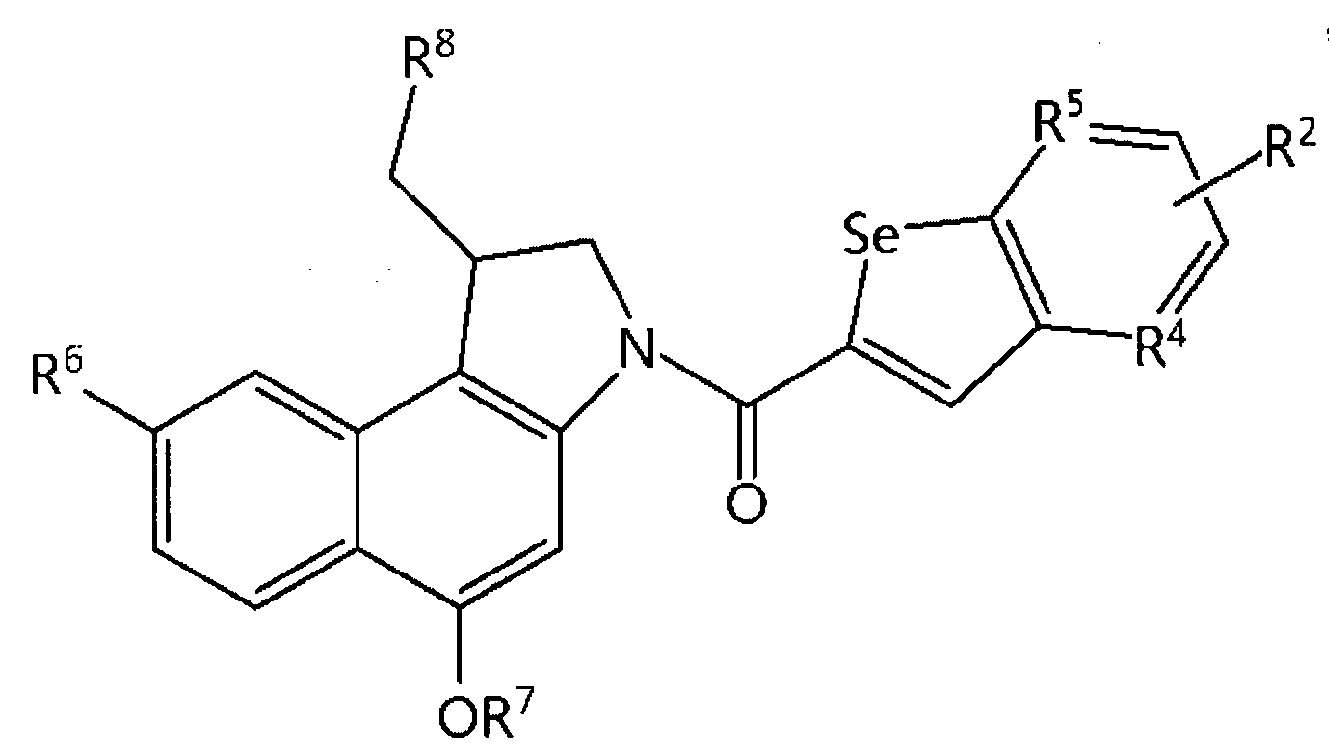 ,
,
[화학식 11]
[규칙 제91조에 의한 정정 03.12.2012]
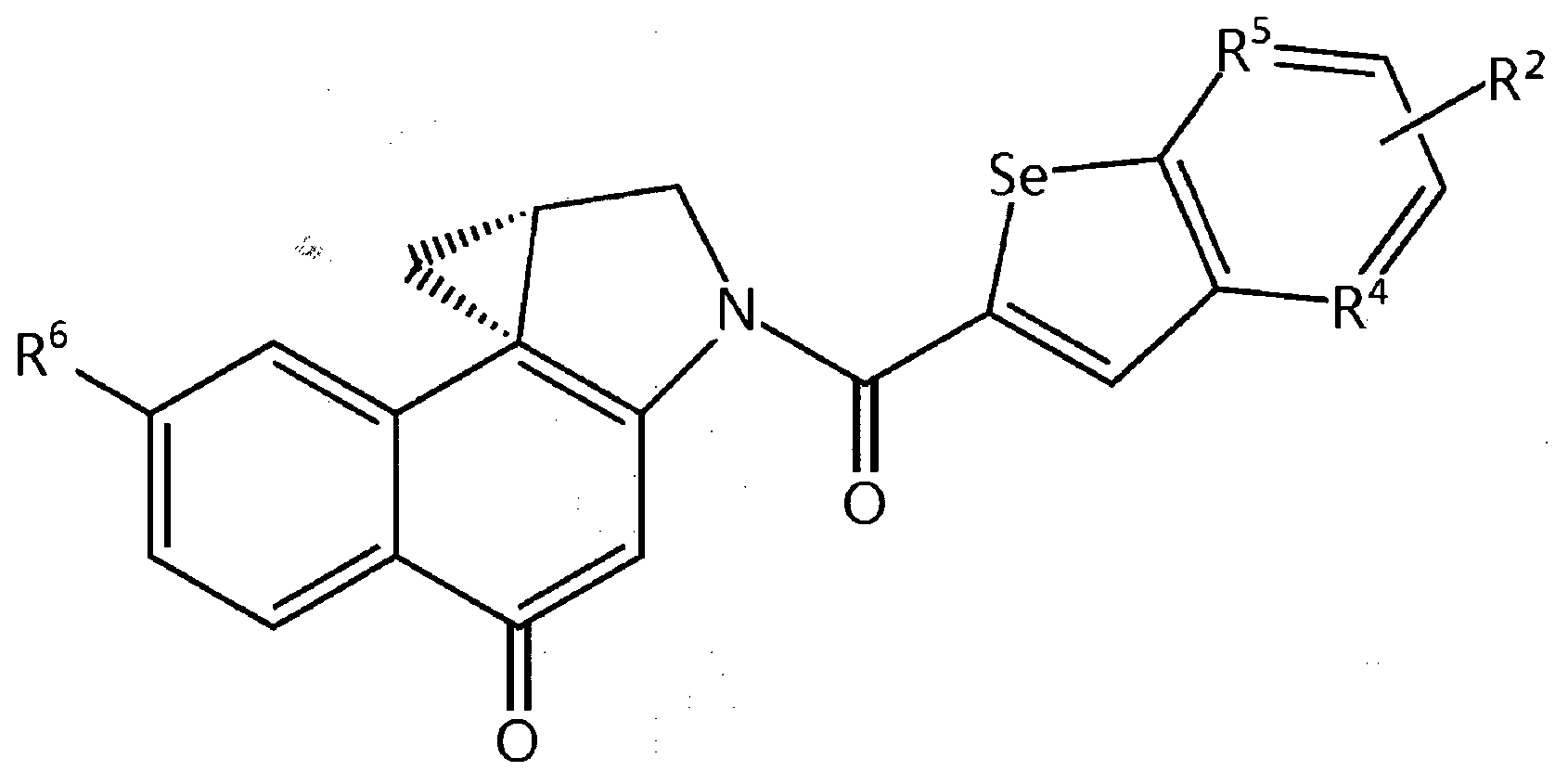
[화학식 12]
[규칙 제91조에 의한 정정 03.12.2012]
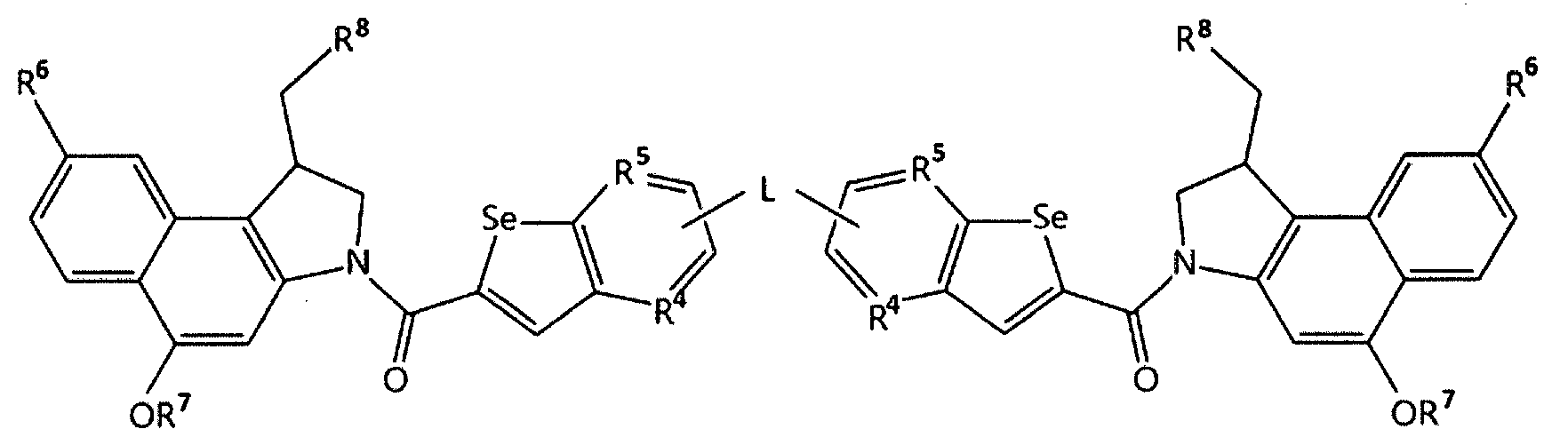
상기 식들 중,
R2는 H, -NO2, -NHCOR, CX3, -OR, -diOR, 치환될 수 있는 알킬기, 치환될 수 있는 알콕시기, 치환될 수 있는 알킬렌-디옥시기, 치환될 수 있는 아미노기, 할로기, 또는 하기 화학식 B로써 표시되는 치환기이고:
[화학식 B]

R4 및 R5는 각각 독립적으로 치환될 수 있는 C, O, N, S, 결합(bond) 또는 비결합이고,
R6은 H, 또는 치환될 수 있는 알콕시기이고,
R7는 H, -CONR17R20, 또는  이고,
이고,
R17 및 R20은 각각 독립적으로 H, 또는 치환될 수 있는 알킬기이고,
R21은 C, O, N, 또는 S이고,
R8는 할로기이고,
R9는 O, NH, S, 또는 Se이고,
R10은 치환될 수 있는 알킬기, 치환될 수 있는 알콕시기, 할로기, -NO2, 또는 -NHCOR이고,
L은 링커(linker)이고,
R은 H, 치환될 수 있는 알킬기, 치환될 수 있는 아릴기, 치환될 수 있는 아미노기, 치환될 수 있는 아미노산기, 치환될 수 있는 펩타이드기, 치환될 수 있는 C1-7의 알콕시기, 또는 치환될 수 있는 탄수화물 또는 탄수화물 유도체의 잔기임.
본원의 일 구현예에 따르면, 상기 링커는 -NHCO-R19-CONH-를 포함하는 것으로서, 상기 식 중 R19는 C1-7의 알킬기일 수 있으나, 이에 제한되는 것은 아니다. 예를 들어, 상기 링커는 -NHCO-CH2-CONH-, -NHCO-CH2CH2-CONH-, -NHCO-CH2CH2CH2-CONH-, -NHCO-CH2CH2CH2CH2-CONH-, -NHCO-CH2CH2CH2CH2CH2-CONH-, -NHCO-CH2CH2CH2CH2CH2CH2-CONH-, 또는 -NHCO-CH2CH2CH2CH2CH2CH2CH2-CONH-일 수 있으나, 이에 제한되는 것은 아니다.
예를 들어, 본원의 상기 화학식 12로써 표시되는 셀레노펜-접합 방향족 화합물은, 본원의 상기 화학식 10으로써 표시되는 셀레노펜-접합 방향족 화합물 2개를 좌우 대칭의 구조가 되도록 하여 상기 링커에 의하여 연결시킴으로써 제조할 수 있는 것이나, 이에 제한되는 것은 아니다.
본원의 제 2 측면은, 일반식 R11-CH2-Se-Se-CH2-R11로써 표시되는 디셀레나이드(diselenide) 화합물, 용매, 및 환원제를 포함하는 반응혼합물을 준비하고; 상기 반응혼합물에 하기 화학식 2a로써 표시되는 방향족 출발물질, 및 염기를 첨가하여 반응시키는 것을 포함하는, 하기 화학식 2로써 표시되는 셀레노펜-접합 방향족 화합물의 제조 방법을 제공한다:
[화학식 2a]

[화학식 2]

상기 식들 중,
Z는 -COR15, 또는 -CN이고,
R15은 -H, 치환될 수 있는 알킬기, 치환될 수 있는 아릴기, 또는 치환될 수 있는 알콕시기이고,
R3는 -H, -OH, -NH2, 치환될 수 있는 알킬기, 또는 치환될 수 있는 아릴기이고,
R11은 -CO2H, -CO2R, 4-NO2-Ph, 4-CN-Ph, 4-RO2C-Ph, 또는 4-X-Ph이고,
R12는 H, -NO2, -NHCOR, CX3, -OR, -diOR, 치환될 수 있는 알콕시기, 치환될 수 있는 알킬렌-디옥시기, 치환될 수 있는 아미노기, 또는 할로기이고,
X는 할로기이고,
R은 H, 치환될 수 있는 알킬기, 치환될 수 있는 아릴기, 치환될 수 있는 아미노기, 치환될 수 있는 아미노산기, 치환될 수 있는 펩타이드기, 치환될 수 있는 C1-7의 알콕시기, 또는 치환될 수 있는 탄수화물 또는 탄수화물 유도체의 잔기임.
본원의 일 구현예에 따르면, 상기 화학식 2a는 하기 화학식 3a를 포함하고, 상기 화학식 2는 하기 화학식 3을 포함하는 것일 수 있으나, 이에 제한되는 것은 아니다:
[화학식 3a]

[화학식 3]

상기 식들 중,
X, R11, 및 R12는 각각 상기 화학식 2a 및 화학식 2에서 정의된 바와 같음.
본원의 일 구현예에 따르면, 상기 화학식 2a는 하기 화학식 4a를 포함하고, 상기 화학식 2는 하기 화학식 4를 포함하는 것일 수 있으나, 이에 제한되는 것은 아니다:
[화학식 4a]

[화학식 4]

상기 식들 중,
X, R11, 및 R12는 각각 상기 화학식 2a 및 화학식 2에서 정의된 바와 같음.
본원의 일 구현예에 따르면, 상기 화학식 2a은 하기 화학식 5a를 포함하고, 상기 화학식 2는 하기 화학식 5를 포함하는 것일 수 있으나, 이에 제한되는 것은 아니다:
[화학식 5a]

[화학식 5]

상기 식들 중,
X, R11, 및 R12는 각각 상기 화학식 2a 및 화학식 2에서 정의된 바와 같음.
본원의 일 구현예에 따르면, 상기 화학식 2a는 하기 화학식 6a를 포함하고, 상기 화학식 2는 하기 화학식 6을 포함하는 것일 수 있으나, 이에 제한되는 것은 아니다:
[화학식 6a]

[화학식 6]
[규칙 제91조에 의한 정정 03.12.2012]
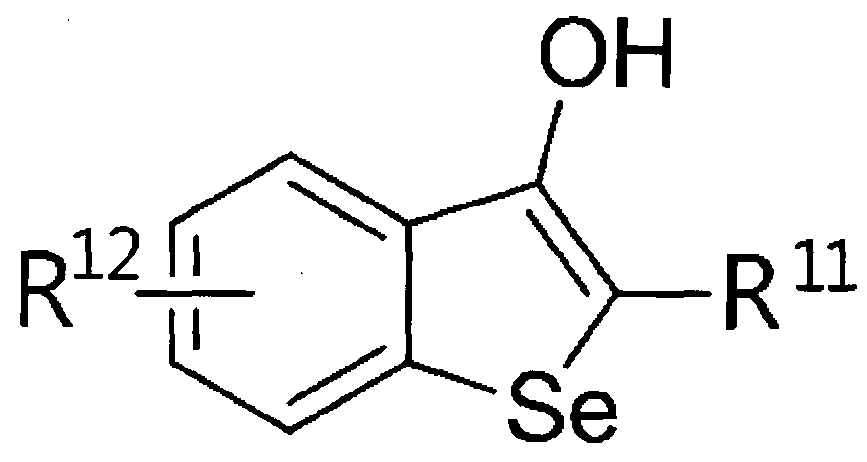 ,
,
상기 식들 중,
X, R11, 및 R12는 각각 상기 화학식 2a 및 화학식 2에서 정의된 바와 같음.
본원의 일 구현예에 따르면, 상기 염기는, 상기 반응혼합물에 상기 방향족 출발물질을 첨가한 후 순차적으로 첨가되는 것일 수 있으나, 이에 제한되는 것은 아니다. 예를 들어, 상기 셀레노펜-접합 방향족 화합물을 제조하는데 이용되는 상기 염기는, 상기 반응혼합물에 상기 방향족 출발물질을 첨가하여 교반한 뒤 순차적으로 첨가될 수 있으나, 이에 제한되는 것은 아니다. 상기 교반 시간은 10 분 또는 그 이상일 수 있으나, 이에 제한되는 것은 아니다. 상기 염기를 첨가함으로써 티올기를 함유하는 상기 환원제가 티올레이트 음이온(negatively charged thiolate, RS-)으로 전환되도록 하여, 그 환원력을 증진시킬 수 있다.
예를 들어, 상기 환원제로서 티올기를 함유하는 환원제를 이용하여 상기 티올레이트 음이온을 생성하는 반응은 하기 반응 메커니즘과 같이 도식화할 수 있다:
[규칙 제91조에 의한 정정 03.12.2012]
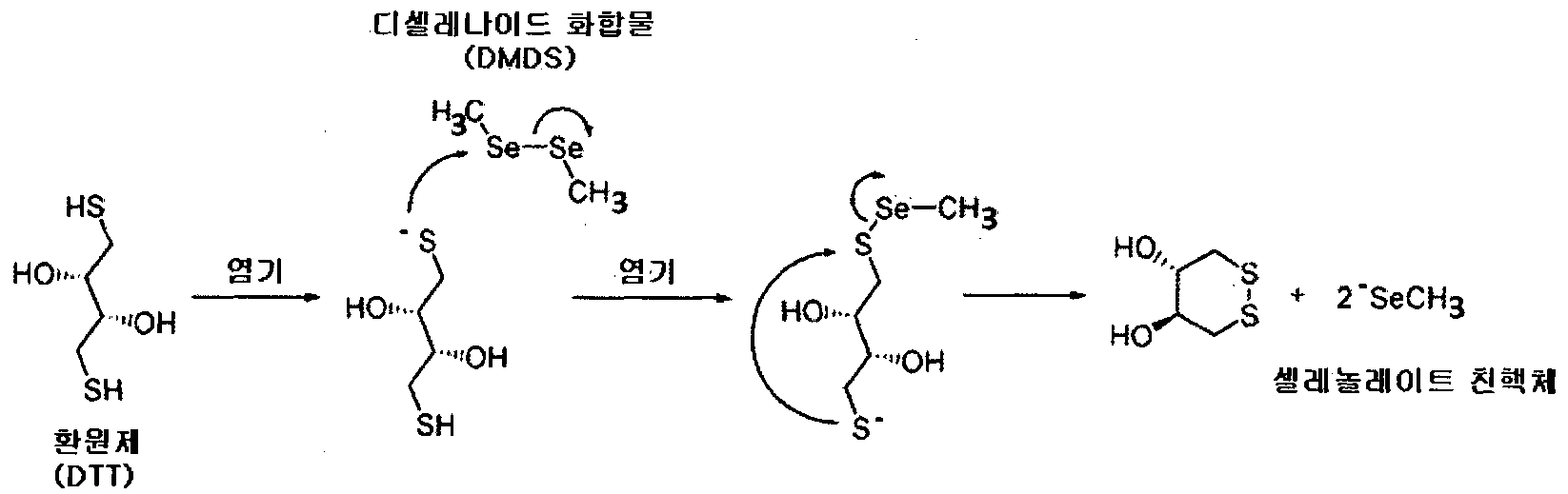
한편, 상기 티올레이트 음이온은 방향족 출발물질과 함께 존재하는 경우 셀레놀레이트 친핵체와 경쟁하면서 치환반응을 일으킬 수 있다는 문제점을 가지고 있다. 즉, 상기 반응의 첫 단계인 반응혼합물을 준비하는 단계에서부터 상기 염기를 첨가하거나, 또는 상기 방향족 출발물질과 함께 상기 염기를 상기 반응혼합물에 첨가하는 경우, 상기 티올레이트 음이온이 상기 방향족 출발물질보다는 상기 디셀레나이드 화합물과 먼저 반응함으로써 최종 목표 생성물의 수율을 저하시킬 수 있다. 따라서, 상기 방향족 출발물질을 첨가하고 일정 시간 교반한 뒤, 상기 염기를 반응 도중에 첨가함으로써 상기 문제를 해결하여, 상기 티올레이트 음이온이 상기 방향족 출발물질과 친핵성 치환 반응을 선택적으로 먼저 일으키도록 함으로써 최종 생성물의 수율을 향상시킬 수 있다.
상기와 같은 이유 때문에, 본원의 일 구현예에서는 상기 반응혼합물에 상기 방향족 출발물질을 첨가하여 교반한 뒤 상기 염기를 순차적으로 첨가하는 셀레노펜-접합 방향족 화합물의 제조 방법을 제공하나, 본원의 제조 방법이 이에 제한되는 것은 아니다. 예를 들어, 디셀레나이드 화합물, 용매, 및 환원제를 포함하는 상기 반응혼합물에 방향족 출발물질을 첨가하고 일정 시간 교반한 뒤 상기 염기를 첨가한 경우, 수분 이내에 상기 방향족 출발물질에 포함된 할로기 위치에서 친핵성 치환 반응이 선호되면서 원하는 반응 생성물인 셀레노펜-접합 방향족 화합물이 형성되는 것이 관찰되었다.
본원의 일 구현예에 따르면, 상기 용매는, 디메틸포름알데하이드(DMF), 디메틸설폭사이드(DMSO), 테트라하이드로푸란(THF), CH2Cl2, CH3CN, CH3NO2, CHCl3, ClCH2CH2Cl, 알코올류, 방향족 용매, 및 이들의 조합들로 이루어진 군에서 선택되는 것을 포함하는 것일 수 있으나, 이에 제한되는 것은 아니다. 예를 들어, 상기 알코올류는 메탄올, 에탄올, 프로판올, 또는 부탄올을 포함할 수 있으며, 상기 방향족 용매는 벤젠, 톨루엔, 또는 이들의 유도체를 포함할 수 있으나, 이에 제한되는 것은 아니다. 상기 용매는 상기 반응혼합물에 포함되는 상기 디셀레나이드 화합물, 및 상기 환원제를 용이하게 용해시킬 수 있는 것이라면 특별히 제한 없이 선택하여 사용할 수 있다.
본원의 일 구현예에 따르면, 상기 환원제는 티올기를 함유하는 것일 수 있으나, 이에 제한되는 것은 아니다. 예를 들어, 상기 환원제는 하나 이상 티올기를 함유하는 물질을 포함할 수 있으나, 이에 제한되는 것은 아니다. 예를 들어, 상기 환원제는 한 개 또는 두 개의 티올기를 함유하는 물질을 포함할 수 있으며, 예를 들어, 디티오트레이톨(dithiothreitol, DTT), 디티오트레이톨의 이성질체, 시스테인, N-아세틸시스테인, N-보크-시스테인(N-Boc-cysteine)과 유사한 시스테인의 유도체, 또는 1,4-부탄디티올 또는 1,6-핵산디티올 등의 알칸디티올을 포함하는 것일 수 있으나, 이에 제한되는 것은 아니다. 상기 셀레노펜-접합 방향족 화합물을 제조하기 위하여, 종래의 기술에서는, NaBH4, LiEt3BH 와 같은 티올기를 함유하지 않는 몇몇 환원제들을 이용하였다. 또한, 인듐, 란타늄, 및 사마륨(Indium, Lanthanum, and Samarium)과 같은 금속들 및 그들의 염을 이용하여 상기 디셀레나이드 화합물의 Se-Se 결합을 환원시켜 셀레놀레이트 친핵체를 생성하기도 하였다. 그러나, 상기한 종래의 방법들을 이용하여 셀레노펜-접합 방향족 화합물을 수득하는 것은 어려운데, 이들 방법을 이용할 경우 상기 디셀레나이드 화합물의 Se-Se 결합이 환원됨과 동시에 상기 방향족 출발물질의 다른 작용기가 환원되거나 변환될 수 있기 때문이다. 본원에서는, 상기한 종래의 방법들 대신에 상기한 바와 같은 티올기를 함유하는 물질을 환원제로 이용함으로써, 상기 방향족 출발물질의 다른 작용기가 환원되거나 변환되는 것을 방지하고, 상기 디셀레나이드 화합물의 Se-Se 결합이 선택적으로 환원될 수 있도록 하여, 결과적으로 원하는 반응 생성물의 수율을 현저하게 높일 수 있었다. 즉, 상기 환원제로서 티올기를 함유하는 물질을 이용함으로써, 상기 셀레노펜-접합 방향족 화합물의 수율을 높이고 불필요한 부반응을 최소화할 수 있다.
본원의 일 구현예에 따르면, 상기 염기는 K2CO3, KHCO3, Na2CO3, NaHCO3, NaOEt, NH4OH, DBU(1,8-diazabicyclo[5,4,0]undec-7-ene), KOH, NaOH, Ca(OH)2, Ba(OH)2, KOtBu, 및 이들의 조합들로 이루어진 군에서 선택되는 것을 포함하는 것일 수 있으나, 이에 제한되는 것은 아니다. 예를 들어, 상기 염기는 DBU(1,8-diazabicyclo[5,4,0]undec-7-ene), KOH, NaOH, Ca(OH)2, Ba(OH)2, KOtBu, 또는 이들의 조합들로 이루어진 군에서 선택되는 강염기일 수 있으나, 이에 제한되는 것은 아니다. 예를 들어, 상기 염기는 K2CO3, KHCO3, Na2CO3, NaHCO3, NaOEt, NH4OH, 또는 이들의 조합들로 이루어진 군에서 선택되는 약염기일 수 있으나, 이에 제한되는 것은 아니다. 상기 염기로서 어떤 물질을 선택하는지가 상기 셀레노펜-접합 방향족 화합물의 수율에 영향을 미칠 수 있다. 예를 들어, 상기 방향족 출발물질로서 전자 공여 치환기를 포함하는 물질을 사용하는 경우, NaOEt와 같은 약염기를 사용하면 원하는 생성물을 수득하기 어려운 반면 DBU와 같은 강염기를 사용하면 원하는 생성물을 높은 수율로 제조할 수 있으나, 이에 제한되는 것은 아니다.
본원의 일 구현예에 따르면, 상기 반응혼합물을 준비하는 것과 상기 반응혼합물에 상기 방향족 출발물질, 및 상기 염기를 첨가하여 반응시키는 것은 각각 독립적으로 실온 내지 약 100℃에서 수행되는 것일 수 있으나, 이에 제한되는 것은 아니다. 상기 반응 온도의 선정이 반응에서 원하는 생성물을 높은 수율로 수득하는 것에 직접적인 영향을 미치는 것은 아니며, 따라서 상기 반응 온도는 반응성을 크게 제한하지 않는 온도 범위가 아니라면 특별히 제한 없이 선택할 수 있다. 예를 들어, 상기 반응혼합물을 준비하여 실온에서 교반하고, 상기 반응혼합물에 상기 방향족 출발물질을 첨가하여 실온에서 일정 시간 동안 교반한 후, 상기 염기를 첨가하여 실온에서 교반함으로써 셀레노펜-접합 방향족 화합물을 제조할 수 있으나, 이에 제한되는 것은 아니다.
본원의 일 구현예에 따르면, 상기 반응혼합물에 포함된 상기 일반식 R11-CH2-Se-Se-CH2-R11으로써 표시되는 디셀레나이드 화합물은 상기 환원제에 의하여 환원되어 R11-CH2-Se-로써 표시되는 셀레놀레이트 친핵체(selenolate nucleophile)를 형성하고, 상기 셀레놀레이트 친핵체는 상기 방향족 출발물질과 친핵성 치환 반응하여 상기 셀레노펜-접합 방향족 화합물을 형성하는 것일 수 있으나, 이에 제한되는 것은 아니다. 상기 일 구현예에서 제공하는 반응 단계 중, 상기 디셀레나이드 화합물이 상기 환원제에 의하여 환원되어 상기 셀레놀레이트 친핵체를 형성하는 반응의 메커니즘은 하기 반응식과 같다. 예를 들어, 하기 반응식에서는 상기 디셀레나이드 화합물로서 디메틸디셀레나이드(dimethyldiselenide, DMDS), 상기 환원제로서 디티오트레이톨(dithiothreitol, DTT)을 이용하여 표시하였으나, 본원이 이에 제한되는 것은 아니다:
[규칙 제91조에 의한 정정 03.12.2012]
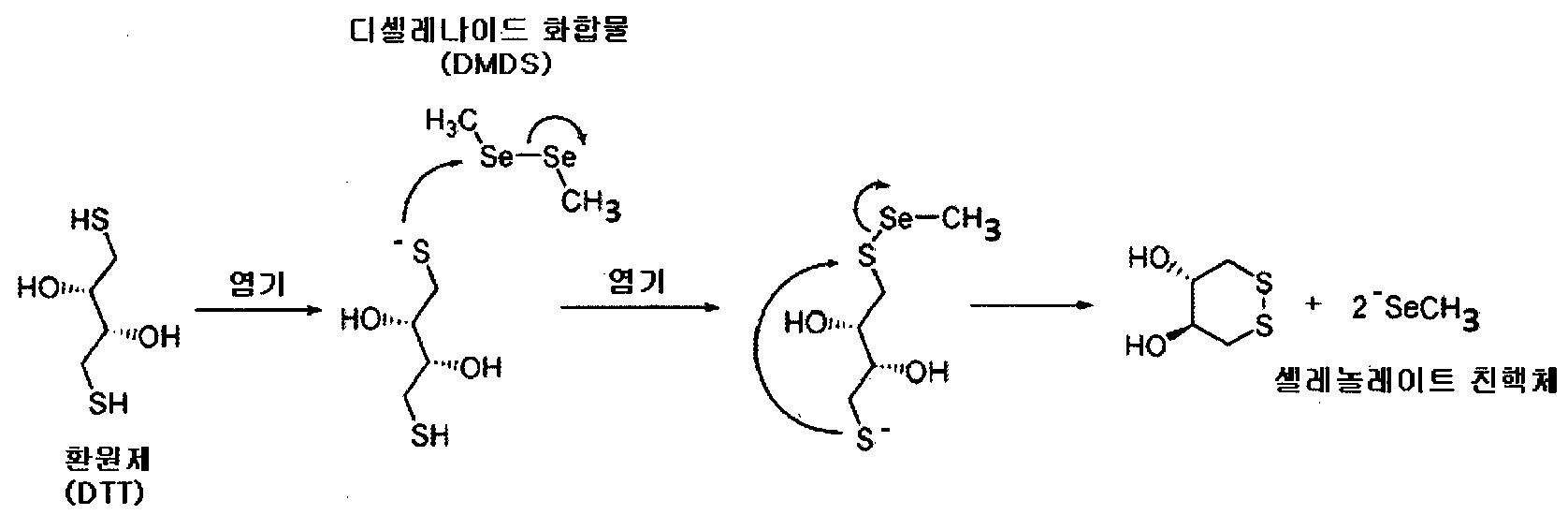
본원의 제 3 측면은, 하기 화학식 7a로써 표시되는 방향족 출발물질, 및 R11CH2X를 가열 반응시켜 하기 화학식 7b로써 표시되는 반응중간체를 형성하고; 상기 반응중간체에 용매, 및 염기를 첨가하여 반응시키는 것을 포함하는, 하기 화학식 7로써 표시되는 셀레노펜-접합 방향족(selenophene-fused aromatic) 화합물의 제조 방법을 제공한다:
[화학식 7a]
[규칙 제91조에 의한 정정 03.12.2012]
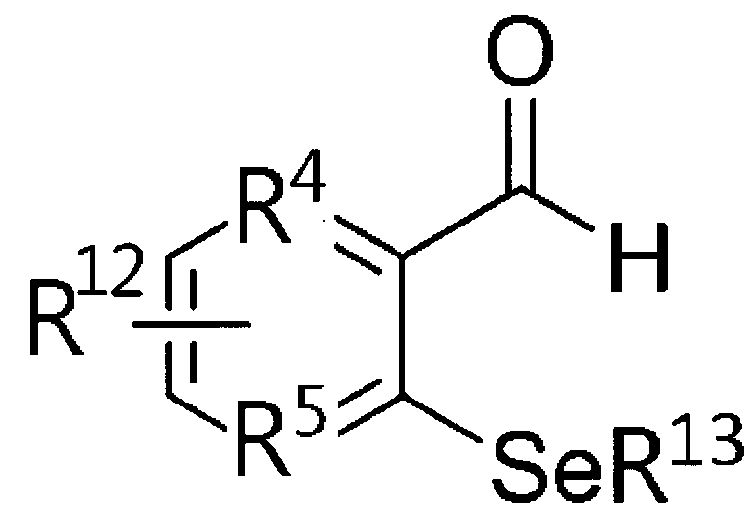 ,
,
[화학식 7b]
[규칙 제91조에 의한 정정 03.12.2012]
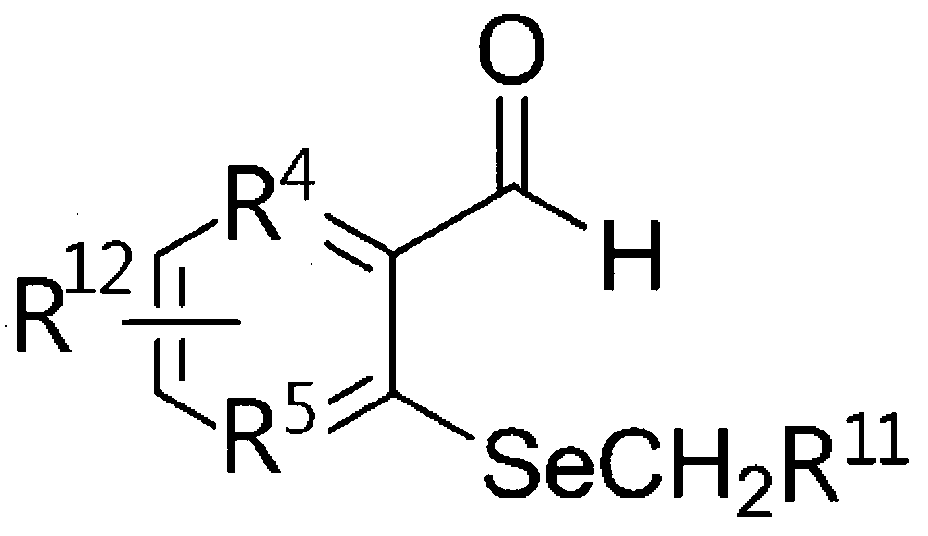 ,
,
[화학식 7]
[규칙 제91조에 의한 정정 03.12.2012]
 ,
,
상기 식들 중,
R4 및 R5는 각각 독립적으로 치환될 수 있는 N, O, S, C, 결합(bond) 또는 비결합이고,
R11은 -CO2H, -CO2R, 4-NO2-Ph, 4-CN-Ph, 4-RO2C-Ph, 또는 4-X-Ph이고,
R12는 H, -NO2, -NHCOR, CX3, -OR, -diOR, 치환될 수 있는 알콕시기, 치환될 수 있는 알킬렌-디옥시기, 치환될 수 있는 아미노기, 또는 할로기이고,
X는 할로기이고,
R13은 치환될 수 있는 알킬기이고,
R은 H, 치환될 수 있는 알킬기, 치환될 수 있는 아릴기, 치환될 수 있는 아미노기, 치환될 수 있는 아미노산기, 치환될 수 있는 펩타이드기, 치환될 수 있는 C1-7의 알콕시기, 또는 치환될 수 있는 탄수화물 또는 탄수화물 유도체의 잔기임.
여기에서, R4가 "결합(bond)"인 경우는, R4 양쪽에 위치한 두 탄소가 직접 탄소 결합으로 연결된 것을 의미하고, R5가 "결합(bond)"인 경우는, R5 양쪽에 위치한 두 탄소가 직접 탄소 결합으로 연결된 것을 의미한다.
본원의 제 3 측면에 따른 제조 방법과 본원의 제 2 측면에 따른 제조 방법을 비교할 경우 가장 눈에 띄는 차이점은, 본원의 제 3 측면에 따른 제조 방법의 경우에는 반응중간체가 형성된다는 점, 및 본원의 제 3 측면에 따른 제조 방법의 경우에는 환원제가 불필요하다는 점이다.
본원의 일 구현예에 따르면, 상기 화학식 7a는 하기 화학식 8a를 포함하고, 상기 화학식 7b는 하기 화학식 8b를 포함하며, 상기 화학식 7은 하기 화학식 8을 포함하는 것일 수 있으나, 이에 제한되는 것은 아니다:
[화학식 8a]

[화학식 8b]

[화학식 8]

상기 식들 중,
R11, R12, 및 R13은 각각 상기 화학식 7a, 화학식 7b, 및 화학식 7에서 정의된 바와 같음.
본원의 일 구현예에 따르면, 상기 화학식 7a는 하기 화학식 9a를 포함하고, 상기 화학식 7b는 하기 화학식 9b를 포함하며, 상기 화학식 7은 하기 화학식 9를 포함하는 것일 수 있으나, 이에 제한되는 것은 아니다:
[화학식 9a]

[화학식 9b]

[화학식 9]

상기 식들 중,
R4, R5, R11, R12, 및 R13은 각각 상기 화학식 7a, 화학식 7b, 및 화학식 7에서 정의된 바와 같음.
본원의 일 구현예에 따르면, 상기 염기는, 상기 반응중간체에 상기 용매를 첨가한 후 순차적으로 첨가되는 것일 수 있으나, 이에 제한되는 것은 아니다. 이처럼 상기 반응중간체에 상기 용매를 첨가한 후 상기 염기를 나중에 첨가함으로써, 티올기가 출발 물질에 의해 치환되는 부반응을 줄일 수 있다는 이점이 있다.
본원의 일 구현예에 따르면, 상기 용매는, 디메틸포름알데하이드(DMF), 디메틸설폭사이드(DMSO), 테트라하이드로푸란(THF), CH2Cl2, CH3CN, CH3NO2, CHCl3, ClCH2CH2Cl, 알코올류, 방향족 용매, 및 이들의 조합들로 이루어진 군에서 선택되는 것을 포함하는 것일 수 있으나, 이에 제한되는 것은 아니다. 예를 들어, 상기 알코올류는 메탄올, 에탄올, 프로판올, 또는 부탄올을 포함할 수 있으며, 상기 방향족 용매는 벤젠, 톨루엔, 또는 이들의 유도체를 포함할 수 있으나, 이에 제한되는 것은 아니다. 상기 용매는 상기 반응중간체 및 상기 염기를 용이하게 용해시킬 수 있는 것이라면 특별히 제한 없이 선택하여 사용할 수 있다.
본원의 일 구현예에 따르면, 상기 염기는 K2CO3, KHCO3, Na2CO3, NaHCO3, NaOEt, NH4OH, DBU(1,8-diazabicyclo[5,4,0]undec-7-ene), KOH, NaOH, Ca(OH)2, Ba(OH)2, KOtBu, 및 이들의 조합들로 이루어진 군에서 선택되는 것을 포함하는 것일 수 있으나, 이에 제한되는 것은 아니다. 예를 들어, 상기 염기는 DBU(1,8-diazabicyclo[5,4,0]undec-7-ene), KOH, NaOH, Ca(OH)2, Ba(OH)2, KOtBu, 또는 이들의 조합들로 이루어진 군에서 선택되는 강염기일 수 있으나, 이에 제한되는 것은 아니다. 예를 들어, 상기 염기는 K2CO3, KHCO3, Na2CO3, NaHCO3, NaOEt, NH4OH, 또는 이들의 조합들로 이루어진 군에서 선택되는 약염기일 수 있으나, 이에 제한되는 것은 아니다. 상기 염기로서 어떤 물질을 선택하는지가 상기 셀레노펜-접합 방향족 화합물의 수율에 영향을 미칠 수 있다. 예를 들어, 상기 방향족 출발물질로서 전자 공여 치환기를 포함하는 물질을 사용하는 경우, NaOEt와 같은 약염기를 사용하면 원하는 생성물을 수득하기 어려운 반면 DBU와 같은 강염기를 사용하면 원하는 생성물을 높은 수율로 제조할 수 있으나, 이에 제한되는 것은 아니다.
본원의 일 구현예에 따르면, 상기 반응중간체를 형성하기 위한 가열 반응은 약 100℃ 내지 약 150℃에서 수행되는 것일 수 있으나, 이에 제한되는 것은 아니다. 상기 반응중간체를 준비하기 위한 가열 반응을 약 100℃ 내지 약 150℃에서 수행하는 것은 반응이 원활하게 일어나 상기 반응중간체가 생성될 수 있도록 하기 위한 것이나, 이에 제한되는 것은 아니다.
본원의 제 4 측면은, 하기 화학식 10a로써 표시되는 MCBI(7-methoxy-1,2,9,9a-tetrahydrocyclopropa[c]benz[e]indol-4-one) 화합물, 및 하기 화학식 10b로써 표시되는 셀레늄-함유 방향족 화합물을 반응시키는 것을 포함하는, 하기 화학식 10으로써 표시되는 셀레노펜-접합 방향족 화합물의 제조 방법을 제공한다:
[화학식 10a]

[화학식 10b]

[화학식 10]

상기 식들 중,
R2는 치환될 수 있는 알킬기, 치환될 수 있는 알콕시기, 할로기, -NO2, -NHCOR, 또는 하기 화학식 B로써 표시되는 치환기이고,
R4 및 R5는 각각 독립적으로 치환될 수 있는 C, O, N, S, 결합(bond) 또는 비결합이고,
R6은 H, 또는 치환될 수 있는 알콕시기이고,
R7은 H, -CONR17R20, 또는  이고,
이고,
R17 및 R20은 각각 독립적으로 H, 또는 치환될 수 있는 알킬기이고,
R21은 C, O, N, 또는 S이고,
R8은 할로기이고,
R은 H, 치환될 수 있는 알킬기, 치환될 수 있는 아릴기, 치환될 수 있는 아미노기, 치환될 수 있는 아미노산기, 치환될 수 있는 펩타이드기, 치환될 수 있는 C1-7의 알콕시기, 또는 치환될 수 있는 탄수화물 또는 탄수화물 유도체의 잔기임:
[화학식 B]

상기 식 중,
R9는 O, NH, S, 또는 Se이고,
R10은 치환될 수 있는 알킬기, 치환될 수 있는 알콕시기, 치환될 수 있는 할로기, -NO2, 또는 -NHCOR이고,
R은 H, 치환될 수 있는 알킬기, 치환될 수 있는 아릴기, 치환될 수 있는 아미노기, 치환될 수 있는 아미노산기, 치환될 수 있는 펩타이드기, 치환될 수 있는 C1-7의 알콕시기, 또는 치환될 수 있는 탄수화물 또는 탄수화물 유도체의 잔기임.
예를 들어, 본원의 상기 화학식 10으로써 표시되는 셀레노펜-접합 방향족 화합물은, 상기 화학식 10a로써 표시되는 MCBI의 NH 부분과 상기 화학식 10b로써 표시되는 셀레늄-함유 방향족 화합물의 카르복시기 부분을 EDCI 및 용매 하에서 축합 중합 반응시킴으로써 용이하게 제조될 수 있으나, 이에 제한되는 것은 아니다. 이와 같이 본원에 따라 상기 셀레노펜-접합 방향족 화합물을 용이하고 경제적으로 제조함으로써, 상기 셀레노펜-접합 방향족 화합물의 상용화를 촉진할 수 있다.
본원의 일 구현예에 따르면, 상기 화학식 10a로써 표시되는 MCBI 화합물은, 하기 화학식 10c로써 표시되는 MCBI 화합물로부터 산성 조건 하에서 제조되는 것을 포함하는 것일 수 있으나, 이에 제한되는 것은 아니다:
[화학식 10c]

상기 식 중,
R6, R7, 및 R8은 각각 상기 화학식 10a에서 정의된 바와 같음.
상기 화학식 10c로써 표시되는 MCBI 화합물은 "Boc-MCBI 화합물"에 포함되는 것이고, 상기 화학식 10a로써 표시되는 MCBI 화합물은 "seco-MCBI 화합물"에 포함되는 것이다. 예를 들어, 상기 seco-MCBI 화합물은 상기 Boc-MCBI 화합물을 출발물질로 하여 통상의 방법에 따라 제조될 수 있는 것이나, 이에 제한되는 것은 아니다. 예를 들어, 상기 seco-MCBI 화합물은 상기 Boc-MCBI 화합물에 HCl 및 EtOAc을 처리하여 반응시킴으로써 용이하게 제조될 수 있는 것이나, 이에 제한되는 것은 아니다.
본원의 일 구현예에 따르면, 상기 화학식 10a로써 표시되는 MCBI 화합물이 상기 화학식 10c로써 표시되는 MCBI 화합물로부터 제조되는 과정은 산성 조건에서 수행되는 것일 수 있으나, 이에 제한되는 것은 아니다. 예를 들어, 상기 산성 조건은 HCl 등의 유기산을 처리함으로써 조성할 수 있는 것이나, 이에 제한되는 것은 아니다.
본원의 일 구현예에 따르면, 상기 화학식 10b로써 표시되는 셀레늄-함유 방향족 화합물은, 하기 화학식 10d로써 표시되는 셀레늄-함유 방향족 화합물로부터 염기성 조건 하에서 제조되는 것을 포함하는 것일 수 있으나, 이에 제한되는 것은 아니다:
[화학식 10d]

상기 식 중,
R2, R4, 및 R5는 상기 화학식 10b에서 정의된 바와 같으며,
R18은 치환될 수 있는 알킬기, 치환될 수 있는 알콕시기, -NO2, 또는 -NHCO2H임.
R18은 알킬기, 알콕시기, -NO2, 또는 -NHCO2H일 수 있으나, 이에 제한되는 것은 아니다. 예를 들어, 상기 화학식 10b로써 표시되는 셀레늄-함유 방향족 화합물은, 상기 화학식 10d로써 표시되는 셀레늄-함유 방향족 화합물의 -CO2R18 부분을 가수분해 함으로써 용이하게 제조될 수 있는 것이나, 이에 제한되는 것은 아니다. 예를 들어, 상기 가수분해를 수행하기 위하여 LiOH 및 THF-H2O-MeOH를 처리하여 반응시킬 수 있으나, 이에 제한되는 것은 아니다.
본원의 일 구현예에 따르면, 상기 화학식 10b로써 표시되는 셀레늄-함유 방향족 화합물이 상기 화학식 10d로써 표시되는 셀레늄-함유 방향족 화합물로부터 제조되는 과정은 염기성 조건에서 수행되는 것일 수 있으나, 이에 제한되는 것은 아니다. 예를 들어, 상기 염기성 조건은 LiOH 등의 염기성 물질을 처리함으로써 조성할 수 있는 것이나, 이에 제한되는 것은 아니다.
본원의 일 구현예에 따르면, 상기 화학식 10a로써 표시되는 MCBI 화합물과 상기 화학식 10b로써 표시되는 셀레늄-함유 방향족 화합물을 반응시키는 것은 EDCI 존재 하에서 수행되는 것을 포함하는 것일 수 있으나, 이에 제한되는 것은 아니다.
본원의 일 구현예에 따르면, 상기 화학식 10a로써 표시되는 MCBI 화합물과 상기 화학식 10b로써 표시되는 셀레늄-함유 방향족 화합물을 반응시키는 것은 용매에 상기 MCBI 화합물을 용해시킨 후 수행되는 것을 포함하는 것일 수 있으나, 이에 제한되는 것은 아니다.
본원의 일 구현예에 따르면, 상기 용매는 디메틸포름알데하이드(DMF), 디메틸설폭사이드(DMSO), 테트라하이드로푸란(THF), CH2Cl2, CH3CN, CH3NO2, CHCl3, ClCH2CH2Cl, 알코올류, 방향족 용매, 및 이들의 조합들로 이루어진 군에서 선택되는 것을 포함하는 것일 수 있으나, 이에 제한되는 것은 아니다. 예를 들어, 상기 알코올류는 메탄올, 에탄올, 프로판올, 또는 부탄올을 포함할 수 있으며, 상기 방향족 용매는 벤젠, 톨루엔, 또는 이들의 유도체를 포함할 수 있으나, 이에 제한되는 것은 아니다. 상기 용매는 상기 MCBI 화합물을 용이하게 용해시킬 수 있는 것이라면 특별히 제한 없이 선택하여 사용할 수 있다.
본원의 제 5 측면은, 하기 화학식 11a로써 표시되는 MCBI 화합물, 및 하기 화학식 11b로써 표시되는 셀레늄-함유 방향족 화합물을 반응시키는 것을 포함하는, 하기 화학식 11로써 표시되는 셀레노펜-접합 방향족 화합물의 제조 방법을 제공한다:
[화학식 11a]

[화학식 11b]

[화학식 11]

상기 식들 중,
R2는 치환될 수 있는 알킬기, 치환될 수 있는 알콕시기, 할로기, -NO2, -NHCOR, 또는 하기 화학식 B로써 표시되는 치환기이고,
R4 및 R5는 각각 독립적으로 치환될 수 있는 C, O, N, S, 결합(bond) 또는 비결합이고,
R6은 H 또는 치환될 수 있는 알콕시기이고,
R은 H, 치환될 수 있는 알킬기, 치환될 수 있는 아릴기, 치환될 수 있는 아미노기, 치환될 수 있는 아미노산기, 치환될 수 있는 펩타이드기, 치환될 수 있는 C1-7의 알콕시기, 또는 치환될 수 있는 탄수화물 또는 탄수화물 유도체의 잔기임:
[화학식 B]

상기 식 중,
R9는 O, NH, S, 또는 Se이고,
R10은 치환될 수 있는 알킬기, 치환될 수 있는 알콕시기, 할로기, -NO2, 또는 -NHCOR이고,
R은 H, 치환될 수 있는 알킬기, 치환될 수 있는 아릴기, 치환될 수 있는 아미노기, 치환될 수 있는 아미노산기, 치환될 수 있는 펩타이드기, 치환될 수 있는 C1-7의 알콕시기, 또는 치환될 수 있는 탄수화물 또는 탄수화물 유도체의 잔기임.
예를 들어, 본원의 제 5 측면의 상기 화학식 11로써 표시되는 셀레노펜-접합 방향족 화합물은, 상기 화학식 11a로써 표시되는 MCBI의 NH 부분과 상기 화학식 11b로써 표시되는 셀레늄-함유 방향족 화합물의 카르복시기 부분을 EDCI 및 용매 하에서 축합 중합 반응시킴으로써 용이하게 제조될 수 있으나, 이에 제한되는 것은 아니다. 이와 같이 본원에 따라 상기 셀레노펜-접합 방향족 화합물을 용이하고 경제적으로 제조함으로써, 상기 셀레노펜-접합 방향족 화합물의 상용화를 촉진할 수 있다.
본원의 일 구현예에 따르면, 상기 화학식 11a로써 표시되는 MCBI 화합물은, 하기 화학식 11c로써 표시되는 MCBI 화합물로부터 산성 조건 하에서 제조되는 것을 포함하는 것일 수 있으나, 이에 제한되는 것은 아니다:
[화학식 11c]

상기 식 중,
R6은 상기 화학식 11a에서 정의된 바와 같음.
상기 화학식 11c로써 표시되는 MCBI 화합물은 "Boc-MCBI 화합물"에 포함되는 것이고, 상기 화학식 11a로써 표시되는 MCBI 화합물은 "seco-MCBI 화합물"에 포함되는 것이다. 예를 들어, 상기 seco-MCBI 화합물은 상기 Boc-MCBI 화합물을 출발물질로 하여 통상의 방법에 따라 제조될 수 있는 것이나, 이에 제한되는 것은 아니다. 예를 들어, 상기 seco-MCBI 화합물은 상기 Boc-MCBI 화합물에 HCl 및 EtOAc을 처리하여 반응시킴으로써 용이하게 제조될 수 있는 것이나, 이에 제한되는 것은 아니다.
본원의 일 구현예에 따르면, 상기 화학식 11a로써 표시되는 MCBI 화합물이 상기 화학식 11c로써 표시되는 MCBI 화합물로부터 제조되는 과정은 산성 조건에서 수행되는 것일 수 있으나, 이에 제한되는 것은 아니다. 예를 들어, 상기 산성 조건은 HCl 등의 유기산을 처리함으로써 조성할 수 있는 것이나, 이에 제한되는 것은 아니다.
본원의 일 구현예에 따르면, 상기 화학식 11b로써 표시되는 셀레늄-함유 방향족 화합물은, 하기 화학식 11d로써 표시되는 셀레늄-함유 방향족 화합물로부터 염기성 조건 하에서 제조되는 것을 포함하는 것일 수 있으나, 이에 제한되는 것은 아니다:
[화학식 11d]

상기 식 중,
R2, R4, 및 R5는 각각 상기 화학식 11b에서 정의된 바와 같으며,
R18은 치환될 수 있는 알킬기, 치환될 수 있는 알콕시기, -NO2, 또는 -NHCO2H임.
R18은 알킬기, 알콕시기, -NO2, 또는 -NHCO2H일 수 있으나, 이에 제한되는 것은 아니다. 예를 들어, 상기 화학식 11b로써 표시되는 셀레늄-함유 방향족 화합물은, 상기 화학식 11d로써 표시되는 셀레늄-함유 방향족 화합물의 -CO2R18 부분을 가수분해 함으로써 용이하게 제조될 수 있는 것이나, 이에 제한되는 것은 아니다. 예를 들어, 상기 가수분해를 수행하기 위하여 LiOH 및 THF-H2O-MeOH를 처리하여 반응시킬 수 있으나, 이에 제한되는 것은 아니다.
본원의 일 구현예에 따르면, 상기 화학식 11b로써 표시되는 셀레늄-함유 방향족 화합물이 상기 화학식 11d로써 표시되는 셀레늄-함유 방향족 화합물로부터 제조되는 과정은 염기성 조건에서 수행되는 것일 수 있으나, 이에 제한되는 것은 아니다. 예를 들어, 상기 염기성 조건은 LiOH 등의 염기성 물질을 처리함으로써 조성할 수 있는 것이나, 이에 제한되는 것은 아니다.
본원의 일 구현예에 따르면, 상기 화학식 11a로써 표시되는 MCBI 화합물과 상기 화학식 11b로써 표시되는 셀레늄-함유 방향족 화합물을 반응시키는 것은 EDCI 존재 하에서 수행되는 것을 포함하는 것일 수 있으나, 이에 제한되는 것은 아니다.
본원의 일 구현예에 따르면, 상기 화학식 11a로써 표시되는 MCBI 화합물과 상기 화학식 11b로써 표시되는 셀레늄-함유 방향족 화합물을 반응시키는 것은 용매에 상기 MCBI 화합물을 용해시킨 후 수행되는 것을 포함하는 것일 수 있으나, 이에 제한되는 것은 아니다.
본원의 일 구현예에 따르면, 상기 용매는 디메틸포름알데하이드(DMF), 디메틸설폭사이드(DMSO), 테트라하이드로푸란(THF), CH2Cl2, CH3CN, CH3NO2, CHCl3, ClCH2CH2Cl, 알코올류, 방향족 용매, 및 이들의 조합들로 이루어진 군에서 선택되는 것을 포함하는 것일 수 있으나, 이에 제한되는 것은 아니다. 예를 들어, 상기 알코올류는 메탄올, 에탄올, 프로판올, 또는 부탄올을 포함할 수 있으며, 상기 방향족 용매는 벤젠, 톨루엔, 또는 이들의 유도체를 포함할 수 있으나, 이에 제한되는 것은 아니다. 상기 용매는 상기 MCBI 화합물을 용이하게 용해시킬 수 있는 것이라면 특별히 제한 없이 선택하여 사용할 수 있다.
본원의 제 6 측면은, 본원의 제 1 측면에 따른 셀레노펜-접합 방향족 화합물을 포함하는, 항-박테리아(Anti-bacterial) 조성물을 제공한다. 상기 셀레노펜-접합 방향족 화합물이 항-박테리아 특성을 가지는 경우, 의약품의 중간체 또는 완성체로서 사용될 수 있다.
본원의 제 7 측면은, 본원의 제 1 측면에 따른 셀레노펜-접합 방향족 화합물을 포함하며, 용매에 따라 발색이 달라지는 지시약으로서 사용될 수 있는, 지시약 조성물을 제공한다. 용매에 따라 발색이 달라지는 특성은 용제변색(solvatochromic)이라고 하며, 상기 용제변색 특성을 가지는 물질의 경우 지시약, 용제변색 잉크 등의 용도로 활용될 수 있다. 상기 용제변색 특성을 가지는 상기 셀레노펜-접합 방향족 화합물로는, 예를 들어, 하기의 화합물을 들 수 있다. 용제변색 특성을 가져 지시약으로서 사용될 수 있는 하기 화합물은, 본원의 실시예에 기재한 [표 1]에서 엔트리 17에 해당되는 화합물이다:

이와 관련하여, 본원의 도 4는, 본원의 실시예 중 엔트리 17에 따라 제조된 셀레노펜-접합 방향족 화합물의 용제변색 특성을 보여주는 흡수스펙트럼이며, 스펙트럼 측정시 화합물의 농도는 60.4 μM 이었다.
본원의 제 8 측면은, 본원의 제 1 측면에 따른 셀레노펜-접합 방향족 화합물을 포함하는, 형광 조성물을 제공한다. 형광 특성을 가지는 상기 셀레노펜-접합 방향족 화합물은 유기반도체 합성의 중간체로서 사용될 수 있다. 상기 형광 특성을 가지는 상기 셀레노펜-접합 방향족 화합물로는, 예를 들어, 하기의 화합물을 들 수 있다. 형광 특성을 가져 유기반도체 합성의 중간체로서 사용될 수 있는 하기 화합물은, 각각, 본원의 실시예에 기재한 [표 2]의 엔트리 26, 27, 및 30에 해당되는 화합물이다:

이와 관련하여, 본원의 도 1 내지 도 3 각각은, 본원의 실시예 중 엔트리 26, 엔트리 27, 및 엔트리 30에 따라 제조된 셀레노펜-접합 방향족 화합물 각각의 형광 특성을 보여주는 스펙트럼이다.
본원의 제 9 측면은, 본원의 제 1 측면에 따른 셀레노펜-접합 방향족 화합물을 포함하는, 항암 조성물을 제공한다. 상기 셀레노펜-접합 방향족 화합물이 항암 특성을 가지는 경우, 의약품의 중간체 또는 완성체로서 사용될 수 있다. 상기 셀레노펜-접합 방향족 화합물은 DNA 알킬레이팅(alkylating)을 통하여 항암 효과를 나타낼 수 있으며, 다양한 암세포들에 대하여 세포 독성 실험을 수행해본 결과 IC50이 nM 또는 pM 단위로서 매우 강력한 항암 효과를 나타냄이 확인되었다. 이에 대해서는 본원의 실시예에 구체적으로 기재하였다. 또한, 적용 가능한 암의 종류도 유방암, 중추신경계암, 결장암, 비소세포폐암, 신장암, 전립선암, 난소암 등으로 다양하여, 향후 본원에 따른 상기 셀레노펜-접합 방향족 화합물은 각종 암에 대한 항암제로서 유용하게 사용될 수 있을 것으로 예상된다.
이하, 본원에 대하여 실시예를 이용하여 보다 더 구체적으로 설명하지만, 본원이 이에 제한되는 것은 아니다.
[실시예]
본 실시예에서 이용된 모든 시약들은 일반적으로 시판되는 것을 사용한 것이며, 구체적인 기재가 없는 경우는 특별한 정제 없이 사용한 것이다.
1. 본원 제 2 측면에 따른 셀레노펜-접합 방향족 화합물 제조 방법
본 실시예에 있어서, 본원 제 2 측면에 따른 셀레노펜-접합 방향족 화합물의 제조는 구체적으로 하기와 같이 수행되었다.
우선, 반응혼합물을 준비하기 위하여, 일반식 R11-CH2-Se-Se-CH2-R11로써 표시되는 디셀레나이드 화합물, 용매, 및 환원제 각각을 준비하였다. 상기 반응혼합물 중 상기 일반식 R11-CH2-Se-Se-CH2-R11로써 표시되는 디셀레나이드 화합물로는 (SeCH2COOEt)2, (p-NO2PhCH2Se)2, (p-CNPhCH2Se)2 등 다양한 물질을 사용하였으며, 구체적인 상기 디셀레나이드 화합물은 [표 1]에 나타내었다. 상기 디셀레나이드 화합물은 0.6 당량 사용하였다. 상기 용매로는 무수 디메틸포름알데하이드(DMF)를 사용하였다. 또한, 상기 환원제로는 0.6 당량의 디티오트레이톨(dithiothreitol, DTT)을 사용하였다.
보다 구체적으로, 상기 용매 2 mL에 상기 일반식 R11-CH2-Se-Se-CH2-R11로써 표시되는 디셀레나이드 화합물과 상기 환원제를 첨가하여 상기 반응혼합물을 준비하였다. 상기 반응혼합물은 1 시간 동안 교반되었으며, 교반시 온도는 60℃로 유지하였다.
상기 반응혼합물을 준비한 뒤, 상기 셀레노펜-접합 방향족 화합물을 제조하기 위한 출발물질인 방향족 화합물이 상기 반응혼합물에 한번에 첨가되었으며, 30 분 동안 교반되었다. 교반시 온도는 이 경우에도 60℃로 유지하였다.
상기 반응혼합물에 상기 출발물질을 첨가하고 교반시킨 후에 첨가하게 되는 상기 염기로서 약염기인 K2CO3를 사용하였다. 상기 염기는 실온에서 2.5 당량 만큼이 상기 반응혼합물에 첨가되었으며, 24 시간 동안 교반되었다. 상기 교반 시 온도는 이 경우에도 60℃로 유지하였다.
상기 염기를 첨가하고 교반을 마친 뒤에, 상기 출발물질이 완전히 소모되었음을 에틸아세테이트 : 헥산(ethyl actate: hexane, EA: Hex) 혼합물 내에서 박막 크로마토그래피(TLC, thin layer chromatography)를 이용하여 확인하였다. 상기 반응혼합물에 포함된 상기 용매는 진공 하에서 제거되었고, 미정제 고체(crude solid)는 디클로로메탄 : 물 (1 : 1) 용매 25 mL를 이용하여 3회 추출하였다. 상기 추출 과정을 통하여 수집된 유기상은 무수 환경에서 MgSO4를 이용하여 건조되었으며, 상기 용매는 진공에서 증발되었다. 상기 잔류물은 실리카겔 컬럼을 이용하는 컬럼 크로마토그래피에 의하여 정제되었다. 순수한 생성물, 즉 본 실시예에서 제조하는 셀레노펜-접합 방향족 화합물은 에틸 아세테이트 및 헥산을 이용하여 용리되었으며, 메탄올을 이용하여 재결정화된 후 걸러졌다.
본 실시예에 있어서, 엔트리 1 내지 17의 셀레노펜-접합 방향족 화합물의 제조 과정을 스킴(scheme)으로써 나타낸 것은 하기와 같다. 이때 하기 '엔트리'라는 용어는 사용된 상기 방향족 출발물질 및 상기 디셀레나이드 화합물에 따라 본 실시예를 세분화한 것으로서, 구체적으로 어떠한 방향족 출발물질과 디셀레나이드 화합물이 사용되었는지는 [표 1]에 나타내었다:
[스킴 1] 엔트리 1 내지 엔트리 11
[규칙 제91조에 의한 정정 03.12.2012]

[스킴 2] 엔트리 12 및 엔트리 13
[규칙 제91조에 의한 정정 03.12.2012]
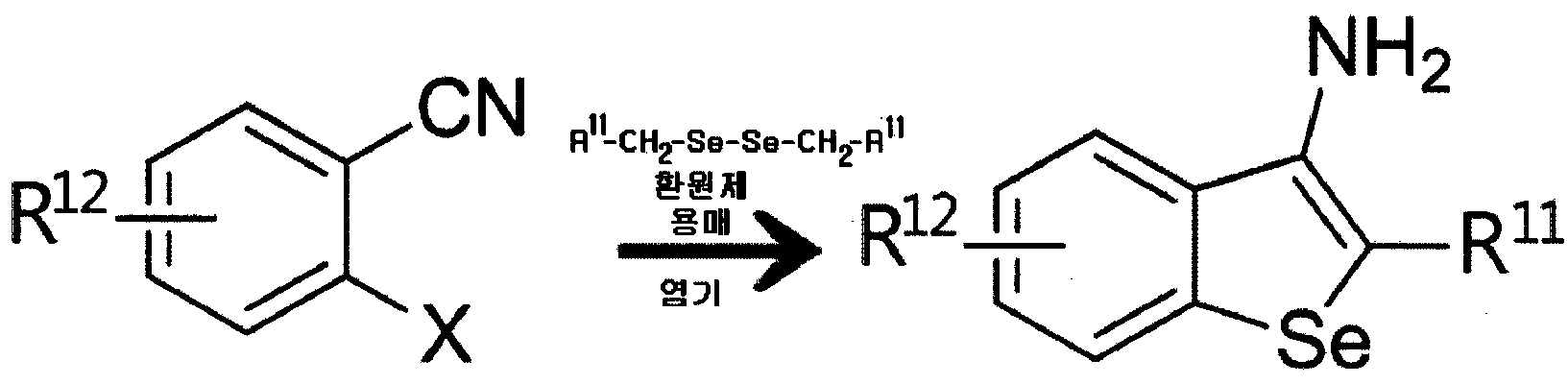
[스킴 3] 엔트리 14 및 엔트리 15
[규칙 제91조에 의한 정정 03.12.2012]
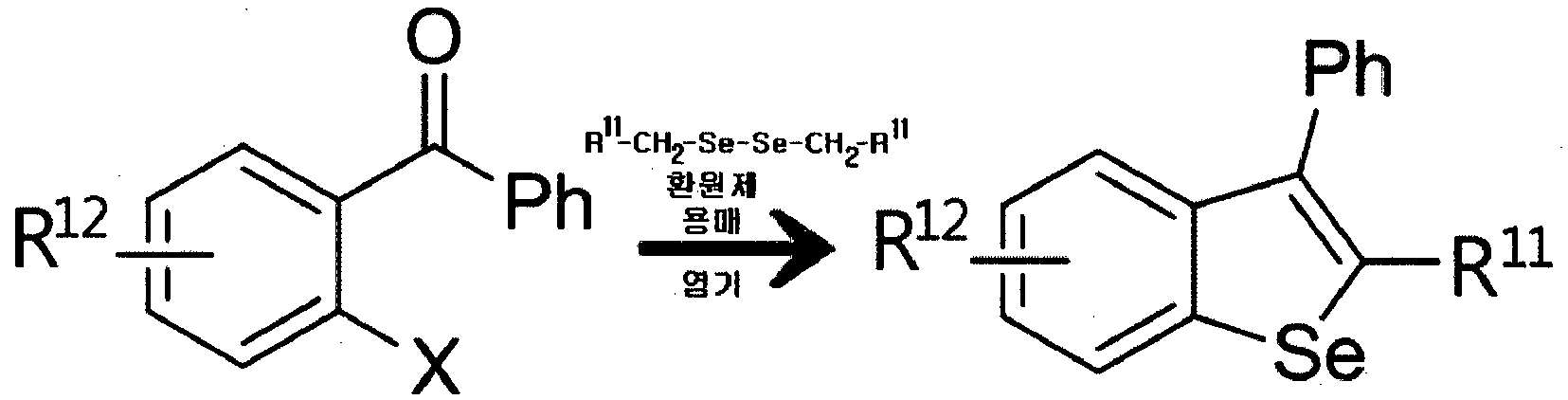
[스킴 4] 엔트리 16 및 엔트리 17
[규칙 제91조에 의한 정정 03.12.2012]
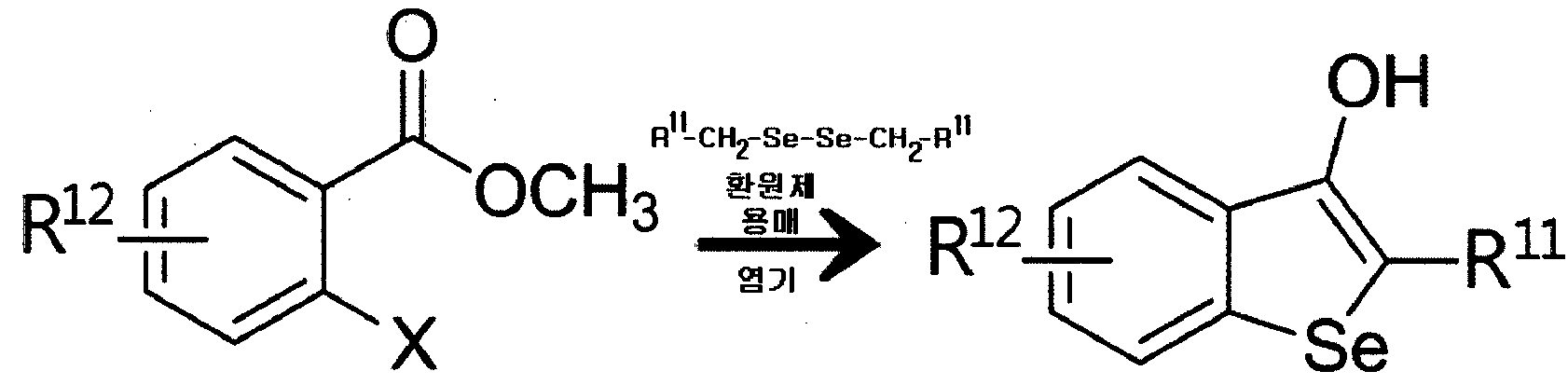
2. 본원 제 3 측면에 따른 셀레노펜-접합 방향족 화합물 제조 방법
본 실시예에 있어서, 본원 제 3 측면에 따른 셀레노펜-접합 방향족 화합물의 제조는 구체적으로 하기와 같이 수행되었다.
우선, 반응중간체를 형성하기 위하여, 방향족 출발물질과 R11CH2X를 준비하였다. 상기 방향족 출발물질은 1 당량 사용하였고, 상기 R11CH2X는 20 당량 사용하였으며, 구체적인 방향족 출발물질의 종류와 R11CH2X의 화학식은 [표 2]에 나타내었다.
상기 반응중간체를 형성하기 위하여, 상기 방향족 출발물질과 상기 R11CH2X의 혼합물을 가열 박스에 넣고 130℃에서 17 시간 동안 가열하였다. 그 후, 용액을 냉각하고, 진공 조건에서 용매를 제거함으로써 고형물 형태의 상기 반응중간체를 수득하였다.
이후, 상기 반응중간체를 용매인 무수 DMF에 용해시켰으며, 약염기인 K2CO3를 2.5 당량만큼 첨가한 뒤 실온에서 24 시간 동안 교반하였다.
상기 염기를 첨가하고 교반을 마친 뒤에, 상기 출발물질이 완전히 소모되었음을 에틸아세테이트:헥산(ethyl actate:hexane, EA:Hex) 혼합물 내에서 박막 크로마토그래피(TLC, thin layer chromatography)를 이용하여 확인하였다. 상기 반응혼합물에 포함된 상기 용매는 진공 하에서 제거되었고, 미정제 고체(crude solid)는 디클로로메탄:물 (1:1) 용매 25 mL를 이용하여 3 회 추출하였다. 상기 추출 과정을 통하여 수집된 유기상은 무수 환경에서 MgSO4를 이용하여 건조되었으며, 상기 용매는 진공에서 증발되었다. 상기 잔류물은 실리카겔 컬럼을 이용하는 컬럼 크로마토그래피에 의하여 정제되었다. 순수한 생성물, 즉 본 실시예에서 제조한 셀레노펜-접합 방향족 화합물은 에틸 아세테이트 및 헥산을 이용하여 용리되었으며, 메탄올을 이용하여 재결정화된 후 걸러졌다.
본 실시예에 있어서, 엔트리 21 내지 37의 셀레노펜-접합 방향족 화합물의 제조 과정을 스킴(scheme)으로써 나타낸 것은 하기와 같다. 이때 하기 '엔트리'라는 용어는 사용된 상기 방향족 출발물질 및 상기 R11CH2X에 따라 본 실시예를 세분화한 것으로서, 구체적으로 어떠한 방향족 출발물질과 R11CH2X가 사용되었는지는 [표 2]에 나타내었다:
[스킴 5] 엔트리 21 내지 엔트리 33
[규칙 제91조에 의한 정정 03.12.2012]

[스킴 6] 엔트리 34 내지 엔트리 37
[규칙 제91조에 의한 정정 03.12.2012]
d
d
3. 엔트리 38 내지 엔트리 41의 셀레노펜-접합 방향족 화합물의 제조 방법
본 실시예에 있어서, 엔트리 38 내지 엔트리 40의 셀레노펜-접합 방향족제조 과화합물의 제조 과정을 스킴(scheme)으로써 나타낸 것은 하기와 같다:
[스킴 7] 엔트리 38 내지 엔트리 41
[규칙 제91조에 의한 정정 03.12.2012]
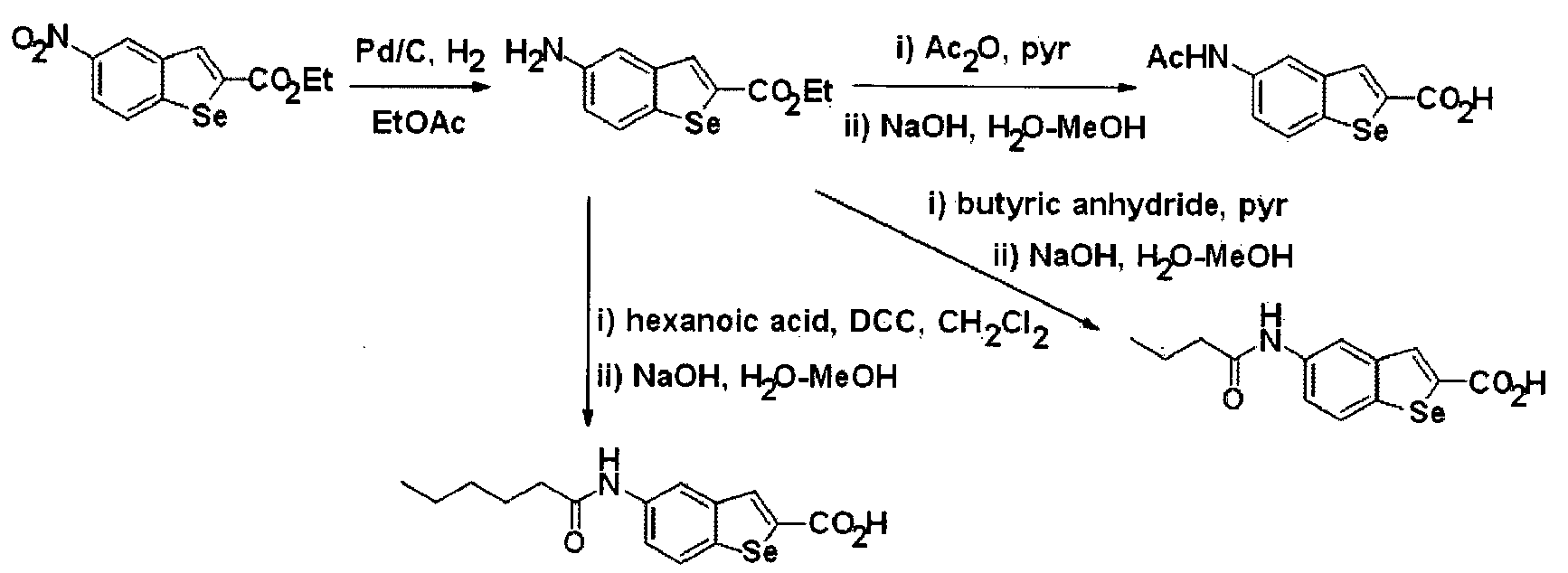
엔트리 38 내지 엔트리 41의 셀레노펜-접합 방향족 화합물은, 상기 엔트리 1 내지 엔트리 37의 셀레노펜-접합 방향족 화합물 중에서 니트로기를 갖는 화합물에 부가 반응을 수행함으로써 제조하였으며, 구체적인 제조 방법은 하기와 같이 수행되었다.
우선, 엔트리 38의 셀레노펜-접합 방향족 화합물을 제조하기 위하여, 출발 물질로서 상기 엔트리 1의 화합물 1.3 g을 250 mL R.B. 플라스크에 담고 무수 에틸 아세테이트 100 mL를 넣은 다음 질소가스로 충전하였다. 10% Pd/C 350 mg이 상기 화합물에 첨가되었으며, 수소가스를 채운 후에 약 24 시간 동안 교반하였다. 상기 반응혼합물은 실리카 패드를 통하여 촉매를 제거하고 에틸 아세테이트를 이용하여 세척한 다음, 얻어진 용액을 감압조건에서 농축하여 1.11 g의 순수한 아미노 유도체 화합물을 얻었다. 이 때, 수율은 98% 였다.
다음으로, 엔트리 39의 셀레노펜-접합 방향족 화합물을 제조하기 위하여, 출발물질로서 엔트리 38의 셀레노펜-접합 방향족 화합물 0.691 g을 피리딘 10 mL에 용해시키고 초산 무수물 0.48 mL를 첨가하여 상온에서 교반하였다. 반응은 TLC(박막 크로마토그래피)를 이용하여 확인하였고, 용매를 감압하여 제거하고 잔여 물질은 실리카겔 컬럼을 통과시켜 765 mg의 아미드 유도체를 얻었다. 이 물질은 2N-NaOH 수용액과 MeOH이 1:1의 비율로 혼합된 용액 20 mL를 사용하여 가수분해하였고, 반응이 완결된 후에 반응용액을 감압하여 MeOH을 제거하고, 2N HCl 용액을 이용하여 산성으로 조절한 다음 디클로로메탄을 이용하여 추출하였고, 유기용매층을 농축한 다음 EA/Hex (1:1)을 이용한 실리카겔 크로마토그래피를 통하여 엔트리 39 화합물을 수율 89%로 얻었다.
엔트리 40 화합물을 얻기 위하여, 엔트리 38 화합물로부터 엔트리 39 화합물을 합성한 방법과 유사한 반응을 수행하였다. 즉 아민 유도체 200 mg을 피리딘 10 mL에 녹이고 부티릭산 무수물 0.184 mL (1.5 당량)을 첨가하여 상온에서 반응하고 정제하여 227 mg의 부틸아미드 유도체를 89% 수율로 얻었고, 이중에 166 mg을 취하여 엔트리 39 합성과 같은 방법으로 가수분해하여 150 mg의 엔트리 40 화합물을 얻었다.
엔트리 41 화합물은 아민 유도체 300 mg을 피리딘 10 mL에 녹이고 핵산오익산 0.424 mL (3.0 당량)과 DCC 347 mg (1.5 당량)을 첨가하여 상온에서 4시간 반응하였고 엔트리 39 합성과 유사하게 추출하고 정제하여 264 mg의 핵실아미드 유도체를 64% 수율로 얻었다. 이 화합물은 엔트리 39 합성과 같은 방법으로 가수분해하고 정제하여 232 mg의 엔트리 41 화합물을 95% 수율로 얻었다.
4. 엔트리 42 내지 엔트리 43의 셀레노펜-접합 방향족 화합물의 제조 방법
본 실시예에 있어서, 엔트리 42 내지 엔트리 43의 셀레노펜-접합 방향족화합물의 제조 과정을 스킴(scheme)으로써 나타낸 것은 하기와 같다:
[스킴 8] 엔트리 42 내지 엔트리 43
[규칙 제91조에 의한 정정 03.12.2012]
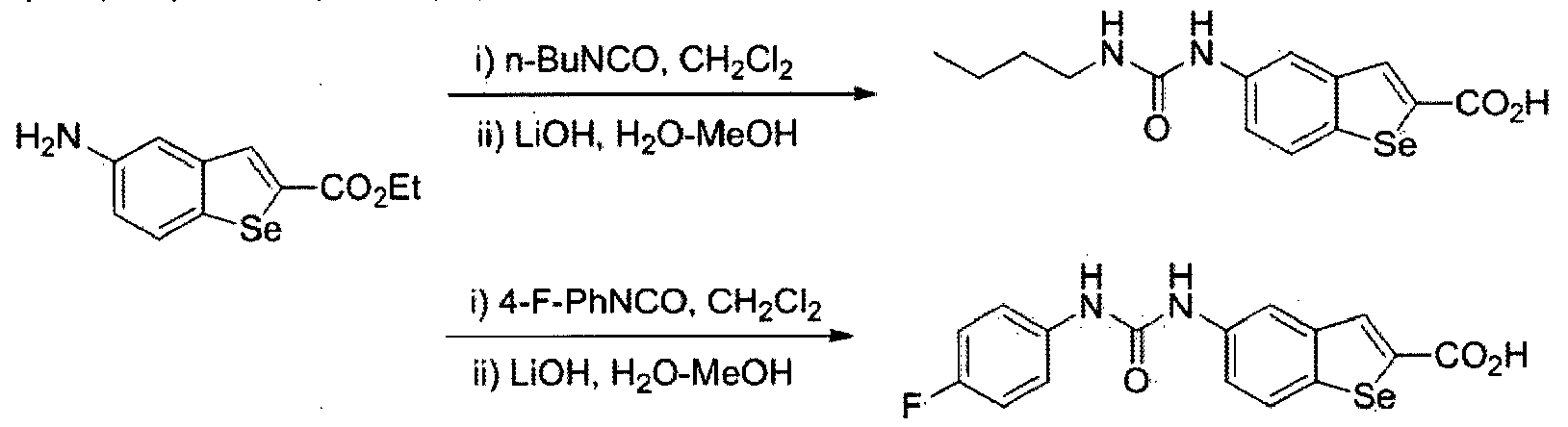
엔트리 42 내지 엔트리 43의 셀레노펜-접합 방향족 화합물은, 상기 엔트리 1 내지 엔트리 37의 셀레노펜-접합 방향족 화합물에 부가 반응을 수행함으로써 제조하였으며, 구체적인 제조 방법은 하기와 같이 수행되었다.
엔트리 42의 합성은 아민 유도체인 엔트리 38 화합물 50 mg을 무수 메틸렌클로라이드 10 mL에 녹이고 질소가스를 충전한 다음 0℃ 로 냉각하였다. 이 용액에 부틸이소시아네이트 55 mg (3당량)을 무수 메틸렌클로라이드 60 mL에 녹인 용액을 20 분 동안 첨가하고, 상온에서 12시간 교반하였다. 용매를 감압하여 제거하고 얻어진 노란 고체를 펜탄-에테르 (7:1) 용액으로 세척하여 55 mg의 노란색 고체를 87% 수율로 얻었다. 이 중간체는 THF-MeOH-H2O (4:1:1) 1.5 mL에 녹이고 LiOH (3 당량)을 가하여 상온에서 18 시간 교반하였다. 물 6 mL를 가하고 10% HCl 용액으로 산성화한 다음 메틸렌클로라이드로 추출하였고, 유기용매층을 농축한 다음 MeOH-CH2Cl2 (1:20)을 이용하여 실리카겔 크로마토그래피로 분리하여 49 mg의 엔트리 42 화합물을 91% 수율로 얻었다.
엔트리 43의 합성은 엔트리 38 화합물 100 mg을 이용하여 엔트리 42의 합성과 유사하게 4-플루오로페닐 이소시아네이트 (153 mg, 3 당량)을 이용하여 145 mg 의 갈색 고체로 중간체인 유레아를 얻었으며, 위의 가수분해 반응과 유사한 반응을 수행하고, 분리 정제과정을 통하여 105 mg의 엔트리 43 화합물을 79% 수율로 갈색 고체형태로 얻었다.
5. 엔트리 44 내지 엔트리 46의 셀레노펜-접합 방향족 화합물의 제조 방법
본 실시예에 있어서, 엔트리 44 내지 엔트리 46의 셀레노펜-접합 방향족화합물의 제조 과정을 스킴(scheme)으로써 나타낸 것은 하기와 같다:
[스킴 9] 엔트리 44 내지 엔트리 46
[규칙 제91조에 의한 정정 03.12.2012]
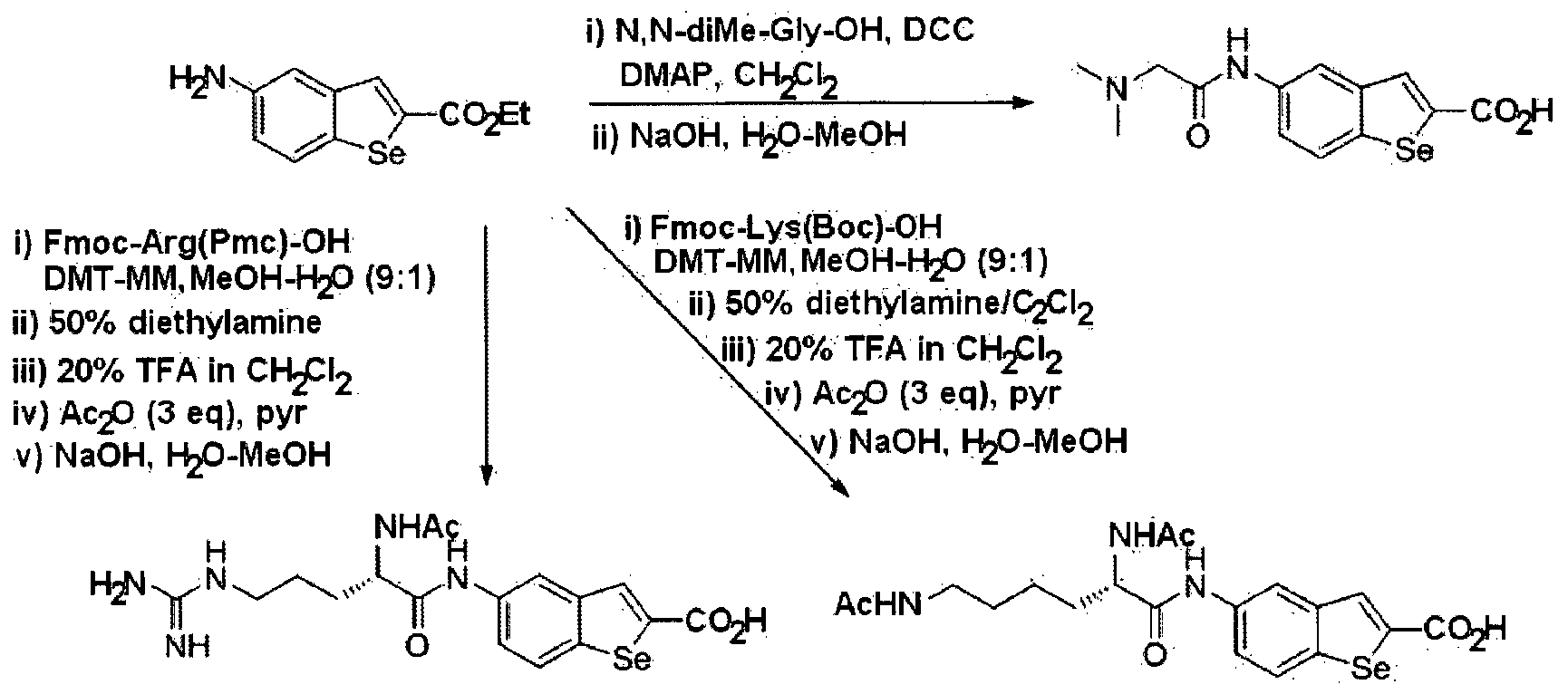
제조방법:
엔트리 44의 합성은 N,N-디메틸글리신 300 mg (3 당량)을 무수 메틸렌클로라이드 20 mL에 녹이고 DCC (206 mg, 4 당량), DMAP (119 mg, 1 당량) 피리딘 (0.47 mL, 6당량)을 추가하여 15 분 교반하였다. 아민 유도체인 엔트리 38 화합물 (260 mg, 1 당량)을 추가하고 24 시간 교반한 다음 물을 50 mL 가하고 메틸렌클로라이드 200 mL로 추출하였다. 유기층은 농축한 다음 EA-hex (1:1)을 이용하여 실리카겔 크로마토그래피로 분리하여 420 mg의 중간체 화합물을 80% 수율로 얻었다. 이 중간체 400 mg을 MeOH-H2O (9:1) 20 mL에 녹이고 NaOH (5 당량)을 가하여 상온에서 24 시간 교반하였다. 20% HCl 용액 2 mL를 가하여 산성화한 다음 동결건조기를 이용하여 농축한 다음 MeOH-CH2Cl2 (1:4)을 이용하여 실리카겔 크로마토그래피로 분리하여 220 mg의 엔트리 44 화합물을 60% 수율로 얻었다.
엔트리 45의 합성은 Fmoc-Lys(Boc)-OH (436 mg) 과 아미노벤조셀레노펜 (300mg, 1.2 당량)에 메탄올 18 mL 와 물 2 mL 를 넣고 15 분 교반한 다음, DMT-MM (385 mg, 1.5 당량)을 추가하고 8 시간 반응하였다. 물을 50 mL 가하고 메틸렌클로라이드 200 mL로 추출한 다음 유기층은 농축하여 EA-hex (1:1)을 이용하여 실리카겔 크로마토그래피로 분리하여 586 mg의 중간체 화합물을 88% 수율로 얻었다. 이 중간물질을 20% TFA-메틸렌클로라이드 (1:4) 용액 10 mL에 녹이고 0℃ 에서 2시간 반응시키고, 용매를 감압하여 농축한 다음 DEA-메틸렌클로라이드 (1:1) 용액 50 mL에 녹이고 2시간 교반하였다. 용매를 감압하여 농축한 다음 피리딘 10 mL에 녹이고 무수초산 0.24 mL (3 당량)을 가하여 상온에서 3 시간 교반하였다. 이 반응용액은 감압하여 농축한 다음 MeOH-H2O (9:1) 20 mL에 녹이고 NaOH (5 당량)을 가하여 상온에서 24 시간 교반하였다. 20% HCl 용액 2 mL를 가하여 산성화한 다음 동결건조기를 이용하여 농축한 다음 MeOH-CH2Cl2 (1:4)을 이용하여 실리카겔 크로마토그래피로 분리하여 20 mg의 엔트리 45 화합물을 얻었다.
엔트리 46의 합성은 Fmoc-Arg(Pmc)-OH (824 mg)과 아미노 벤조셀레노펜 (400 mg, 1.2 당량)에 메탄올 18 mL 와 물 2 mL를 넣고 15 분 교반한 다음, DMT-MM (520 mg, 1.5 당량)을 추가하고 8 시간 반응하였다. 물을 50 mL 가하고 메틸렌클로라이드 200 mL로 추출한 다음 유기층은 농축하여 EA-hex (1:2)을 이용하여 실리카겔 크로마토그래피로 분리하여 870 mg의 중간체 화합물을 73% 수율로 얻었다. 이 중간물질 611 mg을 DEA-메틸렌클로라이드 (1:1) 용액 10 mL에 녹이고 2시간 교반하였다. 용매를 감압하여 농축한 다음 피리딘 10 mL에 녹이고 무수초산 0.095 mL (1.5 당량)을 가하여 상온에서 4 시간 교반하였다. 이 반응용액은 감압하여 농축한 다음 98% TFA-메틸렌클로라이드 용액 10 mL에 녹이고 0℃에서 2시간 반응시키고, 용매를 감압하여 농축한 다음 MeOH-H2O (9:1) 20 mL에 녹이고 NaOH (5 당량)을 가하여 상온에서 24 시간 교반하였다. 20% HCl 용액 2 mL를 가하여 산성으로 맞추고 동결건조기를 이용하여 농축한 다음 MeOH-CH2Cl2 (1:1)을 이용하여 실리카겔 크로마토그래피로 분리하여 275 mg의 엔트리 46 화합물을 얻었다.
6. 엔트리 47 내지 엔트리 49의 셀레노펜-접합 방향족 화합물의 제조 방법
본 실시예에 있어서, 엔트리 47 내지 엔트리 49의 셀레노펜-접합 방향족화합물의 제조 과정을 스킴(scheme)으로써 나타낸 것은 하기와 같다:
[스킴 10] 엔트리 47 내지 엔트리 49
[규칙 제91조에 의한 정정 03.12.2012]
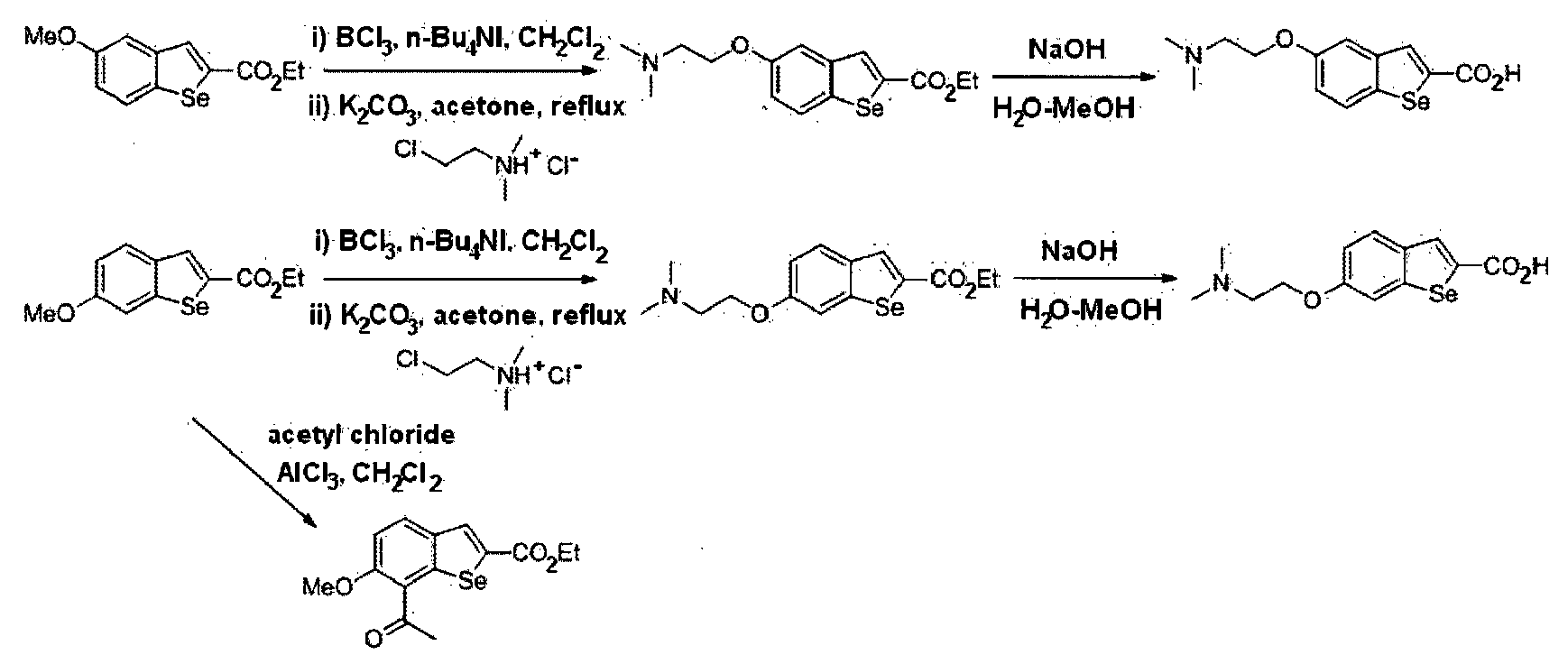
제조방법:
엔트리 47의 합성은 5-메톡시 벤조셀레노펜 유도체 770 mg과 테트라부틸암모늄아이오다이드 2.65 g (2.5 당량)을 무수 메틸렌클로라이드 10 mL에 녹이고 질소를 충전한 다음 -78℃에서 2 분 교반하였다. 이 용액에 BCl3 7.7 mL (1M 메틸렌 클로라이드 용액, 2.5 당량)를 가한 후, 0℃에서 2 시간 반응시켰다. 이 용액에 얼음물 20 mL를 가하고 메틸렌 클로라이드 200 mL씩 3 번 추출을 하였고, 유기층은 감압하여 농축시킨 다음 아세톤 50 mL에 녹였다. 이 용액에 N,N-다이메틸에틸아민 988 mg (3 당량)과 탄산칼륨 2.13 g (5 당량)을 넣고 65℃에서 7 시간 교반하였다. 이 용액을 감압하여 농축하고 메틸렌클로라이드 200 mL로 3번 추출하였고, 유기층은 농축한 다음 EA-Hex (1:1)을 이용하여 실리카겔 크로마토그래피로 분리하여 472 mg의 중간체 화합물을 43% 수율로 얻었다. 이 중간체 160 mg을 취하여 MeOH-H2O (9:1) 20 mL에 녹이고 NaOH (5 당량)을 가하여 상온에서 24 시간 교반하였다. 20% HCl 용액 2 mL를 가하여 산성화시키고 동결건조기를 이용하여 농축한 다음 MeOH-CH2Cl2 (1:4)을 이용하여 실리카겔 크로마토그래피로 분리하여 153 mg의 엔트리 47 화합물을 93% 수율로 얻었다.
엔트리 48의 합성은 6-메톡시 벤조셀레노펜 유도체 231 mg과 테트라부틸암모늄아이오다이드 864 mg (2.5 당량)을 이용하여 엔트리 47의 합성과 유사한 반응을 수행하여 167 mg의 중간체 화합물을 77% 수율로 얻었다. 이 중간체 화합물 160 mg을 취하여 엔트리 47의 합성과 유사한 가수분해 반응을 수행하고 정제하여 148 mg의 엔트리 48 화합물을 90% 수율로 얻었다.
엔트리 49의 합성은 6-메톡시 벤조셀레노펜 유도체 50 mg을 무수 메틸렌클로라이드 10 mL에 녹이고 알루미늄클로라이드 94 mg (4 당량)과 아세틸 클로라이드 0.037 mL (3 당량)를 가하고 3 시간 교반하였다. 이 반응용액에 물을 첨가하고 메틸렌클로라이드 200 mL로 3 번 추출하였고, 유기층은 농축한 다음 EA-Hex (1:4)을 이용하여 실리카겔 크로마토그래피로 분리하여 8.7 mg의 엔트리 49 화합물을 얻었다
7. 엔트리 50 내지 엔트리 58의 셀레노펜-접합 방향족 화합물의 제조 방법
본 실시예에 있어서, 엔트리 50 내지 엔트리 58의 셀레노펜-접합 방향족화합물의 제조 과정을 스킴(scheme)으로써 나타낸 것은 하기와 같다:
[스킴 11] 엔트리 50 내지 엔트리 58

제조방법:
벤조셀레노펜의 에틸에스터 유도체의 가수분해 반응의 일반적인 제조방법
에틸에스터 유도체를 MeOH-H2O (9:1) 20 mL에 녹이고 NaOH (5 당량)을 가하여 상온에서 24 시간 교반하였다. 반응이 종결되면 MeOH을 감압하여 농축하고 물 20 mL를 첨가한 다음 20% HCl 용액 2 mL를 가하여 산성으로 맞추고, 이 때 생성된 고체를 여과하여 MeOH-CH2Cl2 (1:4)을 이용하여 실리카겔 크로마토그래피로 분리하여 49-98%의 수율로 엔트리 50 내지 58의 화합물을 얻었다.
8. 실시예에 따라 제조된 셀레노펜-접합 방향족 화합물
제 2 측면에 따른 방법을 이용하여 제조된 셀레노펜-접합 방향족 화합물에 있어서, 어떠한 방향족 출발물질 및 디셀레나이드 화합물을 사용하였는지, 및 이에 따라 어떠한 셀레노펜-접합 방향족 화합물이 어느 정도의 수율(%)로 수득되었는지를 하기 표 1에 나타내었다:
[규칙 제91조에 의한 정정 03.12.2012]
표 1 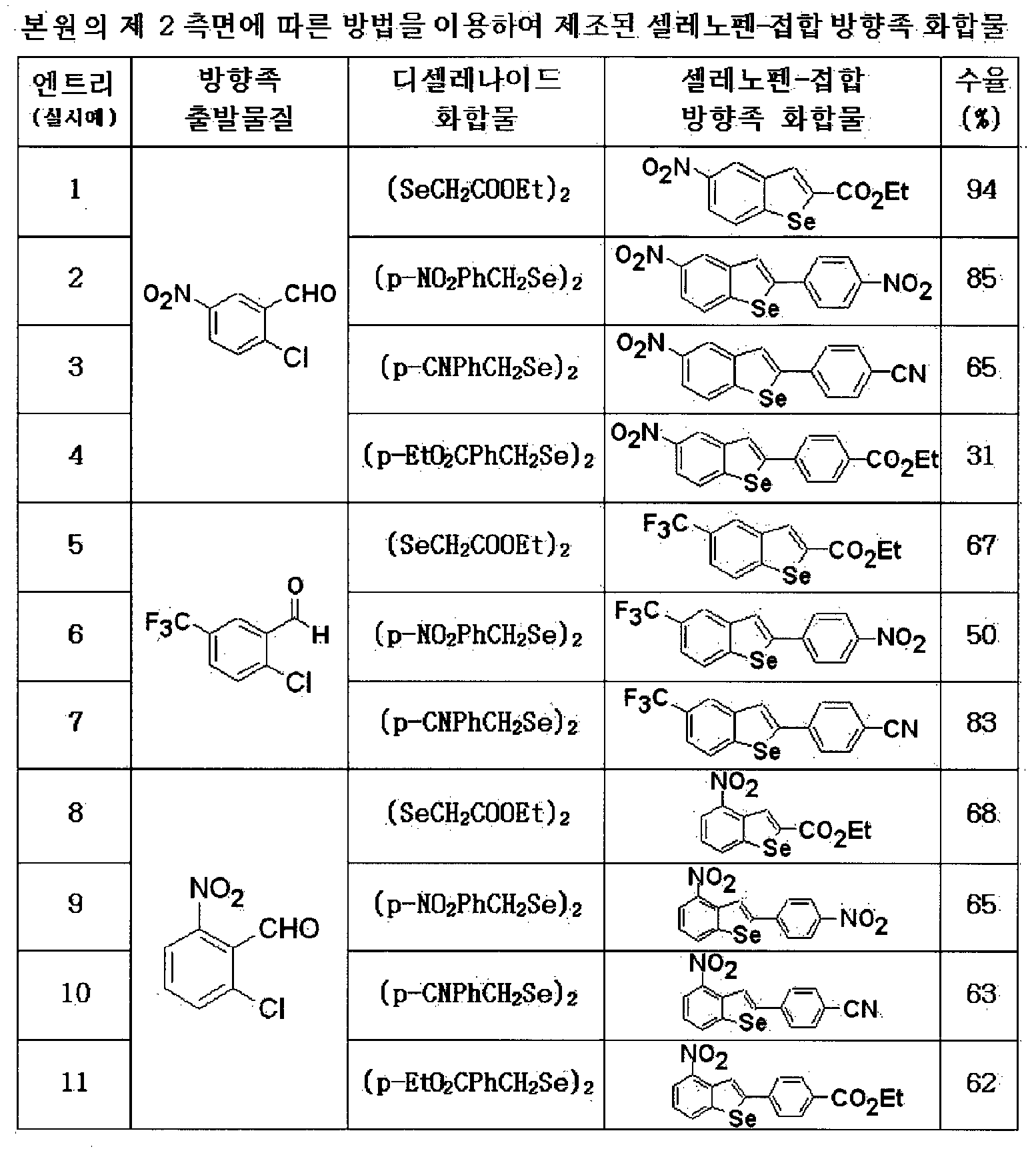
표 1
[규칙 제91조에 의한 정정 03.12.2012]
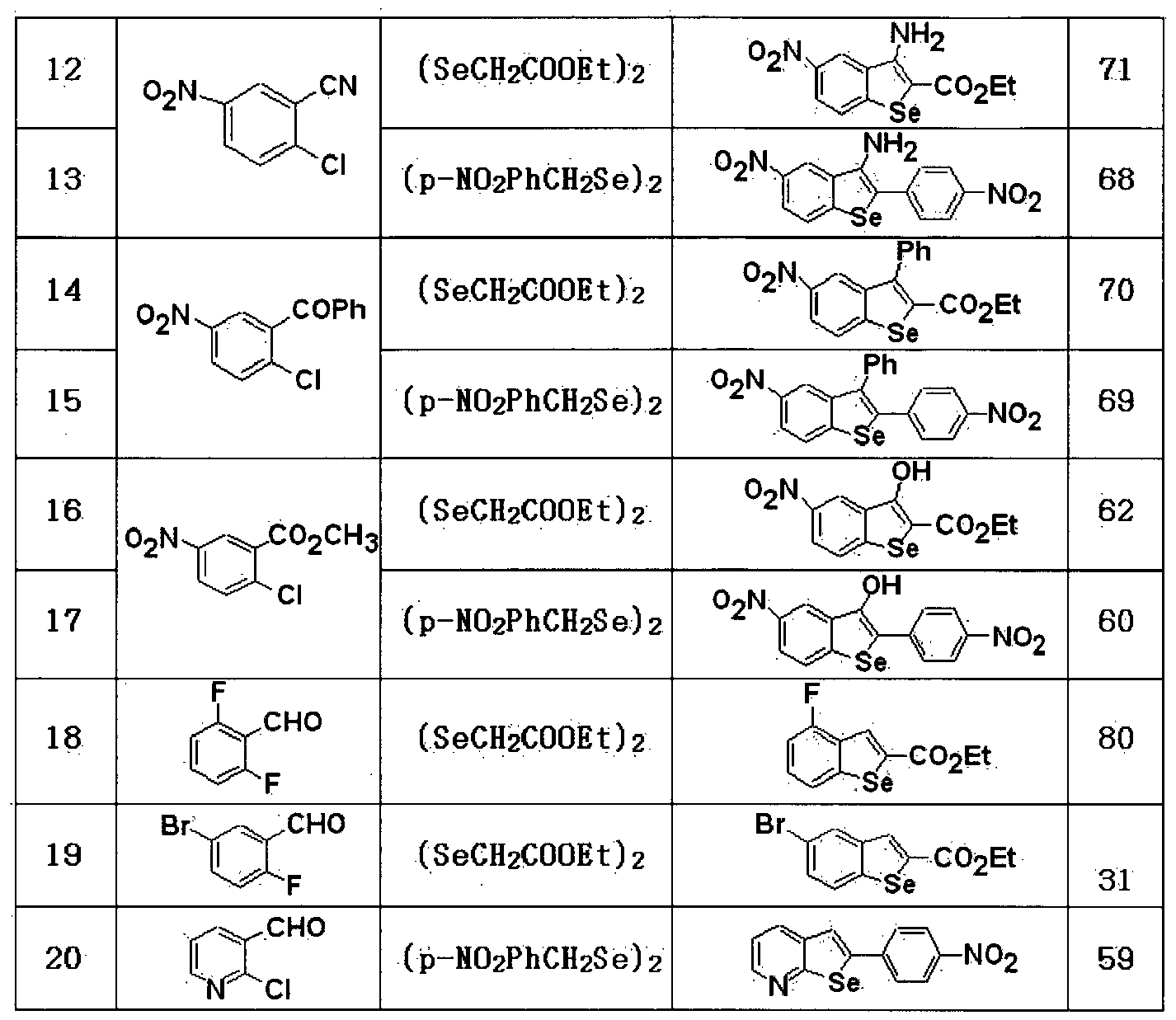
상기 표 1에 나타낸 셀레노펜-접합 방향족 화합물 중, 엔트리 17의 셀레노펜-접합 방향족 화합물은 용제변색 특성을 나타내었으며, 상기 엔트리 17의 화합물의 농도가 60.4 μM 였을 때 흡수 스펙트럼은 도 4에 나타낸 바와 같았다.
또한, 제 3 측면에 따른 방법을 이용하여 제조된 셀레노펜-접합 방향족 화합물에 있어서, 어떠한 방향족 출발물질 및 R11CH2X를 사용하였는지, 및 이에 따라 어떠한 셀레노펜-접합 방향족 화합물이 어느 정도의 수율(%)로 수득되었는지를 하기 표 2에 나타내었다. 하기 [표 2]에 있어서, 수율1은 반응중간체의 수율을 의미하는 것이고, 수율2는 반응 생성물인 셀레노펜-접합 방향족 화합물의 수율을 의미하는 것이다:
[규칙 제91조에 의한 정정 03.12.2012]
표 2 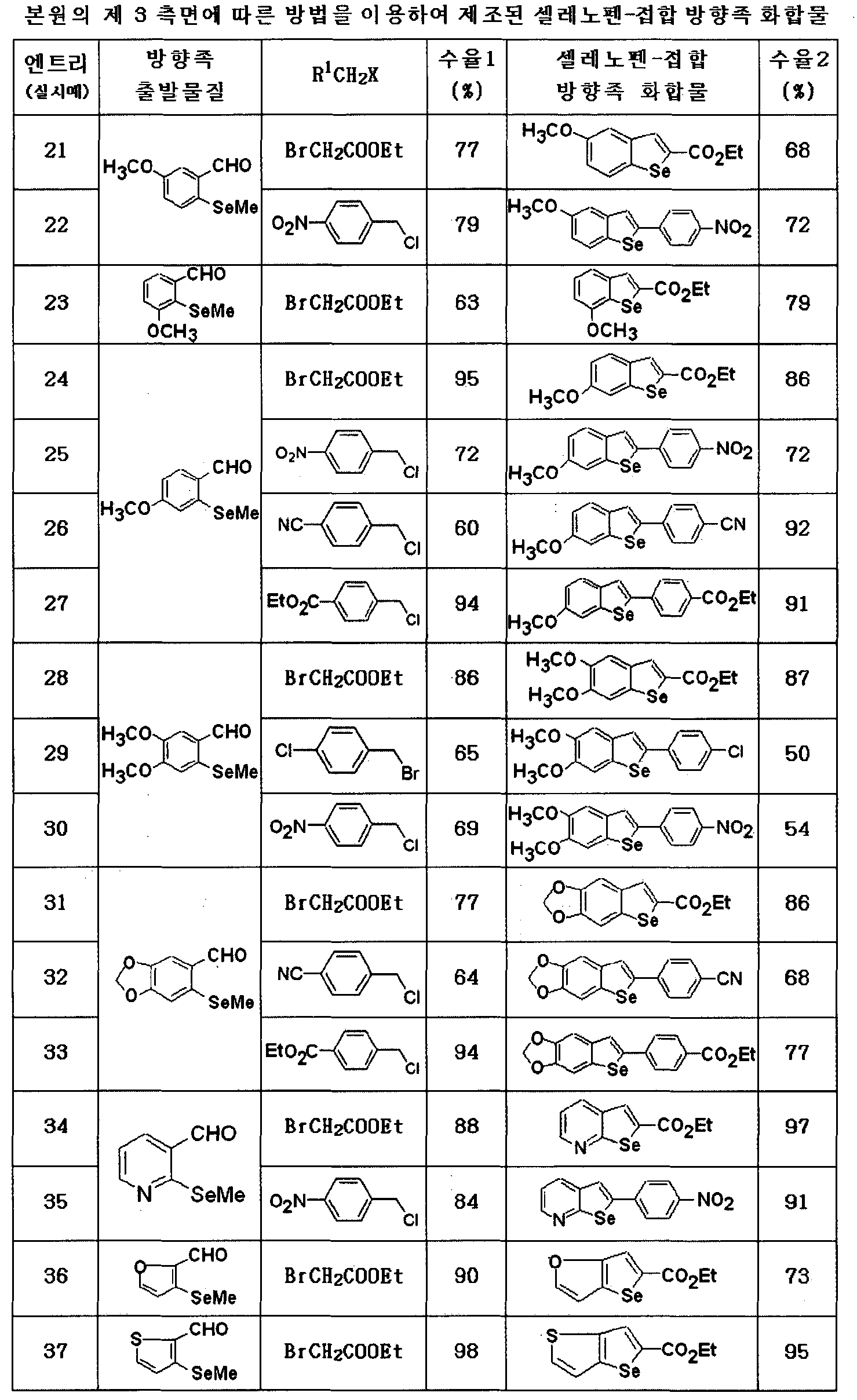
표 2
상기 표 2에 나타낸 셀레노펜-접합 방향족 화합물 중, 엔트리 26, 엔트리 27, 및 엔트리 30의 셀레노펜-접합 방향족 화합물은 형광 특성을 나타내었으며, 상기 화합물들의 형광 특성을 보여주는 스펙트럼은 각각 도 1 내지 도 3에 나타낸 바와 같았다.
또한, 제 2 측면에 따른 방법 또는 제 3 측면에 따른 방법을 이용하여 제조된 엔트리 1 내지 엔트리 37의 셀레노펜-접합 방향족 화합물에 있어서, 부가 반응을 수행함으로써 제조된 셀레노펜-접합 방향족 화합물을 하기 표 3에 나타내었다:
[규칙 제91조에 의한 정정 03.12.2012]
표 3 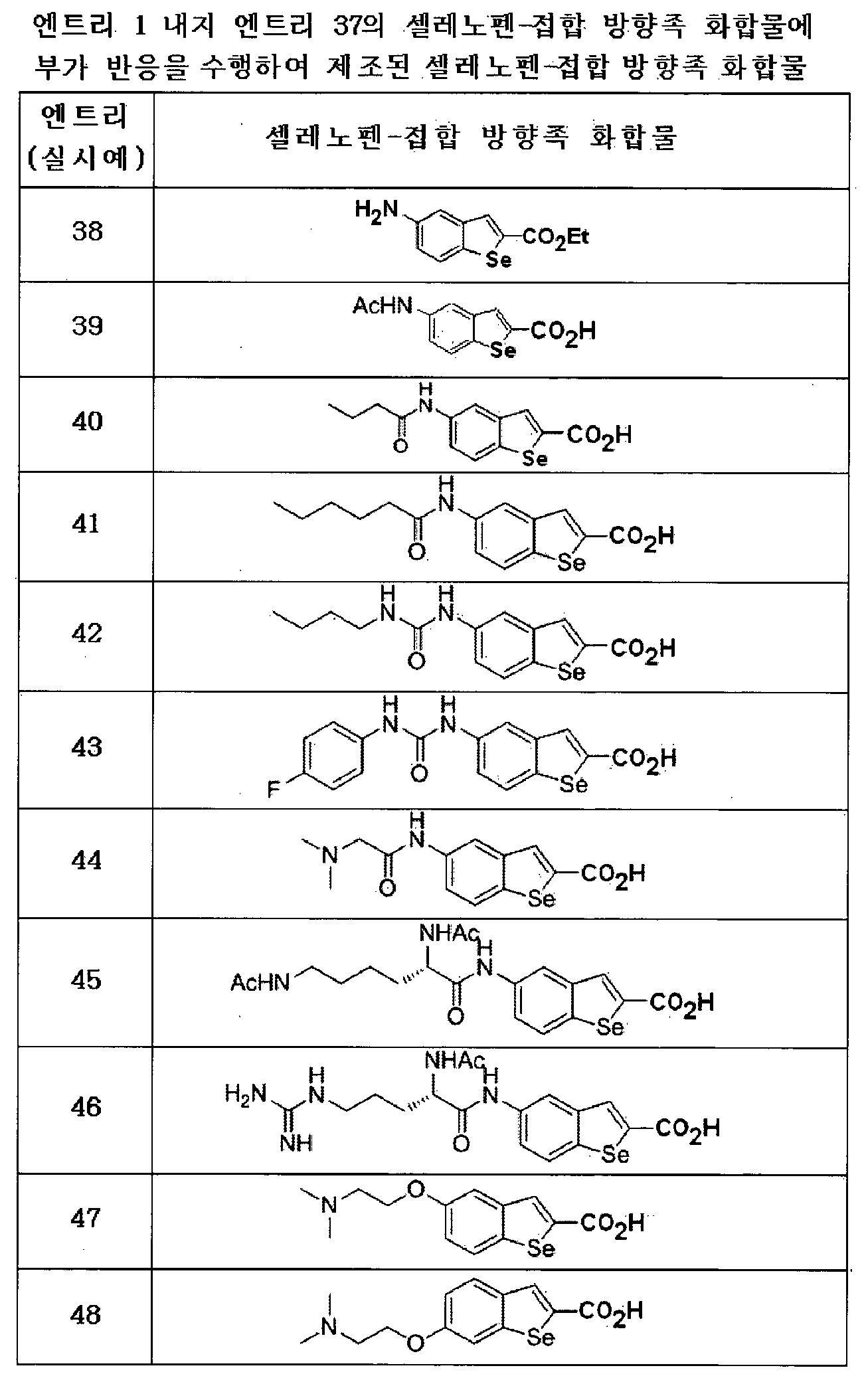
표 3
[규칙 제91조에 의한 정정 03.12.2012]
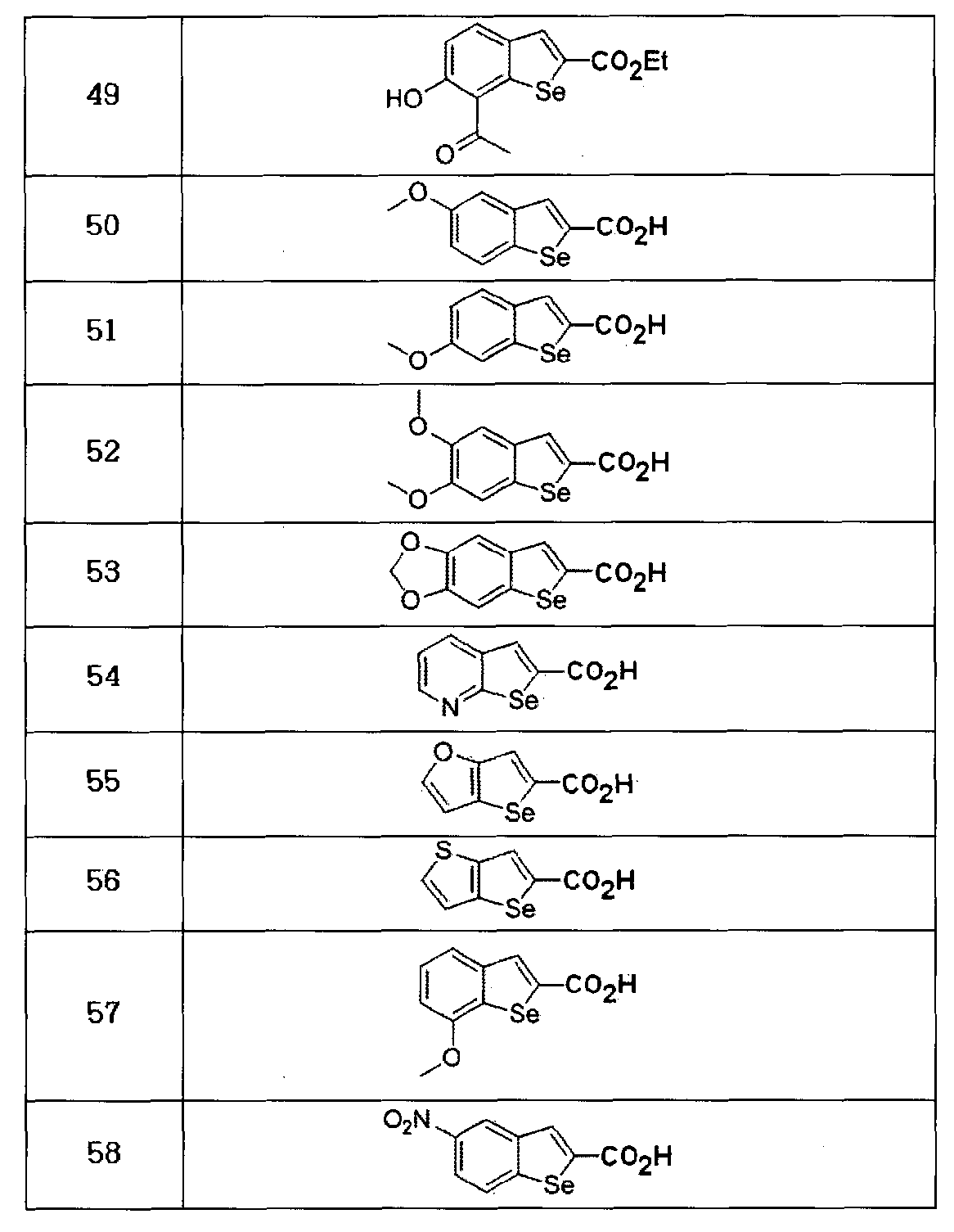
<상기 표 1 내지 표 3에 기재된 엔트리 1 내지 엔트리 58에서 생성된, 셀레노펜-접합 방향족 화합물들의 1H NMR 및 13C NMR 분석 데이터>
[엔트리 1] 5-Nitro-benzo[b]selenophene-2-carboxylic acid ethyl ester:
1H NMR (500.1 MHz, CDCl3) ∂ 1.42 (t, 3H), 4.42 (q, 2H), 8.04 (d, 1H, J = 9), 8.21 (dd, 1H, J = 8.5, 2), 8.38 (s, 1H), 8.74 (d, 1H, J = 2); 13C NMR (125.7 MHz, CDCl3) ∂ ; LCMS (ESI); m/z calcd for C9H11NO4Se [M+]: 298.97; found: 300.2.
[엔트리 2] 5-Nitro-2-(4-nitro-phenyl)-benzo[b]selenophene:
1H NMR (500.1 MHz, CDCl3) ∂ 8.02 (d, 2H, J = 9), 8.15 (dd, 1H, J = 8.5, 2), 8.33 (d, 2H, J = 9), 8.44 (d, 1H, J = 9), 8.50 (s, 1H), 8.79 (d, 1H, J = 2.5); 13C NMR (125.7 MHz, CDCl3) ∂ ; 119.05, 120.97, 124.54, 126.92, 127.31, 127.72, 140.89, 142.80, 145.79, 147.22, 148.03, 148.55.
[엔트리 3] 4-(5-Nitro-benzo[b]selenophen-2-yl)-benzonitrile:
1H NMR (500.1 MHz, CDCl3) ∂ 1.39 (t, 3H, J = 7.0), 3.87 (s, 3H), 4.36 (q, 2H, J = 2.5, 8.5), 6.99 (dd, 1H, J = 2.5, 9.0), 7.36 (d, 1H, J = 1.5), 7.74 (d, 1H, J = 8.5), 8.19 (s, 1H); 13C NMR (125.7 MHz, CDCl3) ∂ 12.60, 53.80, 59.68, 106.49, 113.37, 126.30, 131.53, 132.27, 133.30, 144.16, 157.47, 162.24.
[엔트리 4] 4-(5-Nitro-benzo[b]selenophen-2-yl)-benzoic acid ethyl ester:
1H NMR (500.1 MHz, CDCl3) ∂ 3.90 (s, 3H), 7.01 (dd, 1H, J = 2.0, 8.5), 7.40 (d, 1H, J = 2.0), 7.71-7.72 (m, 3H), 7.80 (s, 1H), 8.24-8.26 (m, 2H); 13C NMR (125.7 MHz, CDCl3) ∂ 54.54, 107.69, 114.44, 123.33, 124.99, 125.10, 126.08, 132.44, 141.53, 142.73, 144.59, 146.13, 157.23.
[엔트리 5] 5-Trifluoromethyl-benzo[b]selenophene-2-carboxylic acid ethyl ester:
1H NMR (500.1 MHz, CDCl3) ∂ 1.42 (t, 3H), 4.41 (q, 2H), 7.58 (dd, 1H, J = 8, 1.5), 8.02 (t, 1H), 8.14 (s, 1H), 8.33 (s, 1H); 13C NMR (125.7 MHz, CDCl3) ∂ 13.28, 60.98, 121.77, 121.80, 123.24, 123.28, 125.50, 132.64, 138.05, 139.90, 146.32, 162.37; LCMS (ESI); m/z calcd for C12H9F3O2Se [M+]: 321.97; found: 323.2
[엔트리 6] 2-(4-Nitro-phenyl)-5-trifluoromethyl-benzo[b]selenophene:
1H NMR (500.1 MHz, CDCl3) ∂ 7.54 (d, 1H, J = 8.5), 7.77 (d, 2H, J = 8.5), 7.91 (s, 1H), 8.01 (d, 1H, J = 8.0), 8.09 (s, 1H), 8.29 (d, 2H, J = 7.5); 13C NMR (125.7 MHz, CDCl3) ∂ 119.67, 119.70, 119.73, 119.76, 120.93, 120.96, 120.14, 121.03, 121. 35, 122.54, 123.51, 123.72, 124.14, 125.53, 126.06, 126.31, 139.78, 140.53, 143.26, 144.93, 145.67.
[엔트리 7] 4-(5-Trifluoromethyl -benzo[b]selenophen-2-yl)-benzonitrile:
1H NMR (500.1 MHz, CDCl3) ∂ 7.51 (d, 1H, J = 8.0), 7.69 (s, 4H), 7.83 (s, 1H), 7.97 (d, 1H, J = 8.0), 8.05 (s, 1H); 13C NMR (125.7 MHz, CDCl3) ∂ 112.06, 118.49, 121.18, 121.44, 121.47, 121.49, 121.53, 122.72, 122.76, 122.79, 122.82, 123.34, 125.05, 125.50, 126.04, 127.33, 127.60, 127.67, 127.86, 128.12, 128.38, 132.85, 139.79, 142.49, 144.97, 147.42.
[엔트리 8] 4-Nitro-benzo[b]selenophene-2-carboxylic acid ethyl ester:
1H NMR (500.1 MHz, CDCl3) ∂ 1.41 (t, 3H), 4.40 (q, 2H), 7.28 (t, 1H), 7.38 (d, 1H, J = 8), 7.76 (d, 1H, J = 8), 8.47 (s, 1H); 13C NMR (125.7 MHz, CDCl3) ∂ 14.44, 62.01, 124.42, 125.29, 127.56, 132.10, 132.35, 137.76, 139.61, 145.08, 163.66.
[엔트리 9] 4-Nitro-2-(4-nitro-phenyl)-benzo[b]selenophene:
1H NMR (500.1 MHz, CDCl3) ∂ 7.40 (d, 1H, J = 8), 7.79 (t, 3H), 8.09 (s, 1H), 8.29 (d, 2H, J = 8.5); 13C NMR (125.7 MHz, CDCl3) ∂ 123.97, 124.15, 124.45, 125.43, 126.23, 127.44, 130.98, 140.87, 142.01, 142.68, 145.51, 147.47.
[엔트리 10] 4-(6-Nitro-benzo[b]selenophen-2-yl)-benzonitrile:
1H NMR (500.1 MHz, CDCl3) ∂ 7.23 (t, 1H, J = 8.0), 7.38 (d, 1H, J = 7.5), 7.67 (d, 2H, J = 8.0), 7.71 (d, 2H, J = 8.5), 7.75 (d, 1H, J = 8.0), 8.01 (s, 1H); 13C NMR (125.7 MHz, CDCl3) ∂ 111.87, 118.61, 123.52, 123.99, 125.40, 126.13, 127.34, 130.83, 132.81, 140.08, 140.87, 142.49, 146.12.
[엔트리 11] 4-(6-Nitro-benzo[b]selenophen-2-yl)-benzoic acid ethyl ester:
1H NMR (500.1 MHz, CDCl3) ∂ 1.42 (t, 3H, J = 7.0), 4.41 (q, 2H, J = 7.0), 7.20 (t, 1H, J = 7.5), 7.36 (d, 1H, J = 8.0), 7.70 (d, 2H, J = 8.0), 7.75 (d, 1H, J = 8.0), 8.02 (s, 1H), 8.08 (d, 2H, J = 8.0); 13C NMR (125.7 MHz, CDCl3) ∂ 13.17 59.97 121.43 122.72 123.98 124.46 125.52 129.09 129.11 129.35 138.67 139.82 141.09 146.21 164.91.
[엔트리 12] 3-Amino-5-nitro-benzo[b]selenophene-2-carboxylic acid ethyl ester:
1H NMR (500.1 MHz, CDCl3) ∂ 1.39 (t, 3H), 4.36 (q, 2H), 6.12 (bs, 2H, NH), 7.94 (d, 1H, J = 8.5), 8.25 (dd, 1H, J = 9, 2), 8.53 (d, 1H, J = 2.5); 13C NMR (125.7 MHz, acetone-D6) ∂ 14.81, 61.21, 98.63, 120.45, 122.67, 128.53, 135.97, 146.77, 147.81, 152.15, 166.52.
[엔트리 13] 5-Nitro-2-(4-nitro-phenyl)-benzo[b]selenophen-3-ylamine:
1H NMR (500.1 MHz, CDCl3) ∂ 7.89-7.92 (m, 2H), 8.20 (dd, 1H, J = 8.5, 2), 8.27 (d, 2H, J = 8.5), 8.30-8.32 (m, 2H), 8.86 (d, 1H, J = 2); 13C NMR (125.7 MHz, CDCl3) ∂ 111.84, 117.90, 118.90, 123.63, 126.24, 128.10, 136.81, 139.38, 142.36, 145.03, 145.07, 145.44.
[엔트리 14] 5-Nitro-3-phenyl-benzo[b]selenophene-2-carboxylic acid ethyl ester:
1H NMR (500.1 MHz, CDCl3) ∂ 1.66 (t, 3H), 4.21 (q, 2H), 7.34 (dd, 2H, J = 6.5,4), 7.51-7.53 (m, 3H), 8.06 (d, 1H, J = 8.5), 8.24 (dd, 1H, J = 9, 2.5), 8.30 (d, 1H, J = 2.5); 13C NMR (125.7 MHz, CDCl3) ∂ 11.64, 59.63, 118.68, 120.66, 124.17, 126.21, 126.46, 127.09, 132.45, 133.00, 141.00, 143.00, 143.21, 144.00, 161.00; LCMS (ESI); m/z calcd for C17H13NO4Se [M+]: 375.00; found: 376.2.
[엔트리 15] 5-Nitro-2-(4-nitro-phenyl)-3-phenyl-benzo[b]selenophene:
1H NMR (500.1 MHz, CDCl3) ∂ 7.60 (t, 2H), 7.72 (t, 1H), 7.82 (d, 2H, J = 7.5), 8.15-8.21 (m, 2H), 8.54 (d, 1H, J = 2.5); 13C NMR (125.7 MHz, CDCl3) ∂ 125.20, 126.08, 127.89, 129.01, 131.74, 132.57, 134.91, 135.26, 143.55, 145.07, 194.34.
[엔트리 16]3-Hydroxy-5-nitro-benzo[b]selenophene-2-carboxylic acid ethyl ester:
1H NMR (500.1 MHz, CDCl3) ∂ 1.42 (t, 3H), 4.43 (q, 2H), 7.95 (d, 1H, J = 9), 8.28 (dd, 1H, J = 8.5, 2), 8.82 (d, 1H, J = 2.5), 10.47 (bs, 1H, OH); 13C NMR (125.7 MHz, CDCl3) ∂ 13.42, 60.95, 119.51, 121.49, 126.06, 132.55, 144.30, 144.92, 159.63, 166.74; LCMS (ESI); m/z calcd for C11H9NO5Se [M+]: 314.96; found: 316.3.
[엔트리 17] 5-Nitro-2-(4-nitro-phenyl)-benzo[b]selenophen-3-ol:
1H NMR (500.1 MHz, CDCl3) ∂ 8.11 (d, 1H, J = 2), 8.13 (d, 1H, J = 2), 8.20 (dd, 1H, J = 8, 2), 8.28 (d, 1H, J = 2), 8.3 (d, 1H, J = 2), 8.86 (d, 1H, J = 2); 13C NMR (125.7 MHz, CDCl3) ∂ 119.35, 120.82, 121.21, 124.80, 128.11, 129.68, 137.76, 142.24, 144.26, 147.14, 147.17, 148.92.
[엔트리 18] 4-Fluoro-benzo[b]selenophene-2-carboxylic acid ethyl ester:
1H NMR (500.1 MHz, CDCl3) ∂ 1.42 (t, 3H, J = 7), 4.40 (q, 2H, J = 7.0), 7.06 (dd, 1H, J = 8, 10), 7.36 (td, 1H, J = 5.5, 8), 7.66 (d, 1H, J = 8), 8.41 (s, 1H); 13C NMR (125.7 MHz, CDCl3) ∂14.32, 61.87, 110.09, 110.24, 121.60, 121.63, 128.02, 128.08, 128.57, 130.59, 130.73, 137.25, 145.80, 145.84, 158.98, 161.02, 163.53.
[엔트리 19] 5-Bromo-benzo[b]selenophene-2-carboxylic acid ethyl ester:
1H NMR (500.1 MHz, CDCl3) ∂ 1.41 (t, 3H, J = 7.5), 4.39 (q, 2H, J = 7.5), 7.46 (dd, 1H, J = 2.0, 8.5), 7.75 (d, 1H, J = 8.5), 8.01 (d, 1H, J = 1.5), 8.19 (s, 1H); 13C NMR (125.7 MHz, CDCl3) ∂ 12.31, 59.89, 117.17, 125.21, 127.80, 127.84, 130.97, 136.56, 140.41, 140.84, 161.48.
[엔트리 20] 2-(4-Nitrophenyl)-seleno[2,3-b]pyridine:
1H NMR (500.1 MHz, CDCl3) ∂ 7.36 (dd, 1H, J = 4.5, 8.0), 7.76 (s, 1H), 7.79 (d, 2H, J = 8.5), 8.06 (dd, 1H, J = 1.5, 8.0), 8.30 (d, 2H, J = 8.5), 8.54 (dd, 1H, J = 1.5, 4.5); 13C NMR (125.7 MHz, CDCl3) ∂ 118.68, 121.26, 122.61, 125.66, 131.05, 135.37, 140.28, 143.85, 145.29, 145.75, 163.59.
[엔트리 21] 5-Methoxy-benzo[b]selenophene-2-carboxylic acid ethyl ester:
1H NMR (500.1 MHz, CDCl3) ∂ 1.39 (t, 3H), 3.84 (s, 3H), 4.37 (q, 2H), 7.02 (dd, 1H, J = 8.5, 2.5), 7.31 (d, 1H, J = 2), 7.72 (d, 1H, J = 8.5), 8.20 (s, 1H); 13C NMR (125.7 MHz, CDCl3) ∂ 12.04, 53.18, 59.29, 106.95, 114.95, 124.14, 131.72, 133.56, 135.27, 139.88, 155.72, 161.56; LCMS (ESI); m/z calcd for C12H12O3Se [M+]: 284.00; found: 285.2.
[엔트리 22] 5-Methoxy-2-(4-nitro-phenyl)-benzo[b]selenophene:
1H NMR (500.1 MHz, CDCl3) ∂ 3.88 (s, 3H), 6.97 (d, 1H, J = 9), 7.31 (s, 1H), 7.74 (d, 3H, J = 9), 7.80 (s, 1H), 8.26 (d, 2H, J = 8.5); 13C NMR (125.7 MHz, CDCl3) ∂ 54.54, 107.69, 114.44, 123.33, 124.99, 125.10, 126.08, 132.44, 141.53, 142.73, 144.59, 146.13, 157.23.
[엔트리 23] 7-
Methoxy
-
benzo
[b]selenophene-2-
carboxylic
acid
ethyl
ester
:
1H NMR (500.1 MHz, CDCl3) ∂ 1.40 (t, 3H), 3.99 (s, 3H), 4.38 (q, 2H), 6.81 (d, 1H, J = 8), 7.37 (t, 1H), 7.50 (d, 1H, J = 7.5), 8.29 (s, 1H); 13C NMR (125.7 MHz, CDCl3) ∂ 14.61, 56.03, 61.89, 106.39, 120.06, 126.87, 133.38, 134.78, 137.21, 142.89, 156.51, 164.34.
[엔트리 24] 6-Methoxy-benzo[b]selenophene-2-carboxylic acid ethyl ester:
1H NMR (500.1 MHz, CDCl3) ∂ 1.39 (t, 3H), 3.86 (s, 3H), 4.36 (q, 2H), 6.99 (dd, 1H, J = 9, 2.5), 7.35 (d, 1H, J = 1.5), 7.74 (d, 1H, J = 8.5), 8.18 (s, 1H); 13C NMR (125.7 MHz, CDCl3) ∂ 12.60, 53.80, 59.68, 106.49, 113.37, 126.30, 131.53, 132.27, 133.30, 144.16, 157.47, 162.24.
[엔트리 25] 6-Methoxy-2-(4-nitro-phenyl)-benzo[b]selenophene:
1H NMR (500.1 MHz, CDCl3) ∂ 3.89 (s, 3H), 7.01 (dd, 1H, J = 8.5, 2), 7.39 (d, 1H, J = 2), 7.70 (s, 1H), 7.72 (d, 2H, J = 2.0), 7.80 (s, 1H), 8.24 (s, 1H), 8.25 (d, 1H, J = 1.5); 13C NMR (125.7 MHz, CDCl3) ∂ 54.23, 107.06, 113.42, 122.81, 124.37, 125.21, 135.25, 140.01, 141.27, 141.97, 145.45, 156.91.
[엔트리 26] 4-(6-Methoxy-benzo[b]selenophen-2-yl)-benzonitrile:
1H NMR (500.1 MHz, CDCl3) ∂ 3.87 (s, 3H), 6.99 (dd, 1H, J = 8.5, 2), 7.37 (d, 1H, J = 1.5), 7.63 (s, 4H), 7.67 (d, 1H, J = 8.5), 7.71 (s, 1H); 13C NMR (125.7 MHz, CDCl3) ∂ 55.63, 108.55, 110.76, 114.71, 118.82, 125.08, 126.53, 126.75, 132.67, 136.61, 140.69, 141.86, 143.07, 158.14.
[엔트리 27] 4-(6-Methoxy-benzo[b]selenophen-2-yl)-benzoic acid ethyl ester:
1H NMR (500.1 MHz, CDCl3) ∂ 1.41 (t, 3H), 3.87 (s, 3H), 4.39 (q, 2H), 6.97 (dd, 1H, J = 8.5, 2), 7.37 (d, 1H, J = 1.5), 7.62 (d, 2H, J = 8), 7.66 (d, 1H, J = 8.5), 7.71 (s, 1H), 8.04 (d, 2H, J = 8); 13C NMR (125.7 MHz, CDCl3) ∂ 12.92, 54.15, 59.58, 107.10, 113.01, 112.76, 124.72, 124.87, 127.97, 128.75, 135.41, 139.07, 141.69, 156.40, 164.77.
[엔트리 28] 5,6-Dimethoxy-benzo[b]selenophene-2-carboxylic acid ethyl ester:
1H NMR (500.1 MHz, CDCl3) ∂ 1.39 (t, 3H), 3.93 (s, 3H), 3.96 (s, 3H), 4.36 (q, 2H), 7.27 (s, 1H), 7.31 (s, 1H), 8.17 (s, 1H); 13C NMR (125.7 MHz, CDCl3) ∂ 14.41, 56.03, 56.17, 61.42, 134.07, 134.18, 134.62, 137.31, 146.66, 150.28, 164.02.
[엔트리 29] 2-(4-Chloro-phenyl)-5,6-dimethoxy-benzo[b]selenophene:
1H NMR (500.1 MHz, CDCl3) ∂ 3.94 (s, 3H), 3.95 (s, 3H), 7.21 (s, 1H), 7.30 (s, 1H), 7.34 (d, 2H, J = 8), 7.49 (d, 2H, J = 8), 7.55 (s, 1H); 13C NMR (125.7 MHz, CDCl3) ∂ 56.18, 56.31, 107.14, 107.33, 123.34, 127.72, 129.17, 133.35, 133.66, 135.11, 136.54, 144.36, 148.46, 148.57.
[엔트리 30] 5,6-Dimethoxy-2-(4-nitro-phenyl)-benzo[b]selenophene:
1H NMR (500.1 MHz, CDCl3) ∂ 3.95 (s, 3H), 3.97 (s, 3H), 7.26 (s, 1H), 7.34 (s, 1H), 7.70 (d, 2H, J = 9), 7.77 (s, 1H), 8.24 (d, 2H, J = 8.5); 13C NMR (125.7 MHz, CDCl3) ∂ 56.09, 56.22, 107.06, 107.06, 107.31, 124.40, 125.91, 126.63, 134.51, 136.15, 142.40, 142.73, 146.74, 148.71, 149.13.
[엔트리 31] 1,3-Dioxa-5-selena-s-indacene-6-carboxylic acid ethyl ester:
1H NMR (500.1 MHz, CDCl3) ∂ 1.37 (t, 3H), 4.34 (q, 2H), 6.01 (s, 2H), 6.99 (dd, 1H, J = 9, 2.5), 7.20 (s, 1H), 7.23 (s, 1H), 8.10 (s, 1H); 13C NMR (125.7 MHz, CDCl3) ∂ 14.43, 32.31, 60.95, 102.33, 110.00, 113.79, 128.82, 129.37, 129.87, 130.75, 131.23, 142.60, 148.12, 152.89, 166.37, 191.35.
[엔트리 32] 4-(1,3-Dioxa-5-selena-s-indacen-6-yl)-benzonitrile:
1H NMR (500.1 MHz, CDCl3) ∂ 6.03 (s, 2H), 7.02 (s, 1H), 7.27 (s, 1H), 7.65 (d, 4H, J = 2), 7.69 (s, 1H); 13C NMR (125.7 MHz, CDCl3) ∂ 99.49, 102.64, 102.79, 108.81, 116.76, 123.11, 124.63, 130.69, 133.04, 134.87, 138.59, 141.12, 145.26, 145.40.
[엔트리 33] 4-(1,3-
Dioxa
-5-
selena
-s-
indacen
-6-
yl
)-
benzoic
acid
ethyl
ester
:
1H NMR (500.1 MHz, CDCl3) ∂ 1.41 (t, 3H), 4.39 (q, 2H), 6.02 (s, 2H), 7.18 (s, 1H), 7.27 (s, 1H), 7.60 (s, 1H), 7.61 (d, 1H, J = 1.5), 7.67 (s, 1H), 8.03 (s, 1H), 8.04 (d, 1H, J = 2); 13C NMR (125.7 MHz, CDCl3) ∂ 14.27, 60.96, 101.31, 104.46, 104.74, 124.25, 125.97, 129.36, 130.15, 134.61, 137.00, 140.34, 144.36, 147.00, 147.03, 166.15.
[엔트리 34] Selenolo[2,3-b]pyridine-2-carboxylic acid ethyl ester:
1H NMR (500.1 MHz, CDCl3) ∂ 1.39 (t, 3H, J = 7.0), 4.38 (q, 2H, J = 7.0), 7.33 (dd, 1H, J = 4.5, 8.0), 8.09 (dd, 1H, J = 2.0, 8.0), 8.16 (s, 1H), 8.58 (dd, 1H, J = 1.5, 4.5); 13C NMR (125.7 MHz, CDCl3) ∂ 14.31, 61.94, 120.29, 131.34, 134.39, 135.63, 137.47, 148.62, 163.62, 166.95.
[엔트리 35] 2-(4-Nitro-phenyl)-selenolo[2,3-b]pyridine:
1H NMR (500.1 MHz, CDCl3) ∂ 7.35 (dd, 1H, J = 5.0, 7.5), 7.75 (s, 1H), 7.78 (d, 1H, J = 8.0), 8.05 (d, 1H, J = 7.5), 8.28 (d, 1H, J = 8.0); 13C NMR (125.7 MHz, CDCl3) ∂ 118.68, 121.26, 122.61, 125.66, 131.05, 135.37, 140.28, 143.85, 145.29, 145.75, 163.59.
[엔트리 36] Selenolo[3,2-b]furan-5-carboxylic acid ethyl ester:
1H NMR (500.1 MHz, CDCl3) ∂ 1.37 (t, 3H, J = 7.0), 4.35 (q, 2H, J = 7.5), 6.81 (s, 1H), 7.63 (d, 1H, J = 1.0), 8.06 (s, 1H); 13C NMR (125.7 MHz, CDCl3) ∂ 14.38 1.40 109.39 119.38 128.64 136.03 147.83 157.43 163.81.
[엔트리 37] Selenolo[3,2-b]thiophene-5-carboxylic acid ethyl ester:
1H NMR (500.1 MHz, CDCl3) ∂ 1.39 (t, 3H, J = 7.0), 4.37 (q, 2H, J = 7.0), 7.33 (d, 1H, J = 5.5), 7.55 (d, 1H, J = 5.0), 8.24 (s, 1H); 13C NMR (125.7 MHz, CDCl3) ∂ 14.39, 61.49, 123.01, 128.30, 131.00, 138.52, 140.18, 143.77, 163.76.
[엔트리 38] Ethyl 5-Amino-benzo[
b
]selenophene-2-carboxylate:
M.P. 78-80 ℃; 1H NMR (500.1 MHz, CDCl3) ∂ 1.39 (t, 3H), 3.74 (s, 1H), 4.36 (q, 2H), 6.81 (dd, 1H, J= 5.7, 3.6), 7.16 (d, 1H, J= 1.2), 7.63 (d, 1H, J= 5.1), 8.11 (s, 1H); 13C NMR (125.7 MHz, CDCl3) ∂ 14.35, 61.51, 111.78, 117.32, 126.32, 133.65, 136.03, 136.98, 137.34, 142.38, 144.33, 164.09. HRMS (ESI); m/z calcd for C11H11NO2Se [M+]: 269; found: 270.0017 (M+1).
[엔트리 39 중간체] Ethyl- 5-Acetamido-benzo[b]selenophene-2-carboxylate:
M.P. 160 ℃; 1H NMR (500.1 MHz, CDCl3) ∂ 1.40 (t, 3H), 2.22 (s, 3H), 4.38 (q, 2H), 7.40 (d, 1H, J= 5.1), 7.81 (d, 1H, J= 5.1), 8.20 (s, 1H), 8.23 (s, 1H); 13C NMR (125.7 MHz, CDCl3) ∂ 14.43, 24.75, 61.82, 118.20, 120.02, 126.23, 134.16, 135.56, 137.89, 139.42, 141.90, 163.88, 168.47. HRMS (ESI); m/z calcd for C11H11NO2Se [M+]: 311.0061; found: 312.0114 (M+1).
[엔트리 39] 5-Acetamido-benzo[b]selenophene-2-carboxylic acid:
1H NMR (500.1 MHz, MeOD-d4) ∂ 2.16 (s, 3H), 7.50 (dd, 1H, J = 2.0, 8.0), 7.88 (d, 1H, J = 8.5), 8.17 (s, 1H), 8.22 (d, 1H, J = 2.0); 13C NMR (125.7 MHz, MeOD-d4) ∂ 23.83, 119.13, 121.28, 127.20, 134.80, 134.82, 137.70, 140.54, 143.43, 171.79, 175.67.
[엔트리 40 중간체] 5-Butyrylamino-benzo[b]selenophene-2-carboxylic acid ethyl ester
1H NMR (500.1 MHz, CDCl3) ∂ 0.95 (t, 3H, J = 7.0), 1.36 (t, 3H, J = 7.0), 1.74 (q, 2H, J = 7.0), 2.34 (t, 2H, J = 7.0), 4.34 (q, 2H, J = 7.5), 7.40 (d, 1H, J = 8.5), 7.66 (d, 1H, J = 8.5), 8.04 (s, 1H), 8.15 (s, 1H), 8.40 (bs, 1H, NH); 13C NMR (125.7 MHz, CDCl3) ∂ 11.92, 12.48, 17.30, 37.56, 59.90, 116.65, 118.71, 124.07, 132.27, 134.02, 135.57, 137.36, 139.77, 162.10, 170.42.
[엔트리 40] 5-Butyrylamino-benzo[b]selenophene-2-carboxylic acid
1H NMR (500.1 MHz, MeOD-d4) ∂ 0.96 (t, 3H, J = 7.5), 1.69 (q, 2H, J = 7.0), 2.33 (t, 2H, J = 7.0), 7.42 (d, 1H, J = 8.5), 7.77 (d, 1H, J = 8.5), 8.07 (s, 1H), 8.16 (s, 1H); 13C NMR (125.7 MHz, MeOD-d4) ∂ 14.11, 20.39, 39.92, 119.10, 121.23, 127.16, 134.86, 137.64, 140.44, 140.88, 143.37, 167.71, 174.72.
[엔트리 41 중간체] 5-Hexanoylamino-benzo[b]selenophene-2-carboxylic acid ethyl ester
1H NMR (500.1 MHz, CDCl3) ∂ 0.87 (s, 3H), 1.32 (s, 4H), 1.38 (t, 3H, J = 7.0), 1.72 (s, 2H), 2.36 (t, 2H, J = 7.5), 4.36 (q, 2H, J = 8.5), 7.41 (d, 1H, J = 8.5), 7.72 (d, 1H, J = 8.5), 7.95 (s, 1H), 8.12 (s, 1H), 8.18 (s, 1H, NH); 13C NMR (125.7 MHz, CDCl3) ∂ 13.94, 14.33, 22.45, 25.37, 31.47, 37.66, 61.74, 118.27, 120.30, 126.00, 134.14, 135.82, 137.55, 139.20, 141.71, 163.93, 172.09.
[엔트리 41] 5-Hexanoylamino-benzo[b]selenophene-2-carboxylic acid
1H NMR (500.1 MHz, MeOD-d4) ∂ 0.94 (t, 3H, J = 8.5), 1.38-1.40 (m, 4H), 1.72 (t, 2H, J = 7.0), 2.40 (t, 2H, J = 7.5), 7.46 (dd, 1H, J = 1.5, 8.5), 7.83 (d, 1H, J = 9.0), 8.05 (s, 1H), 8.17 (s, 1H); 13C NMR (125.7 MHz, MeOD-d4) ∂ 14.32, 23.51, 26.70, 32.63, 38.04, 118.94, 120.70, 127.04, 132.83, 133.65, 137.38, 140.19, 143.87, 174.87.
[엔트리 42 중간체] 5-(3-Butyl-ureido)-benzo[b]selenophene-2-carboxylic acid ethyl ester
1H NMR (500.1 MHz, DMSO ) ∂8.55 (s, 1H ), 8.297 (s, 1H ), 8.107(s, 1H ), 7.930 (d, 1H, J = 9Hz ), 7.39 (d, 1H,10.5Hz ), 6.150(d, 1H, J = 5.5 Hz), 4.318 (qr, 2H, J = 6.75Hz ),3.096 (qr, 2H, J = 6.5 Hz), 1.425 (t ,2H, J = 6.5Hz),1.32 (t, 5H, J = 7.5 Hz ,0.90 (t ,3H, 7Hz).
[엔트리 42] 5-(3-Butyl-ureido)-benzo[b]selenophene-2-carboxylic acid
1H NMR (500.1 MHz, DMSO ) ∂8.55 (s, 1H ), 8.297 (s, 1H ), 8.107(s, 1H ), 7.930 (d, 1H, J = 9Hz ), 7.39 (d, 1H,10.5Hz ), 6.150(d, 1H, J = 5.5 Hz), 3.096 (qr, 2H, J = 6.5 Hz), 1.425 (t ,2H, J = 6.5Hz),1.32 (t, 2H, J = 7.5 Hz ,0.90 (t, 3H, 7Hz).
[엔트리 43 중간체] 5-[3-(4-Fluoro-phenyl)-ureido]-benzo[b]selenophene-2-carboxylic acid ethyl ester
1H NMR (500.1 MHz, DMSO ) ∂8.353 (s, 1H ), 8.182 (s, 1H ), 8.008(d, 1H, J = 8Hz ), 7.494 (t, 3H, J = 9Hz ), 7.125 (t, 2H, J = 8.5Hz ), 4.327 (qr, 2H, J = 7.5Hz ), 1.327 (t, 3H, J = 7.0 Hz )
[엔트리 43] 5-[3-(4-Fluoro-phenyl)-ureido]-benzo[b]selenophene-2-carboxylic acid
1H NMR (500.1 MHz, DMSO ) ∂8.78 (s, 1H ), 8.75 (s, 1H ), 8.158 (s, 1H), 7.974 (d, 1H, J = 7.5Hz), 7.480 (m, 4H ), 7.132 (d, 2H, J = 9.0 Hz )
13C NMR (125.7 MHz, ACETONE-d6 ) ∂ 23.23, 65.12, 113.26, 113.44, 114.0, 117.14, 118.01, 118.07, 124.42, 134.31, 135.62,140.13, 150.96
[엔트리 44 중간체] 5-(2-Dimethylamino-acetylamino)-benzo[b]selenophene-2-carboxylic acid ethyl ester
1H NMR (500.1 MHz, CDCl3) ∂ 1.40 (t, 3H, J = 7.5), 2.40 (s, 6H), 3.11 (s, 2H), 4.39 (q, 2H, J = 7.0), 7.51 (dd, 1H, J = 1.5, 8.5), 7.82 (d, 1H, J = 9.0), 8.24 (s, 1H), 8.30 (d, 1H, J = 1.5), 9.23 (bs, 1H, NH); 13C NMR (125.7 MHz, CDCl3) ∂ 14.34, 46.06, 61.69, 63.67, 117.49, 119.63, 126.13, 134.17, 135.50, 137.67, 139.09, 141.82, 163.82, 168.96.
[엔트리 44] 5-(2-Dimethylamino-acetylamino)-benzo[b]selenophene-2-carboxylic acid
1H NMR (500.1 MHz, MeOD-d4) ∂ 2.43 (s, 6H), 3.26 (s, 2H), 7.45 (dd, 1H, J = 1.5, 8.5), 7.80 (d, 1H, J = 8.5), 8.01 (s, 1H), 8.15 (s, 1H); 13C NMR (125.7 MHz, MeOD-d4) ∂ 45.84, 63.68, 118.90, 120.29, 127.12, 131.69, 136.47, 140.44, 144.10, 148.63, 170.39, 172.00.
[엔트리 45 중간체] 5-[6-tert-Butoxycarbonylamino-2-(9,9a-dihydro-4aH-fluoren-9-ylmethoxycarbonylamino)-hexanoylamino]-benzo[b]selenophene-2-carboxylic acid ethyl ester
1H NMR (500.1 MHz, CDCl3) ∂ 1.38-1.41 (m, 12H), 1.51 (s, 2H), 1.77 (s, 1H), 1.97-2.04 (m, 2H), 3.06-3.14 (m, 2H), 4.16 (t, 1H, J = 7.0), 4.35-4.39 (m, 5H), 4.72 (bs, 1H, NH), 5.91 (bs, 1H, NH), 7.24 (d, 2H, J = 6.0), 7.34 (d, 3H, J = 7.5), 7.52 (d, 1H, J = 7.5), 7.55 (d, 1H, J = 7.5), 7.67 (d, 1H, J = 8.0), 7.72 (d, 2H, J = 7.5), 8.10 (s, 1H), 8.18 (s, 1H), 8.92 (bs, 1H, NH); 13C NMR (125.7 MHz, CDCl3) ∂ 14.36, 22.55, 28.46, 29.53, 31.80, 39.63, 47.08, 55.61, 61.72, 67.35, 79.38, 118.16, 120.03, 120.08, 125.03, 126.04, 127.13, 127.80, 134.12, 135.46, 137.66, 139.44, 141.29, 141.66, 143.61, 143.68, 156.42, 163.84, 170.69.
[엔트리 46 중간체] Fmoc-Arg(Pmc)-benzoselenophene-ester
1H NMR (500.1 MHz, CDCl3) ∂ 1.25 (s, 6H), 1.38 (t, 3H, J = 7.5), 1.72 (t, 2H, J =7.0), 1.74-1.81 (m, 1H), 1.98-2.00 (m, 1H), 2.06 (s, 3H), 2.53 (s, 6H), 2.57 (s, 3H), 3.29-3.39 (m, 2H), 4.11 (t, 1H, J =7.0), 4.34-4.38 (m, 5H), 4.52 (bs, 1H, NH), 6.08 (bs, 1H), 6.23 (s, 2H), 7.20-7.24 (m, 2H), 7.34 (d, 2H, J = 3.0), 7.53 (d, 3H, J = 7.0), 7.65 (d, 1H, J = 9.0), 7.71 (d, 2H, J = 7.5), 8.09 (s, 1H), 8.22 (s, 1H), 9.27 (bs, 1H, NH); 13C NMR (125.7 MHz, CDCl3) ∂ 12.16, 14.35, 17.63, 18.65, 21.46, 25.47, 26.73, 30.99, 32.73, 33.08, 40.63, 47.15, 56.17, 61.70, 68.42, 73.87, 118.21, 118.60, 119.99, 120.60, 124.36, 125.11, 125.93, 127.03, 127.71, 130.36, 132.77, 134.27, 135.02, 135.54, 135.64, 137.39, 139.46, 141.25, 141.29, 141.58, 143.63, 143.75, 153.95, 156.75, 163.86.
[엔트리 46]
1H NMR (500.1 MHz, MeOD-d4) ∂ 1.28 (t, 2H, J =7.5), 1.78-1.97 (m, 2H), 2.05 (s, 3H), 3.26 (t, 2H, J =7.0), 4.53 (dd, 1H, J =5.5, 8.5), 7.47 (dd, 1H, J =2.0, 9.0), 7.83 (d, 1H, J = 9.0), 7.99 (s, 1H), 8.17 (d, 1H, J =2.0);
[엔트리 47 중간체] 5-(2-
Dimethylamino
-
ethoxy
)-
benzo
[b]selenophene-2-carboxylic
acid
ethyl
ester
1H NMR (500.1 MHz, CDCl3) ∂ 1.39 (t, 3H, J = 7.0), 2.34 (s, 6H), 2.75 (t, 2H, J = 5.5), 4.10 (t, 2H, J = 5.5), 4.37 (q, 2H, J = 7.0), 7.06 (dd, 1H, J = 2.5, 9.0), 7.34 (d, 1H, J = 2.0), 7.73 (d, 1H, J = 8.5), 8.19 (s, 1H); 13C NMR (125.7 MHz, CDCl3) ∂ 14.34, 45.94, 58.30, 61.62, 66.39, 110.17, 117.78, 126.47, 134.06, 135.98, 137.53, 142.16, 157.27, 163.95.
[엔트리 47] 5-(2-
Dimethylamino
-
ethoxy
)-
benzo
[b]selenophene-2-
carboxylic
acid
1H NMR (500.1 MHz, DMSO-d6) ∂ 2.82 (s, 6H), 3.50 (t, 2H, J = 4.0), 4.43 (t, 2H, J = 4.0), 7.14 (dd, 1H, J = 1.5, 8.5), 7.64 (d, 1H, J = 2.0), 7.99 (d, 1H, J = 8.5), 8.21 (s, 1H); 13C NMR (125.7 MHz, DMSO-d6) ∂ 42.71, 55.07, 62.77, 110.83, 117.03, 127.12, 133.12, 135.68, 140.19, 142.32, 155.82, 164.85.
[엔트리 48 중간체] 6-(2-
Dimethylamino
-
ethoxy
)-
benzo
[b]selenophene-2-carboxylic
acid
ethyl
ester
1H NMR (500.1 MHz, CDCl3) ∂ 1.37 (t, 3H, J = 7.0), 2.33 (s, 6H), 2.74 (t, 2H, J = 5.5), 4.10 (t, 2H, J = 5.5), 4.34 (q, 2H, J = 7.0), 7.01 (dd, 1H, J = 2.5, 9.0), 7.35 (d, 1H, J = 2.0), 7.72 (d, 1H, J = 9.0), 8.16 (s, 1H); 13C NMR (125.7 MHz, CDCl3) ∂ 15.34, 46.87, 59.17, 62.40, 67.38, 109.97, 116.56, 129.01, 134.29, 135.00, 136.07, 146.80, 159.46, 164.96.
[엔트리 48] 6-(2-Dimethylamino-ethoxy)-benzo[b]selenophene-2-carboxylic acid
1H NMR (500.1 MHz, MeOD-d4) ∂ 2.98 (s, 6H), 3.64 (s, 2H), 4.43 (s, 2H), 7.09 (d, 1H, J = 8.0), 7.60 (s, 1H), 7.76 (d, 1H, J = 7.0), 8.04 (s, 1H); 13C NMR (125.7 MHz, MeOD-d4) ∂ 44.18, 57.68, 63.84, 111.00, 116.25, 129.08, 133.57, 137.89, 139.87, 146.89, 158.29, 169.32.
[엔트리 49] 7-Acetyl-6-methoxy-benzo[b]selenophene-2-carboxylic acid ethyl ester
1H NMR (500.1 MHz, CDCl3) ∂ 1.40 (t, 3H, J = 7.5), 2.79 (s, 3H), 4.06 (s, 3H), 4.37 (q, 2H, J = 7.0), 7.18 (d, 1H, J = 8.5), 8.01 (d, 1H, J = 9.0), 8.27 (s, 1H); 13C NMR (125.7 MHz, CDCl3) ∂ 14.37, 32.80, 56.23, 61.27, 110.58, 121.67, 132.77, 133.07, 135.72, 138.31, 146.50, 161.18, 164.71, 196.75.
[엔트리 50] 5-Methoxy-benzo[b]selenophene-2-carboxylic acid
1H NMR (CDCl3, 500 MHz) ∂ 8.20 (d, J = 7 Hz, 1H), 7.79 (d, J = 9, 1H), 7.43 (d, J = 2.5 Hz, 1H), 7.04 (dd, J = 9.0, 2.5 Hz, 1H), 3.84 (s, 3H); 13C NMR (125.7 MHz, CDCl3), ∂ 167.18, 159.61, 143.87, 139.54, 137.22, 135.39, 127.55, 118.37, 110.27, 55.98.
[엔트리 51] 6-Methoxy-benzo[b]selenophene-2-carboxylic acid
1H NMR (500.1 MHz, DMSO-d6) ∂ 3.87 (s, 3H), 7.03 (dd, 1H, J = 2.0, 8.5), 7.67 (d, 1H, J = 2.0), 7.86 (d, 1H, J = 9.0), 8.16 (s, 1H); 13C NMR (125.7 MHz, DMSO-d6) ∂ 55.48, 108.90, 114.84, 128.06, 132.83, 135.11, 136.32, 145.14, 158.56, 165.17.
[엔트리 52] 5,6-Dimethoxy-benzo[b]selenophene-2-carboxylic acid
1H NMR (500.1 MHz, MeOD-d4) ∂ 3.87 (s, 3H), 3.90 (s, 3H), 7.40 (s, 1H), 7.48 (s, 1H), 8.10 (s, 1H); 13C NMR (125.7 MHz, MeOD-d4) ∂ 56.53, 56.64, 108.56, 109.55, 134.79, 134.93, 136.49, 138.81, 150.07, 151.56, 168.46.
[엔트리 53] 1,3-Dioxa-5-selena-s-indacene-6-carboxylic acid
1H NMR (500.1 MHz, MeOD-d4) ∂ 6.02 (s, 2H), 7.30 (s, 1H), 7.37 (s, 1H), 8.11 (s, 1H); 13C NMR (125.7 MHz, MeOD-d4) ∂ 103.26, 105.82, 106.41, 135.30, 136.17, 137.03, 140.02, 148.90, 150.35, 166.97.
[엔트리 54] Selenolo[2,3-b]pyridine-2-carboxylic acid
1H NMR (500.1 MHz, MeOD-d4) ∂ 7.48 (dd, 1H, J = 5.0, 8.0), 8.18 (s, 1H), 8.31 (d, 1H, J = 8.0), 8.56 (d, 1H, J = 9.5); 13C NMR (125.7 MHz, MeOD-d4) ∂ 121.43, 129.10, 135.78, 148.20, 148.35, 166.87, 170.94.
[엔트리 55] Selenolo[3,2-b]furan-5-carboxylic acid
1H NMR (500.1 MHz, MeOD-d4) ∂ 6.85 (s, 1H), 7.70 (s, 1H), 7.94 (s, 1H); 13C NMR (125.7 MHz, MeOD-d4) ∂ 110.51, 119.76, 129.76, 140.01, 149.31, 158.81, 168.25.
[엔트리 56] Selenolo[3,2-b]thiphene-5-carboxylic acid
1H NMR (500.1 MHz, MeOD-d4) ∂ 7.34 (d, 1H, J = 5.0), 7.63 (d, 1H, J = 5.0), 8.17 (s, 1H); 13C NMR (125.7 MHz, MeOD-d4) ∂ 124.27, 129.65, 132.43, 140.26, 141.54, 145.42, 167.01.
[엔트리 57] 7-Methoxy-benzo[b]selenophene-2-carboxylic acid(60%)
1H NMR (500.1 MHz, MeOD-d4) ∂ 3.99 (s, 3H), 7.01 (d, 1H, J = 7.5), 7.41-7.44 (m, 1H), 7.60 (d, 1H, J = 7.5), 8.28 (s, 1H); 13C NMR (125.7 MHz, MeOD-d4) ∂ 55.85, 106.79, 119.89, 126.92, 131.36, 133.73, 139.11, 142.62, 155.68, 164.82.
[엔트리 58] 5-Nitro-benzo[b]selenophene-2-carboxylic acid
1H NMR (500.1 MHz, MeOD-d4) ∂ 8.22-8.23 (m, 2H), 8.42 (s, 1H), 8.85 (d, 1H, J = 1.5); 13C NMR (125.7 MHz, MeOD-d4) ∂ 118.80, 121.04, 125.76, 140.74, 145.22, 147.80, 149.50, 153.14, 171.24.
9. 본원 제 4 측면에 따른 셀레노펜-접합 방향족 화합물 제조 방법
본원의 제 4 측면에 따른 셀레노펜-접합 방향족 화합물의 제조 방법에 대하여 실시예로서 상세하게 설명하였으나, 본원이 이에 제한되는 것은 아니다.
[규칙 제91조에 의한 정정 03.12.2012]
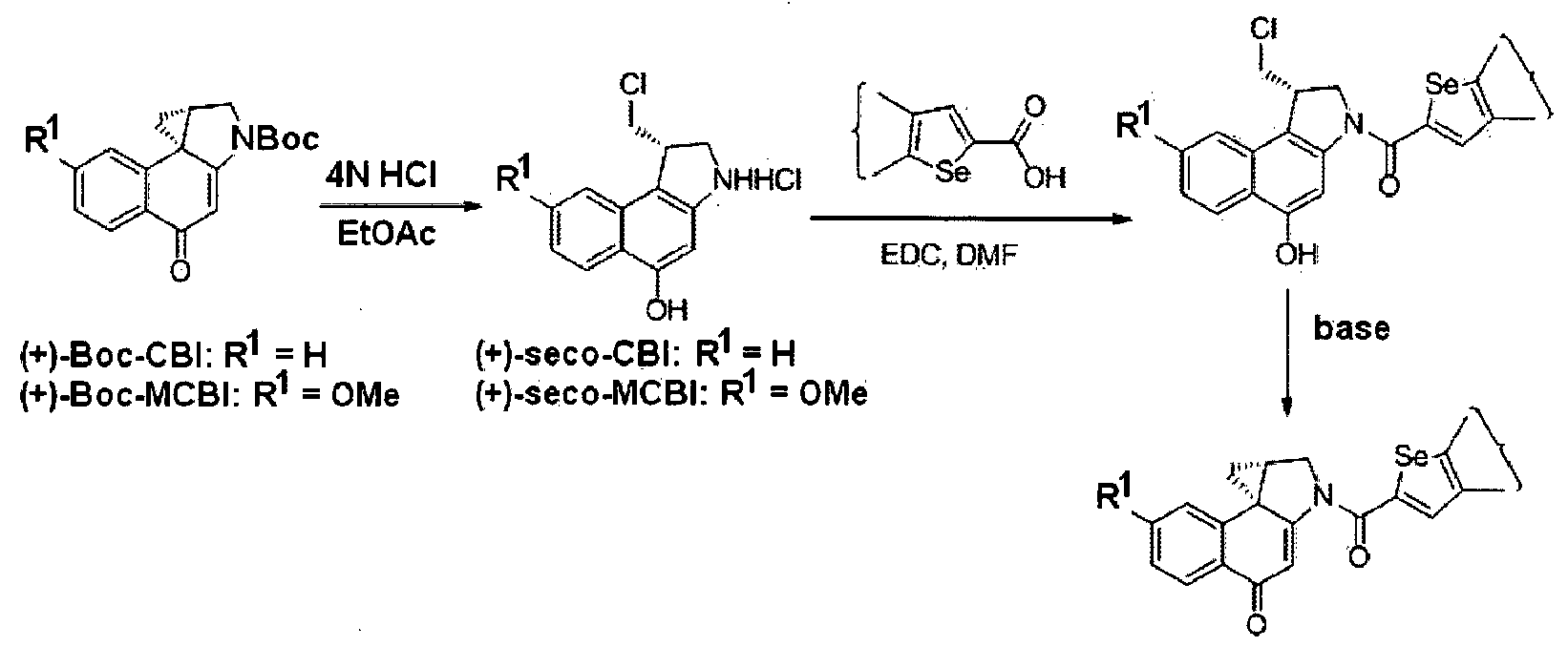
본원의 제 4 측면에 따라 엔트리 59 내지 84의 셀레노펜-접합 방향족 화합물은 하기와 같이 제조되었다.
(+)-Boc-MCBI 및 (+)-Boc-CBI는 문헌 (J. Org. Chem. 1996,
61, 1710)에 보고된 방법에 따라 합성하였으며, 30 mg 또는 50 mg의 출발물질을 4 N 농도의 HCl-EtOAc 3 mL을 혼합한 뒤 -40℃에서 30 분 동안 교반하였고, 이후 30 분에 걸쳐 실온이 되도록 방치하였다. 이후 질소 기체로 불어 반응용액을 농축하였고, 잔존 물질은 감압하에서 15 분 이상 동안 건조하였다.
DMF 1.0 mL 첨가하고 벤조셀레노펜-2-카르복시산 1.1 당량 및 EDCI 3.0 당량을 첨가하여 반응혼합물을 제조하였다. 상기 반응혼합물은 25℃에서 10 시간 동안 교반하였다. 교반 후 물 3 mL를 상기 반응혼합물에 첨가하였으며, 4 x 5 mL의 EtOAc를 이용하여 추출하였다. 이 과정에서 유기층을 모아 Na2SO4에 의하여 건조되었으며, 감압하에서 농축되었다.
생성물인 엔트리 59 내지 84의 셀레노펜-접합 방향족 화합물은 정제 박막 크로마토그래피(메탄올-메틸렌클로라이드 전개용매)를 이용하여 정제하여 15-55% 수율로 합성하였으며, 상기 화합물들의 구조는 하기 표 1에 나타낸 바와 같았다. 또한, 상기 화합물들 각각에 대하여 NMR 실험도 수행하였으며, 그 데이터들은 표 4의 하단에 기재하였다.
[규칙 제91조에 의한 정정 03.12.2012]
표 4 
표 4
[규칙 제91조에 의한 정정 03.12.2012]
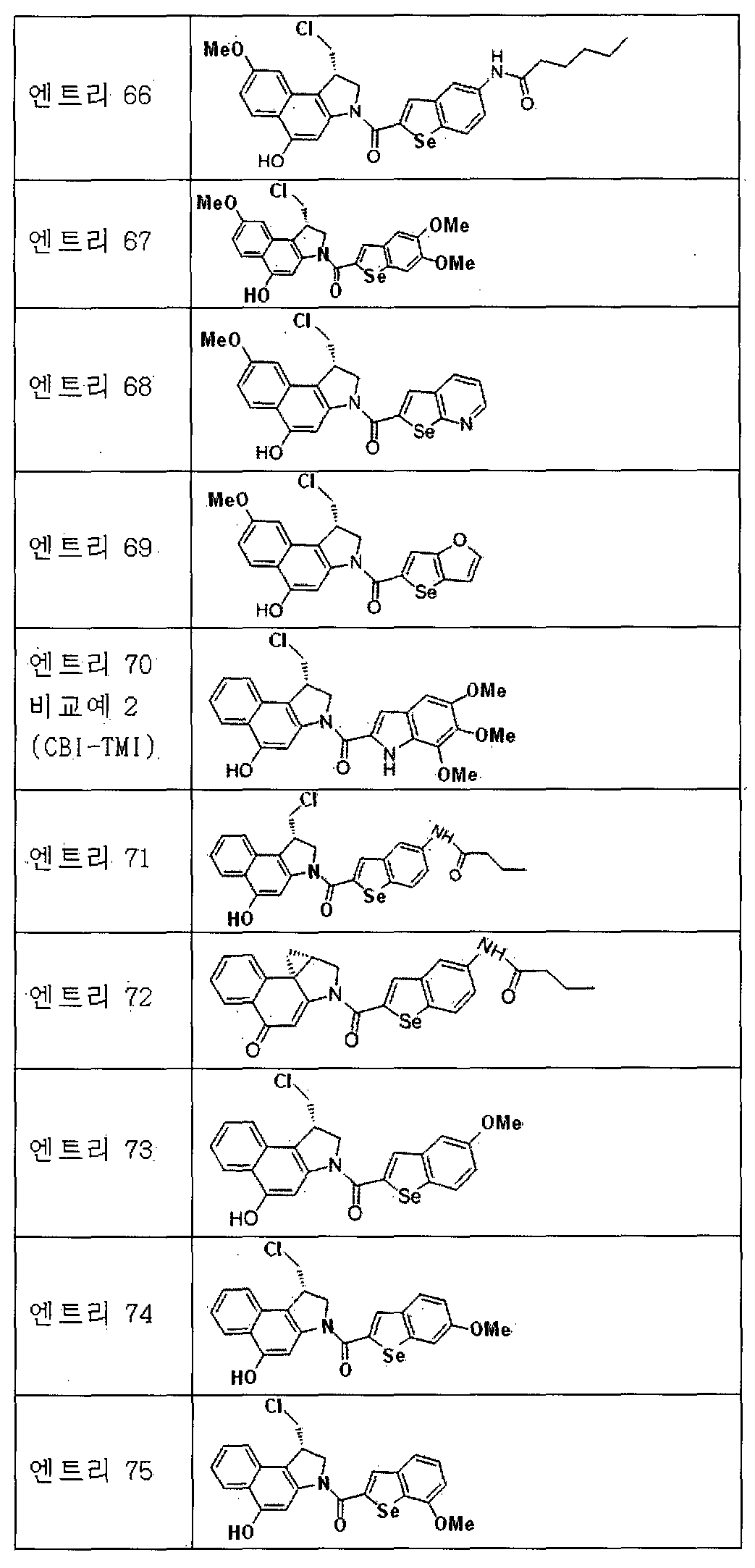
[규칙 제91조에 의한 정정 03.12.2012]
d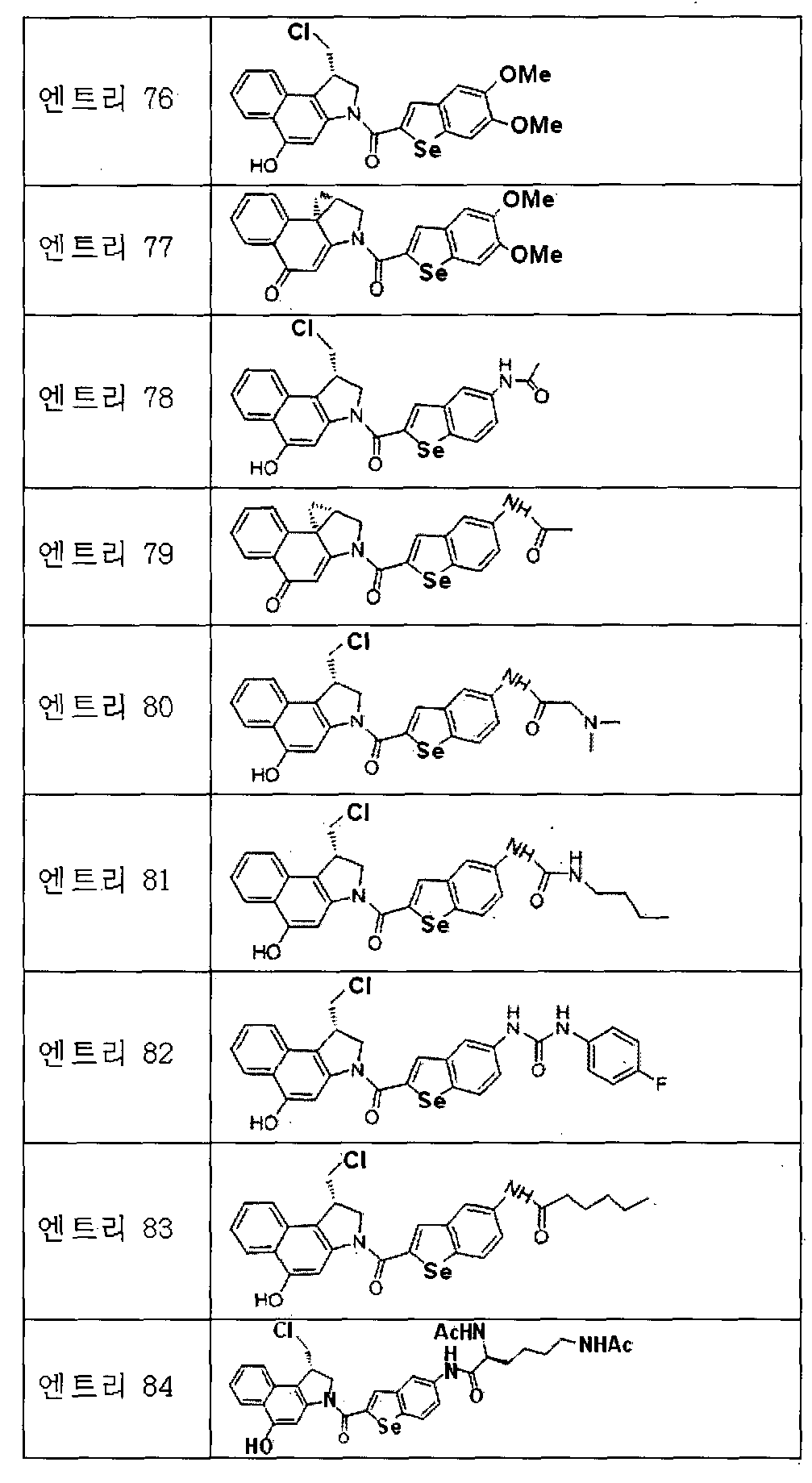
d
<상기 표 1의 비교예 1의 화합물 및 엔트리 59 내지 84의 셀레노펜-접합 방향족 화합물들의 NMR 데이터>
[비교예 1] seco-MCBI-TMI:
1H NMR (DMSO-d6, 500 MHz) ∂ 11.41 (s, 1H, NH), 10.35 (s, 1H, OH), 8.02 (d, J = 9.0 Hz, 1H), 7.72 (br s, 1H), 7.10 (d, J = 2.5 Hz, 1H), 7.05 (d, J = 2.0 Hz, 1H), 6.99 (dd, J = 9.2, 2.4 Hz, 1H), 6.96 (s, 1H), 4.71 (t, J = 10 Hz, 1H), 4.46 (d, J = 10 Hz, 1H), 4.15-4.10 (m, 1H), 4.05 (dd, J = 11.0, 3.5 Hz, 1H), 3.94 (s, 3H, OCH3), 3.91 (s, 3H, OCH3), 3.82 (s, 3H, OCH3), 3.80 (s, 3H, OCH3), 3.78 - 3.80 (m, 1H); LCMS, m/e 497.1 (M+ + H).
[엔트리 59] seco-MCBI-Nitro-Selenophene:
1H NMR (DMSO-d6, 500 MHz) ∂ 10.36 (s, 1H, OH), 8.93 ( d, J = 2.5 Hz, 1H), 8.54 (s, 1H), 8.45 (d, J = 9.0 Hz, 1H), 8.23 (dd, J = 9.0, 2.5 Hz, 1H), 8.03 (d, J = 9.5 Hz, 1H), 7.72 (br s, 1H), 7.13 (d, J = 2.0 Hz, 1H), 7.02 (dd, J = 9.5, 2.5 Hz, 1H), 4.72 (m, 1H), 4.47 (d, J = 10 Hz, 1H), 4.22 (m, 1H), 4.04 (dd, J = 11.0, 3.0 Hz, 1H), 3.92 (s, 3H, OCH3), 3.92 - 3.88 (m, 1H); LCMS, m/e 517.1 (M+ + H).
[엔트리 60] seco-MCBI -Methoxy-Selenophene:
1H NMR (DMSO-d6, 500 MHz) ∂ 10.34 (s, 1H, OH), 8.23 ( s, 1H), 8.02 (d, J = 9.0 Hz, 1H), 7.99 (d, J = 8.5 Hz, 1H), 7.67 (br s, 1H), 7.56 (d, J = 2.5 Hz, 1H), 7.12 (d, J = 2.0 Hz, 1H), 7.08 (dd, J = 9.0, 2.5 Hz, 1H), 7.01 (dd, J = 9.0, 2.0 Hz, 1H), 4.73 (t, J = 9.5 Hz, 1H), 4.48 (m, 1H), 4.18 (m, 1H), 4.04 (dd, J = 14.5, 7.0 Hz, 1H), 3.91 (s, 3H, OCH3), 3.82- (s, 3H, OCH3), 3.85 3.81 (m, 1H); LCMS, m/e 502.2 (M+ + H).
[엔트리 61] seco-MCBI-Acetamino-Selenophene:
1H NMR (DMSO-d6, 500 MHz) ∂ 10.32 (s, 1H, OH), 10.09 (s, 1H, NH), 8.44 ( s, 1H), 8.27 (s, 1H), 8.02 (d, J = 4.5 Hz, 1H), 8.01 (d, 4.5 Hz, 1H), 7.68 (br s, 1H), 7.46 (dd, J = 8.5, 2 Hz, 1H), 7.12 (d, J = 2.0 Hz, 1H), 7.01 (dd, J = 9.0, 2.5 Hz, 1H), 4.77 (t, J = 9.5 Hz, 1H), 4.45 (d, J = 11.5 Hz, 1H), 4.17 (m, 1H), 4.03 (dd, J = 11.5, 3.5 Hz, 1H), 3.91 (s, 3H, OCH3), 3.89-3.80 (dd, J = 11.0, 4.0 Hz, 1H); LCMS, m/e 529.2 (M+ + H).
[엔트리 62]
1H NMR (500.1 MHz, ACETONE-d6) ∂ 9.32 (s, 1H), 8.508 (d, 1H, J = 2.0 Hz ), 8.22 (s, 1H), 8.025 (d, 1H, J = 8.5 Hz), 7.98 (d, 1H, J = 9.0 Hz), 7.509 (dd, 1H, J = 2,8.5 Hz), 6.98 (dd ,1H, J = 2.5,9 Hz), 6.765 (s , 1H), 6.68 (dd,1H, J = 2.5Hz), 4.6 (dd, 1H, J = 5.0, 10.0 Hz), 4.44 (d, 1H, J = 10.5 Hz), 3.9 (s, 3H ), 3.18 (m, 1H), 2.08 (s, 3H), 1.82 (dd ,2H,J=4Hz, 7.5Hz)
[엔트리 63]
1H NMR (500.1 MHz, CDCl3) ∂ 3.43 (t, 1H, J = 11.3), 3.88 (m, 1H), 3.90 (s, 3H), 3.98 (m, 1H), 4.56 (m, 1H), 4.64 (d, 1H, J = 11.3), 6.85 (d, 1H, J = 2.8), 7.02 (dd, 1H, J = 2.8, 9.4), 7.31 (s, 1H), 7.34 (s, 1H), 7.96 (s, 1H), 8.07 (s, 1H), 8.21 (d, 1H, J = 9.4), 8.94 (s, 1H); 13C NMR (125.7 MHz, CDCl3) ∂ 42.82, 45.60, 55.35, 56.17, 99.07, 100.93, 106.39, 114.97, 115.60, 118.20, 125.78, 130.77, 131.22, 134.63, 136.11, 138.80, 141.81, 148.50, 149.76, 155.01, 164.30.
[엔트리 64]
1H NMR (500.1 MHz, CDCl3) ∂ 3.48 (t, 1H, J = 11.3), 3.90 (m, 1H), 3.91 (s, 3H), 3.95 (s, 3H), 4.00 (m, 1H), 4.60 (t, 1H, J = 9.4), 4.69 (d, 1H, J = 10.7), 6.92 (s, 1H), 7.05 (m, 2H), 7.43 (d, 1H, J = 1.6), 7.79 (d, 1H, J = 8.8), 7.82 (m, 1H), 7.97 (s, 1H), 8.17 (d, 1H, J = 10.1)
[엔트리 65]
1H NMR (500.1 MHz, CDCl3) ∂ 1.05 (t, 3H, J = 7.6), 1.81 (m, 2H), 2.39 (t, 2H, J = 7.9), 3.36 (m, 1H), 3.79 (m, 1H), 3.86 (m, 1H), 3.91 (s, 3H), 4.18 (m, 1H), 4.38 (d, 1H, J = 7.8), 6.7 (dd, 1H, J = 2.8, 36.5), 7.02 (m, 1H), 7.34 (d, 1H, J = 8.8), 7.49 (s, 1H) 7.75 (d, 1H, J = 9.1), 7.87 (s, 1H), 8.11 (s, 1H), 8.21 (d, 1H, J = 9.4)
[엔트리 66]
1H NMR (500.1 MHz, CDCl3) ∂ 0.94 (t, 3H, J = 7.6), 1.40 (m, 4H), 1.79 (m, 2H), 2.41 (t, 2H, J = 8.1), 3.35 (m, 1H), 3.66 (m, 1H), 3.80 (d, 1H, J = 12.6), 3.91 (s, 3H), 4.39 (m, 2H), 6.76 (s, 1H), 7.03 (d, 1H, J = 9.4), 7.34 (d, 1H, J = 8.5), 7.49 (m, 1H) 7.74 (d, 1H, J = 11.9), 7.88 (s, 1H), 8.13 (s, 1H), 8.20 (d, 1H, J = 9.4)
[엔트리 67]
1H NMR (500.1 MHz, CDCl3) ∂ 3.46 (t, 1H, J = 11.3), 3.90 (d, 1H, J = 3.1), 3.93 (s, 3H), 3.96 (s, 3H), 3.97 (m, 1H), 3.99 (s, 3H), 4.58 (m, 1H), 4.67 (dd, 1H, J = 1.6, 11.0), 6.89 (d, 1H, J = 2.8), 7.04 (dd, 1H, J = 2.8, 9.4), 7.32 (s, 1H), 7.36 (s, 1H), 7.97 (s, 1H), 7.98 (d, 1H, J = 9.4), 8.20 (d, 1H, J = 9.4)
[엔트리 68]
1H NMR (500.1 MHz, ACETONE-d6 ) ∂ 9.4 (s, 1H), 8.605 (dd, 1H, J = 4.5,1Hz), 8.32 (dd, 1H , J = 1,8 Hz), 8.162 (d, 1H, J = 2Hz ), 7.65 (brs, 1H), 7.492(dd, 1H, J = 4.5, 8.0Hz), 7.187 (d, 1H, J = 2.5 Hz),7.035 (dd, 1H, J = 2.5, 9), 4.717 (t ,1H, J = 10.0Hz),4.635 (d, 1H, J = 11.0 Hz), 4.18 (m ,1H), 4.048 (dd , 1H , J = 3.5, 11.5Hz), 3.9 (s , 3H), 3.832 (m, 1H). 13C NMR (125.7 MHz, ACETONE-d6) ∂ 42.85, 47.39, 55.76, 56.50, 99.50, 102.27, 116.01, 116.28, 116.67, 118.73, 121.43,125.99, 128.31,132.80,135.29,137.25,143.53,149.03,155.34,160.19,162.83,163.08,166.26
[엔트리 69]
1H NMR (500.1 MHz, CDCl3) ∂ 3.47 (m, 1H), 3.92 (m, 1H), 3.94 (s, 3H), 4.02 (t, 1H, J = 11.0), 4.60 (m, 1H), 4.68 (d, 1H, J = 11.0), 6.88 (d, 1H, J = 2.2), 6.91 (d, 1H, J = 2.8), 7.05 (m, 1H), 7.66 (d, 1H, J = 2.5), 7.79 (s, 1H), 7.93 (s, 1H), 8.15 (d, 1H, J = 9.1)
[엔트리 70]
1H NMR (500.1 MHz, DMSO) ∂ 10.46 (s, 1H,OH ), 8.12 (d, 1H, J = 8.5Hz, C6-H), 7.90 (br s, 1H, C4-H), 7.84 (d, 1H, J = 8.5 Hz,C9-H ), 7.52 (t, 1H,J =8.0Hz,C8-H), 7.36 (t, 1H,J= 8.0 Hz,C7-H), 7.06 (s, 1H, ,C3'-H), 6.97 (s, 1H,C4'-H) , 4.74(apparent t,1H,J= 10.4Hz,C2-H), 4.46(d,1H, J= 11.2Hz,C2-H), 4.17 (m, 1H, C1-H), 4.01 (d ,1H , J= 10.6 Hz,CHHCl),3.94 (s,3H,OCH3), 3.83 (s,3H,OCH3), 3.82 (d ,1H , J= 11.2 Hz, CHHCl), 3.79 (s, 3H, OCH3)
[엔트리 71]
1H NMR (500.1 MHz, DMSO) ∂ 10.4 (s, 1H), 10.0 (s, 1H), 8.48 (s, 1H),8.3 (s, 1H), 8.15 (d, 1H, J = 8.5 Hz), 8.05 (d, 1H, J = 8.5 Hz),7.88 (d, 1H, J = 8 Hz), 7.86 (brs 1H), 7.56 ( t,1H, J = 8 Hz ),7.5 (dd, 1H, J = 8.5,2 Hz), 7.4 (t, 1H, J = 8.0 Hz), 7.4 (t,1H, J = 8.0 Hz), 4.8 ( t,1H, J = 9.5 Hz ),4.45 (dd, 1H, J = 11.0,2.0 Hz), 4.2 (m, 1H,) 4.01( dd,1H, 3.0, J =11.0 Hz), 3.89 ( m,1H ),2.3 (t d, 2H, J = 7.5,1.5 Hz), 1.6 (qr, 2H, J = 7.5 Hz), 0.9 ( t ,1H, J = 3.0,11.0 Hz) , 13C NMR (125.7 MHz, Acetone) ∂ 13.96, 14.11, 19.72, 24.41,42.75,47.91, 54.67, 101.58, 115.48, 117.07, 118.01, 120.03, 123.35, 123.62, 123.76, 124.34, 128.21, 128.40, 143.0, 130.92, 137.44, 143.66, 155.22, 163.58, 169.85, 172.13
[엔트리 72]
1H NMR (500.1 MHz, ACETONE-d6) ∂ 9.26 (s, 1H), 8.537 (d, 1H, J =8.5Hz), 8.23 (s, 1H), 8.1 (d, 1H, J =1.0Hz), 7.98 (d, 1H, J =8.5Hz), 7.55 (m, 2H), 7.4 (m, 1H), 7.2 (d, 1H, J = 8 Hz), 6.834 (s,1H), 4.621 (dd, 1H, J = 10.5, 5 Hz), 4.46 (d, 1H, J = 10. 5Hz), 3.17 (m, 1H ), 2.366(t, 1H, J = 7.5 Hz), 1.81 (t, 2H, J =2 Hz), 1.69 (m, 2H), 0.96 (t, 3H, J = 7.5 Hz)
13C NMR (125.7 MHz, Acetone) ∂ 14.14, 19.75, 25.32, 33.60, 39.78, 55.72, 112.31, 117.57, 118.22, 120.52, 123.00, 123.22, 126.71, 126.95, 127.04, 127.30, 132.56, 132.93, 133.79, 138.55, 141.74, 143.13, 143.45, 161.44, 165.22, 172.15, 185.56
[엔트리 73]
1H NMR (500.1 MHz, Acetone) ∂ 10.4 (s, 1H), 8.2 (s, 1H), 8.1 (d, 1H, J = 8.0 Hz), 8.0 (d,1H, J = 8.5 Hz), 7.8 (d, 1H, J = 8.5 Hz), 7.58 (s, 1H ),7.56 (t, 1H, J = 8.5 Hz), 7.4 (t, 1H, J =8Hz),7.1 (d, 1H, J = 9.0 Hz), 4.8 (t, 1H, J = 10.0 Hz),4.45 (d, 1H, J = 11.0 Hz), 4.2 (m, 1H ) 4.01( qr,1H, J = 7 Hz), 3.89 (m,1H), 3.80 (s, 3H). 13C NMR (125.7 MHz, Acetone) ∂ 43.14, 47.72, 55.96, 56.77, 101.64, 110.34, 117.54, 123.67, 123.75, 124.38, 124.40, 127.26, 128.49, 130.74, 131.43, 143.29, 144.36, 155.24, 159.34, 163.57
[엔트리 74]
1H NMR (500.1 MHz, Acetone) ∂ 9.4 (s, 1H), 8.25 (d, 1H, J = 8.5 Hz), 8.2 (s, 1H),7.9 (m, 4H), 7.68 (s, 1H), 7.54 (td, 1H, J = 6.5,1Hz),7.4 (td 1H, J = 10,1Hz), 7.01 (dd, 1H, J = 2, 8.5 Hz), 4.8 (t, 1H, J = 10.0 Hz),4.7 (dd, 1H, J = 1.5,10.5 Hz), 4.2 (m, 1H) 4.01(dd,1H, J = 3.5, 11.5Hz), 3.90 (s, 3H), 3.80 (m,1H ). 13C NMR (125.7 MHz, Acetone) ∂ 43.21, 47.73, 56.13, 56.17, 101.69, 109.18, 115.93, 116.92, 123.64, 124.30, 124.38, 128.45, 129.05, 130.77, 137.13, 137.39, 143.46, 145.4, 155.19, 160.16, 163.49
[엔트리 75]
1H NMR (500.1 MHz, Acetone) ∂ 9.5 (s, 1H ), 8.25 (d, 1H, J = 5Hz), 8.23 (s, 1H), 7.9 (s, 1H ), 7.9 (d, 1H, J = 8.5 Hz), 7.6 (d, 1H, J= 7.5 Hz) ,7.5 (t, 1H, J = 8.0 Hz), 7.43 (t, 1H, J = 8.0 Hz) 7.4 (t, 1H, J = 7.0 Hz), 4.8 (t, 1H, J = 10.5 Hz), 4.68 (dd, 1H, J = 1.5, 10.5 Hz), 4.25 (m, 1H) 4.01(dd,1H, J = 3.5, 11.5Hz), 4.01 (s, 3H), 3.82 (dd,1H, J = 8.5, 11 Hz). 13C NMR (125.7 MHz, Acetone) ∂ 43.14, 47.74, 56.47, 56.79, 107.13, 117.13, 120.72, 123.69, 124.41, 127.89, 128.50, 131.05, 131.44, 131.89, 143.28, 144.67, 155.25, 157.31, 163.55
[엔트리 76]
1H NMR (500.1 MHz, Acetone) ∂ 9.25 (s, 1H ), 8.3 (d, 1H, J = 8.5Hz), 8.2 (s, 1H), 7.9 (s, 1H), 7.8 (d, 1H, J = 8.5 Hz), 7.68 (s, 1H),7.55 (m, 1H), 7.52 (s, 1H) 7.4 (m, 1H), 4.8 (t, 1H, J = 11.0 Hz),4.7 (dd, 1H, J = 2,11.0 Hz), 4.3 (m, 1H) 4.05(dd,1H, J = 3.5, 11.5Hz), 3.94 (s, 3H), 3.89 (s ,3H), 3.8 (dd,1H, J = 9, 11.5Hz). 13C NMR (125.7 MHz, Acetone) ∂ 41.71, 46.17, 54.77, 54.88, 54.93, 100.18, 101.99, 106.74, 108.12, 115.32, 122.08, 122.73, 122.84, 126.9, 129.46, 135.08, 141.98, 148.55, 149.86, 153.65, 162.01
[엔트리 77]
1H NMR (500.1 MHz, ACETONE-d6) ∂ 8.17 (s, 1H), 8.099 (dd, 1H, J =7.5,1Hz), 7.64 (s, 1H), 7.60 (m,1H), 7.489 (s, 1H), 7.422 (m ,1H), 7.18 (d, 1H, 7.5Hz), 6.78(s, 1H), 4.58 (dd, 1H, J = 10.5, 5 Hz), 4.42 (d, 1H, J = 10. 0Hz), 3.92 (s, 3H), 3.86(s, 3H),3.16 (m, 1H), 1.802 (m, 2H)
[엔트리 78]
1H NMR (500.1 MHz, Acetone) ∂ 9.3 (s, 1H), 8.5 (s, 1H), 8.22 (d, 1H, J = 8.5 Hz), 8.2 (s, 1H), 7.98 (d, 1H, J = 9 Hz), 7.9 (d, 1H, J = 8.5 Hz), 7.58 (m, 2H), 7.4 (t, 1H, J = 8.0 Hz), 4.8 (t, 1H, J = 11.0 Hz), 4.7 (dd, 1H, J = 2, 11.0 Hz), 4.24 (m, 1H) 4.05(dd,1H, J = 3.5, 11.5 Hz), 3.85 (dd, 3H, , J = 9, 11.5 Hz ), 2.1 (s ,3H). 13C NMR (125.7 MHz, Acetone) ∂ 24.11, 43.53, 48.13, 57.17, 102.99, 117.18, 118.39, 120.64, 123.30, 124.38, 126.45, 128.45, 131.05, 132.77, 137.13, 138.39, 143.46, 144.4, 155.29, 164.16, 168.49
[엔트리 79]
1H NMR (505.1 MHz, ACETONE-d6) ∂ 9.32 (d, 1H, J = 7), 8.51 (s, 1H ), 8.24 (s, 1H), 8.09 (d, 1H, J = 8.0), 7.98 (d, 1H, 8.5 Hz), 7.581(t, 1H, J = 7.5 Hz), 7.51 (d ,1H, J = 8.5 Hz), 7.428 (t , 1H, 7.5Hz), 7.198 (d,1H, J = 8Hz), 6.82 (s ,1H), 4.63 (dd, 1H, J = 5.5, 10.5 Hz), 4.47 (d, 1H, J = 10.5 Hz), 3.175 ( d, 1H, J = 5.5 Hz), 2.109 (s, 3H), 1.8 (d, 2H, J = 5.5Hz)
[엔트리 80]
1H NMR (500.1 MHz, Acetone) ∂ 9.8 (bs, 1H), 9.3(s, 1H), 8.5 (s, 1H), 8.2 (d, 2H, J = 9.5 Hz), 8.0 (d, 1H, J = 8.5 Hz), 7.9 (s, 1H ), 7.85 (d, 2H, J = 8.5 Hz), 7.7 (dd, 1H, J = 2,8.5 Hz), 7.4 (t, 1H, J = 8 Hz), 4.8 (t, 1H, J = 11.0 Hz), 4.7 (dd, 1H, J = 2, 11.0 Hz), 4.24 (m, 1H) 4.05(dd,1H, J = 3.5, 11.5 Hz), 3.85 (m, 1H),3.25 (s ,2H), 2.5 (s, 6H).
[엔트리 81]
1H NMR (500.1 MHz, Acetone) ∂ 9.3 (s, 1H), 8.32 (s, 1H), 8.28 (d, 1H, J = 8.5 Hz), 8.18 (s, 1H), 8.10 (s, 1H), 7.9 (dd, 3H, J = 4,9Hz),7.53 (t, 1H, J = 7 Hz), 7.52 (m, 1H), 5.85 (bs, 1H), 4.8 (t, 1H, J = 11.0 Hz), 4.68 (dd, 1H, J = 2,11.0 Hz), 4.24 (m, 1H), 4.05 (dd,1H, J = 3.5, 11.5Hz), 3.8 (dd, 1H, J = 8.5, 11.5 Hz), 3.25 (q ,2H, J = 7 Hz), 1.5 (m , 2H),1.38 (m, 2H), 0.92 (t, 3H, J = 7.5Hz)
[엔트리 82]
1H NMR (500.1 MHz, Acetone ) ∂ 9.3 (s, 1H), 8.92 (s, 1H), 8.86 (s, 1H), 8.37 (s, 1H), 8.25(d, 1H, J = 8.5Hz), 8.20 (s, 1H),7.94 (d, 1H, J = 8.5Hz), 7.88 ( d, 1H, J = 8.5Hz), 7.618 (dd, 3H, J = 5, 9 Hz), 7.542 (m, 2H), 7.4 (t, 1H, J = 7 Hz), 7.043 (t, 1H, 9Hz) 4.8 (t, 1H, J = 11.0 Hz), 4.67 (d, 1H, J = 11.5 Hz), 4.24 (t, 1H, J = 8.5Hz), 4.05 (dd , 1H, J = 3, 11Hz), 3.848 (dd, 1H, J = 8.5, 11 Hz).
[엔트리 83]
1H NMR (500.1 MHz, ACETONE-d6) ∂ 9.25 (s, 1H), 8.527 (s, 1H), 8.25 (d, 1H, J =8.5Hz), 8.21 (s,1H), 7.97 (d, 1H, J = 9 Hz), 7.88 (d, 1H, J = 8.5Hz), 7.54 (t, 2H, J = 8 Hz), 7.40 (t, 1H, J = 8 Hz), 4.8 (t ,1H, J = 11.0Hz), 4.67 (d, 1H, J = 11.0 Hz), 4.23 (m, 1H), 4.04 (dd , 1H, J = 3, 11 Hz), 3.82 (dd, 1H, J = 8.5 , 11 Hz), (t, 2H, J = 7.5Hz), 1.7 (t, 2H, J = 7.0 Hz), 1.4 (m, 4H), 0.9 (m, 3H)
[엔트리 84]
1H NMR (500.1 MHz, ACETONE-d6) ∂ 9.6 (s, 1H), 8.44 (s, 1H), 8.238 (d, 1H, J = 8.5 Hz), 8.19 (s,1H), 7.97 (d, 1H, J =8.5Hz), 7.87 (d, 1H, J = 8.5Hz), 7.597 (d, 1H, J = 1.5 Hz), 7.53 (d, 1H, J = 7 Hz), 7.4 (d, 1H, J = 7.5 Hz), 7.2 (s, 1H), 4.87 (t ,1H, J = 11.0Hz), 4.65 (d, 1H, J = 11.0 Hz), 4.523 (dd, 1H, J = 8, 13 Hz), 4.21(t , 1H, J = 8.5 Hz), 4.03 (dd, 1H, J = 3.5, 11 Hz), 3.8 (m ,1H), 3.76 (t, 1H, J = 6.5 Hz), 3.183 (m, 2H), 2.08 (s , 3H), 1.99 (s, 3H), 1.51-1.44 (m, 6 H)
[실험예]
1. 합성된 화합물등의 암세포 증식 효과
한편, 본 실시예에서는 비교예 1의 화합물 및 엔트리 59 내지 84의 몇가지 화합물들에 대하여 SK-OV-3 암세포에 대하여 증식억제효과를 확인하였으며, 결과는 표 2에 나타내었다.
증식억제 효과 실험방법
10% FBS와 1% P/S가 첨가된 McCoy's 5A Medium에 부유시킨 SK-OV-3 세포를 96 웰 플레이트에 웰 당 3×10⁴/100 μl씩 접종하였다. 37℃에서 4 시간 배양한 후, 화합물을 최종 농도 10 nM이 되도록 100 μl씩 처리하였고, 37℃에서 72 시간 동안 배양하였다. 대조군에는 화합물의 용매인 DMSO를 최종 농도 0.1%가 되게 처리하였다. WST-1 assay 시약 (iTSBio, Korea)를 웰 당 10 μl씩 처리하고 37℃에서 2 시간 동안 배양한 후 자동 Microplate Reader로 450 nm에서 흡광도를 측정하였다. 세포 성장 억제정도는 '(A450대조군-A450화합물)/A450대조군}*100'으로 산출하였다.
표 5 
전술한 본원의 설명은 예시를 위한 것이며, 본원이 속하는 기술분야의 통상의 지식을 가진 자는 본원의 기술적 사상이나 필수적인 특징을 변경하지 않고서 다른 구체적인 형태로 쉽게 변형이 가능하다는 것을 이해할 수 있을 것이다. 그러므로 이상에서 기술한 실시예들은 모든 면에서 예시적인 것이며 한정적이 아닌 것으로 이해해야만 한다. 예를 들어, 단일형으로 설명되어 있는 각 구성요소는 분산되어 실시될 수도 있으며, 마찬가지로 분산된 것으로 설명되어 있는 구성요소들도 결합된 형태로 실시될 수 있다.
본원의 범위는 상기 상세한 설명보다는 후술하는 특허청구범위에 의하여 나타내어지며, 특허청구범위의 의미 및 범위, 그리고 그 균등 개념으로부터 도출되는 모든 변경 또는 변형된 형태가 본원의 범위에 포함되는 것으로 해석되어야 한다.
Claims (23)
- 하기 화학식 1로써 표시되는, 셀레노펜-접합 방향족(selenophene-fused aromatic) 화합물:[화학식 1],
 상기 식 중,R1은 -CO2H, -CO2R, 4-NO2-Ph, 4-CN-Ph, 4-RO2C-Ph, 4-X-Ph, 또는 하기 화학식 A이고:[화학식 A],R2는 H, -NO2, -NHCOR, CX3, -OR, -diOR, 치환될 수 있는 알킬기, 치환될 수 있는 알콕시기, 치환될 수 있는 알킬렌-디옥시기, 치환될 수 있는 아미노기, 할로기, 또는 하기 화학식 B로써 표시되는 치환기이고:[화학식 B],
 X는 할로기이고,R3는 -H, -OH, -NH2, 치환될 수 있는 알킬기, 또는 치환될 수 있는 아릴기이고,R4 및 R5 는 각각 독립적으로 치환될 수 있는 N, O, S, C, 결합(bond) 또는 비결합이고,R6은 H, 또는 치환될 수 있는 알콕시기이고,R7는 H, -CONR17R20, 또는이고,
 R17 및 R20은 각각 독립적으로 H, 또는 치환될 수 있는 알킬기이고,R21은 C, O, N, 또는 S이고,R8은 할로기이고,R9는 O, NH, S, 또는 Se이고,R10은 치환될 수 있는 알킬기, 치환될 수 있는 알콕시기, 할로기, -NO2, 또는 -NHCOR이고,R은 H, 치환될 수 있는 알킬기, 치환될 수 있는 아릴기, 치환될 수 있는 아미노기, 치환될 수 있는 아미노산기, 치환될 수 있는 펩타이드기, 치환될 수 있는 C1-7의 알콕시기, 또는 치환될 수 있는 탄수화물 또는 탄수화물 유도체의 잔기임.
 - 제 1 항에 있어서,상기 화학식 1은 하기 화학식 2 내지 화학식 6 중 선택되는 것을 포함하는 것인, 셀레노펜-접합 방향족 화합물:[화학식 2],
 [화학식 3],
 [화학식 4],
 [화학식 5],
 [화학식 6],
 상기 식들 중,R3는 상기 화학식 1에서 정의된 바와 같으며,R11은 -CO2H, -CO2R, 4-NO2-Ph, 4-CN-Ph, 4-RO2C-Ph, 또는 4-X-Ph이고,R12는 H, -NO2, -NHCOR, CX3, -OR, -diOR, 치환될 수 있는 알콕시기, 치환될 수 있는 알킬렌-디옥시기, 치환될 수 있는 아미노기, 또는 할로기이고,X는 할로기이고,R은 H, 치환될 수 있는 알킬기, 치환될 수 있는 아릴기, 치환될 수 있는 아미노기, 치환될 수 있는 아미노산기, 치환될 수 있는 펩타이드기, 치환될 수 있는 C1-7의 알콕시기, 또는 치환될 수 있는 탄수화물 또는 탄수화물 유도체의 잔기임.
 - 제 1 항에 있어서,상기 화학식 1은 하기 화학식 7 내지 화학식 9 중 선택되는 것을 포함하는 것인, 셀레노펜-접합 방향족 화합물:[화학식 7],
 [화학식 8],
 [화학식 9],
 상기 식들 중,R4 및 R5는 각각 독립적으로 치환될 수 있는 N, O, S, C, 결합(bond) 또는 비결합이고,R11은 -CO2H, -CO2R, 4-NO2-Ph, 4-CN-Ph, 4-RO2C-Ph, 또는 4-X-Ph이고,R12는 H, -NO2, -NHCOR, CX3, -OR, -diOR, 치환될 수 있는 알콕시기, 치환될 수 있는 알킬렌-디옥시기, 치환될 수 있는 아미노기, 또는 할로기이고,X는 할로기이고,R은 H, 치환될 수 있는 알킬기, 치환될 수 있는 아릴기, 치환될 수 있는 아미노기, 치환될 수 있는 아미노산기, 치환될 수 있는 펩타이드기, 치환될 수 있는 C1-7의 알콕시기, 또는 치환될 수 있는 탄수화물 또는 탄수화물 유도체의 잔기임.
 - 제 1 항에 있어서,상기 화학식 1은 하기 화학식 10 내지 화학식 12 중 선택되는 것을 포함하는 것인, 셀레노펜-접합 방향족 화합물:[화학식 10],
 [화학식 11]
 [화학식 12]
 상기 식들 중,R2는 H, -NO2, -NHCOR, CX3, -OR, -diOR, 치환될 수 있는 알킬기, 치환될 수 있는 알콕시기, 치환될 수 있는 알킬렌-디옥시기, 치환될 수 있는 아미노기, 할로기, 또는 하기 화학식 B로써 표시되는 치환기이고:[화학식 B],
 X는 할로기이고,R4 및 R5는 각각 독립적으로 치환될 수 있는 C, O, N, S, 결합(bond) 또는 비결합이고,R6은 H, 또는 치환될 수 있는 알콕시기이고,R7는 H, -CONR17R20, 또는 이고,R17 및 R20은 각각 독립적으로 H, 또는 치환될 수 있는 알킬기이고,R21은 C, O, N, 또는 S이고,R8는 할로기이고,R9는 O, NH, S, 또는 Se이고,R10은 치환될 수 있는 알킬기, 치환될 수 있는 알콕시기, 할로기, -NO2, 또는 -NHCOR이고,L은 링커(linker)이고,R은 H, 치환될 수 있는 알킬기, 치환될 수 있는 아릴기, 치환될 수 있는 아미노기, 치환될 수 있는 아미노산기, 치환될 수 있는 펩타이드기, 치환될 수 있는 C1-7의 알콕시기, 또는 치환될 수 있는 탄수화물 또는 탄수화물 유도체의 잔기임.
 - 일반식 R11-CH2-Se-Se-CH2-R11로써 표시되는 디셀레나이드(diselenide) 화합물, 용매, 및 환원제를 포함하는 반응혼합물을 준비하고;상기 반응혼합물에 하기 화학식 2a로써 표시되는 방향족 출발물질, 및 염기를 첨가하여 반응시키는 것을 포함하는,하기 화학식 2로써 표시되는 셀레노펜-접합 방향족 화합물의 제조 방법:[화학식 2a],
 [화학식 2],
 상기 식들 중,Z는 -COR15, 또는 -CN이고,R15은 -H, 치환될 수 있는 알킬기, 치환될 수 있는 아릴기, 또는 치환될 수 있는 알콕시기이고,R3는 -H, -OH, -NH2, 치환될 수 있는 알킬기, 또는 치환될 수 있는 아릴기이고,R11은 -CO2H, -CO2R, 4-NO2-Ph, 4-CN-Ph, 4-RO2C-Ph, 또는 4-X-Ph이고,R12는 H, -NO2, -NHCOR, CX3, -OR, -diOR, 치환될 수 있는 알콕시기, 치환될 수 있는 알킬렌-디옥시기, 치환될 수 있는 아미노기, 또는 할로기이고,X는 할로기이고,R은 H, 치환될 수 있는 알킬기, 치환될 수 있는 아릴기, 치환될 수 있는 아미노기, 치환될 수 있는 아미노산기, 치환될 수 있는 펩타이드기, 치환될 수 있는 C1-7의 알콕시기, 또는 치환될 수 있는 탄수화물 또는 탄수화물 유도체의 잔기임.
 - 제 5 항에 있어서,상기 화학식 2a는 하기 화학식 3a를 포함하고, 상기 화학식 2는 하기 화학식 3을 포함하는 것인, 상기 화학식 2로써 표시되는 셀레노펜-접합 방향족 화합물의 제조 방법:[화학식 3a],
 [화학식 3],
 상기 식들 중,X, R11, 및 R12는 각각 상기 화학식 2a 및 화학식 2에서 정의된 바와 같음.
 - 제 5 항에 있어서,상기 화학식 2a는 하기 화학식 4a를 포함하고, 상기 화학식 2는 하기 화학식 4를 포함하는 것인, 상기 화학식 2로써 표시되는 셀레노펜-접합 방향족 화합물의 제조 방법:[화학식 4a],
 [화학식 4],
 상기 식들 중,X, R11, 및 R12는 각각 상기 화학식 2a 및 화학식 2에서 정의된 바와 같음.
 - 제 5 항에 있어서,상기 화학식 2a은 하기 화학식 5a를 포함하고, 상기 화학식 2는 하기 화학식 5를 포함하는 것인, 상기 화학식 2로써 표시되는 셀레노펜-접합 방향족 화합물의 제조 방법:[화학식 5a],
 [화학식 5],
 상기 식들 중,X, R11, 및 R12는 각각 상기 화학식 2a 및 화학식 2에서 정의된 바와 같음.
 - 제 5 항에 있어서,상기 화학식 2a는 하기 화학식 6a를 포함하고, 상기 화학식 2는 하기 화학식 6를 포함하는 것인, 상기 화학식 2로써 표시되는 셀레노펜-접합 방향족 화합물의 제조 방법:[화학식 6a],
 [화학식 6],
 상기 식들 중,X, R11, 및 R12는 각각 상기 화학식 2a 및 화학식 2에서 정의된 바와 같음.
 - 제 5 항에 있어서,상기 환원제는 티올기를 함유하는 것인, 상기 화학식 2로써 표시되는 셀레노펜-접합 방향족 화합물의 제조 방법.
- 하기 화학식 7a로써 표시되는 방향족 출발물질, 및 R11CH2X를 가열 반응시켜 하기 화학식 7b로써 표시되는 반응중간체를 형성하고;상기 반응중간체에 용매, 및 염기를 첨가하여 반응시키는 것을 포함하는,하기 화학식 7로써 표시되는 셀레노펜-접합 방향족(selenophene-fused aromatic) 화합물의 제조 방법:[화학식 7a],
 [화학식 7b],
 [화학식 7],
 상기 식들 중,R4 및 R5는 각각 독립적으로 치환될 수 있는 N, O, S, C, 결합(bond) 또는 비결합이고,R11은 -CO2H, -CO2R, 4-NO2-Ph, 4-CN-Ph, 4-RO2C-Ph, 또는 4-X-Ph이고,R12는 H, -NO2, -NHCOR, CX3, -OR, -diOR, 치환될 수 있는 알콕시기, 치환될 수 있는 알킬렌-디옥시기, 치환될 수 있는 아미노기, 또는 할로기이고,X는 할로기이고,R13은 치환될 수 있는 알킬기이고,R은 H, 치환될 수 있는 알킬기, 치환될 수 있는 아릴기, 치환될 수 있는 아미노기, 치환될 수 있는 아미노산기, 치환될 수 있는 펩타이드기, 치환될 수 있는 C1-7의 알콕시기, 또는 치환될 수 있는 탄수화물 또는 탄수화물 유도체의 잔기임.
 - 제 11 항에 있어서,상기 화학식 7a는 하기 화학식 8a를 포함하고, 상기 화학식 7b는 하기 화학식 8b를 포함하며, 상기 화학식 7은 하기 화학식 8을 포함하는 것인, 상기 화학식 7로써 표시되는 셀레노펜-접합 방향족 화합물의 제조 방법:[화학식 8a],
 [화학식 8b],
 [화학식 8],
 상기 식들 중,R11, R12, 및 R13은 각각 상기 화학식 7a, 화학식 7b, 및 화학식 7에서 정의된 바와 같음.
 - 제 11 항에 있어서,상기 화학식 7a는 하기 화학식 9a를 포함하고, 상기 화학식 7b는 하기 화학식 9b를 포함하며, 상기 화학식 7은 하기 화학식 9를 포함하는 것인, 상기 화학식 7로써 표시되는 셀레노펜-접합 방향족 화합물의 제조 방법:[화학식 9a],
 [화학식 9b],
 [화학식 9b],
 상기 식들 중,R4, R5, R11, R12, 및 R13은 각각 상기 화학식 7a, 화학식 7b, 및 화학식 7에서 정의된 바와 같음.
 - 하기 화학식 10a로써 표시되는 MCBI(7-methoxy-1,2,9,9a-tetrahydrocyclopropa[c]benz[e]indol-4-one) 화합물, 및 하기 화학식 10b로써 표시되는 셀레늄-함유 방향족 화합물을 반응시키는 것을 포함하는,하기 화학식 10으로써 표시되는 셀레노펜-접합 방향족 화합물의 제조 방법:[화학식 10a],
 [화학식 10b],
 [화학식 10],
 상기 식들 중,R2는 치환될 수 있는 알킬기, 치환될 수 있는 알콕시기, 할로기, -NO2, -NHCOR, 또는 하기 화학식 B로써 표시되는 치환기이고,R4 및 R5는 각각 독립적으로 치환될 수 있는 C, O, N, S, 결합(bond) 또는 비결합이고,R6은 H, 또는 치환될 수 있는 알콕시기이고,R7은 H, -CONR17R20, 또는이고,
 R17 및 R20은 각각 독립적으로 H, 또는 치환될 수 있는 알킬기이고,R21은 C, O, N, 또는 S이고,R8은 할로기이고,R은 H, 치환될 수 있는 알킬기, 치환될 수 있는 아릴기, 치환될 수 있는 아미노기, 치환될 수 있는 아미노산기, 치환될 수 있는 펩타이드기, 치환될 수 있는 C1-7의 알콕시기, 또는 치환될 수 있는 탄수화물 또는 탄수화물 유도체의 잔기임:[화학식 B],
 상기 식 중,R9는 O, NH, S, 또는 Se이고,R10은 치환될 수 있는 알킬기, 치환될 수 있는 알콕시기, 치환될 수 있는 할로기, -NO2, 또는 -NHCOR이고,R은 H, 치환될 수 있는 알킬기, 치환될 수 있는 아릴기, 치환될 수 있는 아미노기, 치환될 수 있는 아미노산기, 치환될 수 있는 펩타이드기, 치환될 수 있는 C1-7의 알콕시기, 또는 치환될 수 있는 탄수화물 또는 탄수화물 유도체의 잔기임.
 - 제 14 항에 있어서,상기 화학식 10a로써 표시되는 MCBI 화합물은, 하기 화학식 10c로써 표시되는 MCBI 화합물로부터 산성 조건 하에서 제조되는 것을 포함하는 것인, 상기 화학식 10으로써 표시되는 셀레노펜-접합 방향족 화합물의 제조 방법:[화학식 10c],
 상기 식 중,R6, R7, 및 R8은 각각 상기 화학식 10a에서 정의된 바와 같음.
 - 제 14 항에 있어서,상기 화학식 10b로써 표시되는 셀레늄-함유 방향족 화합물은, 하기 화학식 10d로써 표시되는 셀레늄-함유 방향족 화합물로부터 염기성 조건 하에서 제조되는 것을 포함하는 것인, 상기 화학식 10으로써 표시되는 셀레노펜-접합 방향족 화합물의 제조 방법:[화학식 10d]
 상기 식 중,R2, R4, 및 R5는 상기 화학식 10b에서 정의된 바와 같으며,R18은 치환될 수 있는 알킬기, 치환될 수 있는 알콕시기, -NO2, 또는 -NHCO2H임.
 - 하기 화학식 11a로써 표시되는 MCBI 화합물, 및 하기 화학식 11b로써 표시되는 셀레늄-함유 방향족 화합물을 반응시키는 것을 포함하는,하기 화학식 11로써 표시되는 셀레노펜-접합 방향족 화합물의 제조 방법:[화학식 11a],
 [화학식 11b]
 [화학식 11]
 상기 식들 중,R2는 치환될 수 있는 알킬기, 치환될 수 있는 알콕시기, 할로기, -NO2, -NHCOR, 또는 하기 화학식 B로써 표시되는 치환기이고,R4 및 R5는 각각 독립적으로 치환될 수 있는 C, O, N, S, 결합(bond) 또는 비결합이고,R6은 H 또는 치환될 수 있는 알콕시기이고,R은 H, 치환될 수 있는 알킬기, 치환될 수 있는 아릴기, 치환될 수 있는 아미노기, 치환될 수 있는 아미노산기, 치환될 수 있는 펩타이드기, 치환될 수 있는 C1-7의 알콕시기, 또는 치환될 수 있는 탄수화물 또는 탄수화물 유도체의 잔기임:[화학식 B],
 상기 식 중,R9는 O, NH, S, 또는 Se이고,R10은 치환될 수 있는 알킬기, 치환될 수 있는 알콕시기, 할로기, -NO2, 또는 -NHCOR이고,R은 H, 치환될 수 있는 알킬기, 치환될 수 있는 아릴기, 치환될 수 있는 아미노기, 치환될 수 있는 아미노산기, 치환될 수 있는 펩타이드기, 치환될 수 있는 C1-7의 알콕시기, 또는 치환될 수 있는 탄수화물 또는 탄수화물 유도체의 잔기임.
 - 제 17 항에 있어서,상기 화학식 11a로써 표시되는 MCBI 화합물은, 하기 화학식 11c로써 표시되는 MCBI 화합물로부터 산성 조건 하에서 제조되는 것을 포함하는 것인, 상기 화학식 11로써 표시되는 셀레노펜-접합 방향족 화합물의 제조 방법:[화학식 11c],
 상기 식 중,R6은 상기 화학식 11a에서 정의된 바와 같음.
 - 제 17 항에 있어서,상기 화학식 11b로써 표시되는 셀레늄-함유 방향족 화합물은, 하기 화학식 11d로써 표시되는 셀레늄-함유 방향족 화합물로부터 염기성 조건 하에서 제조되는 것을 포함하는 것인, 상기 화학식 11로써 표시되는 셀레노펜-접합 방향족 화합물의 제조 방법:[화학식 11d]
 R2, R4, 및 R8는 각각 상기 화학식 11b에서 정의된 바와 같으며,R18은 치환될 수 있는 알킬기, 치환될 수 있는 알콕시기, -NO2, 또는 -NHCO2H임.
 - 제 1 항 내지 제 4 항 중 어느 한 항에 따른 셀레노펜-접합 방향족 화합물을 포함하는, 항-박테리아 조성물.
- 제 1 항 내지 제 4 항 중 어느 한 항에 따른 셀레노펜-접합 방향족 화합물을 포함하며, 용매에 따라 발색이 달라지는 지시약으로서 사용될 수 있는, 지시약 조성물.
- 제 1 항 내지 제 4 항 중 어느 한 항에 따른 셀레노펜-접합 방향족 화합물을 포함하는, 형광 조성물.
- 제 1 항 내지 제 4 항 중 어느 한 항에 따른 셀레노펜-접합 방향족 화합물을 포함하는, 항암 조성물.
Priority Applications (3)
| Application Number | Priority Date | Filing Date | Title |
|---|---|---|---|
| EP12835538.5A EP2762472B1 (en) | 2011-09-28 | 2012-09-28 | Selenophene-fused aromatic compound and manufacturing method thereof |
| CN201280047757.5A CN103906742A (zh) | 2011-09-28 | 2012-09-28 | 硒吩稠合芳族化合物和其制备方法 |
| US14/228,493 US9365590B2 (en) | 2011-09-28 | 2014-03-28 | Selenophene-fused aromatic compound and manufacturing method thereof |
Applications Claiming Priority (4)
| Application Number | Priority Date | Filing Date | Title |
|---|---|---|---|
| KR20110098603 | 2011-09-28 | ||
| KR10-2011-0098603 | 2011-09-28 | ||
| KR10-2011-0130059 | 2011-12-07 | ||
| KR20110130059 | 2011-12-07 |
Related Child Applications (1)
| Application Number | Title | Priority Date | Filing Date |
|---|---|---|---|
| US14/228,493 Continuation US9365590B2 (en) | 2011-09-28 | 2014-03-28 | Selenophene-fused aromatic compound and manufacturing method thereof |
Publications (2)
| Publication Number | Publication Date |
|---|---|
| WO2013048177A2 true WO2013048177A2 (ko) | 2013-04-04 |
| WO2013048177A3 WO2013048177A3 (ko) | 2013-05-23 |
Family
ID=47996644
Family Applications (1)
| Application Number | Title | Priority Date | Filing Date |
|---|---|---|---|
| PCT/KR2012/007905 Ceased WO2013048177A2 (ko) | 2011-09-28 | 2012-09-28 | 셀레노펜-접합 방향족 화합물, 및 이의 제조 방법 |
Country Status (4)
| Country | Link |
|---|---|
| US (1) | US9365590B2 (ko) |
| EP (1) | EP2762472B1 (ko) |
| CN (1) | CN103906742A (ko) |
| WO (1) | WO2013048177A2 (ko) |
Cited By (2)
| Publication number | Priority date | Publication date | Assignee | Title |
|---|---|---|---|---|
| KR101775440B1 (ko) | 2015-10-07 | 2017-09-06 | 세종대학교산학협력단 | 벤조셀레노펜계 화합물 및 이를 포함하는 항체-약물 결합체 |
| US20220380360A1 (en) * | 2020-01-30 | 2022-12-01 | Aimed Bio Inc. | Benzoselenophene-based compound, pharmaceutical composition containing same, and antibody-drug conjugate |
Families Citing this family (8)
| Publication number | Priority date | Publication date | Assignee | Title |
|---|---|---|---|---|
| CN104672047B (zh) * | 2015-03-20 | 2016-08-24 | 中国石油大学(华东) | 一种四至六个碳原子的烯烃转化生产丙烯的方法 |
| LV15485B (lv) * | 2018-09-13 | 2020-06-20 | Latvijas Organiskās Sintēzes Institūts | Selenofēnhromenonu hidroksāmskābes, to izgatavošana un izmantošana angioģenēzes inhibīcijā |
| CN111925355B (zh) * | 2020-05-26 | 2021-05-14 | 绍兴文理学院 | 一种苯并硒酚类化合物及其制备方法 |
| CN113429387B (zh) * | 2021-07-27 | 2022-10-28 | 中国药科大学 | 一种苯并[b]硒吩类STING调控剂、其制备方法及用途 |
| KR20240058859A (ko) | 2021-08-12 | 2024-05-03 | 쿨레온 엘엘씨 | 환각성 및 비환각성 세로토닌 수용체 작용제 및 이의 제조 및 사용 방법 |
| CN116396270B (zh) * | 2023-03-29 | 2025-02-25 | 中国药科大学 | 一种苯并[b]硒吩类STING激动剂荧光探针分子及其用途 |
| CN116874517B (zh) * | 2023-09-08 | 2023-12-01 | 浙江华显光电科技有限公司 | 含硒吩化合物及其在有机发光装置的应用 |
| CN118388461B (zh) * | 2024-04-28 | 2025-02-14 | 山东第一医科大学附属省立医院(山东省立医院) | 一种3-硒代苯并呋喃衍生物及其制备方法和应用 |
Citations (1)
| Publication number | Priority date | Publication date | Assignee | Title |
|---|---|---|---|---|
| KR20090033909A (ko) | 2006-07-26 | 2009-04-06 | 메르크 파텐트 게엠베하 | 치환 벤조디티오펜 및 벤조디셀레노펜 |
Family Cites Families (5)
| Publication number | Priority date | Publication date | Assignee | Title |
|---|---|---|---|---|
| EP0888301B1 (en) * | 1996-03-08 | 2005-08-10 | The Scripps Research Institute | Mcbi analogs of cc-1065 and the duocarmycins |
| WO2004101767A2 (en) * | 2003-05-13 | 2004-11-25 | The Scripps Research Institute | Cbi analogues of the duocarmycins and cc-1065 |
| AU2006212726C1 (en) * | 2005-02-14 | 2013-05-16 | Bionomics Limited | Novel tubulin polymerisation inhibitors |
| JP5315060B2 (ja) * | 2006-02-03 | 2013-10-16 | バイオノミックス リミテッド | 置換ベンゾフラン、ベンゾチオフェン、ベンゾセレノフェンおよびインドールおよびそれらのチューブリン重合阻害剤としての使用 |
| EP2424351B1 (en) * | 2009-04-27 | 2015-10-21 | Kasina Laila Innova Pharmaceuticals Private Ltd. | Anti-cancer drugs, and uses relating for malignant melanoma and other cancers |
-
2012
- 2012-09-28 CN CN201280047757.5A patent/CN103906742A/zh active Pending
- 2012-09-28 WO PCT/KR2012/007905 patent/WO2013048177A2/ko not_active Ceased
- 2012-09-28 EP EP12835538.5A patent/EP2762472B1/en active Active
-
2014
- 2014-03-28 US US14/228,493 patent/US9365590B2/en active Active
Patent Citations (1)
| Publication number | Priority date | Publication date | Assignee | Title |
|---|---|---|---|---|
| KR20090033909A (ko) | 2006-07-26 | 2009-04-06 | 메르크 파텐트 게엠베하 | 치환 벤조디티오펜 및 벤조디셀레노펜 |
Non-Patent Citations (1)
| Title |
|---|
| See also references of EP2762472A4 |
Cited By (3)
| Publication number | Priority date | Publication date | Assignee | Title |
|---|---|---|---|---|
| KR101775440B1 (ko) | 2015-10-07 | 2017-09-06 | 세종대학교산학협력단 | 벤조셀레노펜계 화합물 및 이를 포함하는 항체-약물 결합체 |
| US20220380360A1 (en) * | 2020-01-30 | 2022-12-01 | Aimed Bio Inc. | Benzoselenophene-based compound, pharmaceutical composition containing same, and antibody-drug conjugate |
| US11938115B2 (en) * | 2020-01-30 | 2024-03-26 | Aimed Bio Inc. | Benzoselenophene-based compound, pharmaceutical composition containing same, and antibody-drug conjugate |
Also Published As
| Publication number | Publication date |
|---|---|
| US20140213790A1 (en) | 2014-07-31 |
| EP2762472A2 (en) | 2014-08-06 |
| EP2762472A4 (en) | 2015-09-02 |
| US9365590B2 (en) | 2016-06-14 |
| CN103906742A (zh) | 2014-07-02 |
| EP2762472B1 (en) | 2017-05-24 |
| WO2013048177A3 (ko) | 2013-05-23 |
Similar Documents
| Publication | Publication Date | Title |
|---|---|---|
| WO2013048177A2 (ko) | 셀레노펜-접합 방향족 화합물, 및 이의 제조 방법 | |
| WO2021137665A1 (ko) | Hsp90 억제제로서의 1,2,3-트리아졸 유도체 화합물 및 이의 용도 | |
| WO2017018805A1 (en) | 1,3,4-oxadiazole sulfamide derivative compounds as histone deacetylase 6 inhibitor, and the pharmaceutical composition comprising the same | |
| WO2016032120A1 (ko) | 신규한 아미노-페닐-설포닐-아세테이트 유도체 및 이의 용도 | |
| EP3827004A1 (en) | 1,3,4-oxadiazole derivative compounds as histone deacetylase 6 inhibitor, and pharmaceutical composition comprising the same | |
| WO2018066872A1 (ko) | 3-페닐-2,3,4,8,9,10-헥사히드로피라노[2,3-f]크로멘 유도체 및 이의 광학 이성질체 합성 방법 | |
| EP4110781A1 (en) | 1,3,4-oxadiazole derivative compounds as histone deacetylase 6 inhibitor, and the pharmaceutical composition comprising the same | |
| WO2019074241A1 (ko) | 페닐아세틸렌 유도체를 포함하는 pd-1과 pd-l1의 상호작용 억제제 | |
| WO2020096372A1 (ko) | 신규한 피페리딘-2,6-디온 유도체 및 이의 용도 | |
| WO2014109530A1 (ko) | 2-(페닐에티닐)티에노[3,4-b]피라진 유도체 및 이를 포함하는 암의 예방 또는 치료용 약학적 조성물 | |
| WO2018008989A1 (ko) | 벤조[d]싸이아졸 유도체 또는 그의 염 및 이를 포함하는 약학 조성물 | |
| WO2012134188A2 (ko) | 신규한 옥사졸리디논 유도체 및 이를 함유하는 의약 조성물 | |
| WO2021210857A1 (en) | 1,3,4-oxadiazole derivative compounds as histone deacetylase 6 inhibitor, and the pharmaceutical composition comprising the same | |
| WO2020036382A1 (ko) | Sglt 저해제의 합성에 유용한 중간체의 제조 | |
| WO2009093872A2 (ko) | 신규한 디아민 화합물 또는 이의 약학적으로 허용가능한 염, 이의 제조방법 및 이를 포함하는 암 치료용 약학 조성물 | |
| WO2012153991A2 (ko) | 스트레커 반응용 촉매를 사용하는 키랄성 α-아미노나이트릴의 제조방법 | |
| WO2020116971A1 (ko) | Pde9a 저해 활성을 가지는 화합물 및 이들의 의약 용도 | |
| WO2025034034A1 (ko) | 신규한 화합물, 및 이를 포함하는 암 또는 종양의 예방 또는 치료용 약학적 조성물 | |
| WO2010032986A2 (ko) | 신규 5-(4-아미노페닐)-이소퀴놀린 유도체 또는 이의 약학적으로 허용가능한 염, 이의 제조방법 및 이를 유효성분으로 함유하는 raf 키나제의 과활성에 의해 유발되는 질환의 예방 또는 치료용 조성물 | |
| WO2022065938A1 (ko) | 응집유도발광용 화합물과 이를 이용한 세포이미징용 조성물 및 세포 영상조영제로서의 용도 | |
| WO2023043292A1 (ko) | 피리미딘-2-아민 화합물의 제조방법 | |
| WO2019194582A1 (ko) | 3-페닐-2,8-디히드로피라노[2,3-f]크로멘 유도체의 합성 방법 | |
| WO2022197069A1 (ko) | 트랜스글루타미나제-2 활성을 저해하는 신규 화합물 및 이의 용도 | |
| WO2012157900A2 (ko) | 18f-표지 pet 방사성의약품의 전구체 및 그 제조방법 | |
| WO2020040614A1 (ko) | (3r,5r)-7-[2-(4-플루오로페닐)-5-이소프로필-3-페닐-4-[(4-히드록시메틸페닐아미노)카보닐]-피롤-1-일]-3,5-디히드록시 헵탄산 헤미칼슘염의 제조방법, 이에 사용되는 중간체, 및 중간체의 제조방법 |
Legal Events
| Date | Code | Title | Description |
|---|---|---|---|
| NENP | Non-entry into the national phase in: |
Ref country code: DE |
|
| REEP | Request for entry into the european phase |
Ref document number: 2012835538 Country of ref document: EP |
|
| WWE | Wipo information: entry into national phase |
Ref document number: 2012835538 Country of ref document: EP |
|
| 121 | Ep: the epo has been informed by wipo that ep was designated in this application |
Ref document number: 12835538 Country of ref document: EP Kind code of ref document: A2 |