WO2013048208A1 - Streptococcus dysgalactiae id9103 and method for production of hyaluronic acid using the same - Google Patents
Streptococcus dysgalactiae id9103 and method for production of hyaluronic acid using the same Download PDFInfo
- Publication number
- WO2013048208A1 WO2013048208A1 PCT/KR2012/007955 KR2012007955W WO2013048208A1 WO 2013048208 A1 WO2013048208 A1 WO 2013048208A1 KR 2012007955 W KR2012007955 W KR 2012007955W WO 2013048208 A1 WO2013048208 A1 WO 2013048208A1
- Authority
- WO
- WIPO (PCT)
- Prior art keywords
- hyaluronic acid
- molecular weight
- strain
- medium
- casein
- Prior art date
- Legal status (The legal status is an assumption and is not a legal conclusion. Google has not performed a legal analysis and makes no representation as to the accuracy of the status listed.)
- Ceased
Links
Classifications
-
- C—CHEMISTRY; METALLURGY
- C12—BIOCHEMISTRY; BEER; SPIRITS; WINE; VINEGAR; MICROBIOLOGY; ENZYMOLOGY; MUTATION OR GENETIC ENGINEERING
- C12N—MICROORGANISMS OR ENZYMES; COMPOSITIONS THEREOF; PROPAGATING, PRESERVING, OR MAINTAINING MICROORGANISMS; MUTATION OR GENETIC ENGINEERING; CULTURE MEDIA
- C12N1/00—Microorganisms; Compositions thereof; Processes of propagating, maintaining or preserving microorganisms or compositions thereof; Processes of preparing or isolating a composition containing a microorganism; Culture media therefor
- C12N1/20—Bacteria; Culture media therefor
-
- C—CHEMISTRY; METALLURGY
- C12—BIOCHEMISTRY; BEER; SPIRITS; WINE; VINEGAR; MICROBIOLOGY; ENZYMOLOGY; MUTATION OR GENETIC ENGINEERING
- C12P—FERMENTATION OR ENZYME-USING PROCESSES TO SYNTHESISE A DESIRED CHEMICAL COMPOUND OR COMPOSITION OR TO SEPARATE OPTICAL ISOMERS FROM A RACEMIC MIXTURE
- C12P19/00—Preparation of compounds containing saccharide radicals
- C12P19/26—Preparation of nitrogen-containing carbohydrates
-
- C—CHEMISTRY; METALLURGY
- C12—BIOCHEMISTRY; BEER; SPIRITS; WINE; VINEGAR; MICROBIOLOGY; ENZYMOLOGY; MUTATION OR GENETIC ENGINEERING
- C12N—MICROORGANISMS OR ENZYMES; COMPOSITIONS THEREOF; PROPAGATING, PRESERVING, OR MAINTAINING MICROORGANISMS; MUTATION OR GENETIC ENGINEERING; CULTURE MEDIA
- C12N1/00—Microorganisms; Compositions thereof; Processes of propagating, maintaining or preserving microorganisms or compositions thereof; Processes of preparing or isolating a composition containing a microorganism; Culture media therefor
- C12N1/20—Bacteria; Culture media therefor
- C12N1/205—Bacterial isolates
-
- C—CHEMISTRY; METALLURGY
- C12—BIOCHEMISTRY; BEER; SPIRITS; WINE; VINEGAR; MICROBIOLOGY; ENZYMOLOGY; MUTATION OR GENETIC ENGINEERING
- C12N—MICROORGANISMS OR ENZYMES; COMPOSITIONS THEREOF; PROPAGATING, PRESERVING, OR MAINTAINING MICROORGANISMS; MUTATION OR GENETIC ENGINEERING; CULTURE MEDIA
- C12N1/00—Microorganisms; Compositions thereof; Processes of propagating, maintaining or preserving microorganisms or compositions thereof; Processes of preparing or isolating a composition containing a microorganism; Culture media therefor
- C12N1/38—Chemical stimulation of growth or activity by addition of chemical compounds which are not essential growth factors; Stimulation of growth by removal of a chemical compound
-
- C—CHEMISTRY; METALLURGY
- C12—BIOCHEMISTRY; BEER; SPIRITS; WINE; VINEGAR; MICROBIOLOGY; ENZYMOLOGY; MUTATION OR GENETIC ENGINEERING
- C12R—INDEXING SCHEME ASSOCIATED WITH SUBCLASSES C12C - C12Q, RELATING TO MICROORGANISMS
- C12R2001/00—Microorganisms ; Processes using microorganisms
- C12R2001/01—Bacteria or Actinomycetales ; using bacteria or Actinomycetales
- C12R2001/46—Streptococcus ; Enterococcus; Lactococcus
Definitions
- Streptococcus dysgalactiae ID9103 and method for production of hyaluronic acid using the same
- the present invention relates to a strain of genus streptococcus by which high molecular weight hyaluronic acid can be produced with a high yield, and a method of producing hyaluronic acid using the same. More particularly, the present invention relates to a Streptococcus dysgalactiae ID9103 strain having an accession number of KCTC11818BP, and a method of producing hyaluronic acid, comprising the step of culturing the strain.
- Hyaluronic acid (HA), Hyaluronan, (n>1000) is a polymer existing throughout living organisms, and is a polysaccharide, called glycosaminoglycan. It has a structure which is composed of alternating D- glucuronic acid and N-acetylglucosamine, linked together via alternating ⁇ - 1,3 and ⁇ ⁇ ⁇ glycosidic bonds. It is a water-soluble material and its usable molecular weight has a wide range of 1,000 to 10,000,000Da (daltons). Also, it has a structure of a straight chain.
- the hyaluronic acid with salt structure shows a high efficacy and a high effect, and shows a strong lubricative effect in a physical friction state due to its high moisturizing effect . Also, it has preferable advantages in various effects and properties such as protection against bacterial invasion, etc.
- the development using the hyaluronic acid has been recently conducted in the field of medical treatment. These advantages can be applied to medical supplements, bio materials, and foods as well as play a role in medical supplies or cosmetics. Further, novel fields based on hyaluronic acid have been continuously developed.
- hyaluronic acid In order to develop hyaluronic acid, a biological tissue extraction method or a microorganism culturing method is used, however, since a chicken comb extraction method causes many disadvantages such as virus invasion, impurities, and inflammatory reactions, a microorganism culturing production method has been recently mainly used in which a molecular weight and productivity can be controlled, and a high quality of raw materials can be obtained. Especially, in a recent tendency, according to the range of a molecular weight of hyaluronic acid adjusted and produced by microorganism culturing, use of hyaluronic acid is determined.
- Ultra-low molecular weight hyaluronic acid of 100,000 Da or less is mainly used for foods or cosmetics, and low molecular weight hyaluronic acid with an average molecular weight of 1,000,000 Da is utilized for developing an eye-drops raw material or its derivative, and hyaluronic acid with an average molecular weight of 3,000,000 to 4,000,000 Da is highly valuable when utilized as a knee joint injection raw material .
- hyaluronic acid with a range of higher molecular weights to be very variously utilized. It is expected that its utilization as a knee joint therapeutic agent but also as an ophthalmic surgery adjuvant can be highly increased.
- the ultra-high molecular weight hyaluronic acid may sufficiently substitute for a conventional hyaluronic acid linking material obtained by increasing the molecular weight, the viscosity or the elasticity of relatively low molecular weight hyaluronic acid.
- an object of the present invention is to provide
- Streptococcus dysgalact iae ID9103 strain having an accession number of KCTC11818BP.
- Another object of the present invention is to provide a method of producing hyaluronic acid, comprising the step of culturing the strain in a medium comprising a carbon source and a nitrogen source.
- a further object of the present invention is to provide a method of adjusting a molecular weight of hyaluronic acid, comprising the step of culturing a microorganism of genus streptococcus in a medium comprising at least one nitrogen source selected from the group comprising neopeptone, casein peptone and casein enzymatic hydrolysate, and at least one amino acid selected from the group comprising glutamine, cysteine and lysine.
- Streptococcus dysgalact iae ID9103 strain having an accession number of KCTC11818BP.
- the present invention provides a method of producing hyaluronic acid, comprising the step of culturing the strain in a medium comprising a carbon source and a nitrogen source.
- the present invention provides a method of adjusting a molecular weight of hyaluronic acid, comprising the step of culturing a microorganism of genus streptococcus in a medium comprising at least one nitrogen source selected from the group comprising neopeptone, casein peptone and casein enzymatic hydrolysate, and at least one amino acid selected from the group comprising glutamine, cysteine and lysine.
- the present invention provides Streptococcus dysgalactiae ID9103 strain having an accession number of KCTC11818BP.
- the inventive Streptococcus dysgalactiae ID9103 strain is characterized in that it is non-hemolyt ic, and does not express hyaluronidase. Also, the inventive Streptococcus dysgalactiae ID9103 strain is characterized in that it produces high molecular weight hyaluronic acid with high production efficiency.
- the inventive Streptococcus dysgalactiae ID9103 strain is a novel microorganism, which is obtained by separating hyaluronic acid-producing strains from among microorganisms separated from cow feces, causing mutation in the strains, and selecting a non-hemolyt ic strain that does not produce hyaluronic acid lyase.
- Streptococcus dysgalactiae ID9103 strain was identified as a microorganism of genus streptococcus through an identification experiment in accordance with Bergey's manual, and then identified as dysgalactiae of genus streptococcus through identification using an Api 20 strep kit.
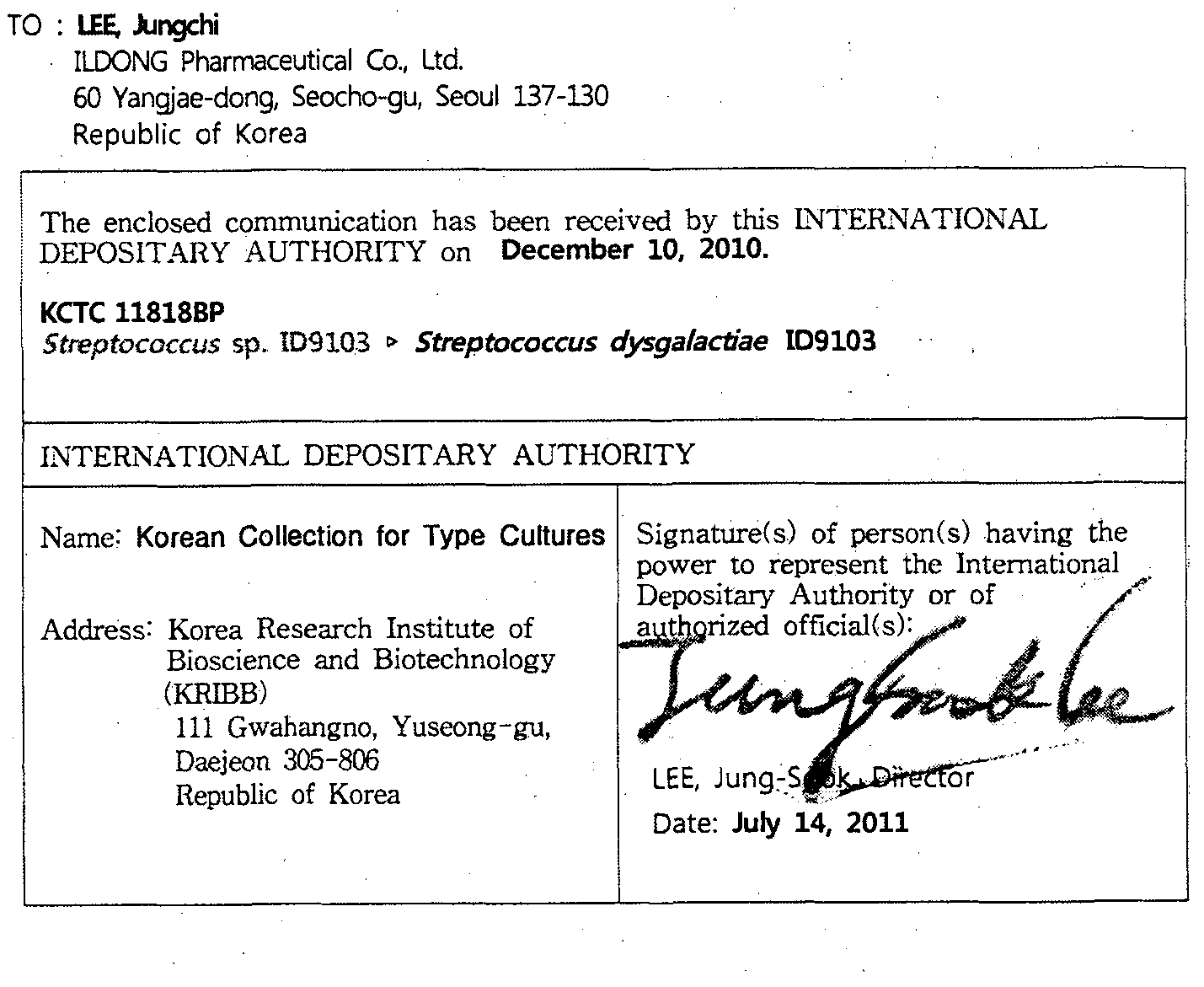
- Streptococcus dysgalactiae ID9103 was named Streptococcus dysgalactiae ID9103, and deposited at Korean Collection for Type Culture (www.kctc.re.kr) on December 2, 2010 (accession number : . KCTC-11818BP) .
- the present invention provides a method of producing hyaluronic acid, comprising the step of culturing the inventive Streptococcus dysgalactiae ID9103 strain in a medium comprising a carbon source and a nitrogen source.
- the inventive Streptococcus dysgalactiae ID9103 strain may be cultured by a conventional method for culturing a microorganism of genus streptococcus.
- the culture medium may comprise the carbon source and the nitrogen source, and further comprise amino acid.
- a medium to be supplied to a fed-batch may comprise a nitrogen source, or both a nitrogen source and a carbon source. More preferably, the nitrogen source is casein enzymatic hydrolysate, and the carbon source is glucose.
- the carbon source there is no limitation in the carbon source, as long as it is a known carbon source capable of being used in microorganism culturing.
- it may be selected from the group comprising glucose, fructose, maltose, lactose, galactose, glycerol and a mixture thereof. More preferably, it may be glucose.
- the nitrogen source there is no limitation in the nitrogen source, as long as it is a known nitrogen source capable of being used in microorganism culturing.
- it may be selected from the group comprising yeast extract, casein peptone, casein acid hydrolysate, casein enzymatic hydrolysate, bacto-peptone, casitone, neopeptone and a mixture thereof. More preferably, it may be a mixture of yeast extract and casein enzymatic hydrolysate.
- the casein enzymatic hydrolysate is obtained by enzymatic decomposition of casein.
- casein may be tryptone, tryptone T, tryptone X, BBL biosate peptone, DIPCO casein digest, bacto-casitone, BBL trypticasepeptone, bactotryptone, Bitec tryptone, NZ amine A, NZ amine AS, NZ amine EKC, NZ amine L concentration, NZ case, NZ case M, NZ case ME, NZ case plus, NZ case TT, pepticase, tryptone USP, pancreatic digest casein codex, pancreatic digest casein, enzymatic hydrolyzed casein kosher, or tryptone V.
- the casein acid hydrolysate may be casein acid hydrolysate, BBL acidicase peptone, bacto-casamino acid, bacto-casamino acid technical, amicase, hicase amino, hiKM, hicaseSF, or acid-decomposed casein.
- the inventive medium may further comprise amino acid.
- amino acid there is no limitation in the kind of the amino acid to be added.
- it may be selected from the group comprising glutamine, lysine, cysteine, arginine, methionine, aspartic acid, glycine and a mixture thereof, and more preferably, may be lysine.
- the inventive medium composition may comprise casein enzymatic hydrolysate as the nitrogen source, and lysine as amino acid.
- the inventive strain is cultured in the culture medium comprising casein enzymatic hydrolysate together with lysine, the amount of hyaluronic acid produced by the strain is increased, and hyaluronic acid having a very high average molecular weight is produced.
- the concentrations of casein enzymatic hydrolysate and lysine there is no specific limitation in the concentrations of casein enzymatic hydrolysate and lysine.
- the casein enzymatic hydrolysate is comprised at a concentration of 0.5 (w/v) to 3%(w/v)
- the lysine is comprised at a concentration of 0.015%(w/v) to 0.6%(w/v).
- the inventive Streptococcus dysgalactiae ID9103 strain may be used to produce ultra-high molecular weight hyaluronic acid having an average molecular weight of 10,000,000 Da or more with a high yield of 9g/L or more.
- the present invention provides a method of adjusting a molecular weight of hyaluronic acid, comprising the step of culturing a microorganism of genus streptococcus in a medium comprising a nitrogen source selected from the group comprising neopeptone, casein peptone and casein enzymatic hydrolysate, and amino acid selected from the group comprising glutamine, cysteine and lysine.
- genus streptococcus there is no limitation in the microorganism of genus streptococcus, as long as it produces hyaluronic acid and is comprised in genus streptococcus.
- it may be the inventive Streptococcus dysgalactiae strain, and more preferably, may be Streptococcus dysgalactiae ID9103 (accession number: KCTC 11818BP) strain.
- the molecular weight indicates an average molecular weight of hyaluronic acid, and the adjustment indicates that the kinds of nitrogen source and amino acid are changed so as to produce hyaluronic acid having a specific range of molecular weights.
- the molecular weight range of hyaluronic acid is not specifically limited.
- the molecular weight may range from 6,000,000 Da to 7,000,000 Da,7,000,000 Da to 8,000,000 Da, 8,000,000 Da to 9,000,000 Da, or 9,000,000 Da to 11,000,000 Da.
- hyaluronic acid having an average molecular weight of 6,000,000 Da to 7,000,000 Da.
- the average molecular weight described in this invention indicates a weight average molecular weight.
- the inventive Streptococcus dysgalactiae ID9103 strain does not express hyaluronidase enzyme, does not show hemolyt icity, and is excellent in hyaluronic acid production capacity. Then, through identification, it was identified as dysgalactiae of genus streptococcus, and deposited with an accession number of KCTC11818BP at Korean Collection for Type Culture (KCTC) on December 2, 2010.
- ⁇ 8i> In one Example in the present invention, a conventional Streptococcus dysgalactiae and the inventive strain were cultured under the same condition so as to measure the production rate and the viscosity of hyaluronic acid. As a result, it was found that the inventive strain shows higher hyaluronic acid production capacity than the conventional strain by 20% or more, and shows significantly higher viscosity than the conventional strain. Thus, it was determined that the inventive strain is a strain that can efficiently produce high molecular weight hyaluronic acid.
- a culturing condition that can increase the hyaluronic acid production capacity of the inventive Streptococcus dysgalactiae ID9103 strain was established.
- hyaluronic acid production capacity and culture solution viscosity according to concentrations of Yeast extract kinds and concentrations of amino acid, and kinds and concentrations of a nitrogen source, medium compositions that show high production capacity and can produce high molecular weight hyaluronic acid were selected.
- an optimum culturing condition was established.
- yeast extract is comprised in the composition at a concentration of 0.75% or more, the production of hyaluronic acid is increased, and the average molecular weight of hyaluronic acid is increased. It was found that when lysine, cysteine, arginine or methionine is used, high molecular weight hyaluronic acid is produced, and also it was found that when casein acid hydrolysate, casein enzymatic hydrolysate or neopeptin is used as a nitrogen source, high molecular weight hyaluronic acid is produced.
- Streptococcus dysgalactiae ID9103 strain is cultured by the combination of various culturing condition as obtained above, various high molecular weight hyaluronic acids having a molecular weight of 6,000,000, 7,000,000 or 8,000,000 Da can be produced. Accordingly, it was found that a required various high molecular weight hyaluronic acid can be produced with high efficiency through the inventive strain and the inventive culturing method.
- the present invention provides a strain of genus streptococcus by which high molecular weight hyaluronic acid can be produced with a high yield, and a method of producing hyaluronic acid using the same.
- the inventive strain can produce highly value-added ultra-high molecular weight hyaluronic acid with a high yield.
- the inventive method according to compositions of a medium, it is possible to produce various ultra-high molecular weight hyaluronic acids, and produce ultra-high molecular weight hyaluronic acid having an average molecular weight 10,000,000 Da or more to the maximum.
- FIG. 1 shows the identification result of the inventive Streptococcus dysgalactiae ID9103 strain, identified by an Api kit.
- FIG. 2 is a graph showing the amount of produced hyaluronic acid, the viscosity of a culture solution, and the amount of microbial cells, according to kinds and concentrations added amino acid.
- FIG. 3 is a graph showing the amount of produced hyaluronic acid, the viscosity of a culture solution, and the amount of microbial cells, according to kinds and concentrations added peptones.
- FIG. 4 is a graph showing the amount of produced hyaluronic acid, the viscosity of a culture solution, and the amount of microbial cells with lapse of production time when the inventive Streptococcus dysgalactiae ID9103 strain was cultured in It fermentation bath in a culture medium comprising casein enzymatic hydrolysate and lysine.
- Genus streptococcus producing hyaluronic acid is well grown in a brain heart infusion medium (Calf brains, infusion 0.77%, beef hearts, infusion 0.98%, proteose peptone 1%, dextrose 0.2%, NaCl 0.5%, Disodium phosphate 0.25%; BD, US), and in single colony separation, it can produce hyaluronic acid, thereby forming more smooth and viscous colonies than general colonies.
- ⁇ i08> In order to morphologically observe separated strains, they were smeared on a brain heart infusion solid medium so as to separate colonies, and cultured in a 37 ° C culture medium. When the colonies were formed, one drop of sterilized distilled water was dropped on a slide glass. Then, one colony was placed on the tip of a sterilized toothpick and dissolved in distilled water. It was covered with a cover glass, and coccus with chain structure, like genus streptococcus, was selected by enlargedly observing microbial cells through a microscope (x400).
- a sample on a slide glass was prepared through a gram staining method in the above described method, and was slightly heated on a lamp so as to attach bacteria on the slide glass. About 1 minute later after staining with dye, the dye was washed with slightly flowing water. When the water was dried to some extent, one drop of mineral oil was dropped thereto. The sample was covered with a cover glass, and observed by a microscope. Herein, the stained gram-positive bacteria are colored violet. Through this method, suitable strain candidates were selected.
- HA HA production was confirmed.
- a carbazole reaction and a cetyltrimethyl-ammonium bromide (CTAB) reaction are used.
- the carbazole reaction is a method of measuring the amount of glucuronic acid produced by decomposition of HA by sulfuric acid.
- the CTAB reaction was carried out so as to confirm HA production.
- CTAB destroys a mucous membrane and makes it opaque.
- HA is a viscous substance, and thus forms an insoluble complex and becomes opaque by being destroyed by CTAB.
- the carbazole reaction has a disadvantage in that since glucuronic acid produced by other sugars is measured, HA in a higher amount may be measured in a culture solution state than in an actual amount. Since CTAB reacts with only HA, it is possible to simply confirm HA production within a short time. Through the carbazole reaction, strains producing polysaccharide including HA were selected, and from among the strains, through the CTAB reaction, a strain producing HA was selected.
- the carbazole reaction is a method in which uronic acid can be quant itated.
- Glucuronic acid one of materials constituting hyaluronic acid, is colored purple by the reaction, and thus can be quant itated.
- lml of a sample was dissolved in 5ml of 0.025M (in H 2 SO 4 ) sodium tetraborate decahydrate, sufficiently mixed, and boiled in water for 10 minutes. After being cooled in ice, it was added and mixed with 200ul of 0.1% (in EtOH) Carbazole, and boiled in water for 10 minutes. At 525nm, the absorbency was measured.
- ⁇ ii4> In the CTAB reaction, 1/10-diluted culture solution was diluted again to half concentration with 0.03% SDS solution. Then, 200ul of the resultant solution was mixed with 200ul of acetic acid buffer (sodium acetate 1.55%, acetic acid 0.063%, NaCl 0.88%), and reacted at 37 ° C for 30 minutes. 800ul of CTAB solution was added thereto. At 600nm, the absorbency was measured.
- Example ⁇ ii7> The hyaluronic acid-producing strain selected in Example ⁇ 1-1> was shake-cultured in 50ml of 3.7% brain heart infusion liquid medium for 24 hours at 37 ° C .
- a culture solution with OD (600) of 0.3 was treated with N- Methyl-N'-nitro-N-nitrosoguanidine (NTG), followed by stirring at 37 ° C for lhour so as to determine the condition at a lethal rate of 95%.
- NTG N- Methyl-N'-nitro-N-nitrosoguanidine
- the culture solution treated with lOmg/ml of NTG was centrifuged at a rotation speed of 4000 rpm for 10 minutes, and the microbial cells were collected and washed with 50 mM Tris-maleate buffer (pH 8.0) three times.
- the spores on which mutation was induced were diluted with sterilized saline solution at a
- ⁇ i22> In order to identify the strain as genus streptococcus based on biochemical characteristics in Bergey's manual, in an identification experiment, a basic medium including yeast extract and peptone was added with sugar or amino acid required for determining biochemical characteristics, and the color change was changed.
- the sources added to the medium comprise inulin, lactose, mannitol, raffinose, ribose, salicin, sorbitol, trehalose, arginine, esculin, and hippurate.
- brompcresol purple (BCP) was added thereto, and the color change between the strain and a non- inoculated control was observed.
- BCP brompcresol purple
- BCP is colored violet at neutral pH, yellow at acidic pH, and red at basic pH. Before being inoculated with microbial cells, the medium is neutral, and colored violet.
- the Streptococcus dysgalactiae ID9103 strain selected in Example ⁇ l-2> was identified using an Api kit.
- an Api 20 strep kit Biomerieux, France
- the identification was performed following the manufacturer's manual.
- the strain was sufficiently dissolved in 2ml of suspension medium by using a cotton swab so as to prepare inoculation liquid with 4 McFarland turbidity.
- the strep comprises a total of 20 cupules including VP, HIP, ESC, PYRA, aGAL, £GUR, PGAL, PAL, LAP, ADH, RIB, ARA, MAN, S0R, LAC, TRE, RAF, AMD, and GLYG in order, and they cause different reactions, respectively.
- VP to LAP each, the inoculation liquid was filled in an amount of lOOul , and to others, the inoculation liquid in an amount of 500ul mixed with 2ml of GP medium was filled in an amount of lOOul .
- ADH and GLYG were added with mineral oil.
- VP was added with one drop of VP1 and VP2 each
- HIP was added with two drops of NIN reagent
- PYRA to LAP were added with one drop of ZYM A, and ZYM B reagents each. After 10 minutes, the results were measured, and after 24 hours, the results on other cupules were read again.
- Streptococcus dysgalactiae ID9103 is dysgalactiae of genus streptococcus.
- ⁇ 142> 40ml of the liquid shake-cultured at 37 ° C at 120rpm was used as a primary seed culture solution.
- the primary seed liquid was aseptically inoculated to three 3% Todd-Hewitt broth sterilized liquid media (40ml, pH 7.8).
- the cultured medium was used as a secondary seed culture solution.
- the secondary seed culture solution has to be maintained at pH of 6.4 + 0.2, and have 0D (600) of 0.35 + 0.05.
- 120ml of the secondary seed culture solution was inoculated to a main culture medium, followed by culturing for 40 hours or more. According to a rotation speed of a fermentation bath impeller, a culturing temperature, and a medium composition, the difference between hyaluronic acids in the productivity was observed. Then, the condition for increasing the hyaluronic acid productivity was determined. This culturing process was performed in the same manner in all Examples.
- the main culture medium determining test for optimally producing hyaluronic acid was performed in a 5L fermentation bath under 3.5L culture solution condition.
- the medium composition comprised glucose 6%(w/v), yeast extract 0.5%(w/v), casein peptone 2%(w/v), glutamine 0.06%(w/v), sodium gluconate 0.1%(w/v), oxalic acid 0.02%(w/v), magnesium sulfate 0,15%(w/v), potassium phosphate dibasic 0.25%(w/v), sodium chloride 0.5%(w/v), sodium acetate 0.5%(w/v), ferric chloride 0.007 %(w/v), and ammonium molybdate 0.05 %(w/v).
- the test was basically performed under the condition of pH 7.0, and 34 ° C.
- the hyaluronic acid concentration in the culture solution was confirmed by both a carbazole method (T. Bitter, Anal. Biochem. , 1962, 4, 330-334) and a turbidity analysis (S. Jung-Min, Carbohyd. Polym. , 2009, 78, 633-634).
- the amount of microbial cells was measured by transferring 200ul of the culture solution diluted to an appropriate concentration (1/10 of culture solution) to a 96 well microplate, and measuring the absorbencyat wavelength of 600nm by Multi-detection Microplate reader (BioTek, US).
- the rotation speed of the fermentation bath impeller is important because the impeller performs a role of helping growth of microbial cells by allowing oxygen and nutrients to be uniformly mixed with medium.
- the rotation speed was set to be 100 to 500rpm, the culturing result of ID9103 is noted in table 2.
- Streptococcus dysgalactiae ID9103 strain were cultured under the same condition, and the amounts of produced hyaluronic acid were compared.
- inventive strain shows a higher production amount of hyaluronic acid than the conventional strain by 20% or more under the same condition. Especially, it was found that the inventive strain shows significantly higher viscosity than the conventional strain. Thus, it was determined that the inventive strainis a strain efficiently producing high molecular weight hyaluronic acid.
- the culturing was performed by varying the concentration of yeast extract.
- the nitrogen source is known to perform an important role in metabolism of microorganisms, and have an effect on production of hyaluronic acid. Accordingly, it was determined that the adjustment of the concentration of the yeast extract as the nitrogen source may contribute to the productivity of hyaluronic acid.
- concentration is suitable for producing high molecular weight hyaluronic acid.
- concentration of the yeast extract was increased up to 2% (w/v).
- casein acid hydrolysate, casein enzymatic hydrolysate, and neopeptone showed higher viscosity levels than casein peptone.
- casein enzymatic hydrolysate showed a viscosity level of 4590cp, and is positively expected to produce high molecular weight hyaluronic acid.
- ⁇ 2i6> In order to determine a proper medium concentration of casein acid hydrolysate, casein enzymatic hydrolysate, and neopeptone showing high viscosity in ⁇ Example 6>, each nitrogen source was added at various concentrations, followed by culturing. Then, the concentration of hyaluronic acid, the amount of microbial cells, the viscosity of culture solution and the like were measured.
- casein enzymatic hydrolysate showed the highest viscosity at l (w/v)
- casein acid hydrolysate and neopeptone showed the highest viscosity at 1.5%(w/v).
- Casein enzymatic hydrolysate and neopeptone showed high production amounts of 8.2g/L, and 8.0g/L respectively, and high viscosity levels of 4590cP, and 4140cP respectively.
- Casein acid hydrolysate showed a high production amount of 8.1g/L but showed only a viscosity level of 3980cP (less than 4000cP).
- the concentration ofcasein enzymatic hydrolysate was fixedly set as l%(w/v), and the concentration of casein acid hydrolysate and neopeptone was fixedly set as 1.5%(w/v).
- each combination of peptone medium sources with amino acid showed a hyaluronic acid concentration of about 8g/L.
- the combination with casein enzymatic hydrolysate showed a higher level.
- the casein enzymatic hydrolysate-lysine combination showed a high hyaluronic acid concentration of 8.3g/L, and a higher viscosity level (5320cP) than casein enzymatic hydrolysate in ⁇ Example 7> (4590cP) by 730cP.
- hyaluronic acid was produced in an amount of 9.103g/L, and the viscosity level was 7200cP.
- peptones as a medium source and glucose
- high molecular weight hyaluronic acid can be produced and the production amount can be increased.
- the average molecular weight of hyaluronic acid was obtained by agel filtration chromatography method (Narlin B. Beaty et al.Anal. Biochem. , 1985, 147, 387-395).
- the column was Toyo Soda TSK gelG6000PWXL, the moving phase comprised 150mM NaCl , 3mM Na 2 HP0 4 (pH7.0) , and 0.02% NaN 2 .
- the detection was performed by a refractive index detector (Shodex; Showa Denko K.K. Japan), and the standard substance was prepared by polyethylene oxide at 2mg/ml concentration per molecular weight.
- the hyaluronic acid produced by culturing in the combination of casein enzymatic hydrolysate-lysine showed an average molecular weight of 8,000,000 Da or more.
- the molecular weight was about 10,000,000, which was higher than a basic medium culture (about 5,900,000 Da) by about 4,000,000 Da.
- hyaluronic acid having various average molecular weights of 6,000,000, 6,500,000, 7,000,000, 7,500,000, 8,000,000, 9,000,000, and 10,000,000 Da with high productivity.
- casein peptone was replaced by casein enzymatic hydrolysate, amino acid was replaced by lysine, and casein peptone was added in fed-batch manner, hyaluronic acid having an average molecular weight of 9,000,000 Da to 11,000,000 Da was produced.
- the basic medium indicates a medium comprising glucose, yeast extract, casein peptone, glutamine, sodium gluconate, oxalic acid, magnesium sulfate, potassium phosphate dibasic, sodium chloride, sodium acetate, ferric chloride, and ammonium molybdate.
- -20 ° C refrigerator was cultured in 800ml of 3% Todd-Hewitt broth sterilized liquid medium (pH7.8) at 37 ° C for 6 hours, and then cultured in 20L of 3% Todd-Hewitt broth sterilized liquid medium at 37 ° C for 20 hours.
- the cultured seed culture solution was maintained at pH of 6.0, and 0D of the culture solution measured at 600nm was 0.35.
- the average molecular weight of hyaluronic acid was measured. As a result, due to the optimum culturing condition in the It fermentation bath, the average molecular weight was about 10 , 500 , 000 Da , which was higher than 10,100,000 Da in 75L fermentation bath by about 400,000 Da.
- the present invention provides a strain of genus streptococcus by which high molecular weight hyaluronic acid can be produced with a high yield, and a method of producing hyaluronic acid using the same.
- the inventive strain can produce highly value-added ultra-high molecular weight hyaluronic acid with a high yield.
- the inventive method according to compositions of a medium, it is possible to produce various ultra-high molecular weight hyaluronic acids, and produce ultra-high molecular weight hyaluronic acid having an average molecular weight 10,000,000 Da or more to the maximum.
Landscapes
- Chemical & Material Sciences (AREA)
- Life Sciences & Earth Sciences (AREA)
- Engineering & Computer Science (AREA)
- Health & Medical Sciences (AREA)
- Organic Chemistry (AREA)
- Wood Science & Technology (AREA)
- Zoology (AREA)
- Biotechnology (AREA)
- Genetics & Genomics (AREA)
- Bioinformatics & Cheminformatics (AREA)
- Microbiology (AREA)
- General Health & Medical Sciences (AREA)
- Biochemistry (AREA)
- General Engineering & Computer Science (AREA)
- General Chemical & Material Sciences (AREA)
- Tropical Medicine & Parasitology (AREA)
- Medicinal Chemistry (AREA)
- Virology (AREA)
- Biomedical Technology (AREA)
- Chemical Kinetics & Catalysis (AREA)
- Molecular Biology (AREA)
- Micro-Organisms Or Cultivation Processes Thereof (AREA)
- Preparation Of Compounds By Using Micro-Organisms (AREA)
- Cosmetics (AREA)
Abstract
Description




Claims
Priority Applications (6)
| Application Number | Priority Date | Filing Date | Title |
|---|---|---|---|
| BR112014007081-4A BR112014007081B1 (en) | 2011-09-30 | 2012-09-28 | strain of streptococcus dysgalactiae id9103 as well as methods of adjusting a molecular weight of hyaluronic acid and producing hyaluronic acid |
| ES12835852.0T ES2665295T3 (en) | 2011-09-30 | 2012-09-28 | Streptococcus dysgalactiae id9103 and method for acid production |
| CN201280048001.2A CN104011220B (en) | 2011-09-30 | 2012-09-28 | Streptococcus dysgalactiae ID9103 and use its hyaluronic acid production method |
| EP12835852.0A EP2771476B1 (en) | 2011-09-30 | 2012-09-28 | Streptococcus dysgalactiae id9103 and method for production of hyaluronic acid using the same |
| JP2014533216A JP5977356B2 (en) | 2011-09-30 | 2012-09-28 | Streptococcus disgalactier ID9103 strain and hyaluronic acid production method using the same (Streptococcus dysgalactiae ID9103 and methodfor production of hyaluronic acidizing thesame) |
| US14/226,216 US8986973B2 (en) | 2011-09-30 | 2014-03-26 | Streptococcus dysgalactiae ID9103 and method for production of hyaluronic acid using the same |
Applications Claiming Priority (2)
| Application Number | Priority Date | Filing Date | Title |
|---|---|---|---|
| KR10-2011-0100364 | 2011-09-30 | ||
| KR1020110100364A KR101322227B1 (en) | 2011-09-30 | 2011-09-30 | Streptococcus dysgalactiae ID9103 and method for production of hyaluronic acid using the same |
Related Child Applications (1)
| Application Number | Title | Priority Date | Filing Date |
|---|---|---|---|
| US14/226,216 Continuation US8986973B2 (en) | 2011-09-30 | 2014-03-26 | Streptococcus dysgalactiae ID9103 and method for production of hyaluronic acid using the same |
Publications (1)
| Publication Number | Publication Date |
|---|---|
| WO2013048208A1 true WO2013048208A1 (en) | 2013-04-04 |
Family
ID=47996045
Family Applications (1)
| Application Number | Title | Priority Date | Filing Date |
|---|---|---|---|
| PCT/KR2012/007955 Ceased WO2013048208A1 (en) | 2011-09-30 | 2012-09-28 | Streptococcus dysgalactiae id9103 and method for production of hyaluronic acid using the same |
Country Status (8)
| Country | Link |
|---|---|
| US (1) | US8986973B2 (en) |
| EP (1) | EP2771476B1 (en) |
| JP (1) | JP5977356B2 (en) |
| KR (1) | KR101322227B1 (en) |
| CN (1) | CN104011220B (en) |
| BR (1) | BR112014007081B1 (en) |
| ES (1) | ES2665295T3 (en) |
| WO (1) | WO2013048208A1 (en) |
Cited By (1)
| Publication number | Priority date | Publication date | Assignee | Title |
|---|---|---|---|---|
| CN109486879A (en) * | 2018-12-06 | 2019-03-19 | 上海景峰制药有限公司 | A kind of Sodium Hyaluronate and its fermentation process |
Families Citing this family (8)
| Publication number | Priority date | Publication date | Assignee | Title |
|---|---|---|---|---|
| KR101598329B1 (en) * | 2013-03-20 | 2016-02-29 | 일동제약주식회사 | Method for manufacturing of hyaluronic acid and the composition for anti adhesion comprising the hyaluronic acid by the same method |
| CN104212732A (en) * | 2014-09-12 | 2014-12-17 | 江南大学 | Recombinant pichia pastoris for preparing hyaluronic acid and construction method of recombinant pichia pastoris |
| CN105861596B (en) * | 2015-01-23 | 2020-02-04 | 中国科学院微生物研究所 | Preparation method of hyaluronic acid |
| JP2017112901A (en) * | 2015-12-24 | 2017-06-29 | キッコーマン株式会社 | Method for producing high-molecular-weight hyaluronic acid |
| JP6626869B2 (en) * | 2016-10-03 | 2019-12-25 | 株式会社バイオジェノミクス | Method for producing beneficial bacteria-producing substance and food |
| KR102489403B1 (en) * | 2018-10-29 | 2023-01-17 | 엠앤에이치바이오 주식회사 | Novel Streptococcus sp. UBC-U46 strain and method for production of hyaluronic acid using the same |
| CN111443149B (en) * | 2020-05-25 | 2022-10-14 | 华熙生物科技股份有限公司 | Method for measuring content of lysine hydrochloride in sodium hyaluronate composite solution for injection |
| KR102315133B1 (en) | 2021-03-26 | 2021-10-19 | 주식회사 현대바이오랜드 | Hair cosmetic composition comprising Streptococcus strain culture medium that has beneficial effects on hair |
Citations (4)
| Publication number | Priority date | Publication date | Assignee | Title |
|---|---|---|---|---|
| WO1994000463A2 (en) * | 1992-06-19 | 1994-01-06 | M.u.r.s.t. Italian Ministry for Universities and Scientific and Technological Research | Production of hyaluronic acid by transeformed microorganisms |
| JPH10113197A (en) * | 1996-10-15 | 1998-05-06 | Chisso Corp | Production of high-molecular-weight hyaluronic acid or its salt |
| KR20100048778A (en) * | 2008-10-31 | 2010-05-11 | 일동제약주식회사 | Method of hyaluronic acid production through fermentation process from microorganism |
| KR20110029492A (en) * | 2009-09-15 | 2011-03-23 | 일동제약주식회사 | How to control the molecular weight of hyaluronic acid |
Family Cites Families (11)
| Publication number | Priority date | Publication date | Assignee | Title |
|---|---|---|---|---|
| NO161573C (en) | 1983-11-25 | 1989-08-30 | Miles Inc | PROCEDURE FOR THE PREPARATION OF HYALURONIC ACID. |
| US4784990A (en) | 1985-01-18 | 1988-11-15 | Bio-Technology General Corporation | High molecular weight sodium hyaluronate |
| JPS62104579A (en) * | 1985-10-30 | 1987-05-15 | Kyowa Hakko Kogyo Co Ltd | Production of hyaluronidase |
| JPH0258502A (en) | 1988-08-24 | 1990-02-27 | Chisso Corp | Production of hyaluronic acid |
| KR100250573B1 (en) | 1993-04-16 | 2000-04-01 | 성재갑 | Hyaluronic acid |
| IT1263393B (en) * | 1993-07-30 | 1996-08-05 | Fidia Advanced Biopolymers Srl | PROCESS FOR THE PREPARATION AND PURIFICATION OF HIGH MOLECULAR WEIGHT HYALURONIC ACID |
| SE9401806D0 (en) | 1994-05-26 | 1994-05-26 | Pharmacia Ab | Method and means for the production of hyaluronic acid |
| KR100303066B1 (en) * | 1994-09-09 | 2001-12-01 | 손 경 식 | Streptococcus sp. microorganism producing hyaluronic acid |
| KR100312637B1 (en) * | 1994-09-09 | 2001-12-28 | 손 경 식 | Method for producing hyaluronic acid by fermentation |
| KR100472007B1 (en) | 2002-08-19 | 2005-03-10 | 주식회사 코오롱 | Microorganism producing hyaluronic acid and method of producing hyalironic acid using thereof |
| WO2010010631A1 (en) * | 2008-07-25 | 2010-01-28 | 電気化学工業株式会社 | Method for producing hyaluronic acid |
-
2011
- 2011-09-30 KR KR1020110100364A patent/KR101322227B1/en active Active
-
2012
- 2012-09-28 BR BR112014007081-4A patent/BR112014007081B1/en active IP Right Grant
- 2012-09-28 ES ES12835852.0T patent/ES2665295T3/en active Active
- 2012-09-28 CN CN201280048001.2A patent/CN104011220B/en active Active
- 2012-09-28 WO PCT/KR2012/007955 patent/WO2013048208A1/en not_active Ceased
- 2012-09-28 EP EP12835852.0A patent/EP2771476B1/en active Active
- 2012-09-28 JP JP2014533216A patent/JP5977356B2/en active Active
-
2014
- 2014-03-26 US US14/226,216 patent/US8986973B2/en active Active
Patent Citations (4)
| Publication number | Priority date | Publication date | Assignee | Title |
|---|---|---|---|---|
| WO1994000463A2 (en) * | 1992-06-19 | 1994-01-06 | M.u.r.s.t. Italian Ministry for Universities and Scientific and Technological Research | Production of hyaluronic acid by transeformed microorganisms |
| JPH10113197A (en) * | 1996-10-15 | 1998-05-06 | Chisso Corp | Production of high-molecular-weight hyaluronic acid or its salt |
| KR20100048778A (en) * | 2008-10-31 | 2010-05-11 | 일동제약주식회사 | Method of hyaluronic acid production through fermentation process from microorganism |
| KR20110029492A (en) * | 2009-09-15 | 2011-03-23 | 일동제약주식회사 | How to control the molecular weight of hyaluronic acid |
Cited By (1)
| Publication number | Priority date | Publication date | Assignee | Title |
|---|---|---|---|---|
| CN109486879A (en) * | 2018-12-06 | 2019-03-19 | 上海景峰制药有限公司 | A kind of Sodium Hyaluronate and its fermentation process |
Also Published As
| Publication number | Publication date |
|---|---|
| CN104011220A (en) | 2014-08-27 |
| EP2771476A1 (en) | 2014-09-03 |
| US8986973B2 (en) | 2015-03-24 |
| BR112014007081B1 (en) | 2020-10-27 |
| US20140206040A1 (en) | 2014-07-24 |
| BR112014007081A2 (en) | 2017-04-11 |
| EP2771476B1 (en) | 2018-01-10 |
| KR20130035808A (en) | 2013-04-09 |
| KR101322227B1 (en) | 2013-10-28 |
| JP2014528239A (en) | 2014-10-27 |
| EP2771476A4 (en) | 2015-06-03 |
| CN104011220B (en) | 2016-12-14 |
| ES2665295T3 (en) | 2018-04-25 |
| JP5977356B2 (en) | 2016-08-24 |
Similar Documents
| Publication | Publication Date | Title |
|---|---|---|
| WO2013048208A1 (en) | Streptococcus dysgalactiae id9103 and method for production of hyaluronic acid using the same | |
| KR100500796B1 (en) | Bacillus subtilis var. chungkookjang producing high molecular weight poly-gamma-glutamic acid | |
| Das et al. | Isolation, purification & mass production of protease enzyme from Bacillus subtilis | |
| Gao et al. | Characterization of a bioflocculant from a newly isolated Vagococcus sp. W31 | |
| KR20120063025A (en) | Novel microorganism bacillus megaterium toha producing l type poly gamma glutamic acid and l type poly gamma glutamic acid produced by therof | |
| Ludbrook et al. | Exopolysaccharide production from lactic acid bacteria isolated from fermented foods | |
| US20160009828A1 (en) | Preparation method for hyaluronic acid, and anti-adhesive composition comprising hyaluronic acid prepared by same preparation method | |
| CN112708571A (en) | Recombinant yeast for producing chondroitin sulfate with controllable molecular weight by fermentation and application thereof | |
| KR102581542B1 (en) | Novel streptococcus strain and hyaluronidase derived from the same | |
| KR20120119060A (en) | Streptococcus equisubsp. zooepidemicus and method for preparing hyaluronic acid using the same | |
| KR100876662B1 (en) | Streptomyces spp. And alginate degrading enzymes having alginate hydrolytic activity | |
| KR20230124918A (en) | Bacterial strains for biocellulose production | |
| KR101087969B1 (en) | How to produce hyaluronic acid by microbial culture | |
| CN102154405A (en) | Preparation method of hyaluronic acid | |
| JP4073787B2 (en) | Sulfated fucoglucuronomannan | |
| KR20200048312A (en) | Novel Streptococcus sp. UBC-U46 strain and method for production of hyaluronic acid using the same | |
| Saranraj et al. | Production, optimization and spectroscopic studies of hyaluronic acid extracted from Streptococcus pyogenes | |
| KR100462904B1 (en) | Manufacturing process for producing Alginate lyase using Xanthomonas sp. BH-1, newly isolated marine bacterium | |
| Uddin et al. | Screening, optimization and exploration of microbial enzymes with special characteristics for biotechnological applications | |
| KR100985841B1 (en) | New Microorganism Pseudomonas sp. N7151-6 Producing Alginate Degrading Enzyme | |
| CN108004150A (en) | A kind of epicoccum nigrum LS10H and its application | |
| JPH0324199B2 (en) | ||
| Shady et al. | Production conditions of exopolysaccharide from Bacillus megaterium identified by 16S rRNA gene sequencing | |
| Pallavi et al. | Screening of Thermophilic Bacillus Cereus Strains and Optimization of Growth Conditions for Mass Production of Alkaline Protease Enzyme | |
| JPH0523741B2 (en) |
Legal Events
| Date | Code | Title | Description |
|---|---|---|---|
| 121 | Ep: the epo has been informed by wipo that ep was designated in this application |
Ref document number: 12835852 Country of ref document: EP Kind code of ref document: A1 |
|
| ENP | Entry into the national phase |
Ref document number: 2014533216 Country of ref document: JP Kind code of ref document: A |
|
| WWE | Wipo information: entry into national phase |
Ref document number: 2012835852 Country of ref document: EP |
|
| NENP | Non-entry into the national phase |
Ref country code: DE |
|
| REG | Reference to national code |
Ref country code: BR Ref legal event code: B01A Ref document number: 112014007081 Country of ref document: BR |
|
| ENP | Entry into the national phase |
Ref document number: 112014007081 Country of ref document: BR Kind code of ref document: A2 Effective date: 20140325 |