WO2013048761A2 - Polymeric nanofoam - Google Patents
Polymeric nanofoam Download PDFInfo
- Publication number
- WO2013048761A2 WO2013048761A2 PCT/US2012/055263 US2012055263W WO2013048761A2 WO 2013048761 A2 WO2013048761 A2 WO 2013048761A2 US 2012055263 W US2012055263 W US 2012055263W WO 2013048761 A2 WO2013048761 A2 WO 2013048761A2
- Authority
- WO
- WIPO (PCT)
- Prior art keywords
- meth
- acrylic
- weight
- acrylonitrile
- polymer phase
- Prior art date
- Legal status (The legal status is an assumption and is not a legal conclusion. Google has not performed a legal analysis and makes no representation as to the accuracy of the status listed.)
- Ceased
Links
Classifications
-
- C—CHEMISTRY; METALLURGY
- C08—ORGANIC MACROMOLECULAR COMPOUNDS; THEIR PREPARATION OR CHEMICAL WORKING-UP; COMPOSITIONS BASED THEREON
- C08J—WORKING-UP; GENERAL PROCESSES OF COMPOUNDING; AFTER-TREATMENT NOT COVERED BY SUBCLASSES C08B, C08C, C08F, C08G or C08H
- C08J9/00—Working-up of macromolecular substances to porous or cellular articles or materials; After-treatment thereof
- C08J9/0061—Working-up of macromolecular substances to porous or cellular articles or materials; After-treatment thereof characterized by the use of several polymeric components
-
- C—CHEMISTRY; METALLURGY
- C08—ORGANIC MACROMOLECULAR COMPOUNDS; THEIR PREPARATION OR CHEMICAL WORKING-UP; COMPOSITIONS BASED THEREON
- C08L—COMPOSITIONS OF MACROMOLECULAR COMPOUNDS
- C08L33/00—Compositions of homopolymers or copolymers of compounds having one or more unsaturated aliphatic radicals, each having only one carbon-to-carbon double bond, and only one being terminated by only one carboxyl radical, or of salts, anhydrides, esters, amides, imides or nitriles thereof; Compositions of derivatives of such polymers
- C08L33/18—Homopolymers or copolymers of nitriles
- C08L33/20—Homopolymers or copolymers of acrylonitrile
-
- B—PERFORMING OPERATIONS; TRANSPORTING
- B32—LAYERED PRODUCTS
- B32B—LAYERED PRODUCTS, i.e. PRODUCTS BUILT-UP OF STRATA OF FLAT OR NON-FLAT, e.g. CELLULAR OR HONEYCOMB, FORM
- B32B5/00—Layered products characterised by the non- homogeneity or physical structure, i.e. comprising a fibrous, filamentary, particulate or foam layer; Layered products characterised by having a layer differing constitutionally or physically in different parts
- B32B5/22—Layered products characterised by the non- homogeneity or physical structure, i.e. comprising a fibrous, filamentary, particulate or foam layer; Layered products characterised by having a layer differing constitutionally or physically in different parts characterised by the presence of two or more layers which are next to each other and are fibrous, filamentary, formed of particles or foamed
- B32B5/32—Layered products characterised by the non- homogeneity or physical structure, i.e. comprising a fibrous, filamentary, particulate or foam layer; Layered products characterised by having a layer differing constitutionally or physically in different parts characterised by the presence of two or more layers which are next to each other and are fibrous, filamentary, formed of particles or foamed at least two layers being foamed and next to each other
-
- C—CHEMISTRY; METALLURGY
- C08—ORGANIC MACROMOLECULAR COMPOUNDS; THEIR PREPARATION OR CHEMICAL WORKING-UP; COMPOSITIONS BASED THEREON
- C08J—WORKING-UP; GENERAL PROCESSES OF COMPOUNDING; AFTER-TREATMENT NOT COVERED BY SUBCLASSES C08B, C08C, C08F, C08G or C08H
- C08J9/00—Working-up of macromolecular substances to porous or cellular articles or materials; After-treatment thereof
- C08J9/04—Working-up of macromolecular substances to porous or cellular articles or materials; After-treatment thereof using blowing gases generated by a previously added blowing agent
- C08J9/12—Working-up of macromolecular substances to porous or cellular articles or materials; After-treatment thereof using blowing gases generated by a previously added blowing agent by a physical blowing agent
- C08J9/122—Hydrogen, oxygen, CO2, nitrogen or noble gases
-
- C—CHEMISTRY; METALLURGY
- C08—ORGANIC MACROMOLECULAR COMPOUNDS; THEIR PREPARATION OR CHEMICAL WORKING-UP; COMPOSITIONS BASED THEREON
- C08L—COMPOSITIONS OF MACROMOLECULAR COMPOUNDS
- C08L33/00—Compositions of homopolymers or copolymers of compounds having one or more unsaturated aliphatic radicals, each having only one carbon-to-carbon double bond, and only one being terminated by only one carboxyl radical, or of salts, anhydrides, esters, amides, imides or nitriles thereof; Compositions of derivatives of such polymers
- C08L33/04—Homopolymers or copolymers of esters
- C08L33/06—Homopolymers or copolymers of esters of esters containing only carbon, hydrogen and oxygen, which oxygen atoms are present only as part of the carboxyl radical
- C08L33/10—Homopolymers or copolymers of methacrylic acid esters
-
- C—CHEMISTRY; METALLURGY
- C08—ORGANIC MACROMOLECULAR COMPOUNDS; THEIR PREPARATION OR CHEMICAL WORKING-UP; COMPOSITIONS BASED THEREON
- C08J—WORKING-UP; GENERAL PROCESSES OF COMPOUNDING; AFTER-TREATMENT NOT COVERED BY SUBCLASSES C08B, C08C, C08F, C08G or C08H
- C08J2203/00—Foams characterized by the expanding agent
- C08J2203/06—CO2, N2 or noble gases
-
- C—CHEMISTRY; METALLURGY
- C08—ORGANIC MACROMOLECULAR COMPOUNDS; THEIR PREPARATION OR CHEMICAL WORKING-UP; COMPOSITIONS BASED THEREON
- C08J—WORKING-UP; GENERAL PROCESSES OF COMPOUNDING; AFTER-TREATMENT NOT COVERED BY SUBCLASSES C08B, C08C, C08F, C08G or C08H
- C08J2333/00—Characterised by the use of homopolymers or copolymers of compounds having one or more unsaturated aliphatic radicals, each having only one carbon-to-carbon double bond, and only one being terminated by only one carboxyl radical, or of salts, anhydrides, esters, amides, imides, or nitriles thereof; Derivatives of such polymers
- C08J2333/04—Characterised by the use of homopolymers or copolymers of compounds having one or more unsaturated aliphatic radicals, each having only one carbon-to-carbon double bond, and only one being terminated by only one carboxyl radical, or of salts, anhydrides, esters, amides, imides, or nitriles thereof; Derivatives of such polymers esters
- C08J2333/06—Characterised by the use of homopolymers or copolymers of compounds having one or more unsaturated aliphatic radicals, each having only one carbon-to-carbon double bond, and only one being terminated by only one carboxyl radical, or of salts, anhydrides, esters, amides, imides, or nitriles thereof; Derivatives of such polymers esters of esters containing only carbon, hydrogen, and oxygen, the oxygen atom being present only as part of the carboxyl radical
-
- C—CHEMISTRY; METALLURGY
- C08—ORGANIC MACROMOLECULAR COMPOUNDS; THEIR PREPARATION OR CHEMICAL WORKING-UP; COMPOSITIONS BASED THEREON
- C08J—WORKING-UP; GENERAL PROCESSES OF COMPOUNDING; AFTER-TREATMENT NOT COVERED BY SUBCLASSES C08B, C08C, C08F, C08G or C08H
- C08J2425/00—Characterised by the use of homopolymers or copolymers of compounds having one or more unsaturated aliphatic radicals, each having only one carbon-to-carbon double bond, and at least one being terminated by an aromatic carbocyclic ring; Derivatives of such polymers
- C08J2425/02—Homopolymers or copolymers of hydrocarbons
- C08J2425/04—Homopolymers or copolymers of styrene
- C08J2425/08—Copolymers of styrene
- C08J2425/12—Copolymers of styrene with unsaturated nitriles
-
- C—CHEMISTRY; METALLURGY
- C08—ORGANIC MACROMOLECULAR COMPOUNDS; THEIR PREPARATION OR CHEMICAL WORKING-UP; COMPOSITIONS BASED THEREON
- C08J—WORKING-UP; GENERAL PROCESSES OF COMPOUNDING; AFTER-TREATMENT NOT COVERED BY SUBCLASSES C08B, C08C, C08F, C08G or C08H
- C08J2455/00—Characterised by the use of homopolymers or copolymers, obtained by polymerisation reactions only involving carbon-to-carbon unsaturated bonds, not provided for in groups C08J2423/00 - C08J2453/00
- C08J2455/02—Acrylonitrile-Butadiene-Styrene [ABS] polymers
Definitions
- the present invention relates to polymeric nanofoam comprising a blend of polymers and a method for preparing such foam.
- thermal insulating materials are commonly used to isolate temperature controlled areas from other areas that may be either at a different temperature. Thermally insulating materials are commonplace in building structures and appliances such as refrigerators and freezers for instance.
- Polymeric foam has long been used as a thermal insulating material. Historically, typical thermally insulating polymeric foam comprises a plurality of cells having dimensions of 100 micrometer or greater and require presence of gas having low thermal conductivity in the foam cells. While these polymeric foams serve well as thermally insulating materials, there is opportunity to improve the thermally insulating properties of polymeric foam without resorting to low thermal conductivity gases.
- One characteristic of polymeric foam that controls thermal conductivity through the foam is the cell size.
- Behavior of gas molecules in foam cells can contribute to thermal conductivity through the polymer foam if the gas molecules are free to move within the cells and collide with the cell walls.
- the contribution of cell gas to thermal conductivity through polymeric foam decreases dramatically when the cell size of the foam is reduced below one micrometer.
- thermal conductivity due to cell gas reduces almost in half upon reducing a foam cell size from one micrometer to 300 nanometers (nm) and reduces by almost 2/3 upon reducing the cell size from one micrometer to below 100 nm.
- polymeric foam having a nanoporous structure that is, having an average cell size that is below one micron; "nanofoam”
- polymeric foam having an average cell size of 300 nm or less, and most preferably 100 nm or less is desirable as thermal insulation.
- thermally insulating polymeric foam it is further desirable for thermally insulating polymeric foam to have a high void volume.
- thermal conductivity is high through the polymer network of a polymeric foam structure than is the thermal conductivity through the cell gas. Therefore, maximizing the amount void space due to cells in foam will generally result in a decrease in thermal conductivity through the foam. This is particularly challenging for polymeric foam having a nanoporous structure.
- One way to characterize void volume is by "porosity", which is the ratio of void volume to foam volume. Porosity values of 0.50 or greater are desirable for thermally insulating foam.
- Cost is also a concern for thermal insulation. It is desirable to prepare polymeric foam using relatively low-cost polymers such as styrenic polymers as opposed to higher cost polymers such as (meth)acrylic polymers. Moreover, it is desirable to reduce cost and complexity by avoiding inclusion of nanofillers as nucleators.
- the present invention offers an advancement in polymeric nanofoam technology by providing a polymeric foam that simultaneously provides a solution to the aforementioned desires and challenges.
- the present invention provides a nanofoam having a porosity of
- the present invention is a result of discovering that including a certain amount of a polymer containing copolymerized acrylonitrile along with a (meth)acrylic polymer allows formation of polymeric nanofoam that is highly porous. Even more surprisingly, the presence of the copolymerized acrylonitrile allows formation of a highly porous polymeric nanofoam that contains a minor amount (less than 50 weight-percent) of (meth)acrylic copolymer.
- a polymeric nanofoam having a narrow cell size distribution (ratio of volume average diameter to number average diameter below 2.5) and a cell density greater than 10 14 cells per cubic centimeter can be made from a single polymer phase comprising a miscible mixture of acrylonitrile copolymer and (meth)acrylic polymer.
- the present invention is a polymeric nanofoam comprising a continuous polymer phase defining a plurality of cells wherein the polymeric foam is characterized by: (a) the continuous polymer phase comprises at least one (meth)acrylic-free acrylonitrile-containing copolymer; (b) the continuous polymer phase comprises at least one (meth)acrylic polymer wherein the concentration of (meth)acrylic polymer is in a range of 5-90 weight-percent of total continuous polymer phase weight yet the amount of methacrylic copolymer is 50 wt or less of the total continuous polymer phase weight; (c) a porosity of at least 50% of the total foam volume; (d) an absence of nano-sized nucleating additive; and (e) at least one of the following: (i) the cells have a number-average cell size of 500 nanometers or less; and (ii) an effective nucleation site density of at least lxlO 14 sites per cubic centimeter of prefoamed material
- the present invention is a method for preparing the polymeric nanofoam of the first aspect, the method comprising: (a) melt-blending together at least one (meth) acrylic-free acrylonitrile-containing copolymer and at least one (meth)acrylic polymer to form a continuous polymer phase; (b) contacting the continuous polymer phase with a blowing agent comprising at least 50 weight-percent carbon dioxide based on total blowing agent weight at a pressure of at least 15 MegaPascals to form a foamable polymer mixture; (c) reducing the pressure on the foamable polymer mixture by at least 10
- (meth) acrylic-free acrylonitrile-containing copolymer has a higher glass transition temperature than all of the (meth)acrylic polymers and the foamable polymer mixture is free of nano-sized nucleating additive.
- the process of the present invention is useful for preparing the polymeric foam of the present invention.
- the polymeric foam of the present invention is useful as a thermally insulating article.
- Test methods refer to the most recent test method as of the priority date of this document when a date is not indicated with the test method number. References to test methods contain both a reference to the testing society and the test method number. The following test method abbreviations and identifiers apply herein: ASTM refers to American Society for Testing and Materials; EN refers to European Norm; DIN refers to Deutsches Institut fur Normung; and ISO refers to International Organization for Standards.
- Polymer unless indicated otherwise, refers to both homopolymer and copolymer. Unless otherwise indicated, “copolymer” includes block copolymer, graft copolymer, alternating copolymer and random copolymer.
- (meth)acrylic refers to both “methacrylic” and “acrylic”. Hence, a
- “(meth)acrylic” polymer is a polymer selected from methacrylic polymers and acrylic polymers.
- Metalacrylic polymers contain polymerized methacrylic monomers.
- Allic polymers contain polymerized acrylic monomers.
- a “(meth)acrylic” polymer can be a copolymer containing both methacrylic monomers and acrylic monomers and as such can be both a methacrylic polymer and an acrylic polymer. If a copolymer is "(meth)acrylic- free” that means the copolymer lacks both methacrylic and acrylic monomer units copolymerized therein.
- Polymeric foam comprises a continuous polymer phase that defines a plurality of cells therein.
- the continuous polymer phase consists of all the polymers in the polymeric foam.
- the continuous polymer phase forms a continuous matrix of a polymeric foam that defines the voids, or cells, of the foam.
- the continuous polymer phase can have non- polymer components such as fillers or additives mixed within it such that the combination of continuous polymer phase and non-polymer components makes up the continuous matrix of the foam, but the non-polymer components are not considered part of the continuous polymer phase.
- the polymeric foam is free of nano-sized nucleating additives. Nano-sized nucleating additives have at least two, preferably three, orthogonal dimensions that are less than 30 nanometers.
- the continuous polymer phase comprises at least one (meth)acrylic-free
- acrylonitrile-containing copolymer examples include styrene-acrylonitrile (SAN) copolymers and acrylonitrile- butadiene-styrene (ABS) copolymers.
- the (meth)acrylic-free acrylonitrile-containing copolymer desirably contains 4 weight-percent (wt%) or more, preferably 5 wt or more and can contain 8 wt or more, 10 wt or more and even 15 wt or more copolymerized acrylonitrile (AN) monomers.
- the (meth)acrylic-free acrylonitrile- containing copolymer desirably contains 40 wt or less copolymerized acrylonitrile (AN) monomers
- the continuous polymer phase comprises at least one (meth)acrylic polymer.
- the (meth)acrylic polymer can be a homopolymer or copolymer.
- the (meth)acrylic polymer can contain acrylonitrile or be free of acrylonitrile.
- the continuous polymer phase can be a blend of at least one (meth)acrylic-free acrylonitrile copolymer and at least one acrylonitrile-containing (meth)acrylic polymer.
- the continuous polymer phase can be a blend of at least one (meth)acrylic-free acrylonitrile copolymer and at least one
- the continuous polymer phase can be a blend of at least one (meth)acrylic-free acrylonitrile copolymer and only acrylonitrile-free
- suitable (meth)acrylic polymers include poly(methylmethacrylate) (PMMA); poly(ethylmethacrylate); copolymers of methyl methacrylate and/or
- Suitable polar monomers include one or more selected from a group consisting of methyl acrylates, ethyl acrylates, butyl acrylates, butyl methacrylates, acrylic acid, vinyl acetate, acrylonitrile, vinyl diaminotriazine, ethylene oxide and acryl amide.
- Suitable non-polar monomers include one or more selected from styrene, isoprene, butadiene, monomers containing dimethyl siloxane and monomers containing fluorine.
- the concentration of (meth)acrylic polymer in the continuous polymer phase is in a range of 5 weight-percent (wt%) or more, desirably 10 wt or more, preferably 20 wt or more, more preferably 30 wt or more and at the same time 90 wt or less, preferably 80 wt or less, still more preferably 70 wt or less and can be 60 wt or less and even 50 wt or less based on total continuous polymer phase weight. Additionally, the total amount of methacrylic copolymer in the continuous polymer phase is 50 wt or less based on the total continuous polymer phase weight.
- the (meth)acrylic-free acrylonitrile-containing copolymer is selected from styrene-acrylonitrile copolymers and acrylonitrile-butadiene- styrene copolymers and the (meth)acrylic polymer is selected from methyl
- the total amount of copolymerized acrylonitrile monomer in the polymers of the continuous polymer phase is 3 wt or more, preferably 4 wt or more, yet more preferably 5 wt or more, still more preferably 7 wt or more and at the same time is 28 wt or less, preferably 25 wt or less, still more preferably 20 wt or less and can be 17 wt or less based on the total weight of continuous polymer phase.
- concentration of copolymerized acrylonitrile monomer is below 3 wt based on total continuous polymer phase weight polymer foam properties tend to suffer when using the present polymer blend.
- Copolymers containing more than 28 wt copolymerized acrylonitrile monomer are difficult to make and difficult to process in a foam manufacturing process .
- M Q N is the molecular weight for AN and ⁇ ⁇ is the molecular weight for the pyrazine reference standard.
- At least one (meth)acrylic-free acrylonitrile-containing copolymer has a glass transition temperature (Tg) that is equal to or higher than the Tg of all of the (meth)acrylic polymers in the continuous polymer phase in order to achieve a polymeric foam having a high nucleation density (10 14 /cm 3 or more) and a uniform cell structure.
- Tg glass transition temperature
- reference to the Tg of a polymer refers to the Tg for the polymer in neat form. Determine Tg for a polymer by differential scanning calorimetry (DSC) according the method of ASTM El 356- 03.
- the continuous polymer phase is a single phase polymer mixture.
- a single phase polymer mixture has a single Tg and forms a transparent polymer film.
- Tg for the continuous polymer phase according to the DSC method of ASTM E1356-03. If the continuous polymer phase comprises only miscible polymers then the test method will reveal a single Tg for the continuous polymer phase. If multiple Tg values are evident in the DSC curve then there are two or more immiscible polymers and the continuous polymer phase is not a single phase polymer mixture. Evaluate transparency by compression molding a one (1) millimeter thick film of the continuous polymer phase and then assessing transparency according to ASTM method D1003. A transmittance value according ASTM method D1003 that is greater than 75% indicates the film is "transparent".
- the polymeric foam has a porosity of at least 50% of the total foam volume.
- Porosity can be expressed as either a fraction or a percentage.
- Determine porosity of foam by first identifying the density (p) of material in the foam (that is, the continuous polymer phase in combination with any non-polymeric additives) and the density of the foam article (pf). Determine pf according to ASTM method D- 1622-03. Then determine the fractional porosity of the foam (p) using the following equation:
- the polymeric foam is further characterized as having either a number-average cell size of 500 nanometers or less or an effective nucleation site density of at least lxlO 14 sites per cubic centimeter of prefoamed material. Desirably, the polymeric foam possesses both of these characteristics.
- Determine number-average cell size of a polymeric foam by: (a) preparing a cross section of a polymeric foam by cryo-fracturing the foam; (b) examining by scanning electron microscopy (SEM) a representative portion of the cross section that dimensions between two microns by two microns in dimensions and ten microns by ten microns in dimensions; (c) measuring the cell size of 50-200 random cells in the portion of the cross section; and (d) determining the average of all measured sizes and using that average value as the number average cell size (Dn) for the polymeric foam using the following formula:
- the cell size for a round cell is equal to the diameter of the cell.
- the cell size of a non-round cell is equal to the average of the longest and shortest chord extending through the centroid of the cell' s planar cross section that is visible in the SEM image.
- Cell sizes can also be characterized by a volume average cell size (Dv) as determined using the following equation:
- the ratio of Dv to Dn is also valuable as an indication of the breadth of the cell size distribution.
- the polymeric foam has a number- average cell size of 500 nanometers or less, preferably 300 nanometers or less, more preferably 250 nanometers or less, still more preferably 200 nanometers or less and yet more preferably 100 nanometers or less.
- the polymeric foam can have a ratio of volume- average cell size to number- average cell size that is less than 2.5, preferably 2.0 or less, still more preferably 1.7 or less and most preferably 1.5 or less.
- the effective nucleation site density of a polymeric foam is equivalent to the number of nucleation sites that develop into a unique cell in the final foam. To be clear, cells that independently nucleate but that coalesce into a single cell correspond to a single effective nucleation site. Cells that nucleate, but collapse and disappear prior to formation of the final foam do not count as effective nucleation sites.
- Preferred embodiments of the thermoplastic polymeric foam article have an effective nucleation site density of lxl 0 14 or more, preferably 1 x 10 15 or more, still more preferably lxlO 16 or more and can be lxlO 17 or more. Typically, the effective nucleation site density is less than about 1 x 10 19 in order to achieve porosity percentage greater than 50%.
- the polymeric foam can contain additives (polymeric or non-polymeric) in the continuous polymer phase.
- Suitable additives include infrared attenuating agents (for example, carbon black, graphite, metal flake, titanium dioxide or other metal oxides); clays such as natural absorbent clays (for example, kaolinite and montmorillonite) and synthetic clays; fillers (for example, talc and magnesium silicate); flame retardants (for example, brominated flame retardants such as hexabromocyclododecane and brominated polymers, phosphorous flame retardants such as triphenylphosphate, and flame retardant packages that may including synergists such as, for example, dicumyl and polycumyl); lubricants (for example, calcium stearate and barium stearate); acid scavengers (for example, magnesium oxide and tetrasodium pyrophosphate), pigments and blowing agent stabilizer (for example, non-plasticizing polyal
- a blowing agent stabilizer is "non-plasticizing" if it does not significantly lower a polymer composition's glass transition temperature (Tg) when dispersed in the polymer composition at a concentration suitable for use in this invention.
- the process of the present invention is a method for preparing the polymeric foam of the present invention.
- the process can be a batch process, a semi-continuous process (for example, an extrusion line that extrudes foamable polymer composition into a mold where it expands into a foam) or a continuous extrusion foam process that produces a continuous length of polymeric foam.
- the (meth) acrylic-free acrylonitrile-containing copolymer, (meth)acrylic polymer and continuous polymer phase are as described previously for the polymeric foam.
- the continuous polymer phase is a single phase polymer mixture.
- Melt-blending of the polymers together can occur in any known method. The melt-blending can occur in an extruder as part of a continuous extrusion foam process, for example.
- the blowing agent comprises carbon dioxide in either a liquid or a supercritical state.
- the blowing agent is desirably 50 weight-percent (wt%) or more and
- Additional blowing agents can be selected from any blowing agent commonly used for preparing polymeric foam. Suitable additional blowing agents include any one or combination of more than one of the following: inorganic gases such as argon, nitrogen and air; organic blowing agents such as water, aliphatic and cyclic hydrocarbons having from one to nine carbons including methane, ethane, n-propane, iso-propane, n-butane, iso-butane, n-pentane, iso-pentane, neo-pentane, cyclobutane and cyclopentane; fully and partially halogenated alkanes and alkenes having from one to five carbons, preferably that are chlorine-free (e.g., difluoromethane (HFC-32), perfluoromethane, ethyl fluoride (HFC- 161), 1, 1,-
- the blowing agent concentration is preferably 18 wt or more, more preferably 20 wt or more and still more preferably 24 wt or more and at the same time desirably 60 wt or less, typically 55 wt or less and can be 50 wt or less relative to the continuous polymer phase weight.
- the continuous polymer phase can be in molten form or solid form when contacted with blowing agent.
- the continuous polymer phase refers to the polymers forming the continuous polymer phase in the final foam and does not necessarily imply that the continuous polymer phase is a single, continuous material throughout the entire process.
- the continuous polymer phase can a single piece or multiple pieces.
- the continuous polymer phase is molten and experiencing mixing when contacted with blowing agent so as to facilitate rapid dispersion of the blowing agent into the continuous polymer phase.
- all of the blowing agent imbibes into the continuous polymer phase in forming the foamable polymer mixture.
- the continuous polymer phase can be in a solid form, as is often the case in batch foam processes.
- a single piece or multiple pieces of the continuous polymer phase can be placed into a vessel and then the vessel sealed and pressurized with blowing agent to a sufficient pressure that causes blowing agent to imbibe into the continuous polymer phase thereby forming a foamable polymer mixture.
- the blowing agent will typically plasticize the continuous polymer phase and expand the plasticized continuous polymer phase into a polymeric foam when the pressure on the vessel is suddenly released.
- the concentration of carbon dioxide in the foamable polymer mixture is typically 10 wt or more, preferably 20 wt or more and more preferably 25 wt or more while at the same time desirably 50 wt or less, preferably 45 wt or less and most preferably 40 wt or less based on total foamable polymer mixture weight.
- the pressure drop should occur at a rate of at least 10 MPa per second (MPa/s) or greater, preferably 50 MPa/s or greater, more preferably 100 MPa/s or greater, still more preferably 200 MPa/s or greater and most preferably 500 MPa/s or greater.
- the pressure drop rate is generally 100 GigaPascal per second (GPa/s) or lower, preferably 15 GPa/s or lower, more typically 10 GPa/s or lower and yet more typically 3 GPa/s or lower.
- the following examples serve to illustrate embodiments of the present invention.
- Prepare a continuous polymer phase composition for each example by batch mixing in a Haake blender at 180°C and 60 revolutions per minute mixing speed for ten minutes.
- the foamable polymer composition expands into to a polymeric foam.
- the resulting foam is immediately submerged into a water bath at 60°C for three minutes. Characterize the resulting foam as described previously.
- the polymers used in the examples are as follows:
- Tg glass transition temperature
- MFR melt flow rate (tested at 3.8 kilograms/230°C according to ASTM D1238)
- Examples 1-8 Sty rene -Aery lonitrile (SAN) and Polyethylmethacrylate (PEMA)
- SAN Sty rene -Aery lonitrile
- PEMA Polyethylmethacrylate
- Examples 1-8 illustrate foam where the continuous polymer phase is a combination of styrene acrylonitrile copolymer and a methacrylic homopolymer.
- Table 1 presents the characteristics of the continuous polymer phase and resulting foams:
- Examples 9-20 illustrate foam where the continuous polymer phase is a combination of either SAN or ABS copolymer and a methacrylic copolymer.
- Table 2 presents the characteristics of the continuous polymer phase and resulting foams: Table 2
- a continuous polymer phase with a single Tg corresponds to a homogeneous blend and only one Tg is evident. When the blend is not homogeneous two Tg values are evident and reported.
- Comparative Example (CE) A prepare a foam in like manner as Examples 1-20 except using the polymer blend indicated in Table 3.
- the polymer blend for Comparative Example A includes a methacrylate copolymer that has a higher Tg than the
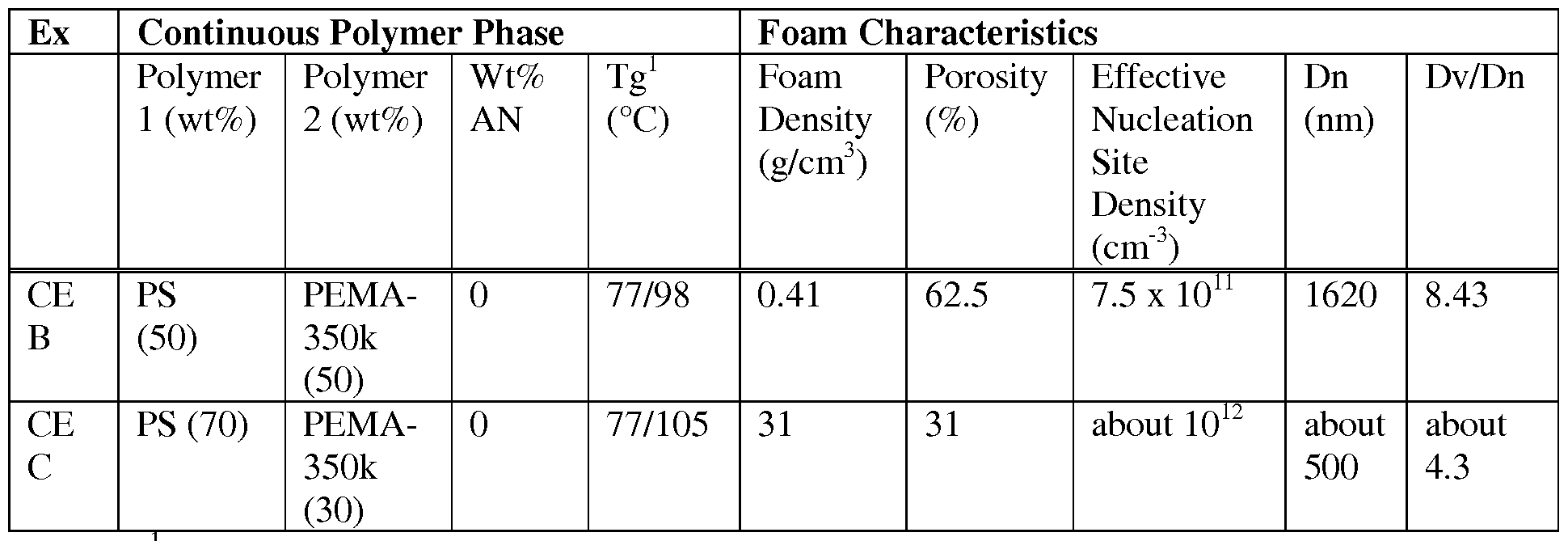
- Comparative Examples B-D prepare foam in like manner as in Examples 1- 20 except use the polymer blends indicated in Table 4. These polymer blends do not contain any acrylonitrile and illustrate that without acrylonitrile foams end up with either large cells or low porosity.
- a continuous polymer phase with a single Tg corresponds to a homogeneous blend and only one Tg is evident. When the blend is not homogeneous two Tg values are evident and reported.
- Comparative Example D in like manner as in Examples 1-12 except use the polymer indicated in Table 5.
- the polymer does not contain any (meth)acrylic polymer, only SAN.
- the resulting foam has very large cell sizes and a low effective nucleation site density.
Landscapes
- Chemical & Material Sciences (AREA)
- Health & Medical Sciences (AREA)
- Chemical Kinetics & Catalysis (AREA)
- Medicinal Chemistry (AREA)
- Polymers & Plastics (AREA)
- Organic Chemistry (AREA)
- Engineering & Computer Science (AREA)
- Materials Engineering (AREA)
- Manufacture Of Porous Articles, And Recovery And Treatment Of Waste Products (AREA)
Abstract
Description



Claims
Priority Applications (8)
| Application Number | Priority Date | Filing Date | Title |
|---|---|---|---|
| US14/238,746 US20140200283A1 (en) | 2011-09-30 | 2012-09-14 | Polymeric nanofoam |
| ES12769541.9T ES2671249T3 (en) | 2011-09-30 | 2012-09-14 | Polymeric nano foam |
| RU2014117520/05A RU2014117520A (en) | 2011-09-30 | 2012-09-14 | POLYMERIC NANOSIZE FOAM |
| CA2850129A CA2850129C (en) | 2011-09-30 | 2012-09-14 | Polymeric nanofoam |
| IN2286CHN2014 IN2014CN02286A (en) | 2011-09-30 | 2012-09-14 | |
| CN201280047914.2A CN103842417B (en) | 2011-09-30 | 2012-09-14 | Polymer/nanometer foam |
| EP12769541.9A EP2734577B1 (en) | 2011-09-30 | 2012-09-14 | Polymeric nanofoam |
| JP2014533581A JP6087932B2 (en) | 2011-09-30 | 2012-09-14 | Polymer nanofoam |
Applications Claiming Priority (2)
| Application Number | Priority Date | Filing Date | Title |
|---|---|---|---|
| US201161541309P | 2011-09-30 | 2011-09-30 | |
| US61/541,309 | 2011-09-30 |
Publications (2)
| Publication Number | Publication Date |
|---|---|
| WO2013048761A2 true WO2013048761A2 (en) | 2013-04-04 |
| WO2013048761A3 WO2013048761A3 (en) | 2013-11-07 |
Family
ID=46982935
Family Applications (1)
| Application Number | Title | Priority Date | Filing Date |
|---|---|---|---|
| PCT/US2012/055263 Ceased WO2013048761A2 (en) | 2011-09-30 | 2012-09-14 | Polymeric nanofoam |
Country Status (10)
| Country | Link |
|---|---|
| US (1) | US20140200283A1 (en) |
| EP (1) | EP2734577B1 (en) |
| JP (1) | JP6087932B2 (en) |
| CN (1) | CN103842417B (en) |
| CA (1) | CA2850129C (en) |
| ES (1) | ES2671249T3 (en) |
| IN (1) | IN2014CN02286A (en) |
| RU (1) | RU2014117520A (en) |
| TR (1) | TR201808430T4 (en) |
| WO (1) | WO2013048761A2 (en) |
Cited By (4)
| Publication number | Priority date | Publication date | Assignee | Title |
|---|---|---|---|---|
| WO2014052032A1 (en) * | 2012-09-25 | 2014-04-03 | Dow Global Technologies Llc | Nanocellular thermoplastic foam and process for making the same |
| WO2015096127A1 (en) * | 2013-12-27 | 2015-07-02 | Dow Global Technologies Llc | Flame-retardant copolymers of dialkyl (meth) acryloyloxyalkyl phosphate or dialkyl (meth)acryloyloxyalkyl phosphonate monomers and polymer foams based made therefrom |
| JP2017517621A (en) * | 2014-05-28 | 2017-06-29 | ダウ グローバル テクノロジーズ エルエルシー | Mold process for making nanofoam |
| US10106665B2 (en) | 2015-11-10 | 2018-10-23 | National Taiwan University Of Science And Technology | Method for producing polymer nanofoam |
Families Citing this family (2)
| Publication number | Priority date | Publication date | Assignee | Title |
|---|---|---|---|---|
| KR102196615B1 (en) * | 2018-05-29 | 2020-12-30 | 롯데첨단소재(주) | Expandable resin composition, method for preparing the same, and foamed molded article |
| JP7853673B2 (en) * | 2020-09-03 | 2026-04-30 | 国立研究開発法人産業技術総合研究所 | Method for producing nanofoamed polymers and nanofoamed polymers |
Family Cites Families (5)
| Publication number | Priority date | Publication date | Assignee | Title |
|---|---|---|---|---|
| JPS63248405A (en) * | 1986-05-30 | 1988-10-14 | Mitsubishi Rayon Co Ltd | porous membrane |
| ITMI20071003A1 (en) * | 2007-05-18 | 2008-11-19 | Polimeri Europa Spa | COMPOSITE BASED ON VINYLAROMATIC POLYMERS WITH IMPROVED PROPERTIES OF THERMAL INSULATION AND PROCEDURE FOR THEIR PREPARATION |
| JP5454137B2 (en) * | 2008-03-07 | 2014-03-26 | 東レ株式会社 | Insulation |
| EP2504384B1 (en) * | 2009-11-25 | 2018-03-21 | Dow Global Technologies LLC | Nanoporous polymeric foam having high porosity |
| JP5833580B2 (en) * | 2010-03-10 | 2015-12-16 | ダウ グローバル テクノロジーズ エルエルシー | Nanoporous polymer foam with high cell density without nanofillers |
-
2012
- 2012-09-14 EP EP12769541.9A patent/EP2734577B1/en active Active
- 2012-09-14 ES ES12769541.9T patent/ES2671249T3/en active Active
- 2012-09-14 RU RU2014117520/05A patent/RU2014117520A/en not_active Application Discontinuation
- 2012-09-14 US US14/238,746 patent/US20140200283A1/en not_active Abandoned
- 2012-09-14 IN IN2286CHN2014 patent/IN2014CN02286A/en unknown
- 2012-09-14 TR TR2018/08430T patent/TR201808430T4/en unknown
- 2012-09-14 JP JP2014533581A patent/JP6087932B2/en active Active
- 2012-09-14 WO PCT/US2012/055263 patent/WO2013048761A2/en not_active Ceased
- 2012-09-14 CA CA2850129A patent/CA2850129C/en active Active
- 2012-09-14 CN CN201280047914.2A patent/CN103842417B/en active Active
Non-Patent Citations (1)
| Title |
|---|
| None |
Cited By (6)
| Publication number | Priority date | Publication date | Assignee | Title |
|---|---|---|---|---|
| WO2014052032A1 (en) * | 2012-09-25 | 2014-04-03 | Dow Global Technologies Llc | Nanocellular thermoplastic foam and process for making the same |
| US9145477B2 (en) | 2012-09-25 | 2015-09-29 | Dow Global Technologies Llc | Nanocellular thermoplastic foam and process for making the same |
| WO2015096127A1 (en) * | 2013-12-27 | 2015-07-02 | Dow Global Technologies Llc | Flame-retardant copolymers of dialkyl (meth) acryloyloxyalkyl phosphate or dialkyl (meth)acryloyloxyalkyl phosphonate monomers and polymer foams based made therefrom |
| US9840605B2 (en) | 2013-12-27 | 2017-12-12 | Dow Global Technologies Llc | Flame-retardant copolymers of dialkyl (meth)acryloyloxyalkyl phosphate or dialkyl (meth)acryloyloxyalkyl phosphonate monomers and polymer foams based made therefrom |
| JP2017517621A (en) * | 2014-05-28 | 2017-06-29 | ダウ グローバル テクノロジーズ エルエルシー | Mold process for making nanofoam |
| US10106665B2 (en) | 2015-11-10 | 2018-10-23 | National Taiwan University Of Science And Technology | Method for producing polymer nanofoam |
Also Published As
| Publication number | Publication date |
|---|---|
| CN103842417A (en) | 2014-06-04 |
| JP2014528495A (en) | 2014-10-27 |
| RU2014117520A (en) | 2015-11-10 |
| JP6087932B2 (en) | 2017-03-01 |
| EP2734577B1 (en) | 2018-03-28 |
| CA2850129C (en) | 2020-01-14 |
| CA2850129A1 (en) | 2013-04-04 |
| EP2734577A2 (en) | 2014-05-28 |
| IN2014CN02286A (en) | 2015-06-12 |
| TR201808430T4 (en) | 2018-07-23 |
| CN103842417B (en) | 2016-03-09 |
| WO2013048761A3 (en) | 2013-11-07 |
| ES2671249T3 (en) | 2018-06-05 |
| US20140200283A1 (en) | 2014-07-17 |
Similar Documents
| Publication | Publication Date | Title |
|---|---|---|
| CN102791783B (en) | Nanoporous polymeric foam having high cell density without nanofiller | |
| RU2466157C2 (en) | High-quality polymer foam from fluorinated alkene foaming agents | |
| CN101547964B (en) | Styrene acrylonitrile copolymer foam with infrared attenuator | |
| CA2850129C (en) | Polymeric nanofoam | |
| JP2010522815A (en) | Polystyrene foam incorporating nanographite and HFC-134 | |
| US9145477B2 (en) | Nanocellular thermoplastic foam and process for making the same | |
| CA2780126A1 (en) | Nanoporous polymeric foam having high porosity | |
| KR20180013926A (en) | Extruded polystyrene foam | |
| JP2003508613A (en) | Extruded thermal insulation foam with monovinyl aromatic polymer of broad molecular weight distribution | |
| CN106661260A (en) | Non-voc processing aids for use in manufacturing foams using low global warming potential blowing agents | |
| US9546256B2 (en) | Polyhedral oligomeric silsesquioxane grafted polymer in polymeric foam | |
| WO1996016111A1 (en) | Polystyrene resin foam and process for producing the foam |
Legal Events
| Date | Code | Title | Description |
|---|---|---|---|
| WWE | Wipo information: entry into national phase |
Ref document number: 201280047914.2 Country of ref document: CN |
|
| 121 | Ep: the epo has been informed by wipo that ep was designated in this application |
Ref document number: 12769541 Country of ref document: EP Kind code of ref document: A2 |
|
| WWE | Wipo information: entry into national phase |
Ref document number: 14238746 Country of ref document: US |
|
| WWE | Wipo information: entry into national phase |
Ref document number: 2012769541 Country of ref document: EP |
|
| ENP | Entry into the national phase |
Ref document number: 2850129 Country of ref document: CA |
|
| ENP | Entry into the national phase |
Ref document number: 2014533581 Country of ref document: JP Kind code of ref document: A |
|
| 121 | Ep: the epo has been informed by wipo that ep was designated in this application |
Ref document number: 12769541 Country of ref document: EP Kind code of ref document: A2 |
|
| ENP | Entry into the national phase |
Ref document number: 2014117520 Country of ref document: RU Kind code of ref document: A |