WO2013053690A1 - Pde9i with imidazo pyrazinone backbone - Google Patents

Pde9i with imidazo pyrazinone backbone Download PDF

Info

Publication number
WO2013053690A1
WO2013053690A1 PCT/EP2012/069936 EP2012069936W WO2013053690A1 WO 2013053690 A1 WO2013053690 A1 WO 2013053690A1 EP 2012069936 W EP2012069936 W EP 2012069936W WO 2013053690 A1 WO2013053690 A1 WO 2013053690A1
Authority
WO
WIPO (PCT)
Prior art keywords
pyrazin
imidazo
methyl
azetidin
fluorophenyl
Prior art date
Legal status (The legal status is an assumption and is not a legal conclusion. Google has not performed a legal analysis and makes no representation as to the accuracy of the status listed.)
Ceased
Application number
PCT/EP2012/069936
Other languages
French (fr)
Inventor
Niels Svenstrup
Klaus Baek Simonsen
Lars Kyhn Rasmussen
Karsten Juhl
Morten LANGGÅRD
Kate Wen
Yazhou WANG
Current Assignee (The listed assignees may be inaccurate. Google has not performed a legal analysis and makes no representation or warranty as to the accuracy of the list.)
H Lundbeck AS
Original Assignee
H Lundbeck AS
Priority date (The priority date is an assumption and is not a legal conclusion. Google has not performed a legal analysis and makes no representation as to the accuracy of the date listed.)
Filing date
Publication date
Priority to MX2015004422A priority Critical patent/MX370433B/en
Priority to BR112015007731-5A priority patent/BR112015007731B1/en
Priority to EP16185105.0A priority patent/EP3121178B1/en
Priority to MX2019014982A priority patent/MX381326B/en
Priority to HK15111740.3A priority patent/HK1211023A1/en
Priority to AU2012323085A priority patent/AU2012323085B2/en
Priority to IN2829DEN2015 priority patent/IN2015DN02829A/en
Priority to MA37958A priority patent/MA37958B1/en
Priority to JP2015535994A priority patent/JP2015531401A/en
Priority to CN201280076285.6A priority patent/CN104703987B/en
Priority to SG11201502728WA priority patent/SG11201502728WA/en
Application filed by H Lundbeck AS filed Critical H Lundbeck AS
Priority to CA2886885A priority patent/CA2886885C/en
Priority to US14/434,308 priority patent/US9643970B2/en
Priority to EP12772769.1A priority patent/EP2906562B1/en
Publication of WO2013053690A1 publication Critical patent/WO2013053690A1/en
Anticipated expiration legal-status Critical
Priority to TNP2015000100A priority patent/TN2015000100A1/en
Priority to IL237836A priority patent/IL237836A/en
Priority to US15/452,827 priority patent/US9993477B2/en
Priority to AU2017201873A priority patent/AU2017201873C1/en
Priority to IL253448A priority patent/IL253448A0/en
Ceased legal-status Critical Current

Links

Classifications

    • AHUMAN NECESSITIES
    • A61MEDICAL OR VETERINARY SCIENCE; HYGIENE
    • A61KPREPARATIONS FOR MEDICAL, DENTAL OR TOILETRY PURPOSES
    • A61K31/00Medicinal preparations containing organic active ingredients
    • A61K31/33Heterocyclic compounds
    • A61K31/395Heterocyclic compounds having nitrogen as a ring hetero atom, e.g. guanethidine or rifamycins
    • A61K31/495Heterocyclic compounds having nitrogen as a ring hetero atom, e.g. guanethidine or rifamycins having six-membered rings with two or more nitrogen atoms as the only ring heteroatoms, e.g. piperazine or tetrazines
    • A61K31/505Pyrimidines; Hydrogenated pyrimidines, e.g. trimethoprim
    • A61K31/506Pyrimidines; Hydrogenated pyrimidines, e.g. trimethoprim not condensed and containing further heterocyclic rings
    • AHUMAN NECESSITIES
    • A61MEDICAL OR VETERINARY SCIENCE; HYGIENE
    • A61PSPECIFIC THERAPEUTIC ACTIVITY OF CHEMICAL COMPOUNDS OR MEDICINAL PREPARATIONS
    • A61P25/00Drugs for disorders of the nervous system
    • AHUMAN NECESSITIES
    • A61MEDICAL OR VETERINARY SCIENCE; HYGIENE
    • A61PSPECIFIC THERAPEUTIC ACTIVITY OF CHEMICAL COMPOUNDS OR MEDICINAL PREPARATIONS
    • A61P25/00Drugs for disorders of the nervous system
    • A61P25/14Drugs for disorders of the nervous system for treating abnormal movements, e.g. chorea, dyskinesia
    • AHUMAN NECESSITIES
    • A61MEDICAL OR VETERINARY SCIENCE; HYGIENE
    • A61PSPECIFIC THERAPEUTIC ACTIVITY OF CHEMICAL COMPOUNDS OR MEDICINAL PREPARATIONS
    • A61P25/00Drugs for disorders of the nervous system
    • A61P25/18Antipsychotics, i.e. neuroleptics; Drugs for mania or schizophrenia
    • AHUMAN NECESSITIES
    • A61MEDICAL OR VETERINARY SCIENCE; HYGIENE
    • A61PSPECIFIC THERAPEUTIC ACTIVITY OF CHEMICAL COMPOUNDS OR MEDICINAL PREPARATIONS
    • A61P25/00Drugs for disorders of the nervous system
    • A61P25/28Drugs for disorders of the nervous system for treating neurodegenerative disorders of the central nervous system, e.g. nootropic agents, cognition enhancers, drugs for treating Alzheimer's disease or other forms of dementia
    • AHUMAN NECESSITIES
    • A61MEDICAL OR VETERINARY SCIENCE; HYGIENE
    • A61PSPECIFIC THERAPEUTIC ACTIVITY OF CHEMICAL COMPOUNDS OR MEDICINAL PREPARATIONS
    • A61P25/00Drugs for disorders of the nervous system
    • A61P25/30Drugs for disorders of the nervous system for treating abuse or dependence
    • AHUMAN NECESSITIES
    • A61MEDICAL OR VETERINARY SCIENCE; HYGIENE
    • A61PSPECIFIC THERAPEUTIC ACTIVITY OF CHEMICAL COMPOUNDS OR MEDICINAL PREPARATIONS
    • A61P25/00Drugs for disorders of the nervous system
    • A61P25/30Drugs for disorders of the nervous system for treating abuse or dependence
    • A61P25/32Alcohol-abuse
    • AHUMAN NECESSITIES
    • A61MEDICAL OR VETERINARY SCIENCE; HYGIENE
    • A61PSPECIFIC THERAPEUTIC ACTIVITY OF CHEMICAL COMPOUNDS OR MEDICINAL PREPARATIONS
    • A61P25/00Drugs for disorders of the nervous system
    • A61P25/30Drugs for disorders of the nervous system for treating abuse or dependence
    • A61P25/36Opioid-abuse
    • AHUMAN NECESSITIES
    • A61MEDICAL OR VETERINARY SCIENCE; HYGIENE
    • A61PSPECIFIC THERAPEUTIC ACTIVITY OF CHEMICAL COMPOUNDS OR MEDICINAL PREPARATIONS
    • A61P43/00Drugs for specific purposes, not provided for in groups A61P1/00-A61P41/00
    • CCHEMISTRY; METALLURGY
    • C07ORGANIC CHEMISTRY
    • C07DHETEROCYCLIC COMPOUNDS
    • C07D487/00Heterocyclic compounds containing nitrogen atoms as the only ring hetero atoms in the condensed system, not provided for by groups C07D451/00 - C07D477/00
    • C07D487/02Heterocyclic compounds containing nitrogen atoms as the only ring hetero atoms in the condensed system, not provided for by groups C07D451/00 - C07D477/00 in which the condensed system contains two hetero rings
    • C07D487/04Ortho-condensed systems

Definitions

  • the present invention relates to cyclic guanylate monophosphate (cGMP)-specific phos- phodiesterase type 9 inhibitors (hereinafter referred to as PDE9 inhibitors) of the form 7H- imidazo[1 ,5-a]pyrazin-8-ones for the use as a medicament. Moreover the invention relates to a pharmaceutical composition comprising 7H-imidazo[1 ,5-a]pyrazin-8-ones, as well as a process for preparation of the compounds.
  • cGMP cyclic guanylate monophosphate
  • PDE9 inhibitors cyclic guanylate monophosphate
  • PDE9 inhibitors cyclic guanylate monophosphate
  • PDE9 inhibitors cyclic guanylate monophosphate (cGMP)-specific phos- phodiesterase type 9 inhibitors
  • PDE9 inhibitors cyclic guanylate monophosphate (cGMP)-specific phos- phodiesterase type 9 inhibitors
  • PDEs phosphodiesterases
  • the phosphodiesterases are a superfamily of enzymes that metabolically inactivate the ubiquitous intracellular messengers cAMP and cGMP. This function involves the PDEs in a broad range of important cellular functions, such as immune response, memory, and vision.
  • the human genome encodes for 21 PDEs that are categorized into 1 1 families (Mehats C, Andersen CB, Filopanti M, Jin SL, Conti M. "Cyclic nucleotide phosphodiesterases and their role in endocrine cell signaling.” Trends Endocrinol Metab. 2002;13:29-35).
  • cGMP Cyclic guanylate monophosphate
  • PDE9 Cyclic guanylate monophosphate
  • PDE9 is a member of the PDE enzyme family that selectively hydrolyses cGMP over cAMP (D A Fisher et al., J. Biol. Chemistry, vol. 273, No. 25, 15559-15564 (1998)).
  • PDE9 inhibitors have been reported as useful to treat cardiovascular disorders (WO 03/037899), and insulin resistance syndrome, hypertension, and/or type 2 diabetes (WO 03/037432) as well as for treatment of obesity related conditions (WO/2005/041972).
  • Wunder F. et al (Mol. Pharmacol. 2005 Dec; 68(6):1775-81 , 2005) report the in vitro characterization of 1 -(2-chlorophenyl)-6-[(2R)-3,3,3-trifluoro-2-methylpropyl]-1 ,5-dihydro-4H- pyrazolo[3,4-d]pyrimidine-4-one, a selective inhibitor of phosphodiesterase 9 (PDE9), which is under development for the treatment of Alzheimer's disease.
  • AD cannot be cured and is degenerative, palliative treatment of patients is essential.
  • the present invention discloses novel PDE9 inhibitors for the use as a medicament, such as in the treatment of patients suffering from cognitive impairments, in particular cognitive impairments that relate to neurodegenerative diseases such as cortical dementia (e.g. Alzheimer's disease) or subcortical dementia, e.g. AIDS related dementia.
  • cognitive impairments that relate to neurodegenerative diseases such as cortical dementia (e.g. Alzheimer's disease) or subcortical dementia, e.g. AIDS related dementia.
  • the PDE9 inhibitors of the present invention have the structure I (i.e. a 7H-imidazo[1 ,5- a]pyrazin-8-one backbone):
  • R2 is cyclized with either R1 or R3.
  • the invention relates to methods of improving conditions involving PDE9, such as cognition, in particular the invention relates to a method of treating diseases involving cognitive difficul- ties, difficulties with executive functioning (such as planning, organization, mental flexibility and task coordination) as well as with pereception (agnosia).
  • the methods of improving conditions involving PDE9 and/or treating diseases involving PDE9 comprises the administration of a compound of the present invention or a pharmaceutically acceptable salt, solvate or prodrug thereof to a patient in need thereof.
  • the compound of the present invention or a pharmaceutically acceptable salt, solvate or prodrug thereof may be in the form of a pharmaceutical composition.
  • the invention relates to an improved pharmaceutical composition
  • a compound of the present invention particularly useful for the treatment of cognitive diffi- culties, difficulties with executive functioning (such as planning, organization, mental flexibility and task coordination) as well as with pereception (agnosia), in particular when associated neurodegenerative diseases, such as cortical or subcortical dementias, e.g. Alzheimer's disease (AD).
  • AD Alzheimer's disease
  • Cognitive impairment includes a decline in cognitive functions or cognitive domains, such as, e.g., difficulties with attention, learning, memory and executive function (relevant reactions to external stimuli). Cognitive impairment also may include: deficits in attention, disorganized thinking, slow thinking, difficulty in understanding, poor concentration, impairment of problem solving, poor memory, difficulty in expressing thoughts and/or integrating thoughts, feelings and behaviour, and/or extinction of irrelevant thoughts, and difficulty in attention and vigilance, verbal learning and memory, visual learning and memory, speed of processing, social cognition, reasoning and problem solving, e.g., executive functioning.
  • guanylyl cyclase (alt. guanylate cyclase) converts guanosine triphosphate (GTP) to cyclic guanosine monophosphate (cGMP), which in turn activates cGMP-dependent protein kinase G (PKG).
  • GTP guanosine triphosphate
  • cGMP cyclic guanosine monophosphate
  • PKG cGMP-dependent protein kinase G
  • cGMP As a result high levels of cGMP will eventually lead to improvement of cognition via the activation of PKG.
  • the level of cGMP can be increased by inhibition of PDE9, which - as mentioned above - has the highest affinity for cGMP of any of the PDEs. Accordingly, PDE9 inhibitors will improve synaptic transmission and thereby enhance cognitive performance as evidenced by the results presented in the experimental section.
  • Embodiments according to the invention in a first embodiment (E1 ) the present invention relates to compounds having the structure (I) (also referred to as compounds of formula (I))
  • R1 when cyclized with R2, is
  • R7 is selected from the group consisting of H, -CH 3 , -C 2 H 5 , and -C 3 H wherein * denotes the cyclization point
  • R1 when not cyclized, is selected from the group consisting of H
  • R7 is selected from the group consisting of H, -CH 3 , -C 2 H 5 , and -C 3 H 7
  • R2 is a compound selected from the group consisting of
  • R8 and R12 independently are selected from the group consisting of H, -CH 3 , -C 2 H 5 , and -C 3 H 7 wherein * denotes the cyclization point, and
  • R9 is selected from the group consisting of H, Ci-C 6 alkyl, branched C 3 -C 6 alkyl, C 3 -C 6 cycloalkyl, C 6 -Ci 0 aryl, substituted C 6 -Ci 0 aryl, C 3 -C 9 het- eroaryl, substituted C 3 -C 9 heteroaryl, CrC 6 alkoxy, branched C 3 -C 6 alkoxy, C 3 -C 6 cycloalkoxy, C 6 -Ci 0 aryloxy, substituted C 6 -Ci 0 aryloxy, C 3 -C 9 heteroary- loxy, substituted C 3 -C 9 heteroaryloxy; and
  • R10 is selected from the group consisting of H, -CH 3 , and -C 2 H 5 ; and R1 1 is selected from the group consisting of C 6 -Cio aryl, substituted C 6 - Ci 0 aryl, C 3 -C 9 heteroaryl, substituted C 3 -C 9 heteroaryl
  • R4 is selected from the group consisting of hydrogen, -CH 3 , -C 2 H 5 , -C 3 H 7 , -CF 3 , -CN, F and CI;
  • R5 is selected from the group consisting of C 6 -Ci 0 aryl, substituted C 6 -Ci 0 aryl, C 3 -C 9 heteroaryl, substituted C 3 -C 9 heteroaryl, C 3 -C 6 heterocyclyl, substituted C 3 -C 6 hetero- cyclyl, C 3 -C 6 cycloalkyl, and substituted C 3 -C 6 cycloalkyl;
  • R6 is selected from the group consisting of hydrogen, F, CI, CN, -CH 3 , -C 2 H 5 , -C 3 H 7 , and -CF 3 ;
  • A is absent or -CH 2 - and tautomers and pharmaceutically acceptable acid addition salts thereof, and polymorphic forms thereof.
  • (E4) of (E1 ) R9 is branched C C 3 alkyl.
  • R9 is phenyl or napthyl.
  • R9 is substituted phenyl or substituted napthyl.
  • the substituent is se- lected from the group consisting of F, CI, methyl, trifluoromethyl, methoxy, trifluoromethoxy, cyano, ethyl, dimethylamino, cyclopropyl, and isopropyl.
  • R9 is a C 4 -C 9 heteroaryl.
  • R9 is selected from the group consisting of pyridyl, pyridazine, pyrimidinyl, pyrazinyl, quinolinyl, quinazolinyl, and quinoxalinyl.
  • R9 is a substituted C 4 -C 9 heteroaryl.
  • R9 is selected from the group consisting of substituted pyridyl, substituted pyridazine, substituted pyrimidinyl, substituted pyrazinyl, substituted quinolinyl, and substituted quinazolinyl, and substituted quinoxalinyl.
  • R9 is selected from the group consisting of 2-pyridyl, 3-pyridyl, 2-pyridazine, 2-pyrimidinyl, 4-pyrimidinyl, 2-pyrazinyl, 2-quinolinyl, 2-quinoxalinyl, 6-quinoxalinyl, and 2-quinazolinyl.
  • R9 is selected from the group consisting of substituted 2-pyridyl, substituted 3-pyridyl, substituted 2-pyridazine, substituted 2-pyrimidinyl, substituted 4-pyrimidinyl, substituted 2-pyrazinyl, substituted 2-quinolinyl, substituted 2-quinoxalinyl, substituted 6-quinoxalinyl, and substituted 2-quinazolinyl.
  • the substituent of R9 is selected from the group consisting of F, CI, methyl, trifluoromethyl, methoxy, trifluoromethoxy, cyano, ethyl, dimethylamino, cyclopropyl, and isopropyl; in particular the substituents are selected from the group consisting of F, CI, methyl, trifluoromethyl, methoxy, trifluoromethoxy, cyano, ethyl, and dimethylamino.
  • R9 is C C 4 alkoxy.
  • R9 is methoxy or ethoxy. In an embodiment (E18) of embodiment (E1 ) R9 is branched C 3 -C 4 alkoxy.
  • R9 is isopropoxy or isobutoxy.
  • R9 is C 6 -Ci 0 aryloxy
  • R9 is selected from the group consisting of phenyloxy and naphtyloxy.
  • R9 when R9 is substituted C 6 -Ci 0 aryloxy, R9 is selected from the group consisting of substituted phenyloxy and substituted naphtyloxy.
  • R9 when R9 is a substituted C 6 -Ci 0 aryloxy, is selected from the group consisting of F, CI, methyl, trifluoromethyl, methoxy, trifluoromethoxy, cyano, ethyl, dimethylamino, cyclopropyl, and isopropyl; in particular the substituents are selected from the group consisting of F, CI, methyl, trifluoromethyl, methoxy, trifluoromethoxy, cyano, ethyl, and dimethylamino.
  • R9 is a C 4 -C 9 heteroaryloxy.
  • R9 is selected from the group consisting of pyridineoxy, pyridazineoxy, pyrimidineoxy and quinoxalineoxy
  • R9 is a substituted C 4 -C 9 het- eroaryloxy.
  • R9 is selected from the group consisting of substituted pyridineoxy, pyridazineoxy, substituted pyrimidineoxy and quinoxalineoxy
  • the substituent is selected from the group consisting of F, CI, methyl, trifluoromethyl, methoxy, trifluoromethoxy, cyano, ethyl, dimethylamino, cyclopropyl, and isopropyl; in particular the substituents are selected from the group consisting of F, CI, methyl, trifluoromethyl, methoxy, trifluoromethoxy, cyano, ethyl, and dimethylamino.
  • R1 1 is a C 6 -Ci 0 aryl selected from the group consisting of phenyl and naphthyl. In a preferred embodiment (E29) of embodiment (E28) R1 1 is phenyl.
  • R1 1 is a substituted C 6 -Ci 0 aryl selected from the group consisting of substituted phenyl and substituted naphthyl.
  • R1 1 is substituted phenyl.
  • the substituent is se- lected from the group consisting of F, CI, methyl, trifluoromethyl, methoxy, trifluoromethoxy, cyano, ethyl, dimethylamino, cyclopropyl, and isopropyl; in particular the substituents are selected from the group consisting of F, CI, methyl, trifluoromethyl, methoxy, trifluoromethoxy, cyano, ethyl, and dimethylamino.
  • R1 1 is a C 4 -C 9 heteroaryl.
  • R1 1 is selected from the group consisting of pyridyl, pyridazine, pyrimidinyl, pyrazinyl, quinolinyl, quinazolinyl, and quinoxalinyl.
  • R1 1 is selected from the group consisting of 2-pyridyl, 3-pyridyl, 2-pyridazine, 2-pyrimidinyl, 4-pyrimidinyl, 2-pyrazinyl, 2- quinolinyl, 2-quinoxalinyl, 6-quinoxalinyl, and 2-quinazolinyl.
  • R1 1 is a substituted C 4 - C 9 heteroaryl.
  • R1 1 is selected from the group consisting of substituted pyridyl, substituted pyridazine, substituted pyrimidinyl, substituted pyraz- inyl, substituted quinolinyl, and substituted quinazolinyl, and substituted quinoxalinyl.
  • R1 1 is selected from the group consisting of substituted 2-pyridyl, substituted 3-pyridyl, substituted 2-pyridazine, substituted 2-pyrimidinyl, substituted 4-pyrimidinyl, substituted 2-pyrazinyl, substituted 2-quinolinyl, substituted 2-quinoxalinyl, substituted 6-quinoxalinyl, and substituted 2-quinazolinyl.
  • R1 1 is selected from the group consisting of F, CI, methyl, trifluoromethyl, methoxy, trifluoromethoxy, cyano, ethyl, dimethylamino, cyclopropyl, and isopropyl; in particular the substituents are selected from the group consisting of F, CI, methyl, trifluoromethyl, methoxy, trifluoromethoxy, cyano, ethyl, and dimethylamino.
  • R5 is selected from the group consisting of phenyl and naphthyl.
  • R5 is substituted phenyl.
  • the substituent is selected from the group consisting of F, CI, methyl, trifluoromethyl, methoxy, trifluoromethoxy, cyano, ethyl, dimethyl- amino, cyclopropyl, and isopropyl; in particular the substituents are selected from the group consisting of F, CI, methyl, trifluoromethyl, methoxy, trifluoromethoxy, cyano, ethyl, and dimethylamino.
  • R5 is pyridyl
  • R5 is substituted pyridyl.
  • the substituent is selected from the group consisting of F, CI, methyl, trifluoromethyl, methoxy, trifluoromethoxy, cyano, ethyl, dimethylamino, cyclopropyl, and isopropyl; in particular the substituents are selected from the group consisting of F, CI, methyl, trifluoromethyl, methoxy, trifluoromethoxy, cyano, ethyl, and dimethylamino.
  • R5 is selected from the group consisting of tet- rahydropyranyl, tetrahydrofuranyl and piperidyl.
  • R5 is selected from the group consisting of substituted tetrahydropyranyl, substituted tetrahydrofuranyl and substituted piperidyl.
  • the substituent is selected from group consisting of F, CI, methyl, cyano and methoxy.
  • R5 is selected from the group consisting of cyclobutyl, cyclopentyl and cyclohexyl.
  • R5 is cyclopentyl or cyclohexyl.
  • R5 is selected from the group consisting of substituted cyclobutyl, substituted cyclopentyl and substituted cyclohexyl.
  • R5 is substituted cyclopentyl or substituted cyclohexyl.
  • substituent is selected from the group consisting of F, CI, methyl, trifluoromethyl, methoxy, trifluoromethoxy, cyano, ethyl, dimethylamino, cyclopropyl, and isopropyl; in particular the substituents are selected from the group consisting of F, CI, methyl, trifluoromethyl, methoxy, trifluoromethoxy, cyano, ethyl, and dimethylamino.
  • the compound of formula (I) is selected among the compounds listed in Table 1 , in the form of the free base, one or more tautomers thereof or a pharmaceutically acceptable acid addition salt thereof.
  • the compound is for use as a medicament.
  • the compound is for use in the treatment of a disease selected from the group consisting of Alzheimer's disease, mental retardation; CIAS, attention-deficit/hyperactivity disorder; and age-related cognitive decline, substance-induced psychotic disorder, for example psychosis induced by alcohol, ampheta- mine, cannabis, cocaine, hallucinogens, inhalants, opioids, or phencyclidine.
  • a disease selected from the group consisting of Alzheimer's disease, mental retardation; CIAS, attention-deficit/hyperactivity disorder; and age-related cognitive decline, substance-induced psychotic disorder, for example psychosis induced by alcohol, ampheta- mine, cannabis, cocaine, hallucinogens, inhalants, opioids, or phencyclidine.
  • the compound is for preparation of a medicament for use in the treatment of a disease selected from the group consisting of Alzheimer's disease, mental retardation; CIAS, attention-deficit/hyperactivity disorder; and age-related cognitive decline, substance-induced psychotic disorder, for example psychosis induced by alcohol, amphetamine, cannabis, cocaine, hallucinogens, inhalants, opioids, or phencyclidine.
  • a disease selected from the group consisting of Alzheimer's disease, mental retardation; CIAS, attention-deficit/hyperactivity disorder; and age-related cognitive decline, substance-induced psychotic disorder, for example psychosis induced by alcohol, amphetamine, cannabis, cocaine, hallucinogens, inhalants, opioids, or phencyclidine.
  • Embodiment (E59) of the present invention covers a method of treating a subject suffering from a disease selected from the group consisting of Alzheimer's disease, mental retardation; CIAS, attention-deficit/hyperactivity disorder; and age-related cognitive decline, sub- stance-induced psychotic disorder, for example psychosis induced by alcohol, amphetamine, cannabis, cocaine, hallucinogens, inhalants, opioids, or phencyclidine, which method comprises administering to said subject a compound of any of embodiments (E1 )-(E55).
  • a disease selected from the group consisting of Alzheimer's disease, mental retardation; CIAS, attention-deficit/hyperactivity disorder; and age-related cognitive decline, sub- stance-induced psychotic disorder, for example psychosis induced by alcohol, amphetamine, cannabis, cocaine, hallucinogens, inhalants, opioids, or phencyclidine
  • the present invention covers a pharmaceutical composition
  • a pharmaceutical composition comprising a therapeutically effective amount of a compound of any of embodiments (E1 ) to (E55), and one or more pharmaceutically acceptable carriers, diluents and excipients.
  • the pharmaceutical composition is for the treatment of a disease selected from the group consisting of Alzheimer's disease, mental retardation; CIAS, attention-deficit/hyperactivity disorder; and age-related cognitive decline, substance-induced psychotic disorder, for example psychosis induced by alcohol, ampheta- mine, cannabis, cocaine, hallucinogens, inhalants, opioids, or phencyclidine.
  • a disease selected from the group consisting of Alzheimer's disease, mental retardation; CIAS, attention-deficit/hyperactivity disorder; and age-related cognitive decline, substance-induced psychotic disorder, for example psychosis induced by alcohol, ampheta- mine, cannabis, cocaine, hallucinogens, inhalants, opioids, or phencyclidine.
  • Table 1 lists compounds of the invention and the corresponding IC50 values (nM) determined as described in the section "PDE9 inhibition assay". Each of the compounds constitutes an individual embodiment of the present invention:
  • halo and halogen are used interchangeably and refer to fluorine, chlorine, bromine or iodine.
  • Ci-C 6 alkoxy refers to a straight-chain or branched saturated alkoxy group having from one to six carbon atoms, inclusive, with the open valency on the oxygen. Examples of such groups include, but are not limited to, methoxy, ethoxy, n-butoxy, 2-methyl- pentoxy and n-hexyloxy.
  • C 3 -C 8 cycloalkyi typically refers to cyclopropyl, cyclobutyl, cyclopentyl, cyclohexyl, cycloheptyl or cyclooctyl.
  • hydroxyheterocycloalkyl refers to a heterocycloalkyi as defined above which is substituted with one hydroxy group.
  • CrC 6 alkyl-heterocycloalkyl refers to a heterocycloalkyi as defined above which is substituted with a Ci-C 6 alkyl group.
  • examples of such groups include, but are not limited to, tetrahydropyran-4-yl-methyl and 2-morpholin-4-yl-ethyl.
  • aryl refers to a phenyl ring, optionally substituted with halogen, Ci-C 6 alkyl, CrC 6 alkoxy or halo(CrC 6 )alkyl as defined above. Examples of such groups include, but are not limited to, phenyl and 4-chlorophenyl.
  • heteroaryloxy refers to an aryloxy where one or more carbon atoms have been sub- stituted with one more hetero atoms, such as N, O, S.
  • present invention further provides certain embodiments of the invention, which are described below. Additionally, the present invention further provides certain embodiments of the invention that are described below.
  • the present invention also comprises salts of the compounds, typically, pharmaceutically acceptable salts.
  • Such salts include pharmaceutically acceptable acid addition salts.
  • Acid addition salts include salts of inorganic acids as well as organic acids.
  • inorganic or organic acid addition salts include the pharmaceutically acceptable salts listed in Berge, S.M. et al., J. Pharm. Sci. 1977, 66, 2, the contents of which are hereby incorporated by reference.
  • the compounds of this invention may exist in unsolvated as well as in solvated forms with pharmaceutically acceptable solvents such as water, ethanol and the like. In general, the solvated forms are considered equivalent to the unsolvated forms for the purposes of this invention.
  • compositions according to the invention may be formulated with pharmaceutically acceptable carriers or diluents as well as any other known adjuvants and excipients in accordance with conventional techniques such as those disclosed in Remington: The Science and Practice of Pharmacy, 19th Edition, Gennaro, Ed., Mack Publishing Co., Easton, PA, 1995.
  • compositions may be specifically formulated for administration by any suitable route such as oral, rectal, nasal, pulmonary, topical (including buccal and sublingual), transdermal, intracisternal, intraperitoneal, vaginal and parenteral (including subcutaneous, intramuscular, intrathecal, intravenous and intradermal) routes. It will be appreciated that the route will depend on the general condition and age of the subject to be treated, the nature of the condition to be treated and the active ingredient.
  • Pharmaceutical compositions for oral administration include solid dosage forms such as capsules, tablets, dragees, pills, lozenges, powders and granules.
  • compositions may be prepared with coatings such as enteric coatings or they may be formulated so as to provide controlled release of the active ingredient such as sustained or prolonged release according to methods well known in the art.
  • Liquid dosage forms for oral administration include solutions, emulsions, suspensions, syrups and elixirs.
  • Typical oral dosages range from about 0.001 to about 100 mg/kg body weight per day. Typical oral dosages also range from about 0.01 to about 50 mg/kg body weight per day. Typical oral dosages further range from about 0.05 to about 10 mg/kg body weight per day. Oral dosages are usually administered in one or more dosages, typically, one to three dosages per day. The exact dosage will depend upon the frequency and mode of administration, the sex, age, weight and general condition of the subject treated, the nature and severity of the condition treated and any concomitant diseases to be treated and other factors evident to those skilled in the art. The formulations may also be presented in a unit dosage form by methods known to those skilled in the art. For illustrative purposes, a typical unit dosage form for oral administration may contain from about 0.01 to about 1000 mg, from about 0.05 to about 500 mg, or from about 0.5 mg to about 200 mg.
  • parenteral routes such as intravenous, intrathecal, intramuscular and similar administra- tion
  • typical doses are in the order of half the dose employed for oral administration.
  • the present invention also provides a process for making a pharmaceutical composition
  • a process for making a pharmaceutical composition comprising admixing a therapeutically effective amount of a compound of formula (I) and at least one pharmaceutically acceptable carrier or diluent.
  • the compound utilized in the aforementioned process is one of the specific com- pounds disclosed in the Experimental Section herein.
  • the compounds of this invention are generally utilized as the free substance or as a pharmaceutically acceptable salt thereof.
  • One example is an acid addition salt of a compound having the utility of a free base.
  • a compound of formula (I) contains a free base such salts are prepared in a conventional manner by treating a solution or suspension of a free base of formula (I) with a molar equivalent of a pharmaceutically acceptable acid.
  • suitable organic and inorganic acids are described above.
  • solutions of the compounds of formula (I) in sterile aqueous so- lution, aqueous propylene glycol, aqueous vitamin E or sesame or peanut oil may be employed.
  • aqueous solutions should be suitably buffered if necessary and the liquid diluent first rendered isotonic with sufficient saline or glucose.
  • the aqueous solutions are particularly suitable for intravenous, intramuscular, subcutaneous and intraperitoneal administration.
  • the compounds of formula (I) may be readily incorporated into known sterile aqueous media us- ing standard techniques known to those skilled in the art.
  • Suitable pharmaceutical carriers include inert solid diluents or fillers, sterile aqueous solutions and various organic solvents.
  • solid carriers include lactose, terra alba, sucrose, cyclodextrin, talc, gelatin, agar, pectin, acacia, magnesium stearate, stearic acid and lower alkyl ethers of cellulose.
  • liquid carriers include, but are not limited to, syrup, pea- nut oil, olive oil, phospholipids, fatty acids, fatty acid amines, polyoxyethylene and water.
  • the carrier or diluent may include any sustained release material known in the art, such as glyceryl monostearate or glyceryl distearate, alone or mixed with a wax.
  • sustained release material such as glyceryl monostearate or glyceryl distearate, alone or mixed with a wax.
  • the pharmaceutical compositions formed by combining the compounds of formula (I) and a pharmaceutically acceptable carrier are then readily administered in a variety of dosage forms suit- able for the disclosed routes of administration.
  • the formulations may conveniently be presented in unit dosage form by methods known in the art of pharmacy.
  • Formulations of the present invention suitable for oral administration may be presented as discrete units such as capsules or tablets, each containing a predetermined amount of the active ingredient, and optionally a suitable excipient.
  • the orally available formu- lations may be in the form of a powder or granules, a solution or suspension in an aqueous or non-aqueous liquid, or an oil-in-water or water-in-oil liquid emulsion.
  • the preparation may be tabletted, placed in a hard gelatin capsule in powder or pellet form or it may be in the form of a troche or lozenge.
  • the amount of solid carrier will vary widely but will range from about 25 mg to about 1 g per dosage unit.
  • the preparation may be in the form of a syrup, emulsion, soft gelatin capsule or sterile injectable liquid such as an aqueous or non-aqueous liquid suspension or solution.
  • the pharmaceutical compositions of the invention may be prepared by conventional methods in the art. For example, tablets may be prepared by mixing the active ingredient with ordinary adjuvants and/or diluents and subsequently compressing the mixture in a conventional tabletting machine prepare tablets.
  • adjuvants or diluents comprise: corn starch, potato starch, talcum, magnesium stearate, gelatin, lactose, gums, and the like. Any other adjuvants or additives usually used for such purposes such as colorings, flavorings, preservatives etc. may be used provided that they are compatible with the active ingredients.
  • the PDE9 inhibitors of the present invention may be used in the treatment of cognition deficiencies related to neurodegenerative disorders, such dementia, such as cortical dementia or subcortical dementia.
  • Cortical dementias arise from a disorder affecting the cerebral cortex, the outer layers of the brain that play a critical role in cognitive processes such as memory and language.
  • Particularly considered cortical dementias are Alzheimer's disease; vascular dementia (also known as multi-infarct dementia), including Binswanger's disease; Dementia with Lewy bodies (DLB); Alcohol-Induced Persisting Dementia, including Korsakoff's syndrome and Wernicke's encephalopathy; frontotemporal lobar degeneration (FTLD), including: Pick's disease, fronto- temporal dementia (or frontal variant FTLD), semantic dementia (or temporal variant FTLD), and progressive non-fluent aphasia; Creutzfeldt-Jakob disease; dementia pugilistica; Moya- moya disease; and posterior cortical atrophy (an Alzheimer's disease variant).
  • vascular dementia also known as multi-infarct dementia
  • DLB Dementia with Lewy bodies
  • Subcortical dementias result from dysfunction in the parts of the brain that are beneath the cortex. Usually, the memory loss and language difficulties that are characteristic of cortical dementias are not present. Rather, people with subcortical dementias, such as Huntington's disease, Parkinson's Disease, and AIDS dementia complex, tend to show changes in their personality and attention span, and their thinking slows down.
  • Particularly considered subcortical dementias are dementia due to Huntington's disease, dementia due to hypothyroidism, dementia due to Parkinson's disease, dementia due to Vitamin B1 deficiency, dementia due to Vitamin B12 deficiency, dementia due to folate deficiency, dementia due to syphilis, dementia due to subdural hematoma, dementia due to hypercalcaemia, dementia due to hypo- glycaemia, AIDS dementia complex, pseudodementia (a major depressive episode with prominent cognitive symptoms), substance-induced persisting dementia, dementia due to multiple etiologies, dementia due to other general medical conditions (i.e. end stage renal failure, cardiovascular disease etc.), dementia not otherwise specified (used in cases where no specific criteria is met).
  • Compounds of formula V, where X is a halogen can be prepared by halogenation of formula IV with SOCI 2 , PBr 3 .
  • Compounds of formula IV can be prepared by reduction with NaBH 4 , LAH, DIBAL, BH 3 , etc, of compounds of formula III, which can be made by carbonylation of compounds of formula II in the presence of CO, and a palladium catalyst, such as Pd(dppf)CI 2 , Pd(PPh 3 ) 2 CI 2 , Pd(PPh 3 ) 4 , and a base, such as Cs 2 C0 3 , K 2 C0 3 , or Et 3 N (Scheme 2):
  • a palladium catalyst such as Pd(dppf)CI 2 , Pd(PPh 3 ) 2 CI 2 , Pd(PPh 3 ) 4
  • a base such as Cs 2 C0 3 , K 2 C0 3 , or Et 3 N (Scheme 2):
  • Compounds of formula XII can be prepared by acid catalyzed demethylation of compounds of formula XI, which can be made from reaction of Wein- reb amides of formula X with a Grignard reagent.
  • Compounds of formula X can be made by carbonylation of compounds of formula II with CO in the presence of a palladium catalyst, such as Pd(dppf)CI 2 , Pd(PPh 3 ) 4 , Pd(PPh 3 ) 2 CI 2 , and a base, such as Cs 2 C0 3 , K 2 C0 3 , Et 3 N, KOAc, etc., in solvents, such as toluene, DMF, DMSO (Scheme 3):
  • a palladium catalyst such as Pd(dppf)CI 2 , Pd(PPh 3 ) 4 , Pd(PPh 3 ) 2 CI 2
  • a base such as Cs 2 C0 3 , K 2 C0 3 , Et 3 N, KOAc, etc.
  • solvents such as toluene, DMF, DMSO (Scheme 3):
  • Compounds of formula XX can be prepared by hydrogena- tion of compounds of formula XIX, with H 2 and in the presence of Pd/C or Pd(OH) 2 /C in solvents such as alcohol or EtOAc, etc.
  • Compounds of formula XIX can be synthesized by me- sylation of compounds of formula XVI, followed by reductive deoxygenation with NaBH 4 or LiAIH 4 , and acid catalyzed demethylation.
  • Compounds of formula XVI can be made by reduction with LAH, NaBH 4 , DIBAL, etc, of compounds of formula XV, which can be made by [3+2] cycloaddtion of compounds of formula XIV with benzyl-methoxymethyl- trimethylsilanylmethylamine with the aid of TFA in solvents such as toluene or CH 2 CI 2 .
  • Compounds of formula XIV can be made by Suzuki reaction of compounds of formula II with bo- ronic ester XIII in the presence of a palladium catalyst, such as Pd(dppf)CI 2 , Pd(PPh 3 ) 4 , Pd(PPh 3 ) 2 CI 2 , etc., and a base, such as Cs 2 C0 3 , K 2 C0 3 , KOAc, etc., in solvent, such as toluene, DMF, DMSO, etc; or by Heck reaction of compounds of formula II with ethyl acrylate in the presence of a palladium catalyst, such as Pd(dppf)CI 2 , Pd(PPh 3 ) 4 , Pd(PPh 3 ) 2 CI 2 and a base, such as Cs 2 C0 3 , K 2 C0 3 , KOAc, etc.
  • a palladium catalyst such as Pd(dppf)CI 2 , Pd(PPh 3 ) 4
  • Boronic ester XIII can be generated by coupling of ethyl propiolate with bis(pinacolato)diboron in the presence of CuCI, and Xantphos as catalysts, i-BuOK as a base in the solvent of THF (Scheme 4):
  • Compounds of formula II can be prepared by cyclization of compounds of formula XXVI in the presence of POCI 3 or SOCI 2 .
  • Compounds of formula XXVI can be made by reduction of com- pounds of formula XXII in H 2 with Pd/C or Raney Ni to generate XXIII, which can then be converted to amides of formula XXIV by reaction with a variety of acid chlorides, or by coupling with various carboxylic acids in the presence of coupling reagents, such as HOBt and EDC, or HATU. Subsequent deprotection under acidic conditions yields compounds of formula XXV, which can undergo diazotization and iodination.
  • Compounds of formula XXII can be made from Boc protection of compounds of formula XXI (Scheme 5):
  • a PDE9 assay may for example, be performed as follows: The assay is performed in 60 uL samples containing a fixed amount of the relevant PDE enzyme (sufficient to convert 20-25% of the cyclic nucleotide substrate), a buffer (50 mM HEPES7.6; 10mM MgCI 2 ; 0.02% Tween20), 0.1 mg/ml BSA, 225 pCi of 3 H-labelled cyclic nucleotide substrate, tritium labeled cAMP to a final concentration of 5 nM and varying amounts of inhibitors.
  • the assay was performed in 60 uL assay buffer (50 mM HEPES pH 7.6; 10mM MgCI 2 ; 0.02% Tween20) containing enough PDE9 to convert 20-25% of 10 nM 3 H-cAMP and varying amounts of inhibitors. Following a 1 hour incubation the reactions were terminated by addition of 15 uL 8 mg/mL yttrium silicate SPA beads (Amersham). The beads were allowed to settle for one hr in the dark before the plates were counted in a Wallac 1450 Microbeta counter. IC 50 values were calculated by non linear regression using XLfit (IDBS).

Landscapes

  • Health & Medical Sciences (AREA)
  • Chemical & Material Sciences (AREA)
  • Organic Chemistry (AREA)
  • General Health & Medical Sciences (AREA)
  • Veterinary Medicine (AREA)
  • Public Health (AREA)
  • Medicinal Chemistry (AREA)
  • Animal Behavior & Ethology (AREA)
  • Life Sciences & Earth Sciences (AREA)
  • Pharmacology & Pharmacy (AREA)
  • Engineering & Computer Science (AREA)
  • Bioinformatics & Cheminformatics (AREA)
  • Neurosurgery (AREA)
  • General Chemical & Material Sciences (AREA)
  • Chemical Kinetics & Catalysis (AREA)
  • Biomedical Technology (AREA)
  • Neurology (AREA)
  • Nuclear Medicine, Radiotherapy & Molecular Imaging (AREA)
  • Addiction (AREA)
  • Psychiatry (AREA)
  • Epidemiology (AREA)
  • Hospice & Palliative Care (AREA)
  • Psychology (AREA)
  • Nitrogen Condensed Heterocyclic Rings (AREA)
  • Pharmaceuticals Containing Other Organic And Inorganic Compounds (AREA)

Abstract

This invention is directed to compounds, which are PDE9 enzyme inhibitors. The invention provides a pharmaceutical composition comprising a therapeutically effective amount of a compound of the invention and a pharmaceutically acceptable carrier. The present invention also provides processes for the preparation of the compounds of formula (I). The present invention further provides a method of treating a subject suffering from a neurodegenerative disorder comprising administering to the subject a therapeutically effective amount of a compound of formula (I). The present invention further provides a method of treating a subject suffering from a psychiatric disorder comprising administering to the subject a therapeutically effective amount of a compound of formula (I).

Description

PDE9i with imidazo pyrazinone backbone
FIELD OF THE INVENTION
The present invention relates to cyclic guanylate monophosphate (cGMP)-specific phos- phodiesterase type 9 inhibitors (hereinafter referred to as PDE9 inhibitors) of the form 7H- imidazo[1 ,5-a]pyrazin-8-ones for the use as a medicament. Moreover the invention relates to a pharmaceutical composition comprising 7H-imidazo[1 ,5-a]pyrazin-8-ones, as well as a process for preparation of the compounds.
BACKGROUND OF THE INVENTION The phosphodiesterases (PDEs) are a superfamily of enzymes that metabolically inactivate the ubiquitous intracellular messengers cAMP and cGMP. This function involves the PDEs in a broad range of important cellular functions, such as immune response, memory, and vision. The human genome encodes for 21 PDEs that are categorized into 1 1 families (Mehats C, Andersen CB, Filopanti M, Jin SL, Conti M. "Cyclic nucleotide phosphodiesterases and their role in endocrine cell signaling." Trends Endocrinol Metab. 2002;13:29-35). These enzymes share a conserved catalytic domain of approximately 300 amino acids that is located in the C- terminal region of the protein. The N-terminal regions, which vary among different PDEs, serve regulatory functions including autoinhibition of the catalytic domains or control of subcellular localization (Mehats 2002). The PDEs have different substrate preferences: Cyclic guanylate monophosphate (cGMP)-specific phosphodiesterase type 9 (PDE9) is a member of the PDE enzyme family that selectively hydrolyses cGMP over cAMP (D A Fisher et al., J. Biol. Chemistry, vol. 273, No. 25, 15559-15564 (1998)). The different substrate preferences, combined with different expression profiles, cellular compartmentalization, and regulation, allow the PDEs to play a very versatile role in cell signal transduction (Breer H, Boekhoff I, Tareilus E. "Rapid kinetics of second messenger formation in olfactory transduction." Nature. 1990;345:65-68).
PDE9 inhibitors have been reported as useful to treat cardiovascular disorders (WO 03/037899), and insulin resistance syndrome, hypertension, and/or type 2 diabetes (WO 03/037432) as well as for treatment of obesity related conditions (WO/2005/041972). Wunder F. et al (Mol. Pharmacol. 2005 Dec; 68(6):1775-81 , 2005) report the in vitro characterization of 1 -(2-chlorophenyl)-6-[(2R)-3,3,3-trifluoro-2-methylpropyl]-1 ,5-dihydro-4H- pyrazolo[3,4-d]pyrimidine-4-one, a selective inhibitor of phosphodiesterase 9 (PDE9), which is under development for the treatment of Alzheimer's disease. This compound is reported to inhibit human (IC50 = 55 nM) and murine (IC50 = 100 nM) PDE9 activity in vitro.
Over the years convincing experimental evidence has accumulated supporting the cognition- enhancing properties of several classes of PDE-inhibitors (Blokland et al., 2006: "Improving memory; a role for phosphodiesterases", Current Pharmacological Design 12, 251 1 -2523).
In a later study van der Staay et al. (F. Josef van der Staay, Neuropharmacology Volume 55, Issue 5, October 2008, pages 908-918) concludes that the PDE9 inhibitor 1 -(2-chlorophenyl)- 6-[(2R)-3,3,3-trifluoro-2-methylpropyl]-1 ,5-dihydro-4H-pyrazolo[3,4-d]pyrimidine-4-one may act as a putative cognition enhancer. Alzheimers disease is the most common form of dementia, it is incurable, degenerative, and terminal. The typical symptoms are cognitive difficulties, difficulties with executive functioning (such as planning, organization, mental flexibility and task coordination) as well as with perception (agnosia) and execution of movements (apraxia).
Because AD cannot be cured and is degenerative, palliative treatment of patients is essential.
SUMMARY OF THE INVENTION
The present invention discloses novel PDE9 inhibitors for the use as a medicament, such as in the treatment of patients suffering from cognitive impairments, in particular cognitive impairments that relate to neurodegenerative diseases such as cortical dementia (e.g. Alzheimer's disease) or subcortical dementia, e.g. AIDS related dementia.
The PDE9 inhibitors of the present invention have the structure I (i.e. a 7H-imidazo[1 ,5- a]pyrazin-8-one backbone):
Figure imgf000003_0001
(I)
wherein R2 is cyclized with either R1 or R3.
The invention relates to methods of improving conditions involving PDE9, such as cognition, in particular the invention relates to a method of treating diseases involving cognitive difficul- ties, difficulties with executive functioning (such as planning, organization, mental flexibility and task coordination) as well as with pereception (agnosia). The methods of improving conditions involving PDE9 and/or treating diseases involving PDE9 comprises the administration of a compound of the present invention or a pharmaceutically acceptable salt, solvate or prodrug thereof to a patient in need thereof. The compound of the present invention or a pharmaceutically acceptable salt, solvate or prodrug thereof may be in the form of a pharmaceutical composition.
In a further aspect the invention relates to an improved pharmaceutical composition comprising a compound of the present invention particularly useful for the treatment of cognitive diffi- culties, difficulties with executive functioning (such as planning, organization, mental flexibility and task coordination) as well as with pereception (agnosia), in particular when associated neurodegenerative diseases, such as cortical or subcortical dementias, e.g. Alzheimer's disease (AD).
DETAILED DESCRIPTION OF THE INVENTION Cognitive impairment includes a decline in cognitive functions or cognitive domains, such as, e.g., difficulties with attention, learning, memory and executive function (relevant reactions to external stimuli). Cognitive impairment also may include: deficits in attention, disorganized thinking, slow thinking, difficulty in understanding, poor concentration, impairment of problem solving, poor memory, difficulty in expressing thoughts and/or integrating thoughts, feelings and behaviour, and/or extinction of irrelevant thoughts, and difficulty in attention and vigilance, verbal learning and memory, visual learning and memory, speed of processing, social cognition, reasoning and problem solving, e.g., executive functioning. There are presently no effective drugs for the treatment of cognitive disorders on the market and there is a great need and demand for drugs effective in the treatment of such disorders. Without being limited to any specific theory it is believed that the mode of action of PDE9 inhibitors can be understood in the light of the following neurological processes: guanylyl cyclase (alt. guanylate cyclase) converts guanosine triphosphate (GTP) to cyclic guanosine monophosphate (cGMP), which in turn activates cGMP-dependent protein kinase G (PKG). PKG is known to lower the threshold for the induction of long-term potentiation (LTP), i.e. the long-lasting improvement in communication between neurons (Zhou et al., 1994: "Role of guanylyl cyclase and cGMP-dependent protein kinase in long-term potentiation", Nature 368, 635-639). The communication between neurons takes place via the chemical synapses (synaptic transmission) and because memories are believed to be stored within these synapses, LTP is considered one of major cellular mechanisms that underlies cognition (Boron, W. F., 2005: Medical Physiology: A Cellular and Molecular Approach. Elsevier/Saunders, ISBN 1 - 4160-2328-3 and Cooke et al., 2006 "Plasticity in the human central nervous system". Brain 129, 1659-1673). As a result high levels of cGMP will eventually lead to improvement of cognition via the activation of PKG. The level of cGMP can be increased by inhibition of PDE9, which - as mentioned above - has the highest affinity for cGMP of any of the PDEs. Accordingly, PDE9 inhibitors will improve synaptic transmission and thereby enhance cognitive performance as evidenced by the results presented in the experimental section.
The invention will be illustrated in the following non-limiting examples.
Embodiments according to the invention In a first embodiment (E1 ) the present invention relates to compounds having the structure (I) (also referred to as compounds of formula (I))
Figure imgf000005_0001
(I) wherein R2 is cyclized with either R1 or R3, wherein R1 , R2 and R3 are
R1 , when cyclized with R2, is
* C— R7
H wherein R7 is selected from the group consisting of H, -CH3, -C2H5, and -C3H wherein * denotes the cyclization point, and
R1 , when not cyclized, is selected from the group consisting of H
C— R7
H and H wherein R7 is selected from the group consisting of H, -CH3, -C2H5, and -C3H7 R2 is a compound selected from the group consisting of
R12— C I C *— R8 C *— R8
H H and H wherein R8 and R12 independently are selected from the group consisting of H, -CH3, -C2H5, and -C3H7 wherein * denotes the cyclization point, and
R3, when cyclized with R2, is
Figure imgf000006_0001
wherein * denotes the cyclization point, and wherein R9 is selected from the group consisting of H, Ci-C6 alkyl, branched C3-C6 alkyl, C3-C6 cycloalkyl, C6-Ci0 aryl, substituted C6-Ci0 aryl, C3-C9 het- eroaryl, substituted C3-C9 heteroaryl, CrC6 alkoxy, branched C3-C6 alkoxy, C3-C6 cycloalkoxy, C6-Ci0 aryloxy, substituted C6-Ci0 aryloxy, C3-C9 heteroary- loxy, substituted C3-C9 heteroaryloxy; and
R3, when not cyclized, is
R10
I
R1 1 wherein
R10 is selected from the group consisting of H, -CH3, and -C2H5; and R1 1 is selected from the group consisting of C6-Cio aryl, substituted C6- Ci0 aryl, C3-C9 heteroaryl, substituted C3-C9 heteroaryl
R4 is selected from the group consisting of hydrogen, -CH3, -C2H5, -C3H7, -CF3, -CN, F and CI; R5 is selected from the group consisting of C6-Ci0 aryl, substituted C6-Ci0 aryl, C3-C9 heteroaryl, substituted C3-C9 heteroaryl, C3-C6 heterocyclyl, substituted C3-C6 hetero- cyclyl, C3-C6 cycloalkyl, and substituted C3-C6 cycloalkyl;
R6 is selected from the group consisting of hydrogen, F, CI, CN, -CH3, -C2H5, -C3H7, and -CF3; A is absent or -CH2- and tautomers and pharmaceutically acceptable acid addition salts thereof, and polymorphic forms thereof.
In a further embodiment (E2) of (E1 ) the one or more heteroaryls of R5, R9 and R1 1 independently of each other comprise one or two nitrogen. In a further embodiment (E3) of (E1 ) R9 is C C3 alkyl.
In a further embodiment (E4) of (E1 ) R9 is branched C C3 alkyl.
In a further embodiment (E5) of (E1 ) R9 is phenyl or napthyl.
In a further embodiment (E6) of (E1 ) R9 is substituted phenyl or substituted napthyl.
In a particular embodiment (E7) of any of embodiments (E1 ) and E(6) the substituent is se- lected from the group consisting of F, CI, methyl, trifluoromethyl, methoxy, trifluoromethoxy, cyano, ethyl, dimethylamino, cyclopropyl, and isopropyl.
In a particular embodiment (E8) of (E7) the substituents are selected from the group consisting of F, CI, methyl, trifluoromethyl, methoxy, trifluoromethoxy, cyano, ethyl, and dimethylamino. In an embodiment (E9) of any of embodiments (E1 ) and (E2) R9 is a C4-C9 heteroaryl.
In a particular embodiment (E10) of embodiment (E9) R9 is selected from the group consisting of pyridyl, pyridazine, pyrimidinyl, pyrazinyl, quinolinyl, quinazolinyl, and quinoxalinyl. In a further embodiment (E1 1 ) of any of embodiments (E1 ) and (E2) R9 is a substituted C4-C9 heteroaryl.
In a particular embodiment (E12) of embodiment (E1 1 ) R9 is selected from the group consisting of substituted pyridyl, substituted pyridazine, substituted pyrimidinyl, substituted pyrazinyl, substituted quinolinyl, and substituted quinazolinyl, and substituted quinoxalinyl.
In a particular embodiment (E13) of embodiment (E10) R9 is selected from the group consisting of 2-pyridyl, 3-pyridyl, 2-pyridazine, 2-pyrimidinyl, 4-pyrimidinyl, 2-pyrazinyl, 2-quinolinyl, 2-quinoxalinyl, 6-quinoxalinyl, and 2-quinazolinyl.
In a particular embodiment (E14) embodiment (E12) R9 is selected from the group consisting of substituted 2-pyridyl, substituted 3-pyridyl, substituted 2-pyridazine, substituted 2-pyrimidinyl, substituted 4-pyrimidinyl, substituted 2-pyrazinyl, substituted 2-quinolinyl, substituted 2-quinoxalinyl, substituted 6-quinoxalinyl, and substituted 2-quinazolinyl.
In a particular embodiment (E15) of any of embodiments (E1 ), (E2), (E1 1 ), (E12) and (E14) the substituent of R9 is selected from the group consisting of F, CI, methyl, trifluoromethyl, methoxy, trifluoromethoxy, cyano, ethyl, dimethylamino, cyclopropyl, and isopropyl; in particular the substituents are selected from the group consisting of F, CI, methyl, trifluoromethyl, methoxy, trifluoromethoxy, cyano, ethyl, and dimethylamino.
In an embodiment (E16) of embodiment (E1 ) R9 is C C4 alkoxy.
In a particular embodiment (E17) of (E16) R9 is methoxy or ethoxy. In an embodiment (E18) of embodiment (E1 ) R9 is branched C3-C4 alkoxy.
In a particular embodiment (E19) of (E18) R9 is isopropoxy or isobutoxy.
In an embodiment (E20) of (E1 ), when R9 is C6-Ci0 aryloxy, R9 is selected from the group consisting of phenyloxy and naphtyloxy.
In an embodiment (E21 ) of (E1 ), when R9 is substituted C6-Ci0 aryloxy, R9 is selected from the group consisting of substituted phenyloxy and substituted naphtyloxy.
In a particular embodiment (E22) of any of embodiments (E1 ) and (E21 ) the substituents of R9, when R9 is a substituted C6-Ci0 aryloxy, is selected from the group consisting of F, CI, methyl, trifluoromethyl, methoxy, trifluoromethoxy, cyano, ethyl, dimethylamino, cyclopropyl, and isopropyl; in particular the substituents are selected from the group consisting of F, CI, methyl, trifluoromethyl, methoxy, trifluoromethoxy, cyano, ethyl, and dimethylamino. In an embodiment (E23) of any of embodiments (E1 ) and (E2) R9 is a C4-C9 heteroaryloxy.
In an embodiment (E24) of embodiment (E23) R9 is selected from the group consisting of pyridineoxy, pyridazineoxy, pyrimidineoxy and quinoxalineoxy
In an embodiment (E25) of any of embodiments (E1 ) and (E2) R9 is a substituted C4-C9 het- eroaryloxy.
In an embodiment (E26) of embodiment (E25) R9 is selected from the group consisting of substituted pyridineoxy, pyridazineoxy, substituted pyrimidineoxy and quinoxalineoxy
In an embodiment (E27) of any of embodiments (E1 ), (E2), (E25) and (E26) the substituent is selected from the group consisting of F, CI, methyl, trifluoromethyl, methoxy, trifluoromethoxy, cyano, ethyl, dimethylamino, cyclopropyl, and isopropyl; in particular the substituents are selected from the group consisting of F, CI, methyl, trifluoromethyl, methoxy, trifluoromethoxy, cyano, ethyl, and dimethylamino.
In an embodiment (E28) of embodiment (E1 ) R1 1 is a C6-Ci0 aryl selected from the group consisting of phenyl and naphthyl. In a preferred embodiment (E29) of embodiment (E28) R1 1 is phenyl.
In an embodiment (E30) of embodiment (E1 ) R1 1 is a substituted C6-Ci0 aryl selected from the group consisting of substituted phenyl and substituted naphthyl.
In a preferred embodiment (E31 ) of embodiment (E28) R1 1 is substituted phenyl.
In an embodiment (E32) of any of embodiments (E1 ), E(30) and E(31 ) the substituent is se- lected from the group consisting of F, CI, methyl, trifluoromethyl, methoxy, trifluoromethoxy, cyano, ethyl, dimethylamino, cyclopropyl, and isopropyl; in particular the substituents are selected from the group consisting of F, CI, methyl, trifluoromethyl, methoxy, trifluoromethoxy, cyano, ethyl, and dimethylamino.
In an embodiment (E33) of any of embodiments (E1 ) and (E2) R1 1 is a C4-C9 heteroaryl. In a particular embodiment (E34) of embodiment (E33) R1 1 is selected from the group consisting of pyridyl, pyridazine, pyrimidinyl, pyrazinyl, quinolinyl, quinazolinyl, and quinoxalinyl.
In a particular embodiment (E35) of embodiment (E34) R1 1 is selected from the group consisting of 2-pyridyl, 3-pyridyl, 2-pyridazine, 2-pyrimidinyl, 4-pyrimidinyl, 2-pyrazinyl, 2- quinolinyl, 2-quinoxalinyl, 6-quinoxalinyl, and 2-quinazolinyl. In a further embodiment (E36) of any of embodiments (E1 ) and (E2) R1 1 is a substituted C4- C9 heteroaryl.
In a particular embodiment (E37) of embodiment (E36) R1 1 is selected from the group consisting of substituted pyridyl, substituted pyridazine, substituted pyrimidinyl, substituted pyraz- inyl, substituted quinolinyl, and substituted quinazolinyl, and substituted quinoxalinyl.
In a particular embodiment (E38) of embodiment (E37) R1 1 is selected from the group consisting of substituted 2-pyridyl, substituted 3-pyridyl, substituted 2-pyridazine, substituted 2-pyrimidinyl, substituted 4-pyrimidinyl, substituted 2-pyrazinyl, substituted 2-quinolinyl, substituted 2-quinoxalinyl, substituted 6-quinoxalinyl, and substituted 2-quinazolinyl. In a particular embodiment (E39) of any of embodiments (E1 ), (E2), (E36), (E37) and (E38) the substituent of R1 1 is selected from the group consisting of F, CI, methyl, trifluoromethyl, methoxy, trifluoromethoxy, cyano, ethyl, dimethylamino, cyclopropyl, and isopropyl; in particular the substituents are selected from the group consisting of F, CI, methyl, trifluoromethyl, methoxy, trifluoromethoxy, cyano, ethyl, and dimethylamino. In an embodiment (E40) of embodiment of embodiment (E1 ) R5 is selected from the group consisting of phenyl and naphthyl.
In an embodiment (E41 ) of embodiment (E1 ) R5 is substituted phenyl.
In an embodiment (E42) of embodiment (E41 ) the substituent is selected from the group consisting of F, CI, methyl, trifluoromethyl, methoxy, trifluoromethoxy, cyano, ethyl, dimethyl- amino, cyclopropyl, and isopropyl; in particular the substituents are selected from the group consisting of F, CI, methyl, trifluoromethyl, methoxy, trifluoromethoxy, cyano, ethyl, and dimethylamino.
In an embodiment (E43) of embodiment of embodiment (E1 ) R5 is pyridyl.
In an embodiment (E44) of embodiment (E1 ) R5 is substituted pyridyl. In an embodiment (E45) of embodiment (E44) the substituent is selected from the group consisting of F, CI, methyl, trifluoromethyl, methoxy, trifluoromethoxy, cyano, ethyl, dimethylamino, cyclopropyl, and isopropyl; in particular the substituents are selected from the group consisting of F, CI, methyl, trifluoromethyl, methoxy, trifluoromethoxy, cyano, ethyl, and dimethylamino. In an embodiment (E46) of embodiment (E1 ) R5 is selected from the group consisting of tet- rahydropyranyl, tetrahydrofuranyl and piperidyl.
In an embodiment (E47) of embodiment (E1 ) R5 is selected from the group consisting of substituted tetrahydropyranyl, substituted tetrahydrofuranyl and substituted piperidyl. In a particular embodiment (E48) of embodiment E(47) the substituent is selected from group consisting of F, CI, methyl, cyano and methoxy.
In an embodiment (E49) of embodiment (E1 ) R5 is selected from the group consisting of cyclobutyl, cyclopentyl and cyclohexyl.
In a preferred embodiment (E50) of embodiment (E49) R5 is cyclopentyl or cyclohexyl. In an embodiment (E51 ) of embodiment (E1 ) R5 is selected from the group consisting of substituted cyclobutyl, substituted cyclopentyl and substituted cyclohexyl.
In a preferred embodiment (E52) of embodiment (E51 ) R5 is substituted cyclopentyl or substituted cyclohexyl.
In an embodiment (E53) of any of embodiments (E51 ) and (E52) substituent is selected from the group consisting of F, CI, methyl, trifluoromethyl, methoxy, trifluoromethoxy, cyano, ethyl, dimethylamino, cyclopropyl, and isopropyl; in particular the substituents are selected from the group consisting of F, CI, methyl, trifluoromethyl, methoxy, trifluoromethoxy, cyano, ethyl, and dimethylamino.
In an embodiment (E54) of embodiment (E1 ), the compound of formula (I) is selected among the compounds listed in Table 1 , in the form of the free base, one or more tautomers thereof or a pharmaceutically acceptable acid addition salt thereof.
In an embodiment (E55) of embodiment (E1 ) the compound is selected from the compounds listed in Table 1.
In an embodiment (E56) of any of embodiments (E1 ) to (E55) the compound is for use as a medicament.
In an embodiment (E57) of any of embodiments (E1 ) to (E55) the compound is for use in the treatment of a disease selected from the group consisting of Alzheimer's disease, mental retardation; CIAS, attention-deficit/hyperactivity disorder; and age-related cognitive decline, substance-induced psychotic disorder, for example psychosis induced by alcohol, ampheta- mine, cannabis, cocaine, hallucinogens, inhalants, opioids, or phencyclidine. In an embodiment (E58) of any of embodiments (E1 ) to (E55) the compound is for preparation of a medicament for use in the treatment of a disease selected from the group consisting of Alzheimer's disease, mental retardation; CIAS, attention-deficit/hyperactivity disorder; and age-related cognitive decline, substance-induced psychotic disorder, for example psychosis induced by alcohol, amphetamine, cannabis, cocaine, hallucinogens, inhalants, opioids, or phencyclidine.
Embodiment (E59) of the present invention covers a method of treating a subject suffering from a disease selected from the group consisting of Alzheimer's disease, mental retardation; CIAS, attention-deficit/hyperactivity disorder; and age-related cognitive decline, sub- stance-induced psychotic disorder, for example psychosis induced by alcohol, amphetamine, cannabis, cocaine, hallucinogens, inhalants, opioids, or phencyclidine, which method comprises administering to said subject a compound of any of embodiments (E1 )-(E55).
In an embodiment (E60) the present invention covers a pharmaceutical composition comprising a therapeutically effective amount of a compound of any of embodiments (E1 ) to (E55), and one or more pharmaceutically acceptable carriers, diluents and excipients.
In an embodiment (E61 ) of embodiment (E60) the pharmaceutical composition is for the treatment of a disease selected from the group consisting of Alzheimer's disease, mental retardation; CIAS, attention-deficit/hyperactivity disorder; and age-related cognitive decline, substance-induced psychotic disorder, for example psychosis induced by alcohol, ampheta- mine, cannabis, cocaine, hallucinogens, inhalants, opioids, or phencyclidine.
Table 1 lists compounds of the invention and the corresponding IC50 values (nM) determined as described in the section "PDE9 inhibition assay". Each of the compounds constitutes an individual embodiment of the present invention:
Table 1 : Compounds of the invention and IC50 values
Compound IC50
(nM)
3-(4-FLUOROPHENYL)-6-[1-(3-METHOXYAZETIDIN-1-YL)ETHYL]-7H-IMIDAZO[1 ,5- 73 A]PYRAZIN-8-ONE
6-[1-(CYCLOHEXYLMETHYLAMINO)ETHYL]-3-PHENYL-7H-IMIDAZO[1 ,5-A]PYRAZIN-8-ONE 187
6-[(3-METHOXYAZETIDIN-1-YL)METHYL]-3-PHENYL-7H-IMIDAZO[1 ,5-A]PYRAZIN-8-ONE 90
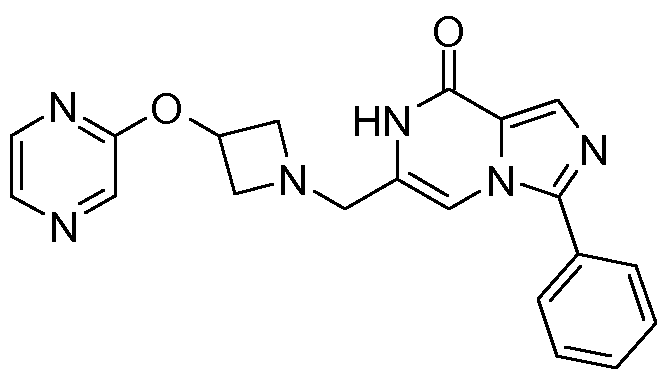
3-PHENYL-6-[(3-PYRAZIN-2-YLOXYAZETIDIN-1-YL)METHYL]-7H-IMIDAZO[1 ,5-A]PYRAZIN- 32 Compound IC50
(nM)
8-ONE
3-PHENYL-6-[(3-PYRIMIDIN-2-YLOXYAZETIDIN-1-YL)METHYL]-7H-IMIDAZO[1 ,5- 30 A]PYRAZIN-8-ONE
6-[[3-[(6-FLUORO-2-PYRIDYL)OXY]AZETIDIN-1-YL]METHYL]-3-PHENYL-7H-IMIDAZO[1 ,5- 31 A]PYRAZIN-8-ONE
3-PHENYL-6-[1-(3-PYRIMIDIN-2-YLOXYAZETIDIN-1-YL)ETHYL]-7H-IMIDAZO[1 ,5- 14 A]PYRAZIN-8-ONE
3-PHENYL-6-[(3-PHENYLAZETIDIN-1-YL)METHYL]-7H-IMIDAZO[1 ,5-A]PYRAZIN-8-ONE 78
6-[[BENZYL(METHYL)AMINO]METHYL]-3-PHENYL-7H-IMIDAZO[1 ,5-A]PYRAZIN-8-ONE 156
METHYL 1-BENZYL-4-(8-OXO-3-PHENYL-7H-IMIDAZO[1 ,5-A]PYRAZIN-6-YL)PYRROLIDINE- 43 3-CARBOXYLATE
6-[[3-(4-ETHYLPHENYL)AZETIDIN-1-YL]METHYL]-3-PHENYL-7H-IMIDAZO[1 ,5-A]PYRAZIN- 127 8-ONE
6-[1-[3-(4-FLUOROPHENYL)AZETIDIN-1-YL]PROPYL]-3-PHENYL-7H-IMIDAZO[1 ,5- 19 A]PYRAZIN-8-ONE
3-PHENYL-6-[(3-QUINOXALIN-2-YLOXYAZETIDIN-1-YL)METHYL]-7H-IMIDAZO[1 ,5- 7 A]PYRAZIN-8-ONE
6-[[3-(4,6-DIMETHYLPYRIMIDIN-2-YL)OXYAZETIDIN-1-YL]METHYL]-3-PHENYL-7H- 50 IMIDAZO[1 ,5-A]PYRAZIN-8-ONE
3-PHENYL-6-[1-(3-PYRAZIN-2-YLOXYAZETIDIN-1-YL)ETHYL]-7H-IMIDAZO[1 ,5-A]PYRAZIN- 40 8-ONE
6-[[3-(3-FLUOROPHENOXY)AZETIDIN-1-YL]METHYL]-3-PHENYL-7H-IMIDAZO[1 ,5- 97 A]PYRAZIN-8-ONE
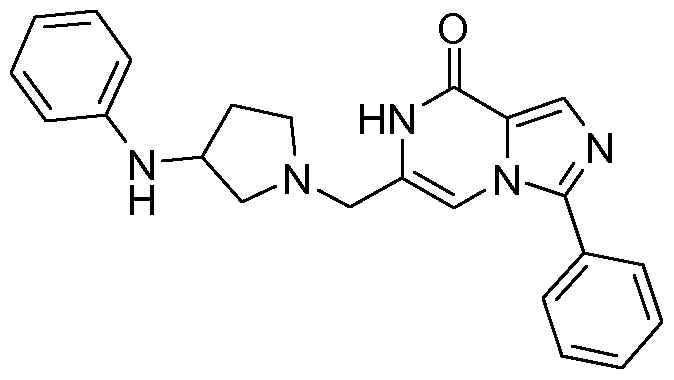
6-[(3-ANILINOPYRROLIDIN-1-YL)METHYL]-3-PHENYL-7H-IMIDAZO[1 ,5-A]PYRAZIN-8-ONE 28
3-PHENYL-6-[1-(3-PHENYLAZETIDIN-1-YL)ETHYL]-7H-IMIDAZO[1 ,5-A]PYRAZIN-8-ONE 54
6-[[3-(4-FLUOROPHENYL)AZETIDIN-1-YL]METHYL]-3-PHENYL-7H-IMIDAZO[1 ,5- 69 A]PYRAZIN-8-ONE
6-[1-(3-METHOXYAZETIDIN-1-YL)ETHYL]-3-PHENYL-7H-IMIDAZO[1 ,5-A]PYRAZIN-8-ONE 17
6-[(3-PHENOXYAZETIDIN-1-YL)METHYL]-3-PHENYL-7H-IMIDAZO[1 ,5-A]PYRAZIN-8-ONE 8
6-[(3-METHOXYAZETIDIN-1-YL)-PHENYL-METHYL]-3-PHENYL-7H-IMIDAZO[1 ,5- 37 A]PYRAZIN-8-ONE Compound IC50
(nM)
6-[[3-(4-FLUOROPHENOXY)AZETIDIN-1-YL]METHYL]-3-PHENYL-7H-IMIDAZO[1 ,5- 16 A]PYRAZIN-8-ONE
6-[1-[3-(3-FLUOROPHENOXY)AZETIDIN-1-YL]ETHYL]-3-PHENYL-7H-IMIDAZO[1 ,5- 25 A]PYRAZIN-8-ONE
6-[1-(3-PHENOXYAZETIDIN-1-YL)ETHYL]-3-PHENYL-7H-IMIDAZO[1 ,5-A]PYRAZIN-8-ONE 28
6-[1-[3-(4-FLUOROPHENOXY)AZETIDIN-1-YL]ETHYL]-3-PHENYL-7H-IMIDAZO[1 ,5- 19 A]PYRAZIN-8-ONE
6-[1-[3-[(6-FLUORO-2-PYRIDYL)OXY]AZETIDIN-1-YL]ETHYL]-3-PHENYL-7H-IMIDAZO[1 ,5- 38 A]PYRAZIN-8-ONE
6-[1-[3-(4-FLUOROPHENYL)AZETIDIN-1-YL]ETHYL]-3-PHENYL-7H-IMIDAZO[1 ,5- 53 A]PYRAZIN-8-ONE
6-[1-[3-(4-METHYL-2-PYRIDYL)AZETIDIN-1-YL]ETHYL]-3-PHENYL-7H-IMIDAZO[1 ,5- 20 A]PYRAZIN-8-ONE
6-[1-[3-(4-ETHYLPHENYL)AZETIDIN-1-YL]ETHYL]-3-PHENYL-7H-IMIDAZO[1 ,5-A]PYRAZIN- 16 8-ONE
6-(1-BENZYL-4-METHYL-PYRROLIDIN-3-YL)-3-PHENYL-7H-IMIDAZO[1 ,5-A]PYRAZIN-8- 33 ONE
6-[1-[3-(2-FLUOROPHENOXY)AZETIDIN-1-YL]ETHYL]-3-PHENYL-7H-IMIDAZO[1 ,5- 72 A]PYRAZIN-8-ONE
6-[[3-(2-FLUOROPHENOXY)AZETIDIN-1-YL]METHYL]-3-PHENYL-7H-IMIDAZO[1 ,5- 18 A]PYRAZIN-8-ONE
6-[1-[3-(4-METHOXYPHENYL)AZETIDIN-1-YL]ETHYL]-3-PHENYL-7H-IMIDAZO[1 ,5- 66 A]PYRAZIN-8-ONE
4-[1-[(8-OXO-3-PHENYL-7H-IMIDAZO[1 ,5-A]PYRAZIN-6-YL)METHYL]AZETIDIN-3- 49 YLJBENZONITRILE
3-PHENYL-6-[1-(3-PYRIMIDIN-2-YLAZETIDIN-1-YL)ETHYL]-7H-IMIDAZO[1 ,5-A]PYRAZIN-8- 79 ONE
3-PHENYL-6-[[3-(2-PYRIDYL)AZETIDIN-1-YL]METHYL]-7H-IMIDAZO[1 ,5-A]PYRAZIN-8-ONE 29
4-[1-[1-(8-OXO-3-PHENYL-7H-IMIDAZO[1 ,5-A]PYRAZIN-6-YL)ETHYL]AZETIDIN-3- 23 YLJBENZONITRILE
3-CYCLOPENTYL-6-[(3-PYRIMIDIN-2-YLOXYAZETIDIN-1-YL)METHYL]-7H-IMIDAZO[1 ,5- 22 A]PYRAZIN-8-ONE
3-CYCLOPENTYL-6-[1-[3-(4-FLUOROPHENYL)AZETIDIN-1-YL]ETHYL]-7H-IMIDAZO[1 ,5- 5 A]PYRAZIN-8-ONE Compound IC50
(nM)
3-CYCLOPENTYL-6-[[3-(4-METHOXYPHENYL)AZETIDIN-1-YL]METHYL]-7H-IMIDAZO[1 ,5- 26 A]PYRAZIN-8-ONE
3-CYCLOPENTYL-6-[1-(3-PYRIMIDIN-2-YLOXYAZETIDIN-1-YL)ETHYL]-7H-IMIDAZO[1 ,5- 8 A]PYRAZIN-8-ONE
6-[4-METHYL-1-(2-PYRIDYLMETHYL)PYRROLIDIN-3-YL]-3-PHENYL-7H-IMIDAZO[1 ,5- 14 A]PYRAZIN-8-ONE
6-[[3-(4-FLUOROPHENYL)AZETIDIN-1-YL]METHYL]-3-TETRAHYDROPYRAN-4-YL-7H- 25 IMIDAZO[1 ,5-A]PYRAZIN-8-ONE
6-[(3-BENZYLOXYAZETIDIN-1-YL)METHYL]-3-(4-FLUOROPHENYL)-7H-IMIDAZO[1 ,5- 1 A]PYRAZIN-8-ONE
3-CYCLOPENTYL-6-[[3-(3-METHYLQUINOXALIN-2-YL)OXYAZETIDIN-1-YL]METHYL]-7H- 6 IMIDAZO[1 ,5-A]PYRAZIN-8-ONE
3-CYCLOPENTYL-6-[1-[3-(4-FLUOROPHENOXY)AZETIDIN-1-YL]ETHYL]-7H-IMIDAZO[1 ,5- 3 A]PYRAZIN-8-ONE
3-CYCLOPENTYL-6-[[3-(4-DIMETHYLAMINOPHENYL)AZETIDIN-1-YL]METHYL]-7H- 40 IMIDAZO[1 ,5-A]PYRAZIN-8-ONE
6-[[3-(2-FLUOROPHENOXY)AZETIDIN-1-YL]METHYL]-3-(4-FLUOROPHENYL)-7H- 16 IMIDAZO[1 ,5-A]PYRAZIN-8-ONE
6-[[3-(2-FLUOROPHENOXY)AZETIDIN-1-YL]METHYL]-3-TETRAHYDROPYRAN-4-YL-7H- 21 IMIDAZO[1 ,5-A]PYRAZIN-8-ONE
6-[[3-(4-DIMETHYLAMINOPHENYL)AZETIDIN-1-YL]METHYL]-3-(4-FLUOROPHENYL)-7H- 7 IMIDAZO[1 ,5-A]PYRAZIN-8-ONE
3-CYCLOPENTYL-6-[1-[3-(2-FLUOROPHENOXY)AZETIDIN-1-YL]ETHYL]-7H-IMIDAZO[1 ,5- 49 A]PYRAZIN-8-ONE
3-(4-FLUOROPHENYL)-6-[(3-PYRIMIDIN-2-YLAZETIDIN-1-YL)METHYL]-7H-IMIDAZO[1 ,5- 22 A]PYRAZIN-8-ONE
6-[(3-PYRIMIDIN-2-YLAZETIDIN-1-YL)METHYL]-3-TETRAHYDROPYRAN-4-YL-7H- 102 IMIDAZO[1 ,5-A]PYRAZIN-8-ONE
3-(4-FLUOROPHENYL)-6-[(3-PYRAZIN-2-YLOXYAZETIDIN-1-YL)METHYL]-7H-IMIDAZO[1 ,5- 9 A]PYRAZIN-8-ONE
6-[(3-BENZYLOXYAZETIDIN-1-YL)METHYL]-3-CYCLOPENTYL-7H-IMIDAZO[1 ,5-A]PYRAZIN- 50 8-ONE
3-CYCLOPENTYL-6-[(3-ISOPROPOXYAZETIDIN-1-YL)METHYL]-7H-IMIDAZO[1 ,5- 17 A]PYRAZIN-8-ONE
3-CYCLOPENTYL-6-[(3-ISOBUTOXYAZETIDIN-1-YL)METHYL]-7H-IMIDAZO[1 ,5-A]PYRAZIN- 4 8-ONE Compound IC50
(nM)
3-CYCLOPENTYL-6-[1-[3-(4-DIMETHYLAMINOPHENYL)AZETIDIN-1-YL]ETHYL]-7H- 57 IMIDAZO[1 ,5-A]PYRAZIN-8-ONE
3-(4-FLUOROPHENYL)-6-[[3-[(6-FLUORO-2-PYRIDYL)OXY]AZETIDIN-1-YL]METHYL]-7H- 164 IMIDAZO[1 ,5-A]PYRAZIN-8-ONE
3-(4-FLUOROPHENYL)-6-[[3-(2-PYRIDYL)AZETIDIN-1-YL]METHYL]-7H-IMIDAZO[1 ,5- 79 A]PYRAZIN-8-ONE
6-[[3-(2-PYRIDYL)AZETIDIN-1-YL]METHYL]-3-TETRAHYDROPYRAN-4-YL-7H-IMIDAZO[1 ,5- 78 A]PYRAZIN-8-ONE
6-[[3-(4-FLUOROPHENOXY)AZETIDIN-1-YL]METHYL]-3-(4-FLUOROPHENYL)-7H- 13 IMIDAZO[1 ,5-A]PYRAZIN-8-ONE
3-TETRAHYDROPYRAN-4-YL-6-[[3-[4-(TRIFLUOROMETHOXY)PHENOXY]AZETIDIN-1- 13 YL]METHYL]-7H-IMIDAZO[1 ,5-A]PYRAZIN-8-ONE
6-[[3-[(6-FLUORO-2-PYRIDYL)OXY]AZETIDIN-1-YL]METHYL]-3-TETRAHYDROPYRAN-4-YL- 91 7H-IMIDAZO[1 ,5-A]PYRAZIN-8-ONE
6-[(3-ANILINOPYRROLIDIN-1-YL)METHYL]-3-TETRAHYDROPYRAN-4-YL-7H-IMIDAZO[1 ,5- 15 A]PYRAZIN-8-ONE
6-[(3-BENZYLOXYAZETIDIN-1-YL)METHYL]-3-TETRAHYDROPYRAN-4-YL-7H-IMIDAZO[1 ,5- 20 A]PYRAZIN-8-ONE
6-[(3-PHENYLAZETIDIN-1-YL)METHYL]-3-TETRAHYDROPYRAN-4-YL-7H-IMIDAZO[1 ,5- 8 A]PYRAZIN-8-ONE
6-[[3-(4-METHOXYPHENYL)AZETIDIN-1-YL]METHYL]-3-TETRAHYDROPYRAN-4-YL-7H- 30 IMIDAZO[1 ,5-A]PYRAZIN-8-ONE
3-TETRAHYDROPYRAN-4-YL-6-[[3-[5-(TRIFLUOROMETHYL)-2-PYRIDYL]AZETIDIN-1- 10 YL]METHYL]-7H-IMIDAZO[1 ,5-A]PYRAZIN-8-ONE
6-[[3-(3-FLUOROPHENOXY)AZETIDIN-1-YL]METHYL]-3-TETRAHYDROPYRAN-4-YL-7H- 7 IMIDAZO[1 ,5-A]PYRAZIN-8-ONE
6-[(3-QUINOXALIN-2-YLOXYAZETIDIN-1-YL)METHYL]-3-TETRAHYDROPYRAN-4-YL-7H- 139 IMIDAZO[1 ,5-A]PYRAZIN-8-ONE
3-(4-FLUOROPHENYL)-6-[(3-PHENOXYAZETIDIN-1-YL)METHYL]-7H-IMIDAZO[1 ,5- 177 A]PYRAZIN-8-ONE
3-(4-FLUOROPHENYL)-6-[[3-[4-(TRIFLUOROMETHOXY)PHENOXY]AZETIDIN-1- 16 YL]METHYL]-7H-IMIDAZO[1 ,5-A]PYRAZIN-8-ONE
6-[[3-(4-FLUOROPHENOXY)AZETIDIN-1-YL]METHYL]-3-TETRAHYDROPYRAN-4-YL-7H- 1 15 IMIDAZO[1 ,5-A]PYRAZIN-8-ONE
3-(4-FLUOROPHENYL)-6-[[3-(4-FLUOROPHENYL)AZETIDIN-1-YL]METHYL]-7H- 33 IMIDAZO[1 ,5-A]PYRAZIN-8-ONE Compound IC50
(nM)
3-(4-FLUOROPHENYL)-6-[[3-[5-(TRIFLUOROMETHYL)-2-PYRIDYL]AZETIDIN-1- 4 YL]METHYL]-7H-IMIDAZO[1 ,5-A]PYRAZIN-8-ONE
6-[[3-(4-ETHYLPHENYL)AZETIDIN-1-YL]METHYL]-3-TETRAHYDROPYRAN-4-YL-7H- 6 IMIDAZO[1 ,5-A]PYRAZIN-8-ONE
6-[4-METHYL-1-[[6-(TRIFLUOROMETHYL)-3-PYRIDYL]METHYL]PYRROLIDIN-3-YL]-3- 23 TETRAHYDROPYRAN-4-YL-7H-IMIDAZO[1 ,5-A]PYRAZIN-8-ONE
4-[1-[(8-OXO-3-TETRAHYDROPYRAN-4-YL-7H-IMIDAZO[1 ,5-A]PYRAZIN-6- 18 YL)METHYL]AZETIDIN-3-YL]OXYBENZONITRILE
6-[4-METHYL-1-(2-PYRIDYLMETHYL)PYRROLIDIN-3-YL]-3-TETRAHYDROPYRAN-4-YL-7H- 19 IMIDAZO[1 ,5-A]PYRAZIN-8-ONE
6-[[3-(4-PYRIDYLOXY)AZETIDIN-1-YL]METHYL]-3-TETRAHYDROPYRAN-4-YL-7H- 14 IMIDAZO[1 ,5-A]PYRAZIN-8-ONE
6-[[3-(3-PYRIDYLOXY)AZETIDIN-1-YL]METHYL]-3-TETRAHYDROPYRAN-4-YL-7H- 36 IMIDAZO[1 ,5-A]PYRAZIN-8-ONE
6-[(3-PYRIMIDIN-2-YLOXYPYRROLIDIN-1-YL)METHYL]-3-TETRAHYDROPYRAN-4-YL-7H- 1 10 IMIDAZO[1 ,5-A]PYRAZIN-8-ONE
3-(4-FLUOROPHENYL)-6-[(3-PHENOXYPYRROLIDIN-1-YL)METHYL]-7H-IMIDAZO[1 ,5- 140 A]PYRAZIN-8-ONE
3-(4-FLUOROPHENYL)-6-[(3-PYRIMIDIN-2-YLOXYPYRROLIDIN-1-YL)METHYL]-7H- 233 IMIDAZO[1 ,5-A]PYRAZIN-8-ONE
3-(4-FLUOROPHENYL)-6-[[3-(4-PYRIDYLOXY)AZETIDIN-1-YL]METHYL]-7H-IMIDAZO[1 ,5- 42 A]PYRAZIN-8-ONE
3-(4-FLUOROPHENYL)-6-[[3-(3-PYRIDYLOXY)AZETIDIN-1-YL]METHYL]-7H-IMIDAZO[1 ,5- 3 A]PYRAZIN-8-ONE
6-[1-[(4-FLUOROPHENYL)METHYL]-4-METHYL-PYRROLIDIN-3-YL]-3- 7 TETRAHYDROPYRAN-4-YL-7H-IMIDAZO[1 ,5-A]PYRAZIN-8-ONE
6-[4-METHYL-1-(PYRIMIDIN-2-YLMETHYL)PYRROLIDIN-3-YL]-3-TETRAHYDROPYRAN-4- 19 YL-7H-IMIDAZO[1 ,5-A]PYRAZIN-8-ONE
6-[1-(3-PYRIMIDIN-2-YLAZETIDIN-1-YL)ETHYL]-3-TETRAHYDROPYRAN-4-YL-7H- 46 IMIDAZO[1 ,5-A]PYRAZIN-8-ONE
4-[1-[[3-(4-FLUOROPHENYL)-8-OXO-7H-IMIDAZO[1 ,5-A]PYRAZIN-6-YL]METHYL]AZETIDIN- 76 3-YL]OXYBENZONITRILE
3-[1-[[3-(4-FLUOROPHENYL)-8-OXO-7H-IMIDAZO[1 ,5-A]PYRAZIN-6-YL]METHYL]AZETIDIN- 18 3-YL]OXYBENZONITRILE
3-[1-[(8-OXO-3-TETRAHYDROPYRAN-4-YL-7H-IMIDAZO[1 ,5-A]PYRAZIN-6- 12 YL)METHYL]AZETIDIN-3-YL]OXYBENZONITRILE Compound IC50
(nM)
3-(4-FLUOROPHENYL)-6-[[3-[3-(TRIFLUOROMETHYL)PHENOXY]AZETIDIN-1-YL]METHYL]- 97 7H-IMIDAZO[1 ,5-A]PYRAZIN-8-ONE
4-[1-[[3-(4-FLUOROPHENYL)-8-OXO-7H-IMIDAZO[1 ,5-A]PYRAZIN-6-YL]METHYL]AZETIDIN- 2 3-YL]BENZONITRILE
6-[4-METHYL-1-(QUINOXALIN-6-YLMETHYL)PYRROLIDIN-3-YL]-3-TETRAHYDROPYRAN-4- 4 YL-7H-IMIDAZO[1 ,5-A]PYRAZIN-8-ONE
4-[[3-METHYL-4-(8-OXO-3-TETRAHYDROPYRAN-4-YL-7H-IMIDAZO[1 ,5-A]PYRAZIN-6- 18 YL)PYRROLIDIN-1-YL]METHYL]BENZONITRILE
3-(4-FLUOROPHENYL)-6-[1-[(4-FLUOROPHENYL)METHYL]-4-METHYL-PYRROLIDIN-3-YL]- 17 7H-IMIDAZO[1 ,5-A]PYRAZIN-8-ONE
1-BROMO-3-(4-FLUOROPHENYL)-6-[1-[(4-FLUOROPHENYL)METHYL]-4-METHYL- 4 PYRROLIDIN-3-YL]-7H-IMIDAZO[1 ,5-A]PYRAZIN-8-ONE
6-[1-[(6-METHOXY-3-PYRIDYL)METHYL]-4-METHYL-PYRROLIDIN-3-YL]-3- 18 TETRAHYDROPYRAN-4-YL-7H-IMIDAZO[1 ,5-A]PYRAZIN-8-ONE
6-[4-METHYL-1-[(5-METHYLPYRAZIN-2-YL)METHYL]PYRROLIDIN-3-YL]-3- 10 TETRAHYDROPYRAN-4-YL-7H-IMIDAZO[1 ,5-A]PYRAZIN-8-ONE
6-[[3-[(4-FLUOROPHENYL)METHOXY]AZETIDIN-1-YL]METHYL]-3-TETRAHYDROPYRAN-4- 21 YL-7H-IMIDAZO[1 ,5-A]PYRAZIN-8-ONE
3-TETRAHYDROPYRAN-4-YL-6-[[3-[4-(TRIFLUOROMETHYL)PHENOXY]AZETIDIN-1- 109 YL]METHYL]-7H-IMIDAZO[1 ,5-A]PYRAZIN-8-ONE
3-CYCLOPENTYL-1 ,5-DIFLUORO-6-[(3-PHENYLAZETIDIN-1-YL)METHYL]-7H-IMIDAZO[1 ,5- 33 A]PYRAZIN-8-ONE
4-[1-[(8-OXO-3-TETRAHYDROPYRAN-4-YL-7H-IMIDAZO[1 ,5-A]PYRAZIN-6- 32 YL)METHYL]AZETIDIN-3-YL]BENZONITRILE
3-[1-[(8-OXO-3-TETRAHYDROPYRAN-4-YL-7H-IMIDAZO[1 ,5-A]PYRAZIN-6- 35 YL)METHYL]AZETIDIN-3-YL]BENZONITRILE
6-[[3-[(4-CHLOROPHENYL)METHOXY]AZETIDIN-1-YL]METHYL]-3-(4-FLUOROPHENYL)-7H- 34 IMIDAZO[1 ,5-A]PYRAZIN-8-ONE
3-(4-FLUOROPHENYL)-6-[[3-[4-(TRIFLUOROMETHYL)PHENOXY]AZETIDIN-1-YL]METHYL]- 28 7H-IMIDAZO[1 ,5-A]PYRAZIN-8-ONE
3-(4-CHLOROPHENYL)-6-[1-[(4-FLUOROPHENYL)METHYL]-4-METHYL-PYRROLIDIN-3-YL]- 36 7H-IMIDAZO[1 ,5-A]PYRAZIN-8-ONE
1-BROMO-3-(4-CHLOROPHENYL)-6-[1-[(4-FLUOROPHENYL)METHYL]-4-METHYL- 74 PYRROLIDIN-3-YL]-7H-IMIDAZO[1 ,5-A]PYRAZIN-8-ONE
6-[1-(3-METHOXYAZETIDIN-1-YL)ETHYL]-6-METHYL-3-TETRAHYDROPYRAN-4-YL-7H- 22 IMIDAZO[1 ,5-A]PYRAZIN-8-ONE Compound IC50
(nM)
3-(4-FLUOROPHENYL)-6-[[3-(P-TOLYLMETHOXY)AZETIDIN-1-YL]METHYL]-7H- 9 IMIDAZO[1 ,5-A]PYRAZIN-8-ONE
3-(4-FLUOROPHENYL)-6-[4-METHYL-1-(2-PYRIDYLMETHYL)PYRROLIDIN-3-YL]-7H- 7 IMIDAZO[1 ,5-A]PYRAZIN-8-ONE
6-[1-(CYCLOHEXYLMETHYL)-4-METHYL-PYRROLIDIN-3-YL]-3-TETRAHYDROPYRAN-4-YL- 37 7H-IMIDAZO[1 ,5-A]PYRAZIN-8-ONE
3-(4-FLUOROPHENYL)-6-[1-(3-ISOPROPOXYAZETIDIN-1-YL)ETHYL]-7H-IMIDAZO[1 ,5- 22 A]PYRAZIN-8-ONE
6-[1-(3-ISOPROPOXYAZETIDIN-1-YL)ETHYL]-3-TETRAHYDROPYRAN-4-YL-7H- 93 IMIDAZO[1 ,5-A]PYRAZIN-8-ONE
6-[[3-(4-CHLOROPHENOXY)AZETIDIN-1-YL]METHYL]-3-(4-FLUOROPHENYL)-7H- 42 IMIDAZO[1 ,5-A]PYRAZIN-8-ONE
6-[1-[(4-FLUOROPHENYL)METHYL]-4-METHYL-PYRROLIDIN-3-YL]-3-[4- 191 (TRIFLUOROMETHOXY)PHENYL]-7H-IMIDAZO[1 ,5-A]PYRAZIN-8-ONE
3-(4-FLUOROPHENYL)-6-[1-[3-[4-(TRIFLUOROMETHOXY)PHENOXY]AZETIDIN-1- 35 YL]ETHYL]-7H-IMIDAZO[1 ,5-A]PYRAZIN-8-ONE
6-[[3-(2,6-DIFLUOROPHENOXY)AZETIDIN-1-YL]METHYL]-3-(4-FLUOROPHENYL)-7H- 41 IMIDAZO[1 ,5-A]PYRAZIN-8-ONE
3-(3,5-DIFLUOROPHENYL)-6-[[3-(4-METHOXYPHENYL)AZETIDIN-1-YL]METHYL]-7H- 38 IMIDAZO[1 ,5-A]PYRAZIN-8-ONE
3-(4-FLUOROPHENYL)-6-[[3-(4-METHOXYPHENYL)AZETIDIN-1-YL]METHYL]-7H- 57 IMIDAZO[1 ,5-A]PYRAZIN-8-ONE
3-(4-FLUOROPHENYL)-6-[1-[3-(4-FLUOROPHENYL)AZETIDIN-1-YL]ETHYL]-7H- 72 IMIDAZO[1 ,5-A]PYRAZIN-8-ONE
3-TETRAHYDROFURAN-3-YL-6-[[3-[3-(TRIFLUOROMETHYL)PHENYL]PYRROLIDIN-1- 48 YL]METHYL]-7H-IMIDAZO[1 ,5-A]PYRAZIN-8-ONE
3-(4-FLUOROPHENYL)-6-[1-[3-(4-METHOXYPHENYL)AZETIDIN-1-YL]ETHYL]-7H- 70 IMIDAZO[1 ,5-A]PYRAZIN-8-ONE
3-(4,4-DIFLUOROCYCLOHEXYL)-6-[[3-(4-METHOXYPHENYL)AZETIDIN-1-YL]METHYL]-7H- IMIDAZO[1 ,5-A]PYRAZIN-8-ONE
n.d.
3-(4,4-DIFLUOROCYCLOHEXYL)-6-[(3-METHOXYAZETIDIN-1-YL)METHYL]-7H- IMIDAZO[1 ,5-A]PYRAZIN-8-ONE
n.d.
6-[[3-(4-FLUOROPHENOXY)AZETIDIN-1-YL]METHYL]-3-TETRAHYDROFURAN-3-YL-7H- IMIDAZO[1 ,5-A]PYRAZIN-8-ONE
n.d. Definition of substituents
As used in the context of the present invention, the terms "halo" and "halogen" are used interchangeably and refer to fluorine, chlorine, bromine or iodine.
The term "CrC6 alkyl" refers to a straight-chain or branched saturated hydrocarbon having from one to six carbon atoms, inclusive. Examples of such groups include, but are not limited to, methyl, ethyl, 1 -propyl, 2-propyl, 1 -butyl, 2-butyl, 2-methyl-2-propyl, 2-methyl-1 -butyl, and n-hexyl. The expression "C1 -C6 hydroxyalkyl" refers to a Ci-C6 alkyl group as defined above which is substituted with one hydroxy group.
The term "halo(Ci-C6)alkyl" refers to a CrC6 alkyl group as defined above which is substi- tuted with up to three halogen atoms, such as trifluoromethyl.
The expression "Ci-C6 alkoxy" refers to a straight-chain or branched saturated alkoxy group having from one to six carbon atoms, inclusive, with the open valency on the oxygen. Examples of such groups include, but are not limited to, methoxy, ethoxy, n-butoxy, 2-methyl- pentoxy and n-hexyloxy. The term "C3-C8 cycloalkyi" typically refers to cyclopropyl, cyclobutyl, cyclopentyl, cyclohexyl, cycloheptyl or cyclooctyl.
The expression "Ci-C6 alkyl(C3-C8)cycloalkyr' refers to a C3-C8 cycloalkyi as defined above which is substituted with a straight-chain or branched Ci-C6 alkyl. Examples of such groups include, but are not limited to, cyclopropylmethyl. The term "heterocycloalkyi" refers to a four to eight membered ring containing carbon atoms and up to three N, O or S atoms, provided that the four to eight membered ring does not contain adjacent O or adjacent S atoms. The open valency is on either the heteroatom or carbon atom. Examples of such groups include, but are not limited to, azetidinyl, oxetanyl, piperaz- inyl, morpholinyl, thiomorpholinyl and [1 ,4]diazepanyl. The term "hydroxyheterocycloalkyl" refers to a heterocycloalkyi as defined above which is substituted with one hydroxy group.
The term "CrC6 alkyl-heterocycloalkyl" refers to a heterocycloalkyi as defined above which is substituted with a Ci-C6 alkyl group. Examples of such groups include, but are not limited to, tetrahydropyran-4-yl-methyl and 2-morpholin-4-yl-ethyl. The term "aryl" refers to a phenyl ring, optionally substituted with halogen, Ci-C6 alkyl, CrC6 alkoxy or halo(CrC6)alkyl as defined above. Examples of such groups include, but are not limited to, phenyl and 4-chlorophenyl.
The term "C-i-Cearylalkyl" refers to an aryl as defined above which is substituted with a straight-chain or branched Ci-C6 alkyl. Examples of such groups include, but are not limited to, benzyl and 4-chlorobenzyl.
The term aryloxy refers to an univalent radical of the form Ar-0 (such as phenoxy) composed of an aryl group (Ar) united with oxygen (O).
The term heteroaryloxy refers to an aryloxy where one or more carbon atoms have been sub- stituted with one more hetero atoms, such as N, O, S.
In the context of the present invention the term 'cyclization point' is understood to mean that connecting the atoms indicated to be cyclization points by a bond results in a cyclic structure (a ring). The cyclization point is indicated with a * in the illustrative reaction scheme below:
Figure imgf000021_0001
* Denotes cyclization points
Additionally, the present invention further provides certain embodiments of the invention, which are described below. Additionally, the present invention further provides certain embodiments of the invention that are described below.
Pharmaceutically Acceptable Salts
The present invention also comprises salts of the compounds, typically, pharmaceutically acceptable salts. Such salts include pharmaceutically acceptable acid addition salts. Acid addition salts include salts of inorganic acids as well as organic acids.
Representative examples of suitable inorganic acids include hydrochloric, hydrobromic, hy- droiodic, phosphoric, sulfuric, sulfamic, nitric acids and the like. Representative examples of suitable organic acids include formic, acetic, trichloroacetic, trifluoroacetic, propionic, benzoic, cinnamic, citric, fumaric, glycolic, itaconic, lactic, methanesulfonic, maleic, malic, malonic, mandelic, oxalic, picric, pyruvic, salicylic, succinic, methane sulfonic, ethanesulfonic, tartaric, ascorbic, pamoic, bismethylene salicylic, ethanedisulfonic, gluconic, citraconic, aspartic, stearic, palmitic, EDTA, glycolic, p-aminobenzoic, glutamic, benzenesulfonic, p- toluenesulfonic acids, theophylline acetic acids, as well as the 8-halotheophyllines, for example 8-bromotheophylline and the like. Further examples of pharmaceutically acceptable inorganic or organic acid addition salts include the pharmaceutically acceptable salts listed in Berge, S.M. et al., J. Pharm. Sci. 1977, 66, 2, the contents of which are hereby incorporated by reference. Furthermore, the compounds of this invention may exist in unsolvated as well as in solvated forms with pharmaceutically acceptable solvents such as water, ethanol and the like. In general, the solvated forms are considered equivalent to the unsolvated forms for the purposes of this invention.
Pharmaceutical composition The present invention further provides a pharmaceutical composition comprising a therapeutically effective amount of a compound of formula (I) and a pharmaceutically acceptable carrier or diluent. The present invention also provides a pharmaceutical composition comprising a therapeutically effective amount of one of the specific compounds disclosed in the Experimental Section herein and a pharmaceutically acceptable carrier or diluent. The compounds of the invention may be administered alone or in combination with pharmaceutically acceptable carriers, diluents or excipients, in either single or multiple doses. The pharmaceutical compositions according to the invention may be formulated with pharmaceutically acceptable carriers or diluents as well as any other known adjuvants and excipients in accordance with conventional techniques such as those disclosed in Remington: The Science and Practice of Pharmacy, 19th Edition, Gennaro, Ed., Mack Publishing Co., Easton, PA, 1995.
The pharmaceutical compositions may be specifically formulated for administration by any suitable route such as oral, rectal, nasal, pulmonary, topical (including buccal and sublingual), transdermal, intracisternal, intraperitoneal, vaginal and parenteral (including subcutaneous, intramuscular, intrathecal, intravenous and intradermal) routes. It will be appreciated that the route will depend on the general condition and age of the subject to be treated, the nature of the condition to be treated and the active ingredient. Pharmaceutical compositions for oral administration include solid dosage forms such as capsules, tablets, dragees, pills, lozenges, powders and granules. Where appropriate, the compositions may be prepared with coatings such as enteric coatings or they may be formulated so as to provide controlled release of the active ingredient such as sustained or prolonged release according to methods well known in the art. Liquid dosage forms for oral administration include solutions, emulsions, suspensions, syrups and elixirs.
Pharmaceutical compositions for parenteral administration include sterile aqueous and nonaqueous injectable solutions, dispersions, suspensions or emulsions as well as sterile powders to be reconstituted in sterile injectable solutions or dispersions prior to use. Other suitable administration forms include, but are not limited to, suppositories, sprays, ointments, creams, gels, inhalants, dermal patches and implants.
Typical oral dosages range from about 0.001 to about 100 mg/kg body weight per day. Typical oral dosages also range from about 0.01 to about 50 mg/kg body weight per day. Typical oral dosages further range from about 0.05 to about 10 mg/kg body weight per day. Oral dosages are usually administered in one or more dosages, typically, one to three dosages per day. The exact dosage will depend upon the frequency and mode of administration, the sex, age, weight and general condition of the subject treated, the nature and severity of the condition treated and any concomitant diseases to be treated and other factors evident to those skilled in the art. The formulations may also be presented in a unit dosage form by methods known to those skilled in the art. For illustrative purposes, a typical unit dosage form for oral administration may contain from about 0.01 to about 1000 mg, from about 0.05 to about 500 mg, or from about 0.5 mg to about 200 mg.
For parenteral routes such as intravenous, intrathecal, intramuscular and similar administra- tion, typical doses are in the order of half the dose employed for oral administration.
The present invention also provides a process for making a pharmaceutical composition comprising admixing a therapeutically effective amount of a compound of formula (I) and at least one pharmaceutically acceptable carrier or diluent. In an embodiment, of the present invention, the compound utilized in the aforementioned process is one of the specific com- pounds disclosed in the Experimental Section herein.
The compounds of this invention are generally utilized as the free substance or as a pharmaceutically acceptable salt thereof. One example is an acid addition salt of a compound having the utility of a free base. When a compound of formula (I) contains a free base such salts are prepared in a conventional manner by treating a solution or suspension of a free base of formula (I) with a molar equivalent of a pharmaceutically acceptable acid. Representative examples of suitable organic and inorganic acids are described above.
For parenteral administration, solutions of the compounds of formula (I) in sterile aqueous so- lution, aqueous propylene glycol, aqueous vitamin E or sesame or peanut oil may be employed. Such aqueous solutions should be suitably buffered if necessary and the liquid diluent first rendered isotonic with sufficient saline or glucose. The aqueous solutions are particularly suitable for intravenous, intramuscular, subcutaneous and intraperitoneal administration. The compounds of formula (I) may be readily incorporated into known sterile aqueous media us- ing standard techniques known to those skilled in the art.
Suitable pharmaceutical carriers include inert solid diluents or fillers, sterile aqueous solutions and various organic solvents. Examples of solid carriers include lactose, terra alba, sucrose, cyclodextrin, talc, gelatin, agar, pectin, acacia, magnesium stearate, stearic acid and lower alkyl ethers of cellulose. Examples of liquid carriers include, but are not limited to, syrup, pea- nut oil, olive oil, phospholipids, fatty acids, fatty acid amines, polyoxyethylene and water. Similarly, the carrier or diluent may include any sustained release material known in the art, such as glyceryl monostearate or glyceryl distearate, alone or mixed with a wax. The pharmaceutical compositions formed by combining the compounds of formula (I) and a pharmaceutically acceptable carrier are then readily administered in a variety of dosage forms suit- able for the disclosed routes of administration. The formulations may conveniently be presented in unit dosage form by methods known in the art of pharmacy.
Formulations of the present invention suitable for oral administration may be presented as discrete units such as capsules or tablets, each containing a predetermined amount of the active ingredient, and optionally a suitable excipient. Furthermore, the orally available formu- lations may be in the form of a powder or granules, a solution or suspension in an aqueous or non-aqueous liquid, or an oil-in-water or water-in-oil liquid emulsion.
If a solid carrier is used for oral administration, the preparation may be tabletted, placed in a hard gelatin capsule in powder or pellet form or it may be in the form of a troche or lozenge. The amount of solid carrier will vary widely but will range from about 25 mg to about 1 g per dosage unit. If a liquid carrier is used, the preparation may be in the form of a syrup, emulsion, soft gelatin capsule or sterile injectable liquid such as an aqueous or non-aqueous liquid suspension or solution. The pharmaceutical compositions of the invention may be prepared by conventional methods in the art. For example, tablets may be prepared by mixing the active ingredient with ordinary adjuvants and/or diluents and subsequently compressing the mixture in a conventional tabletting machine prepare tablets. Examples of adjuvants or diluents comprise: corn starch, potato starch, talcum, magnesium stearate, gelatin, lactose, gums, and the like. Any other adjuvants or additives usually used for such purposes such as colorings, flavorings, preservatives etc. may be used provided that they are compatible with the active ingredients.
Diseases
In a particular embodiment the PDE9 inhibitors of the present invention may be used in the treatment of cognition deficiencies related to neurodegenerative disorders, such dementia, such as cortical dementia or subcortical dementia.
Cortical dementias arise from a disorder affecting the cerebral cortex, the outer layers of the brain that play a critical role in cognitive processes such as memory and language. Particularly considered cortical dementias are Alzheimer's disease; vascular dementia (also known as multi-infarct dementia), including Binswanger's disease; Dementia with Lewy bodies (DLB); Alcohol-Induced Persisting Dementia, including Korsakoff's syndrome and Wernicke's encephalopathy; frontotemporal lobar degeneration (FTLD), including: Pick's disease, fronto- temporal dementia (or frontal variant FTLD), semantic dementia (or temporal variant FTLD), and progressive non-fluent aphasia; Creutzfeldt-Jakob disease; dementia pugilistica; Moya- moya disease; and posterior cortical atrophy (an Alzheimer's disease variant).
Subcortical dementias result from dysfunction in the parts of the brain that are beneath the cortex. Usually, the memory loss and language difficulties that are characteristic of cortical dementias are not present. Rather, people with subcortical dementias, such as Huntington's disease, Parkinson's Disease, and AIDS dementia complex, tend to show changes in their personality and attention span, and their thinking slows down. Particularly considered subcortical dementias are dementia due to Huntington's disease, dementia due to hypothyroidism, dementia due to Parkinson's disease, dementia due to Vitamin B1 deficiency, dementia due to Vitamin B12 deficiency, dementia due to folate deficiency, dementia due to syphilis, dementia due to subdural hematoma, dementia due to hypercalcaemia, dementia due to hypo- glycaemia, AIDS dementia complex, pseudodementia (a major depressive episode with prominent cognitive symptoms), substance-induced persisting dementia, dementia due to multiple etiologies, dementia due to other general medical conditions (i.e. end stage renal failure, cardiovascular disease etc.), dementia not otherwise specified (used in cases where no specific criteria is met). Experimental
Synthesis of Compound I
Compounds of formula (I) can be made by halogenation of a compound of formula IX with NCS, NBS, or NIS, in solvents such as acetonitrile or chloroform (Scheme 1 ): Scheme 1
Figure imgf000026_0001
Compounds of formula IX, where A is (CH2)n, n=0, and R1 is H, can be prepared by coupling of a electrophile of formula VI, where X is a leaving group, such as CI, Br, I, or methanesul- fonyl or 4-toluenesulfonyl, with an amine; compounds of formula VI can be synthesized by demethylation with HCI or BBr3 of compounds of formula V. Compounds of formula V, where X is a halogen, can be prepared by halogenation of formula IV with SOCI2, PBr3. Compounds of formula VI, where X is methanesulfonyl or 4-toluenesufonyl, can be synthesized by reaction of compounds of formula IV with methylsulfonyl chloride or 4-toluenesulfonyl chloride. Compounds of formula IV can be prepared by reduction with NaBH4, LAH, DIBAL, BH3, etc, of compounds of formula III, which can be made by carbonylation of compounds of formula II in the presence of CO, and a palladium catalyst, such as Pd(dppf)CI2, Pd(PPh3)2CI2, Pd(PPh3)4, and a base, such as Cs2C03, K2C03, or Et3N (Scheme 2):
Scheme 2
Figure imgf000027_0001
IX
Compounds of formula IX, where A is (CH2)n, n=0, and R1 is any alkyl, aryl groups, can be prepared by reductive amination of compounds of formula XII with various amines in the presence of Na(OAc)3BH or Na(CN)BH3 in solvents such as 1 ,2-dichloro ethane, CH2CI2, methanol with a few drops of HOAc. Compounds of formula XII can be prepared by acid catalyzed demethylation of compounds of formula XI, which can be made from reaction of Wein- reb amides of formula X with a Grignard reagent. Compounds of formula X can be made by carbonylation of compounds of formula II with CO in the presence of a palladium catalyst, such as Pd(dppf)CI2, Pd(PPh3)4, Pd(PPh3)2CI2, and a base, such as Cs2C03, K2C03, Et3N, KOAc, etc., in solvents, such as toluene, DMF, DMSO (Scheme 3):
Scheme 3
Figure imgf000027_0002
Figure imgf000027_0003
Compounds of formula IX, where A is (CH2)n, n=1 , R1 and R2 are connected to form a pyrrolidine, can be prepared by reductive amination of compounds of formula XX with various aldehydes in the presence of Na(OAc)3BH or Na(CN)BH3 in solvents such as 1 ,2-dichloro ethane, CH2CI2, with a few drops of HOAc; or by alkylation of compounds of formula XX with a variety of alkyl or substituted alkyl halides in the presence of Cs2C03 or K2C03 in solvents such as DMF or 1 ,4-dioxane, etc. Compounds of formula XX can be prepared by hydrogena- tion of compounds of formula XIX, with H2 and in the presence of Pd/C or Pd(OH)2/C in solvents such as alcohol or EtOAc, etc. Compounds of formula XIX can be synthesized by me- sylation of compounds of formula XVI, followed by reductive deoxygenation with NaBH4 or LiAIH4, and acid catalyzed demethylation. Compounds of formula XVI can be made by reduction with LAH, NaBH4, DIBAL, etc, of compounds of formula XV, which can be made by [3+2] cycloaddtion of compounds of formula XIV with benzyl-methoxymethyl- trimethylsilanylmethylamine with the aid of TFA in solvents such as toluene or CH2CI2. Compounds of formula XIV can be made by Suzuki reaction of compounds of formula II with bo- ronic ester XIII in the presence of a palladium catalyst, such as Pd(dppf)CI2, Pd(PPh3)4, Pd(PPh3)2CI2, etc., and a base, such as Cs2C03, K2C03, KOAc, etc., in solvent, such as toluene, DMF, DMSO, etc; or by Heck reaction of compounds of formula II with ethyl acrylate in the presence of a palladium catalyst, such as Pd(dppf)CI2, Pd(PPh3)4, Pd(PPh3)2CI2 and a base, such as Cs2C03, K2C03, KOAc, etc. Boronic ester XIII can be generated by coupling of ethyl propiolate with bis(pinacolato)diboron in the presence of CuCI, and Xantphos as catalysts, i-BuOK as a base in the solvent of THF (Scheme 4):
Scheme 4
Figure imgf000029_0001
Compounds of formula II can be prepared by cyclization of compounds of formula XXVI in the presence of POCI3 or SOCI2. Compounds of formula XXVI can be made by reduction of com- pounds of formula XXII in H2 with Pd/C or Raney Ni to generate XXIII, which can then be converted to amides of formula XXIV by reaction with a variety of acid chlorides, or by coupling with various carboxylic acids in the presence of coupling reagents, such as HOBt and EDC, or HATU. Subsequent deprotection under acidic conditions yields compounds of formula XXV, which can undergo diazotization and iodination. Compounds of formula XXII can be made from Boc protection of compounds of formula XXI (Scheme 5):
Scheme 5
Figure imgf000029_0002
XXII XXIII XXIV
Figure imgf000029_0003
XXVI
Synthesis of specific compounds is described in the Example section below. EXAMPLES
Preparation of intermediates
tert-butyl 5-(aminomethyl)-6-methoxypyrazin-2-ylcarbamate
Scheme 6
Figure imgf000030_0001
5-Amino-3-methoxypyrazine-2-carbonitrile (2)
To 500 mL of methanol in a round-bottom flask, potassium tert-butoxide (49 g, 437 mmol) was added in portions. The suspension was heated at reflux for 1 hour. Then compound 1 (67.03 g, 433 mmol) was added under a N2 atmosphere. The suspension was heated at reflux for 1 .5 hours. The reaction solution was concentrated in vacuo and diluted with water (2 L). The solution was extracted with EtOAc (2 L χ 7). The combined organic phases were dried with sodium sulfate, filtered and concentrated in vacuo to afford 2 (64.0 g, 98%) as a yellow solid. 1HNMR (400 MHz, DMSO-d6): δ 7.69 (br s, 2 H), 7.52 (s, 1 H), 3.89 (s, 3H). tert-butyl 5-cyano-6-methoxypyrazin-2-ylcarbamate (3)
To a solution of compound 2 (64.0 g, 426 mmol) in DCM (1 .5 L), was added 4- dimethylaminopyridine (DMAP) (520 mg, 4.26 mmol) at room temperature. Then di-tert-butyl dicarbonate in DCM (100 mL) was added dropwise at 10°C~20°C in 2 hours. After stirring for 6 hours, the suspension turned clear and it was diluted with 500mL of water. The organic phase was separated, dried over sodium sulfate and concentrated in vacuo. The residue was purified by column chromatography on silica gel (eluted with petroleum ether /EtOAc = 10:1 ) to afford 3 (46.5 g, 44%). 1HNMR (400 MHz, CDCI3): δ 8.93 (s, 1 H), 7.25 (s, 1 H), 3.99 (s, 3 H), 1 .55 (s, 9 H). tert-butyl 5-(aminomethyl)-6-methoxypyrazin-2-ylcarbamate (4)
To a solution of compound 3 (30.0 g, 120 mmol) in NH3/methanol (500 mL) at room temperature, was added Raney Ni (10 g). The resulting suspension was stirred under an atmosphere of H2 overnight. It was diluted with a 1 :1 mixture of DCM and methanol. The solution was fil- tered and the filtrate was concentrated in vacuo. The residue was washed with methanol to afford 4 (19.5 g, 64%) as a white solid. 1HNMR (400 MHz, CDCI3): δ 8.66 (s, 1 H), 6.90 (s, 1 H), 3.98 (s, 3 H), 3.48 (s, 2 H), 1.55 (s, 9 H).
6-Chloromethyl-3-phenyl-7H-imidazo[1 ,5-a]pyrazin-8-one Scheme 7
Figure imgf000031_0001
tert-butyl 5-(benzamidomethyl)-6-methoxypyrazin-2-ylcarbamate (5) To a solution of compound 4 (19.5 g, 76.7 mmol) in DCM (200 mL) was added TEA (23 g, 230 mmol), followed by dropwise addition of benzoyl chloride (1 1.8 g, 84.3 mmol) at 0°C . The resulting reaction mixture was stirred at room temperature for 2 hours. The reaction was monitored by TLC. Upon completion, the reaction was quenched with water (100 mL). The organic phase was separated and the aqueous phase was extracted with DCM (200 mL χ 2). The combined organic phases were dried over anhydrous MgS04, filtered and concentrated in vacuo. The residue was purified by column chromatography on silica gel to afford 5 (21.7 g, 78.9%) as a yellow solid. 1HNMR (400 MHz, CDCI3): δ 8.70 (s, 1 H), 7.88 (d, J = 6.8 Hz, 2 H), 7.62 (br s, 1 H), 7.44-7.52 (m, 3 H), 6.95 (s, 1 H), 4.68 (d, J = 4.4 Hz, 2 H), 3.93 (s, 3 H), 1 .54 (s, 9 H). N-((5-amino-3-methoxypyrazin-2-yl)methyl)benzamide (6)
To as solution of compound 5 (21.7 g, 60.5 mmol) in DCM (100 mL), was added TFA (100 mL). The reaction was stirred at room temperature overnight. The solvent was removed. The residue was taken up in a mixture of DCM (100 mL) and saturated aqueous NaHC03 solution (100 mL). The organic phase was separated and the aqueous phase was extracted with DCM (100 mL x 2). The combined organic phases were dried over anhydrous MgS04, filtered and concentrated in vacuo. The residue was purified by column chromatography on silica gel (eluted with petroleum ether /EtOAc = 6:1 to 1 :1 ) to afford 6 (10.0 g, 64%) as a yellow solid. 1HNMR (400 MHz, CDCI3): δ 8.56 (t, J = 5.2 Hz, 1 H), 7.86 (d, J = 7.2 Hz, 2 H), 7.43-7.53 (m, 3 H), 7.36 (s, 1 H), 6.25 (br s, 2 H), 4.38 (d, J = 5.2 Hz, 2 H), 3.92 (s, 3 H).
N-((5-iodo-3-methoxypyrazin-2-yl)methyl)benzamide (7)
To a solution of compound 6 (4.5 g, 17.4 mmol) in anhydrous THF (100 mL), were added Cul (3.3 g, 17.4 mmol), isoamyl nitrite (6.1 g, 52.2 mmol) and CH2I2 (4.7 g, 17.4 mmol) respectively under a N2 atmosphere. The reaction mixture was heated at 75 °C for 5 hours. Then the reaction was cooled down to room temperature and filtered. The filtrate was concentrated in vacuo. The residue was purified by column chromatography on silica gel (eluted with petroleum ether /EtOAc 5:1 ) to afford 7 (6.2 g, 96%) as a pale yellow solid. 1HNMR (400 MHz, CDCI3): δ 8.35 (s, 1 H), 7.87 (d, J = 7.2 Hz, 2 H), 7.44-7.52 (m, 4 H), 4.68 (d, J = 4.4 Hz, 2 H), 4.04 (s, 3 H).
6-lodo-8-methoxy-3-phenylimidazo[1 ,5-a]pyrazine (8)
To a suspension of compound 7 (7.9 g, 21.4 mmol) in CH3CN (200 mL), was added POCI3 (32.7 g, 214 mmol) under a N2 atmosphere and the reaction mixture was heated at 85 °C for 6 hours. The solvent was removed under reduced pressure. The residue was diluted with a mixture of DCM (100 mL) and ice-water (30 mL), followed by the saturated aqueous Na2C03 solution (100 mL). The organic phase was separated and the aqueous phase was extracted with DCM (100 mL χ 2). The combined organic phases were dried, filtered and concentrated in vacuum. The residue was purified by column chromatography on silica gel (eluted with pe- troleum ether /EtOAc = 20:1 to 3:1 ) to afford 8 (3.6 g, 47.9%) as a yellow solid. 1HNMR (400 MHz, CD3OD): δ 8.51 (s, 1 H), 8.34 (s, 1 H), 7.87-7.89 (m, 2 H), 7.77-7.79 (m, 3 H), 4.22 (s, 3 H).
Methyl 8-methoxy-3-phenylimidazo[1 ,5-a]pyrazine-6-carboxylate (9)
To a mixture of 8 (3.0 g, 8.54 mmol), Cul (460 mg, 2.4 mmol) and Pd(dppf)2CI2 (670 mg, 0.8 mmol) in methanol (50 mL) was added TEA (6 mL) and then it was heated at 85°C under 3.0 MPa CO for 16 hours. The reaction was allowed to cool to room temperature, concentrated in vacuo to give the crude product. The residue was purified by column chromatography on silica gel (eluted with petroleum ether /EtOAc = 1 :1 ) to afford 9 (2.1 g, 86%). 1H NMR (400 MHz, CDCI3): δ 8.66 (s, 1 H), 7.87 (s, 1 H), 7.80 (m, 2 H), 7.53-7.60 (m, 3 H), 4.20 (s, 3 H), 3.95 (s, 3 H).
(8-methoxy-3-phenylimidazo[1 ,5-a]pyrazin-6-yl)methanol (10)
To a solution of 9 (2.0 g, 7.06 mmol) in methanol (60 mL) was added NaBH4 (2.6 g, 70.6 mmol) in portions at 0°C. After addition, the mixture was stirred at room temperature for 5 hours. The reaction was quenched with water (100 mL) and concentrated in vacuo. Then the resulting mixture was extracted with EtOAc (150 mL 2). The combined organic phases were washed with water and then brine, dried over sodium sulfate, filtered and concentrated in vacuo. The residue was purified by column chromatography on silica gel (eluted with petro- leum ether /EtOAc = 3:1 ) to give 10 (1 .2 g, 63%). 1H NMR (400 MHz, DMSO-d6): δ 7.92 (s, 1 H), 7.82-7.84 (m, 3 H), 7.51 -7.60 (m, 2 H), 5.39 (t, J = 5.2 Hz, 1 H), 4.42 (d, J = 4.4 Hz, 2 H), 4.03 (s, 3 H).
6-(chloromethyl)-8-methoxy-3-phenylimidazo[1 ,5-a]pyrazine (11 )
To a solution of 10 (1 .2 g, 4.47 mmol) in dichloromethane (60 mL) was added dropwise sul- furous oxychloride (3.0 mL) under ice -water bath cooling. After the addition, the mixture was stirred for another 2 hours. The reaction was quenched with ice-water, washed with brine, dried over sodium sulfate, filtered and concentrated in vacuo to afford 11 (920 mg, 75%). 1H NMR (400 MHz, DMSO-d6): δ 8.36 (s, 1 H), 7.84-7.87 (m, 3 H), 7.54-7.62 (m, 3 H), 4.72 (s, 2 H), 4.06 (s, 3 H). 6-Chloromethyl-3-phenyl-7H-imidazo[1 ,5-a]pyrazin-8-one (12)
To a solution of 11 (900 mg, 3.29 mmol) in dichloromethane (100 mL), was added dropwise boron tribromide (8.2 g, 32.9mmol) at 0°C, and it was stirred at room temperature overnight. The reaction was quenched with water (60 mL), and then concentrated in vacuo to remove dichloromethane. pH of the solution was adjusted to 8 with saturated aqueous NaHC03 solu- tion, followed by extraction with DCM (200 mL 2). The combined organic phases were dried over anhydrous MgS04, filtered and dried to the desired product 12 (750 mg, 87%). 1H NMR (400 MHz, DMSO-d6): 5 7.88 (s, 1 H), 7.75-7.79 (m, 3 H), 7.55-7.60 (m, 3 H), 4.58 (s, 2 H).
6 -Acetyl -3 -p he ny I -7 H -i m i d azo [ 1 , 5 -a] py razi n -8 -o ne Scheme 8
Figure imgf000034_0001
8-Methoxy-3-phenyl-imidazo[1 ,5-a]pyrazine-6-carboxylic acid methoxy-methyl-amide (13)
To a solution of compound 8 (1 .56 g, 4.46 mmol) and Ν,Ο-dimethyl hydroxylamine hydrochloride (870 mg, 8.92 mmol) in toluene (80 mL) was added Pd(OAc)2 (200 mg, 0.89 mmol), Xantphos (514 mg, 0.89 mmol) and TEA (2.5 mL, 17.8 mmol). The resulting solution was stirred at 90 °C for 16 h under an atmosphere of CO. The reaction mixture was cooled down and filtered. The filtrate was concentrated in vacuo. The residue was purified by column chromatography on silica gel (eluted with EtOAc/ petroleum ether = 1 :2 to 2:1 ) to afford compound 13 (0.91 g, 65 %) as a red solid.
1 -(8-Methoxy-3-phenyl-imidazo[1 ,5-a]pyrazin-6-yl)-ethanone (14)
To a solution of compound 13 (1 .8 g, 5.76 mmol) in THF (100 mL) was dropwise added CHsMgCI (1 1 .7mL, 2 M, 23.4 mmol) at -78 °C. After addition, the mixture was stirred at -30 °C for 3 h. The reaction was quenched with aq. NH4CI solution (60 mL), extracted with EtOAc (50 x 3 mL). The combined organic phases were washed with brine (60 mL), dried over Na2S04, concentrated in vacuo. The residue was purified by column chromatography on silica gel (eluted with EtO Ac/petroleum ether = 10:1 ) to afford compound 14 (1 .46 g, 95 %) as a yellow solid. 1H NMR (400 MHz, CDCI3): 5 8.59 (s, 1 H), 7.87 (s, 1 H), 7.78-7.80 (m, 2 H), 7.51 -7.58 (m, 3 H), 4.18 (s, 3 H), 2.66 (s, 3 H).
6-Acetyl-3-phenyl-7H-imidazo[1 ,5-a]pyrazin-8-one (15) To a solution of compound 14 (400 mg, 1.5 mmol) in methanol (15 mL) was added 6N HCI (aq.) solution (10 mL). The result solution was stirred at 60 °C for 16 h. The reaction mixture was concentrated in vacuo to dryness to afford compound 15 (320 mg, 84%) as a white solid. 1H NMR (400 MHz, DMSO-d6): δ 10.55 (s, 1 H), 8.15 (s, 1 H), 8.02 (s, 1 H), 7.89-7.91 (m, 2 H), 7.60-7.65 (m, 3 H), 2.51 (s, 3 H).
3-Phenyl-azetidine Hydrochloride (A1 ) Scheme 9
Figure imgf000035_0001
A1-1 A1
An adaption of the method described by Matthew A. J., Organci Letters., 2008, Vol.10, No. 15, 3259-3262 was used. A microwave vial was charged with phenylboronic acid (244 mg, 2.0 mmol), Nil2 (18.8 mg, 0.06 mmol), irans-2-aminocyclohexanol hydrochloride (9.1 mg, 0.06 mmol) and sodium hexamethyldisilazane (1 mL, 2 M in THF, 2.0 mmol). Isopropyl alcohol (2 mL) was added under a nitrogen atmosphere and the mixture was stirred for 5-10 minutes. The solution of 1 -Boc-3-iodoazetidine (283 mg, 1.0 mmol) in 0.5 mL of isopropyl alcohol was then added. The resulting mixture was stirred at 80 °C for 30 min under microwave irradiation. Then it was cooled to room temperature, and the mixture was diluted with ethanol (10 mL). The reaction mixture was filtered, and the filtrate was concentrated in vacuo. The residue was purified by column chromatography on silica gel (eluted with EtOAc/petroleum ether = 1 :5) to afford ie/f-butyl-3-Phenylazetidine-1 -carboxylate A1 -1 (120 mg, 52 %) as an oil. 1H NMR (400 MHz, CDCIs): δ 7.25-7.37 (m, 5 H), 4.30-4.34 (m, 2 H), 3.91 -3.99 (m, 2 H), 3.73-3.75 (m, 1 H), 1 .46 (s, 9 H).
To a solution of ie f-butyl-3-Phenylazetidine-1 -carboxylate (A1 -1 ) (120 mg, 0.515 mmol) in methanol (10 mL) was added aqueous HCI (cone.) solution (5 mL). The resulting solution was stirred at 25 °C for 6 h. The reaction mixture was concentrated in vacuo to dryness to afford 3-phenyl-azetidine hydrochloride A1 (80 mg, 92%) as a white solid without purification. 1H NMR (400 MHz, CD3OD): δ 7.39-7.40 (m, 4 H), 7.31 -7.32 (m, 1 H), 4.37-4.39 (m, 2 H), 4.23- 4.25 (m, 3 H). The following intermediates were prepared in a similar way: 3-(4-Ethyl-phenyl)-azetidine Hydrochloride (A2)
Figure imgf000036_0001
98% yield, 1H NMR (400 MHz, CD3OD): δ 7.26-7.34 (m, 4 H), 4.35-4.41 (m, 2 H), 4.21 -4.32 (m, 3 H), 2.63-2.69 (dd, J = 15.2, 7.6 Hz, 2 H), 1 .22-1 .25 (t, J = 7.6 Hz, 3 H).
uoro-phenyl)-azetidine Hydrochloride (A3)
Figure imgf000036_0002
97% yield, 1H NMR (400 MHz, CD3OD): δ 7.44-7.47 (m, 2 H), 7.14-7.18 (m, 2 H), 4.38-4.41 (m, 2 H), 4.24-4.29 (m, 3 H).
2-(Azetidin-3-yloxy)-pyrazine Hydrochloride (A4) Scheme 10
Figure imgf000036_0003
To a solution of 3-hydroxy-azetidine-1 -carboxylic acid tert-butyl ester (0.8 g, 4.6 mmol) in THF (50 mL) was added sodium hydride (60% in mineral oil) (0.74 g, 18.5 mmol). The solution was stirred at 25 °C for 0.5 h, followed by addition of 2-chloro-pyrazine. The reaction mixture was heated at reflux overnight. The reaction solution was cooled to room temperature before water (50 ml) was added. It was then extracted with DCM (30 mL χ 3) and the combined organic phases were dried over anhydrous Na2S04. The solution was filtered and the filtrate was concentrated in vacuo. The residue was purified by column chromatography on silica gel (eluted with DCM/EtOAc = 100:1 to 2:1 ) to afford compound A4-1 (0.97 g, 84%). 1H NMR (400 MHz, CDCIs): δ 8.28 (s, 1 H), 8.17 (m, 1 H), 8.05 (m, 1 H), 5.30-5.33 (m, 1 H), 4.32-4.36 (m, 2 H), 3.98-4.01 (m, 2 H), 1.45 (s, 9 H).
To a solution of compound A4-1 (0.97 g, 3.8 mmol) in methanol (30 mL) was added concentrated hydrochloric acid (5 mL). The result solution was stirred at 25 °C for 3 h. The reaction mixture was concentrated in vacuo to dryness to afford the hydrochloric acid salt of 2- (Azetidin-3-yloxy)-pyrazine A4 (0.70 g, 97%). 1H NMR (400 MHz, D20): δ 8.25-8.40 (m, 3 H), 5.55-5.59 (m, 1 H), 4.58-4.63 (m, 2 H), 4.28-4.32 (m, 2 H).
The following intermediates were prepared in a similar way:
2-(Azetidin-3-yloxy)-pyrimidine Hydrochloride (A5)
Figure imgf000037_0001
100% yield, 1H NMR (400 MHz, D20): δ 8.65(d, J = 5.2 Hz, 2 H), 7.30-7.32 (m, 1 H), 5.56- 5.59 (m, 1 H), 4.57-4.62 (m, 2 H), 4.29-4.33 (m, 2 H).
2-(Azetidin-3-yloxy)-6-fluoro-pyridine Hydrochloride (A6)
Figure imgf000037_0002
98% yield, 1H NMR (400 MHz, D20): δ 7.85-7.91 (m, 1 H), 6.79-6.81 (m, 1 H), 6.70-6.72 (m, 1 H), 5.42-5.45 (m, 1 H), 4.57-4.61 (m, 2 H), 4.23-4.29 (m, 2 H). 2-(Azetidin-3-yloxy)-4,6-dimethyl-pyrimidine Hydrochloride (A7)
Figure imgf000038_0001
97% yield, 1H NMR (400 MHz, D20): δ 7.20 (s, 1 H), 5.63-5.66 (m, 1 H), 4.51 -4.59 (m, 2 H), 4.27-4.32 (m, 2 H), 2.49 (s, 6 H). 2-(Azetidin-3-yloxy)-quinoxaline Hydrochloride (A8)
Figure imgf000038_0002
95% yield, 1H NMR (400 MHz, D20): δ 8.26 (s, 1 H), 7.70 (d, J = 8.4 Hz, 1 H), 7.49-7.59 (m, 3 H), 5.46-5.49 (m, 1 H), 4.54-4.59 (dd, J = 6.8, 12.8 Hz, 2 H), 4.20-4.24 (dd, J = 4.8 Hz, 12.8 Hz, 2 H).
3-Methoxy-azetidine Hydrochloride (A9)
Scheme 11
Figure imgf000038_0003
To a solution of 3-hydroxy-azetidine-1 -carboxylic acid tert-butyl ester (0.8 g, 4.62 mmol) in THF (50 mL) was added sodium hydride (60% in mineral oil) (0.74 g, 18.5 mmol). The solution was stirred at 0 °C for 0.5 hour, followed by addition of iodomethane (2.8 mL, 46.2 mmol). The reaction mixture was stirred at room temperature overnight. The reaction was quenched with water (50 ml), and extracted with EtOAc (30 mL χ 3). The combined organic phases were dried over Na2S04, filtered and concentrated in vacuo to afford compound A9-1 (0.8 g, 93%) as an oil. 1H NMR (400 MHz, CDCI3): δ 4.1 1 -4.13 (m, 1 H), 4.04-4.08 (m, 2 H), 3.79-3.83 (m, 2 H), 3.27 (s, 3 H), 1.43 (s, 9 H).
To a solution of compound A9-1 (0.8 g, 4.29 mmol) in methanol (20 mL) was added concentrated hydrochloric acid (5 mL). The resulting solution was stirred at 25 °C for 16 h. The reac- tion mixture was concentrated in vacuum to dryness to afford the hydrochloric acid salt of 3- methoxy-azetidine A9 (0.48 g, 92%). 1H NMR (400 MHz, DMSO-d6): δ 9.56 (s, 1 H), 4.22- 4.25 (m, 1 H), 4.06-4.10 (m, 2 H), 3.74-3.79 (m, 2 H), 3.21 (s, 3 H),.
3-(3-Fluoro-phenoxy)-azetidine Hydrochloride (A10) Scheme 12
Figure imgf000039_0001
A10
To a solution of 3-Hydroxy-azetidine-1 -carboxylic acid tert-butyl ester (2.0 g, 1 1 .2 mmol) and Et3N (3.12 ml, 22.4 mmol) in DCM (20 ml) was added MsCI (0.92 ml, 1 1 .6 mmol) dropwise at 0°C . The reaction mixture was stirred at room temperature overnight. The reaction mixture was diluted with brine (20 ml) and was extracted with ethyl acetate (20 mL χ 2). The combined organic layers was dried over anhydrous Na2S04, filtered and concentrated in vacuum. The crude product was purified by column chromatography on silica gel (eluted with petroleum ether/EtOAc = 10:1 to 2:1 ) to give compound A10-1 (2.0 g, 68%)
To a solution of A10-1 (0.795 g, 3.16 mmol) in DMF (20 ml) were added 3-fluorophenol (0.357 g, 3.16 mmol) and Cs2C03 (1 .13 g, 3.48 mmol). The reaction was stirred at 80°C for 12 h until TLC showed that A10-1 had disappeared. The reaction mixture was diluted with brine (20 mL) and extracted with ethyl acetate (30 mL 2). The combined organic layers were dried over anhydrous Na2S04, filtered and concentrated in vacuo. The residue was purified by column chromatography on silica gel (eluted with petroleum ether/EtOAc = 10:1 to 2:1 ) to afford A10-2 (0.35 g, 41 %)
To a solution of A10-2 (0.35 g, 1.31 mmol) in methanol (10 mL) was added concentrated hydrochloric acid (5 mL). The mixture was stirred at room temperature for 2h. The solvent was evaporated to give desired product A10 (190 mg, 95%). 1H NMR (400 MHz, CDCI3): δ 7.32- 7.38 (m, 1 H), 6.72-6.88 (m, 3 H), 5.07-5.10 (m, 1 H), 4.41 -4.46 (m, 2 H), 3.95-3.97 (m, 2 H)
The following intermediates were prepared in a similar way: 3-(4-Fluoro-phenoxy)-azetidine Hydrochloride (A11 )
Figure imgf000040_0001
92% yield, 1H NMR (400 MHz, CDCI3): δ 7.13-7.18 (d, J
5.02-5.05 (m, 1 H), 4.39-4.40 (m, 2 H), 3.94-3.95 (m, 2 H)
3-(Phenoxy)-azetidine Hydrochloride (A12)
Figure imgf000040_0002
99% yield, 1H NMR (400 MHz, CDCI3): δ 7.30-7.34 (dd, J = 7.6, 8.0 Hz, 2 H), 7.00-7.04 (m, 1 H), 6.85-6.87 (d, J = 8.0 Hz, 2 H), 5.05-5.08 (m, 1 H), 4.40-4.44 (m, 2 H), 3.92-4.00 (m, 2 H)
3-(2-Fluoro-phenoxy)-azetidine Hydrochloride (A13)
Figure imgf000040_0003
95% yield, 1H NMR (400 MHz, CDCI3): δ 7.26-7.31 (m, 1 H), 7.1 1 -7.15 (m, 1 H), 6.96-7.05 (m, 2 H), 5.09-5.13 (m, 1 H), 4.42-4.43 (m, 2 H), 4.01 -4.02 (m, 2 H) Phenyl-pyrrolidin-3-yl-amine Hydrochloride (A14)
Figure imgf000041_0001
A14-1 A14
To a solution of phenylboronic acid (500 mg, 4.1 mmol) and 3-amino-pyrrolidine-1 -carboxylic acid tert-butyl ester (760 mg, 4.1 mmol) in DCM (50 mL) at room temperature, was added cu- pric acetate (746 mg, 4.1 mmol). The suspension was stirred at room temperature overnight. The reaction mixture was filtered and the filtrate was concentrated in vacuo. The residue was purified by column chromatography on silica gel (eluted with petroleum ether/EtOAc = 10:1 ) to afford A14-1 (160 mg, 15%). To a solution of compound A14-1 (160 mg, 0.61 mmol) in methanol (20 mL) was added concentrated hydrochloric acid (5 mL). The reaction mixture was stirred at room temperature overnight, followed by concentration in vacuo. The residue was diluted with saturated aqueous NaHC03 solution (50 mL) and extracted with DCM (100 mL 3). The organic phases were dried with sodium sulfate and concentrated in vacuum to afford brown solid of A14 (80 mg, 56%) 1H NMR (400 MHz, CDCI3): δ 9.86 (br s, 1 H), 7.25-7.27 (m, 2 H), 6.89 (t, J = 7.2 Hz, 1 H), 6.76-6.78 (d, J = 8 Hz, 2 H), 5.10 (br s, 1 H), 4.30 (s, 1 H), 3.34-3.51 (m, 4 H), 2.33 (m, 1 H), 2.18 (m, 1 H).
Preparation of target compounds:
Example 1 3-Phenyl-6-(3-phenyl-azetidin-1 -ylmethyl)-7H-imidazo-[1 ,5-a]pyrazin-8-one
Figure imgf000041_0002
To a 50 mL round bottom flask, were charged compound 12 (50 mg, 0.192 mmol), 3-phenyl- azetidine hydrochloride (A1 ) (65 mg, 0.384 mmol), Λ/,/V-diisopropylethylamine (0.1 mL, 0.576 mmol) and acetonitrile (5 mL). The resulting solution was heated at reflux for 2 h. The reaction solution was cooled to room temperature, diluted with EtOAc (20 mL) and washed with brine (30 mL). The organic phase was separated, dried over Na2S04, and concentrated in vacuo. The residue was purified by preparative TLC (eluted with CH2Cl2/methanol = 10:1 ) to afford the desired product (1 1.2 mg, 16%) as a white solid, m/z = 357.2 [M+1 ]+; 1H NMR (400 MHz, CD3OD): δ 7.98 (s, 1 H), 7.78-7.98 (m, 2 H), 7.59-7.63 (m, 3 H), 7.741 (s, 1 H), 7.30-7.36 (m, 4 H), 7.22-7.24 (m, 1 H), 3.80-3.84 (m, 2 H), 3.76-3.77 (m, 1 H), 3.53 (s, 2 H), 3.33-3.37 (m, 2 H).
The following compounds were prepared in a similar way:
3-Phenyl-6-[3-(pyrazin-2-yloxy)-azetidin-1 -ylmethyl]-7H-imidazo[1 ,5-a]pyrazin-8-one
Figure imgf000042_0001
10% yield. 1H NMR (400 MHz, CDCI3): δ 8.61 (s, 1 H), 8.26 (s, 1 H), 8.17 (d, J = 2.8 Hz, 1 H), 8.08 (s, 1 H), 8.05 (dd, J = 2.8 Hz, 1 .2 Hz, 1 H), 7.73-7.75 (m, 2 H), 7.50-7.59 (m, 3 H), 7.13 (s, 1 H), 5.25-5.31 (m, 1 H), 3.88-3.92 (m, 2 H), 3.49 (s, 2 H), 3.25-3.28 (m, 2 H).
6-[3-(4-Ethyl-phenyl)-azetidin-1 -ylmethyl]-3-phenyl-7H-imidazo-[1 ,5-a]pyrazin
Figure imgf000042_0002
48% yield, m/z = 385.2 [M+1 ]+. 1H NMR (400 MHz, CDCI3): δ 8.36 (s, 1 H), 8.06 (s, 1 H), 7.72-7.74 (m, 2 H), 7.50-7.57 (m, 3 H), 7.15-7.21 (m, 4 H), 7.10 (s, 1 H), 3.69-3.78 (m, 3 H), 3.41 (s, 2 H), 3.23-3.26 (m, 2 H), 2.64 (q, J = 7.2 Hz, 2 H), 1.24 (t, J = 7.2 Hz, 3 H).
3-Phenyl-6-[3-(pyrimidin-2-yloxy)-azetidin-1 -ylmethyl]-7H-imidazo[1 ,5-a]pyrazin
Figure imgf000043_0001
12% yield. 1H NMR (400 MHz, CDCI3): δ 8.51 (d, J = 4.8 Hz, 2 H), 8.51 (s, 1 H), 8.08 (s, 1 H), 7.73-7.75 (m, 2 H), 7.52-7.58 (m, 3 H), 7.12 (s, 1 H), 6.98 (t, J = 4.8 Hz, 1 H), 5.30 (m, 1 H), 3.94 (dd, J = 6.4, 8.8 Hz, 2 H), 3.48 (s, 2 H), 3.29 (dd, J = 6.0, 8.8 Hz, 2 H).
6-[3-(6-Fluoro^yridin-2-yloxy)-azetidin-1 -ylmethyl]-3^henyl-7H-imidazo[1 ,5-a]pyrazin- 8-one
Figure imgf000043_0002
13% yield. 1H NMR (400 MHz, CD3OD): δ 7.98 (s, 1 H), 7.78-7.84 (m, 3 H), 7.59-7.65 (m, 3 H), 7.39 (s, 1 H), 6.70 (d, J = 8 Hz, 1 H), 6.59 (dd, J = 8.0, 2.0 Hz, 1 H), 5.20-5.23 (m, 1 H), 3.87-3.91 (m, 2 H), 3.54 (s, 2 H), 3.29-3.33 (m, 2 H).
6-[3-(4,6-Dimethyl^yrimidin-2-yloxy)-azetidin-1 -ylmethyl]-3^henyl-7H-imidazo[1 ,5- a]pyrazin-8-one
Figure imgf000043_0003
3% yield. 1H NMR (400 MHz, CDCI3): δ 8.35 (s, 1 H), 8.06 (s, 1 H), 7.72-7.74 (m, 2 H), 7.53- 7.54 (m, 3 H), 7.09 (s, 1 H), 6.68 (s, 1 H), 5.25-5.28 (m, 1 H), 3.91 (m, 2 H), 3.45 (s, 2 H), 3.22 (m, 2 H), 2.38 (s, 6 H).
6-[3-(2-Fluoro^henoxy)-azetidin-1 -ylmethyl]-3^henyl-7H-imidazo[1 ,5-a]pyrazin-8-one
Figure imgf000044_0001
32% yield. 1H NMR (400 MHz, CDCI3): δ 8.39 (br s, 1 H), 8.09 (s, 1 H), 7.74-7.76 (m, 2 H), 7.53-7.60 (m, 3 H), 6.95-7.13 (m, 4 H), 6.74-6.78 (m, 1 H), 4.85-4.87 (m, 1 H), 3.90-3.94 (m, 2 H), 3.50 (s, 2 H), 3.30-3.33 (m, 2 H)
6-[3-(3-Fluoro^henoxy)-azetidin-1 -ylmethyl]-3^henyl-7H-imidazo[1 ,5-a]pyrazin-8-one
Figure imgf000044_0002
21 % yield. 1H NMR (400 MHz, CDCI3): δ 8.36 (s, 1 H), 8.06 (s, 1 H), 7.71 -7.73 (m, 2 H), 7.50- 7.56 (m , 3 H), 7.10-7.26 (m, 1 H), 7.10 (s, 1 H), 6.67-6.68 (m, 1 H), 6.51 -6.54 (m, 1 H), 6.45- 6.48 (m, 1 H), 4.77-4.80 (m , 1 H), 3.85-3.89 (m , 2 H), 3.46 (s, 2 H), 3.21 -3.25 (m, 2 H)
6-[3-(4-Fluoro^henoxy)-azetidin-1 -ylmethyl]-3-phenyl-7H-imidazo[1 ,5-a]pyrazin-8-one
Figure imgf000044_0003
23% yield. 1H NMR (400 MHz, CDCI3): 5 8.22 (s, 1 H), 8.08 (s, 1 H), 7.71 -7.73 (m, 2 H), 7.50- 7.56 (m, 3 H), 7.09 (s, 1 H), 6.94-6.99 (m, 2 H), 6.67-6.70 (m, 2 H), 4.73-4.76 (m, 1 H), 3.83- 3.87 (m, 2 H), 3.43 (s, 2 H), 3.19-3.23 (m, 2 H) 6-(3-Methoxy-azetidin-1 -ylmethyl)-3-phenyl-7H-imidazo[1 ,5-a]pyrazin
Figure imgf000045_0001
25% yield. 1H NMR (400 MHz, CDCI3): δ 8.60 (s, 1 H), 8.08 (s, 1 H), 7.75-7.77 (d, J = 1 .6, 8.4 Hz, 2 H), 7.53-7.59 (m, 3 H), 7.12 (s, 1 H), 4.08 (m, 1 H), 3.67-3.70 (m, 2 H), 3.43 (s, 2 H), 3.28 (s, 3 H), 3.02-3.06 (m, 2 H).
3-Phenyl-6-[3-(quinoxalin-2-yloxy)-azetidin-1 -ylmethyl]-7H-imidazo[1 ,5-a]pyrazin
Figure imgf000045_0002
22% yield. 1H NMR (400 MHz, CDCI3): 5 8.50 (s, 1 H), 8.37 (s, 1 H), 8.07 (s, 1 H), 8.02 (d, J = 8.0 Hz, 1 H), 7.79 (d, J = 8.0 Hz, 2 H), 7.66-7.74 (m, 3 H), 7.50-7.60 (m, 4 H), 7.12 (s, 1 H), 5.45 (m, 1 H), 3.97-4.00 (dd, J = 6.4, 8.0 Hz, 2 H), 3.49 (s, 2 H), 3.02-3.06 (dd, J = 5.6, 8.0 Hz, 2 H).
3-Phenyl-6-(3^henylamino^yrrolidin-1 -ylmethyl)-7H-imidazo[1 ,5-a]pyrazin
Figure imgf000045_0003
12% yield. 1H NMR (400 MHz, CDCI3): δ 8.41 (s, 1 H), 8.07 (s, 1 H), 7.73 (d, J = 6.8 Hz, 2 H), 7.52 (m, 3 H), 7.17 (t, 2 H). 7.10 (s, 1 H), 6.72 (t, 1 H), 6.58 (d, J = 8.0 Hz, 1 H), 4.02-4.10 (br s, 1 H), 3.43 (m, 2 H), 2.86 (m, 2 H), 2.63 (m, 1 H), 2.50 (m, 1 H), 2.38 (m, 1 H), 1 .72 (m, 1 H). Example 2
6-[1 -(3-Methoxy-azetidin-1 -yl)-ethyl]-3-phenyl-7H-imidazo[1 ,5-a]pyrazin-8-one
Figure imgf000046_0001
To a solution of compound 15 (200 mg, 0.79 mmol) and compound A9 (146 mg, 1.18 mmol) in methanol (5 mL) were added NaBH3CN (497 mg, 7.9 mmol) in portions, followed by 3 drops of HOAc. The result mixture was stirred at 25 °C for 6 days. LC-MS showed that the starting material was almost consumed. The reaction mixture was quenched with water (40 mL), extracted with CH2CI2 (30 mL 3). The combined organic phases were washed with brine (30 mL), dried over Na2S04, filtered and concentrated in vacuo. The residue was purified by preparative TLC (eluted with CH2CI2/MeOH = 10:1 ) to afford the desired product (90 mg, 36%) as a white solid.
LC-MS: tR = 2.443 min, m/z = 325.0 [M+1]+. 1H NMR (400 MHz, CDCI3): δ 8.36 (s, 1 H), 8.06 (s, 1 H), 7.72-7.74 (m, 2 H), 7.51 -7.57 (m, 3 H), 7.10 (s, 1 H), 3.99-4.02 (m, 1 H), 3.62-3.65 (m, 1 H), 3.49-3.52 (m, 1 H), 3.25 (s, 3 H), 3.09-3.14 (m, 1 H), 2.97-3.00 (m, 1 H), 2.87-2.91 (m, 1 H), 1.23-1.24 (d, J = 6.4 Hz, 3 H).
The following compounds were prepared in a similar way: 3-Phenyl-6-[1 -(3-phenyl-azetidin-1 -yl)-ethyl]-7H-imidazo[1 ,5-a]pyrazin-8-one
Figure imgf000047_0001
LC-MS: tR = 3.537 min, m/z = 371 .1 [M+1]+.
12% yield. 1H NMR (400 MHz, CDCI3): 5 8.31 (s, 1 H), 8.07 (s, 1 H), 7.73-7.75 (m, 2 H), 7.49- 7.57 (m, 3 H), 7.33-7.35 (m, 2 H), 7.27-7.31 (m, 2 H), 7.22-7.23 (m, 1 H), 7.12 (s, 1 H), 3.74- 3.77 (m, 1 H), 3.64-3.69 (m, 2 H), 3.20-3.24 (m, 1 H), 3.14-3.17 (m, 2 H), 1 .25-1 .27 (d, J = 6.4 Hz, 3 H).
6-{1 -[3-(6-Fluoro-pyridin-2-yloxy)-azetidin-1 -yl]-ethyl}-3-phenyl-7H-imidazo[1 ,5- a]pyrazin-8-one
Figure imgf000047_0002
LC-MS: tR = 3.81 1 min, m/z = 406.1 [M+1]+.
15% yield. 1H NMR (400 MHz, CD3OD): δ 7.85 (s, 1 H), 7.66-7.22 (m, 3 H), 7.47-7.53 (m, 3 H), 7.27 (s, 1 H), 6.57 (d, J = 8.0 Hz, 1 H), 6.47 (m, 1 H), 5.06 (m, 1 H). 3.78 (m, 1 H), 3.66 (m, 1 H), 3.10-3.15 (m, 3 H), 1 .22 (d, J = 7.2 Hz, 3 H). -Fluoro^henyl)-azetidin-1 -yl]-ethyl}-3-phenyl-7H-imidazo[1 ,5-a]pyrazin-8-one
Figure imgf000048_0001
LC-MS: tR = 3.980 min, m/z = 389.0 [M+1]+. 19% yield. 1H NMR (400 MHz, CD3OD): δ 7.84 (s, 1 H), 7.66 (m, 2 H), 7.49 (d, J = 7.2 Hz, 3 H), 7.24-7.30 (m, 3 H), 6.90-6.94 (m, 2 H), 3.69 (m, 1 H), 3.54-3.62 (m, 2 H). 3.26 (m, 1 H), 3.16 (m, 2 H), 1 .20 (d, J = 6.8 Hz, 3 H).
6-{1 -[3-(4-Ethyl-phenyl)-azetidin-1 -yl]-ethyl}-3-phenyl-7H-imidazo[1 ,5-a]pyrazin-8-one
Figure imgf000048_0002
LC-MS: tR = 4.384 min, m/z = 399.1 [M+1]+.
39% yield. 1H NMR (400 MHz, CD3OD): δ 7.86 (s, 1 H), 7.68 (m, 2 H), 7.51 (m, 3 H), 7.31 (s, 1 H), 7.14 (d, J = 8.0 Hz, 2 H), 7.04 (d, J = 8.0 Hz, 2 H), 3.69 (m, 1 H), 3.52-3.60 (m, 2 H), 3.12 -3.18 (m, 3 H), 2.51 (m, 2 H), 1.21 (d, J = 6.8 Hz, 3 H), 1 .1 1 (t, J =7.6 Hz, 3 H). 3-Phenyl-6-{1 -[3-(pyrimidin-2-yloxy)-azetidin-1 -yl]-ethyl}-7H-imidazo[1 ,5-a]pyrazin-8-one
Figure imgf000049_0001
LC-MS: tR = 2.508 min, m/z = 389.0 [M+1]+.
18% yield. 1H NMR (400 MHz, CDCI3): δ 10.65 (s, 1 H), 8.58 (d, J = 4.8 Hz, 2 H), 7.85 (s, 1 H), 7.77-7.79 (m, 2 H), 7.53-7.60 (m, 3 H), 7.32 (s, 1 H), 7.14-7.16 (m, 1 H). 5.1 1 (m, 1 H), 3.75 (m, 1 H), 3.63 (m, 1 H), 3.29 (m, 1 H), 3.1 1 (m, 2 H), 1.22 (d, J = 6.4 Hz, 3 H).
6-{1 -[3-(2-Fluoro-phenoxy)-azetidin-1 -yl]-ethyl}-3-phenyl-7H-imidazo[1 ,5-a]pyrazin-8- one
Figure imgf000049_0002
27% yield. 1H NMR (400 MHz, CDCI3): δ 8.43-8.50 (m, 1 H), 8.09 (s, 1 H), 7.74-7.76 (m, 2 H), 7.51 -7.59 (m, 3 H), 7.02-7.15 (m, 3 H), 6.91 -6.96 (m, 1 H), 6.73-6.78 (m, 1 H), 4.79-4.84 (m , 1 H), 3.76-3.93 (m, 2 H), 3.18-3.32 (m, 3 H), 1 .30-1 .31 (d, J = 6.8 Hz, 3 H). 6-{1 -[3-(4-Fluoro-phenoxy)-azetidin-1 -yl]-ethyl}-3-phenyl-7H-imidazo[1 ,5-a]pyrazin-8- one
Figure imgf000050_0001
30% yield. 1H NMR (400 MHz, CDCI3): 5 8.23 (s, 1 H), 8.06 (s, 1 H), 7.71 -7.73 (m, 2 H), 7.50- 7.57 (m, 3 H), 7.12 (s, 1 H), 6.93-6.98 (m, 2 H), 6.67-6.71 (m, 2 H), 4.76-4.78 (m, 1 H), 3.73- 3.74 (m, 2 H), 3.12-3.22 (m, 3 H), 1.23-1.29 (m, 3 H)
6-{1 -[3-(3-Fluoro-phenoxy)-azetidin-1 -yl]-ethyl}-3-phenyl-7H-imidazo[1 ,5-a]pyrazin-8- one
Figure imgf000050_0002
20% yield. 1H NMR (400 MHz, CDCI3): 5 8.23 (s, 1 H), 8.08 (s, 1 H), 7.71 -7.73 (m, 2 H), 7.51 - 7.56 (m, 3H), 7.10-7.26 (m, 1 H) ,7.1 1 (s, 1 H), 6.65-6.70 (m, 1 H), 6.45-6.54 (m, 1 H), 6.45- 6.49 (m, 1 H), 4.73-4.76 (m, 1 H), 3.72-3.88 (m, 2 H), 3.1 1 -3.24 (m, 3 H), 1 .25(d, J = 7.2 Hz, 3 H) 6-[1 -(3-Phenoxy-azetidin-1 -yl)-ethyl]-3-phenyl-7H-imidazo[1 ,5-a]pyrazin-8-one
Figure imgf000051_0001
23% yield. 1H NMR (400 MHz, CDCI3): 5 8.23 (s, 1 H), 8.06 (s, 1 H), 7.70-7.73 (m, 2 H), 7.53- 7.54 (m, 3 H), 7.24-7.26 (m, 2 H) ,7.09-7.1 1 (s, 1 H), , 6.97-6.98 (m, 1 H), 6.73-6.76 (m, 2 H), 4.76-4.78 (m , 1 H), 3.72-3.87 (m, 2 H), 3.1 1 -3.22 (m, 3 H), 1 .21 -1.28 (m, 3 H)
1 -Benzyl -4-(8-oxo-3-phenyl-7,8-dihydro-imidazo[1 ,5-a]pyrazin-6-yl)-pyrrolidine-3- carboxylic acid methyl ester
Figure imgf000051_0002
The mixture of 3-(4,4,5,5-tetramethyl-[1 ,3,2]dioxaborolan-2-yl)-acrylic acid ethyl ester (6.44 g, 28.5 mmol) (prepared according to the method described in Organic Letters, 2010, Vol.12, No. 5, 1024-1027.), compound 8 (5 g, 14.2 mmol), K2C03 (5.9 g, 42.7 mmol) and 1 ,4-dioxane (150 ml) were degassed by purging with N2 three times, before tetrakis(triphenylphosphine)palladium(0) (165 mg, 0.14 mmol) and Pd(dppf)2CI2 (521 mg, 0.71 mmol) were added. The reaction mixture was stirred at 75 °C for 48 hours under a N2 atmosphere. The mixture was filtered, concentrated in vacuo. The residue was purified by column chromatography on silica gel (eluted with petroleum ether/EtOAc = 20:1 to 5:1 ) to afford compound 16 (4.2 g, 91 %). 1H NMR (400MHz, CDCI3): δ 7.87 (s, 1 H), 7.82 (s, 1 H), 7.76-7.78 (m, 2 H), 7.50-7.58 (m, 3 H), 7.42 (d, J = 15.2 Hz, 1 H), 6.90 (d, J = 15.2 Hz, 1 H), 4.24-4.29 (m, 2 H), 4.15 (s, 3 H), 1 .32-1 .36 (m, 3 H). To a solution of benzyl-methoxymethyl-trimethylsilanylmethyl-amine (15.4 g, 65 mmol) in toluene (100 mL) was added compound 16 (4.2 g, 13 mmol), followed by dropwise addition of TFA (3.0 g, 26 mmol) under a nitrogen atmosphere. The mixture was stirred at 50 °C overnight. The reaction mixture was concentrated and purified by column chromatography on sil- ica gel (eluted with CH2CI2/methanol = 200: 1 to 20: 1 ) to give compound 17 (5.1 g, 86%).
To a solution of compound 17 (20 mg, 0.044 mmol) in methanol (10 mL) was added 6N HCI (aq.) solution (5 mL). The resulting solution was stirred at 50 °C for 16 h. The reaction mixture was concentrated in vacuo to dryness. The saturated aqueous NaHC03 solution (20 mL) was added and the product was extracted with DCM (20 mL χ 3). The combined organic phases were dried over Na2S04, filtered and concentrated in vacuum. The residue was purified by preparative TLC (eluted with CH2CI2/methanol = 15: 1 ) to afford compound 18 (1 .5 mg, 8%). 1 H NMR (400 MHz, CDCI3): δ 9.58-9.60 (m, 1 H), 8.03 (s, 1 H), 7.69-7.71 (m, 2 H), 7.47-7.54 (m, 3 H), 7.29-7.38 (m, 5 H), 7.04 (s, 1 H), 3.78-3.80 (m, 1 H), 3.72 (s, 3 H), 3.61 -3.64 (m, 1 H), 3.36-3.48 (m, 2 H), 3.09-3.12 (m, 1 H), 2.98-2.99 (m, 1 H), 2.42-2.57 (m, 2 H).
6-(1 -Benzyl -4-methyl-pyrrolidin-3-yl)-3-phenyl-7H-imidazo[1 ,5-a]pyrazin-8 -one
Figure imgf000052_0001
To a solution of compound 17 (1 .8 g, 3.9 mmol) in EtOH (100 mL) was added NaBH4 (0.73 g, 19.7 mmol) at 0 °C. The reaction mixture was heated at reflux overnight. Water (200 ml) was added and the resulting mixture was extracted with DCM (100 mL χ 3). The combined organic phases were dried over Na2S04, filtered and concentrated in vacuo. The residue was purified by column chromatography on silica gel (eluted with CH2CI2/methanol = 200:1 to 20: 1 ) to afford compound 19 (0.91 g, 56%). 1 H NMR (400MHz, CDCI3): δ 7.74-7.81 (m, 3 H), 7.66 (s, 1 H), 7.44-7.54 (m, 5 H), 7.34-7.36 (m, 3 H), 4.08 (s, 3 H), 3.87-3.97 (m, 2 H), 3.70-3.74 (m, 2 H), 3.31 -3.38 (m, 2 H), 2.62-3.13 (m, 5 H).
To a solution of compound 19 (100 mg, 0.24 mmol) and DI EA (94.2 mg, 0.72 mmol) in DCM (20 mL), was added MsCI (138 mg, 1 .2 mmol) at 0 °C. The reaction mixture was stirred at 25 °C overnight. The reaction mixture was diluted with DCM (50 mL) and washed with brine (30 mL). The organic phase was dried over Na2S04, filtered and concentrated in vacuo. The residue was purified by column chromatography on silica gel (eluted with CH2Cl2/methanol = 200:1 to 20: 1 ) to afford compound 20 (55 mg, 46%). 1 H NMR (400 MHz, CDCI3): δ 7.68-7.73 (m, 3 H), 7.61 (s, 1 H), 7.39-7.49 (m, 3 H), 7.19-7.33 (m, 5 H), 4.21 -4.27 (m, 2 H), 4.01 (s, 3 H), 3.71 -.81 (m, 2 H), 2.73-3.14 (m, 9 H).
To a solution of compound 20 (230 mg, 0.47 mmol) in EtOH (20 ml), was added NaBH4 (86 mg, 2.3 mmol) at 0 °C. The reaction mixture was heated at reflux overnight. Water (50 ml) was added and the resulting mixture was extracted with DCM (50 mL χ 3). The combined organic phases were dried over Na2S04, filtered and concentrated in vacuo. The residue was purified by column chromatography on silica gel (eluted with CH2Cl2/methanol = 200: 1 to 20: 1 ) to afford compound 21 (120 mg, 64%).
To a solution of compound 21 (120 mg, 0.3 mmol) in methanol (30 mL), was added 6N HCI (aq.) solution (10 mL). The resulting solution was stirred at 50 °C for 16 h. The reaction solution was concentrated in vacuum to dryness. Saturated aqueous NaHC03 solution (20 mL) was added and the resulting mixture was extracted with DCM (30 mL 3). The combined organic phases were dried over Na2S04, concentrated in vacuum. The residue was purified by preparative TLC (eluted with CH2CI2/methanol = 20: 1 ) to afford compound 22 (30.4 mg, 26%). 1 H NMR (400 MHz, CD3OD): δ 7.98 (s, 1 H), 7.78-7.79 (m, 2 H), 7.38-7.76 (m, 9 H), 4.32 (s, 2 H), 3.41 -3.65 (m, 3 H), 2.91 -3.06 (m, 2 H), 2.60-2.63 (m, 1 H), 1 .16-1 .18 (m, 3 H). IN VITRO TESTING
PDE9 inhibition assay
A PDE9 assay may for example, be performed as follows: The assay is performed in 60 uL samples containing a fixed amount of the relevant PDE enzyme (sufficient to convert 20-25% of the cyclic nucleotide substrate), a buffer (50 mM HEPES7.6; 10mM MgCI2; 0.02% Tween20), 0.1 mg/ml BSA, 225 pCi of 3H-labelled cyclic nucleotide substrate, tritium labeled cAMP to a final concentration of 5 nM and varying amounts of inhibitors. Reactions are initiated by addition of the cyclic nucleotide substrate, and reactions are allowed to proceed for one hr at room temperature before being terminated through mixing with 15 uL 8 mg/mL yttrium silicate SPA beads (Amersham). The beads are allowed to settle for one hr in the dark before the plates are counted in a Wallac 1450 Microbeta counter. The measured signal can be converted to activity relative to an uninhibited control (100 %) and IC50 values can be cal- culated using the Xlfit extension to EXCEL.
In the context of the present invention the assay was performed in 60 uL assay buffer (50 mM HEPES pH 7.6; 10mM MgCI2; 0.02% Tween20) containing enough PDE9 to convert 20-25% of 10 nM 3H-cAMP and varying amounts of inhibitors. Following a 1 hour incubation the reactions were terminated by addition of 15 uL 8 mg/mL yttrium silicate SPA beads (Amersham). The beads were allowed to settle for one hr in the dark before the plates were counted in a Wallac 1450 Microbeta counter. IC50 values were calculated by non linear regression using XLfit (IDBS).
Results of the experiments showed that the tested compounds of the invention inhibit the PDE9 enzyme with IC50 values below 250 nM.

Claims

Claims
1 . A compound having the structure (I)
Figure imgf000055_0001
(I)
wherein R2 is cyclized with either R1 or R3, wherein R1 , R2 and R3 are R1 , when cyclized with R2, is
* C— R7
H wherein R7 is selected from the group consisting of H, -CH3, -C2H5, and -C3H7, wherein * denotes the cyclization point, and R1 , when not cyclized, is selected from the group consisting of
H
C— R7
H and H wherein R7 is selected from the group consisting of H, -CH3, -C2H5, and -C3H7 R2 is a compound selected from the group consisting of
R12— C I C *— R8 C *— R8
H H and H wherein R8 and R12 independently are selected from the group consisting of H, -CH3, -C2H5, and -C3H7 wherein * denotes the cyclization point, and R3, when cyclized with R2, is
Figure imgf000056_0001
wherein * denotes the cyclization point, and wherein R9 is selected from the group consisting of H , Ci-C6 alkyl, branched C3-C6 alkyl, C3-C6 cycloalkyl, C6-Ci0 aryl, substituted C6-Ci0 aryl, C3-C9 heteroaryl, substituted C3-C9 heteroaryl, Ci-C6 alkoxy, branched C3-C6 alkoxy, Cs- Ce cycloalkoxy, C6-Ci0 aryloxy, substituted C6-Ci0 aryloxy, C3-C9 heteroaryloxy, substituted C3-C9 heteroaryloxy; and
R3, when not cyclized, is
R10
I
R1 1 wherein
R10 is selected from the group consisting of H , -CH3, and -C2H5; and
R1 1 is selected from the group consisting of C6-Ci0 aryl, substituted C6-Ci0 aryl, C3-C9 heteroaryl, substituted C3-C9 heteroaryl
R4 is selected from the group consisting of hydrogen, -CH3, -C2H5, -C3H7, -CF3, -CN , F and CI;
R5 is selected from the group consisting of C6-Ci0 aryl, substituted C6-Ci0 aryl, C3-C9 heteroaryl, substituted C3-C9 heteroaryl, C3-C6 heterocyclyl, substituted C3-C6 heterocyclyl, C3-C6 cycloalkyl, and substituted C3-C6 cycloalkyl;
R6 is selected from the group consisting of hydrogen, F, CI, CN , -CH3, -C2H5, -C3H7, and -CF3;
A is absent or -CH2- and tautomers and pharmaceutically acceptable acid addition salts thereof, and polymorphic forms thereof.
2. The compound of claim 1 wherein the one or more heteroaryls of R5, R9 and R1 1 independently of each other comprise one or two nitrogen.
3. The compound of claim 1 , wherein the compound is selected from the group consisting
3-(4-FLUOROPHENYL)-6-[1-(3-METHOXYAZETIDIN-1-YL)ETHYL]-7H- IMIDAZO[1 ,5-A]PYRAZIN-8-ONE,
6-[1-(CYCLOHEXYLMETHYLAMINO)ETHYL]-3-PHENYL-7H-IMIDAZO[1 ,5- A]PYRAZIN-8-ONE,
6-[(3-METHOXYAZETIDIN-1-YL)METHYL]-3-PHENYL-7H-IMIDAZO[1 ,5- A]PYRAZIN-8-ONE,
3-PHENYL-6-[(3-PYRAZIN-2-YLOXYAZETIDIN-1-YL)METHYL]-7H-IMIDAZO[1 ,5- A]PYRAZIN-8-ONE,
3-PHENYL-6-[(3-PYRIMIDIN-2-YLOXYAZETIDIN-1-YL)METHYL]-7H-IMIDAZO[1 ,5- A]PYRAZIN-8-ONE,
6-[[3-[(6-FLUORO-2-PYRIDYL)OXY]AZETIDIN-1-YL]METHYL]-3-PHENYL-7H- IMIDAZO[1 ,5-A]PYRAZIN-8-ONE,
3-PHENYL-6-[1-(3-PYRIMIDIN-2-YLOXYAZETIDIN-1-YL)ETHYL]-7H-IMIDAZO[1 ,5- A]PYRAZIN-8-ONE,
3-PHENYL-6-[(3-PHENYLAZETIDIN-1-YL)METHYL]-7H-IMIDAZO[1 ,5-A]PYRAZIN-8- ONE,
6-[[BENZYL(METHYL)AMINO]METHYL]-3-PHENYL-7H-IMIDAZO[1 ,5-A]PYRAZIN-8- ONE,
METHYL 1-BENZYL-4-(8-OXO-3-PHENYL-7H-IMIDAZO[1 ,5-A]PYRAZIN-6- YL)PYRROLIDINE-3-CARBOXYLATE,
6-[[3-(4-ETHYLPHENYL)AZETIDIN-1-YL]METHYL]-3-PHENYL-7H-IMIDAZO[1 ,5- A]PYRAZIN-8-ONE,
6-[1-[3-(4-FLUOROPHENYL)AZETIDIN-1-YL]PROPYL]-3-PHENYL-7H-IMIDAZO[1 ,5- A]PYRAZIN-8-ONE,
3-PHENYL-6-[(3-QUINOXALIN-2-YLOXYAZETIDIN-1-YL)METHYL]-7H- IMIDAZO[1 ,5-A]PYRAZIN-8-ONE,
6-[[3-(4,6-DIMETHYLPYRIMIDIN-2-YL)OXYAZETIDIN-1-YL]METHYL]-3-PHENYL- 7H-IMIDAZO[1 ,5-A]PYRAZIN-8-ONE,
3-PHENYL-6-[1-(3-PYRAZIN-2-YLOXYAZETIDIN-1-YL)ETHYL]-7H-IMIDAZO[1 ,5- A]PYRAZIN-8-ONE, 6-[[3-(3-FLUOROPHENOXY)AZETIDIN-1-YL]METHYL]-3-PHENYL-7H-IMIDAZO[1 ,5- A]PYRAZIN-8-ONE,
6-[(3-ANILINOPYRROLIDIN-1-YL)METHYL]-3-PHENYL-7H-IMIDAZO[1 ,5- A]PYRAZIN-8-ONE,
3- PHENYL-6-[1-(3-PHENYLAZETIDIN-1-YL)ETHYL]-7H-IMIDAZO[1 ,5-A]PYRAZIN- 8-ONE,
6-[[3-(4-FLUOROPHENYL)AZETIDIN-1-YL]METHYL]-3-PHENYL-7H-IMIDAZO[1 ,5- A]PYRAZIN-8-ONE,
6-[1-(3-METHOXYAZETIDIN-1-YL)ETHYL]-3-PHENYL-7H-IMIDAZO[1 ,5- A]PYRAZIN-8-ONE,
6-[(3-PHENOXYAZETIDIN-1-YL)METHYL]-3-PHENYL-7H-IMIDAZO[1 ,5-A]PYRAZIN- 8-ONE,
6-[(3-METHOXYAZETIDIN-1-YL)-PHENYL-METHYL]-3-PHENYL-7H-IMIDAZO[1 ,5- A]PYRAZIN-8-ONE,
6-[[3-(4-FLUOROPHENOXY)AZETIDIN-1-YL]METHYL]-3-PHENYL-7H-IMIDAZO[1 ,5- A]PYRAZIN-8-ONE,
6-[1-[3-(3-FLUOROPHENOXY)AZETIDIN-1-YL]ETHYL]-3-PHENYL-7H- IMIDAZO[1 ,5-A]PYRAZIN-8-ONE,
6-[1-(3-PHENOXYAZETIDIN-1-YL)ETHYL]-3-PHENYL-7H-IMIDAZO[1 ,5- A]PYRAZIN-8-ONE,
6-[1-[3-(4-FLUOROPHENOXY)AZETIDIN-1-YL]ETHYL]-3-PHENYL-7H- IMIDAZO[1 ,5-A]PYRAZIN-8-ONE,
6-[1-[3-[(6-FLUORO-2-PYRIDYL)OXY]AZETIDIN-1-YL]ETHYL]-3-PHENYL-7H- IMIDAZO[1 ,5-A]PYRAZIN-8-ONE,
6-[1-[3-(4-FLUOROPHENYL)AZETIDIN-1-YL]ETHYL]-3-PHENYL-7H-IMIDAZO[1 ,5- A]PYRAZIN-8-ONE,
6-[1-[3-(4-METHYL-2-PYRIDYL)AZETIDIN-1-YL]ETHYL]-3-PHENYL-7H- IMIDAZO[1 ,5-A]PYRAZIN-8-ONE,
6-[1-[3-(4-ETHYLPHENYL)AZETIDIN-1-YL]ETHYL]-3-PHENYL-7H-IMIDAZO[1 ,5- A]PYRAZIN-8-ONE,
6-(1-BENZYL-4-METHYL-PYRROLIDIN-3-YL)-3-PHENYL-7H-IMIDAZO[1 ,5- A]PYRAZIN-8-ONE,
6-[1-[3-(2-FLUOROPHENOXY)AZETIDIN-1-YL]ETHYL]-3-PHENYL-7H- IMIDAZO[1 ,5-A]PYRAZIN-8-ONE,
6-[[3-(2-FLUOROPHENOXY)AZETIDIN-1-YL]METHYL]-3-PHENYL-7H-IMIDAZO[1 ,5- A]PYRAZIN-8-ONE,
6-[1-[3-(4-METHOXYPHENYL)AZETIDIN-1-YL]ETHYL]-3-PHENYL-7H-IMIDAZO[1 ,5- A]PYRAZIN-8-ONE,
4- [1-[(8-OXO-3-PHENYL-7H-IMIDAZO[1 ,5-A]PYRAZIN-6-YL)METHYL]AZETIDIN-3- YLJBENZONITRILE,
3-PHENYL-6-[1-(3-PYRIMIDIN-2-YLAZETIDIN-1-YL)ETHYL]-7H-IMIDAZO[1 ,5- A]PYRAZIN-8-ONE,
3- PHENYL-6-[[3-(2-PYRIDYL)AZETIDIN-1-YL]METHYL]-7H-IMIDAZO[1 ,5- A]PYRAZIN-8-ONE,
4- [1-[1-(8-OXO-3-PHENYL-7H-IMIDAZO[1 ,5-A]PYRAZIN-6-YL)ETHYL]AZETIDIN-3- YLJBENZONITRILE,
3-CYCLOPENTYL-6-[(3-PYRIMIDIN-2-YLOXYAZETIDIN-1-YL)METHYL]-7H- IMIDAZO[1 ,5-A]PYRAZIN-8-ONE,
3-CYCLOPENTYL-6-[1-[3-(4-FLUOROPHENYL)AZETIDIN-1-YL]ETHYL]-7H- IMIDAZO[1 ,5-A]PYRAZIN-8-ONE,
3-CYCLOPENTYL-6-[[3-(4-METHOXYPHENYL)AZETIDIN-1-YL]METHYL]-7H- IMIDAZO[1 ,5-A]PYRAZIN-8-ONE,
3-CYCLOPENTYL-6-[1-(3-PYRIMIDIN-2-YLOXYAZETIDIN-1-YL)ETHYL]-7H- IMIDAZO[1 ,5-A]PYRAZIN-8-ONE,
6-[4-METHYL-1-(2-PYRIDYLMETHYL)PYRROLIDIN-3-YL]-3-PHENYL-7H- IMIDAZO[1 ,5-A]PYRAZIN-8-ONE,
6-[[3-(4-FLUOROPHENYL)AZETIDIN-1-YL]METHYL]-3-TETRAHYDROPYRAN-4- YL-7H-IMIDAZO[1 ,5-A]PYRAZIN-8-ONE,
6-[(3-BENZYLOXYAZETIDIN-1-YL)METHYL]-3-(4-FLUOROPHENYL)-7H- IMIDAZO[1 ,5-A]PYRAZIN-8-ONE,
3-CYCLOPENTYL-6-[[3-(3-METHYLQUINOXALIN-2-YL)OXYAZETIDIN-1- YL]METHYL]-7H-IMIDAZO[1 ,5-A]PYRAZIN-8-ONE,
3-CYCLOPENTYL-6-[1-[3-(4-FLUOROPHENOXY)AZETIDIN-1-YL]ETHYL]-7H- IMIDAZO[1 ,5-A]PYRAZIN-8-ONE,
3-CYCLOPENTYL-6-[[3-(4-DIMETHYLAMINOPHENYL)AZETIDIN-1-YL]METHYL]- 7H-IMIDAZO[1 ,5-A]PYRAZIN-8-ONE,
6-[[3-(2-FLUOROPHENOXY)AZETIDIN-1-YL]METHYL]-3-(4-FLUOROPHENYL)-7H- IMIDAZO[1 ,5-A]PYRAZIN-8-ONE,
6-[[3-(2-FLUOROPHENOXY)AZETIDIN-1-YL]METHYL]-3-TETRAHYDROPYRAN-4- YL-7H-IMIDAZO[1 ,5-A]PYRAZIN-8-ONE,
6-[[3-(4-DIMETHYLAMINOPHENYL)AZETIDIN-1-YL]METHYL]-3-(4- FLUOROPHENYL)-7H-IMIDAZO[1 ,5-A]PYRAZIN-8-ONE,
3-CYCLOPENTYL-6-[1-[3-(2-FLUOROPHENOXY)AZETIDIN-1-YL]ETHYL]-7H- IMIDAZO[1 ,5-A]PYRAZIN-8-ONE,
3-(4-FLUOROPHENYL)-6-[(3-PYRIMIDIN-2-YLAZETIDIN-1-YL)METHYL]-7H- IMIDAZO[1 ,5-A]PYRAZIN-8-ONE,
6-[(3-PYRIMIDIN-2-YLAZETIDIN-1-YL)METHYL]-3-TETRAHYDROPYRAN-4-YL-7H- IMIDAZO[1 ,5-A]PYRAZIN-8-ONE, 3-(4-FLUOROPHENYL)-6-[(3-PYRAZIN-2-YLOXYAZETIDIN-1-YL)METHYL]-7H- IMIDAZO[1 ,5-A]PYRAZIN-8-ONE,
6-[(3-BENZYLOXYAZETIDIN-1-YL)METHYL]-3-CYCLOPENTYL-7H-IMIDAZO[1 ,5- A]PYRAZIN-8-ONE,
3-CYCLOPENTYL-6-[(3-ISOPROPOXYAZETIDIN-1-YL)METHYL]-7H-IMIDAZO[1 ,5- A]PYRAZIN-8-ONE,
3-CYCLOPENTYL-6-[(3-ISOBUTOXYAZETIDIN-1-YL)METHYL]-7H-IMIDAZO[1 ,5- A]PYRAZIN-8-ONE,
3-CYCLOPENTYL-6-[1-[3-(4-DIMETHYLAMINOPHENYL)AZETIDIN-1-YL]ETHYL]- 7H-IMIDAZO[1 ,5-A]PYRAZIN-8-ONE,
3-(4-FLUOROPHENYL)-6-[[3-[(6-FLUORO-2-PYRIDYL)OXY]AZETIDIN-1- YL]METHYL]-7H-IMIDAZO[1 ,5-A]PYRAZIN-8-ONE,
3-(4-FLUOROPHENYL)-6-[[3-(2-PYRIDYL)AZETIDIN-1-YL]METHYL]-7H- IMIDAZO[1 ,5-A]PYRAZIN-8-ONE,
6-[[3-(2-PYRIDYL)AZETIDIN-1-YL]METHYL]-3-TETRAHYDROPYRAN-4-YL-7H- IMIDAZO[1 ,5-A]PYRAZIN-8-ONE,
6-[[3-(4-FLUOROPHENOXY)AZETIDIN-1-YL]METHYL]-3-(4-FLUOROPHENYL)-7H- IMIDAZO[1 ,5-A]PYRAZIN-8-ONE,
3-TETRAHYDROPYRAN-4-YL-6-[[3-[4-
(TRIFLUOROMETHOXY)PHENOXY]AZETIDIN-1-YL]METHYL]-7H-IMIDAZO[1 ,5- A]PYRAZIN-8-ONE,
6-[[3-[(6-FLUORO-2-PYRIDYL)OXY]AZETIDIN-1-YL]METHYL]-3- TETRAHYDROPYRAN-4-YL-7H-IMIDAZO[1 ,5-A]PYRAZIN-8-ONE,
6-[(3-ANILINOPYRROLIDIN-1-YL)METHYL]-3-TETRAHYDROPYRAN-4-YL-7H- IMIDAZO[1 ,5-A]PYRAZIN-8-ONE,
6-[(3-BENZYLOXYAZETIDIN-1-YL)METHYL]-3-TETRAHYDROPYRAN-4-YL-7H- IMIDAZO[1 ,5-A]PYRAZIN-8-ONE,
6-[(3-PHENYLAZETIDIN-1-YL)METHYL]-3-TETRAHYDROPYRAN-4-YL-7H- IMIDAZO[1 ,5-A]PYRAZIN-8-ONE,
6-[[3-(4-METHOXYPHENYL)AZETIDIN-1-YL]METHYL]-3-TETRAHYDROPYRAN-4- YL-7H-IMIDAZO[1 ,5-A]PYRAZIN-8-ONE,
3-TETRAHYDROPYRAN-4-YL-6-[[3-[5-(TRIFLUOROMETHYL)-2- PYRIDYL]AZETIDIN-1-YL]METHYL]-7H-IMIDAZO[1 ,5-A]PYRAZIN-8-ONE,
6-[[3-(3-FLUOROPHENOXY)AZETIDIN-1-YL]METHYL]-3-TETRAHYDROPYRAN-4- YL-7H-IMIDAZO[1 ,5-A]PYRAZIN-8-ONE,
6-[(3-QUINOXALIN-2-YLOXYAZETIDIN-1-YL)METHYL]-3-TETRAHYDROPYRAN-4- YL-7H-IMIDAZO[1 ,5-A]PYRAZIN-8-ONE,
3-(4-FLUOROPHENYL)-6-[(3-PHENOXYAZETIDIN-1-YL)METHYL]-7H- IMIDAZO[1 ,5-A]PYRAZIN-8-ONE, 3-(4-FLUOROPHENYL)-6-[[3-[4-(TRIFLUOROMETHOXY)PHENOXY]AZETIDIN-1- YL]METHYL]-7H-IMIDAZO[1 ,5-A]PYRAZIN-8-ONE,
6-[[3-(4-FLUOROPHENOXY)AZETIDIN-1-YL]METHYL]-3-TETRAHYDROPYRAN-4- YL-7H-IMIDAZO[1 ,5-A]PYRAZIN-8-ONE,
3-(4-FLUOROPHENYL)-6-[[3-(4-FLUOROPHENYL)AZETIDIN-1-YL]METHYL]-7H- IMIDAZO[1 ,5-A]PYRAZIN-8-ONE,
3- (4-FLUOROPHENYL)-6-[[3-[5-(TRIFLUOROMETHYL)-2-PYRIDYL]AZETIDIN-1- YL]METHYL]-7H-IMIDAZO[1 ,5-A]PYRAZIN-8-ONE,
6-[[3-(4-ETHYLPHENYL)AZETIDIN-1-YL]METHYL]-3-TETRAHYDROPYRAN-4-YL- 7H-IMIDAZO[1 ,5-A]PYRAZIN-8-ONE,
6-[4-METHYL-1-[[6-(TRIFLUOROMETHYL)-3-PYRIDYL]METHYL]PYRROLIDIN-3- YL]-3-TETRAHYDROPYRAN-4-YL-7H-IMIDAZO[1 ,5-A]PYRAZIN-8-ONE,
4- [1-[(8-OXO-3-TETRAHYDROPYRAN-4-YL-7H-IMIDAZO[1 ,5-A]PYRAZIN-6- YL)METHYL]AZETIDIN-3-YL]OXYBENZONITRILE,
6-[4-METHYL-1-(2-PYRIDYLMETHYL)PYRROLIDIN-3-YL]-3- TETRAHYDROPYRAN-4-YL-7H-IMIDAZO[1 ,5-A]PYRAZIN-8-ONE,
6-[[3-(4-PYRIDYLOXY)AZETIDIN-1-YL]METHYL]-3-TETRAHYDROPYRAN-4-YL-7H- IMIDAZO[1 ,5-A]PYRAZIN-8-ONE,
6-[[3-(3-PYRIDYLOXY)AZETIDIN-1-YL]METHYL]-3-TETRAHYDROPYRAN-4-YL-7H- IMIDAZO[1 ,5-A]PYRAZIN-8-ONE,
6-[(3-PYRIMIDIN-2-YLOXYPYRROLIDIN-1-YL)METHYL]-3-TETRAHYDROPYRAN- 4-YL-7H-IMIDAZO[1 ,5-A]PYRAZIN-8-ONE,
3-(4-FLUOROPHENYL)-6-[(3-PHENOXYPYRROLIDIN-1-YL)METHYL]-7H- IMIDAZO[1 ,5-A]PYRAZIN-8-ONE,
3-(4-FLUOROPHENYL)-6-[(3-PYRIMIDIN-2-YLOXYPYRROLIDIN-1-YL)METHYL]- 7H-IMIDAZO[1 ,5-A]PYRAZIN-8-ONE,
3-(4-FLUOROPHENYL)-6-[[3-(4-PYRIDYLOXY)AZETIDIN-1-YL]METHYL]-7H- IMIDAZO[1 ,5-A]PYRAZIN-8-ONE,
3- (4-FLUOROPHENYL)-6-[[3-(3-PYRIDYLOXY)AZETIDIN-1-YL]METHYL]-7H- IMIDAZO[1 ,5-A]PYRAZIN-8-ONE,
6-[1-[(4-FLUOROPHENYL)METHYL]-4-METHYL-PYRROLIDIN-3-YL]-3- TETRAHYDROPYRAN-4-YL-7H-IMIDAZO[1 ,5-A]PYRAZIN-8-ONE,
6-[4-METHYL-1-(PYRIMIDIN-2-YLMETHYL)PYRROLIDIN-3-YL]-3- TETRAHYDROPYRAN-4-YL-7H-IMIDAZO[1 ,5-A]PYRAZIN-8-ONE,
6-[1-(3-PYRIMIDIN-2-YLAZETIDIN-1-YL)ETHYL]-3-TETRAHYDROPYRAN-4-YL-7H- IMIDAZO[1 ,5-A]PYRAZIN-8-ONE,
4- [1-[[3-(4-FLUOROPHENYL)-8-OXO-7H-IMIDAZO[1 ,5-A]PYRAZIN-6- YL]METHYL]AZETIDIN-3-YL]OXYBENZONITRILE,
3-[1-[[3-(4-FLUOROPHENYL)-8-OXO-7H-IMIDAZO[1 ,5-A]PYRAZIN-6- YL]METHYL]AZETIDIN-3-YL]0XYBENZ0NITRILE,
3-[1-[(8-OXO-3-TETRAHYDROPYRAN-4-YL-7H-IMIDAZO[1 ,5-A]PYRAZIN-6- YL)METHYL]AZETIDIN-3-YL]0XYBENZ0NITRILE,
3- (4-FLUOROPHENYL)-6-[[3-[3-(TRIFLUOROMETHYL)PHENOXY]AZETIDIN-1 YL]METHYL]-7H-IMIDAZO[1 ,5-A]PYRAZIN-8-ONE,
4- [1-[[3-(4-FLUOROPHENYL)-8-OXO-7H-IMIDAZO[1 ,5-A]PYRAZIN-6- YL]METHYL]AZETIDIN-3-YL]BENZ0NITRILE,
6-[4-METHYL-1-(QUINOXALIN-6-YLMETHYL)PYRROLIDIN-3-YL]-3- TETRAHYDROPYRAN-4-YL-7H-IMIDAZO[1 ,5-A]PYRAZIN-8-ONE,
4-[[3-METHYL-4-(8-OXO-3-TETRAHYDROPYRAN-4-YL-7H-IMIDAZO[1 ,5- A]PYRAZIN-6-YL)PYRR0LIDIN-1-YL]METHYL]BENZ0NITRILE,
3-(4-FLUOROPHENYL)-6-[1-[(4-FLUOROPHENYL)METHYL]-4-METHYL- PYRROLIDIN-3-YL]-7H-IMIDAZO[1 ,5-A]PYRAZIN-8-ONE,
1-BROMO-3-(4-FLUOROPHENYL)-6-[1-[(4-FLUOROPHENYL)METHYL]-4- METHYL-PYRROLIDIN-3-YL]-7H-IMIDAZO[1 ,5-A]PYRAZIN-8-ONE,
6-[1-[(6-METHOXY-3-PYRIDYL)METHYL]-4-METHYL-PYRROLIDIN-3-YL]-3- TETRAHYDROPYRAN-4-YL-7H-IMIDAZO[1 ,5-A]PYRAZIN-8-ONE,
6-[4-METHYL-1-[(5-METHYLPYRAZIN-2-YL)METHYL]PYRROLIDIN-3-YL]-3- TETRAHYDROPYRAN-4-YL-7H-IMIDAZO[1 ,5-A]PYRAZIN-8-ONE,
6-[[3-[(4-FLUOROPHENYL)METHOXY]AZETIDIN-1-YL]METHYL]-3- TETRAHYDROPYRAN-4-YL-7H-IMIDAZO[1 ,5-A]PYRAZIN-8-ONE,
3-TETRAHYDROPYRAN-4-YL-6-[[3-[4-
(TRIFLU0R0METHYL)PHEN0XY]AZETIDIN-1-YL]METHYL]-7H-IMIDAZ0[1 ,5- A]PYRAZIN-8-0NE,
3- CYCLOPENTYL-1 ,5-DIFLUORO-6-[(3-PHENYLAZETIDIN-1-YL)METHYL]-7H IMIDAZ0[1 ,5-A]PYRAZIN-8-ONE,
4- [1-[(8-OXO-3-TETRAHYDROPYRAN-4-YL-7H-IMIDAZO[1 ,5-A]PYRAZIN-6- YL)METHYL]AZETIDIN-3-YL]BENZ0NITRILE,
3-[1-[(8-OXO-3-TETRAHYDROPYRAN-4-YL-7H-IMIDAZO[1 ,5-A]PYRAZIN-6- YL)METHYL]AZETIDIN-3-YL]BENZ0NITRILE,
6-[[3-[(4-CHLOROPHENYL)METHOXY]AZETIDIN-1-YL]METHYL]-3-(4- FLUOROPHENYL)-7H-IMIDAZO[1 ,5-A]PYRAZIN-8-ONE,
3-(4-FLUOROPHENYL)-6-[[3-[4-(TRIFLUOROMETHYL)PHENOXY]AZETIDIN-1 YL]METHYL]-7H-IMIDAZO[1 ,5-A]PYRAZIN-8-ONE,
3-(4-CHLOROPHENYL)-6-[1-[(4-FLUOROPHENYL)METHYL]-4-METHYL- PYRROLIDIN-3-YL]-7H-IMIDAZO[1 ,5-A]PYRAZIN-8-ONE,
1-BROMO-3-(4-CHLOROPHENYL)-6-[1-[(4-FLUOROPHENYL)METHYL]-4- METHYL-PYRROLIDIN-3-YL]-7H-IMIDAZO[1 ,5-A]PYRAZIN-8-ONE, 6-[1-(3-METHOXYAZETIDIN-1-YL)ETHYL]-6-METHYL-3-TETRAHYDROPYRAN-4- YL-7H-IMIDAZO[1 ,5-A]PYRAZIN-8-ONE,
3-(4-FLUOROPHENYL)-6-[[3-(P-TOLYLMETHOXY)AZETIDIN-1-YL]METHYL]-7H- IMIDAZO[1 ,5-A]PYRAZIN-8-ONE,
3-(4-FLUOROPHENYL)-6-[4-METHYL-1-(2-PYRIDYLMETHYL)PYRROLIDIN-3-YL]- 7H-IMIDAZO[1 ,5-A]PYRAZIN-8-ONE,
6-[1-(CYCLOHEXYLMETHYL)-4-METHYL-PYRROLIDIN-3-YL]-3- TETRAHYDROPYRAN-4-YL-7H-IMIDAZO[1 ,5-A]PYRAZIN-8-ONE,
3-(4-FLUOROPHENYL)-6-[1-(3-ISOPROPOXYAZETIDIN-1-YL)ETHYL]-7H- IMIDAZO[1 ,5-A]PYRAZIN-8-ONE,
6-[1-(3-ISOPROPOXYAZETIDIN-1-YL)ETHYL]-3-TETRAHYDROPYRAN-4-YL-7H- IMIDAZO[1 ,5-A]PYRAZIN-8-ONE,
6-[[3-(4-CHLOROPHENOXY)AZETIDIN-1-YL]METHYL]-3-(4-FLUOROPHENYL)-7H- IMIDAZO[1 ,5-A]PYRAZIN-8-ONE,
6-[1-[(4-FLUOROPHENYL)METHYL]-4-METHYL-PYRROLIDIN-3-YL]-3-[4- (TRIFLUOROMETHOXY)PHENYL]-7H-IMIDAZO[1 ,5-A]PYRAZIN-8-ONE,
3-(4-FLUOROPHENYL)-6-[1-[3-[4-(TRIFLUOROMETHOXY)PHENOXY]AZETIDIN-1- YL]ETHYL]-7H-IMIDAZO[1 ,5-A]PYRAZIN-8-ONE,
6-[[3-(2,6-DIFLUOROPHENOXY)AZETIDIN-1-YL]METHYL]-3-(4-FLUOROPHENYL)- 7H-IMIDAZO[1 ,5-A]PYRAZIN-8-ONE,
3-(3,5-DIFLUOROPHENYL)-6-[[3-(4-METHOXYPHENYL)AZETIDIN-1-YL]METHYL]- 7H-IMIDAZO[1 ,5-A]PYRAZIN-8-ONE,
3-(4-FLUOROPHENYL)-6-[[3-(4-METHOXYPHENYL)AZETIDIN-1-YL]METHYL]-7H- IMIDAZO[1 ,5-A]PYRAZIN-8-ONE,
3-(4-FLUOROPHENYL)-6-[1-[3-(4-FLUOROPHENYL)AZETIDIN-1-YL]ETHYL]-7H- IMIDAZO[1 ,5-A]PYRAZIN-8-ONE,
3-TETRAHYDROFURAN-3-YL-6-[[3-[3-
(TRIFLUOROMETHYL)PHENYL]PYRROLIDIN-1-YL]METHYL]-7H-IMIDAZO[1 ,5- A]PYRAZIN-8-ONE,
3-(4-FLUOROPHENYL)-6-[1-[3-(4-METHOXYPHENYL)AZETIDIN-1-YL]ETHYL]-7H- IMIDAZO[1 ,5-A]PYRAZIN-8-ONE,
3-(4,4-DIFLUOROCYCLOHEXYL)-6-[[3-(4-METHOXYPHENYL)AZETIDIN-1- YL]METHYL]-7H-IMIDAZO[1 ,5-A]PYRAZIN-8-ONE,
3-(4,4-DIFLUOROCYCLOHEXYL)-6-[(3-METHOXYAZETIDIN-1-YL)METHYL]-7H- IMIDAZO[1 ,5-A]PYRAZIN-8-ONE, and
6-[[3-(4-FLUOROPHENOXY)AZETIDIN-1-YL]METHYL]-3-TETRAHYDROFURAN-3- YL-7H-IMIDAZO[1 ,5-A]PYRAZIN-8-ONE
and pharmaceutically acceptable acid addition salts thereof.
4. A compound of any one of claims 1 to 3 for use as a medicament.
5. A compound of any one of claims 1 to 4 for use in the treatment of a disorder, wherein the neurodegenerative disorder is selected from the group consisting of Alzheimer's disease, mental retardation; CIAS, attention-deficit/hyperactivity disorder; and age- related cognitive decline, substance-induced psychotic disorder, for example psychosis induced by alcohol, amphetamine, cannabis, cocaine, hallucinogens, inhalants, opioids, or phencyclidine.
6. A compound of any one of claims 1 to 4 for the preparation of a medicament for use in the treatment of a disorder selected from the group consisting of Alzheimer's disease, mental retardation; CIAS, attention-deficit/hyperactivity disorder; and age-related cognitive decline, substance-induced psychotic disorder, for example psychosis induced by alcohol, amphetamine, cannabis, cocaine, hallucinogens, inhalants, opioids, or phencyclidine.
7. A method of treating a subject suffering from a disorder, wherein the neurodegenerative disorder is selected from the group consisting of Alzheimer's disease, mental retardation; CIAS, attention-deficit/hyperactivity disorder; and age-related cognitive decline, substance-induced psychotic disorder, for example psychosis induced by alcohol, amphetamine, cannabis, cocaine, hallucinogens, inhalants, opioids, or phencyclidine.
8. A pharmaceutical composition comprising a therapeutically effective amount of a compound of any one of claims 1 to 4, and one or more pharmaceutically acceptable carriers, diluents and excipients.
PCT/EP2012/069936 2011-10-10 2012-10-09 Pde9i with imidazo pyrazinone backbone Ceased WO2013053690A1 (en)

Priority Applications (19)

Application Number Priority Date Filing Date Title
SG11201502728WA SG11201502728WA (en) 2011-10-10 2012-10-09 Pde9i with imidazo pyrazinone backbone
EP16185105.0A EP3121178B1 (en) 2011-10-10 2012-10-09 6-[4-methyl-1-(pyrimidin-2-ylmethyl)pyrrolidin-3-yl]-3-tetrahydropyran-4-yl-7h-imidazo[1,5-a]pyrazin-8-one as pde9 inhibitor
MX2019014982A MX381326B (en) 2011-10-10 2012-10-09 7H-IMIDAZO[1-5-A]PYRAZIN-8-ONE DERIVATIVES AS PHOSPHODIESTERASE 9 (PDE9) INHIBITORS AND THEIR USE IN THE TREATMENT OF NEURODEGENERATIVE DISORDERS
HK15111740.3A HK1211023A1 (en) 2011-10-10 2012-10-09 Pde9i with imidazo pyrazinone backbone
AU2012323085A AU2012323085B2 (en) 2011-10-10 2012-10-09 PDE9i with imidazo pyrazinone backbone
IN2829DEN2015 IN2015DN02829A (en) 2011-10-10 2012-10-09
CA2886885A CA2886885C (en) 2011-10-10 2012-10-09 Pde9i with imidazo pyrazinone backbone
BR112015007731-5A BR112015007731B1 (en) 2011-10-10 2012-10-09 Compound, pharmaceutical composition comprising it and use thereof
CN201280076285.6A CN104703987B (en) 2011-10-10 2012-10-09 PDE9 inhibitors with imidazopyrazinone skeleton
MX2015004422A MX370433B (en) 2011-10-10 2012-10-09 Pde9i with imidazo pyrazinone backbone.
JP2015535994A JP2015531401A (en) 2011-10-10 2012-10-09 PDE9I having imidazopyrazinone skeleton
MA37958A MA37958B1 (en) 2011-10-10 2012-10-09 Pde9i having an imidazo pyrazinone skeleton
US14/434,308 US9643970B2 (en) 2011-10-10 2012-10-09 Substituted imidazo [1,5-a]pyrazines as PDE9 inhibitors
EP12772769.1A EP2906562B1 (en) 2011-10-10 2012-10-09 Pde9i with imidazo pyrazinone backbone
TNP2015000100A TN2015000100A1 (en) 2011-10-10 2015-03-16 Pde9i with imidazo pyrazinone backbone
IL237836A IL237836A (en) 2011-10-10 2015-03-19 91pde Mother of Imidzo-Firzinone Broadcast
US15/452,827 US9993477B2 (en) 2011-10-10 2017-03-08 Substituted imidazo[1,5-a]pyrazines as PDE9 inhibitors
AU2017201873A AU2017201873C1 (en) 2011-10-10 2017-03-20 PDE9i with imidazo pyrazinone backbone
IL253448A IL253448A0 (en) 2011-10-10 2017-07-12 Pde9i with imidazo pyrazinone backbone

Applications Claiming Priority (2)

Application Number Priority Date Filing Date Title
CN2011001692 2011-10-10
CNPCT/CN2011/001692 2011-10-10

Related Child Applications (2)

Application Number Title Priority Date Filing Date
US14/434,308 A-371-Of-International US9643970B2 (en) 2011-10-10 2012-10-09 Substituted imidazo [1,5-a]pyrazines as PDE9 inhibitors
US15/452,827 Continuation US9993477B2 (en) 2011-10-10 2017-03-08 Substituted imidazo[1,5-a]pyrazines as PDE9 inhibitors

Publications (1)

Publication Number Publication Date
WO2013053690A1 true WO2013053690A1 (en) 2013-04-18

Family

ID=47019007

Family Applications (1)

Application Number Title Priority Date Filing Date
PCT/EP2012/069936 Ceased WO2013053690A1 (en) 2011-10-10 2012-10-09 Pde9i with imidazo pyrazinone backbone

Country Status (15)

Country Link
US (2) US9643970B2 (en)
EP (2) EP2906562B1 (en)
JP (1) JP2015531401A (en)
CN (2) CN106905324B (en)
AU (2) AU2012323085B2 (en)
BR (1) BR112015007731B1 (en)
CA (1) CA2886885C (en)
HK (1) HK1211023A1 (en)
IL (2) IL237836A (en)
IN (1) IN2015DN02829A (en)
MA (1) MA37958B1 (en)
MX (2) MX381326B (en)
SG (1) SG11201502728WA (en)
TN (1) TN2015000100A1 (en)
WO (1) WO2013053690A1 (en)

Cited By (26)

* Cited by examiner, † Cited by third party
Publication number Priority date Publication date Assignee Title
US20150274736A1 (en) * 2011-10-10 2015-10-01 H. Lundbeck A/S PDE9i with imidazo pyrazinone backbone
WO2016174188A1 (en) * 2015-04-30 2016-11-03 H. Lundbeck A/S Imidazopyrazinones as pde1 inhibitors
US9493450B2 (en) 2014-02-13 2016-11-15 Incyte Corporation Cyclopropylamines as LSD1 inhibitors
US9493442B2 (en) 2014-02-13 2016-11-15 Incyte Corporation Cyclopropylamines as LSD1 inhibitors
US9527835B2 (en) 2014-02-13 2016-12-27 Incyte Corporation Cyclopropylamines as LSD1 inhibitors
WO2017005786A1 (en) 2015-07-07 2017-01-12 H. Lundbeck A/S Pde9 inhibitors with imidazo triazinone backbone and imidazo pyrazinone backbone for treatment of peripheral diseases
US9670210B2 (en) 2014-02-13 2017-06-06 Incyte Corporation Cyclopropylamines as LSD1 inhibitors
US9695168B2 (en) 2014-07-10 2017-07-04 Incyte Corporation Substituted imidazo[1,5-α]pyridines and imidazo[1,5-α]pyrazines as LSD1 inhibitors
US9695180B2 (en) 2014-07-10 2017-07-04 Incyte Corporation Substituted imidazo[1,2-a]pyrazines as LSD1 inhibitors
US9695167B2 (en) 2014-07-10 2017-07-04 Incyte Corporation Substituted triazolo[1,5-a]pyridines and triazolo[1,5-a]pyrazines as LSD1 inhibitors
US9758523B2 (en) 2014-07-10 2017-09-12 Incyte Corporation Triazolopyridines and triazolopyrazines as LSD1 inhibitors
WO2018009424A1 (en) 2016-07-06 2018-01-11 Imara, Inc. Pde9 inhibitors for treatment of peripheral diseases
US9944647B2 (en) 2015-04-03 2018-04-17 Incyte Corporation Heterocyclic compounds as LSD1 inhibitors
WO2018073251A1 (en) 2016-10-18 2018-04-26 H. Lundbeck A/S Imidazopyrazinones, pyrazolopyrimidinones and pyrazolopyridinones as pde1 inhibitors
WO2018078038A1 (en) 2016-10-28 2018-05-03 H. Lundbeck A/S Combination treatments comprising imidazopyrazinones for the treatment of psychiatric and/or cognitive disorders
WO2018078042A1 (en) 2016-10-28 2018-05-03 H. Lundbeck A/S Combination treatments comprising administration of imidazopyrazinones
US10150771B2 (en) 2014-10-10 2018-12-11 H. Lundbeck A/S Triazolopyrazinones as PDE1 inhibitors
US10166221B2 (en) 2016-04-22 2019-01-01 Incyte Corporation Formulations of an LSD1 inhibitor
WO2019101511A1 (en) 2017-11-23 2019-05-31 Basf Se Substituted trifluoromethyloxadiazoles for combating phytopathogenic fungi
US10329255B2 (en) 2015-08-12 2019-06-25 Incyte Corporation Salts of an LSD1 inhibitor
WO2019226944A1 (en) 2018-05-25 2019-11-28 Imara Inc. Monohydrate and crystalline forms of 6-[(3s,4s)-4-methyl-1- (pyrimidin-2-ylmethyl)pyrrolidin-3-yl]-3-tetrahydropyran-4-yl- 7h-imid azo [1,5- a] pyrazin-8-one
WO2019243528A1 (en) * 2018-06-20 2019-12-26 Janssen Pharmaceutica Nv Oga inhibitor compounds
US10538525B2 (en) 2016-04-12 2020-01-21 H. Lundbeck A/S 1,5-dihydro-4H-pyrazolo[3,4-d]pyrimidin-4-ones and 1,5-dihydro-4H-pyrazolo[4,3-c]pyridin-4-ones as PDE1 inhibitors
US10968200B2 (en) 2018-08-31 2021-04-06 Incyte Corporation Salts of an LSD1 inhibitor and processes for preparing the same
US11370795B2 (en) 2017-05-26 2022-06-28 Imara Inc. Process for the synthesis of 6-[(3S,4S)-4-methyl-1-(pyrimidin-2-ylmethyl)pyrrolidin-3-yl]-3-tetrahydropyran-4-yl-7H-imidazo[1,5-a]pyrazin-8-one
US12213975B2 (en) 2018-08-31 2025-02-04 Cardurion Pharmaceuticals, Inc. PDE9 inhibitors for treating sickle cell disease

Families Citing this family (7)

* Cited by examiner, † Cited by third party
Publication number Priority date Publication date Assignee Title
TW201717948A (en) * 2015-08-10 2017-06-01 H 朗德貝克公司 Combination treatment comprising administration of 2-amino-3,5,5-trifluoro-3,4,5,6-tetrahydropyridines
LT3374359T (en) * 2015-11-09 2020-03-25 Astrazeneca Ab Dihydroimidazopyrazinone derivatives useful in the treatment of cancer
WO2018154133A1 (en) * 2017-02-27 2018-08-30 Janssen Pharmaceutica Nv [1,2,4]-triazolo [1,5-a]-pyrimidinyl derivatives substituted with piperidine, morpholine or piperazine as oga inhibitors
AU2018281131B2 (en) 2017-06-08 2022-01-20 Merck Sharp & Dohme Corp. Pyrazolopyrimidine PDE9 inhibitors
EP3946348A4 (en) * 2019-04-05 2023-08-02 Imara Inc. PDE9 INHIBITORS FOR THE TREATMENT OF SICKLE CELL DISEASE
EP3965768A1 (en) * 2019-05-07 2022-03-16 Imara Inc. Pde9 inhibitors for treating thalassemia
WO2022036111A1 (en) * 2020-08-13 2022-02-17 Imara Inc. Methods and compositions for treating sickle cell disease

Citations (4)

* Cited by examiner, † Cited by third party
Publication number Priority date Publication date Assignee Title
WO2003037899A1 (en) 2001-11-02 2003-05-08 Pfizer Limited Pde9 inhibitors for treating cardiovascular disorders
WO2003037432A1 (en) 2001-11-02 2003-05-08 Pfizer Products Inc. Treatment of insulin resistance syndrome and type 2 diabetes with pde9 inhibitors
WO2005041972A1 (en) 2003-10-31 2005-05-12 Pfizer Products Inc. Phosphodiesterase 9 inhibition as treatment for obesity-related conditions
WO2012040230A1 (en) * 2010-09-20 2012-03-29 Envivo Pharmaceuticals, Inc. Imidazotriazinone compounds

Family Cites Families (17)

* Cited by examiner, † Cited by third party
Publication number Priority date Publication date Assignee Title
CA2395558C (en) 1997-11-12 2007-07-17 Bayer Aktiengesellschaft Intermediates for 2-phenyl substituted imidazotriazinones as phosphodiesterase inhibitors
IL144156A0 (en) 1999-01-20 2002-05-23 Dresden Arzneimittel Use of imidazo [1,5-a]-pyrido [3,2-e] -pyrazinones as medicaments
GB2388111A (en) 2002-05-01 2003-11-05 Bayer Ag Novel imidazotriazinone compounds
US20040220186A1 (en) 2003-04-30 2004-11-04 Pfizer Inc. PDE9 inhibitors for treating type 2 diabetes,metabolic syndrome, and cardiovascular disease
JP2009507032A (en) 2005-09-02 2009-02-19 アボット・ラボラトリーズ New imidazo heterocycle
TW200815436A (en) 2006-05-30 2008-04-01 Elbion Ag 4-amino-pyrido[3,2-e]pyrazines, their use as inhibitors of phosphodiesterase 10, and processes for preparing them
EP2123801A4 (en) 2006-09-08 2011-01-19 Tokuyama Corp METHOD AND EQUIPMENT FOR PRODUCING A NITRIDE OF A GROUP III ELEMENT
US8299080B2 (en) 2006-12-13 2012-10-30 Aska Pharmaceutical Co., Ltd. Substituted imidazo[1,5-A] quinoxalines as a PDE9 inhibitor
WO2008072778A1 (en) * 2006-12-13 2008-06-19 Aska Pharmaceutical Co., Ltd. Therapeutic agent for urinary tract disease
RS52166B (en) 2007-05-11 2012-08-31 Pfizer Inc. AMINO-HETEROCYCLIC COMPOUNDS
DE102007032349A1 (en) 2007-07-11 2009-01-15 Bayer Healthcare Ag Imidazo, pyrazolopyrazines and imidazotriazines and their use
TWI404721B (en) 2009-01-26 2013-08-11 Pfizer Amino-heterocyclic compounds
WO2011028820A1 (en) 2009-09-02 2011-03-10 Concert Pharmaceuticals, Inc. Substituted derivatives of bicyclic [4.3.0] heteroaryl compounds
JO3116B1 (en) 2011-10-07 2017-09-20 Eisai R&D Man Co Ltd Pyrazolokinoline is derived as inhibitors for PDE9
BR112015007731B1 (en) * 2011-10-10 2022-05-31 H. Lundbeck A/S Compound, pharmaceutical composition comprising it and use thereof
BR112014018199A8 (en) 2012-01-26 2021-03-02 H Lundbeck As pde9 inhibitors with imidazo triazinone main chain, pharmaceutical composition comprising them, use of said inhibitors and process for their preparation
HK1206726A1 (en) 2012-03-19 2016-01-15 Ironwood Pharmaceuticals, Inc. Imidazotriazinone compounds

Patent Citations (4)

* Cited by examiner, † Cited by third party
Publication number Priority date Publication date Assignee Title
WO2003037899A1 (en) 2001-11-02 2003-05-08 Pfizer Limited Pde9 inhibitors for treating cardiovascular disorders
WO2003037432A1 (en) 2001-11-02 2003-05-08 Pfizer Products Inc. Treatment of insulin resistance syndrome and type 2 diabetes with pde9 inhibitors
WO2005041972A1 (en) 2003-10-31 2005-05-12 Pfizer Products Inc. Phosphodiesterase 9 inhibition as treatment for obesity-related conditions
WO2012040230A1 (en) * 2010-09-20 2012-03-29 Envivo Pharmaceuticals, Inc. Imidazotriazinone compounds

Non-Patent Citations (14)

* Cited by examiner, † Cited by third party
Title
"Remington: The Science and Practice of Pharmacy", 1995, MACK PUBLISHING CO.
BERGE, S.M. ET AL., J. PHARM. SCI., vol. 66, 1977, pages 2
BLOKLAND ET AL.: "Improving memory; a role for phosphordiesterases", CURRENT PHARMACOLOGICAL DESIGN, vol. 12, 2006, pages 2511 - 2523
BORON, W. F.: "Medical Physiology: A Cellular and Molecular Approach", 2005, ELSEVIER/SAUNDERS
BREER H; BOEKHOFF , TAREILUS E.: "Rapid kinetics of second messenger formation in olfactory transduction.", NATURE, vol. 345, 1990, pages 65 - 68
COOKE ET AL.: "Plasticity in the human central nervous system", BRAIN, vol. 129, 2006, pages 1659 - 1673
D A FISHER ET AL., J. BIOL. CHEMISTRY, vol. 273, no. 25, 1998, pages 15559 - 15564
F. JOSEF VAN DER STAAY, NEUROPHARMACOLOGY, vol. 55, no. 5, October 2008 (2008-10-01), pages 908 - 918
MATTHEW A. J., ORGANCI LETTERS., vol. 10, no. 15, 2008, pages 3259 - 3262
MEHATS C; ANDERSEN CB; FILOPANTI M; JIN SL; CONTI M.: "Cyclic nucleotide phosphodiesterases and their role in endocrine cell signaling.", TRENDS ENDOCRINOL METAB., vol. 13, 2002, pages 29 - 35
ORGANIC LETTERS, vol. 12, no. 5, 2010, pages 1024 - 1027
PATRICK R. VERHOEST ET AL: "Identification of a Brain Penetrant PDE9A Inhibitor Utilizing Prospective Design and Chemical Enablement as a Rapid Lead Optimization Strategy", JOURNAL OF MEDICINAL CHEMISTRY, vol. 52, no. 24, 24 December 2009 (2009-12-24), pages 7946 - 7949, XP055011767, ISSN: 0022-2623, DOI: 10.1021/jm9015334 *
WUNDER F. ET AL., MOL. PHARMACOL., vol. 68, no. 6, December 2005 (2005-12-01), pages 1775 - 81
ZHOU ET AL.: "Role of guanylyl cyclase and cGMP-dependent protein kinase in long-term potentiation", NATURE, vol. 368, 1994, pages 635 - 639

Cited By (81)

* Cited by examiner, † Cited by third party
Publication number Priority date Publication date Assignee Title
US9643970B2 (en) * 2011-10-10 2017-05-09 H. Lundbeck A/S Substituted imidazo [1,5-a]pyrazines as PDE9 inhibitors
US20150274736A1 (en) * 2011-10-10 2015-10-01 H. Lundbeck A/S PDE9i with imidazo pyrazinone backbone
US9670210B2 (en) 2014-02-13 2017-06-06 Incyte Corporation Cyclopropylamines as LSD1 inhibitors
US9493442B2 (en) 2014-02-13 2016-11-15 Incyte Corporation Cyclopropylamines as LSD1 inhibitors
US9527835B2 (en) 2014-02-13 2016-12-27 Incyte Corporation Cyclopropylamines as LSD1 inhibitors
US11247992B2 (en) 2014-02-13 2022-02-15 Incyte Corporation Cyclopropylamines as LSD1 inhibitors
US9493450B2 (en) 2014-02-13 2016-11-15 Incyte Corporation Cyclopropylamines as LSD1 inhibitors
US10300051B2 (en) 2014-02-13 2019-05-28 Incyte Corporation Cyclopropylamines as LSD1 inhibitors
US10717737B2 (en) 2014-02-13 2020-07-21 Incyte Corporation Cyclopropylamines as LSD1 inhibitors
US9994546B2 (en) 2014-02-13 2018-06-12 Incyte Corporation Cyclopropylamines as LSD1 inhibitors
US10676457B2 (en) 2014-02-13 2020-06-09 Incyte Corporation Cyclopropylamines as LSD1 inhibitors
US10513493B2 (en) 2014-02-13 2019-12-24 Incyte Corporation Cyclopropylamines as LSD1 inhibitors
US11155532B2 (en) 2014-02-13 2021-10-26 Incyte Corporation Cyclopropylamines as LSD1 inhibitors
US10174030B2 (en) 2014-02-13 2019-01-08 Incyte Corporation Cyclopropylamines as LSD1 inhibitors
US9695168B2 (en) 2014-07-10 2017-07-04 Incyte Corporation Substituted imidazo[1,5-α]pyridines and imidazo[1,5-α]pyrazines as LSD1 inhibitors
US9758523B2 (en) 2014-07-10 2017-09-12 Incyte Corporation Triazolopyridines and triazolopyrazines as LSD1 inhibitors
US10968221B2 (en) 2014-07-10 2021-04-06 Incyte Corporation Substituted [1,2,4]triazolo[1,5-a]pyrazines as LSD1 inhibitors
US9695167B2 (en) 2014-07-10 2017-07-04 Incyte Corporation Substituted triazolo[1,5-a]pyridines and triazolo[1,5-a]pyrazines as LSD1 inhibitors
US10640503B2 (en) 2014-07-10 2020-05-05 Incyte Corporation Imidazopyridines and imidazopyrazines as LSD1 inhibitors
US10556908B2 (en) 2014-07-10 2020-02-11 Incyte Corporation Substituted imidazo[1,2-a]pyrazines as LSD1 inhibitors
US9695180B2 (en) 2014-07-10 2017-07-04 Incyte Corporation Substituted imidazo[1,2-a]pyrazines as LSD1 inhibitors
US10138249B2 (en) 2014-07-10 2018-11-27 Incyte Corporation Triazolopyridines and triazolopyrazines as LSD1 inhibitors
US10047086B2 (en) 2014-07-10 2018-08-14 Incyte Corporation Imidazopyridines and imidazopyrazines as LSD1 inhibitors
US10112950B2 (en) 2014-07-10 2018-10-30 Incyte Corporation Substituted imidazo[1,2-a]pyrazines as LSD1 inhibitors
US10125133B2 (en) 2014-07-10 2018-11-13 Incyte Corporation Substituted [1,2,4]triazolo[1,5-a]pyridines and substituted [1,2,4]triazolo[1,5-a]pyrazines as LSD1 inhibitors
US10150771B2 (en) 2014-10-10 2018-12-11 H. Lundbeck A/S Triazolopyrazinones as PDE1 inhibitors
US11401272B2 (en) 2015-04-03 2022-08-02 Incyte Corporation Heterocyclic compounds as LSD1 inhibitors
US10800779B2 (en) 2015-04-03 2020-10-13 Incyte Corporation Heterocyclic compounds as LSD1 inhibitors
US9944647B2 (en) 2015-04-03 2018-04-17 Incyte Corporation Heterocyclic compounds as LSD1 inhibitors
US10011606B2 (en) 2015-04-30 2018-07-03 H. Lundbeck A/S Imidazopyrazinones as PDE1 inhibitors
RU2712219C2 (en) * 2015-04-30 2020-01-27 Х. Лундбекк А/С Imidazopirasothines as pde1 inhibitors
CN107531714A (en) * 2015-04-30 2018-01-02 H.隆德贝克有限公司 Imidazopyrazines ketone as PDE1 inhibitor
EA031946B1 (en) * 2015-04-30 2019-03-29 Х. Лундбекк А/С Imidazopyrazinones as pde1 inhibitors
KR102605759B1 (en) 2015-04-30 2023-11-23 하. 룬드벡 아크티에셀스카브 Imidazopyrazinone as a PDE1 inhibitor
KR20170140216A (en) * 2015-04-30 2017-12-20 하. 룬드벡 아크티에셀스카브 Imidazopyrazinone as a PDE1 inhibitor
CN107531714B (en) * 2015-04-30 2019-07-19 H.隆德贝克有限公司 Imidazopyrazines ketone as PDE1 inhibitor
US10858362B2 (en) 2015-04-30 2020-12-08 H. Lundbeck A/S Imidazopyrazinones as PDE1 inhibitors
WO2016174188A1 (en) * 2015-04-30 2016-11-03 H. Lundbeck A/S Imidazopyrazinones as pde1 inhibitors
US11472810B2 (en) 2015-04-30 2022-10-18 H. Lundbeck A/S Imidazopyrazinones as PDE1 inhibitors
US11608342B2 (en) 2015-07-07 2023-03-21 H. Lundbeck A/S PDE9 inhibitors with imidazo triazinone backbone and imidazo pyrazinone backbone for treatment of peripheral diseases
WO2017005786A1 (en) 2015-07-07 2017-01-12 H. Lundbeck A/S Pde9 inhibitors with imidazo triazinone backbone and imidazo pyrazinone backbone for treatment of peripheral diseases
IL280619B1 (en) * 2015-07-07 2023-06-01 H Lundbeck As Pde9 inhibitors with imidazo triazinone backbone and imidazo pyrazinone backbone for treatment of peripheral diseases
EP3865484A1 (en) 2015-07-07 2021-08-18 H. Lundbeck A/S Pde9 inhibitor with imidazo pyrazinone backbone for treatment of peripheral diseases
AU2021201227B2 (en) * 2015-07-07 2023-02-16 H. Lundbeck A/S PDE9 inhibitors with imidazo triazinone backbone and imidazo pyrazinone backbone for treatment of peripheral diseases
EP4335497A3 (en) * 2015-07-07 2024-05-01 H. Lundbeck A/S Pde9 inhibitor with imidazo pyrazinone backbone for treatment of peripheral diseases
EP4335497A2 (en) 2015-07-07 2024-03-13 H. Lundbeck A/S Pde9 inhibitor with imidazo pyrazinone backbone for treatment of peripheral diseases
CN107810187A (en) * 2015-07-07 2018-03-16 H.隆德贝克有限公司 PDE9 inhibitor with imidazotriazinone skeleton and imidazopyrazinone skeleton for treating peripheral diseases
IL280619B2 (en) * 2015-07-07 2023-10-01 H Lundbeck As Pde9 inhibitors with imidazo triazinone backbone and imidazo pyrazinone backbone for treatment of peripheral diseases
CN107810187B (en) * 2015-07-07 2020-09-15 H.隆德贝克有限公司 PDE9 inhibitors with imidazotriazinone backbone and imidazopyrazinone backbone for the treatment of peripheral diseases
US10513524B2 (en) 2015-07-07 2019-12-24 H. Lundbeck A/S PDE9 inhibitors with imidazo triazinone backbone and imidazo pyrazinone backbone for treatment of peripheral diseases
AU2016289856B2 (en) * 2015-07-07 2020-11-26 H. Lundbeck A/S PDE9 inhibitors with imidazo triazinone backbone and imidazo pyrazinone backbone for treatment of peripheral diseases
US10723700B2 (en) 2015-08-12 2020-07-28 Incyte Corporation Salts of an LSD1 inhibitor
US10329255B2 (en) 2015-08-12 2019-06-25 Incyte Corporation Salts of an LSD1 inhibitor
US11498900B2 (en) 2015-08-12 2022-11-15 Incyte Corporation Salts of an LSD1 inhibitor
US10538525B2 (en) 2016-04-12 2020-01-21 H. Lundbeck A/S 1,5-dihydro-4H-pyrazolo[3,4-d]pyrimidin-4-ones and 1,5-dihydro-4H-pyrazolo[4,3-c]pyridin-4-ones as PDE1 inhibitors
US11104680B2 (en) 2016-04-12 2021-08-31 H. Lundbeck A/S 1,5-dihydro-4H-pyrazolo[3,4-d]pyrimidin-4-ones and 1,5-dihydro-4H-pyrazolo[4,3-c]pyridin-4-ones as PDE1 inhibitors
US10166221B2 (en) 2016-04-22 2019-01-01 Incyte Corporation Formulations of an LSD1 inhibitor
US20210085684A1 (en) * 2016-07-06 2021-03-25 Imara Inc. Pde9 inhibitors for treatment of peripheral diseases
CN109475556A (en) * 2016-07-06 2019-03-15 伊马拉公司 PDE9 inhibitors for the treatment of peripheral diseases
CN114903900A (en) * 2016-07-06 2022-08-16 伊马拉公司 PDE9 inhibitors for the treatment of peripheral diseases
WO2018009424A1 (en) 2016-07-06 2018-01-11 Imara, Inc. Pde9 inhibitors for treatment of peripheral diseases
US10633382B2 (en) 2016-10-18 2020-04-28 H. Lundbeck A/S Imidazopyrazinones, pyrazolopyrimidinones and pyrazolopyridinones as PDE1 inhibitors
WO2018073251A1 (en) 2016-10-18 2018-04-26 H. Lundbeck A/S Imidazopyrazinones, pyrazolopyrimidinones and pyrazolopyridinones as pde1 inhibitors
CN109803653A (en) * 2016-10-28 2019-05-24 H.隆德贝克有限公司 Combined therapy including giving Imidazopyrazines ketone
US10905688B2 (en) 2016-10-28 2021-02-02 H. Lundbeck A/S Combinations comprising substituted imidazo[1,5-α]pyrazinones as PDE1 inhibitors
US10912773B2 (en) 2016-10-28 2021-02-09 H. Lundbeck A/S Combinations comprising substituted imidazo[1,5-a]pyrazinones as PDE1 inhibitors
WO2018078038A1 (en) 2016-10-28 2018-05-03 H. Lundbeck A/S Combination treatments comprising imidazopyrazinones for the treatment of psychiatric and/or cognitive disorders
WO2018078042A1 (en) 2016-10-28 2018-05-03 H. Lundbeck A/S Combination treatments comprising administration of imidazopyrazinones
US11999741B2 (en) 2017-05-26 2024-06-04 Cardurion Pharmaceuticals, Inc. Process for the synthesis of 6-((3S,4S)-4-methyl-1-(pyrimidin-2-ylmethyl)pyrrolidin-3-yl)-3-(tetrahydropyran-4-yl-7H-imidazo[1,5-a]pyrazin-8-one
US11370795B2 (en) 2017-05-26 2022-06-28 Imara Inc. Process for the synthesis of 6-[(3S,4S)-4-methyl-1-(pyrimidin-2-ylmethyl)pyrrolidin-3-yl]-3-tetrahydropyran-4-yl-7H-imidazo[1,5-a]pyrazin-8-one
WO2019101511A1 (en) 2017-11-23 2019-05-31 Basf Se Substituted trifluoromethyloxadiazoles for combating phytopathogenic fungi
WO2019226944A1 (en) 2018-05-25 2019-11-28 Imara Inc. Monohydrate and crystalline forms of 6-[(3s,4s)-4-methyl-1- (pyrimidin-2-ylmethyl)pyrrolidin-3-yl]-3-tetrahydropyran-4-yl- 7h-imid azo [1,5- a] pyrazin-8-one
EP4349403A2 (en) 2018-05-25 2024-04-10 Cardurion Pharmaceuticals, Inc. Monohydrate and crystalline forms of 6-[(3s,4s)-4-methyl-1- (pyrimidin-2-ylmethyl)pyrrolidin-3-yl]-3-tetrahydropyran-4-yl- 7h-imid azo [1,5- a] pyrazin-8-one
EP3801526A4 (en) * 2018-05-25 2022-04-06 Imara Inc. CRYSTALLINE AND MONOHYDRATE FORMS OF 6-[(3S,4S)-4-METHYL-1-(PYRIMIDIN-2-YLMETHYL)PYRROLIDIN-3-YL]-3-TETRAHYDROPYRAN-4-YL-7H-IMIDAZO[1,5- A] PYRAZIN-8-ONE
EP4349403A3 (en) * 2018-05-25 2024-06-05 Cardurion Pharmaceuticals, Inc. Monohydrate and crystalline forms of 6-[(3s,4s)-4-methyl-1- (pyrimidin-2-ylmethyl)pyrrolidin-3-yl]-3-tetrahydropyran-4-yl- 7h-imid azo [1,5- a] pyrazin-8-one
US12006319B2 (en) 2018-05-25 2024-06-11 Cardurion Pharmaceuticals, Inc. Monohydrate and crystalline forms of 6-[(3S,4S)-4-methyl-1-(pyrimidin-2-ylmethyl)pyrrolidin-3-yl]-3-tetrahydropyran-4-yl-7H-imidazo[1,5-a]pyrazin-8-one
US12466832B2 (en) 2018-05-25 2025-11-11 Cardurion Pharmaceuticals, Inc. Monohydrate and crystalline forms of 6-[(3S,4S)-4-methyl-1-(pyrimidin-2-ylmethyl)pyrrolidin-3-yl]-3-tetrahydropyran-4-yl-7H-imidazo[1,5-a]pyrazin-8-one
WO2019243528A1 (en) * 2018-06-20 2019-12-26 Janssen Pharmaceutica Nv Oga inhibitor compounds
US11512064B2 (en) 2018-08-31 2022-11-29 Incyte Corporation Salts of an LSD1 inhibitor and processes for preparing the same
US10968200B2 (en) 2018-08-31 2021-04-06 Incyte Corporation Salts of an LSD1 inhibitor and processes for preparing the same
US12213975B2 (en) 2018-08-31 2025-02-04 Cardurion Pharmaceuticals, Inc. PDE9 inhibitors for treating sickle cell disease

Also Published As

Publication number Publication date
MA37958A1 (en) 2017-11-30
MX2019014982A (en) 2020-02-24
CN106905324A (en) 2017-06-30
MX381326B (en) 2025-03-12
US9643970B2 (en) 2017-05-09
US20170173018A1 (en) 2017-06-22
AU2017201873C1 (en) 2018-08-02
BR112015007731A2 (en) 2017-07-04
IN2015DN02829A (en) 2015-09-11
AU2012323085B2 (en) 2017-03-09
EP3121178B1 (en) 2018-09-19
CN106905324B (en) 2018-09-25
US9993477B2 (en) 2018-06-12
AU2017201873B2 (en) 2018-03-29
US20150274736A1 (en) 2015-10-01
AU2012323085A1 (en) 2015-04-02
AU2017201873A1 (en) 2017-04-06
IL237836A (en) 2017-07-31
MX2015004422A (en) 2015-10-15
CN104703987A (en) 2015-06-10
SG11201502728WA (en) 2015-05-28
CA2886885A1 (en) 2013-04-18
MA37958B1 (en) 2018-10-31
IL253448A0 (en) 2017-09-28
EP3121178A1 (en) 2017-01-25
EP2906562B1 (en) 2016-10-05
JP2015531401A (en) 2015-11-02
EP2906562A1 (en) 2015-08-19
CN104703987B (en) 2017-05-03
BR112015007731B1 (en) 2022-05-31
MX370433B (en) 2019-12-13
TN2015000100A1 (en) 2016-06-29
CA2886885C (en) 2019-07-16
HK1211023A1 (en) 2016-05-13

Similar Documents

Publication Publication Date Title
AU2017201873C1 (en) PDE9i with imidazo pyrazinone backbone
EP3178820B1 (en) Pde9- inhibitors with imidazo triazinone backbone
TWI743401B (en) Indole carboxamide compounds
JP7208142B2 (en) Tyrosinamide derivatives as RHO kinase inhibitors
CN108295073B (en) Polyfluoro compounds as bruton's tyrosine kinase inhibitors
CN114466849A (en) N-substituted-3,4-(fused 5-ring)-5-phenyl-pyrrolidin-2-one compounds as inhibitors of ISOQC and/or QC enzymes
CN111051309A (en) Triazolotriazine derivatives useful as A2A receptor antagonists
CN120676947A (en) Compounds and compositions useful as MK2 kinase degrading agents
HK1256857B (en) Polyfluorinated compounds acting as bruton's tyrosine kinase inhibitors
HK40019786A (en) Triazolotriazine derivatives as a2a receptor antagonists

Legal Events

Date Code Title Description
121 Ep: the epo has been informed by wipo that ep was designated in this application

Ref document number: 12772769

Country of ref document: EP

Kind code of ref document: A1

NENP Non-entry into the national phase

Ref country code: DE

WPC Withdrawal of priority claims after completion of the technical preparations for international publication

Ref document number: PCT/CN2011/001692

Country of ref document: CN

Date of ref document: 20140404

Free format text: WITHDRAWN AFTER TECHNICAL PREPARATION FINISHED

WWE Wipo information: entry into national phase

Ref document number: 237836

Country of ref document: IL

WWE Wipo information: entry into national phase

Ref document number: DZP2015000164

Country of ref document: DZ

WWE Wipo information: entry into national phase

Ref document number: 37958

Country of ref document: MA

ENP Entry into the national phase

Ref document number: 2886885

Country of ref document: CA

ENP Entry into the national phase

Ref document number: 2012323085

Country of ref document: AU

Date of ref document: 20121009

Kind code of ref document: A

WWE Wipo information: entry into national phase

Ref document number: P442/2015

Country of ref document: AE

WWE Wipo information: entry into national phase

Ref document number: 2015000874

Country of ref document: CL

Ref document number: 15076140

Country of ref document: CO

ENP Entry into the national phase

Ref document number: 2015535994

Country of ref document: JP

Kind code of ref document: A

WWE Wipo information: entry into national phase

Ref document number: 14434308

Country of ref document: US

Ref document number: MX/A/2015/004422

Country of ref document: MX

REG Reference to national code

Ref country code: BR

Ref legal event code: B01A

Ref document number: 112015007731

Country of ref document: BR

REEP Request for entry into the european phase

Ref document number: 2012772769

Country of ref document: EP

WWE Wipo information: entry into national phase

Ref document number: 2012772769

Country of ref document: EP

ENP Entry into the national phase

Ref document number: 112015007731

Country of ref document: BR

Kind code of ref document: A2

Effective date: 20150407