WO2013057860A1 - アルカリ電池 - Google Patents
アルカリ電池 Download PDFInfo
- Publication number
- WO2013057860A1 WO2013057860A1 PCT/JP2012/005223 JP2012005223W WO2013057860A1 WO 2013057860 A1 WO2013057860 A1 WO 2013057860A1 JP 2012005223 W JP2012005223 W JP 2012005223W WO 2013057860 A1 WO2013057860 A1 WO 2013057860A1
- Authority
- WO
- WIPO (PCT)
- Prior art keywords
- battery
- manganese dioxide
- positive electrode
- discharge
- battery case
- Prior art date
- Legal status (The legal status is an assumption and is not a legal conclusion. Google has not performed a legal analysis and makes no representation as to the accuracy of the status listed.)
- Ceased
Links
Images


Classifications
-
- H—ELECTRICITY
- H01—ELECTRIC ELEMENTS
- H01M—PROCESSES OR MEANS, e.g. BATTERIES, FOR THE DIRECT CONVERSION OF CHEMICAL ENERGY INTO ELECTRICAL ENERGY
- H01M4/00—Electrodes
- H01M4/02—Electrodes composed of, or comprising, active material
- H01M4/36—Selection of substances as active materials, active masses, active liquids
- H01M4/48—Selection of substances as active materials, active masses, active liquids of inorganic oxides or hydroxides
- H01M4/50—Selection of substances as active materials, active masses, active liquids of inorganic oxides or hydroxides of manganese
-
- H—ELECTRICITY
- H01—ELECTRIC ELEMENTS
- H01M—PROCESSES OR MEANS, e.g. BATTERIES, FOR THE DIRECT CONVERSION OF CHEMICAL ENERGY INTO ELECTRICAL ENERGY
- H01M50/00—Constructional details or processes of manufacture of the non-active parts of electrochemical cells other than fuel cells, e.g. hybrid cells
- H01M50/10—Primary casings; Jackets or wrappings
- H01M50/102—Primary casings; Jackets or wrappings characterised by their shape or physical structure
- H01M50/107—Primary casings; Jackets or wrappings characterised by their shape or physical structure having curved cross-section, e.g. round or elliptic
-
- H—ELECTRICITY
- H01—ELECTRIC ELEMENTS
- H01M—PROCESSES OR MEANS, e.g. BATTERIES, FOR THE DIRECT CONVERSION OF CHEMICAL ENERGY INTO ELECTRICAL ENERGY
- H01M50/00—Constructional details or processes of manufacture of the non-active parts of electrochemical cells other than fuel cells, e.g. hybrid cells
- H01M50/10—Primary casings; Jackets or wrappings
- H01M50/172—Arrangements of electric connectors penetrating the casing
- H01M50/174—Arrangements of electric connectors penetrating the casing adapted for the shape of the cells
- H01M50/182—Arrangements of electric connectors penetrating the casing adapted for the shape of the cells for cells with a collector centrally disposed in the active mass, e.g. Leclanché cells
-
- H—ELECTRICITY
- H01—ELECTRIC ELEMENTS
- H01M—PROCESSES OR MEANS, e.g. BATTERIES, FOR THE DIRECT CONVERSION OF CHEMICAL ENERGY INTO ELECTRICAL ENERGY
- H01M50/00—Constructional details or processes of manufacture of the non-active parts of electrochemical cells other than fuel cells, e.g. hybrid cells
- H01M50/10—Primary casings; Jackets or wrappings
- H01M50/183—Sealing members
- H01M50/186—Sealing members characterised by the disposition of the sealing members
-
- H—ELECTRICITY
- H01—ELECTRIC ELEMENTS
- H01M—PROCESSES OR MEANS, e.g. BATTERIES, FOR THE DIRECT CONVERSION OF CHEMICAL ENERGY INTO ELECTRICAL ENERGY
- H01M6/00—Primary cells; Manufacture thereof
- H01M6/04—Cells with aqueous electrolyte
- H01M6/06—Dry cells, i.e. cells wherein the electrolyte is rendered non-fluid
- H01M6/08—Dry cells, i.e. cells wherein the electrolyte is rendered non-fluid with cup-shaped electrodes
- H01M6/085—Dry cells, i.e. cells wherein the electrolyte is rendered non-fluid with cup-shaped electrodes of the reversed type, i.e. anode in the centre
-
- H—ELECTRICITY
- H01—ELECTRIC ELEMENTS
- H01M—PROCESSES OR MEANS, e.g. BATTERIES, FOR THE DIRECT CONVERSION OF CHEMICAL ENERGY INTO ELECTRICAL ENERGY
- H01M10/00—Secondary cells; Manufacture thereof
- H01M10/42—Methods or arrangements for servicing or maintenance of secondary cells or secondary half-cells
- H01M2010/4292—Aspects relating to capacity ratio of electrodes/electrolyte or anode/cathode
-
- Y—GENERAL TAGGING OF NEW TECHNOLOGICAL DEVELOPMENTS; GENERAL TAGGING OF CROSS-SECTIONAL TECHNOLOGIES SPANNING OVER SEVERAL SECTIONS OF THE IPC; TECHNICAL SUBJECTS COVERED BY FORMER USPC CROSS-REFERENCE ART COLLECTIONS [XRACs] AND DIGESTS
- Y02—TECHNOLOGIES OR APPLICATIONS FOR MITIGATION OR ADAPTATION AGAINST CLIMATE CHANGE
- Y02E—REDUCTION OF GREENHOUSE GAS [GHG] EMISSIONS, RELATED TO ENERGY GENERATION, TRANSMISSION OR DISTRIBUTION
- Y02E60/00—Enabling technologies; Technologies with a potential or indirect contribution to GHG emissions mitigation
- Y02E60/10—Energy storage using batteries
Definitions
- the present invention relates to high capacity alkaline batteries.
- Alkaline batteries are widely spread today as a main power source for toys, game machines, portable electronic devices and the like as daily necessities, and it is desired to be used for devices and to be long-lasting.
- Patent Document 1 describes a technique for achieving high capacity by optimizing the addition ratio of graphite and pores.
- Patent Document 2 describes a technology for suppressing the expansion of the battery case with a high capacity by reducing the thickness of the body portion of the battery case and defining the packing density of the graphite.
- Patent Literatures 3 and 4 disclose techniques for improving the discharge performance under heavy load and low load.
- Patent Document 2 describes that if the addition ratio of graphite is within a predetermined range, the expansion of manganese dioxide can be absorbed to suppress the expansion of the battery case.
- the density of graphite since the density of graphite is already increased, the effect of suppressing the expansion of manganese dioxide resulting in deep discharge may not be sufficient particularly in a region where the addition ratio of graphite is low.
- the graphite density is considered in terms of the amount per volume (g / cm 3 ), in fact, the amount of pores also depends on the molding density of the positive electrode pellet.
- the more densely molded the smaller the expansion of manganese dioxide which can absorb the voids, and the larger the stress on the battery case (outside of the positive electrode) and the separator (inside of the positive electrode) by the expansion of manganese dioxide.
- the addition ratio of graphite is a balance between high rate discharge and low rate discharge (generally, when the addition rate of graphite is high, the conductivity of the positive electrode is improved and the high rate discharge characteristics are improved, but manganese dioxide is decreased. In order to greatly affect the low rate discharge characteristics) and storage performance, changing easily may lead to deterioration of other performances, and it may be difficult to change.
- the inventor of the present invention is first required to reduce the thickness of the body portion of the battery case to increase the internal volume, and in that case, by the expansion of manganese dioxide after deep discharge It was recognized that the problem was that the outer diameter of the battery case was excessively expanded. Furthermore, a method for suppressing the expansion of the battery case while maintaining a high capacity without increasing the addition ratio of graphite or reducing the packing density of manganese dioxide was earnestly studied.
- an AA alkaline battery of a size (for example, 14.3 mm) close to the maximum outer diameter (14.5 mm) of the battery defined by the JIS standard is made as a prototype, and this is attached to the battery storage portion of the used device
- a predetermined voltage for example, 0.6 V
- the positive electrode containing manganese dioxide as an active material is known to expand due to the discharge reaction, but as shown in FIG. 2, the side surface of the positive electrode 2 is held by the battery case 1 while the upper surface of the positive electrode 2 is Since the (sealing portion side) is open, the positive electrode 2 expands in the upper direction in the figure, that is, the sealing portion side.
- the positive electrode 2 expands in the radial direction of the battery.
- the thickness of the body portion of the battery case 1 it is considered that the outer diameter of the battery after discharge is increased.
- the present invention has been made in view of such a point, and the main object of the present invention is to increase the outer diameter of the battery after discharge in an alkaline battery by reducing the thickness of the body portion of the battery case in order to improve the discharge capacity. It is an object of the present invention to provide a high-performance and highly convenient alkaline battery that is easily removable from the battery storage unit of the device.
- a positive electrode and a negative electrode made of manganese dioxide are accommodated in a bottomed cylindrical battery case via a separator, and the opening of the battery case is sealed via a gasket.
- the thickness of the body portion of the battery case is in the range of 0.1 to 0.17 mm, and the half width of 110 of the powder X-ray diffraction measurement of manganese dioxide is 2.30 to 2 It is characterized by being in the range of 70 degrees.
- the present invention in a battery in which the thickness of the body portion of the battery case is reduced, an increase in the outer diameter of the battery after discharge is suppressed, and a high capacity alkaline battery is easily removable from the battery storage portion of the device. It can be realized.
- the present invention relates to an alkaline battery in which a positive electrode and a negative electrode made of manganese dioxide are accommodated in a bottomed cylindrical battery case via a separator and the opening of the battery case is sealed via a gasket.
- a positive electrode and a negative electrode made of manganese dioxide are accommodated in a bottomed cylindrical battery case via a separator and the opening of the battery case is sealed via a gasket.
- the half width is more preferably in the range of 2.40 to 2.62 degrees.
- the reason why the above-mentioned problem is solved when the half value width of 110 face by powder X-ray diffraction measurement of manganese dioxide is within a predetermined range is considered as follows.
- the 110 plane of the crystal structure of manganese dioxide is a clear peak seen at around 22 ⁇ 1 ° in powder X-ray diffraction measurement, and when manganese dioxide is assumed to have a ramsdellite structure, 110 It refers to what is attributed to the face.
- manganese dioxide In manganese dioxide, it is known that when deficient sites of Mn are generated in the regular arrangement of Mn atoms and O atoms, hydrogen ions are arranged there and the hydrogen ion conduction in the manganese dioxide solid phase is accelerated. ing. However, this Mn deficiency is increased by the occurrence of crystal distortion or atomic arrangement disorder during the synthesis of manganese dioxide, and is realized under conditions in which crystal growth is difficult to proceed. Therefore, it can be said that manganese dioxide that emphasizes the conventional high load discharge performance has relatively low crystallinity.
- the half-width of the peak of the 110 face measured by powder X-ray diffraction measurement is small indicates that the crystals are aligned. That is, it means that the arrangement of the Mn atom and the O atom is regular, and that the primary crystal particles are large and the disorder of the atomic arrangement due to micronization is small. Then, at the end of the discharge, H atoms enter into the arrangement of Mn atoms and O atoms, whereby the distance between the atoms is extended, which makes it possible to suppress the strain internally and reduce the breakage of the crystal grains. it can.
- the negative electrode is made of zinc, and the ratio of the theoretical capacity of the X-ray negative electrode to the theoretical capacity of the X-ray positive electrode is 1.07 to 1.17.
- the ratio is more than 1.17, the negative electrode is too small and the positive electrode is discharged excessively, so the negative electrode is filled excessively, while the potential drop of the positive electrode comes first and the discharge capacity is small Become.
- manganese dioxide has a large expansion because it is discharged to a deeper level at a predetermined voltage.
- the ratio is less than 1.07, the voltage drop of the negative electrode occurs too fast, and the discharge end is reached when the depth of manganese dioxide is shallow, so the discharge capacity does not increase.
- the outer diameter of the alkaline battery is in the range of 14.10 to 14.34 mm.
- the outer diameter of the body portion of the battery case is in the range of 13.95 to 14.19 mm.
- FIG. 1 is a half sectional view schematically showing a configuration of an alkaline battery in an embodiment of the present invention.
- the positive electrode 2 and the negative electrode 3 are accommodated in the bottomed cylindrical battery case 1 via the separator 4, and the opening 1 b of the battery case 1 is sealed with the gasket 5 and the negative electrode terminal plate 7. ing.
- the thickness of the body portion 1a of the battery case is in the range of 0.10 to 0.17 mm, whereby the discharge capacity of the battery can be increased.
- the positive electrode 2 is made of manganese dioxide, and the half value width of 110 face measured by powder X-ray diffraction of manganese dioxide is in the range of 2.30 to 2.70 degrees.
- the outer diameter of the alkaline battery is preferably in the range of 14.1 to 14.34 mm. Further, the outer diameter of the body portion 1a of the battery case is preferably in the range of 13.95 to 14.29 mm.
- the thickness of the body portion 1a of the battery case is thinner than the thickness of the opening portion 1b of the battery case. Furthermore, the thickness of the body portion 1a of the battery case is preferably 15% or more smaller than the thickness of the opening of the battery case. As a result, in the battery in which the internal capacity of the battery is large and the capacity is increased, it is easy to maintain the strength of the sealing portion.
- the positive electrode 2 is made of a material in which at least graphite is added to manganese dioxide, and the addition ratio of graphite in the positive electrode is preferably in the range of 3.5 to 7.0% by mass.
- the graphite added to the positive electrode also plays a role like a binder for forming the positive electrode into a pellet and maintaining its shape.
- the graphite particles are compressed to a true density of 2.26 g / cc as the upper limit when pressurized from the powder state, but they are molded to a considerably high density at the stage of positive electrode pellet molding. If the molding density of the positive electrode is very low or the addition ratio of graphite is high to a certain extent, the positive electrode expansion due to manganese dioxide at the end of discharge is effectively alleviated. However, the inventors have found that reducing the expansion of the manganese dioxide itself is more effective when the positive electrode is highly charged and the amount of manganese dioxide is increased.
- the half-width of the 110 plane by powder X-ray diffraction measurement of manganese dioxide means that the manganese dioxide powder is subjected to X-ray diffraction measurement using a CuK ⁇ ray as a light source, and 2 ⁇ is around 22 ⁇ 1 ° in the obtained diffraction pattern. This refers to the half-width of the 110-dimensional diffraction line.
- the type, particle size and the like of the graphite added to manganese dioxide there are no particular restrictions on the type, particle size and the like of the graphite added to manganese dioxide, but high-purity artificial graphite having an average particle size of 10 to 25 ⁇ m is preferable in terms of excellent formability of the positive electrode. Also, scale-like natural graphite or expanded graphite of the same size may be used.
- carbon black or carbon fiber or the like may be added as a positive electrode conductive material, polyethylene powder or the like may be added as a binder, and stearate or the like may be added as a lubricant.
- the crystal structure and particle size of manganese dioxide are not particularly limited, and beta-type, gamma-type, lambda-type, delta-type and epsilon-type manganese dioxide can be used.
- nickel oxyhydroxide, silver oxide, copper oxide or the like may be contained as the positive electrode active material. It is preferable to use electrolytic manganese dioxide which is high in density and excellent in discharge performance.
- Manganese dioxide in the present invention is desired to have a small expansion of the positive electrode at the end of discharge (for example, a continuous discharge until the battery voltage becomes 0.6 V with a load of 43 ⁇ ) in addition to showing necessary battery performance.
- the average particle size is preferably 30 to 60 ⁇ m, more preferably 35 to 45 ⁇ m.
- the valence of Mn is preferably 3.9 to 4.0.
- the potential measured at 23 ° C. in a 34% KOH aqueous solution with respect to the Hg / HgO reference electrode is preferably 250 to 280 mV.
- the half value width of 110 face measured by powder X-ray diffraction of manganese dioxide is in the range of 2.40 to 2.62 degrees.
- the mass reduction rate at high temperature (100 to 400 ° C.) reflecting the rate of Mn deficiency of manganese dioxide is preferably in the range of 3.1 to 3.9% from the viewpoint of discharge performance, 3.2 to 3 More preferably, it is in the range of 7%.
- the BET specific surface area of manganese dioxide is preferably 22 to 34 m 2 / g.
- 0.02 to 0.5% of particles of anatase type titanium dioxide, rutile type titanium dioxide, metatitanic acid and barium titanate are added to the positive electrode, the discharge side reaction at the positive electrode at the end of discharge is suppressed It is preferable because it can be done.
- the negative electrode is not particularly limited, but in the case of an alkaline battery, for example, a powdered zinc electrode gelled with an alkaline electrolyte and a gelling agent is preferable, and the ratio of discharge capacity of positive electrode and negative electrode is the theory of positive electrode
- the theoretical discharge capacity of the negative electrode with respect to the discharge capacity is preferably 1.00 to 1.25. In particular, when it is 1.07 to 1.17, the discharge performance is preferably high.
- the discharge capacity in this case is such that the theoretical discharge capacity of manganese dioxide is 284 mAh / g and the theoretical discharge capacity of zinc is 710 mAh / g.
- the present invention is a problem which is manifested when the thickness of the body portion 1a of the battery case 1 is reduced, that is, an increase in the outer diameter of the battery after discharge is suppressed.
- the thickness of the opening 1b of the battery case 1 is preferably formed thicker than the thickness of the body 1a. In this case, it is desirable that the thickness of the body portion 1a of the battery case 1 be 15% or more smaller than the thickness of the opening 1b.
- an aqueous solution containing potassium hydroxide as a main component can be used, and an aqueous solution of 32.5 to 34.5% by mass of potassium hydroxide and 1.0 to 3.0% by mass of zinc oxide is used Preferred.
- a silicate compound When a small amount of a silicate compound is added to the negative electrode, expansion of the positive electrode and the negative electrode is suppressed, which is more preferable. Specifically, it is preferable to add 0.1 to 0.3% by mass of NaSiO 2 .
- the positive electrode pellet is preferably molded into a battery case, loaded in a battery case, and re-pressed and molded in the battery case (secondary pressure) to have a 2 to 10 ⁇ m crack.
- secondary pressure second pressure
- the positive electrode pellet is re-molded in the battery case under a load of 0.4 to 1.5 t, the stress of expansion due to the discharge of manganese dioxide is relaxed, which is preferable.
- the separator for example, a non-woven fabric sheet formed by mixing various chemical fibers, a porous sheet made of synthetic resin such as cellophane or polyolefin, etc. can be used.
- the AA alkaline battery (LR6) shown in FIG. 1 was produced by the following procedures ⁇ 1> to ⁇ 7>.
- the separator 4 was produced.
- the gasket 5 was produced by injection molding of nylon 6, 6 as a main component into a predetermined size and shape. Further, the negative electrode terminal plate 7 is manufactured by pressing a nickel-plated steel plate into a predetermined size and shape, and the negative electrode current collector 6 is manufactured by pressing a brass so as to be a nail type. It plated. Then, after the negative electrode current collector 6 was electrically welded to the negative electrode terminal plate 7, the negative electrode current collector 6 was pressed into the through hole at the center of the gasket 5 to produce a sealing unit.
- alkaline electrolyte solution was prepared, which was an aqueous solution containing potassium hydroxide and zinc oxide in predetermined amounts.
- a round bottom separable flask of 2 L capacity was used as an electrolytic cell, a titanium plate of 5 cm ⁇ 5 cm and a thickness of 1 mm was used as an anode, and a platinum plate of 3 cm ⁇ 3 cm and a thickness of 0.2 mm was used as a cathode.
- a pair of cathodes were disposed on both sides of the anode at a distance of 2 cm each.
- An aqueous solution having a sulfuric acid concentration of 15 g / L and a manganese sulfate concentration of 70 g / L was used as the solution of the electrolytic bath at the start of the electrolysis.
- manganese sulfate and sulfuric acid special grade reagents manufactured by Kanto Chemical Co., Ltd. were used. The change due to the electrolytic reaction was taken into consideration, and the hydrogen ion concentration (sulfuric acid concentration) was changed at a substantially constant rate so that the sulfuric acid concentration reached 19 g / L at the end of the 24 hours of electrolysis.
- a solution of sulfuric acid, pure water and manganese sulfate was supplied to the electrolytic bath at a substantially constant rate.
- the manganese sulfate concentration was maintained constant from the start of the electrolysis to the end.
- the electrolysis temperature was adjusted to 95 ⁇ 1 ° C. by controlling the temperature of the electrolytic cell with a mantle heater, and electrolysis was performed for a continuous electrolysis time of 24 hours.
- the electrolytic current density was a constant value between 21 and 50 A / m 2 .
- manganese dioxide was peeled off from the titanium plate, roughly crushed to about 300 ⁇ m, washed in ion exchange at 60 ° C., and neutralized by decantation until the pH of the aqueous solution became 6. The manganese dioxide was then dried and milled to an average particle size of 40 ⁇ m. To 10 g of this powder, 100 mL of ion exchanged water was added, and a 0.1 N aqueous solution of sodium hydroxide was added dropwise while stirring to neutralize until the pH of the supernatant reached 6. Thereafter, the powder was dried with hot air at 90 ° C. for 2 hours to obtain manganese dioxide used for the positive electrode.
- the half-width of the 110 face by powder X-ray diffraction measurement of the electrolytic manganese dioxide produced respectively is , 2.11, 2.21, 2.30, 2.40, 2.42, 2.62, 2.65, 2.70, 2.80 ° were made.
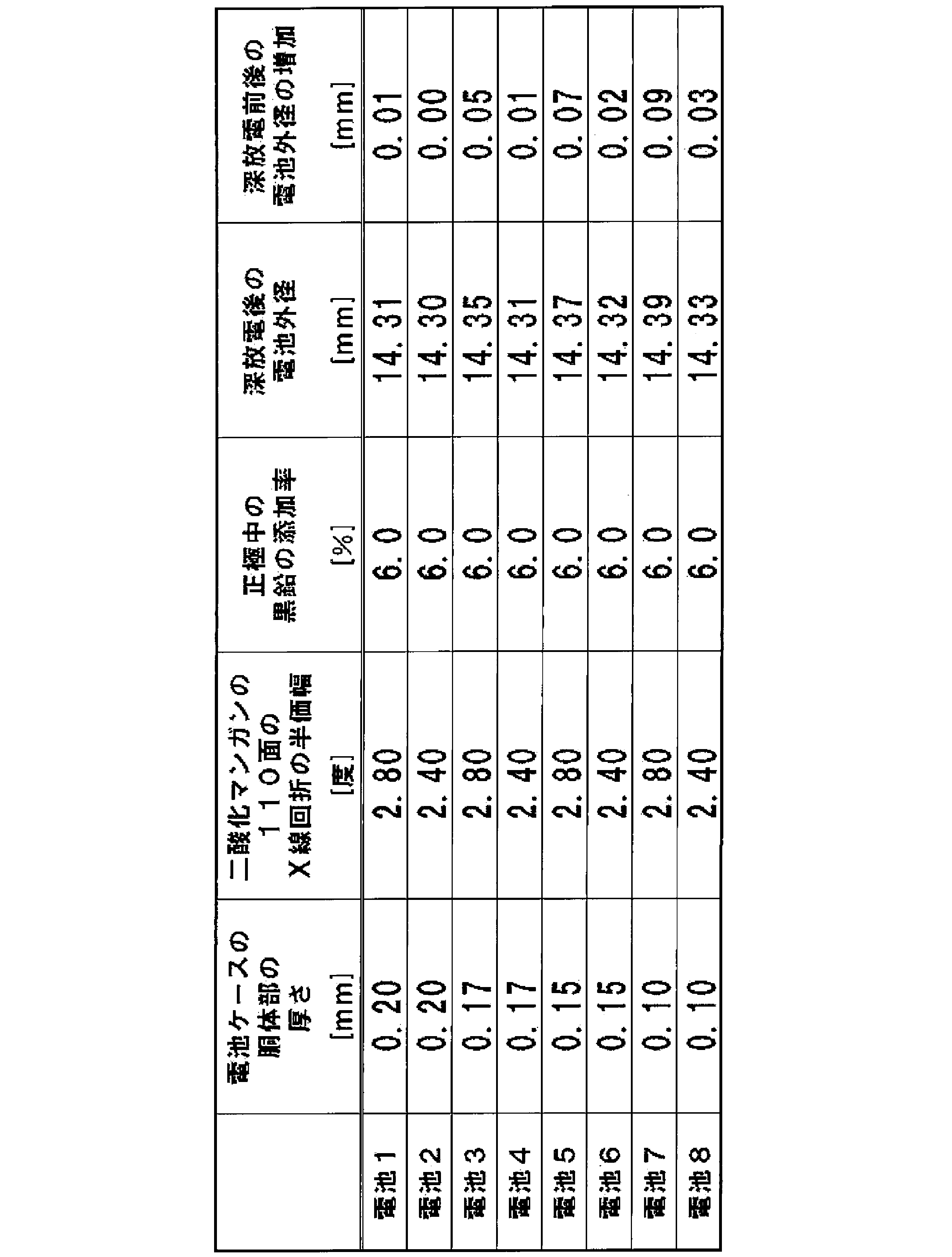
- the relationship between the thickness of the body of the battery case and the half width of the 110 side of manganese dioxide The thickness of the body of the battery case is between 0.10 and 0.20 mm, and 110 of the manganese dioxide of the positive electrode Batteries 1 to 8 were prepared in the order of ⁇ 1> to ⁇ 7> except that the half-width of 2.40 degrees and 2.80 degrees was used.
- the batteries 2, 4, 6 and 8 using manganese dioxide having a half value width of 2.40 have a battery outside of the batteries 1, 3, 5 and 7 using manganese dioxide having a half value width of 2.80.
- the diameter is small, less than 14.35 mm which can be quickly detached from the device loaded with the dry cell, and it can be seen that the expansion is suppressed.
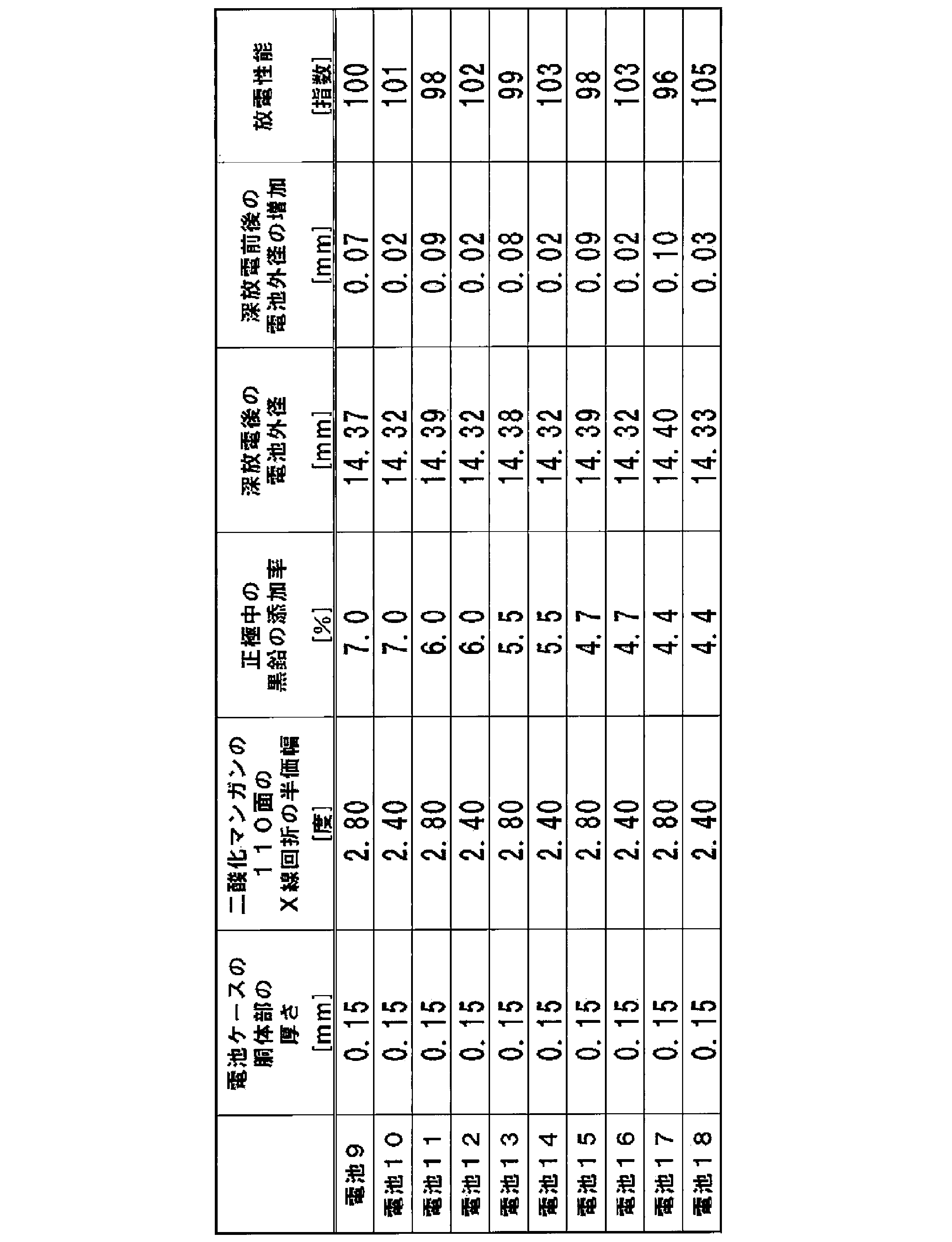
- the battery outer diameter is less than 14.35 in all cases, and the addition ratio of graphite is small (for example, Even in the battery 20), the expansion is sufficiently suppressed.
- the discharge performance tends to decrease if the addition ratio of graphite is small, but when the half width is as small as 2.40 (for example, battery In the battery 16 and the battery 18), the discharge performance does not tend to decrease even if the addition ratio of graphite decreases.
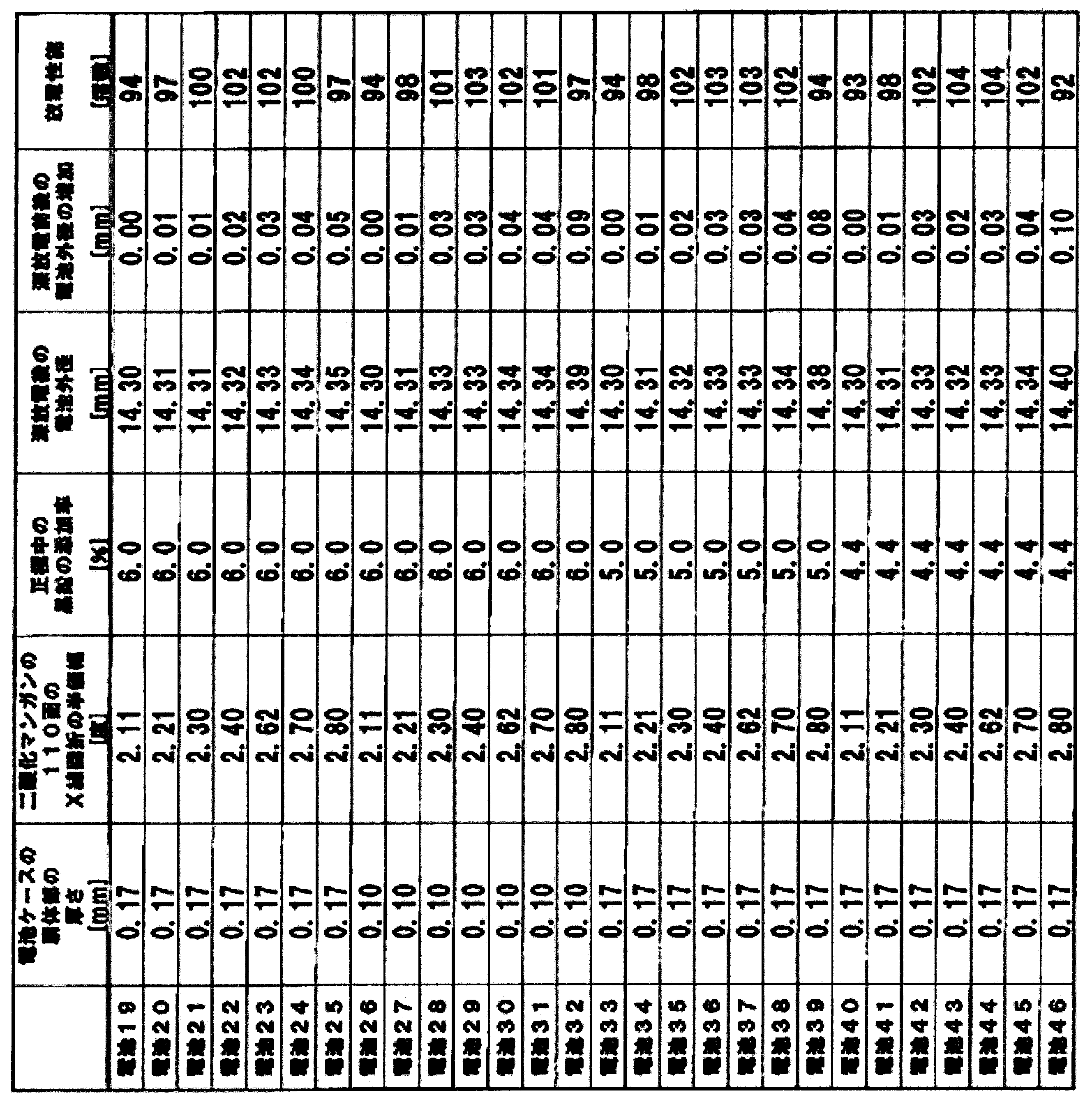
- the half-width of 110 is most preferable in the range of 2.40 degrees to 2.62 degrees so that the batteries 29 and 30 are higher than the batteries 28 and 31. This is thought to be due to the fact that manganese dioxide of this physical property does not only suppress the expansion of the battery case because it has a small expansion at the end of discharge, but also has little inhibition of ion migration in the positive electrode at the end of discharge. Is preferred.
- the discharge performance is improved in the direction of decreasing the graphite addition ratio.
- the discharge performance is lowered as the addition ratio of graphite is lowered. This is a phenomenon in which the discharge performance is reduced in the conventional low-manganese manganese dioxide when the addition ratio of the graphite decreases, but the discharge performance is reduced in the manganese dioxide in which the half width of the 110 face is in the appropriate range. It is shown that the effect of suppressing and improving the discharge performance is maximized.
- the discharge capacity is preferably high when the theoretical capacity ratio of the negative electrode to the positive electrode is between 1.07 and 1.17.
- the reason for this is considered to be that the polarization of the positive and negative electrodes becomes large at almost the same timing at the end of discharge and the range leading to the discharge end voltage is optimum in the range of 1.07 to 1.17.
- the same tendency applies to the batteries 52-56.
- the alkaline battery of the present invention has high reliability and discharge performance, and is suitably used for any device that uses a dry battery as a power source.
Landscapes
- Chemical & Material Sciences (AREA)
- Chemical Kinetics & Catalysis (AREA)
- Electrochemistry (AREA)
- General Chemical & Material Sciences (AREA)
- Inorganic Chemistry (AREA)
- Engineering & Computer Science (AREA)
- Manufacturing & Machinery (AREA)
- Battery Electrode And Active Subsutance (AREA)
- Primary Cells (AREA)
- Sealing Battery Cases Or Jackets (AREA)
Abstract
Description
ニッケルめっき鋼板から、所定の開口部1b及び胴体部1aの厚さを有する有底円筒形の電池ケース1をプレス加工にて作製した。
1:1の質量比率で溶剤紡糸セルロース繊維とポリビニルアルコール系繊維を主体として混抄した坪量25g/m2、厚さ0.09mmの不織布シートを3重に巻いて有底筒状のセパレータ4を作製した。
ガスケット5は、ナイロン6,6を主成分として、所定の寸法、形状に射出成型して作製した。また、負極端子板7は、ニッケルめっき鋼板を所定の寸法、形状にプレス加工して作製し、負極集電体6は、真鍮を釘型となるようにプレス加工して作製し、表面にスズめっきを施した。そして、負極端子板7に負極集電体6を電気溶接した後、負極集電体6をガスケット5の中心の貫通孔に圧入して、封口ユニットを作製した。
水酸化カリウム及び酸化亜鉛をそれぞれ所定量含有する水溶液からなるアルカリ電解液を準備した。
平均粒径40μmの二酸化マンガン粉末と黒鉛粉末とを所定の質量比で混合し、この混合物とアルカリ電解液とを100:1.9の質量比で混合し、充分に攪拌した後、フレーク状に圧縮成型した。その後、フレーク状の正極合剤を粉砕して顆粒状とし、これを中空円筒状に加圧成型してペレット状の正極2を得た。
ゲル化剤(架橋分岐型ポリアクリル酸からなる増粘剤、及び高架橋鎖状型ポリアクリル酸ナトリウムからなる吸水性ポリマー)と、アルカリ電解液と、亜鉛合金粉末とを0.26:0.54:35.2:64.0の質量比で混合して負極3を得た。なお、亜鉛合金粉末は、0.02質量%のインジウムと、0.01質量%のビスマスと、0.005質量%のアルミニウムとを含有したものを用いた。
ペレット状の正極2を電池ケース1内に挿入し、加圧治具により正極2を加圧して電池ケース1の内壁に密着させた。電池ケース1の内壁に密着させた正極2の中央に、セパレータ4を配置した後、所定量の負極3をセパレータ4内に充填した。そして、封口ユニットを介して電池ケース1の開口端部をかしめ封口した後、外装ラベル8で電池ケース1の外表面を被覆した。
電池ケースの胴体部の厚さが0.10~0.20mmの間で、正極の二酸化マンガンの110面の半値幅が2.40度と2.80度であるものを用いたことに変えたこと以外、上記<1>から<7>の手順で電池1~8を作成した。
電池ケースの胴体部の厚さを0.15mmとし、二酸化マンガンの110面の半値幅が2.40度と2.80度であるものを用いたこと、および正極中の黒鉛の添加率を3.5~7.0%の範囲で変化させたこと以外、上記<1>から<7>の手順で電池9から18を作製した。
電池ケースの胴体部の厚さが0.10mmと0.17mmにおいて、二酸化マンガンの110面の半値幅が2.11度と2.80度の間で変化させたものを用いたこと以外、上記<1>から<7>の手順で作成した電池19から46について、上記と同様の深放電後の電池外径と、放電性能として評価した。これらの結果を表3に示した。
電池ケースの胴体部の厚さを0.17mmとし、二酸化マンガンの110面の半値幅が2.42度と2.65度において、また負極/正極の理論容量比を1.00~1.27の間で変化させたこと以外、上記<1>から<7>の手順で作成した電池47~56について、上記と同様の深放電後の電池外径と放電性能として評価した。これらの結果を表4に示した。

1a 胴体部
1b 開口部
2 正極
3 負極
4 セパレータ
5 ガスケット
6 負極集電体
7 負極端子板
8 外装ラベル
Claims (3)
- 有底円筒形の電池ケース内に、セパレータを介して二酸化マンガンからなる正極と負極とが収納され、前記電池ケースの開口部がガスケットを介して封口されてなるアルカリ電池であって、
前記電池ケースの胴体部の厚さは、0.10~0.17mmの範囲にあり、
前記二酸化マンガンの粉末X線回折測定による110面の半値幅は、2.30~2.70度の範囲にある、アルカリ電池。 - 前記半値幅は、2.40~2.62度の範囲にある、請求項1記載のアルカリ電池。
- 前記負極は亜鉛からなり、
前記正極の理論容量に対する前記負極の理論容量の比率は、1.07~1.17の範囲にある、請求項1または2に記載のアルカリ電池。
Priority Applications (4)
| Application Number | Priority Date | Filing Date | Title |
|---|---|---|---|
| EP12830906.9A EP2770566B1 (en) | 2011-10-21 | 2012-08-21 | Alkaline battery |
| JP2012556309A JP5587438B2 (ja) | 2011-10-21 | 2012-08-21 | アルカリ電池 |
| US13/816,643 US8709646B2 (en) | 2011-10-21 | 2012-08-21 | Alkaline battery |
| CN201280037158.5A CN103718359B (zh) | 2011-10-21 | 2012-08-21 | 碱性电池 |
Applications Claiming Priority (2)
| Application Number | Priority Date | Filing Date | Title |
|---|---|---|---|
| JP2011-231391 | 2011-10-21 | ||
| JP2011231391 | 2011-10-21 |
Publications (1)
| Publication Number | Publication Date |
|---|---|
| WO2013057860A1 true WO2013057860A1 (ja) | 2013-04-25 |
Family
ID=48140531
Family Applications (1)
| Application Number | Title | Priority Date | Filing Date |
|---|---|---|---|
| PCT/JP2012/005223 Ceased WO2013057860A1 (ja) | 2011-10-21 | 2012-08-21 | アルカリ電池 |
Country Status (5)
| Country | Link |
|---|---|
| US (1) | US8709646B2 (ja) |
| EP (1) | EP2770566B1 (ja) |
| JP (1) | JP5587438B2 (ja) |
| CN (1) | CN103718359B (ja) |
| WO (1) | WO2013057860A1 (ja) |
Cited By (1)
| Publication number | Priority date | Publication date | Assignee | Title |
|---|---|---|---|---|
| WO2020158124A1 (ja) * | 2019-01-31 | 2020-08-06 | パナソニックIpマネジメント株式会社 | アルカリ乾電池 |
Families Citing this family (7)
| Publication number | Priority date | Publication date | Assignee | Title |
|---|---|---|---|---|
| JP5602313B2 (ja) * | 2012-04-16 | 2014-10-08 | パナソニック株式会社 | アルカリ電池 |
| CN104835926B (zh) * | 2015-05-20 | 2017-01-25 | 福建南平南孚电池有限公司 | 一种用于碱性电池的密封结构 |
| WO2017110023A1 (ja) * | 2015-12-21 | 2017-06-29 | パナソニックIpマネジメント株式会社 | アルカリ乾電池 |
| JP6443816B2 (ja) * | 2016-01-08 | 2018-12-26 | パナソニックIpマネジメント株式会社 | アルカリ乾電池 |
| CN108281607B (zh) * | 2018-02-08 | 2020-09-08 | 中银(宁波)电池有限公司 | 改性电解二氧化锰及其制备方法 |
| US11437644B2 (en) * | 2019-12-09 | 2022-09-06 | City University Of Hong Kong | Energy storage apparatus and electrolyte for use in the apparatus |
| AU2021273919A1 (en) | 2020-05-22 | 2022-10-06 | Duracell U.S. Operations, Inc. | Seal assembly for a battery cell |
Citations (11)
| Publication number | Priority date | Publication date | Assignee | Title |
|---|---|---|---|---|
| JP2000306575A (ja) * | 1999-04-23 | 2000-11-02 | Toshiba Battery Co Ltd | アルカリ乾電池およびその正極合剤の製造方法 |
| JP2002289186A (ja) * | 2001-03-23 | 2002-10-04 | Tosoh Corp | 電解二酸化マンガン粉末およびその製造法 |
| JP2005322613A (ja) * | 2004-04-09 | 2005-11-17 | Hitachi Maxell Ltd | アルカリ電池 |
| JP2007141643A (ja) | 2005-11-18 | 2007-06-07 | Hitachi Maxell Ltd | アルカリ電池 |
| JP2009135067A (ja) * | 2007-02-14 | 2009-06-18 | Tosoh Corp | 電解二酸化マンガン及びその製造方法並びにその用途 |
| JP2009158257A (ja) * | 2007-12-26 | 2009-07-16 | Panasonic Corp | 単3形のアルカリ電池 |
| JP2009159257A (ja) | 2007-12-26 | 2009-07-16 | Fujitsu Ltd | 伝送特性調整装置、回路基板、及び伝送特性調整方法 |
| JP2010153287A (ja) * | 2008-12-26 | 2010-07-08 | Hitachi Maxell Ltd | アルカリ電池 |
| JP2011511411A (ja) | 2008-02-08 | 2011-04-07 | ザ ジレット カンパニー | 4重量%未満の炭素粒子を有するカソードを有するアルカリ電池 |
| JP2011068552A (ja) | 2009-08-24 | 2011-04-07 | Tosoh Corp | 電解二酸化マンガン及びその製造方法並びにその用途 |
| JP2011140711A (ja) * | 2009-12-08 | 2011-07-21 | Tosoh Corp | 電解二酸化マンガン及びその製造方法並びにその用途 |
Family Cites Families (4)
| Publication number | Priority date | Publication date | Assignee | Title |
|---|---|---|---|---|
| CN100334756C (zh) * | 2004-09-03 | 2007-08-29 | 松下电器产业株式会社 | 锂原电池 |
| ZA200801281B (en) * | 2007-02-14 | 2009-01-28 | Tosoh Corp | Electrolytic manganese dioxide, and method for its production and its application |
| US8734992B2 (en) | 2007-02-14 | 2014-05-27 | Tosoh Corporation | Electrolytic manganese dioxide, and method for its production and its application |
| WO2011024765A1 (ja) * | 2009-08-24 | 2011-03-03 | 東ソー株式会社 | 電解二酸化マンガン及びその製造方法並びにその用途 |
-
2012
- 2012-08-21 EP EP12830906.9A patent/EP2770566B1/en active Active
- 2012-08-21 CN CN201280037158.5A patent/CN103718359B/zh active Active
- 2012-08-21 US US13/816,643 patent/US8709646B2/en active Active
- 2012-08-21 WO PCT/JP2012/005223 patent/WO2013057860A1/ja not_active Ceased
- 2012-08-21 JP JP2012556309A patent/JP5587438B2/ja active Active
Patent Citations (11)
| Publication number | Priority date | Publication date | Assignee | Title |
|---|---|---|---|---|
| JP2000306575A (ja) * | 1999-04-23 | 2000-11-02 | Toshiba Battery Co Ltd | アルカリ乾電池およびその正極合剤の製造方法 |
| JP2002289186A (ja) * | 2001-03-23 | 2002-10-04 | Tosoh Corp | 電解二酸化マンガン粉末およびその製造法 |
| JP2005322613A (ja) * | 2004-04-09 | 2005-11-17 | Hitachi Maxell Ltd | アルカリ電池 |
| JP2007141643A (ja) | 2005-11-18 | 2007-06-07 | Hitachi Maxell Ltd | アルカリ電池 |
| JP2009135067A (ja) * | 2007-02-14 | 2009-06-18 | Tosoh Corp | 電解二酸化マンガン及びその製造方法並びにその用途 |
| JP2009158257A (ja) * | 2007-12-26 | 2009-07-16 | Panasonic Corp | 単3形のアルカリ電池 |
| JP2009159257A (ja) | 2007-12-26 | 2009-07-16 | Fujitsu Ltd | 伝送特性調整装置、回路基板、及び伝送特性調整方法 |
| JP2011511411A (ja) | 2008-02-08 | 2011-04-07 | ザ ジレット カンパニー | 4重量%未満の炭素粒子を有するカソードを有するアルカリ電池 |
| JP2010153287A (ja) * | 2008-12-26 | 2010-07-08 | Hitachi Maxell Ltd | アルカリ電池 |
| JP2011068552A (ja) | 2009-08-24 | 2011-04-07 | Tosoh Corp | 電解二酸化マンガン及びその製造方法並びにその用途 |
| JP2011140711A (ja) * | 2009-12-08 | 2011-07-21 | Tosoh Corp | 電解二酸化マンガン及びその製造方法並びにその用途 |
Non-Patent Citations (1)
| Title |
|---|
| See also references of EP2770566A4 |
Cited By (1)
| Publication number | Priority date | Publication date | Assignee | Title |
|---|---|---|---|---|
| WO2020158124A1 (ja) * | 2019-01-31 | 2020-08-06 | パナソニックIpマネジメント株式会社 | アルカリ乾電池 |
Also Published As
| Publication number | Publication date |
|---|---|
| JP5587438B2 (ja) | 2014-09-10 |
| CN103718359B (zh) | 2016-08-17 |
| EP2770566A1 (en) | 2014-08-27 |
| EP2770566A4 (en) | 2015-05-06 |
| EP2770566B1 (en) | 2016-03-02 |
| US20130236775A1 (en) | 2013-09-12 |
| JPWO2013057860A1 (ja) | 2015-04-02 |
| US8709646B2 (en) | 2014-04-29 |
| CN103718359A (zh) | 2014-04-09 |
Similar Documents
| Publication | Publication Date | Title |
|---|---|---|
| JP5587438B2 (ja) | アルカリ電池 | |
| CN100514714C (zh) | 包括羟基氧化镍阴极和锌阳极的碱性电池 | |
| EP1172869B1 (en) | Method for producing a positive electrode active material for an alkaline storage battery | |
| CN1330027C (zh) | 密封型镍锌一次电池 | |
| CN100407481C (zh) | 具有改进阴极的碱性电池 | |
| CN106133993A (zh) | 碱性二次电池 | |
| US6358648B2 (en) | Nickel electrode active material for alkaline storage batteries and nickel electrode using the same | |
| CN100448073C (zh) | 碱性电池 | |
| US10079385B2 (en) | Positive electrode for alkaline storage battery and alkaline storage battery using the same | |
| US11611072B2 (en) | Coating on nickelate cathode materials | |
| JP5602313B2 (ja) | アルカリ電池 | |
| JP5409975B1 (ja) | アルカリ電池 | |
| JP2008210746A (ja) | 二酸化マンガンおよびそれを用いた電池 | |
| US7931986B2 (en) | Alkaline battery | |
| WO2014049966A1 (ja) | アルカリ蓄電池用正極活物質、それを含むアルカリ蓄電池用正極およびアルカリ蓄電池、ならびにニッケル水素蓄電池 | |
| JP2024508883A (ja) | 亜鉛・二酸化マンガン・水酸化ニッケル二次電気化学発電体 | |
| KR102164921B1 (ko) | 리튬이온커패시터 | |
| JP2013211122A (ja) | アルカリ蓄電池 | |
| CN216311874U (zh) | 高功率密度等离子体电池 | |
| JP4137417B2 (ja) | アルカリ乾電池 | |
| JP2022182856A (ja) | 水素吸蔵合金負極および水素吸蔵合金負極を含むニッケル水素二次電池 | |
| CN101114707A (zh) | 碱性电池 | |
| JP2002093426A (ja) | 電 池 | |
| JP2008103111A (ja) | 亜鉛アルカリ電池 |
Legal Events
| Date | Code | Title | Description |
|---|---|---|---|
| ENP | Entry into the national phase |
Ref document number: 2012556309 Country of ref document: JP Kind code of ref document: A |
|
| WWE | Wipo information: entry into national phase |
Ref document number: 13816643 Country of ref document: US |
|
| WWE | Wipo information: entry into national phase |
Ref document number: 2012830906 Country of ref document: EP |
|
| 121 | Ep: the epo has been informed by wipo that ep was designated in this application |
Ref document number: 12830906 Country of ref document: EP Kind code of ref document: A1 |
|
| NENP | Non-entry into the national phase |
Ref country code: DE |