WO2013069505A1 - 再暗号化システム、再暗号化装置及びプログラム - Google Patents
再暗号化システム、再暗号化装置及びプログラム Download PDFInfo
- Publication number
- WO2013069505A1 WO2013069505A1 PCT/JP2012/078028 JP2012078028W WO2013069505A1 WO 2013069505 A1 WO2013069505 A1 WO 2013069505A1 JP 2012078028 W JP2012078028 W JP 2012078028W WO 2013069505 A1 WO2013069505 A1 WO 2013069505A1
- Authority
- WO
- WIPO (PCT)
- Prior art keywords
- file
- encryption
- encrypted
- key
- request
- Prior art date
- Legal status (The legal status is an assumption and is not a legal conclusion. Google has not performed a legal analysis and makes no representation as to the accuracy of the status listed.)
- Ceased
Links
Images








Classifications
-
- H—ELECTRICITY
- H04—ELECTRIC COMMUNICATION TECHNIQUE
- H04L—TRANSMISSION OF DIGITAL INFORMATION, e.g. TELEGRAPHIC COMMUNICATION
- H04L63/00—Network architectures or network communication protocols for network security
- H04L63/04—Network architectures or network communication protocols for network security for providing a confidential data exchange among entities communicating through data packet networks
- H04L63/0428—Network architectures or network communication protocols for network security for providing a confidential data exchange among entities communicating through data packet networks wherein the data content is protected, e.g. by encrypting or encapsulating the payload
- H04L63/045—Network architectures or network communication protocols for network security for providing a confidential data exchange among entities communicating through data packet networks wherein the data content is protected, e.g. by encrypting or encapsulating the payload wherein the sending and receiving network entities apply hybrid encryption, i.e. combination of symmetric and asymmetric encryption
-
- H—ELECTRICITY
- H04—ELECTRIC COMMUNICATION TECHNIQUE
- H04L—TRANSMISSION OF DIGITAL INFORMATION, e.g. TELEGRAPHIC COMMUNICATION
- H04L9/00—Cryptographic mechanisms or cryptographic arrangements for secret or secure communications; Network security protocols
- H04L9/08—Key distribution or management, e.g. generation, sharing or updating, of cryptographic keys or passwords
- H04L9/0816—Key establishment, i.e. cryptographic processes or cryptographic protocols whereby a shared secret becomes available to two or more parties, for subsequent use
- H04L9/0819—Key transport or distribution, i.e. key establishment techniques where one party creates or otherwise obtains a secret value, and securely transfers it to the other(s)
- H04L9/0825—Key transport or distribution, i.e. key establishment techniques where one party creates or otherwise obtains a secret value, and securely transfers it to the other(s) using asymmetric-key encryption or public key infrastructure [PKI], e.g. key signature or public key certificates
-
- G—PHYSICS
- G06—COMPUTING OR CALCULATING; COUNTING
- G06F—ELECTRIC DIGITAL DATA PROCESSING
- G06F21/00—Security arrangements for protecting computers, components thereof, programs or data against unauthorised activity
- G06F21/60—Protecting data
- G06F21/62—Protecting access to data via a platform, e.g. using keys or access control rules
- G06F21/6218—Protecting access to data via a platform, e.g. using keys or access control rules to a system of files or objects, e.g. local or distributed file system or database
-
- H—ELECTRICITY
- H04—ELECTRIC COMMUNICATION TECHNIQUE
- H04L—TRANSMISSION OF DIGITAL INFORMATION, e.g. TELEGRAPHIC COMMUNICATION
- H04L63/00—Network architectures or network communication protocols for network security
- H04L63/04—Network architectures or network communication protocols for network security for providing a confidential data exchange among entities communicating through data packet networks
- H04L63/0428—Network architectures or network communication protocols for network security for providing a confidential data exchange among entities communicating through data packet networks wherein the data content is protected, e.g. by encrypting or encapsulating the payload
- H04L63/0464—Network architectures or network communication protocols for network security for providing a confidential data exchange among entities communicating through data packet networks wherein the data content is protected, e.g. by encrypting or encapsulating the payload using hop-by-hop encryption, i.e. wherein an intermediate entity decrypts the information and re-encrypts it before forwarding it
-
- H—ELECTRICITY
- H04—ELECTRIC COMMUNICATION TECHNIQUE
- H04L—TRANSMISSION OF DIGITAL INFORMATION, e.g. TELEGRAPHIC COMMUNICATION
- H04L63/00—Network architectures or network communication protocols for network security
- H04L63/06—Network architectures or network communication protocols for network security for supporting key management in a packet data network
- H04L63/062—Network architectures or network communication protocols for network security for supporting key management in a packet data network for key distribution, e.g. centrally by trusted party
-
- H—ELECTRICITY
- H04—ELECTRIC COMMUNICATION TECHNIQUE
- H04L—TRANSMISSION OF DIGITAL INFORMATION, e.g. TELEGRAPHIC COMMUNICATION
- H04L9/00—Cryptographic mechanisms or cryptographic arrangements for secret or secure communications; Network security protocols
- H04L9/08—Key distribution or management, e.g. generation, sharing or updating, of cryptographic keys or passwords
- H04L9/0816—Key establishment, i.e. cryptographic processes or cryptographic protocols whereby a shared secret becomes available to two or more parties, for subsequent use
- H04L9/0819—Key transport or distribution, i.e. key establishment techniques where one party creates or otherwise obtains a secret value, and securely transfers it to the other(s)
- H04L9/083—Key transport or distribution, i.e. key establishment techniques where one party creates or otherwise obtains a secret value, and securely transfers it to the other(s) involving central third party, e.g. key distribution center [KDC] or trusted third party [TTP]
- H04L9/0833—Key transport or distribution, i.e. key establishment techniques where one party creates or otherwise obtains a secret value, and securely transfers it to the other(s) involving central third party, e.g. key distribution center [KDC] or trusted third party [TTP] involving conference or group key
-
- H—ELECTRICITY
- H04—ELECTRIC COMMUNICATION TECHNIQUE
- H04L—TRANSMISSION OF DIGITAL INFORMATION, e.g. TELEGRAPHIC COMMUNICATION
- H04L9/00—Cryptographic mechanisms or cryptographic arrangements for secret or secure communications; Network security protocols
- H04L9/14—Cryptographic mechanisms or cryptographic arrangements for secret or secure communications; Network security protocols using a plurality of keys or algorithms
-
- H—ELECTRICITY
- H04—ELECTRIC COMMUNICATION TECHNIQUE
- H04L—TRANSMISSION OF DIGITAL INFORMATION, e.g. TELEGRAPHIC COMMUNICATION
- H04L2209/00—Additional information or applications relating to cryptographic mechanisms or cryptographic arrangements for secret or secure communication H04L9/00
- H04L2209/76—Proxy, i.e. using intermediary entity to perform cryptographic operations
Definitions
- Embodiments described herein relate generally to a re-encryption system, a re-encryption apparatus, and a program.
- the data D on the communication path is protected by SSL / TLS, but the data D in the cloud storage 1 is not encrypted.
- the security of the data D in the cloud storage 1 depends on the reliability of the cloud service. For example, since the cloud storage 1 is used by many companies and users, there is a concern that data may be seen from another tenant due to a setting error, or that inappropriate authentication processing is executed. In addition, there is a concern that data in the cloud storage 1 may be leaked due to an internal crime of the server administrator.
- the data D is encrypted with the common key k of the common key encryption method in the server, and the encrypted data E (k, D) is stored in the cloud storage 1.
- the encrypted data E (k, D) in the cloud storage 1 is protected.
- the server administrator has received the encrypted data E (k, D ) Can be decrypted, which leaves security issues.
- Method of sharing group key Advantages of the method (i) include that data can always be stored in an encrypted state on the cloud, and that encryption key management is easy. .
- FIG. 14 when an encryption key ek Gr1 / decryption key dk Gr1 is shared by a group and encryption is performed using public key encryption, the encryption key ek Gr1 / decryption key dk Gr1 is one set. It is. Therefore, the key can be easily managed by both the uploading member and the downloading member.
- security concerns can be eliminated.
- Disadvantages of the above method (i) include that the decryption key dk Gr1 needs to be shared among members and that a method for securely distributing and sharing the decryption key dk Gr1 is necessary. For example, because each member share a decryption key dk Gr1, thus leakage risk of the decryption key dk Gr1 increases according to an increase in the members. If the decryption key dk Gr1 is leaked, it is necessary to update the decryption key dk Gr1 shared by the group in order to prevent the use of the leaked decryption key dk Gr1 , which reduces convenience. In addition, when a member is removed from the group, it is necessary to update the decryption key dk Gr1 of the other member in order to prevent decryption by the lost member. End up.
- the member to be encrypted needs to manage each member's public key pk A ,..., And when a member H is added to the group, the added member H is made public It is necessary to re-encrypt the data D with the key pk H. For example, for members to be encrypted, the key management of each member becomes complicated and the convenience is reduced. Further, when the additional member H is generated, it is necessary to encrypt the data D with the public key pk H of the additional member H and store it in the cloud storage 1 with respect to the member to be encrypted. .
- Hybrid Cryptography Combining Common Key Cryptography and Public Key Cryptography--Introduction to Information Security: ITpro, http://itpro.nikkeibp.co.jp/article/COLUMN/20060620/241303/ Java Road: Servlet (10. Filter), http://www.javaroad.jp/servletjsp/sj_servlet10.htm B. Libert and D. Vergnaud, “Unidirectional Chosen-Ciphertext Secure Proxy Re-encryption,” Proc. PKC 2008, LNCS 4939, pp.360-379, Springer, 2008.
- the problem to be solved by the present invention is to provide a re-encryption system, a re-encryption device, and a program that can achieve both convenience and security.
- the re-encryption system includes a file sharing device and a re-encryption device that can communicate with a client device operated by a member belonging to a group.
- the file sharing device includes file storage means.
- the file storage means stores a first encrypted file obtained by encrypting a file based on the public key of the group.
- the file sharing device When the file sharing device receives a file request including the member ID for identifying the member and the file name of the first encrypted file from the client device, the file sharing device receives the file request from the file storage unit based on the file name in the file request. Obtain the first encrypted file.
- the file sharing apparatus transmits a re-encryption request including the acquired first encrypted file and a member ID in the file request to the re-encryption apparatus.
- the file sharing device When the file sharing device receives from the re-encryption device a second encrypted file obtained by encrypting the file based on the public key of the member ID, the file sharing device transmits the second encrypted file to the client device. To do.
- the re-encryption device includes re-encryption key storage means.
- the re-encryption key storage unit associates a member ID for identifying the member with a re-encryption key for re-encrypting the first encrypted file into the second encrypted file without decrypting the first encrypted file.
- the re-encryption device When the re-encryption device receives the re-encryption request from the file sharing device, the re-encryption device acquires the re-encryption key from the re-encryption key storage unit based on the member ID in the re-encryption request.
- the re-encryption device re-encrypts the first encrypted file in the re-encryption request into the second encrypted file based on the acquired re-encryption key.
- the re-encryption device transmits the second encrypted file obtained by the re-encryption to the file sharing device.
- the client device obtains the file by decrypting the second encrypted file received from the file sharing device based on a secret key corresponding to the public key of the member.
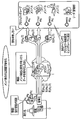
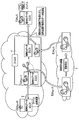
- FIG. 1 is a schematic diagram illustrating a configuration of a re-encryption system according to the first embodiment.
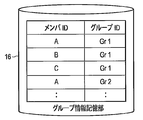
- FIG. 2 is a schematic diagram for explaining a group information storage unit in the embodiment.
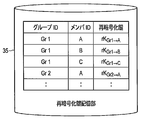
- FIG. 3 is a schematic diagram for explaining a re-encryption key storage unit in the embodiment.
- FIG. 4 is a flowchart for explaining file upload processing in the embodiment.
- FIG. 5 is a sequence diagram for explaining file upload processing in the embodiment.
- FIG. 6 is a flowchart for explaining file download processing in the embodiment.
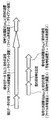
- FIG. 7 is a sequence diagram for explaining file download processing in the embodiment.
- FIG. 8 is a flowchart for explaining member addition processing in the embodiment.
- FIG. 9 is a sequence diagram for explaining member addition processing in the embodiment.
- FIG. 1 is a schematic diagram illustrating a configuration of a re-encryption system according to the first embodiment.
- FIG. 2 is a schematic diagram for explaining a group information storage unit in the embodiment.
- FIG. 10 is a flowchart for explaining member deletion processing in the embodiment.
- FIG. 11 is a sequence diagram for explaining member deletion processing in the embodiment.
- FIG. 12 is a schematic diagram for explaining a problem of a conventional cloud storage.
- FIG. 13 is a schematic diagram for explaining a problem in the case of encryption with a conventional common key.
- FIG. 14 is a schematic diagram for explaining a problem when encryption is performed with a public key of a conventional group.
- FIG. 15 is a schematic diagram for explaining a problem in the case of encryption with a public key for each conventional member.
- FIG. 16A is a schematic diagram showing a conventional encryption technique.
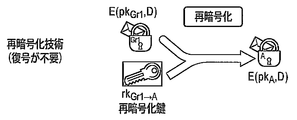
- FIG. 16B is a schematic diagram illustrating a general re-encryption technique.
- FIG. 17 is a schematic diagram for explaining a general re-encryption key creation process.
- FIG. 18 is a schematic diagram for explaining the re-encryption system according to the outline of each embodiment.
- FIG. 19 is a schematic diagram for explaining member addition by the re-encryption system in the outline of each embodiment.
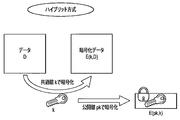
- FIG. 20 is a schematic diagram for explaining a general hybrid system.
- FIG. 21 is a schematic diagram for explaining an advantage when the filter function is applied to the re-encryption system in the outline of each embodiment.
- FIG. 22 is a schematic diagram showing a file format in the hybrid method.
- FIG. 23 is a schematic diagram for explaining a re-encryption system to which the hybrid method is applied.
- FIG. 24 is a schematic diagram for explaining the processing time of the re-encryption system to which the hybrid method is applied.
- Non-Patent Document 3 Re-encryption technology (see Non-Patent Document 3) is known as a method for achieving both convenience and security.
- FIG. 16A A conventional encryption technique is shown in FIG. 16A, and a re-encryption technique is shown in FIG. 16B.
- the data E (pk Gr1 , D) encrypted with the public key pk Gr1 of one member is encrypted with the public key pk A of another member A without being decrypted.
- the re-encryption key rk Gr1 ⁇ A is required. As shown in FIG. 17, the re-encryption key rk Gr1 ⁇ A is created from the private key sk Gr1 before replacement and the public key pk A after replacement. There is no problem even if the re-encryption key rk Gr1 ⁇ A is disclosed.
- a file as data D is uploaded / downloaded to the cloud storage 1 in an encrypted state as shown in FIG.
- the uploading member encrypts the data D with the group public key pk Gr1 and stores the encrypted data E (pk Gr1 , D) in the cloud storage 1. This eliminates the need for key management for each member in the group.
- the encrypted data E (pk Gr1 , D) is re-encrypted with the re-encryption key rk Gr1 ⁇ A for the member A on the server, and the obtained re-encryption is performed.
- Data E (pk A , D) is downloaded.
- Advantages of such a re-encryption system include that data can always be stored encrypted in the cloud, encryption key management is easy, and keys are not shared among members. . For example, since the re-encryption process can be executed with the data D encrypted, the data D is not decrypted on the cloud storage 1. Each member does not need to share the secret key sk A ,... With other members.
- the re-encryption keys rk Gr1 ⁇ A are added to and deleted from the cloud storage 1, as shown in FIG.
- the public key pk C of the member C added by the group manager is acquired.
- Group administrator to create a re-encryption key rk Gr1 ⁇ C from the public key pk C with the acquired secret key sk Gr1 of the group, placing a re-encryption key rk Gr1 ⁇ C that was created in the cloud storage 1. Even if there is such a member change, unlike the conventional case, it is not necessary to re-encrypt the encrypted data E (pk Gr1 , D) on the cloud storage 1, so the convenience does not deteriorate.
- hybrid cryptography hereinafter referred to as a hybrid scheme
- a common key cryptography technology that allows fast encryption / decryption processing.
- a method of using a Java filter can be considered as one method for newly linking with another function without greatly modifying the processing of the existing file sharing system.
- the filter function it is possible to add processing to request / response processing between the file sharing device (device corresponding to the cloud storage 1) and its client.
- By performing re-encryption processing by this filter processing it is possible to add a re-encryption function with few modifications without significantly modifying an existing file sharing system and without incorporating a re-encryption function.
- the only component added to the file sharing device 2 is processing (for example, the filter 4) associated with the re-encryption device 3.
- the encrypted data E (k, D) portion depends on the size of the data, but considering that the size is significantly larger than the encrypted common key E (pk Gr1 , k) portion, the file sharing apparatus 2 And the re-encryption device 3 can be reduced in communication processing.
- the encrypted data E (k, D) portion is changed to the member (client) in parallel with the process of transmitting the encrypted common key E (pk Gr1 , k) portion to the re-encryption device 3. ).
- the download process generally takes longer than the re-encryption process. Processing ends. For this reason, the server processing time by the re-encryption process can be expected to be completed while the encrypted data E (k, D) portion is transmitted to the client device.
- the form in which the data distribution process is improved focuses on the data format of the hybrid method and re-encrypts the encrypted common key E (pk Gr1 , k) portion. Since the encryption process and the transmission of the encrypted data E (k, D) portion are performed in parallel, it is preferable in that the time required for the entire download process can be reduced as compared with the embodiment shown in FIG.
- the above is supplementary explanation about the improved form of data distribution processing. Subsequently, each embodiment will be specifically described.
- the first embodiment is an application form in which the data distribution process is improved
- the second embodiment is a basic form in which the data distribution process is not improved.
- FIG. 1 is a schematic diagram showing a configuration of a re-encryption system according to the first embodiment.
- This re-encryption system has a client / server configuration, and includes a file sharing apparatus 10 and a re-encryption apparatus 30 that can communicate with a client apparatus 20 operated by members belonging to a group.
- the file sharing device 10 and the re-encryption device 30 are server devices, and the devices 10, 20, and 30 can communicate with each other via the Internet 5.
- each of the devices 10, 20, and 30 can be implemented with either a hardware configuration or a combination configuration of hardware resources and software. As the software of the combination configuration, as shown in FIG.
- the file sharing apparatus 10 includes a control unit 11, a communication unit 12, an insertion processing unit 13, a file sharing unit 14, a file storage unit 15, a group information storage unit 16, a public key acquisition unit 17, and a re-encryption key registration unit. 18 and a group management unit 19.
- the control unit 11, the communication unit 12, the insertion processing unit 13, the file sharing unit 14, the public key acquisition unit 17, the re-encryption key registration unit 18, and the group management unit 19 are, for example, a file sharing device 10 described later by a CPU (not shown). It is a functional block realized by executing a program including each step.
- the communication unit 12 is a communication interface between the other devices 20 and 30. However, in the following description, from the viewpoint of simplifying the description, the description that the communication unit 12 is used for transmission / reception of data between the other devices 20 and 30 is omitted.
- the filter function of Java may be used.
- the file storage unit 15 can be realized as a storage device readable / writable from a CPU (not shown), and includes a first encrypted common key portion obtained by encrypting a common key based on a group public key, An encrypted file including an encrypted data portion obtained by encrypting data based on the common key is stored.
- the “first encrypted common key portion” may be read as “first encrypted common key” or “encrypted common key”.
- the “encrypted data portion” may be read as “encrypted data”.
- the group information storage unit 16 can be realized as a storage device that can be read / written by a CPU (not shown). As shown in FIG. 2, the group information storage unit 16 identifies a group ID for identifying a group and members belonging to the group. The member ID is associated and stored.
- the client device 20 includes a control unit 21, a communication unit 22, a file storage unit 23, a secret key storage unit 24, an encryption processing unit 25, a common key generation unit 26, and a re-encryption key creation unit 27.
- the control unit 21, the communication unit 22, the encryption processing unit 25, the common key generation unit 26, and the re-encryption key creation unit 27 execute, for example, a program including steps in the client device 20 described later by a CPU (not shown). It is a functional block realized by.
- the communication unit 22 is a communication interface between the other devices 10 and 30. However, in the following description, from the viewpoint of simplifying the description, the description that the communication unit 22 is used for transmission / reception of data between the other apparatuses 10 and 30 is omitted.
- the file storage unit 23 can be realized as a storage device that can be read / written by a CPU (not shown), and stores, for example, a file to be uploaded.
- the private key storage unit 24 can be realized as a storage device that can be read / written from a CPU (not shown), and stores, for example, a private key corresponding to a member's public key. If the member is a group manager, the secret key storage unit 24 further stores a secret key corresponding to the group public key.
- the re-encryption device 30 includes a control unit 31, a communication unit 32, a re-encryption processing unit 33, a public key storage unit 34, and a re-encryption key storage unit 35.
- the control unit 31, the communication unit 32, and the re-encryption processing unit 33 are functional blocks that are realized by, for example, a CPU (not shown) executing a program including each step in the re-encryption device 30 described later.
- the communication unit 32 is a communication interface between the other devices 10 and 20. However, in the following description, from the viewpoint of simplifying the description, the description that the communication unit 32 is used for transmission / reception of data between the other apparatuses 10 and 20 is omitted.
- the public key storage unit 34 can be realized as a storage device readable / writable from a CPU (not shown), and includes a group ID for identifying a group, a public key of the group, a member ID for identifying a member, The member's public key is associated and stored.
- the re-encryption key storage unit 35 can be realized as a storage device that is readable / writable by a CPU (not shown), and as shown in FIG. 3, a member ID for identifying a member and a first encryption common key
- the second encryption common key part is stored in association with the re-encryption key for re-encrypting the part without decrypting the part.
- the “second encrypted common key portion” may be read as “second encrypted common key” or “re-encrypted common key”.
- control unit 21 reads the file to be uploaded from the file storage unit 23 (ST1).
- control unit 21 In the client device 20, the control unit 21 generates the common key k using the common key generation unit 26. The control unit 21 passes the common key k and the file read in step ST1 to the encryption processing unit 25 (ST2).
- the encryption processing unit 25 encrypts the data D of the file with the common key k, and passes the obtained encrypted data part (E (k, D)) to the control unit 21 (ST3).
- step ST4 the following steps ST4-1 to ST4-7 are executed.
- the control unit 21 requests the file sharing device 10 for the public key pk Gr1 of the group that publishes the file to be uploaded (ST4-1). Specifically, a public key request including a group ID for identifying the group is transmitted to the file sharing apparatus 10.
- control unit 11 sends this public key request to the public key acquisition unit 17 (ST4-2).
- the public key acquisition unit 17 transmits this public key request to the re-encryption apparatus 30 (ST4-3).
- control unit 31 extracts the group public key pk Gr1 from the public key storage unit 34 based on the group ID in the public key request (ST4-4).
- control unit 31 transmits the group public key pk Gr1 to the file sharing device 10 (ST4-5).
- the public key acquisition unit 17 passes the group public key pk Gr1 to the control unit 11 (ST4-6).
- control unit 11 transmits the group public key pk Gr1 to the client apparatus 20 (ST4-7).
- control unit 21 passes the received public key pk Gr1 of the group and the common key k generated in step ST2 to the encryption processing unit 25.
- the encryption processing unit 25 encrypts the common key k with the group public key pk Gr1 and passes the obtained first encrypted common key part (E (pk Gr1 , k)) to the control unit 21 (ST5).
- step ST6 the following steps ST6-1 to ST6-3 are executed.
- control unit 21 includes the encrypted data part (E (k, D)) passed in step ST2 and the first encrypted common key part (E (pk Gr1 , k) obtained in step ST5. )) Are combined into one file (encrypted file), and the combined encrypted file is transmitted to the file sharing apparatus 10 (ST6-1).
- control unit 11 passes the encrypted file to the file sharing unit 14.
- the file sharing unit 14 writes the encrypted file into the file storage unit 15 (ST6-2).
- control unit 11 notifies the client apparatus 20 that the file upload has been completed (ST6-3).
- control unit 21 displays this notification on a display unit (not shown).
- the control unit 21 has a member ID for identifying a member, a group ID for identifying a group (if a file in a folder is shared by a group, the folder name may be a group ID), an encrypted file A file request including the file name is transmitted to the file sharing apparatus 10 (ST11).
- the member ID when the session ID is sent from the client device 20 instead of the member ID, the control unit 11 of the file sharing device 10 manages the session ID and the member ID in association with each other.
- the member ID may be derived by calculating backward from the session ID using the existing member ID.
- step ST12 the following steps ST12-1 to ST12-2 are executed.
- the control unit 11 when the control unit 11 receives a file request including the member ID for identifying the member and the file name of the encrypted file from the client device 20, the file name in the file request is transmitted via the file sharing unit 14. To obtain an encrypted file from the file storage unit 15. Specifically, the control unit 11 sends a file request received from the client device 20 to the file sharing unit 14. The file sharing unit 14 acquires the encrypted file from the file storage unit 15 and passes it to the control unit 11 (ST12-1).
- control unit 11 passes the acquired encrypted file to the insertion processing unit 13 [insert processing] (ST12-2).
- the process insertion unit 13 converts the passed encrypted file into the first encrypted common key part (E (pk Gr1 , k)) and the encrypted data part (E (k, D)). Separate (ST13).
- Steps ST14 'and ST14 are executed in parallel.
- step ST14 ' the following steps ST14'-1 to ST14'-2 are executed.
- the insertion processing unit 13 passes the encrypted data portion (E (k, D)) to the control unit 11 in parallel with the processing of step ST14 (ST14'-1).
- control unit 11 transmits the encrypted data part (E (k, D)) to the client apparatus 20 (ST14'-2).
- step ST14 the following steps ST14-1 to ST14-5 are executed.
- the process insertion unit 13 performs the first encrypted common key part (E (E (k), D) in parallel with the process of transmitting the separated encrypted data part (E (k, D)) to the client apparatus 20.
- pk Gr1 , k)) and a re-encryption request including the member ID and group ID in the file request are transmitted to the re-encryption apparatus 30 (ST14-1).
- the re-encryption device 30 When the re-encryption device 30 receives a re-encryption request from the file sharing device 10, it stores the re-encryption key based on the member ID (eg, A) and group ID (eg, Gr1) in the re-encryption request.
- the re-encryption key rk Gr1 ⁇ A is acquired from the unit 35, and based on the acquired re-encryption key rk Gr1 ⁇ A , the first encryption common key part (E (pk Gr1 , k )) Is re-encrypted into the second encrypted common key part (E (pk A , k)).
- the control unit 31 re-encrypts the first encrypted common key part (E (pk Gr1 , k), member ID (eg, A), and group ID (eg, Gr1)) in the re-encryption request.
- the re-encryption processing unit 33 acquires the re-encryption key rk Gr1 ⁇ A from the re-encryption key storage unit 35 based on the member ID and the group ID, and the first encryption common key part (E (pk Gr1, k) ) of the second encrypted common key portion (E (pk a, re-encrypts the k), obtained second encrypted common key portion (E (pk a, k) ) To the control unit 31 (ST14-2).
- control unit 31 transmits the second encrypted common key part (E (pk A , k)) obtained by re-encryption to file sharing apparatus 10 (ST14-3).
- the insertion processing unit 13 waits until the transmission process of step ST14′-2 is finished, and then sends the second encrypted common key part (E (pk A , k)) to the control unit 11. give. If the transmission process in step ST14'-2 is completed, it is immediately delivered (ST14-4).
- control unit 11 transmits the second encrypted common key part (E (pk A , k)) to the client apparatus 20 [end of inserted process] (ST14-5).
- the response from the file sharing apparatus 10 to the client apparatus 20 is transmitted twice at step ST14-5 and step ST14'-2, and this is sending data in two stages as a response of one communication.
- the client device 20 shares the second encrypted common key portion (E (pk A , k)) received from the file sharing device 10 based on the secret key sk A corresponding to the member public key pk A.
- the file data D is obtained by obtaining the key k and decrypting the encrypted data portion (E (k, D)) received from the file sharing apparatus 10 based on the obtained common key k. .
- the control unit 21 obtains the secret key sk A from the secret key storage unit 24, and the secret key sk A and the second encrypted common key part (E (pk A , k)). Is passed to the cryptographic processing unit 25.
- the encryption processing unit 25 decrypts the second encrypted common key part (E (pk A , k)) with the secret key sk A and passes the obtained common key k to the control unit 21 (ST15).
- control unit 21 passes the second encrypted data portion (E (k, D)) received in step ST14 'and the common key k obtained in step ST15 to the encryption processing unit 25.
- the encryption processing unit 25 decrypts the second encrypted data portion with the common key k, and obtains plain text data D of the file.
- the data D file is transferred to the control unit 21 (ST16).
- the client device 20 is used by a group administrator.
- the control unit 21 transmits a member addition request including a member ID (for example, C) for identifying a member to be added to the file sharing device 10 (ST21).
- a member ID for example, C
- control unit 11 when the control unit 11 receives the member addition request, the control unit 11 calls the insertion processing unit 13 [insert processing] (ST22).
- the insertion processing unit 13 requests the member's public key pk C from the re-encryption apparatus 30 based on the member ID (C) in the member addition request (ST23).
- control unit 31 reads the public key pk C associated with the requested member ID (C) from the public key storage unit 34 (ST24).
- control unit 31 returns the member public key pk C and the member ID (C) to the insertion processing unit 13 of the file sharing device 10 (ST25).
- the insertion processing unit 13 returns the processing to the control unit 11 (also passes the acquired member public key pk C and member ID (C)) [end of the inserted processing] (ST26).
- control unit 11 transmits the member public key pk C and the member ID (C) to the client apparatus 20 (ST27).
- the existing function unit performs the member addition process of step ST36 when receiving the member addition request, but does not perform the function by the function of the insertion processing unit 13.
- control unit 21 reads the group secret key sk Gr1 from the secret key storage unit 24 (ST28).
- the control unit 21 passes the member public key pk C and the group secret key sk Gr1 to the re-encryption key creation unit 27.
- the re-encryption key creation unit 27 creates a member re-encryption key rk Gr1 ⁇ C from the member public key pk C and the group secret key sk Gr1 , and creates the member re-encryption key rk Gr1 ⁇ C and the member ID (C) is passed to the control unit 21 (ST29).
- control unit 21 transmits the member re-encryption key rk Gr1 ⁇ C, the member ID (C), and the group ID (Gr1) to the file sharing device 10 (ST30).
- control unit 11 passes the member re-encryption key rk Gr1 ⁇ C, the member ID (C), and the group ID (Gr1) to the re-encryption key registration unit 18 (ST31).
- the process insertion unit 13 passes the re-encryption key rk Gr1 ⁇ C and the member ID (C) to the re-encryption apparatus 30 (ST32).
- control unit 31 writes re-encryption key rk Gr1 ⁇ C and member ID (C) in association with re-encryption key storage unit 35 (ST33).
- the control unit 31 notifies the file sharing device 10 that the re-encryption key rk Gr1 ⁇ C has been registered in association with the member ID (C) and the group ID (Gr1) (ST34).
- the re-encryption key registration unit 18 upon receiving this notification, sends a member addition request including the member ID (C) and the group ID (Gr1) to the group management unit 19 (ST35).
- the group management unit 19 upon receiving the member addition request, adds the member ID (C) and the group ID (Gr1) to the group information in the group information storage unit 16 (ST36).
- the reason for performing the member addition process in the re-encryption key registration request is that there is a mismatch between the group information storage unit 16 of the file sharing apparatus 10 and the re-encryption key storage unit 35 of the re-encryption apparatus 30. This is to prevent it from happening.
- the file sharing unit 14 notifies the re-encryption key registration unit 18 that the member addition processing has been completed (ST37).
- the encryption key registration unit 18 notifies the control unit 11 that the re-encryption key rk Gr1 ⁇ C corresponding to the member ID (C) and the group ID (Gr1) has been registered (ST38). .
- control unit 11 notifies the client apparatus 20 that the re-encryption key rk Gr1 ⁇ C corresponding to the member ID (C) and the group ID (Gr1) has been registered (ST39).
- control unit 21 displays this notification on a display unit (not shown).
- the client device 20 is used by a group administrator.
- the control unit 21 issues a member deletion request including a member ID (for example, C) for identifying the member to be deleted and a group ID (for example, Gr 1) for identifying the group for deleting the member to the file sharing device 10. (ST41).
- a member ID for example, C
- a group ID for example, Gr 1
- control unit 11 when the control unit 11 receives the member deletion request, it calls the processing insertion unit 13 [insert processing] (ST42).
- the process insertion unit 13 transmits a re-encryption key deletion request including the member ID (C) and group ID (Gr1) in the member deletion request to the re-encryption apparatus 30 (ST43).
- the control unit 31 re-encrypts the key rk associated with the member ID (C) and the group ID (Gr1) based on the member ID (C) in the re-encryption key deletion request.
- Gr1 ⁇ C is deleted from the re-encryption key storage unit 35 (ST44).
- control unit 31 notifies file sharing device 10 that re-encryption key rk Gr1 ⁇ C associated with member ID (C) and group ID (Gr1) has been deleted (ST45). .
- the process insertion unit 13 upon receiving this notification, the process insertion unit 13 returns the process to the control unit 11 [end of process insertion] (ST46).
- the control unit 11 sends a member deletion request including the member ID (C) and the group ID (Gr1) to the group management unit 19 based on this notification.
- the group management unit 19 deletes the row in which the member ID (C) and the group ID (Gr1) are associated from the group information in the group information storage unit 16 (ST47).
- control unit 11 notifies the client apparatus 20 that the member deletion process has been completed (ST48).
- control unit 21 displays this notification on a display unit (not shown).
- the file sharing apparatus 10 acquires an encrypted file from the file storage unit 15 based on a file request received from the client apparatus 20, and uses the encrypted file as the first encrypted common file.
- the re-encryption request including the first encrypted common key part and the member ID is re-encrypted in parallel with the process of separating the key part and the encrypted data part and transmitting the encrypted data part to the client device 20
- the re-encryption device 30 acquires the re-encryption key from the re-encryption key storage unit 35 based on the re-encryption request, and the re-encryption request in the re-encryption request based on the re-encryption key.
- the client device 20 obtains the common key by decrypting the second encrypted common key part based on the secret key corresponding to the member's public key, and decrypts the encrypted data part based on the obtained common key. By doing so, data is obtained, so that both convenience and security can be achieved.
- the file sharing apparatus 10 can cooperate with the re-encryption apparatus 30 with the filter function without changing the portion that provides the function of the existing file sharing system. , renovation costs can be reduced.
- the file sharing apparatus 10 separates the hybrid encryption data and sends only the key part to the re-encryption apparatus, so that the communication time can be shortened.
- the file sharing apparatus 10 separates the hybrid encryption data and sends only the key part to the re-encryption apparatus, so that the communication time can be shortened.
- an increase in processing time due to the re-encryption process can be reduced. Since the re-encryption device 30 is prepared separately, re-encryption processing can be added to the existing file sharing device without applying a CPU load.
- the common key part and the data part in the hybrid method are separated, and the common key part is re-encrypted while the data part is sent to the client device.
- the service level is reduced due to the time spent for encryption processing.
- the technique described in Patent Document 1 divides a body part and a header part when performing encryption processing on a SOAP message at a client terminal, transmits the body part to the gateway, and Perform the encryption process and create the header part. And the technique of patent document 1 transmits a header part to a gateway after transmission of a body part, and produces an original SOAP message by a gateway.
- the technology described in Patent Document 1 performs data transmission and encryption processing in parallel if attention is paid only to the processing of the client terminal, the content looks similar to the present embodiment. In this respect, the configuration and function are different from those of the present embodiment.
- the second embodiment is a basic form that does not use the hybrid method as shown in FIG. 18, and is configured to encrypt and re-encrypt the entire file.
- this re-encryption system has a client / server configuration as described above, and is capable of communicating with a client device 20 operated by a member belonging to a group and a re-encryption device.
- the apparatus 30 is provided.
- the common key k is not used, the common key generation unit 26 of the client device 20 is omitted.
- Other configurations of the client device 20 are as shown in the following description of the operation.
- the file storage unit 15 of the file sharing apparatus 10 stores the first encrypted file E (pk Gr1 , D) obtained by encrypting the file (D) based on the group public key pk Gr1 . Further, the file sharing apparatus 10 has the following functions (f10-1) to (f10-3) for file download, for example.
- the member ID (eg, A) and group ID (eg, Gr1) for identifying the member by the control unit 11 and the communication unit 12, and the file name of the first encrypted file E (pk Gr1 , D) Is received from the client device 20, the control unit 11 and the file sharing unit 14 obtain the first encrypted file E (pk Gr1 , D) from the file storage unit 15 based on the file name in the file request. Function to get.
- (f10-3) Second encrypted file obtained by encrypting the file based on the public key pk A of the member ID (A) and the group ID (Gr1) by the control unit 11, the communication unit 12, and the insertion processing unit 13.
- E (pk A , D) is received from the re-encryption device 30, the control unit 11 and the communication unit 12 transmit the second encrypted file E (pk A , D) to the client device.
- the re-encryption key storage unit 35 of the re-encryption device 30 includes a member ID (A, B,%) That identifies a member, a group ID (Gr1, Gr2, etc identifies a group, and a first encryption.
- Re-encryption keys (rk Gr1 ⁇ A , rk Gr1 ⁇ B ,...) For re-encrypting the file into the second encrypted file without decrypting the file are stored in association with each other.
- the re-encryption apparatus 30 has the following functions (f30-1) to (f30-3) for file download, for example.
- control unit 31 and the communication unit 32 receive a re-encryption request from the file sharing apparatus 10, the control unit 31 and the re-encryption processing unit 33 use the member ID (example) in the re-encryption request. , A) and a function of acquiring the re-encryption key rk Gr1 ⁇ A from the re-encryption key storage unit 35 based on the group ID (eg, Gr1).
- the re-encryption processing unit 33 Based on the acquired re-encryption key rk Gr1 ⁇ A , the re-encryption processing unit 33 converts the first encrypted file E (pk Gr1 , D) in the re-encryption request to the second encryption. Function for re-encrypting to encrypted file E (pk A , D).
- control unit 21 reads the file (D) to be uploaded from the file storage unit 23.
- the control unit 21 requests the file sharing device 10 for the public key pk Gr1 of the group that publishes the file to be uploaded. Specifically, a public key request including a group ID (eg, Gr1) for identifying the group is transmitted to the file sharing apparatus 10.
- a group ID eg, Gr1
- control unit 11 sends this public key request to the public key acquisition unit 17.
- the public key acquisition unit 17 transmits this public key request to the re-encryption apparatus 30.
- control unit 31 extracts the group public key pk Gr1 from the public key storage unit 34 based on the group ID (eg, Gr1) in the public key request.
- control unit 31 transmits the group public key pk Gr1 to the file sharing device 10.
- the public key acquisition unit 17 passes the group public key pk Gr1 to the control unit 11.
- control unit 11 transmits the group public key pk Gr1 to the client apparatus 20.
- control unit 21 passes the received public key pk Gr1 of the group and the file to be uploaded to the encryption processing unit 25.
- the encryption processing unit 25 encrypts the file (D) with the group public key pk Gr1 and passes the obtained first encrypted file E (pk Gr1 , D) to the control unit 21.
- control unit 21 transmits the first encrypted file E (pk Gr 1 , D) to the file sharing device 10.
- control unit 11 passes the first encrypted file E (pk Gr 1 , D) to the file sharing unit 14.
- the file sharing unit 14 writes the first encrypted file E (pk Gr1 , D) into the file storage unit 15.
- control unit 11 notifies the client apparatus 20 that the file upload has been completed.
- control unit 21 displays this notification on a display unit (not shown).
- the control unit 21 has a member ID (eg, A) for identifying the member, a group ID (eg, Gr1) for identifying the group, and the file name of the first encrypted file E (pk Gr1 , D). Is sent to the file sharing apparatus 10.
- a member ID eg, A
- a group ID eg, Gr1
- the file name of the first encrypted file E pk Gr1 , D.
- the control unit 11 when the control unit 11 receives a file request from the client device 20, the first encrypted file E (() is transferred from the file storage unit 15 via the file sharing unit 14 based on the file name in the file request. pk Gr1 , D). Specifically, the control unit 11 sends a file request received from the client device 20 to the file sharing unit 14. The file sharing unit 14 acquires the first encrypted file E (pk Gr1 , D) from the file storage unit 15 and passes it to the control unit 11.
- control unit 11 passes the acquired first encrypted file E (pk Gr1 , D) to the insertion processing unit 13 [insert processing].
- the process insertion unit 13 transmits a re-encryption request including the passed first encrypted file E (pk Gr 1 , D) and the member ID in the file request to the re-encryption apparatus 30.
- the re-encryption device 30 When the re-encryption device 30 receives a re-encryption request from the file sharing device 10, it stores the re-encryption key based on the member ID (eg, A) and group ID (eg, Gr1) in the re-encryption request.
- the re-encryption key rk Gr1 ⁇ A is acquired from the unit 35, and the first encrypted file (E (pk Gr1 , D) in the re-encryption request is acquired based on the acquired re-encryption key rk Gr1 ⁇ A. Re-encrypt to the second encrypted file (E (pk A , D)).
- the control unit 31 re-encrypts the first encrypted file E (pk Gr1 , D), member ID (eg, A) and group ID (eg, Gr1) in the re-encryption request. Pass to 33.
- the re-encryption processing unit 33 acquires the re-encryption key rk Gr1 ⁇ A from the re-encryption key storage unit 34 based on the member ID, and the first encrypted file E (pk Gr1 , D) is stored in the second encryption.
- the encrypted file E (pk A , D) is re-encrypted, and the obtained second encrypted file E (pk A , D) is passed to the control unit 31.
- control unit 31 transmits the second encrypted file E (pk A , D) obtained by re-encryption to the file sharing device 10.
- the insertion processing unit 13 passes the second encrypted file E (pk A , D) to the control unit 11.
- control unit 11 transmits the second encrypted file E (pk A , D) to the client apparatus 20 [end of the inserted process].
- the client device 20 decrypts the second encrypted file E (pk A , D) received from the file sharing device 10 based on the secret key sk A corresponding to the member's public key pk A to thereby obtain the file (D). Get.
- the control unit 21 acquires the secret key sk A from the secret key storage unit 24, and encrypts the secret key sk A and the second encrypted file E (pk A , D). Pass to 25.
- the encryption processing unit 25 decrypts the second encrypted file E (pk A , D) with the secret key sk A and passes the obtained file (D) to the control unit 21.
- the file sharing apparatus 10 acquires the first encrypted file from the file storage unit 15 based on the file request received from the client apparatus 20, and includes the first encrypted file.
- the re-encryption request is transmitted to the re-encryption device 30, and the re-encryption device 30 acquires the re-encryption key from the re-encryption key storage unit 35 based on the re-encryption key, and uses it as the re-encryption key.
- the first encrypted file in the re-encryption request is re-encrypted into the second encrypted file, and the second encrypted file is transmitted to the client device 20 via the file sharing device 10, and the client device 20 Since the second encrypted file is decrypted based on the private key corresponding to the member's public key to obtain the file, the entire first encrypted file is re-encrypted.
- the storage medium can store a program and can be read by a computer
- the storage format may be any form.
- an OS operating system
- MW middleware
- database management software network software
- the storage medium in each embodiment is not limited to a medium independent of a computer, but also includes a storage medium in which a program transmitted via a LAN, the Internet, or the like is downloaded and stored or temporarily stored.
- the number of storage media is not limited to one, and the case where the processing in each of the above embodiments is executed from a plurality of media is also included in the storage media in the present invention, and the media configuration may be any configuration.
- the computer in each embodiment executes each process in each of the above embodiments based on a program stored in a storage medium, and a single device such as a personal computer or a plurality of devices are connected to a network. Any configuration of the system or the like may be used.
- the computer in each embodiment is not limited to a personal computer, and includes an arithmetic processing device, a microcomputer, and the like included in an information processing device, and is a generic term for devices and devices that can realize the functions of the present invention by a program. Yes.
Landscapes
- Engineering & Computer Science (AREA)
- Computer Security & Cryptography (AREA)
- Computer Networks & Wireless Communication (AREA)
- Signal Processing (AREA)
- Computer Hardware Design (AREA)
- General Engineering & Computer Science (AREA)
- Computing Systems (AREA)
- Theoretical Computer Science (AREA)
- Databases & Information Systems (AREA)
- Software Systems (AREA)
- Physics & Mathematics (AREA)
- General Health & Medical Sciences (AREA)
- General Physics & Mathematics (AREA)
- Bioethics (AREA)
- Health & Medical Sciences (AREA)
- Storage Device Security (AREA)
- Information Transfer Between Computers (AREA)
Abstract
実施形態の再暗号化システムは、ファイル共有装置及び再暗号化装置を備えている。前記ファイル共有装置は、ファイル要求を前記クライアント装置から受けると、前記ファイル要求内のファイル名に基づいて第1暗号化ファイルを取得し、前記第1暗号化ファイルを含む再暗号化要求を前記再暗号化装置に送信する。前記再暗号化装置は、前記再暗号化鍵に基づいて前記再暗号化要求内の第1暗号化ファイルを前記第2暗号化ファイルに再暗号化し、前記第2暗号化ファイルを前記ファイル共有装置に送信する。前記ファイル共有装置は、当該第2暗号化ファイルを前記クライアント装置に送信する。前記クライアント装置は、前記ファイル共有装置から受けた第2暗号化ファイルを前記メンバの公開鍵に対応する秘密鍵に基づいて復号することにより、前記ファイルを得る。
Description
本発明の実施形態は、再暗号化システム、再暗号化装置及びプログラムに関する。
近年、情報技術基盤(ITインフラ)や運用管理のコストを削減し得ると同時に、サービスの柔軟性や拡張性を確保して利便性にも優れていることから、クラウドコンピューティング(以下、クラウドという)が急速に普及してきている。一方、既存のクラウドのセキュリティは不十分である。セキュリティの不安感から、特にパブリッククラウドの導入に踏み切れない企業が多数ある。
その反面、複数のメンバからなるグループは、データをクラウドストレージ内に共有したいニーズが高い。このニーズはクラウドの用途の上位にも挙げられている。しかし、既存のクラウドを利用してデータを共有すると、次のような課題が考えられる。
既存のクラウドサービスにおいては、データをグループ間で共有する場合、あるユーザがデータをクラウドストレージ上にアップロードし、グループのメンバがデータをダウンロードして利用する。
しかしながら、アップロードの際に、図12に示すように、通信路上のデータDはSSL/TLSにより保護されるが、クラウドストレージ1内のデータDは暗号化されない。このため、クラウドストレージ1内のデータDのセキュリティは、クラウドサービスの信頼性に依存する。例えばクラウドストレージ1は多くの企業・ユーザに利用されるため、設定ミスにより他テナントからデータが見られる心配や、不適切な認証処理が実行される心配がある。また、クラウドストレージ1内のデータは、サーバ管理者の内部犯行により、漏えいする心配もある。
これに対し、既存のクラウドサービスにおいて、図13に示すように、サーバ内でデータDを共通鍵暗号方式の共通鍵kによって暗号化し、暗号化データE(k,D)をクラウドストレージ1に保管する場合がある。この場合、クラウドストレージ1内の暗号化データE(k,D)は保護される。しかしながら、暗号化前のデータDの受け取り(アップロード)時と、復号したデータDの配布(ダウンロード)時には暗号化されていない状態であることや、サーバの管理者が暗号化データE(k,D)を復号できることから、セキュリティ上の課題が残る。
以上のような課題から、既存クラウドの導入に踏み切れない企業が多数ある。
これら課題を解決する1つの方法として、アップロード前にデータを暗号化することが考えられるが、利便性が低下する問題がある。例えば、従来の暗号化技術を用いてデータを暗号化しグループで共有する場合、大きく2つの方法(i)(ii)が考えられる。但し、いずれの方法(i)(ii)にもメリットとデメリットがあり、利便性とセキュリティが二律背反(trade-off)の関係にある。これら(i)(ii)の方法について以下に説明する。
(i)グループの鍵を共有する方法
上記(i)の方法のメリットとしては、クラウド上でデータを常に暗号化した状態で保管できる点と、暗号化鍵の管理が容易である点が挙げられる。例えば、図14に示すように、グループで暗号化鍵ekGr1/復号鍵dkGr1を共有し、公開鍵暗号を用いて暗号化する場合、暗号化鍵ekGr1/復号鍵dkGr1は1つの組である。このため、アップロードするメンバと、ダウンロードするメンバとのいずれも鍵を容易に管理できる。また、クラウド上では常に暗号化した状態でデータを保管できるため、セキュリティの不安を払拭できる。
上記(i)の方法のメリットとしては、クラウド上でデータを常に暗号化した状態で保管できる点と、暗号化鍵の管理が容易である点が挙げられる。例えば、図14に示すように、グループで暗号化鍵ekGr1/復号鍵dkGr1を共有し、公開鍵暗号を用いて暗号化する場合、暗号化鍵ekGr1/復号鍵dkGr1は1つの組である。このため、アップロードするメンバと、ダウンロードするメンバとのいずれも鍵を容易に管理できる。また、クラウド上では常に暗号化した状態でデータを保管できるため、セキュリティの不安を払拭できる。
上記(i)の方法のデメリットとしては、復号鍵dkGr1をメンバ間で共有する必要がある点と、復号鍵dkGr1の配布・共有を安全に行う方法が必要な点が挙げられる。例えば、各メンバが復号鍵dkGr1を共有するため、メンバの増加に応じて復号鍵dkGr1の漏洩リスクが増えてしまう。仮に復号鍵dkGr1を漏えいした場合、漏洩した復号鍵dkGr1の利用を防ぐ趣旨で、グループで共有する復号鍵dkGr1を更新する必要が生じるため、利便性を低下させてしまう。また、グループからメンバが抜けた場合、抜けたメンバによる復号を防ぐ趣旨で、他のメンバの復号鍵dkGr1を更新する必要が生じるため、メンバ追加・削除時の手続きにより利便性を低下させてしまう。
このように、上記(i)の方法では、鍵の管理が容易となる一方、鍵の共有方法などに課題が残る。
(ii)メンバそれぞれの鍵で暗号化する方法
上記(ii)の方法のメリットとしては、クラウド上で常に暗号化したデータを保管できる点と、メンバ間で鍵を共有しない点が挙げられる。例えば、図15に示すように、メンバA,…毎に公開鍵pkA/秘密鍵skA,…を作成し、公開鍵暗号を用いてデータDを暗号化し、暗号化データE(pkA,D),…をクラウドストレージ1に保管する場合、他のメンバと秘密鍵skA,…を共有しないため、鍵を配布・共有する必要がない。このため、あるメンバIが秘密鍵skIを漏えいさせたとしても、他のメンバが秘密鍵skIを更新する必要はない。
上記(ii)の方法のメリットとしては、クラウド上で常に暗号化したデータを保管できる点と、メンバ間で鍵を共有しない点が挙げられる。例えば、図15に示すように、メンバA,…毎に公開鍵pkA/秘密鍵skA,…を作成し、公開鍵暗号を用いてデータDを暗号化し、暗号化データE(pkA,D),…をクラウドストレージ1に保管する場合、他のメンバと秘密鍵skA,…を共有しないため、鍵を配布・共有する必要がない。このため、あるメンバIが秘密鍵skIを漏えいさせたとしても、他のメンバが秘密鍵skIを更新する必要はない。
上記(ii)の方法のデメリットとしては、暗号化するメンバが各メンバの公開鍵pkA,…を管理する必要がある点と、あるメンバHをグループに追加した場合、追加したメンバHの公開鍵pkHでデータDを暗号化しなおす必要がある点が挙げられる。例えば、暗号化するメンバに関しては、各メンバの鍵管理が煩雑になり、利便性を低下させてしまう。また、追加メンバHが生じた場合、暗号化するメンバに関しては、追加メンバHの公開鍵pkHでデータDを暗号化してクラウドストレージ1に保管する必要があるため、利便性を低下させてしまう。
このように従来の暗号化技術では、利便性とセキュリティが二律背反の関係にある。
なお、以下は実施形態に関連する先行技術文献を示している。このうち、特にハイブリッド暗号方式やJava(登録商標)に関する非特許文献1,2については、同様の技術を示す他の文献があると推測される。
ハイブリッド暗号方式---共通鍵暗号と公開鍵暗号を組み合わせる-情報セキュリティ入門:ITpro、http://itpro.nikkeibp.co.jp/article/COLUMN/20060620/241303/
Javaの道:Servlet(10.フィルタ)、http://www.javaroad.jp/servletjsp/sj_servlet10.htm
B. Libert and D. Vergnaud, "Unidirectional Chosen-Ciphertext Secure Proxy Re-encryption," Proc. PKC 2008, LNCS 4939, pp.360-379, Springer, 2008.
以上説明したように、従来の暗号化技術を用いて暗号化データを保管する場合、利便性とセキュリティが二律背反の関係にある。
本発明が解決しようとする課題は、利便性とセキュリティを両立し得る再暗号化システム、再暗号化装置及びプログラムを提供することである。
実施形態の再暗号化システムは、グループに属するメンバに操作されるクライアント装置に通信可能なファイル共有装置及び再暗号化装置を備えている。
前記ファイル共有装置は、ファイル記憶手段を備えている。
前記ファイル記憶手段は、前記グループの公開鍵に基づいてファイルが暗号化されてなる第1暗号化ファイルを記憶する。
前記ファイル共有装置は、前記メンバを識別するメンバID及び前記第1暗号化ファイルのファイル名を含むファイル要求を前記クライアント装置から受けると、前記ファイル要求内のファイル名に基づいて前記ファイル記憶手段から前記第1暗号化ファイルを取得する。
前記ファイル共有装置は、前記取得した第1暗号化ファイル及び前記ファイル要求内のメンバIDを含む再暗号化要求を前記再暗号化装置に送信する。
前記ファイル共有装置は、前記メンバIDの公開鍵に基づいて前記ファイルが暗号化されてなる第2暗号化ファイルを前記再暗号化装置から受けると、当該第2暗号化ファイルを前記クライアント装置に送信する。
前記再暗号化装置は、再暗号化鍵記憶手段を備えている。
前記再暗号化鍵記憶手段は、前記メンバを識別するメンバIDと、前記第1暗号化ファイルを復号せずに前記第2暗号化ファイルに再暗号化するための再暗号化鍵とを関連付けて記憶する。
前記再暗号化装置は、前記再暗号化要求を前記ファイル共有装置から受けると、当該再暗号化要求内のメンバIDに基づいて前記再暗号化鍵記憶手段から前記再暗号化鍵を取得する。
前記再暗号化装置は、前記取得した再暗号化鍵に基づいて、前記再暗号化要求内の第1暗号化ファイルを前記第2暗号化ファイルに再暗号化する。
前記再暗号化装置は、前記再暗号化により得られた第2暗号化ファイルを前記ファイル共有装置に送信する。
前記クライアント装置は、前記ファイル共有装置から受けた第2暗号化ファイルを前記メンバの公開鍵に対応する秘密鍵に基づいて復号することにより、前記ファイルを得る。
以下、各実施形態について図面を用いて説明するが、その前に各実施形態の前提となる再暗号化技術、ハイブリッド方式及び各実施形態の概要を述べる。
利便性とセキュリティを両立させる方法として、再暗号化技術(非特許文献3参照。)が知られている。
従来の暗号化技術を図16Aに示し、再暗号化技術を図16Bに示す。再暗号化技術では、図16Bに示すように、あるメンバの公開鍵pkGr1で暗号化したデータE(pkGr1,D)を、復号することなく、別のメンバAの公開鍵pkAで暗号化したデータE(pkA,D)に変換できる。つまり、再暗号化とは、暗号化データを復号せずに、鍵を付け替えることができる技術である。
このような再暗号化処理を行うには再暗号化鍵rkGr1→Aが必要である。再暗号化鍵rkGr1→Aは、図17に示すように、付け替える前の秘密鍵skGr1と、付け替える後の公開鍵pkAから作成される。再暗号化鍵rkGr1→Aは公開しても問題ない。
再暗号化技術を用いた場合、図18に示すように、データDとしてのファイルが、暗号化された状態でクラウドストレージ1にアップロード・ダウンロードされる。
このとき、アップロードするメンバは、グループの公開鍵pkGr1でデータDを暗号化し、暗号化データE(pkGr1,D)をクラウドストレージ1に保管する。このため、グループ内の各メンバの鍵管理が不要である。
グループのメンバAがデータDをダウンロードするとき、サーバ上で暗号化データE(pkGr1,D)を当該メンバA向けの再暗号化鍵rkGr1→Aにより再暗号化し、得られた再暗号化データE(pkA,D)をダウンロードする。
このような再暗号化システムのメリットとしては、クラウド上でデータを常に暗号化した状態で保管できる点と、暗号化鍵の管理が容易な点と、メンバ間で鍵を共有しない点が挙げられる。例えば、再暗号化処理はデータDを暗号化した状態で実行できるので、クラウドストレージ1上でデータDが復号されない。また、各メンバは他のメンバと秘密鍵skA,…を共有する必要がない。
なお、再暗号化技術を利用したグループのメンバ管理は、図19に示すように、クラウドストレージ1上に再暗号化鍵rkGr1→A,…の追加・削除を行うことになる。追加の場合、グループ管理者が追加するメンバCの公開鍵pkCを取得する。グループ管理者は、グループの秘密鍵skGr1と取得した公開鍵pkCから再暗号化鍵rkGr1→Cを作成し、作成した再暗号化鍵rkGr1→Cをクラウドストレージ1に配置する。このようなメンバ変更がある場合でも、従来とは異なり、暗号化データE(pkGr1,D)をクラウドストレージ1上で暗号化しなおす必要が無いので、利便性が低下しない。
一方、再暗号化システムのデメリットは、特に見当たらない。
なお、公開鍵暗号を用いてデータを暗号化する場合、一般的に、暗号・復号処理が速い共通鍵暗号技術と組み合わせたハイブリッド暗号と呼ばれる方式(以下、ハイブリッド方式という)を用いて高速化が図られている(非特許文献1参照。)。ハイブリッド方式では、図20に示すように、保護対象のデータDを共通鍵暗号方式の共通鍵kで高速に暗号化して暗号化データE(k,D)を作成し、この共通鍵kを公開鍵暗号方式の公開鍵pkで暗号化して暗号化鍵E(pk,k)を作成する。
ハイブリッド方式を用いることで、鍵の配布・管理が容易な公開鍵暗号方式のメリットと、処理が高速な共通鍵暗号方式のメリットの両方を活かすことができる。
なお、ハイブリッド方式を用いるか否かによらず、再暗号化技術を用いる構成であれば、クラウドストレージ上で、メンバ間で安全にデータを共有することが可能になる。
この再暗号化技術を用いた再暗号化システムを構築する場合、新たに構築するケースと、既存のファイル共有システムに対して再暗号化機能を追加して構築するケースが考えられる。
後者のケースの場合、既存のファイル共有システムに対し、再暗号化機能を組み込んで構築する場合、大きな手間とコストが必要になる。
既存のファイル共有システムの処理を大きく改修することなく、新たに別の機能と連携する一つの方法として、Javaのフィルタ(非特許文献2参照。)を利用する方法が考えられる。フィルタ機能を利用することで、ファイル共有装置(クラウドストレージ1に相当する装置)とそのクライアント間のリクエスト・レスポンス処理に、処理を追加することができる。このフィルタ処理で再暗号化処理を行うことで、既存のファイル共有システムを大きく修正することなく、また再暗号化機能を組み込むことなく、少ない改修で再暗号化機能を追加できる。
すなわち、図21に示すように、ファイル共有装置2に追加する構成要素は、再暗号化装置3と連携する処理(例、フィルタ4)のみである。
なお、上述した再暗号化システムは、そのまま実施してもよいが、本発明者の検討によれば、データの配布処理を改善した形態の方がより好ましい。そこで、第1の実施形態では、データの配布処理を改善した形態について述べている。
補足すると、再暗号化システムにおいて、単純に再暗号化装置3と連携した場合、ファイル共有装置2に保管している暗号化データE(pkGr1,D)を再暗号化する必要があるため、メンバに配布するためには必ず再暗号化処理を待たなければならない。再暗号化処理は既存の公開鍵暗号方式と比べて複雑なため、処理時間がかかる。
そこで、図22に示すように、ハイブリッド方式におけるファイルのフォーマットに注目する。このフォーマットによれば、ファイル共有装置2内の暗号化ファイルのうち、再暗号化処理を行う部分は、(公開鍵で暗号化された)共通鍵部分だけになる。そこで、図21に示した暗号化データE(pkGr1,D)に代えて、図23に示すように、(公開鍵pkGr1で暗号化された)共通鍵kからなる暗号化共通鍵E(pkGr1,k)部分と、共通鍵kで暗号化されたデータDからなる暗号化データE(k,D)部分とからなる暗号化ファイルをファイル共有装置2に保管し、暗号化共通鍵E(pkGr1,k)部分のみ再暗号化装置3に送付する。暗号化データE(k,D)部分が、データの大きさに依存するが、暗号化共通鍵E(pkGr1,k)部分と比べて大幅にサイズが大きいことを考えると、ファイル共有装置2と再暗号化装置3の間での通信処理を軽減することができる。
また、図24に示すように、再暗号化装置3に暗号化共通鍵E(pkGr1,k)部分を送信する処理に並行して、暗号化データE(k,D)部分をメンバ(クライアント)に送信する。暗号化データE(k,D)部分の大きさやネットワークの速さに依存するが、一般的にダウンロード処理の方が再暗号化処理よりも時間がかかるため、ダウンロード処理の実行中に再暗号化処理が終わる。このため、再暗号化処理によるサーバ処理時間は、クライアント装置へ暗号化データE(k,D)部分を送信している間に完了することが期待できる。
以上のように、データの配布処理を改善した形態は、図22乃至図24に示したように、ハイブリッド方式のデータフォーマットに着目し、暗号化共通鍵E(pkGr1,k)部分の再暗号化処理と暗号化データE(k,D)部分の送信を並行して行なうことから、図21に示した形態に比べ、ダウンロード処理全体の時間を短縮できる点で好ましい。
以上がデータの配布処理を改善した形態についての補足説明である。続いて、各実施形態について具体的に説明する。なお、第1の実施形態は、データの配布処理を改善した応用形態であり、第2の実施形態は、データの配布処理を改善していない基本形態である。
<第1の実施形態>
図1は第1の実施形態に係る再暗号化システムの構成を示す模式図である。この再暗号化システムは、クライアント/サーバ構成であり、グループに属するメンバに操作されるクライアント装置20に通信可能なファイル共有装置10及び再暗号化装置30を備えている。なお、ファイル共有装置10及び再暗号化装置30はサーバ装置であり、各装置10,20,30は、互いにインターネット5を介して通信可能となっている。また、各装置10,20,30は、それぞれハードウェア構成、又はハードウェア資源とソフトウェアとの組合せ構成のいずれでも実施可能となっている。組合せ構成のソフトウェアとしては、図1に示す如き、予めネットワーク又は非一時的なコンピュータ読取可能な記憶媒体(non-transitory computer-readable storage medium)M1~M3から各コンピュータにインストールされ、当該各コンピュータのプロセッサに実行されることにより、当該各コンピュータに各装置の機能を実現させるためのプログラムが用いられる。これらのことは、後述する変形例でも同様である。
図1は第1の実施形態に係る再暗号化システムの構成を示す模式図である。この再暗号化システムは、クライアント/サーバ構成であり、グループに属するメンバに操作されるクライアント装置20に通信可能なファイル共有装置10及び再暗号化装置30を備えている。なお、ファイル共有装置10及び再暗号化装置30はサーバ装置であり、各装置10,20,30は、互いにインターネット5を介して通信可能となっている。また、各装置10,20,30は、それぞれハードウェア構成、又はハードウェア資源とソフトウェアとの組合せ構成のいずれでも実施可能となっている。組合せ構成のソフトウェアとしては、図1に示す如き、予めネットワーク又は非一時的なコンピュータ読取可能な記憶媒体(non-transitory computer-readable storage medium)M1~M3から各コンピュータにインストールされ、当該各コンピュータのプロセッサに実行されることにより、当該各コンピュータに各装置の機能を実現させるためのプログラムが用いられる。これらのことは、後述する変形例でも同様である。
ここで、ファイル共有装置10は、制御部11、通信部12、挿入処理部13、ファイル共有部14、ファイル記憶部15、グループ情報記憶部16、公開鍵取得部17、再暗号化鍵登録部18及びグループ管理部19を備えている。
制御部11、通信部12、挿入処理部13、ファイル共有部14、公開鍵取得部17、再暗号化鍵登録部18及びグループ管理部19は、例えば図示しないCPUが、後述するファイル共有装置10内の各ステップを含むプログラムを実行することにより実現される機能ブロックとなっている。また、通信部12は、他の装置20,30との間の通信インターフェースである。但し、以下の説明中では、説明の簡単化の観点から、他の装置20,30との間のデータの送受信に通信部12を介する旨の記載を省略している。
また、例えば再暗号化装置30に連携する挿入処理部13、公開鍵取得部17及び再暗号化鍵登録部18については、既存のファイル共有システムを大きく修正せずに再暗号化システムを構築したい観点から、Javaのフィルタ機能を利用して実現してもよい。
ファイル記憶部15は、図示しないCPUから読出/書込可能な記憶装置として実現可能となっており、グループの公開鍵に基づいて共通鍵が暗号化されてなる第1暗号化共通鍵部分と、当該共通鍵に基づいてデータが暗号化されてなる暗号化データ部分とを含む暗号化ファイルを記憶する。なお、「第1暗号化共通鍵部分」は、「第1暗号化共通鍵」又は「暗号化共通鍵」と読み替えてもよい。また、「暗号化データ部分」は、「暗号化データ」と読み替えてもよい。
グループ情報記憶部16は、図示しないCPUから読出/書込可能な記憶装置として実現可能となっており、図2に示すように、グループを識別するグループIDと、当該グループに属するメンバを識別するメンバIDとを関連付けて記憶する。
一方、クライアント装置20は、制御部21、通信部22、ファイル記憶部23、秘密鍵記憶部24、暗号処理部25、共通鍵生成部26及び再暗号化鍵作成部27を備えている。
制御部21、通信部22、暗号処理部25、共通鍵生成部26及び再暗号化鍵作成部27は、例えば図示しないCPUが、後述するクライアント装置20内の各ステップを含むプログラムを実行することにより実現される機能ブロックとなっている。また、通信部22は、他の装置10,30との間の通信インターフェースである。但し、以下の説明中では、説明の簡単化の観点から、他の装置10,30との間のデータの送受信に通信部22を介する旨の記載を省略している。
ファイル記憶部23は、図示しないCPUから読出/書込可能な記憶装置として実現可能となっており、例えば、アップロード対象のファイルを記憶する。
秘密鍵記憶部24は、図示しないCPUから読出/書込可能な記憶装置として実現可能となっており、例えば、メンバの公開鍵に対応する秘密鍵を記憶する。また、メンバがグループ管理者の場合、秘密鍵記憶部24は、更に、グループの公開鍵に対応する秘密鍵を記憶する。
他方、再暗号化装置30は、制御部31、通信部32、再暗号化処理部33、公開鍵記憶部34及び再暗号化鍵記憶部35を備えている。
制御部31、通信部32及び再暗号化処理部33は、例えば図示しないCPUが、後述する再暗号化装置30内の各ステップを含むプログラムを実行することにより実現される機能ブロックとなっている。また、通信部32は、他の装置10,20との間の通信インターフェースである。但し、以下の説明中では、説明の簡単化の観点から、他の装置10,20との間のデータの送受信に通信部32を介する旨の記載を省略している。
公開鍵記憶部34は、図示しないCPUから読出/書込可能な記憶装置として実現可能となっており、グループを識別するグループIDと、当該グループの公開鍵と、メンバを識別するメンバIDと、当該メンバの公開鍵とを関連付けて記憶する。
再暗号化鍵記憶部35は、図示しないCPUから読出/書込可能な記憶装置として実現可能となっており、図3に示すように、メンバを識別するメンバIDと、第1暗号化共通鍵部分を復号せずに第2暗号化共通鍵部分に再暗号化するための再暗号化鍵とを関連付けて記憶する。なお、「第2暗号化共通鍵部分」は、「第2暗号化共通鍵」又は「再暗号化共通鍵」と読み替えてもよい。
次に、以上のように構成された再暗号化システムの動作を図4乃至図11を用いて説明する。なお、以下の説明は、ファイルアップロードの処理(図4及び図5)、ファイルダウンロードの処理(図6及び図7)、メンバ追加の処理(図8及び図9)及びメンバ追加の処理(図10及び図11)の順に行う。
始めに、ファイルアップロードの処理の流れを図4及び図5に示す。
クライアント装置20では、制御部21がファイル記憶部23からアップロードするファイルを読み込む(ST1)。
クライアント装置20では、制御部21が共通鍵生成部26により共通鍵kを生成する。制御部21は、この共通鍵kとステップST1で読み込んだファイルを暗号処理部25に渡す(ST2)。
クライアント装置20では、暗号処理部25が、ファイルのデータDを共通鍵kで暗号化し、得られた暗号化データ部分(E(k,D))を制御部21に渡す(ST3)。
ステップST4では、以下のステップST4-1~ST4-7が実行される。
クライアント装置20では、制御部21が、アップロードするファイルを公開するグループの公開鍵pkGr1をファイル共有装置10に要求する(ST4-1)。具体的には、グループを識別するグループIDを含む公開鍵要求をファイル共有装置10に送信する。
ファイル共有装置10では、制御部11が、この公開鍵要求を公開鍵取得部17に送出する(ST4-2)。
ファイル共有装置10では、公開鍵取得部17が、この公開鍵要求を再暗号化装置30に送信する(ST4-3)。
再暗号化装置30では、制御部31が、公開鍵要求内のグループIDに基づいて、公開鍵記憶部34からグループの公開鍵pkGr1を取り出す(ST4-4)。
再暗号化装置30では、制御部31がグループの公開鍵pkGr1をファイル共有装置10に送信する(ST4-5)。
ファイル共有装置10では、公開鍵取得部17が、制御部11にグループの公開鍵pkGr1を渡す(ST4-6)。
ファイル共有装置10では、制御部11が、グループの公開鍵pkGr1をクライアント装置20に送信する(ST4-7)。
クライアント装置20では、制御部21が、受信したグループの公開鍵pkGr1と、ステップST2で生成した共通鍵kを暗号処理部25に渡す。暗号処理部25は、共通鍵kをグループの公開鍵pkGr1で暗号化し、得られた第1暗号化共通鍵部分(E(pkGr1,k))を制御部21に渡す(ST5)。
ステップST6では、以下のステップST6-1~ST6-3が実行される。
クライアント装置20では、制御部21が、ステップST2で渡された暗号化データ部分(E(k,D))と、ステップST5で得られた第1暗号化共通鍵部分(E(pkGr1,k))とを1つのファイル(暗号化ファイル)に纏め、纏めた暗号化ファイルをファイル共有装置10に送信する(ST6-1)。
ファイル共有装置10では、制御部11が、暗号化ファイルをファイル共有部14に渡す。ファイル共有部14は、暗号化ファイルをファイル記憶部15に書込む(ST6-2)。
ファイル共有装置10では、制御部11が、ファイルアップロードが完了した旨をクライアント装置20に通知する(ST6-3)。
クライアント装置20では、制御部21が、この通知を表示部(図示せず)に表示する。
以上により、ファイルアップロードの処理が完了する。
続いて、ファイルダウンロードの処理の流れを図6及び図7に示す。
クライアント装置20では、制御部21が、メンバを識別するメンバID及びグループを識別するグループID(フォルダ内のファイルをグループで共有する場合は、フォルダ名をグループIDとしてもよい)と、暗号化ファイルのファイル名を含むファイル要求をファイル共有装置10に送信する(ST11)。なお、メンバIDについては、クライアント装置20から送付するのがメンバIDではなくてセッションIDである場合、ファイル共有装置10の制御部11でセッションIDとメンバIDとを結び付けて管理し、その管理しているメンバIDを利用して、セッションIDから逆算してメンバIDを導くようにしてもよい。
ステップST12では、以下のステップST12-1~ST12-2が実行される。
ファイル共有装置10では、制御部11が、メンバを識別するメンバID及び暗号化ファイルのファイル名を含むファイル要求をクライアント装置20から受けると、ファイル共有部14を介して、ファイル要求内のファイル名に基づいてファイル記憶部15から暗号化ファイルを取得する。具体的には、制御部11は、クライアント装置20から受けたファイル要求をファイル共有部14に送出する。ファイル共有部14は、ファイル記憶部15から暗号化ファイルを取得し、制御部11に渡す(ST12-1)。
ファイル共有装置10では、制御部11が、取得した暗号化ファイルを挿入処理部13に渡す[処理の挿入](ST12-2)。
ファイル共有装置10では、処理挿入部13が、渡された暗号化ファイルを、第1暗号化共通鍵部分(E(pkGr1,k))と暗号化データ部分(E(k,D))に分離する(ST13)。
ステップST14’及びST14は、並列に実行される。ステップST14’では、以下のステップST14’-1~ST14’-2が実行される。
ファイル共有装置10では、挿入処理部13が、ステップST14の処理と並行して、暗号化データ部分(E(k,D))を制御部11に渡す(ST14’-1)。
ファイル共有装置10では、制御部11が、クライアント装置20に暗号化データ部分(E(k,D))を送信する(ST14’-2)。
ステップST14では、以下のステップST14-1~ST14-5が実行される。
ファイル共有装置10では、処理挿入部13が、分離された暗号化データ部分(E(k,D))をクライアント装置20に送信する処理と並行して、第1暗号化共通鍵部分(E(pkGr1,k))及びファイル要求内のメンバID及びグループIDを含む再暗号化要求を再暗号化装置30に送信する(ST14-1)。
再暗号化装置30では、再暗号化要求をファイル共有装置10から受けると、当該再暗号化要求内のメンバID(例、A)とグループID(例、Gr1)に基づいて再暗号化鍵記憶部35から再暗号化鍵rkGr1→Aを取得し、当該取得した再暗号化鍵rkGr1→Aに基づいて、再暗号化要求内の第1暗号化共通鍵部分(E(pkGr1,k))を第2暗号化共通鍵部分(E(pkA,k))に再暗号化する。
具体的には、制御部31は、再暗号化要求内の第1暗号化共通鍵部分(E(pkGr1,k)及びメンバID(例、A)及びグループID(例、Gr1)を再暗号化処理部33に渡す。再暗号化処理部33は、このメンバIDとグループIDに基づいて再暗号化鍵記憶部35から再暗号化鍵rkGr1→Aを取得し、第1暗号化共通鍵部分(E(pkGr1,k))を第2暗号化共通鍵部分(E(pkA,k)に再暗号化し、得られた第2暗号化共通鍵部分(E(pkA,k))を制御部31に渡す(ST14-2)。
再暗号化装置30では、制御部31が、再暗号化により得られた第2暗号化共通鍵部分(E(pkA,k))をファイル共有装置10に送信する(ST14-3)。
ファイル共有装置10では、挿入処理部13が、ステップST14’-2の送信処理が終わっていなければ終わるまで待って、制御部11に第2暗号化共通鍵部分(E(pkA,k))を渡す。ステップST14’-2の送信処理が終わっていればすぐ渡す(ST14-4)。
ファイル共有装置10では、制御部11が、第2暗号化共通鍵部分(E(pkA,k))をクライアント装置20に送信する[挿入した処理の終了](ST14-5)。
ファイル共有装置10からクライアント装置20へのレスポンスはステップST14-5とステップST14’-2との2回送信しているが、これは1つの通信のレスポンスとして2段階でデータを送付している。
クライアント装置20は、ファイル共有装置10から受けた第2暗号化共通鍵部分(E(pkA,k))をメンバの公開鍵pkAに対応する秘密鍵skAに基づいて復号することによって共通鍵kを得ることと、ファイル共有装置10から受けた暗号化データ部分(E(k,D))を、当該得られた共通鍵kに基づいて復号することとにより、ファイルのデータDを得る。
具体的には、クライアント装置20では、制御部21が、秘密鍵記憶部24から秘密鍵skAを取得し、秘密鍵skAと第2暗号化共通鍵部分(E(pkA,k))を暗号処理部25に渡す。暗号処理部25は、第2暗号化共通鍵部分(E(pkA,k))を秘密鍵skAで復号し、得られた共通鍵kを制御部21に渡す(ST15)。
クライアント装置20では、制御部21が、ステップST14’で受信した第2暗号化データ部分(E(k,D))とステップST15で得た共通鍵kを暗号処理部25に渡す。暗号処理部25は、第2暗号化データ部分を共通鍵kで復号し、ファイルの平文のデータDを得る。データDのファイルを制御部21に渡す(ST16)。
以上により、ファイルダウンロードの処理が完了する。
次に、グループにメンバを追加する処理の流れを図8及び図9に示す。ただし、ここでクライアント装置20は、グループ管理者が利用しているものとする。
クライアント装置20では、制御部21が、追加したいメンバを識別するメンバID(例、C)を含むメンバ追加リクエストをファイル共有装置10に送信する(ST21)。
ファイル共有装置10では、制御部11が、メンバ追加リクエストを受けると、挿入処理部13を呼出す[処理の挿入](ST22)。
ファイル共有装置10では、挿入処理部13が、メンバ追加リクエスト内のメンバID(C)に基づいて、再暗号化装置30にメンバの公開鍵pkCを要求する(ST23)。
再暗号化装置30では、制御部31が、要求されたメンバID(C)に関連付けられた公開鍵pkCを公開鍵記憶部34から読み込む(ST24)。
再暗号化装置30では、制御部31が、ファイル共有装置10の挿入処理部13にメンバの公開鍵pkC及びメンバID(C)を返す(ST25)。
ファイル共有装置10では、挿入処理部13が、制御部11に処理を戻す(取得したメンバの公開鍵pkC及びメンバID(C)も渡す)[挿入した処理の終了](ST26)。
ファイル共有装置10では、制御部11が、メンバの公開鍵pkC及びメンバID(C)をクライアント装置20に送信する(ST27)。
本来、既成の機能部は、メンバ追加リクエストの受信時にステップST36のメンバ追加処理を行うが、挿入処理部13の機能により行わないようにする。
クライアント装置20では、制御部21が、秘密鍵記憶部24からグループの秘密鍵skGr1を読み込む(ST28)。
クライアント装置20では、制御部21が、メンバの公開鍵pkCとグループの秘密鍵skGr1を再暗号化鍵作成部27に渡す。再暗号化鍵作成部27は、メンバの公開鍵pkCとグループの秘密鍵skGr1から、メンバの再暗号化鍵rkGr1→Cを作成し、メンバの再暗号化鍵rkGr1→C及びメンバID(C)を制御部21に渡す(ST29)。
クライアント装置20では、制御部21が、メンバの再暗号化鍵rkGr1→C及びメンバID(C)及びグループID(Gr1)をファイル共有装置10に送信する(ST30)。
ファイル共有装置10では、制御部11が、再暗号化鍵登録部18にメンバの再暗号化鍵rkGr1→C及びメンバID(C)とグループID(Gr1)を渡す(ST31)。
ファイル共有装置10では、処理挿入部13が、再暗号化装置30に再暗号化鍵rkGr1→C及びメンバID(C)を渡す(ST32)。
再暗号化装置30では、制御部31が、再暗号化鍵記憶部35に再暗号化鍵rkGr1→C及びメンバID(C)を関連付けて書込む(ST33)。
再暗号化装置30では、制御部31が、メンバID(C)とグループID(Gr1)に関連付けて再暗号化鍵rkGr1→Cを登録した旨をファイル共有装置10に通知する(ST34)。
ファイル共有装置10では、再暗号化鍵登録部18が、この通知を受けると、メンバID(C)とグループID(Gr1)を含むメンバ追加依頼をグループ管理部19に送出する(ST35)。
ファイル共有装置10では、グループ管理部19が、メンバ追加依頼を受けると、グループ情報記憶部16のグループ情報にメンバID(C)とグループID(Gr1)を追加する(ST36)。
なお、再暗号化鍵の登録リクエストでメンバ追加処理を行う理由は、ファイル共有装置10のグループ情報記憶部16と、再暗号化装置30の再暗号化鍵記憶部35との間に不整合が起こらないようにするためである。
ファイル共有装置10では、ファイル共有部14が、メンバ追加処理が完了した旨を再暗号化鍵登録部18に通知する(ST37)。
ファイル共有装置10では、暗号化鍵登録部18が、メンバID(C)とグループID(Gr1)に対応する再暗号化鍵rkGr1→Cを登録した旨を制御部11に通知する(ST38)。
ファイル共有装置10では、制御部11が、メンバID(C)とグループID(Gr1)に対応する再暗号化鍵rkGr1→Cを登録した旨をクライアント装置20に通知する(ST39)。
クライアント装置20では、制御部21が、この通知を表示部(図示せず)に表示する。
以上により、メンバ追加の処理が完了する。
続いて、グループにメンバを削除する処理の流れを図10及び図11に示す。ただし、ここでクライアント装置20はグループ管理者が利用しているものとする。
クライアント装置20では、制御部21が、削除したいメンバを識別するメンバID(例、C)及びそのメンバを削除するグループを識別するグループID(例、Gr1)を含むメンバ削除リクエストをファイル共有装置10に送信する(ST41)。
ファイル共有装置10では、制御部11が、メンバ削除リクエストを受けると、処理挿入部13を呼出す[処理の挿入](ST42)。
ファイル共有装置10では、処理挿入部13が、メンバ削除リクエスト内のメンバID(C)とグループID(Gr1)を含む再暗号化鍵削除リクエストを再暗号化装置30に送信する(ST43)。
再暗号化装置30では、制御部31が、再暗号化鍵削除リクエスト内のメンバID(C)に基づいて、当該メンバID(C)とグループID(Gr1)に関連付けられた再暗号化鍵rkGr1→Cを再暗号化鍵記憶部35から削除する(ST44)。
再暗号化装置30では、制御部31が、メンバID(C)とグループID(Gr1)に関連付けられた再暗号化鍵rkGr1→Cを削除した旨をファイル共有装置10に通知する(ST45)。
ファイル共有装置10では、処理挿入部13が、この通知を受けると、制御部11に処理を戻す[処理の挿入終了](ST46)。
ファイル共有装置10では、制御部11が、この通知に基づいて、メンバID(C)とグループID(Gr1)を含むメンバ削除依頼をグループ管理部19に送出する。グループ管理部19は、メンバ削除依頼を受けると、グループ情報記憶部16のグループ情報からメンバID(C)とグループID(Gr1)が関連付けられている行を削除する(ST47)。
ファイル共有装置10では、制御部11が、メンバ削除処理が完了した旨をクライアント装置20に通知する(ST48)。
クライアント装置20では、制御部21が、この通知を表示部(図示せず)に表示する。
以上により、メンバ削除の処理が完了する。
上述したように本実施形態によれば、ファイル共有装置10が、クライアント装置20から受けたファイル要求に基づいてファイル記憶部15から暗号化ファイルを取得し、当該暗号化ファイルを第1暗号化共通鍵部分と暗号化データ部分に分離し、当該暗号化データ部分をクライアント装置20に送信する処理と並行して、当該第1暗号化共通鍵部分及びメンバIDを含む再暗号化要求を再暗号化装置30に送信し、再暗号化装置30が、再暗号化要求に基づいて再暗号化鍵記憶部35から再暗号化鍵を取得し、当該再暗号化鍵に基づいて再暗号化要求内の第1暗号化共通鍵部分を第2暗号化共通鍵部分に再暗号化し、当該第2暗号化共通鍵部分をファイル共有装置10を介してクライアント装置20に送信する構成により、クライアント装置20が、第2暗号化共通鍵部分をメンバの公開鍵に対応する秘密鍵に基づいて復号することによって共通鍵を得ると共に、暗号化データ部分を、当該得られた共通鍵に基づいて復号することにより、データを得るようにしたので、利便性とセキュリティを両立させることができる。
また、本実施形態によれば、ファイル共有装置10においては、既存のファイル共有システムの機能を提供している部分を変更せずに、フィルタ機能で再暗号化装置30と連携することができるため、改修コストを削減することができる。
また、ファイル共有装置10がハイブリッド暗号のデータを切り離して鍵部分だけを再暗号化装置に送付することで、通信時間を短縮することができる。データ部分の送信と並行して再暗号化処理を行うことによって、再暗号処理による処理時間の増大を軽減することができる。別途、再暗号化装置30を用意しているので、既存のファイル共有装置にCPU負荷をかけずに再暗号化処理を追加することができる。
続いて、本実施形態と特許文献1との相違について補足的に説明する。
本実施形態では、図23に示したようにハイブリッド方式での共通鍵部分とデータ部分を切り離し、データ部分をクライアント装置に送付する間に、共通鍵部分の再暗号化処理を行うことで、再暗号化処理に費やす時間によるサービスレベル低下の軽減を図っている。
これに対し、特許文献1記載の技術は、クライアント端末でSOAPメッセージに対して暗号化処理を行う際に、ボディ部とヘッダ部に分割し、ボディ部をゲートウェイに送信すると共にボディ部に対して暗号化処理を行い、ヘッダ部を作成する。そして、特許文献1記載の技術は、ボディ部の送信後にヘッダ部をゲートウェイに送信し、ゲートウェイで本来のSOAPメッセージを作成するものである。ここで、特許文献1記載の技術は、クライアント端末の処理のみに注目するとデータの送信と暗号化処理を並行して行っていることから、本実施形態に似た内容にも見えるが、以下の点で本実施形態とは構成・機能が異なっている。
(1)特許文献1記載の技術においては、ボディ部とヘッダ部が揃わないとゲートウェイから本来のサーバへ送信できないため、クライアント端末での暗号化処理とデータ送信を並列に行うことでクライアント端末全体での処理を軽減している。しかしながら、特許文献1記載の技術では、ゲートウェイからサーバに送るデータ送信時間が削減できていない点と、SOAPメッセージ構築の時間が削減できていない点と、ゲートウェイ装置を別途発明の内容で構築しなければならない点が異なる。また、特許文献1記載の技術でシステム全体の負荷が軽減できるか否かは、暗号化処理を実行するクライアント端末の性能に依存する。
(2)特許文献1記載の技術においては、暗号化処理をクライアント端末でしか実行できず、ゲートウェイに委託することができない。そのため、特許文献1記載の技術は、クライアント端末での暗号化処理の負荷を軽減できない。
上記(1)(2)に対し、本実施形態では、メッセージ構築に該当する処理が存在しないこと、そのためゲートウェイの機能に該当する処理が不要なこと、および暗号化処理を外部に委託することが可能になる点と、システム全体の負荷が軽減できる点で優れている。また、本実施形態は、メッセージ構築が不要な点や暗号化処理の委託ができることから、特許文献1記載の技術とは構成・機能が異なっている。
<第2の実施形態>
次に、第2の実施形態に係る再暗号化システムについて図1を参照して説明する。
第2の実施形態は、図18に示した如き、ハイブリッド方式を用いない基本形態であり、ファイル全体を暗号化及び再暗号化する構成となっている。
次に、第2の実施形態に係る再暗号化システムについて図1を参照して説明する。
第2の実施形態は、図18に示した如き、ハイブリッド方式を用いない基本形態であり、ファイル全体を暗号化及び再暗号化する構成となっている。
この再暗号化システムは、図1を参照して示すように、前述同様に、クライアント/サーバ構成であり、グループに属するメンバに操作されるクライアント装置20に通信可能なファイル共有装置10及び再暗号化装置30を備えている。但し、共通鍵kを用いないため、クライアント装置20の共通鍵生成部26は省略される。クライアント装置20の他の構成は、以下の動作説明中に示す通りである。
ここで、ファイル共有装置10のファイル記憶部15は、グループの公開鍵pkGr1に基づいてファイル(D)が暗号化されてなる第1暗号化ファイルE(pkGr1,D)を記憶する。また、ファイル共有装置10は、例えばファイルダウンロードに関し、以下の各機能(f10-1)~(f10-3)をもっている。
(f10-1) 制御部11及び通信部12により、メンバを識別するメンバID(例、A)及びグループID(例、Gr1)と、第1暗号化ファイルE(pkGr1,D)のファイル名を含むファイル要求をクライアント装置20から受けると、制御部11及びファイル共有部14により、当該ファイル要求内のファイル名に基づいてファイル記憶部15から第1暗号化ファイルE(pkGr1,D)を取得する機能。
(f10-2) 制御部11、通信部12及び挿入処理部13により、当該取得した第1暗号化ファイルE(pkGr1,D)及び当該ファイル要求内のメンバID(A)とグループID(Gr1)を含む再暗号化要求を再暗号化装置30に送信する機能。
(f10-3) 制御部11、通信部12及び挿入処理部13により、メンバID(A)とグループID(Gr1)の公開鍵pkAに基づいてファイルが暗号化されてなる第2暗号化ファイルE(pkA,D)を再暗号化装置30から受けると、制御部11及び通信部12により、当該第2暗号化ファイルE(pkA,D)をクライアント装置に送信する。
ファイル共有装置10の他の構成(ファイルアップロード・メンバ追加処理・メンバ削除処理に関する構成)は、以下の動作説明中に示す通りである。
また、再暗号化装置30の再暗号化鍵記憶部35は、メンバを識別するメンバID(A,B,…)及びグループを識別するグループID(Gr1,Gr2,…)と、第1暗号化ファイルを復号せずに第2暗号化ファイルに再暗号化するための再暗号化鍵(rkGr1→A,rkGr1→B,…)とを関連付けて記憶する。また、再暗号化装置30は、例えばファイルダウンロードに関し、以下の各機能(f30-1)~(f30-3)をもっている。
(f30-1) 制御部31及び通信部32により、再暗号化要求をファイル共有装置10から受けると、制御部31及び再暗号化処理部33により、当該再暗号化要求内のメンバID(例、A)とグループID(例、Gr1)に基づいて再暗号化鍵記憶部35から再暗号化鍵rkGr1→Aを取得する機能。
(f30-2) 再暗号化処理部33により、当該取得した再暗号化鍵rkGr1→Aに基づいて、再暗号化要求内の第1暗号化ファイルE(pkGr1,D)を第2暗号化ファイルE(pkA,D)に再暗号化する機能。
(f30-3) 制御部31及び通信部32により、当該再暗号化により得られた第2暗号化ファイルE(pkA,D)をファイル共有装置10に送信する機能。
再暗号化装置30の他の構成(ファイルアップロード・メンバ追加処理・メンバ削除処理に関する構成)は、以下の動作説明中に示す通りである。
次に、以上のように構成された再暗号化システムの動作について説明する。
始めに、ファイルアップロードの処理の流れを述べる。
クライアント装置20では、制御部21がファイル記憶部23からアップロードするファイル(D)を読み込む。
クライアント装置20では、制御部21が、アップロードするファイルを公開するグループの公開鍵pkGr1をファイル共有装置10に要求する。具体的には、グループを識別するグループID(例、Gr1)を含む公開鍵要求をファイル共有装置10に送信する。
ファイル共有装置10では、制御部11が、この公開鍵要求を公開鍵取得部17に送出する。
ファイル共有装置10では、公開鍵取得部17が、この公開鍵要求を再暗号化装置30に送信する。
再暗号化装置30では、制御部31が、公開鍵要求内のグループID(例、Gr1)に基づいて、公開鍵記憶部34からグループの公開鍵pkGr1を取り出す。
再暗号化装置30では、制御部31がグループの公開鍵pkGr1をファイル共有装置10に送信する。
ファイル共有装置10では、公開鍵取得部17が、制御部11にグループの公開鍵pkGr1を渡す。
ファイル共有装置10では、制御部11が、グループの公開鍵pkGr1をクライアント装置20に送信する。
クライアント装置20では、制御部21が、受信したグループの公開鍵pkGr1と、アップロードするファイルとを暗号処理部25に渡す。暗号処理部25は、ファイル(D)をグループの公開鍵pkGr1で暗号化し、得られた第1暗号化ファイルE(pkGr1,D)を制御部21に渡す。
クライアント装置20では、制御部21が、第1暗号化ファイルE(pkGr1,D)をファイル共有装置10に送信する。
ファイル共有装置10では、制御部11が、第1暗号化ファイルE(pkGr1,D)をファイル共有部14に渡す。ファイル共有部14は、第1暗号化ファイルE(pkGr1,D)をファイル記憶部15に書込む。
ファイル共有装置10では、制御部11が、ファイルアップロードが完了した旨をクライアント装置20に通知する。
クライアント装置20では、制御部21が、この通知を表示部(図示せず)に表示する。
以上により、ファイルアップロードの処理が完了する。
続いて、ファイルダウンロードの処理の流れを説明する。
クライアント装置20では、制御部21が、メンバを識別するメンバID(例、A)及びグループを識別するグループID(例、Gr1)と、第1暗号化ファイルE(pkGr1,D)のファイル名を含むファイル要求をファイル共有装置10に送信する。
ファイル共有装置10では、制御部11が、ファイル要求をクライアント装置20から受けると、ファイル共有部14を介して、ファイル要求内のファイル名に基づいてファイル記憶部15から第1暗号化ファイルE(pkGr1,D)を取得する。具体的には、制御部11は、クライアント装置20から受けたファイル要求をファイル共有部14に送出する。ファイル共有部14は、ファイル記憶部15から第1暗号化ファイルE(pkGr1,D)を取得し、制御部11に渡す。
ファイル共有装置10では、制御部11が、取得した第1暗号化ファイルE(pkGr1,D)を挿入処理部13に渡す[処理の挿入]。
ファイル共有装置10では、処理挿入部13が、渡された第1暗号化ファイルE(pkGr1,D)及びファイル要求内のメンバIDを含む再暗号化要求を再暗号化装置30に送信する。
再暗号化装置30では、再暗号化要求をファイル共有装置10から受けると、当該再暗号化要求内のメンバID(例、A)とグループID(例、Gr1)に基づいて再暗号化鍵記憶部35から再暗号化鍵rkGr1→Aを取得し、当該取得した再暗号化鍵rkGr1→Aに基づいて、再暗号化要求内の第1暗号化ファイル(E(pkGr1,D)を第2暗号化ファイル(E(pkA,D)に再暗号化する。
具体的には、制御部31は、再暗号化要求内の第1暗号化ファイルE(pkGr1,D)及びメンバID(例、A)とグループID(例、Gr1)を再暗号化処理部33に渡す。再暗号化処理部33は、このメンバIDに基づいて再暗号化鍵記憶部34から再暗号化鍵rkGr1→Aを取得し、第1暗号化ファイルE(pkGr1,D)を第2暗号化ファイルE(pkA,D)に再暗号化し、得られた第2暗号化ファイルE(pkA,D)を制御部31に渡す。
再暗号化装置30では、制御部31が、再暗号化により得られた第2暗号化ファイルE(pkA,D)をファイル共有装置10に送信する。
ファイル共有装置10では、挿入処理部13が、制御部11に第2暗号化ファイルE(pkA,D)を渡す。
ファイル共有装置10では、制御部11が、第2暗号化ファイルE(pkA,D)をクライアント装置20に送信する[挿入した処理の終了]。
クライアント装置20は、ファイル共有装置10から受けた第2暗号化ファイルE(pkA,D)をメンバの公開鍵pkAに対応する秘密鍵skAに基づいて復号することにより、ファイル(D)を得る。
具体的には、クライアント装置20では、制御部21が、秘密鍵記憶部24から秘密鍵skAを取得し、秘密鍵skAと第2暗号化ファイルE(pkA,D)を暗号処理部25に渡す。暗号処理部25は、第2暗号化ファイルE(pkA,D)を秘密鍵skAで復号し、得られたファイル(D)を制御部21に渡す。
以上により、ファイルダウンロードの処理が完了する。
なお、メンバ追加処理及びメンバ削除処理は、第1の実施形態と同様である。
上述したように本実施形態によれば、ファイル共有装置10が、クライアント装置20から受けたファイル要求に基づいてファイル記憶部15から第1暗号化ファイルを取得し、当該第1暗号化ファイルを含む再暗号化要求を再暗号化装置30に送信し、再暗号化装置30が、再暗号化鍵に基づいて再暗号化鍵記憶部35から再暗号化鍵を取得し、当該再暗号化鍵に基づいて再暗号化要求内の第1暗号化ファイルを第2暗号化ファイルに再暗号化し、当該第2暗号化ファイルをファイル共有装置10を介してクライアント装置20に送信し、クライアント装置20が、第2暗号化ファイルをメンバの公開鍵に対応する秘密鍵に基づいて復号することによってファイルを得る構成により、第1暗号化ファイル全体を再暗号化することから、第1の実施形態に比べて処理時間がかかる点を除き、第1の実施形態と同様の効果を得ることができる。
なお、上記の各実施形態に記載した手法は、コンピュータに実行させることのできるプログラムとして、磁気ディスク(フロッピー(登録商標)ディスク、ハードディスクなど)、光ディスク(CD-ROM、DVDなど)、光磁気ディスク(MO)、半導体メモリなどの記憶媒体に格納して頒布することもできる。
また、この記憶媒体としては、プログラムを記憶でき、かつコンピュータが読み取り可能な記憶媒体であれば、その記憶形式は何れの形態であっても良い。
また、記憶媒体からコンピュータにインストールされたプログラムの指示に基づきコンピュータ上で稼働しているOS(オペレーティングシステム)や、データベース管理ソフト、ネットワークソフト等のMW(ミドルウェア)等が上記実施形態を実現するための各処理の一部を実行しても良い。
さらに、各実施形態における記憶媒体は、コンピュータと独立した媒体に限らず、LANやインターネット等により伝送されたプログラムをダウンロードして記憶または一時記憶した記憶媒体も含まれる。
また、記憶媒体は1つに限らず、複数の媒体から上記の各実施形態における処理が実行される場合も本発明における記憶媒体に含まれ、媒体構成は何れの構成であっても良い。
なお、各実施形態におけるコンピュータは、記憶媒体に記憶されたプログラムに基づき、上記の各実施形態における各処理を実行するものであって、パソコン等の1つからなる装置、複数の装置がネットワーク接続されたシステム等の何れの構成であっても良い。
また、各実施形態におけるコンピュータとは、パソコンに限らず、情報処理機器に含まれる演算処理装置、マイコン等も含み、プログラムによって本発明の機能を実現することが可能な機器、装置を総称している。
なお、本発明のいくつかの実施形態を説明したが、これらの実施形態は、例として提示したものであり、発明の範囲を限定することは意図していない。これら新規な実施形態は、その他の様々な形態で実施されることが可能であり、発明の要旨を逸脱しない範囲で、種々の省略、置き換え、変更を行うことができる。これら実施形態やその変形は、発明の範囲や要旨に含まれるとともに、特許請求の範囲に記載された発明とその均等の範囲に含まれる。
Claims (5)
- グループに属するメンバに操作されるクライアント装置(20)に通信可能なファイル共有装置(10)及び再暗号化装置(30)を備えた再暗号化システムであって、
前記ファイル共有装置は、
前記グループの公開鍵に基づいてファイルが暗号化されてなる第1暗号化ファイルを記憶するファイル記憶手段(15)と、
前記メンバを識別するメンバID及び前記第1暗号化ファイルのファイル名を含むファイル要求を前記クライアント装置から受けると、前記ファイル要求内のファイル名に基づいて前記ファイル記憶手段から前記第1暗号化ファイルを取得する手段(11)と、
前記取得した第1暗号化ファイル及び前記ファイル要求内のメンバIDを含む再暗号化要求を前記再暗号化装置に送信する手段(13)と、
前記メンバIDの公開鍵に基づいて前記ファイルが暗号化されてなる第2暗号化ファイルを前記再暗号化装置から受けると、当該第2暗号化ファイルを前記クライアント装置に送信する手段(11)と
を備え、
前記再暗号化装置は、
前記メンバを識別するメンバIDと、前記第1暗号化ファイルを復号せずに前記第2暗号化ファイルに再暗号化するための再暗号化鍵とを関連付けて記憶する再暗号化鍵記憶手段(35)と、
前記再暗号化要求を前記ファイル共有装置から受けると、当該再暗号化要求内のメンバIDに基づいて前記再暗号化鍵記憶手段から前記再暗号化鍵を取得する手段(33)と、
前記取得した再暗号化鍵に基づいて、前記再暗号化要求内の第1暗号化ファイルを前記第2暗号化ファイルに再暗号化する手段(33)と、
前記再暗号化により得られた第2暗号化ファイルを前記ファイル共有装置に送信する手段(31)と
を備え、
前記クライアント装置は、前記ファイル共有装置から受けた第2暗号化ファイルを前記メンバの公開鍵に対応する秘密鍵に基づいて復号することにより、前記ファイルを得る再暗号化システム。 - グループに属するメンバに操作されるクライアント装置(20)に通信可能なファイル共有装置(10)及び再暗号化装置(30)を備えた再暗号化システムであって、
前記ファイル共有装置は、
前記グループの公開鍵に基づいて共通鍵が暗号化されてなる第1暗号化共通鍵部分と、前記共通鍵に基づいてデータが暗号化されてなる暗号化データ部分とを含む暗号化ファイルを記憶するファイル記憶手段(15)と、
前記メンバを識別するメンバID及び前記暗号化ファイルのファイル名を含むファイル要求を前記クライアント装置から受けると、前記ファイル要求内のファイル名に基づいて前記ファイル記憶手段から前記暗号化ファイルを取得する手段(11)と、
前記取得した暗号化ファイルを前記第1暗号化共通鍵部分と前記暗号化データ部分に分離する手段(13)と、
前記分離された暗号化データ部分を前記クライアント装置に送信する処理と並行して、前記第1暗号化共通鍵部分及び前記ファイル要求内のメンバIDを含む再暗号化要求を前記再暗号化装置に送信する手段(13)と、
前記メンバIDの公開鍵に基づいて前記共通鍵が暗号化されてなる第2暗号化共通鍵部分を前記再暗号化装置から受けると、当該第2暗号化共通鍵部分を前記クライアント装置に送信する手段(11)と
を備え、
前記再暗号化装置は、
前記メンバを識別するメンバIDと、前記第1暗号化共通鍵部分を復号せずに前記第2暗号化共通鍵部分に再暗号化するための再暗号化鍵とを関連付けて記憶する再暗号化鍵記憶手段(35)と、
前記再暗号化要求を前記ファイル共有装置から受けると、当該再暗号化要求内のメンバIDに基づいて前記再暗号化鍵記憶手段から前記再暗号化鍵を取得する手段(33)と、
前記取得した再暗号化鍵に基づいて、前記再暗号化要求内の第1暗号化共通鍵部分を前記第2暗号化共通鍵部分に再暗号化する手段(33)と、
前記再暗号化により得られた第2暗号化共通鍵部分を前記ファイル共有装置に送信する手段(31)と
を備え、
前記クライアント装置は、前記ファイル共有装置から受けた第2暗号化共通鍵部分を前記メンバの公開鍵に対応する秘密鍵に基づいて復号することによって前記共通鍵を得ることと、前記ファイル共有装置から受けた暗号化データ部分を、当該得られた共通鍵に基づいて復号することとにより、前記データを得る再暗号化システム。 - グループに属するメンバに操作されるクライアント装置(20)に通信可能なファイル共有装置(10)であって、前記グループの公開鍵に基づいてファイルが暗号化されてなる第1暗号化ファイルをメモリに記憶し、前記メンバを識別するメンバID及び前記第1暗号化ファイルのファイル名を含むファイル要求を前記クライアント装置から受けると、前記ファイル要求内のファイル名に基づいて前記メモリから前記第1暗号化ファイルを取得し、前記取得した第1暗号化ファイル及び前記ファイル要求内のメンバIDを含む再暗号化要求を再暗号化装置(30)に送信し、前記メンバIDの公開鍵に基づいて前記ファイルが暗号化されてなる第2暗号化ファイルを前記再暗号化装置から受けると、当該第2暗号化ファイルを前記クライアント装置に送信する前記ファイル共有装置に通信可能な前記再暗号化装置であって、
前記メンバを識別するメンバIDと、前記第1暗号化ファイルを復号せずに前記第2暗号化ファイルに再暗号化するための再暗号化鍵とを関連付けて記憶する再暗号化鍵記憶手段(35)と、
前記再暗号化要求を前記ファイル共有装置から受けると、当該再暗号化要求内のメンバIDに基づいて前記再暗号化鍵記憶手段から前記再暗号化鍵を取得する手段(33)と、
前記取得した再暗号化鍵に基づいて、前記再暗号化要求内の第1暗号化ファイルを前記第2暗号化ファイルに再暗号化する手段(33)と、
前記再暗号化により得られた第2暗号化ファイルを前記ファイル共有装置に送信する手段(31)と
を備えており、
前記クライアント装置は、前記ファイル共有装置から受けた第2暗号化ファイルを前記メンバの公開鍵に対応する秘密鍵に基づいて復号することにより、前記ファイルを得る再暗号化装置。 - グループに属するメンバに操作されるクライアント装置(20)に通信可能なファイル共有装置(10)であって、前記グループの公開鍵に基づいて共通鍵が暗号化されてなる第1暗号化共通鍵部分と、前記共通鍵に基づいてデータが暗号化されてなる暗号化データ部分とを含む暗号化ファイルをメモリに記憶し、前記メンバを識別するメンバID及び前記暗号化ファイルのファイル名を含むファイル要求を前記クライアント装置から受けると、前記ファイル要求内のファイル名に基づいて前記メモリから前記暗号化ファイルを取得し、前記取得した暗号化ファイルを前記第1暗号化共通鍵部分と前記暗号化データ部分に分離し、前記分離した暗号化データ部分を前記クライアント装置に送信する処理と並行して、前記第1暗号化共通鍵部分及び前記ファイル要求内のメンバIDを含む再暗号化要求を前記再暗号化装置(30)に送信し、前記メンバIDの公開鍵に基づいて前記共通鍵が暗号化されてなる第2暗号化共通鍵部分を前記再暗号化装置から受けると、当該第2暗号化共通鍵部分を前記クライアント装置に送信する前記ファイル共有装置に通信可能な前記再暗号化装置であって、
前記メンバを識別するメンバIDと、前記第1暗号化共通鍵部分を復号せずに前記第2暗号化共通鍵部分に再暗号化するための再暗号化鍵とを関連付けて記憶する再暗号化鍵記憶手段(35)と、
前記再暗号化要求を前記ファイル共有装置から受けると、当該再暗号化要求内のメンバIDに基づいて前記再暗号化鍵記憶手段から前記再暗号化鍵を取得する手段(33)と、
前記取得した再暗号化鍵に基づいて、前記再暗号化要求内の第1暗号化共通鍵部分を前記第2暗号化共通鍵部分に再暗号化する手段(33)と、
前記再暗号化により得られた第2暗号化共通鍵部分を前記ファイル共有装置に送信する手段(31)と
を備えており、
前記クライアント装置は、前記ファイル共有装置から受けた第2暗号化共通鍵部分を前記メンバの公開鍵に対応する秘密鍵に基づいて復号することによって前記共通鍵を得ることと、前記ファイル共有装置から受けた暗号化データ部分を、当該得られた共通鍵に基づいて復号することとにより、前記データを得る再暗号化装置。 - グループに属するメンバに操作されるクライアント装置(20)に通信可能なファイル共有装置(10)であって、前記グループの公開鍵に基づいてファイルが暗号化されてなる第1暗号化ファイルをメモリに記憶し、前記メンバを識別するメンバID及び前記第1暗号化ファイルのファイル名を含むファイル要求を前記クライアント装置から受けると、前記ファイル要求内のファイル名に基づいて前記メモリから前記第1暗号化ファイルを取得し、前記取得した第1暗号化ファイル及び前記ファイル要求内のメンバIDを含む再暗号化要求を再暗号化装置(30)に送信し、前記メンバIDの公開鍵に基づいて前記ファイルが暗号化されてなる第2暗号化ファイルを前記再暗号化装置から受けると、当該第2暗号化ファイルを前記クライアント装置に送信する前記ファイル共有装置に通信可能であり、且つ再暗号化鍵記憶手段を備えた前記再暗号化装置のプロセッサに実行され、非一時的なコンピュータ読取り可能な記憶媒体(M3)に記憶されたプログラムであって、
前記メンバを識別するメンバIDと、前記第1暗号化ファイルを復号せずに前記第2暗号化ファイルに再暗号化するための再暗号化鍵とを関連付けて前記再暗号化鍵記憶手段(35)に書込む処理を前記プロセッサに実行させる第1プログラムコード、
前記再暗号化要求を前記ファイル共有装置から受けると、当該再暗号化要求内のメンバIDに基づいて前記再暗号化鍵記憶手段から前記再暗号化鍵を取得する処理を前記プロセッサに実行させる第2プログラムコード(33)、
前記取得した再暗号化鍵に基づいて、前記再暗号化要求内の第1暗号化ファイルを前記第2暗号化ファイルに再暗号化する処理を前記プロセッサに実行させる第3プログラムコード(33)、
前記再暗号化により得られた第2暗号化ファイルを前記ファイル共有装置に送信する処理を前記プロセッサに実行させる第4プログラムコード(31)、
を備えており、
前記クライアント装置は、前記ファイル共有装置から受けた第2暗号化ファイルを前記メンバの公開鍵に対応する秘密鍵に基づいて復号することにより、前記ファイルを得るプログラム。
Priority Applications (3)
| Application Number | Priority Date | Filing Date | Title |
|---|---|---|---|
| SG11201402113SA SG11201402113SA (en) | 2011-11-09 | 2012-10-30 | Re-encryption system, re-encryption apparatus, and program |
| EP12848411.0A EP2779523B1 (en) | 2011-11-09 | 2012-10-30 | Re-encryption system, re-encryption device, and program |
| US14/274,234 US9635001B2 (en) | 2011-11-09 | 2014-05-09 | Re-encryption system, re-encryption apparatus, and program |
Applications Claiming Priority (2)
| Application Number | Priority Date | Filing Date | Title |
|---|---|---|---|
| JP2011-245618 | 2011-11-09 | ||
| JP2011245618A JP5454960B2 (ja) | 2011-11-09 | 2011-11-09 | 再暗号化システム、再暗号化装置及びプログラム |
Related Child Applications (1)
| Application Number | Title | Priority Date | Filing Date |
|---|---|---|---|
| US14/274,234 Continuation US9635001B2 (en) | 2011-11-09 | 2014-05-09 | Re-encryption system, re-encryption apparatus, and program |
Publications (1)
| Publication Number | Publication Date |
|---|---|
| WO2013069505A1 true WO2013069505A1 (ja) | 2013-05-16 |
Family
ID=48289883
Family Applications (1)
| Application Number | Title | Priority Date | Filing Date |
|---|---|---|---|
| PCT/JP2012/078028 Ceased WO2013069505A1 (ja) | 2011-11-09 | 2012-10-30 | 再暗号化システム、再暗号化装置及びプログラム |
Country Status (5)
| Country | Link |
|---|---|
| US (1) | US9635001B2 (ja) |
| EP (1) | EP2779523B1 (ja) |
| JP (1) | JP5454960B2 (ja) |
| SG (1) | SG11201402113SA (ja) |
| WO (1) | WO2013069505A1 (ja) |
Cited By (3)
| Publication number | Priority date | Publication date | Assignee | Title |
|---|---|---|---|---|
| JP2016012897A (ja) * | 2014-06-30 | 2016-01-21 | Kddi株式会社 | 暗号化データ管理システム、プロキシサーバ、ユーザ端末、暗号化データ管理方法およびコンピュータプログラム |
| US10116442B2 (en) | 2015-02-20 | 2018-10-30 | Mitsubishi Electric Corporation | Data storage apparatus, data updating system, data processing method, and computer readable medium |
| US10592682B2 (en) | 2015-02-20 | 2020-03-17 | Mitsubishi Electric Corporation | Data storage apparatus, data processing method, and computer readable medium adding a user attribute of a revoked user to an embedded decryption condition while encrypted data remains in an encrypted state |
Families Citing this family (39)
| Publication number | Priority date | Publication date | Assignee | Title |
|---|---|---|---|---|
| EP2884690A4 (en) * | 2012-08-08 | 2016-03-09 | Toshiba Kk | READY KEY GENERATING DEVICE, RECTIFYING DEVICE, ENCRYPTION DEVICE, DECRYPTION DEVICE, AND PROGRAM |
| US10482397B2 (en) * | 2013-03-15 | 2019-11-19 | Trustarc Inc | Managing identifiers |
| JP2015033068A (ja) * | 2013-08-06 | 2015-02-16 | 日本電信電話株式会社 | ファイル共有システム、情報提供装置、情報取得装置、及びその方法、プログラム |
| JP6151140B2 (ja) * | 2013-09-13 | 2017-06-21 | 株式会社日立製作所 | 情報の暗号化・復号化方法、情報提供システムおよびプログラム |
| US9979536B2 (en) | 2013-10-09 | 2018-05-22 | Mitsubishi Electric Corporation | Cryptographic system, encryption device, re-encryption key generation device, re-encryption device, and cryptographic program |
| EP3063919B1 (en) * | 2013-10-28 | 2017-08-09 | SEPIOR ApS | A system and a method for management of confidential data |
| JP6313074B2 (ja) | 2014-03-07 | 2018-04-18 | 株式会社東芝 | データ管理装置、システム、データ共有装置及びプログラム |
| US20150358297A1 (en) * | 2014-06-06 | 2015-12-10 | Dropbox, Inc. | Secure peer-to-peer data sychronization |
| US9584492B2 (en) | 2014-06-23 | 2017-02-28 | Vmware, Inc. | Cryptographic proxy service |
| AU2015334534B2 (en) | 2014-10-23 | 2020-06-11 | Pageproof.Com Limited | Encrypted collaboration system and method |
| JP6302851B2 (ja) * | 2015-01-27 | 2018-03-28 | 株式会社日立製作所 | 再暗号化方法、再暗号化システム、および再暗号化装置 |
| CA2976701A1 (en) * | 2015-02-17 | 2016-08-25 | Visa International Service Association | Cloud encryption key broker apparatuses, methods and systems |
| ES2773637T3 (es) | 2015-10-23 | 2020-07-13 | Ericsson Telefon Ab L M | Método y aparato para almacenamiento en caché y entrega de contenido seguro |
| US11424931B2 (en) * | 2016-01-27 | 2022-08-23 | Blackberry Limited | Trusted execution environment |
| US10599409B2 (en) | 2016-02-02 | 2020-03-24 | Blackberry Limited | Application lifecycle operation queueing |
| US10616184B2 (en) * | 2016-06-30 | 2020-04-07 | Intel Corporation | Wireless display streaming of protected content |
| EP3490189B1 (en) * | 2016-07-19 | 2022-04-06 | Nippon Telegraph and Telephone Corporation | Communication terminals, server devices, and programs |
| US10587401B2 (en) * | 2017-04-03 | 2020-03-10 | Salesforce.Com, Inc. | Secure handling of customer-supplied encryption secrets |
| KR102602119B1 (ko) | 2018-04-06 | 2023-11-15 | 주식회사 크립토랩 | 블록체인 및 동형암호 기술을 이용하여 데이터를 공유하는 사용자 장치와 전자장치 및 그 방법들 |
| US10999304B2 (en) | 2018-04-11 | 2021-05-04 | Palo Alto Networks (Israel Analytics) Ltd. | Bind shell attack detection |
| US11362824B2 (en) * | 2018-05-25 | 2022-06-14 | Intertrust Technologies Corporation | Content management systems and methods using proxy reencryption |
| JP7097581B2 (ja) * | 2018-09-25 | 2022-07-08 | 日本電信電話株式会社 | 通信システム、サーバ装置、通信方法、及びプログラム |
| US11133940B2 (en) * | 2018-12-04 | 2021-09-28 | Journey.ai | Securing attestation using a zero-knowledge data management network |
| US11184376B2 (en) * | 2019-01-30 | 2021-11-23 | Palo Alto Networks (Israel Analytics) Ltd. | Port scan detection using destination profiles |
| US11184378B2 (en) | 2019-01-30 | 2021-11-23 | Palo Alto Networks (Israel Analytics) Ltd. | Scanner probe detection |
| US11316872B2 (en) | 2019-01-30 | 2022-04-26 | Palo Alto Networks (Israel Analytics) Ltd. | Malicious port scan detection using port profiles |
| US11184377B2 (en) | 2019-01-30 | 2021-11-23 | Palo Alto Networks (Israel Analytics) Ltd. | Malicious port scan detection using source profiles |
| US11451523B2 (en) * | 2019-02-28 | 2022-09-20 | Nxtkey Corporation | Methods and systems for secure sharing of data between user devices using a proxy re-encryption key (PRE) |
| JP7358867B2 (ja) * | 2019-09-13 | 2023-10-11 | 富士フイルムビジネスイノベーション株式会社 | 情報処理装置及びプログラム |
| US11424914B2 (en) * | 2019-12-03 | 2022-08-23 | Microsoft Technology Licensing, Llc | Enhanced security of secret data for dynamic user groups |
| US11455412B2 (en) | 2019-12-03 | 2022-09-27 | Microsoft Technology Licensing, Llc | Enhanced management of access rights for dynamic user groups sharing secret data |
| CN111277577B (zh) * | 2020-01-14 | 2022-06-07 | 北京百度网讯科技有限公司 | 数字身份验证方法、装置、设备和存储介质 |
| US11303618B2 (en) | 2020-02-17 | 2022-04-12 | International Business Machines Corporation | Encryption management |
| US11429736B2 (en) | 2020-02-17 | 2022-08-30 | International Business Machines Corporation | Encryption management |
| FR3118231A1 (fr) * | 2020-12-18 | 2022-06-24 | Sagemcom Broadband Sas | Procede de chiffrement et de stockage de fichiers informatiques et dispositif de chiffrement et de stockage associe. |
| CN115828223A (zh) * | 2021-09-17 | 2023-03-21 | 鸿海精密工业股份有限公司 | 操作系统登录方法、电子设备及存储介质 |
| US12039017B2 (en) | 2021-10-20 | 2024-07-16 | Palo Alto Networks (Israel Analytics) Ltd. | User entity normalization and association |
| US11799880B2 (en) | 2022-01-10 | 2023-10-24 | Palo Alto Networks (Israel Analytics) Ltd. | Network adaptive alert prioritization system |
| US12603896B2 (en) | 2022-02-21 | 2026-04-14 | Palo Alto Networks, Inc. | Agent prevention augmentation based on organizational learning |
Citations (1)
| Publication number | Priority date | Publication date | Assignee | Title |
|---|---|---|---|---|
| JP2007080145A (ja) * | 2005-09-16 | 2007-03-29 | Ricoh Co Ltd | データ管理システム、データ処理方法およびデータ処理プログラム |
Family Cites Families (18)
| Publication number | Priority date | Publication date | Assignee | Title |
|---|---|---|---|---|
| US5787175A (en) * | 1995-10-23 | 1998-07-28 | Novell, Inc. | Method and apparatus for collaborative document control |
| US5862346A (en) * | 1996-06-28 | 1999-01-19 | Metadigm | Distributed group activity data network system and corresponding method |
| US5940507A (en) * | 1997-02-11 | 1999-08-17 | Connected Corporation | Secure file archive through encryption key management |
| GB9913165D0 (en) * | 1999-06-08 | 1999-08-04 | Secr Defence | Access control in a web environment |
| US7178021B1 (en) * | 2000-03-02 | 2007-02-13 | Sun Microsystems, Inc. | Method and apparatus for using non-secure file servers for secure information storage |
| US7711122B2 (en) * | 2001-03-09 | 2010-05-04 | Arcot Systems, Inc. | Method and apparatus for cryptographic key storage wherein key servers are authenticated by possession and secure distribution of stored keys |
| US7181017B1 (en) * | 2001-03-23 | 2007-02-20 | David Felsher | System and method for secure three-party communications |
| US7509492B2 (en) * | 2001-03-27 | 2009-03-24 | Microsoft Corporation | Distributed scalable cryptographic access control |
| WO2002087146A1 (en) * | 2001-04-18 | 2002-10-31 | Pumpkin House Incorporated | Encryption system and control method thereof |
| US7792300B1 (en) * | 2003-09-30 | 2010-09-07 | Oracle America, Inc. | Method and apparatus for re-encrypting data in a transaction-based secure storage system |
| WO2005043802A1 (en) * | 2003-10-20 | 2005-05-12 | Drm Technologies, Llc | Securing digital content system and method |
| WO2005062919A2 (en) * | 2003-12-22 | 2005-07-14 | Wachovia Corporation | Public key encryption for groups |
| JP4061288B2 (ja) | 2004-04-08 | 2008-03-12 | インターナショナル・ビジネス・マシーンズ・コーポレーション | Webサービス・システム、リクエスタ、soapメッセージ用中間処理装置、リクエスタのリクエスト用soapメッセージ処理方法、リクエスタのレスポンス用soapメッセージ処理方法、soapメッセージ用中間処理装置のリクエスト用soapメッセージ処理方法、soapメッセージ用中間処理装置のレスポンス用soapメッセージ処理方法、及びプログラム |
| US8028329B2 (en) * | 2005-06-13 | 2011-09-27 | Iamsecureonline, Inc. | Proxy authentication network |
| US8094810B2 (en) * | 2006-02-03 | 2012-01-10 | Massachusetts Institute Of Technology | Unidirectional proxy re-encryption |
| US8353015B2 (en) * | 2008-01-09 | 2013-01-08 | Microsoft Corporation | Trusted internet identity |
| US9049023B2 (en) * | 2011-05-24 | 2015-06-02 | Zeutro Llc | Outsourcing the decryption of functional encryption ciphertexts |
| US9077525B2 (en) * | 2011-06-24 | 2015-07-07 | Microsoft Technology Licensing, Llc | User-controlled data encryption with obfuscated policy |
-
2011
- 2011-11-09 JP JP2011245618A patent/JP5454960B2/ja active Active
-
2012
- 2012-10-30 SG SG11201402113SA patent/SG11201402113SA/en unknown
- 2012-10-30 WO PCT/JP2012/078028 patent/WO2013069505A1/ja not_active Ceased
- 2012-10-30 EP EP12848411.0A patent/EP2779523B1/en active Active
-
2014
- 2014-05-09 US US14/274,234 patent/US9635001B2/en active Active
Patent Citations (1)
| Publication number | Priority date | Publication date | Assignee | Title |
|---|---|---|---|---|
| JP2007080145A (ja) * | 2005-09-16 | 2007-03-29 | Ricoh Co Ltd | データ管理システム、データ処理方法およびデータ処理プログラム |
Non-Patent Citations (4)
| Title |
|---|
| B. LIBERT; D. VERGNAUD: "Proc. PKC 2008, LNCS 4939", 2008, SPRINGER, article "Unidirectional Chosen-Ciphertext Secure Proxy Re-encryption", pages: 360 - 379 |
| See also references of EP2779523A4 |
| SHINGO ABE ET AL.: "Proxy Sai Angoka Hoshiki o Riyo shita Anzen na Cloud Storage no Teian", 2012 NEN SYMPOSIUM ON CRYPTOGRAPHY AND INFORMATION SECURITY YOKOSHU, 30 January 2012 (2012-01-30), pages 2A1 - 5, XP008174090 * |
| TAKUYA YOSHIDA ET AL.: "Proxy Re-encryption Scheme for Secure Data Sharing in Cloud Services", TOSHIBA REVIEW, vol. 66, no. 11, 1 November 2011 (2011-11-01), pages 18 - 22, XP055160879 * |
Cited By (3)
| Publication number | Priority date | Publication date | Assignee | Title |
|---|---|---|---|---|
| JP2016012897A (ja) * | 2014-06-30 | 2016-01-21 | Kddi株式会社 | 暗号化データ管理システム、プロキシサーバ、ユーザ端末、暗号化データ管理方法およびコンピュータプログラム |
| US10116442B2 (en) | 2015-02-20 | 2018-10-30 | Mitsubishi Electric Corporation | Data storage apparatus, data updating system, data processing method, and computer readable medium |
| US10592682B2 (en) | 2015-02-20 | 2020-03-17 | Mitsubishi Electric Corporation | Data storage apparatus, data processing method, and computer readable medium adding a user attribute of a revoked user to an embedded decryption condition while encrypted data remains in an encrypted state |
Also Published As
| Publication number | Publication date |
|---|---|
| JP2013101260A (ja) | 2013-05-23 |
| JP5454960B2 (ja) | 2014-03-26 |
| SG11201402113SA (en) | 2014-09-26 |
| US9635001B2 (en) | 2017-04-25 |
| EP2779523B1 (en) | 2017-08-09 |
| US20160119292A1 (en) | 2016-04-28 |
| EP2779523A4 (en) | 2015-07-08 |
| EP2779523A1 (en) | 2014-09-17 |
Similar Documents
| Publication | Publication Date | Title |
|---|---|---|
| JP5454960B2 (ja) | 再暗号化システム、再暗号化装置及びプログラム | |
| JP6363032B2 (ja) | 鍵付替え方向制御システムおよび鍵付替え方向制御方法 | |
| CN102377564B (zh) | 私钥的加密方法及装置 | |
| US20140143541A1 (en) | Method and Apparatus for Managing Encrypted Files in Network System | |
| JP6313074B2 (ja) | データ管理装置、システム、データ共有装置及びプログラム | |
| CN109120639A (zh) | 一种基于区块链的数据云存储加密方法及系统 | |
| JP5389212B2 (ja) | 再暗号文検証プログラム、再暗号化装置及び再暗号化システム | |
| Yan et al. | A scheme to manage encrypted data storage with deduplication in cloud | |
| US10181949B2 (en) | Data distributing over network to user devices | |
| JPWO2012147869A1 (ja) | 再暗号化鍵生成装置、再暗号化装置及びプログラム | |
| Xu et al. | Fine-grained and heterogeneous proxy re-encryption for secure cloud storage | |
| KR20120132708A (ko) | 클라우드 컴퓨팅 환경에서의 접근 권한 분산 관리 장치 및 그 방법 | |
| CN109842589A (zh) | 一种云存储加密方法、装置、设备及存储介质 | |
| JP2015177506A (ja) | 暗号データ更新システム、暗号データ更新方法 | |
| JP6366883B2 (ja) | 属性連携装置、転送システム、属性連携方法及び属性連携プログラム | |
| Ding et al. | Secure encrypted data deduplication with ownership proof and user revocation | |
| KR20150081168A (ko) | 래티스에서의 아이디 기반 브로드캐스트 방법 | |
| Ge et al. | A secure fine-grained identity-based proxy broadcast re-encryption scheme for micro-video subscribing system in clouds | |
| JP2019121999A (ja) | データ共有方法、データ共有システム、通信端末、データ共有サーバ、プログラム | |
| CN110932847A (zh) | 一种针对具有密文同态性的身份标识密码系统的用户撤销方法 | |
| CN115225364A (zh) | 一种面向云端加密数据的高效动态访问控制方法及系统 | |
| JP7097581B2 (ja) | 通信システム、サーバ装置、通信方法、及びプログラム | |
| CN107769915B (zh) | 具备细粒度用户控制的数据加解密系统和方法 | |
| KR20150034591A (ko) | 암호화된 데이터를 재암호화하는 클라우드 서버 및 그것의 재암호화 방법 | |
| EP4088438B1 (en) | Provision of digital content via a communication network |
Legal Events
| Date | Code | Title | Description |
|---|---|---|---|
| 121 | Ep: the epo has been informed by wipo that ep was designated in this application |
Ref document number: 12848411 Country of ref document: EP Kind code of ref document: A1 |
|
| REEP | Request for entry into the european phase |
Ref document number: 2012848411 Country of ref document: EP |
|
| WWE | Wipo information: entry into national phase |
Ref document number: 2012848411 Country of ref document: EP |
|
| NENP | Non-entry into the national phase |
Ref country code: DE |