WO2013069681A1 - 塩化ビニル系共重合体多孔質体及びその製造方法 - Google Patents
塩化ビニル系共重合体多孔質体及びその製造方法 Download PDFInfo
- Publication number
- WO2013069681A1 WO2013069681A1 PCT/JP2012/078837 JP2012078837W WO2013069681A1 WO 2013069681 A1 WO2013069681 A1 WO 2013069681A1 JP 2012078837 W JP2012078837 W JP 2012078837W WO 2013069681 A1 WO2013069681 A1 WO 2013069681A1
- Authority
- WO
- WIPO (PCT)
- Prior art keywords
- vinyl chloride
- chloride copolymer
- porous body
- solvent
- amidoxime
- Prior art date
- Legal status (The legal status is an assumption and is not a legal conclusion. Google has not performed a legal analysis and makes no representation as to the accuracy of the status listed.)
- Ceased
Links
Images






Classifications
-
- C—CHEMISTRY; METALLURGY
- C08—ORGANIC MACROMOLECULAR COMPOUNDS; THEIR PREPARATION OR CHEMICAL WORKING-UP; COMPOSITIONS BASED THEREON
- C08J—WORKING-UP; GENERAL PROCESSES OF COMPOUNDING; AFTER-TREATMENT NOT COVERED BY SUBCLASSES C08B, C08C, C08F, C08G or C08H
- C08J9/00—Working-up of macromolecular substances to porous or cellular articles or materials; After-treatment thereof
- C08J9/28—Working-up of macromolecular substances to porous or cellular articles or materials; After-treatment thereof by elimination of a liquid phase from a macromolecular composition or article, e.g. drying of coagulum
-
- B—PERFORMING OPERATIONS; TRANSPORTING
- B01—PHYSICAL OR CHEMICAL PROCESSES OR APPARATUS IN GENERAL
- B01J—CHEMICAL OR PHYSICAL PROCESSES, e.g. CATALYSIS OR COLLOID CHEMISTRY; THEIR RELEVANT APPARATUS
- B01J20/00—Solid sorbent compositions or filter aid compositions; Sorbents for chromatography; Processes for preparing, regenerating or reactivating thereof
- B01J20/22—Solid sorbent compositions or filter aid compositions; Sorbents for chromatography; Processes for preparing, regenerating or reactivating thereof comprising organic material
- B01J20/26—Synthetic macromolecular compounds
- B01J20/264—Synthetic macromolecular compounds derived from different types of monomers, e.g. linear or branched copolymers, block copolymers, graft copolymers
-
- B—PERFORMING OPERATIONS; TRANSPORTING
- B01—PHYSICAL OR CHEMICAL PROCESSES OR APPARATUS IN GENERAL
- B01J—CHEMICAL OR PHYSICAL PROCESSES, e.g. CATALYSIS OR COLLOID CHEMISTRY; THEIR RELEVANT APPARATUS
- B01J20/00—Solid sorbent compositions or filter aid compositions; Sorbents for chromatography; Processes for preparing, regenerating or reactivating thereof
- B01J20/22—Solid sorbent compositions or filter aid compositions; Sorbents for chromatography; Processes for preparing, regenerating or reactivating thereof comprising organic material
- B01J20/26—Synthetic macromolecular compounds
- B01J20/265—Synthetic macromolecular compounds modified or post-treated polymers
-
- B—PERFORMING OPERATIONS; TRANSPORTING
- B01—PHYSICAL OR CHEMICAL PROCESSES OR APPARATUS IN GENERAL
- B01J—CHEMICAL OR PHYSICAL PROCESSES, e.g. CATALYSIS OR COLLOID CHEMISTRY; THEIR RELEVANT APPARATUS
- B01J20/00—Solid sorbent compositions or filter aid compositions; Sorbents for chromatography; Processes for preparing, regenerating or reactivating thereof
- B01J20/28—Solid sorbent compositions or filter aid compositions; Sorbents for chromatography; Processes for preparing, regenerating or reactivating thereof characterised by their form or physical properties
- B01J20/28054—Solid sorbent compositions or filter aid compositions; Sorbents for chromatography; Processes for preparing, regenerating or reactivating thereof characterised by their form or physical properties characterised by their surface properties or porosity
- B01J20/28078—Pore diameter
- B01J20/28085—Pore diameter being more than 50 nm, i.e. macropores
-
- B—PERFORMING OPERATIONS; TRANSPORTING
- B01—PHYSICAL OR CHEMICAL PROCESSES OR APPARATUS IN GENERAL
- B01J—CHEMICAL OR PHYSICAL PROCESSES, e.g. CATALYSIS OR COLLOID CHEMISTRY; THEIR RELEVANT APPARATUS
- B01J20/00—Solid sorbent compositions or filter aid compositions; Sorbents for chromatography; Processes for preparing, regenerating or reactivating thereof
- B01J20/28—Solid sorbent compositions or filter aid compositions; Sorbents for chromatography; Processes for preparing, regenerating or reactivating thereof characterised by their form or physical properties
- B01J20/28054—Solid sorbent compositions or filter aid compositions; Sorbents for chromatography; Processes for preparing, regenerating or reactivating thereof characterised by their form or physical properties characterised by their surface properties or porosity
- B01J20/28095—Shape or type of pores, voids, channels, ducts
-
- C—CHEMISTRY; METALLURGY
- C08—ORGANIC MACROMOLECULAR COMPOUNDS; THEIR PREPARATION OR CHEMICAL WORKING-UP; COMPOSITIONS BASED THEREON
- C08F—MACROMOLECULAR COMPOUNDS OBTAINED BY REACTIONS ONLY INVOLVING CARBON-TO-CARBON UNSATURATED BONDS
- C08F214/00—Copolymers of compounds having one or more unsaturated aliphatic radicals, each having only one carbon-to-carbon double bond, and at least one being terminated by a halogen
- C08F214/02—Monomers containing chlorine
- C08F214/04—Monomers containing two carbon atoms
- C08F214/06—Vinyl chloride
-
- C—CHEMISTRY; METALLURGY
- C08—ORGANIC MACROMOLECULAR COMPOUNDS; THEIR PREPARATION OR CHEMICAL WORKING-UP; COMPOSITIONS BASED THEREON
- C08F—MACROMOLECULAR COMPOUNDS OBTAINED BY REACTIONS ONLY INVOLVING CARBON-TO-CARBON UNSATURATED BONDS
- C08F214/00—Copolymers of compounds having one or more unsaturated aliphatic radicals, each having only one carbon-to-carbon double bond, and at least one being terminated by a halogen
- C08F214/02—Monomers containing chlorine
- C08F214/04—Monomers containing two carbon atoms
- C08F214/08—Vinylidene chloride
-
- C—CHEMISTRY; METALLURGY
- C08—ORGANIC MACROMOLECULAR COMPOUNDS; THEIR PREPARATION OR CHEMICAL WORKING-UP; COMPOSITIONS BASED THEREON
- C08F—MACROMOLECULAR COMPOUNDS OBTAINED BY REACTIONS ONLY INVOLVING CARBON-TO-CARBON UNSATURATED BONDS
- C08F220/00—Copolymers of compounds having one or more unsaturated aliphatic radicals, each having only one carbon-to-carbon double bond, and only one being terminated by only one carboxyl radical or a salt, anhydride ester, amide, imide or nitrile thereof
- C08F220/02—Monocarboxylic acids having less than ten carbon atoms; Derivatives thereof
- C08F220/42—Nitriles
- C08F220/44—Acrylonitrile
-
- C—CHEMISTRY; METALLURGY
- C08—ORGANIC MACROMOLECULAR COMPOUNDS; THEIR PREPARATION OR CHEMICAL WORKING-UP; COMPOSITIONS BASED THEREON
- C08F—MACROMOLECULAR COMPOUNDS OBTAINED BY REACTIONS ONLY INVOLVING CARBON-TO-CARBON UNSATURATED BONDS
- C08F8/00—Chemical modification by after-treatment
- C08F8/30—Introducing nitrogen atoms or nitrogen-containing groups
- C08F8/32—Introducing nitrogen atoms or nitrogen-containing groups by reaction with amines
-
- C—CHEMISTRY; METALLURGY
- C08—ORGANIC MACROMOLECULAR COMPOUNDS; THEIR PREPARATION OR CHEMICAL WORKING-UP; COMPOSITIONS BASED THEREON
- C08J—WORKING-UP; GENERAL PROCESSES OF COMPOUNDING; AFTER-TREATMENT NOT COVERED BY SUBCLASSES C08B, C08C, C08F, C08G or C08H
- C08J9/00—Working-up of macromolecular substances to porous or cellular articles or materials; After-treatment thereof
- C08J9/36—After-treatment
-
- B—PERFORMING OPERATIONS; TRANSPORTING
- B01—PHYSICAL OR CHEMICAL PROCESSES OR APPARATUS IN GENERAL
- B01J—CHEMICAL OR PHYSICAL PROCESSES, e.g. CATALYSIS OR COLLOID CHEMISTRY; THEIR RELEVANT APPARATUS
- B01J2220/00—Aspects relating to sorbent materials
- B01J2220/50—Aspects relating to the use of sorbent or filter aid materials
- B01J2220/58—Use in a single column
-
- C—CHEMISTRY; METALLURGY
- C08—ORGANIC MACROMOLECULAR COMPOUNDS; THEIR PREPARATION OR CHEMICAL WORKING-UP; COMPOSITIONS BASED THEREON
- C08F—MACROMOLECULAR COMPOUNDS OBTAINED BY REACTIONS ONLY INVOLVING CARBON-TO-CARBON UNSATURATED BONDS
- C08F2810/00—Chemical modification of a polymer
- C08F2810/50—Chemical modification of a polymer wherein the polymer is a copolymer and the modification is taking place only on one or more of the monomers present in minority
-
- C—CHEMISTRY; METALLURGY
- C08—ORGANIC MACROMOLECULAR COMPOUNDS; THEIR PREPARATION OR CHEMICAL WORKING-UP; COMPOSITIONS BASED THEREON
- C08J—WORKING-UP; GENERAL PROCESSES OF COMPOUNDING; AFTER-TREATMENT NOT COVERED BY SUBCLASSES C08B, C08C, C08F, C08G or C08H
- C08J2201/00—Foams characterised by the foaming process
- C08J2201/04—Foams characterised by the foaming process characterised by the elimination of a liquid or solid component, e.g. precipitation, leaching out, evaporation
- C08J2201/052—Inducing phase separation by thermal treatment, e.g. cooling a solution
- C08J2201/0522—Inducing phase separation by thermal treatment, e.g. cooling a solution the liquid phase being organic
-
- C—CHEMISTRY; METALLURGY
- C08—ORGANIC MACROMOLECULAR COMPOUNDS; THEIR PREPARATION OR CHEMICAL WORKING-UP; COMPOSITIONS BASED THEREON
- C08J—WORKING-UP; GENERAL PROCESSES OF COMPOUNDING; AFTER-TREATMENT NOT COVERED BY SUBCLASSES C08B, C08C, C08F, C08G or C08H
- C08J2201/00—Foams characterised by the foaming process
- C08J2201/04—Foams characterised by the foaming process characterised by the elimination of a liquid or solid component, e.g. precipitation, leaching out, evaporation
- C08J2201/054—Precipitating the polymer by adding a non-solvent or a different solvent
- C08J2201/0542—Precipitating the polymer by adding a non-solvent or a different solvent from an organic solvent-based polymer composition
- C08J2201/0543—Precipitating the polymer by adding a non-solvent or a different solvent from an organic solvent-based polymer composition the non-solvent being organic
-
- C—CHEMISTRY; METALLURGY
- C08—ORGANIC MACROMOLECULAR COMPOUNDS; THEIR PREPARATION OR CHEMICAL WORKING-UP; COMPOSITIONS BASED THEREON
- C08J—WORKING-UP; GENERAL PROCESSES OF COMPOUNDING; AFTER-TREATMENT NOT COVERED BY SUBCLASSES C08B, C08C, C08F, C08G or C08H
- C08J2205/00—Foams characterised by their properties
- C08J2205/04—Foams characterised by their properties characterised by the foam pores
- C08J2205/044—Micropores, i.e. average diameter being between 0,1 micrometer and 0,1 millimeter
-
- C—CHEMISTRY; METALLURGY
- C08—ORGANIC MACROMOLECULAR COMPOUNDS; THEIR PREPARATION OR CHEMICAL WORKING-UP; COMPOSITIONS BASED THEREON
- C08J—WORKING-UP; GENERAL PROCESSES OF COMPOUNDING; AFTER-TREATMENT NOT COVERED BY SUBCLASSES C08B, C08C, C08F, C08G or C08H
- C08J2205/00—Foams characterised by their properties
- C08J2205/04—Foams characterised by their properties characterised by the foam pores
- C08J2205/05—Open cells, i.e. more than 50% of the pores are open
-
- C—CHEMISTRY; METALLURGY
- C08—ORGANIC MACROMOLECULAR COMPOUNDS; THEIR PREPARATION OR CHEMICAL WORKING-UP; COMPOSITIONS BASED THEREON
- C08J—WORKING-UP; GENERAL PROCESSES OF COMPOUNDING; AFTER-TREATMENT NOT COVERED BY SUBCLASSES C08B, C08C, C08F, C08G or C08H
- C08J2327/00—Characterised by the use of homopolymers or copolymers of compounds having one or more unsaturated aliphatic radicals, each having only one carbon-to-carbon double bond, and at least one being terminated by a halogen; Derivatives of such polymers
- C08J2327/02—Characterised by the use of homopolymers or copolymers of compounds having one or more unsaturated aliphatic radicals, each having only one carbon-to-carbon double bond, and at least one being terminated by a halogen; Derivatives of such polymers not modified by chemical after-treatment
- C08J2327/04—Characterised by the use of homopolymers or copolymers of compounds having one or more unsaturated aliphatic radicals, each having only one carbon-to-carbon double bond, and at least one being terminated by a halogen; Derivatives of such polymers not modified by chemical after-treatment containing chlorine atoms
- C08J2327/06—Homopolymers or copolymers of vinyl chloride
-
- C—CHEMISTRY; METALLURGY
- C08—ORGANIC MACROMOLECULAR COMPOUNDS; THEIR PREPARATION OR CHEMICAL WORKING-UP; COMPOSITIONS BASED THEREON
- C08J—WORKING-UP; GENERAL PROCESSES OF COMPOUNDING; AFTER-TREATMENT NOT COVERED BY SUBCLASSES C08B, C08C, C08F, C08G or C08H
- C08J2327/00—Characterised by the use of homopolymers or copolymers of compounds having one or more unsaturated aliphatic radicals, each having only one carbon-to-carbon double bond, and at least one being terminated by a halogen; Derivatives of such polymers
- C08J2327/02—Characterised by the use of homopolymers or copolymers of compounds having one or more unsaturated aliphatic radicals, each having only one carbon-to-carbon double bond, and at least one being terminated by a halogen; Derivatives of such polymers not modified by chemical after-treatment
- C08J2327/04—Characterised by the use of homopolymers or copolymers of compounds having one or more unsaturated aliphatic radicals, each having only one carbon-to-carbon double bond, and at least one being terminated by a halogen; Derivatives of such polymers not modified by chemical after-treatment containing chlorine atoms
- C08J2327/08—Homopolymers or copolymers of vinylidene chloride
-
- C—CHEMISTRY; METALLURGY
- C08—ORGANIC MACROMOLECULAR COMPOUNDS; THEIR PREPARATION OR CHEMICAL WORKING-UP; COMPOSITIONS BASED THEREON
- C08J—WORKING-UP; GENERAL PROCESSES OF COMPOUNDING; AFTER-TREATMENT NOT COVERED BY SUBCLASSES C08B, C08C, C08F, C08G or C08H
- C08J2333/00—Characterised by the use of homopolymers or copolymers of compounds having one or more unsaturated aliphatic radicals, each having only one carbon-to-carbon double bond, and only one being terminated by only one carboxyl radical, or of salts, anhydrides, esters, amides, imides, or nitriles thereof; Derivatives of such polymers
- C08J2333/18—Homopolymers or copolymers of nitriles
- C08J2333/20—Homopolymers or copolymers of acrylonitrile
Definitions
- the present invention relates to a vinyl chloride copolymer porous body and a method for producing the same.
- Porous materials are widely used as a separating agent, an adsorbing agent, and the like.
- Inorganic porous materials have been extensively researched on silica-based porous materials.
- silica-based porous bodies a technique for producing porous silica particles is common. This porous silica particle has been put to practical use as an analytical material.
- a polymer-based porous body a technique for obtaining porous body particles by adding an appropriate diluent during suspension polymerization of a vinyl monomer is known.
- This polymer-based porous material has been put into practical use as various adsorbents and separation agents by taking advantage of the light weight of polymer materials.
- a lump of material having a structure in which a continuous skeleton and voids are intertwined with each other is called a monolith.
- a silica-based porous body a technique for producing a monolith which is a thick molded body is also known.
- a polymer-based porous material a vinyl polymer monolith has been reported to be synthesized by a polymerization method, but has not yet been put into practical use because structure control is not easy.
- a vinyl chloride copolymer As a polymer material, a vinyl chloride copolymer is used as a material for fibers and the like. This vinyl chloride copolymer is excellent in chemical resistance, acid resistance, alkali resistance and flame retardancy, but as a porous material using this vinyl chloride copolymer as a material, a vinyl chloride copolymer is used.
- a gel-like porous sheet is known by a wet papermaking method using, for example, Patent Document 1.
- the porous body obtained by such a known technique is, for example, a fiber
- a method for producing a porous body containing a vinyl chloride copolymer as a main component has not been known.
- an object of the present invention is to provide a porous body of a vinyl chloride copolymer and a method for producing the same.
- the present invention is a vinyl chloride copolymer porous body containing a vinyl chloride copolymer as a main component, having continuous pores having a pore diameter of 0.1 to 40 ⁇ m, and a pore skeleton diameter of 0.1 to It is 20 ⁇ m and the thickness is 1 mm or more.
- a porous body is a porous body excellent in chemical resistance, acid resistance, alkali resistance and flame retardancy because a vinyl chloride copolymer is used as a material.
- the vinyl chloride copolymer porous body of the present invention can be produced, for example, by the following production method of the present invention.
- the vinyl chloride copolymer porous body of the present invention is not limited to those produced by this production method.
- the present invention is a method for producing a vinyl chloride copolymer porous body, The method The vinyl chloride copolymer is heated and dissolved in a solvent (first solvent) to obtain a vinyl chloride copolymer solution.
- the solvent includes a poor solvent for the vinyl chloride copolymer and a good solvent for the vinyl chloride copolymer
- the poor solvent is one or more selected from the group consisting of water, tetrahydrofuran, 1,4-dioxane, acetonitrile, ethylene glycol, methanol, ethanol, isopropanol, ethylene glycol and glycerin
- the good solvent is at least one selected from the group consisting of acetone, dimethyl sulfoxide, dimethylformamide, dimethylacetamide, and N-methylpyrrolidone.
- a porous body of a vinyl chloride copolymer can be provided.
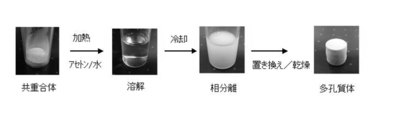
- FIG. 1 is a diagram for explaining a method for producing a porous body of the present invention.
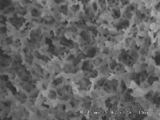
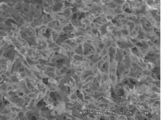
- FIG. 2 is an SEM photograph of the vinyl chloride copolymer porous material obtained in Example 1.
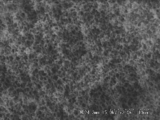
- FIG. 3A is an SEM photograph of the porous body obtained in Example 2 at a cooling temperature of ⁇ 18 ° C.
- FIG. 3B is an SEM photograph of the porous body obtained in Example 2 at a cooling temperature of ⁇ 196 ° C.
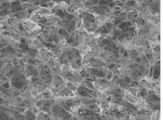
- FIG. 4A is an SEM photograph of the porous material obtained in Example 3 at a vinyl chloride copolymer concentration of 80 mg / mL.
- 4B is an SEM photograph of the porous material obtained in Example 3 at a vinyl chloride copolymer concentration of 120 mg / mL.
- FIG. 1 is a diagram for explaining a method for producing a porous body of the present invention.
- FIG. 2 is an SEM photograph of the vinyl chloride copolymer porous material obtained in Example 1.
- FIG. 3A is an
- FIG. 5 is an SEM photograph of the porous body obtained in Example 4.
- FIG. 6 is an SEM photograph of the porous body obtained in Example 5.
- FIG. 7 is an SEM photograph of the porous body obtained in Example 6.
- FIG. 8A is an SEM photograph of the porous material obtained in Example 7 at a vinyl chloride copolymer concentration of 90 mg / mL.
- FIG. 8B is an SEM photograph of the porous material obtained in Example 7 at a vinyl chloride copolymer concentration of 110 mg / mL.
- FIG. 9A is an SEM photograph of the porous body obtained in Example 8 at a cooling temperature of ⁇ 18 ° C.
- FIG. 9B is an SEM photograph of the porous body obtained in Example 8 at a cooling temperature of ⁇ 196 ° C.
- FIG. 10 is an SEM photograph of the porous body obtained in Example 9.
- FIG. 11 is an IR spectrum of the vinyl chloride / acrylonitrile (VC / AN) copolymer-amidoxime porous material obtained in Example 9.
- FIG. 12 is an SEM photograph of the porous body obtained in Example 10.
- FIG. 13 is an IR spectrum of the vinyl chloride / acrylonitrile (VC / AN) copolymer-amidoxime porous material obtained in Example 10.
- One of the features of the porous body of the present invention is that its thickness is thicker than that of fibers or membranes.
- the shape of the porous body is not limited, but the shortest of the three vertical and horizontal heights of the porous body is referred to as the thickness for convenience.
- the thickness of the porous body of the present invention is, for example, 1 mm or more, preferably 1.5 mm or more, more preferably 2 mm or more.
- the vinyl chloride copolymer is a vinyl chloride monomer as a main component from the viewpoint of excellent chemical resistance, acid resistance, alkali resistance and flame resistance of the porous body of the vinyl chloride copolymer,
- it means a polymer containing 30% by weight to 70% by weight, preferably 40% by weight to 60% by weight, more preferably 45% by weight to 55% by weight.
- the vinyl chloride monomer for example, vinyl chloride, vinylidene chloride and the like are preferable. This is because vinyl chloride and vinylidene chloride are excellent in versatility and handling.
- the vinyl chloride copolymer can contain acrylonitrile as another monomer and a monomer other than acrylonitrile as another component.
- Acrylonitrile can be contained, for example, in an amount of 30 wt% to 70 wt%, preferably 40 wt% to 60 wt%, more preferably 45 wt% to 55 wt%.
- Other components are not limited as long as they can be copolymerized with a vinyl chloride monomer and acrylonitrile, and are monomers other than vinyl chloride monomer and acrylonitrile.
- acrylic acid acrylic acid ester, methacrylic acid, Methacrylic acid ester, acrylamide, methacrylamide, vinyl acetate, vinyl sulfonic acid, vinyl sulfonic acid ester, methallyl sulfonic acid, methallyl sulfonic acid ester, styrene sulfonic acid, styrene sulfonic acid ester, 2-acrylamido-2-methylsulfonic acid And 2-acrylamido-2-methylsulfonic acid salt, and methyl acrylate, vinyl acetate and the like are preferable.
- the other component one or more kinds of monomers can be used.
- the other components can be contained, for example, in the range of 0 wt% to 10 wt%, preferably 0 wt% to 5 wt%, more preferably 0 wt% to 3 wt%.
- the vinyl chloride copolymer can be produced by polymerizing the vinyl chloride monomer, other monomers, and optionally other components, by a polymerization method such as emulsion polymerization, suspension polymerization, or solution polymerization. Of these polymerization methods, emulsion polymerization is preferred from the viewpoints of narrow molecular weight distribution, easy control of molecular weight, and high molecular weight copolymer.
- the molecular weight of the vinyl chloride copolymer is not limited, but the number average molecular weight is, for example, 10,000 to 200,000, preferably 20,000 to 180,000, and more preferably 30,000 to 160,000.
- the vinyl chloride copolymer is heated and dissolved in a solvent (first solvent) to obtain a vinyl chloride copolymer solution.
- This heating temperature is, for example, 30 to 95 ° C., preferably 35 to 90 ° C.
- physical stimulation may be applied. Examples of the physical stimulation include stirring, shaking, ultrasonic treatment, and the like.
- the solvent includes a poor solvent for the vinyl chloride copolymer and a good solvent for the vinyl chloride copolymer.
- the poor solvent for the vinyl chloride copolymer and the good solvent for the vinyl chloride copolymer may each be one or more mixtures.
- the poor solvent means a solvent having a small ability to dissolve the vinyl chloride copolymer. Specifically, it means that 1 g or more of vinyl chloride copolymer is not dissolved in 1 L of the poor solvent, preferably 0.8 g or more, more preferably 0.5 g or more.
- the good solvent means a solvent having a large ability to dissolve the vinyl chloride copolymer.
- the poor solvent for the vinyl chloride copolymer is, for example, one or more selected from the group consisting of water, tetrahydrofuran, 1,4-dioxane, acetonitrile, ethylene glycol, methanol, ethanol, isopropanol, ethylene glycol, and glycerin, Preferably, it is one or more selected from the group consisting of water, tetrahydrofuran, 1,4-dioxane, acetonitrile and ethylene glycol.
- the good solvent for the vinyl chloride copolymer is at least one selected from the group consisting of acetone, dimethyl sulfoxide, dimethylformamide, dimethylacetamide and N-methylpyrrolidone, preferably from dimethylsulfoxide and dimethylformamide.
- One or more selected from the group consisting of Examples of the combination of the poor solvent and the good solvent are acetone, water, and tetrahydrofuran.
- the content of the good solvent is, for example, 15 to 85% by volume, preferably 20 to 80% by volume, more preferably 25 to 75% by volume.
- the poor solvent is a combination of water and a poor solvent other than water (one or more selected from the group consisting of tetrahydrofuran, 1,4-dioxane, acetonitrile, ethylene glycol, methanol, ethanol, isopropanol, ethylene glycol, and glycerin).
- the ratio of water: poor solvent other than water is 5X ⁇ 0.7 ⁇ Y ⁇ 5X ⁇ 0.5 (wherein X is the relative volume of water when the volume of acetone is 1, Y Is a relative volume of a poor solvent other than water when the volume of acetone is 1.
- the combination of the poor solvent and the good solvent is a combination of acetone (good solvent), water and tetrahydrofuran (poor solvent)
- the ratio (volume) of water: tetrahydrofuran is 1: 1.5 to 5 is preferred.
- the ratio of water: tetrahydrofuran is preferably 1: 1.5 to 5.
- the ratio (volume) of acetone: water: tetrahydrofuran is preferably 1: 0.2 to 0.4: 0.4 to 1.4, particularly preferably 1: 0.2: 0.4, 1: 0. .3: 0.9 or 1: 0.4: 1.4.
- the ratio (volume) of water: 1,4-dioxane is preferably 1: 1-8.
- the combination of the poor solvent and the good solvent is a combination of acetone (good solvent), water and 1,4-dioxane (poor solvent), and when the amount of acetone is 1 (volume), : The ratio (volume) of 1,4-dioxane is preferably 1: 1 to 8.
- the concentration of the vinyl chloride copolymer in the vinyl chloride copolymer solution is, for example, 40 to 300 mg / mL, preferably 50 to 200 mg / mL, more preferably 60 to 200 mg / mL.
- the vinyl chloride copolymer solution is then cooled to obtain a formed compact.
- the cooling temperature is, for example, ⁇ 20 to 60 ° C., preferably 15 to 45 ° C., and more preferably 15 to 40 ° C.
- This cooling time is, for example, 1 minute to 24 hours, preferably 1 minute to 1.5 hours, and more preferably 2 minutes to 1 hour.
- the molded body is then immersed in another solvent (second solvent) to replace the solvent (first solvent) with the other solvent (second solvent).
- second solvent another solvent
- a porous body containing a vinyl chloride copolymer as a main component is then immersed in another solvent (second solvent) to replace the solvent (first solvent) with the other solvent (second solvent).
- the other solvent is preferably one or more selected from the group consisting of water, lower alcohols and acetonitrile, and more preferably water, methanol and acetonitrile.
- the lower alcohol include lower alcohols having 1 to 6 carbon atoms such as methanol, ethanol, n-propanol, i-propanol, n-butanol, 2-butanol, i-butanol, t-butanol, n -Pentanol, t-amyl alcohol, n-hexanol.
- the production method of the present invention is, for example, a method for producing a porous body containing a vinyl chloride copolymer as a main component and having a thickness of 1 mm or more,
- the vinyl chloride copolymer is heated at 30 to 95 ° C. and dissolved in a solvent to obtain a vinyl chloride copolymer solution, Cooling the vinyl chloride copolymer solution at ⁇ 20 to 60 ° C.
- the solvent includes a poor solvent for the vinyl chloride copolymer and a good solvent for the vinyl chloride copolymer,
- the poor solvent is one or more selected from the group consisting of water, tetrahydrofuran, 1,4-dioxane, acetonitrile, ethylene glycol, methanol, ethanol, isopropanol, ethylene glycol and glycerin
- the good solvent is at least one selected from the group consisting of acetone, dimethyl sulfoxide, dimethylformamide, dimethylacetamide, and N-methylpyrrolidone.
- the obtained molded body may be dried to obtain a porous body.
- the drying is performed at, for example, 0 to 90 ° C., preferably 0 to 80 ° C.
- the drying is performed, for example, under reduced pressure to normal pressure, preferably under reduced pressure.
- the drying may be performed by freeze drying.
- the porous body of the present invention contains a vinyl chloride copolymer as a main component as described above, the porous body has continuous pores having a pore diameter of 0.1 to 40 ⁇ m, and the skeleton diameter of the pores is The thickness is 0.1 to 20 ⁇ m, and the thickness of the porous body is 1 mm or more.
- a porous body can be used as, for example, a filter or an adsorbent.
- the pore diameter and the skeleton diameter can be obtained from an image taken using a scanning electron microscope.
- the porous body containing a vinyl chloride copolymer as a main component is, for example, 85% by weight or more, preferably 90% by weight or more, more preferably 92% by weight or more, based on the whole raw material polymer of the porous body. It means that the vinyl chloride copolymer occupies.
- Such a porous body is excellent in chemical resistance, acid resistance, alkali resistance and flame retardancy.
- the vinyl chloride copolymer porous body of the present invention is reacted with hydroxylamine to convert a part of the nitrile group of the vinyl chloride copolymer porous body to an amidoxime group.
- An amidoxime-modified porous vinyl chloride copolymer hereinafter sometimes referred to as “vinyl chloride copolymer-amidoxime porous body”.
- the vinyl chloride copolymer porous body is: The vinyl chloride copolymer is heated and dissolved in a solvent to obtain a vinyl chloride copolymer solution. Cooling the vinyl chloride copolymer solution to obtain a formed molded body, The molded body is immersed in another solvent, the solvent is replaced with the other solvent, and a monolithic vinyl chloride copolymer containing a vinyl chloride copolymer as a main component and having a thickness of 1 mm or more.
- the solvent includes a poor solvent for the vinyl chloride copolymer and a good solvent for the vinyl chloride copolymer
- the poor solvent is one or more selected from the group consisting of water, tetrahydrofuran, 1,4-dioxane, acetonitrile, ethylene glycol, methanol, ethanol, isopropanol, ethylene glycol and glycerin
- the good solvent is preferably obtained by a method which is at least one selected from the group consisting of acetone, dimethyl sulfoxide, dimethylformamide, dimethylacetamide and N-methylpyrrolidone.
- the vinyl chloride copolymer porous body is: The vinyl chloride copolymer is heated and dissolved in a solvent to obtain a vinyl chloride copolymer solution. Cooling the vinyl chloride copolymer solution to obtain a formed molded body, The molded body is immersed in another solvent, the solvent is replaced with the other solvent, and a monolithic vinyl chloride copolymer containing a vinyl chloride copolymer as a main component and having a thickness of 1 mm or more.
- the solvent includes a poor solvent for the vinyl chloride copolymer and a good solvent for the vinyl chloride copolymer
- the poor solvent is one or more selected from the group consisting of water, tetrahydrofuran, 1,4-dioxane, acetonitrile, ethylene glycol, methanol, ethanol, isopropanol, ethylene glycol and glycerin
- the good solvent is one or more selected from the group consisting of acetone, dimethyl sulfoxide, dimethylformamide, dimethylacetamide and N-methylpyrrolidone; When the solvent is 100% by volume, the content of the good solvent is preferably 15 to 85% by volume, more preferably 20 to 80% by volume, and further preferably 25 to 75% by volume.
- the vinyl chloride copolymer porous body is: The vinyl chloride copolymer is heated and dissolved in a solvent to obtain a vinyl chloride copolymer solution. Cooling the vinyl chloride copolymer solution to obtain a formed molded body, The molded body is immersed in another solvent, the solvent is replaced with the other solvent, and a monolithic vinyl chloride copolymer containing a vinyl chloride copolymer as a main component and having a thickness of 1 mm or more.
- the solvent includes a poor solvent for the vinyl chloride copolymer and a good solvent for the vinyl chloride copolymer,
- the poor solvent is water and tetrahydrofuran
- the good solvent is acetone;
- the ratio (volume) of water: tetrahydrofuran is 1: 1.5 to 5, preferably the ratio (volume) of acetone: water: tetrahydrofuran is 1: 0.2 to 0.4: 0.4 to 1. 4 is obtained.
- the vinyl chloride copolymer porous body is: The vinyl chloride copolymer is heated and dissolved in a solvent to obtain a vinyl chloride copolymer solution. Cooling the vinyl chloride copolymer solution to obtain a formed molded body, The molded body is immersed in another solvent, the solvent is replaced with the other solvent, and a monolithic vinyl chloride copolymer containing a vinyl chloride copolymer as a main component and having a thickness of 1 mm or more.
- the solvent includes a poor solvent for the vinyl chloride copolymer and a good solvent for the vinyl chloride copolymer,
- the poor solvent is water and 1,4-dioxane,
- the good solvent is acetone;
- the ratio (volume) of water: 1,4-dioxane is obtained by a method having a ratio of 1: 1-8.
- the amidoxime-modified vinyl chloride copolymer porous body of the present invention is, for example, 2 to 98 mol%, preferably 3 to 97 mol%, more preferably nitrile groups of the vinyl chloride copolymer porous body.
- the porous body of the amidoxime-modified vinyl chloride copolymer of the present invention has pores having a pore diameter of 0.1 to 40 ⁇ m, the pore skeleton diameter is 0.1 to 20 ⁇ m, and the thickness of the porous body Is preferably 1 mm or more.
- the amidoxime-modified vinyl chloride copolymer porous material of the present invention preferably satisfies the following formula in the infrared absorption spectrum.
- the peak of infrared absorption spectrum at 2262 cm ⁇ 1 is the peak of the nitrile group of the vinyl chloride copolymer
- the peak of infrared absorption spectrum at 1652 cm ⁇ 1 is that of the vinyl chloride copolymer modified with amidoxime. It is a peak of an amidoxime group. Therefore, (B) / (A) represents the relative value of the ratio of the nitrile group and the amidoxime group of the vinyl chloride copolymer porous polymer modified with amidoxime. A larger value means a higher degree of amidoxime modification.
- (B) / (A) is 1.2 or more and 800 or less.
- (A) means the peak height of the infrared absorption spectrum of the porous body of the vinyl chloride copolymer modified with amidoxime at 2262 cm ⁇ 1 ;
- (B) means the peak height of the infrared absorption spectrum of the porous body of the vinyl chloride copolymer modified with amidoxime at 1652 cm ⁇ 1 .
- the (B) / (A) is more preferably 1.5 ⁇ (B) / (A) ⁇ 500.
- the amidoxime-modified vinyl chloride copolymer porous material of the present invention has a metal ion, preferably copper (for example, copper (II) ion), iron (for example, iron (II) ion), nickel (for example, nickel (II)). ) Ions), vanadium (for example, vanadium (V) ions), indium, gallium, mercury, silver, lead, uranium, plutonium, cesium, barium, lanthanum, thallium, strontium, and other metal ions, and adsorb iodine ions and iodine.
- a metal ion preferably copper (for example, copper (II) ion), iron (for example, iron (II) ion), nickel (for example, nickel (II)).
- Ions preferably copper (for example, copper (II) ion), iron (for example, iron (II) ion), nickel (for example, nickel (II)).
- the amount of adsorption of metal ions and iodine ions per g of the porous amidoxime-modified vinyl chloride copolymer of the present invention is, for example, 0.2 to 10 (ion mmol / g of porous body), preferably 1 to 7 (ion mmol / g of porous material).
- the amount of iodine adsorbed is, for example, 0.2 to 10 (iodine mmol / g of porous body), preferably 1 to 7 (iodine mmol / g of porous body).
- a metal ion preferably copper (for example, copper (II) ion), iron (for example, iron (II)), packed in a column with the amidoxime-modified vinyl chloride copolymer porous body of the present invention.
- Ions preferably copper (for example, copper (II) ion), iron (for example, iron (II)
- Ions nickel (eg, nickel (II) ions), vanadium (eg, vanadium (V) ions), indium, gallium, mercury, silver, lead, uranium, plutonium, cesium, barium, lanthanum, thallium and strontium
- columns for adsorbing ions of selected metals and iodine ions and iodine are also provided.
- the present invention uses the amidoxime-modified vinyl chloride copolymer porous body of the present invention to form metal ions, preferably copper (for example, copper (II) ions), iron (for example, iron (II) ions).
- metal ions preferably copper (for example, copper (II) ions), iron (for example, iron (II) ions).
- Metal adsorption method for adsorbing metal ions and iodine ions and iodine preferably copper (for example, copper (II) ions), iron (for example, iron (II) ions).
- the amount of adsorption of metal ions and iodine ions per g of the amidoxime-modified vinyl chloride copolymer porous material of the present invention is, for example, 0.05 to 10 (ion mmol / g of porous material), preferably 0.1 to 8 (ion mmol / g of porous material). Further, the amount of iodine adsorbed is, for example, 0.05 to 10 (mmol of iodine / g of porous body), preferably 0.1 to 8 (mmol of iodine / g of porous body).
- the method for producing the amidoxime-modified vinyl chloride copolymer porous body of the present invention is obtained by reacting the vinyl chloride copolymer porous body of the present invention with hydroxylamine, thereby producing the vinyl chloride copolymer porous body.
- hydroxylamine is used, for example, 0.05 to 10 equivalents, preferably 0.1 to 6 equivalents, relative to the nitrile group in the vinyl chloride copolymer porous body.
- hydroxylamine is in the form of a salt, it is preferably used after neutralizing it to a free amine in this step.
- This step can be performed by mixing the vinyl chloride copolymer and hydroxylamine in a solvent and heating at 40 to 100 ° C. for 1 to 24 hours, for example.
- a solvent alcohols such as methanol and ethanol can be used.
- the obtained vinyl chloride copolymer-amidoxime porous body may be washed by shaking in alcohol such as water, methanol, ethanol or the like. Further, after the heating and / or after the washing, the obtained vinyl chloride copolymer-amidoxime porous body may be dried at a temperature such as normal temperature under normal pressure or vacuum.
- the porous body of the amidoxime-modified vinyl chloride copolymer of the present invention has, for example, pores having a pore diameter of 0.1 to 40 ⁇ m, and the pore skeleton diameter is 0.1 to 20 ⁇ m. Is 1 mm or more in thickness.
- the pore diameter is preferably 0.2 to 35 ⁇ m, more preferably 0.3 to 30 ⁇ m.
- the skeleton diameter of the pores is preferably 0.15 to 18 ⁇ m, more preferably 0.2 to 15 ⁇ m.
- the thickness of the porous body is preferably 1.2 mm or more, and more preferably 1.5 mm or more.
- the vinyl chloride copolymer-amidoxime porous body preferably has pores having a pore diameter of 0.1 to 40 ⁇ m, the skeleton diameter of the pores is 0.1 to 20 ⁇ m, and the thickness of the porous body is 1 mm or more.
- the pore diameter is preferably 0.2 to 35 ⁇ m, more preferably 0.3 to 30 ⁇ m.
- the skeleton diameter of the pores is preferably 0.15 to 18 ⁇ m, more preferably 0.2 to 15 ⁇ m.
- the thickness of the porous body is preferably 1.2 mm or more, and more preferably 1.5 mm or more.
- Such a porous body can be used as, for example, a filter or an adsorbent.
- the pore diameter and the skeleton diameter can be obtained from an image taken using a scanning electron microscope.
- VDC Vinylidene chloride
- VC Vinyl chloride AN: Acrylonitrile
- THF Tetrahydrofuran
- DMF Dimethylformamide
- a vinylidene chloride / acrylonitrile copolymer having a number average molecular weight of 140,000 and a vinyl chloride / acrylonitrile copolymer having a number of 43,000 were produced as follows. The acrylonitrile content and number average molecular weight of these copolymers were measured as follows.
- the polymerization temperature is maintained at 55 ° C., 40.0 parts by weight of acrylonitrile, 43.0 parts by weight of vinylidene chloride, 0.5 parts by weight of sodium styrenesulfonate dissolved in 15 parts by weight of ion-exchanged water, ion exchange 0.05 parts by weight of ammonium persulfate dissolved in 8 parts by weight of water was added to the polymerization reaction can over 6 hours to obtain a polymer latex.
- the final reaction liquid volume was adjusted to 10L.
- the polymer latex was salted out, heat-treated, dehydrated and dried by a general method to obtain a vinylidene chloride / acrylonitrile copolymer.
- the reaction rate was 99.3% by weight
- the vinylidene chloride was 48.0% by weight
- the acrylonitrile content was 51.5% by weight
- the number average molecular weight was 140,000.
- the polymerization temperature was maintained at 50 ° C., and 42.0 parts by weight of acrylonitrile, 0.5 part by weight of sodium styrenesulfonate dissolved in 15 parts by weight of ion-exchanged water, and excess solution dissolved in 20 parts by weight of ion-exchanged water. 0.27 parts by weight of ammonium sulfate was added to the polymerization reaction can over 4 hours and 30 minutes to obtain a polymer latex. The final reaction liquid volume was adjusted to 10L.
- the polymer latex was salted out, heat-treated, dehydrated and dried by a general method to obtain a vinyl chloride / acrylonitrile copolymer. The reaction rate was 92.3% by weight, vinyl chloride was 50.1% by weight, the acrylonitrile content was 49.4% by weight, and the number average molecular weight was 43,000.
- This molded body was immersed in methanol (another solvent) and shaken at 20 ° C. for 24 hours in a bioshaker. During the 24 hours, methanol was exchanged 3 times to replace the solvent acetone / water / THF with methanol. Thereafter, vacuum drying was performed at room temperature for 6 hours, and methanol was removed to obtain a porous VDC / AN copolymer (dimensions: approximately 8.5 mm in diameter and 7.0 mm in thickness).
- VDC / AN copolymer porous body was subjected to SEM sputtering at a discharge current of 15.0 mA for 150 s and then subjected to SEM observation at an applied voltage of 15.0 kV to 25.0 kV.
- FIG. 2 shows an SEM photograph of the obtained VDC / AN copolymer porous body.
- the VDC / AN copolymer porous body is a porous body having a co-continuous structure having a skeleton diameter of 0.42 to 1.14 ⁇ m and a pore diameter of 0.57 to 1.43 ⁇ m. It could be confirmed. In addition, it can be estimated from the fact that the pores have the same or similar shape in the SEM photographs of a plurality of porous body samples.
- a porous material was obtained in the same manner as in Example 1 except that the cooling temperature was changed from 20 ° C. to ⁇ 18 ° C. and ⁇ 196 ° C.
- the cooling temperature was changed from 20 ° C. to ⁇ 18 ° C. and ⁇ 196 ° C.
- the skeleton diameter is 0.17 to 0.29 ⁇ m and the pore diameter is 0.29 to 0.86 ⁇ m, both of which are 100% by weight based on the raw material polymer of the porous body).
- FIG. 3A shows an SEM photograph of the porous body obtained at a cooling temperature of ⁇ 18 ° C.
- FIG. 3B shows an SEM photograph of the porous body obtained at a cooling temperature of ⁇ 196 ° C. Moreover, it has confirmed that the frame
- a porous material was obtained in the same manner as in Example 1 except that the VDC / AN concentration was changed to 80 mg / mL and 120 mg / mL and the cooling temperature was changed from 20 ° C. to ⁇ 18 ° C.
- Dimensions when the AN concentration is 80 mg / ml a substantially cylindrical shape with a diameter of 8.5 mm and a thickness of 7.0 mm, a skeleton diameter of 0.57 to 1.43 ⁇ m and a pore diameter of 0.86 to 2.23 ⁇ m; VDC / AN concentration of 120 mg /
- Dimensions in the case of ml a substantially cylindrical shape with a diameter of 9.0 mm and a thickness of 8.5 mm, a skeleton diameter of 0.23 to 0.42 ⁇ m and a pore diameter of 0.43 to 1.14 ⁇ m, both of which are raw material polymers for a porous body 100% by weight is VDC / AN).
- FIG. 4A shows an SEM photograph of the porous body obtained at a VDC / AN concentration of 80 mg / mL
- FIG. 4B shows an SEM photograph of the porous body obtained at a VDC / AN concentration of 120 mg / mL.
- FIG. 4 it was confirmed that the higher the polymer concentration, the smaller the skeleton diameter of the resulting porous body.
- An SEM photograph of the obtained porous body is shown in FIG.
- a porous body was obtained in the same manner as in Example 4 (substantially cylindrical with a diameter of 10 mm and a thickness of 7.5 mm, a skeleton diameter of 0.85 to 6.00 ⁇ m, a pore diameter of 4.27 to 13.68 ⁇ m, and a porous body. 100% by weight based on the starting polymer of VC / AN). An SEM photograph of the obtained porous body is shown in FIG.
- a porous material was obtained in the same manner as in Example 4 except that the VC / AN concentration was changed to 90 mg / mL and 110 mg / mL (dimension when the VC / AN concentration was 90 mg / ml: diameter 8.
- FIG. 8A shows an SEM photograph of the porous body obtained at a VC / AN concentration of 90 mg / mL
- FIG. 8B shows an SEM photograph of the porous body obtained at a VC / AN concentration of 110 mg / mL.
- Example 4 Except that the cooling temperature was changed from 20 ° C. to ⁇ 18 ° C. and ⁇ 196 ° C., it was carried out in the same manner as in Example 4 to obtain a porous material (dimension when cooling temperature was ⁇ 18 ° C .: diameter 9.5 mm, A substantially cylindrical shape with a thickness of 9.0 mm, a skeleton diameter of 0.51 to 1.28 ⁇ m, and a pore diameter of 1.28 to 3.85 ⁇ m; dimensions when the cooling temperature is ⁇ 196 ° C .: a diameter of 9.0 mm and a thickness of 8.0 mm (Cylindrical shape, skeleton diameter is 0.68 to 3.85 ⁇ m and pore diameter is 4.27 to 11.11 ⁇ m, both of which are 100% by weight of VC / AN with respect to the raw material polymer of the porous body).
- FIG. 9 (a) An SEM photograph of the porous body obtained at a cooling temperature of ⁇ 18 ° C. is shown in FIG. 9 (a), and an SEM photograph of the porous body obtained at a cooling temperature of ⁇ 196 ° C. is shown in FIG. 9 (b). As shown in FIG. 9, it was confirmed that the higher the cooling temperature, the thicker the skeleton diameter of the porous body obtained.
- Sodium hydroxide (0.120 g, 3 mmol) was added to a solution of hydroxylamine hydrochloride (0.209 g, 3 mmol) in methanol (15 mL) to neutralize the hydrochloride.
- the precipitated sodium chloride was removed by filtration, and methanol (15 mL) was added to the obtained filtrate to prepare a 0.10 M hydroxylamine methanol solution.
- a porous material is obtained in the same manner as in Example 1 except that the cooling temperature is changed from 20 ° C. to 4 ° C.
- the VC / AN copolymer porous material (0. 108 g, containing 0.1 mol / g of CN groups, dimensions: a substantially cylindrical shape with a diameter of 9.0 mm and a thickness of 6.0 mm).
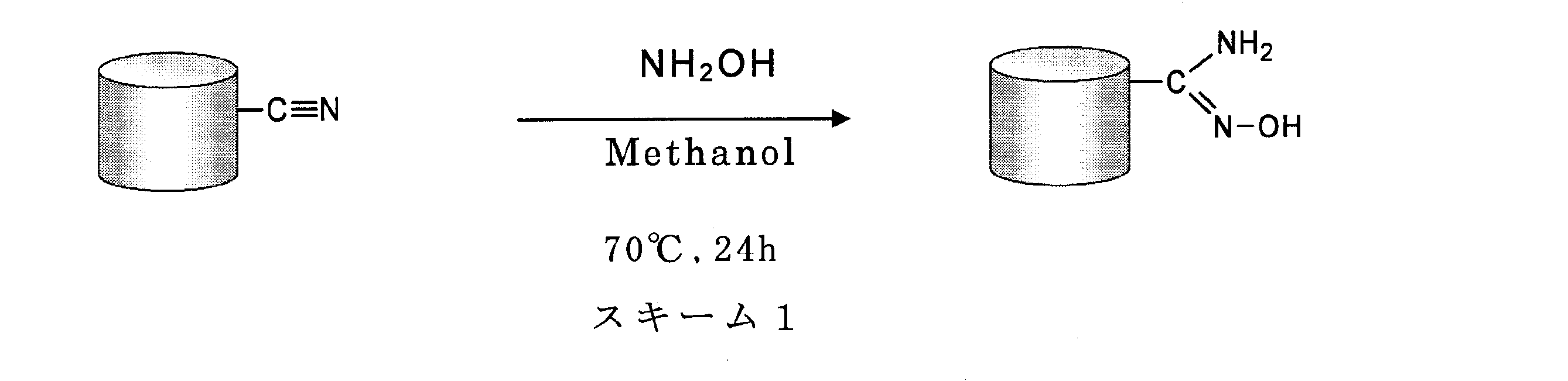
- This mixture was heated to reflux at 70 ° C. for 24 hours to amidoxime the surface of the porous body and the nitrile group in the vicinity of the surface (see Scheme 1). After heating, the obtained porous body was washed by shaking in water (large excess) for 24 hours.
- the porous body was washed by shaking in methanol (large excess) for 24 hours. Finally, the porous body was dried at room temperature under vacuum to obtain a VC / AN copolymer-amidoxime porous body. The introduction rate of the amidoxime group was determined from the results of elemental analysis.
- FIG. 10 An SEM photograph of the obtained porous body is shown in FIG.
- the VC / AN copolymer-amidoxime porous body is also a porous body having a co-continuous structure having a skeleton diameter of 0.85 to 3.85 ⁇ m and a pore diameter of 1.71 to 12.82 ⁇ m. I was able to confirm.
- the pores having a co-continuous structure could be inferred from the fact that the pore shapes are the same or similar in SEM photographs of a plurality of VC / AN copolymer-amidoxime porous body samples.
- Example 9 The same as Example 9 except that a methanol solution of 0.6M hydroxylamine (6 equivalents relative to the nitrile group in the porous VC / AN copolymer) was used instead of the methanol solution of 0.10M hydroxylamine.
- a VC / AN copolymer-amidoxime porous body was obtained (a substantially cylindrical shape having a diameter of 9.0 mm and a thickness of 8.0 mm, a skeleton diameter of 1.28 to 4.27 ⁇ m, and a pore diameter of 2.14 to 12. 0 ⁇ m).
- An SEM photograph of the obtained porous body is shown in FIG.
- FIG. 13 shows an IR (infrared absorption spectrum) spectrum of the obtained porous material.
- (B) / (A) of the obtained VC / AN copolymer-amidoxime porous material was 430.
- a VC / AN copolymer-amidoxime porous material was obtained in the same manner as in Example 9 except that the reaction time was 3 hours instead of 24 hours (a substantially circular shape having a diameter of 9.0 mm and a thickness of 8.0 mm). Columnar).
- a VC / AN copolymer-amidoxime porous material was obtained in the same manner as in Example 10 except that the reaction time was 3 hours instead of 24 hours (a substantially circular shape having a diameter of 9.0 mm and a thickness of 8.0 mm). Columnar).
- Example 9 except that a methanol solution of 0.01M hydroxylamine (0.1 equivalent to the nitrile group in the porous VC / AN copolymer) was used instead of the methanol solution of 0.10M hydroxylamine.
- a VC / AN copolymer-amidoxime porous material was obtained (substantially cylindrical shape with a diameter of 9.0 mm and a thickness of 8.0 mm).
- a VC / AN copolymer-amidoxime porous material was obtained in the same manner as in Example 13 except that the reaction time was 3 hours instead of 24 hours (a substantially circular shape having a diameter of 9.0 mm and a thickness of 8.0 mm). Columnar).
- a 1.2 M hydroxylamine methanol solution (0.1 equivalent to the nitrile group in the porous VC / AN copolymer) was used, and the reaction time was 24 hours.
- a VC / AN copolymer-amidoxime porous material was obtained (substantially cylindrical with a diameter of 9.0 mm and a thickness of 8.0 mm) in the same manner as in Example 9, except that the time was 6 hours.
- C / N by elemental analysis of the obtained VC / AN copolymer amidoxime porous material was 2.57.
- Table 3 shows the elemental analysis of the VC / AN copolymer-amidoxime porous material obtained in Examples 9 to 14.
- composition formula of the VC / AN copolymer-amidoxime porous material obtained from the results of elemental analysis is expressed as C 4.71 H a N x Cl y O z
- the VC / AN copolymer weight is calculated using the following formula:
- the amidoximation rate indicating the degree to which the nitrile group in the coalesced porous material was amidoxime was calculated.
- Amidoximation rate (x ⁇ 1) ⁇ 100 (%) x is x of N x in the formula obtained by the elemental analysis.
- the concentration change of the copper (II) sulfate pentahydrate aqueous solution was calculated from the obtained absorbance value, and the VC / AN copolymer was calculated from the difference in concentration of the copper (II) sulfate pentahydrate aqueous solution before and after stirring. -The adsorption amount of copper ion (II) by the amidoxime porous material was calculated.
- Example 12 instead of the VC / AN copolymer-amidoxime porous material obtained in Example 11, the VC / AN copolymer-amidoxime porous material obtained in Example 12 was used. Similarly, the change in concentration of the aqueous copper (II) sulfate pentahydrate solution after stirring was calculated. The adsorption amount of copper ion (II) by the vinyl chloride copolymer-amidoxime porous material was calculated from the difference in concentration of the copper (II) sulfate pentahydrate aqueous solution before and after stirring.
- the adsorption amount of copper ion (II) by the vinyl chloride copolymer-amidoxime porous material was calculated from the difference in concentration of the copper (II) sulfate pentahydrate aqueous solution before and after stirring. This example is referred to as Reference Example 1.
- Table 5 shows the results obtained in (a) to (c).
- the VC / AN copolymer-amidoxime porous material of the present invention has the ability to adsorb copper ions (II).
- the acetone / water / THF (1 / 0.3 / 0.9, volume ratio) mixed solvent was changed to an acetone / water / 1,4-dioxane (1 / 0.2 / 0.4, volume ratio) mixed solvent.
- the porous body was obtained in the same manner as in Example 4 except for the above.
- the VC / AN copolymer-amidoxime porous material obtained by the method of the present invention is excellent in chemical resistance, acid resistance, alkali resistance and flame resistance, has continuous pores, and has high metal ion adsorption ability. There is a possibility that it can be applied as a filter, an adsorbent, etc.
Landscapes
- Chemical & Material Sciences (AREA)
- Chemical Kinetics & Catalysis (AREA)
- Organic Chemistry (AREA)
- Medicinal Chemistry (AREA)
- Polymers & Plastics (AREA)
- Health & Medical Sciences (AREA)
- Analytical Chemistry (AREA)
- Engineering & Computer Science (AREA)
- Materials Engineering (AREA)
- Nanotechnology (AREA)
- General Chemical & Material Sciences (AREA)
- Manufacture Of Porous Articles, And Recovery And Treatment Of Waste Products (AREA)
- Addition Polymer Or Copolymer, Post-Treatments, Or Chemical Modifications (AREA)
Abstract
Description
前記方法は、
塩化ビニル系共重合体を加熱して溶媒(第1の溶媒)に溶解させて塩化ビニル系共重合体溶液を得、
前記塩化ビニル系共重合体溶液を冷却して析出した成形体を得、
前記成形体を別の溶媒(第2の溶媒)に浸漬させて、前記溶媒を前記別の溶媒と置換させ、厚みが1mm以上であるモノリス状の、塩化ビニル系共重合体を含む塩化ビニル系共重合体多孔質体を得る工程を含み、
前記溶媒が、塩化ビニル系共重合体に対する貧溶媒と、塩化ビニル系共重合体に対する良溶媒とを含み、
前記貧溶媒は、水、テトラヒドロフラン、1,4-ジオキサン、アセトニトリル、エチレングリコール、メタノール、エタノール、イソプロパノール、エチレングリコールおよびグリセリンからなる群から選択される1以上であり、
前記良溶媒は、アセトン、ジメチルスルホキシド、ジメチルホルムアミド、ジメチルアセトアミドおよびN-メチルピロリドンからなる群から選択される1以上である。
前記塩化ビニル系共重合体を30~95℃で加熱して溶媒に溶解させて塩化ビニル系共重合体溶液を得、
前記塩化ビニル系共重合体溶液を-20~60℃で1分~24時間冷却して析出した成形体を得、
前記成形体を別の溶媒に浸漬させて、前記溶媒を前記別の溶媒と置換させ、主成分として塩化ビニル系共重合体を含む多孔質体を得る工程を含み、
前記溶媒が、塩化ビニル系共重合体に対する貧溶媒と、塩化ビニル系共重合体に対する良溶媒とを含み、
前記貧溶媒は、水、テトラヒドロフラン、1,4-ジオキサン、アセトニトリル、エチレングリコール、メタノール、エタノール、イソプロパノール、エチレングリコールおよびグリセリンからなる群から選択される1以上であり、
前記良溶媒は、アセトン、ジメチルスルホキシド、ジメチルホルムアミド、ジメチルアセトアミドおよびN-メチルピロリドンからなる群から選択される1以上である。
塩化ビニル系共重合体を加熱して溶媒に溶解させて塩化ビニル系共重合体溶液を得、
前記塩化ビニル系共重合体溶液を冷却して析出した成形体を得、
前記成形体を別の溶媒に浸漬させて、前記溶媒を前記別の溶媒と置換させ、厚みが1mm以上であるモノリス状の、主成分として塩化ビニル系共重合体を含む塩化ビニル系共重合体多孔質体を得る工程を含み、
前記溶媒が、塩化ビニル系共重合体に対する貧溶媒と、塩化ビニル系共重合体に対する良溶媒とを含み、
前記貧溶媒は、水、テトラヒドロフラン、1,4-ジオキサン、アセトニトリル、エチレングリコール、メタノール、エタノール、イソプロパノール、エチレングリコールおよびグリセリンからなる群から選択される1以上であり、
前記良溶媒は、アセトン、ジメチルスルホキシド、ジメチルホルムアミド、ジメチルアセトアミドおよびN-メチルピロリドンからなる群から選択される1以上である方法により得られるのが好ましい。
塩化ビニル系共重合体を加熱して溶媒に溶解させて塩化ビニル系共重合体溶液を得、
前記塩化ビニル系共重合体溶液を冷却して析出した成形体を得、
前記成形体を別の溶媒に浸漬させて、前記溶媒を前記別の溶媒と置換させ、厚みが1mm以上であるモノリス状の、主成分として塩化ビニル系共重合体を含む塩化ビニル系共重合体多孔質体を得る工程を含み、
前記溶媒が、塩化ビニル系共重合体に対する貧溶媒と、塩化ビニル系共重合体に対する良溶媒とを含み、
前記貧溶媒は、水、テトラヒドロフラン、1,4-ジオキサン、アセトニトリル、エチレングリコール、メタノール、エタノール、イソプロパノール、エチレングリコールおよびグリセリンからなる群から選択される1以上であり、
前記良溶媒は、アセトン、ジメチルスルホキシド、ジメチルホルムアミド、ジメチルアセトアミドおよびN-メチルピロリドンからなる群から選択される1以上であり、
前記溶媒を100体積%とする場合、前記良溶媒の含有量は、好ましくは15~85体積%、より好ましくは20~80体積%、さらに好ましくは25~75体積%である方法により得られる。
塩化ビニル系共重合体を加熱して溶媒に溶解させて塩化ビニル系共重合体溶液を得、
前記塩化ビニル系共重合体溶液を冷却して析出した成形体を得、
前記成形体を別の溶媒に浸漬させて、前記溶媒を前記別の溶媒と置換させ、厚みが1mm以上であるモノリス状の、主成分として塩化ビニル系共重合体を含む塩化ビニル系共重合体多孔質体を得る工程を含み、
前記溶媒が、塩化ビニル系共重合体に対する貧溶媒と、塩化ビニル系共重合体に対する良溶媒とを含み、
前記貧溶媒は、水とテトラヒドロフランであり、
前記良溶媒は、アセトンであり、
水:テトラヒドロフランの割合(容積)は、1:1.5~5であり、好ましくはアセトン:水:テトラヒドロフランの割合(容積)は、1:0.2~0.4:0.4~1.4である方法により得られる。
塩化ビニル系共重合体を加熱して溶媒に溶解させて塩化ビニル系共重合体溶液を得、
前記塩化ビニル系共重合体溶液を冷却して析出した成形体を得、
前記成形体を別の溶媒に浸漬させて、前記溶媒を前記別の溶媒と置換させ、厚みが1mm以上であるモノリス状の、主成分として塩化ビニル系共重合体を含む塩化ビニル系共重合体多孔質体を得る工程を含み、
前記溶媒が、塩化ビニル系共重合体に対する貧溶媒と、塩化ビニル系共重合体に対する良溶媒とを含み、
前記貧溶媒は、水と1,4-ジオキサンであり、
前記良溶媒は、アセトンであり、
水:1,4-ジオキサンの割合(容積)は、1:1~8である方法により得られる。
(A)は、2262cm-1におけるアミドキシム修飾された塩化ビニル系共重合体多孔質体の赤外吸収スペクトルのピーク高さを意味し、
(B)は、1652cm-1におけるアミドキシム修飾された塩化ビニル系共重合体多孔質体の赤外吸収スペクトルのピーク高さを意味する。
前記(B)/(A)は、1.5≦(B)/(A)≦500がより好ましい。
記塩化ビニル系共重合体-アミドキシム多孔質体は、好ましくは、孔径0.1~40μmの孔を有し、前記孔の骨格径が0.1~20μmであり、前記多孔質体の厚みが1mm以上である。前記孔径は、好ましくは、0.2~35μmであり、より好ましくは0.3~30μmである。また、前記孔の骨格径は、好ましくは、0.15~18μmであり、より好ましくは0.2~15μmである。また、前記多孔質体の厚みは、好ましくは1.2mm以上であり、より好ましくは1.5mm以上である。
本明細書の記載において、以下の略語を使用する。
VDC:塩化ビニリデン
VC:塩化ビニル
AN:アクリロニトリル
THF:テトラヒドロフラン
DMF:ジメチルホルムアミド
走査型電子顕微鏡:日立S-3000N(株式会社日立ハイテクノロジーズ製)
BET:マイクロメリティックス トライスター3000(島津製作所製)
ICP発光分析:商品名:ICPS-7510(島津製作所製)
赤外分光計:商品名:Spectrum One FT-IRフーリエ変換赤外分光分析装置(株式会社パーキンエルマージャポン製)
本明細書において孔径および骨格径は、走査電子顕微鏡(SEM)を用いて撮影した画像より求めた。
(株)ジェイ・サイエンス・ラボ製CHNコーダJM10を用いて重合体中の窒素含有量を測定し、この窒素分をアクリロニトリル由来の窒素分とし、重合体中のアクリロニトリル含有量を計算した。
トーソー(株)製GPC装置HLC-8120GPCを使用し、溶媒にDMF、標準資料にポリスチレンを使用し、平均分子量を測定した。
容量14Lの攪拌機付き重合反応缶にドデシル硫酸ナトリウム1.1重量部、硫酸第一鉄(FeSO4・7H2O)0.002重量部、硫酸0.25重量部、酸性亜硫酸ナトリウム0.76重量部、2-メルカプトエタノール0.03重量部、イオン交換水(pH=5.5)185重量部、アクリロニトリル12.5重量部、塩化ビニリデン5.0重量部を仕込み、55℃に昇温した。攪拌を実施しながら、重合温度を55℃に保ち、アクリロニトリル40.0重量部、塩化ビニリデン43.0重量部、イオン交換水15重量部に溶解したスチレンスルホン酸ナトリウム0.5重量部、イオン交換水8重量部に溶解した過硫酸アンモニウム0.05重量部を6時間掛けて重合反応缶に添加し、重合体ラテックスを得た。最終反応液量は10Lとなるように調整をした。重合体ラテックスを一般的な方法により塩析、熱処理、脱水、乾燥を行い、塩化ビニリデン/アクリロニトリル系共重合体を得た。反応率99.3重量%で塩化ビニリデン48.0重量%、アクリロニトリル含有量は51.5重量%、数平均分子量は140,000であった。
容量14Lの攪拌機付き重合反応缶にドデシル硫酸ナトリウム0.9重量部、硫酸第一鉄(FeSO4・7H2O)0.001重量部、硫酸0.25重量部、酸性亜硫酸ナトリウム1.0重量部、イオン交換水(pH=5.5)170重量部、アクリロニトリル4.5重量部、塩化ビニル54.3重量部を仕込み、50℃に昇温した。攪拌を実施しながら、重合温度を50℃に保ち、アクリロニトリル42.0重量部、イオン交換水15重量部に溶解したスチレンスルホン酸ナトリウム0.5重量部、イオン交換水20重量部に溶解した過硫酸アンモニウム0.27重量部を4時間30分掛けて重合反応缶に添加し、重合体ラテックスを得た。最終反応液量は10Lとなるように調整をした。重合体ラテックスを一般的な方法により塩析、熱処理、脱水、乾燥を行い、塩化ビニル/アクリロニトリル系共重合体を得た。反応率92.3重量%で塩化ビニル50.1重量%、アクリロニトリル含有量は49.4重量%、数平均分子量は43,000であった。
実施例において得られた孔質体について、サンプル脱ガス装置を用い、窒素気流下60℃で40分間脱気した後、BET3点法による比表面積測定を行った。
得られたVDC/AN共重合体多孔質体について、15.0mAの放電電流で150sスパッタリングを行った後、15.0kVから25.0kVの印加電圧でSEM観察を行った。
アセトン/水/THF(1/0.3/0.9、体積割合)混合溶媒の割合を表に示す割合に変更した以外は、実施例1と同様にして行った。表1中に、40℃で攪拌した後の状態と、冷却後の混合物の状態を示した。

アセトン/水/THF(1/0.3/0.9、体積割合)混合溶媒の割合を表に示す割合に変更した以外は、実施例4と同様にして行った。表2中に、40℃で攪拌した後の状態と、冷却後の混合物の状態を示した。

得られた多孔質体のIR(赤外吸収スペクトル)スペクトルにより、ニトリル基由来のピークが減少し、代わりにアミドキシム由来のピークが出現したことからも、アミドキシム化が進行したことを確認した(図11参照)。(A)は、2262cm-1における塩化ビニル系共重合体-アミドキシム多孔質体の赤外吸収スペクトルのピーク高さを意味し、(B)は、1652cm-1におけるVC/AN共重合体-アミドキシム多孔質体の赤外吸収スペクトルのピーク高さを意味する場合、得られたVC/AN共重合体-アミドキシム多孔質体の(B)/(A)は、3.25であった。

アミドキシム化率=(x-1)×100(%)
xは、前記元素分析により得られた式におけるNxのxである。

銅イオン(II)吸着量の測定
(a)実施例11で得たVC/AN共重合体-アミドキシム多孔質体(25mg)を硫酸銅(II)五水和物水溶液(10mmol/L、10mL、pH1(塩酸0.1M溶液)、pH3(フタル酸カリウム塩緩衝液)およびpH5(0.1M 酢酸塩緩衝液)中で24時間室温で攪拌した。攪拌後の溶液の765nmにおける吸光度を測定した。得られた吸光度の値から、硫酸銅(II)五水和物水溶液の濃度変化を算出した。攪拌前後の硫酸銅(II)五水和物水溶液の濃度の差から、VC/AN共重合体-アミドキシム多孔質体による銅イオン(II)の吸着量を算出した。

Claims (23)
- 主成分として塩化ビニル系共重合体を含む塩化ビニル系共重合体多孔質体であって、孔径0.1~40μmの連続孔を有し、孔の骨格径が0.1~20μmであり、厚みが1mm以上である塩化ビニル系共重合体多孔質体。
- 塩化ビニル系共重合体が、塩化ビニル系モノマー70~30重量部、アクリロニトリル30~70重量部とを含有する請求項1に記載の塩化ビニル系共重合体多孔質体。
- 前記塩化ビニル系モノマーとアクリロニトリルと共重合可能なビニル系モノマーを0重量部より多く、10重量部以下、さらに含有する請求項2に記載の塩化ビニル系共重合体多孔質体。
- 前記塩化ビニル系モノマーが、塩化ビニルまたは塩化ビニリデンである請求項1~3のいずれかに記載の塩化ビニル系共重合体多孔質体。
- 請求項1~4のいずれかに記載の多孔質体に、ヒドロキシルアミンを反応させ、前記塩化ビニル系共重合体多孔質体のニトリル基の一部をアミドキシム基へ変換することにより得られた、アミドキシム修飾された塩化ビニル系共重合体多孔質体。
- 請求項1~4のいずれかに記載の塩化ビニル系共重合体多孔質体が、
塩化ビニル系共重合体を加熱して溶媒に溶解させて塩化ビニル系共重合体溶液を得、
前記塩化ビニル系共重合体溶液を冷却して析出した成形体を得、
前記成形体を別の溶媒に浸漬させて、前記溶媒を前記別の溶媒と置換させ、厚みが1mm以上であるモノリス状の、主成分として塩化ビニル系共重合体を含む塩化ビニル系共重合体多孔質体を得る工程を含み、
前記溶媒が、塩化ビニル系共重合体に対する貧溶媒と、塩化ビニル系共重合体に対する良溶媒とを含み、
前記貧溶媒は、水、テトラヒドロフラン、1,4-ジオキサン、アセトニトリル、エチレングリコール、メタノール、エタノール、イソプロパノール、エチレングリコールおよびグリセリンからなる群から選択される1以上であり、
前記良溶媒は、アセトン、ジメチルスルホキシド、ジメチルホルムアミド、ジメチルアセトアミドおよびN-メチルピロリドンからなる群から選択される1以上である方法により得られる請求項5に記載のアミドキシム修飾された塩化ビニル系共重合体多孔質体。 - 前記溶媒を100体積%とする場合、良溶媒の含有量は、15~85体積%である請求項6に記載のアミドキシム修飾された塩化ビニル系共重合体多孔質体。
- 前記貧溶媒が、テトラヒドロフラン、1,4-ジオキサン、アセトニトリル、エチレングリコール、メタノール、エタノール、イソプロパノール、エチレングリコールおよびグリセリンからなる群から選択される1以上の水以外の貧溶媒と、水との組み合わせの場合、水:水以外の貧溶媒の割合は、5X-0.7<Y<5X-0.5(式中、Xはアセトンの容積を1とした時の水の相対容積であり,Yはアセトンの容積を1とした時の水以外の貧溶媒の相対容積である)である請求項6または7に記載のアミドキシム修飾された塩化ビニル系共重合体多孔質体。
- 前記塩化ビニル系共重合体が、塩化ビニル系モノマーを30重量%以上70重量%以下含むポリマーである請求項6~8のいずれかに記載のアミドキシム修飾された塩化ビニル系共重合体多孔質体。
- 前記塩化ビニル系共重合体溶液を冷却する温度が、-20~60℃である請求項6~9のいずれかに記載のアミドキシム修飾された塩化ビニル系共重合体多孔質体。
- 前記塩化ビニル系共重合体多孔質体のニトリル基の2~98モル%がアミドキシム化されている、請求項5~10のいずれかに記載のアミドキシム修飾された塩化ビニル系共重合体多孔質体。
- 金属のイオンならびにヨウ素イオンおよびヨウ素を吸着するための請求項5~11のいずれかに記載のアミドキシム修飾された塩化ビニル系共重合体多孔質体。
- 前記金属が、銅、鉄、ニッケル、バナジウム、インジウム、ガリウム、水銀、銀、鉛、ウラン、プルトニウム、セシウム、バリウム、ランタン、タリウムおよびストロンチウムからなる群から選択される請求項12に記載のアミドキシム修飾された塩化ビニル系共重合体多孔質体。
- 請求項5~13のいずれかに記載のアミドキシム修飾された塩化ビニル系共重合体多孔質体をカラムに充填した金属のイオンならびにヨウ素イオンおよびヨウ素を吸着するためのカラム。
- 前記金属が、銅、鉄、ニッケル、バナジウム、インジウム、ガリウム、水銀、銀、鉛、ウラン、プルトニウム、セシウム、バリウム、ランタン、タリウムおよびストロンチウムからなる群から選択される請求項14に記載のカラム。
- 請求項5~11のいずれかに記載のアミドキシム修飾された塩化ビニル系共重合体多孔質体を用いて、金属のイオンならびにヨウ素イオンおよびヨウ素を吸着する金属吸着方法。
- 前記金属が、銅、鉄、ニッケル、バナジウム、インジウム、ガリウム、水銀、銀、鉛、ウラン、プルトニウム、セシウム、バリウム、ランタン、タリウムおよびストロンチウムからなる群から選択される請求項16に記載の金属吸着方法。
- 塩化ビニル系共重合体を加熱して溶媒に溶解させて塩化ビニル系共重合体溶液を得、
前記塩化ビニル系共重合体溶液を冷却して析出した成形体を得、
前記成形体を別の溶媒に浸漬させて、前記溶媒を前記別の溶媒と置換させ、厚みが1mm以上であるモノリス状の、塩化ビニル系共重合体を含む塩化ビニル系共重合体多孔質体を得る工程を含み、
前記溶媒が、塩化ビニル系共重合体に対する貧溶媒と、塩化ビニル系共重合体に対する良溶媒とを含み、
前記貧溶媒は、水、テトラヒドロフラン、1,4-ジオキサン、アセトニトリル、エチレングリコール、メタノール、エタノール、イソプロパノール、エチレングリコールおよびグリセリンからなる群から選択される1以上であり、
前記良溶媒は、アセトン、ジメチルスルホキシド、ジメチルホルムアミド、ジメチルアセトアミドおよびN-メチルピロリドンからなる群から選択される1以上である塩化ビニル系共重合体多孔質体の製造方法。 - 前記溶媒を100体積%とする場合、良溶媒の含有量は、15~85体積%である請求項18に記載の塩化ビニル系共重合体多孔質体の製造方法。
- 前記貧溶媒が、テトラヒドロフラン、1,4-ジオキサン、アセトニトリル、エチレングリコール、メタノール、エタノール、イソプロパノール、エチレングリコールおよびグリセリンからなる群から選択される1以上の水以外の貧溶媒と、水との組み合わせの場合、水:水以外の貧溶媒の割合は、5X-0.7<Y<5X-0.5(式中、Xはアセトンの容積を1とした時の水の相対容積であり,Yはアセトンの容積を1とした時の水以外の貧溶媒の相対容積である)である請求項18または19に記載の塩化ビニル系共重合体多孔質体の製造方法。
- 前記塩化ビニル系共重合体が、塩化ビニル系モノマーを30重量%以上70重量%以下含むポリマーである請求項18~20のいずれかに記載の塩化ビニル系共重合体多孔質体の製造方法。
- 前記塩化ビニル系共重合体溶液を冷却する温度が、-20~60℃である請求項18~21のいずれかに記載のアミドキシム修飾された塩化ビニル系共重合体多孔質体の製造方法。
- 請求項1~3のいずれかに記載の塩化ビニル系共重合体多孔質体または請求項18~22のいずれかに記載の製造方法により得られた塩化ビニル系共重合体多孔質体に、ヒドロキシルアミンを反応させて、前記塩化ビニル系共重合体多孔質体のニトリル基の一部をアミドキシム基へ変換する工程を含む、アミドキシム修飾された塩化ビニル系共重合体多孔質体の製造方法。
Priority Applications (3)
| Application Number | Priority Date | Filing Date | Title |
|---|---|---|---|
| US14/357,142 US20150057380A1 (en) | 2011-11-08 | 2012-11-07 | Vinyl chloride-based copolymer porous body and method for producing same |
| EP12848571.1A EP2778194A4 (en) | 2011-11-08 | 2012-11-07 | VINYL CHLORIDE BASED POROUS COPOLYMER BODY AND METHOD OF MANUFACTURING THEREOF |
| CN201280054599.6A CN103930475A (zh) | 2011-11-08 | 2012-11-07 | 氯乙烯系共聚物多孔质体及其制造方法 |
Applications Claiming Priority (2)
| Application Number | Priority Date | Filing Date | Title |
|---|---|---|---|
| JP2011244171 | 2011-11-08 | ||
| JP2011-244171 | 2011-11-08 |
Publications (1)
| Publication Number | Publication Date |
|---|---|
| WO2013069681A1 true WO2013069681A1 (ja) | 2013-05-16 |
Family
ID=48290055
Family Applications (1)
| Application Number | Title | Priority Date | Filing Date |
|---|---|---|---|
| PCT/JP2012/078837 Ceased WO2013069681A1 (ja) | 2011-11-08 | 2012-11-07 | 塩化ビニル系共重合体多孔質体及びその製造方法 |
Country Status (5)
| Country | Link |
|---|---|
| US (1) | US20150057380A1 (ja) |
| EP (1) | EP2778194A4 (ja) |
| JP (1) | JPWO2013069681A1 (ja) |
| CN (1) | CN103930475A (ja) |
| WO (1) | WO2013069681A1 (ja) |
Cited By (1)
| Publication number | Priority date | Publication date | Assignee | Title |
|---|---|---|---|---|
| KR20210062630A (ko) * | 2018-09-24 | 2021-05-31 | 노스롭 그루먼 시스템즈 코포레이션 | 나노 다공성 윅 및 개방형 셀 다공성 구조 및 제조 방법 |
Families Citing this family (4)
| Publication number | Priority date | Publication date | Assignee | Title |
|---|---|---|---|---|
| CN106179274A (zh) * | 2016-08-21 | 2016-12-07 | 王金桢 | 一种碳酸亚乙烯酯吸附剂的制备方法 |
| CN109224530A (zh) * | 2018-10-18 | 2019-01-18 | 东华大学 | 一种纳米纤维素基金属离子捕获柱及其制备与应用 |
| JP7276688B2 (ja) * | 2019-08-29 | 2023-05-18 | トヨタ自動車株式会社 | エチレン-ビニルアルコール共重合体の多孔質体の製造方法 |
| CN118955775B (zh) * | 2024-08-15 | 2025-09-09 | 西南大学 | 一种巯基化聚合物纳米凝胶及其制备方法和应用 |
Citations (5)
| Publication number | Priority date | Publication date | Assignee | Title |
|---|---|---|---|---|
| JPS5648214A (en) * | 1979-09-19 | 1981-05-01 | Aligena Ag | Membrane containing porous improved polyacrylonitril suitable for ultrafiltration* its manufacture and its use |
| JPS5790028A (en) * | 1980-11-22 | 1982-06-04 | Kanegafuchi Chem Ind Co Ltd | Production of microporous sheet |
| JPS63166436A (ja) * | 1986-12-27 | 1988-07-09 | Sumitomo Chem Co Ltd | 金属捕集剤の製造方法 |
| JPH11273452A (ja) | 1998-03-25 | 1999-10-08 | Mitsubishi Rayon Co Ltd | ゲル状固体電解質形成用多孔質シ−ト及びそれを用いたゲル状固体電解質シ−ト |
| JP2010260952A (ja) * | 2009-05-07 | 2010-11-18 | Osaka Univ | 多孔質体 |
Family Cites Families (8)
| Publication number | Priority date | Publication date | Assignee | Title |
|---|---|---|---|---|
| US2371868A (en) * | 1940-09-09 | 1945-03-20 | Berg Herbert | Porous polyvinyl chloride compositions |
| DK171108B1 (da) * | 1976-08-30 | 1996-06-10 | Akzo Nv | Mikroporøst polymerlegeme samt dettes fremstilling og anvendelse |
| US4262041A (en) * | 1978-02-02 | 1981-04-14 | Kanegafuchi Kagaku Kogyo Kabushiki Kaisha | Process for preparing a composite amphoteric ion exchange membrane |
| JP3818741B2 (ja) * | 1997-06-25 | 2006-09-06 | ダイセル化学工業株式会社 | 高分子多孔質体の製造方法 |
| CN1247670C (zh) * | 2003-11-28 | 2006-03-29 | 中国科学院化学研究所 | 超疏水的多孔聚氯乙烯膜及其制备方法 |
| EP2361937B1 (en) * | 2008-12-18 | 2015-04-01 | Organo Corporation | Monolithic organic porous body, monolithic organic porous ion exchanger, and process for producing the monolithic organic porous body and the monolithic organic porous ion exchanger |
| JP2011006614A (ja) * | 2009-06-26 | 2011-01-13 | Kaneka Corp | ハロゲン含有ビニル系単量体とアクリロニトリルとの共重合体フィルムとその製造方法 |
| JP5717107B2 (ja) * | 2010-05-07 | 2015-05-13 | 国立大学法人大阪大学 | ポリアクリロニトリル多孔質体 |
-
2012
- 2012-11-07 JP JP2013543002A patent/JPWO2013069681A1/ja active Pending
- 2012-11-07 CN CN201280054599.6A patent/CN103930475A/zh active Pending
- 2012-11-07 US US14/357,142 patent/US20150057380A1/en not_active Abandoned
- 2012-11-07 WO PCT/JP2012/078837 patent/WO2013069681A1/ja not_active Ceased
- 2012-11-07 EP EP12848571.1A patent/EP2778194A4/en not_active Withdrawn
Patent Citations (5)
| Publication number | Priority date | Publication date | Assignee | Title |
|---|---|---|---|---|
| JPS5648214A (en) * | 1979-09-19 | 1981-05-01 | Aligena Ag | Membrane containing porous improved polyacrylonitril suitable for ultrafiltration* its manufacture and its use |
| JPS5790028A (en) * | 1980-11-22 | 1982-06-04 | Kanegafuchi Chem Ind Co Ltd | Production of microporous sheet |
| JPS63166436A (ja) * | 1986-12-27 | 1988-07-09 | Sumitomo Chem Co Ltd | 金属捕集剤の製造方法 |
| JPH11273452A (ja) | 1998-03-25 | 1999-10-08 | Mitsubishi Rayon Co Ltd | ゲル状固体電解質形成用多孔質シ−ト及びそれを用いたゲル状固体電解質シ−ト |
| JP2010260952A (ja) * | 2009-05-07 | 2010-11-18 | Osaka Univ | 多孔質体 |
Non-Patent Citations (1)
| Title |
|---|
| See also references of EP2778194A4 * |
Cited By (2)
| Publication number | Priority date | Publication date | Assignee | Title |
|---|---|---|---|---|
| KR20210062630A (ko) * | 2018-09-24 | 2021-05-31 | 노스롭 그루먼 시스템즈 코포레이션 | 나노 다공성 윅 및 개방형 셀 다공성 구조 및 제조 방법 |
| KR102847963B1 (ko) * | 2018-09-24 | 2025-08-19 | 노스롭 그루먼 시스템즈 코포레이션 | 나노 다공성 윅 및 개방형 셀 다공성 구조 및 제조 방법 |
Also Published As
| Publication number | Publication date |
|---|---|
| JPWO2013069681A1 (ja) | 2015-04-02 |
| CN103930475A (zh) | 2014-07-16 |
| EP2778194A1 (en) | 2014-09-17 |
| US20150057380A1 (en) | 2015-02-26 |
| EP2778194A4 (en) | 2015-06-24 |
Similar Documents
| Publication | Publication Date | Title |
|---|---|---|
| WO2012036034A1 (ja) | アミドキシム修飾されたポリアクリロニトリル多孔質体 | |
| KR100861452B1 (ko) | 중금속 이온의 선택적 분리를 위한 표면 각인된 코어-쉘형태의 폴리아크릴레이트 미소구체의 제조 방법 | |
| JP5858154B2 (ja) | 多孔質膜用樹脂組成物、製膜原液、多孔質膜の製造方法、中空糸膜用多孔質膜の製造方法、水処理装置用多孔質膜の製造方法、電解質支持体用多孔質膜の製造方法、及びセパレーター用多孔質膜の製造方法 | |
| WO2013069681A1 (ja) | 塩化ビニル系共重合体多孔質体及びその製造方法 | |
| CN1956785A (zh) | 大孔离子交换树脂 | |
| CN102000514A (zh) | 一种膜孔可调节聚偏氟乙烯分离膜及其制备方法 | |
| JP5717107B2 (ja) | ポリアクリロニトリル多孔質体 | |
| CN108912269A (zh) | 一种聚咪唑类离子液体基共聚物及其制备方法和应用 | |
| KR20230030192A (ko) | 아민화 폴리아크릴로니트릴 구조체를 지닌 다공질 킬레이트 비드 및 이의 제조방법 | |
| CN114014966A (zh) | 一种酰胺基团改性超高交联吸附树脂及其制备方法和应用 | |
| CN105080468A (zh) | 一种两步印迹法制备杂化的大孔分子印迹吸附剂的方法 | |
| KR20120065848A (ko) | 금속 이온 각인된 미세다공성 고분자 입자의 제조방법 | |
| JP2005097545A (ja) | 多孔質樹脂ビーズおよびその製造方法 | |
| CN114302771B (zh) | 用于螯合和/或去除有毒污染物的基于n-烷基-d-葡糖胺的大孔聚合物冷冻凝胶 | |
| KR101759998B1 (ko) | 카테콜 그룹을 갖는 이온교환고분자, 이의 제조방법 및 응용 | |
| CN106008809B (zh) | 含三氮唑盐官能团的多孔交联聚合物及其制备方法和应用 | |
| GB2042565A (en) | Porous cross linked copolymers of chloromethylstyrene and divinylbenzene | |
| AU2020273237A1 (en) | A polymer coated metal-organic framework | |
| WO2021127837A1 (en) | Air filter media | |
| Kaikake et al. | Theophylline-bearing microspheres with dual features as a coordinative adsorbent and catalytic support for palladium ions | |
| CN118185077A (zh) | 一种聚缩醛胺功能化多孔聚苯乙烯微球、制备方法及应用 | |
| JP2987949B2 (ja) | 多孔性樹脂及びその製造方法 | |
| KR20180085898A (ko) | 유기 고분자 흡착제, 유기 고분자 흡착제 조성물 및 유기 고분자 흡착제 제조 방법 | |
| KR101921824B1 (ko) | 보론 흡착용 킬레이트 수지의 모체 수지, 이로부터 합성된 보론 흡착용 킬레이트 수지 및 이의 제조방법 | |
| KR101712000B1 (ko) | 블록 공중합체 분리막 및 그 제조방법 |
Legal Events
| Date | Code | Title | Description |
|---|---|---|---|
| 121 | Ep: the epo has been informed by wipo that ep was designated in this application |
Ref document number: 12848571 Country of ref document: EP Kind code of ref document: A1 |
|
| ENP | Entry into the national phase |
Ref document number: 2013543002 Country of ref document: JP Kind code of ref document: A |
|
| NENP | Non-entry into the national phase |
Ref country code: DE |
|
| WWE | Wipo information: entry into national phase |
Ref document number: 14357142 Country of ref document: US |
|
| WWE | Wipo information: entry into national phase |
Ref document number: 2012848571 Country of ref document: EP |