WO2013080941A1 - 核酸増幅用基材及び核酸増幅方法 - Google Patents
核酸増幅用基材及び核酸増幅方法 Download PDFInfo
- Publication number
- WO2013080941A1 WO2013080941A1 PCT/JP2012/080548 JP2012080548W WO2013080941A1 WO 2013080941 A1 WO2013080941 A1 WO 2013080941A1 JP 2012080548 W JP2012080548 W JP 2012080548W WO 2013080941 A1 WO2013080941 A1 WO 2013080941A1
- Authority
- WO
- WIPO (PCT)
- Prior art keywords
- nucleic acid
- gel
- acid amplification
- primer
- substrate
- Prior art date
- Legal status (The legal status is an assumption and is not a legal conclusion. Google has not performed a legal analysis and makes no representation as to the accuracy of the status listed.)
- Ceased
Links
Images




Classifications
-
- C—CHEMISTRY; METALLURGY
- C12—BIOCHEMISTRY; BEER; SPIRITS; WINE; VINEGAR; MICROBIOLOGY; ENZYMOLOGY; MUTATION OR GENETIC ENGINEERING
- C12Q—MEASURING OR TESTING PROCESSES INVOLVING ENZYMES, NUCLEIC ACIDS OR MICROORGANISMS; COMPOSITIONS OR TEST PAPERS THEREFOR; PROCESSES OF PREPARING SUCH COMPOSITIONS; CONDITION-RESPONSIVE CONTROL IN MICROBIOLOGICAL OR ENZYMOLOGICAL PROCESSES
- C12Q1/00—Measuring or testing processes involving enzymes, nucleic acids or microorganisms; Compositions therefor; Processes of preparing such compositions
- C12Q1/68—Measuring or testing processes involving enzymes, nucleic acids or microorganisms; Compositions therefor; Processes of preparing such compositions involving nucleic acids
- C12Q1/6844—Nucleic acid amplification reactions
- C12Q1/686—Polymerase chain reaction [PCR]
Definitions
- the present invention relates to a nucleic acid amplification base material, a method for producing the same, a nucleic acid amplification method using the base material, and the like.
- the target nucleic acid sequence to be analyzed is often amplified.
- PCR Polymerase Chain Reaction
- LAMP Loop-Mediated Isolation Amplification
- nucleic acid amplification methods methods and devices for independently and comprehensively amplifying unspecified sequences have been proposed for application to large-scale sequences, gene screening, and the like.
- methods and devices for independently amplifying a plurality of types of specific sequences have been proposed in order to improve the efficiency of inspection and diagnosis.
- Patent Document 1 a method of performing PCR inside a well formed by a capillary penetrating the front and back of a microplate.
- Patent Document 1 a method of performing PCR inside a well formed by a capillary penetrating the front and back of a microplate.
- a microplate on which a large number of capillary-shaped wells are formed is immersed in a PCR solution and reacted so that the target nucleic acid contained in each well becomes one molecule, whereby one well is obtained in each well.
- Two target nucleic acids can be amplified independently.
- Patent Document 2 A method that does not use a microplate has also been proposed (Patent Document 2). This method is characterized in that a large number of microdroplet gels containing a PCR solution containing a single molecule of a target nucleic acid are subjected to a PCR amplification reaction prepared as an emulsion in a hydrophobic solvent such as oil. It is a method.
- an example of the latter is a multiplex PCR method.
- the target base sequence is amplified using one kind of primer set in one reaction solution
- a plurality of primer sets to be amplified are set in one reaction container. Is used to amplify a plurality of types of target base sequences.
- Patent Document 3 a method in which a plurality of types of primer pairs are arranged in independent fine spaces, and PCR is performed individually in the fine spaces.
- a substrate in which a large number of capillaries are arranged and a plurality of types of primer pairs are dropped and dried is prepared, and the primer pair is redissolved by contacting and aspirating the PCR solution excluding the primer pair on the substrate. It is possible to perform PCR using different types of primers independently in each capillary.
- Non-patent Document 1 a method of amplifying a large number of target nucleic acid sequences at once after a plurality of types of primer pairs are fixed on the substrate and arrayed has been devised.
- a primer set in which an arbitrary common adapter sequence is added to the 5 ′ end of a primer specific to a target sequence is immobilized on a substrate, and the common adapter sequence is added as a primer in a liquid phase. This makes it possible to amplify and detect even those that were originally difficult to amplify only with the primers immobilized on the substrate.
- Non-Patent Document 1 amplification efficiency is improved as compared with PCR using a carrier on which a primer is immobilized.
- the initial reaction of PCR is performed only in a solid phase, it is compared with PCR in an aqueous phase.
- the amplification efficiency is low, and more time is required for the reaction.
- a common primer is used in the liquid phase, many common primers are used to amplify the target nucleic acid sequence that is originally present in the sample, and it may not be possible to detect the target nucleic acid sequence with a small amount of the original. is there. That is, depending on the quantitative ratio, there may be a target nucleic acid sequence that is not amplified.
- an object of the present invention is to provide a nucleic acid amplification substrate capable of accurately and efficiently amplifying and detecting a plurality of target nucleic acid sequences to be detected, a nucleic acid amplification method using the substrate, and the like. There is to do.
- the present inventors have formed an array in which different types of nucleic acid amplification primer pairs and polymerase and buffer components are retained via a hydrophilic gel that dissolves by heating.
- the present inventors have found that a plurality of target nucleic acid sequences to be detected can be accurately and efficiently amplified and detected by using a substrate having a plurality of fractions, and the present invention has been completed. It was.
- the present invention is as follows.
- a base material for nucleic acid amplification is retained in the fractions.
- the substrate described in (I) above may have a primer concentration in each fraction of, for example, 1 to 1000 fmol / ⁇ L.
- the buffer component may contain at least one selected from the group consisting of, for example, KCl, Tris-HCl, MgCl 2 , gelatin, and Triton X-100.
- the hydrophilic gel (hydrophilic gel that can be dissolved by heating) is a gel prepared by using as a monomer component at least one selected from the group consisting of agarose, alginic acid, dextran, vinyl alcohol and ethylene glycol. In particular, an agarose gel is preferable.
- the concentration of the hydrophilic gel may be, for example, 0.5 to 2% by mass.
- each fraction in the base material described in (I) above may be, for example, the maximum width of the shape of the fraction is 10 ⁇ m to 1000 ⁇ m.
- a nucleic acid amplification kit comprising the nucleic acid amplification substrate according to (I) above and a template supply substrate.
- a nucleic acid amplification method comprising a step of supplying a template to each fraction of the nucleic acid amplification base material described in (I) above and a step of heating the base material after the supply.
- nucleic acid amplification reaction it is possible to carry out a nucleic acid amplification reaction using a plurality of types of primer pairs without mixing primer pairs having different target nucleic acid sequences.
- the primer since the primer is not immobilized on the solid phase, the primer is released when the gel is liquefied by heating, and it can be carried out at the same speed as the nucleic acid amplification reaction in the liquid phase. Due to the water-holding power of the gel, drying is difficult to proceed even with a small volume, and the stability of PCR is increased.
- Nucleic acid amplification base material having a plurality of arrayed fractions A material (raw material) of a nucleic acid amplification base material (hereinafter also referred to as “base material”) used in the present invention is a reaction vessel for performing a heat treatment.
- base material a material used in the present invention is a reaction vessel for performing a heat treatment.
- the shape can be maintained even at a temperature of 100 ° C. or higher, and more preferably the shape can be maintained even at a temperature of 110 ° C. or higher.
- Examples of such a material include glass, silicon, and resin.
- the resin an epoxy resin, a polypropylene resin, a polystyrene resin, a polyurethane resin, or the like can be used.
- the shape of the substrate is not particularly limited.
- a cube, a rectangular parallelepiped for example, plate shape as illustrated in FIG. 1
- a polygonal column, a triangular column, a cylinder, an elliptical column, and the like can be given.
- a cube or a rectangular parallelepiped is preferable from the viewpoint of handling property, reaction, and compatibility with commercially available equipment at the time of detection.
- the size of the base material there is no particular limitation on the size of the base material.
- a heating device such as a commercially available thermal cycler
- the thickness of the base material is not particularly limited, and is preferably a thickness that can be used in a heating device such as a commercially available thermal cycler.
- a heating device such as a commercially available thermal cycler.
- 1 ⁇ m to 5000 ⁇ m is preferable, 10 ⁇ m to 2000 ⁇ m is more preferable, 100 ⁇ m to 500 ⁇ m is further preferable, and in some cases, 100 ⁇ m to 250 ⁇ m is also preferable.
- the base material of the present invention has a plurality of fractions.
- the shape of the fraction is not particularly limited, and examples thereof include a cube, a rectangular parallelepiped, a cylinder, an elliptical column, a triangular pyramid, a quadrangular pyramid, and a hemisphere.
- a cube, a rectangular parallelepiped, a cylinder, and the like are preferable from the viewpoints of good workability and ease of manufacture.
- the size of the fraction is not limited, and can be appropriately selected according to the size of the base material, the number of fractions provided on the base material, and the like.
- the shape of the fraction has a maximum width (specifically, an inner diameter in the case of a cylinder, a length of one side in the case of a cube, and a length of a long side in the case of a rectangular parallelepiped) of 10 ⁇ m to
- the thickness is preferably about 1000 ⁇ m, more preferably about 90 ⁇ m to 500 ⁇ m, and further preferably 150 ⁇ m to 180 ⁇ m.
- the depth of the fraction is not particularly limited, and can be appropriately selected according to the thickness of the substrate. For example, 1 ⁇ m to 5000 ⁇ m is preferable, 10 ⁇ m to 2000 ⁇ m is more preferable, 100 ⁇ m to 500 ⁇ m is further preferable, and in some cases, 100 ⁇ m to 250 ⁇ m is also preferable.
- the fraction may or may not penetrate the base material as illustrated in the cross-sectional view of FIG. If the fraction penetrates the substrate, the depth of the fraction is equal to the thickness of the substrate. On the other hand, if the fraction does not penetrate the substrate, the depth of the fraction is smaller than the thickness of the substrate.
- the substrate In order to amplify a large number of target nucleic acid sequences at one time on a single substrate, it is preferable that as many fractions as possible be placed on the substrate. Preferably it is 50 or more, More preferably, it is 100 or more, More preferably, it is 200 or more.
- the plurality of fractions possessed by the substrate are arrayed. Arraying means, for example, that it is clear which kind of primer pair is contained in which fraction (disposed).
- the substrate surface can be subjected to various treatments as long as the nucleic acid amplification reaction can be performed.
- the surface of the base material may be coated with a water-repellent resin for water-repellent treatment, may be hydrophilized by plasma treatment, or may be sterilized by gamma irradiation or the like.
- hydrophilic gel The type of gel retained in the fraction of the substrate of the present invention is not limited as long as a nucleic acid amplification reaction can be performed. Since it is necessary to perform an enzymatic reaction, it is preferable to use a hydrophilic gel.
- hydrophilic gels those that can be dissolved by heating are preferable, and specifically, they exist as gels around room temperature (preferably 25 ° C. or lower, more preferably 30 ° C. or lower, more preferably 35 ° C. or lower). In the temperature at which the nucleic acid amplification reaction is carried out (for example, preferably at 60 ° C. or higher, preferably 50 ° C. or higher, more preferably 40 ° C.
- a liquid phase (solution state) is preferable. This is because the reaction proceeds efficiently in solution (in a hydrophilic gel dissolved by heating) at the time of nucleic acid amplification reaction, and it is easy to handle by forming a gel at other times.
- hydrophilic gels gels prepared using agarose, alginic acid, dextran, vinyl alcohol, ethylene glycol or the like as monomer components are preferable. These monomer components can be used alone or in combination of two or more.
- the gel itself is a material that does not inhibit the reaction of the nucleic acid amplification reaction.
- an agarose gel such as Agarose LO3 manufactured by Takara Bio Inc. is particularly preferable.
- the concentration of the gel used in the present invention is preferably 0.5 to 2% by mass, more preferably 0.7 to 1.8% by mass, and further preferably 0.9 to 1.6% by mass.
- the reason why the content is 0.5% by mass or more is to avoid a significant decrease in gel strength.
- the reason why it is 2% by mass or less is that the gel can be easily redissolved when the temperature is raised.
- the hydrophilic gel is held in each fraction together with a nucleic acid amplification reaction solution containing a nucleic acid amplification primer described later. That is, the hydrophilic gel in each fraction after the retention is in a state in which the nucleic acid amplification reaction solution is contained.
- the primer itself may be an oligonucleotide composed of DNA, and RNA, PNA, LNA, etc. may be used as long as the specificity and reactivity are not affected.
- primer pairs are adjusted so that the GC content and sequence length are adjusted to the extent that the specificity necessary for amplification of the target nucleic acid sequence can be ensured, so that the reaction conditions of the nucleic acid amplification reaction are equivalent between the primers. It is desirable that it is designed. For example, if the annealing temperature and the length of the amplification product as the target sequence are significantly different, the appropriate reaction temperature and time are different in each fraction, and it may be difficult to react simultaneously. Because. Such a primer design can be appropriately performed by those skilled in the art.
- the set of primer pairs may be included in only one fraction or may be included in a plurality of fractions. It is possible to verify reproducibility by mounting the same primer pair in multiple fractions, and quantitate target nucleic acids based on the number of fractions with and without amplification. It is also possible to do.
- the primer may be modified such as amination, biotinylation, fluorescent labeling, etc. as long as it can be used for nucleic acid amplification reaction.
- two or more types of primer pairs may be contained in one fraction.
- the concentration of the primer contained in each fraction is not particularly limited, and can be appropriately selected depending on the type of target nucleic acid, the type of enzyme used in the amplification reaction, and the like. For example, it is preferably 1 to 1000 fmol / ⁇ L, more preferably 10 to 100 fmol / ⁇ L, and still more preferably 20 to 50 fmol / ⁇ L. By setting it to 1 fmol / ⁇ L or more, the target nucleic acid sequence can be efficiently amplified. Moreover, nonspecific amplification and primer dimer formation can be suppressed by setting it as 1000 fmol / microliter or less.
- the nucleic acid amplification reaction solution held together with the hydrophilic gel in the fraction can contain in advance various components other than the above-described primers, such as dNTP, buffer component, DNA polymerase, and the like.
- SYBR A double-stranded nucleic acid-specific intercalator such as Green I, EtBr, or PicoGreen can be included in advance.
- Glycerol may be included to increase the water retention of the gel. Unless multiple types of samples are handled, it is possible to introduce a template solution in advance.
- the buffer component is not limited, but for example, 50 mM KCl, 10 mM Tris-HCl (pH 8.4 to 9.0, 25 ° C.), 1.5 mM MgCl 2 , 0.01% gelatin or 0.01 Preferred is a mixture of% Triton X-100.
- the DNA polymerase is not limited, but for example, a pol I type heat resistant DNA polymerase such as Taq polymerase or Tth polymerase, or an ⁇ type heat resistant polymerase such as Pfu polymerase or KOD polymerase is preferably mentioned.
- the nucleic acid amplification reaction substrate of the present invention can form a fraction after the substrate is produced, or can be produced using a hollow tube or fiber. .
- it can be manufactured at low cost and in large quantities by a method including the following steps.
- Step of producing a hollow fiber bundle by arranging a plurality of hollow fibers in a three-dimensional manner so that the fiber axes of the hollow fibers are in the same direction, and fixing the arrangement with a resin
- Primer A step of introducing a gel precursor solution containing a pair into a hollow portion of each hollow fiber bundle that has been heated in advance (3) reacting the gel precursor solution introduced into the hollow portion of the hollow fiber bundle, (4) A step of cutting a hollow fiber bundle in a hydrophobic liquid in a direction intersecting with the longitudinal direction of the fiber to make a thin piece.
- fibers that can be used in this method include synthetic fibers, semi-synthetic fibers, regenerated fibers, and natural fibers.
- synthetic fibers include various fibers such as nylon 6, nylon 66 and aromatic polyamide, various polyester fibers such as polyethylene terephthalate, polybutylene terephthalate, polylactic acid, polyglycolic acid and polycarbonate, and acrylic such as polyacrylonitrile.
- Fibers such as polyethylene and polypropylene, polyvinyl alcohol fibers, polyvinylidene chloride fibers, polyvinyl chloride fibers, polyurethane fibers, phenol fibers, polyvinylidene fluoride And fluorine-based fibers made of polytetrafluoroethylene, polyalkylene paraoxybenzoate-based fibers, and the like.
- semi-synthetic fibers include various cellulose-based regenerated fibers (rayon, cupra, polynosic, etc.) and the like made from diacetate, triacetate, chitin, chitosan and the like.
- Representative examples of natural fibers include plant fibers such as cotton and flax, animal fibers such as wool and silk, and mineral fibers such as asbestos.
- a known hollow fiber can be used as a fiber form.
- the diameter of the fiber is preferably 1 mm or less and several tens of microns or more.
- the inner wall of the fraction thus produced can be prevented from adsorbing polymerase or the like by covering it with a substance having a protein adsorption inhibiting action such as BSA. Sterilization by radiation treatment or the like, and hydrophilicity by plasma treatment or the like are also possible.
- Holding a biological substance via a gel means that, for example, if the fiber is a hollow fiber, it is held in the hollow part, and the gel is held using chemical or physical interaction. A state in which a substance is held using chemical or physical interaction.
- the gel that can be used in this method is not particularly limited, and for example, agarose, alginic acid, dextran, polyvinyl alcohol, polyethylene glycol, and the like can be used.
- the fibers are regularly arranged using an arrangement jig described in WO 00/53736.
- the number of fibers constituting the array can be 10 to 1,000,000 per 1 cm 2 .
- the number of the fibers can be appropriately selected according to the number of fractions of the base material of the present invention.
- an embedding agent is uniformly injected between the arranged fibers and cured.
- Examples of the type of embedding agent include embedding agents composed of crosslinkable prepolymers, embedding agents composed of polymerized oligomers and catalysts, and thermoplastic polymers.
- the embedding agent composed of the crosslinkable prepolymer is a polyurethane resin.
- the polyurethane resin can be prepared by adding a curing agent to the polyisocyanate of the crosslinkable prepolymer which is the main component.
- the curing agent include alcohols, ketones, amides, esters, castor oil-based polyols, and the like. Among these, those having a boiling point of 60 ° C. or more are particularly preferred, and specific examples include glycerol, polyethylene glycol, methyl ethyl ketone, acetamide, N, N-dimethylformamide, ethyl acetate and the like.
- an epoxy resin, a silicon resin, or the like can be used.
- an acrylic type containing a (meth) acrylic ester [A] and a (meth) acrylic polymer or copolymer [B] soluble in the [A] component is syrup.
- component [A] examples include acrylic acid esters such as methyl acrylate, ethyl acrylate, n-butyl acrylate, t-butyl acrylate and 2-ethylhexyl acrylate; methyl methacrylate, methacrylic acid Ethyl, n-butyl methacrylate, i-butyl methacrylate, t-butyl methacrylate, lauryl methacrylate, 2-ethylhexyl methacrylate, tridecyl methacrylate, stearyl methacrylate, cyclohexyl methacrylate, benzyl methacrylate, methacrylic acid Such as 2-hydroxyethyl, 2-hydroxypropyl methacrylate, dimethylaminoethyl methacrylate, diethylaminoethyl methacrylate, glycidyl methacrylate, tetrahydrofurfuryl methacrylate,
- the (meth) acrylic polymer used as the above [B] component needs to be soluble in the [A] component.
- the term “soluble” includes a dispersed state.
- Specific examples of the component (B) include, for example, methyl methacrylate, ethyl methacrylate, n-butyl methacrylate, i-butyl methacrylate, t-butyl methacrylate, lauryl methacrylate, 2-ethylhexyl methacrylate, Examples thereof include homopolymers or copolymers of monomers selected from methyl acrylate, ethyl acrylate, n-butyl acrylate, t-butyl acrylate, 2-ethylhexyl acrylate, and the like.
- the proportion of the [A] component and the [B] component used is such that when the acrylic syrup composed of the [A] component and the [B] component is 100 parts by mass, the [A] component is in the range of 40 to 80 parts by mass, The component is in the range of 20 to 60 parts by mass, preferably the component [A] is in the range of 40 to 70 parts by mass, and the component [B] is in the range of 30 to 60 parts by mass.
- a urethane oligomer, a urethane polymer or other rubber components to the acrylic syrup composed of the [A] component and the [B] component in the thinning.
- initiators such as azo, peroxide and redox which can be dissolved in the solvent to be used can be used. Examples include 2,2'-azobisisobutyronitrile, 2,2'-azobis (2-methylbutyronitrile) isobutyronitrile, benzoyl peroxide, or benzoyl peroxide-dimethylaniline. .
- embedding agents that are thermoplastic polymers include polyethylene, polypropylene, polystyrene, ABS resin, methacrylic resin, polyvinyl chloride, polyamide, polycarbonate, polyacetal, PBT resin, polyphenylene sulfide, polyarylate polysulfone, polyethersulfone, polyether Examples include ether ketone, polymethylpentene, and polyetherimide.
- the embedded material embedded with the embedding agent When the embedded material embedded with the embedding agent is used as a base material for nucleic acid amplification reaction, low fluorescence intensity may be required for detection of biologically relevant substances. In such a case, it is preferable to add carbon black or a quencher to the embedding agent. Moreover, it is preferable to select the embedding agent in consideration of the adhesion between the fiber and the embedding agent according to the type of fiber used. For example, an embedding agent made of acrylate syrup is preferable for polymethyl methacrylate hollow fibers.
- the curing temperature of the embedding agent is preferably not higher than the glass transition temperature of the fiber material. More preferably, it is 100 ° C. or lower.
- the surface of the flakes is smooth by having a hardness of 70 to 95 (measured according to JIS K 7215) and crossing the fibers in a crossing direction. It is possible to obtain a fiber array flake in which a bio-related substance without fibers falling off is retained.
- the hardness of the embedding agent is measured according to JIS K 7215 and refers to the hardness measured 5 seconds after the pressing surface is in close contact with the embedding material.
- the gel precursor solution When the gel is held on a substrate having a fraction using the hollow fiber, the gel precursor solution is filled in the previously heated hollow fiber bundle and then gelled and held in the hollow fiber bundle.
- the gel precursor solution refers to a non-gelled solution containing a primer pair.
- the temperature at which the hollow fiber bundle is preheated can be appropriately set depending on the type of the gel precursor solution to be filled and the like, and is not limited, but is preferably 50 to 90 ° C., for example. More preferably, it is 60 to 80 ° C, and further preferably 70 to 75 ° C.
- the hollow fiber bundle holding the gel-like material is cut in a hydrophobic liquid in a direction crossing the longitudinal direction of the fiber to make a thin piece (that is, with respect to the orientation direction of the through hole of the hollow fiber bundle,
- the substrate for nucleic acid amplification reaction in which the gel is held can be obtained.
- the hydrophobic liquid is not limited, but preferred examples include mineral oil and liquid paraffin.
- the method of filling the gel precursor solution into the hollow fiber bundle can be introduced, for example, by sucking the solution into a syringe having a fine needle and inserting the needle into the hollow part of each hollow fiber.
- the gel precursor solution is introduced into the hollow fiber by the following method.
- This solution can be introduced into the hollow portion of the hollow fiber from the end immersed in the solution of the hollow fiber by immersing in the water and bringing the inside of the desiccator into a reduced pressure state and then returning to the normal pressure.
- the gel precursor solution introduced into the hollow part of the hollow fiber is gelled to hold the primer pair in the hollow part of the hollow fiber.
- the gelation conditions are not particularly limited, and can be appropriately selected depending on the type of gel precursor used. For example, in the case of agarose, gelation is possible by heating the gel precursor solution that has been preliminarily heated and cooling the gel precursor solution to a gelling temperature or lower.
- the embedded material is cut in a direction intersecting the fiber axis of the embedded material.
- the angle for cutting is not limited and can be appropriately selected according to the purpose of the experiment.
- the angle is 45 to 90 ° with respect to the fiber axis, preferably 60 to 90 °, and more preferably orthogonal (90 ° to the fiber axis).
- the blade edge angle of the blade used for cutting is preferably 20 ° or less, and more preferably 15 ° or less.
- Examples of the material for the blade include carbon steel, SUS, and cemented carbide.
- the flakes thus prepared can be used as a base material for nucleic acid amplification reaction for amplifying a large number of target nucleic acid sequences.
- the method for amplifying and detecting a nucleic acid using the substrate for nucleic acid amplification reaction of the present invention is a method using a primer, so long as it is a PCR method in which a thermal cycle is applied.
- the LAMP method may be used.
- Those skilled in the art can appropriately set nucleic acid amplification reaction conditions, primer design, and the like. However, the temperature during the reaction needs to be equal to or higher than the melting point of the gel in the nucleic acid amplification anti-base material.
- the following methods are possible.
- a nucleic acid containing a target base sequence as a sample (hereinafter referred to as “template”) is supplied to each fraction in the substrate of the present invention.
- the template can be supplied as a solid such as a powder, or can be supplied as a solution.
- any nucleic acid can be used as long as it is a template used as a template for a normal nucleic acid amplification reaction.
- natural products are used to check the contained nucleic acids, but it is possible to use nucleic acids purified from them, and depending on the application, use cell or tissue disruption fluid or its supernatant. It is also possible. It is also possible to use an artificially synthesized nucleic acid as a template. It is also possible to use a reverse transcript from mRNA as a template.
- the template can also be supplied to each fraction as a solution using a dispensing instrument such as a pipette. In this way, it is possible to prevent release and mixing of the primer dispensed into each fraction. It is also possible to supply each fraction of the substrate using an apparatus such as an arrayer or a manipulator.
- the shape of the template may be a plate shape, a sheet shape, or a film shape.
- the template supply material When the template supply material is applied to the base material of the present invention for the reaction, the template supply material must also be heat resistant to the extent that it is used in the nucleic acid amplification reaction, and the amplification product can be directly In order to detect, it is desirable that the material does not hinder the applied detection method. Moreover, it is desirable that the template supply material can be pressure-bonded to the substrate surface other than the gel for easy use.
- template supply materials include polyolefin films. It is also possible to use a film used for sealing wells in real-time PCR or the like.
- a liquid handling device such as a pipette may be used, or a method of applying a sample solution adsorbed on a film with a cotton swab, brush, paper point or the like may be used.
- a sample solution adsorbed on a film with a cotton swab, brush, paper point or the like may be used.
- coat uniformly it is also possible to apply
- the template supply material including the template can be brought into contact with the surface in contact with the fraction.
- the template supply material including the template can be brought into contact with both surfaces of the base material. It is also possible to bring the template supply material including the template into contact with the other surface and contact the material not including the template with the other surface (FIG. 3).
- the template supply material may be subjected to various surface treatments as necessary. For example, by covering (treating) with a blocking agent such as salmon sperm DNA, it is possible to prevent nucleic acid serving as a template from sticking to the surface of the template supply substrate. Sterilization by radiation treatment or the like, or hydrophilization by plasma treatment or the like is also possible.
- a blocking agent such as salmon sperm DNA
- the nucleic acid amplification reaction can be carried out by sandwiching one or both surfaces of the base material with a heat source. In this case, it is necessary to seal the end of the fraction so that the gel in the fraction and the lysate of the gel do not leak.
- the base material for nucleic acid amplification reaction is embedded (immersed) in a hydrophobic liquid that does not leak gel contents such as mineral oil, and then the nucleic acid amplification reaction is performed. It is also possible to implement. Since mineral oil forms a boundary with the gel solution, it is not necessary to seal the ends of the fractions. In this case, it is also possible to use the nucleic acid amplification reaction after removing the film used for contacting the template.
- the presence or absence of amplification can be easily confirmed using a commercially available fluorescence detector or fluorescence microscope.
- the gel inside can be taken out by centrifugation with mineral oil. It is also possible to dissolve the taken-out gel and obtain the amplified nucleic acid inside. By sealing the fraction other than the acquisition purpose in advance, it becomes possible to acquire only the target gel.
- a nucleic acid amplification reaction is performed by heating the base material after the heating template is supplied.
- the reaction conditions (heating conditions) for amplifying the nucleic acid are not limited and can be appropriately selected according to the enzyme (polymerase or the like) to be used, template or the like. For example, when PCR is performed, thermal cycles are performed at 98 ° C. for 10 seconds to dissociate double-stranded nucleic acids, annealing at 55 ° C. for 30 seconds, and nucleic acid extension reaction at 72 ° C. for 1 minute. For example, the heating step is repeated about 30 cycles. Those skilled in the art can appropriately select the temperature, time, and cycle number of each step. Further, when performing the LAMP method, for example, isothermal heating at 50 to 70 ° C. can be exemplified, and the heating time can be appropriately selected by those skilled in the art.
- Kit The substrate of the present invention can also be used as a kit for nucleic acid amplification.
- the kit preferably includes the substrate of the present invention and a template supply substrate.
- a polycarbonate hollow fiber colored by carbon black (Mitsubishi Rayon Co., Ltd., outer diameter 0.28 mm, inner diameter 0.18 mm, length 500 mm) is allowed to pass through all the holes of the plate, and these two fibers are allowed to pass.
- the perforated plates were separated by 50 mm, and between the separated perforated plates, a polyurethane resin colored by carbon black (Nippon Polyurethane Industry Co., Ltd., Nippon Run 4276 and Coronate 4403) was filled, and the corners were 50 mm long and 7 ⁇ 12 mm square A resin block having portions that are not fixed with resin at both ends of the columnar shape was obtained.
- PCR solution Three types of primer pairs with different detection targets, that is, a total of six types of primers (A1 (SEQ ID NO: 1), A2 (SEQ ID NO: 2), B1 (SEQ ID NO: 3) and B2 (SEQ ID NO: 4) described below ), C1 (SEQ ID NO: 5), C2 (SEQ ID NO: 6)) are prepared so as to have a concentration of 10 pmol / ⁇ L, and a PCR premix (Takara Bio Inc. PremixTaq) containing dNTP, buffer, and DNA polymerase is prepared. ), Agarose (Takara Bio Inc. LO3), SYBR Green I (Life Technologies), Streptavidin-Cy5 (GE Healthcare), and ultrapure water were used to prepare three types of nucleic acid amplification reaction solutions according to primer pairs. (See Table 1 below).
- Primer A1 caggcagacggaagagttcg (SEQ ID NO: 1)
- Primer A2 ttatcacgtccttcttcgcc (SEQ ID NO: 2)
- Primer B1 cagatatttgacataactagggaag (SEQ ID NO: 3)
- Primer B2 ctttcgcttgaccatattattgtcc (SEQ ID NO: 4)
- Primer C1 gaaactatatagtagaacaaacaag (SEQ ID NO: 5)
- Primer C2 atcggctcttactacctaggc (SEQ ID NO: 6)
- nucleic Acid Amplification Reaction Solution Three types of prepared nucleic acid amplification reaction solutions were heated with a heat block at 80 ° C. for 5 minutes to dissolve agarose. In the nucleic acid amplification reaction solution in which agarose is dissolved, five hollow fibers protruding from the end of the resin block that has been heated to 65 ° C. are soaked, and the gel solution is sucked from the opposite end of the hollow fiber. Then, a nucleic acid amplification reaction solution was introduced into the resin block. The resin block was cooled to room temperature, and the internal nucleic acid amplification reaction solution was gelled.
- Obtaining a substrate for nucleic acid amplification reaction by slicing A resin block filled with a nucleic acid amplification reaction solution containing the three types of primer pairs obtained above was cut into a thickness of 250 ⁇ m using a microtome, and the length was 12 X A base material for nucleic acid amplification reaction in which a total of 228 holes in a total of 19 sides were regularly arranged was obtained. For dry spinning, both sides of the obtained nucleic acid amplification reaction substrate were sealed with cellophane tape.
- DNA comprising a target nucleic acid sequence A (SEQ ID NO: 7) that can be amplified only by the combination of primers A1 and A2 was prepared at a concentration of 1 amol / ⁇ L.
- Target nucleic acid sequence A caggcagacggaagagttcgctatagctcagttggttagagcgctacactgataatgtagaggtcggcagttcaactctgggcgaagaaggacgtgataa (SEQ ID NO: 7).
- the cellophane tape on one side of the base material for nucleic acid amplification reaction and the contacted nucleic acid amplification reaction substrate of the template-coated sheet was peeled off, and the sheet coated with the template solution was pressure-bonded to the same surface. Thereafter, the cellophane tape on the opposite side was peeled off and immersed in a sample tube containing 50 ⁇ L of mineral oil (QIAGEN).
- the fluorescence of the SYBRGreen I specifically intercalated with the double-stranded nucleic acid was detected with a mirror unit (Olympus WIB-UMWIB3), and after imaging with a CCD camera The intensity of fluorescence in each hole was quantified using image processing software (Media Cybernetics, ImagePro) (FIG. 5). Since no PCR reaction was performed, no double-stranded nucleic acid was generated, and the signal obtained here can be regarded as background.
- a resin block and a nucleic acid amplification reaction solution were prepared in the same manner as described in Example 1. However, the nucleic acid amplification reaction solution was composed of a single solution without including a primer in this example.
- the prepared nucleic acid amplification reaction solution was heated with a heat block at 80 ° C. for 5 minutes to dissolve agarose. Put all heat blocks, resin blocks, etc. in a constant temperature device of 70 ° C. environment and immerse 19 hollow fibers protruding from the end of the resin block into the nucleic acid amplification reaction solution in which agarose is dissolved under the temperature conditions, The sucking of the gel solution from the opposite end of the hollow fiber was repeated 12 times to introduce the nucleic acid amplification reaction solution into the resin block. The resin block was cooled to room temperature, and the internal nucleic acid amplification reaction solution was gelled.
- the resin block filled with the gel made of the nucleic acid amplification reaction solution obtained above was coated with mineral oil (QIAGEN) on the surface of the resin block and the slice blade (specifically Specifically, under the condition that the resin block is immersed in mineral oil), nucleic acid amplification in which a microtome is used to cut out to a thickness of 500 ⁇ m and a total of 228 holes of 12 ⁇ 19 in length are regularly arranged 15 reaction substrates were obtained.
- QIAGEN mineral oil
- a stable quality base material for nucleic acid amplification reaction can be obtained by slicing a resin block filled with the gel in a hydrophobic liquid such as mineral oil. Became clear.
- the amplification efficiency or detection efficiency of a biological substance to be detected can be significantly improved.
- Sequence number 1 Primer sequence number 2: Primer sequence number 3: Primer sequence number 4: Primer sequence number 5: Primer sequence number 6: Primer sequence number 7: Template
Landscapes
- Chemical & Material Sciences (AREA)
- Organic Chemistry (AREA)
- Life Sciences & Earth Sciences (AREA)
- Chemical Kinetics & Catalysis (AREA)
- Zoology (AREA)
- Wood Science & Technology (AREA)
- Proteomics, Peptides & Aminoacids (AREA)
- Health & Medical Sciences (AREA)
- Engineering & Computer Science (AREA)
- Biophysics (AREA)
- Biochemistry (AREA)
- Microbiology (AREA)
- Molecular Biology (AREA)
- Biotechnology (AREA)
- Analytical Chemistry (AREA)
- Physics & Mathematics (AREA)
- Immunology (AREA)
- Bioinformatics & Cheminformatics (AREA)
- General Engineering & Computer Science (AREA)
- General Health & Medical Sciences (AREA)
- Genetics & Genomics (AREA)
- Apparatus Associated With Microorganisms And Enzymes (AREA)
- Measuring Or Testing Involving Enzymes Or Micro-Organisms (AREA)
Abstract
Description
(I)アレイ化された複数の画分を有し、当該画分中に、核酸を増幅するための異なる種類のプライマー対、ポリメラーゼ及びバッファー成分を含む加熱により溶解し得る親水性ゲルが保持された、核酸増幅用基材。
また、バッファー成分が、例えば、KCl、Tris-HCl、MgCl2、ゼラチン及びTriton X-100からなる群より選ばれる少なくとも1種を含むものであってもよい。
また、親水性ゲル(加熱により溶解し得る親水性ゲル)が、アガロース、アルギン酸、デキストラン、ビニルアルコール及びエチレングリコールからなる群より選ばれる少なくとも1種をモノマー成分として用いて調製されたゲルであってもよく、特に、アガロースゲルが好ましい。ここで、親水性ゲルの濃度は、例えば、0.5~2質量%であってもよい。
(1)複数本の中空繊維を、中空繊維の各繊維軸が同一方向となるように3次元に配列し、その配列を樹脂で固定することにより、中空繊維束を製造する工程
(2)プライマーを含むゲル前駆体溶液を、予め加温した中空繊維束の各中空繊維の中空部に導入する工程
(3)中空繊維束の中空部に導入したゲル前駆体溶液を反応させ、プライマーを含むゲル状物を中空繊維の中空部に保持する工程
(4)疎水性の液体中で、中空繊維束を繊維の長手方向に交差する方向で切断して薄片化する工程
なお、本明細書は、本願優先権主張の基礎となる特願2011-263730号明細書等(2011年12月1日出願)の全体を包含する。また、本明細書において引用された全ての刊行物、例えば先行技術文献、及び公開公報、特許公報その他の特許文献は、参照として本明細書に組み込まれる。
本発明に用いる核酸増幅用基材(以下、「基材」ということがある。)の素材(原料)は、加熱処理を行う反応容器として用いるため、例えば100℃以上の温度下でも形状を維持できるものであることが好ましく、より好ましくは110℃以上の温度下でも形状を維持できるものである。このような素材としては、例えば、ガラス、シリコン、樹脂等が挙げられる。樹脂としては、エポキシ樹脂、ポリプロピレン樹脂、ポリスチレン樹脂、ポリウレタン樹脂等を使用することができる。
本発明において、基材が有する複数の画分は、アレイ化されたものである。アレイ化とは、例えば、どのような種類のプライマー対が、どの画分に含まれているか(配置されているか)が明確となっていることを含む意味である。
本発明の基材の画分中に保持するゲルの種類は、核酸増幅反応を行うことができる限り限定されない。酵素反応を行う必要があるので、親水性ゲルを使用するのが好ましい。親水性ゲルの中でも、加熱により溶解し得るものが好ましく、具体的には、室温付近(好ましくは25℃以下、より好ましくは30℃以下、さらに好ましくは35℃以下)においてはゲルとして存在し、核酸増幅反応を実施する温度(例えば、好ましくは60℃以上、好ましくは50℃以上、さらに好ましくは40℃以上の加熱条件下)においては液相(溶液状)であるものが好ましい。核酸増幅反応時には溶液中(加熱により溶解した親水性ゲル中)で当該反応が効率良く進み、その他の時にはゲルを形成することにより、取り扱いやすいからである。
複数種類の標的核酸配列を増幅するためには、アレイ化された複数の画分に、画分ごとに異なる種類のプライマー対が搭載されている必要がある。プライマー自体は、DNAからなるオリゴヌクレオチドであってもよいし、特異性及び反応性に影響の無い範囲において、RNAやPNA、LNA等を用いることも可能である。
本発明の核酸増幅反応用基材は、基材を作製した後に画分を形成することもできるし、中空の管や繊維を用いて基材を製造することもできる。例えば、以下の工程を含む方法により安価かつ大量に製造することが可能である。
(1)複数本の中空繊維を、中空繊維の各繊維軸が同一方向となるように3次元に配列し、その配列を樹脂で固定することにより、中空繊維束を製造する工程
(2)プライマー対を含むゲル前駆体溶液を、予め加温した中空繊維束の各中空繊維の中空部に導入する工程
(3)中空繊維束の中空部に導入したゲル前駆体溶液を反応させ、プライマー対を含むゲル状物を中空繊維の中空部に保持する工程
(4)疎水性の液体中で、中空繊維束を繊維の長手方向に交差する方向で切断して薄片化する工程。
複数の繊維を各繊維軸が略同一となるように整然と配列するには、例えば、WO00/53736号記載の配列治具を用いて規則正しく配列させる。配列を構成する繊維の本数は、1cm2あたり10~1,000,000本で配列させることができる。当該繊維の本数は、本発明の基材の画分数に応じて適宜選択することができる。
薄片化する際は、包埋物を、該包埋物の繊維軸に対して交差する方向に切断する。切断する角度は限定されず実験等の目的に応じて適宜選択することができる。例えば、繊維軸に対して45~90°、好ましくは60~90°、さらに好ましくは直交する方向(繊維軸に対して90°)である。
本発明の核酸増幅反応用基材を用いて核酸を増幅及び検出する方法は、プライマーを用いる方法であれば、熱サイクルをかけるPCR法であっても、等温反応のLAMP法であってもよい。これらの手法は当業者であれば核酸増幅反応の条件設定、プライマー設計等は適宜実施できる。ただし、反応時の温度が核酸増幅反基材におけるゲルの融点以上であることが必要である。
まず反応開始前に、本発明の基材中の各画分に、サンプルとなる標的塩基配列を含む核酸(以下、「テンプレート」という。)を供給する。当該テンプレートは、例えば、粉末状などの固体で供給することもできるし、溶液として供給することもできる。
テンプレート供給後の基材を加熱することにより、核酸増幅反応を行う。核酸を増幅させる際の反応条件(加熱条件)は限定されず、使用する酵素(ポリメラーゼ等)、テンプレート等に応じて適宜選択することができる。例えば、PCR法を行う場合は、熱サイクルとして、二本鎖核酸を乖離させるために98℃で10秒間、アニーリングのために55℃で30秒間、核酸の伸長反応のために72℃で1分間加熱する工程を30サイクル程度繰り返すことなどが例示できる。各工程の温度や時間及びサイクル数については、当業者であれば宜選択することが可能である。また、LAMP法を行う場合は、例えば50~70℃で等温加熱することが例示でき、加熱時間は当業者であれば宜選択することができる。
本発明の基材は、核酸増幅用キットとして使用することも可能である。キットには、本発明の基材と、テンプレート供給用基材とを含むことが好ましい。
板の中央部に直径0.32mmの孔が0.42mm間隔で、格子状に19×12、228個配列された、厚さ0.1mmの多孔板2枚を用い、その多孔板の全ての孔に、カーボンブラックで着色したポリカーボネート製中空繊維(三菱レイヨン株式会社製、外径0.28mm、内径0.18mm、長さ500mm)を通過させ、この2枚の繊維を通過させた多孔板を50mm離間させ、離間した多孔板間に、カーボンブラックで着色したポリウレタン樹脂(日本ポリウレタン工業株式会社製、ニッポラン4276及びコロネート4403)を充填し、長さ50mm、7×12mm角の角柱状の両端に樹脂で固定化されない部分を有する樹脂ブロックを得た。
検出対象の異なる3種類のプライマー対、すなわち、計6種類のプライマー(下記のA1(配列番号1),A2(配列番号2),B1(配列番号3),B2(配列番号4),C1(配列番号5),C2(配列番号6))を、各10pmol/μLの濃度となるように準備し、dNTP、バッファー、DNAポリメラーゼを含有するPCRプレミックス(タカラバイオ(株)PremixTaq)、アガロース(タカラバイオ(株)LO3)、SYBR Green I(LifeTechnologies社)、Streptavidin-Cy5(GEヘルスケア社)、超純水を用いてプライマー対に応じた3種類の核酸増幅反応溶液を調製した(下表1参照)。
プライマーA2:ttatcacgtccttcttcgcc(配列番号2)
プライマーB2:ctttcgcttgaccatattattgtcc(配列番号4)
プライマーC2:atcggctcttactacctaggc(配列番号6)

調製した3種類の核酸増幅反応溶液をヒートブロックで80℃、5分加熱し、アガロースを溶解させた。アガロースの溶解した核酸増幅反応溶液中に、予め65℃に加熱しておいた樹脂ブロックの、末端からはみ出した中空繊維を5本ずつ浸漬し、当該中空繊維の逆端からゲル溶液を吸うことで、樹脂ブロック内へ核酸増幅反応溶液を導入した。
樹脂ブロックを室温まで冷却し、内部の核酸増幅反応溶液をゲル化した。
上記で得た3種類のプライマー対を含む核酸増幅反応溶液からなるゲルが充填された樹脂ブロックを、ミクロトームを用いて250μmの厚さに切り出し、縦12×横19の計228本の孔が規則的に配列された、核酸増幅反応用基材を得た。乾燥紡糸のため、得られた核酸増幅反応用基材の両面をセロハンテープで封止した。
テンプレート溶液として、プライマーA1及びA2の組み合わせでのみ増幅が可能な標的核酸配列A(配列番号7)からなるDNAを1amol/μLの濃度にて用意した。
caggcagacggaagagttcgctatagctcagttggttagagcgctacactgataatgtagaggtcggcagttcaactctgggcgaagaaggacgtgataa(配列番号7)。
核酸増幅反応用基材の片面のセロハンテープを剥がし、同じ面にテンプレート溶液を塗布したシートを圧着した。その後、逆側のセロハンテープを剥がし、50μLのミネラルオイル(QIAGEN社)が入ったサンプルチューブに浸漬した。
PCR実施前に、蛍光顕微鏡を用い、ミラーユニット(オリンパス WIB-UMWIB3)にて二本鎖核酸に特異的にインターカレートしたSYBRGreenIの蛍光を検出、CCDカメラにて撮像の後、各孔における蛍光の強度を画像処理ソフト(Media Cybernetics社 ImagePro)にて数値化した(図5)。PCR反応を実施していないため二本鎖核酸は生成されておらず、ここで得られたシグナルはバックグラウンドとみなすことが可能である。
核酸増幅反応用基材を浸漬したエッペンチューブを、サーマルサイクラーにセットし、98℃10秒、55℃30秒、72℃1分を1サイクルとし、これを30サイクル繰り返した。
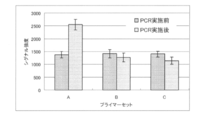
蛍光顕微鏡を用い、ミラーユニット(オリンパス WIB-UMWIB3)にて二本鎖核酸に特異的にインターカレートしたSYBRGreenIの蛍光を検出、CCDカメラにて撮像の後、各孔における蛍光の強度を画像処理ソフト(Media Cybernetics社 ImagePro)にて数値化したところ、3種類のプライマーセットのうち、プライマー対Aを導入した画分でのみ、シグナル強度の有意な増強が確認された。
調製した核酸増幅反応溶液をヒートブロックで80℃、5分加熱し、アガロースを溶解させた。ヒートブロック及び樹脂ブロック等を全て70℃環境の恒温装置に入れ、当該温度条件下において、アガロースの溶解した核酸増幅反応溶液に対して樹脂ブロックの末端からはみ出した中空繊維を19本ずつ浸漬し、当該中空繊維の逆端からゲル溶液を吸うことを12回繰り繰り返し、樹脂ブロック内へ核酸増幅反応溶液を導入した。
樹脂ブロックを室温まで冷却し、内部の核酸増幅反応溶液をゲル化した。
上記で得た核酸増幅反応溶液からなるゲルが充填された樹脂ブロックを、ミネラルオイル(QIAGEN社)で樹脂ブロック表面及びスライス刃を被覆した条件下(具体的には、樹脂ブロックをミネラルオイル中に浸漬させた状況下)において、ミクロトームを用いて500μmの厚さに切り出し、縦12×横19の計228本の孔が規則的に配列された核酸増幅反応用基材を15枚得た。
スライスして得られた核酸増幅反応用基材について、それぞれを光学顕微鏡にて観察し、樹脂ブロック中の中空糸内に担持されたアガロースゲルの割合(残存割合)を調べたところ、図6に示す結果となった。
配列番号2:プライマー
配列番号3:プライマー
配列番号4:プライマー
配列番号5:プライマー
配列番号6:プライマー
配列番号7:テンプレート
Claims (10)
- アレイ化された複数の画分を有し、当該画分中に、核酸を増幅するための異なる種類のプライマー対、DNAポリメラーゼ及びバッファー成分を含む加熱により溶解し得る親水性ゲルが保持された、核酸増幅用基材。
- 各画分中のプライマーの濃度が、1~1000fmol/μLである請求項1に記載の基材。
- バッファー成分が、KCl、Tris-HCl、MgCl2、ゼラチン及びTriton X-100からなる群より選ばれる少なくとも1種を含む、請求項1又は2に記載の基材。
- 親水性ゲルが、アガロース、アルギン酸、デキストラン、ビニルアルコール及びエチレングリコールからなる群より選ばれる少なくとも1種をモノマー成分として用いて調製されたゲルである、請求項1~3のいずれか1項に記載の基材。
- 親水性ゲルがアガロースゲルである、請求項1~3のいずれか1項に記載の基材。
- 親水性ゲルの濃度が0.5~2質量%である、請求項1~5のいずれか1項に記載の基材。
- 各画分の大きさは、該画分の形状の最大幅が10μm~1000μmである、請求項1~6のいずれか1項に記載の基材。
- 下記工程を含む、請求項1に記載の核酸増幅用基材の製造方法。
(1)複数本の中空繊維を、中空繊維の各繊維軸が同一方向となるように3次元に配列し、その配列を樹脂で固定することにより、中空繊維束を製造する工程
(2)プライマーを含むゲル前駆体溶液を、予め加温した中空繊維束の各中空繊維の中空部に導入する工程
(3)中空繊維束の中空部に導入したゲル前駆体溶液を反応させ、プライマーを含むゲル状物を中空繊維の中空部に保持する工程
(4)疎水性の液体中で、中空繊維束を繊維の長手方向に交差する方向で切断して薄片化する工程 - 請求項1~7のいずれか1項に記載の基材とテンプレート供給用基材とを含む、核酸増幅用キット。
- 請求項1~7のいずれか1項に記載の基材の各画分にテンプレートを供給する工程、及び、当該供給後の基材を加熱する工程を含む、核酸増幅方法。
Priority Applications (4)
| Application Number | Priority Date | Filing Date | Title |
|---|---|---|---|
| JP2012557340A JP6040775B2 (ja) | 2011-12-01 | 2012-11-27 | 核酸増幅用基材及び核酸増幅方法 |
| EP12853911.1A EP2787068A4 (en) | 2011-12-01 | 2012-11-27 | BASIC FOR USE IN THE AMPLIFICATION OF NUCLEIC ACID AND METHOD FOR THE AMPLIFICATION OF NUCLEIC ACID |
| US14/361,544 US20140342935A1 (en) | 2011-12-01 | 2012-11-27 | Base for use in amplification of nucleic acid and method for amplifying nucleic acid |
| CN201280059130.1A CN103975053A (zh) | 2011-12-01 | 2012-11-27 | 核酸扩增用基材以及核酸扩增方法 |
Applications Claiming Priority (2)
| Application Number | Priority Date | Filing Date | Title |
|---|---|---|---|
| JP2011263730 | 2011-12-01 | ||
| JP2011-263730 | 2011-12-01 |
Publications (1)
| Publication Number | Publication Date |
|---|---|
| WO2013080941A1 true WO2013080941A1 (ja) | 2013-06-06 |
Family
ID=48535396
Family Applications (1)
| Application Number | Title | Priority Date | Filing Date |
|---|---|---|---|
| PCT/JP2012/080548 Ceased WO2013080941A1 (ja) | 2011-12-01 | 2012-11-27 | 核酸増幅用基材及び核酸増幅方法 |
Country Status (5)
| Country | Link |
|---|---|
| US (1) | US20140342935A1 (ja) |
| EP (1) | EP2787068A4 (ja) |
| JP (2) | JP6040775B2 (ja) |
| CN (1) | CN103975053A (ja) |
| WO (1) | WO2013080941A1 (ja) |
Cited By (2)
| Publication number | Priority date | Publication date | Assignee | Title |
|---|---|---|---|---|
| JP2015104363A (ja) * | 2013-11-29 | 2015-06-08 | セイコーエプソン株式会社 | 核酸増幅反応用カートリッジ、及び核酸増幅反応用カートリッジキット |
| US10053732B2 (en) | 2012-05-02 | 2018-08-21 | Mitsubishi Chemical Corporation | Probe or probe set for evaluating influence of ultraviolet ray on skin and nucleic acid microarray |
Families Citing this family (2)
| Publication number | Priority date | Publication date | Assignee | Title |
|---|---|---|---|---|
| CN106854674B (zh) * | 2015-12-08 | 2021-03-09 | 上海交通大学 | 一种基于毛细管微阵列的核酸高通量快速检测方法 |
| JP2022060807A (ja) * | 2020-10-05 | 2022-04-15 | キヤノンメディカルシステムズ株式会社 | 乾燥試薬、試薬キット、乾燥試薬の製造方法、分析方法及び核酸増幅方法 |
Citations (9)
| Publication number | Priority date | Publication date | Assignee | Title |
|---|---|---|---|---|
| WO2000053736A1 (fr) | 1999-03-05 | 2000-09-14 | Mitsubishi Rayon Co., Ltd. | Supports comportant une substance biologique |
| JP2001133453A (ja) * | 1999-08-26 | 2001-05-18 | Mitsubishi Rayon Co Ltd | 生体高分子配列薄片の製造方法 |
| JP2002335960A (ja) | 2001-05-15 | 2002-11-26 | Moritex Corp | Pcr用マイクロプレート及びそれを用いたpcr法 |
| JP2004337064A (ja) * | 2003-05-15 | 2004-12-02 | Mitsubishi Gas Chem Co Inc | 遺伝子検出用チップ |
| JP2006304709A (ja) * | 2005-04-28 | 2006-11-09 | Institute Of Physical & Chemical Research | 極微量の細胞から行えるゲノムワイドな制限酵素反応部位または変異もしくは修飾部位の検索法およびそのためのキット |
| JP2008154490A (ja) | 2006-12-22 | 2008-07-10 | Olympus Corp | 複数種類の標的塩基配列を同時に増幅するために用いられる基板と、該基板を用いた塩基配列の増幅方法 |
| JP2008245612A (ja) | 2007-03-30 | 2008-10-16 | Hitachi Ltd | 試料調製法および装置 |
| JP2008304356A (ja) * | 2007-06-08 | 2008-12-18 | Toppan Printing Co Ltd | ラボオンチップの試薬封止構造及びラボオンチップ |
| WO2010087466A1 (ja) * | 2009-01-27 | 2010-08-05 | 国立大学法人東京農工大学 | Pcrチャンバーの調製方法およびpcrキット |
Family Cites Families (10)
| Publication number | Priority date | Publication date | Assignee | Title |
|---|---|---|---|---|
| WO1996023834A1 (en) * | 1995-02-01 | 1996-08-08 | Schneider (Usa) Inc. | Process for hydrophilicization of hydrophobic polymers |
| JP3829491B2 (ja) * | 1998-08-27 | 2006-10-04 | 株式会社日立製作所 | プローブチップ、プローブチップ作成方法、試料検出方法、及び試料検出装置 |
| US6277628B1 (en) * | 1998-10-02 | 2001-08-21 | Incyte Genomics, Inc. | Linear microarrays |
| CN1226409C (zh) * | 1999-03-05 | 2005-11-09 | 三菱丽阳株式会社 | 带有生物物质的载体 |
| US6713309B1 (en) * | 1999-07-30 | 2004-03-30 | Large Scale Proteomics Corporation | Microarrays and their manufacture |
| US6642000B1 (en) * | 1999-11-12 | 2003-11-04 | University Of Chicago | PCR amplification on microarrays of gel immobilized oligonucleotides |
| WO2003083475A1 (en) * | 2002-04-03 | 2003-10-09 | Mitsubishi Rayon Co., Ltd. | Gel having biosubstance fixed thereto and microarray utilizing the gel |
| WO2004074503A2 (en) * | 2003-02-21 | 2004-09-02 | Hoser Mark J | Nucleic acid sequencing methods, kits and reagents |
| CN101851652B (zh) * | 2010-04-27 | 2013-11-13 | 上海交通大学 | 基于微阵列芯片的通用多重聚合酶链式反应的实现方法 |
| WO2012108499A1 (ja) * | 2011-02-10 | 2012-08-16 | 三菱レイヨン株式会社 | 核酸の検出方法 |
-
2012
- 2012-11-27 EP EP12853911.1A patent/EP2787068A4/en not_active Withdrawn
- 2012-11-27 US US14/361,544 patent/US20140342935A1/en not_active Abandoned
- 2012-11-27 JP JP2012557340A patent/JP6040775B2/ja not_active Expired - Fee Related
- 2012-11-27 WO PCT/JP2012/080548 patent/WO2013080941A1/ja not_active Ceased
- 2012-11-27 CN CN201280059130.1A patent/CN103975053A/zh active Pending
-
2016
- 2016-08-08 JP JP2016155259A patent/JP2017018118A/ja active Pending
Patent Citations (9)
| Publication number | Priority date | Publication date | Assignee | Title |
|---|---|---|---|---|
| WO2000053736A1 (fr) | 1999-03-05 | 2000-09-14 | Mitsubishi Rayon Co., Ltd. | Supports comportant une substance biologique |
| JP2001133453A (ja) * | 1999-08-26 | 2001-05-18 | Mitsubishi Rayon Co Ltd | 生体高分子配列薄片の製造方法 |
| JP2002335960A (ja) | 2001-05-15 | 2002-11-26 | Moritex Corp | Pcr用マイクロプレート及びそれを用いたpcr法 |
| JP2004337064A (ja) * | 2003-05-15 | 2004-12-02 | Mitsubishi Gas Chem Co Inc | 遺伝子検出用チップ |
| JP2006304709A (ja) * | 2005-04-28 | 2006-11-09 | Institute Of Physical & Chemical Research | 極微量の細胞から行えるゲノムワイドな制限酵素反応部位または変異もしくは修飾部位の検索法およびそのためのキット |
| JP2008154490A (ja) | 2006-12-22 | 2008-07-10 | Olympus Corp | 複数種類の標的塩基配列を同時に増幅するために用いられる基板と、該基板を用いた塩基配列の増幅方法 |
| JP2008245612A (ja) | 2007-03-30 | 2008-10-16 | Hitachi Ltd | 試料調製法および装置 |
| JP2008304356A (ja) * | 2007-06-08 | 2008-12-18 | Toppan Printing Co Ltd | ラボオンチップの試薬封止構造及びラボオンチップ |
| WO2010087466A1 (ja) * | 2009-01-27 | 2010-08-05 | 国立大学法人東京農工大学 | Pcrチャンバーの調製方法およびpcrキット |
Non-Patent Citations (2)
| Title |
|---|
| NUCLEIC ACIDS RESEARCH, vol. 33, no. 2, 2005, pages I |
| See also references of EP2787068A4 |
Cited By (2)
| Publication number | Priority date | Publication date | Assignee | Title |
|---|---|---|---|---|
| US10053732B2 (en) | 2012-05-02 | 2018-08-21 | Mitsubishi Chemical Corporation | Probe or probe set for evaluating influence of ultraviolet ray on skin and nucleic acid microarray |
| JP2015104363A (ja) * | 2013-11-29 | 2015-06-08 | セイコーエプソン株式会社 | 核酸増幅反応用カートリッジ、及び核酸増幅反応用カートリッジキット |
Also Published As
| Publication number | Publication date |
|---|---|
| JP6040775B2 (ja) | 2016-12-07 |
| CN103975053A (zh) | 2014-08-06 |
| JPWO2013080941A1 (ja) | 2015-04-27 |
| JP2017018118A (ja) | 2017-01-26 |
| EP2787068A1 (en) | 2014-10-08 |
| EP2787068A4 (en) | 2014-10-22 |
| US20140342935A1 (en) | 2014-11-20 |
| EP2787068A9 (en) | 2015-08-12 |
Similar Documents
| Publication | Publication Date | Title |
|---|---|---|
| US20110105356A1 (en) | Compositions and methods for providing substances to and from an array | |
| CN104968427B (zh) | 凝胶模式化的表面 | |
| CN106661530B (zh) | 微流体装置 | |
| US20110287951A1 (en) | Methods and systems for purifying, transferring, and/or manipulating nucleic acids | |
| JP6395925B2 (ja) | 遺伝子解析システム | |
| WO2016172373A1 (en) | Methods and compositions for whole transcriptome amplification | |
| JP2012502660A (ja) | マイクロアレイ基板上の生体物質の選択的プロセシング | |
| CN105026562A (zh) | 基因定量、序列分析用二维细胞阵列器件及装置 | |
| JP2017018118A (ja) | 核酸増幅用基材及び核酸増幅方法 | |
| CN107002006A (zh) | 用于检测目标基因的微流体装置、用于制造微流体装置的方法及用于使用微流体装置进行检测的方法 | |
| CN113604547A (zh) | 一种用于组织样本的高分辨率空间组学检测方法 | |
| WO2016151719A1 (ja) | 核酸反応デバイス | |
| WO2012108499A1 (ja) | 核酸の検出方法 | |
| WO2019060900A1 (en) | DEVICE FOR ADDITIVE REAGENT DISTRIBUTION AND ASSOCIATED METHODS AND SYSTEMS | |
| JP2014021081A (ja) | 分析用マイクロ流路チップの製造方法 | |
| KR102395365B1 (ko) | 소수성 플레이트 상에 배열된 복수의 하이드로젤 미세입자를 포함하는 pcr용 반응 칩 | |
| CA2809729C (en) | Setting of multiple priming oligonucleotides for solid gel amplification in hydrogels | |
| EP3478650B1 (en) | Methods using lateral flow for high throughput microbiology applications | |
| JP2013150567A (ja) | 核酸分析用反応デバイス、及び核酸分析装置 | |
| JP4108891B2 (ja) | 核酸固定化ゲル保持多孔質中空繊維並びに該多孔質中空繊維配列体及びその薄片 | |
| JP2010259340A (ja) | 貫通孔マイクロアレイとその製造方法 | |
| JP2005130795A (ja) | ポリヌクレオチドの分析用部材、および検体中の特定塩基配列を有するポリヌクレオチドの存在の有無を判定する方法 | |
| Duan et al. | SIMIT-seq: a bead-free, scalable microfluidic platform for single cell mRNA sequencing with ultrahigh cell-indexing rate | |
| IE20050414A1 (en) | A support for supporting high-density biological or chemical assays | |
| JP2008035801A (ja) | マイクロアレイを用いた相同性の高い配列を有する核酸の存在比率を推定する方法 |
Legal Events
| Date | Code | Title | Description |
|---|---|---|---|
| ENP | Entry into the national phase |
Ref document number: 2012557340 Country of ref document: JP Kind code of ref document: A |
|
| 121 | Ep: the epo has been informed by wipo that ep was designated in this application |
Ref document number: 12853911 Country of ref document: EP Kind code of ref document: A1 |
|
| WWE | Wipo information: entry into national phase |
Ref document number: 14361544 Country of ref document: US |
|
| NENP | Non-entry into the national phase |
Ref country code: DE |
|
| WWE | Wipo information: entry into national phase |
Ref document number: 2012853911 Country of ref document: EP |