WO2013086453A1 - Hydroconversion of renewable feedstocks - Google Patents
Hydroconversion of renewable feedstocks Download PDFInfo
- Publication number
- WO2013086453A1 WO2013086453A1 PCT/US2012/068621 US2012068621W WO2013086453A1 WO 2013086453 A1 WO2013086453 A1 WO 2013086453A1 US 2012068621 W US2012068621 W US 2012068621W WO 2013086453 A1 WO2013086453 A1 WO 2013086453A1
- Authority
- WO
- WIPO (PCT)
- Prior art keywords
- catalyst
- feedstock
- group
- liquid effluent
- fatty alcohols
- Prior art date
- Legal status (The legal status is an assumption and is not a legal conclusion. Google has not performed a legal analysis and makes no representation as to the accuracy of the status listed.)
- Ceased
Links
Classifications
-
- C—CHEMISTRY; METALLURGY
- C07—ORGANIC CHEMISTRY
- C07C—ACYCLIC OR CARBOCYCLIC COMPOUNDS
- C07C29/00—Preparation of compounds having hydroxy or O-metal groups bound to a carbon atom not belonging to a six-membered aromatic ring
- C07C29/132—Preparation of compounds having hydroxy or O-metal groups bound to a carbon atom not belonging to a six-membered aromatic ring by reduction of an oxygen containing functional group
- C07C29/136—Preparation of compounds having hydroxy or O-metal groups bound to a carbon atom not belonging to a six-membered aromatic ring by reduction of an oxygen containing functional group of >C=O containing groups, e.g. —COOH
- C07C29/147—Preparation of compounds having hydroxy or O-metal groups bound to a carbon atom not belonging to a six-membered aromatic ring by reduction of an oxygen containing functional group of >C=O containing groups, e.g. —COOH of carboxylic acids or derivatives thereof
- C07C29/149—Preparation of compounds having hydroxy or O-metal groups bound to a carbon atom not belonging to a six-membered aromatic ring by reduction of an oxygen containing functional group of >C=O containing groups, e.g. —COOH of carboxylic acids or derivatives thereof with hydrogen or hydrogen-containing gases
-
- C—CHEMISTRY; METALLURGY
- C10—PETROLEUM, GAS OR COKE INDUSTRIES; TECHNICAL GASES CONTAINING CARBON MONOXIDE; FUELS; LUBRICANTS; PEAT
- C10G—CRACKING HYDROCARBON OILS; PRODUCTION OF LIQUID HYDROCARBON MIXTURES, e.g. BY DESTRUCTIVE HYDROGENATION, OLIGOMERISATION, POLYMERISATION; RECOVERY OF HYDROCARBON OILS FROM OIL-SHALE, OIL-SAND, OR GASES; REFINING MIXTURES MAINLY CONSISTING OF HYDROCARBONS; REFORMING OF NAPHTHA; MINERAL WAXES
- C10G3/00—Production of liquid hydrocarbon mixtures from oxygen-containing organic materials, e.g. fatty oils, fatty acids
-
- C—CHEMISTRY; METALLURGY
- C07—ORGANIC CHEMISTRY
- C07C—ACYCLIC OR CARBOCYCLIC COMPOUNDS
- C07C29/00—Preparation of compounds having hydroxy or O-metal groups bound to a carbon atom not belonging to a six-membered aromatic ring
- C07C29/17—Preparation of compounds having hydroxy or O-metal groups bound to a carbon atom not belonging to a six-membered aromatic ring by hydrogenation of carbon-to-carbon double or triple bonds
- C07C29/177—Preparation of compounds having hydroxy or O-metal groups bound to a carbon atom not belonging to a six-membered aromatic ring by hydrogenation of carbon-to-carbon double or triple bonds with simultaneous reduction of a carboxy group
-
- C—CHEMISTRY; METALLURGY
- C07—ORGANIC CHEMISTRY
- C07C—ACYCLIC OR CARBOCYCLIC COMPOUNDS
- C07C67/00—Preparation of carboxylic acid esters
-
- C—CHEMISTRY; METALLURGY
- C07—ORGANIC CHEMISTRY
- C07C—ACYCLIC OR CARBOCYCLIC COMPOUNDS
- C07C67/00—Preparation of carboxylic acid esters
- C07C67/03—Preparation of carboxylic acid esters by reacting an ester group with a hydroxy group
-
- C—CHEMISTRY; METALLURGY
- C10—PETROLEUM, GAS OR COKE INDUSTRIES; TECHNICAL GASES CONTAINING CARBON MONOXIDE; FUELS; LUBRICANTS; PEAT
- C10G—CRACKING HYDROCARBON OILS; PRODUCTION OF LIQUID HYDROCARBON MIXTURES, e.g. BY DESTRUCTIVE HYDROGENATION, OLIGOMERISATION, POLYMERISATION; RECOVERY OF HYDROCARBON OILS FROM OIL-SHALE, OIL-SAND, OR GASES; REFINING MIXTURES MAINLY CONSISTING OF HYDROCARBONS; REFORMING OF NAPHTHA; MINERAL WAXES
- C10G3/00—Production of liquid hydrocarbon mixtures from oxygen-containing organic materials, e.g. fatty oils, fatty acids
- C10G3/42—Catalytic treatment
- C10G3/44—Catalytic treatment characterised by the catalyst used
- C10G3/45—Catalytic treatment characterised by the catalyst used containing iron group metals or compounds thereof
- C10G3/46—Catalytic treatment characterised by the catalyst used containing iron group metals or compounds thereof in combination with chromium, molybdenum, tungsten metals or compounds thereof
-
- C—CHEMISTRY; METALLURGY
- C10—PETROLEUM, GAS OR COKE INDUSTRIES; TECHNICAL GASES CONTAINING CARBON MONOXIDE; FUELS; LUBRICANTS; PEAT
- C10G—CRACKING HYDROCARBON OILS; PRODUCTION OF LIQUID HYDROCARBON MIXTURES, e.g. BY DESTRUCTIVE HYDROGENATION, OLIGOMERISATION, POLYMERISATION; RECOVERY OF HYDROCARBON OILS FROM OIL-SHALE, OIL-SAND, OR GASES; REFINING MIXTURES MAINLY CONSISTING OF HYDROCARBONS; REFORMING OF NAPHTHA; MINERAL WAXES
- C10G3/00—Production of liquid hydrocarbon mixtures from oxygen-containing organic materials, e.g. fatty oils, fatty acids
- C10G3/50—Production of liquid hydrocarbon mixtures from oxygen-containing organic materials, e.g. fatty oils, fatty acids in the presence of hydrogen, hydrogen donors or hydrogen generating compounds
-
- C—CHEMISTRY; METALLURGY
- C10—PETROLEUM, GAS OR COKE INDUSTRIES; TECHNICAL GASES CONTAINING CARBON MONOXIDE; FUELS; LUBRICANTS; PEAT
- C10G—CRACKING HYDROCARBON OILS; PRODUCTION OF LIQUID HYDROCARBON MIXTURES, e.g. BY DESTRUCTIVE HYDROGENATION, OLIGOMERISATION, POLYMERISATION; RECOVERY OF HYDROCARBON OILS FROM OIL-SHALE, OIL-SAND, OR GASES; REFINING MIXTURES MAINLY CONSISTING OF HYDROCARBONS; REFORMING OF NAPHTHA; MINERAL WAXES
- C10G47/00—Cracking of hydrocarbon oils, in the presence of hydrogen or hydrogen- generating compounds, to obtain lower boiling fractions
- C10G47/02—Cracking of hydrocarbon oils, in the presence of hydrogen or hydrogen- generating compounds, to obtain lower boiling fractions characterised by the catalyst used
- C10G47/10—Cracking of hydrocarbon oils, in the presence of hydrogen or hydrogen- generating compounds, to obtain lower boiling fractions characterised by the catalyst used with catalysts deposited on a carrier
-
- C—CHEMISTRY; METALLURGY
- C10—PETROLEUM, GAS OR COKE INDUSTRIES; TECHNICAL GASES CONTAINING CARBON MONOXIDE; FUELS; LUBRICANTS; PEAT
- C10L—FUELS NOT OTHERWISE PROVIDED FOR; NATURAL GAS; SYNTHETIC NATURAL GAS OBTAINED BY PROCESSES NOT COVERED BY SUBCLASSES C10G OR C10K; LIQUIFIED PETROLEUM GAS; USE OF ADDITIVES TO FUELS OR FIRES; FIRE-LIGHTERS
- C10L1/00—Liquid carbonaceous fuels
- C10L1/04—Liquid carbonaceous fuels essentially based on blends of hydrocarbons
- C10L1/08—Liquid carbonaceous fuels essentially based on blends of hydrocarbons for compression ignition
-
- B—PERFORMING OPERATIONS; TRANSPORTING
- B01—PHYSICAL OR CHEMICAL PROCESSES OR APPARATUS IN GENERAL
- B01J—CHEMICAL OR PHYSICAL PROCESSES, e.g. CATALYSIS OR COLLOID CHEMISTRY; THEIR RELEVANT APPARATUS
- B01J23/00—Catalysts comprising metals or metal oxides or hydroxides, not provided for in group B01J21/00
- B01J23/70—Catalysts comprising metals or metal oxides or hydroxides, not provided for in group B01J21/00 of the iron group metals or copper
- B01J23/76—Catalysts comprising metals or metal oxides or hydroxides, not provided for in group B01J21/00 of the iron group metals or copper combined with metals, oxides or hydroxides provided for in groups B01J23/02 - B01J23/36
- B01J23/84—Catalysts comprising metals or metal oxides or hydroxides, not provided for in group B01J21/00 of the iron group metals or copper combined with metals, oxides or hydroxides provided for in groups B01J23/02 - B01J23/36 with arsenic, antimony, bismuth, vanadium, niobium, tantalum, polonium, chromium, molybdenum, tungsten, manganese, technetium or rhenium
- B01J23/85—Chromium, molybdenum or tungsten
-
- B—PERFORMING OPERATIONS; TRANSPORTING
- B01—PHYSICAL OR CHEMICAL PROCESSES OR APPARATUS IN GENERAL
- B01J—CHEMICAL OR PHYSICAL PROCESSES, e.g. CATALYSIS OR COLLOID CHEMISTRY; THEIR RELEVANT APPARATUS
- B01J23/00—Catalysts comprising metals or metal oxides or hydroxides, not provided for in group B01J21/00
- B01J23/70—Catalysts comprising metals or metal oxides or hydroxides, not provided for in group B01J21/00 of the iron group metals or copper
- B01J23/76—Catalysts comprising metals or metal oxides or hydroxides, not provided for in group B01J21/00 of the iron group metals or copper combined with metals, oxides or hydroxides provided for in groups B01J23/02 - B01J23/36
- B01J23/84—Catalysts comprising metals or metal oxides or hydroxides, not provided for in group B01J21/00 of the iron group metals or copper combined with metals, oxides or hydroxides provided for in groups B01J23/02 - B01J23/36 with arsenic, antimony, bismuth, vanadium, niobium, tantalum, polonium, chromium, molybdenum, tungsten, manganese, technetium or rhenium
- B01J23/85—Chromium, molybdenum or tungsten
- B01J23/888—Tungsten
- B01J23/8885—Tungsten containing also molybdenum
-
- B—PERFORMING OPERATIONS; TRANSPORTING
- B01—PHYSICAL OR CHEMICAL PROCESSES OR APPARATUS IN GENERAL
- B01J—CHEMICAL OR PHYSICAL PROCESSES, e.g. CATALYSIS OR COLLOID CHEMISTRY; THEIR RELEVANT APPARATUS
- B01J31/00—Catalysts comprising hydrides, coordination complexes or organic compounds
- B01J31/02—Catalysts comprising hydrides, coordination complexes or organic compounds containing organic compounds or metal hydrides
- B01J31/04—Catalysts comprising hydrides, coordination complexes or organic compounds containing organic compounds or metal hydrides containing carboxylic acids or their salts
-
- B—PERFORMING OPERATIONS; TRANSPORTING
- B01—PHYSICAL OR CHEMICAL PROCESSES OR APPARATUS IN GENERAL
- B01J—CHEMICAL OR PHYSICAL PROCESSES, e.g. CATALYSIS OR COLLOID CHEMISTRY; THEIR RELEVANT APPARATUS
- B01J37/00—Processes, in general, for preparing catalysts; Processes, in general, for activation of catalysts
- B01J37/20—Sulfiding
-
- C—CHEMISTRY; METALLURGY
- C10—PETROLEUM, GAS OR COKE INDUSTRIES; TECHNICAL GASES CONTAINING CARBON MONOXIDE; FUELS; LUBRICANTS; PEAT
- C10G—CRACKING HYDROCARBON OILS; PRODUCTION OF LIQUID HYDROCARBON MIXTURES, e.g. BY DESTRUCTIVE HYDROGENATION, OLIGOMERISATION, POLYMERISATION; RECOVERY OF HYDROCARBON OILS FROM OIL-SHALE, OIL-SAND, OR GASES; REFINING MIXTURES MAINLY CONSISTING OF HYDROCARBONS; REFORMING OF NAPHTHA; MINERAL WAXES
- C10G2300/00—Aspects relating to hydrocarbon processing covered by groups C10G1/00 - C10G99/00
- C10G2300/10—Feedstock materials
- C10G2300/1011—Biomass
- C10G2300/1014—Biomass of vegetal origin
-
- C—CHEMISTRY; METALLURGY
- C10—PETROLEUM, GAS OR COKE INDUSTRIES; TECHNICAL GASES CONTAINING CARBON MONOXIDE; FUELS; LUBRICANTS; PEAT
- C10G—CRACKING HYDROCARBON OILS; PRODUCTION OF LIQUID HYDROCARBON MIXTURES, e.g. BY DESTRUCTIVE HYDROGENATION, OLIGOMERISATION, POLYMERISATION; RECOVERY OF HYDROCARBON OILS FROM OIL-SHALE, OIL-SAND, OR GASES; REFINING MIXTURES MAINLY CONSISTING OF HYDROCARBONS; REFORMING OF NAPHTHA; MINERAL WAXES
- C10G2300/00—Aspects relating to hydrocarbon processing covered by groups C10G1/00 - C10G99/00
- C10G2300/40—Characteristics of the process deviating from typical ways of processing
- C10G2300/4006—Temperature
-
- C—CHEMISTRY; METALLURGY
- C10—PETROLEUM, GAS OR COKE INDUSTRIES; TECHNICAL GASES CONTAINING CARBON MONOXIDE; FUELS; LUBRICANTS; PEAT
- C10G—CRACKING HYDROCARBON OILS; PRODUCTION OF LIQUID HYDROCARBON MIXTURES, e.g. BY DESTRUCTIVE HYDROGENATION, OLIGOMERISATION, POLYMERISATION; RECOVERY OF HYDROCARBON OILS FROM OIL-SHALE, OIL-SAND, OR GASES; REFINING MIXTURES MAINLY CONSISTING OF HYDROCARBONS; REFORMING OF NAPHTHA; MINERAL WAXES
- C10G2300/00—Aspects relating to hydrocarbon processing covered by groups C10G1/00 - C10G99/00
- C10G2300/40—Characteristics of the process deviating from typical ways of processing
- C10G2300/4012—Pressure
-
- Y—GENERAL TAGGING OF NEW TECHNOLOGICAL DEVELOPMENTS; GENERAL TAGGING OF CROSS-SECTIONAL TECHNOLOGIES SPANNING OVER SEVERAL SECTIONS OF THE IPC; TECHNICAL SUBJECTS COVERED BY FORMER USPC CROSS-REFERENCE ART COLLECTIONS [XRACs] AND DIGESTS
- Y02—TECHNOLOGIES OR APPLICATIONS FOR MITIGATION OR ADAPTATION AGAINST CLIMATE CHANGE
- Y02P—CLIMATE CHANGE MITIGATION TECHNOLOGIES IN THE PRODUCTION OR PROCESSING OF GOODS
- Y02P30/00—Technologies relating to oil refining and petrochemical industry
- Y02P30/20—Technologies relating to oil refining and petrochemical industry using bio-feedstock
Definitions
- the application relates generally to a process for converting renewable feedstocks to oleochemicals such as fatty alcohols, esters, and normal paraffins, by contacting the feedstock with at least a multi-metallic catalyst under hydroprocessing conditions.
- Fossil fuels are a finite, non-renewable resource formed from decayed plants and animals that have been converted to crude oil, coal, natural gas, or heavy oils by exposure to heat and pressure in the earth's crust over hundreds of millions of years.
- bio-resources renewable/sustainable raw materials
- Industrial oleochemicals are useful in the production of surfactants, lubricants, fuels, plastics, and the like.
- Oleochemicals include, but are not limited to, fatty alcohols, esters and paraffins. Providing efficient processes for directly converting renewable materials into such products would be highly desirable.
- a prior art approach to convert bio-resources such as lipids (e.g., vegetable oil, animal fat, etc.) to high value products such as jet / diesel fuels (paraffins) is via alkali catalyzed reaction in the presence of an alcohol, generating esters such as long chain alkyl esters or fatty acid methyl ester (FAME).
- Hydroprocessing is another approach to covert bio-resources to useful products.
- biocomponent feedstocks e.g., vegetable oils and animal fats which typically contain
- the large triglyceride and fatty acid molecules in biocomponent feedstocks may competitively adsorb on and block active sites of hydrotreating catalysts.
- catalysts having the appropriate morphology, structure, and optimum catalytic activity for high yield conversion of renewable feedstock into high value products.
- Base oils are commonly used for the production of process oils, white oils, metal working oils, and lubricants for use in automotives, industrial applications, and the like. It is increasingly difficult to produce lubricants from conventional mineral oils to meet certain standards in the automotive industry. There is a need for an improved process to make lubricants and bright stocks with renewable feedstock as the originating source.
- catalytic conversion process comprising contacting a renewable feedstock, under hydroprocessing conditions, with at least a self-supported catalyst or a supported catalyst to form an effluent and recovering a hydrocarbon fraction comprising normal paraffins from the effluent, wherein the hydroprocessing conditions include a temperature of from 446°F to 752°F (230°C to 400°C) and a total reaction pressure of from 50 to 3000 psig (0.35 to 20.7 MPa gauge).
- a catalytic conversion process comprising contacting a renewable feedstock, under hydroprocessing conditions, with at least a self-supported catalyst or a supported catalyst to form an effluent and recovering an aliphatic monoester fraction from the effluent, wherein the hydroprocessing conditions include a temperature of from 302°F to 554°F (150°C to 290°C) and a total reaction pressure of from 50 to 3000 psig (0.35 to 20.7 MPa gauge).
- a hydrocarbon conversion process comprising contacting a renewable feedstock, under hydroprocessing conditions, with at least a self-supported catalyst or a supported catalyst to form an effluent and recovering a fatty alcohol fraction from the effluent, wherein the hydroprocessing conditions include a temperature of from 302°F to 554°F (150°C to 290°C) and a total reaction pressure of from 50 to 3000 psig (0.35 to 20.7 MPa gauge).
- the fatty alcohol fraction in one embodiment is further processed forming Guerbet alcohols.
- a catalytic conversion process wherein a renewable feedstock is brought into contact with at least with at least a self-supported catalyst or a supported catalyst to form an effluent containing a fatty alcohol, wherein the fatty alcohol is recovered and subsequently dehydrated in a dehydration zone under dehydration conditions to forming an alpha-olefm product.
- the alpha-olefm product formed is oligmerized in an oligomerization zone under oligomerization conditions to form an oligomer.
- the oligomer formed is hydrogenated forming a base oil, under hydroprocessing conditions including a temperature from 302°F to 752°F (150°C to 400°C) and a total reaction pressure of from 50 to 3000 psig (0.35 to 20.7 MPa gauge).
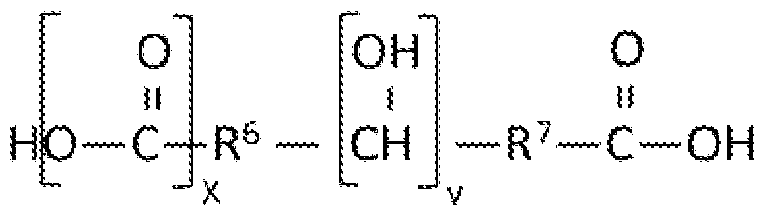
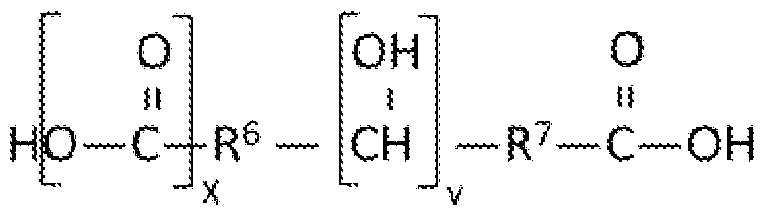
- the promoted self-supported catalyst or the promoted supported catalyst comprises at least a Group VIB metal selected from molybdenum and tungsten, at least a Group VIII metal selected from cobalt and nickel, the promoter being selected from the group of hydrox -(di)-carboxylic acids with steric configurations and having the structure of:
- R 6 or R 7 are a saturated, unsaturated, cyclic, acyclic, aromatic, alcoholic, branched or unbranched hydrocarbon group, with R 6 or R 7 being (CH)2 m (CH 2 ) n with m and n as >0 integers.
- FIG. 1 is a schematic diagram showing the various reaction pathways in the hydroprocessing of a renewable feedstock, e.g., triglycerides, generating various desired products such as long chain normal paraffins, fatty alcohols, fatty acids and esters.
- a renewable feedstock e.g., triglycerides
- Figure 2 is a schematic diagram showing formation of various desirable products, e.g., oligomers, esters, Guerbet alcohols and EOR (Enhanced Oil Recovery) surfactants, from the upgrading of a renewable feedstock, e.g., triglycerides.
- oligomers e.g., esters, Guerbet alcohols and EOR (Enhanced Oil Recovery) surfactants
- EOR Enhanced Oil Recovery
- renewable feedstock refers to feedstocks other than those obtained from fossil resources such as crude oil, coal, natural gas, sad oil, etc. meaning feedstock derived in part from a biological raw material component such as plant-based material such as vegetable fats / oils, or animal fats / oils, including algae and fish fats / oils.
- the renewable feedstock is a triglyceride containing renewable feedstock.
- Oleochemical refers to a chemical that is biologically-derived, i.e., from a renewable resource of biological origin. Such a term is generally accepted as being exclusive of fossil fuels.
- a “middle distillate” is a hydrocarbon product having a boiling range of from 250°F to 1100°F (121°C to 593 °C).
- the term “middle distillate” includes the jet fuel, kerosene, diesel, heating oil boiling range fractions. It may also include a portion of naphtha or light oil.
- a “jet fuel” is a hydrocarbon product having a boiling range in the jet fuel boiling range.
- jet fuel boiling range refers to hydrocarbons having a boiling range of from 280°F to 572°F (138°C to 300°C).
- diesel fuel boiling range refers to hydrocarbons having a boiling range of from 250°F to 1000°F (121°C to 538°C).
- the "boiling range” is the 10 vol. % boiling point to the final boiling point (99.5 vol. %), inclusive of the end points, as measured by ASTM D2887-08 ("Standard Test Method for Boiling Range Distribution of Petroleum Fractions by Gas Chromatography").
- Triglyceride refers to class of molecules having the general formula (1):
- R, R 1 and R 2 are independently aliphatic residues having from 6 to 22 carbon atoms (e.g., from 8 to 20 carbon atoms, or from 10 to 16 carbon atoms).
- aliphatic means a straight (i.e., un-branched) or branched, substituted or un-substituted hydrocarbon chain that is completely saturated or that contains one or more units of unsaturation.
- Fatty alcohol refers to primary aliphatic alcohols generally having from 8 to 24 carbon atoms per molecule, usually from 8 to 18 carbon atoms.
- Aliphatic monoester refers to compounds having the general formula (2):
- the aliphatic ester has from 16 to 40 carbon atoms per molecule (e.g., from 18 to 36, or from 20 to 34 carbon atoms). Such esters can be useful as lubricants.
- paraffin refers to any saturated hydrocarbon compound, e.g., a paraffin having the formula C n H (2n + 2) where n is a positive non-zero integer.
- Normal paraffin refers to a saturated straight chain hydrocarbon.
- Isoparaffm refers to a saturated branched chain hydrocarbon.
- Hydroprocessing can be used interchangeably with the term “hydroprocessing” and refers to any process that is carried out in the presence of hydrogen and a catalyst. Such processes include, but are not limited to, methanation, water gas shift reactions, hydrogenation, hydrotreating, hydrodesulfurization, hydrodenitrogenation, hydrodeoxygenation,
- hydrocracking including selective hydrocracking.
- isomerizing refers to catalytic process in which a paraffin is converted at least partially into its isomer containing more branches or the reverse, e.g., a normal paraffin to an isoparaffm. Such isomerization generally proceeds by way of a catalytic route.
- “Supported catalyst” refers a catalyst in which the active components, e.g., Group VIII and Group VIB metals or compounds thereof, are deposited on a carrier or support.
- Self-supported catalyst can be used interchangeably with “unsupported catalyst,” or “bulk catalyst,” meaning that the catalyst composition is NOT of the conventional catalyst form which has a preformed, shaped catalyst support which is then loaded with metal compounds via impregnation or deposition.
- the self-supported catalyst is formed through precipitation.
- the self-supported catalyst has a binder incorporated into the catalyst composition.
- the self-supported catalyst is formed from metal compounds and without any binder.
- Catalyst precursor in one embodiment refers to a compound containing at least a metal selected from Group IIA, Group IIB, Group IVA, Group VIII metals and combinations thereof (e.g., one or more Group IIA metals, one or more Group IIB metals, one or more Group r A metals, one or more Group VIII metals, and combinations thereof); at least a Group VIB metal; and, optionally, one or more organic oxygen-containing promoters, and which compound can be used directly in the upgrade of a renewable feedstock (as a catalyst), or can be sulfided for use as a sulfided hydroprocessing catalyst.
- a metal selected from Group IIA, Group IIB, Group IVA, Group VIII metals and combinations thereof e.g., one or more Group IIA metals, one or more Group IIB metals, one or more Group r A metals, one or more Group VIII metals, and combinations thereof
- at least a Group VIB metal e.g., one or more Group II
- Group IIA or “Group IIA metal” refers to beryllium (Be), magnesium (Mg), calcium (Ca), strontium (Sr), barium (Ba), radium (Ra), and combinations thereof in any of elemental, compound, or ionic form.
- Group IIB or “Group IIB metal” refers to zinc (Zn), cadmium (Cd), mercury (Hg), and combinations thereof in any of elemental, compound, or ionic form.
- Group IV A or Group IVA metal refers to germanium (Ge), tin (Sn) or lead (Pb), and combinations thereof in any of elemental, compound, or ionic form.
- Group VIB or “Group VIB metal” refers to chromium (Cr), molybdenum (Mo), tungsten (W), and combinations thereof in any of elemental, compound, or ionic form.
- Group VIII or Group VIII metal refers to iron (Fe), cobalt (Co), nickel ( i), ruthenium (Ru), rhodium (Ro), palladium (Pd), osmium (Os), iridium (Ir), platinum (Pt), and combinations thereof in any of elemental, compound, or ionic form.
- Conversion refers to the amount of triglycerides in the feed that is converted to compounds other than triglycerides. Conversion is expressed as a weight percentage based on triglycerides in the feed. “Selectivity” is expressed as a weight percent based on converted triglycerides.
- Noble metal refers to a metal selected from ruthenium, rhodium, palladium, silver, osmium, iridium, platinum, and gold.
- Promoter refers to an organic agent that interacts strongly with inorganic agents (either chemically or physically) in a reaction to form a catalyst or a catalyst precursor, leading to alterations in the structure, surface morphology and composition, which in turn results in enhanced catalytic activity.
- Presulfiding or “presulfided” refers to the sulfidation of a catalyst precursor in the presence of a sulfiding agent such as 3 ⁇ 4S or dimethyl disulfide (DMDS) under sulfiding conditions, prior to contact with a feedstock in an upgrade process.
- a sulfiding agent such as 3 ⁇ 4S or dimethyl disulfide (DMDS)
- Feedstock The feedstock consists essentially of a renewable feedstock (> 99 wt. %), with less than 1 wt. % petroleum feed in one embodiment; less than 2 wt. % petroleum feed in a second embodiment; and less than 5 wt. % petroleum feed in a third embodiment.
- the feedstock is a mix of a renewable source and a petroleum feed in another embodiment, with up to 50 wt. % petroleum feedstock.
- the amount of petroleum feedstock ranges from 1 to 99 wt. %, with the remainder renewable feedstock in one embodiment; from 10 to 90 wt. % in a second embodiment; and from 20 to 80 wt. % in a third embodiment.
- the feedstock is a pure renewable feedstock (consisting only of a renewable feedstock), with no petroleum feed included.
- the renewable feedstocks that can be used include any of those which comprise triglycerides.
- the feedstock generally originates from a biomass source selected from crops, vegetables, microalgae, animal fats, and combinations thereof.
- the feedstock generally comprises at least 25 wt. % triglycerides (e.g., at least 50 wt. %, 75 wt. %, 90 wt. %, or 95 wt. % triglycerides).
- any biological source of lipids can serve as the biomass from which the feedstock can be obtained.
- Exemplary feedstocks include, but are not limited to canola oil, coconut oil, palm oil, palm kernel oil, peanut oil, rapeseed oil, soybean oil, and the like.
- reaction Pathways In the conversion of renewable feedstock such as triglycerides, the reaction pathways in one embodiment are as shown in Figure 1, with the formation of various products such as long chain normal paraffins (jet and diesel range materials), long chain primary alcohols, and fatty acids. Depending on the reaction conditions, esters can also be formed, as the reaction product of the long chain primary alcohol and fatty acid products.
- the invention relates to tailoring reaction conditions to optimize (i.e., maximizing) the formation of specific products, e.g., paraffins, alcohols, and / or esters, employing a promoted hydroprocessing catalyst with the promoter selected from the group of hydroxy-(di)-carboxylic acids with steric configurations, having the structure:
- the promoter in one embodiment is present in an amount of at least 0.05 molar times of the total number of moles of the metals of Group VIB and at least another metal present, e.g., a Group VIII metal. In one embodiment, the promoter is present in an amount ranging from 0.05 to about 1000 molar times of the total number of moles of metals.
- the catalyst for the upgrade of renewable feedstock is a promoted self-supported catalyst derived from a catalyst precursor.
- the catalyst precursor can be a hydroxide or oxide material, prepared from at least a Group VIB metal precursor feed and at least another metal precursor feed.
- the at least another metal precursor can be used interchangeably with M P , referring to a material that enhances the activity of a catalyst (as compared to a catalyst without the at least another metal, e.g., a catalyst with just a Group VIB metal), with the promoter being present in an amount of at least 0.05 to about 5 molar times of the total number of moles of the metals of Group VIB and at least another metal present, e.g., a Group VIII metal. In one embodiment, the promoter is present in an amount of up to 1000 molar times the total number of moles of the metals.
- the self-supported or unsupported catalyst precursor made can be converted into a hydroconversion catalyst (becoming catalytically active) upon sulfidation.
- the self-supported catalyst precursor can be used in the conversion of the renewable feedstock by itself (as a catalyst), or it can be sulfided prior to use, or sulfided in-situ in the presence of sulfiding agents in the reactor.
- the self-supported catalyst precursor is used un- sulfided, with or without any addition of sulfiding agents (e.g., 3 ⁇ 4S) to the reactor system or inherent in the feed, even for the hydroconversion of a feedstock consisting essentially of renewable materials (without any sulfur present in the feed as sulfiding agent).
- sulfiding agents e.g., 3 ⁇ 4S
- a self-supported multi-metallic oxide may also be used.
- the self-supported multi-metallic oxide comprises at least one Group VIII metal and at least two Group VIB metals.
- the ratio of Group VIB metal to Group VIII metal in the precursor ranges from about 10: 1 to about 1 : 10.
- the oxide catalyst precursor further comprises one or more promoters L.
- the self-supported catalyst precursor is of the formula ( iL) x (MoyWi -y )0( X+ 3); wherein L refers to one or more promoters; and wherein x:(l-y) is 1.7- 2.4; and y is 0.25 to 0.67.
- the oxide precursor is generated by combining the Group VIB and group VIII metals, forming a product, then subsequently calcining the product formed thereof.
- the catalyst precursor is in the form of a hydroxide compound, comprising at least one Group VIII metal and at least two Group VIB metals.
- the hydroxide catalyst precursor is represented by the formula:
- a v [(M p )(OH) x (L) n y ] z (M VIB 0 4 ), wherein A is one or more monovalent cationic species; M p has an oxidation state (P) of either +2 or +4 depending on the metal(s) being employed; L is one or more oxygen-containing promoters, and L has a neutral or negative charge n ⁇ 0; M VIB is at least a Group VIB metal having an oxidation state of +6; M P :M VIB has an atomic ratio between 100: 1 and 1 : 100; v - 2 + P * z - x * z + n * y * z 0; and O ⁇ v ⁇ 2; 0 ⁇ x ⁇ P; 0 ⁇ y ⁇ -P/n; 0 ⁇ z.
- the catalyst precursor is charge-neutral, carrying no net positive or negative charge.
- A is selected from the group consisting of an alkali metal cation, an ammonium cation, an organic ammonium cation and a phosphonium cation.
- M p has an oxidation state of either +2 or +4.
- M p is at least one of a Group IIA metal, Group IIB metal, Group IVA metal, Group VIII metal and
- M p is at least a Group VIII metal with M p having an oxidation state P of +2.
- M P is selected from Group IIB metals, Group IVA metals and combinations thereof.
- M P is selected from the group of Group IIB and Group VIA metals such as zinc, cadmium, mercury, germanium, tin or lead, and combinations thereof, in their elemental, compound, or ionic form.
- M p is a Group IIA metal compound, selected from the group of magnesium, calcium, strontium and barium compounds.
- M p can be in solution or in partly in the solid state, e.g., a water-insoluble compound such as a carbonate, hydroxide, fumarate, phosphate, phosphite, sulfide, molybdate, tungstate, oxide, or mixtures thereof.
- a water-insoluble compound such as a carbonate, hydroxide, fumarate, phosphate, phosphite, sulfide, molybdate, tungstate, oxide, or mixtures thereof.
- the promoter L has a neutral or negative charge n ⁇ 0.
- promoters L include but are not limited to carboxylates, carboxylic acids, aldehydes, ketones, the enolate forms of aldehydes, the enolate forms of ketones, and
- organic acid addition salts such as formic acid, acetic acid, propionic acid, maleic acid, malic acid, cluconic acid, fumaric acid, succinic acid, tartaric acid, citric acid, oxalic acid, glyoxylic acid, aspartic acid, alkane sulfonic acids such as methanesulfonic acid and
- ethanesulfonic acid aryl sulfonic acids such as benzenesulfonic acid and p-toluenesulfonic acid and arylcarboxylic acids
- carboxylate containing compounds such as maleate, formate, acetate, propionate, butyrate, pentanoate, hexanoate, dicarboxylate, and combinations thereof.
- M VIB is at least a Group VIB metal having an oxidation state of +6.
- M VIB is a mixture of at least two Group VIB metals, e.g., molybdenum and tungsten.
- M VIB can be in solution or in partly in the solid state.
- M P :M VIB has a mole ratio of 10: 1 to 1 : 10.
- the self-supported catalyst is prepared from a mixed metal sulfide ("MMS") catalyst precursor, characterized by having an optimized Ni:Mo:W composition with a molar ratio of Ni/W of 1.62 ⁇ Ni/W ⁇ 2.5, a molar ratio of W/Mo is in the range of 0.5 ⁇ W/Mo ⁇ 6.0, and a molar ratio of Ni/(Mo+W) in the range of 0.57 ⁇ Ni/(Mo+W) ⁇ 2.1.
- MMS mixed metal sulfide
- the MMS catalyst precursor can be used for the upgrade of the renewable feedstock directly with or without being pre-sulfided, or with or without any sulfiding agents being present or added to the feedstock.
- the first step is a mixing step wherein at least one Group VIB metal precursor feed and at least one another metal precursor feed are combined together in a precipitation step (also called co-gelation or co-precipitation), wherein a catalyst precursor is formed as a gel.
- the precipitation is carried out at a temperature and pH under which the Group VIB metal compound and at least another metal compound precipitate (e.g., forming a gel).
- the temperature is from 25°C to 350°C and the pressure is from 0 to 3000 psig (0 to 20.7 MPa gauge).
- the pH of the reaction mixture can be changed to increase or decrease the rate of precipitation (co-gelation), depending on the desired characteristics of the catalyst precursor product, e.g., an acidic catalyst precursor.
- the mixture is left at its natural pH during the reaction step(s).
- the pH is maintained in the range from 3 - 9 in one embodiment; and from 5 - 8 in a second embodiment.
- hydrotreating catalyst is selected from supported catalysts suitable for hydroconversion of renewable feedstocks.
- Such catalysts comprise at least one metal component selected from Group VIII metals and/or at least one metal component selected from the Group VIB metals.
- Group VIII metals include iron (Fe), cobalt (Co) and nickel ( i).
- Noble metals, such as palladium (Pd) and/or platinum (Pt) can be included in the hydrotreating catalyst.
- Group VIB metals include chromium (Cr), molybdenum (Mo) and tungsten (W).
- Group VIII metals can present in the catalyst in an amount of from 0.5 to 25 wt. % (e.g., from 2 to 20 wt.%, 3 to 10 wt.
- Group VIB metals can be present in the catalyst in an amount of from 0.5 to 25 wt. % (e.g., from 5 to 20 wt. %, or 10 to 15 wt. %), calculated as metal oxide(s) per 100 parts by weight of total catalyst, where the percentages by weight are based on the weight of the catalyst before sulfiding.
- the total weight percent of metals employed in the hydrotreating catalyst is at least 5 wt. % in one embodiment.
- the remainder of the catalyst can be composed of the support material, although optionally other components may be present (e.g., filler, molecular sieve, or the like, or a combination thereof).
- the metal components in the supported catalyst can be in the oxide and/or the sulfide form. If a combination of at least a Group VIII and a Group VIB metal component is present as (mixed) oxides, it can be subjected to a pre-sulfiding treatment prior to proper use in hydroprocessing.
- the catalyst usually comprises one or more components of Ni and/or Co and one or more components of Mo and/or W.
- the supported catalyst precursor can be used in the conversion of the renewable feedstock by itself (unsulfided and as a catalyst) with or without any addition of sulfiding agents (e.g., H 2 S) to the reactor system or inherent in the feed, or it can be pre-sulfided prior to use, or sulfided in-situ in the presence of sulfiding agents in the reactor or in the feed.
- sulfiding agents e.g., H 2 S
- the supported catalyst can be prepared by blending, or co-mulling, active sources of the aforementioned metals with a binder.
- binders include silica, silicon carbide, amorphous and crystalline silica-aluminas, silica-magnesias, aluminophosphates, boria, titania, zirconia, and the like, as well as mixtures and co-gels thereof.
- Preferred supports include silica, alumina, alumina-silica, and the crystalline silica-aluminas, particularly those materials classified as clays or zeolitic materials.
- Especially preferred support materials include alumina, silica, and alumina-silica, particularly either alumina or silica.
- Other components such as phosphorous can be added as desired to tailor the catalyst particles for a desired application.
- the blended components can then shaped, such as by extrusion, dried and calcined at temperatures up to 1200°F (649°C) to produce the finished catalyst.
- other methods of preparing the amorphous catalyst include preparing oxide binder particles, such as by extrusion, drying and calcining, followed by depositing the aforementioned metals on the oxide particles, using methods such as impregnation.
- the supported catalyst, containing the aforementioned metals can then further dried and calcined prior to use as a hydrotreating catalyst.
- the supported catalyst is a hydroprocessing catalyst prepared as disclosed in US20090298677A1, the relevant disclosures are included herein by reference, by depositing onto a carrier having a water pore volume a composition comprising at least a Group VIB metal and at least a Group VIII metal of the Periodic Table of the Elements, optionally a phosphorus-containing acidic component, and at least a promote, deposited onto a carrier having a water pore volume, and then calcining the impregnated carrier at a temperature greater than 200° C. and lower than the decomposition temperature of the promoter.
- the Group VIB metal in one embodiment is selected from molybdenum Mo and tungsten W.
- the Group VIII metal is selected from cobalt Co and nickel Ni.
- the promoter is present in an amount of 0.05 to about 5 molar times of the total number of moles of the metals of Group VIB and Group VIII. In one embodiment, the molar ratio of the Group VIII metal to Group VIB metal is about 0.05 to about 0.75.
- the promoter is selected from the group of hydroxycarboxylic acids, ethylene glycol, glycerol, ethanolamine, polyethylene glycol, hydroquinone,
- the promoter is selected from hydroxycarboxylic acids such as tartaric acid, malic acid, glyceric acid, citric acid and gluconic acid. In yet another embodiment, the promoter is citric acid.
- the supported catalyst has an average pore size of 1 to 10 nm (e.g., from 5 to 10 nm) and a surface area of from 20 to 400 m 2 /g (e.g., from 100 to 300 m 2 /g).
- the hydroprocessing process for the upgrade of the renewable feedstock can be a single-staged or multiple-staged reactor system. In one embodiment, the process utilizes a single-stage system.
- the reactor system can be of any reactor type.
- the feedstock is processed in a fixed bed reactor.
- unreacted triglycerides can be recycled to the reactor of the single-staged reactor system (having only one reactor) or to one of the reactors in the multiple-staged reactor system (having multiple reactors) for further processing to maximize production of the desired product(s).
- the reactor system comprises at least two reactors in series with the different reactors employing the same or different catalysts.
- the reactor comprises a single reactor having at least two catalyst zones, with the different catalyst zones employing the same or different catalysts.
- the system is a single reactor containing a single catalyst type, a self-supported catalyst or a supported catalyst.
- the different catalysts are employed in a layered or stacked bed reactor system.
- layered or “stacked bed,” it is meant that the first catalyst appears in a separate catalyst layer, bed, reactor, or reaction zone, and the second catalyst appears in a separate catalyst layer, bed, reactor, or reaction zone downstream, in relation to the flow of the feed, from the first catalyst.
- the system comprises about 5-95 vol. % of the first catalyst with the second catalyst comprising the remainder.
- the volume ratio of the first catalyst is about 30-60 vol. %.
- the volume ratio of the first catalyst ranges from 5 to about 50 vol. %.
- the first catalyst is a supported catalyst
- the second catalyst is a self-supported catalyst.
- the hydroprocessing conditions can be selected so that an overall conversion rate of triglycerides in the feedstock is at least 20 wt. %, (e.g., at least 50 wt. %, 60 wt. %, 70 wt. %, 80 wt. %, 90 wt. %, or 95 wt. %).
- Suitable hydroprocessing conditions can include a temperature of from 302°F to 752°F (150°C to 400°C), e.g., from 383°F to 464°F (195°C to 240°C), 491°F to 662°F (255°C to 350°C), or from 491°F to 563°F (255°C to 295°C); a total reaction pressure of from 50 to 3000 psig (0.35 to 20.7 MPa gauge), e.g., from 800 to 2000 psig (5.5 to 13.8 MPa gauge), or from 1600 to 2000 psig (11.0 to 13.8 MPa gauge); a liquid hourly space velocity (LHSV) of from 0.1 to 5 h e.g., from 0.5 to 2 h !
- LHSV liquid hourly space velocity
- the hydroprocessing conditions include a reaction
- the hydroprocessing conditions include a reaction temperature of 302°F to 554°F (150°C to 290°C) and a total reaction pressure from 50 to 3000 psig (0.35 to 20.7 MPa gauge) for the liquid effluent having a fatty alcohols concentration of at least 5 wt. %.
- the hydroprocessing conditions include a temperature of from 302°F to 554°F (150°C to 290°C) and a total reaction pressure from 50 to 3000 psig (0.35 to 20.7 MPa gauge) for the liquid effluent to have an aliphatic monoesters concentration of at least 5 wt. %.
- the type of catalyst is selected as a separate variable or in conjunction with the reaction conditions.
- a promoted self-supported catalyst can be more active than a promoted supported catalyst.
- the volume ratio of promoted self-supported to promoted supported catalyst is varied depending on the desired products.
- a promoted self-supported catalyst is more selective than a promoted supported catalyst in a hydrodecarboxylation / hydrodecarbonylation reaction, with a promoted self-supported catalyst being more favorable for reaction pathways (A) and (B) than for (C), and consuming or requiring less hydrogen:
- Reactor temperature is another variable that selectively impacts the reaction pathway and consequently the end products.
- a higher reactor temperature e.g., at 500°F or more
- a higher reactor temperature results in the formation of more n-C17 paraffin (and n-C15 paraffin) over n-C18 paraffin (and n-C16 paraffin) via reaction pathways (A) and (B), with each increase of reactor temperature of 50°F (e.g., from 500°F to 550°F) results in an increase of at least 10% more n-C17 paraffin, other variables being kept constant.
- a reactor temperature of 550°F or more and a total reaction pressure of 1000 psig or less there is more of n-C17 paraffin over n-C18 formed.
- Another variable that selectively impacts the formation of the end-products is the total reaction pressure, for example again with soybean oil feed which is made mainly of CI 8- and CI 6 fatty acids, with lower total reaction pressure favoring reaction pathways (A) and (B), resulting in the formation of more n-C17 paraffin (and n-C15 paraffin) over n-C18 paraffin (and n-C16 paraffin), with a total reaction pressure of 1000 psi or less resulting in an increase of at least 10% more n-C17 paraffin than a total reaction pressure of 1500 psi or more, other variables being kept constant.
- the reaction temperature is at least 450°F for a triglyceride conversion rate of at least 85% (i.e., less than 15% unconverted triglycerides), at least 500°F (260°C) for a conversion rate of at least 90% triglyceride conversion in one embodiment, at least 95% conversion in a second embodiment, and at least 99% conversion in a third embodiment.
- reaction temperature can be adjusted to accommodate facility process conditions such as available H 2 feed.
- the hydrodeoxygenation reaction consumes four times the amount of H 2 required for a hydrodecarboxylation reaction.
- the reaction temperature is maintained at a temperature of at least 550°F in one embodiment and at least 600°F in a second embodiment.
- the total reaction pressure is kept at 1200 psi or less for a combination of excellent conversion yield and optimized production of jet / diesel products (e.g., of at least 90% of the effluent products comprising n-paraffms).
- hydroprocessing conditions can be adjusted by any of: increasing the reactor temperature of at least 50°F, decreasing the reaction pressure of at least 500 psi, and combinations thereof for every reduction in available 3 ⁇ 4 to the process of 10% to the system, for a minimum amount of 3 ⁇ 4 at least 4 times the molar ratio of triglycerides in the feedstock. Every increase in reactor temperature of at least 50°F, or every decrease in the total reaction pressure of at least 100 psi results in a reduction in hydrogen consumption in the process of at least 10 SCF/barrel of feedstock in one embodiment, and at least a reduction of hydrogen consumption of at least 20 SCF/barrel of feedstock in a second embodiment.
- multiple reaction pathways may occur in a reactor system for the conversion of a renewable feedstock (e.g., a vegetable oil with the majority of the fatty acids being triglycerides): a) conversion of triglycerides to n-paraffms; b) conversion of triglycerides to composite fatty acids (which build up the triglycerides); c) production of fatty alcohols which have the same number of carbon atoms in the molecules as these fatty acids; and d) production of esters via the transesterification of the resulting alcohols and fatty acids. All these reactions can simultaneously occur in the reactor system.
- a renewable feedstock e.g., a vegetable oil with the majority of the fatty acids being triglycerides
- the liquid product of the reaction in one embodiment comprises a least one of: paraffins, alcohols, acids, esters (formed from the resulting alcohols and acids), unconverted triglycerides if any, and combinations thereof.
- the compositions depend on the selected catalyst and the hydroprocessing conditions. Under certain reaction conditions, e.g., at a lower temperature such as 450°F or less (which is less favorable to the formation of n-paraffms), more triglycerides are converted to alcohol and fatty acids than n-paraffms with the lower the temperature, the less n-paraffms formed, as exemplified with soybean oil feed which is made mainly of CI 8- and CI 6 fatty acids.
- the hydroprocessing conditions can be selected from any parameter that influences the subsequent level of the desired product(s) in the effluent from the reactor.
- the hydroprocessing parameter is one that obtains a yield of a product in the reactant mixture, increases the yield of a product, optimizes the selectivity of products in the reactor, or is effective for a conversion of triglycerides in the reactor.
- the hydroprocessing parameter is one that obtains a yield of a product in the reactant mixture, increases the yield of a product, optimizes the selectivity of products in the reactor, or is effective for a conversion of triglycerides in the reactor.
- hydroprocessing parameter is selected from the group consisting of a reactor temperature, a total reaction pressure and combinations thereof.
- the effluent from the hydroprocessing zone will comprise a liquid portion and a gaseous portion.
- the effluent can be passed to one or more separators/fractionators for the removal of gas phase products (e.g., CO, C0 2 , H 2 0, methane and propane), and separation of one or more fully and/or partially deoxygenated product fractions (e.g., n-paraffms, fatty alcohols and/or aliphatic monoesters) from the liquid portion.
- gas phase products e.g., CO, C0 2 , H 2 0, methane and propane
- product fractions e.g., n-paraffms, fatty alcohols and/or aliphatic monoesters
- At least a portion of the liquid effluent can be combined with the liquid effluent from the hydrotreatment of a different feedstock, e.g., petroleum feedstock. Additionally or alternately, after separating out the light end products, a recycled product stream can be recovered for us as an input stream to the upgrade reactor system.
- a different feedstock e.g., petroleum feedstock.
- the effluent consists essentially of n-paraffms.
- the effluent comprises at least 75 wt. % of normal paraffins (e.g., at least 80 wt. % normal paraffins).
- the normal paraffins have from 8 to 24 carbon atoms (e.g., from 12 to 18 carbon atoms). Note that the normal paraffins can be utilized as a middle distillate fuel. However, subsequent isomerization of the normal paraffins to isoparaffms can provide a broader range of products with improved low-temperature properties such as freeze point and pour point, thereby making the process more universal and flexible.
- the liquid product comprises fatty alcohols, an aliphatic monoester, and normal paraffins.
- the product is a fatty alcohol, an aliphatic monoester, or a combination thereof.
- the effluent comprises a fatty alcohol fraction.
- the fatty alcohol has from 8 and 24 carbon atoms in one embodiment, and from 8 to 18 carbon atoms in a second embodiment.
- the effluent comprises at least 5 wt. % of a fatty alcohol (e.g., at least 10 wt. % of a fatty alcohol).
- the effluent has a selectivity to a fatty alcohol of at least 10 wt.% (e.g., at least 15 wt.%, 20 wt.%, or 25 wt.%).
- the effluent comprises an aliphatic monoester fraction.
- the aliphatic monoester has from 18 and 36 carbon atoms in one embodiment.
- the effluent comprises at least 4 wt. % of an aliphatic monoester (e.g., at least 7 wt. %, 10 wt. % or 13 wt. %).
- the effluent has a selectivity to an aliphatic monoester of at least 10 wt.% (e.g., at least 12 wt.%, 15 wt.%, or 18 wt.%).
- the products generated from the hydroprocessing of a renewable feedstock after separation / recovery can be further processed to generate various desirable products, including PAO (poly alpha olefins) or -olefins (by dehydrating the fatty alcohol products), lubricants and bright stocks (from the oligomerizing of the PAO), and Group 3 lubricants (from co-oligomerizing of the PAO with some short chain olefins).
- PAO poly alpha olefins
- -olefins by dehydrating the fatty alcohol products
- lubricants and bright stocks from the oligomerizing of the PAO
- Group 3 lubricants from co-oligomerizing of the PAO with some short chain olefins.
- the alcohol products can be processed forming drilling fluids, EOR (enhanced oil recovery) surfactants, and the like.
- the upgrade process further comprises a step of catalytically isomerizing at least some of the n-paraffms to form an isomerized product comprising isoparaffms.
- the step of catalytically isomerizing results in superior fuel properties (e.g., cloud point, pour point etc.) relative to those of the non-isomerized paraffmic product.
- the step of isomerizing is carried out using an
- Suitable such isomerization catalysts can include, but are not limited to, Pt and/or Pd on a support.
- Suitable supports include, but are not limited to, zeolites CIT-1 , IM-5, SSZ-20,SSZ-23, SSZ-24, SSZ-25, SSZ-26, SSZ-31 , SSZ-32, SSZ-32, SSZ-33, SSZ-35, SSZ-36, SSZ-37, SSZ-41 , SSZ-42, SSZ-43, SSZ-44, SSZ-46, SSZ-47, SSZ-48, SSZ-51 , SSZ-56, SSZ-57, SSZ-58, SSZ-59, SSZ-60, SSZ-61, SSZ-63, SSZ-64, SSZ-65, SSZ-67, SSZ-68, SSZ-69, SSZ-70
- the step of isomerizing involves a Pt and/or Pd catalyst supported on an acidic support material selected from the group consisting of beta or zeolite Y molecular sieves, silica, alumina, silica-alumina, and combinations thereof.
- an acidic support material selected from the group consisting of beta or zeolite Y molecular sieves, silica, alumina, silica-alumina, and combinations thereof.
- suitable isomerization catalysts see, e.g., U.S. Pat. Nos. 4,859,312; 5,158,665; and 5,300,210.
- Isomerization conditions can include a temperature of from 200°F to 900°F (93 °C to 482°C), e.g., from 300°F to 800°F (149°C to 427°C), or from 400°F to 800°F (204°C to 427°C); a total reaction pressure of from 15 to 3000 psig (0.1 to 20.7 MPa gauge), e.g., from 50 to 2500 psig (0.3 to 17.2 MPa gauge); a LHSV of from 0.1 to 10 IT 1 , e.g., from 0.25 to 5 IT 1 ; and a hydrogen gas treat rate of from 0.1 to 30 MSCF/bbl, e.g., from 0.2 to 20 MSCF/bbl, or from 0.4 to 10 MSCF/bbl.
- a temperature of from 200°F to 900°F (93 °C to 482°C), e.g., from 300°F to 800°F (149°C to 427°C), or from 400
- the methods described herein can be conducted by contacting the normal paraffins with a fixed stationary bed of catalyst, with a fixed fluidized bed, or with a transport bed.
- a trickle-bed operation is employed, wherein such feed is allowed to trickle through a stationary fixed bed, typically in the presence of hydrogen.
- the isomerized product comprises at least 10 wt. % isoparaffms (e.g., at least 30 wt. %, 50 wt. %, or 70 wt. % isoparaffms). In some embodiments, the isomerized product has an isoparaffm to normal paraffin mole ratio of at least 5: 1 (e.g., at least 10: 1, 15: 1, or 20: 1).
- the isomerized product has a boiling range of from 250°F to 1100°F (121°C to 593°C), e.g., from 280°F to 572°F (138°C to 300°C), or from 250°F to 1000°F (121°C to 538°C).
- the isomerized product is suitable (or better suited) for use as a transportation fuel.
- the isomerized product is mixed or admixed with existing transportation fuels in order to create new fuels or to modify the properties of existing fuels. Isomerization and blending can be used to modulate and maintain pour point and cloud point of the fuel or other product at suitable values.
- the normal paraffins are blended with other species prior to undergoing catalytic isomerization. In some embodiments, the normal paraffins are blended with the isomerized product.
- fatty alcohols as the end product, e.g., 1-hexanol and/or long chain bio- alcohols including 1-hexadecanol, etc.
- the alcohol products are dehydrated under dehydrating conditions forming -olefm products, e.g., bio- 1 -olefins such as bio-l-hexenes or bio-1- hexadecens.
- the final bio-olefin products may be further processed to make bio-lubricants.
- a dehydration process the fatty alcohols are heated in the presence of at least a desired catalyst for a sufficient amount of time and at a sufficient temperature and optionally, with at least one purge gas.
- the optional purge gas is nitrogen, argon, or a mixture of the two gases.
- the reaction conditions include atmospheric pressure, a temperature of 250-420°C, and LHSV from 1 to 5 h "1 in one embodiment.
- the heating temperatures for the dehydration range from about 300 - 420°C or about 360 - 385°C.
- the catalyst is activated alumina in one embodiment.
- the catalyst is an equal molar combination of zinc oxide and alumina that has been treated at a temperature of 800 to 1000° C for periods of 24 to 48 h prior, then treated with base, washed, air dried, and then treated with 0.1-20 wt.% of a chlorosilane in a hydrocarbon solvent.
- the fatty alcohols generated from the upgrade of renewable feedstock may be blended with other fatty alcohols, e.g., petroleum derived fatty alcohols or fatty alcohols derived from Fischer-Tropsch processes prior to the dehydration step to generate a- olefm products.
- other fatty alcohols e.g., petroleum derived fatty alcohols or fatty alcohols derived from Fischer-Tropsch processes prior to the dehydration step to generate a- olefm products.
- the a-olefin products generated can be further processed by oligomerizing to form a mixture of dimers, trimers, tetramers, and pentamers, optionally with some amount of other desirable higher oligemers.
- the oligomer products then can be hydrogenated to improve their thermal and oxidative stability.
- dehydrating, oligomerizing, and hydrogenating are each carried out in the presence of a dehydration catalyst, oligomerization catalyst, and a hydrogenation catalyst, respectively.
- dehydrating, oligomerizing, and hydrogenating may be carried out in a different reaction zone.
- the a-olefm products generated above are reacted over a heterogeneous acidic catalyst, such as sulfonic acid resin, solid phosphoric acid, or acidic zeolite, or any other suitable catalyst at moderate temperatures (e.g., 100-300° C) and pressures (e.g., 0-1000 psig) to form a blend of co-oligomers of the resulting a- olefms with light olefins such as butene(s).
- a heterogeneous acidic catalyst such as sulfonic acid resin, solid phosphoric acid, or acidic zeolite, or any other suitable catalyst at moderate temperatures (e.g., 100-300° C) and pressures (e.g., 0-1000 psig) to form a blend of co-oligomers of the resulting a- olefms with light olefins such as butene(s).
- catalysts include acidic solid phase catalysts such as alumina and zeolites (see, e.g., U.S. Pat. Nos. 3,997,621; 4,663,406; 4,612,406; 4,864,068; and 5,962,604).
- acidic resin catalysts may be employed such as Amberlyst-35 catalysts.
- the oligomerization conditions may be optimized as described herein to limit production of light or heavy components which simplifies the downstream fractionation step, e.g., by appropriate selection of catalyst, reaction time, temperature, pressure, etc. during the oligomerization step, to meet specific requirements of the desirable lubricants and bright stock products. Additionally, lighter and/or heavier fractions from the oligomerization reaction may be removed (by, e.g., distillation, etc.) prior to further processing to provide a hydrogenation feedstock, e.g., a jet fuel blend stock. Alternatively, lighter and heavier fraction may be separated after hydrogenation/hydrotreating.
- Various methods can be used for controlling the molecular weight distribution of the resulting oligomers, including methods which form primarily dimers including isooctene (see, e.g., U.S. Pat. No. 6,689,927), trimers (see, e.g., PCT Pat. Appl. Pub. No. WO 2007/091862), and tetramers and pentamers (see e.g., U.S. Pat. No. 6,239,321), the relevant disclosures are incorporated herein by reference.
- the resulting long chain a- olefm olefins may be separated from the product mixture, then led to an oligomerization reaction zone to co-oligomerize with some light olefins such as butene(s), forming Group 3 lubricant products.
- Example 1 A soybean feed having an API gravity of 21.6 (0.9223 g/mL) is employed as the feedstock.
- the triglycerides of soybean oil are derived mainly from five fatty acids (see, e.g., D. Firestone, Physical and Chemical Characteristics of Oils, Fats, and Waxes, 2 nd Edition, 2006, AOCS Press, 149). Table 1 discloses the representative ranges of these fatty acids in soybean oil.
- Examples 2 - 8 The soybean oil feed from Example 1 was tested under hydroprocessing conditions in a single reactor over a promoted catalyst based on a Ni-Mo-W- maleate catalyst precursor (per Example 1 of U.S. Pat. No. 7,807,599) and sulfided with dimethyl disulfide gas (per Example 6 of U.S. Pat. No. 7,807,599).
- the reactor conditions included a hydrogen gas rate of 8.0 MSCF/bbl and a LHSV of 1.0 h _1 . Additional
- hydroprocessing conditions (reactor temperature and pressure) are set forth in Tables 2 and 3.
- composition of the whole product was determined by gas chromatography (GC) and is set forth in wt. % in Table 2. All liquid paraffmic products were normal paraffins as determined by GC with negligible amounts of isoparaffins formed. Methane and propane were essentially the only other light hydrocarbon products. Water, carbon monoxide (CO), and carbon dioxide (C0 2 ) were by-products from hydrodeoxygenation, hydrodecarbonylation and/or hydrodecarboxylation.
- GC gas chromatography
- the C 15 /C 16 n- paraffm product ratio by weight at 500°F was 0.56 while the C 17 /C 18 n-paraffin ratio was 0.59 by weight.
- the C 15 /C 16 n-paraffin product ratio increased to 1.02 by weight while the C 1 /C 18 n-paraffm product ratio increased to 1.04 by weight.
- the C 15 /C 16 n-paraffm product ratio increased to 1.80 by weight while the C17/C18 n-paraffm product ratio increased to 2.03 by weight.
- the increase in the C 15 /C 16 and C17/C18 n-paraffm product ratios indicated enhanced selectivity of this catalyst for
- hydrodecarboxylation and/or hydrodecarbonylation over hydrodeoxygenation was achieved at lower reaction pressure, leading to further reduction of hydrogen consumption.
- Examples 9-12 The soybean oil feed from Example 1 was tested under hydroprocessing conditions at several temperatures in a single-stage reactor over a promoted hydroprocessing catalyst prepared as disclosed in US20090298677A1, e.g., an alumina-supported Ni-Mo catalyst available from Chevron Lummus Global, having a median pore size of about 8 nm and specific surface area of about 180 m /g.
- the reactor conditions include a total reaction pressure of 1900 psig (13.1 MPa gauge), a hydrogen gas rate of 8.0 MSCF/bbl, and a LHSV of 1.0 h "1 .
- composition of the whole product was determined by gas chromatography (GC) and is set forth in wt. % in Table 4. All liquid paraffmic products were normal paraffins as determined by GC with negligible amounts of isoparaffins formed. Methane and propane were essentially the only other hydrocarbon products. Water, carbon monoxide (CO), and carbon dioxide (C0 2 ) were by-products from hydrodeoxygenation, hydrodecarbonylation and/or hydrodecarboxylation.
- GC gas chromatography
- Examples 13 - 14 The soybean oil feed from Example 1 was tested under hydroprocessing conditions in a single reactor with a pre-sulfided promoted self-supported catalyst (as used in Examples 2-8) and a pre-sulfided promoted supported catalyst (as used in Examples 9-12), with reaction conditions at 550°F, 1000 psig, 1.0 h "1 LHSV, and H 2 rate of 8000 scf / bbl feed. All the triglycerides in the feed were converted and paraffins were the only components in the liquid products.
- Table 6 presents the SimDis (simulated distillation by gas chromatography) of the diesel products from the two examples.
- the promoted self-supported catalyst is more selective than the promoted supported catalyst for hydrodecarboxylation - hydrodecarbonylation reactions.
- Examples 15 - 16 The soybean oil feed from Example 1 was tested under hydroprocessing conditions in a single reactor with a pre-sulfided promoted self-supported catalyst (as used in Examples 2-8) but under different total reaction pressures 1000 psig and 500 psig, with other reaction conditions including a temperature of 600°F, 0.5 h "1 LHSV, and 3 ⁇ 4 rate of 8000 scf / bbl feed. All the triglycerides in the feed were converted and paraffins were the only components in the liquid products.
- Table 7 presents the SimDis (simulated distillation by gas chromatography) of the diesel products from the two examples. Lower pressure is more favorable for hydrodecarboxylation - hydrodecarbonylation reactions.
- Examples 17 - 18 The soybean oil feed from Example 1 was tested under hydroprocessing conditions in a single reactor with an unsulfided promoted self-supported catalyst precursor (as used in Examples 2-8, but not sulfided), and with sulfided promoted self-supported catalyst (as used in Examples 2-8) but under the same reaction conditions including a temperature of 550°F, a pressure of 1000 psig, 1.0 h "1 LHSV, and 3 ⁇ 4 rate of 8000 scf / bbl feed. All the triglycerides in the feed were converted and paraffins were the only components in the liquid products.
- Table 8 presents the SimDis (simulated distillation by gas chromatography) of the diesel products from the two examples. Sulfided promoted self-supported catalyst is more active than the unsulfided version. However, it is noted that the reaction proceeded even with unsulfided promoted catalyst precursors.
- Example 19 The soybean oil feed from Example 1 was tested under
- hydroprocessing conditions 500 or 550°F, 1000 psig, 1.0 h "1 LHSV, and 3 ⁇ 4 rate of 8000 scf / bbl feed
- a noble metal, amorphous catalyst from Chevron Lumnus Global under the trade name of ICR-419. It is noted that the noble metal catalyst does not appear to be efficient for hydrodecarboxylation and hydrodecarbonylation, as shown by the low conversions of triglycerides of 57 wt.% at 500 °F and 88 wt.% at 550 °F, respectively, and with relatively low formation of n-paraffms compared to the amount of fatty alcohol and esters formed.
- the term “include” and its grammatical variants are intended to be non-limiting, such that recitation of items in a list is not to the exclusion of other like items that can be substituted or added to the listed items.
- the term “comprising” means including elements or steps that are identified following that term, but any such elements or steps are not exhaustive, and an embodiment can include other elements or steps.
Landscapes
- Chemical & Material Sciences (AREA)
- Organic Chemistry (AREA)
- Oil, Petroleum & Natural Gas (AREA)
- Engineering & Computer Science (AREA)
- Chemical Kinetics & Catalysis (AREA)
- General Chemical & Material Sciences (AREA)
- Catalysts (AREA)
- Production Of Liquid Hydrocarbon Mixture For Refining Petroleum (AREA)
Abstract
Description


Claims




Priority Applications (4)
| Application Number | Priority Date | Filing Date | Title |
|---|---|---|---|
| CA2858585A CA2858585C (en) | 2011-12-09 | 2012-12-07 | Hydroconversion of renewable feedstocks |
| GB1410557.1A GB2510788B (en) | 2011-12-09 | 2012-12-07 | Hydroconversion of renewable feedstocks |
| CN201280067929.5A CN104066818B (en) | 2011-12-09 | 2012-12-07 | The hydro-conversion of renewable raw materials |
| SG11201403050XA SG11201403050XA (en) | 2011-12-09 | 2012-12-07 | Hydroconversion of renewable feedstocks |
Applications Claiming Priority (12)
| Application Number | Priority Date | Filing Date | Title |
|---|---|---|---|
| US13/315,774 | 2011-12-09 | ||
| US13/315,611 | 2011-12-09 | ||
| US13/315,575 | 2011-12-09 | ||
| US13/315,575 US8884077B2 (en) | 2011-12-09 | 2011-12-09 | Hydroconversion of renewable feedstocks |
| US13/315,729 | 2011-12-09 | ||
| US13/315,729 US9199909B2 (en) | 2011-12-09 | 2011-12-09 | Hydroconversion of renewable feedstocks |
| US13/315,683 | 2011-12-09 | ||
| US13/315,611 US8704007B2 (en) | 2011-12-09 | 2011-12-09 | Hydroconversion of renewable feedstocks |
| US13/315,650 | 2011-12-09 | ||
| US13/315,683 US20130150641A1 (en) | 2011-12-09 | 2011-12-09 | Hydroconversion of renewable feedstocks |
| US13/315,774 US8865949B2 (en) | 2011-12-09 | 2011-12-09 | Hydroconversion of renewable feedstocks |
| US13/315,650 US9035115B2 (en) | 2011-12-09 | 2011-12-09 | Hydroconversion of renewable feedstocks |
Publications (1)
| Publication Number | Publication Date |
|---|---|
| WO2013086453A1 true WO2013086453A1 (en) | 2013-06-13 |
Family
ID=48574958
Family Applications (1)
| Application Number | Title | Priority Date | Filing Date |
|---|---|---|---|
| PCT/US2012/068621 Ceased WO2013086453A1 (en) | 2011-12-09 | 2012-12-07 | Hydroconversion of renewable feedstocks |
Country Status (5)
| Country | Link |
|---|---|
| CN (1) | CN104066818B (en) |
| CA (1) | CA2858585C (en) |
| GB (1) | GB2510788B (en) |
| SG (1) | SG11201403050XA (en) |
| WO (1) | WO2013086453A1 (en) |
Cited By (4)
| Publication number | Priority date | Publication date | Assignee | Title |
|---|---|---|---|---|
| WO2016080552A1 (en) * | 2014-11-20 | 2016-05-26 | Kao Corporation | Preparation of aliphatic alcohols from fatty acids or fatty acid esters by catalytic hydrogenation |
| WO2017202837A1 (en) * | 2016-05-25 | 2017-11-30 | Shell Internationale Research Maatschappij B.V. | Conversion of biomass into a liquid hydrocarbon material |
| WO2018185200A1 (en) | 2017-04-06 | 2018-10-11 | Eni S.P.A. | Hydrotreatment of feedstock from renewable sources using catalysts with a high content of active phase |
| CN116020564A (en) * | 2021-10-25 | 2023-04-28 | 中国石油化工股份有限公司 | Non-supported catalyst composition suitable for heavy oil hydrogenation and application thereof |
Families Citing this family (3)
| Publication number | Priority date | Publication date | Assignee | Title |
|---|---|---|---|---|
| CN106140316B (en) * | 2015-04-15 | 2018-09-28 | 中国石油化工股份有限公司 | A kind of hydrogenation catalyst and its application in hydrocarbon oil hydrogenation |
| CN111790403A (en) * | 2020-07-23 | 2020-10-20 | 成都国丰新能源科技有限公司 | New energy mixed biological methyl ester fuel catalyst |
| US11577235B1 (en) * | 2021-08-13 | 2023-02-14 | Chevron U.S.A. Inc. | Layered catalyst reactor systems and processes for hydrotreatment of hydrocarbon feedstocks |
Citations (5)
| Publication number | Priority date | Publication date | Assignee | Title |
|---|---|---|---|---|
| US20060207166A1 (en) * | 2005-03-21 | 2006-09-21 | Ben-Gurion University Of The Negev Research & Development Authority | Production of diesel fuel from vegetable and animal oils |
| US20070161832A1 (en) * | 2005-12-12 | 2007-07-12 | Neste Oil Oyj | Process for producing a hydrocarbon component |
| US7667059B2 (en) * | 2005-03-08 | 2010-02-23 | Kao Corporation | Process for producing glycerin and fatty alcohol via hydrogenation |
| US20100263263A1 (en) * | 2008-12-23 | 2010-10-21 | Chevron U.S.A. Inc. | Low Melting Point Triglycerides for Use in Fuels |
| US20110015459A1 (en) * | 2009-07-17 | 2011-01-20 | Neste Oil Oyj | Process for the preparation of light fuels |
Family Cites Families (3)
| Publication number | Priority date | Publication date | Assignee | Title |
|---|---|---|---|---|
| US4992605A (en) * | 1988-02-16 | 1991-02-12 | Craig Wayne K | Production of hydrocarbons with a relatively high cetane rating |
| BRPI0500591A (en) * | 2005-02-18 | 2006-10-03 | Petroleo Brasileiro Sa | process for hydroconversion of vegetable oils |
| WO2008020048A2 (en) * | 2006-08-16 | 2008-02-21 | Bioecon International Holding N.V. | Production of linear alkanes by hydrotreating mixtures of triglycerides with vacuum gasoil |
-
2012
- 2012-12-07 WO PCT/US2012/068621 patent/WO2013086453A1/en not_active Ceased
- 2012-12-07 CN CN201280067929.5A patent/CN104066818B/en active Active
- 2012-12-07 SG SG11201403050XA patent/SG11201403050XA/en unknown
- 2012-12-07 GB GB1410557.1A patent/GB2510788B/en active Active
- 2012-12-07 CA CA2858585A patent/CA2858585C/en active Active
Patent Citations (5)
| Publication number | Priority date | Publication date | Assignee | Title |
|---|---|---|---|---|
| US7667059B2 (en) * | 2005-03-08 | 2010-02-23 | Kao Corporation | Process for producing glycerin and fatty alcohol via hydrogenation |
| US20060207166A1 (en) * | 2005-03-21 | 2006-09-21 | Ben-Gurion University Of The Negev Research & Development Authority | Production of diesel fuel from vegetable and animal oils |
| US20070161832A1 (en) * | 2005-12-12 | 2007-07-12 | Neste Oil Oyj | Process for producing a hydrocarbon component |
| US20100263263A1 (en) * | 2008-12-23 | 2010-10-21 | Chevron U.S.A. Inc. | Low Melting Point Triglycerides for Use in Fuels |
| US20110015459A1 (en) * | 2009-07-17 | 2011-01-20 | Neste Oil Oyj | Process for the preparation of light fuels |
Cited By (7)
| Publication number | Priority date | Publication date | Assignee | Title |
|---|---|---|---|---|
| WO2016080552A1 (en) * | 2014-11-20 | 2016-05-26 | Kao Corporation | Preparation of aliphatic alcohols from fatty acids or fatty acid esters by catalytic hydrogenation |
| US9975826B2 (en) | 2014-11-20 | 2018-05-22 | Kao Corporation | Production method of aliphatic alcohol |
| WO2017202837A1 (en) * | 2016-05-25 | 2017-11-30 | Shell Internationale Research Maatschappij B.V. | Conversion of biomass into a liquid hydrocarbon material |
| US10822545B2 (en) | 2016-05-25 | 2020-11-03 | Shell Oil Company | Conversion of biomass into a liquid hydrocarbon material |
| WO2018185200A1 (en) | 2017-04-06 | 2018-10-11 | Eni S.P.A. | Hydrotreatment of feedstock from renewable sources using catalysts with a high content of active phase |
| CN116020564A (en) * | 2021-10-25 | 2023-04-28 | 中国石油化工股份有限公司 | Non-supported catalyst composition suitable for heavy oil hydrogenation and application thereof |
| CN116020564B (en) * | 2021-10-25 | 2025-11-14 | 中国石油化工股份有限公司 | Unsupported catalyst compositions for heavy oil hydrotreating and their applications |
Also Published As
| Publication number | Publication date |
|---|---|
| GB2510788B (en) | 2020-08-12 |
| CN104066818B (en) | 2016-09-07 |
| CN104066818A (en) | 2014-09-24 |
| GB201410557D0 (en) | 2014-07-30 |
| CA2858585A1 (en) | 2013-06-13 |
| SG11201403050XA (en) | 2014-09-26 |
| GB2510788A (en) | 2014-08-13 |
| CA2858585C (en) | 2018-10-16 |
Similar Documents
| Publication | Publication Date | Title |
|---|---|---|
| EP2177587B1 (en) | Deoxygenation of materials of biological origin | |
| US8329970B2 (en) | Deoxygenation of materials of biological origin | |
| EP2809744B1 (en) | A method for production of hydrocarbons by increasing hydrocarbon chain length | |
| CA2858585C (en) | Hydroconversion of renewable feedstocks | |
| US9266802B2 (en) | Hydroconversion of renewable feedstocks | |
| EP4547782A1 (en) | Hydroconversion process to make renewable products from biofeedstock | |
| US9446998B2 (en) | Paraffinic jet and diesel fuels and base oils from vegetable oils via a combination of hydrotreating, paraffin disproportionation and hydroisomerization | |
| CA3158966A1 (en) | Flexible integrated production plant system and method | |
| US9035115B2 (en) | Hydroconversion of renewable feedstocks | |
| US8704007B2 (en) | Hydroconversion of renewable feedstocks | |
| US8865949B2 (en) | Hydroconversion of renewable feedstocks | |
| KR20250027800A (en) | Catalysts and processes for producing renewable diesel and sustainable aviation fuels | |
| US9199909B2 (en) | Hydroconversion of renewable feedstocks | |
| EP4516882A1 (en) | Method for preparing sustainable aviation fuel | |
| WO2026024851A1 (en) | Process to convert carbon oxides into renewable products | |
| KR20260030104A (en) | Method for manufacturing renewable products from biomaterials | |
| WO2025174805A1 (en) | Startup procedure for biofeedstock processing | |
| WO2025174809A1 (en) | Process run procedure for biofeedstock processing | |
| US8884077B2 (en) | Hydroconversion of renewable feedstocks | |
| WO2026096888A1 (en) | Bimetallic ssz-91 catalysts for renewable applications | |
| US20130150641A1 (en) | Hydroconversion of renewable feedstocks |
Legal Events
| Date | Code | Title | Description |
|---|---|---|---|
| 121 | Ep: the epo has been informed by wipo that ep was designated in this application |
Ref document number: 12855456 Country of ref document: EP Kind code of ref document: A1 |
|
| ENP | Entry into the national phase |
Ref document number: 2858585 Country of ref document: CA |
|
| NENP | Non-entry into the national phase |
Ref country code: DE |
|
| ENP | Entry into the national phase |
Ref document number: 1410557 Country of ref document: GB Kind code of ref document: A Free format text: PCT FILING DATE = 20121207 |
|
| WWE | Wipo information: entry into national phase |
Ref document number: 1410557.1 Country of ref document: GB |
|
| 122 | Ep: pct application non-entry in european phase |
Ref document number: 12855456 Country of ref document: EP Kind code of ref document: A1 |