WO2013087315A2 - Pulverförmige kosmetika - Google Patents
Pulverförmige kosmetika Download PDFInfo
- Publication number
- WO2013087315A2 WO2013087315A2 PCT/EP2012/072254 EP2012072254W WO2013087315A2 WO 2013087315 A2 WO2013087315 A2 WO 2013087315A2 EP 2012072254 W EP2012072254 W EP 2012072254W WO 2013087315 A2 WO2013087315 A2 WO 2013087315A2
- Authority
- WO
- WIPO (PCT)
- Prior art keywords
- metal oxide
- group
- preferred
- composition according
- keratin
- Prior art date
- Legal status (The legal status is an assumption and is not a legal conclusion. Google has not performed a legal analysis and makes no representation as to the accuracy of the status listed.)
- Ceased
Links
Classifications
-
- A—HUMAN NECESSITIES
- A61—MEDICAL OR VETERINARY SCIENCE; HYGIENE
- A61K—PREPARATIONS FOR MEDICAL, DENTAL OR TOILETRY PURPOSES
- A61K8/00—Cosmetics or similar toiletry preparations
- A61K8/02—Cosmetics or similar toiletry preparations characterised by special physical form
- A61K8/0216—Solid or semisolid forms
- A61K8/022—Powders; Compacted Powders
-
- A—HUMAN NECESSITIES
- A61—MEDICAL OR VETERINARY SCIENCE; HYGIENE
- A61K—PREPARATIONS FOR MEDICAL, DENTAL OR TOILETRY PURPOSES
- A61K8/00—Cosmetics or similar toiletry preparations
- A61K8/02—Cosmetics or similar toiletry preparations characterised by special physical form
- A61K8/11—Encapsulated compositions
-
- A—HUMAN NECESSITIES
- A61—MEDICAL OR VETERINARY SCIENCE; HYGIENE
- A61K—PREPARATIONS FOR MEDICAL, DENTAL OR TOILETRY PURPOSES
- A61K8/00—Cosmetics or similar toiletry preparations
- A61K8/18—Cosmetics or similar toiletry preparations characterised by the composition
- A61K8/19—Cosmetics or similar toiletry preparations characterised by the composition containing inorganic ingredients
- A61K8/25—Silicon; Compounds thereof
-
- A—HUMAN NECESSITIES
- A61—MEDICAL OR VETERINARY SCIENCE; HYGIENE
- A61K—PREPARATIONS FOR MEDICAL, DENTAL OR TOILETRY PURPOSES
- A61K8/00—Cosmetics or similar toiletry preparations
- A61K8/18—Cosmetics or similar toiletry preparations characterised by the composition
- A61K8/72—Cosmetics or similar toiletry preparations characterised by the composition containing organic macromolecular compounds
- A61K8/81—Cosmetics or similar toiletry preparations characterised by the composition containing organic macromolecular compounds obtained by reactions involving only carbon-to-carbon unsaturated bonds
- A61K8/817—Compositions of homopolymers or copolymers of compounds having one or more unsaturated aliphatic radicals, each having only one carbon-to-carbon double bond, and at least one being terminated by a single or double bond to nitrogen or by a heterocyclic ring containing nitrogen; Compositions or derivatives of such polymers, e.g. vinylimidazol, vinylcaprolactame, allylamines (Polyquaternium 6)
-
- A—HUMAN NECESSITIES
- A61—MEDICAL OR VETERINARY SCIENCE; HYGIENE
- A61K—PREPARATIONS FOR MEDICAL, DENTAL OR TOILETRY PURPOSES
- A61K8/00—Cosmetics or similar toiletry preparations
- A61K8/18—Cosmetics or similar toiletry preparations characterised by the composition
- A61K8/72—Cosmetics or similar toiletry preparations characterised by the composition containing organic macromolecular compounds
- A61K8/84—Cosmetics or similar toiletry preparations characterised by the composition containing organic macromolecular compounds obtained by reactions otherwise than those involving only carbon-carbon unsaturated bonds
- A61K8/86—Polyethers
-
- A—HUMAN NECESSITIES
- A61—MEDICAL OR VETERINARY SCIENCE; HYGIENE
- A61K—PREPARATIONS FOR MEDICAL, DENTAL OR TOILETRY PURPOSES
- A61K8/00—Cosmetics or similar toiletry preparations
- A61K8/18—Cosmetics or similar toiletry preparations characterised by the composition
- A61K8/72—Cosmetics or similar toiletry preparations characterised by the composition containing organic macromolecular compounds
- A61K8/84—Cosmetics or similar toiletry preparations characterised by the composition containing organic macromolecular compounds obtained by reactions otherwise than those involving only carbon-carbon unsaturated bonds
- A61K8/89—Polysiloxanes
- A61K8/891—Polysiloxanes saturated, e.g. dimethicone, phenyl trimethicone, C24-C28 methicone or stearyl dimethicone
-
- A—HUMAN NECESSITIES
- A61—MEDICAL OR VETERINARY SCIENCE; HYGIENE
- A61K—PREPARATIONS FOR MEDICAL, DENTAL OR TOILETRY PURPOSES
- A61K8/00—Cosmetics or similar toiletry preparations
- A61K8/18—Cosmetics or similar toiletry preparations characterised by the composition
- A61K8/72—Cosmetics or similar toiletry preparations characterised by the composition containing organic macromolecular compounds
- A61K8/84—Cosmetics or similar toiletry preparations characterised by the composition containing organic macromolecular compounds obtained by reactions otherwise than those involving only carbon-carbon unsaturated bonds
- A61K8/89—Polysiloxanes
- A61K8/891—Polysiloxanes saturated, e.g. dimethicone, phenyl trimethicone, C24-C28 methicone or stearyl dimethicone
- A61K8/894—Polysiloxanes saturated, e.g. dimethicone, phenyl trimethicone, C24-C28 methicone or stearyl dimethicone modified by a polyoxyalkylene group, e.g. cetyl dimethicone copolyol
-
- A—HUMAN NECESSITIES
- A61—MEDICAL OR VETERINARY SCIENCE; HYGIENE
- A61K—PREPARATIONS FOR MEDICAL, DENTAL OR TOILETRY PURPOSES
- A61K8/00—Cosmetics or similar toiletry preparations
- A61K8/18—Cosmetics or similar toiletry preparations characterised by the composition
- A61K8/92—Oils, fats or waxes; Derivatives thereof, e.g. hydrogenation products thereof
- A61K8/922—Oils, fats or waxes; Derivatives thereof, e.g. hydrogenation products thereof of vegetable origin
-
- A—HUMAN NECESSITIES
- A61—MEDICAL OR VETERINARY SCIENCE; HYGIENE
- A61K—PREPARATIONS FOR MEDICAL, DENTAL OR TOILETRY PURPOSES
- A61K8/00—Cosmetics or similar toiletry preparations
- A61K8/18—Cosmetics or similar toiletry preparations characterised by the composition
- A61K8/92—Oils, fats or waxes; Derivatives thereof, e.g. hydrogenation products thereof
- A61K8/927—Oils, fats or waxes; Derivatives thereof, e.g. hydrogenation products thereof of insects, e.g. shellac
-
- A—HUMAN NECESSITIES
- A61—MEDICAL OR VETERINARY SCIENCE; HYGIENE
- A61Q—SPECIFIC USE OF COSMETICS OR SIMILAR TOILETRY PREPARATIONS
- A61Q5/00—Preparations for care of the hair
- A61Q5/06—Preparations for styling the hair, e.g. by temporary shaping or colouring
-
- A—HUMAN NECESSITIES
- A61—MEDICAL OR VETERINARY SCIENCE; HYGIENE
- A61K—PREPARATIONS FOR MEDICAL, DENTAL OR TOILETRY PURPOSES
- A61K2800/00—Properties of cosmetic compositions or active ingredients thereof or formulation aids used therein and process related aspects
- A61K2800/20—Chemical, physico-chemical or functional or structural properties of the composition as a whole
Definitions
- the present invention relates to the technical field of use of pulverulent compositions for the cosmetic treatment of keratinic fibers, in particular human hair.
- Powdered cosmetics are well known to those skilled in the art. These have long been used, for example, in the field of skin treatment. Typical examples include make-up powder or eye shadow. Furthermore, surfactant-free but solvent-containing dry shampoos which are sprayed onto the fibers by means of an aerosol device are in use for the use of the hair treatment. The starch particles contained in the dry shampoo absorb sebum and dirt after evaporation of the solvent and are brushed off after a contact time. Furthermore, the person skilled in the art knows of powdered hair colors which, however, are not applied in powder form to the fibers but are previously stirred with separately added water to form a coloring cream. The resulting cream then applies to the hair.
- Styling agents for the deformation of keratinous fibers are generally long known and are used in various embodiments for the construction, for refreshing and fixing hairstyles, which can be obtained in many hair types using only firming agents.
- Both hair treatment products which serve a permanent, as well as those that serve a temporary shaping of the hair, play an important role.
- Temporary shapes, which should give a good grip, without affecting the healthy appearance of the hair, such as their gloss, can be achieved for example by hair sprays, hair waxes, hair gels, hair drier, etc.
- Corresponding temporary shaping agents usually contain synthetic polymers as the shaping component. Preparations containing a polymer can be applied to the hair by means of propellants or by a pumping mechanism. Hair gels and hair waxes, however, are usually not applied directly to the hair, but distributed by means of a comb or hands in the hair.
- WO 2007/05151 1 A1 discloses the use of a pulverulent composition containing 50 to 95% by weight of an aqueous solvent, hydrophobicized silica powder and at least one film-forming and / or setting polymer in the aqueous solvent for the temporary deformation of keratinic fibers.
- WO 2010/054980 A1 discloses the use of a pulverulent composition with core-shell particles for the temporary deformation of keratinic fibers, wherein the shell contains the particles of at least one hydrophobized metal oxide powder and the core comprises a liquid, aqueous phase.
- These powdery core-shell particles comprise at least one film-forming and / or setting polymer in the form of particles.
- the powder compositions known from the prior art show a limited application profile.
- rinse-off cosmetic ie cosmetic is rinsed / washed from the substrate after application
- the pulverulent compositions should also be compatible and stable with the waxy esters customary in the field of hair styling.
- the powder should be able to transform into a liquid to pasty shape / consistency.
- the powdered compositions should not form fine dusts of solidifying polymers in the composition as solids.
- the setting polymer should release well from the powdered composition and be distributed evenly on the substrate.
- the powdered compositions should not form fine dusts of film-forming polymers which are solid in composition.
- the film-forming polymer should release well from the powdered composition and be evenly distributed on the substrate.
- the latter should remain stable in the presence of hydrous and powdery core-shell particles, even in the presence of at least 2% by weight of washing-active surfactants.
- These powdery compositions are predominantly provided as a rinse-off cosmetic.
- oxidation dye precursor (s) and oxidizing agent in the same powdered composition should be possible.
- oxidation dye precursor (s) and oxidizing agent in the same powdered composition should be possible.
- These powdery compositions are predominantly provided as a rinse-off cosmetic.
- a first subject of the present invention are pulverulent compositions comprising at least one particulate, amorphous metal oxide, with the proviso that in said metal oxide at least one cosmetic active ingredient is present, which is selected from waxy esters, setting polymers, film-forming polymers, oxidation dye precursors, anionic surfactants , keratin-reducing compounds or mixtures thereof.
- particles are particles which are present as grains (see DIN 66160: 1992-09) of solids.
- powders are compositions whose particles are freely free-flowing under their own weight (see DIN EN ISO 6186: 1998-08).
- An amorphous state of a solid is present when its atomic building blocks are predominantly not arranged in crystal lattices.
- a crystalline substance in which apart from a close arrangement between the building blocks (ie constant distances and angles to the nearest neighboring atoms) also a remote order (regular repetition of a motif in a crystal lattice) exists, is in the amorphous state only a more or less pronounced Nahaku vor.
- Sorption is the collective term for all processes (including absorption, adsorption) in which a substance is selectively taken up by another substance in contact with it.
- the particulate amorphous metal oxide is the sorbent and the cosmetic active ingredient is the sorbate.
- various drugs can be sorbed individually onto particles of an amorphous metal oxide.
- amorphous metal oxide For example, only one active ingredient is sorbed on the particles. These particles are then mixed (separate sorption). This results in a powdery composition having a sorbed on particulate amorphous metal oxides drug mixture, wherein on each particle of this mixture, only one of the cosmetic active ingredients is sorbed.
- the particulate, amorphous metal oxide is a precipitated silica.
- precipitated silica is in turn preferably a precipitated silica with a proportion of 0, 1 to 1, 0 wt .-% Na 2 0 based on their weight.
- the object according to the invention is achieved particularly well if the particulate, amorphous metal oxide has a DBP number of from 50 to 800 g, preferably from 100 to 500 g, particularly preferably from 200 to 400 g, most preferably from 250 to 350 g, each per 100 g of metal oxide.
- the DBP number is always given in grams of DBP (dibutyl phthalate) per 100 grams of metal oxide and determined according to the ASTM D 2414 protocol based on the dried substance.
- the release of the sorbed cosmetic active ingredient takes place particularly well when the particulate, amorphous metal oxide of the pulverulent composition according to the invention in a 5% strength by weight slurry in distilled water has a pH of the resulting mixture of 4.5 to 8.0, in particular from 5.0 to 7.5.
- This embodiment is particularly suitable for increasing the release of waxy esters and / or setting polymers and / or film-forming polymers.
- the invention works particularly well when the particulate amorphous metal oxide of the powdered composition has a BET surface area of from 50 to 1000 m 2 / g, preferably from 100 to 750 m 2 / g, particularly preferably from 150 to 500 m 2 / g (each measured according to ISO 5794-1).
- a particularly preferred powdery composition comprises at least one particulate amorphous metal oxide of embodiments (A) to (F):
- At least one cosmetic active substance is present sorbed in said metal oxide, which is selected from waxy esters, setting polymers, film-forming polymers, oxidation dye precursors, anionic surfactants, keratin-reducing compounds or mixtures thereof.
- DBP number 50 to 800 g, preferably from 100 to 500 g, more preferably from 200 to 400 g, most preferably from 250 to 350 g, each per 100 g of metal oxide, with the proviso that in said metal oxide at least one cosmetic active ingredient is present, which is selected from waxy esters, setting polymers, film-forming polymers, oxidation dye precursors, anionic surfactants, keratin-reducing compounds or mixtures thereof.
- At least one cosmetic active substance is present sorbed in said metal oxide, which is selected from waxy esters, setting polymers, film-forming polymers, oxidation dye precursors, anionic surfactants, keratin-reducing compounds or mixtures thereof.
- - causes in a 5 wt .-% - slurry in distilled water, a pH of the resulting mixture of 4.5 to 8.0, in particular from 5.0 to 7.5, with the proviso that at least one cosmetic active substance is present sorbed in said metal oxide, which is selected from waxy esters, setting polymers, film-forming polymers, oxidation dye precursors, anionic surfactants, keratin-reducing compounds or mixtures thereof.
- DBP number of 50 to 800 g, preferably from 100 to 500 g, more preferably from 200 to 400 g, most preferably from 250 to 350 g, each per 100 g of metal oxide, and
- At least one cosmetic active substance is present sorbed in said metal oxide, which is selected from waxy esters, setting polymers, film-forming polymers, oxidation dye precursors, anionic surfactants, keratin-reducing compounds or mixtures thereof.
- BET surface area of from 50 to 1000 m 2 / g, preferably from 100 to 750 m 2 / g, particularly preferably from 150 to 500 m 2 / g (measured in each case according to ISO 5794-1),
- a DBP number of from 50 to 800 g, preferably from 100 to 500 g, more preferably from 200 to 400 g, most preferably from 250 to 350 g, each per 100 g of metal oxide, and
- At least one cosmetic active substance is present sorbed in said metal oxide, which is selected from waxy esters, setting polymers, film-forming polymers, oxidation dye precursors, anionic surfactants, keratin-reducing compounds or mixtures thereof.
- At least one wax-like ester is suitable (hereinafter also: wax ester).
- Waxy esters according to the invention have a melting point in a range from 40 ° C to 95 ° C at 1013 mbar.
- the waxy esters are preferably selected from vegetable, animal and mineral waxes, preference being given to those waxes which have a melting point in the range from 40 ° C. to 90 ° C.
- the powdery composition according to the invention contains at least one waxy ester selected from at least one wax of the group beeswax (Cera Alba), carnauba wax, candelilla wax, montan wax, rice bran wax (ie wax obtainable from rice bran), hydrogenated vegetable oil and cetyl palmitate.
- the teaching according to the invention also comprises the combined use of several waxes.
- carnauba wax can be used to increase the melting and dripping point of another wax and reduce its stickiness.
- These other waxes may be different from the waxy esters.
- microcrystalline waxes in particular microcrystalline paraffin wax
- ozokerite wax are preferred. Accordingly, a number of wax mixtures, optionally in admixture with other additives, commercially available.
- the powdery compositions of the invention preferably contain the waxy esters in amounts of from 50% to 90% by weight, based on the total agent. Quantities of 75% by weight to 80% by weight, based on the total agent, are particularly preferred.
- wax-ester-containing pulverulent compositions if a particulate amorphous metal oxide is present, on the particles of which at least one wax ester and at least one emulsifier are sorbed in total.
- either the wax ester and the emulsifier may be co-sorbed on the same particle of the particulate amorphous metal oxide (co-sorption) and / or a mixture of particles of a particulate amorphous metal oxide with sorbed emulsifier with particles of a particulate amorphous metal oxide sorbed waxy ester (separate sorption).
- emulsifier preferred according to the invention, at least one nonionic oil-in-water emulsifier is suitable.
- the pulverulent compositions according to the invention contain emulsifiers - preferably nonionic oil-in-water emulsifiers - preferably in amounts of from 0.1 to 20.0% by weight, based on the total agent. Quantities of 1, 0 wt .-% to 10.0 wt .-% are particularly preferred.
- At least one nonionic oil-in-water emulsifier is at least one nonionic oil-in-water emulsifier.
- At least one nonionic oil-in-water emulsifier is at least one nonionic oil-in-water emulsifier.
- At least one nonionic oil-in-water emulsifier is at least one nonionic oil-in-water emulsifier.
- At least one nonionic oil-in-water emulsifier is at least one nonionic oil-in-water emulsifier.
- DBP number of 50 to 800 g, preferably from 100 to 500 g, more preferably from 200 to 400 g, most preferably from 250 to 350 g, each per 100 g of metal oxide, and
- At least one nonionic oil-in-water emulsifier is at least one nonionic oil-in-water emulsifier.
- BET surface area of from 50 to 1000 m 2 / g, preferably from 100 to 750 m 2 / g, particularly preferably from 150 to 500 m 2 / g (measured in each case according to ISO 5794-1),
- a DBP number of from 50 to 800 g, preferably from 100 to 500 g, more preferably from 200 to 400 g, most preferably from 250 to 350 g, each per 100 g of metal oxide, and
- At least one nonionic oil-in-water emulsifier is at least one nonionic oil-in-water emulsifier.
- Preferred cosmetic compositions according to the invention are characterized in that the emulsifiers are selected from at least one compound of the group formed from ethoxylated C 8 -C 2 alkanols with an average of from 8 to 100 moles of ethylene oxide per mole of ethoxylated C 8 -C 2 carboxylic acids having on average 8 - 100 moles of ethylene oxide per mole, with an average of 20 - 100 moles of ethylene oxide per mole of ethoxylated glycerol mono- and diesters of linear, saturated and unsaturated C 2 - C 30 carboxylic acids, which may be hydroxylated, especially those of myristic acid, palmitic acid , Stearic acid, 12-hydroxystearic acid or mixtures of these fatty acids, with an average of 20-100 moles of ethylene oxide per mole of ethoxylated sorbitan monoesters of linear saturated and unsaturated C-
- 2 -C 30 -carboxylic acids which may be
- the ethoxylated C 8 -C 2 4-alkanols have the formula R 0 (CH 2 CH 2 0) n H, where R is a linear or branched alkyl and / or alkenyl radical having 8 to 24 carbon atoms and n, the average number of ethylene oxide Units per molecule, for numbers from 8-100, preferably 8-30 moles of ethylene oxide to 1 mole of caprylic alcohol, 2-ethylhexyl alcohol, capric alcohol, lauryl alcohol, isotridecyl alcohol, tridecyl alcohol, myristyl alcohol, cetyl alcohol, palmitoleyl alcohol, stearyl alcohol, isostearyl alcohol, oleyl alcohol, elaidyl alcohol, petroselinyl alcohol, Arachyl alcohol, gadoleyl alcohol, behenyl alcohol, erucyl alcohol and brassidyl alcohol and their technical mixtures. Also, adducts of 8-100 moles of
- the ethoxylated C 8 -C 2 4-carboxylic acids have the formula R 0 (CH 2 CH 2 0) n H, where R 0 is a linear or branched saturated or unsaturated acyl radical having 8-24 carbon atoms and n, the average number of ethylene oxide units per molecule, for numbers from 8 to 100, preferably 10 to 30, moles of ethylene oxide to 1 mole caprylic, 2-ethylhexanoic, capric, lauric, isotridecanoic, myristic, cetylic, palmitoleic, stearic, isostearic, oleic, elaidic, petroselic, arachidic, gadoleic , Behenic acid, erucic acid and brassidic acid and their technical mixtures.
- Adducts of 10 to 100 moles of ethylene oxide with technical fatty acids containing 12 to 18 carbon atoms, such as coconut, palm, palm kernel or tallow fatty acid, are also suitable. Particularly preferred are PEG-50 monostearate, PEG-100 monostearate, PEG-50 monooleate, PEG-100 monooleate, PEG-50 monolaurate and PEG-100 monolaurate.
- C 12 -C 18 -alkanols or the C 12 -C 18 -carboxylic acids with in each case 8 to 30 units of ethylene oxide per molecule and mixtures of these substances, in particular laureth-8, laureth-10, laureth-12, laureth- 20, trideceth-8, trideceth-9, trideceth-10, tri- deceth-12, trideceth-20, ceteth-10, ceteth-12, ceteth-20, ceteth-30, steareth-10, steareth-12, steareth- 20, steareth-30, ceteareth-10, ceteareth-12, ceteareth-20, ceteareth-30, laureth-12 and beheneth-20.
- Preferred ones having on average 20-100 moles of ethylene oxide per mole of ethoxylated glycerol mono- and / or diesters of linear saturated and unsaturated d 2 -C 30 carboxylic acids which may be hydroxylated are selected from PEG-20 Hydrogenated Castor Oil, PEG-40 Hydrocarbons. genated Castor Oil and PEG-60 Hydrogenated Castor Oil.
- Preferred average of 20 - 100 moles of ethylene oxide per mole of ethoxylated sorbitan monoesters of linear saturated and unsaturated C 2 - C 30 carboxylic acids, which can be hydroxylated are selected from Polysorbate 20, Polysorbate-40, Polysorbate-60, and Polysorbate-80th
- C 8 are preferably - C 2 2-alkyl mono- and oligoglycosides employed.
- C 8 -C 2 2-alkyl mono- and oligoglycosides are known, commercially available emulsifiers. They are prepared in particular by reacting glucose or oligosaccharides with primary alcohols having 8-22 carbon atoms.
- the glycoside radical monoglycosides in which a cyclic sugar residue is glycosidically linked to the fatty alcohol and oligomeric glycosides having a degree of oligomerization of up to about 8, preferably 1-2, are suitable.
- the degree of oligomerization is a statistical mean, which is based on a homolog distribution typical for such technical products.
- Particularly preferred C 8 -C 2 2-alkyl mono- and oligoglycosides are selected from octyl glucoside, decyl glucoside, lauryl glucoside, palmityl glucoside, isostearyl glucoside, stearyl glucoside, arachidyl glucoside and behenyl glucoside and mixtures thereof.
- the glucamine-derived acylglucamides are also suitable as nonionic oil-in-water emulsifiers.
- Ethoxylated sterols in particular ethoxylated soy sterols, are also suitable oil-in-water emulsifiers according to the invention.
- the degree of ethoxylation must be greater than 5, preferably at least 10, in order to have an HLB value greater than 7.
- Suitable commercial products are, for. PEG-10 Soy Sterol, PEG-16 Soy Sterol and PEG-25 Soy Sterol.
- partial esters of polyglycerols having 2 to 10 glycerol units and having 1 to 4 saturated or unsaturated, linear or branched, optionally hydroxylated C 8 -C 30 -fatty acid radicals are preferably used if they have an HLB value of more than 7 ,
- Particularly preferred Diglycerinmonocaprylat, Diglycerinmonocaprat, Diglycerinmono- are laurate, Triglycerinmonocaprylat, Triglycerinmonocaprat, triglycerol, Tetraglycerinmono- caprylate, cerinmonocaprat Tetraglycerinmonocaprat, Tetraglycerinmonolaurat, Pentaglycerinmonocaprylat, Pentagly-, Pentaglycerinmonolaurat, Hexaglycerinmonocaprylat, Hexaglycerinmonocaprat, Hexaglycerinmonolaurat, Hexaglycerinmonomyrist
- compositions which are suitable for reshaping keratin-containing fibers, in particular human hair, and comprise as said adsorbed cosmetic active ingredient at least one active ingredient selected from waxy esters, setting polymers, film-forming polymers, mixtures thereof.
- the technical teaching of the embodiment with at least one sorbed consolidating polymer is combined in the context of a preferred embodiment with the technical teaching of sorbed waxy esters.
- the active ingredients With regard to the active ingredients, a common sorption or a separate sorption is possible.
- At least one setting polymer is suitable, in particular for providing a pulverulent composition for shaping keratin-containing fibers.
- Corresponding setting polymers are preferably selected from nonionic setting polymers, anionic setting polymers, amphoteric setting polymers, cationic setting polymers.
- Hair-setting polymers contribute to the maintenance and / or build-up of the hair volume and hair fullness of the overall hairstyle. These polymers are at the same time also film-forming polymers and therefore generally typical substances for shaping hair treatment agents such as hair fixatives, hair foams, hair waxes, hair sprays.
- the film formation can be quite selective and connect only a few fibers.
- Film-forming polymers need not be setting polymers.
- Film-forming polymers are polymers which leave a continuous film on the skin, the hair or the nails when drying.
- Such film formers can be used in a wide variety of cosmetic products, such as for example face masks, make-up, hair fixatives, hair sprays, hair gels, hair waxes, hair treatments, shampoos or nail varnishes.
- Particular preference is given to polymers which have a sufficient solubility in water or water / alcohol mixtures in order to be present in completely completely dissolved form in the pulverulent composition according to the invention.
- the film-forming polymers may be of synthetic or natural origin.
- film-forming polymers are understood as meaning polymers which, when used in 0.01 to 20% strength by weight aqueous, alcoholic or aqueous-alcoholic solution, are capable of depositing a transparent polymer film on the hair.
- the composition according to the invention contains at least one nonionic, fixing polymer sorbed in the particulate, amorphous metal oxide.
- a nonionic polymer is understood as meaning a polymer which, in standard conditions, carries no structural units with permanently cationic groups or anionic groups in a protic solvent, which units each have to be compensated by counterions while maintaining the electroneutrality.
- Quaternized ammonium groups do not include protonated amines under cationic groups.
- anionic groups include carboxyl and sulfonic acid groups.
- the nonionic, setting polymers are preferably present in the pulverulent composition according to the invention in an amount of from 0.01% by weight to 20% by weight, in particular from 0.5% by weight to 10% by weight, most preferably from 1, 0 wt .-% to 5.0 wt .-%, each based on the weight of the powdered composition.
- nonionic setting polymers are preferably selected from at least one polymer of the group that is formed
- Copolymers of N-vinylpyrrolidone with N, N-di (Ci to C 4) alkylamino (C 2 to C 4) -alkylacrylamid, according to the invention are particularly preferred.
- Suitable polyvinylpyrrolidones are, for example, commercial products such as Luviskol ® K 90 or Luviskol ® K 85 from BASF SE.
- the molar ratio of the structural units comprised of the monomer N-vinylpyrrolidone to the structural units of the polymer comprised of the monomer vinyl acetate is in the range from 20:80 to 80:20, in particular from 30 to 70 to 60 to 40, lies.
- Suitable copolymers of vinylpyrrolidone and vinyl acetate are available, for example under the trademark Luviskol ® VA 37, Luviskol ® VA 55, Luviskol ® VA 64 and Luviskol ® VA 73 from the firm BASF SE.
- At least one copolymer unit comprising at least one structural unit of the formula (M-1) and at least one structural unit of the formula (M-II) is present as nonionic fixing polymer and at least one structural unit of the formula (M-III) is used,
- these copolymers in addition to polymer units resulting from the incorporation of said structural units of the formula (Ml), (M-II) and (M-III) in the copolymer, a maximum of 5 wt .-%, preferably at most 1 Wt .-%, contain polymer units, which are due to the incorporation of other monomers.
- the copolymers are composed exclusively of structural units of the formula (M-1), (M-II) and (M-III) and can be represented by the general formula (polyl)
- Formulas (M-l), (M-II) and (M-III) are statistically distributed in the molecule.
- a particularly preferred polymer is selected from the polymers of the INCI name VP / methacrylamide / vinyl imidazole copolymer, which are obtainable, for example, under the trade name Luviset Clear from BASF SE.
- compositions which comprise, sorbed, at least one nonionic fixing polymer comprising at least one structural unit of the formula (III) and at least one structural unit of the formula (M-IV)
- R is a hydrogen atom or a methyl group
- X 1 represents an oxygen atom or a group NH
- A is a group ethane-1,2-diyl, propane-1,3-diyl or butane-1,4-diyl
- R 2 and R 3 independently of one another represent a (C 1 to C 4 ) -alkyl group.
- nonionic fixing polymer is selected from at least one polymer which satisfies for formula (ES-II) at least one or more of the following features:
- R is a methyl group
- X 1 stands for a group NH
- A is ethane-1, 2-diyl or propane-1, 3-diyl,
- R 2 and R 3 independently of one another, represent methyl or ethyl, (particularly preferably
- Vinylcaprolactam / vinylpyrrolidone / dimethylaminoethyl methacrylate copolymer for example, INCI name: Vinyl caprolactam / PVP / di-methylaminoethyl methacrylate copolymer (Gaffix ® under the trade name VC 713 ISP)
- Vinylcaprolactam / vinylpyrrolidone / dimethylaminoethyl methacrylate copolymer (for example as a 35-39% solids in ethanol in the form of the commercial product Advantage LC E with the INCI name: vinyl caprolactam / VP / dimethylaminoethyl methacrylate copolymer, alcohol, lauryl pyrrolidone (ISP)),
- Vinylpyrrolidone / dimethylaminopropylmethacrylamide copolymer for example, INCI name: VP / DMAPA Acrylates Copolymer under the trade name Styleze CC-10 (10% by weight of active substance) (ISP)
- ISP active substance
- compositions according to the invention contain as sorbed setting polymer at least one anionic setting polymer.
- the anionic, setting polymers are preferably present in the powdery composition according to the invention in an amount of from 0.1% by weight to 20.0% by weight, particularly preferably from 0.2% by weight to 15.0% by weight. , very particularly preferably from 0.5 wt .-% to 10.0 wt .-%, each based on the weight of the composition according to the invention.
- the anionic, fixing polymer contains at least one structural unit of the formula (S1) which is selected from at least one structural unit of the formulas (S1 -1) to (S1-3)
- At least one structural unit of the formulas (S1-1) to (S1-3) additionally contains at least one structural unit of the formula (S2), which is selected from at least one structural unit of the formulas (S2-1) to (S2-8)
- R 2 is (C 2 to C 2) for an acyl group stands (especially acetyl or neodecanoyl).
- compositions according to the invention are preferred as containing at least one polymer which contains at least one structural unit of the formula (S1-3) and at least one structural unit of the formula (S2-8) as a sorbed fixing polymer
- R 2 is a (C 2 to C 12 ) acyl group (in particular acetyl and / or neodecanoyl).
- Particularly preferred polymers of this type are selected from at least one polymer of the group formed
- Such copolymers are, for example, from the company Clariant under the trade name Aristoflex A 60 (INCI name: VA / Crotonates copolymer) in an isopropanol-water mixture (60 wt .-% of active substance), from BASF under the trade name Luviset CA 66 (Vinyl acetate / crotonic acid copolymer 90:10, INCI name VA / Crotonates Copolymer) provided by National Starch under the trade names Resyn 28-2942 and Resyn 28-2930 (INCI name: VA / Crotonates / Vinyl Neodecanoate Copolymer ) provided.
- compositions according to the invention are preferred as containing at least one polymer as sorbed anionic setting polymer, which contain at least one structural unit of the formula (S1-1) and at least one structural unit of the formula (S2-5)
- the sorbed anionic fixing polymer additionally contains at least one structural unit of the formula (S3) in addition to the above structural units of the formulas (S1-1) and (S2-5)
- R 5 represents a hydrogen atom or a methyl group
- R 6 is a (C 1 to C 4 ) -alkyl group (in particular a methyl group or an ethyl group).
- Particularly preferred polymers of this type are selected from at least one polymer of the group which is formed from copolymers of acrylic acid and ethyl acrylate and N-tert-butylacrylamide.
- Such copolymers are, for example, from BASF under the trade name Ultrahold ® strand (INCI name: Acrylates / t-butylacrylamide copolymer, white, pourable granules) or Ultrahold ® 8 (INCI name: Acrylates / t-butylacrylamide copolymer, white, pourable Granules) provided.
- anionic setting polymers in particular those mentioned as preferred
- the sorption of the anionic fixing polymer of one of the preferred particulate amorphous metal oxides in particular one of the embodiments (A) to (F)) to use (vide supra).
- compositions according to the invention preferably contain a sorbed amphoteric setting polymer.
- an amphoteric polymer is understood as meaning a polymer which, in standard conditions, carries structural units in a protic solvent with anionic groups which have to be compensated by counterions while maintaining electroneutrality and which additionally has structural units with groups which can be cationized by protonation but is free of permanently cationized groups is.
- Anionic groups include carboxyl and sulfonic acid groups.
- Permanently cationized nitrogen atoms are to be understood as meaning those nitrogen atoms which carry a positive charge and thereby form a quaternary ammonium compound.
- N-oxide containing polymers are also among the amphoteric polymers.
- amphoteric, setting polymers are preferably present in the powdery composition according to the invention in an amount of from 0.1% by weight to 20.0% by weight, particularly preferably from 0.2% by weight to 15.0% by weight. , very particularly preferably from 0.5 wt .-% to 10.0 wt .-%, each based on the weight of the composition according to the invention. It is suitable according to the invention if the amphoteric, fixing polymer contains at least one structural unit of the formula (S1) which is selected from at least one structural unit of the formulas (S1 -1) to (S1-3)
- At least one structural unit of the formulas (S1-1) to (S1-3) additionally contains at least one structural unit of the formula (S2), which is selected from at least one structural unit of the formula (S2-9) to (S2-15)
- X represents an oxygen atom or a group NH.
- amphoteric, fixing polymers in addition to at least one structural unit of the formulas (S1-1) to (S1-3) and at least one structural unit of the formulas (S2-9) to (S2-15) additionally at least one structural unit of the formulas (S2-1) to (S2-8)
- R 2 is a (C 2 to d 2 ) acyl group (especially acetyl or neodecanoyl).
- An amphoteric, consolidating polymer is preferably suitable which has at least one structural unit of the formula (S1-1), at least one structural unit of the formula (S2-3) and at least one structural unit of the formula (S2-16) (in particular selected from the group which is formed from the above formulas (S2-5) to (S2-12) with the proviso that X 3 represents an oxygen atom), (S2-3) (S2-16)
- X 3 is an oxygen atom or a group NH
- R 3 represents a hydrogen atom or a methyl group
- R 4 is an alkyl group having 4 carbon atoms (especially n-butyl, sec-butyl, iso-butyl or tert-butyl).
- amphoteric, fixing polymers in addition to the above structural units of the formulas (S1-1), (S2-3) and (S2-16) additionally contains at least one structural unit of the formula (S3)
- R 5 represents a hydrogen atom or a methyl group
- R 6 is a (C 1 to C 4 ) -alkyl group (in particular a methyl group or an ethyl group).
- Preferred polymers of this type are selected from the group consisting of copolymers of acrylic acid, (C 1 to C 4 ) -alkyl acrylate, N- (C 4 -alkyl) aminoethyl methacrylate and N- (C 8 -alkyl) acrylamide.
- fixing polymer is that available under the trade name Amphomer ® of National Starch polymer having the INCI name octylacrylamide / acrylates / butylaminoethyl methacrylate copolymer.
- Another particularly preferred sorbed amphoteric setting polymer comprises
- At least one monomer A1 selected from acrylic acid, methacrylic acid, alkyl acrylates and methacrylic acid alkyl esters, and
- amphoteric monomer A2 selected from (meth) acryloylalkylaminoxiden of the formula A2-I
- R is H or CH 3 ,
- R 2 and R 3 are each independently of one another optionally branched Ci_i 0 alkyl and n is an integer from 1 to 20.
- amphoteric setting polymers formed from the monomers mentioned are understood to mean only those copolymers which, in addition to polymer units resulting from the incorporation of said monomers A1 and A2 into the copolymer, have a maximum of 5% by weight. %, preferably at most 1 wt .-%, contain polymer units, which are due to the incorporation of other monomers.
- the copolymers A are composed exclusively of polymer units resulting from the incorporation of said monomers A1 and A2 into the copolymer.
- Preferred monomers A1 are acrylic acid, methacrylic acid, acrylic acid Ci_ 2 o-alkyl esters and methacrylic acid-D-20-alkyl ester.
- Monomer A1 is particularly preferably selected from acrylic acid, methacrylic acid, methyl acrylate, methyl acrylate, ethyl acrylate, ethyl methacrylate, propyl acrylate, propyl methacrylate, isopropyl acrylate, isopropyl acrylate, lauryl acrylate, lauryl methacrylate, cetyl acrylate, cetyl methacrylate, stearyl acrylate and stearyl methacrylate, very particularly preferably from acrylic acid, methacrylic acid, methyl acrylate, methyl methacrylate, ethyl acrylate, ethyl methacrylate, lauryl acrylate, lauryl methacrylate, stearyl acrylate and stearyl methacrylate.
- Preferred monomers A2 are (meth) acryloylalkylaminoxide of the formula A2-I and / or (meth) acryloylalkylbetaine of the formula A2-II, wherein R 2 and R 3 are each independently methyl, ethyl, propyl, isopropyl, butyl, isobutyl or tert. -Butyl, particularly preferably methyl.
- Preferred monomers A2 are furthermore selected from at least one monomer from the group which is formed from (meth) acryloylalkylamine oxides of the formula A2-I and / or (meth) acryloylalkylbetaines of the formula A2-II, where n is in each case an integer from 1 to 5, preferably represents an integer from 1 to 3 and particularly preferably 2.
- monomers A2 selected from at least one monomer from the group which is formed from (meth) acryloylalkylaminoxiden of formula A2-I and / or (meth) acryloylalkylbetainen of formula A2-II, wherein each R is CH 3 are preferred.
- the monomers A2 are particularly preferably selected from at least one monomer from the group which is formed from (meth) acryloylalkylamine oxides of the formula A2-I and / or (meth) acryloylalkylbetaines of the formula A2-II, where R 2 and R 3 are each independently of one another is methyl, ethyl, propyl, isopropyl, butyl, isobutyl or tert-butyl, particularly preferably methyl, n is in each case an integer from 1 to 5, preferably an integer from 1 to 3 and particularly preferably 2, and Each R is CH 3 .
- monomer A2 is selected from at least one monomer from the group formed from (meth) acryloylalkylamine oxides of the formula A2-I and / or (meth) acryloylalkylbetaines of the formula A2-II, where R, R 2 and R 3 are each stand for CH 3 and n for 2.
- the said amphoteric setting polymer is (in particular exclusively) formed from at least one monomer of the formula (A1) and at least one monomer corresponding to the respective embodiment of the formula (A2-I).
- the agent according to the invention comprises at least one amphoteric setting polymer which is formed from
- the first monomer is selected from acrylic acid, methacrylic acid, methyl acrylate, methyl methacrylate, ethyl acrylate, ethyl methacrylate, propyl acrylate, propyl methacrylate, isopropyl acrylate and isopropyl methacrylate
- the second monomer is selected from stearyl acrylate and stearyl methacrylate
- the agent according to the invention comprises at least one amphoteric setting polymer which is formed from
- the first monomer being selected from acrylic acid, methacrylic acid, methyl acrylate, methyl methacrylate, ethyl acrylate, ethyl methacrylate, propyl acrylate, propyl methacrylate,
- the second monomer is selected from acryloyl acrylate and methacrylic acid lauryl ester
- the third monomer is selected from stearyl acrylate and stearyl methacrylate
- Corresponding copolymers are likewise known, for example under the names Diaformer Z-61 1, Diaformer Z-612, Diaformer Z-613, Diaformer Z-631, Diaformer Z-633, Diaformer Z-651, Diaformer Z-71 1 N, Diaformer Z 712N and Diaformer Z-731 N available from the company Clariant, wherein the use of Diaformer Z-712N and Diaformer Z-651 is preferred.
- amphoteric setting polymers in particular those mentioned as preferred
- amphoteric setting polymer of one of the preferred particulate amorphous metal oxides in particular one of the embodiments (A) to (F)
- At least one film-forming polymer is suitable, in particular for providing a pulverulent composition for shaping keratin-containing fibers.
- Corresponding film-forming polymers are preferably selected from cationic film-forming polymers and / or from silicones. Among them are partially polymers, which are also fixing polymers.
- Cationic polymers are polymers which have a group in the main and / or side chain which are "permanently” cationic.
- "permanently cationic” refers to those polymers which have a cationic group, irrespective of the pH of the agent. These are usually polymers containing a quaternary nitrogen atom, for example in the form of an ammonium group.
- Preferred cationic groups are quaternary ammonium groups.
- those polymers in which the quaternary ammonium group are bonded via a CI_ 4 hydrocarbon group to a synthesized from acrylic acid, methacrylic acid or derivatives thereof, polymer backbone have been found to be particularly suitable.
- a cationic film-forming polymer which is preferably suitable according to the invention is at least one cationic film-forming polymer which contains at least one structural element of the formula (M9) and additionally at least one structural element of the formula (M10)
- R is a hydrogen atom or a methyl group
- R ', R "and R” independently of one another represent a (C 1 to C 30 ) -alkyl group
- X is an oxygen atom or a group NH
- A is an ethane-1,2-diyl group or a propane-1,3-diyl group
- n 1 or 3.
- physiologically acceptable anions such as chloride, bromide, hydrogen sulfate, methyl sulfate, ethyl sulfate, tetrafluoroborate, phosphate, hydrogen phosphate, dihydrogen phosphate or p-toluenesulfonate, triflate.
- cationic film-forming polymers which comprise at least one structural unit of the formula (M5) and at least one structural unit of the formula (V) and optionally at least one structural unit of the formula (VI)
- R and R 4 independently of one another represent a hydrogen atom or a methyl group
- a and A 2 are each independently a group of ethane-1, 2-diyl, propane-1, 3-diyl or
- R 2 , R 3 , R 5 and R 6 independently of one another represent a (C 1 to C 4 ) -alkyl group
- R 7 is a (C 8 to C 30 ) alkyl group.
- ком ⁇ онент (VI) To compensate for the positive charge of the monomer (VI) are all possible physiologically acceptable anions, such as chloride, bromide, hydrogen sulfate, methyl sulfate, Ethyl sulfate, tetrafluoroborate, phosphate, hydrogen phosphate, dihydrogen phosphate or p-toluenesulfonate, triflate.
- physiologically acceptable anions such as chloride, bromide, hydrogen sulfate, methyl sulfate, Ethyl sulfate, tetrafluoroborate, phosphate, hydrogen phosphate, dihydrogen phosphate or p-toluenesulfonate, triflate.
- Copolymers of N-vinylpyrrolidone, N- (3-dimethylaminopropyl) methacrylamide and 3- (methacryloylamino) propyl-lauryl-dimethylammonium chloride (INCI name: Polyquaternium-55), which, for example, under the trade name Styleze W 10 or Styleze W 20 (10 or 20% by weight of active substance in ethanol-water mixture) is sold by the company ISP.
- Dimethylaminopropyl) methacrylamide and 3- (methacryloylamino) propyl-lauryl dimethylammonium chloride (INCI name: Polyquaternium-69), which, for example, under the trade name AquaStyle ® 300 (28-32 wt .-% active ingredient in ethanol-water mixture) of the Company ISP is distributed.
- powdered compositions (K1) in the context of this embodiment are particularly particularly preferred, which contain at least one particulate, amorphous metal oxide in which at least one cationic film-forming polymer is sorbed, which contains at least one structural element of the formula (M9) and additionally at least contains a structural element of formula M1
- the preferred particulate, amorphous metal oxides continue to be mutatis mutandis preferred.
- the sorbed cationic film-forming polymers are particularly preferably selected from cationic, quaternized cellulose derivatives.
- Such cationic, quaternized celluloses prove to be particularly advantageous for the purposes of the invention, which carry more than one permanent cationic charge in a side chain.
- cationic celluloses such cationic celluloses with the INCI name Polyquaternium-4 in turn, are particularly suitable, which are sold for example under the names of Celquat ® H 100, Celquat L 200 ® by the company National Starch.
- such pulverulent compositions (K2) in the context of this embodiment are considered to be most particularly preferred, containing at least one particulate amorphous metal oxide in which polyquaternium-4 is sorbed as the cationic film-forming polymer.
- the preferred particulate, amorphous metal oxides are preferred.
- Cationic polymers which are particularly preferably used in the context of the invention furthermore include those cationic film-forming copolymers which contain at least one structural element of the formula M1 1)
- R is a (C 1 to C 4 ) -alkyl group, in particular a methyl group
- physiologically acceptable anions such as chloride, bromide, hydrogen sulfate, methyl sulfate, ethyl sulfate, tetrafluoroborate, phosphate, hydrogen phosphate, dihydrogen phosphate or p-toluenesulfonate, triflate.
- At least one copolymer (co1) is sorbed, which in addition to at least one structural element of the formula (M1 1) additionally comprises a structural element of the formula (M5)
- R is a (Ci to C 4 ) alkyl group, in particular a methyl group.
- R is a (Ci to C 4 ) alkyl group, in particular a methyl group.
- physiologically acceptable anions such as chloride, bromide, hydrogen sulfate, methyl sulfate, ethyl sulfate, tetrafluoroborate, phosphate, hydrogen phosphate, dihydrogen phosphate or p-toluenesulfonate, triflate.
- Very particularly preferred cationic film-forming and / or cationic fixing polymers as copolymers (co1) contain 10 to 30 mol%, preferably 15 to 25 mol% and in particular 20 mol% of structural units of the formula (M1 1) and 70 to 90 Mol .-%, preferably 75 to 85 mol .-% and in particular 80 mol .-% of structural units according to formula (M5).
- the copolymers (co1) in addition to polymer units resulting from the incorporation of said structural units of the formula (M1 1) and (M5) in the copolymer, a maximum of 5 wt .-%, preferably at most 1 wt .-% , Contain polymer units due to the incorporation of other monomers.
- polyquaternium-16 according to INCI nomenclature and are, for example, from BASF under the trade names Luviquat ® Style, Luviquat ® FC 370 , Luviquat.RTM ® FC 550, FC 905 and Luviquat.RTM ® Luviquat.RTM ® HM 552
- these N-methylvinylimidazole / vinylpyrrolidone copolymers will be referred to as Polyquaternium-44, according to INCI nomenclature and are, for example, from BASF under the trade names Luviquat ® Ultra Care available.
- Structural element of the formula (M5) comprises wherein R is a (Ci to C 4 ) alkyl group, in particular a methyl group.
- the agents according to the invention may also contain copolymers (co2) which, starting from the copolymer (co1), have structural units of the formula (M6) as additional structural units
- compositions according to the invention are thus characterized in that they comprise as cationic film-forming polymer at least one copolymer (co2) which has at least one structural unit of formula (M1 1-a) and at least one structural unit of formula (M5) and at least one structural unit according to Formula (M6) contains
- the copolymers (co2) in addition to polymer units resulting from the incorporation of the above-mentioned structural units of the formula (M1 1-a), (M5) and (M6) into the copolymer, a maximum of 5 wt .-%, preferably at most 1 wt .-%, polymer units, which go back to the incorporation of other monomers.
- the copolymers (co2) are composed exclusively of structural units of the formulas (M1 1-a), (M5) and (M6).
- physiologically acceptable anions such as chloride, bromide, hydrogen sulfate, methyl sulfate, ethyl sulfate, tetrafluoroborate, phosphate, hydrogen phosphate, dihydrogen phosphate or p-toluenesulfonate, triflate.
- N-methylvinylimidazole / vinylpyrrolidone / vinylcaprolactam copolymers are used to compensate the positive charge of the copolymer, a methosulfate designated according to INCI nomenclature as Polyquaternium-46 and are for example available under the trade name Luviquat Hold ® from BASF.
- Very particularly preferred copolymers (co2) contain 1 to 20 mol%, preferably 5 to 15 mol% and in particular 10 mol% of structural units of the formula (M1 1-a) and 30 to 50 mol%, preferably 35 to 45 mol .-% and in particular 40 mol .-% of structural units of the formula (M5) and 40 to 60 mol .-%, preferably 45 to 55 mol .-% and in particular 60 mol .-% of structural units of the formula (M6).
- the agents according to the invention may also contain copolymers (co3) as cationic film-forming polymer, which as structural units are structural units of the formulas (M1 1 -a) and (M5), as well as further structural units from the group of vinylimidazole units and further structural units from the group of the acrylamide and / or methacrylamide units.
- compositions according to the invention are characterized in that they contain at least one copolymer (co3) as sorbed cationic film-forming polymer, the at least one structural unit of formula (M1 1-a) and at least one structural unit of formula (M5) and at least one structural unit according to Formula (M10) and at least one structural unit according to formula (M12) contains
- the copolymers (co3) in addition to polymer units resulting from the incorporation of said structural units of the formula (M1 1-a), (M5), (M8) and (M12) in the copolymer, a maximum of 5 wt .-%, preferably at most 1 wt .-%, contain polymer units, which go back to the incorporation of other monomers.
- the copolymers (co3) are composed exclusively of structural units of the formula (M1 1-a), (M5), (M8) and (M12).
- physiologically acceptable anions such as chloride, bromide, hydrogen sulfate, methyl sulfate, ethyl sulfate, tetrafluoroborate, phosphate, hydrogen phosphate, dihydrogen phosphate or p-toluenesulfonate, triflate.
- a methosulfate such N-methylvinylimidazole / vinylpyrrolidone / vinylimidazole / methacrylamide copolymers are used as Polyquaternium-68, according to INCI nomenclature and are obtainable for example under the trade name Luviquat ® Supreme by BASF.
- Very particularly preferred copolymers (co3) contain 1 to 12 mol%, preferably 3 to 9 mol% and in particular 6 mol% of structural units of the formula (M1 1-a) and 45 to 65 mol%, preferably 50 to 60 mol .-% and in particular 55 mol .-% of structural units of formula (M5) and 1 to 20 mol .-%, preferably 5 to 15 mol .-% and in particular 10 mol .-% of structural units of formula (M8) and 20 to 40 mol .-%, preferably 25 to 35 mol .-% and in particular 29 mol .-% of structural units of the formula (M12).
- film-forming cationic polymers selected from the cationic polymers having at least one structural element of the above formula (M1 1-a), the following are preferred:
- Vinylpyrrolidone / 1-vinyl-3-methyl-1 H-imidazolium chloride copolymers such as for example that with the INCI name Polyquaternium-16 under the trade names Luviquat ® Style, Luviquat ® FC 370, Luviquat ® FC 550, Luviquat ® FC 905 and Luviquat ® HM 552 (BASF SE)
- Vinylpyrrolidone / 1-vinyl-3-methyl-1H-imidazolium-Cop such as for example that with the INCI name Polyquaternium-44 under the trade names Luviquat Care ® (BASF SE)
- BASF SE Luviquat Care ®
- Vinylpyrrolidone / vinyl caprolactam / 1-vinyl-3-methyl-1 H-imidazolium terpolymer (such as for example that with the INCI name Polyquaternium-46 under the trade names Luviquat ® Care or Luviquat Hold ® (BASF SE)),
- Vinylpyrrolidone / methacrylamide / vinyl imidazole / 1-vinyl-3-methyl-1 H-imidazoliummethylsulfat- copolymer for example that with the INCI name Polyquaternium-68 ® under the trade name Luviquat Supreme (BASF SE)),
- the use of at least one silicone is particularly advantageous in order to reduce or avoid particle deposition of the particulate metal oxide on the keratin-containing fiber that is visible to the naked eye.
- the silicone used is preferably at least one silicone oil and / or at least one silicone gum.
- Silicone oils or silicone gums which are suitable according to the invention are in particular dialkyl and alkylaryl siloxanes, for example dimethylpolysiloxane and methylphenylpolysiloxane, and also their alkoxylated, quaternized or else anionic derivatives. Preference is given to cyclic and linear polydialkylsiloxanes, their alkoxylated and / or aminated derivatives, dihydroxypoly-dimethylsiloxanes and polyphenylalkylsiloxanes.
- Silicone oils cause a wide variety of effects. For example, at the same time they influence the dry and wet combability, the grip of dry and wet hair and the shine.
- the term "silicone oils” is understood by the person skilled in the art as meaning several structures of silicon-organic compounds. Initially, this is understood to mean the dimethiconols.
- Examples of such products include the following commercial products: Botanisil NU-150M (Botanigenics), Dow Coming 1-1254 Fluid, Dow Corning 2-9023 Fluid, Dow Corning 2-9026 Fluid, Ultrapure Dimethiconol (Ultra Chemical), Unisil SF- R (Universal Preserve), X-21-5619 (Shin- Etsu Chemical Co.), Abil OSW 5 (Degussa Care Specialties), ACC DL-9430 Emulsion (Taylor Chemical Company), AEC Dimethiconol & Sodium Dodecylbenzenesulfonate (A & E Connock (Perfumery & Cosmetics) Ltd.), BC Dimethiconol Emulsion 95 (Basildon Chemical Company, Ltd.), Cosmetic Fluid 1401, Cosmetic Fluid 1403, Cosmetic Fluid 1501, Cosmetic Fluid 1401 DC (all aforementioned Chemsil Silicones, Inc.), Dow Corning 1401 Fluid, Dow Corning 1403 Fluid, Dow Corning 1501 Fluid, Dow Corning 1784 HVF Em
- Dimethicones form the second group of silicones which may be present according to the invention. These may be both linear and branched as well as cyclic or cyclic and branched.
- Dimethicone copolyols form another group of silicones that are suitable.
- Corresponding dimethicone copolyols are commercially available and are sold, for example, by Dow Corning under the name Dow Corning® 5330 Fluid.
- the teaching according to the invention also encompasses the fact that the dimethiconols, dimethicones and / or dimethicone copolymers can already be present as an emulsion.
- the corresponding emulsion of dimethiconols, dimethicones and / or dimethicone copolyols can be prepared both after the preparation of the corresponding dimethiconols, dimethicones and / or dimethicone copolyols from these and the conventional methods of emulsification known to the person skilled in the art.
- both cationic, anionic, nonionic or zwitterionic surfactants and emulsifiers can be used as auxiliaries for the preparation of the corresponding emulsions.
- the emulsions of dimethiconols, dimethicones and / or dimethicone copolyols can also be prepared directly by an emulsion polymerization process. Such methods are also well known to the person skilled in the art.
- the droplet size of the emulsified particles according to the invention 0.01 to 10000 ⁇ , preferably 0.01 to 100 ⁇ , more preferably 0.01 to 20 ⁇ and most preferably 0 , 01 to 10 ⁇ .
- the particle size is determined by the method of light scattering.
- branched dimethiconols, dimethicones and / or dimethicone copolyols are used, it is to be understood that the branching is greater than a random branching which caused by contamination of the respective monomers randomly.
- branched dimethiconols, dimethicones and / or dimethicone copolyols are therefore to be understood as meaning that the degree of branching is greater than 0.01%.
- a degree of branching is greater than 0.1%, and most preferably greater than 0.5%.
- the degree of branching is determined from the ratio of the unbranched monomers to the branching monomers, that is, the amount of tri- and tetrafunctional siloxanes. According to the invention, both low-branched and highly branched dimethiconols, dimethicones and / or dimethicone copolyols can be very particularly preferred.
- Particularly suitable silicones are amino-functional silicones, in particular the silicones, which are summarized under the INCI name Amodimethicone. It is therefore preferred according to the invention if the agents according to the invention additionally contain at least one amino-functional silicone. These are silicones which have at least one, optionally substituted, amino group. These silicones are referred to as amodimethicone according to the INCI nomenclature and are available for example in the form of an emulsion as a commercial product Dow Corning ® 939 or as a commercial product Dow Corning ® 949 in a mixture with a cationic and a nonionic surfactant.
- those amino-functional silicones are used which have an amine number above 0.25 meq / g, preferably above 0.3 meq / g and especially preferably above 0.4 meq / g.
- the amine number stands for the milliequivalents of amine per gram of the amino-functional silicone. It can be determined by titration and also expressed in mg KOH / g.
- quaternized aminosilicones are preferably suitable.
- a particularly preferred quaternized aminosilicone has the INCI designation quaternium-80 and is sold under the trade name Abil Quat ® from Evonik Goldschmidt.
- the agents contain the silicones preferably in amounts of from 0.01% by weight to 30.0% by weight, particularly preferably from 0.05 to 10.0% by weight, based on the total agent.
- At least one oxidation dye precursor is suitable.
- Corresponding oxidation dye precursors are preferably selected from at least one developer component and at least one coupler component.
- the person skilled in the art is familiar with so-called developer components and coupler component as oxidation dye precursors.
- the developer components form the actual dyes under the influence of oxidizing agents or of atmospheric oxygen with one another or with coupling with one or more coupler components.
- the oxidation dyes are characterized by excellent, long-lasting dyeing results.
- p-phenylenediamine derivatives of the formula (E1) it may be preferred according to the invention to use as the developer component a p-phenylenediamine derivative or one of its physiologically acceptable salts. Particular preference is given to p-phenylenediamine derivatives of the formula (E1)
- G stands for a hydrogen atom, a (C- ⁇ -C 4) alkyl, (C- ⁇ -C 4) - monohydroxyalkyl radical, a (C 2 to C 4) polyhydroxyalkyl radical, a (C- ⁇ -C 4) Alkoxy- (C 1 to C 4 ) -alkyl radical, a 4'-aminophenyl radical or a (C 1 to C 4 ) -alkyl radical which is substituted by a nitrogen-containing group, a phenyl or a 4'-aminophenyl radical;
- G 2 represents a hydrogen atom, a (Ci to C4) alkyl, a (Ci to C 4) - monohydroxyalkyl radical, a (C 2 to C 4) polyhydroxyalkyl radical, a (Ci-C 4) alkoxy- (C to C 4 ) -alkyl radical or a (C 1 to C 4 ) -alkyl radical which is substituted by a nitrogen-containing group;
- G 3 represents a hydrogen atom, a halogen atom such as a chlorine, bromine, iodine or fluorine atom, a (Ci to C4) alkyl, a (Ci to C 4) monohydroxyalkyl, a (C 2 to C 4 ) - Polyhydroxyalkylrest, a (Ci to C 4 ) -hydroxyalkoxy, a (Ci to C 4 ) -alkoxy- (Ci to C 4 ) - alkyl, a (Ci to C 4 ) -Acetylaminoalkoxy, a Mesylamino- (Ci to C 4 ) alkoxy or (C 1 to C 4 ) carbamoylaminoalkoxy;
- a halogen atom such as a chlorine, bromine, iodine or fluorine atom
- a (Ci to C4) alkyl a (Ci to C 4) monohydroxyalkyl, a (C 2 to
- G 4 represents a hydrogen atom, a halogen atom, a (C 1 to C 4 ) -alkyl radical or a (C 1 to C 4 ) -alkoxy (C 1 to C 4 ) -alkyl radical, or
- G 3 and G 4 when G 3 and G 4 are ortho to each other, they may together form a bridging ⁇ , ⁇ -alkylenedioxy group such as an ethylenedioxy group.
- Particularly preferred p-phenylenediamines of formula (E1) are selected from one or more compounds of the group formed from p-phenylenediamine, p-toluenediamine, 2-chloro-p-phenylenediamine, 2,3-dimethyl-p-phenylenediamine , 2,6-dimethyl-p-phenylenediamine, 2,6-diethyl-p-phenylenediamine, 2,5-dimethyl-p-phenylenediamine, N, N-dimethyl-p-phenylenediamine, N, N-diethyl-p-phenylenediamine , N, N-dipropyl-p-phenylenediamine, 4-amino-3-methyl- (N, N-diethyl) -aniline, N, N-bis ( ⁇ -hydroxyethyl) -p-phenylenediamine, 4-N, N-bis ( ⁇ -hydroxyethyl) amino-2-methylaniline
- p-phenylenediamine derivatives of the formula (E1) are selected from at least one compound of the group p-phenylenediamine, p-toluenediamine, 2- (ß-hydroxyethyl) -p-phenylenediamine, 2- (a, ß-dihydroxyethyl) - p-phenylenediamine, N, N-bis- ( ⁇ -hydroxyethyl) -p-phenylenediamine, 2-methoxymethyl-p-phenylenediamine, N- (4-amino-3-methylphenyl) -N- [3- (1H-imidazole 1-yl) propyl] amine, as well as the physiologically acceptable salts of these compounds.
- developer component compounds which contain at least two aromatic nuclei which are substituted by amino and / or hydroxyl groups.
- binuclear developer components which can be used in the dyeing compositions according to the invention, mention may be made in particular of the compounds corresponding to the following formula (E2) and their physiologically tolerated salts:
- Z and Z 2 independently of one another represent a hydroxyl or NH 2 radical which is optionally substituted by a (C 1 to C 4 ) -alkyl radical, by a (C 1 to C 4 ) -hydroxyalkyl radical and / or by a bridging Y or which is optionally part of a bridging ring system,
- the bridge Y is an alkylene group having 1 to 14 carbon atoms, such as a linear or branched alkylene chain or an alkylene ring, which of a or a plurality of nitrogen-containing groups and / or one or more heteroatoms such as oxygen, sulfur or nitrogen atoms may be interrupted or terminated and may be substituted by one or more hydroxyl or (C 1 to C 8 ) -alkoxy radicals, or a direct bond,
- G 5 and G 6 are each independently a hydrogen or halogen atom, a (Ci to C4) alkyl, a (Ci to C 4) monohydroxyalkyl, a (C 2 to C 4) - polyhydroxyalkyl radical, a (Ci to C 4 ) -aminoalkyl radical or a direct compound for bridging Y,
- G 7 , G 8 , G 9 , G 0 , G and G 2 independently of one another represent a hydrogen atom, a direct bond to the bridge Y or a (C 1 to C 4 ) -alkyl radical,
- Preferred binuclear developer components of the formula (E2) are in particular selected from at least one of the following compounds: N, N'-bis- ( ⁇ -hydroxyethyl) -N, N'-bis- (4'-aminophenyl) -1,3-diamino -propan-2-ol, N, N'-bis ( ⁇ -hydroxyethyl) -N, N'-bis (4'-aminophenyl) ethylenediamine, N, N'-bis (4'-aminophenyl) - tetramethylenediamine, N, N'-bis ( ⁇ -hydroxyethyl) -N, N'-bis (4'-aminophenyl) tetramethylenediamine, N, N'-bis (4- (methylamino) phenyl) tetramethylenediamine, N , N'-diethyl-N, N'-bis (4'-amino-3'-methylphenyl) ethylenediamine,
- Very particularly preferred binuclear developer components of the formula (E2) are selected from N, N'-bis ( ⁇ -hydroxyethyl) -N, N'-bis (4-aminophenyl) -1,3-diamino-propan-2-ol , Bis (2-hydroxy-5-aminophenyl) -methane, 1, 3-bis (2,5-diaminophenoxy) -propan-2-ol, N, N'-bis (4-aminophenyl) -1, 4-diazacycloheptane, 1, 10-bis (2,5-diaminophenyl) -1, 4,7, 10-tetraoxadecane or one of the physiologically acceptable salts of these compounds.
- p-aminophenol derivatives of the formula (E3) it may be preferred according to the invention to use as the developer component a p-aminophenol derivative or one of its physiologically tolerable salts. Particular preference is given to p-aminophenol derivatives of the formula (E3)
- G 3 represents a hydrogen atom, a halogen atom, a (Ci to C4) alkyl, a (Ci to C 4) monohydroxyalkyl, a (C 2 to C 4) polyhydroxyalkyl radical, a (Ci to C 4) alkoxy (C 1 to C 4 ) -alkyl radical, a (C 1 to C 4 ) -aminoalkyl radical, a hydroxy (C 1 to C 4 ) -alkylamino radical, a (C 1 to C 4 ) -hydroxyalkoxy radical, a (C 1 to C 4 ) - Hydroxyalkyl (Ci to C 4 ) -aminoalkylrest or a (di - [(Ci to C 4 ) -alkyl] amino) - (Ci to C 4 ) -alkylrest, and
- G 4 is a hydrogen or halogen atom, a (C 1 to C 4 ) -alkyl radical, a (C 1 to C 4 ) -
- Monohydroxyalkylrest a (C 2 to C 4 ) polyhydroxyalkyl, a (C- ⁇ to C 4 ) alkoxy (Ci to
- G 5 represents hydrogen, a (Ci to C4) alkyl, a (Ci to C 4) monohydroxyalkyl, a (C 2 to C 4) polyhydroxyalkyl radical, a phenyl radical or a benzyl radical, and
- G 6 is hydrogen or a halogen atom.
- Preferred p-aminophenols of the formula (E3) are, in particular, p-aminophenol, N-methyl-p-aminophenol, 4-amino-3-methylphenol, 4-amino-3-fluorophenol, 2-hydroxymethylamino-4-aminophenol, 4 -Amino-3-hydroxymethylphenol, 4-amino-2- ( ⁇ -hydroxyethoxy) -phenol, 4-amino-2-methylphenol, 4-amino-2-hydroxymethylphenol, 4-amino-2-methoxymethyl-phenol, 4-amino -2-aminomethylphenol, 4-amino-2- ( ⁇ -hydroxyethyl-aminomethyl) phenol, 4-amino-2- ( ⁇ , ⁇ -dihydroxyethyl) phenol, 4-amino-2-fluorophenol, 4-amino-2 -chlorophenol, 4-amino-2,6-dichlorophenol, 4-amino-2- (diethyl-aminomethyl) -phenol and their physiological
- Very particularly preferred compounds of the formula (E3) are p-aminophenol, 4-amino-3-methylphenol, 4-amino-2-aminomethylphenol, 4-amino-2- ( ⁇ , ⁇ -dihydroxyethyl) -phenol and 4-amino 2- (diethylaminomethyl) -phenol.
- the developer component may be selected from o-aminophenol and its derivatives such as 2-amino-4-methylphenol, 2-amino-5-methylphenol or 2-amino-4-chlorophenol.
- the developer component may be selected from heterocyclic developer components, such as pyrimidine derivatives, pyrazole derivatives, pyrazolopyrimidine derivatives or their physiologically acceptable salts.
- Preferred pyrimidine derivatives are selected according to the invention from compounds of the formula (E4) or their physiologically tolerated salts,
- G 7 , G 8 and G 9 independently of one another represent a hydrogen atom, a hydroxy group, a (C 1 to C 4 ) -alkoxy group or an amino group and
- G is a hydroxy group or a group -NG G, in which G and G independently of one another represent a hydrogen atom, a (C 1 to C 4 ) -alkyl group, a (C 1 to C 4 ) -monohydroxyalkylglyrope,
- a maximum of two of the groups of G 7 , G 8 , G 9 and G 20 denote a hydroxy group and at most two of the radicals G 7 , G 8 and G 9 represent a hydrogen atom.
- at least two groups of G 7 , G 8 , G 9 and G 20 represent a group -NG 2 G 22 and at most two groups of G 7 , G 8 , G 9 and G 20 represent a hydroxy group.
- Particularly preferred pyrimidine derivatives are in particular the compounds 2,4,5,6-tetra-aminopyrimidine, 4-hydroxy-2,5,6-triaminopyrimidine, 2-hydroxy-4,5,6-triaminopyrimidine, 2-dimethylamino-4 , 5,6-triaminopyrimidine, 2,4-dihydroxy-5,6-diaminopyrimidine and 2,5,6-triaminopyrimidine.
- Preferred pyrazole derivatives are selected according to the invention from compounds of the formula (E5),
- G, G, G are, independently, a hydrogen atom, a (Ci to C 4) - alkyl, (Ci to C 4) monohydroxyalkyl, a (C 2 to C 4) -Polyhydroxy- alkyl group, an optionally substituted aryl group or one if necessary substituted aryl- (C 1 -C 4 ) -alkyl group, with the proviso that if G is a hydrogen atom, G 27 may additionally be a group -NH 2 in addition to the abovementioned groups,
- G 26 represents a hydrogen atom, a (Ci to C 4) alkyl group, a (Ci to C 4) - monohydroxyalkyl group or a (C 2 to C 4) polyhydroxyalkyl group and
- G 27 represents a hydrogen atom, an optionally substituted aryl group, a (C 1 to C 4 ) -alkyl group or a (C 1 to C 4 ) -monohydroxyalkyl group, in particular a hydrogen atom or a methyl group.
- the radical -NG 25 G 26 binds to the 5 position and the radical G 27 to the 3 position of the pyrazole cycle.
- Particularly preferred pyrazole derivatives are, in particular, the compounds which are selected from 4,5-diamino-1-methylpyrazole, 4,5-diamino-1- ( ⁇ -hydroxyethyl) pyrazole, 3,4-diaminopyrazole, 4,5- Diamino-1- (4'-chlorobenzyl) pyrazole, 4,5-diamino-1,3-dimethylpyrazole, 4,5-diamino-3-methyl-1-phenylpyrazole, 4,5-diamino-1-methyl-3 phenylpyrazole, 4-amino-1,3-dimethyl-5-hydrazinopyrazole, 1-benzyl-4,5-diamino-3-methylpyrazole, 4,5-diamino-3-tert-butyl-1-methylpyrazole, 4 5-diamino-1-tert-butyl-3-methylpyrazole, 4,5-diamino-1- ( ⁇ -hydroxyeth
- Very particularly preferred developer components are selected from at least one compound from the group formed from p-phenylenediamine, p-toluenediamine, 2- ( ⁇ -hydroxyethyl) -p-phenylenediamine, 2- ( ⁇ , ⁇ -dihydroxyethyl) -p phenylenediamine, N, N-bis ( ⁇ -hydroxyethyl) -p-phenylenediamine, N- (4-amino-3-methylphenyl) -N- [3- (1 H -imidazol-1-yl) propyl] amine, N, N'-bis ( ⁇ -hydroxyethyl) -N, N'-bis (4-aminophenyl) -1, 3-diamino-propan-2-ol, bis (2-hydroxy-5-aminophenyl) - methane, 1,3-bis- (2,5-diaminophenoxy) -propan-2-ol, N, N'-bis (4-amin
- Examples of (C 1 -C 4 ) -alkyl radicals are the groups -CH 3 , - -CH 2 CH 2 CH 3, -CH (CH 3) 2, -CH 2 CH 2 CH 2 CH 3, -CH 2 CH (CH 3) 2, -CH (CH 3) CH 2 CH 3, -C (CH 3) 3.
- Examples of (C 1 to C 4 ) -alkoxy radicals according to the invention are -OCH 3 , -OCH 2 CH 3 , -OCH 2 CH 2 CH 3 , -OCH (CH 3 ) 2 , -OCH 2 CH 2 CH 2 CH 3 , -OCH 2 CH (CH 3 ) 2 , -OCH (CH 3 ) CH 2 CH 3 , -OC (CH 3 ) 3 , in particular a methoxy or an ethoxy group.
- a (C 1 to C 4 ) monohydroxyalkyl group -CH 2 OH, -CH 2 CH 2 OH, -CH 2 CH 2 CH 2 OH, -CHCH (OH) CH 3 , -CH 2 CH 2 CH 2 CH 2 OH, wherein the group - CH 2 CH 2 OI-l is preferred.
- a particularly preferred example of a (C 2 to C 4 ) polyhydroxyalkyl group is the 1, 2-dihydroxyethyl group.
- halogen atoms are F, CI or Br atoms, Cl atoms are very particularly preferred examples.
- nitrogen-containing groups are especially -NH 2, (Ci to C 4) - monoalkylamino, (Ci to C 4) dialkylamino, (Ci to C 4) -Trialkylammoniunri phenomenon, (Ci to C 4) -Monohydroxyalkylamino phenomenon, imidazolinium and -NH 3 + .
- Examples of (C 1 -C 4 ) -monoalkylamino groups are -NHCH 3 , -NHCH 2 CH 3 , -NHCH 2 CH 2 CH 3 , -NHCH (CH 3 ) 2 .
- Examples of (C 1 to C 4 ) -dialkylamino groups are -N (CH 3 ) 2 , -N (CH 2 CH 3 ) 2.
- Examples of (C 1 to C 4 ) trialkylammonium groups are -N + (CH 3 ) 3 , -N + (CH 3 ) 2 (CH 2 CH 3),
- Examples of (C 1 to C 4 ) -hydroxyalkylamino radicals are -NH-CH 2 CH 2 OH, -NH-CH 2 CH 2 OH, -NH-CH 2 CH 2 CH 2 OH, -NH-CH 2 CH 2 CH 2 OH.
- Examples of (C 1 -C 4 ) -alkoxy- (C 1 -C 4 ) -alkyl groups are the groups -CH 2 CH 2 -O-CH 3, -CH 2 CH 2 CH 2 -O-CH 3, -CH 2 CH 2 -O-CH 2 CH 3, -CH 2 CH 2 CH 2 -O- CH2CH3, -CH2CH2 "0-CH (CH3), -CH 2 CH 2 CH2-0-CH (CH3).
- hydroxy (C 1 -C 4 ) -alkoxy radicals are -O-CH 2 OH, -O-CH 2 CH 2 OH, -O-CH 2 CH 2 CH 2 OH, -O-CHCH (OH) CH 3 , -O-CH2CH2CH2CH2OH.
- Examples of (d to C4) are -Acetylaminoalkoxyreste -0-CH 2 NHC (0) CH 3, -0-CH 2 CH 2 NHC (0) CH 3, -0-CH 2 CH 2 CH 2 NHC (0) CH 3, -O-CH 2 CH (NHC (O) CH 3 ) CH 3 , -O-CH 2 CH 2 CH 2 CH 2 NHC (O) CH 3 .
- Examples of (C 1 to C 4 ) -carbamoylaminoalkoxy radicals are -O-CH 2 Cl-1 2 -NI-1 C (0) -NI-12, -O-CH 2 CH 2 CH 2 -NH-C (O) -NH 2, CH 2 CH 2 CH 2 0-CH2-NH-C (0) -NH2.
- Examples of (C 1 to C 4 ) aminoalkyl radicals are -CH 2 NH 2 , -CH 2 CH 2 NH 2 , -CH 2 CH 2 CH 2 NH 2 , -CH 2 CH (NH 2 ) CH 3 , -CH 2 CH 2 CH 2 CH 2 NH 2 .
- Examples of (C 1 to C 4 ) -cyanoalkyl radicals are -CH 2 CN, -CH 2 CH 2 CN, -CH 2 CH 2 CH 2 CN.
- Examples of (C 1 to C 4 ) -hydroxyalkylamino (C 1 to C 4 ) -alkyl radicals are -CH 2 CH 2 NH-CH 2 CH 2 OH, -CH 2 CH 2 CH 2 NH-CH 2 CH 2 OH, -CH 2 CH 2 NH-CH 2 CH 2 CH 2 OH, -CH 2 CH 2 CH 2 NH-CH 2 CH 2 CH 2 OH.
- Examples of di [(C 1 to C 4 ) hydroxyalkyl] amino (C 1 to C 4 ) alkyl radicals are -CH 2 CH 2 N (CH 2 CH 2 OH) 2, -CH 2 CH 2 CH 2 N (CH 2 CH 2 OH) 2, -CH 2 CH 2 N (CH 2 CH 2 CH 2 OH) 2, -CH 2 CH 2 CH 2 N (CH 2 CH 2 CH 2 OH) 2.
- An example of aryl groups is the phenyl group.
- Coupler components do not form a significant color within the framework of the oxidative dyeing alone, but always require the presence of developer components. Therefore, it is preferred according to the invention that at least one coupler component is additionally used when using at least one developer component.
- Coupler components according to the invention allow at least one substitution of a chemical residue of the coupler by the oxidized form of the developer component. This forms a covalent bond between the coupler and the developer component.
- Couplers are preferably cyclic compounds which carry on cycle at least two groups selected from (i) optionally substituted amino groups and / or (ii) hydroxy groups. When the cyclic compound is a six-membered ring (preferably aromatic), said groups are preferably in ortho position or meta position to each other.
- Coupler components according to the invention are preferably selected as at least one compound from one of the following classes:
- o-aminophenol derivatives such as o-aminophenol
- Naphthalene derivatives having at least one hydroxy group having at least one hydroxy group
- Pyrazolone derivatives such as 1-phenyl-3-methylpyrazol-5-one,
- Morpholine derivatives such as, for example, 6-hydroxybenzomorpholine or 6-aminobenzomorpholine,
- m-aminophenols or derivatives thereof which can be used according to the invention are preferably selected from at least one compound of the formula (K1) and / or from at least one physiologically tolerated salt of a compound of the formula (K1),
- G and G z independently of one another represent a hydrogen atom, a (C 1 to C 4 ) -alkyl group, a (C 3 to C 6 ) -cycloalkyl group, a (C 2 to C 4 ) -alkenyl group, a (C 1 to C 4 ) Monohydroxyalkyl group, a (C 2 to C 4 ) polyhydroxyalkyl group, a (C 2 to C 4 ) perfluoroacyl group, an aryl (C 1 to C 6 ) alkyl group, an amino (C 1 to C 6 ) alkyl group, a (Ci to C 6 ) -Dialkylamino- (Ci to C 6 ) -alkyl distr or a (Ci to C 6 ) -alkoxy- (Ci to C 6 ) -alkyl distr, whereby G and G 2 together with the nitrogen atom a five-membered, six-membered or form a seven-membered
- G J and G are independently a hydrogen atom, a halogen atom, a (Ci to C 4) alkyl group, a (Ci to C4) alkoxy group, a hydroxy group, a (Ci to C 4) monohydroxyalkyl, a (C 2 to C 4 ) polyhydroxyalkyl, a hydroxy (Ci to C 4 ) -alkoxy, a (Ci to C 6 ) -alkoxy (C 2 to C 6 ) -alkoxy distr, an aryl group or a heteroaryl group.
- Particularly preferred m-aminophenol coupler components are selected from at least one compound selected from the group consisting of m-aminophenol, 5-amino-2-methylphenol, N-cyclopentyl-3-aminophenol, 3-amino-2-chloro-6 -methylphenol, 2-hydroxy-4-aminophenoxyethanol, 2,6-dimethyl-3-aminophenol, 3-trifluoroacetylamino-2-chloro-6-methylphenol, 5-amino-4-chloro-2-methylphenol, 5-amino-4 -methoxy-2-methylphenol, 5- (2'-hydroxyethyl) amino-2-methylphenol, 3- (diethylamino) -phenol, N-cyclopentyl-3-aminophenol, 1, 3-dihydroxy-5- (methylamino) - benzene, 3-ethylamino-4-methylphenol, 2,4-dichloro-3-aminophenol and the physiologically acceptable salts of all the abovementioned compounds.
- m-diaminobenzenes or derivatives thereof which can be used according to the invention are preferably selected from at least one compound of the formula (K2) and / or from at least one physiologically tolerated salt of a compound of the formula (K2),
- G 5 , G 6 , G 7 and G independently represent a hydrogen atom, a (Ci to C 4) - alkyl group, a (C 3 -C 6) cycloalkyl group, a (C 2 -C 4) -alkenyl, (C- ⁇ -C 4) monohydroxyalkyl , a (C 2 to C 4 ) polyhydroxyalkyl group, a (C 1 to C 4 ) alkoxy (C 1 to C 4 ) alkyl group, an aryl (C 1 to C 4 ) alkyl group, a heteroaryl (C 1 to C 4 ) alkyl group, a (C 2 to C 4 ) perfluoroacyl group, or together with the nitrogen atom form a five-membered or six-membered heterocycle
- G a and G 'independently of one another represent a hydrogen atom, a halogen atom, a (C 1 to C 4 ) -alkyl group, a u (2,4-diaminophenyl) - (C 1 to C 4 ) -alkyl group, a (jj- (2 , 4-Diaminophenyloxy) - (Ci to C 4) alkoxy, (Ci to C 4) alkoxy group, a hydroxy group, a (C- ⁇ -C 4) alkoxy (C 2 to C 4) - alkoxy group, alkoxy monohydroxyalkyl, a (C 2 to C 4) -polyhydroxyalkyl group, a hydroxy (Ci to C 4) - an aryl group, a heteroaryl group, a (Ci to C4).
- Particularly preferred m-diaminobenzene coupler components are selected from at least one compound from the group formed from m-phenylenediamine, 2- (2,4-diaminophenoxy) ethanol, 1, 3-bis (2,4-diaminophenoxy) propane, 1-Methoxy-2-amino-4- (2'-hydroxyethylamino) benzene, 1, 3-bis (2,4-diaminophenyl) propane, 2,6-bis (2'-hydroxyethylamino) -1-methylbenzene, 2- ( ⁇ 3 - [(2-hydroxyethyl) amino] -4-methoxy-5-methylphenyl ⁇ amino) ethanol, 2 - ( ⁇ 3 - [(2-hydroxyethyl) amino] -2-methoxy-5-methylphenyl ⁇ amino) ethanol, 2 - ( ⁇ 3 - [(2-hydroxyethyl) amino] -4,5-dimethylphenyl ⁇ amino) ethanol, 2- [3-morpholin-4
- o-diaminobenzenes or their derivatives which can be used according to the invention are preferably selected from at least one compound of the formula (K3) and / or from at least one physiologically tolerated salt of a compound of the formula (K3),
- G, G 2, G 3 and G 4 independently represent a hydrogen atom, a (C- ⁇ -C 4) - alkyl group, a (C 3 -C 6) cycloalkyl group, a (C 2 to C 4) - alkenyl , a (Ci to C 4) monohydroxyalkyl, a (C 2 to C 4) - polyhydroxyalkyl group, a (Ci to C 4) alkoxy alkyl (Ci to C 4), aryl (Ci to C 4) alkyl group, a heteroaryl (Ci to C 4 ) alkyl group, a (C 2 to C 4 ) perfluoroacyl group, or together with the nitrogen atom form a five-membered or six-membered heterocycle
- G 5 and G 6 are independently a hydrogen atom, a halogen atom, a carboxyl group, a (C- ⁇ -C 4) alkyl group, a (C- ⁇ -C 4) - alkoxy group, a hydroxy group, a (Ci to C 4) - monohydroxyalkyl, a (C 2 to C 4) -polyhydroxyalkyl group, a hydroxy (Ci to C4) alkoxy group.
- Particularly preferred o-diaminobenzene coupler components are selected from at least one compound selected from the group consisting of 3,4-diaminobenzoic acid and 2,3-diamino-1-methylbenzene and the physiologically acceptable salts of all of the aforementioned compounds.
- Preferred di- or trihydroxybenzenes and their derivatives are selected from at least one compound of the group formed from resorcinol, resorcinol monomethyl ether, 2-methylresorcinol, 5-methylresorcinol, 2,5-dimethylresorcinol, 2-chlororesorcinol, 4-chlororesorcinol, pyrogallol and 1 , 2,4-trihydroxybenzene.
- the pyridine derivatives which can be used according to the invention are preferably selected from at least one compound of the formula (K4) and / or from at least one physiologically tolerable salt of a compound of the formula (K4),
- G and G independently represent a hydroxy group or a group
- G 2 and G 22 independently of one another represent a hydrogen atom, a (C 1 to C 4 ) -alkyl group, a (C 3 to C 6 ) -cycloalkyl group, a (C 2 to C 4 ) -alkenyl group, an aryl group, a ( Ci to C 4) monohydroxyalkyl, a (C 2 to C 4) -polyhydroxyalkyl group, a (C -C 4) alkoxy (Ci -C 4) - alkyl group, an aryl (Ci alkyl to C4), a heteroaryl (C 1 to C 4 ) alkyl group,
- G 9 and G independently of one another represent a hydrogen atom, a halogen atom, a (C 1 to C 4 ) -alkyl group or a (C 1 to C 4 ) -alkoxy group.
- radicals G 7 and G 8 are in the ortho position or in the meta position relative to one another.
- Particularly preferred pyridine derivatives are selected from at least one compound of the group formed from 2,6-dihydroxypyridine, 2-amino-3-hydroxypyridine, 2-amino-5-chloro-3-hydroxypyridine, 3-amino-2-methylamino 6-methoxypyridine, 2,6-dihydroxy-3,4-dimethylpyridine, 2,6-dihydroxy-4-methylpyridine, 2,6-diaminopyridine, 2,3-diamino-6-methoxypyridine, 3,5-diamino-2, 6-dimethoxypyridine, 3,4-diaminopyridine, 2- (2-methoxyethyl) amino-3-amino-6-methoxypyridine, 2- (4'-methoxyphenyl) amino-3-aminopyridine, and the physiologically acceptable salts of the aforementioned compounds.
- Preferred naphthalene derivatives having at least one hydroxy group are selected from at least one compound of the group formed from 1-naphthol, 2-methyl-1-naphthol, 2-hydroxymethyl-1-naphthol, 2-hydroxyethyl-1-naphthol, 1, 3 Dihydroxynaphthalene, 1,5-dihydroxynaphthalene, 1,6-dihydroxynaphthalene, 1-dihydroxynaphthalene, 1,8-dihydroxynaphthalene, 2,7-dihydroxynaphthalene and 2,3-dihydroxynaphthalene.
- the indole derivatives which can be used according to the invention are preferably selected from at least one compound of the formula (K5) and / or from at least one physiologically tolerable salt of a compound of the formula (K5),
- G is a hydrogen atom, a (C 1 -C 4 ) -alkyl group, a (C 3 -C 6 ) -cycloalkyl group, a (C 2 -C 4 ) -alkenyl group, a (C 1 -C 4 ) -monohydroxyalkyl group, a (C 2 to C 4) -polyhydroxyalkyl group, an aryl (Ci to C 4) alkyl group,
- G 24 represents a hydroxy group or a group -NG 26 G 27 , wherein G 26 and G 27 independently of one another represent a hydrogen atom, a (C 1 to C 4 ) -alkyl group, a (C 3 to C 6 ) -cycloalkyl group, a (C 2 -C 4) -alkenyl, (Ci to C 4) monohydroxyalkyl, a (C 2 to C 4) polyhydroxyalkyl group,
- G 25 is a hydrogen atom, a halogen atom or a (C 1 -C 4 ) -alkyl group,
- Particularly preferred indole derivatives are selected from at least one compound of the group which is formed from 4-hydroxyindole, 6-hydroxyindole and 7-hydroxyindole and the physiologically acceptable salts of the abovementioned compounds.
- the indoline derivatives which can be used according to the invention are preferably selected from at least one compound of the formula (K6) and / or from at least one physiologically tolerable salt of a compound of the formula (K6),
- G stands for a hydrogen atom, a (Ci to C 4) alkyl group, a (C 3 -C 6) - cycloalkyl group, a (C 2 to C 4) alkenyl group, a (Ci to C 4) monohydroxyalkyl, a ( C 2 to C 4 alkyl) -polyhydroxyalkyl group, an aryl (Ci to C 4),
- G 29 represents a hydroxy group or a group -NG 3 G 32 , in which G 3 and G 32 independently of one another represent a hydrogen atom, a (C 1 to C 4 ) -alkyl group, a (C 3 to C 6 ) -cycloalkyl group, a (C 2 -C 4) -alkenyl, (Ci to C 4) monohydroxyalkyl, a (C 2 to C 4) polyhydroxyalkyl group,
- G 30 is a hydrogen atom, a halogen atom or a (C 1 to C 4 ) -alkyl group,
- Particularly preferred indoline derivatives are selected from at least one compound of the group formed from 4-hydroxyindoline, 6-hydroxyindoline and 7-hydroxyindoline and the physiologically acceptable salts of the aforementioned compounds.
- Preferred pyrimidine derivatives are selected from at least one compound of the group formed from 4,6-diaminopyrimidine, 4-amino-2,6-dihydroxypyrimidine, 2,4-diamino-6-hydroxypyrimidine, 2,4,6-trihydroxypyrimidine, 2 -Amino-4-methylpyrimidine, 2-amino-4-hydroxy-6-methylpyrimidine and 4,6-dihydroxy-2-methylpyrimidine and the physiologically acceptable salts of the aforementioned compounds.
- coupler components according to the invention are selected from m-aminophenol, 5-amino-2-methylphenol, 3-amino-2-chloro-6-methylphenol, 2-hydroxy-4-aminophenoxyethanol, 5-amino-4-chloro-2-methylphenol , 5- (2'-hydroxyethyl) amino-2-methylphenol, 2,4-dichloro-3-aminophenol, o-aminophenol, m-phenylenediamine, 2- (2,4-diaminophenoxy) ethanol, 1,3-bis (2,4-diaminophenoxy) propane, 1-methoxy-2-amino-4- (2'-hydroxyethylamino) benzene, 1, 3-bis (2,4-diaminophenyl) propane, 2,6-bis (2'-bis) hydroxyethylamino) -1-methylbenzene, 2 - ( ⁇ 3 - [(2-hydroxyethyl) amino] -4-methoxy-5-methylphenyl ⁇
- the coupler components are preferably used in an amount of from 0.005 to 20% by weight, preferably from 0.1 to 5% by weight, based in each case on the corresponding pulverulent oxidation dye.
- developer components and coupler components are generally used in approximately molar amounts to each other.
- a certain excess of individual oxidation dye precursors is not disadvantageous, so that developer components and coupler components in a molar ratio of 1: 0.5 to 1: 3, in particular 1: 1 to 1: 2 , can stand.
- Examples of (C 3 to C 6 ) cycloalkyl groups according to the invention are cyclopropyl, cyclopentyl and cyclohexyl.
- Examples of (C 1 to C 4 ) -alkoxy radicals according to the invention are -OCH 3 , -OCH 2 CH 3 , -OCH 2 CH 2 CH 3 , -OCH (CH 3 ) 2 , -OCH 2 CH 2 CH 2 CH 3 , -OCH 2 CH (CH 3 ) 2 , -OCH (CH 3 ) CH 2 CH 3 , -OC (CH 3 ) 3 , in particular a methoxy or an ethoxy group.
- a particularly preferred example of a (C 2 to C 4 ) polyhydroxyalkyl group is the 1, 2-dihydroxyethyl group.
- halogen atoms are F, CI or Br atoms, Cl atoms are very particularly preferred examples.
- nitrogen-containing groups are especially -NH 2, (Ci to C 4) - monoalkylamino, (Ci to C 4) dialkylamino, (Ci to C 4) -Trialkylammonium phenomenon, (Ci to C 4) -Monohydroxyalkylamino phenomenon, imidazolinium and -NH 3 + .
- Examples of (C 1 -C 4 ) -monoalkylamino groups are -NHCH 3 , -NHCH 2 CH 3 , -NHCH 2 CH 2 CH 3 , -NHCH (CH 3 ) 2 .
- Examples of (C 1 to C 4 ) -dialkylamino groups are -N (CH 3 ) 2 , -N (CH 2 CH 3 ) 2 .
- Examples of (C 1 to C 4 ) -alkoxy (C 1 to C 4 ) -alkyl groups are the groups -CH 2 CH 2 -O-CH 3 , -CH 2 CH 2 CH 2 -O-CH 3 , -CH 2 CH 2 -O-CH 2 CH 3 , -CH 2 CH 2 CH 2 -O-CH 2 CH 3 , -CH 2 CH 2 -O-CH (CH 3 ) 2 , -CH 2 CH 2 CH 2 -O-CH (CH 3 ) 2 , -CH 2 CH 2 CH 2 -O-CH (CH 3 ) 2 .
- Examples of (C 1 to C 4 ) -alkoxy (C 1 to C 4 ) -alkoxy groups are the groups -O-CH 2 CH 2 -O-CH 3 , -O-CH 2 CH 2 CH 2 -O-CH 3 , -O-CH 2 CH 2 -O-CH 2 CH 3 , -O-CH 2 CH 2 CH 2 -O-CH 2 CH 3 , -O-CH 2 CH 2 -O-CH (CH 3 ) 2 ,
- hydroxy (C 1 -C 4 ) alkoxy radicals are -O-CH 2 OH, -O-CH 2 CH 2 OH, -O-CH 2 CH 2 CH 2 OH, -O-CH 2 CH (OH) CH 3 , -O-CH 2 CH 2 CH 2 CH 2 OH.
- Examples of (C 1 to C 4 ) aminoalkyl radicals are -CH 2 NH 2 , -CH 2 CH 2 NH 2 , -CH 2 CH 2 CH 2 NH 2 , -CH 2 CH (NH 2 ) CH 3 , -CH 2 CH 2 CH 2 CH 2 NH 2 .
- aryl groups is the phenyl group, which may also be substituted.
- aryl (C 1 to C 4 ) alkyl groups are the benzyl group and the 2-phenylethyl group.
- oxidation dye precursors in particular those mentioned as preferred
- amorphous metal oxides in particular one of embodiments (A) to (F)
- at least one anionic surfactant is suitable, in particular for providing a pulverulent composition for purifying keratin-containing fibers.
- the pulverulent compositions according to the invention preferably contain anionic surfactants in amounts of from 0.5% by weight to 30.0% by weight, based on the total agent. Amounts of from 5.0% to 15.0% by weight are particularly preferred.
- Suitable anionic surfactants in inventive compositions are the following preferred anionic surfactants:
- Sulfobernsteinklamono- and dialkyl esters having 8 to 24 carbon atoms in the alkyl group and sulfosuccinic monoalkylpolyoxyethylester having 8 to 24 carbon atoms in the alkyl group and 1 to 6 oxyethyl groups.
- Alpha-sulfofatty acid methyl esters of fatty acids having 8 to 30 carbon atoms are alpha-sulfofatty acids having 8 to 30 carbon atoms.
- Alkyl sulfates and alkyl polyglycol ether sulfates of the formula R-O (CH 2 -CH 2 O) x -OSO 3 H, in which R is a preferably linear alkyl group having 8 to 30 C atoms and x 0 or 1 to 12,
- Hydroxysulfonates corresponding to at least one of the following two formulas or mixtures thereof and salts thereof,
- R 2 is hydrogen, a radical (CH 2 CH 2 0) nR 2 or X, n is from 1 to 10 and X is hydrogen, an alkali or alkaline earth metal or NR 3 R 4 R 5 R 6 , where R 3 to R 6 independently of one another represent hydrogen or a C 1 to C 4 hydrocarbon radical,
- RCO-- for a linear or branched, aliphatic, saturated and / or unsaturated acyl radical having 6 to 22 C atoms
- Alk for CH 2 CH 2 , CHCH 3 CH 2 and / or CH 2 CHCH 3
- n for numbers of 0 , 5 to 5 and M is a metal such as alkali metal, in particular sodium, potassium, lithium, alkaline earth metal, in particular magnesium, calcium, zinc, or ammonium ion, such as + NR 3 R 4 R 5 R 6 , with R 3 to R 6 independently of one another represent hydrogen or a C1 to C4 hydrocarbon radical
- R 8 CO is a linear or branched acyl radical having 6 to 22 carbon atoms
- x, y and z are in total 0 or numbers of 1 to 30, preferably 2 to 10
- X is an alkali or alkaline earth metal.
- monoglyceride ether sulfates suitable for the purposes of the invention are the reaction products of lauric acid monoglyceride, coconut fatty acid monoglyceride, palmitic acid monoglyceride, stearic acid monoglyceride, oleic acid monoglyceride and tallow fatty acid monoglyceride and their ethylene oxide adducts with sulfur trioxide or chlorosulfonic acid in the form of their sodium salts.
- monoglyceride sulfates are used, in which R 8 CO is a linear acyl radical having 8 to 18 carbon atoms,
- Amide ether carboxylic acids R-CO-NR 2 -CH 2 CH 2 -0- (CH 2 CH 2 0) n CH 2 COOM, with R as a straight-chain or branched alkyl or alkenyl radical with a number of carbon atoms in the chain 2-30 , n is an integer from 1 to 20 and R 2 is hydrogen, a methyl, ethyl, propyl, isopropyl, n-butyl, t-butyl or iso-butyl radical and M is hydrogen or a metal such as alkali metal, especially sodium, potassium, lithium, Alkaline earth metal, in particular magnesium, calcium, zinc, or an ammonium ion, such as + NR 3 R 4 R 5 R 6 , with R 3 to R 6 independently of one another represent hydrogen or a C 1 to C 4 hydrocarbon radical.
- Such products are obtainable, for example, by the company Chem Y under the product name Akypo ®.
- Condensation products of a water-soluble salt of a water-soluble protein hydrolyzate with a C8-C30 fatty acid are available under the trademark Lamepon® ®, Maypon ®, Gluadin® ®, Hostapon® ® KCG or Amisoft ® long been commercially.
- the anionic surfactants used comprise polyglycol ether chains, it is very particularly preferred that they have a narrow homolog distribution. Further, in the case of mild anionic surfactants having polyglycol ether units, it is preferable that the number of glycol ether groups is 1 to 20, preferably 2 to 15, more preferably 2 to 12. Particularly mild anionic surfactants having polyglycol ether groups with no restricted homolog distribution can be obtained, for example on the one hand the number of polyglycol ether groups is 4 to 12 and Zn or Mg ions are selected as the counterion. One example is the commercial product Texapon.RTM ® ASV.
- anionic surfactants in particular those mentioned as preferred
- one of the preferred particulate, amorphous metal oxides in particular one of the embodiments (A) to (F)) (vide supra)
- the preferred amounts or proportions in particular in the preferred amounts or proportions.
- At least one keratin-reducing compound is suitable.
- the permanent deformation of keratin fibers is usually carried out by treating the fibers with a keratin-reducing compound preparation and shaping them by mechanical deformation aids. Thereafter, rinsing after an exposure time with water or an aqueous solution. In a second step, the fiber is then treated with a preparation of an oxidizing agent. After a contact time is also rinsed this and freed the fiber from the mechanical deformation aids (winder, papillote).
- the keratin-reducing compound cleaves a portion of the disulfide bonds of the keratin to -SH groups, thus causing a loosening of the peptide cross-linking and, due to the stress of the fiber due to the mechanical deformation, reorientation of the keratin layer. Under the influence of the oxidizing agent again disulfide bonds are knotted, and in this way the Keratingechege is reflowed in the given deformation.
- One such such method is the permanent wave treatment of human hair. This can be used both to create curls and waves in straight hair and to smooth ruffled hair.
- the keratin-reducing compounds contained in the powdered composition in sorbed form are preferably selected from compounds having at least one thiol group and their derivatives, sulfites, hydrogen sulfites, disulfites.
- Compounds having at least one thiol group and derivatives thereof are, for example, thioglycolic acid, thiolactic acid, thiomalic acid, phenylthioglycolic acid, mercaptoethanesulphonic acid and its salts and esters (such as isooctylthioglycolate and isopropylthioglycolate), cysteamine, cysteine, Bunte salts and salts of sulphurous acid.
- thioglycolic acid thiolactic acid, thiomalic acid, phenylthioglycolic acid, mercaptoethanesulphonic acid and its salts and esters (such as isooctylthioglycolate and isopropylthioglycolate), cysteamine, cysteine, Bunte salts and salts of sulphurous acid.
- thioglycolic acid thiolactic acid
- Examples of keratin-reducing compounds of the disulfites, which may be contained in the powdered composition sorbiert are alkali metal disulfites, such as sodium disulfite (Na 2 S 2 0 5 ) and potassium disulfite (K 2 S 2 0 5 ), and magnesium disulfite and ammonium disulfite ((NH 4 ) 2 S 2 0 5 ). Ammonium disulfite may be preferred according to the invention.
- Examples of keratin-reducing compounds of hydrogen sulfites which may be contained in the powdered composition sorbed, are hydrogen sulfites as alkali metal, magnesium, ammonium or alkanolammonium salt based on a C 2 -C 4 mono-, di- or trialkanolamine.
- Ammonium hydrogen sulfite may be a particularly preferred hydrogen sulfite.
- Examples of keratin-reducing compounds of the sulfites, which may be contained sorbed in the powdered composition are sulfites as alkali, ammonium or alkanolammonium salt based on a C 2 -C 4 mono-, di- or trialkanolamine. Ammonium sulfite is preferred.
- Preferred sulfur-containing, keratin-reducing compounds are cysteamine, cysteine, Bunte salts and salts of sulfurous acid, thioglycolic acid, thiolactic acid, thiomalic acid, mercaptoethanesulfonic acid and the salts and esters of the aforementioned thioacids.
- the keratin-reducing compound is preferably used in an amount of 5 to 20 wt .-%, based on the total powdered composition.
- the core-shell particles of the powdery composition according to the above preferred embodiment of the present invention comprise a core comprising an aqueous liquid phase.
- the core is thus in liquid form.
- This core is surrounded by a shell based on separable individual particles of at least one hydrophobized metal oxide powder.
- hydrophobized metal oxide is not limited in principle, as long as it is ensured that upon intensive mixing with the liquid, aqueous phase, a corresponding core-shell particle is formed.
- hydrophobed are to be understood as meaning those metal oxides which have been modified at least on the surface of the particles in such a way that the modified particle is wetted less by water than the unmodified particle.
- silanized, hydrophobized metal oxides are preferred.
- at least one member of the group which is formed is preferably selected from silanes, halosilanes, alkoxysilanes and silazanes.
- Preferred hydrophobized metal oxides of the hydrophobized metal oxide powder are selected according to the invention from at least one member of the group formed from hydrophobized silicates, hydrophobicized aluminum silicates, hydrophobized titanium dioxide and hydrophobized silica.
- Aluminum silicates also called aluminosilicates
- aluminosilicates are selected from phyllosilicates, tectosilicates or mixtures thereof.
- Preferred phyllosilicates are selected from kaolins (here in particular kaolinite, dickite, halloysite and nacrite), serpentine, talc, pyrophyllite, montmorillonite, quartz, bentonite, mica (in particular below IIIit, muscovite, paragonite, phlogopite, biotite, lepidolite, margarite , Smectite (here in particular montmorillonite, saponite, nontronite, hectorite)).
- kaolins here in particular kaolinite, dickite, halloysite and nacrite
- serpentine talc
- pyrophyllite montmorillonite
- quartz in particular below IIIit, muscovite, paragonite, phlogopite
- biotite lepidolite
- margarite margarite
- Smectite here in particular montmorillonite,
- Preferred tectosilicates are selected from feldspar minerals (especially albite, orthoclase, anorthite, leucite, sodalite, hauyne, labradorite, lasurite, nosean, nepheline), zeolites.
- the core-shell particles of the powdered compositions preferred according to the invention preferably contain the hydrophobized metal oxide powder in an amount of from 0.5 to 30% by weight, based on the weight of the core-shell particles contained in the pulverulent composition according to the invention.
- the hydrophobized metal oxides have a particle diameter of less than 5 ⁇ m, preferably less than 1 ⁇ m, particularly preferably between 20 and 100 nm.
- the pulverulent composition according to the invention particularly preferably contains as hydrophobized metal oxide powder of the core-shell particles at least one hydrophobized silicon dioxide, in particular at least one silanized, hydrophobicized silicon dioxide.
- At least one member of the group which is formed from silanes, halosilanes, alkoxysilanes and silazanes is preferably suitable according to the invention.
- Preferred representatives of the group of silanes are hexa (CiC 2 o) alkyldisilanes, in particular hexamethyldisilane.
- halosilane when a halosilane is used as the silylating agent, as the preferred halosilane, at least one compound selected from the group consisting of the compounds is selected
- X represents a chlorine, bromine or iodine atom
- z ' is a number 1, 2 or 3
- y ' is a number 0, 1 or 2
- n is an integer from 1 to 20 and
- alkoxysilane As the silylating agent, as the preferred alkoxysilane, at least one compound selected from the group consisting of the compounds is selected
- n is an integer from 1 to 20 and
- z is a number 1, 2, or 3
- silazane is at least one compound from the class of disilazanes, in particular at least one compound of disilazanes of the formula
- R ' is a (Ci-C 2 o) alkyl group
- R represents a (C 1 -C 20 ) alkyl group or a vinyl group, a particularly preferred silazane being hexamethyldisilazane.
- alkyl groups may be both cyclic and linear or branched.
- alkyl groups which can be used according to the invention are methyl, ethyl, n-propyl, isopropyl, n-butyl, cyclopentyl, cyclohexyl, n-decyl, lauryl, myristyl, cetyl, stearyl, isostearyl and behenyl.
- An example of an aryl group according to the invention is the phenyl group.
- Examples of a (Ci-C6) perfluoroalkyl group according to the invention are trifluoromethyl, perfluoroethyl, perfluoropropyl and perfluorohexyl.
- Silanized hydrophobized silicas are particularly preferably selected from at least one compound of the group formed from trimethylsilylate-coated silica, dimethylsilylate-coated silica, octylsilylate-coated silica. It is again preferred to select the hydrophobized metal oxide powder of the core-shell particles of silica silylates. These are hydrophobized silicas that comply with the INCI name Silica Silylate.
- hydrophobicized silicon dioxides which have a BET specific surface area between 10 and 400 m 2 / g, preferably between 80 and 300 m 2 / g.
- hydrophobized silicon dioides are preferably suitable silanized, in particular silica silylate.
- hydrophobized silicas are commercially available. Examples include Aerosil ® R104 V, Aerosil ® R106, Aerosil ® R202, Aerosil ® R805, Aerosil ® R812, Aerosil ® R812S, Aerosil ® R972 and Aerosil ® R8200, all Degussa, and HDK ® H2000, HDK ® H2050 and HDK ® H3004 , all Wacker, called.
- the hydrophobic silicas are used which are available under the names Aerosil ® R202, Aerosil ® R812S or Aerosil ® R972.
- the silicon dioxide comes with the INCI name silica Silylate used, which is sold by Degussa under the name Aerosil ® R812S.
- the core-shell particles of the powdered compositions preferred according to the present invention preferably contain the hydrophobized silica powder in an amount of 0.5 to 30% by weight based on the weight of the core-shell particles contained in the powdery composition of the present invention.
- the optimum amount depends primarily on the hydrophobicity of the silica powder used. The more hydrophobic the silica powder is, the less of it is needed to obtain a stable, powdered product.
- the pulverulent composition according to the invention preferably contains as hydrophobized metal oxide at least one hydrophobicized phyllosilicate, in particular at least one hydrophobicized mica and / or at least one hydrophobicized talc.
- at least one silanized, hydrophobized phyllosilicate or at least one silanized hydrophobized mica and / or at least one hydrophobized talc is preferably used.
- reagent for silanizing the phyllosilicate or the mica at least one member of the group which is formed, from silanes, halosilanes, alkoxysilanes and silazanes, is preferably suitable.
- Silanized, hydrophobized mica are particularly preferably selected from at least one compound of the group formed from trimethylsilylate-coated mica, dimethylsilylate-coated mica, octylsilylate-coated mica.
- Silanized, hydrophobicized talc is particularly preferably selected from at least one compound of the group formed from trimethylsilylate-coated talc, dimethylsilylate-coated talc, octylsilylate-coated talc.
- hydrophobically modified phyllosilicate which can be used according to the invention include, for example, silanized, hydrophobized talc silanized with triethoxycaprylsilane, hydrophobized mica with triethoxycaprylsilane, for example from LCW.
- the core-shell particles of the powdered compositions preferred according to the invention contain on the surface fluorine-containing, organic-group-coated metal oxide particles as hydrophobized metal oxide powder (in particular on the surface with fluorine-containing, organic group-coated mica, on the surface with fluorine-containing organic groups coated titanium dioxide, on the surface with fluorine-containing, organic groups coated silica).
- on the surface with fluorine-containing, organic groups coated metal oxide particles are those which have been coated on the surface with perfluorinated organic compounds, in particular with Perfluoralkylresten.
- metal oxides are preferred, which have been hydrophobicized with at least one radical selected from perfluoroalkylsilyl, polyperfluoro (C 2 to C 6 ) alkylene oxide, polysiloxane having perfluoroalkyl groups, perfluoroalkyl, Polyfluoralkylphosphatether.
- at least one radical selected from perfluoroalkylsilyl, polyperfluoro (C 2 to C 6 ) alkylene oxide, polysiloxane having perfluoroalkyl groups, perfluoroalkyl, Polyfluoralkylphosphatether preference is given to using those metal oxide particles coated on the surface with fluorine-containing, organic groups which carry polyperfluoro (C 2 to C 6 ) -alkylene oxide radicals on the surface.
- These are preferably selected from polyperfluoro- (C 2 to C 6 ) -alkylene oxide-coated mica and / or polyperfluoro- (C 2 to C 6 ) -alkylene oxide-coated titanium dioxide and / or with polyperfluoro- (C 2 to C 6 ) - alkylene oxide-coated silica and / or with polyperfluoro (C 2 to C 6 ) alkylene oxide-coated talc.
- Metal oxide particles coated with reagents of formula (I) are covalently surface-bonded polyperfluoro- (C 2 to C 6 ) -alkylene oxide moieties.
- the metal oxide particles coated on the surface with fluorine-containing, organic groups to be coated by at least one compound of the formula (Ia)
- n + m stands for an integer of 20 to 80.
- These compounds have the INCI name Polyperfluoromethylisopropyl Ether. Particular preference is given to compounds of the formula (Ia) which have a molecular weight of from 1500 to 4000 g / mol.
- the commercial product PW F-MS (with polyperfluoromethyl isopropyl ether (CAS No .: 69991-67-9, EINECS 274-225-4) and triethoxycaprylylsilan coated, nanofine titanium dioxide (INCI name: Cl 77891, Polyperfluoromethylisopropyl ether, Triethoxycaprylylsilane) from Sensient / LCW.
- a liquid, aqueous phase is understood as meaning a liquid which contains at least 40% by weight, in particular at least 65% by weight, of water, based on the weight of the liquid, aqueous phase in the core.
- the liquid, aqueous phase of the core-shell particles of the preferred embodiment of the pulverulent composition preferably contains an aqueous solvent selected from water or a mixture of water and a C 1 -C 4 -alcohol, in particular ethanol.
- an aqueous solvent selected from water or a mixture of water and a C 1 -C 4 -alcohol, in particular ethanol.
- the core-shell particles in the liquid, aqueous phase based on the weight of the core-shell particles of the powdered composition contain from 70 wt .-% to 90 wt .-%, particularly preferably 80 to 90 wt .-%, one aqueous solvent.
- water or a mixture of water and a maximum of 60% by weight of C 1 -C 4 -alcohol, based on the solvent mixture is therefore used as the aqueous solvent.
- Particularly preferred aqueous solvents are water or a mixture of water and a maximum of 30 wt .-% Ci-C4-alcohol, based on the solvent mixture. Very particular preference is given to using water as the aqueous solvent.
- the core-shell particles of the preferred embodiment of the powdered composition are suitable for releasing the liquid, aqueous phase of the core from the core-shell particle by mechanical loading of the core-shell particles, in particular by friction and / or pressure to form a liquid from the powdered composition.
- the pulverulent composition according to the invention comprises said core-shell particles and is configured as an oxidative hair dye comprising at least one oxidation dye precursor
- the liquid, aqueous phase of the core-shell particles preferably comprises at least one oxidizing agent, in particular hydrogen peroxide.
- the pulverulent composition according to the invention comprises said core-shell particles and is designed as a permanent hair-shaping composition comprising at least one keratin-reducing compound
- the liquid, aqueous phase of the core-shell particles preferably contains at least one alkalizing agent.
- alkalizing agents according to the invention are ammonia, alkali metal and ammonium carbonates and bicarbonates or organic amines such as monoethanolamine, and mixtures thereof.
- the pulverulent compositions can be formulated in virtually any containers. If the composition according to the invention contains core-shell particles, it merely has to be ensured that the mechanical loading of the powder during the removal of the composition is not so high that the powder is converted into liquid form already on removal. Suitable, for example, crucibles, bottles or tetra packs, the container can be configured for example with a bulk and metering device.
- the particulate amorphous metal oxides containing at least one sorbed active ingredient according to the invention are prepared, for example, as follows:
- the said cosmetic active ingredient is obtained in liquid form (obtained either by dissolving in a solvent or by melting) with the particulate amorphous metal oxide in a mixer ( Eg propeller mixer) first slurried and then stirred until the particulate, amorphous metal oxide has taken up said cosmetic active ingredient and a powdered composition results.
- Another manufacturing method is the intimate one Mixing a solid sorbate with the said amorphous metal oxide as a sorbent, for example in a mortar or grinder.
- the core-shell particles as an additive within the scope of the preferred embodiment of the pulverulent composition according to the invention can be prepared simply. It has proven useful when using different metal oxide particles coated according to the invention to first mix all of the metal oxide particles coated according to the invention. Then, in a separate mixer, all ingredients except for said inventively coated metal oxide particles are incorporated into the aqueous phase with stirring. Finally, the coated metal oxide particles are added to the aqueous phase with vigorous stirring.
- the mixing time required depends on the mixing energy introduced and the composition of the mixture, but is usually between 15 seconds and 5 minutes. If mixed too briefly, no stable powder forms and an oily phase is formed. If the mixing time is too long, the initially resulting powder is converted into a creamy or creamy consistency, whereby this process is not reversible. It is therefore advisable to determine the optimum mixing time for the respective system through a few preliminary tests.
- a powdered composition comprising core-shell particles which is preferred according to the invention is provided, for example, by carefully mixing the core-shell particles with the said sorbate-containing, pulverulent, amorphous metal oxide.
- a second object of the invention is the use of a powdery composition of the first subject of the invention for the cosmetic treatment of keratinous fibers, in particular human hair.
- keratin-containing fibers for the temporary deformation of keratin-containing fibers, in particular human hair, or / and
- keratin-containing fibers for conditioning keratin-containing fibers, in particular human hair and / or
- pulverulent compositions according to the invention for the temporary deformation of keratin-containing fibers, in particular human hair.
- keratin-containing fibers are understood to mean furs, wool, feathers and in particular human hair.
- a fourth subject of the invention is a process for the cosmetic treatment of keratin-containing
- this powdered composition is subjected to mechanical stress during or after application to the keratin-containing fibers, the powdered composition comprising said core shell Transforms particles into a liquid,
- the applied composition acts on the keratin-containing fibers and optionally rinsed out.
- Preferred is a method for shaping keratin-containing fibers, in particular human hair, in the
- the keratin-containing fibers are moistened
- this powdered composition is subjected to mechanical stress during or after application to the keratin-containing fibers, the powdered composition comprising said core shell Transforms particles into a liquid,
- the form of the keratin-containing fibers is temporarily fixed by said powdered composition.
- the desired amount of pulverulent composition is preferably first removed from the container.
- the composition can be applied directly to the keratin fiber to be treated or, for example, to the hand.
- the composition according to the invention is preferably applied to wet to wet hair.
- application to dry fiber is also possible.
- the powdered composition can be applied directly from the container to the fibers, but of course also with an aid, such as the hand, a brush, a sponge, a cloth, a brush or a comb.
- the adjuvants can also be used to distribute the applied composition on the fiber.
- the applied powder can be exposed directly to the keratinic fiber to a mechanical load, for example by means of the hands or tools (vide supra), whereby the liquid, aqueous phase contained in the powdered composition core Sheath particles are released directly onto the fiber and the effect of the sorbed drug is unfolded.
- the pulverulent composition comprising core-shell particles is first given to the hand, it can first be distributed carefully in the hair and then again subjected to greater mechanical stress, for example by massaging the powder into the hair. As a result, the liquid, aqueous phase of the core shell particles is released directly on the fiber and unfolds the effect of the sorbed active ingredient. This makes it very possible to achieve an excellent cosmetic effect.
- Kahlwax 6240 Vegetable Wax 10.0 10.0 5.0 5.0 5.0 5.0 10.0 10.0 5.0 5.0
- the powdered styling agents E1 to E19 according to the invention were prepared as described below.
- 19 hair strands were treated with one of the above-mentioned styling agents.
- the strand of hair was moistened and applied to the wet strand of the composition of the invention and massaged.
- the treated strand of hair was fixed stretched on a board and allowed to dry.
- compositions E1 to E20 according to the invention an excellent hold was obtained.
- the hair had much more structure and texture.
- the particulate precipitated silica used no visible matting of the hair was observed.
- the hair retained its natural shine.
- Amphomer white powder INCI name: Octylacrylamide / Acrylates / inoethyl methacrylate copolymer (Akzo Nobel)
- Aerosil ® R 812 S modified fumed silica INCI name: Silica
- DOW Corning® 193 C fluid silicone glycol copolymer (INCI name: PEG-12
- Kahlwax ® 6240 Vegetable Wax self-emulsifying wax ester (solid) (Kahl GmbH & Co.) Verityl ® AB 1000 Liquid 1, 4-Dihydroxymethylcyclohexane
Landscapes
- Life Sciences & Earth Sciences (AREA)
- Health & Medical Sciences (AREA)
- Animal Behavior & Ethology (AREA)
- General Health & Medical Sciences (AREA)
- Public Health (AREA)
- Veterinary Medicine (AREA)
- Birds (AREA)
- Epidemiology (AREA)
- Chemical & Material Sciences (AREA)
- Oil, Petroleum & Natural Gas (AREA)
- Inorganic Chemistry (AREA)
- Insects & Arthropods (AREA)
- Zoology (AREA)
- Cosmetics (AREA)
Abstract
Pulverförmige Zusammensetzungen, enthaltend mindestens ein partikelförmiges, amorphes Metalloxid, mit der Maßgabe, dass im besagten Metalloxid mindestens ein kosmetischer Wirkstoff sorbiert vorliegt, der ausgewählt wird unter wachsförmigen Estern, festigenden Polymeren, filmbildenden Polymeren, Oxidationsfarbstoffvorprodukten, anionischen Tensiden, keratinreduzierenden Verbindungen oder Mischungen davon, eignen sich hervorragend zur temporären Umformung keratinhaltiger Fasern, insbesondere menschlicher Haare. Das mit diesen Pulvern behandelte Haar lässt sich festigen und behält seinen natürlichen Glanz.
Description
„Pulverförmige Kosmetika"
Die vorliegende Erfindung betrifft das technische Gebiet des Einsatzes pulverförmiger Zusammensetzungen zur kosmetischen Behandlung keratinischer Fasern, insbesondere menschlicher Haare.
Pulverförmige Kosmetika sind dem Fachmann lange bekannt. Diese werden etwa im Bereich der Hautbehandlung bereits seit langem eingesetzt. Typische Beispiele sind etwa Make-up Puder oder Lidschatten. Weiterhin sind für den Einsatz der Haarbehandlung tensidfreie aber lösemittelhaltige Trockenshampoos, die mittels Aerosolvorrichtung auf die Fasern gesprüht werden lange im Einsatz. Die im Trockenshampoo enthaltenen Stärkepartikel nehmen nach Verdunstung des Lösemittels Sebum und Schmutz auf und werden nach einer Einwirkzeit ausgebürstet. Ferner kennt der Fachmann Pulverhaarfarben, die jedoch nicht in Pulverform auf die Fasern aufgetragen werden, sondern zuvor mit separat zugefügtem Wasser unter Ausbildung einer Färbecreme verrührt werden. Die resultierende Creme findet sodann Anwendung auf dem Haar.
Stylingmittel zur Verformung keratinischer Fasern sind im Allgemeinen lange bekannt und finden in verschiedener Ausgestaltung Einsatz zum Aufbau, zur Auffrischung und zur Fixierung von Frisuren, die sich bei vielen Haartypen nur unter Verwendung festigender Wirkstoffe erhalten lassen. Dabei spielen sowohl Haarbehandlungsmittel, die einer permanenten, als auch solche, die einer temporären Formgebung der Haare dienen, eine wichtige Rolle. Temporäre Formgebungen, die einen guten Halt ergeben sollen, ohne das gesunde Aussehen der Haare, wie zum Beispiel deren Glanz, zu beeinträchtigen, können beispielsweise durch Haarsprays, Haarwachse, Haargele, Fönwellen etc. erzielt werden.
Entsprechende Mittel zur temporären Formgebung enthalten als formgebende Komponente üblicherweise synthetische Polymere. Zubereitungen, die ein Polymer enthalten, können mittels Treibgasen oder durch einen Pumpmechanismus auf das Haar aufgebracht werden. Haargele und Haarwachse werden hingegen in der Regel nicht direkt auf das Haar appliziert, sondern mittels eines Kamms oder der Hände im Haar verteilt.
Bekannte Formen temporärer Stylingmittel lassen sich oftmals nicht mit zufriedenstellender Genauigkeit dosieren. So lassen sich etwa Haargele, Haarcremes und Haarwachse nur noch schwierig verteilen, sobald sie einmal auf das Haar aufgebracht sind. Sobald der Kamm oder die Hände, auf die das Stylingmittel aufgebracht wurde, mit den ersten Haarpartien in Kontakt kommen, werden vergleichsweise große Mengen an Stylingmittel an das Haar abgegeben. In Haarpartien, die erst später mit dem Kamm oder den Händen erreicht werden, wird hingegen vergleichsweise wenig Stylingmittel eingearbeitet. Dies hat zur Folge, dass der Anwender entweder von Anfang an eine große Menge Stylingmittel aufbringen muss, so dass auch die zuletzt erreichten Haarpartien ausreichend Stylingmittel erhalten, oder gezwungen ist, das Stylingmittel in
mehreren Schritten aufzubringen, wobei jeweils andere Haarpartien behandelt werden. Haarsprays lassen sich gleichmäßiger auf das Haar verteilen. Da der Verwender aber keine Möglichkeit hat, die Gesamtmenge an aufgebrachtem Stylingmittel visuell zu erfassen, besteht die Gefahr, dass mehr Stylingmittel auf das Haar aufgebracht wird, als eigentlich erforderlich wäre.
Die Druckschrift WO 2007/05151 1 A1 offenbart die Verwendung einer pulverförmigen Zusammensetzung, enthaltend 50 bis 95 Gew.-% eines wässrigen Lösungsmittels, hydrophobiertes Siliziumdioxidpulver und mindestens im wässrigen Lösemittel befindliches filmbildendes und/oder festigendes Polymer zur temporären Verformung keratinischer Fasern.
Die Druckschrift WO 2010/054980 A1 offenbart die Verwendung einer pulverförmigen Zusammensetzung mit Kern-Hülle-Teilchen zur temporären Verformung keratinischer Fasern, wobei die Hülle die Partikel mindestens eines hydrophobierten Metalloxidpulvers enthält und der Kern eine flüssige, wässrige Phase umfasst. Diese pulverförmigen Kern-Hülle-Teilchen umfassen mindestens ein filmbildendes und/oder festigendes Polymer in Form von Partikeln.
In der Druckschrift WO-A1-201 1/076518 werden pulverförmige Zusammensetzungen beschrieben, die sich in eine Flüssigkeit umwandeln lassen und die einen auf einem Träger sorbierten Wirkstoff umfassen.
Insbesondere auf dem Gebiet der Haarkosmetik zeigen die aus dem Stand der Technik bekannten pulverförmigen Zusammensetzungen ein beschränktes Anwendungsprofil.
Aufgabe der vorliegenden Erfindung war es daher, eine pulverförmiges Zusammensetzung zur kosmetischen Behandlung keratinischer Fasern zur Verfügung zu stellen, die im Rahmen aller Ausführungsformen
- genau und einfach dosiert werden kann,
- sich ohne zu verklumpen gut auf der keratinhaltigen Faser verteilen lässt,
- als leave-on Kosmetikum (i.e. Kosmetikum wird nach Applikation nicht vom Substrat gespült/gewaschen) auf der Faser einen sichtbaren Matteffekt vermeidet (aber dennoch durch Zusatz geeigneter Inhaltsstoffe als mattierende Zusammensetzung eingesetzt werden könnte),
- als rinse-off Kosmetikum (i.e. Kosmetikum wird nach Applikation vom Substrat gespült/gewaschen) sich gut von der Faser abspülen/abwaschen lässt,
- eine verbesserte Lagerstabilität hat, und
- kosmetische Wirkstoffe schnell und zuverlässig an das Substrat abgibt.
Folgende konkretere Aufgaben im Rahmen der o.g. Grundprobleme existieren für die Erfindung im Zusammenhang folgender möglicher Ausführungsformen:
In der Ausführungsform als pulverförmige Zusammensetzung mit Eignung zur Verformung keratinischer Fasern, insbesondere menschlicher Haare, sollten die pulverförmigen Zusammensetzungen auch mit den im Bereich des Haarstylings üblichen wachsförmigen Estern kompatibel und stabil sein. Bei Anwendung der wachsesterhaltigen pulverförmigen
Zusammensetzung sollte sich das Pulver in eine flüssige bis pastöse Form/Konsistenz transformieren lassen. Diese pulverförmigen Zusammensetzungen werden überwiegend als leave- on Kosmetikum eingesetzt.
In der Ausführungsform als pulverförmige Zusammensetzung mit Eignung zur Verformung keratinischer Fasern, insbesondere menschlicher Haare, sollten die pulverförmigen Zusammensetzungen keine feinen Stäube von in der Zusammensetzung als Feststoff enthaltenden, festigenden Polymeren bilden. Darüber hinaus soll sich das festigende Polymer gut aus der pulverförmigen Zusammensetzung freisetzen und sich gleichmäßig auf dem Substrat verteilen lassen Diese pulverförmigen Zusammensetzungen werden überwiegend als leave-on Kosmetikum eingesetzt.
In der Ausführungsform als pulverförmige Zusammensetzung mit Eignung zur Pflege keratinischer Fasern, insbesondere menschlicher Haare, sollten die pulverförmigen Zusammensetzungen keine feinen Stäube von in der Zusammensetzung als Feststoff enthaltenden, filmbildenden Polymeren bilden. Darüber hinaus soll sich das filmbildende Polymer gut aus der pulverförmigen Zusammensetzung freisetzen und sich gleichmäßig auf dem Substrat verteilen lassen.
In der Ausführungsform als pulverförmige Zusammensetzung mit Eignung zur Reinigung keratinischer Fasern, insbesondere menschlicher Haare, sollten bei Gegenwart wasserhaltiger und pulverförmiger, Kern-Hülle-Teilchen letztere auch in Gegenwart von mindestens 2 Gew.-% waschaktiver Tenside stabil bleiben. Diese pulverförmigen Zusammensetzungen werden überwiegend als rinse-off Kosmetikum bereitgestellt.
In der Ausführungsform als pulverförmige Zusammensetzung mit Eignung für die oxidative Haarfärbung sollte die Lagerung und der Einsatz von zwei miteinander reaktiven Komponenten (i.e. Oxidationsfarbstoffvorprodukt(e) und Oxidationsmittel) in derselben pulverförmigen Zusammensetzung möglich sein. Diese pulverförmigen Zusammensetzungen werden überwiegend als rinse-off Kosmetikum bereitgestellt.
Es wurde gefunden, dass die Lehre des Standes der Technik durch eine nachfolgend beschriebene pulverförmige Zusammensetzung entsprechend verbessert wird.
Ein erster Gegenstand der vorliegenden Erfindung sind pulverförmige Zusammensetzungen, enthaltend mindestens ein partikelförmiges, amorphes Metalloxid, mit der Maßgabe, dass im besagten Metalloxid mindestens ein kosmetischer Wirkstoff sorbiert vorliegt, der ausgewählt wird unter wachsförmigen Estern, festigenden Polymeren, filmbildenden Polymeren, Oxidationsfarbstoffvorprodukten, anionischen Tensiden, keratinreduzierenden Verbindungen oder Mischungen davon.
Partikel sind im Sinne der Erfindung als Korn vorliegende Teilchen (vgl. DIN 66160: 1992-09) von Festkörpern.
Pulverförmig im Sinne der Erfindung sind Zusammensetzungen, deren Teilchen unter eigenem Gewicht frei rieselfähig sind (vgl. DIN EN ISO 6186: 1998-08).
Ein amorpher Zustand eines Festkörpers liegt vor, wenn dessen atomare Bausteine überwiegend nicht in Kristallgittern angeordnet sind. Anders als bei einer kristallinen Substanz, bei der neben einer Nahordnung zwischen den Bausteinen (d. h. konstante Abstände und Winkel zu den nächsten Nachbaratomen) auch eine Fernordnung (regelmäßige Wiederholung eines Motivs in einem Kristallgitter) existiert, liegt im amorphen Zustand lediglich eine mehr oder minder ausgeprägte Nahordnung vor.
Sorption ist die Sammelbezeichnung für alle Vorgänge (u.a. Absorption, Adsorption), bei denen ein Stoff durch einen anderen mit ihm in Berührung stehenden Stoff selektiv aufgenommen wird. Das partikelförmige, amorphe Metalloxid ist das Sorbens, der kosmetische Wirkstoff das Sorbat.
Wenn Mischungen der besagten kosmetischen Wirkstoffe vorliegen, können mehrere verschiedene Wirkstoffe gemeinsam auf demselben Partikel des partikelförmigen amorphen Metalloxids sorbiert vorliegen (gemeinsame Sorption).
Darüber hinaus können verschiedene Wirkstoffe einzeln auf Partikel eines amorphen Metalloxids sorbiert werden. Auf den Partikeln liegt somit nur ein Wirkstoff sorbiert vorliegt. Diese Partikel werden dann gemischt (getrennte Sorption). Es entsteht dabei eine pulverförmige Zusammensetzung mit einer auf partikelförmigen amorphen Metalloxiden sorbierten Wirkstoffmischung, wobei auf jedem Partikel dieser Mischung nur einer der kosmetischen Wirkstoffe sorbiert vorliegt.
Im Rahmen einer besonders bevorzugten Ausführungsform ist das partikelförmige, amorphe Metalloxid eine Fällungskieselsäure. Als Fällungskieselsäure eignet sich wiederum bevorzugt eine Fällungskieselsäure mit einem Anteil von 0, 1 bis 1 ,0 Gew.-% Na20 bezogen auf ihr Gewicht.
Ferner zeigte es sich im Rahmen einer bevorzugten Ausführungsform, dass die erfindungsgemäße Aufgabe besonders gut gelöst wird, wenn das partikelförmige, amorphe Metalloxid eine DBP-Zahl von 50 bis 800 g, bevorzugt von 100 bis 500 g, besonders bevorzugt von 200 bis 400 g, ganz besonders bevorzugt von 250 bis 350 g, jeweils pro 100 g Metalloxid besitzt. Die DBP-Zahl wird stets in g DBP (Dibutylphthalat) pro 100 g Metalloxid angegeben und nach der Vorschrift der ASTM D 2414 basierend auf der getrockneten Substanz bestimmt.
Die Freisetzung des sorbierten kosmetischen Wirkstoff erfolgt besonders gut, wenn das partikelförmige, amorphe Metalloxid der erfindungsgemäßen pulverförmigen Zusammensetzung in einer 5 Gew.-%-igen Aufschlämmung in destilliertem Wasser einen pH-Wert der resultierenden Mischung von 4,5 bis 8,0, insbesondere von 5,0 bis 7,5, bewirkt. Diese Ausführungsform eignet sich besonders gut für die Steigerung der Freisetzung von wachsformigen Estern und/oder festigenden Polymeren und/oder filmbildenden Polymeren.
Darüber hinaus zeigte sich, dass die Erfindung besonders gut funktioniert, wenn das partikelförmige, amorphe Metalloxid der pulverförmigen Zusammensetzung eine BET-Oberfläche von 50 bis 1000 m2/g, bevorzugt von 100 bis 750 m2/g, besonders bevorzugt von 150 bis 500 m2/g (jeweils gemessen nach ISO 5794-1 ), besitzt.
Eine besonders bevorzugte pulverförmige Zusammensetzung umfasst mindestens ein partikelförmiges, amorphes Metalloxid der Ausführungsformen (A) bis (F):
(A) :
Partikelförmiges, amorphes Metalloxid in Form einer Fällungskieselsäure
- mit einer BET-Oberfläche von 50 bis 1000 m2/g, bevorzugt von 100 bis 750 m2/g, besonders bevorzugt von 150 bis 500 m2/g (jeweils gemessen nach ISO 5794-1 ) und
mit der Maßgabe, dass im besagten Metalloxid mindestens ein kosmetischer Wirkstoff sorbiert vorliegt, der ausgewählt wird unter wachsformigen Estern, festigenden Polymeren, filmbildenden Polymeren, Oxidationsfarbstoffvorprodukten, anionischen Tensiden, keratinreduzierenden Verbindungen oder Mischungen davon.
(B) :
Partikelförmiges, amorphes Metalloxid in Form einer Fällungskieselsäure
- mit einer DBP-Zahl von 50 bis 800 g, bevorzugt von 100 bis 500 g, besonders bevorzugt von 200 bis 400 g, ganz besonders bevorzugt von 250 bis 350 g, jeweils pro 100 g Metalloxid, mit der Maßgabe, dass im besagten Metalloxid mindestens ein kosmetischer Wirkstoff sorbiert vorliegt, der ausgewählt wird unter wachsformigen Estern, festigenden Polymeren, filmbildenden Polymeren, Oxidationsfarbstoffvorprodukten, anionischen Tensiden, keratinreduzierenden Verbindungen oder Mischungen davon.
(C) :
Partikelförmiges, amorphes Metalloxid in Form einer Fällungskieselsäure
- mit einer BET-Oberfläche von 50 bis 1000 m2/g, bevorzugt von 100 bis 750 m2/g, besonders bevorzugt von 150 bis 500 m2/g (jeweils gemessen nach ISO 5794-1 ) und
- einer DBP-Zahl von 50 bis 800 g, bevorzugt von 100 bis 500 g, besonders bevorzugt von 200 bis 400 g, ganz besonders bevorzugt von 250 bis 350 g, jeweils pro 100 g Metalloxid,
mit der Maßgabe, dass im besagten Metalloxid mindestens ein kosmetischer Wirkstoff sorbiert vorliegt, der ausgewählt wird unter wachsformigen Estern, festigenden Polymeren, filmbildenden Polymeren, Oxidationsfarbstoffvorprodukten, anionischen Tensiden, keratinreduzierenden Verbindungen oder Mischungen davon.
(D) :
Partikelförmiges, amorphes Metalloxid in Form einer Fällungskieselsäure
- mit einer BET-Oberfläche von 50 bis 1000 m2/g, bevorzugt von 100 bis 750 m2/g, besonders bevorzugt von 150 bis 500 m2/g (jeweils gemessen nach ISO 5794-1 ) und
- das in einer 5 Gew.-%-igen Aufschlämmung in destilliertem Wasser einen pH-Wert der resultierenden Mischung von 4,5 bis 8,0, insbesondere von 5,0 bis 7,5, bewirkt,
mit der Maßgabe, dass im besagten Metalloxid mindestens ein kosmetischer Wirkstoff sorbiert vorliegt, der ausgewählt wird unter wachsformigen Estern, festigenden Polymeren, filmbildenden Polymeren, Oxidationsfarbstoffvorprodukten, anionischen Tensiden, keratinreduzierenden Verbindungen oder Mischungen davon.
(E) :
Partikelförmiges, amorphes Metalloxid in Form einer Fällungskieselsäure
- mit einer DBP-Zahl von 50 bis 800 g, bevorzugt von 100 bis 500 g, besonders bevorzugt von 200 bis 400 g, ganz besonders bevorzugt von 250 bis 350 g, jeweils pro 100 g Metalloxid, und
- das in einer 5 Gew.-%-igen Aufschlämmung in destilliertem Wasser einen pH-Wert der resultierenden Mischung von 4,5 bis 8,0, insbesondere von 5,0 bis 7,5, bewirkt,
mit der Maßgabe, dass im besagten Metalloxid mindestens ein kosmetischer Wirkstoff sorbiert vorliegt, der ausgewählt wird unter wachsformigen Estern, festigenden Polymeren, filmbildenden Polymeren, Oxidationsfarbstoffvorprodukten, anionischen Tensiden, keratinreduzierenden Verbindungen oder Mischungen davon.
(F) :
Partikelförmiges, amorphes Metalloxid in Form einer Fällungskieselsäure
- mit einer BET-Oberfläche von 50 bis 1000 m2/g, bevorzugt von 100 bis 750 m2/g, besonders bevorzugt von 150 bis 500 m2/g (jeweils gemessen nach ISO 5794-1 ),
- einer DBP-Zahl von 50 bis 800 g, bevorzugt von 100 bis 500 g, besonders bevorzugt von 200 bis 400 g, ganz besonders bevorzugt von 250 bis 350 g, jeweils pro 100 g Metalloxid, und
- das in einer 5 Gew.-%-igen Aufschlämmung in destilliertem Wasser einen pH-Wert der resultierenden Mischung von 4,5 bis 8,0, insbesondere von 5,0 bis 7,5, bewirkt,
mit der Maßgabe, dass im besagten Metalloxid mindestens ein kosmetischer Wirkstoff sorbiert vorliegt, der ausgewählt wird unter wachsformigen Estern, festigenden Polymeren, filmbildenden Polymeren, Oxidationsfarbstoffvorprodukten, anionischen Tensiden, keratinreduzierenden Verbindungen oder Mischungen davon.
Es ist generell bevorzugt und wiederum insbesondere im Rahmen der o.g. bevorzugten Ausführungsformen (insbesondere der Ausführungsformen (A) bis (F)) bevorzugt, wenn der besagte kosmetische Wirkstoff (bzw. Mischungen davon) in einem Gewichtsverhältnisbereich von 1 zu 1 bis 9 zu 1 , insbesondere von 3 zu 1 bis 4 zu 1 , im partikelförmigen, amorphen Metalloxid sorbiert vorliegt.
Als erfindungsgemäß sorbierter kosmetischer Wirkstoff eignet sich, insbesondere zur Bereitstellung einer pulverförmigen Zusammensetzung zur Verformung keratinhaltiger Fasern, mindestens ein wachsförmiger Ester (im Folgenden auch: Wachsester). Erfindungsgemäße wachsformige Ester weisen bei 1013 mbar einen Schmelzpunkt in einem Bereich von 40°C bis 95°C auf.
Bevorzugt werden die wachsformigen Ester aus pflanzlichen, tierischen und mineralischen Wachsen ausgewählt, wobei solche Wachse bevorzugt sind, die einen Schmelzpunkt im Bereich von 40°C bis 90°C, aufweisen.
Erfindungsgemäß besonders bevorzugt, enthält die erfindungsgemäße pulverförmige Zusammensetzung mindestens einen wachsformigen Ester, ausgewählt aus mindestens einem Wachs der Gruppe Bienenwachs (Cera Alba), Carnaubawachs, Candelillawachs, Montanwachs, Rice Bran Wachs (i.e. Wachs erhältlich aus Reis Kleie), hydrogeniertes Pflanzenöl und Cetylpalmitat.
Die erfindungsgemäße Lehre umfasst auch den kombinierten Einsatz von mehreren Wachsen. So kann ein Zusatz von Carnaubawachs dazu verwendet werden, um Schmelz- und Tropfpunkt eines anderen Wachses zu erhöhen und dessen Klebrigkeit zu vermindern. Diese anderen Wachse können von den wachsformigen Estern verschieden sein. Bevorzugt sind z.B. mikrokristalline Wachse (insbesondere mikrokristallines Paraffinwachs) und Ozokeritwachs. Entsprechend sind eine Reihe von Wachsmischungen, gegebenenfalls in Abmischung mit weiteren Zusätzen, im Handel erhältlich. Die unter den Bezeichnungen "Spezialwachs 7686 OE" (eine Mischung aus Cetylpalmitat, Bienenwachs, mikrokristallinem Wachs und Polyethylen mit einem Schmelzbereich von 73-75 °C; Hersteller: Kahl & Co) und "Weichceresin® FL 400" (ein Vaseline/Vaselinöl/Wachs- Gemisch mit einem Schmelzpunkt von 50-54 °C; Hersteller: Parafluid Mineralölgesellschaft) sind Beispiele für erfindungsgemäß bevorzugt eingesetzte Mischungen.
Es ist im Rahmen aller genannten wachsformigen Ester (insbesondere der als bevorzugt erwähnten) erfindungsgemäß bevorzugt, für die Sorption des wachsformigen Esters eines der bevorzugten partikelförmigen, amorphen Metalloxide (insbesondere eines der Ausführungsformen (A) bis (F)) zu verwenden (vide supra).
Die erfindungsgemäßen pulverförmigen Zusammensetzungen enthalten die wachsformigen Ester vorzugsweise in Mengen von 50 Gew.-% bis 90 Gew.-%, bezogen auf das gesamte Mittel. Mengen von 75 Gew.-% bis 80 Gew.-% bezogen auf das gesamte Mittel sind besonders bevorzugt.
Es ist wiederum im Rahmen der wachsesterhaltigen pulverförmigen Zusammensetzungen erfindungsgemäß bevorzugt wenn ein partikelförmiges amorphe Metalloxid vorliegt, auf dessen Partikel in Summe mindestens ein Wachsester und mindestens ein Emulgator sorbiert vorliegt. Im Rahmen dieser Ausführungsform können entweder der Wachsester und der Emulgator gemeinsam auf demselben Partikel des partikelförmigen amorphen Metalloxids sorbiert vorliegen (gemeinsame Sorption) und/oder es handelt sich um eine Mischung von Partikeln eines partikelförmigen amorphen Metalloxids mit sorbiertem Emulgator mit Partikeln eines partikelförmigen amorphen Metalloxids mit sorbiertem wachsformigen Ester (getrennte Sorption).
Als erfindungsgemäß bevorzugter Emulgator eignet sich mindestens ein nichtionischer Öl-in- Wasser-Emulgator.
Die erfindungsgemäßen pulverförmigen Zusammensetzungen enthalten Emulgatoren - bevorzugt nichtionische ÖI-inWasser-Emulgatoren - vorzugsweise in Mengen von 0, 1 Gew.-% bis 20,0 Gew.- %, bezogen auf das gesamte Mittel. Mengen von 1 ,0 Gew.-% bis 10,0 Gew.-% sind besonders bevorzugt.
Dabei ist es erfindungsgemäß bevorzugt, eine pulverförmige Zusammensetzung der Ausführungsformen (A-l) bis (F-l) einzusetzen:
(A-l):
Pulverförmige Zusammensetzung, enthaltend mindestens ein partikelförmiges, amorphes Metalloxid in Form einer Fällungskieselsäure
- mit einer BET-Oberfläche von 50 bis 1000 m2/g, bevorzugt von 100 bis 750 m2/g, besonders bevorzugt von 150 bis 500 m2/g (jeweils gemessen nach ISO 5794-1 ) und
mit der Maßgabe, dass im besagten Metalloxid sorbiert vorliegt:
mindestens ein wachsförmiger Ester und
mindestens ein nichtionischer ÖI-in-Wasser-Emulgator.
(B-l):
Pulverförmige Zusammensetzung, enthaltend mindestens ein partikelförmiges, amorphes Metalloxid in Form einer Fällungskieselsäure
- mit einer DBP-Zahl von 50 bis 800 g, bevorzugt von 100 bis 500 g, besonders bevorzugt von 200 bis 400 g, ganz besonders bevorzugt von 250 bis 350 g, jeweils pro 100 g Metalloxid, mit der Maßgabe, dass im besagten Metalloxid sorbiert vorliegt:
mindestens ein wachsförmiger Ester und
mindestens ein nichtionischer ÖI-in-Wasser-Emulgator.
(C-l):
Pulverförmige Zusammensetzung, enthaltend mindestens ein partikelförmiges, amorphes Metalloxid in Form einer Fällungskieselsäure
- mit einer BET-Oberfläche von 50 bis 1000 m2/g, bevorzugt von 100 bis 750 m2/g, besonders bevorzugt von 150 bis 500 m2/g (jeweils gemessen nach ISO 5794-1 ) und
- einer DBP-Zahl von 50 bis 800 g, bevorzugt von 100 bis 500 g, besonders bevorzugt von 200 bis 400 g, ganz besonders bevorzugt von 250 bis 350 g, jeweils pro 100 g Metalloxid,
mit der Maßgabe, dass im besagten Metalloxid sorbiert vorliegt:
mindestens ein wachsförmiger Ester und
mindestens ein nichtionischer ÖI-in-Wasser-Emulgator.
(D-l):
Pulverförmige Zusammensetzung, enthaltend mindestens ein partikelförmiges, amorphes Metalloxid in Form einer Fällungskieselsäure
- mit einer BET-Oberfläche von 50 bis 1000 m2/g, bevorzugt von 100 bis 750 m2/g, besonders bevorzugt von 150 bis 500 m2/g (jeweils gemessen nach ISO 5794-1 ) und
- das in einer 5 Gew.-%-igen Aufschlämmung in destilliertem Wasser einen pH-Wert der resultierenden Mischung von 4,5 bis 8,0, insbesondere von 5,0 bis 7,5, bewirkt,
mit der Maßgabe, dass im besagten Metalloxid sorbiert vorliegt:
mindestens ein wachsförmiger Ester und
mindestens ein nichtionischer ÖI-in-Wasser-Emulgator.
(E-l):
Pulverförmige Zusammensetzung, enthaltend mindestens ein partikelförmiges, amorphes Metalloxid in Form einer Fällungskieselsäure
- mit einer DBP-Zahl von 50 bis 800 g, bevorzugt von 100 bis 500 g, besonders bevorzugt von 200 bis 400 g, ganz besonders bevorzugt von 250 bis 350 g, jeweils pro 100 g Metalloxid, und
- das in einer 5 Gew.-%-igen Aufschlämmung in destilliertem Wasser einen pH-Wert der resultierenden Mischung von 4,5 bis 8,0, insbesondere von 5,0 bis 7,5, bewirkt,
mit der Maßgabe, dass im besagten Metalloxid sorbiert vorliegt:
mindestens ein wachsförmiger Ester und
mindestens ein nichtionischer ÖI-in-Wasser-Emulgator.
(F-l):
Pulverförmige Zusammensetzung, enthaltend mindestens ein partikelförmiges, amorphes Metalloxid in Form einer Fällungskieselsäure
- mit einer BET-Oberfläche von 50 bis 1000 m2/g, bevorzugt von 100 bis 750 m2/g, besonders bevorzugt von 150 bis 500 m2/g (jeweils gemessen nach ISO 5794-1 ),
- einer DBP-Zahl von 50 bis 800 g, bevorzugt von 100 bis 500 g, besonders bevorzugt von 200 bis 400 g, ganz besonders bevorzugt von 250 bis 350 g, jeweils pro 100 g Metalloxid, und
- das in einer 5 Gew.-%-igen Aufschlämmung in destilliertem Wasser einen pH-Wert der resultierenden Mischung von 4,5 bis 8,0, insbesondere von 5,0 bis 7,5, bewirkt,
mit der Maßgabe, dass im besagten Metalloxid sorbiert vorliegt:
mindestens ein wachsförmiger Ester und
mindestens ein nichtionischer ÖI-in-Wasser-Emulgator.
Im Rahmen der bevorzugten Ausführungsformen (A-l) bis (F-l) sind wiederum die obigen als bevorzugt gekennzeichneten wachsförmigen Ester und/oder die bevorzugten Einsatzmengen bevorzugt geeignet. Gleiches gilt für die nachfolgend als bevorzugt geeigneten nichtionischen Emulgatoren und/oder deren bevorzugte Einsatzmengen.
Bevorzugte erfindungsgemäße kosmetische Zusammensetzungen sind dadurch gekennzeichnet, dass die Emulgatoren aus mindestens einer Verbindung der Gruppe ausgewählt werden, die gebildet wird aus ethoxylierten C8-C24-Alkanolen mit durchschnittlich 8 - 100 Mol Ethylenoxid pro Mol, ethoxylierten C8-C24-Carbonsäuren mit durchschnittlich 8 - 100 Mol Ethylenoxid pro Mol, mit durchschnittlich 20 - 100 Mol Ethylenoxid pro Mol ethoxylierten Glycerinmono- und diestern von linearen gesättigten und ungesättigten Ci2 - C30-Carbonsäuren, die hydroxyliert sein können, insbesondere diejenigen von Myristinsäure, Palmitinsäure, Stearinsäure, 12-Hydroxystearinsäure
oder von Mischungen dieser Fettsäuren, mit durchschnittlich 20 - 100 Mol Ethylenoxid pro Mol, ethoxylierten Sorbitanmonoestern von linearen gesättigten und ungesättigten C-|2 - C30-Carbon- säuren, die hydroxyliert sein können, insbesondere diejenigen von Myristinsäure, Palmitinsäure, Stearinsäure, 12-Hydroxystearinsäure oder von Mischungen dieser Fettsäuren, Silicon-Copolyolen mit Ethylenoxid-Einheiten oder mit Ethylenoxid- und Propylenoxid-Einheiten, Alkylmono- und - oligoglycosiden mit 8 bis 22 Kohlenstoffatomen im Alkylrest und deren ethoxylierten Analoga, ethoxylierten Sterinen, Partialestern von Polyglycerinen mit n = 2 bis 10 Glycerineinheiten und mit 1 bis 4 gesättigten oder ungesättigten, linearen oder verzweigten, gegebenenfalls hydroxylierten C8 - C30-Fettsäureresten verestert, sofern letztere einen HLB-Wert von mehr als 7 aufweisen.
Die ethoxylierten C8-C24-Alkanole haben die Formel R 0(CH2CH20)nH, wobei R steht für einen linearen oder verzweigten Alkyl- und/oder Alkenylrest mit 8 - 24 Kohlenstoffatomen und n, die mittlere Anzahl der Ethylenoxid-Einheiten pro Molekül, für Zahlen von 8 - 100, vorzugsweise 8 - 30 Mol Ethylenoxid an 1 Mol Caprylalkohol, 2-Ethylhexylalkohol, Caprinalkohol, Laurylalkohol, Isotridecylalkohol, Tridecylalkohol, Myristylalkohol, Cetylalkohol, Palmitoleylalkohol, Stearylalkohol, Isostearylalkohol, Oleylalkohol, Elaidylalkohol, Petroselinylalkohol, Arachylalkohol, Gadoleylalkohol, Behenylalkohol, Erucylalkohol und Brassidylalkohol sowie deren technische Mischungen. Auch Addukte von 8 - 100 Mol Ethylenoxid an technische Fettalkohole mit 12 - 18 Kohlenstoffatomen, wie beispielsweise Kokos-, Palm-, Palmkern- oder Talgfettalkohol, sind geeignet.
Die ethoxylierten C8-C24-Carbonsäuren haben die Formel R 0(CH2CH20)nH, wobei R 0 steht für einen linearen oder verzweigten gesättigten oder ungesättigten Acylrest mit 8 -24 Kohlenstoffatomen und n, die mittlere Anzahl der Ethylenoxid-Einheiten pro Molekül, für Zahlen von 8 - 100, vorzugsweise 10 - 30 Mol Ethylenoxid an 1 Mol Caprylsäure, 2-Ethylhexansäure, Caprinsäure, Laurinsäure, Isotridecansäure, Myristinsäure, Cetylsäure, Palmitoleinsäure, Stearinsäure, Isostearinsäure, Ölsäure, Elaidinsäure, Petroselinsäure, Arachyinsäure, Gadoleinsäure, Behensäure, Erucasäure und Brassidinsäure sowie deren technische Mischungen. Auch Addukte von 10 - 100 Mol Ethylenoxid an technische Fettsäuren mit 12 - 18 Kohlenstoffatomen, wie Kokos-, Palm-, Palmkern- oder Talgfettsäure, sind geeignet. Besonders bevorzugt sind PEG-50-monostearat, PEG-100-monostearat, PEG-50-monooleat, PEG-100-monooleat, PEG-50-monolaurat und PEG- 100-monolaurat.
Besonders bevorzugt eingesetzt werden die C12-C18-Alkanole oder die C12-C18-Carbonsäuren mit jeweils 8 - 30 Einheiten Ethylenoxid pro Molekül sowie Mischungen dieser Substanzen, insbesondere Laureth-8, Laureth-10, Laureth-12, Laureth-20, Trideceth-8, Trideceth-9, Trideceth-10, Tri- deceth-12, Trideceth-20, Ceteth-10, Ceteth-12, Ceteth-20, Ceteth-30, Steareth-10, Steareth-12, Steareth-20, Steareth-30, Ceteareth-10, Ceteareth-12, Ceteareth-20, Ceteareth-30, Laureth-12 und Beheneth-20.
Bevorzugte mit durchschnittlich 20 - 100 Mol Ethylenoxid pro Mol ethoxylierte Glycerinmono- und/oder diester von linearen gesättigten und ungesättigten d2 - C30-Carbonsäuren, die hydroxyliert sein können, sind ausgewählt aus PEG-20 Hydrogenated Castor Oil, PEG-40 Hydro- genated Castor Oil und PEG-60 Hydrogenated Castor Oil.
Bevorzugte mit durchschnittlich 20 - 100 Mol Ethylenoxid pro Mol ethoxylierte Sorbitanmonoester von linearen gesättigten und ungesättigten Ci2 - C30-Carbonsäuren, die hydroxyliert sein können, sind ausgewählt aus Polysorbate-20, Polysorbate-40, Polysorbate-60 und Polysorbate-80.
Weiterhin werden vorzugsweise C8 - C22-Alkylmono- und -oligoglycoside eingesetzt. C8 -C22-Alkyl- mono- und -oligoglycoside stellen bekannte, handelsübliche Emulgatoren dar. Ihre Herstellung erfolgt insbesondere durch Umsetzung von Glucose oder Oligosacchariden mit primären Alkoholen mit 8 - 22 Kohlenstoffatomen. Bezüglich des Glycosidrestes gilt, dass sowohl Monoglycoside, bei denen ein cyclischer Zuckerrest glycosidisch an den Fettalkohol gebunden ist, als auch oligomere Glycoside mit einem Oligomerisationsgrad bis etwa 8, vorzugsweise 1 - 2, geeignet sind. Der Oligomerisierungsgrad ist dabei ein statistischer Mittelwert, dem eine für solche technischen Produkte übliche Homologenverteilung zugrunde liegt. Produkte, die unter dem Warenzeichen Plantacare® erhältlich sind, enthalten eine glucosidisch gebundene C8-Ci6-Alkylgruppe an einem Oligoglucosidrest, dessen mittlerer Oligomerisationsgrad bei 1 - 2, insbesondere 1 ,2 - 1 ,4, liegt. Besonders bevorzugte C8 - C22-Alkylmono- und -oligoglycoside sind ausgewählt aus Octylglucosid, Decylglucosid, Laurylglucosid, Palmitylglucosid, Isostearylglucosid, Stearylglucosid, Arachi- dylglucosid und Behenylglucosid sowie Mischungen hiervon. Auch die vom Glucamin abgeleiteten Acylglucamide sind als nicht-ionische ÖI-in-Wasser-Emulgatoren geeignet.
Auch ethoxylierte Sterine, insbesondere ethoxylierte Sojasterine, stellen erfindungsgemäß geeignete ÖI-in-Wasser-Emulgatoren dar. Der Ethoxylierungsgrad muss größer als 5, bevorzugt mindestens 10 sein, um einen HLB-Wert größer 7 aufzuweisen. Geeignete Handelsprodukte sind z. B. PEG-10 Soy Sterol, PEG-16 Soy Sterol und PEG-25 Soy Sterol.
Weiterhin werden vorzugsweise Partialester von Polyglycerinen mit 2 bis 10 Glycerineinheiten und mit 1 bis 4 gesättigten oder ungesättigten, linearen oder verzweigten, gegebenenfalls hydroxylier- ten C8 - C30-Fettsäureresten verestert, eingesetzt, sofern sie einen HLB-Wert von mehr als 7 aufweisen. Besonders bevorzugt sind Diglycerinmonocaprylat, Diglycerinmonocaprat, Diglycerinmono- laurat, Triglycerinmonocaprylat, Triglycerinmonocaprat, Triglycerinmonolaurat, Tetraglycerinmono- caprylat, Tetraglycerinmonocaprat, Tetraglycerinmonolaurat, Pentaglycerinmonocaprylat, Pentagly- cerinmonocaprat, Pentaglycerinmonolaurat, Hexaglycerinmonocaprylat, Hexaglycerinmonocaprat, Hexaglycerinmonolaurat, Hexaglycerinmonomyristat, Hexaglycerinmonostearat, Decaglycerin- monocaprylat, Decaglycerinmonocaprat, Decaglycerinmonolaurat, Decaglycerinmonomyristat, Decaglycerinmonoisostearat, Decaglycerinmonostearat, Decaglycerinmonooleat, Deca- glycerinmonohydroxystearat, Decaglycerindicaprylat, Decaglycerindicaprat, Decaglycerindilaurat, Decaglycerindimyristat, Decaglycerindiisostearat, Decaglycerindistearat, Decaglycerindioleat,
Decaglycerindihydroxystearat, Decaglycerintricaprylat, Decaglycerintricaprat, Decaglycerintri- laurat, Decaglycerintrimyristat, Decaglycerintriisostearat, Decaglycerintristearat, Decaglycerintri- oleat und Decaglycerintrihydroxystearat.
Im Rahmen der vorliegenden Erfindung sind solche pulverförmigen Zusammensetzungen bevorzugt, die sich zur Umformung keratinhaltiger Fasern, insbesondere menschlicher Haare, eignen und als besagten adsorbierten kosmetischen Wirkstoff mindestens einen Wirkstoff umfassen, der ausgewählt wird unter wachsförmigen Estern, festigenden Polymeren, filmbildenden Polymeren, Mischungen davon. Die technische Lehre der Ausführungsform mit mindestens einem sorbierten festigenden Polymer wird im Rahmen einer bevorzugten Ausführungsform mit der technischen Lehre der sorbierten wachsförmigen Ester kombiniert. Dabei ist mit Blick auf die Wirkstoffe eine gemeinsame Sorption oder eine getrennte Sorption möglich.
Als erfindungsgemäß sorbierter kosmetischer Wirkstoff eignet sich, insbesondere zur Bereitstellung einer pulverförmigen Zusammensetzung zur Verformung keratinhaltiger Fasern, mindestens ein festigendes Polymer. Entsprechende festigende Polymere werden bevorzugt ausgewählt unter nichtionischen festigenden Polymeren, anionischen festigenden Polymeren, amphoteren festigenden Polymeren, kationischen festigenden Polymeren.
Haarfestigende Polymere tragen zum Halt und/oder zum Aufbau des Haarvolumens und der Haarfülle der Gesamtfrisur bei. Diese Polymere sind gleichzeitig auch filmbildende Polymere und daher generell typische Substanzen für formgebende Haarbehandlungsmittel wie Haarfestiger, Haarschäume, Haarwachse, Haarsprays. Die Filmbildung kann dabei durchaus punktuell sein und nur einige Fasern miteinander verbinden.
Als eine Testmethode für die haarfestigende Wirkung eines Polymers wird häufig der so genannte curl-retention - Test angewendet.
Zu den bevorzugten Eigenschaften der filmbildenden Polymeren zählt die Filmbildung. Filmbildende Polymere müssen keine festigenden Polymere sein. Unter filmbildenden Polymeren sind solche Polymere zu verstehen, welche beim Trocknen einen kontinuierlichen Film auf der Haut, dem Haar oder den Nägeln hinterlassen. Derartige Filmbildner können in den unterschiedlichsten kosmetischen Produkten wie beispielsweise Gesichtsmasken, Make-up, Haarfestigern, Haarsprays, Haargelen, Haarwachsen, Haarkuren, Shampoos oder Nagellacken verwendet werden. Bevorzugt sind insbesondere solche Polymere, die eine ausreichende Löslichkeit in Wasser oder Wasser/Alkohol-Gemischen besitzen, um in der erfindungsgemäßen pulverförmigen Zusammensetzung in vollständig gelöster Form vorzuliegen. Die filmbildenden Polymere können synthetischen oder natürlichen Ursprungs sein.
Unter filmbildenden Polymeren werden weiterhin erfindungsgemäß solche Polymere verstanden, die bei Anwendung in 0,01 bis 20 Gew.-%-iger wässriger, alkoholischer oder wässrigalkoholischer Lösung in der Lage sind, auf dem Haar einen transparenten Polymerfilm abzuscheiden.
Die erfindungsgemäße Zusammensetzung enthält im Rahmen einer bevorzugten Ausführungsform mindestens ein nichtionisches, festigendes Polymer, das im partikelförmigen, amorphen Metalloxid sorbiert vorliegt.
Unter einem nichtionischen Polymer wird erfindungsgemäß ein Polymer verstanden, das in einem protischen Lösemittel bei Standardbedingungen keine Struktureinheiten mit permanent kationischen Gruppen oder anionischen Gruppen trägt, welche jeweils durch Gegenionen unter Erhaltung der Elektroneutralität kompensiert werden müssen. Unter kationische Gruppen fallen beispielsweise quaternisierte Ammoniumgruppen jedoch keine protonierten Amine. Unter anionische Gruppen fallen beispielsweise Carboxyl- und Sulfonsäuregruppen.
Die nichtionischen, festigenden Polymere sind in der erfindungsgemäßen pulverförmigen Zusammensetzung bevorzugt in einer Menge von 0,01 Gew.-% bis 20 Gew.-%, insbesondere von 0,5 Gew.-% bis 10 Gew.-%, ganz besonders bevorzugt von 1 ,0 Gew.-% bis 5,0 Gew.-%, jeweils bezogen auf das Gewicht der pulverförmigen Zusammensetzung, enthalten.
Die nichtionischen festigenden Polymere werden wiederum bevorzugt ausgewählt aus mindestens einem Polymer der Gruppe, die gebildet wird, aus
Homopolymeren und nichtionischen Copolymeren des N-Vinylpyrrolidons,
nichtionischen Copolymeren des Isobutens,
nichtionischen Copolymeren des Maleinsäureanhydrids.
Pulverförmige Zusammensetzungen, die als nichtionisches festigendes Polymer mindestens ein Polymer ausgewählt aus der Gruppe, die gebildet wird aus
Polyvinylpyrrolidon,
Copolymeren aus N-Vinylpyrrolidon und Vinylestern von Carbonsäuren mit 2 bis 18 Kohlenstoffatomen, insbesondere aus N-Vinylpyrrolidon und Vinylacetat,
Copolymere aus N-Vinylpyrrolidon und N-Vinylimidazol und Methacrylamid,
Copolymere aus N-Vinylpyrrolidon und N-Vinylimidazol und Acrylamid,
Copolymere aus N-Vinylpyrrolidon mit N,N-Di(Ci bis C4)-Alkylamino-(C2 bis C4)-alkylacrylamid, sind erfindungsgemäß besonders bevorzugt.
Pulverförmige Zusammensetzungen, die als nichtionisches festigendes Polymer mindestens ein Polymer ausgewählt aus der Gruppe, die gebildet wird aus
Polyvinylpyrrolidon,
Copolymeren aus N-Vinylpyrrolidon und Vinylestern von Carbonsäuren mit 2 bis 18 Kohlenstoffatomen, insbesondere aus N-Vinylpyrrolidon und Vinylacetat,
oder Gemische aus diesen Polymeren enthalten, sind erfindungsgemäß ganz besonders bevorzugt.
Geeignete Polyvinylpyrrolidone sind beispielsweise Handelsprodukte wie Luviskol® K 90 oder Luviskol® K 85 der Firma BASF SE.
Kommen Copolymere aus N-Vinylpyrrolidon und Vinylacetat zum Einsatz, ist es wiederum bevorzugt, wenn das Molverhältnis der aus dem Monomer N-Vinylpyrrolidon enthaltenen Struktureinheiten zu den aus dem Monomer Vinylacetat enthaltenen Struktureinheiten des Polymers im Bereich von 20 zu 80 bis 80 zu 20, insbesondere von 30 zu 70 bis 60 zu 40, liegt.
Geeignete Copolymerisate aus Vinylpyrrolidon und Vinylacetat sind beispielsweise unter dem Warenzeichen Luviskol® VA 37, Luviskol® VA 55, Luviskol® VA 64 und Luviskol® VA 73 von der Firme BASF SE erhältlich.
Falls als nichtionisches festigendes Polymer mindestens ein Copolymer enthaltend mindestens eine Struktureinheit gemäß Formel (M-l) und mindestens eine Struktureinheit gemäß Formel (M-Il) enthält und mindestens eine Struktureinheit gemäß Formel (M-Ill) zum Einsatz kommt,

ist es besonders bevorzugt, wenn diese Copolymere neben Polymereinheiten, die aus dem Einbau der genannten Struktureinheiten gemäß Formel (M-l), (M-Il) und (M-Ill) in das Copolymer resultieren, maximal 5 Gew.-%, vorzugsweise maximal 1 Gew.-%, Polymereinheiten enthalten, die auf den Einbau anderer Monomere zurückgehen. Vorzugsweise sind die Copolymere ausschließlich aus Struktureinheiten der Formel (M-l), (M-Il) und (M-Ill) aufgebaut und lassen sich durch die allgemeine Formel (Polyl )

beschreiben, wobei die Indices m, n, o und p je nach Molmasse des Polymers variieren und nicht bedeuten sollen, daß es sich um Blockcopolymere handelt. Vielmehr können Struktureinheiten der
Formeln (M-l), (M-Il) und (M-Ill) im Molekül statistisch verteilt vorliegen.
Ein besonders bevorzugtes Polymer wird dabei ausgewählt aus den Polymeren der INCI- Bezeichnung VP/Methacrylamide/Vinyl Imidazole Copolymer, die beispielsweise unter dem Handelsnamen Luviset Clear von der Fa. BASF SE erhältlich sind.
Weiterhin eignen sich erfindungsgemäß solche pulverförmige Zusammensetzungen, die sorbiert mindestens ein nichtionisches festigendes Polymer enthalten, umfassend mindestens eine Struktureinheit der Formel (M-l) und mindestens eine Struktureinheit der Formel (M-IV)

worin
R für ein Wasserstoffatom oder eine Methylgruppe steht,
X1 für ein Sauerstoffatom oder eine Gruppe NH steht,
A für eine Gruppe Ethan-1 ,2-diyl, Propan-1 ,3-diyl oder Butan-1 ,4-diyl steht
R2 und R3 stehen unabhängig voneinander für eine (Ci bis C4)-Alkylgruppe.
Dabei ist es insbesondere bevorzugt, wenn das obige nichtionische festigende Polymer ausgewählt wird aus mindestens einem Polymer, welches für Formel (ES-II) mindestens eines oder mehrere der folgenden Merkmale erfüllt:
R bedeutet eine Methylgruppe,
X1 steht für eine Gruppe NH,
A steht für Ethan-1 ,2-diyl oder Propan-1 ,3-diyl,
R2 und R3, stehen unabhängig voneinander für Methyl oder Ethyl, (besonders bevorzugt für
Methyl).
Dabei gilt wiederum die Gruppe der Polymere
Vinylcaprolactam/Vinylpyrrolidon/Dimethylaminoethylmethacrylat-Copolymer (beispielsweise INCI-Bezeichnung: Vinyl Caprolactam/PVP/Di-methylaminoethyl Methacrylate Copolymer unter dem Handelsnamen Gaffix® VC 713 (ISP)),
Vinylpyrrolidon/Vinylcaprolactam/Dimethylaminopropylmethacrylamid-Copolymer
(beispielsweise INCI-Bezeichnung: VP/Vinyl Caprolactam/DMAPA Acrylates Copolymer unter dem Handelsnamen Aquaflex® SF-40 (ISP)),
Vinylcaprolactam/Vinylpyrrolidon/Dimethylaminoethylmethacrylat-Copolymer (beispielsweise als.35-39% Festkörper in Ethanol in form des Handelsprodukts Advantage LC E mit der INCI- Bezeichnung: Vinyl Caprolactam/VP/Dimethylaminoethyl Methacrylate Copolymer, Alcohol, Lauryl Pyrrolidone (ISP)),
Vinylpyrrolidon/Dimethylaminopropylmethacrylamid-Copolymer (beispielsweise INCI- Bezeichnung: VP/DMAPA Acrylates Copolymer unter dem Handelsnamen Styleze CC-10 (10 Gew.-% Aktivsubstanz) (ISP)),
als bevorzugte Liste zur Auswahl mindestens eines oder mehrerer Polymere daraus.
Es ist im Rahmen aller genannten nichtionischen festigenden Polymere (insbesondere der als bevorzugt erwähnten) erfindungsgemäß bevorzugt, für die Sorption des nichtionischen festigenden
Polymers eines der bevorzugten partikelförmigen, amorphen Metalloxide (insbesondere eines der Ausführungsformen (A) bis (F)) zu verwenden (vide supra).
Im Rahmen einer weiteren bevorzugten Ausführungsform enthalten die erfindungsgemäßen Zusammensetzungen als sorbiertes festigendes Polymer mindestens ein anionisches festigendes Polymer.
Die anionischen, festigenden Polymere sind in der erfindungsgemäßen pulverförmigen Zusammensetzung bevorzugt in einer Menge von 0,1 Gew.-% bis 20,0 Gew.-%, besonders bevorzugt von 0,2 Gew.-% bis 15,0 Gew.-%, ganz besonders bevorzugt von 0,5 Gew.-% bis 10,0 Gew.-%, jeweils bezogen auf das Gewicht der erfindungsgemäßen Zusammensetzung, enthalten.
Es ist erfindungsgemäß bevorzugt, wenn das anionische, festigende Polymere mindestens eine Struktureinheit der Formel (S1 ) enthält, die ausgewählt wird aus mindestens einer Struktureinheit der Formeln (S1 -1 ) bis (S1-3)

und neben mindestens einer Struktureinheit der Formeln (S1-1 ) bis (S1-3) zusätzlich mindestens eine Struktureinheit der Formel (S2) enthält, die ausgewählt wird aus mindestens einer Struktureinheit der Formeln (S2-1 ) bis (S2-8)


worin
R 2 für eine (C2 bis Ci2)-Acylgruppe (insbesondere für Acetyl oder Neodecanoyl) steht.
Im Rahmen einer bevorzugten Ausführungsform gelten solche erfindungsgemäßen Zusammensetzungen als erfindungsgemäß bevorzugt, die als sorbiertes festigendes Polymer mindestens ein Polymer enthalten, das mindestens eine Struktureinheit der Formel (S1-3) und mindestens eine Struktureinheit der Formel (S2-8) enthält

worin R 2 für eine (C2 bis C12)-Acylgruppe (insbesondere für Acetyl und/oder Neodecanoyl) steht.
Besonders bevorzugte Polymere dieser Art werden ausgewählt aus mindestens einem Polymer der Gruppe, die gebildet wird aus
- Copolymeren aus Vinylacetat und Crotonsäure.
- Copolymeren aus Vinylpropionat und Crotonsäure,
- Copolymeren aus Vinylneodecanoat, Vinylacetat und Crotonsäure.
Solche Copolymere werden beispielsweise von der Firma Clariant unter dem Handelsnamen Aristoflex A 60 (INCI-Bezeichnung: VA/Crotonates Copolymer) in einem Isopropanol-Wasser- Gemisch (60 Gew.-% Aktivsubstanz), von der Firma BASF unter dem Handelsnamen Luviset CA 66 (Vinylacetat/Crotonsäure-Copolymer 90: 10, INCI-Bezeichnung VA/Crotonates Copolymer) bereitgestellt, von der Firma National Starch unter dem Handelsnamen Resyn 28-2942 bzw. Resyn 28-2930 (INCI-Bezeichnung: VA/Crotonates/Vinyl Neodecanoate Copolymer) bereitgestellt.
Im Rahmen einer bevorzugten Ausführungsform gelten solche erfindungsgemäßen Zusammensetzungen als erfindungsgemäß bevorzugt, die als sorbiertes anionisches festigendes Polymer mindestens ein Polymer enthalten, das mindestens eine Struktureinheit der Formel (S1-1 ) und mindestes eine Struktureinheit der Formel (S2-5) enthalten


worin
R 5 steht für ein Wasserstoffatom oder eine Methylgruppe
R 6 steht für eine (Ci bis C4)-Alkylgruppe (insbesondere eine Methylgruppe oder eine Ethylgruppe).
Besonders bevorzugte Polymere dieser Art werden ausgewählt aus mindestens einem Polymer der Gruppe, die gebildet wird aus Copolymeren aus Acrylsäure und Ethylacrylat und N-tert.- Butylacrylamid. Solche Copolymere werden beispielsweise von der Firma BASF unter dem Handelsnamen Ultrahold® Strang (INCI-Bezeichnung: Acrylates/t-Butylacrylamide Copolymer, weißes, schüttfähiges Granulat) oder Ultrahold® 8 (INCI-Bezeichnung: Acrylates/t-Butylacrylamide Copolymer, weißes, schüttfähiges Granulat) bereitgestellt.
Es ist im Rahmen aller genannten anionischen festigenden Polymere (insbesondere der als bevorzugt erwähnten) erfindungsgemäß bevorzugt, für die Sorption des anionischen festigenden Polymers eines der bevorzugten partikelförmigen, amorphen Metalloxide (insbesondere eines der Ausführungsformen (A) bis (F)) zu verwenden (vide supra).
Im Rahmen einer weiteren bevorzugten Ausführungsform enthalten die erfindungsgemäßen Zusammensetzungen bevorzugt ein sorbiertes amphoteres festigendes Polymer.
Unter einem amphoteren Polymer wird erfindungsgemäß ein Polymer verstanden, das in einem protischen Lösemittel bei Standardbedingungen Struktureinheiten mit anionischen Gruppen, welche durch Gegenionen unter Erhaltung der Elektroneutralität kompensiert werden müssen, trägt und zusätzlich Struktureinheiten mit durch Protonierung kationisierbaren Gruppen aufweist, jedoch frei von permanent kationisierten Gruppen ist. Unter anionische Gruppen fallen Carboxyl- und Sulfonsäuregruppen. Unter permanent kationisierten Stickstoffatomen sind solche Stickstoffatome zu verstehen, die eine positive Ladung tragen und dadurch eine quartäre Ammoniumverbindung bilden. Per Definition gehören auch N-Oxid-haltige Polymere zu den amphoteren Polymeren.
Die amphoteren, festigenden Polymere sind in der erfindungsgemäßen pulverförmigen Zusammensetzung bevorzugt in einer Menge von 0,1 Gew.-% bis 20,0 Gew.-%, besonders bevorzugt von 0,2 Gew.-% bis 15,0 Gew.-%, ganz besonders bevorzugt von 0,5 Gew.-% bis 10,0 Gew.-%, jeweils bezogen auf das Gewicht der erfindungsgemäßen Zusammensetzung, enthalten.
Es ist erfindungsgemäß geeignet, wenn das amphotere, festigende Polymer mindestens eine Struktureinheit der Formel (S1 ) enthält, die ausgewählt wird aus mindestens einer Struktureinheit der Formeln (S1 -1 ) bis (S1-3)

(S1-3).
und neben mindestens einer Struktureinheit der Formeln (S1-1 ) bis (S1-3) zusätzlich mindestens eine Struktureinheit der Formel (S2) enthält, die ausgewählt wird aus mindestens einer Struktureinheit der Formel (S2-9) bis (S2-15)

worin
X steht für ein Sauerstoffatom oder eine Gruppe NH.
Es ist wiederum erfindungsgemäß geeignet, wenn das amphotere, festigende Polymere neben mindestens einer Struktureinheit der Formeln (S1-1 ) bis (S1-3) und mindestens einer Struktureinheit der Formeln (S2-9) bis (S2-15) zusätzlich mindestens eine Struktureinheit der Formeln (S2-1 ) bis (S2-8) umfasst

worin
R 2 für eine (C2 bis d2)-Acylgruppe (insbesondere für Acetyl oder Neodecanoyl) steht.
Bevorzugt eignet sich ein amphoteres, festigendes Polymer, welches mindestens eine Struktureinheit der Formel (S1-1 ), mindestens eine Struktureinheit der Formel (S2-3) und mindestens eine Struktureinheit der Formel (S2-16) (insbesondere ausgewählt aus der Gruppe, die gebildet wird aus obigen Formeln (S2-5) bis (S2-12) mit der Maßgabe, dass X3 für ein Sauerstoffatom steht),
 (S2-3) (S2-16)
worin X3 steht für ein Sauerstoffatom oder eine Gruppe NH,
R 3 steht für ein Wasserstoffatom oder eine Methylgruppe und
R 4 steht für eine Alkylgruppe mit 4 Kohlenstoffatomen (insbesondere n-Butyl, sec-Butyl, iso-Butyl oder tert-Butyl).
Dabei ist es wiederum besonders geeignet, wenn das amphotere, festigende Polymere neben den obigen Struktureinheiten der Formeln (S1-1 ), (S2-3) und (S2-16) zusätzlich mindestens eine Struktureinheit der Formel (S3) enthält
R15
C=0
o
R 6 (S3)
worin
R 5 steht für ein Wasserstoffatom oder eine Methylgruppe
R 6 steht für eine (Ci bis C4)-Alkylgruppe (insbesondere eine Methylgruppe oder eine Ethylgruppe).
Bevorzugte Polymere dieser Art werden ausgewählt aus der Gruppe, die gebildet wird aus Copolymeren aus Acrylsäure, (Ci bis C4)-Alkylacrylat, N-(C4-Alkyl)aminoethylmethacrylat und N- (C8-Al kyl )acry lam id .
Ein Beispiel eines besonders bevorzugt im Rahmen dieser Ausführungsform verwendbaren amphoteren, festigenden Polymers ist das unter dem Handelsnamen Amphomer® von der Firma National Starch erhältliche Polymer mit der INCI-Bezeichnung Octylacrylamide/Acrylates/Butylaminoethylmethacrylate Copolymer.
Ein weiteres besonders bevorzugtes sorbiertes amphoteres festigendes Polymer umfasst
mindestens ein Monomer A1 ausgewählt aus Acrylsäure, Methacrylsäure, Acrylsäure- alkylestern und Methacrylsäurealkylestern, und
mindestens ein amphoteres Monomer A2 ausgewählt aus (Meth)acryloylalkylaminoxiden der Formel A2-I

oder (Meth)acryloylalkylbetainen der Formel A2-II
 (A2-II)
wobei in Formel A2-I und in Formel A2-II
- R für H oder CH3,
R2 und R3 jeweils unabhängig voneinander für gegebenenfalls verzweigtes Ci_i0-Alkyl und n für eine ganze Zahl von 1 bis 20 steht.
Unter amphoteren festigenden Polymeren, die aus den genannten Monomeren gebildet sind, werden im Sinne der vorliegenden Ausführungsform der Erfindung nur solche Copolymere verstanden, die neben Polymereinheiten, die aus dem Einbau der genannten Monomere A1 und A2 in das Copolymer resultieren, maximal 5 Gew.-%, vorzugsweise maximal 1 Gew.-%, Polymereinheiten enthalten, die auf den Einbau anderer Monomere zurückgehen. Vorzugsweise sind die Copolymere A ausschließlich aus Polymereinheiten aufgebaut, die aus dem Einbau der genannten Monomere A1 und A2 in das Copolymer resultieren.
Bevorzugte Monomere A1 sind Acrylsäure, Methacrylsäure, Acrylsäure-Ci_2o-alkylester und Methacrylsäure-d-20-alkylester.
Besonders bevorzugt ist Monomer A1 ausgewählt aus Acrylsäure, Methacrylsäure, Acrylsäure- methylester, Methacrylsäuremethylester, Acrylsäureethylester, Methacrylsäureethylester, Acryl- säurepropylester, Methacrylsäurepropylester, Acrylsäureisopropylester, Methacrylsäureisopropyl- ester, Acrylsäurelaurylester, Methacrylsäurelaurylester, Acrylsäurecetylester, Methacrylsäurecetyl- ester, Acrylsäurestearylester und Methacrylsäurestearylester, ganz besonders bevorzugt aus Acrylsäure, Methacrylsäure, Acrylsäuremethylester, Methacrylsäuremethylester, Acrylsäureethylester, Methacrylsäureethylester, Acrylsäurelaurylester, Methacrylsäurelaurylester, Acrylsäurestearylester und Methacrylsäurestearylester.
Bevorzugte Monomere A2 sind (Meth)acryloylalkylaminoxide der Formel A2-I und/oder (Meth)acryloylalkylbetaine der Formel A2-II, wobei R2 und R3 jeweils unabhängig voneinander für Methyl, Ethyl, Propyl, Isopropyl, Butyl, Isobutyl oder tert.-Butyl, besonders bevorzugt für Methyl stehen.
Bevorzugte Monomere A2 sind weiterhin ausgewählt aus mindestens einem Monomer aus der Gruppe, die gebildet wird aus (Meth)acryloylalkylaminoxiden der Formel A2-I und/oder (Meth)acryloylalkylbetainen der Formel A2-II, wobei n jeweils für eine ganze Zahl von 1 bis 5, vorzugsweise für eine ganze Zahl von 1 bis 3 und besonders bevorzugt für 2 steht.
Bevorzugt sind auch Monomere A2 ausgewählt aus mindestens einem Monomer aus der Gruppe, die gebildet wird aus (Meth)acryloylalkylaminoxiden der Formel A2-I und/oder (Meth)acryloylalkylbetainen der Formel A2-II, wobei R jeweils für CH3 steht.
Besonders bevorzugt sind die Monomere A2 ausgewählt aus mindestens einem Monomer aus der Gruppe, die gebildet wird aus (Meth)acryloylalkylaminoxiden der Formel A2-I und/oder (Meth)acryloylalkylbetainen der Formel A2-II, wobei R2 und R3 jeweils unabhängig voneinander für Methyl, Ethyl, Propyl, Isopropyl, Butyl, Isobutyl oder tert.-Butyl, besonders bevorzugt für Methyl, n jeweils für eine ganze Zahl von 1 bis 5, vorzugsweise für eine ganze Zahl von 1 bis 3 und besonders bevorzugt für 2, und R jeweils für CH3 steht.
Ganz besonders bevorzugt ist Monomer A2 ausgewählt aus mindestens einem Monomer aus der Gruppe, die gebildet wird aus (Meth)acryloylalkylaminoxiden der Formel A2-I und/oder (Meth)acryloylalkylbetainen der Formel A2-II, wobei R , R2 und R3 jeweils für CH3 und n für 2 stehen.
Bei allen zuvor geschilderten Ausführungsformen ist es wiederum bevorzugt, dass das besagte amphotere festigende Polymer (insbesondere ausschließlich) aus mindestens einem Monomer der Formel (A1 ) und mindestens einem der jeweiligen Ausführungsform entsprechenden Monomer der Formel (A2-I) gebildet wird.
In einer besonders bevorzugten Ausführungsform enthält das erfindungsgemäße Mittel mindestens ein amphoteres festigendes Polymer, das gebildet ist aus
mindestens zwei Monomeren A1 , wobei das erste Monomer ausgewählt ist aus Acrylsäure, Methacrylsäure, Acrylsäuremethylester, Methacrylsäuremethylester, Acrylsäureethylester, Methacrylsäureethylester, Acrylsäurepropylester, Methacrylsäurepropylester, Acrylsäure- isopropylester und Methacrylsäureisopropylester, und das zweite Monomer ausgewählt ist aus Acrylsäurestearylester und Methacrylsäurestearylester, und
als Monomer A2 Methacryloylethylaminoxid, insbesondere Methacryloylethyl-N,N- dimethylaminoxid (in Formel (A2-I): R = CH3, n = 2, R2 und R3 = CH3).
Auch diese Copolymere sind bekannt und beispielsweise unter der Bezeichnung Diaformer Z-632 von der Firma Clariant erhältlich, wobei der Einsatz von Diaformer Z-632 besonders bevorzugt ist.
In einer bevorzugten Ausführungsform enthält das erfindungsgemäße Mittel mindestens ein amphoteres festigendes Polymer, das gebildet ist aus
mindestens drei Monomeren A1 , wobei das erste Monomer ausgewählt ist aus Acrylsäure, Methacrylsäure, Acrylsäuremethylester, Methacrylsäuremethylester, Acrylsäureethylester, Methacrylsäureethylester, Acrylsäurepropylester, Methacrylsäurepropylester,
Acrylsäureisopropylester und Methacrylsäureisopropylester, das zweite Monomer ausgewählt ist aus Acrylsäurelaurylester und Methacrylsäurelaurylester, und das dritte Monomer ausgewählt ist aus Acrylsäurestearylester und Methacrylsäurestearylester, und als Monomer A2 Methacryloylethylaminoxid, insbesondere Methacryloylethyl-N,N- dimethylaminoxid (in Formel (A2-I): R = CH3, n = 2, R2 und R3 = CH3).
Entsprechende Copolymere sind ebenfalls bekannt und beispielsweise unter den Bezeichnungen Diaformer Z-61 1 , Diaformer Z-612, Diaformer Z-613, Diaformer Z-631 , Diaformer Z-633, Diaformer Z-651 , Diaformer Z-71 1 N, Diaformer Z-712N und Diaformer Z-731 N von der Firma Clariant erhältlich, wobei der Einsatz von Diaformer Z-712N und Diaformer Z-651 bevorzugt ist.
Es ist im Rahmen aller genannten amphoteren festigenden Polymere (insbesondere der als bevorzugt erwähnten) erfindungsgemäß bevorzugt, für die Sorption des amphoteren festigenden Polymers eines der bevorzugten partikelförmigen, amorphen Metalloxide (insbesondere eines der Ausführungsformen (A) bis (F)) zu verwenden (vide supra).
Als erfindungsgemäß sorbierter kosmetischer Wirkstoff eignet sich, insbesondere zur Bereitstellung einer pulverförmigen Zusammensetzung zur Verformung keratinhaltiger Fasern, mindestens ein filmbildendes Polymer. Entsprechende filmbildende Polymere werden bevorzugt ausgewählt aus kationischen filmbildenden Polymeren oder/und aus Silikonen. Darunter befinden sich teilweise Polymere, die auch festigende Polymere sind.
Unter kationischen Polymeren sind Polymere zu verstehen, welche in der Haupt- und/oder Seitenkette eine Gruppe aufweisen, welche "permanent" kationisch sind. Als "permanent kationisch" werden erfindungsgemäß solche Polymere bezeichnet, die unabhängig vom pH-Wert des Mittels eine kationische Gruppe aufweisen. Dies sind in der Regel Polymere, die ein quartäres Stickstoffatom, beispielsweise in Form einer Ammoniumgruppe, enthalten. Bevorzugte kationische Gruppen sind quartäre Ammoniumgruppen. Insbesondere solche Polymere, bei denen die quartäre Ammoniumgruppe über eine Ci_4-Kohlenwasserstoffgruppe an eine aus Acrylsäure, Methacrylsäure oder deren Derivaten aufgebaute Polymerhauptkette gebunden sind, haben sich als besonders geeignet erwiesen.
Ein erfindungsgemäß bevorzugt geeignetes kationisches filmbildendes Polymer ist mindestens ein kationisches filmbildendes Polymer, das mindestens ein Strukturelement der Formel (M9) und zusätzlich mindestens ein Strukturelement der Formel (M10) enthält

worin
R für ein Wasserstoffatom oder eine Methylgruppe steht,
R', R" und R" unabhängig voneinander stehen für eine (Ci bis C30)-Alkylgruppe,
X steht für ein Sauerstoffatom oder eine Gruppe NH,
A steht für eine Ethan-1 ,2,-diylgruppe oder eine Propan-1 ,3-diylgruppe,
n 1 oder 3 bedeutet.
Zur Kompensation der positiven Polymerladung dienen alle möglichen physiologisch verträglichen Anionen, wie beispielsweise Chlorid, Bromid, Hydrogensulfat, Methylsulfat, Ethylsulfat, Tetrafluoroborat, Phosphat, Hydrogenphosphat, Dihydrogenphosphat oder p-Toluolsulfonat, Triflat.
Weiterhin eignen sich solche kationischen filmbildenden Polymere, die mindestens eine Struktureinheit der Formel (M5) und mindestens eine Struktureinheit der Formel (V) und gegebenenfalls mindestens eine Struktureinheit der Formel (VI) umfassen

R und R4 stehen unabhängig voneinander für ein Wasserstoffatom oder eine Methylgruppe,
A und A2 stehen unabhängig voneinander für eine Gruppe Ethan-1 , 2-diyl, Propan-1 , 3-diyl oder
Butan-1 ,4-diyl,
R2, R3, R5 und R6 stehen unabhängig voneinander für eine (Ci bis C4)-Alkylgruppe,
R7 steht für eine (C8 bis C30)-Alkylgruppe.
Zur Kompensation der positiven Ladung des Monomers (VI) dienen alle möglichen physiologisch verträglichen Anionen, wie beispielsweise Chlorid, Bromid, Hydrogensulfat, Methylsulfat,
Ethylsulfat, Tetrafluoroborat, Phosphat, Hydrogenphosphat, Dihydrogenphosphat oder p- Toluolsulfonat, Triflat.
Solche Verbindungen sind beispielsweise als
Copolymere aus mit Diethylsulfat quaterniertem Dimethylaminoethylmethacrylat, mit Vinylpyrrolidon mit der INCI-Bezeichnung Polyquaternium-1 1 unter den Bezeichnungen Gafquat® 440, Gafquat®734, Gafquat®755 (jeweils Firma ISP) sowie Luviquat PQ 1 1 PN (Firma BASF SE),
Copolymere aus N-Vinylpyrrolidon, N-(3-Dimethylaminopropyl)methacrylamid und 3- (Methacryloylamino)propyl-lauryl-dimethylammoniumchlorid (INCI-Bezeichnung: Polyquaternium-55), welches beispielsweise unter dem Handelsnamen Styleze W 10 oder Styleze W 20 (10 oder 20 Gew.-% Aktivsubstanz in Ethanol-Wasser-Gemisch) von der Firma ISP vertrieben wird.
Copolymere aus N-Vinylpyrrolidon, N-Vinylcaprolactam, N-(3-
Dimethylaminopropyl)methacrylamid und 3-(Methacryloylamino)propyl-lauryl- dimethylammoniumchlorid (INCI-Bezeichnung: Polyquaternium-69), welches beispielsweise unter dem Handelsnamen AquaStyle® 300 (28-32 Gew.-% Aktivsubstanz in Ethanol-Wasser- Gemisch) von der Firma ISP vertrieben wird.
Es gelten somit insbesondere pulverförmige Zusammensetzungen (K1 ) im Rahmen dieser Ausführungsform als ganz besonders bevorzugt, die enthalten mindestens ein partikelförmiges, amorphes Metalloxid enthalten, in dem mindestens ein kationisches filmbildendes Polymer sorbiert vorliegt, das mindestens ein Strukturelement der Formel (M9) und zusätzlich mindestens ein Strukturelement der Formel M1 enthält
eine Methylgruppe steht,
hen für eine (Ci bis C30)-Alkylgruppe, der eine Gruppe NH,

1 oder 3 bedeutet.
Es gelten hierfür weiterhin mutatis mutandis die bevorzugten partikelförmigen, amorphen Metalloxide (vide supra) als bevorzugt.
Weiterhin werden die sorbierten kationischen filmbildenden Polymere erfindungsgemäß besonders bevorzugt aus kationischen, quaternisierten Cellulose-Derivaten ausgewählt.
Es erweisen sich solche kationischen, quaternisierten Cellulosen als im Sinne der Erfindung besonders vorteilhaft, die in einer Seitenkette mehr als eine permanente kationische Ladung tragen. Unter diesen kationischen Cellulosen sind wiederum solche kationischen Cellulosen mit der INCI-Bezeichnung Polyquaternium-4 besonders geeignet, welche beispielsweise unter den Bezeichnungen Celquat® H 100, Celquat® L 200 von der Firma National Starch vertrieben werden.
Es gelten somit insbesondere solche pulverförmigen Zusammensetzungen (K2) im Rahmen dieser Ausführungsform als ganz besonders bevorzugt, enthaltend mindestens ein partikelförmiges amorphes Metalloxid, in dem als kationisches filmbildendes Polymer Polyquaternium-4 sorbiert vorliegt. Es gelten hierfür mutatis mutandis die bevorzugten partikelförmigen, amorphen Metalloxide (vide supra) als bevorzugt.
Als im Sinne der Erfindung besonders bevorzugt verwendbare kationische Polymere dienen weiterhin solche kationischen filmbildenden Copolymere, die mindestens ein Strukturelement der Formel M1 1 )

worin R für eine (Ci bis C4)-Alkylgruppe, insbesondere eine Methylgruppe, steht,
und zusätzlich mindestens ein weiteres kationisches und/oder nichtionisches Strukturelement aufweisen.
Zur Kompensation der positiven Polymerladung dienen alle möglichen physiologisch verträglichen Anionen, wie beispielsweise Chlorid, Bromid, Hydrogensulfat, Methylsulfat, Ethylsulfat, Tetrafluoroborat, Phosphat, Hydrogenphosphat, Dihydrogenphosphat oder p-Toluolsulfonat, Triflat.
Es ist wiederum erfindungsgemäß bevorzugt, wenn als kationisches filmbildendes Polymer, mindestens ein Copolymer (co1 ) sorbiert ist, das neben mindestens einem Strukturelement der Formel (M1 1 ) zusätzlich ein Strukturelement der Formel (M5) umfasst
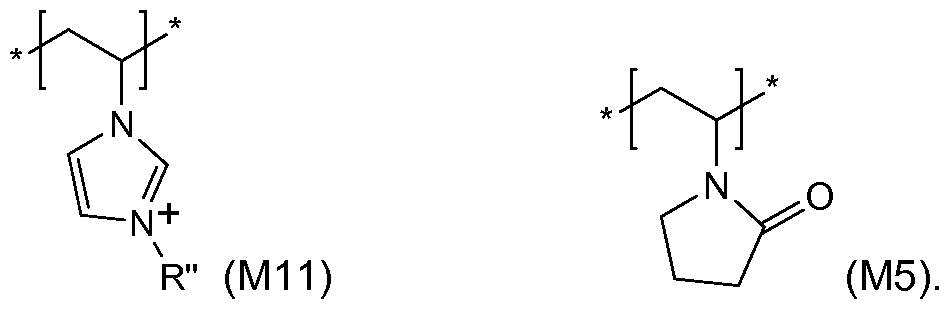
worin R für eine (Ci bis C4)-Alkylgruppe, insbesondere eine Methylgruppe, steht.
Zur Kompensation der positiven Polymerladung der Copolymere (co1 ) dienen alle möglichen physiologisch verträglichen Anionen, wie beispielsweise Chlorid, Bromid, Hydrogensulfat, Methylsulfat, Ethylsulfat, Tetrafluoroborat, Phosphat, Hydrogenphosphat, Dihydrogenphosphat oder p-Toluolsulfonat, Triflat.
Ganz besonders bevorzugte kationische filmbildende und/oder kationische festigende Polymere als Copolymere (co1 ) enthalten 10 bis 30 Mol-%, vorzugsweise 15 bis 25 Mol.-% und insbesondere 20 Mol.-% Struktureinheiten gemäß Formel (M1 1 ) und 70 bis 90 Mol.-%, vorzugsweise 75 bis 85 Mol.- % und insbesondere 80 Mol.-% Struktureinheiten gemäß Formel (M5).
Hierbei ist besonders bevorzugt, wenn die Copolymere (co1 ) neben Polymereinheiten, die aus dem Einbau der genannten Struktureinheiten gemäß Formel (M1 1 ) und (M5) in das Copolymer resultieren, maximal 5 Gew.-%, vorzugsweise maximal 1 Gew.-%, Polymereinheiten enthalten, die auf den Einbau anderer Monomere zurückgehen. Vorzugsweise sind die Copolymere (co1 ) ausschließlich aus Struktureinheiten der Formel (M1 1 ) mit R" = Methyl und (M5) aufgebaut.
Wird in zur Kompensation der positiven Ladung des Copolymers ein Chloridion verwendet, so werden diese N-Methylvinylimidazol/Vinylpyrrolidon-Copolymere werden laut INCI-Nomenklatur als Polyquaternium-16 bezeichnet und sind beispielsweise von der BASF unter den Handelsnamen Luviquat® Style, Luviquat® FC 370, Luviquat® FC 550, Luviquat® FC 905 und Luviquat® HM 552
Wird in zur Kompensation der positiven Ladung des Copolymers ein Methosulfat verwendet, so werden diese N-Methylvinylimidazol/Vinylpyrrolidon-Copolymere werden laut INCI-Nomenklatur als Polyquaternium-44 bezeichnet und sind beispielsweise von der BASF unter den Handelsnamen Luviquat® UltraCare erhältlich.
Es gelten somit insbesondere solche pulverförmigen Zusammensetzungen (K3) im Rahmen dieser Ausführungsform als ganz besonders bevorzugt, enthaltend mindestens ein partikelförmiges, amorphes Metalloxid, in dem mindestens ein kationisches filmbildendes Polymer sorbiert vorliegt, das neben mindestens einem Strukturelement der Formel (M1 1 ) zusätzlich ein Strukturelement der Formel (M5) umfasst
 worin R für eine (Ci bis C4)-Alkylgruppe, insbesondere eine Methylgruppe, steht.
Es gelten hierfür mutatis mutandis die bevorzugten partikelförmigen, amorphen Metalloxide (vide supra) als bevorzugt.
Zusätzlich zu dem bzw. den Copolymer(en) (co1 ) oder an dessen bzw. deren Stelle können die erfindungsgemäßen Mittel auch Copolymere (co2) enthalten, die ausgehend vom Copolymer (co1 ) als zusätzliche Struktureinheiten Struktureinheiten der Formel (M6) aufweisen

Weitere besonders bevorzugte erfindungsgemäße Mittel sind somit dadurch gekennzeichnet, daß sie als kationisches filmbildendes Polymer mindestens ein Copolymer (co2) enthalten, das mindestens eine Struktureinheit gemäß Formel (M1 1-a) und mindestens eine Struktureinheit gemäß Formel (M5) und mindestens eine Struktureinheit gemäß Formel (M6) enthält

Auch hierbei ist besonders bevorzugt, wenn die Copolymere (co2) neben Polymereinheiten, die aus dem Einbau der genannten Struktureinheiten gemäß Formel (M1 1-a), (M5) und (M6) in das Copolymer resultieren, maximal 5 Gew.-%, vorzugsweise maximal 1 Gew.-%, Polymereinheiten enthalten, die auf den Einbau anderer Monomere zurückgehen. Vorzugsweise sind die Copolymere (co2) ausschließlich aus Struktureinheiten der Formeln (M1 1-a), (M5) und (M6) aufgebaut.
Zur Kompensation der positiven Polymerladung der Komponente (co2) dienen alle möglichen physiologisch verträglichen Anionen, wie beispielsweise Chlorid, Bromid, Hydrogensulfat, Methylsulfat, Ethylsulfat, Tetrafluoroborat, Phosphat, Hydrogenphosphat, Dihydrogenphosphat oder p-Toluolsulfonat, Triflat.
Wird in zur Kompensation der positiven Ladung des Copolymers ein Methosulfat verwendet werden solche N-Methylvinylimidazol/Vinylpyrrolidon/Vinylcaprolactam-Copolymere laut INCI- Nomenklatur als Polyquarternium-46 bezeichnet und sind beispielsweise von der BASF unter dem Handelsnamen Luviquat® Hold erhältlich.
Ganz besonders bevorzugte Copolymere (co2) enthalten 1 bis 20 Mol-%, vorzugsweise 5 bis 15 Mol.-% und insbesondere 10 Mol.-% Struktureinheiten gemäß Formel (M1 1-a) und 30 bis 50 Mol.- %, vorzugsweise 35 bis 45 Mol.-% und insbesondere 40 Mol.-% Struktureinheiten gemäß Formel (M5) und 40 bis 60 Mol.-%, vorzugsweise 45 bis 55 Mol.-% und insbesondere 60 Mol.-% Struktureinheiten gemäß Formel (M6).
Zusätzlich zu dem bzw. den Copolymer(en) (co1 ) und/oder (co2) oder an dessen bzw. deren Stelle können die erfindungsgemäßen Mittel als kationisches filmbildendes Polymer auch Copolymere (co3) enthalten, die als Struktureinheiten Struktureinheiten der Formeln (M1 1-a) und (M5) aufweisen, sowie weitere Struktureinheiten aus der Gruppe der Vinylimidazol-Einheiten und weitere Struktureinheiten aus der Gruppe der Acrylamid- und/oder Methacrylamid-Einheiten.
Weitere besonders bevorzugte erfindungsgemäße Mittel sind dadurch gekennzeichnet, daß sie als sorbiertes kationisches filmbildendes Polymer mindestens ein Copolymer (co3) enthalten, das mindestens eine Struktureinheit gemäß Formel (M1 1-a) und mindestens eine Struktureinheit gemäß Formel (M5) und mindestens eine Struktureinheit gemäß Formel (M10) und mindestens eine Struktureinheit gemäß Formel (M12) enthält

Auch hierbei ist besonders bevorzugt, wenn die Copolymere (co3) neben Polymereinheiten, die aus dem Einbau der genannten Struktureinheiten gemäß Formel (M1 1-a), (M5), (M8) und (M12) in das Copolymer resultieren, maximal 5 Gew.-%, vorzugsweise maximal 1 Gew.-%, Polymereinheiten enthalten, die auf den Einbau anderer Monomere zurückgehen. Vorzugsweise sind die Copolymere (co3) ausschließlich aus Struktureinheiten der Formel (M1 1-a), (M5), (M8) und (M12) aufgebaut.
Zur Kompensation der positiven Polymerladung der Komponente (co3) dienen alle möglichen physiologisch verträglichen Anionen, wie beispielsweise Chlorid, Bromid, Hydrogensulfat, Methylsulfat, Ethylsulfat, Tetrafluoroborat, Phosphat, Hydrogenphosphat, Dihydrogenphosphat oder p-Toluolsulfonat, Triflat.
Wird in zur Kompensation der positiven Ladung des Copolymers ein Methosulfat verwendet werden solche N-Methylvinylimidazol/Vinylpyrrolidon/Vinylimidazol/Methacrylamid-Copolymere laut INCI-Nomenklatur als Polyquaternium-68 bezeichnet und sind beispielsweise von der BASF unter dem Handelsnamen Luviquat® Supreme erhältlich.
Ganz besonders bevorzugte Copolymere (co3) enthalten 1 bis 12 Mol-%, vorzugsweise 3 bis 9 Mol.-% und insbesondere 6 Mol.-% Struktureinheiten gemäß Formel (M1 1-a) und 45 bis 65 Mol.-%, vorzugsweise 50 bis 60 Mol.-% und insbesondere 55 Mol.-% Struktureinheiten gemäß Formel (M5) und 1 bis 20 Mol.-%, vorzugsweise 5 bis 15 Mol.-% und insbesondere 10 Mol.-% Struktureinheiten gemäß Formel (M8) und 20 bis 40 Mol.-%, vorzugsweise 25 bis 35 Mol.-% und insbesondere 29 Mol.-% Struktureinheiten gemäß Formel (M12).
Unter den filmbildenden kationischen Polymeren ausgewählt aus den kationischen Polymeren mit mindestens einem Strukturelement der obigen Formel (M1 1-a), gelten als bevorzugt:
Vinylpyrrolidon/1 -Vinyl-3-methyl-1 H-imidazoliumchlorid-Copolymere (wie beispielsweise das mit der INCI-Bezeichnung Polyquaternium-16 unter den Handelsbezeichnungen Luviquat® Style, Luviquat® FC 370, Luviquat® FC 550, Luviquat® FC 905 und Luviquat® HM 552 (BASF SE)),
Vinylpyrrolidon/1 -Vinyl-3-methyl-1 H-imidazoliummethylsulfat-Cop (wie beispielsweise das mit der INCI-Bezeichnung Polyquaternium-44 unter den Handelsbezeichnungen Luviquat® Care (BASF SE)),
Vinylpyrrolidon/Vinylcaprolactam/1-Vinyl-3-methyl-1 H-imidazolium-Terpolymer (wie beispielsweise das mit der INCI-Bezeichnung Polyquaternium-46 unter den Handelsbezeichnungen Luviquat® Care oder Luviquat® Hold (BASF SE)),
Vinylpyrrolidon/Methacrylamid/Vinylimidazol/1-Vinyl-3-methyl-1 H-imidazoliummethylsulfat- Copolymer (wie beispielsweise das mit der INCI-Bezeichnung Polyquaternium-68 unter der Handelsbezeichnung Luviquat® Supreme (BASF SE)),
sowie Gemische aus diesen Polymeren.
Es ist im Rahmen aller genannten kationischen filmbildenden Polymere (insbesondere der als bevorzugt erwähnten) erfindungsgemäß bevorzugt, für die Sorption des kationischen filmbildenden Polymers eines der bevorzugten partikelförmigen, amorphen Metalloxide (insbesondere eines der Ausführungsformen (A) bis (F)) zu verwenden (vide supra), insbesondere in den bevorzugten Mengen oder Mengenverhältnissen.
Ein Einsatz mindestens eines Silikons ist insbesondere günstig, um eine für das bloße Auge sichtbare Partikelabscheidung des partikelförmigen Metalloxids auf der keratinhaltigen Faser zu verringern bzw. zu vermeiden.
Als Silikon wird bevorzugt mindestens ein Silikonöl und/oder mindestens ein Silikongum eingesetzt.
Erfindungsgemäß geeignete Silikonöle oder Silikongums sind insbesondere Dialkyl- und Alkylarylsiloxane, wie beispielsweise Dimethylpolysiloxan und Methylphenylpolysiloxan, sowie deren alkoxylierte, quaternierte oder auch anionische Derivate. Bevorzugt sind cyclische und lineare Polydialkylsiloxane, deren alkoxylierte und/oder aminierte Derivate, Dihydroxypoly- dimethylsiloxane und Polyphenylalkylsiloxane.
Silikonöle bewirken die unterschiedlichsten Effekte. So beeinflussen sie beispielsweise gleichzeitig die Trocken- und Nasskämmbarkeiten, den Griff des trockenen und nassen Haares sowie den Glanz. Unter dem Begriff Silikonöle versteht der Fachmann mehrere Strukturen Silicium- organischer Verbindungen. Zunächst werden hierunter die Dimethiconole verstanden.
Als Beispiele für derartige Produkte werden die folgenden Handelsprodukte genannt: Botanisil NU- 150M (Botanigenics), Dow Corning 1-1254 Fluid, Dow Corning 2-9023 Fluid, Dow Corning 2-9026 Fluid, Ultrapure Dimethiconol (Ultra Chemical), Unisil SF-R (Universal Preserve), X-21-5619 (Shin- Etsu Chemical Co.), Abil OSW 5 (Degussa Care Specialties), ACC DL-9430 Emulsion (Taylor Chemical Company), AEC Dimethiconol & Sodium Dodecylbenzenesulfonate (A & E Connock (Perfumery & Cosmetics) Ltd.), B C Dimethiconol Emulsion 95 (Basildon Chemical Company, Ltd.), Cosmetic Fluid 1401 , Cosmetic Fluid 1403, Cosmetic Fluid 1501 , Cosmetic Fluid 1401 DC (alle zuvor genannten Chemsil Silicones, Inc.), Dow Corning 1401 Fluid, Dow Corning 1403 Fluid, Dow
Corning 1501 Fluid, Dow Corning 1784 HVF Emulsion, Dow Corning 9546 Silicone Elastomer Blend (alle zuvor genannten Dow Corning Corporation), Dub Gel Sl 1400 (Stearinerie Dubois Fils), HVM 4852 Emulsion (Crompton Corporation), Jeesilc 6056 (Jeen International Corporation), Lubrasil, Lubrasil DS (beide Guardian Laboratories), Nonychosine E, Nonychosine V (beide Exsymol), SanSurf Petrolatum-25, Satin Finish (beide Collaborative Laboratories, Inc.), Silatex-D30 (Cosmetic Ingredient Resources), Silsoft 148, Silsoft E-50, Silsoft E-623 (alle zuvor genannten Crompton Corporation), SM555, SM2725, SM2765, SM2785 (alle zuvor genannten GE Silicones), Taylor T-Sil CD-1 , Taylor TME-4050E (alle Taylor Chemical Company), TH V 148 (Crompton Corporation), Tixogel CYD-1429 (Sud-Chemie Performance Additives), Wacker-Belsil CM 1000, Wacker-Belsil CM 3092, Wacker-Belsil CM 5040, Wacker-Belsil DM 3096, Wacker-Belsil DM 31 12 VP, Wacker-Belsil DM 8005 VP, Wacker-Belsil DM 60081 VP (alle zuvor genannten Wacker- Chemie GmbH).
Dimethicone bilden die zweite Gruppe der Silikone, welche erfindungsgemäß enthalten sein können. Diese können sowohl linear als auch verzweigt als auch cyclisch oder cyclisch und verzweigt sein.
Dimethiconcopolyole bilden eine weitere Gruppe von Silikonen, die geeignet sind. Entsprechende Dimethiconcopolyole sind kommerziell erhältlich und werden beispielsweise von der Firma Dow Corning unter der Bezeichnung Dow Corning ® 5330 Fluid vertrieben.
Selbstverständlich umfasst die erfindungsgemäße Lehre auch, dass die Dimethiconole, Dimethicone und/oder Dimethiconcopolymere bereits als Emulsion vorliegen können. Dabei kann die entsprechende Emulsion der Dimethiconole, Dimethicone und/oder Dimethiconcopolyole sowohl nach der Herstellung der entsprechenden Dimethiconole, Dimethicone und/oder Dimethiconcopolyole aus diesen und den dem Fachmann bekannten üblichen Verfahren zur Emulgierung hergestellt werden. Hierzu können als Hilfsmittel zur Herstellung der entsprechenden Emulsionen sowohl kationische, anionische, nichtionische oder zwitterionische Tenside und Emulgatoren als Hilfsstoffe verwendet werden. Selbstverständlich können die Emulsionen der Dimethiconole, Dimethicone und/oder Dimethiconcopolyole auch direkt durch ein Emulsionspoly- merisationsverfahren hergestellt werden. Auch derartige Verfahren sind dem Fachmann wohl bekannt.
Wenn die Dimethiconole, Dimethicone und/oder Dimethiconcopolyole als Emulsion verwendet werden, dann beträgt die Tröpfchengröße der emulgierten Teilchen erfindungsgemäß 0,01 bis 10000 μιτι, bevorzugt 0,01 bis 100 μιτι, besonders bevorzugt 0,01 bis 20 μιτι und ganz besonders bevorzugt 0,01 bis 10 μιτι. Die Teilchengröße wird dabei nach der Methode der Lichtstreuung bestimmt.
Werden verzweigte Dimethiconole, Dimethicone und/oder Dimethiconcopolyole verwendet, so ist darunter zu verstehen, dass die Verzweigung größer ist, als eine zufällige Verzweigung, welche
durch Verunreinigungen der jeweiligen Monomere zufällig entsteht. Im Sinne der vorliegenden Erfindung ist daher unter verzweigten Dimethiconolen, Dimethiconen und/oder Dimethiconcopolyolen zu verstehen, dass der Verzweigungsgrad größer als 0,01 % ist. Bevorzugt ist ein Verzweigungsgrad größer als 0,1 % und ganz besonders bevorzugt von größer als 0,5 %. Der Grad der Verzweigung wird dabei aus dem Verhältnis der unverzweigten Monomeren zu den verzweigenden Monomeren, das heißt der Menge an tri- und tetrafunktionalen Siloxanen, bestimmt. Erfindungsgemäß können sowohl niedrigverzweigte als auch hochverzweigte Dimethiconole, Dimethicone und/oder Dimethiconcopolyole ganz besonders bevorzugt sein.
Besonders geeignete Silikone sind aminofunktionelle Silikone, insbesondere die Silikone, die unter der INCI-Bezeichnung Amodimethicone zusammengefasst sind. Daher ist es erfindungsgemäß bevorzugt, wenn die erfindungsgemäß Mittel zusätzlich mindestens ein aminofunktionelles Silikon enthalten. Darunter sind Silikone zu verstehen, welche mindestens eine, gegebenenfalls substituierte, Aminogruppe aufweisen. Diese Silikone werden nach der INCI-Deklaration als Amodimethicone bezeichnet und sind beispielsweise in Form einer Emulsion als Handelsprodukt Dow Corning® 939 oder als Handelsprodukt Dow Corning® 949 im Gemisch mit einem kationischen und eine nichtionischen Tensid erhältlich.
Vorzugsweise werden solche aminofunktionellen Silikone eingesetzt, die eine Aminzahl oberhalb von 0,25 meq/g, vorzugsweise oberhalb von 0,3 meq/g und insbesondere bevorzugt oberhalb von 0,4 meq/g aufweisen. Die Aminzahl steht dabei für die Milli-Äquivalente Amin pro Gramm des aminofunktionellen Silikons. Sie kann durch Titration ermittelt und auch in der Einheit mg KOH/g angegeben werden.
Gleichfalls sind quaternisierte Aminosilikone bevorzugt geeignet. Ein besonders bevorzugtes quaternisiertes Aminosilikon trägt die INCI-Bezeichnung Quaternium-80 und wird unter der Handelsbezeichnung Abil Quat® von der Firma Evonik Goldschmidt vertrieben.
Die Mittel enthalten die Silikone bevorzugt in Mengen von 0,01 Gew.-% bis 30,0 Gew.-%, besonders bevorzugt von 0,05 bis 10,0 Gew.-%, bezogen auf das gesamte Mittel.
Es ist im Rahmen aller genannten Silikone (insbesondere der als bevorzugt erwähnten) erfindungsgemäß bevorzugt, für die Sorption des Silikons eines der bevorzugten partikelförmigen, amorphen Metalloxide (insbesondere eines der Ausführungsformen (A) bis (F)) zu verwenden (vide supra), insbesondere in den dafür bevorzugten Mengen bzw. Mengenverhältnissen.
Als erfindungsgemäß sorbierter kosmetischer Wirkstoff eignet sich, insbesondere zur Bereitstellung einer pulverförmigen Zusammensetzung zur Färbung keratinhaltiger Fasern, mindestens ein Oxidationsfarbstoffvorprodukt. Entsprechende Oxidationsfarbstoffvorprodukte werden bevorzugt ausgewählt unter mindestens einer Entwicklerkomponente und mindestens einer Kupplerkomponente.
Als Oxidationsfarbstoffvorprodukte kennt der Fachmann sogenannte Entwicklerkomponenten und Kupplerkomponent. Die Entwicklerkomponenten bilden unter dem Einfluß von Oxidationsmitteln oder von Luftsauerstoff untereinander oder unter Kupplung mit einer oder mehreren Kupplerkomponenten die eigentlichen Farbstoffe aus. Die Oxidationsfärbemittel zeichnen sich zwar durch hervorragende, lang anhaltende Färbeergebnisse aus.
Es kann erfindungsgemäß bevorzugt sein, als Entwicklerkomponente ein p-Phenylendiaminderivat oder eines seiner physiologisch verträglichen Salze einzusetzen. Besonders bevorzugt sind p- Phenylendiaminderivate der Formel (E1 )

G steht für ein Wasserstoffatom, einen (C-ι bis C4)-Alkylrest, einen (C-ι bis C4)- Monohydroxyalkylrest, einen (C2 bis C4)-Polyhydroxyalkylrest, einen (C-ι bis C4)-Alkoxy-(C-i bis C4)-alkylrest, einen 4'-Aminophenylrest oder einen (Ci bis C4)-Alkylrest, der mit einer stickstoffhaltigen Gruppe, einem Phenyl- oder einem 4'-Aminophenylrest substituiert ist;
G2 steht für ein Wasserstoffatom, einen (Ci bis C4)-Alkylrest, einen (Ci bis C4)- Monohydroxyalkylrest, einen (C2 bis C4)-Polyhydroxyalkylrest, einen (Ci bis C4)-Alkoxy-(Ci bis C4)-alkylrest oder einen (Ci bis C4)-Alkylrest, der mit einer stickstoffhaltigen Gruppe substituiert ist;
G3 steht für ein Wasserstoffatom, ein Halogenatom, wie ein Chlor-, Brom-, lod- oder Fluoratom, einen (Ci bis C4)-Alkylrest, einen (Ci bis C4)-Monohydroxyalkylrest, einen (C2 bis C4)- Polyhydroxyalkylrest, einen (Ci bis C4)-Hydroxyalkoxyrest, einen (Ci bis C4)-Alkoxy-(Ci bis C4)- alkylrest, einen (Ci bis C4)-Acetylaminoalkoxyrest, einen Mesylamino-(Ci bis C4)-alkoxyrest oder einen (Ci bis C4)-Carbamoylaminoalkoxyrest;
G4 steht für ein Wasserstoffatom, ein Halogenatom, einen (Ci bis C4)-Alkylrest oder einen (Ci bis C4)-Alkoxy-(Ci bis C4)-alkylrest, oder
wenn G3 und G4 in ortho-Stellung zueinander stehen, können sie gemeinsam eine verbrückende α,ω-Alkylendioxogruppe, wie beispielsweise eine Ethylendioxygruppe bilden.
Besonders bevorzugte p-Phenylendiamine der Formel (E1 ) werden ausgewählt aus einer oder mehrerer Verbindungen der Gruppe, die gebildet wird, aus p-Phenylendiamin, p-Toluylendiamin, 2- Chlor-p-phenylendiamin, 2,3-Dimethyl-p-phenylendiamin, 2,6-Dimethyl-p-phenylendiamin, 2,6- Diethyl-p-phenylendiamin, 2,5-Dimethyl-p-phenylendiamin, N,N-Dimethyl-p-phenylendiamin, N,N- Diethyl-p-phenylendiamin, N,N-Dipropyl-p-phenylendiamin, 4-Amino-3-methyl-(N,N-diethyl)-anilin,
N,N-Bis-(ß-hydroxyethyl)-p-phenylendiamin, 4-N,N-Bis-(ß-hydroxyethyl)-amino-2-methylanilin, 4- N,N-Bis-(ß-hydroxyethyl)-amino-2-chloranilin, 2-(ß-Hydroxyethyl)-p-phenylendiamin, 2-(a,ß- Dihydroxyethyl)-p-phenylendiamin, 2-Fluor-p-phenylendiamin, 2-lsopropyl-p-phenylendiamin, N-(ß- Hydroxypropyl)-p-phenylendiamin, 2-Hydroxymethyl-p-phenylendiamin, N,N-Dimethyl-3-methyl-p- phenylendiamin, N,N-(Ethyl,ß-hydroxyethyl)-p-phenylendiamin, N-(ß,v-Dihydroxypropyl)-p- phenylendiamin, N-(4'-Aminophenyl)-p-phenylendiamin, N-Phenyl-p-phenylendiamin, 2-(ß- Hydroxyethyloxy)-p-phenylendiamin, 2-Methoxymethyl-p-phenylendiamin, 2-(ß- Acetylaminoethyloxy)-p-phenylendiamin, N-(ß-Methoxyethyl)-p-phenylendiamin, N-(4-Amino-3- methylphenyl)-N-[3-(1 H-imidazol-1-yl)propyl]amin, 5,8-Diaminobenzo-1 ,4-dioxan sowie ihren physiologisch verträglichen Salzen.
Erfindungsgemäß ganz besonders bevorzugte p-Phenylendiaminderivate der Formel (E1 ) sind ausgewählt aus mindestens einer Verbindung der Gruppe p-Phenylendiamin, p-Toluylendiamin, 2- (ß-Hydroxyethyl)-p-phenylendiamin, 2-(a,ß-Dihydroxyethyl)-p-phenylendiamin, N,N-Bis-(ß- hydroxyethyl)-p-phenylendiamin, 2-Methoxymethyl-p-phenylendiamin, N-(4-Amino-3- methylphenyl)-N-[3-(1 H-imidazol-1-yl)propyl]amin, sowie den physiologisch verträglichen Salzen dieser Verbindungen.
Es kann erfindungsgemäß weiterhin bevorzugt sein, als Entwicklerkomponente Verbindungen einzusetzen, die mindestens zwei aromatische Kerne enthalten, die mit Amino- und/oder Hydroxylgruppen substituiert sind.
Unter den zweikernigen Entwicklerkomponenten, die in den Färbezusammensetzungen gemäß der Erfindung verwendet werden können, kann man insbesondere die Verbindungen nennen, die der folgenden Formel (E2) entsprechen, sowie ihre physiologisch verträglichen Salze:

Z und Z2 stehen unabhängig voneinander für einen Hydroxyl- oder NH2-Rest, der gegebenenfalls durch einen (Ci bis C4)-Alkylrest, durch einen (Ci bis C4)-Hydroxyalkylrest und/oder durch eine Verbrückung Y substituiert ist oder der gegebenenfalls Teil eines verbrückenden Ringsystems ist,
die Verbrückung Y steht für eine Alkylengruppe mit 1 bis 14 Kohlenstoffatomen, wie beispielsweise eine lineare oder verzweigte Alkylenkette oder einen Alkylenring, die von einer
oder mehreren stickstoffhaltigen Gruppen und/oder einem oder mehreren Heteroatomen wie Sauerstoff-, Schwefel- oder Stickstoffatomen unterbrochen oder beendet sein kann und eventuell durch einen oder mehrere Hydroxyl- oder (Ci bis C8)-Alkoxyreste substituiert sein kann, oder eine direkte Bindung,
G5 und G6 stehen unabhängig voneinander für ein Wasserstoff- oder Halogenatom, einen (Ci bis C4)-Alkylrest, einen (Ci bis C4)-Monohydroxyalkylrest, einen (C2 bis C4)- Polyhydroxyalkylrest, einen (Ci bis C4)-Aminoalkylrest oder eine direkte Verbindung zur Verbrückung Y,
G7, G8, G9, G 0, G und G 2 stehen unabhängig voneinander für ein Wasserstoffatom, eine direkte Bindung zur Verbrückung Y oder einen (Ci bis C4)-Alkylrest,
mit der Maßgabe, dass die Verbindungen der Formel (E2) nur eine Verbrückung Y pro Molekül enthalten.
Die in Formel (E2) verwendeten Substituenten sind erfindungsgemäß analog zu den obigen Ausführungen definiert.
Bevorzugte zweikernige Entwicklerkomponenten der Formel (E2) werden insbesondere aus mindestens einer der folgenden Verbindungen ausgewählt: N,N'-Bis-(ß-hydroxyethyl)-N,N'-bis-(4'- aminophenyl)-1 ,3-diamino-propan-2-ol, N,N'-Bis-(ß-hydroxyethyl)-N,N'-bis-(4'-aminophenyl)- ethylendiamin, N,N'-Bis-(4'-aminophenyl)-tetramethylendiamin, N,N'-Bis-(ß-hydroxyethyl)-N,N'-bis- (4'-aminophenyl)-tetramethylendiamin, N,N'-Bis-(4-(methylamino)phenyl)-tetramethylendiamin, N,N'-Diethyl-N,N'-bis-(4'-amino-3'-methylphenyl)-ethylendiamin, Bis-(2-hydroxy-5-aminophenyl)- methan, N,N'-Bis-(4'-aminophenyl)-1 ,4-diazacycloheptan, N,N'-Bis-(2-hydroxy-5-aminobenzyl)- piperazin, N-(4'-Aminophenyl)-p-phenylendiamin und 1 , 10-Bis-(2\5'-diaminophenyl)-1 ,4,7, 10- tetraoxadecan sowie ihre physiologisch verträglichen Salze.
Ganz besonders bevorzugte zweikernige Entwicklerkomponenten der Formel (E2) werden ausgewählt unter N,N'-Bis-(ß-hydroxyethyl)-N,N'-bis-(4-aminophenyl)-1 ,3-diamino-propan-2-ol, Bis- (2-hydroxy-5-aminophenyl)-methan, 1 ,3-Bis-(2,5-diaminophenoxy)-propan-2-ol, N,N'-Bis-(4- aminophenyl)-1 ,4-diazacycloheptan, 1 , 10-Bis-(2,5-diaminophenyl)-1 ,4,7, 10-tetraoxadecan oder eines der physiologisch verträglichen Salze dieser Verbindungen.
Weiterhin kann es erfindungsgemäß bevorzugt sein, als Entwicklerkomponente ein p- Aminophenolderivat oder eines seiner physiologisch verträglichen Salze einzusetzen. Besonders bevorzugt sind p-Aminophenolderivate der Formel (E3)

wobei:
G 3 steht für ein Wasserstoffatom, ein Halogenatom, einen (Ci bis C4)-Alkylrest, einen (Ci bis C4)-Monohydroxyalkylrest, einen (C2 bis C4)-Polyhydroxyalkylrest, einen (Ci bis C4)-Alkoxy-(d bis C4)-alkylrest, einen (Ci bis C4)-Aminoalkylrest, einen Hydroxy-(Ci bis C4)-alkylaminorest, einen (Ci bis C4)-Hydroxyalkoxyrest, einen (Ci bis C4)-Hydroxyalkyl-(Ci bis C4)-aminoalkylrest oder einen (Di-[(Ci bis C4)-alkyl]amino)-(Ci bis C4)-alkylrest, und
G 4 steht für ein Wasserstoff- oder Halogenatom, einen (Ci bis C4)-Alkylrest, einen (Ci bis C4)-
Monohydroxyalkylrest, einen (C2 bis C4)-Polyhydroxyalkylrest, einen (C-ι bis C4)-Alkoxy-(C-i bis
C4)-alkylrest, einen (C-ι bis C4)-Aminoalkylrest oder einen (C-ι bis C4)-Cyanoalkylrest,
G 5 steht für Wasserstoff, einen (Ci bis C4)-Alkylrest, einen (Ci bis C4)-Monohydroxyalkylrest, einen (C2 bis C4)-Polyhydroxyalkylrest, einen Phenylrest oder einen Benzylrest, und
G 6 steht für Wasserstoff oder ein Halogenatom.
Die in Formel (E3) verwendeten Substituenten sind erfindungsgemäß analog zu den obigen Ausführungen definiert.
Bevorzugte p-Aminophenole der Formel (E3) sind insbesondere p-Aminophenol, N-Methyl-p- aminophenol, 4-Amino-3-methyl-phenol, 4-Amino-3-fluorphenol, 2-Hydroxymethylamino-4- aminophenol, 4-Amino-3-hydroxymethylphenol, 4-Amino-2-(ß-hydroxyethoxy)-phenol, 4-Amino-2- methylphenol, 4-Amino-2-hydroxymethylphenol, 4-Amino-2-methoxymethyl-phenol, 4-Amino-2- aminomethylphenol, 4-Amino-2-(ß-hydroxyethyl-aminomethyl)-phenol, 4-Amino-2-(a,ß- dihydroxyethyl)-phenol, 4-Amino-2-fluorphenol, 4-Amino-2-chlorphenol, 4-Amino-2,6-dichlorphenol, 4-Amino-2-(diethyl-aminomethyl)-phenol sowie ihre physiologisch verträglichen Salze.
Ganz besonders bevorzugte Verbindungen der Formel (E3) sind p-Aminophenol, 4-Amino-3- methylphenol, 4-Amino-2-aminomethylphenol, 4-Amino-2-(a,ß-dihydroxyethyl)-phenol und 4- Amino-2-(diethylaminomethyl)-phenol.
Ferner kann die Entwicklerkomponente ausgewählt sein aus o-Aminophenol und seinen Derivaten, wie beispielsweise 2-Amino-4-methylphenol, 2-Amino-5-methylphenol oder 2-Amino-4-chlorphenol.
Weiterhin kann die Entwicklerkomponente ausgewählt sein aus heterocyclischen Entwicklerkomponenten, wie beispielsweise aus Pyrimidinderivaten, Pyrazolderivaten, Pyrazolopyrimidin-Derivaten bzw. ihren physiologisch verträglichen Salzen.
Bevorzugte Pyrimidin-Derivate werden erfindungsgemäß ausgewählt aus Verbindungen gemäß Formel (E4) bzw. deren physiologisch verträglichen Salzen,

worin
G 7, G 8 und G 9 unabhängig voneinander für ein Wasserstoffatom, eine Hydroxygruppe, eine (Ci bis C4)-Alkoxygruppe oder eine Aminogruppe steht und
G für eine Hydroxygruppe oder eine Gruppe -NG G steht, worin G und G unabhängig voneinander stehen für ein Wasserstoffatom, eine (Ci bis C4)-Alkylgruppe, eine (Ci bis C4)- Monohyd roxyalky Ig ru ppe ,
mit der Maßgabe, dass maximal zwei der Gruppen aus G 7, G 8, G 9 und G20 eine Hydroxygruppe bedeuten und höchstens zwei der Reste G 7, G 8 und G 9 für ein Wasserstoffatom stehen. Dabei ist es wiederum bevorzugt, wenn gemäß Formel (E4) mindestens zwei Gruppen aus G 7, G 8, G 9 und G20 für eine Gruppe -NG2 G22 stehen und höchstens zwei Gruppen aus G 7, G 8, G 9 und G20 für eine Hydroxygruppe stehen.
Besonders bevorzugte Pyrimidin-Derivate sind insbesondere die Verbindungen 2,4,5,6-Tetra- aminopyrimidin, 4-Hydroxy-2,5,6-triaminopyrimidin, 2-Hydroxy-4,5,6-triaminopyrimidin, 2- Dimethylamino-4,5,6-triaminopyrimidin, 2,4-Dihydroxy-5,6-diaminopyrimidin und 2,5,6- Triaminopyrimidin.
Bevorzugte Pyrazol-Derivate werden erfindungsgemäß ausgewählt aus Verbindungen gemäß Formel (E5),

G , G , G stehen unabhängig voneinander für ein Wasserstoffatom, eine (Ci bis C4)- Alkylgruppe, eine (Ci bis C4)-Monohydroxyalkylgruppe, eine (C2 bis C4)-Polyhydroxy- alkylgruppe, eine gegebenenfalls substituierte Arylgruppe oder eine gegebenenfalls
substituierte Aryl-(C-i bis C4)-alkylgruppe, mit der Maßgabe dass, wenn G für ein Wasserstoffatom steht, G27 neben den vorgenannten Gruppen zusätzlich für eine Gruppe -NH2 stehen kann,
G26 steht für ein Wasserstoffatom, eine (Ci bis C4)-Alkylgruppe, eine (Ci bis C4)- Monohydroxyalkylgruppe oder eine (C2 bis C4)-Polyhydroxyalkylgruppe und
G27 steht für ein Wasserstoffatom, eine gegebenenfalls substituierte Arylgruppe, eine (Ci bis C4)-Alkylgruppe oder eine (Ci bis C4)-Monohydroxyalkylgruppe, insbesondere für ein Wasserstoffatom oder eine Methylgruppe.
Bevorzugt bindet in Formel (E5) der Rest -NG25G26 an die 5 Position und der Rest G27 an die 3 Position des Pyrazolzyklus.
Besonders bevorzugte Pyrazol-Derivate sind insbesondere die Verbindungen, die ausgewählt werden aus 4,5-Diamino-1-methylpyrazol, 4,5-Diamino-1-(ß-hydroxyethyl)-pyrazol, 3,4- Diaminopyrazol, 4,5-Diamino-1-(4'-chlorbenzyl)-pyrazol, 4,5-Diamino-1 ,3-dimethylpyrazol, 4,5- Diamino-3-methyl-1-phenylpyrazol, 4,5-Diamino-1 -methyl-3-phenylpyrazol, 4-Amino-1 ,3-dimethyl- 5-hydrazinopyrazol, 1-Benzyl-4,5-diamino-3-methylpyrazol, 4,5-Diamino-3-tert.-butyl-1- methylpyrazol, 4,5-Diamino-1-tert.-butyl-3-methylpyrazol, 4,5-Diamino-1-(ß-hydroxyethyl)-3-methyl- pyrazol, 4,5-Diamino-1-ethyl-3-methylpyrazol, 4,5-Diamino-1 -ethyl-3-(4'-methoxyphenyl)-pyrazol, 4,5-Diamino-1-ethyl-3-hydroxymethylpyrazol, 4,5-Diamino-3-hydroxymethyl-1-methylpyrazol, 4,5- Diamino-3-hydroxymethyl-1-isopropylpyrazol, 4,5-Diamino-3-methyl-1 -isopropylpyrazol, 4-Amino-5- (ß-aminoethyl)amino-l ,3-dimethylpyrazol, sowie deren physiologisch verträglichen Salze.
Ganz besonders bevorzugte Entwicklerkomponenten werden ausgewählt, aus mindestens einer Verbindung aus der Gruppe, die gebildet wird aus p-Phenylendiamin, p-Toluylendiamin, 2-(ß- Hydroxyethyl)-p-phenylendiamin, 2-(a,ß-Dihydroxyethyl)-p-phenylendiamin, N,N-Bis-(ß- hydroxyethyl)-p-phenylendiamin, N-(4-Amino-3-methylphenyl)-N-[3-(1 H-imidazol-1-yl)propyl]amin, N,N'-Bis-(ß-hydroxyethyl)-N,N'-bis-(4-aminophenyl)-1 ,3-diamino-propan-2-ol, Bis-(2-hydroxy-5- aminophenyl)-methan, 1 ,3-Bis-(2,5-diaminophenoxy)-propan-2-ol, N,N'-Bis-(4-aminophenyl)-1 ,4- diazacycloheptan, 1 , 10-Bis-(2,5-diaminophenyl)-1 ,4J, 10-tetraoxadecan, p-Aminophenol, 4-Amino- 3-methylphenol, 4-Amino-2-aminomethylphenol, 4-Amino-2-(a,ß-dihydroxyethyl)-phenol und 4- Amino-2-(diethylaminomethyl)-phenol, 4,5-Diamino-1-(ß-hydroxyethyl)-pyrazol, 2,4,5,6-Tetraamino- pyrimidin, 4-Hydroxy-2,5,6-triaminopyrimidin, 2-Hydroxy-4,5,6-triaminopyrimidin, sowie den physiologisch verträglichen Salzen dieser Verbindungen.
Im folgenden werden Beispiele für die als Substituenten der Verbindungen der Formeln (E1 ) bis (E5) genannten Reste aufgezählt: Beispiele für (C-ι bis C4)-Alkylreste sind die Gruppen -CH3, -
-CH2CH2CH3, -CH(CH3)2, -CH2CH2CH2CH3, -CH2CH(CH3)2, -CH(CH3)CH2CH3, -C(CH3)3. Erfindungsgemäße Beispiele für (Ci bis C4)-Alkoxyreste sind -OCH3, -OCH2CH3, -OCH2CH2CH3, -OCH(CH3)2, -OCH2CH2CH2CH3, -OCH2CH(CH3)2, -OCH(CH3)CH2CH3, -OC(CH3)3, insbesondere eine Methoxy- oder eine Ethoxygruppe.
Weiterhin können als bevorzugte Beispiele für eine (Ci bis C4)-Monohydroxyalkylgruppe -CH2OH, -CH2CH2OH , -CH2CH2CH2OH, -CHCH(OH)CH3, -CH2CH2CH2CH2OH, wobei die Gruppe - CH2CH2OI-l bevorzugt ist.
Ein besonders bevorzugtes Beispiel einer (C2 bis C4)-Polyhydroxyalkylgruppe ist die 1 ,2- Dihydroxyethylgruppe.
Beispiele für Halogenatome sind F-, CI- oder Br-Atome, Cl-Atome sind ganz besonders bevorzugte Beispiele.
Beispiele für stickstoffhaltige Gruppen sind insbesondere -NH2, (Ci bis C4)- Monoalkylaminogruppen, (Ci bis C4)-Dialkylaminogruppen, (Ci bis C4)-Trialkylammoniunrigruppen, (C-i bis C4)-Monohydroxyalkylaminogruppen, Imidazolinium und -NH3 +.
Beispiele für (C-, bis C4)-Monoalkylaminogruppen sind -NHCH3, -NHCH2CH3, -NHCH2CH2CH3, -NHCH(CH3)2.
Beispiele für (Ci bis C4)-Dialkylaminogruppe sind -N(CH3)2, -N(CH2CH3)2.
Beispiele für (Ci bis C4)-Trialkylammoniunrigruppen sind -N+(CH3)3, -N+(CH3)2(CH2CH3),

Beispiele für (Ci bis C4)-Hydroxyalkylaminoreste sind -NH-CH2CH2OH, -NH-CH2CH2OH, -NH-CH2CH2CH2OH, -NH-CH2CH2CH2OH.
Beispiele für (C-ι bis C4)-Alkoxy-(C-i bis C4)-alkylgruppen sind die Gruppen -CH2CH2-O-CH3, -CH2CH2CH2-O-CH3, -CH2CH2-O-CH2CH3, -CH2CH2CH2-O-CH2CH3, -CH2CH2"0-CH(CH3), -CH2CH2CH2-0-CH(CH3).
Beispiele für Hydroxy-(d bis C4)-alkoxyreste sind -0-CH2OH, -0-CH2CH2OH, -0-CH2CH2CH2OH, -0-CHCH(OH)CH3, -O-CH2CH2CH2CH2OH.
Beispiele für (d bis C4)-Acetylaminoalkoxyreste sind -0-CH2NHC(0)CH3, -0-CH2CH2NHC(0)CH3, -0-CH2CH2CH2NHC(0)CH3, -0-CH2CH(NHC(0)CH3)CH3, -0-CH2CH2CH2CH2NHC(0)CH3.
Beispiele für (Ci bis C4)-Carbamoylaminoalkoxyreste sind -0-CH2CI-l2-NI-l-C(0)-NI-l2, -0-CH2CH2CH2-NH-C(0)-NH2, -0-CH2CH2CH2CH2-NH-C(0)-NH2.
Beispiele für (Ci bis C4)-Aminoalkylreste sind -CH2NH2, -CH2CH2NH2, -CH2CH2CH2NH2, -CH2CH(NH2)CH3, -CH2CH2CH2CH2NH2.
Beispiele für (Ci bis C4)-Cyanoalkylreste sind -CH2CN, -CH2CH2CN, -CH2CH2CH2CN.
Beispiele für (Ci bis C4)-Hydroxyalkylamino-(Ci bis C4)-alkylreste sind -CH2CH2NH-CH2CH2OH, -CH2CH2CH2NH-CH2CH2OH, -CH2CH2NH-CH2CH2CH2OH, -CH2CH2CH2NH-CH2CH2CH2OH . Beispiele für Di[(Ci bis C4)-Hydroxyalkyl]amino-(Ci bis C4)-alkylreste sind -CH2CH2N(CH2CH2OH)2, -CH2CH2CH2N(CH2CH2OH)2, -CH2CH2N(CH2CH2CH2OH)2, -CH2CH2CH2N(CH2CH2CH2OH)2.
Ein Beispiel für Arylgruppen ist die Phenylgruppe.
Beispiele für Aryl-(Ci bis C4)-alkylgruppen sind die Benzylgruppe und die 2-Phenylethylgruppe. Kupplerkomponenten bilden im Rahmen der oxidativen Färbung allein keine signifikante Färbung aus, sondern benötigen stets die Gegenwart von Entwicklerkomponenten. Daher ist es erfindungsgemäß bevorzugt, dass bei Verwendung mindestens einer Entwicklerkomponente zusätzlich mindestens eine Kupplerkomponente zum Einsatz kommt.
Kupplerkomponenten im Sinne der Erfindung erlauben mindestens eine Substitution eines chemischen Restes des Kupplers durch die oxidierte Form der Entwicklerkomponente. Dabei bildet sich eine kovalente Bindung zwischen Kuppler- und Entwicklerkomponente aus. Kuppler sind bevorzugt zyklische Verbindungen, die am Zyklus mindestens zwei Gruppen tragen, ausgewählt aus (i) gegebenenfalls substituierten Aminogruppen und/oder (ii) Hydroxygruppen. Wenn die zyklische Verbindung ein Sechsring (bevorzugt aromatisch) ist, so befinden sich die besagten Gruppen bevorzugt in ortho-Position oder meta-Position zueinander.
Erfindungsgemäße Kupplerkomponenten werden bevorzugt als mindestens eine Verbindung aus einer der folgenden Klassen ausgewählt:
- m-Aminophenol und/oder dessen Derivate,
- m-Diaminobenzol und/oder dessen Derivate,
- o-Diaminobenzol und/oder dessen Derivate,
- o-Aminophenolderivate, wie beispielsweise o-Aminophenol,
- Naphthalinderivate mit mindestens einer Hydroxygruppe,
- Di- beziehungsweise Trihydroxybenzol und/oder deren Derivate,
- Pyridinderivate,
- Pyrimidinderivate,
- Monohydroxyindol-Derivate und/oder Monoaminoindol-Derivate,
- Monohydroxyindolin-Derivate und/oder Monoaminoindolin-Derivate,
- Pyrazolonderivate, wie beispielsweise 1-Phenyl-3-methylpyrazol-5-on,
- Morpholinderivate wie beispielsweise 6-Hydroxybenzomorpholin oder 6-Amino-benzomorpholin,
- Chinoxalinderivate wie beispielsweise 6-Methyl-1 ,2,3,4-tetrahydrochinoxalin,
Gemische aus zwei oder mehrer Verbindungen aus einer oder mehrerer dieser Klassen sind im Rahmen dieser Ausführungsform ebenso erfindungsgemäß.
Die erfindungsgemäß verwendbaren m-Aminophenole bzw. deren Derivate werden bevorzugt ausgewählt aus mindestens einer Verbindung der Formel (K1 ) und/oder aus mindestens einem physiologisch verträglichen Salz einer Verbindung gemäß Formel (K1 ),

worin
G und Gz unabhängig voneinander stehen für ein Wasserstoffatom, eine (Ci bis C4)-Alkylgruppe, eine (C3 bis C6)-Cycloalkylgruppe, eine (C2 bis C4)-Alkenylgruppe, eine (Ci bis C4)- Monohydroxyalkylgruppe, eine (C2 bis C4)-Polyhydroxyalkylgruppe, eine (C2 bis C4)- Perfluoracylgruppe, eine Aryl-(Ci bis C6)-alkylgruppe, eine Amino-(Ci bis C6)- alkylgruppe, eine (Ci bis C6)-Dialkylamino-(Ci bis C6)-alkylgruppe oder eine (Ci bis C6)-Alkoxy-(Ci bis C6)-alkylgruppe, wobei G und G2 gemeinsam mit dem Stickstoffatom einen fünfgliedrigen, sechsgliedrigen oder siebengliedrigen Ring bilden können,
GJ und G unabhängig voneinander stehen für ein Wasserstoffatom, ein Halogenatom, eine (Ci bis C4)-Alkylgruppe, eine (Ci bis C4)-Alkoxygruppe, eine Hydroxygruppe, eine (Ci bis C4)-Monohydroxyalkylgruppe, eine (C2 bis C4)-Polyhydroxyalkylgruppe, eine Hydroxy- (Ci bis C4)-alkoxygruppe, eine (Ci bis C6)-Alkyox-(C2 bis C6)-alkoxygruppe, eine Arylgruppe oder eine Heteroarylgruppe.
Besonders bevorzugte m-Aminophenol-Kupplerkomponenten werden ausgewählt aus mindestens einer Verbindung aus der Gruppe, die gebildet wird aus m-Aminophenol, 5-Amino-2-methylphenol, N-Cyclopentyl-3-aminophenol, 3-Amino-2-chlor-6-methylphenol, 2-Hydroxy-4- aminophenoxyethanol, 2,6-Dimethyl-3-aminophenol, 3-Trifluoroacetylamino-2-chlor-6- methylphenol, 5-Amino-4-chlor-2-methylphenol, 5-Amino-4-methoxy-2-methylphenol, 5-(2'- Hydroxyethyl)-amino-2-methylphenol, 3-(Diethylamino)-phenol, N-Cyclopentyl-3-aminophenol, 1 ,3- Dihydroxy-5-(methylamino)-benzol, 3-Ethylamino-4-methylphenol, 2,4-Dichlor-3-aminophenol und den physiologisch verträglichen Salzen aller vorstehend genannten Verbindungen.
Die erfindungsgemäß verwendbaren m-Diaminobenzole bzw. deren Derivate werden bevorzugt ausgewählt aus mindestens einer Verbindung der Formel (K2) und/oder aus mindestens einem physiologisch verträglichen Salz einer Verbindung gemäß Formel (K2),

worin
G5, G6, G7 und G; unabhängig voneinander stehen für ein Wasserstoffatom, eine (Ci bis C4)- Alkylgruppe, eine (C3 bis C6)-Cycloalkylgruppe, eine (C2 bis C4)-Alkenylgruppe, eine (C-ι bis C4)-Monohydroxyalkylgruppe, eine (C2 bis C4)- Polyhydroxyalkylgruppe, eine (Ci bis C4)-Alkoxy-(Ci bis C4)-alkylgruppe, eine Aryl-(Ci bis C4)-alkylgruppe, eine Heteroaryl-(Ci bis C4)-alkylgruppe, eine (C2 bis C4)-Perfluoracylgruppe, oder gemeinsam mit dem Stickstoffatom einen fünfgliedrigen oder sechsgliedrigen Heterozyklus bilden
Ga und G ' unabhängig voneinander stehen für ein Wasserstoffatom, ein Halogenatom, eine (Ci bis C4)-Alkylgruppe, eine u (2,4-Diaminophenyl)-(Ci bis C4)- alkylgruppe, eine (jj-(2,4-Diaminophenyloxy)-(C-i bis C4)-alkoxygruppe, eine (C-i bis C4)-Alkoxygruppe, eine Hydroxygruppe, eine (C-ι bis C4)-Alkoxy-(C2 bis C4)- alkoxygruppe, eine Arylgruppe, eine Heteroarylgruppe, eine (Ci bis C4)- Monohydroxyalkylgruppe, eine (C2 bis C4)-Polyhydroxyalkylgruppe, eine Hydroxy-(Ci bis C4)-alkoxygruppe.
Besonders bevorzugte m-Diaminobenzol-Kupplerkomponenten werden ausgewählt aus mindestens einer Verbindung aus der Gruppe, die gebildet wird aus m-Phenylendiamin, 2-(2,4- Diaminophenoxy)ethanol, 1 ,3-Bis(2,4-diaminophenoxy)propan, 1 -Methoxy-2-amino-4-(2'- hydroxyethylamino)benzol, 1 ,3-Bis(2,4-diaminophenyl)propan, 2,6-Bis(2'-hydroxyethylamino)-1- methylbenzol, 2-({3-[(2-Hydroxyethyl)amino]-4-methoxy-5-methylphenyl}amino)ethanol, 2-({3-[(2- Hydroxyethyl)amino]-2-methoxy-5-methylphenyl}amino)ethanol, 2-({3-[(2-Hydroxyethyl)amino]-4,5- dimethylphenyl}amino)ethanol, 2-[3-Morpholin-4-ylphenyl)amino]ethanol, 3-Amino-4-(2-methoxy- ethoxy)-5-methylphenylamin, 1-Amino-3-bis-(2'-hydroxyethyl)-aminobenzol und den physiologisch verträglichen Salzen aller vorstehend genannten Verbindungen.
Die erfindungsgemäß verwendbaren o-Diaminobenzole bzw. deren Derivate werden bevorzugt ausgewählt aus mindestens einer Verbindung der Formel (K3) und/oder aus mindestens einem physiologisch verträglichen Salz einer Verbindung gemäß Formel (K3),

worin
G , G 2, G 3 und G 4 unabhängig voneinander stehen für ein Wasserstoffatom, eine (C-ι bis C4)- Alkylgruppe, eine (C3 bis C6)-Cycloalkylgruppe, eine (C2 bis C4)- Alkenylgruppe, eine (Ci bis C4)-Monohydroxyalkylgruppe, eine (C2 bis C4)- Polyhydroxyalkylgruppe, eine (Ci bis C4)-Alkoxy-(Ci bis C4)-alkylgruppe, eine Aryl-(Ci bis C4)-alkylgruppe, eine Heteroaryl-(Ci bis C4)-alkylgruppe, eine (C2 bis C4)-Perfluoracylgruppe, oder gemeinsam mit dem Stickstoffatom einen fünfgliedrigen oder sechsgliedrigen Heterozyklus bilden
G 5 und G 6 unabhängig voneinander stehen für ein Wasserstoffatom, ein Halogenatom, eine Carboxylgruppe, eine (C-ι bis C4)-Alkylgruppe, eine (C-ι bis C4)- Alkoxygruppe, eine Hydroxygruppe, eine (Ci bis C4)- Monohydroxyalkylgruppe, eine (C2 bis C4)-Polyhydroxyalkylgruppe, eine Hydroxy-(Ci bis C4)-alkoxygruppe.
Besonders bevorzugte o-Diaminobenzol-Kupplerkomponenten werden ausgewählt aus mindestens einer Verbindung aus der Gruppe, die gebildet wird aus 3,4-Diaminobenzoesäure und 2,3-Diamino- 1-methylbenzol und den physiologisch verträglichen Salzen aller vorstehend genannten Verbindungen.
Bevorzugte Di- beziehungsweise Trihydroxybenzole und deren Derivate werden ausgewählt aus mindestens einer Verbindung der Gruppe, die gebildet wird aus Resorcin, Resorcinmonomethylether, 2-Methylresorcin, 5-Methylresorcin, 2,5-Dimethylresorcin, 2- Chlorresorcin, 4-Chlorresorcin, Pyrogallol und 1 ,2,4-Trihydroxybenzol.
Die erfindungsgemäß verwendbaren Pyridinderivate werden bevorzugt ausgewählt aus mindestens einer Verbindung der Formel (K4) und/oder aus mindestens einem physiologisch verträglichen Salz einer Verbindun gemäß Formel (K4),

worin
G und G stehen unabhängig voneinander für eine Hydroxygruppe oder eine Gruppe -
NG2 G22,
worin G2 und G22 unabhängig voneinander stehen für ein Wasserstoffatom, eine (Ci bis C4)-Alkylgruppe, eine (C3 bis C6)-Cycloalkylgruppe, eine (C2 bis C4)- Alkenylgruppe, eine Arylgruppe, eine (Ci bis C4)-Monohydroxyalkylgruppe, eine (C2 bis C4)-Polyhydroxyalkylgruppe, eine (Ci bis C4)-Alkoxy-(Ci bis C4)- alkylgruppe, eine Aryl-(Ci bis C4)-alkylgruppe, eine Heteroaryl-(Ci bis C4)- alkylgruppe,
G 9 und G: stehen unabhängig voneinander für ein Wasserstoffatom, ein Halogenatom, eine (C-i bis C4)-Alkylgruppe oder eine (Ci bis C4)-Alkoxygruppe.
Es ist bevorzugt, wenn gemäß Formel (K4) die Reste G 7 und G 8 in ortho-Position oder in metaPosition zueinander stehen.
Besonders bevorzugte Pyridinderivate werden ausgewählt aus mindestens einer Verbindung der Gruppe, die gebildet wird aus 2,6-Dihydroxypyridin, 2-Amino-3-hydroxypyridin, 2-Amino-5-chlor-3- hydroxypyridin, 3-Amino-2-methylamino-6-methoxypyridin, 2,6-Dihydroxy-3,4-dimethylpyridin, 2,6- Dihydroxy-4-methylpyridin, 2,6-Diaminopyridin, 2,3-Diamino-6-methoxypyridin, 3,5-Diamino-2,6- dimethoxypyridin, 3,4-Diaminopyridin, 2-(2-Methoxyethyl)amino-3-amino-6-methoxypyridin, 2-(4'- Methoxyphenyl)amino-3-aminopyridin, und den physiologisch verträglichen Salzen der vorgenannten Verbindungen.
Bevorzugte Naphthalinderivate mit mindestens einer Hydroxygruppe werden ausgewählt aus mindestens einer Verbindung der Gruppe, die gebildet wird aus 1-Naphthol, 2-Methyl-1 -naphthol, 2-Hydroxymethyl-1-naphthol, 2-Hydroxyethyl-1-naphthol, 1 ,3-Dihydroxynaphthalin, 1 ,5- Dihydroxynaphthalin, 1 ,6-Dihydroxynaphthalin, 1 J-Dihydroxynaphthalin, 1 ,8-Dihydroxynaphthalin, 2,7-Dihydroxynaphthalin und 2,3-Dihydroxynaphthalin.
Die erfindungsgemäß verwendbaren Indolderivate werden bevorzugt ausgewählt aus mindestens einer Verbindung der Formel (K5) und/oder aus mindestens einem physiologisch verträglichen Salz einer Verbindun gemäß Formel (K5),

worin
G steht für ein Wasserstoffatom, eine (C-ι bis C4)-Alkylgruppe, eine (C3 bis C6)- Cycloalkylgruppe, eine (C2 bis C4)-Alkenylgruppe, eine (Ci bis C4)-Monohydroxyalkylgruppe, eine (C2 bis C4)-Polyhydroxyalkylgruppe, eine Aryl-(Ci bis C4)-alkylgruppe,
G24 steht für eine Hydroxygruppe oder eine Gruppe -NG26G27, worin G26 und G27 unabhängig voneinander stehen für ein Wasserstoffatom, eine (Ci bis C4)-Alkylgruppe, eine (C3 bis C6)- Cycloalkylgruppe, eine (C2 bis C4)-Alkenylgruppe, eine (Ci bis C4)-Monohydroxyalkylgruppe, eine (C2 bis C4)-Polyhydroxyalkylgruppe,
G25 Wasserstoffatom, ein Halogenatom oder eine (C-ι bis C4)-Alkylgruppe,
mit der Maßgabe, dass G24 in meta-Position oder ortho-Position zum Strukturfragment NG23 der
Formel bindet.
Besonders bevorzugte Indolderivate werden ausgewählt aus mindestens einer Verbindung der Gruppe, die gebildet wird aus 4-Hydroxyindol, 6-Hydroxyindol und 7-Hydroxyindol und den physiologisch verträglichen Salzen der vorgenannten Verbindungen.
Die erfindungsgemäß verwendbaren Indolinderivate werden bevorzugt ausgewählt aus mindestens einer Verbindung der Formel (K6) und/oder aus mindestens einem physiologisch verträglichen Salz einer Verbindun gemäß Formel (K6),

G steht für ein Wasserstoffatom, eine (Ci bis C4)-Alkylgruppe, eine (C3 bis C6)- Cycloalkylgruppe, eine (C2 bis C4)-Alkenylgruppe, eine (Ci bis C4)-Monohydroxyalkylgruppe, eine (C2 bis C4)-Polyhydroxyalkylgruppe, eine Aryl-(C-i bis C4)-alkylgruppe,
G29 steht für eine Hydroxygruppe oder eine Gruppe -NG3 G32, worin G3 und G32 unabhängig voneinander stehen für ein Wasserstoffatom, eine (Ci bis C4)-Alkylgruppe, eine (C3 bis C6)- Cycloalkylgruppe, eine (C2 bis C4)-Alkenylgruppe, eine (Ci bis C4)-Monohydroxyalkylgruppe, eine (C2 bis C4)-Polyhydroxyalkylgruppe,
G30 Wasserstoffatom, ein Halogenatom oder eine (Ci bis C4)-Alkylgruppe,
mit der Maßgabe, dass G29 in meta-Position oder ortho-Position zum Strukturfragment NG28 der
Formel bindet.
Besonders bevorzugte Indolinderivate werden ausgewählt aus mindestens einer Verbindung der Gruppe, die gebildet wird aus 4-Hydroxyindolin, 6-Hydroxyindolin und 7-Hydroxyindolin und den physiologisch verträglichen Salzen der vorgenannten Verbindungen.
Bevorzugte Pyrimidinderivate werden ausgewählt aus mindestens einer Verbindung der Gruppe, die gebildet wird aus 4,6-Diaminopyrimidin, 4-Amino-2,6-dihydroxypyrimidin, 2,4-Diamino-6- hydroxypyrimidin, 2,4,6-Trihydroxypyrimidin, 2-Amino-4-methylpyrimidin, 2-Amino-4-hydroxy-6- methylpyrimidin und 4,6-Dihydroxy-2-methylpyrimidin und den physiologisch verträglichen Salzen der vorgenannten Verbindungen.
Erfindungsgemäß besonders bevorzugte Kupplerkomponenten werden ausgewählt unter m- Aminophenol, 5-Amino-2-methylphenol, 3-Amino-2-chlor-6-methylphenol, 2-Hydroxy-4- aminophenoxyethanol, 5-Amino-4-chlor-2-methylphenol, 5-(2'-Hydroxyethyl)-amino-2- methylphenol, 2,4-Dichlor-3-aminophenol, o-Aminophenol, m-Phenylendiamin, 2-(2,4- Diaminophenoxy)ethanol, 1 ,3-Bis(2,4-diaminophenoxy)propan, 1 -Methoxy-2-amino-4-(2'- hydroxyethylamino)benzol, 1 ,3-Bis(2,4-diaminophenyl)propan, 2,6-Bis(2'-hydroxyethylamino)-1- methylbenzol, 2-({3-[(2-Hydroxyethyl)amino]-4-methoxy-5-methylphenyl}amino)ethanol, 2-({3-[(2- Hydroxyethyl)amino]-2-methoxy-5-methylphenyl}amino)ethanol, 2-({3-[(2-Hydroxyethyl)amino]-4,5- dimethylphenyl}amino)ethanol, 2-[3-Morpholin-4-ylphenyl)amino]ethanol, 3-Amino-4-(2-methoxy- ethoxy)-5-methylphenylamin, 1-Amino-3-bis-(2'-hydroxyethyl)-aminobenzol, Resorcin, 2- Methylresorcin, 4-Chlorresorcin, 1 ,2,4-Trihydroxybenzol, 2-Amino-3-hydroxypyridin, 3-Amino-2- methylamino-6-methoxypyridin, 2,6-Dihydroxy-3,4-dimethylpyridin, 3,5-Diamino-2,6- dimethoxypyridin, 1-Phenyl-3-methylpyrazol-5-on, 1 -Naphthol, 1 ,5-Dihydroxynaphthalin, 2,7- Dihydroxynaphthalin, 1 ,7-Dihydroxynaphthalin, 1 ,8-Dihydroxynaphthalin, 4-Hydroxyindol, 6- Hydroxyindol, 7-Hydroxyindol, 4-Hydroxyindolin, 6-Hydroxyindolin, 7-Hydroxyindolin oder Gemischen dieser Verbindungen oder den physiologisch verträglichen Salzen der vorgenannten Verbindungen.
Die Kupplerkomponenten werden bevorzugt in einer Menge von 0,005 bis 20 Gew.-%, vorzugsweise 0, 1 bis 5 Gew.-%, jeweils bezogen auf das entsprechende pulverförmige Oxida- tionsfärbemittel, verwendet.
Dabei werden Entwicklerkomponenten und Kupplerkomponenten im Allgemeinen in etwa molaren Mengen zueinander eingesetzt. Wenn sich auch der molare Einsatz als zweckmäßig erwiesen hat, so ist ein gewisser Überschuss einzelner Oxidationsfarbstoffvorprodukte nicht nachteilig, so dass Entwicklerkomponenten und Kupplerkomponenten in einem Mol-Verhältnis von 1 :0,5 bis 1 :3, insbesondere 1 : 1 bis 1 :2, stehen können.
Im folgenden werden Beispiele für die als Substituenten der Verbindungen der Formeln (K1 ) bis (K6) genannten Reste aufgezählt: Beispiele für (Ci bis C4)-Alkylreste sind die Gruppen -CH3, -
-CH2CH2CH3, -CH(CH3)2, -CH2CH2CH2CH3, -CH2CH(CH3)2, -CH(CH3)CH2CH3, -C(CH3)3.
Erfindungsgemäße Beispiele für (C3 bis C6)-Cycloalkylgruppen sind die Cyclopropyl, die Cyclopentyl und die Cyclohexylgruppe.
Erfindungsgemäße Beispiele für (Ci bis C4)-Alkoxyreste sind -OCH3, -OCH2CH3, -OCH2CH2CH3, -OCH(CH3)2, -OCH2CH2CH2CH3, -OCH2CH(CH3)2, -OCH(CH3)CH2CH3, -OC(CH3)3, insbesondere eine Methoxy- oder eine Ethoxygruppe.
Weiterhin können als bevorzugte Beispiele für eine (Ci bis C4)-Monohydroxyalkylgruppe -CH2OH, - CH2CH2OH, -CH2CH2CH2OH, -CH2CH(OH)CH3, -CH2CH2CH2CH2OH genannt werden, wobei die Gruppe -CH2CH2OH bevorzugt ist.
Ein besonders bevorzugtes Beispiel einer (C2 bis C4)-Polyhydroxyalkylgruppe ist die 1 ,2- Dihydroxyethylgruppe.
Beispiele für Halogenatome sind F-, CI- oder Br-Atome, Cl-Atome sind ganz besonders bevorzugte Beispiele.
Beispiele für stickstoffhaltige Gruppen sind insbesondere -NH2, (Ci bis C4)- Monoalkylaminogruppen, (Ci bis C4)-Dialkylaminogruppen, (Ci bis C4)-Trialkylammoniumgruppen, (C-i bis C4)-Monohydroxyalkylaminogruppen, Imidazolinium und -NH3 +.
Beispiele für (C-, bis C4)-Monoalkylaminogruppen sind -NHCH3, -NHCH2CH3, -NHCH2CH2CH3, -NHCH(CH3)2.
Beispiele für (Ci bis C4)-Dialkylaminogruppe sind -N(CH3)2, -N(CH2CH3)2.
Beispiele für (Ci bis C4)-Alkoxy-(Ci bis C4)-alkylgruppen sind die Gruppen -CH2CH2-0-CH3, -CH2CH2CH2-0-CH3, -CH2CH2-0-CH2CH3, -CH2CH2CH2-0-CH2CH3, -CH2CH2-0-CH(CH3)2, -CH2CH2CH2-0-CH(CH3)2.
Beispiele für (Ci bis C4)-Alkoxy-(Ci bis C4)-alkoxygruppen sind die Gruppen -0-CH2CH2-0-CH3, -0-CH2CH2CH2-0-CH3, -0-CH2CH2-0-CH2CH3, -0-CH2CH2CH2-0-CH2CH3, -0-CH2CH2-0- CH(CH3)2,
-0-CH2CH2CH2-0-CH(CH3)2.
Beispiele für Hydroxy-(d bis C4)-alkoxyreste sind -0-CH2OH, -0-CH2CH2OH, -0-CH2CH2CH2OH, -0-CH2CH(OH)CH3, -0-CH2CH2CH2CH2OH.
Beispiele für (Ci bis C4)-Aminoalkylreste sind -CH2NH2, -CH2CH2NH2, -CH2CH2CH2NH2, -CH2CH(NH2)CH3, -CH2CH2CH2CH2NH2.
Ein Beispiel für Arylgruppen ist die Phenylgruppe, die auch substituiert sein kann.
Beispiele für Aryl-(C-i bis C4)-alkylgruppen sind die Benzylgruppe und die 2-Phenylethylgruppe.
Es ist im Rahmen aller genannten Oxidationsfarbstoffvorprodukte (insbesondere der als bevorzugt erwähnten) erfindungsgemäß bevorzugt, für die Sorption des Oxidationsfarbstoffvorprodukts eines der bevorzugten partikelförmigen, amorphen Metalloxide (insbesondere eines der Ausführungsformen (A) bis (F)) zu verwenden (vide supra), insbesondere in den bevorzugten Mengen oder Mengenverhältnissen.
Als erfindungsgemäß sorbierter kosmetischer Wirkstoff eignet sich, insbesondere zur Bereitstellung einer pulverförmigen Zusammensetzung zur Reinigung keratinhaltiger Fasern, mindestens ein anionisches Tensid.
Die erfindungsgemäßen pulverförmigen Zusammensetzungen enthalten anionische Tenside vorzugsweise in Mengen von 0,5 Gew.-% bis 30,0 Gew.-%, bezogen auf das gesamte Mittel. Mengen von 5,0 Gew.-% bis 15,0 Gew.-% sind besonders bevorzugt.
Als anionische Tenside eignen sich in erfindungsgemäßen Zusammensetzungen folgende bevorzugten anionischen oberflächenaktiven Stoffe:
lineare und verzweigte Fettsäuren mit 8 bis 30 C-Atomen (Seifen),
Ethercarbonsäuren der Formel R-0-(CH2-CH20)x-CH2-COOH, in der R eine lineare Alkylgruppe mit 8 bis 30 C-Atomen und x = 0 oder 1 bis 16 ist und deren Salze,
Acylsarcoside mit 8 bis 24 C-Atomen in der Acylgruppe,
Acyltauride mit 8 bis 24 C-Atomen in der Acylgruppe,
Acylisethionate mit 8 bis 24 C-Atomen in der Acylgruppe,
Sulfobernsteinsäuremono- und -dialkylester mit 8 bis 24 C-Atomen in der Alkylgruppe und Sulfobernsteinsäuremono-alkylpolyoxyethylester mit 8 bis 24 C-Atomen in der Alkylgruppe und 1 bis 6 Oxyethylgruppen.
lineare Alkansulfonate mit 8 bis 24 C-Atomen,
lineare Alpha-Olefinsulfonate mit 8 bis 24 C-Atomen,
Alpha-Sulfofettsäuremethylester von Fettsäuren mit 8 bis 30 C-Atomen,
- Alkylsulfate und Alkylpolyglykolethersulfate der Formel R-0(CH2-CH20)x-OS03H, in der R eine bevorzugt lineare Alkylgruppe mit 8 bis 30 C-Atomen und x = 0 oder 1 bis 12 ist,
Hydroxysulfonate entsprechend mindestens einer der beiden folgenden Formeln oder deren Mischungen sowie deren Salzen,
CH3-(CH2)y-CHOH-(CH2)p-(CH-S03M)-(CH2)z-CH2-0-(CnH2nO)x-H, und/oder CH3-(CH2)y-(CH-S03M)-(CH2)p-CHOH-(CH2)z- CH2-0-(CnH2nO)x-H wobei in beiden Formeln y und z = 0 oder ganze Zahlen von 1 bis 18, p = 0, 1 oder 2 und die Summe (y+z+p) eine Zahl von 12 bis 18, x = 0 oder eine Zahl von 1 bis 30 und n eine ganze Zahl von 2 bis 4 sowie M = H oder Alkali-, insbesondere Natrium, Kalium, Lithium, Erdalkali- , insbesondere Magnesium, Calcium, Zink und/oder einem Ammoniumion, welches gegebenenfalls substituiert sein kann, insbesondere Mono-, Di-, Tri- oder Tetraammoniumionen mit C1 bis C4 Alkyl-, Alkenyl- oder Arylresten,
sulfatierte Hydroxyalkylpolyethylen- und/oder Hydroxyalkylenpropylenglykolether der Formel R -(CHOS03M)-CHR3-(OCHR4-CH2)n-OR2 mit R1 , einem linearen Alkylrest mit 1 bis 24 C- Atomen, R2 für einen linearen oder verzweigten, gesättigten Alkylrest mit 1 bis 24 C-Atomen, R3 für Wasserstoff oder einen linearen Alkylrest mit 1 bis 24 C-Atomen, R4 für Wasserstoff oder einen Methylrest und M für Wasserstoff, Ammonium, Alkylammonium, Alkanolammonium,
worin die Alkyl- und Alkanolreste je 1 bis 4 C-Atome aufweisen, oder ein Metallatom ausgewählt aus Lithium, Natrium, Kalium, Calcium oder Magnesium und n für eine Zahl im Bereich von 0 bis 12 stehen und weiterhin die Gesamtzahl der in R und R3 enthaltenen C- Atome 2 bis 44 beträgt,
Sulfonate ungesättigter Fettsäuren mit 8 bis 24 C-Atomen und 1 bis 6 Doppelbindungen, Ester der Weinsäure und Zitronensäure mit Alkoholen, die Anlagerungsprodukte von etwa 2-15 Molekülen Ethylenoxid und/oder Propylenoxid an Fettalkohole mit 8 bis 22 C-Atomen darstellen,
Alkyl- und/oder Alkenyletherphosphate der Formel,
R (OCH2CH2)n-0-(PO-OX)-OR2,
in der R bevorzugt für einen aliphatischen Kohlenwasserstoffrest mit 8 bis 30 Kohlenstoffatomen, R2 für Wasserstoff, einen Rest (CH2CH20)nR2 oder X, n für Zahlen von 1 bis 10 und X für Wasserstoff, ein Alkali- oder Erdalkalimetall oder NR3R4R5R6, mit R3 bis R6 unabhängig voneinander stehend für Wasserstoff oder einen Ci bis C4 - Kohlenwasserstoffrest, steht,
sulfatierte Fettsäurealkylenglykolester der Formel RCO(AlkO)nS03M
in der RCO- für einen linearen oder verzweigten, aliphatischen, gesättigten und/oder ungesättigten Acylrest mit 6 bis 22 C-Atomen, Alk für CH2CH2, CHCH3CH2 und/oder CH2CHCH3, n für Zahlen von 0,5 bis 5 und M für ein Metall steht, wie Alkalimetall, insbesondere Natrium, Kalium, Lithium, Erdalkalimetall, insbesondere Magnesium, Calcium, Zink, oder Ammoniumion, wie +NR3R4R5R6, mit R3 bis R6 unabhängig voneinander stehend für Wasserstoff oder einen C1 bis C4 - Kohlenwasserstoffrest,
Monoglyceridsulfate und Monoglyceridethersulfate der Formel
R8OC-(OCH2CH2)x-OCH2-[CHO(CH2CH20)yH]-CH20(CH2CH20)z-S03X,
in der R8CO für einen linearen oder verzweigten Acylrest mit 6 bis 22 Kohlenstoffatomen, x, y und z in Summe für 0 oder für Zahlen von 1 bis 30, vorzugsweise 2 bis 10, und X für ein Alkalioder Erdalkalimetall steht. Typische Beispiele für im Sinne der Erfindung geeignete Monoglyceridethersulfate sind die Umsetzungsprodukte von Laurinsäuremonoglycerid, Kokosfettsäuremonoglycerid, Palmitinsäuremonoglycerid, Stearinsäuremonoglycerid, Ölsäu- remonoglycerid und Talgfettsäuremonoglycerid sowie deren Ethylenoxidaddukte mit Schwefeltrioxid oder Chlorsulfonsäure in Form ihrer Natriumsalze. Vorzugsweise werden Monoglyceridsulfate eingesetzt, in der R8CO für einen linearen Acylrest mit 8 bis 18 Kohlenstoffatomen steht,
Amidethercarbonsäuren, R -CO-NR2-CH2CH2-0-(CH2CH20)nCH2COOM, mit R als geradkettigen oder verzweigten Alkyl- oder Alkenylrest mit einer Zahl an Kohlenstoffatomen in der Kette von 2 bis 30, n steht für eine ganze Zahl von 1 bis 20 und R2 steht für Wasserstoff, einen Methyl-, Ethyl-, Propyl-, Isopropyl-, n-Butyl-, t-Butyl- oder iso-Butylrest und M steht für Wasserstoff oder ein Metall wie Alkalimetall, insbesondere Natrium, Kalium, Lithium,
Erdalkalimetall, insbesondere Magnesium, Calcium, Zink, oder ein Ammoniumion, wie +NR3R4R5R6, mit R3 bis R6 unabhängig voneinander stehend für Wasserstoff oder einen C1 bis C4 - Kohlenwasserstoffrest. Derartige Produkte sind beispielsweise von der Firma Chem-Y unter der Produktbezeichnung Akypo® erhältlich.
- Acylglutamate der Formel XOOC-CH2CH2CH(C(NH)OR)-COOX, in der RCO für einen linearen oder verzweigten Acylrest mit 6 bis 22 Kohlenstoffatomen und 0 und/oder 1 , 2 oder 3 Doppelbindungen und X für Wasserstoff, ein Alkali- und/oder Erdalkalimetall, Ammonium, Alkylammonium, Alkanolammonium oder Glucammonium steht,
Kondensationsprodukte aus einem wasserlöslichen Salz eines wasserlöslichen Eiweißhydrolysats mit einer C8 - C30 - Fettsäure. Solche Produkte sind unter dem Warenzeichen Lamepon®, Maypon®, Gluadin®, Hostapon® KCG oder Amisoft® seit langem im Handel erhältlich.
Alkyl- und/oder Alkenyl-Oligoglykosidcarboxylate, -sulfate, -phosphate und/oder -isethionate,
Acyllactylate und
Hydroxymischethersulfate.
Sofern die eingesetzten anionischen Tenside (insbesondere milden anionischen Tenside) Polygly- coletherketten umfassen, ist es ganz besonders bevorzugt, dass diese eine eingeengte Homologenverteilung aufweisen. Weiterhin ist es im Falle von milden anionischen Tensiden mit Polyglycolethereinheiten bevorzugt, dass die Zahl der Glykolethergruppen 1 bis 20 beträgt, bevorzugt 2 bis 15, besonders bevorzugt 2 bis 12. Besonders milde anionische Tenside mit Polyglykolethergruppen ohne eingeschränkte Homologenverteilung können beispielsweise auch erhalten werden, wenn einerseits die Zahl der Polyglykolethergruppen 4 bis 12 beträgt und als Gegenion Zn- oder Mg-ionen gewählt werden. Ein Beispiel hierfür ist das Handelsprodukt Texapon® ASV.
Es ist im Rahmen aller genannten anionischen Tenside (insbesondere der als bevorzugt erwähnten) erfindungsgemäß bevorzugt, für die Sorption des anionischen Tensids eines der bevorzugten partikelförmigen, amorphen Metalloxide (insbesondere eines der Ausführungsformen (A) bis (F)) zu verwenden (vide supra), insbesondere in den bevorzugten Mengen oder Mengenverhältnissen.
Als erfindungsgemäß sorbierter kosmetischer Wirkstoff eignet sich, insbesondere zur Bereitstellung einer pulverförmigen Zusammensetzung zur permanenten Verformung keratinhaltiger Fasern, mindestens eine keratinreduzierende Verbindung.
Die dauerhafte Verformung von Keratinfasern wird üblicherweise so durchgeführt, daß die Fasern mit einer Zubereitung mit einer keratinreduzierenden Verbindung behandelt werden und mittels mechanischen Verformungshilfsmitteln in Form gebracht werden. Danach spült man nach einer Einwirkungszeit mit Wasser oder einer wäßrigen Lösung. In einem zweiten Schritt behandelt man dann die Faser mit einer Zubereitung eines Oxidationsmittels. Nach einer Einwirkungszeit wird
auch dieses ausgespült und die Faser von den mechanischen Verformungshilfsmitteln (Wickler, Papilloten) befreit.
Die keratinreduzierende Verbindung spaltet einen Teil der Disulfid-Bindungen des Keratins zu -SH- Gruppen, so daß es zu einer Lockerung der Peptidvernetzung und infolge der Spannung der Faser durch die mechanische Verformung zu einer Neuorientierung des Keratingefüges kommt. Unter dem Einfluß des Oxidationsmittels werden erneut Disulfid-Bindungen geknüpft, und auf diese Weise wird das Keratingefüge in der vorgegebenen Verformung neu fixiert. Ein bekanntes derartiges Verfahren stellt die Dauerwell-Behandlung menschlicher Haare dar. Dieses kann sowohl zur Erzeugung von Locken und Wellen in glattem Haar als auch zur Glättung von gekräuselten Haaren angewendet werden.
Die in der pulverförmigen Zusammensetzung in sorbierter Form enthaltenen keratinreduzierenden Verbindungen werden bevorzugt ausgewählt unter Verbindungen mit mindestens einer Thiolgruppe sowie deren Derivate, Sulfiten, Hydrogensulfiten, Disulfiten.
Verbindungen mit mindestens einer Thiolgruppe sowie deren Derivate sind beispielsweise Thioglykolsäure, Thiomilchsäure, Thioäpfelsäure, Phenylthioglykolsäure, Mercaptoethan- sulfonsäure sowie deren Salze und Ester (wie z.B. Isooctylthioglycolat und Isopropylthioglycolat), Cysteamin, Cystein, Bunte Salze und Salze der schwefligen Säure. Bevorzugt geeignet sind die Monoethanolammoniumsalze oder Ammoniumsalze der Thioglykolsäure und/oder der Thiomilchsäure sowie die freien Säuren. Diese werden in der pulverförmigen Zubereitung bevorzugt in Konzentrationen von 0,5 bis 2,0 mol/kg eingesetzt.
Beispiele für keratinreduzierende Verbindungen der Disulfite, die sorbiert in der pulverförmigen Zusammensetzung enthaltenen sein können, sind Alkalidisulfite, wie z.B. Natriumdisulfit (Na2S205) und Kaliumdisulfit (K2S205), sowie Magnesiumdisulfit und Ammoniumdisulfit ((NH4)2S205). Ammoniumdisulfit kann dabei erfindungsgemäß bevorzugt sein. Beispiele für keratinreduzierende Verbindungen der Hydrogensulfite, die sorbiert in der pulverförmigen Zusammensetzung enthaltenen sein können, sind Hydrogensulfite als Alkali-, Magnesium-, Ammonium- oder Alkanolammonium-Salz auf Basis eines C2-C4-Mono-, Di- oder Trialkanolamins. Ammoniumhydrogensulfit kann dabei ein besonders bevorzugtes Hydrogensulfit sein. Beispiele für keratinreduzierende Verbindungen der Sulfite, die sorbiert in der pulverförmigen Zusammensetzung enthalten sein können, sind Sulfite als Alkali-, Ammonium- oder Alkanolammonium-Salz auf Basis eines C2-C4-Mono-, Di- oder Trialkanolamins. Ammoniumsulfit ist dabei bevorzugt.
Bevorzugte schwefelhaltige, keratinreduzierende Verbindungen sind Cysteamin, Cystein, Bunte Salze und Salze der schwefligen Säure, Thioglykolsäure, Thiomilchsäure, Thioäpfelsäure, Mercaptoethansulfonsäure sowie den Salzen und Estern der vorgenannten Thiosäuren.
Die keratinreduzierende Verbindung wird bevorzugt in einer Menge von 5 bis 20 Gew.-%, bezogen auf die gesamte pulverförmige Zusammensetzung, eingesetzt.
Es ist im Rahmen aller genannten keratinreduzierenden Verbindungen (insbesondere der als bevorzugt erwähnten) erfindungsgemäß bevorzugt, für die Sorption der keratinreduzierenden Verbindung eines der bevorzugten partikelförmigen, amorphen Metalloxide (insbesondere eines der Ausführungsformen (A) bis (F)) zu verwenden (vide supra), insbesondere in den bevorzugten Mengen oder Mengenverhältnissen.
Im Rahmen aller vorgenannten Ausführungsformen der Erfindung erwies es sich als besonders vorteilhaft, insbesondere für die Anwendung der erfindungsgemäßen pulverförmigen Zusammensetzungen auf trockenem Substrat, der erfindungsgemäßen pulverförmigen Zusammensetzung zusätzlich Kern-Hülle-Teilchen zuzusetzen, deren Hülle Partikel mindestens eines hydrophobierten Metalloxidpulvers enthält und deren Kern eine flüssige, wässrige Phase umfasst.
Die Kern-Hülle-Teilchen der pulverförmigen Zusammensetzung gemäß obiger bevorzugter Ausführungsform der vorliegenden Erfindung umfassen einen Kern, der eine wässrige, flüssige Phase umfasst. Der Kern liegt somit in flüssiger Form vor. Diesen Kern umgibt eine Hülle, die auf separierbaren einzelnen Partikeln mindestens eines hydrophobierten Metalloxidpulvers basiert.
Die Art des hydrophobierten Metalloxids ist nicht prinzipiell beschränkt, solange sichergestellt ist, dass beim intensiven Vermischen mit der flüssigen, wässrigen Phase ein entsprechendes Kern- Hülle-Teilchen entsteht. Unter hydrophobiert sind im Sinne der Erfindung solche Metalloxide zu verstehen, die zumindest an der Oberfläche der Partikel derart modifiziert wurden, dass das modifizierte Teilchen weniger von Wasser benetzt wird als das nicht modifizierte Teilchen. Insbesondere sind silanisierte, hydrophobierte Metalloxide bevorzugt. Als Reagenz zur Silanisierung des Matalloxids eignet sich erfindungsgemäß bevorzugt mindestens ein Vertreter der Gruppe, die gebildet wird, aus Silanen, Halogensilanen, Alkoxysilanen und Silazanen.
Bevorzugt geeignete hydrophobierte Metalloxide des hydrophobierten Metalloxidpulvers werden erfindungsgemäß ausgewählt aus mindestens einem Vertreter der Gruppe, die gebildet wird aus hydrophobierten Silikaten, hydrophobierten Aluminiumsilikaten, hydrophobiertem Titandioxid sowie hydrophobiertem Siliziumdioxid.
Besonders bevorzugte Aluminiumsilikate (auch Alumosilikate genannt) werden ausgewählt unter Phyllosilikaten, Tectosilikaten oder Gemischen daraus.
Bevorzugt geeignete Phyllosilikate werden ausgewählt unter Kaolinen (hier insbesondere unter Kaolinit, Dickit, Hallosit sowie Nakrit), Serpentin, Talk, Pyrophyllit, Montmorillonit, Quarz, Bentonit, Glimmer (hier insbesondere unter lllit, Muscovit, Paragonit, Phlogopit, Biotit, Lepidolith, Margarit, Smektit (hier insbesondere unter Montmorrilionit, Saponit, Nontronit, Hectorit)).
Bevorzugt geeignete Tectosilikate werden ausgewählt unter Feldspatmineralien (insbesondere Albit, Orthoklas, Anorthit, Leucit, Sodalith, Hauyn, Labradorit, Lasurit, Nosean, Nephelin), Zeolithen.
Die Kern-Hülle-Teilchen der erfindungsgemäß bevorzugten pulverförmigen Zusammensetzungen enthalten das hydrophobierte Metalloxidpulver vorzugsweise in einer Menge von 0,5 bis 30 Gew.- %, bezogen auf das Gewicht der in der erfindungsgemäßen pulverförmigen Zusammensetzung enthaltenen Kern-Hülle-Teilchen.
Ferner hat es sich als bevorzugt erwiesen, wenn die hydrophobierten Metalloxide einen Partikeldurchmesser von weniger als 5 μιτι, bevorzugt weniger als 1 μητι, besonders bevorzugt zwischen 20 und 100 nm, aufweisen.
Besonders bevorzugt enthält die erfindungsgemäße pulverförmige Zusammensetzung als hydrophobiertes Metalloxidpulver der Kern-Hülle-Teilchen mindestens ein hydrophobiertes Siliziumdioxid, insbesondere mindestens ein silanisiertes, hydrophobiertes Siliziumdioxid.
Als Reagenz zur Silanisierung des Siliziumdioxids eignen sich erfindungsgemäß bevorzugt mindestens ein Vertreter der Gruppe, die gebildet wird, aus Silanen, Halogensilanen, Alkoxysilanen und Silazanen.
Bevorzugte Vertreter der Gruppe der Silane sind Hexa(C-i-C2o)alkyldisilane, insbesondere Hexamethyldisilan.
Wenn ein Halogensilan als Silylierungsmittel Anwendung findet, wird als bevorzugtes Halogensilan mindestens eine Verbindung aus der Gruppe ausgewählt, die gebildet wird, aus den Verbindungen
[(C1-C20)Alkyl]z.SiX(4-z')
X3Si[(CH2)n-R]
X2[(C1-C2o)Alkyl]Si(CH2)n-R
[(C1-C20)Alkyl](y.+1 )[R-(CH2)n](2.y )SiX
worin
X ein Chlor-, Brom- oder lodatom bedeutet,
z' eine Zahl 1 , 2 oder 3 ist,
y' eine Zahl 0, 1 oder 2 ist
n eine ganze Zahl von 1 bis 20 ist und
R steht für einen Rest aus
(C C10)Alkyl-, Aryl-, (C C6)Perfluoroalkyl-, -NH2, -N3, -SCN, -CH=CH2,
-0(0)C-C(CH3)=CH2, -OCH2-CH=CH2,
-NHC(0)-N-C(0)-(CH2)5
I I
-NH-C(0)0-Me, -NH-C(0)0-Et, -NH-(CH2)3-Si(0(C1-C6)alkyl)3 .
Wenn ein Alkoxysilan als Silylierungsmittel verwendet wird, wird als bevorzugtes Alkoxysilan mindestens eine Verbindung aus der Gruppe ausgewählt, die gebildet wird, aus den Verbindungen
[(C 1 -C20)AI kylOJzSiid -C20)Alky l(4-z)
[(C1-C20)AlkylO]zSi[(CH2)n-R](4-Z)
[(C1-C20)AlkylO]2[(C1-C20)Alkyl]Si(CH2)n-R
[(C1-C20)AlkylO][(C1-C20)Alkyl]2Si(CH2)n-R
[(C1-C20)AlkylO][(C1-C20)Alkyl]Si[(CH2)n-R]2
(C1-C20Alkyl)3SiO-C(CH3)=N-Si(C1-C2o)Alkyl3,
worin
n eine ganze Zahl von 1 bis 20 ist und
z eine Zahl 1 , 2, oder 3 bedeutet
R steht für einen Rest aus
(C1-C20)Alkyl-, Aryl-, (C1-C6)Perfluoroalkyl-, -NH2, -N3, -SCN, -CH=CH2,
-0(0)C-C(CH3)=CH2, -OCH2-CH=CH2,
-NHC(0)-N-C(0)-(CH2)5
I I
-NH-C(0)0-Me, -NH-C(0)0-Et, -NH-(CH2)3-Si(0(C1-C6)alkyl)3.
Als bevorzugtes Silazan wird mindestens eine Verbindung aus der Klasse der Disilazane, insbesondere mindestens eine Verbindung aus Disilazanen der Formel
R'2R"Si-NH-SiR'2R"
ausgewählt, worin
R' eine (Ci-C2o)Alkylgruppe bedeutet und
R" eine (C-|-C20)Alkylgruppe oder eine Vinylgruppe bedeutet. Ein besonders bevorzugtes Silazan ist Hexamethyldisilazan.
Alle oben genannten Alkylgruppen, ob (Ci-Ce)Alkyl, (Ci-Cio)Alkyl oder (Ci-C2o)-Alkyl, können sowohl zyklisch, als auch linear bzw. verzweigt sein. Beispiele für erfindungsgemäß verwendbare Alkylgruppen sind Methyl, Ethyl, n-Propyl, Isopropyl, n-Butyl, Cyclopentyl, Cyclohexyl, n-Decyl, Lauryl, Myristyl, Cetyl, Stearyl, Isostearyl und Behenyl.
Ein Beispiel für eine erfindungsgemäße Arylgruppe ist die Phenylgruppe.
Beispiele für eine erfindungsgemäße (Ci-C6)Perfluoroalkylgruppe sind Trifluormethyl, Perfluoroethyl, Perfluoropropyl und Perfluorohexyl.
Vorzugsweise werden hydrophobierte Siliziumdioxide eingesetzt, die durch Silanisierung von pyrogenem Siliziumdioxid erhalten werden.
Silanisierte, hydrophobierte Siliziumdioxide werden insbesondere bevorzugt ausgewählt aus mindestens einer Verbindung der Gruppe, die gebildet wird aus Trimethylsilylat-beschichtetem Siliziumdioxid, Dimethylsilylat-beschichtetem Siliziumdioxid, Octylsilylat-beschichtetem Siliziumdioxid.
Dabei ist es wiederum bevorzugt das hydrophobierte Metalloxidpulver der Kern-Hülle-Teilchen aus Silica Silylate auszuwählen. Dies sind hydrophobierte Siliziumdioxide, die der INCI-Bezeichnung Silica Silylate gehorchen.
Bevorzugt sind solche hydrophobierten Siliziumdioxide, die eine spezifische Oberfläche nach BET zwischen 10 und 400 m2/g, vorzugsweise zwischen 80 bis 300 m2/g aufweisen. Dabei sind wiederum solche hydrophobierte Siliziumdioide bevorzugt geeignet, die silanisiert sind, insbesondere Silica Silylat.
Eine Vielzahl geeigneter hydrophobierter Siliziumdioxide ist kommerziell erhältlich. Beispielhaft seien Aerosil® R104 V, Aerosil® R106, Aerosil® R202, Aerosil® R805, Aerosil® R812, Aerosil® R812S, Aerosil® R972 und Aerosil® R8200, alle Degussa, sowie HDK® H2000, HDK® H2050 und HDK® H3004, alle Wacker, genannt.
Besonders bevorzugt werden die hydrophobierten Siliziumdioxide eingesetzt, die unter den Bezeichnungen Aerosil® R202, Aerosil® R812S oder Aerosil® R972 erhältlich sind. Ganz besonders bevorzugt kommt das Siliziumdioxid mit der INCI-Bezeichnung Silica Silylate zum Einsatz, das von der Firma Degussa unter der Bezeichnung Aerosil® R812S vertrieben wird.
Die Kern-Hülle-Teilchen der erfindungsgemäß bevorzugten pulverförmigen Zusammensetzungen enthalten das hydrophobierte Siliziumoxidpulver vorzugsweise in einer Menge von 0,5 bis 30 Gew.- %, bezogen auf das Gewicht der in der erfindungsgemäßen pulverförmigen Zusammensetzung enthaltenen Kern-Hülle-Teilchen. Dabei ist es wiederum besonders bevorzugt, das hydrophobierte Siliziumdioxidpulver aus Silica Silylate auszuwählen und in einer Menge von 0,5 bis 30 Gew.-%, bezogen auf das Gewicht der in der erfindungsgemäßen pulverförmigen Zusammensetzung enthaltenen Kern-Hülle-Teilchen einzusetzen. Die optimale Menge hängt dabei vor allem von der Hydrophobizität des eingesetzten Siliziumdioxidpulvers ab. Je hydrophober das Siliziumdioxidpulver ist, desto weniger davon wird benötigt, um ein stabiles, pulverförmiges Produkt zu erhalten.
Bevorzugt enthält die erfindungsgemäße pulverförmige Zusammensetzung als hydrophobiertes Metalloxid mindestens ein hydrophobiertes Phyllosilikat, insbesondere mindestens einen hydrophobierten Glimmer und/oder mindestens einen hydrophobierten Talk. Dabei eignet sich wiederum mindestens ein silanisiertes, hydrophobiertes Phyllosilikat bzw. mindestens ein silanisierter hydrophobierter Glimmer und/oder mindestens ein hydrophobierter Talk bevorzugt.
Als Reagenz zur Silanisierung des Phyllosilikats bzw. des Glimmers eignen sich erfindungsgemäß bevorzugt mindestens ein Vertreter der Gruppe, die gebildet wird, aus Silanen, Halogensilanen, Alkoxysilanen und Silazanen. Für die besonders bevorzugten Reagenzien wird mutatis mutandis auf die Ausführungen zur Silanisierung des Siliziumdioxids verwiesen (vide supra).
Silanisierte, hydrophobierte Glimmer werden insbesondere bevorzugt ausgewählt aus mindestens einer Verbindung der Gruppe, die gebildet wird aus Trimethylsilylat-beschichtetem Glimmer, Dimethylsilylat-beschichtetem Glimmer, Octylsilylat-beschichtetem Glimmer.
Silanisierter, hydrophobierter Talk wird insbesondere bevorzugt ausgewählt aus mindestens einer Verbindung der Gruppe, die gebildet wird aus Trimethylsilylat-beschichtetem Talk, Dimethylsilylat- beschichtetem Talk, Octylsilylat-beschichtetem Talk.
Als erfindungsgemäß einsetzbares hydrophob modifiziertes Phyllosilikat sind beispielsweise mit Triethoxycaprylsilan silanisierter, hydrophobierter Glimmer mit Triethoxycaprylsilan silanisierter, hydrophobierter Talk beispielsweise von der Firma LCW zu nennen.
Ferner enthalten die Kern-Hülle-Teilchen der erfindungsgemäß bevorzugten pulverförmigen Zusammensetzungen an der Oberfläche mit fluorhaltigen, organischen Gruppen beschichtete Metalloxidpartikel als hydrophobiertes Metalloxidpulver (insbesondere an der Oberfläche mit fluorhaltigen, organischen Gruppen beschichtetem Glimmer, an der Oberfläche mit fluorhaltigen, organischen Gruppen beschichtetem Titandioxid, an der Oberfläche mit fluorhaltigen, organischen Gruppen beschichtetem Siliziumdioxid) enthalten. Besonders zur Ausführung dieser Ausführungsform geeignete an der Oberfläche mit fluorhaltigen, organischen Gruppen beschichtete Metalloxidpartikel sind solche, die an der Oberfläche mit perfluorierten organischen Verbindungen, insbesondere mit Perfluoralkylresten, beschichtet wurden. Dabei sind wiederum solche besagten Metalloxide bevorzugt, die mit mindestens einem Rest hydrophobiert wurden, ausgewählt aus Perfluoralkylsilyl, Polyperfluor-(C2 bis C6)-alkylenoxid, Polysiloxan mit Perfluoralkylgruppen, Perfluoralkylphosphat, Polyfluoralkylphosphatether. Darunter werden solche an der Oberfläche mit fluorhaltigen, organischen Gruppen beschichteten Metalloxidpartikel bevorzugt verwendet, die an der Oberfläche Polyperfluor-(C2 bis C6)-alkylenoxidreste tragen. Diese werden bevorzugt ausgewählt aus mit Polyperfluor-(C2 bis C6)-alkylenoxid beschichtetem Glimmer und/oder mit Polyperfluor-(C2 bis C6)-alkylenoxid beschichtetem Titandioxid und/oder mit Polyperfluor-(C2 bis C6)-alkylenoxid beschichtetem Siliziumdioxid und/oder mit Polyperfluor-(C2 bis C6)-alkylenoxid beschichtetem Talk.
Besonders bevorzugt einsetzbar sind im Rahmen dieser Ausführungsform dabei die Handelsprodukte PW Covafluor® (Firma LCW), PFS Tale JA 46-R® (Firma Daito), Tale JA R46PF® (Firma LCW), Submica M® (Firma LCW).
Ganz besonders bevorzugt eignen sich im Rahmen dieser Ausführungsform solche an der Oberfläche mit fluorhaltigen, organischen Gruppen beschichtete Metalloxidpartikel, die an der Oberfläche durch Umsetzung mit mindestens einem Reagenz der Formel (I) beschichtet wurden
 worin RF für eine Perfluor-(Ci bis C4)-alkylgruppe, insbesondere Trifluormethyl, steht.
Metalloxidpartikel, die mit Reagenzien der Formel (I) beschichtet wurden erhalten kovalent an der Oberfläche gebundene Polyperfluor-(C2 bis C6)-alkylenoxidreste.
Darüber hinaus ist es im Rahmen der besagten Ausführungsform erfindungsgemäß bevorzugt, wenn die an der Oberfläche mit fluorhaltigen, organischen Gruppen beschichteten Metalloxidpartikel durch mindestens eine Verbindung der Formel (la) beschichtet sind
CF3-(OCFCF2)n-(OCF2)m-OCF3 (la)
CF3
worin die Summe n + m für eine ganze Zahl von 20 bis 80 steht. Diese Verbindungen besitzen die INCI-Bezeichnung Polyperfluoromethylisopropyl Ether. Besonders bevorzugt eignen sich Verbindungen der Formel (la), die ein Molekulargewicht von 1500 bis 4000 g/mol aufweisen.
Ganz besonders bevorzugt einsetzbar ist das Handelsprodukt PW F-MS (mit Polyperfluoromethylisopropylether (CAS-Nr.: 69991-67-9, EINECS 274-225-4) und Triethoxycaprylylsilan beschichtetes, nanofeines Titandioxid (INCI-Bezeichnung: Cl 77891 , Polyperfluoromethylisopropyl Ether, Triethoxycaprylylsilane) der Firma Sensient / LCW.
Unter einer flüssigen, wässrigen Phase wird eine Flüssigkeit verstanden, die mindestens 40 Gew.- %, insbesondere mindestens 65 Gew.-%, Wasser bezogen auf das Gewicht der flüssigen, wässrigen Phase im Kern, enthält.
Die flüssige, wässrige Phase der Kern-Hülle-Teilchen der bevorzugten Ausführungsform der pulverförmigen Zusammensetzung enthält dabei bevorzugt ein wässriges Lösungsmittel ausgewählt aus Wasser oder einem Gemisch aus Wasser und einem Ci-C4-Alkohol, insbesondere Ethanol. Da oberflächenaktive Substanzen und Alkohole unter Umständen jedoch hydrophobiertes Siliziumdioxid benetzen und damit die hydrophoben Eigenschaften negativ beeinflussen können, kann es je nach Art des eingesetzten hydrophobierten Siliziumdioxids notwendig sein, den Gehalt an Ci-C4-Alkohol im wässrigen Lösungsmittel unter einer kritischen Maximalmenge zu halten.
Vorzugsweise enthalten die Kern-Hülle-Teilchen in der flüssigen, wässrigen Phase bezogen auf das Gewicht der Kern-Hülle-Teilchen der pulverförmigen Zusammensetzung 70 Gew.-% bis 90 Gew.-%, besonders bevorzugt 80 bis 90 Gew.-%, eines wässrigen Lösungsmittels.
Vorzugsweise wird daher als wässriges Lösungsmittel Wasser oder ein Gemisch aus Wasser und maximal 60 Gew.-% Ci-C4-Alkohol, bezogen auf das Lösungsmittelgemisch, eingesetzt. Besonders bevorzugte wässrige Lösungsmittel sind Wasser oder ein Gemisch aus Wasser und maximal 30 Gew.-% Ci-C4-Alkohol, bezogen auf das Lösungsmittelgemisch. Ganz besonders bevorzugt wird als wässriges Lösungsmittel Wasser eingesetzt.
Die Kern-Hülle-Teilchen der bevorzugten Ausführungsform der pulverförmigen Zusammensetzung sind dazu geeignet, die flüssige, wässrige Phase des Kerns durch mechanische Belastung der Kern-Hülle-Teilchen, insbesondere durch Reibung und/oder Druck, aus dem Kern-Hülle-Teilchen freizusetzen und dabei aus der pulverförmigen Zusammensetzung eine Flüssigkeit zu bilden.
Wenn die erfindungsgemäße pulverförmige Zusammensetzung besagte Kern-Hülle-Teilchen umfasst und als oxidatives Haarfärbemittel umfassend mindestens ein Oxidationsfarbstoffvorprodukt ausgestaltet ist, enthält die flüssige, wässrige Phase der Kern-Hülle- Teilchen bevorzugt mindestens ein Oxidationsmittel, insbesondere Wasserstoffperoxid.
Wenn die erfindungsgemäße pulverförmige Zusammensetzung besagte Kern-Hülle-Teilchen umfasst und als Mittel zur permanenten Haarumformung umfassend mindestens eine keratinreduzierende Verbindung ausgestaltet ist, enthält die flüssige, wässrige Phase der Kern- Hülle-Teilchen bevorzugt mindestens ein Alkalisierungsmittel. Als bevorzugte Alkalisierungsmittel gelten erfindungsgemäß Ammoniak, Alkali- und Ammonium-carbonate und -hydrogencarbonate oder organische Amine wie Monoethanolamin, und deren Mischungen.
Die pulverförmigen Zusammensetzungen können in nahezu beliebigen Behältnissen konfektioniert werden. Falls die erfindungsgemäße Zusammensetzung Kern-Hülle-Teilchen enthält, muss lediglich sichergestellt werden, dass die mechanische Belastung des Pulvers bei der Entnahme der Zusammensetzung nicht so hoch ist, dass bereits bei der Entnahme das Pulver in flüssige Form überführt wird. Geeignet sind beispielsweise Tiegel, Flaschen oder auch Tetrapacks, wobei das Behältnis beispielsweise mit einer Schütt- und Dosiervorrichtung ausgestaltet werden kann.
Alle erfindungsgemäßen pulverförmigen Zusammensetzungen können zumindest durch folgendes bevorzugtes Herstellungsverfahren bereitgestellt werden, welches der zweite Gegenstand der Erfindung ist:
Die partikelförmigen, amorphen Metalloxide, enthaltend mindestens einen erfindungsgemäßen, sorbierten Wirkstoff, werden beispielsweise wie folgt hergestellt: Der besagte kosmetische Wirkstoff wird in flüssiger Form (erzielt entweder durch auflösen in einem Lösemittel oder durch schmelzen) mit dem partikelförmigen, amorphen Metalloxid in einem Mischer (z.B. Propellermischer) zunächst aufgeschlämmt und dann solange verrührt, bis das partikelförmige, amorphe Metalloxid den besagten kosmetischen Wirkstoff aufgenommen hat und eine pulverförmige Zusammensetzung resultiert. Eine andere Herstellungsmethode ist die innige
Vermengung eines festförmigen Sorbats mit dem besagten amorphen Metalloxid als Sorbens z.B. in einem Mörser oder Mahlwerk.
Die Kern-Hülle-Teilchen als Zusatz im Rahmen der bevorzugten Ausführungsform der erfindungsgemäßen pulverförmigen Zusammensetzung lassen sich einfach herstellen. Es hat sich bei Einsatz unterschiedlicher erfindungsgemäß beschichteter Metalloxidpartikel bewährt, zunächst alle erfindungsgemäß beschichteten Metalloxidpartikel zu vermischen. Dann werden in einem separaten Mischer alle Inhaltsstoffe bis auf besagte erfindungsgemäß beschichtete Metalloxidpartikel in die wässrige Phase unter Rühren eingearbeitet. Schließlich werden die beschichteten Metalloxidpartikel unter intensivem Rühren zu der wässrigen Phase gegeben. Die benötigte Mischzeit ist abhängig von der eingebrachten Mischenergie und der jeweiligen Zusammensetzung der Mischung, beträgt aber in der Regel zwischen 15 Sekunden und 5 Minuten. Wird zu kurz gemischt, bildet sich kein stabiles Pulver aus und es kommt zur Ausbildung einer öligen Phase. Bei zu langer Mischzeit wird das zunächst entstehende Pulver in eine brei- oder cremeartige Konsistenz überführt, wobei dieser Vorgang nicht reversibel verläuft. Es empfiehlt sich daher, durch einige Vorversuche die optimale Mischzeit für das jeweilige System zu ermitteln.
Eine erfindungsgemäß bevorzugte pulverförmige Zusammensetzung umfassend Kern-Hülle- Teilchen wird beispielsweise durch vorsichtiges vermengen der Kern-Hülle-Teilchen mit dem besagten sorbathaltigen, pulverförmigen, amorphen Metalloxid bereitgestellt.
Ein zweiter Gegenstand der Erfindung ist die Verwendung einer pulverförmigen Zusammensetzung des ersten Erfindungsgegenstandes zur kosmetischen Behandlung keratinischer Fasern, insbesondere menschlicher Haare. Im Rahmen der Erfindung ist es besonders bevorzugt, die erfindungsgemäßen pulverförmigen Zusammensetzungen
- zur temporären Verformung keratinhaltiger Fasern, insbesondere menschlicher Haare, oder/und
- zur Färbung keratinhaltiger Fasern, insbesondere menschlicher Haare, oder/und
- zur Reinigung keratinhaltiger Fasern, insbesondere menschlicher Haare, oder/und
- zur Konditionierung keratinhaltiger Fasern, insbesondere menschlicher Haare oder/und
- zur permanenten Umformung keratinhaltiger Fasern, insbesondere menschlicher Haare zu verwenden.
Dabei ist es wiederum besonders bevorzugt, die erfindungsgemäßen pulverförmigen Zusammensetzungen zur temporären Verformung keratinhaltiger Fasern, insbesondere menschlicher Haare zu verwenden.
Unter keratinhaltigen Fasern sind dabei erfindungsgemäß Pelze, Wolle, Federn und insbesondere menschliche Haare zu verstehen.
Ein vierter Erfindungsgegenstand ist ein Verfahren zur kosmetischen Behandlung keratinhaltiger
Fasern, insbesondere menschlicher Haare, in dem
a) die keratinhaltigen Fasern gegebenenfalls angefeuchtet werden,
b) eine pulverförmige Zusammensetzung des ersten Erfindungsgegenstandes auf die keratinhaltigen Fasern aufgetragen wird
c) falls es sich um eine pulverförmige Zusammensetzung enthaltend zusätzlich besagte Kern- Hülle-Teilchen des ersten Erfindungsgegenstandes handelt, diese pulverförmige Zusammensetzung während oder nach dem Auftragen auf die keratinhaltigen Fasern einer mechanischen Belastung ausgesetzt wird, wobei sich die pulverförmige Zusammensetzung umfassend besagte Kern-Hülle-Teilchen in eine Flüssigkeit umwandelt,
d) die aufgetragene Zusammensetzung auf die keratinhaltigen Fasern einwirkt und gegebenenfalls ausgespült wird.
Bevorzugt ist ein Verfahren zur Verformung keratinhaltiger Fasern, insbesondere menschlicher Haare, in dem
a) die keratinhaltigen Fasern gegebenenfalls angefeuchtet werden,
b) eine pulverförmige Zusammensetzung des ersten Erfindungsgegenstandes auf die keratinhaltigen Fasern aufgetragen wird
c) falls es sich um eine pulverförmige Zusammensetzung enthaltend zusätzlich besagte Kern- Hülle-Teilchen des ersten Erfindungsgegenstandes handelt, diese pulverförmige Zusammensetzung während oder nach dem Auftragen auf die keratinhaltigen Fasern einer mechanischen Belastung ausgesetzt wird, wobei sich die pulverförmige Zusammensetzung umfassend besagte Kern-Hülle-Teilchen in eine Flüssigkeit umwandelt,
d) die keratinhaltigen Fasern
vor, nach oder während des Auftragens der pulverförmigen Zusammensetzung und/oder
vor, nach oder während der mechanischen Belastung der pulverförmigen Zusammensetzung
in Form gebracht werden,
e) die Form der keratinhaltigen Fasern durch die besagte pulverförmige Zusammensetzung temporär fixiert wird.
Im Rahmen dieser Ausführungsform des Verfahrens ist es bevorzugt, die Zusammensetzung nicht von der Faser zu spülen (Einsatz als leave-on Kosmetikum).
Im Sinne des o.g. Verfahrens wird zunächst bevorzugt die gewünschte Menge der pulverförmigen Zusammensetzung dem Behältnis entnommen. Die Zusammensetzung kann direkt auf die zu behandelnde keratinische Faser oder aber beispielsweise auf die Hand gegeben werden. Wenn die erfindungsgemäße Zusammensetzung keine besagten Kern-Hülle-Teilchen (vide supra) umfasst, wird die erfindungsgemäße Zusammensetzung bevorzugt auf feuchtem bis nassem Haar angewendet. Sind besagte Kern-Hülle-Teilchen umfasst, ist auch eine Anwendung auf trockener Faser möglich.
Die pulverförmige Zusammensetzung lässt sich direkt aus dem Behältnis auf die Fasern applizieren, aber natürlich auch mit einem Hilfsmittel, etwa der Hand, einem Pinsel, einem Schwamm, einem Tuch, einer Bürste oder einem Kamm. Die Hilfsmittel können auch dazu verwendet werden, die aufgetragene Zusammensetzung auf der Faser zu verteilen.
Umfasst die pulverförmige Zusammensetzung besagte Kern-Hülle-Teilchen, kann das aufgebrachte Pulver direkt auf der keratinischen Faser einer mechanischen Belastung, beispielsweise mittels der Hände oder Hilfsmitteln (vide supra) , ausgesetzt werden, wodurch die flüssige, wässrige Phase in der pulverförmigen Zusammensetzung enthaltener Kern-Hülle-Teilchen direkt auf der Faser freigesetzt und die Wirkung des sorbierten Wirkstoffs entfaltet werden. Wird die pulverförmige Zusammensetzung umfassend Kern-Hülle-Teilchen zunächst auf die Hand gegeben, so kann sie zunächst vorsichtig im Haar verteilt und wiederum erst anschließend stärker mechanisch belastet werden, beispielsweise durch gezieltes Einmassieren des Pulvers in das Haar. Dadurch wird die flüssige, wässrige Phase der Kern Hülle Teilchen direkt auf der Faser freigesetzt und die Wirkung des sorbierten Wirkstoffs entfaltet. So lässt sich sehr gezielt eine hervorragende kosmetische Wirkung erreichen. Es ist natürlich auch möglich, die pulverförmige Zusammensetzung bereits auf der Hand zu verreiben und erst das entstehende flüssige oder pastenartige Mittel auf die keratinische Faser aufzubringen. Diese Vorgehensweise ist allerdings nicht bevorzugt, da dabei auf einen wesentlichen Vorteil der pulverförmigen Konsistenz der Zusammensetzung, nämlich die gute Verteilbarkeit, verzichtet wird.
Die nachfolgenden Beispiele sollen den Gegenstand der vorliegenden Erfindung erläutern ohne ihn in irgendeiner Weise zu beschränken.
B e i s p i e l e
Die im Folgenden angegebenen Mengenangaben verstehen sich - soweit nichts anderes vermerkt ist - in Gewichtsprozent.
Rohstoff E1 E2 E3 E4 E5 E6 E7 E8 E9 E10
Phenoxyethanol, rein 0,6 0,6 0,6 1 ,0 1 ,0 0,6 0,6 0,6 0,6 0,6
Wasser, vollentsalzt 6,4 6,4 6,4 - - 6,4 - - - - Isopropylmyristat 5,0 - - - - - - - - - Wachsemulsion
7,0 7,0 - - - - - - - 7,0
2168/5BWCW
Sipernat® 500LS 10,0 25,0 25,0 24,0 20,0 22,5 22,0 21 ,0 18,5 16,4
Aerosil® R 812 S 1 ,0
Dow Corning® 193 C
5,0 5,0 5,0 5,0 5,0 5,0 5,0 5,0 5,0
Fluid
Luviskol® VA 64 W - - - - 5,0 - - - - - Kern-Hülle-Teilchen - - - - - 2,5 2,0 1 ,5 1 ,5 1 ,0
PEG-45M - - - - - - 0,4 2,0 2,0 - Sorbitol - - - - - - 3,5 3,5 3,5 -
Verityl AB-1000 - - - - - - 2,0 - - - Liquid
Glycerin < ad 100 -
Rohstoff E11 E12 E13 E14 E15 E16 E17 E18 E19 E20
Phenoxyethanol, rein 0,6 0,6 0,6 0,6 0,6 0,6 0,6 0,6 0,6 0,6
Kahlwax 6240 Vegetable Wax 10,0 10,0 5,0 5,0 5,0 5,0 10,0 10,0 10,0 5,0
Bienenwachs - 10,0 - - - - - - - -
Dow Corning 9701
2,0
Cosmetic Powder
PEG-32 10,0 10,0 5,0 5,0 5,0 5,0 5,0 10,0 5,0 -
PEG-8 10,0 15,0 - - - - - - - -
PEG-40 Hydrogenated Castor Oil - - 5,0 5,0 5,0 5,0 5,0 - 5,0 -
Cocoglycerides + 7.3 EO - 15,0 - - - - - - - -
Sipernat® 2200 - - 14,4 - - - - - - -
Sipernat® 22 LS - - - 14,4 - - - - - -
Sipernat® 50 - - - - 14,4 - - - - -
Sipernat® 500LS 23,0 23,0 - - - 25,0 23,0 23,0 23,0 22,4
Wachsemulsion 2168/5BWCW - - - - - - - 7,0 - -
Polyvinylpyrrolidon - - - - - - - - 1 ,4 -
Glycerin < ad 100 - >
1 . Herstellung der pulverförmigen Stylingmittel
Es wurden wie nachfolgend beschrieben die erfindungsgemäßen pulverförmigen Stylingmittel E1 bis E19 hergestellt.
Alle Rohstoffe bis auf Sipernat, Aerosil bzw. die Aerosil-haltige Mischung 1 wurden miteinander gemischt, wobei nötigenfalls feste Rohstoffe aufgeschmolzen wurden. Die resultierende Mischung
wurde mit Sipernat und ggf. Aerosil vermengt, bis die Mischung durch das Sipernat und ggf. Aerosil sorbiert wurde und eine pulverförmige Zusammensetzung entstand. Die pulverförmige Mischung 1 wurde sodann - falls in Rezeptur vorhanden - vorsichtig unter das zuvor hergestellte Pulver gemengt. Das fertige Stylingpulver wurde in Polyethylenflaschen abgefüllt.
2. Anwendung
Es wurden 19 Haarsträhnen mit je einem der oben genannten Stylingmittel behandelt. Dabei wurde die Haarsträhne angefeuchtet und auf die feuchte Strähne das erfindungsgemäße Mittel aufgetragen und einmassiert. Die behandelte Haarsträhne wurde auf einem Brett gestreckt fixiert und trocknen gelassen.
Für die erfindungsgemäßen Zusammensetzungen E1 bis E20 wurde ein hervorragender Halt erhalten. Das Haar besaß deutlich mehr Struktur und Textur. Trotz der eingesetzten partikelförmigen Fällungskieselsäure war keine sichtbare Mattierung des Haars zu beobachten. Das Haar behielt seinen natürlichen Glanz.
3. Verzeichnis der eingesetzten Rohstoffe
Die im Rahmen der Beispiele eingesetzten Rohstoffe sind wie folgt definiert:
Amphomer weisses Pulver; INCI-Bezeichnung: Octylacrylamide / Acrylates / inoethyl Methacrylate Copolymer (Akzo Nobel)
Sipernaf 500 LS Fällungskieselsäure (weisses Pulver), pH-Wert (50 g/l
Suspension in Wasser bei 20°C): 6,0; BET: 457 m2/g, DBP- Absorption: 325 g/100g, Na20-Gehalt: 0,6 %, mittlerer Teilchendurchmesser (d50): 4,5 μιτι, INCI-Bezeichnung: Hydrated Silica
Sipernaf 22 LS Fällungskieselsäure (weisses Pulver), pH-Wert (50 g/l
Suspension in Wasser bei 20°C): 6,2; BET: 190 m2/g, DBP- Absorption: 265 g/100g, Na20-Gehalt: 1 ,0 %, mittlerer Teilchendurchmesser (d50): 4,5 μιτι, INCI-Bezeichnung: Hydrated Silica
Sipernaf 50 Fällungskieselsäure (weisses Pulver), pH-Wert (50 g/l
Suspension in Wasser bei 20°C): 6,0; BET: 450 m2/g, DBP- Absorption: 335 g/100g, Na20-Gehalt: 0,6 %, mittlerer Teilchendurchmesser (d50): 40 μιτι, INCI-Bezeichnung: Hydrated Silica
Sipernat 2200 Fällungskieselsäure (weisses Pulver), pH-Wert (50 g/l
Suspension in Wasser bei 20°C): 6,0; BET: 185 m2/g, DBP- Absorption: 245 g/100g, Na20-Gehalt: 1 ,0 %, mittlerer Teilchendurchmesser (d50): 320 μιη
Aerosil® R 812 S modifizierte, pyrogene Kieselsäure, INCI-Bezeichnung: Silica
Silylate (Evonik Degussa)
Wachsemulsion 2168/5BWCW Wachsemulsion aus Bienenwachs und Carbaubawachs
Kern-Hülle-Teilchen Mischung aus 20 Gew.-% Aerosil R 812 S, 0,05 Gew.-%
Amphomer, 0,02 Gew.-% Zitronensäure, 0,2 Gew.-% Natriumbenzoat und 79,73 Gew.-% Wasser. Herstellung:
Wasser, Zitronensäure Monohydrat und Natriumbenzoat (sowie für A2 PVP/VA 60/40 W NP) wurden in einem Gefäß gemischt. Daraus resultierte eine Flüssigkeit mit einem pH-Wert zwischen 4,5 und 5. Diese Flüssigkeit wurde mit dem hydrophobierten Siliziumdioxidpulver Aerosil® R 812 S (INCI-Bezeichnung: Silica Silylate) versetzt. Nach einer Rührzeit von jeweils 30 bis 45 Sekunden hatte sich jeweils ein stabiles Pulver gebildet. Das Amphomer (sofern enthalten) wurde als Feststoff zu dem stabilen Pulver gegeben und unter rühren untergemengt. Es ergeben sich Kern-Hülle-Teilchen im Sinne des 6. Anspruchs, die sich bei mechanischer Belastung verflüssigen.
DOW Corning 9701 Cosmetic Powder pulverförmig (Körnung <10 μιτι), Mischung aus einem vernetzten, elastomeren Silikon (INCI-Bezeichnung: Dimethicone/Vinyl Dimethicone Crosspolmyer) und Silika (INCI- Bezeichnung: Silica) (Dow Corning)
DOW Corning® 193 C fluid Silikon-Glykol-Copolymer (INCI-Bezeichnung: PEG-12
Dimethicone) (Dow Corning)
Cocoglycerides + 7.3 EO Glyceride des Kokusnussfettsäureschnitts mit 7.3 Äquivalenten
Ethylenoxid ethoxyliert
Kahlwax® 6240 Vegetable Wax selbstemulgierender Wachsester (fest) (Kahl GmbH & Co.) Verityl® AB 1000 Liquid 1 ,4-Dihydroxymethylcyclohexan
Luviskol® VA 64 W Copolymer aus Vinylpyrrolidon und Vinylacetat (60:40) (48-52%
Aktivsubstanz in Wasser, INCI-Bezeichnung: VP/VA Copolymer) (BASF SE)
Claims
1. Pulverförmige Zusammensetzung, enthaltend mindestens ein partikelförmiges, amorphes Metalloxid, mit der Maßgabe, dass im besagten Metalloxid mindestens ein kosmetischer Wirkstoff sorbiert vorliegt, der ausgewählt wird unter wachsförmigen Estern, festigenden Polymeren, filmbildenden Polymeren, Oxidationsfarbstoffvorprodukten, anionischen Tensiden, keratinreduzierenden Verbindungen oder Mischungen davon.
2. Pulverförmige Zusammensetzung nach Anspruch 1 , dadurch gekennzeichnet, dass das besagte Metalloxid eine Fällungskieselsäure ist, die bezogen auf ihr Gewicht bevorzugt mindestens 0,1 bis 1 ,0 Gew.-% Na20 enthält.
3. Pulverförmige Zusammensetzung nach einem der Ansprüche 1 oder 2, dadurch gekennzeichnet, dass das besagte Metalloxid eine DBP-Zahl von 50 bis 800 g, bevorzugt von 100 bis 500g, besonders bevorzugt von 200 bis 400 g, ganz besonders bevorzugt von 250 bis 350 g, jeweils pro 100 g Metalloxid (gemessen nach ASTM D 2414) besitzt.
4. Pulverförmige Zusammensetzung nach einem der Ansprüche 1 oder 2, dadurch gekennzeichnet, dass das besagte Metalloxid in einer 5 Gew.-%-igen Aufschlämmung in destilliertem Wasser einen pH-Wert der resultierenden Mischung von 4,5 bis 8,0, insbesondere von 5,0 bis 7,5, bewirkt.
5. Pulverförmige Zusammensetzung nach einem der Ansprüche 1 bis 3, dadurch gekennzeichnet, dass das besagte Metalloxid eine BET-Oberfläche von 50 bis 1000 m2/g, bevorzugt von 100 bis 750 m2/g, besonders bevorzugt von 150 bis 500 m2/g (jeweils gemessen nach ISO 5794-1 ), besitzt.
6. Pulverförmige Zusammensetzung nach einem der Ansprüche 1 bis 5, dadurch gekennzeichnet, dass zusätzlich Kern-Hülle-Teilchen enthalten sind, deren Hülle Partikel mindestens eines hydrophobierten Metalloxid pulvers enthält und deren Kern eine flüssige, wässrige Phase umfasst.
7. Pulverförmige Zusammensetzung nach Anspruch 6, dadurch gekennzeichnet, dass das hydrophobierte Metalloxid des hydrophobierten Metalloxidpulvers ausgewählt wird aus mindestens einem Vertreter der Gruppe, die gebildet wird aus hydrophobierten Silikaten, hydrophobierten Aluminiumsilikaten, hydrophobiertem Titandioxid sowie hydrophobiertem Siliziumdioxid.
8. Pulverförmige Zusammensetzung nach einem der Ansprüche 6 oder 7, dadurch gekennzeichnet, dass das hydrophobierte Metalloxidpulver ausgewählt wird aus Silica Silylate.
9. Pulverförmige Zusammensetzung nach einem der Ansprüche 6 bis 8, dadurch gekennzeichnet, dass die Kern-Hülle-Teilchen in der flüssigen, wässrigen Phase bezogen auf das Gewicht der Kern-Hülle-Teilchen der pulverförmigen Zusammensetzung 70 Gew.-% bis 90 Gew.-% eines wässrigen Lösungsmittels enthalten.
10. Pulverförmige Zusammensetzung nach einem der Ansprüche 6 bis 9, dadurch gekennzeichnet, dass die Kern-Hülle-Teilchen geeignet sind, die flüssige, wässrige Phase des Kerns durch mechanische Belastung der Kern-Hülle-Teilchen (insbesondere durch Reibung und/oder Druck) aus dem Kern-Hülle-Teilchen freizusetzen und dabei aus der pulverförmigen Zusammensetzung eine Flüssigkeit zu bilden.
1 1. Pulverförmige Zusammensetzung nach einem der Ansprüche 1 bis 10, dadurch gekennzeichnet, dass besagter kosmetischer Wirkstoff (bzw. Mischungen davon) in einem Gewichtsverhältnisbereich von 1 zu 1 bis 9 zu 1 , insbesondere von 3 zu 1 bis 4 zu 1 , im partikelförmigen, amorphen Metalloxid sorbiert vorliegt.
12. Pulverförmige Zusammensetzung nach einem der Ansprüche 1 bis 1 1 , dadurch gekennzeichnet, dass sie sich zur Umformung keratinhaltiger Fasern, insbesondere menschlicher Haare, eignet und als besagten adsorbierten kosmetischen Wirkstoff mindestens einen Wirkstoff umfasst, der ausgewählt wird unter wachsförmigen Estern, festigenden Polymeren, filmbildenden Polymeren, Mischungen davon.
13. Verwendung einer pulverförmigen Zusammensetzung gemäß einem der Ansprüche 1 bis 12 zur kosmetischen Behandlung keratinhaltiger Fasern, insbesondere menschlicher Haare.
14. Verfahren zur kosmetischen Behandlung keratinhaltiger Fasern, insbesondere menschlicher Haare, in dem
a) die keratinhaltigen Fasern gegebenenfalls angefeuchtet werden,
b) eine pulverförmige Zusammensetzung gemäß einem der Ansprüche 1 bis 12 auf die keratinhaltigen Fasern aufgetragen wird
c) falls es sich um eine pulverförmige Zusammensetzung gemäß einem der Ansprüche 6 bis 12 handelt, diese pulverförmige Zusammensetzung der Ansprüche 6 bis 12 während oder nach dem Auftragen auf die keratinhaltigen Fasern einer mechanischen Belastung ausgesetzt wird, wobei sich die pulverförmige Zusammensetzung der Ansprüche 6 bis 12 in eine Flüssigkeit umwandelt,
d) die aufgetragene Zusammensetzung auf die keratinhaltigen Fasern einwirkt und gegebenenfalls ausgespült wird.
Priority Applications (3)
| Application Number | Priority Date | Filing Date | Title |
|---|---|---|---|
| EP12781360.8A EP2814452B1 (de) | 2011-12-16 | 2012-11-09 | Pulverförmige kosmetika |
| US14/364,595 US20140345640A1 (en) | 2011-12-16 | 2012-11-09 | Powdery Hair Cosmetics |
| JP2014546383A JP6163493B2 (ja) | 2011-12-16 | 2012-11-09 | 粉末状毛髪化粧品 |
Applications Claiming Priority (2)
| Application Number | Priority Date | Filing Date | Title |
|---|---|---|---|
| DE102011088815A DE102011088815A1 (de) | 2011-12-16 | 2011-12-16 | Pulverförmige Kosmetika |
| DE102011088815.2 | 2011-12-16 |
Publications (2)
| Publication Number | Publication Date |
|---|---|
| WO2013087315A2 true WO2013087315A2 (de) | 2013-06-20 |
| WO2013087315A3 WO2013087315A3 (de) | 2014-11-20 |
Family
ID=47143142
Family Applications (1)
| Application Number | Title | Priority Date | Filing Date |
|---|---|---|---|
| PCT/EP2012/072254 Ceased WO2013087315A2 (de) | 2011-12-16 | 2012-11-09 | Pulverförmige kosmetika |
Country Status (5)
| Country | Link |
|---|---|
| US (1) | US20140345640A1 (de) |
| EP (1) | EP2814452B1 (de) |
| JP (1) | JP6163493B2 (de) |
| DE (1) | DE102011088815A1 (de) |
| WO (1) | WO2013087315A2 (de) |
Cited By (2)
| Publication number | Priority date | Publication date | Assignee | Title |
|---|---|---|---|---|
| WO2015096836A1 (de) * | 2013-12-23 | 2015-07-02 | Henkel Ag & Co. Kgaa | Mittel und verfahren zur temporären verformung keratinhaltiger fasern |
| WO2015096834A1 (de) * | 2013-12-23 | 2015-07-02 | Henkel Ag & Co. Kgaa | Mittel und verfahren zur temporären verformung keratinhaltiger fasern |
Families Citing this family (8)
| Publication number | Priority date | Publication date | Assignee | Title |
|---|---|---|---|---|
| WO2013026630A2 (en) * | 2011-08-19 | 2013-02-28 | Unilever Plc | Hair cleaning kit |
| DE102016209468A1 (de) * | 2016-05-31 | 2017-11-30 | Henkel Ag & Co. Kgaa | Haar schonende Mittel und Verfahren zur oxidativen Haarfärbung oder Blondierung mit ausgewählten Dicarbonsäuren |
| WO2017156756A1 (en) * | 2016-03-18 | 2017-09-21 | Beiersdorf Daily Chemical (Wuhan) Co. Ltd. | Hair styling composition containing non-ionic polymer and amphoteric polymer |
| FR3059234B1 (fr) * | 2016-11-28 | 2019-11-01 | L'oreal | Composition solide comprenant une poudre et un poly(oxyde d'alkylene) |
| CN111526858B (zh) * | 2017-11-30 | 2023-08-04 | 联合利华知识产权控股有限公司 | 用于模糊皮肤的表面瑕疵的化妆品组合物 |
| EP3871656A1 (de) * | 2020-02-28 | 2021-09-01 | Kao Germany GmbH | Umformungszusammensetzung für keratinfasern |
| FR3115200B1 (fr) | 2020-10-21 | 2023-11-03 | Oreal | Composition cosmetique contenant des capsules de type cœur/enveloppe |
| DE102023210769A1 (de) * | 2023-10-31 | 2025-04-30 | Henkel Ag & Co. Kgaa | Zusammensetzung umfassend Kieselsäuren zur kosmetischen Behandlung keratinischer Fasern |
Citations (3)
| Publication number | Priority date | Publication date | Assignee | Title |
|---|---|---|---|---|
| WO2007051511A1 (de) | 2005-11-02 | 2007-05-10 | Henkel Ag & Co. Kgaa | Pulverförmiges stylingmittel |
| WO2010054980A1 (de) | 2008-11-13 | 2010-05-20 | Henkel Ag & Co. Kgaa | Pulverförmige stylingmittel |
| WO2011076518A1 (en) | 2009-12-26 | 2011-06-30 | Evonik Degussa Gmbh | Water containing powder composition |
Family Cites Families (5)
| Publication number | Priority date | Publication date | Assignee | Title |
|---|---|---|---|---|
| JP3219886B2 (ja) * | 1993-01-12 | 2001-10-15 | 株式会社コーセー | 粉末化粧料 |
| US5703236A (en) * | 1993-12-21 | 1997-12-30 | Schering Corporation | Tetrahydrofuran antifungals |
| US6290939B1 (en) * | 1998-01-20 | 2001-09-18 | Ccp, Incorporated | Dedusted bleach composition, process for producing the composition and uses thereof |
| DE102005005486A1 (de) * | 2005-02-04 | 2006-08-17 | Schwan-Stabilo Cosmetics Gmbh & Co. Kg | Zubereitung, insbesondere kosmetische Zubereitung sowie ihre Herstellung und Verwendung |
| DE102007058921A1 (de) * | 2007-12-05 | 2009-06-10 | Henkel Ag & Co. Kgaa | Stylingmittel |
-
2011
- 2011-12-16 DE DE102011088815A patent/DE102011088815A1/de not_active Withdrawn
-
2012
- 2012-11-09 JP JP2014546383A patent/JP6163493B2/ja active Active
- 2012-11-09 WO PCT/EP2012/072254 patent/WO2013087315A2/de not_active Ceased
- 2012-11-09 US US14/364,595 patent/US20140345640A1/en not_active Abandoned
- 2012-11-09 EP EP12781360.8A patent/EP2814452B1/de active Active
Patent Citations (3)
| Publication number | Priority date | Publication date | Assignee | Title |
|---|---|---|---|---|
| WO2007051511A1 (de) | 2005-11-02 | 2007-05-10 | Henkel Ag & Co. Kgaa | Pulverförmiges stylingmittel |
| WO2010054980A1 (de) | 2008-11-13 | 2010-05-20 | Henkel Ag & Co. Kgaa | Pulverförmige stylingmittel |
| WO2011076518A1 (en) | 2009-12-26 | 2011-06-30 | Evonik Degussa Gmbh | Water containing powder composition |
Cited By (2)
| Publication number | Priority date | Publication date | Assignee | Title |
|---|---|---|---|---|
| WO2015096836A1 (de) * | 2013-12-23 | 2015-07-02 | Henkel Ag & Co. Kgaa | Mittel und verfahren zur temporären verformung keratinhaltiger fasern |
| WO2015096834A1 (de) * | 2013-12-23 | 2015-07-02 | Henkel Ag & Co. Kgaa | Mittel und verfahren zur temporären verformung keratinhaltiger fasern |
Also Published As
| Publication number | Publication date |
|---|---|
| EP2814452B1 (de) | 2017-01-04 |
| WO2013087315A3 (de) | 2014-11-20 |
| JP2015511210A (ja) | 2015-04-16 |
| JP6163493B2 (ja) | 2017-07-12 |
| DE102011088815A1 (de) | 2013-06-20 |
| US20140345640A1 (en) | 2014-11-27 |
| EP2814452A2 (de) | 2014-12-24 |
Similar Documents
| Publication | Publication Date | Title |
|---|---|---|
| WO2013087315A2 (de) | Pulverförmige kosmetika | |
| EP2192958B1 (de) | Oxidative haarbehandlung mit verringerter haarschädigung | |
| EP3166577A1 (de) | Verbesserte entfärbung von gefärbten keratinischen fasern | |
| EP2416752A2 (de) | Pulverförmige zusammensetzung zur form- und glanzgebung keratinischer fasern | |
| EP2205198A2 (de) | Stylingmittel | |
| EP2459281A2 (de) | Kosmetisches mittel | |
| EP2931243B1 (de) | Reduzierung des ammoniakgeruchs in mitteln zum färben und/oder aufhellen von haaren | |
| WO2013087311A2 (de) | Pulverförmige haarkosmetika | |
| EP2355905A2 (de) | Alternative oxidationsmittel | |
| EP2313078B1 (de) | Mittel für keratinhaltige fasern, enthaltend mindestens ein spezielles amphiphiles kationisches polymer und mindestens ein spezielles, zusätzliches filmbildendes nichtionisches und/oder festigendes nichtionisches polymer | |
| EP4034260B1 (de) | Verfahren zum färben von keratinischem material mit premix aus aminosilikon und farbgebender verbindung | |
| EP2337554B1 (de) | Mittel für keratinhaltige fasern, enthaltend mindestens ein spezielles amphiphiles kationisches polymer und mindestens ein spezielles, zusätzliches filmbildendes anionisches und/oder festigendes anionisches polymer | |
| EP2461789A2 (de) | Haarbehandlungsmittel mit polyether-modifizierten feststoffpartikeln und haarfestigenden polymeren | |
| EP2793839B1 (de) | Mittel für keratinhaltige fasern, enthaltend mindestens ein spezielles amphiphiles kationisches polymer und mindestens ein spezielles copolymer | |
| DE102019218228A1 (de) | Verfahren zur Verbesserung des Farberhalts von gefärbtem keratinischem Material, insbesondere menschlichen Haaren | |
| DE102010043016A1 (de) | Mittel für keratinhaltige Fasern | |
| DE102015222215A1 (de) | Verbesserte Entfärbung von gefärbten keratinischen Fasern | |
| EP2794019A2 (de) | Mittel für keratinhaltige fasern, enthaltend mindestens ein spezielles copolymer des n-vinylpyrrolidons und mindestens ein polymer mit struktureinheiten abgeleitet vom maleinsäureester | |
| WO2012168312A2 (de) | Verfahren zur umformung keratinhaltiger fasern | |
| WO2019057470A1 (de) | Verbesserte entfärbung von gefärbten keratinischen fasern | |
| EP1759686B1 (de) | Quarz in kosmetischen Mitteln | |
| EP4496559A1 (de) | Mittel zur oxidativen färbung von keratinfasern, enthaltend isatin und mindestens ein bestimmtes polymer | |
| WO2013092074A2 (de) | Mittel für keratinhaltige fasern, enthaltend mindestens eine cellulose mit kationischer struktureinheit und mindestens ein spezielles copolymer | |
| EP2794020B1 (de) | Mittel für keratinhaltige fasern, enthaltend mindestens ein spezielles amphiphiles kationisches polymer und mindestens ein polymer mit struktureinheiten abgeleitet vom maleinsäureester | |
| WO2023179920A1 (de) | Mittel zur oxidativen färbung von keratinfasern, enthaltend mindestens ein oxidationsfarbstoff-vorprodukt vom entwicklertyp, isatin und mindestens einen bestimmten komplexbildner |
Legal Events
| Date | Code | Title | Description |
|---|---|---|---|
| REEP | Request for entry into the european phase |
Ref document number: 2012781360 Country of ref document: EP |
|
| WWE | Wipo information: entry into national phase |
Ref document number: 2012781360 Country of ref document: EP |
|
| WWE | Wipo information: entry into national phase |
Ref document number: 14364595 Country of ref document: US |
|
| ENP | Entry into the national phase |
Ref document number: 2014546383 Country of ref document: JP Kind code of ref document: A |