WO2013092011A1 - 2-oxo-1,3-dioxolane-4-carboxamides, their preparation and use - Google Patents
2-oxo-1,3-dioxolane-4-carboxamides, their preparation and use Download PDFInfo
- Publication number
- WO2013092011A1 WO2013092011A1 PCT/EP2012/072589 EP2012072589W WO2013092011A1 WO 2013092011 A1 WO2013092011 A1 WO 2013092011A1 EP 2012072589 W EP2012072589 W EP 2012072589W WO 2013092011 A1 WO2013092011 A1 WO 2013092011A1
- Authority
- WO
- WIPO (PCT)
- Prior art keywords
- oxo
- dioxolane
- formula
- groups
- preparation
- Prior art date
- Legal status (The legal status is an assumption and is not a legal conclusion. Google has not performed a legal analysis and makes no representation as to the accuracy of the status listed.)
- Ceased
Links
Classifications
-
- C—CHEMISTRY; METALLURGY
- C07—ORGANIC CHEMISTRY
- C07D—HETEROCYCLIC COMPOUNDS
- C07D317/00—Heterocyclic compounds containing five-membered rings having two oxygen atoms as the only ring hetero atoms
- C07D317/08—Heterocyclic compounds containing five-membered rings having two oxygen atoms as the only ring hetero atoms having the hetero atoms in positions 1 and 3
- C07D317/10—Heterocyclic compounds containing five-membered rings having two oxygen atoms as the only ring hetero atoms having the hetero atoms in positions 1 and 3 not condensed with other rings
- C07D317/32—Heterocyclic compounds containing five-membered rings having two oxygen atoms as the only ring hetero atoms having the hetero atoms in positions 1 and 3 not condensed with other rings with hetero atoms or with carbon atoms having three bonds to hetero atoms with at the most one bond to halogen, e.g. ester or nitrile radicals, directly attached to ring carbon atoms
- C07D317/34—Oxygen atoms
-
- C—CHEMISTRY; METALLURGY
- C07—ORGANIC CHEMISTRY
- C07C—ACYCLIC OR CARBOCYCLIC COMPOUNDS
- C07C231/00—Preparation of carboxylic acid amides
- C07C231/12—Preparation of carboxylic acid amides by reactions not involving the formation of carboxamide groups
-
- C—CHEMISTRY; METALLURGY
- C07—ORGANIC CHEMISTRY
- C07C—ACYCLIC OR CARBOCYCLIC COMPOUNDS
- C07C269/00—Preparation of derivatives of carbamic acid, i.e. compounds containing any of the groups, the nitrogen atom not being part of nitro or nitroso groups
- C07C269/04—Preparation of derivatives of carbamic acid, i.e. compounds containing any of the groups, the nitrogen atom not being part of nitro or nitroso groups from amines with formation of carbamate groups
-
- C—CHEMISTRY; METALLURGY
- C07—ORGANIC CHEMISTRY
- C07C—ACYCLIC OR CARBOCYCLIC COMPOUNDS
- C07C329/00—Thiocarbonic acids; Halides, esters or anhydrides thereof
- C07C329/02—Monothiocarbonic acids; Derivatives thereof
- C07C329/04—Esters of monothiocarbonic acids
-
- C—CHEMISTRY; METALLURGY
- C07—ORGANIC CHEMISTRY
- C07D—HETEROCYCLIC COMPOUNDS
- C07D317/00—Heterocyclic compounds containing five-membered rings having two oxygen atoms as the only ring hetero atoms
- C07D317/08—Heterocyclic compounds containing five-membered rings having two oxygen atoms as the only ring hetero atoms having the hetero atoms in positions 1 and 3
- C07D317/10—Heterocyclic compounds containing five-membered rings having two oxygen atoms as the only ring hetero atoms having the hetero atoms in positions 1 and 3 not condensed with other rings
- C07D317/32—Heterocyclic compounds containing five-membered rings having two oxygen atoms as the only ring hetero atoms having the hetero atoms in positions 1 and 3 not condensed with other rings with hetero atoms or with carbon atoms having three bonds to hetero atoms with at the most one bond to halogen, e.g. ester or nitrile radicals, directly attached to ring carbon atoms
- C07D317/34—Oxygen atoms
- C07D317/36—Alkylene carbonates; Substituted alkylene carbonates
- C07D317/38—Ethylene carbonate
-
- C—CHEMISTRY; METALLURGY
- C08—ORGANIC MACROMOLECULAR COMPOUNDS; THEIR PREPARATION OR CHEMICAL WORKING-UP; COMPOSITIONS BASED THEREON
- C08G—MACROMOLECULAR COMPOUNDS OBTAINED OTHERWISE THAN BY REACTIONS ONLY INVOLVING UNSATURATED CARBON-TO-CARBON BONDS
- C08G18/00—Polymeric products of isocyanates or isothiocyanates
- C08G18/06—Polymeric products of isocyanates or isothiocyanates with compounds having active hydrogen
- C08G18/28—Polymeric products of isocyanates or isothiocyanates with compounds having active hydrogen characterised by the compounds used containing active hydrogen
- C08G18/2805—Compounds having only one group containing active hydrogen
- C08G18/281—Monocarboxylic acid compounds
-
- C—CHEMISTRY; METALLURGY
- C08—ORGANIC MACROMOLECULAR COMPOUNDS; THEIR PREPARATION OR CHEMICAL WORKING-UP; COMPOSITIONS BASED THEREON
- C08G—MACROMOLECULAR COMPOUNDS OBTAINED OTHERWISE THAN BY REACTIONS ONLY INVOLVING UNSATURATED CARBON-TO-CARBON BONDS
- C08G18/00—Polymeric products of isocyanates or isothiocyanates
- C08G18/06—Polymeric products of isocyanates or isothiocyanates with compounds having active hydrogen
- C08G18/70—Polymeric products of isocyanates or isothiocyanates with compounds having active hydrogen characterised by the isocyanates or isothiocyanates used
- C08G18/71—Monoisocyanates or monoisothiocyanates
-
- C—CHEMISTRY; METALLURGY
- C08—ORGANIC MACROMOLECULAR COMPOUNDS; THEIR PREPARATION OR CHEMICAL WORKING-UP; COMPOSITIONS BASED THEREON
- C08G—MACROMOLECULAR COMPOUNDS OBTAINED OTHERWISE THAN BY REACTIONS ONLY INVOLVING UNSATURATED CARBON-TO-CARBON BONDS
- C08G18/00—Polymeric products of isocyanates or isothiocyanates
- C08G18/06—Polymeric products of isocyanates or isothiocyanates with compounds having active hydrogen
- C08G18/70—Polymeric products of isocyanates or isothiocyanates with compounds having active hydrogen characterised by the isocyanates or isothiocyanates used
- C08G18/72—Polyisocyanates or polyisothiocyanates
- C08G18/73—Polyisocyanates or polyisothiocyanates acyclic
-
- C—CHEMISTRY; METALLURGY
- C08—ORGANIC MACROMOLECULAR COMPOUNDS; THEIR PREPARATION OR CHEMICAL WORKING-UP; COMPOSITIONS BASED THEREON
- C08G—MACROMOLECULAR COMPOUNDS OBTAINED OTHERWISE THAN BY REACTIONS ONLY INVOLVING UNSATURATED CARBON-TO-CARBON BONDS
- C08G18/00—Polymeric products of isocyanates or isothiocyanates
- C08G18/06—Polymeric products of isocyanates or isothiocyanates with compounds having active hydrogen
- C08G18/70—Polymeric products of isocyanates or isothiocyanates with compounds having active hydrogen characterised by the isocyanates or isothiocyanates used
- C08G18/72—Polyisocyanates or polyisothiocyanates
- C08G18/77—Polyisocyanates or polyisothiocyanates having heteroatoms in addition to the isocyanate or isothiocyanate nitrogen and oxygen or sulfur
- C08G18/78—Nitrogen
- C08G18/79—Nitrogen characterised by the polyisocyanates used, these having groups formed by oligomerisation of isocyanates or isothiocyanates
- C08G18/791—Nitrogen characterised by the polyisocyanates used, these having groups formed by oligomerisation of isocyanates or isothiocyanates containing isocyanurate groups
- C08G18/792—Nitrogen characterised by the polyisocyanates used, these having groups formed by oligomerisation of isocyanates or isothiocyanates containing isocyanurate groups formed by oligomerisation of aliphatic and/or cycloaliphatic isocyanates or isothiocyanates
-
- C—CHEMISTRY; METALLURGY
- C08—ORGANIC MACROMOLECULAR COMPOUNDS; THEIR PREPARATION OR CHEMICAL WORKING-UP; COMPOSITIONS BASED THEREON
- C08G—MACROMOLECULAR COMPOUNDS OBTAINED OTHERWISE THAN BY REACTIONS ONLY INVOLVING UNSATURATED CARBON-TO-CARBON BONDS
- C08G18/00—Polymeric products of isocyanates or isothiocyanates
- C08G18/06—Polymeric products of isocyanates or isothiocyanates with compounds having active hydrogen
- C08G18/70—Polymeric products of isocyanates or isothiocyanates with compounds having active hydrogen characterised by the isocyanates or isothiocyanates used
- C08G18/72—Polyisocyanates or polyisothiocyanates
- C08G18/80—Masked polyisocyanates
- C08G18/8061—Masked polyisocyanates masked with compounds having only one group containing active hydrogen
-
- C—CHEMISTRY; METALLURGY
- C08—ORGANIC MACROMOLECULAR COMPOUNDS; THEIR PREPARATION OR CHEMICAL WORKING-UP; COMPOSITIONS BASED THEREON
- C08G—MACROMOLECULAR COMPOUNDS OBTAINED OTHERWISE THAN BY REACTIONS ONLY INVOLVING UNSATURATED CARBON-TO-CARBON BONDS
- C08G64/00—Macromolecular compounds obtained by reactions forming a carbonic ester link in the main chain of the macromolecule
- C08G64/02—Aliphatic polycarbonates
- C08G64/0208—Aliphatic polycarbonates saturated
- C08G64/0225—Aliphatic polycarbonates saturated containing atoms other than carbon, hydrogen or oxygen
- C08G64/0241—Aliphatic polycarbonates saturated containing atoms other than carbon, hydrogen or oxygen containing nitrogen
-
- C—CHEMISTRY; METALLURGY
- C08—ORGANIC MACROMOLECULAR COMPOUNDS; THEIR PREPARATION OR CHEMICAL WORKING-UP; COMPOSITIONS BASED THEREON
- C08G—MACROMOLECULAR COMPOUNDS OBTAINED OTHERWISE THAN BY REACTIONS ONLY INVOLVING UNSATURATED CARBON-TO-CARBON BONDS
- C08G64/00—Macromolecular compounds obtained by reactions forming a carbonic ester link in the main chain of the macromolecule
- C08G64/20—General preparatory processes
- C08G64/38—General preparatory processes using other monomers
-
- C—CHEMISTRY; METALLURGY
- C08—ORGANIC MACROMOLECULAR COMPOUNDS; THEIR PREPARATION OR CHEMICAL WORKING-UP; COMPOSITIONS BASED THEREON
- C08K—Use of inorganic or non-macromolecular organic substances as compounding ingredients
- C08K5/00—Use of organic ingredients
- C08K5/16—Nitrogen-containing compounds
- C08K5/20—Carboxylic acid amides
Definitions
- the present invention relates to 2-oxo-1 ,3-dioxolane-4-carboxamides of formula (I),
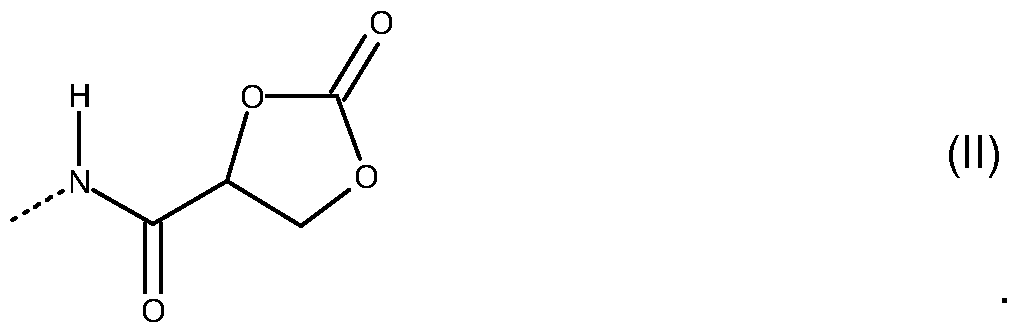
- R2 can be, inter alia, an n-valent radical (n > 1 ), which is substituted with n-1 further 2-Oxo-l ,3-dioxolane-4-carboxamide groups of general formula (II),
- R 4 may be hydrogen, straight-chain or branched Ci-s-alkyl, Cs-i2-cycloalkyl or C6-i5-aryl.
- R3 may be straight-chain or branched Ci-s-alkyl or C6-i5-aryl.
- WO 2004/003001 A1 describes the enzymatic race- mate separation of the enantiomers of type (VI) but without indicating a synthesis for these compounds.
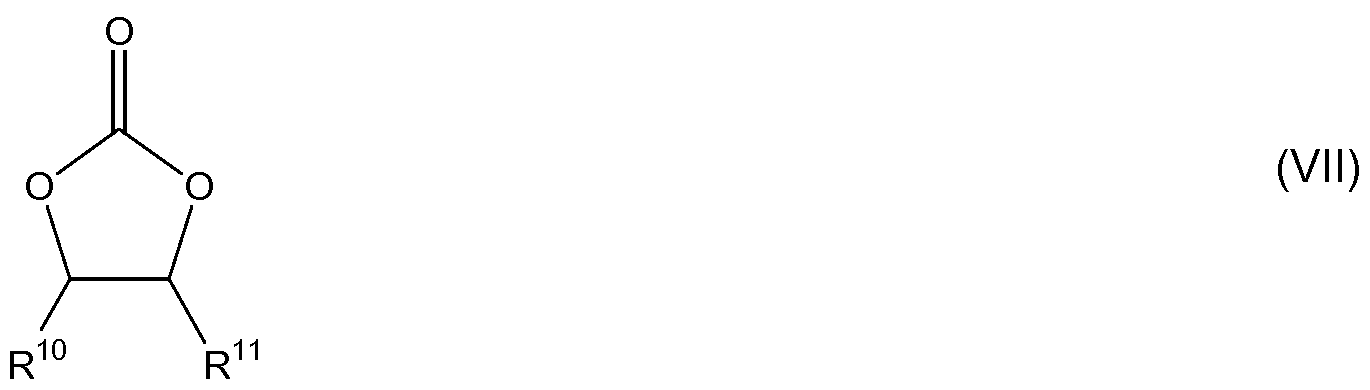
- EP 1941946 A1 describes the use of a carbonitride catalyst inter alia for the preparation of certain disubstituted organic carbonates. These may also be compounds of the general formula (VII),
- R 10 and R 1 1 are selected optional substituents.
- Possible meanings of the substituents are alkyl, aryl, herteroaryl and ester groups CO2A, where A may in turn be alkyl or aryl, e.g. straight-chain or branched Ci-6-alkyl, preferably Ci-3-alkyl and particularly preferably methyl or ethyl.
- A may in turn be alkyl or aryl, e.g. straight-chain or branched Ci-6-alkyl, preferably Ci-3-alkyl and particularly preferably methyl or ethyl.
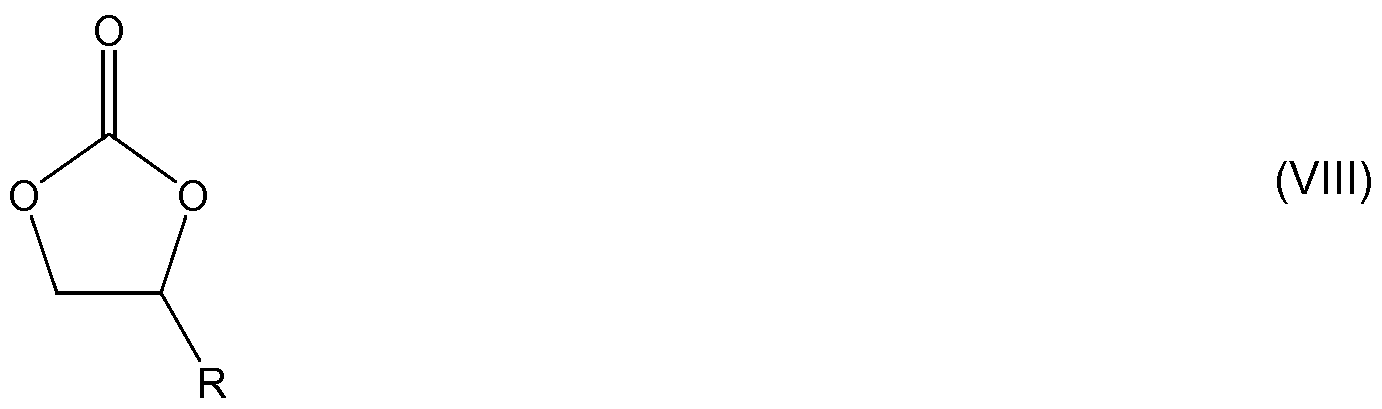
- JP 2006-003433 A discloses a sealing composition for liquid crystal display elements which comprises a compound of the general formula (VIII),
- R is H, a hydroxyl group, a cyano group, a carboxylic acid group, an optionally substituted aromatic ring, a straight-chain, branched or cyclic alkyl group, an acyl group or an ester group.
- EP 0001088 A1 describes inter alia 2-oxo-1 ,3-dioxolanes of the general formula (IX), where R can be H or CH3.
- EP 2397474 A1 describes 2-oxo-1 ,3-dioxolane-4-carboxylic acid esters of formula (X)
- Ri may preferably be Me or Et or an n-valent radical which may be substituted with a maximum of n-1 further 2-oxo-1 ,3-dioxolane-4-carboxyl groups, a process for their preparation by means of carboxylation of the corresponding epoxides, a process for their transesterification, and also their use for the preparation of hydroxyurethanes and as end groups for the blocking of amines.
- At least one of the radicals W1 or W1 a comprises a protected glycoside, and each of the radicals W1 and W1 a, independently of one another, may inter alia also be an amide group.
- each of the radicals W1 and W1 a independently of one another, may inter alia also be an amide group.
- no protected glycoside groups are provided.
- Polyurethanes based on polyisocyanates belong to the prior art. These are used for example as adhesives, sealants, casting compositions, as corrosion protection and for coatings. The high resistance to acids, alkalis and chemicals of the cured compositions obtained in this way are advantageous. However, monomeric low molecular weight (poly)isocyanate compounds are toxicologically unacceptable, especially if they are readily volatile or migrate.
- Polyurethane systems can also be obtained starting from cyclic carbonate compounds, which are toxicologically acceptable.
- glycerol carbonate (4-(hydro- xymethyl)-2-oxo-1 ,3-dioxolane) is regularly used in cosmetics.
- the aim was to provide an alternative 2-oxo-1 ,3-dioxolane system with an electron-withdrawing group.
- the aim was to provide a 2-oxo-1 ,3-dioxolane system which is toxicologically acceptable, readily accessible and highly reactive with amine hardeners and is moreover suitable as a crosslinkable binder (with a bonding to the polymer chain which is less prone to attack by amines).
- the present invention provides a 2-oxo-1 ,3-dioxolane-4-carboxamide of formula (I),
- Ri and R2 in each case independently of one another, are selected from H, straight-chain, branched or cyclic Ci-12-alkyl groups, C6-io-aryl groups, C6-i2-aralkyl groups and C6-i2-alkaryl groups or, together with the N atom to which they are bonded, form a 5- to 8-membered ring, and R3 is selected from H and straight-chain, branched or cyclic Ci-12-alkyl groups, or
- Ri and R3 are each H, and R2 is an n-valent radical, wherein n is an integer greater than 1 , which is substituted with n-1 further 2-oxo-1 ,3-dioxolane-4-carboxamide groups of general formula (II)
- the carbon atom to which R3 is bonded can additionally also carry a further Ci-12-alkyl group.
- the carbon atom in the 4 position can also additionally carry a Ci-12-alkyl group. Both may be the case at the same time.
- the groups Ri and R3 are preferably each H, and R2 is selected from methyl, ethyl, n-propyl, isopropyl, n-butyl, sec-butyl, tert-butyl, n-pentyl, neopentyl, n-hexyl, 2-ethyl-n-hexyl, n-lauryl, cyclohexyl, phenyl and benzyl.
- the 2-0X0-1 ,3-dioxolane-4-carboxamides of the invention can be used as curable binders. In this case, a functionality with regard to the 2-oxo-1 ,3-dioxolane group of greater than 1 is required (as defined hereinabove).
- n can be 2 to 5, in particular 2 to 3.
- R2 is the polymeric backbone of the curable binder and is selected from straight-chain or branched C2-22-alkylene groups, polyether groups of the general formula -(AiO)m-, wherein Ai is C2-5-alkylene and m is 1 -100, polycarbonate groups, polyester groups, poly(meth)acrylate groups, and combinations thereof.
- the present invention further provides a process for the preparation of a 2-oxo-1 ,3-di- oxolane-4-carboxamide of formula (I) which, according to one embodiment, is characterized in that a 2-oxo-1 ,3-dioxolane-4-carboxylic acid of formula (III) is reacted with an amine of the formula R1-NH-R2 to give the 2-oxo-1 ,3-dioxolane-4-carboxamide (I) ac- cording to the invention, where Ri , R2 and R3 have the meanings given. It is possible, by virtue of this reaction, to obtain 2-oxo-1 ,3-dioxolane-4-carboxamides of formula (I) wherein Ri and R2 are both different from H.
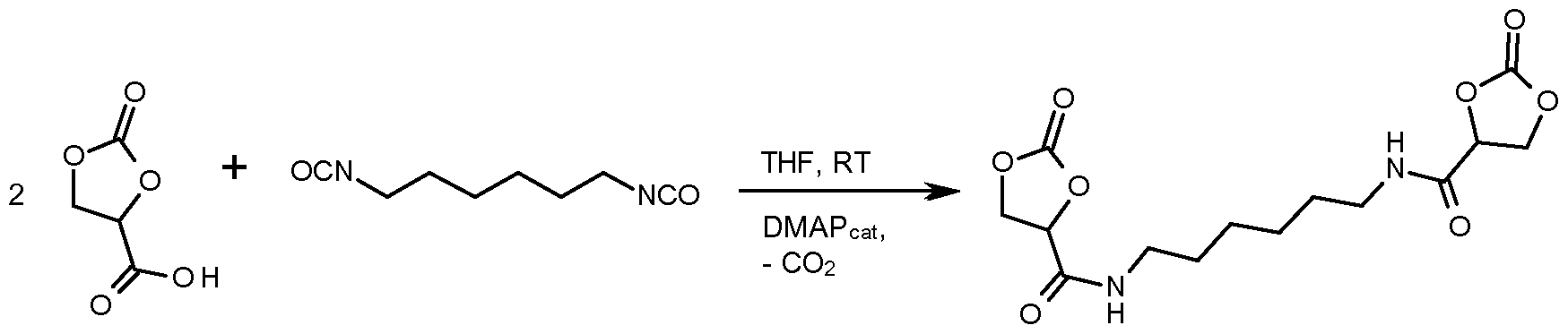
- the 2-oxo-1 ,3-dioxolane-4-carboxylic acid of formula (III) can be reacted either with a monoisocyanate or with a polyisocyanate having n NCO groups, where n has the meaning given above.
- the reaction is preferably carried out in the presence of a catalyst selected from tertiary amines, organometallic compounds, and mixtures thereof.
- a catalyst selected from tertiary amines, organometallic compounds, and mixtures thereof.
- the tertiary amine can be selected e.g. from dimethylcyclohexylamine, 4-dimethylaminopyridine (DMAP), diazabi- cyclooctane (DABCO), and diazabicycloundecene (DBU);
- the organometallic compound can be selected e.g.
- DBTL dibutyltin dilaurate
- a bismuth carboxylate such as bismuth octanoate or bismuth neodecanoate
- titanium or zirconium alkoxy- late or carboxylate and the like catalysts known in the prior art.
- R2 is preferably selected from methyl, ethyl, n-propyl, isopropyl, n-butyl, sec-butyl, tert-butyl, n-pentyl, neopentyl, n-hexyl, 2-ethyl-n-hexyl, n-lauryl, cyclohexyl, phenyl and benzyl.
- Suitable polyisocyanates include tetramethylene 1 ,4-diisocyanate, 2-methylpenta- methylene 1 ,5-diisocyanate, hexamethylene 1 ,6-diisocyanate (HDI), 2,2,4- and 2,4,4- trimethylhexamethylene 1 ,6-diisocyanate (TMDI), dodecamethylene 1 ,12-diisocyanate, lysine diisocyanate and lysine ester diisocyanate, 1 -isocyanato-3,3,5-trimethyl- 5-isocyanatomethylcyclohexane (isophorone diisocyanate - IPDI), 1 ,4-diisocyanato- 2,2,6-trimethylcyclohexane (TMCDI), 2,2'-, 2,4'- and 4,4'-dicyclohexylmethane diisocyanate (H12MDI), cyclohexane 1
- the polyisocyanates according to the invention are also intended to include dimers (uretdiones) and trimers (isocyanurates). Particular importance is attributed here to the HDI trimer.
- prepolymers of polyisocyanates with polyols can also be used if a stoichiometric excess of NCO groups is present.
- Suitable polyols include polyoxyalkylene polyols (also called “polyether polyols”), which can contain inter alia ethylene oxide units, propylene oxide units and butylene oxide units, aliphatic diols and polyols, and also polyester polyols and polycarbonate polyols, castor oil, hydroxylated epoxidized soya oil, and also mixtures of the aforementioned polyols.
- the present invention furthermore provides a process for the preparation of a 2-oxo- 1 ,3-dioxolane-4-carboxylic acid of formula (III) hereinabove, which is a key intermediate in the preparation of the 2-oxo-1 ,3-dioxolane-4-carboxamide of the invention.
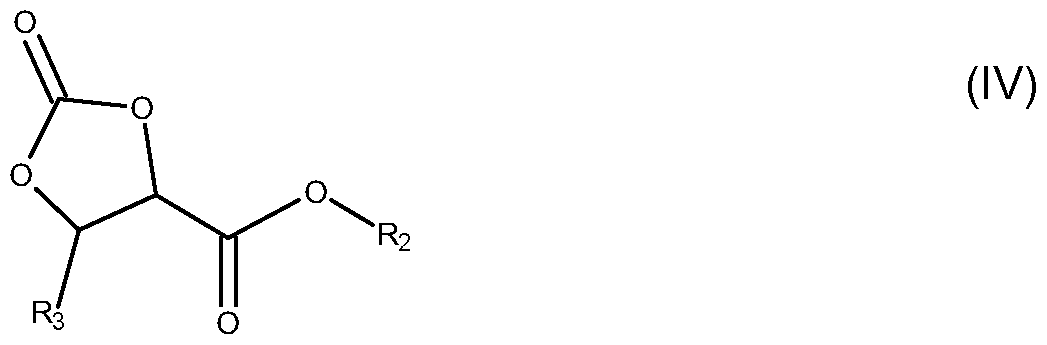
- the 2-oxo-1 ,3-dioxolane-4-carboxylic acid of formula (III) can be prepared by hydrolysing a 2-oxo-1 ,3-dioxolane-4-carboxylic acid ester of formula (IV)
- R2 and R3 have the meanings given, in an acidic medium, preferably in aqueous acetic acid. It is also possible to arrive from the 2-oxo-1 ,3-dioxolane-4-carboxylic acid ester of formula (IV) directly at the 2-oxo-1 ,3-dioxolane-4-carboxamide according to the invention of formula (I) by reacting the ester (IV) with a formamide of the formula R1R2N-CHO, where Ri and R2 have the meanings given.
- the 2-oxo-1 ,3-dioxolane-4-carboxylic acid of formula (III) can be prepared by oxidizing a glycerol carbonate of formula (V)
- R3 has the meaning given, and more specifically for example by means of N- oxide-mediated oxidation, or by means of aerobic oxidation.
- the N-oxide-mediated oxidation may be carried out with 1 ,3,5-trichloroisocyanuric acid and 2,2,6,6-tetramethylpiperidin-1 -oxyl (TEMPO). It may also be carried out with hydro- gen peroxide as an oxidant, e.g. in the presence of a manganese salt.
- TEMPO 2,2,6,6-tetramethylpiperidin-1 -oxyl
- the aerobic oxidation uses oxygen from air or oxygen in pure form as the oxidant. It is suitably carried out in the presence of at least one transition metal salt selected from Co, Mn, Cu, Fe, and mixtures thereof, preferably Mn. It is preferably carried out in a suitable solvent or in (e.g. aqueous) acetic acid.
- the oxygen pressure should be in the range of 0.1 to 100 bar.
- the presence of an N-oxide such as TEMPO is preferred.
- the aerobic oxidation reaction is particularly preferred to oxidize glycerol carbonate (4-(hy- droxymethyl)-2-oxo-1 ,3-dioxolane) to form 2-oxo-1 ,3-dioxolane-4-carboxylic acid.
- a source of oxygen may also be the decomposition reaction of hydrogen peroxide with e.g. manganese ions.
- the aerobic oxidation reaction hereinabove elegantly solves the problem of providing a source of 2-oxo-1 ,3-dioxolane-4-carboxylic acid from glycerol carbonate.
- the invention further provides the use of the 2-oxo-1 ,3-dioxolane-4-carboxamides according to the invention for the preparation of hydroxyurethanes.
- the amides according to the invention react, as has been shown in the formula scheme listed at the outset, with R'-Nhb to give hydroxyurethanes.
- hydroxyurethanes with secondary hydroxyl groups are predominantly formed here since during the attack of the nucleophilic nitrogen atom, the negative charge on the oxygen atom, which is closer to the CONR1R2 group, is better stabilized.
- Suitable amines here are primary and secondary amines with alkyl groups, aryl groups, aralkyl groups and also alkaryl groups as radicals. Primary amines react more quickly than secondary amines; aliphatic amines react more quickly than aromatic amines.
- relatively high molecular weight (poly)amines such as e.g. Jeffamine® from Huntsman Corp. and polyetheramines from BASF SE are of suitability here.
- the invention further provides the use of the 2-oxo-1 ,3-dioxolane-4-carboxamides according to the invention for the preparation of hydroxycarbonates.
- the formula scheme below shows only the preferred reaction to give the hydroxycarbonate with a secondary hydroxyl group.
- Suitable alcohols of the formula R'-OH are in particular the aforementioned polyols.
- the invention further provides the use of the 2-oxo-1 ,3-dioxolane-4-carboxamides according to the invention for the preparation of hydroxysulphanylformates according to an analogous formula scheme:
- polyvalent 2-oxo-1 ,3-dioxolane- 4-carboxamide binders (where n > 1 ) can be readily cured with polyamines, polyols and/or polythiols.
- the present invention further consists in the use of the 2-oxo-1 ,3- dioxolane-4-carboxamides according to the invention for the preparation of polymeric hydroxyurethanes, hydroxycarbonates and/or hydroxysulphanylformat.es.
- polyhydroxyurethane systems lies in the relatively high hydrophilicity of these systems, which can be attributed to the OH groups present. These OH groups are in principle also available for the crosslinking with polyisocyanates, although the isocyanate-free systems possible according to the invention are preferred on account of their lower toxicity.
- thermal stability of such polyhydroxyurethane systems is also higher than the stability of classic polyurethane systems.
- the low molecular weight 2-oxo-1 ,3-dioxolane-4-carboxamides can be used to block amines as end groups (so-called "end caps"), which constitutes a further subject matter of the present invention.
- end caps amines as end groups
- This is also of interest with regard to conventional, amine-crosslinked polyurethane systems since an amine excess can lead to discolorations, while an isocyanate excess is toxicologically unacceptable.
- the present invention is now illustrated in more detail by reference to the examples hereinbelow.
- Example 1 Preparation of 4-methoxycarbonyl-2-oxo-1 ,3-dioxolane (Reference)
- IR (v [cm- 1 ]): 2977 bs (OH acid), 2751 bw, 2658 bw, 2621 bw, 2538 bw, 2407 bw, 1785 bm (CO cyclocarbonate), 1793 bs (CO acid), 1546 w, 1481 w, 1431 w, 1399 s, 1345 w, 1325 w, 128 m, 1 196 s, 1087 s, 1074 s, 1039 m, 928 w, 832 s, 769 s, 724 m, 699 s, 650 m, 633 s, 525 s.
- Example 8 Aerobic oxidation of glycerol carbonate
- IR (v [cm- 1 ]): 3284 bm (NH); 2933 m; 2909 m; 2852 m; 1807 s, 1790 s (CO cyclocarbonate); 1649 s (CO amide); 1544 s (CN); 1485 w; 1448 w; 1380 m; 1321 w; 1 150 s; 1084 s; 1058 s; 1013 s; 934 w; 893 m; 869 w; 815 w; 767 s; 732 m; 689 m; 637w; 529 m.
- Example 1 Reaction of 2-oxo-1 ,3-dioxolane-4-carboxylic acid with HDI
- HDI trimer (Desmodur® N3600, Bayer AG, or Basonat® LR 9046, BASF SE), 64 g (0.48 mol) of 2-oxo-1 ,3-dioxolane-4-carboxylic acid and 0.585 g (4.8 mmol) of DMAP were dissolved in one litre of THF and stirred overnight at room temperature. Then, 10 g of activated carbon and 5 mmol of acetic acid were added, and the mixture was stirred for a further hour. It was then filtered off and the solvent was distilled off.
- HDI trimer Desmodur® N3600, Bayer AG, or Basonat® LR 9046, BASF SE
- Example 13 Curing experiments with the binder from Example 12
- the binder resin from Example 12 was cured with customary amines, i.e. isophorone diamine (I PDA) and trimethyl hexamethylenediamine isomeric mixture (TMD).
- customary amines i.e. isophorone diamine (I PDA) and trimethyl hexamethylenediamine isomeric mixture (TMD).
- I PDA isophorone diamine
- TMD trimethyl hexamethylenediamine isomeric mixture
- Table 2 gives the dynamic viscosities [mPas] of the reaction products obtained from the reaction products of two molecules of 2-oxo-1 ,3-dioxolane-4-carb- oxylic acid methyl ester with one molecule of 1 ,6-hexanediol ("hexanediol diester", "HDDE”) and, respectively, of two molecules of 2-oxo-1 ,3-dioxolane-4-carboxylic acid with one molecule of HDI (“hexamethylene diamide", "HMDA”) with equimolar amounts of said customary amines, i.e. I PDA and TMD after seven days of curing at room temperature.
- HDI hexamethylene diamide
Landscapes
- Chemical & Material Sciences (AREA)
- Organic Chemistry (AREA)
- Chemical Kinetics & Catalysis (AREA)
- Health & Medical Sciences (AREA)
- Medicinal Chemistry (AREA)
- Polymers & Plastics (AREA)
- Polyurethanes Or Polyureas (AREA)
- Organic Low-Molecular-Weight Compounds And Preparation Thereof (AREA)
- Polyamides (AREA)
- Polyesters Or Polycarbonates (AREA)
- Heterocyclic Carbon Compounds Containing A Hetero Ring Having Nitrogen And Oxygen As The Only Ring Hetero Atoms (AREA)
Abstract
Description









Claims


Priority Applications (10)
| Application Number | Priority Date | Filing Date | Title |
|---|---|---|---|
| CN201280064040.1A CN104011040B (en) | 2011-12-22 | 2012-11-14 | 2 oxo, 1,3 dioxolanes, 4 Methanamide, Preparation Method And The Use |
| AU2012358695A AU2012358695B2 (en) | 2011-12-22 | 2012-11-14 | 2-oxo-1,3-dioxolane-4-carboxamides, their preparation and use |
| MX2014007549A MX351799B (en) | 2011-12-22 | 2012-11-14 | 2-oxo-1,3-dioxolane-4-carboxamides, their preparation and use. |
| ES12784024.7T ES2592631T3 (en) | 2011-12-22 | 2012-11-14 | 2-Oxo-1,3-dioxolane-4-carboxamides, their preparation and use |
| RU2014129920A RU2632903C2 (en) | 2011-12-22 | 2012-11-14 | 2-oxo-1,3-dioxolane-4-carboxamides, their production and application |
| BR112014012358-6A BR112014012358B1 (en) | 2011-12-22 | 2012-11-14 | 2-OXO-1,3-DIOXOLAN-4-CARBOXAMIDE, PROCESSES FOR PREPARING A 2-OXO-1,3-DIOXOLAN-4-CARBOXAMIDE, AND USES OF 2-OXO-1,3-DIOXOLAN-4- CARBOXAMIDES |
| JP2014547794A JP6072067B2 (en) | 2011-12-22 | 2012-11-14 | 2-oxo-1,3-dioxolane-4-carboxamide, process for its preparation and use |
| EP12784024.7A EP2794585B1 (en) | 2011-12-22 | 2012-11-14 | 2-oxo-1,3-dioxolane-4-carboxamides, their preparation and use |
| US14/364,413 US9309218B2 (en) | 2011-12-22 | 2012-11-14 | 2-Oxo-1,3-dioxolane-4-carboxamides, their preparation and use |
| CA2859450A CA2859450C (en) | 2011-12-22 | 2012-11-14 | 2-oxo-1,3-dioxolane-4-carboxamides, their preparation and use |
Applications Claiming Priority (2)
| Application Number | Priority Date | Filing Date | Title |
|---|---|---|---|
| EP11195272 | 2011-12-22 | ||
| EP11195272.7 | 2011-12-22 |
Publications (1)
| Publication Number | Publication Date |
|---|---|
| WO2013092011A1 true WO2013092011A1 (en) | 2013-06-27 |
Family
ID=47148839
Family Applications (1)
| Application Number | Title | Priority Date | Filing Date |
|---|---|---|---|
| PCT/EP2012/072589 Ceased WO2013092011A1 (en) | 2011-12-22 | 2012-11-14 | 2-oxo-1,3-dioxolane-4-carboxamides, their preparation and use |
Country Status (11)
| Country | Link |
|---|---|
| US (1) | US9309218B2 (en) |
| EP (1) | EP2794585B1 (en) |
| JP (1) | JP6072067B2 (en) |
| CN (1) | CN104011040B (en) |
| AU (1) | AU2012358695B2 (en) |
| BR (1) | BR112014012358B1 (en) |
| CA (1) | CA2859450C (en) |
| ES (1) | ES2592631T3 (en) |
| MX (1) | MX351799B (en) |
| RU (1) | RU2632903C2 (en) |
| WO (1) | WO2013092011A1 (en) |
Cited By (13)
| Publication number | Priority date | Publication date | Assignee | Title |
|---|---|---|---|---|
| WO2014118268A1 (en) | 2013-01-31 | 2014-08-07 | Construction Research & Technology Gmbh | 2-oxo-1,3-dioxolane-4-carboxamide building blocks, their preparation and use |
| EP2883872A1 (en) * | 2013-12-16 | 2015-06-17 | Universite De Bordeaux I | Five-membered cyclic biscarbonates bearing amide linkages, their preparation and their uses for the preparation of polyhydroxyurethanes |
| WO2015093532A1 (en) | 2013-12-19 | 2015-06-25 | 宇部興産株式会社 | Nonaqueous electrolyte, capacitor device using same, and carboxylic acid ester compound used in same |
| US9079871B2 (en) | 2011-12-29 | 2015-07-14 | Basf Se | Preparing cyclocarbonate-functionalized compounds |
| EP2915808A1 (en) | 2014-03-07 | 2015-09-09 | Construction Research & Technology GmbH | 2-Hydroxyethyl 2-oxo-1,3-dioxolane-4-carboxylates, their preparation and use |
| EP2998331A1 (en) | 2014-09-17 | 2016-03-23 | Construction Research & Technology GmbH | A curable organic polymer comprising at least one acylurea unit, its preparation and use |
| WO2016062424A1 (en) * | 2014-10-23 | 2016-04-28 | Construction Research & Technology Gmbh | Method for producing glyceric acid carbonate |
| WO2017059011A1 (en) * | 2015-09-30 | 2017-04-06 | E Ink Corporation | Polyurethane adhesive layers for electro-optic assemblies |
| WO2017207461A1 (en) | 2016-06-03 | 2017-12-07 | Basf Se | Use of compounds having n 2-oxo-1,3-dioxolane-4-carboxamide units in two-component adhesives |
| US20180208705A1 (en) * | 2015-08-10 | 2018-07-26 | Construction Research & Technology, Gmbh | Process for producing a ring-opening polymerization product |
| US10426882B2 (en) | 2003-12-16 | 2019-10-01 | Baxter International Inc. | Blood rinseback system and method |
| WO2020094973A1 (en) | 2018-11-09 | 2020-05-14 | Bostik Sa | Functionalized hydroxysilanes, silylated polyurethanes, and compositions comprising same |
| EP3677616A1 (en) | 2019-01-04 | 2020-07-08 | Henkel AG & Co. KGaA | Method for producing non-isocyanate polyurethanes |
Families Citing this family (6)
| Publication number | Priority date | Publication date | Assignee | Title |
|---|---|---|---|---|
| EP2818465A1 (en) | 2013-06-26 | 2014-12-31 | Construction Research & Technology GmbH | 2-Oxo-1,3-dioxolane-4-acyl halides, their preparation and use |
| US10081760B2 (en) | 2014-01-16 | 2018-09-25 | Elevance Renewable Sciences, Inc. | Olefinic ester compositions and their use in stimulating hydrocarbon production from a subterranean formation |
| CA2995706A1 (en) * | 2015-08-17 | 2017-02-23 | Elevance Renewable Sciences, Inc. | Non-isocyanate polyurethanes and methods of making and using the same |
| US10316214B2 (en) | 2016-03-08 | 2019-06-11 | 3D Systems, Incorporated | Non-isocyanate polyurethane inks for 3D printing |
| FR3089514B1 (en) * | 2018-12-05 | 2021-07-30 | Arkema France | Terminated polyurethane (2-oxo-1,3-dioxolane-4-carboxylate) |
| CN119505516B (en) * | 2024-11-18 | 2025-07-08 | 常州市第一人民医院 | Artificial meniscus and preparation method thereof |
Citations (6)
| Publication number | Priority date | Publication date | Assignee | Title |
|---|---|---|---|---|
| EP0001088A1 (en) | 1977-09-05 | 1979-03-21 | BASF Aktiengesellschaft | Polymers containing carbonate groups |
| WO2004003001A1 (en) | 2002-06-28 | 2004-01-08 | Altus Biologics Inc. | Process for the enzymatic resolution of 1,3-dioxolane-4-carboxylates |
| JP2006003433A (en) | 2004-06-15 | 2006-01-05 | Sekisui Chem Co Ltd | Sealant for liquid crystal display element, vertical conduction material, and liquid crystal display element |
| EP1941946A1 (en) | 2007-01-04 | 2008-07-09 | Max-Planck-Gesellschaft zur Förderung der Wissenschaften e.V. | Carbonitrides as catalysts |
| US20100317838A1 (en) | 2009-06-12 | 2010-12-16 | International Business Machines Corporation | Cyclic carbonyl monomers functionalized with carbohydrates, polymers derived therefrom, and methods of preparation thereof |
| EP2397474A1 (en) | 2010-06-17 | 2011-12-21 | Construction Research & Technology GmbH | 2-Oxo-1,3-dioxolan-4-carbolic acid esters, production and use of same |
Family Cites Families (7)
| Publication number | Priority date | Publication date | Assignee | Title |
|---|---|---|---|---|
| US4996231A (en) * | 1988-02-16 | 1991-02-26 | Merck & Co., Inc. | Triyne cyclic carbonates |
| JP3586881B2 (en) | 1994-04-19 | 2004-11-10 | 三菱化学株式会社 | Dioxolane-containing solvent |
| EP1507826A4 (en) * | 2002-05-17 | 2007-11-07 | Othera Pharmaceuticals Inc | Amelioration of the development of cataracts and other opthalmic diseases |
| WO2004033001A1 (en) * | 2002-09-11 | 2004-04-22 | Fresenius Medical Care Deutschland Gmbh | Method for returning blood from a blood treatment device, and device for carrying out this method |
| RU2008112691A (en) | 2005-10-03 | 2009-10-10 | Оно Фармасьютикал Ко., Лтд. (Jp) | NITROGEN-CONTAINING HETEROCYCLIC COMPOUND AND ITS PHARMACEUTICAL APPLICATION |
| TWI423946B (en) * | 2007-11-14 | 2014-01-21 | Shell Int Research | Process for the preparation of alkylene glycol |
| US8742137B2 (en) | 2010-06-17 | 2014-06-03 | Construction Research & Technology Gmbh | 2-oxo-1, 3-dioxolane-4-carboxylic acid and derivatives thereof, their preparation and use |
-
2012
- 2012-11-14 JP JP2014547794A patent/JP6072067B2/en not_active Expired - Fee Related
- 2012-11-14 CA CA2859450A patent/CA2859450C/en active Active
- 2012-11-14 US US14/364,413 patent/US9309218B2/en active Active
- 2012-11-14 EP EP12784024.7A patent/EP2794585B1/en active Active
- 2012-11-14 CN CN201280064040.1A patent/CN104011040B/en active Active
- 2012-11-14 RU RU2014129920A patent/RU2632903C2/en active
- 2012-11-14 MX MX2014007549A patent/MX351799B/en active IP Right Grant
- 2012-11-14 BR BR112014012358-6A patent/BR112014012358B1/en not_active IP Right Cessation
- 2012-11-14 WO PCT/EP2012/072589 patent/WO2013092011A1/en not_active Ceased
- 2012-11-14 AU AU2012358695A patent/AU2012358695B2/en not_active Ceased
- 2012-11-14 ES ES12784024.7T patent/ES2592631T3/en active Active
Patent Citations (6)
| Publication number | Priority date | Publication date | Assignee | Title |
|---|---|---|---|---|
| EP0001088A1 (en) | 1977-09-05 | 1979-03-21 | BASF Aktiengesellschaft | Polymers containing carbonate groups |
| WO2004003001A1 (en) | 2002-06-28 | 2004-01-08 | Altus Biologics Inc. | Process for the enzymatic resolution of 1,3-dioxolane-4-carboxylates |
| JP2006003433A (en) | 2004-06-15 | 2006-01-05 | Sekisui Chem Co Ltd | Sealant for liquid crystal display element, vertical conduction material, and liquid crystal display element |
| EP1941946A1 (en) | 2007-01-04 | 2008-07-09 | Max-Planck-Gesellschaft zur Förderung der Wissenschaften e.V. | Carbonitrides as catalysts |
| US20100317838A1 (en) | 2009-06-12 | 2010-12-16 | International Business Machines Corporation | Cyclic carbonyl monomers functionalized with carbohydrates, polymers derived therefrom, and methods of preparation thereof |
| EP2397474A1 (en) | 2010-06-17 | 2011-12-21 | Construction Research & Technology GmbH | 2-Oxo-1,3-dioxolan-4-carbolic acid esters, production and use of same |
Non-Patent Citations (5)
| Title |
|---|
| H. TOMITA; F. SANDA; T. ENDO, JOURNAL OF POLYMER SCIENCE |
| LEWIS M D ET AL: "Synthesis of L-660,631 methyl ester and related compounds", TETRAHEDRON LETTERS, ELSEVIER, AMSTERDAM, NL, vol. 29, no. 19, 1 January 1988 (1988-01-01), pages 2279 - 2282, XP022581010, ISSN: 0040-4039, [retrieved on 19880101], DOI: 10.1016/S0040-4039(00)86037-2 * |
| POLYMER CHEMISTRY, vol. 39, 2001, pages 3678 - 3685 |
| SYNTHESIS, vol. 2, 2001, pages 243 - 246 |
| TOMITA H ET AL: "MODEL REACTION FOR THE SYNTHESIS OF POLYHYDROXYURETHANES FROM CYCLIC CARBONATES WITH AMINES: SUBSTITUENT EFFECT ON THE REACTIVITY AND SELECTIVITY OF RING-OPENING DIRECTION IN THE REACTION OF FIVE-MEMBERED CYCLIC CARBONATES WITH AMINE", JOURNAL OF POLYMER SCIENCE, INTERSCIENCE PUBLISHERS, XX, vol. 39, no. 21, 1 January 2001 (2001-01-01), pages 3678 - 3685, XP001080699 * |
Cited By (33)
| Publication number | Priority date | Publication date | Assignee | Title |
|---|---|---|---|---|
| US10426882B2 (en) | 2003-12-16 | 2019-10-01 | Baxter International Inc. | Blood rinseback system and method |
| US11672897B2 (en) | 2003-12-16 | 2023-06-13 | Baxter International Inc. | Blood rinseback system and method |
| US9079871B2 (en) | 2011-12-29 | 2015-07-14 | Basf Se | Preparing cyclocarbonate-functionalized compounds |
| US9617238B2 (en) | 2013-01-31 | 2017-04-11 | Construction Research & Technology Gmbh | 2-oxo-1,3-dioxolane-4-carboxamide building blocks, their preparation and use |
| WO2014118268A1 (en) | 2013-01-31 | 2014-08-07 | Construction Research & Technology Gmbh | 2-oxo-1,3-dioxolane-4-carboxamide building blocks, their preparation and use |
| US9926288B2 (en) | 2013-12-16 | 2018-03-27 | Université De Bordeaux | Five-membered cyclic biscarbonates bearing amide linkages, their preparation and their uses for the preparation of polymers |
| EP2883872A1 (en) * | 2013-12-16 | 2015-06-17 | Universite De Bordeaux I | Five-membered cyclic biscarbonates bearing amide linkages, their preparation and their uses for the preparation of polyhydroxyurethanes |
| WO2015091494A1 (en) * | 2013-12-16 | 2015-06-25 | Université De Bordeaux | Five-membered cyclic biscarbonates bearing amide linkages, their preparation and their uses for the preparation of polymers |
| WO2015093532A1 (en) | 2013-12-19 | 2015-06-25 | 宇部興産株式会社 | Nonaqueous electrolyte, capacitor device using same, and carboxylic acid ester compound used in same |
| CN106068259A (en) * | 2014-03-07 | 2016-11-02 | 建筑研究和技术有限公司 | 2 oxo 1,3 dioxolanes 4 formic acid 2 hydroxyl ethyl esters, its preparation and purposes |
| US10059685B2 (en) | 2014-03-07 | 2018-08-28 | Construction Research & Technology, Gmbh | 2-hydroxyethyl 2-oxo-1,3-dioxolane-4-carboxylates, their preparation and use |
| CN106068259B (en) * | 2014-03-07 | 2019-06-14 | 建筑研究和技术有限公司 | 2-hydroxyethyl 2-oxo-1,3-dioxolane-4-carboxylate, its preparation and use |
| WO2015132080A1 (en) * | 2014-03-07 | 2015-09-11 | Construction Research & Technology Gmbh | 2-hydroxyethyl 2-oxo-1, 3-dioxolane-4-carboxylates, their preparation and use |
| EP2915808A1 (en) | 2014-03-07 | 2015-09-09 | Construction Research & Technology GmbH | 2-Hydroxyethyl 2-oxo-1,3-dioxolane-4-carboxylates, their preparation and use |
| WO2016041666A1 (en) * | 2014-09-17 | 2016-03-24 | Construction Research & Technology Gmbh | A curable organic polymer comprising at least one acylurea unit, its preparation and use |
| US10590227B2 (en) | 2014-09-17 | 2020-03-17 | Construction Research & Technology Gmbh | Curable organic polymer comprising at least one acylurea unit, its preparation and use |
| EP2998331A1 (en) | 2014-09-17 | 2016-03-23 | Construction Research & Technology GmbH | A curable organic polymer comprising at least one acylurea unit, its preparation and use |
| US9969708B2 (en) | 2014-10-23 | 2018-05-15 | Construction Research & Technology, Gmbh | Method for producing glyceric acid carbonate |
| AU2015335289B2 (en) * | 2014-10-23 | 2019-06-06 | Sika Technology Ag | Method for producing glyceric acid carbonate |
| JP2017534619A (en) * | 2014-10-23 | 2017-11-24 | コンストラクション リサーチ アンド テクノロジー ゲーエムベーハーConstruction Research & Technology GmbH | Method for producing glyceric acid carbonate |
| RU2711037C2 (en) * | 2014-10-23 | 2020-01-14 | Констракшн Рисёрч Энд Текнолоджи Гмбх | Method of producing glyceric acid carbonate |
| WO2016062424A1 (en) * | 2014-10-23 | 2016-04-28 | Construction Research & Technology Gmbh | Method for producing glyceric acid carbonate |
| US10899866B2 (en) | 2015-08-10 | 2021-01-26 | Construction Research & Technology Gmbh | Process for producing a ring-opening polymerization product |
| US20180208705A1 (en) * | 2015-08-10 | 2018-07-26 | Construction Research & Technology, Gmbh | Process for producing a ring-opening polymerization product |
| WO2017059011A1 (en) * | 2015-09-30 | 2017-04-06 | E Ink Corporation | Polyurethane adhesive layers for electro-optic assemblies |
| WO2017207461A1 (en) | 2016-06-03 | 2017-12-07 | Basf Se | Use of compounds having n 2-oxo-1,3-dioxolane-4-carboxamide units in two-component adhesives |
| US11613681B2 (en) | 2016-06-03 | 2023-03-28 | Basf Se | Use of compounds having n 2-oxo-1,3-dioxolane-4-carboxamide units in two-component adhesives |
| WO2020094973A1 (en) | 2018-11-09 | 2020-05-14 | Bostik Sa | Functionalized hydroxysilanes, silylated polyurethanes, and compositions comprising same |
| FR3088326A1 (en) | 2018-11-09 | 2020-05-15 | Bostik Sa | FUNCTIONALIZED HYDROXYSILANES, SILYLATED POLYURETHANES, AND COMPOSITIONS COMPRISING THE SAME |
| US11945829B2 (en) | 2018-11-09 | 2024-04-02 | Bostik Sa | Functionalized hydroxysilanes, silylated polyurethanes, and compositions comprising same |
| WO2020141046A1 (en) | 2019-01-04 | 2020-07-09 | Henkel Ag & Co. Kgaa | Method for producing non-isocyanate polyurethanes |
| EP3677616A1 (en) | 2019-01-04 | 2020-07-08 | Henkel AG & Co. KGaA | Method for producing non-isocyanate polyurethanes |
| US12146030B2 (en) | 2019-01-04 | 2024-11-19 | Henkel Ag & Co. Kgaa | Method for producing non-isocyanate polyurethanes |
Also Published As
| Publication number | Publication date |
|---|---|
| US9309218B2 (en) | 2016-04-12 |
| RU2632903C2 (en) | 2017-10-11 |
| EP2794585A1 (en) | 2014-10-29 |
| BR112014012358A2 (en) | 2017-06-06 |
| EP2794585B1 (en) | 2016-06-15 |
| MX2014007549A (en) | 2014-08-01 |
| AU2012358695B2 (en) | 2016-10-27 |
| CN104011040B (en) | 2017-03-15 |
| BR112014012358B1 (en) | 2019-07-16 |
| AU2012358695A1 (en) | 2014-07-10 |
| CA2859450A1 (en) | 2013-06-27 |
| CA2859450C (en) | 2020-01-07 |
| MX351799B (en) | 2017-10-26 |
| RU2014129920A (en) | 2016-02-10 |
| JP2015502374A (en) | 2015-01-22 |
| JP6072067B2 (en) | 2017-02-01 |
| US20150051365A1 (en) | 2015-02-19 |
| CN104011040A (en) | 2014-08-27 |
| ES2592631T3 (en) | 2016-11-30 |
Similar Documents
| Publication | Publication Date | Title |
|---|---|---|
| AU2012358695B2 (en) | 2-oxo-1,3-dioxolane-4-carboxamides, their preparation and use | |
| AU2014211407B2 (en) | 2-oxo-1,3-dioxolane-4-carboxamide building blocks, their preparation and use | |
| KR102841781B1 (en) | Method for producing non-isocyanate polyurethane | |
| AU2014301613B2 (en) | 2-oxo-1,3-dioxolane-4-acyl halides, their preparation and use | |
| CA2995337C (en) | Process for producing a ring-opening polymerization product | |
| JP2017530223A (en) | Curable organic polymer comprising at least one acylurea unit, its production and its use | |
| JP5615372B2 (en) | Polyurethane synthesis by self-condensation | |
| EP3233816B1 (en) | Difunctional monomer compounds containing clickable pendant furyl group and polymers therefrom | |
| US4304731A (en) | Method for producing an aliphatic triisocyanate |
Legal Events
| Date | Code | Title | Description |
|---|---|---|---|
| 121 | Ep: the epo has been informed by wipo that ep was designated in this application |
Ref document number: 12784024 Country of ref document: EP Kind code of ref document: A1 |
|
| WWE | Wipo information: entry into national phase |
Ref document number: 2012784024 Country of ref document: EP |
|
| WWE | Wipo information: entry into national phase |
Ref document number: 14364413 Country of ref document: US |
|
| ENP | Entry into the national phase |
Ref document number: 2859450 Country of ref document: CA |
|
| WWE | Wipo information: entry into national phase |
Ref document number: MX/A/2014/007549 Country of ref document: MX |
|
| ENP | Entry into the national phase |
Ref document number: 2014547794 Country of ref document: JP Kind code of ref document: A |
|
| NENP | Non-entry into the national phase |
Ref country code: DE |
|
| ENP | Entry into the national phase |
Ref document number: 2012358695 Country of ref document: AU Date of ref document: 20121114 Kind code of ref document: A |
|
| ENP | Entry into the national phase |
Ref document number: 2014129920 Country of ref document: RU Kind code of ref document: A |
|
| REG | Reference to national code |
Ref country code: BR Ref legal event code: B01A Ref document number: 112014012358 Country of ref document: BR |
|
| ENP | Entry into the national phase |
Ref document number: 112014012358 Country of ref document: BR Kind code of ref document: A2 Effective date: 20140522 |