WO2013093756A1 - Polymeric precursors for producing graphene nanoribbons and methods for preparing them - Google Patents

Polymeric precursors for producing graphene nanoribbons and methods for preparing them Download PDF

Info

Publication number
WO2013093756A1
WO2013093756A1 PCT/IB2012/057377 IB2012057377W WO2013093756A1 WO 2013093756 A1 WO2013093756 A1 WO 2013093756A1 IB 2012057377 W IB2012057377 W IB 2012057377W WO 2013093756 A1 WO2013093756 A1 WO 2013093756A1
Authority
WO
WIPO (PCT)
Prior art keywords
graphene nanoribbons
independently
crc
polymeric precursor
alkyl
Prior art date
Legal status (The legal status is an assumption and is not a legal conclusion. Google has not performed a legal analysis and makes no representation as to the accuracy of the status listed.)
Ceased
Application number
PCT/IB2012/057377
Other languages
French (fr)
Inventor
Matthias Georg SCHWAB
Akimitsu NARITA
Xinliang Feng
Klaus MÜLLEN
Current Assignee (The listed assignees may be inaccurate. Google has not performed a legal analysis and makes no representation or warranty as to the accuracy of the list.)
BASF China Co Ltd
BASF SE
Max Planck Gesellschaft zur Foerderung der Wissenschaften eV
Original Assignee
BASF China Co Ltd
BASF SE
Max Planck Gesellschaft zur Foerderung der Wissenschaften eV
Priority date (The priority date is an assumption and is not a legal conclusion. Google has not performed a legal analysis and makes no representation as to the accuracy of the date listed.)
Filing date
Publication date
Priority to US14/367,041 priority Critical patent/US9550678B2/en
Priority to IN4378CHN2014 priority patent/IN2014CN04378A/en
Priority to CN201280062080.2A priority patent/CN104114489B/en
Priority to JP2014548286A priority patent/JP2015504046A/en
Priority to EP12859354.8A priority patent/EP2794476A4/en
Priority to KR1020147019888A priority patent/KR20140116112A/en
Application filed by BASF China Co Ltd, BASF SE, Max Planck Gesellschaft zur Foerderung der Wissenschaften eV filed Critical BASF China Co Ltd
Priority to SG11201403360VA priority patent/SG11201403360VA/en
Priority to RU2014129615A priority patent/RU2014129615A/en
Publication of WO2013093756A1 publication Critical patent/WO2013093756A1/en
Priority to IL233003A priority patent/IL233003A0/en
Anticipated expiration legal-status Critical
Ceased legal-status Critical Current

Links

Classifications

    • HELECTRICITY
    • H01ELECTRIC ELEMENTS
    • H01BCABLES; CONDUCTORS; INSULATORS; SELECTION OF MATERIALS FOR THEIR CONDUCTIVE, INSULATING OR DIELECTRIC PROPERTIES
    • H01B1/00Conductors or conductive bodies characterised by the conductive materials; Selection of materials as conductors
    • H01B1/04Conductors or conductive bodies characterised by the conductive materials; Selection of materials as conductors mainly consisting of carbon-silicon compounds, carbon or silicon
    • BPERFORMING OPERATIONS; TRANSPORTING
    • B82NANOTECHNOLOGY
    • B82YSPECIFIC USES OR APPLICATIONS OF NANOSTRUCTURES; MEASUREMENT OR ANALYSIS OF NANOSTRUCTURES; MANUFACTURE OR TREATMENT OF NANOSTRUCTURES
    • B82Y30/00Nanotechnology for materials or surface science, e.g. nanocomposites
    • BPERFORMING OPERATIONS; TRANSPORTING
    • B82NANOTECHNOLOGY
    • B82YSPECIFIC USES OR APPLICATIONS OF NANOSTRUCTURES; MEASUREMENT OR ANALYSIS OF NANOSTRUCTURES; MANUFACTURE OR TREATMENT OF NANOSTRUCTURES
    • B82Y40/00Manufacture or treatment of nanostructures
    • CCHEMISTRY; METALLURGY
    • C01INORGANIC CHEMISTRY
    • C01BNON-METALLIC ELEMENTS; COMPOUNDS THEREOF; METALLOIDS OR COMPOUNDS THEREOF NOT COVERED BY SUBCLASS C01C
    • C01B32/00Carbon; Compounds thereof
    • C01B32/15Nano-sized carbon materials
    • C01B32/182Graphene
    • C01B32/184Preparation
    • CCHEMISTRY; METALLURGY
    • C07ORGANIC CHEMISTRY
    • C07CACYCLIC OR CARBOCYCLIC COMPOUNDS
    • C07C49/00Ketones; Ketenes; Dimeric ketenes; Ketonic chelates
    • C07C49/587Unsaturated compounds containing a keto groups being part of a ring
    • C07C49/647Unsaturated compounds containing a keto groups being part of a ring having unsaturation outside the ring
    • C07C49/653Unsaturated compounds containing a keto groups being part of a ring having unsaturation outside the ring polycyclic
    • CCHEMISTRY; METALLURGY
    • C07ORGANIC CHEMISTRY
    • C07CACYCLIC OR CARBOCYCLIC COMPOUNDS
    • C07C49/00Ketones; Ketenes; Dimeric ketenes; Ketonic chelates
    • C07C49/587Unsaturated compounds containing a keto groups being part of a ring
    • C07C49/657Unsaturated compounds containing a keto groups being part of a ring containing six-membered aromatic rings
    • C07C49/683Unsaturated compounds containing a keto groups being part of a ring containing six-membered aromatic rings having unsaturation outside the aromatic rings
    • CCHEMISTRY; METALLURGY
    • C08ORGANIC MACROMOLECULAR COMPOUNDS; THEIR PREPARATION OR CHEMICAL WORKING-UP; COMPOSITIONS BASED THEREON
    • C08FMACROMOLECULAR COMPOUNDS OBTAINED BY REACTIONS ONLY INVOLVING CARBON-TO-CARBON UNSATURATED BONDS
    • C08F138/00Homopolymers of compounds having one or more carbon-to-carbon triple bonds
    • CCHEMISTRY; METALLURGY
    • C08ORGANIC MACROMOLECULAR COMPOUNDS; THEIR PREPARATION OR CHEMICAL WORKING-UP; COMPOSITIONS BASED THEREON
    • C08FMACROMOLECULAR COMPOUNDS OBTAINED BY REACTIONS ONLY INVOLVING CARBON-TO-CARBON UNSATURATED BONDS
    • C08F2/00Processes of polymerisation
    • CCHEMISTRY; METALLURGY
    • C08ORGANIC MACROMOLECULAR COMPOUNDS; THEIR PREPARATION OR CHEMICAL WORKING-UP; COMPOSITIONS BASED THEREON
    • C08GMACROMOLECULAR COMPOUNDS OBTAINED OTHERWISE THAN BY REACTIONS ONLY INVOLVING UNSATURATED CARBON-TO-CARBON BONDS
    • C08G61/00Macromolecular compounds obtained by reactions forming a carbon-to-carbon link in the main chain of the macromolecule
    • C08G61/02Macromolecular compounds containing only carbon atoms in the main chain of the macromolecule, e.g. polyxylylenes
    • C08G61/10Macromolecular compounds containing only carbon atoms in the main chain of the macromolecule, e.g. polyxylylenes only aromatic carbon atoms, e.g. polyphenylenes
    • CCHEMISTRY; METALLURGY
    • C08ORGANIC MACROMOLECULAR COMPOUNDS; THEIR PREPARATION OR CHEMICAL WORKING-UP; COMPOSITIONS BASED THEREON
    • C08KUse of inorganic or non-macromolecular organic substances as compounding ingredients
    • C08K3/00Use of inorganic substances as compounding ingredients
    • C08K3/02Elements
    • C08K3/04Carbon
    • C08K3/042Graphene or derivatives, e.g. graphene oxides
    • CCHEMISTRY; METALLURGY
    • C08ORGANIC MACROMOLECULAR COMPOUNDS; THEIR PREPARATION OR CHEMICAL WORKING-UP; COMPOSITIONS BASED THEREON
    • C08LCOMPOSITIONS OF MACROMOLECULAR COMPOUNDS
    • C08L65/00Compositions of macromolecular compounds obtained by reactions forming a carbon-to-carbon link in the main chain; Compositions of derivatives of such polymers
    • CCHEMISTRY; METALLURGY
    • C08ORGANIC MACROMOLECULAR COMPOUNDS; THEIR PREPARATION OR CHEMICAL WORKING-UP; COMPOSITIONS BASED THEREON
    • C08GMACROMOLECULAR COMPOUNDS OBTAINED OTHERWISE THAN BY REACTIONS ONLY INVOLVING UNSATURATED CARBON-TO-CARBON BONDS
    • C08G2261/00Macromolecular compounds obtained by reactions forming a carbon-to-carbon link in the main chain of the macromolecule
    • C08G2261/10Definition of the polymer structure
    • C08G2261/14Side-groups
    • C08G2261/141Side-chains having aliphatic units
    • C08G2261/1412Saturated aliphatic units
    • CCHEMISTRY; METALLURGY
    • C08ORGANIC MACROMOLECULAR COMPOUNDS; THEIR PREPARATION OR CHEMICAL WORKING-UP; COMPOSITIONS BASED THEREON
    • C08GMACROMOLECULAR COMPOUNDS OBTAINED OTHERWISE THAN BY REACTIONS ONLY INVOLVING UNSATURATED CARBON-TO-CARBON BONDS
    • C08G2261/00Macromolecular compounds obtained by reactions forming a carbon-to-carbon link in the main chain of the macromolecule
    • C08G2261/30Monomer units or repeat units incorporating structural elements in the main chain
    • C08G2261/31Monomer units or repeat units incorporating structural elements in the main chain incorporating aromatic structural elements in the main chain
    • C08G2261/312Non-condensed aromatic systems, e.g. benzene
    • CCHEMISTRY; METALLURGY
    • C08ORGANIC MACROMOLECULAR COMPOUNDS; THEIR PREPARATION OR CHEMICAL WORKING-UP; COMPOSITIONS BASED THEREON
    • C08GMACROMOLECULAR COMPOUNDS OBTAINED OTHERWISE THAN BY REACTIONS ONLY INVOLVING UNSATURATED CARBON-TO-CARBON BONDS
    • C08G2261/00Macromolecular compounds obtained by reactions forming a carbon-to-carbon link in the main chain of the macromolecule
    • C08G2261/30Monomer units or repeat units incorporating structural elements in the main chain
    • C08G2261/36Oligomers, i.e. comprising up to 10 repeat units
    • C08G2261/364Oligomers, i.e. comprising up to 10 repeat units containing hetero atoms
    • CCHEMISTRY; METALLURGY
    • C08ORGANIC MACROMOLECULAR COMPOUNDS; THEIR PREPARATION OR CHEMICAL WORKING-UP; COMPOSITIONS BASED THEREON
    • C08GMACROMOLECULAR COMPOUNDS OBTAINED OTHERWISE THAN BY REACTIONS ONLY INVOLVING UNSATURATED CARBON-TO-CARBON BONDS
    • C08G2261/00Macromolecular compounds obtained by reactions forming a carbon-to-carbon link in the main chain of the macromolecule
    • C08G2261/40Polymerisation processes
    • C08G2261/46Diels-Alder reactions
    • CCHEMISTRY; METALLURGY
    • C08ORGANIC MACROMOLECULAR COMPOUNDS; THEIR PREPARATION OR CHEMICAL WORKING-UP; COMPOSITIONS BASED THEREON
    • C08GMACROMOLECULAR COMPOUNDS OBTAINED OTHERWISE THAN BY REACTIONS ONLY INVOLVING UNSATURATED CARBON-TO-CARBON BONDS
    • C08G2261/00Macromolecular compounds obtained by reactions forming a carbon-to-carbon link in the main chain of the macromolecule
    • C08G2261/90Applications
    • C08G2261/91Photovoltaic applications
    • CCHEMISTRY; METALLURGY
    • C08ORGANIC MACROMOLECULAR COMPOUNDS; THEIR PREPARATION OR CHEMICAL WORKING-UP; COMPOSITIONS BASED THEREON
    • C08GMACROMOLECULAR COMPOUNDS OBTAINED OTHERWISE THAN BY REACTIONS ONLY INVOLVING UNSATURATED CARBON-TO-CARBON BONDS
    • C08G2261/00Macromolecular compounds obtained by reactions forming a carbon-to-carbon link in the main chain of the macromolecule
    • C08G2261/90Applications
    • C08G2261/92TFT applications
    • CCHEMISTRY; METALLURGY
    • C08ORGANIC MACROMOLECULAR COMPOUNDS; THEIR PREPARATION OR CHEMICAL WORKING-UP; COMPOSITIONS BASED THEREON
    • C08GMACROMOLECULAR COMPOUNDS OBTAINED OTHERWISE THAN BY REACTIONS ONLY INVOLVING UNSATURATED CARBON-TO-CARBON BONDS
    • C08G2261/00Macromolecular compounds obtained by reactions forming a carbon-to-carbon link in the main chain of the macromolecule
    • C08G2261/90Applications
    • C08G2261/95Use in organic luminescent diodes
    • YGENERAL TAGGING OF NEW TECHNOLOGICAL DEVELOPMENTS; GENERAL TAGGING OF CROSS-SECTIONAL TECHNOLOGIES SPANNING OVER SEVERAL SECTIONS OF THE IPC; TECHNICAL SUBJECTS COVERED BY FORMER USPC CROSS-REFERENCE ART COLLECTIONS [XRACs] AND DIGESTS
    • Y10TECHNICAL SUBJECTS COVERED BY FORMER USPC
    • Y10STECHNICAL SUBJECTS COVERED BY FORMER USPC CROSS-REFERENCE ART COLLECTIONS [XRACs] AND DIGESTS
    • Y10S977/00Nanotechnology
    • Y10S977/70Nanostructure
    • Y10S977/734Fullerenes, i.e. graphene-based structures, such as nanohorns, nanococoons, nanoscrolls or fullerene-like structures, e.g. WS2 or MoS2 chalcogenide nanotubes, planar C3N4, etc.
    • YGENERAL TAGGING OF NEW TECHNOLOGICAL DEVELOPMENTS; GENERAL TAGGING OF CROSS-SECTIONAL TECHNOLOGIES SPANNING OVER SEVERAL SECTIONS OF THE IPC; TECHNICAL SUBJECTS COVERED BY FORMER USPC CROSS-REFERENCE ART COLLECTIONS [XRACs] AND DIGESTS
    • Y10TECHNICAL SUBJECTS COVERED BY FORMER USPC
    • Y10STECHNICAL SUBJECTS COVERED BY FORMER USPC CROSS-REFERENCE ART COLLECTIONS [XRACs] AND DIGESTS
    • Y10S977/00Nanotechnology
    • Y10S977/84Manufacture, treatment, or detection of nanostructure
    • Y10S977/842Manufacture, treatment, or detection of nanostructure for carbon nanotubes or fullerenes
    • YGENERAL TAGGING OF NEW TECHNOLOGICAL DEVELOPMENTS; GENERAL TAGGING OF CROSS-SECTIONAL TECHNOLOGIES SPANNING OVER SEVERAL SECTIONS OF THE IPC; TECHNICAL SUBJECTS COVERED BY FORMER USPC CROSS-REFERENCE ART COLLECTIONS [XRACs] AND DIGESTS
    • Y10TECHNICAL SUBJECTS COVERED BY FORMER USPC
    • Y10STECHNICAL SUBJECTS COVERED BY FORMER USPC CROSS-REFERENCE ART COLLECTIONS [XRACs] AND DIGESTS
    • Y10S977/00Nanotechnology
    • Y10S977/902Specified use of nanostructure
    • Y10S977/932Specified use of nanostructure for electronic or optoelectronic application

Definitions

  • the present invention concerns polymeric precursors for producing graphene nanoribbons, methods for preparing them, and oligophenylene monomers for the synthesis of polymeric precursors, as well as methods for preparing the graphene nanoribbons from the polymeric precursors and the oligophenylene monomers.
  • Graphene an atomically thin layer from graphite, has received considerable interest in physics, material science and chemistry since the recent discovery of its appealing electronic properties. These involve superior charge carrier mobility and the quantum Hall effect. Moreover, its chemical robustness and material strength make graphene an ideal candidate for applications ranging from transparent conductive electrodes to devices for charge and energy storage.
  • Graphene nanoribbons are linear structures that are derived from the parent graphene lattice. Their characteristic feature is high shape-anisotropy due to the increased ratio of length over width. Currently, their usage in yet smaller, flatter and faster carbon-based devices and integrated circuits is being widely discussed in material science.
  • armchair-type GNRs exhibit a band gap that can be adjusted by their width. Their length becomes relevant when GNRs are to be used in devices such as field-effect transistors (FETs) for which a minimum channel width has to be bridged. The same holds for the potential replacement of copper or gold in nanoscale conducting pathways. At the same time the edge structure of the GNRs will have a strong impact. Computational simulations and experimental results on smaller nanographenes suggest that GNRs exhibiting nonbonding 7T-electron states at zigzag edges could be used as active component in spintronic devices.
  • FETs field-effect transistors
  • Suzuki-Miyaura polymerization of the b/s-boronic ester with diiodobenzene furnished polyphenylenes in a strongly sterically hindered reaction.
  • Intramolecular Scholl reaction of the polyphenylene with FeCI 3 as oxidative reagent provides graphene nanoribbons.
  • the resulting graphene nanoribbons are ill-defined due to the statistically arranged "kinks" in their backbone. Furthermore the molecular weight is limited due to the sensitivity of the A2B2-type polymerization approach to aberrations fromstoichiometry. No lateral solubilizing alkyl chains have been introduced into the graphene nanoribbons.
  • the second case suffers also from the stoichiometry issue due to the underlying A2B2- stoichiometry of the A2B2-type Suzuki protocol and the sterical hindrance of 1 ,4-diiodo- 2,3,5,6-tetraphenylbenzene.
  • the third case makes use of a step-wise synthesis which provides very defined cutouts from graphene nanoribbons but is impracticable for the fabrication of high- molecular weight species.
  • R 1 and R 2 are independently of each other H, halogene, -OH, -NH 2 , -CN, -N0 2 or a linear or branched, saturated or unsaturated Ci-C 40 hydrocarbon residue, which can be substituted 1 - to 5-fold with halogene (F, CI, Br, I), -OR 3 , -NR 3 2 , -CN and/or -N0 2 , and wherein one or more CH 2 -groups can be replaced by -0-, -S-, -NR 4 -, -OC(O)- or - C(O)-, or an optionally substituted aryl, alkylaryl or alkoxyaryl residue;
  • each R 3 is independently of each other H , C1-C30 akyl, C 2 -C 3 o alkenyl, C 2 -C 3 o alkynyl, C1-C30 haloalkyl, C 2 -C 30 haloalkenyl, C 2 -C 30 haloalkynyl or C 2 -C 30 acyl; each R 4 is independently of each other H , Ci-C 30 alkyl, C 2 -C 30 alkenyl, C 2 -C 30 alkynyl, CrC 30 haloalkyl, C 2 -C 30 haloalkenyl, C 2 -C 30 haloalkynyl or C 2 -C 30 acyl; and m represents 0, 1 or 2.
  • R 1 and R 2 are independently of each other H, Ci-C 30 alkyl, CrC 30 alkoxy, Ci-C 30 alkylthio, C 2 -C 30 alkenyl, C 2 -C 30 alkynyl, CrC 30 haloalkyl, C 2 -C 30 haloalkenyl or haloalkynyl, e.g. CrC 30 perfluoroalkyl. More preferably R 1 and R 2 are independently of each other H, CrC 30 alkyl or CrC 30 alkoxy. Most preferably R 1 and R 2 and are independently of each other H or CrC 30 alkyl.
  • Ci-C 30 alkyl can be linear or branched, where possible. Examples are methyl, ethyl, n-propyl, isopropyl, n-butyl, sec. -butyl, isobutyl, tert.
  • Ci-C 30 alkoxy groups are straight-chain or branched alkoxy groups, e.g. methoxy, ethoxy, n-propoxy, isopropoxy, n-butoxy, sec-butoxy, tert-butoxy, amyloxy, isoamyloxy, tert-amyloxy, heptyloxy, octyloxy, isooctyloxy, nonyloxy, decyloxy, undecyloxy, dode- cyloxy, tetradecyloxy, pentadecyloxy, hexadecyloxy, heptadecyloxy or octadecyloxy.
  • alkylthio group means the same groups as the alkoxy groups, except that the oxygen atom of the ether linkage is replaced by a sulfur atom.
  • C 2 -C 30 alkenyl groups are straight-chain or branched alkenyl groups, such as e.g.
  • C 2 -30 alkynyl is straight-chain or branched and may be unsubstituted or substituted, such as, for example, ethynyl, 1-propyn-3-yl, 1 -butyn-4-yl, 1 -pentyn-5-yl, 2-methyl-3- butyn-2-yl, 1 ,4-pentadiyn-3-yl, 1 ,3-pentadiyn-5-yl, 1 -hexyn-6-yl, cis-3-methyl-2-penten- 4-yn-1 l-yl, trans-3-methyl-2-penten-4-yn-1 -yl, 1 ,3-hexadiyn-5-yl, 1 -octyn-8-yl, 1 -nonyn- 9-yl, 1 -decyn-10-yl, or 1 -tetracosyn-24-yl.
  • Ci-C 3 o-perfluoroalkyl is a branched or unbranched radical such as for example -CF 3 , -CF 2 CF 3 , -CF 2 CF 2 CF 3 , -CF(CF 3 ) 2 , -(CF 2 ) 3 CF 3 or -C(CF 3 ) 3 .
  • haloalkyi, haloalkenyl and haloalkynyl mean groups given by partially or wholly substituting the abovementioned alkyl group, alkenyl group and alkynyl group with halogen.
  • C 2 -C 30 acyl is straight-chain or branched and may be saturated or unsaturated, such as, for example, ethanoyl, propanoyl, isobutanoyl, n-butanoyl, pentanoyl, hexanoyl, heptanoyl, octanoyl, nonanoyl, decanoyl or dodecanoyl.
  • Aryl is usually C 6 -C 30 aryl, which optionally can be substituted, such as, for example, phenyl, 4-methylphenyl, 4-methoxyphenyl, naphthyl, biphenylyl, terphenylyl, pyrenyl, fluorenyl, phenanthryl, anthryl, tetracyl, pentacyl or hexacyl.
  • R 1 is a linear or branched Ci-C 30 alkyl and R 2 is H.
  • the problem is further solved by a polymeric precursor for producing graphene nanoribbons having repeating units of general formula (II),
  • R 1 and R 2 are independently of each other H, halogene, -OH, -NH 2 , -CN, -N0 2 or a linear or branched, saturated or unsaturated Ci-C 40 hydrocarbon residue, which can be substituted 1 - to 5-fold with halogene (F, CI, Br, I), -OR 3 , -NR 3 2 , -CN and/or -N0 2 , and wherein one or more CH 2 -groups can be replaced by -0-, -S-, -NR 4 -, -OC(O)- or - C(O)-, or an optionally substituted aryl, alkylaryl or alkoxyaryl residue; each R 3 is independently of each other H, C1-C30 akyl, C 2 -C 3 o alkenyl, C 2 -C 3 o alkynyl, C1-C30 haloalkyl, C 2 -C 30 haloalkenyl, C
  • R 1 and R 2 are independently of each other H, Ci-C 30 alkyl, CrC 30 alkoxy, Ci-C 30 alkylthio, C 2 -C 30 alkenyl, C 2 -C 30 alkynyl, CrC 30 haloalkyl, C 2 -C 30 haloalkenyl or haloalkynyl, e.g. CrC 30 perfluoroalkyl. More preferably R 1 and R 2 are independently of each other H, Ci-C 30 alkyl or CrC 30 alkoxy. Most preferably R 1 and R 2 are independently of each other H or CrC 30 alkyl.
  • R 2 in formulae (I) and (II) is H.
  • m in formulae (I) and (I I) represents 0 or 1 . More preferably, m in formulae (I) and (II) represents 0.
  • R 1 is a linear or branched CrC 30 alkyl and R 2 is H.
  • the oligophenylene monomer of general formula (I) is used for the preparation of the polymeric precursor for producing graphene nanoribbons having repeating units of general formula (II) by reacting it via Diels-Alder-Reaction according to Scheme 1 .
  • the Diels-Alder reaction represents a well-established protocol which has been used for the build-up of functional molecules and polymers.
  • the Diels-Alder-Reaction of oligophenylene monomer of general formula (I) to the polymeric precursor having repeating units of general formula (II) can be achieved under different conditions.
  • the Diels-Alder-Reaction can be performed in high boiling solvents at elevated temperatures. Suitable high boiling solvents are diphenyl ether, 1 ,1 ,2,2- tetrachloroethane, 1 ,2-dichlorobenzene, 1 ,2,4-trichlorobenzene, nitrobenzene and benzophenone.
  • the Diels-Alder-Reaction can be performed without using solvents at temperatures between 200 °C and 300 °C.
  • the polymeric precursor having repeating units of general formula (II) contains from 2 to 900 repeating units and has a molecular weight of from 1 000 to 600 000 g/mol.
  • the invention also concerns a process for the preparation of the polymeric precursor having repeating units of general formula (II) by Diels-Alder polymerization of the oligophenylene monomer of general formula (I).
  • the invention also concerns a process for the preparation of graphene nanoribbons by cyclodehydrogenation of the polymeric precursor having repeating units of general formula (II) according to Scheme 2.
  • the preparation of graphene nanoribbons of general formula (III) from the polymeric precursor having repeating units of general formula (II) can be performed e.g.
  • reaction time is from 2 h to 10 d. If the reaction is carried out at around 20 °C, the reaction time is usually between two and four days. Preferably, a stream of an inert gas is passed through the reaction mixture during the reaction to avoid side reactions.
  • the preparation of graphene nanoribbons of general formula (III) can be carried out using phenyliodine(lll)bis(trifluoroacetate) (PIFA) and boron trifluoride etherate in anhydrous DCM or molybdenum(V) pentachloride in anhydrous DCM.
  • PIFA phenyliodine(lll)bis(trifluoroacetate)
  • boron trifluoride etherate in anhydrous DCM or molybdenum(V) pentachloride in anhydrous DCM.
  • the molecular weight of the graphene nanoribbons of general formula (III) varies from 1 000 to 600 000 g/mol.
  • the oligophenylene monomer of general formula (I) can be synthesized according to Schemes 3 to 7 below, involving the two intermediates 3-bromobenzil 4 and substituted 1 ,3-bis(oligophenylenyl)propan-2-one 8, as summarized below in Scheme 7.
  • the reaction conditions and solvents used are purely illustrative, of course other conditions and solvents can also be used and will be determined by the skilled in the art.
  • the intermediate 3-bromobenzil 4 can be synthesized via a two-step route from commercially available 1 -bromo-3-iodobenzene 1 and ethynylbenzene 2 (Scheme 3). Sonogashira-type coupling of 1 and 2 can be used for the build-up of 3-bromodiphenylacetylene 3.
  • the reaction can be achieved in a mixture of THF and triethylamine at room temperature in the presence of copper(l) iodide and a palladium(ll) catalyst.
  • the second step consists in the oxidation of the acetylene group of 3- bromodiphenylacetylene 3 to yield the 3-bromobenzil 4.
  • This step can be realized by stirring bromodiphenylacetylene 3 in the presence of iodine in dimethyl sulfoxide at elevated temperatures.
  • Scheme 4 illustrates the synthetic route to substituted 1 ,3-bis(oligophenylenyl)propan- 2-one 8-0 starting from literature known halogenated toluene 5, wherein X and Y are independently selected from CI, Br, I or H.
  • the first step consists in the bromination of the benzylic position of halogenated toluene 5 to yield the halogenated benzyl bromide 6.
  • This step can be realized by heating halogenated toluene 5 under reflux in carbon tetrachloride in the presence of N-bromosuccinimide (NBS) and benzoyl peroxide.
  • NBS N-bromosuccinimide
  • the halogenated benzyl bromide 6 can be further reacted to the halogenated 1 ,3- bis(phenyl)propan-2-one 7. This is achieved by heating the halogenated benzyl bromide 6 under reflux in a reaction mixture of dichloromethane and water using iron(0) pentacarbonyl, potassium hydroxide and benzyltriethylammonium chloride.
  • the last reaction step of this reaction sequence can be carried out with any desired substituted or non-substituted halide R 1 X' or R 2 X', wherein X' is selected from CI, Br or I and R 1 and R 2 are as defined above.
  • substituted 1 ,3-bis(oligophenylenyl)propan- 2-one 8-0 is accessible using zinc(ll) iodide and a palladium(O) catalyst at room temperature. If both X and Y are H, this reaction step is omitted.
  • the reaction can be achieved at an elevated temperature in a reaction mixture of toluene, ethanol and water in the presence of potassium carbonate and catalytic amounts of tetrakis(triphenylphosphine)palladium(0). Due to the higher reactivity of the iodine carbon bond, the coupling mainly proceeds at the iodine atom in the desired 1 -position.
  • the next step consists in the bromination of the benzylic position of 2-bromo-5-methyl- biphenyl 11 to yield the functionalized biphenyl 12. This step can be realized by heating bromo-5-methyl-biphenyl 11 under reflux in carbon tetrachloride using N- bromosuccinimide (NBS) and benzoyl peroxide.
  • the functionalized biphenyl 12 can be further reacted to 1 ,3-bis(bromobiphenyl)propan- 2-one 13. This is achieved by boiling the functionalized biphenyl 12 in a reaction mixture of dichloromethane and water in the presence of iron(0) pentacarbonyl, potassium hydroxide and benzyltriethylammonium chloride.
  • the synthesis of the substituted 1 ,3-bis(oligophenylenyl)propan-2-one 8- 2 starts from commercially available 2-bromo-4-chloro-1 -iodobenzene 16 and the afore mentioned substituted phenylboronic acid pinacol ester 14. Suzuki cross coupling can be used for the build-up of the substituted 2-bromo-4-chlorobiphenyl 17.
  • the reaction can be performed e.g. at an elevated temperature in a reaction mixture of toluene, ethanol and water in the presence of potassium carbonate and of tetrakis(triphenylphosphine)palladium(0).
  • the substituted trisphenylenylboronic acid pinacol ester 19 can be prepared from chlorotrisphenylene 18 and bis(pinacol) ester of 1 ,4-phenyldiboronic acid under reflux in 1 ,4-dioxane in the presence of potassium acetate as a base and catalytic amounts of both tris(dibenzylideneacetone)dipalladium (0) (Pd 2 (dba) 3 ) and 2-dicyclohexyl- phosphino-2',4',6'-triisopropylbiphenyl (XPhos).
  • Various articles of manufacture including electronic devices, optical devices, and optoelectronic devices, such as field effect transistors (e.g., thin film transistors), photovoltaics, organic light emitting diodes (OLEDs), complementary metal oxide semiconductors (CMOSs), complementary inverters, D flip-flops, rectifiers, and ring oscillators, that make use of the graphene nanoribbons disclosed herein also are within the scope of the present invention as are methods of making the same.
  • field effect transistors e.g., thin film transistors
  • OLEDs organic light emitting diodes
  • CMOSs complementary metal oxide semiconductors
  • CMOSs complementary inverters
  • D flip-flops D flip-flops
  • rectifiers and ring oscillators
  • the present invention therefore, further provides methods of preparing a semiconductor material.
  • the methods can include preparing a composition that includes one or more of the graphene nanoribbons of the invention disclosed herein dissolved or dispersed in a liquid medium such as a solvent or a mixture of solvents, depositing the composition on a substrate to provide a semiconductor material precursor, and processing (e.g., heating) the semiconductor precursor to provide a semiconductor material (e.g., a thin film semiconductor) that includes one or more of the graphene nanoribbons disclosed herein.
  • the liquid medium can be an organic solvent, an inorganic solvent such as water, or combinations thereof.
  • the composition can further include one or more additives independently selected from detergents, dispersants, binding agents, compatibilizing agents, curing agents, initiators, humectants, antifoaming agents, wetting agents, pH modifiers, biocides, and bacteriostats.
  • additives independently selected from detergents, dispersants, binding agents, compatibilizing agents, curing agents, initiators, humectants, antifoaming agents, wetting agents, pH modifiers, biocides, and bacteriostats.
  • surfactants and/or polymers e.g., polystyrene, polyethylene, poly-alpha-methylstyrene, polyisobutene, polypropylene, polymethylmethacrylate, and the like
  • a dispersant e.g., polystyrene, polyethylene, poly-alpha-methylstyrene, polyisobutene, polypropylene, polymethylmethacrylate, and the like
  • an antifoaming agent
  • the depositing step can be carried out by printing, including inkjet printing and various contact printing techniques (e.g., screen-printing, gravure printing, offset printing, pad printing, lithographic printing, flexographic printing, and microcontact printing).
  • the depositing step can be carried out by spin coating, drop-casting, zone casting, dip coating, blade coating, spraying or vacuum filtration.
  • the present invention further provides articles of manufacture such as the various devices described herein that include a composite having a semiconductor material of the present invention and a substrate component and/or a dielectric component.
  • the substrate component can be selected from doped silicon, an indium tin oxide (ITO), ITO-coated glass, ITO-coated polyimide or other plastics, aluminum or other metals alone or coated on a polymer or other substrate, a doped polythiophene, and the like.
  • the dielectric component can be prepared from inorganic dielectric materials such as various oxides (e.g., Si0 2 , Al 2 0 3 , Hf0 2 ), organic dielectric materials such as various polymeric materials (e.g., polycarbonate, polyester, polystyrene, polyhaloethylene, polyacrylate), and self-assembled superlattice/self-assembled nanodielectric (SAS/SAND) materials (e.g., described in Yoon, M-H. et al., PNAS, 102 (13): 4678- 4682 (2005)), as well as hybrid organic/inorganic dielectric materials (e.g., described in US 2007/0181961 A1 ).
  • the composite also can include one or more electrical contacts.
  • Suitable materials for the source, drain, and gate electrodes include metals (e.g., Au, Al, Ni, Cu), transparent conducting oxides (e.g., ITO, IZO, ZITO, GZO, GIO, GITO), and conducting polymers (e.g., poly(3,4-ethylenedioxythiophene) poly(styrene- sulfonate) (PEDOT:PSS), polyaniline (PANI), polypyrrole (PPy).
  • metals e.g., Au, Al, Ni, Cu
  • transparent conducting oxides e.g., ITO, IZO, ZITO, GZO, GIO, GITO
  • conducting polymers e.g., poly(3,4-ethylenedioxythiophene) poly(styrene- sulfonate) (PEDOT:PSS), polyaniline (PANI), polypyrrole (PPy).
  • One or more of the composites described herein can be embodied within various organic electronic, optical, and optoelectronic devices such as organic thin film transistors (OTFTs), specifically, organic field effect transistors (OFETs), as well as sensors, capacitors, unipolar circuits, complementary circuits (e.g., inverter circuits), and the like.
  • OFTs organic thin film transistors
  • OFETs organic field effect transistors
  • sensors capacitors
  • unipolar circuits e.g., unipolar circuits
  • complementary circuits e.g., inverter circuits
  • graphene nanoribbons of the present invention are photovoltaics or solar cells.
  • Compounds of the present invention can exhibit broad optical absorption and/or a very positively shifted reduction potential, making them desirable for such applications.
  • the graphene nanoribbons described herein can be used as a n-type semiconductor in a photovoltaic design, which includes an adjacent p-type semiconductor material that forms a p-n junction.
  • the compounds can be in the form of a thin film semiconductor, which can be deposited on a substrate to form a composite. Exploitation of compounds of the present invention in such devices is within the knowledge of a skilled artisan.
  • another aspect of the present invention relates to methods of fabricating an organic field effect transistor that incorporates a semiconductor material of the present invention.
  • the semiconductor materials of the present invention can be used to fabricate various types of organic field effect transistors including top-gate top-contact capacitor structures, top-gate bottom-contact capacitor structures, bottom-gate top- contact capacitor structures, and bottom-gate bottom-contact capacitor structures.
  • OTFT devices can be fabricated with the present graphene nanoribbons on doped silicon substrates, using Si0 2 as the dielectric, in top-contact geometries.
  • the active semiconductor layer which incorporates at least a graphene nanoribbon of the present invention can be deposited at room temperature or at an elevated temperature.
  • the active semiconductor layer which incorporates at least a graphene nanoribbon of the present invention can be applied by spin-coating or printing as described herein.
  • metallic contacts can be patterned on top of the films using shadow masks. The invention is illustrated in more detail by the following examples. Examples
  • Figure 3 Chemical formulae, exact masses and molecular weights of tetrameric, pentameric, hexameric and heptameric polymeric precursor Ha.
  • Figure 4 Molecular weight distribution of polymeric precursor Ha after fractionation by GPC (Table 1 , entry 2, THF, PSS).
  • Figure 5 Raman spectrum of graphene nanoribbons Ilia (powder).
  • THF 14 ⁇ g mL
  • graphene nanoribbons Ilia as a film on a glass substrate drop-casted from dispersion in THF.
  • Figure 7 UV-vis absorption spectrum of graphene nanoribbons Ilia in an exfoliated solution in NMP.
  • Figure 8 Output characteristics of graphene nanoribbons Ilia at various gate biases
  • a purple powder of 2,5-bis(4-dodecylphenyl)-3-(3-ethynylphenyl)-4-phenyl-2,4- cyclopentadienone la in a 25-mL Schlenk tube was heated to 260 °C using a heating mantle. The powder at first melted and then lost its purple color to be pale yellow. After cooling down to room temperature, the resulting polymer was sonicated in THF for 30 min, and the insoluble polymer was filtered off. The filtrate was concentrated in vacuo and fractionated by gel permeation chromatography (eluent: dichloromethane).

Landscapes

  • Chemical & Material Sciences (AREA)
  • Organic Chemistry (AREA)
  • Engineering & Computer Science (AREA)
  • Nanotechnology (AREA)
  • Health & Medical Sciences (AREA)
  • Chemical Kinetics & Catalysis (AREA)
  • Medicinal Chemistry (AREA)
  • Polymers & Plastics (AREA)
  • General Physics & Mathematics (AREA)
  • Condensed Matter Physics & Semiconductors (AREA)
  • Crystallography & Structural Chemistry (AREA)
  • Physics & Mathematics (AREA)
  • Materials Engineering (AREA)
  • Composite Materials (AREA)
  • Manufacturing & Machinery (AREA)
  • Inorganic Chemistry (AREA)
  • Organic Low-Molecular-Weight Compounds And Preparation Thereof (AREA)
  • Polyoxymethylene Polymers And Polymers With Carbon-To-Carbon Bonds (AREA)
  • Thin Film Transistor (AREA)
  • Carbon And Carbon Compounds (AREA)
  • Compositions Of Macromolecular Compounds (AREA)

Abstract

An oligophenylene monomer of general formula (I) wherein R1and R2 are independently of each other H, halogene, -OH, -NH2, -CN, -NO2 or a linear or branched, saturated or unsaturated C1-C40 hydrocarbon residue, which can be substituted 1-to 5-fold with halogene (F, Cl, Br, I), -OH, -NH2, -CN and/or -NO2, and wherein one or more CH2-groups can be replaced by -O-or -S-, or an optionally substituted aryl, alkylaryl or alkoxyaryl residue; and m represents 0, 1 or 2.

Description

As originally filed
Polymeric precursors for producing graphene nanoribbons and methods for preparing them
Description
The present invention concerns polymeric precursors for producing graphene nanoribbons, methods for preparing them, and oligophenylene monomers for the synthesis of polymeric precursors, as well as methods for preparing the graphene nanoribbons from the polymeric precursors and the oligophenylene monomers.
Graphene, an atomically thin layer from graphite, has received considerable interest in physics, material science and chemistry since the recent discovery of its appealing electronic properties. These involve superior charge carrier mobility and the quantum Hall effect. Moreover, its chemical robustness and material strength make graphene an ideal candidate for applications ranging from transparent conductive electrodes to devices for charge and energy storage. Graphene nanoribbons (GNRs) are linear structures that are derived from the parent graphene lattice. Their characteristic feature is high shape-anisotropy due to the increased ratio of length over width. Currently, their usage in yet smaller, flatter and faster carbon-based devices and integrated circuits is being widely discussed in material science. In contrast to graphene, armchair-type GNRs exhibit a band gap that can be adjusted by their width. Their length becomes relevant when GNRs are to be used in devices such as field-effect transistors (FETs) for which a minimum channel width has to be bridged. The same holds for the potential replacement of copper or gold in nanoscale conducting pathways. At the same time the edge structure of the GNRs will have a strong impact. Computational simulations and experimental results on smaller nanographenes suggest that GNRs exhibiting nonbonding 7T-electron states at zigzag edges could be used as active component in spintronic devices.
Because considerable complexity governs design, chemical preparation and processing of chemically defined GNRs, only very few of these structures are known. In the recent past, only a limited number of synthetic attempts have been published addressing the fabrication of GNRs of defined geometry, width, length, edge structure and heteroatom-content. Based on the reaction environment the studies on the synthetic bottom-up fabrication of GNRs can be further divided into solution- and surface-based routes. For solution-based approaches using oligophenylene precursors a polymer is typically prepared in a first step which is subsequently converted into the graphitic structure by Scholl-type oxidative cyclodehydrogenation. However, the design of the parent monomer must be carefully adjusted in order to guarantee for a suitable arrangement of the aromatic units upon the chemistry-assisted graphitization into the final GNR structure.
J. Wu, L. Gherghel, D. Watson, J. Li, Z. Wang, CD. Simpson, U. Kolb, and K. Mullen, Macromolecules 2003, 36, 7082 - 7089 report the synthesis of graphitic nanoribbons obtained by intramolecular oxidative cyclodehydrogenation of soluble branched polyphenylenes, which were prepared by repetitive Diels-Alder cycloaddition of 1 ,4- bis(2,4,5-triphenylcyclopentadienone-3-yl)benzene and diethynylterphenyl. The obtained graphene ribbons are not linear but rather contain statistically distributed "kinks" due to the structural design of the polyphenylene precursor.
X. Yang., X. Dou, A. Rouhanipour, L. Zhi, H.J. Rader, and K. Mullen, JACS Communications, published on Web 03/07/2008, report the synthesis of two- dimensional graphene nanoribbons. Suzuki-Miyaura coupling of 1 ,4-diiodo-2, 3,5,6- tetraphenylbenzene with 4-bromophenylboronic acid gives dibromo- hexaphenylbenzene, which is converted into the b/s-boronic ester. Suzuki-Miyaura polymerization of the b/s-boronic ester with diiodobenzene furnished polyphenylenes in a strongly sterically hindered reaction. Intramolecular Scholl reaction of the polyphenylene with FeCI3 as oxidative reagent provides graphene nanoribbons.
Y. Fogel, L. Zhi, A. Rouhanipour, D. Andrienko, H.J. Rader, and K. Mullen, Macromolecules 2009, 42, 6878 - 6884 report the synthesis of a homologous series of five monodisperse ribbon-type polyphenylenes, with rigid dibenzopyrene cores in the repeat units, by microwave-assisted Diels-Alder reaction. The size of the obtained polyphenylene ribbons ranges from 132 to 372 carbon atoms in the aromatic backbone which incorporates up to six dibenzopyrene units. Because of the flexibility of the backbone and the peripheral substitution with dodecyl chains, the polyphenylene ribbons are soluble in organic solvents. In a further reaction step, ribbon-type polycyclic aromatic hydrocarbons (PAHs) are prepared by cyclodehydrogenation.
All three methods suffer from drawbacks regarding the final graphene nanoribbon.
In the first case, the resulting graphene nanoribbons are ill-defined due to the statistically arranged "kinks" in their backbone. Furthermore the molecular weight is limited due to the sensitivity of the A2B2-type polymerization approach to aberrations fromstoichiometry. No lateral solubilizing alkyl chains have been introduced into the graphene nanoribbons.
The second case suffers also from the stoichiometry issue due to the underlying A2B2- stoichiometry of the A2B2-type Suzuki protocol and the sterical hindrance of 1 ,4-diiodo- 2,3,5,6-tetraphenylbenzene.
The third case makes use of a step-wise synthesis which provides very defined cutouts from graphene nanoribbons but is impracticable for the fabrication of high- molecular weight species.
It is an object of the present invention to provide new methods for the production of graphene nanoribbons. It is a further object of the present invention to provide suitable polymeric precursors for producing graphene nanoribbons, as well as methods and suitable oligophenylene monomers for preparing such polymeric precursors.
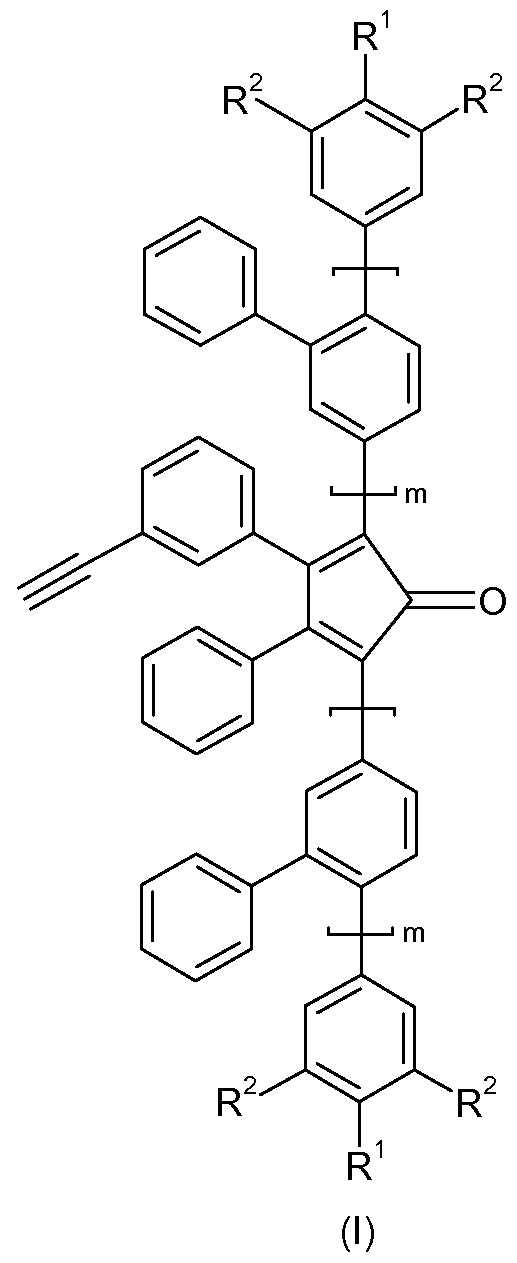
The problem is solved by a oligophenylene monomer of general formula (I),
Figure imgf000005_0001
wherein (I)
R1 and R2 are independently of each other H, halogene, -OH, -NH2, -CN, -N02 or a linear or branched, saturated or unsaturated Ci-C40 hydrocarbon residue, which can be substituted 1 - to 5-fold with halogene (F, CI, Br, I), -OR3, -NR3 2, -CN and/or -N02, and wherein one or more CH2-groups can be replaced by -0-, -S-, -NR4-, -OC(O)- or - C(O)-, or an optionally substituted aryl, alkylaryl or alkoxyaryl residue;
each R3 is independently of each other H , C1-C30 akyl, C2-C3o alkenyl, C2-C3o alkynyl, C1-C30 haloalkyl, C2-C30 haloalkenyl, C2-C30 haloalkynyl or C2-C30 acyl; each R4 is independently of each other H , Ci-C30 alkyl, C2-C30 alkenyl, C2-C30 alkynyl, CrC30 haloalkyl, C2-C30 haloalkenyl, C2-C30 haloalkynyl or C2-C30 acyl; and m represents 0, 1 or 2.
Preferably, R1 and R2 are independently of each other H, Ci-C30 alkyl, CrC30 alkoxy, Ci-C30 alkylthio, C2-C30 alkenyl, C2-C30 alkynyl, CrC30 haloalkyl, C2-C30 haloalkenyl or haloalkynyl, e.g. CrC30 perfluoroalkyl. More preferably R1 and R2 are independently of each other H, CrC30 alkyl or CrC30 alkoxy. Most preferably R1 and R2 and are independently of each other H or CrC30 alkyl.
Ci-C30 alkyl can be linear or branched, where possible. Examples are methyl, ethyl, n-propyl, isopropyl, n-butyl, sec. -butyl, isobutyl, tert. -butyl, n-pentyl, 2-pentyl, 3-pentyl, 2,2-dimethylpropyl, 1 ,1 ,3,3-tetramethylpentyl, n-hexyl, 1- methylhexyl, 1 ,1 ,3,3,5,5-hexamethylhexyl, n-heptyl, isoheptyl, 1 ,1 ,3,3-tetramethylbutyl, 1-methylheptyl, 3-methylheptyl, n-octyl, 1 ,1 ,3,3-tetramethylbutyl and 2-ethylhexyl, n- nonyl, decyl, undecyl, dodecyl, tridecyl, tetradecyl, pentadecyl, hexadecyl, heptadecyl, octadecyl, eicosyl, heneicosyl, docosyl, tetracosyl or pentacosyl.
Ci-C30 alkoxy groups are straight-chain or branched alkoxy groups, e.g. methoxy, ethoxy, n-propoxy, isopropoxy, n-butoxy, sec-butoxy, tert-butoxy, amyloxy, isoamyloxy, tert-amyloxy, heptyloxy, octyloxy, isooctyloxy, nonyloxy, decyloxy, undecyloxy, dode- cyloxy, tetradecyloxy, pentadecyloxy, hexadecyloxy, heptadecyloxy or octadecyloxy.
The term "alkylthio group" means the same groups as the alkoxy groups, except that the oxygen atom of the ether linkage is replaced by a sulfur atom. C2-C30 alkenyl groups are straight-chain or branched alkenyl groups, such as e.g. vinyl, allyl, methallyl, isopropenyl, 2-butenyl, 3-butenyl, isobutenyl, n-penta-2,4-dienyl, 3- methyl-but-2-enyl, n-oct-2-enyl, n-dodec-2-enyl, isododecenyl, n-dodec-2-enyl or n- octadec-4-enyl. C2-30 alkynyl is straight-chain or branched and may be unsubstituted or substituted, such as, for example, ethynyl, 1-propyn-3-yl, 1 -butyn-4-yl, 1 -pentyn-5-yl, 2-methyl-3- butyn-2-yl, 1 ,4-pentadiyn-3-yl, 1 ,3-pentadiyn-5-yl, 1 -hexyn-6-yl, cis-3-methyl-2-penten- 4-yn-1 l-yl, trans-3-methyl-2-penten-4-yn-1 -yl, 1 ,3-hexadiyn-5-yl, 1 -octyn-8-yl, 1 -nonyn- 9-yl, 1 -decyn-10-yl, or 1 -tetracosyn-24-yl.
Ci-C3o-perfluoroalkyl is a branched or unbranched radical such as for example -CF3, -CF2CF3, -CF2CF2CF3, -CF(CF3)2, -(CF2)3CF3 or -C(CF3)3. The terms "haloalkyi, haloalkenyl and haloalkynyl" mean groups given by partially or wholly substituting the abovementioned alkyl group, alkenyl group and alkynyl group with halogen.
C2-C30 acyl is straight-chain or branched and may be saturated or unsaturated, such as, for example, ethanoyl, propanoyl, isobutanoyl, n-butanoyl, pentanoyl, hexanoyl, heptanoyl, octanoyl, nonanoyl, decanoyl or dodecanoyl.
Aryl is usually C6-C30 aryl, which optionally can be substituted, such as, for example, phenyl, 4-methylphenyl, 4-methoxyphenyl, naphthyl, biphenylyl, terphenylyl, pyrenyl, fluorenyl, phenanthryl, anthryl, tetracyl, pentacyl or hexacyl.
In a preferred embodiment of the invention, R1 is a linear or branched Ci-C30 alkyl and R2 is H. The problem is further solved by a polymeric precursor for producing graphene nanoribbons having repeating units of general formula (II),
Figure imgf000007_0001
(II) wherein
R1 and R2 are independently of each other H, halogene, -OH, -NH2, -CN, -N02 or a linear or branched, saturated or unsaturated Ci-C40 hydrocarbon residue, which can be substituted 1 - to 5-fold with halogene (F, CI, Br, I), -OR3, -NR3 2, -CN and/or -N02, and wherein one or more CH2-groups can be replaced by -0-, -S-, -NR4-, -OC(O)- or - C(O)-, or an optionally substituted aryl, alkylaryl or alkoxyaryl residue; each R3 is independently of each other H, C1-C30 akyl, C2-C3o alkenyl, C2-C3o alkynyl, C1-C30 haloalkyl, C2-C30 haloalkenyl, C2-C30 haloalkynyl or C2-C30 acyl; each R4 is independently of each other H, Ci-C30 alkyl, C2-C30 alkenyl, C2-C30 alkynyl, CrC30 haloalkyl, C2-C30 haloalkenyl, C2-C30 haloalkynyl or C2-C30 acyl; m represents 0, 1 or 2; and n represents a number of from 2 to 900.
Preferably, R1 and R2 are independently of each other H, Ci-C30 alkyl, CrC30 alkoxy, Ci-C30 alkylthio, C2-C30 alkenyl, C2-C30 alkynyl, CrC30 haloalkyl, C2-C30 haloalkenyl or haloalkynyl, e.g. CrC30 perfluoroalkyl. More preferably R1 and R2 are independently of each other H, Ci-C30 alkyl or CrC30 alkoxy. Most preferably R1 and R2 are independently of each other H or CrC30 alkyl. Preferably, R2 in formulae (I) and (II) is H.
Preferably, m in formulae (I) and (I I) represents 0 or 1 . More preferably, m in formulae (I) and (II) represents 0. In a preferred embodiment of the invention, R1 is a linear or branched CrC30 alkyl and R2 is H.
The oligophenylene monomer of general formula (I) is used for the preparation of the polymeric precursor for producing graphene nanoribbons having repeating units of general formula (II) by reacting it via Diels-Alder-Reaction according to Scheme 1 .
The Diels-Alder reaction represents a well-established protocol which has been used for the build-up of functional molecules and polymers. The Diels-Alder-Reaction of oligophenylene monomer of general formula (I) to the polymeric precursor having repeating units of general formula (II) can be achieved under different conditions. For example, the Diels-Alder-Reaction can be performed in high boiling solvents at elevated temperatures. Suitable high boiling solvents are diphenyl ether, 1 ,1 ,2,2- tetrachloroethane, 1 ,2-dichlorobenzene, 1 ,2,4-trichlorobenzene, nitrobenzene and benzophenone.
Alternatively, the Diels-Alder-Reaction can be performed without using solvents at temperatures between 200 °C and 300 °C.
Scheme 1
Figure imgf000009_0001
(I) (II)
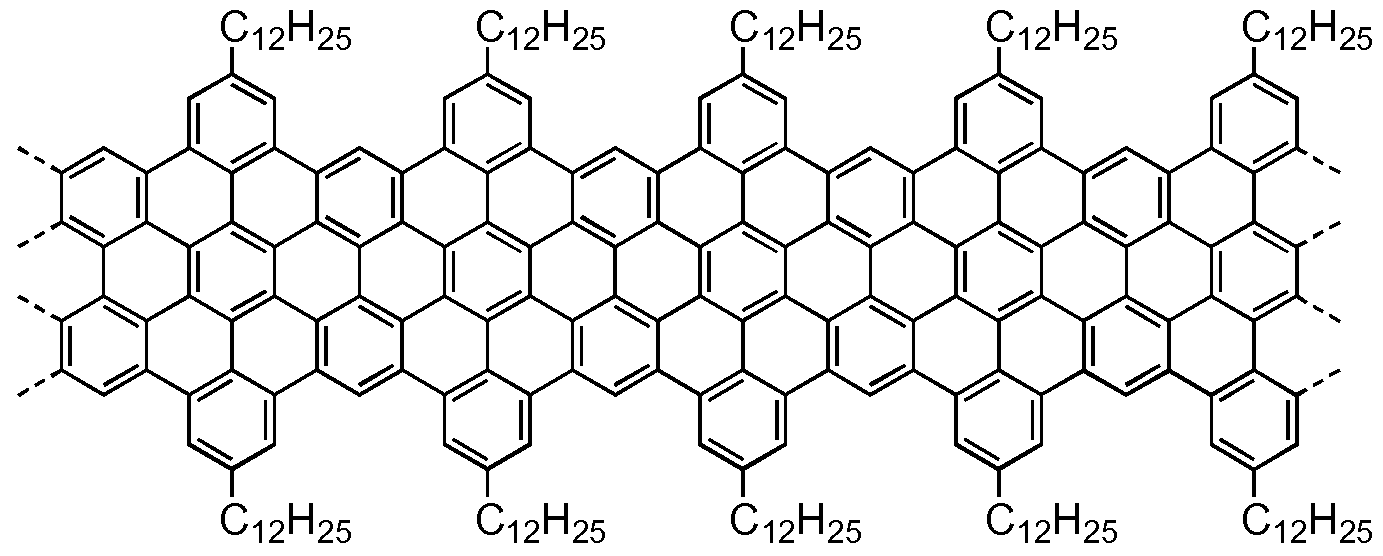
In general, the polymeric precursor having repeating units of general formula (II) contains from 2 to 900 repeating units and has a molecular weight of from 1 000 to 600 000 g/mol. The invention also concerns a process for the preparation of the polymeric precursor having repeating units of general formula (II) by Diels-Alder polymerization of the oligophenylene monomer of general formula (I). The invention also concerns a process for the preparation of graphene nanoribbons by cyclodehydrogenation of the polymeric precursor having repeating units of general formula (II) according to Scheme 2. The preparation of graphene nanoribbons of general formula (III) from the polymeric precursor having repeating units of general formula (II) can be performed e.g. using ferric(lll) chloride as oxidant in a mixture of DCM and nitromethane (Scheme 2). Depending on the temperature and the nature of the polymeric precursor having repeating units of general formula (II), the reaction time is from 2 h to 10 d. If the reaction is carried out at around 20 °C, the reaction time is usually between two and four days. Preferably, a stream of an inert gas is passed through the reaction mixture during the reaction to avoid side reactions.
Alternatively, the preparation of graphene nanoribbons of general formula (III) can be carried out using phenyliodine(lll)bis(trifluoroacetate) (PIFA) and boron trifluoride etherate in anhydrous DCM or molybdenum(V) pentachloride in anhydrous DCM.
In general, the molecular weight of the graphene nanoribbons of general formula (III) varies from 1 000 to 600 000 g/mol.
Scheme 2
Figure imgf000010_0001
(N) The oligophenylene monomer of general formula (I) can be synthesized according to Schemes 3 to 7 below, involving the two intermediates 3-bromobenzil 4 and substituted 1 ,3-bis(oligophenylenyl)propan-2-one 8, as summarized below in Scheme 7. The reaction conditions and solvents used are purely illustrative, of course other conditions and solvents can also be used and will be determined by the skilled in the art. Depending on the desired width of the graphene nanoribbons of general formula (III), different substituted 1 ,3-bis(oligophenylenyl)propan-2-ones 8 (m = 0, 1 or 2) can be reacted with 3-bromobenzil 4. Suitable substituted 1 ,3-bis(oligophenylenyl)propan-2- ones 8 are for example the 1 ,3-bis(oligophenylenyl)propan-2-ones 8-0 with m = 0 (Scheme 4), 8-1 with m = 1 (Scheme 5) and 8-2 with m = 2 (Scheme 6).
In a first reaction sequence, the intermediate 3-bromobenzil 4 can be synthesized via a two-step route from commercially available 1 -bromo-3-iodobenzene 1 and ethynylbenzene 2 (Scheme 3). Sonogashira-type coupling of 1 and 2 can be used for the build-up of 3-bromodiphenylacetylene 3. The reaction can be achieved in a mixture of THF and triethylamine at room temperature in the presence of copper(l) iodide and a palladium(ll) catalyst. Due to the higher reactivity of the iodine carbon bond of 1 -bromo- 3-iodobenzene 1 , the coupling only proceeded at the desired 3-position. The second step consists in the oxidation of the acetylene group of 3- bromodiphenylacetylene 3 to yield the 3-bromobenzil 4. This step can be realized by stirring bromodiphenylacetylene 3 in the presence of iodine in dimethyl sulfoxide at elevated temperatures. Scheme 3
Figure imgf000011_0001
1 2 3 4 Scheme 4 illustrates the synthetic route to substituted 1 ,3-bis(oligophenylenyl)propan- 2-one 8-0 starting from literature known halogenated toluene 5, wherein X and Y are independently selected from CI, Br, I or H. The first step consists in the bromination of the benzylic position of halogenated toluene 5 to yield the halogenated benzyl bromide 6. This step can be realized by heating halogenated toluene 5 under reflux in carbon tetrachloride in the presence of N-bromosuccinimide (NBS) and benzoyl peroxide. The halogenated benzyl bromide 6 can be further reacted to the halogenated 1 ,3- bis(phenyl)propan-2-one 7. This is achieved by heating the halogenated benzyl bromide 6 under reflux in a reaction mixture of dichloromethane and water using iron(0) pentacarbonyl, potassium hydroxide and benzyltriethylammonium chloride. The last reaction step of this reaction sequence can be carried out with any desired substituted or non-substituted halide R1X' or R2X', wherein X' is selected from CI, Br or I and R1 and R2 are as defined above. For example, substituted 1 ,3-bis(oligophenylenyl)propan- 2-one 8-0 is accessible using zinc(ll) iodide and a palladium(O) catalyst at room temperature. If both X and Y are H, this reaction step is omitted.
Scheme 4
Figure imgf000012_0001
8-0
The synthesis of substituted 1 ,3-bis(oligophenylenyl)propan-2-one 8-1 (m = 1 ) is shown in Scheme 5. Substituted 1 ,3-bis(oligophenylenyl)propan-2-one 8-1 can be synthesized via a four step route starting from commercially available 2-bromo-1 -iodo-5- methylbenzene 9 and phenylboronic acid 10. Suzuki cross coupling of 9 and 10 can be used for the build-up of the 2-bromo-5-methyl-biphenyl 11. The reaction can be achieved at an elevated temperature in a reaction mixture of toluene, ethanol and water in the presence of potassium carbonate and catalytic amounts of tetrakis(triphenylphosphine)palladium(0). Due to the higher reactivity of the iodine carbon bond, the coupling mainly proceeds at the iodine atom in the desired 1 -position. The next step consists in the bromination of the benzylic position of 2-bromo-5-methyl- biphenyl 11 to yield the functionalized biphenyl 12. This step can be realized by heating bromo-5-methyl-biphenyl 11 under reflux in carbon tetrachloride using N- bromosuccinimide (NBS) and benzoyl peroxide. Scheme 5
Figure imgf000013_0001
8-1
The functionalized biphenyl 12 can be further reacted to 1 ,3-bis(bromobiphenyl)propan- 2-one 13. This is achieved by boiling the functionalized biphenyl 12 in a reaction mixture of dichloromethane and water in the presence of iron(0) pentacarbonyl, potassium hydroxide and benzyltriethylammonium chloride. In the last step, Suzuki cross coupling of 1 ,3-bis(bromobiphenyl)propan-2-one 13 with arylboronic acid pinacol ester 14 in the presence of potassium carbonate and of tetrakis(triphenyl- phosphine)palladium(O) yields the substituted 1 ,3-bis(oligophenylenyl)propan-2-one 8-1 (m = 1 ). R1 and R2 are as defined above. The synthesis of substituted 1 ,3-bis(oligophenylenyl)propan-2-one 8-2 (m = 2) is shown in Scheme 6. The synthesis of the substituted 1 ,3-bis(oligophenylenyl)propan-2-one 8- 2 starts from commercially available 2-bromo-4-chloro-1 -iodobenzene 16 and the afore mentioned substituted phenylboronic acid pinacol ester 14. Suzuki cross coupling can be used for the build-up of the substituted 2-bromo-4-chlorobiphenyl 17. The reaction can be performed e.g. at an elevated temperature in a reaction mixture of toluene, ethanol and water in the presence of potassium carbonate and of tetrakis(triphenylphosphine)palladium(0). Preferably, exactly 1 .00 equivalent of substituted phenylboronic acid pinacol ester 14 is used. Subsequently, the 2-bromo-4- chlorobiphenyl 17 is converted with phenylboronic acid 10 in a second Suzuki reaction to yield the substituted chlorotrisphenylene 18. The conditions applied are the same as in the step before but at a higher temperature. Scheme 6
Figure imgf000014_0001
The substituted trisphenylenylboronic acid pinacol ester 19 can be prepared from chlorotrisphenylene 18 and bis(pinacol) ester of 1 ,4-phenyldiboronic acid under reflux in 1 ,4-dioxane in the presence of potassium acetate as a base and catalytic amounts of both tris(dibenzylideneacetone)dipalladium (0) (Pd2(dba)3) and 2-dicyclohexyl- phosphino-2',4',6'-triisopropylbiphenyl (XPhos). Suzuki cross coupling of 19 with 1 ,3- bis(bromobiphenyl)propan-2-one 13 under reflux in a mixture of toluene, ethanol and water using potassium carbonate as a base and tetrakis(triphenyl- phosphine)palladium(O) yields the substituted 1 ,3-bis(oligophenylenyl)propan-2-one 8- 2.
With the intermediates 3-bromobenzil 4 and the substituted 1 ,3-bis(oligo- phenylenyl)propan-2-one 8 (m = 0,1 or 2) available, their coupling can be carried out using Knoevenagel condensation (Scheme 7). This can be achieved by reacting 4 and 8 in a mixture of tert-butanol and water at 80°C in the presence of tetraethylammoniumhydroxid. The obtained substituted 2,5-bis(oligophenylenyl)-3-(3- bromophenyl)-4-phenyl-2,4-cyclopentadienone 20 is further reacted using trimethylsilyl acetylene, bis(triphenylphosphine)palladiumchloride(ll) and copper(l) iodide in a Sonogashira cross coupling reaction. This yields substituted 2,5-bis(oligophenylenyl)-3- (3-trimethylsilylacetylphenyl)-4-phenyl-2,4-clopentadienone 21. Using potassium carbonate as base finally results in the formation of oligophenylene monomer of general formula (I). The reaction works well when a 1 :1 mixture of THF and methanol is used.
Figure imgf000016_0001
Various articles of manufacture including electronic devices, optical devices, and optoelectronic devices, such as field effect transistors (e.g., thin film transistors), photovoltaics, organic light emitting diodes (OLEDs), complementary metal oxide semiconductors (CMOSs), complementary inverters, D flip-flops, rectifiers, and ring oscillators, that make use of the graphene nanoribbons disclosed herein also are within the scope of the present invention as are methods of making the same.
The present invention, therefore, further provides methods of preparing a semiconductor material. The methods can include preparing a composition that includes one or more of the graphene nanoribbons of the invention disclosed herein dissolved or dispersed in a liquid medium such as a solvent or a mixture of solvents, depositing the composition on a substrate to provide a semiconductor material precursor, and processing (e.g., heating) the semiconductor precursor to provide a semiconductor material (e.g., a thin film semiconductor) that includes one or more of the graphene nanoribbons disclosed herein. In various embodiments, the liquid medium can be an organic solvent, an inorganic solvent such as water, or combinations thereof. In some embodiments, the composition can further include one or more additives independently selected from detergents, dispersants, binding agents, compatibilizing agents, curing agents, initiators, humectants, antifoaming agents, wetting agents, pH modifiers, biocides, and bacteriostats. For example, surfactants and/or polymers (e.g., polystyrene, polyethylene, poly-alpha-methylstyrene, polyisobutene, polypropylene, polymethylmethacrylate, and the like) can be included as a dispersant, a binding agent, a compatibilizing agent, and/or an antifoaming agent. In some embodiments, the depositing step can be carried out by printing, including inkjet printing and various contact printing techniques (e.g., screen-printing, gravure printing, offset printing, pad printing, lithographic printing, flexographic printing, and microcontact printing). In other embodiments, the depositing step can be carried out by spin coating, drop-casting, zone casting, dip coating, blade coating, spraying or vacuum filtration.
The present invention further provides articles of manufacture such as the various devices described herein that include a composite having a semiconductor material of the present invention and a substrate component and/or a dielectric component. The substrate component can be selected from doped silicon, an indium tin oxide (ITO), ITO-coated glass, ITO-coated polyimide or other plastics, aluminum or other metals alone or coated on a polymer or other substrate, a doped polythiophene, and the like. The dielectric component can be prepared from inorganic dielectric materials such as various oxides (e.g., Si02, Al203, Hf02), organic dielectric materials such as various polymeric materials (e.g., polycarbonate, polyester, polystyrene, polyhaloethylene, polyacrylate), and self-assembled superlattice/self-assembled nanodielectric (SAS/SAND) materials (e.g., described in Yoon, M-H. et al., PNAS, 102 (13): 4678- 4682 (2005)), as well as hybrid organic/inorganic dielectric materials (e.g., described in US 2007/0181961 A1 ). The composite also can include one or more electrical contacts. Suitable materials for the source, drain, and gate electrodes include metals (e.g., Au, Al, Ni, Cu), transparent conducting oxides (e.g., ITO, IZO, ZITO, GZO, GIO, GITO), and conducting polymers (e.g., poly(3,4-ethylenedioxythiophene) poly(styrene- sulfonate) (PEDOT:PSS), polyaniline (PANI), polypyrrole (PPy). One or more of the composites described herein can be embodied within various organic electronic, optical, and optoelectronic devices such as organic thin film transistors (OTFTs), specifically, organic field effect transistors (OFETs), as well as sensors, capacitors, unipolar circuits, complementary circuits (e.g., inverter circuits), and the like.
Other articles of manufacture, in which graphene nanoribbons of the present invention are useful, are photovoltaics or solar cells. Compounds of the present invention can exhibit broad optical absorption and/or a very positively shifted reduction potential, making them desirable for such applications. Accordingly, the graphene nanoribbons described herein can be used as a n-type semiconductor in a photovoltaic design, which includes an adjacent p-type semiconductor material that forms a p-n junction. The compounds can be in the form of a thin film semiconductor, which can be deposited on a substrate to form a composite. Exploitation of compounds of the present invention in such devices is within the knowledge of a skilled artisan. Accordingly, another aspect of the present invention relates to methods of fabricating an organic field effect transistor that incorporates a semiconductor material of the present invention. The semiconductor materials of the present invention can be used to fabricate various types of organic field effect transistors including top-gate top-contact capacitor structures, top-gate bottom-contact capacitor structures, bottom-gate top- contact capacitor structures, and bottom-gate bottom-contact capacitor structures.
In certain embodiments, OTFT devices can be fabricated with the present graphene nanoribbons on doped silicon substrates, using Si02 as the dielectric, in top-contact geometries. In particular embodiments, the active semiconductor layer which incorporates at least a graphene nanoribbon of the present invention can be deposited at room temperature or at an elevated temperature. In other embodiments, the active semiconductor layer which incorporates at least a graphene nanoribbon of the present invention can be applied by spin-coating or printing as described herein. For top- contact devices, metallic contacts can be patterned on top of the films using shadow masks. The invention is illustrated in more detail by the following examples. Examples
Brief description of the figures:
Figure 1 : MALDI-TOF MS analysis of a crude product of polymeric precursor Ha
(Table 1 , entry 1 , matrix: TCNQ, linear mode).
Figure 2: MALDI-TOF MS analysis of a crude product of polymeric precursor Ha
(Table 1 , entry 1 , matrix: TCNQ, reflectron mode).
Figure 3: Chemical formulae, exact masses and molecular weights of tetrameric, pentameric, hexameric and heptameric polymeric precursor Ha.
(Tetramer
Figure imgf000019_0001
exact mass=2868,14, molecular weight=2870,49 pentamer=C27oH342, exact mass=3584,68; molecular weight=3587,60
Figure imgf000019_0002
exact mass=4301 ,21 , molecular weight=4304,72 heptamer=C378H478, exact mass=5017,74, molecular weight=5021 , 84)
Figure 4: Molecular weight distribution of polymeric precursor Ha after fractionation by GPC (Table 1 , entry 2, THF, PSS).
Figure 5: Raman spectrum of graphene nanoribbons Ilia (powder).
Figure 6: Comparison of UV-VIS absorption spectra: (a) polymeric precursor Ha in
THF (14 μg mL) and (b) graphene nanoribbons Ilia as a film on a glass substrate drop-casted from dispersion in THF.
Figure 7: UV-vis absorption spectrum of graphene nanoribbons Ilia in an exfoliated solution in NMP. Figure 8: Output characteristics of graphene nanoribbons Ilia at various gate biases
VG
Figure 9: Transfer curve of graphene nanoribbons Ilia at a source drain bias of VSD =
-60V.
Example 1
Preparation of 3-bromodiphenylacetylene (3)
Figure imgf000019_0003
To a degassed solution of 1 -bromo-3-iodobenzene 1 (5.03 g, 17.8 mmol) and ethynylbenzene 2 (2.08 g, 20.4 mmol) in a mixture of THF (50 ml.) and triethylamine (50 ml.) were added copper(l) iodide (52.7 mg, 0.277 mmol) and dichlorobis(triphenylphosphine)palladium(ll) (376 mg, 0.536 mmol). After stirring at room temperature for 18 h, the reaction mixture was filtered to remove precipitates. The filtrate was diluted with diethylether, and washed twice with a saturated aqueous solution of ammonium chloride and three times with brine followed by drying over sodium sulfate and concentration in vacuo. Dark brown crude material was purified by silica gel column chromatography (eluent: hexane) to give the title compound as colorless oil (4.46 g, 98% yield).
1H NMR (300 MHz, CD2CI2): δ 7.25 (t, J = 7.9 Hz, 1 H), 7.35-7.41 (m, 3H), 7.46-7.57 (m, 4H), 7.70 (t, J = 1 .7 Hz, 1 H). 13C NMR (75 MHz, CDCI3): δ 87.77, 90.65, 122.16, 122.73, 125.30, 128.40, 128.61 , 129.76, 130.13, 131 .36, 131.66, 134.31.
Elemental Analysis: Calc. for d4H9Br: C, 65.40; H, 3.53. Found: C, 65.53; H, 3.65.
Example 2
Preparation of 3-Bromobenzil (4)
Figure imgf000020_0001
To a solution of 3-bromodiphenylacetylene 3 (6.38 g, 24.8 mmol) in DMSO (60 ml.) was added iodine (3.15 g, 12.4 mmol). The reaction mixture was degassed and stirred at 155 °C for 20 h. After cooling down to room temperature, the reaction was quenched with a saturated aqueous solution of sodium sulfite followed by dilution with dichloromethane. The aqueous layer was extracted three times with dichloromethane and the combined organic layers were washed five times with water. After drying over sodium sulfate and concentration in vacuo purification by silica gel column chromatography (eluent: 30-50% dichloromethane/hexane) yielded the title compound as a yellow solid (4.47 g, 62% yield).
1H NMR (300 MHz, CD2CI2): δ 7.42 (t, J = 7.9 Hz, 1 H), 7.51-7.59 (m, 2H), 7.71 (tt, J = 1.3, 7.4 Hz, 1 H), 7.82 (qd, J = 0.99, 8.0 Hz, 1 H), 7.89 (td, J = 1 .2, 7.8 Hz, 1 H), 7.93-7.98 (m, 2H), 8.13 (t, J = 1.8 Hz, 1 H). 13C NMR (75 MHz, CD2CI2): δ 123.61 , 128.99, 129.53, 130.29, 131.10, 132.79, 133.1 1 , 135.16, 135.59, 138.12, 193.42, 194.08. Elemental Analysis: Calc. for Ci4H9Br02: C, 58.16; H, 3.14. Found: C, 58.21 ; H, 3.32.
Example 3
Preparation of 3-(3-Bromophenyl)-2,5-bis(4-dodecylphenyl)-4-phenyl-2,4-cyclo- pentadienone (20a)
Figure imgf000021_0001
To a solution of 3-bromobenzil 4 (2.00 g, 6.92 mmol) and 1 ,3-bis(4-dodecylphenyl)- propan-2-one (8a) (3.79g, 6.93 mmol) in ie/f-butanol (200 mL) was added at 80 °C an aqueous solution of tetraethylammonium hydroxide (20%, 2.05 mL, 2.77 mmol). After stirring at 80 °C for 50 min the reaction was quenched by the addition of 1 N HCI (40 mL), and the reaction mixture was extracted three times with dichloromethane. The combined organic extracts were washed with water three times, dried over sodium sulfate, and evaporated to give a purple crude product. Purification by silica gel column chromatography (eluent: 20% dichloromethane/hexane) gave the title compound as a purple solid (5.05 g, 91 % yield).
1H NMR (300 MHz, CD2CI2): δ 0.86-0.90 (m, 6H), 1 .23-1 .37 (m, 36H), 1.51-1 .66 (m, 4H), 2.52-2.62 (m, 4H), 6.87-6.92 (m, 1 H), 6.93-6.98 (m, 2H), 7.04-7.16 (m, 10H), 7.18-7.32 (m, 3H), 7.35-7.41 (m, 1 H).
13C NMR (75 MHz, CD2CI2): δ 14.30 (2C), 23.12 (2C), 29.75 (2C), 29.79 (2C), 29.92 (2C), 30.02 (2C), 30.07 (2C), 30.09 (2C), 30.1 1 (2C), 31.74 (2C), 32.36 (2C), 36.13 (2C), 122.25, 125.64, 126.36, 128.12, 128.46 (2C), 128.48 (2C), 128.60 (2C), 128.90, 129.60 (2C), 129.97, 130.25, 130.34 (2C), 130.35 (2C), 131 .61 , 132.46, 133.63, 136.13, 143.13, 143.38, 152.58, 152.63, 154.27, 200.93.
Elemental Analysis: Calc. for C39H620: C, 79.57; H, 8.44. Found: C, 79.59; H, 8.56. Example 4
Preparation of 2,5-Bis(4-dodecylphenyl)-3-phenyl-4-(3-((trimethylsilyl)ethynyl)- phenyl)-2,4-cyclopentadienone (21 a)
Figure imgf000022_0001
To a degassed suspension of 3-(3-bromophenyl)-2,5-bis(4-dodecylphenyl)-4-phenyl- 2,4-cyclopentadienone 20a (3.00 g, 3.75 mmol) and copper(l) iodide (73.5 mg, 0.386 mmol) in triethylamine (200 ml.) were added trimethylsilylacetylene (1 .60 ml_, 1 1 .3 mmol) and tetrakis-(triphenylphosphino)-palladium(0) (438 mg, 0.379 mmol). After stirring at 80 °C for 19 h, the solvent was removed in vacuo. The resulting purple solid was dissolved in dichloromethane and washed once with a saturated aqueous solution of ammonium chloride and then twice with brine. After drying over sodium sulfate and concentration in vacuo, purification by silica gel column chromatography (eluent: 15% dichloromethane/hexane) yielded the title compound as a purple solid (2.10 g, 69% yield).
1H NMR (300 MHz, CD2CI2): δ 0.19 (s, 9H), 0.88 (t, J = 6.7 Hz, 6H), 1.23-1 .36 (m, 36H), 1.55-1.65 (m, 4H), 2.52-2.61 (m, 4H), 6.87-6.92 (m, 1 H), 6.92-6.97 (m, 2H), 7.04-7.29 (m, 13H), 7.30-7.35 (m, 1 H).
13C NMR (75 MHz, CD2CI2): δ 0.10 (3C), 14.30 (2C), 23.12 (2C), 29.78 (2C), 29.82 (2C), 29.91 (2C), 30.01 (2C), 30.07 (4C), 30.10 (2C), 31.75 (2C), 32.35 (2C), 36.14 (2C), 95.25, 104.61 , 123.49, 125.52, 126.01 , 128.27, 128.41 (2C), 128.47 (2C), 128.53 (2C), 128.67, 128.81 , 129.61 (2C), 129.82, 130.34 (4C), 130.61 , 132.07, 132.50, 133.70, 134.47, 143.07, 143.28, 153.43, 154.43, 154.27, 201.13.
Elemental Analysis: Calc. for C58H760Si: C, 85.23; H, 9.37. Found: C, 84.84; H, 9.33. Example 5
Preparation of 2,5-Bis(4-dodecylphenyl)-3-(3-ethynylphenyl)-4-phenyl-2,4-cyclo- pentadienone (la)
Figure imgf000022_0002
Methanol (100 mL) was added to a suspension of 2,5-bis(4-dodecylphenyl)-3-phenyl-4- (3-((trimethylsilyl)ethynyl)phenyl)-2,4-cyclopentadienone 21a (1.02 g, 1 .25 mmol) and potassium fluoride (361 mg, 6.21 mmol) in THF (100 mL), and the reaction mixture was stirred at 40 °C for 5 h. After removal of the solvents at 40 °C in vacuo, purification by silica gel column chromatography (eluent: 15% dichloromethane/hexane) yielded the title compound as a purple solid (786 mg, 84% yield).
1H NMR (300 MHz, CD2CI2): δ 0.88 (t, J = 6.7 Hz, 6H), 1 .23-1 .36 (m, 36H), 1.51-1.65 (m, 4H), 2.51-2.61 (m, 4H), 3.04 (s, 1 H), 6.91-6.97 (m, 3H), 7.04-7.30 (m, 13H), 7.35- 7.39 (m, 1 H).
13C NMR (75 MHz, CD2CI2): δ 14.33 (2C), 23.14 (2C), 29.80 (4C), 29.93 (2C), 30.03 (2C), 30.09 (4C), 30.12 (2C), 31 .75 (2C), 32.37 (2C), 36.14 (2C), 77.93, 83.22, 122.35, 125.61 , 126.17, 128.25, 128.44 (2C), 128.48 (2C), 128.52, 128.54, 128.56 (2C), 128.84, 129.63 (2C), 130.19, 130.36 (4C), 132.28, 133.00, 133.69, 134.44, 143.08, 143.27, 153.21 , 154.34, 201 .06.
HRMS (ESI, positive) m/z calc. for C55H690 [M+H]+ 745.5348, found 745.5334. Example 6
Preparation of polymeric precursor (Ma)
Figure imgf000023_0001
Method 1 : Diels-Alder-Polymerization in a solution of diphenyl ether
A degassed solution of 2,5-bis(4-dodecylphenyl)-3-(3-ethynylphenyl)-4-phenyl-2,4- cyclopentadienone la in diphenyl ether was refluxed using a heating mantle. After cooling down to room temperature, diphenyl ether was distilled off and the resulting crude material was fractionated by using recycling gel permeation chromatography (GPC) system (eluent: chloroform).
1H NMR (300 MHz, CD2CI2): δ 0.81-0.92 (m, 6H), 1 .00-1 .68 (m, 40H), 2.15-2.75 (m, 4H), 6.15-7.38 (m, 18H). Method 2: Diels-Alder-Polymerization in a neat condition
A purple powder of 2,5-bis(4-dodecylphenyl)-3-(3-ethynylphenyl)-4-phenyl-2,4- cyclopentadienone la in a 25-mL Schlenk tube was heated to 260 °C using a heating mantle. The powder at first melted and then lost its purple color to be pale yellow. After cooling down to room temperature, the resulting polymer was sonicated in THF for 30 min, and the insoluble polymer was filtered off. The filtrate was concentrated in vacuo and fractionated by gel permeation chromatography (eluent: dichloromethane).
Table 1 Reaction conditions and the resulting molecular weights of polymeric precursor Ha
entry solvent concentration (mM) time (h) Mw (g/mol)a
1 Ph20 36.6 25 24000
2 Ph20 228 28 150000
3 neat — 1 .5 350000b
4 neat — 5 620000b a GPC analysis of the crude products (THF, PSS, UV detector)
b Crude products were extracted from unsoluble polymer with THF using sonication.
MALDI analysis of a crude product of polymeric precursor Ha (Table 1 , entry 1 ) in reflectron mode showed peaks of tetramer, pentamer, hexamer, heptamer, and octamer at 2869, 3587, 4304, 5021 , and 5739, respectively, which indicated that the ethynyl groups and tetraphenylcyclopentadienone moieties at the edges of them was reacted during the reaction (Figure 2).
Example 7
Preparation of graphene nanoribbons (Ilia)
Figure imgf000024_0001
A solution of polymeric precursor Ha in non-stabilized dichloromethane was degassed by argon bubbling for 10 min. To the degassed solution was added a suspension of iron(lll) chloride in nitromethane. After stirring at room temperature for 3 days under continuous argon bubbling, the reaction was quenched by the addition of methanol to form black precipitates. Filtration by suction using a membrane filter and washing with methanol gave the title compound as black powder.
Although the solubility of graphene nanoribbons Ilia in normal organic solvents was very poor, it was possible to disperse Ilia in THF with the help of sonication. Analysis of the dispersion was not possible because it started to reaggregate immediately after stopping the sonication, but it was possible to make a film of Ilia by drop-casting it on glass substrate and measure solid-state UV-VIS absorption spectrum (Figure 6b). It was demonstrated that the absorption band is dramatically red shifted upon the cyclodehydrogenation of polymeric precursor Ha (Figure 6a) to graphene nanoribbons Ilia (Figure 6b). The spectrum of graphene nanoribbons Ilia showed an absorption peak at 570 nm.
Exfoliation of graphene nanoribbons Ilia was performed in NMP with the help of sonication, which gave UV-VIS absorption spectrum of Ilia from exfoliated solution (Figure 7). An absorption peak was observed at 550 nm. Fabrication of OFET devices with graphene nanoribbons Ilia was performed by drop casting the dispersion of Ilia in THF directly after sonication, which demonstrates the field-effect mobility of graphene nanoribbons Ilia to be [ max = 0.001 cm2/vs and [ avg = 0.00087 cm2/vs in HMDS modified OFET devices (Figure 8 and 9). Example 8
Preparation of 1 ,3-Bis(4-(2-decyltetradecyl)phenyl)propan-2-one (8b)
Figure imgf000025_0001
Dry N,N-dimethylacetamide (10 ml.) was added to zinc (3.21 g, 49.1 mmol) and iodine (0.689 mg, 2.71 mmol) in a 100-mL two-necked flask equipped with a condenser, and stirred at room temperature until the purple color of iodine disappeared. 2-decyl- tetradecylbromide (15.3 g, 36.7 mmol) was then added to the mixture and stirred at 80 °C for 24 h to generate dodecylzinc bromide. To 1 ,3-bis(4-bromophenyl)-propan-2-one 7b (2.00 g, 5.43 mmol) and dichloro[1 ,1 '-bis(diphenylphosphino)- ferrocene]palladium(ll) (0.384 g, 0.544 mmol) in a 100-mL Schlenk flask was added via cannula the solution of dodecylzinc bromide. The reaction mixture was stirred at room temperature for 18 h, and then quenched by hydrochloric acid (2 M, 40 ml_). The aqueous layer was extracted three times with dichloromethane. The combined organic extracts were washed three times with water, dried over sodium sulfate, and evaporated. The crude material was purified by silica gel column chromatography (eluent: 20% dichloromethane/hexane) to give the title compound as pale yellow oil (4.13 g, 86% yield).
1H NMR (300 MHz, CD2CI2)D : δ 0.88 (t, J = 6.7 Hz, 12H), 1 .16-1 .37 (m, 80H), 1 .55- 1 .67 (m, 2H), 2.50 (d, J = 7.0 Hz, 4H), 3.68 (s, 4H), 7.01 (d, J = 8.1 Hz, 4H), 7.09 (d, J = 8.1 Hz, 4H).
13C NMR (75 MHz, CD2CI2): δ 14.36 (4C), 23.18 (4C), 26.99 (4C), 29.85 (4C), 30.16 (16C), 30.50 (4C), 32.42 (4C), 33.60 (4C), 40.12 (2C), 40.57 (2C), 49.13 (2C), 129.70 (4C), 129.86 (4C), 131 .88 (2C), 141.1 1 (2C), 206.30. Elemental Analysis: Calc. for C63H110O: C, 85.64; H, 12.55. Found: C, 85.71 ; H, 12.45.
Example 9
Preparation of 3-(3-Bromophenyl)-2,5-bis(4-(2-decyltetradecyl)phenyl)-4-phenyl- 2,4-cyclopentadienone (20b)
Figure imgf000026_0001
To a solution of 3-bromobenzil 4 (0.808 g, 2.79 mmol) and 1 ,3-bis(4-(2- decyltetradecyl)phenyl)propan-2-one 8b (2.55 g, 2.89 mmol) in ie f-butanol (70 mL) was added at 80 °C an aqueous solution of tetraethylammonium hydroxide (20%, 0.82 mL, 1.12 mmol). After stirring at 80 °C for 40 min, the reaction was quenched by the addition of hydrochloric acid (2 M, 20 mL), and the reaction mixture was concentrated in vacuo and then extracted twice with dichloromethane. The combined organic extracts were washed twice with water, dried over sodium sulfate, and evaporated. Purification by silica gel column chromatography (eluent: 10% dichloromethane/hexane) gave the title compound as a purple oil (2.71 g, 85% yield). 1H NMR (300 MHz, CD2CI2): δ 0.88 (t, J = 6.7 Hz, 12H), 1 .15-1 .35 (m, 80H), 1 .55-1.67 (m, 2H), 2.50 (t, J = 6.4 Hz, 4H), 6.87 (td, J = 1 .1 , 7.9 Hz, 1 H), 6.92-6.98 (m, 2H), 7.01-7.16 (m, 10H), 7.18-7.32 (m, 3H), 7.35-7.41 (m, 1 H). 13C NMR (75 MHz, CD2CI2): δ 14.33 (4C), 23.15 (4C), 26.96 (4C), 29.82 (4C), 30.12 (16C), 30.44 (4C), 32.39 (4C), 33.61 (2C), 33.64 (2C), 40.01 (2C), 40.78 (2C), 122.26, 125.69, 126.42, 128.09, 128.42, 128.47 (2C), 128.49, 128.91 , 129.30 (2C), 129.41 (2C), 129.65 (2C), 129.93, 130.20 (4C), 131 .62, 132.56, 133.66, 136.13, 142.12, 142.39, 152.55, 154.22, 200.95.
HRMS (ESI, positive) m/z calc. for C77H116OBr [M+H]+ 1 135.8210, found 1 135.8199.
Example 10
Preparation of 2,5-Bis(4-(2-decyltetradecyl)phenyl)-3-phenyl-4-(3-((trimethylsilyl)- ethynyl)phenyl-2,4-cyclopentadienone (21 b)
Figure imgf000027_0001
To a degassed suspension of 3-(3-bromophenyl)-2,5-bis(4-(2-decyltetradecyl)phenyl)- 4-phenyl-2,4-cyclopentadienone 20b (1.53 g, 1 .34 mmol) and copper(l) iodide (30.0 mg, 0.158 mmol) in triethylamine (100 ml.) were added trimethylsilylacetylene (0.580 ml_, 4.07 mmol) and tetrakis-(triphenylphosphino)-palladium(0) (158 mg, 0.137 mmol). After stirring at 80°C for 16 h, the solvent was removed in vacuo. Purification by silica gel column chromatography (eluent: 10% dichloromethane/hexane) yielded the title compound as a purple oil (1.23 g, 79% yield).
1H NMR (300 MHz, CD2CI2): δ 0.19 (s, 9H), 0.88 (t, J = 6.8 Hz, 12H), 1.16-1 .36 (m, 80H), 1.53-1.66 (m, 2H), 2.45-2.53 (m, 4H), 6.85-6.97 (m, 3H), 7.00-7.29 (m, 13H), 7.30-7.35 (m, 1 H).
13C NMR (75 MHz, CD2CI2): δ 0.05 (3C), 14.35 (4C), 23.16 (4C), 26.93 (2C), 26.97 (2C), 29.83 (4C), 30.13 (16C), 30.44 (4C), 32.40 (4C), 33.60 (2C), 33.66 (2C), 39.95, 40.02, 40.71 , 40.80, 95.23, 104.66, 123.55, 125.55, 126.02, 128.25, 128.41 (2C), 128.49, 128.52, 128.83, 129.30 (2C), 129.37 (2C), 129.68 (2C), 129.85, 130.21 (4C), 132.10, 132.55, 133.75, 134.55, 142.07, 142.24, 153.42, 154.43, 201.17. HRMS (ESI, positive) m/z calc. for C83Hi240NaSi [M+Na]+ 1 175.9319, found 1 175.9371 . Example 11
Preparation of 2,5-Bis(4-(2-decyltetradecyl)phenyl)-3-(3-ethynylphenyl)-4-phenyl- 2,4-cyclopentadienone (lb)
Figure imgf000028_0001
Methanol (15 mL) was added to a suspension of 2,5-bis(4-(2-decyltetradecyl)phenyl)-3- phenyl-4-(3-((trimethylsilyl)ethynyl)phenyl-2,4-cyclopentadienone 21 b (1 10 mg, 0.0953 mmol) and potassium fluoride (54.5 mg, 0.938 mmol) in TH F (15 mL), and the reaction mixture was stirred at 40 °C for 21 h. After removal of the solvent at 40 °C in vacuo, purification by silica gel column chromatography (eluent: 6-10% dichloro- methane/hexane) yielded the title compound as a purple oil (93.8 mg, 91 % yield).
1 H N MR (300 MHz, CD2CI2): δ 0.88 (t, J = 6.8 Hz, 12H), 1 .18-1 .34 (m, 80H), 1 .54-1.67 (m, 2H), 2.46-2.54 (m, 4H), 3.03 (s, 1 H), 6.90-6.97 (m, 3H), 7.01 -7.30 (m, 13H), 7.34- 7.39 (m, 1 H).
13C N MR (75 MHz, CD2CI2): δ 14.32 (4C), 23.13 (4C), 26.93 (4C), 29.80 (4C), 30.10 (16C), 30.41 (4C), 32.37 (4C), 33.58 (2C), 33.62 (2C), 39.98 (2C), 40.75 (2C), 77.87, 83.20, 122.34, 125.63, 126.19, 128.19, 128.40 (2C), 128.46, 128.50, 128.83, 129.28 (2C), 129.36 (2C), 129.66 (2C), 130.19 (5C), 132.26, 133.06, 133.69, 134.43, 142.07, 142.25, 153.18, 154.29, 201 .09.
MS (MALDI-TOF) m/z (%) calc. for C79H1160 1081 (43), 1082 (37), 1083 (16), 1084 (4), found 1081 (34), 1082 (38), 1083 (21 ), 1084 (7). Example 12
Preparation of polymeric precursor (Mb)
Figure imgf000028_0002
A degassed solution of 2,5-bis(4-(2-decyltetradecyl)phenyl)-3-(3-ethynylphenyl)-4- phenyl-2,4-cyclopentadienone (lb) in a 25-mL Schlenk tube was heated to 260 °C using a heating mantle. The powder at first melted and then lost its purple color to be pale yellow. After cooling down to room temperature the resulting polymer was sonicated in THF for 30 min, and the insoluble polymer was filtered off. The filtrate was concentrated in vacuo and fractionated by gel permeation chromatography (eluent: dichloromethane).
Example 13
Preparation of graphene nanoribbons (1Mb)
Figure imgf000029_0001
A solution of polymeric precursor lib in unstabilized dichloromethane was degassed by argon bubbling for 10 min. To the degassed solution was added a suspension of iron(lll) chloride in nitromethane. After stirring at room temperature for 3 days under continuous argon bubbling, the reaction was quenched by the addition of methanol to form black precipitates. Filtration by suction using a membrane filter and washing with methanol gave the title compound as black powder.

Claims

Claims
1 . An oligophenylene monomer of general formula (I)
Figure imgf000030_0001
wherein
R1 and R2 are independently of each other H, halogene, -OH, -NH2, -CN, -N02 or a linear or branched, saturated or unsaturated Ci-C40 hydrocarbon residue, which can be substituted 1 - to 5-fold with halogene (F, CI, Br, I), -OR3, -NR3 2, -CN and/or -N02, and wherein one or more CH2-groups can be replaced by -0-, -S-, - NR4-, -OC(O)- or -C(O)-, or an optionally substituted aryl, alkylaryl or alkoxyaryl residue; each R is independently of each other H , C1-C30 akyl, C2-C3o alkenyl, C2- C3o alkynyl, C1-C30 haloalkyl, C2-C30 haloalkenyl, C2-C30 haloalkynyl or C2- C30 acyl; each R4 is independently of each other H, Ci-C30 alkyl, C2-C30 alkenyl, C2- C30 alkynyl, CrC30 haloalkyl, C2-C30 haloalkenyl, C2-C30 haloalkynyl or C2- C30 acyl; and m represents 0, 1 or 2. The oligophenylene monomer according to claim 1 , wherein R1 and R2 are independently of each other H, C1-C30 alkyl, C1-C30 alkoxy, C1-C30 alkylthio, C2- C3o alkenyl, C2-C30 alkynyl, CrC30 haloalkyl, C2-C30 haloalkenyl or haloalkynyl.
The oligophenylene monomer according to claim 1 or 2, wherein m represents 0.
The oligophenylene monomer according to any of claims 1 to 3, wherein R1 is a linear or branched CrC30 alkyl and R2 is H.
The use of the oligophenylene monomer as defined in any of claims 1 to 4 for the preparation of a polymeric precursor for producing graphene nanoribbons.
6. A polymeric precursor for preparing graphene nanoribbons having repeating units of general formula (II)
Figure imgf000031_0001
wherein
R1 and R2 are independently of each other H, halogene, -OH, -NH2, -CN, -N02 or a linear or branched, saturated or unsaturated Ci-C40 hydrocarbon residue, which can be substituted 1 - to 5-fold with halogene (F, CI, Br, I), -OR3, -NR3 2, -CN and/or -N02, and wherein one or more CH2-groups can be replaced by -0-, -S-, - NR4-, -OC(O)- or -C(O)-, or an optionally substituted aryl, alkylaryl or alkoxyaryl residue; each R3 is independently of each other H, C1-C30 akyl, C2-C3o alkenyl, C2- C3o alkynyl, C1-C30 haloalkyl, C2-C30 haloalkenyl, C2-C30 haloalkynyl or C2- C30 acyl; each R4 is independently of each other H , Ci-C30 alkyl, C2-C30 alkenyl, C2- C30 alkynyl, CrC30 haloalkyl, C2-C30 haloalkenyl, C2-C30 haloalkynyl or C2- C30 acyl; m represents 0, 1 or 2; and n represents a number of from 2 to 100.
7. The polymeric precursor according to claim 6, wherein R1 and R2 are independently of each other H , Ci-C30 alkyl, CrC30 alkoxy, CrC30 alkylthio, C2- C30 alkenyl, C2-C30 alkynyl, CrC30 haloalkyl, C2-C30 haloalkenyl and C2-C30 haloalkynyl.
8. The polymeric precursor according to claim 6 or 7, wherein m represents 0.
9. The polymeric precursor according to any of claims 6 to 8, wherein R1 is a linear or branched CrC30 alkyl and R2 is H .
10. A process for the production of graphene nanoribbons by cyclodehydrogenation of the polymeric precursor as defined in any of claims 6 to 9. 1 1 . The process according to claim 10, wherein the polymeric precursor is prepared by Diels-Alder polymerization of the oligophenylene monomer as defined in any of claims 1 to 4.
12. Graphene nanoribbons, obtainable by the process according to claim 10 or 1 1.
13. A composition comprising one or more graphene nanoribbons according to claim 12 dissolved or dispersed in a liquid medium.
14. An electronic, optical, or optoelectronic device comprising a thin film semiconductor comprising one or more graphene nanoribbons according to claim 12. 15. The device according to claim 14, wherein the device is an organic field effect transistor device, an organic photovoltaic device, or an organic light-emitting diode.
16. The use of one or more graphene nanoribbons according to claim 12 in an electronic, optical, or optoelectronic device.
17. The use according to claim 16, wherein the device is an organic field effect transistor device, an organic photovoltaic device, or an organic light-emitting diode.
PCT/IB2012/057377 2011-12-20 2012-12-17 Polymeric precursors for producing graphene nanoribbons and methods for preparing them Ceased WO2013093756A1 (en)

Priority Applications (9)

Application Number Priority Date Filing Date Title
IN4378CHN2014 IN2014CN04378A (en) 2011-12-20 2012-12-17
CN201280062080.2A CN104114489B (en) 2011-12-20 2012-12-17 For the preparation of the polymer precursor and preparation method thereof of graphene nanobelt
JP2014548286A JP2015504046A (en) 2011-12-20 2012-12-17 Polymer precursor for producing graphene nanoribbon and method for producing the same
EP12859354.8A EP2794476A4 (en) 2011-12-20 2012-12-17 POLYMER PRECURSORS FOR THE PRODUCTION OF GRAPHENE NANORUBANS AND METHODS FOR THE PREPARATION THEREOF
KR1020147019888A KR20140116112A (en) 2011-12-20 2012-12-17 Polymeric precursors for producing graphene nanoribbons and methods for preparing them
US14/367,041 US9550678B2 (en) 2011-12-20 2012-12-17 Polymeric precursors for producing graphene nanoribbons and methods for preparing them
SG11201403360VA SG11201403360VA (en) 2011-12-20 2012-12-17 Polymeric precursors for producing graphene nanoribbons and methods for preparing them
RU2014129615A RU2014129615A (en) 2011-12-20 2012-12-17 POLYMERIC PREDATORS INTENDED FOR OBTAINING GRAPHENE NANO-TAPES, AND METHODS FOR PRODUCING THEM
IL233003A IL233003A0 (en) 2011-12-20 2014-06-08 Polymeric precursors for producing graphene nanoribbons and methods for preparing them

Applications Claiming Priority (2)

Application Number Priority Date Filing Date Title
US201161577689P 2011-12-20 2011-12-20
US61/577,689 2011-12-20

Publications (1)

Publication Number Publication Date
WO2013093756A1 true WO2013093756A1 (en) 2013-06-27

Family

ID=48667866

Family Applications (1)

Application Number Title Priority Date Filing Date
PCT/IB2012/057377 Ceased WO2013093756A1 (en) 2011-12-20 2012-12-17 Polymeric precursors for producing graphene nanoribbons and methods for preparing them

Country Status (11)

Country Link
US (1) US9550678B2 (en)
EP (1) EP2794476A4 (en)
JP (1) JP2015504046A (en)
KR (1) KR20140116112A (en)
CN (1) CN104114489B (en)
IL (1) IL233003A0 (en)
IN (1) IN2014CN04378A (en)
RU (1) RU2014129615A (en)
SG (1) SG11201403360VA (en)
TW (1) TWI579316B (en)
WO (1) WO2013093756A1 (en)

Cited By (3)

* Cited by examiner, † Cited by third party
Publication number Priority date Publication date Assignee Title
EP2845838A1 (en) 2013-09-04 2015-03-11 Basf Se Purification process for graphene nanoribbons
CN105502351A (en) * 2015-12-04 2016-04-20 华南理工大学 Soluble graphene nanoribbon as well as synthetic method and application thereof
KR20160123335A (en) * 2014-02-13 2016-10-25 바스프 에스이 Graphene nanoribbons with controlled zig-zag edge and cove edge configuration

Families Citing this family (11)

* Cited by examiner, † Cited by third party
Publication number Priority date Publication date Assignee Title
JP5945501B2 (en) * 2012-03-05 2016-07-05 本田技研工業株式会社 Method for producing photoelectric conversion material
CN105399074B (en) * 2015-12-04 2017-06-06 华南理工大学 A kind of graphene nanobelt and its synthetic method and application
US10998405B2 (en) 2015-12-17 2021-05-04 Intel Corporation Low-defect graphene-based devices and interconnects
GB201613012D0 (en) * 2016-07-27 2016-09-07 Price Richard J Improvements relating to graphene nanomaterials
WO2018094234A1 (en) * 2016-11-18 2018-05-24 The Regents Of The University Of California Synthesis of graphene nanoribbons from monomeric molecular precursors bearing reactive alkyne moieties
JP7166635B2 (en) * 2017-05-08 2022-11-08 慶應義塾 Polymer having a layered structure like graphite or graphene
CN107597196B (en) * 2017-07-27 2020-01-17 东华大学 A kind of preparation method of surface-modified titanium dioxide organic graphene nanotubes
CN108285139B (en) * 2017-12-11 2021-06-18 昆明理工大学 A kind of preparation method and application of nitrogen-doped graphene carbon material
CN114181220B (en) * 2021-12-17 2023-03-10 中国科学技术大学 Solenoid-shaped magnetic carbon nano material and preparation method thereof
CN117509629B (en) * 2023-11-27 2024-10-22 厦门大学 Edge fluorinated nano graphene material and preparation method and application thereof
CN117993513B (en) * 2024-02-07 2025-03-04 张江国家实验室 Ising machine core circuit, its unit and method for annealing the same

Citations (2)

* Cited by examiner, † Cited by third party
Publication number Priority date Publication date Assignee Title
WO2004089862A2 (en) * 2003-04-02 2004-10-21 Dow Global Technologies Inc. Multifunctional unsymmetrically substituted monomers and polyarylene compositions therefrom
WO2010147860A1 (en) * 2009-06-15 2010-12-23 William Marsh Rice University Graphene nanoribbons prepared from carbon nanotubes via alkali metal exposure

Family Cites Families (10)

* Cited by examiner, † Cited by third party
Publication number Priority date Publication date Assignee Title
US5965679A (en) * 1996-09-10 1999-10-12 The Dow Chemical Company Polyphenylene oligomers and polymers
JP2000191752A (en) * 1998-12-25 2000-07-11 Dow Chem Co:The Polyphenylene oligomer and polymer
KR100569187B1 (en) * 2003-09-27 2006-04-10 한국과학기술연구원 Compounds derived from cyclopentadienone, preparation methods thereof, and EL elements using the same
JP4005571B2 (en) * 2004-02-04 2007-11-07 独立行政法人科学技術振興機構 Amphiphilic hexaperihexabenzocoronene derivatives
JP2007019086A (en) * 2005-07-05 2007-01-25 Toyota Central Res & Dev Lab Inc Organic semiconductor material, semiconductor device using the same, and field effect transistor
WO2007075748A2 (en) 2005-12-20 2007-07-05 Northwestern University Intercalated superlattice compositions and related methods for modulating dielectric property
GB0622150D0 (en) * 2006-11-06 2006-12-20 Kontrakt Technology Ltd Anisotropic semiconductor film and method of production thereof
GB0802912D0 (en) * 2008-02-15 2008-03-26 Carben Semicon Ltd Thin-film transistor, carbon-based layer and method of production thereof
TW201012749A (en) 2008-08-19 2010-04-01 Univ Rice William M Methods for preparation of graphene nanoribbons from carbon nanotubes and compositions, thin films and devices derived therefrom
WO2011112589A1 (en) * 2010-03-08 2011-09-15 William Marsh Rice University Transparent electrodes based on graphene and grid hybrid structures

Patent Citations (2)

* Cited by examiner, † Cited by third party
Publication number Priority date Publication date Assignee Title
WO2004089862A2 (en) * 2003-04-02 2004-10-21 Dow Global Technologies Inc. Multifunctional unsymmetrically substituted monomers and polyarylene compositions therefrom
WO2010147860A1 (en) * 2009-06-15 2010-12-23 William Marsh Rice University Graphene nanoribbons prepared from carbon nanotubes via alkali metal exposure

Non-Patent Citations (3)

* Cited by examiner, † Cited by third party
Title
MATTHIAS, TREIER ET AL.: "Surface-assisted cyclodehydrogenation provides a synthetic route owards easily processable and chemically tailored nanographenes.", NATURE CHEMISTRY., vol. 3, 7 November 2010 (2010-11-07), pages 61 - 67, XP055156668 *
MIHOV, G. ET AL.: "Toward Nanoamphiphiles: Efficient Synthesis of Desymmetrized Polyphenylene Dendrimers.", J. ORG. CHEM., vol. 69, 20 October 2004 (2004-10-20), pages 8029 - 8037, XP055072130 *
See also references of EP2794476A4 *

Cited By (6)

* Cited by examiner, † Cited by third party
Publication number Priority date Publication date Assignee Title
EP2845838A1 (en) 2013-09-04 2015-03-11 Basf Se Purification process for graphene nanoribbons
KR20160123335A (en) * 2014-02-13 2016-10-25 바스프 에스이 Graphene nanoribbons with controlled zig-zag edge and cove edge configuration
JP2017507890A (en) * 2014-02-13 2017-03-23 ビーエーエスエフ ソシエタス・ヨーロピアBasf Se Graphene nanoribbons with controlled zigzag edge and cove edge arrangement
US10329378B2 (en) 2014-02-13 2019-06-25 Basf Se Graphene nanoribbons with controlled zig-zag edge and cove edge configuration
KR102333861B1 (en) 2014-02-13 2021-12-01 바스프 에스이 Graphene nanoribbons with controlled zig-zag edge and cove edge configuration
CN105502351A (en) * 2015-12-04 2016-04-20 华南理工大学 Soluble graphene nanoribbon as well as synthetic method and application thereof

Also Published As

Publication number Publication date
RU2014129615A (en) 2016-02-10
IL233003A0 (en) 2014-07-31
TW201331255A (en) 2013-08-01
US9550678B2 (en) 2017-01-24
EP2794476A1 (en) 2014-10-29
US20140353554A1 (en) 2014-12-04
EP2794476A4 (en) 2015-06-03
SG11201403360VA (en) 2014-07-30
JP2015504046A (en) 2015-02-05
CN104114489B (en) 2016-04-27
CN104114489A (en) 2014-10-22
TWI579316B (en) 2017-04-21
IN2014CN04378A (en) 2015-09-04
KR20140116112A (en) 2014-10-01

Similar Documents

Publication Publication Date Title
US9550678B2 (en) Polymeric precursors for producing graphene nanoribbons and methods for preparing them
US20170081192A1 (en) Ortho-terphenyls for the preparation of graphene nanoribbons
Zhang et al. Synthesis, self-assembly, and charge transporting property of contorted tetrabenzocoronenes
US20160207774A1 (en) Oligophenylene monomers and polymeric precursors for producing graphene nanoribbons
JP2014501695A (en) Diketopyrrolopyrrole semiconductor
KR20150000860A (en) Graphene nanoribbon precursors and monomers suitable for preparation thereof
Lin et al. A star-shaped electron acceptor based on 5, 5′-bibenzothiadiazole for solution processed solar cells
WO2021143222A1 (en) High-performance hole transport material, and preparation method therefor and application thereof
US20150299381A1 (en) Polymeric precursors for producing graphene nanoribbons and suitable oligophenylene monomers for preparing them
Zhou et al. Improved photovoltaic performance of star-shaped molecules with a triphenylamine core by tuning the substituted position of the carbazolyl unit at the terminal
WO2020058203A1 (en) Novel fluorescent pyrene derivatives, methods for preparing the same, and uses thereof
Huang et al. Ladder-type conjugated oligomers prepared by the Scholl oxidative cyclodehydrogenation reaction: synthesis, characterization and application in field effect transistors
JP6664710B2 (en) Polymer and method for producing the same
JP2011222974A (en) Organic semiconductor material and organic semiconductor element
KR20120109597A (en) Dibenzofluoranthene compound and organic thin-film solar cell using same
JP6275117B2 (en) Organic semiconductor material for organic transistor and organic transistor element
JP6143257B2 (en) Organic semiconductor material and organic semiconductor device using the same
Fan et al. Blue-light-emitting and hole-transporting molecular materials based on amorphous triphenylamine-functionalized twisted binaphthyl
JP5650051B2 (en) Organic semiconductor

Legal Events

Date Code Title Description
WWE Wipo information: entry into national phase

Ref document number: 201280062080.2

Country of ref document: CN

121 Ep: the epo has been informed by wipo that ep was designated in this application

Ref document number: 12859354

Country of ref document: EP

Kind code of ref document: A1

WWE Wipo information: entry into national phase

Ref document number: 233003

Country of ref document: IL

ENP Entry into the national phase

Ref document number: 2014548286

Country of ref document: JP

Kind code of ref document: A

WWE Wipo information: entry into national phase

Ref document number: 14367041

Country of ref document: US

NENP Non-entry into the national phase

Ref country code: DE

REEP Request for entry into the european phase

Ref document number: 2012859354

Country of ref document: EP

WWE Wipo information: entry into national phase

Ref document number: 2012859354

Country of ref document: EP

ENP Entry into the national phase

Ref document number: 20147019888

Country of ref document: KR

Kind code of ref document: A

ENP Entry into the national phase

Ref document number: 2014129615

Country of ref document: RU

Kind code of ref document: A