WO2013094546A1 - スルホン酸塩の製造方法 - Google Patents
スルホン酸塩の製造方法 Download PDFInfo
- Publication number
- WO2013094546A1 WO2013094546A1 PCT/JP2012/082588 JP2012082588W WO2013094546A1 WO 2013094546 A1 WO2013094546 A1 WO 2013094546A1 JP 2012082588 W JP2012082588 W JP 2012082588W WO 2013094546 A1 WO2013094546 A1 WO 2013094546A1
- Authority
- WO
- WIPO (PCT)
- Prior art keywords
- formula
- represented
- ester represented
- sulfonate
- sulfonic acid
- Prior art date
- Legal status (The legal status is an assumption and is not a legal conclusion. Google has not performed a legal analysis and makes no representation as to the accuracy of the status listed.)
- Ceased
Links
- 0 CC1(*)OC(*)*CO1 Chemical compound CC1(*)OC(*)*CO1 0.000 description 2
- JLAINTCPGSSNAX-UHFFFAOYSA-N CC(C)COS(C1(CCCOCc2ccccc2)CC1)O Chemical compound CC(C)COS(C1(CCCOCc2ccccc2)CC1)O JLAINTCPGSSNAX-UHFFFAOYSA-N 0.000 description 1
- XAFBBPAESFHXHT-UHFFFAOYSA-O CC(C)COS(CCCCl)([OH2+])=O Chemical compound CC(C)COS(CCCCl)([OH2+])=O XAFBBPAESFHXHT-UHFFFAOYSA-O 0.000 description 1
Classifications
-
- C—CHEMISTRY; METALLURGY
- C07—ORGANIC CHEMISTRY
- C07D—HETEROCYCLIC COMPOUNDS
- C07D317/00—Heterocyclic compounds containing five-membered rings having two oxygen atoms as the only ring hetero atoms
- C07D317/08—Heterocyclic compounds containing five-membered rings having two oxygen atoms as the only ring hetero atoms having the hetero atoms in positions 1 and 3
- C07D317/10—Heterocyclic compounds containing five-membered rings having two oxygen atoms as the only ring hetero atoms having the hetero atoms in positions 1 and 3 not condensed with other rings
- C07D317/14—Heterocyclic compounds containing five-membered rings having two oxygen atoms as the only ring hetero atoms having the hetero atoms in positions 1 and 3 not condensed with other rings with substituted hydrocarbon radicals attached to ring carbon atoms
- C07D317/18—Radicals substituted by singly bound oxygen or sulfur atoms
-
- C—CHEMISTRY; METALLURGY
- C07—ORGANIC CHEMISTRY
- C07C—ACYCLIC OR CARBOCYCLIC COMPOUNDS
- C07C303/00—Preparation of esters or amides of sulfuric acids; Preparation of sulfonic acids or of their esters, halides, anhydrides or amides
- C07C303/26—Preparation of esters or amides of sulfuric acids; Preparation of sulfonic acids or of their esters, halides, anhydrides or amides of esters of sulfonic acids
- C07C303/28—Preparation of esters or amides of sulfuric acids; Preparation of sulfonic acids or of their esters, halides, anhydrides or amides of esters of sulfonic acids by reaction of hydroxy compounds with sulfonic acids or derivatives thereof
-
- C—CHEMISTRY; METALLURGY
- C07—ORGANIC CHEMISTRY
- C07C—ACYCLIC OR CARBOCYCLIC COMPOUNDS
- C07C303/00—Preparation of esters or amides of sulfuric acids; Preparation of sulfonic acids or of their esters, halides, anhydrides or amides
- C07C303/26—Preparation of esters or amides of sulfuric acids; Preparation of sulfonic acids or of their esters, halides, anhydrides or amides of esters of sulfonic acids
- C07C303/30—Preparation of esters or amides of sulfuric acids; Preparation of sulfonic acids or of their esters, halides, anhydrides or amides of esters of sulfonic acids by reactions not involving the formation of esterified sulfo groups
-
- C—CHEMISTRY; METALLURGY
- C07—ORGANIC CHEMISTRY
- C07C—ACYCLIC OR CARBOCYCLIC COMPOUNDS
- C07C309/00—Sulfonic acids; Halides, esters, or anhydrides thereof
- C07C309/63—Esters of sulfonic acids
- C07C309/64—Esters of sulfonic acids having sulfur atoms of esterified sulfo groups bound to acyclic carbon atoms
- C07C309/65—Esters of sulfonic acids having sulfur atoms of esterified sulfo groups bound to acyclic carbon atoms of a saturated carbon skeleton
-
- C—CHEMISTRY; METALLURGY
- C07—ORGANIC CHEMISTRY
- C07C—ACYCLIC OR CARBOCYCLIC COMPOUNDS
- C07C309/00—Sulfonic acids; Halides, esters, or anhydrides thereof
- C07C309/63—Esters of sulfonic acids
- C07C309/71—Esters of sulfonic acids having sulfur atoms of esterified sulfo groups bound to carbon atoms of rings other than six-membered aromatic rings
-
- C—CHEMISTRY; METALLURGY
- C07—ORGANIC CHEMISTRY
- C07D—HETEROCYCLIC COMPOUNDS
- C07D317/00—Heterocyclic compounds containing five-membered rings having two oxygen atoms as the only ring hetero atoms
- C07D317/08—Heterocyclic compounds containing five-membered rings having two oxygen atoms as the only ring hetero atoms having the hetero atoms in positions 1 and 3
- C07D317/10—Heterocyclic compounds containing five-membered rings having two oxygen atoms as the only ring hetero atoms having the hetero atoms in positions 1 and 3 not condensed with other rings
- C07D317/14—Heterocyclic compounds containing five-membered rings having two oxygen atoms as the only ring hetero atoms having the hetero atoms in positions 1 and 3 not condensed with other rings with substituted hydrocarbon radicals attached to ring carbon atoms
- C07D317/18—Radicals substituted by singly bound oxygen or sulfur atoms
- C07D317/24—Radicals substituted by singly bound oxygen or sulfur atoms esterified
-
- C—CHEMISTRY; METALLURGY
- C07—ORGANIC CHEMISTRY
- C07C—ACYCLIC OR CARBOCYCLIC COMPOUNDS
- C07C2601/00—Systems containing only non-condensed rings
- C07C2601/02—Systems containing only non-condensed rings with a three-membered ring
Definitions
- the present invention relates to a method for producing a sulfonate and the like.
- Formula (7A) Is a compound useful as a cancer therapeutic agent precursor (see, for example, WO2009 / 018238 and WO2011 / 009541).
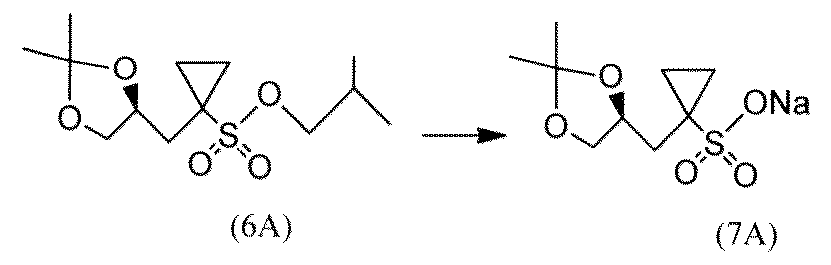
- Example 8 Step A and Example 9 of WO2011 / 009541 describe a method for producing a sulfonate salt represented by the formula (7A) according to the scheme shown below.
- the present invention provides a new method for producing a sulfonate salt represented by the formula (7) shown in the following scheme and an intermediate used in the production method.
- the outline of the production method of the present invention is shown by the following scheme.
- X 1 And X 2 Each independently represents a chlorine atom, a bromine atom or an iodine atom; 1 Represents a branched alkyl group having 4 to 6 carbon atoms.
- the sulfonate represented by the above formula (7) can be produced according to Step E from the sulfonate ester represented by the formula (6).
- the sulfonate ester represented by the formula (6) can be produced from the sulfonate ester represented by the formula (5) according to Step D, and the sulfonate ester represented by the formula (5) is a sulfone ester represented by the formula (4). It can manufacture from acid ester according to StepC.
- the sulfonic acid ester represented by the formula (4) can be produced from the sulfonic acid ester represented by the formula (2) according to Step B or Step B′-1 and Step B′-2.
- the sulfonic acid ester represented by the formula (2) can be produced from the sulfonic acid halide represented by the formula (1) according to Step A.
- the formula (7) The sulfonate represented by the formula starts with the sulfonic acid halide represented by the formula (1), (Step A) Formula (1) (Where X 1 And X 2 Each independently represents a chlorine atom, a bromine atom or an iodine atom. ) And a sulfonic acid halide represented by the formula (11) (Wherein R 1 Represents a branched alkyl group having 4 to 6 carbon atoms. ) Is reacted with an alcohol represented by formula (2) in the presence of a base.
- Formula (1) where X 1 And X 2 Each independently represents a chlorine atom, a bromine atom or an iodine atom.
- a sulfonic acid halide represented by the formula (11) (Wherein R 1 Represents a branched alkyl group having 4 to 6 carbon atoms. ) Is reacted with an alcohol represented by formula (2) in the presence of a base.
- Step B A sulfonic acid ester represented by formula (2) is reacted with a base to form formula (3) (Wherein R 1 Represents a branched alkyl group having 4 to 6 carbon atoms. ) Is obtained (Step B′-1), which is represented by the formula (31) (Wherein R 2 Represents a hydroxyl-protecting group. ) Is reacted with an epoxy compound represented by formula (4) in the presence of a base.
- R 1 Represents a branched alkyl group having 4 to 6 carbon atoms
- R 2 Represents a hydroxyl-protecting group.
- StepC The sulfonate ester represented by the formula (4) is deprotected to obtain the formula (5)
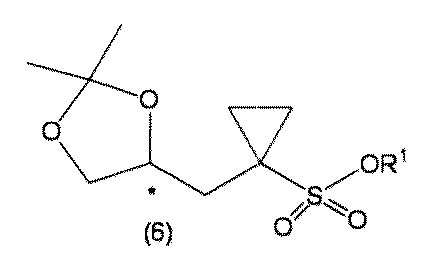
- StepD Sulfonic acid ester represented by formula (5) and formula (51) (Wherein R 3 Represents an alkyl group having 1 to 6 carbon atoms. ) Is reacted with 2,2-dialkoxypropane represented by the formula (6) (Wherein R 1 Represents a branched alkyl group having 4 to 6 carbon atoms.
- a step of obtaining a sulfonate ester represented by: (Step E) A sulfonate ester represented by the formula (6) is reacted with sodium iodide or sodium hydroxide to obtain a formula (7) A step of obtaining a sulfonate represented by: It is manufactured by a route including X 1 Represents a chlorine atom, a bromine atom or an iodine atom, preferably a chlorine atom.
- R 1 The branched alkyl group having 4 to 6 carbon atoms represented by, for example, isobutyl, sec-butyl, tert-butyl, isopentyl, neopentyl, 1-ethylpropyl, isohexyl, 1,1-dimethylbutyl, 2,2-dimethyl Butyl, 3,3-dimethylbutyl and 2-ethylbutyl, preferably isobutyl and neopentyl.
- R 2 As the hydroxyl-protecting group represented by benzyl group, 1-phenylethyl group, 1-phenylpropyl group, 1-phenylbutyl group, 2-methyl-1-phenylpropyl group, 1-phenylpentyl group, 2-methyl Benzyl ether protecting groups such as -1-phenylbutyl group, 3-methyl-1-phenylbutyl group, diphenylmethyl group, 1,1-diphenylethyl group, triphenylmethyl group, naphthylmethyl group, 1-naphthylethyl group Methyl group, tert-butyl group, 1-ethoxyethyl group, 3,4,5,6-tetrahydro-2H-pyran-2-yl group, triphenylmethyl group, 1-methoxy-1-methylethyl group, methoxy Alkyl ether protecting groups such as methyl and 2-methoxyethoxymethyl; trimethylsilyl, triethylsilyl,
- the alkyl group having 1 to 6 carbon atoms represented by the formula may be linear or branched, for example, methyl, ethyl, propyl, isopropyl, butyl, isobutyl, sec-butyl, tert-butyl, pentyl, isopentyl, neopentyl, 1 -Ethylpropyl, hexyl, isohexyl, 1,1-dimethylbutyl, 2,2-dimethylbutyl, 3,3-dimethylbutyl and 2-ethylbutyl.
- each step will be described in more detail.
- Step A As the sulfonic acid halide represented by the formula (1) and the alcohol represented by the formula (11) used in Step A, commercially available products can be used as they are, and they can be produced by known methods. Although this step can be performed in the absence of a solvent, it is preferable to perform the step in a solvent since the reaction mixture easily flows and is excellent in handleability.
- solvent used examples include aromatic hydrocarbon solvents such as benzene, toluene, xylene and chlorobenzene; aliphatic hydrocarbon solvents such as hexane, pentane and cyclohexane; diethyl ether, diisopropyl ether, tert-butyl methyl ether, tetrahydrofuran Ether solvents such as 1,4-dioxane and 1,2-dimethoxyethane; halogenated hydrocarbon solvents such as dichloromethane, chloroform, 1,2-dichloroethane and carbon tetrachloride; nitrile solvents such as acetonitrile and propionitrile; N , N-dimethylformamide, N, N-dimethylacetamide, N-methylpyrrolidone, dimethylsulfoxide, and other aprotic polar solvents; Methyl acetate, ethyl acetate, butyl ali
- an aromatic hydrocarbon solvent is preferable and toluene is particularly preferable because post-treatment is easier.
- the amount of the solvent used is preferably 0.3 to 10 mL, more preferably 0.4 to 2.0 mL with respect to 1 mmol of the sulfonic acid halide represented by the formula (1).
- the amount of the alcohol represented by the formula (11) is preferably 0.8 to 2.0 mol, more preferably 0.9 to 1.1 mol based on 1 mol of the sulfonic acid halide represented by the formula (1). It is.
- Examples of the base used in this step include inorganic bases such as sodium hydroxide, potassium hydroxide, lithium hydroxide, barium hydroxide, sodium carbonate, potassium carbonate, sodium hydrogen carbonate, potassium hydrogen carbonate; and triethylamine, diisopropyl Ethylamine, N-methylmorpholine, 1,8-diazabicyclo [5.4.0] undec-7-ene] (DBU), 1,5-diazabicyclo [4.3.0] non-5-ene (DBN),
- Examples include organic bases such as amine compounds such as pyridine and 2,6-lutidine. Among these, weak bases, particularly amine compounds are preferable, and triethylamine is particularly preferable from the viewpoint that side reactions can be sufficiently suppressed.
- the amount of the base used is preferably 0.8 to 2.0 mol, more preferably 0.9 to 1.1 mol with respect to 1 mol of the sulfonic acid halide represented by the formula (1).
- This step is a method of adding the sulfonic acid halide represented by the formula (1) to the mixture of the alcohol, the base and the solvent represented by the formula (11); and adding the base to the mixture of the alcohol, the sulfonic acid halide and the solvent.
- Method It is carried out by a method of adding an alcohol to a mixture of a sulfonic acid halide, a base and a solvent.
- a sulfonic acid halide in a mixture of an alcohol, a base and a solvent is preferable.
- the reaction temperature is preferably in the range of 0 to 40 ° C, more preferably 0 to 10 ° C.
- the reaction time is usually 1 to 10 hours, preferably 1 to 3 hours, although depending on the type of sulfonic acid halide represented by formula (1), the alcohol and base represented by formula (11), and the reaction temperature.
- the sulfonic acid ester represented by the formula (2) thus obtained can be isolated and purified by a conventional method.
- the sulfonic acid ester can be isolated and purified after the extraction operation or by subjecting the reaction mixture directly to silica gel column chromatography. Moreover, it can also use for the next process, without isolating and purifying.
- the sulfonic acid ester represented by the formula (4) can be produced by reacting the sulfonic acid ester represented by the formula (2) with the epoxy compound represented by the formula (31) in the presence of a base. Although this step can be performed in the absence of a solvent, it is preferable to perform the step in a solvent since the reaction mixture easily flows and is excellent in handleability.
- solvent used examples include aromatic hydrocarbon solvents such as benzene, toluene, xylene and chlorobenzene; aliphatic hydrocarbon solvents such as hexane, pentane and cyclohexane; diethyl ether, diisopropyl ether, tert-butyl methyl ether, tetrahydrofuran Ether solvents such as 1,4-dioxane and 1,2-dimethoxyethane; and halogenated hydrocarbon solvents such as dichloromethane, chloroform, 1,2-dichloroethane and carbon tetrachloride.
- aromatic hydrocarbon solvents such as benzene, toluene, xylene and chlorobenzene
- aliphatic hydrocarbon solvents such as hexane, pentane and cyclohexane
- the base is an alkyl alkali metal
- an ether solvent, an aromatic hydrocarbon solvent and an aliphatic hydrocarbon solvent are preferable, and tetrahydrofuran, toluene and hexane are particularly preferable from the viewpoint that the alkyl alkali metal is not significantly impaired.
- the amount of the solvent used is preferably 0.3 to 10 mL, more preferably 0.5 to 2.0 mL with respect to 1 mmol of the sulfonate ester represented by the formula (2).
- the amount of the epoxy compound represented by the formula (31) is preferably 0.8 to 2.0 mol, more preferably 0.9 to 1.1 mol based on 1 mol of the sulfonic acid ester represented by the formula (2). It is a ratio.
- Examples of the base used in this step include alkali metal hydrides such as lithium hydride, sodium hydride and potassium hydride; alkali metal amides such as lithium amide, sodium amide and lithium diisopropylamide; n-butyllithium, alkyl alkali metals such as sec-butyllithium and tert-butyllithium; and alkali metal alkoxides such as sodium methoxide, sodium ethoxide, potassium tert-butoxide and sodium tert-butoxide.
- strong bases particularly alkyl alkali metals are preferable, alkyl lithium is more preferable, and n-butyl lithium is particularly preferable.
- n-Butyllithium is usually used as a hexane solution.
- the amount of the base used is preferably 1.8 to 3.0 equivalents, more preferably 2.0 to 2.2 equivalents per 1 equivalent of the sulfonate ester represented by the formula (2).
- This step is a method in which a base is added to a mixture of the sulfonic acid ester represented by the formula (2), the epoxy compound represented by the formula (31) and the solvent; the epoxy compound is added to the mixture of the sulfonic acid ester, the base and the solvent.
- Method of adding it is carried out by a method of adding a sulfonic acid ester into a mixture of an epoxy compound, a base and a solvent, etc., but from the point that side reactions can be sufficiently suppressed, in a mixture of a sulfonic acid ester, an epoxy compound and a solvent
- a method of adding a base is preferred.
- the reaction temperature is preferably within a range of ⁇ 80 to 0 ° C., more preferably ⁇ 40 to ⁇ 20 ° C.
- the reaction time depends on the kind of sulfonic acid ester represented by the formula (2), the epoxy compound represented by the formula (31) and the base, and the reaction temperature, but usually 0.5 to 15 hours, preferably 1 to 5 hours. It is.
- the sulfonic acid ester represented by the formula (4) thus obtained can be isolated and purified by a conventional method.
- the sulfonic acid ester compound (4) can be isolated and purified after the extraction operation or by subjecting the reaction mixture directly to silica gel column chromatography. Alternatively, it can be subjected to the next step without isolation and purification.
- the sulfonic acid ester represented by the formula (4) is obtained by reacting the sulfonic acid ester represented by the formula (2) with a base to obtain a cyclopropanesulfonic acid ester represented by the formula (3) (Step B′-1 ), And a process via a step (Step B′-2) of reacting the cyclopropanesulfonic acid ester represented by the formula (3) and the epoxy compound represented by the formula (31) in the presence of a base. it can.
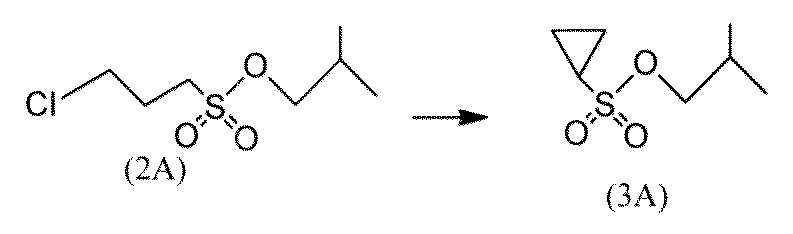
- Step B'-1 This step is a step of obtaining a cyclopropanesulfonic acid ester represented by the formula (3) by reacting the sulfonic acid ester represented by the formula (2) with a base.
- Examples of the base used in this step include alkali metal hydrides such as lithium hydride, sodium hydride and potassium hydride; alkali metal amides such as lithium amide, sodium amide and lithium diisopropylamide; n-butyllithium, alkyl alkali metals such as sec-butyllithium and tert-butyllithium; and alkali metal alkoxides such as sodium methoxide, sodium ethoxide, potassium tert-butoxide and sodium tert-butoxide.
- strong bases particularly alkyl alkali metals are preferable, alkyl lithium is more preferable, and n-butyl lithium is particularly preferable.
- n-Butyllithium is usually used as a hexane solution.
- the amount of the base used is preferably 0.9 to 1.5 equivalents, more preferably 1.0 to 1.2 equivalents per 1 equivalent of the sulfonate ester represented by the formula (2).
- solvent used examples include aromatic hydrocarbon solvents such as benzene, toluene, xylene and chlorobenzene; aliphatic hydrocarbon solvents such as hexane, pentane and cyclohexane; diethyl ether, diisopropyl ether, tert-butyl methyl ether, tetrahydrofuran Ether solvents such as 1,4-dioxane and 1,2-dimethoxyethane; and halogenated hydrocarbon solvents such as dichloromethane, chloroform, 1,2-dichloroethane and carbon tetrachloride.
- aromatic hydrocarbon solvents such as benzene, toluene, xylene and chlorobenzene
- aliphatic hydrocarbon solvents such as hexane, pentane and cyclohexane
- the base is a preferable alkyl alkali metal
- an ether solvent and an aliphatic hydrocarbon solvent are preferable, and tetrahydrofuran and hexane are particularly preferable from the viewpoint that the alkyl alkali metal is not significantly impaired.
- the amount of the solvent used is preferably 0.3 to 10 mL, more preferably 0.5 to 2.0 mL with respect to 1 mmol of the sulfonic acid ester compound (2).
- This step is performed by a method of adding a base to the mixture of the sulfonate ester represented by the formula (2) and the solvent; a method of adding a sulfonate ester to the mixture of the base and the solvent, etc.
- a method of adding a base to the mixture of the sulfonic acid ester and the solvent is preferable.
- the reaction temperature is preferably within a range of ⁇ 80 to 0 ° C., more preferably ⁇ 80 to ⁇ 20 ° C.
- the reaction time is usually 0.5 to 15 hours, preferably 1 to 5 hours, although it depends on the kind of the sulfonate ester represented by formula (2) and the base and the reaction temperature.
- the cyclopropanesulfonic acid ester represented by the formula (3) thus obtained can be isolated and purified by a conventional method.
- the cyclopropanesulfonic acid ester represented by the formula (3) can be isolated and purified after the extraction operation or by subjecting the reaction mixture directly to silica gel column chromatography. Or it can also use for next process B'-2, without isolating and purifying.
- Step B'-2 In this step, the cyclopropanesulfonic acid ester represented by the formula (3) and the epoxy compound represented by the formula (31) are reacted in the presence of a base to obtain the sulfonic acid ester represented by the formula (4). It is a process.
- Examples of the base used in this step include alkali metal hydrides such as lithium hydride, sodium hydride and potassium hydride; alkali metal amides such as lithium amide, sodium amide and lithium diisopropylamide; n-butyllithium, alkyl alkali metals such as sec-butyllithium and tert-butyllithium; and alkali metal alkoxides such as sodium methoxide, sodium ethoxide, potassium tert-butoxide and sodium tert-butoxide.
- strong bases particularly alkyl alkali metals are preferable, alkyl lithium is more preferable, and n-butyl lithium is particularly preferable.
- n-Butyllithium is usually used as a hexane solution.
- the amount of the base used is preferably 0.9 to 1.5 equivalents, more preferably 1.0 to 1.2 equivalents per 1 equivalent of the cyclopropanesulfonic acid ester represented by the formula (3). .
- this step can be performed in the absence of a solvent, it is preferable to perform the step in a solvent since the reaction mixture easily flows and is excellent in handleability.
- solvent used examples include aromatic hydrocarbon solvents such as benzene, toluene, xylene and chlorobenzene; aliphatic hydrocarbon solvents such as hexane, pentane and cyclohexane; diethyl ether, diisopropyl ether, tert-butyl methyl ether, tetrahydrofuran Ether solvents such as 1,4-dioxane and 1,2-dimethoxyethane; and halogenated hydrocarbon solvents such as dichloromethane, chloroform, 1,2-dichloroethane and carbon tetrachloride.
- aromatic hydrocarbon solvents such as benzene, toluene, xylene and chlorobenzene
- aliphatic hydrocarbon solvents such as hexane, pentane and cyclohexane
- the base is a preferable alkyl alkali metal
- an ether solvent, an aromatic hydrocarbon solvent and an aliphatic hydrocarbon solvent are preferable, and tetrahydrofuran, toluene and hexane are particularly preferable from the viewpoint that the alkyl alkali metal is not significantly impaired.
- the amount of the solvent used is preferably 0.3 to 10 mL, more preferably 0.5 to 2.0 mL with respect to 1 mmol of the cyclopropanesulfonic acid ester represented by the formula (3).
- the amount of the epoxy compound represented by the formula (31) to be used is preferably 0.8 to 2.0 mol, more preferably 0.9 to 1.
- This step is a method of adding an epoxy compound represented by formula (31) to a mixture of a cyclopropanesulfonic acid ester represented by formula (3), a base and a solvent; cyclopropane in a mixture of an epoxy compound, a base and a solvent
- a method of adding a base to the mixture of the epoxy compound and the solvent is preferred.
- the reaction temperature is preferably within a range of ⁇ 80 to 0 ° C., more preferably ⁇ 80 to ⁇ 20 ° C.
- the reaction time depends on the kind of cyclopropanesulfonic acid ester represented by the formula (3), the epoxy compound represented by the formula (31) and the base and the reaction temperature, but usually 0.5 to 15 hours, preferably 1 to 5 hours.
- the sulfonic acid ester represented by the formula (4) thus obtained can be isolated and purified by a conventional method.
- the sulfonic acid ester represented by the formula (4) can be isolated and purified after the extraction operation or by directly subjecting the reaction mixture to silica gel column chromatography. Alternatively, it can be subjected to the next step without isolation and purification.
- the steric configuration of the carbon atom marked with * in the sulfonic acid ester represented by the formula (4) may be either S configuration or R configuration.
- an optically active sulfonic acid ester represented by the formula (4) in the epoxy compound (31) represented by the formula (31), depending on the desired configuration of the carbon atom marked with * in the above formula.
- a material having a configuration of carbon atoms marked with * may be selected as a raw material.
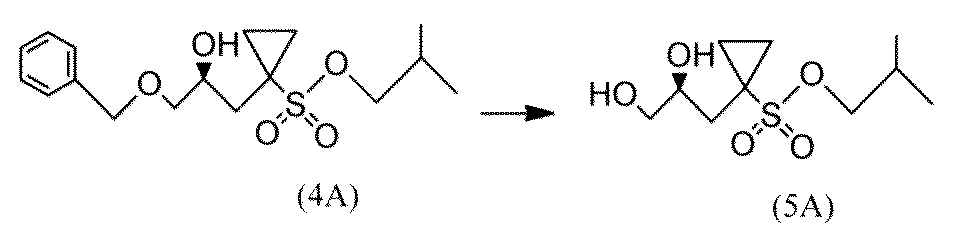
- the sulfonic acid ester represented by the formula (5) can be produced by deprotecting the sulfonic acid ester represented by the formula (4).
- a method for deprotecting the sulfonate ester represented by the formula (5) is R 2 R is selected according to the protecting group of the hydroxyl group of R 2
- the catalytic reduction is performed by reacting the sulfonic acid ester represented by the formula (4) in a solvent in the presence of a metal catalyst and a hydrogen source.
- the metal catalyst used include palladium-carbon, palladium black, palladium chloride, palladium hydroxide, rhodium-carbon, platinum oxide, platinum black, platinum-palladium, Raney nickel, and Raney cobalt.
- the amount of the metal catalyst used is usually 0.01 to 0.30 times by weight, preferably 0.03 to 0.10 times by weight with respect to the sulfonic acid ester represented by the formula (4).
- the hydrogen source used include hydrogen gas.
- an alcohol solvent is preferable, and ethanol is particularly preferable.
- the amount of the solvent used is preferably 0.3 to 10 mL, more preferably 0.5 to 2.0 mL with respect to 1 mmol of the sulfonate ester represented by the formula (4).
- This step is performed by a method in which a hydrogen source is added to the mixture of the sulfonate ester represented by formula (4), the metal catalyst, and the solvent.
- the reaction temperature is preferably in the range of 10 to 50 ° C, more preferably 20 to 30 ° C.
- the reaction time is, for example, 1 to 10 hours, preferably 3 to 5 hours, depending on the type of sulfonate ester represented by formula (4) and the reaction temperature.
- the sulfonic acid ester represented by the formula (5) thus obtained can be isolated and purified by a conventional method.
- the sulfonic acid ester compound (5) can be isolated and purified after the extraction operation or by subjecting the reaction mixture directly to silica gel column chromatography. Alternatively, it can be subjected to the next step without isolation and purification.
- the steric configuration of the carbon atom marked with * in the sulfonic acid ester compound (5) may be either S configuration or R configuration.
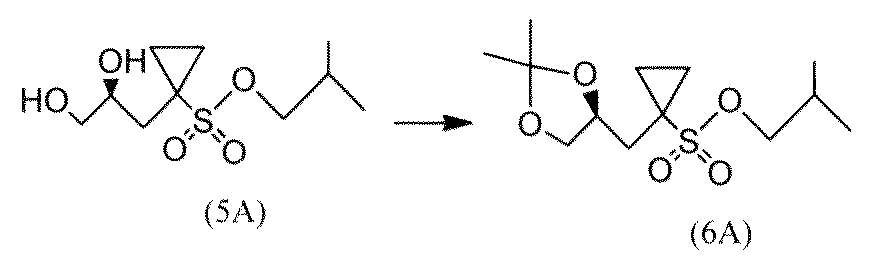
- the sulfonic acid ester represented by the formula (6) can be produced by reacting the sulfonic acid ester represented by the formula (5) with the 2,2-dialkoxypropane represented by the formula (51) in the presence of an acid. .
- this step can be performed in the absence of a solvent, it is preferable to perform the step in a solvent since the reaction mixture easily flows and is excellent in handleability.
- solvent used examples include ketone solvents such as acetone and methyl ethyl ketone; aromatic hydrocarbon solvents such as benzene, toluene, xylene and chlorobenzene; aliphatic hydrocarbon solvents such as hexane, pentane and cyclohexane; dichloromethane, chloroform, 1 Halogenated hydrocarbon solvents such as 1,2-dichloroethane and carbon tetrachloride; and ester solvents such as methyl acetate, ethyl acetate, butyl acetate and tert-butyl acetate.
- ketone solvents such as acetone and methyl ethyl ketone
- aromatic hydrocarbon solvents such as benzene, toluene, xylene and chlorobenzene
- aliphatic hydrocarbon solvents such as hexane, pentane and cyclohexane
- a ketone solvent is preferable, and acetone is particularly preferable.
- the amount of the solvent used is preferably 0.5 to 10 mL, more preferably 1 to 5 mL with respect to 1 mmol of the sulfonate ester represented by the formula (5).
- the amount of 2,2-dialkoxypropane represented by the formula (51) is usually 1.0 to 2.0 mol, preferably 1.3 to 1 mol with respect to 1 mol of the sulfonic acid ester represented by the formula (5).
- the ratio is 0.7 mol.
- Examples of the acid used in this step include hydrochloric acid, sulfuric acid, nitric acid, and acetic acid.
- the sulfuric acid which is excellent in the reactivity of the sulfonate ester represented by Formula (5) is preferable.
- the amount of the acid used is usually 0.0001 to 0.01 equivalent, preferably 0.0005 to 0.002 equivalent, relative to 1 equivalent of the sulfonic acid ester represented by the formula (5).
- This step is a method of adding an acid to a mixture of a sulfonic acid ester represented by the formula (5), a 2,2-dialkoxypropane represented by the formula (51) and a solvent; a mixture of a sulfonic acid ester, an acid and a solvent 2,2-dialkoxypropane is added in a method; 2,2-dialkoxypropane, a method of adding a sulfonic acid ester in a mixture of an acid and a solvent, etc., but side reactions can be sufficiently suppressed. From the viewpoint, a method of adding an acid to a mixture of a sulfonic acid ester, 2,2-dialkoxypropane and a solvent is preferable.
- the reaction temperature is preferably in the range of 0 to 50 ° C, more preferably 20 to 30 ° C.
- the reaction time depends on the kind of the sulfonic acid ester represented by the formula (5), the 2,2-dialkoxypropane represented by the formula (51) and the acid, and the reaction temperature, but usually 1 to 20 hours, preferably 2 ⁇ 10 hours.
- the sulfonic acid ester represented by the formula (6) thus obtained can be isolated and purified by a conventional method.
- the sulfonic acid ester represented by the formula (6) can be isolated and purified after the extraction operation or by subjecting the reaction mixture directly to silica gel column chromatography. Alternatively, it can be subjected to the next step without isolation and purification.
- the steric configuration of the carbon atom marked with * in the sulfonate ester represented by formula (6) may be either S configuration or R configuration.
- * in the sulfonate ester represented by the formula (5) What is necessary is just to select the thing of the configuration of the attached carbon atom as a raw material.
- the sulfonate represented by the formula (7) can be produced by reacting the sulfonate ester represented by the formula (6) with sodium iodide.
- this step can be performed in the absence of a solvent, it is preferable to perform the step in a solvent since the reaction mixture easily flows and is excellent in handleability.
- the solvent used include ketone solvents such as acetone and methyl ethyl ketone, and water. Among these, from the viewpoint of reactivity, a ketone solvent is preferable, and acetone is particularly preferable.
- the amount of the solvent used is preferably 0.5 to 10 mL, more preferably 1 to 5 mL with respect to 1 mmol of the sulfonate ester represented by the formula (6).
- the amount of sodium iodide used is usually 1.0 to 2.0 mol, preferably 1.1 to 1.7 mol, with respect to 1 mol of the sulfonic acid ester represented by the formula (6).
- This step is performed by a method of adding sodium iodide into a mixture of the sulfonate ester represented by formula (6) and a solvent; a method of adding a sulfonate ester into a mixture of sodium iodide and a solvent, etc.
- a method of adding sodium iodide in the mixture of the sulfonate ester and the solvent is preferable.
- the reaction temperature is preferably in the range of 30 to 55 ° C, more preferably 45 to 55 ° C.
- the reaction time is usually 20 to 40 hours, preferably 20 to 30 hours, although it depends on the type of sulfonate ester represented by formula (6) and the reaction temperature.
- the sulfonate represented by the formula (7) can also be produced by reacting the sulfonate ester represented by the formula (6) with sodium hydroxide. Although this step can be performed in the absence of a solvent, it is preferable to perform the step in a solvent since the reaction mixture easily flows and is excellent in handleability.
- the solvent used include ketone solvents such as acetone and methyl ethyl ketone, and water.
- a ketone solvent is preferable, and acetone is particularly preferable.
- the amount of the solvent used is preferably 0.5 to 10 mL, more preferably 1 to 5 mL with respect to 1 mmol of the sulfonate ester represented by the formula (6).
- the amount of sodium hydroxide used is usually 1.0 to 2.0 mol, preferably 1.1 to 1.7 mol, per 1 mol of the sulfonic acid ester represented by formula (6).
- This step is carried out by a method of adding sodium hydroxide into the mixture of the sulfonate ester represented by formula (6) and the solvent; a method of adding the sulfonate ester into the mixture of sodium hydroxide and the solvent, etc.
- a method of adding sodium hydroxide to the mixture of the sulfonic acid ester and the solvent is preferable because side reactions can be sufficiently suppressed.
- the reaction temperature is preferably in the range of 0 to 55 ° C, more preferably 0 to 30 ° C.
- the reaction time is usually 1 to 10 hours, preferably 1 to 5 hours, although it depends on the type of sulfonate ester represented by formula (6) and the reaction temperature.
- the sulfonate represented by the formula (7) thus obtained can be isolated and purified by a conventional method.
- the sulfonate can be isolated and purified after performing the extraction operation or by subjecting the reaction mixture directly to silica gel column chromatography.
- the steric configuration of the carbon atom marked with * in the sulfonate represented by the formula (7) may be either S configuration or R configuration.
- * in the sulfonate ester represented by the formula (6) What is necessary is just to select the thing of the configuration of the attached carbon atom as a raw material.
- Example 1 Production of compound represented by formula (2A) (Step A) In a nitrogen gas atmosphere, 242.2 g of toluene, 30.8 g of isobutyl alcohol (1.05 times mol of 3-chloropropanesulfonyl chloride) and 41.2 g of triethylamine (1.03 times mol of 3-chloropropanesulfonyl chloride) were mixed at room temperature. The resulting mixture was cooled to 3 ° C. Thereto, 70 g of 3-chloropropanesulfonyl chloride was added dropwise while keeping the temperature of the resulting mixture in the range of 3 ° C to 8 ° C.
- the dripping took about 3 hours. After completion of dropping, 30.3 g of toluene was added to the obtained mixture, and the obtained mixture was stirred in the range of 2 ° C to 5 ° C for 1 hour. After completion of the reaction, 140 g of water was added dropwise to the resulting reaction mixture while maintaining the temperature of the obtained mixture in the range of 0 ° C. to 10 ° C., and 2.1 g of 35 wt% hydrochloric acid was further added dropwise. The temperature of the obtained mixture was adjusted to a range of 20 ° C. to 25 ° C., stirred at the same temperature for 30 minutes, and then the separated organic layer was washed with an aqueous sodium hydrogen carbonate solution and then separated.
- Example 2 Production of compound represented by formula (2) (Step A) Except that isobutyl alcohol in Example 1 is replaced with neopentyl alcohol, a compound represented by the formula (2) in which X 1 is a chlorine atom and R 1 is a neopentyl group is performed by performing the same experiment as in Example 1. Can be manufactured.
- Example 3 Production of compound represented by formula (3A) (Step B′-1) 130 g of the compound represented by the formula (2A) obtained in Example 1 and 920 mL of tetrahydrofuran were mixed at room temperature, and the resulting mixture was cooled to ⁇ 72 ° C.
- Example 4 Production of compound represented by formula (3) Except that isobutyl alcohol in Example 1 was replaced with neopentyl alcohol, the same experiment as in Examples 1 and 3 was performed, whereby R 1 was a neopentyl group. A compound represented by a certain formula (3) can be produced.
- Example 5 Production of compound represented by formula (4A) (Step B) Under a nitrogen gas atmosphere, 42.4 g of the compound represented by the formula (2A) obtained in Example 1, 71.3 g of tetrahydrofuran, 30.8 g of (S) -benzylglycidyl ether (one time the compound represented by the formula (2A)) Mol) and 69.7 g of toluene at room temperature, and the resulting mixture was cooled to -30 ° C.
- a 15 wt% n-butyllithium / hexane solution 167 g (2.1-fold mol n-butyllithium of the compound represented by the formula (2A)) was added in the range of -30 ° C to -25 ° C for about 6 hours. And dripped. After completion of the dropwise addition, the obtained reaction mixture was kept warm in the range of ⁇ 30 ° C. to ⁇ 25 ° C. for about 1.5 hours. The obtained reaction mixture was added dropwise to acetic acid water prepared by diluting 14.7 g of acetic acid with 141 g of water in the range of 3 ° C. to 10 ° C. over 20 minutes.
- a compound represented by the formula (4) in which R 2 is a benzyl group can be produced.
- Example 7 Production of compound represented by formula (5A) (Step C) 66.5 g of the compound represented by the formula (4A) obtained in Example 5, 26.3 g of ethanol, and 86.4 g of cyclohexane were mixed at about 20 ° C., and 2.78 g of activated carbon was added to ethanol. The mixture obtained by suspending in 17.5 g was added at about 25 ° C. The resulting mixture was stirred at about 25 ° C. for 1 hour and then filtered.
- the solid substance removed by filtration was washed with a mixed solution of 11 g of ethanol and 22 g of cyclohexane, and the obtained washing solution and the previously obtained filtrate were mixed.
- the obtained mixed liquid was adjusted to around 20 ° C. in a nitrogen gas atmosphere, and 5.55 g of 10 wt% palladium carbon was added thereto.
- the inside of the autoclave was pressurized with hydrogen gas to 0.2 MPa to 0.3 MPa.
- the mixture was stirred for about 3.5 hours in the range of 23 ° C. to 26 ° C. under pressure of 0.2 MPa to 0.3 MPa of hydrogen gas, and then the gas phase in the autoclave was replaced with nitrogen gas.
- the obtained reaction mixture was filtered, the solid matter removed by filtration was washed with a mixed solution of 11 g of ethanol and 22 g of cyclohexane, and the obtained washing solution and the previously obtained filtrate were mixed.
- the obtained aqueous layer was extracted with a mixed solution of toluene and cyclohexane.
- Sodium chloride was added to the obtained aqueous layer, and the mixture was further extracted twice with ethyl acetate.
- the organic layers extracted with ethyl acetate were combined and concentrated under reduced pressure to obtain the compound represented by the formula (5A).
- Example 8 Production of compound represented by formula (5) R 1 was obtained by conducting the same experiment as in Examples 1, 3, 5 and 7, except that isobutyl alcohol in Example 1 was replaced with neopentyl alcohol. The compound shown by Formula (5) whose is a neopentyl group can be manufactured.
- Example 9 Production of compound represented by formula (6A) (Step D) 83.8 g of the compound represented by the formula (5A) obtained in Example 7, 642 g of acetone and 50.3 g of 2,2-dimethoxypropane (1.5 mol with respect to 1 mol of the compound represented by the formula (5A)) Mix and adjust the resulting mixture to about 25 ° C. Thereto was added dropwise 31.6 mg of concentrated sulfuric acid (0.001 mol with respect to 1 mol of the compound represented by the formula (5A)), and the resulting mixture was stirred at 24 ° C. to 28 ° C. for 8 hours. ) Was obtained.
- Example 10 Production of compound represented by formula (6) Except that isobutyl alcohol in Example 1 was replaced with neopentyl alcohol, the same experiment as in Examples 1, 3, 5, 7 and 9 was performed.
- a compound represented by the formula (6) in which R 1 is a neopentyl group can be produced.
- Example 11 Production of compound represented by formula (7A) (Step E) 776 g (approximately 12 wt% acetone solution) of the compound represented by the formula (6A) obtained in Example 9 and 65.2 mg (0.002 times mol of the compound represented by the formula (6A)) of 25 ° C. Then, 72.4 g of sodium iodide (1.5 times mol of the compound represented by the formula (6A)) was added in the range of 25 ° C to 30 ° C. The obtained mixture was adjusted to about 50 ° C. and stirred for 25 hours.
- the obtained reaction mixture was cooled to around 20 ° C., and triethylamine was added thereto to adjust the pH of the mixture to 10.
- the pH adjusted mixture was stirred at 20 ° C. for 10 minutes, filtered, and the obtained solid was washed with acetone. The washed solid was dried under reduced pressure to obtain a compound represented by the formula (7A). The yield was 77%.
- Example 12 Production of a compound represented by the formula (7) The same experiment as in Examples 1, 3, 5, 7, 9, and 11 is performed except that isobutyl alcohol in Example 1 is replaced with neopentyl alcohol. Thus, the compound represented by the formula (7) can be produced.
- the compound represented by the formula (7) is a compound useful as a cancer therapeutic agent precursor.
- INDUSTRIAL APPLICATION This invention is industrially applicable as a novel compound which can be used for manufacture of the compound shown by Formula (7), and its manufacturing method.
Landscapes
- Chemical & Material Sciences (AREA)
- Organic Chemistry (AREA)
- Chemical Kinetics & Catalysis (AREA)
- Organic Low-Molecular-Weight Compounds And Preparation Thereof (AREA)
Abstract
Description
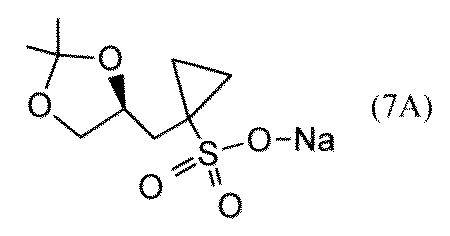
WO2011/009541の実施例8StepA及び実施例9には、以下に示されるスキームにより、式(7A)で示されるスルホン酸塩を製造する方法が記載されている。

本発明の製造方法の概略は以下のスキームで示される。
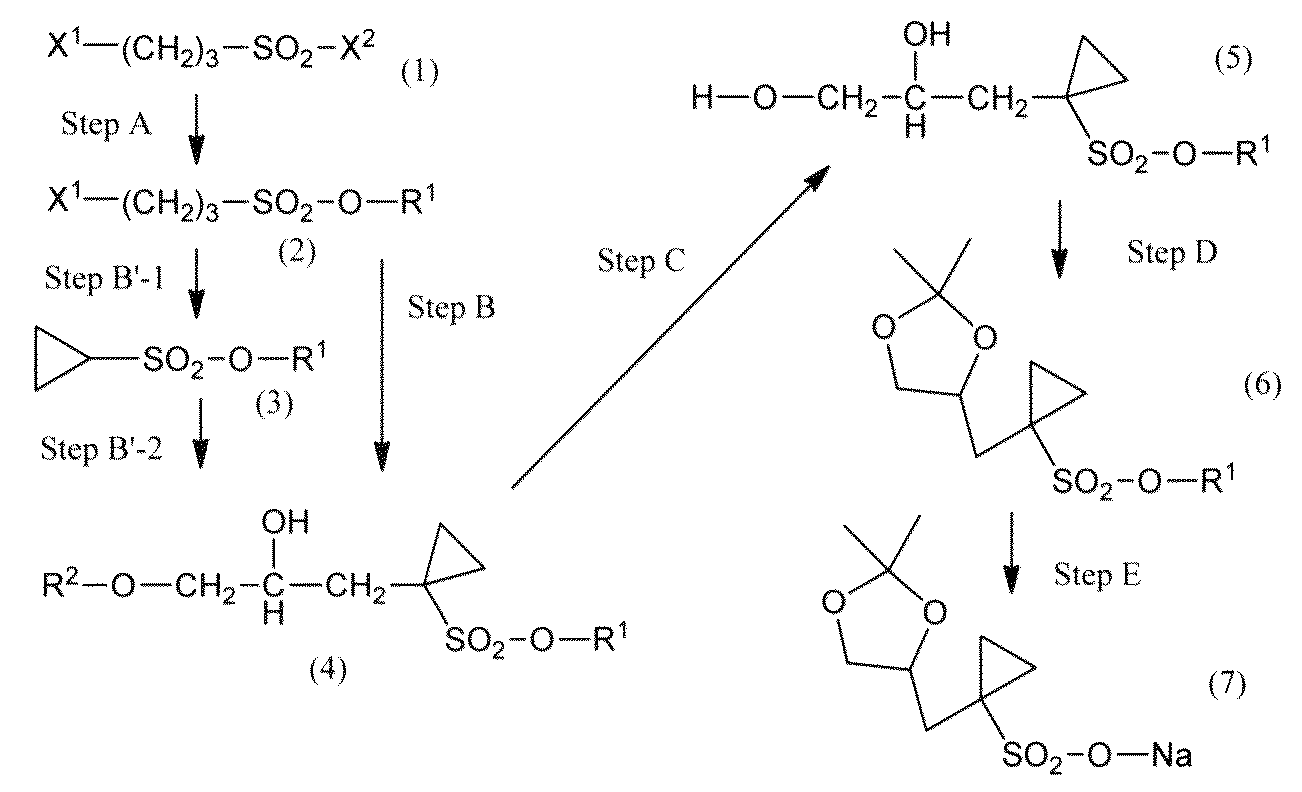
即ち、本発明によれば、上記の式(7)で示されるスルホン酸塩は式(6)で示されるスルホン酸エステルよりのStepEにしたがって製造することができる。式(6)で示されるスルホン酸エステルは式(5)で示されるスルホン酸エステルよりStepDにしたがって製造することができ、式(5)で示されるスルホン酸エステルは式(4)で示されるスルホン酸エステルよりStepCにしたがって製造することができる。式(4)で示されるスルホン酸エステルは式(2)で示されるスルホン酸エステルよりStepB又はStepB’−1及びStepB’−2にしたがって製造することができる。式(2)で示されるスルホン酸エステルは式(1)で示されるスルホン酸ハライドよりStepAにしたがって製造することができる。
さらに、本発明によれば、式(7)

(StepA)
式(1)

で示されるスルホン酸ハライドと式(11)

で示されるアルコールとを塩基の存在下に反応させて式(2)

で示されるスルホン酸エステルを得る工程、
(StepB)
式(2)で示されるスルホン酸エステルと塩基とを反応させて式(3)
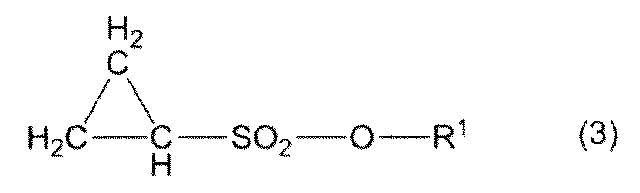
で示されるシクロプロパンスルホン酸エステルを得(StepB’−1)、これを式(31)
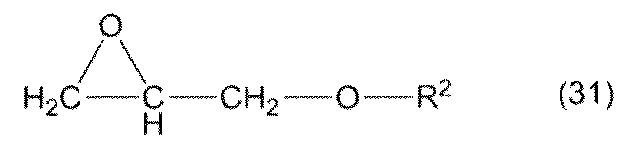
で示されるエポキシ化合物と塩基の存在下に反応させて式(4)

で示されるスルホン酸エステルを得る(StepB’−2)工程、又は
式(2)で示されるスルホン酸エステルと式(31)で示されるエポキシ化合物とを塩基の存在下に反応させて式(4)で示されるスルホン酸エステルを得る工程、
(StepC)
式(4)で示されるスルホン酸エステルを脱保護して式(5)

で示されるスルホン酸エステルを得る工程、
(StepD)
式(5)で示されるスルホン酸エステルと式(51)
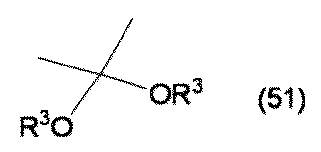
で示される2,2−ジアルコキシプロパンとを酸の存在下で反応させて式(6)
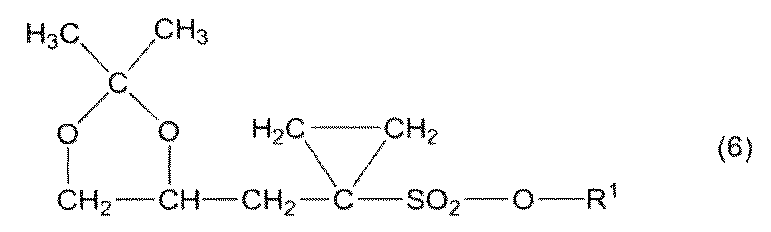
で示されるスルホン酸エステルを得る工程、
(StepE)
式(6)で示されるスルホン酸エステルと沃化ナトリウム又は水酸化ナトリウムとを反応させて式(7)
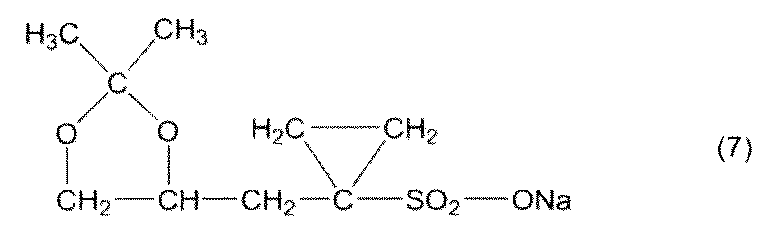
を含む経路により製造される。
X1は塩素原子、臭素原子又は沃素原子を表し、好ましくは、塩素原子である。
R1で表される炭素数4~6の分岐アルキル基は、例えば、イソブチル、sec−ブチル、tert−ブチル、イソペンチル、ネオペンチル、1−エチルプロピル、イソヘキシル、1,1−ジメチルブチル、2,2−ジメチルブチル、3,3−ジメチルブチル及び2−エチルブチルであり、好ましくは、イソブチル及びネオペンチルである。
R2で示される水酸基の保護基としては、ベンジル基、1−フェニルエチル基、1−フェニルプロピル基、1−フェニルブチル基、2−メチル−1−フェニルプロピル基、1−フェニルペンチル基、2−メチル−1−フェニルブチル基、3−メチル−1−フェニルブチル基、ジフェニルメチル基、1,1−ジフェニルエチル基、トリフェニルメチル基、ナフチルメチル基、1−ナフチルエチル基等のベンジルエーテル系保護基;メチル基、tert−ブチル基、1−エトキシエチル基、3,4,5,6−テトラヒドロ−2H−ピラン−2−イル基、トリフェニルメチル基、1−メトキシ−1−メチルエチル基、メトキシメチル基、2−メトキシエトキシメチル基等のアルキルエーテル系保護基;トリメチルシリル基、トリエチルシリル基、トリプロピルシリル基、トリイソプロピルシリル基、トリブチルシリル基、tert−ブチルジメチルシリル基、tert−ブチルジフェニルシリル基等のシリル系保護基;アセチル基、プロパノイル基、ブタノイル基、イソブタノイル基、ピバロイル基、ベンゾイル基、4−ニトロベンゾイル基、4−メトキシベンゾイル基、4−メチルベンゾイル基、4−tert−ブチルベンゾイル基、4−フルオロベンゾイル基、4−クロロベンゾイル基、4−ブロモベンゾイル基、3−ニトロベンゾイル基、3−メトキシベンゾイル基、3−メチルベンゾイル基、3−tert−ブチルベンゾイル基、3−フルオロベンゾイル基、3−クロロベンゾイル基、3−ブロモベンゾイル基、2−ニトロベンゾイル基、2−メトキシベンゾイル基、2−メチルベンゾイル基、2−tert−ブチルベンゾイル基、2−フルオロベンゾイル基、2−クロロベンゾイル基、2−ブロモベンゾイル基、3,5−ジニトロベンゾイル基、3,5−ジメトキシベンゾイル基、3,5−ジメチルベンゾイル基、3,5−ジ−tert−ブチルベンゾイル基、3,5−ジフルオロベンゾイル基、3,5−ジクロロベンゾイル基、3,5−ジブロモベンゾイル基、2,4−ジニトロベンゾイル基、2,4−ジメトキシベンゾイル基、2,4−ジメチルベンゾイル基、2,4−ジ−tert−ブチルベンゾイル基、2,4−ジフルオロベンゾイル基、2,4−ジクロロベンゾイル基、2、4−ジブロモベンゾイル基、2,5−ジニトロベンゾイル基、2,5−ジメトキシベンゾイル基、2,5−ジメチルベンゾイル基、2,5−ジ−tert−ブチルベンゾイル基、2,5−ジフルオロベンゾイル基、2,5−ジクロロベンゾイル基、2,5−ジブロモベンゾイル基、4−フェニルベンゾイル基、2−フェニルベンゾイル基、4−メトキシカルボニルベンゾイル基、3−メトキシカルボニルベンゾイル基、2−メトキシカルボニルベンゾイル基等のエステル系保護基などが挙げられ、中でも、ベンジルエーテル系保護基が好ましく、ベンジル基が特に好ましい。
R3で示される炭素数1~6のアルキル基は、直鎖でも分岐鎖でもよく、例えば、メチル、エチル、プロピル、イソプロピル、ブチル、イソブチル、sec−ブチル、tert−ブチル、ペンチル、イソペンチル、ネオペンチル、1−エチルプロピル、ヘキシル、イソヘキシル、1,1−ジメチルブチル、2,2−ジメチルブチル、3,3−ジメチルブチル及び2−エチルブチルが挙げられる。
次に、各工程についてより詳細に説明する。
(StepA)
StepAに用いられる式(1)で示されるスルホン酸ハライド及び式(11)で示されるアルコールは、市販品をそのまま使用でき、また、公知の方法により製造することができる。
本工程は無溶媒下で行うこともできるが、溶媒中で行うのが、反応混合物が流動し易く取扱い性に優れる点から好ましい。
使用される溶媒としては、例えば、ベンゼン、トルエン、キシレン、クロロベンゼン等の芳香族炭化水素溶媒;ヘキサン、ペンタン、シクロヘキサン等の脂肪族炭化水素溶媒;ジエチルエーテル、ジイソプロピルエーテル、tert−ブチルメチルエーテル、テトラヒドロフラン、1,4−ジオキサン、1,2−ジメトキシエタン等のエーテル溶媒;ジクロロメタン、クロロホルム、1,2−ジクロロエタン、四塩化炭素等のハロゲン化炭化水素溶媒;アセトニトリル、プロピオニトリル等のニトリル溶媒;N,N−ジメチルホルムアミド、N,N−ジメチルアセトアミド、N−メチルピロリドン、ジメチルスルホキシド等の非プロトン性極性溶媒;酢酸メチル、酢酸エチル、酢酸ブチル、酢酸tert−ブチル等のエステル溶媒;及びアセトン、メチルエチルケトン等のケトン溶媒が挙げられる。中でも、後処理がより簡便となる点から、芳香族炭化水素溶媒が好ましく、トルエンが特に好ましい。
溶媒の使用量は、式(1)で示されるスルホン酸ハライド1mmolに対して、好ましくは0.3~10mL、より好ましくは0.4~2.0mLの割合である。
式(11)で示されるアルコールの使用量は、式(1)で示されるスルホン酸ハライド1molに対して、好ましくは0.8~2.0mol、より好ましくは0.9~1.1molの割合である。
本工程に使用される塩基としては、例えば、水酸化ナトリウム、水酸化カリウム、水酸化リチウム、水酸化バリウム、炭酸ナトリウム、炭酸カリウム、炭酸水素ナトリウム、炭酸水素カリウム等の無機塩基;及びトリエチルアミン、ジイソプロピルエチルアミン、N−メチルモルホリン、1,8−ジアザビシクロ[5.4.0]ウンデカ−7−エン](DBU)、1,5−ジアザビシクロ[4.3.0]ノナ−5−エン(DBN)、ピリジン、2,6−ルチジン等のアミン化合物等の有機塩基が挙げられる。中でも、副反応を十分抑制し得る点から、弱塩基、特にアミン化合物が好ましく、トリエチルアミンが特に好ましい。
塩基の使用量は、式(1)で示されるスルホン酸ハライド1molに対して、好ましくは0.8~2.0mol、より好ましくは0.9~1.1molの割合である。
本工程は、式(11)で示されるアルコール、塩基及び溶媒の混合物中に式(1)で示されるスルホン酸ハライドを添加する方法;アルコール、スルホン酸ハライド及び溶媒の混合物中に塩基を添加する方法;スルホン酸ハライド、塩基及び溶媒の混合物中にアルコールを添加する方法等により行われるが、スルホン酸ハライドの反応性がより良好となる点から、アルコール、塩基及び溶媒の混合物中にスルホン酸ハライドを添加する方法が好ましい。
反応温度は、好ましくは0~40℃、より好ましくは0~10℃の範囲内である。
反応時間は、式(1)で示されるスルホン酸ハライド、式(11)で示されるアルコール及び塩基の種類や反応温度にもよるが、通常1~10時間、好ましくは1~3時間である。
このようにして得られた式(2)で示されるスルホン酸エステルは、常法により単離精製することができる。例えば、抽出操作を行った後か、或いは反応混合物を直接シリカゲルカラムクロマトグラフィーに付することにより、スルホン酸エステルを単離精製することができる。また、単離精製することなく次の工程に供することもできる。
(StepB)
式(4)で示されるスルホン酸エステルは、式(2)で示されるスルホン酸エステルと式(31)で示されるエポキシ化合物とを塩基の存在下に反応させることにより製造できる。
本工程は無溶媒下で行うこともできるが、溶媒中で行うのが、反応混合物が流動し易く取扱い性に優れる点から好ましい。
使用される溶媒としては、例えば、ベンゼン、トルエン、キシレン、クロロベンゼン等の芳香族炭化水素溶媒;ヘキサン、ペンタン、シクロヘキサン等の脂肪族炭化水素溶媒;ジエチルエーテル、ジイソプロピルエーテル、tert−ブチルメチルエーテル、テトラヒドロフラン、1,4−ジオキサン、1,2−ジメトキシエタン等のエーテル溶媒;及びジクロロメタン、クロロホルム、1,2−ジクロロエタン、四塩化炭素等のハロゲン化炭化水素溶媒が挙げられる。中でも、塩基がアルキルアルカリ金属である場合、当該アルキルアルカリ金属を著しく損なうことのない点から、エーテル溶媒、芳香族炭化水素溶媒及び脂肪族炭化水素溶媒が好ましく、テトラヒドロフラン、トルエン及びヘキサンが特に好ましい。
溶媒の使用量は、式(2)で示されるスルホン酸エステル1mmolに対して、好ましくは0.3~10mL、より好ましくは0.5~2.0mLの割合である。
式(31)で示されるエポキシ化合物の使用量は、式(2)で示されるスルホン酸エステル1molに対して、好ましくは0.8~2.0mol、より好ましくは0.9~1.1molの割合である。
本工程で使用される塩基としては、例えば、水素化リチウム、水素化ナトリウム、水素化カリウム等のアルカリ金属水素化物;リチウムアミド、ナトリウムアミド、リチウムジイソプロピルアミド等のアルカリ金属アミド;n−ブチルリチウム、sec−ブチルリチウム、tert−ブチルリチウム等のアルキルアルカリ金属;及びナトリウムメトキシド、ナトリウムエトキシド、カリウムtert−ブトキシド、ナトリウムtert−ブトキシド等のアルカリ金属アルコキシドが挙げられる。中でも、反応性が良好である点から、強塩基、特にアルキルアルカリ金属が好ましく、アルキルリチウムがより好ましく、n−ブチルリチウムが特に好ましい。n−ブチルリチウムは、通常ヘキサン溶液として使用される。
塩基の使用量は、式(2)で示されるスルホン酸エステル1当量に対して、好ましくは1.8~3.0当量、より好ましくは2.0~2.2当量の割合である。
本工程は、式(2)で示されるスルホン酸エステル、式(31)で示されるエポキシ化合物及び溶媒の混合物中に塩基を添加する方法;スルホン酸エステル、塩基及び溶媒の混合物中にエポキシ化合物を添加する方法;エポキシ化合物、塩基及び溶媒の混合物中にスルホン酸エステルを添加する方法等により行われるが、副反応を十分に抑制し得る点から、スルホン酸エステル、エポキシ化合物及び溶媒の混合物中に塩基を添加する方法が好ましい。
反応温度は、好ましくは−80~0℃、より好ましくは−40~−20℃の範囲内である。
反応時間は、式(2)で示されるスルホン酸エステル、式(31)で示されるエポキシ化合物及び塩基の種類や反応温度にもよるが、通常0.5~15時間、好ましくは1~5時間である。
このようにして得られた式(4)で示されるスルホン酸エステルは、常法により単離精製することができる。例えば、抽出操作を行った後か、或いは反応混合物を直接シリカゲルカラムクロマトグラフィーに付することにより、スルホン酸エステル化合物(4)を単離精製することができる。或いは、単離精製することなく次の工程に供することもできる。
式(4)で示されるスルホン酸エステルは、式(2)で示されるスルホン酸エステルと塩基とを反応させて、式(3)で示されるシクロプロパンスルホン酸エステルを得る工程(StepB’−1)、及び式(3)で示されるシクロプロパンスルホン酸エステルと式(31)で示されるエポキシ化合物とを塩基の存在下で反応させる工程(StepB’−2)を経由する方法により製造することもできる。
(StepB’−1)
本工程は、式(2)で示されるスルホン酸エステルと塩基とを反応させて、式(3)で示されるシクロプロパンスルホン酸エステルを得る工程である。
本工程で使用される塩基としては、例えば、水素化リチウム、水素化ナトリウム、水素化カリウム等のアルカリ金属水素化物;リチウムアミド、ナトリウムアミド、リチウムジイソプロピルアミド等のアルカリ金属アミド;n−ブチルリチウム、sec−ブチルリチウム、tert−ブチルリチウム等のアルキルアルカリ金属;及びナトリウムメトキシド、ナトリウムエトキシド、カリウムtert−ブトキシド、ナトリウムtert−ブトキシド等のアルカリ金属アルコキシドが挙げられる。中でも、反応性が良好である点から、強塩基、特にアルキルアルカリ金属が好ましく、アルキルリチウムがより好ましく、n−ブチルリチウムが特に好ましい。n−ブチルリチウムは、通常ヘキサン溶液として使用される。
塩基の使用量は、式(2)で示されるスルホン酸エステル1当量に対して、好ましくは0.9~1.5当量、より好ましくは1.0~1.2当量の割合である。
本工程は無溶媒下で行うこともできるが、溶媒中で行うのが、反応混合物が流動し易く取扱い性に優れる点から好ましい。
使用される溶媒としては、例えば、ベンゼン、トルエン、キシレン、クロロベンゼン等の芳香族炭化水素溶媒;ヘキサン、ペンタン、シクロヘキサン等の脂肪族炭化水素溶媒;ジエチルエーテル、ジイソプロピルエーテル、tert−ブチルメチルエーテル、テトラヒドロフラン、1,4−ジオキサン、1,2−ジメトキシエタン等のエーテル溶媒;及びジクロロメタン、クロロホルム、1,2−ジクロロエタン、四塩化炭素等のハロゲン化炭化水素溶媒が挙げられる。中でも、塩基が好ましいアルキルアルカリ金属である場合、当該アルキルアルカリ金属を著しく損なうことのない点から、エーテル溶媒及び脂肪族炭化水素溶媒が好ましく、テトラヒドロフラン及びヘキサンが特に好ましい。
溶媒の使用量は、スルホン酸エステル化合物(2)1mmolに対して、好ましくは0.3~10mL、より好ましくは0.5~2.0mLの割合である。
当該工程は、式(2)で示されるスルホン酸エステル及び溶媒の混合物中に塩基を添加する方法;塩基及び溶媒の混合物中にスルホン酸エステルを添加する方法等により行われるが、副反応を十分に抑制し得る点から、スルホン酸エステル及び溶媒の混合物中に塩基を添加する方法が好ましい。
反応温度は、好ましくは−80~0℃、より好ましくは−80~−20℃の範囲内である。
反応時間は、式(2)で示されるスルホン酸エステル及び塩基の種類や反応温度にもよるが、通常0.5~15時間、好ましくは1~5時間である。
このようにして得られた式(3)で示されるシクロプロパンスルホン酸エステルは、常法により単離精製することができる。例えば、抽出操作を行った後か、或いは反応混合物を直接シリカゲルカラムクロマトグラフィーに付することにより、式(3)で示されるシクロプロパンスルホン酸エステルを単離精製することができる。或いは、単離精製することなく次の工程B’−2に供することもできる。
(StepB’−2)
本工程は、式(3)で示されるシクロプロパンスルホン酸エステルと式(31)で示されるエポキシ化合物とを、塩基の存在下で反応させて、式(4)で示されるスルホン酸エステルを得る工程である。
本工程で使用される塩基としては、例えば、水素化リチウム、水素化ナトリウム、水素化カリウム等のアルカリ金属水素化物;リチウムアミド、ナトリウムアミド、リチウムジイソプロピルアミド等のアルカリ金属アミド;n−ブチルリチウム、sec−ブチルリチウム、tert−ブチルリチウム等のアルキルアルカリ金属;及びナトリウムメトキシド、ナトリウムエトキシド、カリウムtert−ブトキシド、ナトリウムtert−ブトキシド等のアルカリ金属アルコキシドが挙げられる。中でも、反応性が良好である点から、強塩基、特にアルキルアルカリ金属が好ましく、アルキルリチウムがより好ましく、n−ブチルリチウムが特に好ましい。n−ブチルリチウムは、通常ヘキサン溶液として使用される。
塩基の使用量は、式(3)で示されるシクロプロパンスルホン酸エステル1当量に対して、好ましくは0.9~1.5当量、より好ましくは1.0~1.2当量の割合である。
本工程は無溶媒下で行うこともできるが、溶媒中で行うのが、反応混合物が流動し易く取扱い性に優れる点から好ましい。
使用される溶媒としては、例えば、ベンゼン、トルエン、キシレン、クロロベンゼン等の芳香族炭化水素溶媒;ヘキサン、ペンタン、シクロヘキサン等の脂肪族炭化水素溶媒;ジエチルエーテル、ジイソプロピルエーテル、tert−ブチルメチルエーテル、テトラヒドロフラン、1,4−ジオキサン、1,2−ジメトキシエタン等のエーテル溶媒;及びジクロロメタン、クロロホルム、1,2−ジクロロエタン、四塩化炭素等のハロゲン化炭化水素溶媒が挙げられる。中でも、塩基が好ましいアルキルアルカリ金属である場合、当該アルキルアルカリ金属を著しく損なうことのない点から、エーテル溶媒、芳香族炭化水素溶媒及び脂肪族炭化水素溶媒が好ましく、テトラヒドロフラン、トルエン及びヘキサンが特に好ましい。
溶媒の使用量は、式(3)で示されるシクロプロパンスルホン酸エステル1mmolに対して、好ましくは0.3~10mL、より好ましくは0.5~2.0mLの割合である。
式(31)で示されるエポキシ化合物の使用量は、式(3)で示されるシクロプロパンスルホン酸エステル1molに対して、好ましくは0.8~2.0mol、より好ましくは0.9~1.1molの割合である。
本工程は、式(3)で示されるシクロプロパンスルホン酸エステル、塩基及び溶媒の混合物中に式(31)で示されるエポキシ化合物を添加する方法;エポキシ化合物、塩基及び溶媒の混合物中にシクロプロパンスルホン酸エステルを添加する方法;シクロプロパンスルホン酸エステル、エポキシ化合物及び溶媒の混合物中に塩基を添加する方法等により行われるが、副反応を十分に抑制し得る点から、シクロプロパンスルホン酸エステル、エポキシ化合物及び溶媒の混合物中に塩基を添加する方法が好ましい。
反応温度は、好ましくは−80~0℃、より好ましくは−80~−20℃の範囲内である。
反応時間は、式(3)で示されるシクロプロパンスルホン酸エステル、式(31)で示されるエポキシ化合物及び塩基の種類や反応温度にもよるが、通常0.5~15時間、好ましくは1~5時間である。
このようにして得られた式(4)で示されるスルホン酸エステルは、常法により単離精製することができる。例えば、抽出操作を行った後か、或いは反応混合物を直接シリカゲルカラムクロマトグラフィーに付することにより、式(4)で示されるスルホン酸エステルを単離精製することができる。或いは、単離精製することなく次の工程に供することもできる。
式(4)で示されるスルホン酸エステルにおける*を付した炭素原子の立体配置は、S配置でもR配置でもどちらでもよい。


式(5)で示されるスルホン酸エステルは、式(4)で示されるスルホン酸エステルを脱保護することにより製造できる。
式(5)で示されるスルホン酸エステルを脱保護する方法は、R2の水酸基の保護基に応じて選択されるが、R2がベンジルエーテル系保護基の場合、接触還元により行うことができる。接触還元は、式(4)で示されるスルホン酸エステルを金属触媒及び水素源の存在下、溶媒中で反応させることによって行われる。
使用される金属触媒としては、例えば、パラジウム−炭素、パラジウム黒、塩化パラジウム、水酸化パラジウム、ロジウム−炭素、酸化白金、白金黒、白金−パラジウム、ラネーニッケル、及びラネーコバルトが挙げられる。中でも、式(4)で示されるスルホン酸エステルの反応性の点から、パラジウム−炭素が好ましい。
金属触媒の使用量は、式(4)で示されるスルホン酸エステルに対して、通常0.01~0.30重量倍、好ましくは0.03~0.10重量倍である。
使用される水素源としては、例えば、水素ガスが挙げられる。
本工程は、無溶媒下で行うこともできるが、溶媒中で行うのが、反応混合物が流動し易く取扱い性に優れる点から好ましい。
本工程で使用される溶媒としては、例えば、メタノール、エタノール、プロパノール、2−プロパノール、ブタノール、イソブタノール、tert−ブタノール、シクロヘキサノール等のアルコール溶媒;ジエチルエーテル、ジイソプロピルエーテル、tert−ブチルメチルエーテル、テトラヒドロフラン、1,4−ジオキサン、1,2−ジメトキシエタン等のエーテル溶媒;ベンゼン、トルエン、キシレン、クロロベンゼン等の芳香族炭化水素溶媒;ヘキサン、ペンタン、シクロヘキサン等の脂肪族炭化水素溶媒;及びジクロロメタン、クロロホルム、1,2−ジクロロエタン、四塩化炭素等のハロゲン化炭化水素溶媒が挙げられる。中でも、反応性の点から、アルコール溶媒が好ましく、エタノールが特に好ましい。
溶媒の使用量は、式(4)で示されるスルホン酸エステル1mmolに対して、好ましくは0.3~10mL、より好ましくは0.5~2.0mLの割合である。
本工程は、式(4)で示されるスルホン酸エステル、金属触媒及び溶媒の混合物中に水素源を添加する方法により行われる。
反応温度は、好ましくは10~50℃、より好ましくは20~30℃の範囲内である。
反応時間は、式(4)で示されるスルホン酸エステルの種類や反応温度にもよるが、例えば、1~10時間、好ましくは3~5時間である。
このようにして得られた式(5)で示されるスルホン酸エステルは、常法により単離精製することができる。例えば、抽出操作を行った後か、或いは反応混合物を直接シリカゲルカラムクロマトグラフィーに付することにより、スルホン酸エステル化合物(5)を単離精製することができる。或いは、単離精製することなく次の工程に供することもできる。
スルホン酸エステル化合物(5)における*を付した炭素原子の立体配置は、S配置でもR配置でもどちらでもよい。


式(6)で示されるスルホン酸エステルは、式(5)で示されるスルホン酸エステルと式(51)で示される2,2−ジアルコキシプロパンとを酸の存在下で反応させることにより製造できる。
本工程は、無溶媒下で行うこともできるが、溶媒中で行うのが、反応混合物が流動し易く取扱い性に優れる点から好ましい。
使用される溶媒としては、例えば、アセトン、メチルエチルケトン等のケトン溶媒;ベンゼン、トルエン、キシレン、クロロベンゼン等の芳香族炭化水素溶媒;ヘキサン、ペンタン、シクロヘキサン等の脂肪族炭化水素溶媒;ジクロロメタン、クロロホルム、1,2−ジクロロエタン、四塩化炭素等のハロゲン化炭化水素溶媒;及び酢酸メチル、酢酸エチル、酢酸ブチル、酢酸tert−ブチル等のエステル溶媒が挙げられる。中でも、反応性の点から、ケトン溶媒が好ましく、アセトンが特に好ましい。
溶媒の使用量は、式(5)で示されるスルホン酸エステル1mmolに対して、好ましくは0.5~10mL、より好ましくは1~5mLの割合である。
式(51)で示される2,2−ジアルコキシプロパンの使用量は、式(5)で示されるスルホン酸エステル1molに対して、通常1.0~2.0mol、好ましくは1.3~1.7molの割合である。
本工程で使用される酸としては、例えば、塩酸、硫酸、硝酸及び酢酸が挙げられる。中でも、式(5)で示されるスルホン酸エステルの反応性に優れる硫酸が好ましい。酸の使用量は、式(5)で示されるスルホン酸エステル1当量に対して、通常0.0001~0.01当量、好ましくは0.0005~0.002当量の割合である。
本工程は、式(5)で示されるスルホン酸エステル、式(51)で示される2,2−ジアルコキシプロパン及び溶媒の混合物中に酸を添加する方法;スルホン酸エステル、酸及び溶媒の混合物中に2,2−ジアルコキシプロパンを添加する方法;2,2−ジアルコキシプロパン、酸及び溶媒の混合物中にスルホン酸エステルを添加する方法等により行われるが、副反応を十分に抑制し得る点から、スルホン酸エステル、2,2−ジアルコキシプロパン及び溶媒の混合物中に酸を添加する方法が好ましい。
反応温度は、好ましくは0~50℃、より好ましくは20~30℃の範囲内である。
反応時間は、式(5)で示されるスルホン酸エステル、式(51)で示される2,2−ジアルコキシプロパン及び酸の種類や反応温度にもよるが、通常1~20時間、好ましくは2~10時間である。
このようにして得られた式(6)で示されるスルホン酸エステルは、常法により単離精製することができる。例えば、抽出操作を行った後か、或いは反応混合物を直接シリカゲルカラムクロマトグラフィーに付することにより、式(6)で示されるスルホン酸エステルを単離精製することができる。或いは、単離精製することなく次の工程に供することもできる。
式(6)で示されるスルホン酸エステルにおける*を付した炭素原子の立体配置は、S配置でもR配置でもどちらでもよい。

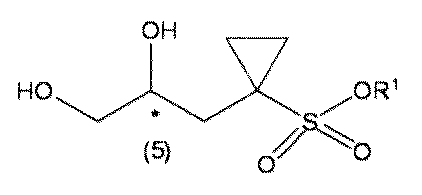
式(7)で示されるスルホン酸塩は、式(6)で示されるスルホン酸エステルと沃化ナトリウムとを反応させることにより製造できる。
本工程は、無溶媒下で行うこともできるが、溶媒中で行うのが、反応混合物が流動し易く取扱い性に優れる点から好ましい。
使用される溶媒としては、例えば、アセトン、メチルエチルケトン等のケトン溶媒及び水が挙げられる。中でも、反応性の点から、ケトン溶媒が好ましく、アセトンが特に好ましい。
溶媒の使用量は、式(6)で示されるスルホン酸エステル1mmolに対して、好ましくは0.5~10mL、より好ましくは1~5mLの割合である。
ヨウ化ナトリウムの使用量は、式(6)で示されるスルホン酸エステル1molに対して、通常1.0~2.0mol、好ましくは1.1~1.7molの割合である。
本工程は、式(6)で示されるスルホン酸エステル及び溶媒の混合物中にヨウ化ナトリウムを添加する方法;ヨウ化ナトリウム及び溶媒の混合物中にスルホン酸エステルを添加する方法等により行われるが、副反応を十分に抑制し得る点から、スルホン酸エステル及び溶媒の混合物中にヨウ化ナトリウムを添加する方法が好ましい。
反応温度は、好ましくは30~55℃、より好ましくは45~55℃の範囲内である。
反応時間は、式(6)で示されるスルホン酸エステルの種類や反応温度にもよるが、通常20~40時間、好ましくは20~30時間である。
式(7)で示されるスルホン酸塩は、式(6)で示されるスルホン酸エステルと水酸化ナトリウムとを反応させることにより製造することもできる。
本工程は、無溶媒下で行うこともできるが、溶媒中で行うのが、反応混合物が流動し易く取扱い性に優れる点から好ましい。
使用される溶媒としては、例えば、アセトン、メチルエチルケトン等のケトン溶媒及び水が挙げられる。中でも、反応性の点から、ケトン溶媒が好ましく、アセトンが特に好ましい。
溶媒の使用量は、式(6)で示されるスルホン酸エステル1mmolに対して、好ましくは0.5~10mL、より好ましくは1~5mLの割合である。
水酸化ナトリウムの使用量は、式(6)で示されるスルホン酸エステル1molに対して、通常1.0~2.0mol、好ましくは1.1~1.7molの割合である。
本工程は、式(6)で示されるスルホン酸エステル及び溶媒の混合物中に水酸化ナトリウムを添加する方法;水酸化ナトリウム及び溶媒の混合物中にスルホン酸エステルを添加する方法等により行われるが、副反応を十分に抑制し得る点から、スルホン酸エステル及び溶媒の混合物中に水酸化ナトリウムを添加する方法が好ましい。
反応温度は、好ましくは0~55℃、より好ましくは0~30℃の範囲内である。
反応時間は、式(6)で示されるスルホン酸エステルの種類や反応温度にもよるが、通常1~10時間、好ましくは1~5時間である。
このようにして得られた式(7)で示されるスルホン酸塩は、常法により単離精製することができる。例えば、抽出操作を行った後か、或いは反応混合物を直接シリカゲルカラムクロマトグラフィーに付することにより、スルホン酸塩を単離精製することができる。
式(7)で示されるスルホン酸塩における*を付した炭素原子の立体配置は、S配置でもR配置でもどちらでもよい。

実施例1:式(2A)で示される化合物の製造(StepA)

1H−NMR(400MHz,CDCl3)δ:4.02(2H,d),3.70(2H,t),3.30(2H,t),2.34(2H,m),2.05(1H,m),0.99(6H,d)
実施例2:式(2)で示される化合物の製造(StepA)
実施例1におけるイソブチルアルコールを、ネオペンチルアルコールに置き換える以外は、実施例1と同様の実験を行うことで、X1が塩素原子でR1がネオペンチル基である式(2)で示される化合物を製造することができる。
実施例3:式(3A)で示される化合物の製造(StepB’−1)
(1H−NMR(400MHz),CDCl3)δ:4.01(2H,d),2.47(1H,m),2.04(1H,m),1.27(2H,m),1.07(2H,m),0.99(6H,d)
実施例4:式(3)で示される化合物の製造
実施例1におけるイソブチルアルコールを、ネオペンチルアルコールに置き換える以外は、実施例1及び3と同様の実験を行うことで、R1がネオペンチル基である式(3)で示される化合物を製造することができる。
実施例5:式(4A)で示される化合物の製造(StepB)

1H−NMR(400MHz,CDCl3)δ:7.30−7.37(5H,m),4.55(2H,d),4.20(1H,m),4.00(2H,m),3.51(1H,dd),3.41(1H,dd),2.61(1H,d),2.13(1H,dd),2.03(1H,m),1.83(1H,dd),1.45(2H,m),1.20(1H,m),0.98(6H,d),0.96(1H,m)
実施例6:式(4)で示される化合物の製造
実施例1におけるイソブチルアルコールを、ネオペンチルアルコールに置き換える以外は、実施例1、3及び5と同様の実験を行うことで、R1がネオペンチル基でR2がベンジル基である式(4)で示される化合物を製造することができる。
実施例7:式(5A)で示される化合物の製造(StepC)
1H−NMR(400MHz,CDCl3)δ:4.12(1H,m),4.02(2H,m),3.66(1H,dd),3.47(1H,dd),3.15(1H,br s),2.44(1H,br s),2.03(2H,m),1.86(1H,dd),1.49(2H,m),1.15(1H,m),1.00(6H,d),0.96(1H,m)
実施例8:式(5)で示される化合物の製造
実施例1におけるイソブチルアルコールを、ネオペンチルアルコールに置き換える以外は、実施例1、3、5及び7と同様の実験を行うことで、R1がネオペンチル基である式(5)で示される化合物を製造することができる。
実施例9:式(6A)で示される化合物の製造(StepD)
1H−NMR(400MHz,CDCl3)δ:4.41(1H,m),4.12(1H,dd),4.00(2H,m),3.47(1H,dd),2.35(1H,dd),2.04(1H,m),1.83(1H,dd),1.45(2H,m),1.38(3H,s),1.34(3H,s),1.23(1H,m),0.98(7H,m)
実施例10:式(6)で示される化合物の製造
実施例1におけるイソブチルアルコールを、ネオペンチルアルコールに置き換える以外は、実施例1、3、5、7及び9と同様の実験を行うことで、R1がネオペンチル基である式(6)で示される化合物を製造することができる。
実施例11:式(7A)で示される化合物の製造(StepE)
1H−NMR(400MHz,DMSO−d6)δ:4.43(1H,m),4.01(1H,dd),3.47(1H,dd),1.96(1H,dd),1.69(1H,dd),1.25(3H,s),1.21(3H,s),0.84(2H,dd),0.44(2H,m)
実施例12:式(7)で示される化合物の製造
実施例1におけるイソブチルアルコールを、ネオペンチルアルコールに置き換える以外は、実施例1、3、5、7、9及び11と同様の実験を行うことで、式(7)で示される化合物を製造することができる。
Claims (10)
- (StepE)
式(6)
(式中、R1は炭素数4~6の分岐アルキル基を表す。)
で示されるスルホン酸エステルと沃化ナトリウム又は水酸化ナトリウムとを反応させて式(7)
で示されるスルホン酸塩を得る工程、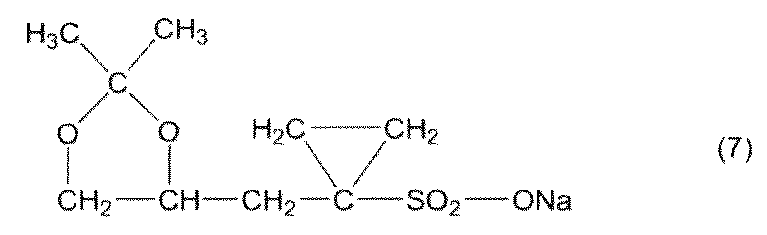
を含む、式(7)で示されるスルホン酸塩の製造方法。 - (StepD)
式(5)
(式中、R1は炭素数4~6の分岐アルキル基を表す。)
で示されるスルホン酸エステルと式(51)
(式中、R3は炭素数1~6のアルキル基を表す。)
で示される2,2−ジアルコキシプロパンとを酸の存在下で反応させて式(6)
(式中、R1は上述の通り。)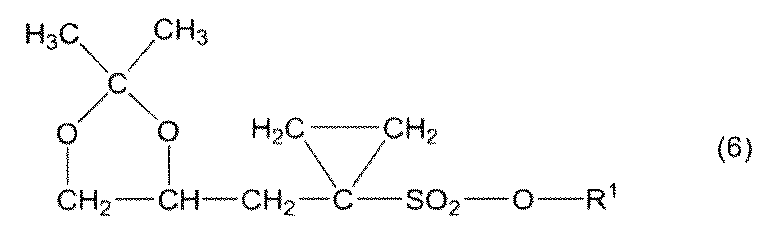
で示されるスルホン酸エステルを得る工程、
(StepE)
式(6)で示されるスルホン酸エステルと沃化ナトリウム又は水酸化ナトリウムとを反応させて式(7)
で示されるスルホン酸塩を得る工程、
を含む請求項1に記載の製造方法。 - (StepB)
式(2)
(式中、X1は塩素原子、臭素原子又は沃素原子を表し、R1は炭素数4~6の分岐アルキル基を表す。)
で示されるスルホン酸エステルと式(31)
(式中、R2は水酸基の保護基を表す。)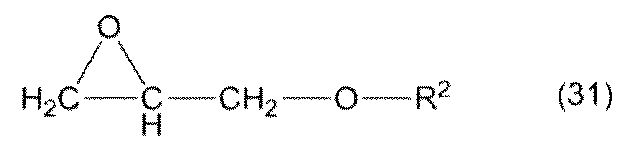
で示されるエポキシ化合物とを塩基の存在下に反応させて式(4)
(式中、R1及びR2は上述の通り。)
で示されるスルホン酸エステルを得る工程、
(StepC)
式(4)で示されるスルホン酸エステルを脱保護して式(5)
(式中、R1は上述の通り。)
で示されるスルホン酸エステルを得る工程、
(StepD)
式(5)で示されるスルホン酸エステルと式(51)
(式中、R3は炭素数1~6のアルキル基を表す。)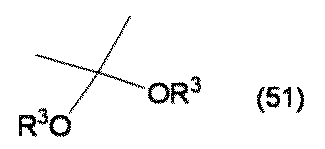
で示される2,2−ジアルコキシプロパンとを酸の存在下で反応させて式(6)
(式中、R1は上述の通り。)
で示されるスルホン酸エステルを得る工程、
(StepE)
式(6)で示されるスルホン酸エステルと沃化ナトリウム又は水酸化ナトリウムとを反応させて式(7)
で示されるスルホン酸塩を得る工程、
を含む請求項1に記載の製造方法。 - (StepB’−1)
式(2)
(式中、X1は塩素原子、臭素原子又は沃素原子を表し、R1は炭素数4~6の分岐アルキル基を表す。)
で示されるスルホン酸エステルと塩基とを反応させて式(3)
(式中、R1は上述の通り。)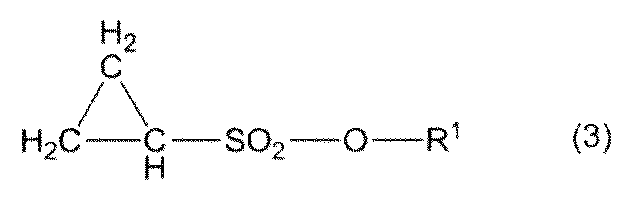
で示されるシクロプロパンスルホン酸エステルを得る工程、
(StepB’−2)
式(3)で示されるシクロプロパンスルホン酸エステルと式(31)
(式中、R2は水酸基の保護基を表す。)
で示されるエポキシ化合物とを塩基の存在下に反応させて式(4)
(式中、R1及びR2は上述の通り。)
で示されるスルホン酸エステルを得る工程、
(StepC)
式(4)で示されるスルホン酸エステルを脱保護して式(5)
(式中、R1は上述の通り。)
で示されるスルホン酸エステルを得る工程、
(StepD)
式(5)で示されるスルホン酸エステルと式(51)
(式中、R3は炭素数1~6のアルキル基を表す。)
で示される2,2−ジアルコキシプロパンとを酸の存在下で反応させて式(6)
(式中、R1は上述の通り。)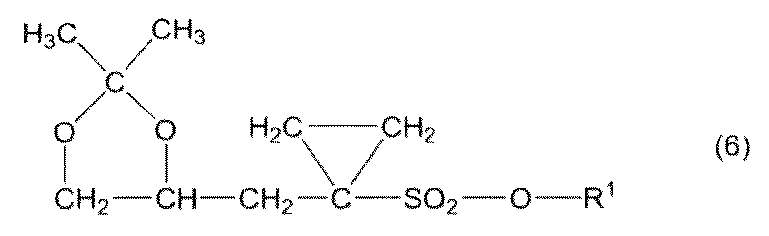
で示されるスルホン酸エステルを得る工程、
(StepE)
式(6)で示されるスルホン酸エステルと沃化ナトリウム又は水酸化ナトリウムとを反応させて式(7)
で示されるスルホン酸塩を得る工程、
を含む請求項1に記載の製造方法。 - (StepA)
式(1)
(式中、X1は塩素原子、臭素原子又は沃素原子を表す。)
で示されるスルホン酸ハライドと式(11)
(式中、R1は炭素数4~6の分岐アルキル基を表す。)
で示されるアルコールとを塩基の存在下に反応させて式(2)
(式中、X1は塩素原子、臭素原子又は沃素原子を表し、R1は上述の通り。)
で示されるスルホン酸エステルを得る工程、
(StepB)
式(2)で示されるスルホン酸エステルと塩基とを反応させて式(3)
(式中、R1は上述の通り。)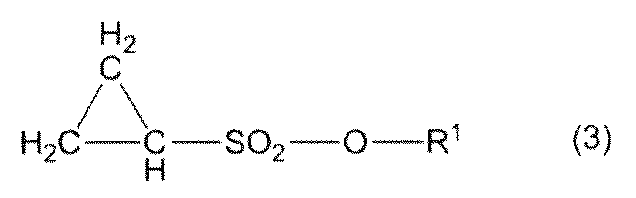
で示されるシクロプロパンスルホン酸エステルを得(StepB’−1)、これを式(31)
(式中、R2は水酸基の保護基を表す。)
で示されるエポキシ化合物と塩基の存在下に反応させて式(4)
(式中、R1及びR2は上述の通り。)
で示されるスルホン酸エステルを得る(StepB’−2)工程、又は
式(2)で示されるスルホン酸エステルと式(31)で示されるエポキシ化合物とを塩基の存在下に反応させて式(4)で示されるスルホン酸エステルを得る工程、
(StepC)
式(4)で示されるスルホン酸エステルを脱保護して式(5)
(式中、R1は上述の通り。)
で示されるスルホン酸エステルを得る工程、
(StepD)
式(5)で示されるスルホン酸エステルと式(51)
(式中、R3は炭素数1~6のアルキル基を表す。)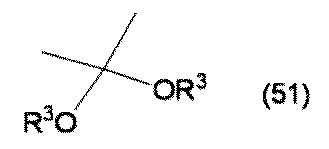
で示される2,2−ジアルコキシプロパンとを酸の存在下で反応させて式(6)
(式中、R1は上述の通り。)
で示されるスルホン酸エステルを得る工程、
(StepE)
式(6)で示されるスルホン酸エステルと沃化ナトリウム又は水酸化ナトリウムとを反応させて式(7)
で示されるスルホン酸塩を得る工程、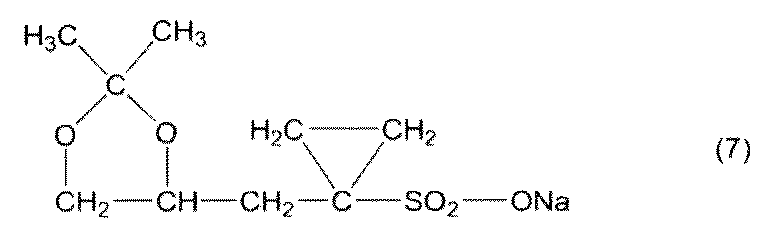
を含む請求項1に記載の製造方法。 - 式(6)
(式中、R1は炭素数4~6の分岐アルキル基を表す。)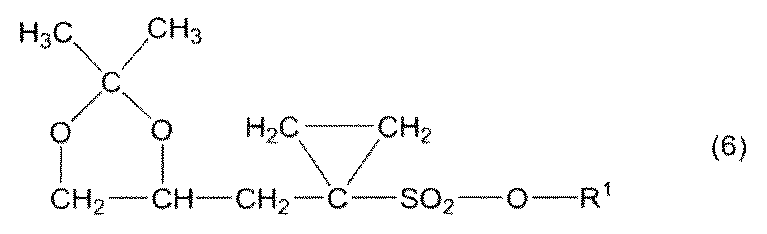
で示されるスルホン酸エステル。 - 式(5)
(式中、R1は炭素数4~6の分岐アルキル基を表す。)
で示されるスルホン酸エステル。 - 式(4)
(式中、R1は炭素数4~6の分岐アルキル基を表し、R2は水酸基の保護基を表す。)
で示されるスルホン酸エステル。 - 式(3)
(式中、R1は炭素数4~6の分岐アルキル基を表す。)
で示されるシクロプロパンスルホン酸エステル。 - 式(2)
(式中、X1は塩素原子、臭素原子又は沃素原子を表し、R1は炭素数4~6の分岐アルキル基を表す。)
で示されるスルホン酸エステル。
Priority Applications (2)
| Application Number | Priority Date | Filing Date | Title |
|---|---|---|---|
| CN201280062479.0A CN104011039A (zh) | 2011-12-19 | 2012-12-10 | 磺酸盐的制造方法 |
| EP12859632.7A EP2796455A4 (en) | 2011-12-19 | 2012-12-10 | PROCESS FOR THE PREPARATION OF SULPHONATE |
Applications Claiming Priority (12)
| Application Number | Priority Date | Filing Date | Title |
|---|---|---|---|
| JP2011-277699 | 2011-12-19 | ||
| JP2011-277700 | 2011-12-19 | ||
| JP2011-277702 | 2011-12-19 | ||
| JP2011277697 | 2011-12-19 | ||
| JP2011277698 | 2011-12-19 | ||
| JP2011277699 | 2011-12-19 | ||
| JP2011-277701 | 2011-12-19 | ||
| JP2011277700 | 2011-12-19 | ||
| JP2011-277698 | 2011-12-19 | ||
| JP2011-277697 | 2011-12-19 | ||
| JP2011277702 | 2011-12-19 | ||
| JP2011277701 | 2011-12-19 |
Publications (1)
| Publication Number | Publication Date |
|---|---|
| WO2013094546A1 true WO2013094546A1 (ja) | 2013-06-27 |
Family
ID=48668437
Family Applications (1)
| Application Number | Title | Priority Date | Filing Date |
|---|---|---|---|
| PCT/JP2012/082588 Ceased WO2013094546A1 (ja) | 2011-12-19 | 2012-12-10 | スルホン酸塩の製造方法 |
Country Status (4)
| Country | Link |
|---|---|
| EP (1) | EP2796455A4 (ja) |
| JP (1) | JPWO2013094546A1 (ja) |
| CN (1) | CN104011039A (ja) |
| WO (1) | WO2013094546A1 (ja) |
Citations (3)
| Publication number | Priority date | Publication date | Assignee | Title |
|---|---|---|---|---|
| WO2009018238A1 (en) | 2007-07-30 | 2009-02-05 | Ardea Biosciences, Inc. | Combinations of mek inhibitors and raf kinase inhibitors and uses thereof |
| WO2010145197A1 (en) * | 2009-06-15 | 2010-12-23 | Chemizon (Beijing), Ltd. | Novel 6-arylamino pyridone sulfonamides and 6-arylamino pyrazinone sulfonamdies as mek inhibitors |
| WO2011009541A1 (en) | 2009-07-24 | 2011-01-27 | Ardea Biosciences, Inc. | Preparation of (r)- and (s)-n-(3, 4-difluoro-2-(2-fluoro-4-iodophenylamino)--6-methoxyphenyl) -1- (2, 3-dihydroxypropyl)cyclopropane-1-sulfonamide and protected derivatives thereof |
Family Cites Families (5)
| Publication number | Priority date | Publication date | Assignee | Title |
|---|---|---|---|---|
| WO2007014011A2 (en) * | 2005-07-21 | 2007-02-01 | Ardea Biosciences, Inc. | N-(arylamino)-sulfonamide inhibitors of mek |
| US8101799B2 (en) * | 2005-07-21 | 2012-01-24 | Ardea Biosciences | Derivatives of N-(arylamino) sulfonamides as inhibitors of MEK |
| CN101495118B (zh) * | 2005-07-21 | 2012-09-05 | 阿迪亚生命科学公司 | Mek的n-(芳基氨基)磺酰胺抑制剂 |
| AU2012265844A1 (en) * | 2009-12-08 | 2013-05-02 | Novartis Ag | Heterocyclic sulfonamide derivatives |
| UA113850C2 (xx) * | 2011-05-27 | 2017-03-27 | Хіральний синтез n-{3,4-дифтор-2-$(2-фтор-4-йодфеніл)аміно]-6-метоксифеніл}-1-$2,3-дигідроксипропіл]циклопропансульфонамідів |
-
2012
- 2012-12-10 JP JP2013510423A patent/JPWO2013094546A1/ja active Pending
- 2012-12-10 CN CN201280062479.0A patent/CN104011039A/zh active Pending
- 2012-12-10 EP EP12859632.7A patent/EP2796455A4/en not_active Withdrawn
- 2012-12-10 WO PCT/JP2012/082588 patent/WO2013094546A1/ja not_active Ceased
Patent Citations (3)
| Publication number | Priority date | Publication date | Assignee | Title |
|---|---|---|---|---|
| WO2009018238A1 (en) | 2007-07-30 | 2009-02-05 | Ardea Biosciences, Inc. | Combinations of mek inhibitors and raf kinase inhibitors and uses thereof |
| WO2010145197A1 (en) * | 2009-06-15 | 2010-12-23 | Chemizon (Beijing), Ltd. | Novel 6-arylamino pyridone sulfonamides and 6-arylamino pyrazinone sulfonamdies as mek inhibitors |
| WO2011009541A1 (en) | 2009-07-24 | 2011-01-27 | Ardea Biosciences, Inc. | Preparation of (r)- and (s)-n-(3, 4-difluoro-2-(2-fluoro-4-iodophenylamino)--6-methoxyphenyl) -1- (2, 3-dihydroxypropyl)cyclopropane-1-sulfonamide and protected derivatives thereof |
Non-Patent Citations (3)
| Title |
|---|
| ADAMCZYK,M. ET AL.: "w-Aminooxyalkanesulfonic acids.", NOVEL NUCLEOPHILIC SULFOALKYLATION REAGENTS, TETRAHEDRON LETTERS, vol. 42, no. 26, 2001, pages 4285 - 4287, XP055151039 * |
| See also references of EP2796455A4 * |
| TRUCE,W.E. ET AL.: "trans-1-(Arylsulfonyl)-2- arylcyclopropanes and derivatives of cyclopropanesulfonic acid", JOURNAL OF ORGANIC CHEMISTRY, vol. 34, no. LL, 1969, pages 3324 - 3328, XP002678923 * |
Also Published As
| Publication number | Publication date |
|---|---|
| EP2796455A1 (en) | 2014-10-29 |
| CN104011039A (zh) | 2014-08-27 |
| EP2796455A4 (en) | 2015-08-19 |
| JPWO2013094546A1 (ja) | 2015-04-27 |
Similar Documents
| Publication | Publication Date | Title |
|---|---|---|
| KR102688084B1 (ko) | 아미노피리미딘 유도체의 개선된 제조방법 | |
| JP7216704B2 (ja) | アミノピリミジン誘導体の合成に有用な新規中間体、それを調製するためのプロセス、及びそれを使用してアミノピリミジン誘導体を調製するためのプロセス | |
| WO2016086710A1 (zh) | 一种羧酸的制备方法 | |
| WO2016161826A1 (zh) | 一种4-异丙氨基-1-丁醇的制备方法 | |
| JPWO2013094546A1 (ja) | スルホン酸塩の製造方法 | |
| JP2009035513A (ja) | 4−n−(メチルベンゾイル)アミノ−2−メチル安息香酸の製法 | |
| JP2009242244A (ja) | ピラジン誘導体類の製造方法及びその中間体類 | |
| CN101573034A (zh) | 合成(+)及(-)-1-(3,4-二氯苯基)-3-氮杂双环[3.1.0]己烷的方法 | |
| JP4032861B2 (ja) | β−オキソニトリル誘導体又はそのアルカリ金属塩の製法 | |
| TW200410930A (en) | Method for producing acetylene compound | |
| JP5918624B2 (ja) | 光学活性含フッ素5,6−ジヒドロピリドン誘導体及びその製造方法 | |
| JP5507579B2 (ja) | N−[5−(3−ジメチルアミノ−アクリロイル)−2−フルオロ−フェニル]−n−メチル−アセトアミドの調製方法 | |
| JP5396841B2 (ja) | α−トリフルオロメチル−β−置換−β−アミノ酸類の製造方法 | |
| JP5507147B2 (ja) | ピリミジニルアルコール誘導体の製造方法及びその合成中間体 | |
| JP5205971B2 (ja) | テトラヒドロピラン化合物の製造方法 | |
| JP2011057575A (ja) | 4−ヒドロキシベンゾチオフェン誘導体の製造方法 | |
| CN101723841A (zh) | 2-氨基-5-烷氧基苯丙酮的制备方法 | |
| EP2892873A1 (en) | Process for preparing 6-iodo-2-oxindole | |
| WO2002014284A1 (en) | Processes for the preparation of pyrazole compounds | |
| JP6937107B2 (ja) | 1,1−ジオキソ−ヘキサヒドロチオピラン−4−カルボン酸またはその誘導体の製造方法 | |
| HK40103024A (zh) | 制备氨基嘧啶衍生物的改善方法 | |
| JP2017075120A (ja) | ジフルオロメチルチオ化試薬およびジフルオロメチルチオ−エナミン誘導体の製造方法 | |
| WO2013168780A1 (ja) | 光学活性2-ビニルシクロプロパン-1,1-ジカルボン酸エステルの製造法 | |
| JP2008247835A (ja) | メトキシ基を有するβ−ジケトン化合物の製法 | |
| JP2007051128A (ja) | アラルキルオキシ又はヘテロアラルキルオキシ基を有するアニリンの製法 |
Legal Events
| Date | Code | Title | Description |
|---|---|---|---|
| ENP | Entry into the national phase |
Ref document number: 2013510423 Country of ref document: JP Kind code of ref document: A |
|
| 121 | Ep: the epo has been informed by wipo that ep was designated in this application |
Ref document number: 12859632 Country of ref document: EP Kind code of ref document: A1 |
|
| REEP | Request for entry into the european phase |
Ref document number: 2012859632 Country of ref document: EP |
|
| WWE | Wipo information: entry into national phase |
Ref document number: 2012859632 Country of ref document: EP |
|
| NENP | Non-entry into the national phase |
Ref country code: DE |