WO2013099206A1 - 熱延鋼板およびその製造方法 - Google Patents
熱延鋼板およびその製造方法 Download PDFInfo
- Publication number
- WO2013099206A1 WO2013099206A1 PCT/JP2012/008239 JP2012008239W WO2013099206A1 WO 2013099206 A1 WO2013099206 A1 WO 2013099206A1 JP 2012008239 W JP2012008239 W JP 2012008239W WO 2013099206 A1 WO2013099206 A1 WO 2013099206A1
- Authority
- WO
- WIPO (PCT)
- Prior art keywords
- hot
- less
- steel sheet
- rolled steel
- rolling
- Prior art date
- Legal status (The legal status is an assumption and is not a legal conclusion. Google has not performed a legal analysis and makes no representation as to the accuracy of the status listed.)
- Ceased
Links
Classifications
-
- C—CHEMISTRY; METALLURGY
- C21—METALLURGY OF IRON
- C21D—MODIFYING THE PHYSICAL STRUCTURE OF FERROUS METALS; GENERAL DEVICES FOR HEAT TREATMENT OF FERROUS OR NON-FERROUS METALS OR ALLOYS; MAKING METAL MALLEABLE, e.g. BY DECARBURISATION OR TEMPERING
- C21D8/00—Modifying the physical properties of ferrous metals or ferrous alloys by deformation combined with, or followed by, heat treatment
- C21D8/02—Modifying the physical properties of ferrous metals or ferrous alloys by deformation combined with, or followed by, heat treatment during manufacturing of plates or strips
- C21D8/0247—Modifying the physical properties of ferrous metals or ferrous alloys by deformation combined with, or followed by, heat treatment during manufacturing of plates or strips characterised by the heat treatment
- C21D8/0263—Modifying the physical properties of ferrous metals or ferrous alloys by deformation combined with, or followed by, heat treatment during manufacturing of plates or strips characterised by the heat treatment following hot rolling
-
- B—PERFORMING OPERATIONS; TRANSPORTING
- B32—LAYERED PRODUCTS
- B32B—LAYERED PRODUCTS, i.e. PRODUCTS BUILT-UP OF STRATA OF FLAT OR NON-FLAT, e.g. CELLULAR OR HONEYCOMB, FORM
- B32B15/00—Layered products comprising a layer of metal
- B32B15/01—Layered products comprising a layer of metal all layers being exclusively metallic
-
- C—CHEMISTRY; METALLURGY
- C21—METALLURGY OF IRON
- C21D—MODIFYING THE PHYSICAL STRUCTURE OF FERROUS METALS; GENERAL DEVICES FOR HEAT TREATMENT OF FERROUS OR NON-FERROUS METALS OR ALLOYS; MAKING METAL MALLEABLE, e.g. BY DECARBURISATION OR TEMPERING
- C21D8/00—Modifying the physical properties of ferrous metals or ferrous alloys by deformation combined with, or followed by, heat treatment
- C21D8/02—Modifying the physical properties of ferrous metals or ferrous alloys by deformation combined with, or followed by, heat treatment during manufacturing of plates or strips
-
- C—CHEMISTRY; METALLURGY
- C21—METALLURGY OF IRON
- C21D—MODIFYING THE PHYSICAL STRUCTURE OF FERROUS METALS; GENERAL DEVICES FOR HEAT TREATMENT OF FERROUS OR NON-FERROUS METALS OR ALLOYS; MAKING METAL MALLEABLE, e.g. BY DECARBURISATION OR TEMPERING
- C21D8/00—Modifying the physical properties of ferrous metals or ferrous alloys by deformation combined with, or followed by, heat treatment
- C21D8/02—Modifying the physical properties of ferrous metals or ferrous alloys by deformation combined with, or followed by, heat treatment during manufacturing of plates or strips
- C21D8/0221—Modifying the physical properties of ferrous metals or ferrous alloys by deformation combined with, or followed by, heat treatment during manufacturing of plates or strips characterised by the working steps
- C21D8/0226—Hot rolling
-
- C—CHEMISTRY; METALLURGY
- C21—METALLURGY OF IRON
- C21D—MODIFYING THE PHYSICAL STRUCTURE OF FERROUS METALS; GENERAL DEVICES FOR HEAT TREATMENT OF FERROUS OR NON-FERROUS METALS OR ALLOYS; MAKING METAL MALLEABLE, e.g. BY DECARBURISATION OR TEMPERING
- C21D9/00—Heat treatment, e.g. annealing, hardening, quenching or tempering, adapted for particular articles; Furnaces therefor
- C21D9/46—Heat treatment, e.g. annealing, hardening, quenching or tempering, adapted for particular articles; Furnaces therefor for sheet metals
-
- C—CHEMISTRY; METALLURGY
- C22—METALLURGY; FERROUS OR NON-FERROUS ALLOYS; TREATMENT OF ALLOYS OR NON-FERROUS METALS
- C22C—ALLOYS
- C22C38/00—Ferrous alloys, e.g. steel alloys
- C22C38/001—Ferrous alloys, e.g. steel alloys containing N
-
- C—CHEMISTRY; METALLURGY
- C22—METALLURGY; FERROUS OR NON-FERROUS ALLOYS; TREATMENT OF ALLOYS OR NON-FERROUS METALS
- C22C—ALLOYS
- C22C38/00—Ferrous alloys, e.g. steel alloys
- C22C38/002—Ferrous alloys, e.g. steel alloys containing In, Mg, or other elements not provided for in one single group C22C38/001 - C22C38/60
-
- C—CHEMISTRY; METALLURGY
- C22—METALLURGY; FERROUS OR NON-FERROUS ALLOYS; TREATMENT OF ALLOYS OR NON-FERROUS METALS
- C22C—ALLOYS
- C22C38/00—Ferrous alloys, e.g. steel alloys
- C22C38/005—Ferrous alloys, e.g. steel alloys containing rare earths, i.e. Sc, Y, Lanthanides
-
- C—CHEMISTRY; METALLURGY
- C22—METALLURGY; FERROUS OR NON-FERROUS ALLOYS; TREATMENT OF ALLOYS OR NON-FERROUS METALS
- C22C—ALLOYS
- C22C38/00—Ferrous alloys, e.g. steel alloys
- C22C38/007—Ferrous alloys, e.g. steel alloys containing silver
-
- C—CHEMISTRY; METALLURGY
- C22—METALLURGY; FERROUS OR NON-FERROUS ALLOYS; TREATMENT OF ALLOYS OR NON-FERROUS METALS
- C22C—ALLOYS
- C22C38/00—Ferrous alloys, e.g. steel alloys
- C22C38/008—Ferrous alloys, e.g. steel alloys containing tin
-
- C—CHEMISTRY; METALLURGY
- C22—METALLURGY; FERROUS OR NON-FERROUS ALLOYS; TREATMENT OF ALLOYS OR NON-FERROUS METALS
- C22C—ALLOYS
- C22C38/00—Ferrous alloys, e.g. steel alloys
- C22C38/02—Ferrous alloys, e.g. steel alloys containing silicon
-
- C—CHEMISTRY; METALLURGY
- C22—METALLURGY; FERROUS OR NON-FERROUS ALLOYS; TREATMENT OF ALLOYS OR NON-FERROUS METALS
- C22C—ALLOYS
- C22C38/00—Ferrous alloys, e.g. steel alloys
- C22C38/04—Ferrous alloys, e.g. steel alloys containing manganese
-
- C—CHEMISTRY; METALLURGY
- C22—METALLURGY; FERROUS OR NON-FERROUS ALLOYS; TREATMENT OF ALLOYS OR NON-FERROUS METALS
- C22C—ALLOYS
- C22C38/00—Ferrous alloys, e.g. steel alloys
- C22C38/06—Ferrous alloys, e.g. steel alloys containing aluminium
-
- C—CHEMISTRY; METALLURGY
- C22—METALLURGY; FERROUS OR NON-FERROUS ALLOYS; TREATMENT OF ALLOYS OR NON-FERROUS METALS
- C22C—ALLOYS
- C22C38/00—Ferrous alloys, e.g. steel alloys
- C22C38/10—Ferrous alloys, e.g. steel alloys containing cobalt
-
- C—CHEMISTRY; METALLURGY
- C22—METALLURGY; FERROUS OR NON-FERROUS ALLOYS; TREATMENT OF ALLOYS OR NON-FERROUS METALS
- C22C—ALLOYS
- C22C38/00—Ferrous alloys, e.g. steel alloys
- C22C38/12—Ferrous alloys, e.g. steel alloys containing tungsten, tantalum, molybdenum, vanadium, or niobium
-
- C—CHEMISTRY; METALLURGY
- C22—METALLURGY; FERROUS OR NON-FERROUS ALLOYS; TREATMENT OF ALLOYS OR NON-FERROUS METALS
- C22C—ALLOYS
- C22C38/00—Ferrous alloys, e.g. steel alloys
- C22C38/14—Ferrous alloys, e.g. steel alloys containing titanium or zirconium
-
- C—CHEMISTRY; METALLURGY
- C22—METALLURGY; FERROUS OR NON-FERROUS ALLOYS; TREATMENT OF ALLOYS OR NON-FERROUS METALS
- C22C—ALLOYS
- C22C38/00—Ferrous alloys, e.g. steel alloys
- C22C38/18—Ferrous alloys, e.g. steel alloys containing chromium
- C22C38/40—Ferrous alloys, e.g. steel alloys containing chromium with nickel
- C22C38/42—Ferrous alloys, e.g. steel alloys containing chromium with nickel with copper
-
- C—CHEMISTRY; METALLURGY
- C22—METALLURGY; FERROUS OR NON-FERROUS ALLOYS; TREATMENT OF ALLOYS OR NON-FERROUS METALS
- C22C—ALLOYS
- C22C38/00—Ferrous alloys, e.g. steel alloys
- C22C38/18—Ferrous alloys, e.g. steel alloys containing chromium
- C22C38/40—Ferrous alloys, e.g. steel alloys containing chromium with nickel
- C22C38/48—Ferrous alloys, e.g. steel alloys containing chromium with nickel with niobium or tantalum
-
- C—CHEMISTRY; METALLURGY
- C22—METALLURGY; FERROUS OR NON-FERROUS ALLOYS; TREATMENT OF ALLOYS OR NON-FERROUS METALS
- C22C—ALLOYS
- C22C38/00—Ferrous alloys, e.g. steel alloys
- C22C38/18—Ferrous alloys, e.g. steel alloys containing chromium
- C22C38/40—Ferrous alloys, e.g. steel alloys containing chromium with nickel
- C22C38/50—Ferrous alloys, e.g. steel alloys containing chromium with nickel with titanium or zirconium
-
- C—CHEMISTRY; METALLURGY
- C22—METALLURGY; FERROUS OR NON-FERROUS ALLOYS; TREATMENT OF ALLOYS OR NON-FERROUS METALS
- C22C—ALLOYS
- C22C38/00—Ferrous alloys, e.g. steel alloys
- C22C38/18—Ferrous alloys, e.g. steel alloys containing chromium
- C22C38/40—Ferrous alloys, e.g. steel alloys containing chromium with nickel
- C22C38/54—Ferrous alloys, e.g. steel alloys containing chromium with nickel with boron
-
- C—CHEMISTRY; METALLURGY
- C22—METALLURGY; FERROUS OR NON-FERROUS ALLOYS; TREATMENT OF ALLOYS OR NON-FERROUS METALS
- C22C—ALLOYS
- C22C38/00—Ferrous alloys, e.g. steel alloys
- C22C38/60—Ferrous alloys, e.g. steel alloys containing lead, selenium, tellurium, or antimony, or more than 0.04% by weight of sulfur
-
- C—CHEMISTRY; METALLURGY
- C21—METALLURGY OF IRON
- C21D—MODIFYING THE PHYSICAL STRUCTURE OF FERROUS METALS; GENERAL DEVICES FOR HEAT TREATMENT OF FERROUS OR NON-FERROUS METALS OR ALLOYS; MAKING METAL MALLEABLE, e.g. BY DECARBURISATION OR TEMPERING
- C21D2211/00—Microstructure comprising significant phases
- C21D2211/005—Ferrite
-
- Y—GENERAL TAGGING OF NEW TECHNOLOGICAL DEVELOPMENTS; GENERAL TAGGING OF CROSS-SECTIONAL TECHNOLOGIES SPANNING OVER SEVERAL SECTIONS OF THE IPC; TECHNICAL SUBJECTS COVERED BY FORMER USPC CROSS-REFERENCE ART COLLECTIONS [XRACs] AND DIGESTS
- Y10—TECHNICAL SUBJECTS COVERED BY FORMER USPC
- Y10T—TECHNICAL SUBJECTS COVERED BY FORMER US CLASSIFICATION
- Y10T428/00—Stock material or miscellaneous articles
- Y10T428/12—All metal or with adjacent metals
- Y10T428/12493—Composite; i.e., plural, adjacent, spatially distinct metal components [e.g., layers, joint, etc.]
- Y10T428/12771—Transition metal-base component
- Y10T428/12785—Group IIB metal-base component
- Y10T428/12792—Zn-base component
- Y10T428/12799—Next to Fe-base component [e.g., galvanized]
Definitions
- the present invention is a high-strength hot-rolled steel sheet that is useful for use in automobile parts, has a tensile strength (TS) of 850 MPa or more, and anisotropy of mechanical properties (anisotropy).
- TS tensile strength
- anisotropy of mechanical properties
- the present invention relates to a high-strength hot-rolled steel sheet and a method for producing the same.
- the anisotropy of the mechanical properties means a difference between the mechanical properties in the L direction (rolling direction) and the mechanical properties in the C direction (perpendicular to the rolling direction) of the hot-rolled steel sheet.
- the steel sheet composition contains, by mass%, C: 0.02 to 0.08%, Si: 0.01 to 1.50%, Mn: 0.1 to 1.5%, Ti: 0.03 to 0.06%, and P: 0.1% or less , S: 0.005% or less, Al: 0.5% or less, N: 0.009% or less, further limit the total content of Nb, Mo, V to 0.01% or less, the remainder from Fe and inevitable impurities
- the ratio of Ti to C is Ti / C: 0.375 to 1.6, the average diameter of TiC precipitates in the crystal grains is 0.8 to 3 nm, and the average number density is 1 ⁇ 10 17 [pieces / cm 3
- the above technique has been proposed.
- Patent Document 1 Ti having the highest carbide forming ability is efficiently used for precipitation strengthening, thereby suppressing a decrease in workability due to the addition of alloy elements. It is said that an alloy-saving high-strength hot-rolled steel sheet with a tensile strength of 540 to 650 MPa can be obtained.
- the steel plate composition is mass%, C: 0.015-0.06%, Si: less than 0.5%, Mn: 0.1-2.5%, P ⁇ 0.10%, S ⁇ 0.01%, Al: 0.005-0.3% , N ⁇ 0.01%, Ti: 0.01 to 0.30%, B: 2 to 50 ppm, the composition consisting of the balance Fe and inevitable impurities, and the atomic ratio of carbide-generating elements and C
- the content of Si, Mn, B, and Mo, which are elements that control the ⁇ / ⁇ transformation temperature, is specified so as to satisfy a predetermined relationship, and the total area ratio of one or both of ferrite and bainitic ferrite is 90 %, And a cementite structure with a cementite area ratio of 5% or less has been proposed.
- the grain boundary strength reduced by carbide precipitation is improved by adding B to suppress defects in the punched end face, and the stretch flangeability is excellent and the punching cracking resistance and the surface condition are improved. It is said that a high-strength hot-rolled steel sheet having a good tensile strength of 690 MPa or more can be stably manufactured at low cost.
- the essential component of a steel plate is mass%, C: 0.01-0.10%, Si: 1.0% or less, Mn: 2.5% or less, P: 0.08% or less, S: 0.005% or less, Al:
- the composition is 0.015 to 0.050%, Ti: 0.10 to 0.30%, and the balance is Fe, with the steel sheet structure mainly composed of ferrite, and grains whose orientation difference from adjacent grains are all surrounded by 15 ° or more are unit grains.
- d is 5 ⁇ m or less when the particle size is d ⁇ m.
- Patent Document 3 when steel having the above components is heated, rolled, cooled, wound, and manufactured to produce a high-strength hot-rolled steel sheet, finish rolling is performed in a temperature range of 900 to 840 ° C., and finish rolling. A technology for reducing the rolling reduction at 70% or more has been proposed. And according to the technique proposed by patent document 3, it is supposed that the high intensity
- the composition of the hot-rolled steel strip is C: 0.04 to 0.18 wt%, Si: 0.05 to 1.00 wt%, Mn: 0.10 to 0.50 wt%, Ti: 0.05 to 0.30 wt%, Al: 0.001 to Contains 0.100wt%, N: 0.0100wt% or less, P: 0.030wt% or less, and S: 0.015wt% or less at 0.3 ⁇ Ti / (C + S + N) ⁇ 5 and C + Mn / 6 + Si / 24 + Cr / 5 ⁇ 0.20wt%
- a technique has been proposed in which the final ferrite microstructure has a polygonal ferrite fraction of 70% or more.
- the Si and Mn contents are suppressed to reduce the C equivalent, which is an index of weldability, and further, by containing a predetermined amount of Ti as a reinforcing component, weldability It is said that a high-tensile hot-rolled steel strip having an excellent tensile strength of 55 kgf / mm 2 or more can be obtained.
- Japanese Unexamined Patent Publication No. 2011-026690 Japanese Unexamined Patent Publication No. 2007-302992
- Japanese Unexamined Patent Publication No. 2002-105595 Japanese Laid-Open Patent Publication No. 2-008349
- Patent Document 1 has a low Ti content of 0.03 to 0.06%, so a large amount of carbide (TiC) contributing to precipitation strengthening cannot be precipitated, and the tensile strength is about 650 MPa. Only the steel plate is obtained. When the Ti content is increased to increase the strength, the precipitated TiC tends to coarsen, and it is not easy to achieve a high strength exceeding 650 MPa. With the technique proposed in Patent Document 1, if the Ti content exceeds 0.06%, the carbide (TiC) tends to be coarsened, so it is extremely difficult to increase the tensile strength of the steel sheet to 850 MPa or more.
- the steel sheet strength is increased by including B in the steel sheet and Mn, which is a solid solution strengthening element and also an element that controls precipitation of carbides contributing to precipitation strengthening.
- B is a solid solution strengthening element and also an element that controls precipitation of carbides contributing to precipitation strengthening.
- Patent Document 2 discloses an example of a steel plate with an Mn content of 0.5%, but the tensile strength of this steel plate is as low as less than 750 MPa, and Nb that significantly delays the recrystallization of austenite is also disclosed. 0.03% content increases the anisotropy of the mechanical properties of hot-rolled steel sheets. Furthermore, in the technique proposed in Patent Document 2, regarding the steel sheet composition, the ratio of the C content to the Ti content is not appropriate, and a steel sheet having a tensile strength of 850 MPa or more cannot be obtained.
- the strength of the steel sheet is improved by containing Mn, which is a solid solution strengthening element and promotes transformation and affects the shape of the grain boundary.
- Mn which is a solid solution strengthening element
- the rolling conditions Since the steel sheet is not optimized, only a steel sheet having a tensile strength of less than 850 MPa can be obtained, and the anisotropy of mechanical properties becomes a problem.
- Patent Document 3 discloses an example of a steel plate with an Mn content of 0.3%, but the tensile strength of this steel plate is as low as 730 MPa, and Nb, which significantly delays the recrystallization of austenite, is 0.24. %, The anisotropy of the mechanical properties of the hot-rolled steel sheet increases. Furthermore, similarly to the technique proposed in Patent Document 2, regarding the steel plate composition, the ratio of the C content to the Ti content is not appropriate, and a steel plate having a tensile strength of 850 MPa or more cannot be obtained.
- Patent Document 4 describes that the microstructure of the hot-rolled steel strip is mainly composed of fine polygonal ferrite and that the microstructure is made uniform to eliminate anisotropy. There is a problem in the anisotropy of the mechanical characteristics because nothing is presented about the crystal grain size and the state of austenite grains is not taken into consideration.
- the present invention has been made in view of such circumstances, has a tensile strength of 850 MPa or more, and reduces the anisotropy of mechanical properties evaluated as tensile strength and total elongation. Another object is to provide a high-strength hot-rolled steel sheet and a method for producing the same.
- the present inventors focused on a hot-rolled steel sheet having a ferrite single-phase structure with good workability such as press forming, and increased the strength and mechanical properties of the hot-rolled steel sheet.
- Various factors affecting the sex were studied.
- the shape of ferrite grains greatly affects the anisotropy of tensile strength and total elongation.
- the carbides precipitated in the ferrite phase grains usually precipitate almost simultaneously with the austenite ⁇ ferrite transformation of the steel.
- carbides precipitated in the high temperature range are easily coarsened, while fine carbides are obtained when the carbides are precipitated in the low temperature range.
- the steel austenite ⁇ ferrite transformation point can be taken up by adjusting the steel plate composition, the cooling rate after hot rolling, etc. It is preferable that the temperature is lowered to a temperature range and carbide is precipitated in the ferrite phase crystal grains and then wound immediately, or simultaneously with the winding, austenite ⁇ ferrite transformation is performed to precipitate the carbide in the ferrite phase crystal grains.
- Mn and B are also elements having an effect of delaying the austenite ⁇ ferrite transformation of the steel in the cooling process after the hot rolling is completed and lowering the austenite ⁇ ferrite transformation point. Therefore, if Mn and B contained in the steel material are reduced for the purpose of suppressing the anisotropy of the mechanical properties of the hot-rolled steel sheet, ferrite transformation starts at a high temperature in the cooling process after the hot rolling is completed. Further, the coarsening of carbides cannot be suppressed, and a high-strength steel sheet having a tensile strength of 850 MPa or more cannot be produced.
- the present inventors have a role as an element for delaying the transformation before the austenite ⁇ ferrite transformation in the cooling process after hot rolling at the time of manufacturing the hot rolled steel sheet, and after the austenite ⁇ ferrite transformation. Focusing on C and Ti, which can significantly increase the strength of hot-rolled steel sheets by forming carbides, and aiming to increase the strength of hot-rolled steel sheets by precipitating fine Ti carbide in the ferrite grains. Tried. As a result, the Mn and Si contents of the steel material, or even the B and Nb contents are suppressed to a predetermined amount or less, and the contents of C, Ti, N and S are adjusted, and the contents of these elements are further reduced.
- Ti carbides are finely precipitated in large quantities while reducing the anisotropy of the mechanical properties of the hot rolled steel sheet. It has been found that precipitation strengthening due to Ti carbide can be utilized to the maximum.
- the present invention has been completed based on the above findings, and the gist thereof is as follows.
- the steel material in mass%, C: 0.055% or more and 0.15% or less, Si: 0.2% or less, Mn: 1.3% or less, P: 0.03% or less, S: 0.007% or less, Al: 0.1% or less, N: 0.01% or less, Ti: 0.14% or more and 0.30% or less, so that C, S, N and Ti satisfy the following formula (1), and Nb and B as impurities are Nb: less than 0.03%, B: Limited to less than 0.0005%, with the balance being Fe and inevitable impurities,
- the heating temperature T (° C.) of the heating is 1150 ° C.
- the total rolling reduction in the temperature range of 980 ° C. or less of the hot rolling is 40% or less
- the finish rolling temperature of the finish rolling is 880 ° C. or higher
- the cooling is started within 3 seconds after finish rolling, and the average cooling rate of the cooling is 40 ° C./s to 200 ° C./s,
- a method for producing a hot-rolled steel sheet wherein the winding temperature of the winding is 500 ° C or higher and 680 ° C or lower.
- the hot rolled steel sheet according to [6] which has a plating layer on the steel sheet surface.
- the anisotropy of the tensile strength is defined as an absolute value of a difference obtained by subtracting the tensile strength in the L direction from the tensile strength in the C direction.
- the hot-rolled steel sheet according to [6] to [10] wherein the anisotropy of the total elongation of the hot-rolled steel sheet is 2% or less.
- the anisotropy of the total elongation is defined as the absolute value of the difference obtained by subtracting the total elongation in the L direction from the total elongation in the C direction.
- a high-strength hot-rolled steel sheet having a tensile strength of 850 MPa or more and low mechanical property anisotropy suitable for the use of automobile structural members and the like can be obtained.
- the effect is remarkable, such as enabling member molding.
- C 0.055% or more and 0.15% or less C suppresses precipitation and coarsening of carbides in the high temperature range by suppressing ferrite transformation before austenite ⁇ ferrite transformation of steel during the hot-rolled steel plate manufacturing and cooling process after hot rolling. It has the effect of miniaturizing.
- Ti is combined with W described later, or further W, Mo, V, and is finely dispersed in the steel sheet as carbide. That is, C is an element that forms fine carbides and remarkably strengthens the ferrite structure, and is an essential element for strengthening the hot-rolled steel sheet.
- the C content is less than 0.055%, the austenite ⁇ ferrite transformation of the steel occurs in the high temperature range during the cooling process after the hot rolling is completed, and the coarsening of the carbide cannot be suppressed, and the desired strength (tensile strength). : 850 MPa or more) cannot be obtained.
- the C content is less than 0.055%, the amount of carbide precipitated in the ferrite phase grains becomes insufficient, and the desired steel sheet strength cannot be obtained. Therefore, in the present invention, the C content is 0.055% or more. Preferably it is 0.06% or more. On the other hand, if the C content exceeds 0.15%, coarse Ti carbides are formed in the steel material.
- the coarse Ti carbide cannot be dissolved, and the coarse Ti carbide remains in the finally obtained hot-rolled steel sheet. If coarse Ti carbide remains in this way, the amount of fine Ti carbide that contributes to strength increase decreases, and the strength of the hot-rolled steel sheet rapidly decreases.
- the C content is 0.15% or less. Preferably it is 0.13% or less.
- Si 0.2% or less
- Si is actively contained in conventional high-strength steel sheets as an effective element for improving the steel sheet strength without reducing ductility (elongation).
- Si is an element that inhibits the recrystallization of austenite grains in the hot rolling process and promotes the anisotropy of the mechanical properties of the hot rolled steel sheet during the production of the hot rolled steel sheet. Therefore, in the present invention, it is desirable to reduce the Si content as much as possible, but up to 0.2% is acceptable, so the upper limit of the Si content is 0.2%. Preferably it is 0.09% or less. Note that the Si content may be reduced to the impurity level, or even if it is zero, there is no problem.
- Mn 1.3% or less Mn is a solid solution strengthening element and, like Si, is actively contained in conventional high-strength steel sheets, but it inhibits austenite grain recrystallization in the hot rolling process, and mechanical properties of hot-rolled steel sheets. It is an element that promotes anisotropy. Therefore, in the present invention, it is desirable to reduce the Mn content as much as possible, but up to 1.3% is acceptable, so the upper limit of the Mn content is 1.3%. Preferably, it is less than 0.5%, and in this range, the anisotropy of mechanical properties is further improved.
- the Mn content is drastically reduced, the ferrite transformation temperature (transformation point) rises, and during the production of hot-rolled steel sheet, the carbide that precipitates simultaneously with the austenite ⁇ ferrite transformation is exposed to high temperatures during the cooling process after finish rolling. It becomes. And when a carbide
- P 0.03% or less P segregates in the dislocations introduced into the austenite grains during hot rolling to inhibit recrystallization, and promotes the anisotropy of the mechanical properties of the hot-rolled steel sheet. Therefore, in the present invention, it is desirable to reduce the P content as much as possible, but 0.03% is acceptable, so the P content is set to 0.03% or less. Preferably it is 0.02% or less. There is no problem even if the P content is zero.
- S 0.007% or less S combines with Mn to form a soft sulfide in the steel material.
- This soft sulfide is stretched in a wedge shape during hot rolling at the time of manufacturing a hot-rolled steel sheet, and causes a decrease in ductility in the vertical direction from the rolling direction of the hot-rolled steel sheet. Therefore, in the present invention, it is desirable to reduce the S content as much as possible, and it is 0.007% or less. Preferably it is 0.004% or less. There is no problem even if the S content is zero.
- Al 0.1% or less
- Al is an element that acts as a deoxidizer, and in order to obtain such an effect, it is desirable to contain 0.01% or more.
- Al is also an element that forms inclusions in the steel and inhibits recrystallization of austenite grains in the hot rolling process. If the Al content exceeds 0.1%, the adverse effect on recrystallization becomes obvious. Therefore, the Al content is 0.1% or less. Preferably it is 0.07% or less.
- N 0.01% or less N combines with Ti, which is a carbide-forming element, at the steelmaking stage to form coarse nitrides and inhibits the formation of fine carbides, so that the steel sheet strength is significantly reduced. Moreover, coarse nitride significantly inhibits recrystallization of austenite grains in the hot rolling process during the production of hot-rolled steel sheets. Therefore, the N content is preferably reduced as much as possible, and is 0.01% or less. Preferably it is 0.006% or less. There is no problem even if the N content is zero.
- Ti 0.14% to 0.30% Ti, like C, during the hot-rolled steel plate manufacturing, during the cooling process after hot rolling, precipitation and coarsening of carbides at high temperatures by delaying the progress of ferrite transformation before austenite ⁇ ferrite transformation of steel And has the effect of miniaturizing the carbide. Further, after austenite ⁇ ferrite transformation, it combines with C and is finely dispersed in the steel sheet as carbide. That is, Ti is an element that forms fine carbides and remarkably strengthens the ferrite structure, and is an essential element for strengthening the hot-rolled steel sheet. In order to obtain a hot-rolled steel sheet having a tensile strength of 850 MPa or more, the Ti content needs to be 0.14% or more.
- the Ti content needs to be 0.30% or less. Preferably it is 0.28% or less.
- steel plate strength is proportional to the volume fraction of carbides, it is preferable to precipitate solid solution Ti by precipitating 80% or more of the Ti content as carbides. In order to precipitate 80% or more of the Ti content as carbide, it is achieved by adjusting the austenite ⁇ ferrite transformation temperature. This temperature can be adjusted by chemical components and hot rolling conditions.
- the steel material of the present invention contains C, S, N, and Ti in the above-described range and satisfying the expression (1).
- [Ti * ] [Ti]-3.4 x [N]-1.5 x [S] ([C], [S], [N], [Ti]: Content of each element (% by mass))
- the above formula (1) is a requirement that must be satisfied in order to set the tensile strength of the hot-rolled steel sheet to 850 MPa or more, and is an important index in the present invention.
- a desired steel plate strength is ensured by finely precipitating Ti carbide mainly in the hot-rolled steel plate.
- Ti carbide has a strong tendency to become a fine carbide whose average particle diameter is extremely small, when the atomic concentration of Ti contained in the steel exceeds the atomic concentration of C, Ti carbide tends to be coarsened, Since the effect of adjusting the austenite ⁇ ferrite transformation temperature due to solute C is reduced, it becomes difficult to ensure the desired hot-rolled steel sheet strength (tensile strength: 850 MPa or more).
- Ti that can contribute to carbide formation is “Ti * ”, in the present invention, it is necessary that the atomic percent of C contained in the steel material be equal to or more than the atomic percent of Ti * . That is, the value of ([C] / 12) / ([Ti * ] / 48) needs to be 1 or more.
- Each atomic% is proportional to the mass% of C and Ti divided by the atomic weight of C and Ti (C: 12, Ti: 48), respectively.
- a predetermined amount of Ti is added to the steel material, the carbide in the steel material is dissolved by heating before hot rolling, and Ti carbide is precipitated mainly during winding after hot rolling.
- the total amount of Ti added to the steel material does not contribute to carbide formation, and part of the Ti added to the steel material is consumed for the formation of nitrides and sulfides that do not contribute to increasing the strength of the steel sheet.
- Ti is more likely to form nitrides and sulfides than carbides at higher temperatures than the coiling temperature, and Ti mainly forms nitrides and sulfides before the winding process during the production of hot-rolled steel sheets. It is.
- the amount of Ti * that is Ti that contributes to carbide formation is the formation of Ti nitride and Ti sulfide from the total amount of Ti added to the steel material. It was clarified that the amount of Ti consumed can be expressed as “[Ti] ⁇ 3.4 ⁇ [N] ⁇ 1.5 ⁇ [S]”.
- the atomic% C in order to more atomic% of Ti *, ([C] / 12) / ([Ti *] / 48) values so as to become 1 or more It contains C, S, N and Ti elements.
- the value of ([C] / 12) / ([Ti * ] / 48) is less than 1, the coarsening of Ti carbide formed in the ferrite crystal grains and the austenite ⁇ ferrite transformation temperature are increased. In order to promote, the hot-rolled steel sheet strength decreases or the production stability deteriorates.
- the value of ([C] / 12) / ([Ti * ] / 48) is preferably 1.05 or more. However, if the value of ([C] / 12) / ([Ti * ] / 48) exceeds 3.0, the coarse Ti carbides generated in the steel material are not hot-rolled in the hot-rolled steel plate manufacturing process. Even if the steel material is heated, it remains without melting, which causes a reduction in the strength of the finally obtained hot-rolled steel sheet.
- the value of ([C] / 12) / ([Ti * ] / 48) exceeds 3.0, the amount of C relative to the amount of Ti in the steel material becomes excessive, and as a result, cementite is easily generated, and the steel sheet structure Is substantially difficult to have a ferrite single-phase structure. Therefore, the value of ([C] / 12) / ([Ti * ] / 48) is preferably 3.0 or less.
- V 0.30% or less
- V is an element that combines with C and Ti to form carbides and contributes to further strengthening of the hot-rolled steel sheet.
- the V content is preferably 0.005% or more.
- V has a lower carbide forming ability than Ti, and tends to remain in a solid solution state (solid solution V).
- this solid solution V causes the carbide to coarsen and lowers the steel sheet strength. If the V content exceeds 0.30%, the solid solution V becomes excessive, and the adverse effect of lowering the steel sheet strength becomes obvious. Therefore, the V content is preferably 0.30% or less. More preferably it is 0.26% or less, and still more preferably 0.15% or less.
- W 1.0% or less and Mo: 0.5% or less
- W and Mo are elements that combine with Ti and C to form a composite carbide and contribute to further strengthening of the hot-rolled steel sheet.
- W and Mo are effective in stabilizing the production of hot-rolled steel sheets because they have the effect of delaying the progress of the steel austenite ⁇ ferrite transformation in the cooling process after hot rolling during the production of hot-rolled steel sheets. It is an element. In order to obtain these effects, it is preferable that the W content is 0.01% or more and the Mo content is 0.01% or more.
- the W content is preferably 1.0% or less and the Mo content is preferably 0.5% or less. More preferably, the W content is 0.01% to 0.5%, and the Mo content is 0.01% to 0.3%.
- Nb is an element that segregates on the dislocations of austenite grains during hot rolling and inhibits the progress of recrystallization. Therefore, in order to suppress the anisotropy of the mechanical properties of the hot-rolled steel sheet, it is necessary to reduce the Nb content to less than 0.03%. More preferably, it is less than 0.02%. In the present invention, since Nb is an impurity, its content is most preferably zero.
- Impurity B less than 0.0005% B not only segregates on the grain boundaries and dislocations of austenite grains during hot rolling to inhibit the progress of recrystallization, but also significantly increases the recrystallization temperature of austenite grains, so it accumulates strain energy during rolling. It is an element that is easy to cause.
- the ferrite grains of the hot-rolled steel sheet in which the austenite grains are transformed from the unrecrystallized state extend in the rolling direction, and the anisotropy of the mechanical properties is remarkably increased. From the above viewpoint, B needs to be reduced to less than 0.0005%. More preferably, it is less than 0.0003%. In the present invention, since B is an impurity, its content is most preferably zero.
- One or more of Hg, Ag, Au, Pd, Pt, Co, Rh, Ir, Ru, Os, Tc, Re, Ta, Be, and Sr may be contained in a total amount of 1.0% or less. If it is 1.0% or less in total, the material strength and the anisotropy of mechanical properties are not affected.
- Components other than the above are Fe and inevitable impurities.
- the steel material having the above composition is heated, subjected to hot rolling consisting of rough rolling and finish rolling, cooled after completion of finish rolling, and wound into a hot-rolled steel sheet.
- the method for melting steel is not particularly limited, and a known melting method such as a converter or an electric furnace can be employed. Further, secondary refining may be performed in a vacuum degassing furnace. Thereafter, the slab (steel material) is preferably formed by a continuous casting method from the viewpoint of productivity and quality, but the slab may be formed by a known casting method such as an ingot-bundling rolling method or a thin slab continuous casting method. .
- Steel material heating temperature T (° C.): 1150 ° C. or higher
- the steel material (steel slab) obtained as described above is subjected to rough rolling and finish rolling.
- the steel material is heated prior to rough rolling. It is necessary to form a substantially homogeneous austenite phase and dissolve coarse carbides.
- the heating temperature of the steel material is below 1150 ° C, coarse Ti carbide does not dissolve, so the amount of carbide finely dispersed in the cooling and winding process after hot rolling is reduced, and the heat finally obtained The strength of the rolled steel sheet is significantly reduced. Therefore, the steel material is heated so that the maximum temperature reached 1150 ° C. or higher. Preferably it is 1200 degreeC or more.
- [Ti * ] ⁇ 10 ⁇ -7000 / (T + 273) +2.75 ⁇ / [C] (2)
- [Ti * ] [Ti]-3.4 x [N]-1.5 x [S]
- T Steel material heating temperature (°C) ([C], [S], [N], [Ti]: Content of each element (% by mass))
- the heating temperature T (° C.) of the steel material before rough rolling is set to 1150 ° C. or higher and satisfies the above formula (2).
- the coarse Ti carbide remaining after reheating of the steel material delays the recrystallization of austenite grains, so the strength of the steel sheet decreases due to the high temperature of the austenite ⁇ ferrite transformation point.
- an increase in the anisotropy of the mechanical properties of the hot-rolled steel sheet Therefore, as a result of the study by the present inventors on the steel material having the above-described composition, it is necessary to satisfy the above formula (2) in order to dissolve coarse Ti carbide in the steel material by heating before hot rolling. I found out.
- [Ti * ] which is the left side of the above formula (2) is Ti Ti that substantially contributes to strengthening by forming Ti carbide at a value obtained by subtracting the nitride and sulfide generated in the steelmaking stage from the content. Represents an amount.
- T is the heating temperature T (° C.) of the steel material, that is, the highest temperature reached in reheating the steel material.
- the residence time of the steel material in the temperature range of 1150 ° C or higher is set to 15 minutes or longer. Preferably it is 20 minutes or more. Although it is not necessary to set the upper limit of the residence time, it is preferable to set the residence time to 30 hours or less from the viewpoint of production efficiency.
- the heating temperature T (° C.) of the steel material exceeds 1350 ° C., the scale loss increases and the steel sheet surface properties deteriorate due to scale biting. Therefore, the heating temperature T (° C.) is preferably 1350 ° C. or lower.
- the steel material heated as described above is subjected to hot rolling under a predetermined condition.
- Total rolling reduction in a temperature range of 980 ° C. or less 40% or less
- the progress of recrystallization of austenite grains becomes slow, and austenite grains
- the amount of accumulated strain energy increases.
- ferrite grains close to equiaxes cannot be obtained in the cooling process after the hot rolling is completed, and the anisotropy of the mechanical properties of the hot-rolled steel sheet is increased.
- the total rolling reduction at 980 ° C. or less in hot rolling exceeds 40%, the above-described adverse effect becomes obvious. Therefore, the total rolling reduction is set to 40% or less. Preferably it is 33% or less.
- the total rolling reduction at 980 ° C. or lower is the total rolling reduction including rough rolling and finish rolling.
- the total rolling reduction at 980 ° C. or lower may be 0%.
- Finishing rolling temperature 880 ° C or more
- the finish rolling temperature is 880 ° C. or higher.
- it is 890 degreeC or more.
- the upper limit of the finish rolling temperature is not particularly required, but is naturally determined by the heating temperature before hot rolling, the rolling plate speed, the steel plate thickness, and the like. For this reason, the upper limit of the finish rolling temperature is substantially 1000 ° C.
- Time until start of forced cooling after finish rolling Within 3 s seconds
- the steel material of the present invention having the above-described composition has a high ferrite transformation point. Therefore, if it is not cooled immediately after finish rolling, austenite ⁇ ferrite transformation at high temperature Will start and the carbides will become coarse. Therefore, in the present invention, it is necessary to start forced cooling immediately after the end of hot rolling, and cooling is started within at least 3 seconds after the end of finish rolling. Preferably it is within 2 s.
- Average cooling rate 40 ° C / s or more and 200 ° C / s or less If the average cooling rate of forced cooling that follows the finish rolling is less than 40 ° C / s, austenite ⁇ ferrite transformation starts at high temperature, and fine carbides cannot be obtained. Hot-rolled steel sheet strength decreases. On the other hand, when the average cooling rate exceeds 200 ° C / s, the cooling stop temperature is not stable, and a structure in which a martensite phase and a bainite phase are mixed is formed. Phase) hot-rolled steel sheet cannot be obtained.
- the average cooling rate of forced cooling that follows the finish rolling needs to be 200 ° C./s or less. Preferably, it is 50 ° C./s or more and 150 ° C./s or less.
- the average cooling rate is the average cooling rate from the start of forced cooling to the stop of cooling. Since only air cooling is performed after the forced cooling is stopped, the temperature of the steel sheet is hardly lowered and the steel sheet is wound up. Normally, the cooling stop temperature is set to the coiling temperature + 5 to 10 ° C.
- the austenite ⁇ ferrite transformation point of the steel is adjusted to a coiling temperature range described later, carbides can be precipitated in a fine and large amount within the crystal grains of the ferrite phase.
- the average cooling rate is preferably 50 ° C./s or more.
- Winding temperature 500 ° C. or higher and 680 ° C. or lower
- carbides can be precipitated in a fine and large amount in the ferrite phase crystal grains in a low temperature range. From this point of view, it is preferable to lower the coiling temperature (and the austenite ⁇ ferrite transformation point). However, if the coiling temperature is below 500 ° C., the diffusion of the element is slowed, resulting in a sufficiently precipitated carbide. Cannot be obtained. On the other hand, when the coiling temperature (and the austenite ⁇ ferrite transformation point) exceeds 680 ° C., carbides precipitated almost simultaneously with the austenite ⁇ ferrite transformation become coarse, and the strength of the hot-rolled steel sheet decreases.
- the coiling temperature range needs to be 500 ° C. or higher and 680 ° C. or lower. Preferably they are 550 degreeC or more and 660 degrees C or less.
- the hot-rolled steel sheet after being rolled by hot rolling does not change its characteristics even if the scale is attached to the surface or the scale is removed by pickling.
- the hot-rolled steel sheet after winding may be plated to form a plating layer on the surface of the hot-rolled steel sheet.
- the type of the plating treatment is not particularly limited, and both electroplating treatment and electroless plating treatment are applicable.
- the alloy component of the plating layer is not particularly limited, and for example, a hot dip galvanized layer can be formed by performing a hot dip galvanizing process as a plating process. Alternatively, after the hot dip galvanizing treatment, an alloying treatment may be further performed to form an alloyed hot dip galvanized layer.
- other metals and alloys such as aluminum or aluminum alloy can be plated for hot dipping.
- the state of precipitates does not change by annealing in a temperature range of 740 ° C. or lower. Therefore, for example, a continuous hot-dip galvanizing line with an annealing temperature of 740 ° C. or lower can be passed. If the thermal history of the continuous hot-dip galvanizing line is a temperature range of 740 ° C or less, the state of carbides precipitated in the ferrite phase grains that are the matrix of the hot-rolled steel sheet will not change, and the mechanical properties of the steel sheet will not change. There is no change.
- the method for attaching the plating layer include a method in which a steel sheet is immersed in a plating bath and pulled up.
- the alloying method include a method performed in a furnace capable of heating the steel sheet surface such as a gas furnace after plating.
- the ferrite phase area ratio is 95% or more, the average grain size of the ferrite phase is 8 ⁇ m or less, the aspect ratio of the crystal grains of the ferrite phase is 3.5 or less, the ferrite A high-strength hot-rolled steel sheet having a structure in which the average grain size of carbides in the crystal grains of the phase is less than 10 nm, a tensile strength of 850 MPa or more, and a small mechanical property anisotropy is obtained.
- the production method of the present invention is suitable for producing a high-strength hot-rolled steel sheet having a tensile strength of up to about 1165 MPa. More preferably, it is about 1100 MPa or less.
- a steel material containing a predetermined amount of a carbide-forming element such as Ti is heated to an austenite single-phase region, and then hot-rolled to complete the hot rolling.
- the strength of the hot-rolled steel sheet is improved by precipitating a large amount of carbide simultaneously with the subsequent austenite ⁇ ferrite transformation. Further, in order to obtain a hot rolled steel sheet having a tensile strength of 850 MPa or more, it is necessary to precipitate almost the entire amount of Ti in the steel material as fine carbides.
- the carbide contributing to the steel sheet strength precipitates along with the austenite ⁇ ferrite transformation, in order to precipitate almost the entire amount of Ti in the steel material as fine carbide, the austenite ⁇ ferrite transformation is promoted, and the final It is desirable to increase the area ratio of the ferrite phase of the hot-rolled steel sheet obtained.
- the area ratio of the ferrite phase of the hot-rolled steel sheet is 95% or more. Preferably it is 98% or more.
- the ferrite phase includes polygonal ferrite, bainitic ferrite, acicular ferrite, and granular ferrite.
- examples of structures other than the ferrite phase include cementite, pearlite, bainite phase, martensite phase and the like.
- these structures are present in a large amount, the amount of fine carbides precipitated decreases and the steel sheet strength decreases. Therefore, it is preferable to reduce these structures as much as possible, but it is acceptable if the total area ratio with respect to the whole structure is 5% or less. More preferably, it is 2% or less.
- the average crystal grain size 8 ⁇ m or less.
- the average crystal grain size is 8 ⁇ m or less.
- it is less than 6 ⁇ m.
- Aspect ratio of ferrite phase grains 3.5 or less
- the anisotropy of the mechanical properties of the hot-rolled steel sheet increases.
- the aspect ratio exceeds 3.5, the anisotropy of the mechanical properties of the hot-rolled steel sheet increases, and pressing such a hot-rolled steel sheet causes various problems such as unexpected cracks during press processing. Come on. Therefore, the aspect ratio of the ferrite phase crystal grains is 3.5 or less. Preferably it is 2.5 or less.
- the “aspect ratio of the ferrite phase crystal grains” is obtained by a cutting method (linear intercept method) based on ASTM E 112-10 for a cross section (L cross section) parallel to the rolling direction. For a photograph taken at double magnification, draw three horizontal lines and three vertical lines, respectively, and average grain size on the vertical line relative to the average length (average grain section length mean intercept length of each ferrite grain) It is defined by the ratio of the section length. The lower limit of the aspect ratio is approximately 1.4.
- Examples of the carbide finely precipitated in the crystal grains of the carbide ferrite phase in the ferrite crystal grains include Ti carbide, and further V carbide, W carbide, Mo carbide, and composite carbide of Ti, V, W, and Mo. Most of these carbides are carbides that precipitate at the interface at the same time as the austenite ⁇ ferrite transformation in the cooling and winding process after finishing rolling in the hot-rolled steel sheet manufacturing process.
- Carbide average particle diameter in ferrite crystal grains less than 10 nm
- steel strengthening is achieved by finely dispersing carbides such as Ti described above.
- carbides such as Ti described above.
- the average particle diameter of the carbide is less than 10 nm.
- it is 6 nm or less.
- the hot-rolled steel sheet of the present invention has little material fluctuation even when heat treatment up to 740 ° C. is performed for a short time. Therefore, for the purpose of imparting corrosion resistance to the steel sheet, the hot-rolled steel sheet of the present invention can be plated, and a plating layer can be provided on the surface thereof. Since the heating temperature in the plating process can be operated at 740 ° C. or less, even if the hot-rolled steel sheet of the present invention is subjected to the plating process, the above-described effects of the present invention are not impaired.
- the type of the plating layer is not particularly limited, and any of an electroplating layer and an electroless plating layer can be applied.
- the alloy component of the plating layer is not particularly limited, and a hot dip galvanized layer, an alloyed hot dip galvanized layer and the like can be mentioned as suitable examples, but of course, it is not limited to these, and any conventionally known one can be applied. is there.
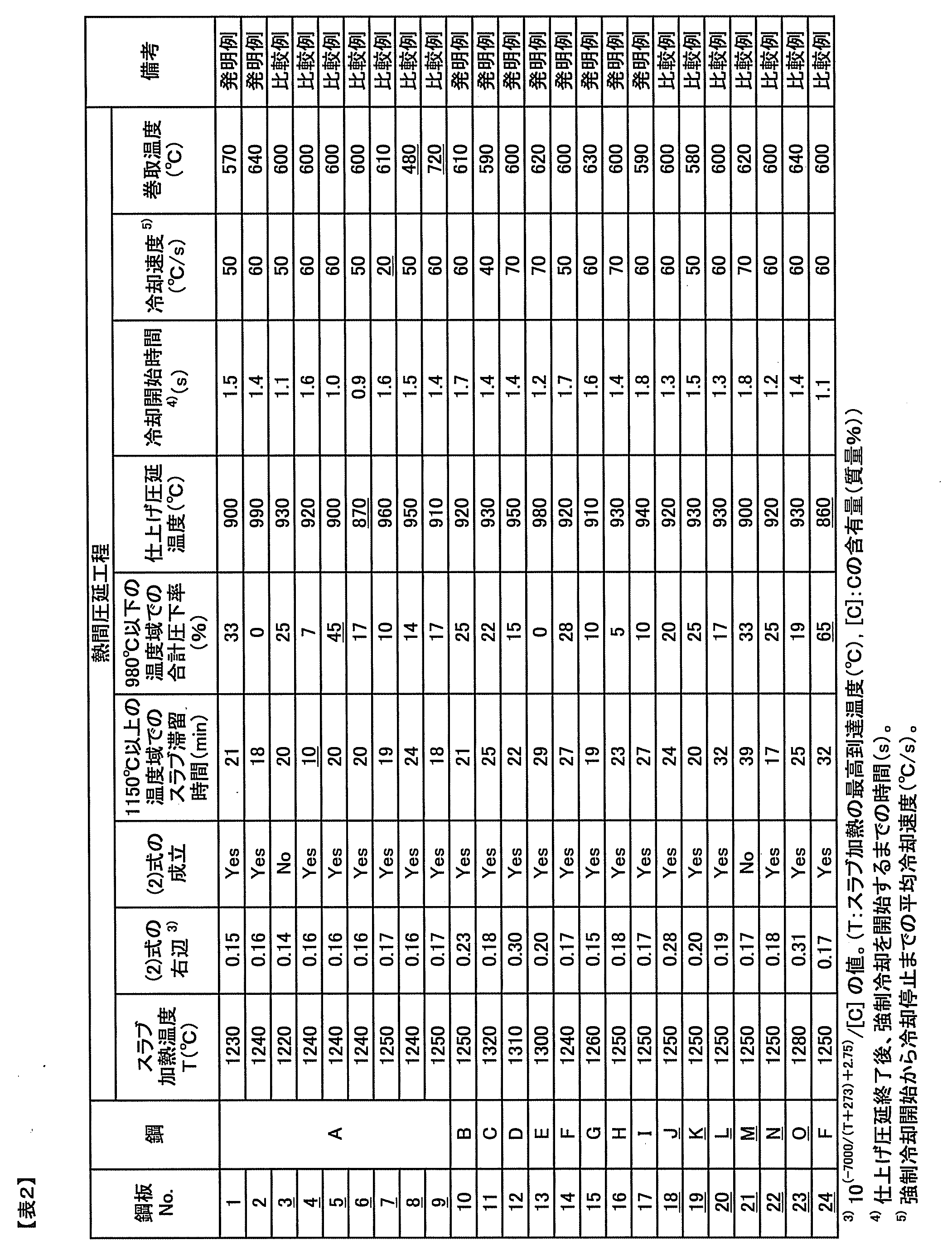
- a steel material having a thickness of 250 mm having the composition shown in Table 1 was used as a hot rolled steel sheet having a thickness of 1.2 to 3.2 mm under the hot rolling conditions shown in Table 2.
- the cooling rate described in Table 2 is an average cooling rate from the start of forced cooling to the stop of cooling.
- a part of the obtained hot-rolled steel sheet is passed through a hot dip galvanizing line with an annealing temperature of 700 to 720 ° C, and then a 460 ° C plating bath (plating composition: Zn-0.13mass% Al) It was immersed in galvanized steel sheet (GI material).
- Samples are taken from the hot-rolled steel sheet (hot-rolled steel sheet, GI material, GA material) obtained as described above, and the structure observation and the tensile test are performed.
- the area ratio of the ferrite phase, the structure type other than the ferrite phase, and the area ratio The average crystal grain size and aspect ratio of the ferrite phase, the average grain size of the carbide, the yield strength, the tensile strength, and the elongation were determined.
- the test method was as follows.
- the area ratio of the ferrite phase was evaluated by the following method. About the central part of the plate thickness with a cross section parallel to the rolling direction, the corrosion appearance structure by 5% nital was magnified 400 times with a scanning optical microscope and photographed for 10 fields of view.
- the ferrite phase is a structure having a form in which corrosion marks and cementite are not observed in the grains. Further, the area ratio and particle size were determined using polygonal ferrite, bainitic ferrite, acicular ferrite and granular ferrite as ferrite.
- the area ratio of the ferrite phase was determined by separating the ferrite phase from those other than the ferrite phase such as bainite and martensite by image analysis and determining the area ratio of the ferrite phase with respect to the observation field. At this time, the grain boundary observed as a linear form was counted as a part of the ferrite phase.
- the ferrite average crystal grain size was determined by drawing a horizontal line and a vertical line for each of the three photographs described above by a cutting method in accordance with ASTM E 112-10, and finally the average value of the three photographs is shown in Table 3.
- the aspect ratio of the crystal grains of the ferrite phase is the cross section in the L direction of the hot-rolled steel sheet, and the straight line perpendicular to the L direction with respect to the average length in which the straight line parallel to the L direction cuts the ferrite grain boundary
- the ratio of the average length to cut was determined.
- the average particle size of the carbides in the ferrite phase grains was measured by a transmission electron microscope (magnification: 120,000 times) by preparing a sample from the center of the thickness of the obtained hot-rolled steel sheet using a thin film method. It calculated
- the anisotropy of mechanical properties is the absolute value of the difference obtained by subtracting the tensile strength in the L direction from the tensile strength in the C direction, or the absolute value of the difference obtained by subtracting the total elongation in the L direction from the total elongation in the C direction. Defined.
- the absolute value of the difference in tensile strength ( ⁇ TS) is 30 MPa or less
- the absolute value of the difference in total elongation ( ⁇ EL) is 2% or less. “Good” and the others were “bad”. The obtained results are shown in Table 3.
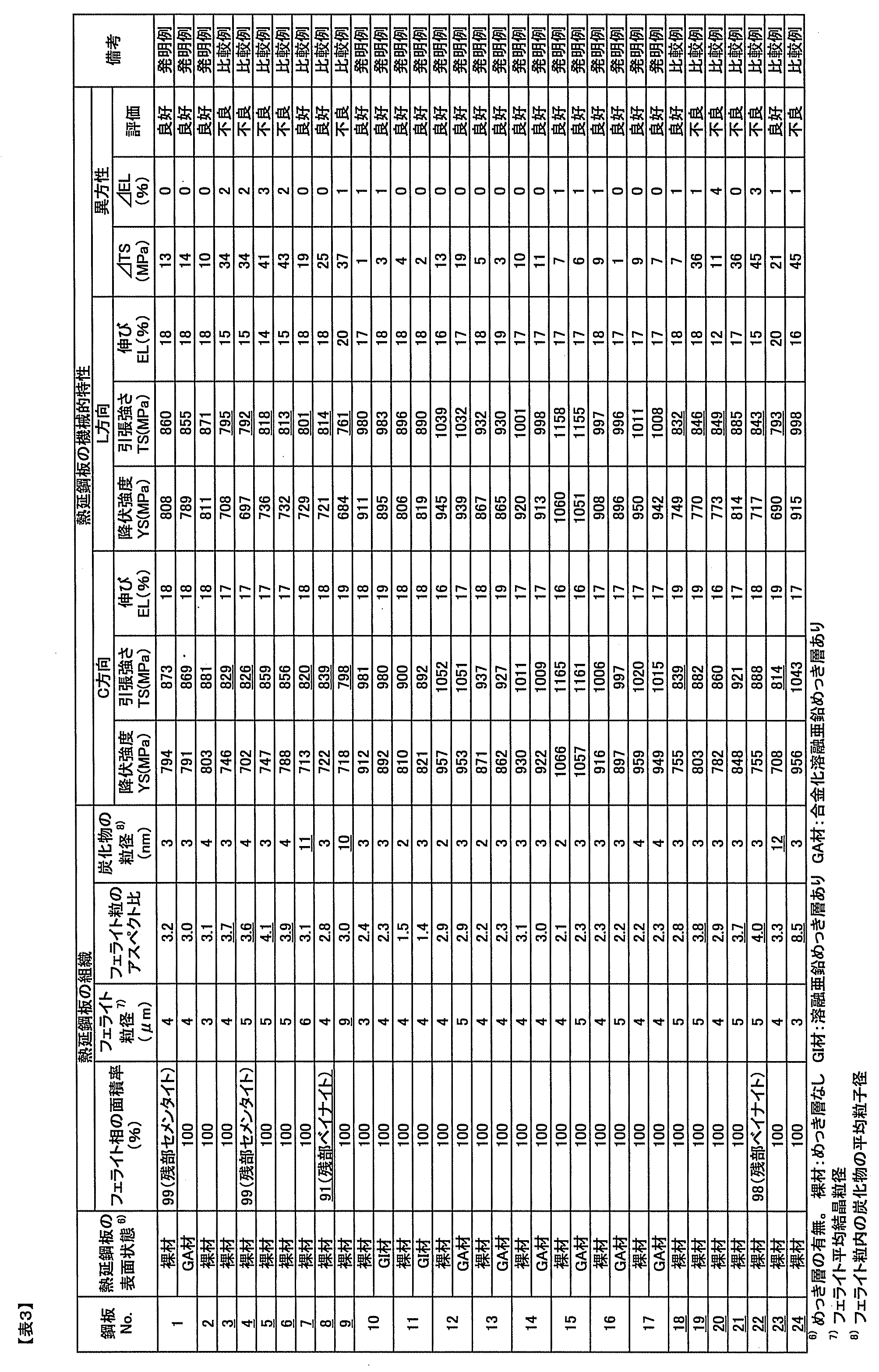
- All of the hot-rolled steel sheets of the examples of the present invention have a tensile strength TS of 850 MPa or more, have good evaluation of anisotropy of mechanical properties, and have low anisotropy of mechanical properties.
- the hot-rolled steel sheet of the comparative example does not have a predetermined strength or has large anisotropy in mechanical properties.
Landscapes
- Chemical & Material Sciences (AREA)
- Engineering & Computer Science (AREA)
- Materials Engineering (AREA)
- Mechanical Engineering (AREA)
- Metallurgy (AREA)
- Organic Chemistry (AREA)
- Physics & Mathematics (AREA)
- Thermal Sciences (AREA)
- Crystallography & Structural Chemistry (AREA)
- Heat Treatment Of Sheet Steel (AREA)
- Metal Rolling (AREA)
Abstract
Description
以上の理由により、引張強さが850MPa以上の高強度熱延鋼板を自動車部材等に適用するうえでは、機械的特性の異方性が小さい高強度熱延鋼板を工業的かつ安定的に生産する技術の開発が必須となる。
例えば、特許文献1では、鋼板組成を質量%で、C:0.02~0.08%、Si:0.01~1.50%、Mn:0.1~1.5%、Ti:0.03~0.06%を含有し、P:0.1%以下、S:0.005%以下、Al:0.5%以下、N:0.009%以下に制限し、更に、Nb、Mo、Vの含有量の合計を0.01%以下に制限し、残部がFeおよび不可避的不純物からなり、C量に対するTi量の比がTi/C:0.375~1.6である組成とし、結晶粒内のTiC析出物の平均直径を0.8~3nm、平均個数密度を1×1017[個/cm3]以上とする技術が提案されている。そして、特許文献1で提案された技術によると、炭化物形成能が最も高いTiを効率的に析出強化(precipitation strengthening)に利用することで、合金元素の添加に起因する加工性低下が抑制された引張強度:540~650MPaの省合金型高強度熱延鋼板が得られるとされている。
本発明はかかる事情に鑑みてなされたものであって、850MPa以上の引張強さを有し、しかも引張強さ、全伸び(total elongation)として評価される機械的特性の異方性を低減させた高強度熱延鋼板およびその製造方法を提供することを目的とする。
[1]鋼素材を加熱し、粗圧延と仕上げ圧延からなる熱間圧延を施し、仕上げ圧延終了後、冷却し、巻き取り、熱延鋼板とするにあたり、
前記鋼素材を、質量%で、
C :0.055%以上0.15%以下、 Si:0.2%以下、
Mn:1.3%以下、 P :0.03%以下、
S :0.007%以下、 Al:0.1%以下、
N :0.01%以下、 Ti:0.14%以上0.30%以下
を、C、S、NおよびTiが下記(1)式を満足するように含有し、不純物であるNb、BをNb:0.03%未満、B:0.0005%未満に制限し、残部がFeおよび不可避的不純物からなる組成とし、
前記加熱の加熱温度T(℃)を1150℃以上であり且つ下記(2)式を満足する温度とし、前記鋼素材が1150℃以上の温度域に滞留する時間を15分以上とし、
前記熱間圧延の980℃以下の温度域での合計圧下率を40%以下とし、
前記仕上げ圧延の仕上げ圧延温度を880℃以上とし、
前記冷却を仕上げ圧延終了後3秒以内に開始し、前記冷却の平均冷却速度を40℃/s以上200℃/s以下とし、
前記巻き取りの巻取り温度を500℃以上680℃以下とする熱延鋼板の製造方法。
記
1.0 ≦ ([C]/12)/([Ti*]/48) ・・・ (1)
[Ti*] < 10{-7000/(T+273)+2.75}/[C] ・・・ (2)
但し、[Ti*]=[Ti]-3.4×[N]-1.5×[S]
T:鋼素材の加熱温度(℃)
([C]、[S]、[N]、[Ti]:各元素の含有量(質量%))
[2]前記組成に加えてさらに、質量%でV:0.30%以下を含有する、[1]に記載の熱延鋼板の製造方法。
[3]前記組成に加えてさらに、質量%でW:1.0%以下、Mo:0.5%以下のいずれか1種以上を含有する、[1]に記載の熱延鋼板の製造方法。
[4]前記組成に加えてさらに、質量%でW:1.0%以下、Mo:0.5%以下のいずれか1種以上を含有する、[2]に記載の熱延鋼板の製造方法。
[5]前記組成に加えてさらに、質量%で、Sb、Cu、Ni、Sn、Cr、Ca、REM、Mg、Se、Te、Po、As、Bi、Ge、Pb、Ga、In、Tl、Zn、Cd、Hg、Ag、Au、Pd、Pt、Co、Rh、Ir、Ru、Os、Tc、Re、Ta、Be、Srのうちの1種以上を合計で1.0%以下含有する、[1]ないし[4]のいずれかに記載の熱延鋼板の製造方法。
[6][1]ないし[5]のいずれかの方法により製造された高強度熱延鋼板であって、フェライト相の面積率が95%以上、該フェライト相の平均結晶粒径が8μm以下、該フェライト相の結晶粒のアスペクト比が3.5以下であり、前記フェライト相の結晶粒内の炭化物平均粒子径が10nm未満である組織を有し、引張強さが850MPa以上である、熱延鋼板。
[7]鋼板表面にめっき層を有する、[6]に記載の熱延鋼板。
[8]前記めっき層が亜鉛めっき層である、[7]に記載の熱延鋼板。
[9]前記めっき層が合金化亜鉛めっき層である、[8]に記載の熱延鋼板。
[10]前記熱延鋼板の引張強さの異方性が30MPa以下である[6]ないし[9]に記載の熱延鋼板。
上記引張強さの異方性は、C方向の引張強さからL方向の引張強さを差し引いた差分の絶対値として定義される。
[11]前記熱延鋼板の全伸びの異方性が2%以下である[6]ないし[10]に記載の熱延鋼板。
上記全伸びの異方性は、C方向の全伸びからL方向の全伸びを差し引いた差分の絶対値として定義される。
まず、鋼素材の成分組成の限定理由について説明する。なお、以下の成分組成を表す%は、特に断らない限り質量%(mass%)を意味するものとする。
Cは、熱延鋼板製造時、熱間圧延終了後の冷却過程において、鋼のオーステナイト→フェライト変態前にはフェライト変態を抑制することで高温域での炭化物の析出・粗大化を抑制し、炭化物を微細化する効果を有する。また、オーステナイト→フェライト変態後には後述するTi、或いは更にW、Mo、Vと結合し炭化物として鋼板中に微細分散する。すなわちCは、微細な炭化物を形成してフェライト組織を著しく強化させる元素であり、熱延鋼板を強化するうえで必須の元素である。
C含有量が0.055%未満では、熱間圧延終了後の冷却過程において、高温域で鋼のオーステナイト→フェライト変態が生じ、炭化物の粗大化を抑制することができず、所望の強度(引張強さ:850MPa以上)を有する熱延鋼板が得られない。また、C含有量が0.055%未満では、フェライト相の結晶粒内に析出する炭化物の析出量が不十分となり、所望の鋼板強度が得られない。したがって、本発明では、C含有量を0.055%以上とする。好ましくは0.06%以上である。一方、C含有量が0.15%を超えると、鋼素材中に粗大なTi炭化物が形成される。そして、熱延鋼板を製造する工程の鋼素材再加熱時に粗大なTi炭化物を溶解しきれなくなり、最終的に得られる熱延鋼板に粗大なTi炭化物が残存してしまう。このように粗大なTi炭化物が残存すると、強度上昇に担う微細なTi炭化物の析出量が減少することで熱延鋼板の強度が急落する。また、鋼素材中に粗大なTi炭化物が存在すると、熱間圧延時においてオーステナイト粒の再結晶を阻害し、熱延鋼板の機械的特性の異方性を大きくさせることとなる。したがって、C含有量は0.15%以下とする。好ましくは0.13%以下である。
Siは、延性(伸び)低下をもたらすことなく鋼板強度を向上させる有効な元素として、従来の高強度鋼板では積極的に含有されている。しかしながら、Siは、熱延鋼板製造時、熱間圧延工程においてオーステナイト粒の再結晶を阻害し、熱延鋼板の機械的特性の異方性を助長する元素である。したがって、本発明ではSi含有量を極力低減することが望ましいが、0.2%までは許容できるため、Si含有量の上限を0.2%とする。好ましくは0.09%以下である。なお、Si含有量は不純物レベルまで低減してもよいし、ゼロであっても問題ない。
Mnは、固溶強化元素であり、Siと同様、従来の高強度鋼板では積極的に含有されているが、熱間圧延工程においてオーステナイト粒の再結晶を阻害し、熱延鋼板の機械的特性の異方性を助長する元素である。したがって、本発明ではMn含有量を極力低減することが望ましいが、1.3%までは許容できるため、Mn含有量の上限を1.3%とする。好ましくは0.5%未満であり、この範囲ではより機械的特性の異方性が改善される。但し、Mn含有量を極端に低減するとフェライト変態温度(変態点)が上昇し、熱延鋼板製造時、仕上げ圧延終了後の冷却過程でオーステナイト→フェライト変態と同時に析出する炭化物が高温に晒されることとなる。そして、このように炭化物が高温に晒されると炭化物は短時間で粗大化するため、最終的に得られる熱延鋼板の強度が低下する。このような観点から、Mn含有量は0.1%以上とすることが好ましい。
Pは、熱間圧延時、オーステナイト粒内に導入された転位に偏析して再結晶を阻害し、熱延鋼板の機械的特性の異方性を助長する。したがって、本発明ではP含有量も極力低減することが望ましいが、0.03%までは許容できるため、P含有量を0.03%以下とする。好ましくは0.02%以下である。P含有量はゼロであっても問題ない。
Sは、Mnと結合して鋼素材中に軟質な硫化物を形成する。この軟質な硫化物は、熱延鋼板製造時、熱間圧延中に楔状に引き延ばされ、熱延鋼板の圧延方向から垂直方向に対する延性を低下させる要因となる。したがって、本発明では、S含有量を極力低減することが望ましく、0.007%以下とする。好ましくは0.004%以下である。S含有量はゼロであっても問題はない。
Alは、脱酸剤として作用する元素であり、このような効果を得るためには0.01%以上含有することが望ましい。しかしながら、Alは鋼中で介在物を形成して熱間圧延工程におけるオーステナイト粒の再結晶を阻害する元素でもあり、Al含有量が0.1%を越えると再結晶への悪影響が顕在化する。したがって、Al含有量は0.1%以下とする。好ましくは0.07%以下である。
Nは、製鋼の段階で炭化物形成元素であるTiと結合して粗大な窒化物を形成し、微細な炭化物の形成を阻害するため鋼板強度を著しく低下させる。また、粗大な窒化物は、熱延鋼板製造時、熱間圧延工程においてオーステナイト粒の再結晶を著しく阻害する。したがってN含有量は極力低減することが好ましく、0.01%以下とする。好ましくは0.006%以下である。N含有量はゼロであっても問題はない。
Tiは、Cと同様、熱延鋼板製造時、熱間圧延終了後の冷却過程において、鋼のオーステナイト→フェライト変態前にはフェライト変態の進行を遅らせることで高温域での炭化物の析出・粗大化を抑制し、炭化物を微細化する効果を有する。また、オーステナイト→フェライト変態後にはCと結合し、炭化物として鋼板中に微細分散する。すなわちTiは、微細な炭化物を形成してフェライト組織を著しく強化させる元素であり、熱延鋼板を強化するうえで必須の元素である。引張強さが850MPa以上である熱延鋼板を得るためには、Ti含有量を0.14%以上とする必要がある。一方、Ti含有量が0.30%を超えると、熱延鋼板製造時、熱間圧延前の鋼素材再加熱時に粗大なTi炭化物が完全に溶解せずに残存し、熱間圧延時にオーステナイト粒の再結晶が著しく遅延する要因となる。したがって、Ti含有量は0.30%以下とする必要がある。好ましくは0.28%以下である。
なお、鋼板強度は炭化物の体積分率に比例するため、Ti含有量の80%以上を炭化物として析出させて固溶Tiを抑制することが好ましい。Ti含有量の80%以上を炭化物として析出させるには、オーステナイト→フェライト変態温度を調整することで達成される。この温度は、化学成分と熱延条件で調整できる。
1.0 ≦ ([C]/12)/([Ti*]/48) ・・・ (1)
但し、[Ti*]=[Ti]-3.4×[N]-1.5×[S]
([C]、[S]、[N]、[Ti]:各元素の含有量(質量%))
上記(1)式は、熱延鋼板の引張強さを850MPa以上とするために満足すべき要件であり、本発明において重要な指標である。
Vは、CおよびTiと結合して炭化物を形成し、熱延鋼板の更なる強化に寄与する元素である。このような効果を得るためには、V含有量を0.005%以上とすることが好ましい。一方、Vは、Tiと比べて炭化物形成能が低く、固溶状態(固溶V)として残存し易いが、この固溶Vは炭化物を粗大化させて鋼板強度を低下させる要因となる。V含有量が0.30%を超えると、固溶Vが過剰となり、鋼板強度を低下させる悪影響が顕在化することから、V含有量は0.30%以下とすることが好ましい。より好ましくは0.26%以下、さらに好ましくは0.15%以下である。
Vと同様にW、Moは、TiおよびCと結合して複合炭化物を形成し、熱延鋼板の更なる強化に寄与する元素である。また、W、Moは、熱延鋼板製造時、熱間圧延終了後の冷却過程において鋼のオーステナイト→フェライト変態の進行を遅らせる効果を有するため、熱延鋼板の製造を安定化させるうえでも有効な元素である。これらの効果を得るためには、W含有量を0.01%以上、Mo含有量を0.01%以上とすることが好ましい。一方、W含有量が1.0%超、Mo含有量が0.5%超になると、熱延鋼板製造時、熱間圧延終了後の冷却工程に続くコイル巻取り時に鋼のオーステナイト→フェライト変態が完了せず、実質的にフェライト単相組織(面積率95%以上のフェライト相)の熱延鋼板が得られなくなるおそれがある。その結果、上記オーステナイト→フェライト変態と同時に析出する炭化物の量が減少するため、熱延鋼板強度の著しい低下が懸念される。したがって、W含有量は1.0%以下、Mo含有量は0.5%以下とすることが好ましい。また、W含有量は0.01%以上0.5%以下、Mo含有量は0.01%以上0.3%以下とすることがより好ましい。
Nbは、熱間圧延時、オーステナイト粒の転位上に偏析し、その再結晶の進行を阻害する元素である。したがって、熱延鋼板の機械的特性の異方性を抑制するには、Nb含有量を0.03%未満にまで低減する必要がある。より好ましくは0.02%未満である。なお、本発明においてNbは不純物であることから、その含有量をゼロとすることが最も好ましい。
Bは、熱間圧延時、オーステナイト粒の粒界および転位上に偏析して再結晶の進行を阻害するばかりか、オーステナイト粒の再結晶温度を著しく上昇させるため、圧延中でのひずみエネルギーを蓄積させ易い元素である。オーステナイト粒が未再結晶の状態から変態した熱延鋼板のフェライト粒は圧延方向に伸展し、機械的特性の異方性を顕著に増大させる。上記観点から、Bは0.0005%未満にまで低減する必要がある。より好ましくは0.0003%未満である。なお、本発明においてBは不純物であることから、その含有量をゼロとすることが最も好ましい。
本発明において、鋼の溶製方法は特に限定されず、転炉、電気炉等、公知の溶製方法を採用することができる。また、真空脱ガス炉にて2次精錬を行ってもよい。その後、生産性や品質上の問題から連続鋳造法によりスラブ(鋼素材)とするのが好ましいが、造塊-分塊圧延法、薄スラブ連鋳法等、公知の鋳造方法でスラブとしても良い。
上記の如く得られた鋼素材(鋼スラブ)に、粗圧延および仕上げ圧延を施すが、本発明においては、粗圧延に先立ち鋼素材を加熱して実質的に均質なオーステナイト相とし、粗大な炭化物を溶解する必要がある。鋼素材の加熱温度が1150℃を下回ると、粗大なTi炭化物が溶解しないため、熱間圧延終了後の冷却・巻取り工程で微細分散する炭化物の量が減じることとなり、最終的に得られる熱延鋼板の強度が著しく低下する。したがって、鋼素材を、最高到達温度が1150℃以上となるように加熱する。好ましくは1200℃以上である。
但し、[Ti*]=[Ti]-3.4×[N]-1.5×[S]
T:鋼素材の加熱温度(℃)
([C]、[S]、[N]、[Ti]:各元素の含有量(質量%))
本発明においては、粗圧延前の鋼素材の加熱温度T(℃)を、1150℃以上にするとともに上記(2)式を満足する温度とする。
粗圧延前の鋼素材を1150℃以上の温度域で加熱しても、1150℃以上の温度域での鋼素材の滞留時間が15分を下回ると、粗大なTi炭化物を溶解しきれない。したがって、1150℃以上の温度域での鋼素材の滞留時間を15分以上とする。好ましくは20分以上である。滞留時間の上限をとくに定める必要は無いが、生産効率の観点から、滞留時間を30時間以下とすることが好ましい。
以上のように加熱された鋼素材に、所定条件の熱間圧延を施す。
上記した組成を有する本発明の鋼素材を、980℃未満の温度域で圧延すると、オーステナイト粒の再結晶の進行が遅くなり、オーステナイト粒へのひずみエネルギーの蓄積量が大きくなる。その結果、熱間圧延終了後の冷却過程において等軸に近いフェライト粒が得られなくなり、熱延鋼板の機械的特性の異方性が増大する。また、熱間圧延終了後の冷却過程における鋼のオーステナイト→フェライト変態の駆動力が上昇し、フェライト変態が高温で開始するため、炭化物が粗大化して熱延鋼板強度が低下する。
仕上げ圧延温度が880℃を下回ると、オーステナイト粒へのひずみエネルギーの蓄積が顕著になり、これに伴い熱延鋼板の機械的特性の異方性や強度に関する諸問題が顕在化する。したがって、仕上げ圧延温度は880℃以上とする。好ましくは890℃以上である。仕上げ圧延温度の上限は特に定める必要はないが、熱間圧延前の加熱温度、圧延通板速度、鋼板板厚などにより自ずと決定される。このため、実質的には仕上げ圧延温度の上限は1000℃である。
上記した組成を有する本発明の鋼素材は、フェライト変態点が高いため、仕上げ圧延後直ちに冷却しなければ高温でオーステナイト→フェライト変態が開始してしまい、炭化物が粗大化することとなる。したがって、本発明では、熱間圧延終了後速やかに強制冷却を開始する必要があり、仕上げ圧延終了後、少なくとも3s以内に冷却を開始する。好ましくは2s以内である。
仕上げ圧延終了後に続く強制冷却の平均冷却速度が40℃/s未満では、高温でオーステナイト→フェライト変態が開始し、微細な炭化物が得られず熱延鋼板強度が低下する。一方、上記平均冷却速度が200℃/sを超えると、冷却停止温度が安定せず、マルテンサイト相やベイナイト相が混在した組織となり、実質的にフェライト単相組織(面積率95%以上のフェライト相)の熱延鋼板が得られない。その結果、熱間圧延終了後の冷却・巻取り工程においてオーステナイト→フェライト変態と同時に析出する炭化物の量が減少し、熱延鋼板の引張強さが850MPaに達しない。したがって、仕上げ圧延終了後に続く強制冷却の平均冷却速度は200℃/s以下とする必要がある。好ましくは50℃/s以上150℃/s以下である。なお、平均冷却速度は、強制冷却開始から冷却停止までの平均冷却速度である。強制冷却停止後は空冷だけであるので、鋼板の温度がほとんど低下せずに鋼板は巻き取られる。通常は冷却停止温度は巻取り温度+5~10℃程度に設定される。
上記のとおり、低い温度域ではフェライト相の結晶粒内に炭化物を微細かつ多量に析出させることができる。このような観点からは、巻取り温度(およびオーステナイト→フェライト変態点)を低くすることが好ましいが、巻取り温度が500℃を下回ると、元素の拡散が遅くなる結果、十分な析出量の炭化物が得られない。一方、巻取り温度(およびオーステナイト→フェライト変態点)が680℃を超えると、オーステナイト→フェライト変態とほぼ同時に析出した炭化物が粗大化し、熱延鋼板強度が低下する。また、最終的に得られる熱延鋼板のフェライト相の平均結晶粒径が粗大化し、熱延鋼板強度が低下する。したがって、巻取り温度の範囲は500℃以上680℃以下とする必要がある。好ましくは550℃以上660℃以下である。
めっき層の付着方法としては、例えば、めっき浴に鋼板を浸漬して引き上げる方法などが挙げられる。合金化処理方法としては、例えば、めっき処理後にガス炉など、鋼板表面を加熱することができる炉内で行う方法などが挙げられる。
次に、本発明高強度熱延鋼板の組織の限定理由について説明する。
先述のとおり、本発明では、Ti等の炭化物形成元素を所定量含有する鋼素材を、オーステナイト単相域に加熱したのち熱間圧延を施し、熱間圧延終了後のオーステナイト→フェライト変態と同時に炭化物を微細かつ多量に析出させることで、熱延鋼板強度の向上を図る。また、引張強さ850MPa以上の熱延鋼板を得るためには、鋼素材中のTiのほぼ全量を微細な炭化物として析出させる必要がある。ここで、鋼板強度に寄与する炭化物は上記オーステナイト→フェライト変態に伴い析出することから、鋼素材中のTiのほぼ全量を微細な炭化物として析出させるためには上記オーステナイト→フェライト変態を促進し、最終的に得られる熱延鋼板のフェライト相の面積率を大きくすることが望ましい。
フェライト平均結晶粒径が8μmを上回ると、結晶粒微細化強化による強化量が低下し、引張強さ850MPa以上の高強度熱延鋼板が得られなくなるうえ、混粒組織となることから機械的特性にばらつきが生じ、異方性も増大する。よって、平均結晶粒径を8μm以下とする。好ましくは6μm未満である。
フェライト相の結晶粒が伸展した熱延鋼板組織になると、熱延鋼板に外力を負荷した際、フェライト相の結晶粒自体の回転や変形が外力を与えた方向で不均一になるため、熱延鋼板の機械的特性の異方性が増大する。以上の理由により、熱延鋼板の機械的特性の異方性を小さくする観点から等軸のフェライト粒であることが望ましい。上記アスペクト比が3.5を超えると、熱延鋼板の機械的特性の異方性が大きくなり、このような熱延鋼板をプレス加工するとプレス加工時に予期せぬ割れが発生する等、様々な支障をきたす。したがって、フェライト相の結晶粒のアスペクト比は3.5以下とする。好ましくは2.5以下である。
フェライト相の結晶粒内に微細析出する炭化物としては、Ti炭化物、或いは更にV炭化物、W炭化物、Mo炭化物、TiとV、W、Moの複合炭化物が挙げられる。なお、これらの炭化物の多くは、熱延鋼板製造工程における仕上げ圧延終了後の冷却・巻取り工程で、オーステナイト→フェライト変態と同時に相界面析出する炭化物である。
本発明鋼では、前記したTi等の炭化物を微細に分散させることにより強化を図っている。炭化物が粗大化すると、鋼板に変形が加わった際に生じる転位の運動を阻害する炭化物数が減じることから、炭化物は微細化するほど鋼板は高強度化する。引張強さ850MPa以上の高強度熱延鋼板を得るには、上記炭化物の平均粒子径を10nm未満とする必要がある。好ましくは6nm以下である。
なお、鋼板No.3~9、18~23を除き、巻き取りまでの冷却中にオーステナイトからフェライトへの変態は生じていないことを、別途確認している。

フェライト相の面積率は以下の手法により評価した。圧延方向に平行な断面の板厚中心部について、5%ナイタールによる腐食現出組織を走査型光学顕微鏡で400倍に拡大して10視野分撮影した。フェライト相は粒内に腐食痕やセメンタイトが観察されない形態を有する組織である。また、ポリゴナルフェライト、ベイニティックフェライト、アシキュラーフェライトおよびグラニュラーフェライトをフェライトとして面積率や粒径を求めた。フェライト相の面積率は画像解析によりフェライト相とベイナイトやマルテンサイト等のフェライト相以外を分離し、観察視野に対するフェライト相の面積率によって求めた。このとき、線状の形態として観察される粒界はフェライト相の一部として計上した。
フェライト相の結晶粒のアスペクト比は、上記と同様に熱延鋼板のL方向断面で、L方向に平行な直線がフェライト粒界を切る平均長さに対するL方向に垂直な直線がフェライト粒界を切る平均長さの比率を求めた。
得られた熱延鋼板から、JIS 5号引張試験片を、鋼板面内で圧延方向と直交する方向(C方向)、および圧延方向と平行な方向(L方向)を試験片長手方向として採取し、C方向およびL方向についてJIS Z 2241(2011)の規定に準拠した引張試験をそれぞれ5回行い、平均の降伏強度(YS)、引張強さ(TS)、全伸び(El)を求めた。引張試験のクロスヘッドスピードは10mm/minとした。機械的特性の異方性は、C方向の引張強さからL方向の引張強さを差し引いた差分の絶対値、あるいはC方向の全伸びからL方向の全伸びを差し引いた差分の絶対値として定義した。機械的特性の異方性の評価としては、上記引張強さの差分の絶対値(ΔTS)が30MPa以下であり、且つ上記全伸びの差分の絶対値(ΔEL)が2%以下であるものを「良好」、それ以外のものを「不良」とした。
得られた結果を表3に示す。
Claims (11)
- 鋼素材を加熱し、粗圧延と仕上げ圧延からなる熱間圧延を施し、仕上げ圧延終了後、冷却し、巻き取り、熱延鋼板とするにあたり、
前記鋼素材を、質量%で、
C :0.055%以上0.15%以下、 Si:0.2%以下、
Mn:1.3%以下、 P :0.03%以下、
S :0.007%以下、 Al:0.1%以下、
N :0.01%以下、 Ti:0.14%以上0.30%以下
を、C、S、NおよびTiが下記(1)式を満足するように含有し、不純物であるNb、BをNb:0.03%未満、B:0.0005%未満に制限し、残部がFeおよび不可避的不純物からなる組成とし、
前記加熱の加熱温度T(℃)を1150℃以上であり且つ下記(2)式を満足する温度とし、前記鋼素材が1150℃以上の温度域に滞留する時間を15分以上とし、
前記熱間圧延の980℃以下の温度域での合計圧下率を40%以下とし、
前記仕上げ圧延の仕上げ圧延温度を880℃以上とし、
前記冷却を仕上げ圧延終了後3秒以内に開始し、前記冷却の平均冷却速度を40℃/s以上200℃/s以下とし、
前記巻き取りの巻取り温度を500℃以上680℃以下とする熱延鋼板の製造方法。
記
1.0 ≦ ([C]/12)/([Ti*]/48) ・・・ (1)
[Ti*] < 10{-7000/(T+273)+2.75}/[C] ・・・ (2)
但し、[Ti*]=[Ti]-3.4×[N]-1.5×[S]
T:鋼素材の加熱温度(℃)
([C]、[S]、[N]、[Ti]:各元素の含有量(質量%)) - 前記組成に加えてさらに、質量%でV:0.30%以下を含有する、請求項1に記載の熱延鋼板の製造方法。
- 前記組成に加えてさらに、質量%でW:1.0%以下、Mo:0.5%以下のいずれか1種以上を含有する、請求項1に記載の熱延鋼板の製造方法。
- 前記組成に加えてさらに、質量%でW:1.0%以下、Mo:0.5%以下のいずれか1種以上を含有する、請求項2に記載の熱延鋼板の製造方法。
- 前記組成に加えてさらに、質量%で、Sb、Cu、Ni、Sn、Cr、Ca、REM、Mg、Se、Te、Po、As、Bi、Ge、Pb、Ga、In、Tl、Zn、Cd、Hg、Ag、Au、Pd、Pt、Co、Rh、Ir、Ru、Os、Tc、Re、Ta、Be、Srのうちの1種以上を合計で1.0%以下含有する、請求項1ないし4のいずれかに記載の熱延鋼板の製造方法。
- 請求項1ないし5のいずれかの方法により製造された高強度熱延鋼板であって、フェライト相の面積率が95%以上、該フェライト相の平均結晶粒径が8μm以下、該フェライト相の結晶粒のアスペクト比が3.5以下であり、前記フェライト相の結晶粒内の炭化物平均粒子径が10nm未満である組織を有し、引張強さが850MPa以上である、熱延鋼板。
- 鋼板表面にめっき層を有する、請求項6に記載の熱延鋼板。
- 前記めっき層が亜鉛めっき層である、請求項7に記載の熱延鋼板。
- 前記めっき層が合金化亜鉛めっき層である、請求項7に記載の熱延鋼板。
- 前記熱延鋼板の引張強さの異方性が30MPa以下である請求項6ないし9に記載の熱延鋼板。
上記引張強さの異方性は、C方向の引張強さからL方向の引張強さを差し引いた差分の絶対値として定義される。 - 前記熱延鋼板の全伸びの異方性が2%以下である請求項6ないし9に記載の熱延鋼板。
上記全伸びの異方性は、C方向の全伸びからL方向の全伸びを差し引いた差分の絶対値として定義される。
Priority Applications (6)
| Application Number | Priority Date | Filing Date | Title |
|---|---|---|---|
| KR1020147018576A KR101630550B1 (ko) | 2011-12-27 | 2012-12-25 | 열연 강판 및 그 제조 방법 |
| EP12863298.1A EP2799562B1 (en) | 2011-12-27 | 2012-12-25 | Hot-rolled steel sheet and process for manufacturing same |
| CN201280065192.3A CN104011234B (zh) | 2011-12-27 | 2012-12-25 | 热轧钢板及其制造方法 |
| IN1251KON2014 IN2014KN01251A (ja) | 2011-12-27 | 2012-12-25 | |
| JP2013551233A JP5610094B2 (ja) | 2011-12-27 | 2012-12-25 | 熱延鋼板およびその製造方法 |
| US14/365,392 US9534271B2 (en) | 2011-12-27 | 2012-12-25 | Hot rolled steel sheet and method for manufacturing the same |
Applications Claiming Priority (2)
| Application Number | Priority Date | Filing Date | Title |
|---|---|---|---|
| JP2011-285774 | 2011-12-27 | ||
| JP2011285774 | 2011-12-27 |
Publications (1)
| Publication Number | Publication Date |
|---|---|
| WO2013099206A1 true WO2013099206A1 (ja) | 2013-07-04 |
Family
ID=48696747
Family Applications (1)
| Application Number | Title | Priority Date | Filing Date |
|---|---|---|---|
| PCT/JP2012/008239 Ceased WO2013099206A1 (ja) | 2011-12-27 | 2012-12-25 | 熱延鋼板およびその製造方法 |
Country Status (7)
| Country | Link |
|---|---|
| US (1) | US9534271B2 (ja) |
| EP (1) | EP2799562B1 (ja) |
| JP (1) | JP5610094B2 (ja) |
| KR (1) | KR101630550B1 (ja) |
| CN (1) | CN104011234B (ja) |
| IN (1) | IN2014KN01251A (ja) |
| WO (1) | WO2013099206A1 (ja) |
Cited By (8)
| Publication number | Priority date | Publication date | Assignee | Title |
|---|---|---|---|---|
| CN104195462A (zh) * | 2014-07-24 | 2014-12-10 | 安徽广源科技发展有限公司 | 一种超高强度铸钢及其制造方法 |
| JP2015054974A (ja) * | 2013-09-10 | 2015-03-23 | Jfeスチール株式会社 | 靭性に優れた高強度熱延鋼板およびその製造方法 |
| US20150368738A1 (en) * | 2013-01-31 | 2015-12-24 | Jfe Steel Corporation | High-strength hot-rolled steel sheet and method for manufacturing the same |
| CN105349912A (zh) * | 2015-12-16 | 2016-02-24 | 常熟市凯波冶金建材机械设备厂 | 燃气轮机用轴承座 |
| US10301698B2 (en) | 2012-01-31 | 2019-05-28 | Jfe Steel Corporation | Hot-rolled steel sheet for generator rim and method for manufacturing the same |
| EP3715491A4 (en) * | 2017-11-24 | 2021-03-24 | Nippon Steel Corporation | HOT ROLLED STEEL SHEET AND MANUFACTURING METHOD FOR IT |
| JPWO2021124864A1 (ja) * | 2019-12-19 | 2021-06-24 | ||
| WO2021187238A1 (ja) * | 2020-03-19 | 2021-09-23 | 日本製鉄株式会社 | 鋼板 |
Families Citing this family (59)
| Publication number | Priority date | Publication date | Assignee | Title |
|---|---|---|---|---|
| JP5821864B2 (ja) * | 2013-01-31 | 2015-11-24 | Jfeスチール株式会社 | バーリング加工性に優れた高強度熱延鋼板およびその製造方法 |
| CN104195445A (zh) * | 2014-09-02 | 2014-12-10 | 青岛永通电梯工程有限公司 | 一种合金钢 |
| DE102014017274A1 (de) * | 2014-11-18 | 2016-05-19 | Salzgitter Flachstahl Gmbh | Höchstfester lufthärtender Mehrphasenstahl mit hervorragenden Verarbeitungseigenschaften und Verfahren zur Herstellung eines Bandes aus diesem Stahl |
| JP5958666B1 (ja) * | 2014-12-22 | 2016-08-02 | Jfeスチール株式会社 | 高強度溶融亜鉛めっき鋼板およびその製造方法 |
| KR101657835B1 (ko) * | 2014-12-24 | 2016-09-20 | 주식회사 포스코 | 프레스 성형성이 우수한 고강도 열연강판 및 그 제조방법 |
| WO2016132549A1 (ja) | 2015-02-20 | 2016-08-25 | 新日鐵住金株式会社 | 熱延鋼板 |
| KR101957078B1 (ko) | 2015-02-20 | 2019-03-11 | 신닛테츠스미킨 카부시키카이샤 | 열연 강판 |
| WO2016135898A1 (ja) | 2015-02-25 | 2016-09-01 | 新日鐵住金株式会社 | 熱延鋼板 |
| KR101980471B1 (ko) | 2015-02-25 | 2019-05-21 | 닛폰세이테츠 가부시키가이샤 | 열연 강판 |
| EP3255168B1 (en) * | 2015-03-25 | 2020-08-19 | JFE Steel Corporation | High-strength steel sheet and method for manufacturing same |
| CN107709593B (zh) * | 2015-05-29 | 2020-01-14 | 杰富意钢铁株式会社 | 热轧钢板、全硬冷轧钢板和热轧钢板的制造方法 |
| CN104962812B (zh) * | 2015-07-16 | 2017-03-08 | 武汉钢铁(集团)公司 | 具有良好板形的热连轧桥壳钢及其制造方法 |
| CN106436696A (zh) * | 2015-08-13 | 2017-02-22 | 江鹏财 | 一种路桥建设用混凝土管桩 |
| WO2017029814A1 (ja) * | 2015-08-19 | 2017-02-23 | Jfeスチール株式会社 | 高強度鋼板およびその製造方法 |
| CN107923014B (zh) * | 2015-08-19 | 2020-06-16 | 杰富意钢铁株式会社 | 高强度钢板和其制造方法 |
| CN105401096A (zh) * | 2015-11-13 | 2016-03-16 | 太仓旺美模具有限公司 | 一种高硬度耐热金属材料 |
| CN105385960A (zh) * | 2015-11-26 | 2016-03-09 | 佛山市高明区杨和金属材料专业镇技术创新中心 | 一种热轧板的生产工艺 |
| CN105568181A (zh) * | 2015-12-15 | 2016-05-11 | 常熟市强盛电力设备有限责任公司 | 风力发电机组机舱座 |
| CN105438637A (zh) * | 2015-12-24 | 2016-03-30 | 常熟市新冶机械制造有限公司 | 摩根线材打捆机 |
| CN105369164A (zh) * | 2015-12-24 | 2016-03-02 | 常熟市新冶机械制造有限公司 | 线材轧机用锥套 |
| CN105543724A (zh) * | 2015-12-24 | 2016-05-04 | 常熟市新冶机械制造有限公司 | 液压元件 |
| CN105506516A (zh) * | 2015-12-24 | 2016-04-20 | 常熟市新冶机械制造有限公司 | 密封元件 |
| CN105543659A (zh) * | 2015-12-28 | 2016-05-04 | 常熟市双灵船舶设备有限公司 | 船用双轮滑车 |
| CN105543717A (zh) * | 2016-01-12 | 2016-05-04 | 杭州科技职业技术学院 | 一种用于汽车制动泵活塞的合金材料及制备方法 |
| CN107310218B (zh) * | 2016-04-26 | 2019-03-29 | 宝山钢铁股份有限公司 | 一种复合防弹钢板及其制造方法 |
| CN107310219B (zh) * | 2016-04-26 | 2019-03-29 | 宝山钢铁股份有限公司 | 一种冷弯加工性能优良的防弹钢板及其制造方法 |
| CN105821350A (zh) * | 2016-06-21 | 2016-08-03 | 泉州市惠安闽投商贸有限公司 | 一种海洋钻井平台高压泥浆排出系统用合金材料及其制备方法 |
| CN105950995A (zh) * | 2016-07-20 | 2016-09-21 | 淮北元力金属制品有限公司 | 一种高碳钢超薄合金带及其制备工艺 |
| CN106048391A (zh) * | 2016-07-20 | 2016-10-26 | 淮北元力金属制品有限公司 | 一种冷轧光亮带钢的生产方法 |
| JP6358407B2 (ja) | 2016-08-05 | 2018-07-18 | 新日鐵住金株式会社 | 鋼板及びめっき鋼板 |
| TWI629367B (zh) | 2016-08-05 | 2018-07-11 | 日商新日鐵住金股份有限公司 | Steel plate and plated steel |
| CN106367678A (zh) * | 2016-10-11 | 2017-02-01 | 安徽卡塔门窗有限公司 | 门框用高硬度合金钢及其制备方法 |
| CN106319345A (zh) * | 2016-10-11 | 2017-01-11 | 安徽卡塔门窗有限公司 | 高硬度门窗钢及其制备方法 |
| CN106222565A (zh) * | 2016-10-11 | 2016-12-14 | 安徽卡塔门窗有限公司 | 门把手用耐磨合金钢及其制备方法 |
| CN106399827A (zh) * | 2016-10-11 | 2017-02-15 | 安徽卡塔门窗有限公司 | 高强度门窗钢及其制备方法 |
| CN106399828A (zh) * | 2016-10-11 | 2017-02-15 | 安徽卡塔门窗有限公司 | 门框用高强度合金钢及其制备方法 |
| CN107058856B (zh) * | 2017-01-24 | 2019-01-22 | 河北高新泵业有限公司 | 一种液相变质剂和制备高铬铸铁的方法 |
| JP6424908B2 (ja) * | 2017-02-06 | 2018-11-21 | Jfeスチール株式会社 | 溶融亜鉛めっき鋼板およびその製造方法 |
| RU2644708C1 (ru) * | 2017-03-20 | 2018-02-13 | Юлия Алексеевна Щепочкина | Сталь для изготовления ювелирных изделий |
| RU2639171C1 (ru) * | 2017-03-28 | 2017-12-20 | Юлия Алексеевна Щепочкина | Литейная сталь |
| CN107058888A (zh) * | 2017-05-27 | 2017-08-18 | 苏州铭晟通物资有限公司 | 一种金属五金钢材 |
| CN107119235A (zh) * | 2017-05-27 | 2017-09-01 | 太仓源壬金属科技有限公司 | 一种汽车零部件用合金材料 |
| CN107326274A (zh) * | 2017-06-02 | 2017-11-07 | 太仓市龙华塑胶有限公司 | 一种金属五金件 |
| CN107326287A (zh) * | 2017-06-09 | 2017-11-07 | 太仓东旭精密机械有限公司 | 一种机械零部件用钢 |
| CN107190218A (zh) * | 2017-06-26 | 2017-09-22 | 太仓市顺昌锻造有限公司 | 一种新型钢材 |
| CN107310192A (zh) * | 2017-08-30 | 2017-11-03 | 南通润德机械科技有限公司 | 一种新型液压机用导柱 |
| KR101963773B1 (ko) * | 2017-10-17 | 2019-03-29 | 주식회사 홍인터내셔날 | 다트 게임 장치 및 다트 게임 시스템 |
| BR112020008431A2 (pt) | 2017-11-08 | 2020-11-17 | Nippon Steel Corporation | chapa de aço |
| CN108165881A (zh) * | 2018-01-08 | 2018-06-15 | 哈尔滨工程大学 | 一种800MPa级多特性热轧钢板及其制备方法 |
| CN108546872B (zh) * | 2018-04-13 | 2020-08-04 | 武汉钢铁有限公司 | 用CSP产线生产抗拉强度≥600MPa热轧双相薄钢板及方法 |
| CN109112279A (zh) * | 2018-09-26 | 2019-01-01 | 武汉钢铁有限公司 | 800MPa级簇团强化型钢板及制备方法 |
| MX2019004536A (es) * | 2018-10-02 | 2020-10-15 | Nippon Steel Corp | Lamina de acero para carburacion, y metodo para fabricar lamina de acero para carburacion. |
| JP6897882B2 (ja) | 2018-10-19 | 2021-07-07 | 日本製鉄株式会社 | 熱延鋼板およびその製造方法 |
| WO2020241257A1 (ja) * | 2019-05-31 | 2020-12-03 | 日本製鉄株式会社 | ホットスタンプ用鋼板 |
| CN110643882A (zh) * | 2019-09-12 | 2020-01-03 | 宁波天业精密铸造有限公司 | 一种高性能冲击钢材料及其铸造方法 |
| EP3926064B1 (en) * | 2020-06-16 | 2022-08-24 | SSAB Technology AB | High strength strip steel product and method of manufacturing the same |
| CN114150225A (zh) * | 2021-12-01 | 2022-03-08 | 承德建龙特殊钢有限公司 | 一种非调质钢及其制备方法和应用 |
| CN119194253A (zh) * | 2024-09-20 | 2024-12-27 | 天津艺创节能科技有限公司 | 一种含铌微合金化高强度钢的生产方法 |
| CN120425262B (zh) * | 2025-07-09 | 2025-09-30 | 鞍钢股份有限公司 | 一种高成形性乘用车用钢及其生产方法 |
Citations (10)
| Publication number | Priority date | Publication date | Assignee | Title |
|---|---|---|---|---|
| JPH028349A (ja) | 1988-06-28 | 1990-01-11 | Kawasaki Steel Corp | 冷間加工性および溶接性に優れた引張り強さが55Kgf/mm↑2以上の高張力熱延鋼帯 |
| JPH05271865A (ja) * | 1992-03-30 | 1993-10-19 | Nippon Steel Corp | 加工性および溶接性の良い高強度熱延鋼板 |
| JP2002105595A (ja) | 2000-07-24 | 2002-04-10 | Kobe Steel Ltd | 伸びフランジ性に優れた高強度熱延鋼板およびその製造方法 |
| JP2003089848A (ja) * | 2001-09-18 | 2003-03-28 | Nkk Corp | 加工性に優れた超高張力鋼板ならびにその製造方法および加工方法 |
| JP2003138343A (ja) * | 2001-10-31 | 2003-05-14 | Nkk Corp | 材質均一性に優れた高成形性高張力熱延鋼板ならびにその製造方法および加工方法 |
| JP2006124789A (ja) * | 2004-10-29 | 2006-05-18 | Jfe Steel Kk | 加工性に優れた高強度熱延鋼板およびその製造方法 |
| JP2006161111A (ja) * | 2004-12-08 | 2006-06-22 | Sumitomo Metal Ind Ltd | 熱延鋼板とその製造方法 |
| JP2007302992A (ja) | 2006-04-11 | 2007-11-22 | Nippon Steel Corp | 伸びフランジ成形性に優れた高強度熱延鋼板及び亜鉛めっき鋼板並びにそれらの製造方法 |
| JP2008179852A (ja) * | 2007-01-24 | 2008-08-07 | Jfe Steel Kk | 高強度熱延鋼板 |
| JP2011026690A (ja) | 2009-07-29 | 2011-02-10 | Nippon Steel Corp | 省合金型高強度熱延鋼板及びその製造方法 |
Family Cites Families (11)
| Publication number | Priority date | Publication date | Assignee | Title |
|---|---|---|---|---|
| JPS60418B2 (ja) * | 1979-10-08 | 1985-01-08 | 株式会社神戸製鋼所 | 高降伏比型非調質熱延高張力鋼板の製造法 |
| EP0535238A4 (en) * | 1991-03-13 | 1993-08-04 | Kawasaki Steel Corporation | High-strength steel sheet for forming and production thereof |
| JP3433687B2 (ja) * | 1998-12-28 | 2003-08-04 | Jfeスチール株式会社 | 加工性に優れた高張力熱延鋼板およびその製造方法 |
| CA2297291C (en) * | 1999-02-09 | 2008-08-05 | Kawasaki Steel Corporation | High tensile strength hot-rolled steel sheet and method of producing the same |
| TWI248977B (en) * | 2003-06-26 | 2006-02-11 | Nippon Steel Corp | High-strength hot-rolled steel sheet excellent in shape fixability and method of producing the same |
| JP2005054255A (ja) * | 2003-08-06 | 2005-03-03 | Jfe Steel Kk | ブラウン管フレーム用高強度熱延鋼板およびその製造方法、ならびにブラウン管フレーム |
| US7955444B2 (en) * | 2005-08-05 | 2011-06-07 | Jfe Steel Corporation | High strength steel sheet and method for manufacturing the same |
| JP4226626B2 (ja) * | 2005-11-09 | 2009-02-18 | 新日本製鐵株式会社 | 音響異方性が小さく溶接性に優れる、板厚中心部も含めて降伏応力450MPa以上かつ引張強さ570MPa以上の高張力鋼板およびその製造方法 |
| JP4853082B2 (ja) * | 2006-03-30 | 2012-01-11 | 住友金属工業株式会社 | ハイドロフォーム加工用鋼板およびハイドロフォーム加工用鋼管と、これらの製造方法 |
| CN100557060C (zh) * | 2007-01-12 | 2009-11-04 | 武汉钢铁(集团)公司 | C-Mn-Ti系热轧高强度高磁感性能钢的制造方法 |
| BR112013024166B1 (pt) * | 2011-03-31 | 2019-05-28 | Nippon Steel & Sumitomo Metal Corporation | Chapa de aço laminada a quente de alta resistência contendo bainita tendo capacidade de trabalho isotrópico e método de produção da mesma |
-
2012
- 2012-12-25 IN IN1251KON2014 patent/IN2014KN01251A/en unknown
- 2012-12-25 EP EP12863298.1A patent/EP2799562B1/en active Active
- 2012-12-25 WO PCT/JP2012/008239 patent/WO2013099206A1/ja not_active Ceased
- 2012-12-25 KR KR1020147018576A patent/KR101630550B1/ko active Active
- 2012-12-25 CN CN201280065192.3A patent/CN104011234B/zh active Active
- 2012-12-25 JP JP2013551233A patent/JP5610094B2/ja active Active
- 2012-12-25 US US14/365,392 patent/US9534271B2/en not_active Expired - Fee Related
Patent Citations (10)
| Publication number | Priority date | Publication date | Assignee | Title |
|---|---|---|---|---|
| JPH028349A (ja) | 1988-06-28 | 1990-01-11 | Kawasaki Steel Corp | 冷間加工性および溶接性に優れた引張り強さが55Kgf/mm↑2以上の高張力熱延鋼帯 |
| JPH05271865A (ja) * | 1992-03-30 | 1993-10-19 | Nippon Steel Corp | 加工性および溶接性の良い高強度熱延鋼板 |
| JP2002105595A (ja) | 2000-07-24 | 2002-04-10 | Kobe Steel Ltd | 伸びフランジ性に優れた高強度熱延鋼板およびその製造方法 |
| JP2003089848A (ja) * | 2001-09-18 | 2003-03-28 | Nkk Corp | 加工性に優れた超高張力鋼板ならびにその製造方法および加工方法 |
| JP2003138343A (ja) * | 2001-10-31 | 2003-05-14 | Nkk Corp | 材質均一性に優れた高成形性高張力熱延鋼板ならびにその製造方法および加工方法 |
| JP2006124789A (ja) * | 2004-10-29 | 2006-05-18 | Jfe Steel Kk | 加工性に優れた高強度熱延鋼板およびその製造方法 |
| JP2006161111A (ja) * | 2004-12-08 | 2006-06-22 | Sumitomo Metal Ind Ltd | 熱延鋼板とその製造方法 |
| JP2007302992A (ja) | 2006-04-11 | 2007-11-22 | Nippon Steel Corp | 伸びフランジ成形性に優れた高強度熱延鋼板及び亜鉛めっき鋼板並びにそれらの製造方法 |
| JP2008179852A (ja) * | 2007-01-24 | 2008-08-07 | Jfe Steel Kk | 高強度熱延鋼板 |
| JP2011026690A (ja) | 2009-07-29 | 2011-02-10 | Nippon Steel Corp | 省合金型高強度熱延鋼板及びその製造方法 |
Non-Patent Citations (1)
| Title |
|---|
| See also references of EP2799562A4 |
Cited By (18)
| Publication number | Priority date | Publication date | Assignee | Title |
|---|---|---|---|---|
| US10301698B2 (en) | 2012-01-31 | 2019-05-28 | Jfe Steel Corporation | Hot-rolled steel sheet for generator rim and method for manufacturing the same |
| US20150368738A1 (en) * | 2013-01-31 | 2015-12-24 | Jfe Steel Corporation | High-strength hot-rolled steel sheet and method for manufacturing the same |
| JP2015054974A (ja) * | 2013-09-10 | 2015-03-23 | Jfeスチール株式会社 | 靭性に優れた高強度熱延鋼板およびその製造方法 |
| CN104195462A (zh) * | 2014-07-24 | 2014-12-10 | 安徽广源科技发展有限公司 | 一种超高强度铸钢及其制造方法 |
| CN105349912A (zh) * | 2015-12-16 | 2016-02-24 | 常熟市凯波冶金建材机械设备厂 | 燃气轮机用轴承座 |
| EP3715491A4 (en) * | 2017-11-24 | 2021-03-24 | Nippon Steel Corporation | HOT ROLLED STEEL SHEET AND MANUFACTURING METHOD FOR IT |
| JP7277835B2 (ja) | 2019-12-19 | 2023-05-19 | 日本製鉄株式会社 | 鋼板及びめっき鋼板 |
| JPWO2021124864A1 (ja) * | 2019-12-19 | 2021-06-24 | ||
| WO2021124864A1 (ja) * | 2019-12-19 | 2021-06-24 | 日本製鉄株式会社 | 鋼板及びめっき鋼板 |
| KR102726115B1 (ko) | 2019-12-19 | 2024-11-06 | 닛폰세이테츠 가부시키가이샤 | 강판 및 도금 강판 |
| KR20220088903A (ko) * | 2019-12-19 | 2022-06-28 | 닛폰세이테츠 가부시키가이샤 | 강판 및 도금 강판 |
| WO2021187238A1 (ja) * | 2020-03-19 | 2021-09-23 | 日本製鉄株式会社 | 鋼板 |
| CN115298342A (zh) * | 2020-03-19 | 2022-11-04 | 日本制铁株式会社 | 钢板 |
| KR20220138402A (ko) * | 2020-03-19 | 2022-10-12 | 닛폰세이테츠 가부시키가이샤 | 강판 |
| JP7277860B2 (ja) | 2020-03-19 | 2023-05-19 | 日本製鉄株式会社 | 鋼板 |
| CN115298342B (zh) * | 2020-03-19 | 2023-11-17 | 日本制铁株式会社 | 钢板 |
| JPWO2021187238A1 (ja) * | 2020-03-19 | 2021-09-23 | ||
| KR102799504B1 (ko) | 2020-03-19 | 2025-04-24 | 닛폰세이테츠 가부시키가이샤 | 강판 |
Also Published As
| Publication number | Publication date |
|---|---|
| KR101630550B1 (ko) | 2016-06-24 |
| CN104011234A (zh) | 2014-08-27 |
| JP5610094B2 (ja) | 2014-10-22 |
| CN104011234B (zh) | 2015-12-23 |
| EP2799562B1 (en) | 2015-10-14 |
| KR20140100983A (ko) | 2014-08-18 |
| US20150030879A1 (en) | 2015-01-29 |
| EP2799562A4 (en) | 2014-12-31 |
| EP2799562A1 (en) | 2014-11-05 |
| JPWO2013099206A1 (ja) | 2015-04-30 |
| IN2014KN01251A (ja) | 2015-10-16 |
| US9534271B2 (en) | 2017-01-03 |
Similar Documents
| Publication | Publication Date | Title |
|---|---|---|
| JP5610094B2 (ja) | 熱延鋼板およびその製造方法 | |
| JP5565534B2 (ja) | 高強度熱延鋼板及びその製造方法 | |
| JP6086081B2 (ja) | 表面性状に優れた高強度冷延鋼板およびその製造方法 | |
| JP5884472B2 (ja) | 伸びフランジ性に優れた高強度熱延鋼板およびその製造方法 | |
| JP5729523B1 (ja) | 高強度熱延鋼板およびその製造方法 | |
| WO2011162412A1 (ja) | 伸びフランジ性に優れた高強度熱延鋼板およびその製造方法 | |
| JP5915412B2 (ja) | 曲げ性に優れた高強度熱延鋼板およびその製造方法 | |
| JP6390572B2 (ja) | 冷延鋼板、めっき鋼板およびこれらの製造方法 | |
| WO2015118864A1 (ja) | 高強度熱延鋼板およびその製造方法 | |
| JP5978614B2 (ja) | 打ち抜き性に優れた高強度熱延鋼板およびその製造方法 | |
| JP5257239B2 (ja) | 延性、加工性及び靭性に優れた高強度低比重鋼板及びその製造方法 | |
| JP5887903B2 (ja) | 溶接性に優れた高強度熱延鋼板およびその製造方法 | |
| JP6390573B2 (ja) | 冷延鋼板およびその製造方法 | |
| JP5453973B2 (ja) | 高強度冷延鋼板およびその製造方法 | |
| JP6123551B2 (ja) | 耐疲労性およびスリット加工後の形状凍結性に優れた高強度熱延鋼板およびその製造方法 | |
| JP5861434B2 (ja) | 打ち抜き性に優れた高強度熱延鋼板およびその製造方法 | |
| JP6086080B2 (ja) | 高強度冷延鋼板およびその製造方法 | |
| JP7827217B2 (ja) | 熱延鋼板およびその製造方法 | |
| JP7569028B2 (ja) | 熱延鋼板およびその製造方法 | |
| JP7764841B2 (ja) | 熱延鋼板およびその製造方法 | |
| JP2025116324A (ja) | 熱延鋼板およびその製造方法 | |
| WO2025164310A1 (ja) | 熱延鋼板およびその製造方法 | |
| JP6086077B2 (ja) | 加工性に優れた高強度冷延鋼板およびその製造方法 |
Legal Events
| Date | Code | Title | Description |
|---|---|---|---|
| 121 | Ep: the epo has been informed by wipo that ep was designated in this application |
Ref document number: 12863298 Country of ref document: EP Kind code of ref document: A1 |
|
| ENP | Entry into the national phase |
Ref document number: 2013551233 Country of ref document: JP Kind code of ref document: A |
|
| WWE | Wipo information: entry into national phase |
Ref document number: 14365392 Country of ref document: US |
|
| NENP | Non-entry into the national phase |
Ref country code: DE |
|
| ENP | Entry into the national phase |
Ref document number: 20147018576 Country of ref document: KR Kind code of ref document: A |
|
| WWE | Wipo information: entry into national phase |
Ref document number: 2012863298 Country of ref document: EP |