WO2013105350A1 - 半導体装置とその製造方法 - Google Patents
半導体装置とその製造方法 Download PDFInfo
- Publication number
- WO2013105350A1 WO2013105350A1 PCT/JP2012/080624 JP2012080624W WO2013105350A1 WO 2013105350 A1 WO2013105350 A1 WO 2013105350A1 JP 2012080624 W JP2012080624 W JP 2012080624W WO 2013105350 A1 WO2013105350 A1 WO 2013105350A1
- Authority
- WO
- WIPO (PCT)
- Prior art keywords
- insulating layer
- trench
- semiconductor device
- electrode
- region
- Prior art date
- Legal status (The legal status is an assumption and is not a legal conclusion. Google has not performed a legal analysis and makes no representation as to the accuracy of the status listed.)
- Ceased
Links
Images






Classifications
-
- H—ELECTRICITY
- H10—SEMICONDUCTOR DEVICES; ELECTRIC SOLID-STATE DEVICES NOT OTHERWISE PROVIDED FOR
- H10D—INORGANIC ELECTRIC SEMICONDUCTOR DEVICES
- H10D12/00—Bipolar devices controlled by the field effect, e.g. insulated-gate bipolar transistors [IGBT]
- H10D12/01—Manufacture or treatment
- H10D12/031—Manufacture or treatment of IGBTs
- H10D12/032—Manufacture or treatment of IGBTs of vertical IGBTs
- H10D12/038—Manufacture or treatment of IGBTs of vertical IGBTs having a recessed gate, e.g. trench-gate IGBTs
-
- H—ELECTRICITY
- H10—SEMICONDUCTOR DEVICES; ELECTRIC SOLID-STATE DEVICES NOT OTHERWISE PROVIDED FOR
- H10D—INORGANIC ELECTRIC SEMICONDUCTOR DEVICES
- H10D12/00—Bipolar devices controlled by the field effect, e.g. insulated-gate bipolar transistors [IGBT]
- H10D12/411—Insulated-gate bipolar transistors [IGBT]
- H10D12/441—Vertical IGBTs
- H10D12/461—Vertical IGBTs having non-planar surfaces, e.g. having trenches, recesses or pillars in the surfaces of the emitter, base or collector regions
- H10D12/481—Vertical IGBTs having non-planar surfaces, e.g. having trenches, recesses or pillars in the surfaces of the emitter, base or collector regions having gate structures on slanted surfaces, on vertical surfaces, or in grooves, e.g. trench gate IGBTs
-
- H—ELECTRICITY
- H10—SEMICONDUCTOR DEVICES; ELECTRIC SOLID-STATE DEVICES NOT OTHERWISE PROVIDED FOR
- H10D—INORGANIC ELECTRIC SEMICONDUCTOR DEVICES
- H10D30/00—Field-effect transistors [FET]
- H10D30/60—Insulated-gate field-effect transistors [IGFET]
- H10D30/64—Double-diffused metal-oxide semiconductor [DMOS] FETs
- H10D30/66—Vertical DMOS [VDMOS] FETs
- H10D30/665—Vertical DMOS [VDMOS] FETs having edge termination structures
-
- H—ELECTRICITY
- H10—SEMICONDUCTOR DEVICES; ELECTRIC SOLID-STATE DEVICES NOT OTHERWISE PROVIDED FOR
- H10D—INORGANIC ELECTRIC SEMICONDUCTOR DEVICES
- H10D30/00—Field-effect transistors [FET]
- H10D30/60—Insulated-gate field-effect transistors [IGFET]
- H10D30/64—Double-diffused metal-oxide semiconductor [DMOS] FETs
- H10D30/66—Vertical DMOS [VDMOS] FETs
- H10D30/668—Vertical DMOS [VDMOS] FETs having trench gate electrodes, e.g. UMOS transistors
-
- H—ELECTRICITY
- H10—SEMICONDUCTOR DEVICES; ELECTRIC SOLID-STATE DEVICES NOT OTHERWISE PROVIDED FOR
- H10D—INORGANIC ELECTRIC SEMICONDUCTOR DEVICES
- H10D62/00—Semiconductor bodies, or regions thereof, of devices having potential barriers
- H10D62/10—Shapes, relative sizes or dispositions of the regions of the semiconductor bodies; Shapes of the semiconductor bodies
- H10D62/102—Constructional design considerations for preventing surface leakage or controlling electric field concentration
- H10D62/103—Constructional design considerations for preventing surface leakage or controlling electric field concentration for increasing or controlling the breakdown voltage of reverse-biased devices
- H10D62/105—Constructional design considerations for preventing surface leakage or controlling electric field concentration for increasing or controlling the breakdown voltage of reverse-biased devices by having particular doping profiles, shapes or arrangements of PN junctions; by having supplementary regions, e.g. junction termination extension [JTE]
- H10D62/109—Reduced surface field [RESURF] PN junction structures
-
- H—ELECTRICITY
- H10—SEMICONDUCTOR DEVICES; ELECTRIC SOLID-STATE DEVICES NOT OTHERWISE PROVIDED FOR
- H10D—INORGANIC ELECTRIC SEMICONDUCTOR DEVICES
- H10D64/00—Electrodes of devices having potential barriers
- H10D64/111—Field plates
- H10D64/112—Field plates comprising multiple field plate segments
-
- H—ELECTRICITY
- H10—SEMICONDUCTOR DEVICES; ELECTRIC SOLID-STATE DEVICES NOT OTHERWISE PROVIDED FOR
- H10D—INORGANIC ELECTRIC SEMICONDUCTOR DEVICES
- H10D64/00—Electrodes of devices having potential barriers
- H10D64/111—Field plates
- H10D64/117—Recessed field plates, e.g. trench field plates or buried field plates
-
- H—ELECTRICITY
- H10—SEMICONDUCTOR DEVICES; ELECTRIC SOLID-STATE DEVICES NOT OTHERWISE PROVIDED FOR
- H10D—INORGANIC ELECTRIC SEMICONDUCTOR DEVICES
- H10D62/00—Semiconductor bodies, or regions thereof, of devices having potential barriers
- H10D62/10—Shapes, relative sizes or dispositions of the regions of the semiconductor bodies; Shapes of the semiconductor bodies
- H10D62/102—Constructional design considerations for preventing surface leakage or controlling electric field concentration
- H10D62/103—Constructional design considerations for preventing surface leakage or controlling electric field concentration for increasing or controlling the breakdown voltage of reverse-biased devices
- H10D62/105—Constructional design considerations for preventing surface leakage or controlling electric field concentration for increasing or controlling the breakdown voltage of reverse-biased devices by having particular doping profiles, shapes or arrangements of PN junctions; by having supplementary regions, e.g. junction termination extension [JTE]
-
- H—ELECTRICITY
- H10—SEMICONDUCTOR DEVICES; ELECTRIC SOLID-STATE DEVICES NOT OTHERWISE PROVIDED FOR
- H10D—INORGANIC ELECTRIC SEMICONDUCTOR DEVICES
- H10D62/00—Semiconductor bodies, or regions thereof, of devices having potential barriers
- H10D62/10—Shapes, relative sizes or dispositions of the regions of the semiconductor bodies; Shapes of the semiconductor bodies
- H10D62/102—Constructional design considerations for preventing surface leakage or controlling electric field concentration
- H10D62/103—Constructional design considerations for preventing surface leakage or controlling electric field concentration for increasing or controlling the breakdown voltage of reverse-biased devices
- H10D62/105—Constructional design considerations for preventing surface leakage or controlling electric field concentration for increasing or controlling the breakdown voltage of reverse-biased devices by having particular doping profiles, shapes or arrangements of PN junctions; by having supplementary regions, e.g. junction termination extension [JTE]
- H10D62/106—Constructional design considerations for preventing surface leakage or controlling electric field concentration for increasing or controlling the breakdown voltage of reverse-biased devices by having particular doping profiles, shapes or arrangements of PN junctions; by having supplementary regions, e.g. junction termination extension [JTE] having supplementary regions doped oppositely to or in rectifying contact with regions of the semiconductor bodies, e.g. guard rings with PN or Schottky junctions
-
- H—ELECTRICITY
- H10—SEMICONDUCTOR DEVICES; ELECTRIC SOLID-STATE DEVICES NOT OTHERWISE PROVIDED FOR
- H10D—INORGANIC ELECTRIC SEMICONDUCTOR DEVICES
- H10D62/00—Semiconductor bodies, or regions thereof, of devices having potential barriers
- H10D62/10—Shapes, relative sizes or dispositions of the regions of the semiconductor bodies; Shapes of the semiconductor bodies
- H10D62/102—Constructional design considerations for preventing surface leakage or controlling electric field concentration
- H10D62/112—Constructional design considerations for preventing surface leakage or controlling electric field concentration for preventing surface leakage due to surface inversion layers, e.g. by using channel stoppers
Definitions
- the technology disclosed in this specification relates to the structure of the outer peripheral region of a semiconductor device.
- Japanese Patent Application Laid-Open No. 2005-209983 discloses a semiconductor device including an outer peripheral region between an active region where a semiconductor element is formed and an end face of a semiconductor substrate.
- An insulating layer is formed on the upper part of the outer peripheral region.
- External charges for example, ions flying from the outside
- the electric field in the semiconductor layer in the outer peripheral region is disturbed by the influence of the electric field of the external charge, a local high electric field is generated and stress is applied to the semiconductor device.
- this semiconductor device has a plurality of floating electrodes inside the insulating layer. The floating electrode can suppress the influence of the electric field of external charges on the semiconductor layer in the outer peripheral region.
- the floating electrode is disposed on the insulating layer in the upper part of the outer peripheral region so as to form two layers.
- the floating electrode in the lower layer is disposed so as to partially overlap the floating electrode in the upper layer. This ensures a high capacity between the floating electrodes.
- the capacitance between the floating electrodes By increasing the capacitance between the floating electrodes in this way, the amount of charge stored in the capacitor between the floating electrodes is increased. As a result, the influence of the external electric field on the semiconductor layer in the outer peripheral region can be further reduced.
- the conventional semiconductor device has a problem that the manufacturing efficiency is poor. Therefore, the present specification provides a semiconductor device that can suppress the influence of external charges and can be efficiently manufactured.
- the semiconductor device disclosed in this specification includes a semiconductor substrate.
- the semiconductor substrate has an active region in which a semiconductor element is formed and an outer peripheral region between the active region and the end face of the semiconductor substrate.
- An insulating layer is formed on at least a part of the upper surface of the outer peripheral region.
- a plurality of floating electrodes whose width in the thickness direction of the semiconductor substrate is larger than the width in the direction from the active region toward the end surface of the semiconductor substrate are spaced apart along the direction from the active region toward the end surface of the semiconductor substrate. are arranged.
- each floating electrode extends long in the thickness direction of the semiconductor substrate. Further, the floating electrodes are arranged at intervals in a direction from the active region toward the end face of the semiconductor substrate. Therefore, the wide surfaces of the floating electrodes face each other in the direction from the active region toward the end surface of the semiconductor substrate. For this reason, the capacity
- the present specification also provides a method for manufacturing a semiconductor device.
- This manufacturing method includes a step of forming an insulating layer on an outer peripheral region between an active region of a semiconductor substrate where a semiconductor element is formed and a portion serving as an end face of the semiconductor device, and a thickness of the semiconductor substrate on the insulating layer. Forming a plurality of trenches having a width in a direction larger than a width in a direction from the active region toward the end surface of the semiconductor substrate at intervals along a direction from the active region toward the end surface of the semiconductor device And a step of forming a metal layer on the insulating layer, and a metal layer remains in each trench without masking the metal layer on the upper portion of the trench, and the metal layers in each trench are separated from each other. And a step of etching the metal layer.
- the metal layer is also formed in the trench.
- the metal layer outside the trench is removed, and the metal layer is left in the trench.
- the metal layers in each trench are separated from each other.
- the etching rate of the metal layer in the trench is extremely slow. For this reason, the metal layer can easily remain in the trench.
- the plurality of metal layers remaining in the trench have a width in the thickness direction of the semiconductor substrate that is larger than a width in the direction from the active region toward the end surface of the semiconductor substrate, and is spaced along the direction from the active region toward the end surface of the semiconductor substrate.
- a plurality of floating electrodes are provided apart from each other. Therefore, according to this manufacturing method, it is possible to manufacture a semiconductor device having an outer peripheral region that is not easily affected by external charges. Further, in this manufacturing method, it is only necessary to form a single floating electrode, and the floating electrode can be easily formed as described above. Therefore, according to this manufacturing method, a semiconductor device can be manufactured efficiently.
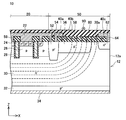
- 1 is a longitudinal sectional view of a semiconductor device 10.
- FIG. The figure which shows arrangement
- 1 is a longitudinal sectional view of a semiconductor wafer showing a manufacturing process of a semiconductor device 10.
- 1 is a longitudinal sectional view of a semiconductor wafer showing a manufacturing process of a semiconductor device 10.
- 1 is a longitudinal sectional view of a semiconductor wafer showing a manufacturing process of a semiconductor device 10.
- 1 is a longitudinal sectional view of a semiconductor wafer showing a manufacturing process of a semiconductor device 10.
- 1 is a longitudinal sectional view of a semiconductor wafer showing a manufacturing process of a semiconductor device 10.
- 1 is a longitudinal sectional view of a semiconductor wafer showing a manufacturing process of a semiconductor device 10.
- FIG. 1 is a longitudinal sectional view of a semiconductor wafer showing a manufacturing process of a semiconductor device 10.
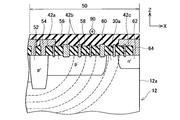
- FIG. 6 is a longitudinal sectional view of a semiconductor device 10a according to a second embodiment.
- FIG. 6 is a plan view of a semiconductor device 10a according to a second embodiment.
- FIG. 10 is a partial enlarged view of an outer peripheral region 50 of a semiconductor device according to a modification of the second embodiment.
- FIG. 10 is a partially enlarged view of an outer peripheral region 50 of a semiconductor device according to another modification of the second embodiment.
- FIG. 10 is a partially enlarged view of an outer peripheral region 50 of a semiconductor device according to another modification of the second embodiment.
- FIG. 10 is a partially enlarged view of an outer peripheral region 50 of a semiconductor device according to another modification of the second embodiment.
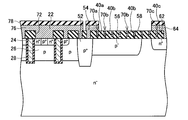
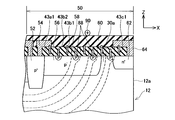
- FIG. 10 is a longitudinal sectional view of a semiconductor device 10b according to a third embodiment.
- FIG. 10 is a partially enlarged view of an outer peripheral region 50 of a semiconductor device according to a modification of the third embodiment.
- FIG. 10 is a partially enlarged view of an outer peripheral region 50 of a semiconductor device according to another modification of the third embodiment.
- FIG. 10 is a partially enlarged view of an outer peripheral region 50 of a semiconductor device according to another modification of the third embodiment.
- FIG. 10 is a partially enlarged view of an outer peripheral region 50 of a semiconductor device according to another modification of the third embodiment.
- FIG. 10 is a partially enlarged view of an outer peripheral region 50 of a semiconductor device according to another modification of the third embodiment.
- FIG. 10
- the floating electrode disposed in the insulating layer may be exposed on at least one surface of the upper surface or the lower surface of the insulating layer.
- the floating electrode When the floating electrode is exposed on the upper surface of the insulating layer, it is not necessary to embed the floating electrode in the insulating layer, so that the floating electrode can be easily formed.
- the floating electrode When the floating electrode is exposed on the lower surface of the insulating layer, it is possible to physically block the movement of external charges on the lower surface side of the insulating layer.
- At least one floating electrode is disposed on an arbitrary straight line from the active region toward the end surface of the semiconductor substrate. May be present. According to this configuration, the movement of the external charge within the insulating layer is suppressed, and the local concentration of the external charge can be suppressed.
- the floating electrode is exposed on the upper surface of the insulating layer and may not be exposed on the lower surface of the insulating layer. According to this configuration, the semiconductor region is prevented from being etched when the floating electrode is formed.
- the floating electrode may be exposed on the upper surface and the lower surface of the insulating layer.
- the region between the floating electrodes adjacent to each other in the insulating layer is a closed space in the direction from the active region toward the end face of the semiconductor substrate, so that the external charges and the movable ions present in the insulating layer are It can only move within that closed space. That is, the movement of the external charges and mobile ions can be physically blocked.
- the plurality of floating electrodes arranged in the insulating layer includes a first floating electrode exposed on the upper surface of the insulating layer and a second floating electrode exposed on the lower surface of the insulating layer.
- the first floating electrode and the second floating electrode may be alternately arranged. According to this configuration, the wide surfaces of the first floating electrode and the second floating electrode face each other. For this reason, the capacity
- the lower surface and the side corners of the floating electrode may be curved in a cross section obtained by cutting the floating electrode along a plane orthogonal to the longitudinal direction.
- the corner portion in the cross section of the floating electrode has a substantially right angle (that is, the cross section is rectangular)
- the electric field tends to concentrate on the substantially right corner portion. Therefore, by making the corner portion into a curved shape, electric field concentration on the corner portion is suppressed, and a decrease in breakdown voltage can be effectively suppressed.
- the manufacturing method in the step of forming the insulating layer, it is preferable to form the insulating layer also on the active region.
- the manufacturing method preferably further includes a step of forming a contact hole in the insulating layer on the active region before the step of forming the metal layer.
- the step of forming the metal layer in the step of forming the metal layer, the step of forming the metal layer in the contact hole and etching the metal layer is preferably performed in a state where the metal layer above the contact hole is masked. According to such a configuration, not only the floating electrode but also an electrode that is electrically connected to the active region through the contact hole can be formed by the metal layer. Therefore, a semiconductor device can be manufactured more efficiently.
- the step of forming a trench and the step of forming a contact hole may be performed by common etching. According to such a configuration, a semiconductor device can be manufactured more efficiently.
- a semiconductor device 10 shown in FIG. 1 includes a semiconductor substrate 12 and electrodes, insulating layers, and the like formed on the upper and lower surfaces of the semiconductor substrate 12.
- the semiconductor substrate 12 has an active region 20 and an outer peripheral region 50.
- An IGBT is formed in the active region 20.
- the active region 20 is formed at a substantially central portion of the semiconductor substrate 12 when the semiconductor substrate 12 is viewed from the upper surface side.
- the outer peripheral region 50 is a region between the active region 20 and the end surface (outer peripheral surface) 12 a of the semiconductor substrate 12. Therefore, the active region 20 is surrounded by the outer peripheral region 50 when the semiconductor substrate 12 is viewed from above.
- a trench is formed on the upper surface of the active region 20.
- the inner surface of the trench is covered with a gate insulating film.
- a gate electrode 28 is formed in the trench.
- the upper surface of the gate electrode 28 is covered with an insulating layer 58.
- An emitter electrode 22 is formed on the upper surface of the active region 20.
- the emitter electrode 22 is insulated from the gate electrode 28 by the insulating layer 58.
- a collector electrode 34 is formed on the lower surface of the semiconductor substrate 12.
- an n-type emitter region 24, a p-type body region 26, an n-type drift region 30, and a p-type collector region 32 are formed.
- the emitter region 24 is formed in a range exposed on the upper surface of the semiconductor substrate 12.
- the emitter region 24 is formed in a range in contact with the gate insulating film.
- the emitter region 24 is ohmically connected to the emitter electrode 22.
- the body region 26 is formed on the side of the emitter region 24 and below the emitter region 24.
- the body region 26 is in contact with the gate insulating film below the emitter region 24.
- the body region 26 between the two emitter regions 24 has a high p-type impurity concentration and is ohmically connected to the emitter electrode 22.
- the drift region 30 is formed below the body region 26.
- the drift region 30 is separated from the emitter region 24 by the body region 26.
- the drift region 30 is in contact with the gate insulating film at the lower end of the trench.
- the collector region 32 is formed below the drift region 30.
- the collector region 32 has a high p-type impurity concentration and is ohmically connected to the collector electrode 34.
- An IGBT is formed in the active region 20 by each electrode and each semiconductor region described above.
- a deep p-type region 52 In the outer peripheral region 50, a deep p-type region 52, a resurf region 56, and an end n-type region 62 are formed.
- the deep p-type region 52 is located at the boundary between the active region 20 and the outer peripheral region 50.
- the deep p-type region 52 is formed in a range exposed on the upper surface of the semiconductor substrate 12. Deep p-type region 52 is in contact with body region 26.
- the deep p-type region 52 is formed to a depth deeper than the gate electrode 28 in the active region 20.
- the deep p-type region 52 contains a p-type impurity at a high concentration, and is ohmically connected to the electrodes 22 and 54 formed on the deep p-type region 52.
- the RESURF region 56 is adjacent to the deep p-type region 52.
- the RESURF region 56 is formed in a range exposed on the upper surface of the semiconductor substrate 12.
- the RESURF region 56 is formed in a shallower range than the deep p-type region 52.
- the p-type impurity concentration of the RESURF region 56 is lower than that of the deep p-type region 52.
- the p-type impurity concentration of the RESURF region 56 is lower than the n-type impurity concentration of the end n-type region 62.
- the end n-type region 62 is formed in a range exposed on the end surface 12 a of the semiconductor substrate 12 and exposed on the upper surface of the semiconductor substrate 12.
- the end n-type region 62 contains an n-type impurity at a relatively high concentration, and is ohmically connected to the electrode 64 formed on the end n-type region 62.
- the drift region 30 described above is formed below the deep p-type region 52, the resurf region 56, and the end n-type region 62. That is, the drift region 30 extends from the active region 20 to the outer peripheral region 50.
- the drift region 30 also exists in a range between the RESURF region 56 and the end n-type region 62 and is exposed on the upper surface of the semiconductor substrate 12 within the range.
- the drift region 30 between the RESURF region 56 and the end n-type region 62 is referred to as a peripheral drift region 30a.
- the n-type impurity concentration of the drift region 30 is lower than the p-type impurity concentration of the deep p-type region 52 and lower than the n-type impurity concentration of the end n-type region 62. Also in the outer peripheral region 50, the collector region 32 is formed below the drift region 30.
- an insulating layer 58 On the outer peripheral region 50, an insulating layer 58, an insulating layer 60, and a plurality of trench electrodes 40 (40a to 40c) are formed.
- the insulating layer 58 is shown to be thicker than the actual thickness in consideration of easy viewing.
- the insulating layer 58 is formed in a range in contact with the upper surface of the semiconductor substrate 12.
- Insulating layer 58 is composed of SiO 2.
- the insulating layer 58 covers the upper surfaces of the RESURF region 56 and the peripheral drift region 30a.
- the insulating layer 58 is also formed in other regions (such as on the gate electrode 28 in the active region 20).
- the plurality of trench electrodes 40 are formed in the insulating layer 58.
- each trench electrode 40 extends along the thickness direction of the semiconductor substrate 12. That is, each trench electrode 40 has a width in the Z direction larger than a width in the X direction.
- each trench electrode 40 extends along the end surface 12 a of the semiconductor substrate 12 so as to go around the active region 20. Yes.
- the trench electrodes 40 are arranged at intervals along the direction from the active region 20 toward the end face 12 a of the semiconductor substrate 12.
- each trench electrode 40 faces the wide surface of the other trench electrode 40.
- capacitance between each trench electrode 40 namely, capacity
- the trench electrodes 40 are arranged at substantially equal intervals. Each trench electrode 40 is electrically isolated from each other. As shown in FIG. 1, the trench electrode 40 a closest to the active region 20 is connected to the electrode 54. The trench electrode 40 c closest to the end face 12 a is connected to the electrode 64. The other trench electrodes 40b are not connected to other electrodes. For this reason, the electric potential of each trench electrode 40b changes with the electric potential distribution of the circumference
- the insulating layer 60 is made of SiN and covers the insulating layer 60 and each electrode. Therefore, the upper surface of each trench electrode 40 is covered with the insulating layer 60.
- a high voltage Vce is applied between the collector electrode 34 and the emitter electrode 22.
- the end n-type region 62 has substantially the same potential as the collector electrode 34.
- the deep p-type region 52 has substantially the same potential as the emitter electrode 22. Therefore, a voltage V 1 that is substantially equal to the voltage V ce is applied between the end n-type region 62 and the deep p-type region 52. Then, a depletion layer spreads from the deep p-type region 52 toward the end n-type region 62.
- the RESURF region 56 promotes the elongation of this depletion layer.
- the depletion layer extends over substantially the entire RESURF region 56 and the peripheral drift region 30a.
- the insulating property between the end n-type region 62 and the deep p-type region 52 is ensured by the depletion layer spreading in this way. For this reason, when the IGBT is turned off, equipotential lines are distributed in the semiconductor substrate 12 as shown by the dotted lines in FIG.
- the trench electrode 40 a is connected to the deep p-type region 52 through the electrode 54.
- the trench electrode 40 c is connected to the end n-type region 62 through the electrode 64. Therefore, a voltage substantially equal to the voltage V1 between the end n-type region 62 and the deep p-type region 52 is applied between the trench electrode 40a and the trench electrode 40c.
- a plurality of trench electrodes 40b exist inside the insulating layer 58 between the trench electrodes 40a and 40c. For this reason, a voltage obtained by dividing the voltage V ⁇ b> 1 is applied between these trench electrodes 40. Since the trench electrodes 40 are arranged at substantially equal intervals, the potential differences between the trench electrodes 40 are substantially equal to each other. For this reason, as shown in FIG. 1, equipotential lines are distributed in the outer peripheral region 50 at substantially equal intervals. Therefore, the electric fields in the RESURF region 56 and the peripheral drift region 30a are made uniform, and the occurrence of a local high electric field is suppressed.
- foreign charges 90 for example, movable ions such as Na, Cu, Cl, etc.
- foreign charges 90 may adhere to the surface of the outer peripheral region 50.
- electric field generated by the external charge 90 disturbs the electric field in the outer peripheral region 50
- electric field concentration occurs in the outer peripheral region 50.
- a plurality of trench electrodes 40 are formed in the insulating layer 58 on the surface of the outer peripheral region 50. Electric charges are stored in each capacitor formed by each trench electrode 40 by a voltage applied thereto. The electric field generated by the electric charge stored in each capacitor suppresses the electric field from the external charge 90 from affecting the resurf region 56 and the peripheral drift region 30a.
- each trench electrode 40 is disposed so that the wide surfaces face each other, the capacitance of each capacitor described above is large. For this reason, the amount of charge stored in each capacitor is large. Further, the external electric charge is moved to one trench electrode 40 by the electric field generated between the trench electrodes 40 and fixed there. For this reason, it is more effectively suppressed that the electric field from the external charge 90 affects the RESURF region 56 and the peripheral drift region 30a. Therefore, in this semiconductor device 10, it is possible to effectively suppress the generation of a local high electric field in the outer peripheral region 50 due to the adhesion of the external charge 90. For this reason, the semiconductor device 10 is excellent in withstand voltage characteristics.
- each semiconductor layer (emitter region 24, body region 26, deep p-type region 52, RESURF region) is formed on the upper surface side of the n-type semiconductor wafer. 56, an end n-type region 62), a gate electrode 28 and a gate insulating film are formed. These are formed by a conventionally known method.
- an insulating layer 58 (SiO 2 layer) is formed over the entire upper surface of the semiconductor wafer.
- the insulating layer 58 is etched by RIE or dry etching.
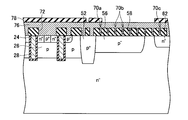
- the trench 70 (trench 70a to 70c) and the contact hole 72 are formed.
- the trench 70a is a trench in which the trench electrode 40a is formed
- the trench 70b is a trench in which the trench electrode 40b is formed
- the trench 70c is a trench in which the trench electrode 40c is formed.
- the trench 70 is formed so as not to reach the semiconductor layer (that is, the insulating layer 58 remains below the bottom surface of the trench 70).
- the contact hole 72 is a hole for connecting the electrodes 22, 54, 64 and the like to the semiconductor layer.
- the contact hole 72 is formed so as to reach the semiconductor layer.
- the width of the trench 70 is narrower than that of the contact hole 72. Therefore, the etching rate in the region where the trench 70 is formed is lower than the etching rate in the region where the contact hole 72 is formed. Therefore, the trench 70 that does not reach the semiconductor layer and the contact hole 72 that reaches the semiconductor layer can be formed by one etching. After the trench 70 and the contact hole 72 are formed, the mask 74 is removed.
- a metal layer 76 is formed on the semiconductor wafer by sputtering or the like. At this time, the metal layer 76 is also filled in the trench 70 and the contact hole 72. Here, the upper surface of the metal layer 76 is substantially planarized by forming the metal layer 76 thick.
- a mask 78 is formed on the surface of the metal layer 76 to be left as electrodes such as the electrodes 22, 54 and 64.
- the mask 78 is not formed on the surface of the metal layer 76 on the trench 70b.
- the metal layer 76 is etched, and the metal layer 76 is patterned as shown in FIG. Thereby, the emitter electrode 22, the electrode 54, and the electrode 64 are formed.
- the metal layer 76 in the trench 70a becomes the trench electrode 40a
- the metal layer 76 in the trench 70c becomes the trench electrode 40c.
- etching is performed so that the metal layer 76 on the insulating layer 58 in a range where the mask 78 is not formed is removed and the metal layer 76 remains in the trench 70b. Since the width of the trench 70b is narrow, the etching rate in the trench 70b becomes extremely slow. Therefore, the metal layer 76 can easily remain in the trench 70b. As a result, the metal layers 76 in the trenches 70b are separated from each other, and the trench electrode 40b is formed.
- an insulating layer 60 (SiN layer) is formed on the semiconductor wafer. Thereby, the structure on the upper surface side of the semiconductor device 10 is completed. Thereafter, the lower surface structure (collector region 32, collector electrode 34) is formed by a conventionally known method. Then, the semiconductor device 10 shown in FIG. 1 is completed by dicing the semiconductor wafer.
- the trench electrode 40 is formed together with the other electrodes by the metal layer 76.
- the trench layer 40b is formed by separating the metal layers 76 in each trench 70b from each other at the same time.
- the SiO 2 insulating layer 58 is formed below the trench electrode 40.
- an SiN insulating layer 68 may be formed below the trench electrode 40.
- SiN and SiO 2 can be selectively etched. Therefore, in the step of forming the trench 70 in the SiO 2 insulating layer 58, the etching does not proceed any more when the trench 70 reaches the SiN insulating layer 68. Therefore, it is possible to prevent the trench 70 from being formed deeper than intended. According to this configuration, the etching time can be managed more easily.
- the trench electrode 40 extends long along the end face 12a.
- the trench electrode 40 may extend in a broken line shape.
- the trench electrode 40 may be formed in a dot shape.
- the IGBT is formed in the active region.
- other semiconductor elements such as a MOS-FET or a diode may be formed in the active region.
- a semiconductor device 10a according to the second embodiment will be described with reference to FIGS.
- the semiconductor device 10a according to the second embodiment is obtained by changing a part of the semiconductor device 10 according to the first embodiment. Therefore, here, differences from the semiconductor device 10 of the first embodiment will be described.
- the same members as those of the semiconductor device 10 of the first embodiment are denoted by the same reference numerals, and detailed description thereof is omitted.
- each trench electrode 41 extends along the thickness direction of the semiconductor substrate 12. That is, each trench electrode 41 has a width in the Z direction larger than a width in the X direction. Further, the width in the X direction is substantially equal in each trench electrode 41.
- Each trench electrode 41 is exposed on the upper and lower surfaces of the insulating layer 58.
- the upper portions of the trench electrodes 41 a and 41 c are respectively located in the electrodes 54 and 64 covering a part of the upper surface of the insulating layer 58, and the upper portion of the trench electrode 41 b is the upper surface of the insulating layer 58.
- the lower part of the trench electrode 41 is located in the semiconductor layer. That is, each trench electrode 41 is formed so as to penetrate the insulating layer 58 in the Z direction.
- each trench electrode 41 extends along the end surface 12 a of the semiconductor substrate 12 so as to go around the active region 20.
- the upper and side corner portions of the trench electrode 41 and the lower and side corner portions of the trench electrode 41 are curved.
- the trench electrode 41 has a cross-section with rounded corners at four corners of the rectangle.
- the above-mentioned “plane perpendicular to the longitudinal direction” is the position where the trench electrode 41 is rounded and bent at the corner portions C1 to C4 of the rectangular active region 20.
- the plane extending in the Z direction including the tangent line TL at the contact P and the straight line L perpendicular to the contact P corresponds to an example of “a plane perpendicular to the longitudinal direction”.
- the trench electrodes 41 are arranged at substantially equal intervals along the X direction in FIG.
- each trench electrode 41 is formed on an arbitrary straight line from the active region 20 toward the end surface 12a of the semiconductor substrate 12. Will exist.
- Each trench electrode 41 is electrically isolated from each other. As shown in FIG. 12, the trench electrode 41 a closest to the active region 20 is connected to the electrode 54. The trench electrode 41 c closest to the end face 12 a is connected to the electrode 64. Other trench electrodes 41b are not connected to other electrodes. For this reason, the electric potential of each trench electrode 41b changes with the electric potential distribution of the circumference
- the semiconductor device 10a according to the second embodiment has the same effects as the semiconductor device 10 according to the first embodiment.
- the trench electrode 41 is formed so as to penetrate the insulating layer 58 in the Z direction. That is, a region between adjacent trench electrodes 41 in the insulating layer 58 is a closed space in the X direction of FIG. For this reason, the external charges and the movable ions that existed in advance in the insulating layer 58 can move only within the closed space. Thus, the trench electrode 41 physically blocks the movement of the external charges and the movable ions.
- the semiconductor device 10a can ensure excellent breakdown voltage characteristics.
- the trench electrode 41 of the present embodiment forms a capacitor between the adjacent trench electrodes 41 in addition to physically blocking the movement of the foreign charge and movable ions, and the external charge and the movable ion are generated by the electric field between the capacitors. Needless to say, local ion generation can be suppressed by moving ions to one side of the capacitor and fixing the ions.
- the corner portion of the trench electrode 41 by making the corner portion of the trench electrode 41 curved, it is possible to suppress the occurrence of electric field concentration in the corner portion and to suppress the decrease in the initial breakdown voltage. Furthermore, since the trench electrode 41 of this embodiment is formed so as to protrude from the upper surface and the lower surface of the insulating layer 58, it can be easily manufactured as compared with the case where the trench electrode 41 is embedded in the insulating layer 58. . In the case where the trench electrode 41 is formed of polysilicon, it is formed of the same material as other portions (for example, the gate electrode 28) of the semiconductor device 10a. For this reason, it is not necessary to prepare a new material for the trench electrode, and an increase in manufacturing cost can be suppressed.
- FIGS. 14 to 17 show only the outer peripheral region 50, and differences from the semiconductor device 10a of the second embodiment will be described. Note that the same reference numerals are used for the same members as those of the semiconductor device 10a of the second embodiment, and the detailed description thereof is omitted.
- the trench electrodes 42 (42a to 42c) of Modification 1 differ from the trench electrode 41 of Embodiment 2 in that the widths in the X direction are not the same.
- the trench electrode 42 is arrange
- the semiconductor device of Modification 1 has the same function and effect as the semiconductor device 10a of Embodiment 2.
- the semiconductor device of Modification 2 is different from the semiconductor device 10 a of Example 2 in that a plurality of electrodes 74 are formed on the upper surface of the insulating layer 58.
- the electrode 74 is formed on the upper surface of the insulating layer 58 and is disposed so as not to contact the trench electrode 41 protruding from the upper surface of the insulating layer 58. Thereby, a capacitor is also formed between the adjacent electrodes 74.
- the external charge is physically suppressed from adhering to the upper surface of the insulating layer 58, and the external charge enters the insulating layer 58 electrically by the capacitor formed by the electrode 74. Can be suppressed.
- the electrode 74 is formed of, for example, the same metal (for example, aluminum) as the metal that forms the electrodes 54 and 64, but the material that forms the electrode 74 is not limited to this.
- the electrode 74 may be formed of polysilicon.
- the semiconductor device of Modification 3 is different from the semiconductor device 10a of Example 2 in that a semiconductive silicon nitride film (so-called SInSiN film) 78 is formed on the upper surface of the insulating layer 58. .
- the semiconductive silicon nitride film 78 is located between the electrode 54 and the electrode 64, contacts the upper surface of the insulating layer 58, and at least a part of one side surface of the electrode 54 and one side surface of the electrode 64. It is formed so that it may contact at least a part of. That is, the semiconductive silicon nitride film 78 is formed so as to cover the trench electrode 41 b and is connected to the electrodes 54 and 64. According to this configuration, it is possible to suppress the external charge from adhering to the upper surface of the insulating layer 58, and it is possible to suppress the breakdown voltage from being reduced due to the external charge.
- the semiconductor device of Modification 4 is different from the semiconductor device 10 a of Example 2 in that a plurality of p-type diffusion layers 80 are formed below the trench electrode 41.
- the p-type diffusion layer 80 is formed under the trench electrodes 41a and 41b exposed in the RESURF region 56 and the peripheral drift region 30a. That is, the p-type diffusion layer 80 is not formed below the trench electrode 41 c exposed at the end n-type region 62.
- the impurity concentration of the p-type diffusion layer 80 is higher than the p-type impurity concentration of the RESURF region 56. According to this configuration, the lines of electric force escape to the surface side while avoiding the plurality of p-type diffusion layers 80. For this reason, the corner part of the lower end of trench electrode 41a, 41b does not need to be curvilinear, for example, may be substantially right-angled.
- the semiconductor device 10b according to the third embodiment will be described with reference to FIG.
- the semiconductor device 10b according to the third embodiment is obtained by changing a part of the semiconductor device 10a according to the second embodiment. Therefore, here, differences from the semiconductor device 10a of the second embodiment will be described. Note that the same reference numerals are used for the same members as those of the semiconductor device 10a of the second embodiment, and the detailed description thereof is omitted.
- each trench electrode 43 has a width in the Z direction larger than a width in the X direction.
- the width in the X direction is the same in each trench electrode 43.
- the trench electrode 43 has upper trench electrodes 43a1 to 43c1 whose upper ends are exposed on the upper surface of the insulating layer 58, and lower trench electrodes 43b2 whose lower ends are exposed on the lower surface of the insulating layer 58.
- the lower ends of the upper trench electrodes 43a1 to 43c1 are located in the insulating layer 58, and the upper ends of the lower trench electrodes 43b2 are located in the insulating layer 58.
- the upper trench electrodes 43a1 to 43c1 and the lower trench electrodes 43b2 are alternately arranged in the X direction.
- the plurality of upper trench electrodes 43a1 to 43c1 and the lower trench electrode 43b2 are formed so as to satisfy the following conditions. That is, at least one trench electrode on an arbitrary straight line in a direction from the active region 20 toward the end face 12a of the semiconductor substrate 12 in an arbitrary cross section obtained by cutting the insulating layer 58 along a plane orthogonal to the thickness direction of the semiconductor substrate 12. 43 exists.
- the upper trench electrodes 43a1 to 43c1 correspond to an example of “first floating electrode”, and the lower trench electrode 43b2 corresponds to an example of “second floating electrode”.
- the cross-sectional shape (that is, the shape of the trench electrode 43 shown in FIG. 18) cut along a plane orthogonal to the longitudinal direction of the trench electrode 43 (that is, the direction that goes around the active region 20) is the same as that of the trench electrode 41.
- the upper and side corners of the trench electrode 43 and the lower and side corners of the trench electrode 43 are curved.
- the trench electrodes 43 are arranged at substantially equal intervals along the X direction in FIG. Each trench electrode 43 is electrically isolated from each other. As shown in FIG. 18, the uppermost trench electrode 43 a 1 closest to the active region 20 is connected to the electrode 54.
- the uppermost trench electrode 43 c 1 on the most end face 12 a side is connected to the electrode 64.
- the other trench electrodes 43b1 and 43b2 are not connected to other electrodes. That is, the trench electrodes 43b1 and 43b2 are floating electrodes.
- the upper surfaces of the upper trench electrodes 43a1 to 43c1 are covered with an insulating layer 60.
- the semiconductor device 10b according to the third embodiment has the same effects as the semiconductor device 10 according to the first embodiment.
- the upper trench electrodes 43a1 to 43c1 and the lower trench electrodes 43b2 are alternately arranged. That is, the wide surfaces of the upper trench electrodes 43a1 to 43c1 and the lower trench electrode 43b2 face each other. For this reason, the capacity of the capacitor constituted by the upper trench electrodes 43a1 to 43c1 and the lower trench electrode 43b2 increases, and the amount of charge stored in each capacitor increases. Further, the external electric charge is moved to one of the trench electrodes 43 by the electric field generated between the trench electrodes 43 and fixed there. Therefore, the influence of the external charge and the electric field of the movable ions can be effectively suppressed.
- FIGS. 19 to 23 show only the outer peripheral region 50, and differences from the semiconductor device 10b of the third embodiment will be described. Note that the same reference numerals are used for the same members as those of the semiconductor device 10b of the third embodiment, and the detailed description thereof is omitted.
- the trench electrode 44 (44a1 to 44c1, 44b2) of the first modification differs from the trench electrode 43 of the third embodiment in that the widths in the X direction are not equal. Even in this case, the trench electrodes 44 are arranged so that the distances between the opposing surfaces of the adjacent trench electrodes 44 are substantially equal. Also with this configuration, it is possible to achieve the same effects as the semiconductor device 10b of the third embodiment.
- the trench electrode 45 (45a1 to 45c1, 45b2) of Modification 2 is different from the trench electrode 43 of Example 3 in that the widths in the Z direction are not equal to each other.
- at least one of the upper end or the lower end of each trench electrode 43 is exposed on the upper surface or the lower surface of the insulating layer 58, respectively. Also with this configuration, it is possible to achieve the same effects as the semiconductor device 10b of the third embodiment.
- the semiconductor device of Modification 3 differs from the semiconductor device 10 b of Example 3 in that a plurality of electrodes 82 are formed on the upper surface of the insulating layer 58.
- the electrode 82 is formed so as not to contact the upper trench electrode 43 protruding from the upper surface of the insulating layer 58. Thereby, the adjacent electrodes 82 form a capacitor.
- the external charge is physically suppressed from adhering to the upper surface of the insulating layer 58, and the external charge enters the insulating layer 58 electrically by the capacitor formed by the electrode 82. Can be suppressed. Therefore, it is possible to further suppress the breakdown voltage from being reduced due to the external charge.
- the electrode 82 is formed of, for example, aluminum or polysilicon, but the material forming the electrode 82 is not limited to this.
- the semiconductor device of Modification 4 differs from the semiconductor device 10 b of Example 3 in that a semiconductive silicon nitride film (so-called SInSiN film) 86 is formed on the upper surface of the insulating layer 58. . Similar to the modification shown in FIG. 16, the semiconductive silicon nitride film 86 is located between the electrode 54 and the electrode 64 and is formed so as to cover the upper trench electrode 43b1. According to this configuration, it is possible to suppress the external charge from adhering to the upper surface of the insulating layer 58, and it is possible to suppress the breakdown voltage from being reduced due to the external charge.
- a semiconductive silicon nitride film semiconductive silicon nitride film
- the semiconductor device of Modification 5 is different from the semiconductor device 10b of Example 3 in that a plurality of p-type diffusion layers 88 are formed below the lower trench electrode 43b2.
- the p-type diffusion layer 88 is formed under the lower trench electrode 43b2 exposed in the RESURF region 56 and the peripheral drift region 30a.
- the impurity concentration of the p-type diffusion layer 88 is higher than the p-type impurity concentration of the RESURF region 56. According to this configuration, the lines of electric force escape to the surface side while avoiding the plurality of p-type diffusion layers 80. For this reason, the corner part of the lower end of trench electrode 43b2 does not need to be curvilinear.
- the corner portions of the cross section of the trench electrode in the Z direction are all curved, but at least the lower corner portion of the trench electrode exposed on the lower surface of the insulating layer 58 is curved.
- the shape of the corner portion of the upper end of the trench electrode exposed on the upper surface of the insulating layer 58 and the corner portion of the trench electrode located in the insulating layer 58 are not limited to a curved shape, and are, for example, substantially perpendicular. Also good.
Landscapes
- Electrodes Of Semiconductors (AREA)
Abstract
Description
図14に示すように、変形例1のトレンチ電極42(42a~42c)は、X方向の幅がそれぞれ同一でない点で実施例2のトレンチ電極41と異なる。なお、トレンチ電極42は、隣接するトレンチ電極42の対向する面同士の間隔が略均等となるように配置される。この構成によっても、変形例1の半導体装置は、実施例2の半導体装置10aと同様の作用効果を有する。
図15に示すように、変形例2の半導体装置は、絶縁層58の上面に複数の電極74が形成されている点で実施例2の半導体装置10aと異なる。電極74は、絶縁層58の上面に形成され、絶縁層58の上面から突出しているトレンチ電極41に接触しないように配置されている。これにより、隣接する電極74同士でもコンデンサが形成される。この構成によれば、外来電荷が絶縁層58の上面に付着することを物理的に抑制するとともに、電極74により形成されるコンデンサにより、外来電荷が絶縁層58内に進入することを電気的に抑制することができる。従って、外来電荷に起因して耐圧が低下することをより抑制することができる。なお、電極74は、例えば、電極54,64を形成する金属と同一の金属(例えば、アルミニウム)により形成されるが、電極74を形成する物質はこれに限られない。例えば、電極74は、ポリシリコンにより形成してもよい。
図16に示すように、変形例3の半導体装置は、絶縁層58の上面に半導電性のシリコン窒化膜(いわゆるSInSiN膜)78が形成されている点で実施例2の半導体装置10aと異なる。半導電性シリコン窒化膜78は、電極54と電極64の間に位置しており、絶縁層58の上面に接触するとともに、電極54の一方の側面の少なくとも一部、及び電極64の一方の側面の少なくとも一部と接触するように形成されている。即ち、半導電性シリコン窒化膜78は、トレンチ電極41bを覆うように形成され、電極54,64に接続されている。この構成によれば、外来電荷が絶縁層58の上面に付着することを抑制することができ、外来電荷に起因して耐圧が低下することを抑制することができる。
図17に示すように、変形例4の半導体装置は、トレンチ電極41の下部に複数のp型拡散層80が形成されている点で実施例2の半導体装置10aと異なる。p型拡散層80は、リサーフ領域56及び周辺ドリフト領域30aに露出しているトレンチ電極41a、41bの下部に形成されている。即ち、p型拡散層80は、端部n型領域62に露出しているトレンチ電極41cの下部には形成されていない。p型拡散層80の不純物濃度は、リサーフ領域56のp型不純物濃度よりも高い。この構成によれば、電気力線が複数のp型拡散層80を回避して表面側へ抜ける。このため、トレンチ電極41a、41bの下端のコーナ部は曲線状でなくてもよく、例えば略直角であってもよい。
図19に示すように、変形例1のトレンチ電極44(44a1~44c1、44b2)は、X方向の幅がそれぞれ等しくない点で実施例3のトレンチ電極43と異なる。この場合でも、トレンチ電極44は、隣接するトレンチ電極44の対向する面同士の間隔が略均等となるように配置される。この構成によっても、実施例3の半導体装置10bと同様の作用効果を奏することができる。
図20に示すように、変形例2のトレンチ電極45(45a1~45c1、45b2)は、Z方向の幅がそれぞれ等しくない点で実施例3のトレンチ電極43と異なる。なお、各トレンチ電極43は、その上端又は下端の少なくとも一方が、絶縁層58の上面又は下面にそれぞれ露出している。この構成によっても、実施例3の半導体装置10bと同様の作用効果を奏することができる。
図21に示すように、変形例3の半導体装置は、絶縁層58の上面に複数の電極82が形成されている点で実施例3の半導体装置10bと異なる。電極82は、絶縁層58の上面から突出している上側トレンチ電極43に接触しないように形成されている。これにより、隣接する電極82同士がコンデンサを形成する。この構成によれば、外来電荷が絶縁層58の上面に付着することを物理的に抑制するとともに、電極82により形成されるコンデンサにより、外来電荷が絶縁層58内に進入することを電気的に抑制することができる。従って、外来電荷に起因して耐圧が低下することをより抑制することができる。なお電極82は、例えばアルミニウムやポリシリコン等により形成されるが、電極82を形成する物質はこれに限られない。
図22に示すように、変形例4の半導体装置は、絶縁層58の上面に半導電性のシリコン窒化膜(いわゆるSInSiN膜)86が形成されている点で実施例3の半導体装置10bと異なる。半導電性シリコン窒化膜86は、図16に示す変形例と同様、電極54と電極64の間に位置し、上側トレンチ電極43b1を覆うように形成されている。この構成によれば、外来電荷が絶縁層58の上面に付着することを抑制することができ、外来電荷に起因して耐圧が低下することを抑制することができる。
図23に示すように、変形例5の半導体装置は、下側トレンチ電極43b2の下部に複数のp型拡散層88が形成されている点で実施例3の半導体装置10bと異なる。p型拡散層88は、リサーフ領域56及び周辺ドリフト領域30aに露出している下側トレンチ電極43b2の下部に形成されている。p型拡散層88の不純物濃度は、リサーフ領域56のp型不純物濃度よりも高い。この構成によれば、電気力線が複数のp型拡散層80を回避して表面側へ抜ける。このため、トレンチ電極43b2の下端のコーナ部は曲線状でなくてもよい。
Claims (10)
- 半導体基板12を有する半導体装置10であって、
半導体基板12が、
半導体素子が形成されているアクティブ領域20と、
アクティブ領域20と半導体基板12の端面12aとの間の外周領域50、
を有しており、
外周領域50の少なくとも一部の上面に、絶縁層58が形成されており、
絶縁層58内に、半導体基板12の厚み方向における幅がアクティブ領域20から半導体基板12の端面12aに向かう方向における幅よりも大きい複数のフローティング電極40が、アクティブ領域20から半導体基板12の端面12aに向かう方向に沿って間隔を隔てて配置されている、
半導体装置。 - 絶縁層58内に配置されるフローティング電極41~45は、前記絶縁層58の上面または下面の少なくとも一方の面に露出していることを特徴とする請求項1に記載の半導体装置。
- 前記絶縁層58を前記厚み方向に直交する平面で切断した任意の断面において、アクティブ領域20から半導体基板12の端面12aに向かう任意の直線上に、少なくとも1つのフローティング電極41~45が存在することを特徴とする請求項1に記載の半導体装置。
- フローティング電極40は、前記絶縁層58の上面に露出しており、前記絶縁層58の下面には露出していないことを特徴とする、請求項1又は2に記載の半導体装置。
- フローティング電極41~42は、前記絶縁層58の上面及び下面に露出していることを特徴とする、請求項1から3のいずれか一項に記載の半導体装置。
- 絶縁層58内に配置される複数のフローティング電極43~45は、前記絶縁層58の上面に露出している第1フローティング電極43a1~43c1、44a1~44c1、45a1~45c1と、前記絶縁層58の下面に露出している第2フローティング電極43b2、44b2、45b2とを有しており、第1フローティング電極43a1~43c1、44a1~44c1、45a1~45c1と第2フローティング電極43b2、44b2、45b2が交互に配置されていることを特徴とする、請求項1又は2に記載の半導体装置。
- フローティング電極41~45をその長手方向と直交する平面で切断した断面において、フローティング電極41~45の下面と側面のコーナ部が曲線状となっていることを特徴とする、請求項1から6のいずれか一項に記載の半導体装置。
- 半導体装置の製造方法であって、
半導体基板のうちの半導体素子が形成されるアクティブ領域と半導体装置の端面となる箇所との間の外周領域上に絶縁層を形成する工程と、
絶縁層に、半導体基板の厚み方向における幅がアクティブ領域から半導体基板の端面となる箇所に向かう方向における幅よりも大きい複数のトレンチを、アクティブ領域から半導体装置の端面となる箇所に向かう方向に沿って間隔を隔てて形成する工程と、
絶縁層上に金属層を形成する工程と、
トレンチの上部の金属層をマスクしていない状態で、各トレンチ内に金属層が残存し、かつ、各トレンチ内の金属層が互いに分離されるように金属層をエッチングする工程、
を有する製造方法。 - 絶縁層を形成する工程では、アクティブ領域上にも絶縁層を形成し、
金属層を形成する工程の前に、アクティブ領域上の絶縁層にコンタクトホールを形成する工程をさらに有し、
金属層を形成する工程では、コンタクトホール内にも金属層を形成し、
金属層をエッチングする工程は、コンタクトホールの上部の金属層をマスクした状態で行う、
請求項8の製造方法。 - トレンチを形成する工程と、コンタクトホールを形成する工程を、共通のエッチングにより行う請求項9に記載の製造方法。
Priority Applications (4)
| Application Number | Priority Date | Filing Date | Title |
|---|---|---|---|
| EP12865395.3A EP2804214B1 (en) | 2012-01-12 | 2012-11-27 | Semiconductor device comprising a termination structure |
| CN201280066749.5A CN104040720B (zh) | 2012-01-12 | 2012-11-27 | 半导体装置及其制造方法 |
| JP2013553204A JP5772987B2 (ja) | 2012-01-12 | 2012-11-27 | 半導体装置とその製造方法 |
| US14/372,103 US9385188B2 (en) | 2012-01-12 | 2012-11-27 | Semiconductor device with termination region having floating electrodes in an insulating layer |
Applications Claiming Priority (2)
| Application Number | Priority Date | Filing Date | Title |
|---|---|---|---|
| JP2012003877 | 2012-01-12 | ||
| JP2012-003877 | 2012-01-12 |
Publications (1)
| Publication Number | Publication Date |
|---|---|
| WO2013105350A1 true WO2013105350A1 (ja) | 2013-07-18 |
Family
ID=48781313
Family Applications (1)
| Application Number | Title | Priority Date | Filing Date |
|---|---|---|---|
| PCT/JP2012/080624 Ceased WO2013105350A1 (ja) | 2012-01-12 | 2012-11-27 | 半導体装置とその製造方法 |
Country Status (5)
| Country | Link |
|---|---|
| US (1) | US9385188B2 (ja) |
| EP (1) | EP2804214B1 (ja) |
| JP (1) | JP5772987B2 (ja) |
| CN (1) | CN104040720B (ja) |
| WO (1) | WO2013105350A1 (ja) |
Cited By (7)
| Publication number | Priority date | Publication date | Assignee | Title |
|---|---|---|---|---|
| JP2015032664A (ja) * | 2013-08-01 | 2015-02-16 | 住友電気工業株式会社 | ワイドバンドギャップ半導体装置 |
| WO2015040675A1 (ja) * | 2013-09-17 | 2015-03-26 | 株式会社日立製作所 | 半導体装置、電力変換装置、鉄道車両、および半導体装置の製造方法 |
| US9412809B2 (en) | 2013-02-15 | 2016-08-09 | Toyota Jidosha Kabushiki Kaisha | Semiconductor device and manufacturing method thereof |
| JP2016171272A (ja) * | 2015-03-16 | 2016-09-23 | 株式会社東芝 | 半導体装置 |
| JP2018078169A (ja) * | 2016-11-08 | 2018-05-17 | ローム株式会社 | 電子部品 |
| DE102014005879B4 (de) | 2014-04-16 | 2021-12-16 | Infineon Technologies Ag | Vertikale Halbleitervorrichtung |
| DE102014020089B4 (de) | 2014-04-16 | 2026-04-23 | Infineon Technologies Ag | Vertikale halbleitervorrichtungen |
Families Citing this family (17)
| Publication number | Priority date | Publication date | Assignee | Title |
|---|---|---|---|---|
| DE112012005981B4 (de) * | 2012-03-05 | 2025-04-30 | Mitsubishi Electric Corporation | Halbleitervorrichtungen |
| JP2014204038A (ja) * | 2013-04-08 | 2014-10-27 | 三菱電機株式会社 | 半導体装置及びその製造方法 |
| KR20150030799A (ko) * | 2013-09-12 | 2015-03-23 | 매그나칩 반도체 유한회사 | 반도체 소자 및 그 제조 방법 |
| JP6340200B2 (ja) * | 2014-01-27 | 2018-06-06 | ルネサスエレクトロニクス株式会社 | 半導体装置およびその製造方法 |
| US9553184B2 (en) * | 2014-08-29 | 2017-01-24 | Nxp Usa, Inc. | Edge termination for trench gate FET |
| US9397213B2 (en) | 2014-08-29 | 2016-07-19 | Freescale Semiconductor, Inc. | Trench gate FET with self-aligned source contact |
| CN105990408A (zh) | 2015-02-02 | 2016-10-05 | 无锡华润上华半导体有限公司 | 横向绝缘栅双极型晶体管 |
| US9680003B2 (en) | 2015-03-27 | 2017-06-13 | Nxp Usa, Inc. | Trench MOSFET shield poly contact |
| US9806186B2 (en) * | 2015-10-02 | 2017-10-31 | D3 Semiconductor LLC | Termination region architecture for vertical power transistors |
| CN105762181A (zh) * | 2016-03-04 | 2016-07-13 | 李思敏 | 一种多晶硅发射极晶体管及其制造方法 |
| JP6588363B2 (ja) * | 2016-03-09 | 2019-10-09 | トヨタ自動車株式会社 | スイッチング素子 |
| JP6804379B2 (ja) * | 2017-04-24 | 2020-12-23 | 三菱電機株式会社 | 半導体装置 |
| CN110571153B (zh) * | 2018-06-05 | 2023-02-21 | 比亚迪半导体股份有限公司 | 半导体功率器件及其终端区的制备方法 |
| JP2020105590A (ja) * | 2018-12-27 | 2020-07-09 | キオクシア株式会社 | 基板処理装置および基板処理方法 |
| JP7335190B2 (ja) * | 2020-03-23 | 2023-08-29 | 株式会社東芝 | 半導体装置 |
| US11538934B2 (en) * | 2021-01-12 | 2022-12-27 | Sanken Electric Co., Ltd. | Semiconductor device having a group of trenches in an active region and a mesa portion |
| US11777027B2 (en) * | 2021-06-29 | 2023-10-03 | Sanken Electric Co., Ltd. | Semiconductor device |
Citations (7)
| Publication number | Priority date | Publication date | Assignee | Title |
|---|---|---|---|---|
| JP2001111034A (ja) * | 1999-10-07 | 2001-04-20 | Fuji Electric Co Ltd | プレーナ型半導体装置 |
| JP2003188381A (ja) * | 2001-12-21 | 2003-07-04 | Denso Corp | 半導体装置 |
| JP2005209983A (ja) | 2004-01-26 | 2005-08-04 | Mitsubishi Electric Corp | 半導体装置 |
| JP2007123570A (ja) * | 2005-10-28 | 2007-05-17 | Toyota Industries Corp | 半導体装置 |
| JP2008187125A (ja) * | 2007-01-31 | 2008-08-14 | Toshiba Corp | 半導体装置 |
| JP2011040773A (ja) * | 2010-10-04 | 2011-02-24 | Mitsubishi Electric Corp | 半導体装置 |
| JP2011077202A (ja) * | 2009-09-29 | 2011-04-14 | Fuji Electric Holdings Co Ltd | 半導体装置 |
Family Cites Families (16)
| Publication number | Priority date | Publication date | Assignee | Title |
|---|---|---|---|---|
| US5607718A (en) * | 1993-03-26 | 1997-03-04 | Kabushiki Kaisha Toshiba | Polishing method and polishing apparatus |
| JPH09283754A (ja) * | 1996-04-16 | 1997-10-31 | Toshiba Corp | 高耐圧半導体装置 |
| JP3958404B2 (ja) * | 1997-06-06 | 2007-08-15 | 三菱電機株式会社 | 横型高耐圧素子を有する半導体装置 |
| JP3850146B2 (ja) * | 1998-07-07 | 2006-11-29 | 三菱電機株式会社 | 分離構造とその分離構造を備える半導体装置 |
| US7368785B2 (en) * | 2005-05-25 | 2008-05-06 | United Microelectronics Corp. | MOS transistor device structure combining Si-trench and field plate structures for high voltage device |
| JP5050329B2 (ja) | 2005-08-26 | 2012-10-17 | サンケン電気株式会社 | トレンチ構造半導体装置及びその製造方法 |
| JP2008227474A (ja) * | 2007-02-13 | 2008-09-25 | Toshiba Corp | 半導体装置 |
| JP5315638B2 (ja) | 2007-07-24 | 2013-10-16 | サンケン電気株式会社 | 半導体装置 |
| JP5358963B2 (ja) * | 2008-02-04 | 2013-12-04 | 富士電機株式会社 | 半導体装置およびその製造方法 |
| CN101414635B (zh) * | 2008-12-01 | 2010-08-11 | 西安电子科技大学 | 凹槽绝缘栅型栅-漏复合场板功率器件及其制作方法 |
| JP5182376B2 (ja) * | 2008-12-10 | 2013-04-17 | トヨタ自動車株式会社 | 半導体装置 |
| JP5391447B2 (ja) | 2009-04-06 | 2014-01-15 | 三菱電機株式会社 | 半導体装置およびその製造方法 |
| JP5376365B2 (ja) | 2009-04-16 | 2013-12-25 | 三菱電機株式会社 | 半導体装置 |
| JP5543758B2 (ja) * | 2009-11-19 | 2014-07-09 | ルネサスエレクトロニクス株式会社 | 半導体装置 |
| JP2011159903A (ja) * | 2010-02-03 | 2011-08-18 | Rohm Co Ltd | 半導体装置 |
| CN102214689B (zh) * | 2010-04-06 | 2012-11-07 | 上海华虹Nec电子有限公司 | 超级结器件的终端保护结构及其制造方法 |
-
2012
- 2012-11-27 JP JP2013553204A patent/JP5772987B2/ja not_active Expired - Fee Related
- 2012-11-27 WO PCT/JP2012/080624 patent/WO2013105350A1/ja not_active Ceased
- 2012-11-27 EP EP12865395.3A patent/EP2804214B1/en not_active Not-in-force
- 2012-11-27 US US14/372,103 patent/US9385188B2/en active Active
- 2012-11-27 CN CN201280066749.5A patent/CN104040720B/zh not_active Expired - Fee Related
Patent Citations (7)
| Publication number | Priority date | Publication date | Assignee | Title |
|---|---|---|---|---|
| JP2001111034A (ja) * | 1999-10-07 | 2001-04-20 | Fuji Electric Co Ltd | プレーナ型半導体装置 |
| JP2003188381A (ja) * | 2001-12-21 | 2003-07-04 | Denso Corp | 半導体装置 |
| JP2005209983A (ja) | 2004-01-26 | 2005-08-04 | Mitsubishi Electric Corp | 半導体装置 |
| JP2007123570A (ja) * | 2005-10-28 | 2007-05-17 | Toyota Industries Corp | 半導体装置 |
| JP2008187125A (ja) * | 2007-01-31 | 2008-08-14 | Toshiba Corp | 半導体装置 |
| JP2011077202A (ja) * | 2009-09-29 | 2011-04-14 | Fuji Electric Holdings Co Ltd | 半導体装置 |
| JP2011040773A (ja) * | 2010-10-04 | 2011-02-24 | Mitsubishi Electric Corp | 半導体装置 |
Non-Patent Citations (1)
| Title |
|---|
| See also references of EP2804214A4 |
Cited By (8)
| Publication number | Priority date | Publication date | Assignee | Title |
|---|---|---|---|---|
| US9412809B2 (en) | 2013-02-15 | 2016-08-09 | Toyota Jidosha Kabushiki Kaisha | Semiconductor device and manufacturing method thereof |
| JP2015032664A (ja) * | 2013-08-01 | 2015-02-16 | 住友電気工業株式会社 | ワイドバンドギャップ半導体装置 |
| WO2015040675A1 (ja) * | 2013-09-17 | 2015-03-26 | 株式会社日立製作所 | 半導体装置、電力変換装置、鉄道車両、および半導体装置の製造方法 |
| DE102014005879B4 (de) | 2014-04-16 | 2021-12-16 | Infineon Technologies Ag | Vertikale Halbleitervorrichtung |
| DE102014020089B4 (de) | 2014-04-16 | 2026-04-23 | Infineon Technologies Ag | Vertikale halbleitervorrichtungen |
| JP2016171272A (ja) * | 2015-03-16 | 2016-09-23 | 株式会社東芝 | 半導体装置 |
| JP2018078169A (ja) * | 2016-11-08 | 2018-05-17 | ローム株式会社 | 電子部品 |
| US11094443B2 (en) | 2016-11-08 | 2021-08-17 | Rohm Co., Ltd. | Electronic component |
Also Published As
| Publication number | Publication date |
|---|---|
| EP2804214A1 (en) | 2014-11-19 |
| CN104040720B (zh) | 2016-12-14 |
| US20140374871A1 (en) | 2014-12-25 |
| JPWO2013105350A1 (ja) | 2015-05-11 |
| US9385188B2 (en) | 2016-07-05 |
| JP5772987B2 (ja) | 2015-09-02 |
| EP2804214B1 (en) | 2021-02-24 |
| CN104040720A (zh) | 2014-09-10 |
| EP2804214A4 (en) | 2015-03-18 |
Similar Documents
| Publication | Publication Date | Title |
|---|---|---|
| JP5772987B2 (ja) | 半導体装置とその製造方法 | |
| US8994102B2 (en) | Semiconductor device | |
| TWI649872B (zh) | 半導體裝置 | |
| JP6666671B2 (ja) | 半導体装置 | |
| JP7223543B2 (ja) | 半導体装置 | |
| JP2013149761A (ja) | 半導体装置 | |
| JP6193163B2 (ja) | 絶縁ゲート型半導体装置 | |
| JP6854598B2 (ja) | 半導体装置 | |
| WO2011155394A1 (ja) | 半導体装置および半導体装置の製造方法 | |
| JP6463338B2 (ja) | 半導体装置 | |
| WO2013128833A1 (ja) | 半導体装置 | |
| US10204980B2 (en) | Semiconductor device and manufacturing method of the same | |
| WO2014162498A1 (ja) | トレンチゲート電極を利用するigbt | |
| CN111834448B (zh) | 碳化硅半导体装置 | |
| JP7291679B2 (ja) | 半導体装置 | |
| JP2017022185A (ja) | 半導体装置及びその製造方法 | |
| JP7680503B2 (ja) | 縦型電界効果トランジスタおよびその形成のための方法 | |
| KR100904785B1 (ko) | 박형층 실리콘 온 인슐레이터(soi) 디바이스 | |
| JP6334438B2 (ja) | 半導体装置 | |
| CN117080245B (zh) | 一种功率半导体器件及其制备方法 | |
| US20190006512A1 (en) | Shield indent trench termination for shielded gate mosfets | |
| TWI511294B (zh) | 半導體裝置及其製造方法 | |
| CN105374854A (zh) | 半导体装置以及半导体装置的制造方法 | |
| JP7613059B2 (ja) | 半導体装置およびその製造方法 | |
| WO2013179650A1 (ja) | 半導体装置およびその製造方法 |
Legal Events
| Date | Code | Title | Description |
|---|---|---|---|
| 121 | Ep: the epo has been informed by wipo that ep was designated in this application |
Ref document number: 12865395 Country of ref document: EP Kind code of ref document: A1 |
|
| ENP | Entry into the national phase |
Ref document number: 2013553204 Country of ref document: JP Kind code of ref document: A |
|
| NENP | Non-entry into the national phase |
Ref country code: DE |
|
| WWE | Wipo information: entry into national phase |
Ref document number: 14372103 Country of ref document: US |
|
| WWE | Wipo information: entry into national phase |
Ref document number: 2012865395 Country of ref document: EP |