WO2013105653A1 - 化学品の製造方法 - Google Patents
化学品の製造方法 Download PDFInfo
- Publication number
- WO2013105653A1 WO2013105653A1 PCT/JP2013/050438 JP2013050438W WO2013105653A1 WO 2013105653 A1 WO2013105653 A1 WO 2013105653A1 JP 2013050438 W JP2013050438 W JP 2013050438W WO 2013105653 A1 WO2013105653 A1 WO 2013105653A1
- Authority
- WO
- WIPO (PCT)
- Prior art keywords
- fermentation
- culture
- pentose
- separation membrane
- membrane
- Prior art date
- Legal status (The legal status is an assumption and is not a legal conclusion. Google has not performed a legal analysis and makes no representation as to the accuracy of the status listed.)
- Ceased
Links
Classifications
-
- C—CHEMISTRY; METALLURGY
- C12—BIOCHEMISTRY; BEER; SPIRITS; WINE; VINEGAR; MICROBIOLOGY; ENZYMOLOGY; MUTATION OR GENETIC ENGINEERING
- C12P—FERMENTATION OR ENZYME-USING PROCESSES TO SYNTHESISE A DESIRED CHEMICAL COMPOUND OR COMPOSITION OR TO SEPARATE OPTICAL ISOMERS FROM A RACEMIC MIXTURE
- C12P7/00—Preparation of oxygen-containing organic compounds
- C12P7/40—Preparation of oxygen-containing organic compounds containing a carboxyl group including Peroxycarboxylic acids
- C12P7/56—Lactic acid
-
- C—CHEMISTRY; METALLURGY
- C12—BIOCHEMISTRY; BEER; SPIRITS; WINE; VINEGAR; MICROBIOLOGY; ENZYMOLOGY; MUTATION OR GENETIC ENGINEERING
- C12P—FERMENTATION OR ENZYME-USING PROCESSES TO SYNTHESISE A DESIRED CHEMICAL COMPOUND OR COMPOSITION OR TO SEPARATE OPTICAL ISOMERS FROM A RACEMIC MIXTURE
- C12P7/00—Preparation of oxygen-containing organic compounds
- C12P7/02—Preparation of oxygen-containing organic compounds containing a hydroxy group
- C12P7/04—Preparation of oxygen-containing organic compounds containing a hydroxy group acyclic
- C12P7/06—Ethanol, i.e. non-beverage
- C12P7/065—Ethanol, i.e. non-beverage with microorganisms other than yeasts
-
- C—CHEMISTRY; METALLURGY
- C12—BIOCHEMISTRY; BEER; SPIRITS; WINE; VINEGAR; MICROBIOLOGY; ENZYMOLOGY; MUTATION OR GENETIC ENGINEERING
- C12P—FERMENTATION OR ENZYME-USING PROCESSES TO SYNTHESISE A DESIRED CHEMICAL COMPOUND OR COMPOSITION OR TO SEPARATE OPTICAL ISOMERS FROM A RACEMIC MIXTURE
- C12P7/00—Preparation of oxygen-containing organic compounds
- C12P7/02—Preparation of oxygen-containing organic compounds containing a hydroxy group
- C12P7/04—Preparation of oxygen-containing organic compounds containing a hydroxy group acyclic
- C12P7/18—Preparation of oxygen-containing organic compounds containing a hydroxy group acyclic polyhydric
-
- Y—GENERAL TAGGING OF NEW TECHNOLOGICAL DEVELOPMENTS; GENERAL TAGGING OF CROSS-SECTIONAL TECHNOLOGIES SPANNING OVER SEVERAL SECTIONS OF THE IPC; TECHNICAL SUBJECTS COVERED BY FORMER USPC CROSS-REFERENCE ART COLLECTIONS [XRACs] AND DIGESTS
- Y02—TECHNOLOGIES OR APPLICATIONS FOR MITIGATION OR ADAPTATION AGAINST CLIMATE CHANGE
- Y02E—REDUCTION OF GREENHOUSE GAS [GHG] EMISSIONS, RELATED TO ENERGY GENERATION, TRANSMISSION OR DISTRIBUTION
- Y02E50/00—Technologies for the production of fuel of non-fossil origin
- Y02E50/10—Biofuels, e.g. bio-diesel
Definitions
- the present invention relates to a method for producing a chemical product by continuous fermentation using a fermentation raw material containing hexose and pentose.
- Biomass-derived chemicals such as biodegradable polymer raw materials such as lactic acid and biofuels such as ethanol have become sustainable (sustainable) as well as carbon dioxide emissions into the atmosphere and the emergence of energy problems. It is attracting a great deal of attention as a life cycle assessment (LCA) compatible product.
- LCA life cycle assessment
- As a method for producing these biodegradable polymer materials and biofuels glucose, which is a hexose refined from edible biomass such as corn, is generally used as a fermentation material for microorganisms, and is obtained as a fermentation product. If edible biomass is used, the price will rise due to competition with food, and there is a risk that other raw materials cannot be procured. Therefore, attempts have been made to use sugar derived from non-edible biomass such as rice straw as a fermentation raw material for microorganisms (see Patent Document 1).
- sugars derived from non-edible biomass are used as fermentation raw materials
- cellulose, hemicellulose, etc. contained in non-edible biomass are decomposed into sugars by saccharifying enzymes.
- saccharifying enzymes not only hexose sugars such as glucose are decomposed.
- Pentoses such as xylose can be obtained at the same time.
- sugars derived from non-edible biomass are used as fermentation raw materials for microorganisms, mixed sugars of hexose and pentose sugars are used as fermentation raw materials (patents) Reference 1).
- Continuous fermentation can be adopted as a fermentation method using sugar derived from non-edible biomass, which is a mixed sugar of hexose sugar and pentose sugar, as a fermentation raw material for microorganisms. It has not been confirmed (see Patent Document 2). On the other hand, when a microorganism having a pentose isomerase is continuously fermented using a mixed sugar of hexose and pentose as a fermentation raw material, it is also known that the fermentation yield is lower than batch fermentation (non-patent) Reference 2).
- the present invention has an object to improve the fermentation yield when continuously fermenting a mixed sugar of hexose and pentose as a fermentation raw material for a microorganism having a pathway for metabolizing pentose isomerase using pentose isomerase. It is.
- the present inventor has produced a chemical product that is continuously fermented as a fermentation raw material for microorganisms having a pathway for metabolizing pentose isomerase using a mixed sugar of hexose and pentose using pentose isomerase.
- the said subject was solved by performing continuous fermentation using a separation membrane, and came to this invention.
- the present invention is as follows (1) to (6).
- (1) Filtering the microorganism culture solution with a separation membrane, holding or refluxing the unfiltered solution in the culture solution, adding fermentation raw materials to the culture solution, and recovering the product in the filtrate
- a method for producing a chemical by continuous fermentation wherein the fermentation raw material contains pentose and hexose, and the microorganism has a pathway for metabolizing pentose using pentose isomerase.
- Method (2) The method for producing a chemical product according to (1), wherein continuous fermentation is performed under a condition where the oxygen transfer capacity coefficient (Kla) is 150 h ⁇ 1 or less.
- Kla oxygen transfer capacity coefficient
- a mixed sugar of hexose and pentose is used as a fermentation raw material for a microorganism having a pathway for metabolizing pentose isomerase using pentose isomerase, a chemical product is obtained in high yield. be able to.
- the present invention relates to a method for producing a chemical product in which a microorganism is cultured with a fermentation raw material to produce a chemical product by fermentation.
- the culture solution is filtered through a separation membrane, and the unfiltered solution is retained or refluxed in the culture solution.
- the pentose has five carbons constituting the sugar, and is also called pentose.
- aldopentose include xylose, arabinose, ribose, and lyxose.
- ketopentose include ribulose and xylulose.
- the pentose used in the present invention may be any pentose as long as it can assimilate microorganisms, but is preferably xylose or arabinose, more preferably from the viewpoint of the natural ratio or availability. Is xylose.
- the hexose has 6 carbons constituting the sugar, and is also called hexose.
- aldose include glucose, mannose, galactose, allose, growth, and talose.
- ketose include fructose, psicose, and sorbose.
- the hexose used in the present invention may be any as long as it can assimilate microorganisms, but from the viewpoint of the natural ratio, availability, etc., preferably glucose, mannose, galactose, More preferred is glucose.
- the mixed sugar used in the present invention is not particularly limited, but a cellulose-containing biomass-derived sugar solution known to contain both hexose and pentose is preferably used.
- the cellulose-containing biomass include plant biomass such as bagasse, switchgrass, corn stover, rice straw, and straw, and woody biomass such as trees and waste building materials.
- Cellulose-containing biomass contains cellulose or hemicellulose, which is a polysaccharide obtained by dehydrating and condensing sugar, and a sugar solution that can be used as a fermentation raw material is produced by hydrolyzing such a polysaccharide. Any method may be used for preparing the cellulose-containing biomass-derived sugar solution.
- a method for producing a sugar solution by acid hydrolysis of biomass using concentrated sulfuric acid discloses a method for producing a sugar solution by hydrolyzing biomass with dilute sulfuric acid and further treating with an enzyme such as cellulase (A).
- Aden et al. “Lignocellulosic Biomass to Ethanol Process Design and Economics Optimized Co-Current Dirty Acid Prehydrology and Enzymatic Physiology Hydrology. ver "NREL Technical Report (2002)).
- a method not using an acid a method of hydrolyzing biomass using subcritical water at about 250 to 500 ° C.
- the weight ratio of the pentose and hexose contained in the mixed sugar is not particularly limited, but the weight ratio of the pentose and hexose in the mixed sugar is expressed as (pentose): (hexose). And 1: 9 to 9: 1 are preferred. This is a sugar ratio when a cellulose-containing biomass-derived sugar solution is assumed as a mixed sugar.
- the total sugar concentration contained in the fermentation raw material used in the present invention is not particularly limited and is preferably as high as possible as long as it does not inhibit the production of microbial chemicals.
- the concentration of the carbon source in the medium is preferably 15 to 500 g / l, more preferably 20 to 300 g / l.
- the total sugar concentration is 15 g / l or less, the effect of improving the yield from pentose may be reduced.
- the total sugar concentration is low, the production efficiency of chemicals also decreases.
- the concentration of hexose contained in the fermentation raw material used in the present invention is not particularly limited in the range of the total sugar concentration and the ratio of pentose and hexose, but if the method for producing a chemical product of the present invention is used. A good yield can be obtained even in a mixed sugar solution containing hexose at a concentration of 5 g / L or more.
- the fermentation raw material used in the present invention is preferably a normal liquid medium appropriately containing a carbon source, a nitrogen source, inorganic salts, and if necessary, organic micronutrients such as amino acids and vitamins.
- nitrogen source used in the present invention examples include ammonia gas, aqueous ammonia, ammonium salts, urea, nitrates, and other auxiliary organic nitrogen sources such as oil cakes, soybean hydrolysate, casein decomposition products, and others.
- inorganic salts phosphates, magnesium salts, calcium salts, iron salts, manganese salts, and the like can be appropriately added and used.
- the nutrient is added as a preparation or a natural product containing it.
- An antifoaming agent is also used as necessary.
- the culture solution refers to a solution obtained as a result of the growth of microorganisms on the fermentation raw material. You may change suitably the composition of the fermentation raw material to add from the fermentation raw material composition at the time of a culture
- microorganisms that can be used in the present invention for the chemical production method will be described.
- the present invention is characterized by using a microorganism having a pathway for metabolizing pentose using pentose isomerase.
- Pentose isomerase is defined as an enzyme that catalyzes the isomerization of aldopentose and ketopentose, which are structural isomers of pentose.
- the pentose isomerase used in the present invention is not particularly limited as long as it has an activity of catalyzing the direct isomerization of pentose. For example, xylose isomerase (EC 5.3.1.5) and arabinose isomerase (EC 5. 3.1.3).
- xylose isomerase is an enzyme that catalyzes the direct isomerization of D-xylose (aldopentose) to D-xylulose (ketopentose) and / or vice versa, and is also known as D-xylose ketoisomerase.
- Direct isomerization refers to isomerization in one step catalyzed by pentose isomerase, as opposed to two-step conversion via sugar alcohol intermediates catalyzed by pentose reductase and pentol dehydrogenase.
- the microorganism used in the present invention is not particularly limited as long as it is a microorganism having a pathway for metabolizing pentose isomerase using pentose isomerase.
- a microorganism originally having pentose isomerase may be used, and a pentose isomerase may be used as a suitable host.
- the microorganisms used may be those isolated from the natural environment, or those whose properties are partially modified by mutation or gene recombination.
- microorganisms having a pathway for metabolizing pentose isomerase using pentose isomerase include, for example, the genus Clostridium, the genus Enterobacter, the genus Escherichia, the genus Klebsiella, and the genus Bacteroides.
- Intestinal bacteria such as Erwinia, Lactobacillus such as Lactobacillus, Actinoplanes, Arthrobacter, Streptomyces Actinomycetes, fungi such as Pyromyces and Cylamyces Or Bacillus, Paenibacillus, Aerobacter, Ampullariella, Staphylococcus, Thermoanaerobacter More specifically, microorganisms belonging to the genus Escherichia, Bacillus, Paenibacillus, and more specifically, Escherichia coli, Bacillus coagulans, Paenibacilis polymyxa (Paenibacils) polymyxa) can be used. That.
- the pentose isomerase activity can be confirmed by performing an enzymatic reaction in the presence of pentose and measuring isomerized pentol using HPLC or the like.
- the xylose isomerase activity can be measured by the method disclosed in JP2008-79564. A similar method can be adopted for arabinose isomerase.
- Examples of microorganisms in which a pentose isomerase gene is introduced into an appropriate host to cause the pentose isomerase to function include examples disclosed in JP-T-2006-525029.
- the pentose isomerase gene to be introduced is not particularly limited and may be genomic DNA, cDNA, or the like. Further, it may be derived from any organism such as animals, plants, fungi (yeasts, molds, etc.) and bacteria. Information on such genes can be easily obtained by searching a database published on the web such as NCBI.
- the porous membrane used in the present invention is not particularly limited as long as it has a function of separating and filtering a culture solution obtained by culturing using a microbial stirring type incubator or a stirring type bioreactor from microorganisms.
- Ceramic ceramic membranes, porous glass membranes, porous organic polymer membranes, metal fiber woven fabrics, nonwoven fabrics, and the like can be used. Among these, a porous organic polymer film or a ceramic film is particularly preferable.
- the configuration of a porous membrane used as a separation membrane in the present invention will be described.
- the porous membrane used in the present invention preferably has separation performance and water permeability according to the quality of water to be treated and the application.
- the porous membrane is preferably a porous membrane including a porous resin layer from the viewpoint of blocking performance, water permeability performance and separation performance, for example, stain resistance.
- the porous membrane including the porous resin layer preferably has a porous resin layer that acts as a separation functional layer on the surface of the porous substrate.
- the porous substrate supports the porous resin layer and gives strength to the separation membrane.
- the porous substrate used in the present invention has a porous resin layer on the surface of the porous substrate, the porous substrate is porous even if the porous resin layer penetrates the porous substrate. It does not matter if the porous resin layer does not penetrate, and it is selected according to the application.
- the average thickness of the porous substrate is preferably 50 ⁇ m or more and 3000 ⁇ m or less.
- the material of the porous substrate is made of an organic material and / or an inorganic material, and an organic fiber is preferably used.
- the preferred porous substrate is a woven or non-woven fabric made of organic fibers such as cellulose fiber, cellulose triacetate fiber, polyester fiber, polypropylene fiber and polyethylene fiber. More preferably, the density control is relatively easy and the production is easy. Inexpensive nonwoven fabric is used.
- An organic polymer film can be suitably used for the porous resin layer.
- the material of the organic polymer film include polyethylene resin, polypropylene resin, polyvinyl chloride resin, polyvinylidene fluoride resin, polysulfone resin, polyethersulfone resin, polyacrylonitrile resin, cellulose resin, and the like. Examples thereof include cellulose triacetate resins.
- the organic polymer film may be a mixture of resins mainly composed of these resins.
- the main component means that the component is contained in an amount of 50% by weight or more, preferably 60% by weight or more.
- the organic polymer film is made of a polyvinyl chloride resin, a polyvinylidene fluoride resin, a polysulfone resin, a polyethersulfone resin, which is easy to form a film with a solution and has excellent physical durability and chemical resistance.
- Polyacrylonitrile-based resins are preferable, and polyvinylidene fluoride-based resins or resins containing them as the main components are most preferably used.
- polyvinylidene fluoride-based resin a homopolymer of vinylidene fluoride is preferably used.
- polyvinylidene fluoride resin a copolymer of a vinyl monomer copolymerizable with vinylidene fluoride is also preferably used.
- vinyl monomers copolymerizable with vinylidene fluoride include tetrafluoroethylene, hexafluoropropylene, and ethylene trichloride fluoride.
- the porous membrane used as a separation membrane in the present invention is not particularly limited, and may be any microorganism as long as it does not pass through microorganisms used for fermentation. It is desirable that the clogging is less likely to occur and the filtration performance is within a range that continues stably for a long period of time. Therefore, the average pore diameter of the porous separation membrane is preferably 0.01 ⁇ m or more and less than 5 ⁇ m. More preferably, when the average pore diameter of the porous membrane is 0.01 ⁇ m or more and less than 1 ⁇ m, it is possible to achieve both a high exclusion rate at which microorganisms do not leak and a high water permeability. Holding for a long time can be carried out with higher accuracy and reproducibility.
- the average pore diameter of the porous membrane is preferably less than 1 ⁇ m.
- the average pore diameter of the porous membrane is preferably not too large compared to the size of the microorganism in order to prevent the occurrence of a problem that the microorganism leaks out, that is, the rejection rate decreases.
- the average pore diameter is preferably 0.4 ⁇ m or less, and more preferably less than 0.2 ⁇ m.
- microorganisms produce substances other than chemicals that are desired products, for example, substances that easily aggregate, such as proteins and polysaccharides.
- substances that easily aggregate such as proteins and polysaccharides.
- a part of the microorganisms in the fermentation broth may die. Cell debris may be generated, and in order to avoid clogging of the porous membrane by these substances, the average pore diameter is more preferably 0.1 ⁇ m or less.
- the average pore size of the porous membrane in the present invention is preferably 0.01 ⁇ m. It is above, More preferably, it is 0.02 micrometer or more, More preferably, it is 0.04 micrometer or more.
- the average pore diameter can be obtained by measuring and averaging the diameters of all pores that can be observed within a range of 9.2 ⁇ m ⁇ 10.4 ⁇ m in a scanning electron microscope observation at a magnification of 10,000 times. it can.
- the average pore diameter can be obtained by taking a photograph of the surface of the membrane at a magnification of 10,000 using a scanning electron microscope and randomly selecting 10 or more, preferably 20 or more pores. It can also be obtained by measuring and number average.
- a circle having an area equal to the area of the pores (equivalent circle) can be obtained by an image processing apparatus or the like, and the equivalent circle diameter can be obtained by the method of setting the diameter of the pores.
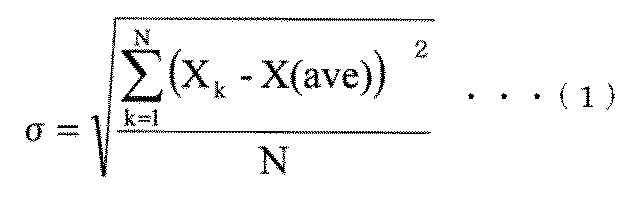
- the standard deviation ⁇ of the average pore diameter of the porous membrane used in the present invention is preferably 0.1 ⁇ m or less.
- the standard deviation ⁇ of the average pore diameter is N as the number of pores that can be observed within the above-mentioned range of 9.2 ⁇ m ⁇ 10.4 ⁇ m, the measured diameter is X k, and the average pore diameter is X (ave ) And the following (Equation 1).
- the permeability of the fermentation broth is one of the important performances.
- the pure water permeability coefficient of the porous membrane before use can be used as an index of the permeability of the porous membrane.
- the pure water permeability coefficient of the porous membrane is 5.6 ⁇ 10 ⁇ 10 m when calculated by measuring the water permeability at a head height of 1 m using purified water at a temperature of 25 ° C. by a reverse osmosis membrane.
- a pure water permeability coefficient is 5.6 ⁇ 10 ⁇ 10 m 3 / m 2 / s / pa or more 6 ⁇ 10 ⁇ 7 m 3 / m 2 / s. If it is / pa or less, a practically sufficient amount of permeated water can be obtained.
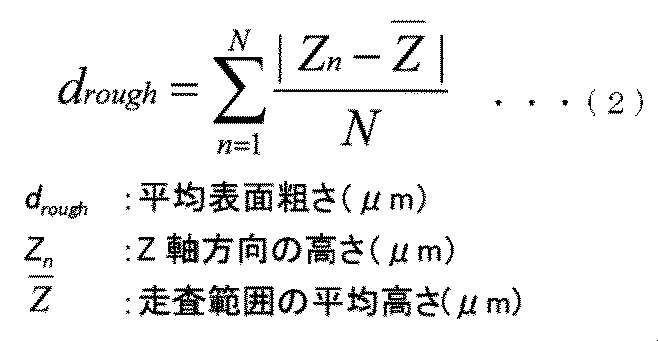
- the surface roughness is the average value of the height in the direction perpendicular to the surface.
- the membrane surface roughness is one of the factors for facilitating separation of microorganisms adhering to the separation membrane surface by the membrane surface cleaning effect by the liquid flow by stirring or a circulation pump.
- the surface roughness of the porous membrane is not particularly limited as long as it is within a range in which microorganisms attached to the membrane and other solid substances are peeled off, but is preferably 0.1 ⁇ m or less. When the surface roughness is 0.1 ⁇ m or less, microorganisms adhering to the film and other solid substances are easily peeled off.
- the membrane surface roughness of the porous membrane is 0.1 ⁇ m or less, the average pore diameter is 0.01 ⁇ m or more and less than 1 ⁇ m, and the pure water permeability coefficient of the porous membrane is 2 ⁇ 10 ⁇ 9 m 3 / It has been found that by using a porous membrane of m 2 / s / pa or more, an operation that does not require excessive power required for membrane surface cleaning can be performed more easily.
- the surface roughness of the porous membrane to 0.1 ⁇ m or less, in the filtration of microorganisms, the shearing force generated on the membrane surface can be reduced, the destruction of microorganisms is suppressed, and the porous membrane is clogged.
- the surface roughness of the porous membrane is preferably as small as possible.
- the film surface roughness of the porous film is measured under the following conditions using the following atomic force microscope (AFM).
- FAM atomic force microscope
- Device Atomic force microscope device (“Nanoscope IIIa” manufactured by Digital Instruments)
- Condition probe SiN cantilever manufactured by Digital Instruments
- Scan mode Contact mode in-air measurement
- Underwater tapping mode underwater measurement
- Scanning range 10 ⁇ m, 25 ⁇ m square (measurement in air) 5 ⁇ m
- 10 ⁇ m square underwater measurement
- Scanning resolution 512 ⁇ 512 -Sample preparation The membrane sample was immersed in ethanol at room temperature for 15 minutes, then immersed in RO water for 24 hours, washed, and then air-dried.
- the RO water refers to water that has been filtered using a reverse osmosis membrane (RO membrane), which is a type of filtration membrane, to exclude impurities such as ions and salts.
- RO membrane reverse osmosis membrane
- the pore size of the RO membrane is approximately 2 nm or less.
- the film surface roughness d rough is calculated by the following (Equation 2) from the height of each point in the Z-axis direction by the above-described atomic force microscope (AFM).
- the shape of the porous membrane used in the present invention is preferably a flat membrane.
- the average thickness is selected according to the application.
- the average thickness when the shape of the porous membrane is a flat membrane is preferably 20 ⁇ m or more and 5000 ⁇ m or less, and more preferably 50 ⁇ m or more and 2000 ⁇ m or less.
- the shape of the porous membrane used in the present invention is preferably a hollow fiber membrane.
- the inner diameter of the hollow fiber is preferably 200 ⁇ m or more and 5000 ⁇ m or less, and the film thickness is preferably 20 ⁇ m or more and 2000 ⁇ m or less.
- a woven fabric or a knitted fabric in which organic fibers or inorganic fibers are formed in a cylindrical shape may be included in the hollow fiber.
- the above-mentioned porous membrane can be manufactured by the manufacturing method described in WO2007 / 097260, for example.
- the separation membrane in the present invention can be a membrane containing at least ceramics.
- the ceramics in the present invention refers to those containing a metal oxide and baked and hardened by heat treatment at a high temperature.
- the metal oxide include alumina, magnesia, titania, zirconia and the like.
- the separation membrane may be formed of only a metal oxide, and may include silica, silicon carbide, mullite, cordierite, or the like, which is a compound of silica and a metal oxide.
- Components other than the ceramics forming the separation membrane are not particularly limited as long as they can form a porous body as a separation membrane.
- the shape is not particularly limited, and any of monolithic membrane, flat membrane, tubular membrane and the like can be used. From the viewpoint of filling efficiency into the container, a columnar structure and a structure having a through hole in the longitudinal direction is preferable. A monolith film is preferred from the viewpoint of increasing the filling efficiency.
- the separation membrane When a separation membrane having a columnar structure is housed in a module container and used as a separation membrane module, the separation membrane can be modularized and filtered by selecting a suitable mode from an external pressure type and an internal pressure type.
- the side where the separation membrane is in contact with the fermentation broth is referred to as the primary side
- the side where the filtrate containing the chemical product is obtained by filtration is referred to as the secondary side.
- the output of the circulation pump can be saved when cross-flow filtration is performed because the flow path on the primary side is narrow. Furthermore, the action of discharging turbidity deposited on the surface of the separation membrane to the outside of the module becomes stronger, which is preferable because the surface of the separation membrane is easily kept clean.
- the internal pressure type separation membrane has an inlet and an outlet for the fermentation broth. In this case, it is preferable that the inlet and the outlet are in a state of through holes arranged in a straight line, since the liquid flow resistance becomes small. Further, since the separation membrane has a columnar structure and the through-holes are vacant in the longitudinal direction, the container for accommodating the separation membrane can be made thinner. When the separation membrane module is thin, it can be preferably used from the viewpoint of production and handling.
- the porosity of the separation membrane is not particularly limited, but if it is too low, the filtration efficiency will deteriorate, and if it is too high, the strength will decrease. In order to achieve both the filtration efficiency and the strength of the separation membrane and to have resistance to repeated steam sterilization, it is preferably 20% or more and 60% or less.
- the average pore diameter of the separation membrane is preferably 0.01 ⁇ m or more and 1 ⁇ m or less. If the membrane has an average pore diameter in this range, the separation membrane is less likely to block and the filtration efficiency is excellent. In addition, if the average pore size is in the range of 0.02 ⁇ m or more and 0.2 ⁇ m or less, fermentation by-products by microorganisms and cultured cells exemplified by proteins and polysaccharides, and microorganisms / cultured cells in the culture solution This is particularly preferable because clogging of a substance that easily clogs the separation membrane, such as a crushed cell produced by death, is less likely to occur.
- the separation membrane having a columnar structure having a through hole has a secondary surface on the secondary side, it is preferable to provide a module container for collecting filtrate and use the module as a module in which the separation container is filled.
- One or more separation membranes are filled in one module.
- the module container is preferably made of a material that can withstand repeated steam sterilization.
- Examples of the steam sterilization treatment include stainless steel and ceramics having a low average porosity.
- Such a ceramic membrane module can be manufactured by, for example, a manufacturing method described in WO2012 / 086763, but a commercially available one can also be used. Specific examples of commercially available products include MEMBLAROX microfiltration membranes (Pall), ceramic membrane filter cefilt MF membranes (NGK), and the like.
- the culture solution of microorganisms is filtered through a separation membrane, the unfiltered solution is retained or refluxed in the culture solution, and the fermentation raw material is added to the culture solution to recover the product from the filtrate. It is characterized by fermentation.
- the culture of microorganisms may be carried out at a pH and temperature suitable for the microorganism to be used, and is not particularly limited as long as the microorganisms are grown. However, the cultivation is usually performed at a pH of 4 to 8 and a temperature of 20 to 75 ° C. Is called.
- the pH of the culture solution is usually adjusted to a predetermined value within a pH range of 4 to 8 with an inorganic or organic acid, an alkaline substance, urea, calcium carbonate, ammonia gas, or the like.
- the nutrients necessary for cell growth may be added to the medium so that the cell growth is continuously performed.
- the concentration of microorganisms in the culture solution may be a concentration that is preferable for efficiently producing a chemical product. For example, good production efficiency can be obtained by maintaining the concentration of microorganisms in the culture solution as a dry weight of 5 g / L or more.
- the oxygen condition for culture in the present invention is preferably such that the oxygen transfer capacity coefficient Kla (h ⁇ 1 ) (hereinafter simply referred to as Kla) is 150 h ⁇ 1 or less.
- C dissolved oxygen concentration DO (ppm) in the culture solution
- C * dissolved oxygen concentration DO (ppm) in equilibrium with the gas phase when oxygen is not consumed by microorganisms
- Kla is a numerical value measured by a gas replacement method (dynamic method).
- gas displacement method dynamic method
- water or a medium to be used is placed in an aeration and agitation culture apparatus with a dissolved oxygen concentration electrode inserted, and oxygen in these liquids is replaced with nitrogen gas to lower the oxygen concentration of the liquid.
- the nitrogen gas is switched to compressed air, and Kla is calculated by measuring the rising process of dissolved oxygen under a predetermined aeration rate, stirring rate, and temperature.
- Kla can be appropriately set by combining aeration conditions and agitation conditions for aeration and agitation culture.
- aeration may or may not be performed, and the gas to be aerated can be changed depending on the culture conditions.
- a method such as sealing the container to make it non-vented, venting an inert gas such as nitrogen gas, or venting an inert gas containing carbon dioxide gas. it can.
- a method such as adding oxygen to air to keep the oxygen concentration at 21% or more, or pressurizing the culture solution can be used.
- V Ventilation rate (vvm), a, b: constants.
- a microorganism having a pathway for metabolizing pentose isomerase using pentose isomerase that can be used in the present invention does not require a coenzyme such as NADH in the isomerization reaction from pentose sugar to pentol.
- Sugar metabolism is not affected by oxygen conditions. Therefore, even under anaerobic conditions that do not use oxygen, chemicals can be produced without stagnation of pentose metabolism.
- Kla employed in the fermentation culture of the present invention is not particularly limited, specifically, it is preferable that Kla is 150h -1 or less, more preferably 100h -1 or less, more preferably 60h -1 or less, most Preferably it is 30 h ⁇ 1 or less.
- the transmembrane pressure difference during filtration is not particularly limited as long as the fermentation broth can be filtered.
- the organic polymer membrane is filtered at a transmembrane pressure higher than 150 kPa in order to filter the fermentation broth, the structure of the organic polymer membrane is likely to be destroyed and a chemical product is produced. Capability may be reduced.
- the transmembrane pressure is lower than 0.1 kPa, the permeated water amount of the fermentation broth may not be obtained sufficiently, and the productivity when producing a chemical product tends to decrease.
- the permeated water amount of the fermentation broth is increased by setting the transmembrane differential pressure, which is the filtration pressure, preferably in the range of 0.1 kPa to 150 kPa. Further, since there is no decrease in chemical production capacity due to destruction of the film structure, it is possible to maintain a high ability to produce chemical products.
- the transmembrane pressure is preferably in the range of 0.1 kPa to 50 kPa, more preferably in the range of 0.1 kPa to 20 kPa, in the organic polymer film.
- the transmembrane pressure difference during filtration is not particularly limited as long as the fermentation broth can be filtered, but is preferably 500 kPa or less.
- the operation is performed at 500 kPa or more, clogging of the membrane occurs, which may cause a problem in the continuous fermentation operation.
- a transmembrane differential pressure can be generated in the separation membrane by a siphon using a liquid level difference (water head difference) of the fermented liquid and the porous membrane treated water or a cross flow circulation pump.
- a suction pump may be installed on the secondary side of the separation membrane as a driving force for filtration.
- the transmembrane pressure difference can be controlled by the suction pressure.
- the transmembrane pressure difference can be controlled also by the pressure of the gas or liquid that introduces the pressure on the fermentation broth side.
- batch culture or fed-batch culture is performed at the initial stage of culture to increase the microorganism concentration, and then continuous culture (filtration of the culture solution) may be started.
- continuous culture filtration of the culture solution
- a high concentration of bacterial cells may be seeded and continuous culture may be performed at the start of culture.
- the sugar concentration in the total filtrate in continuous fermentation is desirably 5 g / L or less from the viewpoint of productivity.
- the sugar concentration in the filtrate can be adjusted by the supply rate of the medium, the filtration rate of the culture medium, or the sugar concentration in the medium.
- microorganisms in the culture tank are obtained by removing a part of the culture solution containing the microorganisms from the fermenter and diluting with a medium as necessary during the continuous fermentation.
- the density may be adjusted. For example, if the concentration of microorganisms in the fermenter becomes too high, the separation membrane is likely to be clogged. Therefore, by removing a part of the culture solution containing microorganisms and diluting with a culture medium, clogging of the separation membrane can be achieved. It can be easily avoided.
- the production performance of chemicals may change depending on the concentration of microorganisms in the fermenter, and the production performance can be maintained by extracting microorganisms using the production performance as an index.
- the continuous culture apparatus used in the present invention filters the fermentation broth of microorganisms through a separation membrane, collects the product from the filtrate, holds or refluxs the unfiltrated liquid in the fermentation broth, and supplies the fermentation raw material.
- a separation membrane collects the product from the filtrate in addition to the fermentation broth, but when using an organic polymer membrane, a specific example is given.
- the apparatus described in WO2007 / 097260 can be used.
- the apparatus described in WO2012 / 086763 can be used.
- the chemical product produced by the present invention is not limited as long as it is a substance produced by the microorganism in the fermentation broth, and includes substances that are mass-produced in the fermentation industry, such as alcohols, organic acids, amino acids, and nucleic acids. Can do.
- alcohol organic substances such as ethanol, 1,3-propanediol, 1,3-butanediol, 2,3-butanediol 1,4-butanediol, glycerol, butanol, isobutanol, 2-butanol, isopropanol, etc.
- acids include acetic acid, lactic acid, adipic acid, pyruvic acid, succinic acid, malic acid, itaconic acid, citric acid, and nucleic acids, nucleosides such as inosine and guanosine, nucleotides such as inosinic acid and guanylic acid, and cataverine Among them, organic acids and alcohols are preferable, and lactic acid, ethanol, and 2,3-butanediol are more preferable.
- the present invention can also be applied to the production of substances such as enzymes, antibiotics, and recombinant proteins. These chemicals can be recovered from the filtrate by known methods (membrane separation, concentration, distillation, crystallization, extraction, etc.).
- Escherichia coli KO11 strain was planted in 5 mL of a preculture medium (glucose 20 g / L yeast extract 10 g / L, tryptone 5 g / L, NaCl 5 g / L) with platinum ears. The cells were cultured and cultured overnight at 30 ° C. (preculture). On the next day, the preculture was inoculated into a 500 mL Erlenmeyer flask containing 50 mL of ethanol fermentation medium (mixed sugar) shown in Table 2, and cultured at 30 ° C. for 24 hours. The collected culture was washed twice with 200 mM maleate buffer (pH 5.5).
- a preculture medium glucose 20 g / L yeast extract 10 g / L, tryptone 5 g / L, NaCl 5 g / L
- the cells were cultured and cultured overnight at 30 ° C. (preculture). On the next day, the preculture was inoculated into a 500 mL
- the cells were resuspended with 200 mM maleate buffer (pH 5.5), disrupted with a bead-type homogenizer (bead ⁇ 0.5 0.6 g, 4000 rpm, 1 minute ⁇ 5 times), and then centrifuged to obtain a supernatant.
- 100 ⁇ L of the cell extract was added to 900 ⁇ L of 200 mM maleic acid buffer (pH 5.5) containing 20 mM MgSO 4 , 1 mM CoCl 2 , 1 mM MnCl 2 , 10 mM xylose, and reacted at 35 ° C. for 2 hours.
- the xylose peak decreased and the xylulose peak increased compared to before the reaction, and the xylose isomerase activity could be confirmed.
- Escherichia coli KO11 strain was cultured in a test tube with 2 mL of preculture medium (glucose 20 g / L yeast extract 10 g / L, tryptone 5 g). / L, NaCl 5 g / L) at 30 ° C. overnight (pre-culture).
- the obtained culture solution was inoculated into a 50 mL preculture medium in a 500 mL pleated Erlenmeyer flask and cultured overnight (preculture).
- the preculture was inoculated into 1 L of an ethanol fermentation medium (glucose) having the composition shown in Table 3, and batch fermentation was performed for 16 hours under the following operating conditions while adjusting temperature and pH to produce ethanol (Table 4).
- Culture tank capacity 2 (L) Temperature adjustment: 30 (° C) Kla: 30 (h -1 ) pH adjustment: adjusted to pH 6 with 5N Ca (OH) 2 Sterilization: All fermenters and culture media are autoclaved at 121 ° C. for 20 min under high pressure steam sterilization.
- Comparative Example 2 Production of Ethanol by Batch Fermentation of Escherichia coli Using Mixed Sugar as Fermentation Raw Material
- An ethanol fermentation medium (mixed sugar) having the composition shown in Table 2 was used as a medium under the same conditions as in Comparative Example 1. Time batch fermentation was performed to produce ethanol (Table 4).
- Pre-culture medium was inoculated into a continuous culture device (excluding the separation membrane element from the device shown in FIG. 2 of WO2007 / 097260) containing an ethanol fermentation medium (mixed sugar) having the composition shown in Table 2 to adjust the temperature. And while adjusting the pH, batch fermentation was performed for 33 hours under the following operating conditions (pre-culture). Immediately after completion of the preculture, continuous culture was started to produce ethanol. To supply the ethanol fermentation medium (mixed sugar) with the composition shown in Table 2 and to extract the culture solution containing microorganisms, use Perista Biominipump AC-2120 (ATTO) and supply the medium directly into the culture tank. The culture solution containing microorganisms was directly extracted from the culture tank.
- a continuous culture device excluding the separation membrane element from the device shown in FIG. 2 of WO2007 / 097260
- ethanol fermentation medium mixed sugar having the composition shown in Table 2
- batch fermentation was performed for 33 hours under the following operating conditions (pre-culture).
- continuous culture was started to
- Ethanol production was carried out for 300 hours while controlling the medium supply rate so that the extraction rate of the culture solution containing microorganisms was constant and the amount of the culture solution in the culture tank was 1.5 L (Table 4).
- Culture tank capacity 2 (L) Temperature adjustment: 30 (° C) Kla: 30 (h -1 ) pH adjustment: adjusted to pH 6 with 5N Ca (OH) 2 Fermentation liquid withdrawal rate: 2 L / day Sterilization: All fermenters and culture media are autoclaved at 121 ° C for 20 min under high pressure steam sterilization.
- Example 1 Production 1 of ethanol by continuous fermentation using a separation membrane of Escherichia coli using mixed sugar as a fermentation raw material 1 Continuous fermentation using a separation membrane using mixed sugar as a fermentation raw material was performed.
- Escherichia coli KO11 strain was cultured overnight at 30 ° C. in 2 mL of a preculture medium (glucose 20 g / L yeast extract 10 g / L, tryptone 5 g / L, NaCl 5 g / L) in a test tube.
- the obtained culture solution was inoculated into a 50 mL preculture medium in a 500 mL pleated Erlenmeyer flask and cultured overnight (pre-culture).
- the culture broth was inoculated in a continuous fermentation apparatus (the apparatus shown in FIG. 2 of WO2007 / 097260) having the following conditions with a membrane-integrated medium containing an ethanol fermentation medium (mixed sugar) having the composition shown in Table 2. While performing temperature adjustment and pH adjustment, batch fermentation was performed for 24 hours under the following operating conditions (pre-culture). Immediately after completion of the preculture, continuous culture was started to produce ethanol. Perista Biominipump AC-2120 (ATTO) was used for supplying the ethanol fermentation medium (mixed sugar) having the composition shown in Table 2 and filtering the culture solution. The medium was supplied directly into the culture tank, and the culture solution was filtered through an element having a separation membrane fixed thereto.
- a membrane-integrated medium containing an ethanol fermentation medium (mixed sugar) having the composition shown in Table 2.
- the transmembrane pressure difference during filtration ranges from 0.1 to 19.8 kPa.
- the ethanol was produced by continuous fermentation for 290 hours (Table 4).
- Fermenter capacity 2 (L) Separation membrane used: Polyvinylidene fluoride filtration membrane separation element Effective filtration area: 120 cm 2 Pure water permeability coefficient of separation membrane: 50 ⁇ 10 ⁇ 9 m 3 / m 2 / s / Pa Separation membrane average pore size: 0.1 ⁇ m Standard deviation of average pore diameter: ⁇ 0.035 ⁇ m Separation membrane surface roughness: 0.06 ⁇ m Temperature adjustment: 30 (° C) Kla: 30 (h -1 ) pH adjustment: adjusted to pH 6 with 5N Ca (OH) 2 Fermentation liquid withdrawal rate: 2 L / day Sterilization: All fermenters and separation media including separation membrane elements are autoclaved at 121 ° C. for 20 min under high pressure steam sterilization.
- Example 2 Production 2 of ethanol by continuous fermentation using a separation membrane of Escherichia coli using mixed sugar as a fermentation raw material 2 Continuous fermentation using a separation membrane using Escherichia coli KO11 strain was performed. Ethanol was produced by continuous fermentation for 300 hours under the same conditions as in Example 1 except that Kla was 0 (Table 4).
- Example 3 Production of ethanol by continuous fermentation using a separation membrane of Escherichia coli using mixed sugar as a fermentation raw material 3 Continuous fermentation using a separation membrane using Escherichia coli KO11 strain was performed. Ethanol was produced by continuous fermentation for 280 hours under the same conditions as in Example 1 except that Kla was 60 (Table 4).
- Example 4 Ethanol Production by Continuous Fermentation Using Escherichia coli Separation Membrane Using Mixed Sugar as Fermentation Raw Material 4 Continuous fermentation using a separation membrane using Escherichia coli KO11 strain was performed. Ethanol was produced by continuous fermentation for 290 hours under the same conditions as in Example 1 except that Kla was set to 100 (Table 4).
- Example 5 Production of ethanol by continuous fermentation using Escherichia coli separation membrane using mixed sugar as a fermentation raw material 5 Continuous fermentation using a separation membrane using Escherichia coli KO11 strain was performed. Ethanol was produced by continuous fermentation for 270 hours under the same conditions as in Example 1 except that Kla was 150 (Table 4).
- the collected culture was washed twice with 200 mM maleate buffer (pH 5.5).
- the cells were resuspended with 200 mM maleate buffer (pH 5.5), disrupted with a bead-type homogenizer (bead ⁇ 0.5 0.6 g, 4000 rpm, 1 minute ⁇ 5 times), and then centrifuged to obtain a supernatant.
- a bead-type homogenizer bead ⁇ 0.5 0.6 g, 4000 rpm, 1 minute ⁇ 5 times
- the preculture is inoculated into 1 L of 2,3-butanediol fermentation medium (glucose) having the composition shown in Table 6, and batch fermentation is performed for 27 hours under the following operating conditions while adjusting the temperature and pH. , 3-butanediol was prepared (Table 8).
- Culture tank capacity 2 (L) Temperature adjustment: 30 (° C) Kla: 30 (h -1 ) pH adjustment: Adjusted to pH 6.5 with 5N Ca (OH) 2 Sterilization: All fermenters and medium used are autoclaved at 121 ° C for 20 min and autoclaved.
- the culture medium was directly supplied to the culture medium, and the culture solution containing the microorganisms was directly extracted from the culture tank. Production of 2,3-butanediol was carried out for 280 hours while controlling the medium supply rate so that the culture solution drawing speed including microorganisms was kept constant and the amount of the culture solution in the culture tank was 1.5 L (Table 8).
- Culture tank capacity 2 (L) Temperature adjustment: 30 (° C) Kla: 30 (h -1 ) pH adjustment: adjusted to pH 6.5 with 5N Ca (OH) 2 Fermentation liquid withdrawal rate: 1 L / day Sterilization: All fermenters and culture media are autoclaved at 121 ° C for 20 min under high pressure steam sterilization.
- Example 6 Production of 2,3-butanediol by continuous fermentation using a separation membrane of Paenibacillus polymixa using mixed sugar as a fermentation raw material 1 Continuous fermentation using a separation membrane using mixed sugar as a fermentation raw material was performed.
- Paenibacillus polymyxa ATCC12321 strain was cultured overnight at 30 ° C. in a 2 mL preculture medium (glucose 5 g / L, peptone 5 g / L, yeast extract 3 g / L, malt extract 3 g / L) in a test tube. culture).
- the obtained culture solution was inoculated into a 50 mL preculture medium in a 500 mL pleated Erlenmeyer flask and cultured overnight (pre-culture).
- the culture solution was inoculated in a continuous culture apparatus (the apparatus shown in FIG. 2 of WO2007 / 097260) containing 2,3-butanediol fermentation medium 1 (mixed sugar) having the composition shown in Table 5 to adjust the temperature and pH. While adjusting, batch fermentation was performed for 30 hours under the following operating conditions (pre-culture). Immediately after completion of the preculture, continuous culture was started to produce 2,3-butanediol.
- Perista Biominipump AC-2120 was used for supplying 2,3-butanediol fermentation medium 2 (mixed sugar) having the composition shown in Table 7 and filtering the culture solution.
- the medium was supplied directly into the culture tank, and the culture solution was filtered through an element having a separation membrane fixed thereto. While controlling the culture medium supply rate so that the culture fluid filtration rate is constant and the culture fluid volume in the culture tank is 1.5 L, the transmembrane pressure difference during filtration ranges from 0.1 to 19.4 kPa. As a result, 2,3-butanediol was produced by continuous fermentation for 280 hours (Table 8).
- Fermenter capacity 2 (L) Separation membrane used: Polyvinylidene fluoride filtration membrane separation element Effective filtration area: 120 cm 2 Pure water permeability coefficient of separation membrane: 50 ⁇ 10 ⁇ 9 m 3 / m 2 / s / Pa Separation membrane average pore size: 0.1 ⁇ 0.035 ⁇ m Separation membrane surface roughness: 0.06 ⁇ m Temperature adjustment: 30 (° C) Kla: 30 (h -1 ) pH adjustment: adjusted to pH 6.5 with 5N Ca (OH) 2 Fermentation liquid withdrawal rate: 1 L / day Sterilization: All fermenters and separation media including separation membrane elements are autoclaved at 121 ° C. for 20 min under high pressure steam sterilization.
- Example 7 Production of 2,3-butanediol by continuous fermentation using a separation membrane of Paenibacillus polymixa using mixed sugar as a fermentation raw material 2 Continuous fermentation using a separation membrane using Paenibacillus polymyxa ATCC12321 was performed. Except for setting Kla to 0, the reaction was carried out under the same conditions as in Example 1, and 2,3-butanediol was produced by continuous fermentation for 300 hours (Table 8).
- Example 8 Production of 2,3-butanediol by continuous fermentation using a separation membrane of Paenibacillus polymixa using mixed sugar as a fermentation raw material 3 Continuous fermentation using a separation membrane using Paenibacillus polymyxa ATCC12321 was performed. Except that Kla was set to 60, 2,3-butanediol was produced by continuous fermentation for 270 hours under the same conditions as in Example 1 (Table 8).
- Example 9 Production of 2,3-butanediol by continuous fermentation using a separation membrane of Paenibacillus polymyxa using mixed sugar as a fermentation raw material 4 Continuous fermentation using a separation membrane using Paenibacillus polymyxa ATCC12321 was performed. Except that Kla was set to 100, 2,3-butanediol was produced by continuous fermentation for 280 hours under the same conditions as in Example 1 (Table 8).
- Example 10 Production of 2,3-butanediol by continuous fermentation using a separation membrane of Paenibacillus polymixa using mixed sugar as a fermentation raw material 5 Continuous fermentation using a separation membrane using Paenibacillus polymyxa ATCC12321 was performed. 2,3-butanediol was produced by continuous fermentation for 270 hours under the same conditions as in Example 1 except that the Kla was 150 (Table 8).
- the collected culture was washed twice with 200 mM maleate buffer (pH 5.5).
- the cells were resuspended with 200 mM maleate buffer (pH 5.5), disrupted with a bead-type homogenizer (bead ⁇ 0.5 0.6 g, 4000 rpm, 1 minute ⁇ 5 times), and then centrifuged to obtain a supernatant.
- a bead-type homogenizer bead ⁇ 0.5 0.6 g, 4000 rpm, 1 minute ⁇ 5 times
- the preculture is inoculated into 1 L of L-lactic acid fermentation medium (glucose) having the composition shown in Table 10, and subjected to batch fermentation for 96 hours under the operating conditions shown below while adjusting the temperature and pH.
- Produced (Table 13).
- Example 11 Production of L-lactic acid by continuous fermentation using Bacillus coagulans separation membrane using mixed sugar as a fermentation raw material 1 Continuous fermentation using a separation membrane using mixed sugar as a fermentation raw material was performed. Cultivate Bacillus coagulans NBRC12714 strain in a test tube overnight at 50 ° C. in 2 mL of preculture medium (polypeptone 10 g / L, yeast extract 2 g / L, magnesium sulfate heptahydrate 1 g / L, calcium carbonate 30 g / L) (Previously cultured). The obtained culture solution was inoculated into a 50 mL preculture medium in a 500 mL pleated Erlenmeyer flask and cultured overnight (pre-culture).
- the transmembrane pressure difference during filtration ranges from 0.1 to 19.7 kPa.
- L-lactic acid was produced by continuous fermentation for 290 hours (Table 13).
- Fermenter capacity 2 (L) Separation membrane used: Polyvinylidene fluoride filtration membrane separation element Effective filtration area: 120 cm 2 Pure water permeability coefficient of separation membrane: 50 ⁇ 10 ⁇ 9 m 3 / m 2 / s / Pa Separation membrane average pore size: 0.1 ⁇ 0.035 ⁇ m Separation membrane surface roughness: 0.06 ⁇ m Temperature adjustment: 50 (°C) Kla: 30 (h -1 ) pH adjustment: adjusted to pH 7 with 5N Ca (OH) 2 Fermentation liquid withdrawal rate: 3 L / day Sterilization: All fermenters and separation media including separation membrane elements are autoclaved at 121 ° C. for 20 min under high pressure steam sterilization.
- Example 12 Production of L-lactic acid by continuous fermentation using Bacillus coagulans separation membrane using mixed sugar as a fermentation raw material 2 Continuous fermentation using a separation membrane using Bacillus coagulans NBRC12714 was performed. L-lactic acid was produced by continuous fermentation for 280 hours under the same conditions as in Example 11 except that Kla was 0 (Table 13).
- Example 13 Production of L-lactic acid by continuous fermentation using a separation membrane of Bacillus coagulans using mixed sugar as a fermentation raw material 3 Continuous fermentation using a separation membrane using Bacillus coagulans NBRC12714 was performed. L-lactic acid was produced by continuous fermentation for 270 hours under the same conditions as in Example 11 except that Kla was 60 (Table 13).
- Example 14 Production of L-lactic acid by continuous fermentation using Bacillus coagulans separation membrane using mixed sugar as a fermentation raw material 4 Continuous fermentation using a separation membrane using Bacillus coagulans NBRC12714 was performed. L-lactic acid was produced by continuous fermentation for 300 hours under the same conditions as in Example 1 except that Kla was set to 100 (Table 13).
- Example 15 Production of L-lactic acid by continuous fermentation using Bacillus coagulans separation membrane using mixed sugar as a fermentation raw material 5 Continuous fermentation using a separation membrane using Bacillus coagulans NBRC12714 was performed. L-lactic acid was produced by continuous fermentation for 290 hours under the same conditions as in Example 11 except that Kla was 150 (Table 13).
- Example 16 Continuous culture of Bacillus coagulans using a mixed sugar as a fermentation raw material using a separation membrane 6 Using a lactic acid fermentation medium (mixed sugar) 2 shown in Table 11, continuous culture using a separation membrane for 305 hours was performed under the same conditions as in Example 12 to produce L-lactic acid (Table 13).
- Example 17 Continuous culture of Bacillus coagulans using a mixed sugar as a fermentation raw material using a separation membrane 6 Using the lactic acid fermentation mixed sugar medium 3 shown in Table 12, continuous culture using a separation membrane was performed for 300 hours under the same conditions as in Example 12 to produce L-lactic acid (Table 13).
- Example 18 Manufacture of ethanol by continuous fermentation using Escherichia coli separation membrane using biomass-derived sugar liquid as fermentation raw material Continuous fermentation using a separation membrane using biomass-derived sugar liquid as fermentation raw material was performed.
- the pre-culture medium is the same as in Comparative Example 17 and the ethanol fermentation medium (sugar solution) 1 shown in Table 14 is used.
- the continuous culture medium is the same as Comparative Example 17 in the ethanol fermentation medium (sugar solution) 2 shown in Table 15 as shown in Table 15.
- ethanol was produced by continuous fermentation for 290 hours under the same conditions as in Example 1 except that 4N KOH was used for pH adjustment (Table 17).
- Example 19 Production of L-lactic acid by continuous fermentation using Bacillus coagulans separation membrane using biomass-derived sugar liquid as fermentation raw material Continuous fermentation using separation membrane using biomass-derived sugar liquid as fermentation raw material It was.
- the fermentation medium the medium shown in Table 16 was used as in Comparative Example 12.
- L-lactic acid was produced by continuous fermentation for 260 hours under the same conditions as in Example 11 except that 4N KOH was used for pH adjustment and Kla was 0 (h ⁇ 1 ) (Table 17).
- Example 20 Production of 2,3-butanediol by continuous fermentation using a ceramic separation membrane of Paenibacillus polymixa using mixed sugar as a fermentation raw material 6 Continuous fermentation using a ceramic separation membrane was performed using Paenibacillus polymyxa ATCC12321 strain. Paenibacillus polymyxa ATCC12321 strain was cultured overnight at 30 ° C. in a 2 mL preculture medium (glucose 5 g / L, peptone 5 g / L, yeast extract 3 g / L, malt extract 3 g / L) in a test tube. culture).
- a 2 mL preculture medium glucose 5 g / L, peptone 5 g / L, yeast extract 3 g / L, malt extract 3 g / L
- the obtained culture solution was inoculated into a 50 mL preculture medium in a 500 mL pleated Erlenmeyer flask and cultured overnight (pre-culture).
- the culture solution was inoculated in a continuous culture apparatus (the apparatus shown in FIG. 2 of WO2007 / 097260) containing 2,3-butanediol fermentation medium 1 (mixed sugar) having the composition shown in Table 5 to adjust the temperature and pH. While adjusting, batch fermentation was performed for 30 hours under the following operating conditions (pre-culture). After completion of the preculture, continuous culture was started immediately using 2,3-butanediol fermentation medium 2 (mixed sugar) having the composition shown in Table 7 to produce 2,3-butanediol.
- 2,3-butanediol was produced by continuous fermentation for 260 hours while adjusting the transmembrane pressure difference during filtration to 500 kPa or less (Table 17).
- Fermenter capacity 2 (L) Separation membrane used: Celfit microfiltration membrane monolith ⁇ 4-19 (NGK) Membrane separation element length: 500mm Separation membrane average pore size: 0.1 ⁇ m Temperature adjustment: 30 (° C) Kla: 30 (h -1 ) pH adjustment: adjusted to pH 6.5 with 5N Ca (OH) 2 Extraction rate of fermentation broth: 0.7 L / day
- the efficiency of fermentation production of various chemicals using fermentation raw materials containing pentose and hexose can be greatly improved.
Landscapes
- Organic Chemistry (AREA)
- Chemical & Material Sciences (AREA)
- Engineering & Computer Science (AREA)
- Zoology (AREA)
- Life Sciences & Earth Sciences (AREA)
- Wood Science & Technology (AREA)
- Chemical Kinetics & Catalysis (AREA)
- Microbiology (AREA)
- General Chemical & Material Sciences (AREA)
- Biotechnology (AREA)
- Health & Medical Sciences (AREA)
- Biochemistry (AREA)
- Bioinformatics & Cheminformatics (AREA)
- General Engineering & Computer Science (AREA)
- General Health & Medical Sciences (AREA)
- Genetics & Genomics (AREA)
- Preparation Of Compounds By Using Micro-Organisms (AREA)
- Apparatus Associated With Microorganisms And Enzymes (AREA)
Abstract
Description
(1)微生物の培養液を分離膜で濾過すること、未濾過液を培養液に保持または還流すること、発酵原料を培養液に追加すること、およびろ過液中の生産物を回収することを含む、連続発酵による化学品の製造方法であって、前記発酵原料が五炭糖および六炭糖を含み、前記微生物がペントースイソメラーゼを用いて五炭糖を代謝する経路を有する、化学品の製造方法。
(2)酸素移動容量係数(Kla)が150h-1以下の条件で連続発酵を行う、(1)に記載の化学品の製造方法。
(3)前記発酵原料中に含まれる六炭糖と五炭糖の重量比率が1:9~9:1である、(1)または(2)に記載の化学品の製造方法。
(4)前記発酵原料がバイオマス由来の糖液を含む、(1)または(2)に記載の化学品の製造方法。
(5)ペントースイソメラーゼがキシロースイソメラーゼである、(1)~(4)のいずれかに記載の化学品の製造方法。
(6)五炭糖がキシロースである、(1)~(5)のいずれかに記載の化学品の製造方法。
・装置 原子間力顕微鏡装置(Digital Instruments(株)製“Nanoscope IIIa”)
・条件 探針 SiNカンチレバー(Digital Instruments(株)製)
走査モード コンタクトモード(気中測定)
水中タッピングモード(水中測定)
走査範囲 10μm、25μm四方(気中測定)
5μm、10μm四方(水中測定)
走査解像度 512×512
・試料調製 測定に際し膜サンプルは、常温でエタノールに15分浸漬後、RO水中に24時間浸漬し洗浄した後、風乾し用いた。RO水とは、濾過膜の一種である逆浸透膜(RO膜)を用いて濾過し、イオンや塩類などの不純物を排除した水を指す。RO膜の孔の大きさは、概ね2nm以下である。
気孔率[%]=100×(湿潤膜重量[g]-乾燥膜重量[g])/水比重[g/cm3]/(膜体積[cm3])。
dC/dt=Kla×(C*-C)・・・(式3)。
In(C*-C)=-Kla×t・・・(式4)。
Kla=a×V+b・・・(式5)。
ここで、V:通気速度(vvm)、a,b:定数である。
収率(g/g)=生産物量(g)÷{投入糖(g)-未利用糖(g)}・・・(式7)。
発酵液中のグルコース、キシロース、キシルロース、エタノールおよび2,3-ブタンジオールの濃度は、下記に示すHPLC条件で、標品との比較により定量した。
カラム:Shodex SH1011(株式会社昭和電工製)
移動相:5mM 硫酸(流速0.6mL/分)
反応液:なし
検出方法:RI(示差屈折率)
温度:65℃。
発酵液中の乳酸を下記に示すHPLC条件で標品との比較により定量した。
カラム:Shim-Pack SPR-H(株式会社島津製作所製)
移動相:5mM p-トルエンスルホン酸(流速0.8mL/min)
反応液:5mM p-トルエンスルホン酸、20mM ビストリス、0.1mM EDTA・2Na(流速0.8mL/min)
検出方法:電気伝導度
温度:45℃。
培養槽に溶存酸素電極(メトラートレド製)を挿入して各通気攪拌条件に対する溶存酸素濃度を測定し、窒素ガスを用いるダイナミック法によりKlaを求めた。まず、培養槽に水1.5Lを張り、水温を30℃あるいは50℃に調整しながら一定の速度で攪拌して窒素ガスを十分に水中に吹き込み、電極値が最低値となった時点で溶存酸素電極のゼロ校正を行った。そののち通気ガスを窒素ガスから所定の通気速度の空気あるいは窒素ガスに切り替えてからの溶存酸素濃度の経時変化を測定してKlaを求めた。得られた各通気攪拌条件に対するKlaを表1に示す。

エシェリシア・コリKO11株を5mLの前培養培地(グルコース20g/L酵母エキス10g/L、トリプトン5g/L、NaCl5g/L)に白金耳にて植菌し、30℃で一晩培養をおこなった(前培養)。翌日、表2に示す50mLのエタノール発酵培地(混合糖)入りの500mLの三角フラスコに前培養液を植え継ぎ、30℃で24時間培養を行った。回収した培養液を200mMマレイン酸緩衝液(pH5.5)にて2回洗浄した。200mMマレイン酸緩衝液(pH5.5)で菌体を再懸濁し、ビーズ式ホモジナイザー(ビーズφ0.5を0.6g、4000rpm、1分間×5回)にて破砕した後、遠心分離によって上清を回収してこれを菌体抽出液とした。その後20mM MgSO4、1mM CoCl2、1mM MnCl2、10mM キシロースを含む200mMマレイン酸緩衝液(pH5.5)900μLに菌体抽出液100μLを添加し、35℃で2時間反応させた後、反応液をHPLCで分析した。その結果、反応前と比較してキシロースのピークが減少し、キシルロースのピークが増大しており、キシロースイソメラーゼ活性を確認することができた。

エシェリシア・コリKO11株を試験管で2mLの前培養培地(グルコース20g/L酵母エキス10g/L、トリプトン5g/L、NaCl5g/L)にて30℃で一晩培養した(前々培養)。得られた培養液を500mL容量のひだ付三角フラスコに入った50mLの前培養培地に植菌し、一晩培養した(前培養)。前培養液を表3に示す組成のエタノール発酵培地(グルコース)1Lに植菌し、温度調整およびpH調整を行いながら以下に示す運転条件にて16時間バッチ発酵を行い、エタノールを製造した(表4)。
培養槽容量:2(L)
温度調整:30(℃)
Kla:30(h-1)
pH調整:5N Ca(OH)2によりpH6に調整
滅菌:発酵槽および使用培地は全て121℃、20minのオートクレーブにより高圧蒸気滅菌。

培地として表2に示す組成のエタノール発酵培地(混合糖)を用いて、比較例1と同様の条件で33時間バッチ発酵を行い、エタノールを製造した(表4)。
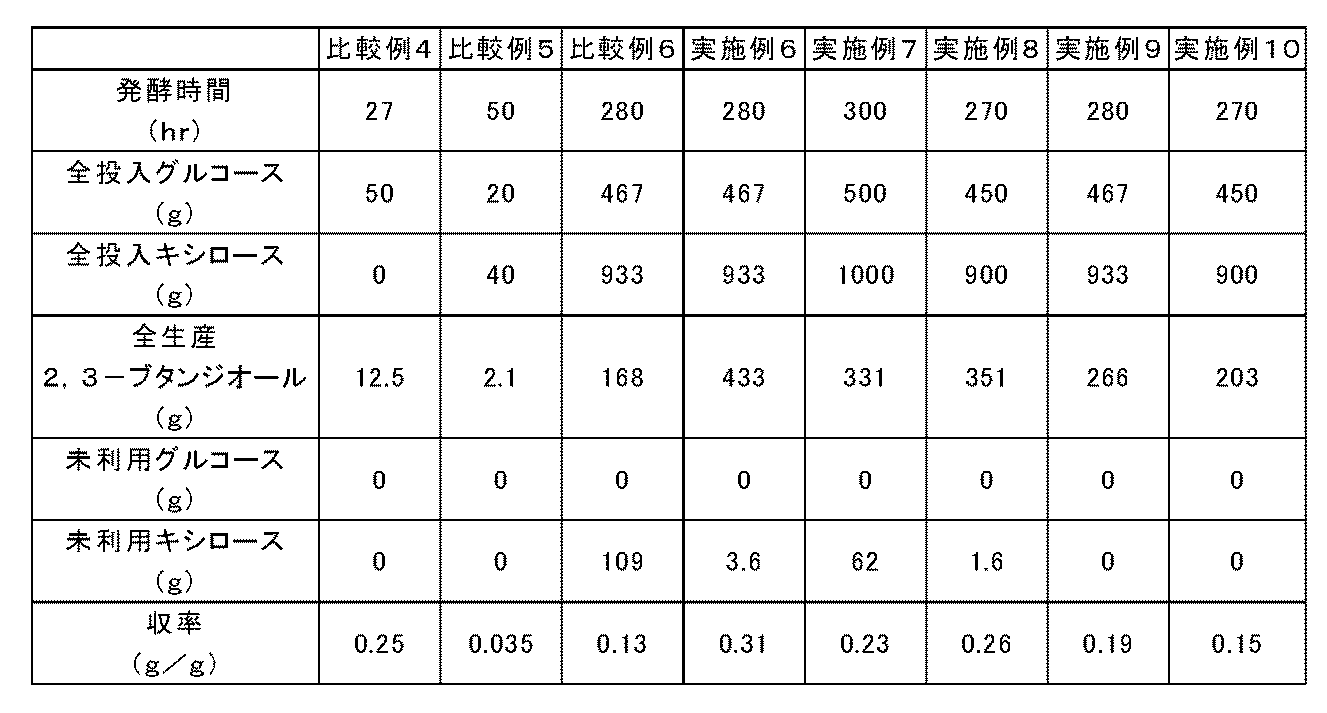
混合糖を発酵原料にした、分離膜を利用しない連続発酵を行った。エシェリシア・コリKO11株を試験管で2mLの前培養培地(グルコース20g/L酵母エキス10g/L、トリプトン5g/L、NaCl5g/L)にて30℃で一晩培養した(前々々培養)。得られた培養液を500mL容量のひだ付三角フラスコに入った50mLの前培養培地に植菌し、一晩培養した(前々培養)。前々培養液を表2に示す組成のエタノール発酵培地(混合糖)の入った連続培養装置(WO2007/097260の図2に示す装置より分離膜エレメントを除いたもの)に植菌し、温度調整およびpH調整を行いながら以下に示す運転条件にて33時間バッチ発酵を行った(前培養)。前培養完了後、直ちに連続培養を開始し、エタノールの製造を行った。表2に示す組成のエタノール発酵培地(混合糖)の供給と微生物を含む培養液の引き抜きにはペリスタ・バイオミニポンプAC-2120型(ATTO社)を用いて、培養槽内に直接培地供給を行い、培養槽内から直接微生物を含む培養液の引き抜きを行った。微生物を含む培養液の引き抜き速度を一定にして、培養槽内の培養液量を1.5Lとなるように培地供給速度を制御しながら300時間エタノール製造を行った(表4)。
培養槽容量:2(L)
温度調整:30(℃)
Kla:30(h-1)
pH調整:5N Ca(OH)2によりpH6に調整
発酵液の抜き速度:2L/day
滅菌:発酵槽および使用培地は全て121℃、20minのオートクレーブにより高圧蒸気滅菌。
混合糖を発酵原料にした、分離膜を利用した連続発酵を行った。エシェリシア・コリKO11株を試験管で2mLの前培養培地(グルコース20g/L酵母エキス10g/L、トリプトン5g/L、NaCl5g/L)にて30℃で一晩培養した(前々々培養)。得られた培養液を500mL容量のひだ付三角フラスコに入った50mLの前培養培地に植菌し、一晩培養した(前々培養)。前々培養液を、表2に示す組成のエタノール発酵培地(混合糖)の入った膜一体型の以下の条件を具備した連続発酵装置(WO2007/097260の図2に示す装置)に植菌し、温度調整およびpH調整を行いながら以下に示す運転条件にて24時間バッチ発酵を行った(前培養)。前培養完了後、直ちに連続培養を開始し、エタノールの製造を行った。表2に示す組成のエタノール発酵培地(混合糖)の供給と培養液の濾過にはペリスタ・バイオミニポンプAC-2120型(ATTO社)を用いた。培地供給は培養槽内に直接行い、培養液の濾過は分離膜を固定したエレメントを通して行った。培養液の濾過速度を一定にして、培養槽内の培養液量を1.5Lとなるように培地供給速度を制御しつつ、濾過時の膜間差圧は0.1~19.8kPaの範囲を推移させることで、290時間の連続発酵によりエタノールを製造した(表4)。
発酵槽容量:2(L)
使用分離膜:ポリフッ化ビニリデンろ過膜
膜分離エレメント有効濾過面積:120cm2
分離膜の純水透過係数:50×10-9m3/m2/s/Pa
分離膜の平均細孔径:0.1μm
平均細孔径の標準偏差:±0.035μm
分離膜の表面粗さ:0.06μm
温度調整:30(℃)
Kla:30(h-1)
pH調整:5N Ca(OH)2によりpH6に調整
発酵液の抜き速度:2L/day
滅菌:分離膜エレメントを含む発酵槽および使用培地は全て121℃、20minのオートクレーブにより高圧蒸気滅菌。
エシェリシア・コリKO11株を用いた分離膜を利用した連続発酵を行った。Klaを0とする以外は実施例1と同様の条件で行い、300時間の連続発酵によりエタノールを製造した(表4)。
エシェリシア・コリKO11株を用いた分離膜を利用した連続発酵を行った。Klaを60とする以外は実施例1と同様の条件で行い、280時間の連続発酵によりエタノールを製造した(表4)。
エシェリシア・コリKO11株を用いた分離膜を利用した連続発酵を行った。Klaを100とする以外は実施例1と同様の条件で行い、290時間の連続発酵によりエタノールを製造した(表4)。
エシェリシア・コリKO11株を用いた分離膜を利用した連続発酵を行った。Klaを150とする以外は実施例1と同様の条件で行い、270時間の連続発酵によりエタノールを製造した(表4)。

パエニバチラス・ポリミクサATCC12321株を5mLの前培養培地(グルコース5g/L、ペプトン5g/L、酵母エキス3g/L、麦芽エキス3g/L)に白金耳にて植菌し、30℃で一晩培養をおこなった(前培養)。翌日、表5に示す50mLの2,3-ブタンジオール発酵培地1(混合糖)入りの500mLの三角フラスコに前培養液を植え継ぎ、30℃で24時間培養を行った。回収した培養液を200mMマレイン酸緩衝液(pH5.5)にて2回洗浄した。200mMマレイン酸緩衝液(pH5.5)で菌体を再懸濁し、ビーズ式ホモジナイザー(ビーズφ0.5を0.6g、4000rpm、1分間×5回)にて破砕した後、遠心分離によって上清を回収してこれを菌体抽出液とした。その後20mM MgSO4、1mM CoCl2、1mM MnCl2、10mM キシロースを含む200mMマレイン酸緩衝液(pH5.5)900μLに菌体抽出液100μLを添加し、35℃で2時間反応させた後、反応液をHPLCで分析した。その結果、反応前と比較してキシロースのピークが減少し、キシルロースのピークが増大しており、キシロースイソメラーゼ活性を確認することができた。

パエニバチラス・ポリミクサATCC12321株を試験管で2mLの前培養培地(グルコース5g/L、ペプトン5g/L、酵母エキス3g/L、麦芽エキス3g/L)にて30℃で一晩培養した(前々培養)。得られた培養液を500mL容量のひだ付三角フラスコに入った50mLの前培養培地に植菌し、一晩培養した(前培養)。前培養液を表6に示す組成の2,3-ブタンジオール発酵培地(グルコース)1Lに植菌し、温度調整およびpH調整を行いながら以下に示す運転条件にて27時間バッチ発酵を行い、2,3-ブタンジオールを製造した(表8)。
培養槽容量:2(L)
温度調整:30(℃)
Kla:30(h-1)
pH調整:5N Ca(OH)2によりpH6.5に調整
滅菌:発酵槽および使用培地は全て121℃、20minのオートクレーブにより高圧蒸気滅菌。
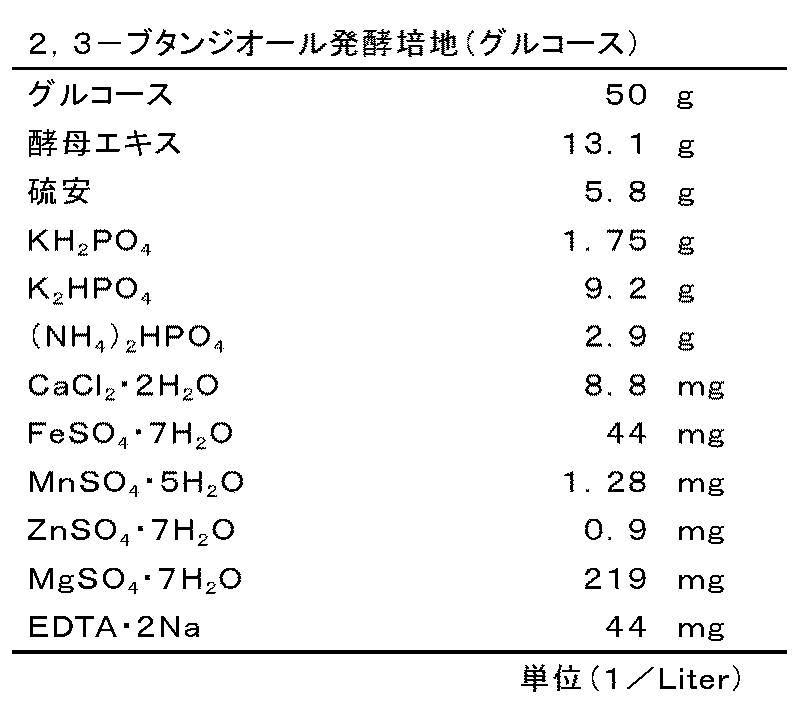
培地として表5に示す組成の2,3-ブタンジオール発酵培地1(混合糖)を用いて、比較例4と同様の条件で50時間バッチ発酵を行い、2,3-ブタンジオールを製造した(表8)。
混合糖を発酵原料にした、分離膜を利用しない連続発酵を行った。パエニバチラス・ポリミクサATCC12321株を試験管で2mLの前培養培地(グルコース5g/L、ペプトン5g/L、酵母エキス3g/L、麦芽エキス3g/L)にて30℃で一晩培養した(前々々培養)。得られた培養液を500mL容量のひだ付三角フラスコに入った50mLの前培養培地に植菌し、一晩培養した(前々培養)。前々培養液を表5に示す組成の2,3-ブタンジオール発酵培地1(混合糖)の入った連続培養装置(WO2007/097260の図2に示す装置より分離膜エレメントを除いたもの)に植菌し、温度調整およびpH調整を行いながら以下に示す運転条件にて30時間バッチ発酵を行った(前培養)。前培養完了後、直ちに連続培養を開始し、2,3-ブタンジオールの製造を行った。表7に示す組成の2,3-ブタンジオール発酵培地2(混合糖)の供給と微生物を含む培養液の引き抜きにはペリスタ・バイオミニポンプAC-2120型(ATTO社)を用いて、培養槽内に直接培地供給を行い、培養槽内から直接微生物を含む培養液の引き抜きを行った。微生物を含む培養液引き抜き速度を一定にして、培養槽内の培養液量を1.5Lとなるように培地供給速度を制御ながら280時間2,3-ブタンジオール製造を行った(表8)
培養槽容量:2(L)
温度調整:30(℃)
Kla:30(h-1)
pH調整:5N Ca(OH)2によりpH6.5に調整
発酵液の抜き速度:1L/day
滅菌:発酵槽および使用培地は全て121℃、20minのオートクレーブにより高圧蒸気滅菌。
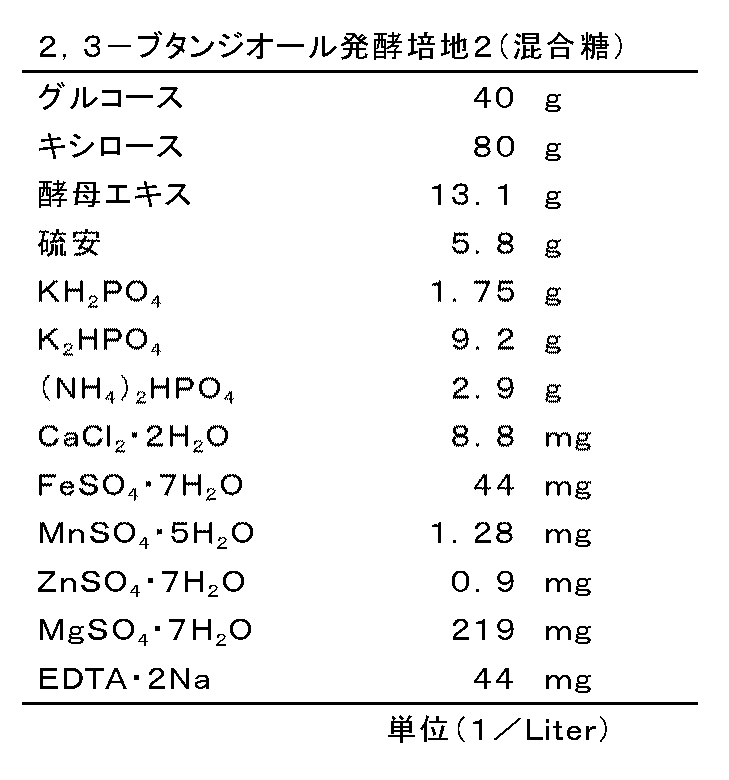
混合糖を発酵原料にした、分離膜を利用した連続発酵を行った。パエニバチラス・ポリミクサATCC12321株を試験管で2mLの前培養培地(グルコース5g/L、ペプトン5g/L、酵母エキス3g/L、麦芽エキス3g/L)にて30℃で一晩培養した(前々々培養)。得られた培養液を500mL容量のひだ付三角フラスコに入った50mLの前培養培地に植菌し、一晩培養した(前々培養)。前々培養液を表5に示す組成の2,3-ブタンジオール発酵培地1(混合糖)の入った連続培養装置(WO2007/097260の図2に示す装置)に植菌し、温度調整およびpH調整を行いながら以下に示す運転条件にて30時間バッチ発酵を行った(前培養)。前培養完了後、直ちに連続培養を開始し、2,3-ブタンジオールの製造を行った。表7に示す組成の2,3-ブタンジオール発酵培地2(混合糖)の供給と培養液の濾過にはペリスタ・バイオミニポンプAC-2120型(ATTO社)を用いた。培地供給は培養槽内に直接行い、培養液の濾過は分離膜を固定したエレメントを通して行った。培養液の濾過速度を一定にして、培養槽内の培養液量を1.5Lとなるように培地供給速度を制御しつつ、濾過時の膜間差圧は0.1~19.4kPaの範囲を推移させることで、280時間の連続発酵により2,3-ブタンジオールを製造した(表8)。
発酵槽容量:2(L)
使用分離膜:ポリフッ化ビニリデンろ過膜
膜分離エレメント有効濾過面積:120cm2
分離膜の純水透過係数:50×10-9m3/m2/s/Pa
分離膜の平均細孔径:0.1±0.035μm
分離膜の表面粗さ:0.06μm
温度調整:30(℃)
Kla:30(h-1)
pH調整:5N Ca(OH)2によりpH6.5に調整
発酵液の抜き速度:1L/day
滅菌:分離膜エレメントを含む発酵槽および使用培地は全て121℃、20minのオートクレーブにより高圧蒸気滅菌。
パエニバチラス・ポリミクサATCC12321株を用いた分離膜を利用した連続発酵を行った。Klaを0とする以外は実施例1と同様の条件で行い、300時間の連続発酵により2,3-ブタンジオールを製造した(表8)。
パエニバチラス・ポリミクサATCC12321株を用いた分離膜を利用した連続発酵を行った。Klaを60とする以外は実施例1と同様の条件で行い、270時間の連続発酵により2,3-ブタンジオールを製造した(表8)。
パエニバチラス・ポリミクサATCC12321株を用いた分離膜を利用した連続発酵を行った。Klaを100とする以外は実施例1と同様の条件で行い、280時間の連続発酵により2,3-ブタンジオールを製造した(表8)。
パエニバチラス・ポリミクサATCC12321株を用いた分離膜を利用した連続発酵を行った。Klaを150とする以外は実施例1と同様の条件で行い、270時間の連続発酵により2,3-ブタンジオールを製造した(表8)。
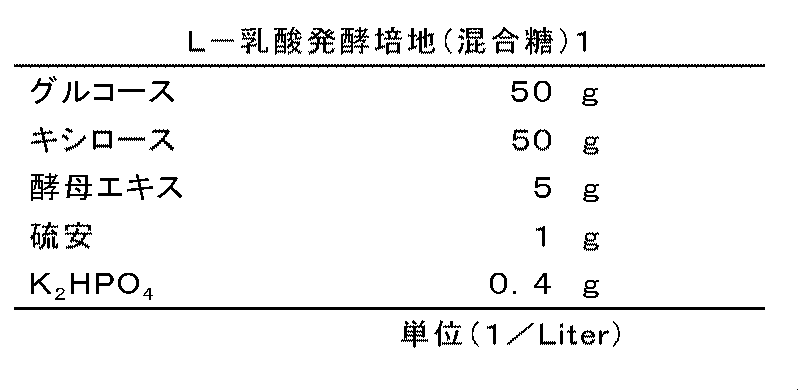
バチルス・コアギュランスNBRC12714株を5mLの前培養培地(ポリペプトン10g/L、酵母エキス2g/L、硫酸マグネシウム7水和物1g/L、炭酸カルシウム30g/L)に白金耳にて植菌し、50℃で一晩培養をおこなった(前培養)。翌日、30g/Lの炭酸カルシウムを含む、表9に示す50mLのL-乳酸発酵培地(混合糖)入りの500mLの三角フラスコに前培養液を植え継ぎ、50℃で24時間培養を行った。回収した培養液を200mMマレイン酸緩衝液(pH5.5)にて2回洗浄した。200mMマレイン酸緩衝液(pH5.5)で菌体を再懸濁し、ビーズ式ホモジナイザー(ビーズφ0.5を0.6g、4000rpm、1分間×5回)にて破砕した後、遠心分離によって上清を回収してこれを菌体抽出液とした。その後20mM MgSO4、1mM CoCl2、1mM MnCl2、10mM キシロースを含む200mMマレイン酸緩衝液(pH5.5)900μLに菌体抽出液100μLを添加し、35℃で2時間反応させた後、反応液をHPLCで分析した。その結果、反応前と比較してキシロースのピークが減少し、キシルロースのピークが増大しており、キシロースイソメラーゼ活性を確認することができた。
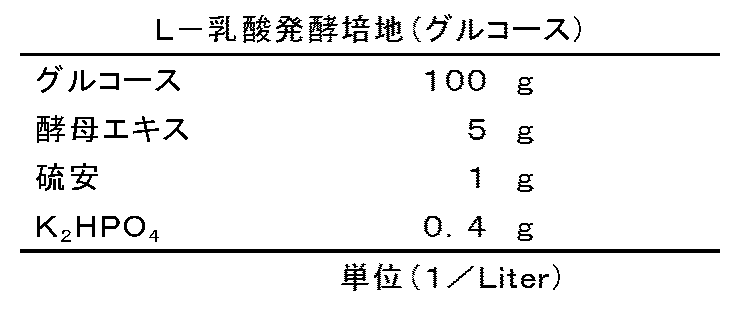
バチルス・コアギュランスNBRC12714株を試験管で2mLの前培養培地(ポリペプトン10g/L、酵母エキス2g/L、硫酸マグネシウム7水和物1g/L、炭酸カルシウム30g/L)にて50℃で一晩培養した(前々培養)。得られた培養液を500mL容量のひだ付三角フラスコに入った50mLの前培養培地に植菌し、一晩培養した(前培養)。前培養液を表10に示す組成のL-乳酸発酵培地(グルコース)1Lに植菌し、温度調整およびpH調整を行いながら以下に示す運転条件にて96時間バッチ発酵を行い、L-乳酸を製造した(表13)。
培養槽容量:2(L)
温度調整:50(℃)
Kla:30(h-1)
pH調整:5N Ca(OH)2によりpH7に調整
滅菌:発酵槽および使用培地は全て121℃、20minのオートクレーブにより高圧蒸気滅菌。
培地として表9に示す組成のL-乳酸発酵培地(混合糖)を用いて、比較例7と同様の条件で128時間バッチ発酵を行い、L-乳酸を製造した(表13)。
混合糖を発酵原料にした、分離膜を利用しない連続発酵を行った。バチルス・コアギュランスNBRC12714株を試験管で2mLの前培養培地(ポリペプトン10g/L、酵母エキス2g/L、硫酸マグネシウム7水和物1g/L、炭酸カルシウム30g/L)にて50℃で一晩培養した(前々々培養)。得られた培養液を500mL容量のひだ付三角フラスコに入った50mLの前培養培地に植菌し、一晩培養した(前々培養)。前々培養液を表9に示す組成のL-乳酸発酵培地(混合糖)の入った連続培養装置(WO2007/097260の図2に示す装置より分離膜エレメントを除いたもの)に植菌し、温度調整およびpH調整を行いながら以下に示す運転条件にて124時間バッチ発酵を行った(前培養)。前培養完了後、直ちに連続培養を開始し、L-乳酸の製造を行った。表9に示す組成のL-乳酸発酵培地(混合糖)の供給と微生物を含む培養液の引き抜きにはペリスタ・バイオミニポンプAC-2120型(ATTO社)を用いて、培養槽内に直接培地供給を行い、培養槽内から直接微生物を含む培養液の引き抜きを行った。微生物を含む培養液引き抜き速度を一定にして、培養槽内の培養液量を1.5Lとなるように培地供給速度を制御ながら300時間L-乳酸製造を行った(表13)。
培養槽容量:2(L)
温度調整:50(℃)
Kla:30(h-1)
pH調整:5N Ca(OH)2によりpH7に調整
発酵液の抜き速度:3L/day
滅菌:発酵槽および使用培地は全て121℃、20minのオートクレーブにより高圧蒸気滅菌。
混合糖を発酵原料にした、分離膜を利用した連続発酵を行った。バチルス・コアギュランスNBRC12714株を試験管で2mLの前培養培地(ポリペプトン10g/L、酵母エキス2g/L、硫酸マグネシウム7水和物1g/L、炭酸カルシウム30g/L)にて50℃で一晩培養した(前々々培養)。得られた培養液を500mL容量のひだ付三角フラスコに入った50mLの前培養培地に植菌し、一晩培養した(前々培養)。前々培養液を表9に示す組成のL-乳酸発酵培地(混合糖)の入った連続培養装置(WO2007/097260の図2に示す装置)に植菌し、温度調整およびpH調整を行いながら以下に示す運転条件にて126時間バッチ発酵を行った(前培養)。前培養完了後、直ちに連続培養を開始し、L-乳酸の製造を行った。表9に示す組成のL-乳酸発酵培地(混合糖)1の供給と培養液の濾過にはペリスタ・バイオミニポンプAC-2120型(ATTO社)を用いた。培地供給は培養槽内に直接行い、培養液の濾過は分離膜を固定したエレメントを通して行った。培養液の濾過速度を一定にして、培養槽内の培養液量を1.5Lとなるように培地供給速度を制御しつつ、濾過時の膜間差圧は0.1~19.7kPaの範囲を推移させることで、290時間の連続発酵によりL-乳酸を製造した(表13)。
発酵槽容量:2(L)
使用分離膜:ポリフッ化ビニリデンろ過膜
膜分離エレメント有効濾過面積:120cm2
分離膜の純水透過係数:50×10-9m3/m2/s/Pa
分離膜の平均細孔径:0.1±0.035μm
分離膜の表面粗さ:0.06μm
温度調整:50(℃)
Kla:30(h-1)
pH調整:5N Ca(OH)2によりpH7に調整
発酵液の抜き速度:3L/day
滅菌:分離膜エレメントを含む発酵槽および使用培地は全て121℃、20minのオートクレーブにより高圧蒸気滅菌。
バチルス・コアギュランスNBRC12714株を用いた分離膜を利用した連続発酵を行った。Klaを0とする以外は実施例11と同様の条件で行い、280時間の連続発酵によりL-乳酸を製造した(表13)。
バチルス・コアギュランスNBRC12714株を用いた分離膜を利用した連続発酵を行った。Klaを60とする以外は実施例11と同様の条件で行い、270時間の連続発酵によりL-乳酸を製造した(表13)。
バチルス・コアギュランスNBRC12714株を用いた分離膜を利用した連続発酵を行った。Klaを100とする以外は実施例1と同様の条件で行い、300時間の連続発酵によりL-乳酸を製造した(表13)。
バチルス・コアギュランスNBRC12714株を用いた分離膜を利用した連続発酵を行った。Klaを150とする以外は実施例11と同様の条件で行い、290時間の連続発酵によりL-乳酸を製造した(表13)。
表11に示す乳酸発酵培地(混合糖)2を用い、実施例12と同様の条件で305時間の分離膜利用連続培養を行い、L-乳酸を製造した(表13)。
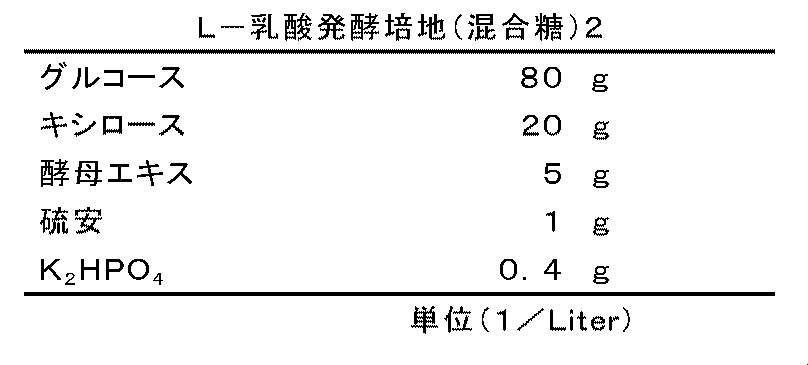
表12に示す乳酸発酵混合糖培地3を用い、実施例12と同様の条件で300時間の分離膜利用連続培養を行い、L-乳酸を製造した(表13)。
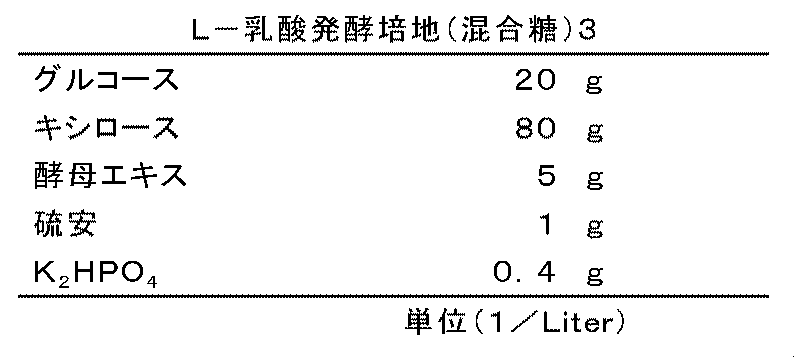

発酵原料としてバイオマス由来の糖液を使用した発酵を行った。発酵培地は、WO2010/067785の実施例2に開示されたナノ濾過膜による調製方法にて調製したセルロース糖化液を利用し、適宜試薬により発酵培地の組成を表14に示すとおり調製した。pH調製に4N KOHを用いた他は比較例2と同様の条件で24時間バッチ発酵を行い、エタノールを製造した(表17)。

発酵原料としてバイオマス由来の糖液を使用した、分離膜を利用しない連続発酵を行った。発酵培地は、WO2010/067785の実施例2に開示されたナノ濾過膜による調製方法にて調製したセルロース糖化液を利用し、適宜試薬により前培養培地として表14に示すエタノール発酵培地(糖液)1を、また連続培養中の培地として表15に示すエタノール発酵培地(糖液)2を調製した。pH調製に4N KOHを用いた他は比較例3と同様の条件で280時間連続発酵を行い、エタノールを製造した(表17)。

発酵原料としてバイオマス由来の糖液を使用した、分離膜を利用した連続発酵を行った。前培養培地は比較例17と同様にとして表14に示すエタノール発酵培地(糖液)1を、また連続培養中の培地として比較例17と同様に表15に示すエタノール発酵培地(糖液)2を用い、pH調製に4N KOHを用いた他は実施例1と同様の条件で290時間連続発酵を行い、エタノールを製造した(表17)。
発酵原料としてバイオマス由来の糖液を使用した発酵を行った。発酵培地は、WO2010/067785の実施例2に開示されたナノ濾過膜による調製方法にて調製したセルロース糖化液を利用し、適宜試薬により発酵培地の組成を表16に示すとおり調製した。pH調製に4N KOHを用い、Klaを0(h-1)とした他は比較例8と同様の条件で70時間バッチ発酵を行い、L-乳酸を製造した(表17)。

発酵原料としてバイオマス由来の糖液を使用した、分離膜を利用しない連続発酵を行った。発酵培地は、比較例12と同様に表16記載の培地を用いた。pH調製に4N KOHを用い、Klaを0(h-1)とした他は比較例9と同様の条件で250時間連続発酵を行い、L-乳酸を製造した(表17)。
発酵原料としてバイオマス由来の糖液を使用した、分離膜を利用した連続発酵を行った。発酵培地は、比較例12と同様に表16記載の培地を用いた。pH調製に4N KOHを用い、Klaを0(h-1)とした他は実施例11と同様の条件で260時間連続発酵を行い、L-乳酸を製造した(表17)。
パエニバチラス・ポリミクサATCC12321株を用い、セラミック製分離膜を利用した連続発酵を行った。パエニバチラス・ポリミクサATCC12321株を試験管で2mLの前培養培地(グルコース5g/L、ペプトン5g/L、酵母エキス3g/L、麦芽エキス3g/L)にて30℃で一晩培養した(前々々培養)。得られた培養液を500mL容量のひだ付三角フラスコに入った50mLの前培養培地に植菌し、一晩培養した(前々培養)。前々培養液を表5に示す組成の2,3-ブタンジオール発酵培地1(混合糖)の入った連続培養装置(WO2007/097260の図2に示す装置)に植菌し、温度調整およびpH調整を行いながら以下に示す運転条件にて30時間バッチ発酵を行った(前培養)。前培養完了後、表7に示す組成の2,3-ブタンジオール発酵培地2(混合糖)を用いて直ちに連続培養を開始し、2,3-ブタンジオールの製造を行った。濾過時の膜間差圧は500kPa以下となるよう調整しながら、260時間の連続発酵により2,3-ブタンジオールを製造した(表17)。
発酵槽容量:2(L)
使用分離膜:Celfit精密ろ過膜 モノリス φ4-19(日本ガイシ)
膜分離エレメント長さ:500mm
分離膜の平均細孔径:0.1μm
温度調整:30(℃)
Kla:30(h-1)
pH調整:5N Ca(OH)2によりpH6.5に調整
発酵液の抜き速度:0.7L/day

Claims (6)
- 微生物の培養液を分離膜で濾過すること、未濾過液を培養液に保持または還流すること、発酵原料を培養液に追加すること、およびろ過液中の生産物を回収することを含む、連続発酵による化学品の製造方法であって、前記発酵原料が五炭糖および六炭糖を含み、前記微生物がペントースイソメラーゼを用いて五炭糖を代謝する経路を有する、化学品の製造方法。
- 酸素移動容量係数(Kla)が150h-1以下の条件で連続発酵を行う、請求項1に記載の化学品の製造方法。
- 前記発酵原料中に含まれる六炭糖と五炭糖の重量比率が1:9~9:1である、請求項1または2に記載の化学品の製造方法。
- 前記発酵原料がバイオマス由来の糖液を含む、請求項1または2に記載の化学品の製造方法。
- ペントースイソメラーゼがキシロースイソメラーゼである、請求項1~4のいずれかに記載の化学品の製造方法。
- 五炭糖がキシロースである、請求項1~5のいずれかに記載の化学品の製造方法。
Priority Applications (9)
| Application Number | Priority Date | Filing Date | Title |
|---|---|---|---|
| CN201380005124.2A CN104039970A (zh) | 2012-01-13 | 2013-01-11 | 化学品的制造方法 |
| AU2013208441A AU2013208441B2 (en) | 2012-01-13 | 2013-01-11 | Method for producing chemical substance |
| BR112014017006A BR112014017006A8 (pt) | 2012-01-13 | 2013-01-11 | método para produzir um produto químico por fermentação contínua |
| US14/371,916 US20150010971A1 (en) | 2012-01-13 | 2013-01-11 | Method of producing chemical substance |
| CA2860761A CA2860761A1 (en) | 2012-01-13 | 2013-01-11 | Method for producing chemical substance |
| KR1020147015287A KR20140119687A (ko) | 2012-01-13 | 2013-01-11 | 화학품의 제조방법 |
| EP13736377.6A EP2803731A4 (en) | 2012-01-13 | 2013-01-11 | PROCESS FOR THE PRODUCTION OF CHEMICAL SUBSTANCE |
| RU2014133167/10A RU2595386C2 (ru) | 2012-01-13 | 2013-01-11 | Способ получения химического вещества |
| PH12014501609A PH12014501609A1 (en) | 2012-01-13 | 2014-07-11 | Method for producing chemical substance |
Applications Claiming Priority (2)
| Application Number | Priority Date | Filing Date | Title |
|---|---|---|---|
| JP2012-005257 | 2012-01-13 | ||
| JP2012005257 | 2012-01-13 |
Publications (1)
| Publication Number | Publication Date |
|---|---|
| WO2013105653A1 true WO2013105653A1 (ja) | 2013-07-18 |
Family
ID=48781594
Family Applications (1)
| Application Number | Title | Priority Date | Filing Date |
|---|---|---|---|
| PCT/JP2013/050438 Ceased WO2013105653A1 (ja) | 2012-01-13 | 2013-01-11 | 化学品の製造方法 |
Country Status (11)
| Country | Link |
|---|---|
| US (1) | US20150010971A1 (ja) |
| EP (1) | EP2803731A4 (ja) |
| JP (1) | JPWO2013105653A1 (ja) |
| KR (1) | KR20140119687A (ja) |
| CN (1) | CN104039970A (ja) |
| AU (1) | AU2013208441B2 (ja) |
| BR (1) | BR112014017006A8 (ja) |
| CA (1) | CA2860761A1 (ja) |
| PH (1) | PH12014501609A1 (ja) |
| RU (1) | RU2595386C2 (ja) |
| WO (1) | WO2013105653A1 (ja) |
Cited By (1)
| Publication number | Priority date | Publication date | Assignee | Title |
|---|---|---|---|---|
| JP2017513468A (ja) * | 2014-04-16 | 2017-06-01 | エリアス ハカレート,エイノ | 促進したバイオプロセスにおける水素及び他の気体又は液体生成物の生成 |
Citations (12)
| Publication number | Priority date | Publication date | Assignee | Title |
|---|---|---|---|---|
| JPH11506934A (ja) | 1995-06-07 | 1999-06-22 | アーケノール,インコーポレイテッド | 強酸加水分解法 |
| JP3041380B2 (ja) | 1997-06-02 | 2000-05-15 | 工業技術院長 | 水溶性オリゴ糖類及び単糖類の製造方法 |
| JP2001095597A (ja) | 1999-07-27 | 2001-04-10 | Shiseido Co Ltd | ステロイド5α−リダクターゼの阻害活性の検出方法 |
| JP2003212888A (ja) | 2002-01-18 | 2003-07-30 | Asahi Kasei Corp | グルコース及び/又は水溶性セロオリゴ糖の製造方法 |
| JP2005229821A (ja) | 2004-02-17 | 2005-09-02 | Jgc Corp | バイオマスから単糖を製造する方法及び単糖製造装置 |
| JP2006525029A (ja) | 2003-05-02 | 2006-11-09 | ネイチャーワークス・エル・エル・シー | 遺伝子組換え酵母及び遺伝子組換え酵母を用いた発酵方法 |
| WO2007097260A1 (ja) | 2006-02-24 | 2007-08-30 | Toray Industries, Inc. | 化学品の製造方法、および、連続発酵装置 |
| JP2008079564A (ja) | 2006-09-28 | 2008-04-10 | Toyota Central R&D Labs Inc | キシロースイソメラーゼ活性を有するタンパク質及びその利用 |
| JP2009028030A (ja) * | 2007-06-28 | 2009-02-12 | Gekkeikan Sake Co Ltd | シデロフォアの製造方法 |
| WO2010067785A1 (ja) | 2008-12-09 | 2010-06-17 | 東レ株式会社 | 糖液の製造方法 |
| JP2011139707A (ja) * | 2002-10-11 | 2011-07-21 | Nippon Suisan Kaisha Ltd | 不ケン化物の含量を低下させた微生物油脂の製造法並びに該油脂 |
| WO2012086763A1 (ja) | 2010-12-24 | 2012-06-28 | 東レ株式会社 | 分離膜モジュールの滅菌方法、滅菌用装置および化学品製造用装置 |
Family Cites Families (2)
| Publication number | Priority date | Publication date | Assignee | Title |
|---|---|---|---|---|
| DK624088A (da) * | 1987-03-10 | 1989-01-03 | Helmut Effenberger | Fremgangsmaade til kontinuerlig forgaering af carbonhydratholdige medier ved hjaelp af bakterier |
| US7629156B2 (en) * | 2006-09-28 | 2009-12-08 | E.I. Du Pont De Nemours And Company | Ethanol production in fermentation of mixed sugars containing xylose |
-
2013
- 2013-01-11 BR BR112014017006A patent/BR112014017006A8/pt not_active IP Right Cessation
- 2013-01-11 EP EP13736377.6A patent/EP2803731A4/en not_active Withdrawn
- 2013-01-11 JP JP2013501475A patent/JPWO2013105653A1/ja active Pending
- 2013-01-11 CA CA2860761A patent/CA2860761A1/en not_active Abandoned
- 2013-01-11 WO PCT/JP2013/050438 patent/WO2013105653A1/ja not_active Ceased
- 2013-01-11 US US14/371,916 patent/US20150010971A1/en not_active Abandoned
- 2013-01-11 CN CN201380005124.2A patent/CN104039970A/zh active Pending
- 2013-01-11 KR KR1020147015287A patent/KR20140119687A/ko not_active Withdrawn
- 2013-01-11 RU RU2014133167/10A patent/RU2595386C2/ru not_active IP Right Cessation
- 2013-01-11 AU AU2013208441A patent/AU2013208441B2/en not_active Ceased
-
2014
- 2014-07-11 PH PH12014501609A patent/PH12014501609A1/en unknown
Patent Citations (13)
| Publication number | Priority date | Publication date | Assignee | Title |
|---|---|---|---|---|
| JPH11506934A (ja) | 1995-06-07 | 1999-06-22 | アーケノール,インコーポレイテッド | 強酸加水分解法 |
| JP3041380B2 (ja) | 1997-06-02 | 2000-05-15 | 工業技術院長 | 水溶性オリゴ糖類及び単糖類の製造方法 |
| JP2001095597A (ja) | 1999-07-27 | 2001-04-10 | Shiseido Co Ltd | ステロイド5α−リダクターゼの阻害活性の検出方法 |
| JP2003212888A (ja) | 2002-01-18 | 2003-07-30 | Asahi Kasei Corp | グルコース及び/又は水溶性セロオリゴ糖の製造方法 |
| JP2011139707A (ja) * | 2002-10-11 | 2011-07-21 | Nippon Suisan Kaisha Ltd | 不ケン化物の含量を低下させた微生物油脂の製造法並びに該油脂 |
| JP2006525029A (ja) | 2003-05-02 | 2006-11-09 | ネイチャーワークス・エル・エル・シー | 遺伝子組換え酵母及び遺伝子組換え酵母を用いた発酵方法 |
| JP2005229821A (ja) | 2004-02-17 | 2005-09-02 | Jgc Corp | バイオマスから単糖を製造する方法及び単糖製造装置 |
| WO2007097260A1 (ja) | 2006-02-24 | 2007-08-30 | Toray Industries, Inc. | 化学品の製造方法、および、連続発酵装置 |
| JP2008079564A (ja) | 2006-09-28 | 2008-04-10 | Toyota Central R&D Labs Inc | キシロースイソメラーゼ活性を有するタンパク質及びその利用 |
| JP2009028030A (ja) * | 2007-06-28 | 2009-02-12 | Gekkeikan Sake Co Ltd | シデロフォアの製造方法 |
| WO2010067785A1 (ja) | 2008-12-09 | 2010-06-17 | 東レ株式会社 | 糖液の製造方法 |
| JP4770987B2 (ja) * | 2008-12-09 | 2011-09-14 | 東レ株式会社 | 糖液の製造方法 |
| WO2012086763A1 (ja) | 2010-12-24 | 2012-06-28 | 東レ株式会社 | 分離膜モジュールの滅菌方法、滅菌用装置および化学品製造用装置 |
Non-Patent Citations (10)
| Title |
|---|
| A. ADEN ET AL.: "Lignocellulosic Biomass to Ethanol Process Design and Economics Utilizing Co-Current Dilute Acid Prehydrolysis and Enzymatic Hydrolysis for Corn Stover", NREL TECHNICAL REPORT, 2002 |
| DO YUN KIM; SEONG CHUN YIM; PYUNG CHEON LEE; WOO GI LEE; SANG YUP LEE; HO NAM CHANG: "Batch and continuous fermentation of succinic acid from wood hydrolysate by Mannheimia succiniciproducens MBEL55E", ENZYME AND MICROBIAL TECHNOLOGY, vol. 35, 2004, pages 648 - 653, XP004619965, DOI: doi:10.1016/j.enzmictec.2004.08.018 |
| ERLANDSON ET AL.: "Dissolution of Xylose Metabolism inLactococcus lactis", APPL. ENVIRON. MICROBIOL., vol. 66, no. 9, 2000, pages 3974 - 3980, XP002578206 * |
| FOND ET AL.: "The acetone butanol fermentation on glucose and xylose. I. Regulation and kinetics in batch cultures", BIOTECHNOLOGY AND BIOENGINEERING, vol. XXVIII, 1986, pages 160 - 166, XP055080755 * |
| KAISA KARHUMAA; ROSA GARCIA SANCHEZ; BARBEL HAHN-HAGERDAL; MARIE-F GORWA-GRAUSLUND: "Comparison of the xylose reductase-xylitol dehydrogenase and the xylose isomerase pathways for xylose fermentation by recombinant Saccharomyces cerevisiae", MICROBIAL CELL FACTORIES, vol. 6, 2007, pages 5, XP021024086, DOI: doi:10.1186/1475-2859-6-5 |
| KIM ET AL.: "Batch and continuous fermentation of succinic acid from wood hydrolysate by Mannheimia succiniciproducens MBEL55E", ENZYME AND MICROBIAL TECHNOLOGY, vol. 35, 2004, pages 648 - 653, XP004619965 * |
| KRISHNAN ET AL.: "Ethanol production from glucose and xylose by immobilized Zymomonas mobilis CP4 (pZB5)", APPLIED BIOCHEMISTRY AND BIOTECHNOLOGY, vol. 84-86, 2000, pages 525 - 541, XP055080753 * |
| See also references of EP2803731A4 |
| TANAKA ET AL.: "Two different pathways for D- xylose metabolism and the effectof xylose concentration on the yield coefficient of L- lactate in mixed-acidfermentation by the lactic acid bacterium Lactococcus lactis 10-1", APPL MICROBIOL BIOTECHNOL, vol. 60, 2002, pages 160 - 167, XP009148218 * |
| THE SOCIETY FOR BIOTECHNOLOGY, JAPAN: "Laboratory Manual for Bioengineering", 1992, BAIFUKAN CO., LTD., pages: 310 |
Cited By (2)
| Publication number | Priority date | Publication date | Assignee | Title |
|---|---|---|---|---|
| JP2017513468A (ja) * | 2014-04-16 | 2017-06-01 | エリアス ハカレート,エイノ | 促進したバイオプロセスにおける水素及び他の気体又は液体生成物の生成 |
| JP7198572B2 (ja) | 2014-04-16 | 2023-01-04 | エリアス ハカレート,エイノ | 促進したバイオプロセスにおける水素及び他の気体又は液体生成物の生成 |
Also Published As
| Publication number | Publication date |
|---|---|
| CN104039970A (zh) | 2014-09-10 |
| RU2595386C2 (ru) | 2016-08-27 |
| BR112014017006A8 (pt) | 2017-07-04 |
| AU2013208441B2 (en) | 2016-12-01 |
| US20150010971A1 (en) | 2015-01-08 |
| RU2014133167A (ru) | 2016-03-10 |
| PH12014501609A1 (en) | 2014-10-13 |
| BR112014017006A2 (pt) | 2017-06-13 |
| JPWO2013105653A1 (ja) | 2015-05-11 |
| EP2803731A4 (en) | 2015-08-26 |
| EP2803731A1 (en) | 2014-11-19 |
| AU2013208441A1 (en) | 2014-08-21 |
| CA2860761A1 (en) | 2013-07-18 |
| KR20140119687A (ko) | 2014-10-10 |
Similar Documents
| Publication | Publication Date | Title |
|---|---|---|
| JP5082496B2 (ja) | 連続発酵による化学品の製造方法および連続発酵装置 | |
| JP6447682B2 (ja) | 化学品の製造方法 | |
| KR20080096710A (ko) | 화학품의 제조 방법 및 연속 발효 장치 | |
| JP2010029108A (ja) | 連続発酵による化学品の製造方法 | |
| AU2013208440B2 (en) | Method for producing chemical substance | |
| JP5061639B2 (ja) | 連続発酵装置 | |
| WO2017159764A1 (ja) | 化学品の製造方法および微生物の培養方法 | |
| WO2015159812A1 (ja) | 連続発酵による化学品の製造方法 | |
| AU2013208441B2 (en) | Method for producing chemical substance | |
| JPWO2019054469A1 (ja) | エタノールの製造方法およびエタノール発酵液 | |
| WO2021117849A1 (ja) | 膜濾過性を改善する連続発酵による化学品の製造方法 |
Legal Events
| Date | Code | Title | Description |
|---|---|---|---|
| ENP | Entry into the national phase |
Ref document number: 2013501475 Country of ref document: JP Kind code of ref document: A |
|
| 121 | Ep: the epo has been informed by wipo that ep was designated in this application |
Ref document number: 13736377 Country of ref document: EP Kind code of ref document: A1 |
|
| ENP | Entry into the national phase |
Ref document number: 20147015287 Country of ref document: KR Kind code of ref document: A |
|
| ENP | Entry into the national phase |
Ref document number: 2860761 Country of ref document: CA |
|
| WWE | Wipo information: entry into national phase |
Ref document number: 14371916 Country of ref document: US Ref document number: 12014501609 Country of ref document: PH |
|
| NENP | Non-entry into the national phase |
Ref country code: DE |
|
| WWE | Wipo information: entry into national phase |
Ref document number: 2013736377 Country of ref document: EP |
|
| ENP | Entry into the national phase |
Ref document number: 2014133167 Country of ref document: RU Kind code of ref document: A |
|
| WWE | Wipo information: entry into national phase |
Ref document number: IDP00201404802 Country of ref document: ID |
|
| ENP | Entry into the national phase |
Ref document number: 2013208441 Country of ref document: AU Date of ref document: 20130111 Kind code of ref document: A |
|
| REG | Reference to national code |
Ref country code: BR Ref legal event code: B01A Ref document number: 112014017006 Country of ref document: BR |
|
| ENP | Entry into the national phase |
Ref document number: 112014017006 Country of ref document: BR Kind code of ref document: A2 Effective date: 20140710 |