WO2013106730A1 - Carbon dioxide sequestration involving two-salt-based thermolytic processes - Google Patents

Carbon dioxide sequestration involving two-salt-based thermolytic processes Download PDF

Info

Publication number
WO2013106730A1
WO2013106730A1 PCT/US2013/021264 US2013021264W WO2013106730A1 WO 2013106730 A1 WO2013106730 A1 WO 2013106730A1 US 2013021264 W US2013021264 W US 2013021264W WO 2013106730 A1 WO2013106730 A1 WO 2013106730A1
Authority
WO
WIPO (PCT)
Prior art keywords
mgcl
water
product
reaction
cacl
Prior art date
Legal status (The legal status is an assumption and is not a legal conclusion. Google has not performed a legal analysis and makes no representation as to the accuracy of the status listed.)
Ceased
Application number
PCT/US2013/021264
Other languages
French (fr)
Inventor
Joe David Jones
Al Yablonsky
Current Assignee (The listed assignees may be inaccurate. Google has not performed a legal analysis and makes no representation or warranty as to the accuracy of the list.)
Skyonic Corp
Original Assignee
Skyonic Corp
Priority date (The priority date is an assumption and is not a legal conclusion. Google has not performed a legal analysis and makes no representation as to the accuracy of the date listed.)
Filing date
Publication date
Family has litigation
First worldwide family litigation filed litigation Critical https://patents.darts-ip.com/?family=48781952&utm_source=google_patent&utm_medium=platform_link&utm_campaign=public_patent_search&patent=WO2013106730(A1) "Global patent litigation dataset” by Darts-ip is licensed under a Creative Commons Attribution 4.0 International License.
Priority to BR112014017019A priority Critical patent/BR112014017019A8/en
Priority to MX2014008491A priority patent/MX2014008491A/en
Priority to NZ628133A priority patent/NZ628133A/en
Priority to CA2863326A priority patent/CA2863326A1/en
Priority to HK15105469.4A priority patent/HK1205039A1/en
Priority to AP2014007853A priority patent/AP2014007853A0/en
Priority to JP2014552337A priority patent/JP2015508332A/en
Priority to IN5949DEN2014 priority patent/IN2014DN05949A/en
Priority to CN201380011318.3A priority patent/CN104284707A/en
Application filed by Skyonic Corp filed Critical Skyonic Corp
Priority to AU2013203886A priority patent/AU2013203886B2/en
Priority to EA201491342A priority patent/EA201491342A1/en
Priority to EP13736385.9A priority patent/EP2809427A4/en
Priority to KR1020147022332A priority patent/KR20140111034A/en
Priority to HK15106677.0A priority patent/HK1205976A1/en
Priority to SG11201404005SA priority patent/SG11201404005SA/en
Publication of WO2013106730A1 publication Critical patent/WO2013106730A1/en
Priority to IL233577A priority patent/IL233577A0/en
Priority to PH12014501606A priority patent/PH12014501606A1/en
Anticipated expiration legal-status Critical
Ceased legal-status Critical Current

Links

Classifications

    • BPERFORMING OPERATIONS; TRANSPORTING
    • B01PHYSICAL OR CHEMICAL PROCESSES OR APPARATUS IN GENERAL
    • B01DSEPARATION
    • B01D53/00Separation of gases or vapours; Recovering vapours of volatile solvents from gases; Chemical or biological purification of waste gases, e.g. engine exhaust gases, smoke, fumes, flue gases, aerosols
    • B01D53/34Chemical or biological purification of waste gases
    • B01D53/46Removing components of defined structure
    • B01D53/62Carbon oxides
    • CCHEMISTRY; METALLURGY
    • C01INORGANIC CHEMISTRY
    • C01BNON-METALLIC ELEMENTS; COMPOUNDS THEREOF; METALLOIDS OR COMPOUNDS THEREOF NOT COVERED BY SUBCLASS C01C
    • C01B32/00Carbon; Compounds thereof
    • C01B32/60Preparation of carbonates or bicarbonates in general
    • CCHEMISTRY; METALLURGY
    • C01INORGANIC CHEMISTRY
    • C01FCOMPOUNDS OF THE METALS BERYLLIUM, MAGNESIUM, ALUMINIUM, CALCIUM, STRONTIUM, BARIUM, RADIUM, THORIUM, OR OF THE RARE-EARTH METALS
    • C01F11/00Compounds of calcium, strontium, or barium
    • C01F11/18Carbonates
    • CCHEMISTRY; METALLURGY
    • C01INORGANIC CHEMISTRY
    • C01FCOMPOUNDS OF THE METALS BERYLLIUM, MAGNESIUM, ALUMINIUM, CALCIUM, STRONTIUM, BARIUM, RADIUM, THORIUM, OR OF THE RARE-EARTH METALS
    • C01F5/00Compounds of magnesium
    • C01F5/24Magnesium carbonates
    • BPERFORMING OPERATIONS; TRANSPORTING
    • B01PHYSICAL OR CHEMICAL PROCESSES OR APPARATUS IN GENERAL
    • B01DSEPARATION
    • B01D2251/00Reactants
    • B01D2251/40Alkaline earth metal or magnesium compounds
    • B01D2251/402Alkaline earth metal or magnesium compounds of magnesium
    • BPERFORMING OPERATIONS; TRANSPORTING
    • B01PHYSICAL OR CHEMICAL PROCESSES OR APPARATUS IN GENERAL
    • B01DSEPARATION
    • B01D2251/00Reactants
    • B01D2251/40Alkaline earth metal or magnesium compounds
    • B01D2251/404Alkaline earth metal or magnesium compounds of calcium
    • BPERFORMING OPERATIONS; TRANSPORTING
    • B01PHYSICAL OR CHEMICAL PROCESSES OR APPARATUS IN GENERAL
    • B01DSEPARATION
    • B01D2251/00Reactants
    • B01D2251/60Inorganic bases or salts
    • BPERFORMING OPERATIONS; TRANSPORTING
    • B01PHYSICAL OR CHEMICAL PROCESSES OR APPARATUS IN GENERAL
    • B01DSEPARATION
    • B01D2251/00Reactants
    • B01D2251/60Inorganic bases or salts
    • B01D2251/604Hydroxides
    • BPERFORMING OPERATIONS; TRANSPORTING
    • B01PHYSICAL OR CHEMICAL PROCESSES OR APPARATUS IN GENERAL
    • B01DSEPARATION
    • B01D2257/00Components to be removed
    • B01D2257/50Carbon oxides
    • B01D2257/504Carbon dioxide
    • YGENERAL TAGGING OF NEW TECHNOLOGICAL DEVELOPMENTS; GENERAL TAGGING OF CROSS-SECTIONAL TECHNOLOGIES SPANNING OVER SEVERAL SECTIONS OF THE IPC; TECHNICAL SUBJECTS COVERED BY FORMER USPC CROSS-REFERENCE ART COLLECTIONS [XRACs] AND DIGESTS
    • Y02TECHNOLOGIES OR APPLICATIONS FOR MITIGATION OR ADAPTATION AGAINST CLIMATE CHANGE
    • Y02CCAPTURE, STORAGE, SEQUESTRATION OR DISPOSAL OF GREENHOUSE GASES [GHG]
    • Y02C20/00Capture or disposal of greenhouse gases
    • Y02C20/40Capture or disposal of greenhouse gases of CO2
    • YGENERAL TAGGING OF NEW TECHNOLOGICAL DEVELOPMENTS; GENERAL TAGGING OF CROSS-SECTIONAL TECHNOLOGIES SPANNING OVER SEVERAL SECTIONS OF THE IPC; TECHNICAL SUBJECTS COVERED BY FORMER USPC CROSS-REFERENCE ART COLLECTIONS [XRACs] AND DIGESTS
    • Y02TECHNOLOGIES OR APPLICATIONS FOR MITIGATION OR ADAPTATION AGAINST CLIMATE CHANGE
    • Y02PCLIMATE CHANGE MITIGATION TECHNOLOGIES IN THE PRODUCTION OR PROCESSING OF GOODS
    • Y02P20/00Technologies relating to chemical industry
    • Y02P20/151Reduction of greenhouse gas [GHG] emissions, e.g. CO2

Definitions

  • the present invention generally relates to the field of removing carbon dioxide from a source, such as the waste stream (e.g. flue gas) of a power plant, whereby Group 2 silicate minerals are converted into Group 2 chloride salts and Si0 2 , Group 2 chloride salts are converted into Group 2 hydroxide and/or Group 2 hydroxychloride salts. These in turn may be reacted with carbon dioxide to form Group 2 carbonate salts, optionally in the presence of catalysts. These steps may be combined to form a cycle in which carbon dioxide is sequestered in the form of carbonate salts and byproducts from one or more steps, such as heat and chemicals, are re-used or recycled in one or more other steps.
  • a source such as the waste stream (e.g. flue gas) of a power plant
  • Group 2 silicate minerals are converted into Group 2 chloride salts and Si0 2
  • Group 2 chloride salts are converted into Group 2 hydroxide and/or Group 2 hydroxychloride salts.
  • These in turn may be
  • Greenhouse gases are predominately made up of carbon dioxide and are produced by municipal power plants and large-scale industry in site-power-plants, though they are also produced in any normal carbon combustion (such as automobiles, rain-forest clearing, simple burning, etc.). Though their most concentrated point-emissions occur at power-plants across the planet, making reduction or removal from those fixed sites an attractive point to effect a removal-technology. Because energy production is a primary cause of greenhouse gas emissions, methods such as reducing carbon intensity, improving efficiency, and sequestering carbon from power-plant flue-gas by various means has been researched and studied intensively over the last thirty years.
  • methods of sequestering carbon dioxide produced by a source comprising:
  • step (b) reacting some or all of the Mg(OH)Cl from step (a) with a quantity of water and a quantity of MgCi 2 in a second admixture under conditions suitable to form a second product mixture comprising a first step (b) product comprising Mg(OH) 2 and a second step (b) product comprising MgCl 2 , wherein the quantity of water is sufficient to provide a molar ratio of water to MgCl 2 of greater than or equal to 6 to 1 in the second product mixture;
  • step (c) admixing some or all of the Mg(OH) 2 from the first step (b) product with CaCl 2 or a hydrate thereof and carbon dioxide produced by the source in a third admixture under conditions suitable to form a third product mixture comprising a first step (c) product comprising MgCl 2 or a hydrate thereof, a second step (c) product comprising CaC0 3 , and a third step (c) product comprising water; and
  • the MgCl 2 of step (a) is a MgCl 2 hydrate (e.g.,
  • the MgCl 2 of step (a) is greater than 90% by weight MgCl 2 -6(H 2 0).
  • some or all of the MgCl 2 formed in step (b) and/or step (c) is the MgCl 2 used in step (a).
  • some or all of the water in step (a) is present in the form of a hydrate of the MgCl 2 or is obtained from the water of step (c) or step (b).
  • some or all of the water in step (a) is present in the form of steam or supercritical water.
  • the hydrogen chloride of step (a) is admixed with water to form hydrochloric acid.
  • the first step (a) product comprises greater than 90% by weight Mg(OH)Cl.
  • step (a) occurs in one, two or three reactors.
  • a defined quantity of water is maintained in the second product mixture of step (b).
  • the molar ratio of water to MgCl 2 in the second product mixture is between about 6 and about 10, between about 6 and 9, between about 6 and 8 , between about 6 and 7 or is about 6.
  • a method comprises monitoring the concentration of MgCl 2 in the second product mixture, the quantity of water in the second product mixture or both.
  • the amount MgCl 2 and/or water in step (b) (or the flow rates of MgCl 2 and/or water into the second admixture) is adjusted based on such monitoring.
  • a method comprises separating the step (b) products.
  • the Mg(OH) 2 product of step (b) can be a solid and separating the step (b) products can comprise separating some or all of the solid Mg(OH) 2 from the water and MgCl 2 solution.
  • the MgCl 2 product of step (b) is aqeous MgCl 2 .
  • step (b) comprises reacting some or all of the Mg(OH)Cl from step (a) with MgCl 2 and a quantity of water in a second admixture under conditions suitable to form a second product mixture comprising a first step (b) product comprising Mg(OH) 2 and a second step (b) product comprising MgCl 2 , wherein the quantity of water is sufficient to provide a molar ratio of water to Mg of greater than or equal to 6 to 1 in said second admixture.
  • the some or all of the MgCl 2 for the reaction of step (b) is the MgCl 2 product of step (c).
  • step (c) further comprises admixing sodium hydroxide salt in the third admixture.
  • a method comprises:
  • step (e) further comprises agitating the calcium silicate mineral with HC1.
  • some or all of the heat generated in step (e) is recovered.
  • some or all of the CaCl 2 of step (c) is the CaCl 2 of step (e).
  • a method comprises a separation step, wherein the silicon dioxide is removed from the CaCl 2 formed in step (e).
  • some or all of the water of step (a) and/or (b) is obtained from the water of step (e).
  • the embodiments comprise use of a calcium silicate mineral, such as a calcium inosilicate.
  • the calcium silicate mineral comprises diopside (CaMg[Si 2 0 6 ]), tremolite Ca2Mg 5 ⁇ [OH]Si 4 0i i ⁇ 2 or CaSi0 3 .
  • the calcium silicate further comprises iron (e.g., fayalite (Fe 2 [Si0 4 ])) and or manganese silicates.
  • the carbon dioxide is in the form of flue gas, wherein the flue gas further comprises N 2 and H 2 0.
  • suitable reacting conditions of step (a) comprise a temperature from about 200 °C to about 500 °C. In some embodiments, the temperature is from about 230 °C to about 260 °C. In some embodiments, the temperature is about 250 °C. In some embodiments, the temperature is from about 200 °C to about 250 °C. In some embodiments, the temperature is about 240 °C.
  • suitable reacting conditions of step (b) comprise a temperature from about 140 °C to about 240 °C.
  • suitable reacting conditions of step (c) comprise a temperature from about 20 °C to about 100 °C. In some embodiments, the temperature is from about 25 °C to about 95 °C. In some embodiments, suitable reacting conditions of step (e) comprise a temperature from about 50 °C to about 200 °C. In some embodiments, the temperature is from about 90 °C to about 150 °C.
  • step (b) admixing some or all of the first step (a) product with a second cation-based halide, sulfate or nitrate salt or hydrate thereof and carbon dioxide produced by the source in a second admixture under conditions suitable to form a second product mixture comprising a first step (b) product comprising a first cation-based halide, sulfate and/or nitrate salt or hydrate thereof, a second step (b) product comprising a second cation-based carbonate salt, and a third step (b) product comprising water; and
  • the first cation-based halide sulfate or nitrate salt or hydrate thereof of step (a) is a first cation-based chloride salt or hydrate thereof
  • the second step (a) product is HCl
  • the first cation-based halide, sulfate, or nitrate salt or hydrate thereof of step (b) is a first cation-based chloride salt or hydrate thereof.
  • the first cation-based chloride salt or hydrate thereof of step (a) is MgCl 2 . In some embodiments, the first cation-based chloride salt or hydrate thereof of step (a) is a hydrated form of MgCl 2 . In some embodiments, the first cation-based chloride salt or hydrate thereof of step (a) is MgCl 2 '6H 2 0. In some embodiments, the first cation- based hydroxide salt of step (a) is Mg(OH) 2 . In some embodiments, the first cation-based hydroxychloride salt of step (a) is Mg(OH)Cl. In some embodiments, the first step (a) product comprises predominantly Mg(OH)Cl.
  • the first step (a) product comprises greater than 90% by weight Mg(OH)Cl. In some embodiments, the first step (a) product is Mg(OH)Cl. In some embodiments, the first cation-based oxide salt of step (a) is MgO. In some embodiments, the second cation-based halide, sulfate or nitrate salt or hydrate thereof of step (b) is a second cation-based chloride salt or hydrate thereof, for example, CaCl 2 . In some embodiments, the first cation-based chloride salt of step (b) is MgCl 2 .
  • the first cation-based chloride salt of step (b) is a hydrated form of MgCl 2 . In some embodiments, the first cation-based chloride salt of step (b) is MgCl 2 -6H 2 0.
  • step (a) some or all of the water in step (a) is present in the form of steam or supercritical water. In some embodiments, some or all of the water of step (a) is obtained from the water of step (b). In some embodiments, step (b) further comprises admixing sodium hydroxide salt in the second admixture.
  • the methods further comprise:
  • step (d) some or all of the HC1 in step (d) is obtained from step (a).
  • the methods of step (d) further comprises agitating the Group 2 silicate mineral with HC1.
  • some or all of the heat generated in step (d) is recovered.
  • some or all of the second cation-based chloride salt of step (b) is the Group 2 chloride salt of step (d).
  • the methods further comprise a separation step, wherein the silicon dioxide is removed from the Group 2 chloride salt formed in step (d).
  • some or all of the water of step (a) is obtained from the water of step (d).
  • the Group 2 silicate mineral of step (d) comprises a Group 2 inosilicate. In some embodiments, the Group 2 silicate mineral of step (d) comprises CaSi0 3 . In some embodiments, the Group 2 silicate mineral of step (d) comprises MgSi0 3 . In some embodiments, the Group 2 silicate mineral of step (d) comprises olivine (Mg 2 [Si0 4 ]). In some embodiments, the Group 2 silicate mineral of step (d) comprises serpentine (Mg6[OH]g[Si 4 0io]).
  • the Group 2 silicate mineral of step (d) comprises sepiolite (Mg 4 [(OH) 2 Si 6 Oi 5] -6H 2 0), enstatite (Mg 2 [Si 2 0 6 ]), diopside (CaMg[Si 2 0 6 ]), and/or tremolite Ca 2 Mg 5 ⁇ [OH]Si 4 0n ⁇ 2 .
  • the Group 2 silicate further comprises iron and or manganese silicates.
  • the iron silicate is fayalite (Fe 2 [Si0 4 ]).
  • the first cation-based chloride salt formed in step (b) is the first cation-based chloride salt used in step (a).
  • the carbon dioxide is in the form of flue gas, wherein the flue gas further comprises N 2 and H 2 0.
  • suitable reacting conditions of step (a) comprise a temperature from about 200 °C to about 500 °C. In some embodiments, the temperature is from about 230 °C to about 260 °C. In some embodiments, the temperature is about 250 °C. In some embodiments, the temperature is from about 200 °C to about 250 °C. In some embodiments, the temperature is about 240 °C.
  • suitable reacting conditions of step (a) comprise a temperature from about 50 °C to about 200 °C. In some embodiments, the temperature is from about 90 °C to about 260 °C. In some embodiments, the temperature is from about 90 °C to about 230 °C. In some embodiments, the temperature is about 130 °C.
  • suitable reacting conditions of step (a) comprise a temperature from about 400 °C to about 550 °C. In some embodiments, the temperature is from about 450 °C to about 500 °C.
  • suitable reacting conditions of step (a) comprise a temperature from about 20 °C to about 100 °C. In some embodiments, the temperature is from about 25 °C to about 95 °C.
  • suitable reacting conditions of step (a) comprise a temperature from about 50 °C to about 200 °C. In some embodiments, the temperature is from about 90 °C to about 150 °C.
  • the present invention provides methods of sequestering carbon dioxide produced by a source, comprising:
  • step (a) some or all of the hydrogen chloride of step (a) is admixed with water to form hydrochloric acid.
  • some or all of the magnesium hydroxide, magnesium oxide and/or Mg(OH)Cl of step (b)(i) is obtained from step (a)(i).
  • some of all the water in step (a) is present in the form of a hydrate of the magnesium chloride salt.
  • step (a) occurs in one, two or three reactors.
  • step (a) occurs in one reactor.
  • the magnesium hydroxide, magnesium oxide and/or Mg(OH)Cl of step (a)(i) is greater than 90% by weight Mg(OH)Cl.
  • the magnesium chloride salt is greater than 90% by weight MgCl 2 -6(H 2 0).
  • the methods further comprise:
  • step (d) further comprises agitating the Group 2 silicate mineral with the hydrochloric acid.
  • step (d) further comprises agitating the Group 2 silicate mineral with the hydrochloric acid.
  • some or all of the magnesium chloride salt in step (a) is obtained from step (d).
  • the methods further comprise a separation step, wherein the silicon dioxide is removed from the Group 2 chloride salt formed in step (d).
  • some or all of the water of step (a) is obtained from the water of step (d).
  • the Group 2 silicate mineral of step (d) comprises a Group 2 inosilicate.
  • the Group 2 silicate mineral of step (d) comprises CaSi0 3 . In some embodiments, the Group 2 silicate mineral of step (d) comprises MgSi0 3 . In some embodiments, the Group 2 silicate mineral of step (d) comprises olivine. In some embodiments, the Group 2 silicate mineral of step (d) comprises serpentine. In some embodiments, the Group 2 silicate mineral of step (d) comprises sepiolite, enstatite, diopside, and/or tremolite. In some embodiments, the Group 2 silicate further comprises mineralized iron and or manganese.
  • step (b) further comprises admixing CaCl 2 and water to the second admixture.
  • FIG. 1 is block diagram of a system for a Group 2 hydroxide-based process to sequester C0 2 as Group 2 carbonates according to some embodiments of the present invention.
  • FIG. 2 is block diagram of a system in which Mg functions as a catalyst for the sequestration of C0 2 as calcium carbonate according to some embodiments of the present invention.
  • FIG. 3 is a simplified process flow diagram according to some embodiments of the processes provided herein. Shown is a Group-II hydroxide-based process, which sequesters C0 2 as limestone (composed largely of the mineral calcite, CaC0 3 ).
  • the term "road salt” in this figure refers to a Group II chloride, such as CaCl 2 and/or MgCl 2 , either or both of which are optionally hydrated.
  • heat may be used to drive the reaction between road salt and water (including water of hydration) to form HC1 and magnesium hydroxide, Mg(OH) 2 , and/or magnesium hydroxychloride, Mg(OH)Cl.
  • heat may be used to drive the reaction between road salt and water to form calcium hydroxide and HC1.
  • the HC1 is reacted with, for example, calcium inosilicate rocks (optionally ground), to form additional road salt, e.g. , CaCl 2 , and sand (Si0 2 ).
  • FIG. 4 is a simplified process-flow diagram corresponding to some embodiments of the present invention.
  • Silicate rocks may be used in some embodiments of the present invention to sequester C0 2 as CaC0 3 .
  • the term "road salt” in this figure refers to a Group II chloride, such as CaCl 2 and/or MgCl 2 , either or both of which are optionally hydrated.
  • heat may be used to drive the reaction between road salt, e.g.
  • HC1 and Group II hydroxides, oxides, and/or mixed hydroxide-chlorides, including, for example, magnesium hydroxide, Mg(OH) 2 , and/or magnesium hydroxychloride, Mg(OH)Cl.
  • heat may be used to drive the reaction between road salt and water to form calcium hydroxide and HC1.
  • the HC1 may be sold or reacted with silicate rocks, e.g., inosilicates, to form additional road salt, e.g. , CaCl 2 , and sand (Si0 2 ).
  • Ion exchange reaction between Mg and Ca may used, in some of these embodiments, to allow, for example, the cycling of Mg 2+ ions.
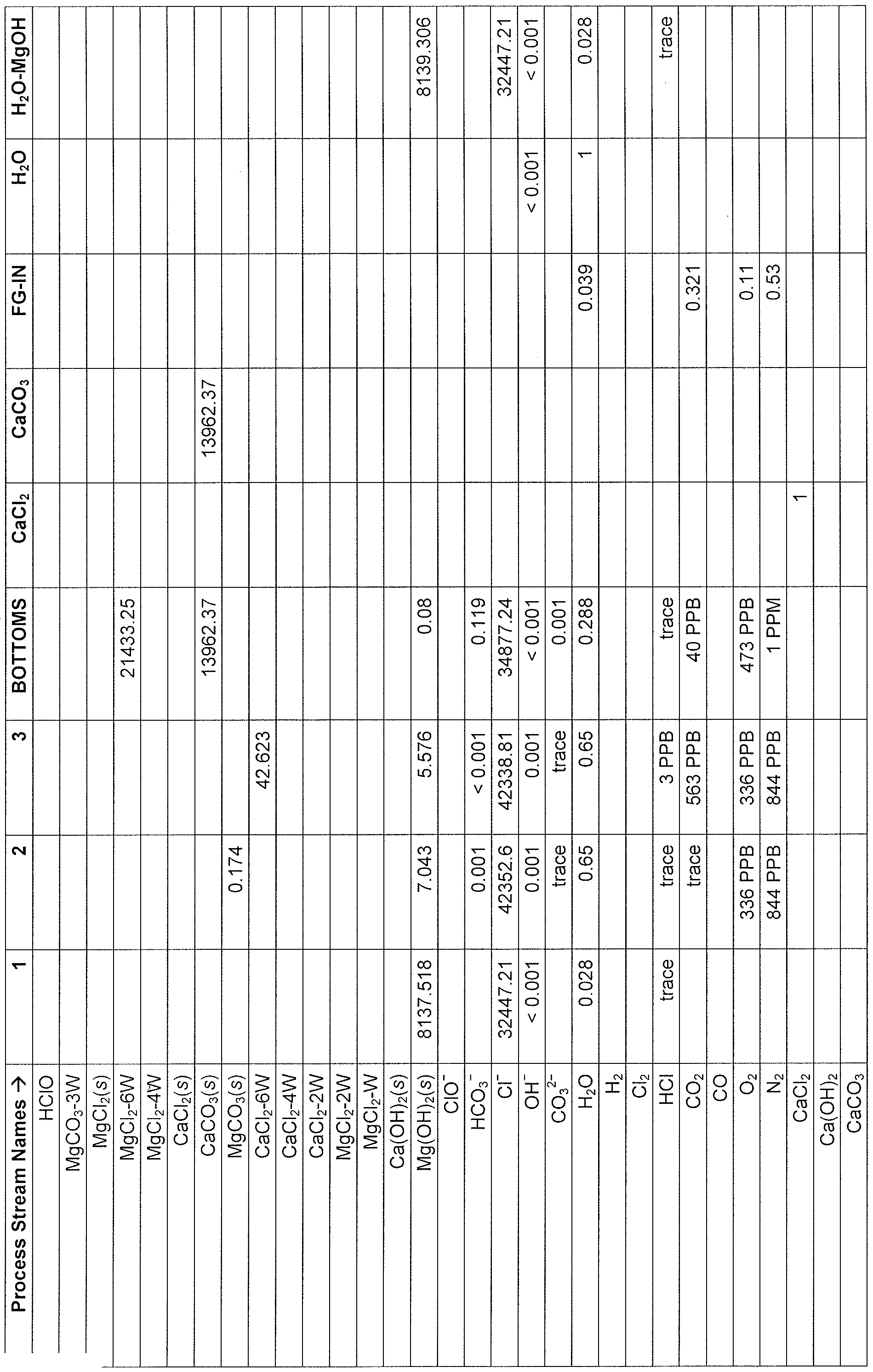
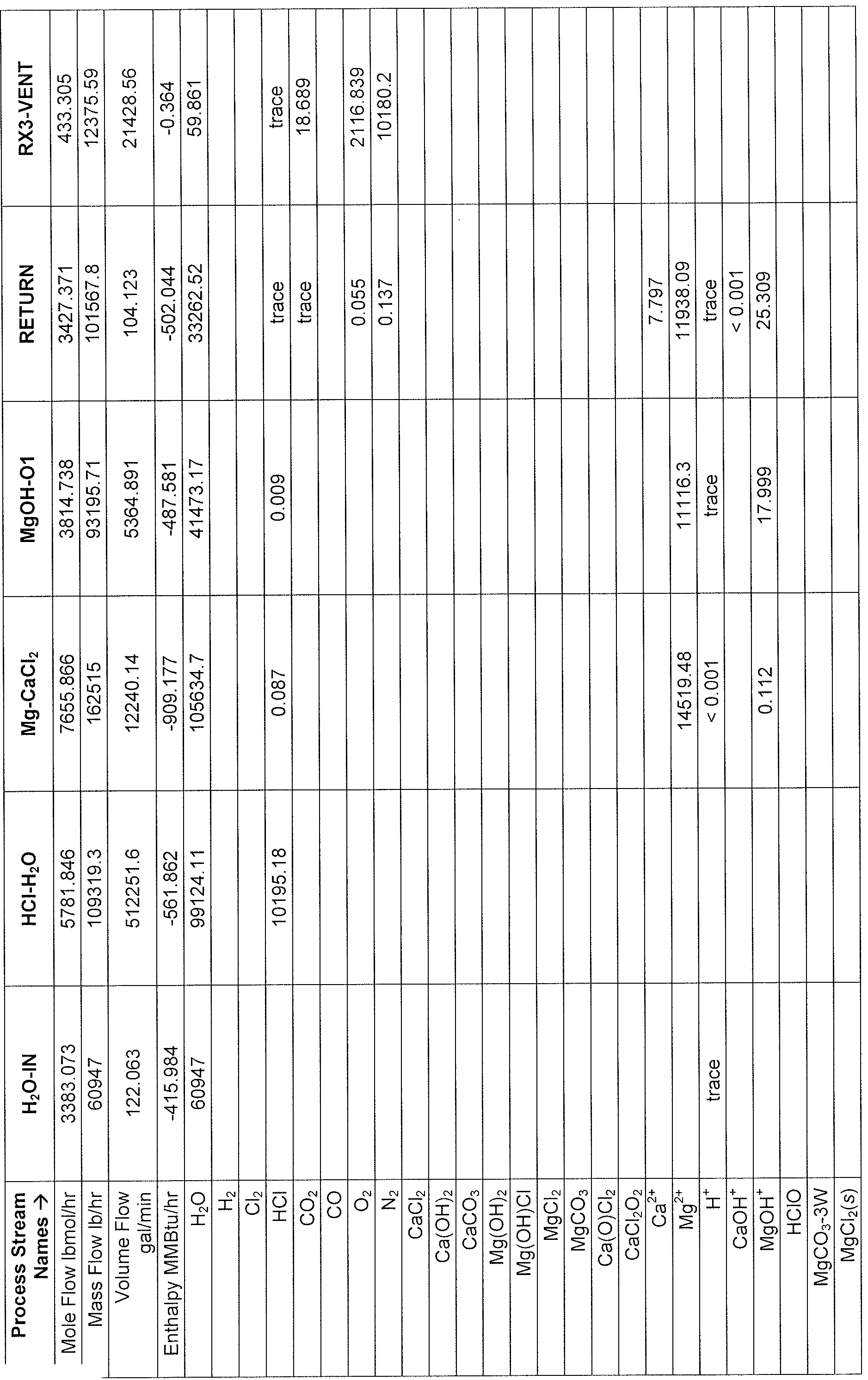
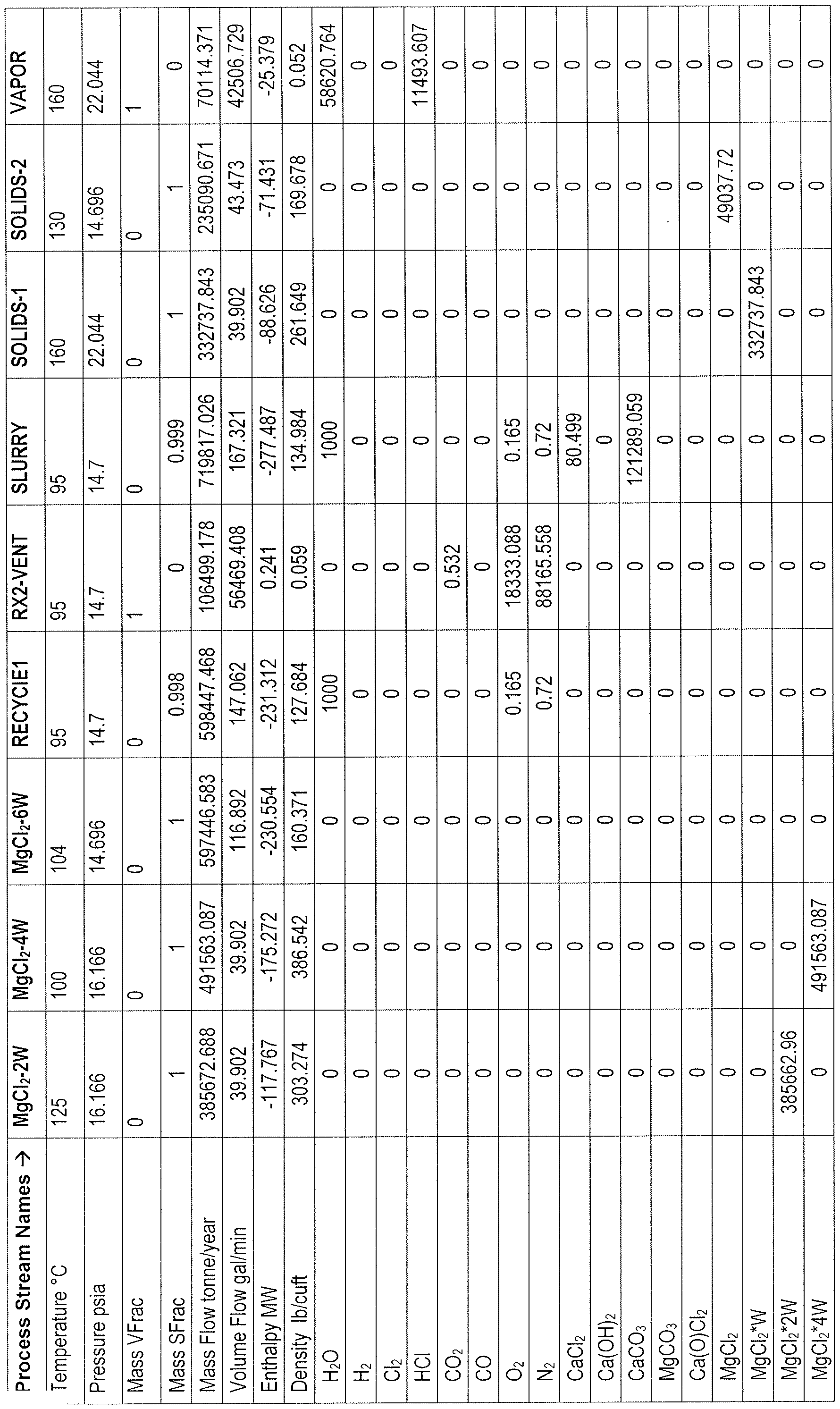
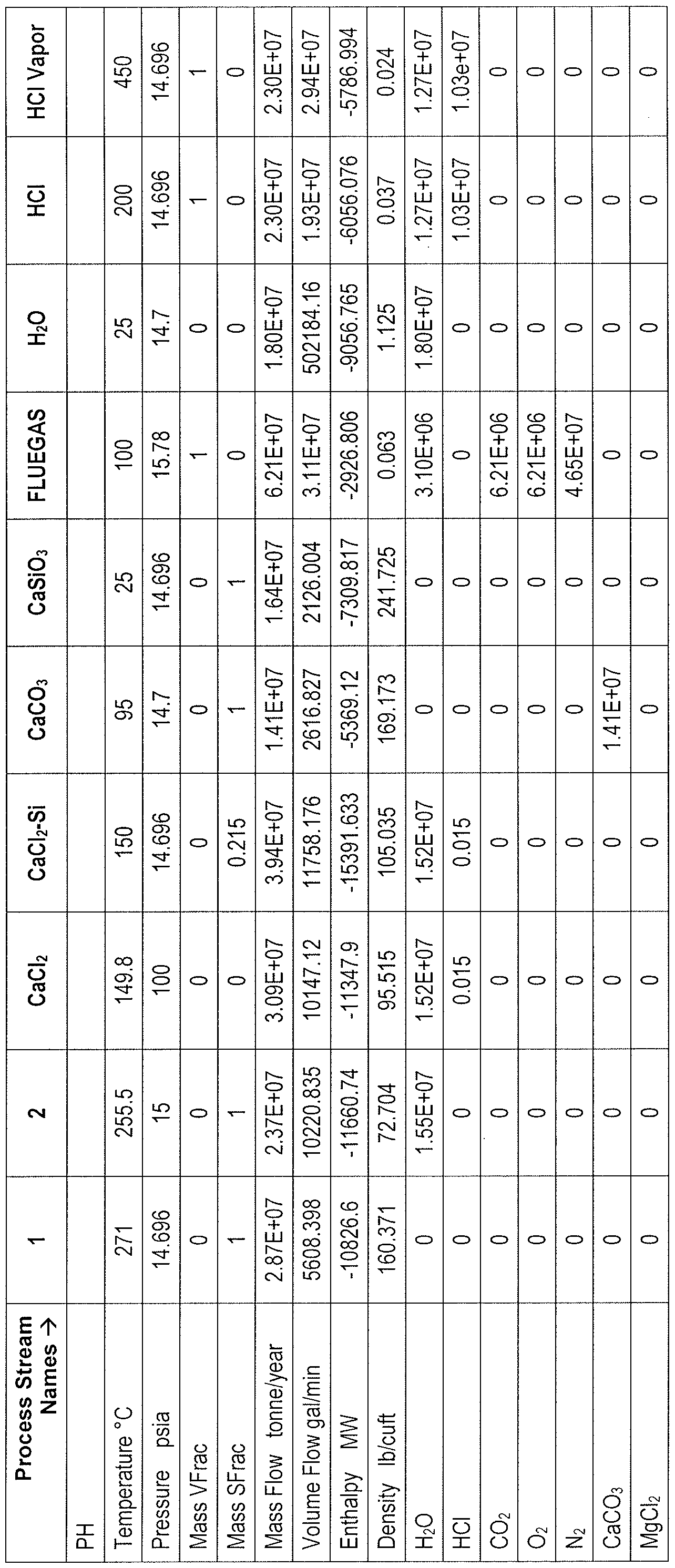
  • FIG. 5 is a process flow diagram showing parameters and results from a process simulation using Aspen Plus process software.
  • a 35% MgCl 2 , 65% H 2 0 solution is heated to 536 °F (280 °C), then the stream leaves in the stream labeled "H 2 0- MgOH," which comprises a solution of MgCl 2 and solid Mg(OH) 2 .
  • H 2 0- MgOH comprises a solution of MgCl 2 and solid Mg(OH) 2 .
  • Mg(OH)Cl dissolves in water it forms Mg(OH) 2 (solid) and MgCl 2 (dissolved).
  • the MgCl 2 is not used to absorb C0 2 directly, rather it is recycled.
  • the net reaction is the capture of C0 2 from flue gas using inexpensive raw materials, CaCl 2 and water, to form CaC0 3 .
  • Results from the simulation suggest that it is efficient to recirculate a MgCl 2 stream and then to react it with H 2 0 and heat to form Mg(OH) 2 .
  • One or more of the aforementioned compounds then reacts with a CaCl 2 /H 2 0 solution and C0 2 from the flue gas to ultimately form CaC0 3 , which is filtered out of the stream.
  • the resulting MgCl 2 formed is recycled to the first reactor to repeat the process.
  • FIG. 6 is a process flow diagram showing parameters and results from a process simulation using Aspen Plus process software.
  • the net reaction is the capture of C0 2 from flue gas using inexpensive raw materials, CaCl 2 and water, to form CaC0 3 .
  • the hexahydrate is dehydrated in three separate chambers and decomposed in the fourth chamber where the HCl that is formed from the decomposition is recirculated back to the third chamber to prevent any side reactions. Reactions occurring in these chambers include the following:
  • HCl recirculates to the 3 r chamber.
  • the first three reactions above may be characterized as dehydrations, while the fourth may be characterized as a decomposition.
  • Results from this simulation indicate that at lower temperatures (130-250 °C) the decomposition of MgCl 2 -6H 2 0 results in the formation of Mg(OH)Cl instead of MgO.
  • the Mg(OH)Cl then reacts with H 2 0 to form MgCl 2 and Mg(OH)2, which then reacts with a saturated CaCl 2 /H 2 0 solution and C0 2 from the flue gas to form CaC0 3 , which is filtered out of the stream.
  • the resulting MgCl 2 formed is recycled to the first reactor to begin the process again.
  • FIG. 7 is a process flow diagram showing parameters and results from a process simulation using Aspen Plus process software.
  • the net reaction is the capture of C0 2 from flue gas using inexpensive raw materials, CaCl 2 and water, to form CaC0 3 .
  • the magnesium hexahydrate is dehydrated in two separate chambers and decomposed in a third chamber. Both dehydration and decomposition reactions occur in the third chamber. There is no recirculating HCl. Reactions occurring in these chambers include the following:
  • the first, second and fourth reactions above may be characterized as dehydrations, while the third may be characterized as a decomposition.
  • the temperatures used in this embodiment result in the formation of Mg(OH)Cl from the MgCl 2 -6H 2 0 rather than MgO.
  • the Mg(OH)Cl then reacts with H 2 0 to form MgCl 2 and Mg(OH) 2 , which reacts with a saturated CaCl 2 /H 2 0 solution and C0 2 from the flue gas to form CaC0 3 , which is filtered out of the stream.
  • the resulting MgCl 2 formed is recycled to the first reactor to begin the process again. Additional details regarding this simulation are provided in Example 3 below.
  • FIG. 8 is a process flow diagram showing parameters and results from a process simulation using Aspen Plus process software.
  • the net reaction is the capture of C0 2 from flue gas using inexpensive raw materials, CaCl 2 and water, to form CaC0 3 .
  • Results from this simulation indicate that it is efficient to heat MgCl 2 -6H 2 0 to form MgO.
  • the MgO then reacts with H 2 0 to form Mg(OH) 2 , which then reacts with a saturated CaCl 2 /H 2 0 solution and C0 2 from the flue gas to form CaC0 3 , which is filtered out of the stream.
  • the resulting MgCl 2 formed is recycled to the first reactor to begin the process again.
  • the magnesium hexahydrate is simultaneously dehydrated and decomposed in one chamber at 450 °C.
  • This is the model termperature range.
  • the preferred range in some emobodiments, is 450 °C - 500 °C.
  • the main reaction occurring in this chamber can be represented as follows:
  • FIG. 9 is a process flow diagram showing parameters and results from a process simulation using Aspen Plus process software similar to the embodiment of FIG. 8 except that the MgCl 2 -6H 2 0 is decomposed into an intermediate compound, Mg(OH)Cl at a lower temperature of 250 °C in one chamber.
  • the Mg(OH)Cl is then dissolved in water to form MgCl 2 and Mg(OH) 2 , which follows through with the same reaction with CaCl 2 and C0 2 to form CaC0 3 and MgCl 2 .
  • the main reaction occurring in this chamber can be represented as follows:
  • the reaction was modeled at 250 °C. In some embodiments, the preferred range is from 230 °C to 260 °C. Additional details regarding this simulation are provided in Example 5 below.
  • FIG. 10 shows a graph of the mass percentage of a heated sample of MgCl 2 -6H 2 0.
  • the sample's initial mass was approximately 70 mg and set at 100%.
  • the temperature was quickly ramped up to 150 °C, and then slowly increased by 0.5 °C per minute. At approximately 220 °C, the weight became constant, consistent with the formation of Mg(OH)Cl.
  • FIG. 11 shows X-ray diffraction data corresponding to the product of Example 7.
  • FIG. 12 shows X-ray diffraction data corresponding to the product from the reaction using Mg(OH)2 of Example 8.
  • FIG. 13 shows X-ray diffraction data corresponding to the product from the reaction using Mg(OH)Cl of Example 8.
  • FIG. 14 shows the effect of temperature and pressure on the decomposition of MgCl 2 -(H 2 0).
  • FIG. 15 is a process flow diagram of an embodiment of the Ca Mg process described herein.
  • FIG. 16 is a process flow diagram of a variant of the process, whereby only magnesium compounds are used. In this embodiment the Ca 2+ - Mg 2+ switching reaction does not occur.
  • FIG. 17 is a process flow diagram of a different variant of the process which is in between the previous two embodiments.
  • Half of the Mg is replaced by Ca , thereby making the resulting mineralized carbonate MgCa(C0 3 ) 2 or dolomite.
  • This figure shows a process flow diagram providing parameters and results from a process simulation using Aspen Plus process software.
  • the net reaction is the capture of C0 2 from flue gas using inexpensive raw materials, CaSi0 3 , C0 2 and water, to form Si0 2 and CaC0 3 .
  • Results from this simulation indicate that it is efficient to use heat from the HCl reacting with CaSi0 3 and heat from the flue gas emitted by a natural gas or coal fired power plant to carry out the decomposition of MgCl 2 -6H 2 0 to form Mg(OH)Cl.
  • the Mg(OH)Cl then reacts with H 2 0 to form MgCl 2 and Mg(OH) 2 , which then reacts with a saturated CaCl 2 /H 2 0 solution and C0 2 from the flue gas to form CaC0 3 , which is filtered out of the stream.
  • the resulting MgCl 2 formed is recycled to the first reactor to begin the process again.
  • the magnesium chloride hexahydrate is dehydrated to magnesium chloride dihydrate MgCl 2 -2H 2 0 in the first chamber using heat from the HCl and CaSi0 3 reaction and decomposed in a second chamber at 250°C using heat from the flue gas.
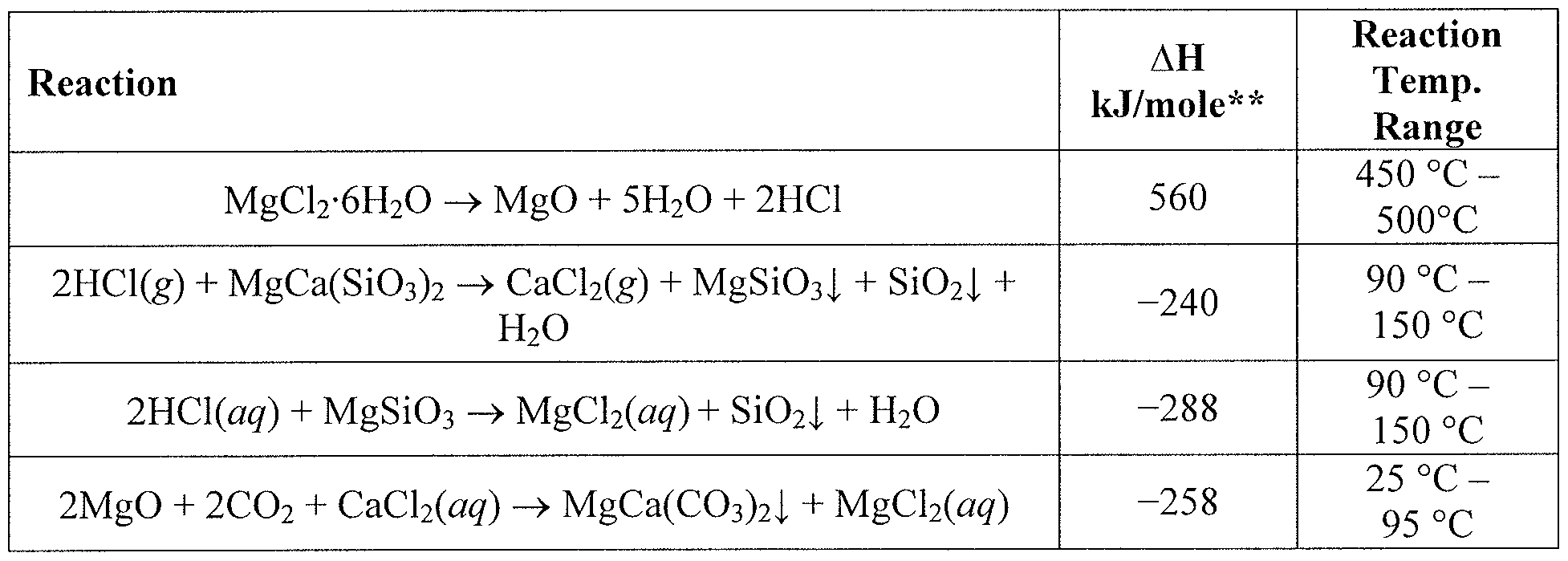
  • the main reactions occurring in this chamber can be represented as follows: ⁇ ** Reaction
  • FIG. 19 CaSi03-MgO Process, Cases 12 & 13.
  • This figure shows a process flow diagram providing parameters and results from a process simulation using Aspen Plus process software.
  • the net reaction is the capture of C0 2 from flue gas using inexpensive raw materials, CaSi0 3 , C0 2 and water, to form Si0 2 and CaC0 3 .
  • Results from this simulation indicate that it is efficient to use heat from the HC1 reacting with CaSi0 3 and heat from flue gas emitted by a natural gas or coal fired power plant to carry out the decomposition of MgCl 2 -6H 2 0 to form MgO.
  • the MgO then reacts with H 2 0 to form Mg(OH) 2 , which then reacts with a saturated CaCl 2 /H 2 0 solution and C0 2 from the flue gas to form CaC0 3 , which is filtered out of the stream.
  • the resulting MgCl 2 formed is recycled to the first reactor to begin the process again.
  • the magnesium chloride hexahydrate is dehydrated to magnesium chloride dihydrate MgCl 2 -2H 2 0 in the first chamber using heat from the HC1 and CaSi0 3 reaction and decomposed in a second chamber at 450°C using heat from the flue gas.
  • the main reactions occurring in this chamber can be represented as follows:
  • This figure shows a process flow diagram providing parameters and results from a process simulation using Aspen Plus process software.
  • the net reaction is the capture of C0 2 from flue gas using inexpensive raw materials, MgSi0 3 , C0 2 and water, to form Si0 2 and MgC0 3 .
  • Results from this simulation indicate that it is efficient to use heat from the HC1 reacting with MgSi0 3 and heat from the flue gas emitted by a natural gas or coal fired power plant to carry out the decomposition of MgCl 2 -2H 2 0 to form Mg(OH)Cl.
  • the Mg(OH)Cl then reacts with H 2 0 to form MgCl 2 and Mg(OH) 2 , which then reacts with C0 2 from the flue gas to form MgC0 3 , which is filtered out of the stream.
  • the resulting MgCl 2 formed is recycled to the first reactor to begin the process again.
  • the magnesium chloride remains in the dihydrate form MgCl 2 -2H 2 0 due to the heat from the HC1 and MgSi0 3 prior to decomposition at 250°C using heat from the flue gas.
  • the main reactions occurring in this chamber can be represented as follows:
  • This figure shows a process flow diagram providing parameters and results from a process simulation using Aspen Plus process software.
  • the net reaction is the capture of C0 2 from flue gas using inexpensive raw materials, MgSi0 3 , C0 2 and water, to form Si0 2 and MgC0 3 .
  • Results from this simulation indicate that it is efficient to use heat from the HC1 reacting with MgSi0 3 and heat from the flue gas emitted by a natural gas or coal fired power plant to carry out the decomposition of MgCl 2 -2H 2 0 to form MgO.
  • the MgO then reacts with H 2 0 to form Mg(OH) 2 , which then reacts with C0 2 from the flue gas to form MgC0 3 , which is filtered out of the stream.
  • the magnesium chloride remains in the dihydrate form MgCl 2 -2H 2 0 due to the heat from the HC1 and MgSi0 3 prior to decomposition at 450°C using heat from the flue gas.
  • the main reactions occurring in this chamber can be represented as follows: Reaction ⁇ kJ/mole Reaction Temp.
  • FIG. 22 Diopside-Mg(OH)Cl Process, Cases 18 & 19.
  • This figure shows a process flow diagram providing parameters and results from a process simulation using Aspen Plus process software.
  • the net reaction is the capture of C0 2 from flue gas using inexpensive raw materials, diopside MgCa(Si03) 2 , C0 2 and water, to form Si0 2 and dolomite MgCa(CC>3) 2 .
  • Results from this simulation indicate that it is efficient to use heat from the HC1 reacting with MgCa(Si03) 2 and heat from the flue gas emitted by a natural gas or coal fired power plant to carry out the decomposition of MgCl 2 -6H 2 0 to form Mg(OH)Cl.
  • the Mg(OH)Cl then reacts with H 2 0 to form MgCl 2 and Mg(OH) 2 , which then reacts with a saturated CaCl 2 /H 2 0 solution and C0 2 from the flue gas to form MgCa(C0 3 ) 2 which is filtered out of the stream.
  • the resulting MgCl 2 formed is recycled to the first reactor to begin the process again.
  • the magnesium chloride hexahydrate is dehydrated to magnesium chloride dihydrate MgCl 2 -2H 2 0 in the first chamber using heat from the HC1 and CaSi0 3 reaction and decomposed to Mg(OH)Cl in a second chamber at 250°C using heat from the flue gas.
  • the main reactions occurring in this chamber can be represented as follows:
  • FIG. 23 Diopside-MgO Process, Cases 20 & 21.
  • This figure shows a process flow diagram providing parameters and results from a process simulation using Aspen Plus process software.
  • the net reaction is the capture of C0 2 from flue gas using inexpensive raw materials, diopside MgCa(Si0 3 ) 2 , C0 2 and water, to form Si0 2 and dolomite MgCa(C0 3 ) 2 .
  • results from this simulation indicate that it is efficient to use heat from the HCl reacting with MgCa(Si0 3 ) 2 and heat from the flue gas emitted by a natural gas or coal fired power plant and/or other heat source to carry out the decomposition of MgCl 2 -6H 2 0 to form MgO.
  • the MgO then reacts with H 2 0 to form Mg(OH) 2 , which then reacts with a saturated CaCl 2 /H 2 0 solution and C0 2 from the flue gas to form MgCa(C0 3 ) 2 which is filtered out of the stream.
  • the resulting MgCl 2 formed is recycled to the first reactor to begin the process again.
  • the magnesium chloride hexahydrate is dehydrated to magnesium chloride dihydrate MgCl 2 -2H 2 0 in the first chamber using heat from the HCl and CaSi0 3 reaction and decomposed to MgO in a second chamber at 450°C using heat from the flue gas.
  • the main reactions occurring in this chamber can be represented as follows:
  • FIG. 24 illustrates the percent C0 2 captured for varying C0 2 flue gas concentrations, varying temperatures, whether the flue gas was originated from coal or natural gas, and also whether the process relied on full or partial decomposition. See Examples 10 through 13 of the CaSi0 3 -Mg(OH)Cl and CaSi0 3 -MgO processes.
  • FIG. 25 illustrates the percent C0 2 captured for varying C0 2 flue gas concentrations, varying temperatures, whether the flue gas was originated from coal or natural gas, and also whether the process relied on full or partial decomposition. See Examples 14 through 17 of the MgSi0 3 -Mg(OH)Cl and MgSi0 3 -MgO processes.
  • FIG. 26 illustrates the percent C0 2 captured for varying C0 2 flue gas concentrations, varying temperatures, whether the flue gas was originated from coal or natural gas, and also whether the process relied on full or partial decomposition. See Examples 18 through 21 of the Diopside - Mg(OH)Cl and Diopside - MgO processes.
  • FIG. 27 is a simplified process-flow diagram corresponding to some embodiments of the present invention in which two different salts, e.g. , Ca 2+ and Mg 2+ , are used for decomposition and carbonation.
  • two different salts e.g. , Ca 2+ and Mg 2+
  • FIGS. 28-29 show graphs of the mass percentages of heated samples of MgCl 2 -6H 2 0.
  • the initial masses of the samples were approximately 70 mg each and were each set at 100%.
  • the temperature was ramped up to 200 °C then further increased over the course of a 12 hour run.
  • the identities of the decomposed materials can be confirmed by comparing against the theoretical plateaus provided.
  • FIG. 28 is a superposition of two plots, the first one being the solid line, which is a plot of time (minutes) versus temperature (°C).
  • FIG. 29 is also a superposition of two plots, the first (the solid line) is a plot of weighf% versus temperature (°C), illustrating the sample's weight decreasing as the temperature increases; the second plot (the dashed line) is a plot of the derivative of the weight% with respect to temperature (wt.%/°C) versus temperature °C. When this value is high it indicates a higher rate of weight loss for each change per degree. If this value is zero, the sample's weight remains the same although the temperature is increasing, indicating an absence of dehydration or decomposition. Note Figure 28 and 29 are of the same sample.
  • FIG. 30 - MgCl 2 -6H 2 0 Decomposition at 500°C after One Hour.
  • This graph shows the normalized final and initial weights of four test runs of MgCl 2 -6H 2 0 after heating at 500 °C for one hour. The consistent final weight confirms that MgO is made by decomposition at this temperature.
  • FIG. 31 Three-Chamber Decomposition.
  • This figure shows a process flow diagram providing parameters and results from a process simulation using Aspen Plus process software.
  • heat from cold flue gas (chamber 1 )
  • heat from mineral dissolution reactor (chamber 2)
  • external natural gas (chamber 3) are used as heat sources.
  • This process flow diagram illustrates a three chamber process for the decomposition to Mg(OH)Cl.
  • the first chamber is heated by 200 °C flue gas to provide some initial heat about -8.2% of the total required heat
  • the second chamber which relies on heat recovered from the mineral dissolution reactor to provide 83% of the needed heat for the decomposition of which 28% is from the hydrochloric acid/mineral silicate reaction and 55% is from the condensation and formation of hydrochloric acid
  • the third chamber which uses natural gas as an external source of the remaining heat which is 8.5% of the total heat.
  • the C0 2 is from a combined cycle power natural gas plant, so very little heat is available from the power plant to power the decomposition reaction.
  • FIG. 32 Four-Chamber Decomposition. This figure shows a process flow diagram providing parameters and results from a process simulation using Aspen Plus process software.
  • heat from cold flue gas (chamber 1), heat from additional steam (chamber 2), heat from mineral dissolution reactor (chamber 3), and external natural gas (chamber 4) are used as heat sources.
  • This process flow diagram illustrates a four chamber process for the decomposition to Mg(OH)Cl, the first chamber provides 200 °C flue gas to provide some initial heat about -8.2% of the total required heat, the second chamber provides heat in the form of extra steam which is 0.8% of the total heat needed, the third chamber which relies on heat recovered from the mineral dissolution reactor to provide 83% of the needed heat for the decomposition of which 28% is from the hydrochloric acid/mineral silicate reaction and 55% is from the condensation and formation of hydrochloric acid, and finally the fourth chamber, which uses natural gas as an external source of the remaining heat which is 8.0% of the total heat.
  • the C0 2 is from a combined cycle natural gas power plant, so very little heat is available from the power plant to power the decomposition reaction.
  • FIG. 33 Two-Chamber Decomposition.
  • This figure shows a process flow diagram providing parameters and results from a process simulation using Aspen Plus process software.
  • heat from mineral dissolution reactor (chamber 1), and external natural gas (chamber 2) are used as heat sources.
  • This process flow diagram illustrates a two chamber process for the decomposition to Mg(OH)Cl, the first chamber which relies on heat recovered from the mineral dissolution reactor to provide 87% of the needed heat for the decomposition of which 28% is from the hydrochloric acid/mineral silicate reaction and 59% is from the condensation and formation of hydrochloric acid, and the second chamber, which uses natural gas as an external source of the remaining heat which is 13% of the total heat.
  • the C0 2 is from a combined cycle natural gas power plant, so very little heat is available from the power plant to power the decomposition reaction.
  • FIG. 34 Two-Chamber Decomposition.
  • This figure shows a process flow diagram providing parameters and results from a process simulation using Aspen Plus process software.
  • heat from mineral dissolution reactor (chamber 1), and hot flue gas from open cycle natural gas plant (chamber 2) are used as heat sources.
  • This process flow diagram illustrates a two chamber process for the decomposition to Mg(OH)Cl, the first chamber which relies on heat recovered from the mineral dissolution reactor to provide 87% of the needed heat for the decomposition of which 28% is from the hydrochloric acid/mineral silicate reaction and 59% is from the condensation and formation of hydrochloric acid, and the second chamber, which uses hot flue gas as an external source of the remaining heat which is 13%) of the total heat.
  • the C0 2 is from an open cycle natural gas power plant, therefore substantial heat is available from the power plant in the form of 600 °C flue gas to power the decomposition reaction.
  • FIG. 35 shows a schematic diagram of a Auger reactor which may be used for the salt decomposition reaction, including the decomposition of MgCl 2 -6H 2 0 to M(OH)Cl or MgO.
  • Such reactors may comprises internal heating for efficient heat utilization, external insulation for efficient heat utilization, a screw mechanism for adequate solid transport (when solid is present), adequate venting for HC1 removal.
  • Such a reactors has been used to prepare ⁇ 1.8kg of -90% Mg(OH)Cl.
  • FIG. 36 shows the optimization index for two separate runs of making Mg(OH)Cl using an Auger reactor.
  • the optimization index % conversion ⁇ % efficiency.
  • FIG. 37 shows a process flow diagram of an Aspen model that simulates an CaSi0 3 - Mg(OH)Cl Process.
  • FIG. 38A-I shows a process flow diagram providing parameters and results from a process simulation using Aspen Plus process software.
  • the net reaction is the capture of C0 2 from flue gas using inexpensive raw materials, CaSi0 3 , C0 2 and water, to form Si0 2 and CaC0 3 .
  • Heat is used to carry out the decomposition of MgCl 2 -6H 2 0 to form Mg(OH)Cl.
  • the Mg(OH)Cl then reacts with H 2 0 to form MgCl 2 and Mg(OH) 2 .
  • the quantity of H 2 0 is regulated to favor formation of solid Mg(OH) 2 and aqueous MgCl 2 (which is recycled to the first reactor to begin the process again)
  • the Mg(OH) 2 then reacts with a saturated CaCl 2 /H 2 0 solution and C0 2 from the flue gas to form CaC0 3 , which is filtered out of the stream.
  • the resulting MgCl 2 formed is recycled to the first reactor to begin the process again.
  • A is an overview diagram of the process.
  • B-I are overlapping enlargements of the overview diagram shown in A.
  • FIG. 39A-I shows a process flow diagram providing parameters and results from a process simulation using Aspen Plus process software.
  • the net reaction is the capture of C0 2 from flue gas using inexpensive raw materials, CaSi0 3 , C0 2 and water, to form Si0 2 and CaC0 3 .
  • Heat is used to carry out the decomposition of MgCl 2 -6H 2 0 to form Mg(OH)Cl.
  • the Mg(OH)Cl then reacts with H 2 0 to form MgCl 2 and Mg(OH) 2 .
  • the quantity of H 2 0 is regulated to favor formation of solid Mg(OH) 2 and aqueous MgCl 2 (which is recycled to the first reactor to begin the process again).
  • A is an overview diagram of the process.
  • B-I are overlapping enlargements of the overview diagram shown in A.
  • the present invention relates to carbon dioxide sequestration, including energy- efficient processes in which Group 2 chlorides are converted to Group 2 hydroxides and hydrogen chloride, which are then used to remove carbon dioxide from waste streams.
  • hydrogen chloride may be further reacted with Group 2 silicates to produce additional Group 2 chloride starting materials and silica.
  • the methods and apparatuses of the invention comprise one or more of the following general components: (1) the conversion of Group 2 silicate minerals with hydrogen chloride into Group 2 chlorides and silicon dioxide, (2) conversion of Group 2 chlorides into Group 2 hydroxides and hydrogen chloride, (3) an aqueous decarbonation whereby gaseous C0 2 is absorbed into an aqueous caustic mixture comprising Group 2 hydroxides to form Group 2 carbonate and/or bicarbonate products and water, (4) a separation process whereby the carbonate and/or bicarbonate products are separated from the liquid mixture, (5) the reuse or cycling of by-products, including energy, from one or more of the steps or process streams into another one or more steps or process streams.
  • each of these general components is explained in further detail below.
  • one advantage of certain embodiments of the present invention is that they provide ecological efficiencies that are superior to those of the prior art, while absorbing most or all of the emitted C0 2 from a given source, such as a power plant.
  • carbonates or “carbonate products” are generally defined as mineral components containing the carbonate group, [C0 3 ] . Thus, the terms encompass both carbonate/bicarbonate mixtures and species containing solely the carbonate ion.
  • bicarbonates and bicarbonate products are generally defined as mineral components containing the bicarbonate group, [HC0 3 ]' ⁇ . Thus, the terms encompass both carbonate/bicarbonate mixtures and species containing solely the bicarbonate ion.
  • Ca/Mg signifies either Ca alone, Mg alone or a mixture of both Ca and Mg.
  • the ratio of Ca to Mg may range from 0: 100 to 100:0, including, e.g., 1 :99, 5:95, 10:90, 20:80, 30:70, 40:60, 50:50, 60:40, 70:30, 80:20, 90: 10, 95:5, and 99: 1.
  • the symbols "Ca/Mg”, “MgxCa(l-x)” and CaxMg(l-x)” are synonymous.
  • “CaMg” or “MgCa” refers to a 1 : 1 ratio of these two ions.
  • ecological efficiency is used synonymously with the term “thermodynamic efficiency” and is defined as the amount of C0 2 sequestered by certain embodiments of the present invention per energy consumed (represented by the equation "3C0 2 / ⁇ 9E"), appropriate units for this value are kWh/ton C0 2 .
  • C0 2 sequestration is denominated in terms of percent of total plant C0 2 ; energy consumption is similarly denominated in terms of total plant power consumption.
  • “Hexahydrate” refers to MgCl 2 -6H 2 0.
  • the term "ion ratio” refers to the ratio of cations in the product divided by the number of carbons present in that product.
  • a product stream formed of calcium bicarbonate (Ca(HC0 3 ) 2 ) may be said to have an "ion ratio" of 0.5 (Ca/C)
  • a product stream formed of pure calcium carbonate (CaC0 3 ) may be said to have an "ion ratio” of 1.0 (Ca/C).
  • an infinite number of continuous mixtures of carbonate and bicarbonate of mono-, di- and trivalent cations may be said to have ion ratios varying between 0.5 and 3.0.
  • MW either means molecular weight or megawatts.
  • PFD process flow diagram
  • Q heat (or heat duty), and heat is a type of energy. This does not include any other types of energy.
  • the term "sequestration” is used to refer generally to techniques or practices whose partial or whole effect is to remove C0 2 from point emissions sources and to store that C0 2 in some form so as to prevent its return to the atmosphere. Use of this term does not exclude any form of the described embodiments from being considered “sequestration” techniques.
  • the pyroxenes are a group of silicate minerals found in many igneous and metamorphic rocks. They share a common structure consisting of single chains of silica tetrahedra and they crystallize in the monoclinic and orthorhombic systems. Pyroxenes have the general formula XY(Si,Al) 2 0 6 , where X represents calcium, sodium, iron (II) and magnesium and more rarely zinc, manganese and lithium and Y represents ions of smaller size, such as chromium, aluminium, iron(III), magnesium, manganese, scandium, titanium, vanadium and even iron (II).
  • atoms making up the compounds of the present invention are intended to include all isotopic forms of such atoms.
  • Isotopes include those atoms having the same atomic number but different mass numbers.
  • isotopes of hydrogen include tritium and deuterium
  • isotopes of carbon include 13 C and 14 C.
  • the term “about” is used to indicate that a value includes the inherent variation of error for the device, the method being employed to determine the value, or the variation that exists among the study subjects.
  • the terms “comprise,” “have” and “include” are open-ended linking verbs. Any forms or tenses of one or more of these verbs, such as “comprises,” “comprising,” “has,” “having,” “includes” and “including,” are also open-ended. For example, any method that "comprises,” “has” or “includes” one or more steps is not limited to possessing only those one or more steps and also covers other unlisted steps.
  • FIG. 1 depicts a simplified process-flow diagram illustrating general, exemplary embodiments of the apparatuses and methods of the present disclosure. This diagram is offered for illustrative purposes only, and thus it merely depicts specific embodiments of the present invention and is not intended to limit the scope of the claims in any way.
  • reactor 10 e.g., a road salt boiler
  • power such as external power and/or recaptured power (e.g., heat from hot flue gas or an external source of heat such as solar concentration or combustion), to drive a reaction represented by equation 1.
  • external power and/or recaptured power e.g., heat from hot flue gas or an external source of heat such as solar concentration or combustion
  • the water used in this reaction may be in the form of liquid, steam, a crystalline hydrate, e.g. , MgCl 2 -6H 2 0, CaCl 2 -2H 2 0, or it may be supercritical.
  • the reaction uses MgCl 2 to form Mg(OH) 2 and/or Mg(OH)Cl (see, e.g., FIG. 2).
  • the reaction uses CaCl 2 to form Ca(OH) 2 .
  • Some or all of the Group 2 hydroxide or hydroxychloride (not shown) from equation 1 may be delivered to reactor 20.
  • some or all of the Group 2 hydroxide and/or Group 2 hydroxychloride is delivered to reactor 20 as an aqueous solution.
  • some or all of the Group 2 hydroxide is delivered to reactor 20 in an aqueous suspension. In some embodiments, some or all of the Group 2 hydroxide is delivered to reactor 20 as a solid. In some embodiments, some or all of the hydrogen chloride (e.g. , in the form of vapor or in the form of hydrochloric acid) may be delivered to reactor 30 (e.g. , a rock melter). In some embodiments, the resulting Group 2 hydroxides are further heated to remove water and form corresponding Group 2 oxides. In some variants, some or all of these Group 2 oxides may then be delivered to reactor 20.
  • the hydrogen chloride e.g. , in the form of vapor or in the form of hydrochloric acid
  • reactor 30 e.g. , a rock melter
  • the resulting Group 2 hydroxides are further heated to remove water and form corresponding Group 2 oxides. In some variants, some or all of these Group 2 oxides may then be delivered to reactor 20.
  • Carbon dioxide from a source enters the process at reactor 20 (e.g. , a fluidized bed reactor, a spray-tower decarbonator or a decarbonation bubbler), potentially after initially exchanging waste-heat with a waste-heat/DC generation system.
  • reactor 20 e.g. , a fluidized bed reactor, a spray-tower decarbonator or a decarbonation bubbler
  • the temperature of the flue gas is at least 125 °C.
  • the Group 2 hydroxide, some or all of which may be obtained from reactor 10 reacts with carbon dioxide in reactor 20 according to the reaction represented by equation 2.
  • the water produced from this reaction may be delivered back to reactor 10.
  • the Group 2 carbonate is typically separated from the reaction mixture.
  • Group 2 carbonates have a very low ⁇ Sp (solubility product constant). So they be separated as solids from other, more soluble compounds that can be kept in solution.
  • the reaction proceeds through Group 2 bicarbonate salts.
  • Group 2 bicarbonate salts are generated and optionally then separated from the reaction mixture.
  • Group 2 oxides, optionally together with or separately from the Group 2 hydroxides are reacted with carbon dioxide to also form Group 2 carbonate salts.
  • the flue gas from which C0 2 and/or other pollutants have been removed, is released to the air.
  • Group 2 silicates enter the process at reactor 30 (e.g. , a rock melter or a mineral dissociation reactor).
  • reactor 30 e.g. , a rock melter or a mineral dissociation reactor.
  • these Group 2 silicates are ground in a prior step.
  • the Group 2 silicates are inosilicates.
  • These minerals may be reacted with hydrochloric acid, either as a gas or in the form of hydrochloric acid, some or all of which may be obtained from reactor 10, to form the corresponding Group 2 metal chlorides (CaCl 2 and/or MgCl 2 ), water and sand (Si0 2 ).
  • the reaction can be represented by equation 3.
  • Some or all of the water produced from this reaction may be delivered to reactor 10.
  • Some or all of the Group 2 chlorides from equation 3 may be delivered to reactor 20.
  • some or all of the Group 2 chloride is delivered to reactor 20 as an aqueous solution.
  • some or all of the Group 2 chloride is delivered to reactor 20 in an aqueous suspension.
  • some or all of the Group 2 chloride is delivered to reactor 20 as a solid. The net reaction capturing the summation of equations 1 -3 is shown here as equation
  • the resulting Mg x Ca ( ]- X) C0 3 sequestrant is reacted with HC1 in a manner to regenerate and concentrate the C0 2 .
  • the Ca/MgCl 2 thus formed is returned to the decomposition reactor to produce C0 2 absorbing hydroxides or hydroxyhalides.
  • Group 2 carbonates are generated as end-sequestrant material from the captured C0 2 .
  • Some or all of the water, hydrogen chloride and/or reaction energy may be cycled. In some embodiments, only some or none of these are cycled. In some embodiments, the water, hydrogen chloride and reaction energy made be used for other purposes.
  • the methods disclosed herein may be used to capture 33-66% of the plant's C0 2 using heat-only as the driver (no electrical penalty).
  • the efficiencies of the methods disclosed herein improve with lower C0 2 -concentrations, and increase with higher (unscrubbed) flue-gas temperatures.
  • 33% of flue-gas C0 2 can be mineralized from waste-heat alone.
  • approximately 100% mineralization can be achieved.
  • FIG. 2 depicts a simplified process-flow diagram illustrating general, exemplary embodiments of the apparatuses and methods of the present disclosure. This diagram is offered for illustrative purposes only, and thus it merely depicts specific embodiments of the present invention and is not intended to limit the scope of the claims in any way.
  • reactor 100 uses power, such as external power and/or recaptured power (e.g., heat from hot flue gas), to drive a decomposition -type reaction represented by equation 5.
  • power such as external power and/or recaptured power (e.g., heat from hot flue gas)
  • recaptured power e.g., heat from hot flue gas
  • the water used in this reaction may be in the form of a hydrate of magnesium chloride, liquid, steam and/or it may be supercritical.
  • the reaction may occur in one, two, three or more reactors. In some embodiments, the reaction may occur as a batch, semi-batch of continuous process.
  • some or all of the magnesium salt product may be delivered to reactor 200. In some embodiments, some or all of the magnesium salt product is delivered to reactor 200 as an aqueous solution.
  • some or all of the magnesium salt product is delivered to reactor 200 in an aqueous suspension. In some embodiments, some or all of the magnesium salt product is delivered to reactor 200 as a solid. In some embodiments, some or all of the hydrogen chloride (e.g. , in the form of vapor or in the form of hydrochloric acid) may be delivered to reactor 300 (e.g. , a rock melter).
  • the Mg(OH)2 is further heated to remove water and form MgO. In some embodiments, the MgCl(OH) is further heated to remove HC1 and form MgO. In some variants, one or more of Mg(OH)2, MgCl(OH) and MgO may then be delivered to reactor 200.
  • Carbon dioxide from a source enters the process at reactor 200 (e.g. , a fluidized bed reactor, a spray-tower decarbonator or a decarbonation bubbler), potentially after initially exchanging waste-heat with a waste-heat/DC generation system.
  • reactor 200 e.g. , a fluidized bed reactor, a spray-tower decarbonator or a decarbonation bubbler
  • the temperature of the flue gas is at least 125 °C.
  • Admixed with the carbon dioxide is the magnesium salt product from reactor 100 and CaCl 2 ⁇ e.g. , rock salt). The carbon dioxide reacts with the magnesium salt product and CaCl 2 in reactor 200 according to the reaction represented by equation 6.
  • the water produced from this reaction may be delivered back to reactor 100.
  • the calcium carbonate product e.g., limestone, calcite
  • the reaction proceeds through magnesium carbonate and bicarbonate salts.
  • the reaction proceeds through calcium bicarbonate salts.
  • various Group 2 bicarbonate salts are generated and optionally then separated from the reaction mixture.
  • the flue gas, from which C0 2 and/or other pollutants have been removed is released to the air, optionally after one or more further purification and/or treatment steps.
  • the MgCl 2 product, optionally hydrated is returned to reactor 100.
  • the MgCl 2 product is subjected to one or more isolation, purification and/or hydration steps before being returned to reactor 100.
  • Calcium silicate ⁇ e.g. , 3CaOSi0 2 , Ca 3 Si0 5 ; 2CaOSi0 2 , Ca 2 Si0 4 ; 3CaO2Si0 2 , Ca 3 Si 2 0 7 and CaOSi0 2 , CaSi0 3 enters the process at reactor 300 ⁇ e.g. , a rock melter).
  • these Group 2 silicates are ground in a prior step.
  • the Group 2 silicates are inosilicates.
  • the inosilicate is CaSi0 3 ⁇ e.g., wollastonite, which may itself, in some embodiments, contain small amounts of iron, magnesium and/or manganese substituting for iron).
  • the CaSi0 3 is reacted with hydrogen chloride, either gas or in the form of hydrochloric acid, some or all of which may be obtained from reactor 100, to form CaCl 2 , water and sand (Si0 2 ).
  • the reaction can be represented by equation 7.
  • a Group 2 chloride e.g. , CaCl 2 or MgCl 2
  • water may be in the form of liquid, steam, from a hydrate of the Group 2 chloride, and/or it may be supercritical.
  • the steam may come from a heat exchanger whereby heat from an enormous combustible reaction, i.e. natural gas and oxygen or hydrogen and chlorine heats a stream of water.
  • steam may also be generated through the use of plant or factory waste heat.
  • the chloride salt, anhydrous or hydrated is also heated.
  • the reactions are endothermic meaning energy, e.g., heat has to be applied to make these reactions occur. Such energy may be obtained from the waste-heat generated from one or more of the exothermic process steps disclosed herein.
  • the above reactions may occur according to one of more of the following steps:
  • reaction enthalpy ( ⁇ ) for CaCl 2 + 2 3 ⁇ 40 ⁇ Ca(OH) 2 + 2 HCl(g) is 284 kJ/mole at 100 °C.
  • the salt MgCl 2 -6H 2 0, magnesium hexahydrate is used. Since water is incorporated into the molecular structure of the salt, direct heating without any additional steam or water may be used to initiate the decomposition. Typical reactions temperatures for the following reactions are shown here:
  • Mg(OH) 2 can be more efficiently generated from MgCl 2 (via Mg(OH)Cl) by adjusting the proportion of MgCl 2 and water in the presence of Mg(OH)Cl.
  • the amount of water in the chamber is adjusted to favor Mg(OH) 2 precipitation, while preventing formation of MgCl 2 -6(H 2 0) hydrates.
  • the amount of water in a Mg(OH)Cl solution is maintained at a water to MgCl 2 molar ratio of greater than or equal to 6, such as a ratio of of between about 6 and 7.
  • Mg(OH)Cl + 1 ⁇ 2 MgCl 2 - 12H 2 0(liquid) > 1 ⁇ 2 Mg(OH) 2 + MgCl 2 -6H 2 0
  • the MgCl 2 (aq) is being reconstituted to half of the original MgCl 2 -6H 2 0 by water removal and the remaining half of the MgCl 2 -6H 2 0 forms from the disproportionation of Mg(OH)Cl by addition of water.
  • FIG. 38A-I An example of a system that utilizes Mg(OH) 2 generated as detailed above is shown in FIG. 38A-I.
  • the Aspen diagram is below, and has a red rectangle around the defined "water disproportionator".
  • Mg(OH)Cl, stream SOLIDS- 1 is leaving the decomposition reactor labeled "DECOMP”.
  • the Mg(OH)Cl is mixed the aqueous MgC12 from the absorption column, stream RECYCLE2. They leave as a slurry from the unit as stream "4", pass through a heat exchanger and send heat to the decomposition chamber.
  • the stream is then named "13" which passes through a separation unit which separates the stream into stream MGCLSLRY (MgCl 2 .6H 2 0 almost) and stream SOLIDS-2, which is the Mg(OH) 2 heading to the absorption column.
  • apparatuses and methods for the decarbonation of carbon dioxide sources using Group 2 hydroxides, Group 2 oxides, and/or Group 2 hydroxide chlorides as C0 2 adsorbents are provided.
  • C0 2 is absorbed into an aqueous caustic mixture and/or solution where it reacts with the hydroxide and/or oxide salts to form carbonate and bicarbonate products.
  • Sodium hydroxide, calcium hydroxide and magnesium hydroxide, in various concentrations, are known to readily absorb C0 2 .
  • Group 2 hydroxides, Group 2 oxides (such as CaO and/or MgO) and/or other hydroxides and oxides, e.g. , sodium hydroxide may be used as the absorbing reagent.
  • a Group 2 hydroxide e.g. , obtained from a Group 2 chloride, may be used in an adsorption tower to react with and thereby capture C0 2 based on one or both of the following reactions:
  • the reaction may be driven to completion, for example, through the removal of water, whether through continuous or discontinous processes, and/or by means of the precipitation of bicarbonate, carbonate, or a mixture of both types of salts. See example 1, below, providing a simulation demonstrating the ability to capture C0 2 from flue gas using an inexpensive raw material, Ca(CO) 2 derived from CaCl 2 , to form CaC0 3 .
  • an initially formed Group 2 may undergo an salt exchange reaction with a second Group 2 hydroxide to transfer the carbonate anion.
  • a second Group 2 hydroxide may undergo an salt exchange reaction with a second Group 2 hydroxide to transfer the carbonate anion.
  • silicate minerals make up one of the largest and most important classes of rock-forming minerals, constituting approximately 90 percent of the crust of the Earth. They are classified based on the structure of their silicate group. Silicate minerals all contain silicon and oxygen. In some aspects of the present invention, Group 2 silicates may be used to accomplish the energy efficient sequestration of carbon dioxide.
  • compositions comprising Group 2 inosilicates may be used.
  • Inosilicates, or chain silicates have interlocking chains of silicate tetrahedra with either Si0 3 , 1 :3 ratio, for single chains or Si 4 Oi i, 4: 1 1 ratio, for double chains.
  • compositions comprising Group 2 inosilicates from the pyroxene group.
  • enstatite MgSi0 3
  • MgSi0 3 enstatite
  • compositions comprising Group 2 inosilicates from the pyroxenoid group are used.
  • wollastonite CaSi0 3
  • compositions comprising mixtures of Group 2 inosilicates may be employed, for example, mixtures of enstatite and wollastonite.
  • compositions comprising mixed-metal Group 2 inosilicates may be used, for example, diopside (CaMgSi 2 0 6 ).
  • Wollastonite usually occurs as a common constituent of a thermally metamorphosed impure limestone. Typically wollastonite results from the following reaction (equation 26) between calcite and silica with the loss of carbon dioxide:
  • the present invention has the result of effectively reversing this natural process.
  • Wollastonite may also be produced in a diffusion reaction in skarn. It develops when limestone within a sandstone is metamorphosed by a dyke, which results in the formation of wollastonite in the sandstone as a result of outward migration of calcium ions.
  • the purity of the Group 2 inosilicate compositions may vary.
  • the Group 2 inosilicate compositions used in the disclosed processes may contain varying amounts of other compounds or minerals, including non-Group 2 metal ions.
  • wollastonite may itself contain small amounts of iron, magnesium, and manganese substituting for calcium.
  • compositions comprising olivine and/or serpentine may be used.
  • CO 2 mineral sequestration processes utilizing these minerals have been attempted. The techniques of Goldberg et al. (2001) are incorporated herein by reference.
  • the mineral olivine is a magnesium iron silicate with the formula (Mg,Fe) 2 SiC>4. When in gem-quality, it is called peridot. Olivine occurs in both mafic and ultramafic igneous rocks and as a primary mineral in certain metamorphic rocks. Mg-rich olivine is known to crystallize from magma that is rich in magnesium and low in silica. Upon crystallization, the magna forms mafic rocks such as gabbro and basalt. Ultramafic rocks, such as peridotite and dunite, can be residues left after extraction of magmas and typically are more enriched in olivine after extraction of partial melts.
  • Olivine and high pressure structural variants constitute over 50% of the Earth's upper mantle, and olivine is one of the Earth's most common minerals by volume.
  • the metamorphism of impure dolomite or other sedimentary rocks with high magnesium and low silica content also produces Mg-rich olivine, or forsterite.
  • Group 2 silicates e.g., CaSi0 3 , MgSi0 3 , and/or other silicates disclosed herein, may be reacted with hydrochloric acid, either as a gas or in the form of aqueous hydrochloric acid, to form the corresponding Group 2 metal chlorides (CaCl 2 and/or MgCl 2 ), water and sand.
  • the HCl produced in equation 1 is used to regenerate the MgCl 2 and/or CaCl 2 in equation 3.
  • a process loop is thereby created.
  • Table 1 below depicts some of the common calcium/magnesium containing silicate minerals that may be used, either alone or in combination. Initial tests by reacting olivine and serpentine with HCl have been successful. Si0 2 was observed to precipitate out and MgCl 2 and CaCl 2 were collected. Table 1. Calcium/Magnesium Minerals.
  • the conversion of carbon dioxide to mineral carbonates may be defined by two salts.
  • the first salt is one that may be heated to decomposition until it becomes converted to a base (hydroxide and/or oxide) and emits an acid, for example, as a gas. This same base reacts with carbon dioxide to form a carbonate, bicarbonate or basic carbonate salt.
  • the present disclosure provides processes that react one or more salts from Tables A-C below with water to form a hydroxides, oxides, and/or a mixed hydroxide halides. Such reactions are typically referred to as decompositions.
  • the water may be in the form of liquid, steam, and/or from a hydrate of the selected salt.
  • the steam may come from a heat exchanger whereby heat from an enormous combustible reaction, i.e. natural gas and oxygen or hydrogen and chlorine heats a stream of water.
  • steam may also be generated through the use of plant or factory waste heat.
  • the halide salt, anhydrous or hydrated is also heated.
  • This same carbonate, bicarbonate or basic carbonate of the first salt reacts with a second salt to do a carbonate/bicarbonate exchange, such that the anion of second salt combines with the cation of the first salt and the cation of the second salt combines with the carbonate/bicarbonate ion of the first salt, which forms the final carbonate/bicarbonate.
  • the hydroxide derived from the first salt is reacted with carbon dioxide and the second salt directly to form a carbonate/bicarbonate derived from (combined with the cation of) the second salt.
  • the carbonate/bicarbonate/basic carbonate derived from (combined with the cation of) the first salt is removed from the reactor chamber and placed in a second chamber to react with the second salt.
  • FIG. 27 shows an embodiment of this 2-salt process.
  • This reaction may be beneficial when making a carbonate/bicarbonate when a salt of the second metal is desired, and this second metal is not as capable of decomposing to form a C0 2 absorbing hydroxide, and if the carbonate/bicarbonate compound of the second salt is insoluble, i.e. it precipitates from solution.
  • this reaction may be beneficial when making a carbonate/bicarbonate when a salt of the second metal is desired, and this second metal is not as capable of decomposing to form a C0 2 absorbing hydroxide, and if the carbonate/bicarbonate compound of the second salt is insoluble, i.e. it precipitates from solution.
  • Known carbonate compounds include H 2 C0 3 , Li 2 C0 3 , Na 2 C0 3 , K 2 C0 3 , Rb 2 C0 3 , Cs 2 C0 3 , BeC0 3 , MgC0 3 , CaC0 3 , MgC0 3 , SrC0 3 , BaC0 3 , MnC0 3 , FeC0 3 , CoC0 3 , CuC0 3 , ZnC0 3 , Ag 2 C0 3 , CdC0 3 , A1 2 (C0 3 ) 3 , T1 2 C0 3 , PbC0 3 , and La 2 (C0 3 ) 3 .
  • Group IA elements are known to be stable bicarbonates, e.g., LiHC0 3 , NaHC0 3 , RbHC0 3 , and CsHC0 3 .
  • Group IIA and some other elements can also form bicarbonates, but in some cases, they may only be stable in solution.
  • rock-forming elements are H, C, O, F, Na, Mg, Al, Si, P, S, CI, K, Ca, Ti, Mg and Fe. Salts of these that can be thermally decomposed into corresponding hydroxides by the least amount of energy per mole of C0 2 absorbing hydroxide may therefore be considered potential Salt-1 candidates.
  • the following salts specify a decomposition reaction through their respective available MSDS information.
  • Limestone is a sedimentary rock composed largely of the mineral calcite (calcium carbonate: CaC0 3 ). This mineral has many uses, some of which are identified below.
  • Limestone in powder or pulverized form may be used as a soil conditioner (agricultural lime) to neutralize acidic soil conditions, thereby, for example, neutralizing the effects of acid rain in ecosystems.
  • soil conditioner agricultural lime
  • Upstream applications include using limestone as a reagent in desulfurizations.
  • Limestone is an important stone for masonry and architecture. One of its advantages is that it is relatively easy to cut into blocks or more elaborate carving. It is also long-lasting and stands up well to exposure. Limestone is a key ingredient of quicklime, mortar, cement, and concrete.
  • Calcium carbonate is also used as an additive for paper, plastics, paint, tiles, and other materials as both white pigment and an inexpensive filler. Purified forms of calcium carbonate may be used in toothpaste and added to bread and cereals as a source of calcium. CaC0 3 is also commonly used medicinally as an antacid.
  • this invention provides a non-extractive source of this important product.
  • MgC0 3 is a white solid that occurs in nature as a mineral.
  • the most common magnesium carbonate forms are the anhydrous salt called magnesite (MgC0 3 ) and the di, tri, and pentahydrates known as barringtonite (MgC0 3 -2H 2 0), nesquehonite (MgC0 3 -3H 2 0), and lansfordite (MgC0 3 -5H 2 0), respectively.
  • MgC0 3 anhydrous salt
  • barringtonite MgC0 3 -2H 2 0
  • nesquehonite MgC0 3 -3H 2 0
  • lansfordite MgC0 3 -5H 2 0
  • Magnesium carbonate may be used to produce magnesium metal and basic refractory bricks. MgC0 3 is also used in flooring, fireproofing, fire extinguishing compositions, cosmetics, dusting powder, and toothpaste. Other applications are as filler material, smoke suppressant in plastics, a reinforcing agent in neoprene rubber, a drying agent, a laxative, and for color retention in foods. In addition, high purity magnesium carbonate is used as antacid and as an additive in table salt to keep it free flowing.
  • magnesium carbonate is typically obtained by mining the mineral magnesite. By co-generating this mineral as part of carbon dioxide sequestration in some embodiments, this invention provides a non-extractive source of this important product.
  • Silicon dioxide also known as silica
  • silica is an oxide of silicon with a chemical formula of Si0 2 and is known for its hardness.
  • Silica is most commonly found in nature as sand or quartz, as well as in the cell walls of diatoms. Silica is the most abundant mineral in the Earth's crust. This compound has many uses; some of these are briefly discussed below.
  • Silica is used primarily in the production of window glass, drinking glasses and bottled beverages.
  • the majority of optical fibers for telecommunications are also made from silica. It is a primary raw material for many whiteware ceramics such as earthenware, stoneware and porcelain, as well as industrial Portland cement.
  • Silica is a common additive in the production of foods, where it is used primarily as a flow agent in powdered foods, or to absorb water in hygroscopic applications. In hydrated form, silica is used in toothpaste as a hard abrasive to remove tooth plaque. Silica is the primary component of diatomaceous earth which has many uses ranging from filtration to insect control. It is also the primary component of rice husk ash which is used, for example, in filtration and cement manufacturing.
  • Thin films of silica grown on silicon wafers via thermal oxidation methods can be quite beneficial in microelectronics, where they act as electric insulators with high chemical stability. In electrical applications, it can protect the silicon, store charge, block current, and even act as a controlled pathway to limit current flow.
  • Silica is typically manufactured in several forms including glass, crystal, gel, aerogel, fumed silica, and colloidal silica. By co-generating this mineral as part of carbon dioxide sequestration in some embodiments, this invention provides another source of this important product.
  • Separation processes may be employed to separate carbonate and bicarbonate products from the liquid solution and/or reaction mixture. By manipulating the basic concentration, temperature, pressure, reactor size, fluid depth, and degree of carbonation, precipitates of one or more carbonate and/or bicarbonate salts may be caused to occur. Alternatively, carbonate/bicarbonate products may be separated from solution by the exchange of heat energy with incoming flue-gases.
  • the exit liquid streams may include water, CaC0 3 ,
  • removing/separating the water from the carbonate product involves adding heat energy to evaporate water from the mixture, for example, using a reboiler.
  • retaining a partial basic solution and subsequently heating the solution in a separating chamber may be used to cause relatively pure carbonate salts to precipitate into a holding tank and the remaining hydroxide salts to recirculate back to the reactor.
  • pure carbonate, pure bicarbonate, and mixtures of the two in equilibrium concentrations and/or in a slurry or concentrated form may then be periodically transported to a truck/tank-car.
  • the liquid streams may be displaced to evaporation tanks/fields where the liquid, such as water, may be carried off by evaporation.
  • the release of gaseous products includes a concern whether hydroxide or oxide salts will be released safely, i.e., emitting "basic rain.” Emission of such aerosolized caustic salts may be prevented in some embodiments by using a simple and inexpensive condenser/reflux unit.
  • the carbonate salt may be precipitated using methods that are used separately or together with a water removal process.
  • Various carbonate salt equilibria have characteristic ranges where, when the temperature is raised, a given carbonate salt, e.g. , CaC0 3 will naturally precipitate and collect, which makes it amenable to be withdrawn as a slurry, with some fractional NaOH drawn off in the slurry.
  • waste-heat recovery energy quantities may be found to entirely power embodiments of the present invention.
  • some embodiments of the apparatuses and methods of the present disclosure produce a number of useful intermediates, by-products, and final products from the various reaction steps, including hydrogen chloride, Group 2 carbonate salts, Group 2 hydroxide salts, etc. In some embodiments, some or all of these may be used in one or more of the methods described below. In some embodiments, some or all of one of the starting materials or intermediates employed in one or more of the steps described above are obtained using one or more of the methods outlined below.
  • the chlorine gas may be liquefied to hydrochloric acid that is then used to chlorinate Group 2 silicate minerals. Liquefaction of chlorine and subsequent use of the hydrochloric acid is particularly attractive especially in situations where the chlorine market is saturated. Liquefaction of chlorine may be accomplished according to equation 27:
  • the oxygen so produced may be returned to the air-inlet of the power plant itself, where it has been demonstrated throughout the course of power-industry investigations that enriched oxygen-inlet plants have (a) higher Carnot-efficiencies, (b) more concentrated C0 2 exit streams, (c) lower heat-exchange to warm inlet air, and (d) other advantages over non-oxygen-enhanced plants.
  • the oxygen may be utilized in a hydrogen/oxygen fuel cell.
  • the oxygen may serve as part of the oxidant in a turbine designed for natural gas power generation, for example, using a mixture of hydrogen and natural gas.
  • the chlorine gas may be reacted with a Group 2 hydroxide salts to yield a mixture of a chloride and a hypochlorite salts (equation 28).
  • a Group 2 hydroxide salt may be sold as a product and the Group 2 hydroxide salt may be used to remove excess chlorine.
  • the Group 2 hypochlorites may then be decomposed using a cobalt or nickel catalyst to form oxygen and the corresponding chloride (equation 29).
  • the calcium chloride and/or the magnesium chloride may then be recovered.
  • the decarbonation conditions will also remove SOx and ⁇ and, to a lesser extent, mercury.
  • the incidental scrubbing of ⁇ , SOx, and mercury compounds can assume greater economic importance; i.e., by employing embodiments of the present invention, coals that contain large amounts of these compounds can be combusted in the power plant with, in some embodiments, less resulting pollution than with higher-grade coals processed without the benefit of the C0 2 absorption process.
  • Such principles and techniques are taught, for example, in U.S. Patent 7,727,374, U.S. Patent Application No. 1 1/233,509, filed September 22, 2005, U.S.
  • the entire text of each of the above-referenced disclosures is specifically incorporated by reference herein.
  • One embodiment of the present invention was simulated using Aspen Plus v. 7.1 software using known reaction enthalpies, reaction free energies and defined parameters to determine mass and energy balances and suitable conditions for capturing C0 2 from a flue gas stream utilizing CaCl 2 and heat to form CaC0 3 product. These results show that it is possible to capture C0 2 from flue gas using inexpensive raw materials, CaCl 2 and water, to form CaC0 3 .
  • Part of the defined parameters includes the process flow diagram shown in FIG. 5. Results from the simulation suggest that it is efficient to recirculate an MgCl 2 stream to react with H 2 0 and heat to form Mg(OH) 2 .
  • This Mg(OH) 2 then reacts with a saturated CaCl 2 /H 2 0 solution and C0 2 from the flue gas to form CaC0 3 , which is filtered out of the stream.
  • the resulting MgCl 2 formed is recycled to the first reactor to begin the process again.
  • This process is not limited to any particular source for CaCl 2 .
  • it may be obtained from reacting calcium silicate with HQ to yield CaCl 2 .
  • Constraints and parameters specified for this simulation include:
  • Tables 2a and 2b provide mass and energy accounting for the various streams (the columns in the table) of the simulated process. Each stream corresponds to the stream of FIG. 5.
  • the process consists of two primary reaction sections and one solids filtration section.
  • the first reactor heats MgCl 2 /water solution causing it to break down into a HC1/H 2 0 vapor stream and a liquid stream of Mg(OH) 2 .
  • the HC1/H 2 0 vapor stream is sent to the HC1 absorber column.
  • the Mg(OH) 2 solution is sent to reactor 2 for further processing.
  • the chemical reaction for this reactor can be represented by the following equation:
  • a CaCl 2 solution and a flue gas stream are added to the MgCl 2 in reactor 2.
  • This reaction forms CaC0 3 , MgCl 2 and water.
  • the CaC0 3 precipitates and is removed in a filter or decanter.
  • the remaining MgCl 2 and water are recycled to the first reactor. Additional water is added to complete the water balance required by the first reactor.
  • the chemical reaction for this reactor can be represented by the following equation:
  • the primary feeds to this process are CaCl 2 , flue gas (C0 2 ) and water.
  • MgCl 2 in the system is used, reformed and recycled.
  • the only MgCl 2 make-up required is to replace small amounts that leave the system with the CaC0 3 product, and small amounts that leave with the HCl/water product.
  • This process is a net energy user.
  • results from the simulation suggest that it is efficient to heat a MgCl 2 -6H 2 0 stream in three separate dehydration reactions, each in its own chamber, followed by a decomposition reaction, also in its own chamber, to form Mg(OH)Cl and HC1, i.e. total of four chambers.
  • the Mg(OH)Cl is reacted with H 2 0 to form MgCl 2 and Mg(OH) 2 , which then reacts with a saturated CaCl 2 /H 2 0 solution and C0 2 from the flue gas to form CaC0 3 , which is filtered out of the stream.
  • the resulting MgCl 2 -6H 2 0 formed is recycled along with the earlier product to the first reactor to begin the process again.
  • This process is not limited to any particular source for CaCl 2 .
  • it may be obtained from reacting calcium silicate with HC1 to yield CaCl 2 .
  • Constraints and parameters specified for this simulation include:
  • Table 3 provides mass and energy accounting for the various streams of the simulated process. Each stream corresponds to the stream of FIG. 6.
  • the process consists of two primary reactors and one solids filtration section.
  • the first reactor heats MgCl 2 -6H 2 0 causing it to break down into a HC1/H 2 0 vapor stream and a solid stream of Mg(OH)Cl.
  • the HC1/H 2 0 vapor stream is sent to a heat exchanger to recover extra heat.
  • the Mg(OH) 2 formed from the Mg(OH)Cl is sent to reactor 2 for further processing.
  • Chemical reaction(s) occurring in this reactor include the following:
  • a CaCl 2 solution and a flue gas stream are added to the Mg(OH) 2 in reactor 2.
  • This reaction forms CaC0 3 , MgCl 2 and water.
  • the CaC0 3 precipitates and is removed in a filter or decanter.
  • the remaining MgCl 2 and water are recycled to the first reactor. Additional water is added to complete the water balance required by the first reactor.
  • Chemical reaction(s) occurring in this reactor include the following:
  • the primary feeds to this process are CaCl 2 , flue gas (C0 2 ) and water.
  • MgCl 2 in the system is used, reformed and recycled.
  • the only MgCl 2 make-up required is to replace small amounts that leave the system with the CaC0 3 product, and small amounts that leave with the HCl/water product.
  • This process is a net energy user.
  • the amount of energy is under investigation and optimization.
  • Part of the defined parameters includes the process flow diagram shown in FIG. 7. Results from the simulation suggest that it is efficient to heat a MgCl 2 '6H 2 0 stream to form Mg(OH)Cl in two separate dehydration reactions, each in their own chambers followed by a decomposition reaction, also in its own chamber to form Mg(OH)Cl and HC1, i.e. a total of three chambers.
  • the Mg(OH)Cl is reacted with H 2 0 to form MgCl 2 and Mg(OH) 2 , which then reacts with a saturated CaCl 2 /H 2 0 solution and C0 2 from the flue gas to form CaC0 3 , which is filtered out of the stream.
  • the resulting MgCl 2 .6H 2 0 formed is recycled to the first reactor to begin the process again.
  • This process is not limited to any particular source for CaCl 2 .
  • it may be obtained from reacting calcium silicate with HC1 to yield CaCl 2 .
  • Constraints and parameters specified for this simulation include:
  • Table 4 provides mass and energy accounting for the various streams of the simulated process. Each stream corresponds to the stream in FIG. 7.
  • the process consists of two primary reactors and one solids filtration section.
  • the first reactor heats MgCl 2 .6H 2 0 causing it to break down into a HC1/H 2 0 vapor stream and a solid stream of Mg(OH)Cl.
  • the HC1/H 2 0 vapor stream is sent to a heat exchanger to recover extra heat.
  • the Mg(OH) 2 formed from the Mg(OH)Cl is sent to reactor 2 for further processing.
  • Chemical reaction(s) occurring in this reactor include the following:
  • a CaCl 2 solution and a flue gas stream are added to the Mg(OH) 2 in reactor 2.
  • This reaction forms CaC0 3 , MgCl 2 and water.
  • the CaC0 3 precipitates and is removed in a filter or decanter.
  • the remaining MgCl 2 and water are recycled to the first reactor. Additional water is added to complete the water balance required by the first reactor.
  • Chemical reaction(s) occurring in this reactor include the following: Mg(OH) 2 + CaCl 2 + C0 2 ⁇ CaC0 3 0) + MgCl 2 + H 2 0 (37)
  • the primary feeds to this process are CaCl 2 , flue gas (C0 2 ) and water.
  • MgCl 2 in the system is used, reformed and recycled.
  • the only MgCl 2 make-up required is to replace small amounts that leave the system with the CaC0 3 product, and small amounts that leave with the HCl/water product.
  • This process is a net energy user.
  • the amount of energy is under investigation and optimization.
  • Hexahydrate is dehydrated in 2 separate chambers. Step 1 hex to tetra, Step 2 tetra to di. Di-hydrate is decomposed into 100% Mg(OH)CI.
  • Part of the defined parameters include the process flow diagram shown in FIG. 8. Results from the simulation suggest that it is efficient to heat a MgCl 2 -6H 2 0 stream to form MgO in a single chamber.
  • the MgO is reacted with H 2 0 to form Mg(OH) 2 , which then reacts with a saturated CaCl 2 /H 2 0 solution and C0 2 from the flue gas to form CaC0 3 , which is filtered out of the stream.
  • the resulting MgCl 2 -6H 2 0 formed is recycled to the first reactor to begin the process again.
  • This process is not limited to any particular source for CaCl 2 . For example, it may be obtained from reacting calcium silicate with HC1 to yield CaCl 2 .
  • Constraints and parameters specified for this simulation include:
  • Table 5 provides mass and energy accounting for the various streams of the simulated process. Each stream corresponds to the stream of FIG. 8.
  • the process consists of two primary reactors and one solids filtration section.
  • the first reactor heats MgCl 2 -6H 2 0 causing it to break down into a HC1/H 2 0 vapor stream and a solid stream of MgO.
  • the HC1/H 2 0 vapor stream is sent to a heat exchanger to recover extra heat.
  • the Mg(OH) 2 formed from the MgO is sent to reactor 2 for further processing.
  • Chemical reaction(s) occurring in this reactor include the following:
  • a CaCl 2 solution and a flue gas stream are added to the Mg(OH) 2 in reactor 2.
  • This reaction forms CaC0 3 , MgCl 2 and water.
  • the CaC0 3 precipitates and is removed in a filter or decanter.
  • the remaining MgCl 2 and water are recycled to the first reactor. Additional water is added to complete the water balance required by the first reactor.
  • Chemical reaction(s) occurring in this reactor include the following::
  • the primary feeds to this process are CaCl 2 , flue gas (C0 2 ) and water.
  • MgCl 2 in the system is used, reformed and recycled.
  • the only MgCl 2 make-up required is to replace small amounts that leave the system with the CaC0 3 product, and small amounts that leave with the
  • This process is a net energy user.
  • the amount of energy is under investigation and optimization.
  • Hexahydrate is dehydrated and decomposed simultaneously at 450C. Reactor yeilds 100% MgO.
  • Part of the defined parameters include the process flow diagram shown in FIG. 9. Results from the simulation suggest that it is efficient to heat a MgCl 2 '6H 2 0 stream to form Mg(OH)Cl in a single chamber.
  • the Mg(OH)Cl is reacted with H 2 0 to form MgCl 2 and Mg(OH) 2 , which then reacts with a saturated CaCb/FbO solution and CO 2 from the flue gas to form CaC0 3 , which is filtered out of the stream.
  • the resulting MgCl 2 -6H 2 0 formed is recycled to the first reactor to begin the process again.
  • This process is not limited to any particular source for CaC ⁇ . For example, it may be obtained from reacting calcium silicate with HC1 to yield CaCl 2 .
  • Constraints and parameters specified for this simulation include:
  • the process consists of two primary reactors and one solids filtration section.
  • the first reactor heats MgCl 2 .6H 2 0 causing it to break down into a HCI/H 2 O vapor stream and a solid stream of Mg(OH)Cl.
  • the HCI/H 2 O vapor stream is sent to a heat exchanger to recover extra heat.
  • the Mg(OH) 2 formed from the Mg(OH)Cl is sent to reactor 2 for further processing.
  • Chemical reaction(s) occurring in this reactor include the following:
  • a CaCh solution and a flue gas stream are added to the Mg(OH) 2 in reactor 2.
  • This reaction forms CaC0 3 , MgCl 2 and water.
  • the CaC0 3 precipitates and is removed in a filter or decanter.
  • the remaining MgCl 2 and water are recycled to the first reactor. Additional water is added to complete the water balance required by the first reactor.
  • Chemical reaction(s) occurring in this reactor include the following:
  • the primary feeds to this process are CaCl 2 , flue gas (C0 2 ) and water.
  • MgCl 2 in the system is used, reformed and recycled. The only MgCl 2 make-up required is to replace small amounts that leave the system with the CaC0 3 product, and small amounts that leave with the HCl/water product.
  • This process is a net energy user.
  • the amount of energy is under investigation and optimization.
  • Hexahydrate is dehydrated and decomposed simultaneously at 250 °C. Reactor yields 100%
  • Example 6 Road Salt Boiler: Decomposition of Mg0 -6H 2 0
  • FIG. 10 shows a graph of the mass percentage of a heated sample of MgCl 2 -6H 2 0.
  • the sample's initial mass was approximately 70 mg and set at 100%.
  • the temperature was quickly ramped up to 150 °C, and then slowly increased by 0.5 °C per minute.
  • the weight became constant, consistent with the formation of Mg(OH)Cl.
  • the absence of further weight decrease indicated that almost all the water has been removed.
  • FIGS. 28 and 29 Two different detailed decompositional mass analyses are shown in FIGS. 28 and 29, with the theoretical plateaus of different final materials shown.
  • FIG. 30 confirms that MgO can be made by higher temperatures (here, 500 °C) than those which produce Mg(OH)Cl.
  • Results do not include elements with Z ⁇ 11 (Na) .
  • the EDS analysis indicates almost pure CaC0 3 with only a 1.55% by weight magnesium impurity and almost no Chlorine from the CaCl 2 .
  • the same test was performed, except that Mg(OH)Cl from the decomposition of MgCl 2 -6H 2 0 was used instead of Mg(OH) 2 .
  • Mg(OH)Cl has half the hydroxide [OH-], as Mg(OH) 2 it is expected to absorb C0 2 and form precipitated CaC0 3 (PCC).
  • the X D analysis coincides with the CaC0 3 signature.
  • olivine (Mg,Fe) 2 Si0 4 and serpentine Mg 3 Si 2 C> 5 (OH) 4 were crushed and reacted with 6.1 molar HCl over a period of approximately 72 hours. Two sets of tests were run, the first at room temperature and the second at 70 °C. These minerals have variable formulae and often contain iron. After the samples were filtered, the resulting filtrand and filtrate were dried in an oven overnight. The samples then went through XRD and EDS analysis. The filtrates should have MgCl 2 present and the filtrand should be primarily Si0 2 . Olivine Filtrate Reacted with HCl at Room Temperature
  • Results do not include elements with Z ⁇ 11 (Na) .
  • Results do not include elements with Z ⁇ 11 (Na) .
  • Results do not include elements with Z ⁇ 11 (Na) .
  • Results do not include elements with Z ⁇ 11 (Na) ,
  • Results do not include elements with Z ⁇ 11 (Na) .
  • olivine is (Mg,Fe) 2 Si0 , and this is a magnesium rich olivine.
  • the raw compound has a Mg:Si ratio of 2: 1.
  • the filtrand, that which does not pass through the filter has a (Mg + Fe:Si) ratio of (37+5.5:52) or 0.817:1. (Atom % on the chart), evidently more than 50% of the magnesium passed through the filter.
  • the heat source may be located prior to the baghouse where the temperature ranges from 320-480 °C in lieu of the air pre-heater. See Reference: pages 1 1-15 of "The structural design of air and gas ducts for power stations and industrial Boiler Applications," Publisher: American Society of Civil Engineers (March 1995), which is incorporated by reference herein in its entirety. Open cycle natural gas plants have much higher exhaust temperatures of 600 °C.
  • the decomposition reaction of MgCi 2 -6H 2 0 may also run in two different modes, complete decomposition to MgO or a partial decomposition to Mg(OH)Cl.
  • the partial decomposition to Mg(OH)Cl requires in some embodiments a temperature greater than 180 °C whereas the total decomposition to MgO requires in some embodiments a temperature of 440 °C or greater.
  • the incoming feed to the process can be represented as a continuum between 100% Calcium Silicate (CaSi0 3 ) and 100% Magnesium Silicate (MgSi0 3 ) with Diopside (MgCa(Si0 3 )2) (or a mixture of CaSi0 3 and MgSi0 3 in a 1 : 1 molar ratio) representing an intermediate 50% case.
  • the resulting output will range in some embodiments from calcium carbonate (CaC0 3 ) to magnesium carbonate (MgC0 3 ) with Dolomite CaMg(C0 3 )2 representing the intermediate case.
  • the process using 100% calcium silicate is the Ca-Mg process used in all of the previously modeled embodiments. It is also important to note that the 100% magnesium silicate process uses no calcium compounds; whereas the 100% calcium silicate incoming feed process does use magnesium compounds, but in a recycle loop, only makeup magnesium compounds are required.
  • Mg(OH) 2 which is formed from MgO and H 2 0.
  • diopside is a mixed calcium and magnesium silicate and dolomite is a mixed calcium and magnesium carbonate.
  • the temperature range of 320-550 °C includes models run at 320, 360, 400, 440 and 550 °C respectively.
  • the C0 2 percentage of flue gas 7.2% - 18%) includes models run at 7.2%, 10%, 14% and 18%) respectively.
  • the CaSi0 3 -MgO and CaSi0 3 -Mg(OH)Cl decomposition processes are further divided into two stages, the first step consists of a dehydration reaction where MgCl 2 -6H 2 0 is converted to MgCl 2 -2H 2 0 + 4 H 2 0 and the second step in which the MgCl 2 -2H 2 0 is converted to Mg(OH)Cl + HQ + H 2 0 if partial decomposition is desired or required and MgO + 2HC1 + H 2 0 if total decomposition is desired or required.
  • FIG. 15 describes a layout of this process.
  • the MgSi0 3 -MgO and MgSi0 3 -Mg(OH)Cl processes consists of a one chamber decomposition step in which the HC1 from the decomposition chamber reacts with MgSi0 3 in the rock-melting reactor and the ensuing heat of reaction leaves the MgCl 2 in the dihydrate form MgCl 2 -2H 2 0 as it leaves the rock-melting chamber in approach to the decomposition reactor where it is converted to either MgO or Mg(OH)Cl as described earlier. This process may be preferred if calcium silicates are unavailable.
  • the HC1 emitted from the decomposition reacts with MgSi0 3 to form more MgCl 2 .
  • the magnesium silicate process follows a different path from the calcium. The process starts from the “rock melting reaction HC1 + silicate”, and then moves to the “decomposition reaction (MgCl 2 + heat),” and lastly the absorption column. In the calcium silicate process, all the magnesium compounds rotate between the decomposition reaction and the absorption reaction. FIG. 16 describes the layout of this process.
  • Diopside-MgO and Diopside-Mg(OH)Cl also involve a two stage decomposition consisting of the dehydration reaction MgCl 2 -6H 2 0 + ⁇ — > MgCl 2 -2H 2 0 + 4 H 2 0 followed by the decomposition reaction MgCl 2 -2H 2 0 + ⁇ MgO + 2HC1 + H 2 0 (full decomposition) or MgCl 2 -2H 2 0 + ⁇ Mg(OFI)Cl + HC1 + FI 2 0 partial decomposition.
  • FIG. 17 describes a layout of this process.
  • the ensuing HC1 from the decomposition then reacts with the Diopside CaMg(Si0 3 ) 2 in a two step "rock melting reaction.”
  • the first reaction creates CaCl 2 through the reaction 2HC1 + CaMg(Si0 3 ) 2 ⁇ CaC ⁇ 2 (aq) + MgSi0 3
  • the solids from the previous reaction are then reacted with HC1 a second time to produce MgCl 2 through the reaction MgSi0 3 + 2HC1 ⁇ MgCl 2 + Si0 2 J +H 2 0.
  • the CaCl 2 from the first rock melter is transported to the absorption column and the MgCl 2 from the second rock melter is transported to the decomposition reactor to make Mg(OH)Cl or MgO.
  • Basis of the reaction Basis of the reaction:
  • the Aspen model enters the required inputs for the process and calculates the required flue gas to provide the heat needed for the decomposition reaction to produce the carbon dioxide absorbing compounds MgO, Mg(OH) 2 or Mg(OH)Cl.
  • This flue gas may be from a natural gas or a coal plant and in the case of coal was tested at a range of temperatures from 320 °C to 550 °C. This flue gas should not be confused with the reference flue gas which was used a standard to provide a specific amount of C0 2 removal for each example. A process with a higher temperature flue gas would typically require a lesser amount of flue gas to capture the same amount of carbon dioxide from the basis.
  • a flue gas with a greater carbon dioxide concentration would typically result in greater amount of flue gas needed to capture the carbon dioxide because there is a greater amount of carbon dioxide that needs to be captured.
  • the consumption of reactants and generation of products can be determined from the basis of C0 2 captured and the molecular weights of each input and each output for each example.
  • the CaSi0 3 consumption is:
  • the CaC0 3 production is:
  • the Si0 2 production is:
  • Running the Aspen models generated the following results for the heat duty for each step of the decomposition reaction, dehydration and decomposition.
  • the results for each example are summarized in the table below.
  • FIG. 24 illustrates the percent C captured for varying C0 2 flue gas concentrations, varying temperatures, whether the flue gas was originated from coal or natural gas, and al whether the process relied on full or partial decomposition for examples 10 through 13 of the CaSi0 3 -Mg(OH)Cl and CaSi0 3 -MgO processes.
  • FIG. 25 illustrates the percent C0 2 captured for varying C0 2 flue gas concentrations, varying temperatures, whether the flue gas w originated from coal or natural gas, and also whether the process relied on full or partial decomposition for examples 14 through 17 of t MgSi0 3 -Mg(OH)Cl and MgSi0 3 -MgO processes.
  • FIG. 26 illustrates the percent C0 2 captured for varying C0 2 flue gas concentrations, varying temperatures, whether the flue gas w originated from coal or natural gas, and also whether the process relied on full or partial decomposition for examples 18 through 21 of t Diopside - Mg(OH)Cl and Diopside - MgO processes.
  • Example 22 Decomposition of other salts.
  • Table 23 (see below) is a comparison of the four configurations corresponding to FIGS. 31-34. Depicted are the number and description of the chambers, the heat consumed in MW (Megawatts), the percentage of heat from that particular source and the reduction of required external heat in kW-H/tonne of C0 2 because of available heat from other reactions in the process, namely the hydrochloric acid reaction with mineral silicates and the condensation of hydrochloric acid.
  • the hot flue gas from the open- cycle natural gas plant also qualifies.
  • Example 23 Output Mineral Compared with Input Minerals— Coal
  • Table 24 illustrates that the volume of mineral outputs (limestone and sand) are 83% of the volume of input minerals (coal and inosilicate). The results summarized in Table 24 are based on a 600 MWe coal plant; total 4.66 E6 tonne C0 2 , includes C0 2 for process-required heat.
  • Example 25 Selective production of magnesium hydroxide by disproportionation of water and magnesium chloride
  • Mg(OH) 2 can be used in the following reaction to produce limestone from C0 2 gas.
  • CaCl 2 (aq) + C0 2 + Mg(OH) 2 > MgCl 2 (aq) + CaC0 3 l+ H 2 0
  • the amount of water in the reaction chamber will be adjusted to favor Mg(OH) 2 precipitation.
  • Mg(OH)Cl and MgCl 2 is provided in a large enough volume of water, the magnesium hydroxide precipitates, as it is virtually insoluble, whereas the magnesium chloride forms an aqueous solution.
  • the water (H 2 0) in the reaction below does not become part of the products, it merely solvates the Mg and CI " so they become an ionic solution.
  • an example set of C0 2 capture reactions can be represented as:

Landscapes

  • Chemical & Material Sciences (AREA)
  • Organic Chemistry (AREA)
  • Engineering & Computer Science (AREA)
  • Inorganic Chemistry (AREA)
  • Geology (AREA)
  • Life Sciences & Earth Sciences (AREA)
  • Chemical Kinetics & Catalysis (AREA)
  • Oil, Petroleum & Natural Gas (AREA)
  • Analytical Chemistry (AREA)
  • Environmental & Geological Engineering (AREA)
  • Biomedical Technology (AREA)
  • General Chemical & Material Sciences (AREA)
  • Health & Medical Sciences (AREA)
  • Treating Waste Gases (AREA)
  • Gas Separation By Absorption (AREA)
  • Carbon And Carbon Compounds (AREA)
  • Physical Or Chemical Processes And Apparatus (AREA)
  • Compounds Of Alkaline-Earth Elements, Aluminum Or Rare-Earth Metals (AREA)
  • Solid-Sorbent Or Filter-Aiding Compositions (AREA)

Description

DESCRIPTION
CARBON DIOXIDE SEQUESTRATION INVOLVING TWO-SALT-BASED
THERMOLYTIC PROCESSES
BACKGROUND OF THE INVENTION This application claims the benefit of priority to U.S. Provisional Patent Application Serial No. 61/585,597, filed January 1 1, 2012, hereby incorporated by reference in its entirety.
I. Field of the Invention
The present invention generally relates to the field of removing carbon dioxide from a source, such as the waste stream (e.g. flue gas) of a power plant, whereby Group 2 silicate minerals are converted into Group 2 chloride salts and Si02, Group 2 chloride salts are converted into Group 2 hydroxide and/or Group 2 hydroxychloride salts. These in turn may be reacted with carbon dioxide to form Group 2 carbonate salts, optionally in the presence of catalysts. These steps may be combined to form a cycle in which carbon dioxide is sequestered in the form of carbonate salts and byproducts from one or more steps, such as heat and chemicals, are re-used or recycled in one or more other steps.
II. Description of Related Art
Considerable domestic and international concern has been increasingly focused on the emission of C02 into the air. In particular, attention has been focused on the effect of this gas on the retention of solar heat in the atmosphere, producing the "greenhouse effect." Despite some debate regarding the magnitude of the effect, all would agree there is a benefit to removing C02 (and other chemicals) from point-emission sources, especially if the cost for doing so were sufficiently small.
Greenhouse gases are predominately made up of carbon dioxide and are produced by municipal power plants and large-scale industry in site-power-plants, though they are also produced in any normal carbon combustion (such as automobiles, rain-forest clearing, simple burning, etc.). Though their most concentrated point-emissions occur at power-plants across the planet, making reduction or removal from those fixed sites an attractive point to effect a removal-technology. Because energy production is a primary cause of greenhouse gas emissions, methods such as reducing carbon intensity, improving efficiency, and sequestering carbon from power-plant flue-gas by various means has been researched and studied intensively over the last thirty years.
Attempts at sequestration of carbon (in the initial form of gaseous C02) have produced many varied techniques, which can be generally classified as geologic, terrestrial, or ocean systems. An overview of such techniques is provided in the Proceedings of First National Conference on Carbon Sequestration, (2001). To date, many if not all of these techniques are too energy intensive and therefore not economically feasible, in many cases consuming more energy than the energy obtained by generating the carbon dioxide. Alternative processes that overcome one or more of these disadvantages would be advantageous.
The referenced shortcomings are not intended to be exhaustive, but rather are among many that tend to impair the effectiveness of previously known techniques for removing carbon dioxide from waste streams; however, those mentioned here are sufficient to demonstrate that the methodologies appearing in the art have not been altogether satisfactory and that a significant need exists for the techniques described and claimed in this disclosure.
SUMMARY OF THE INVENTION
Disclosed herein are methods and apparatuses for carbon dioxide sequestration, including removing carbon dioxide from waste streams.
In one aspect there are provided methods of sequestering carbon dioxide produced by a source, comprising:
(a) reacting MgCl2 or a hydrate thereof with water in a first admixture under conditions suitable to form a first product mixture comprising a first step (a) product comprising Mg(OH)Cl and a second step (a) product comprising HC1;
(b) reacting some or all of the Mg(OH)Cl from step (a) with a quantity of water and a quantity of MgCi2 in a second admixture under conditions suitable to form a second product mixture comprising a first step (b) product comprising Mg(OH)2 and a second step (b) product comprising MgCl2, wherein the quantity of water is sufficient to provide a molar ratio of water to MgCl2 of greater than or equal to 6 to 1 in the second product mixture;
(c) admixing some or all of the Mg(OH)2 from the first step (b) product with CaCl2 or a hydrate thereof and carbon dioxide produced by the source in a third admixture under conditions suitable to form a third product mixture comprising a first step (c) product comprising MgCl2 or a hydrate thereof, a second step (c) product comprising CaC03, and a third step (c) product comprising water; and
(d) separating some or all of the CaC03 from the third product mixture,
whereby some or all of the carbon dioxide is sequestered as CaC03. In certain embodiments, the MgCl2 of step (a) is a MgCl2 hydrate (e.g.,
MgCl2-6(H20)). In some embodiments, the MgCl2 of step (a) is greater than 90% by weight MgCl2-6(H20). In still further embodiments, some or all of the MgCl2 formed in step (b) and/or step (c) is the MgCl2 used in step (a). Thus, in certain embodiments, some or all of the water in step (a) is present in the form of a hydrate of the MgCl2 or is obtained from the water of step (c) or step (b). In certain embodiments, some or all of the water in step (a) is present in the form of steam or supercritical water. In some embodiments some or all of the hydrogen chloride of step (a) is admixed with water to form hydrochloric acid. In a further embodiment the first step (a) product comprises greater than 90% by weight Mg(OH)Cl. In certain embodiments step (a) occurs in one, two or three reactors. In some embodiments, a defined quantity of water is maintained in the second product mixture of step (b). For example, in some embodiments, the molar ratio of water to MgCl2 in the second product mixture is between about 6 and about 10, between about 6 and 9, between about 6 and 8 , between about 6 and 7 or is about 6. In certain embodiments, a method comprises monitoring the concentration of MgCl2 in the second product mixture, the quantity of water in the second product mixture or both. In still further embodiments, the amount MgCl2 and/or water in step (b) (or the flow rates of MgCl2 and/or water into the second admixture) is adjusted based on such monitoring.
In a further embodiment, a method comprises separating the step (b) products. For example, the Mg(OH)2 product of step (b) can be a solid and separating the step (b) products can comprise separating some or all of the solid Mg(OH)2 from the water and MgCl2 solution. Thus, in some embodiments, the MgCl2 product of step (b) is aqeous MgCl2.
In yet a further embodiment step (b) comprises reacting some or all of the Mg(OH)Cl from step (a) with MgCl2 and a quantity of water in a second admixture under conditions suitable to form a second product mixture comprising a first step (b) product comprising Mg(OH)2 and a second step (b) product comprising MgCl2, wherein the quantity of water is sufficient to provide a molar ratio of water to Mg of greater than or equal to 6 to 1 in said second admixture. In some embodiments, the some or all of the MgCl2 for the reaction of step (b) is the MgCl2 product of step (c).
In a further embodiment, step (c) further comprises admixing sodium hydroxide salt in the third admixture.
In still yet a further embodiment, a method comprises:
(e) admixing a calcium silicate mineral with HC1 under conditions suitable to form a third product mixture comprising CaCl2, water, and silicon dioxide.
For example, in some cases, some or all of the HC1 in step (e) is obtained from step (a). In certain embodiments, step (e) further comprises agitating the calcium silicate mineral with HC1. In some embodiments, some or all of the heat generated in step (e) is recovered. In certain embodiments, some or all of the CaCl2 of step (c) is the CaCl2 of step (e). In further embodiments, a method comprises a separation step, wherein the silicon dioxide is removed from the CaCl2 formed in step (e). In yet further embodiments, some or all of the water of step (a) and/or (b) is obtained from the water of step (e). Certain aspects of the embodiments comprise use of a calcium silicate mineral, such as a calcium inosilicate. In some embodiments, the calcium silicate mineral comprises diopside (CaMg[Si206]), tremolite Ca2Mg5 { [OH]Si40i i }2 or CaSi03. In some embodiments, the calcium silicate further comprises iron (e.g., fayalite (Fe2[Si04])) and or manganese silicates.
In some embodiments, the carbon dioxide is in the form of flue gas, wherein the flue gas further comprises N2 and H20.
In some embodiments, suitable reacting conditions of step (a) comprise a temperature from about 200 °C to about 500 °C. In some embodiments, the temperature is from about 230 °C to about 260 °C. In some embodiments, the temperature is about 250 °C. In some embodiments, the temperature is from about 200 °C to about 250 °C. In some embodiments, the temperature is about 240 °C.
In some embodiments, suitable reacting conditions of step (b) comprise a temperature from about 140 °C to about 240 °C.
In some embodiments, suitable reacting conditions of step (c) comprise a temperature from about 20 °C to about 100 °C. In some embodiments, the temperature is from about 25 °C to about 95 °C. In some embodiments, suitable reacting conditions of step (e) comprise a temperature from about 50 °C to about 200 °C. In some embodiments, the temperature is from about 90 °C to about 150 °C.
In further aspect there are provided methods of sequestering carbon dioxide produced by a source, comprising:
(a) reacting a first cation-based halide, sulfate or nitrate salt or hydrate thereof with water in a first admixture under conditions suitable to form a first product mixture comprising a first step (a) product comprising a first cation-based hydroxide salt, a first cation-based oxide salt and/or a first cation-based hydroxychloride salt and a second step (a) product comprising HCl, H2SO4 or HN03;
(b) admixing some or all of the first step (a) product with a second cation-based halide, sulfate or nitrate salt or hydrate thereof and carbon dioxide produced by the source in a second admixture under conditions suitable to form a second product mixture comprising a first step (b) product comprising a first cation-based halide, sulfate and/or nitrate salt or hydrate thereof, a second step (b) product comprising a second cation-based carbonate salt, and a third step (b) product comprising water; and
(c) separating some or all of the second cation-based carbonate salt from the second product mixture,
whereby the carbon dioxide is sequestered into a mineral product form.
In some embodiments, the first cation-based halide sulfate or nitrate salt or hydrate thereof of step (a) is a first cation-based chloride salt or hydrate thereof, and the second step (a) product is HCl. In some embodiments, the first cation-based halide, sulfate, or nitrate salt or hydrate thereof of step (b) is a first cation-based chloride salt or hydrate thereof.
In some embodiments, the first cation-based chloride salt or hydrate thereof of step (a) is MgCl2. In some embodiments, the first cation-based chloride salt or hydrate thereof of step (a) is a hydrated form of MgCl2. In some embodiments, the first cation-based chloride salt or hydrate thereof of step (a) is MgCl2'6H20. In some embodiments, the first cation- based hydroxide salt of step (a) is Mg(OH)2. In some embodiments, the first cation-based hydroxychloride salt of step (a) is Mg(OH)Cl. In some embodiments, the first step (a) product comprises predominantly Mg(OH)Cl. In some embodiments, the first step (a) product comprises greater than 90% by weight Mg(OH)Cl. In some embodiments, the first step (a) product is Mg(OH)Cl. In some embodiments, the first cation-based oxide salt of step (a) is MgO. In some embodiments, the second cation-based halide, sulfate or nitrate salt or hydrate thereof of step (b) is a second cation-based chloride salt or hydrate thereof, for example, CaCl2. In some embodiments, the first cation-based chloride salt of step (b) is MgCl2. In some embodiments, the first cation-based chloride salt of step (b) is a hydrated form of MgCl2. In some embodiments, the first cation-based chloride salt of step (b) is MgCl2-6H20.
In some embodiments, some or all of the water in step (a) is present in the form of steam or supercritical water. In some embodiments, some or all of the water of step (a) is obtained from the water of step (b). In some embodiments, step (b) further comprises admixing sodium hydroxide salt in the second admixture.
In some embodiments, the methods further comprise:
(d) admixing a Group 2 silicate mineral with HC1 under conditions suitable to form a third product mixture comprising a Group 2 chloride salt, water, and silicon dioxide.
In some embodiments, some or all of the HC1 in step (d) is obtained from step (a). In some embodiments, the methods of step (d) further comprises agitating the Group 2 silicate mineral with HC1. In some embodiments, some or all of the heat generated in step (d) is recovered. In some embodiments, some or all of the second cation-based chloride salt of step (b) is the Group 2 chloride salt of step (d). In some embodiments, the methods further comprise a separation step, wherein the silicon dioxide is removed from the Group 2 chloride salt formed in step (d). In some embodiments, some or all of the water of step (a) is obtained from the water of step (d).
In some embodiments, the Group 2 silicate mineral of step (d) comprises a Group 2 inosilicate. In some embodiments, the Group 2 silicate mineral of step (d) comprises CaSi03. In some embodiments, the Group 2 silicate mineral of step (d) comprises MgSi03. In some embodiments, the Group 2 silicate mineral of step (d) comprises olivine (Mg2[Si04]). In some embodiments, the Group 2 silicate mineral of step (d) comprises serpentine (Mg6[OH]g[Si40io]). In some embodiments, the Group 2 silicate mineral of step (d) comprises sepiolite (Mg4[(OH)2Si6Oi 5] -6H20), enstatite (Mg2[Si206]), diopside (CaMg[Si206]), and/or tremolite Ca2Mg5{[OH]Si40n }2. In some embodiments, the Group 2 silicate further comprises iron and or manganese silicates. In some embodiments, the iron silicate is fayalite (Fe2[Si04]).
In some embodiments, some or all of the first cation-based chloride salt formed in step (b) is the first cation-based chloride salt used in step (a). In some embodiments, the carbon dioxide is in the form of flue gas, wherein the flue gas further comprises N2 and H20.
In some embodiments, suitable reacting conditions of step (a) comprise a temperature from about 200 °C to about 500 °C. In some embodiments, the temperature is from about 230 °C to about 260 °C. In some embodiments, the temperature is about 250 °C. In some embodiments, the temperature is from about 200 °C to about 250 °C. In some embodiments, the temperature is about 240 °C.
In some embodiments, suitable reacting conditions of step (a) comprise a temperature from about 50 °C to about 200 °C. In some embodiments, the temperature is from about 90 °C to about 260 °C. In some embodiments, the temperature is from about 90 °C to about 230 °C. In some embodiments, the temperature is about 130 °C.
In some embodiments, suitable reacting conditions of step (a) comprise a temperature from about 400 °C to about 550 °C. In some embodiments, the temperature is from about 450 °C to about 500 °C.
In some embodiments, suitable reacting conditions of step (a) comprise a temperature from about 20 °C to about 100 °C. In some embodiments, the temperature is from about 25 °C to about 95 °C.
In some embodiments, suitable reacting conditions of step (a) comprise a temperature from about 50 °C to about 200 °C. In some embodiments, the temperature is from about 90 °C to about 150 °C.
In another aspect, the present invention provides methods of sequestering carbon dioxide produced by a source, comprising:
(a) admixing a magnesium chloride salt and water in a first admixture under conditions suitable to form (i) magnesium hydroxide, magnesium oxide and/or Mg(OH)Cl and (ii) hydrogen chloride;
(b) admixing (i) magnesium hydroxide, magnesium oxide and/or Mg(OH)Cl, (ii) CaCl2 and (iii) carbon dioxide produced by the source in a second admixture under conditions suitable to form (iv) calcium carbonate, (v) a magnesium chloride salt, and (vi) water; and
(c) separating the calcium carbonate from the second admixture, whereby the carbon dioxide is sequestered into a mineral product form.
In some embodiments, some or all of the hydrogen chloride of step (a) is admixed with water to form hydrochloric acid. In some embodiments, some or all of the magnesium hydroxide, magnesium oxide and/or Mg(OH)Cl of step (b)(i) is obtained from step (a)(i). In some embodiments, some of all the water in step (a) is present in the form of a hydrate of the magnesium chloride salt. In some embodiments, step (a) occurs in one, two or three reactors. In some embodiments, step (a) occurs in one reactor. In some embodiments, the magnesium hydroxide, magnesium oxide and/or Mg(OH)Cl of step (a)(i) is greater than 90% by weight Mg(OH)Cl. In some embodiments, the magnesium chloride salt is greater than 90% by weight MgCl2-6(H20).
In some embodiments, the methods further comprise:
(d) admixing a Group 2 silicate mineral with hydrogen chloride under conditions suitable to form a Group 2 chloride salt, water, and silicon dioxide.
In some embodiments, some or all of the hydrogen chloride in step (d) is obtained from step (a). In some embodiments, step (d) further comprises agitating the Group 2 silicate mineral with the hydrochloric acid. In some embodiments, some or all of the magnesium chloride salt in step (a) is obtained from step (d). In some embodiments, the methods further comprise a separation step, wherein the silicon dioxide is removed from the Group 2 chloride salt formed in step (d). In some embodiments, some or all of the water of step (a) is obtained from the water of step (d). In some embodiments, the Group 2 silicate mineral of step (d) comprises a Group 2 inosilicate.
In some embodiments, the Group 2 silicate mineral of step (d) comprises CaSi03. In some embodiments, the Group 2 silicate mineral of step (d) comprises MgSi03. In some embodiments, the Group 2 silicate mineral of step (d) comprises olivine. In some embodiments, the Group 2 silicate mineral of step (d) comprises serpentine. In some embodiments, the Group 2 silicate mineral of step (d) comprises sepiolite, enstatite, diopside, and/or tremolite. In some embodiments, the Group 2 silicate further comprises mineralized iron and or manganese.
In some embodiments, step (b) further comprises admixing CaCl2 and water to the second admixture.
Other objects, features and advantages of the present disclosure will become apparent from the following detailed description. It should be understood, however, that the detailed description and the specific examples, while indicating specific embodiments of the invention, are given by way of illustration only, since various changes and modifications within the spirit and scope of the invention will become apparent to those skilled in the art from this detailed description. BRIEF DESCRIPTION OF THE DRAWINGS
The following drawings form part of the present specification and are included to further demonstrate certain aspects of the present disclosure. The invention may be better understood by reference to one of these drawings in combination with the detailed description of specific embodiments presented herein.
FIG. 1 is block diagram of a system for a Group 2 hydroxide-based process to sequester C02 as Group 2 carbonates according to some embodiments of the present invention.
2+
FIG. 2 is block diagram of a system in which Mg functions as a catalyst for the sequestration of C02 as calcium carbonate according to some embodiments of the present invention.
FIG. 3 is a simplified process flow diagram according to some embodiments of the processes provided herein. Shown is a Group-II hydroxide-based process, which sequesters C02 as limestone (composed largely of the mineral calcite, CaC03). The term "road salt" in this figure refers to a Group II chloride, such as CaCl2 and/or MgCl2, either or both of which are optionally hydrated. In embodiments comprising MgCl2, heat may be used to drive the reaction between road salt and water (including water of hydration) to form HC1 and magnesium hydroxide, Mg(OH)2, and/or magnesium hydroxychloride, Mg(OH)Cl. In embodiments comprising CaCl2, heat may be used to drive the reaction between road salt and water to form calcium hydroxide and HC1. The HC1 is reacted with, for example, calcium inosilicate rocks (optionally ground), to form additional road salt, e.g. , CaCl2, and sand (Si02).
FIG. 4 is a simplified process-flow diagram corresponding to some embodiments of the present invention. Silicate rocks may be used in some embodiments of the present invention to sequester C02 as CaC03. The term "road salt" in this figure refers to a Group II chloride, such as CaCl2 and/or MgCl2, either or both of which are optionally hydrated. In the road salt boiler, heat may be used to drive the reaction between road salt, e.g. , MgCl2-6H20, and water (including water of hydration) to form HC1 and Group II hydroxides, oxides, and/or mixed hydroxide-chlorides, including, for example, magnesium hydroxide, Mg(OH)2, and/or magnesium hydroxychloride, Mg(OH)Cl. In embodiments comprising CaCl2, heat may be used to drive the reaction between road salt and water to form calcium hydroxide and HC1. The HC1 may be sold or reacted with silicate rocks, e.g., inosilicates, to form additional road salt, e.g. , CaCl2, and sand (Si02). Ion exchange reaction between Mg and Ca may used, in some of these embodiments, to allow, for example, the cycling of Mg2+ ions.
FIG. 5 is a process flow diagram showing parameters and results from a process simulation using Aspen Plus process software. In this embodiment, a 35% MgCl2, 65% H20 solution is heated to 536 °F (280 °C), then the stream leaves in the stream labeled "H20- MgOH," which comprises a solution of MgCl2 and solid Mg(OH)2. Typically, when Mg(OH)Cl dissolves in water it forms Mg(OH)2 (solid) and MgCl2 (dissolved). Here the MgCl2 is not used to absorb C02 directly, rather it is recycled. The net reaction is the capture of C02 from flue gas using inexpensive raw materials, CaCl2 and water, to form CaC03. Results from the simulation suggest that it is efficient to recirculate a MgCl2 stream and then to react it with H20 and heat to form Mg(OH)2. One or more of the aforementioned compounds then reacts with a CaCl2/H20 solution and C02 from the flue gas to ultimately form CaC03, which is filtered out of the stream. The resulting MgCl2 formed is recycled to the first reactor to repeat the process.
FIG. 6 is a process flow diagram showing parameters and results from a process simulation using Aspen Plus process software. The net reaction is the capture of C02 from flue gas using inexpensive raw materials, CaCl2 and water, to form CaC03. In this embodiment, the hexahydrate is dehydrated in three separate chambers and decomposed in the fourth chamber where the HCl that is formed from the decomposition is recirculated back to the third chamber to prevent any side reactions. Reactions occurring in these chambers include the following:
1 st Chamber: MgCl2-6H20→ MgCl2-4H20 + 2H20 100 °C
2nd Chamber: MgCl2-4H20→ MgCl2-2H20 + 2H20 125 °C
3rd Chamber: MgCl2-2H20→ MgCl2-H20 + H20 160 °C
(HCl vapor present)
4th Chamber: MgCl2-H20→ Mg(OH)Cl + HCl 130 °C
HCl recirculates to the 3r chamber.
Figure imgf000011_0001
4th MgCl2-H20→ Mg(OH)Cl + HCl 130°C 230°C- 260°C
* HCl Vapor Present
** HCl Vapor Recirculates to the 3r Chamber
The first three reactions above may be characterized as dehydrations, while the fourth may be characterized as a decomposition. Results from this simulation, which is explained in greater detail in Example 2, indicate that at lower temperatures (130-250 °C) the decomposition of MgCl2-6H20 results in the formation of Mg(OH)Cl instead of MgO. The Mg(OH)Cl then reacts with H20 to form MgCl2 and Mg(OH)2, which then reacts with a saturated CaCl2/H20 solution and C02 from the flue gas to form CaC03, which is filtered out of the stream. The resulting MgCl2 formed is recycled to the first reactor to begin the process again.
FIG. 7 is a process flow diagram showing parameters and results from a process simulation using Aspen Plus process software. The net reaction is the capture of C02 from flue gas using inexpensive raw materials, CaCl2 and water, to form CaC03. In this embodiment, the magnesium hexahydrate is dehydrated in two separate chambers and decomposed in a third chamber. Both dehydration and decomposition reactions occur in the third chamber. There is no recirculating HCl. Reactions occurring in these chambers include the following:
1 st Chamber: MgCl2-6H20→ MgCl2-4H20 + 2H20 100 °C
2nd Chamber: MgCl2 H20→ MgCl2-2H20 + 2H20 125 °C
3rd Chamber: MgCl2-2H20→ Mg(OH)Cl + HCl + H20 130 °C
3rd Chamber: MgCl2-2H20→ MgCl2-H20 + H20 130 °C
Figure imgf000012_0001
* No recirculating HCl
The first, second and fourth reactions above may be characterized as dehydrations, while the third may be characterized as a decomposition. As in the embodiment of FIG. 6, the temperatures used in this embodiment result in the formation of Mg(OH)Cl from the MgCl2-6H20 rather than MgO. The Mg(OH)Cl then reacts with H20 to form MgCl2 and Mg(OH)2, which reacts with a saturated CaCl2/H20 solution and C02 from the flue gas to form CaC03, which is filtered out of the stream. The resulting MgCl2 formed is recycled to the first reactor to begin the process again. Additional details regarding this simulation are provided in Example 3 below.
FIG. 8 is a process flow diagram showing parameters and results from a process simulation using Aspen Plus process software. The net reaction is the capture of C02 from flue gas using inexpensive raw materials, CaCl2 and water, to form CaC03. Results from this simulation indicate that it is efficient to heat MgCl2-6H20 to form MgO. The MgO then reacts with H20 to form Mg(OH)2, which then reacts with a saturated CaCl2/H20 solution and C02 from the flue gas to form CaC03, which is filtered out of the stream. The resulting MgCl2 formed is recycled to the first reactor to begin the process again. In this embodiment, the magnesium hexahydrate is simultaneously dehydrated and decomposed in one chamber at 450 °C. This is the model termperature range. The preferred range in some emobodiments, is 450 °C - 500 °C. Thus the decomposition goes completely to MgO. The main reaction occurring in this chamber can be represented as follows:
MgCl2-6H20→ MgO + 5H20 + 2HC1 450 °C
Additional details regarding this simulation are provided in Example 4 below.
FIG. 9 is a process flow diagram showing parameters and results from a process simulation using Aspen Plus process software similar to the embodiment of FIG. 8 except that the MgCl2-6H20 is decomposed into an intermediate compound, Mg(OH)Cl at a lower temperature of 250 °C in one chamber. The Mg(OH)Cl is then dissolved in water to form MgCl2 and Mg(OH)2, which follows through with the same reaction with CaCl2 and C02 to form CaC03 and MgCl2. The main reaction occurring in this chamber can be represented as follows:
MgCl2-6H20→ Mg(OH)Cl + HC1 + 5H20 250 °C
The reaction was modeled at 250 °C. In some embodiments, the preferred range is from 230 °C to 260 °C. Additional details regarding this simulation are provided in Example 5 below.
FIG. 10 shows a graph of the mass percentage of a heated sample of MgCl2-6H20. The sample's initial mass was approximately 70 mg and set at 100%. During the experiment, the sample's mass was measured while it was being thermally decomposed. The temperature was quickly ramped up to 150 °C, and then slowly increased by 0.5 °C per minute. At approximately 220 °C, the weight became constant, consistent with the formation of Mg(OH)Cl. FIG. 11 shows X-ray diffraction data corresponding to the product of Example 7.
FIG. 12 shows X-ray diffraction data corresponding to the product from the reaction using Mg(OH)2 of Example 8.
FIG. 13 shows X-ray diffraction data corresponding to the product from the reaction using Mg(OH)Cl of Example 8.
FIG. 14 shows the effect of temperature and pressure on the decomposition of MgCl2-(H20).
FIG. 15 is a process flow diagram of an embodiment of the Ca Mg process described herein.
FIG. 16 is a process flow diagram of a variant of the process, whereby only magnesium compounds are used. In this embodiment the Ca2+ - Mg2+ switching reaction does not occur.
FIG. 17 is a process flow diagram of a different variant of the process which is in between the previous two embodiments. Half of the Mg is replaced by Ca , thereby making the resulting mineralized carbonate MgCa(C03)2 or dolomite.
FIG. 18 - CaSi03-Mg(OH)Cl Process, Cases 10 & 11. This figure shows a process flow diagram providing parameters and results from a process simulation using Aspen Plus process software. The net reaction is the capture of C02 from flue gas using inexpensive raw materials, CaSi03, C02 and water, to form Si02 and CaC03. Results from this simulation indicate that it is efficient to use heat from the HCl reacting with CaSi03 and heat from the flue gas emitted by a natural gas or coal fired power plant to carry out the decomposition of MgCl2-6H20 to form Mg(OH)Cl. The Mg(OH)Cl then reacts with H20 to form MgCl2 and Mg(OH)2, which then reacts with a saturated CaCl2/H20 solution and C02 from the flue gas to form CaC03, which is filtered out of the stream. The resulting MgCl2 formed is recycled to the first reactor to begin the process again. In this embodiment, the magnesium chloride hexahydrate is dehydrated to magnesium chloride dihydrate MgCl2-2H20 in the first chamber using heat from the HCl and CaSi03 reaction and decomposed in a second chamber at 250°C using heat from the flue gas. Thus the decomposition goes partially to Mg(OH)Cl. The main reactions occurring in this chamber can be represented as follows: ΔΗ** Reaction
Reaction
kJ/mole Temp. Range
230 °C -
MgCl2-6H20→ Mg(OH)Cl + 5H20 + HC1 433
260 °C
2HCl(g) + CaSi03→ CaC\2(aq) + H20 + Si02| -259 90 °C - 150 °C
2Mg(OH)Cl + C02 + CaCl2→ 2MgCl2 + CaC03| + H20 -266 25 °C - 95 °C
* * Enthalpies are based on reaction temperatures, and temperatures of incoming reactant and outgoing product streams. Additional details regarding this simulation are provided in Examples 10 and 1 1 below.
FIG. 19 - CaSi03-MgO Process, Cases 12 & 13. This figure shows a process flow diagram providing parameters and results from a process simulation using Aspen Plus process software. The net reaction is the capture of C02 from flue gas using inexpensive raw materials, CaSi03, C02 and water, to form Si02 and CaC03. Results from this simulation indicate that it is efficient to use heat from the HC1 reacting with CaSi03 and heat from flue gas emitted by a natural gas or coal fired power plant to carry out the decomposition of MgCl2-6H20 to form MgO. The MgO then reacts with H20 to form Mg(OH)2, which then reacts with a saturated CaCl2/H20 solution and C02 from the flue gas to form CaC03, which is filtered out of the stream. The resulting MgCl2 formed is recycled to the first reactor to begin the process again. In this embodiment, the magnesium chloride hexahydrate is dehydrated to magnesium chloride dihydrate MgCl2-2H20 in the first chamber using heat from the HC1 and CaSi03 reaction and decomposed in a second chamber at 450°C using heat from the flue gas. Thus the decomposition goes completely to MgO. The main reactions occurring in this chamber can be represented as follows:
Figure imgf000015_0001
* * Enthalpies are based on reaction temperatures, and temperatures of incoming reactant and outgoing product streams. Additional details regarding this simulation are provided in Examples 12 and 13 below.
FIG. 20 - MgSi03-Mg(OH)Cl Process, Cases 14 & 15. This figure shows a process flow diagram providing parameters and results from a process simulation using Aspen Plus process software. The net reaction is the capture of C02 from flue gas using inexpensive raw materials, MgSi03, C02 and water, to form Si02 and MgC03. Results from this simulation indicate that it is efficient to use heat from the HC1 reacting with MgSi03 and heat from the flue gas emitted by a natural gas or coal fired power plant to carry out the decomposition of MgCl2-2H20 to form Mg(OH)Cl. The Mg(OH)Cl then reacts with H20 to form MgCl2 and Mg(OH)2, which then reacts with C02 from the flue gas to form MgC03, which is filtered out of the stream. The resulting MgCl2 formed is recycled to the first reactor to begin the process again. In this embodiment, the magnesium chloride remains in the dihydrate form MgCl2-2H20 due to the heat from the HC1 and MgSi03 prior to decomposition at 250°C using heat from the flue gas. Thus the decomposition goes partially to Mg(OH)Cl. The main reactions occurring in this chamber can be represented as follows:
Figure imgf000016_0001
** Enthalpies are based on reaction temperatures, and temperatures of incoming reactant and outgoing product streams. Additional details regarding this simulation are provided in Examples 14 and 15 below.
FIG. 21 - MgSi03-MgO Process, Cases 16 & 17. This figure shows a process flow diagram providing parameters and results from a process simulation using Aspen Plus process software. The net reaction is the capture of C02 from flue gas using inexpensive raw materials, MgSi03, C02 and water, to form Si02 and MgC03. Results from this simulation indicate that it is efficient to use heat from the HC1 reacting with MgSi03 and heat from the flue gas emitted by a natural gas or coal fired power plant to carry out the decomposition of MgCl2-2H20 to form MgO. The MgO then reacts with H20 to form Mg(OH)2, which then reacts with C02 from the flue gas to form MgC03, which is filtered out of the stream. In this embodiment, the magnesium chloride remains in the dihydrate form MgCl2-2H20 due to the heat from the HC1 and MgSi03 prior to decomposition at 450°C using heat from the flue gas. Thus the decomposition goes completely to MgO. The main reactions occurring in this chamber can be represented as follows: Reaction ΔΗ kJ/mole Reaction Temp.
Range
MgCl2-2H20→ MgO + H20(g) + 2HCl(g) 232.9 450 °C - 500°C
2HCl(g) + MgSi03→ MgCl2(<¾ + H20(g) + Si02| -293.5 90 °C - 150 °C
MgO + C02 - MgC03| -100 25 °C - 95 °C
** Enthalpies are based on reaction temperatures, and temperatures of incoming reactant and outgoing product streams. Additional details regarding this simulation are provided in Examples 16 and 17 below.
FIG. 22 - Diopside-Mg(OH)Cl Process, Cases 18 & 19. This figure shows a process flow diagram providing parameters and results from a process simulation using Aspen Plus process software. The net reaction is the capture of C02 from flue gas using inexpensive raw materials, diopside MgCa(Si03)2, C02 and water, to form Si02 and dolomite MgCa(CC>3)2. Results from this simulation indicate that it is efficient to use heat from the HC1 reacting with MgCa(Si03)2 and heat from the flue gas emitted by a natural gas or coal fired power plant to carry out the decomposition of MgCl2-6H20 to form Mg(OH)Cl. The Mg(OH)Cl then reacts with H20 to form MgCl2 and Mg(OH)2, which then reacts with a saturated CaCl2/H20 solution and C02 from the flue gas to form MgCa(C03)2 which is filtered out of the stream. The resulting MgCl2 formed is recycled to the first reactor to begin the process again. In this embodiment, the magnesium chloride hexahydrate is dehydrated to magnesium chloride dihydrate MgCl2-2H20 in the first chamber using heat from the HC1 and CaSi03 reaction and decomposed to Mg(OH)Cl in a second chamber at 250°C using heat from the flue gas. The main reactions occurring in this chamber can be represented as follows:
Figure imgf000017_0001
** Enthalpies are based on reaction temperatures, and temperatures of incoming reactant and outgoing product streams. Additional details regarding this simulation are provided in Examples 1 8 and 19 below.
FIG. 23 - Diopside-MgO Process, Cases 20 & 21. This figure shows a process flow diagram providing parameters and results from a process simulation using Aspen Plus process software. The net reaction is the capture of C02 from flue gas using inexpensive raw materials, diopside MgCa(Si03)2, C02 and water, to form Si02 and dolomite MgCa(C03)2. Results from this simulation indicate that it is efficient to use heat from the HCl reacting with MgCa(Si03)2 and heat from the flue gas emitted by a natural gas or coal fired power plant and/or other heat source to carry out the decomposition of MgCl2-6H20 to form MgO. The MgO then reacts with H20 to form Mg(OH)2, which then reacts with a saturated CaCl2/H20 solution and C02 from the flue gas to form MgCa(C03)2 which is filtered out of the stream. The resulting MgCl2 formed is recycled to the first reactor to begin the process again. In this embodiment, the magnesium chloride hexahydrate is dehydrated to magnesium chloride dihydrate MgCl2-2H20 in the first chamber using heat from the HCl and CaSi03 reaction and decomposed to MgO in a second chamber at 450°C using heat from the flue gas. The main reactions occurring in this chamber can be represented as follows:
Figure imgf000018_0001
** Enthalpies are based on reaction temperatures, and temperatures of incoming reactant and outgoing product streams. Additional details regarding this simulation are provided in Examples 20 and 21 below.
FIG. 24 illustrates the percent C02 captured for varying C02 flue gas concentrations, varying temperatures, whether the flue gas was originated from coal or natural gas, and also whether the process relied on full or partial decomposition. See Examples 10 through 13 of the CaSi03-Mg(OH)Cl and CaSi03-MgO processes. FIG. 25 illustrates the percent C02 captured for varying C02 flue gas concentrations, varying temperatures, whether the flue gas was originated from coal or natural gas, and also whether the process relied on full or partial decomposition. See Examples 14 through 17 of the MgSi03-Mg(OH)Cl and MgSi03-MgO processes.
FIG. 26 illustrates the percent C02 captured for varying C02 flue gas concentrations, varying temperatures, whether the flue gas was originated from coal or natural gas, and also whether the process relied on full or partial decomposition. See Examples 18 through 21 of the Diopside - Mg(OH)Cl and Diopside - MgO processes.
FIG. 27 is a simplified process-flow diagram corresponding to some embodiments of the present invention in which two different salts, e.g. , Ca2+ and Mg2+, are used for decomposition and carbonation.
FIGS. 28-29 show graphs of the mass percentages of heated samples of MgCl2-6H20. The initial masses of the samples were approximately 70 mg each and were each set at 100%. During the experiment, the masses of the samples were measured while they was being thermally decomposed. The temperature was ramped up to 200 °C then further increased over the course of a 12 hour run. The identities of the decomposed materials can be confirmed by comparing against the theoretical plateaus provided. FIG. 28 is a superposition of two plots, the first one being the solid line, which is a plot of time (minutes) versus temperature (°C). The line illustrates the ramping of temperature over time; the second plot, being the dashed line is a plot of weight % (100% = original weight of sample) versus time, which illustrates the reduction of the sample's weight over time whether by dehydration or decomposition. FIG. 29 is also a superposition of two plots, the first (the solid line) is a plot of weighf% versus temperature (°C), illustrating the sample's weight decreasing as the temperature increases; the second plot (the dashed line) is a plot of the derivative of the weight% with respect to temperature (wt.%/°C) versus temperature °C. When this value is high it indicates a higher rate of weight loss for each change per degree. If this value is zero, the sample's weight remains the same although the temperature is increasing, indicating an absence of dehydration or decomposition. Note Figure 28 and 29 are of the same sample.
FIG. 30 - MgCl2-6H20 Decomposition at 500°C after One Hour. This graph shows the normalized final and initial weights of four test runs of MgCl2-6H20 after heating at 500 °C for one hour. The consistent final weight confirms that MgO is made by decomposition at this temperature.
FIG. 31 - Three-Chamber Decomposition. This figure shows a process flow diagram providing parameters and results from a process simulation using Aspen Plus process software. In this embodiment, heat from cold flue gas (chamber 1 ), heat from mineral dissolution reactor (chamber 2), and external natural gas (chamber 3) are used as heat sources. This process flow diagram illustrates a three chamber process for the decomposition to Mg(OH)Cl. The first chamber is heated by 200 °C flue gas to provide some initial heat about -8.2% of the total required heat, the second chamber which relies on heat recovered from the mineral dissolution reactor to provide 83% of the needed heat for the decomposition of which 28% is from the hydrochloric acid/mineral silicate reaction and 55% is from the condensation and formation of hydrochloric acid, and finally the third chamber, which uses natural gas as an external source of the remaining heat which is 8.5% of the total heat. The C02 is from a combined cycle power natural gas plant, so very little heat is available from the power plant to power the decomposition reaction.
FIG. 32 - Four-Chamber Decomposition. This figure shows a process flow diagram providing parameters and results from a process simulation using Aspen Plus process software. In this embodiment, heat from cold flue gas (chamber 1), heat from additional steam (chamber 2), heat from mineral dissolution reactor (chamber 3), and external natural gas (chamber 4) are used as heat sources. This process flow diagram illustrates a four chamber process for the decomposition to Mg(OH)Cl, the first chamber provides 200 °C flue gas to provide some initial heat about -8.2% of the total required heat, the second chamber provides heat in the form of extra steam which is 0.8% of the total heat needed, the third chamber which relies on heat recovered from the mineral dissolution reactor to provide 83% of the needed heat for the decomposition of which 28% is from the hydrochloric acid/mineral silicate reaction and 55% is from the condensation and formation of hydrochloric acid, and finally the fourth chamber, which uses natural gas as an external source of the remaining heat which is 8.0% of the total heat. The C02 is from a combined cycle natural gas power plant, so very little heat is available from the power plant to power the decomposition reaction.
FIG. 33 - Two-Chamber Decomposition. This figure shows a process flow diagram providing parameters and results from a process simulation using Aspen Plus process software. In this embodiment, heat from mineral dissolution reactor (chamber 1), and external natural gas (chamber 2) are used as heat sources. This process flow diagram illustrates a two chamber process for the decomposition to Mg(OH)Cl, the first chamber which relies on heat recovered from the mineral dissolution reactor to provide 87% of the needed heat for the decomposition of which 28% is from the hydrochloric acid/mineral silicate reaction and 59% is from the condensation and formation of hydrochloric acid, and the second chamber, which uses natural gas as an external source of the remaining heat which is 13% of the total heat. The C02 is from a combined cycle natural gas power plant, so very little heat is available from the power plant to power the decomposition reaction.
FIG. 34 - Two-Chamber Decomposition. This figure shows a process flow diagram providing parameters and results from a process simulation using Aspen Plus process software. In this embodiment, heat from mineral dissolution reactor (chamber 1), and hot flue gas from open cycle natural gas plant (chamber 2) are used as heat sources. This process flow diagram illustrates a two chamber process for the decomposition to Mg(OH)Cl, the first chamber which relies on heat recovered from the mineral dissolution reactor to provide 87% of the needed heat for the decomposition of which 28% is from the hydrochloric acid/mineral silicate reaction and 59% is from the condensation and formation of hydrochloric acid, and the second chamber, which uses hot flue gas as an external source of the remaining heat which is 13%) of the total heat. The C02 is from an open cycle natural gas power plant, therefore substantial heat is available from the power plant in the form of 600 °C flue gas to power the decomposition reaction.
FIG. 35 shows a schematic diagram of a Auger reactor which may be used for the salt decomposition reaction, including the decomposition of MgCl2-6H20 to M(OH)Cl or MgO. Such reactors may comprises internal heating for efficient heat utilization, external insulation for efficient heat utilization, a screw mechanism for adequate solid transport (when solid is present), adequate venting for HC1 removal. Such a reactors has been used to prepare ~1.8kg of -90% Mg(OH)Cl.
FIG. 36 shows the optimization index for two separate runs of making Mg(OH)Cl using an Auger reactor. The optimization index = % conversion χ % efficiency.
FIG. 37 shows a process flow diagram of an Aspen model that simulates an CaSi03- Mg(OH)Cl Process.
FIG. 38A-I shows a process flow diagram providing parameters and results from a process simulation using Aspen Plus process software. The net reaction is the capture of C02 from flue gas using inexpensive raw materials, CaSi03, C02 and water, to form Si02 and CaC03. Heat is used to carry out the decomposition of MgCl2-6H20 to form Mg(OH)Cl. The Mg(OH)Cl then reacts with H20 to form MgCl2 and Mg(OH)2. The quantity of H20 is regulated to favor formation of solid Mg(OH)2 and aqueous MgCl2 (which is recycled to the first reactor to begin the process again) The Mg(OH)2 then reacts with a saturated CaCl2/H20 solution and C02 from the flue gas to form CaC03, which is filtered out of the stream. The resulting MgCl2 formed is recycled to the first reactor to begin the process again. A, is an overview diagram of the process. B-I, are overlapping enlargements of the overview diagram shown in A.
FIG. 39A-I shows a process flow diagram providing parameters and results from a process simulation using Aspen Plus process software. The net reaction is the capture of C02 from flue gas using inexpensive raw materials, CaSi03, C02 and water, to form Si02 and CaC03. Heat is used to carry out the decomposition of MgCl2-6H20 to form Mg(OH)Cl. The Mg(OH)Cl then reacts with H20 to form MgCl2 and Mg(OH)2. The quantity of H20 is regulated to favor formation of solid Mg(OH)2 and aqueous MgCl2 (which is recycled to the first reactor to begin the process again). The Mg(OH)2 then reacts with a saturated CaCl2/H20 solution and C02 from the flue gas to form CaC03, which is filtered out of the stream. The resulting MgCl2 formed is recycled to the first reactor to begin the process again. A, is an overview diagram of the process. B-I, are overlapping enlargements of the overview diagram shown in A.
DESCRIPTION OF ILLUSTRATIVE EMBODIMENTS The present invention relates to carbon dioxide sequestration, including energy- efficient processes in which Group 2 chlorides are converted to Group 2 hydroxides and hydrogen chloride, which are then used to remove carbon dioxide from waste streams. In some embodiments, hydrogen chloride may be further reacted with Group 2 silicates to produce additional Group 2 chloride starting materials and silica.
In some embodiments, the methods and apparatuses of the invention comprise one or more of the following general components: (1) the conversion of Group 2 silicate minerals with hydrogen chloride into Group 2 chlorides and silicon dioxide, (2) conversion of Group 2 chlorides into Group 2 hydroxides and hydrogen chloride, (3) an aqueous decarbonation whereby gaseous C02 is absorbed into an aqueous caustic mixture comprising Group 2 hydroxides to form Group 2 carbonate and/or bicarbonate products and water, (4) a separation process whereby the carbonate and/or bicarbonate products are separated from the liquid mixture, (5) the reuse or cycling of by-products, including energy, from one or more of the steps or process streams into another one or more steps or process streams. Each of these general components is explained in further detail below.
While many embodiments of the present invention consume some energy to accomplish the absorption of C02 and other chemicals from flue-gas streams and to accomplish the other objectives of embodiments of the present invention as described herein, one advantage of certain embodiments of the present invention is that they provide ecological efficiencies that are superior to those of the prior art, while absorbing most or all of the emitted C02 from a given source, such as a power plant.
Another additional benefit of certain embodiments of the present invention that distinguishes them from other C02-removal processes is that in some market conditions, the products are worth considerably more than the reactants required or the net-power or plant- depreciation costs. In other words, certain embodiments are industrial methods of producing chloro-hydro-carbonate products at a profit, while accomplishing considerable removal of C02 and incidental pollutants of concern. I. Definitions
As used herein, the terms "carbonates" or "carbonate products" are generally defined as mineral components containing the carbonate group, [C03] . Thus, the terms encompass both carbonate/bicarbonate mixtures and species containing solely the carbonate ion. The terms "bicarbonates" and "bicarbonate products" are generally defined as mineral components containing the bicarbonate group, [HC03]'~. Thus, the terms encompass both carbonate/bicarbonate mixtures and species containing solely the bicarbonate ion.
As used herein "Ca/Mg" signifies either Ca alone, Mg alone or a mixture of both Ca and Mg. The ratio of Ca to Mg may range from 0: 100 to 100:0, including, e.g., 1 :99, 5:95, 10:90, 20:80, 30:70, 40:60, 50:50, 60:40, 70:30, 80:20, 90: 10, 95:5, and 99: 1. The symbols "Ca/Mg", "MgxCa(l-x)" and CaxMg(l-x)" are synonymous. In contrast, "CaMg" or "MgCa" refers to a 1 : 1 ratio of these two ions.
As used herein, the term "ecological efficiency" is used synonymously with the term "thermodynamic efficiency" and is defined as the amount of C02 sequestered by certain embodiments of the present invention per energy consumed (represented by the equation "3C02/<9E"), appropriate units for this value are kWh/ton C02. C02 sequestration is denominated in terms of percent of total plant C02; energy consumption is similarly denominated in terms of total plant power consumption.
The terms "Group II" and "Group 2" are used interchangeably.
"Hexahydrate" refers to MgCl2-6H20.
In the formation of bicarbonates and carbonates using some embodiments of the present invention, the term "ion ratio" refers to the ratio of cations in the product divided by the number of carbons present in that product. Hence, a product stream formed of calcium bicarbonate (Ca(HC03)2) may be said to have an "ion ratio" of 0.5 (Ca/C), whereas a product stream formed of pure calcium carbonate (CaC03) may be said to have an "ion ratio" of 1.0 (Ca/C). By extension, an infinite number of continuous mixtures of carbonate and bicarbonate of mono-, di- and trivalent cations may be said to have ion ratios varying between 0.5 and 3.0.
Based on the context, the abbreviation "MW" either means molecular weight or megawatts.
The abbreviation "PFD" is process flow diagram.
The abbreviation "Q" is heat (or heat duty), and heat is a type of energy. This does not include any other types of energy.
As used herein, the term "sequestration" is used to refer generally to techniques or practices whose partial or whole effect is to remove C02 from point emissions sources and to store that C02 in some form so as to prevent its return to the atmosphere. Use of this term does not exclude any form of the described embodiments from being considered "sequestration" techniques.
In the context of a chemical formula, the abbreviation "W" refers to H20.
The pyroxenes are a group of silicate minerals found in many igneous and metamorphic rocks. They share a common structure consisting of single chains of silica tetrahedra and they crystallize in the monoclinic and orthorhombic systems. Pyroxenes have the general formula XY(Si,Al)206, where X represents calcium, sodium, iron (II) and magnesium and more rarely zinc, manganese and lithium and Y represents ions of smaller size, such as chromium, aluminium, iron(III), magnesium, manganese, scandium, titanium, vanadium and even iron (II).
In addition, atoms making up the compounds of the present invention are intended to include all isotopic forms of such atoms. Isotopes, as used herein, include those atoms having the same atomic number but different mass numbers. By way of general example and without limitation, isotopes of hydrogen include tritium and deuterium, and isotopes of carbon include 13C and 14C.
The use of the word "a" or "an," when used in conjunction with the term "comprising" in the claims and/or the specification may mean "one," but it is also consistent with the meaning of "one or more," "at least one," and "one or more than one."
Throughout this application, the term "about" is used to indicate that a value includes the inherent variation of error for the device, the method being employed to determine the value, or the variation that exists among the study subjects. The terms "comprise," "have" and "include" are open-ended linking verbs. Any forms or tenses of one or more of these verbs, such as "comprises," "comprising," "has," "having," "includes" and "including," are also open-ended. For example, any method that "comprises," "has" or "includes" one or more steps is not limited to possessing only those one or more steps and also covers other unlisted steps.
The term "effective," as that term is used in the specification and/or claims, means adequate to accomplish a desired, expected, or intended result.
The above definitions supersede any conflicting definition in any of the reference that is incorporated by reference herein. The fact that certain terms are defined, however, should not be considered as indicative that any term that is undefined is indefinite. Rather, all terms used are believed to describe the invention in terms such that one of ordinary skill can appreciate the scope and practice the present invention.
II. Sequestration of Carbon Dioxide Using Salts of Group II Metals
FIG. 1 depicts a simplified process-flow diagram illustrating general, exemplary embodiments of the apparatuses and methods of the present disclosure. This diagram is offered for illustrative purposes only, and thus it merely depicts specific embodiments of the present invention and is not intended to limit the scope of the claims in any way.
In the embodiment shown in FIG. 1, reactor 10 (e.g., a road salt boiler) uses power, such as external power and/or recaptured power (e.g., heat from hot flue gas or an external source of heat such as solar concentration or combustion), to drive a reaction represented by equation 1.
(Ca/Mg)Cl2 + 2 H20→ (Ca/Mg)(OH)2 + 2 HC1 ( 1 )
The water used in this reaction may be in the form of liquid, steam, a crystalline hydrate, e.g. , MgCl2-6H20, CaCl2-2H20, or it may be supercritical. In some embodiments, the reaction uses MgCl2 to form Mg(OH)2 and/or Mg(OH)Cl (see, e.g., FIG. 2). In some embodiments, the reaction uses CaCl2 to form Ca(OH)2. Some or all of the Group 2 hydroxide or hydroxychloride (not shown) from equation 1 may be delivered to reactor 20. In some embodiments, some or all of the Group 2 hydroxide and/or Group 2 hydroxychloride is delivered to reactor 20 as an aqueous solution. In some embodiments, some or all of the Group 2 hydroxide is delivered to reactor 20 in an aqueous suspension. In some embodiments, some or all of the Group 2 hydroxide is delivered to reactor 20 as a solid. In some embodiments, some or all of the hydrogen chloride (e.g. , in the form of vapor or in the form of hydrochloric acid) may be delivered to reactor 30 (e.g. , a rock melter). In some embodiments, the resulting Group 2 hydroxides are further heated to remove water and form corresponding Group 2 oxides. In some variants, some or all of these Group 2 oxides may then be delivered to reactor 20.
Carbon dioxide from a source, e.g. , flue-gas, enters the process at reactor 20 (e.g. , a fluidized bed reactor, a spray-tower decarbonator or a decarbonation bubbler), potentially after initially exchanging waste-heat with a waste-heat/DC generation system. In some embodiments the temperature of the flue gas is at least 125 °C. The Group 2 hydroxide, some or all of which may be obtained from reactor 10, reacts with carbon dioxide in reactor 20 according to the reaction represented by equation 2.
(Ca/Mg)(OH)2 + C02→ (Ca/Mg)C03 + H20 (2)
The water produced from this reaction may be delivered back to reactor 10. The Group 2 carbonate is typically separated from the reaction mixture. Group 2 carbonates have a very low ^Sp (solubility product constant). So they be separated as solids from other, more soluble compounds that can be kept in solution. In some embodiments, the reaction proceeds through Group 2 bicarbonate salts. In some embodiments, Group 2 bicarbonate salts are generated and optionally then separated from the reaction mixture. In some embodiments, Group 2 oxides, optionally together with or separately from the Group 2 hydroxides, are reacted with carbon dioxide to also form Group 2 carbonate salts. In some embodiments, the flue gas, from which C02 and/or other pollutants have been removed, is released to the air.
Group 2 silicates (e.g. , CaSi03, MgSi03, MgOFeOSi02, etc.) enter the process at reactor 30 (e.g. , a rock melter or a mineral dissociation reactor). In some embodiments, these Group 2 silicates are ground in a prior step. In some embodiments, the Group 2 silicates are inosilicates. These minerals may be reacted with hydrochloric acid, either as a gas or in the form of hydrochloric acid, some or all of which may be obtained from reactor 10, to form the corresponding Group 2 metal chlorides (CaCl2 and/or MgCl2), water and sand (Si02). The reaction can be represented by equation 3.
2 HC1 + (Ca/Mg)Si03→ (Ca/Mg)Cl2 + H20 + Si02 (3) Some or all of the water produced from this reaction may be delivered to reactor 10. Some or all of the Group 2 chlorides from equation 3 may be delivered to reactor 20. In some embodiments, some or all of the Group 2 chloride is delivered to reactor 20 as an aqueous solution. In some embodiments, some or all of the Group 2 chloride is delivered to reactor 20 in an aqueous suspension. In some embodiments, some or all of the Group 2 chloride is delivered to reactor 20 as a solid. The net reaction capturing the summation of equations 1 -3 is shown here as equation
4:
C02 + (Ca/Mg)Si03→ (Ca/Mg)C03 + Si02 (4)
In another embodiment, the resulting MgxCa(]-X)C03 sequestrant is reacted with HC1 in a manner to regenerate and concentrate the C02. The Ca/MgCl2 thus formed is returned to the decomposition reactor to produce C02 absorbing hydroxides or hydroxyhalides.
Through the process shown in FIG. 1 and described herein, Group 2 carbonates are generated as end-sequestrant material from the captured C02. Some or all of the water, hydrogen chloride and/or reaction energy may be cycled. In some embodiments, only some or none of these are cycled. In some embodiments, the water, hydrogen chloride and reaction energy made be used for other purposes.
In some embodiments, and depending on the concentration of C02 in the flue gas stream of a given plant, the methods disclosed herein may be used to capture 33-66% of the plant's C02 using heat-only as the driver (no electrical penalty). In some embodiments, the efficiencies of the methods disclosed herein improve with lower C02-concentrations, and increase with higher (unscrubbed) flue-gas temperatures. For example, at 320 °C and 7% C02 concentration, 33% of flue-gas C02 can be mineralized from waste-heat alone. In other embodiments, e.g. , at the exit temperatures of natural gas turbines approximately 100% mineralization can be achieved.
These methods and devices can be further modified, e.g. , with modular components, optimized and scaled up using the principles and techniques of chemistry, chemical engineering, and/or materials science as applied by a person skilled in the art. Such principles and techniques are taught, for example, in U.S. Patent 7,727,374, U.S. Patent Application Publications 2006/0185985 and 2009/0127127, U.S. Patent Application No. 1 1/233,509, filed September 22, 2005, U.S. Provisional Patent Application No. 60/718,906, filed September 20, 2005; U.S. Provisional Patent Application No. 60/642,698, filed January 10, 2005; U.S. Provisional Patent Application No. 60/612,355, filed September 23, 2004, U.S. Patent Application No. 12/235,482, filed September 22, 2008, U.S. Provisional Application No. 60/973,948, filed September 20, 2007, U.S. Provisional Application No. 61/032,802, filed February 29, 2008, U.S. Provisional Application No. 61/033,298, filed March 3, 2008, U.S. Provisional Application No. 61/288,242, filed January 20, 2010, U.S. Provisional Application No. 61/362,607, filed July 8, 2010, and International Application No. PCT/US08/77122, filed September 19, 2008. The entire text of each of the above-referenced disclosures (including any appendices) is specifically incorporated by reference herein.
The above examples were included to demonstrate particular embodiments of the invention. However, those of skill in the art should, in light of the present disclosure, appreciate that many changes can be made in the specific embodiments which are disclosed and still obtain a like or similar result without departing from the spirit and scope of the invention.
III. Sequestration of Carbon Dioxide Using Mg2+ as Catalyst
FIG. 2 depicts a simplified process-flow diagram illustrating general, exemplary embodiments of the apparatuses and methods of the present disclosure. This diagram is offered for illustrative purposes only, and thus it merely depicts specific embodiments of the present invention and is not intended to limit the scope of the claims in any way.
In the embodiment shown in FIG. 2, reactor 100 uses power, such as external power and/or recaptured power (e.g., heat from hot flue gas), to drive a decomposition -type reaction represented by equation 5.
MgCl2-x(H20) + y¾0→
z'[Mg(OH)2] + z"[MgO] + z"'[MgCl(OH)] + (2ζ' + 2z" + z"')[HCl] (5) The water used in this reaction may be in the form of a hydrate of magnesium chloride, liquid, steam and/or it may be supercritical. In some embodiments, the reaction may occur in one, two, three or more reactors. In some embodiments, the reaction may occur as a batch, semi-batch of continuous process. In some embodiments, some or all of the magnesium salt product may be delivered to reactor 200. In some embodiments, some or all of the magnesium salt product is delivered to reactor 200 as an aqueous solution. In some embodiments, some or all of the magnesium salt product is delivered to reactor 200 in an aqueous suspension. In some embodiments, some or all of the magnesium salt product is delivered to reactor 200 as a solid. In some embodiments, some or all of the hydrogen chloride (e.g. , in the form of vapor or in the form of hydrochloric acid) may be delivered to reactor 300 (e.g. , a rock melter). In some embodiments, the Mg(OH)2 is further heated to remove water and form MgO. In some embodiments, the MgCl(OH) is further heated to remove HC1 and form MgO. In some variants, one or more of Mg(OH)2, MgCl(OH) and MgO may then be delivered to reactor 200.
Carbon dioxide from a source, e.g., flue-gas, enters the process at reactor 200 (e.g. , a fluidized bed reactor, a spray-tower decarbonator or a decarbonation bubbler), potentially after initially exchanging waste-heat with a waste-heat/DC generation system. In some embodiments the temperature of the flue gas is at least 125 °C. Admixed with the carbon dioxide is the magnesium salt product from reactor 100 and CaCl2 {e.g. , rock salt). The carbon dioxide reacts with the magnesium salt product and CaCl2 in reactor 200 according to the reaction represented by equation 6.
C02 + CaCl2 + z'[Mg(OH)2] + z"[MgO] + z"'[MgCl(OH)]→
(z' + z" + z"')MgCl2 + (z' + ½z'")H20 + CaC03 (6)
In some embodiments, the water produced from this reaction may be delivered back to reactor 100. The calcium carbonate product (e.g., limestone, calcite) is typically separated {e.g., through precipitation) from the reaction mixture. In some embodiments, the reaction proceeds through magnesium carbonate and bicarbonate salts. In some embodiments, the reaction proceeds through calcium bicarbonate salts. In some embodiments, various Group 2 bicarbonate salts are generated and optionally then separated from the reaction mixture. In some embodiments, the flue gas, from which C02 and/or other pollutants have been removed, is released to the air, optionally after one or more further purification and/or treatment steps. In some embodiments, the MgCl2 product, optionally hydrated, is returned to reactor 100. In some embodiments, the MgCl2 product is subjected to one or more isolation, purification and/or hydration steps before being returned to reactor 100.
Calcium silicate {e.g. , 3CaOSi02, Ca3Si05; 2CaOSi02, Ca2Si04; 3CaO2Si02, Ca3Si207 and CaOSi02, CaSi03 enters the process at reactor 300 {e.g. , a rock melter). In some embodiments, these Group 2 silicates are ground in a prior step. In some embodiments, the Group 2 silicates are inosilicates. In the embodiment of FIG. 2, the inosilicate is CaSi03 {e.g., wollastonite, which may itself, in some embodiments, contain small amounts of iron, magnesium and/or manganese substituting for iron). The CaSi03 is reacted with hydrogen chloride, either gas or in the form of hydrochloric acid, some or all of which may be obtained from reactor 100, to form CaCl2, water and sand (Si02). The reaction can be represented by equation 7.
2 HC1 + (Ca/Mg)Si03→ (Ca/Mg)Cl2 + H20 + Si02
Figure imgf000029_0001
** Enthalpies are based on reaction temperatures, and temperatures of incoming reactant and outgoing product streams. Some or all of the water produced from this reaction may be delivered to reactor 100. Some or all of the CaCl2 from equation 7 may be delivered to reactor 200. In some embodiments, some or all of the CaCl2 is delivered to reactor 200 as an aqueous solution. In some embodiments, some or all of the CaCl2 is delivered to reactor 200 in an aqueous suspension. In some embodiments, some or all of the CaCl2 is delivered to reactor 200 as a solid.
The net reaction capturing the summation of equations 5-7 is shown here as equation
8: C02 + CaSi03→ CaC03 + Si02 (8)
Figure imgf000030_0001
** Measured at standard temperature and pressure (STP). Through the process shown in FIG. 2 and described herein, calcium carbonates are generated as end-sequestrant material from C02 and calcium inosilicate. Some or all of the various magnesium salts, water, hydrogen chloride and reaction energy may be cycled. In some embodiments, only some or none of these are cycled. In some embodiments, the water, hydrogen chloride and/or reaction energy made be used for other purposes.
These methods and devices can be further modified, optimized and scaled up using the principles and techniques of chemistry, chemical engineering, and/or materials science as applied by a person skilled in the art. Such principles and techniques are taught, for example, in U.S. Patent 7,727,374, U.S. Patent Application Publications 2006/0185985 and 2009/0127127, U.S. Patent Application No. 1 1/233,509, filed September 22, 2005, U.S. Provisional Patent Application No. 60/718,906, filed September 20, 2005; U.S. Provisional Patent Application No. 60/642,698, filed January 10, 2005; U.S. Provisional Patent Application No. 60/612,355, filed September 23, 2004, U.S. Patent Application No. 12/235,482, filed September 22, 2008, U.S. Provisional Application No. 60/973,948, filed September 20, 2007, U.S. Provisional Application No. 61/032,802, filed February 29, 2008, U.S. Provisional Application No. 61/033,298, filed March 3, 2008, U.S. Provisional Application No. 61/288,242, filed January 20, 2010, U.S. Provisional Application No. 61/362,607, filed July 8, 2010, and International Application No. PCT/US08/77122, filed September 19, 2008. The entire text of each of the above-referenced disclosures (including any appendices) is specifically incorporated by reference herein.
The above examples were included to demonstrate particular embodiments of the invention. However, those of skill in the art should, in light of the present disclosure, appreciate that many changes can be made in the specific embodiments which are disclosed and still obtain a like or similar result without departing from the spirit and scope of the invention.
IV. Conversion of Group 2 Chlorides into Group 2 Hydroxides or Group II Hydroxy Chlorides
Disclosed herein are processes that react a Group 2 chloride, e.g. , CaCl2 or MgCl2, with water to form a Group 2 hydroxide, a Group 2 oxide, and/or a mixed salt such as a Group 2 hydroxide chloride. Such reactions are typically referred to as decompositions. In some embodiments, the water may be in the form of liquid, steam, from a hydrate of the Group 2 chloride, and/or it may be supercritical. The steam may come from a heat exchanger whereby heat from an immensely combustible reaction, i.e. natural gas and oxygen or hydrogen and chlorine heats a stream of water. In some embodiments, steam may also be generated through the use of plant or factory waste heat. In some embodiments, the chloride salt, anhydrous or hydrated, is also heated.
In the case of Mg2+ and Ca2+, the reactions may be represented by equations 9 and 10, respectively:
MgCl2 + 2 H20→ Mg(OH)2 + 2 HCl(g) ΔΗ = 263 kJ/mole** (9)
CaCl2 + 2 H20→ Ca(OH)2 + 2 HCl(g) ΔΗ = 284 kJ/mole** (10)
**Measured at 100 °C. The reactions are endothermic meaning energy, e.g., heat has to be applied to make these reactions occur. Such energy may be obtained from the waste-heat generated from one or more of the exothermic process steps disclosed herein. The above reactions may occur according to one of more of the following steps:
CaCl2 + (x + y + z) H20→ Ca2+-xH20 + CPyH20 + CPzH20 (1 1)
Ca+2-xH20 + CPyH20 + CPzH20→
[Ca2+-(x-l)(H20)OH~]+ + CP(yIi20) + CP(z-l )H20 + H30+ (12) [Ca2+-(x-l)(H20)OH"]+ + CP(yH20) + CP(z-l)H20 + H30+
[Ca2+-(x-l)(H20)OH + + CP(yH20)~ + zH20 + HCl(g)† (13)
2+
[Ca2+-(x~l)(H20)OH + + CP(yH20)
[Ca2+-(x-2)(H20) (OH~)2] + CP(y-l)H20 + H3<X (14) [Ca2+-(x-2)(H20) (OH")2] + CP(y-l)H20 + H30+
Ca(OH)2i + (x-2)H20 + yH20 + HCl† (15)
The reaction enthalpy (ΔΗ) for CaCl2 + 2 ¾0→ Ca(OH)2 + 2 HCl(g) is 284 kJ/mole at 100 °C. In some variants, the salt MgCl2-6H20, magnesium hexahydrate, is used. Since water is incorporated into the molecular structure of the salt, direct heating without any additional steam or water may be used to initiate the decomposition. Typical reactions temperatures for the following reactions are shown here:
From 95-1 10 °C:
MgCl2-6H20→ MgCl2-4H20 + 2 H20 (16)
MgCl2-4H20→ MgCl2-2H20 + 2 H20 (17) From 135-180 °C:
MgCl2-4H20→ Mg(OH)Cl + HCl + 3 H20 (18)
MgCl2-2H20→ MgCl2-H20 + H20 (19)
From 185-230 °C:
MgCl2-2H20→ Mg(OH)Cl + HCl +H20 (20) From >230 °C:
MgCl2-H20→ MgCl2 + H20 (21 )
MgCl2-H20→ Mg(OH)Cl + HCl (22)
Mg(OH)Cl→ MgO + HCl (23) Referenced
ΔΗ Temp.
Reaction Temp.
kJ/mole** Reaction Range
95 °C -
MgCl2-6H20 - MgCl2-4H20 + 2 H20(g) 1 15.7 100°C
1 10 °C
95 °C -
MgCl2-4H20→ MgCl2-2H20 + 2 H20(g) 134.4 100°C
1 10 °C
MgCl2-4H20→ Mg(OH)Cl + HCl(g) + 3 135 °C -
275 160°C H20(g) 180 °C
135 °C -
MgCl2-2H20→ MgCl2-H20 + H20(g) 70.1 160°C
180 °C
MgCl2-2H20→ Mg(OH)Cl + HCl(g) 185 °C -
141 210°C +H20(g) 230 °C
MgCl2-H20 -> MgCl2 + H20(g) >230 °C 76.6 240°C
MgCl2-H20→ Mg(OH)Cl + HCl(g) >230 °C 70.9 240°C
Mg(OH)Cl→ MgO + HCl(g) >230 °C 99.2 450°C
** ΔΗ values were calculated at the temperature of reaction (column "Temp. Reaction"). See the chemical reference Kirk Othmer 4th ed. Vol. 15 p. 343 1998 John Wiley and Sons, which is incorporated herein by reference. See example 1 , below, providing results from a simulation that demonstrating the ability to capture C02 from flue gas using an inexpensive raw material, CaCl2, to form CaC03. See also Energy Requirements and Equilibrium in the dehydration, hydrolysis and decomposition of Magnesium Chloride - K.K. Kelley, Bureau of Mines 1941 and Kinetic Analysis of Thermal Dehydration and Hydrolysis of MgCl2.6H20 by DTA and TG - Y. Kirsh, S. Yariv and S. Shoval - Journal of Thermal Analysis, Vol. 32 (1987), both of which are incorporated herein by reference in their entireties.
In certain aspects, Mg(OH)2 can be more efficiently generated from MgCl2 (via Mg(OH)Cl) by adjusting the proportion of MgCl2 and water in the presence of Mg(OH)Cl. In order to optimize production of Mg(OH)2, the amount of water in the chamber is adjusted to favor Mg(OH)2 precipitation, while preventing formation of MgCl2-6(H20) hydrates. Specifically, the amount of water in a Mg(OH)Cl solution is maintained at a water to MgCl2 molar ratio of greater than or equal to 6, such as a ratio of of between about 6 and 7. Under these conditions Mg(OH)2, which is virtually insoluble, whereas the magnesium chloride remains in an aqueous solution. See, for example page 52 of de Bakker 201 1 , the entire disclosure of which is incorporated herein by reference. Thus, to reach a product mixture of MgCl2-6H20 and Mg(OH)2 Mg(OH)Cl is reacted with an aqueous MgCl2 solution, such as that from the bubble column. That reaction would be:
CaCl2(aq) + C02 + Mg(OH)2 => MgCl2(aq) + CaC03 |+ H20
MgCl2(aq) ~ MgCl2- 13-16H20(liquid)
Boiling the mixture MgCl2- 13-16H20(liquid) + ΔΗ => MgCl2-6H20(solid) + 7- 9H20(gas)† would require significant energy usage. Thus, a solution more dilute than MgCl2-6H20 shall cause the disproportionation of Mg(OH)Cl, a solution of MgCl2.xH20(liquid) where x > 12 should also be able to cause the disproportionation of Mg(OH)Cl. The equation is written as follows:
Mg(OH)Cl + ½ MgCl2-13-16H20(liquid) => ½ Mg(OH)2 + MgCl2-6.5-8H20
Such as: Mg(OH)Cl + ½ MgCl2- 12H20(liquid) => ½ Mg(OH)2 + MgCl2-6H20 The MgCl2(aq) is being reconstituted to half of the original MgCl2-6H20 by water removal and the remaining half of the MgCl2-6H20 forms from the disproportionation of Mg(OH)Cl by addition of water.
An example of a system that utilizes Mg(OH)2 generated as detailed above is shown in FIG. 38A-I. The Aspen diagram is below, and has a red rectangle around the defined "water disproportionator". At the top of the red rectangle, Mg(OH)Cl, stream SOLIDS- 1 , is leaving the decomposition reactor labeled "DECOMP". Then in the module labeled MGOH2, the Mg(OH)Cl is mixed the aqueous MgC12 from the absorption column, stream RECYCLE2. They leave as a slurry from the unit as stream "4", pass through a heat exchanger and send heat to the decomposition chamber. The stream is then named "13" which passes through a separation unit which separates the stream into stream MGCLSLRY (MgCl2.6H20 almost) and stream SOLIDS-2, which is the Mg(OH)2 heading to the absorption column.
V. Reaction of Group 2 Hydroxides and C02 to Form Group 2 Carbonates
In another aspect of the present disclosure, there are provided apparatuses and methods for the decarbonation of carbon dioxide sources using Group 2 hydroxides, Group 2 oxides, and/or Group 2 hydroxide chlorides as C02 adsorbents. In some embodiments, C02 is absorbed into an aqueous caustic mixture and/or solution where it reacts with the hydroxide and/or oxide salts to form carbonate and bicarbonate products. Sodium hydroxide, calcium hydroxide and magnesium hydroxide, in various concentrations, are known to readily absorb C02. Thus, in embodiments of the present invention, Group 2 hydroxides, Group 2 oxides (such as CaO and/or MgO) and/or other hydroxides and oxides, e.g. , sodium hydroxide may be used as the absorbing reagent.
For example, a Group 2 hydroxide, e.g. , obtained from a Group 2 chloride, may be used in an adsorption tower to react with and thereby capture C02 based on one or both of the following reactions:
Ca(OH)2 + C02→ CaCOs + H20 (24)
ΔΗ = -1 17.92 kJ/mol**
AG = -79.91 kJ/mol** Mg(OH)2 + C02→ MgC03 + H20 (25)
ΔΗ = -58.85 kJ/mol**
AG = -16.57 kJ/mol**
** Calculated at STP.
In some embodiments of the present invention, most or nearly all of the carbon dioxide is reacted in this manner. In some embodiments, the reaction may be driven to completion, for example, through the removal of water, whether through continuous or discontinous processes, and/or by means of the precipitation of bicarbonate, carbonate, or a mixture of both types of salts. See example 1, below, providing a simulation demonstrating the ability to capture C02 from flue gas using an inexpensive raw material, Ca(CO)2 derived from CaCl2, to form CaC03.
In some embodiments, an initially formed Group 2 may undergo an salt exchange reaction with a second Group 2 hydroxide to transfer the carbonate anion. For example:
CaCl2 + MgC03 +→ MgCl2 + CaC03 (25a)
These methods and devices can be further modified, optimized and scaled up using the principles and techniques of chemistry, chemical engineering, and/or materials science as applied by a person skilled in the art. Such principles and techniques are taught, for example, in U.S. Patent 7,727,374, U.S. Patent Application No. 1 1/233,509, filed September 22, 2005, U.S. Provisional Patent Application No. 60/718,906, filed September 20, 2005; U.S. Provisional Patent Application No. 60/642,698, filed January 10, 2005; U.S. Provisional Patent Application No. 60/612,355, filed September 23, 2004, U.S. Patent Application No. 12/235,482, filed September 22, 2008, U.S. Provisional Application No. 60/973,948, filed September 20, 2007, U.S. Provisional Application No. 61/032,802, filed February 29, 2008, U.S. Provisional Application No. 61/033,298, filed March 3, 2008, U.S. Provisional Application No. 61/288,242, filed January 20, 2010, U.S. Provisional Application No. 61/362,607, filed July 8, 2010, and International Application No. PCT/US08/77122, filed September 19, 2008. The entire text of each of the above-referenced disclosures (including any appendices) is specifically incorporated by reference herein.
VI. Silicate Minerals for the Sequestration of Carbon Dioxide
In aspects of the present invention there are provided methods of sequestering carbon dioxide using silicate minerals. The silicate minerals make up one of the largest and most important classes of rock-forming minerals, constituting approximately 90 percent of the crust of the Earth. They are classified based on the structure of their silicate group. Silicate minerals all contain silicon and oxygen. In some aspects of the present invention, Group 2 silicates may be used to accomplish the energy efficient sequestration of carbon dioxide.
In some embodiments, compositions comprising Group 2 inosilicates may be used. Inosilicates, or chain silicates, have interlocking chains of silicate tetrahedra with either Si03, 1 :3 ratio, for single chains or Si4Oi i, 4: 1 1 ratio, for double chains.
In some embodiments, the methods disclosed herein use compositions comprising Group 2 inosilicates from the pyroxene group. For example, enstatite (MgSi03) may be used.
In some embodiments, compositions comprising Group 2 inosilicates from the pyroxenoid group are used. For example, wollastonite (CaSi03) may be used. In some embodiments, compositions comprising mixtures of Group 2 inosilicates may be employed, for example, mixtures of enstatite and wollastonite. In some embodiments, compositions comprising mixed-metal Group 2 inosilicates may be used, for example, diopside (CaMgSi206).
Wollastonite usually occurs as a common constituent of a thermally metamorphosed impure limestone. Typically wollastonite results from the following reaction (equation 26) between calcite and silica with the loss of carbon dioxide:
CaC03 + Si02→ CaSi03 + C02 (26) In some embodiments, the present invention has the result of effectively reversing this natural process. Wollastonite may also be produced in a diffusion reaction in skarn. It develops when limestone within a sandstone is metamorphosed by a dyke, which results in the formation of wollastonite in the sandstone as a result of outward migration of calcium ions. In some embodiments, the purity of the Group 2 inosilicate compositions may vary. For example, it is contemplated that the Group 2 inosilicate compositions used in the disclosed processes may contain varying amounts of other compounds or minerals, including non-Group 2 metal ions. For example, wollastonite may itself contain small amounts of iron, magnesium, and manganese substituting for calcium.
In some embodiments, compositions comprising olivine and/or serpentine may be used. CO2 mineral sequestration processes utilizing these minerals have been attempted. The techniques of Goldberg et al. (2001) are incorporated herein by reference.
The mineral olivine is a magnesium iron silicate with the formula (Mg,Fe)2SiC>4. When in gem-quality, it is called peridot. Olivine occurs in both mafic and ultramafic igneous rocks and as a primary mineral in certain metamorphic rocks. Mg-rich olivine is known to crystallize from magma that is rich in magnesium and low in silica. Upon crystallization, the magna forms mafic rocks such as gabbro and basalt. Ultramafic rocks, such as peridotite and dunite, can be residues left after extraction of magmas and typically are more enriched in olivine after extraction of partial melts. Olivine and high pressure structural variants constitute over 50% of the Earth's upper mantle, and olivine is one of the Earth's most common minerals by volume. The metamorphism of impure dolomite or other sedimentary rocks with high magnesium and low silica content also produces Mg-rich olivine, or forsterite. VII. Generation of Group 2 Chlorides from Group 2 Silicates
Group 2 silicates, e.g., CaSi03, MgSi03, and/or other silicates disclosed herein, may be reacted with hydrochloric acid, either as a gas or in the form of aqueous hydrochloric acid, to form the corresponding Group 2 metal chlorides (CaCl2 and/or MgCl2), water and sand. In some embodiments the HCl produced in equation 1 is used to regenerate the MgCl2 and/or CaCl2 in equation 3. A process loop is thereby created. Table 1 below depicts some of the common calcium/magnesium containing silicate minerals that may be used, either alone or in combination. Initial tests by reacting olivine and serpentine with HCl have been successful. Si02 was observed to precipitate out and MgCl2 and CaCl2 were collected. Table 1. Calcium/Magnesium Minerals.
Figure imgf000038_0001
See "Handbook of Rocks, Minerals & Gemstones by Walter Schumann Published 1993, Houghton Mifflin Co., Boston, New Yor which is incorporated herein by reference.
VIII. Further Embodiments
In some embodiments, the conversion of carbon dioxide to mineral carbonates may be defined by two salts. The first salt is one that may be heated to decomposition until it becomes converted to a base (hydroxide and/or oxide) and emits an acid, for example, as a gas. This same base reacts with carbon dioxide to form a carbonate, bicarbonate or basic carbonate salt.
For example, in some embodiments, the present disclosure provides processes that react one or more salts from Tables A-C below with water to form a hydroxides, oxides, and/or a mixed hydroxide halides. Such reactions are typically referred to as decompositions. In some embodiments, the water may be in the form of liquid, steam, and/or from a hydrate of the selected salt. The steam may come from a heat exchanger whereby heat from an immensely combustible reaction, i.e. natural gas and oxygen or hydrogen and chlorine heats a stream of water. In some embodiments, steam may also be generated through the use of plant or factory waste heat. In some embodiments, the halide salt, anhydrous or hydrated, is also heated.
Table A. Decomposition Salts
Figure imgf000039_0001
Table B. Decomposition Salts (cont.)
Figure imgf000039_0002
^Subsequent tests have proven the heat of reaction within 1.5-4% of the fhermodynamically derived value using TGA (thermogravinometric analysis) of heated samples and temperature ramp settings. Table C. Decomposition Salts (cont.)
Figure imgf000040_0002
5
Table D. Decomposition Salts (cont.)
Figure imgf000040_0003
Figure imgf000040_0001
kWh/tonne, NC = did not converge, and NA = data not available.
This same carbonate, bicarbonate or basic carbonate of the first salt reacts with a second salt to do a carbonate/bicarbonate exchange, such that the anion of second salt combines with the cation of the first salt and the cation of the second salt combines with the carbonate/bicarbonate ion of the first salt, which forms the final carbonate/bicarbonate.
In some cases the hydroxide derived from the first salt is reacted with carbon dioxide and the second salt directly to form a carbonate/bicarbonate derived from (combined with the cation of) the second salt. In other cases the carbonate/bicarbonate/basic carbonate derived from (combined with the cation of) the first salt is removed from the reactor chamber and placed in a second chamber to react with the second salt. FIG. 27 shows an embodiment of this 2-salt process.
This reaction may be beneficial when making a carbonate/bicarbonate when a salt of the second metal is desired, and this second metal is not as capable of decomposing to form a C02 absorbing hydroxide, and if the carbonate/bicarbonate compound of the second salt is insoluble, i.e. it precipitates from solution. Below is a non-exhaustive list of examples of such reactions that may be used either alone or in combination, including in combination with one or more either reactions discussed herein. Examples for a Decomposition of a Salt-1 :
2NaI + H20→ Na20 + 2HI and/or Na20 + H20→ 2NaOH
MgCl2-6H20→ MgO + 5H20 + 2HC1 and/or MgO + H20→ Mg(OH)2 Examples of a Decarbonation:
2NaOH + C02→ Na2C03+ H20 and/or Na2C03 + C02 + H20→ 2NaHC03
Mg(OH)2 + C02→ MgC03 + H20 and/or Mg(OH)2 + 2C02→ Mg(HC03)2 Examples of a Carbonate exchange with a Salt-2:
Na2C03 + CaCl2→ CaC03| + 2NaCl
Na2C03 + 2AgN03→ Ag2C03|+ 2NaN03
Ca(OH) 2 + Na2C03→ CaC03i + 2NaOH*
* In this instance the carbonate, Na2C03 is Salt-2, and the salt decomposed to form Ca(OH)2, i.e. CaCl2 is the Salt-1. This is the reverse of some of the previous examples in that the carbonate ion remains with Salt-1.
Known carbonate compounds include H2C03, Li2C03, Na2C03, K2C03, Rb2C03, Cs2C03, BeC03, MgC03, CaC03, MgC03, SrC03, BaC03, MnC03, FeC03, CoC03, CuC03, ZnC03, Ag2C03, CdC03, A12(C03)3, T12C03, PbC03, and La2(C03)3. Group IA elements are known to be stable bicarbonates, e.g., LiHC03, NaHC03, RbHC03, and CsHC03. Group IIA and some other elements can also form bicarbonates, but in some cases, they may only be stable in solution. Typically rock-forming elements are H, C, O, F, Na, Mg, Al, Si, P, S, CI, K, Ca, Ti, Mg and Fe. Salts of these that can be thermally decomposed into corresponding hydroxides by the least amount of energy per mole of C02 absorbing hydroxide may therefore be considered potential Salt-1 candidates.
Based on the energies calculated in Tables A-D, several salts have lower energies than MgCl2 6H20. Table E below, summarizes these salts and the percent penalty reduction through their use relative to MgCl2.6H20.
Table E: Section Lower Energy Alternative Salts
Figure imgf000041_0001
CaBr2 2743 64%
MnF2 3318 36%
FeF2 2102 114%
FeCI2.4H20 3860 17%
Fel2.4H20 3055 47%
CoCl2.6H20 3860 17%
Col2.6H20 4123 9%
CoS04.4H20 3351 34%
ZnF2.2H20 3285 37%
ZnBr2.4H20 4418 2%
Znl2.4H20 4271 5%
CdF2 3137 43%
AgF 2168 108%
The following salts specify a decomposition reaction through their respective available MSDS information.
Table F.
Figure imgf000042_0001
Figure imgf000042_0002
CoS04.4H20 http://www.chemicalbook.com/ProductMSDSDetailCB0323842_EN.htm
CdCI2-2.5H20 http://www.espimetals.com/index.php/msds/460-cadmium-chloride
Ca(N03) 4H20 http://avogadro.chem.iastate.edu/MSDS/Ca%28N03%292-4H20.htm
IX. Limestone Generation and Uses
In aspects of the present invention there are provided methods of sequestering carbon dioxide in the form of limestone. Limestone is a sedimentary rock composed largely of the mineral calcite (calcium carbonate: CaC03). This mineral has many uses, some of which are identified below.
Limestone in powder or pulverized form, as formed in some embodiments of the present invention, may be used as a soil conditioner (agricultural lime) to neutralize acidic soil conditions, thereby, for example, neutralizing the effects of acid rain in ecosystems. Upstream applications include using limestone as a reagent in desulfurizations.
Limestone is an important stone for masonry and architecture. One of its advantages is that it is relatively easy to cut into blocks or more elaborate carving. It is also long-lasting and stands up well to exposure. Limestone is a key ingredient of quicklime, mortar, cement, and concrete.
Calcium carbonate is also used as an additive for paper, plastics, paint, tiles, and other materials as both white pigment and an inexpensive filler. Purified forms of calcium carbonate may be used in toothpaste and added to bread and cereals as a source of calcium. CaC03 is also commonly used medicinally as an antacid.
Currently, the majority of calcium carbonate used in industry is extracted by mining or quarrying. By co-generating this mineral as part of carbon dioxide sequestration in some embodiments, this invention provides a non-extractive source of this important product.
X. Magnesium Carbonate Generation and Uses
In aspects of the present invention there are provided methods of sequestering carbon dioxide in the form of magnesium carbonate. Magnesium carbonate, MgC03, is a white solid that occurs in nature as a mineral. The most common magnesium carbonate forms are the anhydrous salt called magnesite (MgC03) and the di, tri, and pentahydrates known as barringtonite (MgC03 -2H20), nesquehonite (MgC03 -3H20), and lansfordite (MgC03 -5H20), respectively. Magnesium carbonate has a variety of uses; some of these are briefly discussed below. Magnesium carbonate may be used to produce magnesium metal and basic refractory bricks. MgC03 is also used in flooring, fireproofing, fire extinguishing compositions, cosmetics, dusting powder, and toothpaste. Other applications are as filler material, smoke suppressant in plastics, a reinforcing agent in neoprene rubber, a drying agent, a laxative, and for color retention in foods. In addition, high purity magnesium carbonate is used as antacid and as an additive in table salt to keep it free flowing.
Currently magnesium carbonate is typically obtained by mining the mineral magnesite. By co-generating this mineral as part of carbon dioxide sequestration in some embodiments, this invention provides a non-extractive source of this important product. XL Silicon Dioxide Generation and Uses
In aspects of the present invention there are provided methods of sequestering carbon dioxide that produce silicon dioxide as a byproduct. Silicon dioxide, also known as silica, is an oxide of silicon with a chemical formula of Si02 and is known for its hardness. Silica is most commonly found in nature as sand or quartz, as well as in the cell walls of diatoms. Silica is the most abundant mineral in the Earth's crust. This compound has many uses; some of these are briefly discussed below.
Silica is used primarily in the production of window glass, drinking glasses and bottled beverages. The majority of optical fibers for telecommunications are also made from silica. It is a primary raw material for many whiteware ceramics such as earthenware, stoneware and porcelain, as well as industrial Portland cement.
Silica is a common additive in the production of foods, where it is used primarily as a flow agent in powdered foods, or to absorb water in hygroscopic applications. In hydrated form, silica is used in toothpaste as a hard abrasive to remove tooth plaque. Silica is the primary component of diatomaceous earth which has many uses ranging from filtration to insect control. It is also the primary component of rice husk ash which is used, for example, in filtration and cement manufacturing.
Thin films of silica grown on silicon wafers via thermal oxidation methods can be quite beneficial in microelectronics, where they act as electric insulators with high chemical stability. In electrical applications, it can protect the silicon, store charge, block current, and even act as a controlled pathway to limit current flow.
Silica is typically manufactured in several forms including glass, crystal, gel, aerogel, fumed silica, and colloidal silica. By co-generating this mineral as part of carbon dioxide sequestration in some embodiments, this invention provides another source of this important product.
XII. Separation of Products
Separation processes may be employed to separate carbonate and bicarbonate products from the liquid solution and/or reaction mixture. By manipulating the basic concentration, temperature, pressure, reactor size, fluid depth, and degree of carbonation, precipitates of one or more carbonate and/or bicarbonate salts may be caused to occur. Alternatively, carbonate/bicarbonate products may be separated from solution by the exchange of heat energy with incoming flue-gases.
The exit liquid streams, depending upon reactor design, may include water, CaC03,
MgC03, Ca(HC03)2, Mg(HC03)2, Ca(OH)2, Ca(OH)2, NaOH, NaHC03, Na2C03, and other dissolved gases in various equilibria. Dissolved trace emission components such as H2S04, HN03, and Hg may also be found. In one embodiment, removing/separating the water from the carbonate product involves adding heat energy to evaporate water from the mixture, for example, using a reboiler. Alternatively, retaining a partial basic solution and subsequently heating the solution in a separating chamber may be used to cause relatively pure carbonate salts to precipitate into a holding tank and the remaining hydroxide salts to recirculate back to the reactor. In some embodiments, pure carbonate, pure bicarbonate, and mixtures of the two in equilibrium concentrations and/or in a slurry or concentrated form may then be periodically transported to a truck/tank-car. In some embodiments, the liquid streams may be displaced to evaporation tanks/fields where the liquid, such as water, may be carried off by evaporation.
The release of gaseous products includes a concern whether hydroxide or oxide salts will be released safely, i.e., emitting "basic rain." Emission of such aerosolized caustic salts may be prevented in some embodiments by using a simple and inexpensive condenser/reflux unit.
In some embodiments, the carbonate salt may be precipitated using methods that are used separately or together with a water removal process. Various carbonate salt equilibria have characteristic ranges where, when the temperature is raised, a given carbonate salt, e.g. , CaC03 will naturally precipitate and collect, which makes it amenable to be withdrawn as a slurry, with some fractional NaOH drawn off in the slurry. XIII. Recovery of Waste-Heat
Because certain embodiments of the present invention are employed in the context of large emission of C02 in the form of flue-gas or other hot gases from combustion processes, such as those which occur at a power plant, there is ample opportunity to utilize this 'waste' heat, for example, for the conversion of Group 2 chlorides salts into Group 2 hydroxides. For instance, a typical incoming flue-gas temperature (after electro-static precipitation treatment, for instance) is approximately 300 °C. Heat exchangers can lower that flue-gas to a point less than 300°C, while warming the water and/or Group 2 chloride salt to facilitate this conversion.
Generally, since the flue-gas that is available at power-plant exits at temperatures between 100°C (scrubbed typical), 300°C (after precipitation processing), and 900°C (precipitation entrance), or other such temperatures, considerable waste-heat processing can be extracted by cooling the incoming flue-gas through heat-exchange with a power-recovery cycle, for example an ammonia-water cycle (e.g. , a "Kalina" cycle), a steam cycle, or any such cycle that accomplishes the same thermodynamic means. Since some embodiments of the present invention rely upon DC power to accomplish the manufacture of the reagent/absorbent, the process can be directly powered, partially or wholly, by waste-heat recovery that is accomplished without the normal transformer losses associated with converting that DC power to AC power for other uses. Further, through the use of waste- heat-to-work engines, significant efficiencies can be accomplished without an electricity generation step being employed at all. In some conditions, these waste-heat recovery energy quantities may be found to entirely power embodiments of the present invention.
XIV. Alternative Processes
As noted above, some embodiments of the apparatuses and methods of the present disclosure produce a number of useful intermediates, by-products, and final products from the various reaction steps, including hydrogen chloride, Group 2 carbonate salts, Group 2 hydroxide salts, etc. In some embodiments, some or all of these may be used in one or more of the methods described below. In some embodiments, some or all of one of the starting materials or intermediates employed in one or more of the steps described above are obtained using one or more of the methods outlined below. A. Use of Chlorine for the Chlorination of Group 2 Silicates
In some embodiments the chlorine gas may be liquefied to hydrochloric acid that is then used to chlorinate Group 2 silicate minerals. Liquefaction of chlorine and subsequent use of the hydrochloric acid is particularly attractive especially in situations where the chlorine market is saturated. Liquefaction of chlorine may be accomplished according to equation 27:
Ch(g) + 2 H20 (/) + hv (363 nm)→ 2 HC1 (/) + ½ 02 (g) (27) In some embodiments, the oxygen so produced may be returned to the air-inlet of the power plant itself, where it has been demonstrated throughout the course of power-industry investigations that enriched oxygen-inlet plants have (a) higher Carnot-efficiencies, (b) more concentrated C02 exit streams, (c) lower heat-exchange to warm inlet air, and (d) other advantages over non-oxygen-enhanced plants. In some embodiments, the oxygen may be utilized in a hydrogen/oxygen fuel cell. In some embodiments, the oxygen may serve as part of the oxidant in a turbine designed for natural gas power generation, for example, using a mixture of hydrogen and natural gas.
B. Use of Chlorine for the Chlorination of Group 2 Hydroxides
In some embodiments the chlorine gas may be reacted with a Group 2 hydroxide salts to yield a mixture of a chloride and a hypochlorite salts (equation 28). For example, HC1 may be sold as a product and the Group 2 hydroxide salt may be used to remove excess chlorine.
Ca/Mg(OH)2 + Cl2→ ½ Ca/Mg(OCl)2 + ½ Ca/MgCl2 + H20 (28) The Group 2 hypochlorites may then be decomposed using a cobalt or nickel catalyst to form oxygen and the corresponding chloride (equation 29).
Ca/Mg(OCl)2→ Ca/MgCl2 + 02 (29)
The calcium chloride and/or the magnesium chloride may then be recovered.
XV. Removal of other Pollutants from Source
In addition to removing C02 from the source, in some embodiments of the invention, the decarbonation conditions will also remove SOx and ΝΟχ and, to a lesser extent, mercury. In some embodiments of the present invention, the incidental scrubbing of ΝΟχ, SOx, and mercury compounds can assume greater economic importance; i.e., by employing embodiments of the present invention, coals that contain large amounts of these compounds can be combusted in the power plant with, in some embodiments, less resulting pollution than with higher-grade coals processed without the benefit of the C02 absorption process. Such principles and techniques are taught, for example, in U.S. Patent 7,727,374, U.S. Patent Application No. 1 1/233,509, filed September 22, 2005, U.S. Provisional Patent Application No. 60/718,906, filed September 20, 2005; U.S. Provisional Patent Application No. 60/642,698, filed January 10, 2005; U.S. Provisional Patent Application No. 60/612,355, filed September 23, 2004, U.S. Patent Application No. 12/235,482, filed September 22, 2008, U.S. Provisional Application No. 60/973,948, filed September 20, 2007, U.S. Provisional Application No. 61/032,802, filed February 29, 2008, U.S. Provisional Application No. 61/033,298, filed March 3, 2008, U.S. Provisional Application No. 61/288,242, filed January 20, 2010, U.S. Provisional Application No. 61/362,607, filed July 8, 2010, and International Application No. PCT/US08/77122, filed September 19, 2008. The entire text of each of the above-referenced disclosures (including any appendices) is specifically incorporated by reference herein.
XVI. Examples
The following examples are included to demonstrate some embodiments of the invention. It should be appreciated by those of skill in the art that the techniques disclosed in the examples which follow represent techniques discovered by the inventor to function well in the practice of the invention, and thus can be considered to constitute preferred modes for its practice. However, those of skill in the art should, in light of the present disclosure, appreciate that many changes can be made in the specific embodiments which are disclosed and still obtain a like or similar result without departing from the spirit and scope of the invention. Example 1 - Process Simulation of Capture C02 from Flue Gas Using
CaCl2 to form CaC03.
One embodiment of the present invention was simulated using Aspen Plus v. 7.1 software using known reaction enthalpies, reaction free energies and defined parameters to determine mass and energy balances and suitable conditions for capturing C02 from a flue gas stream utilizing CaCl2 and heat to form CaC03 product. These results show that it is possible to capture C02 from flue gas using inexpensive raw materials, CaCl2 and water, to form CaC03. Part of the defined parameters includes the process flow diagram shown in FIG. 5. Results from the simulation suggest that it is efficient to recirculate an MgCl2 stream to react with H20 and heat to form Mg(OH)2. This Mg(OH)2 then reacts with a saturated CaCl2/H20 solution and C02 from the flue gas to form CaC03, which is filtered out of the stream. The resulting MgCl2 formed is recycled to the first reactor to begin the process again. This process is not limited to any particular source for CaCl2. For example, it may be obtained from reacting calcium silicate with HQ to yield CaCl2.
Constraints and parameters specified for this simulation include:
• The reactions were run at 100% efficiencies with no losses. The simulations can be modified when pilot runs determine the reaction efficiencies.
• Simulations did not account for impurities in the CaCl2 feed stock or in any make-up MgCl2 required due to losses from the system.
The results of this simulation indicate a preliminary net energy consumption of approximately 130 MM Btu/hr. Tables 2a and 2b provide mass and energy accounting for the various streams (the columns in the table) of the simulated process. Each stream corresponds to the stream of FIG. 5.
The process consists of two primary reaction sections and one solids filtration section. The first reactor heats MgCl2/water solution causing it to break down into a HC1/H20 vapor stream and a liquid stream of Mg(OH)2. The HC1/H20 vapor stream is sent to the HC1 absorber column. The Mg(OH)2 solution is sent to reactor 2 for further processing. The chemical reaction for this reactor can be represented by the following equation:
MgCl2 + 2 H20→ Mg(OH)2 + 2HC1 (30)
A CaCl2 solution and a flue gas stream are added to the MgCl2 in reactor 2. This reaction forms CaC03, MgCl2 and water. The CaC03 precipitates and is removed in a filter or decanter. The remaining MgCl2 and water are recycled to the first reactor. Additional water is added to complete the water balance required by the first reactor. The chemical reaction for this reactor can be represented by the following equation:
Mg(OH)2 + CaCl2 + C02→ CaC03 (s) + MgCl2 + H20 (31 )
The primary feeds to this process are CaCl2, flue gas (C02) and water. MgCl2 in the system is used, reformed and recycled. The only MgCl2 make-up required is to replace small amounts that leave the system with the CaC03 product, and small amounts that leave with the HCl/water product. This process is a net energy user. There is cross heat exchange to recover the heat in high temperature streams to preheat the feed streams. Significant heat recovery may be obtained by reacting the concentrated HCl thus formed with silicate minerals.
Table 2a. Mass and Energy Accounting for Simulation of Capture C02 from Flue Gas Using CaCl2 to form CaC03.
Figure imgf000051_0001
Figure imgf000052_0001
Figure imgf000053_0001
Figure imgf000054_0001
Figure imgf000055_0001
Figure imgf000056_0001
Table 2b. Mass and Energy Accounting for Simulation of Capture C02 from Flue Gas Using CaCI2 to form CaC03.
Figure imgf000056_0002
Figure imgf000057_0001
Figure imgf000058_0001
Figure imgf000059_0001
Figure imgf000060_0001
Figure imgf000061_0001
Figure imgf000062_0001
Example 2 (Case 1)- Process Simulation of Magnesium Ion Catalyzed
Capture C02 from Flue Gas Using CaCl2 to form CaC03.
Results from the simulation suggest that it is efficient to heat a MgCl2-6H20 stream in three separate dehydration reactions, each in its own chamber, followed by a decomposition reaction, also in its own chamber, to form Mg(OH)Cl and HC1, i.e. total of four chambers. The Mg(OH)Cl is reacted with H20 to form MgCl2 and Mg(OH)2, which then reacts with a saturated CaCl2/H20 solution and C02 from the flue gas to form CaC03, which is filtered out of the stream. The resulting MgCl2-6H20 formed is recycled along with the earlier product to the first reactor to begin the process again.
This process is not limited to any particular source for CaCl2. For example, it may be obtained from reacting calcium silicate with HC1 to yield CaCl2.
Constraints and parameters specified for this simulation include:
• The reactions were run at 100% efficiencies with no losses. The simulations can be modified when pilot runs determine the reaction efficiencies.
· Simulations did not account for impurities in the CaCl2 feed stock or in any make-up MgCl2 required due to losses from the system.
• Part of the defined parameters include the process flow diagram shown in FIG.
6.
The results of this simulation indicate a preliminary net energy consumption of 5946 kwh/tonne C02. Table 3 provides mass and energy accounting for the various streams of the simulated process. Each stream corresponds to the stream of FIG. 6.
The process consists of two primary reactors and one solids filtration section. The first reactor heats MgCl2-6H20 causing it to break down into a HC1/H20 vapor stream and a solid stream of Mg(OH)Cl. The HC1/H20 vapor stream is sent to a heat exchanger to recover extra heat. The Mg(OH)2 formed from the Mg(OH)Cl is sent to reactor 2 for further processing. Chemical reaction(s) occurring in this reactor include the following:
MgCl2-6H20 + Δ→ Mg(OH)Cl + 5 H20† + HCl† (32)
2 Mg(OH)Cl(a )→ Mg(OH)2 + MgCl2 (33)
A CaCl2 solution and a flue gas stream are added to the Mg(OH)2 in reactor 2. This reaction forms CaC03, MgCl2 and water. The CaC03 precipitates and is removed in a filter or decanter. The remaining MgCl2 and water are recycled to the first reactor. Additional water is added to complete the water balance required by the first reactor. Chemical reaction(s) occurring in this reactor include the following:
Mg(OH)2 + CaCl2 + C02→ CaC03 0) + MgCl2 + H20 (34)
The primary feeds to this process are CaCl2, flue gas (C02) and water. MgCl2 in the system is used, reformed and recycled. The only MgCl2 make-up required is to replace small amounts that leave the system with the CaC03 product, and small amounts that leave with the HCl/water product.
This process is a net energy user. The amount of energy is under investigation and optimization. There is cross heat exchange to recover the heat in high temperature streams to preheat the feed streams.
The steps for this process (Case 1 ) are summarized below:
Figure imgf000064_0001
Table 3a. Mass and Energy Accounting for Case 1 Simulation.
Figure imgf000065_0001
Figure imgf000066_0001
Figure imgf000067_0001
Table 3b. Mass and Energy Accounting for Case 1 Simulation.
Figure imgf000068_0001
Figure imgf000069_0001
Figure imgf000070_0001
Example 3 - Process Simulation of Magnesium Ion Catalyzed Capture
C02 from Flue Gas Using CaCl2 to form CaC03.
Part of the defined parameters includes the process flow diagram shown in FIG. 7. Results from the simulation suggest that it is efficient to heat a MgCl2'6H20 stream to form Mg(OH)Cl in two separate dehydration reactions, each in their own chambers followed by a decomposition reaction, also in its own chamber to form Mg(OH)Cl and HC1, i.e. a total of three chambers. The Mg(OH)Cl is reacted with H20 to form MgCl2 and Mg(OH)2, which then reacts with a saturated CaCl2/H20 solution and C02 from the flue gas to form CaC03, which is filtered out of the stream. The resulting MgCl2.6H20 formed is recycled to the first reactor to begin the process again. This process is not limited to any particular source for CaCl2. For example, it may be obtained from reacting calcium silicate with HC1 to yield CaCl2.
Constraints and parameters specified for this simulation include:
• The reactions were run at 100% efficiencies with no losses. The simulations can be modified when pilot runs determine the reaction efficiencies.
• Simulations did not account for impurities in the CaCl2 feed stock or in any make-up MgCl2 required due to losses from the system.
The results of this simulation indicate a preliminary net energy consumption of 4862 kwh/tonne C02. Table 4 provides mass and energy accounting for the various streams of the simulated process. Each stream corresponds to the stream in FIG. 7.
The process consists of two primary reactors and one solids filtration section. The first reactor heats MgCl2.6H20 causing it to break down into a HC1/H20 vapor stream and a solid stream of Mg(OH)Cl. The HC1/H20 vapor stream is sent to a heat exchanger to recover extra heat. The Mg(OH)2 formed from the Mg(OH)Cl is sent to reactor 2 for further processing. Chemical reaction(s) occurring in this reactor include the following:
MgCl2-6H20 + Δ→ Mg(OH)Cl + 5 H20† + HCl† (35)
2 Mg(OH)Cl(a )→ Mg(OH)2 + MgCl2 (36)
A CaCl2 solution and a flue gas stream are added to the Mg(OH)2 in reactor 2. This reaction forms CaC03, MgCl2 and water. The CaC03 precipitates and is removed in a filter or decanter. The remaining MgCl2 and water are recycled to the first reactor. Additional water is added to complete the water balance required by the first reactor. Chemical reaction(s) occurring in this reactor include the following: Mg(OH)2 + CaCl2 + C02→ CaC03 0) + MgCl2 + H20 (37)
The primary feeds to this process are CaCl2, flue gas (C02) and water. MgCl2 in the system is used, reformed and recycled. The only MgCl2 make-up required is to replace small amounts that leave the system with the CaC03 product, and small amounts that leave with the HCl/water product.
This process is a net energy user. The amount of energy is under investigation and optimization. There is cross heat exchange to recover the heat in high temperature streams to preheat the feed streams.
The steps for this process (Case 2) are summarized below:
CASE 2
2 STEP Dehydration then Decomposition
Hexahydrate is dehydrated in 2 separate chambers. Step 1 hex to tetra, Step 2 tetra to di. Di-hydrate is decomposed into 100% Mg(OH)CI.
C02 Absorbed 53333 MTPY
CaCI2 134574 MTPY
HCI Dry 88368 MTPY
CaC03 105989 MTPY
Hexahydrate recycled 492737 MTPY
HEX TO TETRA (100 °C) 1445 kWh/tonne C02
TETRA TO DI (125 °C) 1774 kWh/tonne C02
DI-HYDRATE
DEHYDRATION & DECOMPOSITION 1790 kWh/tonne C02
TO 100% Mg(OH)CI (130 °C)
YEILDS 66% HCI VAPOR
NO CARRIER MgCI2 = BETTER OVERALL EFFICIENCY
NO USE OF HCI PP
0.9
Heat Recovery 148 kWh/tonne C02
from 28% HCI vapor
TOTAL 4862 kWh/tonne C02 Table 4a. Mass and Energy Accounting for Case 2 Simulation.
Figure imgf000073_0001
Figure imgf000074_0001
Figure imgf000075_0001
Table 4b. Mass and Energy Accounting for Case 2 Simulation.
Figure imgf000075_0002
Figure imgf000076_0001
Figure imgf000077_0001
Figure imgf000078_0001
Example 4 - Process Simulation of Magnesium Ion Catalyzed Capture
C02 from Flue Gas Using CaCl2 to Form CaC03.
Part of the defined parameters include the process flow diagram shown in FIG. 8. Results from the simulation suggest that it is efficient to heat a MgCl2-6H20 stream to form MgO in a single chamber. The MgO is reacted with H20 to form Mg(OH)2, which then reacts with a saturated CaCl2/H20 solution and C02 from the flue gas to form CaC03, which is filtered out of the stream. The resulting MgCl2-6H20 formed is recycled to the first reactor to begin the process again. This process is not limited to any particular source for CaCl2. For example, it may be obtained from reacting calcium silicate with HC1 to yield CaCl2.
Constraints and parameters specified for this simulation include:
• The reactions were run at 100% efficiencies with no losses. The simulations can be modified when pilot runs determine the reaction efficiencies.
• Simulations did not account for impurities in the CaCl2 feed stock or in any make-up MgCl2 required due to losses from the system.
The results of this simulation indicate a preliminary net energy consumption of 3285 kwh/tonne C02. Table 5 provides mass and energy accounting for the various streams of the simulated process. Each stream corresponds to the stream of FIG. 8.
The process consists of two primary reactors and one solids filtration section. The first reactor heats MgCl2-6H20 causing it to break down into a HC1/H20 vapor stream and a solid stream of MgO. The HC1/H20 vapor stream is sent to a heat exchanger to recover extra heat. The Mg(OH)2 formed from the MgO is sent to reactor 2 for further processing. Chemical reaction(s) occurring in this reactor include the following:
MgCl2-6H20 + Δ→ MgO + 5 H20† + 2 HCl† (38)
MgO + H20→ Mg(OH)2 (39)
A CaCl2 solution and a flue gas stream are added to the Mg(OH)2 in reactor 2. This reaction forms CaC03, MgCl2 and water. The CaC03 precipitates and is removed in a filter or decanter. The remaining MgCl2 and water are recycled to the first reactor. Additional water is added to complete the water balance required by the first reactor. Chemical reaction(s) occurring in this reactor include the following::
Mg(OH)2 + CaCl2 + C02→ CaC03 J/(s) + MgCl2 + H20 (40)
The primary feeds to this process are CaCl2, flue gas (C02) and water. MgCl2 in the system is used, reformed and recycled. The only MgCl2 make-up required is to replace small amounts that leave the system with the CaC03 product, and small amounts that leave with the
HCl/water product.
This process is a net energy user. The amount of energy is under investigation and optimization. There is cross heat exchange to recover the heat in high temperature streams to preheat the feed streams.
The steps for this process (Case 3) are summarized below:
CASE 3
Combined Dehydration/Decomposition to MgO
Hexahydrate is dehydrated and decomposed simultaneously at 450C. Reactor yeilds 100% MgO.
C02 Absorbed 53333 MTPY
CaCI2 134574 MTPY
HCI Dry 88368 MTPY
CaC03 105989 MTPY
Hexahydrate recycled 246368 MTPY
HEXAHYDRATE
DEHYDRATION & DECOMPOSITION 3778 kWh/tonne C02
TO 100% MgO (450 °C)
YIELDS 44.7% HCI VAPOR
RECYCLES HALF AS MUCH HEXAHYDRATE
BUT NEEDS HIGH QUALITY HEAT
Heat Recovery 493 kWh/tonne C02
from 45% HCI vapor
TOTAL 3285 kWh/tonne C02
fable 5a. Mass and Energy Accounting for Case 3 Simulation.
Figure imgf000081_0001
Figure imgf000082_0001
Figure imgf000083_0001
Table 5b. Mass and Energy Accounting for Case 3 Simulation.
Figure imgf000083_0002
Figure imgf000084_0001
Figure imgf000085_0001
Figure imgf000086_0001
Example 5 - Process Simulation of Magnesium Ion Catalyzed Capture
C02 from Flue Gas Using CaCl2 to form CaC03.
Part of the defined parameters include the process flow diagram shown in FIG. 9. Results from the simulation suggest that it is efficient to heat a MgCl2'6H20 stream to form Mg(OH)Cl in a single chamber. The Mg(OH)Cl is reacted with H20 to form MgCl2 and Mg(OH)2, which then reacts with a saturated CaCb/FbO solution and CO2 from the flue gas to form CaC03, which is filtered out of the stream. The resulting MgCl2-6H20 formed is recycled to the first reactor to begin the process again. This process is not limited to any particular source for CaC^. For example, it may be obtained from reacting calcium silicate with HC1 to yield CaCl2.
Constraints and parameters specified for this simulation include:
• The reactions were run at 100% efficiencies with no losses. The simulations can be modified when pilot runs determine the reaction efficiencies.
• Simulations did not account for impurities in the CaC^ feed stock or in any make-up MgC required due to losses from the system.
The results of this simulation indicate a preliminary net energy consumption of 4681 kwh/tonne CO2. Table 6 provides mass and energy accounting for the various streams of the simulated process. Each stream corresponds to the stream of FIG. 9.
The process consists of two primary reactors and one solids filtration section. The first reactor heats MgCl2.6H20 causing it to break down into a HCI/H2O vapor stream and a solid stream of Mg(OH)Cl. The HCI/H2O vapor stream is sent to a heat exchanger to recover extra heat. The Mg(OH)2 formed from the Mg(OH)Cl is sent to reactor 2 for further processing. Chemical reaction(s) occurring in this reactor include the following:
MgCl2.6H20 + Δ→ Mg(OH)Cl + 5 H20† + HCl† (41) 2 Mg(OH)Cl(a^)→ Mg(OH)2 + MgCl2 (42)
A CaCh solution and a flue gas stream are added to the Mg(OH)2 in reactor 2. This reaction forms CaC03, MgCl2 and water. The CaC03 precipitates and is removed in a filter or decanter. The remaining MgCl2 and water are recycled to the first reactor. Additional water is added to complete the water balance required by the first reactor. Chemical reaction(s) occurring in this reactor include the following:
Mg(OH)2 + CaCl2 + C02→ CaC03 + MgCl2 + H20 (43) The primary feeds to this process are CaCl2, flue gas (C02) and water. MgCl2 in the system is used, reformed and recycled. The only MgCl2 make-up required is to replace small amounts that leave the system with the CaC03 product, and small amounts that leave with the HCl/water product.
This process is a net energy user. The amount of energy is under investigation and optimization. There is cross heat exchange to recover the heat in high temperature streams to preheat the feed streams.
The steps for this process (Case 4) are summarized below:
CASE 4
Combined Dehydration/Decomposition to Mg(OH)CI
Hexahydrate is dehydrated and decomposed simultaneously at 250 °C. Reactor yields 100%
Mg(OH)CI.
C02 Absorbed 53333 MTPY
CaCI2 134574 MTPY
HCI Dry 88368 MTPY
CaC03 105989 MTPY
Hexahydrate recycled 492737 MTPY
DEHYDRATION & DECOMPOSITION 5043 kWh/tonne C02
TO 100% Mg(OH)CI (250 °C)
YEILDS 28.8% HCI VAPOR
2.2 MW
Heat Recovery 361 kWh/tonne C02
from 28% HCI vapor
TOTAL 4681 kWh/tonne C02
fable 6a. Mass and Energy Accounting for Case 4 Simulation.
Figure imgf000089_0001
Figure imgf000090_0001
Figure imgf000091_0001
Table 6b. Mass and Energy Accounting for Case 4 Simulation.
Figure imgf000091_0002
Figure imgf000092_0001
Figure imgf000093_0001
Figure imgf000094_0001
Example 6 - Road Salt Boiler: Decomposition of Mg0 -6H20
FIG. 10 shows a graph of the mass percentage of a heated sample of MgCl2-6H20. The sample's initial mass was approximately 70 mg and set at 100%. During the experiment, the sample's mass was measured while it was being thermally decomposed. The temperature was quickly ramped up to 150 °C, and then slowly increased by 0.5 °C per minute. At approximately 220 °C, the weight became constant, consistent with the formation of Mg(OH)Cl. The absence of further weight decrease indicated that almost all the water has been removed. Two different detailed decompositional mass analyses are shown in FIGS. 28 and 29, with the theoretical plateaus of different final materials shown. FIG. 30 confirms that MgO can be made by higher temperatures (here, 500 °C) than those which produce Mg(OH)Cl.
Example 7 - Dissolution of Mg(OH)Cl in H20
A sample of Mg(OH)Cl, produced by the heated decomposition of MgCl2-6H20, was dissolved in water and stirred for a period of time. Afterwards, the remaining precipitate was dried, collected and analyzed. By the formula of decomposition, the amount of Mg(OH)2 could be compared to the expected amount and analyzed. The chemical reaction can be represented as follows:
2 Mg(OH)Cl (aq)→ Mg(OH)2 + MgCl2 (44)
The solubility data for Mg(OH)2 and MgCl2 is as follows:
MgCl2 52.8 gm in 100 gm. H20 (very soluble)
Mg(OH)2 0.0009 gm in 100 gm. H20 (virtually insoluble)
Theoretical weight of recovered Mg(OH)2:
Given weight of sample: 3.0136 gm.
MW Mg(OH)Cl 76.764
MW Mg(OH)2 58.32
Moles Mg(OH)2 formed per mole Mg(OH)Cl
Expected amount of Mg(OH)2
2 Mg(OH)Cl (aq)→ Mg(OH)2 + MgCl2
3.016gm * (MW Mg(OH)2 ÷ (MW Mg(OH)Cl * ½ = 1.1447 gm
Precipitate collected = 1.1245 gm
% of theoretical collected - ( 1.1447 ÷ 1.1245) * 100 = 98.24%
Analytical data: Next the sample of Mg(OH)2 was sent for analysis, XRD (X-ray -diffraction) and EDS. Results are shown in FIG. 1 1. The top row of peaks is that of the sample, the spikes in the middle row are the signature of Mg(OH)2 while the spikes at the bottom are those of MgO. Thus verifying that the recovered precipitate from the dissolution of Mg(OH)Cl has a signal resembling that of Mg(OH)2.
Element k-ratio ZAF Atom % Element Wt % Err.
(calc. ) Wt % (1-Sigma)
Mg-K 0.9472 1.014 96.88 96.02 +/- 0.23
Si-K 0.0073 2.737 1.74 1.99 +/- 0.17
Cl-K 0.0127 1.570 1.38 2.00 +/- 0.16
Total 100.00 100.00
Note: Results do not include elements with Z<11 (Na) .
The EDS analysis reveals that very little chlorine [CI] was incorporated into the precipitate. Note, this analysis cannot detect oxygen or hydrogen.
Example 8 - Decarbonation Bubbler Experiment: Production of CaCC>3
by reacting C02 with Mg(OH)2 {or Mg(OH)Cl} and CaCl2
Approximately 20 grams of Mg(OH)2 was placed in a bubble column with two liters of water and C02 was bubbled though it for x minutes period of time. Afterwards some of the liquid was collected to which a solution of CaCl2 was added. A precipitate immediately formed and was sent through the XRD and EDS. The chemical reaction can be represented as follows:
Mg(OH)2 + C02 + CaCl2→ CaC03 + H20 (45) The XRD analysis (FIG. 12) coincides with the CaC03 signature.
EDS
Element k-ratio ZAF Atom % Element Wt % Err .
( calc . ) Wt % ( 1-Sigma )
Mg-K 0.0070 2.211 2.52 1.55 +/- 0.10
Al-K 0.0013 1.750 0.33 0.22 +/- 0.04
Si-K 0.0006 1.382 0.12 0.09 +/- 0.03
Cl-K 0.0033 1.027 0.38 0.34 +/- 0.03
Ca-K 0.9731 1.005 96.64 97.80 +/- 0.30
Total 100.00 100.00
Note: Results do not include elements with Z<11 (Na)
The EDS analysis indicates almost pure CaC03 with only a 1.55% by weight magnesium impurity and almost no Chlorine from the CaCl2. The same test was performed, except that Mg(OH)Cl from the decomposition of MgCl2-6H20 was used instead of Mg(OH)2. Although Mg(OH)Cl has half the hydroxide [OH-], as Mg(OH)2 it is expected to absorb C02 and form precipitated CaC03 (PCC).
The X D analysis (FIG. 13) coincides with the CaC03 signature.
EDS
Chi-sqd = 5.83 Livetime = 300.0 Sec.
Standardless Analysis
PROZA Correction Acc.Volt.= 20 kV Take-off Angle=35.00 deg Number of Iterations = 3
Element k-ratio ZAF Atom % Element Wt % Err.
(calc. ) Wt % (1-Sigma)
Mg-K 0.0041 2.224 1.48 0.90 +/- 0.09
S -K 0.0011 1.071 0.14 0.11 +/- 0.04
Ca-K 0.9874 1.003 98.38 98.98 +/- 0.34
Total 100.00 100.00
Note : Result s do not include element s with Z<11 ( Na ) .
Again the results indicate almost pure CaC03, almost no Mg or CI compounds.
Example 9A - Rock Melter Experiment: Reaction of Olivine and
Serpentine with HCl
Samples of olivine (Mg,Fe)2Si04 and serpentine Mg3Si2C>5(OH)4were crushed and reacted with 6.1 molar HCl over a period of approximately 72 hours. Two sets of tests were run, the first at room temperature and the second at 70 °C. These minerals have variable formulae and often contain iron. After the samples were filtered, the resulting filtrand and filtrate were dried in an oven overnight. The samples then went through XRD and EDS analysis. The filtrates should have MgCl2 present and the filtrand should be primarily Si02. Olivine Filtrate Reacted with HCl at Room Temperature
Element k-ratio ZAF Atom % Element Wt % Err .
(calc . . ) Wt % ( 1-Sigma )
Mg-K 0.1960 1.451 37.06 28 , .45 +/- 0.18
Si-K 0.0103 1.512 1.75 1 , .56 +/- 0.11
Cl-K 0.5643 1.169 58.89 65 , .94 +/- 0.31
Fe-K 0.0350 1.161 2.30 4 , .06 +/- 0.22
Total 100.00 100.00
Olivine Filtrate Reacted with HCl at 70 °C
Note: Results do not include elements with Z<11 (Na)
Element k-ratio ZAF Atom % Element wt % Err .
( calc . ) Wt % ( 1-Sigma )
Mg-K 0.1172 1.684 27.39 19. .74 +/- 0.12
Si-K 0.0101 1.459 1.77 1. ,48 +/- 0.07
Cl-K 0.5864 1.142 63.70 66. , 94 +/- 0.24 Fe-K 0.0990 1.144 6.84 11.33 +/- 0.21 Ni-K 0.0045 1.128 0.29 0.51 +/- 0.09
Total 100.00 100.00
Serpentine Filtrate Reacted with HCl at Room Temperature
Note: Results do not include elements with Z<11 (Na) .
Element k-ratio ZAF Atom % Element Wt % Err.
(calc . . ) Wt % (1 -Sigma )
Mg-K 0 .1674 1 .466 32. .47 24. .53 +/- 0. .15
Al-K 0 .0025 1 .863 0. .55 0. .46 +/- 0. .06
Si-K 0 .0033 1 .456 0. .55 0. .48 +/- 0. .04
Cl-K 0 .6203 1 .141 64. .22 70. .77 +/- 0. .27
Ca-K 0 .0016 1 .334 0. .17 0. .21 +/- 0. .05
Cr-K 0 .0026 1 .200 0. .19 0. .31 +/- 0. .07
Mn-K 0 .0011 1 .200 0. .08 0. .14 +/- 0. .08
Fe-K 0 .0226 1 .160 1. .51 2. .62 +/- 0. .10
Ni-K 0 .0042 1 .128 0. .26 0. .48 +/- 0. .10
Total 100 .00 100. 00
Serpentine Filtrate Reacted with HCl at 70°C
Note: Results do not include elements with Z<11 (Na) .
Element k-ratio ZAF Atom % Element
(calc. ) Wt % (1-Sigma)
Mg-K 0. .1759 1. .455 33. .67 25, .59 +/- 0. .14
Al-K 0. , 0017 1. ,886 0. .39 0. .33 +/- 0. .06
Si-K 0. .0087 1. .468 1. .46 1. .28 +/- 0. .04
Cl-K 0. , 6014 1. , 152 62. .46 69. .27 +/- 0. .25
Cr-K 0. .0016 1. .199 0. .12 0. .19 +/- 0. .06
Fe-K 0. .0268 1. .161 1. .78 3. .11 +/- 0. .17
Ni-K 0. .0020 1. .130 0. .12 0. .22 +/- 0. .08
Total 100.00 100.00
Note: Results do not include elements with Z<11 (Na) .
The filtrate clearly for both minerals serpentine and olivine at ambient conditions and 70 °C all illustrate the presence of MgC^, and a small amount of FeCl2 in the case of olivine. Olivine Filtrand Reacted with HCl at Room Temperature
Element k-ratio ZAF Atom % Element Wt % Err.
( calc . , ) Wt % (1 -Sigma )
Mg-K 0.2239 1 .431 37 , .68 32. .04 +/- 0. .14
Si-K 0.3269 1 .622 53 , .96 53. .02 +/- 0. .19
Cl-K 0.0140 1 .658 1. .87 2. .32 +/- 0. .06
Cr-K 0.0090 1 .160 0, .58 1. .05 + /- 0. .08
Mn-K 0.0013 1 .195 0. .08 0. .16 +/- 0. .09
Fe-K 0.0933 1 .167 5. .57 10. .89 +/- 0. .26
Ni-K 0.0045 1 .160 0. .25 0. .52 +/- 0. .11
Total 100.00 100. 00
Note: Results do not include elements with Z<11 (Na) ,
Olivine Filtrand Reacted with HCl at 70 °C
Element k-ratio ZAF Atom % Element Wt % Err.
(calc. ) Wt % (1-Sigma)
Mg-K 0.2249 1.461 38.87 32.86 +/- 0.16 Si-K 0..3030 1.649 51..12 49..94 +/- 0..21
Cl-K 0. .0223 1 .638 2. .96 3. .65 +/- 0. .14
Ca-K 0. , 0033 1 .220 0. .29 0. .41 +/- 0. .05
Cr-K 0. .0066 1 .158 0. .42 0. .76 +/- 0. .08
Mn-K 0. .0023 1 .193 0. .15 0. .28 +/- 0. .10
Fe-K 0. .0937 1 .163 5. .61 10. .89 +/- 0. .29
Ni-K 0. .0074 1 .158 0. .42 0. .86 +/- 0. .13
Cu-K 0. .0029 1 .211 0. .16 0. .35 +/- 0. .16
Total 100. .00 100. 00
Note: Results do not include elements with Z<11 (Na) .
Given that the formula for olivine is (Mg,Fe)2Si0 , and this is a magnesium rich olivine. The raw compound has a Mg:Si ratio of 2: 1. However the filtrand, that which does not pass through the filter has a (Mg + Fe:Si) ratio of (37+5.5:52) or 0.817:1. (Atom % on the chart), evidently more than 50% of the magnesium passed through the filter.
Serpentine Filtrand Reacted with HCI at Room Temperature
Element k-ratio ZAF Atom % Element Wt % Err .
(calc . . ) Wt % ( 1-Sigma )
Mg-K 0.1930 1.595 37.32 30. .78 +/- 0.15
Si-K 0.2965 1.670 51.94 49. .50 +/- 0.20
Cl-K 0.0065 1.633 0.88 1. .06 +/- 0.06
Cr-K 0.0056 1.130 0.36 0. .63 +/- 0.08
Fe-K 0.1532 1.155 9.33 17. .69 +/- 0.31
Ni-K 0.0029 1.159 0.17 0. .34 +/- 0.12
Total 100.00 100.00
Note: Results do not include elements with Z<11 (Na)
Serpentine Filtrand Reacted with HCI at 70 °C
Element k-ratio ZAF Atom % Element Wt % Err .
(calc . . ) Wt % ( 1-Sigma)
Mg-K 0.1812 1.536 33.53 27 , .83 +/- 0.13
Si-K 0.3401 1.593 56.49 54 , .18 +/- 0.18
Cl-K 0.0106 1.651 1.45 1. .75 +/- 0.11
Cr-K 0.0037 1.142 0.24 0, .43 +/- 0.07
Mn-K 0.0009 1.188 0.05 0. .10 +/- 0.08
Fe-K 0.1324 1.159 8.05 15. .35 +/- 0.26
Ni-K 0.0032 1.160 0.18 0, .37 +/- 0.11
Total 100.00 100.00
Note: Results do not include elements with Z<11 (Na)
Given that the formula of serpentine is (Mg,Fe)3Si205(OH)4 the initial 1.5: 1 ratio of (Mg + Fe) to Si has been whittled down to (37 + 9.3:56.5) = 0.898: 1. Example 9B - Temperature/Pressure Simulation for Decomposition of
MgC12-6(H20) Pressure and temperature was varied, as shown below (Table 7) and in FIG. 14, to determine the effect this has on the equilibrium of the decomposition of MgCl2-6(H20). Inputs are:
1 ) MgCl2-6H20
2) CaCl2
3) The temperature of the hot stream leaving the heat exchanger (HX) labeled Mg(OH)Cl (see FIGS. 7-8).
4) Percentage of Solids separated in decanter.
5) Water needed labeled H20
6) Flue Gas.
Table 7.
Figure imgf000100_0001
VARY 1 VARY 2 INPUT Mg(OH)CI MgO Q
REACTOR1 REACTOR1
PARAM PARAM
TEMP PRES
°C PSIA MOL/SEC MOL/SEC MOL/SEC MW kWh/tonne C02
410 13 76.854 76.854 0 31.41 5159
420 13 76.854 76.854 0 31.44515 5165
430 13 55.59535 34.3367 21.25865 25.07026 4118
440 13 38.427 0 38.427 19.9123 3271
450 13 38.427 0 38.427 19.93111 3274
400 15 76.854 76.854 0 31.37484 5153
410 15 76.854 76.854 0 31.41 5159
420 15 76.854 76.854 0 31.44515 5165
430 15 66.51322 56.17244 10.34078 28.36229 4659
440 15 46.41875 15.98351 30.43525 22.32544 3667
450 15 38.427 0 38.427 19.93111 3274
200 5 127 76.854 0 47.51946 7805
210 5 85 76.854 0 33.34109 5476
220 5 77 76.854 0 30.74184 5049
230 5 77 76.854 0 30.77702 5055
240 5 77 76.854 0 30.8122 5061
250 5 77 76.854 0 30.84739 5067
200 7 184 76.854 0 66.57309 10935
210 7 125 76.854 0 46.75184 7679
220 7 85 76.854 0 33.32609 5474
230 7 77 76.854 0 30.777 5055
240 7 77 76.854 0 30.81218 5061
250 7 77 76.854 0 30.84737 5067
200 9 297 76.854 0 89.51079 14702
210 9 165 76.854 0 60.16258 9882
220 9 113 76.854 0 42.92123 7050
230 9 78 76.854 0 31.04401 5099
240 9 77 76.854 0 30.81217 5061
250 9 77 76.854 0 30.84735 5067
200 11 473 76.854 0 136.5784 22433
210 11 205 76.854 0 73.57332 12084
220 11 142 76.854 0 52.51638 8626
230 11 98 76.854 0 38.01558 6244
240 11 77 76.854 0 30.81216 5061
250 11 77 76.854 0 30.84734 5067
200 13 684 76.854 0 192.9858 31698
210 13 303 76.854 0 91.43505 15018
220 13 170 76.854 0 62.11152 10202
230 13 119 76.854 0 44.98715 7389 VARY 1 VARY 2 INPUT Mg(OH)CI MgO Q
REACTOR1 REACTOR1
PARAM PARAM
TEMP PRES
°C PSIA MOL/SEC MOL/SEC MOL/SEC MW kWh/tonne C02
240 13 83.3323 76.854 0 33.00459 5421
250 13 76.854 76.854 0 30.84733 5067
200 15 930.5287 76.854 0 258.7607 42502
210 15 422.9236 76.854 0 123.7223 20322
220 15 198.7291 76.854 0 71.70666 11778
230 15 139.6567 76.854 0 51.95871 8534
240 15 98.51739 76.854 0 38.14363 6265
250 15 76.854 76.854 0 30.84733 5067
Examples 10 - 21
The following remaining examples are concerned with obtaining the necessary heat to perform the decomposition reaction using waste heat emissions from either coal or natural gas power plants. In order to obtain the necessary heat from coal flue gas emissions, the heat source may be located prior to the baghouse where the temperature ranges from 320-480 °C in lieu of the air pre-heater. See Reference: pages 1 1-15 of "The structural design of air and gas ducts for power stations and industrial Boiler Applications," Publisher: American Society of Civil Engineers (August 1995), which is incorporated by reference herein in its entirety. Open cycle natural gas plants have much higher exhaust temperatures of 600 °C. See Reference: pages 1 1 -15 of "The structural design of air and gas ducts for power stations and industrial Boiler Applications," Publisher: American Society of Civil Engineers (August 1995), which is incorporated by reference herein in its entirety. Additionally, the decomposition reaction of MgCi2-6H20 may also run in two different modes, complete decomposition to MgO or a partial decomposition to Mg(OH)Cl. The partial decomposition to Mg(OH)Cl requires in some embodiments a temperature greater than 180 °C whereas the total decomposition to MgO requires in some embodiments a temperature of 440 °C or greater.
Additionally the incoming feed to the process can be represented as a continuum between 100% Calcium Silicate (CaSi03) and 100% Magnesium Silicate (MgSi03) with Diopside (MgCa(Si03)2) (or a mixture of CaSi03 and MgSi03 in a 1 : 1 molar ratio) representing an intermediate 50% case. For each of these cases the resulting output will range in some embodiments from calcium carbonate (CaC03) to magnesium carbonate (MgC03) with Dolomite CaMg(C03)2 representing the intermediate case. The process using 100% calcium silicate is the Ca-Mg process used in all of the previously modeled embodiments. It is also important to note that the 100% magnesium silicate process uses no calcium compounds; whereas the 100% calcium silicate incoming feed process does use magnesium compounds, but in a recycle loop, only makeup magnesium compounds are required.
Further details regarding the Ca-Mg, Mg only, Diopside processes, for example, using complete and partial decomposition of hydrated MgCl2 to MgO and Mg(OH)Cl, respectively, are depicted below.
I) Ca-Mg Process
Overall reaction CaSi03 + C02→ CaC03 + Si02
a) Full decomposition ("the CaSi03-MgO process"):
1 ) MgCl2.6FI20 + A -> MgO + 5H20† + 2FIC1†
A thermal decomposition reaction.
2) 2HCl(aq) + CaSi03 - Ca£\2{aq) + Si02| + H20
A rock melting reaction.
Note 5 H20 will be present per 2 moles of HC1 during the reaction.
3) MgO + Ca.C\2(aq) + C02→ CaC03| + MgCl2(fl¾
Some versions of this equation use Mg(OH)2 which is formed from MgO and H20.
4) MgC\2(aq) + 6H20→ MgCl2-6H20
Regeneration of MgCl2.6H20, return to #1.
b) Partial decomposition ("the CaSi03-Mg(OH)Cl process"):
1 ) 2 [MgCl2-6H20 + Δ→ Mg(OH)Cl + 5H20† + HCl† ]
Thermal decomposition.
Twice as much MgCl2-6FI20 is needed to trap the same amount of
C02.
2) 2HC\(aq) + CaSi03→ CaC\2( q) + Si02 j + H20
Rock melting reaction.
3) 2Mg(OH)Cl + CaCl2(£^) + C02→ CaC03 I + 2MgC\2(aq) + H20
C02 capture reaction
2 MgCl2 + 12H20→ 2MgCl2-6H20
Regeneration of MgCl2.6H20, return to #1 . II) Mg Only Process
Overall reaction MgSi03 + C02→ MgC03 + Si02
c) Full decomposition ("the MgSi03-MgO process")
1 ) 2HCl(a^) + MgSi03 + (x-l )H20→ MgCl2 + Si02| + x¾0
Rock melting reaction.
2) MgCl2-xH20 + Δ→ MgO + (x-l)H20† + 2HC1†
Thermal decomposition reaction.
Note "x-1" moles H20 will be produced per 2 moles of HC1.
3) MgO + C02 - MgC03
C02 capture reaction.
Note, in this embodiment no recycle of MgCl2 is required. The value of x, the number of waters of hydration is much lower than 6 because the MgCl2 from the rock melting reaction is hot enough to drive much of the water into the vapor phase. Therefore the path from the rock melting runs at steady state with "x" as modeled with a value of approximately 2.
d) Partial decomposition ("the MgSi03-Mg(OH)Cl process")
1) 2UCl(aq) + MgSi03→ MgCl2 + Si02| + H20
Rock melting reaction.
Note "x-1 " H20 will be present per mole of HC1 during the reaction.
2) 2 [MgCl2.xH20 + Δ→ Mg(OH)Cl + (x-1) H20† + HCl†]
Decomposition.
Twice as much MgCl2-(x-l)H20 is needed to trap the same amount of C02.
3) 2Mg(OH)Cl + C02→ MgC03| + MgCl2 + H20
C02 capture reaction.
4) MgC (aq) + 6H20→ MgCl2-6H20
Regenerate MgCl2-6H20, Return to #1.
Note, in this embodiment half of the MgCl2 is recycled. The value of x, the number of waters of hydration is somewhat lower than 6 because half of the MgCl2 is from the rock melting reaction which is hot enough to drive much of the water into the vapor phase and the remaining half is recycled from the absorption column. Therefore the number of hydrations for the total amount of MgCl2 at steady state will have a value of approximately 4, being the average between the MgCl2-6H20 and MgCl2-2H20. III) Diopside or Mixed process:
Note diopside is a mixed calcium and magnesium silicate and dolomite is a mixed calcium and magnesium carbonate.
Overall reaction: ½ CaMg(Si03)2 + C02→ ½ CaMg(C03)2 + Si02
e) Full decomposition ("the Diopside-MgO process"):
1) MgCl2.6H20 + Δ→ MgO + 5H20† + 2HC1†
Thermal decomposition.
2) HCl + ½ CaMg(Si03)2→ ½ CaCl2 + ½ MgSi03| + ½ Si02| + ½ H20 First rock melting reaction.
3) HCl + ½ MgSi03→ ½MgCl2 + ½ Si02| + ½ H20
Second rock melting reaction. The MgCl2 returns to #1.
4) MgO + ½ CaCl2 + C02→ ½ CaMg(C03) 2| + ½ MgCl2
5) ½ MgCl2 + 3H20→ ½ MgCl2.6H20
Regenerate MgCl2.6H20, return to #1.
f) Partial decomposition ("the Diopside-Mg(OH)Cl process"):
1) 2 [MgCl2-6H20 + Δ→ Mg(OH)Cl + 5H20† + HCl† ]
Thermal decomposition.
Twice as much MgCl2-6H20 is needed to trap the same amount of C02.
2) HCl + ½ CaMg(Si03)2→ ½ CaCl2 + ½ MgSi03| + ½ Si02| + ½ H20 First rock melting reaction.
3) HCl + ½ MgSi03→ ½MgCl2 + ½ Si02I + ½ H20
Second rock melting reaction. Here the MgCl2 returns to #1.
4) 2Mg(OH)Cl + ½ CaCl2 + C02→ ½ CaMg(C03) 2| + 3/2 MgCl2 + H20
5) 3/2 MgCl2 + 9H20→ 3/2 MgCl2-6H20
Regenerate MgCl2-6H20, return to #1 Table 9. Summary of Processes
Figure imgf000106_0001
1 - The temperature range of 320-550 °C includes models run at 320, 360, 400, 440 and 550 °C respectively.
2 - The C02 percentage of flue gas 7.2% - 18%) includes models run at 7.2%, 10%, 14% and 18%) respectively.
Calcium Silicate process:
The CaSi03-MgO and CaSi03-Mg(OH)Cl decomposition processes are further divided into two stages, the first step consists of a dehydration reaction where MgCl2-6H20 is converted to MgCl2-2H20 + 4 H20 and the second step in which the MgCl2-2H20 is converted to Mg(OH)Cl + HQ + H20 if partial decomposition is desired or required and MgO + 2HC1 + H20 if total decomposition is desired or required. FIG. 15 describes a layout of this process.
Magnesium Silicate process:
The MgSi03-MgO and MgSi03-Mg(OH)Cl processes consists of a one chamber decomposition step in which the HC1 from the decomposition chamber reacts with MgSi03 in the rock-melting reactor and the ensuing heat of reaction leaves the MgCl2 in the dihydrate form MgCl2-2H20 as it leaves the rock-melting chamber in approach to the decomposition reactor where it is converted to either MgO or Mg(OH)Cl as described earlier. This process may be preferred if calcium silicates are unavailable. The HC1 emitted from the decomposition reacts with MgSi03 to form more MgCl2. The magnesium silicate process follows a different path from the calcium. The process starts from the "rock melting reaction HC1 + silicate", and then moves to the "decomposition reaction (MgCl2 + heat)," and lastly the absorption column. In the calcium silicate process, all the magnesium compounds rotate between the decomposition reaction and the absorption reaction. FIG. 16 describes the layout of this process.
Mixed Magnesium and Calcium Silicate "Diopside" process:
The intermediate process Diopside-MgO and Diopside-Mg(OH)Cl also involve a two stage decomposition consisting of the dehydration reaction MgCl2-6H20 + Δ— > MgCl2-2H20 + 4 H20 followed by the decomposition reaction MgCl2-2H20 + Δ→ MgO + 2HC1 + H20 (full decomposition) or MgCl2-2H20 + Δ→ Mg(OFI)Cl + HC1 + FI20 partial decomposition. FIG. 17 describes a layout of this process.
The ensuing HC1 from the decomposition then reacts with the Diopside CaMg(Si03)2 in a two step "rock melting reaction." The first reaction creates CaCl2 through the reaction 2HC1 + CaMg(Si03)2→ CaC\2(aq) + MgSi03|+ Si02j + H20. The solids from the previous reaction are then reacted with HC1 a second time to produce MgCl2 through the reaction MgSi03 + 2HC1→ MgCl2 + Si02J +H20. The CaCl2 from the first rock melter is transported to the absorption column and the MgCl2 from the second rock melter is transported to the decomposition reactor to make Mg(OH)Cl or MgO. Basis of the reaction:
All of these examples assume 50% C02 absorption of a reference flue gas from a known coal fired plant of interest. This was done to enable a comparison between each example. The emission flow rate of flue gas from this plant is 136,903,680 tons per year and the C02 content of this gas is 10% by weight. This amount of C02 is the basis for examples 10 through 21 which is:
Amount of C02 present in the flue gas per year:
136,903,680 tons per year * 10% = 13,690,368 tons per year
Amount of C02 absorbed per year.
13,690,368 tons per year * 50% = 6,845, 184 tons per year of C02.
Since the amount of C02 absorbed is a constant, the consumption of reactants and generation of products is also a constant depending on the reaction stoichiometry and molecular weight for each compound.
For all the examples of both the CaSi03-MgO and the CaSi03-Mg(OH)Cl process (examples 10-13) the overall reaction is:
CaSi03 + C02→ CaC03 + Si02
For all the examples of both the MgSi03-MgO and the MgSi03-Mg(OH)Cl process (examples 14-17) the overall reaction is:
MgSi03 + C02→ MgC03 + Si02
For all the examples of both the Diopside-MgO and the Diopside-Mg(OH)Cl process
(examples 18-21) the overall reaction is:
½ CaMg(Si03)2+ C02→ ½ CaMg(C03)2+ Si02
The Aspen model enters the required inputs for the process and calculates the required flue gas to provide the heat needed for the decomposition reaction to produce the carbon dioxide absorbing compounds MgO, Mg(OH)2 or Mg(OH)Cl. This flue gas may be from a natural gas or a coal plant and in the case of coal was tested at a range of temperatures from 320 °C to 550 °C. This flue gas should not be confused with the reference flue gas which was used a standard to provide a specific amount of C02 removal for each example. A process with a higher temperature flue gas would typically require a lesser amount of flue gas to capture the same amount of carbon dioxide from the basis. Also a flue gas with a greater carbon dioxide concentration would typically result in greater amount of flue gas needed to capture the carbon dioxide because there is a greater amount of carbon dioxide that needs to be captured. The consumption of reactants and generation of products can be determined from the basis of C02 captured and the molecular weights of each input and each output for each example.
Table 10. Molecular Masses of Inputs and Outputs (all embodiments).
Figure imgf000109_0001
* Number of moles must be divided by 2 to measure comparable C02 absorption with the other processes,
For Examples 10-13:
The CaSi03 consumption is:
6,845,184 tons per year * (1 16.16 / 44.01) = 18,066,577 tons per year.
The CaC03 production is:
6,845,184 tons per year * (100.09 / 44.01) = 15,559,282 tons per year.
The Si02 production is:
6,845,184 tons per year * (60.08 / 44.01 ) = 9,344,884 tons per year
The same type of calculations may be done for the remaining examples. This following table contains the inputs and outputs for examples 10 through 21. Basis: 6,845,184 tons C02 absorbed per year.
Table 11. Mass Flows of Inputs and Outputs for Examples 10-21.
Figure imgf000109_0002
All measurements are in tons per year (TPY)
Examples
10-13 14-17 18-21
INPUTS
Flue Gas for C02 Capture 136,903,680 136,903,680 136,903,680
10% CO2 13,690,368 13,690,368 13,690,368
CaSi03 18,066,577
MgSi03 15,613,410
Diopside 16,839,993
OUTPUTS
Si02 9,344,884 9,344,884 9,344,884
CaC03 15,559,282
MgC03 13,1 1 1 ,817
Dolomite 14,319,845
Running the Aspen models generated the following results for the heat duty for each step of the decomposition reaction, dehydration and decomposition. The results for each example are summarized in the table below.
Table 12. Power (Rate of Energy for each process at the particular basis of C02 absorption).
Figure imgf000111_0001
D&D equals dehydration and decomposition
Table 13. Percentage C02 captured as a function of flue gas temperature and C02 concentration. Examples 10 through 13.
Figure imgf000112_0001
A value of over 100% means that excess heat is available to produce more Mg(OH)Cl or MgO. FIG. 24 illustrates the percent C captured for varying C02 flue gas concentrations, varying temperatures, whether the flue gas was originated from coal or natural gas, and al whether the process relied on full or partial decomposition for examples 10 through 13 of the CaSi03-Mg(OH)Cl and CaSi03-MgO processes.
fable 14. Percentage C02 captured as a function of flue gas temperature and C02 concentration. Examples 14 through 17.
Figure imgf000113_0001
FIG. 25 illustrates the percent C02 captured for varying C02 flue gas concentrations, varying temperatures, whether the flue gas w originated from coal or natural gas, and also whether the process relied on full or partial decomposition for examples 14 through 17 of t MgSi03-Mg(OH)Cl and MgSi03-MgO processes.
Table 15. Percentage C02 captured as a function of flue gas temperature and C02 concentration. Examples 18 through 21.
Figure imgf000114_0001
* Note Diop equals Diopside
FIG. 26 illustrates the percent C02 captured for varying C02 flue gas concentrations, varying temperatures, whether the flue gas w originated from coal or natural gas, and also whether the process relied on full or partial decomposition for examples 18 through 21 of t Diopside - Mg(OH)Cl and Diopside - MgO processes.
Table 16a. Mass and Energy Accounting for Examples 10 and 11 Simulation.
Figure imgf000115_0001
Figure imgf000116_0001
Table 16b. Mass and Energy Accounting for Examples 10 and 11 Simulation.
Figure imgf000116_0002
Figure imgf000117_0001
Figure imgf000118_0001
Table 17a. Mass and Energy Accounting for Examples 12 and 13 Simulation.
Figure imgf000118_0002
Figure imgf000119_0001
Table 17b. Mass and Energy Accounting for Examples 12 and 13 Simulation.
Figure imgf000119_0002
Figure imgf000120_0001
Figure imgf000121_0001
Table 18a. Mass and Energy Accounting for Examples 14 and 15 Simulation.
Figure imgf000121_0002
Figure imgf000122_0001
fable 18b. Mass and Energy Accounting for Examples 14 and 15 Simulation.
Figure imgf000123_0001
Figure imgf000124_0001
Table 19a. Mass and Energy Accounting for Examples 16 and 17 Simulation.
Figure imgf000124_0002
Figure imgf000125_0001
Table 19b. Mass and Energy Accounting for Examples 16 and 17 Simulation.
Figure imgf000126_0001
Figure imgf000127_0001
Table 20a. Mass and Energy Accounting for Examples 18 and 19 Simulation.
Figure imgf000127_0002
Figure imgf000128_0001
Figure imgf000129_0001
Table 20b. Mass and Energy Accounting for Examples 18 and 19 Simulation.
Figure imgf000129_0002
Figure imgf000130_0001
Figure imgf000131_0001
Table 21a. Mass and Energy Accounting for Examples 20 and 21 Simulation.
Figure imgf000131_0002
Figure imgf000132_0001
Table 21b. Mass and Energy Accounting for Examples 20 and 21 Simulation.
Figure imgf000133_0001
Figure imgf000134_0001
Example 22: Decomposition of other salts.
The thermal decomposition of other salts has been measured in lab. A summary of some test results are shown in the table below.
Table 22. Decomposition of other salts.
Figure imgf000135_0001
Example 22: Two, Three and Four-Chamber Decomposition Models
Table 23 (see below) is a comparison of the four configurations corresponding to FIGS. 31-34. Depicted are the number and description of the chambers, the heat consumed in MW (Megawatts), the percentage of heat from that particular source and the reduction of required external heat in kW-H/tonne of C02 because of available heat from other reactions in the process, namely the hydrochloric acid reaction with mineral silicates and the condensation of hydrochloric acid. In the FIG. 34 example, the hot flue gas from the open- cycle natural gas plant also qualifies.
Example 23: Output Mineral Compared with Input Minerals— Coal
In this case study involving flue gas from a coal-based power plant, Table 24 illustrates that the volume of mineral outputs (limestone and sand) are 83% of the volume of input minerals (coal and inosilicate). The results summarized in Table 24 are based on a 600 MWe coal plant; total 4.66 E6 tonne C02, includes C02 for process-required heat. Example 24: Output Mineral Compared with Input Minerals— atural
Gas
In this case study summarized in Table 25 (below) involving flue gas from a natural gas-based power plant, the "rail-back volume" of minerals is 92% of the "rail-in volume" of minerals. The results summarized in Table 25 are (based on a 600 MWe CC natural gas plant; total 2.41 E6 tonne C02, which includes C02 for process-required heat.
fable 23. Two, Three and Four-Chamber Decomposition Results
Figure imgf000137_0001
fable 24. Coal Scenario— Volume of Mineral Outputs Compared with Volume of Mineral Inputs
Figure imgf000138_0001
fable 25. Natural Gas Scenario— Volume of Mineral Outputs Compared with Volume of Mineral Inputs
Figure imgf000139_0001
Example 25: Selective production of magnesium hydroxide by disproportionation of water and magnesium chloride
Mg(OH)2 can be used in the following reaction to produce limestone from C02 gas. CaCl2(aq) + C02 + Mg(OH)2 => MgCl2(aq) + CaC03l+ H20
In order to optimize production of Mg(OH)2, upon conversion of MgCl2 to Mg(OH)Cl, the amount of water in the reaction chamber will be adjusted to favor Mg(OH)2 precipitation. Specifically, when Mg(OH)Cl and MgCl2 is provided in a large enough volume of water, the magnesium hydroxide precipitates, as it is virtually insoluble, whereas the magnesium chloride forms an aqueous solution. Thus the two compounds may be efficiently separated. Note the water (H20) in the reaction below, does not become part of the products, it merely solvates the Mg and CI" so they become an ionic solution.
Mg(OH)Cl (H20) => ½ Mg(OH)2j+ ½ MgCl2(aq)
If the amount of water is reduced until the a ratio of about 6 to 1 relative to magnesium, it would be possible to form MgCl2-6H20 instead of MgCl2(aq). The equation would be as follows:
Mg(OH)Cl + 3H20 => ½ Mg(OH)2l+ ½ MgCl2.6H20
Thus, by maintaining a MgCl2 to water ratio of greater than or equal to 6 to 1, production of aqueous MgCl2 and solid Mg(OH)2 is favored. Thus, an example set of C02 capture reactions can be represented as:
i) MgCl2-H20 => Mg(OH)CL + H20 + HC1
ii) HCl + CaSi03 => CaCl2 + H20 + Si02
iii) Mg(OH)Cl + MgCl2 + H20 => Mg(OH)2 + MgCl2 + H20
iv) H20 + Mg(OH)2 + C02 + CaCl2 => MgCl2 + CaC03 + H20
With an overall reaction of: CaSi03 C02 => CaC03 + Si02.
This system is shown in the the Aspen diagram of FIG. 38A-I and FIG. 39A-I. The outlined rectangle in the center of the diagram is around the defined "water disproportionator". At the top of the rectangle, Mg(OH)Cl, stream SOLIDS- 1, is leaving the decomposition reactor labeled "DECOMP". Then in the module labeled MGOH2, the Mg(OH)Cl is mixed the aqueous MgCl2 from the absorption column, stream RECYCLE2. They leave as a slurry from the unit as stream "4", pass through a heat exchanger and send heat to the decomposition chamber. The stream is then named "13" which passes through a separation unit which separates the stream into stream MGCLSLRY (MgCl2.6FI20 almost) and stream SOLIDS-2, which is the Mg(OH)2 heading to the absorption column. All of the methods disclosed and claimed herein can be made and executed without undue experimentation in light of the present disclosure. While the compositions and methods of this invention have been described in terms of particular embodiments, it will be apparent to those of skill in the art that variations may be applied to the methods and in the steps or in the sequence of steps of the method described herein without departing from the concept, spirit and scope of the invention. All such similar substitutes and modifications apparent to those skilled in the art are deemed to be within the spirit, scope and concept of the invention as defined by the appended claims.
REFERENCES
The following references, to the extent that they provide exemplary procedural or other details supplementary to those set forth herein, are specifically incorporated herein by reference.
U.S. Prov. Appln. 60/612,355
U.S. Prov. Appln. 60/642,698
U.S. Prov. Appln. 60/718,906
U.S. Prov. Appln. 60/973,948
U.S. Prov. Appln. 61/032,802
U.S. Prov. Appln. 61/033,298
U.S. Prov. Appln. 61/288,242
U.S. Prov. Appln. 61/362,607
U.S. Patent Appln. 1 1/233,509
U.S. Patent Appln. 12/235,482
U.S. Patent Pubn. 2006/0185985
U.S. Patent Pubn. 2009/0127127
U.S. Patent 7,727,374
PCT Appln. PCT/US08/77122
Goldberg et al, Proceedings of First National Conference on Carbon Sequestration, 14-17 May 2001, Washington, DC. , section 6c,United States Department of Energy, National Energy Technology Laboratory, available at:
http://www.netl.doe.gov/publications/proceedings/01/carbon_seq/6cl .pdf.
Proceedings of First National Conference on Carbon Sequestration, 14-17 May 2001, Washington, DC. United States Department of Energy, National Energy Technology Laboratory. CD-ROM USDOE/NETL-2001/1 144; also available at http://www.netl.doe.gov/publications/proceedings/01/carbon_seq/carbon__seq01.html. de Bakker, The Recovery of Magnesium Oxide and Hydrogen Chloride from Magnesium Chloride Brines and Molten Salt Hydrates, March 201 1 , Queens University, Kingston, Ontario, Canada. Thesis by Jan Simon Christiaan de Bakker; also available on the internet at qspace.library.queensu.ca/bitstream/1974/6337/l/de%20Bakker_Jan_S_C_201 103_P hD.pdf.

Claims

WHAT IS CLAIMED IS:
1. A method of sequestering carbon dioxide produced by a source, comprising:
(a) reacting MgCl2 or a hydrate thereof with water in a first admixture under conditions suitable to form a first product mixture comprising a first step (a) product comprising Mg(OH)Cl and a second step (a) product comprising HC1;
(b) reacting some or all of the Mg(OH)Cl from step (a) with a quantity of water and a quantity of MgCl2 in a second admixture under conditions suitable to form a second product mixture comprising a first step (b) product comprising Mg(OH)2 and a second step (b) product comprising MgCl2, wherein the quantity of water is sufficient to provide a molar ratio of water to MgCl2 of greater than or equal to 6 to 1 in the second product mixture;
(c) admixing some or all of the Mg(OH)2 from the first step (b) product with CaCl2 or a hydrate thereof and carbon dioxide produced by the source in a third admixture under conditions suitable to form a third product mixture comprising a first step (c) product comprising MgCl2 or a hydrate thereof, a second step (c) product comprising CaC03, and a third step (c) product comprising water; and
(d) separating some or all of the CaC03 from the third product mixture, whereby some or all of the carbon dioxide is sequestered as CaC03.
2. The method of claim 1 , wherein some or all of the water in step (a) is present in the form of a hydrate of the MgCl2.
3. The method according to either claims 1 or 2, wherein the molar ratio of water to MgC in the second product mixture is between 6 and 10.
4. The method of claim 3, wherein the molar ratio of water to MgCl2 in the second product mixture is between about 6 and about 7.
5. The method according to any one of claims 1-4, further comprising monitoring the concentration of Mg in the second admixture.
6. The method of claim 5, wherein the amount of Mg(OH)Cl or the quantity of water in a second admixture is adjusted based on said monitoring.
7. The method according to any one of claims 1 -6, wherein the MgCl2 of step (a) is a MgCl2 hydrate.
8. The method of claim 7, wherein the MgCl2 hydrate of step (a) is MgCl2-6H20.
9. The method according to any one of claims 1 -8, wherein the MgCl2 of step (a) is greater than 90% by weight MgCl2-6(H20).
10. The method according to any one of claims 1-9, wherein the first step (a) product comprises greater than 90% by weight Mg(OH)Cl.
1 1. The method according to any one of claims 1 -10, further comprising separating the step (b) products.
12. The method of claim 1 1 , wherein the Mg(OH)2 product of step (b) is a solid and wherein separating the step (b) products comprises separating some or all of the solid Mg(OH)2 from the water and the MgCl2.
13. The method according to any one of claims 1-12, wherein the MgCl2 product of step (b) is aqueous MgCl2.
14. The method according to any one of claims 1-13, wherein some or all of the MgCl2 formed in step (b) or step (c) is the MgCl2 used in step (a).
15. The method according to any one of claims 1-13, where some or all of the water in step (a) is present in the form of steam or supercritical water.
16. The method according to any one of claims 1-15, where some or all of the water of step (a) is obtained from the water of step (c).
17. The method of any one of claims 1-16, further comprising:
(e) admixing a calcium silicate mineral with HQ under conditions suitable to form a third product mixture comprising CaCl2, water, and silicon dioxide.
18. The method of claim 17, where some or all of the HC1 in step (e) is obtained from step (a).
19. The method of claim 17, wherein step (e) further comprises agitating the calcium silicate mineral with HC1.
20. The method according to any one of claims 17-19, wherein some or all of the heat generated in step (e) is recovered.
21. The method according to any one of claims 17-20, where some or all of the CaCl2 of step (c) is the CaCl2 of step (e).
22. The method according to any one of claims 17-21 , further comprising a separation step, wherein the silicon dioxide is removed from the CaCl2 formed in step (e).
23. The method according to any one of claims 17-22, where some or all of the water of step (a) is obtained from the water of step (e).
24. The method according to any one of claims 17-22, wherein the calcium silicate mineral of step (e) comprises a calcium inosilicate.
25. The method according to any one of claims 17-22, wherein the calcium silicate mineral of step (e) comprises CaSi03.
26. The method according to any one of claims 17-22, wherein the calcium silicate mineral of step (e) comprises diopside (CaMg[Si206]) or tremolite Ca2Mg5{[OH]Si4On }2.
27. The method according to any one of claims 17-22, wherein the calcium silicate further comprises iron and or manganese silicates.
28. The method of claim 27, wherein the iron silicate is fayalite (Fe2[Si04]).
29. The method according to any one of claims 1-28, wherein the carbon dioxide is in the form of flue gas, wherein the flue gas further comprises N2 and H20.
30. The method according to any one of claims 1 -29, wherein suitable reacting conditions of step (a) comprise a temperature from about 200 °C to about 500 °C.
31. The method of claim 30, wherein the temperature is from about 230 °C to about 260 °C.
32. The method of claim 30, wherein the temperature is about 250 °C.
33. The method of claim 30, wherein the temperature is from about 200 °C to about 250 °C.
34. The method of claim 30, wherein the temperature is about 240 °C.
35. The method according to any one of claims 1-34, wherein the suitable reacting conditions of step (b) comprise a temperature from about 140 °C to about 240 °C.
36. The method according to any one of claims 1-35, wherein suitable reacting conditions of step (c) comprise a temperature from about 20 °C to about 100 °C.
37. The method of claim 36, wherein the temperature is from about 25 °C to about 95 °C.
38. The method according to any one of claims 17-37, wherein suitable reacting conditions of step (e) comprise a temperature from about 50 °C to about 200 °C.
39. The method of claim 38, wherein the temperature is from about 90 °C to about 150 °C.
40. The method according to any one of claims 1 -39, wherein some or all of the hydrogen chloride of step (a) is admixed with water to form hydrochloric acid.
41. The method of claim 1, wherein step (a) occurs in one, two or three reactors.
42. The method of claim 1 , wherein step (a) occurs in one reactor.
PCT/US2013/021264 2012-01-11 2013-01-11 Carbon dioxide sequestration involving two-salt-based thermolytic processes Ceased WO2013106730A1 (en)

Priority Applications (17)

Application Number Priority Date Filing Date Title
SG11201404005SA SG11201404005SA (en) 2012-01-11 2013-01-11 Carbon dioxide sequestration involving two-salt-based thermolytic processes
AU2013203886A AU2013203886B2 (en) 2012-01-11 2013-01-11 Carbon dioxide sequestration involving two-salt-based thermolytic processes
NZ628133A NZ628133A (en) 2012-01-11 2013-01-11 Carbon dioxide sequestration involving two-salt-based thermolytic processes
CA2863326A CA2863326A1 (en) 2012-01-11 2013-01-11 Carbon dioxide sequestration involving two-salt-based thermolytic processes
HK15105469.4A HK1205039A1 (en) 2012-01-11 2013-01-11 Carbon dioxide sequestration involving two-salt-based thermolytic processes
AP2014007853A AP2014007853A0 (en) 2012-01-11 2013-01-11 Carbon dioxide sequestration involving two-salt-based thermolytic processes
JP2014552337A JP2015508332A (en) 2012-01-11 2013-01-11 Sequestration of carbon dioxide with pyrolysis process based on two kinds of salts
IN5949DEN2014 IN2014DN05949A (en) 2012-01-11 2013-01-11
CN201380011318.3A CN104284707A (en) 2012-01-11 2013-01-11 Carbon dioxide sequestration involving two-salt-based thermolytic processes
BR112014017019A BR112014017019A8 (en) 2012-01-11 2013-01-11 carbon dioxide sequestration involving two-salt thermolytic processes
EP13736385.9A EP2809427A4 (en) 2012-01-11 2013-01-11 Carbon dioxide sequestration involving two-salt-based thermolytic processes
MX2014008491A MX2014008491A (en) 2012-01-11 2013-01-11 Carbon dioxide sequestration involving two-salt-based thermolytic processes.
EA201491342A EA201491342A1 (en) 2012-01-11 2013-01-11 COVER OF CARBON DIOXIDE, INCLUDING TWO-SOLE THERMOLYTIC WAYS
KR1020147022332A KR20140111034A (en) 2012-01-11 2013-01-11 Carbon dioxide sequestration involving two-salt-based thermolytic processes
HK15106677.0A HK1205976A1 (en) 2012-01-11 2013-01-11 Carbon dioxide sequestration involving two-salt-based thermolytic processes
IL233577A IL233577A0 (en) 2012-01-11 2014-07-09 Carbon dioxide sequestration involving two-salt-based thermolytic processes
PH12014501606A PH12014501606A1 (en) 2012-01-11 2014-07-11 Carbon dioxide sequestration involving two-salt-based thermolytic processes

Applications Claiming Priority (2)

Application Number Priority Date Filing Date Title
US201261585597P 2012-01-11 2012-01-11
US61/585,597 2012-01-11

Publications (1)

Publication Number Publication Date
WO2013106730A1 true WO2013106730A1 (en) 2013-07-18

Family

ID=48781952

Family Applications (1)

Application Number Title Priority Date Filing Date
PCT/US2013/021264 Ceased WO2013106730A1 (en) 2012-01-11 2013-01-11 Carbon dioxide sequestration involving two-salt-based thermolytic processes

Country Status (23)

Country Link
US (1) US20130202516A1 (en)
EP (1) EP2809427A4 (en)
JP (1) JP2015508332A (en)
KR (1) KR20140111034A (en)
CN (1) CN104284707A (en)
AP (1) AP2014007853A0 (en)
AR (1) AR090051A1 (en)
AU (1) AU2013203886B2 (en)
BR (1) BR112014017019A8 (en)
CA (1) CA2863326A1 (en)
CL (1) CL2014001842A1 (en)
CO (1) CO7020904A2 (en)
EA (1) EA201491342A1 (en)
HK (2) HK1205039A1 (en)
IL (1) IL233577A0 (en)
IN (1) IN2014DN05949A (en)
MX (1) MX2014008491A (en)
NZ (1) NZ628133A (en)
PE (1) PE20142384A1 (en)
PH (1) PH12014501606A1 (en)
SG (1) SG11201404005SA (en)
TW (1) TW201335071A (en)
WO (1) WO2013106730A1 (en)

Cited By (3)

* Cited by examiner, † Cited by third party
Publication number Priority date Publication date Assignee Title
WO2017113539A1 (en) * 2015-12-29 2017-07-06 原初科技(北京)有限公司 Carbon dioxide absorption and mineralization device and method
WO2019014309A1 (en) 2017-07-13 2019-01-17 Verdezyne (Abc), Llc Biological methods for modifying cellular carbon flux
US10583394B2 (en) 2015-02-23 2020-03-10 Carbonfree Chemicals Holdings, Llc Carbon dioxide sequestration with magnesium hydroxide and regeneration of magnesium hydroxide

Families Citing this family (10)

* Cited by examiner, † Cited by third party
Publication number Priority date Publication date Assignee Title
CA2937108A1 (en) 2014-01-17 2015-07-23 Skyonic Corporation Acid gas removal from a gaseous stream
EA201790890A1 (en) 2014-10-21 2017-10-31 Скайоник Корпорейшн TREATMENT OF SEWAGE WATER UP TO A LEVEL SUITABLE FOR REPEATED USE IN A CO REMOVAL METHOD AND SYSTEM
AU2017381715B2 (en) 2016-12-21 2023-11-09 Isca Management Ltd. Removal of greenhouse gases and heavy metals from an emission stream
CN107324753B (en) * 2017-04-10 2020-01-17 南京工业大学 A kind of carbonate cementitious material and preparation method thereof
CN107720800A (en) * 2017-11-07 2018-02-23 王麒 Recycle the method and system of carbon dioxide
KR102140915B1 (en) * 2018-11-27 2020-08-05 한국에너지기술연구원 Carbon dioxide mineralization reactor and carbon dioxide immobilization method
US11717802B2 (en) 2021-03-04 2023-08-08 Energy And Environmental Research Center Foundation Methods of treating metal carbonate salts
US11858819B2 (en) 2021-03-04 2024-01-02 Energy And Environmental Research Center Foundation Methods of producing a syngas composition
WO2023210261A1 (en) * 2022-04-26 2023-11-02 株式会社Inpex Processing method and processing apparatus
WO2025171399A1 (en) * 2024-02-09 2025-08-14 Carbonfree Chemicals Holdings, Llc Co2 capture device using cavitation

Citations (2)

* Cited by examiner, † Cited by third party
Publication number Priority date Publication date Assignee Title
US1978403A (en) * 1932-12-31 1934-10-30 Dow Chemical Co Process of separating calcium and magnesium chlorides
US20120034144A1 (en) * 2010-07-08 2012-02-09 Joe David Jones Carbon dioxide sequestration involving two-salt-based thermolytic processes

Family Cites Families (1)

* Cited by examiner, † Cited by third party
Publication number Priority date Publication date Assignee Title
WO2012122496A1 (en) * 2011-03-09 2012-09-13 Skyonic Corporation Carbon dioxide sequestration methods using group 2 silicates and chlor-alkali processes

Patent Citations (2)

* Cited by examiner, † Cited by third party
Publication number Priority date Publication date Assignee Title
US1978403A (en) * 1932-12-31 1934-10-30 Dow Chemical Co Process of separating calcium and magnesium chlorides
US20120034144A1 (en) * 2010-07-08 2012-02-09 Joe David Jones Carbon dioxide sequestration involving two-salt-based thermolytic processes

Non-Patent Citations (2)

* Cited by examiner, † Cited by third party
Title
HAYWOOD ET AL.: "Carbon dioxide sequestration as stable carbonate minerals - environmental barriers", ENVIRONMENTAL GEOLOGY, vol. 41, no. IS. 1-, 2001, pages 11 - 16, XP055159410 *
See also references of EP2809427A4 *

Cited By (6)

* Cited by examiner, † Cited by third party
Publication number Priority date Publication date Assignee Title
US10583394B2 (en) 2015-02-23 2020-03-10 Carbonfree Chemicals Holdings, Llc Carbon dioxide sequestration with magnesium hydroxide and regeneration of magnesium hydroxide
US11498029B2 (en) 2015-02-23 2022-11-15 Carbonfree Chemicals Holdings, Llc Carbon dioxide sequestration with magnesium hydroxide and regeneration of magnesium hydroxide
US11772046B2 (en) 2015-02-23 2023-10-03 Carbonfree Chemicals Holdings, Llc Carbon dioxide sequestration with magnesium hydroxide and regeneration of magnesium hydroxide
US12179148B2 (en) 2015-02-23 2024-12-31 Carbonfree Chemicals Holdings, Llc Carbon dioxide sequestration with magnesium hydroxide and regeneration of magnesium hydroxide
WO2017113539A1 (en) * 2015-12-29 2017-07-06 原初科技(北京)有限公司 Carbon dioxide absorption and mineralization device and method
WO2019014309A1 (en) 2017-07-13 2019-01-17 Verdezyne (Abc), Llc Biological methods for modifying cellular carbon flux

Also Published As

Publication number Publication date
MX2014008491A (en) 2015-04-16
NZ628133A (en) 2015-11-27
AP2014007853A0 (en) 2014-08-31
CN104284707A (en) 2015-01-14
HK1205039A1 (en) 2015-12-11
JP2015508332A (en) 2015-03-19
IL233577A0 (en) 2014-08-31
BR112014017019A8 (en) 2017-07-04
EP2809427A4 (en) 2015-08-26
AR090051A1 (en) 2014-10-15
CL2014001842A1 (en) 2015-05-08
PE20142384A1 (en) 2015-01-25
AU2013203886A1 (en) 2013-07-25
EP2809427A1 (en) 2014-12-10
CA2863326A1 (en) 2013-07-18
AU2013203886B2 (en) 2015-10-29
BR112014017019A2 (en) 2017-06-13
CO7020904A2 (en) 2014-08-11
PH12014501606A1 (en) 2014-10-13
SG11201404005SA (en) 2014-08-28
TW201335071A (en) 2013-09-01
IN2014DN05949A (en) 2015-06-26
KR20140111034A (en) 2014-09-17
US20130202516A1 (en) 2013-08-08
HK1205976A1 (en) 2015-12-31
EA201491342A1 (en) 2015-05-29

Similar Documents

Publication Publication Date Title
US9359221B2 (en) Carbon dioxide sequestration involving two-salt-based thermolytic processes
US9339761B2 (en) Carbon dioxide sequestration methods using group 2 silicates and chlor-alkali processes
WO2013106730A1 (en) Carbon dioxide sequestration involving two-salt-based thermolytic processes
US8795508B2 (en) Carbon dioxide sequestration through formation of group-2 carbonates and silicon dioxide
CA2777893A1 (en) Method and apparatus to sequester co2 gas
KR20250056231A (en) Passive and forced synthesis of MG(OH)2 for magnesium-based CO2 capture
AU2011274391B8 (en) Carbon dioxide sequestrations involving two-salt-based thermolytic processes
HK1185302B (en) Carbon dioxide sequestrations involving two-salt-based thermolytic processes
OA16950A (en) Carbon dioxide sequestration involving two-salt-based thermolytic processes.

Legal Events

Date Code Title Description
WWE Wipo information: entry into national phase

Ref document number: 2013203886

Country of ref document: AU

121 Ep: the epo has been informed by wipo that ep was designated in this application

Ref document number: 13736385

Country of ref document: EP

Kind code of ref document: A1

ENP Entry into the national phase

Ref document number: 2863326

Country of ref document: CA

WWE Wipo information: entry into national phase

Ref document number: 233577

Country of ref document: IL

ENP Entry into the national phase

Ref document number: 2014552337

Country of ref document: JP

Kind code of ref document: A

NENP Non-entry into the national phase

Ref country code: DE

WWE Wipo information: entry into national phase

Ref document number: 2014001842

Country of ref document: CL

Ref document number: 001101-2014

Country of ref document: PE

Ref document number: 12014501606

Country of ref document: PH

Ref document number: MX/A/2014/008491

Country of ref document: MX

WWE Wipo information: entry into national phase

Ref document number: 14160004

Country of ref document: CO

ENP Entry into the national phase

Ref document number: 13541

Country of ref document: GE

Kind code of ref document: P

WWE Wipo information: entry into national phase

Ref document number: 201491342

Country of ref document: EA

ENP Entry into the national phase

Ref document number: 20147022332

Country of ref document: KR

Kind code of ref document: A

WWE Wipo information: entry into national phase

Ref document number: A201408973

Country of ref document: UA

Ref document number: 2013736385

Country of ref document: EP

REG Reference to national code

Ref country code: BR

Ref legal event code: B01A

Ref document number: 112014017019

Country of ref document: BR

ENP Entry into the national phase

Ref document number: 112014017019

Country of ref document: BR

Kind code of ref document: A2

Effective date: 20140710