WO2013108859A1 - 1,5-ペンタメチレンジアミンの製造方法、変異型リジン脱炭酸酵素、1,5-ペンタメチレンジイソシアネートの製造方法およびポリイソシアネート組成物の製造方法 - Google Patents
1,5-ペンタメチレンジアミンの製造方法、変異型リジン脱炭酸酵素、1,5-ペンタメチレンジイソシアネートの製造方法およびポリイソシアネート組成物の製造方法 Download PDFInfo
- Publication number
- WO2013108859A1 WO2013108859A1 PCT/JP2013/050862 JP2013050862W WO2013108859A1 WO 2013108859 A1 WO2013108859 A1 WO 2013108859A1 JP 2013050862 W JP2013050862 W JP 2013050862W WO 2013108859 A1 WO2013108859 A1 WO 2013108859A1
- Authority
- WO
- WIPO (PCT)
- Prior art keywords
- amino acid
- changed
- base sequence
- sequence encoding
- ile
- Prior art date
- Legal status (The legal status is an assumption and is not a legal conclusion. Google has not performed a legal analysis and makes no representation as to the accuracy of the status listed.)
- Ceased
Links
Images


Classifications
-
- C—CHEMISTRY; METALLURGY
- C12—BIOCHEMISTRY; BEER; SPIRITS; WINE; VINEGAR; MICROBIOLOGY; ENZYMOLOGY; MUTATION OR GENETIC ENGINEERING
- C12P—FERMENTATION OR ENZYME-USING PROCESSES TO SYNTHESISE A DESIRED CHEMICAL COMPOUND OR COMPOSITION OR TO SEPARATE OPTICAL ISOMERS FROM A RACEMIC MIXTURE
- C12P13/00—Preparation of nitrogen-containing organic compounds
- C12P13/001—Amines; Imines
-
- C—CHEMISTRY; METALLURGY
- C07—ORGANIC CHEMISTRY
- C07C—ACYCLIC OR CARBOCYCLIC COMPOUNDS
- C07C209/00—Preparation of compounds containing amino groups bound to a carbon skeleton
- C07C209/68—Preparation of compounds containing amino groups bound to a carbon skeleton from amines, by reactions not involving amino groups, e.g. reduction of unsaturated amines, aromatisation, or substitution of the carbon skeleton
-
- C—CHEMISTRY; METALLURGY
- C07—ORGANIC CHEMISTRY
- C07C—ACYCLIC OR CARBOCYCLIC COMPOUNDS
- C07C263/00—Preparation of derivatives of isocyanic acid
- C07C263/10—Preparation of derivatives of isocyanic acid by reaction of amines with carbonyl halides, e.g. with phosgene
-
- C—CHEMISTRY; METALLURGY
- C12—BIOCHEMISTRY; BEER; SPIRITS; WINE; VINEGAR; MICROBIOLOGY; ENZYMOLOGY; MUTATION OR GENETIC ENGINEERING
- C12N—MICROORGANISMS OR ENZYMES; COMPOSITIONS THEREOF; PROPAGATING, PRESERVING, OR MAINTAINING MICROORGANISMS; MUTATION OR GENETIC ENGINEERING; CULTURE MEDIA
- C12N9/00—Enzymes; Proenzymes; Compositions thereof; Processes for preparing, activating, inhibiting, separating or purifying enzymes
- C12N9/88—Lyases (4.)
-
- C—CHEMISTRY; METALLURGY
- C12—BIOCHEMISTRY; BEER; SPIRITS; WINE; VINEGAR; MICROBIOLOGY; ENZYMOLOGY; MUTATION OR GENETIC ENGINEERING
- C12P—FERMENTATION OR ENZYME-USING PROCESSES TO SYNTHESISE A DESIRED CHEMICAL COMPOUND OR COMPOSITION OR TO SEPARATE OPTICAL ISOMERS FROM A RACEMIC MIXTURE
- C12P13/00—Preparation of nitrogen-containing organic compounds
-
- C—CHEMISTRY; METALLURGY
- C12—BIOCHEMISTRY; BEER; SPIRITS; WINE; VINEGAR; MICROBIOLOGY; ENZYMOLOGY; MUTATION OR GENETIC ENGINEERING
- C12Y—ENZYMES
- C12Y401/00—Carbon-carbon lyases (4.1)
- C12Y401/01—Carboxy-lyases (4.1.1)
- C12Y401/01018—Lysine decarboxylase (4.1.1.18)
Definitions
- the present invention relates to a method for producing 1,5-pentamethylenediamine, a mutant lysine decarboxylase, a method for producing 1,5-pentamethylene diisocyanate, and a method for producing a polyisocyanate composition.
- 1,5-Pentamethylenediamine is a diamine that is known to be produced by decarboxylation of the amino acid lysine, and has recently attracted attention as an intermediate for biomass-derived polymer raw materials, agricultural chemicals, and pharmaceuticals. .
- the amount of the enzyme to be used is not limited, but an appropriate amount is 25 mg / L to 70 mg / L for the purified enzyme, and 5 g / L to 15 g / L for the catalyst resting cells. .
- 0.97M 1,5-pentamethylenediamine can be obtained from 1M lysine neutralized with adipic acid by reaction at 45 ° C. for 48 hours using 50 mg / L of purified enzyme. It is shown.
- a catalyst resting cell can be used as a catalyst for polymer raw material production.
- 6.6 g / L of 1,5-pentamethylenediamine is obtained from a fermentation broth containing 10 g / L of lysine by reaction at 45 ° C. for 24 hours using 50 mg / L of purified enzyme. It has been shown that
- the specific activity of purified Escherichia coli-derived lysine decarboxylase is shown to be 900 to 1100 ⁇ mol / min per mg of the enzyme (see, for example, Non-Patent Document 1 below).
- Non-Patent Document 3 a method for improving the activity by modifying a lysine decarboxylase gene derived from Selenomonas luminantium is known (for example, see Non-Patent Document 3 below).
- 1,5-pentamethylenediamine In order to produce 1,5-pentamethylenediamine at a low cost, a higher concentration of 1,5-pentamethylenediamine can be accumulated in a short time with a smaller amount of enzyme or catalyst resting cells, or the amount of treated product. It is obvious that it is necessary to do. However, in the reaction to produce 1,5-pentamethylenediamine from lysine, there was a phenomenon that the reaction would not proceed even if the reaction time was extended if the amount of purified enzyme, catalyst resting cells, or the amount of the treated product was reduced. It was done.
- the object of the present invention is to solve the phenomenon in which the reaction does not proceed when the amount of purified enzyme, catalyst resting cell or catalyst dead cell is small, and a method for producing high concentration 1,5-pentamethylenediamine in a short time. Is to provide.
- Another object of the present invention is to provide a catalyst that can realize a higher concentration of 1,5-pentamethylenediamine accumulation in a short time with a smaller amount of enzyme or catalyst resting microbial cells, or the amount of treated product thereof, Another object of the present invention is to provide a method for producing a high concentration 1,5-pentamethylenediamine in a short time using the catalyst.
- Another object of the present invention is to provide a method for efficiently producing 1,5-pentamethylene diisocyanate and a polyisocyanate composition.
- the present inventors have conducted extensive research on a method for producing 1,5-pentamethylenediamine.
- lysine decarboxylase is allowed to act on an L-lysine aqueous solution
- lysine is used. It has been found that 1,5-pentamethylenediamine can be efficiently obtained by producing 1,5-pentamethylenediamine with a reaction solution containing a substance that prevents deactivation of the decarboxylation reaction.
- the present inventors have intensively studied, and by introducing a mutation at a specific site of lysine decarboxylase, a mutant lysine decarboxylase that produces 1,5-pentamethylenediamine remarkably efficiently, or Bacteria that express the enzyme were found. Furthermore, an industrially advantageous method for producing 1,5-pentamethylenediamine was found by using the lysine decarboxylase.
- the present invention [1] A mutant lysine decarboxylation characterized in that in the amino acid sequence shown in SEQ ID NO: 4 in the sequence listing, at least one of the amino acids in the amino acid sequence is substituted with another amino acid whose activity is increased. enzyme, [2] The mutant lysine decarboxylase according to [1], wherein the amino acid to be substituted with another amino acid is present in the 10-mer formation domain and / or the active region domain, [3] The method according to [2], wherein the 10-mer formation domain is a wing domain and / or a linker domain, and the active region domain is a pyridoxal phosphate common domain and / or a substrate entrance / exit.
- the mutant lysine decarboxylase described above [4] In the amino acid sequence set forth in SEQ ID NO: 4 in the Sequence Listing, the amino acid present in the decamerogenic domain is 14, 28, 39, 64, 67, 70, 75, 79, 83, 84, 85.
- amino acids present in the active region domain are 14, 28, 39, 64, 67, 70, 75, 79, 83, 84, 85, 88, 89, 94, 95, 98, 99, 104, 112, 119th amino acid
- amino acid present in the linker domain is 14, 28, 39, 64, 67, 70, 75, 79, 83, 84, 85, 88, 89, 94, 95, 98, 99, 104, 112, 119th amino acid
- the amino acid present in the linker domain is 14, 28, 39, 64, 67, 70, 75, 79, 83, 84, 85, 88, 89, 94, 95, 98, 99, 104, 112, 119th amino acid
- amino acid present in the linker domain is 14, 28, 39, 64, 67, 70, 75, 79, 83, 84, 85, 88, 89, 94, 95, 98, 99, 104, 112, 119th amino acid
- a process for producing 1,5-pentamethylenediamine characterized by subjecting L-lysine and / or a salt thereof to lysine decarboxylation in the presence of a substance that prevents termination; [14] The 1,5-penta according to [13], wherein the mutant lysine decarboxylase is used in an amount of 5 to 165 units per gram of lysine, or 5 to 165 ⁇ g in terms of purified enzyme per lysine.
- a method for producing methylenediamine [15] The substance according to [13] or [14], wherein the substance that prevents slowing or stopping of the lysine decarboxylation reaction is a fermentation broth of a microorganism, a processed product thereof, or a component contained therein.
- a process for producing 5-pentamethylenediamine [16] The material according to any one of [13] to [15], wherein the substance that prevents slowing or stopping of the lysine decarboxylation reaction is a component contained in a fermentation broth during lysine production or a processed product thereof
- a process for producing pentamethylenediamine [18] The 1,5-pentamethylenediamine according to any one of [13] to [17], wherein the substance that prevents slowing or stopping of lysine decarboxylation reaction is a microorganism or a microorganism-treated product.
- Production method [19] The method for producing 1,5-pentamethylenediamine according to [17] or [18], wherein the microorganism is a prokaryote and / or a eukaryote.
- a process for producing pentamethylenediamine [23] The substance according to any one of [13] to [17], wherein the substance that prevents slowing or stopping of the reaction is a mixture of a microorganism and a compound that the microorganism can use as a carbon source.
- the 1,5-pentamethylene diisocyanate obtained by the method described in [24] is modified so as to contain at least one of the following functional groups (a) to (e): Production method of polyisocyanate composition, (A) isocyanurate group (b) allophanate group (c) biuret group (d) urethane group (e) urea group.
- the present invention it is possible to solve the phenomenon that the reaction does not proceed when the amount of purified enzyme, catalyst resting cells or catalyst dead cells is smaller than before, improving the reaction rate, and increasing the concentration of 1,5-pentamethylenediamine. It is possible to provide a method for producing in a short time, and furthermore, by using such 1,5-pentamethylenediamine, it is possible to efficiently produce 1,5-pentamethylene diisocyanate and polyisocyanate composition. it can.
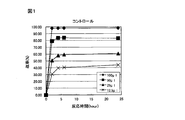
- FIG. 1 is a graph showing the reaction efficiency of lysine decarboxylase reaction in ion-exchanged water.
- FIG. 2 is a graph showing the reaction efficiency of lysine decarboxylase reaction in fermentation broth A.
- FIG. 3 is a graph showing the reaction efficiency of lysine decarboxylase reaction in fermentation broth B.
- the present invention is described in detail below.
- the lysine decarboxylase in the present invention is classified into enzyme number EC 4.1.1.18 based on the report of the International Biochemical Union (IUB) enzyme committee, and pyridoxal.
- PGP phosphoric acid
- L-lysine also referred to as lysine
- 1,5-pentamethylenediamine also referred to as pentane 1,5-diamine, 1,5-pentamethylenediamine
- carbonic acid refers to an enzyme that catalyzes a reaction that produces lysate, a microbial cell that is highly producing this enzyme by a technique such as genetic recombination, and a processed product thereof.
- the origin of the lysine decarboxylase of the present invention is not particularly limited, and examples thereof include those derived from known organisms.
- lysine decarboxylase examples include, for example, Bacillus halodurans, Bacillus subtilis, Escherichia coli, Vibrio cholera, and Vibrio cholera.
- Salmonella typhimurium Hafnia albei
- Neisseria meningitidis Thermoplasma acid pi
- examples thereof include those derived from microorganisms such as Corynebacterium glutamicum. From the viewpoint of safety, preferably, those derived from Escherichia coli are used.
- lysine decarboxylase activity means an activity that catalyzes a reaction in which lysine is decarboxylated and converted to 1,5-pentamethylenediamine. In the present invention, it can be calculated by measuring the amount of 1,5-pentamethylenediamine produced from lysine by high performance liquid chromatography (HPLC).
- the unit of activity is 1 unit (U) for producing 1 ⁇ mol of 1,5-pentamethylenediamine per minute, and the cell activity is the enzyme activity (U / mg dry cells) per 1 mg of dry cell equivalent weight.
- the dry cell equivalent weight means the weight that is dried and does not contain moisture. For example, until the weight becomes constant by separating the cells from a solution containing the cells (bacterial solution) by a method such as centrifugation or filtration. Dry weight can be determined by measuring the weight after drying. The measurement can be performed according to the method of Sabo et al.
- the substances that prevent the slowing or stopping of the reaction are L-lysine, PLP, lysine decarboxylase, water, and inorganic acids used to adjust pH.
- This is a substance in the reaction solution excluding bases and dicarboxylic acids, and prevents a sudden decrease in the reaction rate of lysine decarboxylation reaction or a phenomenon of termination when L-lysine decarboxylase is allowed to act on an L-lysine aqueous solution.
- An effective substance in other words, a substance that promotes lysine decarboxylation in the reaction system.
- a culture solution in which a microorganism is cultured, a microorganism, a carbon source that can be used by the microorganism, a lysine fermentation solution, and the like can be exemplified.
- the fermentation liquid at the time of lysine production is a culture liquid in which microorganisms are cultured.
- the culture solution contains a microorganism and a carbon source that can be used by the microorganism.
- the cells in the present invention are classified into a plurality of types.
- the present invention defines as follows.
- Cells that produce lysine decarboxylase at a high level and have higher lysine decarboxylation activity than wild-type strains are referred to as “catalyst cells”.
- live catalytic cells are called “catalytic live cells”
- catalytic cells that have stopped growing are called “catalytic resting cells”
- those that have lost their ability to grow are called “catalyst dead cells”.
- a microbial cell that produces 10 g / L or more of lysine from glucose in a culture solution is referred to as a “lysine-producing bacterium”.
- a microorganism other than the catalyst cell is referred to as a “microorganism”, and a lysine-producing bacterium is included in the microorganism.
- a microorganism is not specifically limited, As a suitable thing, yeast, Corynebacterium, Brevibacterium, Escherichia coli etc. can be illustrated. Corynebacterium is particularly effective.
- the preferred concentration varies depending on the composition of the reaction solution. For example, in the case of Escherichia coli, a concentration of 1 ⁇ 10 ⁇ 8 cells / ml or more is suitable for Escherichia coli in the composition of water, PLP, enzyme, and lysine hydrochloride alone. .
- concentration of 1x10 ⁇ 7 piece / ml or more is suitable by viable count.
- a concentration of 1 ⁇ 10 6 cells / ml or more in terms of the number of viable bacteria is preferable.
- the upper limit is not particularly limited as long as lysine as a substrate dissolves and the reaction solution has fluidity, but it is generally 500 g / L or less in terms of wet weight of cells.
- the concentration of the microorganism to be mixed can be lowered.
- molasses or corn steep liquor is mixed to coryne.
- a concentration of 1 ⁇ 10 ⁇ 3 / ml or more is preferable in terms of the number of viable bacteria.
- a concentration of 50 / ml or more is suitable.
- the reaction start can also be started before the end of lysine fermentation.
- the microorganism-treated product in the present invention refers to a dormant microorganism that starts growing when it becomes viable, such as dry yeast, alcohol fermentation starter, and cryopreserved cells.
- the compound that can be used as a carbon source by the microorganism in the present invention is not particularly limited as long as the microorganism is a carbon source that can be used for growth, but preferred examples include corn steep liquor, yeast extract, molasses, saccharides, polypeptone, and amino acids. Particularly, corn steep liquor and yeast extract are highly effective.
- the preferred concentration is 1 g / L or more for yeast extract and corn steep liquor, 5 g / L or more for polypeptone, and 10 g / L or more for molasses. If these are mixed with corynebacteria, they will be effective at lower concentrations. For example, if corynebacteria with a viable count of 1 ⁇ 10 ⁇ 3 / ml or more are mixed, they will be effective at 0.5 g / L. I can do it.
- the lysine-producing fermentation broth is a liquid obtained by inoculating lysine-producing bacteria in a culture solution and culturing for a certain period of time, and is a liquid containing at least 10 g / L or more of lysine and lysine-producing bacteria.
- Processed fermented liquid at the time of lysine production in the present invention is a concentrated or diluted liquid at the time of lysine production, or a fermentation liquid supernatant obtained by removing lysine-producing bacteria from the fermented liquid at the time of lysine production by centrifugation or the like. And its concentration and dilution.
- the fermentation liquor during lysine production in the present invention or a processed product thereof When adding the fermentation liquor during lysine production in the present invention or a processed product thereof to the reaction solution, it is at least 5% volume, preferably 20% volume, more preferably 50% volume or more of the reaction solution.
- the medium used for the fermentation broth during lysine production in the present invention is a normal medium containing a carbon source, a nitrogen source, inorganic ions, and other organic micronutrients as necessary.
- Carbon sources include glucose, lactose, galactose, fructose, sucrose, molasses, carbohydrates such as starch hydrolysate, alcohols such as ethanol and inositol, organic acids such as acetic acid, fumaric acid, citric acid, and succinic acid. Can be used.
- Nitrogen sources include inorganic ammonium salts such as ammonium sulfate, ammonium nitrate, ammonium chloride, ammonium phosphate, and ammonium acetate; organics such as ammonia, peptone, meat extract, yeast extract, yeast extract, corn steep liquor, and soy hydrolyzate Nitrogen, ammonia gas, aqueous ammonia, etc. can be used.
- inorganic ions potassium phosphate, magnesium sulfate, iron ions, manganese ions and the like are added in small amounts.
- required substances such as vitamin B1 or yeast extract can be contained in an appropriate amount as required.
- Cultivation is preferably carried out for 16 to 72 hours under aerobic conditions such as shaking culture and aeration and agitation culture.
- the culture temperature is controlled to 30 ° C. to 45 ° C.
- the pH is controlled to 5 to 9 during the culture.
- an inorganic or organic acidic or alkaline substance, ammonia gas or the like can be used for pH adjustment.
- the microorganism used in the fermentation broth during the production of lysine in the present invention may be a wild strain or a breeding strain artificially bred from the wild strain as long as it has the ability to produce L-lysine. There may be.
- the mutated lysine decarboxylase in the present invention is a gene that uses at least one amino acid in the amino acid sequence of wild-type lysine decarboxylase mainly using genetic recombination technology. It is defined as a lysine decarboxylase having a substituted mutation and having improved enzyme activity of lysine decarboxylase itself. Mutant lysine decarboxylase is within the scope of the present invention.
- amino acids in the amino acid sequence correspond to amino acid residues in lysine decarboxylase, and they are in a corresponding relationship with each other.
- amino acid an amino acid represented as an amino acid sequence is indicated, and when referred to as an amino acid residue, an amino acid residue contained in lysine decarboxylase is indicated.
- the method for preparing a mutant lysine decarboxylase gene may be any known method for introducing a mutation, and can generally be performed by a known method.
- site-specific mutagenesis (Kramer, W. and frita, HJ, Methods in Enzymology, 1987, 154, 350), recombinant PCR (PCR Technology, Stockton Press, 1989)
- Examples thereof include a method of chemically synthesizing a specific portion of nucleic acid, a method of treating a gene with hydroxyamine, a method of treating a strain having the gene with ultraviolet irradiation, or treating with a chemical agent such as nitrosoguanidine or nitrous acid.
- a site-specific mutation method is preferable. Specifically, it is a method of causing site-specific substitution using a commercially available kit based on the wild-type lysine decarboxylase gene.
- the position of the insertion, deletion or substitution may be any position as long as the lysine decarboxylation activity is not lost.
- the number of amino acid residues inserted, deleted or substituted include 1 amino acid residue or 2 amino acid residues or more, for example, 1 amino acid residue to 10 amino acid residues, preferably 1 amino acid residue to 5 amino acid residues. Is mentioned.
- the mutant lysine decarboxylase in the amino acid sequence set forth in SEQ ID NO: 4 in the sequence listing, at least one amino acid in the amino acid sequence is substituted with another amino acid whose activity is increased. Has been.
- amino acid sequence set forth in SEQ ID NO: 4 in the sequence listing is an amino acid sequence of a protein generated from the DNA sequence set forth in SEQ ID NO: 3 in the sequence listing, wherein the N-terminal methionine is the first amino acid,
- the 129th amino acid is a wing domain
- the 130th to 183rd amino acids are linker domains
- these 1st to 183rd amino acids form a 10-mer forming domain.
- amino acids 184 to 417 are pyridoxal phosphate (PLP enzyme) common domains
- amino acids 418 to 715 are substrate entrances
- these amino acids 184 to 715 form an active region domain. .
- the amino acid present in the 10-mer forming domain and / or the active region domain in the amino acid sequence set forth in SEQ ID NO: 4 in the sequence listing is substituted with another amino acid.
- amino acids present in the wing domain and / or linker domain in the demerization domain, and / or amino acids present in the pyridoxal phosphate common domain and / or substrate entry / exit in the active region domain It is substituted with another amino acid.
- the amino acid residue corresponding to the amino acid in the amino acid sequence is substituted with another amino acid residue.
- the mutant lysine decarboxylase is preferably at least 137, 138, 286, 290, 295, 303, 317, 335, 352, 353, 386, 443, 466, 475, 553, the 711th amino acid residue and 14 28, 39, 64, 67, 70, 75, 79, 83, 84, 85, 88, 89, 94, 95, 98, 99, 104, 112, 119, 139, 143, 145, 148, 182, 184 Mutations in which one or more amino acid residues at 253, 262, 430, 446, 460, 471, 506, 524, 539, 544, 546, 623, 626, 636, 646, 648 are substituted with other amino acid residues Type enzymes.
- the methionine at the N-terminal of the amino acid sequence of the protein generated from the DNA sequence set forth in SEQ ID NO: 3 (SEQ ID NO: 4 in the sequence listing) is number 1 As amino acids 137, 138, 286, 290, 295, 303, 317,
- the amino acid sequence after the change is not particularly limited as long as it has better properties than before the change, for example, improved specific activity, properties resistant to pH change during the reaction, resistance to reaction products, relaxation of inhibition, etc.
- the amino acid sequence produced by the sequences described in -6 is particularly preferred.
- the 14th amino acid in the amino acid present in the 10-mer forming domain was changed from Phe to Gln.
- the 14th amino acid in the wing domain is changed from Phe to Gln, and the 28th amino acid is changed from Arg to Ile.
- 39th amino acid changed from Arg to Ile 39th amino acid changed from Arg to Val
- 64th amino acid changed from Leu to Lys 64th amino acid changed from Leu to Lys
- 67th amino acid changed from Cys to Thr The 67th amino acid changed from Cys to Leu, the 70th amino acid changed from Ile to Leu, the 70th amino acid changed from Ile to Pro, the 75th amino acid changed to Glu Changed from Pro to Pro, 75th amino acid changed from Glu to His, 79th amino acid changed from Leu to Ile, 83rd amino acid changed from Ala to Leu, 84th amino acid From Asn Changed to Asp, changed the 84th amino acid from Asn to Thr, changed the 85th amino acid from Thr to Pro, changed the 88th amino acid from Thr to Lys, changed
- Preferred mutant lysine decarboxylase includes an active region domain, specifically, 290th, 335, 475, 711th amino acid residues, 286, 290, 335, 475, 711th amino acid residues, 148 , 646th amino acid residue, 471, 626th amino acid residue, and mutated enzyme in which the 626th and 646th amino acid residues are substituted with other amino acid residues.
- the mutant enzyme in which the 290th, 335th, 475th, and 711st amino acid residues are substituted with other amino acid residues is N of the amino acid sequence of the protein generated from the DNA sequence described in SEQ ID NO: 3 in the Sequence Listing. This refers to a mutant enzyme having a sequence in which the amino acid at the 4th position of 290, 335, 475, and 711 is replaced with an amino acid different from the original amino acid, with the terminal methionine as the first amino acid.
- the mutated enzyme in which the 286th, 290th, 335th, 475th, and 711th amino acid residues in the present invention are substituted with other amino acid residues is the amino acid sequence of a protein generated from the DNA sequence shown in SEQ ID NO: 3 in the Sequence Listing.
- the N-terminal methionine is the first amino acid, and the 286, 290, 335, 475, and 711th amino acids are substituted with amino acids different from the original amino acids.
- the mutated enzyme in which the 148th and 646th amino acid residues are substituted with other amino acid residues is the N-terminal methionine of the amino acid sequence of the protein generated from the DNA sequence described in SEQ ID NO: 3 in the Sequence Listing. It refers to a mutant enzyme having a sequence in which two amino acids at the 148th and 646th positions are substituted with amino acids different from the original amino acid as the first amino acid.
- the mutated enzyme in which the 471st and 626th amino acid residues are substituted with other amino acid residues is the N-terminal methionine of the amino acid sequence of the protein generated from the DNA sequence described in SEQ ID NO: 3 in the Sequence Listing.
- the first amino acid refers to a mutant enzyme having a sequence in which the amino acids at two positions, 471 and 626, are substituted with amino acids different from the original amino acid.
- the mutated enzyme in which the 626th and 646th amino acid residues are substituted with other amino acid residues is the N-terminal methionine of the amino acid sequence of the protein produced from the DNA sequence described in SEQ ID NO: 3 in the Sequence Listing. This refers to a mutant enzyme having a sequence in which two amino acids at the 626th and 646th positions are substituted with amino acids different from the original amino acid as the first amino acid.
- amino acid sequence after the change is not particularly limited as long as it has better properties than the enzyme of the original sequence, but the amino acid sequences generated by the sequences shown in Tables 1 to 6 are particularly preferred.
- the modified mutant lysine decarboxylase is shown as a modified amino acid of the amino acid sequence.
- the modified mutant lysine decarboxylase may be represented as a modified amino acid sequence. it can.
- the base sequence encoding Phe which is the 14th amino acid among the amino acids present in the 10-mer forming domain is TTT.
- CAA which is the base sequence encoding Gln
- TTT which is the base sequence encoding Leu
- the base sequence encoding Arg was changed from CGT to ATT, which is the base sequence encoding Ile
- the base sequence encoding Arg, the 39th amino acid was changed from CGT to ATA, the base sequence encoding Ile.
- the base sequence encoding Arg which is the 39th amino acid, has been changed from CGT to ATC, which is the base sequence encoding Ile, and the base sequence encoding the 39th amino acid, Arg, is C.
- Changed from GT to GTG which is the base sequence encoding Val the base sequence encoding Leu which is the 64th amino acid is changed to AAA which is the base sequence encoding Lys from the CTC, and the 67th amino acid
- the base sequence encoding a Cys was changed from TGC to ACC, which is a base sequence encoding Thr, and the base sequence encoding Cys, the 67th amino acid, was changed from TGC to TTA, the base sequence encoding Leu.
- the base sequence encoding Ile which is the 70th amino acid, has been changed from ATT to TTG, which is the base sequence encoding Leu, and the base sequence encoding Ile, the 70th amino acid, encodes Leu.
- the base sequence encoding Asn the 84th amino acid, has been changed from AAT to ACA, the base sequence encoding Thr, and the base sequence encoding Thr, the 85th amino acid, encodes Pro from ACG
- the base sequence encoding Thr which is the 88th amino acid, has been changed from AAA to ThA, which is the base sequence encoding Lys, and Thr, the 88th amino acid.
- the base sequence is changed from ACT to AAG which is the base sequence encoding Lys
- the base sequence encoding Thr which is the 88th amino acid is changed from ACT which is the base sequence encoding ACT to Arg
- the base sequence encoding Thr, the first amino acid was changed from ACT to AAT
- the base sequence encoding Asn was changed from ACT to AAT
- the base sequence encoding Leu was a base sequence encoding CTC to Phe.
- the base sequence encoding Ast, the 94th amino acid, changed from AAT to ATC, the base sequence encoding Ile, the base sequence encoding Asp, the 95th amino acid is GAC Changed from CTA, which is the nucleotide sequence encoding Pro to Pro, nucleotide sequence encoding Leu, which is the 98th amino acid, changed from TTA to ATA, which is the nucleotide sequence encoding Ile, and the 99th amino acid
- the base sequence encoding Gln is changed from CAG to ACT, which is the base sequence encoding Thr, and the base sequence encoding Glu, the 104th amino acid, is changed from GAA to AAT, which is the base sequence encoding Asn.
- the base sequence encoding Glu which is the 104th amino acid, is changed from AAA to GA, which is the base sequence encoding Lys, and the base sequence encoding Asp, which is the 112th amino acid, is changed from GAT to Glu.
- GAG which is the coding base sequence
- GAG which is the coding base sequence
- AAC which is the base sequence encoding Asn
- coded Gln the 119th amino acid
- the base sequence to be changed from CAG to AAT which is the base sequence encoding Asn
- the base sequence encoding Gln which is the 119th amino acid is changed from ATT to the base sequence encoding CAle to Ile, 119
- the base sequence encoding Gln, the first amino acid has been changed from CAG to ACC, the base sequence encoding Thr, and the base sequence encoding Gln, the 119th amino acid, encodes Ser from CAG.
- AAA which is the base sequence encoding Ile
- the base sequence encoding Tyr the 139th amino acid
- the base sequence encoding Val the 139th
- the base sequence encoding the amino acid Tyr is changed from TAT to GTG, which is the base sequence encoding Val
- the base sequence encoding Tyr, the 139th amino acid is the base sequence encoding TAT to Cys.
- the base sequence encoding Tyr, the 139th amino acid is changed from TAT to ACA, the base sequence encoding Thr, and the base sequence encoding Tyr, the 139th amino acid, Changed from TAT to TCT, which is the base sequence encoding Ser, changed base sequence encoding Tyr, which is the 139th amino acid, from AAT, which is the base sequence encoding Ser, to the 139th amino acid,
- the base sequence encoding a certain Tyr was changed from TAT to AAC, which is the base sequence encoding Asn, and the base sequence encoding Gly, the 143rd amino acid, was changed from GGT to GAA, the base sequence encoding Glu.
- the base sequence encoding Tyr, the 145th amino acid, is changed from TAT to CGT, the base sequence encoding Arg, the base sequence encoding the Tyr, 145th amino acid, encodes Arg from TAT
- the base sequence encoding Cys, which is the 148th amino acid has been changed from AGT which is the base sequence encoding Ser to the Ser, and Cys, which is the 148th amino acid
- the base sequence to be changed from TGT to TCT which is the base sequence encoding Ser, the base sequence encoding Cys which is the 148th amino acid is changed from TGT to TCC which is the base sequence encoding Ser
- the base sequence encoding Cys, the 148th amino acid is changed from TGT to TCA, the base sequence encoding Ser, the base sequence encoding the Cys, the 148th amino acid, is a base encoding Tla to Ala
- the base sequence encoding Ala has been changed from GCA to TCA, the base sequence encoding Ser, and the base sequence encoding Ile, the 303th amino acid.
- Change from ATT to ACA, which is a base sequence encoding Thr change base sequence encoding Phe, which is 317th amino acid, to CAG, which is a base sequence encoding Gln, from TC, at 335th amino acid
- the base sequence encoding a Pro has been changed from CCT to GCT, which is the base sequence encoding Ala, and the base sequence encoding Gly, the 352nd amino acid, has been changed from GGC to GCA, the base sequence encoding Ala.
- the base sequence encoding is changed from AGA to ATG which is the base sequence encoding Met
- the base sequence encoding Ser which is the 446th amino acid is changed from TCT to TAC which is the base sequence encoding Tyr
- the nucleotide sequence encoding Ser, the 446th amino acid has been changed from CAT, which is the nucleotide sequence encoding Gln, from TCT, the nucleotide sequence encoding the Asp, the 460th amino acid, nucleotide sequence encoding GAT to Ile
- the base sequence encoding Asp, which is the 460th amino acid has been changed from AAT, which is the base sequence encoding Asn, to the 460th amino acid, and the base sequence encoding Asp, which is the 460th amino acid.
- GAT to TGT which is the base sequence encoding Cys
- the base sequence encoding the amino acid Asp has been changed from CAT, which is the base sequence encoding GAT to Pro
- the base sequence encoding Asp, the 460th amino acid is the base sequence encoding GAT to Pro.
- the base sequence encoding Asp, which is the 460th amino acid has been changed from CAT, which is the base sequence encoding Pro, from GAT to the base sequence encoding Asp, the 460th amino acid.
- TCA which is the base sequence that encodes A
- the base sequence encoding Pro which is the 466th amino acid
- ACG which is the base sequence that encodes Asn
- CCG Pro
- the 466th amino acid is changed from CCG to TCT, which is the base sequence encoding Ser.
- the base sequence encoding Ser, the 471st amino acid has been changed from AGC to TAT
- the base sequence encoding Tyr has been changed from GGC to Asn.
- the coding base sequence changed the base sequence encoding Asp, the 506th amino acid, to CCA, the base sequence encoding Pro from GAC, encoded Val, the 524th amino acid
- the base sequence encoding Val which is the 524th amino acid is changed from CTT to CTG which is the base sequence encoding Leu, 539
- the base sequence encoding the first amino acid, Ile is changed from ATC to TGC, the base sequence encoding Cys, and the base sequence encoding the 539th amino acid, Ile, encodes ATC to Leu.
- the base sequence was changed to CTT, the base sequence encoding Ile, the 539th amino acid, was changed to CTA, the base sequence encoding Leu from ATC, the base encoding Thr, the 544th amino acid
- the sequence was changed from ACC to GCG, which is the base sequence encoding Ala, the base sequence encoding Thr, the 544th amino acid, was changed to GCT, the base sequence encoding ACC to Ala, the 544th
- the base sequence encoding the amino acid Thr is changed from ACC to TCT which is the base sequence encoding Ser, 54
- the base sequence encoding the fourth amino acid Thr is changed from ACC to TCC, the base sequence encoding Ser, and the base sequence encoding the 544th amino acid Thr is the base sequence encoding ACC to Pro.
- the base sequence encoding Thr which is the 544th amino acid, is changed to CCG, which is the base sequence encoding Pro from ACC, and the base sequence encoding Ala, the 546th amino acid.
- Change from GCA to AGC, which is the base sequence encoding Ser Change base sequence encoding Leu, which is the 553rd amino acid, to GTA, which is the base sequence encoding Val from CTG,
- a base sequence encoding Ala is changed from GCA to TGT, which is a base sequence encoding Cys, and a base sequence encoding Ala, the 623rd amino acid, is a base sequence encoding GCA to Phe.
- the base sequence encoding Ala, the 646th amino acid, has been changed from GCC to TTG, which is the base sequence encoding Leu, and the base sequence encoding the 646th amino acid, Ala, has been encoded from GCC to Ile.
- the base sequence encoding Met, which is the 648th amino acid, has been changed from ATG to TCT, which is the base sequence encoding Ser, and the 648th amino acid, Met, is encoded.
- the base sequence is changed from ATG to TCC which is the base sequence encoding Ser, the base sequence encoding Lys which is the 710th amino acid is changed from AAA to ACG which is the base sequence encoding Thr, the 711th A mutated lysine decarboxylase in which at least one or more of the base sequence encoding Glu, which is an amino acid of the above, is changed from GAA to GAC, which is a base sequence encoding Asp, is included.
- the base sequence encoding Phe is a base sequence encoding TTT to Gln.
- Changed to CAA the base sequence encoding Leu, the 22nd amino acid, from CTT to TTG, the base sequence encoding Leu, the base sequence encoding Arg, the 28th amino acid from CGT
- the base sequence encoding Ile is changed to ATT, the base sequence encoding Arg, the 39th amino acid, is changed from CGT to ATA, the base sequence encoding Ile, the 39th amino acid, Arg
- the base sequence encoding CGT is changed to ATC, which is the base sequence encoding Ile, and the base sequence encoding Arg, the 39th amino acid, is the base sequence encoding CGT to Val.
- the base sequence encoding Leu which is the 64th amino acid, is changed from AAA, which is the base sequence encoding Lys, from CTC, and the base sequence encoding Cys, the 67th amino acid, is TGC.
- the base sequence encoding Ile was changed from ATT to TTG, which is the base sequence encoding Leu, and the base sequence encoding Ile, the 70th amino acid, was changed from ATT to CTG, the base sequence encoding Leu.
- the base sequence encoding Ile which is the 70th amino acid
- CCG which is the base sequence encoding Pro from ATT
- the base sequence encoding Glu which is the 75th amino acid
- GAG the base sequence encoding Glu, which is the 75th amino acid
- CAG CAG
- CAC CAC
- the base sequence is changed from TTG to ATA which is the base sequence encoding Ile, the base sequence encoding Ala which is the 83rd amino acid is changed from GCT to CTG which is the base sequence encoding Leu, the 83rd
- the base sequence encoding Ala, the amino acid of GCT has been changed from CCT, which is the base sequence encoding Leu, and the base sequence encoding the 83rd amino acid, Ala, is the base sequence encoding GCT to Leu.
- the base sequence encoding Ala, the 83rd amino acid, changed from GCT to ATA, the base sequence encoding Ala, the base sequence encoding Ala, the 83rd amino acid, is GC Change from T to GCC which is the base sequence encoding Ala, base sequence encoding Asn which is the 84th amino acid changed from GAT which is the base sequence encoding Asp to Asp,
- the base sequence encoding a certain Asn has been changed from AAT to ACA, the base sequence encoding Thr, and the base sequence encoding the 85th amino acid, Thr, has been changed from ACG to CCA, the base sequence encoding Pro.
- the base sequence encoding Thr, the 88th amino acid has been changed from AAA to the base sequence encoding Lys from ACT, and the base sequence encoding the Thr, the 88th amino acid, encoded Lys from ACT
- the base sequence encoding Thr, which is the 88th amino acid is changed from AACT, which is the base sequence encoding Arg to ACT, and the Thr, which is the 88th amino acid, is encoded.
- the base sequence changed from ACT to AAT which is the base sequence encoding Asn, the base sequence encoding Leu, the 89th amino acid, changed from CTC to TTT, the base sequence encoding Phe, 94
- the base sequence encoding Asn, which is the first amino acid, has been changed from AAT to ATC, which is the base sequence encoding Ile, and the base sequence encoding Asp, the 95th amino acid, is a base sequence encoding GAC to Pro.
- the base sequence encoding Gln, the 119th amino acid has been changed from CAG to AAC, the base sequence encoding Asn, and the base sequence encoding the G119, the 119th amino acid, encodes Asn from CAG.
- the base sequence encoding Gln, the 119th amino acid changed from CAG to ATT, the base sequence encoding Ile, and the G119, the 119th amino acid.
- the base sequence was changed from CAG to ACC, which is the base sequence encoding Thr, and the base sequence encoding Gln, the 119th amino acid, was changed from CAG to AGT, the base sequence encoding Ser.
- the base sequence encoding Phe has been changed from TTT to GTC, the base sequence encoding Val, the base sequence encoding Lys, the 138th amino acid Changed from AAA to ATC, which is the base sequence encoding Ile, the base sequence encoding Tyr, the 139th amino acid, changed from TAT to GTA, the base sequence encoding Val, the 139th amino acid
- the base sequence encoding Tyr is changed from TAT to GTG, which is the base sequence encoding Val
- the base sequence encoding Tyr, the 139th amino acid is changed to TGC, which is the base sequence encoding TAT to Cys.
- the base sequence encoding Cys, the 148th amino acid has been changed from TGT to TCA, the base sequence encoding Ser, the base sequence encoding the Cys, the 148th amino acid, encodes Ala from TGT
- the base sequence encoding Cys, the 148th amino acid is changed to GCA, the base sequence encoding Ala from TGT, and the 182nd amino acid, Ile.
- the base sequence is changed from ATT to ATG, which is the base sequence encoding Met, and Val is the 184th amino acid among the amino acids present in the common domain of pyridoxal phosphate.
- the base sequence is changed from GTA to GCC which is the base sequence encoding Ala
- the base sequence encoding Val which is the 184th amino acid is changed from GTA to GCA which is the base sequence encoding Ala
- the 253rd The base sequence encoding Met, which is the amino acid of, was changed from ATG to CTA, which is the base sequence encoding Leu
- the base sequence encoding Phe, the 262nd amino acid is the base sequence encoding TTC to Tyr.
- TTC which is the base sequence to be encoded
- the base sequence encoding Arg which is the 443rd amino acid, changed from AGA to ATG, which is the base sequence encoding Met
- Ser which is the 446th amino acid
- TCT to TAC which is the base sequence encoding Tyr
- Ser which is the 446th amino acid
- TCT to TAC which is the base sequence encoding Tyr
- Ser which is the 446th amino acid
- CAT which is the base sequence encoding Gln
- TCT 460
- the base sequence encoding Asp which is the second amino acid is changed from GAT to ATT which is the base sequence encoding Ile
- the base sequence encoding Asp which is the 460th amino acid is a base sequence encoding GAT to Asn.
- the base sequence encoding Asp which is the 460th amino acid
- GAT to TCA which is the base sequence encoding Ser
- the base sequence encoding Pro which is the 466th amino acid
- CCG to Asn Changed to AAC, which is the base sequence encoding
- the base sequence encoding Pro which is the 466th amino acid
- CCG to GGC which is the base sequence encoding Gly
- the base sequence encoding Pro changed from CCG to TCT, the base sequence encoding Ser, and the base sequence encoding Ser, the 471st amino acid, changed from AGC to TAT, the base sequence encoding Tyr.
- the base sequence encoding Gly which is the 475th amino acid, is changed from GGC to AAT, which is the base sequence encoding Asn, and the base sequence encoding Asp, which is the 506th amino acid, encodes GAC to Pro.
- the base sequence was changed to CCA, the base sequence encoding Val, the 524th amino acid, was changed to TTA, the base sequence encoding Leu from GTT, the base encoding the Val, the 524th amino acid
- the sequence was changed from GTT to CTG which is a base sequence encoding Leu
- the base sequence encoding Ile which is the 539th amino acid was changed from ATC to TGC which is a base sequence encoding Cys
- 539 The base sequence encoding the first amino acid Ile was changed from ATC to CTT, which is the base sequence encoding Leu
- the base sequence encoding Ile, the 539th amino acid was the base sequence encoding ATC to Leu.
- Changed to a certain CTA changed the base sequence encoding Thr, the 544th amino acid from ACC to GCG, the base sequence encoding Ala, the base sequence encoding the Thr, the 544th amino acid Is changed to GCT, which is the base sequence encoding Ala, the base sequence encoding Thr, which is the 544th amino acid, is changed to TCT, which is the base sequence encoding Ser, and the 544th amino acid.
- the base sequence encoding Thr is changed from ACC to TCC, which is the base sequence encoding Ser, and the base sequence encoding Thr, the 544th amino acid, is the base sequence encoding ACC to Pro.
- the base sequence encoding Ala, the 623th amino acid was changed from GCA to TTC, the base sequence encoding Phe, and the base sequence encoding the 623th amino acid, Ala, encoded Gln from GCA. Changed to CAG, the base sequence encoding Lys, the base sequence encoding Lys, the 626th amino acid, from GAA, which is the base sequence encoding Val from AAA, and the Tyr, the 636th amino acid, is encoded.
- the base sequence encoding Ala, which is the amino acid of GCC is changed from GCC to TTG, which is the base sequence encoding Leu, and the base sequence encoding Ala, the 646th amino acid, is the base sequence encoding GCC to Ile.
- the base sequence after the change is not particularly limited as long as it has better properties than the enzyme of the original sequence, but base sequences generated by the sequences shown in Tables 1 to 6 are particularly preferred.
- the method for producing a mutant lysine decarboxylase according to the present invention (hereinafter, also simply referred to as “manufacturing method”) is obtained by culturing a transformant and culturing it.
- the mutant lysine decarboxylase is recovered from at least one of the transformant and the culture of the transformant.
- the transformant means one transformed with an expression vector containing a nucleic acid represented by a base sequence encoding the amino acid sequence of the mutant lysine decarboxylase.
- the mutant lysine decarboxylase In the method for producing the mutant lysine decarboxylase according to the present invention, a transformant transformed with an expression vector containing a nucleic acid represented by a base sequence encoding the amino acid sequence of the mutant lysine decarboxylase is cultured. Thus, the mutant lysine decarboxylase is produced. According to the production method, the mutation shows stable activity even under severe conditions where the enzyme is easily inactivated, and the initial rate of the reaction is not greatly reduced even when compared with the corresponding wild-type lysine decarboxylase. Type lysine decarboxylase can be produced at low cost.
- the production method of the mutant lysine decarboxylase according to the present invention is represented by a base sequence encoding the amino acid sequence of the mutant lysine decarboxylase. From the step of culturing a transformant transformed with an expression vector containing a nucleic acid (host cell culture step), and the cultured transformant and the culture of the transformant, the mutant type It only needs to include a step of recovering lysine decarboxylase (mutant lysine decarboxylase recovery step), and may further include other steps as necessary.
- Transformant culture step is a step of culturing a transformant transformed with an expression vector containing a nucleic acid represented by a nucleotide sequence encoding the amino acid sequence of the mutant lysine decarboxylase. It is.
- the transformant is not particularly limited as long as it is transformed with an expression vector containing a nucleic acid represented by a base sequence encoding the amino acid sequence of the mutant lysine decarboxylase.
- the transformant examples include those using cells derived from bacteria, yeast, actinomycetes, filamentous fungi and the like as host cells, and those using cells derived from Escherichia coli and Corynebacterium bacteria as host cells are preferred.
- the nucleic acid is represented by a base sequence encoding the amino acid sequence of the mutant lysine decarboxylase.
- the base sequence encoding the amino acid sequence of the mutant lysine decarboxylase can be synthesized by a method of introducing a mutation point into the base sequence encoding the corresponding wild type lysine decarboxylase.
- the expression vector is not particularly limited as long as it contains a nucleic acid represented by a base sequence encoding the amino acid sequence of the mutant lysine decarboxylase, but it can improve transformation efficiency and translation efficiency. From the viewpoint, a plasmid vector or a phage vector having the following configuration is more preferable.
- the expression vector is not particularly limited as long as it contains a base sequence encoding the mutant lysine decarboxylase and can transform the host cell. If necessary, in addition to the base sequence, a base sequence constituting another region (hereinafter, also simply referred to as “other region”) may be included.
- Examples of other regions include a control region necessary for the transformant to produce the mutant lysine decarboxylase, a region necessary for autonomous replication, and the like.
- it may further include a base sequence encoding a selection gene that can be a selection marker.
- control region necessary for producing the mutant lysine decarboxylase examples include a promoter sequence (including an operator sequence that controls transcription), a ribosome binding sequence (SD sequence), a transcription termination sequence, and the like. it can.
- a promoter sequence including an operator sequence that controls transcription
- SD sequence ribosome binding sequence
- transcription termination sequence a transcription termination sequence
- the expression vector should contain a promoter sequence in addition to the base sequence encoding the mutant lysine decarboxylase from the viewpoint of production efficiency of the mutant lysine decarboxylase. Is preferred.
- the promoter sequence it may contain a ribosome binding sequence, a transcription termination sequence, and the like.
- promoter sequence examples include trp promoter of tryptophan operon derived from E. coli, lac promoter of lactose operon, PL promoter and PR promoter derived from lambda phage, gluconate synthase promoter (gnt) derived from Bacillus subtilis, alkaline protease promoter ( apr), neutral protease promoter (npr), ⁇ -amylase promoter (amy) and the like.
- a promoter sequence that is uniquely modified or designed such as a tac promoter, can be used.
- ribosome binding sequence examples include sequences derived from E. coli or Bacillus subtilis, but are not particularly limited as long as the sequence functions in a desired host cell such as Escherichia coli or Bacillus subtilis.
- ribosome-binding sequence examples include a sequence prepared by DNA synthesis of a consensus sequence of 4 bases or more continuous among sequences complementary to the 3 'end region of 16S ribosomal RNA.
- a transcription termination sequence is not necessarily required, but a ⁇ -factor-independent one such as a lipoprotein terminator, a trp operon terminator, etc. can be used.
- sequence order of these control regions on the expression vector is not particularly limited, but considering transcription efficiency, a promoter sequence, a ribosome binding sequence, a gene encoding the target protein, a transcription termination sequence from the 5 ′ end upstream. It is desirable to arrange in order.
- expression vectors herein include pBR322, pUC18, Bluescript II SK (+), pKK223-3, pSC101 having autonomously replicable regions in E. coli, and autonomous replication in Bacillus subtilis.
- PUB110, pTZ4, pC194, ⁇ 11, ⁇ 1, ⁇ 105, etc. having possible regions can be used as expression vectors.
- expression vectors capable of autonomous replication in two or more types of hosts pHV14, TRp7, YEp7, pBS7, and the like can be used as expression vectors.
- Method for producing transformant The transformant according to the present invention can be prepared by a known method. For example, a method for constructing the expression vector comprising a base sequence encoding the mutant lysine decarboxylase according to the present invention and, if necessary, the other region, and transforming the expression vector into a desired host cell Etc. Specifically, Sambrook, J. et al. Et. al. , "Molecular Cloning A Laboratory Manual, 3rd Edition", Cold Spring Harbor Laboratory Press, (2001), etc., can be used general methods known in the field of molecular biology, biotechnology and genetic engineering. it can.
- a method for introducing into a chromosome using homologous recombination can be used.
- the transformant according to the present invention not only incorporates the expression vector into the host cell, but also a silent mutation so that a low-use codon in the host cell is changed to a high-use codon as necessary. It is also possible to produce by combining the introduction.
- the method for introducing a silent mutation is not particularly limited as long as it matches the codon usage in the host cell with the codon of the expression vector, the method of the mutation, the type of base to be changed, and the like.
- the medium for culturing the transformant of the present invention contains a carbon source, a nitrogen source, inorganic salts and the like that can be assimilated by the host, and can be a natural medium as long as the transformant can be cultured efficiently. Any of synthetic media may be used.
- Examples of the carbon source include sugars such as glucose, lactose, galactose, fructose, arabinose, maltose, xylose, trehalose, ribose and starch hydrolysate, for example, alcohols such as glycerol, mannitol and sorbitol, for example, gluconic acid , Organic acids such as fumaric acid, citric acid and succinic acid.
- sugars such as glucose, lactose, galactose, fructose, arabinose, maltose, xylose, trehalose, ribose and starch hydrolysate
- alcohols such as glycerol, mannitol and sorbitol, for example, gluconic acid
- Organic acids such as fumaric acid, citric acid and succinic acid.
- Such carbon sources may be used alone or in combination.
- the nitrogen source examples include inorganic ammonium salts such as ammonium sulfate, ammonium chloride, and ammonium phosphate, and organic nitrogen such as soybean hydrolysate, such as ammonia gas and aqueous ammonia.
- inorganic ammonium salts such as ammonium sulfate, ammonium chloride, and ammonium phosphate
- organic nitrogen such as soybean hydrolysate, such as ammonia gas and aqueous ammonia.
- Such nitrogen sources may be used alone or in combination.
- inorganic ions include sodium ions, magnesium ions, potassium ions, calcium ions, chlorine ions, manganese ions, iron ions, phosphate ions, and sulfate ions.
- Such inorganic ions may be used alone or in combination.
- organic components organic micronutrients
- organic micronutrients include various amino acids, for example, vitamins such as vitamin B1, for example, Requirement substances such as nucleic acids such as RNA, and yeast extract, for example.
- Examples of such a medium include LB medium, YT medium, and M9 medium.
- LB medium is preferable.
- the culture conditions for the transformant may be appropriately selected depending on the type of the transformant, the medium, and the culture method, as long as the transformant can grow and produce the mutant lysine decarboxylase according to the present invention.
- the culture temperature is, for example, 20 to 45 ° C., preferably 25 to 40 ° C. under aerobic conditions
- the culture pH is, for example, 5 0.0 to 8.5, preferably 6.5 to 8.0 until the content of the protein having the desired mutant lysine decarboxylase activity is maximized within the culture period of 1 to 7 days. What is necessary is just to culture.
- an inorganic or organic acidic or alkaline substance, ammonia gas, or the like can be used.
- Cultivation can be performed in a liquid medium containing the above medium using a conventional culture method such as shaking culture, aeration and agitation culture, continuous culture, or fed-batch culture.
- a conventional culture method such as shaking culture, aeration and agitation culture, continuous culture, or fed-batch culture.
- the lysine decarboxylase recovery step is a step of recovering the mutant lysine decarboxylase from at least one of the cultured transformant and the culture of the transformant.
- a method commonly used in this field can be used as a method of recovering the mutant lysine decarboxylase according to the present invention after culturing the transformed transformant.
- a crude enzyme solution can be easily obtained by centrifuging, filtering, etc. the transformant culture. Can do.
- the mutant lysine decarboxylase according to the present invention is accumulated in the transformed body, the cultured transformant is recovered by means such as centrifugation, and the recovered transformant is recovered.
- the crude enzyme solution may be recovered by suspending in water or a buffer solution and disrupting the cell membrane of the transformant according to a known method such as lysozyme treatment, freeze-thawing, or ultrasonic disruption.
- the crude enzyme solution can be concentrated by an ultrafiltration method or the like and added with a preservative or the like to be used as a concentrated enzyme. Further, after the concentration, the powdered enzyme of the mutant lysine decarboxylase can be obtained by a spray drying method or the like.
- the recovered crude enzyme solution having lysine decarboxylase activity needs to be separated and purified, for example, salting out with ammonium sulfate or the like, organic solvent precipitation method with alcohol or the like, membrane separation method by dialysis and ultrafiltration, etc.
- known chromatographic separation methods such as ion exchanger chromatography, reverse phase high performance chromatography, affinity chromatography, and gel filtration chromatography can be appropriately combined.
- the mutant lysine decarboxylase obtained as described above is within the scope of the present invention.
- Method for producing 1,5-pentamethylenediamine The mutant lysine decarboxylase produced as described above can be used as an enzyme catalyst for substance production.
- 1,5-pentamethylenediamine can be produced by contacting the above-mentioned mutant lysine decarboxylase with lysine.
- lysine and mutant lysine decarboxylase at least selected from the group consisting of lysine and mutant lysine decarboxylase, a transformant expressing the mutant lysine decarboxylase, a treated product of the transformant, a transformant, and an immobilized product of the treated product
- One kind and a reaction solvent are mixed, lysine decarboxylase and lysine are contacted in the reaction solvent, and 1,5-pentamethylenediamine is produced by a lysine decarboxylase reaction.
- the lysine used as a raw material in the present invention may be a salt thereof.
- the lysine salt include hydrochloride, acetate, carbonate, bicarbonate, sulfate, nitrate, and the like.
- lysine hydrochloride is preferable.
- the concentration of lysine in the reaction solvent is not particularly limited, but is, for example, 1 to 70% by mass, preferably 2 to 50% by mass.
- the required amount of mutant lysine decarboxylase is 5 U or more per gram of lysine hydrochloride if the lysine concentration in the reaction solvent is 10% by mass or less. It is 165U or less, More preferably, it is 20U or more and 82.5U or less. In terms of purified enzyme, the required amount of mutant lysine decarboxylase is 5 ⁇ g or more and 165 ⁇ g or less, more preferably 20 ⁇ g or more and 82.5 ⁇ g, per 1 g of lysine hydrochloride when the lysine concentration in the reaction solvent is 10% by mass or less. It is as follows.
- the lysine concentration in the reaction solvent is 10% by mass or less, 5 mg to 161 mg, more preferably 5.4 mg to 80 mg is preferable per 100 g of lysine hydrochloride. .
- the required amount of mutant lysine decarboxylase is 5 U or more and 165 U or less, more preferably 20 U or more and 110 U or less, per 1 g of lysine hydrochloride.
- the required amount of mutant lysine decarboxylase is 5 ⁇ g or more and 165 ⁇ g or less, more preferably 20 ⁇ g or more and 110 ⁇ g or less, per 1 g of lysine hydrochloride.
- the amount is 5 U or more and 165 U or less, more preferably 100 U or more and 165 U or less, and more preferably 100 U or more and 165 U or less. Is 5 ⁇ g or more and 165 ⁇ g or less, more preferably 100 ⁇ g or more and 165 ⁇ g or less per 1 g of lysine hydrochloride.
- reaction solvent examples include water, an aqueous medium, an organic solvent, water, or a mixed liquid of an aqueous medium and an organic solvent.
- aqueous medium examples include a buffer solution such as a phosphate buffer solution.
- Any organic solvent may be used as long as it does not inhibit the reaction.
- the temperature is, for example, 28 to 55 ° C., preferably 35 to 45 ° C.
- the time is, for example, 0.1 to 72 hours, and preferably 1 to 72 hours. Preferably, it is 12 to 36 hours.
- the reaction pH is, for example, 5.0 to 9.0, preferably 5.5 to 8.5.
- the reaction can be performed under shaking, stirring or standing conditions.
- lysine is decarboxylated and converted to 1,5-pentamethylenediamine to produce 1,5-pentamethylenediamine.
- the 1,5-pentamethylenediamine produced in the present invention may be a salt thereof.
- Examples of the salt of 1,5-pentamethylenediamine include hydrochloride, acetate, carbonate, bicarbonate, sulfate or nitrate of 1,5-pentamethylenediamine.
- hydrochloride is preferable.
- the pH of the reaction solution may increase as lysine is converted to 1,5-pentamethylenediamine.
- an acidic substance for example, an organic acid, for example, an inorganic acid such as hydrochloric acid
- an acidic substance can be added to adjust the pH.
- vitamin B 6 and / or a derivative thereof can be added to the reaction solution as necessary.
- vitamin B 6 and / or derivatives thereof examples include pyridoxine, pyridoxamine, pyridoxal, pyridoxal phosphate, and the like.
- Such vitamin B 6 and / or derivatives thereof may be used alone or in combination.
- the production rate and reaction yield of 1,5-pentamethylenediamine can be improved. Moreover, in this method, a part of water can be distilled off from the obtained pentamethylenediamine aqueous solution as needed.
- a pentamethylenediamine aqueous solution is heated (heat treated) under a pressure of 0.1 kPa to normal pressure by a distillation apparatus equipped with a continuous multistage distillation column, a batch multistage distillation column, etc.
- a pentamethylenediamine aqueous solution in which a part of the water is distilled off can be obtained.
- the heating temperature is, for example, 25 ° C. or more and less than 90 ° C., preferably 25 ° C. or more and 85 ° C. or less, more preferably 25 ° C. or more and less than 80 ° C., more preferably 30 ° C. or more and 70 ° C. or less. is there.
- the aqueous solution of pentamethylenediamine is not heated (heat treatment) at 90 ° C. or higher, more preferably, it is not heated at 80 ° C. or higher, and more preferably, the aqueous solution of pentamethylene diamine is heated (heat treatment). Instead, as described later, pentamethylenediamine (or a salt thereof) is extracted from the aqueous solution as it is.
- pentamethylenediamine (or a salt thereof) is extracted from the aqueous solution of pentamethylenediamine obtained as described above.
- a liquid-liquid extraction method is employed.
- an extraction solvent (described later) is brought into contact with an aqueous solution of pentamethylenediamine batchwise, semi-continuously or continuously, and mixed and stirred, so that pentamethylenediamine (or a solution thereof) is obtained.
- Salt is extracted (distributed) into an extraction solvent (described later), and pentamethylenediamine (or a salt thereof) is separated from the extraction solvent (described later).
- a tower spray tower, plate having a perforated plate
- Type extraction tower or a column equipped with a packing, nozzle, orifice plate, baffle, injector and / or static mixer
- countercurrent differential type extraction tower, non-stirring type stage extraction tower revised fifth edition, Chemical Engineering Handbook, p566 To 569, edited by Chemical Engineering Society, Maruzen (1988)
- an aqueous solution of pentamethylenediamine and an extraction solvent (described later) are continuously supplied in countercurrent
- An amine (or a salt thereof) is extracted (distributed) into an extraction solvent (described later), and then the extraction solvent (described later) is continuously flowed out from the extraction solvent (described later) to pentamethylenediamine (or a salt thereof).
- liquid-liquid extraction methods can be used alone or in combination of two or more.
- liquid-liquid extraction method from the viewpoint of production efficiency, a method of continuously extracting (distributing) pentamethylenediamine (or a salt thereof) into an extraction solvent (described later), more specifically, for example, And the above methods (1) to (3).
- the blending ratio of the pentamethylenediamine aqueous solution and the extraction solvent (described later) in the liquid-liquid extraction is 100 parts by mass of the pentamethylenediamine aqueous solution (if the extraction is continuous, the supply amount per unit time.
- the extraction solvent (described later) is, for example, 30 to 300 parts by mass, and preferably from 50 to 200 parts by mass, more preferably from 50 to 150 parts by mass, particularly preferably from the viewpoint of economy and productivity. 80 to 120 parts by mass.
- the pentamethylenediamine aqueous solution and the extraction solvent are, for example, under normal pressure (atmospheric pressure), for example, 5 to 60 ° C., preferably 10 to 60 ° C., more preferably,
- the mixture is mixed at 15 to 50 ° C., more preferably 15 to 40 ° C. with, for example, a stirring blade, for example, for 1 to 120 minutes, preferably 5 to 90 minutes, preferably 5 to 60 minutes.
- the agitating blade is not particularly limited. An anchor etc. are mentioned.
- the rotation speed in mixing is, for example, 5 to 3000 rpm, preferably 10 to 2000 rpm, and more preferably 20 to 1000 rpm.
- pentamethylenediamine (or a salt thereof) is extracted into an extraction solvent (described later).
- a mixture of pentamethylenediamine (or a salt thereof) and an extraction solvent (described later) is allowed to stand, for example, for 5 to 300 minutes, preferably 10 to 240 minutes, more preferably 20 to 180 minutes.
- an extraction solvent from which pentamethylenediamine (or a salt thereof) is extracted is used in a known method. Take out.
- liquid-liquid extraction can be repeated several times (for example, 2 to 5 times).
- pentamethylenediamine (or a salt thereof) in the aqueous solution of pentamethylenediamine can be extracted into an extraction solvent (described later).
- the concentration of pentamethylenediamine (or a salt thereof) is, for example, 0.2 to 40% by mass.
- the content is 0.3 to 35% by mass, more preferably 0.4 to 30% by mass, and particularly preferably 0.8 to 25% by mass.
- the yield (extraction rate) of pentamethylenediamine (or a salt thereof) after extraction is, for example, 65 to 100 mol%, preferably 70 to 100 mol%, based on lysine (or a salt thereof). Preferably, it is 80 to 100 mol%, particularly preferably 90 to 100 mol%.
- pentamethylenediamine (or a salt thereof) can be isolated from a mixture of the obtained extraction solvent (described later) and pentamethylenediamine (or a salt thereof).
- the isolation of pentamethylenediamine (or a salt thereof) is not particularly limited, but for example, by a distillation apparatus equipped with a continuous multistage distillation column, a batch multistage distillation column, etc., for example, 50 to 182 ° C., 0.1 kPa to ordinary Under pressure, a mixture of the extraction solvent (described later) and pentamethylenediamine (or a salt thereof) is distilled to remove the extraction solvent (described later).
- examples of the extraction solvent include non-halogen organic solvents.
- Non-halogen organic solvents are organic solvents that do not contain halogen atoms (fluorine, chlorine, bromine, iodine, etc.) in their molecules, such as non-halogen aliphatic organic solvents, non-halogen alicyclic organic solvents, Non-halogen aromatic organic solvents are exemplified.
- non-halogen aliphatic organic solvents examples include linear non-halogen aliphatic organic solvents and branched non-halogen aliphatic organic solvents.
- linear non-halogen aliphatic organic solvents examples include linear non-halogen aliphatic hydrocarbons, linear non-halogen aliphatic ethers, and linear non-halogen aliphatic alcohols. Is mentioned.
- linear non-halogen aliphatic hydrocarbons examples include n-hexane, n-heptane, n-nonane, n-decane, and n-dodecane.
- linear non-halogen aliphatic ethers examples include diethyl ether, dibutyl ether, and dihexyl ether.
- linear non-halogen aliphatic alcohols examples include linear monohydric alcohols having 1 to 3 carbon atoms (eg, methanol, ethanol, n-propanol, isopropanol, etc.), linear carbon atoms of 4 To 7 monohydric alcohols (eg, n-butanol, n-pentanol, n-hexanol, n-heptanol), linear monohydric alcohols having 8 or more carbon atoms (eg, n-octanol, n-nonanol) N-decanol, n-undecanol, n-dodecanol, etc.).
- monohydric alcohols having 1 to 3 carbon atoms eg, methanol, ethanol, n-propanol, isopropanol, etc.
- linear carbon atoms of 4 To 7 monohydric alcohols eg, n-butanol, n-pentanol
- branched non-halogen aliphatic organic solvents include branched non-halogen aliphatic hydrocarbons, branched non-halogen aliphatic ethers, branched non-halogen aliphatic monohydric alcohols, branched Non-halogen aliphatic polyhydric alcohols.
- branched non-halogen aliphatic hydrocarbons examples include 2-methylpentane, 2,2-dimethylbutane, 2,3-dimethylbutane, 2-methylhexane, 3-methylhexane, and 2,3-dimethylpentane.
- branched non-halogen aliphatic ethers examples include diisopropyl ether and diisobutyl ether.
- branched non-halogen aliphatic monohydric alcohols include branched monohydric alcohols having 4 to 7 carbon atoms (for example, 2-butanol, isobutanol, tert-butanol, 2-pentanol, 3-pentane).
- Tanol isopentanol, 2-methyl-1-butanol, 2-methyl-3-butanol, 2,2-dimethyl-1-propanol, tert-pentanol, 2-hexanol, 3-hexanol, isohexanol, 2- Methyl-2-pentanol, 2-methyl-1-pentanol, 3-methyl-1-pentanol, 2-ethyl-1-butanol, 3,3-dimethyl-1-butanol, 2-heptanol, 3-heptanol 4-heptanol, 5-methyl-1-hexanol, 4-methyl-1-hexanol, 3-methyl-1- Xanol, 2-ethyl-2-methyl-1-butanol, etc., branched monohydric alcohols having 8 or more carbon atoms (for example, isooctanol, isononanol, isodecanol, 5-ethyl-2-nonanol,
- branched non-halogen aliphatic polyhydric alcohols examples include 2-ethyl-1,3-hexanediol.
- non-halogen aliphatic organic solvents can be used alone or in combination of two or more.
- the non-halogen aliphatic organic solvent is preferably a linear non-halogen aliphatic organic solvent, more preferably a linear non-halogen aliphatic alcohol.
- pentamethylene diamine can be extracted with high yield.
- the non-halogen aliphatic organic solvent is preferably a monohydric alcohol having 4 to 7 carbon atoms (a linear monohydric alcohol having 4 to 7 carbon atoms or a branched monohydric alcohol having 4 to 7 carbon atoms). ).
- pentamethylenediamine or a salt thereof can be efficiently extracted, and further, the content ratio of impurities of pentamethylenediamine or a salt thereof can be reduced.
- non-halogen alicyclic organic solvent examples include non-halogen alicyclic hydrocarbons (eg, cyclopentane, methylcyclopentane, cyclohexane, methylcyclohexane, ethylcyclohexane, p-menthane, bicyclohexyl, etc.).
- non-halogen alicyclic hydrocarbons eg, cyclopentane, methylcyclopentane, cyclohexane, methylcyclohexane, ethylcyclohexane, p-menthane, bicyclohexyl, etc.
- non-halogen alicyclic organic solvents can be used alone or in combination of two or more.
- Non-halogen aromatic organic solvents include, for example, non-halogen aromatic hydrocarbons (for example, benzene, toluene, xylene, ethylbenzene, isopropylbenzene, 1, 3, 5-trimethylbenzene, 1, 2, 3, 4- Tetrahydronaphthalene, n-butylbenzene, sec-butylbenzene, tert-butylbenzene, ethylbenzene, etc.) and phenols (eg, phenol, cresol, etc.).
- non-halogen aromatic hydrocarbons for example, benzene, toluene, xylene, ethylbenzene, isopropylbenzene, 1, 3, 5-trimethylbenzene, 1, 2, 3, 4- Tetrahydronaphthalene, n-butylbenzene, sec-butylbenzene, tert-butylbenzene, ethylbenzene, etc.
- non-halogen aromatic organic solvents can be used alone or in combination of two or more.
- non-halogen organic solvent examples include a mixture of aliphatic hydrocarbons and aromatic hydrocarbons, and examples of such a mixture include petroleum ether and petroleum benzine.
- non-halogen organic solvents can be used alone or in combination of two or more.
- a halogen-based organic solvent an organic solvent containing a halogen atom in the molecule
- a halogen-based organic solvent an organic solvent containing a halogen atom in the molecule
- halogen-based organic solvent examples include halogen-based aliphatic hydrocarbons (for example, chloroform, dichloromethane, carbon tetrachloride, tetrachloroethylene), halogen-based aromatic hydrocarbons (for example, chlorobenzene, dichlorobenzene, chlorotoluene, etc.) Etc.
- halogen-based aliphatic hydrocarbons for example, chloroform, dichloromethane, carbon tetrachloride, tetrachloroethylene
- halogen-based aromatic hydrocarbons for example, chlorobenzene, dichlorobenzene, chlorotoluene, etc.
- halogenated organic solvents can be used alone or in combination of two or more.
- pentamethylene diisocyanate (described later) is produced using the obtained pentamethylene diamine or a salt thereof, and the pentamethylene diisocyanate (described later) is further reacted to produce isocyanate.
- the productivity and physical properties for example, yellowing resistance
- the isocyanate-modified product may be inferior.
- a polyurethane resin is produced by reacting such a pentamethylene diisocyanate (described later) or an isocyanate-modified product (described later) with an active hydrogen compound (described later), the physical properties of the resulting polyurethane resin (for example, , Mechanical strength, chemical resistance, etc.).
- the extraction solvent is preferably a non-halogen organic solvent, more preferably a non-halogen aliphatic organic solvent.
- the boiling point of the extraction solvent is, for example, 60 to 250 ° C., preferably 80 to 200 ° C., more preferably 90 to 150 ° C.
- the boiling point of the extraction solvent is less than the lower limit, it may be difficult to separate the extraction solvent from the extraction solvent when pentamethylenediamine or a salt thereof is obtained by extraction from an aqueous pentamethylenediamine solution.
- the method for obtaining pentamethylenediamine or a salt thereof from an aqueous solution of pentamethylenediamine is not limited to the above extraction, and a known isolation and purification method such as distillation can also be employed.
- Amides, imides, epoxies and the like can be derived from the pentamethylenediamine thus obtained.
- the present invention also relates to 1,5-pentamethylene diisocyanate produced from 1,5-pentamethylenediamine (or a salt thereof) thus obtained (hereinafter sometimes simply referred to as pentamethylene diisocyanate). Is included.
- Examples of a method for synthesizing 1,5-pentamethylene diisocyanate include a method of phosgenating 1,5-pentamethylenediamine (or a salt thereof) (hereinafter sometimes referred to as a phosgenation method), 1, Examples thereof include a method of carbamateizing 5-pentamethylenediamine (or a salt thereof) and then thermally decomposing (hereinafter sometimes referred to as a carbamate method).
- phosgenation method for example, a method in which pentamethylenediamine is directly reacted with phosgene (hereinafter sometimes referred to as a cold two-stage phosgenation method), or a hydrochloride of pentamethylenediamine is inactive.
- a cold two-stage phosgenation method a method in which pentamethylenediamine is directly reacted with phosgene
- a hydrochloride of pentamethylenediamine is inactive.
- examples thereof include a method of suspending in a solvent (described later) and reacting with phosgene (hereinafter sometimes referred to as a phosgenation method of amine hydrochloride).
- an inert solvent is charged into a reactor that can be stirred and provided with a phosgene introduction tube, and the pressure in the reaction system is, for example, from normal pressure to 1
- the pressure is 0.0 MPa, preferably normal pressure to 0.5 MPa
- the temperature is, for example, 0 to 80 ° C., preferably 0 to 60 ° C.
- the inert solvent examples include aromatic hydrocarbons such as benzene, toluene, xylene, and ethylbenzene, and fatty acid esters such as ethyl acetate, butyl acetate, and amyl acetate, such as methyl salicylate, dimethyl phthalate, and phthalic acid.
- Aromatic carboxylic acid esters such as dibutyl and methyl benzoate, for example, chlorinated aromatic hydrocarbons such as monodichlorobenzene, orthodichlorobenzene, and trichlorobenzene, for example, chlorinated hydrocarbons such as chloroform and carbon tetrachloride Etc.
- inert solvents can be used alone or in combination of two or more.
- the compounding amount (total amount) of the inert solvent is, for example, 400 to 3000 parts by mass, and preferably 500 to 2000 parts by mass with respect to 100 parts by mass of pentamethylenediamine as a raw material.
- phosgene is introduced, for example, 1 to 10-fold mol, preferably 1 to 6-fold mol, with respect to one amino group of pentamethylenediamine, and pentamethylene dissolved in the above inert solvent.
- Add the diamine is added.
- the reaction solution is maintained at, for example, 0 to 80 ° C., preferably 0 to 60 ° C., and the generated hydrogen chloride is discharged out of the reaction system through a reflux condenser (cold phosgenation reaction). Thereby, the contents of the reactor are made into a slurry.
- the pressure in the reaction system is, for example, normal pressure to 1.0 MPa, preferably 0.05 to 0.5 MPa, for example, 30 minutes to 5 hours, for example, 80 to 180 ° C.
- the temperature is raised to a temperature range. After the temperature rise, for example, the reaction is continued for 30 minutes to 8 hours to completely dissolve the slurry (thermal phosgenation reaction).
- an inert gas such as nitrogen gas is introduced into the reaction system at, for example, 80 to 180 ° C., preferably 90 to 160 ° C. to dissolve excess phosgene and chloride. Purge hydrogen.
- pentamethylene dicarbamoyl chloride produced by the cold phosgenation reaction is thermally decomposed to produce pentamethylene diisocyanate, and the amine hydrochloride of pentamethylenediamine is further phosgenated to produce pentamethylene diisocyanate. Is done.
- the hydrochloride of pentamethylenediamine is sufficiently dried and finely pulverized, and then the hydrochloride of pentamethylenediamine is used in the same reactor as in the above-described cold and two-stage phosgenation method. Is stirred in the above inert solvent and dispersed into a slurry.
- the reaction temperature is maintained at, for example, 80 to 180 ° C., preferably 90 to 160 ° C.
- the reaction pressure is maintained at, for example, normal pressure to 1.0 MPa, preferably 0.05 to 0.5 MPa.
- phosgene is introduced over 1 to 10 hours so that the total amount of phosgene is 1 to 10 times the stoichiometric amount.
- pentamethylene diisocyanate can be synthesized.
- the progress of the reaction can be estimated from the amount of hydrogen chloride gas generated and the slurry insoluble in the inert solvent disappearing, and the reaction solution becomes clear and uniform. Further, the generated hydrogen chloride is released out of the reaction system through, for example, a reflux condenser. At the end of the reaction, excess phosgene and hydrogen chloride dissolved by the above method are purged. Thereafter, the mixture is cooled and the inert solvent is distilled off under reduced pressure.
- pentamethylene diisocyanate tends to increase the concentration (HC) of hydrolyzable chlorine, when adopting the phosgenation method, when it is necessary to reduce HC, for example, a phosgenation reaction is performed.
- the pentamethylene diisocyanate distilled off after removing the solvent is, for example, 150 to 200 ° C., preferably 160 to 190 ° C., for example, 1 to 8 while passing an inert gas such as nitrogen. Heat treatment is performed for a time, preferably 3 to 6 hours. Thereafter, HC of pentamethylene diisocyanate can be remarkably reduced by performing rectification treatment.
- the concentration of hydrolyzable chlorine in pentamethylene diisocyanate is, for example, 100 ppm or less, preferably 80 ppm or less, more preferably 60 ppm or less, and even more preferably 50 ppm or less.
- the concentration of hydrolyzable chlorine can be measured in accordance with, for example, the test method for hydrolyzable chlorine described in Annex 3 of JIS K-1556 (2000).
- the concentration of hydrolyzable chlorine exceeds 100 ppm, the reaction rate of trimerization (described later) decreases, and a large amount of trimerization catalyst (described later) may be required, and a large amount of trimerization catalyst (described later) is used.
- the resulting polyisocyanate composition (described later) has a high degree of yellowing, the number average molecular weight is high, and the viscosity is high.
- the viscosity and hue may change greatly in the storage process of the polyisocyanate composition (described later) and the manufacturing process of the polyurethane resin (described later).
- Examples of the carbamate method include a urea method.
- pentamethylenediamine is first carbamateized to produce pentamethylene dicarbamate (PDC).
- PDC pentamethylene dicarbamate
- N-unsubstituted carbamic acid esters examples include N-unsubstituted carbamic acid aliphatic esters (for example, methyl carbamate, ethyl carbamate, propyl carbamate, iso-propyl carbamate, butyl carbamate, isocarbamate).
- N-unsubstituted carbamic acid esters can be used alone or in combination of two or more.
- N-unsubstituted carbamic acid esters include N-unsubstituted carbamic acid aliphatic esters.
- Examples of the alcohol include primary to tertiary monohydric alcohols, and more specific examples include aliphatic alcohols and aromatic alcohols.
- aliphatic alcohols examples include linear aliphatic alcohols (eg, methanol, ethanol, n-propanol, n-butanol (1-butanol), n-pentanol, n-hexanol, n-heptanol, n-octanol (1-octanol), n-nonanol, n-decanol, n-dodecanol, n-tetradecanol, n-hexadecanol, etc.), branched aliphatic alcohols (eg, iso-propanol, iso) -Butanol, sec-butanol, tert-butanol, iso-pentanol, sec-pentanol, 2-ethylhexanol, iso-decanol, etc.).
- linear aliphatic alcohols eg, methanol, ethanol, n-prop
- aromatic alcohols examples include phenol, hydroxytoluene, hydroxyxylene, biphenyl alcohol, naphthalenol, anthracenol, phenanthrenol and the like.
- These alcohols can be used alone or in combination of two or more.
- aliphatic alcohols are preferable, and linear aliphatic alcohols are more preferable.
- the above-described monovalent alcohol having 4 to 7 carbon atoms (linear monovalent alcohol having 4 to 7 carbon atoms, branched monovalent alcohol having 4 to 7 carbon atoms) can be used. .
- an alcohol such as a monohydric alcohol having 4 to 7 carbon atoms
- the alcohol is preferably used as a reaction raw material alcohol.
- pentamethylene diamine, urea and / or N-unsubstituted carbamic acid ester, and alcohol are blended and reacted preferably in a liquid phase.
- the blending ratio of pentamethylenediamine, urea and / or N-unsubstituted carbamic acid ester, and alcohol is not particularly limited and can be appropriately selected within a relatively wide range.
- the blending amount of urea and N-unsubstituted carbamic acid ester and the blending amount of alcohol should be equimolar or more with respect to the amino group of pentamethylenediamine. Therefore, urea and / or N- An unsubstituted carbamate or alcohol itself can also be used as a reaction solvent in this reaction.
- an alcohol such as a monohydric alcohol having 4 to 7 carbon atoms
- the alcohol is preferably used as it is as a reaction raw material and a reaction solvent.
- the blending amount of urea and / or the above-mentioned N-unsubstituted carbamic acid ester is 0.5 to 20 times mol with respect to one amino group of pentamethylenediamine from the viewpoint of improving the yield of carbamate, Preferably, it is 1 to 10 times mol, more preferably 1 to 5 times mol, and the compounding amount of the alcohol is 0.5 to 100 times mol, preferably 1 mol per amino group of pentamethylenediamine, It is 1 to 20 times mol, more preferably 1 to 10 times mol.
- a catalyst can also be used.
- Metal compound for example, lithium methanolate, lithium ethanolate, Lithium propanolate, lithium butanolate, sodium methanolate, potassium tert-butanolate, etc., Group 2 metal compounds (eg magnesium methanolate, calcium methanolate etc.), Group 3 metal compounds (eg cerium oxide) (IV), uranyl acetate, etc.), Group 4 metal compounds (titanium tetraisopropanolate, titanium tetrabutanolate, titanium tetrachloride, titanium tetraphenolate, titanium naphthenate, etc.
- Metal compound for example, lithium methanolate, lithium ethanolate, Lithium propanolate, lithium butanolate, sodium methanolate, potassium tert-butanolate, etc., Group 2 metal compounds (eg magnesium methanolate, calcium methanolate etc.), Group 3 metal compounds (eg cerium oxide) (IV), uranyl acetate, etc.), Group 4 metal compounds (t
- Group 5 metal compounds eg, vanadium (III) chloride, vanadium acetylacetonate, etc.
- Group 6 metal compounds eg, chromium (III) chloride, molybdenum (VI) oxide, molybdenum acetylacetonate, tungsten oxide ( VI)
- Group 7 metal compounds eg, manganese (II) chloride, manganese (II) acetate, manganese (III), etc.
- Group 8 metal compounds eg, iron (II) acetate, iron acetate ( III), iron phosphate, iron oxalate, iron chloride (III), iron bromide (III), etc.
- Group 9 metal compounds eg, cobalt acetate, cobalt chloride, cobalt sulfate, cobalt naphthenate, etc.
- Group 10 metal compounds for example, nickel chloride, nickel acetate, nickel naphthenate, etc.
- Group 11 metal compounds for example, copper
- Zn (OSO 2 CF 3 ) 2 another notation: Zn (OTf) 2 , zinc trifluoromethanesulfonate
- Zn (OSO 2 C 2 F 5 ) 2 Zn (OSO 2 C 3 F 7 ) 2
- Zn (OSO 2 C 4 F 9 ) 2 Zn (OSO 2 C 6 H 4 CH 3 ) 2 (p-toluenesulfonic acid zinc)
- Zn (OSO 2 C 6 H 5 ) 2 Zn ( BF 4 ) 2
- Zn (PF 6 ) 2 , Hf (OTf) 4 hafnium trifluoromethanesulfonate
- Sn (OTf) 2 Al (OTf) 3 , Cu (OTf) 2 and the like are also included.
- These catalysts can be used alone or in combination of two or more.
- the amount of the catalyst is, for example, 0.000001 to 0.1 mol, preferably 0.00005 to 0.05 mol, per 1 mol of pentamethylenediamine. Even if the amount of the catalyst is larger than this, no further significant reaction promoting effect is observed, but the cost may increase due to an increase in the amount of the catalyst. On the other hand, if the blending amount is less than this, the reaction promoting effect may not be obtained.
- the addition method of the catalyst does not affect the reaction activity and is not particularly limited by any addition method of batch addition, continuous addition, and plural intermittent additions.
- reaction solvent is not necessarily required.
- the operability can be improved by blending the solvent.
- Solvents that are inactive or poorly reactive with pentamethylenediamine, urea and / or N-unsubstituted carbamic acid esters as reaction raw materials, and alcohol and urethane compounds as reaction products If it is, it will not restrict
- reaction solvent examples include the extraction solvent in the above-described extraction.
- reaction solvents aliphatic hydrocarbons and aromatic hydrocarbons are preferably used in view of economy and operability.
- reaction solvent is preferably the extraction solvent in the above-described extraction.
- the extracted pentamethylene diisocyanate can be used for the carbamation reaction as it is, and the operability can be improved.
- reaction solvents can be used alone or in combination of two or more.
- the amount of the reaction solvent is not particularly limited as long as the target product pentamethylene dicarbamate is dissolved, but industrially, the reaction solvent needs to be recovered from the reaction solution. If the energy consumed for recovery is reduced as much as possible and the amount is large, the reaction substrate concentration decreases and the reaction rate slows down. More specifically, it is usually used in the range of 0.1 to 500 parts by weight, preferably 1 to 100 parts by weight with respect to 1 part by weight of pentamethylenediamine.
- the reaction temperature is appropriately selected, for example, in the range of 100 to 350 ° C., preferably 150 to 300 ° C.
- the reaction rate may decrease.
- the reaction temperature is higher than this, side reaction may increase and the yield of the target product, pentamethylene dicarbamate may decrease.
- the reaction pressure is usually atmospheric pressure, but may be increased when the boiling point of the component in the reaction solution is lower than the reaction temperature, and further reduced as necessary.
- the reaction time is, for example, 0.1 to 20 hours, preferably 0.5 to 10 hours. If the reaction time is shorter than this, the yield of the target product, pentamethylene dicarbamate, may decrease. On the other hand, if it is longer than this, it is unsuitable for industrial production.
- pentamethylenediamine, urea and / or N-unsubstituted carbamic acid ester, alcohol, and, if necessary, a catalyst and a reaction solvent are charged into the reaction vessel under the above-described conditions, and stirred or mixed. do it. Then, pentamethylene dicarbamate is produced in a short time, at a low cost and in a high yield under mild conditions.
- the obtained pentamethylene dicarbamate usually corresponds to the above pentamethylene diamine used as a raw material component, and more specifically 1,5-pentamethylene dicarbamate is obtained.
- reaction type either a batch type or a continuous type can be adopted as a reaction type.
- this reaction is preferably performed while the by-produced ammonia flows out of the system. Furthermore, when N-unsubstituted carbamic acid ester is blended, the reaction is carried out while distilling off the by-produced alcohol out of the system.
- pentamethylene dicarbamate When the obtained pentamethylene dicarbamate is isolated, for example, excess (unreacted) urea and / or N-unsubstituted carbamic acid ester, excess (unreacted) alcohol, catalyst, pentamethylene dicarbamate.
- the pentamethylene dicarbamate may be separated from the reaction solution containing carbamate, reaction solvent, by-produced ammonia, and optionally by-produced alcohol by a known separation and purification method.
- the obtained pentamethylene dicarbamate is thermally decomposed to produce pentamethylene diisocyanate.
- the pentamethylene dicarbamate obtained as described above is thermally decomposed to produce pentamethylene diisocyanate and alcohol as a by-product.
- the obtained pentamethylene diisocyanate usually corresponds to the above pentamethylene diamine used as a raw material component, and more specifically 1,5-pentamethylene diisocyanate is obtained.
- alcohol usually the same kind of alcohol as that used as a raw material component is by-produced.
- This thermal decomposition is not particularly limited, and for example, a known decomposition method such as a liquid phase method or a gas phase method can be used.
- pentamethylene diisocyanate and alcohol produced by thermal decomposition can be separated from the gaseous product mixture by fractional condensation.
- pentamethylene diisocyanate and alcohol produced by thermal decomposition can be separated by, for example, distillation or using a solvent and / or an inert gas as a support material.
- a liquid phase method is preferably used from the viewpoint of workability.
- the thermal decomposition reaction of pentamethylene dicarbamate in the liquid phase method is a reversible reaction, it is preferable to suppress the reverse reaction of the thermal decomposition reaction (urethanization reaction of pentamethylene diisocyanate and alcohol).
- the pentamethylene diisocyanate and / or by-product alcohol is extracted from the reaction mixture as a gas, for example, and separated from the reaction mixture.
- pentamethylene dicarbamate can be thermally decomposed satisfactorily, and pentamethylene diisocyanate and alcohol generated in the thermal decomposition evaporate, whereby the equilibrium of pentamethylene dicarbamate and pentamethylene diisocyanate is achieved.
- side reactions such as polymerization of pentamethylene diisocyanate are suppressed.
- the thermal decomposition temperature is usually 350 ° C. or lower, preferably 80 to 350 ° C., more preferably 100 to 300 ° C. If it is lower than 80 ° C., a practical reaction rate may not be obtained, and if it exceeds 350 ° C., undesirable side reactions such as polymerization of pentamethylene diisocyanate may occur.
- the pressure at the time of the pyrolysis reaction is preferably a pressure at which the generated alcohol can be vaporized with respect to the above-mentioned pyrolysis reaction temperature. It is preferably 90 kPa.
- the pentamethylene dicarbamate used for the thermal decomposition may be purified, but the above reaction (that is, reaction of pentamethylenediamine with urea and / or N-unsubstituted carbamic acid ester with alcohol). After completion, excess (unreacted) urea and / or N-unsubstituted carbamic acid ester, excess (unreacted) alcohol, catalyst, reaction solvent, by-product ammonia, and optionally by-product alcohol are recovered and separated. The resulting raw material of pentamethylene dicarbamate may be subsequently pyrolyzed.
- a catalyst and an inert solvent may be added.
- these catalysts and inert solvents differ depending on their types, they may be added to the above reaction either before or after distillation separation after the reaction or before or after separation of pentamethylene dicarbamate.
- a catalyst used for thermal decomposition one kind selected from Sn, Sb, Fe, Co, Ni, Cu, Zn, Cr, Ti, Pb, Mo, Mn, etc., used for the urethanization reaction between isocyanate and hydroxyl group
- the metal simple substance or its oxides, halides, carboxylates, phosphates, organometallic compounds and the like are used.
- Fe, Sn, Co, Sb, and Mn are preferably used because they exhibit the effect of making it difficult to generate by-products.
- Sn metal catalyst examples include tin oxide, tin chloride, tin bromide, tin iodide, tin formate, tin acetate, tin oxalate, tin octylate, tin stearate, tin oleate, tin phosphate, Examples thereof include dibutyltin chloride, dibutyltin dilaurate, 1,1,3,3-tetrabutyl-1,3-dilauryloxydistanoxane and the like.
- Examples of the metal catalyst of Fe, Co, Sb, and Mn include acetates, benzoates, naphthenates, and acetylacetonates.
- the blending amount of the catalyst is in the range of 0.0001 to 5% by mass, preferably in the range of 0.001 to 1% by mass with respect to the reaction solution as a single metal or a compound thereof.
- the inert solvent is not particularly limited as long as it dissolves at least pentamethylene dicarbamate, is inert to pentamethylene dicarbamate and isocyanate, and is stable at the temperature in thermal decomposition.
- the boiling point is preferably higher than that of the isocyanate to be produced.
- examples of such inert solvents include esters such as dioctyl phthalate, didecyl phthalate, and didodecyl phthalate, such as dibenzyltoluene, triphenylmethane, phenylnaphthalene, biphenyl, diethylbiphenyl, and triethylbiphenyl.
- Aromatic hydrocarbons and aliphatic hydrocarbons that are commonly used as media.
- the inert solvent is also available as a commercial product.
- barrel process oil B-01 aromatic hydrocarbons, boiling point: 176 ° C.
- barrel process oil B-03 aromatic hydrocarbons, Boiling point: 280 ° C.
- barrel process oil B-04AB aromatic hydrocarbons, boiling point: 294 ° C.
- barrel process oil B-05 aromatic hydrocarbons, boiling point: 302 ° C.
- barrel process oil B-27 Aromatic hydrocarbons, boiling point: 380 ° C
- barrel process oil B-28AN aromatic hydrocarbons, boiling point: 430 ° C
- barrel process oil B-30 aromatic hydrocarbons, boiling point: 380 ° C
- Barrel therm 200 aromatic hydrocarbons, boiling point: 382 ° C.
- barrel therm 300 aromatic hydrocarbons, boiling point: 344 ° C.
- barrel therm 400 aromatic hydrocarbons
- the compounding amount of the inert solvent is in the range of 0.001 to 100 parts by weight, preferably 0.01 to 80 parts by weight, more preferably 0.1 to 50 parts by weight with respect to 1 part by weight of pentamethylene dicarbamate. Range.
- This thermal decomposition reaction is a batch reaction in which pentamethylene dicarbamate, a catalyst and an inert solvent are charged all at once, or a continuous reaction in which pentamethylene dicarbamate is charged in an inert solvent containing a catalyst under reduced pressure. Either can be implemented.
- pentamethylene diisocyanate and alcohol are generated, and side reactions may generate, for example, allophanate, amines, urea, carbonate, carbamate, carbon dioxide, etc.
- the obtained pentamethylene diisocyanate is purified by a known method.
- the carbamate method is not described in detail, but besides the urea method described above, a known carbonate method, that is, pentamethylene dicarbamate is synthesized from pentamethylenediamine and dialkyl carbonate or diaryl carbonate, and the pentamethylene is synthesized.
- a method of obtaining pentamethylene diisocyanate by thermally decomposing dicarbamate in the same manner as described above can also be employed.
- the purity of the pentamethylene diisocyanate of the present invention thus obtained is, for example, 95 to 100% by mass, preferably 97 to 100% by mass, more preferably 98 to 100% by mass, and particularly preferably 99 to 100% by mass. %, Most preferably 99.5 to 100% by mass.
- a stabilizer or the like can be added to pentamethylene diisocyanate.
- the stabilizer examples include an antioxidant, an acidic compound, a compound containing a sulfonamide group, and an organic phosphite.
- antioxidants examples include hindered phenol antioxidants. Specifically, for example, 2,6-di (t-butyl) -4-methylphenol, 2,4,6-tri -T-butylphenol, 2,2'-methylenebis- (4-methyl-6-t-butylphenol), 2,2'-thio-bis- (4-methyl-6-t-butylphenol), 4,4'- Thio-bis (3-methyl-6-tert-butylphenol), 4,4'-butylidene-bis- (6-tert-butyl-3-methylphenol), 4,4'-methylidene-bis- (2,6 -Di-t-butylphenol), 2,2'-methylene-bis- [4-methyl-6- (1-methylcyclohexyl) -phenol], tetrakis- [methylene-3- (3,5-di-t- Butyl-4-hydro Cyphenyl) -propionyl] -methane, 1,3,5-trimethyl-2,4,6-tris- (3,
- antioxidants can be used alone or in combination of two or more.
- the acidic compound examples include organic acidic compounds. Specifically, for example, phosphate ester, phosphite ester, hypophosphite ester, formic acid, acetic acid, propionic acid, hydroxyacetic acid, oxalic acid, lactic acid Citric acid, malic acid, sulfonic acid, sulfonic acid ester, phenol, enol, imide, oxime and the like.
- organic acidic compounds Specifically, for example, phosphate ester, phosphite ester, hypophosphite ester, formic acid, acetic acid, propionic acid, hydroxyacetic acid, oxalic acid, lactic acid Citric acid, malic acid, sulfonic acid, sulfonic acid ester, phenol, enol, imide, oxime and the like.
- These acidic compounds can be used alone or in combination of two or more.
- Examples of the compound containing a sulfonamide group include aromatic sulfonamides and aliphatic sulfonamides.
- aromatic sulfonamides include benzenesulfonamide, dimethylbenzenesulfonamide, sulfanilamide, o- and p-toluenesulfonamide, hydroxynaphthalenesulfonamide, naphthalene-1-sulfonamide, naphthalene-2-sulfonamide, Examples thereof include m-nitrobenzenesulfonamide and p-chlorobenzenesulfonamide.
- Examples of the aliphatic sulfonamides include methanesulfonamide, N, N-dimethylmethanesulfonamide, N, N-dimethylethanesulfonamide, N, N-diethylmethanesulfonamide, N-methoxymethanesulfonamide, N- Examples include dodecylmethanesulfonamide, N-cyclohexyl-1-butanesulfonamide, and 2-aminoethanesulfonamide.
- These compounds containing a sulfonamide group can be used alone or in combination of two or more.
- organic phosphites include organic phosphite diesters and organic phosphite triesters, and more specifically, for example, triethyl phosphite, tributyl phosphite, tris (2-ethylhexyl) phosphine.
- tridecyl phosphite trilauryl phosphite, tris (tridecyl) phosphite, tristearyl phosphite, triphenyl phosphite, tris (nonylphenyl) phosphite, tris (2,4-di-t-butylphenyl) Monophosphites such as phosphite, diphenyldecyl phosphite, diphenyl (tridecyl) phosphite, such as distearyl pentaerythrityl diphosphite, di-dodecyl pentaerythritol diphosphite, di-tridecyl From polyhydric alcohols such as pentaerythritol diphosphite, dinonylphenyl pentaerythritol diphosphite, tetraphenyl tetratetrade
- organic phosphites can be used alone or in combination of two or more.
- the stabilizer preferably includes an antioxidant, an acidic compound, and a compound containing a sulfonamide group. More preferably, pentamethylene diisocyanate is blended with an antioxidant and an acidic compound and / or a compound containing a sulfonamide group.
- the mixing ratio of the stabilizer is not particularly limited, and is appropriately set according to necessity and application.
- the blending ratio of the antioxidant is, for example, 0.0005 to 0.05 parts by mass with respect to 100 parts by mass of pentamethylene diisocyanate.
- the compounding ratio of the acidic compound and / or the compound containing a sulfone and group is, for example, 0.0005 to 0.02 with respect to 100 parts by mass of pentamethylene diisocyanate. Part by mass.
- the present invention further includes a polyisocyanate composition.
- the polyisocyanate composition is obtained by modifying pentamethylene diisocyanate, and contains at least one of the following functional groups (a) to (e).
- the polyisocyanate composition containing the functional group (isocyanurate group) of (a) is pentamethylene diisocyanate.
- the trimer (trimer) can be obtained by, for example, reacting pentamethylene diisocyanate in the presence of a known isocyanuration catalyst and trimerization.
- the polyisocyanate composition containing the functional group (allophanate group) of the above (b) is an allophanate modified product of pentamethylene diisocyanate, and, for example, after reacting pentamethylene diisocyanate with a monoalcohol, a known allophanate is formed. It can be obtained by further reaction in the presence of a catalyst.
- the polyisocyanate composition containing the functional group (biuret group) of the above (c) is a biuret-modified product of pentamethylene diisocyanate, for example, pentamethylene diisocyanate, for example, water, tertiary alcohol (for example, t -Butyl alcohol, etc.), secondary amines (eg, dimethylamine, diethylamine, etc.) and the like, and then further reacted in the presence of a known biuretization catalyst.
- pentamethylene diisocyanate for example, pentamethylene diisocyanate
- tertiary alcohol for example, t -Butyl alcohol, etc.
- secondary amines eg, dimethylamine, diethylamine, etc.
- the polyisocyanate composition containing the functional group (urethane group) of (b) is a polyol-modified product of pentamethylene diisocyanate, for example, pentamethylene diisocyanate and a polyol component (for example, trimethylolpropane, etc. ).
- the polyisocyanate composition containing the functional group (urea group) of (e) is a polyamine-modified product of pentamethylene diisocyanate, and for example, by reaction of pentamethylene diisocyanate with water, a polyamine component (described later), Obtainable.
- the polyisocyanate composition only needs to contain at least one of the functional groups (a) to (e) described above, and may contain two or more. Such a polyisocyanate composition is produced by appropriately combining the above reactions.
- polyisocyanate composition examples include pentamethylene diisocyanate trimer (polyisocyanate composition containing isocyanurate group).
- the trimer of pentamethylene diisocyanate contains polyisocyanate having an iminooxadiazinedione group in addition to the isocyanurate group.
- the polyurethane resin of the present invention can be obtained by reacting the above pentamethylene diisocyanate and / or the above polyisocyanate composition with an active hydrogen compound.
- Examples of the active hydrogen compound include a polyol component (a component mainly containing a polyol having two or more hydroxyl groups), a polyamine component (a compound mainly containing a polyamine having two or more amino groups), and the like.
- examples of the polyol component include low molecular weight polyols and high molecular weight polyols.
- the low molecular weight polyol is a compound having two or more hydroxyl groups and having a number average molecular weight of less than 400, such as ethylene glycol, propylene glycol, 1,3-propanediol, 1,4-butylene glycol, and 1,3-butylene glycol.
- 1,2-butylene glycol 1,5-pentanediol, 1,6-hexanediol, neopentyl glycol, 3-methyl-1,5-pentanediol, 2,2,2-trimethylpentanediol, 3, 3 Dimethylol heptane, alkane (C7-20) diol, 1,3- or 1,4-cyclohexanedimethanol and mixtures thereof, 1,3- or 1,4-cyclohexanediol and mixtures thereof, hydrogenated bisphenol A 1,4-dihydroxy-2-butene, 2,6-di Dihydric alcohols such as til-1-octene-3,8-diol, bisphenol A, diethylene glycol, triethylene glycol and dipropylene glycol, for example, trihydric alcohols such as glycerin and trimethylolpropane, such as tetramethylolmethane (penta Erythritol), t
- These low molecular weight polyols can be used alone or in combination of two or more.
- the high molecular weight polyol is a compound having two or more hydroxyl groups and a number average molecular weight of 400 or more, for example, polyether polyol, polyester polyol, polycarbonate polyol, polyurethane polyol, epoxy polyol, vegetable oil polyol, polyolefin polyol, acrylic polyol, and And vinyl monomer-modified polyol.
- polyether polyol examples include polypropylene glycol and polytetramethylene ether glycol.
- polypropylene glycol examples include addition polymers of alkylene oxides such as ethylene oxide and propylene oxide (the random and / or two or more types of alkylene oxides) using the above-described low molecular weight polyols or aromatic / aliphatic polyamines as initiators.
- alkylene oxides such as ethylene oxide and propylene oxide (the random and / or two or more types of alkylene oxides) using the above-described low molecular weight polyols or aromatic / aliphatic polyamines as initiators.
- a block copolymer A block copolymer).
- polytetramethylene ether glycol examples include a ring-opening polymer obtained by cationic polymerization of tetrahydrofuran, and amorphous polytetramethylene ether glycol obtained by copolymerizing the above-described dihydric alcohol with a polymerization unit of tetrahydrofuran.
- polyester polyol examples include polycondensates obtained by reacting the above-described low molecular weight polyol and polybasic acid under known conditions.
- polybasic acid examples include oxalic acid, malonic acid, succinic acid, methyl succinic acid, glutaric acid, adipic acid, 1,1-dimethyl-1,3-dicarboxypropane, and 3-methyl-3-ethylglutaric acid.
- polyester polyol for example, a plant-derived polyester polyol, specifically, a hydroxyl group-containing vegetable oil fatty acid (for example, castor oil fatty acid containing ricinoleic acid, 12-hydroxystearic acid, using the above-described low molecular weight polyol as an initiator, And vegetable oil-based polyester polyols obtained by subjecting a hydroxycarboxylic acid such as hydrogenated castor oil fatty acid and the like to a condensation reaction under known conditions.
- a hydroxycarboxylic acid such as hydrogenated castor oil fatty acid and the like
- the polyester polyol for example, the above-described low molecular weight polyol (preferably dihydric alcohol) is used as an initiator, for example, lactones such as ⁇ -caprolactone and ⁇ -valerolactone, for example, L-lactide, D- Examples thereof include polycaprolactone polyol, polyvalerolactone polyol obtained by ring-opening polymerization of lactides such as lactide, and lactone polyester polyol obtained by copolymerizing the above-described dihydric alcohol.
- lactones such as ⁇ -caprolactone and ⁇ -valerolactone
- L-lactide L-lactide
- D- Examples thereof include polycaprolactone polyol, polyvalerolactone polyol obtained by ring-opening polymerization of lactides such as lactide, and lactone polyester polyol obtained by copolymerizing the above-described dihydric alcohol.
- polycarbonate polyol examples include, for example, a ring-opening polymer of ethylene carbonate using the above low molecular weight polyol (preferably a dihydric alcohol) as an initiator, for example, 1,4-butanediol, 1,5-pentanediol, Examples thereof include amorphous polycarbonate polyols obtained by copolymerizing a dihydric alcohol such as 3-methyl-1,5-pentanediol or 1,6-hexanediol with a ring-opening polymer.
- a ring-opening polymer of ethylene carbonate using the above low molecular weight polyol (preferably a dihydric alcohol) as an initiator for example, 1,4-butanediol, 1,5-pentanediol
- examples thereof include amorphous polycarbonate polyols obtained by copolymerizing a dihydric alcohol such as 3-methyl-1,5-pentanediol or 1,6
- the polyurethane polyol is a ratio in which the equivalent ratio (OH / NCO) of the hydroxyl group (OH) to the isocyanate group (NCO) of the polyester polyol, polyether polyol and / or polycarbonate polyol obtained as described above exceeds 1, By reacting with polyisocyanate, it can be obtained as polyester polyurethane polyol, polyether polyurethane polyol, polycarbonate polyurethane polyol, or polyester polyether polyurethane polyol.
- epoxy polyol examples include an epoxy polyol obtained by reacting the above-described low molecular weight polyol with a polyfunctional halohydrin such as epichlorohydrin or ⁇ -methylepichlorohydrin.
- Examples of the vegetable oil polyol include hydroxyl group-containing vegetable oils such as castor oil and palm oil.
- castor oil polyol, or ester-modified castor oil polyol obtained by reaction of castor oil fatty acid and polypropylene polyol can be used.
- polystyrene resin examples include polybutadiene polyol, partially saponified ethylene-vinyl acetate copolymer, and the like.
- acrylic polyol examples include a copolymer obtained by copolymerizing a hydroxyl group-containing acrylate and a copolymerizable vinyl monomer copolymerizable with the hydroxyl group-containing acrylate.
- hydroxyl group-containing acrylates examples include 2-hydroxyethyl (meth) acrylate, hydroxypropyl (meth) acrylate, hydroxybutyl (meth) acrylate, 2,2-dihydroxymethylbutyl (meth) acrylate, polyhydroxyalkyl maleate, Examples thereof include polyhydroxyalkyl fumarate.
- Preferable examples include 2-hydroxyethyl (meth) acrylate.
- Examples of the copolymerizable vinyl monomer include methyl (meth) acrylate, ethyl (meth) acrylate, propyl (meth) acrylate, isopropyl (meth) acrylate, butyl (meth) acrylate, isobutyl (meth) acrylate, s-butyl ( Alkyl (meth) acrylate, t-butyl (meth) acrylate, pentyl (meth) acrylate, isopentyl (meth) acrylate, hexyl (meth) acrylate, isononyl (meth) acrylate, 2-ethylhexyl (meth) acrylate, cyclohexyl acrylate, etc.
- (Meth) acrylate (having 1 to 12 carbon atoms), for example, aromatic vinyl such as styrene, vinyltoluene and ⁇ -methylstyrene, vinyl cyanide such as (meth) acrylonitrile, Vinyl monomers containing carboxyl groups such as (meth) acrylic acid, fumaric acid, maleic acid, itaconic acid, or alkyl esters thereof such as ethylene glycol di (meth) acrylate, butylene glycol di (meth) acrylate, hexanediol di ( Alkane polyol poly (meth) acrylates such as meth) acrylate, oligoethylene glycol di (meth) acrylate, trimethylolpropane di (meth) acrylate, trimethylolpropane tri (meth) acrylate, for example 3- (2-isocyanate-2 And vinyl monomers containing an isocyanate group such as -propyl) - ⁇ -methylstyren
- the acrylic polyol can be obtained by copolymerizing these hydroxyl group-containing acrylate and copolymerizable vinyl monomer in the presence of a suitable solvent and a polymerization initiator.
- the acrylic polyol includes, for example, silicone polyol and fluorine polyol.
- silicone polyol examples include an acrylic polyol in which a silicone compound containing a vinyl group such as ⁇ -methacryloxypropyltrimethoxysilane is blended as the copolymerizable vinyl monomer in the copolymerization of the acrylic polyol described above. .
- the fluorine polyol for example, in the copolymerization of the acrylic polyol described above, as the copolymerizable vinyl monomer, for example, an acrylic polyol in which a fluorine compound containing a vinyl group such as tetrafluoroethylene or chlorotrifluoroethylene is blended may be mentioned. .
- the vinyl monomer-modified polyol can be obtained by a reaction between the above-described high molecular weight polyol and a vinyl monomer.
- the high molecular weight polyol is preferably a high molecular weight polyol selected from polyether polyol, polyester polyol and polycarbonate polyol.
- examples of the vinyl monomer include the above-described alkyl (meth) acrylate, vinyl cyanide, vinylidene cyanide, and the like. These vinyl monomers can be used alone or in combination of two or more. Of these, alkyl (meth) acrylate is preferable.
- the vinyl monomer-modified polyol is obtained by reacting these high molecular weight polyol and vinyl monomer in the presence of a radical polymerization initiator (for example, persulfate, organic peroxide, azo compound, etc.), for example. Can be obtained.
- a radical polymerization initiator for example, persulfate, organic peroxide, azo compound, etc.
- These high molecular weight polyols can be used alone or in combination of two or more.
- polyester polyol and acrylic polyol are preferable, polyester polyol is more preferable, and plant-derived polyester polyol is more preferable.
- polyol components can be used alone or in combination of two or more.
- polyamine component examples include an aromatic polyamine, an araliphatic polyamine, an alicyclic polyamine, an aliphatic polyamine, an amino alcohol, a primary amino group, or an alkoxy having a primary amino group and a secondary amino group.
- polyamine component examples include silyl compounds and polyoxyethylene group-containing polyamines.
- aromatic polyamines examples include 4,4'-diphenylmethanediamine and tolylenediamine.
- Examples of the araliphatic polyamine include 1,3- or 1,4-xylylenediamine or a mixture thereof.
- alicyclic polyamine examples include 3-aminomethyl-3,5,5-trimethylcyclohexylamine (also known as isophoronediamine), 4,4′-dicyclohexylmethanediamine, 2,5 (2,6) -bis ( Aminomethyl) bicyclo [2.2.1] heptane, 1,4-cyclohexanediamine, 1-amino-3-aminomethyl-3,5,5-trimethylcyclohexane, bis- (4-aminocyclohexyl) methane, diaminocyclohexane 3,9-bis (3-aminopropyl) -2,4,8,10-tetraoxaspiro [5.5] undecane, 1,3- and 1,4-bis (aminomethyl) cyclohexane and mixtures thereof Etc.
- 3-aminomethyl-3,5,5-trimethylcyclohexylamine also known as isophoronediamine
- Examples of the aliphatic polyamine include ethylenediamine, propylenediamine, 1,3-propanediamine, 1,4-butanediamine, 1,5-pentanediamine, 1,6-hexamethylenediamine, and hydrazine (including hydrates). ), Diethylenetriamine, triethylenetetramine, tetraethylenepentamine, 1,2-diaminoethane, 1,2-diaminopropane, 1,3-diaminopentane, and the like.
- amino alcohol examples include N- (2-aminoethyl) ethanolamine.
- alkoxysilyl compound having a primary amino group or a primary amino group and a secondary amino group examples include ⁇ -aminopropyltriethoxysilane and N-phenyl- ⁇ -aminopropyltrimethoxysilane.
- Examples include alkoxysilyl group-containing monoamines, N- ⁇ (aminoethyl) ⁇ -aminopropyltrimethoxysilane, and N- ⁇ (aminoethyl) ⁇ -aminopropylmethyldimethoxysilane.
- polyoxyethylene group-containing polyamine examples include polyoxyalkylene ether diamines such as polyoxyethylene ether diamine. More specifically, for example, PEG # 1000 diamine manufactured by Nippon Oil & Fats, Jeffamine ED-2003, EDR-148, XTJ-512 manufactured by Huntsman, and the like can be mentioned.
- polyamine components can be used alone or in combination of two or more.
- a known additive for example, a plasticizer, an anti-blocking agent, a heat stabilizer, a light stabilizer, an antioxidant, a release agent, a catalyst, a pigment, a dye, Lubricants, fillers, hydrolysis inhibitors and the like can be added.
- a plasticizer for example, a plasticizer, an anti-blocking agent, a heat stabilizer, a light stabilizer, an antioxidant, a release agent, a catalyst, a pigment, a dye, Lubricants, fillers, hydrolysis inhibitors and the like
- additives may be added at the time of synthesis of each component, or may be added at the time of mixing / dissolving each component, and may be added after the synthesis.
- the polyurethane resin of the present invention can be produced by a polymerization method such as bulk polymerization or solution polymerization.
- an active hydrogen compound is added to a pentamethylene diisocyanate and / or polyisocyanate composition while stirring the pentamethylene diisocyanate and / or polyisocyanate composition under a nitrogen stream, and the reaction temperature is 50 to 250 ° C., more preferably 50 to 200 ° C. For about 0.5 to 15 hours.
- a pentamethylene diisocyanate and / or polyisocyanate composition and an active hydrogen compound are added to an organic solvent, and the reaction is carried out at a reaction temperature of 50 to 120 ° C., more preferably 50 to 100 ° C. for about 0.5 to 15 hours.
- organic solvent examples include ketones such as acetone, methyl ethyl ketone, methyl isobutyl ketone and cyclohexanone, nitriles such as acetonitrile, alkyl esters such as methyl acetate, ethyl acetate, butyl acetate and isobutyl acetate, such as n- Aliphatic hydrocarbons such as hexane, n-heptane and octane, for example, alicyclic hydrocarbons such as cyclohexane and methylcyclohexane, for example, aromatic hydrocarbons such as toluene, xylene and ethylbenzene, such as methyl cellosolve acetate , Ethyl cellosolve acetate, methyl carbitol acetate, ethyl carbitol acetate, ethylene glycol ethyl ether acetate, propylene glyco
- examples of the organic solvent include nonpolar solvents (nonpolar organic solvents).
- nonpolar organic solvents include aliphatic and naphthenic hydrocarbon organic solvents having an aniline point of, for example, 10 to Examples include non-polar organic solvents having low toxicity and weak dissolving power at 70 ° C., preferably 12 to 65 ° C., and vegetable oils represented by terpene oil.
- Such a nonpolar organic solvent is available as a commercial product.
- Examples of such a commercial product include House (manufactured by Shell Chemical Co., aniline point 15 ° C.), Swazol 310 (manufactured by Maruzen Petroleum Co., Ltd., aniline point 16 ° C.) Essonaphtha No. 6 (manufactured by Exxon Chemical, aniline point 43 ° C.), wax (manufactured by Shell Chemical Co., aniline point 43 ° C.), Essonaphtha No.
- a urethanization catalyst can be added as necessary.
- amines include tertiary amines such as triethylamine, triethylenediamine, bis- (2-dimethylaminoethyl) ether, N-methylmorpholine, and quaternary ammonium salts such as tetraethylhydroxylammonium, such as imidazole, And imidazoles such as 2-ethyl-4-methylimidazole.
- tertiary amines such as triethylamine, triethylenediamine, bis- (2-dimethylaminoethyl) ether, N-methylmorpholine
- quaternary ammonium salts such as tetraethylhydroxylammonium, such as imidazole, And imidazoles such as 2-ethyl-4-methylimidazole.
- organometallic compounds include tin acetate, tin octylate, tin oleate, tin laurate, dibutyltin diacetate, dimethyltin dilaurate, dibutyltin dilaurate, dibutyltin dimercaptide, dibutyltin maleate, dibutyltin dilaurate, dibutyltin Organic tin compounds such as dineodecanoate, dioctyltin dimercaptide, dioctyltin dilaurate, dibutyltin dichloride, for example, organic lead compounds such as lead octoate and lead naphthenate, for example, organic nickel compounds such as nickel naphthenate, Examples thereof include organic cobalt compounds such as cobalt naphthenate, organic copper compounds such as copper octenoate, and organic bismuth compounds such as bismuth octylate and bismuth
- examples of the urethanization catalyst include potassium salts such as potassium carbonate, potassium acetate, and potassium octylate.
- urethanization catalysts can be used alone or in combination of two or more.
- the (unreacted) pentamethylene diisocyanate and / or polyisocyanate composition can be removed by a known removal means such as distillation or extraction.
- pentamethylene diisocyanate and / or polyisocyanate composition and an active hydrogen compound are converted into an active hydrogen group (hydroxyl group, amino group) in the active hydrogen compound and pentamethylene diisocyanate and / or polyisocyanate. It is blended so that the equivalent ratio of isocyanate groups (NCO / active hydrogen group) in the composition is, for example, 0.75 to 1.3, preferably 0.9 to 1.1.
- the polyurethane resin can be obtained by a known method such as a one-shot method or a prepolymer method, depending on the application.
- a polyurethane resin can also be obtained as an aqueous dispersion (PUD) etc. by another method.
- a pentamethylene diisocyanate and / or polyisocyanate composition and an active hydrogen compound are mixed with an active hydrogen group (hydroxyl group, amino group) in the active hydrogen compound in the pentamethylene diisocyanate and / or polyisocyanate composition.
- an active hydrogen group hydroxyl group, amino group
- the curing reaction is performed at 250 ° C., preferably at room temperature to 200 ° C., for example, for 5 minutes to 72 hours, preferably for 4 to 24 hours.
- the curing temperature may be a constant temperature, or may be raised or cooled stepwise.
- a pentamethylene diisocyanate and / or polyisocyanate composition is first reacted with a part of an active hydrogen compound (preferably, a high molecular weight polyol) to form an isocyanate having an isocyanate group at the molecular end.
- an active hydrogen compound preferably, a high molecular weight polyol
- a base end prepolymer is synthesized.
- the obtained isocyanate group-terminated prepolymer and the remainder of the active hydrogen compound preferably, a low molecular weight polyol and / or polyamine component
- the remainder of the active hydrogen compound is used as a chain extender.
- a pentamethylene diisocyanate and / or polyisocyanate composition and a portion of the active hydrogen compound may be combined with pentamethylene diisocyanate and / or polyisocyanate for the active hydrogen group in a portion of the active hydrogen compound.
- Formulated so that the equivalent ratio of isocyanate groups (NCO / active hydrogen group) in the isocyanate composition is, for example, 1.1 to 20, preferably 1.3 to 10, and more preferably 1.3 to 6. (Mixing) and reacting in a reaction vessel at room temperature to 150 ° C., preferably 50 to 120 ° C., for example, for 0.5 to 18 hours, preferably 2 to 10 hours.
- the urethanization catalyst described above may be added, and after the reaction, if necessary, an unreacted pentamethylene diisocyanate and / or polyisocyanate composition may be added. For example, it can also be removed by a known removal means such as distillation or extraction.
- the isocyanate group-terminated prepolymer and the remainder of the active hydrogen compound are reacted with the active hydrogen group in the remainder of the active hydrogen compound.
- the equivalent ratio of isocyanate groups (NCO / active hydrogen groups) in the isocyanate group-terminated prepolymer is, for example, 0.75 to 1.3, preferably 0.9 to 1.1.
- the curing reaction is performed at room temperature to 250 ° C., preferably at room temperature to 200 ° C., for example, for 5 minutes to 72 hours, preferably for 1 to 24 hours.
- a polyurethane resin as an aqueous dispersion, for example, first, a pentamethylene diisocyanate and / or polyisocyanate composition and an active hydrogen compound containing a hydrophilic group described below (hereinafter abbreviated as a hydrophilic group-containing active hydrogen compound). To obtain an isocyanate group-terminated prepolymer.
- an aqueous polyurethane resin in which the isocyanate group-terminated prepolymer is chain-extended with a chain extender can be obtained as an internal emulsion type aqueous dispersion.
- the isocyanate group-terminated prepolymer is added to water to disperse the isocyanate group-terminated prepolymer.
- a chain extender is added thereto to chain extend the isocyanate group-terminated prepolymer.
- the hydrophilic group-containing active hydrogen compound is a compound having both a hydrophilic group and an active hydrogen group.
- the hydrophilic group include an anionic group (for example, carboxyl group), a cationic group, and a nonionic group (for example, And polyoxyethylene groups). More specifically, examples of the hydrophilic group-containing active hydrogen compound include a carboxylic acid group-containing active hydrogen compound, a polyoxyethylene group-containing active hydrogen compound, and the like.
- Examples of the active hydrogen compound containing a carboxylic acid group include 2,2-dimethylolacetic acid, 2,2-dimethylollactic acid, 2,2-dimethylolpropionic acid, 2,2-dimethylolbutanoic acid and 2,2-dimethylolbutyric acid.
- Examples thereof include dihydroxylcarboxylic acids such as 2,2-dimethylolvaleric acid, diaminocarboxylic acids such as lysine and arginine, or metal salts and ammonium salts thereof.
- the polyoxyethylene group-containing active hydrogen compound is a compound having a polyoxyethylene group in the main chain or side chain and having two or more active hydrogen groups, for example, polyethylene glycol, polyoxyethylene side chain-containing polyol ( And compounds having a polyoxyethylene group in the side chain and having two or more active hydrogen groups).
- hydrophilic group-containing active hydrogen compounds can be used alone or in combination of two or more.
- chain extender for example, low molecular weight polyols such as the above-described dihydric alcohols and trihydric alcohols described above, for example, diamines such as alicyclic diamines and aliphatic diamines can be used.
- chain extenders can be used alone or in combination of two or more.
- the hydrophilic group is neutralized with a known neutralizing agent as necessary.
- hydrophilic group-containing active hydrogen compound when a hydrophilic group-containing active hydrogen compound is not used as the active hydrogen compound, it can be obtained as an external emulsion type aqueous dispersion by, for example, emulsification using a known surfactant.
- Such 5-pentamethylene diisocyanate, polyisocyanate composition and polyurethane resin are produced from 1,5-pentamethylenediamine, which is obtained with a high production rate and a high reaction yield. And high reaction yields.
- L-lysine and 1,5-pentamethylenediamine were quantified by high performance liquid chromatography (HPLC). These analytical conditions and methods for measuring lysine decarboxylase activity are as follows. ⁇ Analytical conditions for 1,5-pentamethylenediamine> Column: Asahipak ODP-50 4E (Showa Denko) Column temperature: 40 ° C Eluent: 0.2 M sodium phosphate (pH 7.7) +2.3 mM sodium 1-octanesulfonate eluent flow rate: 0.5 mL / min Detection was performed by post-column derivatization using orthophthalaldehyde [J. Chromatogr. 83, 353-355 (1973)].
- ⁇ Method for measuring lysine decarboxylase activity The cell suspension or its treated product was added to 200 mM sodium phosphate buffer (pH 7.0) containing 200 mM L-lysine monohydrochloride and 0.15 mM pyridoxal phosphate (manufactured by Hiroshima Wako Kogyo Co., Ltd.) for a total of 0. 2 mL and reacted at 37 ° C. for 6 minutes. The reaction was stopped by adding 1 mL of 0.2M hydrochloric acid to the reaction solution. This reaction stop solution was appropriately diluted with water, and the produced 1,5-pentamethylenediamine was quantified by HPLC.
- the unit of activity was defined as 1 unit for producing 1 ⁇ mol of 1,5-pentamethylenediamine per minute.
- the conversion ratio of isocyanate group is the ratio of the area of the peak on the high molecular weight side of the peak of pentamethylene diisocyanate to the total peak area, based on the chromatogram obtained under the following GPC measurement conditions, as the conversion ratio of isocyanate group. .
- HLC-8020 (manufactured by Tosoh Corporation) Column; G1000HXL, G2000HXL and G3000HXL (trade name, manufactured by Tosoh Corporation) connected in series Column temperature: 40 ° C
- Eluent Tetrahydrofuran Flow rate: 0.8 mL / min
- Detection method Differential refractive index Standard material: Polyethylene oxide (manufactured by Tosoh Corporation, trade name: TSK standard polyethylene oxide) ⁇ Isocyanate trimer concentration (unit: mass%)> The measurement similar to the above (conversion rate of isocyanate group) was performed, and a peak area ratio corresponding to a molecular weight three times that of pentamethylene diisocyanate was defined as an isocyanate trimer concentration.
- ⁇ Isocyanate group concentration (unit: mass%)> The isocyanate group concentration of the polyisocyanate composition was measured by an n-dibutylamine method according to JIS K-1556 using a potentiometric titrator.
- ⁇ Viscosity (unit: mPa ⁇ s)> The viscosity at 25 ° C. of the polyisocyanate composition was measured using an E-type viscometer TV-30 manufactured by Toki Sangyo Co., Ltd.
- ⁇ Hue (unit: APHA)> The hue of the polyisocyanate composition was measured by a method according to JIS K-0071.
- oligonucleotides having the nucleotide sequences shown in SEQ ID NOs: 1 and 2 designed based on the nucleotide sequence of lysine decarboxylase gene (cadA) (GenBank Accession No. AP009048) (consigned to Invitrogen) Synthesized). These primers have restriction enzyme recognition sequences for KpnI and XbaI, respectively, near the 5 'end.
- the PCR reaction product and plasmid pUC18 were digested with KpnI and XbaI and ligated using Ligation High (Toyobo), and then Escherichia coli DH5 ⁇ (Toyobo) was used with the resulting recombinant plasmid. Made).
- the transformant was cultured on an LB agar medium containing ampicillin (Am) 100 ⁇ g / mL and X-Gal (5-bromo-4-chloro-3-indolyl- ⁇ -D-galactoside), and was Am-resistant and white colony. The resulting transformant was obtained.
- a plasmid was extracted from the transformant thus obtained.
- the base sequence of the DNA fragment introduced into the plasmid was the base sequence shown in SEQ ID NO: 3.
- the obtained plasmid having DNA encoding lysine decarboxylase was named pCADA1.
- SEQ ID NO: 4 A sequence obtained by translating the DNA sequence shown in SEQ ID NO: 3 into an amino acid sequence is shown in SEQ ID NO: 4.
- Escherichia coli W3110 strain was transformed with pCADA1 by a conventional method, and the resulting transformant was named W / pCADA1.
- the transformant was inoculated into 500 ml of LB medium containing 100 ⁇ g / mL of Am in a 2 L baffled Erlenmeyer flask and cultured with shaking at 30 ° C. for 26.5 hours. Thereafter, the culture broth was centrifuged at 8000 rpm for 10 minutes to collect the cells (the dry cell equivalent concentration was 31% (w / w)).
- This cell suspension was kept in a 58 ° C. water bath for 30 minutes, subjected to heat treatment, and stored frozen at ⁇ 20 ° C. until use.
- the purified enzyme was cultured by the method described above, and the collected cells were purified by the method of Sabo et al. (Biochemistry 13 (1974) pp. 662-670.). When the enzyme activity of the purified enzyme was measured, 1000 unit / mg of purified enzyme was obtained.
- Example 2 [Production of mutant enzyme] PCR was performed using pCADA1 as a template and oligonucleotides having the nucleotide sequences shown in Tables 1 to 6 (synthesized by commissioning Invitrogen).
- reaction cycle comprising denaturation: 96 ° C., 30 seconds, annealing: 55 ° C., 30 seconds, extension reaction: 68 ° C., 5 minutes, 20 seconds using pCADA1 as a template and SEQ ID NO: 5 and SEQ ID NO: 6 PCR was performed under conditions of 16 cycles.
- the obtained amplified fragment was treated with DpnI and ligated using ligation high, the obtained recombinant plasmid was used, or the amplified fragment treated with DpnI was directly added to competent cell DH5 ⁇ , and Escherichia coli DH5 ⁇ strain was obtained. Was transformed.
- a plasmid was prepared from the prepared strain, the base sequence was determined, and it was confirmed that the target base was substituted. The resulting plasmid was named pCAD2.
- plasmids from pCAD3 to pCAD20 and from pCAD23 to pCAD119 were constructed.
- the oligonucleotide sequences used are shown in Tables 1-6.
- Escherichia coli W3110 strain was transformed with pCADA2 to pCADA20 by a conventional method, and the resulting transformants were named W / pCADA2 to W / pCADA20.
- Escherichia coli W3110 strain was transformed with pCAD23 to pCAD119 by a conventional method, and the resulting transformants were named W / pCADA23 to W / pCADA119.
- the transformant was inoculated into 500 ml of LB medium containing 100 ⁇ g / mL of Am in a 2 L baffled Erlenmeyer flask and cultured with shaking at 30 ° C. for 26.5 hours. Thereafter, the culture solution was centrifuged at 8000 rpm for 10 minutes, and the cells were collected (the dry cell equivalent concentration was 31 wt%).
- Tables 7 to 9 show the correspondence between the mutation enzyme before mutation and after mutation.
- PCR was performed using pCADA5 as a template and oligonucleotides having the nucleotide sequences shown in SEQ ID NOS: 19 and 20 (synthesized by commissioning Invitrogen). Then, PCR was performed under the conditions of 16 cycles of denaturation: 96 ° C., 30 seconds, annealing: 55 ° C., 30 seconds, extension reaction: 68 ° C., 5 minutes, 20 seconds.
- the obtained amplified fragment was treated with DpnI and ligated using ligation high, and then the obtained recombinant plasmid was used or the amplified fragment treated with DpnI was directly added to competent cell DH5 ⁇ to obtain Escherichia coli DH5 ⁇ strain.
- a plasmid was prepared from the prepared strain, the base sequence was determined, and it was confirmed that the target base was substituted.
- a plasmid is similarly prepared using the nucleotide sequences shown in SEQ ID NOs: 35 and 36.
- plasmid is prepared by the above method using the nucleotide sequences shown in SEQ ID NOs: 41 and 42 in this plasmid.
- plasmid pCADA21 having the quadruple mutant sequence was prepared.
- the DNA sequence of the obtained quadruple mutant is shown in SEQ ID NO: 43 of the Sequence Listing.
- the amino acid sequence is shown in SEQ ID NO: 44 in the sequence listing.
- a plasmid pCADA22 having a quintuple mutant sequence was prepared by preparing a plasmid by the above-described method using the nucleotide sequences shown in SEQ ID NOs: 9 and 10 in this plasmid.
- This plasmid was transformed into Escherichia coli W3110 strain by a usual method by a usual method, and the resulting transformants were named W / pCADA21 and W / pCADA22.
- the DNA sequence of the obtained 5-fold mutant is shown in SEQ ID NO: 45 of the sequence listing.
- the amino acid sequence is shown in SEQ ID NO: 46 in the sequence listing.
- PCR was performed using pCADA73 as a template and an oligonucleotide having the nucleotide sequences shown in SEQ ID NOs: 235 and 236. Then, PCR was performed under the conditions of 16 cycles of denaturation: 96 ° C., 30 seconds, annealing: 55 ° C., 30 seconds, extension reaction: 68 ° C., 5 minutes, 20 seconds. The obtained amplified fragment was treated with DpnI, and this fragment was used to transform E. coli DH5 ⁇ strain. A plasmid was prepared from the prepared strain, the base sequence was determined, and it was confirmed that the target base was substituted. The resulting plasmid was named pCADA120.
- PCR was carried out using pCADA95 as a template and an oligonucleotide having the nucleotide sequences shown in SEQ ID NOs: 227 and 228. Then, PCR was performed under the conditions of 16 cycles of denaturation: 96 ° C., 30 seconds, annealing: 55 ° C., 30 seconds, extension reaction: 68 ° C., 5 minutes, 20 seconds. The obtained amplified fragment was treated with DpnI, and this fragment was used to transform E. coli DH5 ⁇ strain. A plasmid was prepared from the prepared strain, the base sequence was determined, and it was confirmed that the target base was substituted. The resulting plasmid was named pCADA121.
- PCR was performed using pCADA113 as a template and an oligonucleotide having the nucleotide sequences shown in SEQ ID NOs: 235 and 236. Then, PCR was performed under the conditions of 16 cycles of denaturation: 96 ° C., 30 seconds, annealing: 55 ° C., 30 seconds, extension reaction: 68 ° C., 5 minutes, 20 seconds. The obtained amplified fragment was treated with DpnI, and this fragment was used to transform E. coli DH5 ⁇ strain. A plasmid was prepared from the prepared strain, the base sequence was determined, and it was confirmed that the target base was substituted. The resulting plasmid was named pCADA122.
- the transformant was inoculated into 500 ml of LB medium containing 100 ⁇ g / mL of ampicillin in a 2 L baffled Erlenmeyer flask and cultured with shaking at 30 ° C. for 26.5 hours. Thereafter, the culture solution was centrifuged at 8000 rpm for 10 minutes, and the cells were collected (the dry cell equivalent concentration was 31 wt%).
- the total amount of the obtained preculture solution was placed in a 3 L aerated culture tank containing 840 ml of the main culture medium shown in Table 11, and cultured for 50 hours at 30 ° C. with an aeration rate of 1 L / min, a stirring speed of 800 rpm.
- the pH during the cultivation was adjusted to 7.0 with ammonia, and a mixed solution of 40% glucose and 4.5% ammonium chloride was added at a flow rate of 26.7 g per hour until the end of the cultivation from the 20th hour of cultivation.
- the OD660 at the end of the culture was 370. 27 g / L of lysine was accumulated in the fermentation broth after completion of the culture.
- the obtained fermentation broth was designated as fermentation broth A.
- the total amount of the obtained preculture solution was placed in a 1 L aerated culture tank containing 350 ml of the main culture medium shown in Table 12, and cultured for 50 hours at an aeration rate of 180 ml / min, a stirring speed of 700 rpm, and 31.5 ° C.
- the pH during the culture was adjusted to 7.0 with ammonia, and 50 g of molasses was added 25 hours after the start of the main culture and 30 g of molasses was added 42 hours.
- fermentation broth B 16 g / L lysine was accumulated in the fermentation broth after completion of the culture.
- the obtained fermentation broth was designated as fermentation broth B.
- Corynebacterium glutamicum (ATCC13032) was obtained from the American Type Culture Collection.
- the bacterial cells were centrifuged from each of the obtained culture solutions to remove the supernatant, suspended in the same amount of deionized water as the supernatant, and centrifuged again. This operation was repeated 10 times, and the cells were washed and then used for the following experiments.
- This operation was repeated 10 times to prepare a dilution series with a bacterial cell concentration of 1/10.
- 100 ⁇ l of each concentration solution was plated on an LB plate, cultured at 30 ° C. for 24 hours, and the number of colonies that emerged was measured.
- 5 ml of each concentration solution is put into a PP container with a 15 ml screw cap, 50 ⁇ l of 0.4% PLP aqueous solution, and the dead catalyst cell prepared in Reference Example 1 is converted to 0.153% in terms of dry cells. Dilute and add 50 ⁇ l.
- a 12.5% lysine hydrochloride aqueous solution without adding bacterial cells was used, and the same procedure as described above was performed.
- the reaction was carried out at 200 rpm, 42 ° C. for 20 hours by placing the container in parallel and horizontally in the shaking direction.
- the reaction was stopped by adding 950 ⁇ l of 0.2 M hydrochloric acid to 50 ⁇ l of the reaction solution.
- This reaction stop solution was appropriately diluted with water, and the produced 1,5-pentamethylenediamine was quantified by HPLC.
- the bacterial cells were centrifuged from the obtained culture broth, the supernatant was removed, the bacterial cells were suspended in the same amount of deionized water as the supernatant, and centrifuged again. This operation was repeated 10 times, and the cells were washed and then suspended in a 12.5% lysine hydrochloride aqueous solution and used for the following experiments.
- the reaction was carried out at 200 rpm, 42 ° C. for 20 hours by placing the container in parallel and horizontally in the shaking direction.
- the reaction was stopped by adding 950 ⁇ l of 0.2 M hydrochloric acid to 50 ⁇ l of the reaction solution.
- This reaction stop solution was appropriately diluted with water, and the produced 1,5-pentamethylenediamine was quantified by HPLC. The results are shown in Table 15.
- the accumulated concentration is shown as a relative value when the accumulated concentration of the control is 1.
- Reference Example 8 [Effect of fermentation broth reaction on wild type enzyme] Take 5 ml from the fermentation broth A prepared in Reference Example 4 and put it in a PP container with a 15 ml screw cap, 50 ⁇ l of 0.4% PLP aqueous solution, and 0% of the dead catalyst cell prepared in Reference Example 1 in terms of dry cells. Dilute to 153% and add 10 ⁇ l. Next, the fermentation broth A was centrifuged, and the supernatant was filtered through a 0.22 ⁇ m filter to be sterilized.
- the reaction was carried out at 200 rpm, 42 ° C. for 24 hours with the container placed horizontally and parallel to the shaking direction.
- the reaction was stopped by adding 950 ⁇ l of 0.2 M hydrochloric acid to 50 ⁇ l of the reaction solution.
- This reaction stop solution was appropriately diluted with water, and the produced 1,5-pentamethylenediamine was quantified by HPLC. The results are shown in Table 16.
- the conversion rate (%) generated 1,5-pentamethylenediamine (mol) / substrate lysine (mol).
- the reaction was carried out at 200 rpm, 42 ° C. for 24 hours with the container placed horizontally and parallel to the shaking direction.
- the reaction was stopped by adding 950 ⁇ l of 0.2 M hydrochloric acid to 50 ⁇ l of the reaction solution.
- This reaction stop solution was appropriately diluted with water, and the produced 1,5-pentamethylenediamine was quantified by HPLC. The results are shown in Tables 17 to 20 and FIGS.
- Example 9 [Mutation enzyme reaction] W / pCADA1 to W / pCADA22 obtained in Reference Example 1, Example 2 and Example 3 were inoculated into 500 mL of LB medium containing 100 ⁇ g / mL of ampicillin in a 2 L baffled Erlenmeyer flask, and optical at 30 ° C. After shaking culture until the density (OD) (660 nm) reached 0.5, IPTG (isopropyl- ⁇ -thiogalactopyranoside) was added to a concentration of 0.1 mM, followed by further 14 hours of shaking culture.
- OD density
- IPTG isopropyl- ⁇ -thiogalactopyranoside
- the culture solution was centrifuged at 8000 rpm for 20 minutes to collect the cells (the dry cell equivalent concentration was about 30 wt%).
- the obtained transformant W / pCADA1 to W / pCADA22 recovered bacterial cells were diluted with 10 mM sodium phosphate buffer (pH 7.0) containing 0.15 mM pyridoxal phosphate and 5 g / L bovine albumin (manufactured by SIGMA). )) To prepare a cell suspension. In the same manner as in Reference Example 1, this bacterial cell suspension was crushed for 5 minutes in ice water using a biopluter (manufactured by Olympus) to prepare a bacterial cell lysate.
- the numerical value in Table 21 is a density
- the numerical value in Table 22 is a density
- the cells were disrupted in 200 mM sodium phosphate buffer (pH 7.5) containing 0.5 M1, 5-pentamethylenediamine, 200 mM L-lysine monohydrochloride and 0.15 mM pyridoxal phosphate (manufactured by Hiroshima Wako Kogyo Co., Ltd.). 20 ⁇ l of the solution was added to make a total of 0.2 mL, and reacted at 37 ° C. for 6 minutes.
- 200 mM sodium phosphate buffer pH 7.5
- 20 ⁇ l of the solution was added to make a total of 0.2 mL, and reacted at 37 ° C. for 6 minutes.
- the numerical value in Table 23 is a density
- Example 10 [Effect of reaction with mutant enzyme fermentation broth] W / pCADA1 to W / pCADA22 obtained in Reference Example 1, Example 2 and Example 3 were inoculated into a test tube containing 3 ml of LB medium (Difco Cat. 244620), and 24 hours at 26 ° C. and 200 rpm. Cultured. 1 ml of the obtained culture solution was put into a 1.5 ml tube, and the cells were collected by centrifugation.
- a cell disruption solution (0.1% Triton X-100, 0.004% PLP, 100 mM sodium phosphate buffer (pH 7.0) was added to the obtained cells, Was suspended and heated at 58 ° C. for 30 minutes.
- the reaction was carried out at 200 rpm, 42 ° C. for 20 hours by placing the container in parallel and horizontally in the shaking direction.
- the reaction was stopped by adding 1 mL of 0.2 M hydrochloric acid to the reaction solution.
- This reaction stop solution was appropriately diluted with water, and the produced 1,5-pentamethylenediamine was quantified by HPLC. The results are shown in Table 24.
- the numerical value in Table 24 is a density
- W / pCADA119 and W / pCADA119 obtained in Reference Example 1, Example 2 and Example 3 were inoculated into a test tube containing 3 ml of LB medium (Difco Cat. 244620) and IPTG. (Isopropyl- ⁇ -thiogalactopyranoside) was added to a concentration of 0.1 mM and cultured at 33 ° C. and 200 rpm for 24 hours. 1 ml of the obtained culture broth was placed in a 1.5 ml tube and stored at ⁇ 20 ° C. until use.
- LB medium Difco Cat. 244620
- IPTG IPTG
- Tables 25 to 29 are concentrations, and are expressed as relative values when the concentration of W / pCADA1 in the control test group is 1.
- W / pCADA119 and W / pCADA119 obtained in Reference Example 1, Example 2 and Example 3 were inoculated into a test tube containing 3 ml of LB medium (Difco Cat. 244620) and IPTG. (Isopropyl- ⁇ -thiogalactopyranoside) was added to a concentration of 0.1 mM and cultured at 33 ° C. and 200 rpm for 24 hours. 1 ml of the obtained culture broth was placed in a 1.5 ml tube and stored at ⁇ 20 ° C. until use.
- LB medium Difco Cat. 244620
- IPTG IPTG
- each lysine hydrochloride (Wako) solution dissolved in the fermentation broth A prepared in Reference Example 4 so as to be 45% by mass is taken into a PP container with a 15 ml screw cap, and a 0.4% PLP aqueous solution. After dissolving the frozen broth and 200 ⁇ l of well-stirred solution, 200 ⁇ l was added.
- lysine hydrochloride (Wako) dissolved in ion-exchanged water was used so that the lysine concentration was 45% by mass. The reaction was carried out at 200 rpm, 45 ° C. for 18 hours by placing the container in parallel and horizontally in the shaking direction.
- reaction was stopped by adding 100 ⁇ l of the reaction solution to 900 ⁇ l of 2M hydrochloric acid. This reaction stop solution was appropriately diluted with water, and the produced 1,5-pentamethylenediamine was quantified by HPLC. The results are shown in Tables 30 to 34.
- Tables 30 to 34 are concentrations, and are expressed as relative values when the concentration of W / pCADA1 in the control test group is 1.
- W / pCADA1 and W / pCADA75, W / pCADA95, W / pCADA113, and W / pCADA117 obtained in Reference Example 1 and Example 2 were added to 500 ml of LB medium containing 100 ⁇ g / mL of Am in a 2 L baffled Erlenmeyer flask. Inoculated and cultured with shaking at 30 ° C. for 26.5 hours. Thereafter, the culture solution was centrifuged at 8000 rpm for 10 minutes to collect the cells, and the collected cells were suspended in water to prepare a cell suspension with a dry cell equivalent concentration of 12.5 wt%. This cell suspension was kept in a hot water bath at 58 ° C.
- W / pCADA75 was reacted at 35 ° C., and W / pCADA1, W / pCADA95, W / pCADA113, and W / pCADA117 were reacted at 45 ° C. for 24 hours. The results are shown in Table 35.
- W / pCADA1 and W / pCADA120, W / pCADA121, and W / pCADA122 obtained in Reference Example 1 and Example 3 were inoculated into 500 ml of LB medium containing 100 ⁇ g / mL of Am in a 2 L baffled Erlenmeyer flask, The culture was shaken at 30 ° C. for 26.5 hours. Thereafter, the culture solution was centrifuged at 8000 rpm for 10 minutes to collect the cells, and the collected cells were suspended in water to prepare a cell suspension with a dry cell equivalent concentration of 12.5 wt%. This cell suspension was kept in a hot water bath at 58 ° C.
- Example 11 [High concentration accumulation reaction] 120 g of a substrate solution prepared by adding L-lysine hydrochloride to a final concentration of 45% by mass and pyridoxal phosphate to a final concentration of 0.15 mM was added to a 300 mL flask. Next, the Corynebacterium described in Reference Example 5 was added so as to be 2.5 ⁇ 10 7 cells / mL, and the dead W / pCAD21 catalyst prepared in Example 3 (in terms of dry cell weight) 0.0648 g, microbial activity 164 unit / mg dry microbial cells) was added and reacted at 42 ° C., 200 rpm for 24 hours. The reaction yield was 99%.
- Example 12 [Production of 1,5-pentamethylene diisocyanate] (Purification of PDA produced from lysine fermentation broth) After adjusting the pH of the reaction solution added with 25 ⁇ L of the dead catalyst cells shown in Table 17 of Reference Example 8 to 6.0 with sulfuric acid, precipitates such as the cells were removed by centrifugation at 8000 rpm for 20 minutes. After passing through a column packed with a cation exchange resin (Dowex 50WX8 (H + type)), 1,5-pentamethylenediamine was adsorbed on the cation exchange resin, and then 0.7M saline solution was passed through the column.
- a cation exchange resin Dowex 50WX8 (H + type
- the resin was thoroughly washed to remove impurities, and the adsorbed 1,5-pentamethylenediamine was eluted with 6N hydrochloric acid. Then, 30% sodium hydroxide solution was added to the eluate to adjust the pH to 12. (Concentration of purified PDA)
- a separatory funnel was charged with 100 parts by mass of a 1,5-pentamethylenediamine aqueous solution and 100 parts by mass of n-butanol (extraction solvent), mixed for 10 minutes, and then allowed to stand for 30 minutes. Next, the organic layer (n-butanol containing 1,5-pentamethylenediamine) was extracted.
- an organic layer extract (n-butanol containing 1,5-pentamethylenediamine) was charged into a four-necked flask equipped with a thermometer, a distillation column, a cooling tube, and a nitrogen introduction tube, Under reduced pressure, the oil bath temperature was 120 ° C., and n-butanol was distilled off to obtain 1,5-pentamethylenediamine having a purity of 99.9% by mass.
- 1,5-pentamethylenediamine was obtained in the same manner, starting from the material at 24 hours of W / pCADA75 in Table 35 of Example 10 and 24 hours of W / pCADA122 in Table 36.
- Synthesis of PDI 2000 parts by mass of orthodichlorobenzene was charged into a jacketed pressure reactor equipped with an electromagnetic induction stirrer, an automatic pressure control valve, a thermometer, a nitrogen introduction line, a phosgene introduction line, a condenser, and a raw material feed pump. Next, 2300 parts by mass of phosgene was added from the phosgene introduction line, and stirring was started. Cold water was passed through the reactor jacket to keep the internal temperature at about 10 ° C.
- a solution obtained by dissolving 400 parts by mass of pentamethylenediamine in 2600 parts by mass of orthodichlorobenzene was fed with a feed pump over 60 minutes, and cold phosgenation was started at 30 ° C. or lower and normal pressure. After completion of the feed, the pressure reactor became a pale brown white slurry.
- the distilled pentamethylene diisocyanate was charged into a four-necked flask equipped with a stirrer, a thermometer, a reflux tube, and a nitrogen introduction tube, and at 190 ° C. under normal pressure while introducing nitrogen. Heat treatment was performed for a time.
- the pentamethylene diisocyanate after the heat treatment is charged into a glass flask, using a distillation tube equipped with a packing, a distillation column equipped with a reflux ratio adjustment timer, and a rectification apparatus equipped with a cooler.
- the rectification was further performed under reflux at 127 to 132 ° C. and 2.7 KPa to obtain 450 parts by mass of pentamethylene diisocyanate having a purity of 99.8% by mass.
- the pentamethylene diisocyanate was obtained in the same manner using the materials at 24 hours of W / pCADA75 in Table 35 of Example 10 and 24 hours of W / pCADA122 in Table 36.
- Example 13 [Production of polyisocyanate composition] In a four-necked flask equipped with a stirrer, a thermometer, a reflux tube, and a nitrogen introduction tube, 500 parts by mass of the pentamethylene diisocyanate obtained as described above and 1,3-butanediol (hereinafter referred to as 1,3-BG) are added.
- 1,3-BG 1,3-butanediol
- the obtained reaction solution was passed through a thin film distillation apparatus (vacuum degree: 0.093 KPa, temperature: 150 ° C.) to remove unreacted pentamethylene diisocyanate. Further, with respect to 100 parts by mass of the obtained composition, o- 0.02 part by mass of toluenesulfonamide was added to obtain a polyisocyanate composition.
- This polyisocyanate composition has a pentamethylene diisocyanate concentration of 0.4% by mass, an isocyanate trimer concentration of 46% by mass, an isocyanate group concentration of 24.0% by mass, a viscosity at 25 ° C. of 1930 mPa ⁇ s, and a hue of APHA20. there were.
- the 1,5-pentamethylenediamine obtained using the method for producing 1,5-pentamethylenediamine and the mutant lysine decarboxylase of the present invention includes, for example, biomass-derived polymer raw materials, agricultural chemicals, pharmaceutical intermediates and the like. It can be suitably used in various industrial fields.
Landscapes
- Chemical & Material Sciences (AREA)
- Organic Chemistry (AREA)
- Life Sciences & Earth Sciences (AREA)
- Engineering & Computer Science (AREA)
- Zoology (AREA)
- Wood Science & Technology (AREA)
- Health & Medical Sciences (AREA)
- Genetics & Genomics (AREA)
- Bioinformatics & Cheminformatics (AREA)
- General Health & Medical Sciences (AREA)
- Biochemistry (AREA)
- General Engineering & Computer Science (AREA)
- Chemical Kinetics & Catalysis (AREA)
- Microbiology (AREA)
- Biotechnology (AREA)
- General Chemical & Material Sciences (AREA)
- Proteomics, Peptides & Aminoacids (AREA)
- Medicinal Chemistry (AREA)
- Molecular Biology (AREA)
- Biomedical Technology (AREA)
- Preparation Of Compounds By Using Micro-Organisms (AREA)
- Enzymes And Modification Thereof (AREA)
- Organic Low-Molecular-Weight Compounds And Preparation Thereof (AREA)
Description
[1]配列表の配列番号4に記載のアミノ酸配列において、前記アミノ酸配列中のアミノ酸の少なくとも1つが、活性が上昇する他のアミノ酸に置換されていることを特徴とする、変異型リジン脱炭酸酵素、
[2]他のアミノ酸に置換される前記アミノ酸が、10量体形成ドメインおよび/または活性領域ドメインに存在することを特徴とする、[1]に記載の変異型リジン脱炭酸酵素、
[3]前記10量体形成ドメインが、ウィングドメインおよび/またはリンカードメインであり、前記活性領域ドメインが、ピリドキサールリン酸酵素共通ドメインおよび/または基質出入口であることを特徴とする、[2]に記載の変異型リジン脱炭酸酵素、
[4]配列表の配列番号4に記載のアミノ酸配列において、前記10量体形成ドメインに存在する前記アミノ酸が、14、28、39、64、67、70、75、79、83、84、85、88、89、94、95、98、99、104、112、119、137、138、139、143、145、148、182番目のアミノ酸であり、前記活性領域ドメインに存在する前記アミノ酸が、184、253、262、286、290、295、303、317、335、352、353、386、430、443、446、460、466、471、475、506、524、539、544、546、553、623、626、636、646、648、711番目のアミノ酸であることを特徴とする、[2]または[3]に記載の変異型リジン脱炭酸酵素、
[5]配列表の配列番号4に記載のアミノ酸配列において、前記ウィングドメインに存在する前記アミノ酸が、14、28、39、64、67、70、75、79、83、84、85、88、89、94、95、98、99、104、112、119番目のアミノ酸であり、前記リンカードメインに存在する前記アミノ酸が、137、138、139、143、145、148、182番目のアミノ酸であり、前記ピリドキサールリン酸酵素共通ドメインに存在する前記アミノ酸が、184、253、262、286、290、295、303、317、335、352、353、386番目のアミノ酸であり、前記基質出入口に存在する前記アミノ酸が、430、443、446、460、466、471、475、506、524、539、544、546、553、623、626、636、646、648、711番目のアミノ酸であることを特徴とする、[3]または[4]に記載の変異型リジン脱炭酸酵素、
[6]配列表の配列番号4に記載のアミノ酸配列において、10量体形成ドメインに存在するアミノ酸のうち14番目のアミノ酸をPheからGlnに変更したもの、28番目のアミノ酸をArgからIleに変更したもの、39番目のアミノ酸をArgからIleに変更したもの、39番目のアミノ酸をArgからValに変更したもの、64番目のアミノ酸をLeuからLysに変更したもの、67番目のアミノ酸をCysからThrに変更したもの、67番目のアミノ酸をCysからLeuに変更したもの、70番目のアミノ酸をIleからLeuに変更したもの、70番目のアミノ酸をIleからProに変更したもの、75番目のアミノ酸をGluからProに変更したもの、75番目のアミノ酸をGluからHisに変更したもの、79番目のアミノ酸をLeuからIleに変更したもの、83番目のアミノ酸をAlaからLeuに変更したもの、84番目のアミノ酸をAsnからAspに変更したもの、84番目のアミノ酸をAsnからThrに変更したもの、85番目のアミノ酸をThrからProに変更したもの、88番目のアミノ酸をThrからLysに変更したもの、88番目のアミノ酸をThrからArgに変更したもの、88番目のアミノ酸をThrからAsnに変更したもの、89番目のアミノ酸をLeuからPheに変更したもの、94番目のアミノ酸をAsnからIleに変更したもの、95番目のアミノ酸をAspからProに変更したもの、98番目のアミノ酸をLeuからIleに変更したもの、99番目のアミノ酸をGlnからThrに変更したもの、104番目のアミノ酸をGluからAsnに変更したもの、104番目のアミノ酸をGluからLysに変更したもの、112番目のアミノ酸をAspからGluに変更したもの、119番目のアミノ酸をGlnからAsnに変更したもの、119番目のアミノ酸をGlnからIleに変更したもの、119番目のアミノ酸をGlnからThrに変更したもの、119番目のアミノ酸をGlnからSerに変更したもの、137番目のアミノ酸をPheからValに変更したもの、138番目のアミノ酸をLysからIleに変更したもの、139番目のアミノ酸をTyrからValに変更したもの、139番目のアミノ酸をTyrからCysに変更したもの、139番目のアミノ酸をTyrからThrに変更したもの、139番目のアミノ酸をTyrからSerに変更したもの、139番目のアミノ酸をTyrからAsnに変更したもの、143番目のアミノ酸をGlyからGluに変更したもの、145番目のアミノ酸をTyrからArgに変更したもの、148番目のアミノ酸をCysからSerに変更したもの、148番目のアミノ酸をCysからAlaに変更したもの、182番目のアミノ酸をIleからMetに変更したもの、活性領域ドメインに存在するアミノ酸のうち184番目のアミノ酸をValからAlaに変更したもの、253番目のアミノ酸をMetからLeuに変更したもの、262番目のアミノ酸をPheからTyrに変更したもの、286番目のアミノ酸をAlaからAspに変更したもの、290番目のアミノ酸をLysからHisに変更したもの、295番目のアミノ酸をAlaからSerに変更したもの、303番目のアミノ酸をIleからThrに変更したもの、317番目のアミノ酸をPheからGlnに変更したもの、335番目のアミノ酸をProからAlaに変更したもの、352番目のアミノ酸をGlyからAlaに変更したもの、353番目のアミノ酸をArgからHisに変更したもの、386番目のアミノ酸をGluからSerに変更したもの、430番目のアミノ酸をGluからPheに変更したもの、443番目のアミノ酸をArgからMetに変更したもの、446番目のアミノ酸をSerからTyrに変更したもの、446番目のアミノ酸をSerからGlnに変更したもの、460番目のアミノ酸をAspからIleに変更したもの、460番目のアミノ酸をAspからAsnに変更したもの、460番目のアミノ酸をAspからCysに変更したもの、460番目のアミノ酸をAspからGlnに変更したもの、460番目のアミノ酸をAspからProに変更したもの、460番目のアミノ酸をAspからSerに変更したもの、466番目のアミノ酸をProからAsnに変更したもの、466番目のアミノ酸をProからGlyに変更したもの、466番目のアミノ酸をProからSerに変更したもの、471番目のアミノ酸をSerからTyrに変更したもの、475番目のアミノ酸をGlyからAsnに変更したもの、506番目のアミノ酸をAspからProに変更したもの、524番目のアミノ酸をValからLeuに変更したもの、524番目のアミノ酸をValからLeuに変更したもの、539番目のアミノ酸をIleからCysに変更したもの、539番目のアミノ酸をIleからLeuに変更したもの、544番目のアミノ酸をThrからAlaに変更したもの、544番目のアミノ酸をThrからSerに変更したもの、544番目のアミノ酸をThrからProに変更したもの、546番目のアミノ酸をAlaからSerに変更したもの、553番目のアミノ酸をLeuからValに変更したもの、623番目のアミノ酸をAlaからCysに変更したもの、623番目のアミノ酸をAlaからPheに変更したもの、623番目のアミノ酸をAlaからGlnに変更したもの、626番目のアミノ酸をLysからValに変更したもの、636番目のアミノ酸をTyrからCysに変更したもの、636番目のアミノ酸をTyrからProに変更したもの、646番目のアミノ酸をAlaからLeuに変更したもの、646番目のアミノ酸をAlaからIleに変更したもの、648番目のアミノ酸をMetからSerに変更したもの、710番目のアミノ酸をLysからThrに変更したもの、711番目のアミノ酸をGluからAspに変更したものに少なくとも1箇所以上置換されている変異型リジン脱炭酸酵素であることを特徴とする、[4]または[5]に記載の変異型リジン脱炭酸酵素、
[7]配列表の配列番号4に記載のアミノ酸配列において、ウィングドメインに存在するアミノ酸のうち14番目のアミノ酸をPheからGlnに変更したもの、28番目のアミノ酸をArgからIleに変更したもの、39番目のアミノ酸をArgからIleに変更したもの、39番目のアミノ酸をArgからValに変更したもの、64番目のアミノ酸をLeuからLysに変更したもの、67番目のアミノ酸をCysからThrに変更したもの、67番目のアミノ酸をCysからLeuに変更したもの、70番目のアミノ酸をIleからLeuに変更したもの、70番目のアミノ酸をIleからProに変更したもの、75番目のアミノ酸をGluからProに変更したもの、75番目のアミノ酸をGluからHisに変更したもの、79番目のアミノ酸をLeuからIleに変更したもの、83番目のアミノ酸をAlaからLeuに変更したもの、84番目のアミノ酸をAsnからAspに変更したもの、84番目のアミノ酸をAsnからThrに変更したもの、85番目のアミノ酸をThrからProに変更したもの、88番目のアミノ酸をThrからLysに変更したもの、88番目のアミノ酸をThrからArgに変更したもの、88番目のアミノ酸をThrからAsnに変更したもの、89番目のアミノ酸をLeuからPheに変更したもの、94番目のアミノ酸をAsnからIleに変更したもの、95番目のアミノ酸をAspからProに変更したもの、98番目のアミノ酸をLeuからIleに変更したもの、99番目のアミノ酸をGlnからThrに変更したもの、104番目のアミノ酸をGluからAsnに変更したもの、104番目のアミノ酸をGluからLysに変更したもの、112番目のアミノ酸をAspからGluに変更したもの、119番目のアミノ酸をGlnからAsnに変更したもの、119番目のアミノ酸をGlnからIleに変更したもの、119番目のアミノ酸をGlnからThrに変更したもの、119番目のアミノ酸をGlnからSerに変更したもの、リンカードメインに存在するアミノ酸のうち137番目のアミノ酸をPheからValに変更したもの、138番目のアミノ酸をLysからIleに変更したもの、139番目のアミノ酸をTyrからValに変更したもの、139番目のアミノ酸をTyrからCysに変更したもの、139番目のアミノ酸をTyrからThrに変更したもの、139番目のアミノ酸をTyrからSerに変更したもの、139番目のアミノ酸をTyrからAsnに変更したもの、143番目のアミノ酸をGlyからGluに変更したもの、145番目のアミノ酸をTyrからArgに変更したもの、148番目のアミノ酸をCysからSerに変更したもの、148番目のアミノ酸をCysからAlaに変更したもの、182番目のアミノ酸をIleからMetに変更したもの、ピリドキサールリン酸酵素共通ドメインに存在するアミノ酸のうち184番目のアミノ酸をValからAlaに変更したもの、253番目のアミノ酸をMetからLeuに変更したもの、262番目のアミノ酸をPheからTyrに変更したもの、286番目のアミノ酸をAlaからAspに変更したもの、290番目のアミノ酸をLysからHisに変更したもの、295番目のアミノ酸をAlaからSerに変更したもの、303番目のアミノ酸をIleからThrに変更したもの、317番目のアミノ酸をPheからGlnに変更したもの、335番目のアミノ酸をProからAlaに変更したもの、352番目のアミノ酸をGlyからAlaに変更したもの、353番目のアミノ酸をArgからHisに変更したもの、386番目のアミノ酸をGluからSerに変更したもの、基質出入口に存在するアミノ酸のうち430番目のアミノ酸をGluからPheに変更したもの、443番目のアミノ酸をArgからMetに変更したもの、446番目のアミノ酸をSerからTyrに変更したもの、446番目のアミノ酸をSerからGlnに変更したもの、460番目のアミノ酸をAspからIleに変更したもの、460番目のアミノ酸をAspからAsnに変更したもの、460番目のアミノ酸をAspからCysに変更したもの、460番目のアミノ酸をAspからGlnに変更したもの、460番目のアミノ酸をAspからProに変更したもの、460番目のアミノ酸をAspからSerに変更したもの、466番目のアミノ酸をProからAsnに変更したもの、466番目のアミノ酸をProからGlyに変更したもの、466番目のアミノ酸をProからSerに変更したもの、471番目のアミノ酸をSerからTyrに変更したもの、475番目のアミノ酸をGlyからAsnに変更したもの、506番目のアミノ酸をAspからProに変更したもの、524番目のアミノ酸をValからLeuに変更したもの、524番目のアミノ酸をValからLeuに変更したもの、539番目のアミノ酸をIleからCysに変更したもの、539番目のアミノ酸をIleからLeuに変更したもの、544番目のアミノ酸をThrからAlaに変更したもの、544番目のアミノ酸をThrからSerに変更したもの、544番目のアミノ酸をThrからProに変更したもの、546番目のアミノ酸をAlaからSerに変更したもの、553番目のアミノ酸をLeuからValに変更したもの、623番目のアミノ酸をAlaからCysに変更したもの、623番目のアミノ酸をAlaからPheに変更したもの、623番目のアミノ酸をAlaからGlnに変更したもの、626番目のアミノ酸をLysからValに変更したもの、636番目のアミノ酸をTyrからCysに変更したもの、636番目のアミノ酸をTyrからProに変更したもの、646番目のアミノ酸をAlaからLeuに変更したもの、646番目のアミノ酸をAlaからIleに変更したもの、648番目のアミノ酸をMetからSerに変更したもの、710番目のアミノ酸をLysからThrに変更したもの、711番目のアミノ酸をGluからAspに変更したものに少なくとも1箇所以上置換されている変異型リジン脱炭酸酵素であることを特徴とする、[5]または[6]に記載の変異型リジン脱炭酸酵素、
[8]配列表の配列番号4に記載のアミノ酸配列において、290、335、475および711番目のアミノ酸が、他のアミノ酸に置換されていることを特徴とする、[1]~[7]のいずれかに記載の変異型リジン脱炭酸酵素、
[9]配列表の配列番号4に記載のアミノ酸配列において、286、290、335、475および711番目のアミノ酸が、他のアミノ酸に置換されていることを特徴とする、[1]~[7]のいずれかに記載の変異型リジン脱炭酸酵素、
[10]配列表の配列番号4に記載のアミノ酸配列において、148、646番目のアミノ酸が、他のアミノ酸に置換されていることを特徴とする、[1]~[7]のいずれかに記載の変異型リジン脱炭酸酵素、
[11]配列表の配列番号4に記載のアミノ酸配列において、471、626番目のアミノ酸が、他のアミノ酸に置換されていることを特徴とする、[1]~[7]のいずれかに記載の変異型リジン脱炭酸酵素、
[12]配列表の配列番号4に記載のアミノ酸配列において、626、646番目のアミノ酸が、他のアミノ酸に置換されていることを特徴とする、[1]~[7]のいずれかに記載の変異型リジン脱炭酸酵素、
[13]配列表の配列番号4に記載のアミノ酸配列において、前記アミノ酸配列中のアミノ酸の少なくとも1つが、他のアミノ酸に置換されている変異型リジン脱炭酸酵素によって、リジン脱炭酸反応の減速または停止を防ぐ物質の存在下において、L-リジン及び/またはその塩を、リジン脱炭酸反応させることを特徴とする、1、5-ペンタメチレンジアミンの製造方法、
[14]変異型リジン脱炭酸酵素をリジン1g当たり5unitから165unit使用する、または、リジン1gあたり精製酵素換算で5μgから165μg使用することを特徴とする、[13]に記載の1、5-ペンタメチレンジアミンの製造方法、
[15]リジン脱炭酸反応の減速または停止を防ぐ物質が、微生物の発酵液またはその処理物またはそれらに含まれる成分であることを特徴とする、[13]または[14]に記載の1、5-ペンタメチレンジアミンの製造方法、
[16]リジン脱炭酸反応の減速または停止を防ぐ物質が、リジン生産時の発酵液、またはその処理物に含まれる成分であることを特徴とする、[13]~[15]のいずれかに記載の1、5-ペンタメチレンジアミンの製造方法、
[17]リジン脱炭酸反応の減速または停止を防ぐ物質が、微生物を培養した培養液に含まれる成分であることを特徴とする、[13]~[16]のいずれかに記載の1、5-ペンタメチレンジアミンの製造方法、
[18]リジン脱炭酸反応の減速または停止を防ぐ物質が、微生物または微生物処理物であることを特徴とする、[13]~[17]のいずれかに記載の1、5-ペンタメチレンジアミンの製造方法、
[19]微生物が、原核生物および/または真核生物であることを特徴とする、[17]または[18]に記載の1、5-ペンタメチレンジアミンの製造方法。
[20]微生物がリジン生産菌であることを特徴とする、[17]~[19]のいずれかに記載の1、5-ペンタメチレンジアミンの製造方法、
[21]リジン脱炭酸反応の減速または停止を防ぐ物質が、微生物が炭素源としうる化合物であることを特徴とする、[13]~[17]のいずれかに記載の1、5-ペンタメチレンジアミンの製造方法、
[22]微生物が炭素源としうる化合物が、コーンスティープリカー、廃糖蜜、糖類およびアミノ酸類からなる群から選択される少なくとも1種であることを特徴とする、[21]に記載の1、5-ペンタメチレンジアミンの製造方法、
[23]反応の減速または停止を防ぐ物質が、微生物と、微生物が炭素源としうる化合物との混合物であることを特徴とする、[13]~[17]のいずれかに記載の1、5-ペンタメチレンジアミンの製造方法、
[24][13]~[23]のいずれかに記載の方法により得られた1、5-ペンタメチレンジアミンまたはその塩を、イソシアネート化することを特徴とする、1、5-ペンタメチレンジイソシアネートの製造方法、
[25][24]に記載の方法により得られた1、5-ペンタメチレンジイソシアネートを、下記(a)~(e)の官能基を少なくとも1種含有するように変性することを特徴とする、ポリイソシアネート組成物の製造方法、
(a)イソシアヌレート基
(b)アロファネート基
(c)ビウレット基
(d)ウレタン基
(e)ウレア基
である。
(1)リジン脱炭酸酵素
本発明におけるリジン脱炭酸酵素とは、国際生化学連合(I.U.B.)酵素委員会報告に準拠した酵素番号EC4.1.1.18に分類され、ピリドキサールリン酸(PLP)を補酵素として要求し、L-リジン(リジンとも記載する)から1,5-ペンタメチレンジアミン(ペンタン1,5―ジアミン、1,5―ペンタメチレンジアミンとも記載する)及び炭酸を生成する反応を触媒する酵素、及びこの酵素を遺伝子組み換え等の技術で高生産している菌体、及びその処理物を指す。本発明のリジン脱炭酸酵素はその由来は特に限定されるものではなく、例えば、公知の生物に由来するものが挙げられる。リジン脱炭酸酵素として、より具体的には、例えば、バシラス・ハロドゥランス(Bacillus halodurans)、バシラス・サブチリス(Bacillus subtilis)、エシェリシア・コリ(Escherichia coli)、ビブリオ・コレラ(Vibrio cholerae)、ビブリオ・パラヘモリティカス(Vibrio parahaemolyticus)、ストレプトマイセス・コエリカーラ(Streptomyces coelicolor)、ストレプトマイセス・ピロサス(Streptomyces pilosus)、エイケネラ・コロデンス(Eikenella corrodens)、イユバクテリウム・アシダミノフィルム(Eubacterium acidaminophilum)、サルモネラ・ティフィムリウム(Salmonella typhimurium)、ハフニア・アルベイ(Hafnia alvei)、ナイセリア・メニンギチデス(Neisseria meningitidis)、テルモプラズマ・アシドフィルム(Thermoplasma acidophilum)、ピロコッカス・アビシ(Pyrococcus abyssi)またはコリネバクテリウム・グルタミカス(Corynebacterium glutamicum)などの微生物に由来するものが挙げられる。安全性の観点から、好ましくは、Escherichia coliに由来するものが挙げられる。
(2)リジン脱炭酸酵素活性
本発明において、リジン脱炭酸酵素活性とは、リジンを脱炭酸して1,5-ペンタメチレンジアミンへと変換する反応を触媒する活性を意味する。本発明においてはリジンからの1,5-ペンタメチレンジアミンの生成量を高速液体クロマトグラフィー(HPLC)で測定することにより、算出することができる。
(3)反応の減速または停止を防ぐ物質
本発明における反応の減速または停止を防ぐ物質とは、L-リジン、PLP、リジン脱炭酸酵素、水、pHを調製するために使用される無機の酸類、塩基類およびジカルボン酸類を除く反応液中の物質であり、L-リジン水溶液にL-リジン脱炭酸酵素を作用させる際にリジン脱炭酸反応の反応速度の急激な低下、または停止する現象を防ぐ効果がある物質、言い換えると、当該反応系において、リジン脱炭酸反応を促進する物質である。例えば、微生物を培養した培養液、微生物、微生物が利用しうる炭素源、及びリジン発酵液等が例示できる。
本発明におけるリジン生産時の発酵液に用いる微生物は、L-リジンを生成する能力を有する微生物であれば、野生株であってもよいし、該野生株から人工的に育種された育種株であってもよい。
例えば、コリネバクテリウム(Corynebacterium)属、ブレビバクテリウム(Brevibacterium)属、ミクロバクテリウム属(Microbacterium)属、エシェリヒア(Escherichia)属に属する微生物等をあげることができるが、コリネバクテリウム属、ブレビバクテリウム属、ミクロバクテリウム属に属する微生物が好ましい。
(4)変異型リジン脱炭酸酵素
本発明における変異型リジン脱炭酸酵素とは、主に遺伝子組換え技術を利用して野生型リジン脱炭酸酵素のアミノ酸配列において少なくとも1つのアミノ酸が他のアミノ酸に置換された変異を有し、かつ、リジン脱炭酸酵素自体の酵素活性が向上したことを特徴とするリジン脱炭酸酵素と定義される。変異型リジン脱炭酸酵素は、本発明の範囲に含まれる。
4番目のアミノ酸であるThrをコードする塩基配列がACCからSerをコードする塩基配列であるTCCに変更したもの、544番目のアミノ酸であるThrをコードする塩基配列がACCからProをコードする塩基配列であるCCTに変更したもの、544番目のアミノ酸であるThrをコードする塩基配列がACCからProをコードする塩基配列であるCCGに変更したもの、546番目のアミノ酸であるAlaをコードする塩基配列がGCAからSerをコードする塩基配列であるAGCに変更したもの、553番目のアミノ酸であるLeuをコードする塩基配列がCTGからValをコードする塩基配列であるGTAに変更したもの、623番目のアミノ酸であるAlaをコードする塩基配列がGCAからCysをコードする塩基配列であるTGTに変更したもの、623番目のアミノ酸であるAlaをコードする塩基配列がGCAからPheをコードする塩基配列であるTTTに変更したもの、623番目のアミノ酸であるAlaをコードする塩基配列がGCAからPheをコードする塩基配列であるTTCに変更したもの、623番目のアミノ酸であるAlaをコードする塩基配列がGCAからGlnをコードする塩基配列であるCAGに変更したもの、626番目のアミノ酸であるLysをコードする塩基配列がAAAからValをコードする塩基配列であるGTGに変更したもの、636番目のアミノ酸であるTyrをコードする塩基配列がTACからCysをコードする塩基配列であるTGTに変更したもの、636番目のアミノ酸であるTyrをコードする塩基配列がTACからProをコードする塩基配列であるCCCに変更したもの、646番目のアミノ酸であるAlaをコードする塩基配列がGCCからLeuをコードする塩基配列であるTTGに変更したもの、646番目のアミノ酸であるAlaをコードする塩基配列がGCCからIleをコードする塩基配列であるATCに変更したもの、648番目のアミノ酸であるMetをコードする塩基配列がATGからSerをコードする塩基配列であるTCTに変更したもの、648番目のアミノ酸であるMetをコードする塩基配列がATGからSerをコードする塩基配列であるTCCに変更したもの、710番目のアミノ酸であるLysをコードする塩基配列がAAAからThrをコードする塩基配列であるACGに変更したもの、711番目のアミノ酸であるGluをコードする塩基配列がGAAからAspをコードする塩基配列であるGACに変更したものに少なくとも1箇所以上置換されている変異型リジン脱炭酸酵素が挙げられる。
配列がACCからSerをコードする塩基配列であるTCTに変更したもの、544番目のアミノ酸であるThrをコードする塩基配列がACCからSerをコードする塩基配列であるTCCに変更したもの、544番目のアミノ酸であるThrをコードする塩基配列がACCからProをコードする塩基配列であるCCTに変更したもの、544番目のアミノ酸であるThrをコードする塩基配列がACCからProをコードする塩基配列であるCCGに変更したもの、546番目のアミノ酸であるAlaをコードする塩基配列がGCAからSerをコードする塩基配列であるAGCに変更したもの、553番目のアミノ酸であるLeuをコードする塩基配列がCTGからValをコードする塩基配列であるGTAに変更したもの、623番目のアミノ酸であるAlaをコードする塩基配列がGCAからCysをコードする塩基配列であるTGTに変更したもの、623番目のアミノ酸であるAlaをコードする塩基配列がGCAからPheをコードする塩基配列であるTTTに変更したもの、623番目のアミノ酸であるAlaをコードする塩基配列がGCAからPheをコードする塩基配列であるTTCに変更したもの、623番目のアミノ酸であるAlaをコードする塩基配列がGCAからGlnをコードする塩基配列であるCAGに変更したもの、626番目のアミノ酸であるLysをコードする塩基配列がAAAからValをコードする塩基配列であるGTGに変更したもの、636番目のアミノ酸であるTyrをコードする塩基配列がTACからCysをコードする塩基配列であるTGTに変更したもの、636番目のアミノ酸であるTyrをコードする塩基配列がTACからProをコードする塩基配列であるCCCに変更したもの、646番目のアミノ酸であるAlaをコードする塩基配列がGCCからLeuをコードする塩基配列であるTTGに変更したもの、646番目のアミノ酸であるAlaをコードする塩基配列がGCCからIleをコードする塩基配列であるATCに変更したもの、648番目のアミノ酸であるMetをコードする塩基配列がATGからSerをコードする塩基配列であるTCTに変更したもの、648番目のアミノ酸であるMetをコードする塩基配列がATGからSerをコードする塩基配列であるTCCに変更したもの、710番目のアミノ酸であるLysをコードする塩基配列がAAAからThrをコードする塩基配列であるACGに変更したもの、711番目のアミノ酸であるGluをコードする塩基配列がGAAからAspをコードする塩基配列であるGACに変更したものに少なくとも1箇所以上置換されている変異型リジン脱炭酸酵素が挙げられる。
(5)変異型リジン脱炭酸酵素の製造方法
本発明にかかる前記変異型リジン脱炭酸酵素の製造方法(以下、単に「製造方法」とも言う。)は、形質転換体を培養し、培養された形質転換体及び該形質転換体の培養物のうち少なくともいずれか一方から、前記変異型リジン脱炭酸酵素を回収するものである。
(6)形質転換体培養工程
形質転換体培養工程は、前記変異型リジン脱炭酸酵素のアミノ酸配列をコードする塩基配列で示される核酸を含む発現ベクターで形質転換された形質転換体を培養する工程である。
〔形質転換体〕
本発明にかかる製造方法において、形質転換体とは前記変異型リジン脱炭酸酵素のアミノ酸配列をコードする塩基配列で示される核酸を含む発現ベクターで形質転換されたものであれば特に限定されない。
〔核酸〕
前記核酸は、前記変異型リジン脱炭酸酵素のアミノ酸配列をコードする塩基配列で示される。
〔発現ベクター〕
前記発現ベクターは、前記変異型リジン脱炭酸酵素のアミノ酸配列をコードする塩基配列で示される核酸を含むものであれば特に限定されるものではないが、形質転換効率や翻訳効率を向上させるなどの観点より、以下に示すような構成を示すプラスミドベクターやファージベクターであることがより好ましい。
〔発現ベクターの基本構成〕
発現ベクターは、前記変異型リジン脱炭酸酵素をコードする塩基配列を含み、前記宿主細胞を形質転換しうるものであれば特に限定されない。必要に応じて、該塩基配列の他に、他の領域を構成する塩基配列(以下、単に「他の領域」とも言う。)を含んでいてもよい。
〔原核生物を宿主細胞とした場合の発現ベクター〕
原核生物を宿主細胞とする場合、発現ベクターは、前記変異型リジン脱炭酸酵素をコードする塩基配列の他に、前記変異型リジン脱炭酸酵素の産生効率の観点より、プロモーター配列を含んでいることが好ましい。また、プロモーター配列の他にリボゾーム結合配列や転写終結配列等を含んでいてもよい。
〔形質転換体の作製方法〕
本発明にかかる形質転換体は、公知の方法により作製することができる。例えば、本発明にかかる変異型リジン脱炭酸酵素をコードする塩基配列と、必要に応じて前記他の領域とを含む前記発現ベクターを構築し、該発現ベクターを所望の宿主細胞に形質転換する方法等が挙げられる。具体的には、Sambrook、J.、et.al.、”Molecular Cloning A Laboratory Manual、 3rd Edition”、Cold Spring Harbor Laboratory Press、(2001)等に記載されている分子生物学、生物工学及び遺伝子工学の分野において公知の一般的な方法を利用することができる。
〔形質転換体の培養方法〕
本発明の形質転換体を培養する培地は、宿主が資化し得る炭素源、窒素源、無機塩類などを含有し、形質転換体の培養を効率的に行うことができる培地であれば、天然培地、合成培地のいずれを用いてもよい。
(7)1、5-ペンタメチレンジアミンの製造方法
上述のように製造された変異型リジン脱炭酸酵素は酵素触媒として物質生産に利用することができる。例えばリジンに上述の変異型リジン脱炭酸酵素を接触させることにより、1、5-ペンタメチレンジアミンを製造することができる。すなわち、リジンと、変異型リジン脱炭酸酵素、変異型リジン脱炭酸酵素を発現する形質転換体、形質転換体の処理物、形質転換体およびその処理物の固定化物からなる群から選択された少なくとも1種と、反応溶媒とを混合し、反応溶媒中でリジン脱炭酸酵素と、リジンを接触させて、リジンの脱炭酸酵素反応により、1、5-ペンタメチレンジアミンを製造する。
また、この方法では、得られたペンタメチレンジアミン水溶液から、必要により、水の一部を留去させることができる。
(8)1、5-ペンタメチレンジイソシアネートの製造方法
また、ペンタメチレンジアミン水溶液を、90℃以上で加熱(熱処理)すると、その水溶液から得られたペンタメチレンジアミンを用いてペンタメチレンジイソシアネートを製造し、さらに、そのペンタメチレンジイソシアネートからイソシアネート変性体(後述)を製造する場合に、反応速度が低い場合や、得られるイソシアネート変性体(後述)の貯蔵安定性が低い場合がある。
(b)アロファネート基
(c)ビウレット基
(d)ウレタン基
(e)ウレア基
上記(a)の官能基(イソシアヌレート基)を含有するポリイソシアネート組成物は、ペンタメチレンジイソシアネートのトリマー(三量体)であって、例えば、ペンタメチレンジイソシアネートを公知のイソシアヌレート化触媒の存在下において反応させ、三量化することにより、得ることができる。
[実施例]
以下、本発明を実施例にて詳細に説明する。しかしながら、本発明はそれらに何ら限定されるものではない。
<1、5-ペンタメチレンジアミンの分析条件>
カラム;Asahipak ODP-50 4E(昭和電工社製)
カラム温度;40℃
溶離液;0.2M リン酸ナトリウム(pH7.7)+2.3mM 1-オクタンスルホン酸ナトリウム
溶離液の流量;0.5mL/min
検出はオルトフタルアルデヒドを用いたポストカラム誘導体化法〔J.Chromatogr.、83、353-355(1973)〕を用いた。
<リジン脱炭酸酵素活性の測定方法>
200mM L-リジン一塩酸塩および0.15mM ピリドキサールリン酸(広島和光工業社製)を含む200mM リン酸ナトリウム緩衝液(pH7.0)に菌体懸濁液またはその処理物を添加して合計0.2mLとし、37℃で6分間反応した。反応液に0.2M 塩酸を1mL添加して反応を停止した。この反応停止液を水で適当に希釈し、生成した1、5-ペンタメチレンジアミンをHPLCにより定量した。
<ペンタメチレンジイソシアネート濃度(単位:質量%)>
後述する実施例12で得られたペンタメチレンジイソシアネートを用い、以下のHPLC分析条件下で得られたクロマトグラムの面積値から作成した検量線により、ポリイソシアネート組成物中のペンタメチレンジイソシアネートの濃度を算出した。
1) ポンプ LC-20AT
2) デガッサ DGU-20A3
3) オートサンプラ SIL-20A
4) カラム恒温槽 COT-20A
5) 検出器 SPD-20A
カラム;SHISEIDO SILICA SG-120
カラム温度;40℃
溶離液;n-ヘキサン/メタノール/1、2-ジクロロエタン=90/5/5(体積
比)
流量;0.2mL/min
検出方法;UV 225nm
<イソシアネート基の転化率(単位:%)>
イソシアネート基の転化率は、以下のGPC測定条件において得られたクロマトグラムにより、全ピーク面積に対するペンタメチレンジイソシアネートのピークよりも高分子量側にあるピークの面積の割合を、イソシアネート基の転化率とした。
カラム;G1000HXL、G2000HXLおよびG3000HXL(以上、東ソー製商品名)を直列に連結
カラム温度;40℃
溶離液;テトラヒドロフラン
流量;0.8mL/min
検出方法;示差屈折率
標準物質;ポリエチレンオキシド(東ソー社製、商品名:TSK標準ポリエチレンオキシド)
<イソシアネート3量体濃度(単位:質量%)>
上記した(イソシアネート基の転化率)と同様の測定を行い、ペンタメチレンジイソシアネートの3倍の分子量に相当するピーク面積比率を、イソシアネート3量体濃度とした。
<イソシアネート基濃度(単位:質量%)>
ポリイソシアネート組成物のイソシアネート基濃度は、電位差滴定装置を用いて、JIS K-1556に準拠したn-ジブチルアミン法により、測定した。
<粘度(単位:mPa・s)>
東機産業社製のE型粘度計TV-30を用いて、ポリイソシアネート組成物の25℃における粘度を測定した。
<色相(単位:APHA)>
JIS K-0071に準拠した方法により、ポリイソシアネート組成物の色相を測定した。
(参考例1)
[リジン脱炭酸酵素遺伝子(cadA)のクローニング]
Escherichia coli W3110株(ATCC27325)から常法に従い調製したゲノムDNAをPCRの鋳型に用いた。
[形質転換体の調製]
pCADA1を用いてEscherichia coli W3110株を通常の方法で形質転換し、得られた形質転換体をW/pCADA1と命名した。
[触媒菌体の超音波破砕物の調製]
得られた形質転換体W/pCADA1の回収菌体を希釈液(0.15mM ピリドキサールリン酸および5g/L ウシアルブミン(SIGMA社製)を含む10mM リン酸ナトリウム緩衝液(pH7.0))に懸濁し、菌体懸濁液を調製した。そして、菌体懸濁液をそれぞれバイオラピュター(オリンパス社製)により氷水中で15分間破砕した。
[触媒死菌体の調製]
形質転換体W/pCADA1の回収菌体を水に懸濁し、乾燥菌体換算濃度12.5wt%の菌体懸濁液を調製した。この菌体懸濁液を58℃の湯浴で30分間保温し、熱処理を施し、使用するまで-20℃で凍結保存した。
[精製酵素の調製]
精製酵素は上記の方法で形質転換体を培養し、回収した菌体をSaboら(Biochemistry 13(1974)pp.662-670.)の方法により精製した。精製した酵素の酵素活性を測定したところ1000unit/mgの精製酵素が得られた。
(実施例2)
[変異酵素の作製]
pCADA1を鋳型として表1~6に示す塩基配列を有するオリゴヌクレオチド(インビトロジェン社に委託して合成した)を用いて、PCRを行った。

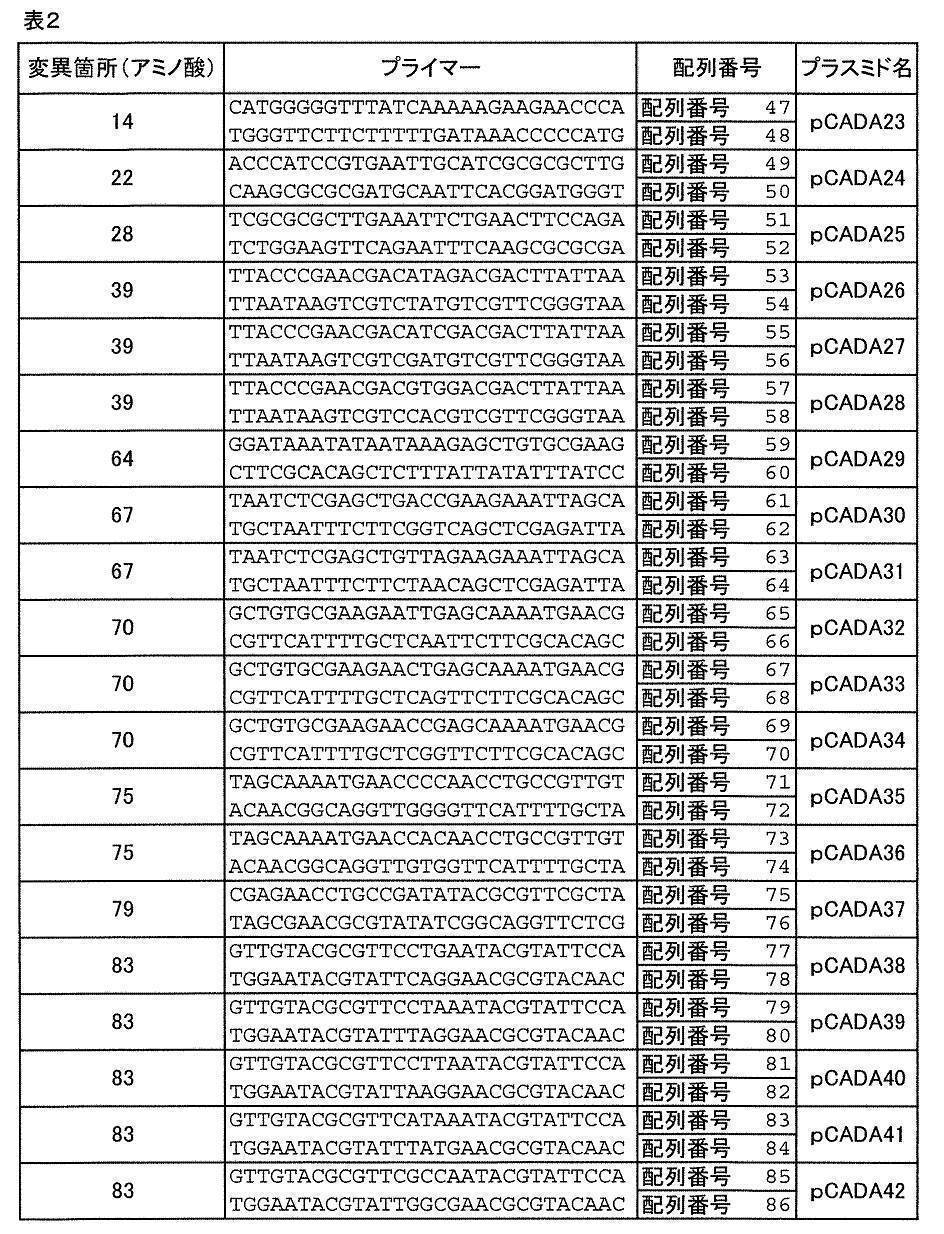
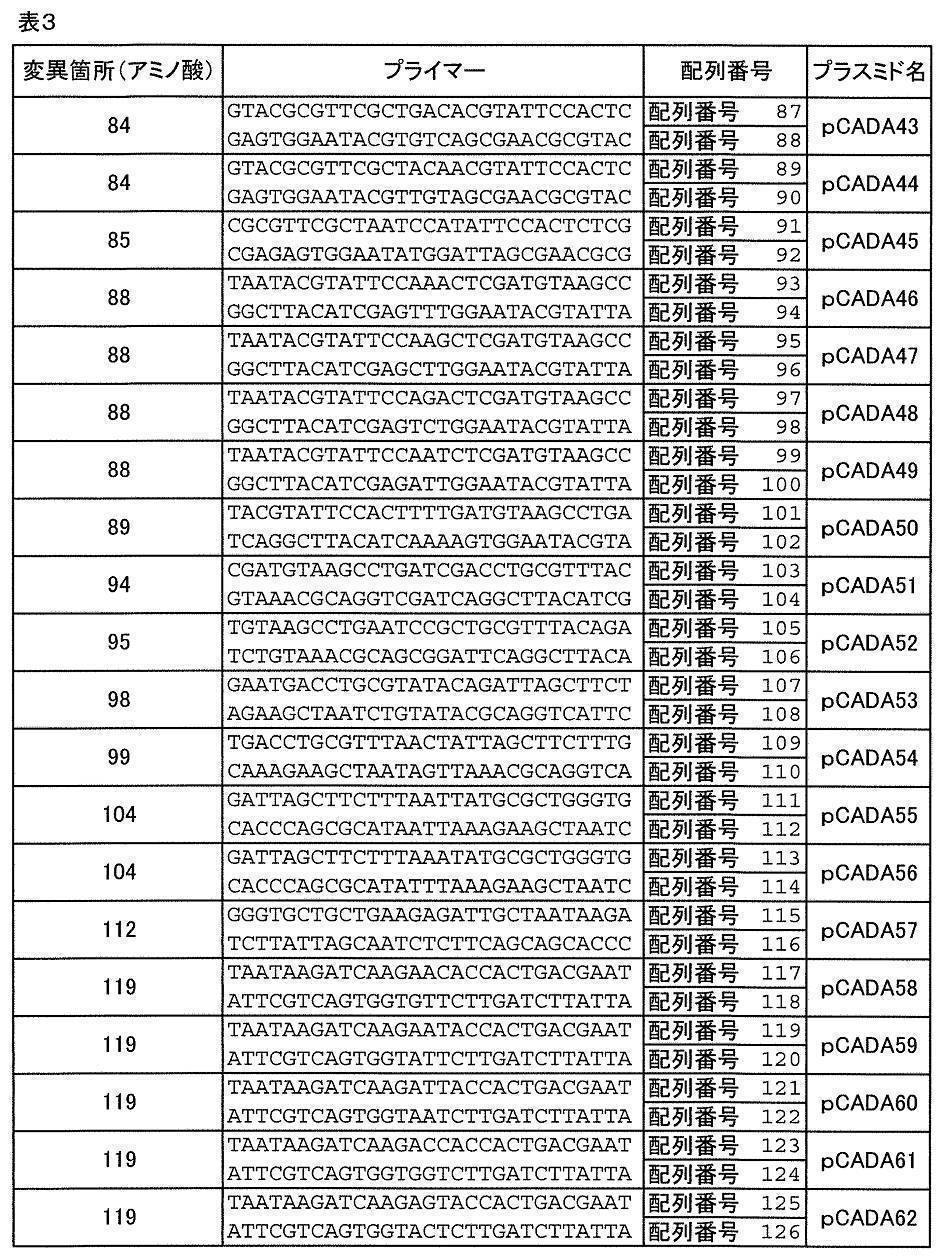


[多重変異株の作成]
pCADA5を鋳型として配列番号19および20に示す塩基配列を有するオリゴヌクレオチド(インビトロジェン社に委託して合成した)を用いて、PCRを行った。
そして、変性:96℃、30秒間、アニーリング:55℃、30秒間、伸長反応:68℃、5分間20秒からなる反応サイクルを16サイクルの条件でPCRを行った。
(参考例4)
[リジン生産菌の作製とリジン発酵]
Corynebacterium glutamicum(ATCC13032)に対しM.Ikedaら(J Ind Microbiol Biotechnol (2006) 33: 610-615)が記載の方法によりAPG-4株(hom、lysC、pyc、gnd変異株)を作製した。

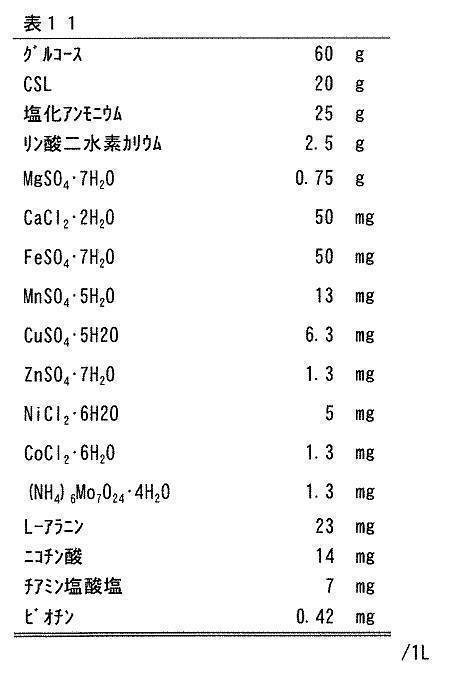

[野生型酵素における 大腸菌、コリネバクテリウム、酵母の添加効果]
500mlのバッフル付きフラスコに100mlのLB培地(Difco Cat.244620)をいれ滅菌したものを2本用意し、大腸菌(ATCC27325)及びCorynebacterium glutamicum(ATCC13032)をそれぞれに植菌し、30℃、20時間、120rpmの振盪培養を行った。

(参考例6)
[野生型酵素における コーンスティープリカー、酵母エキス、糖蜜、ペプトンの添加効果]
12.5%のリジン塩酸塩水溶液に20g/Lのコーンスティープリカー(日本食品加工)(6N NaOHで中和)(以後CSLと略すことがある)、酵母エキス(Difco)、糖蜜(大日本明治製糖)、またはペプトン(Difco)を混合した溶液を調製し、それぞれ1/2倍ずつ12.5%のリジン塩酸塩水溶液で希釈することにより20g/Lから0.156g/Lの希釈系列を作製した。

(参考例7)
[野生型酵素における コリネバクテリウム+コーンスティープリカー、コリネバクテリウム+酵母エキス、コリネバクテリウム+糖蜜の添加効果]
500mlのバッフル付きフラスコに100mlのLB培地(Difco Cat.244620)をいれ滅菌したものを用意し、Corynebacterium glutamicum(ATCC13032)を植菌し、30℃、20時間、120rpmの振盪培養を行った。得られた培養液から菌体を遠心分離し上清を除き、上清と同量の脱イオン交換水で菌体を懸濁し、再度遠心分離を行った。この操作を10回繰り返し菌体を洗浄した後、12.5%のリジン塩酸塩水溶液に懸濁し、以下の実験に使用した。

(参考例8)
[野生型酵素における 発酵液の反応の効果]
参考例4で調製した発酵液Aから5mlをとり、15mlスクリューキャップつきのPP容器に入れ、0.4%PLP水溶液を50μl、及び参考例1で調製した触媒死菌体を乾燥菌体換算で0.153%に希釈して10μl添加した。次に発酵液Aを遠心分離し、上清を0.22μmのフィルターでろ過し、除菌した。この上清を5mlをとり、15mlスクリューキャップつきのPP容器に入れ、0.4%PLP水溶液を50μl、及び参考例1で調製した触媒死菌体を乾燥菌体換算で0.153%に希釈して10μl添加した。さらにこの上清1mlとリジン濃度が27g/Lとなるようにリジン塩酸塩(Wako)をイオン交換水に溶解したものを9mlを混合し、この液を発酵液の希釈混合液とした。この液から5mlをとり、15mlスクリューキャップつきのPP容器に入れ、0.4%PLP水溶液を50μl、及び参考例1で調製した触媒死菌体を乾燥菌体換算で0.153%に希釈して10μl添加した。コントロールにはリジン濃度が27g/Lとなるようにリジン塩酸塩(Wako)をイオン交換水に溶解したものを用いた。


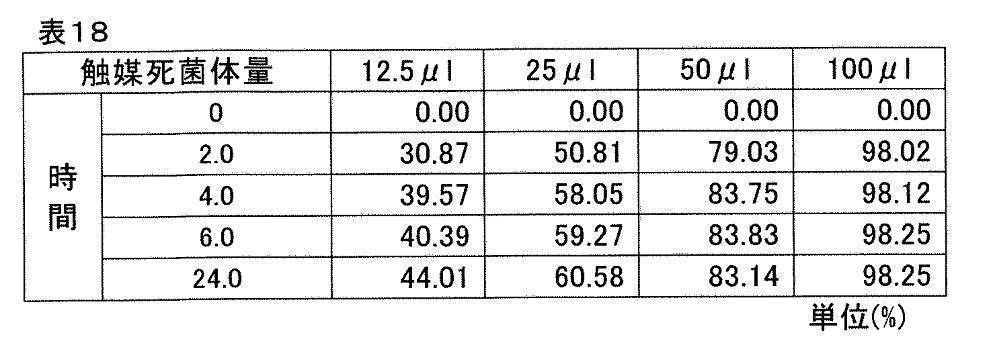


(実施例9)
[変異酵素の反応]
参考例1、実施例2及び実施例3で得られたW/pCADA1からW/pCADA22をを2Lのバッフル付き三角フラスコ中のアンピシリン100μg/mLを含むLB培地500mLに接種し、30℃にて光学密度(OD)(660nm)が0.5になるまで振盪培養した後、IPTG(イソプロピルーβーチオガラクトピラノシド)が0.1mMとなるように添加し、さらに14時間振盪培養した。培養液を8000rpmで20分間遠心分離し、菌体を回収した(乾燥菌体換算濃度は約30wt%)。
[菌体破砕液の調製]
得られた形質転換体W/pCADA1からW/pCADA22の回収菌体を希釈液(0.15mM ピリドキサールリン酸および5g/L ウシアルブミン(SIGMA社製)を含む10mM リン酸ナトリウム緩衝液(pH7.0))に懸濁し、菌体懸濁液を調製した。この菌体懸濁液を参考例1の方法と同様にそれぞれバイオラピュター(オリンパス社製)により氷水中で5分間破砕し、菌体破砕液を調製した。
[リジン脱炭酸酵素活性の測定方法]
200mM L-リジン一塩酸塩および0.15mM ピリドキサールリン酸(広島和光工業社製)を含む200mM リン酸ナトリウム緩衝液(pH7.0、pH8.0)に菌体破砕液を20μl添加して合計0.2mLとし、37℃で4分間反応した。反応液に0.2M塩酸を1mL添加して反応を停止した。この反応停止液を水で適当に希釈し、生成した1、5-ペンタメチレンジアミンをHPLCにより定量した。結果を表21(pH7.0)、表22(pH8.0)に示す。


(実施例10)
[変異酵素 発酵液での反応の効果]
参考例1、実施例2及び実施例3で得られたW/pCADA1からW/pCADA22を3mlのLB培地(Difco Cat.244620)を入れた試験管に植菌し、26℃、200rpmで24時間培養した。得られた培養液1mlを1.5mlチューブに入れ、遠心分離により菌体を集菌した。上清を取り除き得られた菌体に1mlの菌体破砕液(0.1%TritonX-100、0.004%PLP、100mMリン酸ナトリウム緩衝液(pH7.0))を加えた後、菌体を懸濁し、58℃で30分加熱した。
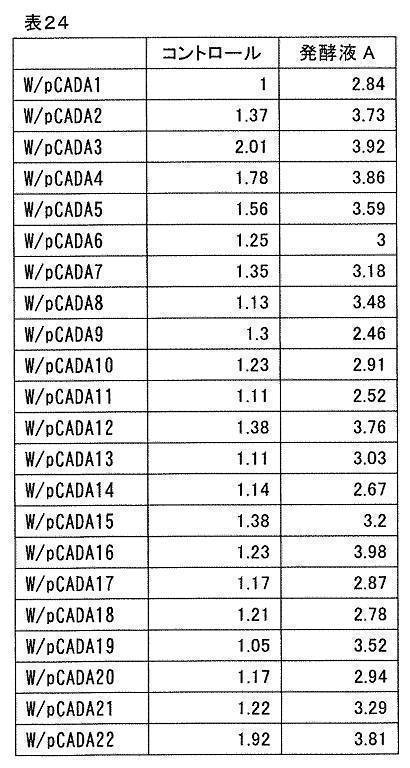
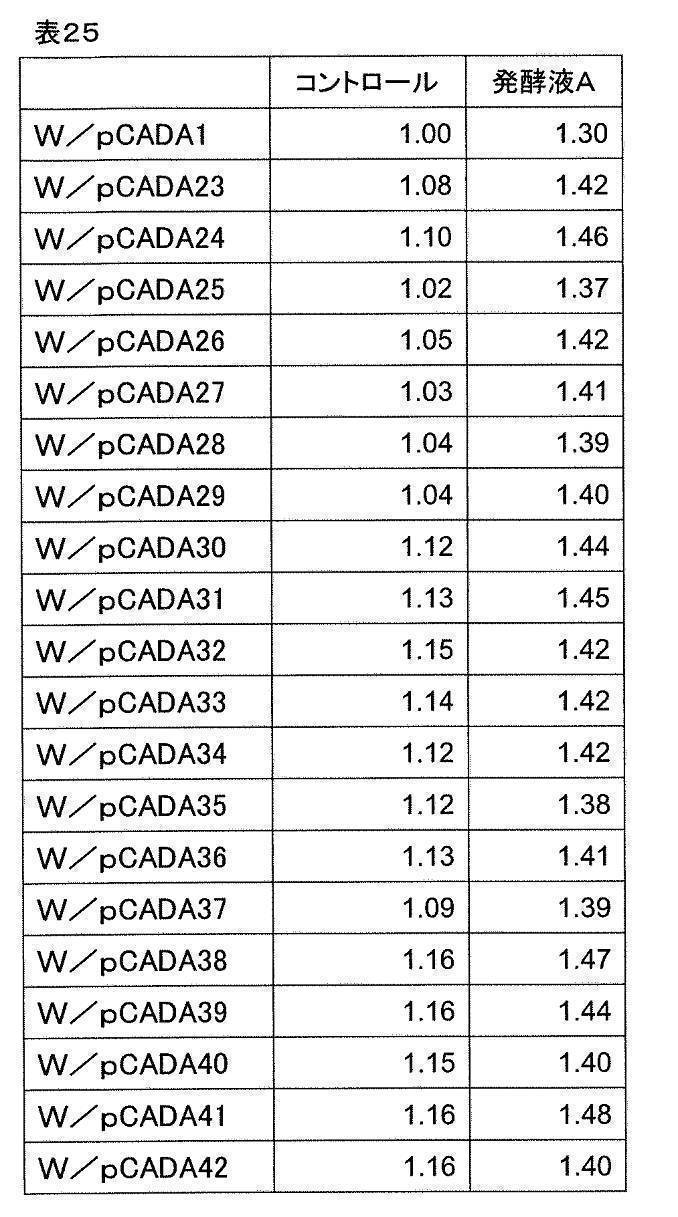

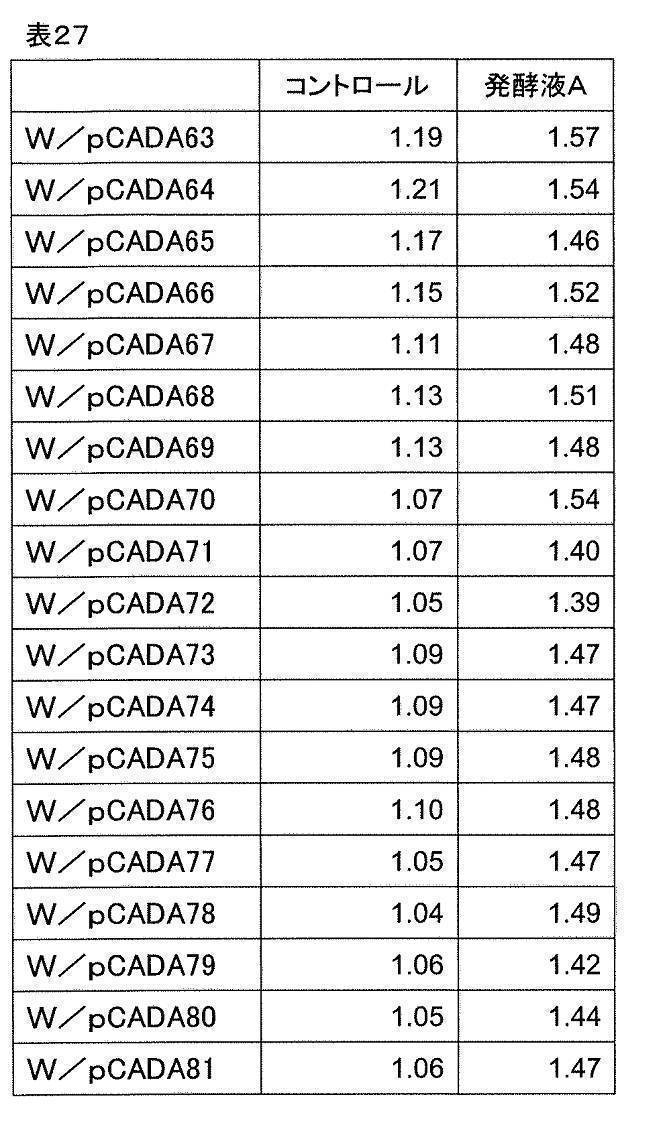
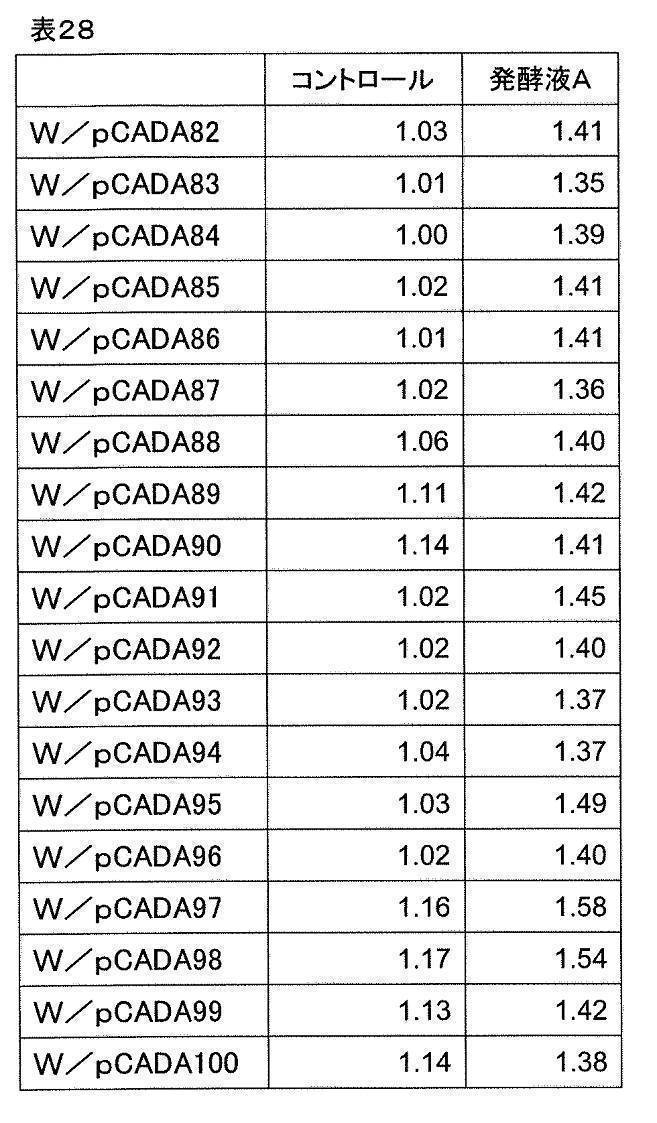


[高濃度蓄積反応]
300mLのフラスコに、L-リジン塩酸塩を、終濃度が45質量%となるように、およびピリドキサールリン酸を終濃度0.15mMとなるように調製した基質溶液120gを加えた。次に、参考例5に記載のコリネバクテリウム菌を2.5x10^7細胞/mLとなるように添加し、実施例3で調製したW/pCAD21の触媒死菌体を(乾燥菌体重量換算0.0648g、菌体活性164unit/mg乾燥菌体)を添加して42℃、200rpm、24時間反応した。反応収率は99%であった。
(実施例12)
[1、5-ペンタメチレンジイソシアネートの製造]
(リジン発酵液から製造したPDAの精製)
参考例8の表17に示した触媒死菌体を25μL添加した反応液を硫酸でpHを6.0に調整した後、8000rpm、20分の遠心分離により菌体などの沈殿物を除去した。陽イオン交換樹脂(Dowex 50WX8 (H+ 型))を充填したカラムに通液し、陽イオン交換樹脂に1、5-ペンタメチレンジアミンを吸着させた後、0.7M食塩水をカラムに通液して樹脂を充分洗浄して不純物を除去し、吸着した1、5-ペンタメチレンジアミンを6N塩酸で溶出した。そして、この溶出液に30%水酸化ナトリウム溶液を加えてpHを12に調整した。
(精製PDAの濃縮)
分液ロートに1、5-ペンタメチレンジアミン水溶液100質量部をn-ブタノール(抽出溶媒)100質量部とを仕込み、10分間混合し、その後30分間静置した。次いで有機層(1、5-ペンタメチレンジアミンを含むn-ブタノール)を抜き出した。
(PDIの合成)
電磁誘導撹拌機、自動圧力調整弁、温度計、窒素導入ライン、ホスゲン導入ライン、凝縮器、原料フィードポンプを備え付けたジャケット付き加圧反応器に、オルトジクロロベンゼン2000質量部を仕込んだ。次いで、ホスゲン2300質量部をホスゲン導入ラインから加え、撹拌を開始した。反応器のジャケットには冷水を通し、内温を約10℃に保った。そこへ、ペンタメチレンジアミン400質量部をオルトジクロロベンゼン2600質量部に溶解した溶液を、フィードポンプにて60分かけてフィードし、30℃以下、常圧下で冷ホスゲン化を開始した。フィード終了後、加圧反応器内は淡褐白色スラリー状液となった。
(実施例13)
[ポリイソシアネート組成物の製造]
攪拌機、温度計、還流管、および、窒素導入管を備えた4つ口フラスコに、上記により得られたペンタメチレンジイソシアネートを500質量部、1、3-ブタンジオール(以下、1、3-BGと略する場合がある。)を3.9質量部、2、6-ジ(tert-ブチル)-4-メチルフ
ェノールを0.25質量部、トリス(トリデシル)ホスファイトを0.25質量部装入し、80℃で3時間反応させた。この溶液を60℃に降温した後、トリマー化触媒としてN-(2-ヒドロキシプロピル)-N、N、N-トリメチルアンモニウム-2-エチルヘキサノエートを0.1質量部添加した。1時間反応させた後、o-トルエンスルホンアミドを0.12質量部添加した(イソシアネート基の転化率:10質量%)。得られた反応液を薄膜蒸留装置(真空度0.093KPa、温度150℃)に通液して未反応のペンタメチレンジイソシアネートを除去し、さらに、得られた組成物100質量部に対し、o-トルエンスルホンアミドを0.02質量部添加し、ポリイソシアネート組成物を得た。
Claims (25)
- 配列表の配列番号4に記載のアミノ酸配列において、
前記アミノ酸配列中のアミノ酸の少なくとも1つが、活性が上昇する他のアミノ酸に置換されていることを特徴とする、変異型リジン脱炭酸酵素。 - 他のアミノ酸に置換される前記アミノ酸が、
10量体形成ドメインおよび/または活性領域ドメイン
に存在することを特徴とする、請求項1に記載の変異型リジン脱炭酸酵素。 - 前記10量体形成ドメインが、
ウィングドメインおよび/またはリンカードメインであり、
前記活性領域ドメインが、
ピリドキサールリン酸酵素共通ドメインおよび/または基質出入口
であることを特徴とする、請求項2に記載の変異型リジン脱炭酸酵素。 - 配列表の配列番号4に記載のアミノ酸配列において、
前記10量体形成ドメインに存在する前記アミノ酸が、
14、28、39、64、67、70、75、79、83、84、85、88、89、94、95、98、99、104、112、119、137、138、139、143、145、148、182番目のアミノ酸であり、
前記活性領域ドメインに存在する前記アミノ酸が、
184、253、262、286、290、295、303、317、335、352、353、386、430、443、446、460、466、471、475、506、524、539、544、546、553、623、626、636、646、648、711番目のアミノ酸であることを特徴とする、請求項2に記載の変異型リジン脱炭酸酵素。 - 配列表の配列番号4に記載のアミノ酸配列において、
前記ウィングドメインに存在する前記アミノ酸が、
14、28、39、64、67、70、75、79、83、84、85、88、89、94、95、98、99、104、112、119番目のアミノ酸であり、
前記リンカードメインに存在する前記アミノ酸が、
137、138、139、143、145、148、182番目のアミノ酸であり、
前記ピリドキサールリン酸酵素共通ドメインに存在する前記アミノ酸が、
184、253、262、286、290、295、303、317、335、352、353、386番目のアミノ酸であり、
前記基質出入口に存在する前記アミノ酸が、
430、443、446、460、466、471、475、506、524、539、544、546、553、623、626、636、646、648、711番目のアミノ酸であることを特徴とする、請求項3に記載の変異型リジン脱炭酸酵素。 - 配列表の配列番号4に記載のアミノ酸配列において、
10量体形成ドメインに存在するアミノ酸のうち14番目のアミノ酸をPheからGlnに変更したもの、28番目のアミノ酸をArgからIleに変更したもの、39番目のアミノ酸をArgからIleに変更したもの、39番目のアミノ酸をArgからValに変更したもの、64番目のアミノ酸をLeuからLysに変更したもの、67番目のアミノ酸をCysからThrに変更したもの、67番目のアミノ酸をCysからLeuに変更したもの、70番目のアミノ酸をIleからLeuに変更したもの、70番目のアミノ酸をIleからProに変更したもの、75番目のアミノ酸をGluからProに変更したもの、75番目のアミノ酸をGluからHisに変更したもの、79番目のアミノ酸をLeuからIleに変更したもの、83番目のアミノ酸をAlaからLeuに変更したもの、84番目のアミノ酸をAsnからAspに変更したもの、84番目のアミノ酸をAsnからThrに変更したもの、85番目のアミノ酸をThrからProに変更したもの、88番目のアミノ酸をThrからLysに変更したもの、88番目のアミノ酸をThrからArgに変更したもの、88番目のアミノ酸をThrからAsnに変更したもの、89番目のアミノ酸をLeuからPheに変更したもの、94番目のアミノ酸をAsnからIleに変更したもの、95番目のアミノ酸をAspからProに変更したもの、98番目のアミノ酸をLeuからIleに変更したもの、99番目のアミノ酸をGlnからThrに変更したもの、104番目のアミノ酸をGluからAsnに変更したもの、104番目のアミノ酸をGluからLysに変更したもの、112番目のアミノ酸をAspからGluに変更したもの、119番目のアミノ酸をGlnからAsnに変更したもの、119番目のアミノ酸をGlnからIleに変更したもの、119番目のアミノ酸をGlnからThrに変更したもの、119番目のアミノ酸をGlnからSerに変更したもの、137番目のアミノ酸をPheからValに変更したもの、138番目のアミノ酸をLysからIleに変更したもの、139番目のアミノ酸をTyrからValに変更したもの、139番目のアミノ酸をTyrからCysに変更したもの、139番目のアミノ酸をTyrからThrに変更したもの、139番目のアミノ酸をTyrからSerに変更したもの、139番目のアミノ酸をTyrからAsnに変更したもの、143番目のアミノ酸をGlyからGluに変更したもの、145番目のアミノ酸をTyrからArgに変更したもの、148番目のアミノ酸をCysからSerに変更したもの、148番目のアミノ酸をCysからAlaに変更したもの、182番目のアミノ酸をIleからMetに変更したもの、
活性領域ドメインに存在するアミノ酸のうち184番目のアミノ酸をValからAlaに変更したもの、253番目のアミノ酸をMetからLeuに変更したもの、262番目のアミノ酸をPheからTyrに変更したもの、286番目のアミノ酸をAlaからAspに変更したもの、290番目のアミノ酸をLysからHisに変更したもの、295番目のアミノ酸をAlaからSerに変更したもの、303番目のアミノ酸をIleからThrに変更したもの、317番目のアミノ酸をPheからGlnに変更したもの、335番目のアミノ酸をProからAlaに変更したもの、352番目のアミノ酸をGlyからAlaに変更したもの、353番目のアミノ酸をArgからHisに変更したもの、386番目のアミノ酸をGluからSerに変更したもの、430番目のアミノ酸をGluからPheに変更したもの、443番目のアミノ酸をArgからMetに変更したもの、446番目のアミノ酸をSerからTyrに変更したもの、446番目のアミノ酸をSerからGlnに変更したもの、460番目のアミノ酸をAspからIleに変更したもの、460番目のアミノ酸をAspからAsnに変更したもの、460番目のアミノ酸をAspからCysに変更したもの、460番目のアミノ酸をAspからGlnに変更したもの、460番目のアミノ酸をAspからProに変更したもの、460番目のアミノ酸をAspからSerに変更したもの、466番目のアミノ酸をProからAsnに変更したもの、466番目のアミノ酸をProからGlyに変更したもの、466番目のアミノ酸をProからSerに変更したもの、471番目のアミノ酸をSerからTyrに変更したもの、475番目のアミノ酸をGlyからAsnに変更したもの、506番目のアミノ酸をAspからProに変更したもの、524番目のアミノ酸をValからLeuに変更したもの、524番目のアミノ酸をValからLeuに変更したもの、539番目のアミノ酸をIleからCysに変更したもの、539番目のアミノ酸をIleからLeuに変更したもの、544番目のアミノ酸をThrからAlaに変更したもの、544番目のアミノ酸をThrからSerに変更したもの、544番目のアミノ酸をThrからProに変更したもの、546番目のアミノ酸をAlaからSerに変更したもの、553番目のアミノ酸をLeuからValに変更したもの、623番目のアミノ酸をAlaからCysに変更したもの、623番目のアミノ酸をAlaからPheに変更したもの、623番目のアミノ酸をAlaからGlnに変更したもの、626番目のアミノ酸をLysからValに変更したもの、636番目のアミノ酸をTyrからCysに変更したもの、636番目のアミノ酸をTyrからProに変更したもの、646番目のアミノ酸をAlaからLeuに変更したもの、646番目のアミノ酸をAlaからIleに変更したもの、648番目のアミノ酸をMetからSerに変更したもの、710番目のアミノ酸をLysからThrに変更したもの、711番目のアミノ酸をGluからAspに変更したものに少なくとも1箇所以上置換されている変異型リジン脱炭酸酵素であることを特徴とする、請求項4に記載の変異型リジン脱炭酸酵素。 - 配列表の配列番号4に記載のアミノ酸配列において、
ウィングドメインに存在するアミノ酸のうち14番目のアミノ酸をPheからGlnに変更したもの、28番目のアミノ酸をArgからIleに変更したもの、39番目のアミノ酸をArgからIleに変更したもの、39番目のアミノ酸をArgからValに変更したもの、64番目のアミノ酸をLeuからLysに変更したもの、67番目のアミノ酸をCysからThrに変更したもの、67番目のアミノ酸をCysからLeuに変更したもの、70番目のアミノ酸をIleからLeuに変更したもの、70番目のアミノ酸をIleからProに変更したもの、75番目のアミノ酸をGluからProに変更したもの、75番目のアミノ酸をGluからHisに変更したもの、79番目のアミノ酸をLeuからIleに変更したもの、83番目のアミノ酸をAlaからLeuに変更したもの、84番目のアミノ酸をAsnからAspに変更したもの、84番目のアミノ酸をAsnからThrに変更したもの、85番目のアミノ酸をThrからProに変更したもの、88番目のアミノ酸をThrからLysに変更したもの、88番目のアミノ酸をThrからArgに変更したもの、88番目のアミノ酸をThrからAsnに変更したもの、89番目のアミノ酸をLeuからPheに変更したもの、94番目のアミノ酸をAsnからIleに変更したもの、95番目のアミノ酸をAspからProに変更したもの、98番目のアミノ酸をLeuからIleに変更したもの、99番目のアミノ酸をGlnからThrに変更したもの、104番目のアミノ酸をGluからAsnに変更したもの、104番目のアミノ酸をGluからLysに変更したもの、112番目のアミノ酸をAspからGluに変更したもの、119番目のアミノ酸をGlnからAsnに変更したもの、119番目のアミノ酸をGlnからIleに変更したもの、119番目のアミノ酸をGlnからThrに変更したもの、119番目のアミノ酸をGlnからSerに変更したもの、
リンカードメインに存在するアミノ酸のうち137番目のアミノ酸をPheからValに変更したもの、138番目のアミノ酸をLysからIleに変更したもの、139番目のアミノ酸をTyrからValに変更したもの、139番目のアミノ酸をTyrからCysに変更したもの、139番目のアミノ酸をTyrからThrに変更したもの、139番目のアミノ酸をTyrからSerに変更したもの、139番目のアミノ酸をTyrからAsnに変更したもの、143番目のアミノ酸をGlyからGluに変更したもの、145番目のアミノ酸をTyrからArgに変更したもの、148番目のアミノ酸をCysからSerに変更したもの、148番目のアミノ酸をCysからAlaに変更したもの、182番目のアミノ酸をIleからMetに変更したもの、
ピリドキサールリン酸酵素共通ドメインに存在するアミノ酸のうち184番目のアミノ酸をValからAlaに変更したもの、253番目のアミノ酸をMetからLeuに変更したもの、262番目のアミノ酸をPheからTyrに変更したもの、286番目のアミノ酸をAlaからAspに変更したもの、290番目のアミノ酸をLysからHisに変更したもの、295番目のアミノ酸をAlaからSerに変更したもの、303番目のアミノ酸をIleからThrに変更したもの、317番目のアミノ酸をPheからGlnに変更したもの、335番目のアミノ酸をProからAlaに変更したもの、352番目のアミノ酸をGlyからAlaに変更したもの、353番目のアミノ酸をArgからHisに変更したもの、386番目のアミノ酸をGluからSerに変更したもの、
基質出入口に存在するアミノ酸のうち430番目のアミノ酸をGluからPheに変更したもの、443番目のアミノ酸をArgからMetに変更したもの、446番目のアミノ酸をSerからTyrに変更したもの、446番目のアミノ酸をSerからGlnに変更したもの、460番目のアミノ酸をAspからIleに変更したもの、460番目のアミノ酸をAspからAsnに変更したもの、460番目のアミノ酸をAspからCysに変更したもの、460番目のアミノ酸をAspからGlnに変更したもの、460番目のアミノ酸をAspからProに変更したもの、460番目のアミノ酸をAspからSerに変更したもの、466番目のアミノ酸をProからAsnに変更したもの、466番目のアミノ酸をProからGlyに変更したもの、466番目のアミノ酸をProからSerに変更したもの、471番目のアミノ酸をSerからTyrに変更したもの、475番目のアミノ酸をGlyからAsnに変更したもの、506番目のアミノ酸をAspからProに変更したもの、524番目のアミノ酸をValからLeuに変更したもの、524番目のアミノ酸をValからLeuに変更したもの、539番目のアミノ酸をIleからCysに変更したもの、539番目のアミノ酸をIleからLeuに変更したもの、544番目のアミノ酸をThrからAlaに変更したもの、544番目のアミノ酸をThrからSerに変更したもの、544番目のアミノ酸をThrからProに変更したもの、546番目のアミノ酸をAlaからSerに変更したもの、553番目のアミノ酸をLeuからValに変更したもの、623番目のアミノ酸をAlaからCysに変更したもの、623番目のアミノ酸をAlaからPheに変更したもの、623番目のアミノ酸をAlaからGlnに変更したもの、626番目のアミノ酸をLysからValに変更したもの、636番目のアミノ酸をTyrからCysに変更したもの、636番目のアミノ酸をTyrからProに変更したもの、646番目のアミノ酸をAlaからLeuに変更したもの、646番目のアミノ酸をAlaからIleに変更したもの、648番目のアミノ酸をMetからSerに変更したもの、710番目のアミノ酸をLysからThrに変更したもの、711番目のアミノ酸をGluからAspに変更したものに少なくとも1箇所以上置換されている変異型リジン脱炭酸酵素であることを特徴とする、請求項5に記載の変異型リジン脱炭酸酵素。 - 配列表の配列番号4に記載のアミノ酸配列において、290、335、475および711番目のアミノ酸が、他のアミノ酸に置換されていることを特徴とする、請求項1に記載の変異型リジン脱炭酸酵素。
- 配列表の配列番号4に記載のアミノ酸配列において、286、290、335、475および711番目のアミノ酸が、他のアミノ酸に置換されていることを特徴とする、請求項1に記載の変異型リジン脱炭酸酵素。
- 配列表の配列番号4に記載のアミノ酸配列において、148、646番目のアミノ酸が、他のアミノ酸に置換されていることを特徴とする、請求項1に記載の変異型リジン脱炭酸酵素。
- 配列表の配列番号4に記載のアミノ酸配列において、471、626番目のアミノ酸が、他のアミノ酸に置換されていることを特徴とする、請求項1に記載の変異型リジン脱炭酸酵素。
- 配列表の配列番号4に記載のアミノ酸配列において、626、646番目のアミノ酸が、他のアミノ酸に置換されていることを特徴とする、請求項1に記載の変異型リジン脱炭酸酵素。
- 配列表の配列番号4に記載のアミノ酸配列において、前記アミノ酸配列中のアミノ酸の少なくとも1つが、他のアミノ酸に置換されている変異型リジン脱炭酸酵素によって、
リジン脱炭酸反応の減速または停止を防ぐ物質の存在下において、L-リジン及び/またはその塩を、リジン脱炭酸反応させることを特徴とする、1、5-ペンタメチレンジアミンの製造方法。 - 変異型リジン脱炭酸酵素をリジン1g当たり5unitから165unit使用する、または、リジン1gあたり精製酵素換算で5μgから165μg使用することを特徴とする、請求項13に記載の1、5-ペンタメチレンジアミンの製造方法。
- リジン脱炭酸反応の減速または停止を防ぐ物質が、微生物の発酵液またはその処理物またはそれらに含まれる成分であることを特徴とする、請求項13に記載の1、5-ペンタメチレンジアミンの製造方法。
- リジン脱炭酸反応の減速または停止を防ぐ物質が、リジン生産時の発酵液、またはその処理物に含まれる成分であることを特徴とする、請求項13に記載の1、5-ペンタメチレンジアミンの製造方法。
- リジン脱炭酸反応の減速または停止を防ぐ物質が、微生物を培養した培養液に含まれる成分であることを特徴とする、請求項13に記載の1、5-ペンタメチレンジアミンの製造方法。
- リジン脱炭酸反応の減速または停止を防ぐ物質が、微生物または微生物処理物であることを特徴とする、請求項13に記載の1、5-ペンタメチレンジアミンの製造方法。
- 微生物が、原核生物および/または真核生物であることを特徴とする、請求項17に記載の1、5-ペンタメチレンジアミンの製造方法。
- 微生物がリジン生産菌であることを特徴とする、請求項17に記載の1、5-ペンタメチレンジアミンの製造方法。
- リジン脱炭酸反応の減速または停止を防ぐ物質が、微生物が炭素源としうる化合物であることを特徴とする、請求項13に記載の1、5-ペンタメチレンジアミンの製造方法。
- 微生物が炭素源としうる化合物が、コーンスティープリカー、廃糖蜜、糖類およびアミノ酸類からなる群から選択される少なくとも1種であることを特徴とする、請求項21に記載の1、5-ペンタメチレンジアミンの製造方法。
- 反応の減速または停止を防ぐ物質が、
微生物と、微生物が炭素源としうる化合物との混合物であることを特徴とする、請求項13に記載の1、5-ペンタメチレンジアミンの製造方法。 - 配列表の配列番号4に記載のアミノ酸配列において、前記アミノ酸配列中のアミノ酸の少なくとも1つが、他のアミノ酸に置換されている変異型リジン脱炭酸酵素によって、
リジン脱炭酸反応の減速または停止を防ぐ物質の存在下において、L-リジン及び/またはその塩を、リジン脱炭酸反応させることにより得られる
1、5-ペンタメチレンジアミンまたはその塩を、イソシアネート化することを特徴とする、1、5-ペンタメチレンジイソシアネートの製造方法。 - 配列表の配列番号4に記載のアミノ酸配列において、前記アミノ酸配列中のアミノ酸の少なくとも1つが、他のアミノ酸に置換されている変異型リジン脱炭酸酵素によって、
リジン脱炭酸反応の減速または停止を防ぐ物質の存在下において、L-リジン及び/またはその塩を、リジン脱炭酸反応させることにより得られる
1、5-ペンタメチレンジアミンまたはその塩を、イソシアネート化することにより得られる
1、5-ペンタメチレンジイソシアネートを、下記(a)~(e)の官能基を少なくとも1種含有するように変性することを特徴とする、ポリイソシアネート組成物の製造方法。
(a)イソシアヌレート基
(b)アロファネート基
(c)ビウレット基
(d)ウレタン基
(e)ウレア基
Priority Applications (3)
| Application Number | Priority Date | Filing Date | Title |
|---|---|---|---|
| US14/372,386 US9765369B2 (en) | 2012-01-18 | 2013-01-17 | Method for producing 1,5-pentamethylenediamine, mutant lysine decarboxylase, method for producing 1,5-pentamethylene diisocyanate and method for producing polyisocyanate composition |
| JP2013554350A JP5961634B2 (ja) | 2012-01-18 | 2013-01-17 | 変異型リジン脱炭酸酵素、および、1、5−ペンタメチレンジアミンの製造方法 |
| EP13738315.4A EP2806026B1 (en) | 2012-01-18 | 2013-01-17 | Method for producing 1,5-pentamethylenediamine, mutant lysine decarboxylase, method for producing 1,5-pentamethylene diisocyanate and method for producing polyisocyanate composition |
Applications Claiming Priority (2)
| Application Number | Priority Date | Filing Date | Title |
|---|---|---|---|
| JP2012-008173 | 2012-01-18 | ||
| JP2012008173 | 2012-01-18 |
Publications (1)
| Publication Number | Publication Date |
|---|---|
| WO2013108859A1 true WO2013108859A1 (ja) | 2013-07-25 |
Family
ID=48799282
Family Applications (2)
| Application Number | Title | Priority Date | Filing Date |
|---|---|---|---|
| PCT/JP2013/050862 Ceased WO2013108859A1 (ja) | 2012-01-18 | 2013-01-17 | 1,5-ペンタメチレンジアミンの製造方法、変異型リジン脱炭酸酵素、1,5-ペンタメチレンジイソシアネートの製造方法およびポリイソシアネート組成物の製造方法 |
| PCT/JP2013/050863 Ceased WO2013108860A1 (ja) | 2012-01-18 | 2013-01-17 | 1,5-ペンタメチレンジアミンの製造方法、1,5-ペンタメチレンジイソシアネートの製造方法およびポリイソシアネート組成物の製造方法 |
Family Applications After (1)
| Application Number | Title | Priority Date | Filing Date |
|---|---|---|---|
| PCT/JP2013/050863 Ceased WO2013108860A1 (ja) | 2012-01-18 | 2013-01-17 | 1,5-ペンタメチレンジアミンの製造方法、1,5-ペンタメチレンジイソシアネートの製造方法およびポリイソシアネート組成物の製造方法 |
Country Status (4)
| Country | Link |
|---|---|
| US (1) | US9765369B2 (ja) |
| EP (1) | EP2806026B1 (ja) |
| JP (2) | JP5961634B2 (ja) |
| WO (2) | WO2013108859A1 (ja) |
Cited By (4)
| Publication number | Priority date | Publication date | Assignee | Title |
|---|---|---|---|---|
| JPWO2013108860A1 (ja) * | 2012-01-18 | 2015-05-11 | 三井化学株式会社 | 1,5−ペンタメチレンジアミンの製造方法、1,5−ペンタメチレンジイソシアネートの製造方法およびポリイソシアネート組成物の製造方法 |
| WO2015137418A1 (ja) * | 2014-03-11 | 2015-09-17 | 味の素株式会社 | 熱安定性向上リジン脱炭酸酵素変異体を用いる1,5-ペンタジアミンの製造方法 |
| WO2018079502A1 (ja) * | 2016-10-26 | 2018-05-03 | 三井化学株式会社 | ペンタメチレンジイソシアネートの製造方法 |
| JP2019154313A (ja) * | 2018-03-13 | 2019-09-19 | 三井化学株式会社 | リジン脱炭酸酵素、1,5−ペンタメチレンジイソシアネートの製造方法、および、ポリイソシアネート組成物の製造方法 |
Families Citing this family (14)
| Publication number | Priority date | Publication date | Assignee | Title |
|---|---|---|---|---|
| US10358576B2 (en) | 2015-04-20 | 2019-07-23 | Basf Se | Two-component coating compounds |
| KR101791837B1 (ko) * | 2015-08-06 | 2017-10-31 | 서울대학교산학협력단 | 라이신 디카르복실라아제의 변이주 개발 방법 및 그의 응용 |
| US11078473B2 (en) * | 2016-12-30 | 2021-08-03 | Cathay Biotech Inc. | Lysine decarboxylases having modifications at titratable amino acids |
| JP2018177273A (ja) * | 2017-04-07 | 2018-11-15 | 三井化学株式会社 | ペンタメチレンジイソシアネート入り容器、および、ペンタメチレンジイソシアネートの保存方法 |
| CN108795912B (zh) * | 2017-05-05 | 2022-08-02 | 上海凯赛生物技术股份有限公司 | 赖氨酸脱羧酶突变体及其应用 |
| CN111748549B (zh) * | 2017-05-16 | 2022-09-23 | 中国科学院天津工业生物技术研究所 | 新的赖氨酸脱羧酶突变体及其应用 |
| ES3053013T3 (en) * | 2017-05-16 | 2026-01-16 | Cathay Biotech Inc | Modifications to lysine decarboxylase enzymes |
| CN108795916B (zh) * | 2018-07-16 | 2020-02-21 | 南京工业大学 | 一种赖氨酸脱羧酶突变体、其编码基因及其表达和应用 |
| CN115125229B (zh) * | 2021-03-25 | 2023-11-14 | 中国科学院过程工程研究所 | 一种用于合成戊二胺的赖氨酸脱羧酶突变体 |
| US20220356150A1 (en) | 2021-04-30 | 2022-11-10 | Evoco Limited | Biobased diisocyanates, and process for preparation of same |
| KR102855700B1 (ko) * | 2022-06-23 | 2025-09-04 | 서울대학교산학협력단 | 용해도 증대 라이신 디카르복실라아제 변이주 개발 및 그의 응용 |
| EP4545579A1 (de) | 2023-10-24 | 2025-04-30 | Covestro Deutschland AG | Verfahren zur herstellung eines polyisocyanats auf basis von 1,5-pentamethylendiisocyanat |
| EP4606786A1 (en) | 2024-02-21 | 2025-08-27 | Covestro Deutschland AG | Extraction of 1,6-hexamethylenediamine using combinations of solvents |
| EP4606788A1 (en) | 2024-02-21 | 2025-08-27 | Covestro Deutschland AG | Use of two different solvents for the extraction of 1,6-hexamethylenediamine produced by microbial fermentation |
Citations (3)
| Publication number | Priority date | Publication date | Assignee | Title |
|---|---|---|---|---|
| JP2004000114A (ja) * | 2002-04-08 | 2004-01-08 | Toray Ind Inc | カダベリンの製造方法 |
| JP2009207495A (ja) | 2009-06-15 | 2009-09-17 | Toray Ind Inc | カダベリン・脂肪族ジカルボン酸塩 |
| JP2011201863A (ja) * | 2010-03-01 | 2011-10-13 | Mitsui Chemicals Inc | ペンタメチレンジイソシアネート、ポリイソシアネート組成物、ペンタメチレンジイソシアネートの製造方法、および、ポリウレタン樹脂 |
Family Cites Families (5)
| Publication number | Priority date | Publication date | Assignee | Title |
|---|---|---|---|---|
| JP5553394B2 (ja) | 2001-02-01 | 2014-07-16 | 東レ株式会社 | カダベリンの製造方法 |
| JP4356320B2 (ja) | 2003-01-08 | 2009-11-04 | 東レ株式会社 | カダベリン・ジカルボン酸塩およびポリアミドの製造方法 |
| SI1858920T1 (sl) * | 2005-02-18 | 2016-07-29 | Glaxosmithkline Biologicals S.A. | Proteini in nukleinske kisline iz escherichia coli, povezane z meningitisom/sepso |
| WO2011108473A1 (ja) * | 2010-03-01 | 2011-09-09 | 三井化学株式会社 | 1,5-ペンタメチレンジアミンの製造方法、1,5-ペンタメチレンジアミン、1,5-ペンタメチレンジイソシアネート、1,5-ペンタメチレンジイソシアネートの製造方法、ポリイソシアネート組成物、および、ポリウレタン樹脂 |
| EP2806026B1 (en) * | 2012-01-18 | 2018-12-26 | Mitsui Chemicals, Inc. | Method for producing 1,5-pentamethylenediamine, mutant lysine decarboxylase, method for producing 1,5-pentamethylene diisocyanate and method for producing polyisocyanate composition |
-
2013
- 2013-01-17 EP EP13738315.4A patent/EP2806026B1/en active Active
- 2013-01-17 WO PCT/JP2013/050862 patent/WO2013108859A1/ja not_active Ceased
- 2013-01-17 JP JP2013554350A patent/JP5961634B2/ja active Active
- 2013-01-17 JP JP2013554351A patent/JP5961635B2/ja active Active
- 2013-01-17 US US14/372,386 patent/US9765369B2/en active Active
- 2013-01-17 WO PCT/JP2013/050863 patent/WO2013108860A1/ja not_active Ceased
Patent Citations (3)
| Publication number | Priority date | Publication date | Assignee | Title |
|---|---|---|---|---|
| JP2004000114A (ja) * | 2002-04-08 | 2004-01-08 | Toray Ind Inc | カダベリンの製造方法 |
| JP2009207495A (ja) | 2009-06-15 | 2009-09-17 | Toray Ind Inc | カダベリン・脂肪族ジカルボン酸塩 |
| JP2011201863A (ja) * | 2010-03-01 | 2011-10-13 | Mitsui Chemicals Inc | ペンタメチレンジイソシアネート、ポリイソシアネート組成物、ペンタメチレンジイソシアネートの製造方法、および、ポリウレタン樹脂 |
Non-Patent Citations (15)
| Title |
|---|
| "Chemical Engineers Handbook", 1988, MARUZEN, pages: 563 - 566,574 |
| "Chemical Engineers Handbook", 1988, MARUZEN, pages: 566 - 569 |
| "Chemical Engineers Handbook", 1988, MARUZEN, pages: 569 - 574 |
| "Nucleotide sequence of the Escherichia coli cad operon: a system for neutralization of low extracellular pH", J. BACTERIOL., vol. 174, no. 8, 1992, pages 2659 - 2669, XP000978358 * |
| "PCR Technology", 1989, STOCKTON PRESS |
| J.CHROMATOGR., vol. 83, 1973, pages 353 - 355 |
| KRAMER, W.; FRITA, H.J., METHODS IN ENZYMOLOGY, vol. 154, 1987, pages 350 |
| M.IKEDA ET AL., J IND MICROBIOL BIOTECHNOL, vol. 33, 2006, pages 610 - 615 |
| QIAN ZG. ET AL.: "Metabolic engineering of Escherichia coli for the production of cadaverine: a five carbon diamine", BIOTECHNOL. BIOENG., vol. 108, no. 1, 2011, pages 93 - 103, XP055070575 * |
| SABO ET AL., BIOCHEMISTRY, vol. 13, 1974, pages 662 - 670 |
| SABO, D. L. ET AL., BIOCHEMISTRY, vol. 13, 1974, pages 662 - 670 |
| SAMBROOK, J.: "Molecular Cloning A Laboratory Manual", 2001, COLD SPRING HARBOR LABORATORY PRESS |
| TAKATSUKA ET AL., BIOSCIENCE, BIOTECHNOLOGY, AND BIOCHEMISTRY, vol. 63, no. 10, 1999, pages 1843 - 1846 |
| TAKATSUKA ET AL., BIOSCIENCE, BIOTECHNOLOGY, AND BIOCHEMISTRY, vol. 63, no. 6, 1999, pages 1063 - 1069 |
| TAKATSUKA Y. ET AL.: "Gene cloning and molecular characterization of lysine decarboxylase from Selenomonas ruminantium delineate its evolutionary relationship to ornithine decarboxylases from eukaryotes", J. BACTERIOL., vol. 182, no. 23, 2000, pages 6732 - 6741, XP055080140 * |
Cited By (8)
| Publication number | Priority date | Publication date | Assignee | Title |
|---|---|---|---|---|
| JPWO2013108860A1 (ja) * | 2012-01-18 | 2015-05-11 | 三井化学株式会社 | 1,5−ペンタメチレンジアミンの製造方法、1,5−ペンタメチレンジイソシアネートの製造方法およびポリイソシアネート組成物の製造方法 |
| WO2015137418A1 (ja) * | 2014-03-11 | 2015-09-17 | 味の素株式会社 | 熱安定性向上リジン脱炭酸酵素変異体を用いる1,5-ペンタジアミンの製造方法 |
| JPWO2015137418A1 (ja) * | 2014-03-11 | 2017-04-06 | 味の素株式会社 | 熱安定性向上リジン脱炭酸酵素変異体を用いる1,5−ペンタジアミンの製造方法 |
| US10358638B2 (en) | 2014-03-11 | 2019-07-23 | Ajinomoto Co., Inc. | Method of producing 1,5-pentadiamine using lysine decarboxylase mutant having improved thermal stability |
| WO2018079502A1 (ja) * | 2016-10-26 | 2018-05-03 | 三井化学株式会社 | ペンタメチレンジイソシアネートの製造方法 |
| JPWO2018079502A1 (ja) * | 2016-10-26 | 2019-06-24 | 三井化学株式会社 | ペンタメチレンジイソシアネートの製造方法 |
| US11358928B2 (en) | 2016-10-26 | 2022-06-14 | Mitsui Chemicals, Inc. | Method for producing pentamethylene diisocyanate |
| JP2019154313A (ja) * | 2018-03-13 | 2019-09-19 | 三井化学株式会社 | リジン脱炭酸酵素、1,5−ペンタメチレンジイソシアネートの製造方法、および、ポリイソシアネート組成物の製造方法 |
Also Published As
| Publication number | Publication date |
|---|---|
| EP2806026A1 (en) | 2014-11-26 |
| US9765369B2 (en) | 2017-09-19 |
| EP2806026A4 (en) | 2016-02-10 |
| JPWO2013108860A1 (ja) | 2015-05-11 |
| EP2806026B1 (en) | 2018-12-26 |
| WO2013108860A1 (ja) | 2013-07-25 |
| JP5961634B2 (ja) | 2016-08-02 |
| US20150132808A1 (en) | 2015-05-14 |
| JP5961635B2 (ja) | 2016-08-02 |
| JPWO2013108859A1 (ja) | 2015-05-11 |
Similar Documents
| Publication | Publication Date | Title |
|---|---|---|
| JP5961634B2 (ja) | 変異型リジン脱炭酸酵素、および、1、5−ペンタメチレンジアミンの製造方法 | |
| JP5700575B2 (ja) | 1,5−ペンタメチレンジイソシアネートの製造方法 | |
| JP5849088B2 (ja) | ペンタメチレンジイソシアネート組成物、ポリイソシアネート変性体組成物、ポリウレタン樹脂およびポリウレア樹脂 | |
| JP2011201863A (ja) | ペンタメチレンジイソシアネート、ポリイソシアネート組成物、ペンタメチレンジイソシアネートの製造方法、および、ポリウレタン樹脂 | |
| JP5899309B2 (ja) | 1,5−ペンタメチレンジアミンの製造方法、および、触媒菌体の保存方法 | |
| JP5711940B2 (ja) | ペンタメチレンジアミンまたはその塩の保存方法 | |
| JP2019154313A (ja) | リジン脱炭酸酵素、1,5−ペンタメチレンジイソシアネートの製造方法、および、ポリイソシアネート組成物の製造方法 | |
| JP5623310B2 (ja) | ペンタメチレンジアミンまたはその塩、および、その製造方法 | |
| HK1174665B (en) | Method for producing 1,5-pentamethylene diisocyanate | |
| HK1186171B (en) | Pentamethylene diisocyanate, method for producing pentamethylene diisocyanate, polyisocyanate composition, polyurethane resin, and polyurea resin |
Legal Events
| Date | Code | Title | Description |
|---|---|---|---|
| 121 | Ep: the epo has been informed by wipo that ep was designated in this application |
Ref document number: 13738315 Country of ref document: EP Kind code of ref document: A1 |
|
| ENP | Entry into the national phase |
Ref document number: 2013554350 Country of ref document: JP Kind code of ref document: A |
|
| WWE | Wipo information: entry into national phase |
Ref document number: IDP00201404227 Country of ref document: ID |
|
| WWE | Wipo information: entry into national phase |
Ref document number: 14372386 Country of ref document: US |
|
| NENP | Non-entry into the national phase |
Ref country code: DE |
|
| WWE | Wipo information: entry into national phase |
Ref document number: 2013738315 Country of ref document: EP |