WO2013118533A1 - パラフィン混合物およびその製造方法 - Google Patents
パラフィン混合物およびその製造方法 Download PDFInfo
- Publication number
- WO2013118533A1 WO2013118533A1 PCT/JP2013/050375 JP2013050375W WO2013118533A1 WO 2013118533 A1 WO2013118533 A1 WO 2013118533A1 JP 2013050375 W JP2013050375 W JP 2013050375W WO 2013118533 A1 WO2013118533 A1 WO 2013118533A1
- Authority
- WO
- WIPO (PCT)
- Prior art keywords
- paraffin mixture
- carbon atoms
- mixture
- mass
- paraffin
- Prior art date
- Legal status (The legal status is an assumption and is not a legal conclusion. Google has not performed a legal analysis and makes no representation as to the accuracy of the status listed.)
- Ceased
Links
Classifications
-
- C—CHEMISTRY; METALLURGY
- C07—ORGANIC CHEMISTRY
- C07C—ACYCLIC OR CARBOCYCLIC COMPOUNDS
- C07C5/00—Preparation of hydrocarbons from hydrocarbons containing the same number of carbon atoms
- C07C5/02—Preparation of hydrocarbons from hydrocarbons containing the same number of carbon atoms by hydrogenation
- C07C5/03—Preparation of hydrocarbons from hydrocarbons containing the same number of carbon atoms by hydrogenation of non-aromatic carbon-to-carbon double bonds
-
- A—HUMAN NECESSITIES
- A61—MEDICAL OR VETERINARY SCIENCE; HYGIENE
- A61K—PREPARATIONS FOR MEDICAL, DENTAL OR TOILETRY PURPOSES
- A61K8/00—Cosmetics or similar toiletry preparations
- A61K8/18—Cosmetics or similar toiletry preparations characterised by the composition
- A61K8/30—Cosmetics or similar toiletry preparations characterised by the composition containing organic compounds
- A61K8/31—Hydrocarbons
-
- A—HUMAN NECESSITIES
- A61—MEDICAL OR VETERINARY SCIENCE; HYGIENE
- A61Q—SPECIFIC USE OF COSMETICS OR SIMILAR TOILETRY PREPARATIONS
- A61Q1/00—Make-up preparations; Body powders; Preparations for removing make-up
- A61Q1/02—Preparations containing skin colorants, e.g. pigments
- A61Q1/10—Preparations containing skin colorants, e.g. pigments for eyes, e.g. eyeliner, mascara
-
- A—HUMAN NECESSITIES
- A61—MEDICAL OR VETERINARY SCIENCE; HYGIENE
- A61Q—SPECIFIC USE OF COSMETICS OR SIMILAR TOILETRY PREPARATIONS
- A61Q19/00—Preparations for care of the skin
-
- A—HUMAN NECESSITIES
- A61—MEDICAL OR VETERINARY SCIENCE; HYGIENE
- A61Q—SPECIFIC USE OF COSMETICS OR SIMILAR TOILETRY PREPARATIONS
- A61Q19/00—Preparations for care of the skin
- A61Q19/001—Preparations for care of the lips
-
- A—HUMAN NECESSITIES
- A61—MEDICAL OR VETERINARY SCIENCE; HYGIENE
- A61Q—SPECIFIC USE OF COSMETICS OR SIMILAR TOILETRY PREPARATIONS
- A61Q19/00—Preparations for care of the skin
- A61Q19/10—Washing or bathing preparations
-
- A—HUMAN NECESSITIES
- A61—MEDICAL OR VETERINARY SCIENCE; HYGIENE
- A61Q—SPECIFIC USE OF COSMETICS OR SIMILAR TOILETRY PREPARATIONS
- A61Q3/00—Manicure or pedicure preparations
-
- A—HUMAN NECESSITIES
- A61—MEDICAL OR VETERINARY SCIENCE; HYGIENE
- A61Q—SPECIFIC USE OF COSMETICS OR SIMILAR TOILETRY PREPARATIONS
- A61Q5/00—Preparations for care of the hair
- A61Q5/02—Preparations for cleaning the hair
-
- A—HUMAN NECESSITIES
- A61—MEDICAL OR VETERINARY SCIENCE; HYGIENE
- A61Q—SPECIFIC USE OF COSMETICS OR SIMILAR TOILETRY PREPARATIONS
- A61Q5/00—Preparations for care of the hair
- A61Q5/12—Preparations containing hair conditioners
-
- C—CHEMISTRY; METALLURGY
- C07—ORGANIC CHEMISTRY
- C07C—ACYCLIC OR CARBOCYCLIC COMPOUNDS
- C07C7/00—Purification; Separation; Use of additives
- C07C7/04—Purification; Separation; Use of additives by distillation
-
- C—CHEMISTRY; METALLURGY
- C07—ORGANIC CHEMISTRY
- C07C—ACYCLIC OR CARBOCYCLIC COMPOUNDS
- C07C7/00—Purification; Separation; Use of additives
- C07C7/12—Purification; Separation; Use of additives by adsorption, i.e. purification or separation of hydrocarbons with the aid of solids, e.g. with ion-exchangers
-
- C—CHEMISTRY; METALLURGY
- C07—ORGANIC CHEMISTRY
- C07C—ACYCLIC OR CARBOCYCLIC COMPOUNDS
- C07C9/00—Aliphatic saturated hydrocarbons
- C07C9/02—Aliphatic saturated hydrocarbons with one to four carbon atoms
-
- C—CHEMISTRY; METALLURGY
- C07—ORGANIC CHEMISTRY
- C07C—ACYCLIC OR CARBOCYCLIC COMPOUNDS
- C07C9/00—Aliphatic saturated hydrocarbons
- C07C9/14—Aliphatic saturated hydrocarbons with five to fifteen carbon atoms
-
- C—CHEMISTRY; METALLURGY
- C07—ORGANIC CHEMISTRY
- C07C—ACYCLIC OR CARBOCYCLIC COMPOUNDS
- C07C9/00—Aliphatic saturated hydrocarbons
- C07C9/22—Aliphatic saturated hydrocarbons with more than fifteen carbon atoms
-
- C—CHEMISTRY; METALLURGY
- C08—ORGANIC MACROMOLECULAR COMPOUNDS; THEIR PREPARATION OR CHEMICAL WORKING-UP; COMPOSITIONS BASED THEREON
- C08F—MACROMOLECULAR COMPOUNDS OBTAINED BY REACTIONS ONLY INVOLVING CARBON-TO-CARBON UNSATURATED BONDS
- C08F6/00—Post-polymerisation treatments
- C08F6/001—Removal of residual monomers by physical means
-
- C—CHEMISTRY; METALLURGY
- C08—ORGANIC MACROMOLECULAR COMPOUNDS; THEIR PREPARATION OR CHEMICAL WORKING-UP; COMPOSITIONS BASED THEREON
- C08F—MACROMOLECULAR COMPOUNDS OBTAINED BY REACTIONS ONLY INVOLVING CARBON-TO-CARBON UNSATURATED BONDS
- C08F6/00—Post-polymerisation treatments
- C08F6/02—Neutralisation of the polymerisation mass, e.g. killing the catalyst also removal of catalyst residues
-
- A—HUMAN NECESSITIES
- A61—MEDICAL OR VETERINARY SCIENCE; HYGIENE
- A61Q—SPECIFIC USE OF COSMETICS OR SIMILAR TOILETRY PREPARATIONS
- A61Q1/00—Make-up preparations; Body powders; Preparations for removing make-up
- A61Q1/02—Preparations containing skin colorants, e.g. pigments
- A61Q1/04—Preparations containing skin colorants, e.g. pigments for lips
- A61Q1/06—Lipsticks
-
- A—HUMAN NECESSITIES
- A61—MEDICAL OR VETERINARY SCIENCE; HYGIENE
- A61Q—SPECIFIC USE OF COSMETICS OR SIMILAR TOILETRY PREPARATIONS
- A61Q17/00—Barrier preparations; Preparations brought into direct contact with the skin for affording protection against external influences, e.g. sunlight, X-rays or other harmful rays, corrosive materials, bacteria or insect stings
- A61Q17/04—Topical preparations for affording protection against sunlight or other radiation; Topical sun tanning preparations
-
- A—HUMAN NECESSITIES
- A61—MEDICAL OR VETERINARY SCIENCE; HYGIENE
- A61Q—SPECIFIC USE OF COSMETICS OR SIMILAR TOILETRY PREPARATIONS
- A61Q5/00—Preparations for care of the hair
Definitions
- the present invention relates to a paraffin mixture which is suitably used as a cosmetic or cleaning oil for skin and hair and has excellent volatility and a method for producing the same.
- hydrocarbons used as volatile oils include hydrocarbons having 6 to 12 carbon atoms such as n-hexane, isohexane, cyclohexane, n-octane, isooctane, n-nonane, and n-decane. And isododecane are known.
- these volatile oils have a low flash point of 50 ° C. or lower, there is a problem that safety is poor.
- these volatile oils are used in cosmetics and cleaning oils for the skin and hair, there is a problem of high irritation to the skin and mucous membranes and a problem that water is easily evaporated from the living body surface due to high volatility. is there.
- hydrocarbons having 15 or more carbon atoms such as n-pentadecane and isohexadecane, are expected to improve performance such as increased flash point and decreased irritation to skin and mucous membranes due to their high molecular weight. Due to the decrease in volatility, the oil tends to remain, and there is a problem that the feeling of use is poor when applied to the skin and hair.
- Patent Document 1 discloses a hydrocarbon having 12 to 14 carbon atoms and a hydrocarbon having 13 to 16 carbon atoms as a volatile oil agent having excellent volatility, high flash point and safety to human body.
- Non-silicon compositions combining hydrocarbons and non-volatile hydrocarbons are disclosed.
- Patent Document 2 discloses that cyclic silicones such as cyclomethicone are used as volatile components.
- the non-silicone composition contains 2, 2, 4, 6, 6-pentamethylheptane, it has a strong odor and causes a squeaky feeling when applied to hair. There is a problem that it is inferior in feeling and cannot be used as a cosmetic or a cleaning oil.
- non-silicon-based compositions contain oil that is a non-volatile component, there is a problem of low volatility, and it is necessary to mix a plurality of oils in the manufacturing process, which makes manufacturing complicated. There is also a problem.
- the method of Patent Document 2 is excellent in volatility, there is a concern that safety to the human body and the environment is concerned, and therefore there is a problem that use as a cosmetic or a cleaning oil is not preferable.
- an object of the present invention is to provide a paraffin mixture which is suitably used as a cosmetic or cleaning oil for skin and hair and has excellent volatility.
- the present inventors have found that the above object can be achieved by setting the paraffin carbon number, boiling point range, 2, 2, 4, 6, 6-pentamethylheptane content in a specific range in a mixture of paraffins. . It has also succeeded in providing a method for producing the paraffin mixture of the present invention.
- the present invention is a paraffin mixture containing isoparaffin having 12 to 16 carbon atoms, having a boiling range of 185 to 215 ° C., and a content of 2, 2, 4, 6, 6-pentamethylheptane. % Paraffin mixture.
- the method for producing a paraffin mixture of the present invention includes the following steps 1 to 4.
- Step 1) A step of removing a non-reacted component and a polymer having 20 or more carbon atoms from a polymerization reaction system of isobutylene and normal butene to obtain a polybutene mixture having 16 or less carbon atoms.
- Step 2) A step of hydrogenating the polybutene mixture having 16 or less carbon atoms obtained in Step 1 to obtain a paraffin mixture having 16 or less carbon atoms.
- Step 3) A step of adsorbing the paraffin mixture having 16 or less carbon atoms obtained in Step 2 with an adsorbent to bring the iron content to 10 ppm or less.
- Step 4) A step of distilling the paraffin mixture having 16 or less carbon atoms adsorbed in Step 3 under reduced pressure to distill off 15% by mass or more based on the charged amount.
- the paraffin mixture of the present invention has excellent volatility, high flash point, and safety for the human body, and also has an effect of excellent usability when applied to skin and hair. Therefore, the paraffin mixture of the present invention is useful as a raw material for cosmetics, cleaning oils and pharmaceuticals for the skin and hair. For example, it is useful as a substitute for cyclic silicones such as cyclopentasiloxane, and is excellent in safety and economics for the human body and the environment.
- the production method of the present invention produces an effect that the paraffin mixture of the present invention can be produced easily.
- the paraffin mixture of the present invention is a mixture of paraffins (saturated hydrocarbons) including isoparaffins (branched saturated hydrocarbons) having 12 to 16 carbon atoms, and further, linear saturated hydrocarbons having 12 to 16 carbon atoms. May contain.
- the paraffin mixture of the present invention contains hydrocarbons other than saturated hydrocarbons having 12 to 16 carbon atoms, such as cyclic saturated hydrocarbons and unsaturated hydrocarbons, to the extent that they do not contradict the purpose of the present invention. May be.
- the paraffin mixture of the present invention has a boiling point range of 185 to 215 ° C, preferably 186 to 210 ° C.
- the boiling point of the paraffin mixture is less than 185 ° C.
- the flash point becomes low, which is not preferable in terms of safety.
- the boiling point exceeds 215 ° C., the volatility decreases and the oil tends to remain, so that the feeling of use when applied to the skin and hair is inferior.
- the boiling point can be measured by a distillation test according to JIS K2254.
- the paraffin mixture of the present invention preferably has a flash point in the range of 61 to 70 ° C., preferably 62 to 67 ° C. in a sealing test according to JIS K2265.
- the paraffin mixture of the present invention has a content of 2, 2, 4, 6, 6-pentamethylheptane (hereinafter also referred to as isododecane) of less than 10% by mass, preferably less than 8% by mass, and more preferably Is less than 5% by weight.
- isododecane 2, 2, 4, 6, 6-pentamethylheptane
- the content of isododecane in the mixture is 10% by mass or more, the boiling point is lowered, which is not preferable in terms of safety, and the odor becomes strong and the feeling of use on the skin and hair is lowered. Is limited.
- the paraffin mixture of the present invention can be produced, for example, through steps including the following steps 1 to 4.
- Step 1) A step of removing a non-reacted component and a polymer having 20 or more carbon atoms from a polymerization reaction system of isobutylene and normal butene to obtain a polybutene mixture having 16 or less carbon atoms.
- Step 2) A step of hydrogenating the polybutene mixture having 16 or less carbon atoms obtained in Step 1 to obtain a paraffin mixture having 16 or less carbon atoms.
- Step 3) A step of adsorbing the paraffin mixture having 16 or less carbon atoms obtained in Step 2 with an adsorbent to bring the iron content to 10 ppm or less.
- Step 4) A step of distilling the paraffin mixture having 16 or less carbon atoms adsorbed in Step 3 under reduced pressure to distill off 15% by mass or more based on the charged amount.
- the polymerization reaction system of isobutylene and normal butene used in Step 1 uses a known method, for example, a catalyst, using a mixed gas of isobutylene and normal butene which is a C4 fraction in the fraction obtained by cracking of naphtha. It can be obtained by the conventional cationic polymerization method. Therefore, the polymerization reaction system of isobutylene and normal butene includes a polybutene mixture (a copolymer of isobutylene and normal butene, an isobutylene (co) polymer, and a normal butene polymer). A mixture of saturated hydrocarbons), unreacted components (such as isobutylene and normal butene contained in the mixed gas), and a catalyst.
- Normal butene has isomers of 1-butene, cis-2-butene and trans-2-butene.
- the mixed gas composition for obtaining a copolymer of isobutylene and normal butene is 15 to 80% by mass of isobutylene, 10 to 40% by mass of 1-butene and 10 in total of cis-2-butene and trans-2-butene. Is preferably 60 to 60% by mass, more preferably 15 to 70% by mass of isobutylene, 15 to 40% by mass of 1-butene, and 15 to 60% by mass of cis-2-butene and trans-2-butene in total.
- the mixed gas may contain components that do not contribute to the copolymerization reaction, such as isobutane and butane.
- Examples of the catalyst used in the cationic polymerization method include aluminum chloride, acidic ion exchange resin, sulfuric acid, boron fluoride, and complexes thereof. It is also possible to control the polymerization reaction by adding a base to the catalyst. The polymerization reaction is usually performed at 40 to 120 ° C.
- the polymerization reaction system of isobutylene and normal butene contains a polybutene mixture, which is a polymerization reaction product of isobutylene and normal butene, unreacted components, and the like.
- step 1 unreacted components and a polymer having 20 or more carbon atoms are removed from the polymerization reaction system to obtain a polybutene mixture having 16 or less carbon atoms.
- distillation is preferred. Examples of the distillation method include a simple distillation method, a continuous distillation method, a steam distillation method, and a thin film distillation method, and these methods can be performed alone or in combination.
- the apparatus used for distillation is not particularly limited in terms of the material, shape, type, and the like, and examples thereof include a distillation column filled with a packing such as Raschig ring, a plate distillation column having a dish-like shelf, and the like.
- the number of theoretical plates showing the separation ability of the distillation column is preferably 10 or more.
- the conditions for the feed amount to the distillation column, the reflux ratio, and the removal amount can be appropriately selected depending on the distillation apparatus.
- Step 2 the polybutene mixture having 16 or less carbon atoms obtained in Step 1 is hydrogenated to obtain a polybutene hydride, that is, a mixture of 16 or less carbon atoms containing isoparaffin.
- the polybutene having 16 or less carbon atoms obtained in Step 1 leaves a double bond at the polymerization terminal, and therefore causes deterioration such as coloring when stored for a long period of time.
- a hydrogenation reaction is performed in step 2 to obtain a hydrogenated product.
- the hydrogenation reaction can be performed, for example, using nickel or palladium as a hydrogenation catalyst at a temperature of 180 to 230 ° C. and contacting hydrogen at a pressure of 2 to 10 MPa.
- the degree of hydrogenation for obtaining the paraffin mixture of the present invention is preferably 10 or less in terms of iodine value.
- a more preferred degree of hydrogenation is 1 or less in terms of iodine value, and a further preferred degree of hydrogenation is 0.1 or less in terms of iodine value.
- the paraffin mixture having 16 or less carbon atoms obtained in step 2 includes trace metal compounds contained in the catalyst used in the hydrogenation reaction, iron content generated by corrosion of the reactor due to the high acidity of the catalyst, etc. Trace metals may be mixed. These trace metals adversely affect the odor and storage stability of the paraffin mixture. Among trace metals, especially the iron content is a cause of an unpleasant odor due to a further worsening of the odor in the subsequent distillation operation for obtaining the paraffin mixture of the present invention. Therefore, for the purpose of suppressing coloring and odor, in Step 3, a paraffin mixture having 16 or less carbon atoms is adsorbed with an adsorbent.
- adsorbent inorganic and organic adsorbents are used.
- clay, kaolin, talc, calcium carbonate, diatomaceous earth, zeolite, bentonite, acid clay, activated clay, vermiculite, silica gel, molecular sieve, and activated carbon are used.
- activated clay and clay are effective.
- These adsorbents can be used alone or in combination of two or more.
- the adsorbent is effective not only for physically removing trace metals and iron components derived from the hydrogenation reaction catalyst, but also for removing trace decomposition and by-product low-molecular oxides caused by high temperatures in hydrogenation, This is more effective for maintaining the stability of the product after distillation.
- the particle size of the adsorbent to be used is not particularly limited. However, when one kind of adsorbent is used, it is preferable to combine two or more adsorbents having different particle sizes. The combination of adsorbents is appropriately selected according to the dispersion of pressure in the column packed with the adsorbent and efficient processing. When two or more kinds of adsorbents are used, it is more effective in terms of production to pack 50 to 80% by volume of the relatively smallest particle size with respect to the column volume.
- the paraffin mixture adsorbed in step 3 has an iron content of 10 ppm or less, preferably 5 ppm or less. If the iron content exceeds 10 ppm, there is a problem that the odor in the subsequent distillation process becomes strong.
- the paraffin mixture adsorbed in Step 3 contains isododecane having a low flash point and an unpleasant odor. Therefore, in step 4, the paraffin mixture having 16 or less carbon atoms adsorbed in step 3 is distilled under reduced pressure, and 15% by mass or more, preferably 25% by mass or more with respect to the charged amount before performing this vacuum distillation. Distill off. In addition, from a viewpoint of suppressing the fall of the flash point of a paraffin mixture, 40 mass% or less is preferable with respect to the preparation amount before performing vacuum distillation, and 35 mass% or less is more preferable.
- the distillation method and distillation apparatus described in Step 1 above can be employed.
- the distillation conditions are such that the liquid temperature in the container is 50 to 180 ° C., preferably 100 to 180 ° C., and the internal pressure of the container is 0.5 to 80 kPa, preferably 5 to 80 kPa.
- isododecane and other low-boiling substances such as saturated hydrocarbons having 8 carbon atoms
- the paraffin mixture of the present invention containing isoparaffin having 12 to 16 carbon atoms can be produced.
- the paraffin mixture according to the present invention is a solid and liquid cosmetic base material for basic cosmetics, makeup cosmetics, hair cosmetics, etc., and as a volatile oil for various cosmetics including perfumes, as well as a detergent and odorless multipurpose. It can be used as a solvent.
- the composition using the paraffin mixture of the present invention is useful as a cosmetic composition.
- volatile solvents such as cyclic silicone oil and isododecane, such as cosmetics, hair care products, skin hair products, sun care products such as sun creams, antiperspirants, deodorants, sun lotions, and pharmaceutical creams.
- the content of the paraffin mixture can be appropriately selected depending on the purpose and usage of the cosmetic preparation.
- the blending amount also depends on the purpose of use.
- the paraffin mixture of the present invention is mixed in the cosmetic composition in an amount of 5 to 90% by mass, preferably 10 to 70% by mass.
- Cosmetic and pharmaceutical compositions comprising the paraffin mixture according to the invention comprise auxiliaries and additives such as surfactants, further oil components, humectants, pearlescent waxes, thickeners, thickeners, Superfatting agent, stabilizer, water-soluble and oil-soluble polymer, fat, wax, lecithin, phospholipid, biogenic active substance, UV absorber, UV scattering agent, organic and inorganic pigments, antioxidant, deodorant, whitening Agent, antiperspirant, hair restorer, analgesic / anti-inflammatory agent, blood circulation promoter, anti-dandruff agent (anti-dandruff agent), film forming agent, swelling agent, insect repellent, tyrosinase inhibitor (depigmenting agent), hydrotrope, solubilization Agents, preservatives, perfume oils, colorants, pH adjusters, chelating agents and the like.
- auxiliaries and additives such as surfactants, further oil components, humectants, pearlescent waxes, thickeners,
- the cosmetic composition and pharmaceutical composition comprising the paraffin mixture of the present invention can be applied to various dosage forms, such as emulsions, creams, packs, massages, makeup bases, UV protection agents, etc. Can be applied to.
- hair cosmetics can be provided in usage forms such as liquid, cream, emulsion, gel, mousse, etc., aerosol hair spray, pump hair spray, foam hair spray, hair mist set lotion, hair styling It is useful for use as a set product such as hair oil, and a product with a conditioning function such as shampoo, rinse, permanent liquid and hair treatment.
- Such a cosmetic composition or pharmaceutical composition can be produced by emulsification or mixing, for example, using a stirrer such as a homogenizer, a homomixer, or a mill, or applying other principles such as high pressure or ultrasonic waves. Emulsification and mixing can be performed using a stirrer.
- ⁇ Number average molecular weight> The number average molecular weight (polystyrene conversion) was measured using a Shimadzu GPC (gel permeation chromatography) measuring device.
- ⁇ Odor evaluation test> Sensory test (indicated as odor 1 in Table 1) The sensory test was performed to evaluate the quality of odors (discomfort and irritation) that are difficult to evaluate with an odor sensor.
- ⁇ Total odor (denoted as odor 2 in Table 1) Using an odor sensor manufactured by Shin Cosmos Electric Co., Ltd., the odor component (volatile component) was inhaled under measurement conditions, and the relative odor intensity was measured as a change in resistance value by gas adsorption.
- odor test by sensory test (odor 1) and odor sensor (odor sensor made by Shin Cosmos Electric Co., Ltd.) An odor test (odor 2) was conducted to examine changes from the initial value.
- Example 1 Through the following steps 1 to 4, a paraffin mixture was produced. An autoclave was charged with 360 g of a mixed gas consisting of 30% by mass of isobutylene, 18% by mass of 1-butene and 25% by mass of 2-butene, and a mixed gas of 4 carbon atoms and the remaining 27% by mass of butane gas. The polymerization reaction was carried out in the presence to obtain a polymerization reaction system of isobutylene and normal butene.
- This polybutene mixture was hydrogenated in an autoclave with a hydrogenation catalyst (0.5% Pd-supported alumina catalyst) 10% by mass at a hydrogen pressure of 3 MPa and 220 ° C. to obtain 160 g of a paraffin mixture.
- the paraffin mixture had an iodine number of 0.1 and a number average molecular weight of about 180.
- Example 2 In Step 3 described in Example 1, the type of adsorbent was changed to attapal gas clay and silica gel (volume ratio 70:30), and in Step 4, all except that 20% by mass of the charged amount was distilled off. The same operation as in Example 1 was performed. In addition, the attapal gas clay was packed first, and then the silica gel was packed into an adsorption column. Table 1 shows the results of various physical properties of the obtained paraffin mixture.
- Example 3 In Step 3 described in Example 1, all operations were performed in the same manner as in Example 1 except that the type of adsorbent was changed to two types of attapulgus clay having different particle diameters.
- One of the attapal gas clays with different particle sizes has a particle size of 840 ⁇ m to 1000 ⁇ m, and the other has a particle size of 200 ⁇ m to 480 ⁇ m.
- 20% of a particle size of 840 ⁇ m to 1000 ⁇ m was charged and charged at a volume ratio of the adsorption column, and the remaining 80% was charged with a particle size of 200 ⁇ m to 480 ⁇ m to obtain an adsorption column.
- Table 1 shows the results of various physical properties of the obtained paraffin mixture.
- Step 4 described in Example 1 the same operation as in Example 1 was performed except that the distillation outlet temperature was set to 70 ° C. and 2% by mass of the charged amount was distilled off. As a result, a paraffin mixture having a compound having a boiling point lower than that of isododecane was obtained. The content of isododecane in the obtained paraffin mixture was 15% by mass. It had a strong unpleasant odor and a low flash point. Table 1 shows the results of various physical properties of the obtained paraffin mixture.
- Example 2 In Step 4 described in Example 3, the same operation as in Example 3 was carried out except that the distillation outlet temperature was 85 ° C. and 10% by mass of the charged amount was distilled off. The content of isododecane in the obtained paraffin mixture was 10% by mass. It had a strong specific odor and a low flash point. Table 1 shows the results of various physical properties of the obtained paraffin mixture.
- Examples 4 to 8 In Step 4 described in Example 3, all operations were performed in the same manner as in Example 3 except that the distillation conditions were changed to the conditions shown in Table 1. Table 1 shows the results of various physical properties of the obtained paraffin mixture.
- Step 3 described in Example 1 the metal compound was not adsorbed by the adsorbent, and in Step 4, the distillation outflow temperature was set to 90 ° C., and 14% by mass of the charged amount was distilled off. Were all the same as in Example 1. As a result, a paraffin mixture having a strong specific odor and a low flash point was obtained. Table 1 shows the results of various physical properties of the obtained paraffin mixture.
- the volatility order in Table 2 was obtained by spreading 0.1 g of each sample on a filter paper having a diameter of 110 mm and measuring the mass of drying in 2 hours. The order was given in order from the fastest speed of complete drying and mass of 0 g.
- Sense of application to hair and skin was sensory evaluated by 10 panelists.
- 1 g of a healthy Chinese hair bundle was used, and an appropriate amount of each sample was taken and applied by hand.
- For skin use feeling each sample was dropped on the back of the hand with a 0.1 g dropper and spread with the palm.
- the paraffin mixture of the present invention according to Example 1 is not only superior in volatility than cyclic silicone, but also excellent in the feeling of use of the oil alone and compared with other cosmetic oils excellent in other volatility. Even so, it was confirmed that when applied to cosmetics, it gives a very good feel when applied to hair and skin.
- the hair oil shown in Table 3 was evaluated by comparison with that using isododecane. As a result, the hair oil using the paraffin mixture of the present invention had a better unit of hair than the one using isododecane, and was superior in feeling of use.
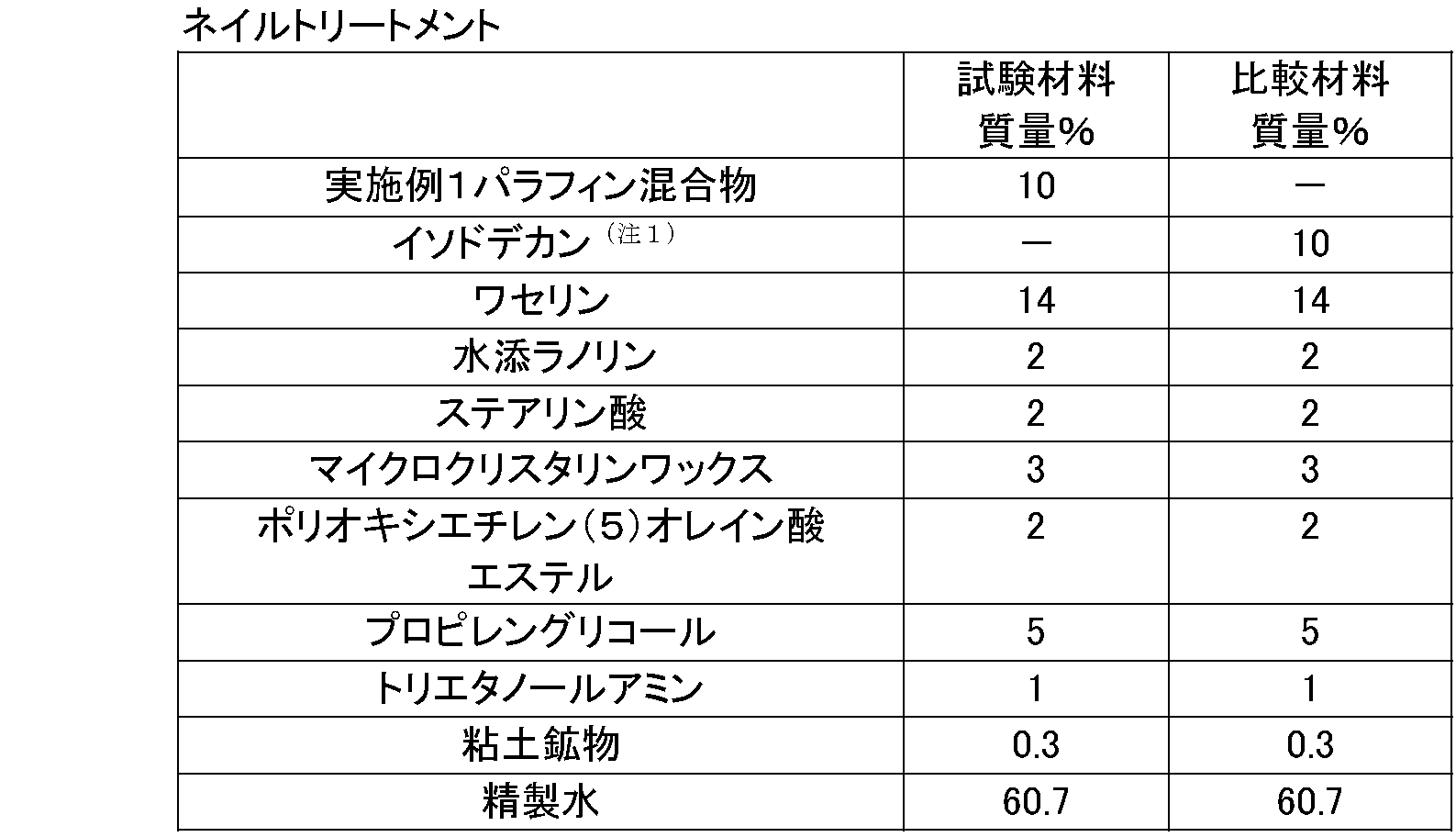
- nail treatment The nail treatment for nail care shown in Table 9 was evaluated by comparison with that using isododecane. As a result, the nail treatment using the paraffin mixture of the present invention was superior in wearing feeling than that using isododecane.
- the paraffin mixture of the present invention is useful as a raw material for cosmetics, cleaning oils and pharmaceuticals.
- it is useful as a raw material for external preparations for skin and hair, such as cosmetics, perfumes, hair care products, skin hair products, nail care products, sun care products such as sun creams, antiperspirants, deodorants, sun lotions, pharmaceutical creams, etc. It is useful as a raw material.
- the paraffin mixture of the present invention can be used not only in the cosmetics and pharmaceutical industries but also in other industries using volatile oils.
Landscapes
- Chemical & Material Sciences (AREA)
- Health & Medical Sciences (AREA)
- Organic Chemistry (AREA)
- Life Sciences & Earth Sciences (AREA)
- Animal Behavior & Ethology (AREA)
- General Health & Medical Sciences (AREA)
- Public Health (AREA)
- Veterinary Medicine (AREA)
- Dermatology (AREA)
- Engineering & Computer Science (AREA)
- Oil, Petroleum & Natural Gas (AREA)
- Medicinal Chemistry (AREA)
- Polymers & Plastics (AREA)
- Chemical Kinetics & Catalysis (AREA)
- Analytical Chemistry (AREA)
- Water Supply & Treatment (AREA)
- Birds (AREA)
- Epidemiology (AREA)
- Cosmetics (AREA)
- Compositions Of Macromolecular Compounds (AREA)
Description
工程1)イソブチレンとノルマルブテンとの重合反応系から未反応成分および炭素数20以上の重合物を除去して、炭素数16以下のポリブテン混合物を得る工程。
工程2)工程1で得られた炭素数16以下のポリブテン混合物を水素化して、炭素数16以下のパラフィン混合物を得る工程。
工程3)工程2で得られた炭素数16以下のパラフィン混合物を吸着剤によって吸着処理して、鉄分を10ppm以下にする工程。
工程4)工程3で吸着処理された炭素数16以下のパラフィン混合物を減圧蒸留して、仕込み量に対し15質量%以上を留去する工程。
本発明のパラフィン混合物は、炭素数が12~16であるイソパラフィン(分岐飽和炭化水素)を含むパラフィン(飽和炭化水素)の混合物であり、さらに、炭素数が12~16の直鎖飽和炭化水素を含むことがある。なお、本発明のパラフィン混合物には、本発明の目的に反しない程度に、炭素数が12~16の飽和炭化水素以外の炭化水素、例えば環状飽和炭化水素や不飽和炭化水素などが含まれていてもよい。
工程1)イソブチレンとノルマルブテンとの重合反応系から未反応成分および炭素数20以上の重合物を除去して、炭素数16以下のポリブテン混合物を得る工程。
工程2)工程1で得られた炭素数16以下のポリブテン混合物を水素化して、炭素数16以下のパラフィン混合物を得る工程。
工程3)工程2で得られた炭素数16以下のパラフィン混合物を吸着剤によって吸着処理して、鉄分を10ppm以下にする工程。
工程4)工程3で吸着処理された炭素数16以下のパラフィン混合物を減圧蒸留して、仕込み量に対し15質量%以上を留去する工程。
まず、工程1において用いられるイソブチレンとノルマルブテンとの重合反応系は、ナフサのクラッキングにより得られる留分の中のC4留分であるイソブチレンとノルマルブテンの混合ガスを公知の方法、例えば触媒を用いたカチオン重合法によって得ることができる。したがって、イソブチレンとノルマルブテンとの重合反応系には、ポリブテン混合物(イソブチレンとノルマルブテンとの共重合物、イソブチレン(共)重合物、ノルマルブテン重合物からなる混合物であり、炭素数8以上の不飽和炭化水素の混合物)、未反応成分(前記混合ガスに含まれるイソブチレンやノルマルブテンなど)、触媒などが含まれる。
以上の工程1~4を含む工程を経て、炭素数が12~16であるイソパラフィンを含む本発明のパラフィン混合物を製造することができる。
このような化粧品組成物や医薬品組成物は、乳化や混合により製造することができ、例えば、ホモジナイザー、ホモミキサー、ミル等の攪拌機を用いて、あるいは高圧や超音波等の他の原理を応用した攪拌機を用いて乳化や混合を行なうことができる。
JIS K0070のヨウ素価試験方法に準じる。
<沸点範囲>
JIS K2254の蒸留試験方法に準じる。
<引火点>
JIS K2265の密閉式引火点測定法に準じる。
島津製GPC(ゲル浸透クロマトグラフィー)測定装置を用いて数平均分子量(ポリスチレン換算)を測定した。
標品としてイソドデカンを用いて島津製GC-14Bガスクロマトグラフィー分析により溶出位置を確認し、その溶出位置に相当する化合物の含有量を測定した。
・ガスクロマトグラフィー分析条件
カラム:無極性キャピラリカラム、0.55mm、30m、5μm
温度:80℃~250℃、10℃/minにて昇温分析
所定量の試料を白金皿中で緩やかに燃焼させた後に、電気炉で完全に燃焼した灰分を濃塩酸で溶解し、測定試料とした。次にICP発光分析装置を使用し、所定操作により分析した。なお、分析は工程3の終了後に行なったが、工程3を行なわない比較例3については工程2の終了後に分析を行なった。
・官能試験(表1中に臭気1と表記)
官能試験は、臭気センサーでは評価が困難な臭いの質(不快感および刺激感)を評価するために行なった。
・臭気総量(表1中に臭気2と表記)
新コスモス電機(株)製の臭気センサーを用い、測定条件下で臭気成分(揮発成分)を吸入し、相対的な臭いの強弱をガス吸着により抵抗値変化として測定した。
下記の工程1~4を経て、パラフィン混合物を製造した。
イソブチレン30質量%、1-ブテン18質量%および2-ブテン25質量%を含む炭素数4のオレフィン混合ガスと、残り27質量%のブタンガスとからなる混合ガス360gをオートクレーブに仕込み、塩化アルミニウム触媒の存在下に重合反応を行なって、イソブチレンとノルマルブテンとの重合反応系を得た。
反応終了後のオートクレーブ中の未反応ガスを窒素ガス置換により除去した後に、重合反応混合物であるポリブテン混合物を抜き出した。そして触媒を苛性アルカリ水溶液処理および水洗工程によって除去した。次に、水洗後のポリブテン混合物を1L容の四つ口フラスコに仕込み、オイルバスによって加熱し、内温40℃で窒素バブリングによりポリブテン混合物中に溶解している未反応ガス成分を除去した後、内温140℃、減圧度5kPaで単蒸留した。これにより、炭素数20以上の重合物を蒸留残渣としてフラスコ中に残して、炭素数16以下のポリブテン混合物が得られた。このポリブテン混合物は、数平均分子量が約185であった。
このポリブテン混合物をオートクレーブ中で、水素化触媒(0.5%Pd担持アルミナ触媒)10質量%により水素圧3MPa、220℃で水素添加して、160gのパラフィン混合物を得た。パラフィン混合物は、ヨウ素価が0.1であり、数平均分子量が約180であった。
外径4cm、長さ30cmのガラス筒に、アタパルガスクレーと活性白土を50:50の体積比で、アタパルガスクレーを先に充填し、ついで活性白土を充填して吸着カラムとした。工程2で得られたパラフィン混合物を吸着カラム下部より毎分1mlの流速、25℃で連続的に送液して、触媒由来および装置材質由来の微量金属化合物の吸着処理を行なった。吸着処理後のパラフィン混合物の鉄分を表1に示す。
15段のオールダーショー棚段精留塔のボトム容器に、工程3で得られた吸着処理後のパラフィン混合物を150g仕込み、オイルバスにつけ容器内の液温度が110℃になるまで乾燥窒素ガスによりバブリングを行い空気との接触を避けて加熱した。容器内の液温度が110℃に達したら、減圧下(10kPa)で還流比を10、蒸留の流出温度を95℃として減圧蒸留を8時間行い、仕込み全量の25質量%を留去した。その後、再び乾燥窒素ガスを減圧下バブリングしてボトム容器内の液状物を冷却して、112.5gのパラフィン混合物を得た。得られたパラフィン混合物の各種物性値の結果を表1に示した。
実施例1記載の工程3において、吸着剤の種類をアタパルガスクレーとシリカゲル(体積割合が70:30)に変更し、工程4において、仕込み量の20質量%を留去したこと以外はすべて実施例1と同様の操作をした。なお、アタパルガスクレーを先に充填し、ついでシリカゲルを充填して吸着カラムとした。得られたパラフィン混合物の各種物性値の結果を表1に示した。
実施例1記載の工程3において、吸着剤の種類を粒子径が異なる2種のアタパルガスクレーに変更したこと以外はすべて実施例1と同様の操作をした。異なる粒子径のアタパルガスクレーのうち一方は粒子径840μmから1000μmのものであり、他方は粒子径200μmから480μmのものである。まず、粒子径840μmから1000μmのものを吸着カラムの容積割合で20%充填して仕込み、次に残り80%の割合を粒子径200μm~480μmのもので充填して吸着カラムとした。得られたパラフィン混合物の各種物性値の結果を表1に示した。
実施例1記載の工程4において、蒸留の流出温度を70℃までとし、仕込み量の2質量%を留去したこと以外はすべて実施例1と同様の操作をした。その結果、イソドデカンよりも低沸点の化合物を有するパラフィン混合物が得られた。得られたパラフィン混合物のイソドデカンの含有率は15質量%であった。強い不快臭を有し、引火点も低い結果となった。得られたパラフィン混合物の各種物性値の結果を表1に示した。
実施例3記載の工程4において、蒸留の流出温度を85℃までとし、仕込み量の10質量%を留去したこと以外はすべて実施例3と同様の操作をした。得られたパラフィン混合物のイソドデカンの含有率は10質量%であった。強い特異臭を有し、引火点も低い結果となった。得られたパラフィン混合物の各種物性値の結果を表1に示した。
実施例3記載の工程4において、蒸留条件を表1に示す条件に変更したこと以外はすべて実施例3と同様の操作をした。得られたパラフィン混合物の各種物性値の結果を表1に示した。
実施例1記載の工程3において、吸着剤による金属化合物の吸着処理を行わなかったことと、工程4において、蒸留の流出温度を90℃までとし、仕込み量の14質量%を留去したこと以外はすべて実施例1と同様の操作をした。その結果、強い特異臭を有し、引火点も低いパラフィン混合物が得られた。得られたパラフィン混合物の各種物性値の結果を表1に示した。
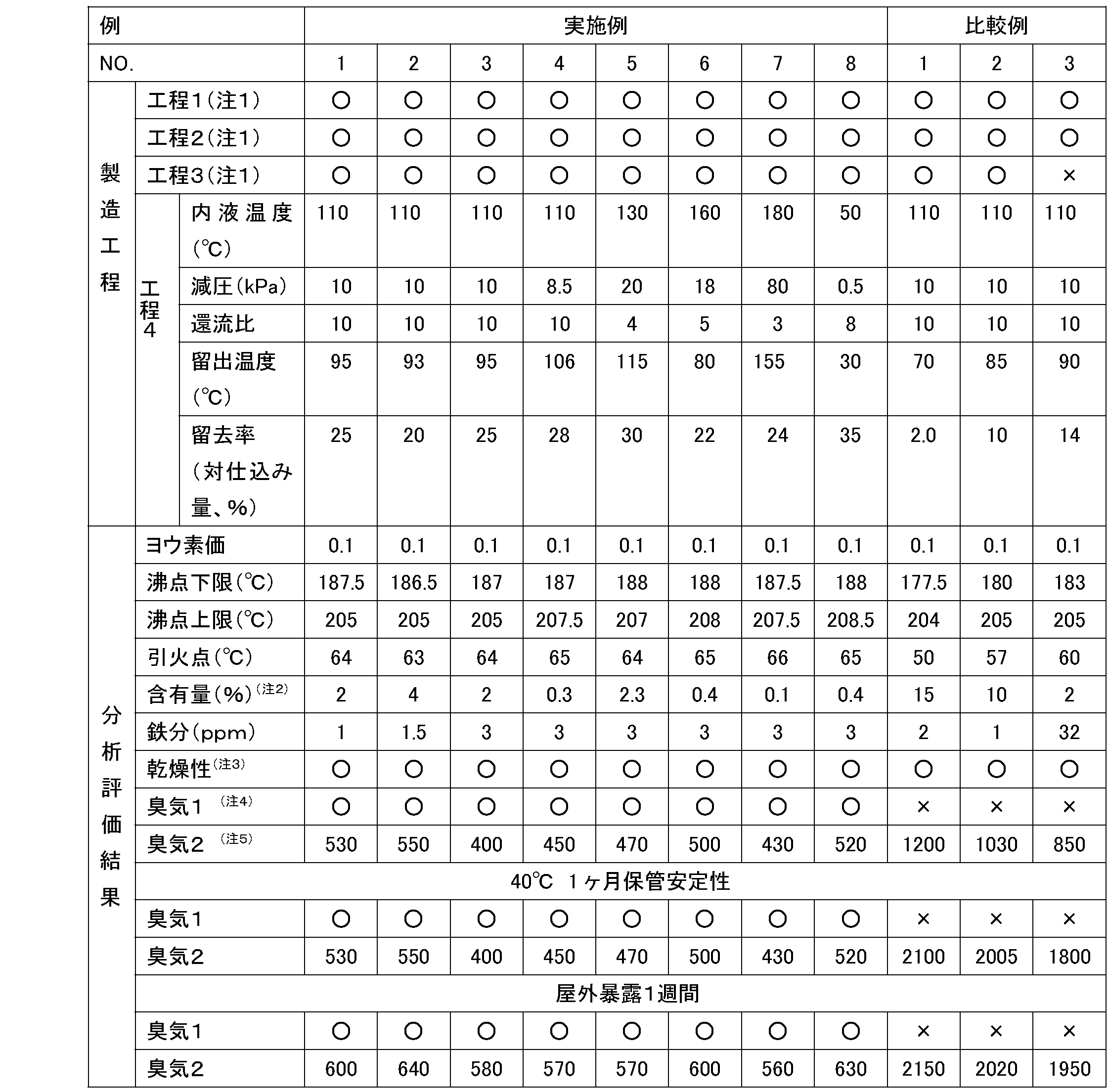
(注2)含有量:イソドデカンの混合物全量に対する割合(質量%)
(注3)乾燥性:10cmの5Aろ紙(アドバンテック(株)製)に各試料0.1gを塗布して乾燥速度を測定した。ブランクとして環状シリコーンのデカメチルペンタシロキサンの半分の時間で乾燥した場合に「○」と表記し、それ以外は「×」と表記した。
(注4)臭気1:官能試験により不快及び刺激臭の有無を判定、有り:×、無し:○
(注5)臭気2:臭気センサーによる臭気総量(相対比較値)

[炭素数12、引火点48℃、イソドデカン含量95質量%以上]
(注2)東レダウコーニング(株)製「SH-245」[引火点77℃]
(注3)日油(株)製、水添ポリブテン:パールリーム4
[炭素数16、沸点範囲220~252. 5℃、引火点88℃、イソドデカン含量0質量%]
本発明のパラフィン混合物を用いて、以下に示す毛髪および皮膚化粧料を調製し、それぞれの調製品に対する評価を行なった。評価は10人のパネラーによりその使用感について行なった。すべての毛髪および皮膚化粧料において、環状シリコーンの代替として良好であり、またイソドデカンを用いた場合よりも高い評価が得られた。
表3に示されるヘアオイルを、イソドデカンを用いたものと比較して、評価を行なった。その結果、本発明のパラフィン混合物を使用したヘアオイルは、イソドデカンを使用したものよりも、毛髪のまとまりがあり、使用感において優れていた。

[炭素数12、引火点48℃、イソドデカン含量95質量%以上]
表4に示されるサンオイルを、環状シリコ-ンを用いたものと比較して、評価を行なった。その結果、本発明のパラフィン混合物を使用したサンオイルは、環状シリコ-ンを使用したものよりも、延びと使用感において優れていた。

(注2)東レ・ダウコーニング(株)製「MQレジン」
表5に示される日焼け止め化粧料を、イソドデカンを用いたものと比較して、評価を行なった。その結果、本発明のパラフィン混合物を使用したサンオイルは、イソドデカンを使用したものよりも、延びと使用感において優れていた。
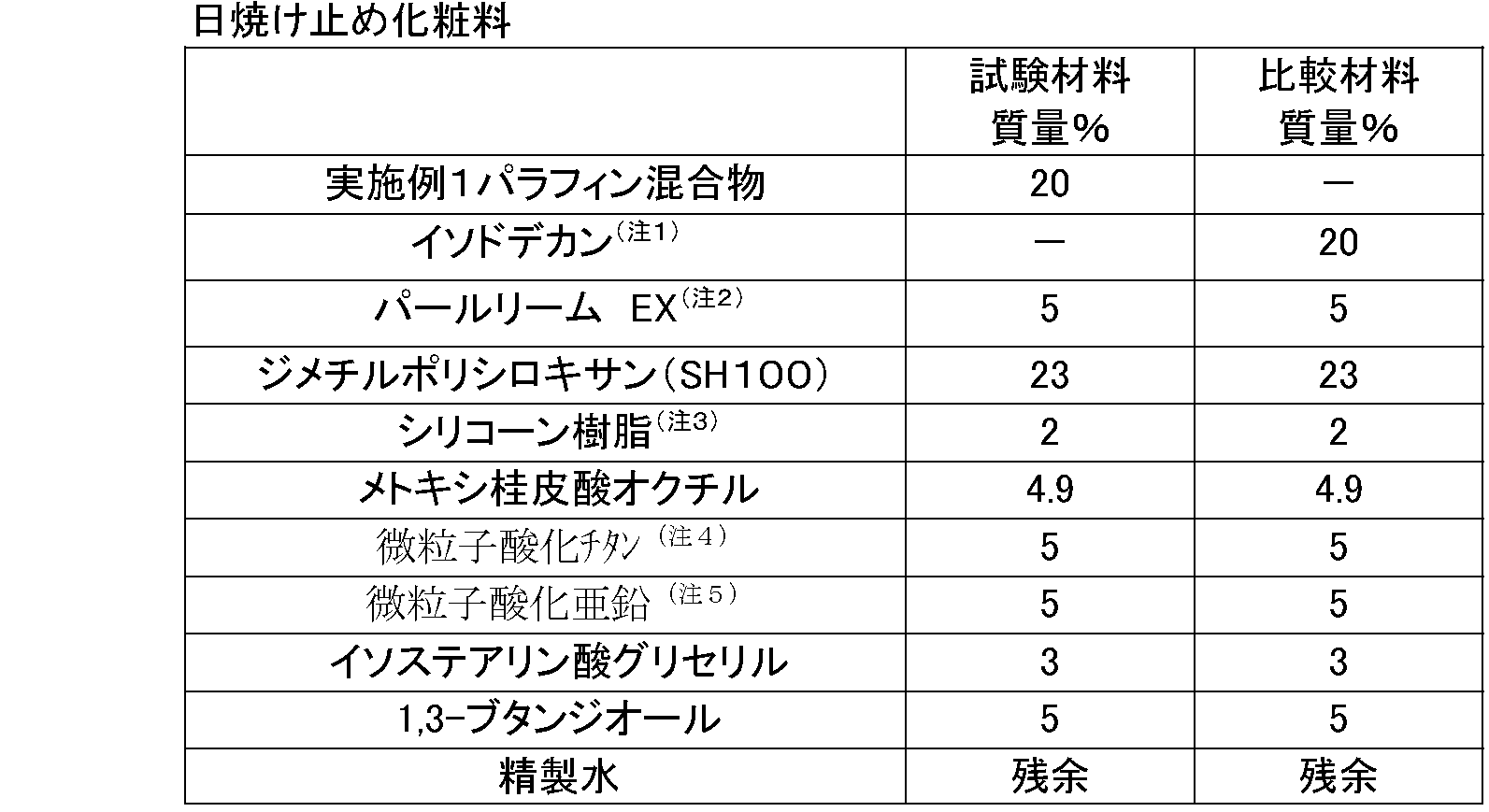
(注2)日油(株)製「パールリームEX」
(注3)東レ・ダウコーニング(株)製「MQレジン」
(注4)堺化学工業(株)製「SPP-M」
(注5)テイカ(株)製「MZ-500」
表6に示されるウォータープルーフマスカラを、環状シリコ-ンを用いたものと比較して、評価を行なった。その結果、本発明のパラフィン混合物を使用したウォータープルーフマスカラは、環状シリコーンを使用したものよりも、乾きが早く使用感において優れていた。

(注2)アクゾノーベル(株)製「BALANCE CR」
表7に示される口紅を、イソドデカンを用いたものと比較して、評価を行なった。その結果、本発明のパラフィン混合物を使用した口紅は、イソドデカンを使用したものよりも、皮膚馴染みと装用感において優れていた。
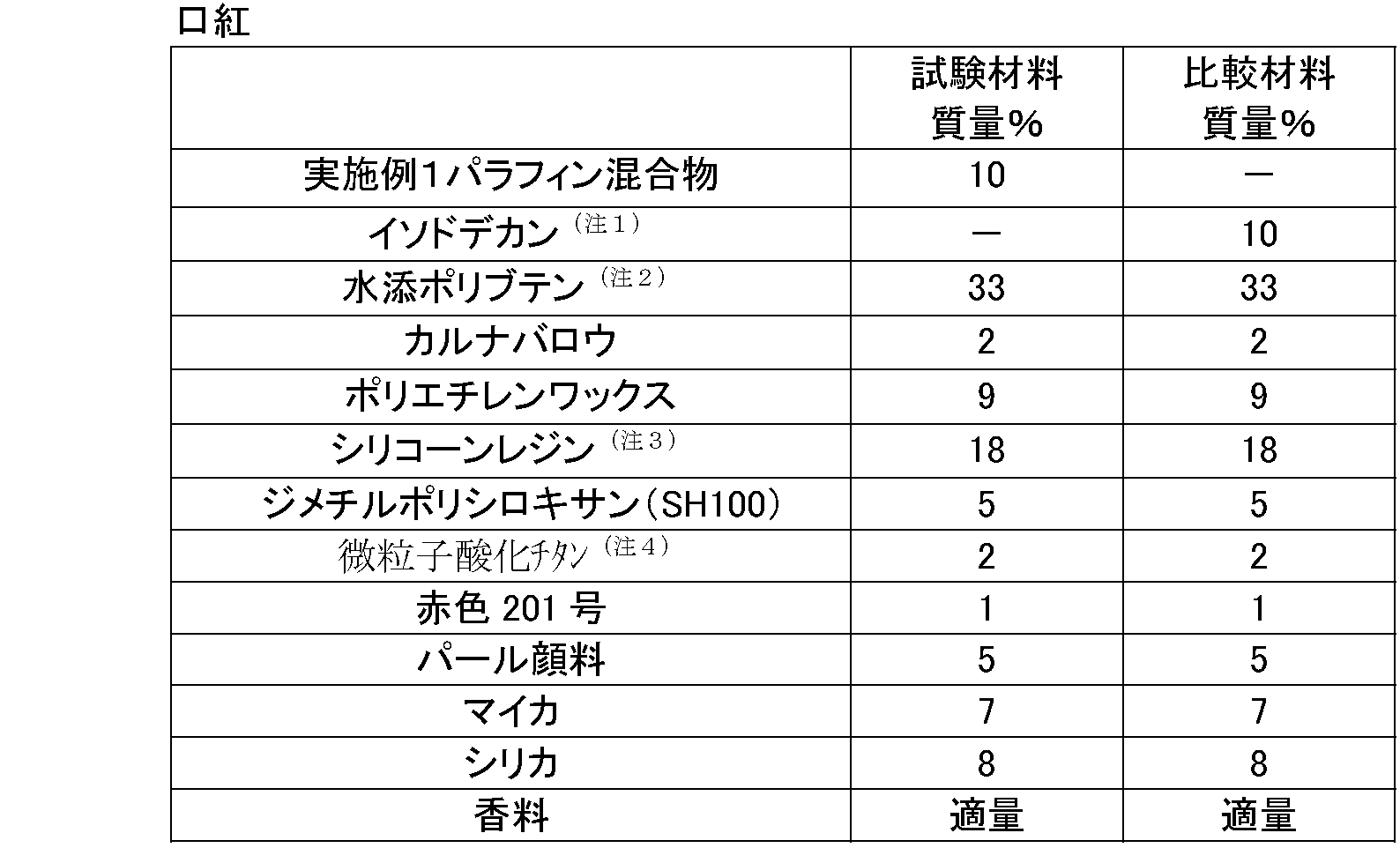
(注2)日油(株)製「パールリームEX」
(注3)東レ・ダウコーニング(株)製「MQレジン」
(注4)堺化学工業(株)製「SPP-M」
表8に示される薬用リップクリームを、イソドデカンを用いたものと比較して、評価を行なった。その結果、本発明のパラフィン混合物を使用した薬用リップクリームは、イソドデカンを使用したものよりも、皮膚馴染みと装用感において優れていた。

表9に示されるネイルケア用のネイルトリートメントを、イソドデカンを用いたものと比較して、評価を行なった。その結果、本発明のパラフィン混合物を使用したネイルトリートメントは、イソドデカンを使用したものよりも、装用感において優れていた。
Claims (2)
- 炭素数が12~16であるイソパラフィンを含むパラフィン混合物であって、沸点範囲が185~215℃であり、2, 2, 4, 6, 6-ペンタメチルヘプタン含有量が10質量%未満であるパラフィン混合物。
- 下記の工程1~4を含む、請求項1に記載のパラフィン混合物の製造方法。
工程1)イソブチレンとノルマルブテンとの重合反応系から未反応成分および炭素数20以上の重合物を除去して、炭素数16以下のポリブテン混合物を得る工程。
工程2)工程1で得られた炭素数16以下のポリブテン混合物を水素化して、炭素数16以下のパラフィン混合物を得る工程。
工程3)工程2で得られた炭素数16以下のパラフィン混合物を吸着剤によって吸着処理して、鉄分を10ppm以下にする工程。
工程4)工程3で吸着処理された炭素数16以下のパラフィン混合物を減圧蒸留して、仕込み量に対し15質量%以上を留去する工程。
Priority Applications (6)
| Application Number | Priority Date | Filing Date | Title |
|---|---|---|---|
| JP2013557440A JP6098524B2 (ja) | 2012-02-08 | 2013-01-11 | パラフィン混合物およびその製造方法 |
| CA2862593A CA2862593C (en) | 2012-02-08 | 2013-01-11 | Paraffin mixture and method of producing the same |
| US14/375,376 US9745231B2 (en) | 2012-02-08 | 2013-01-11 | Paraffin mixture and method for producing same |
| CN201380003896.2A CN103945825A (zh) | 2012-02-08 | 2013-01-11 | 烷烃混合物及其制造方法 |
| EP13746196.8A EP2813206B1 (en) | 2012-02-08 | 2013-01-11 | Paraffin mixture and method for producing same |
| KR1020147014623A KR102008036B1 (ko) | 2012-02-08 | 2013-01-11 | 파라핀 혼합물 및 그 제조 방법 |
Applications Claiming Priority (2)
| Application Number | Priority Date | Filing Date | Title |
|---|---|---|---|
| JP2012-025186 | 2012-02-08 | ||
| JP2012025186 | 2012-02-08 |
Publications (1)
| Publication Number | Publication Date |
|---|---|
| WO2013118533A1 true WO2013118533A1 (ja) | 2013-08-15 |
Family
ID=48947302
Family Applications (1)
| Application Number | Title | Priority Date | Filing Date |
|---|---|---|---|
| PCT/JP2013/050375 Ceased WO2013118533A1 (ja) | 2012-02-08 | 2013-01-11 | パラフィン混合物およびその製造方法 |
Country Status (7)
| Country | Link |
|---|---|
| US (1) | US9745231B2 (ja) |
| EP (1) | EP2813206B1 (ja) |
| JP (1) | JP6098524B2 (ja) |
| KR (1) | KR102008036B1 (ja) |
| CN (1) | CN103945825A (ja) |
| CA (1) | CA2862593C (ja) |
| WO (1) | WO2013118533A1 (ja) |
Cited By (8)
| Publication number | Priority date | Publication date | Assignee | Title |
|---|---|---|---|---|
| WO2014002837A1 (ja) * | 2012-06-28 | 2014-01-03 | 日油株式会社 | 化粧料用揮発性油 |
| JP2014009186A (ja) * | 2012-06-28 | 2014-01-20 | Nof Corp | 毛髪化粧料用揮発性油 |
| JP2014065666A (ja) * | 2012-09-24 | 2014-04-17 | Nof Corp | 皮膚外用剤用揮発性油 |
| JP2015074606A (ja) * | 2013-10-04 | 2015-04-20 | 日油株式会社 | リーブオン毛髪化粧料 |
| JP2017503855A (ja) * | 2014-01-03 | 2017-02-02 | ネステ ユルキネン オサケ ユキテュア | 生物学的原材料から得られたパラフィンフラクションを含む組成物及びそれを製造する方法 |
| WO2023054075A1 (ja) | 2021-09-30 | 2023-04-06 | 日油株式会社 | 化粧料用油剤及びそれを含む化粧料 |
| WO2023054077A1 (ja) | 2021-09-30 | 2023-04-06 | 日油株式会社 | 化粧料用油剤およびこれを含む化粧料 |
| WO2024232347A1 (ja) * | 2023-05-11 | 2024-11-14 | 日油株式会社 | 化粧料用油剤 |
Families Citing this family (4)
| Publication number | Priority date | Publication date | Assignee | Title |
|---|---|---|---|---|
| CN106456471A (zh) | 2014-05-02 | 2017-02-22 | 爱美瑞公司 | 基于二氢法呢烯的溶剂组合物 |
| US10695273B2 (en) | 2015-10-02 | 2020-06-30 | Amyris, Inc. | Compositions containing bio-based farnesene or compounds derived therefrom and their use in consumer and industrial products |
| CN106214528A (zh) * | 2016-09-09 | 2016-12-14 | 拉芳家化股份有限公司 | 一种快干护发精华油 |
| EP4174048A1 (en) * | 2021-10-29 | 2023-05-03 | Haltermann Carless Deutschland GmbH | Proces for treating a composition containing renewable isododecane |
Citations (4)
| Publication number | Priority date | Publication date | Assignee | Title |
|---|---|---|---|---|
| JPS4985243A (ja) * | 1972-12-20 | 1974-08-15 | ||
| JP2009286752A (ja) | 2008-05-30 | 2009-12-10 | Nakano Seiyaku Kk | 毛髪化粧料 |
| JP2011503192A (ja) | 2007-11-13 | 2011-01-27 | プレスパース、エルエルシー | 風合いおよび揮発性を付与するシリコンフリーな炭化水素類 |
| JP2012001670A (ja) * | 2010-06-18 | 2012-01-05 | Jx Nippon Oil & Energy Corp | オレフィン重合体の製造方法 |
Family Cites Families (13)
| Publication number | Priority date | Publication date | Assignee | Title |
|---|---|---|---|---|
| US4061780A (en) | 1972-12-20 | 1977-12-06 | Nichiyu Kagaku Co., Ltd. | Cosmetic oil containing isobutylene |
| FR2401122A1 (fr) * | 1977-08-26 | 1979-03-23 | Inst Francais Du Petrole | Procede pour la conversion des coupes c4 olefiniques de vapocraquage en isooctane et en butane |
| JPH0215017A (ja) * | 1988-07-01 | 1990-01-18 | Kansai Paint Co Ltd | 色白化粧料 |
| PL165297B1 (en) * | 1989-11-07 | 1994-12-30 | Colgate Palmolive Co | Fibre conditioning agent, method for its manufacturing and method for washing and conditioning hair |
| JP4304828B2 (ja) * | 2000-05-17 | 2009-07-29 | 日油株式会社 | 流動イソパラフィン化合物およびその製造方法ならびに用途 |
| JP4096586B2 (ja) * | 2002-03-19 | 2008-06-04 | 日油株式会社 | 安定な水添ポリブテン |
| US6752919B2 (en) * | 2002-07-31 | 2004-06-22 | Chemical Products Industries, Inc. | Promoted absorbents for the removal of contaminants |
| ES2329791T3 (es) * | 2003-03-10 | 2009-12-01 | Sasol Technology (Proprietary) Limited | Produccion de aquilbenceno lineale. |
| DE102004018752A1 (de) * | 2004-04-17 | 2005-11-03 | Oxeno Olefinchemie Gmbh | Gemisch von aliphatischen gesättigten Kohlenwasserstoffen mit 12 C-Atomen |
| DE102005022021A1 (de) * | 2005-05-12 | 2006-11-16 | Basf Ag | Isoalkangemisch, dessen Herstellung und Verwendung |
| JP2011126832A (ja) * | 2009-12-18 | 2011-06-30 | Shiseido Co Ltd | 油中水型乳化日焼け止め化粧料 |
| FR2960434B1 (fr) * | 2010-05-26 | 2012-08-17 | Oreal | Composition cosmetique a base d'un polymere supramoleculaire et d'un charge absorbante |
| JP5535808B2 (ja) * | 2010-07-28 | 2014-07-02 | 富士フイルム株式会社 | アスタキサンチン含有水系組成物、化粧料、及びアスタキサンチンの分解抑制方法 |
-
2013
- 2013-01-11 KR KR1020147014623A patent/KR102008036B1/ko active Active
- 2013-01-11 CA CA2862593A patent/CA2862593C/en active Active
- 2013-01-11 JP JP2013557440A patent/JP6098524B2/ja active Active
- 2013-01-11 US US14/375,376 patent/US9745231B2/en active Active
- 2013-01-11 WO PCT/JP2013/050375 patent/WO2013118533A1/ja not_active Ceased
- 2013-01-11 EP EP13746196.8A patent/EP2813206B1/en active Active
- 2013-01-11 CN CN201380003896.2A patent/CN103945825A/zh active Pending
Patent Citations (4)
| Publication number | Priority date | Publication date | Assignee | Title |
|---|---|---|---|---|
| JPS4985243A (ja) * | 1972-12-20 | 1974-08-15 | ||
| JP2011503192A (ja) | 2007-11-13 | 2011-01-27 | プレスパース、エルエルシー | 風合いおよび揮発性を付与するシリコンフリーな炭化水素類 |
| JP2009286752A (ja) | 2008-05-30 | 2009-12-10 | Nakano Seiyaku Kk | 毛髪化粧料 |
| JP2012001670A (ja) * | 2010-06-18 | 2012-01-05 | Jx Nippon Oil & Energy Corp | オレフィン重合体の製造方法 |
Non-Patent Citations (4)
| Title |
|---|
| FANCOL IH: "Elementis Specialties", 11 November 2010 (2010-11-11), XP008174964, Retrieved from the Internet <URL:http://freedownloadb.com/pdf/fanco-1-ih-esp-home-spa-products-cosmetic-raw-materials-49552863.html> [retrieved on 20130327] * |
| HIROSHI HIROTA, KESHOHIN-YO YUSHI NO KAGAKU, 10 April 2001 (2001-04-10), pages 54 - 56, XP008174966 * |
| ISOHEXADECANE MSDS: "INEOS", 21 February 2007 (2007-02-21), XP008174965, Retrieved from the Internet <URL:http://freedownloadb.com/pdf/material-safety-data-sheet-wordpresscom-get-a-free-blog-here-21011494.htm1> [retrieved on 20130327] * |
| See also references of EP2813206A4 |
Cited By (11)
| Publication number | Priority date | Publication date | Assignee | Title |
|---|---|---|---|---|
| WO2014002837A1 (ja) * | 2012-06-28 | 2014-01-03 | 日油株式会社 | 化粧料用揮発性油 |
| JP2014009186A (ja) * | 2012-06-28 | 2014-01-20 | Nof Corp | 毛髪化粧料用揮発性油 |
| US9855201B2 (en) | 2012-06-28 | 2018-01-02 | Nof Corporation | Volatile oil for cosmetics |
| JP2014065666A (ja) * | 2012-09-24 | 2014-04-17 | Nof Corp | 皮膚外用剤用揮発性油 |
| JP2015074606A (ja) * | 2013-10-04 | 2015-04-20 | 日油株式会社 | リーブオン毛髪化粧料 |
| JP2017503855A (ja) * | 2014-01-03 | 2017-02-02 | ネステ ユルキネン オサケ ユキテュア | 生物学的原材料から得られたパラフィンフラクションを含む組成物及びそれを製造する方法 |
| WO2023054075A1 (ja) | 2021-09-30 | 2023-04-06 | 日油株式会社 | 化粧料用油剤及びそれを含む化粧料 |
| WO2023054077A1 (ja) | 2021-09-30 | 2023-04-06 | 日油株式会社 | 化粧料用油剤およびこれを含む化粧料 |
| KR20240071368A (ko) | 2021-09-30 | 2024-05-22 | 니치유 가부시키가이샤 | 화장료용 유제 및 그것을 포함하는 화장료 |
| KR20240071369A (ko) | 2021-09-30 | 2024-05-22 | 니치유 가부시키가이샤 | 화장료용 유제 및 이것을 함유하는 화장료 |
| WO2024232347A1 (ja) * | 2023-05-11 | 2024-11-14 | 日油株式会社 | 化粧料用油剤 |
Also Published As
| Publication number | Publication date |
|---|---|
| EP2813206A4 (en) | 2015-12-02 |
| EP2813206B1 (en) | 2017-06-14 |
| KR102008036B1 (ko) | 2019-08-06 |
| US9745231B2 (en) | 2017-08-29 |
| JPWO2013118533A1 (ja) | 2015-05-11 |
| CN103945825A (zh) | 2014-07-23 |
| JP6098524B2 (ja) | 2017-03-22 |
| CA2862593C (en) | 2019-01-29 |
| US20150005550A1 (en) | 2015-01-01 |
| EP2813206A1 (en) | 2014-12-17 |
| KR20140127205A (ko) | 2014-11-03 |
| CA2862593A1 (en) | 2013-08-15 |
Similar Documents
| Publication | Publication Date | Title |
|---|---|---|
| JP6098524B2 (ja) | パラフィン混合物およびその製造方法 | |
| JP7422405B2 (ja) | 1つのc8~c10のアルカンとc11以上のアルカンを含む化粧品添加剤 | |
| CN108348418B (zh) | 包含异链烷烃的生物来源润肤组合物 | |
| JP7514620B2 (ja) | バイオソースゲル化組成物 | |
| CN102388107A (zh) | 挥发性油状组合物 | |
| JP2022517180A (ja) | ポリ(ファルネセン)を含むバイオベースの増粘組成物 | |
| BR112015029615B1 (pt) | Uso cosmético, processo cosmético, composição e uso de um material silicioso | |
| JP2017535558A (ja) | カチオン性ポリマーを含有するパーソナルケア組成物 | |
| JP2018501309A (ja) | 非水性媒体中のポリマー粒子の分散体及びその美容的使用 | |
| JP6804420B2 (ja) | 毛髪化粧料 | |
| JP6127699B2 (ja) | 化粧料用組成物 | |
| FR2990850A1 (fr) | Composition cosmetique comprenant l'association d'un derive lipophile de l'acide salicylique, d'un sel ou complexe d'aluminium anti-transpirant et d'un sel d'acide amine n,n-diacide acetique | |
| TWI581807B (zh) | 烷烴混合物及其製造方法 | |
| JP6065424B2 (ja) | 毛髪化粧料用揮発性油 | |
| WO2014002837A1 (ja) | 化粧料用揮発性油 | |
| JP2006306857A (ja) | 化粧料用基剤およびそれを配合してなる化粧料 | |
| BR112015029492B1 (pt) | Uso cosmético, processo cosmético para tratar o odor corporal e composição | |
| JP2014065666A (ja) | 皮膚外用剤用揮発性油 | |
| JP5962255B2 (ja) | 毛髪化粧料 | |
| JP2007182402A (ja) | サンスクリーン化粧料 | |
| FR3053591A1 (fr) | Composition anhydre anti-transpirante sous forme d’aerosol comprenant une huile volatile, un copolymere d’ester vinylique particulier et un actif antitranspirant | |
| FR2976484A1 (fr) | Utilisation comme agent anti-transpirant d'un polymere floculant comportant en chaine laterale des groupements pyridines non quaternises |
Legal Events
| Date | Code | Title | Description |
|---|---|---|---|
| 121 | Ep: the epo has been informed by wipo that ep was designated in this application |
Ref document number: 13746196 Country of ref document: EP Kind code of ref document: A1 |
|
| ENP | Entry into the national phase |
Ref document number: 2013557440 Country of ref document: JP Kind code of ref document: A |
|
| ENP | Entry into the national phase |
Ref document number: 20147014623 Country of ref document: KR Kind code of ref document: A |
|
| ENP | Entry into the national phase |
Ref document number: 2862593 Country of ref document: CA |
|
| WWE | Wipo information: entry into national phase |
Ref document number: 14375376 Country of ref document: US |
|
| REEP | Request for entry into the european phase |
Ref document number: 2013746196 Country of ref document: EP |
|
| WWE | Wipo information: entry into national phase |
Ref document number: 2013746196 Country of ref document: EP |
|
| NENP | Non-entry into the national phase |
Ref country code: DE |