WO2013125291A1 - 水中油型エマルション組成物 - Google Patents
水中油型エマルション組成物 Download PDFInfo
- Publication number
- WO2013125291A1 WO2013125291A1 PCT/JP2013/051672 JP2013051672W WO2013125291A1 WO 2013125291 A1 WO2013125291 A1 WO 2013125291A1 JP 2013051672 W JP2013051672 W JP 2013051672W WO 2013125291 A1 WO2013125291 A1 WO 2013125291A1
- Authority
- WO
- WIPO (PCT)
- Prior art keywords
- fatty acid
- lycopene
- oil
- emulsion composition
- glycerin
- Prior art date
- Legal status (The legal status is an assumption and is not a legal conclusion. Google has not performed a legal analysis and makes no representation as to the accuracy of the status listed.)
- Ceased
Links
Classifications
-
- A—HUMAN NECESSITIES
- A61—MEDICAL OR VETERINARY SCIENCE; HYGIENE
- A61K—PREPARATIONS FOR MEDICAL, DENTAL OR TOILETRY PURPOSES
- A61K8/00—Cosmetics or similar toiletry preparations
- A61K8/02—Cosmetics or similar toiletry preparations characterised by special physical form
- A61K8/0241—Containing particulates characterized by their shape and/or structure
-
- A—HUMAN NECESSITIES
- A61—MEDICAL OR VETERINARY SCIENCE; HYGIENE
- A61K—PREPARATIONS FOR MEDICAL, DENTAL OR TOILETRY PURPOSES
- A61K8/00—Cosmetics or similar toiletry preparations
- A61K8/18—Cosmetics or similar toiletry preparations characterised by the composition
- A61K8/30—Cosmetics or similar toiletry preparations characterised by the composition containing organic compounds
- A61K8/31—Hydrocarbons
-
- A—HUMAN NECESSITIES
- A23—FOODS OR FOODSTUFFS; TREATMENT THEREOF, NOT COVERED BY OTHER CLASSES
- A23L—FOODS, FOODSTUFFS OR NON-ALCOHOLIC BEVERAGES, NOT OTHERWISE PROVIDED FOR; PREPARATION OR TREATMENT THEREOF
- A23L33/00—Modifying nutritive qualities of foods; Dietetic products; Preparation or treatment thereof
- A23L33/10—Modifying nutritive qualities of foods; Dietetic products; Preparation or treatment thereof using additives
-
- A—HUMAN NECESSITIES
- A23—FOODS OR FOODSTUFFS; TREATMENT THEREOF, NOT COVERED BY OTHER CLASSES
- A23L—FOODS, FOODSTUFFS OR NON-ALCOHOLIC BEVERAGES, NOT OTHERWISE PROVIDED FOR; PREPARATION OR TREATMENT THEREOF
- A23L33/00—Modifying nutritive qualities of foods; Dietetic products; Preparation or treatment thereof
- A23L33/10—Modifying nutritive qualities of foods; Dietetic products; Preparation or treatment thereof using additives
- A23L33/105—Plant extracts, their artificial duplicates or their derivatives
-
- A—HUMAN NECESSITIES
- A61—MEDICAL OR VETERINARY SCIENCE; HYGIENE
- A61K—PREPARATIONS FOR MEDICAL, DENTAL OR TOILETRY PURPOSES
- A61K8/00—Cosmetics or similar toiletry preparations
- A61K8/02—Cosmetics or similar toiletry preparations characterised by special physical form
- A61K8/04—Dispersions; Emulsions
- A61K8/06—Emulsions
-
- A—HUMAN NECESSITIES
- A61—MEDICAL OR VETERINARY SCIENCE; HYGIENE
- A61K—PREPARATIONS FOR MEDICAL, DENTAL OR TOILETRY PURPOSES
- A61K8/00—Cosmetics or similar toiletry preparations
- A61K8/02—Cosmetics or similar toiletry preparations characterised by special physical form
- A61K8/04—Dispersions; Emulsions
- A61K8/06—Emulsions
- A61K8/062—Oil-in-water emulsions
-
- A—HUMAN NECESSITIES
- A61—MEDICAL OR VETERINARY SCIENCE; HYGIENE
- A61K—PREPARATIONS FOR MEDICAL, DENTAL OR TOILETRY PURPOSES
- A61K8/00—Cosmetics or similar toiletry preparations
- A61K8/18—Cosmetics or similar toiletry preparations characterised by the composition
- A61K8/30—Cosmetics or similar toiletry preparations characterised by the composition containing organic compounds
- A61K8/33—Cosmetics or similar toiletry preparations characterised by the composition containing organic compounds containing oxygen
- A61K8/34—Alcohols
-
- A—HUMAN NECESSITIES
- A61—MEDICAL OR VETERINARY SCIENCE; HYGIENE
- A61K—PREPARATIONS FOR MEDICAL, DENTAL OR TOILETRY PURPOSES
- A61K8/00—Cosmetics or similar toiletry preparations
- A61K8/18—Cosmetics or similar toiletry preparations characterised by the composition
- A61K8/30—Cosmetics or similar toiletry preparations characterised by the composition containing organic compounds
- A61K8/33—Cosmetics or similar toiletry preparations characterised by the composition containing organic compounds containing oxygen
- A61K8/34—Alcohols
- A61K8/345—Alcohols containing more than one hydroxy group
-
- A—HUMAN NECESSITIES
- A61—MEDICAL OR VETERINARY SCIENCE; HYGIENE
- A61K—PREPARATIONS FOR MEDICAL, DENTAL OR TOILETRY PURPOSES
- A61K8/00—Cosmetics or similar toiletry preparations
- A61K8/18—Cosmetics or similar toiletry preparations characterised by the composition
- A61K8/30—Cosmetics or similar toiletry preparations characterised by the composition containing organic compounds
- A61K8/40—Cosmetics or similar toiletry preparations characterised by the composition containing organic compounds containing nitrogen
-
- A—HUMAN NECESSITIES
- A61—MEDICAL OR VETERINARY SCIENCE; HYGIENE
- A61K—PREPARATIONS FOR MEDICAL, DENTAL OR TOILETRY PURPOSES
- A61K8/00—Cosmetics or similar toiletry preparations
- A61K8/18—Cosmetics or similar toiletry preparations characterised by the composition
- A61K8/30—Cosmetics or similar toiletry preparations characterised by the composition containing organic compounds
- A61K8/40—Cosmetics or similar toiletry preparations characterised by the composition containing organic compounds containing nitrogen
- A61K8/42—Amides
-
- A—HUMAN NECESSITIES
- A61—MEDICAL OR VETERINARY SCIENCE; HYGIENE
- A61Q—SPECIFIC USE OF COSMETICS OR SIMILAR TOILETRY PREPARATIONS
- A61Q19/00—Preparations for care of the skin
-
- A—HUMAN NECESSITIES
- A61—MEDICAL OR VETERINARY SCIENCE; HYGIENE
- A61K—PREPARATIONS FOR MEDICAL, DENTAL OR TOILETRY PURPOSES
- A61K2800/00—Properties of cosmetic compositions or active ingredients thereof or formulation aids used therein and process related aspects
- A61K2800/40—Chemical, physico-chemical or functional or structural properties of particular ingredients
- A61K2800/41—Particular ingredients further characterized by their size
- A61K2800/413—Nanosized, i.e. having sizes below 100 nm
Definitions
- the present invention relates to an oil-in-water emulsion composition.
- carotenoids are widely known as poorly water-soluble materials, and various techniques have been proposed from the viewpoint of solubility and dispersibility of carotenoids.
- Japanese Patent Application Laid-Open No. 2008-120712 describes a cosmetic aqueous dispersion containing a carotenoid substantially free of vitamin A efficacy and a dihydric alcohol having 5 or more carbon atoms.
- Japanese Patent Application Laid-Open No. 2011-241177 discloses a carotenoid-containing composition obtained by heating an oil phase component liquid mixture containing a carotenoid component containing a crystalline carotenoid and a specific (poly) glycerin fatty acid ester under specific temperature conditions. A method of obtaining an object is described.
- lycopene is a compound having poor stability and easily decomposes, and depending on the combination with a specific compound widely used from the viewpoint of antiseptic properties in various compositions, It became clear that the stability of lycopene was particularly unstable. Therefore, an oil-in-water emulsion composition that is excellent in storage stability while maintaining the stability of lycopene is desired, but has not yet been provided.
- the present invention has been made in view of the above circumstances, and an object of the present invention is to provide an emulsion composition in which decomposition of lycopene is suppressed and storage stability is excellent.
- Means for solving the above problems are as follows.
- Dispersed particles containing 0.05% by mass to 2.5% by mass of lycopene, phenoxyethanol, an aliphatic diol compound having a carbon chain length of 3 to 10, an ether compound of glycerin and an aliphatic alcohol, and carbamine An oil-in-water emulsion composition comprising: at least one compound selected from the group consisting of acid ester compounds.
- an oil-in-water emulsion composition that suppresses the decomposition of lycopene and is excellent in storage stability.
- the oil-in-water emulsion composition of the present invention (hereinafter appropriately referred to as “the emulsion composition of the present invention”) comprises dispersed particles containing 0.05% to 2.5% by mass of lycopene, phenoxyethanol, carbon At least one selected from the group consisting of an aliphatic diol compound having a chain length of 3 to 10, an ether compound of glycerin and an aliphatic alcohol, and a carbamate compound (hereinafter referred to as “specific additive” as appropriate). And an oil-in-water emulsion composition.
- the content of lycopene in the dispersed particles is within a predetermined range, and by containing at least one selected from the specific additives, decomposition of lycopene is effectively suppressed, and excellent storage is achieved. Stability is demonstrated.
- the emulsion composition of the present invention is an oil-in-water emulsion composition obtained by emulsifying and mixing an aqueous phase composition composed of an aqueous phase component and an oil phase composition composed of an oil phase component. .
- a numerical range indicated by using “to” indicates a range including the numerical values described before and after “to” as the minimum value and the maximum value, respectively.
- the amount of each component in the composition means the total amount of the plurality of substances present in the composition unless there is a specific notice when there are a plurality of substances corresponding to each component in the composition.
- aqueous phase is used as a term for “oil phase” regardless of the type of solvent.
- the term “process” is not limited to an independent process, and is included in the term if the intended purpose of this process is achieved even when it cannot be clearly distinguished from other processes. .
- the expression “(poly) glycerin fatty acid ester” includes glycerin fatty acid ester containing one glycerin unit and one fatty acid unit, glycerin fatty acid ester containing a plurality of any one of glycerin units and fatty acid units, and glycerin. All of the glycerin fatty acid esters containing a plurality of both units and fatty acid units are included. In this specification, the expression “(poly) glycerin fatty acid ester” is used when these glycerin fatty acid esters are used without distinction.
- the “melting temperature of lycopene” means the lowest temperature at which all of the lycopene crystals dissolve when the lycopene crystals or the composition containing the lycopene crystals is maintained at that temperature for 1 minute.
- “storage stability” means that after the preparation of an emulsion composition containing lycopene, the stability of the emulsion composition is maintained without deterioration over time.
- the emulsion composition of the present invention comprises dispersed particles containing 0.05% to 2.5% by weight of lycopene.
- the dispersed particles in the present invention exist as a dispersed phase (oil phase) in the emulsion composition of the present invention which is an oil-in-water type.
- the content of lycopene in the dispersed particles is 0.05% by mass to 2.5% by mass.
- the content is preferably 0.2% by mass or more, more preferably 0.5% by mass or more, still more preferably 1.0% by mass or more from the viewpoint of exerting the function expected of lycopene, and lycopene. From the viewpoint of inhibiting decomposition, it is preferably 2.2% by mass or less, more preferably 1.9% by mass or less, and still more preferably 1.6% by mass or less.
- the content of lycopene in the emulsion composition of the present invention is preferably 0.00001% by mass to 1% by mass, and 0.00005% by mass to 0.5% by mass with respect to the total mass of the emulsion composition. Is more preferable, and 0.0001% by mass to 0.2% by mass is even more preferable. If the content of lycopene in the emulsion composition is within this range, the effect of lycopene can be expected more.
- Lycopene is a carotenoid represented by the chemical formula C 40 H 56 (molecular weight 536.87), belongs to a type of carotenoid of carotenoids, and is a red pigment having an absorption maximum at 474 nm (acetone).
- Lycopene is known for its extremely high antioxidant effect, whitening effect, etc., and it has been requested, studied and implemented for addition to raw materials for foods, cosmetics, pharmaceuticals and processed products thereof.
- lycopene there are also cis- and trans- isomers of conjugated double bonds at the center of the molecule, and examples thereof include all trans-, 9-cis and 13-cis isomers. In the present invention, any of these lycopenes may be used.
- Lycopene may be used in the preparation of the emulsion composition of the present invention as lycopene-containing oil or lycopene-containing paste separated and extracted from a natural product containing it.
- lycopene is contained in natural products such as tomatoes, strawberries, watermelons, and pink grapefruits.
- the lycopene-containing oil may be one separated and extracted from these natural products.
- Four types of products containing lycopene are known: oil type, emulsion type, paste type, and powder type.
- the lycopene used in the present invention may be a product obtained by appropriately purifying an extract from a natural product as necessary.
- the lycopene used in the present invention may be a synthetic product.
- lycopene in the present invention is a fat-soluble extract extracted from tomato pulp.
- the fat-soluble extract extracted from the tomato pulp is particularly preferable from the viewpoint of stability, quality, and productivity of the composition containing the fat-soluble extract.
- the fat-soluble extract extracted from the tomato pulp is an extract extracted from the pulp-like solid obtained by centrifuging the pulverized product obtained by pulverizing the tomato using an oily solvent. Means a thing.
- lycopene which is a fat-soluble extract a tomato extract widely marketed as lycopene-containing oil or lycopene-containing paste can be used.
- tomato extracts include, for example, Lyc-O-Mato 15%, Lyc-O-Mato 6% sold by Sunbright Co., Ltd., and lycopene sold by Kyowa Hakko Bio Co., Ltd. 18 etc. are mentioned.
- a carotenoid component other than lycopene may be contained as long as the effects of the present invention are not impaired.
- carotenoid components other than lycopene include ⁇ -carotene, ⁇ -carotene, ⁇ -carotene, ⁇ -carotene, actinioerythrol, bixin, canthaxanthin, capsorbine, ⁇ -8'-apo-carotenal ( Apocarotenal), ⁇ -12′-apo-carotenal, xanthophylls (for example, astaxanthin, fucoxanthin, lutein, zeaxanthin, capsanthin, ⁇ -cryptoxanthin, violaxanthin, and the like) and hydroxyl derivatives or carboxyl derivatives thereof. You may use these individually or in combination of 2 or more types.
- Lycopene in the present invention is a crystalline carotenoid.
- the “crystalline carotenoid” does not indicate a specific carotenoid, and when it is in the form of oil or paste containing carotenoid, due to various factors such as its production method, treatment, storage, etc. It means a carotenoid that can exist as a crystal at any temperature in the temperature range of 5 ° C to 35 ° C.
- lycopene contained in the emulsion composition of the present invention ⁇ -carotene, ⁇ -carotene, zeaxanthin, lutein, astaxanthin, etc., which may be optionally contained, are carotenoids in which crystals are easily present.
- the crystalline carotenoid examples include yellow to red terpenoid pigments derived from plants, algae and bacteria. Further, the crystalline carotenoid is not limited to a naturally derived one, and any crystalline carotenoid may be used as long as it is obtained according to a conventional method. Moreover, what is necessary is just to confirm that it is a crystalline carotenoid by a conventional method, for example, it can confirm by applying differential scanning calorimetry (DSC), a polarizing microscope observation, X-ray diffraction etc.
- DSC differential scanning calorimetry
- the carotenoid containing lycopene is preferably contained in the emulsion composition of the present invention as an amorphous crystalline carotenoid.
- the average particle diameter of the dispersed particles can be easily reduced to 100 nm or less, and the absorbability of the carotenoid component in the body can be increased.
- Whether the crystalline carotenoid is amorphous may be confirmed using a known means for detecting the crystal structure. Moreover, what is necessary is just to confirm that it is a crystalline carotenoid by a conventional method, for example, a differential scanning calorimetry (Differential scanning calorimetry, DSC), a polarizing microscope observation, an X-ray diffraction etc. can be utilized. When the detection of the crystal cannot be confirmed by these known techniques, it can be made amorphous. In particular, in the present invention, it is preferable to confirm that the material is amorphous based on the presence of a DSC endothermic peak.
- DSC differential scanning calorimetry
- the crystalline carotenoid is in a non-crystalline state by using DSC Q2000 (TE Instruments Japan Co., Ltd.) and lyophilized to remove moisture, Obtain endothermic and exothermic temperatures in one cycle of temperature rise and fall (15 ° C / min) in the temperature range of 200 ° C, no recognizable endothermic peak is found, the presence of crystalline carotenoids by polarization microscope observation When an emulsion having an amount of 0.1% by mass is observed, it is preferably confirmed by satisfying at least one of 1000 or less crystal bodies that can be confirmed in a 1 cm ⁇ 1 cm visual field.
- the carotenoid component contained in the present invention is preferably at least 50% by mass to 100% by mass of the crystalline carotenoid from the viewpoint of dynamic absorbability, and 90% by mass to 100% by mass is amorphous. It is more preferable that 95% by mass to 100% by mass is amorphous.
- the fact that the carotenoid component contains at least 50% by mass of amorphous crystalline carotenoid means, for example, the endothermic amount of the endothermic peak derived from the carotenoid crystal in the composition of the present invention measured by differential scanning calorimetry (DSC). This can be confirmed by comparing with the endothermic amount of the endothermic peak of the product. It can also be confirmed by comparing the spectrum of the emulsion composition of the present invention in X-ray diffraction with the spectrum of a carotenoid crystal preparation.
- the content ratio of amorphous crystalline carotenoid was obtained by DSC peak area or XRD (X-ray diffraction) using a carotenoid reagent which is a crystalline product available as a commercial product and using it as 100%. Can be converted.
- Examples of commercially available carotenoid reagents that are crystalline include biochemical reagents available from Wako Pure Chemical Industries, Ltd.
- the crystalline carotenoid may constitute the carotenoid component alone, or may constitute the carotenoid component together with the oil (oil) used when extracted from the natural product.
- the carotenoid component may contain a naturally-derived amorphous carotenoid (non-crystalline carotenoid) in addition to the crystalline carotenoid.
- the emulsion composition of the present invention comprises at least one compound selected from the group consisting of phenoxyethanol, an aliphatic diol compound having a carbon chain length of 3 to 10, an ether compound of glycerin and an aliphatic alcohol, and a carbamic acid ester compound.
- phenoxyethanol an aliphatic diol compound having a carbon chain length of 3 to 10
- ether compound of glycerin and an aliphatic alcohol a carbamic acid ester compound.
- a carbamic acid ester compound Contains (specific additives).
- the specific additive is a compound that also contributes to exhibiting antiseptic properties in the emulsion composition of the present invention.
- the specific additive in combination with dispersed particles containing lycopene in a predetermined amount, can ensure good storage stability while suppressing decomposition of lycopene in the emulsion composition.
- the carbon chain length means the number of consecutive carbon atoms constituting the aliphatic chain to which two hydroxy groups are bonded.
- Examples of the aliphatic diol compound having a carbon chain length of 3 to 10 include 1,3-butanediol, 1,2-pentanediol, 1,6-hexanediol, 1,2-heptanediol, 1,2-octanediol, 1,2-decanediol and the like can be mentioned, and 1,2-octanediol, 1,2-decanediol and the like are more preferable from the viewpoint of the particle size stability of the dispersed particles during storage of the emulsion composition.
- ether compounds of glycerin and aliphatic alcohols include ether compounds of glycerin and aliphatic alcohols having a total carbon number of 6 to 11.
- the ether compound may be linear or branched, and for example, ethylhexylglycerin is preferable.
- Examples of the carbamic acid ester compound include various compounds, and among them, butyl carbamate propynyl iodide is preferable.
- a carbamate compound is more preferable from the viewpoint of obtaining a high effect with a small amount.
- emulsion composition of the present invention only one kind of specific additive may be contained, or two or more kinds thereof may be used in combination.
- the content of the specific additive can be 0.001% by mass to 25% by mass, and more preferably 0.003% by mass to 15% by mass with respect to the total mass of the emulsion composition.
- the emulsion composition of the present invention preferably contains (poly) glycerin fatty acid ester of HLB 6 or less as the oil phase component contained in the dispersed particles.
- the (poly) glycerin fatty acid ester is a (poly) glycerin fatty acid ester having 1 to 3 glycerin units, 1 to 6 fatty acid units, and having at least one hydroxyl group of the glycerin unit. Is preferred. In such a co-dissolved product of the predetermined (poly) glycerin fatty acid ester and lycopene, which is a crystalline carotenoid, recrystallization of the crystalline carotenoid is suppressed.
- (Poly) glycerin fatty acid ester having 3 or less glycerin units has high affinity with carotenoids such as lycopene.
- a (poly) glycerin fatty acid ester having 6 or less fatty acid units has a high carotenoid crystal suppression effect.
- crystallization of carotenoid can be sufficiently suppressed by including a (poly) glycerin fatty acid ester containing a hydroxyl group of a glycerin unit.
- the (poly) glycerin fatty acid ester has a number of glycerin units (average degree of polymerization) of 1 to 3 (more preferably 1 to 2) and a number of fatty acid units of 1 to 6 (in terms of suppression of recrystallization). More preferably, the ester is an ester with a fatty acid having 8 to 22 carbon atoms (more preferably a fatty acid having 14 to 18 carbon atoms). Examples of the fatty acid having 8 to 22 carbon atoms include caprylic acid, capric acid, lauric acid, myristic acid, palmitic acid, stearic acid, oleic acid, linoleic acid, and behenic acid.
- the molecular weight of the (poly) glycerin fatty acid ester is preferably 10,000 or less, more preferably 3000 or less, More preferably, it is 2500 or less.
- the (poly) glycerin fatty acid ester preferably has an HLB of 9 or less, and more preferably an HLB of 6 or less.
- Examples of the (poly) glycerin fatty acid ester that can be used in the emulsion composition of the present invention include glyceryl myristate, glyceryl monostearate, diglyceryl monostearate, triglyceryl monostearate, triglyceryl dipalmitate, and distearic acid. Examples thereof include glyceryl and hexaglyceryl tetrabehenate. From the viewpoints of recrystallization inhibition and uniform solubility, glyceryl myristate, glyceryl monostearate, or diglyceryl monostearate is preferred.
- the content (mass) of the (poly) glycerin fatty acid ester is preferably 0.01 to 9 times, preferably 0.1 to 8 times the total mass of lycopene, from the viewpoint of the stability of the emulsion composition. Is more preferably doubled, and further preferably 0.3 times to 5 times. If the total mass of the (poly) glycerin fatty acid ester in the emulsion composition is 0.01 times the total mass of lycopene, a sufficient crystal suppression effect can be expected.
- the total mass of the (poly) glycerin fatty acid ester in the emulsion composition is 9 times or less the total mass of lycopene, an increase in the particle diameter of the dispersed particles in the emulsion composition can be suppressed.
- the emulsion composition of the present invention is at least one fatty acid selected from the group consisting of triesters of glycerin and fatty acids and esters of alcohols and fatty acids having one hydroxyl group (hereinafter also referred to as “other fatty acid esters”). It is preferable to contain an ester.
- the other fatty acid ester is preferably contained as an oil phase component contained in the dispersed particles.
- the other fatty acid ester is at least one selected from the group consisting of a triester of glycerin and a fatty acid and an ester of an alcohol having one hydroxyl group and a fatty acid, and has a total carbon number of 10 to 60 having no hydroxyl group in the molecule.
- a fatty acid ester is preferred.
- Such other fatty acid esters lower the dissolution temperature of crystalline carotenoids such as lycopene.
- the fineness of the emulsified particles in the emulsion composition of the present invention is stably maintained by containing other fatty acid esters.
- the other fatty acid esters preferably have a total carbon number of 10 to 60 and more preferably 27 to 57 from the viewpoint of lowering the dissolution temperature of the crystalline carotenoid.
- each fatty acid unit in the other fatty acid ester is preferably a fatty acid unit having 8 to 18 carbon atoms from the viewpoint of suppressing an increase in the particle size of the dispersed particles when formed into an emulsion, and a fatty acid unit having 8 to 12 carbon atoms. More preferably, it is a fatty acid unit having 8 to 10 carbon atoms.
- the triester of glycerin and a fatty acid preferably has a total carbon number of 10 to 60 and more preferably 27 to 57, from the viewpoint of lowering the dissolution temperature of the crystalline carotenoid.
- Each of the three fatty acid units in the triester of glycerin and fatty acid is preferably a fatty acid unit having 8 to 18 carbon atoms from the viewpoint of suppressing an increase in the particle size of the dispersed particles when formed into an emulsion. 12 fatty acid units are more preferred, and fatty acid units having 8 to 10 carbon atoms are more preferred.
- the fatty acid unit may be a fatty acid unit derived from a saturated fatty acid or a fatty acid unit derived from an unsaturated fatty acid.
- the fatty acid unit may be a fatty acid unit derived from a linear fatty acid or a fatty acid unit derived from a branched chain fatty acid.
- the fatty acid unit is preferably a fatty acid unit derived from a linear fatty acid from the viewpoint of lowering the dissolution temperature of a crystalline carotenoid such as lycopene.
- Examples of triesters of glycerin and fatty acids include glyceryl tricaprylate, glyceryl tricaprate, glyceryl trilaurate, glyceryl trimyristate, glyceryl tripalmitate, glyceryl tripalmitoleate, glyceryl tristearate, trio Examples thereof include glyceryl oleate, glyceryl trilinoleate, glyceryl trilinolenate, glyceryl tri (caprylic acid / capric acid), and the like.
- glyceryl tricaprylate glyceryl tricaproate, glyceryl trilaurate, tri (caprylic acid / capric acid) glyceryl and the like are preferable.
- Glycerin and fatty acid triesters may be used alone or in combination of two or more.
- the ester of an alcohol having one hydroxyl group and a fatty acid preferably has a total carbon number of 10 to 50 and a total carbon number of 10 to 30 from the viewpoint of suppressing the increase in the particle size of dispersed particles when formed into an emulsion. It is more preferable that
- the fatty acid unit in the ester of an alcohol having one hydroxyl group and a fatty acid is preferably a fatty acid unit having 8 to 18 carbon atoms from the viewpoint of lowering the dissolution temperature of a crystalline carotenoid such as lycopene, and has 8 to 12 carbon atoms.
- the fatty acid unit is more preferably a fatty acid unit having 8 to 10 carbon atoms.
- the fatty acid unit may be a fatty acid unit derived from a saturated fatty acid or a fatty acid unit derived from an unsaturated fatty acid. Further, the fatty acid unit may be a fatty acid unit derived from a linear fatty acid or a fatty acid unit derived from a branched chain fatty acid. Among these, the fatty acid unit is preferably a fatty acid unit derived from a linear fatty acid from the viewpoint of lowering the dissolution temperature of a crystalline carotenoid such as lycopene.
- the alcohol unit in the ester of an alcohol having one hydroxyl group and a fatty acid is preferably an alcohol unit having 2 to 35 carbon atoms, and an alcohol unit having 4 to 20 carbon atoms from the viewpoint of lowering the dissolution temperature of the crystalline carotenoid. More preferably, it is an alcohol unit having 5 to 15 carbon atoms.
- the alcohol unit may be an alcohol unit derived from a saturated alcohol or an alcohol unit derived from an unsaturated alcohol.
- the alcohol unit may be an alcohol unit derived from a linear alcohol or an alcohol unit derived from a branched chain alcohol. Among these, from the viewpoint of lowering the melting temperature of the crystalline carotenoid, the alcohol unit is preferably an alcohol unit derived from a linear alcohol.
- ester of alcohol and fatty acid having one hydroxyl group examples include hexyl caprylate, hexyl laurate, methyl heptyl laurate, octyldodecyl myristate, methyl heptyl isostearate, isocetyl isostearate, methyl heptyl isostearate, isopropyl isostearate, stearin Acid butyl, 2-ethylhexyl stearate and the like. From the viewpoint of lowering the melting temperature of the crystalline carotenoid, methyl heptyl laurate, methyl heptyl isostearate and the like are preferable.
- One ester of an alcohol having one hydroxyl group and a fatty acid may be used alone, or two or more esters may be used in combination. Moreover, as another fatty acid ester, you may use together 2 or more types irrespective of the kind of the ester of glycerol and a fatty acid, the alcohol which has one hydroxyl group, and a fatty acid.
- the content (mass) of the other fatty acid ester is preferably 3 to 300 times with respect to the total mass of lycopene, preferably 5 to 200 times, from the viewpoint of lowering the dissolution temperature of lycopene in the emulsion composition. More preferably, it is more preferably 7 times to 100 times. If the content of the other fatty acid ester in the emulsion composition of the present invention is at least 3 times the total mass of lycopene, a sufficient crystal suppression effect can be expected. On the other hand, if the content of the other fatty acid ester is not more than 300 times the total mass of lycopene, blending of a sufficient amount of lycopene is not impaired.
- the content (mass) of other fatty acid esters varies depending on the type or content of the (poly) glycerin fatty acid ester used, but from the viewpoint of the stability of the emulsion composition, the total mass of the (poly) glycerin fatty acid ester. Is preferably 0.8 times to 750 times, more preferably 1 time to 300 times, and still more preferably 2 times to 100 times.
- the content of the other fatty acid ester in the emulsion composition is 0.8 times the total mass of the (poly) glycerin fatty acid ester, a sufficient effect of improving the stability of the emulsion composition can be expected, When the content of the other fatty acid ester is 750 times or less the total mass of the (poly) glycerin fatty acid ester, a sufficient amount of the carotenoid component such as lycopene is not impaired.
- the other fatty acid ester is a triester of glycerin and a fatty acid
- the content (mass) of the other fatty acid ester is 7 to 100 times that of the crystalline carotenoid.
- the total mass is 0.3 to 5 times the total mass of lycopene
- the content (mass) of other fatty acid esters is 2 to 100 times the total mass of the (poly) glycerin fatty acid ester. Is preferable from the viewpoint of crystallization suppression and stability of the carotenoid component.
- the dispersed particles in the emulsion composition of the present invention may contain other oily components in addition to the components already mentioned above.
- the solubility in water at 25 ° C. is less than 0.5%
- the oil phase component containing lycopene in the present invention is a component that dissolves in a natural medium at 90 ° C. at 5% or more.
- antioxidants, amorphous carotenoids, unsaturated fatty acids, squalane, squalene, ubiquinones, fat-soluble vitamins and the like are preferably used.
- Examples of the unsaturated fatty acid include monovalent highly unsaturated fatty acids ( ⁇ -9, oleic acid, etc.) or polyvalent highly unsaturated fatty acids ( ⁇ -3, ⁇ , preferably 10 or more carbon atoms, more preferably 18-30. -6). Such unsaturated fatty acids may be any known ones.
- omega-3 oils include linolenic acid, eicosapentaenoic acid (EPA) and docosahexaenoic acid (DHA), and fish oils containing these.
- Examples of ubiquinones include coenzyme Qs such as coenzyme Q10.
- Fatty acid esters of erythorbic acid such as erythorbyl palmitate, erythorbyl tetraisopalmitate; fatty acid esters of vitamin B 6 such as pyridoxine dipalmitate, pyridoxine tripalmitate, pyridoxine dilaurate, pyridoxine dioctanoate, etc.
- erythorbic acid such as erythorbyl palmitate, erythorbyl tetraisopalmitate
- fatty acid esters of vitamin B 6 such as pyridoxine dipalmitate, pyridoxine tripalmitate, pyridoxine dilaurate, pyridoxine dioctanoate, etc.
- the emulsion composition of the present invention preferably contains an antioxidant.
- the antioxidant may be a water-soluble antioxidant or an oil-soluble antioxidant. It is preferable to add the water-soluble antioxidant as an aqueous phase component and the oil-soluble antioxidant as an oil phase component. It is presumed that the emulsion composition of the present invention can reliably suppress decomposition (for example, oxidative decomposition) due to heating of lycopene by containing an antioxidant.
- antioxidants include various anti-oxidants described in “Theory and Practice of Antioxidants” (Enomoto, Sanshobo 1984) and “Antioxidants Handbook” (Saruwatari, Nishino, Tabata, Taiseisha 1976).
- the oxidizing agents those that function as antioxidants may be used.
- the antioxidant is preferably at least one selected from the group consisting of a compound having a phenolic hydroxyl group and an ascorbic acid compound. Preferred antioxidants are exemplified below, but the present invention is not limited thereto.
- Examples of the compound having a phenolic hydroxyl group include aromatic carboxylic acids, cinnamic acids or ellagic acids, BHT (butylhydroxytoluene), BHA (butylhydroxyanisole), vitamin E and the like.
- Examples of aromatic carboxylic acids include gallic acid (3,4,5-hydroxybenzoic acid) and derivatives thereof.
- examples of derivatives of gallic acid (3,4,5-hydroxybenzoic acid) include gallic acid esters such as propyl gallate, epicatechin gallate and epigallocatechin gallate, and gallic acid glycosides such as gallotannin.
- Examples of cinnamic acids include ferulic acid and chlorogenic acid, and derivatives thereof.
- Examples of the derivatives of ferulic acid and chlorogenic acid include ferulic acid esters.
- ferulic acid examples include ferulic acid, ⁇ -oryzanol (rice bran extract), caffeic acid (caffeic acid or 3,4-dihydroxycinnamic acid), chlorogenic acid, glyceryl ferulic acid, dihydroferulic acid and the like.
- ellagic acids examples include ellagic acid.
- Vitamin E is not particularly limited, and examples thereof include those selected from a compound group consisting of tocopherol and its derivatives, and a compound group consisting of tocotrienol and its derivatives. These vitamin Es may be used alone or in combination. Moreover, you may use combining the compound group which consists of a tocophenol and its derivative, and each selected from the compound group which consists of a tocotrienol and its derivative, respectively.
- the compound group consisting of tocopherol and its derivatives includes dl- ⁇ -tocopherol, dl- ⁇ -tocopherol, dl- ⁇ -tocopherol, dl- ⁇ -tocopherol, dl- ⁇ -tocopherol acetate, nicotinic acid-dl- ⁇ -tocopherol Linoleic acid-dl- ⁇ -tocopherol, succinic acid dl- ⁇ -tocopherol and the like.
- dl- ⁇ -tocopherol, dl- ⁇ -tocopherol, dl- ⁇ -tocopherol, dl- ⁇ -tocopherol, and a mixture thereof (mixed tocopherol) are more preferable.
- tocopherol derivative these carboxylic acid ester, especially acetate ester are used preferably.
- the compound group consisting of tocotrienol and derivatives thereof includes ⁇ -tocotrienol, ⁇ -tocotrienol, ⁇ -tocotrienol, ⁇ -tocotrienol and the like.
- these acetates are preferably used as the tocotrienol derivative.
- the compound having a phenolic hydroxyl group is preferably the compound group consisting of the tocopherol and derivatives thereof, and the cinnamic acids.
- the molecular weight of the compound having a phenolic hydroxyl group is preferably a low molecular weight from the viewpoint of the stability of the carotenoid component containing lycopene.
- the compound having a phenolic hydroxyl group preferably has a molecular weight of 100 to 3,000, more preferably a molecular weight of 100 to 1,000.
- the total content of the phenolic hydroxyl group in the emulsion composition of the present invention may be an amount effective for suppressing the decomposition or disappearance of the carotenoid component including lycopene.
- the total content of the phenolic hydroxyl group can be 1.3 to 15.0 times mol of the carotenoid component containing lycopene, preferably 2 to 10 times mol, and preferably 3 to 8 times mol. It is more preferable to make it a double mole.
- the total content of the phenolic hydroxyl group is 1.3 times mol or more of the carotenoid component containing lycopene, it is sufficient for the effect of suppressing the degradation or disappearance of the carotenoid component, and if it is 15.0 times mol or less.
- the blending of the carotenoid component containing a sufficient amount of lycopene is not impaired.
- Ascorbic acid compounds include ascorbic acid, ascorbic acid esters and salts thereof.
- Ascorbic acid compounds include L-ascorbic acid, L-ascorbic acid Na, L-ascorbic acid K, L-ascorbic acid Ca, L-ascorbic acid phosphate, magnesium salt of L-ascorbic acid phosphate, L- Ascorbic acid sulfate, L-ascorbic acid sulfate disodium salt, L-ascorbic acid stearate, L-ascorbic acid 2-glucoside, L-ascorbyl palmitate, tetraisopalmitate L-ascorbyl, etc .;
- Examples include fatty acid esters of ascorbic acid such as stearic acid L-ascorbyl ester, tetraisopalmitic acid L-ascorbyl ester, and palmitic acid L-ascorbyl ester.
- L-ascorbic acid L-ascorbic acid Na, L-ascorbic acid Ca, L-ascorbic acid stearate, L-ascorbic acid 2-glucoside, L-ascorbic acid Palmitic acid ester, magnesium salt of L-ascorbic acid phosphate, L-ascorbic acid sulfate disodium salt, and tetraisopalmitic acid L-ascorbyl are particularly preferred.
- These ascorbic acid compounds may be contained alone in the oil phase component mixture, or may be blended in the oil phase component mixture in the form of an aqueous solution.
- the concentration of the ascorbic acid compound in such an aqueous solution is not particularly limited, but is generally preferably 0.05% by mass to 5% by mass from the viewpoint of antioxidant.
- the total content of the ascorbic acid compound in the emulsion composition of the present invention is preferably 0.05 to 50 times the mass of the carotenoid component including lycopene, from the viewpoint of suppressing the loss of carotenoid due to heat, and preferably 1 to The ratio is more preferably 10 times, further preferably 1.5 times to 10 times, further preferably 2 times to 10 times. If the mass of the ascorbic acid compound is 0.05 times or more of the crystalline carotenoid containing lycopene, it is sufficient to exhibit the effect of suppressing the reduction of the crystalline carotenoid content containing lycopene, and if it is 50 times or less, sufficient The formulation of crystalline carotenoids containing an amount of lycopene is not impaired.
- the antioxidant may be used alone or in combination of two or more.
- decomposition for example, oxidative decomposition
- an emulsion composition This is preferable because the reduction of the carotenoid component in the production process can be suppressed.
- the average particle diameter of the dispersed particles is 100 nm or less, the dispersed particles containing a predetermined amount of lycopene, and at least one kind of specific additive, and an oil-in-water type An emulsion composition is mentioned.
- the emulsion composition of the present invention in such an embodiment is excellent in the fine stability and transparency of the dispersed particles.
- the average particle diameter of the dispersed particles in the emulsion composition means the particle diameter of the dispersed particles (oil droplets) in the composition.
- the average particle size of the dispersed particles in the present invention is preferably 100 nm or less, more preferably 30 nm to 100 nm, and further preferably from the viewpoint of transparency, from the viewpoints of transparency and absorptivity of lycopene. Is from 35 nm to 85 nm, most preferably from 40 nm to 70 nm.
- the dynamic light scattering method is preferred as the method for measuring the average particle size of the dispersed particles in the present invention.
- Commercially available measuring devices using dynamic light scattering include Nanotrac UPA (Nikkiso Co., Ltd.), dynamic light scattering type particle size distribution measuring device LB-550 (Horiba, Ltd.), and a concentrated particle size analyzer.
- Examples include FPAR-1000 (Otsuka Electronics Co., Ltd.), and the particle diameter in the present invention is a value measured at 25 ° C. using a particle size analyzer FPAR-1000 (Otsuka Electronics Co., Ltd.).
- the emulsion composition of the present invention is obtained by emulsifying and mixing an aqueous phase composition composed of an aqueous phase component and an oil phase composition composed of an oil phase component.
- the content of the oil phase composition in the emulsion composition is preferably 0.001% by mass to 50% by mass, and preferably 0.005% by mass to 30% by mass from the viewpoint of exhibiting the function of the oil component. More preferably, the content is 0.01% by mass to 25% by mass.
- the average particle size of the dispersed particles can be adjusted by factors such as the stirring conditions (shearing force / temperature / pressure) in the production method and the ratio of the oil phase to the water phase.
- the emulsion composition of the present invention may contain an emulsifier that can be used as an oil phase component in addition to the components described above.
- an emulsifier that can be used as such an oil phase component include those having an HLB of 7 or less among the emulsifiers described later.
- the aqueous phase composition is preferably composed of an aqueous medium, particularly water, and contains at least an emulsifier.
- the emulsifier may be any of an anionic surfactant, a cationic surfactant, an amphoteric surfactant and a nonionic surfactant.
- HLB is a hydrophilic-hydrophobic balance that is usually used in the field of surfactants, and a commonly used calculation formula such as the Kawakami formula can be used. Kawakami's formula is shown below.
- HLB 7 + 11.7 log (M w / M 0 )
- M w of the hydrophilic group M 0 is the molecular weight of the hydrophobic group.
- the emulsifying operation is carried out to adjust the particle diameter of the dispersed particles to preferably 100 nm or less. 30% by mass is preferable, 1% by mass to 20% by mass is more preferable, and 2% by mass to 15% by mass is still more preferable. Within this range, it is preferable in that the interfacial tension between the oil phase and the poor solvent phase can be easily lowered, and it is difficult to cause problems such as excessive foaming without causing an excessive amount.
- the total mass of the emulsifier can be used in a range of 0.1 to 10 times the total mass of the oily component including the carotenoid component. From the viewpoint of making the emulsion particles finer and suppressing foaming, 0.5 to 8 times is preferable, and 0.8 times to 5 times is particularly preferable. Within this range, the dispersion stability of the composition can be improved.
- nonionic surfactants are preferred because they are hypoallergenic and have little impact on the environment.
- nonionic surfactants include sucrose fatty acid ester, polyglycerin fatty acid ester, organic acid monoglyceride, propylene glycol fatty acid ester, polyglycerin condensed ricinoleic acid ester, sorbitan fatty acid ester, polyoxyethylene sorbitan fatty acid ester and the like. It is done.
- sucrose fatty acid ester those having 12 to 20 carbon atoms in the fatty acid constituting the sucrose fatty acid ester are preferable and 14 to 16 are more preferable from the viewpoint of the stability of the dispersed particles in the composition.
- sucrose fatty acid esters include sucrose dioleate, sucrose distearate, sucrose dipalmitate, sucrose dimyristic ester, sucrose dilaurate, sucrose monooleate, sucrose Examples include sugar monostearate, sucrose monopalmitate, sucrose monomyristic ester, and sucrose monolaurate. Among these, sucrose monooleate, sucrose monostearate, sucrose Monopalmitate, sucrose monomyristate, and sucrose monolaurate are more preferable. In the present invention, these sucrose fatty acid esters can be used alone or in combination.
- the aqueous phase composition can contain a polyglycerol fatty acid ester separately from the predetermined polyglycerol fatty acid ester described above.
- polyglycerin fatty acid esters include polyglycerin having an average degree of polymerization of 2 or more, preferably 6 to 15, more preferably 8 to 10 and fatty acids having 8 to 18 carbon atoms such as caprylic acid, capric acid, Esters of lauric acid, myristic acid, palmitic acid, stearic acid, oleic acid, and linoleic acid.
- polyglycerol fatty acid esters include hexaglycerol monooleate, hexaglycerol monostearate, hexaglycerol monopalmitate, hexaglycerol monomyristate, hexaglycerol monolaurate, decaglycerol monooleate , Decaglycerin monostearic acid ester, decaglycerin monopalmitic acid ester, decaglycerin monomyristic acid ester, decaglycerin monolauric acid ester and the like.
- polyglycerin fatty acid esters can be used alone or in combination.
- sorbitan fatty acid ester in the present invention, those having 8 or more carbon atoms of fatty acids are preferable, and those having 12 or more are more preferable.
- Preferred examples of sorbitan fatty acid esters include sorbitan monocaprylate, sorbitan monolaurate, sorbitan monostearate, sorbitan sesquistearate, sorbitan tristearate, sorbitan isostearate, sorbitan sesquiisostearate, sorbitan oleate, sorbitan sesquioleate And sorbitan trioleate. In the present invention, these sorbitan fatty acid esters can be used alone or in combination.
- the polyoxyethylene sorbitan fatty acid ester preferably has 8 or more carbon atoms, more preferably 12 or more. Further, the length (number of added moles) of polyoxyethylene ethylene oxide is preferably 2 to 100, and more preferably 4 to 50.
- polyoxyethylene sorbitan fatty acid ester examples include sorbitan polyoxyethylene monocaprylate, sorbitan polyoxyethylene monolaurate, sorbitan polyoxyethylene monostearate, sorbitan polyoxyethylene sesquistearate, sorbitan polyoxyethylene tristearate Sorbitan polyoxyethylene isostearate, sorbitan polyoxyethylene sesquiisostearate, sorbitan polyoxyethylene oleate, sorbitan polyoxyethylene sesquioleate, sorbitan polyoxyethylene trioleate, and the like.
- These polyoxyethylene sorbitan fatty acid esters can be used alone or in combination.
- phospholipids such as a lecithin
- the phospholipid that can be used in the present invention comprises a glycerin skeleton, a fatty acid residue, and a phosphate residue as essential components, to which a base, a polyhydric alcohol, and the like are bonded, and is also referred to as lecithin. Since phospholipids have a hydrophilic group and a hydrophobic group in the molecule, they have been widely used as emulsifiers in the food, pharmaceutical and cosmetic fields.
- lecithin having a purity of 60% or more is used as lecithin and can be used in the present invention. From the viewpoint of the formation of fine oil droplet size and the stability of the functional oil component, it is preferably generally referred to as high-purity lecithin, which has a lecithin purity of 80% or more, more preferably 90% or more. Is.
- phospholipids include various conventionally known phospholipids extracted and separated from living organisms of plants, animals and microorganisms. Specific examples of such phospholipids include various lecithins derived from plants such as soybean, corn, peanut, rapeseed and wheat, animals such as egg yolk and cows, and microorganisms such as Escherichia coli.
- lecithins by their compound names include phosphatidic acid, phosphatidylglycerin, phosphatidylinositol, phosphatidylethanolamine, phosphatidylmethylethanolamine, phosphatidylcholine, phosphatidylserine, bisphosphatidic acid, diphosphatidylglycerin (cardiolipin) and the like; sphingomyelin And the like can be mentioned.
- hydrogenated lecithin, enzymatically decomposed lecithin, enzymatically decomposed hydrogenated lecithin, hydroxylecithin, and the like can be used in addition to the high-purity lecithin described above.
- These lecithins that can be used in the present invention can be used alone or in the form of a mixture of plural kinds.
- additive components In addition to the above-described components, components usually used in the fields of foods, cosmetics and the like may be appropriately blended in the emulsion composition of the present invention according to the form of the composition. Depending on the properties of the additive component, the additive component may be blended as a component of the oil phase component mixture, emulsion composition or water phase composition, or as an additive component to the aqueous phase of the emulsion composition.
- Such other components include glycerin, other polyhydric alcohols; glucose, fructose, lactose, maltose, sucrose, pectin, copper carrageenan, locust bean gum, guar gum, hydroxypropyl guar gum, xanthan gum, karaya gum, tamarind seed polysaccharide Monosaccharides or polysaccharides such as gum arabic, gum tragacanth, hyaluronic acid, sodium hyaluronate, sodium chondroitin sulfate, dextrin; sugar alcohols such as sorbitol, mannitol, maltitol, lactose, maltotriitol, xylitol; sodium chloride, sodium sulfate Inorganic salts such as casein, albumin, methylated collagen, hydrolyzed collagen, water-soluble collagen, gelatin and other proteins having a molecular weight of over 5000; Synthetic polymers such as mer,
- the emulsion composition of the present invention is an emulsion composition in which decomposition of lycopene is suppressed and the expected effect of lycopene is sufficiently expected. For this reason, in addition to external preparations for skin such as cosmetic compositions and pharmaceutical compositions, it can be preferably applied to food compositions. Moreover, the component which can be added to foodstuffs or cosmetics can be suitably added to the foodstuffs or cosmetics containing the emulsion composition of this invention as needed. Since the emulsion composition of the present invention has little decomposition of lycopene, when applied to food, cosmetics, etc., good properties such as good absorption of lycopene can be realized.
- a cosmetic composition for example, a lotion, a cosmetic liquid, a milky lotion, a cream pack / mask, a pack, a cosmetic for hair washing, a fragrance cosmetic, a liquid body cleansing agent, a UV care cosmetic, a deodorant cosmetic, an oral care cosmetic, etc. used.
- a foodstuff it uses suitably for common foodstuffs, such as a nutrition drink, a nourishing tonic, a palatability drink, and a frozen dessert.
- the emulsion composition of the present invention can be produced according to a known method. As a preferable production method of the emulsion composition according to the present invention, the production methods described below can be mentioned.
- the emulsion composition of the present invention is preferably produced by a production method comprising mixing an oil phase composition containing lycopene and an aqueous phase composition and emulsifying under pressure.
- the specific additive may be added to the aqueous phase composition before mixing with the oil phase composition, or after the oil phase composition and the aqueous phase composition are mixed and added. You may add after carrying out pressure emulsification.
- an oil phase composition containing lycopene is lycopene, having 1 to 3 glycerin units and 1 to 6 fatty acid units, and having a hydroxyl group of the glycerin unit. It is at least one selected from the group consisting of at least one (poly) glycerin fatty acid ester, triester of glycerin and fatty acid, and ester of alcohol and fatty acid having one hydroxyl group, and has a hydroxyl group in the molecule. And an oil phase component mixture containing a fatty acid ester component having a total carbon number of 10 to 60 and an antioxidant is heated under a temperature condition of 90 ° C. or higher.
- the manufacturing method of an emulsion composition using the oil phase composition of this embodiment is explained as an example, the manufacturing method of an emulsion composition is explained in detail, the present invention is not limited to this.
- lycopene is heated together with a predetermined (poly) glycerin fatty acid ester, a predetermined fatty acid ester component and an antioxidant under a temperature condition equal to or higher than the dissolution temperature of the carotenoid component.
- a predetermined (poly) glycerin fatty acid ester and a predetermined fatty acid ester component.
- the production method of this aspect is to add the predetermined fatty acid ester component. This makes it possible to lower the lycopene dissolution temperature compared to when the predetermined fatty acid ester component is not added.
- a carotenoid component containing at least one crystalline carotenoid, a glycerol unit number of 1 to 3, a fatty acid unit number of 1 to 6, and a hydroxyl group of the glycerol unit It is at least one selected from the group consisting of at least one (poly) glycerin fatty acid ester, triester of glycerin and fatty acid, and ester of alcohol and fatty acid having one hydroxyl group, and has a hydroxyl group in the molecule.
- the fatty acid ester component having a total carbon number of 10 to 60 and the antioxidant can be mixed to obtain an oil phase component mixture (hereinafter also referred to as “oil phase component mixing step”).
- the oil phase component mixture may contain other oil phase components as necessary.
- contents and preferred ranges of lycopene, (poly) glycerin fatty acid ester, fatty acid ester component, antioxidant and other oily components contained in the oil phase component mixture used in the oil phase component mixing step are: The same as described for each component contained in the emulsion composition of the present invention.
- the oil phase composition can be obtained by heating the oil phase component mixture under a temperature condition of 90 ° C. or higher (hereinafter also referred to as “oil phase component heating step”).
- the heating temperature may be 90 ° C. or higher, and can be 90 ° C. to 155 ° C. From the viewpoint of suppressing the thermal decomposition of carotenoids, the heating temperature is preferably 110 ° C. to 150 ° C., more preferably 120 ° C. to 145 ° C.
- the heating time in the oil phase component heating step may be a time for dissolving lycopene in the oil phase component mixture, and is 1 minute from the viewpoint of efficiently suppressing the decrystallization of the crystal and the decomposition of the carotenoid due to excessive heat. It is preferably ⁇ 60 minutes, more preferably 3 minutes to 45 minutes, but is not limited thereto.
- an oil phase composition can be obtained from the oil phase component mixture containing lycopene.
- the entire oil phase component mixture is at a uniform temperature. Therefore, it is preferable to sufficiently stir while heating, and it is heated to a constant temperature while stirring using a sealed container. It is desirable to hold.
- An oil phase composition is obtained by the oil phase component heating step.
- oil phase component heating step After the oil phase component heating step, emulsifying the oil phase composition obtained by the oil phase component heating step and the aqueous phase composition (which may contain a specific additive) (emulsification step). Including. Thereby, the oil-in-water emulsion composition in which the oil phase component containing lycopene is finely dispersed in water as oil droplets (dispersed particles) can be obtained. In this composition, lycopene is stably maintained.
- the ratio (mass) of the oil phase and the aqueous phase in the emulsification is not particularly limited, but the oil phase / water phase ratio (mass%) is preferably 0.1 / 99.9 to 50/50, 0 The ratio is more preferably 5 / 99.5 to 30/70, and still more preferably 1/99 to 20/80.
- the oil phase / water phase ratio is preferably 0.1 / 99.9 or more, since the active ingredient does not decrease, there is a tendency that a practical problem of the oil-in-water emulsion composition does not occur, which is preferable.
- the emulsifier concentration does not become thin, and the emulsification stability of the oil-in-water emulsion composition tends not to deteriorate, which is preferable.
- the pressure emulsification may be performed by a one-step emulsification operation, but it is preferable to perform a two-step or more emulsification operation from the viewpoint of obtaining uniform and fine dispersed particles (emulsified particles).
- a one-step emulsification operation such as emulsification using a normal emulsification apparatus (for example, stirrer, impeller stirring, homomixer, continuous flow type shearing apparatus, etc.) utilizing a shearing action, a high-pressure homogenizer, etc.
- a high-pressure homogenizer for example, stirrer, impeller stirring, homomixer, continuous flow type shearing apparatus, etc.
- the emulsion can be arranged into even more uniform droplets of fine particles. Further, it may be performed a plurality of times for the purpose of forming a droplet having a more uniform particle diameter.
- the emulsifying means usable here may be any of generally known emulsification methods such as natural emulsification method, interfacial chemical emulsification method, electroemulsification method, capillary emulsification method, mechanical emulsification method, ultrasonic emulsification method and the like. it can.
- a surface chemical emulsification method such as a PIT emulsification method or a gel emulsification method is known as a useful method for making the emulsified particles in the emulsion composition finer.
- This method has the advantage that less energy is consumed, and is suitable for finely emulsifying a material that is easily deteriorated by heat.
- a method using mechanical force that is, a method of breaking oil droplets by applying a strong shearing force from the outside is applied.
- the most common mechanical force is a high speed, high shear stirrer.
- a stirrer what is called a homomixer, a disper mixer and an ultramixer are commercially available.
- high-pressure homogenizer as another mechanical emulsification apparatus useful for miniaturization, and various apparatuses are commercially available. Since the high-pressure homogenizer can give a larger shearing force than the stirring method, it can be miniaturized even if the amount of the emulsifier is relatively small.
- High-pressure homogenizers can be broadly classified into a chamber-type high-pressure homogenizer having a fixed throttle portion and a homogeneous valve-type high-pressure homogenizer that controls the opening of the throttle.
- Examples of the chamber type high-pressure homogenizer include a microfluidizer (manufactured by Microfluidics), a nanomizer (manufactured by Yoshida Kikai Kogyo Co., Ltd.), an optimizer (manufactured by Sugino Machine Co., Ltd.), and the like.
- An ultrasonic homogenizer is an emulsifying device that has a simple structure and is a relatively energy efficient dispersing device.
- Examples of high-power ultrasonic homogenizers that can be manufactured include ultrasonic homogenizers US-600, US-1200T, RUS-1200T, MUS-1200T (above, Nippon Seiki Seisakusho Co., Ltd.), ultrasonic processor UIP2000, UIP-4000, UIP-8000, UIP-16000 (above, manufactured by Heelscher). These high-power ultrasonic irradiation devices are used at a frequency of 25 kHz or less, preferably 15 to 20 kHz.
- a method using a static mixer, a microchannel, a micromixer, a membrane emulsifier, etc. that does not have an external stirring unit and requires only low energy is also a useful method.
- the temperature condition for emulsifying and dispersing is not particularly limited, but is preferably 10 ° C. to 100 ° C. from the viewpoint of the stability of the functional oil component, and the functional oil component to be handled
- a preferable range can be appropriately selected depending on the melting point of
- the pressure is preferably 50 MPa or more, more preferably 50 MPa to 280 MPa, still more preferably 100 MPa to 280 MPa.
- the emulsified liquid which is an emulsified and dispersed composition, is cooled through some cooler within 30 seconds, preferably within 3 seconds immediately after passing through the chamber.
- the average particle size of the dispersed particles in the emulsion composition obtained by the production method described above is preferably 100 nm or less, more preferably 30 nm to 100 nm, from the viewpoints of transparency and absorptivity. From the viewpoint of properties, it is more preferably 35 nm to 85 nm, and most preferably 40 nm to 70 nm.
- Examples 1 to 10 which are emulsion compositions of Examples 1 to 10 and lycopene-containing emulsions C1 to C6 which are emulsion compositions of Comparative Examples 1 to 6 were prepared as follows.
- Preparation of lycopene-containing emulsion composition ⁇ Preparation of lycopene-containing emulsion A> The following aqueous phase composition was heated and mixed with stirring in a 70 ° C. constant temperature bath, confirmed to be well mixed, and maintained at 70 ° C. The following oil phase composition was heated and mixed for 5 minutes while stirring on a hot plate at 135 ° C. to confirm that it was well mixed. The aqueous phase composition was added to the oil phase composition, mixed with stirring, and dispersed using an ultrasonic homogenizer.
- the particle size immediately after preparation of the lycopene-containing emulsions A to D obtained above was measured as follows. The measurement results are also shown in Table 1. Samples were prepared by filling lycopene-containing emulsions AD in 5 ml glass vials, respectively. Purified water was added to each sample to prepare a 0.5% dilution. The volume average particle diameter (median particle diameter) of the particles in the diluted solution was measured with a dynamic light scatterometer (trade name: FPAR-1000, manufactured by Otsuka Electronics Co., Ltd.).
- the lycopene-containing emulsion compositions 1 to 10 and C1 to C6 obtained above were measured by liquid chromatography immediately after preparation and after storage at 40 ° C. for 2 weeks. The strength ratio immediately after preparation and after storage when the value immediately after preparation was taken as 100% was evaluated as the residual ratio of lycopene in each lycopene-containing emulsion composition.
- the lycopene-containing emulsions 1 to 10 which are the emulsion compositions of the examples are all excellent in storage stability.
- the comparison between Comparative Examples 1 to 5 and Examples 1 to 3 shows that the dispersion particles according to the present invention containing lycopene at a predetermined content and the specific additive are selectively combined to save dramatically. It can be seen that the stability is increased.
- the specific additive is a compound having an antiseptic effect, and is common with methyl paraoxybenzoate, which is a general-purpose preservative used in Comparative Example 6, in having an antiseptic effect.
- the lycopene-containing emulsion of Comparative Example 6 is significantly inferior in the lycopene residual rate, unlike the lycopene-containing emulsion of Example. Also from this, it can be seen that the selective combination of the dispersed particles and the specific additive in the present invention containing lycopene at a predetermined content greatly contributes to improving the stability of lycopene.
Landscapes
- Health & Medical Sciences (AREA)
- Life Sciences & Earth Sciences (AREA)
- Veterinary Medicine (AREA)
- Public Health (AREA)
- General Health & Medical Sciences (AREA)
- Animal Behavior & Ethology (AREA)
- Birds (AREA)
- Epidemiology (AREA)
- Chemical & Material Sciences (AREA)
- Emergency Medicine (AREA)
- Dispersion Chemistry (AREA)
- Polymers & Plastics (AREA)
- Food Science & Technology (AREA)
- Engineering & Computer Science (AREA)
- Nutrition Science (AREA)
- Mycology (AREA)
- Dermatology (AREA)
- Oil, Petroleum & Natural Gas (AREA)
- Botany (AREA)
- Cosmetics (AREA)
Description
[1] 0.05質量%~2.5質量%のリコピンを含有する分散粒子と、フェノキシエタノール、炭素鎖長が3~10の脂肪族ジオール化合物、グリセリンと脂肪族アルコールとのエーテル化合物、及びカルバミン酸エステル化合物よりなる群から選択される少なくとも1種の化合物と、を含有する水中油型エマルション組成物。
[2] 前記分散粒子の平均粒子径が、100nm以下である[1]に記載の水中油型エマルション組成物。
[3] 前記カルバミン酸エステル誘導体が、ブチルカルバミン酸ヨウ化プロピニルを含む[1]又は[2]のいずれか1項に記載の水中油型エマルション組成物。
[4] 前記グリセリンと脂肪族アルコールとのエーテル化合物が、エチルヘキシルグリセリンを含む[1]~[3]のいずれか1項に記載の水中油型エマルション組成物。
[5] 前記炭素鎖長が3~10の脂肪族ジオール化合物が、オクタンジオール及びデカンジオールから選択された少なくとも1種の脂肪族ジオール化合物を含む[1]~[4]のいずれか1項に記載の水中油型エマルション組成物。
[6] [1]~[5]のいずれか1項に記載の水中油型エマルション組成物を含む皮膚外用剤。
本発明の水中油型エマルション組成物(以下、適宜「本発明のエマルション組成物」と称する。)は、0.05質量%~2.5質量%のリコピンを含有する分散粒子と、フェノキシエタノール、炭素鎖長が3~10の脂肪族ジオール化合物、グリセリンと脂肪族アルコールとのエーテル化合物、及びカルバミン酸エステル化合物よりなる群から選択される少なくとも1種(以下、適宜「特定添加剤」と総称する。)と、を含有する水中油型エマルション組成物である。
本発明において、組成物中の各成分の量は、組成物中に各成分に該当する物質が複数存在する場合、特に断らない限り、組成物中に存在する当該複数の物質の合計量を意味する。
本発明において「水相」とは、溶媒の種類にかかわらず「油相」に対する語として使用する。
本明細書において「工程」との語は、独立した工程だけでなく、他の工程と明確に区別できない場合であっても本工程の所期の目的が達成されれば、本用語に含まれる。
本明細書において「(ポリ)グリセリン脂肪酸エステル」との表現には、グリセリン単位及び脂肪酸単位をそれぞれ1つずつ含むグリセリン脂肪酸エステル、グリセリン単位及び脂肪酸単位のいずれか一方を複数含むグリセリン脂肪酸エステル、グリセリン単位及び脂肪酸単位のいずれについても複数含むグリセリン脂肪酸エステルのすべてが包含される。本明細書において「(ポリ)グリセリン脂肪酸エステル」との表現は、これらのグリセリン脂肪酸エステルを区別せずに用いる場合に使用される。
本発明において「リコピンの溶解温度」とは、リコピン結晶体又はリコピン結晶体を含有する組成物をその温度で1分間維持した際に、リコピンの結晶体がすべて溶解する最も低い温度を意味する。
また、本発明において「保存安定性」とは、リコピンを含有するエマルション組成物を調製した後、経時によって該エマルション組成物の安定性が損なわれずに持続することを意味する。
以下、本発明における各構成要素ついて詳細に説明する。
本発明のエマルション組成物は、0.05質量%~2.5質量%のリコピンを含有する分散粒子を含む。
リコピン(lycopene)は、化学式C40H56(分子量536.87)で表されるカロチノイドであり、カロチノイドの一種カロテン類に属し、474nm(アセトン)に吸収極大を示す赤色色素である。
リコピンを含有する製品の形態は、オイルタイプ、乳化液タイプ、ペーストタイプ、粉末タイプの4種類が知られている。
また、本発明で用いられるリコピンは、天然物からの抽出物を必要に応じて適宜精製したものでもよい。また、本発明で用いられるリコピンは、合成品であってもよい。
ここで、トマトパルプから抽出された脂溶性抽出物とは、トマトを粉砕して得られた粉砕物を遠心分離して得られたパルプ状の固形物から、油性溶剤を用いて抽出された抽出物を意味する。
脂溶性抽出物であるリコピンとしては、リコピン含有オイル又はリコピン含有ペーストとして広く市販されているトマト抽出物を用いることができる。市販されているトマト抽出物としては、例えば、サンブライト(株)より販売されているLyc-O-Mato 15%、Lyc-O-Mato 6%、協和発酵バイオ(株)より販売されているリコピン18等が挙げられる。
ここで、「結晶性カロチノイド」とは、特定のカロチノイドを示すものではなく、カロチノイドを含むオイルもしくはペースト等の形態とした場合に、その製造方法、あるいは処理、保存等の様々な要因により、-5℃~35℃の温度領域のいずれかの温度において結晶体として存在し得るカロチノイドを意味する。特に、本発明のエマルション組成物が含有するリコピン、所望により含有してもよい、β-カロテン、δ-カロテン、ゼアキサンチン、ルテイン、アスタキサンチン等は結晶体が存在しやすいカロチノイドである。
結晶性カロチノイドが非結晶状態であることは、具体的には、DSC Q2000(ティー・エイ・インスツルメント・ジャパン(株))を使用し、凍結乾燥し水分を除去した状態で、30℃~200℃の温度範囲で昇温-降温(15℃/min)の1サイクルで吸熱及び発熱温度を求め、認識可能な吸熱ピークの存在が認められないこと、偏光顕微鏡観察で、結晶性カロチノイドの含有量が0.1質量%のエマルションを観察した場合に、1cm×1cmの視野において、確認できる結晶体が1000個以下であること、の少なくとも一方を満たすことをもって、確認されることが好ましい。
カロチノイド成分が、非結晶の結晶性カロチノイドを少なくとも50質量%含むとは、例えば示差走査熱量測定(DSC)で測定した本発明の組成物中のカロチノイド結晶由来の吸熱ピークの吸熱量をカロチノイド結晶標品の吸熱ピークの吸熱量と比較することによって確認することができる。
また、X線回折における本発明のエマルション組成物のスペクトルをカロチノイド結晶標品のスペクトルと比較することによっても確認することができる。
本発明のエマルション組成物は、フェノキシエタノール、炭素鎖長が3~10の脂肪族ジオール化合物、グリセリンと脂肪族アルコールとのエーテル化合物、及びカルバミン酸エステル化合物よりなる群から選択される少なくとも1種の化合物(特定添加剤)を含有する。特定添加剤は、本発明のエマルション組成物における防腐性の発揮にも寄与する化合物である。
本発明のエマルション組成物は、分散粒子に含まれる油相成分として、HLB6以下の(ポリ)グリセリン脂肪酸エステルを含有することが好ましい。
このような所定の(ポリ)グリセリン脂肪酸エステルと結晶性カロチノイドであるリコピンとの共溶解物では、結晶性カロチノイドの再結晶化が抑制される。
また、リコピンとの親和性の観点から、(ポリ)グリセリン脂肪酸エステルは、HLBが9以下であることが好ましく、HLBが6以下であることがより好ましい。
エマルション組成物における(ポリ)グリセリン脂肪酸エステルの全質量が、リコピンの全質量の0.01倍量であれば、充分な結晶抑制効果が期待できる。一方、エマルション組成物における(ポリ)グリセリン脂肪酸エステルの全質量が、リコピンの全質量の9倍量以下であれば、エマルション組成物における分散粒子の粒子径の増大を抑制することができる。
本発明のエマルション組成物は、グリセリンと脂肪酸とのトリエステル及び1つの水酸基を有するアルコールと脂肪酸とのエステル(以下、「他の脂肪酸エステル」とも言う。)からなる群より選ばれる少なくとも一種の脂肪酸エステルを含有することが好ましい。
このような他の脂肪酸エステルは、リコピンの如き結晶性カロチノイドの溶解温度を低下させる。また、他の脂肪酸エステルの含有により、本発明のエマルション組成物における乳化粒子の微細性が安定的に保たれる。
他の脂肪酸エステルは、結晶性カロチノイドの溶解温度低下の観点より、総炭素数が10~60であることが好ましく、総炭素数が27~57であることがより好ましい。
グリセリンと脂肪酸とのトリエステルにおける3つの各脂肪酸単位としては、エマルションとしたときの分散粒子の粒子径増大抑制の観点から、炭素数8~18の脂肪酸単位であることが好ましく、炭素数8~12の脂肪酸単位であることがより好ましく、炭素数8~10の脂肪酸単位であることがさらに好ましい。該脂肪酸単位は、飽和脂肪酸に由来する脂肪酸単位であってもよく、不飽和脂肪酸に由来する脂肪酸単位であってもよい。また該脂肪酸単位は、直鎖状脂肪酸に由来する脂肪酸単位であってもよく、分岐鎖状脂肪酸に由来する脂肪酸単位であってもよい。中でも、リコピンの如き結晶性カロチノイドの溶解温度低下の観点より、該脂肪酸単位は、直鎖状脂肪酸に由来する脂肪酸単位であることが好ましい。
結晶性カロチノイドの溶解温度低下の観点より、トリカプリル酸グリセリル、トリカプロン酸グリセリル、トリラウリン酸グリセリル、トリ(カプリル酸・カプリン酸)グリセリル等が好ましい。
また、グリセリンと脂肪酸とのトリエステルの混合物である、オリーブ油、ツバキ油、マカデミアナッツ油、ヒマシ油、アボガド油、月見草油、タートル油、トウモロコシ油、ミンク油、ナタネ油、卵黄油、ゴマ油、パーシック油、小麦胚芽油、サザンカ油、アマニ油、綿実油、エノ油、大豆油、茶実油、カヤ油、コメヌカ油、シナギリ油、日本キリ油、ホホバ油、胚芽油、トリオクタン酸グリセリン、トリイソパルチミン酸グリセリン、サラダ油、サフラワー油(ベニバナ油)、ココナッツ油、ピーナッツ油、アーモンド油、ヘーゼルナッツ油、ウォルナッツ油、グレープシード油、カカオ脂、パーム油、ショートニング等を用いることもできる。
1つの水酸基を有するアルコールと脂肪酸とのエステルにおける脂肪酸単位としては、リコピンの如き結晶性カロチノイドの溶解温度低下の観点から、炭素数8~18の脂肪酸単位であることが好ましく、炭素数8~12の脂肪酸単位であることがより好ましく、炭素数8~10の脂肪酸単位であることがさらに好ましい。該脂肪酸単位は、飽和脂肪酸に由来する脂肪酸単位であってもよく、不飽和脂肪酸に由来する脂肪酸単位であってもよい。また、該脂肪酸単位は、直鎖状脂肪酸に由来する脂肪酸単位であってもよく、分岐鎖状脂肪酸に由来する脂肪酸単位であってもよい。中でも、リコピンの如き結晶性カロチノイドの溶解温度低下の観点より、該脂肪酸単位は、直鎖状脂肪酸に由来する脂肪酸単位であることが好ましい。
1つの水酸基を有するアルコールと脂肪酸とのエステルは、一種単独で使用してもよく、二種以上を併用してもよい。
また、他の脂肪酸エステルとしては、グリセリン及び脂肪酸のトリエステルと、1つの水酸基を有するアルコール及び脂肪酸のエステルとの種類にかかわらず、二種以上併用してもよい。
本発明のエマルション組成物における他の脂肪酸エステルの含有量が、リコピンの全質量の3倍量以上であれば、充分な結晶抑制効果が期待できる。一方、他の脂肪酸エステルの含有量がリコピンの全質量の300倍量以下であれば、充分な量のリコピンの配合を損なうことがない。
エマルション組成物における他の脂肪酸エステルの含有量が、前記(ポリ)グリセリン脂肪酸エステルの全質量の0.8倍量以上であれば、充分なエマルション組成物の安定性向上効果が期待でき、一方、他の脂肪酸エステルの含有量が、前記(ポリ)グリセリン脂肪酸エステルの全質量の750倍量以下であれば、充分な量のリコピンの如きカロチノイド成分の配合を損なうことがない。
本発明のエマルション組成物における分散粒子は、上記にて既に言及した各成分の他、他の油性成分を含んでもよい。
他の油性成分としては、25℃における水への溶解度が0.5%未満であり、本発明におけるリコピンを含有する油相成分に90℃で5%以上性媒体に溶解する成分であれば、特に限定はなく、目的に応じた物性や機能性を有するものを適宜選択して使用することができる。他の油性成分としては、例えば、酸化防止剤、非結晶性のカロチノイド類、不飽和脂肪酸類、スクワラン、スクワレン、ユビキノン類、脂溶性ビタミン類などが好ましく用いられる。
ユビキノン類としては、コエンザイムQ10のようなコエンザイムQ類等が挙げられる。
本発明のエマルション組成物は酸化防止剤を含有することが好ましい。該酸化防止剤は、水溶性酸化防止剤であっても、油溶性酸化防止剤であってもよい。水溶性酸化防止剤は水相成分として、油溶性酸化防止剤は油相成分として、添加することが好ましい。
本発明のエマルション組成物は、酸化防止剤を含有することにより、リコピンの加熱による分解(例えば、酸化分解等)を確実に抑制することが可能になるものと推測される。
ケイ皮酸類の例としては、フェルラ酸及びクロロゲン酸等、並びにそれらの誘導体を挙げることができる。フェルラ酸及びクロロゲン酸の誘導体としては、フェルラ酸エステルを挙げることができる。具体的には、フェルラ酸、γ-オリザノール(米ぬか抽出物)、コーヒー酸(カフェ酸又は3,4-ジヒドロキシケイ皮酸)、クロロゲン酸、グリセリルフェルラ酸、ジヒドロフェルラ酸等を挙げることができる。
エラグ酸類としては、エラグ酸を挙げることができる。
トコトリエノール及びその誘導体からなる化合物群としては、α-トコトリエノール、β-トコトリエノール、γ-トコトリエノール、δ-トコトリエノール等が含まれる。また、トコトリエノール誘導体としては、これらの酢酸エステルが好ましく用いられる。
これらのアスコルビン酸化合物は、単体で油相成分混合液に含まれていてもよく、水溶液の形態で油相成分混合液に配合してもよい。このような水溶液のアスコルビン酸化合物濃度としては、特に制限はないが、一般に0.05質量%~5質量%とすることが酸化防止の観点から好ましい。
また、酸化防止剤として、フェノール性水酸基を有する化合物とアスコルビン酸化合物とを共に用いることよって、リコピンを含むカロチノイド成分の加熱による分解(例えば、酸化分解等)を確実に抑制して、エマルション組成物の製造工程におけるカロチノイド成分の減少を抑えることができるため好ましい。
本発明のエマルション組成物の好ましい態様としては、分散粒子の平均粒子径が100nm以下であり、所定量のリコピンを含有する分散粒子と、特定添加剤の少なくとも1種と、を含有する水中油型エマルション組成物が挙げられる。かかる態様の本発明のエマルション組成物は、分散粒子の微細安定性と透明性に優れるものである。
エマルション組成物における油相組成物の含有量は、油性成分の機能発揮の観点から、0.001質量%~50質量%であることが好ましく、0.005質量%~30質量%であることがより好ましく、0.01質量%~25質量%であることが更に好ましい。
また、乳化剤は、乳化力の観点から、HLBが10以上であることが好ましく、12以上が更に好ましい。HLBが低すぎると、乳化力が不十分となることがある。なお、抑泡効果の観点からHLB=5以上10未満の乳化剤を併用してもよい。
ここで、HLBは、通常界面活性剤の分野で使用される親水性-疎水性のバランスで、通常用いる計算式、例えば川上式等が使用できる。川上式を次に示す。
HLB=7+11.7log(Mw/M0)
ここで、Mwは親水基の分子量、M0は疎水基の分子量である。
また、カタログ等に記載されているHLBの数値を使用してもよい。
また、上記の式からも分かるように、HLBの加成性を利用して、任意のHLB値の乳化剤を得ることができる。
また、乳化剤の総質量は、カロチノイド成分を含む油性成分の合計質量の0.1倍~10倍の範囲で用いることができ、乳化粒子の微細化と発泡抑制の点から、0.5倍~8倍が好ましく、0.8倍~5倍が特に好ましい。この範囲内であれば、組成物の分散安定性を良好なものにすることができる。
本発明においては、これらのショ糖脂肪酸エステルを、単独又は混合して用いることができる。
このようなポリグリセリン脂肪酸エステルとしては、平均重合度が2以上、好ましくは6~15、より好ましくは8~10のポリグリセリンと、炭素数8~18の脂肪酸、例えば、カプリル酸、カプリン酸、ラウリン酸、ミリスチン酸、パルミチン酸、ステアリン酸、オレイン酸、及びリノール酸と、のエステルである。
ポリグリセリン脂肪酸エステルの好ましい例としては、ヘキサグリセリンモノオレイン酸エステル、ヘキサグリセリンモノステアリン酸エステル、ヘキサグリセリンモノパルミチン酸エステル、ヘキサグリセリンモノミリスチン酸エステル、ヘキサグリセリンモノラウリン酸エステル、デカグリセリンモノオレイン酸エステル、デカグリセリンモノステアリン酸エステル、デカグリセリンモノパルミチン酸エステル、デカグリセリンモノミリスチン酸エステル、デカグリセリンモノラウリン酸エステル等が挙げられる。
これらの中でも、より好ましくは、デカグリセリンモノオレイン酸エステル(HLB=12)、デカグリセリンモノステアリン酸エステル(HLB=12)、デカグリセリンモノパルミチン酸エステル(HLB=13)、デカグリセリンモノミリスチン酸エステル(HLB=14)、デカグリセリンモノラウリン酸エステル(HLB=16)などである。
これらのポリグリセリン脂肪酸エステルを、単独又は混合して用いることができる。
本発明においては、これらのソルビタン脂肪酸エステルを、単独又は混合して用いることができる。
ポリオキシエチレンソルビタン脂肪酸エステルの好ましい例としては、ポリオキシエチレンモノカプリル酸ソルビタン、ポリオキシエチレンモノラウリン酸ソルビタン、ポリオキシエチレンモノステアリン酸ソルビタン、ポリオキシエチレンセスキステアリン酸ソルビタン、ポリオキシエチレントリステアリン酸ソルビタン、ポリオキシエチレンイソステアリン酸ソルビタン、ポリオキシエチレンセスキイソステアリン酸ソルビタン、ポリオキシエチレンオレイン酸ソルビタン、ポリオキシエチレンセスキオレイン酸ソルビタン、ポリオキシエチレントリオレイン酸ソルビタン等が挙げられる。
これらのポリオキシエチレンソルビタン脂肪酸エステルを、単独又は混合して用いることができる。
本発明に用いうるリン脂質は、グリセリン骨格と脂肪酸残基及びリン酸残基を必須構成成分とし、これに、塩基や多価アルコール等が結合したもので、レシチンとも称されるものである。リン脂質は、分子内に親水基と疎水基を有しているため、従来から、食品、医薬品、化粧品分野で、広く乳化剤として使用されている。
このようなリン脂質の具体例としては、例えば、大豆、トウモロコシ、落花生、ナタネ、麦等の植物や、卵黄、牛等の動物及び大腸菌等の微生物等から由来する各種レシチンを挙げることができる。
このようなレシチンを化合物名で例示すると、ホスファチジン酸、ホスファチジルグリセリン、ホスファチジルイノシトール、ホスファチジルエタノールアミン、ホスファチジルメチルエタノールアミン、ホスファチジルコリン、ホスファチジルセリン、ビスホスアチジン酸、ジホスファチジルグリセリン(カルジオリピン)等のグリセロレシチン;スフィンゴミエリン等のスフィンゴレシチン等を挙げることができる。
また、本発明においては、上記の高純度レシチン以外にも、水素添加レシチン、酵素分解レシチン、酵素分解水素添加レシチン、ヒドロキシレシチン等を使用することができる。本発明で用いることができるこれらのレシチンは、単独又は複数種の混合物の形態で用いることができる。
上記各成分の他、食品、化粧品等の分野において通常用いられる成分を、本発明のエマルション組成物に、当該組成物の形態に応じて適宜配合してもよい。添加成分は、添加成分の特性によって、油相成分混合液、エマルション組成物又は水相組成物の成分として配合してもよく、エマルション組成物の水相への添加成分として配合してもよい。
その他、例えば、種々の薬効成分、pH調整剤、pH緩衝剤、紫外線吸収剤、防腐剤、香料、着色剤など、通常、その用途で使用される他の添加物を併用することができる。
また、本発明のエマルション組成物を含有する食品又は化粧品には、必要に応じて、食品又は化粧品に添加可能な成分を適宜添加することができる。
本発明のエマルション組成物は、リコピンの分解が少ないので、食品、化粧品等に適用すると、リコピンの良好な吸収などの良好な性質を実現できる。
また、食品としては、栄養ドリンク、滋養強壮剤、嗜好性飲料、冷菓などの一般的な食品類に好適に使用される。
本発明のエマルション組成は、公知の方法に従い製造することが可能である。本発明にかかるエマルション組成物の好ましい製造方法としては、以下に述べる製造方法が挙げられる。
本発明のエマルション組成物は、リコピンを含有する油相組成物と、水相組成物とを混合し、加圧乳化すること、を含む製造方法により製造することが好ましい。
以下、本態様の油相組成物を用いたエマルション組成物の製造方法を例に、エマルション組成物の製造方法を詳細に説明するが、本発明はこれに限定されない。
このような加熱処理によって、リコピンを含む油相成分混合液から油相組成物を得ることができる。
上記油相成分加熱工程によって、油相組成物が得られる。
油相/水相比率を0.1/99.9以上とすることにより、有効成分が低くならないため水中油型エマルション組成物の実用上の問題が生じない傾向となり好ましい。また、油相/水相比率を50/50以下とすることにより、乳化剤濃度が薄くなることがなく、水中油型エマルション組成物の乳化安定性が悪化しない傾向となり好ましい。
具体的には、剪断作用を利用する通常の乳化装置(例えば、スターラーやインペラー攪拌、ホモミキサー、連続流通式剪断装置等)を用いて乳化するという1ステップの乳化操作に加えて、高圧ホモジナイザー等を通して乳化する等の方法で2種以上の乳化装置を併用するのが特に好ましい。高圧ホモジナイザーを使用することで、乳化物を更に均一な微粒子の液滴に揃えることができる。また、更に均一な粒子径の液滴とする目的で複数回行ってもよい。
高圧ホモジナイザーには大きく分けて、固定した絞り部を有するチャンバー型高圧ホモジナイザーと、絞りの開度を制御するタイプの均質バルブ型高圧ホモジナイザーがある。
チャンバー型高圧ホモジナイザーの例としては、マイクロフルイダイザー(マイクロフルイディクス社製)、ナノマイザー(吉田機械興業(株)製)、アルティマイザー((株)スギノマシン製)等が挙げられる。
均質バルブ型高圧ホモジナイザーとしては、ゴーリンタイプホモジナイザー(APV社製)、ラニエタイプホモジナイザー(ラニエ社製)、高圧ホモジナイザー(ニロ・ソアビ社製)、ホモゲナイザー(三和機械(株)製)、高圧ホモゲナイザー(イズミフードマシナリ(株)製)、超高圧ホモジナイザー(イカ社製)等が挙げられる。
また、本発明において高圧ホモジナイザーを用いる場合には、その圧力は、好ましくは50MPa以上、より好ましくは50MPa~280MPa、更に好ましくは100MPa~280MPaで処理することが好ましい。
また、乳化分散された組成物である乳化液はチャンバー通過直後30秒以内、好ましくは3秒以内に何らかの冷却器を通して冷却することが、乳化粒子の粒子径保持の観点から好ましい。
実施例1~10のエマルション組成物であるリコピン含有エマルション1~10、及び比較例1~6のエマルション組成物であるリコピン含有エマルションC1~C6を、以下の通り調製した。
<リコピン含有エマルションAの調製>
下記水相組成物を、70℃の恒温槽にて攪拌しながら加熱混合し、よく混合されたことを確認し、70℃で保持した。下記油相組成物を、135℃のホットプレート上にて攪拌しながら5分間加熱混合し、よく混合されたことを確認した。
水相組成物を油相組成物に加えて攪拌混合し、超音波ホモジナイザーを用いて分散させた。その後、得られた粗分散物を更に超高圧乳化装置(アルティマイザー、(株)スギノマシン社製)を用い、200MPaの高圧乳化を行った。
以上により、リコピン含有エマルションAを得た。
(1)オレイン酸デカグリセリル*1 10部
(2)グリセリン 45部
(3)精製水 30部
*1:日光ケミカルズ株式会社製「Decaglyn 1-O」
(1)トマトオレオレジン(リコピン含有量6%)*2 8.4部
(2)モノステアリン酸ジグリセリル*2 0.3部
(3)トリ(カプリル酸・カプリン酸)グリセリン*4 5.7部
(4)ミックストコフェロール*5 0.6部
*3:日光ケミカルズ株式会社製「NIKKOL DGMS」(HLB=5.0)
*4:花王株式会社製「ココナードMT」(HLB=1)
*5:理研ビタミン株式会社製「理研Eオイル800」
リコピン含有組成物Aの調製において、油相組成物及び水相組成物に用いた各成分の種類及び含有量を、表1に示すように変更した以外は、リコピン含有エマルションAと同様にして、リコピン含有エマルションB~D調製した。
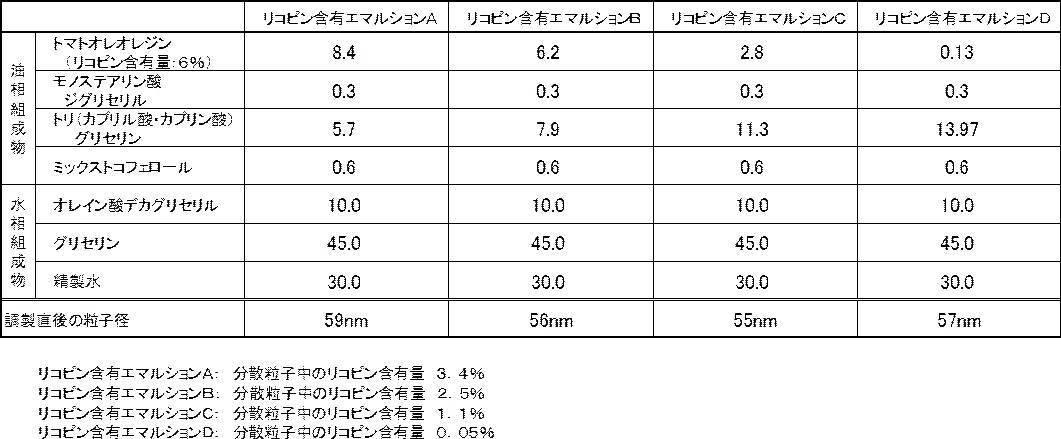
リコピン含有エマルションA~Dを、それぞれ5mlガラスバイアルに充填した試料を作製した。それぞれの試料に精製水を加えて0.5%希釈液を調製した。希釈液中の粒子の体積基準での平均粒子径(メジアン粒子径)を動的光散乱計(商品名:FPAR-1000、大塚電子株式会社製)にて測定した。
(1)上記で得られたリコピン含有エマルションA、B、C又はD、(2)下記表2に示す特定添加剤、及び(3)精製水を用いて、下記表2に記載の組成となるように、25℃にて撹拌しながら混合することで、実施例1~10のリコピン含有エマルション1~10、及び、比較例1~6のリコピン含有エマルション組成物C1~C6を調製した。
上記で得られたリコピン含有エマルション組成物1~10、C1~C6について、リコピンの分解抑制、及び、組成物の保存安定性の評価として、下記(1)~(4)の評価を行った。評価結果を表2に併記する。
上記で得られたリコピン含有エマルション組成物1~10、C1~C6を、調製直後及び40℃で2週間保存した後に、液体クロマトグラフ法で測定した。
調製直直後の値を100%としたときの調製直後及び保存後における強度比を、各リコピン含有エマルション組成物のリコピンの残存率として評価した。
上記で得られたリコピン含有エマルション組成物1~10、C1~C6を、40℃で2週間保存した後に、目視で色味変化を確認し、以下の評価基準により評価した。
<評価基準>
A:認識できる色味変化無し
B:変化は小さいが、わずかに色味の変化が認められる。
C:明らかに色味変化が認められる。
上記で得られたリコピン含有エマルション組成物1~10、C1~C6をそれぞれ2つに分け、それぞれ5mlガラスバイアルに充填した試料を作製した。2つの試料そのうち1つを40℃にて2週間保存した。調製直後及び2週間保存後のそれぞれの試料について、試料中の粒子の体積基準での平均粒子径(メジアン粒子径)を動的光散乱計(商品名FPAR-1000、大塚電子株式会社製)にて測定した。
上記で得られたリコピン含有エマルション組成物1~10、C1~C6の、調製直後及び40℃にて2週間保存後の1%希釈液を、高さ5cm以上の容器に、容器の底部より液面までが4cmになるようにとり、液面から垂直・上方の位置から容器底部に向かって試料液越しに目視した。このようにして、容器底部を目視できるかどうかを透明性の評価として、下記の基準に従ってそれぞれ評価した。
<評価基準>
A:底部がはっきり見える。
B:底部がぼんやりと見える。
C:底部が見えない。

特に、比較例1~5と実施例1~3の比較からは、所定の含有量でリコピンを含有する本発明における分散粒子と特定添加剤とが選択的に組み合わされることにより、飛躍的に保存安定性が高まることが分かる。
また、特定添加剤は防腐効果を有する化合物であり、防腐効果を有することにおいては、比較例6に用いた汎用防腐剤であるパラオキシ安息香酸メチルと共通する。しかしながら、比較例6と実施例2、4~10との対比から分かるように、比較例6のリコピン含有エマルションでは、実施例のリコピン含有エマルションとは異なり、リコピン残存率に著しく劣る。このことからも、所定の含有量でリコピンを含有する本発明における分散粒子と特定添加剤とが選択的に組み合わせが、リコピンの安定性向上に飛躍的に寄与していることが分かる。
Claims (6)
- 0.05質量%~2.5質量%のリコピンを含有する分散粒子と、フェノキシエタノール、炭素鎖長が3~10の脂肪族ジオール化合物、グリセリンと脂肪族アルコールとのエーテル化合物、及びカルバミン酸エステル化合物よりなる群から選択される少なくとも1種の化合物と、を含有する水中油型エマルション組成物。
- 前記分散粒子の平均粒子径が、100nm以下である請求項1に記載の水中油型エマルション組成物。
- 前記カルバミン酸エステル化合物が、ブチルカルバミン酸ヨウ化プロピニルを含む請求項1又は請求項2に記載の水中油型エマルション組成物。
- 前記グリセリンと脂肪族アルコールとのエーテル化合物が、エチルヘキシルグリセリンを含む請求項1~請求項3のいずれか1項に記載の水中油型エマルション組成物。
- 前記炭素鎖長が3~10の脂肪族ジオール化合物が、オクタンジオール及びデカンジオールから選択された少なくとも1種の脂肪族ジオール化合物を含む請求項1~請求項4のいずれか1項に記載の水中油型エマルション組成物。
- 請求項1~請求項5のいずれか1項に記載の水中油型エマルション組成物を含む皮膚外用剤。
Priority Applications (4)
| Application Number | Priority Date | Filing Date | Title |
|---|---|---|---|
| JP2014500621A JP5952382B2 (ja) | 2012-02-24 | 2013-01-25 | 水中油型エマルション組成物 |
| KR1020147020383A KR101669831B1 (ko) | 2012-02-24 | 2013-01-25 | 수중 유형 에멀젼 조성물 |
| CN201380008486.7A CN104114145B (zh) | 2012-02-24 | 2013-01-25 | 水包油型乳液组合物 |
| EP13752537.4A EP2829263B1 (en) | 2012-02-24 | 2013-01-25 | Oil-in-water emulsion composition |
Applications Claiming Priority (2)
| Application Number | Priority Date | Filing Date | Title |
|---|---|---|---|
| JP2012-039370 | 2012-02-24 | ||
| JP2012039370 | 2012-02-24 |
Publications (1)
| Publication Number | Publication Date |
|---|---|
| WO2013125291A1 true WO2013125291A1 (ja) | 2013-08-29 |
Family
ID=49005485
Family Applications (1)
| Application Number | Title | Priority Date | Filing Date |
|---|---|---|---|
| PCT/JP2013/051672 Ceased WO2013125291A1 (ja) | 2012-02-24 | 2013-01-25 | 水中油型エマルション組成物 |
Country Status (5)
| Country | Link |
|---|---|
| EP (1) | EP2829263B1 (ja) |
| JP (1) | JP5952382B2 (ja) |
| KR (1) | KR101669831B1 (ja) |
| CN (1) | CN104114145B (ja) |
| WO (1) | WO2013125291A1 (ja) |
Cited By (2)
| Publication number | Priority date | Publication date | Assignee | Title |
|---|---|---|---|---|
| CN109310974A (zh) * | 2016-04-29 | 2019-02-05 | 西姆莱斯股份公司 | 用于制备微胶囊的方法 |
| JP2021054817A (ja) * | 2019-09-30 | 2021-04-08 | 富士フイルム株式会社 | 油性組成物及びその製造方法、並びにソフトカプセル剤 |
Families Citing this family (3)
| Publication number | Priority date | Publication date | Assignee | Title |
|---|---|---|---|---|
| JP5676339B2 (ja) * | 2011-03-29 | 2015-02-25 | 富士フイルム株式会社 | 脂肪低減剤 |
| JP2017114845A (ja) * | 2015-09-29 | 2017-06-29 | 富士フイルム株式会社 | 透明化粧料 |
| CN116367812A (zh) * | 2020-10-30 | 2023-06-30 | 安提昂有限公司 | 含有链烷二醇和辛酰基甘油醚或乙基己基甘油的皮肤外用剂用保存剂及包括其的化妆品组合物 |
Citations (12)
| Publication number | Priority date | Publication date | Assignee | Title |
|---|---|---|---|---|
| JPH08113723A (ja) * | 1994-10-18 | 1996-05-07 | Sanei Gen F F I Inc | 安定なリコピン色素液の製造方法 |
| JPH1135444A (ja) * | 1997-07-18 | 1999-02-09 | Nikko Chem Kk | 新規化粧料 |
| JP2000229827A (ja) * | 1999-02-05 | 2000-08-22 | Kose Corp | 皮膚外用剤 |
| JP2000229828A (ja) * | 1999-02-05 | 2000-08-22 | Kose Corp | 美白用皮膚外用剤 |
| JP2003212709A (ja) * | 2002-01-22 | 2003-07-30 | Saadonikkusu:Kk | 機能性化粧料組成物 |
| WO2006069426A2 (en) * | 2004-12-29 | 2006-07-06 | Natura Cosméticos S.A. | A cosmetic composition and a process for preparing this cosmetic composition and a cosmetic product |
| JP2008120712A (ja) | 2006-11-10 | 2008-05-29 | Q P Corp | 化粧料用水系分散体およびその製造方法、ならびに化粧料 |
| WO2009080572A1 (en) * | 2007-12-21 | 2009-07-02 | Unilever Plc | Topical composition comprising coloring antioxidants |
| JP2010229081A (ja) * | 2009-03-27 | 2010-10-14 | Mandom Corp | 皮膚外用剤 |
| WO2010134206A1 (en) * | 2009-05-19 | 2010-11-25 | L'oreal | Combination of at least two active ingredients for cosmetic use |
| JP2011241177A (ja) | 2010-05-18 | 2011-12-01 | Fujifilm Corp | カロチノイド含有組成物の製造方法 |
| JP2012039370A (ja) | 2010-08-06 | 2012-02-23 | Sony Corp | 通信システム並びに通信装置 |
Family Cites Families (4)
| Publication number | Priority date | Publication date | Assignee | Title |
|---|---|---|---|---|
| US6426078B1 (en) * | 1997-03-17 | 2002-07-30 | Roche Vitamins Inc. | Oil in water microemulsion |
| FR2830187B1 (fr) * | 2001-09-28 | 2004-10-15 | Oreal | Emulsion ultrafine contenant un derive haloalkynylique |
| BRPI0404331A (pt) * | 2004-09-24 | 2006-05-16 | Natura Cosmeticos Sa | complexo antioxidante e composição cosmética e farmacêutica compreendendo o referido complexo |
| JP5680275B2 (ja) * | 2009-01-20 | 2015-03-04 | 富士フイルム株式会社 | エマルション組成物、該エマルション組成物を含む食品及び化粧品 |
-
2013
- 2013-01-25 JP JP2014500621A patent/JP5952382B2/ja active Active
- 2013-01-25 KR KR1020147020383A patent/KR101669831B1/ko not_active Expired - Fee Related
- 2013-01-25 WO PCT/JP2013/051672 patent/WO2013125291A1/ja not_active Ceased
- 2013-01-25 EP EP13752537.4A patent/EP2829263B1/en not_active Not-in-force
- 2013-01-25 CN CN201380008486.7A patent/CN104114145B/zh active Active
Patent Citations (12)
| Publication number | Priority date | Publication date | Assignee | Title |
|---|---|---|---|---|
| JPH08113723A (ja) * | 1994-10-18 | 1996-05-07 | Sanei Gen F F I Inc | 安定なリコピン色素液の製造方法 |
| JPH1135444A (ja) * | 1997-07-18 | 1999-02-09 | Nikko Chem Kk | 新規化粧料 |
| JP2000229827A (ja) * | 1999-02-05 | 2000-08-22 | Kose Corp | 皮膚外用剤 |
| JP2000229828A (ja) * | 1999-02-05 | 2000-08-22 | Kose Corp | 美白用皮膚外用剤 |
| JP2003212709A (ja) * | 2002-01-22 | 2003-07-30 | Saadonikkusu:Kk | 機能性化粧料組成物 |
| WO2006069426A2 (en) * | 2004-12-29 | 2006-07-06 | Natura Cosméticos S.A. | A cosmetic composition and a process for preparing this cosmetic composition and a cosmetic product |
| JP2008120712A (ja) | 2006-11-10 | 2008-05-29 | Q P Corp | 化粧料用水系分散体およびその製造方法、ならびに化粧料 |
| WO2009080572A1 (en) * | 2007-12-21 | 2009-07-02 | Unilever Plc | Topical composition comprising coloring antioxidants |
| JP2010229081A (ja) * | 2009-03-27 | 2010-10-14 | Mandom Corp | 皮膚外用剤 |
| WO2010134206A1 (en) * | 2009-05-19 | 2010-11-25 | L'oreal | Combination of at least two active ingredients for cosmetic use |
| JP2011241177A (ja) | 2010-05-18 | 2011-12-01 | Fujifilm Corp | カロチノイド含有組成物の製造方法 |
| JP2012039370A (ja) | 2010-08-06 | 2012-02-23 | Sony Corp | 通信システム並びに通信装置 |
Non-Patent Citations (2)
| Title |
|---|
| KAJIMOTO: "Kosankazai no Riron to Jissai", 1984, SAN SHOBO |
| SAWATARI; NISHINO; TABATA: "Sanka Boshizai Handobukku", 1976, TAISEISHA |
Cited By (4)
| Publication number | Priority date | Publication date | Assignee | Title |
|---|---|---|---|---|
| CN109310974A (zh) * | 2016-04-29 | 2019-02-05 | 西姆莱斯股份公司 | 用于制备微胶囊的方法 |
| JP2019514675A (ja) * | 2016-04-29 | 2019-06-06 | シムライズ アーゲー | マイクロカプセルの製造方法 |
| CN109310974B (zh) * | 2016-04-29 | 2022-07-19 | 西姆莱斯股份公司 | 用于制备微胶囊的方法 |
| JP2021054817A (ja) * | 2019-09-30 | 2021-04-08 | 富士フイルム株式会社 | 油性組成物及びその製造方法、並びにソフトカプセル剤 |
Also Published As
| Publication number | Publication date |
|---|---|
| KR20140114840A (ko) | 2014-09-29 |
| CN104114145A (zh) | 2014-10-22 |
| EP2829263A1 (en) | 2015-01-28 |
| EP2829263A4 (en) | 2015-10-28 |
| CN104114145B (zh) | 2016-10-05 |
| JPWO2013125291A1 (ja) | 2015-07-30 |
| EP2829263B1 (en) | 2020-10-28 |
| KR101669831B1 (ko) | 2016-10-27 |
| JP5952382B2 (ja) | 2016-07-13 |
Similar Documents
| Publication | Publication Date | Title |
|---|---|---|
| JP5878638B2 (ja) | リコピン含有水中油型エマルション組成物及びその製造方法 | |
| JP6016700B2 (ja) | 水中油型エマルション組成物 | |
| JP5743941B2 (ja) | カロチノイド含有組成物及びその製造方法 | |
| KR101663551B1 (ko) | 카로티노이드 함유 조성물 및 그 제조 방법 | |
| JP5738782B2 (ja) | カロチノイド含有組成物 | |
| CN103945837B (zh) | 含类胡萝卜素组合物及其制造方法 | |
| JP5952382B2 (ja) | 水中油型エマルション組成物 | |
| JP2011241177A (ja) | カロチノイド含有組成物の製造方法 | |
| JP5881838B2 (ja) | カロチノイド含有水中油型エマルション組成物 | |
| JP2014108104A (ja) | 飲料 | |
| JP2014108106A (ja) | 飲料 | |
| JP2014108105A (ja) | 炭酸飲料 |
Legal Events
| Date | Code | Title | Description |
|---|---|---|---|
| 121 | Ep: the epo has been informed by wipo that ep was designated in this application |
Ref document number: 13752537 Country of ref document: EP Kind code of ref document: A1 |
|
| ENP | Entry into the national phase |
Ref document number: 2014500621 Country of ref document: JP Kind code of ref document: A |
|
| ENP | Entry into the national phase |
Ref document number: 20147020383 Country of ref document: KR Kind code of ref document: A |
|
| REEP | Request for entry into the european phase |
Ref document number: 2013752537 Country of ref document: EP |
|
| WWE | Wipo information: entry into national phase |
Ref document number: 2013752537 Country of ref document: EP |
|
| NENP | Non-entry into the national phase |
Ref country code: DE |