WO2013125509A1 - グルカル酸の製造方法 - Google Patents
グルカル酸の製造方法 Download PDFInfo
- Publication number
- WO2013125509A1 WO2013125509A1 PCT/JP2013/053958 JP2013053958W WO2013125509A1 WO 2013125509 A1 WO2013125509 A1 WO 2013125509A1 JP 2013053958 W JP2013053958 W JP 2013053958W WO 2013125509 A1 WO2013125509 A1 WO 2013125509A1
- Authority
- WO
- WIPO (PCT)
- Prior art keywords
- gene
- transformant
- inositol monophosphatase
- inositol
- endogenous
- Prior art date
- Legal status (The legal status is an assumption and is not a legal conclusion. Google has not performed a legal analysis and makes no representation as to the accuracy of the status listed.)
- Ceased
Links
Images


Classifications
-
- C—CHEMISTRY; METALLURGY
- C12—BIOCHEMISTRY; BEER; SPIRITS; WINE; VINEGAR; MICROBIOLOGY; ENZYMOLOGY; MUTATION OR GENETIC ENGINEERING
- C12P—FERMENTATION OR ENZYME-USING PROCESSES TO SYNTHESISE A DESIRED CHEMICAL COMPOUND OR COMPOSITION OR TO SEPARATE OPTICAL ISOMERS FROM A RACEMIC MIXTURE
- C12P7/00—Preparation of oxygen-containing organic compounds
- C12P7/40—Preparation of oxygen-containing organic compounds containing a carboxyl group including Peroxycarboxylic acids
- C12P7/58—Aldonic, ketoaldonic or saccharic acids
-
- C—CHEMISTRY; METALLURGY
- C12—BIOCHEMISTRY; BEER; SPIRITS; WINE; VINEGAR; MICROBIOLOGY; ENZYMOLOGY; MUTATION OR GENETIC ENGINEERING
- C12N—MICROORGANISMS OR ENZYMES; COMPOSITIONS THEREOF; PROPAGATING, PRESERVING, OR MAINTAINING MICROORGANISMS; MUTATION OR GENETIC ENGINEERING; CULTURE MEDIA
- C12N9/00—Enzymes; Proenzymes; Compositions thereof; Processes for preparing, activating, inhibiting, separating or purifying enzymes
- C12N9/14—Hydrolases (3)
- C12N9/16—Hydrolases (3) acting on ester bonds (3.1)
-
- C—CHEMISTRY; METALLURGY
- C12—BIOCHEMISTRY; BEER; SPIRITS; WINE; VINEGAR; MICROBIOLOGY; ENZYMOLOGY; MUTATION OR GENETIC ENGINEERING
- C12Y—ENZYMES
- C12Y301/00—Hydrolases acting on ester bonds (3.1)
- C12Y301/03—Phosphoric monoester hydrolases (3.1.3)
- C12Y301/03025—Inositol-phosphate phosphatase (3.1.3.25)
-
- Y—GENERAL TAGGING OF NEW TECHNOLOGICAL DEVELOPMENTS; GENERAL TAGGING OF CROSS-SECTIONAL TECHNOLOGIES SPANNING OVER SEVERAL SECTIONS OF THE IPC; TECHNICAL SUBJECTS COVERED BY FORMER USPC CROSS-REFERENCE ART COLLECTIONS [XRACs] AND DIGESTS
- Y02—TECHNOLOGIES OR APPLICATIONS FOR MITIGATION OR ADAPTATION AGAINST CLIMATE CHANGE
- Y02P—CLIMATE CHANGE MITIGATION TECHNOLOGIES IN THE PRODUCTION OR PROCESSING OF GOODS
- Y02P20/00—Technologies relating to chemical industry
- Y02P20/50—Improvements relating to the production of bulk chemicals
- Y02P20/52—Improvements relating to the production of bulk chemicals using catalysts, e.g. selective catalysts
Definitions
- the present invention relates to the application of gene recombination technology in the production of glucaric acid.
- Glucaric acid (tetrahydroxyadipic acid) is a compound that has long been found in plants and mammals.
- Non-Patent Document 1 glucaric acid derivatives that can be prepared using glucaric acid as a raw material, lactones such as glucaro- ⁇ -lactone, glucaro- ⁇ -lactone, and glucarodilactone (use as a solvent can be expected), poly Examples include hydroxy polyamides (use as a novel nylon can be expected).
- the report states that as a known method for producing glucaric acid, a nitrate oxidation reaction of starch and a catalytic oxidation reaction in the presence of a basic bleaching agent can be used.
- Patent Document 1 a transformant capable of biosynthesizing glucaric acid was disclosed in Patent Document 1. That is, in this patent document, three genes encoding myo-inositol-1-phosphate synthase (Ino1), myo-inositol oxygenase (MIOX) and uronic acid dehydrogenase (udh), respectively, were transfected into an E. coli host. The transformant thus obtained is said to have produced glucaric acid at a concentration of 0.72 to 1.13 g / L in the medium. However, the inventors of Patent Document 1 determined that introduction of an inositol monophosphatase (suhB) gene is unnecessary for the transformant of the patent document.
- ino1 myo-inositol-1-phosphate synthase
- MIOX myo-inositol oxygenase
- udh uronic acid dehydrogenase
- Activity 1 Activity to produce glucose-6-phosphate from a suitable carbon source
- Activity 2 Activity to convert glucose-6-phosphate to myo-inositol-1-phosphate, ie inositol-1-phosphate synthase activity
- Activity 3 Activity to convert myo-inositol-1-phosphate to myo-inositol, that is, phosphatase activity using myo-inositol-1-phosphate as a substrate
- Activity 4 Activity to convert myo-inositol into glucuronic acid, ie, myo-inositol oxygenase activity
- Activity 5 Activity to convert glucuronic acid into glucaric acid, ie, uronic acid dehydrogenase activity,
- Patent Document 1 concludes that it is not necessary to introduce an inositol monophosphatase gene into a transformant for biosynthesis of glucaric acid based on metabolic analysis of the prepared transformant. That is, Patent Document 1 states, “It should also be noted that we did not overexpress the suhB gene or homologous phosphatase. However, myo-inositol-1-phosphate was not detected in the culture product. On the other hand, myo-inositol has accumulated, so we concluded that phosphatase activity does not restrict the flux of metabolism through the pathway "(page 33, lines 2-5). ing.
- the problem to be solved by the present invention is the production and use of a transformant having a significantly improved ability to produce glucaric acid.
- Patent Document 1 that discloses a transformant capable of biosynthesizing glucaric acid does not introduce an inositol monophosphatase gene into the transformant, and pays special attention to the activity. I didn't pay.
- the first aspect of the present invention is: (1) A method for producing glucaric acid, comprising the following steps: 1) A transformant having an inositol-1-phosphate synthase gene, an inositol monophosphatase gene, a myoinositol oxygenase gene and a uronic acid dehydrogenase gene, and an excess of functional inositol monophosphatase in the transformant Providing a transformant having a gene recombination or mutation that induces production or activation of inositol monophosphatase; 2) contacting the transformant with a carbon source that can be converted to glucaric acid by the transformant under conditions suitable for the growth and / or maintenance of the transformant; and 3) obtained in 2) above.
- the transformant in the method for producing glucaric acid using the transformant having inositol-1-phosphate synthase gene, inositol monophosphatase gene, myoinositol oxygenase gene and uronic acid dehydrogenase gene, the transformant Is a transformant having a genetic recombination or mutation that induces overproduction of functional inositol monophosphatase or activation of inositol monophosphatase.
- a carbon source containing a compound suitable for production of glucose-6-phosphate which is a substrate of inositol-1-phosphate synthase (the above activity 2), is used as a culture substrate. It is preferable to use as. Accordingly, preferred embodiments of the present invention are: (2) The production method according to (1) above, wherein the carbon source contains a compound that can be converted into glucose-6-phosphate in the transformant; and (3) the carbon source is D-glucose.
- Prokaryotic microorganisms typified by Escherichia coli are extremely attractive from the viewpoint of industrial fermentation production because of their rapid growth ability and ease of fermentation management. Also has advantages.
- many prokaryotic microorganisms that do not have a pathway to biosynthesize glucaric acid from glucose via myo-inositol can be used to control glucaric acid productivity by using synthetic biological techniques linked with genetic recombination technology.
- prokaryotic microbial hosts such as Escherichia coli do not have the ability (resolution) to assimilate myo-inositol, which is an intermediate of the glucaric acid biosynthetic pathway, and thus make it easier to apply synthetic biological techniques.
- preferred embodiments of the present invention are: (4) The production method according to any one of (1) to (3) above, wherein the transformant is derived from a microorganism having no myo-inositol assimilation ability; and (5) The transformant includes the production method according to any one of (1) to (4) above, wherein the transformant is derived from a bacterium selected from the group consisting of Escherichia coli, Bacillus bacteria, Corynebacterium bacteria, and Zymomonas bacteria. .
- the inositol monophosphatase activity of the cell can be enhanced by overproducing inositol monophosphatase in the cell.
- Various known techniques can be applied to cause cells to overproduce inositol monophosphatase.
- the present invention provides the following aspects: (6) Overproduction of the inositol monophosphatase is caused by a) introducing an exogenous inositol monophosphatase gene, b) increasing the copy number of the endogenous inositol monophosphatase gene, c) introducing a mutation into the regulatory region of the endogenous inositol monophosphatase gene, d) replacing the regulatory region of the endogenous inositol monophosphatase gene with a high expression inducible foreign regulatory region, or e) deleting the regulatory region of the endogenous inositol monophosphatase gene, (7) the production method according to any one of (1) to (5); and (7) the inositol monophosphatase overproduction introduces a foreign inositol monophosphatase gene into the transformant.
- the production method according to (6) which is induced by
- the inositol monophosphatase activity of the cell can be enhanced also by the following mode.
- Activation of the inositol monophosphatase is performed on the transformant, f) introducing a mutation into the endogenous inositol monophosphatase gene; g) replacing part or all of the endogenous inositol monophosphatase gene, h) deleting a portion of the endogenous inositol monophosphatase gene; i) reduce other proteins that reduce inositol monophosphatase activity, j) reduce the production of compounds that reduce inositol monophosphatase activity,
- the manufacturing method in any one of said (1) to (5) induced
- the present invention also contemplates a transformant for use in the above glucaric acid production method.
- the second aspect of the present invention is: (9) A transformant having an inositol-1-phosphate synthase gene, an inositol monophosphatase gene, a myoinositol oxygenase gene, and a uronic acid dehydrogenase gene, which is a functional inositol monophosphatase in the transformant. It is a transformant having a gene recombination or mutation that induces overproduction or activation of inositol monophosphatase.
- transformant having inositol-1-phosphate synthase gene, inositol monophosphatase gene, myoinositol oxygenase gene and uronic acid dehydrogenase gene, overproduction of functional inositol monophosphatase or inositol monophosphatase
- the transformant is characterized by having a gene recombination or mutation that induces activation of phosphatase.
- the embodiment described for the first aspect of the present invention also applies to the second aspect of the present invention.
- These aspects are: (10) The transformant according to (9) above, wherein the transformant is derived from a microorganism that does not have myo-inositol assimilation ability; (11) The transformant according to (9) or (10) above, wherein the transformant is derived from a bacterium selected from the group consisting of Escherichia coli, Bacillus bacteria, Corynebacterium bacteria, and Zymomonas bacteria.
- the inositol monophosphatase overproduction is caused by the transformant, a) introducing an exogenous inositol monophosphatase gene, b) increasing the copy number of the endogenous inositol monophosphatase gene, c) introducing a mutation into the regulatory region of the endogenous inositol monophosphatase gene, d) replacing the regulatory region of the endogenous inositol monophosphatase gene with a high expression inducible foreign regulatory region, or e) deleting the regulatory region of the endogenous inositol monophosphatase gene,
- the transformant according to any one of (9) to (11), which is induced by (13)
- the transformant according to (12) above, wherein the overproduction of the inositol monophosphatase is induced by introducing a foreign inositol monophosphatase gene into the transformant; and (14) the inositol Monophosphatase
- industrial glucaric acid production efficiency can be improved by microbial culture technology.
- the coding region of the INO1 gene is shown (SEQ ID NO: 1).
- the coding region of suhB gene is shown (SEQ ID NO: 3).
- the coding region of the miox gene is shown (SEQ ID NO: 5).
- the coding region of the udh gene is shown (SEQ ID NO: 7).
- the object of the present invention is solved by enhancing inositol monophosphatase activity in a transformant having an inositol-1-phosphate synthase gene, an inositol monophosphatase gene, a myoinositol oxygenase gene and a uronic acid dehydrogenase gene.
- the transformant of the present invention can be prepared using various host microbial cells.
- using a prokaryotic microorganism as a host makes it possible to newly construct a glucaric acid biosynthetic pathway in the host cell (that is, there is no influence of the existing endogenous pathway). It is extremely attractive in the application of genetic methods.
- Illustrative prokaryotic microorganisms are: Escherichia, Pseudomonas, Bacillus, Geobacillus, Methanomonas, Methylobacillus, Methylophilus, Protaminobacter, Methylococcus, Corynebacterium, Brevibacterium, Zymomonas and Listeria.
- Non-limiting examples of prokaryotic microorganisms suitable for industrial fermentation production include E. coli, Bacillus bacteria, Corynebacterium bacteria, Zymomonas bacteria.
- E. coli is an example of a host microorganism of the present invention that is particularly preferred because of its rapid growth ability and ease of fermentation management.
- the cell line that can be used as the host cell of the present invention may be a wild type in the usual sense, or may be an auxotrophic mutant or an antibiotic-resistant mutant. Furthermore, the cell line that can be used as the host cell of the present invention may be already transformed so as to have various marker genes relating to the mutation as described above. These mutations and genes can provide useful properties for the production, maintenance, and management of the transformant of the present invention.
- glucaric acid production of the present invention can be easily performed by using a strain resistant to antibiotics such as chloramphenicol, ampicillin, kanamycin, and tetracycline.
- the term “foreign” or “foreign” means that when the host microorganism before transformation does not have the gene to be introduced according to the present invention, the enzyme encoded by the gene is referred to.
- the gene or nucleic acid sequence according to the present invention is introduced into the host Used to mean to do.
- Inositol-1-phosphate synthase genes are known (for example, GenBank Accession Nos. AB032073, AF056325, AF071033, AF078915, AF120146, AF207640, AF284065, BC111160, L23520, U32511), all of which are used for the purposes of the present invention. can do.
- the inositol-1-phosphate synthase gene having the coding region nucleotide sequence represented by SEQ ID NO: 1 can be preferably used in the present invention.
- the inositol-1-phosphate synthase gene that can be used in the present invention is not limited to the above-mentioned gene, and it may be derived from other organisms or artificially synthesized. Any substance capable of expressing substantial inositol-1-phosphate synthase activity in microbial cells may be used.
- the inositol-1-phosphate synthase gene that can be used for the purpose of the present invention is naturally generated as long as it can express substantial inositol-1-phosphate synthase activity in the host microorganism cell. It may have all possible mutations and artificially introduced mutations and modifications. For example, it is known that there are extra codons in various codons that code for specific amino acids. Therefore, in the present invention, alternative codons that are finally translated into the same amino acid may be used. That is, since the genetic code is degenerate, multiple codons can be used to encode a particular amino acid, so that the amino acid sequence can be encoded with any set of similar DNA oligonucleotides.
- the inositol-1-phosphate synthase gene is introduced as an “expression cassette” into the host microorganism cell, so that a more stable and high level of inositol-1-phosphate synthase activity can be obtained.
- expression cassette means a nucleotide comprising a nucleic acid to be expressed or a nucleic acid sequence that regulates transcription and translation operably linked to a gene to be expressed.
- the expression cassette of the present invention comprises a promoter sequence 5 ′ upstream from the coding sequence, a terminator sequence 3 ′ downstream, and optionally further normal regulatory elements, operably linked, such as
- the nucleic acid to be expressed or the gene to be expressed is “expressably introduced” into the host microorganism.
- a promoter is defined as a DNA sequence that binds RNA polymerase to DNA and initiates RNA synthesis, whether it is a structural promoter or a regulated promoter.
- a strong promoter is a promoter that initiates mRNA synthesis at a high frequency, and is also preferably used in the present invention.
- lac system lac system, trp system, TAC or TRC system, lambda phage major operator and promoter region, fd coat protein regulatory region, glycolytic enzymes (eg 3-phosphoglycerate kinase, glyceraldehyde-3-phosphate dehydration) Elementary enzyme), glutamic acid decarboxylase A, a promoter for serine hydroxymethyltransferase, and the like can be used depending on the properties of the host cell.
- glycolytic enzymes eg 3-phosphoglycerate kinase, glyceraldehyde-3-phosphate dehydration
- glutamic acid decarboxylase A eg 3-phosphoglycerate kinase, glyceraldehyde-3-phosphate dehydration
- glutamic acid decarboxylase A eglyceraldehyde-3-phosphate dehydration
- promoter for serine hydroxymethyltransferase e.glyceraldehy
- the expression cassette described above is inserted into a host microorganism by being incorporated into a vector comprising, for example, a plasmid, phage, transposon, IS element, fasmid, cosmid, or linear or circular DNA. Plasmids and phage are preferred. These vectors may be autonomously replicated in the host microorganism, or may be replicated by chromosome. Suitable plasmids are, for example, E.
- Other usable plasmids are described in “Cloning Vectors”, Elsevier, 1985.
- the expression cassette can be introduced into a vector by a conventional method including excision, cloning, and ligation with an appropriate restriction enzyme.
- inositol monophosphatase activity plays a critical role in transformants obtained by introducing the glucaric acid biosynthetic pathway into host microorganisms that do not have an endogenous glucaric acid biosynthetic pathway. I have found it. As noted above, previous studies have not paid special attention to inositol monophosphatase activity. However, unexpectedly, enhancing the inositol monophosphatase activity significantly improved the ability of such transformants to produce glucaric acid.
- one embodiment of the present invention is to overproduce inositol monophosphatase in a transformant having an inositol-1-phosphate synthase gene, an inositol monophosphatase gene, a myoinositol oxygenase gene, and a uronic acid dehydrogenase gene. Is included.
- Inositol monophosphatase intended by the present invention is a phosphate monoester hydrolase activity that can act on a wide range of substrates in addition to those showing high substrate specificity for inositol-1-phosphate.
- proteins that can substantially hydrolyze inositol-1-phosphate For example, inositol-1-monophosphatase is known as a typical inositol monophosphatase, and the gene (suhB gene) derived from many organisms is known as GenBank Accession Nos. ZP_046119988, YP_001451848, etc.
- the use of the suhB gene derived from E. coli (SEQ ID NO: 3: AAC75586 (MG1655)) is convenient when E. coli is used as a host cell.
- the next biological activity that the transformed microorganism of the present invention should have is myo-inositol oxygenase activity.
- the enzyme typically converts myo-inositol to glucuronic acid by the following reaction.
- myo-inositol oxygenase genes are known and available.
- WO2002 / 074926 pamphlet discloses cryptococcus and human-derived myo-inositol oxygenase gene and heterologous expression thereof.
- the myo-inositol oxygenase gene disclosed in Patent Document 1 can be used in the present invention.
- myo-inositol oxygenase genes derived from many organisms, which are given the following GenBank Accession numbers are known and may be useful in the present invention.
- ACCESSION No. AY733258 Homo sapiens myo-inositol oxygenase (MIOX)
- NM101319 Arabidopsis thaliana inositol oxygenase 1 (MIOX1)
- ACCESSION No. NM001101065 Bos taurus myo-inositol oxygenase (MIOX))
- ACCESSION No. NM001030266 Diso rerio myo-inositol oxygenase (miox)
- NM214102 Sus scrofa myo-inositol oxygenase (MIOX)
- ACCESSION No. AY064416 Homo sapiens myo-inositol oxygenase (MIOX)) ACCESSION No.
- NM001247664 Solanum lycopersicum myo-inositol oxygenase (MIOX)) ACCESSION No. XM630762 (Dictyostelium discoideum AX4 inositol oxygenase (miox)) ACCESSION No. NM1457571 (Rattus norvegicus myo-inositol oxygenase (Miox)) ACCESSION No. NM017584 (Homo sapiens myo-inositol oxygenase (MIOX)) ACCESSION No.
- NM001131282 (Pongo abelii myo-inositol oxygenase (MIOX))
- MIOX myo-inositol oxygenase
- the use of the miox gene having the coding region nucleotide sequence shown in SEQ ID NO: 5 is convenient.
- the final biological activity that the transformed microorganism of the present invention should have is uronic acid dehydrogenase activity.
- the enzyme typically converts glucuronic acid to glucaric acid in the presence of NAD + by the following reaction.
- uronic acid dehydrogenase genes are known and available.
- uronic acid dehydrogenase of Pseudomonas aeruginosa and Agrobacterium genus described in Patent Document 1 can also be used in the present invention.
- the udh gene to which the following GenBank Accession number is assigned is known and may be useful in the present invention.
- ACCESSION No. BK006462 Agrobacterium tumefaciens str. C58 uronate dehydrogenase (udh) gene
- ACCESSION No. EU377538 Pseudomonas syringae pv. Tomato str. DC3000 uronate dehydrogenase (udh) gene
- the use of the udh gene having the coding region nucleotide sequence shown in SEQ ID NO: 7 is convenient.
- inositol-1-phosphate synthase gene mutations, modifications and codon optimization, regulator cassettes such as expression cassettes, promoters, and plasmids, etc., and description of transformation by them are all the inositol monophosphatase gene of the present invention Those skilled in the art will readily understand that this also applies to the myo-inositol oxygenase gene and the uronic acid dehydrogenase gene.
- the transformant of the present invention comprises an expression cassette containing a nucleic acid encoding inositol-1-phosphate synthase, an expression cassette containing a nucleic acid encoding inositol monophosphatase gene, and an expression containing a nucleic acid encoding myo-inositol oxygenase. It can carry four expression cassettes, an expression cassette comprising a cassette and a nucleic acid encoding uronic acid dehydrogenase.
- a preferred transformant of the present invention includes an expression cassette containing a nucleic acid having the nucleotide sequence shown by SEQ ID NO: 1, an expression cassette containing a nucleic acid having the nucleotide sequence shown by SEQ ID NO: 3, and a nucleotide sequence shown by SEQ ID NO: 5. And an expression cassette containing a nucleic acid having the nucleotide sequence shown in SEQ ID NO: 7.
- the above four expression cassettes may be arranged on one vector and transfected into a host microorganism.
- a vector in which any two or more of these expression cassettes are arranged and a vector in which the remaining expression cassettes are arranged may be co-transfected into the host microorganism, or each expression cassette is arranged 4
- One vector may be co-transfected into the host microorganism.
- any one or more of the four expression cassettes may be integrated into the genome of the host microorganism, and the remaining expression cassette may be present in the transformed microorganism as a plasmid.
- Escherichia coli AKC-018 strain having both an expression cassette containing inositol-1-phosphate synthase-encoding nucleic acid (INO1) and an expression cassette containing a nucleic acid encoding inositol monophosphatase (suhB) on the chromosome. -2181, deposited with the Patent Organism Depositary, National Institute of Technology and Evaluation on October 25, 2011.
- a nucleic acid encoding myo-inositol oxygenase It is also possible to transfect a plasmid on which an expression cassette containing and an expression cassette containing a nucleic acid encoding uronic acid dehydrogenase are placed.
- inositol monophosphatase activity intended in the present invention that is, have an endogenous gene encoding inositol monophosphatase activity.
- overproduction of inositol monophosphatase in the present invention increases the copy number of the endogenous inositol monophosphatase gene; introduces mutations into the regulatory region of the endogenous inositol monophosphatase gene; regulatory region of the endogenous inositol monophosphatase gene Can also be induced by deleting the regulatory region of the endogenous inositol monophosphatase gene.
- a construct containing an expression cassette containing an endogenous inositol monophosphatase gene or a suitable regulatory region added to the coding region of the endogenous gene is used.
- Transforming a host microorganism to substantially increase the copy number of the inositol monophosphatase gene in the transformant compared to the original host cell, or with respect to the original host cell having an endogenous inositol monophosphatase gene Chromosome mutations, additions and deletions can be achieved by performing known gene recombination techniques, or by randomly introducing mutations into the chromosome using a mutagen or the like.
- a known SDS-PAGE analysis method or the like can be used for confirmation of overproduction of inositol monophosphatase.
- another aspect of the present invention for enhancing inositol monophosphatase activity includes inducing activation of inositol monophosphatase in a host microbial cell.
- the activity of inositol monophosphatase encoding the inositol monophosphatase gene after mutation, addition or deletion of the inositol monophosphatase gene Inositol monophosphatase with enhanced inositol monophosphatase activity can be obtained.
- the transformant obtained as described above is cultured and maintained under conditions suitable for the growth and / or maintenance of the transformant for the production of glucaric acid of the present invention.
- Suitable media compositions, culture conditions, and culture times for transformants derived from various host microbial cells are known to those skilled in the art.
- the medium may be a natural, semi-synthetic or synthetic medium containing one or more carbon sources, nitrogen sources, inorganic salts, vitamins and optionally trace elements such as trace elements or vitamins.
- the medium used must appropriately meet the nutritional requirements of the transformant to be cultured.
- the medium of the present invention is a carbon source that can ultimately be used as a substrate for glucaric acid production, ie, transformation. It should contain a compound that can be converted to glucose-6-phosphate in the body.
- the carbon source can be D-glucose, sucrose, oligosaccharides, polysaccharides, starch, cellulose, rice bran, waste molasses, and can also be biomass containing D-glucose.
- suitable biomass include corn decomposition solution and cellulose decomposition solution.
- the medium may contain a corresponding antibiotic. Thereby, the risk of contamination due to various germs during fermentation is reduced.
- glucaric acid using these carbon sources can be obtained by applying a known genetic engineering technique such as introducing a foreign gene into the host microorganism.
- a known genetic engineering technique such as introducing a foreign gene into the host microorganism.
- foreign genes include cellulase genes and amylase genes.
- the culture may be a batch type or a continuous type. In any case, the additional carbon source or the like may be replenished at an appropriate point in the culture. Furthermore, the culture should be continued while maintaining a suitable temperature, oxygen concentration, pH and the like.
- a suitable culture temperature for the transformant derived from a general microbial host cell is usually in the range of 15 ° C to 45 ° C, preferably 25 ° C to 37 ° C. When the host microorganism is aerobic, it is necessary to perform shaking (flask culture, etc.) and stirring / aeration (jar fermenter culture, etc.) to ensure an appropriate oxygen concentration during fermentation. Those culture conditions can be easily set by those skilled in the art.
- Glucaric acid can be purified from the above culture by combining methods known to those skilled in the art.
- Patent Document 1 specifically describes a glucaric acid detection and quantification method useful for that purpose.
- Example 1 Construction of plasmid 1-a) Inositol monophosphatase expression cassette
- E. coli strain W3110 (NBRC 12713) was cultured with shaking in LB medium (2 ml) at 37 ° C. After completion of the culture, the cells were collected from the culture solution, and genomic DNA was extracted using Nucleo Spin Tissue (product name, manufactured by MACHEREY-NAGEL). Using the extracted genomic DNA as a template, PCR amplification was performed with the following primers (PrimeStar Max DNA Polymerase (product name, manufactured by Takara Bio Inc.) reaction conditions: 98 ° C. 10 sec, 55 ° C. 5 sec, 72 ° C.
- the coding region (SEQ ID NO: 3) was cloned.
- the obtained suhB coding region was inserted in the downstream of the promoter of the following sequence so that transcription was possible.
- the plasmid pNFP-A51 (as FERM P-22182 was deposited with the Patent Organism Depositary, National Institute of Technology and Evaluation on October 25, 2011. International deposit number: FERM BP-11515).
- a terminator sequence and the promoter sequence were inserted.
- the suhB coding region cloned above was ligated downstream of the introduced promoter sequence to construct pNFP-A54.
- the constructed pNFP-A54 was transformed into the Escherichia coli AKC-016 strain (FERM P-22104 by the Calcium Chloride Method (written by Yodosha, Genetic Engineering Experiment Note, Takaaki Ueda)). On April 20, 2011. International deposit number: FERM BP-11512). High expression of inositol monophosphatase in the soluble fraction of the Escherichia coli was confirmed by SDS-PAGE.
- Inositol-1-phosphate synthase expression cassette Bacterial cells were collected from the culture solution of alcoholic yeast, and genomic DNA was extracted using Nucleo Spin Tissue (product name, manufactured by MACHEREY-NAGEL). Using the extracted genomic DNA as a template, PCR amplification was performed with the following primers (PrimeStar Max DNA Polymerase (product name, manufactured by Takara Bio Inc.) reaction conditions: 98 ° C. 10 sec, 55 ° C. 5 sec, 72 ° C. 20 sec, 28 cycle), and the INO1 gene The coding region (SEQ ID NO: 1) was cloned. The obtained ino1 coding region was inserted downstream of the promoter of the following sequence so as to allow transcription.
- PNFP-D78 was constructed by ligating the cloned ino1 coding region downstream of the introduced promoter sequence.
- the constructed pNFP-D78 was transformed into the Escherichia coli AKC-016 strain (FERM P-22104 by the Calcium Chloride Method (written by Yodosha, Genetic Engineering Experiment Note, by Takaaki Ueda)). On April 20, 2011. International deposit number: FERM BP-11512). High expression of inositol-1-phosphate synthase in the soluble fraction of the Escherichia coli was confirmed by SDS-PAGE.
- the myo-inositol oxygenase (miox) gene is prepared by artificial synthesis of a DNA having the nucleotide sequence of SEQ ID NO: 5 and PCR (PrimeSTAR Max DNA Polymerase) using the DNA as a template and the following primers: (Product name, manufactured by Takara Bio Inc.) Reaction conditions: 98 ° C. 10 sec, 55 ° C. 5 sec, 72 ° C. 20 sec, 28 cycles). The obtained miox coding region was inserted downstream of the promoter of SEQ ID NO: 11 in a transcriptional manner.
- a terminator sequence and the promoter sequence were inserted into the multiple cloning site of pNFP-A51.
- the miox coding region cloned above was ligated downstream of the introduced promoter sequence to construct pNFP-H26.
- the constructed pNFP-H26 was transfected into Escherichia coli strain FERM P-22104 by the calcium chloride method (written by Yodosha Genetic Engineering Experiment Note, Takaaki Uedamura). High expression of myo-inositol oxygenase in the soluble fraction of the E. coli was confirmed by SDS-PAGE.
- Uronic acid dehydrogenase expression cassette The uronic acid dehydrogenase (udh) gene is prepared by artificial synthesis of DNA having the nucleotide sequence of SEQ ID NO: 7, and PCR (PrimeStar Max DNA Polymerase) using the DNA as a template and the following primers. (Product name, manufactured by Takara Bio Inc.) Reaction conditions: 98 ° C. 10 sec, 55 ° C. 5 sec, 72 ° C. 20 sec, 28 cycles). The obtained udh coding region was inserted downstream of the promoter of SEQ ID NO: 11 in a transcriptional manner. That is, a terminator sequence and the promoter sequence were inserted into the multiple cloning site of pNFP-A51.
- the udh coding region cloned above was ligated downstream of the introduced promoter sequence to construct pNFP-H45.
- the constructed pNFP-H45 was transfected into Escherichia coli strain FERM P-22104 by the calcium chloride method (written by Yodosha, Genetic Engineering Experiment Note, Takaaki Uedamura). High expression of uronic acid dehydrogenase in the soluble fraction of the E. coli was confirmed by SDS-PAGE.
- the miox expression cassette in pNFP-H26 and the udh expression cassette in pNFP-H45 prepared in Example 1 were cloned, and both expression cassettes were ligated to pNFP-G22.
- a plasmid of the present invention was obtained in which the miox expression cassette and the udh expression cassette were ligated in the forward direction with the INO1 expression cassette and the suhB expression cassette in pNFP-G22.
- Example 2 2-a) Production of glucaric acid using a Jar culture tank by a transformant transfected with a plasmid containing an expression cassette
- the plasmid of the present invention constructed according to the above procedure was used as Escherichia coli AKC-016 strain (FERM P-22104). Deposited with the Patent Microorganisms Deposit Center, National Institute of Technology and Evaluation, April 20, 2011. Referred to by Takaaki Ueda, Calcium Chloride Method (Yochisha Genetic Engineering Experiment Note, International Deposit Number: FERM BP-11512) ). The obtained transformant was cultured at 37 ° C. for 1 day on an LB plate containing ampicillin (100 mg / L) to form colonies.
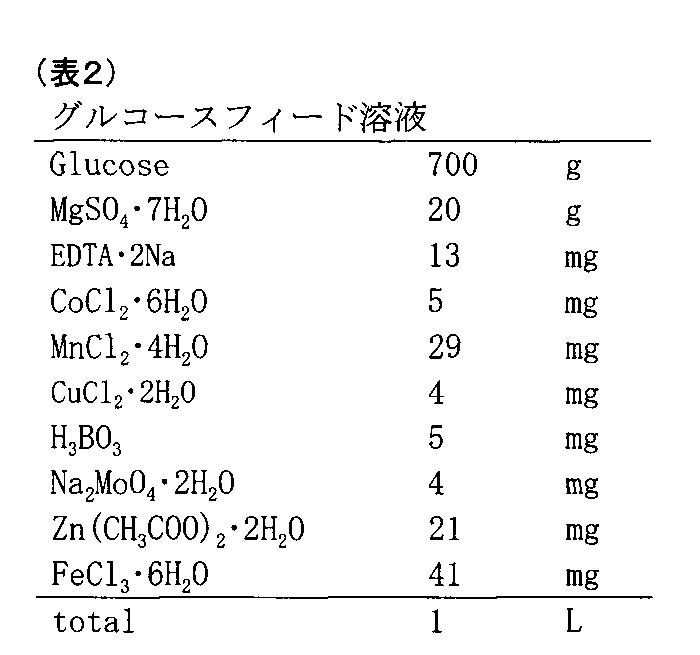
- the culture conditions are as follows: culture temperature 32 ° C .; culture pH 6.0 [lower limit]; alkali addition 28% (weight / volume) ammonia water; stirring 850 rpm; The glucose feed solution as a raw material (Table 2) was appropriately added so that the glucose concentration in the culture solution was 0 to 5 g / L.
- the above culture broth was centrifuged at 10,000 g ⁇ 10 minutes at 4 ° C. to recover the supernatant, and the glucaric acid concentration of the culture supernatant was measured.
- Shim-Pak SCR-H guard column
- Shim-Pak SCR-101H both trade names, manufactured by Shimadzu GL
- HPLC analysis detector: RI, column temperature: (40 ° C., flow rate: 1 mL / min, moving layer: 0.1% formic acid
- concentration of glucaric acid in the culture supernatant was quantified.
- the inositol monophosphate synthase gene, the inositol monophosphatase gene, the myoinositol oxygenase gene, and the uronic acid dehydrogenase gene in the transformant carrying the inositol-1-phosphate synthase gene About 73 g / L (culture time: 68 hours) of glucaric acid was produced in the culture supernatant of the transformant.
- glucaric acid production test was carried out according to Example 2 except that a transformant that does not overproduce inositol monophosphatase was prepared and the inositol monophosphatase non-enhanced strain was used. Only L produced glucaric acid.
- the present invention can be used for industrial fermentation production of glucaric acid.
Landscapes
- Chemical & Material Sciences (AREA)
- Organic Chemistry (AREA)
- Life Sciences & Earth Sciences (AREA)
- Engineering & Computer Science (AREA)
- Zoology (AREA)
- Wood Science & Technology (AREA)
- Health & Medical Sciences (AREA)
- Genetics & Genomics (AREA)
- Bioinformatics & Cheminformatics (AREA)
- General Health & Medical Sciences (AREA)
- Biochemistry (AREA)
- General Engineering & Computer Science (AREA)
- Microbiology (AREA)
- Biotechnology (AREA)
- Chemical Kinetics & Catalysis (AREA)
- General Chemical & Material Sciences (AREA)
- Biomedical Technology (AREA)
- Molecular Biology (AREA)
- Medicinal Chemistry (AREA)
- Micro-Organisms Or Cultivation Processes Thereof (AREA)
- Preparation Of Compounds By Using Micro-Organisms (AREA)
- Enzymes And Modification Thereof (AREA)
Abstract
Description
活性1: 適当な炭素源からグルコース‐6‐リン酸を生成させる活性;
活性2: グルコース‐6‐リン酸をミオイノシトール‐1‐リン酸へ変換する活性、つまり、イノシトール‐1‐リン酸合成酵素活性;
活性3: ミオイノシトール‐1‐リン酸をミオイノシトールへ変換する活性、つまり、ミオイノシトール‐1‐リン酸を基質としたフォスファターゼ活性;
活性4: ミオイノシトールをグルクロン酸へ変換する活性、つまり、ミオイノシトールオキシゲナーゼ活性;及び
活性5: グルクロン酸をグルカル酸へ変換する活性、つまり、ウロン酸デヒドロゲナーゼ活性、
の5つ活性が必要である。しかし、実際には、活性1の生成物であるグルコース‐6‐リン酸は、原核微生物が普遍的に生成する代謝中間体であるので、当該活性を原核微生物に付与することは必須ではない。
従って、本発明の第1の局面は:
(1)グルカル酸の製造方法であって、以下の工程:
1) イノシトール-1-リン酸合成酵素遺伝子、イノシトールモノフォスファターゼ遺伝子、ミオイノシトールオキシゲナーゼ遺伝子及びウロン酸デヒドロゲナーゼ遺伝子を保有する形質転換体であって、該形質転換体内での機能的なイノシトールモノフォスファターゼの過剰生産又はイノシトールモノフォスファターゼの活性化を誘導する遺伝子組換又は変異を有する形質転換体を用意する工程;
2) 前記形質転換体の生育及び/又は維持に適した条件下で、該形質転換体と該形質転換体によりグルカル酸に変換され得る炭素源を接触させる工程;及び
3) 前記2)で得られた培養物からグルカル酸あるいはグルカル酸塩を分離する工程、
を含む、前記製造方法である。
より特定的には、イノシトール-1-リン酸合成酵素遺伝子、イノシトールモノフォスファターゼ遺伝子、ミオイノシトールオキシゲナーゼ遺伝子及びウロン酸デヒドロゲナーゼ遺伝子を保有する形質転換体を用いたグルカル酸の製造方法において、前記形質転換体が、機能的なイノシトールモノフォスファターゼの過剰生産又はイノシトールモノフォスファターゼの活性化を誘導する遺伝子組換又は変異を有する形質転換体であることを特徴とする、前記製造方法である。
(2) 前記炭素源が、前記形質転換体内でグルコース‐6‐リン酸へと変換され得る化合物を含む、上記(1)に記載の製造方法;及び
(3) 前記炭素源が、D‐グルコース、スクロース、オリゴ糖、多糖、でんぷん、セルロース、米ぬか、廃糖密、及びD‐グルコースを含有するバイオマスからなる群から選択される1つ以上である、上記(2)に記載の製造方法である。
(4) 前記形質転換体が、ミオイノシトール資化能を有さない微生物に由来することを特徴とする、上記(1)から(3)のいずれかに記載の製造方法;及び
(5) 前記形質転換体が、大腸菌、バチルス属細菌、コリネバクテリウム属細菌、ザイモモナス属細菌からなる群から選択される細菌に由来する、上記(1)から(4)のいずれかに記載の製造方法を含む。
(6) 前記イノシトールモノフォスファターゼの過剰生産が、前記形質転換体に対して、
a) 外来イノシトールモノフォスファターゼ遺伝子を導入する、
b) 内因性イノシトールモノフォスファターゼ遺伝子のコピー数を増加させる、
c) 内因性イノシトールモノフォスファターゼ遺伝子の調整領域に変異を導入する、
d) 内因性イノシトールモノフォスファターゼ遺伝子の調整領域を高発現誘導性外来調整領域で置換する、又は
e) 内因性イノシトールモノフォスファターゼ遺伝子の調整領域を欠失させる、
ことにより誘導される、上記(1)から(5)のいずれかに記載の製造方法;及び
(7) 前記イノシトールモノフォスファターゼの過剰生産が、前記形質転換体に対して外来イノシトールモノフォスファターゼ遺伝子を導入することにより誘導される、上記(6)に記載の製造方法を含む。
(8) 前記イノシトールモノフォスファターゼの活性化が、前記形質転換体に対して、
f) 内因性イノシトールモノフォスファターゼ遺伝子に変異を導入する、
g) 内因性イノシトールモノフォスファターゼ遺伝子の一部又は全部を置換する、
h) 内因性イノシトールモノフォスファターゼ遺伝子の一部を欠失させる、
i) イノシトールモノフォスファターゼ活性を低下させる他のタンパク質を減少させる、
j) イノシトールモノフォスファターゼ活性を低下させる化合物の生成を減少させる、
ことにより誘導される、上記(1)から(5)のいずれかに記載の製造方法。
(9) イノシトール-1-リン酸合成酵素遺伝子、イノシトールモノフォスファターゼ遺伝子、ミオイノシトールオキシゲナーゼ遺伝子及びウロン酸デヒドロゲナーゼ遺伝子を保有する形質転換体であって、該形質転換体内での機能的なイノシトールモノフォスファターゼの過剰生産又はイノシトールモノフォスファターゼの活性化を誘導する遺伝子組換又は変異を有する形質転換体である。
より特定的には、イノシトール-1-リン酸合成酵素遺伝子、イノシトールモノフォスファターゼ遺伝子、ミオイノシトールオキシゲナーゼ遺伝子及びウロン酸デヒドロゲナーゼ遺伝子を保有する形質転換体において、機能的なイノシトールモノフォスファターゼの過剰生産又はイノシトールモノフォスファターゼの活性化を誘導する遺伝子組換又は変異を有することを特徴とする、前記形質転換体である。
(10) 前記形質転換体が、ミオイノシトール資化能を有さない微生物に由来することを特徴とする、上記(9)に記載の形質転換体;
(11) 前記形質転換体が、大腸菌、バチルス属細菌、コリネバクテリウム属細菌、ザイモモナス属細菌からなる群から選択される細菌に由来する、上記(9)又は(10)に記載の形質転換体;
(12) 前記イノシトールモノフォスファターゼの過剰生産が、前記形質転換体に対して、
a) 外来イノシトールモノフォスファターゼ遺伝子を導入する、
b) 内因性イノシトールモノフォスファターゼ遺伝子のコピー数を増加させる、
c) 内因性イノシトールモノフォスファターゼ遺伝子の調整領域に変異を導入する、
d) 内因性イノシトールモノフォスファターゼ遺伝子の調整領域を高発現誘導性外来調整領域で置換する、又は
e) 内因性イノシトールモノフォスファターゼ遺伝子の調整領域を欠失させる、
ことにより誘導される、上記(9)から(11)のいずれかに記載の形質転換体;
(13) 前記イノシトールモノフォスファターゼの過剰生産が、前記形質転換体に対して外来イノシトールモノフォスファターゼ遺伝子を導入することにより誘導される、上記(12)に記載の形質転換体;及び
(14) 前記イノシトールモノフォスファターゼの活性化が、前記形質転換体に対して、
f) 内因性イノシトールモノフォスファターゼ遺伝子に変異を導入する、
g) 内因性イノシトールモノフォスファターゼ遺伝子の一部又は全部を置換する、
h) 内因性イノシトールモノフォスファターゼ遺伝子の一部を欠失させる、
i) イノシトールモノフォスファターゼ活性を低下させる他のタンパク質を減少させる、
j) イノシトールモノフォスファターゼ活性を低下させる化合物の生成を減少させる、
ことにより誘導される、上記(9)から(11)のいずれかに記載の形質転換体である。

ACCESSION No.AY738258(Homo sapiens myo-inositol oxygenase (MIOX))
ACCESSION No.NM101319(Arabidopsis thaliana inositol oxygenase 1 (MIOX1))
ACCESSION No.NM001101065(Bos taurus myo-inositol oxygenase (MIOX))
ACCESSION No.NM001030266(Danio rerio myo-inositol oxygenase (miox))
ACCESSION No.NM214102(Sus scrofa myo-inositol oxygenase (MIOX))
ACCESSION No.AY064416(Homo sapiens myo-inositol oxygenase (MIOX))
ACCESSION No.NM001247664(Solanum lycopersicum myo-inositol oxygenase (MIOX))
ACCESSION No.XM630762(Dictyostelium discoideum AX4 inositol oxygenase (miox))
ACCESSION No.NM145771(Rattus norvegicus myo-inositol oxygenase (Miox))
ACCESSION No.NM017584(Homo sapiens myo-inositol oxygenase (MIOX))
ACCESSION No.NM001131282(Pongo abelii myo-inositol oxygenase (MIOX))
特に、配列番号5で示されるコード化領域ヌクレオチド配列を有するmiox遺伝子の使用は便利である。

ACCESSION No.BK006462(Agrobacterium tumefaciens str. C58 uronate dehydrogenase (udh) gene)
ACCESSION No.EU377538(Pseudomonas syringae pv. tomato str. DC3000 uronate dehydrogenase (udh) gene)
特に、配列番号7で示されるコード化領域ヌクレオチド配列を有するudh遺伝子の使用は便利である。
上記、セルロースや多糖類などの炭素源を宿主微生物が資化できない場合は、当該宿主微生物に外来遺伝子を導入するなどの公知の遺伝子工学的手法を施すことで、これら炭素源を使用したグルカル酸生産に適応させることができる。外来遺伝子としては、例えば、セルラーゼ遺伝子やアミラーゼ遺伝子などを挙げることができる。
1-a)イノシトールモノフォスファターゼ発現カセット
大腸菌株W3110(NBRC 12713)をLB培地中(2ml)で37℃にて振盪培養した。培養終了後、培養液から菌体を回収し、Nucleo Spin Tissue(製品名、MACHEREY-NAGEL社製)を使用してゲノムDNAを抽出した。抽出したゲノムDNAを鋳型に用い、以下のプライマーによりPCR増幅し(PrimeSTAR Max DNA Polymerase(製品名、タカラバイオ製) 反応条件:98℃ 10sec,55℃ 5sec,72℃ 20sec,28cycle)、suhB遺伝子のコード領域(配列番号3)をクローニングした。

得られたsuhBコード領域は下記配列のプロモーターの下流に転写可能に挿入した。

すなわち、プラスミドpNFP-A51(FERM P-22182として、独立行政法人製品評価技術基盤機構特許生物寄託センターに2011年10月25日に寄託した。国際寄託番号:FERM BP-11515)のマルチクローニングサイトにターミネーター配列及び前記プロモーター配列を挿入した。導入されたプロモーター配列の下流に上記でクローニングされたsuhBコード領域をライゲーションして、pNFP-A54を構築した。構築したpNFP-A54を、塩化カルシウム法(羊土社 遺伝子工学実験ノート 上 田村隆明著、参照)により大腸菌AKC-016株(FERM P-22104として、独立行政法人製品評価技術基盤機構特許微生物寄託センターに2011年4月20日に寄託した。国際寄託番号:FERM BP-11512)にトランスフェクトした。SDS-PAGEにより当該大腸菌の可溶性画分でのイノシトールモノフォスファターゼの高発現を確認した。
酒精酵母の培養液から菌体を回収し、Nucleo Spin Tissue(製品名、MACHEREY-NAGEL社製)を使用してゲノムDNAを抽出した。抽出したゲノムDNAを鋳型に用い、以下のプライマーによりPCR増幅し(PrimeSTAR Max DNA Polymerase(製品名、タカラバイオ製) 反応条件:98℃ 10sec,55℃ 5sec,72℃ 20sec,28cycle)、INO1遺伝子のコード領域(配列番号1)をクローニングした。

得られたino1コード領域は下記配列のプロモーターの下流に転写可能に挿入した。

すなわち、上記プラスミドpNFP-A51のマルチクローニングサイトにターミネーター配列及び前記プロモーター配列を挿入した。導入されたプロモーター配列の下流に上記でクローニングされたino1コード領域をライゲーションして、pNFP-D78を構築した。構築したpNFP-D78を、塩化カルシウム法(羊土社 遺伝子工学実験ノート 上 田村隆明著、参照)により大腸菌AKC-016株(FERM P-22104として、独立行政法人製品評価技術基盤機構特許微生物寄託センターに2011年4月20日に寄託した。国際寄託番号:FERM BP-11512)にトランスフェクトした。SDS-PAGEにより当該大腸菌の可溶性画分でのイノシトール‐1‐リン酸合成酵素の高発現を確認した。
ミオイノシトールオキシゲナーゼ(miox)遺伝子は、配列番号5のヌクレオチド配列を有するDNAを人工合成により作製し、当該DNAを鋳型にして以下のプライマーによりPCR(PrimeSTAR Max DNA Polymerase(製品名、タカラバイオ製) 反応条件:98℃ 10sec,55℃ 5sec,72℃ 20sec,28cycle)を行うことで得た。

得られたmioxコード領域は配列番号11のプロモーターの下流に転写可能に挿入した。すなわち、前記pNFP-A51のマルチクローニングサイトにターミネーター配列及び前記プロモーター配列を挿入した。導入されたプロモーター配列の下流に上記でクローニングされたmioxコード領域をライゲーションして、pNFP-H26を構築した。構築したpNFP-H26を、塩化カルシウム法(羊土社 遺伝子工学実験ノート 上 田村隆明著、参照)により大腸菌株FERM P-22104にトランスフェクトした。SDS-PAGEにより当該大腸菌の可溶性画分でのミオイノシトールオキシゲナーゼの高発現を確認した。
ウロン酸デヒドロゲナーゼ(udh)遺伝子は、配列番号7のヌクレオチド配列を有するDNAを人工合成により作製し、当該DNAを鋳型にして以下のプライマーによりPCR(PrimeSTAR Max DNA Polymerase(製品名、タカラバイオ製) 反応条件:98℃ 10sec,55℃ 5sec,72℃ 20sec,28cycle)を行うことで得た。

得られたudhコード領域は配列番号11のプロモーターの下流に転写可能に挿入した。すなわち、前記pNFP-A51のマルチクローニングサイトにターミネーター配列及び前記プロモーター配列を挿入した。導入されたプロモーター配列の下流に上記でクローニングされたudhコード領域をライゲーションして、pNFP-H45を構築した。構築したpNFP-H45を、塩化カルシウム法(羊土社 遺伝子工学実験ノート 上 田村隆明著、参照)により大腸菌株FERM P-22104にトランスフェクトした。SDS-PAGEにより当該大腸菌の可溶性画分でのウロン酸デヒドロゲナーゼの高発現を確認した。
上記で作製したpNFP-D78をSalIで消化し、平滑末端化及び5’末端脱リン酸化した。pNFP-A54中のsuhB発現カセットをクローニングして、pNFP-D78にライゲーションした。pNFP-D78中のINO1発現カセットと順方向にsuhB発現カセットがライゲーションしていたpNFP-G22を取得した。次いで、pNFP-G22をSalIで消化し、平滑末端化及び5’末端脱リン酸化した。実施例1で作製したpNFP-H26中のmiox発現カセット及びpNFP-H45中のudh発現カセットをクローニングして、両発現カセットをpNFP-G22にライゲーションした。pNFP-G22中のINO1発現カセット及びsuhB発現カセットと順方向にmiox発現カセット及びudh発現カセットがライゲーションしていた本発明のプラスミドを取得した。
2-a) 発現カセット含有プラスミドでトランスフェクトした形質転換体によるJar培養槽を用いたグルカル酸の生産
上記の手順に従って構築した本発明のプラスミドを、大腸菌AKC-016株(FERM P-22104として、独立行政法人製品評価技術基盤機構特許微生物寄託センターに2011年4月20日に寄託した。国際寄託番号:FERM BP-11512)に塩化カルシウム法(羊土社 遺伝子工学実験ノート 上 田村隆明著、参照)を用いてトランスフェクトした。
得られた形質転換体を、アンピシリン(100mg/L)含有LBプレート上で、37℃、一日間培養して、コロニーを形成させた。アンピシリン(100mg/L)を含むLB培地30mLを150mL容のフラスコに入れ、上記プレートからコロニーを白金耳で植菌し、37℃で、3~5時間、OD(600nm)が0.5程度になるまで180rpmで培養を行い、これを本培養のための前培養液とした。
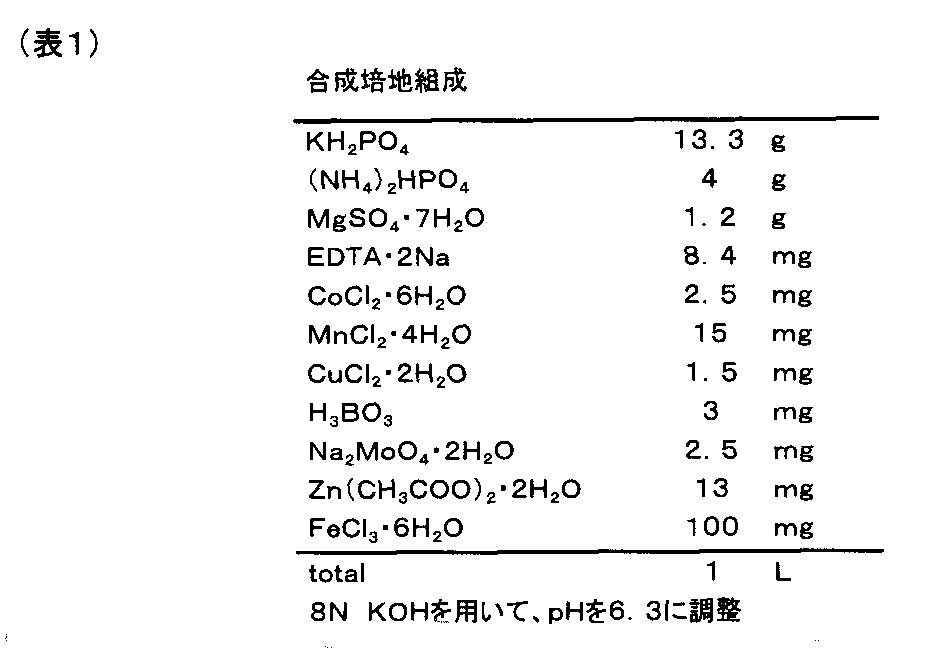
1000mL容のJar培養装置(丸菱バイオエンジ社製)に、10g/Lのグルコースと、100mg/Lのアンピシリンを含む合成培地(表1)を300mL入れ、6mLの前培養液を添加し本培養(Jar培養装置を用いたグルカル酸生産試験)を行った。培養条件は次のとおり培養温度 32℃;培養pH 6.0〔下限〕;アルカリ添加 28%(重量/容量)アンモニア水;攪拌 850rpm;通気 1vvm。原料となるグルコースフィード溶液(表2)は、培養液中のグルコース濃度が0~5g/Lとなるように適宜添加した。
上記の培養液を、4℃で、10,000g×10分間遠心分離して上清を回収し、培養上清のグルカル酸濃度を測定した。具体的には、Shim-Pak SCR-H(ガードカラム)及びShim-Pak SCR-101H(いずれも商品名、島津ジーエルシー社製)を連結して、HPLC分析(検出器:RI、カラム温度:40℃、流速:1mL/min、移動層:0.1% ギ酸)を行うことで、培養上清中のグルカル酸濃度を定量した。
イノシトールモノフォスファターゼを過剰生産しない形質転換体を作製し、当該イノシトールモノフォスファターゼ非強化株を用いた以外は、上記実施例2に従ってグルカル酸生産試験を行ったところ、培養時間68時間で0.26g/Lしかグルカル酸を生産しなかった。
Claims (14)
- グルカル酸の製造方法であって、以下の工程:
1) イノシトール-1-リン酸合成酵素遺伝子、イノシトールモノフォスファターゼ遺伝子、ミオイノシトールオキシゲナーゼ遺伝子及びウロン酸デヒドロゲナーゼ遺伝子を保有する形質転換体であって、該形質転換体内での機能的なイノシトールモノフォスファターゼの過剰生産又はイノシトールモノフォスファターゼの活性化を誘導する遺伝子組換又は変異を有する形質転換体を用意する工程;
2) 前記形質転換体の生育及び/又は維持に適した条件下で、該形質転換体と該形質転換体によりグルカル酸に変換され得る炭素源を接触させる工程;及び
3) 前記2)で得られた培養物からグルカル酸あるいはグルカル酸塩を分離する工程、
を含む、前記製造方法。 - 前記炭素源が、前記形質転換体内でグルコース‐6‐リン酸へと変換され得る化合物を含む、請求項1に記載の製造方法。
- 前記炭素源が、D‐グルコース、スクロース、オリゴ糖、多糖、でんぷん、セルロース、米ぬか、廃糖密、及びD‐グルコースを含有するバイオマスからなる群から選択される1つ以上である、請求項2に記載の製造方法。
- 前記形質転換体が、ミオイノシトール資化能を有さない微生物に由来することを特徴とする、請求項1乃至3のいずれか1項に記載の製造方法。
- 前記形質転換体が、大腸菌、バチルス属細菌、コリネバクテリウム属細菌、ザイモモナス属細菌からなる群から選択される細菌に由来する、請求項1乃至4のいずれか1項に記載の製造方法。
- 前記イノシトールモノフォスファターゼの過剰生産が、前記形質転換体に対して、
a) 外来イノシトールモノフォスファターゼ遺伝子を導入する、
b) 内因性イノシトールモノフォスファターゼ遺伝子のコピー数を増加させる、
c) 内因性イノシトールモノフォスファターゼ遺伝子の調整領域に変異を導入する、
d) 内因性イノシトールモノフォスファターゼ遺伝子の調整領域を高発現誘導性外来調整領域で置換する、又は
e) 内因性イノシトールモノフォスファターゼ遺伝子の調整領域を欠失させる、
ことにより誘導される、請求項1乃至5のいずれか1項に記載の製造方法。 - 前記イノシトールモノフォスファターゼの過剰生産が、前記形質転換体に対して外来イノシトールモノフォスファターゼ遺伝子を導入することにより誘導される、請求項6に記載の製造方法。
- 前記イノシトールモノフォスファターゼの活性化が、前記形質転換体に対して、
f) 内因性イノシトールモノフォスファターゼ遺伝子に変異を導入する、
g) 内因性イノシトールモノフォスファターゼ遺伝子の一部又は全部を置換する、
h) 内因性イノシトールモノフォスファターゼ遺伝子の一部を欠失させる、
i) イノシトールモノフォスファターゼ活性を低下させる他のタンパク質を減少させる、
j) イノシトールモノフォスファターゼ活性を低下させる化合物の生成を減少させる、
ことにより誘導される、請求項1乃至5のいずれか1項に記載の製造方法。 - イノシトール-1-リン酸合成酵素遺伝子、イノシトールモノフォスファターゼ遺伝子、ミオイノシトールオキシゲナーゼ遺伝子及びウロン酸デヒドロゲナーゼ遺伝子を保有する形質転換体であって、該形質転換体内での機能的なイノシトールモノフォスファターゼの過剰生産又はイノシトールモノフォスファターゼの活性化を誘導する遺伝子組換又は変異を有する形質転換体。
- 前記形質転換体が、ミオイノシトール資化能を有さない微生物に由来することを特徴とする、請求項9に記載の形質転換体。
- 前記形質転換体が、大腸菌、バチルス属細菌、コリネバクテリウム属細菌、ザイモモナス属細菌からなる群から選択される細菌に由来する、請求項9又は10に記載の形質転換体。
- 前記イノシトールモノフォスファターゼの過剰生産が、前記形質転換体に対して、
a) 外来イノシトールモノフォスファターゼ遺伝子を導入する、
b) 内因性イノシトールモノフォスファターゼ遺伝子のコピー数を増加させる、
c) 内因性イノシトールモノフォスファターゼ遺伝子の調整領域に変異を導入する、
d) 内因性イノシトールモノフォスファターゼ遺伝子の調整領域を高発現誘導性外来調整領域で置換する、又は
e) 内因性イノシトールモノフォスファターゼ遺伝子の調整領域を欠失させる、
ことにより誘導される、請求項9乃至11のいずれか1項に記載の形質転換体。 - 前記イノシトールモノフォスファターゼの過剰生産が、前記形質転換体に対して外来イノシトールモノフォスファターゼ遺伝子を導入することにより誘導される、請求項12に記載の形質転換体。
- 前記イノシトールモノフォスファターゼの活性化が、前記形質転換体に対して、
f) 内因性イノシトールモノフォスファターゼ遺伝子に変異を導入する、
g) 内因性イノシトールモノフォスファターゼ遺伝子の一部又は全部を置換する、
h) 内因性イノシトールモノフォスファターゼ遺伝子の一部を欠失させる、
i) イノシトールモノフォスファターゼ活性を低下させる他のタンパク質を減少させる、
j) イノシトールモノフォスファターゼ活性を低下させる化合物の生成を減少させる、
ことにより誘導される、請求項9乃至11のいずれか1項に記載の形質転換体。
Priority Applications (4)
| Application Number | Priority Date | Filing Date | Title |
|---|---|---|---|
| US14/377,559 US9506091B2 (en) | 2012-02-24 | 2013-02-19 | Method for producing glucaric acid |
| CN201380006973.XA CN104080918B (zh) | 2012-02-24 | 2013-02-19 | 葡萄糖二酸的制造方法 |
| JP2014500708A JP6012703B2 (ja) | 2012-02-24 | 2013-02-19 | グルカル酸の製造方法 |
| EP13751346.1A EP2818552B1 (en) | 2012-02-24 | 2013-02-19 | Method for producing glucaric acid |
Applications Claiming Priority (2)
| Application Number | Priority Date | Filing Date | Title |
|---|---|---|---|
| JP2012-039129 | 2012-02-24 | ||
| JP2012039129 | 2012-02-24 |
Publications (1)
| Publication Number | Publication Date |
|---|---|
| WO2013125509A1 true WO2013125509A1 (ja) | 2013-08-29 |
Family
ID=49005694
Family Applications (1)
| Application Number | Title | Priority Date | Filing Date |
|---|---|---|---|
| PCT/JP2013/053958 Ceased WO2013125509A1 (ja) | 2012-02-24 | 2013-02-19 | グルカル酸の製造方法 |
Country Status (6)
| Country | Link |
|---|---|
| US (1) | US9506091B2 (ja) |
| EP (1) | EP2818552B1 (ja) |
| JP (2) | JP6012703B2 (ja) |
| CN (1) | CN104080918B (ja) |
| TW (1) | TWI488970B (ja) |
| WO (1) | WO2013125509A1 (ja) |
Cited By (1)
| Publication number | Priority date | Publication date | Assignee | Title |
|---|---|---|---|---|
| WO2018181759A1 (ja) | 2017-03-31 | 2018-10-04 | 学校法人慶應義塾 | 併用抗がん剤の感受性の判定マーカー |
Families Citing this family (8)
| Publication number | Priority date | Publication date | Assignee | Title |
|---|---|---|---|---|
| CN104312987B (zh) * | 2014-10-21 | 2017-12-29 | 江南大学 | 一种生物合成葡萄糖醛酸和葡萄糖二酸的方法 |
| CN104312934A (zh) * | 2014-10-22 | 2015-01-28 | 江南大学 | 一种构建重组酵母生物合成葡萄糖醛酸的方法 |
| CN106929459B (zh) * | 2017-03-30 | 2026-03-20 | 华南理工大学 | 一种重组大肠杆菌及其构建方法与通过代谢工程生产葡萄糖二酸的方法 |
| CN107022514A (zh) * | 2017-03-30 | 2017-08-08 | 华南理工大学 | 一种重组大肠杆菌及其构建方法与通过代谢工程生产葡萄糖醛酸的方法 |
| CN108384796B (zh) * | 2018-03-05 | 2021-11-26 | 北京化工大学 | 一种利用蔗糖生物合成d-葡萄糖二酸的方法 |
| WO2024192251A1 (en) * | 2023-03-14 | 2024-09-19 | Solugen, Inc. | Multifunctional cement additives and methods of using same |
| CN119506231B (zh) * | 2023-08-23 | 2026-03-10 | 安徽华恒生物科技股份有限公司 | 一种肌醇加氧酶突变体及其在葡萄糖二酸制备中的应用 |
| WO2025098128A1 (en) * | 2023-11-06 | 2025-05-15 | Enzymaster (Ningbo) Bio-Engineering Co., Ltd. | A method of synthesizing glucaric acid and the enzymes used thereof |
Citations (2)
| Publication number | Priority date | Publication date | Assignee | Title |
|---|---|---|---|---|
| WO2002074926A2 (en) | 2001-03-19 | 2002-09-26 | Cargill Incorporated | Myo-inositol oxygenases |
| WO2009145838A2 (en) | 2008-04-04 | 2009-12-03 | Massachusetts Institute Of Technology | Cellular production of glucaric acid |
-
2013
- 2013-02-19 CN CN201380006973.XA patent/CN104080918B/zh active Active
- 2013-02-19 WO PCT/JP2013/053958 patent/WO2013125509A1/ja not_active Ceased
- 2013-02-19 JP JP2014500708A patent/JP6012703B2/ja active Active
- 2013-02-19 EP EP13751346.1A patent/EP2818552B1/en active Active
- 2013-02-19 US US14/377,559 patent/US9506091B2/en active Active
- 2013-02-22 TW TW102106172A patent/TWI488970B/zh active
-
2016
- 2016-05-19 JP JP2016100208A patent/JP6144804B2/ja active Active
Patent Citations (3)
| Publication number | Priority date | Publication date | Assignee | Title |
|---|---|---|---|---|
| WO2002074926A2 (en) | 2001-03-19 | 2002-09-26 | Cargill Incorporated | Myo-inositol oxygenases |
| WO2009145838A2 (en) | 2008-04-04 | 2009-12-03 | Massachusetts Institute Of Technology | Cellular production of glucaric acid |
| JP2011516063A (ja) * | 2008-04-04 | 2011-05-26 | マサチューセッツ インスティテュート オブ テクノロジー | グルカン酸の細胞での産生 |
Non-Patent Citations (11)
| Title |
|---|
| "Cloning Vectors", 1985, ELSEVIER |
| "Gene Expression Technology: Methods in Enzymology", vol. 185, 1990, ACADEMIC PRESS |
| CHEN, LIANGJING ET AL.: "Overexpression, purification, and analysis of complementation behavior of E. coli SuhB protein: comparison with bacterial and archaeal inositol monophosphatases", BIOCHEMISTRY, vol. 39, 2000, pages 4145 - 4153, XP055081993 * |
| F. AUSUBEL ET AL.: "Current Protocols in Molecular Biology", 1997, WILEY INTERSCIENCE |
| GENE, vol. 105, 1991, pages 61 - 72 |
| INADA, T. ET AL.: "Lethal double- stranded RNA processing activity of ribonuclease III in the absence of suhB protein of Escherichia coli", BIOCHIMIE, vol. 77, 1995, pages 294 - 302, XP055081995 * |
| MATSUHISA, AKIO ET AL.: "Inositol monophosphatase activity from the Escherichia coli suhB gene product", J. BACTERIOL., vol. 177, no. 1, 1995, pages 200 - 205, XP002112923 * |
| MOON, TAE SEOK ET AL.: "Production of glucaric acid from a synthetic pathway in recombinant Escherichia coli", APPL. ENVIRON. MICROBIOL., vol. 75, no. 3, 2009, pages 589 - 595, XP002575769 * |
| MOON, TAE SEOK ET AL.: "Use of modular, synthetic scaffolds for improved production of glucaric acid in engineered E. coli", METAB. ENG., vol. 12, no. 3, 2010, pages 298 - 305, XP027013821 * |
| SAMBROOK ET AL.: "Molecular Cloning: Laboratory Manual", 1989, COLD SPRING HARBOR LABORATORY PRESS |
| T. WERPY; G. PETERSON, TOP VALUE ADDED CHEMICALS FROM BIOMASS VOLUME 1-RESULTS OF SCREENING FOR POTENTIAL CANDIDATES FROM SUGARS AND SYNTHESIS GAS, vol. 1, August 2004 (2004-08-01), Retrieved from the Internet <URL:http://wwwl.eere.energy.gov/biomass/pdfs/35523.pdf> |
Cited By (1)
| Publication number | Priority date | Publication date | Assignee | Title |
|---|---|---|---|---|
| WO2018181759A1 (ja) | 2017-03-31 | 2018-10-04 | 学校法人慶應義塾 | 併用抗がん剤の感受性の判定マーカー |
Also Published As
| Publication number | Publication date |
|---|---|
| JPWO2013125509A1 (ja) | 2015-07-30 |
| US20150010969A1 (en) | 2015-01-08 |
| TW201339306A (zh) | 2013-10-01 |
| JP6012703B2 (ja) | 2016-10-25 |
| CN104080918B (zh) | 2017-02-22 |
| US9506091B2 (en) | 2016-11-29 |
| EP2818552A1 (en) | 2014-12-31 |
| JP6144804B2 (ja) | 2017-06-07 |
| TWI488970B (zh) | 2015-06-21 |
| EP2818552A4 (en) | 2015-06-17 |
| EP2818552B1 (en) | 2017-12-27 |
| JP2016163587A (ja) | 2016-09-08 |
| CN104080918A (zh) | 2014-10-01 |
Similar Documents
| Publication | Publication Date | Title |
|---|---|---|
| JP6012703B2 (ja) | グルカル酸の製造方法 | |
| Kim et al. | Development of metabolically engineered Corynebacterium glutamicum for enhanced production of cadaverine and its use for the synthesis of bio-polyamide 510 | |
| JP5781669B2 (ja) | ミオイノシトール及びミオイノシトール誘導体の製造方法 | |
| Park et al. | Production of 13S-hydroxy-9 (Z)-octadecenoic acid from linoleic acid by whole recombinant cells expressing linoleate 13-hydratase from Lactobacillus acidophilus | |
| AU2013267968A1 (en) | Biosynthetic pathways, recombinant cells, and methods | |
| US20130210097A1 (en) | Glycolic acid fermentative production with a modified microorganism | |
| JP7727616B2 (ja) | 中鎖脂肪酸誘導体の生産のための改良された活性を有するチオエステラーゼ変種 | |
| JP6110542B2 (ja) | シロ‐イノシトールの製造方法 | |
| KR20220032084A (ko) | 유전자 재조합 미생물 및 디아민 화합물의 제조 방법 | |
| WO2014049382A2 (en) | Ethylenediamine fermentative production by a recombinant microorganism | |
| KR101785150B1 (ko) | 모듈식 스캐폴드를 이용한 감마 아미노부티르산의 생산방법 | |
| JP6576650B2 (ja) | グルコースの溶出抑制方法 | |
| KR101533150B1 (ko) | 모듈식 스캐폴드를 이용한 감마 아미노부틸산 생산방법 | |
| WO2024243302A2 (en) | Microorganisms and methods for increased diamine production | |
| KR20150038857A (ko) | 세포 표면 발현 기술을 이용한 gaba의 대량 생산방법 | |
| JP2021108558A (ja) | 2,5−ピリジンジカルボン酸類生産能を有する形質転換細胞 |
Legal Events
| Date | Code | Title | Description |
|---|---|---|---|
| 121 | Ep: the epo has been informed by wipo that ep was designated in this application |
Ref document number: 13751346 Country of ref document: EP Kind code of ref document: A1 |
|
| ENP | Entry into the national phase |
Ref document number: 2014500708 Country of ref document: JP Kind code of ref document: A |
|
| WWE | Wipo information: entry into national phase |
Ref document number: 2013751346 Country of ref document: EP |
|
| WWE | Wipo information: entry into national phase |
Ref document number: 14377559 Country of ref document: US |
|
| NENP | Non-entry into the national phase |
Ref country code: DE |