WO2013126413A1 - Voc-free, low viscosity, led-curable coating and method of application - Google Patents
Voc-free, low viscosity, led-curable coating and method of application Download PDFInfo
- Publication number
- WO2013126413A1 WO2013126413A1 PCT/US2013/026871 US2013026871W WO2013126413A1 WO 2013126413 A1 WO2013126413 A1 WO 2013126413A1 US 2013026871 W US2013026871 W US 2013026871W WO 2013126413 A1 WO2013126413 A1 WO 2013126413A1
- Authority
- WO
- WIPO (PCT)
- Prior art keywords
- flowable composition
- weight
- composition
- acrylate
- coating
- Prior art date
- Legal status (The legal status is an assumption and is not a legal conclusion. Google has not performed a legal analysis and makes no representation as to the accuracy of the status listed.)
- Ceased
Links
Classifications
-
- C—CHEMISTRY; METALLURGY
- C09—DYES; PAINTS; POLISHES; NATURAL RESINS; ADHESIVES; COMPOSITIONS NOT OTHERWISE PROVIDED FOR; APPLICATIONS OF MATERIALS NOT OTHERWISE PROVIDED FOR
- C09D—COATING COMPOSITIONS, e.g. PAINTS, VARNISHES OR LACQUERS; FILLING PASTES; CHEMICAL PAINT OR INK REMOVERS; INKS; CORRECTING FLUIDS; WOODSTAINS; PASTES OR SOLIDS FOR COLOURING OR PRINTING; USE OF MATERIALS THEREFOR
- C09D175/00—Coating compositions based on polyureas or polyurethanes; Coating compositions based on derivatives of such polymers
- C09D175/04—Polyurethanes
- C09D175/14—Polyurethanes having carbon-to-carbon unsaturated bonds
-
- C—CHEMISTRY; METALLURGY
- C08—ORGANIC MACROMOLECULAR COMPOUNDS; THEIR PREPARATION OR CHEMICAL WORKING-UP; COMPOSITIONS BASED THEREON
- C08F—MACROMOLECULAR COMPOUNDS OBTAINED BY REACTIONS ONLY INVOLVING CARBON-TO-CARBON UNSATURATED BONDS
- C08F220/00—Copolymers of compounds having one or more unsaturated aliphatic radicals, each having only one carbon-to-carbon double bond, and only one being terminated by only one carboxyl radical or a salt, anhydride ester, amide, imide or nitrile thereof
- C08F220/02—Monocarboxylic acids having less than ten carbon atoms; Derivatives thereof
- C08F220/10—Esters
-
- C—CHEMISTRY; METALLURGY
- C08—ORGANIC MACROMOLECULAR COMPOUNDS; THEIR PREPARATION OR CHEMICAL WORKING-UP; COMPOSITIONS BASED THEREON
- C08G—MACROMOLECULAR COMPOUNDS OBTAINED OTHERWISE THAN BY REACTIONS ONLY INVOLVING UNSATURATED CARBON-TO-CARBON BONDS
- C08G75/00—Macromolecular compounds obtained by reactions forming a linkage containing sulfur with or without nitrogen, oxygen, or carbon in the main chain of the macromolecule
- C08G75/02—Polythioethers
- C08G75/04—Polythioethers from mercapto compounds or metallic derivatives thereof
- C08G75/045—Polythioethers from mercapto compounds or metallic derivatives thereof from mercapto compounds and unsaturated compounds
-
- C—CHEMISTRY; METALLURGY
- C09—DYES; PAINTS; POLISHES; NATURAL RESINS; ADHESIVES; COMPOSITIONS NOT OTHERWISE PROVIDED FOR; APPLICATIONS OF MATERIALS NOT OTHERWISE PROVIDED FOR
- C09D—COATING COMPOSITIONS, e.g. PAINTS, VARNISHES OR LACQUERS; FILLING PASTES; CHEMICAL PAINT OR INK REMOVERS; INKS; CORRECTING FLUIDS; WOODSTAINS; PASTES OR SOLIDS FOR COLOURING OR PRINTING; USE OF MATERIALS THEREFOR
- C09D163/00—Coating compositions based on epoxy resins; Coating compositions based on derivatives of epoxy resins
-
- C—CHEMISTRY; METALLURGY
- C09—DYES; PAINTS; POLISHES; NATURAL RESINS; ADHESIVES; COMPOSITIONS NOT OTHERWISE PROVIDED FOR; APPLICATIONS OF MATERIALS NOT OTHERWISE PROVIDED FOR
- C09D—COATING COMPOSITIONS, e.g. PAINTS, VARNISHES OR LACQUERS; FILLING PASTES; CHEMICAL PAINT OR INK REMOVERS; INKS; CORRECTING FLUIDS; WOODSTAINS; PASTES OR SOLIDS FOR COLOURING OR PRINTING; USE OF MATERIALS THEREFOR
- C09D163/00—Coating compositions based on epoxy resins; Coating compositions based on derivatives of epoxy resins
- C09D163/10—Epoxy resins modified by unsaturated compounds
-
- C—CHEMISTRY; METALLURGY
- C09—DYES; PAINTS; POLISHES; NATURAL RESINS; ADHESIVES; COMPOSITIONS NOT OTHERWISE PROVIDED FOR; APPLICATIONS OF MATERIALS NOT OTHERWISE PROVIDED FOR
- C09D—COATING COMPOSITIONS, e.g. PAINTS, VARNISHES OR LACQUERS; FILLING PASTES; CHEMICAL PAINT OR INK REMOVERS; INKS; CORRECTING FLUIDS; WOODSTAINS; PASTES OR SOLIDS FOR COLOURING OR PRINTING; USE OF MATERIALS THEREFOR
- C09D175/00—Coating compositions based on polyureas or polyurethanes; Coating compositions based on derivatives of such polymers
- C09D175/04—Polyurethanes
- C09D175/14—Polyurethanes having carbon-to-carbon unsaturated bonds
- C09D175/16—Polyurethanes having carbon-to-carbon unsaturated bonds having terminal carbon-to-carbon unsaturated bonds
-
- C—CHEMISTRY; METALLURGY
- C09—DYES; PAINTS; POLISHES; NATURAL RESINS; ADHESIVES; COMPOSITIONS NOT OTHERWISE PROVIDED FOR; APPLICATIONS OF MATERIALS NOT OTHERWISE PROVIDED FOR
- C09D—COATING COMPOSITIONS, e.g. PAINTS, VARNISHES OR LACQUERS; FILLING PASTES; CHEMICAL PAINT OR INK REMOVERS; INKS; CORRECTING FLUIDS; WOODSTAINS; PASTES OR SOLIDS FOR COLOURING OR PRINTING; USE OF MATERIALS THEREFOR
- C09D181/00—Coating compositions based on macromolecular compounds obtained by reactions forming in the main chain of the macromolecule a linkage containing sulfur, with or without nitrogen, oxygen, or carbon only; Coating compositions based on polysulfones; Coating compositions based on derivatives of such polymers
- C09D181/02—Polythioethers; Polythioether-ethers
-
- C—CHEMISTRY; METALLURGY
- C09—DYES; PAINTS; POLISHES; NATURAL RESINS; ADHESIVES; COMPOSITIONS NOT OTHERWISE PROVIDED FOR; APPLICATIONS OF MATERIALS NOT OTHERWISE PROVIDED FOR
- C09D—COATING COMPOSITIONS, e.g. PAINTS, VARNISHES OR LACQUERS; FILLING PASTES; CHEMICAL PAINT OR INK REMOVERS; INKS; CORRECTING FLUIDS; WOODSTAINS; PASTES OR SOLIDS FOR COLOURING OR PRINTING; USE OF MATERIALS THEREFOR
- C09D4/00—Coating compositions, e.g. paints, varnishes or lacquers, based on organic non-macromolecular compounds having at least one polymerisable carbon-to-carbon unsaturated bond ; Coating compositions, based on monomers of macromolecular compounds of groups C09D183/00 - C09D183/16
- C09D4/06—Organic non-macromolecular compounds having at least one polymerisable carbon-to-carbon unsaturated bond in combination with a macromolecular compound other than an unsaturated polymer of groups C09D159/00 - C09D187/00
-
- Y—GENERAL TAGGING OF NEW TECHNOLOGICAL DEVELOPMENTS; GENERAL TAGGING OF CROSS-SECTIONAL TECHNOLOGIES SPANNING OVER SEVERAL SECTIONS OF THE IPC; TECHNICAL SUBJECTS COVERED BY FORMER USPC CROSS-REFERENCE ART COLLECTIONS [XRACs] AND DIGESTS
- Y10—TECHNICAL SUBJECTS COVERED BY FORMER USPC
- Y10T—TECHNICAL SUBJECTS COVERED BY FORMER US CLASSIFICATION
- Y10T428/00—Stock material or miscellaneous articles
- Y10T428/31504—Composite [nonstructural laminate]
-
- Y—GENERAL TAGGING OF NEW TECHNOLOGICAL DEVELOPMENTS; GENERAL TAGGING OF CROSS-SECTIONAL TECHNOLOGIES SPANNING OVER SEVERAL SECTIONS OF THE IPC; TECHNICAL SUBJECTS COVERED BY FORMER USPC CROSS-REFERENCE ART COLLECTIONS [XRACs] AND DIGESTS
- Y10—TECHNICAL SUBJECTS COVERED BY FORMER USPC
- Y10T—TECHNICAL SUBJECTS COVERED BY FORMER US CLASSIFICATION
- Y10T428/00—Stock material or miscellaneous articles
- Y10T428/31504—Composite [nonstructural laminate]
- Y10T428/31551—Of polyamidoester [polyurethane, polyisocyanate, polycarbamate, etc.]
-
- Y—GENERAL TAGGING OF NEW TECHNOLOGICAL DEVELOPMENTS; GENERAL TAGGING OF CROSS-SECTIONAL TECHNOLOGIES SPANNING OVER SEVERAL SECTIONS OF THE IPC; TECHNICAL SUBJECTS COVERED BY FORMER USPC CROSS-REFERENCE ART COLLECTIONS [XRACs] AND DIGESTS
- Y10—TECHNICAL SUBJECTS COVERED BY FORMER USPC
- Y10T—TECHNICAL SUBJECTS COVERED BY FORMER US CLASSIFICATION
- Y10T428/00—Stock material or miscellaneous articles
- Y10T428/31504—Composite [nonstructural laminate]
- Y10T428/31678—Of metal
- Y10T428/31692—Next to addition polymer from unsaturated monomers
- Y10T428/31696—Including polyene monomers [e.g., butadiene, etc.]
-
- Y—GENERAL TAGGING OF NEW TECHNOLOGICAL DEVELOPMENTS; GENERAL TAGGING OF CROSS-SECTIONAL TECHNOLOGIES SPANNING OVER SEVERAL SECTIONS OF THE IPC; TECHNICAL SUBJECTS COVERED BY FORMER USPC CROSS-REFERENCE ART COLLECTIONS [XRACs] AND DIGESTS
- Y10—TECHNICAL SUBJECTS COVERED BY FORMER USPC
- Y10T—TECHNICAL SUBJECTS COVERED BY FORMER US CLASSIFICATION
- Y10T428/00—Stock material or miscellaneous articles
- Y10T428/31504—Composite [nonstructural laminate]
- Y10T428/31855—Of addition polymer from unsaturated monomers
- Y10T428/31931—Polyene monomer-containing
Definitions
- the present invention is broadly concerned with VOC-free protective coatings that can be used to protect surfaces, such as those on bowling lanes.
- Protective coatings are utilized in many products, including furniture, appliances and other electrical devices, floors, automotive exterior paint, and automotive interior parts.
- the coating usually protects plastic, metal, and wooden surfaces from being scratched as well as from other damage.
- the coating also conceals some of the underlying surface imperfections, makes the surface look smoother, and gives a glossier or more matte finish depending on the desired final product look.
- UV light is an electromagnetic radiation with a wavelength shorter than visible light wavelength.
- UV light is an electromagnetic radiation with a wavelength shorter than visible light wavelength.
- UV mercury vapor lamps which can be arc or microwave powered, are utilized. These lamps emit radiation in UVA, UVB, and UVC regions of the electromagnetic spectrum. This radiation is useful in the coating cure process. Besides UV radiation, these lamps produce a large quantities of infrared (IR) radiation (heat) as well as ozone.
- IR infrared
- LED curable coatings.
- LED light sources There are many advantages to using LED light sources over conventional UV mercury lamps. Some of the important advantages include that LEDs require much less power to run, they are instant on/off light sources, and there is no need for bulky cooling systems. In addition, LEDs have a much longer life compared to mercury vapor lamps.
- current commercially available UV LEDs generate neither ozone nor excessive heat that may damage the coating being cured. Current commercially used UV LEDs emit radiation in the close to visible part of UVA (320-400 nm) and visible portion (400-700 nm) of the spectrum.
- High energy UV radiation such as UVC (100-290 nm) is required to effectively cure standard UV coatings that react through free radical mechanisms such as various acrylate coatings in ambient conditions.
- Ambient conditions herein are defined as the presence of oxygen at concentrations that are equal to or above 20% by volume, which can be translated into 18 kPa oxygen partial pressure.
- most of the existing free-radical UV curable coating will not be sufficiently cured under UVA LED light even if UVA absorbing initiators are applied.
- the surface of the coating does not completely cure, i.e., it remains tacky after UVA exposure due to oxygen inhibition.
- the practice to apply a nitrogen blanket in order to properly cure these UV coating compositions is customary even when mercury vapor UV lamps are utilized. This is true especially if high scratch or abrasion resistance is required.
- Coatings that cure through a cationic polymerization route such as those bearing epoxy functionality do not have the downside of the aforementioned property.
- Most of the commercially available cationic photoinitiators do not efficiently absorb light in UVA region.
- the addition of a UVA photosensitizer solves that problem. Therefore, the development of UV LED epoxy coatings looks like a promising path.
- the shortcomings of this route include the yellow/brownish color of the resulting UV-cured epoxy coating, and reduced selection (if compared to available free radical) of low molecular weight highly crosslinkable monomers that are not viscous in order to formulate a 100% solids coating.
- the Environmental protection agency (EPA) VOC regulations are getting more strict each year, especially for indoor coatings and finishes. Therefore, the need exists for a 100% solids or water-based coating that can be cured in ambient conditions with UV LED light.
- the present provides a flowable composition useful for treating a surface.
- the flowable composition is selected from the group consisting of:
- a metal oxide composition comprising:
- silica nanoparticles silica nanoparticles, alumina nanoparticles, or both;
- a polymeric composition comprising a polymer and a photoinitiator dissolved or dispersed in a solvent system, said polymer being selected from the group consisting of epoxies, polyurethanes, acrylates, and mixtures thereof.
- the flowable composition has a viscosity of less than about 200 cP, comprises less than about 5% by weight volatile organic compounds, and is curable by light having a wavelength of from about 320 nm to about 700 nm, and more preferably curable by an LED light source.
- the invention is further concerned with a method of forming a coating on a surface.
- the method involves applying the above flowable composition to the surface.
- the layer is then exposed to light having a wavelength of from about 320 nm to about 700 nm to form the coating, and more particularly to light from an LED light source.
- the invention provides a protected surface, which comprises a cured coating on the surface to be protected.
- the cured coating is formed from the above flowable composition.
- the flowable composition is provided in three embodiments.
- the flowable composition is a metal oxide-containing composition, and it comprises silica and/or alumina nanoparticles, an acrylate (or multiple different types of acrylates), and a photoinitiator.
- This embodiment is preferably mostly or entirely solids. That is, the composition comprises at least about 95% by weight solids, preferably at least about 98% by weight solids, and more preferably about 100% by weight solids, based upon the total weight of the composition taken as 100% by weight.
- Suitable silica and alumina nanoparticles include any commercially available ones, with some specific ones shown in the Examples below. (The Examples also include exemplary commercial products for the other components of this embodiment and the other embodiments as well.)
- the nanoparticles preferably have a particle size of from about 10 nm to about 800 nm, and preferably from about 20 nm to about 250 nm, and are typically provided dispersed in epoxy monomers, acrylate monomers or resins, and a solvent at a level of from about 1 % to about 50% by weight.
- the silica and/or alumina nanoparticles are present in the overall composition at levels of from about 1 % by weight to about 50% by weight, preferably from about 2% by weight to about 45% by weight, and more preferably from about 25% by weight to about 45% by weight, based upon the total weight of the composition taken as 100% by weight.
- Suitable acrylates and other free radical polymerizable monomers include those selected from the group consisting of aliphatic urethane acrylates, epoxy acrylates, melamine acrylates, monofunctional acrylates, methacrylates, ethylenically unsaturated monomers and resins, and multifunctional acrylates (difunctional acrylates).
- Particularly preferred acrylates are selected from the group consisting of acrylate esters, trimethylol propane triacrylate, 1 ,6-hexanediol acrylate, 1 ,6-hexanediol diacrylate, isobornyl acrylate, hexafunctional urethane acrylate, hexafunctional epoxy acrylate, tripropylene glycol diacrylate, epoxy novolak acrylate, ethoxylated trimethylolpropane triacrylate, pentaerythritol triacrylate, dipentaerythritol pentaacrylate, melamine acrylate, propoxylated neopentyl glycol diacrylate, and mixtures thereof.
- acrylate esters trimethylol propane triacrylate
- 1 ,6-hexanediol acrylate 1 ,6-hexanediol diacrylate
- isobornyl acrylate hexafunctional urethan
- the acrylates are present in the composition at levels of from about 20% by weight to about 80% by weight, preferably from about 30% by weight to about 70% by weight, and more preferably from about 45% by weight to about 65% by weight, based upon the total weight of the composition taken as 100% by weight.
- Suitable photoinitiators include those selected from the group consisting of 2,4,6- trimethylbenzoyldiphenylphosphine oxide, bis (2,4,6-trimethylbenzoyl)-phenylphosphineoxide, 4-thiophenyl phenyl diphenyl sulfonium hexafiuoroantimonate, 2 -methyl- 1 -[4-(m ethylthio)- phenyl]-2-(4-mo holinyl)-l -propanone, other phosphine oxide-based photoinitiators, and mixtures thereof.
- the photoinitiators are present in the composition at levels of from about 1% by weight to about 10% by weight, preferably from about 2% by weight to about 8% by weight, and more preferably from about 3% by weight to about 7% by weight, based upon the total weight of the composition taken as 100% by weight.
- the flowable composition is a hybrid composition comprising both FRPMs such as acrylates, methacrylates, ethylenically unsaturated compounds, and mixtures thereof; and cationic polymerizable monomers (CPMs) such as epoxies, vinyl ethers, oxiranes, oxetanes, polyols, and mixture thereof.
- the hybrid composition also comprises a photoinitiator. Even more preferably, the hybrid composition comprises at least two photoinitiators: one for initiating free radical polymerization and one for initiating cationic polymerization.
- the FRPMs are present in the composition at levels of from about 5% by weight to about 95% by weight, preferably from aboutl0% by weight to about 80% by weight, and more preferably from about 50% by weight to about 70% by weight, based upon the total weight of the composition taken as 100% by weight.
- the CPMs are present in the composition at levels of from about 5% by weight to about 95% by weight, preferably from about 10% by weight to about 80% by weight, and more preferably from about 35% by weight to about 75% by weight, based upon the total weight of the composition taken as 100% by weight.
- the total photoinitiator is preferably the same as those discussed above with respect to the metal oxide composition.
- the free radical photoinitiator is present in the composition at levels of from about 1% by weight to about 10% by weight, preferably from about 2% by weight to about 8% by weight, and more preferably from about 3% by weight to about 7% by weight, while the cationic photoinitiator is present in the composition at levels of from about 1% by weight to about 10% by weight, preferably from about 2% by weight to about 8% by weight, and more preferably from about 3% by weight to about 7% by weight, based upon the total weight of the composition taken as 100% by weight.
- Preferred cationic photoinitiators include those selected from the group consisting of dyaryliodonium, triarylsulfonium, triarylsulfoxonium, dialkylhydroxyphenylsulfonium, ferrocenium salts, and diazonium salts.
- This hybrid embodiment preferably also comprises a VOC-exempt solvent.
- a VOC compound or solvent means one of carbon (excluding carbon monoxide, carbon dioxide, carbonic acid, metallic carbides or carbonates, and ammonium carbonate) that participates in atmospheric photochemical reactions.
- VOC-exempt solvents are those that have negligible or no photochemical activity and are defined in 40 C.F.R. 51.100(s)(l), incorporated by reference herein.
- Preferred VOC-exempt solvents for use in the present invention include those selected from the group consisting of dimethyl carbonate, acetone, methyl acetate, p- chlorobenzotrifluoride, propylene carbonate, t-butyl acetate, and mixtures thereof.
- VOC- exempt solvent When a VOC- exempt solvent is utilized, it is preferably present at levels of from about 10% by weight to about 30% by weight, more preferably from about 12% by weight to about 25% by weight, and even more preferably from about 15% by weight to about 20% by weight, based upon the total weight of the composition taken as 100% by weight.
- the hybrid composition can also comprise silica or alumina nanoparticles in the sizes and quantities discussed above with respect to the metal oxide composition.
- the flowable composition is a polymeric composition comprising a polymer or oligomer and a photoinitiator dissolved or dispersed in a solvent system, with the polymer being selected from the group consisting of epoxies, polyurethanes, acrylates, and mixtures thereof.
- the polymer or oligomer is present at levels of from about 60% by weight to about 95% by weight, preferably from about 50% by weight to about 80% by weight, and more preferably from about 60% by weight to about 75% by weight, based upon the total weight of the composition taken as 100% by weight.
- the photoinitiator is present at levels that are the same as those discussed above with respect to the metal oxide composition, with the preferred photoinitiator being a sulfonium or diazonium salt.
- the solvent system comprises only VOC-exempt solvents such as those listed above, and in the same quantities as in the hybrid embodiment of the composition.
- the polymeric composition can also comprise silica or alumina nanoparticles in the sizes and quantities discussed above with respect to the metal oxide composition.
- the polymeric composition comprises a polyurethane
- water is typically included as a solvent.
- the water is present at levels of from about 5% by weight to about 80%) by weight, preferably from about 10%> by weight to about 60% by weight, and more preferably from about 30% by weight to about 50% by weight, based upon the total weight of the composition taken as 100%) by weight.
- thiol-containing or thiol-free a source of thiols is included in the composition, with the thiols being useful as an oxygen scavenger, thus preventing the oxygen from inhibiting polymerization within the composition.
- Suitable sources of thiols include those selected from the group consisting of pentaerythritol tetra-(3-mercaptopropionate), trimethylolpropane tri-(3 -mercaptopropionate), glycol di-(3-mercaptopropionate), pentaerythritol tetramercaptoacetate, trimethylolpropane trimercaptoacetate, glycol dimercaptoacetate, ethoxylated trimethylpropane tri(3-mercapto-propionate), and propylene glycol 3 -mercaptopropionate.
- the source of thiols is preferably included in sufficient amounts to provide from about 1% by weight to about 10% by weight thiols, preferably from about 2% by weight to about 8% by weight thiols, and more preferably from about 3% by weight to about 5% by weight thiols, based upon the total weight of the composition taken as 100% by weight.
- the flowable composition is essentially free of thiols. That is, the flowable composition comprises less than about 1 % by weight thiols, preferably less than about 0.1 % by weight thiols, and more preferably about 0% by weight thiols, based upon the total weight of the composition taken as 100% by weight.
- the flowable compositions can also include various optional ingredients.
- Such ingredients include those selected from the group consisting of adhesion promoters, leveling agents, metal oxides, waxes, surfactants, photosensitizers, antifoaming agent, oxygen inhibition offsetting additives, and mixtures of the foregoing. When utilized, they are present in the following amounts:
- INGREDIENT BROADEST A PREFERRED A adhesion promoter about 0 to about 5% about 0.1 to about 1% leveling agents about 0.01 to about 3% about 0.04 to about 0.8% metal oxides about 0.01 to about 50% about 2 to about 45% waxes about 0 to about 5% about 0.05 to about 2% surfactants about 0.01 to about 3% about 0.05 to about 0.6% photosensitizers B about 1 to about 10% about 2 to about 5% antifoaming agent about 0.01 to about 3% about 0.05 to about 0.7% oxygen inhibition offsetting about 1 to about 10% about 0.1 to about 5% additives c
- Such as multifunctional mercapto compounds e.g., polythiols
- amino-containing compounds such as aminofunctional acrylates.
- the flowable composition has a low viscosity. That is, the composition will have a viscosity of less than about 500 cP, preferably less than about 400 cP, more preferably less than about 200 cP, and even more preferably from about 1 cP to about 200 cP. As used herein, viscosity is determined by a Brookfield LVDV+ II Pro Viscometer at 22 °C.
- the flowable composition may or may not comprise a VOC-exempt solvent, as discussed above, it will comprise little to no VOCs. That is, the composition will preferably comprise less than about 5% by weight VOCs, more preferably less than about 1 % by weight VOCs, and even more preferably about 0% by weight VOCs, based upon the total weight of the composition taken as 100% by weight.
- the composition is free of amines. That is, the composition will comprise less than about 5% by weight amine groups, preferably less than about 1 % by weight amine groups, and more preferably about 0% by weight amine groups, based upon the total weight of the composition taken as 100% by weight.
- the flowable composition is applied to the particular surface to be protected by any conventional application method.
- the composition can be sprayed onto the surface, brushed onto the surface, or pulled with a squeegee.
- Other suitable methods include dip-coating, silk-screening, and application with a roller.
- the composition can be applied directly to the surface, or to a primer layer (e.g., adhesion promoting layer) on the surface.
- Typical surfaces that might be protected with the inventive coatings include those selected from the group consisting of high pressure decorative laminate surface (such as a synthetic bowling lane surface) as well as wooden and plastic surfaces. Specific additional examples include vinyl composite tile flooring, hardwood flooring, and laminate flooring.
- a layer of the composition is applied to the surface, it is exposed to UV LED light. That is, the layer is exposed to light having a wavelength of from about 320 nm to about 700 nm, preferably from about 350 nm to about 500 nm, and more preferably from about 365 nm to about 420 nm, to form a cured coating.
- Any commercially available or custom-made UV LEDs can be used. Powerful UV LEDs are available from the companies such as Phoseon Technology (Hillsboro, OR), Hamamatsu Corporation (Bridgewater, NJ), UV Process Supply, Inc. (Chicago, II), Clearstone Technologies Inc.
- the light source could be one selected from the group consisting of xenon lamps, helium lamps, and some low-energy mercury lamps.
- the light exposure activates the photoinitiator, causing polymerization to occur in embodiments where polymerizable monomers are present.
- the polymers will preferably also crosslink during this process, whether they are polymers that were newly formed during light exposure, or whether they were added as polymers when preparing the composition (e.g., in the polyurethane embodiments).
- This curing process will result in a coating having an average thickness (an average taken over 5 measurements) of from about 2 ⁇ to about 200 ⁇ , and more preferably from about 3 ⁇ to about 100 ⁇ . It will be appreciated that the present invention provides significant benefits over the prior art in that the inventive compositions cure successfully in the presence of oxygen in ambient conditions without partial or complete inert gas (nitrogen, carbon dioxide) blanketing.
- the cured coating will have a number of desirable properties.
- the coatings when subjected to an abrasion test as defined herein, will have a AHaze of less than about 30, preferably less than about 20, and more preferably from about 0 to about 10. They will also have a coefficient of friction of less than about 0.8, preferably less than about 0.29, and more preferably from about 0.08 to about 0.20.
- the coatings will also have an adhesion of at least about 90%, preferably at least about 95%, and more preferably about 100%.
- the impact resistance of the coatings will be at least about 140 inch-lb, preferably at least about 150 inch-lb, and more preferably at least about 160 inch-lb.
- the Sward hardness of the coating will be from about 30 to about 55, and preferably from about 35 to about 50.
- a sample of the particular mixed coating was applied to a polyethylene terephthalate (PET) film using differently sized wire rods.
- the coating was cured with a UV LED light source: 4 W/cm 2 395 nm air cooled RX Firefly light source from Phoseon Technology (Hillsboro, OR). Curing took place at a speed of 10 fpm at a distance of 5 mm from the LED surface.
- Abrasion was tested with a TABER ® Rotary Platform Abrasion Tester.
- the coating was subjected to a 100 cycles with 500 g load and CS-10F wheels. Haze of the coating was determined before and after the abrasion, and the change in haze (AHaze) was recorded.
- Samples were prepared exactly as described in Part 1 above for the Abrasion test, except that the coating was applied to a synthetic bowling lane. Impact Resistance was tested with a Taber Heavy Duty Impact Tester by following ASTM D2794, D3029, and D4226.
- Sward hardness is the surface hardness of a material measured by a rocker device such as Gardner/Sward Hardness Rocker. The hardness value was obtained from the damping of the oscillation of the rocker, which is proportional to the hardness of the material.
- the sward hardness rocker was placed on a flat, completely dry and clean, leveled synthetic lane surface sample.
- the instrument was rotated to between 25 to 27 degrees from its "at rest” position, and then the rocker was released. As soon as the swing amplitude decayed to the high set limit of approximately 22 degrees, the counter automatically started registering each swing cycle and continued to do so until the swing amplitude dropped below the low set limit of approximately 16 degrees. The average of the several readings multiplied by 2 gave the hardness value.
- the components of the coating composition were mixed in ambient conditions with light exposure kept to a minimum.
- Polyethylene containers were used for mixing, which was accomplished with a laboratory mixer equipped with a stainless steel blade.
- the following Examples and accompanying tables set forth the various formulations that were tested.
- SR 454 ethoxylated trimethylolpropane triacrylate, Sartomer 11.0
- Ebecryl PI 15 (photactivator, copolymerizable amine, Cytec, NJ) 8.3
- Nanoctyl C-165 50 pbw silica nanoparticles in propoxylated 39.3
- MASURF FS-2000 nonionic fluoroaiiphatic polymer fluorosurfactant 0.01
- Example 3.1 Influence of Thiol Levels on Properties of Cured Coatings
- the formulation of Example 3.1 was prepared multiple times, but with varying amounts of Thiocure TMPMP, so that the impact of thiols on the coating could be analyzed. See Table A.
- Example 1.1 was prepared multiple times, but with varying amounts of Thiocure TMPMP, so that the impact of thiols on the coating could be analyzed. See Table B.
Landscapes
- Chemical & Material Sciences (AREA)
- Organic Chemistry (AREA)
- Life Sciences & Earth Sciences (AREA)
- Engineering & Computer Science (AREA)
- Materials Engineering (AREA)
- Wood Science & Technology (AREA)
- Chemical Kinetics & Catalysis (AREA)
- Health & Medical Sciences (AREA)
- Medicinal Chemistry (AREA)
- Polymers & Plastics (AREA)
- Paints Or Removers (AREA)
Description
VOC-FREE, LOW VISCOSITY, LED-CURABLE COATING
AND METHOD OF APPLICATION
BACKGROUND OF THE INVENTION
Related Applications
The present application claims the priority benefit of U.S. Provisional Patent Application Serial No. 61/601,353, filed February 21, 2012, entitled VOC-FREE LOW VISCOSITY LED CURABLE COATING AND METHOD OF APPLICATION, incorporated by reference in its entirety herein.
Field of the Invention
The present invention is broadly concerned with VOC-free protective coatings that can be used to protect surfaces, such as those on bowling lanes.
Description of the Prior Art
Protective coatings are utilized in many products, including furniture, appliances and other electrical devices, floors, automotive exterior paint, and automotive interior parts. The coating usually protects plastic, metal, and wooden surfaces from being scratched as well as from other damage. The coating also conceals some of the underlying surface imperfections, makes the surface look smoother, and gives a glossier or more matte finish depending on the desired final product look.
Many types of coatings have been developed over the years, including two-part, ambient cure, and radiation curable types. A two-part is a coating that must be mixed with a hardener in order to be cured. An ambient cure coating is a coating where either solvent evaporation or moisture solidifies the coating. Radiation curable coatings include both ultraviolet (UV) light and electron beam (EB) curable coatings and cure by initiating reactions via irradiation. UV light is an electromagnetic radiation with a wavelength shorter than visible light wavelength. When the term UV light is applied to radiation curable conventional coatings, the wavelength of UV light is in the region of 100 nm through 400 nm.
Since their development, radiation curable coatings have gained acceptance due to their almost immediate cure or very short cure times, minimal oven use, and ability to be applied onto thermally unstable substrates. In order to cure common radiation curable coatings, UV mercury
vapor lamps, which can be arc or microwave powered, are utilized. These lamps emit radiation in UVA, UVB, and UVC regions of the electromagnetic spectrum. This radiation is useful in the coating cure process. Besides UV radiation, these lamps produce a large quantities of infrared (IR) radiation (heat) as well as ozone.
A new field in radiation cured coatings that is emerging now is light emitting diode
(LED) curable coatings. There are many advantages to using LED light sources over conventional UV mercury lamps. Some of the important advantages include that LEDs require much less power to run, they are instant on/off light sources, and there is no need for bulky cooling systems. In addition, LEDs have a much longer life compared to mercury vapor lamps. Moreover, current commercially available UV LEDs generate neither ozone nor excessive heat that may damage the coating being cured. Current commercially used UV LEDs emit radiation in the close to visible part of UVA (320-400 nm) and visible portion (400-700 nm) of the spectrum.
High energy UV radiation such as UVC (100-290 nm) is required to effectively cure standard UV coatings that react through free radical mechanisms such as various acrylate coatings in ambient conditions. Ambient conditions herein are defined as the presence of oxygen at concentrations that are equal to or above 20% by volume, which can be translated into 18 kPa oxygen partial pressure. In these conditions, most of the existing free-radical UV curable coating will not be sufficiently cured under UVA LED light even if UVA absorbing initiators are applied. The surface of the coating does not completely cure, i.e., it remains tacky after UVA exposure due to oxygen inhibition. The practice to apply a nitrogen blanket in order to properly cure these UV coating compositions is customary even when mercury vapor UV lamps are utilized. This is true especially if high scratch or abrasion resistance is required.
Coatings that cure through a cationic polymerization route such as those bearing epoxy functionality do not have the downside of the aforementioned property. Most of the commercially available cationic photoinitiators do not efficiently absorb light in UVA region. The addition of a UVA photosensitizer solves that problem. Therefore, the development of UV LED epoxy coatings looks like a promising path. Unfortunately, the shortcomings of this route include the yellow/brownish color of the resulting UV-cured epoxy coating, and reduced selection (if compared to available free radical) of low molecular weight highly crosslinkable monomers that are not viscous in order to formulate a 100% solids coating. The Environmental
protection agency (EPA) VOC regulations are getting more strict each year, especially for indoor coatings and finishes. Therefore, the need exists for a 100% solids or water-based coating that can be cured in ambient conditions with UV LED light.
SUMMARY OF THE INVENTION
The present provides a flowable composition useful for treating a surface. The flowable composition is selected from the group consisting of:
(1) a metal oxide composition comprising:
silica nanoparticles, alumina nanoparticles, or both;
an acrylate; and
a photoinitiator;
(2) a hybrid composition comprising free radical polymerizable monomers, cationic polymerizable monomers, and a photoinitiator; and
(3) a polymeric composition comprising a polymer and a photoinitiator dissolved or dispersed in a solvent system, said polymer being selected from the group consisting of epoxies, polyurethanes, acrylates, and mixtures thereof.
The flowable composition has a viscosity of less than about 200 cP, comprises less than about 5% by weight volatile organic compounds, and is curable by light having a wavelength of from about 320 nm to about 700 nm, and more preferably curable by an LED light source.
The invention is further concerned with a method of forming a coating on a surface. The method involves applying the above flowable composition to the surface. The layer is then exposed to light having a wavelength of from about 320 nm to about 700 nm to form the coating, and more particularly to light from an LED light source.
In a further embodiment, the invention provides a protected surface, which comprises a cured coating on the surface to be protected. The cured coating is formed from the above flowable composition.
DETAILED DESCRIPTION OF THE PREFERRED EMBODIMENTS
In more detail, the flowable composition is provided in three embodiments. In the first embodiment, the flowable composition is a metal oxide-containing composition, and it comprises silica and/or alumina nanoparticles, an acrylate (or multiple different types of acrylates), and a
photoinitiator. This embodiment is preferably mostly or entirely solids. That is, the composition comprises at least about 95% by weight solids, preferably at least about 98% by weight solids, and more preferably about 100% by weight solids, based upon the total weight of the composition taken as 100% by weight.
Suitable silica and alumina nanoparticles include any commercially available ones, with some specific ones shown in the Examples below. (The Examples also include exemplary commercial products for the other components of this embodiment and the other embodiments as well.) The nanoparticles preferably have a particle size of from about 10 nm to about 800 nm, and preferably from about 20 nm to about 250 nm, and are typically provided dispersed in epoxy monomers, acrylate monomers or resins, and a solvent at a level of from about 1 % to about 50% by weight. The silica and/or alumina nanoparticles are present in the overall composition at levels of from about 1 % by weight to about 50% by weight, preferably from about 2% by weight to about 45% by weight, and more preferably from about 25% by weight to about 45% by weight, based upon the total weight of the composition taken as 100% by weight.
Suitable acrylates and other free radical polymerizable monomers ("FRPM") include those selected from the group consisting of aliphatic urethane acrylates, epoxy acrylates, melamine acrylates, monofunctional acrylates, methacrylates, ethylenically unsaturated monomers and resins, and multifunctional acrylates (difunctional acrylates). Particularly preferred acrylates are selected from the group consisting of acrylate esters, trimethylol propane triacrylate, 1 ,6-hexanediol acrylate, 1 ,6-hexanediol diacrylate, isobornyl acrylate, hexafunctional urethane acrylate, hexafunctional epoxy acrylate, tripropylene glycol diacrylate, epoxy novolak acrylate, ethoxylated trimethylolpropane triacrylate, pentaerythritol triacrylate, dipentaerythritol pentaacrylate, melamine acrylate, propoxylated neopentyl glycol diacrylate, and mixtures thereof.
The acrylates are present in the composition at levels of from about 20% by weight to about 80% by weight, preferably from about 30% by weight to about 70% by weight, and more preferably from about 45% by weight to about 65% by weight, based upon the total weight of the composition taken as 100% by weight.
Suitable photoinitiators include those selected from the group consisting of 2,4,6- trimethylbenzoyldiphenylphosphine oxide, bis (2,4,6-trimethylbenzoyl)-phenylphosphineoxide, 4-thiophenyl phenyl diphenyl sulfonium hexafiuoroantimonate, 2 -methyl- 1 -[4-(m ethylthio)- phenyl]-2-(4-mo holinyl)-l -propanone, other phosphine oxide-based photoinitiators, and
mixtures thereof. The photoinitiators are present in the composition at levels of from about 1% by weight to about 10% by weight, preferably from about 2% by weight to about 8% by weight, and more preferably from about 3% by weight to about 7% by weight, based upon the total weight of the composition taken as 100% by weight.
In another embodiment, the flowable composition is a hybrid composition comprising both FRPMs such as acrylates, methacrylates, ethylenically unsaturated compounds, and mixtures thereof; and cationic polymerizable monomers (CPMs) such as epoxies, vinyl ethers, oxiranes, oxetanes, polyols, and mixture thereof. The hybrid composition also comprises a photoinitiator. Even more preferably, the hybrid composition comprises at least two photoinitiators: one for initiating free radical polymerization and one for initiating cationic polymerization.
The FRPMs are present in the composition at levels of from about 5% by weight to about 95% by weight, preferably from aboutl0% by weight to about 80% by weight, and more preferably from about 50% by weight to about 70% by weight, based upon the total weight of the composition taken as 100% by weight. The CPMs are present in the composition at levels of from about 5% by weight to about 95% by weight, preferably from about 10% by weight to about 80% by weight, and more preferably from about 35% by weight to about 75% by weight, based upon the total weight of the composition taken as 100% by weight. The total photoinitiator is preferably the same as those discussed above with respect to the metal oxide composition. The free radical photoinitiator is present in the composition at levels of from about 1% by weight to about 10% by weight, preferably from about 2% by weight to about 8% by weight, and more preferably from about 3% by weight to about 7% by weight, while the cationic photoinitiator is present in the composition at levels of from about 1% by weight to about 10% by weight, preferably from about 2% by weight to about 8% by weight, and more preferably from about 3% by weight to about 7% by weight, based upon the total weight of the composition taken as 100% by weight. Preferred cationic photoinitiators include those selected from the group consisting of dyaryliodonium, triarylsulfonium, triarylsulfoxonium, dialkylhydroxyphenylsulfonium, ferrocenium salts, and diazonium salts.
This hybrid embodiment preferably also comprises a VOC-exempt solvent. As used herein, a VOC compound or solvent means one of carbon (excluding carbon monoxide, carbon dioxide, carbonic acid, metallic carbides or carbonates, and ammonium carbonate) that participates in atmospheric photochemical reactions. VOC-exempt solvents are those that have
negligible or no photochemical activity and are defined in 40 C.F.R. 51.100(s)(l), incorporated by reference herein. Preferred VOC-exempt solvents for use in the present invention include those selected from the group consisting of dimethyl carbonate, acetone, methyl acetate, p- chlorobenzotrifluoride, propylene carbonate, t-butyl acetate, and mixtures thereof. When a VOC- exempt solvent is utilized, it is preferably present at levels of from about 10% by weight to about 30% by weight, more preferably from about 12% by weight to about 25% by weight, and even more preferably from about 15% by weight to about 20% by weight, based upon the total weight of the composition taken as 100% by weight. The hybrid composition can also comprise silica or alumina nanoparticles in the sizes and quantities discussed above with respect to the metal oxide composition.
In the third embodiment, the flowable composition is a polymeric composition comprising a polymer or oligomer and a photoinitiator dissolved or dispersed in a solvent system, with the polymer being selected from the group consisting of epoxies, polyurethanes, acrylates, and mixtures thereof. In this embodiment, the polymer or oligomer is present at levels of from about 60% by weight to about 95% by weight, preferably from about 50% by weight to about 80% by weight, and more preferably from about 60% by weight to about 75% by weight, based upon the total weight of the composition taken as 100% by weight. The photoinitiator is present at levels that are the same as those discussed above with respect to the metal oxide composition, with the preferred photoinitiator being a sulfonium or diazonium salt. In this embodiment, the solvent system comprises only VOC-exempt solvents such as those listed above, and in the same quantities as in the hybrid embodiment of the composition. The polymeric composition can also comprise silica or alumina nanoparticles in the sizes and quantities discussed above with respect to the metal oxide composition.
In instances where the polymeric composition comprises a polyurethane, water is typically included as a solvent. In such cases, the water is present at levels of from about 5% by weight to about 80%) by weight, preferably from about 10%> by weight to about 60% by weight, and more preferably from about 30% by weight to about 50% by weight, based upon the total weight of the composition taken as 100%) by weight.
Regardless of which of the three embodiments above are utilized, they can be provided as thiol-containing or thiol-free. In the former, a source of thiols is included in the composition, with the thiols being useful as an oxygen scavenger, thus preventing the oxygen from inhibiting
polymerization within the composition. Suitable sources of thiols include those selected from the group consisting of pentaerythritol tetra-(3-mercaptopropionate), trimethylolpropane tri-(3 -mercaptopropionate), glycol di-(3-mercaptopropionate), pentaerythritol tetramercaptoacetate, trimethylolpropane trimercaptoacetate, glycol dimercaptoacetate, ethoxylated trimethylpropane tri(3-mercapto-propionate), and propylene glycol 3 -mercaptopropionate.
In such instances, the source of thiols is preferably included in sufficient amounts to provide from about 1% by weight to about 10% by weight thiols, preferably from about 2% by weight to about 8% by weight thiols, and more preferably from about 3% by weight to about 5% by weight thiols, based upon the total weight of the composition taken as 100% by weight. In the thiol-free aspects, the flowable composition is essentially free of thiols. That is, the flowable composition comprises less than about 1 % by weight thiols, preferably less than about 0.1 % by weight thiols, and more preferably about 0% by weight thiols, based upon the total weight of the composition taken as 100% by weight.
The flowable compositions can also include various optional ingredients. Such ingredients include those selected from the group consisting of adhesion promoters, leveling agents, metal oxides, waxes, surfactants, photosensitizers, antifoaming agent, oxygen inhibition offsetting additives, and mixtures of the foregoing. When utilized, they are present in the following amounts:
INGREDIENT BROADESTA PREFERREDA adhesion promoter about 0 to about 5% about 0.1 to about 1% leveling agents about 0.01 to about 3% about 0.04 to about 0.8% metal oxides about 0.01 to about 50% about 2 to about 45% waxes about 0 to about 5% about 0.05 to about 2% surfactants about 0.01 to about 3% about 0.05 to about 0.6% photosensitizersB about 1 to about 10% about 2 to about 5% antifoaming agent about 0.01 to about 3% about 0.05 to about 0.7% oxygen inhibition offsetting about 1 to about 10% about 0.1 to about 5% additivesc
A based upon the total weight of the composition taken as 100% by weight.
B Such as anthracene, thioxanthone, naphthalene, perylene, pyrene, or phenothiazine.
c Such as multifunctional mercapto compounds (e.g., polythiols) or amino-containing compounds such as aminofunctional acrylates.
Furthermore, regardless of the embodiment, the flowable composition has a low viscosity. That is, the composition will have a viscosity of less than about 500 cP, preferably less than about 400 cP, more preferably less than about 200 cP, and even more preferably from about 1 cP to about 200 cP. As used herein, viscosity is determined by a Brookfield LVDV+ II Pro Viscometer at 22 °C.
Additionally, while the flowable composition may or may not comprise a VOC-exempt solvent, as discussed above, it will comprise little to no VOCs. That is, the composition will preferably comprise less than about 5% by weight VOCs, more preferably less than about 1 % by weight VOCs, and even more preferably about 0% by weight VOCs, based upon the total weight of the composition taken as 100% by weight.
Finally, in another embodiment, the composition is free of amines. That is, the composition will comprise less than about 5% by weight amine groups, preferably less than about 1 % by weight amine groups, and more preferably about 0% by weight amine groups, based upon the total weight of the composition taken as 100% by weight.
In use, the flowable composition is applied to the particular surface to be protected by any conventional application method. For example, the composition can be sprayed onto the surface, brushed onto the surface, or pulled with a squeegee. Other suitable methods include dip-coating,
silk-screening, and application with a roller. The composition can be applied directly to the surface, or to a primer layer (e.g., adhesion promoting layer) on the surface. Typical surfaces that might be protected with the inventive coatings include those selected from the group consisting of high pressure decorative laminate surface (such as a synthetic bowling lane surface) as well as wooden and plastic surfaces. Specific additional examples include vinyl composite tile flooring, hardwood flooring, and laminate flooring.
Once a layer of the composition is applied to the surface, it is exposed to UV LED light. That is, the layer is exposed to light having a wavelength of from about 320 nm to about 700 nm, preferably from about 350 nm to about 500 nm, and more preferably from about 365 nm to about 420 nm, to form a cured coating. Any commercially available or custom-made UV LEDs can be used. Powerful UV LEDs are available from the companies such as Phoseon Technology (Hillsboro, OR), Hamamatsu Corporation (Bridgewater, NJ), UV Process Supply, Inc. (Chicago, II), Clearstone Technologies Inc. (Minneapolis, MN), Heraeus Noblelight LLC (Buford, GA), and LEDs Masters (Guangdong China (Mainland)). In some embodiments, the light source could be one selected from the group consisting of xenon lamps, helium lamps, and some low-energy mercury lamps.
The light exposure activates the photoinitiator, causing polymerization to occur in embodiments where polymerizable monomers are present. The polymers will preferably also crosslink during this process, whether they are polymers that were newly formed during light exposure, or whether they were added as polymers when preparing the composition (e.g., in the polyurethane embodiments). This curing process will result in a coating having an average thickness (an average taken over 5 measurements) of from about 2 μηι to about 200 μηι, and more preferably from about 3 μπι to about 100 μπι. It will be appreciated that the present invention provides significant benefits over the prior art in that the inventive compositions cure successfully in the presence of oxygen in ambient conditions without partial or complete inert gas (nitrogen, carbon dioxide) blanketing.
Advantageously, the cured coating will have a number of desirable properties. For example, when subjected to an abrasion test as defined herein, the coatings will have a AHaze of less than about 30, preferably less than about 20, and more preferably from about 0 to about 10. They will also have a coefficient of friction of less than about 0.8, preferably less than about 0.29, and more preferably from about 0.08 to about 0.20.
The coatings will also have an adhesion of at least about 90%, preferably at least about 95%, and more preferably about 100%. The impact resistance of the coatings will be at least about 140 inch-lb, preferably at least about 150 inch-lb, and more preferably at least about 160 inch-lb. Finally, the Sward hardness of the coating will be from about 30 to about 55, and preferably from about 35 to about 50.
EXAMPLES
The following examples set forth preferred methods in accordance with the invention. It is to be understood, however, that these examples are provided by way of illustration and nothing therein should be taken as a limitation upon the overall scope of the invention.
Testing Procedures
1. Abrasion
A sample of the particular mixed coating was applied to a polyethylene terephthalate (PET) film using differently sized wire rods. The coating was cured with a UV LED light source: 4 W/cm2 395 nm air cooled RX Firefly light source from Phoseon Technology (Hillsboro, OR). Curing took place at a speed of 10 fpm at a distance of 5 mm from the LED surface.
Abrasion was tested with a TABER® Rotary Platform Abrasion Tester. The coating was subjected to a 100 cycles with 500 g load and CS-10F wheels. Haze of the coating was determined before and after the abrasion, and the change in haze (AHaze) was recorded.
2. Scratch
Samples were prepared exactly as described in Part 1 above for the Abrasion test. The Scratch test was performed with a 000 steel wool, 20 rubs with no weight applied. The results were inspected visually.
3. Adhesion
Samples were prepared exactly as described in Part 1 above for the Abrasion test, except that the coating was applied to a synthetic bowling lane. Adhesion was tested by the method described in ASTM DD3359.
4. Impact Resistance
Samples were prepared exactly as described in Part 1 above for the Abrasion test, except that the coating was applied to a synthetic bowling lane. Impact Resistance was tested with a Taber Heavy Duty Impact Tester by following ASTM D2794, D3029, and D4226.
5. Coefficient of Friction
Samples were prepared exactly as described in Part 1 above for the Abrasion test, except that the coating was applied to a synthetic bowling lane. The Coefficient of Friction was then tested according the test specified for synthetic bowling lane surface in the USBC manual. This method was designed for determining the coefficient of friction of a bowling lane surface using a weighted sled with urethane feet. In the method, the force needed to slide a sled with a total weight of 14 pounds across a coated synthetic lane surface at a speed of about 0.5 feet per second was measured. The lane sample was cleaned thoroughly with isopropyl alcohol and allowed to dry completely. The sample was then pre-treated by applying a heavy layer of lane conditioner and allowed to saturate for a total of 72 hours. The sample was then cleaned thoroughly with isopropyl alcohol to remove all lane conditioner from the surface of the sample. Next, the force was measured. The resulting force was then divided by 14 lb weigh to calculate the kinetic coefficient of friction. 6. Sward Hardness
Sward hardness is the surface hardness of a material measured by a rocker device such as Gardner/Sward Hardness Rocker. The hardness value was obtained from the damping of the oscillation of the rocker, which is proportional to the hardness of the material.
The sward hardness rocker was placed on a flat, completely dry and clean, leveled synthetic lane surface sample. The instrument was rotated to between 25 to 27 degrees from its "at rest" position, and then the rocker was released. As soon as the swing amplitude decayed to the high set limit of approximately 22 degrees, the counter automatically started registering each swing cycle and continued to do so until the swing amplitude dropped below the low set limit of approximately 16 degrees. The average of the several readings multiplied by 2 gave the hardness value.
Coating Formulation Preparation
In each instance, the components of the coating composition were mixed in ambient conditions with light exposure kept to a minimum. Polyethylene containers were used for mixing, which was accomplished with a laboratory mixer equipped with a stainless steel blade. The following Examples and accompanying tables set forth the various formulations that were tested.
EXAMPLE 1
100% Solids UV LED Curable Formulation with Thiols
Example 1.1

Example 1.2


Example 1.4

Example 1.5

Example 1.6
 Example 1.7
COMPONENT WEIGHT %
Nanocryl C-140 67.8
Darocure TPO 3.5
Irgacure 819 1.1
TEGO Flow 370 0.5
Polyfluo 523 XF 1.7
Sartomer CD9053 4.2
Thiocure TMPMP 4.2
SR238 (1 ,6 hexanediol diacrylate, Sartomer) 17
Example 1.8

EXAMPLE 2
100% Solids UV LED Curable Formulation Without Thiols
Example 2.1


Example 2.3

EXAMPLE 3
VOC-Exempt Solvent Diluted Formulation with Thiols
Example 3.1

COMPONENT WEIGHT %
CN9890 (melamine acrylate, Sartomer) 20.0
SR 351 (trimethylolpropane triacrylate, Sartomer) 16.0
Nanocryl C-150 16.0
SR 454 (ethoxylated trimethylolpropane triacrylate, Sartomer) 11.0
SR 9003 (propoxylated(2) neopentyl glycol diacrylate, Sartomer) 16.0
Sartomer CD 9053 4.0
Thiol 3.4
Darocure TPO 5.3
TEGO Flow 370 0.3
VOC exempt solvent (dimethylcarbonate) 8.0
Example 3.3
COMPONENT WEIGHT %
SR 399 (low viscosity dipentaerythritol pentacrylate, Sartomer) 21
SR351 16.75
Nanocryl C-150 16.75
SR 454 12.5
SR 9003 8.3
Ebecryl PI 15 (photactivator, copolymerizable amine, Cytec, NJ) 8.3
Darocure TPO 5.8
TEGO Flow 370 0.4
VOC exempt solvent (dimethylcarbonate) 10.2
Example 3.4
COMPONENT WEIGHT %
SR 399 20.0
SR351 16.1
Nanocryl C-150 16.1
SR 454 12.0
SR 9003 16.1
Irgacure 819 5.1
TEGO Flow 370 0.4
Sartomer CD 9054 (trifunctional acid ester) 4.0
VOC Exempt Solvent (dimethylcarbonate) 10.2
Example 3.5
COMPONENT WEIGHT %
Sartomer CD595 7.6
CN9890 39.3
Nanoctyl C-165 (50 pbw silica nanoparticles in propoxylated 39.3
pentaerythritoletrarylate, Nanocryl)
Thiocure TMPMP 4
Sartomer CD9053 4
MASURF FS-2000 (nonionic fluoroaiiphatic polymer fluorosurfactant, 0.01
Mason Chemical Company, IL)
TEGO Flow 370 0.39
Irgacure 819 1.3
Darocure TPO 4.1
EXAMPLE 4
VOC-Exempt Solvent Diluted Formulation Without Thiols

EXAMPLE 5
Influence of Thiol Levels on Properties of Cured Coatings The formulation of Example 3.1 was prepared multiple times, but with varying amounts of Thiocure TMPMP, so that the impact of thiols on the coating could be analyzed. See Table A.
Table A - Solvent-Based UV LED Bowlin Lane Finish

A Based upon weight of resins.
B Where 5 is worst, and 0 is best (i.e., no scratches). Next, the formulation of Example 1.1 was prepared multiple times, but with varying amounts of Thiocure TMPMP, so that the impact of thiols on the coating could be analyzed. See Table B.
Table B - 100% Solids UV LED Bowling Lane Finish

A Based upon weight of resins.
B Where 5 is worst, and 0 is best (i.e., no scratches).
The results from Tables A-B demonstrate that the scratch resistance of the coating depends significantly on the amount of the added thiol. The solvent-borne formulation required at least 3.5% of thiol in order to achieve sufficient scratch resistance, while a solvent-free formulation required only 1.5%.
The impact on abrasion resistance was not as dramatic, but the abrasion resistance continually improved with the increase in thiol concentration.
There was also an effect on the coefficient of friction by the addition of thiol. The coefficient of friction decreased with lower concentrations of thiol until the full cure of the
surface of the coating is achieved. After that, the coefficient of friction increased with further increases in thiol concentration.
The presence of thiols can make the formulations unstable since oxygen inhibition of spontaneous polymerization is absent in this case. At concentrations of thiol above 10% the formulations tend to become very unstable. Solvent- free formulations gel almost instantly in these instances. The shelf life of the solvent-borne coating formulation is more than 6 months in a glass container. The shelf life of a 100% solids formulation depends on its composition, but is generally much shorter than that of a solvent-borne composition. EXAMPLE 6
Hybrid Coating Formulation
Example 6.1

Example 6.2

COMPONENT WEIGHT %
Erisys GE-30 32.5
Nanopox C-680 28.7
Sartomer CN1 12C60 15
Sartomer SR399 16.6
Aceto PI 6976 2.6
DETX 2.6
Irgacure 819 2
Example 6.4

EXAMPLE 7
Epoxy Formulation
Example 7.1
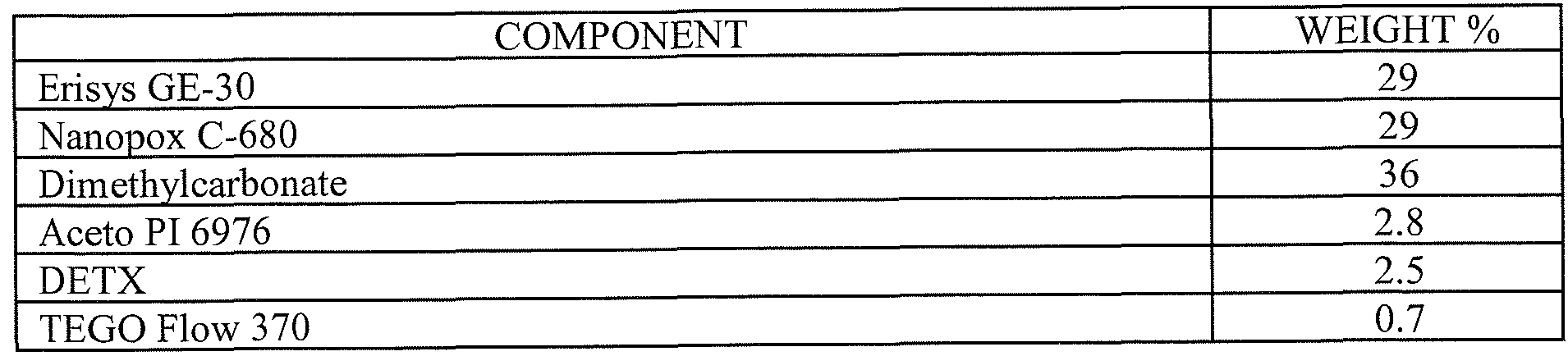

Example 7.3

Example 7.4

Example 7.5

EXAMPLE 8
UV Curable Polyurethane Dispersion Example 8.1

Comparison of the Sward Hardness of the Coating
Table C provides the Sward Hardness ranges of the coatings from Examples 1-5. Table C

EXAMPLE 10
Impact Resistance and Adhesion of Cured Coatings
The impact resistance of Examples 1-4 and 6-7 above were tested after coating onto a synthetic bowling lane surface (as described in the Testing Procedures section above), and all were above 160 inch-lb., which is the highest resistance level than can be measured with the
Taber Heavy Duty Impact Tester.
The adhesion of Examples 1-4 and 6-8 above were tested, and all had a 95-100% retention of the coating on the test surface.
EXAMPLE 11
Comparative Examples
The properties and performance of the inventive bowling lane finishes were compared to synthetic bowling lane surfaces. This surface is originally coated with a melamine-formaldehyde resin when manufactured. Melamine- formaldehyde resins are one of the hardest and toughest materials, and it is desirable for the inventive coating was to reach the performance numbers of this original material. A standard EN438/YS04586 test that is commonly utilized in testing of HPDL surfaces was used.
S-42 abrasive strips on SO rubber wheels with 500 g/arm weights were used in the Taber test. The number of cycles that was needed to completely remove the coating was recorded.

The presented synthetic lane finish performance was compared to commercially available wood lane coatings as well. Abrasion resistance (the smaller the AHaze, the better the resistance), scratch resistance (0=best....5=worst), and coefficient of friction were assessed as described above. Both wood lane coatings were urethane-based ones. Therefore, their properties were tested at least 10 days after coating application in order to let the material crosslink to full extent and acquire its final properties.

These examples demonstrated that the 100% solids UV LED coating according to the invention surpassed many characteristics of commercially available wood lane coatings. Moreover, it achieved the performance of a very tough synthetic lane surface.
Claims
1. A method of forming a coating on a surface, said method comprising:
providing a flowable composition being selected from the group consisting of:
(1) a metal oxide composition comprising:
silica nanoparticles, alumina nanoparticles, or both;
an acrylate; and
a photoinitiator;
(2) a hybrid composition comprising free radical polymerizable monomers, cationic polymerizable monomers, and a photoinitiator; and
(3) a polymeric composition comprising a polymer and a photoinitiator dissolved or dispersed in a solvent system, said polymer being selected from the group consisting of epoxies, polyurethanes, acrylates, and mixtures thereof;
said flowable composition having a viscosity of less than about 200 cP and comprising less than about 5% by weight volatile organic compounds; applying a layer of said flowable composition to said surface; and
exposing said layer to light having a wavelength of from about 320 nm to about 700 nm to form said coating.
2. The method of claim 1, wherein said flowable composition further comprises a source of thiols.
3. The method of claim 2, wherein said source of thiols is present at a level of from about 1 % by weight to about 10% by weight thiols, based upon the total weight of the flowable composition taken as 100% by weight.
4. The method of claim 1, wherein said flowable composition is essentially free of thiols.
5. The method of claim 1, wherein said exposing causes polymerization of components in said flowable composition.
6. The method of claim 5, wherein said exposing causes crosslinking of polymers formed during said polymerization.
7. The method of claim 1, wherein said flowable composition comprises less than about 1% of volatile organic compounds.
8. The method of claim 1 , wherein said coating, when subjected to an abrasion test, has a AHaze of less than about 30.
9. The method of claim 1, wherein said coating has a coefficient of friction of less than about 0.8.
10. The method of claim 1, wherein said coating has an adhesion of at least about
90%.
11. The method of claim 1 , wherein said coating has an impact resistance of at least about 140 inch-lb.
12. The method of claim 1 , wherein said acrylate is selected from the group consisting of acrylate esters, trimethylol propane triacrylate, 1 ,6-hexanediol acrylate, 1 ,6-hexanediol diacrylate, isobornyl acrylate, hexafunctional urethane acrylate, hexafunctional epoxy acrylate, tripropylene glycol diacrylate, epoxy novolak acrylate, ethoxylated trimethylolpropane triacrylate, pentaerythritol triacrylate, dipentaerythritol pentaacrylate, melamine acrylate, propoxylated neopentyl glycol diacrylate, and mixtures thereof.
13. The method of claim 1, wherein said photoinitiator is selected from the group consisting of 2,4,6-trimethylbenzoyldiphenylphosphine oxide, bis (2,4,6-trimethylbenzoyl)- phenylphosphineoxide, 4-thiophenyl phenyl diphenyl sulfonium hexafluoroantimonate, and mixtures thereof.
14. The method of claim 1, wherein:
said free radical polymerizable monomers are selected from the group consisting of acrylates, methacrylates, other ethylenically unsaturated monomers and resins, and mixtures thereof; and
said cationic polymerizable monomers are selected from the group consisting of epoxies, oxetanes, oxiranes, vinyl ethers, and mixture thereof
15. The method of claim 1 , wherein said flowable composition further comprises an ingredient selected from the group consisting of adhesion promoters, leveling agents, metal oxides, waxes, surfactants, photosensitizers, antifoaming agent, oxygen inhibition offsetting additives, and mixtures of the foregoing.
16. The method of claim 1 , wherein said surface is selected from the group consisting of bowling lanes, vinyl composite tile, hardwood flooring, and laminate flooring.
17. The method of claim 1, wherein said exposing is carried out with an LED light source.
18. A protected surface, said surface comprising a cured coating on said surface, said cured coating being formed from a flowable composition being selected from the group consisting of:
(1) a metal oxide composition comprising:
silica nanoparticles, alumina nanoparticles, or both;
an acrylate; and
a photoinitiator;
(2) a hybrid composition comprising free radical polymerizable monomers, cationic polymerizable monomers, and a photoinitiator; and
(3) a polymeric composition comprising a polymer and a photoinitiator dissolved or dispersed in a solvent system, said polymer being selected from the group consisting of epoxies, polyurethanes, acrylates, and mixtures thereof;
said flowable composition having a viscosity of less than about 200 cP and comprising less than about 5% by weight volatile organic compounds.
19. The protected surface of claim 18, wherein said flowable composition further comprises a source of thiols.
20. The protected surface of claim 19, wherein said source of thiols is present at a level of from about 1 % by weight to about 10% by weight thiols, based upon the total weight of the flowable composition taken as 100% by weight.
21. The protected surface of claim 18, wherein said flowable composition is essentially free of thiols.
22. The protected surface of claim 18, wherein said flowable composition comprises less than about 1% of volatile organic compounds.
23. The protected surface of claim 18, wherein said coating, when subjected to an abrasion test, has a AHaze of less than about 30.
24. The protected surface of claim 18, wherein said coating has a coefficient of friction of less than about 0.8.
25. The protected surface of claim 18, wherein said coating has an adhesion of at least about 90%.
26. The protected surface of claim 18, wherein said coating has an impact resistance of at least about 140 inch-lb.
27. A flowable composition useful for treating a surface, said flowable composition being selected from the group consisting of:
(1) a metal oxide composition comprising:
silica nanoparticles, alumina nanoparticles, or both;
an acrylate; and
a photoinitiator;
(2) a hybrid composition comprising free radical polymerizable monomers, cationic polymerizable monomers, and a photoinitiator; and
(3) a polymeric composition comprising a polymer and a photoinitiator dissolved or dispersed in a solvent system, said polymer being selected from the group consisting of epoxies, polyurethanes, acrylates, and mixtures thereof;
said flowable composition having a viscosity of less than about 200 cP, comprising less than about 5% by weight volatile organic compounds, and being curable by light having a wavelength of from about 320 nm to about 700 nm.
28. The flowable composition of claim 27, wherein said flowable composition further comprises a source of thiols.
29. The flowable composition of claim 28, wherein said source of thiols is present at a level of from about 1% by weight to about 10% by weight thiols, based upon the total weight of the flowable composition taken as 100% by weight.
30. The flowable composition of claim 27, wherein said flowable composition is essentially free of thiols.
31. The flowable composition of claim 27, wherein said flowable composition comprises less than about 1% of volatile organic compounds.
32. The flowable composition of claim 27, wherein said acrylate is selected from the group consisting of acrylate esters, trimethylol propane triacrylate, 1 ,6-hexanediol acrylate, 1 ,6- hexanediol diacrylate, isobornyl acrylate, hexafunctional urethane acrylate, hexafunctional epoxy acrylate, tripropylene glycol diacrylate, epoxy novolak acrylate, ethoxylated trimethylolpropane triacrylate, pentaerythritol triacrylate, dipentaerythritol pentaacrylate, melamine acrylate, propoxylated neopentyl glycol diacrylate, and mixtures thereof.
33. The flowable composition of claim 27, wherein said photoinitiator is selected from the group consisting of 2,4,6-trimethylbenzoyldiphenylphosphine oxide, bis (2,4,6- trimethylbenzoyl)-phenylphosphineoxide, 4-thiophenyl phenyl diphenyl sulfonium hexafluoroantimonate, and mixtures thereof.
34. The flowable composition of claim 27, wherein:
said free radical polymerizable monomers are selected from the group consisting of acrylates, methacrylates, other ethylenically unsaturated monomers and resins, and mixtures thereof; and
said cationic polymerizable monomers are selected from the group consisting of epoxies, oxetanes, oxiranes, vinyl ethers, and mixture thereof.
35. The flowable composition of claim 27, wherein said flowable composition further comprises an ingredient selected from the group consisting of adhesion promoters, leveling agents, metal oxides, waxes, surfactants, photosensitizers, antifoaming agent, oxygen inhibition offsetting additives, and mixtures of the foregoing.
36. The flowable composition of claim 27, wherein said flowable composition is curable by an LED light source.
Priority Applications (1)
| Application Number | Priority Date | Filing Date | Title |
|---|---|---|---|
| EP13751530.0A EP2817375A4 (en) | 2012-02-21 | 2013-02-20 | Voc-free, low viscosity, led-curable coating and method of application |
Applications Claiming Priority (2)
| Application Number | Priority Date | Filing Date | Title |
|---|---|---|---|
| US201261601353P | 2012-02-21 | 2012-02-21 | |
| US61/601,353 | 2012-02-21 |
Publications (1)
| Publication Number | Publication Date |
|---|---|
| WO2013126413A1 true WO2013126413A1 (en) | 2013-08-29 |
Family
ID=48982495
Family Applications (1)
| Application Number | Title | Priority Date | Filing Date |
|---|---|---|---|
| PCT/US2013/026871 Ceased WO2013126413A1 (en) | 2012-02-21 | 2013-02-20 | Voc-free, low viscosity, led-curable coating and method of application |
Country Status (3)
| Country | Link |
|---|---|
| US (1) | US9598607B2 (en) |
| EP (1) | EP2817375A4 (en) |
| WO (1) | WO2013126413A1 (en) |
Cited By (13)
| Publication number | Priority date | Publication date | Assignee | Title |
|---|---|---|---|---|
| CN103980803A (en) * | 2014-06-04 | 2014-08-13 | 广东美涂士建材股份有限公司 | UV woodware laser roller-coating white finish coat and preparation method thereof |
| CN104194613A (en) * | 2014-08-13 | 2014-12-10 | 江苏宏泰高分子材料有限公司 | Recoatable UV-curing colored one-step-coating aluminum powder paint and preparation method thereof |
| CN105255350A (en) * | 2015-10-08 | 2016-01-20 | 江苏华夏制漆科技有限公司 | Metal anti-corrosion coating cured by utilizing LED light and preparation method thereof |
| CN106118448A (en) * | 2016-08-23 | 2016-11-16 | 佛山阳光逸采涂料科技有限公司 | A kind of UV LED low-yield solidification paint of wooden floor and preparation method thereof |
| CN106118447A (en) * | 2016-08-23 | 2016-11-16 | 佛山阳光逸采涂料科技有限公司 | A kind of UV LED low-yield solidification household coating and preparation method thereof |
| CN106118385A (en) * | 2016-08-23 | 2016-11-16 | 佛山阳光逸采涂料科技有限公司 | A kind of UV LED low-yield solidification mahogany furniture coating and preparation method thereof |
| CN106243985A (en) * | 2016-08-23 | 2016-12-21 | 佛山阳光逸采涂料科技有限公司 | A kind of UV LED low-yield solidification ceramic coating and preparation method thereof |
| CN106318190A (en) * | 2016-08-23 | 2017-01-11 | 佛山阳光逸采涂料科技有限公司 | UV LED low-energy curing wooden door coating and preparation method thereof |
| CN106318137A (en) * | 2016-08-23 | 2017-01-11 | 佛山阳光逸采涂料科技有限公司 | UV LED low-energy curing cabinet coating and preparation method thereof |
| CN107513346A (en) * | 2017-09-22 | 2017-12-26 | 东周化学工业(昆山)有限公司 | A kind of water-based UV aluminium paints and preparation method thereof |
| US10307940B2 (en) | 2016-05-13 | 2019-06-04 | MSI Coatings Inc. | System and method for using a VOC free low radiant flux LED UV curable composition |
| US11338320B1 (en) | 2018-02-03 | 2022-05-24 | MSI Coatings Inc. | Composition for aerosol cans, method of making and using the same |
| US12157831B1 (en) | 2017-07-26 | 2024-12-03 | MSI Coatings Inc. | Energy curable composition and method of using the same |
Families Citing this family (14)
| Publication number | Priority date | Publication date | Assignee | Title |
|---|---|---|---|---|
| CN104559423A (en) * | 2014-12-23 | 2015-04-29 | 王新民 | Curable coating colorant |
| CN104629614A (en) * | 2015-01-19 | 2015-05-20 | 安徽嘉年华漆业有限公司 | High-water-resistance ultraviolet-curing wood paint |
| CN105037620B (en) * | 2015-03-10 | 2016-11-30 | 六安市大宇高分子材料有限公司 | A kind of preparation method of high-performance acrylate resin |
| CN110023419A (en) * | 2016-10-05 | 2019-07-16 | Afi特许有限责任公司 | Coating composition including diamond and cationic curing resin system or mercaptan-alkene curing system |
| CN108373782B (en) * | 2016-11-10 | 2023-04-11 | 广西真龙彩印包装有限公司 | Hydrophobic, scratch-resistant and wear-resistant UV-LED curing gloss oil for paper packaging printed matter |
| CN108373787B (en) * | 2016-11-10 | 2023-04-11 | 广西真龙彩印包装有限公司 | Hydrophobic light-resistant UV-LED curing glazing oil for paper packaging printed matter |
| CN110054977A (en) * | 2019-05-21 | 2019-07-26 | 临沂优彩新能源环保科技有限公司 | A kind of UV woodenware printing coating and its preparation process |
| JP7445393B2 (en) * | 2019-05-23 | 2024-03-07 | 中国塗料株式会社 | paint composition |
| CN110437731B (en) * | 2019-08-27 | 2021-04-27 | 浙江佑泰新材料科技有限公司 | UV-LED photocuring vacuum coating primer and preparation method thereof |
| CN110819213A (en) * | 2019-11-16 | 2020-02-21 | 湖北劲佳包装有限公司 | A kind of UV reverse varnish and method for preparing printed matter using UV reverse varnish |
| CN111454633B (en) * | 2020-03-27 | 2022-06-28 | 上海展辰涂料有限公司 | Ultraviolet curing matte color-modifying clear-finish wood paint for vacuum spraying |
| US20210378918A1 (en) * | 2020-06-04 | 2021-12-09 | Regents Of The University Of Minnesota | Compositions and coatings for soft tissue attachment |
| CN113943521B (en) * | 2020-07-17 | 2025-04-22 | 宣伟(广东)新材料有限公司 | A yellowing-resistant UV-LED-curable coating composition |
| CN114634756A (en) * | 2022-03-17 | 2022-06-17 | 苏州市三新材料科技股份有限公司 | Hybrid ultraviolet curing coating special for scribing and repairing coating and preparation method and application method thereof |
Citations (6)
| Publication number | Priority date | Publication date | Assignee | Title |
|---|---|---|---|---|
| US5453451A (en) * | 1991-05-15 | 1995-09-26 | Sokol; Andrew A. | Finishing composition which is curable by UV light and method of using same |
| US20060194894A1 (en) * | 2000-02-15 | 2006-08-31 | Foster Miller | No VOC radiation curable resin compositions with enhanced flexibility |
| JP2007532739A (en) * | 2004-04-15 | 2007-11-15 | チバ スペシャルティ ケミカルズ ホールディング インコーポレーテッド | Photocuring method using light emitting diode |
| US20100279026A1 (en) * | 1999-08-20 | 2010-11-04 | The Walman Optical Company | Coating composition yielding abrasion-resistant tintable coatings |
| WO2012006199A1 (en) * | 2010-07-09 | 2012-01-12 | Dsm Ip Assets B.V. | Colored radiation curable coatings for concrete floors |
| US20120021134A1 (en) * | 2009-04-15 | 2012-01-26 | 3M Innovative Properties Company | Process and apparatus for coating with reduced defects |
Family Cites Families (12)
| Publication number | Priority date | Publication date | Assignee | Title |
|---|---|---|---|---|
| CA1065085A (en) | 1974-05-20 | 1979-10-23 | John P. Guarino | Radiation curable coating |
| US4146452A (en) | 1976-02-02 | 1979-03-27 | Mobil Oil Corporation | Anhydride modified epoxy acrylate UV curable coating |
| US5318808A (en) | 1992-09-25 | 1994-06-07 | Polyset Company, Inc. | UV-curable coatings |
| US6387981B1 (en) * | 1999-10-28 | 2002-05-14 | 3M Innovative Properties Company | Radiopaque dental materials with nano-sized particles |
| US7399982B2 (en) | 2003-01-09 | 2008-07-15 | Con-Trol-Cure, Inc | UV curing system and process with increased light intensity |
| US7151123B2 (en) | 2004-02-04 | 2006-12-19 | Ecology Coating, Inc. | Environmentally friendly, 100% solids, actinic radiation curable coating compositions and coated surfaces and coated articles thereof |
| US7514482B2 (en) | 2005-07-25 | 2009-04-07 | The Walman Optical Company | Optical coating composition |
| US7491287B2 (en) * | 2006-06-09 | 2009-02-17 | 3M Innovative Properties Company | Bonding method with flowable adhesive composition |
| GB0719464D0 (en) | 2007-10-04 | 2007-11-14 | Sun Chemical Bv | An ink jet and a method of ink jet printing |
| CN102089067A (en) * | 2008-04-08 | 2011-06-08 | 富士胶片制造欧洲有限公司 | Process for preparing membranes |
| US20100276059A1 (en) | 2009-04-30 | 2010-11-04 | Dong Tian | UVV curable coating compositions and method for coating flooring and other substrates with same |
| CA2783601A1 (en) | 2009-12-17 | 2011-07-14 | Dsm Ip Assets B.V. | Led curing of radiation curable floor coatings |
-
2013
- 2013-02-20 WO PCT/US2013/026871 patent/WO2013126413A1/en not_active Ceased
- 2013-02-20 EP EP13751530.0A patent/EP2817375A4/en not_active Withdrawn
- 2013-02-20 US US13/771,762 patent/US9598607B2/en not_active Expired - Fee Related
Patent Citations (6)
| Publication number | Priority date | Publication date | Assignee | Title |
|---|---|---|---|---|
| US5453451A (en) * | 1991-05-15 | 1995-09-26 | Sokol; Andrew A. | Finishing composition which is curable by UV light and method of using same |
| US20100279026A1 (en) * | 1999-08-20 | 2010-11-04 | The Walman Optical Company | Coating composition yielding abrasion-resistant tintable coatings |
| US20060194894A1 (en) * | 2000-02-15 | 2006-08-31 | Foster Miller | No VOC radiation curable resin compositions with enhanced flexibility |
| JP2007532739A (en) * | 2004-04-15 | 2007-11-15 | チバ スペシャルティ ケミカルズ ホールディング インコーポレーテッド | Photocuring method using light emitting diode |
| US20120021134A1 (en) * | 2009-04-15 | 2012-01-26 | 3M Innovative Properties Company | Process and apparatus for coating with reduced defects |
| WO2012006199A1 (en) * | 2010-07-09 | 2012-01-12 | Dsm Ip Assets B.V. | Colored radiation curable coatings for concrete floors |
Non-Patent Citations (1)
| Title |
|---|
| See also references of EP2817375A4 * |
Cited By (16)
| Publication number | Priority date | Publication date | Assignee | Title |
|---|---|---|---|---|
| CN103980803A (en) * | 2014-06-04 | 2014-08-13 | 广东美涂士建材股份有限公司 | UV woodware laser roller-coating white finish coat and preparation method thereof |
| CN104194613A (en) * | 2014-08-13 | 2014-12-10 | 江苏宏泰高分子材料有限公司 | Recoatable UV-curing colored one-step-coating aluminum powder paint and preparation method thereof |
| CN105255350A (en) * | 2015-10-08 | 2016-01-20 | 江苏华夏制漆科技有限公司 | Metal anti-corrosion coating cured by utilizing LED light and preparation method thereof |
| US10307940B2 (en) | 2016-05-13 | 2019-06-04 | MSI Coatings Inc. | System and method for using a VOC free low radiant flux LED UV curable composition |
| US12539649B2 (en) | 2016-05-13 | 2026-02-03 | MSI Coatings, Inc. | System and method for using a VOC free low radiant flux LED UV curable composition |
| US11738481B2 (en) | 2016-05-13 | 2023-08-29 | MSI Coatings Inc. | System and method for using a VOC free low radiant flux LED UV curable composition |
| CN106118447A (en) * | 2016-08-23 | 2016-11-16 | 佛山阳光逸采涂料科技有限公司 | A kind of UV LED low-yield solidification household coating and preparation method thereof |
| CN106318190A (en) * | 2016-08-23 | 2017-01-11 | 佛山阳光逸采涂料科技有限公司 | UV LED low-energy curing wooden door coating and preparation method thereof |
| CN106318137A (en) * | 2016-08-23 | 2017-01-11 | 佛山阳光逸采涂料科技有限公司 | UV LED low-energy curing cabinet coating and preparation method thereof |
| CN106243985A (en) * | 2016-08-23 | 2016-12-21 | 佛山阳光逸采涂料科技有限公司 | A kind of UV LED low-yield solidification ceramic coating and preparation method thereof |
| CN106118385A (en) * | 2016-08-23 | 2016-11-16 | 佛山阳光逸采涂料科技有限公司 | A kind of UV LED low-yield solidification mahogany furniture coating and preparation method thereof |
| CN106118448A (en) * | 2016-08-23 | 2016-11-16 | 佛山阳光逸采涂料科技有限公司 | A kind of UV LED low-yield solidification paint of wooden floor and preparation method thereof |
| US12157831B1 (en) | 2017-07-26 | 2024-12-03 | MSI Coatings Inc. | Energy curable composition and method of using the same |
| CN107513346A (en) * | 2017-09-22 | 2017-12-26 | 东周化学工业(昆山)有限公司 | A kind of water-based UV aluminium paints and preparation method thereof |
| US11338320B1 (en) | 2018-02-03 | 2022-05-24 | MSI Coatings Inc. | Composition for aerosol cans, method of making and using the same |
| US12214378B2 (en) | 2018-02-03 | 2025-02-04 | MSI Coatings, Inc. | Composition for aerosol cans, method of making and using the same |
Also Published As
| Publication number | Publication date |
|---|---|
| US9598607B2 (en) | 2017-03-21 |
| EP2817375A1 (en) | 2014-12-31 |
| US20130216838A1 (en) | 2013-08-22 |
| EP2817375A4 (en) | 2015-08-05 |
Similar Documents
| Publication | Publication Date | Title |
|---|---|---|
| US9598607B2 (en) | VOC-free, low viscosity, LED-curable coating and method of application | |
| KR102792014B1 (en) | Dual-cured soft touch coating | |
| JP7018871B2 (en) | One-component curable soft feel coating | |
| US20080167395A1 (en) | Radiation curable, sprayable coating compositions | |
| US6787197B1 (en) | Method for producing scratch resistant, weatherproof coatings | |
| US9505936B1 (en) | Ultra-violet cure coating | |
| CN105026499A (en) | Scratch and stain resistant coatings | |
| KR102803895B1 (en) | UV curable car refinish filler paint and method of automobile maintenance using the same | |
| US12214378B2 (en) | Composition for aerosol cans, method of making and using the same | |
| EP2771415A1 (en) | Low gloss uv-cured coatings for aircraft | |
| JP5093868B2 (en) | Composition for ultraviolet curable coating and method for producing laminate using the same | |
| KR20220098420A (en) | LED UV curing topcoat for automobile repair | |
| JPH03182567A (en) | Radiation-hardenable, wear-resisting coating material containing unsaturated organic compound but not silane | |
| JP2003313489A (en) | Radiation curable resin composition for coating aluminum material | |
| KR102736016B1 (en) | Photocurable water-soluble coating composition and multi-layer coating using the same | |
| BRPI0609853A2 (en) | radiation curable sticky composition, method for repainting a substrate, substrate and method for improving the curability of a radiation curable sticky composition | |
| JP2012001671A (en) | Photo- and moisture-curable composition | |
| JP2018131481A (en) | Active energy ray-curable resin composition, cured film and coated substrate, and method for producing coated substrate | |
| US20250360534A1 (en) | Process for providing low gloss coatings | |
| JP5893493B2 (en) | Hard coat composition for thin film | |
| JP2005314605A (en) | Coating composition and method for forming coating film | |
| WO2000055272A1 (en) | Radiation curable coating composition comprising a secondary curing agent | |
| CN110903743A (en) | Photocuring coating for polyamide substrate surface coating | |
| JPH09111150A (en) | Emulsion coating composition | |
| MXPA97007979A (en) | Method for curing compositions of recubrimie |
Legal Events
| Date | Code | Title | Description |
|---|---|---|---|
| 121 | Ep: the epo has been informed by wipo that ep was designated in this application |
Ref document number: 13751530 Country of ref document: EP Kind code of ref document: A1 |
|
| DPE1 | Request for preliminary examination filed after expiration of 19th month from priority date (pct application filed from 20040101) | ||
| NENP | Non-entry into the national phase |
Ref country code: DE |
|
| WWE | Wipo information: entry into national phase |
Ref document number: 2013751530 Country of ref document: EP |