WO2013131076A1 - Highly nonlinear optical fiber with improved sbs threshold and moderate attenuation - Google Patents

Highly nonlinear optical fiber with improved sbs threshold and moderate attenuation Download PDF

Info

Publication number
WO2013131076A1
WO2013131076A1 PCT/US2013/028816 US2013028816W WO2013131076A1 WO 2013131076 A1 WO2013131076 A1 WO 2013131076A1 US 2013028816 W US2013028816 W US 2013028816W WO 2013131076 A1 WO2013131076 A1 WO 2013131076A1
Authority
WO
WIPO (PCT)
Prior art keywords
central core
optical fiber
highly nonlinear
fiber
nonlinear optical
Prior art date
Legal status (The legal status is an assumption and is not a legal conclusion. Google has not performed a legal analysis and makes no representation as to the accuracy of the status listed.)
Ceased
Application number
PCT/US2013/028816
Other languages
French (fr)
Inventor
Lars Gruner-Nielsen
Soren HERSTROM
Dan Peter JAKOBSEN
Bera Palsdottir
Current Assignee (The listed assignees may be inaccurate. Google has not performed a legal analysis and makes no representation or warranty as to the accuracy of the list.)
OFS Fitel LLC
Original Assignee
OFS Fitel LLC
Priority date (The priority date is an assumption and is not a legal conclusion. Google has not performed a legal analysis and makes no representation as to the accuracy of the date listed.)
Filing date
Publication date
Application filed by OFS Fitel LLC filed Critical OFS Fitel LLC
Priority to JP2014560126A priority Critical patent/JP6122041B2/en
Priority to EP13755912.6A priority patent/EP2820457B1/en
Priority to US14/381,910 priority patent/US9366811B2/en
Publication of WO2013131076A1 publication Critical patent/WO2013131076A1/en
Anticipated expiration legal-status Critical
Ceased legal-status Critical Current

Links

Classifications

    • GPHYSICS
    • G02OPTICS
    • G02BOPTICAL ELEMENTS, SYSTEMS OR APPARATUS
    • G02B6/00Light guides; Structural details of arrangements comprising light guides and other optical elements, e.g. couplings
    • G02B6/02Optical fibres with cladding with or without a coating
    • G02B6/028Optical fibres with cladding with or without a coating with core or cladding having graded refractive index
    • GPHYSICS
    • G02OPTICS
    • G02FOPTICAL DEVICES OR ARRANGEMENTS FOR THE CONTROL OF LIGHT BY MODIFICATION OF THE OPTICAL PROPERTIES OF THE MEDIA OF THE ELEMENTS INVOLVED THEREIN; NON-LINEAR OPTICS; FREQUENCY-CHANGING OF LIGHT; OPTICAL LOGIC ELEMENTS; OPTICAL ANALOGUE/DIGITAL CONVERTERS
    • G02F1/00Devices or arrangements for the control of the intensity, colour, phase, polarisation or direction of light arriving from an independent light source, e.g. switching, gating or modulating; Non-linear optics
    • G02F1/35Non-linear optics
    • G02F1/365Non-linear optics in an optical waveguide structure
    • GPHYSICS
    • G02OPTICS
    • G02BOPTICAL ELEMENTS, SYSTEMS OR APPARATUS
    • G02B6/00Light guides; Structural details of arrangements comprising light guides and other optical elements, e.g. couplings
    • G02B6/10Light guides; Structural details of arrangements comprising light guides and other optical elements, e.g. couplings of the optical waveguide type
    • G02B6/12Light guides; Structural details of arrangements comprising light guides and other optical elements, e.g. couplings of the optical waveguide type of the integrated circuit kind
    • G02B2006/12035Materials
    • G02B2006/12061Silicon
    • GPHYSICS
    • G02OPTICS
    • G02BOPTICAL ELEMENTS, SYSTEMS OR APPARATUS
    • G02B6/00Light guides; Structural details of arrangements comprising light guides and other optical elements, e.g. couplings
    • G02B6/02Optical fibres with cladding with or without a coating
    • G02B6/036Optical fibres with cladding with or without a coating core or cladding comprising multiple layers
    • G02B6/03616Optical fibres characterised both by the number of different refractive index layers around the central core segment, i.e. around the innermost high index core layer, and their relative refractive index difference
    • G02B6/03622Optical fibres characterised both by the number of different refractive index layers around the central core segment, i.e. around the innermost high index core layer, and their relative refractive index difference having 2 layers only
    • G02B6/03627Optical fibres characterised both by the number of different refractive index layers around the central core segment, i.e. around the innermost high index core layer, and their relative refractive index difference having 2 layers only arranged - +

Definitions

  • the invention is directed to optical fiber. More specifically the invention is directed to highly nonlinear optical fiber (HNLF) and ways to reduce the threshold of stimulated Brillouin scattering (SBS) in HNLF.
  • HNLF highly nonlinear optical fiber
  • SBS stimulated Brillouin scattering
  • HNLF Highly nonlinear optical fibers
  • SBS stimulated Brillouin scattering
  • n 2 is the nonlinear refractive index
  • is the wavelength
  • a e ff the effective area
  • a is the loss coefficient in units of [m 1 ]
  • L is the fiber length.
  • Expression (1) is often referred to as the "figure of merit" for SBS-limited HNLFs.
  • the figure of merit is approximately 0.21, which is too low for some applications, such as phases sensitive amplifiers, and compression of the beat signal from two lasers closely spaced in wavelength and operating in continuous wave mode. It would be desirable to raise the SBS threshold for HNLFs.
  • Another way to increase the figure of merit P th YL e ff is to increase the nonlinear coefficient ⁇ by making HNLFs from soft glass materials such as bismuth or lead silicate rather than silica.
  • soft glass materials such as bismuth or lead silicate rather than silica.
  • FOMs greater than 1 have been demonstrated with soft glass based HNLFs.
  • a drawback of such fibers is the quite high losses (approximately ldB/m) and the high coupling loss as compared to standard single mode fibers.
  • Two somewhat similar techniques for increasing the SBS threshold include applying a linear or stepwise temperature gradient, or a linear or stepwise strain gradient along the fiber.
  • the principle in both techniques is that temperature or strain changes the SBS frequency shift.
  • the Brillouin line width is broadened and as a consequence the Brillouin gain coefficient g B is lowered.
  • Increases in threshold of approximately 8 dB have been demonstrated in a HNLF using the temperature technique.
  • threshold increases of 6-7 dB have been demonstrated.
  • a drawback in both techniques is that both strain and temperature may also alter the dispersion. Both techniques have drawbacks from a practical point of view. Large strain will reduce the fiber lifetime. Unless very large diameter spools are used, straining will also increase the polarization mode dispersion (PMD) of the HNLF.
  • PMD polarization mode dispersion
  • Another method to reduce the SBS in HNLF is to dope the core of the HNLF with aluminum instead of germanium.
  • this method does not address the issue of
  • the invention is a highly nonlinear optical fiber (HNLF) exhibiting improved SBS properties.
  • the HNLF includes a central core region made substantially from silica doped with aluminum, a trench region surrounding the central core region, and a silica cladding surrounding the trench region.
  • the refractive index profile of the HNLF is optimized to raise the SBS threshold.
  • a first refractive index difference of the central core region relative to the cladding ( ⁇ +) is less than 26 x 10 "
  • a second refractive index difference of the trench region relative to the cladding ( ⁇ -) is less than -5 x 10 " .
  • ⁇ + is less than 26 x 10 - " 3 and greater than or equal to 16 x 10 - “ 3 , and more preferably ⁇ + is approximately 21 x 10 " .
  • the trench region is preferably doped with fluorine, In addition, an outer diameter of the trench region is preferably approximately 3.8 times a diameter of the central core region.
  • the fiber is preferably a single mode fiber.
  • the invention further includes optical devices incorporating the above-described optical fiber. Such devices may include a phase sensitive amplifier, devices having two lasers operating in continuous wave mode and having a compressed beat signal owing to their wavelengths being closely spaced, and any other applications in which phase dithering or other conventional SBS suppression techniques cannot be utilized or are insufficient.
  • a HNLF is characterized by having a relative high nonlinear coefficient ⁇ . In accordance with the invention, this is accomplished by optimizing the refractive index profile to minimize A eff . Additionally, it is desired to have a dispersion (D) close to zero at the operating
  • D wavelength.
  • D should be in the range -5 to +5 ps/(nm-km).
  • FIG. 1 is sectional schematic of a HNLF in accordance with the invention.
  • Fig. 2 is a schematic of a refractive index profile for a HNLF in accordance with the invention.
  • Fig. 3 is a graph illustrating effective length L eff as a function of fiber length.
  • Fig. 1 is a cross-sectional view of an optical fiber 10 according to an embodiment of the present invention
  • Fig. 2 is a schematic view showing a refractive index profile of the optical fiber 10.
  • the optical fiber 10 comprises a central core 11, a trench region 12 surrounding the central core 11, and a cladding 13 surrounding the trench region 12.
  • the refractive index of the cladding 13 is lower than that of the central core 11 and is greater than that of the trench region 12.
  • Core 11 has a diameter, a, and a refractive index difference relative to the outer cladding of ⁇ +.
  • Core 11 is preferably made from silica doped by aluminum in a preferred amount to increase the refractive index.
  • Trench region 12 has a diameter, b, and a refractive index difference relative to the outer cladding of ⁇ -.
  • Trench region 12 is preferably made out of silica doped with fluorine.
  • Cladding 13 is preferably also made from silica.
  • trench region 12 can be thought of as two-fold. First, for designs having a dispersion, D, of approximately zero, the trench region decreases A eff ; the lower or more negative the value for ⁇ -, the lower the A eff . Second, by optimizing the diametric ratio of b/a, the dispersion slope can be minimized and D is approximately zero. Low dispersion slope is good for parametric amplifier applications as it increases the gain bandwidth. Yet, a low dispersion slope also increases variation in dispersion, which then decreases the gain bandwidth of parametric amplifiers. Therefore, in the preferred embodiment, a large diametric ratio, b/a, is selected, which also will minimize A eff .
  • ⁇ - is approximately -10x10-3, which is the lowest that can be obtained with a Modified Chemical Vapor Deposition (MCVD) technique.
  • MCVD Modified Chemical Vapor Deposition
  • the ratio of b/a has been selected to be approximately 3.8, beyond which any additional benefits in terms of minimizing A eff become minimal.
  • diameter a is optimized to get D approximately to 0.
  • PCVD Plasma Enhanced Chemical Vapor Deposition
  • HNLF created by the present inventors included an Al-doped HNLF with an attenuation of 15 dB/km. That fiber had ⁇ + of approximately 26x10-3, equivalent to an Al doping level of 14 wt% .
  • the Al concentration in the new Al-doped HNLF was decreased from 14 wt% to around 11 wt% ( ⁇ + of approximately 21x10-3). This decreases the nonlinear coefficient ⁇ somewhat, but does not significantly decrease the figure of merit for SBS-limited HNLF.
  • a proportionality coefficient for aluminum doping of 1.84 xl0-3/% is assumed for comparison purposes.
  • the aluminum doping level of the central core region is preferably less than 14 wt% Al, and more preferably approximately 11 wt% Al.
  • Table 1 shows measured properties for the new, inventive Al-doped fiber compared with a prior Al-doped HNLF and a conventional Ge-doped HNLF:
  • the figure of merit P t hYL eff is too low for some applications, such as phase sensitive amplifiers or applications having compression of the beat signal from two lasers closely spaced in wavelength and operating in continuous wave mode.
  • the figure of merit PthYLeff is significantly higher (triple) than that of the Ge-doped fiber, however attenuation is extremely high.
  • the new Al-doped HNLF has a higher A eff and, consequently, a lower ⁇ than the previous Al-doped HNLF, the overall figure of merit P th YL e ff is not much lower.
  • the attenuation is significantly decreased from 15 dB/km to 6.2 dB/km with the inventive Al-doped HNLF.
  • the effective length of the inventive fiber can be significantly increased. This is illustrated in Fig. 3 where L e ff is shown as function of L.
  • Embodiments of the present invention include a single mode optical fiber comprising a central core, which is made of Si02 as the main component doped with Al with a weight concentration of 6 wt% or more so that ⁇ + is approximately 21 x 10-3, having an absolute value of dispersion of 5 ps/(nm-km) or less at 1550 nm, and having an effective area in the range of 15 to 20 ⁇ 2 at 1550 nm.
  • inventions include a nonlinear figure of merit of greater than 0.3 for SBS-limited HNLF P th YL e ff at 1550 nm; an attenuation at 1550 nm of less than 15 dB/km; and an increased SBS threshold by applying a linear stepwise temperature gradient along the length of the fiber, or a linear stepwise strain gradient.
  • Other embodiments include optical fiber devices using the inventive fiber and methods of operating such devices.
  • the invention is well-suited for phase sensitive amplifiers or applications having compression of the beat signal from two lasers closely spaced in wavelength and operating in continuous wave mode. More generally, the invention is well-suited for application of parametric amplifiers used for phase encoded signals and/or all applications where phase dithering or other alternative SBS suppression techniques cannot be utilized or are otherwise insufficient.

Landscapes

  • Physics & Mathematics (AREA)
  • Nonlinear Science (AREA)
  • General Physics & Mathematics (AREA)
  • Optics & Photonics (AREA)
  • Lasers (AREA)
  • Optical Modulation, Optical Deflection, Nonlinear Optics, Optical Demodulation, Optical Logic Elements (AREA)

Description

HIGHLY NONLINEAR OPTICAL FIBER WITH IMPROVED SBS THRESHOLD
AND MODERATE ATTENUATION
RELATED APPLICATIONS
[0001] Priority is claimed from US Provisional Patent Application No. 61/605,968 filed March 2, 2012, entitled "Highly Nonlinear Fiber with Improved SBS Threshold and Moderate
Attenuation", the teachings of which are incorporated by reference herein.
BACKGROUND OF THE INVENTION
[0002] Field of the Invention
[0003] The invention is directed to optical fiber. More specifically the invention is directed to highly nonlinear optical fiber (HNLF) and ways to reduce the threshold of stimulated Brillouin scattering (SBS) in HNLF.
[0004] Description of Related Art
[0005] Highly nonlinear optical fibers (HNLF), defined as fibers with an increased nonlinear coefficient (γ) and an engineered dispersion close to zero, have been used in numerous applications, including parametric amplification, phase sensitive amplifiers, optical regenerators, switching, and wavelength conversion. One of the limitations of conventional HNLF is stimulated Brillouin scattering (SBS). SBS is a phenomenon where, when light having power over a certain threshold is launched into an optical fiber, a part of the light is reflected and, therefore, the light cannot propagate through the fiber at high intensity. As a result, the intensity of the transmitted light is restricted (and the efficiency of the optical device is restricted), which sets an upper limit on the amount of power which can be launched into the HNLF. The SBS threshold power (Pth) determines the maximum obtainable nonlinear phase shift, which is given as:
Leff P4 (1)
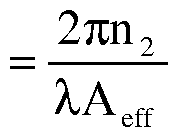
where Pth is the threshold power for the onset of SBS, γ is the nonlinear coefficient, and Leff the effective length, given by:
Figure imgf000003_0001
_ 1 - exp(- OCL)
L- = a (3)
where n2 is the nonlinear refractive index, λ is the wavelength, Aeff the effective area, a is the loss coefficient in units of [m 1], and L is the fiber length. Expression (1) is often referred to as the "figure of merit" for SBS-limited HNLFs. For conventional HNLFs having a germanium- doped silica core, the figure of merit is approximately 0.21, which is too low for some applications, such as phases sensitive amplifiers, and compression of the beat signal from two lasers closely spaced in wavelength and operating in continuous wave mode. It would be desirable to raise the SBS threshold for HNLFs.
[0006] Another way to increase the figure of merit PthYLeff is to increase the nonlinear coefficient γ by making HNLFs from soft glass materials such as bismuth or lead silicate rather than silica. Quite high figure of merits, that is, FOMs greater than 1 have been demonstrated with soft glass based HNLFs. A drawback of such fibers is the quite high losses (approximately ldB/m) and the high coupling loss as compared to standard single mode fibers.
[0007] Two somewhat similar techniques for increasing the SBS threshold include applying a linear or stepwise temperature gradient, or a linear or stepwise strain gradient along the fiber. The principle in both techniques is that temperature or strain changes the SBS frequency shift. By applying a temperature/strain gradient along the fiber, the Brillouin line width is broadened and as a consequence the Brillouin gain coefficient gB is lowered. Increases in threshold of approximately 8 dB have been demonstrated in a HNLF using the temperature technique. Using the straining technique on HNLFs, threshold increases of 6-7 dB have been demonstrated. A drawback in both techniques is that both strain and temperature may also alter the dispersion. Both techniques have drawbacks from a practical point of view. Large strain will reduce the fiber lifetime. Unless very large diameter spools are used, straining will also increase the polarization mode dispersion (PMD) of the HNLF.
[0008] Another method to reduce the SBS in HNLF is to dope the core of the HNLF with aluminum instead of germanium. However, this method does not address the issue of
attenuation, and a fiber having an effective area of 15 μιη or smaller requires additional undesired power requirements resulting from the high attenuation. Such methods tend to focus exclusively on the wt% doping level of aluminum in the core and fluorine in the trench region. However, there is no agreement in scientific literature as to the relationship between how much aluminum or fluorine is used and the respective changes that doping creates to the refractive indices of the thus-doped components. As an example, although there is theoretically a linear relationship between wt% amount of doped material and change to the refractive index of silica, literature values for the fluorine proportionality coefficient range from -4x10 -"3 /% to -8x10 -"3 /%, and values for the aluminum proportionality coefficient range from 1.731x10 -"3 /% to 2.76x10 -"3 /%. There are several possible reasons for such a large variation in the reported proportionality coefficient, including measurement uncertainty, dependence of the thermal history of the glass, and dependence of the amount of stress in the glass, among other possible reasons. Thus, one cannot properly rely on wt % levels estimated from index profile measurements.
[0009] Additional attempts to dope the core of an HNLF with aluminum instead of germanium thus far have resulted in quite high attenuation, which will limit the usable length and consequently increase the requisite pump power.
[0010] Accordingly, there is a long felt need to provide a HNLF that exhibits a higher SBS threshold than previously exhibited without evidencing attenuation problems.
SUMMARY OF THE INVENTION
[0011] The invention is a highly nonlinear optical fiber (HNLF) exhibiting improved SBS properties. In one embodiment, the HNLF includes a central core region made substantially from silica doped with aluminum, a trench region surrounding the central core region, and a silica cladding surrounding the trench region. The refractive index profile of the HNLF is optimized to raise the SBS threshold. A first refractive index difference of the central core region relative to the cladding (Δη+) is less than 26 x 10" , and a second refractive index difference of the trench region relative to the cladding (Δη-) is less than -5 x 10" . Preferably,
Δη+ is less than 26 x 10 -"3 and greater than or equal to 16 x 10 -"3 , and more preferably Δη+ is approximately 21 x 10" . The trench region is preferably doped with fluorine, In addition, an outer diameter of the trench region is preferably approximately 3.8 times a diameter of the central core region. The fiber is preferably a single mode fiber. The invention further includes optical devices incorporating the above-described optical fiber. Such devices may include a phase sensitive amplifier, devices having two lasers operating in continuous wave mode and having a compressed beat signal owing to their wavelengths being closely spaced, and any other applications in which phase dithering or other conventional SBS suppression techniques cannot be utilized or are insufficient.
[0012] A HNLF is characterized by having a relative high nonlinear coefficient γ. In accordance with the invention, this is accomplished by optimizing the refractive index profile to minimize Aeff. Additionally, it is desired to have a dispersion (D) close to zero at the operating
wavelength. The optimum value of D depends on the application. For most applications, D should be in the range -5 to +5 ps/(nm-km).
BRIEF DESCRIPTION OF THE DRAWINGS
[0013] Fig. 1 is sectional schematic of a HNLF in accordance with the invention.
[0014] Fig. 2 is a schematic of a refractive index profile for a HNLF in accordance with the invention.
[0015] Fig. 3 is a graph illustrating effective length Leff as a function of fiber length.
DETAILED DESCRIPTION OF THE INVENTION AND DRAWINGS
[0016] Description will now be given with reference to the attached Figs. 1-3. It should be understood that these figures are exemplary in nature and in no way serve to limit the scope of the invention, which is defined by the claims appearing below.
[0017] Fig. 1 is a cross-sectional view of an optical fiber 10 according to an embodiment of the present invention, and Fig. 2 is a schematic view showing a refractive index profile of the optical fiber 10. The optical fiber 10 comprises a central core 11, a trench region 12 surrounding the central core 11, and a cladding 13 surrounding the trench region 12. The refractive index of the cladding 13 is lower than that of the central core 11 and is greater than that of the trench region 12. Core 11 has a diameter, a, and a refractive index difference relative to the outer cladding of Δη+. Core 11 is preferably made from silica doped by aluminum in a preferred amount to increase the refractive index. Trench region 12 has a diameter, b, and a refractive index difference relative to the outer cladding of Δη-. Trench region 12 is preferably made out of silica doped with fluorine. Cladding 13 is preferably also made from silica.
[0018] The purpose of trench region 12 can be thought of as two-fold. First, for designs having a dispersion, D, of approximately zero, the trench region decreases Aeff; the lower or more negative the value for Δη-, the lower the Aeff. Second, by optimizing the diametric ratio of b/a, the dispersion slope can be minimized and D is approximately zero. Low dispersion slope is good for parametric amplifier applications as it increases the gain bandwidth. Yet, a low dispersion slope also increases variation in dispersion, which then decreases the gain bandwidth of parametric amplifiers. Therefore, in the preferred embodiment, a large diametric ratio, b/a, is selected, which also will minimize Aeff. In this example, Δη- is approximately -10x10-3, which is the lowest that can be obtained with a Modified Chemical Vapor Deposition (MCVD) technique. The ratio of b/a has been selected to be approximately 3.8, beyond which any additional benefits in terms of minimizing Aeff become minimal. Regarding the core, for fixed values of Δη+, Δη-, and b/a, diameter a is optimized to get D approximately to 0. Thus, the higher Δη+, the lower the effective area Aeff. It is possible to achieve greater Δη- using other techniques, such as Plasma Enhanced Chemical Vapor Deposition (PCVD).
[0019] An embodiment of HNLF created by the present inventors included an Al-doped HNLF with an attenuation of 15 dB/km. That fiber had Δη+ of approximately 26x10-3, equivalent to an Al doping level of 14 wt% . In the inventive fiber, to achieve lower loss, the Al concentration in the new Al-doped HNLF was decreased from 14 wt% to around 11 wt% (Δη+ of approximately 21x10-3). This decreases the nonlinear coefficient γ somewhat, but does not significantly decrease the figure of merit for SBS-limited HNLF. Herein, a proportionality coefficient for aluminum doping of 1.84 xl0-3/% is assumed for comparison purposes. To that end, in the preferred embodiment of the invention, the aluminum doping level of the central core region is preferably less than 14 wt% Al, and more preferably approximately 11 wt% Al.
[0020] Table 1 below shows measured properties for the new, inventive Al-doped fiber compared with a prior Al-doped HNLF and a conventional Ge-doped HNLF:
Figure imgf000008_0001
Table 1
[0021] In the conventional Ge-doped fiber, attenuation is favorably very low, however the figure of merit PthYLeff is too low for some applications, such as phase sensitive amplifiers or applications having compression of the beat signal from two lasers closely spaced in wavelength and operating in continuous wave mode. In the previous Al-doped fiber, the figure of merit PthYLeff is significantly higher (triple) than that of the Ge-doped fiber, however attenuation is extremely high. Even though the new Al-doped HNLF has a higher Aeff and, consequently, a lower γ than the previous Al-doped HNLF, the overall figure of merit PthYLeff is not much lower. Importantly, however, the attenuation is significantly decreased from 15 dB/km to 6.2 dB/km with the inventive Al-doped HNLF. With the lower loss, the effective length of the inventive fiber can be significantly increased. This is illustrated in Fig. 3 where Leff is shown as function of L.
[0022] For practical use, Leff should not be too much lower than the fiber length, L. From Fig. 3 it can be seen that, if the criteria Leff greater than or equal to 0.75xL is used, then a maximum Leff for the prior art Al-HNLF was 130 m while it is 320 m for the inventive Al-HNLF. This means that the pump power requirement for the same nonlinearity will be (320 x 6.9)/(130 x 7.4) = 2.3 times lower for the new Al-HNLF compared to the old.
[0023] Embodiments of the present invention include a single mode optical fiber comprising a central core, which is made of Si02 as the main component doped with Al with a weight concentration of 6 wt% or more so that Δη+ is approximately 21 x 10-3, having an absolute value of dispersion of 5 ps/(nm-km) or less at 1550 nm, and having an effective area in the range of 15 to 20 μιη2 at 1550 nm. Further aspects of these embodiments include a nonlinear figure of merit of greater than 0.3 for SBS-limited HNLF PthYLeff at 1550 nm; an attenuation at 1550 nm of less than 15 dB/km; and an increased SBS threshold by applying a linear stepwise temperature gradient along the length of the fiber, or a linear stepwise strain gradient. Other embodiments include optical fiber devices using the inventive fiber and methods of operating such devices.
[0024] As previously noted, the invention is well- suited for phase sensitive amplifiers or applications having compression of the beat signal from two lasers closely spaced in wavelength and operating in continuous wave mode. More generally, the invention is well-suited for application of parametric amplifiers used for phase encoded signals and/or all applications where phase dithering or other alternative SBS suppression techniques cannot be utilized or are otherwise insufficient.
[0025] Having described certain embodiments of the invention, it should be understood that the invention is not limited to the above description or the attached exemplary drawings. Rather, the scope of the invention is defined by the claims appearing below and includes any equivalents thereof as would be appreciated by one of ordinary skill in the art.
Claims

What is claimed is:
1. A highly nonlinear optical fiber, comprising:
a central core region made substantially from silica doped with aluminum;
a trench region surrounding said central core region; and
a silica cladding surrounding said trench region,
wherein a first refractive index difference of said central core region relative to said cladding (Δη+) is less than 26 x 10" , and
wherein a second refractive index difference of said trench region relative to said cladding (Δη-) is less than -5 x 10" .
2. The highly nonlinear optical fiber according to Claim 1, wherein said fiber is a single mode fiber.
3. The highly nonlinear optical fiber according to Claim 1, wherein said Δη+ is greater than 16 x 10"3.
4. The highly nonlinear optical fiber according to Claim 1, wherein said Δη+ is
approximately 21 x 10"3.
5. The highly nonlinear optical fiber according to Claim 1, wherein said trench region is doped with fluorine.
6. The highly nonlinear optical fiber according to Claim 1, wherein an aluminum doping level of said central core region is less than 14wt% Al.
7. The highly nonlinear optical fiber according to Claim 1, wherein an outer diameter of said trench region is approximately 3.8 times a diameter of said central core region.
8. An optical device, comprising:
a highly nonlinear optical fiber, said fiber comprising:
a central core region made substantially from silica doped with aluminum; a trench region substantially surrounding said central core region; and a silica cladding substantially surrounding said trench region,
wherein a first refractive index difference of said central core region relative to said cladding (Δη+) is less than 26 x 10" , and
wherein a second refractive index difference of said trench region relative to said cladding (Δη-) is less than -5 x 10" .
9. The optical device according to Claim 8, wherein said fiber is a single mode fiber.
10. The optical device according to Claim 8, wherein said Δη+ is greater than 16 x 10" .
11. The optical device according to Claim 8, wherein said Δη+ is approximately 21 x 10" .
12. The optical device according to Claim 8, wherein said trench region is doped with fluorine.
13. The optical device according to Claim 8, wherein an aluminum doping level of said central core region is less than 14wt% Al.
14. The optical device according to Claim 8, wherein an outer diameter of said trench region is approximately 3.8 times a diameter of said central core region.
15. The optical device according to Claim 8, wherein said device includes a phase sensitive amplifier.
16. The optical device according to Claim 8, wherein said device further comprises:
a first laser having a first wavelength operating in a continuous wave mode; and.
a second laser having a second wavelength sufficiently close to said first wavelength so as to form a beat signal, said beat signal being compressed.
PCT/US2013/028816 2012-03-02 2013-03-04 Highly nonlinear optical fiber with improved sbs threshold and moderate attenuation Ceased WO2013131076A1 (en)

Priority Applications (3)

Application Number Priority Date Filing Date Title
JP2014560126A JP6122041B2 (en) 2012-03-02 2013-03-04 Highly nonlinear optical fiber with improved SBS threshold and moderate attenuation
EP13755912.6A EP2820457B1 (en) 2012-03-02 2013-03-04 Highly nonlinear optical fiber with improved sbs threshold and moderate attenuation
US14/381,910 US9366811B2 (en) 2012-03-02 2013-03-04 Highly nonlinear optical fiber with improved SBS threshold and moderate attenuation

Applications Claiming Priority (2)

Application Number Priority Date Filing Date Title
US201261605968P 2012-03-02 2012-03-02
US61/605,968 2012-03-02

Publications (1)

Publication Number Publication Date
WO2013131076A1 true WO2013131076A1 (en) 2013-09-06

Family

ID=49083376

Family Applications (1)

Application Number Title Priority Date Filing Date
PCT/US2013/028816 Ceased WO2013131076A1 (en) 2012-03-02 2013-03-04 Highly nonlinear optical fiber with improved sbs threshold and moderate attenuation

Country Status (4)

Country Link
US (1) US9366811B2 (en)
EP (1) EP2820457B1 (en)
JP (1) JP6122041B2 (en)
WO (1) WO2013131076A1 (en)

Families Citing this family (1)

* Cited by examiner, † Cited by third party
Publication number Priority date Publication date Assignee Title
JP6682826B2 (en) * 2015-11-27 2020-04-15 住友電気工業株式会社 Optical fiber and light source device

Citations (6)

* Cited by examiner, † Cited by third party
Publication number Priority date Publication date Assignee Title
EP1901096A2 (en) 2006-09-12 2008-03-19 Sumitomo Electric Industries, Ltd. Optical fiber and optical fiber device
EP1995632A1 (en) 2006-03-15 2008-11-26 Sumitomo Electric Industries, Ltd. Optical fiber and broadband light source
US20090060433A1 (en) * 2007-09-03 2009-03-05 The Furukawa Electric Co. Ltd. Optical fiber
US20090196619A1 (en) * 2008-02-05 2009-08-06 University Of Central Florida Research Foundation, Inc. Systems and Methods for Optical Carrier Recovery
US20090257724A1 (en) * 2006-02-21 2009-10-15 The Furukawa Electric Co., Ltd. Nonlinear optical fiber, nonlinear optical device, and optical signal processing apparatus
US20100183303A1 (en) * 2007-10-11 2010-07-22 Fujitsu Limited Optical pulse generating device and optical signal processing device

Family Cites Families (2)

* Cited by examiner, † Cited by third party
Publication number Priority date Publication date Assignee Title
US7027468B2 (en) * 2003-09-22 2006-04-11 Corning Incorporated Phase-insensitive recovery of clock pulses of wavelength division multiplexed optical signals
US7130515B2 (en) 2004-08-31 2006-10-31 3M Innovative Properties Company Triple-band bend tolerant optical waveguide

Patent Citations (6)

* Cited by examiner, † Cited by third party
Publication number Priority date Publication date Assignee Title
US20090257724A1 (en) * 2006-02-21 2009-10-15 The Furukawa Electric Co., Ltd. Nonlinear optical fiber, nonlinear optical device, and optical signal processing apparatus
EP1995632A1 (en) 2006-03-15 2008-11-26 Sumitomo Electric Industries, Ltd. Optical fiber and broadband light source
EP1901096A2 (en) 2006-09-12 2008-03-19 Sumitomo Electric Industries, Ltd. Optical fiber and optical fiber device
US20090060433A1 (en) * 2007-09-03 2009-03-05 The Furukawa Electric Co. Ltd. Optical fiber
US20100183303A1 (en) * 2007-10-11 2010-07-22 Fujitsu Limited Optical pulse generating device and optical signal processing device
US20090196619A1 (en) * 2008-02-05 2009-08-06 University Of Central Florida Research Foundation, Inc. Systems and Methods for Optical Carrier Recovery

Also Published As

Publication number Publication date
US9366811B2 (en) 2016-06-14
EP2820457A1 (en) 2015-01-07
EP2820457B1 (en) 2019-05-08
US20150016792A1 (en) 2015-01-15
JP6122041B2 (en) 2017-04-26
EP2820457A4 (en) 2015-10-21
JP2015512063A (en) 2015-04-23

Similar Documents

Publication Publication Date Title
JP6146590B2 (en) Fumode optical fiber for Er-doped amplifier and amplifier using the same
CN1210589C (en) Dispersion control fiber
US7203407B2 (en) Rare earth doped single polarization double clad optical fiber and a method for making such fiber
US20140241684A1 (en) Low attenuation optical fibers with an f-graded index core
US10571628B2 (en) Low loss optical fiber with core codoped with two or more halogens
WO1999010770A1 (en) Non-linear optical fiber, optical fiber coil, and wavelength converter
CN100380852C (en) Dispersion managed cable using raman assisted transmission
JP5466805B2 (en) Optical fiber with reduced stimulated Brillouin scattering
RU2216755C2 (en) Low-dispersion optical fiber and optical transmission system with use of low-dispersion optical fiber
CN102141649A (en) Non-zero dispersion shifted optical fiber having a large effective area
US7558461B2 (en) High SBS threshold optical fiber with aluminum dopant
US6529666B1 (en) Single-mode optical fiber
US7130514B1 (en) High SBS threshold optical fiber
Grüner-Nielsen et al. A silica based highly nonlinear fibre with improved threshold for stimulated Brillouin scattering
US8014645B2 (en) Dispersion shifted optical fiber
WO2005054916A2 (en) High sbs threshold nzds optical fiber
US7536074B2 (en) Optical fiber
EP2820457B1 (en) Highly nonlinear optical fiber with improved sbs threshold and moderate attenuation
KR19990029630A (en) Wavelength Division Multiplexing Optical Fiber
AU753653B2 (en) Highly non-linear single mode waveguide
RU2350987C1 (en) Method for increase of pass band of multimode fiber optic transmission line
Seraji et al. Design of non-zero dispersion shifted fiber with large effective area based on variational method
JP2006221052A (en) Multimode dispersion compensating fiber, mode dispersion compensation method, optical waveguide, optical transmission line, and optical communication system
Zhang et al. On-chip, high-dispersion-value and coupled strip/slotted waveguide structure for efficient dispersion compensation
Vu et al. Hybrid waveguide from As₂S₃ and Er-doped TeO₂ for lossless nonlinear optics

Legal Events

Date Code Title Description
121 Ep: the epo has been informed by wipo that ep was designated in this application

Ref document number: 13755912

Country of ref document: EP

Kind code of ref document: A1

WWE Wipo information: entry into national phase

Ref document number: 14381910

Country of ref document: US

WWE Wipo information: entry into national phase

Ref document number: 2013755912

Country of ref document: EP

ENP Entry into the national phase

Ref document number: 2014560126

Country of ref document: JP

Kind code of ref document: A

NENP Non-entry into the national phase

Ref country code: DE