WO2013132735A1 - 仮想マシン管理装置及び仮想マシン管理方法 - Google Patents
仮想マシン管理装置及び仮想マシン管理方法 Download PDFInfo
- Publication number
- WO2013132735A1 WO2013132735A1 PCT/JP2013/000370 JP2013000370W WO2013132735A1 WO 2013132735 A1 WO2013132735 A1 WO 2013132735A1 JP 2013000370 W JP2013000370 W JP 2013000370W WO 2013132735 A1 WO2013132735 A1 WO 2013132735A1
- Authority
- WO
- WIPO (PCT)
- Prior art keywords
- virtual machine
- workload
- performance information
- server device
- performance
- Prior art date
- Legal status (The legal status is an assumption and is not a legal conclusion. Google has not performed a legal analysis and makes no representation as to the accuracy of the status listed.)
- Ceased
Links
Images



Classifications
-
- G—PHYSICS
- G06—COMPUTING OR CALCULATING; COUNTING
- G06F—ELECTRIC DIGITAL DATA PROCESSING
- G06F11/00—Error detection; Error correction; Monitoring
- G06F11/30—Monitoring
- G06F11/34—Recording or statistical evaluation of computer activity, e.g. of down time, of input/output operation ; Recording or statistical evaluation of user activity, e.g. usability assessment
- G06F11/3409—Recording or statistical evaluation of computer activity, e.g. of down time, of input/output operation ; Recording or statistical evaluation of user activity, e.g. usability assessment for performance assessment
- G06F11/3433—Recording or statistical evaluation of computer activity, e.g. of down time, of input/output operation ; Recording or statistical evaluation of user activity, e.g. usability assessment for performance assessment for load management
-
- G—PHYSICS
- G06—COMPUTING OR CALCULATING; COUNTING
- G06F—ELECTRIC DIGITAL DATA PROCESSING
- G06F9/00—Arrangements for program control, e.g. control units
- G06F9/06—Arrangements for program control, e.g. control units using stored programs, i.e. using an internal store of processing equipment to receive or retain programs
- G06F9/44—Arrangements for executing specific programs
- G06F9/455—Emulation; Interpretation; Software simulation, e.g. virtualisation or emulation of application or operating system execution engines
- G06F9/45533—Hypervisors; Virtual machine monitors
-
- G—PHYSICS
- G06—COMPUTING OR CALCULATING; COUNTING
- G06F—ELECTRIC DIGITAL DATA PROCESSING
- G06F11/00—Error detection; Error correction; Monitoring
- G06F11/30—Monitoring
- G06F11/34—Recording or statistical evaluation of computer activity, e.g. of down time, of input/output operation ; Recording or statistical evaluation of user activity, e.g. usability assessment
- G06F11/3447—Performance evaluation by modeling
-
- G—PHYSICS
- G06—COMPUTING OR CALCULATING; COUNTING
- G06F—ELECTRIC DIGITAL DATA PROCESSING
- G06F9/00—Arrangements for program control, e.g. control units
- G06F9/06—Arrangements for program control, e.g. control units using stored programs, i.e. using an internal store of processing equipment to receive or retain programs
- G06F9/46—Multiprogramming arrangements
- G06F9/50—Allocation of resources, e.g. of the central processing unit [CPU]
- G06F9/5083—Techniques for rebalancing the load in a distributed system
- G06F9/5088—Techniques for rebalancing the load in a distributed system involving task migration
-
- G—PHYSICS
- G06—COMPUTING OR CALCULATING; COUNTING
- G06F—ELECTRIC DIGITAL DATA PROCESSING
- G06F2201/00—Indexing scheme relating to error detection, to error correction, and to monitoring
- G06F2201/815—Virtual
-
- G—PHYSICS
- G06—COMPUTING OR CALCULATING; COUNTING
- G06F—ELECTRIC DIGITAL DATA PROCESSING
- G06F2209/00—Indexing scheme relating to G06F9/00
- G06F2209/50—Indexing scheme relating to G06F9/50
- G06F2209/5019—Workload prediction
Definitions
- the present invention relates to virtual machine management technology.
- Virtual machine migration technology such as centralized management and shared migration using shared resource pools can reduce system power consumption. This is because such a technique can consolidate virtual machines into specific physical machines and turn off unnecessary servers. In addition, it is possible to avoid a high load state of a physical machine by evacuating a virtual machine operating on a physical machine in a high load state to another physical machine.
- Patent Document 1 below proposes a method for measuring the processing capacity margin of each physical server in the virtual server environment based on the same standard. Specifically, the method of Patent Document 1 below starts a performance measurement virtual server based on the same virtual server image including an OS (Operating System) and a performance measurement program on a plurality of physical servers, and measures each performance. Collect performance information measured by the virtual server from each physical server. According to this method, it is possible to acquire a difference in processing performance margin between physical servers based on the same reference based on a difference in collected performance information of each physical server.
- OS Operating System
- a virtual server image having a performance measurement program that has the same OS as the OS of the virtual server to be arranged and measures performance information suitable for the type of application executed on the virtual server to be arranged.
- a performance measurement virtual server is started on each physical server, and performance information is measured.
- the characteristics of the workload generated by the performance measurement virtual server are different from those of the virtual server scheduled to be arranged, the above-described method cannot accurately estimate the performance of the virtual server planned to be arranged.
- the characteristics of the workload are defined as indicating the processing characteristics of the workload. For example, even between workloads that perform the same number of operations, there is a possibility that the cache hit rate in the CPU will be affected by the difference in memory size used in the operation process, and thus the CPU usage rate indicating performance may differ. is there. In addition, there is a possibility that the performance differs between workloads that transmit the same amount of data due to the difference in the transmission packet size. Similarly, performance may differ between workloads that process the same amount of data on the hard disk due to differences in disk access methods (random access, sequential access, etc.).
- the present invention has been made in consideration of the above points, and before moving a virtual machine to a destination server device, the performance of the virtual machine on the destination server device is highly accurate. Provide estimation technology.
- the first aspect relates to a virtual machine management apparatus.
- the virtual machine management device includes a workload amount, a workload characteristic value that is a workload parameter that affects the workload performance, and a workload corresponding to the workload amount and the workload characteristic value.
- a model acquisition unit that acquires, for each server device, a performance model that shows multiple correspondences with the performance information of the workload that is measured by being executed on the server device, and movement that is operating on the current server device.
- the performance information acquisition unit that acquires the performance information of the target virtual machine and the performance model of the current server device
- the conversion unit that converts to a combination and the combination converted by the conversion unit By applying the performance model of the candidate to become the destination server apparatus Dosaki, and a estimation unit that estimates the performance information of the mobile target virtual machine on the destination server.
- the second aspect relates to a virtual machine management method.
- at least one computer has a workload amount, a workload characteristic value that is a workload parameter that affects the workload performance, a workload amount, and a workload characteristic value.
- For each server device obtain a performance model that shows multiple correspondences with the performance information of the workload measured when the workload corresponding to is executed on each server device, and run on the current server device.
- the performance information of the migration target virtual machine is combined with the workload amount and workload characteristic value for the migration target virtual machine.
- the converted combinations are converted into migration destination candidates that are candidates for the migration destination of the migration target virtual machine.
- the performance model of the server device includes estimating the performance information of the mobile target virtual machine on the destination server.
- Another aspect of the present invention may be a program that causes at least one computer to implement the configuration of the first aspect, or a computer-readable recording medium that records such a program. Also good.
- This recording medium includes a non-transitory tangible medium.
- the virtual machine management device includes a workload amount, a workload characteristic value that is a workload parameter that affects the workload performance, and a workload corresponding to the workload amount and the workload characteristic value.
- a model acquisition unit that acquires a plurality of correspondence models with the performance information of the workload measured by being executed on each server device for each server device, and is operating on the current server device
- the performance information acquisition unit that acquires the performance information of the migration target virtual machine and the performance model of the current server device
- the performance information of the migration target virtual machine can be calculated using the workload amount and workload characteristic value for the migration target virtual machine.
- the conversion unit that converts to the combination of the virtual machine and the combination converted by the conversion unit By applying the performance model of the destination server apparatus as a destination candidate, and a estimation unit that estimates the performance information of the mobile target virtual machine on the destination server.
- At least one computer has a workload amount, a workload characteristic value that is a workload parameter that affects the workload performance, a workload amount, and a workload characteristic value.
- For each server device obtain a performance model that shows multiple correspondences with the performance information of the workload measured when the workload corresponding to is executed on each server device, and run on the current server device
- the performance information of the migration target virtual machine is combined with the workload amount and workload characteristic value for the migration target virtual machine.
- Convert and convert the converted combination as a candidate for the destination of the target virtual machine By applying the performance model of the server device includes estimating the performance information of the mobile target virtual machine on the destination server.
- the performance model of each server device is used.
- This performance model indicates a plurality of correspondence relationships among workload amounts, workload characteristic values, and workload performance information for each server device.
- the workload means a processing load that uses a certain computer resource, such as a CPU load, a network transmission load, a network reception load, a hard disk reading load, a hard disk writing load, an image processing load, and the like.
- the workload is realized by a program that executes specific processing.
- the workload characteristic value is obtained by converting the workload characteristic indicating the processing characteristic of the workload into data, and is a workload parameter that affects the performance of the workload.
- the performance information of a certain virtual machine on a certain server device is converted into a combination of a workload amount and a workload characteristic value. Then, this combination is converted into performance information of the virtual machine on another server device that is a candidate for the movement destination.
- the performance information measured differently for each operation environment (server device) even in the same virtual machine is a combination of the workload amount and the workload characteristic value independent of the operation environment. Is converted to Therefore, such a combination of workload amount and workload characteristic value can also be called common index data. Since the performance information of the virtual machine on the destination server device is estimated from the converted combination data, according to this embodiment, before actually moving the virtual machine, the destination of the destination The performance of the virtual machine on the server device can be estimated with high accuracy.
- the combination data as the common index data uses data indicating workload characteristics that are normally unobservable, the combination data indicates the performance of the virtual machine with high accuracy. Eventually, each virtual machine can be migrated and deployed to a server device that matches the characteristics of each virtual machine, and the optimal use of resources in the entire system becomes possible.
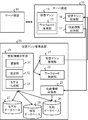
- FIG. 1 is a diagram conceptually illustrating a configuration example of a virtual machine management system 1 in the first embodiment.
- the virtual machine management system 1 in the first embodiment includes a plurality of server apparatuses 10 (# 1) to 10 (#m) (m is a positive integer), a virtual machine management apparatus 20, and the like.
- the plurality of server apparatuses 10 (# 1) to 10 (#m) are collectively referred to as the server apparatus 10 unless it is necessary to distinguish them individually.
- the server device 10 and the virtual machine management device 20 are so-called computers, and include, for example, a CPU 2, a memory 3, an input / output interface (I / F) 4, and the like that are connected to each other via a bus 5.
- the memory 3 is a RAM (Random Access Memory), a ROM (Read Only Memory), a hard disk, a portable storage medium, or the like.
- the input / output I / F 4 is connected to a communication device 7 that communicates with other devices via a communication network 9. Note that the input / output I / F 4 may be connected to a device that accepts an input of a user operation such as a keyboard or a mouse, or a device that provides information to the user such as a display device or a printer.
- the hardware configurations of the server device 10 and the virtual machine management device 20 are not limited.
- the plurality of server devices 10 and the virtual machine management device 20 are connected to each other via a communication network 9 so that they can communicate with each other.
- the communication network 9 is a public network such as the Internet, a WAN (Wide Area Network), a LAN (Local Area Network), a wireless communication network, or the like.
- communication modes between the server apparatuses 10 and between each server apparatus 10 and the virtual machine management apparatus 20 are not limited.
- FIG. 2 is a diagram conceptually illustrating a processing configuration example of the server device 10 and the virtual machine management device 20 in the first embodiment.
- the server apparatus 10 includes a virtual machine control unit 16, a performance information measurement unit 17, and the like, and can operate at least one virtual machine 11.
- Each of these processing units and the virtual machine 11 is realized by executing a program stored in the memory 3 by the CPU 2 in the server device 10. Further, the program may be installed from a portable recording medium such as a CD (Compact Disc) or a memory card or another computer on the network via the input / output I / F 4 and stored in the memory 3. Good.
- a portable recording medium such as a CD (Compact Disc) or a memory card or another computer on the network via the input / output I / F 4 and stored in the memory 3. Good.
- the virtual machine control unit 16 activates the virtual machine 11 and allocates resources to the virtual machine 11.
- the performance information measuring unit 17 measures the performance information of the virtual machine 11 and the own server device 10.
- the measured performance information includes performance information for at least one resource type.
- the performance information measurement unit 17 measures performance information for a plurality of resource types such as a CPU resource, a network resource, a disk resource, and a memory resource, for example, the CPU usage rate, the network reception amount, the network transmission amount, Measure disk reading, disk writing, and memory usage.
- the virtual machine 11 operated by the server device 10 includes a measurement virtual machine 11.
- the measurement virtual machine 11 may be preinstalled in the server device 10 at the start of operation, or may be provided from the virtual machine management device 20 or another device via the communication network 9.
- the measurement virtual machine 11 has a workload generation unit 12.
- the workload generation unit 12 executes various types of workloads on the measurement virtual machine 11.
- the workload generation unit 12 executes a workload corresponding to a workload specification acquired from a setting file or another device. For example, when workload types corresponding to two resource types are specified as the workload specification, the workload generation unit 12 sequentially executes two types of workloads related to each resource type. In this case, for example, the CPU workload is realized by an arithmetic processing program that does not perform processing (network transmission / reception or disk read / write) using other resource types.
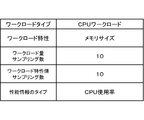
- FIG. 3 is a diagram illustrating an example of a workload specification executed by the measurement virtual machine 11.
- a workload type for example, a workload type, a workload characteristic, a workload amount sampling number, a workload characteristic value sampling number, a performance information type, and the like are designated as the workload specification.
- the workload type indicates a resource type that gives a load, and the type of performance information indicates a form of performance information measured by execution of the workload.
- the used memory size that affects the CPU performance information is specified.
- the size of one transmission / reception packet is used as the workload characteristic value
- the disk reading workload and the disk writing workload are used.
- a sequential access ratio can be used as a workload characteristic value.
- a plurality of workload characteristics may be set for each workload.
- the workload generation unit 12 sequentially selects 100 types of CPU workloads corresponding to combinations of 10 types of workload amounts (number of operations) and 10 types of workload characteristic values (usable memory size). Execute. As a result, the performance information measurement unit 17 sequentially measures 100 pieces of performance information related to CPU workloads having different numbers of calculations and different memory sizes.
- the virtual machine management device 20 includes a virtual machine management unit 21, a workload control unit 22, a performance information collection unit 23, a performance information analysis unit 25, a performance database (DB) 26, a model database (DB) 27, and a characteristic database (DB). 28 etc.
- Each of these processing units is realized by executing a program stored in the memory 3 by the CPU 2 in the virtual machine management apparatus 20. Further, the program may be installed from a portable recording medium such as a CD or a memory card or another computer on the network via the input / output I / F 4 and stored in the memory 3.
- the virtual machine management unit 21 controls the deployment of a plurality of virtual machines 11 to each server device 10, the allocation of resources to each virtual machine 11, the redeployment (movement) of each virtual machine 11, and the like.
- the virtual machine management unit 21 deploys the above-described measurement virtual machine 11 in each target server device 10.
- the deployment of the virtual machine 11 means that the virtual machine 11 can operate on the server device 10, and in this embodiment, the specific method of the deployment is not limited.
- the measurement virtual machine 11 is installed on each server device 10, and the virtual machine management unit 21 may instruct each server device 10 that operates the measurement virtual machine 11 to operate. .
- the virtual machine management unit 21 determines a movement destination server apparatus 10 for the movement target virtual machine 11 among the plurality of virtual machines 11, and moves the movement target virtual machine 11 to the movement destination server apparatus 10.
- the workload control unit 22 controls the workload generated on the measurement virtual machine 11.
- the workload control unit 22 acquires workload specification setting information as shown in the example of FIG. 3 and designates the workload specification to the workload generation unit 12 of the measurement virtual machine 11.
- the setting information of the workload specification may be held in advance by the workload control unit 22, may be input from the user interface device, or may be acquired from another device.
- the performance information collection unit 23 collects performance information measured by the performance information measurement unit 17 of each server device 10 and stores the collected performance information in the performance DB 26. When the workload is executed based on the example of FIG. 3, the performance information collection unit 23 receives 100 pieces of performance information related to CPU workloads having different numbers of calculations and different memory sizes from each server device 10. collect. The performance information collection unit 23 stores each collected performance information in the performance DB 26 in association with the workload amount and the workload characteristic value corresponding to the performance information.
- the virtual machine management device 20 can associate the performance information collected from the server device 10 with the workload amount and the workload characteristic value corresponding to the performance information. It operates in cooperation with each server device 10.
- the present embodiment does not limit the form of this cooperative operation.
- As a form of this cooperative operation for example, there is a form in which the association is executed on the virtual machine management apparatus 20 side and a form in which the association is executed on each server apparatus 10 side.
- the workload control unit 22 of the virtual machine management device 20 gives a workload execution instruction including a certain combination of the workload amount and the workload characteristic value to the measurement virtual machine 11 of each server device 10.
- a workload execution instruction including the next new combination is sent to each measurement virtual machine 11.
- the workload generation unit 12 sequentially executes the workload corresponding to the combination of the instructed workload amount and the workload characteristic value, and the performance information measurement unit 17 Measure workload performance information sequentially.
- the workload control unit 22 gives a workload execution instruction further including a list of workload amounts and a list of workload characteristic values in addition to the information shown in FIG. Send to.
- the workload corresponding to each combination is sequentially executed according to the instruction, and the performance information at that time is sequentially measured.
- the performance information measuring unit 17 of each server device 10 generates information in which each measured performance information and a combination of a workload amount and a workload characteristic value corresponding to the performance information are associated with each other. It transmits to the virtual machine management apparatus 20.
- the performance information collection unit 23 collects the performance information of each virtual machine 11 other than the measurement virtual machine 11 from each server device 10 on which each virtual machine 11 is operating. Therefore, the performance information collection unit 23 can also be called a performance information acquisition unit.
- the performance DB 26 stores each piece of performance information and a combination of a workload amount and a workload characteristic value corresponding to the performance information in association with each server device 10.
- the performance DB 26 relates each resource type of each server device 10 with each performance information, a workload amount corresponding to the performance information, and a workload characteristic value.
- Each combination is stored in an associated form.
- the performance information analysis unit 25 includes a conversion unit 31, an estimation unit 32, a model generation unit 33, and the like.
- the model generation unit 33 generates a performance model of each server device 10 from the correspondence between each combination of workload amount and workload characteristic value and the performance information of each workload stored in the performance DB 26.
- this performance model is represented by a regression equation in which a workload amount and a workload characteristic value are input and performance information corresponding to the combination is output.
- the model generation unit 33 generates the performance model by performing multiple regression analysis using information stored in the performance DB 26. According to the performance information measured according to the workload specification in the example of FIG. 3, a performance model having a workload amount (number of operations) and a workload characteristic value (used memory size) as inputs and a CPU usage rate as an output is Generated.
- this embodiment does not limit the method of generating this performance model as long as it shows a plurality of correspondence relationships among the workload amount, the workload characteristic value, and the performance information of the workload.
- the model generation unit 33 may generate a performance model indicating each of a plurality of correspondence relationships among the workload amount, the workload characteristic value, and the workload performance information for each of the plurality of resource types.
- the model DB 27 stores the performance model of each server device 10 generated by the model generation unit 33.
- Each performance model stored in the model DB 27 may be generated once for each server device 10 as long as the configuration of the server device 10 does not change. For example, before starting the operation of the server device 10 (such as immediately after purchase). May be generated once.
- the conversion unit 31 uses the performance model of the server device 10 in which the virtual machine 11 to be moved is used, converts the performance information of the virtual machine 11 to be moved, the workload amount and the workload related to the virtual machine 11 to be moved. Convert to combination with characteristic value.
- the performance information of the migration target virtual machine 11 is collected by the performance information collection unit 23.
- the server device 10 in which the virtual machine 11 to be moved is identified from the performance information acquisition source or the management information of the virtual machine management unit 21. Since the conversion unit 31 acquires the performance model of the server device 10 from the model DB 27, the conversion unit 31 also operates as a model acquisition unit.
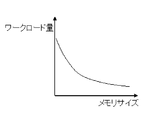
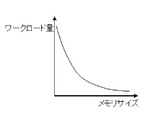
- the CPU workload performs arithmetic processing with a low cache hit rate and a small workload amount. It is not possible to determine whether there is an arithmetic process with a high cache hit rate and a large workload. As a result, there are a plurality of combinations of workload amounts and workload characteristic values corresponding to the CPU usage rate of 50%.
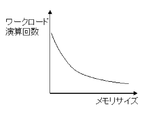
- FIG. 4 is a diagram illustrating an example of a correspondence relationship between the workload amount (number of operations) and the workload characteristic value (memory size) when the CPU usage rate (performance information) is fixed in the CPU usage rate performance model. is there. As shown in FIG. 4, even when the CPU usage rate is the same, the workload amount varies with the memory size used by the workload.
- the characteristic DB 28 stores a plurality of combinations of the workload amount and the workload characteristic value related to the virtual machine 11 to be moved, converted from the performance information measured on a certain server device 10. Therefore, for the virtual machine 11 that has already been moved in the past, a plurality of combinations of the workload amount and the workload characteristic value converted from the performance information measured on the server device 10 that was operating before the movement. Is stored in the characteristic DB 28.
- the characteristic DB 28 can also be called a characteristic information storage unit.
- a plurality of combinations of workload amounts and workload characteristic values related to a certain virtual machine 11 that are converted from performance information by the conversion unit 31 may be handled as discrete data such as array data, It may be handled as such continuous data.
- the characteristic DB 28 stores data relating to the plurality of combinations in the data format handled by the virtual machine management apparatus 20 in this way.
- the conversion unit 31 uses a plurality of past combinations stored in the characteristic DB 28 and the server apparatus 10 on which the virtual machine 11 is currently operating. Based on a plurality of combinations converted from the measured performance information, one combination of a workload amount and a workload characteristic value related to the virtual machine 11 to be moved is determined. This can be realized, for example, by finding a solution of simultaneous equations.
- the conversion unit 31 calculates a workload from a plurality of combinations converted from performance information measured by the server apparatus 10 in which the movement target virtual machine 11 is currently operating. One combination of quantity and workload characteristic value is determined. Specifically, the conversion unit 31 determines the one combination by selecting any one of the plurality of combinations or taking an average among the plurality of combinations.
- the conversion unit 31 uses the performance information for each resource type as a workload amount and a workload characteristic value for each resource type of the virtual machine 11. Convert to a combination.
- the estimation unit 32 applies the combination converted by the conversion unit 31 to the performance model of the migration destination server device 10 that is a migration destination candidate of the migration target virtual machine 11, thereby causing the estimation server 32 on the migration destination server device 10.
- the performance information of the virtual machine 11 to be moved is estimated.
- the virtual machine management method according to the first embodiment will be described with reference to FIGS. 5 and 6.
- the virtual machine management method according to the first embodiment performs the preparation phase until the performance model of each server device 10 is generated and the virtual machine to be moved in the state where the performance model of each server device 10 is generated. It is classified into an operation phase in which the machine 11 is moved to a certain server device 10. Therefore, hereinafter, the virtual machine management method in the first embodiment will be described for each phase.
- FIG. 5 is a flowchart showing an operation example of the preparation phase of the virtual machine management apparatus 20 in the first embodiment.
- the virtual machine management device 20 deploys the measurement virtual machine 11 to each server device 10 that is a performance model generation target (S51).
- the virtual machine management apparatus 20 reads the setting information of the workload specification (S52), and determines the combination of the workload amount and the workload characteristic value regarding the workload to be executed. This combination data may be included in the setting information or may be determined randomly.
- the virtual machine management device 20 sends a workload execution instruction indicating the determined combination to the measurement virtual machine 11 of each server device 10.
- the measurement virtual machine 11 of each server apparatus 10 executes a workload corresponding to the combination of the workload amount and the workload characteristic value included in the instruction (S53).
- Each server device 10 measures the performance information of the executed workload (S54).
- the virtual machine management device 20 collects the performance information of the workload measured by each server device 10 (S54), the collected performance information, the workload amount and the workload characteristic value corresponding to the performance information, Are stored in association with each other.
- the virtual machine management apparatus 20 executes (S53) and (S54) described above for all workloads indicated by the read setting information (S55; YES).
- the virtual machine management device 20 When the collection of performance information for all workloads is completed (S55; NO), the virtual machine management device 20 generates a performance model for each server device 10 from the stored information, and each generated server The performance model of the apparatus 10 is stored (S56).
- Such a preparation phase may be executed once for each server device 10 if the configuration of the server devices 10 does not change. For example, when a new server device 10 is purchased and introduced into the virtual machine management system 1, this preparation phase targets the new server device 10 before starting the operation of the new server device 10. Is executed once.
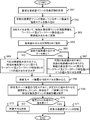
- FIG. 6 is a flowchart showing an operation example of the operation phase of the virtual machine management apparatus 20 in the first embodiment.
- the operation phase shown in FIG. 6 is executed when a trigger for migrating the virtual machine 11 operating in the virtual machine management system 1 is generated.
- This trigger is generated, for example, due to maintenance of the server device 10, occurrence of an overload state of the server device 10, aggregation of the virtual machines 11 to the server device 10 for power saving, or the like.
- the conditions for generating the trigger are not limited at all.
- the virtual machine management device 20 identifies the migration target virtual machine 11 and acquires performance information of the migration target virtual machine 11 (S61).
- the performance information of the migration target virtual machine 11 is measured by the server device 10 (indicated as the current server device 10) on which the virtual machine 11 currently operates, and is collected by the virtual machine management device 20.
- the virtual machine management device 20 reads the performance model of the current server device 10 (S62).
- the virtual machine management device 20 uses the performance model of the current server device 10 to convert the performance information of the migration target virtual machine 11 into a plurality of combinations of workload amounts and workload characteristic values related to the migration target virtual machine 11 ( S63).
- the virtual machine management apparatus 20 stores discrete data or continuous data as a plurality of combinations in the characteristic DB 28 (S64).
- the virtual machine management apparatus 20 determines whether or not data indicating a plurality of combinations converted in the past is stored in the characteristic DB 28 with respect to the migration target virtual machine 11 (S65).
- the data indicating a plurality of past combinations is stored in the characteristic DB 28 when the movement target virtual machine 11 has been moved in the past, and is based on the performance information on the server device 10 that was operating before the movement. Corresponds to multiple converted combinations.
- the virtual machine management apparatus 20 stores data indicating the plurality of combinations converted this time and a plurality of combinations converted in the past. Based on the indicated data, one combination of the workload amount and the workload characteristic value related to the migration target virtual machine 11 is determined (S67).
- the virtual machine management device 20 determines the workload amount related to the migration target virtual machine 11 from the plurality of combinations that have been converted this time. And one combination of the workload characteristic values are determined (S66).
- the virtual machine management apparatus 20 reads the performance model of the server apparatus 10 (denoted as the movement destination server apparatus 10) that is a movement destination candidate (S68).
- the virtual machine management apparatus 20 applies the combination of the workload amount and the workload characteristic value determined in (S66) or (S67) to the performance model of the movement destination server apparatus 10 to thereby move the movement destination server apparatus 10.
- the performance information of the migration target virtual machine 11 is estimated (S69).
- the virtual machine management device 20 determines whether or not there is a free resource amount that can bear the estimated performance information in the migration destination server device 10 (S70), and if it exists (S70; YES). The movement target virtual machine 11 is moved to the movement destination server apparatus 10 (S71).
- the virtual machine management device 20 determines that the migration target virtual machine 11 cannot be migrated to the migration destination server device 10 (S72). When it is determined that the movement is impossible (S72), the virtual machine management device 20 may select another server device 10 and execute (S68) and subsequent steps for the server device 10.
- the measurement virtual machine 11 is caused to execute a plurality of types of workloads corresponding to a plurality of combinations of the workload amount and the workload characteristic value.
- the performance information of the workload is measured, and the virtual machine management device 20 generates a performance model indicating a plurality of correspondence relationships among the workload amount, the workload characteristic value, and the performance information for each server device 10. That is, according to the first embodiment, the performance model of each server device 10 can be automatically generated.
- the first embodiment using the performance model of the current server device 10 in which the virtual machine 11 operates, a plurality of combinations of the workload amount and the workload characteristic value converted from the performance information of the virtual machine 11 are combined.
- the data shown is stored.
- one combination of the workload amount and the workload characteristic value of the virtual machine 11 is determined from the plurality of combinations converted at the time of the past movement determination and the plurality of combinations obtained by the current conversion.
- The By using past information in this way, according to the first embodiment, it is possible to obtain one combination of the workload amount and the workload characteristic value that indicates the performance of the virtual machine 11 with high accuracy. .
- the server device 10 can be prevented from being heavily loaded.
- the combination obtained for the virtual machine 11 that moves for the first time is information obtained from the performance model of the current server device 10 although the accuracy is lower than that of the virtual machine 11 that has been moved in the past. It is possible to maintain a degree of accuracy.
- the virtual environment can be realized in various forms. Depending on the form of the virtual environment, performance information for each virtual machine 11 may not be measured. For example, in a layer configuration in which a guest OS is executed on the host OS, when the guest OS virtual machine performs input / output processing of a network, a disk, or the like, the load is also applied to the host OS. At this time, when a plurality of guest OSs are operating on one host OS, only the total load of the plurality of guest OSs is measured as the performance information of the host OS, and the contribution of one virtual machine 11 is unknown. There is a case. In some cases, the nature of the workload can be estimated without using the host OS information, but the host OS information is important in order to perform highly accurate estimation.
- the CPU usage rate can be measured for each virtual machine 11, but the hard disk usage rate cannot be measured for each virtual machine 11 and may have to be measured for each host OS.
- the virtual machine management system 1 in the second embodiment has the same configuration as in the first embodiment, and the server apparatus 10 and the virtual machine management apparatus 20 in the second embodiment also have the same processing configuration as in the first embodiment. Have.
- the second embodiment will be described focusing on the contents different from the first embodiment, and the same contents as those of the first embodiment will be omitted as appropriate.
- the performance information of the resource types that can be measured for each virtual machine 11 is processed in the same manner as in the first embodiment. It only has to be done. Further, when the server apparatus 10 that can measure performance information for each virtual machine 11 and the server apparatus 10 that cannot measure performance information for each virtual machine 11 coexist, the former server apparatus 10 measures the performance information.
- the performance information may be processed in the same manner as in the first embodiment. That is, in such a mixed environment, the contents of the first embodiment described above and the contents of the second embodiment described later are mixedly executed.
- the performance information measurement unit 17 measures integrated performance information of a group of virtual machines 11 in a predetermined unit.
- the predetermined unit means a unit capable of measuring performance information.
- the predetermined unit means a host OS unit
- the performance information measurement unit 17 measures the performance information of the host OS as the integrated performance information of the group of virtual machines 11 operating on the host OS. To do.
- the performance information of the host OS measured by the performance information measuring unit 17 indicates the sum of the performance information of all virtual machines 11 operating on the host OS, and the integrated performance of the group of virtual machines 11 described above. Information.
- the performance information collection unit 23 collects performance information of the host OS measured by the performance information measurement unit 17 described above, and from the performance information, the performance information collection unit 23 Extract performance information corresponding to the contribution.
- the performance information collection unit 23 calculates performance information corresponding to the contribution of the virtual machine 11 based on the amount of change in the performance information accompanying the movement of the virtual machine 11. Specifically, the performance information collection unit 23 collects the decrease amount of the performance information before and after the movement of the virtual machine 11 from the server apparatus 10 (previously indicated as the previous server apparatus 10) that was operating before the movement. The amount of decrease is obtained as performance information on the previous server device 10 of the virtual machine 11.
- the performance information collection unit 23 calculates the increase in the performance information before and after the movement of the virtual machine 11 from the performance information before and after the movement collected from the server device 10 operating after the movement (denoted as the current server device 10). The amount of increase is acquired as performance information on the current server device 10 of the virtual machine 11.
- the performance information on the current server device 10 of the virtual machine 11 is the performance information on the current server device 10 accompanying the movement of the virtual machine 11. Can be obtained by increasing the amount of.
- the virtual server 11 on the current server device 10 of the virtual machine 11 is not obtained.
- Performance information cannot be obtained. Therefore, when the performance information collection unit 23 determines that the virtual machine 11 that has not yet been moved is a movement target, for example, the performance information collection unit 23 performs component analysis on the history data of the performance information of the host OS measured by the current server device 10.
- the performance information of the virtual machine 11 on the current server device 10 is estimated.
- the component analysis method a known method such as independent component analysis may be used.
- the past combinations of the workload amount and the workload characteristic value stored in the characteristic DB 28 are the performances estimated as described above. Since the information is converted from information, the accuracy may be somewhat low. Therefore, based on the performance information on the previous server device 10 of the virtual machine 11 obtained from the increase amount of the performance information as described above after the movement of the virtual machine 11, the plurality of combinations related to the previous server device 10 are again performed. It is desirable to acquire and update the past plural combinations by the plural combinations. In this way, the past information used when the virtual machine 11 that has been moved once is determined as the movement target becomes highly accurate.
- the generation of the performance model in the preparation phase is the first embodiment using the performance information measured by the performance information measuring unit 17 described above by causing each server apparatus 10 to operate only the measurement virtual machine 11. As long as it is performed.
- the second embodiment even for performance information that cannot be acquired for each virtual machine 11, the amount of increase in the performance information of the host OS before and after the movement of the virtual machine 11 (integrated performance information of a virtual machine group in a predetermined unit).
- the performance information of the virtual machine 11 on the current server device 10 or the performance information of the virtual machine 11 on the previous server device 10 is calculated based on the decrease amount.
- the performance information of the virtual machine 11 at the migration destination is estimated from this performance information, as in the first embodiment. Therefore, according to the second embodiment, it is possible to accurately estimate the performance of the virtual machine 11 at the migration destination even if the performance information cannot be acquired for each virtual machine 11.
- the conversion unit 31 of the virtual machine management device 20 extracts the performance model of the server device 10 (# 1) from the model DB 27, and uses this performance model to perform the performance of the virtual machine 11 on the server device 10 (# 1).
- Information (CPU usage rate 50%) is converted into a plurality of combinations of workload amount and workload characteristic value.
- FIG. 7 is a diagram illustrating an example of a plurality of combinations of workload amounts and workload characteristic values converted using the performance model of the server device 10 (# 1).
- a memory size is used as a workload characteristic
- continuous data is used as data indicating the plurality of combinations.
- the server device 10 (# 2) as the migration destination candidate has a smaller CPU clock and a larger cache than the server device 10 (# 1).
- FIG. 7 A plurality of pieces of performance information as shown in the example is obtained.
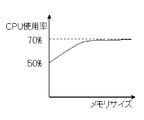
- FIG. 8 is a diagram illustrating an example of performance information of the virtual machine 11 on the destination server apparatus 10 (# 2).
- the performance is improved by the effect of the CPU cache, so the performance on the server device 10 (# 1) and the server device 10 (# 2) The difference between the performance and the performance will be reduced.
- the CPU usage rate 50% on the server device 10 (# 1) depends on the combination of the workload amount and the workload characteristic value, and 50% on the server device 10 (# 2). To any value in the range of 70%.
- the memory size used cannot be observed, it cannot be specified.
- the estimation unit 32 determines the performance information on the server device 10 (# 2) of the virtual machine 11 to a value in the range of 50% to 70%, or 70% which is the maximum value in the range. .
- the virtual machine 11 can be transferred to the server apparatus 10 (# 2).
- the conversion unit 31 selects one combination from the plurality of combinations converted from the performance model of the server device 10 (# 1).
- the estimation unit 32 applies the plurality of combinations to the performance model of the migration destination server device 10 (# 2), and the migration destination server device of the virtual machine 11 from the range of performance information obtained.
- the performance information on 10 (# 2) may be estimated.
- FIG. 9 is a diagram illustrating an example of a plurality of combinations of workload amounts and workload characteristic values converted using the performance model of the server device 10 (# 2).
- FIG. 10 is a graph showing a distribution obtained by superimposing the distribution of FIG. 7 and the distribution of FIG.
- the conversion unit 31 determines the intersection of the two distributions shown in FIG. 10 as one combination of the workload amount and the workload characteristic value related to the virtual machine 11. Thereafter, when the virtual machine 11 is migrated, the determined combination is used as data indicating the performance of the virtual machine 11 so that the performance information at the migration destination of the virtual machine 11 can be estimated with high accuracy. It becomes possible.
- the virtual machine management apparatus 20 includes the performance DB 26, the model DB 27, and the characteristic DB 28 is shown (see FIG. 2). These databases are stored in other apparatuses in the virtual machine management system 1. And the virtual machine management device 20 may access these databases on the other devices. Further, in each of the above-described embodiments, the server device 10 that operates the virtual machine 11 and the virtual machine management device 20 are provided separately. However, all or part of the configuration of the virtual machine management device 20 is the server device 10. It may be provided above. For example, the model generation unit 33 and the model DB 27 may be provided in each server device 10, and each server device 10 may generate and store a performance model of the own server device 10.
- the workload amount, the workload characteristic value that is a workload parameter that affects the workload performance, and the workload corresponding to the workload amount and the workload characteristic value are executed on each server device.
- a model acquisition unit that acquires a performance model indicating a plurality of correspondences with the performance information of the workload measured by each of the server devices;
- a performance information acquisition unit that acquires performance information of the migration target virtual machine running on the current server device;
- a conversion unit that converts the performance information of the migration target virtual machine into a combination of a workload amount and a workload characteristic value related to the migration target virtual machine by using the performance model of the current server device;
- By applying the combination converted by the conversion unit to the performance model of a destination server device that is a destination candidate of the destination virtual machine, the destination virtual machine on the destination server device
- An estimation unit for estimating the performance information of A virtual machine management device.
- the conversion unit obtains a plurality of combinations of a workload amount and a workload characteristic value related to the migration target virtual machine by applying the performance information of the migration target virtual machine to the performance model of the current server device. And determining one combination after the conversion of the performance information of the migration target virtual machine from the plurality of combinations.
- the virtual machine management device according to appendix 1 or 2, characterized in that:
- the workload related to the migration target virtual machine obtained by applying the performance information of the migration target virtual machine on the previous server device on which the migration target virtual machine was previously operating to the performance model of the previous server device
- a characteristic information storage unit for storing a first plurality of combinations of quantities and workload characteristic values
- the conversion unit applies the performance information of the migration target virtual machine to the performance model of the current server device, thereby obtaining a second plurality of workload amounts and workload characteristic values related to the migration target virtual machine.
- a combination is acquired, and one combination after conversion of the performance information of the migration target virtual machine is determined from the second plurality of combinations and the first plurality of combinations stored in the characteristic information storage unit.
- the virtual machine management device according to any one of appendices 1 to 3.
- the performance information acquisition unit when the migration target virtual machine has moved from the previous server device that was previously operating to the current server device, the integrated performance information of a group of virtual machines that operate on the current server device
- the performance information of the migration target virtual machine on the current server device is acquired from the increase of the current server device, or from the decrease of the integrated performance information of the virtual machine group of a predetermined unit operating on the previous server device,
- the virtual machine management device according to any one of appendices 1 to 4, which acquires the performance information of the migration target virtual machine on a previous server device.
- the performance model indicates a plurality of correspondence relationships between the workload amount, the workload characteristic value, and the workload performance information for each of a plurality of resource types
- the performance information acquisition unit acquires the performance information of the migration target virtual machine for each of the plurality of resource types
- the conversion unit uses the performance model for each resource type to calculate the performance information for each resource type of the migration target virtual machine and the workload amount for each resource type of the migration target virtual machine. Converted into a combination with the workload characteristic value,
- the estimation unit estimates performance information for each resource type of the migration target virtual machine on the migration destination server device, The virtual machine management device according to any one of appendices 1 to 5.
- the virtual machine management device according to any one of appendices 1 to 6, A plurality of server devices; With Each of the plurality of server devices is A virtual machine management system having a performance information measuring unit that measures performance information of a virtual machine operating on the own server device or integrated performance information of a predetermined unit of virtual machine group operating on the own server device.
- (Appendix 8) At least one computer
- the workload amount, the workload characteristic value that is a workload parameter that affects the workload performance, and the workload corresponding to the workload amount and the workload characteristic value are executed on each server device.
- Obtain a performance model for each server device that shows multiple correspondences with the performance information of the workload measured by Obtain the performance information of the migration target virtual machine running on the current server device.
- the performance information of the migration target virtual machine is converted into a combination of a workload amount and a workload characteristic value related to the migration target virtual machine,
- the performance information of the movement target virtual machine on the movement destination server apparatus is obtained.
- a virtual machine management method A virtual machine management method.
- the at least one computer comprises: Each of a plurality of workloads corresponding to a plurality of combinations of the workload amount and the workload characteristic value is sequentially applied to a measurement virtual machine arranged in each server device in order to execute a specified workload. Let it run Collecting performance information of each workload on each server device, which is measured by each workload being executed on each server device, From the correspondence between each combination of the workload amount and the workload characteristic value and the performance information of each workload, the performance model of each server device is generated, respectively.
- the virtual machine management method according to appendix 8 further including:
- the transformation is By applying the performance information of the migration target virtual machine to the performance model of the current server device, a plurality of combinations of a workload amount and a workload characteristic value related to the migration target virtual machine are acquired, Determining one combination after the conversion of the performance information of the migration target virtual machine from the plurality of combinations;
- the at least one computer comprises: The workload related to the migration target virtual machine obtained by applying the performance information of the migration target virtual machine on the previous server device on which the migration target virtual machine was previously operating to the performance model of the previous server device Storing a first plurality of combinations of quantities and workload characteristic values; Further including The transformation is By applying the performance information of the migration target virtual machine to the performance model of the current server device, a second plurality of combinations of a workload amount and a workload characteristic value related to the migration target virtual machine are acquired, Determining one combination after the conversion of the performance information of the migration target virtual machine from the second plurality of combinations and the first plurality of combinations;
- the virtual machine management method according to any one of appendices 8 to 10, including:
- the acquisition of the performance information of the migration target virtual machine is performed by a predetermined unit of virtual machine operating on the current server device when the migration target virtual machine is moved from the previous server device that was previously operating to the current server device.
- the performance information of the migration target virtual machine on the current server device is acquired from the increase in the integrated performance information of the machine group, or the integrated performance of the virtual machine group in a predetermined unit that operates on the previous server device.
- the virtual machine management method according to any one of appendices 8 to 11, further comprising: acquiring the performance information of the migration target virtual machine on the previous server device from a decrease in information.
- the performance model indicates a plurality of correspondence relationships between the workload amount, the workload characteristic value, and the workload performance information for each of a plurality of resource types
- the acquisition of the performance information of the migration target virtual machine acquires the performance information of the migration target virtual machine for each of the plurality of resource types
- the conversion uses the performance model for each resource type to convert the performance information for each resource type of the migration target virtual machine, the workload amount for each resource type of the migration target virtual machine, and the Converted into a combination with workload characteristic values
- the estimation estimates performance information for each resource type of the migration target virtual machine on the migration destination server device,
- the virtual machine management method according to any one of appendices 8 to 12.
- the workload amount, the workload characteristic value that is a workload parameter that affects the workload performance, and the workload corresponding to the workload amount and the workload characteristic value are executed on each server device.
- a model acquisition unit that acquires a performance model indicating a plurality of correspondences with the performance information of the workload measured by each of the server devices;
- a performance information acquisition unit that acquires performance information of the migration target virtual machine running on the current server device;
- a conversion unit that converts the performance information of the migration target virtual machine into a combination of a workload amount and a workload characteristic value related to the migration target virtual machine by using the performance model of the current server device;
- By applying the combination converted by the conversion unit to the performance model of a destination server device that is a destination candidate of the destination virtual machine, the destination virtual machine on the destination server device
- An estimation unit for estimating the performance information of A program that realizes
- Each of a plurality of workloads corresponding to a plurality of combinations of the workload amount and the workload characteristic value is sequentially applied to a measurement virtual machine arranged in each server device in order to execute a specified workload.
- a workload controller to be executed A performance information collection unit that collects performance information of each workload on each server device, which is measured by executing each workload on each server device; From the correspondence relationship between each combination of the workload amount and the workload characteristic value and the performance information of each workload, a model generation unit that generates the performance model of each server device, The program according to appendix 14, which further realizes
- the conversion unit obtains a plurality of combinations of a workload amount and a workload characteristic value related to the migration target virtual machine by applying the performance information of the migration target virtual machine to the performance model of the current server device. And determining one combination after the conversion of the performance information of the migration target virtual machine from the plurality of combinations.
- (Appendix 17) Said at least one computer, The workload related to the migration target virtual machine obtained by applying the performance information of the migration target virtual machine on the previous server device on which the migration target virtual machine was previously operating to the performance model of the previous server device Further realizing a characteristic information storage unit that stores the first plurality of combinations of the quantity and the workload characteristic value, The conversion unit applies the performance information of the migration target virtual machine to the performance model of the current server device, thereby obtaining a second plurality of workload amounts and workload characteristic values related to the migration target virtual machine. A combination is acquired, and one combination after conversion of the performance information of the migration target virtual machine is determined from the second plurality of combinations and the first plurality of combinations stored in the characteristic information storage unit. , The program according to any one of appendices 14 to 16.
- the performance information acquisition unit when the migration target virtual machine has moved from the previous server device that was previously operating to the current server device, the integrated performance information of a group of virtual machines that operate on the current server device
- the performance information of the migration target virtual machine on the current server device is acquired from the increase of the current server device, or from the decrease of the integrated performance information of the virtual machine group of a predetermined unit operating on the previous server device,
- the program according to any one of appendices 14 to 17, which acquires the performance information of the migration target virtual machine on a previous server device.
- the performance model indicates a plurality of correspondence relationships between the workload amount, the workload characteristic value, and the workload performance information for each of a plurality of resource types
- the performance information acquisition unit acquires the performance information of the migration target virtual machine for each of the plurality of resource types
- the conversion unit uses the performance model for each resource type to calculate the performance information for each resource type of the migration target virtual machine and the workload amount for each resource type of the migration target virtual machine. Converted into a combination with the workload characteristic value,
- the estimation unit estimates performance information for each resource type of the migration target virtual machine on the migration destination server device, The program according to any one of appendices 14 to 18.
- Appendix 20 A recording medium for recording the program according to any one of appendices 14 to 19 in a computer-readable manner.
Landscapes
- Engineering & Computer Science (AREA)
- Theoretical Computer Science (AREA)
- General Engineering & Computer Science (AREA)
- Software Systems (AREA)
- Physics & Mathematics (AREA)
- General Physics & Mathematics (AREA)
- Computer Hardware Design (AREA)
- Quality & Reliability (AREA)
- Life Sciences & Earth Sciences (AREA)
- Bioinformatics & Cheminformatics (AREA)
- Bioinformatics & Computational Biology (AREA)
- Evolutionary Biology (AREA)
- Debugging And Monitoring (AREA)
Description
〔システム構成〕
図1は、第1実施形態における仮想マシン管理システム1の構成例を概念的に示す図である。第1実施形態における仮想マシン管理システム1は、複数のサーバ装置10(#1)から10(#m)(mは正の整数)、仮想マシン管理装置20等を有する。以降、複数のサーバ装置10(#1)から10(#m)は、個別に区別する必要がある場合を除き、サーバ装置10と総称される。
図2は、第1実施形態におけるサーバ装置10及び仮想マシン管理装置20の処理構成例を概念的に示す図である。
サーバ装置10は、仮想マシン制御部16、性能情報計測部17等を有し、少なくとも1つの仮想マシン11を動作させることができる。これら各処理部及び仮想マシン11は、サーバ装置10において、CPU2によりメモリ3に格納されるプログラムが実行されることにより実現される。また、当該プログラムは、例えば、CD(Compact Disc)、メモリカード等のような可搬型記録媒体やネットワーク上の他のコンピュータから入出力I/F4を介してインストールされ、メモリ3に格納されてもよい。
仮想マシン管理装置20は、仮想マシン管理部21、ワークロード制御部22、性能情報収集部23、性能情報分析部25、性能データベース(DB)26、モデルデータベース(DB)27、特性データベース(DB)28等を有する。これら各処理部は、仮想マシン管理装置20において、CPU2によりメモリ3に格納されるプログラムが実行されることにより実現される。また、当該プログラムは、例えば、CD、メモリカード等のような可搬型記録媒体やネットワーク上の他のコンピュータから入出力I/F4を介してインストールされ、メモリ3に格納されてもよい。
以下、第1実施形態における仮想マシン管理方法について図5及び図6を用いて説明する。上述のように、第1実施形態における仮想マシン管理方法は、各サーバ装置10の性能モデルを生成するまでの準備フェーズと、各サーバ装置10の性能モデルが生成されている状態において移動対象の仮想マシン11を或るサーバ装置10に移動させる運用フェーズとに分類される。よって、以下、第1実施形態における仮想マシン管理方法をフェーズ毎にそれぞれ説明する。
上述のように、第1実施形態では、各サーバ装置10上で、計測用仮想マシン11に、ワークロード量とワークロード特性値との複数組み合わせに対応する複数種のワークロードを実行させ、各ワークロードの性能情報がそれぞれ計測され、仮想マシン管理装置20において、ワークロード量とワークロード特性値と性能情報との複数の対応関係を示す性能モデルが各サーバ装置10についてそれぞれ生成される。つまり、第1実施形態によれば、各サーバ装置10の性能モデルを自動で生成することができる。
仮想環境は様々な形態で実現され得る。仮想環境の形態によっては、仮想マシン11毎の性能情報が計測できない場合がある。例えば、ホストOS上でゲストOSが実行されるレイヤ構成では、通常、ゲストOSの仮想マシンがネットワークやディスク等の入出力処理を行う場合、その負荷がホストOSにもかかる。このとき、1つのホストOS上で複数のゲストOSが動作している場合、複数のゲストOSの負荷の合計のみがホストOSの性能情報として計測され、1つの仮想マシン11の寄与分が不明な場合がある。ホストOSの情報を利用しなくてもワークロードの性質を推定できる場合もあるが、高精度の推定を行うためにはホストOSの情報が重要となる。
上述のように、第2実施形態では、仮想マシン11毎に取得できない性能情報についても、仮想マシン11の移動前後のホストOSの性能情報(所定単位の仮想マシン群の統合性能情報)の増加量又は減少量により、仮想マシン11の現サーバ装置10上での性能情報又は仮想マシン11の前サーバ装置10上での性能情報が算出される。以降、この性能情報により、第1実施形態と同様に、移動先での仮想マシン11の性能情報が推定される。よって、第2実施形態によれば、仮想マシン11毎に性能情報が取得できない形態であっても、移行先における仮想マシン11の性能を精度良く見積もることが可能となる。
上述の各実施形態では、仮想マシン管理装置20が性能DB26、モデルDB27及び特性DB28を有する例が示されているが(図2参照)、これらデータベースは、仮想マシン管理システム1内の他の装置が有しており、仮想マシン管理装置20が当該他の装置上のそれらデータベースにアクセスするようにしてもよい。また、上述の各実施形態では、仮想マシン11を動作させるサーバ装置10と仮想マシン管理装置20とが区別して設けられたが、仮想マシン管理装置20の構成の全部又は一部は、サーバ装置10上に設けられてもよい。例えば、モデル生成部33及びモデルDB27が各サーバ装置10に設けられ、各サーバ装置10が自サーバ装置10の性能モデルをそれぞれ生成し格納するようにしてもよい。
ワークロード量と、ワークロードの性能に影響を与えるワークロードのパラメータであるワークロード特性値と、該ワークロード量及び該ワークロード特性値に対応するワークロードが各サーバ装置上で実行されることにより計測されるワークロードの性能情報との複数の対応関係を示す性能モデルを、各サーバ装置についてそれぞれ取得するモデル取得部と、
現サーバ装置で動作している移動対象仮想マシンの性能情報を取得する性能情報取得部と、
前記現サーバ装置の前記性能モデルを用いることにより、前記移動対象仮想マシンの前記性能情報を、前記移動対象仮想マシンに関するワークロード量とワークロード特性値との組み合わせに変換する変換部と、
前記変換部により変換された前記組み合わせを、前記移動対象仮想マシンの移動先の候補となる移動先サーバ装置の前記性能モデルに適用することにより、該移動先サーバ装置上での前記移動対象仮想マシンの性能情報を推定する推定部と、
を備える仮想マシン管理装置。
指定されたワークロードを実行するために各サーバ装置に配置されている計測用仮想マシンに、前記ワークロード量と前記ワークロード特性値との複数の組み合わせに対応する複数のワークロードの各々を順次実行させるワークロード制御部と、
前記各ワークロードが前記各サーバ装置上でそれぞれ実行されることにより計測される、前記各サーバ装置上における前記各ワークロードの性能情報をそれぞれ収集する性能情報収集部と、
前記ワークロード量と前記ワークロード特性値との前記各組み合わせと前記各ワークロードの性能情報との対応関係から、前記各サーバ装置の前記性能モデルをそれぞれ生成するモデル生成部と、
を更に備える付記1に記載の仮想マシン管理装置。
前記変換部は、前記移動対象仮想マシンの前記性能情報を前記現サーバ装置の前記性能モデルに適用することにより、前記移動対象仮想マシンに関するワークロード量とワークロード特性値との複数の組み合わせを取得し、該複数の組み合わせから、前記移動対象仮想マシンの前記性能情報の変換後の1つの組み合わせを決定する、
ことを特徴とする付記1又は2に記載の仮想マシン管理装置。
前記移動対象仮想マシンが以前動作していた前サーバ装置上での前記移動対象仮想マシンの性能情報を該前サーバ装置の前記性能モデルに適用することにより得られる、前記移動対象仮想マシンに関するワークロード量とワークロード特性値との第1の複数の組み合わせを格納する特性情報格納部を更に備え、
前記変換部は、前記移動対象仮想マシンの前記性能情報を前記現サーバ装置の前記性能モデルに適用することにより、前記移動対象仮想マシンに関するワークロード量とワークロード特性値との第2の複数の組み合わせを取得し、該第2の複数の組み合わせ及び前記特性情報格納部に格納される前記第1の複数の組み合わせから、前記移動対象仮想マシンの前記性能情報の変換後の1つの組み合わせを決定する、
付記1から3のいずれか1つに記載の仮想マシン管理装置。
前記性能情報取得部は、前記移動対象仮想マシンが以前動作していた前サーバ装置から前記現サーバ装置へ移動した場合において、前記現サーバ装置上で動作する所定単位の仮想マシン群の統合性能情報の増加分から、前記現サーバ装置上での前記移動対象仮想マシンの前記性能情報を取得するか、又は、該前サーバ装置上で動作する所定単位の仮想マシン群の統合性能情報の減少分から、該前サーバ装置上での前記移動対象仮想マシンの前記性能情報を取得する付記1から4のいずれか1つに記載の仮想マシン管理装置。
前記性能モデルは、複数のリソース種の各々に関し、前記ワークロード量と前記ワークロード特性値と前記ワークロードの性能情報との複数の対応関係をそれぞれ示し、
前記性能情報取得部は、前記複数のリソース種の各々についての前記移動対象仮想マシンの性能情報をそれぞれ取得し、
前記変換部は、前記各リソース種に関する前記性能モデルを用いて、前記移動対象仮想マシンの前記リソース種毎の前記性能情報を、前記移動対象仮想マシンの前記リソース種毎の、前記ワークロード量と前記ワークロード特性値との組み合わせに変換し、
前記推定部は、前記移動先サーバ装置上における前記移動対象仮想マシンの前記リソース種毎の性能情報をそれぞれ推定する、
付記1から5のいずれか1つに記載の仮想マシン管理装置。
付記1から6のいずれか1つに記載の仮想マシン管理装置と、
複数のサーバ装置と、
を備え、
前記複数のサーバ装置の各々が、
自サーバ装置上で動作している仮想マシンの性能情報、又は、自サーバ装置上で動作している所定単位の仮想マシン群の統合性能情報を計測する性能情報計測部
を有する仮想マシン管理システム。
少なくとも1つのコンピュータが、
ワークロード量と、ワークロードの性能に影響を与えるワークロードのパラメータであるワークロード特性値と、該ワークロード量及び該ワークロード特性値に対応するワークロードが各サーバ装置上で実行されることにより計測されるワークロードの性能情報との複数の対応関係を示す性能モデルを、各サーバ装置についてそれぞれ取得し、
現サーバ装置で動作している移動対象仮想マシンの性能情報を取得し、
前記現サーバ装置の前記性能モデルを用いることにより、前記移動対象仮想マシンの前記性能情報を、前記移動対象仮想マシンに関するワークロード量とワークロード特性値との組み合わせに変換し、
前記変換された組み合わせを、前記移動対象仮想マシンの移動先の候補となる移動先サーバ装置の前記性能モデルに適用することにより、該移動先サーバ装置上での前記移動対象仮想マシンの性能情報を推定する、
ことを含む仮想マシン管理方法。
前記少なくとも1つのコンピュータが、
指定されたワークロードを実行するために各サーバ装置に配置されている計測用仮想マシンに、前記ワークロード量と前記ワークロード特性値との複数の組み合わせに対応する複数のワークロードの各々を順次実行させ、
前記各ワークロードが前記各サーバ装置上でそれぞれ実行されることにより計測される、前記各サーバ装置上における前記各ワークロードの性能情報をそれぞれ収集し、
前記ワークロード量と前記ワークロード特性値との前記各組み合わせと前記各ワークロードの性能情報との対応関係から、前記各サーバ装置の前記性能モデルをそれぞれ生成する、
ことを更に含む付記8に記載の仮想マシン管理方法。
前記変換は、
前記移動対象仮想マシンの前記性能情報を前記現サーバ装置の前記性能モデルに適用することにより、前記移動対象仮想マシンに関するワークロード量とワークロード特性値との複数の組み合わせを取得し、
前記複数の組み合わせから、前記移動対象仮想マシンの前記性能情報の変換後の1つの組み合わせを決定する、
ことを含む付記8又は9に記載の仮想マシン管理方法。
前記少なくとも1つのコンピュータが、
前記移動対象仮想マシンが以前動作していた前サーバ装置上での前記移動対象仮想マシンの性能情報を該前サーバ装置の前記性能モデルに適用することにより得られる、前記移動対象仮想マシンに関するワークロード量とワークロード特性値との第1の複数の組み合わせを格納する、
ことを更に含み、
前記変換は、
前記移動対象仮想マシンの前記性能情報を前記現サーバ装置の前記性能モデルに適用することにより、前記移動対象仮想マシンに関するワークロード量とワークロード特性値との第2の複数の組み合わせを取得し、
前記第2の複数の組み合わせ及び前記第1の複数の組み合わせから、前記移動対象仮想マシンの前記性能情報の変換後の1つの組み合わせを決定する、
ことを含む付記8から10のいずれか1つに記載の仮想マシン管理方法。
前記移動対象仮想マシンの性能情報の前記取得は、前記移動対象仮想マシンが以前動作していた前サーバ装置から前記現サーバ装置へ移動した場合において、前記現サーバ装置上で動作する所定単位の仮想マシン群の統合性能情報の増加分から、前記現サーバ装置上での前記移動対象仮想マシンの前記性能情報を取得するか、又は、該前サーバ装置上で動作する所定単位の仮想マシン群の統合性能情報の減少分から、該前サーバ装置上での前記移動対象仮想マシンの前記性能情報を取得することを含む付記8から11のいずれか1つに記載の仮想マシン管理方法。
前記性能モデルは、複数のリソース種の各々に関し、前記ワークロード量と前記ワークロード特性値と前記ワークロードの性能情報との複数の対応関係をそれぞれ示し、
前記移動対象仮想マシンの性能情報の前記取得は、前記複数のリソース種の各々についての前記移動対象仮想マシンの性能情報をそれぞれ取得し、
前記変換は、前記各リソース種に関する前記性能モデルを用いて、前記移動対象仮想マシンの前記リソース種毎の前記性能情報を、前記移動対象仮想マシンの前記リソース種毎の、前記ワークロード量と前記ワークロード特性値との組み合わせに変換し、
前記推定は、前記移動先サーバ装置上における前記移動対象仮想マシンの前記リソース種毎の性能情報をそれぞれ推定する、
付記8から12のいずれか1つに記載の仮想マシン管理方法。
少なくとも1つのコンピュータに、
ワークロード量と、ワークロードの性能に影響を与えるワークロードのパラメータであるワークロード特性値と、該ワークロード量及び該ワークロード特性値に対応するワークロードが各サーバ装置上で実行されることにより計測されるワークロードの性能情報との複数の対応関係を示す性能モデルを、各サーバ装置についてそれぞれ取得するモデル取得部と、
現サーバ装置で動作している移動対象仮想マシンの性能情報を取得する性能情報取得部と、
前記現サーバ装置の前記性能モデルを用いることにより、前記移動対象仮想マシンの前記性能情報を、前記移動対象仮想マシンに関するワークロード量とワークロード特性値との組み合わせに変換する変換部と、
前記変換部により変換された前記組み合わせを、前記移動対象仮想マシンの移動先の候補となる移動先サーバ装置の前記性能モデルに適用することにより、該移動先サーバ装置上での前記移動対象仮想マシンの性能情報を推定する推定部と、
を実現させるプログラム。
前記少なくとも1つのコンピュータに、
指定されたワークロードを実行するために各サーバ装置に配置されている計測用仮想マシンに、前記ワークロード量と前記ワークロード特性値との複数の組み合わせに対応する複数のワークロードの各々を順次実行させるワークロード制御部と、
前記各ワークロードが前記各サーバ装置上でそれぞれ実行されることにより計測される、前記各サーバ装置上における前記各ワークロードの性能情報をそれぞれ収集する性能情報収集部と、
前記ワークロード量と前記ワークロード特性値との前記各組み合わせと前記各ワークロードの性能情報との対応関係から、前記各サーバ装置の前記性能モデルをそれぞれ生成するモデル生成部と、
を更に実現させる付記14に記載のプログラム。
前記変換部は、前記移動対象仮想マシンの前記性能情報を前記現サーバ装置の前記性能モデルに適用することにより、前記移動対象仮想マシンに関するワークロード量とワークロード特性値との複数の組み合わせを取得し、該複数の組み合わせから、前記移動対象仮想マシンの前記性能情報の変換後の1つの組み合わせを決定する、
ことを特徴とする付記14又は15に記載のプログラム。
前記少なくとも1つのコンピュータに、
前記移動対象仮想マシンが以前動作していた前サーバ装置上での前記移動対象仮想マシンの性能情報を該前サーバ装置の前記性能モデルに適用することにより得られる、前記移動対象仮想マシンに関するワークロード量とワークロード特性値との第1の複数の組み合わせを格納する特性情報格納部を更に実現させ、
前記変換部は、前記移動対象仮想マシンの前記性能情報を前記現サーバ装置の前記性能モデルに適用することにより、前記移動対象仮想マシンに関するワークロード量とワークロード特性値との第2の複数の組み合わせを取得し、該第2の複数の組み合わせ及び前記特性情報格納部に格納される前記第1の複数の組み合わせから、前記移動対象仮想マシンの前記性能情報の変換後の1つの組み合わせを決定する、
付記14から16のいずれか1つに記載のプログラム。
前記性能情報取得部は、前記移動対象仮想マシンが以前動作していた前サーバ装置から前記現サーバ装置へ移動した場合において、前記現サーバ装置上で動作する所定単位の仮想マシン群の統合性能情報の増加分から、前記現サーバ装置上での前記移動対象仮想マシンの前記性能情報を取得するか、又は、該前サーバ装置上で動作する所定単位の仮想マシン群の統合性能情報の減少分から、該前サーバ装置上での前記移動対象仮想マシンの前記性能情報を取得する付記14から17のいずれか1つに記載のプログラム。
前記性能モデルは、複数のリソース種の各々に関し、前記ワークロード量と前記ワークロード特性値と前記ワークロードの性能情報との複数の対応関係をそれぞれ示し、
前記性能情報取得部は、前記複数のリソース種の各々についての前記移動対象仮想マシンの性能情報をそれぞれ取得し、
前記変換部は、前記各リソース種に関する前記性能モデルを用いて、前記移動対象仮想マシンの前記リソース種毎の前記性能情報を、前記移動対象仮想マシンの前記リソース種毎の、前記ワークロード量と前記ワークロード特性値との組み合わせに変換し、
前記推定部は、前記移動先サーバ装置上における前記移動対象仮想マシンの前記リソース種毎の性能情報をそれぞれ推定する、
付記14から18のいずれか1つに記載のプログラム。
付記14から19のいずれか1つに記載のプログラムをコンピュータに読み取り可能に記録する記録媒体。
Claims (9)
- ワークロード量と、ワークロードの性能に影響を与えるワークロードのパラメータであるワークロード特性値と、該ワークロード量及び該ワークロード特性値に対応するワークロードが各サーバ装置上で実行されることにより計測されるワークロードの性能情報との複数の対応関係を示す性能モデルを、各サーバ装置についてそれぞれ取得するモデル取得部と、
現サーバ装置で動作している移動対象仮想マシンの性能情報を取得する性能情報取得部と、
前記現サーバ装置の前記性能モデルを用いることにより、前記移動対象仮想マシンの前記性能情報を、前記移動対象仮想マシンに関するワークロード量とワークロード特性値との組み合わせに変換する変換部と、
前記変換部により変換された前記組み合わせを、前記移動対象仮想マシンの移動先の候補となる移動先サーバ装置の前記性能モデルに適用することにより、該移動先サーバ装置上での前記移動対象仮想マシンの性能情報を推定する推定部と、
を備える仮想マシン管理装置。 - 指定されたワークロードを実行するために各サーバ装置に配置されている計測用仮想マシンに、前記ワークロード量と前記ワークロード特性値との複数の組み合わせに対応する複数のワークロードの各々を順次実行させるワークロード制御部と、
前記各ワークロードが前記各サーバ装置上でそれぞれ実行されることにより計測される、前記各サーバ装置上における前記各ワークロードの性能情報をそれぞれ収集する性能情報収集部と、
前記ワークロード量と前記ワークロード特性値との前記各組み合わせと前記各ワークロードの性能情報との対応関係から、前記各サーバ装置の前記性能モデルをそれぞれ生成するモデル生成部と、
を更に備える請求項1に記載の仮想マシン管理装置。 - 前記変換部は、前記移動対象仮想マシンの前記性能情報を前記現サーバ装置の前記性能モデルに適用することにより、前記移動対象仮想マシンに関するワークロード量とワークロード特性値との複数の組み合わせを取得し、該複数の組み合わせから、前記移動対象仮想マシンの前記性能情報の変換後の1つの組み合わせを決定する、
ことを特徴とする請求項1又は2に記載の仮想マシン管理装置。 - 前記移動対象仮想マシンが以前動作していた前サーバ装置上での前記移動対象仮想マシンの性能情報を該前サーバ装置の前記性能モデルに適用することにより得られる、前記移動対象仮想マシンに関するワークロード量とワークロード特性値との第1の複数の組み合わせを格納する特性情報格納部を更に備え、
前記変換部は、前記移動対象仮想マシンの前記性能情報を前記現サーバ装置の前記性能モデルに適用することにより、前記移動対象仮想マシンに関するワークロード量とワークロード特性値との第2の複数の組み合わせを取得し、該第2の複数の組み合わせ及び前記特性情報格納部に格納される前記第1の複数の組み合わせから、前記移動対象仮想マシンの前記性能情報の変換後の1つの組み合わせを決定する、
請求項1から3のいずれか1項に記載の仮想マシン管理装置。 - 前記性能情報取得部は、前記移動対象仮想マシンが以前動作していた前サーバ装置から前記現サーバ装置へ移動した場合において、前記現サーバ装置上で動作する所定単位の仮想マシン群の統合性能情報の増加分から、前記現サーバ装置上での前記移動対象仮想マシンの前記性能情報を取得するか、又は、該前サーバ装置上で動作する所定単位の仮想マシン群の統合性能情報の減少分から、該前サーバ装置上での前記移動対象仮想マシンの前記性能情報を取得する請求項1から4のいずれか1項に記載の仮想マシン管理装置。
- 前記性能モデルは、複数のリソース種の各々に関し、前記ワークロード量と前記ワークロード特性値と前記ワークロードの性能情報との複数の対応関係をそれぞれ示し、
前記性能情報取得部は、前記複数のリソース種の各々についての前記移動対象仮想マシンの性能情報をそれぞれ取得し、
前記変換部は、前記各リソース種に関する前記性能モデルを用いて、前記移動対象仮想マシンの前記リソース種毎の前記性能情報を、前記移動対象仮想マシンの前記リソース種毎の、前記ワークロード量と前記ワークロード特性値との組み合わせに変換し、
前記推定部は、前記移動先サーバ装置上における前記移動対象仮想マシンの前記リソース種毎の性能情報をそれぞれ推定する、
請求項1から5のいずれか1項に記載の仮想マシン管理装置。 - 請求項1から6のいずれか1項に記載の仮想マシン管理装置と、
複数のサーバ装置と、
を備え、
前記複数のサーバ装置の各々が、
自サーバ装置上で動作している仮想マシンの性能情報、又は、自サーバ装置上で動作している所定単位の仮想マシン群の統合性能情報を計測する性能情報計測部
を有する仮想マシン管理システム。 - 少なくとも1つのコンピュータが、
ワークロード量と、ワークロードの性能に影響を与えるワークロードのパラメータであるワークロード特性値と、該ワークロード量及び該ワークロード特性値に対応するワークロードが各サーバ装置上で実行されることにより計測されるワークロードの性能情報との複数の対応関係を示す性能モデルを、各サーバ装置についてそれぞれ取得し、
現サーバ装置で動作している移動対象仮想マシンの性能情報を取得し、
前記現サーバ装置の前記性能モデルを用いることにより、前記移動対象仮想マシンの前記性能情報を、前記移動対象仮想マシンに関するワークロード量とワークロード特性値との組み合わせに変換し、
前記変換された組み合わせを、前記移動対象仮想マシンの移動先の候補となる移動先サーバ装置の前記性能モデルに適用することにより、該移動先サーバ装置上での前記移動対象仮想マシンの性能情報を推定する、
ことを含む仮想マシン管理方法。 - 少なくとも1つのコンピュータに、
ワークロード量と、ワークロードの性能に影響を与えるワークロードのパラメータであるワークロード特性値と、該ワークロード量及び該ワークロード特性値に対応するワークロードが各サーバ装置上で実行されることにより計測されるワークロードの性能情報との複数の対応関係を示す性能モデルを、各サーバ装置についてそれぞれ取得するモデル取得部と、
現サーバ装置で動作している移動対象仮想マシンの性能情報を取得する性能情報取得部と、
前記現サーバ装置の前記性能モデルを用いることにより、前記移動対象仮想マシンの前記性能情報を、前記移動対象仮想マシンに関するワークロード量とワークロード特性値との組み合わせに変換する変換部と、
前記変換部により変換された前記組み合わせを、前記移動対象仮想マシンの移動先の候補となる移動先サーバ装置の前記性能モデルに適用することにより、該移動先サーバ装置上での前記移動対象仮想マシンの性能情報を推定する推定部と、
を実現させるプログラム。
Priority Applications (3)
| Application Number | Priority Date | Filing Date | Title |
|---|---|---|---|
| US14/382,597 US9600311B2 (en) | 2012-03-08 | 2013-01-25 | Virtual-machine managing device and virtual-machine managing method |
| JP2014503432A JP5983728B2 (ja) | 2012-03-08 | 2013-01-25 | 仮想マシン管理装置及び仮想マシン管理方法 |
| EP13757898.5A EP2824571A4 (en) | 2012-03-08 | 2013-01-25 | DEVICE FOR MANAGING VIRTUAL COMPUTERS AND METHOD FOR MANAGING VIRTUAL COMPUTERS |
Applications Claiming Priority (2)
| Application Number | Priority Date | Filing Date | Title |
|---|---|---|---|
| JP2012-052028 | 2012-03-08 | ||
| JP2012052028 | 2012-03-08 |
Publications (1)
| Publication Number | Publication Date |
|---|---|
| WO2013132735A1 true WO2013132735A1 (ja) | 2013-09-12 |
Family
ID=49116232
Family Applications (1)
| Application Number | Title | Priority Date | Filing Date |
|---|---|---|---|
| PCT/JP2013/000370 Ceased WO2013132735A1 (ja) | 2012-03-08 | 2013-01-25 | 仮想マシン管理装置及び仮想マシン管理方法 |
Country Status (4)
| Country | Link |
|---|---|
| US (1) | US9600311B2 (ja) |
| EP (1) | EP2824571A4 (ja) |
| JP (1) | JP5983728B2 (ja) |
| WO (1) | WO2013132735A1 (ja) |
Cited By (7)
| Publication number | Priority date | Publication date | Assignee | Title |
|---|---|---|---|---|
| JP2015056182A (ja) * | 2013-09-13 | 2015-03-23 | 株式会社Nttドコモ | ネットワーク仮想化のための方法及び装置 |
| JP2015108899A (ja) * | 2013-12-03 | 2015-06-11 | 富士通株式会社 | 制御プログラム、制御装置及び制御方法 |
| JP5968563B1 (ja) * | 2015-04-27 | 2016-08-10 | 三菱電機株式会社 | 情報処理装置及びリソース割り当て方法及びリソース割り当てプログラム |
| US10067804B2 (en) | 2017-02-02 | 2018-09-04 | Fujitsu Limited | Apparatus, method, and non-transitory computer-readable storage medium for storing program for performance requirement estimation |
| JP2023079086A (ja) * | 2021-11-26 | 2023-06-07 | 株式会社日立製作所 | モデル管理システム、方法、およびプログラム |
| CN117785485A (zh) * | 2024-02-26 | 2024-03-29 | 浪潮计算机科技有限公司 | 云计算虚拟机任务分配方法、装置、设备及介质 |
| WO2025052509A1 (ja) * | 2023-09-04 | 2025-03-13 | 日本電信電話株式会社 | 推定装置、及び、推定プログラム |
Families Citing this family (14)
| Publication number | Priority date | Publication date | Assignee | Title |
|---|---|---|---|---|
| US9378057B2 (en) * | 2014-02-28 | 2016-06-28 | Red Hat Israel, Ltd. | Paravirtualized migration counter |
| US9389910B2 (en) * | 2014-06-02 | 2016-07-12 | Red Hat Israel, Ltd. | Paravirtualized migration counter for migrating a virtual CPU to a different physical CPU |
| US9792050B2 (en) * | 2014-08-13 | 2017-10-17 | PernixData, Inc. | Distributed caching systems and methods |
| US9471362B2 (en) | 2014-09-23 | 2016-10-18 | Splunk Inc. | Correlating hypervisor data for a virtual machine with associated operating system data |
| CN105743808B (zh) | 2014-12-08 | 2017-09-19 | 华为技术有限公司 | 一种适配QoS的方法和装置 |
| KR102371916B1 (ko) * | 2015-07-22 | 2022-03-07 | 삼성전자주식회사 | 가상 머신을 지원하는 스토리지 장치, 그것을 포함하는 스토리지 시스템 및 그것의 동작 방법 |
| CN106775918A (zh) * | 2015-11-23 | 2017-05-31 | 中国电信股份有限公司 | 虚拟机调度方法、虚拟机管理器和sdn系统 |
| US10929290B2 (en) * | 2016-12-31 | 2021-02-23 | Intel Corporation | Mechanism for providing reconfigurable data tiers in a rack scale environment |
| KR101886317B1 (ko) * | 2017-04-28 | 2018-08-08 | 울산과학기술원 | 가상 머신 배치 선택 장치 및 방법 |
| KR102109088B1 (ko) * | 2019-09-05 | 2020-05-12 | 오케스트로 주식회사 | 가상 머신 예측 워크 로드 산출 방법 및 이를 구현하는 예측 장치 |
| KR102347375B1 (ko) * | 2019-09-05 | 2022-01-05 | 오케스트로 주식회사 | 복수의 예측 모델을 기초로 가상 머신 워크 로드 예측 방법 |
| US11307781B2 (en) * | 2019-12-19 | 2022-04-19 | Red Hat, Inc. | Managing replicas of content in storage systems |
| US11307902B1 (en) * | 2020-09-30 | 2022-04-19 | Kyndryl, Inc. | Preventing deployment failures of information technology workloads |
| CN114500540B (zh) * | 2022-04-14 | 2022-08-02 | 阿里巴巴(中国)有限公司 | 一种云数据中心的数据传输方法和装置 |
Citations (5)
| Publication number | Priority date | Publication date | Assignee | Title |
|---|---|---|---|---|
| JP2007323245A (ja) | 2006-05-31 | 2007-12-13 | Nec Corp | 計算機システムおよび性能計測方法ならびに管理サーバ装置 |
| JP2008276320A (ja) * | 2007-04-25 | 2008-11-13 | Nec Corp | 仮想システム制御方法およびコンピュータシステム |
| JP2009123174A (ja) * | 2007-11-19 | 2009-06-04 | Mitsubishi Electric Corp | 仮想マシンサーバサイジング装置及び仮想マシンサーバサイジング方法及び仮想マシンサーバサイジングプログラム |
| WO2011093011A1 (ja) * | 2010-01-29 | 2011-08-04 | 日本電気株式会社 | 情報処理装置及び情報処理方法 |
| JP2011257792A (ja) * | 2010-06-04 | 2011-12-22 | Fujitsu Ltd | ネットワークシステム,管理サーバおよび仮想マシンの配置方法 |
Family Cites Families (8)
| Publication number | Priority date | Publication date | Assignee | Title |
|---|---|---|---|---|
| US8175863B1 (en) * | 2008-02-13 | 2012-05-08 | Quest Software, Inc. | Systems and methods for analyzing performance of virtual environments |
| US8180604B2 (en) | 2008-09-30 | 2012-05-15 | Hewlett-Packard Development Company, L.P. | Optimizing a prediction of resource usage of multiple applications in a virtual environment |
| WO2010050249A1 (ja) * | 2008-10-30 | 2010-05-06 | 株式会社日立製作所 | 情報処理システムの運用管理装置 |
| US8316125B2 (en) * | 2009-08-31 | 2012-11-20 | Red Hat, Inc. | Methods and systems for automated migration of cloud processes to external clouds |
| US8490087B2 (en) * | 2009-12-02 | 2013-07-16 | International Business Machines Corporation | System and method for transforming legacy desktop environments to a virtualized desktop model |
| WO2011105091A1 (ja) * | 2010-02-26 | 2011-09-01 | 日本電気株式会社 | 制御装置、管理装置、制御装置のデータ処理方法、およびプログラム |
| US8707300B2 (en) * | 2010-07-26 | 2014-04-22 | Microsoft Corporation | Workload interference estimation and performance optimization |
| US9329968B2 (en) * | 2011-08-29 | 2016-05-03 | Red Hat, Inc. | Testing application performance using virtual machines created from the same image on different hardware platforms |
-
2013
- 2013-01-25 US US14/382,597 patent/US9600311B2/en active Active
- 2013-01-25 WO PCT/JP2013/000370 patent/WO2013132735A1/ja not_active Ceased
- 2013-01-25 EP EP13757898.5A patent/EP2824571A4/en not_active Withdrawn
- 2013-01-25 JP JP2014503432A patent/JP5983728B2/ja active Active
Patent Citations (5)
| Publication number | Priority date | Publication date | Assignee | Title |
|---|---|---|---|---|
| JP2007323245A (ja) | 2006-05-31 | 2007-12-13 | Nec Corp | 計算機システムおよび性能計測方法ならびに管理サーバ装置 |
| JP2008276320A (ja) * | 2007-04-25 | 2008-11-13 | Nec Corp | 仮想システム制御方法およびコンピュータシステム |
| JP2009123174A (ja) * | 2007-11-19 | 2009-06-04 | Mitsubishi Electric Corp | 仮想マシンサーバサイジング装置及び仮想マシンサーバサイジング方法及び仮想マシンサーバサイジングプログラム |
| WO2011093011A1 (ja) * | 2010-01-29 | 2011-08-04 | 日本電気株式会社 | 情報処理装置及び情報処理方法 |
| JP2011257792A (ja) * | 2010-06-04 | 2011-12-22 | Fujitsu Ltd | ネットワークシステム,管理サーバおよび仮想マシンの配置方法 |
Non-Patent Citations (3)
| Title |
|---|
| MASAYA FUJIWAKA ET AL.: "Kyotsu Shihyo o Mochiita Fukusu Kaso Machine Dosaji ni Okeru Seino Mitsumori Hoshiki", DAI 73 KAI (HEISEI 23 NEN) ZENKOKU TAIKAI KOEN RONBUNSHU, vol. 5G-2, no. 1, 2 March 2011 (2011-03-02), pages 1-27 - 1-28, XP008174489 * |
| MITSURU YANAGISAWA ET AL.: "A method for estimated performance of virtual machines by common index and its evaluation", IPSJ SIG NOTES, vol. 2009, no. 6, 21 January 2009 (2009-01-21), pages 27 - 33, XP008174539 * |
| See also references of EP2824571A4 |
Cited By (10)
| Publication number | Priority date | Publication date | Assignee | Title |
|---|---|---|---|---|
| JP2015056182A (ja) * | 2013-09-13 | 2015-03-23 | 株式会社Nttドコモ | ネットワーク仮想化のための方法及び装置 |
| CN104468688A (zh) * | 2013-09-13 | 2015-03-25 | 株式会社Ntt都科摩 | 用于网络虚拟化的方法和设备 |
| CN104468688B (zh) * | 2013-09-13 | 2018-04-17 | 株式会社Ntt都科摩 | 用于网络虚拟化的方法和设备 |
| JP2015108899A (ja) * | 2013-12-03 | 2015-06-11 | 富士通株式会社 | 制御プログラム、制御装置及び制御方法 |
| JP5968563B1 (ja) * | 2015-04-27 | 2016-08-10 | 三菱電機株式会社 | 情報処理装置及びリソース割り当て方法及びリソース割り当てプログラム |
| US10067804B2 (en) | 2017-02-02 | 2018-09-04 | Fujitsu Limited | Apparatus, method, and non-transitory computer-readable storage medium for storing program for performance requirement estimation |
| JP2023079086A (ja) * | 2021-11-26 | 2023-06-07 | 株式会社日立製作所 | モデル管理システム、方法、およびプログラム |
| JP7638200B2 (ja) | 2021-11-26 | 2025-03-03 | 日立ヴァンタラ株式会社 | モデル管理システム、方法、およびプログラム |
| WO2025052509A1 (ja) * | 2023-09-04 | 2025-03-13 | 日本電信電話株式会社 | 推定装置、及び、推定プログラム |
| CN117785485A (zh) * | 2024-02-26 | 2024-03-29 | 浪潮计算机科技有限公司 | 云计算虚拟机任务分配方法、装置、设备及介质 |
Also Published As
| Publication number | Publication date |
|---|---|
| JPWO2013132735A1 (ja) | 2015-07-30 |
| US9600311B2 (en) | 2017-03-21 |
| EP2824571A4 (en) | 2015-11-18 |
| US20150052526A1 (en) | 2015-02-19 |
| EP2824571A1 (en) | 2015-01-14 |
| JP5983728B2 (ja) | 2016-09-06 |
Similar Documents
| Publication | Publication Date | Title |
|---|---|---|
| JP5983728B2 (ja) | 仮想マシン管理装置及び仮想マシン管理方法 | |
| CN110869909B (zh) | 应用机器学习算法来计算健康分数以进行工作负载调度的系统和方法 | |
| US20120324471A1 (en) | Control device, management device, data processing method of control device, and program | |
| JP4982578B2 (ja) | リソース割当装置、リソース割当方法、およびリソース割当制御プログラム | |
| JP6031196B2 (ja) | 分散データストレージ・処理システムのためのチューニング | |
| US20150134831A1 (en) | Management method and apparatus | |
| US10432491B2 (en) | Control device for estimation of power consumption and energy efficiency of application containers | |
| KR101916294B1 (ko) | 클라우드 데이터 센터 분석을 위한 기술 | |
| JP2013069214A (ja) | ストレージシステム | |
| CN119225907B (zh) | 一种虚拟化服务器负载响应模型建立方法、介质及系统 | |
| JP6620609B2 (ja) | 分散処理実行管理プログラム、分散処理実行管理方法および分散処理実行管理装置 | |
| Liu et al. | High-responsive scheduling with mapreduce performance prediction on hadoop YARN | |
| CN103336726B (zh) | 检测Linux系统中多任务冲突的方法与装置 | |
| JP2014174609A (ja) | ハードウェア構成見積システム、ハードウェア構成見積方法及びハードウェア構成見積プログラム | |
| Liu et al. | Understanding the impact of vcpu scheduling on dvfs-based power management in virtualized cloud environment | |
| US8819174B2 (en) | Information processing system, information processing method, and storage medium | |
| KR102251995B1 (ko) | 물리 서버의 에너지 효율 평가를 위한 방법 및 장치 | |
| CN117992180A (zh) | 一种异构云计算资源统一算力测算的方法和系统 | |
| JP5867499B2 (ja) | 仮想サーバシステム、管理サーバ装置及びシステム管理方法 | |
| JP5751372B2 (ja) | データ処理システム、そのコンピュータプログラムおよびデータ処理方法 | |
| US20160004513A1 (en) | Design assisting system, design assisting method, and storage medium storing program therefor | |
| CN105187269A (zh) | 基于性能模型的云平台性能评测方法 | |
| JPWO2011043011A1 (ja) | 仮想サーバシステム、その自律制御サーバ、そのデータ処理方法およびコンピュータプログラム | |
| JP6772857B2 (ja) | 判定プログラム、判定方法および判定装置 | |
| JP2016218926A (ja) | 情報処理装置、情報処理方法およびコンピュータプログラム |
Legal Events
| Date | Code | Title | Description |
|---|---|---|---|
| 121 | Ep: the epo has been informed by wipo that ep was designated in this application |
Ref document number: 13757898 Country of ref document: EP Kind code of ref document: A1 |
|
| ENP | Entry into the national phase |
Ref document number: 2014503432 Country of ref document: JP Kind code of ref document: A |
|
| NENP | Non-entry into the national phase |
Ref country code: DE |
|
| REEP | Request for entry into the european phase |
Ref document number: 2013757898 Country of ref document: EP |
|
| WWE | Wipo information: entry into national phase |
Ref document number: 2013757898 Country of ref document: EP |
|
| WWE | Wipo information: entry into national phase |
Ref document number: 14382597 Country of ref document: US |