WO2013132966A1 - 電子部品および電子部品と接合対象物との接合構造体の形成方法 - Google Patents
電子部品および電子部品と接合対象物との接合構造体の形成方法 Download PDFInfo
- Publication number
- WO2013132966A1 WO2013132966A1 PCT/JP2013/053239 JP2013053239W WO2013132966A1 WO 2013132966 A1 WO2013132966 A1 WO 2013132966A1 JP 2013053239 W JP2013053239 W JP 2013053239W WO 2013132966 A1 WO2013132966 A1 WO 2013132966A1
- Authority
- WO
- WIPO (PCT)
- Prior art keywords
- electronic component
- alloy layer
- external electrode
- layer
- film
- Prior art date
- Legal status (The legal status is an assumption and is not a legal conclusion. Google has not performed a legal analysis and makes no representation as to the accuracy of the status listed.)
- Ceased
Links
Images


Classifications
-
- H—ELECTRICITY
- H01—ELECTRIC ELEMENTS
- H01G—CAPACITORS; CAPACITORS, RECTIFIERS, DETECTORS, SWITCHING DEVICES, LIGHT-SENSITIVE OR TEMPERATURE-SENSITIVE DEVICES OF THE ELECTROLYTIC TYPE
- H01G2/00—Details of capacitors not covered by a single one of groups H01G4/00-H01G11/00
- H01G2/10—Housing; Encapsulation
- H01G2/106—Fixing the capacitor in a housing
-
- B—PERFORMING OPERATIONS; TRANSPORTING
- B23—MACHINE TOOLS; METAL-WORKING NOT OTHERWISE PROVIDED FOR
- B23K—SOLDERING OR UNSOLDERING; WELDING; CLADDING OR PLATING BY SOLDERING OR WELDING; CUTTING BY APPLYING HEAT LOCALLY, e.g. FLAME CUTTING; WORKING BY LASER BEAM
- B23K1/00—Soldering, e.g. brazing, or unsoldering
- B23K1/0008—Soldering, e.g. brazing, or unsoldering specially adapted for particular articles or work
- B23K1/0016—Soldering of electronic components
-
- H—ELECTRICITY
- H01—ELECTRIC ELEMENTS
- H01G—CAPACITORS; CAPACITORS, RECTIFIERS, DETECTORS, SWITCHING DEVICES, LIGHT-SENSITIVE OR TEMPERATURE-SENSITIVE DEVICES OF THE ELECTROLYTIC TYPE
- H01G4/00—Fixed capacitors; Processes of their manufacture
- H01G4/002—Details
- H01G4/005—Electrodes
- H01G4/008—Selection of materials
-
- H—ELECTRICITY
- H01—ELECTRIC ELEMENTS
- H01G—CAPACITORS; CAPACITORS, RECTIFIERS, DETECTORS, SWITCHING DEVICES, LIGHT-SENSITIVE OR TEMPERATURE-SENSITIVE DEVICES OF THE ELECTROLYTIC TYPE
- H01G4/00—Fixed capacitors; Processes of their manufacture
- H01G4/002—Details
- H01G4/005—Electrodes
- H01G4/012—Form of non-self-supporting electrodes
-
- H—ELECTRICITY
- H01—ELECTRIC ELEMENTS
- H01G—CAPACITORS; CAPACITORS, RECTIFIERS, DETECTORS, SWITCHING DEVICES, LIGHT-SENSITIVE OR TEMPERATURE-SENSITIVE DEVICES OF THE ELECTROLYTIC TYPE
- H01G4/00—Fixed capacitors; Processes of their manufacture
- H01G4/002—Details
- H01G4/018—Dielectrics
- H01G4/06—Solid dielectrics
- H01G4/08—Inorganic dielectrics
- H01G4/12—Ceramic dielectrics
-
- H—ELECTRICITY
- H01—ELECTRIC ELEMENTS
- H01G—CAPACITORS; CAPACITORS, RECTIFIERS, DETECTORS, SWITCHING DEVICES, LIGHT-SENSITIVE OR TEMPERATURE-SENSITIVE DEVICES OF THE ELECTROLYTIC TYPE
- H01G4/00—Fixed capacitors; Processes of their manufacture
- H01G4/002—Details
- H01G4/228—Terminals
- H01G4/232—Terminals electrically connecting two or more layers of a stacked or rolled capacitor
-
- H—ELECTRICITY
- H01—ELECTRIC ELEMENTS
- H01G—CAPACITORS; CAPACITORS, RECTIFIERS, DETECTORS, SWITCHING DEVICES, LIGHT-SENSITIVE OR TEMPERATURE-SENSITIVE DEVICES OF THE ELECTROLYTIC TYPE
- H01G4/00—Fixed capacitors; Processes of their manufacture
- H01G4/002—Details
- H01G4/228—Terminals
- H01G4/232—Terminals electrically connecting two or more layers of a stacked or rolled capacitor
- H01G4/2325—Terminals electrically connecting two or more layers of a stacked or rolled capacitor characterised by the material of the terminals
-
- H—ELECTRICITY
- H01—ELECTRIC ELEMENTS
- H01G—CAPACITORS; CAPACITORS, RECTIFIERS, DETECTORS, SWITCHING DEVICES, LIGHT-SENSITIVE OR TEMPERATURE-SENSITIVE DEVICES OF THE ELECTROLYTIC TYPE
- H01G4/00—Fixed capacitors; Processes of their manufacture
- H01G4/002—Details
- H01G4/228—Terminals
- H01G4/248—Terminals the terminals embracing or surrounding the capacitive element, e.g. caps
-
- H—ELECTRICITY
- H01—ELECTRIC ELEMENTS
- H01G—CAPACITORS; CAPACITORS, RECTIFIERS, DETECTORS, SWITCHING DEVICES, LIGHT-SENSITIVE OR TEMPERATURE-SENSITIVE DEVICES OF THE ELECTROLYTIC TYPE
- H01G4/00—Fixed capacitors; Processes of their manufacture
- H01G4/30—Stacked capacitors
Definitions
- the present invention relates to an electronic component and a method for forming a bonded structure between an electronic component and a bonding target, and more specifically, the bonding reliability between an external electrode and a bonding target can be kept high even at high temperatures.
- the present invention relates to an electronic component and a method for forming a bonded structure of an electronic component and a bonding object that has high bonding reliability even at high temperatures.
- Surface mount type electronic components such as chip capacitors and chip inductors are generally mounted by soldering external electrodes formed on the electronic component main body to, for example, mounting electrodes provided on the substrate. .
- an external electrode disposed in such an electronic component an external electrode having a two-layer structure having an inner layer in contact with the surface of a bare chip made of a ceramic sintered body and an outer layer laminated on the inner layer.
- the conductive paste metal powder which is formed by baking a conductive paste containing metal powder and glass frit, and forms the inner layer and the outer layer, is Ag: 80 to 95% by weight and Pd: 5 to 20
- the glass frit contains PbO: 0 to 40% by weight, B 2 O 3 : 35 to 65% by weight, and ZnO: 20 to 55% by weight, and the glass frit is a metal powder.
- An external electrode is proposed in which the content is 2 to 6% by weight, and the inner layer and the outer layer are formed of a conductive paste having the same composition (see Patent Document 1).
- the external electrode of this Patent Document 1 is to optimize the structure of the external electrode and the composition of the conductive paste for forming the electrode (metal powder, glass) with respect to solderability, which is a problem in chip-type electronic components. Thus, it is intended to suppress soldering of the glass on the surface of the external electrode and improve solderability.
- the present invention solves the above-mentioned problems, and is excellent in the heat resistance of the soldered part when soldered and mounted, and the solder wettability due to oxidation of the external electrode until the stage of mounting. It is an object of the present invention to provide an electronic component that can be mounted with high reliability and a method for forming a highly heat-resistant bonded structure that has excellent bonding reliability even at high temperatures. .
- the electronic component of the present invention is An electronic component comprising an electronic component body and an external electrode formed on the surface of the electronic component body,
- the external electrode is at least one selected from a Cu—Ni alloy layer and a Cu—Mn alloy layer; And an antioxidant film formed outside the alloy layer.
- the external electrode formed on the surface of the electronic component body is, for example, an external electrode of a surface mount type electronic component such as a chip capacitor or a chip inductor, or a surface formed on the surface of a printed circuit board or a multilayer substrate.
- the alloy layer may be a layer formed by a thick film forming method, or may be a layer formed by a thin film forming method such as plating or vapor deposition.
- another electrode layer such as a Cu thick film electrode layer may be further provided on the lower layer side of the alloy layer.
- the antioxidant film preferably includes a Sn-containing film containing Sn.
- the soldering process can suppress soldering defects when the Sn-containing film gets wet with the solder in the soldering process.
- the antioxidant film preferably includes a noble metal film made of a noble metal.
- the anti-oxidation film includes a noble metal film
- the alloy layer and Sn for example, Sn contained in the bonding material or object to be joined, Sn when the external electrode contains Sn
- the timing of generating an intermetallic compound by the reaction between the alloy layer and tin can be controlled, and soldering during mounting can be made more reliable.
- the antioxidant film includes an organic film made of an organic material.
- the composition does not change in the external electrode (alloy layer) and the bonding material, so that it is possible to prevent the mechanical strength and thermal properties of the electronic component and the bonding portion from changing.
- the alloy layer is one of a Cu—Ni alloy layer containing Ni in a proportion of 3 to 30% by weight and a Cu—Mn alloy layer containing Mn in a proportion of 3 to 30% by weight. Is preferred. By satisfying the above requirements, it is possible to realize a rapid diffusion action between the metal material constituting the alloy layer of the external electrode and Sn.
- the alloy layer is one of a Cu—Ni alloy layer containing Ni in a proportion of 5 to 20% by weight and a Cu—Mn alloy layer containing Mn in a proportion of 5 to 20% by weight. Is more preferable. By satisfying the above requirements, it is possible to more effectively realize the rapid diffusion action between Sn and the metal material constituting the alloy layer of the external electrode.
- the electronic component main body is a ceramic laminate including a plurality of ceramic layers and an internal electrode layer disposed in a manner such that a part thereof is led out to an end face between the ceramic layers,
- the electrode is preferably disposed on the end face from which the internal electrode layer is led out so as to be electrically connected to the internal electrode layer.
- a multilayer ceramic electronic component has the above-described configuration, but the present invention can be suitably used for such a multilayer ceramic electronic component.
- the method for forming a bonded structure according to the present invention includes: A method for forming a bonded structure having a structure in which an external electrode formed on the surface of an electronic component body and a bonding object are bonded, An electronic device in which an external electrode having at least one selected from a Cu—Ni alloy layer and a Cu—Mn alloy layer and an antioxidant film formed outside the alloy layer is formed on the surface of the electronic component body.
- Preparing parts Preparing a bonding material containing Sn; Preparing a bonding target object to be bonded to the external electrode; A heat treatment step of performing a heat treatment in a state in which the bonding material is interposed between the external electrode and the bonding object, In the heat treatment step, an alloy layer of the external electrode and Sn contained in the bonding material are reacted to generate an intermetallic compound.
- another method for forming a bonded structure of the present invention includes: A method for forming a bonded structure having a structure in which an external electrode formed on the surface of an electronic component body and a bonding object are bonded, An external electrode having at least one selected from a Cu—Ni alloy layer and a Cu—Mn alloy layer and an anti-oxidation film containing Sn formed outside the alloy layer is formed on the surface of the electronic component body.
- a step of preparing a prepared electronic component Preparing a bonding target object to be bonded to the external electrode;
- the external electrode formed on the surface of the electronic component body is, for example, an external electrode of a surface mount type electronic component such as a chip capacitor or a chip inductor, a printed circuit board, It includes a surface electrode formed on the surface of a multilayer substrate or the like.
- the object to be bonded includes a metal terminal connected to the external electrode, a metal wiring, or a terminal electrode (external electrode) of another electronic component. It is a waste.
- the electronic component of the present invention has an external electrode formed on the surface of the electronic component main body, at least one selected from a Cu—Ni alloy layer and a Cu—Mn alloy layer, and an antioxidant that is formed outside the alloy layer. Since the film is provided with the film, the surface of the external electrode can be prevented from being oxidized, and the occurrence of soldering failure during mounting can be suppressed.
- the alloy layer when the outermost layer of the external electrode is at least one selected from a Cu—Ni alloy layer and a Cu—Mn alloy layer, the alloy layer may be oxidized and solder wettability may not be sufficiently obtained.
- the antioxidant film is formed on the outer side of the alloy layer, it is possible to prevent a decrease in solder wettability due to the oxidation of the alloy layer and to ensure good solderability.
- the antioxidant layer includes a Sn-containing layer
- the Cu—Ni alloy and / or the Cu—Mn alloy and the Sn in the reflow heat treatment process at the time of joining to the object to be joined As a result of the rapid diffusion of Sn, most of Sn is expelled, and an intermetallic compound having a melting point of 400 ° C. or higher is generated at the junction between the electronic component and the object to be joined (for example, a mounting electrode for a substrate).
- the mounted electronic component for example, a vehicle-mounted electronic component
- Sn rapidly becomes an intermetallic compound having a melting point of 400 ° C. or higher and is solidified, so that it is possible to prevent solder explosion due to internal pressure.
- the Sn layer It is possible to suppress or prevent the generation of whiskers, which is a problem in the case where is in the outermost layer.
- the method for forming a bonded structure of the present invention includes at least one selected from a Cu—Ni alloy layer and a Cu—Mn alloy layer on the surface of an electronic component body, and an antioxidant film formed outside the alloy layer.
- Heat treatment is performed in a state where a bonding material containing Sn is interposed between an external electrode having an external electrode and an object to be bonded to the external electrode, and the alloy layer of the external electrode reacts with Sn contained in the bonding material. Since the intermetallic compound is generated, Sn is reduced by the rapid diffusion reaction between the alloy layer and Sn in the bonding material, and the bonding structure is excellent in heat resistance of the bonding portion (soldering portion). Can be formed efficiently.
- the external electrode is provided with the antioxidant film, the wettability of the external electrode with respect to the bonding material such as solder is good, and the occurrence of soldering failure during mounting can be suppressed.
- the electronic component and the object to be bonded are securely bonded, if the electronic component is reflowed multiple times at the stage after the electronic component is mounted, or if the mounted electronic component is Even when used in the above, for example, it is possible to prevent the electronic component from falling off from the bonding target (mounting electrode on the substrate).
- Another method for forming a bonded structure of the present invention is formed on the surface of the electronic component main body, at least one selected from a Cu—Ni alloy layer and a Cu—Mn alloy layer, and outside the alloy layer, A heat treatment is performed in a state where the external electrode having the antioxidant film containing Sn and the object to be bonded are in contact with each other, and the alloy layer of the external electrode reacts with the Sn contained in the antioxidant film of the external electrode. Since the intermetallic compound is generated, it is possible to efficiently join the electronic component and the object to be joined without using a joining material containing Sn, and in the alloy layer and the antioxidant film.
- the thickness of the Cu—Ni alloy layer and / or the Cu—Mn alloy layer and the antioxidant film (Sn-containing film) is preferably in the range of 3 to 10 ⁇ m with respect to 10 ⁇ m of the alloy layer.
- the bonded structure formed by the method of the present invention since the electronic component and the object to be bonded are securely bonded, a plurality of reflows are performed at a stage after the electronic component is mounted. Even when the mounted electronic component is used in a high temperature environment, for example, it is possible to prevent the electronic component from falling off the bonding target (mounting electrode on the substrate).
- a multilayer ceramic capacitor having a structure as shown in FIGS. 1, 2 and 3 was produced as an electronic component according to the present invention.
- the electronic components (multilayer ceramic capacitors) A1, A2 and A3 shown in FIGS. 1, 2 and 3 all have internal electrodes 2 arranged inside a ceramic multilayer body (multilayer ceramic element) 1 which is an electronic component body. Both ends of a multilayer ceramic element (electronic component main body) 1 laminated with ceramic layers (dielectric ceramic layers) 3 as dielectric layers and having a structure alternately drawn to both end faces 4 and 4 of the ceramic laminate 1 A pair of external electrodes 5 and 5 are disposed on the surfaces 4 and 4 so as to be electrically connected to the internal electrode 2.
- the external electrode 5 includes a Cu—Ni alloy layer or a Cu—Mn alloy layer (hereinafter also simply referred to as “alloy layer”) 10 and an antioxidant film 20 formed outside the alloy layer 10. Yes.
- the electronic component A1 shown in FIG. 1 includes an antioxidant film 20 having a single layer structure composed of a single plating layer 120 as an antioxidant film.
- the electronic component A2 shown in FIG. 2 includes an antioxidant film 20 having a two-layer structure including a lower plating layer 121 and an upper plating layer 122 formed thereon as an antioxidant film.
- the electronic component A3 shown in FIG. 3 includes an antioxidant film 20 made of an organic film 123 made of an organic substance formed by applying a rust prevention treatment as an antioxidant film.
- Example preparation Hereinafter, a method for manufacturing the electronic component (multilayer ceramic capacitor) will be described.
- a ceramic green sheet mainly composed of barium titanate was produced.
- a conductive paste (internal electrode paste) containing Ni powder as a conductive component was screen printed on the surface of the ceramic green sheet to form an internal electrode paste pattern.
- this unfired laminate was fired in air at 1300 ° C. for 1 hour to obtain a ceramic laminate 1 (FIGS. 1 to 3).
- a Cu—Ni thick film paste or a Cu—Mn thick film paste was applied to both end faces 4 and 4 of the ceramic laminate 1 as a conductive paste for forming external electrodes.
- a Cu-Ni thick film paste a Cu-Ni powder having a particle size of 3 ⁇ m, a glass frit, an organic binder, a dispersant, and an organic solvent are mixed, and dispersed by a ball mill and a roll mill. Kneaded paste was used.
- a Cu—Mn thick film paste a Cu—Mn powder having a particle diameter of 3 ⁇ m, a glass frit, an organic binder, a dispersant, and an organic solvent are mixed, and a ball mill and a roll mill are mixed.
- the paste was dispersed and kneaded into a paste.
- the ratio was changed in the ranges shown in sample numbers 1 to 25 in Table 1 and sample numbers 101 to 129 in Table 2.
- the number 3 of “Cu-3Ni” in the column of the composition of the alloy layer of Sample No. 1 in Table 1 indicates the value of wt% of the component (in this case, Ni). That is, in this case, the proportion of Ni in the Cu—Ni alloy powder is 3% by weight.
- the ratio of Ni and the ratio of Mn are indicated by the same method.
- the ceramic laminate 1 having the both end faces 4 and 4 coated with a firing type Cu—Ni thick film paste or Cu—Mn thick film paste for forming an external electrode is fired to obtain thick film electrodes.
- An alloy layer (thick film electrode (Cu—Ni alloy layer or Cu—Mn alloy layer)) 10 (FIGS. 1 to 3) was formed. It is confirmed by cross-sectional observation that the thickness of the alloy layer 10 after firing is 100 to 150 ⁇ m.
- sample numbers 1 to 25 in Table 1 and sample numbers 101 to 129 in Table 2 are used.
- samples Nos. 1 to 25 (electronic components (multilayer ceramic capacitors)) A1 in Table 1 and samples Nos. 101 to 129 in Table 2 (Electronic component (multilayer ceramic capacitor)) A2 was produced.
- the description of Sn / Au in the sample of sample number 101 indicates that the lower layer side is the Sn plating layer and the upper layer side is the Au plating layer.
- the description of Sn / Au / Sn / Au in the sample of sample number 119 indicates that the plating layers of Sn, Au, Sn, and Au are formed in order from the lower layer side to the upper layer side.
- Each sample (electronic component (multilayer ceramic capacitor)) A1 of Table Nos. 1 to 25 in Table 1 has an oxidation of a single layer structure composed of a single plating layer 120 as an antioxidant film as shown in FIG. A prevention film 20 is provided.
- each sample (electronic component (multilayer ceramic capacitor)) A2 of sample numbers 101 to 129 in Table 2 has a lower plating layer 121 and an upper layer formed thereon as an antioxidant film as shown in FIG.
- An anti-oxidation film 20 having a two-layer structure composed of a plating layer 122 is provided.
- Each plating layer was formed by electrolytic plating.
- the film thickness was controlled by adjusting the film formation time.
- the surface of the alloy layer 10 formed on the end face 4 of the ceramic laminate 1 is subjected to a rust prevention treatment to form an organic film, whereby a sample of sample number 201 in Table 3 (electronic component (multilayer ceramic capacitor)) ) A3 was produced.
- the sample (electronic component A3) of the sample number 201 in Table 3 includes an antioxidant film 20 having a single-layer structure composed of a single-layer organic film 123 formed by performing a rust prevention treatment. (FIG. 3).
- a rust prevention treatment a known organic film may be formed on the surface of the alloy layer 10 by a method of immersing an electronic component in an imidazole aqueous solution or a benzotriazole aqueous solution for a certain period of time and then washing and drying. it can.
- a Cu layer is used for the external electrode main body portion using a Cu—Ni or Cu—Mn alloy layer, and an Ni plating layer on the lower side is formed as an antioxidant film (plating layer).
- the same Cu—Ni alloy layer as in the case of the present invention is used for the external electrode main body portion, and the sample provided with the upper Sn plating layer (sample No. 26 in Table 1 (comparative example)).
- a sample not provided with an antioxidant film was prepared and subjected to evaluation of the following characteristics together with each sample having the above-described requirements of the present invention.
- a board with a Cu electrode (joining object) as a board for soldering and mounting an electronic component (multilayer ceramic capacitor), which is a sample produced as described above ( Cu laminated FR4 glass epoxy substrate for multilayer ceramic electronic component) was prepared. Then, using a metal mask, Sn-3Ag-0.5Cu solder paste (former MIL standard RA flux) manufactured by Senju Metal Industry Co., Ltd. was printed on the surface of the Cu electrode. The thickness of the metal mask was 50 ⁇ m.
- the number 3 of “Sn-3Ag-0.5Cu” is the weight percentage of the component (in this case Ag), and 0.5 is the weight percentage of Cu. Is shown.
- Ni content is 5 to 20% by weight
- an electronic component having an external electrode with particularly excellent high-temperature strength can be obtained because the Ni content is in the range of 5 to 20% by weight. This is because the action is particularly good, an intermetallic compound having a high melting point is easily formed, and the amount of Sn causing a decrease in strength at high temperatures is reduced.
- the melted solder wraps around the gap between the external electrode and the Cu electrode, and the electronic component is reliably mounted on the Cu electrode.
- the bonding portion can be made into a dense structure to improve the compatibility with high-density mounting.
- the sample of Sample No. 26 which is a sample that does not have the requirements of the present invention, that is, a sample in which the external electrode main body portion is a Cu layer instead of a Cu—Ni alloy layer or a Cu—Mn alloy layer (in the comparative example)
- the solderability is excellent, but the rapid diffusion action during reflow does not occur, and a sufficient intermetallic compound is not formed between the external electrode of the electronic component and the Cu electrode of the substrate. It was confirmed that practical high-temperature strength could not be obtained.
- sample of sample number 27 which is a sample that does not have the requirements of the present invention, that is, the external electrode main body portion is made of a Cu—Ni alloy layer as in the present invention, but does not have an antioxidant film.
- the sample electroactive component of the comparative example
- sample numbers 101 to 129 in Table 2 that is, as shown in FIG. 2, a two-layer structure composed of a lower plating layer 121 and an upper plating layer 122 formed thereon as an antioxidant film.
- the sample electronic component according to the embodiment of the present invention
- the anti-oxidation film 20 it was confirmed that there was no particular problem in solderability and practical solderability.
- the sample of sample number 201 in Table 3, that is, a sample having a single-layered antioxidant film 20 made of a single layer organic film formed by performing rust prevention treatment ( Also in the case of the electronic component according to the embodiment of the present invention, it was confirmed that there is no particular problem in solderability and that practical solderability is provided.
- the solder paste is used to bond the external electrode of the electronic component to the Cu electrode of the substrate.
- the Sn-containing layer is provided, the amount of metal contained in the Cu—Ni alloy layer and / or the Cu—Mn alloy layer and the amount of Sn contained in the antioxidant film are appropriately adjusted, By performing a heat treatment in a state where the Cu electrode on the substrate is in contact with each other, without using a solder paste, the alloy layer and Sn contained in the antioxidant film are reacted to generate an intermetallic compound, It is also possible to firmly bond the external electrode and the Cu electrode.
- the relationship between the thickness of the Cu—Ni alloy layer and / or the Cu—Mn alloy layer and the thickness of the antioxidant film (Sn-containing film) is 3 to 3 ⁇ m. A range of 10 ⁇ m is desirable.
- the electronic component is a multilayer ceramic capacitor
- the external electrode is an electrode formed on the end surface of the ceramic laminate (multilayer ceramic element).
- the electronic component is It may be a printed circuit board, a multilayer board, etc.
- the external electrode may be a surface electrode (mounting electrode) formed on the surface.
- the electronic component including the external electrode is a multilayer ceramic capacitor and the bonding target is a Cu electrode formed on the substrate has been described as an example.
- the object may be a metal terminal connected to an external electrode (surface electrode) of the electronic component, a metal wiring, or a terminal electrode (external electrode) of another electronic component.
- the present invention is not limited to the above embodiment.
- A1, A2, A3 Electronic components (multilayer ceramic capacitors) 1 Ceramic laminate (multilayer ceramic element) 2 Internal electrode 3 Ceramic layer (dielectric ceramic layer) 4 End face of ceramic laminate 5 External electrode 10 Alloy layer (Cu—Ni alloy layer or Cu—Mn alloy layer) 20 Antioxidation film 120 One layer of plating layer 121 Lower layer plating layer 122 Upper layer plating layer 123 Organic film
Landscapes
- Engineering & Computer Science (AREA)
- Power Engineering (AREA)
- Microelectronics & Electronic Packaging (AREA)
- Manufacturing & Machinery (AREA)
- Chemical & Material Sciences (AREA)
- Materials Engineering (AREA)
- Ceramic Engineering (AREA)
- Inorganic Chemistry (AREA)
- Mechanical Engineering (AREA)
- Fixed Capacitors And Capacitor Manufacturing Machines (AREA)
- Ceramic Capacitors (AREA)
Description
電子部品本体と、前記電子部品本体の表面に形成された外部電極とを備えた電子部品であって、
前記外部電極が、Cu-Ni合金層およびCu-Mn合金層から選ばれる少なくとも1種と、
前記合金層よりも外側に形成された酸化防止膜と
を具備していることを特徴としている。
また、本発明において、上記合金層は、厚膜形成法により形成された層であってもよく、また、めっきや蒸着などの薄膜形成方法により形成された層であってもよい。
また、本発明においては、合金層の下層側に、さらにCu厚膜電極層などの他の電極層を備えていてもよい。
Sn含有膜を備えている場合、はんだ付け工程で、Sn含有膜がはんだに濡れることで、実装時のはんだ付け不良を抑制することができる。
酸化防止膜が貴金属膜を備えている場合、貴金属膜が喰われるまで、合金層とSn(例えば、接合材料や接合対象物に含まれるSn、外部電極にSnが含まれる場合には該Sn)との反応を遅らせることができるため、合金層と錫の反応により金属間化合物を生成するタイミングを制御して、実装時のはんだ付けをより確実なものにすることができる。
酸化防止膜が有機被膜である場合には、外部電極(合金層)や接合材料に組成変動が生じないため、電子部品や接合部の機械的強度や熱的性質が変動することを防止できる。
上記要件を満たすことにより、外部電極の合金層を構成する金属材料と、Snとの急速拡散作用を実現することが可能になる。
上記要件を満たすことにより、外部電極の合金層を構成する金属材料と、Snとの急速拡散作用をさらに効果的に実現することが可能になる。
通常、積層セラミック電子部品は、上述のような構成を備えているが、本発明は、そのような積層セラミック電子部品に好適に用いることができる。
電子部品本体の表面に形成された外部電極と接合対象物とが接合された構造を有する接合構造体の形成方法であって、
前記電子部品本体の表面に、Cu-Ni合金層およびCu-Mn合金層から選ばれる少なくとも1種と、前記合金層よりも外側に形成された酸化防止膜とを有する外部電極が形成された電子部品を準備する工程と、
Snを含む接合材料を準備する工程と、
前記外部電極と接合する対象である接合対象物を準備する工程と、
前記外部電極と前記接合対象物との間に、前記接合材料を介在させた状態で熱処理する熱処理工程と
を備え、
前記熱処理工程において、前記外部電極が有する合金層と前記接合材料に含まれるSnとを反応させて金属間化合物を生成させること
を特徴としている。
電子部品本体の表面に形成された外部電極と接合対象物とが接合された構造を有する接合構造体の形成方法であって、
前記電子部品本体の表面に、Cu-Ni合金層およびCu-Mn合金層から選ばれる少なくとも1種と、前記合金層よりも外側に形成され、Snを含む酸化防止膜とを有する外部電極が形成された電子部品を準備する工程と、
前記外部電極と接合する対象である接合対象物を準備する工程と、
前記外部電極と前記接合対象物とが接した状態で熱処理する熱処理工程と
を備え、
前記熱処理工程において、前記外部電極が有する合金層と、前記外部電極が有する前記酸化防止膜に含まれるSnとを反応させて金属間化合物を生成させること
を特徴としている。
また、本発明の接合構造体の形成方法において、接合対象物とは、上述の外部電極に接続される金属端子や、金属配線、あるいは、他の電子部品の端子電極(外部電極)などを含むものである。
なお、上述のCu-Ni合金および/またはCu-Mn合金と、Snの急速拡散は、熱処理工程で溶融したSn中で金属間化合物が剥離、分散しながら反応を繰り返すことにより生じるものである。
また、外部電極が酸化防止膜を備えているので、外部電極のはんだなどの接合材料に対する濡れ性が良好で、実装時のはんだ付不良の発生を抑止することができる。
なお、Snを含む接合材料を用いることなく、電子部品と接合対象物とを接合する場合には、Cu-Ni合金層および/またはCu-Mn合金層の厚みと、酸化防止膜(Sn含有膜)の厚みの関係を、合金層10μmに対してSn含有膜の厚みを3~10μmの範囲とすることが望ましい。
以下、この電子部品(積層セラミックコンデンサ)の製造方法について説明する。
(1)まず、チタン酸バリウムを主成分とするセラミックグリ-ンシ-トを作製した。そして、このセラミックグリ-ンシ-トの表面に、Ni粉末を導電成分とする導電性ペースト(内部電極用ペ-スト)をスクリ-ン印刷して内部電極ペーストパターンを形成した。
Cu-Ni厚膜ペ-ストとしては、粒径3μmのCu-Ni粉末と、ガラスフリットと、有機バインダと、分散剤と、有機溶剤とを混合し、ボ-ルミルとロ-ルミルで分散、混錬してペ-スト状にしたものを用いた。
また、Cu-Mn厚膜ペーストとしては、同様に、粒径3μmのCu-Mn粉末と、ガラスフリットと、有機バインダと、分散剤と、有機溶剤とを混合し、ボ-ルミルとロ-ルミルで分散、混錬してペ-スト状にしたものを用いた。
そして、焼成型Cu-Ni厚膜ペ-ストを構成するCu-Ni合金粉末に占めるNiの割合、および、焼成型Cu-Mn厚膜ペ-ストを構成するCu-Mn合金粉末に占めるMnの割合を、表1の試料番号1から25、表2の試料番号101~129に示すような範囲で変化させた。
なお、例えば、表1の試料番号1の、合金層の組成の欄における「Cu-3Ni」の数字3は、当該成分(この場合はNi)の重量%の値を示している。すなわち、この場合、Cu-Ni合金粉末に占めるNiの割合が3重量%であることを示している。他の試料についても、Niの割合およびMnの割合は同様の方法で表示している。
なお、焼成後の合金層10の厚みは、100~150μmであることを断面観察により確認している。
なお、表2のめっき金属組成の欄において、例えば、試料番号101の試料における、Sn/Auの記載は下層側がSnめっき層、上層側がAuめっき層であることを示している。また、試料番号119の試料における、Sn/Au/Sn/Auの記載は、下層側から上層側に順に、Sn,Au,Sn,Auの各めっき層が形成されていることを示している。
なお、例えば、防錆処理として、イミダゾール系水溶液、或いはベンゾトリアゾール系水溶液に電子部品を一定時間浸漬した後、水洗、乾燥する方法により、合金層10の表面に公知の有機物膜を形成することができる。
上述のようにして得た接合構造体を特性評価用試料として、以下の方法で特性を評価した。
基板の、電子部品(積層セラミックコンデンサ)が接合された面を下向きにした特性評価用試料を、250℃熱風強風循環オ-ブンに5分間入れた後、取り出し、基板からの電子部品の脱落の有無を調べることにより、高温時の接合強度(高温強度)を評価した。
このとき電子部品の脱落があったものを不良(×)と評価した。 さらに、電子部品の外部電極と、基板のCu電極との、金属間化合物による接合状体を確認するために、未反応の金属Sn成分をエッチングした後、電子部品の脱落の有無を調べた。
そして、このとき電子部品の脱落が認められたものについては、一応接合ができていることから良(○)、エッチング後にも電子部品の脱落がなかったものを、金属間化合物により強固に接合されているとして優(◎)と評価した。

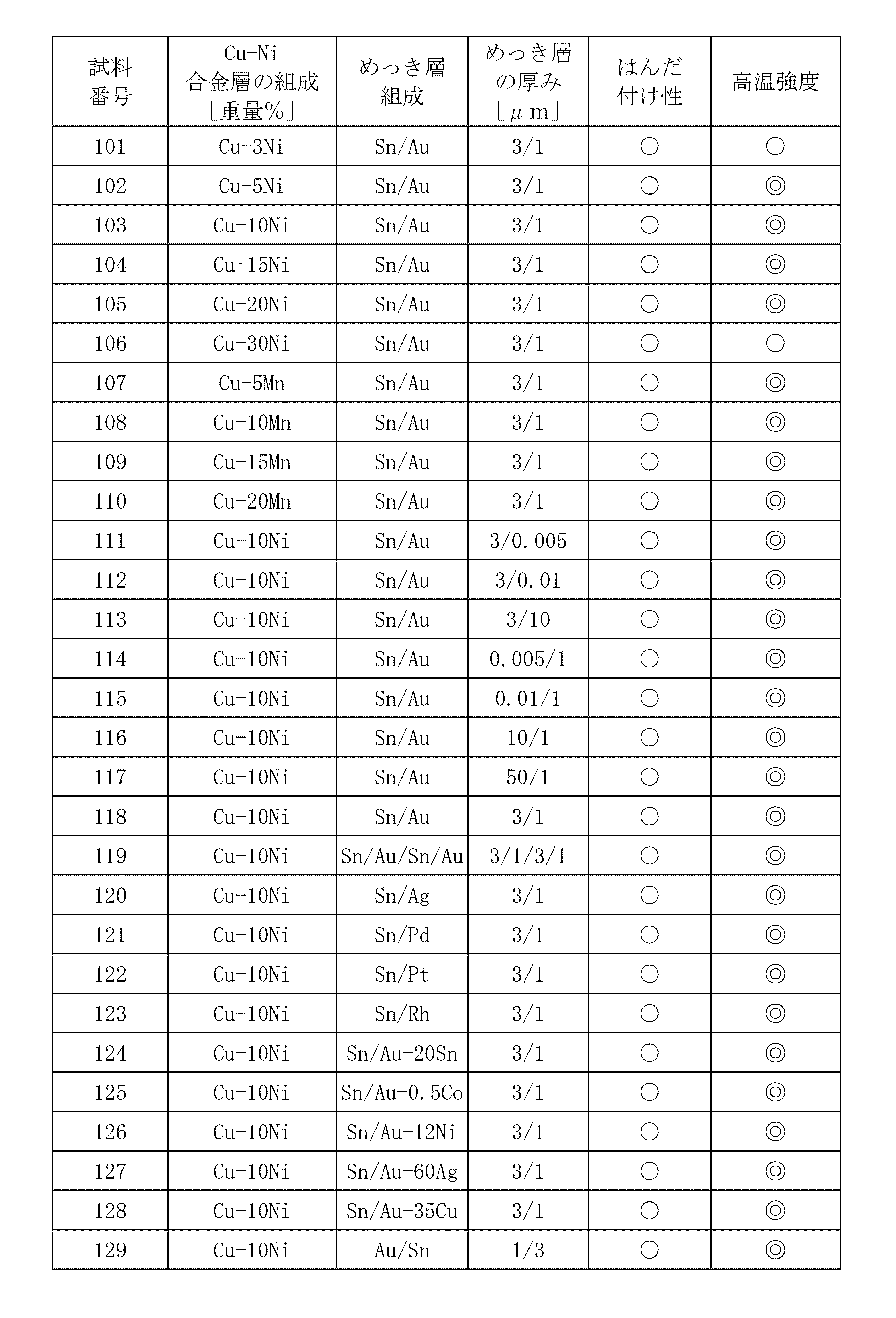

また、Cu-Ni合金層を備えた各試料のうち、試料番号1のNiが3重量%の試料と、試料番号6のNiが30重量%の試料の場合、高温強度が良(○)で、他の試料は、高温強度が優(◎)であった。この結果から、Cu-Ni合金におけるNiの割合に関しては、Niの割合が3~30重量%の範囲にある場合には、実用上問題のない高温強度を備えた外部電極を有する電子部品が得られ、Niの割合を5~20重量%とすることにより、さらに高温強度に優れた外部電極を有する電子部品が得られることが確認された。
また、表1には示していないが、Cu-Mn合金層の場合も、Mnの割合が3~30重量%の範囲にある場合には、実用上問題のない、はんだ付け性および高温強度を備えた外部電極を有する電子部品が得られることが確認されている。
1 セラミック積層体(積層セラミック素子)
2 内部電極
3 セラミック層(誘電体セラミック層)
4 セラミック積層体の端面
5 外部電極
10 合金層(Cu-Ni合金層またはCu-Mn合金層)
20 酸化防止膜
120 1層のめっき層
121 下層めっき層
122 上層めっき層
123 有機物膜
Claims (9)
- 電子部品本体と、前記電子部品本体の表面に形成された外部電極とを備えた電子部品であって、
前記外部電極が、Cu-Ni合金層およびCu-Mn合金層から選ばれる少なくとも1種と、
前記合金層よりも外側に形成された酸化防止膜と
を具備していることを特徴とする電子部品。 - 前記酸化防止膜が、Snを含有するSn含有膜を備えていることを特徴とする、請求項1記載の電子部品。
- 前記酸化防止膜が、貴金属からなる貴金属膜を備えていることを特徴とする、請求項1または2記載の電子部品。
- 前記酸化防止膜が、有機物からなる有機物膜を備えていることを特徴とする、請求項1~3のいずれかに記載の電子部品。
- 前記合金層は、
Niを3~30重量%の割合で含有するCu-Ni合金層および
Mnを3~30重量%の割合で含有するCu-Mn合金層
のいずれか1種であることを特徴とする、請求項1~4のいずれかに記載の電子部品。 - 前記合金層は、
Niを5~20重量%の割合で含有するCu-Ni合金層および
Mnを5~20重量%の割合で含有するCu-Mn合金層
のいずれか1種であることを特徴とする、請求項1~4のいずれかに記載の電子部品。 - 前記電子部品本体は、複数のセラミック層と、前記セラミック層間に、一部が端面に導出されるような態様で配設された内部電極層とを備えたセラミック積層体であり、
前記外部電極は、前記内部電極層が導出された端面に、前記内部電極層と導通するように配設されていることを特徴とする、請求項1~6のいずれかに記載の電子部品。 - 電子部品本体の表面に形成された外部電極と接合対象物とが接合された構造を有する接合構造体の形成方法であって、
前記電子部品本体の表面に、Cu-Ni合金層およびCu-Mn合金層から選ばれる少なくとも1種と、前記合金層よりも外側に形成された酸化防止膜とを有する外部電極が形成された電子部品を準備する工程と、
Snを含む接合材料を準備する工程と、
前記外部電極と接合する対象である接合対象物を準備する工程と、
前記外部電極と前記接合対象物との間に、前記接合材料を介在させた状態で熱処理する熱処理工程と
を備え、
前記熱処理工程において、前記外部電極が有する合金層と、前記接合材料に含まれるSnとを反応させて金属間化合物を生成させること
を特徴とする接合構造体の形成方法。 - 電子部品本体の表面に形成された外部電極と接合対象物とが接合された構造を有する接合構造体の形成方法であって、
前記電子部品本体の表面に、Cu-Ni合金層およびCu-Mn合金層から選ばれる少なくとも1種と、前記合金層よりも外側に形成され、Snを含む酸化防止膜とを有する外部電極が形成された電子部品を準備する工程と、
前記外部電極と接合する対象である接合対象物を準備する工程と、 前記外部電極と前記接合対象物とが接した状態で熱処理する熱処理工程と
を備え、
前記熱処理工程において、前記外部電極が有する合金層と、前記外部電極が有する前記酸化防止膜に含まれるSnとを反応させて金属間化合物を生成させること
を特徴とする接合構造体の形成方法。
Priority Applications (5)
| Application Number | Priority Date | Filing Date | Title |
|---|---|---|---|
| CN201380012339.7A CN104160463B (zh) | 2012-03-05 | 2013-02-12 | 电子部件及电子部件与接合对象物的接合结构体的形成方法 |
| JP2014503726A JP6061104B2 (ja) | 2012-03-05 | 2013-02-12 | 電子部品および電子部品と接合対象物との接合構造体の形成方法 |
| KR1020147019209A KR101645625B1 (ko) | 2012-03-05 | 2013-02-12 | 전자 부품, 전자 부품과 접합 대상물의 접합 구조체의 형성방법 |
| EP13757355.6A EP2824681B1 (en) | 2012-03-05 | 2013-02-12 | Electronic component and a junction structure between electronic component and object to be joined |
| US14/477,957 US9691546B2 (en) | 2012-03-05 | 2014-09-05 | Electronic part and method for forming joint structure of electronic part and joining object |
Applications Claiming Priority (2)
| Application Number | Priority Date | Filing Date | Title |
|---|---|---|---|
| JP2012-048028 | 2012-03-05 | ||
| JP2012048028 | 2012-03-05 |
Related Child Applications (1)
| Application Number | Title | Priority Date | Filing Date |
|---|---|---|---|
| US14/477,957 Continuation US9691546B2 (en) | 2012-03-05 | 2014-09-05 | Electronic part and method for forming joint structure of electronic part and joining object |
Publications (1)
| Publication Number | Publication Date |
|---|---|
| WO2013132966A1 true WO2013132966A1 (ja) | 2013-09-12 |
Family
ID=49116450
Family Applications (1)
| Application Number | Title | Priority Date | Filing Date |
|---|---|---|---|
| PCT/JP2013/053239 Ceased WO2013132966A1 (ja) | 2012-03-05 | 2013-02-12 | 電子部品および電子部品と接合対象物との接合構造体の形成方法 |
Country Status (7)
| Country | Link |
|---|---|
| US (1) | US9691546B2 (ja) |
| EP (1) | EP2824681B1 (ja) |
| JP (1) | JP6061104B2 (ja) |
| KR (1) | KR101645625B1 (ja) |
| CN (1) | CN104160463B (ja) |
| TW (1) | TWI592960B (ja) |
| WO (1) | WO2013132966A1 (ja) |
Cited By (3)
| Publication number | Priority date | Publication date | Assignee | Title |
|---|---|---|---|---|
| JP2016149424A (ja) * | 2015-02-12 | 2016-08-18 | Tdk株式会社 | 積層貫通コンデンサ |
| JP2016149426A (ja) * | 2015-02-12 | 2016-08-18 | Tdk株式会社 | 積層貫通コンデンサ |
| JP2020004942A (ja) * | 2018-06-29 | 2020-01-09 | サムソン エレクトロ−メカニックス カンパニーリミテッド. | 積層セラミックキャパシタ |
Families Citing this family (17)
| Publication number | Priority date | Publication date | Assignee | Title |
|---|---|---|---|---|
| CN105873713B (zh) * | 2014-01-07 | 2018-07-10 | 株式会社村田制作所 | 结构材料接合方法、接合用片材和接合结构 |
| US9892854B2 (en) * | 2015-03-12 | 2018-02-13 | Murata Manufacturing Co., Ltd. | Multilayer ceramic capacitor and method for manufacturing the same |
| CN104690266A (zh) * | 2015-03-18 | 2015-06-10 | 宁波广博纳米新材料股份有限公司 | 用于制备晶片电阻器正面、背面电极的铜锰合金粉 |
| US11001933B2 (en) * | 2015-05-18 | 2021-05-11 | Tdk Corporation | Composite body |
| JP6597008B2 (ja) * | 2015-07-16 | 2019-10-30 | 株式会社村田製作所 | 積層セラミックコンデンサ及び積層セラミックコンデンサの製造方法 |
| JP6332566B2 (ja) * | 2015-09-15 | 2018-05-30 | 株式会社村田製作所 | 接合用部材、接合用部材の製造方法、および、接合方法 |
| WO2017056842A1 (ja) | 2015-09-28 | 2017-04-06 | 株式会社村田製作所 | ヒートパイプ、放熱部品、ヒートパイプの製造方法 |
| JP6369640B2 (ja) * | 2015-11-05 | 2018-08-08 | 株式会社村田製作所 | 接合用部材、および、接合用部材の製造方法 |
| JP6512309B2 (ja) * | 2016-01-07 | 2019-05-15 | 株式会社村田製作所 | 金属組成物、金属間化合物部材、接合体 |
| CN114566387B (zh) * | 2018-12-26 | 2025-03-21 | 株式会社村田制作所 | 电解电容器及其制造方法 |
| WO2020218218A1 (ja) * | 2019-04-26 | 2020-10-29 | 株式会社村田製作所 | 電子部品および実装構造体 |
| JP7405019B2 (ja) * | 2020-06-26 | 2023-12-26 | Tdk株式会社 | 金属端子付き電子部品の製造方法 |
| WO2022195937A1 (ja) * | 2021-03-18 | 2022-09-22 | パナソニックIpマネジメント株式会社 | 半田プリコートに電子部品を仮止めするための粘着剤および電子部品実装基板の製造方法 |
| CN115692573A (zh) * | 2022-04-01 | 2023-02-03 | 友达光电股份有限公司 | 发光装置 |
| CN115815726B (zh) * | 2022-12-02 | 2023-09-22 | 哈尔滨工业大学 | 一种用Ag基钎料在空气下连接YSZ陶瓷与Crofer22H不锈钢的方法 |
| KR20240140233A (ko) * | 2023-03-16 | 2024-09-24 | 삼성전기주식회사 | 적층형 커패시터 및 이의 제조 방법 |
| CN116721864B (zh) * | 2023-07-26 | 2024-09-03 | 广东微容电子科技有限公司 | 一种内埋型片式多层陶瓷电容器及其制备方法 |
Citations (8)
| Publication number | Priority date | Publication date | Assignee | Title |
|---|---|---|---|---|
| JPS636969A (ja) | 1986-06-26 | 1988-01-12 | Fujitsu Ltd | 画像デ−タ入力方式 |
| JP2000243662A (ja) * | 1999-02-19 | 2000-09-08 | Tdk Corp | 電子デバイスおよびその製造方法 |
| JP2002015946A (ja) * | 2000-06-30 | 2002-01-18 | Kyocera Corp | セラミックコンデンサ |
| JP2002158137A (ja) * | 2000-11-22 | 2002-05-31 | Tdk Corp | 積層セラミック電子部品及びその製造方法 |
| JP2003332731A (ja) * | 2002-05-09 | 2003-11-21 | Murata Mfg Co Ltd | Pbフリー半田付け物品 |
| JP2006080428A (ja) * | 2004-09-13 | 2006-03-23 | Murata Mfg Co Ltd | 電子部品 |
| JP2008078593A (ja) * | 2006-09-20 | 2008-04-03 | Taiyo Yuden Co Ltd | 積層セラミックコンデンサ及びその製造方法 |
| WO2011027659A1 (ja) * | 2009-09-03 | 2011-03-10 | 株式会社村田製作所 | ソルダペースト、それを用いた接合方法、および接合構造 |
Family Cites Families (24)
| Publication number | Priority date | Publication date | Assignee | Title |
|---|---|---|---|---|
| JP2996015B2 (ja) | 1992-07-14 | 1999-12-27 | 三菱マテリアル株式会社 | チップ型電子部品の外部電極 |
| JPH08138902A (ja) * | 1993-11-11 | 1996-05-31 | Matsushita Electric Ind Co Ltd | チップ抵抗器およびその製造方法 |
| JP3874041B2 (ja) * | 1997-08-18 | 2007-01-31 | Tdk株式会社 | Cr複合電子部品とその製造方法 |
| JPH11283867A (ja) * | 1998-03-31 | 1999-10-15 | Tdk Corp | 電子部品およびその製造方法 |
| TWI248384B (en) * | 2000-06-12 | 2006-02-01 | Hitachi Ltd | Electronic device |
| JP4124598B2 (ja) * | 2002-01-28 | 2008-07-23 | 松下電器産業株式会社 | チップ型コンデンサの製造方法 |
| JP3757881B2 (ja) * | 2002-03-08 | 2006-03-22 | 株式会社日立製作所 | はんだ |
| JP2003318059A (ja) * | 2002-04-25 | 2003-11-07 | Kyocera Corp | 積層セラミックコンデンサ |
| JP2004055679A (ja) * | 2002-07-17 | 2004-02-19 | Murata Mfg Co Ltd | 電子部品及び積層セラミック電子部品 |
| JPWO2005036571A1 (ja) * | 2003-10-08 | 2007-11-22 | Tdk株式会社 | 電極ペースト、セラミック電子部品及びその製造方法 |
| JP4544896B2 (ja) * | 2004-04-01 | 2010-09-15 | 京セラ株式会社 | 電子部品 |
| JP3861927B1 (ja) * | 2005-07-07 | 2006-12-27 | 株式会社村田製作所 | 電子部品、電子部品の実装構造および電子部品の製造方法 |
| US8168889B2 (en) * | 2005-12-22 | 2012-05-01 | Namics Corporation | Thermosetting conductive paste and multilayer ceramic part having an external electrode formed using the same |
| KR100755654B1 (ko) * | 2006-06-09 | 2007-09-04 | 삼성전기주식회사 | Esr 특성 제어가능한 적층세라믹 커패시터 |
| JP4983799B2 (ja) * | 2006-09-22 | 2012-07-25 | 株式会社村田製作所 | 積層セラミックコンデンサ |
| KR20080061719A (ko) * | 2006-12-28 | 2008-07-03 | 삼성전자주식회사 | 반도체 소자의 커패시터 제조방법 및 이를 이용한 커패시터 |
| JP5046700B2 (ja) * | 2007-03-27 | 2012-10-10 | 京セラ株式会社 | 誘電体磁器および積層セラミックコンデンサ |
| JP4957394B2 (ja) * | 2007-06-04 | 2012-06-20 | 株式会社村田製作所 | セラミック電子部品及びその製造方法 |
| US8120891B2 (en) * | 2007-12-17 | 2012-02-21 | Murata Manufacturing Co., Ltd. | Multilayer capacitor having low equivalent series inductance and controlled equivalent series resistance |
| CN101658929B (zh) * | 2009-09-06 | 2011-03-23 | 宁波广博纳米材料有限公司 | 用于制备片式多层陶瓷电容器终端电极的铜镍合金粉 |
| JP2011187774A (ja) | 2010-03-10 | 2011-09-22 | Panasonic Corp | 抵抗器 |
| JP5353839B2 (ja) * | 2010-07-16 | 2013-11-27 | 株式会社村田製作所 | 電子部品 |
| JP5007763B2 (ja) * | 2010-07-16 | 2012-08-22 | 株式会社村田製作所 | 積層セラミックコンデンサ |
| KR20130037485A (ko) * | 2011-10-06 | 2013-04-16 | 삼성전기주식회사 | 적층 세라믹 커패시터 및 이의 제조방법 |
-
2013
- 2013-02-12 JP JP2014503726A patent/JP6061104B2/ja active Active
- 2013-02-12 WO PCT/JP2013/053239 patent/WO2013132966A1/ja not_active Ceased
- 2013-02-12 KR KR1020147019209A patent/KR101645625B1/ko active Active
- 2013-02-12 EP EP13757355.6A patent/EP2824681B1/en active Active
- 2013-02-12 CN CN201380012339.7A patent/CN104160463B/zh active Active
- 2013-03-05 TW TW102107686A patent/TWI592960B/zh active
-
2014
- 2014-09-05 US US14/477,957 patent/US9691546B2/en active Active
Patent Citations (8)
| Publication number | Priority date | Publication date | Assignee | Title |
|---|---|---|---|---|
| JPS636969A (ja) | 1986-06-26 | 1988-01-12 | Fujitsu Ltd | 画像デ−タ入力方式 |
| JP2000243662A (ja) * | 1999-02-19 | 2000-09-08 | Tdk Corp | 電子デバイスおよびその製造方法 |
| JP2002015946A (ja) * | 2000-06-30 | 2002-01-18 | Kyocera Corp | セラミックコンデンサ |
| JP2002158137A (ja) * | 2000-11-22 | 2002-05-31 | Tdk Corp | 積層セラミック電子部品及びその製造方法 |
| JP2003332731A (ja) * | 2002-05-09 | 2003-11-21 | Murata Mfg Co Ltd | Pbフリー半田付け物品 |
| JP2006080428A (ja) * | 2004-09-13 | 2006-03-23 | Murata Mfg Co Ltd | 電子部品 |
| JP2008078593A (ja) * | 2006-09-20 | 2008-04-03 | Taiyo Yuden Co Ltd | 積層セラミックコンデンサ及びその製造方法 |
| WO2011027659A1 (ja) * | 2009-09-03 | 2011-03-10 | 株式会社村田製作所 | ソルダペースト、それを用いた接合方法、および接合構造 |
Non-Patent Citations (1)
| Title |
|---|
| See also references of EP2824681A4 |
Cited By (4)
| Publication number | Priority date | Publication date | Assignee | Title |
|---|---|---|---|---|
| JP2016149424A (ja) * | 2015-02-12 | 2016-08-18 | Tdk株式会社 | 積層貫通コンデンサ |
| JP2016149426A (ja) * | 2015-02-12 | 2016-08-18 | Tdk株式会社 | 積層貫通コンデンサ |
| JP2020004942A (ja) * | 2018-06-29 | 2020-01-09 | サムソン エレクトロ−メカニックス カンパニーリミテッド. | 積層セラミックキャパシタ |
| JP7302926B2 (ja) | 2018-06-29 | 2023-07-04 | サムソン エレクトロ-メカニックス カンパニーリミテッド. | 積層セラミックキャパシタ |
Also Published As
| Publication number | Publication date |
|---|---|
| KR20140107422A (ko) | 2014-09-04 |
| KR101645625B1 (ko) | 2016-08-05 |
| EP2824681B1 (en) | 2019-04-10 |
| CN104160463A (zh) | 2014-11-19 |
| CN104160463B (zh) | 2017-09-29 |
| EP2824681A4 (en) | 2015-09-23 |
| TW201346960A (zh) | 2013-11-16 |
| US20150034701A1 (en) | 2015-02-05 |
| JP6061104B2 (ja) | 2017-01-18 |
| US9691546B2 (en) | 2017-06-27 |
| EP2824681A1 (en) | 2015-01-14 |
| JPWO2013132966A1 (ja) | 2015-07-30 |
| TWI592960B (zh) | 2017-07-21 |
Similar Documents
| Publication | Publication Date | Title |
|---|---|---|
| JP6061104B2 (ja) | 電子部品および電子部品と接合対象物との接合構造体の形成方法 | |
| CN104145317B (zh) | 电子部件 | |
| JP3918851B2 (ja) | 積層型電子部品および積層型電子部品の製造方法 | |
| US9805865B2 (en) | Ceramic electronic component and method for manufacturing the same | |
| JP2007043144A (ja) | 電子部品、電子部品の実装構造および電子部品の製造方法 | |
| JP2008300769A (ja) | セラミック電子部品及びその製造方法 | |
| JP2001307947A (ja) | 積層チップ部品及びその製造方法 | |
| JP2014053598A (ja) | 電子部品 | |
| JP5239236B2 (ja) | 電子部品およびその製造方法 | |
| US9320146B2 (en) | Electronic circuit module component | |
| TWI401713B (zh) | Machines and electronic machines | |
| JP3679529B2 (ja) | 端子電極ペーストおよび積層セラミックコンデンサ | |
| JP6260169B2 (ja) | セラミック電子部品 | |
| JP4677798B2 (ja) | 電子機器 | |
| JP2005285957A (ja) | 導電性ペースト及びその導電性ペーストを用いたセラミック多層回路基板。 | |
| WO2023037747A1 (ja) | 実装構造体 | |
| JP2006310618A (ja) | セラミック電子部品及びその製造方法 | |
| JP2005109125A (ja) | チップ型電子部品 | |
| JP2015065333A (ja) | セラミック電子部品 | |
| JP2002158133A (ja) | 積層チップ部品 |
Legal Events
| Date | Code | Title | Description |
|---|---|---|---|
| 121 | Ep: the epo has been informed by wipo that ep was designated in this application |
Ref document number: 13757355 Country of ref document: EP Kind code of ref document: A1 |
|
| WWE | Wipo information: entry into national phase |
Ref document number: 2013757355 Country of ref document: EP |
|
| ENP | Entry into the national phase |
Ref document number: 20147019209 Country of ref document: KR Kind code of ref document: A |
|
| ENP | Entry into the national phase |
Ref document number: 2014503726 Country of ref document: JP Kind code of ref document: A |
|
| NENP | Non-entry into the national phase |
Ref country code: DE |