WO2013136924A1 - レーザー加工用樹脂組成物 - Google Patents
レーザー加工用樹脂組成物 Download PDFInfo
- Publication number
- WO2013136924A1 WO2013136924A1 PCT/JP2013/054099 JP2013054099W WO2013136924A1 WO 2013136924 A1 WO2013136924 A1 WO 2013136924A1 JP 2013054099 W JP2013054099 W JP 2013054099W WO 2013136924 A1 WO2013136924 A1 WO 2013136924A1
- Authority
- WO
- WIPO (PCT)
- Prior art keywords
- resin
- laser processing
- parts
- resin composition
- resist
- Prior art date
- Legal status (The legal status is an assumption and is not a legal conclusion. Google has not performed a legal analysis and makes no representation as to the accuracy of the status listed.)
- Ceased
Links
Classifications
-
- C—CHEMISTRY; METALLURGY
- C08—ORGANIC MACROMOLECULAR COMPOUNDS; THEIR PREPARATION OR CHEMICAL WORKING-UP; COMPOSITIONS BASED THEREON
- C08K—Use of inorganic or non-macromolecular organic substances as compounding ingredients
- C08K5/00—Use of organic ingredients
- C08K5/16—Nitrogen-containing compounds
- C08K5/34—Heterocyclic compounds having nitrogen in the ring
- C08K5/3467—Heterocyclic compounds having nitrogen in the ring having more than two nitrogen atoms in the ring
- C08K5/3472—Five-membered rings
- C08K5/3475—Five-membered rings condensed with carbocyclic rings
-
- C—CHEMISTRY; METALLURGY
- C08—ORGANIC MACROMOLECULAR COMPOUNDS; THEIR PREPARATION OR CHEMICAL WORKING-UP; COMPOSITIONS BASED THEREON
- C08L—COMPOSITIONS OF MACROMOLECULAR COMPOUNDS
- C08L33/00—Compositions of homopolymers or copolymers of compounds having one or more unsaturated aliphatic radicals, each having only one carbon-to-carbon double bond, and only one being terminated by only one carboxyl radical, or of salts, anhydrides, esters, amides, imides or nitriles thereof; Compositions of derivatives of such polymers
- C08L33/02—Homopolymers or copolymers of acids; Metal or ammonium salts thereof
-
- C—CHEMISTRY; METALLURGY
- C08—ORGANIC MACROMOLECULAR COMPOUNDS; THEIR PREPARATION OR CHEMICAL WORKING-UP; COMPOSITIONS BASED THEREON
- C08J—WORKING-UP; GENERAL PROCESSES OF COMPOUNDING; AFTER-TREATMENT NOT COVERED BY SUBCLASSES C08B, C08C, C08F, C08G or C08H
- C08J5/00—Manufacture of articles or shaped materials containing macromolecular substances
- C08J5/18—Manufacture of films or sheets
-
- C—CHEMISTRY; METALLURGY
- C08—ORGANIC MACROMOLECULAR COMPOUNDS; THEIR PREPARATION OR CHEMICAL WORKING-UP; COMPOSITIONS BASED THEREON
- C08J—WORKING-UP; GENERAL PROCESSES OF COMPOUNDING; AFTER-TREATMENT NOT COVERED BY SUBCLASSES C08B, C08C, C08F, C08G or C08H
- C08J7/00—Chemical treatment or coating of shaped articles made of macromolecular substances
- C08J7/04—Coating
-
- C—CHEMISTRY; METALLURGY
- C08—ORGANIC MACROMOLECULAR COMPOUNDS; THEIR PREPARATION OR CHEMICAL WORKING-UP; COMPOSITIONS BASED THEREON
- C08K—Use of inorganic or non-macromolecular organic substances as compounding ingredients
- C08K5/00—Use of organic ingredients
- C08K5/0008—Organic ingredients according to more than one of the "one dot" groups of C08K5/01 - C08K5/59
- C08K5/0016—Plasticisers
-
- C—CHEMISTRY; METALLURGY
- C08—ORGANIC MACROMOLECULAR COMPOUNDS; THEIR PREPARATION OR CHEMICAL WORKING-UP; COMPOSITIONS BASED THEREON
- C08K—Use of inorganic or non-macromolecular organic substances as compounding ingredients
- C08K5/00—Use of organic ingredients
- C08K5/0008—Organic ingredients according to more than one of the "one dot" groups of C08K5/01 - C08K5/59
- C08K5/005—Stabilisers against oxidation, heat, light, ozone
-
- C—CHEMISTRY; METALLURGY
- C08—ORGANIC MACROMOLECULAR COMPOUNDS; THEIR PREPARATION OR CHEMICAL WORKING-UP; COMPOSITIONS BASED THEREON
- C08K—Use of inorganic or non-macromolecular organic substances as compounding ingredients
- C08K5/00—Use of organic ingredients
- C08K5/04—Oxygen-containing compounds
- C08K5/10—Esters; Ether-esters
- C08K5/11—Esters; Ether-esters of acyclic polycarboxylic acids
-
- C—CHEMISTRY; METALLURGY
- C08—ORGANIC MACROMOLECULAR COMPOUNDS; THEIR PREPARATION OR CHEMICAL WORKING-UP; COMPOSITIONS BASED THEREON
- C08K—Use of inorganic or non-macromolecular organic substances as compounding ingredients
- C08K5/00—Use of organic ingredients
- C08K5/04—Oxygen-containing compounds
- C08K5/10—Esters; Ether-esters
- C08K5/12—Esters; Ether-esters of cyclic polycarboxylic acids
-
- C—CHEMISTRY; METALLURGY
- C08—ORGANIC MACROMOLECULAR COMPOUNDS; THEIR PREPARATION OR CHEMICAL WORKING-UP; COMPOSITIONS BASED THEREON
- C08K—Use of inorganic or non-macromolecular organic substances as compounding ingredients
- C08K5/00—Use of organic ingredients
- C08K5/49—Phosphorus-containing compounds
- C08K5/51—Phosphorus bound to oxygen
- C08K5/52—Phosphorus bound to oxygen only
- C08K5/521—Esters of phosphoric acids, e.g. of H3PO4
- C08K5/523—Esters of phosphoric acids, e.g. of H3PO4 with hydroxyaryl compounds
-
- C—CHEMISTRY; METALLURGY
- C08—ORGANIC MACROMOLECULAR COMPOUNDS; THEIR PREPARATION OR CHEMICAL WORKING-UP; COMPOSITIONS BASED THEREON
- C08L—COMPOSITIONS OF MACROMOLECULAR COMPOUNDS
- C08L101/00—Compositions of unspecified macromolecular compounds
-
- H—ELECTRICITY
- H05—ELECTRIC TECHNIQUES NOT OTHERWISE PROVIDED FOR
- H05K—PRINTED CIRCUITS; CASINGS OR CONSTRUCTIONAL DETAILS OF ELECTRIC APPARATUS; MANUFACTURE OF ASSEMBLAGES OF ELECTRICAL COMPONENTS
- H05K1/00—Printed circuits
- H05K1/02—Details
- H05K1/03—Use of materials for the substrate
-
- H—ELECTRICITY
- H05—ELECTRIC TECHNIQUES NOT OTHERWISE PROVIDED FOR
- H05K—PRINTED CIRCUITS; CASINGS OR CONSTRUCTIONAL DETAILS OF ELECTRIC APPARATUS; MANUFACTURE OF ASSEMBLAGES OF ELECTRICAL COMPONENTS
- H05K3/00—Apparatus or processes for manufacturing printed circuits
- H05K3/0011—Working of insulating substrates or insulating layers
-
- H—ELECTRICITY
- H05—ELECTRIC TECHNIQUES NOT OTHERWISE PROVIDED FOR
- H05K—PRINTED CIRCUITS; CASINGS OR CONSTRUCTIONAL DETAILS OF ELECTRIC APPARATUS; MANUFACTURE OF ASSEMBLAGES OF ELECTRICAL COMPONENTS
- H05K3/00—Apparatus or processes for manufacturing printed circuits
- H05K3/0073—Masks not provided for in groups H05K3/02 - H05K3/46, e.g. for photomechanical production of patterned surfaces
- H05K3/0076—Masks not provided for in groups H05K3/02 - H05K3/46, e.g. for photomechanical production of patterned surfaces characterised by the composition of the mask
-
- C—CHEMISTRY; METALLURGY
- C08—ORGANIC MACROMOLECULAR COMPOUNDS; THEIR PREPARATION OR CHEMICAL WORKING-UP; COMPOSITIONS BASED THEREON
- C08J—WORKING-UP; GENERAL PROCESSES OF COMPOUNDING; AFTER-TREATMENT NOT COVERED BY SUBCLASSES C08B, C08C, C08F, C08G or C08H
- C08J2433/00—Characterised by the use of homopolymers or copolymers of compounds having one or more unsaturated aliphatic radicals, each having only one carbon-to-carbon double bond, and only one being terminated by only one carboxyl radical, or of salts, anhydrides, esters, amides, imides, or nitriles thereof; Derivatives of such polymers
- C08J2433/02—Homopolymers or copolymers of acids; Metal or ammonium salts thereof
-
- H—ELECTRICITY
- H05—ELECTRIC TECHNIQUES NOT OTHERWISE PROVIDED FOR
- H05K—PRINTED CIRCUITS; CASINGS OR CONSTRUCTIONAL DETAILS OF ELECTRIC APPARATUS; MANUFACTURE OF ASSEMBLAGES OF ELECTRICAL COMPONENTS
- H05K1/00—Printed circuits
- H05K1/02—Details
- H05K1/03—Use of materials for the substrate
- H05K1/0313—Organic insulating material
- H05K1/0353—Organic insulating material consisting of two or more materials, e.g. two or more polymers, polymer + filler, + reinforcement
- H05K1/0373—Organic insulating material consisting of two or more materials, e.g. two or more polymers, polymer + filler, + reinforcement containing additives, e.g. fillers
-
- H—ELECTRICITY
- H05—ELECTRIC TECHNIQUES NOT OTHERWISE PROVIDED FOR
- H05K—PRINTED CIRCUITS; CASINGS OR CONSTRUCTIONAL DETAILS OF ELECTRIC APPARATUS; MANUFACTURE OF ASSEMBLAGES OF ELECTRICAL COMPONENTS
- H05K2201/00—Indexing scheme relating to printed circuits covered by H05K1/00
- H05K2201/01—Dielectrics
- H05K2201/0104—Properties and characteristics in general
- H05K2201/0129—Thermoplastic polymer, e.g. auto-adhesive layer; Shaping of thermoplastic polymer
-
- H—ELECTRICITY
- H05—ELECTRIC TECHNIQUES NOT OTHERWISE PROVIDED FOR
- H05K—PRINTED CIRCUITS; CASINGS OR CONSTRUCTIONAL DETAILS OF ELECTRIC APPARATUS; MANUFACTURE OF ASSEMBLAGES OF ELECTRICAL COMPONENTS
- H05K3/00—Apparatus or processes for manufacturing printed circuits
- H05K3/0011—Working of insulating substrates or insulating layers
- H05K3/0017—Etching of the substrate by chemical or physical means
- H05K3/0026—Etching of the substrate by chemical or physical means by laser ablation
- H05K3/0032—Etching of the substrate by chemical or physical means by laser ablation of organic insulating material
-
- H—ELECTRICITY
- H05—ELECTRIC TECHNIQUES NOT OTHERWISE PROVIDED FOR
- H05K—PRINTED CIRCUITS; CASINGS OR CONSTRUCTIONAL DETAILS OF ELECTRIC APPARATUS; MANUFACTURE OF ASSEMBLAGES OF ELECTRICAL COMPONENTS
- H05K3/00—Apparatus or processes for manufacturing printed circuits
- H05K3/10—Apparatus or processes for manufacturing printed circuits in which conductive material is applied to the insulating support in such a manner as to form the desired conductive pattern
- H05K3/18—Apparatus or processes for manufacturing printed circuits in which conductive material is applied to the insulating support in such a manner as to form the desired conductive pattern using precipitation techniques to apply the conductive material
- H05K3/181—Apparatus or processes for manufacturing printed circuits in which conductive material is applied to the insulating support in such a manner as to form the desired conductive pattern using precipitation techniques to apply the conductive material by electroless plating
- H05K3/182—Apparatus or processes for manufacturing printed circuits in which conductive material is applied to the insulating support in such a manner as to form the desired conductive pattern using precipitation techniques to apply the conductive material by electroless plating characterised by the patterning method
- H05K3/184—Apparatus or processes for manufacturing printed circuits in which conductive material is applied to the insulating support in such a manner as to form the desired conductive pattern using precipitation techniques to apply the conductive material by electroless plating characterised by the patterning method using masks
Definitions
- the present invention relates to a resin composition for laser processing, and more particularly to a resin composition for laser processing that can be used as a resist when, for example, forming a circuit of a printed wiring board.
- circuit boards mounted on these electrical devices are increasingly required to have higher circuit density.
- a method for accurately forming a circuit having a narrower line width and line interval (a width of a portion between adjacent electric circuits) is required. ing.
- Patent Document 1 a method using a subtractive method, an additive method, or the like, which is a conventional method for forming a printed wiring board circuit.
- Patent Document 1 a novel fine circuit forming method using laser light has been proposed.
- a resist material is used in the conventional circuit formation process of a printed wiring board, and the resist material is used in the circuit formation process of Patent Document 1 as well.
- the film thickness of the resist material used in Patent Document 1 is as thin as about 1 to 2 ⁇ m, and it is not easy to form a resist film with a uniform film thickness during actual manufacturing. Further, even a dry film resist (DFR) generally used as a method for forming a uniform film may lack reliability in terms of uniformity if the film thickness is too thin.
- DFR dry film resist
- the thickness of the resist material can be increased.
- problems such as a decrease in laser processability and developability or a decrease in the accuracy of a circuit formed by machining occur.
- Patent Document 2 proposes a resin composition in which an ultraviolet absorber or the like is blended with a thermosetting resin for the purpose of improving the laser processability of the resin.
- the present invention has been made in view of the above-mentioned problems, and it is suitable as a resist when forming a circuit of a printed wiring board because the ultraviolet laser processability of the resin is improved and the resist performance after laser processing is not impaired. It aims at providing the resin composition for laser processing which can be used for.
- the present inventor has used a thermoplastic resin having a softening temperature in a certain range, and blended a specific amount of an ultraviolet absorber, thereby resist performance after ultraviolet laser processing.
- the present inventors have found that the laser processability can be improved when forming a circuit with a laser without damaging the structure, and the present invention has been completed.
- the resin composition for laser processing of the present invention contains a resin and an ultraviolet absorber, and in order to solve the above problems, the resin has a carboxyl group and has a softening temperature of 70 to 140 ° C. It is assumed that the content of the ultraviolet absorber is 1 to 30 parts by mass with respect to 100 parts by mass of the thermoplastic resin.
- thermoplastic resin having a carboxyl group.
- the ultraviolet absorber preferably has an absorption wavelength of 200 to 380 nm.
- the resin composition for laser processing of the present invention can further contain a plasticizer, and the content thereof is preferably 1 to 30 parts by mass with respect to 100 parts by mass of the thermoplastic resin.
- the resin film for laser processing of the present invention can be obtained by applying the resin composition for laser processing of the present invention on a support and drying it.
- the resin composition for laser processing of the present invention contains a specific amount of an ultraviolet absorber in a thermoplastic resin having a carboxyl group, thereby increasing the absorption of laser light near the ultraviolet wavelength and improving the laser processability of the resin. .
- thermoplastic resin By controlling the softening temperature of the thermoplastic resin, an effect that the resist performance after laser processing is not impaired can be obtained.
- the resin composition for laser processing of the present invention it becomes possible to improve laser processability while maintaining resist performance after laser processing.
- (meth) acryl means both acryl and methacryl, and these are used as a general term when they are not particularly distinguished.
- thermoplastic resin having a carboxyl group used in the present invention examples include, but are not limited to, a diene resin such as a styrene-butadiene copolymer having a carboxyl group in the molecule; ) Acrylic resins such as acrylic ester copolymers; and polyester resins.
- Examples of the (meth) acrylic acid ester include methyl (meth) acrylate, ethyl (meth) acrylate, n-butyl (meth) acrylate, t-butyl (meth) acrylate, hexyl (meth) acrylate, 2-ethylhexyl ( Alkyl group-containing acrylates such as meth) acrylate, n-octyl (meth) acrylate, n-nonyl (meth) acrylate, n-decyl (meth) acrylate, cyclohexyl (meth) acrylate; benzyl (meth) acrylate, phenoxyethyl acrylate Aromatic (meth) acrylates such as; amino group-containing (meth) acrylates such as dimethylaminoethyl (meth) acrylate; 2-hydroxyethyl (meth) acrylate, 2-hydroxypropyl (meth) acryl
- ethyl (meth) acrylate n-butyl (meth) acrylate, and 2-ethylhexyl (meth) acrylate are preferably used from the viewpoint of easy control of the softening temperature.
- a copolymer of (meth) acrylic acid and styrene and / or alkyl (meth) acrylate is preferable from the viewpoint of good adhesion to the substrate and easy control of the softening temperature.
- the thermoplastic resin having a carboxyl group preferably has a softening temperature of 70 to 140 ° C., more preferably 70 to 120 ° C. If the softening temperature is higher than 140 ° C., the resist performance after laser processing tends to be impaired, and if it is lower than 70 ° C., the resistance to the plating solution tends to be weakened in the plating process.
- thermoplastic resin preferably has an acid value in the range of 100 to 300 mgKOH / g. If the acid value is too low, the resist developability may be insufficient. If the acid value is too high, the developer resistance tends to be lowered, and the adhesion to the substrate tends to be lowered.
- UV absorber used in the present invention examples include, but are not limited to, benzotriazole, benzophenone, salicylate, cyanoacrylate and triazine. From the viewpoint of improving laser processability, it is preferable to select one having an absorption band in the wavelength region of the ultraviolet laser to be used. For example, when a UV-YAG laser (laser wavelength 355 nm) is used for a laser processing machine, it is preferable to use a laser having absorption in the ultraviolet wavelength region of 200 to 380 nm and having an absorption maximum in the ultraviolet wavelength region of 355 nm. Specifically, a benzotriazole type or triazine type having an absorption maximum around 355 nm is preferable.
- benzotriazole ultraviolet absorber examples include 2- (2′-hydroxy-5′-methylphenyl) benzotriazole, 2- (2′-hydroxy-5′-t-butylphenyl) benzotriazole, 2 -(2'-hydroxy-5'-octylphenyl) benzotriazole, 2- (2'-hydroxy-3'-t-butyl-5'-methylphenyl) -5-chlorobenzotriazole, 2- (2'- Hydroxy-3 ′, 5′-di-t-butylphenyl) benzotriazole, 2- (2′-hydroxy-3 ′, 5′-di-t-butylphenyl) -5-chlorobenzotriazole, 2- (2 '-Hydroxy-3', 5'-di-t-amylphenyl) benzotriazole, 2- (2'-hydroxy-3 ', 5'-dicumylphenyl) fe Rubenzotriazole, 2- (2′-hydroxy-4′-di
- triazine ultraviolet absorber examples include hydroxyphenyl triazine, 2,4-bis “2-hydroxy-4-butoxyphenyl] -6- (2,4-dibutoxyphenyl) -1,3- Examples include 5-triazine and 2,4-diphenyl-6- (2-hydroxy-4-hexyloxyphenyl) 1,3,5-triazine.
- the above ultraviolet absorbers can be used alone or in combination of two or more.
- the content of these ultraviolet absorbers is preferably 1 to 30 parts by mass with respect to 100 parts by mass of a carboxyl group-containing thermoplastic resin (however, in terms of solid content, the same applies hereinafter), and is 10 to 30 parts by mass. It is more preferable. If the content is less than 1 part by mass, the effect on improving laser processability is small, and if it exceeds 30 parts by mass, there is a tendency for problems to occur in compatibility with the resin.
- the resin composition for laser processing of the present invention can further contain a plasticizer as necessary.
- the plasticizer to be contained is not particularly limited, and examples thereof include phthalate ester-based, trimellitic ester-based, aliphatic dibasic ester-based, and phosphate ester-based.
- phthalate ester plasticizer examples include dimethyl phthalate, diethyl phthalate, dibutyl phthalate, bis (2-ethylhexyl) phthalate, diisodecyl phthalate, butyl benzyl phthalate, diisononyl phthalate, and ethyl phthalyl ethyl glycolate. .
- trimellitic acid ester plasticizer examples include tris (2-ethylhexyl) trimellitate and the like.
- aliphatic dibasic ester plasticizer examples include dibutyl adipate, diisobutyl adipate, bis (2-ethylhexyl) adipate, diisononyl adipate, diisodecyl adipate, bis (2-ethylhexyl) azelate, bis (2-ethylhexyl) Examples include sebacate and diethyl succinate.
- phosphate ester plasticizer examples include trimethyl phosphate, triethyl phosphate, tributyl phosphate, tris (2-ethylhexyl) phosphate, triphenyl phosphate, tricresyl phosphate, trixylenyl phosphate, cresyl diphenyl phosphate, 2 -Ethylhexyl diphenyl phosphate and the like.
- the plasticizer can be used alone or in combination of two or more.
- the blending amount is preferably 1 to 30 parts by mass with respect to 100 parts by mass of the thermoplastic resin having a carboxyl group. If it is less than 1 part by mass, the plasticizing effect of the resin is small, and if it exceeds 30 parts by mass, a compatibility problem with the resin may occur, or the softening temperature of the resin composition may decrease, resulting in the plating solution in the plating process step. There is a risk that resistance will be weakened.
- additives such as stabilizers and flame retardants can be further used as necessary as long as they do not depart from the spirit of the invention.
- the resin composition for laser processing of the present invention can also be used as an ink (liquid resist) applied to a circuit board as it is.
- ink liquid resist
- the laser processing resin film obtained from the laser processing resin composition of the present invention can be used alone as a film, or the laser processing resin composition layer of the present invention is formed on a support film and dried. Furthermore, it can also be used as a resin laminate for laser processing in which a protective film is further laminated.
- the support film is not particularly limited as long as it is flexible and can withstand coating and drying.
- polyester films such as polyethylene terephthalate (PET) films, and stretched polypropylene (OPP).
- PET polyethylene terephthalate
- OPP stretched polypropylene
- the protective film plays a role of preventing the resin film from peeling off or floating from the support film when the resin laminate for laser processing is rolled, for example, polyethylene (PE) film, polypropylene
- PE polyethylene
- polypropylene A polyolefin film such as a (PP) film, a PET film, a polytetrafluoroethylene (PTFE) film, a polyvinyl alcohol film, a nylon film and the like are used, and among them, a polyolefin film is preferably used.
- drying, lamination and the like of the resin composition for laser processing to a support can be performed according to conventional methods, and are not particularly limited, but preferred coating methods include roll coating and flow coating, and drying. May be performed at room temperature or under heating as necessary.
- part means “part by mass” unless otherwise specified.
- thermoplastic resin A-1 After nitrogen gas is sealed in a reactor equipped with a stirrer, thermometer, reflux condenser, dropping device, and nitrogen inlet tube, 120 parts of methyl isobutyl ketone, 30 parts of isopropyl alcohol, 27 parts of acrylic acid, 55 parts of styrene, 2- 18 parts of ethylhexyl acrylate and 2,2′-azobisisobutyronitrile (trade name: V-60, manufactured by Wako Pure Chemical Industries, Ltd.) as an azo polymerization initiator were charged. Polymerization was performed at 80 ° C. for 12 hours with stirring in a nitrogen gas stream to obtain a thermoplastic resin A-1.
- thermoplastic resin A-1 had a weight average molecular weight (measured by GPC, the same shall apply hereinafter) of 30,000, and a softening temperature (measured by a flow tester, the same applies hereinafter) of 108 ° C.
- thermoplastic resin A-2 After nitrogen gas is sealed in a reactor equipped with a stirrer, thermometer, reflux condenser, dropping device, and nitrogen introduction tube, 58 parts of methyl isobutyl ketone, 14 parts of isopropyl alcohol, 27 parts of acrylic acid, 55 parts of styrene, 2- 18 parts of ethylhexyl acrylate and 2,2′-azobisisobutyronitrile (trade name: V-60, manufactured by Wako Pure Chemical Industries, Ltd.) as an azo polymerization initiator were charged. Polymerization was performed at 75 ° C. for 12 hours in a nitrogen gas stream with stirring to obtain a thermoplastic resin A-2. The obtained thermoplastic resin A-2 had a weight average molecular weight of 50,000 and a softening temperature of 104 ° C.
- thermoplastic resin A-3 After nitrogen gas is sealed in a reactor equipped with a stirrer, thermometer, reflux condenser, dropping device, and nitrogen inlet tube, 120 parts of methyl isobutyl ketone, 30 parts of isopropyl alcohol, 27 parts of acrylic acid, 39 parts of styrene, 2- 34 parts of ethylhexyl acrylate and 2,2′-azobisisobutyronitrile (trade name: V-60, manufactured by Wako Pure Chemical Industries, Ltd.) as an azo polymerization initiator were charged. Polymerization was performed at 80 ° C. for 12 hours with stirring in a nitrogen gas stream to obtain a thermoplastic resin A-3. The obtained thermoplastic resin A-3 had a weight average molecular weight of 30,000 and a softening temperature of 86 ° C.
- thermoplastic resin A-4 After nitrogen gas is sealed in a reactor equipped with a stirrer, thermometer, reflux condenser, dropping device, and nitrogen inlet tube, 120 parts of methyl isobutyl ketone, 30 parts of isopropyl alcohol, 33 parts of acrylic acid, 67 parts of styrene, and azo series 2,2′-Azobisisobutyronitrile (trade name: V-60, manufactured by Wako Pure Chemical Industries, Ltd.) as a polymerization initiator was charged. Polymerization was performed at 75 ° C. for 12 hours in a nitrogen gas stream with stirring to obtain a thermoplastic resin A-4. The obtained thermoplastic resin A-4 had a weight average molecular weight of 40,000 and a softening temperature of 101 ° C.
- thermoplastic resin A-5 After nitrogen gas is sealed in a reactor equipped with a stirrer, thermometer, reflux condenser, dropping device, and nitrogen introduction tube, 120 parts of methyl isobutyl ketone, 30 parts of isopropyl alcohol, 27 parts of acrylic acid, 39 parts of styrene, butyl acrylate 34 parts and 2,2′-azobisisobutyronitrile (trade name: V-60, manufactured by Wako Pure Chemical Industries, Ltd.) as an azo polymerization initiator were charged. Polymerization was performed at 80 ° C. for 12 hours with stirring in a nitrogen gas stream to obtain a thermoplastic resin A-5. The obtained thermoplastic resin A-5 had a weight average molecular weight of 30,000 and a softening temperature of 86 ° C.
- thermoplastic resin A-6 After nitrogen gas is sealed in a reactor equipped with a stirrer, thermometer, reflux condenser, dropping device, and nitrogen inlet tube, 120 parts of methyl isobutyl ketone, 30 parts of isopropyl alcohol, 32 parts of methacrylic acid, 39 parts of styrene, butyl methacrylate 29 parts and 2,2′-azobisisobutyronitrile (trade name: V-60, manufactured by Wako Pure Chemical Industries, Ltd.) as an azo polymerization initiator were charged. Polymerization was performed at 80 ° C. for 12 hours with stirring in a nitrogen gas stream to obtain a thermoplastic resin A-5. The obtained thermoplastic resin A-6 had a weight average molecular weight of 30,000 and a softening temperature of 118 ° C.
- the resin composition for laser processing (resist resin) obtained above was applied to the surface of an epoxy-based insulating resin substrate having a thickness of 100 ⁇ m, and a film having a thickness of 5 ⁇ m was formed after drying.
- the insulating resin base material on which the coating is formed is subjected to laser processing to form a groove having a substantially rectangular cross section having a width of 20 ⁇ m and a depth of 30 ⁇ m, and the surface of the insulating resin base material is exposed by SEM (scanning microscope).
- SEM scanning microscope
- the state and the state of the circuit groove were observed and evaluated according to the following criteria.
- a UV-YAG laser was used for laser processing.
- ⁇ There is no exposure of the insulating resin base material, and there is no resist resin residue in the circuit groove.
- X The insulating resin base material is exposed or there is a residue of resist resin in the circuit groove.
- ⁇ Rise ratio of resist resin coating The film thickness ( ⁇ m) of the resist resin film before and after laser processing was measured, and the bulge rate was determined by the following formula.
- Rising rate film thickness of resist resin after laser processing / film thickness of resist resin before laser processing
- ⁇ Plating chemical resistance> The insulating resin base material in which the groove was formed was immersed in a cleaner conditioner (surfactant solution, Rohm & Haas Electronic Materials Co., Ltd., trade name: C / N 3320, pH ⁇ 1), and then washed with water. Next, a soft etching treatment was performed with a sodium persulfate-sulfuric acid based soft etching agent (pH ⁇ 1). Next, a pre-dip process was performed using PD404 (Shipley Far East Co., Ltd., pH ⁇ 1).
- a cleaner conditioner surfactant solution, Rohm & Haas Electronic Materials Co., Ltd., trade name: C / N 3320, pH ⁇ 1
- a soft etching treatment was performed with a sodium persulfate-sulfuric acid based soft etching agent (pH ⁇ 1).
- a pre-dip process was performed using PD404 (Shipley Far East Co., Ltd., pH ⁇ 1).
- ⁇ Alkali developability> The resist was peeled off by spraying a 3% aqueous sodium hydroxide solution at 30 ° C. onto the insulating resin substrate on which the palladium nucleus was generated, and the peeled state was evaluated according to the following criteria. ⁇ : There is no resist resin residue on the insulating resin substrate. X: Resist resin residue is present on the insulating resin substrate.
- ⁇ Plating formability> The insulating resin base material from which the resist has been removed is immersed in an electroless plating solution (trade name: CM328A, CM328L, CM328C manufactured by Shipley Far East Co., Ltd.) to perform electroless copper plating treatment, and an electroless film having a thickness of 3 to 5 ⁇ m. A copper plating film was deposited. Thereafter, the surface of the insulating resin substrate was observed, and the formation state of the plating film was evaluated according to the following criteria. ⁇ : A plating film is formed only on the cut portion. X: A plating film is formed in addition to the machined part, or no plating film is formed in the machined part.
- an electroless plating solution trade name: CM328A, CM328L, CM328C manufactured by Shipley Far East Co., Ltd.
- the resin composition of the present invention is useful as a resist used when forming a circuit on a printed wiring board using a laser because the laser processability of the resin can be improved while maintaining the resist performance.
Landscapes
- Chemical & Material Sciences (AREA)
- Polymers & Plastics (AREA)
- Health & Medical Sciences (AREA)
- Chemical Kinetics & Catalysis (AREA)
- Medicinal Chemistry (AREA)
- Organic Chemistry (AREA)
- Engineering & Computer Science (AREA)
- Manufacturing & Machinery (AREA)
- Microelectronics & Electronic Packaging (AREA)
- Materials Engineering (AREA)
- Compositions Of Macromolecular Compounds (AREA)
- Materials For Photolithography (AREA)
- Coating Of Shaped Articles Made Of Macromolecular Substances (AREA)
Abstract
Description
(熱可塑性樹脂A-1)
攪拌機、温度計、還流冷却器、滴下装置、窒素導入管を備えた反応装置に、窒素ガスを封入後、メチルイソブチルケトン120部、イソプロピルアルコール30部、アクリル酸27部、スチレン55部、2-エチルヘキシルアクリレート18部およびアゾ系重合開始剤である2,2’-アゾビスイソブチロニトリル(和光純薬工業(株)製 商品名:V-60)を仕込んだ。窒素ガス気流中、攪拌しながら、80℃で12時間重合して、熱可塑性樹脂A-1を得た。得られた熱可塑性樹脂A-1の重量平均分子量(GPCにより測定、以下同様)は30,000、軟化温度(フローテスターにより測定、以下同様)は108℃であった。
攪拌機、温度計、還流冷却器、滴下装置、窒素導入管を備えた反応装置に、窒素ガスを封入後、メチルイソブチルケトン58部、イソプロピルアルコール14部、アクリル酸27部、スチレン55部、2-エチルヘキシルアクリレート18部およびアゾ系重合開始剤である2,2’-アゾビスイソブチロニトリル(和光純薬工業(株)製 商品名:V-60)を仕込んだ。窒素ガス気流中、攪拌しながら、75℃で12時間重合して、熱可塑性樹脂A-2を得た。得られた熱可塑性樹脂A-2の重量平均分子量は50,000、軟化温度は104℃であった。
攪拌機、温度計、還流冷却器、滴下装置、窒素導入管を備えた反応装置に、窒素ガスを封入後、メチルイソブチルケトン120部、イソプロピルアルコール30部、アクリル酸27部、スチレン39部、2-エチルヘキシルアクリレート34部およびアゾ系重合開始剤である2,2’-アゾビスイソブチロニトリル(和光純薬工業(株)製 商品名:V-60)を仕込んだ。窒素ガス気流中、攪拌しながら、80℃で12時間重合して、熱可塑性樹脂A-3を得た。得られた熱可塑性樹脂A-3の重量平均分子量は30,000、軟化温度は86℃であった。
攪拌機、温度計、還流冷却器、滴下装置、窒素導入管を備えた反応装置に、窒素ガスを封入後、メチルイソブチルケトン120部、イソプロピルアルコール30部、アクリル酸33部、スチレン67部およびアゾ系重合開始剤である2,2’-アゾビスイソブチロニトリル(和光純薬工業(株)製 商品名:V-60)を仕込んだ。窒素ガス気流中、攪拌しながら、75℃で12時間重合して、熱可塑性樹脂A-4を得た。得られた熱可塑性樹脂A-4の重量平均分子量は40,000、軟化温度は101℃であった。
攪拌機、温度計、還流冷却器、滴下装置、窒素導入管を備えた反応装置に、窒素ガスを封入後、メチルイソブチルケトン120部、イソプロピルアルコール30部、アクリル酸27部、スチレン39部、ブチルアクリレート34部およびアゾ系重合開始剤である2,2’-アゾビスイソブチロニトリル(和光純薬工業(株)製 商品名:V-60)を仕込んだ。窒素ガス気流中、攪拌しながら、80℃で12時間重合して、熱可塑性樹脂A-5を得た。得られた熱可塑性樹脂A-5の重量平均分子量は30,000、軟化温度は86℃であった。
攪拌機、温度計、還流冷却器、滴下装置、窒素導入管を備えた反応装置に、窒素ガスを封入後、メチルイソブチルケトン120部、イソプロピルアルコール30部、メタクリル酸32部、スチレン39部、ブチルメタクリレート29部およびアゾ系重合開始剤である2,2’-アゾビスイソブチロニトリル(和光純薬工業(株)製 商品名:V-60)を仕込んだ。窒素ガス気流中、攪拌しながら、80℃で12時間重合して、熱可塑性樹脂A-5を得た。得られた熱可塑性樹脂A-6の重量平均分子量は30,000、軟化温度は118℃であった。
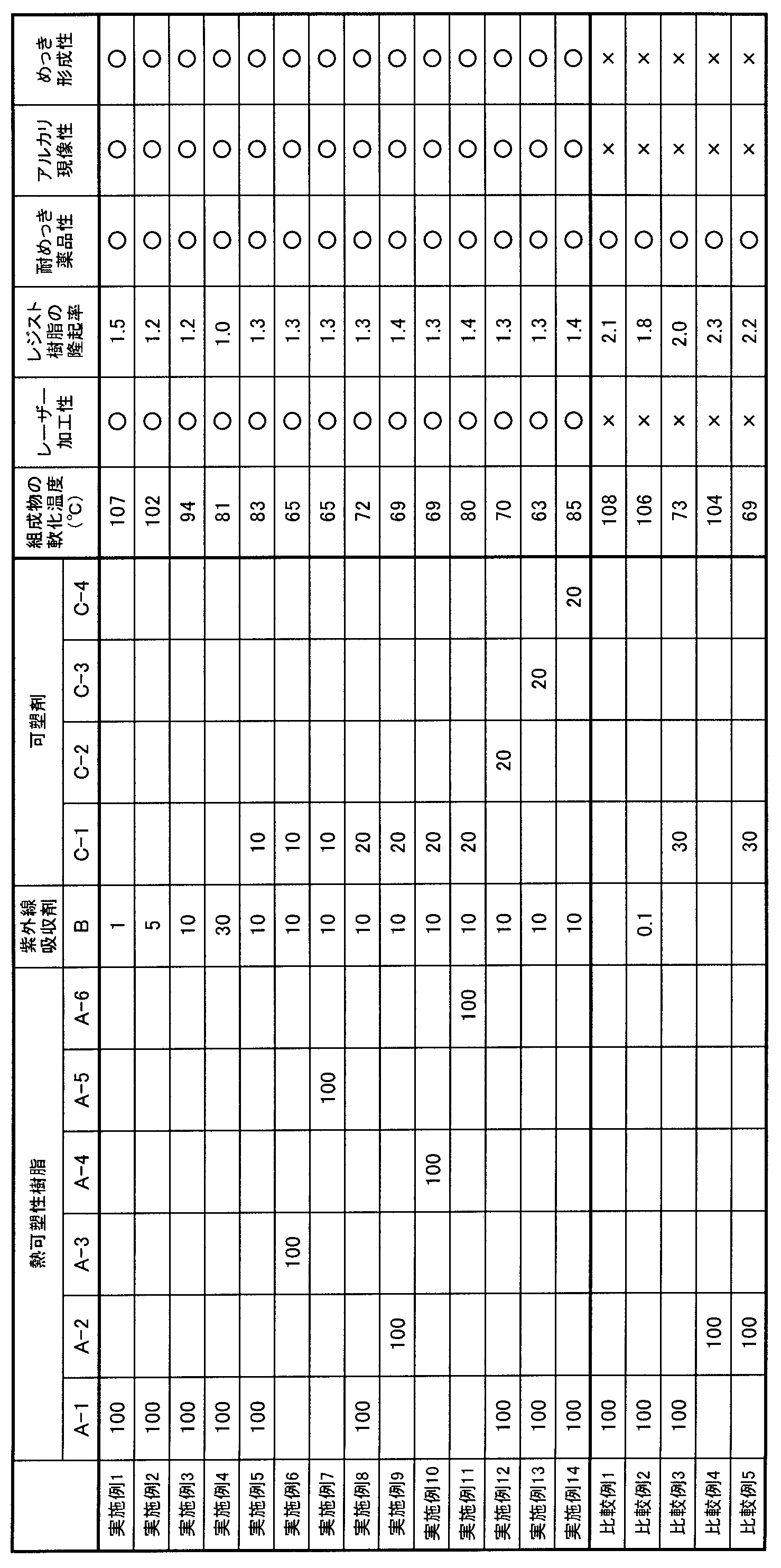
上記熱可塑性樹脂A-1、A-2、A-3、A-4、A-5又はA-6、紫外線吸収剤Bとして2-(2H-ベンゾトリアゾル-2-イル)-6-ドデシル-4-メチルフェノール(BASF社製 商品名:TINUVIN571、最大吸収波長:344nm)、可塑剤C-1としてトリキシレニルホスフェート(大八化学工業(株)製 商品名:TXP)、C-2としてビス(2-エチルヘキシル)フタレート(大八化学工業(株)製 商品名:DOP)、C-3としてビス(2-エチルヘキシル)アジペート(大八化学工業(株)製 商品名:DOA)、C-4としてトリス(2-エチルヘキシル)トリメリテート(大八化学工業(株)製 商品名:TOTM)を、表1に示す組成にてそれぞれ配合し、実施例及び比較例のレーザー加工用樹脂組成物を調整した。得られたレーザー加工用樹脂組成物について、以下の測定・評価を行った。評価結果を表1に示す。
島津製作所製 フローテスターにより測定した。
厚み100μmのエポキシ系絶縁樹脂基材の表面に、上記で得られたレーザー加工用樹脂組成物(レジスト樹脂)を塗布して、乾燥後膜厚5μmの被膜を形成した。そして、被膜が形成された絶縁樹脂基材に対して、レーザー加工により、幅20μm、深さ30μmの略長方形断面の溝形成加工を行い、SEM(走査型顕微鏡)により絶縁樹脂基材表面の露出状態、及び回路溝の状態を観察し、次の基準で評価した。なお、レーザー加工にはUV-YAGレーザーを用いた。
○:絶縁樹脂基材の露出がなく、回路溝にレジスト樹脂の残渣がない。
×:絶縁樹脂基材の露出がある、または回路溝にレジスト樹脂の残渣がある。
レーザー加工前後でのレジスト樹脂被膜の膜厚(μm)をそれぞれ測定し、次式により隆起率を求めた。
上記溝形成された絶縁樹脂基材をクリーナーコンディショナー(界面活性剤溶液、ローム&ハース電子材料(株)製 商品名:C/N3320、pH<1)中に浸漬し、その後、水洗した。次に、過硫酸ナトリウム-硫酸系のソフトエッチング剤(pH<1)でソフトエッチング処理した。次に、PD404(シプレイ・ファーイースト(株)製、pH<1)を用いてプリディップ工程を行った。次に、塩化第一錫と塩化パラジウムを含む酸性Pd-Snコロイド溶液(シプレイ・ファーイースト(株)製 商品名:CAT44、pH1)に浸漬することにより、無電解銅めっきの核となるパラジウムをスズ-パラジウムコロイドの状態で絶縁樹脂基材に吸着させた。次に、アクセラレータ薬液(シプレイ・ファーイースト(株)製 商品名:ACC19E、pH<1)に浸漬することにより、パラジウム核を発生させた。その後、絶縁樹脂基材表面を目視で観察し、レジスト樹脂の状態を次の基準で評価した。
○:レジスト樹脂の剥離、ひび割れが発生していない。
×:レジスト樹脂の剥離、ひび割れが発生している。
パラジウム核を発生させた絶縁樹脂基材に30℃で3%水酸化ナトリウム水溶液をスプレーすることで、レジスト剥離を行い、剥離状態を次の基準で評価した。
○:絶縁樹脂基材上にレジスト樹脂の残渣がない。
×:絶縁樹脂基材上にレジスト樹脂の残渣がある。
レジスト剥離した絶縁樹脂基材を無電解めっき液(シプレイ・ファーイースト(株)製 商品名:CM328A,CM328L,CM328C)に浸漬させて無電解銅めっき処理を行い、膜厚3~5μmの無電解銅めっき膜を析出させた。その後、絶縁樹脂基材表面を観察し、めっき膜の形成状態を次の基準で評価した。
○:切削加工された部分のみにめっき膜が形成されている。
×:切削加工された部分以外にもめっき膜が形成されている、または切削加工された部分にめっき膜が形成されていない。
Claims (5)
- 樹脂と紫外線吸収剤とを含有してなるレーザー加工用樹脂組成物であって、前記樹脂がカルボキシル基を有し、軟化温度が70~140℃である熱可塑性樹脂であり、前記紫外線吸収剤の含有量が前記熱可塑性樹脂100質量部に対して1~30質量部であることを特徴とするレーザー加工用樹脂組成物。
- 前記熱可塑性樹脂が、(メタ)アクリル酸と、スチレン及び/又は(メタ)アクリル酸アルキルとの共重合物であることを特徴とする、請求項1に記載のレーザー加工用樹脂組成物。
- 前記紫外線吸収剤が、吸収波長が200~380nmであることを特徴とする、請求項1又は2に記載のレーザー加工用樹脂組成物。
- さらに可塑剤を含有し、その含有量が前記熱可塑性樹脂100質量部に対して1~30質量部であることを特徴とする、請求項1~3のいずれか1項に記載のレーザー加工用樹脂組成物。
- 請求項1~4のいずれか1項に記載のレーザー加工用樹脂組成物を支持体上に塗布し、乾燥して得られることを特徴とするレーザー加工用樹脂フィルム。
Priority Applications (4)
| Application Number | Priority Date | Filing Date | Title |
|---|---|---|---|
| US14/384,335 US9708466B2 (en) | 2012-03-15 | 2013-02-20 | Resin composition for laser processing |
| EP13760488.0A EP2826820A4 (en) | 2012-03-15 | 2013-02-20 | RESIN COMPOSITION FOR LASER TREATMENT |
| KR1020147021872A KR101645835B1 (ko) | 2012-03-15 | 2013-02-20 | 레이저 가공용 수지 조성물 |
| CN201380014078.2A CN104169370B (zh) | 2012-03-15 | 2013-02-20 | 用于激光加工的树脂组合物 |
Applications Claiming Priority (2)
| Application Number | Priority Date | Filing Date | Title |
|---|---|---|---|
| JP2012-058927 | 2012-03-15 | ||
| JP2012058927A JP5921920B2 (ja) | 2012-03-15 | 2012-03-15 | レーザー加工用レジスト樹脂組成物 |
Publications (1)
| Publication Number | Publication Date |
|---|---|
| WO2013136924A1 true WO2013136924A1 (ja) | 2013-09-19 |
Family
ID=49160843
Family Applications (1)
| Application Number | Title | Priority Date | Filing Date |
|---|---|---|---|
| PCT/JP2013/054099 Ceased WO2013136924A1 (ja) | 2012-03-15 | 2013-02-20 | レーザー加工用樹脂組成物 |
Country Status (7)
| Country | Link |
|---|---|
| US (1) | US9708466B2 (ja) |
| EP (1) | EP2826820A4 (ja) |
| JP (1) | JP5921920B2 (ja) |
| KR (1) | KR101645835B1 (ja) |
| CN (1) | CN104169370B (ja) |
| TW (1) | TWI558755B (ja) |
| WO (1) | WO2013136924A1 (ja) |
Families Citing this family (1)
| Publication number | Priority date | Publication date | Assignee | Title |
|---|---|---|---|---|
| US20250344324A1 (en) * | 2022-05-31 | 2025-11-06 | Resonac Corporation | Pattern formation method and pattern formation structure |
Citations (7)
| Publication number | Priority date | Publication date | Assignee | Title |
|---|---|---|---|---|
| JPH06305814A (ja) * | 1993-02-26 | 1994-11-01 | Toray Ind Inc | セラミックス・グリーンシート |
| WO2009096507A1 (ja) | 2008-01-31 | 2009-08-06 | Sekisui Chemical Co., Ltd. | 樹脂組成物、及びそれを用いた積層樹脂フィルム |
| JP2009206116A (ja) * | 2008-02-26 | 2009-09-10 | Toray Ind Inc | ディスプレイ用フィルター及びその製造方法 |
| JP2009206117A (ja) * | 2008-02-26 | 2009-09-10 | Toray Ind Inc | ディスプレイ用フィルターの製造方法 |
| JP2009206118A (ja) * | 2008-02-26 | 2009-09-10 | Toray Ind Inc | 光透過性電磁波シールド部材の製造方法及びディスプレイ用フィルターの製造方法 |
| JP2010135768A (ja) | 2008-12-02 | 2010-06-17 | Panasonic Electric Works Co Ltd | 回路基板の製造方法、及び前記製造方法により得られた回路基板 |
| JP2012241149A (ja) * | 2011-05-23 | 2012-12-10 | Panasonic Corp | 樹脂組成物及び回路基板の製造方法 |
Family Cites Families (10)
| Publication number | Priority date | Publication date | Assignee | Title |
|---|---|---|---|---|
| US6004705A (en) * | 1992-07-07 | 1999-12-21 | Toray Industries, Inc. | Photosensitive ceramics green sheet |
| US5262275A (en) * | 1992-08-07 | 1993-11-16 | E. I. Du Pont De Nemours And Company | Flexographic printing element having an IR ablatable layer and process for making a flexographic printing plate |
| EP0784869B1 (en) * | 1995-05-11 | 2002-08-07 | Fuji Electric Co., Ltd. | Emitter switched thyristor |
| DE60003748T2 (de) * | 1999-04-23 | 2004-03-18 | Nippon Mitsubishi Oil Corp. | UV-absorbierende Harzzusammensetzung |
| US6773859B2 (en) * | 2001-03-06 | 2004-08-10 | E. I. Du Pont De Nemours And Company | Process for making a flexographic printing plate and a photosensitive element for use in the process |
| EP1440348A1 (en) * | 2001-10-31 | 2004-07-28 | DSM IP Assets B.V. | Uv curable powder suitable for use as photoresist |
| CN1290959C (zh) | 2003-04-21 | 2006-12-20 | 株式会社理光 | 粉粒体的造粒成形用粘结剂及造粒成形物 |
| JP2007045974A (ja) * | 2005-08-11 | 2007-02-22 | Nitto Denko Corp | 熱硬化型粘接着剤組成物、熱硬化型粘接着テープ又はシートおよび配線回路基板 |
| KR101260579B1 (ko) * | 2008-03-21 | 2013-05-06 | 아사히 가세이 이-매터리얼즈 가부시키가이샤 | 감광성 수지 조성물, 감광성 수지 적층체, 레지스트 패턴 형성 방법, 그리고 프린트 배선판, 리드 프레임, 반도체 패키지 및 요철 기판의 제조 방법 |
| TWI434074B (zh) | 2008-11-06 | 2014-04-11 | Sumitomo Chemical Co | A light diffusion plate, a light source device provided with the same, and a transmission type image display device |
-
2012
- 2012-03-15 JP JP2012058927A patent/JP5921920B2/ja not_active Expired - Fee Related
-
2013
- 2013-02-20 CN CN201380014078.2A patent/CN104169370B/zh not_active Expired - Fee Related
- 2013-02-20 US US14/384,335 patent/US9708466B2/en not_active Expired - Fee Related
- 2013-02-20 WO PCT/JP2013/054099 patent/WO2013136924A1/ja not_active Ceased
- 2013-02-20 KR KR1020147021872A patent/KR101645835B1/ko not_active Expired - Fee Related
- 2013-02-20 EP EP13760488.0A patent/EP2826820A4/en not_active Withdrawn
- 2013-03-14 TW TW102109011A patent/TWI558755B/zh not_active IP Right Cessation
Patent Citations (7)
| Publication number | Priority date | Publication date | Assignee | Title |
|---|---|---|---|---|
| JPH06305814A (ja) * | 1993-02-26 | 1994-11-01 | Toray Ind Inc | セラミックス・グリーンシート |
| WO2009096507A1 (ja) | 2008-01-31 | 2009-08-06 | Sekisui Chemical Co., Ltd. | 樹脂組成物、及びそれを用いた積層樹脂フィルム |
| JP2009206116A (ja) * | 2008-02-26 | 2009-09-10 | Toray Ind Inc | ディスプレイ用フィルター及びその製造方法 |
| JP2009206117A (ja) * | 2008-02-26 | 2009-09-10 | Toray Ind Inc | ディスプレイ用フィルターの製造方法 |
| JP2009206118A (ja) * | 2008-02-26 | 2009-09-10 | Toray Ind Inc | 光透過性電磁波シールド部材の製造方法及びディスプレイ用フィルターの製造方法 |
| JP2010135768A (ja) | 2008-12-02 | 2010-06-17 | Panasonic Electric Works Co Ltd | 回路基板の製造方法、及び前記製造方法により得られた回路基板 |
| JP2012241149A (ja) * | 2011-05-23 | 2012-12-10 | Panasonic Corp | 樹脂組成物及び回路基板の製造方法 |
Non-Patent Citations (1)
| Title |
|---|
| See also references of EP2826820A4 |
Also Published As
| Publication number | Publication date |
|---|---|
| TWI558755B (zh) | 2016-11-21 |
| KR101645835B1 (ko) | 2016-08-04 |
| US9708466B2 (en) | 2017-07-18 |
| EP2826820A1 (en) | 2015-01-21 |
| TW201343755A (zh) | 2013-11-01 |
| US20150065621A1 (en) | 2015-03-05 |
| CN104169370A (zh) | 2014-11-26 |
| KR20140119098A (ko) | 2014-10-08 |
| JP2013189608A (ja) | 2013-09-26 |
| EP2826820A4 (en) | 2015-11-11 |
| JP5921920B2 (ja) | 2016-05-24 |
| CN104169370B (zh) | 2017-09-22 |
Similar Documents
| Publication | Publication Date | Title |
|---|---|---|
| TWI668284B (zh) | 黏著劑、遮蔽膜用黏著劑、耐熱黏著膜用黏著劑、遮蔽用耐熱黏著膜、及其使用方法 | |
| JP6547827B2 (ja) | 粘着剤組成物及びその製造方法、並びに粘着製品 | |
| JP5231417B2 (ja) | 輝度向上シート用ポリエステルフィルム | |
| US10251265B2 (en) | Pregreg, film with resin, metal foil with resin, metal-clad laminate, and printed wiring board | |
| JP7162627B2 (ja) | 熱プレス用離型シート及びこれを用いたフレキシブルプリント配線基板の製造方法 | |
| TWI695048B (zh) | 黏著劑組合物、透明導電層用黏著劑層、積層體及圖像顯示裝置 | |
| TWI641676B (zh) | 附黏著劑層之光學構件、圖像顯示裝置及附黏著劑層之光學構件之製造方法 | |
| CN109071923B (zh) | 热固化性树脂组合物、固化膜及其制造方法、以及带固化膜的柔性印刷基板及其制造方法 | |
| KR102607576B1 (ko) | 점착제 조성물 | |
| JP2023026584A (ja) | 粘着剤組成物、及びそれを用いた粘着フィルム、表面保護フィルム、粘着剤層付き光学フィルム | |
| TWI612115B (zh) | 用於剝離片的固化性樹脂組合物、剝離片、使用有該剝離片的製程基材、及保護該基材的方法 | |
| WO2010061563A1 (ja) | 電子部品用保護フィルム、その製造方法および用途 | |
| JP5921920B2 (ja) | レーザー加工用レジスト樹脂組成物 | |
| JP2017019900A (ja) | 接着剤組成物、接着フィルム、樹脂付き金属箔及び金属ベース基板 | |
| JP6580033B2 (ja) | 永久絶縁膜用樹脂組成物、永久絶縁膜、多層プリント配線板およびその製造方法 | |
| JP2015044967A (ja) | フッ化ビニリデン系樹脂組成物 | |
| JP6318091B2 (ja) | めっき用マスキングフィルム支持体及びこれを用いたマスキングフィルム | |
| JP5952470B1 (ja) | 導電部材用粘着剤組成物 | |
| TW201502237A (zh) | 黏著劑組成物、利用該組成物之黏著膜及表面保護膜 | |
| JP2010143955A (ja) | 耐水性及び耐溶剤性を有する皮膜を形成する水分散性樹脂組成物 | |
| WO2019124013A1 (ja) | 粘着剤組成物及びその利用 | |
| JP2024109722A (ja) | 粘着剤組成物 | |
| JP2020077777A (ja) | 低誘電熱伝導材用組成物、及び低誘電熱伝導材 | |
| JP5551678B2 (ja) | カバーレイフィルム及びそれを用いた銅張り積層板 | |
| JP2004035780A (ja) | 配線基板接続用材料およびそれを用いた配線基板の製造方法 |
Legal Events
| Date | Code | Title | Description |
|---|---|---|---|
| 121 | Ep: the epo has been informed by wipo that ep was designated in this application |
Ref document number: 13760488 Country of ref document: EP Kind code of ref document: A1 |
|
| ENP | Entry into the national phase |
Ref document number: 20147021872 Country of ref document: KR Kind code of ref document: A |
|
| WWE | Wipo information: entry into national phase |
Ref document number: 14384335 Country of ref document: US |
|
| WWE | Wipo information: entry into national phase |
Ref document number: 2013760488 Country of ref document: EP |
|
| NENP | Non-entry into the national phase |
Ref country code: DE |