WO2013137258A1 - 潤滑油組成物 - Google Patents
潤滑油組成物 Download PDFInfo
- Publication number
- WO2013137258A1 WO2013137258A1 PCT/JP2013/056819 JP2013056819W WO2013137258A1 WO 2013137258 A1 WO2013137258 A1 WO 2013137258A1 JP 2013056819 W JP2013056819 W JP 2013056819W WO 2013137258 A1 WO2013137258 A1 WO 2013137258A1
- Authority
- WO
- WIPO (PCT)
- Prior art keywords
- lubricating oil
- oil composition
- mass
- group
- component
- Prior art date
- Legal status (The legal status is an assumption and is not a legal conclusion. Google has not performed a legal analysis and makes no representation as to the accuracy of the status listed.)
- Ceased
Links
Classifications
-
- C—CHEMISTRY; METALLURGY
- C10—PETROLEUM, GAS OR COKE INDUSTRIES; TECHNICAL GASES CONTAINING CARBON MONOXIDE; FUELS; LUBRICANTS; PEAT
- C10M—LUBRICATING COMPOSITIONS; USE OF CHEMICAL SUBSTANCES EITHER ALONE OR AS LUBRICATING INGREDIENTS IN A LUBRICATING COMPOSITION
- C10M141/00—Lubricating compositions characterised by the additive being a mixture of two or more compounds covered by more than one of the main groups C10M125/00 - C10M139/00, each of these compounds being essential
- C10M141/10—Lubricating compositions characterised by the additive being a mixture of two or more compounds covered by more than one of the main groups C10M125/00 - C10M139/00, each of these compounds being essential at least one of them being an organic phosphorus-containing compound
-
- C—CHEMISTRY; METALLURGY
- C10—PETROLEUM, GAS OR COKE INDUSTRIES; TECHNICAL GASES CONTAINING CARBON MONOXIDE; FUELS; LUBRICANTS; PEAT
- C10M—LUBRICATING COMPOSITIONS; USE OF CHEMICAL SUBSTANCES EITHER ALONE OR AS LUBRICATING INGREDIENTS IN A LUBRICATING COMPOSITION
- C10M135/00—Lubricating compositions characterised by the additive being an organic non-macromolecular compound containing sulfur, selenium or tellurium
- C10M135/08—Lubricating compositions characterised by the additive being an organic non-macromolecular compound containing sulfur, selenium or tellurium containing a sulfur-to-oxygen bond
- C10M135/10—Sulfonic acids or derivatives thereof
-
- C—CHEMISTRY; METALLURGY
- C10—PETROLEUM, GAS OR COKE INDUSTRIES; TECHNICAL GASES CONTAINING CARBON MONOXIDE; FUELS; LUBRICANTS; PEAT
- C10M—LUBRICATING COMPOSITIONS; USE OF CHEMICAL SUBSTANCES EITHER ALONE OR AS LUBRICATING INGREDIENTS IN A LUBRICATING COMPOSITION
- C10M137/00—Lubricating compositions characterised by the additive being an organic non-macromolecular compound containing phosphorus
- C10M137/02—Lubricating compositions characterised by the additive being an organic non-macromolecular compound containing phosphorus having no phosphorus-to-carbon bond
-
- C—CHEMISTRY; METALLURGY
- C10—PETROLEUM, GAS OR COKE INDUSTRIES; TECHNICAL GASES CONTAINING CARBON MONOXIDE; FUELS; LUBRICANTS; PEAT
- C10M—LUBRICATING COMPOSITIONS; USE OF CHEMICAL SUBSTANCES EITHER ALONE OR AS LUBRICATING INGREDIENTS IN A LUBRICATING COMPOSITION
- C10M163/00—Lubricating compositions characterised by the additive being a mixture of a compound of unknown or incompletely defined constitution and a non-macromolecular compound, each of these compounds being essential
-
- C—CHEMISTRY; METALLURGY
- C10—PETROLEUM, GAS OR COKE INDUSTRIES; TECHNICAL GASES CONTAINING CARBON MONOXIDE; FUELS; LUBRICANTS; PEAT
- C10M—LUBRICATING COMPOSITIONS; USE OF CHEMICAL SUBSTANCES EITHER ALONE OR AS LUBRICATING INGREDIENTS IN A LUBRICATING COMPOSITION
- C10M133/00—Lubricating compositions characterised by the additive being an organic non-macromolecular compound containing nitrogen
- C10M133/02—Lubricating compositions characterised by the additive being an organic non-macromolecular compound containing nitrogen having a carbon chain of less than 30 atoms
- C10M133/04—Amines, e.g. polyalkylene polyamines; Quaternary amines
- C10M133/06—Amines, e.g. polyalkylene polyamines; Quaternary amines having amino groups bound to acyclic or cycloaliphatic carbon atoms
-
- C—CHEMISTRY; METALLURGY
- C10—PETROLEUM, GAS OR COKE INDUSTRIES; TECHNICAL GASES CONTAINING CARBON MONOXIDE; FUELS; LUBRICANTS; PEAT
- C10M—LUBRICATING COMPOSITIONS; USE OF CHEMICAL SUBSTANCES EITHER ALONE OR AS LUBRICATING INGREDIENTS IN A LUBRICATING COMPOSITION
- C10M137/00—Lubricating compositions characterised by the additive being an organic non-macromolecular compound containing phosphorus
- C10M137/02—Lubricating compositions characterised by the additive being an organic non-macromolecular compound containing phosphorus having no phosphorus-to-carbon bond
- C10M137/04—Phosphate esters
-
- C—CHEMISTRY; METALLURGY
- C10—PETROLEUM, GAS OR COKE INDUSTRIES; TECHNICAL GASES CONTAINING CARBON MONOXIDE; FUELS; LUBRICANTS; PEAT
- C10M—LUBRICATING COMPOSITIONS; USE OF CHEMICAL SUBSTANCES EITHER ALONE OR AS LUBRICATING INGREDIENTS IN A LUBRICATING COMPOSITION
- C10M2207/00—Organic non-macromolecular hydrocarbon compounds containing hydrogen, carbon and oxygen as ingredients in lubricant compositions
- C10M2207/02—Hydroxy compounds
- C10M2207/023—Hydroxy compounds having hydroxy groups bound to carbon atoms of six-membered aromatic rings
- C10M2207/028—Overbased salts thereof
-
- C—CHEMISTRY; METALLURGY
- C10—PETROLEUM, GAS OR COKE INDUSTRIES; TECHNICAL GASES CONTAINING CARBON MONOXIDE; FUELS; LUBRICANTS; PEAT
- C10M—LUBRICATING COMPOSITIONS; USE OF CHEMICAL SUBSTANCES EITHER ALONE OR AS LUBRICATING INGREDIENTS IN A LUBRICATING COMPOSITION
- C10M2207/00—Organic non-macromolecular hydrocarbon compounds containing hydrogen, carbon and oxygen as ingredients in lubricant compositions
- C10M2207/26—Overbased carboxylic acid salts
- C10M2207/262—Overbased carboxylic acid salts derived from hydroxy substituted aromatic acids, e.g. salicylates
-
- C—CHEMISTRY; METALLURGY
- C10—PETROLEUM, GAS OR COKE INDUSTRIES; TECHNICAL GASES CONTAINING CARBON MONOXIDE; FUELS; LUBRICANTS; PEAT
- C10M—LUBRICATING COMPOSITIONS; USE OF CHEMICAL SUBSTANCES EITHER ALONE OR AS LUBRICATING INGREDIENTS IN A LUBRICATING COMPOSITION
- C10M2215/00—Organic non-macromolecular compounds containing nitrogen as ingredients in lubricant Compositions
- C10M2215/02—Amines, e.g. polyalkylene polyamines; Quaternary amines
- C10M2215/04—Amines, e.g. polyalkylene polyamines; Quaternary amines having amino groups bound to acyclic or cycloaliphatic carbon atoms
-
- C—CHEMISTRY; METALLURGY
- C10—PETROLEUM, GAS OR COKE INDUSTRIES; TECHNICAL GASES CONTAINING CARBON MONOXIDE; FUELS; LUBRICANTS; PEAT
- C10M—LUBRICATING COMPOSITIONS; USE OF CHEMICAL SUBSTANCES EITHER ALONE OR AS LUBRICATING INGREDIENTS IN A LUBRICATING COMPOSITION
- C10M2219/00—Organic non-macromolecular compounds containing sulfur, selenium or tellurium as ingredients in lubricant compositions
- C10M2219/04—Organic non-macromolecular compounds containing sulfur, selenium or tellurium as ingredients in lubricant compositions containing sulfur-to-oxygen bonds, i.e. sulfones, sulfoxides
- C10M2219/046—Overbased sulfonic acid salts
-
- C—CHEMISTRY; METALLURGY
- C10—PETROLEUM, GAS OR COKE INDUSTRIES; TECHNICAL GASES CONTAINING CARBON MONOXIDE; FUELS; LUBRICANTS; PEAT
- C10M—LUBRICATING COMPOSITIONS; USE OF CHEMICAL SUBSTANCES EITHER ALONE OR AS LUBRICATING INGREDIENTS IN A LUBRICATING COMPOSITION
- C10M2223/00—Organic non-macromolecular compounds containing phosphorus as ingredients in lubricant compositions
- C10M2223/02—Organic non-macromolecular compounds containing phosphorus as ingredients in lubricant compositions having no phosphorus-to-carbon bonds
- C10M2223/04—Phosphate esters
-
- C—CHEMISTRY; METALLURGY
- C10—PETROLEUM, GAS OR COKE INDUSTRIES; TECHNICAL GASES CONTAINING CARBON MONOXIDE; FUELS; LUBRICANTS; PEAT
- C10M—LUBRICATING COMPOSITIONS; USE OF CHEMICAL SUBSTANCES EITHER ALONE OR AS LUBRICATING INGREDIENTS IN A LUBRICATING COMPOSITION
- C10M2223/00—Organic non-macromolecular compounds containing phosphorus as ingredients in lubricant compositions
- C10M2223/02—Organic non-macromolecular compounds containing phosphorus as ingredients in lubricant compositions having no phosphorus-to-carbon bonds
- C10M2223/049—Phosphite
-
- C—CHEMISTRY; METALLURGY
- C10—PETROLEUM, GAS OR COKE INDUSTRIES; TECHNICAL GASES CONTAINING CARBON MONOXIDE; FUELS; LUBRICANTS; PEAT
- C10N—INDEXING SCHEME ASSOCIATED WITH SUBCLASS C10M RELATING TO LUBRICATING COMPOSITIONS
- C10N2010/00—Metal present as such or in compounds
- C10N2010/04—Groups 2 or 12
-
- C—CHEMISTRY; METALLURGY
- C10—PETROLEUM, GAS OR COKE INDUSTRIES; TECHNICAL GASES CONTAINING CARBON MONOXIDE; FUELS; LUBRICANTS; PEAT
- C10N—INDEXING SCHEME ASSOCIATED WITH SUBCLASS C10M RELATING TO LUBRICATING COMPOSITIONS
- C10N2030/00—Specified physical or chemical properties which is improved by the additive characterising the lubricating composition, e.g. multifunctional additives
- C10N2030/06—Oiliness; Film-strength; Anti-wear; Resistance to extreme pressure
-
- C—CHEMISTRY; METALLURGY
- C10—PETROLEUM, GAS OR COKE INDUSTRIES; TECHNICAL GASES CONTAINING CARBON MONOXIDE; FUELS; LUBRICANTS; PEAT
- C10N—INDEXING SCHEME ASSOCIATED WITH SUBCLASS C10M RELATING TO LUBRICATING COMPOSITIONS
- C10N2030/00—Specified physical or chemical properties which is improved by the additive characterising the lubricating composition, e.g. multifunctional additives
- C10N2030/76—Reduction of noise, shudder, or vibrations
-
- C—CHEMISTRY; METALLURGY
- C10—PETROLEUM, GAS OR COKE INDUSTRIES; TECHNICAL GASES CONTAINING CARBON MONOXIDE; FUELS; LUBRICANTS; PEAT
- C10N—INDEXING SCHEME ASSOCIATED WITH SUBCLASS C10M RELATING TO LUBRICATING COMPOSITIONS
- C10N2040/00—Specified use or application for which the lubricating composition is intended
- C10N2040/04—Oil-bath; Gear-boxes; Automatic transmissions; Traction drives
- C10N2040/045—Oil-bath; Gear-boxes; Automatic transmissions; Traction drives for continuous variable transmission [CVT]
Definitions
- the present invention relates to a lubricating oil composition suitable for a continuously variable transmission.
- a lubricating oil composition (see Patent Document 1) containing (a) an alkaline earth metal sulfonate or phenate, (b) an imide compound, and (c) a phosphorus compound, or (A) having 1 to 8 carbon atoms. At least one phosphorus-containing compound selected from phosphoric acid monoesters, phosphoric acid diesters and phosphorous acid monoesters having a hydrocarbon group, and (B) a tertiary group in which the substituent is a hydrocarbon group having 6 to 10 carbon atoms
- Patent Document 2 A lubricating oil composition containing an amine compound has been proposed.
- a lubricating oil composition comprising (A) a tertiary amine, (B) an acidic phosphate ester, and (C) a metal sulfonate is also proposed (see Patent Document 3).
- the lubricating oil compositions described in these patent documents have a high coefficient of friction between metals as a lubricating oil for continuously variable transmissions.
- the continuously variable transmission itself has become more sophisticated, and a continuously variable transmission having a torque converter with a lock-up clutch as a starting mechanism is on the market.
- a continuously variable transmission having a function (slip control) for intentionally sliding the lock-up clutch has been widely used for the purpose of improving the fuel efficiency in the lock-up speed range and reducing the shock at the time of lock-up engagement. ing.
- slip control depending on the lubricating oil, self-excited vibration called “shudder” is likely to occur. Therefore, the continuously variable transmission oil is required to have an initial shudder preventing performance and a long shudder preventing life.
- the lubricating oil compositions described in the above-mentioned Patent Documents 1 to 3 give a high coefficient of friction between metals, the initial anti-sudder performance and anti-shudder life are not always sufficient.
- An object of the present invention is to provide a lubricating oil composition having a high coefficient of friction between metals, excellent in initial shudder prevention performance, and having a long shudder prevention life.
- a lubricating oil composition comprising the following components (A) to (D) in a lubricating base oil.
- D At least any one of acidic phosphate and acidic phosphite
- the lubricating oil composition is characterized in that the content of nitrogen resulting from the component (A) is 0.001% by mass or more based on the total amount of the composition.
- the lubricating oil composition of the present invention since four specific components are blended in the lubricating base oil, the friction coefficient between metals is high, the initial anti-sudder performance is excellent, and the anti-shudder life is also long. Therefore, the lubricating oil composition of the present invention is particularly preferable for a continuously variable transmission having a torque converter with a lock-up clutch.
- the lubricating oil composition of the present invention is characterized in that the above-mentioned components (A) to (D) are blended with a lubricating base oil. Details will be described below.
- the lubricating base oil used in the present invention may be at least one of mineral oil and synthetic oil, that is, each may be used alone or in combination of two or more, or mineral oil and synthetic oil may be used in combination. . These mineral oils and synthetic oils are not particularly limited, but are suitable as long as they are generally used as base oils for transmissions. In particular, the kinematic viscosity at 100 ° C.
- kinematic viscosity is preferably 1 mm 2 / s to 50 mm 2 / s, particularly 2 mm 2 / s to 15 mm 2 / s. If the kinematic viscosity is too high, the low-temperature viscosity is deteriorated, and if it is too low, there is a risk that wear at sliding parts such as gear bearings and clutches of the continuously variable transmission increases.
- the pour point which is an index of the low temperature fluidity of the lubricating base oil is not particularly limited, but is preferably ⁇ 10 ° C. or lower, particularly preferably ⁇ 15 ° C. or lower.
- the lubricating base oil preferably has a saturated hydrocarbon component of 90% by mass or more, a sulfur content of 0.03% by mass or less, and a viscosity index of 100 or more.
- the saturated hydrocarbon component is less than 90% by mass, there is a possibility that a disadvantage that the deteriorated product increases.
- the sulfur content is more than 0.03% by mass, there is a risk that the degradation product similarly increases.
- the viscosity index is smaller than 100, there is a possibility that inconvenience that wear at a high temperature increases.
- mineral oil examples include naphthenic mineral oil, paraffinic mineral oil, GTL WAX, and the like. Specific examples include light neutral oil, medium neutral oil, heavy neutral oil, bright stock and the like by solvent refining or hydrogenation refining.
- synthetic oils include polybutene or hydrides thereof, poly ⁇ -olefins (1-octene oligomers, 1-decene oligomers, etc.), ⁇ -olefin copolymers, alkylbenzenes, polyol esters, dibasic acid esters, polyoxyalkylene glycols, Examples include polyoxyalkylene glycol esters, polyoxyalkylene glycol ethers, hindered esters, and silicone oils.
- Component (A) The component (A) used in the present invention is a primary amine, and preferably has a structure as shown by the following formula (1).
- R 1 is a hydrocarbon group, and preferably has 16 or more and 22 or less carbon atoms. When the carbon number is within this range, the friction coefficient between metals can be effectively increased.
- hydrocarbon groups include alkyl groups, alkenyl groups, aryl groups, and aralkyl groups. Of these hydrocarbon groups, an aliphatic hydrocarbon group is preferable, and an alkenyl group is particularly preferable.
- examples of R 1 include a hexadecyl group, a heptadecyl group, an octadecyl group, a nonadecyl group, an eicosyl group, a heneicosyl group, a docosyl group, and an oleyl group. Of these, an oleyl group is most preferred.
- the carbon chain portion may be a straight chain structure or a branched structure, but a straight chain structure is particularly preferable in terms of increasing the intermetallic friction coefficient.
- the primary amine as the component (A) may be a diamine as represented by the following formula (2).
- R 2 is the same as R 1 in the above formula (1).
- R 3 is a divalent hydrocarbon group, preferably an alkylene group.
- the preferable carbon number is about 1 or more and 5 or less from the viewpoint of stability, and the particularly preferable carbon number is 3.
- R 4 is hydrogen or a hydrocarbon group. In the case of a hydrocarbon group, an alkyl group is preferable. Further, R 4 preferably has 3 or less carbon atoms, and particularly preferably R 4 is hydrogen.
- the preferred blending amount of the component (A) is that the content of nitrogen resulting from the component (A) is 0.001% by mass or more based on the total amount of the composition from the viewpoint of both the anti-shudder effect and the anti-shudder life. Is more preferable, 0.01% by mass or more is more preferable, and 0.02% by mass or more is further preferable. However, even if the blending amount of the component (A) is increased too much, the effect of preventing shudder and the effect of preventing shudder life is saturated, so the content of nitrogen resulting from the component (A) is 0.1% by mass or less. It is desirable to limit the blending amount so that The primary amine of the formula (1) and the diamine of the formula (2) may be mixed and used.
- the component (B) used in the present invention is a tertiary amine.
- a structure represented by the following formula (3) is preferable.
- R 5 is a hydrocarbon group, but is preferably a hydrocarbon group having 16 to 22 carbon atoms. When the carbon number is within this range, the friction coefficient between metals can be effectively increased.
- hydrocarbon groups include alkyl groups, alkenyl groups, aryl groups, and aralkyl groups. Of these hydrocarbon groups, an aliphatic hydrocarbon group is preferable, and a saturated structure is particularly preferable. Therefore, R 1 includes a hexadecyl group, a heptadecyl group, an octadecyl group, a nonadecyl group, an eicosyl group, a heneicosyl group, and a docosyl group. Of these, an octadecyl group is most preferred.
- the carbon chain portion may have a straight chain structure or a branched structure, but a straight chain structure is particularly preferable.
- R 6 and R 7 are both hydrocarbon groups, but preferably each has 1 or 2 carbon atoms. Specifically, they are a methyl group, an ethyl group, and a vinyl group. When the number of carbon atoms of R 6 and R 7 is within this range, the effect of preventing shudder can be exerted strongly. Further, a methyl group or an ethyl group is preferable to a vinyl group having an unsaturated structure in terms of stability. R 6 and R 7 may be bonded to each other to form a heterocyclic ring.
- the component (B) include dimethylhexadecylamine, dimethyloctadecylamine, dimethylheneicosylamine, diethyloctadecylamine, and methylethyloctadecylamine.
- the tertiary amine which is the component (B) in the present invention may be used alone or in combination of two or more.
- the content of nitrogen resulting from the component (B) is preferably 0.005% by mass or more based on the total amount of the composition from the viewpoint of both the anti-shudder effect and the anti-shudder life, and 0.01% by mass. More preferably, it is more preferably 0.02% by mass or more.
- the blending amount of the component (B) is increased too much, the effect of preventing shudder and the effect of preventing shudder life is saturated. It is desirable to limit the blending amount so that
- the component (C) used in the present invention is at least one of metal sulfonate, metal phenate, and metal salicylate.
- the metal compound is preferably one selected from alkaline earth metal sulfonates, alkaline earth metal phenates, and alkaline earth metal salicylates in terms of effects.
- the improvement effect of the friction coefficient between metals is synergistically demonstrated by combining (C) component of this invention with above-described (B) component.
- the alkaline earth metal sulfonate is preferably an alkaline earth metal salt of an alkyl aromatic sulfonic acid obtained by sulfonating an alkyl aromatic compound having a mass average molecular weight of 300 to 1500, more preferably 400 to 700.
- magnesium salts, calcium salts, and the like can be mentioned, and among them, calcium salts are preferably used.
- alkaline earth metal phenates include alkylphenols, alkylphenol sulfides, alkaline earth metal salts of Mannich reactants of alkylphenols, particularly magnesium salts and calcium salts, among which calcium salts are particularly preferably used.
- Examples of the alkaline earth metal salicylate include alkaline earth metal salts of alkyl salicylic acid, particularly magnesium salts and calcium salts, among which calcium salts are preferably used.
- the alkaline earth metal compound described above preferably includes a linear or branched alkyl group, and the alkyl group preferably has 4 to 30 carbon atoms, more preferably 6 to 18 carbon atoms. .
- any of neutral salts, basic salts and overbased salts can be used.
- the total base number of the alkaline earth metal compound is preferably 10 mgKOH / g or more and 500 mgKOH / g or less, more preferably 15 mgKOH / g or more and 450 mgKOH / g or less.
- the compounding amount of the metal compound as the component (C) is preferably 0.01% by mass or more and 0.1% by mass or less, and 0.02% by mass or more, 0 based on the total amount of the composition as a metal conversion amount. More preferably, the content is 0.08% by mass or less.
- the effect of this invention can be more preferably exhibited as a compounding quantity is this range.
- the component (D) used in the present invention is at least one of acidic phosphate ester and acidic phosphite ester.
- an acidic phosphoric acid monoester represented by the following formula (4), an acidic phosphoric acid diester, and an acidic phosphite represented by the formula (5) are preferable.
- R 8 , R 9 , R 10 , R 11 , R 12 and R 13 are all hydrocarbon groups, particularly hydrocarbon groups having 8 or less carbon atoms. Preferably there is. When the carbon number of these hydrocarbon groups exceeds 8, the friction coefficient between metals may not be increased.
- the hydrocarbon group having 8 or less carbon atoms include an alkyl group having 8 or less carbon atoms, an alkenyl group having 8 or less carbon atoms, an aryl group having 6 to 8 carbon atoms, and an aralkyl group having 7 or 8 carbon atoms. be able to.
- the alkyl group and alkenyl group may be linear, branched or cyclic, for example, methyl group, ethyl group, n-propyl group, isopropyl group, n-butyl group, isobutyl group, sec-butyl.
- Examples of the aryl group having 6 to 8 carbon atoms include a phenyl group, tolyl group, and xylyl group.
- Examples of the aralkyl group having 7 or 8 carbon atoms include a benzyl group, a phenethyl group, and a methylbenzyl group. It is done.
- Specific examples of the acidic phosphoric acid monoester represented by the formula (4) include monoethyl acid phosphate, mono n-propyl acid phosphate, mono n-butyl acid phosphate, and mono-2-ethylhexyl acid phosphate.
- Specific examples of the acidic phosphoric acid diester represented by the formula (4) include diethyl acid phosphate, di-n-propyl acid phosphate, di-n-butyl acid phosphate, and di-2-ethylhexyl acid phosphate.
- the acidic phosphite represented by the formula (5) include ethyl hydrogen phosphite, n-propyl hydrogen phosphite, n-butyl hydrogen phosphite, 2-ethylhexyl hydrogen phosphite, Examples thereof include di-2-ethylhexyl hydrogen phosphite, dilauryl hydrogen phosphite, and dioleyl hydrogen phosphite.
- the component (D) of the present invention one type of the above-described phosphoric acid compounds may be used alone, or two or more types may be used in combination.
- the phosphorus amount attributable to the component (D) is preferably 0.02% by mass or more, more preferably 0.03% by mass or more and 0.09% by mass or less, based on the total amount of the lubricating oil composition. (D) By making the compounding quantity of a component 0.02 mass% or more, an intermetallic friction coefficient can be raised.
- the above-described lubricating oil composition of the present invention has a high coefficient of friction between metals and a large torque transmission capacity, and also has a long shudder prevention life. Therefore, a chain-type continuously variable transmission using a chain and a belt using a metal belt It can be suitably used for various continuously variable transmissions such as a continuously variable transmission or a toroidal continuously variable transmission.
- additives In the lubricating oil composition of the present invention, other additives such as a viscosity index improver, pour point depressant, antiwear agent, friction modifier, none You may mix
- Viscosity index improvers include polymethacrylates, dispersed polymethacrylates, olefin copolymers (eg, ethylene-propylene copolymers), dispersed olefin copolymers, styrene copolymers (eg, styrene- Diene copolymer, styrene-isoprene copolymer, etc.).
- the blending amount of the viscosity index improver is about 0.5% by mass or more and 15% by mass or less based on the total amount of the composition from the viewpoint of the blending effect.
- the pour point depressant for example, polymethacrylate having a mass average molecular weight of about 10,000 to 150,000 is used.
- a preferable blending amount of the pour point depressant is about 0.01% by mass or more and 10% by mass or less based on the total amount of the composition.
- the antiwear agent examples include sulfur type antiwear agents such as thiophosphate metal salts (Zn, Pb, Sb, etc.) and thiocarbamic acid metal salts (Zn, etc.), phosphate esters (tricresyl phosphate), and the like. And phosphorus-based antiwear agents.
- a preferable blending amount of the antiwear agent is about 0.05% by mass or more and 5% by mass or less based on the total amount of the composition.
- the friction modifier examples include polyhydric alcohol partial esters such as neopentyl glycol monolaurate, trimethylolpropane monolaurate, and glycerin monooleate (oleic acid monoglyceride).
- a preferable blending amount of the friction modifier is about 0.05% by mass or more and 4% by mass or less based on the composition.
- the ashless dispersant include succinimides, boron-containing succinimides, benzylamines, boron-containing benzylamines, succinic esters, monovalent or divalent typified by fatty acids or succinic acid. Examples thereof include amides of carboxylic acids.
- a preferable blending amount of the ashless dispersant is about 0.1% by mass or more and 20% by mass or less based on the total amount of the composition.
- the rust inhibitor examples include fatty acid, alkenyl succinic acid half ester, fatty acid soap, alkyl sulfonate, polyhydric alcohol fatty acid ester, fatty acid amide, oxidized paraffin, alkyl polyoxyethylene ether and the like.
- a preferable blending amount of the rust inhibitor is about 0.01% by mass or more and 3% by mass or less based on the total amount of the composition.
- the metal deactivator for example, benzotriazole, thiadiazole and the like are used alone or in combination of two or more.
- a preferable compounding amount of the metal deactivator is about 0.01% by mass or more and 5% by mass or less based on the total amount of the composition.
- the antifoaming agent for example, a silicone compound, an ester compound, or the like is used alone or in combination of two or more.
- a preferable blending amount of the antifoaming agent is about 0.05% by mass or more and 5% by mass or less based on the total amount of the composition.
- the antioxidant hindered phenol-based or amine-based, zinc alkyldithiophosphate (ZnDTP) or the like is preferably used.
- ZnDTP zinc alkyldithiophosphate
- the phenol type bisphenol type and ester group-containing phenol type are particularly suitable.
- As the amine system a dialkyldiphenylamine system or a naphthylamine system is suitable.
- a preferable blending amount of the antioxidant is about 0.05% by mass or more and 7% by mass or less.
- Friction material Cellulose disc / steel plate Oil amount: 150 mL Surface pressure: 1 MPa Oil temperature: 120 ° C Sliding speed: 0.9m / s Sliding time: 30 minutes Rest time: 1 minute Performance measurement: ⁇ -V characteristics measured every 24 hours after starting (running condition: oil temperature: 80 ° C., surface pressure: 1 MPa, sliding speed: 0.6 m / s , Time: 30 minutes)
- the lubricating oil composition of the present invention comprising all of the components (A) to (D) in the base oil has a sufficiently high coefficient of friction between metals, It has excellent anti-shudder performance at the beginning of the clutch, and has a sufficiently long clutch shudder prevention life. Therefore, it is understood that the lubricating oil composition of the present invention can be preferably applied to a continuously variable transmission.
- the friction coefficient between metals and the anti-shudder performance initial performance
- Prevention life cannot be made compatible.
Landscapes
- Chemical & Material Sciences (AREA)
- Chemical Kinetics & Catalysis (AREA)
- General Chemical & Material Sciences (AREA)
- Oil, Petroleum & Natural Gas (AREA)
- Organic Chemistry (AREA)
- Lubricants (AREA)
Abstract
潤滑油組成物は、潤滑油基油に、以下の(A)から(D)までの成分を配合してなる。 (A)1級アミン (B)3級アミン (C)金属スルホネート、金属フェネートおよび金属サリチレートのうち少なくともいずれか1種 (D)酸性リン酸エステルおよび酸性亜リン酸エステルのうち少なくともいずれか1種
Description
本発明は、無段変速機用として好適な潤滑油組成物に関する。
近年、自動車などに用いられる変速機として、金属ベルト式やトロイダル式の無段変速機が開発され、すでに実用化されている。当初、これらの無段変速機においては、潤滑油として自動変速機用潤滑油が転用されていた。しかし、無段変速機の性能が向上するにつれて潤滑油としてもより優れた性能が求められるようになってきた。特に、自動変速機の湿式クラッチに用いられる潤滑油の摩擦特性は、自動変速機用として最適化されているため、当該潤滑油を無段変速機に転用した場合に金属間摩擦係数が不足しやすく、大容量のトルク伝達が困難であるという問題があった。
そこで、無段変速機用として種々の潤滑油が開発されてきた。例えば、(a)アルカリ土類金属スルホネートまたはフェネート、(b)イミド化合物、および(c)リン系化合物を含有する潤滑油組成物(特許文献1参照)や、(A)炭素数1~8の炭化水素基を有する、リン酸モノエステル、リン酸ジエステルおよび亜リン酸モノエステルから選ばれる少なくとも一種のリン含有化合物、および(B)置換基が炭素数6~10の炭化水素基である3級アミン化合物を配合してなる潤滑油組成物(特許文献2参照)が提案されている。
また、(A)3級アミン、(B)酸性リン酸エステル等、および(C)金属スルフォネート等を配合してなる潤滑油組成物も提案されている(特許文献3参照)。これらの特許文献に記載された潤滑油組成物は無段変速機用の潤滑油として高い金属間摩擦係数を有している。
また、(A)3級アミン、(B)酸性リン酸エステル等、および(C)金属スルフォネート等を配合してなる潤滑油組成物も提案されている(特許文献3参照)。これらの特許文献に記載された潤滑油組成物は無段変速機用の潤滑油として高い金属間摩擦係数を有している。
一方、無段変速機自体についてもより高度化し、発進機構にロックアップクラッチ付きトルクコンバータを有した無段変速機が上市されている。また、最近では、ロックアップ速度域における燃費向上や、ロックアップ係合時のショックを和らげる目的で、意図的にロックアップクラッチを滑らせる機能(スリップ制御)を有する無段変速機も多く用いられている。このようなスリップ制御を行うと、潤滑油によってはシャダーと呼ばれる自励振動が発生しやすいため、無段変速機油には初期シャダー防止性能とともにシャダー防止寿命が長いことが要求される。しかしながら、上述の特許文献1~3に記載された潤滑油組成物は、高い金属間摩擦係数を与えるものの、初期シャダー防止性能とシャダー防止寿命に関しては必ずしも十分ではない。
本発明は、高い金属間摩擦係数を有し、初期シャダー防止性能に優れ、さらにシャダー防止寿命の長い潤滑油組成物を提供することを目的とする。
上記課題を解決すべく、本発明は、以下のような潤滑油組成物を提供するものである。
(1)潤滑油基油に、以下の(A)から(D)までの成分を配合してなることを特徴とする潤滑油組成物。
(A)1級アミン
(B)3級アミン
(C)金属スルホネート、金属フェネートおよび金属サリチレートのうち少なくともいずれか1種
(D)酸性リン酸エステルおよび酸性亜リン酸エステルのうち少なくともいずれか1種
(2)上述の潤滑油組成物において、前記(A)成分が、ジアミンであることを特徴とする潤滑油組成物。
(3)上述の潤滑油組成物において、前記(A)成分に起因する窒素の含有量が組成物全量基準で0.001質量%以上であることを特徴とする潤滑油組成物。
(4)上述の潤滑油組成物において、前記(B)成分に起因する窒素の含有量が組成物全量基準で0.005質量%以上であることを特徴とする潤滑油組成物。
(5)上述の潤滑油組成物において、前記(C)成分がアルカリ土類金属塩であることを特徴とする潤滑油組成物。
(6)上述の潤滑油組成物において、前記(C)成分に起因する金属の含有量が組成物全量基準で0.01質量%以上0.1質量%以下であることを特徴とする潤滑油組成物。
(7)上述の潤滑油組成物において、前記(D)成分に起因するリンの含有量が組成物全量基準で0.02質量%以上であることを特徴とする潤滑油組成物。
(8)上述の潤滑油組成物が無段変速機用であることを特徴とする潤滑油組成物。
(1)潤滑油基油に、以下の(A)から(D)までの成分を配合してなることを特徴とする潤滑油組成物。
(A)1級アミン
(B)3級アミン
(C)金属スルホネート、金属フェネートおよび金属サリチレートのうち少なくともいずれか1種
(D)酸性リン酸エステルおよび酸性亜リン酸エステルのうち少なくともいずれか1種
(2)上述の潤滑油組成物において、前記(A)成分が、ジアミンであることを特徴とする潤滑油組成物。
(3)上述の潤滑油組成物において、前記(A)成分に起因する窒素の含有量が組成物全量基準で0.001質量%以上であることを特徴とする潤滑油組成物。
(4)上述の潤滑油組成物において、前記(B)成分に起因する窒素の含有量が組成物全量基準で0.005質量%以上であることを特徴とする潤滑油組成物。
(5)上述の潤滑油組成物において、前記(C)成分がアルカリ土類金属塩であることを特徴とする潤滑油組成物。
(6)上述の潤滑油組成物において、前記(C)成分に起因する金属の含有量が組成物全量基準で0.01質量%以上0.1質量%以下であることを特徴とする潤滑油組成物。
(7)上述の潤滑油組成物において、前記(D)成分に起因するリンの含有量が組成物全量基準で0.02質量%以上であることを特徴とする潤滑油組成物。
(8)上述の潤滑油組成物が無段変速機用であることを特徴とする潤滑油組成物。
本発明の潤滑油組成物によれば、潤滑油基油に特定の4種の成分を配合しているので、金属間の摩擦係数が高く、初期シャダー防止性能に優れ、シャダー防止寿命も長い。それ故、本発明の潤滑油組成物は、特に、ロックアップクラッチ付きのトルクコンバータを有する無段変速機用として好ましい。
本発明の潤滑油組成物は、潤滑油基油に、上述の(A)から(D)までの成分を配合してなることを特徴とするものである。以下、詳細に説明する。
〔潤滑油基油〕
本発明に用いられる潤滑油基油としては、鉱油と合成油とのうちの少なくともいずれか一方、すなわちそれぞれ単独あるいは2種以上を組み合わせて用いたり、鉱油と合成油とを組み合わせて用いてもよい。
これらの鉱油や合成油としては特に制限はないが、一般に変速機の基油として用いられるものであれば好適である。特に、100℃における動粘度が1mm2/s以上、50mm2/s以下、特に2mm2/s以上、15mm2/s以下が好ましい。動粘度が高すぎると低温粘度が悪化し、低すぎると無段変速機のギヤ軸受、クラッチなどの摺動部位における摩耗が増大するおそれがある。
〔潤滑油基油〕
本発明に用いられる潤滑油基油としては、鉱油と合成油とのうちの少なくともいずれか一方、すなわちそれぞれ単独あるいは2種以上を組み合わせて用いたり、鉱油と合成油とを組み合わせて用いてもよい。
これらの鉱油や合成油としては特に制限はないが、一般に変速機の基油として用いられるものであれば好適である。特に、100℃における動粘度が1mm2/s以上、50mm2/s以下、特に2mm2/s以上、15mm2/s以下が好ましい。動粘度が高すぎると低温粘度が悪化し、低すぎると無段変速機のギヤ軸受、クラッチなどの摺動部位における摩耗が増大するおそれがある。
また、潤滑油基油の低温流動性の指標である流動点については、特に制限されないが、-10℃以下、特に-15℃以下が好ましい。
さらに、潤滑油基油としては、飽和炭化水素成分が90質量%以上、硫黄分が0.03質量%以下、粘度指数が100以上であることが好ましい。ここで、飽和炭化水素成分が90質量%より少なくなると、劣化生成物が多くなるという不都合が生じるおそれがある。また、硫黄分が0.03質量%より多くなっても、同様に劣化生成物が多くなるという不都合が生じるおそれがある。さらに、粘度指数が100より小さくなると、高温での摩耗が増大するという不都合が生じるおそれがある。
さらに、潤滑油基油としては、飽和炭化水素成分が90質量%以上、硫黄分が0.03質量%以下、粘度指数が100以上であることが好ましい。ここで、飽和炭化水素成分が90質量%より少なくなると、劣化生成物が多くなるという不都合が生じるおそれがある。また、硫黄分が0.03質量%より多くなっても、同様に劣化生成物が多くなるという不都合が生じるおそれがある。さらに、粘度指数が100より小さくなると、高温での摩耗が増大するという不都合が生じるおそれがある。
このような鉱油としては、例えばナフテン系鉱油、パラフィン系鉱油、GTL WAXなどが挙げられる。具体的には、溶剤精製あるいは水添精製による軽質ニュートラル油、中質ニュートラル油、重質ニュートラル油、およびブライトストックなどが例示できる。
一方、合成油としては、ポリブテンまたはその水素化物、ポリα-オレフィン(1-オクテンオリゴマー、1-デセンオリゴマー等)、α-オレフィンコポリマー、アルキルベンゼン、ポリオールエステル、二塩基酸エステル、ポリオキシアルキレングリコール、ポリオキシアルキレングリコールエステル、ポリオキシアルキレングリコールエーテル、ヒンダードエステル、およびシリコーンオイルなどが挙げられる。
一方、合成油としては、ポリブテンまたはその水素化物、ポリα-オレフィン(1-オクテンオリゴマー、1-デセンオリゴマー等)、α-オレフィンコポリマー、アルキルベンゼン、ポリオールエステル、二塩基酸エステル、ポリオキシアルキレングリコール、ポリオキシアルキレングリコールエステル、ポリオキシアルキレングリコールエーテル、ヒンダードエステル、およびシリコーンオイルなどが挙げられる。
〔(A)成分〕
本発明に用いられる(A)成分は、1級アミンであり、例えば下記式(1)で示されるような構造のものが好適である。
本発明に用いられる(A)成分は、1級アミンであり、例えば下記式(1)で示されるような構造のものが好適である。

ここで、R1は、炭化水素基であり、炭素数が16以上、22以下であることが好ましい。炭素数がこの範囲であると、金属間摩擦係数を効果的に上げることができる。このような炭化水素基としては、アルキル基、アルケニル基、アリール基、およびアラルキル基などを挙げることができる。これらの炭化水素基のうち、脂肪族の炭化水素基であることが好ましく、特にアルケニル基がより好ましい。それ故、R1としては、ヘキサデシル基、ヘプタデシル基、オクタデシル基、ノナデシル基、エイコシル基、ヘネイコシル基、ドコシル基、およびオレイル基等が挙げられる。このうち、オレイル基がもっとも好ましい。
また、炭素鎖部分は、直鎖構造であっても分岐構造であってもよいが、特に直鎖構造のものが金属間摩擦係数を上げる点で好ましい。
また、炭素鎖部分は、直鎖構造であっても分岐構造であってもよいが、特に直鎖構造のものが金属間摩擦係数を上げる点で好ましい。
また、(A)成分としての1級アミンは、下記式(2)のようなジアミンであってもよい。

好ましいR2としては、上述の式(1)におけるR1と同様である。R3は、2価の炭化水素基であり、好ましくはアルキレン基である。その好ましい炭素数は安定性の観点より1以上5以下程度であり、特に好ましい炭素数は3である。R4は水素または炭化水素基である。炭化水素基の場合、アルキル基であることが好ましい。また、R4の炭素数は3以下が好ましく、特に好ましいのは、R4が水素の場合である。
(A)成分の好ましい配合量は、シャダー防止効果およびシャダー防止寿命の双方の観点より、(A)成分に起因する窒素の含有量が、組成物全量基準で0.001質量%以上であることが好ましく、0.01質量%以上であることがより好ましく、0.02質量%以上であることがさらに好ましい。ただし、(A)成分の配合量をあまり多くしても、シャダー防止効果およびシャダー防止寿命の効果が飽和してしまうので、(A)成分に起因する窒素の含有量が0.1質量%以下となるように配合量を制限することが望ましい。
なお、上述した式(1)の1級アミンと式(2)のジアミンは混合して用いてもよい。
なお、上述した式(1)の1級アミンと式(2)のジアミンは混合して用いてもよい。
〔(B)成分〕
本発明に用いられる(B)成分は、3級アミンである。例えば下記式(3)で示されるような構造のものが好適である。
本発明に用いられる(B)成分は、3級アミンである。例えば下記式(3)で示されるような構造のものが好適である。

ここで、R5は、炭化水素基であるが、炭素数が16以上、22以下の炭化水素基であることが好ましい。炭素数がこの範囲であると、金属間摩擦係数を効果的に上げることができる。このような炭化水素基としては、アルキル基、アルケニル基、アリール基、およびアラルキル基などを挙げることができる。これらの炭化水素基のうち、脂肪族の炭化水素基であることが好ましく、特に飽和構造のものがより好ましい。それ故、R1としては、ヘキサデシル基、ヘプタデシル基、オクタデシル基、ノナデシル基、エイコシル基、ヘネイコシル基、およびドコシル基が挙げられる。このうち、オクタデシル基がもっとも好ましい。
また、炭素鎖部分は、直鎖構造であっても分岐構造であってもよいが、特に直鎖構造のものが好ましい。
また、炭素鎖部分は、直鎖構造であっても分岐構造であってもよいが、特に直鎖構造のものが好ましい。
R6とR7は、いずれも炭化水素基であるが、各々の炭素数は1または2であることが好ましい。具体的にはメチル基、エチル基、ビニル基である。R6とR7の炭素数がこの範囲であると、シャダー防止効果を強く発揮することができる。また、安定性の点で不飽和構造であるビニル基よりも、メチル基あるいはエチル基が好ましい。なお、R6とR7は、各々の末端部が結合して複素環を形成してもよい。
(B)成分の具体例としては、ジメチルヘキサデシルアミン、ジメチルオクタデシルアミン、ジメチルヘネイコシルアミン、ジエチルオクタデシルアミン、およびメチルエチルオクタデシルアミン等が挙げられる。本発明における(B)成分である3級アミンは、1種を単独で用いてもよく、2種以上を組み合わせて用いてもよい。
また、(B)成分に起因する窒素の含有量は、シャダー防止効果およびシャダー防止寿命の双方の観点より、組成物全量基準で0.005質量%以上であることが好ましく、0.01質量%以上であることがより好ましく、0.02質量%以上であることがさらに好ましい。ただし、(B)成分の配合量をあまり多くしても、シャダー防止効果およびシャダー防止寿命の効果が飽和してしまうので、(B)成分に起因する窒素の含有量が0.1質量%以下となるように配合量を制限することが望ましい。
また、(B)成分に起因する窒素の含有量は、シャダー防止効果およびシャダー防止寿命の双方の観点より、組成物全量基準で0.005質量%以上であることが好ましく、0.01質量%以上であることがより好ましく、0.02質量%以上であることがさらに好ましい。ただし、(B)成分の配合量をあまり多くしても、シャダー防止効果およびシャダー防止寿命の効果が飽和してしまうので、(B)成分に起因する窒素の含有量が0.1質量%以下となるように配合量を制限することが望ましい。
〔(C)成分〕
本発明に用いられる(C)成分は、金属スルホネート、金属フェネートおよび金属サリチレートのうち少なくともいずれか1種である。このような金属化合物を配合することで、金属間摩擦係数が高くなる。金属化合物としては、特に、アルカリ土類金属スルホネート、アルカリ土類金属フェネートおよびアルカリ土類金属サリチレートから選ばれる1種であることが効果の点で好ましい。そして、本発明の(C)成分を、前記した(B)成分と組み合わせることにより、金属間摩擦係数の向上効果が相乗的に発揮される。
本発明に用いられる(C)成分は、金属スルホネート、金属フェネートおよび金属サリチレートのうち少なくともいずれか1種である。このような金属化合物を配合することで、金属間摩擦係数が高くなる。金属化合物としては、特に、アルカリ土類金属スルホネート、アルカリ土類金属フェネートおよびアルカリ土類金属サリチレートから選ばれる1種であることが効果の点で好ましい。そして、本発明の(C)成分を、前記した(B)成分と組み合わせることにより、金属間摩擦係数の向上効果が相乗的に発揮される。
アルカリ土類金属スルホネートとしては、好ましくは質量平均分子量が300以上1500以下、より好ましくは400以上700以下のアルキル芳香族化合物をスルホン化することによって得られるアルキル芳香族スルホン酸のアルカリ土類金属塩、特にマグネシウム塩やカルシウム塩等が挙げられ、中でもカルシウム塩が好ましく用いられる。
アルカリ土類金属フェネートとしては、アルキルフェノール、アルキルフェノールサルファイド、アルキルフェノールのマンニッヒ反応物のアルカリ土類金属塩、特にマグネシウム塩やカルシウム塩等が挙げられ、中でもカルシウム塩が特に好ましく用いられる。
アルカリ土類金属サリチレートとしては、アルキルサリチル酸のアルカリ土類金属塩、特にマグネシウム塩やカルシウム塩等が挙げられ、中でもカルシウム塩が好ましく用いられる。
アルカリ土類金属フェネートとしては、アルキルフェノール、アルキルフェノールサルファイド、アルキルフェノールのマンニッヒ反応物のアルカリ土類金属塩、特にマグネシウム塩やカルシウム塩等が挙げられ、中でもカルシウム塩が特に好ましく用いられる。
アルカリ土類金属サリチレートとしては、アルキルサリチル酸のアルカリ土類金属塩、特にマグネシウム塩やカルシウム塩等が挙げられ、中でもカルシウム塩が好ましく用いられる。
上記したアルカリ土類金属化合物は、直鎖状または分岐鎖を有するアルキル基を含んでなるものが好ましく、アルキル基の炭素数は4以上30以下、より好ましくは6以上18以下であることが好ましい。また、アルカリ土類金属化合物は中性塩、塩基性塩、過塩基性塩のいずれも使用することができる。アルカリ土類金属化合物の全塩基価は、10mgKOH/g以上、500mgKOH/g以下であることが好ましく、より好ましくは15mgKOH/g以上、450mgKOH/g以下である。
(C)成分としての金属化合物の配合量は、金属換算量として組成物全量基準で、0.01質量%以上、0.1質量%以下であることが好ましく、0.02質量%以上、0.08質量%以下であることがより好ましい。配合量がこの範囲であると、本発明の効果をより好ましく発揮することができる。また、(C)成分は、単独または2種以上を組み合わせて用いてもよい。
本発明に用いられる(D)成分は、酸性リン酸エステルおよび酸性亜リン酸エステルのうち少なくともいずれか1種である。具体的には、以下の式(4)で示される酸性リン酸モノエステル、酸性リン酸ジエステル、および式(5)で示される酸性亜リン酸エステルが好ましい。


上記式(4)、式(5)において、R8、R9、R10、R11、R12およびR13は、いずれも炭化水素基であり、特に炭素数が8以下の炭化水素基であることが好ましい。これらの炭化水素基の炭素数が8を超えると、金属間摩擦係数が高くならないおそれがある。
炭素数8以下の炭化水素基としては、炭素数8以下のアルキル基、炭素数8以下のアルケニル基、炭素数6から8までのアリ-ル基、炭素数7か8のアラルキル基などを挙げることができる。前記アルキル基およびアルケニル基は直鎖状、分岐状、環状のいずれであってもよく、例えば、メチル基、エチル基、n-プロピル基、イソプロピル基、n-ブチル基、イソブチル基,sec-ブチル基、tert-ブチル基、各種ペンチル基、各種ヘキシル基、各種ヘプチル基、各種オクチル基、シクロペンチル基、シクロヘキシル基、アリル基、プロペニル基、各種ブテニル基、各種ヘキセニル基、各種オクテニル基、シクロペンテニル基、シクロヘキセニル基などが挙げられる。
炭素数8以下の炭化水素基としては、炭素数8以下のアルキル基、炭素数8以下のアルケニル基、炭素数6から8までのアリ-ル基、炭素数7か8のアラルキル基などを挙げることができる。前記アルキル基およびアルケニル基は直鎖状、分岐状、環状のいずれであってもよく、例えば、メチル基、エチル基、n-プロピル基、イソプロピル基、n-ブチル基、イソブチル基,sec-ブチル基、tert-ブチル基、各種ペンチル基、各種ヘキシル基、各種ヘプチル基、各種オクチル基、シクロペンチル基、シクロヘキシル基、アリル基、プロペニル基、各種ブテニル基、各種ヘキセニル基、各種オクテニル基、シクロペンテニル基、シクロヘキセニル基などが挙げられる。
炭素数6から8までのアリール基としては、例えばフェニル基、トリル基、キシリル基などが挙げられ、炭素数7か8のアラルキル基としては、例えばベンジル基、フェネチル基、メチルベンジル基などが挙げられる。
式(4)で示される酸性リン酸モノエステルの具体例としては、モノエチルアシッドホスフェート、モノn-プロピルアシッドホスフェート、モノn-ブチルアシッドホスフェート、およびモノ-2-エチルヘキシルアシッドホスフェート等が挙げられる。式(4)で示される酸性リン酸ジエステルの具体例としては、ジエチルアシッドホスフェート、ジn-プロピルアシッドホスフェート、ジn-ブチルアシッドホスフェート、およびジ-2-エチルヘキシルアシッドホスフェート等が挙げられる。また、式(5)で示される酸性亜リン酸エステルの具体例としては、エチルハイドロジェンホスファイト、n-プロピルハイドロジェンホスファイト、n-ブチルハイドロジェンホスファイト、2-エチルヘキシルハイドロジェンホスファイト、ジ-2-エチルヘキシルハイドロジェンホスファイト、ジラウリルハイドロジェンホスファイト、およびジオレイルハイドロジェンホスファイト等が挙げられる。
本発明の(D)成分は、上述したリン酸化合物のうち1種を単独で用いてもよく、2種以上を組み合わせて用いてもよい。(D)成分に起因するリン量は、潤滑油組成物全量基準で0.02質量%以上であることが好ましく、0.03質量%以上、0.09質量%以下であることがより好ましい。(D)成分の配合量を0.02質量%以上とすることで、金属間摩擦係数を高めることができる。
本発明の(D)成分は、上述したリン酸化合物のうち1種を単独で用いてもよく、2種以上を組み合わせて用いてもよい。(D)成分に起因するリン量は、潤滑油組成物全量基準で0.02質量%以上であることが好ましく、0.03質量%以上、0.09質量%以下であることがより好ましい。(D)成分の配合量を0.02質量%以上とすることで、金属間摩擦係数を高めることができる。
上述した本発明の潤滑油組成物は、金属間摩擦係数が高いためトルク伝達容量が大きく、また、シャダー防止寿命も長いため、チェーンを用いたチェーン式無段変速機、金属ベルトを用いたベルト式無段変速機、あるいはトロイダル式無段変速機など、各種の無段変速機に好適に用いることができる。
〔その他添加剤〕
本発明の潤滑油組成物には、本発明の効果を損なわない範囲で、必要に応じてさらに他の添加剤、例えば粘度指数向上剤、流動点降下剤、摩耗防止剤、摩擦調整剤、無灰系分散剤、防錆剤、金属不活性化剤、消泡剤、および酸化防止剤等を配合してもよい。
本発明の潤滑油組成物には、本発明の効果を損なわない範囲で、必要に応じてさらに他の添加剤、例えば粘度指数向上剤、流動点降下剤、摩耗防止剤、摩擦調整剤、無灰系分散剤、防錆剤、金属不活性化剤、消泡剤、および酸化防止剤等を配合してもよい。
粘度指数向上剤としては、ポリメタクリレート、分散型ポリメタクリレート、オレフィン系共重合体(例えば、エチレン-プロピレン共重合体など)、分散型オレフィン系共重合体、スチレン系共重合体(例えば、スチレン-ジエン共重合体、スチレン-イソプレン共重合体など)などが挙げられる。粘度指数向上剤の配合量は、配合効果の点から、組成物全量基準で、0.5質量%以上、15質量%以下程度である。
流動点降下剤としては、例えば質量平均分子量が1万以上、15万以下程度のポリメタクリレートなどが用いられる。流動点降下剤の好ましい配合量は、組成物全量基準で、0.01質量%以上、10質量%以下程度である。
流動点降下剤としては、例えば質量平均分子量が1万以上、15万以下程度のポリメタクリレートなどが用いられる。流動点降下剤の好ましい配合量は、組成物全量基準で、0.01質量%以上、10質量%以下程度である。
摩耗防止剤としては、例えばチオリン酸金属塩(Zn、Pb、Sb等)やチオカルバミン酸金属塩(Zn等)のような硫黄系摩耗防止剤、リン酸エステル(トリクレジルフォスフェート)のようなリン系摩耗防止剤を挙げることができる。摩耗防止剤の好ましい配合量は、組成物全量基準で0.05質量%以上、5質量%以下程度である。
摩擦調整剤としては、例えば、ネオペンチルグリコールモノラウレート、トリメチロールプロパンモノラウレート、グリセリンモノオレエート(オレイン酸モノグリセライド)などの多価アルコール部分エステルなどが挙げられる。摩擦調整剤の好ましい配合量は、組成物基準で0.05質量%以上、4質量%以下程度である。
無灰系分散剤としては、例えばコハク酸イミド類、ホウ素含有コハク酸イミド類、ベンジルアミン類、ホウ素含有ベンジルアミン類、コハク酸エステル類、脂肪酸あるいはコハク酸で代表される一価または二価のカルボン酸のアミド類などが挙げられる。無灰系分散剤の好ましい配合量は、組成物全量基準で、0.1質量%以上、20質量%以下程度である。
摩擦調整剤としては、例えば、ネオペンチルグリコールモノラウレート、トリメチロールプロパンモノラウレート、グリセリンモノオレエート(オレイン酸モノグリセライド)などの多価アルコール部分エステルなどが挙げられる。摩擦調整剤の好ましい配合量は、組成物基準で0.05質量%以上、4質量%以下程度である。
無灰系分散剤としては、例えばコハク酸イミド類、ホウ素含有コハク酸イミド類、ベンジルアミン類、ホウ素含有ベンジルアミン類、コハク酸エステル類、脂肪酸あるいはコハク酸で代表される一価または二価のカルボン酸のアミド類などが挙げられる。無灰系分散剤の好ましい配合量は、組成物全量基準で、0.1質量%以上、20質量%以下程度である。
防錆剤としては、例えば、脂肪酸、アルケニルコハク酸ハーフエステル、脂肪酸セッケン、アルキルスルホン酸塩、多価アルコール脂肪酸エステル、脂肪酸アミド、酸化パラフィン、アルキルポリオキシエチレンエーテル等が挙げられる。防錆剤の好ましい配合量は、組成物全量基準で0.01質量%以上、3質量%以下程度である。
金属不活性化剤としては、例えばベンゾトリアゾール、チアジアゾールなどが、単独もしくは2種以上を組み合わせて用いられる。金属不活性化剤の好ましい配合量は、組成物全量基準で0.01質量%以上、5質量%以下程度である。
金属不活性化剤としては、例えばベンゾトリアゾール、チアジアゾールなどが、単独もしくは2種以上を組み合わせて用いられる。金属不活性化剤の好ましい配合量は、組成物全量基準で0.01質量%以上、5質量%以下程度である。
消泡剤としては、例えばシリコーン系化合物、エステル系化合物などが、単独もしくは2種以上を組み合わせて用いられる。消泡剤の好ましい配合量は、組成物全量基準で、0.05質量%以上、5質量%以下程度である。
酸化防止剤としては、ヒンダードフェノール系やアミン系のもの、あるいはアルキルジチオリン酸亜鉛(ZnDTP)などが好ましく用いられる。フェノール系としては、特にビスフェノール系やエステル基含有フェノール系のものが好適である。アミン系としては、ジアルキルジフェニルアミン系やナフチルアミン系が好適である。酸化防止剤の好ましい配合量は、0.05質量%以上、7質量%以下程度である。
酸化防止剤としては、ヒンダードフェノール系やアミン系のもの、あるいはアルキルジチオリン酸亜鉛(ZnDTP)などが好ましく用いられる。フェノール系としては、特にビスフェノール系やエステル基含有フェノール系のものが好適である。アミン系としては、ジアルキルジフェニルアミン系やナフチルアミン系が好適である。酸化防止剤の好ましい配合量は、0.05質量%以上、7質量%以下程度である。
次に、実施例および比較例を挙げて、本発明をさらに詳しく説明する。なお、本発明は、これらの実施例などの記載内容に何ら制限されるものではない。
〔実施例1~3、比較例1~5〕
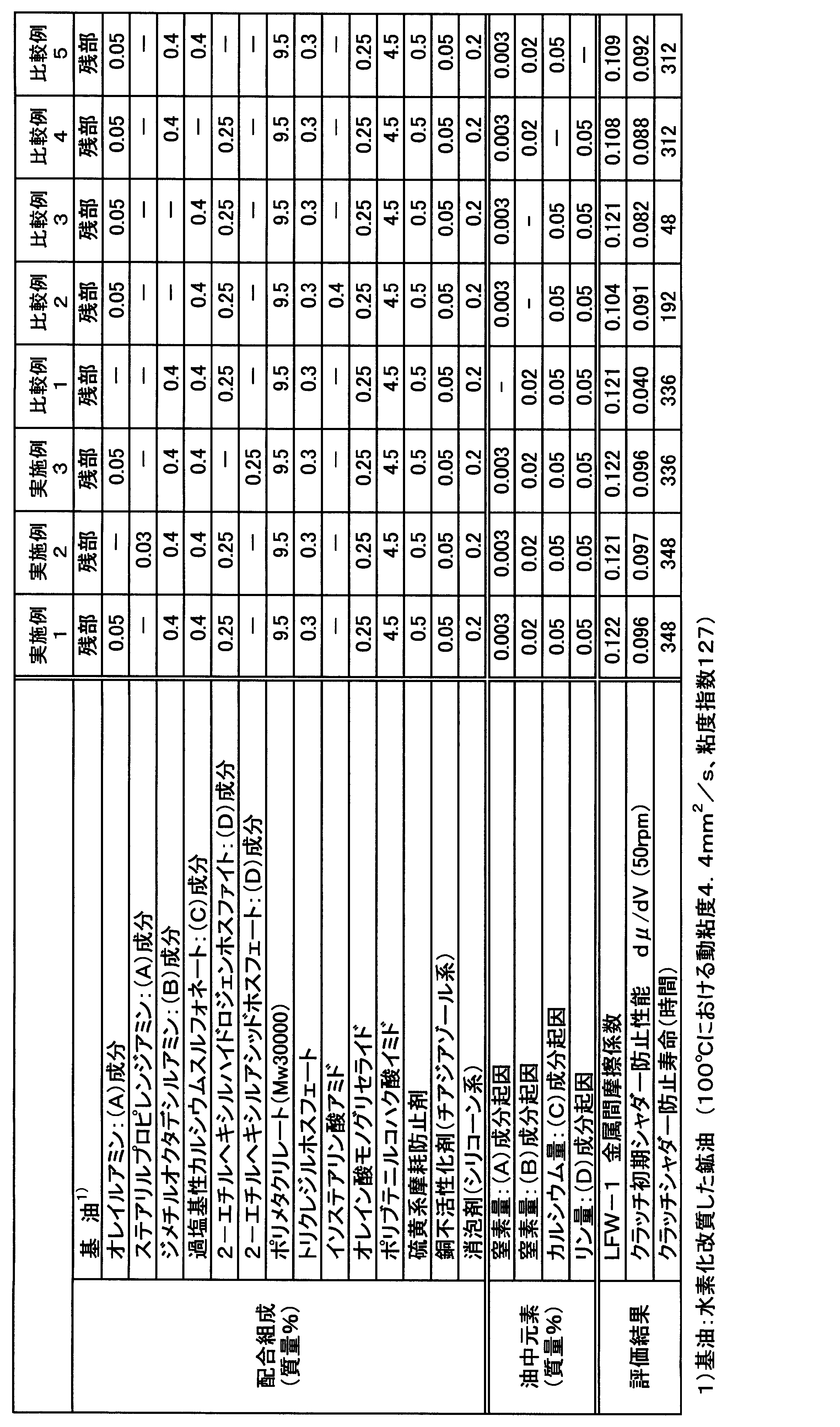
表1に示す組成の潤滑油組成物を調製した。ここで、油中の元素含有量は以下のようにして測定した。
(窒素含有量)
JIS K2609に準拠して測定した。
(リン、カルシウム含有量)
JPI-5S-38-92に準拠して測定した。
〔実施例1~3、比較例1~5〕
表1に示す組成の潤滑油組成物を調製した。ここで、油中の元素含有量は以下のようにして測定した。
(窒素含有量)
JIS K2609に準拠して測定した。
(リン、カルシウム含有量)
JPI-5S-38-92に準拠して測定した。
次に、以下のようにして金属間摩擦係数、クラッチ初期シャダー防止性能およびクラッチシャダー防止寿命を測定した。結果も併せて表1に示す。
(金属間摩擦係数:LFW-1試験)
ASTM D2174に記載されたブロックオンリング試験機(LFW-1)を用いて、金属間摩擦係数を測定した。具体的な試験条件を以下に示す。
・試験治具:
リング:Falex S-10 Test Ring(SAE4620 Steel)
ブロック:Falex H-60 Test Block(SAE01 Steel)
・試験条件:
油温:110℃
荷重:1176N
滑り速度:1.0、0.5、0.25、0.125、0.063m/sの順で各5分間保持
摩擦係数:滑り速度変更前の30秒間における測定値
(ならし運転条件:油温:110℃、荷重:1176N、滑り速度:1m/s、時間:30分間)
ASTM D2174に記載されたブロックオンリング試験機(LFW-1)を用いて、金属間摩擦係数を測定した。具体的な試験条件を以下に示す。
・試験治具:
リング:Falex S-10 Test Ring(SAE4620 Steel)
ブロック:Falex H-60 Test Block(SAE01 Steel)
・試験条件:
油温:110℃
荷重:1176N
滑り速度:1.0、0.5、0.25、0.125、0.063m/sの順で各5分間保持
摩擦係数:滑り速度変更前の30秒間における測定値
(ならし運転条件:油温:110℃、荷重:1176N、滑り速度:1m/s、時間:30分間)
(クラッチ初期シャダー防止性能)
JASO M349-1998に準拠して評価した。50rpmでのdμ/dVをシャダー防止の指標とした。この値が大きいほどシャダー防止性能がよい。
・摩擦材:セルロース系ディスク/スチールプレート
・油量 :150mL
・性能測定:ならし運転後に油温40℃にて測定
(ならし運転条件:油温:80℃、面圧:1MPa、滑り速度:0.6m/s、時間:30分間)
JASO M349-1998に準拠して評価した。50rpmでのdμ/dVをシャダー防止の指標とした。この値が大きいほどシャダー防止性能がよい。
・摩擦材:セルロース系ディスク/スチールプレート
・油量 :150mL
・性能測定:ならし運転後に油温40℃にて測定
(ならし運転条件:油温:80℃、面圧:1MPa、滑り速度:0.6m/s、時間:30分間)
(クラッチシャダー防止寿命)
JASO M349-1998に準拠して評価した。具体的な試験条件は以下の通りであり、50rpmでのdμ/dV<0になるまでの時間を測定してクラッチシャダー防止寿命とした。
摩擦材:セルロース系ディスク/スチールプレート
油 量:150mL
面 圧:1MPa
油 温:120℃
滑り速度:0.9m/s
滑り時間:30分
休止時間:1分
性能測定:開始以降24時間おきにμ-V特性を測定
(ならし運転条件:油温:80℃、面圧:1MPa、滑り速度:0.6m/s、時間:30分間)
JASO M349-1998に準拠して評価した。具体的な試験条件は以下の通りであり、50rpmでのdμ/dV<0になるまでの時間を測定してクラッチシャダー防止寿命とした。
摩擦材:セルロース系ディスク/スチールプレート
油 量:150mL
面 圧:1MPa
油 温:120℃
滑り速度:0.9m/s
滑り時間:30分
休止時間:1分
性能測定:開始以降24時間おきにμ-V特性を測定
(ならし運転条件:油温:80℃、面圧:1MPa、滑り速度:0.6m/s、時間:30分間)
〔評価結果〕
表1における実施例1~3の結果より、基油に(A)成分から(D)成分までを全て配合してなる本発明の潤滑油組成物は、金属間摩擦係数が十分に高いとともに、クラッチ初期のシャダー防止性能に優れ、さらにクラッチシャダー防止寿命も十分に長いものとなっている。それ故、本発明の潤滑油組成物は、無段変速機用として好ましく適用できることが理解される。
一方、比較例1~5の潤滑油組成物では、本発明における(A)成分から(D)成分までのいずれかの成分が配合されていないため、金属間摩擦係数とシャダー防止性能(初期性能、防止寿命)を両立させることができない。
表1における実施例1~3の結果より、基油に(A)成分から(D)成分までを全て配合してなる本発明の潤滑油組成物は、金属間摩擦係数が十分に高いとともに、クラッチ初期のシャダー防止性能に優れ、さらにクラッチシャダー防止寿命も十分に長いものとなっている。それ故、本発明の潤滑油組成物は、無段変速機用として好ましく適用できることが理解される。
一方、比較例1~5の潤滑油組成物では、本発明における(A)成分から(D)成分までのいずれかの成分が配合されていないため、金属間摩擦係数とシャダー防止性能(初期性能、防止寿命)を両立させることができない。
Claims (8)
- 潤滑油基油に、以下の(A)から(D)までの成分を配合してなる
ことを特徴とする潤滑油組成物。
(A)1級アミン
(B)3級アミン
(C)金属スルホネート、金属フェネートおよび金属サリチレートのうち少なくともいずれか1種
(D)酸性リン酸エステルおよび酸性亜リン酸エステルのうち少なくともいずれか1種 - 請求項1に記載の潤滑油組成物において、
前記(A)成分が、ジアミンである
ことを特徴とする潤滑油組成物。 - 請求項1または請求項2に記載の潤滑油組成物において、
前記(A)成分に起因する窒素の含有量が組成物全量基準で0.001質量%以上である
ことを特徴とする潤滑油組成物。 - 請求項1から請求項3までのいずれか1項に記載の潤滑油組成物において、
前記(B)成分に起因する窒素の含有量が組成物全量基準で0.005質量%以上である
ことを特徴とする潤滑油組成物。 - 請求項1から請求項4までのいずれか1項に記載の潤滑油組成物において、
前記(C)成分がアルカリ土類金属塩である
ことを特徴とする潤滑油組成物。 - 請求項1から請求項5までのいずれか1項に記載の潤滑油組成物において、
前記(C)成分に起因する金属の含有量が組成物全量基準で0.01質量%以上0.1質量%以下である
ことを特徴とする潤滑油組成物。 - 請求項1から請求項6までのいずれか1項に記載の潤滑油組成物において、
前記(D)成分に起因するリンの含有量が組成物全量基準で0.02質量%以上である
ことを特徴とする潤滑油組成物。 - 請求項1から請求項7までのいずれか1項に記載の潤滑油組成物が無段変速機用である
ことを特徴とする潤滑油組成物。
Priority Applications (3)
| Application Number | Priority Date | Filing Date | Title |
|---|---|---|---|
| US14/374,350 US9574157B2 (en) | 2012-03-14 | 2013-03-12 | Lubricant composition |
| EP13760336.1A EP2826846B1 (en) | 2012-03-14 | 2013-03-12 | Lubricant composition |
| CN201380014126.8A CN104169407B (zh) | 2012-03-14 | 2013-03-12 | 润滑油组合物 |
Applications Claiming Priority (2)
| Application Number | Priority Date | Filing Date | Title |
|---|---|---|---|
| JP2012057496A JP5922449B2 (ja) | 2012-03-14 | 2012-03-14 | 潤滑油組成物 |
| JP2012-057496 | 2012-03-14 |
Publications (1)
| Publication Number | Publication Date |
|---|---|
| WO2013137258A1 true WO2013137258A1 (ja) | 2013-09-19 |
Family
ID=49161164
Family Applications (1)
| Application Number | Title | Priority Date | Filing Date |
|---|---|---|---|
| PCT/JP2013/056819 Ceased WO2013137258A1 (ja) | 2012-03-14 | 2013-03-12 | 潤滑油組成物 |
Country Status (5)
| Country | Link |
|---|---|
| US (1) | US9574157B2 (ja) |
| EP (1) | EP2826846B1 (ja) |
| JP (1) | JP5922449B2 (ja) |
| CN (1) | CN104169407B (ja) |
| WO (1) | WO2013137258A1 (ja) |
Cited By (4)
| Publication number | Priority date | Publication date | Assignee | Title |
|---|---|---|---|---|
| WO2015045816A1 (ja) * | 2013-09-25 | 2015-04-02 | 出光興産株式会社 | トラクションドライブ変速機用潤滑油組成物 |
| WO2015122525A1 (ja) * | 2014-02-17 | 2015-08-20 | 出光興産株式会社 | 潤滑油組成物 |
| WO2016170813A1 (ja) * | 2015-04-22 | 2016-10-27 | 出光興産株式会社 | 自動変速機油 |
| JP2017149856A (ja) * | 2016-02-25 | 2017-08-31 | 出光興産株式会社 | 潤滑油組成物 |
Families Citing this family (10)
| Publication number | Priority date | Publication date | Assignee | Title |
|---|---|---|---|---|
| JP6405217B2 (ja) * | 2014-12-09 | 2018-10-17 | シェルルブリカンツジャパン株式会社 | すべり案内面用潤滑油組成物 |
| JP6551727B2 (ja) | 2015-03-31 | 2019-07-31 | 出光興産株式会社 | 潤滑油組成物 |
| CN105181403B (zh) * | 2015-06-04 | 2018-02-09 | 中国兵器工业集团第五三研究所 | 单元素标准油及其制备方法 |
| CN108779410B (zh) * | 2016-03-15 | 2022-03-01 | 出光兴产株式会社 | 润滑油组合物、润滑方法、和变速器 |
| DE112017001520T5 (de) * | 2016-03-24 | 2018-12-13 | Idemitsu Kosan Co., Ltd. | Schmiermittelölzusammensetzung für Motor, ausgerüstet mit Superladermechanismus, Verfahrenzum Unterdrücken der Vorzündung bei niedriger Geschwindigkeit im Motor, ausgerüstet mitSuperladermechanismus unter Verwendung der Schmiermittelölzusammensetzung und Verfahren zur Herstellung der Schmiermittelölzusammensetzung |
| JP6753608B2 (ja) | 2016-10-19 | 2020-09-09 | 出光興産株式会社 | 潤滑油組成物、潤滑方法、及び変速機 |
| CN107034000A (zh) * | 2017-06-12 | 2017-08-11 | 苏州永创达电子有限公司 | 一种高质量环保减磨润滑油 |
| CN107236590A (zh) * | 2017-06-30 | 2017-10-10 | 太仓宝达齿条有限公司 | 一种齿条用高性能润滑脂 |
| EP3650521B1 (en) | 2018-02-28 | 2022-06-01 | Idemitsu Kosan Co., Ltd. | Lubricating oil composition |
| US20220098508A1 (en) * | 2018-08-30 | 2022-03-31 | Basf Se | Lubricant composition |
Citations (5)
| Publication number | Priority date | Publication date | Assignee | Title |
|---|---|---|---|---|
| JP2001288488A (ja) | 2000-02-02 | 2001-10-16 | Idemitsu Kosan Co Ltd | 潤滑油組成物 |
| JP2007238764A (ja) * | 2006-03-08 | 2007-09-20 | Nippon Oil Corp | 潤滑油組成物 |
| JP2009167337A (ja) | 2008-01-18 | 2009-07-30 | Idemitsu Kosan Co Ltd | 潤滑油組成物および無段変速機 |
| WO2011037054A1 (ja) | 2009-09-25 | 2011-03-31 | 出光興産株式会社 | 潤滑油組成物および無段変速機 |
| WO2011062282A1 (ja) * | 2009-11-19 | 2011-05-26 | 株式会社ジェイテクト | 潤滑油、摩擦部材及び歯車式の差動制限機能付ディファレンシャル |
Family Cites Families (12)
| Publication number | Priority date | Publication date | Assignee | Title |
|---|---|---|---|---|
| US4795583A (en) * | 1987-12-28 | 1989-01-03 | Ethyl Petroleum Additives, Inc. | Shift-feel durability enhancement |
| US5916852A (en) | 1997-09-02 | 1999-06-29 | Exxon Chemical Patents Inc. | Power transmission fluids with improved friction break-in |
| JP4038306B2 (ja) | 1999-06-15 | 2008-01-23 | 東燃ゼネラル石油株式会社 | 無段変速機用潤滑油組成物 |
| US6320088B1 (en) * | 2000-03-21 | 2001-11-20 | Nippon Mitsubishi Oil Corporation | Traction drive fluid |
| JP2001262176A (ja) | 2000-03-21 | 2001-09-26 | Nippon Mitsubishi Oil Corp | 変速機用潤滑油組成物 |
| US6777378B2 (en) | 2002-02-15 | 2004-08-17 | The Lubrizol Corporation | Molybdenum, sulfur and boron containing lubricating oil composition |
| JP3785378B2 (ja) * | 2002-04-30 | 2006-06-14 | 出光興産株式会社 | 自動変速機用潤滑油組成物 |
| JP4202898B2 (ja) * | 2003-11-17 | 2008-12-24 | シェブロンジャパン株式会社 | 潤滑油添加剤および潤滑油組成物 |
| US20070004603A1 (en) * | 2005-06-30 | 2007-01-04 | Iyer Ramnath N | Methods for improved power transmission performance and compositions therefor |
| JP5030402B2 (ja) * | 2005-08-15 | 2012-09-19 | Jx日鉱日石エネルギー株式会社 | 潤滑油組成物 |
| US20070293406A1 (en) | 2006-06-16 | 2007-12-20 | Henly Timothy J | Power transmission fluid with enhanced friction characteristics |
| JP5280668B2 (ja) | 2007-11-16 | 2013-09-04 | 出光興産株式会社 | 潤滑油組成物 |
-
2012
- 2012-03-14 JP JP2012057496A patent/JP5922449B2/ja active Active
-
2013
- 2013-03-12 EP EP13760336.1A patent/EP2826846B1/en active Active
- 2013-03-12 US US14/374,350 patent/US9574157B2/en active Active
- 2013-03-12 WO PCT/JP2013/056819 patent/WO2013137258A1/ja not_active Ceased
- 2013-03-12 CN CN201380014126.8A patent/CN104169407B/zh active Active
Patent Citations (5)
| Publication number | Priority date | Publication date | Assignee | Title |
|---|---|---|---|---|
| JP2001288488A (ja) | 2000-02-02 | 2001-10-16 | Idemitsu Kosan Co Ltd | 潤滑油組成物 |
| JP2007238764A (ja) * | 2006-03-08 | 2007-09-20 | Nippon Oil Corp | 潤滑油組成物 |
| JP2009167337A (ja) | 2008-01-18 | 2009-07-30 | Idemitsu Kosan Co Ltd | 潤滑油組成物および無段変速機 |
| WO2011037054A1 (ja) | 2009-09-25 | 2011-03-31 | 出光興産株式会社 | 潤滑油組成物および無段変速機 |
| WO2011062282A1 (ja) * | 2009-11-19 | 2011-05-26 | 株式会社ジェイテクト | 潤滑油、摩擦部材及び歯車式の差動制限機能付ディファレンシャル |
Non-Patent Citations (1)
| Title |
|---|
| See also references of EP2826846A4 |
Cited By (13)
| Publication number | Priority date | Publication date | Assignee | Title |
|---|---|---|---|---|
| CN105579563A (zh) * | 2013-09-25 | 2016-05-11 | 出光兴产株式会社 | 牵引传动变速器用润滑油组合物 |
| WO2015045816A1 (ja) * | 2013-09-25 | 2015-04-02 | 出光興産株式会社 | トラクションドライブ変速機用潤滑油組成物 |
| US10011802B2 (en) | 2014-02-17 | 2018-07-03 | Idemitsu Kosan Co., Ltd. | Lubricating oil composition |
| JP2015151490A (ja) * | 2014-02-17 | 2015-08-24 | 出光興産株式会社 | 潤滑油組成物 |
| CN105980535A (zh) * | 2014-02-17 | 2016-09-28 | 出光兴产株式会社 | 润滑油组合物 |
| WO2015122525A1 (ja) * | 2014-02-17 | 2015-08-20 | 出光興産株式会社 | 潤滑油組成物 |
| EP3109299B1 (en) | 2014-02-17 | 2019-06-12 | Idemitsu Kosan Co., Ltd. | Lubricating oil composition |
| CN105980535B (zh) * | 2014-02-17 | 2019-07-19 | 出光兴产株式会社 | 润滑油组合物 |
| WO2016170813A1 (ja) * | 2015-04-22 | 2016-10-27 | 出光興産株式会社 | 自動変速機油 |
| JP2016204519A (ja) * | 2015-04-22 | 2016-12-08 | 出光興産株式会社 | 自動変速機油 |
| JP2017149856A (ja) * | 2016-02-25 | 2017-08-31 | 出光興産株式会社 | 潤滑油組成物 |
| WO2017145592A1 (ja) * | 2016-02-25 | 2017-08-31 | 出光興産株式会社 | 潤滑油組成物 |
| US11111457B2 (en) | 2016-02-25 | 2021-09-07 | Idemitsu Kosan Co., Ltd. | Lubricating oil composition |
Also Published As
| Publication number | Publication date |
|---|---|
| JP5922449B2 (ja) | 2016-05-24 |
| CN104169407B (zh) | 2017-03-01 |
| JP2013189565A (ja) | 2013-09-26 |
| US20140378357A1 (en) | 2014-12-25 |
| US9574157B2 (en) | 2017-02-21 |
| EP2826846A4 (en) | 2015-11-18 |
| CN104169407A (zh) | 2014-11-26 |
| EP2826846B1 (en) | 2018-12-05 |
| EP2826846A1 (en) | 2015-01-21 |
Similar Documents
| Publication | Publication Date | Title |
|---|---|---|
| JP5922449B2 (ja) | 潤滑油組成物 | |
| JP5816554B2 (ja) | 潤滑油組成物および無段変速機 | |
| US10011802B2 (en) | Lubricating oil composition | |
| JP5225696B2 (ja) | 潤滑油組成物および無段変速機 | |
| JP4017317B2 (ja) | 自動変速機用潤滑油組成物 | |
| JP4038306B2 (ja) | 無段変速機用潤滑油組成物 | |
| JP6551727B2 (ja) | 潤滑油組成物 | |
| JP2014196396A (ja) | 自動変速機用潤滑油組成物 | |
| WO2007052833A1 (ja) | 潤滑油組成物 | |
| JP2001342486A (ja) | 無段変速機用潤滑油組成物 | |
| JP3785378B2 (ja) | 自動変速機用潤滑油組成物 | |
| JP2001342485A (ja) | 無段変速機用潤滑油組成物 | |
| WO2007052826A1 (ja) | 潤滑油組成物 | |
| JP4121244B2 (ja) | 無段変速機用潤滑油組成物 | |
| JP4810492B2 (ja) | 無段変速機用潤滑油組成物 | |
| JP5431860B2 (ja) | 無段変速機油組成物 | |
| US20180142180A1 (en) | Automatic transmission fluid | |
| JP2008222904A (ja) | 無段変速機用潤滑油組成物 | |
| JP2021095457A (ja) | 潤滑油組成物 |
Legal Events
| Date | Code | Title | Description |
|---|---|---|---|
| 121 | Ep: the epo has been informed by wipo that ep was designated in this application |
Ref document number: 13760336 Country of ref document: EP Kind code of ref document: A1 |
|
| WWE | Wipo information: entry into national phase |
Ref document number: 14374350 Country of ref document: US |
|
| WWE | Wipo information: entry into national phase |
Ref document number: 2013760336 Country of ref document: EP |
|
| NENP | Non-entry into the national phase |
Ref country code: DE |
|
| WWE | Wipo information: entry into national phase |
Ref document number: IDP00201406202 Country of ref document: ID |