WO2013139207A1 - 一种下行控制信令的传输方法及装置 - Google Patents
一种下行控制信令的传输方法及装置 Download PDFInfo
- Publication number
- WO2013139207A1 WO2013139207A1 PCT/CN2013/072235 CN2013072235W WO2013139207A1 WO 2013139207 A1 WO2013139207 A1 WO 2013139207A1 CN 2013072235 W CN2013072235 W CN 2013072235W WO 2013139207 A1 WO2013139207 A1 WO 2013139207A1
- Authority
- WO
- WIPO (PCT)
- Prior art keywords
- scheduling dci
- downlink
- information field
- uplink
- length
- Prior art date
- Legal status (The legal status is an assumption and is not a legal conclusion. Google has not performed a legal analysis and makes no representation as to the accuracy of the status listed.)
- Ceased
Links
Classifications
-
- H—ELECTRICITY
- H04—ELECTRIC COMMUNICATION TECHNIQUE
- H04L—TRANSMISSION OF DIGITAL INFORMATION, e.g. TELEGRAPHIC COMMUNICATION
- H04L1/00—Arrangements for detecting or preventing errors in the information received
- H04L1/12—Arrangements for detecting or preventing errors in the information received by using return channel
- H04L1/16—Arrangements for detecting or preventing errors in the information received by using return channel in which the return channel carries supervisory signals, e.g. repetition request signals
- H04L1/18—Automatic repetition systems, e.g. Van Duuren systems
- H04L1/1812—Hybrid protocols; Hybrid automatic repeat request [HARQ]
-
- H—ELECTRICITY
- H04—ELECTRIC COMMUNICATION TECHNIQUE
- H04L—TRANSMISSION OF DIGITAL INFORMATION, e.g. TELEGRAPHIC COMMUNICATION
- H04L1/00—Arrangements for detecting or preventing errors in the information received
- H04L1/12—Arrangements for detecting or preventing errors in the information received by using return channel
- H04L1/16—Arrangements for detecting or preventing errors in the information received by using return channel in which the return channel carries supervisory signals, e.g. repetition request signals
- H04L1/18—Automatic repetition systems, e.g. Van Duuren systems
- H04L1/1829—Arrangements specially adapted for the receiver end
- H04L1/1861—Physical mapping arrangements
-
- H—ELECTRICITY
- H04—ELECTRIC COMMUNICATION TECHNIQUE
- H04L—TRANSMISSION OF DIGITAL INFORMATION, e.g. TELEGRAPHIC COMMUNICATION
- H04L1/00—Arrangements for detecting or preventing errors in the information received
- H04L1/12—Arrangements for detecting or preventing errors in the information received by using return channel
- H04L1/16—Arrangements for detecting or preventing errors in the information received by using return channel in which the return channel carries supervisory signals, e.g. repetition request signals
- H04L1/18—Automatic repetition systems, e.g. Van Duuren systems
- H04L1/1829—Arrangements specially adapted for the receiver end
- H04L1/1864—ARQ related signaling
-
- H—ELECTRICITY
- H04—ELECTRIC COMMUNICATION TECHNIQUE
- H04L—TRANSMISSION OF DIGITAL INFORMATION, e.g. TELEGRAPHIC COMMUNICATION
- H04L1/00—Arrangements for detecting or preventing errors in the information received
- H04L1/12—Arrangements for detecting or preventing errors in the information received by using return channel
- H04L1/16—Arrangements for detecting or preventing errors in the information received by using return channel in which the return channel carries supervisory signals, e.g. repetition request signals
- H04L1/18—Automatic repetition systems, e.g. Van Duuren systems
- H04L1/1867—Arrangements specially adapted for the transmitter end
- H04L1/1893—Physical mapping arrangements
-
- H—ELECTRICITY
- H04—ELECTRIC COMMUNICATION TECHNIQUE
- H04L—TRANSMISSION OF DIGITAL INFORMATION, e.g. TELEGRAPHIC COMMUNICATION
- H04L5/00—Arrangements affording multiple use of the transmission path
-
- H—ELECTRICITY
- H04—ELECTRIC COMMUNICATION TECHNIQUE
- H04L—TRANSMISSION OF DIGITAL INFORMATION, e.g. TELEGRAPHIC COMMUNICATION
- H04L5/00—Arrangements affording multiple use of the transmission path
- H04L5/14—Two-way operation using the same type of signal, i.e. duplex
-
- H—ELECTRICITY
- H04—ELECTRIC COMMUNICATION TECHNIQUE
- H04W—WIRELESS COMMUNICATION NETWORKS
- H04W72/00—Local resource management
- H04W72/20—Control channels or signalling for resource management
- H04W72/21—Control channels or signalling for resource management in the uplink direction of a wireless link, i.e. towards the network
-
- H—ELECTRICITY
- H04—ELECTRIC COMMUNICATION TECHNIQUE
- H04L—TRANSMISSION OF DIGITAL INFORMATION, e.g. TELEGRAPHIC COMMUNICATION
- H04L1/00—Arrangements for detecting or preventing errors in the information received
- H04L1/12—Arrangements for detecting or preventing errors in the information received by using return channel
- H04L1/16—Arrangements for detecting or preventing errors in the information received by using return channel in which the return channel carries supervisory signals, e.g. repetition request signals
- H04L1/18—Automatic repetition systems, e.g. Van Duuren systems
- H04L1/1822—Automatic repetition systems, e.g. Van Duuren systems involving configuration of automatic repeat request [ARQ] with parallel processes
-
- H—ELECTRICITY
- H04—ELECTRIC COMMUNICATION TECHNIQUE
- H04L—TRANSMISSION OF DIGITAL INFORMATION, e.g. TELEGRAPHIC COMMUNICATION
- H04L5/00—Arrangements affording multiple use of the transmission path
- H04L5/0001—Arrangements for dividing the transmission path
- H04L5/0003—Two-dimensional division
- H04L5/0005—Time-frequency
- H04L5/0007—Time-frequency the frequencies being orthogonal, e.g. OFDM(A) or DMT
- H04L5/001—Time-frequency the frequencies being orthogonal, e.g. OFDM(A) or DMT the frequencies being arranged in component carriers
-
- H—ELECTRICITY
- H04—ELECTRIC COMMUNICATION TECHNIQUE
- H04L—TRANSMISSION OF DIGITAL INFORMATION, e.g. TELEGRAPHIC COMMUNICATION
- H04L5/00—Arrangements affording multiple use of the transmission path
- H04L5/003—Arrangements for allocating sub-channels of the transmission path
- H04L5/0053—Allocation of signalling, i.e. of overhead other than pilot signals
- H04L5/0055—Physical resource allocation for ACK/NACK
-
- H—ELECTRICITY
- H04—ELECTRIC COMMUNICATION TECHNIQUE
- H04L—TRANSMISSION OF DIGITAL INFORMATION, e.g. TELEGRAPHIC COMMUNICATION
- H04L5/00—Arrangements affording multiple use of the transmission path
- H04L5/14—Two-way operation using the same type of signal, i.e. duplex
- H04L5/1469—Two-way operation using the same type of signal, i.e. duplex using time-sharing
-
- H—ELECTRICITY
- H04—ELECTRIC COMMUNICATION TECHNIQUE
- H04W—WIRELESS COMMUNICATION NETWORKS
- H04W72/00—Local resource management
- H04W72/12—Wireless traffic scheduling
Definitions
- the uplink scheduling DCI and the downlink scheduling DCI are parsed according to the determination result of each information domain.
- a DCI transmission device is applied to an aggregation scenario of a TDD carrier and an FDD carrier, including:
- FIG. 2 is a schematic diagram of a CA technology download wave distribution of the LTE-A system in the prior art
- FIG. 3 is a flowchart of DCI transmission performed by a base station according to an embodiment of the present invention.
- the first feedback mode is as follows:
- the TDD carrier and the FDD carrier are both based on the FDD system for PDSCH HARQ feedback, that is, the PDSCH HARQ feedback information of different downlink subframes are respectively fed back in different uplink subframes, and the cylinder in the following embodiment is called mode 1.
- the second feedback mode is as follows:
- the FDD carrier and the TDD carrier perform PDSCH HARQ feedback according to the TDD system, that is, the PDSCH HARQ feedback information of different downlink subframes is fed back in the same uplink subframe, and the cylinder in the following embodiment is called mode 2.
- the base station in the scenario of TDD carrier and FDD carrier aggregation, the base station combines the foregoing PDSCHs.
- the HARQ feedback mode and the PUSCH scheduling mode respectively set respective information fields in the uplink scheduling DCI (that is, the DCI for scheduling uplink data transmission) and the downlink scheduling DCI (that is, the DCI for scheduling downlink data transmission) carried by each carrier, and according to each information.
- the determination result of the domain generates the corresponding uplink scheduling DCI and the downlink scheduling DCI, and then transmits the corresponding uplink scheduling DCI and downlink scheduling DCI to the terminal side through each carrier.
- carrier a the detailed process of transmitting DCI on any carrier (hereinafter referred to as carrier a) is as follows:
- Step 310 The base station determines, according to the currently used PUSCH scheduling mode, the UL index information field in the uplink scheduling DCI carried by the carrier a.
- the DAI information field is not set in the uplink scheduling DCI, and the UL index information field is set as follows:
- the length of the UL index information field in the uplink scheduling DCI is set to M bits, and M is a preset value, for example, 2 bits; or, according to the notification of the high layer signaling, the UL in the uplink scheduling DCI is set.
- M is a preset value, for example, 2 bits; or, according to the notification of the high layer signaling, the UL in the uplink scheduling DCI is set.
- the length of the index information field is set to M bits, and M is a preset value, for example, 2 bits; or, according to the notification of the high layer signaling.
- the length of the UL index information field in the uplink scheduling DCI may be set to a constant value " g2 ( P bit, where P is the maximum number of uplink subframes scheduled by the same downlink subframe supported by the system)
- the length of the UL index information field in the uplink scheduling DCI may be set according to the notification of the high layer signaling; or the length of the UL index information field in the uplink scheduling DCI may be set to " 1 ( 3 ⁇ 4 2 ( ⁇ )" bits
- the Q is the maximum number of multiple uplink subframes scheduled in the same downlink subframe in the current aggregation carrier.
- the length of the UL index information field in the uplink scheduling DCI may be set to A bits, where A is in the system.
- the maximum number of uplink subframes that are scheduled to be used in the same downlink subframe is supported.
- the length of the UL index information field in the uplink scheduling DCI may be set to B bits, where B is the same downlink in the current aggregated carrier. The maximum number of multiple uplink subframes scheduled by the frame.
- the base station performs mode PUSCH scheduling on the carrier a, the base station does not set the UL index information field in the uplink scheduling DCI, and sets the DAI information field in the following manner (when the length of the DAI information field is determined, all downlinks on the secondary carrier are determined.
- the length of the DAI information field in the subframe is the same until the base station performs reconfiguration):
- the base station configures the UE to aggregate 3 downlink carriers, and uses PUCCH format 3 to feed back ACK/NACK information.
- the padded uplink subframe is a feedback subframe that fills the corresponding ACK/NACK information of the uplink subframe of the same pattern, and the uplink subframe 2 and the uplink subframe 7 need feedback 14
- the base station should set the DAI information field in the uplink scheduling DCI to N bits, where N is a preset value, for example, 2 bits or 3 bits.
- the base station uses the same manner as the TDD system, and sets the HARQ process number information field and the DAI information field in the downlink scheduling DCI. (When the length of the D AI information field is determined, the DAI information field in all downlink subframes on the secondary carrier is determined. The length is the same until the base station reconfigures):
- the NACK information implicitly determines the length of the DAI information field in the downlink scheduling DCI, specifically: determining whether the number of bits of the ACK/NACK information fed back by the UE in all uplink subframes is not greater than 11 bits, and if so, scheduling the downlink in the DCI
- the length of the DAI information field is set to 0 bits. Otherwise, the length of the DAI information field in the downlink scheduling DCI is set to N bits, and N is a preset value, for example, 2 bits or 3 bits, as shown in FIG. 4 and FIG. 5 . , No longer.
- the TPC information field in the downlink scheduling DCI is used to indicate the PUCCH resource, and the PUCCH resources indicated in the multiple downlink subframes that use the same uplink subframe to transmit the ACK/NACK information are the same. .
- Step 320 The base station generates a corresponding uplink scheduling DCI and a downlink scheduling DCI according to the determination result of each information domain, and transmits the uplink scheduling DCI and the downlink scheduling DCI to the terminal side by using carrier a.
- the base station sends the uplink scheduling DCI and the downlink scheduling DCI to the terminal side through the two types of PDCCH resource sets, that is, the PDCCH common space and the PDCCH UE-specific space, where the PDCCH common space is shared by all terminals in the cell, and is mainly used for The public information is scheduled, so the length of the DCI transmitted in the PDCCH common space must be determined by all the terminals, and cannot be changed arbitrarily, and the PDCCH UE exclusive space is used for transmitting the DCI of the UE-specific data, which is for each terminal. Therefore, in the embodiment of the present invention, preferably, the uplink scheduling DCI and the downlink scheduling DCI determined by the base station according to the schemes described in steps 300 and 310 are transmitted in the PDCCH UE exclusive space.
- the primary carrier is an FDD carrier
- the secondary carrier is a TDD carrier
- the PUSCHs in different uplink subframes on the FDD carrier are respectively scheduled by different downlink subframes
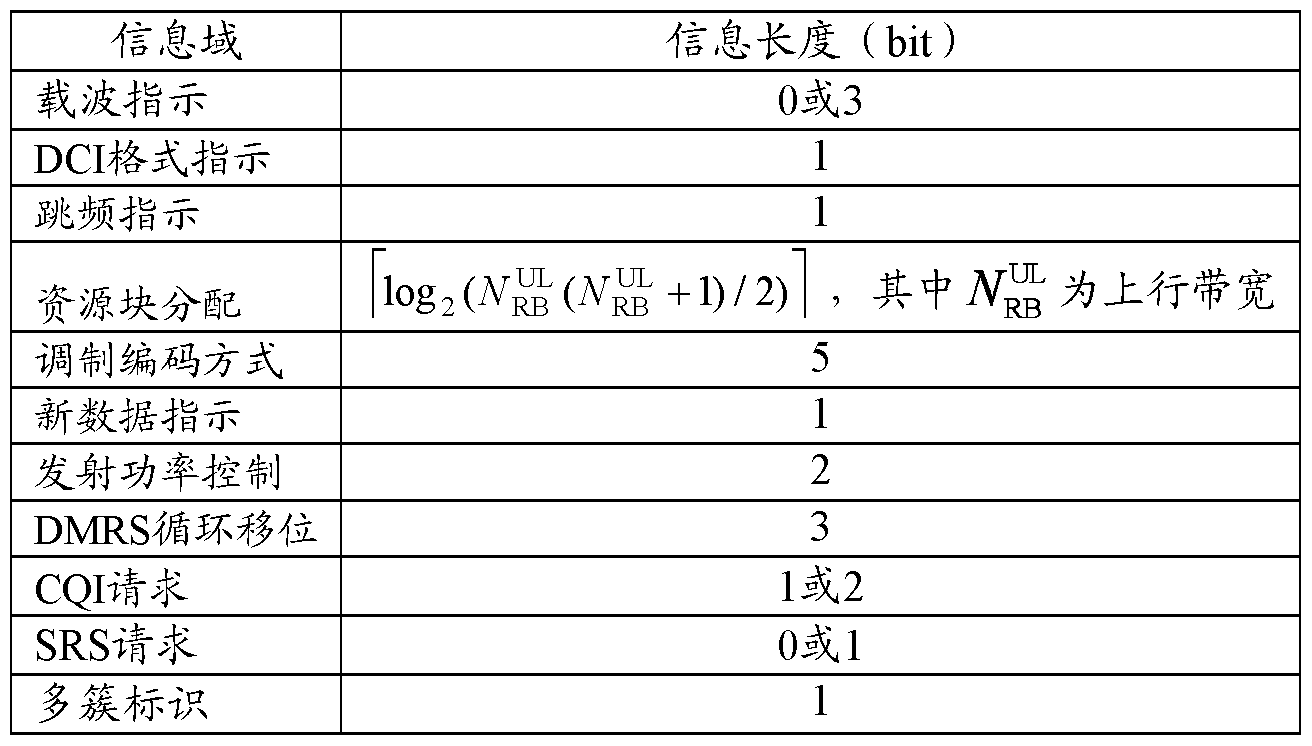
- the PUSCH scheduling on the TDD carrier corresponds to the TDD uplink and downlink configuration 1 to 6 That is, the foregoing mode 1 and mode X are used, and the uplink scheduling DCI and the downlink scheduling DCI transmitted in the UE-specific space corresponding to each carrier are respectively shown in Tables 3 and 4:
- DCI format 0 (DCI format corresponding to FDD system 0)
- DCI format 1 A (DCI format corresponding to FDD system 0)
- Table 4 shows the DCI format 1A for scheduling downlink data transmission: where the HARQ process number information field of length 2 bits is set, and the PUCCH transmission power control information field (ie TPC information) on the FDD carrier
- the 2-bit information in the field is used to adjust the PUCCH transmission power; the 2-bit information in the PUCCH transmission power control information field on the TDD carrier is used to indicate the resource used by the PUCCH to transmit the corresponding ACK/NACK information.
- the primary carrier is an FDD carrier
- the secondary carrier is a TDD carrier
- the PUSCHs in different uplink subframes on the FDD carrier are respectively scheduled by different downlink subframes
- the TDD carrier uses TDD uplink and downlink configuration 0, that is, the TDD carrier corresponds to
- the method for setting the information fields in the uplink scheduling DCI and the downlink scheduling DCI is the same as that in the application scenario 1, as shown in Table 3 and Table 4; and the FDD carrier corresponds to the foregoing mode 1 and mode Y,
- the uplink scheduling DCI and the downlink scheduling DCI transmitted in the corresponding UE-specific space are respectively shown in Table 5 and Table 6: Table 5
- Table 5 shows the DCI format 0 for scheduling uplink data transmission, in which 2 bits of UL index information are set.
- Table 6 shows the DCI format 0 for scheduling uplink data transmission, in which 2 bits of UL index information are set.
- DCI format 1 A (DCI format corresponding to FDD system 0)
- SRS request 0 or 1 Table 6 shows DCI format 1A for scheduling downlink data transmission, in which a 3-bit HARQ process number information field is set, and 2 bits in the PUCCH transmission power control information field (ie, TPC information field) The information is used to indicate a resource used by the PUCCH that transmits the corresponding ACK/NACK information.
- the primary carrier is a TDD carrier
- the secondary carrier is an FDD carrier
- the PUSCHs in different uplink subframes on the FDD carrier are respectively scheduled by different downlink subframes
- the TDD uplink and downlink configuration corresponding to the PUSCH scheduling on the TDD carrier is 1 ⁇ 6 , that is, in the foregoing manner 2 and mode X
- the uplink scheduling DCI and the downlink scheduling DCI transmitted in the UE-specific space corresponding to each carrier are respectively shown in Table 7 and Table 8, wherein the length of the DAI information field in the FDD carrier is set.
- Table 7 shows the DCI format 0 for scheduling uplink data transmission, in which a 2-bit DAI information field is set.
- Table 8 shows the DCI format 1A for scheduling downlink data transmission, where the 2-bit information in the PUCCH transmission power control information field on the FDD carrier is used to indicate the resource used for transmitting the PUCCH corresponding to the ACK/NACK information, and is used.
- the value of the information field is the same in multiple downlink subframes in which the ACK/NACK information is transmitted in the same uplink subframe.
- the primary carrier is a TDD carrier
- the secondary carrier is an FDD carrier
- the PUSCH in multiple uplink subframes on the FDD carrier is scheduled by the same downlink subframe
- the PUSCH scheduling on the TDD carrier corresponds to the TDD uplink and downlink configuration.
- 6 that is, the TDD carrier corresponds to the foregoing mode 2 and mode X
- the setting method of each information field in the uplink scheduling DCI and the downlink scheduling DCI is the same as that in the application scenario 3, as shown in Table 7 and Table 8
- the uplink scheduling DCI and downlink scheduling DCI transmitted in the corresponding UE-specific space are shown in Table 9 and Table 10, respectively.
- DCI format 0 (DCI format corresponding to TDD system 0)
- Table 9 shows the DCI format 0 of the uplink data transmission, in which the lengths of the UL index information field and the DAI information field are set to 2 bits:
- Table 10 shows DCI format 1A for scheduling downlink data transmission, in which a 3-bit HARQ process number information field and a 3-bit DAI information field are set, and 2-bit information in the PUCCH transmission power control information field on the FDD carrier is set.
- the information used by the PUCCH for transmitting the corresponding ACK/NACK information is the same, and the value of the information field is the same in the multiple downlink subframes in which the ACK/NACK information is transmitted in the same uplink subframe.
- Step 600 The UE determines, according to the currently used PDSCH HARQ feedback mode, the DAI information field in the uplink scheduling DCI and the downlink scheduling DCI carried by the carrier a, and the HARQ process number information field in the downlink scheduling DCI.
- Step 610 The UE determines, according to the currently used PUSCH scheduling mode, the UL index information field in the uplink scheduling DCI carried by the carrier a.
- A' on the carrier a, use mode 1 to perform PDSCH HARQ feedback, then,
- the UE determines that the UL index information field and the DAI information field are not set in the uplink scheduling DCI.
- the UE determines that the DAI information field is not set in the uplink scheduling DCI, and determines the setting manner of the UL index information field according to the following manner:
- the carrier a is a TDD carrier
- M is a preset value, for example, 2 bits; or, according to the notification of the high layer signaling, determining the UL in the uplink scheduling DCI Index The length of the information field.
- the length of the UL index information field in the uplink scheduling DCI is set to a constant value " g2 (P bit, P is the maximum number of uplink subframes scheduled by the same downlink subframe supported by the system).
- the length of the UL index information field in the uplink scheduling DCI may be determined according to the notification of the high layer signaling; or, the length of the UL index information field in the uplink scheduling DCI may be determined to be set to " 1 ( 3 ⁇ 4 2 ( ⁇ )" bits
- the Q is the maximum number of multiple uplink subframes scheduled in the same downlink subframe in the current aggregation carrier.
- the length of the UL index information field in the uplink scheduling DCI may be set to A bits, where A is in the system.
- the maximum number of uplink subframes that are scheduled to be used in the same downlink subframe is supported.
- the length of the UL index information field in the uplink scheduling DCI may be set to B bits, where B is the same downlink in the current aggregated carrier. The maximum number of multiple uplink subframes scheduled by the frame.
- the UE determines that the DAI information field is not set in the uplink scheduling DCI, and the length of the HARQ process number information field is set to 3 bits.
- the UE determines the network side indication by using the TPC information field in the downlink scheduling DCI. Indicates the PUCCH resource.
- the UE determines that the UL index information field is not set in the uplink scheduling DCI, and determines the setting mode of the DAI information field according to the following manner:
- the length of the DAI information field in the uplink scheduling DCI is set to N bits, and N is a preset value, for example, 2 bits or 3 bits; or, the length of the DAI information field in the uplink scheduling DCI may be determined according to the notification of the high layer signaling; Or determining, according to the locally fed back ACK/NACK information, the length of the DAI information field in the uplink scheduling DCI, specifically: determining whether the number of bits of the ACK/NACK information fed back in all uplink subframes is not greater than 11 bits, and if so, Then, it is determined that the length of the DAI information field in the uplink scheduling DCI is set to 0 bits. Otherwise, the length of the DAI information field in the uplink scheduling DCI is set to N bits, where N is a preset value, for example, 2 bits or 3 bits.
- the UE determines the setting manner of the UL index information field and the DAI information field in the uplink scheduling DCI as follows:
- the carrier a is a TDD carrier, it is determined that the length of the UL index information field in the uplink scheduling DCI is set to M bits, and M is a preset value, for example, 2 bits; or, according to the notification of the high layer signaling, determining the UL in the uplink scheduling DCI Index The length of the information field;
- the length of the UL index information field in the uplink scheduling DCI is set to a constant value " g2 (P bit, P is the maximum number of uplink subframes scheduled by the same downlink subframe supported by the system).
- the length of the UL index information field in the uplink scheduling DCI may be determined according to the notification of the high layer signaling; or, the length of the UL index information field in the uplink scheduling DCI may be determined to be set to " 1 ( 3 ⁇ 4 2 ( ⁇ )" bits
- the Q is the maximum number of multiple uplink subframes scheduled in the same downlink subframe in the current aggregated carrier.
- the length of the UL index information field in the uplink scheduling DCI may be determined as A bits, where A is in the system.
- the maximum number of uplink subframes that are scheduled to be used in the same downlink subframe is supported.
- the length of the UL index information field in the uplink scheduling DCI may be determined as B bits, where B is the same downlink in the current aggregated carrier. The maximum number of multiple uplink subframes scheduled by the frame.
- the UE may determine that the length of the DAI information field in the uplink scheduling DCI is set to N bits, and N is a preset value, for example, 2 bits or 3 bits; or, the DAI in the uplink scheduling DCI may be determined according to the notification of the high layer signaling.
- the length of the information field is determined according to the ACK/NACK information of the local feedback, and the length of the DAI information field in the uplink scheduling DCI is determined by: determining whether the number of bits of the ACK/NACK information fed back in any uplink subframe is not If the value is greater than 11 bits, if yes, it is determined that the length of the DAI information field in the uplink scheduling DCI is set to 0 bits. Otherwise, it is determined that the length of the DAI information field in the uplink scheduling DCI is set to N bits, where N is a preset value, for example, 2 bits or 3 bits.
- the UE determines the HARQ process number information field and the DAI information field in the following manner in the downlink scheduling DCI.
- the length of the HARQ process number information field in the downlink scheduling DCI may be determined according to the TDD upper bit downlink reference configuration corresponding to the PDSCH HARQ feedback on the FDD carrier: For example, if the uplink and downlink reference configuration is TDD uplink and downlink configuration 5, The UE determines that the length of the HARQ process number information field in the downlink scheduling DCI is set to 5 bits. If the uplink and downlink reference configuration is one of the TDD uplink and downlink configurations 0, 1, 2, 3, 4, and 6, the UE determines the downlink scheduling.
- the length of the HARQ process number information field in the DCI is set to 4 bits.
- the DAI information field in the downlink scheduling DCI indicates the first downlink subframe actually scheduled in the multiple downlink subframes in which the same uplink subframe is used for PDSCH HARQ feedback. Therefore, the UE can determine the downlink scheduling DCI.
- the length of the DAI information field is set to N bits, and N is a preset value, for example, 2 bits or 3 bits; or, the length of the DAI information field in the downlink scheduling DCI may be determined according to the notification of the high layer signaling; or, according to local feedback
- the ACK/NACK information implicitly determines the length of the DAI information field in the downlink scheduling DCI, specifically: determining whether the number of bits of the ACK/NACK information fed back in all uplink subframes is not greater than 11 bits, and if yes, determining the downlink scheduling.
- the length of the DAI information field in the DCI is set to 0 bits.
- N is a preset value, for example, 2 bits or 3 bits, as shown in FIG. 4 and FIG. 5 . As shown, no longer repeat them.
- the UE determines, according to the TPC information field in the downlink scheduling DCI, the PUCCH resource indicated by the network side, where the same uplink subframe transmits the ACK/NACK information in multiple downlink subframes.
- the PUCCH resources are the same.
- the UE performs the PDSCH HARQ feedback on the carrier a, and the UE determines the length of each information field in the uplink scheduling DCI and the downlink scheduling DCI according to the foregoing method A'; if the carrier a is For the TDD carrier, the UE performs the PDCSH HARQ feedback in the mode 2, and the UE sets the length of each information field in the uplink scheduling DCI and the downlink scheduling DCI according to the foregoing method B', and details are not described herein again.
- step 600 and step 610 regardless of which method is selected by the UE to determine each information field in the uplink scheduling DCI and the downlink scheduling DCI, the method should be consistent with the method of setting each information domain on the base station side, and the UE may be pre- The method for determining the information field of the base station may be determined according to the default unified configuration, and details are not described herein again.
- Step 620 After receiving the uplink scheduling DCI and the downlink scheduling DCI transmitted by the network side, the UE parses the obtained uplink scheduling DCI and downlink scheduling DCI according to the determination result of each information domain.
- the UE When the UE detects the PDCCH, it needs to detect two types of resource sets, that is, the PDCCH common space and the PDCCH UE exclusive space.
- the PDCCH common space is shared by all the UEs in the cell, and is mainly used for scheduling common information. Therefore, the length of the DCI transmitted in the PDCCH common space must be determined by all UEs, and cannot be changed arbitrarily, and the PDCCH UE exclusive space is used for transmission.
- the DCI of the UE-specific data is for each UE, therefore, the present invention
- the uplink scheduling DCI and the downlink scheduling DCI determined by the UE according to the foregoing manner are DCIs transmitted in the PDCCH UE exploration space.
- the base station includes a main control unit 70 and a communication unit 71, wherein
- the main control unit 70 is configured to determine, in the uplink scheduling DCI of the any carrier carrier and the DAI information domain and the downlink scheduling DCI in the downlink scheduling DCI, according to the currently used PDSCH HARQ feedback manner when the DCI is transmitted on any one carrier.
- the communication unit 71 is configured to generate a corresponding uplink scheduling DCI and a downlink scheduling DCI according to the determination result of each information domain, and transmit the uplink scheduling DCI and the downlink scheduling DCI to the terminal side by using any one of the foregoing carriers.
- the terminal includes a processing unit 80 and a communication unit 81, wherein
- the processing unit 80 is configured to: when processing the DCI transmitted on any one of the carriers, determine, according to the currently used PDSCH HARQ feedback manner, the DAI information field and the downlink scheduling DCI in the uplink scheduling DCI and the downlink scheduling DCI carried by the any one carrier.
- the communication unit 81 is configured to: after receiving the uplink scheduling DCI and the downlink scheduling DCI transmitted by the network side by using any one of the foregoing carriers, parsing the obtained uplink scheduling DCI and the downlink scheduling DCI according to the determination result of each information domain.
- the base station when performing carrier aggregation on the TDD carrier and the FDD carrier, determines, according to the PDSCH HARQ feedback mode and the PUSCH scheduling mode, each of the DCI information included in the UE-specific search space corresponding to each carrier.
- the information domain provides a suitable DCI design solution for the cross-system carrier aggregation application scenario, thereby satisfying the use requirements of the LTE system evolution process, and effectively improving the system performance.
- embodiments of the present invention can be provided as a method, system, or computer program product. Accordingly, the present invention may take the form of an entirely hardware embodiment, an entirely software embodiment, or a combination of software and hardware. Moreover, the present invention can be embodied in the form of a computer program product embodied on one or more computer-usable storage interfaces (including but not limited to disk storage, CD-ROM, optical storage, etc.) containing computer usable program code.
- computer-usable storage interfaces including but not limited to disk storage, CD-ROM, optical storage, etc.
- the computer program instructions can also be stored in a computer readable memory that can direct a computer or other programmable data processing device to operate in a particular manner, such that the instructions stored in the computer readable memory produce an article of manufacture comprising the instruction device.
- the apparatus implements the functions specified in one or more blocks of a flow or a flow and/or block diagram of the flowchart.
- These computer program instructions can also be loaded onto a computer or other programmable data processing device such that a series of operational steps are performed on a computer or other programmable device to produce computer-implemented processing for execution on a computer or other programmable device.
- the instructions provide steps for implementing the functions specified in one or more of the flow or in a block or blocks of a flow diagram.
Landscapes
- Engineering & Computer Science (AREA)
- Signal Processing (AREA)
- Computer Networks & Wireless Communication (AREA)
- Mobile Radio Communication Systems (AREA)
Description




Claims
Priority Applications (4)
| Application Number | Priority Date | Filing Date | Title |
|---|---|---|---|
| ES13763840.9T ES2649143T3 (es) | 2012-03-19 | 2013-03-06 | Procedimiento y dispositivo de transmisión de señalización de control de enlace descendente |
| EP13763840.9A EP2844003B1 (en) | 2012-03-19 | 2013-03-06 | Downlink control signalling transmission method and device |
| KR1020147029337A KR101712895B1 (ko) | 2012-03-19 | 2013-03-06 | 다운링크 제어 정보 전송 방법 및 장치 |
| US14/386,788 US9571236B2 (en) | 2012-03-19 | 2013-03-06 | Downlink control signalling transmission method and device |
Applications Claiming Priority (2)
| Application Number | Priority Date | Filing Date | Title |
|---|---|---|---|
| CN201210073376.6A CN103326806B (zh) | 2012-03-19 | 2012-03-19 | 一种下行控制信令的传输方法及装置 |
| CN201210073376.6 | 2012-03-19 |
Publications (1)
| Publication Number | Publication Date |
|---|---|
| WO2013139207A1 true WO2013139207A1 (zh) | 2013-09-26 |
Family
ID=49195359
Family Applications (1)
| Application Number | Title | Priority Date | Filing Date |
|---|---|---|---|
| PCT/CN2013/072235 Ceased WO2013139207A1 (zh) | 2012-03-19 | 2013-03-06 | 一种下行控制信令的传输方法及装置 |
Country Status (6)
| Country | Link |
|---|---|
| US (1) | US9571236B2 (zh) |
| EP (1) | EP2844003B1 (zh) |
| KR (1) | KR101712895B1 (zh) |
| CN (1) | CN103326806B (zh) |
| ES (1) | ES2649143T3 (zh) |
| WO (1) | WO2013139207A1 (zh) |
Cited By (7)
| Publication number | Priority date | Publication date | Assignee | Title |
|---|---|---|---|---|
| CN106134100A (zh) * | 2014-01-29 | 2016-11-16 | 三星电子株式会社 | 频率集成的系统中控制信道发送设备和方法 |
| CN106162906A (zh) * | 2015-03-31 | 2016-11-23 | 中兴通讯股份有限公司 | 调度信息发送、接收方法及装置 |
| WO2017028606A1 (zh) * | 2015-08-14 | 2017-02-23 | 中兴通讯股份有限公司 | 一种上行控制信息的发送方法及装置 |
| EP3096485A4 (en) * | 2014-01-17 | 2017-06-21 | ZTE Corporation | Resource management method and device and computer storage medium |
| KR20170116106A (ko) * | 2015-02-10 | 2017-10-18 | 후아웨이 테크놀러지 컴퍼니 리미티드 | 기지국, 사용자 단말, 및 캐리어 스케줄링 지시 방법 |
| WO2018201294A1 (zh) * | 2017-05-02 | 2018-11-08 | 华为技术有限公司 | 一种针对eMTC的HARQ反馈方法及终端设备 |
| US10805910B2 (en) | 2015-08-14 | 2020-10-13 | Zte Corporation | Method and apparatus for sending Uplink Control Information |
Families Citing this family (61)
| Publication number | Priority date | Publication date | Assignee | Title |
|---|---|---|---|---|
| WO2014181156A1 (en) * | 2013-05-10 | 2014-11-13 | Nokia Corporation | Compact dci for machine type communications |
| US9900142B2 (en) * | 2013-06-26 | 2018-02-20 | Lg Electronics Inc. | Method and apparatus for FDD/TDD intra-node and inter-node carrier aggregation |
| US9706537B2 (en) | 2013-07-10 | 2017-07-11 | Industrial Technology Research Institute | Method of handling HARQ feedbacks and related communication device |
| US9479293B2 (en) * | 2013-07-10 | 2016-10-25 | Industrial Technology Research Institute | Method of handling HARQ feedbacks and related communication device |
| CN103944701B (zh) * | 2013-08-26 | 2017-08-08 | 上海朗帛通信技术有限公司 | 一种tdd‑fdd联合系统中的传输方法和装置 |
| EP3043500B1 (en) * | 2013-09-26 | 2020-02-19 | Huawei Technologies Co., Ltd. | Feedback method of control information and user equipment |
| US20150085834A1 (en) * | 2013-09-26 | 2015-03-26 | Qualcomm Incorporated | Time division long term evolution (td-lte) frame structure modification |
| EP3043601A4 (en) * | 2013-09-26 | 2016-09-28 | Huawei Tech Co Ltd | METHOD AND DEVICE FOR SENDING UPLINK INFORMATION, METHOD AND DEVICE FOR RECEIVING UPLINK INFORMATION AND COMMUNICATION SYSTEM |
| JP5931828B2 (ja) * | 2013-09-26 | 2016-06-08 | 株式会社Nttドコモ | ユーザ端末、基地局及び無線通信方法 |
| CN104518854B (zh) * | 2013-09-27 | 2018-03-02 | 上海诺基亚贝尔股份有限公司 | 用于tdd‑fdd联合操作的harq时序和pucch资源的配置方法 |
| CN110176979B (zh) * | 2013-09-27 | 2020-10-27 | 中兴通讯股份有限公司 | 一种频谱聚合的数据发送方法及装置 |
| KR101797441B1 (ko) | 2013-09-27 | 2017-11-13 | 엘지전자 주식회사 | 반송파 집성 시스템에서 기지국의 하향링크 제어 정보 전송 방법 및 장치 |
| CN108712239B (zh) * | 2013-09-30 | 2022-02-01 | 华为技术有限公司 | 控制信息的传输方法、用户设备和基站 |
| US10098143B2 (en) * | 2013-11-08 | 2018-10-09 | Sharp Kabushiki Kaisha | Terminal device, base station apparatus, communication method, and integrated circuit |
| CN104734821B (zh) * | 2013-12-19 | 2019-04-05 | 电信科学技术研究院 | 数据传输方法和装置 |
| US9853779B2 (en) * | 2014-01-10 | 2017-12-26 | Sharp Kabushiki Kaisha | Systems and methods for carrier aggregation |
| CN104812040B (zh) * | 2014-01-27 | 2018-11-13 | 上海诺基亚贝尔股份有限公司 | 一种物理上行控制信道的闭环功率控制方法与设备 |
| WO2015147544A1 (ko) * | 2014-03-25 | 2015-10-01 | 엘지전자 주식회사 | 무선 통신 시스템에서 제어 정보 전송 방법 및 장치 |
| CN113595699B (zh) * | 2014-08-01 | 2024-08-09 | 苹果公司 | 用于窄带部署的pdcch设计 |
| JP6592445B2 (ja) * | 2014-09-03 | 2019-10-16 | シャープ株式会社 | 端末、および、基地局 |
| CN105634688B (zh) * | 2014-11-07 | 2021-08-17 | 中兴通讯股份有限公司 | 一种实现数据传输的方法及装置 |
| CN105763307B (zh) * | 2014-12-19 | 2020-02-14 | 中兴通讯股份有限公司 | 下行数据的传输方法及装置、下行数据的获取装置 |
| WO2016122243A1 (en) * | 2015-01-29 | 2016-08-04 | Samsung Electronics Co., Ltd. | Harq-ack information feedback method and apparatus |
| US20160242153A1 (en) * | 2015-02-13 | 2016-08-18 | Qualcomm Incorporated | Eimta in enhanced carrier aggregation |
| US10075970B2 (en) * | 2015-03-15 | 2018-09-11 | Qualcomm Incorporated | Mission critical data support in self-contained time division duplex (TDD) subframe structure |
| US10342012B2 (en) | 2015-03-15 | 2019-07-02 | Qualcomm Incorporated | Self-contained time division duplex (TDD) subframe structure |
| US9936519B2 (en) | 2015-03-15 | 2018-04-03 | Qualcomm Incorporated | Self-contained time division duplex (TDD) subframe structure for wireless communications |
| JPWO2016159230A1 (ja) * | 2015-04-02 | 2018-02-01 | 株式会社Nttドコモ | ユーザ端末、無線基地局及び無線通信方法 |
| US9814058B2 (en) | 2015-05-15 | 2017-11-07 | Qualcomm Incorporated | Scaled symbols for a self-contained time division duplex (TDD) subframe structure |
| JP6101311B2 (ja) * | 2015-06-26 | 2017-03-22 | 株式会社Nttドコモ | ユーザ端末、無線基地局及び無線通信方法 |
| US9992790B2 (en) * | 2015-07-20 | 2018-06-05 | Qualcomm Incorporated | Time division duplex (TDD) subframe structure supporting single and multiple interlace modes |
| CN106714320B (zh) * | 2015-11-16 | 2019-07-05 | 电信科学技术研究院 | 一种下行控制信息dci传输方法及装置 |
| CN107295683A (zh) * | 2016-04-05 | 2017-10-24 | 工业和信息化部电信研究院 | 一种调度多个上行子帧的方法和装置 |
| CN107359969B (zh) * | 2016-05-10 | 2020-03-24 | 电信科学技术研究院 | 一种harq的反馈信息传输方法、ue、基站和系统 |
| CN109479303B (zh) * | 2016-07-12 | 2021-01-01 | Oppo广东移动通信有限公司 | 传输数据的方法和终端设备 |
| CN107682931A (zh) * | 2016-08-09 | 2018-02-09 | 深圳市金立通信设备有限公司 | 一种数据通信方法及装置 |
| MY202417A (en) * | 2016-09-29 | 2024-04-28 | Sharp Kk | Systems and methods for determining frame structure and association timing |
| CN108616341B (zh) * | 2016-12-13 | 2020-05-26 | 电信科学技术研究院 | 一种数据传输方法、基站及终端 |
| CN108234086B (zh) * | 2016-12-22 | 2021-11-30 | 上海诺基亚贝尔股份有限公司 | 一种重传数据的方法 |
| WO2018137130A1 (zh) * | 2017-01-24 | 2018-08-02 | 广东欧珀移动通信有限公司 | Harq进程的配置方法、装置及设备 |
| CN108631952B (zh) * | 2017-03-24 | 2021-12-10 | 华为技术有限公司 | 一种反馈信息传输方法、终端设备和接入网设备 |
| CN108633044B (zh) | 2017-03-24 | 2021-12-28 | 华为技术有限公司 | 数据传输方法、终端设备及接入网设备 |
| WO2018233691A1 (zh) * | 2017-06-22 | 2018-12-27 | 华为技术有限公司 | 信号发送和接收方法、装置 |
| CN109120381B (zh) | 2017-06-22 | 2022-09-02 | 华为技术有限公司 | 信号发送和接收方法、装置 |
| CN109257819A (zh) * | 2017-07-13 | 2019-01-22 | 普天信息技术有限公司 | 一种多子带启动dci的指示方法、基站及用户设备 |
| WO2019032019A1 (en) | 2017-08-11 | 2019-02-14 | Telefonaktiebolaget Lm Ericsson (Publ) | DOWNLINK ASSIGNMENT AT DIFFERENT PROCESS TIMES |
| CN109391422B (zh) | 2017-08-11 | 2020-11-17 | 华为技术有限公司 | 一种反馈码本确定的方法及终端设备、网络设备 |
| ES2933380T3 (es) * | 2018-01-12 | 2023-02-06 | Lg Electronics Inc | Método y aparato para transmitir y recibir una señal inalámbrica en un sistema de comunicación inalámbrica |
| CN110278062B (zh) * | 2018-03-14 | 2021-03-09 | 电信科学技术研究院有限公司 | 资源指示、确定方法及装置 |
| CN119095179A (zh) * | 2018-04-05 | 2024-12-06 | 韩国电子通信研究院 | 用于通信系统中的上行链路传输的方法和装置 |
| US12047168B2 (en) * | 2018-09-28 | 2024-07-23 | Lenovo (Singapore) Pte. Ltd. | Method and apparatus for generating a CSI report |
| KR102723290B1 (ko) | 2019-04-02 | 2024-10-31 | 광동 오포 모바일 텔레커뮤니케이션즈 코포레이션 리미티드 | 데이터 전송 방법 및 관련 장치 |
| CN111130735B (zh) | 2019-04-30 | 2021-11-23 | 维沃移动通信有限公司 | 一种反馈控制方法、ue及网络设备 |
| KR102719919B1 (ko) * | 2019-05-09 | 2024-10-18 | 베이징 시아오미 모바일 소프트웨어 컴퍼니 리미티드 | 다운링크 제어 정보 송신 방법, 장치 및 판독 가능 저장 매체 (downlink control information sending method and apparatus, and readable storage medium) |
| CN112351504B (zh) * | 2019-08-08 | 2022-04-08 | 大唐移动通信设备有限公司 | 一种harq-ack反馈方法、终端及网络侧设备 |
| WO2021035450A1 (zh) * | 2019-08-23 | 2021-03-04 | 华为技术有限公司 | 一种数据传输方法和通信设备 |
| CN113472488B (zh) * | 2020-03-30 | 2022-09-02 | 维沃移动通信有限公司 | Harq-ack的反馈模式确定方法、配置方法及设备 |
| CN113473611B (zh) * | 2020-03-31 | 2024-09-06 | 维沃移动通信有限公司 | 资源调度方法、装置及ue |
| CN116326030B (zh) * | 2020-10-23 | 2025-11-25 | 捷开通讯(深圳)有限公司 | 混合自动重传请求方法、半持续调度方法和通信设备 |
| US11974283B2 (en) * | 2021-03-19 | 2024-04-30 | Qualcomm Incorporated | Implicit uplink control channel resource allocation |
| EP4381644A4 (en) | 2021-08-06 | 2025-04-30 | Apple Inc. | PLANNING FOR MULTIPLE PDSCH/PUSCH OPERATIONS |
Citations (4)
| Publication number | Priority date | Publication date | Assignee | Title |
|---|---|---|---|---|
| CN101478808A (zh) * | 2009-01-21 | 2009-07-08 | 中兴通讯股份有限公司 | 一种下行控制信息的发送及检测方法 |
| CN101998507A (zh) * | 2009-08-14 | 2011-03-30 | 中兴通讯股份有限公司 | 一种下行控制信令的传输方法和系统 |
| CN102045862A (zh) * | 2009-10-22 | 2011-05-04 | 中国移动通信集团公司 | 一种载波聚合实现方法、装置与系统 |
| CN102118756A (zh) * | 2009-12-31 | 2011-07-06 | 中兴通讯股份有限公司 | 一种载波聚合方法与频谱动态分配的方法 |
Family Cites Families (3)
| Publication number | Priority date | Publication date | Assignee | Title |
|---|---|---|---|---|
| US8739013B2 (en) * | 2007-09-28 | 2014-05-27 | Lg Electronics Inc. | Method for detecting control information in wireless communication system |
| KR20130126980A (ko) * | 2011-02-07 | 2013-11-21 | 인터디지탈 패튼 홀딩스, 인크 | 면허 면제 스펙트럼에서 보충 셀을 동작시키는 방법 및 장치 |
| US9042277B2 (en) * | 2011-04-11 | 2015-05-26 | Qualcomm Incorporated | Transmission of control information for FDD-TDD carrier aggregation |
-
2012
- 2012-03-19 CN CN201210073376.6A patent/CN103326806B/zh active Active
-
2013
- 2013-03-06 ES ES13763840.9T patent/ES2649143T3/es active Active
- 2013-03-06 KR KR1020147029337A patent/KR101712895B1/ko active Active
- 2013-03-06 US US14/386,788 patent/US9571236B2/en active Active
- 2013-03-06 WO PCT/CN2013/072235 patent/WO2013139207A1/zh not_active Ceased
- 2013-03-06 EP EP13763840.9A patent/EP2844003B1/en active Active
Patent Citations (4)
| Publication number | Priority date | Publication date | Assignee | Title |
|---|---|---|---|---|
| CN101478808A (zh) * | 2009-01-21 | 2009-07-08 | 中兴通讯股份有限公司 | 一种下行控制信息的发送及检测方法 |
| CN101998507A (zh) * | 2009-08-14 | 2011-03-30 | 中兴通讯股份有限公司 | 一种下行控制信令的传输方法和系统 |
| CN102045862A (zh) * | 2009-10-22 | 2011-05-04 | 中国移动通信集团公司 | 一种载波聚合实现方法、装置与系统 |
| CN102118756A (zh) * | 2009-12-31 | 2011-07-06 | 中兴通讯股份有限公司 | 一种载波聚合方法与频谱动态分配的方法 |
Non-Patent Citations (1)
| Title |
|---|
| See also references of EP2844003A4 * |
Cited By (19)
| Publication number | Priority date | Publication date | Assignee | Title |
|---|---|---|---|---|
| EP3096485A4 (en) * | 2014-01-17 | 2017-06-21 | ZTE Corporation | Resource management method and device and computer storage medium |
| CN106134100A (zh) * | 2014-01-29 | 2016-11-16 | 三星电子株式会社 | 频率集成的系统中控制信道发送设备和方法 |
| EP3101822A4 (en) * | 2014-01-29 | 2017-10-11 | Samsung Electronics Co., Ltd. | Control channel transmission device and method in frequency integrated system |
| US10764003B2 (en) | 2015-02-10 | 2020-09-01 | Huawei Technologies Co., Ltd. | Base station, user terminal, and carrier scheduling indication method |
| EP4068667A1 (en) * | 2015-02-10 | 2022-10-05 | Huawei Technologies Co., Ltd. | Carrier scheduling indication method and apparatus |
| KR20170116106A (ko) * | 2015-02-10 | 2017-10-18 | 후아웨이 테크놀러지 컴퍼니 리미티드 | 기지국, 사용자 단말, 및 캐리어 스케줄링 지시 방법 |
| EP3247065A4 (en) * | 2015-02-10 | 2018-01-24 | Huawei Technologies Co., Ltd. | Base station, user terminal, and carrier scheduling indication method |
| RU2681374C1 (ru) * | 2015-02-10 | 2019-03-06 | Хуавэй Текнолоджиз Ко., Лтд. | Базовая станция, пользовательский терминал и способ указания планирования несущих |
| KR102008357B1 (ko) | 2015-02-10 | 2019-10-21 | 후아웨이 테크놀러지 컴퍼니 리미티드 | 기지국, 사용자 단말, 및 캐리어 스케줄링 지시 방법 |
| US11483103B2 (en) | 2015-02-10 | 2022-10-25 | Huawei Technologies Co., Ltd. | Base station, user terminal, and carrier scheduling indication method |
| EP3742646A1 (en) * | 2015-02-10 | 2020-11-25 | Huawei Technologies Co. Ltd. | Carrier scheduling indication method and apparatus |
| US12309765B2 (en) | 2015-03-31 | 2025-05-20 | Xi'an Zhongxing New Software Co., Ltd. | Method and device for transmitting or receiving scheduling information |
| CN106162906B (zh) * | 2015-03-31 | 2019-01-15 | 中兴通讯股份有限公司 | 调度信息发送、接收方法及装置 |
| US10631310B2 (en) | 2015-03-31 | 2020-04-21 | Xi'an Zhongxing New Software Co., Ltd | Method and device for transmitting or receiving scheduling information |
| CN106162906A (zh) * | 2015-03-31 | 2016-11-23 | 中兴通讯股份有限公司 | 调度信息发送、接收方法及装置 |
| US11206676B2 (en) | 2015-03-31 | 2021-12-21 | Xi'an Zhongxing New Software Co., Ltd. | Method and device for transmitting or receiving scheduling information |
| US10805910B2 (en) | 2015-08-14 | 2020-10-13 | Zte Corporation | Method and apparatus for sending Uplink Control Information |
| WO2017028606A1 (zh) * | 2015-08-14 | 2017-02-23 | 中兴通讯股份有限公司 | 一种上行控制信息的发送方法及装置 |
| WO2018201294A1 (zh) * | 2017-05-02 | 2018-11-08 | 华为技术有限公司 | 一种针对eMTC的HARQ反馈方法及终端设备 |
Also Published As
| Publication number | Publication date |
|---|---|
| EP2844003A4 (en) | 2015-06-17 |
| KR20140142299A (ko) | 2014-12-11 |
| ES2649143T3 (es) | 2018-01-10 |
| KR101712895B1 (ko) | 2017-03-07 |
| EP2844003B1 (en) | 2017-09-27 |
| EP2844003A1 (en) | 2015-03-04 |
| US9571236B2 (en) | 2017-02-14 |
| CN103326806B (zh) | 2016-08-03 |
| CN103326806A (zh) | 2013-09-25 |
| US20150043394A1 (en) | 2015-02-12 |
Similar Documents
| Publication | Publication Date | Title |
|---|---|---|
| JP7787141B2 (ja) | Fdd‐tddジョイントキャリアアグリゲーションのためのアップリンク制御シグナリング | |
| US9571236B2 (en) | Downlink control signalling transmission method and device | |
| CN107135052B (zh) | 一种发送harq-ack反馈信息的方法 | |
| CN110086579B (zh) | 一种通信方法及设备 | |
| JP6500164B2 (ja) | アップリンク制御情報伝送方法及び装置 | |
| CN106060930B (zh) | 一种增强载波聚合系统的harq-ack传输方法和设备 | |
| CN103532688B (zh) | 一种跨频带载波聚合下的dci传输方法及装置 | |
| CN108650067B (zh) | 组合的tdd和fdd载波聚合中的传输 | |
| TWI492567B (zh) | A method and apparatus for determining ACK / NACK feedback bit number | |
| EP2663008B1 (en) | Method, user equipment and base station for information transmission in time division duplex system | |
| WO2011054188A1 (zh) | 一种上行控制信道资源配置的方法和装置 | |
| WO2013131435A1 (zh) | 一种harq反馈的实现方法及装置 | |
| JP2014503150A (ja) | LTE−ATDDシステムにおけるチャネル選択を行うPUCCHフォーマット1bでのリソース割り当て | |
| CN105846977A (zh) | 一种增强载波聚合系统的harq-ack传输方法和设备 | |
| WO2014067140A1 (zh) | 一种信息传输方法、用户设备及基站 | |
| WO2012094990A1 (zh) | 一种csi的传输方法和装置 | |
| WO2012174918A1 (zh) | Ack/nack的传输方法、接收方法及其装置 | |
| CN102638333B (zh) | 一种上行数据的调度方法及装置 | |
| WO2011120277A1 (zh) | 载波聚合场景下非周期反馈的方法和系统 | |
| WO2012022239A1 (zh) | 一种控制信道传输和资源确定方法、基站及用户设备 | |
| CN118764141A (zh) | 用于在通信系统中发送或接收反馈信息的方法和装置 | |
| CN102291227B (zh) | 一种发送和接收反馈信息的方法、系统及装置 | |
| WO2011124127A1 (zh) | 调度信令发送及应答反馈的方法、系统和设备 | |
| CN104601303A (zh) | 上行控制信息的发送方法和装置、以及接收方法和装置 | |
| WO2014173333A1 (zh) | 一种上行控制信息的发送方法及装置 |
Legal Events
| Date | Code | Title | Description |
|---|---|---|---|
| 121 | Ep: the epo has been informed by wipo that ep was designated in this application |
Ref document number: 13763840 Country of ref document: EP Kind code of ref document: A1 |
|
| NENP | Non-entry into the national phase |
Ref country code: DE |
|
| WWE | Wipo information: entry into national phase |
Ref document number: 14386788 Country of ref document: US |
|
| REEP | Request for entry into the european phase |
Ref document number: 2013763840 Country of ref document: EP |
|
| WWE | Wipo information: entry into national phase |
Ref document number: 2013763840 Country of ref document: EP |
|
| ENP | Entry into the national phase |
Ref document number: 20147029337 Country of ref document: KR Kind code of ref document: A |