WO2013141357A1 - 使用済み高吸水性ポリマーの再生方法 - Google Patents
使用済み高吸水性ポリマーの再生方法 Download PDFInfo
- Publication number
- WO2013141357A1 WO2013141357A1 PCT/JP2013/058288 JP2013058288W WO2013141357A1 WO 2013141357 A1 WO2013141357 A1 WO 2013141357A1 JP 2013058288 W JP2013058288 W JP 2013058288W WO 2013141357 A1 WO2013141357 A1 WO 2013141357A1
- Authority
- WO
- WIPO (PCT)
- Prior art keywords
- superabsorbent polymer
- metal salt
- aqueous solution
- water
- alkali metal
- Prior art date
- Legal status (The legal status is an assumption and is not a legal conclusion. Google has not performed a legal analysis and makes no representation as to the accuracy of the status listed.)
- Ceased
Links
Images


Classifications
-
- C—CHEMISTRY; METALLURGY
- C08—ORGANIC MACROMOLECULAR COMPOUNDS; THEIR PREPARATION OR CHEMICAL WORKING-UP; COMPOSITIONS BASED THEREON
- C08J—WORKING-UP; GENERAL PROCESSES OF COMPOUNDING; AFTER-TREATMENT NOT COVERED BY SUBCLASSES C08B, C08C, C08F, C08G or C08H
- C08J11/00—Recovery or working-up of waste materials
- C08J11/04—Recovery or working-up of waste materials of polymers
- C08J11/06—Recovery or working-up of waste materials of polymers without chemical reactions
-
- B—PERFORMING OPERATIONS; TRANSPORTING
- B01—PHYSICAL OR CHEMICAL PROCESSES OR APPARATUS IN GENERAL
- B01J—CHEMICAL OR PHYSICAL PROCESSES, e.g. CATALYSIS OR COLLOID CHEMISTRY; THEIR RELEVANT APPARATUS
- B01J20/00—Solid sorbent compositions or filter aid compositions; Sorbents for chromatography; Processes for preparing, regenerating or reactivating thereof
- B01J20/30—Processes for preparing, regenerating, or reactivating
- B01J20/34—Regenerating or reactivating
- B01J20/3425—Regenerating or reactivating of sorbents or filter aids comprising organic materials
-
- B—PERFORMING OPERATIONS; TRANSPORTING
- B01—PHYSICAL OR CHEMICAL PROCESSES OR APPARATUS IN GENERAL
- B01J—CHEMICAL OR PHYSICAL PROCESSES, e.g. CATALYSIS OR COLLOID CHEMISTRY; THEIR RELEVANT APPARATUS
- B01J20/00—Solid sorbent compositions or filter aid compositions; Sorbents for chromatography; Processes for preparing, regenerating or reactivating thereof
- B01J20/30—Processes for preparing, regenerating, or reactivating
- B01J20/34—Regenerating or reactivating
- B01J20/345—Regenerating or reactivating using a particular desorbing compound or mixture
- B01J20/3475—Regenerating or reactivating using a particular desorbing compound or mixture in the liquid phase
-
- B—PERFORMING OPERATIONS; TRANSPORTING
- B09—DISPOSAL OF SOLID WASTE; RECLAMATION OF CONTAMINATED SOIL
- B09B—DISPOSAL OF SOLID WASTE NOT OTHERWISE PROVIDED FOR
- B09B3/00—Destroying solid waste or transforming solid waste into something useful or harmless
- B09B3/70—Chemical treatment, e.g. pH adjustment or oxidation
-
- B—PERFORMING OPERATIONS; TRANSPORTING
- B01—PHYSICAL OR CHEMICAL PROCESSES OR APPARATUS IN GENERAL
- B01J—CHEMICAL OR PHYSICAL PROCESSES, e.g. CATALYSIS OR COLLOID CHEMISTRY; THEIR RELEVANT APPARATUS
- B01J2220/00—Aspects relating to sorbent materials
- B01J2220/50—Aspects relating to the use of sorbent or filter aid materials
- B01J2220/68—Superabsorbents
-
- B—PERFORMING OPERATIONS; TRANSPORTING
- B29—WORKING OF PLASTICS; WORKING OF SUBSTANCES IN A PLASTIC STATE IN GENERAL
- B29B—PREPARATION OR PRETREATMENT OF THE MATERIAL TO BE SHAPED; MAKING GRANULES OR PREFORMS; RECOVERY OF PLASTICS OR OTHER CONSTITUENTS OF WASTE MATERIAL CONTAINING PLASTICS
- B29B17/00—Recovery of plastics or other constituents of waste material containing plastics
-
- B—PERFORMING OPERATIONS; TRANSPORTING
- B29—WORKING OF PLASTICS; WORKING OF SUBSTANCES IN A PLASTIC STATE IN GENERAL
- B29L—INDEXING SCHEME ASSOCIATED WITH SUBCLASS B29C, RELATING TO PARTICULAR ARTICLES
- B29L2031/00—Other particular articles
- B29L2031/48—Wearing apparel
- B29L2031/4871—Underwear
- B29L2031/4878—Diapers, napkins
-
- C—CHEMISTRY; METALLURGY
- C08—ORGANIC MACROMOLECULAR COMPOUNDS; THEIR PREPARATION OR CHEMICAL WORKING-UP; COMPOSITIONS BASED THEREON
- C08J—WORKING-UP; GENERAL PROCESSES OF COMPOUNDING; AFTER-TREATMENT NOT COVERED BY SUBCLASSES C08B, C08C, C08F, C08G or C08H
- C08J2300/00—Characterised by the use of unspecified polymers
-
- Y—GENERAL TAGGING OF NEW TECHNOLOGICAL DEVELOPMENTS; GENERAL TAGGING OF CROSS-SECTIONAL TECHNOLOGIES SPANNING OVER SEVERAL SECTIONS OF THE IPC; TECHNICAL SUBJECTS COVERED BY FORMER USPC CROSS-REFERENCE ART COLLECTIONS [XRACs] AND DIGESTS
- Y02—TECHNOLOGIES OR APPLICATIONS FOR MITIGATION OR ADAPTATION AGAINST CLIMATE CHANGE
- Y02W—CLIMATE CHANGE MITIGATION TECHNOLOGIES RELATED TO WASTEWATER TREATMENT OR WASTE MANAGEMENT
- Y02W30/00—Technologies for solid waste management
- Y02W30/50—Reuse, recycling or recovery technologies
- Y02W30/62—Plastics recycling; Rubber recycling
Definitions
- the present invention relates to a method for regenerating used water-absorbing polymer (hereinafter also referred to as “SAP”) (method for recovering water absorption capacity).
- SAP used water-absorbing polymer
- the present invention also relates to a method for recovering and regenerating a superabsorbent polymer from a used absorbent article.
- absorbent articles such as paper diapers, incontinence pads, incontinence liners, sanitary napkins, panty liners, etc.
- a mixture of pulp and a superabsorbent polymer is used as the absorbent. It has been considered to collect a highly water-absorbing polymer from a used absorbent article and recycle it, that is, restore the water absorption capacity and reuse it.
- Patent Document 1 discloses that a transition metal salt alone or a transition metal salt and an alkali metal salt or an alkaline earth metal salt are contained in a gel-like mixture of a pulp component and a superabsorbent polymer contained in a used absorbent article.
- the water component contained in the superabsorbent polymer is dehydrated, the superabsorbent polymer is shrunk and solidified, and the superabsorbent polymer is colored with a transition metal salt.
- Each polymer is separated and recovered, and the transition metal salt, alkali metal salt or alkaline earth metal salt used for separation is recovered from the separated superabsorbent polymer by acid treatment, and the superabsorbent polymer after acid treatment is treated with alkali.
- a method for recovering the water absorption ability of the superabsorbent polymer is disclosed.
- Patent Document 1 includes acid treatment and alkali treatment steps. Since acids and alkalis corrode equipment, a method that does not include acid treatment or alkali treatment steps is desired. In addition, acid and alkali roughen human skin. When it is not completely neutralized by the alkali treatment after the acid treatment, there is a possibility that acid or alkali remains in the regenerated superabsorbent polymer. When the recycled superabsorbent polymer in which the acid or alkali remains is reused in absorbent articles such as paper diapers, there is a problem that the acid or alkali may roughen human skin.
- the present invention provides a method for regenerating a used superabsorbent polymer in a simple and inexpensive manner without using an acid or alkali, that is, a method for recovering the water absorption capacity of a used superabsorbent polymer.
- the present inventors have surprisingly found that a superabsorbent polymer dehydrated by treatment with an aqueous polyvalent metal salt solution can be treated with an aqueous alkali metal salt solution, without using an acid or an alkali.
- the present invention has been completed.
- the present invention relates to a method for reclaiming a used superabsorbent polymer, the step of treating a used superabsorbent polymer with a polyvalent metal salt aqueous solution, and the treatment of a superabsorbent polymer treated with a polyvalent metal salt aqueous solution with an alkali metal. Treating with an aqueous salt solution.
- the present invention is also a method for recovering and regenerating a superabsorbent polymer from a used absorbent article, a step of recovering the superabsorbent polymer from the used absorbent article, Treating with a metal salt aqueous solution, treating the superabsorbent polymer treated with the polyvalent metal salt aqueous solution with an alkali metal salt aqueous solution, washing the superabsorbent polymer treated with the alkali metal salt aqueous solution with water, and water And a step of drying the superabsorbent polymer washed in step (b).
- the present invention is as follows.
- a method for regenerating a used superabsorbent polymer, a step of treating a used superabsorbent polymer with an aqueous polyvalent metal salt solution, and an alkali metal salt of the superabsorbent polymer treated with the aqueous polyvalent metal salt solution A method comprising a step of treating with an aqueous solution.
- the polyvalent metal salt is an alkaline earth metal salt.
- the alkaline earth metal salt aqueous solution contains 4.5 to 10 mmol of alkaline earth metal salt per 1 g of the superabsorbent polymer having a dry mass of 1 g.
- a method for recovering and regenerating a superabsorbent polymer from a used absorbent article, a step of recovering the superabsorbent polymer from a used absorbent article, and the recovered superabsorbent polymer in an aqueous polyvalent metal salt solution The step of treating with, the step of treating the superabsorbent polymer treated with the aqueous solution of polyvalent metal salt with the aqueous solution of alkali metal salt, the step of washing the superabsorbent polymer treated with the aqueous solution of alkali metal salt with water, and washing with water
- a method comprising a step of drying a superabsorbent polymer.
- a used superabsorbent polymer can be regenerated easily and inexpensively without using acid or alkali.
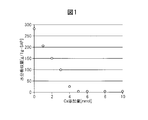
- FIG. 1 shows the water absorption amount of SAP after the CaCl 2 aqueous solution treatment.
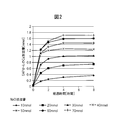
- FIG. 2 shows the amount of Ca released from the SAP by the NaCl aqueous solution treatment.
- FIG. 3 shows the amount of Ca released from SAP by the KCl aqueous solution treatment.
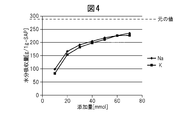
- FIG. 4 shows the water absorption of SAP after NaCl or KCl aqueous solution treatment.
- FIG. 5 shows the amount of Ca released from SAP by acid treatment.
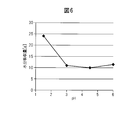
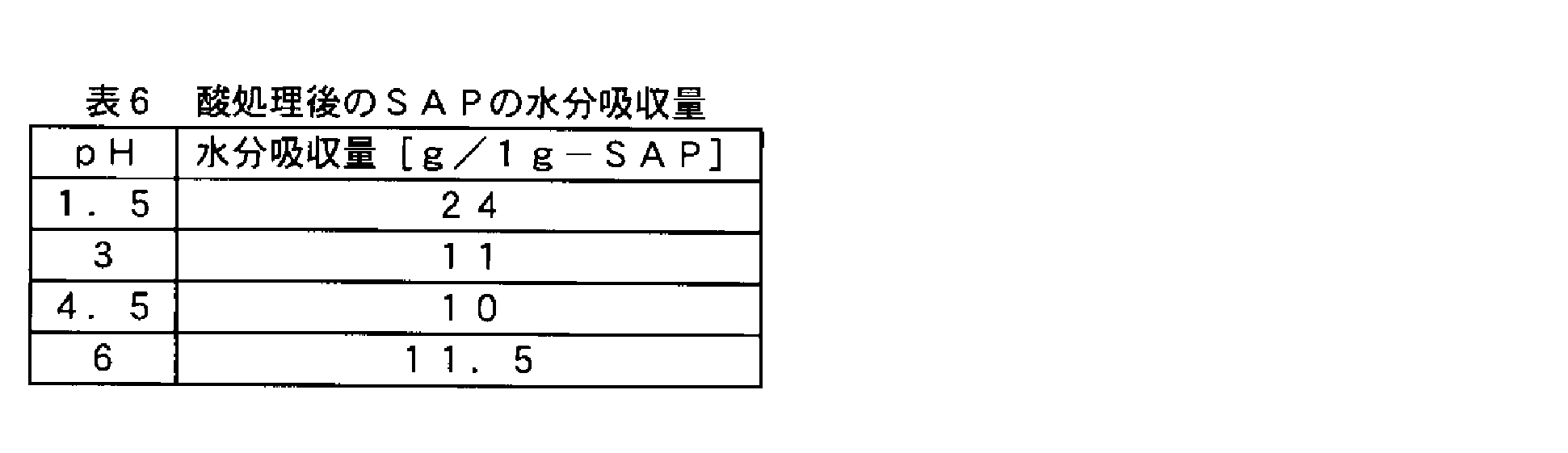
- FIG. 6 shows the water absorption of SAP after acid treatment.
- the present invention relates to a method for reclaiming a used superabsorbent polymer, the step of treating a used superabsorbent polymer with a polyvalent metal salt aqueous solution, and the treatment of a superabsorbent polymer treated with a polyvalent metal salt aqueous solution with an alkali metal. Treating with an aqueous salt solution.
- the used superabsorbent polymer means a superabsorbent polymer after absorbing a liquid such as water, regardless of the use of the superabsorbent polymer.
- the present invention is also a method for recovering and regenerating a superabsorbent polymer from a used absorbent article, a step of recovering the superabsorbent polymer from the used absorbent article, Treating with a metal salt aqueous solution, treating the superabsorbent polymer treated with the polyvalent metal salt aqueous solution with an alkali metal salt aqueous solution, washing the superabsorbent polymer treated with the alkali metal salt aqueous solution with water, and water And a step of drying the superabsorbent polymer washed in step (b).
- the superabsorbent polymer normally absorbs water by dissociating sodium in the liquid, and the oxygen of the carboxyl group in the superabsorbent polymer has a negative charge, and water is attracted to the negatively charged oxygen.
- the oxygen of the carboxyl group in the superabsorbent polymer binds to the cation and loses water absorption. That is, by treating with an aqueous polyvalent metal salt solution, water can be released from the superabsorbent polymer, that is, the superabsorbent polymer can be dehydrated.
- alkaline earth metal salts As the polyvalent metal salt, alkaline earth metal salts, transition metal salts and the like can be used. As alkaline earth metal salts, water-soluble salts of beryllium, magnesium, calcium, strontium and barium can be used. Preferred alkaline earth metal salts include calcium chloride, calcium nitrate, magnesium chloride, magnesium nitrate, and the like, among which calcium chloride is preferred.
- transition metal salt examples include water-soluble salts such as iron, cobalt, nickel, and copper, and any inorganic acid salt, organic acid salt, complex, or the like can be used as long as it is incorporated into the water-absorbing polymer.
- inorganic acid salts or organic acid salts are preferred.
- inorganic acid salts include iron salts such as iron chloride, iron sulfate, iron phosphate and iron nitrate, cobalt salts such as cobalt chloride, cobalt sulfate, cobalt phosphate and cobalt nitrate, nickel salts such as nickel chloride and nickel sulfate,
- nickel salts such as nickel chloride and nickel sulfate
- examples thereof include copper salts such as copper chloride and copper sulfate.
- the organic acid salts include iron lactate, cobalt acetate, cobalt stearate, nickel acetate, and copper acetate.
- the amount of the polyvalent metal salt is preferably 4 mmol or more, more preferably 4.5 to 10 mmol, still more preferably 5 to 8 mmol, per 1 g (dry mass) of the superabsorbent polymer. If the amount of the polyvalent metal salt is too small, the superabsorbent polymer will not be sufficiently dehydrated. If the amount of the polyvalent metal salt is too large, excess polyvalent metal ions remain in the treatment liquid without being taken into the superabsorbent polymer, leading to waste of the polyvalent metal salt and increasing the treatment cost.
- the concentration of the polyvalent metal salt in the polyvalent metal salt aqueous solution is not particularly limited as long as the polyvalent metal ion is a concentration at which the polyvalent metal ion is taken into the superabsorbent polymer, but is preferably 4 mmol / liter or more, more preferably 4.5. ⁇ 10 mmol / liter, more preferably 5 to 8 mmol / liter. If the concentration is too low, dehydration of the superabsorbent polymer will be insufficient. If the concentration is too high, excess polyvalent metal ions remain in the treatment liquid without being taken into the superabsorbent polymer, leading to waste of the polyvalent metal salt and increasing the treatment cost.
- the time for the treatment with the polyvalent metal salt aqueous solution is not particularly limited as long as the polyvalent metal ion is sufficient to be taken into the superabsorbent polymer, but is preferably 10 minutes or more, more preferably 20 minutes to 2 hours, More preferably, it is 40 minutes to 90 minutes. If the treatment time is too short, the superabsorbent polymer will not be sufficiently dehydrated. When the treatment time exceeds a certain value, the amount of polyvalent metal ions taken into the superabsorbent polymer is saturated, so treatment time exceeding that value is meaningless.
- the temperature of the aqueous polyvalent metal salt solution is not particularly limited as long as the polyvalent metal ions are taken into the superabsorbent polymer, but is usually higher than 0 ° C. and lower than 100 ° C. Room temperature is sufficient, but heating may be used to increase the reaction rate. In the case of heating, room temperature to 60 ° C. is preferable, room temperature to 40 ° C. is more preferable, and room temperature to 30 ° C. is further preferable.
- the process of treating the superabsorbent polymer treated with the polyvalent metal salt aqueous solution with the alkali metal salt aqueous solution will be described.
- an aqueous alkali metal salt solution By treating with an aqueous alkali metal salt solution, the water absorption ability of the superabsorbent polymer can be recovered.
- the superabsorbent polymer is preferably subjected to a treatment with the alkali metal salt aqueous solution without drying. If the superabsorbent polymer is dried before the step of treating with the aqueous alkali metal salt solution, it may be difficult to recover the water absorbing ability of the superabsorbent polymer.
- alkali metal salt water-soluble salts of lithium, sodium, potassium, rubidium and cesium can be used.
- Preferred alkali metal salts include sodium chloride, potassium chloride, sodium nitrate, potassium nitrate, sodium sulfate, potassium sulfate and the like, and sodium chloride and potassium chloride are particularly preferred.
- the amount of the alkali metal salt is preferably 20 mmol or more, more preferably 30 to 150 mmol, still more preferably 40 to 120 mmol, per 1 g (dry mass) of the superabsorbent polymer. If the amount of the alkali metal salt is too small, recovery of the water absorbing ability of the superabsorbent polymer will be insufficient. If the amount of the alkali metal salt is too large, excess alkali metal ions remain in the treatment liquid without being taken into the superabsorbent polymer, leading to wasted alkali metal salt and increasing the treatment cost.
- the concentration of the alkali metal salt in the aqueous alkali metal salt solution is not particularly limited as long as it is a concentration capable of desorbing polyvalent metal ions from the superabsorbent polymer, but is preferably 20 mmol / liter or more, more preferably 30 to 150. Mmol / liter, more preferably 40 to 120 mmol / liter. If the concentration is too low, recovery of the water absorption capacity of the superabsorbent polymer will be insufficient. If the concentration is too high, excess alkali metal ions remain in the treatment liquid without being taken into the superabsorbent polymer, leading to wasted alkali metal salt and increasing the treatment cost.
- the time of the alkali metal salt aqueous solution treatment is not particularly limited as long as it is sufficient to desorb the polyvalent metal ions from the superabsorbent polymer, but is preferably 1 hour or more, more preferably 2 to 10 hours, Preferably it is 4 to 8 hours. If the treatment time is too short, recovery of the water absorption ability of the superabsorbent polymer will be insufficient. When the treatment time exceeds a certain value, the water absorption amount of the superabsorbent polymer does not increase, so that the treatment time exceeding that value is meaningless.
- the temperature of the alkali metal salt aqueous solution is not particularly limited as long as it is a temperature capable of desorbing polyvalent metal ions from the superabsorbent polymer, but is usually higher than 0 ° C. and lower than 100 ° C. Room temperature is sufficient, but heating may be used to increase the reaction rate. In the case of heating, room temperature to 60 ° C. is preferable, room temperature to 40 ° C. is more preferable, and room temperature to 30 ° C. is further preferable.
- the method of the present invention can further include a step of washing the superabsorbent polymer treated with the aqueous alkali metal salt solution with water. Washing can be carried out by taking out the superabsorbent polymer from the aqueous alkali metal salt solution, placing it in a large amount of water and stirring it. Washing can be performed multiple times.
- the water used for washing is not particularly limited as long as it does not contain a component that inhibits the recovery of the water absorption ability of the superabsorbent polymer, but pure water is preferable, and distilled water or ion-exchanged water can be suitably used. .
- the amount of water used for one washing, the time of one washing, and the number of washings are as long as the concentration of the alkali metal salt remaining in the superabsorbent polymer after washing can be sufficiently reduced (regenerated).
- the amount of water used for one washing is preferably per 1 g (dry mass) of the superabsorbent polymer. Is 0.4 L or more, more preferably 0.6 to 2.0 L, and still more preferably 0.8 to 1.5 L.
- the time for one washing is preferably 15 minutes or more, more preferably 30 minutes to 2 hours, and further preferably 45 minutes to 1 hour 15 minutes.
- the number of washings is at least once, preferably 2 times, more preferably 3 times. If the amount of water used for one washing, the time of one washing, and the number of washings are too small, the concentration of the alkali metal salt remaining in the superabsorbent polymer after washing cannot be lowered sufficiently. If the amount of water used for one washing, the time of one washing, and the number of washings are too many, it is uneconomical.
- the temperature of water used for washing is not particularly limited as long as the concentration of the alkali metal salt remaining in the superabsorbent polymer after washing can be sufficiently lowered, but is usually higher than 0 ° C and lower than 100 ° C. It is. Room temperature is sufficient, but heating may be used to increase the reaction rate. In the case of heating, room temperature to 60 ° C. is preferable, room temperature to 40 ° C. is more preferable, and room temperature to 30 ° C. is further preferable.
- the method of this invention can also be implemented using a flow-type apparatus.
- the used high water absorption polymer is filled in the flow type processing tank, the aqueous solution of the polyvalent metal salt is poured into the flow type processing tank, and the polyvalent metal ion is highly water absorbent.
- the supply of the aqueous solution of the polyvalent metal salt is stopped.
- the aqueous solution of the alkali metal salt is allowed to flow, and the majority of the polyvalent metal ions are desorbed from the superabsorbent polymer. Stop supplying water, and instead flush water for washing. After the alkali metal salt concentration has dropped sufficiently, stop supplying water, and instead use warm air for drying. Can be stopped by removing the superabsorbent polymer from the flow-through treatment tank.
- the superabsorbent polymer examples include water-swellable crosslinked polymers obtained by polymerizing hydrophilic monomers.
- the structure and composition thereof are not particularly limited. Specifically, a partially neutralized crosslinked polyacrylic acid polymer, a crosslinked and partially neutralized starch-acrylic acid graft polymer, an isobutylene-maleic acid copolymer, Examples thereof include saponified vinyl acetate-acrylic acid copolymers, hydrolysates of acrylamide and (co) polymers, hydrolysates of acrylonitrile polymers, (meth) acrylamide derivatives, and the like. Of these, a polyacrylate-based crosslinked polymer is preferable. As the polyacrylate-based crosslinked polymer, 50 to 90 mol% of acid groups in the polymer is preferably neutralized, and examples of the salt include alkali metal salts, ammonium salts, amine salts, and the like. Can do.
- the method for recovering and regenerating a superabsorbent polymer from the used absorbent article of the present invention includes a step of recovering the superabsorbent polymer from the used absorbent article.
- the absorbent article include a paper diaper, an incontinence pad, an incontinence liner, a sanitary napkin, a panty liner, and the like, but are not limited to these as long as the absorbent article contains a superabsorbent polymer.
- These absorbent articles usually contain a mixture of superabsorbent polymer and pulp as an absorbent.
- the superabsorbent polymer can be recovered from the used absorbent article by disassembling the absorbent article and taking out the absorbent containing the superabsorbent polymer.
- the method for recovering and regenerating a superabsorbent polymer from the used absorbent article of the present invention includes a step of treating the recovered superabsorbent polymer with an aqueous polyvalent metal salt solution.
- the absorbent containing the superabsorbent polymer recovered from the used absorbent article that is, A mixture of a superabsorbent polymer and pulp
- the superabsorbent polymer since the dehydrated superabsorbent polymer is precipitated in the aqueous polyvalent metal salt solution, the superabsorbent polymer can be separated from the pulp relatively easily by sedimentation separation or the like. In this case, the superabsorbent polymer obtained by sedimentation separation is subjected to the following treatment with an aqueous alkali metal salt solution.
- the regenerated superabsorbent polymer can be used again as an absorbent body for absorbent articles.
- the regenerated superabsorbent polymer can also be used in applications where superabsorbent polymers are generally used, other than absorbent bodies of absorbent articles. For example, it is also used for applications such as agricultural and horticultural water retaining materials, industrial absorbent products such as civil engineering and optical cable waterproofing materials, medical sheets such as medical sheets, freshness preservation materials for foods, drip absorbents for foods, etc. can do.
- the addition amount of Ca and the SAP water absorption amount are in a substantially proportional relationship, and the water absorption amount was decreased by increasing the addition amount of Ca. Moreover, it turns out that SAP loses water absorption completely by adding 4.5 millimoles of Ca per 1 g of dry weight SAP.
- a SAP that has been treated with an aqueous solution containing 4.5 mmol or more calcium chloride per 1 g of dry weight of SAP and has lost water absorption is hereinafter referred to as “inactivated SAP”.
- the amount of water absorption increased rapidly from the added amount of 10 mmol to 20 mmol. It increased linearly from 20 to 60 mmol. Since the water absorption amount of the unused SAP was 280 g / g, the water absorption amount of the SAP recovered to about 80% of the original amount when the added amount was 70 mmol.
- the mixture was stirred in 1 L of distilled water having a pH of 5.5 for 1 hour.
- the mesh case was taken out, suspended for 10 minutes and drained. Thereafter, the water absorption amount of SAP was measured.
- the amount of Ca released from the SAP by the acid treatment is shown in Table 5 and FIG.
- the water absorption of SAP after acid treatment is shown in Table 6 and FIG. Only in pH 1.5, that is, under strong acidity, Ca in SAP was released.
- the inactivated SAP used in this test contained 3.6 mmoles of Ca per 1 g of dry mass of SAP, but 3.3 mmoles of Ca was released under strong acidity, and most of the Ca was released. I understand that.
- the amount of water absorption increased at pH 1.5 from pH 3, 4.5, and 6, and the water absorption capacity was recovered. However, since most of the Ca was released, it was expected to recover up to about 280 g of water absorption of the original SAP, but the water absorption was about 25 g and did not reach a significant recovery. From the above, it can be seen that the moisture absorption capacity of SAP is not recovered only by releasing Ca.
- the regenerated superabsorbent polymer is an absorbent material for absorbent articles, agro-horticultural water retention material, industrial water-absorbing materials such as civil engineering water-stopping materials and optical cable water-stopping materials, medical materials such as medical sheets, and foods. It can be used for various applications such as a freshness-keeping material and a drip absorbent for food.
Landscapes
- Chemical & Material Sciences (AREA)
- Chemical Kinetics & Catalysis (AREA)
- Analytical Chemistry (AREA)
- Organic Chemistry (AREA)
- Health & Medical Sciences (AREA)
- Environmental & Geological Engineering (AREA)
- Engineering & Computer Science (AREA)
- General Health & Medical Sciences (AREA)
- Toxicology (AREA)
- General Chemical & Material Sciences (AREA)
- Life Sciences & Earth Sciences (AREA)
- Polymers & Plastics (AREA)
- Medicinal Chemistry (AREA)
- Sustainable Development (AREA)
- Solid-Sorbent Or Filter-Aiding Compositions (AREA)
- Separation, Recovery Or Treatment Of Waste Materials Containing Plastics (AREA)
- Addition Polymer Or Copolymer, Post-Treatments, Or Chemical Modifications (AREA)
- Orthopedics, Nursing, And Contraception (AREA)
Abstract
使用済み吸収性物品等から回収した使用済みの高吸水性ポリマーを、酸やアルカリを使用せずに、簡単かつ安価に、再生する方法を提供する。使用済みの高吸水性ポリマーを塩化カルシウム等の多価金属塩の水溶液で処理し、多価金属塩水溶液で処理した高吸水性ポリマーを塩化ナトリウム等のアルカリ金属塩水溶液で処理し、アルカリ金属塩水溶液で処理した高吸水性ポリマーを水で洗浄し、そして水で洗浄した高吸水性ポリマーを乾燥する。
Description
本発明は、使用済み高吸水性ポリマー(以下「SAP」ともいう。)の再生方法(水分吸収能力回復方法)に関する。また、本発明は、使用済み吸収性物品から高吸水性ポリマーを回収再生する方法に関する。
紙おむつ、失禁パッド、失禁ライナー、生理用ナプキン、パンティーライナー等の吸収性物品においては、多くの場合、その吸収体に、パルプと高吸水性ポリマーを混合したものが使用されている。使用済みの吸収性物品から高吸水性ポリマーを回収し、再生しすなわち水分吸収能力を回復させ、再利用することが検討されている。
たとえば、特許文献1には、使用済み吸収性物品に含有される、パルプ成分と高吸水性ポリマーとのゲル状混合物に、遷移金属塩単独または遷移金属塩とアルカリ金属塩もしくはアルカリ土類金属塩との混合物を添加して、高吸水性ポリマーに含まれる水分を脱水し、高吸水性ポリマーを収縮・固化するとともに、遷移金属塩により高吸水性ポリマーを着色した後、パルプ成分および高吸水性ポリマーをそれぞれ分離回収し、分離に使用した遷移金属塩、アルカリ金属塩またはアルカリ土類金属塩を、分離した高吸水性ポリマーから酸処理により回収し、酸処理後の高吸水性ポリマーをアルカリ処理して、高吸水性ポリマーの水分吸収能力を回復させる方法が開示されている。
特許文献1に記載の方法は、酸処理やアルカリ処理の工程を含む。酸やアルカリは装置を腐食するので、酸処理やアルカリ処理の工程を含まない方法が望まれる。また、酸やアルカリは人の肌を荒す。酸処理後のアルカリ処理で完全に中和されなかった場合、再生した高吸水性ポリマーに酸またはアルカリが残留する虞がある。酸またはアルカリが残留した再生高吸水性ポリマーを紙おむつ等の吸収性物品に再利用した場合、酸またはアルカリが人の肌を荒す虞があるという問題がある。
本発明は、酸やアルカリを使用せずに、簡単かつ安価に、使用済みの高吸水性ポリマーを再生する方法、すなわち使用済みの高吸水性ポリマーの水分吸収能力を回復させる方法を提供する。
本発明は、酸やアルカリを使用せずに、簡単かつ安価に、使用済みの高吸水性ポリマーを再生する方法、すなわち使用済みの高吸水性ポリマーの水分吸収能力を回復させる方法を提供する。
本発明者は、多価金属塩水溶液で処理することにより脱水された高吸水性ポリマーが、意外にも、酸やアルカリを使用せずとも、アルカリ金属塩水溶液で処理するだけで、水分吸収能力を回復することを見いだし、本発明を完成した。
本発明は、使用済み高吸水性ポリマーの再生方法であって、使用済みの高吸水性ポリマーを多価金属塩水溶液で処理する工程および多価金属塩水溶液で処理した高吸水性ポリマーをアルカリ金属塩水溶液で処理する工程を含む。
本発明は、また、使用済み吸収性物品から高吸水性ポリマーを回収再生する方法であって、使用済みの吸収性物品から高吸水性ポリマーを回収する工程、回収した高吸水性ポリマーを多価金属塩水溶液で処理する工程、多価金属塩水溶液で処理した高吸水性ポリマーをアルカリ金属塩水溶液で処理する工程、アルカリ金属塩水溶液で処理した高吸水性ポリマーを水で洗浄する工程、および水で洗浄した高吸水性ポリマーを乾燥する工程を含む。
本発明は、使用済み高吸水性ポリマーの再生方法であって、使用済みの高吸水性ポリマーを多価金属塩水溶液で処理する工程および多価金属塩水溶液で処理した高吸水性ポリマーをアルカリ金属塩水溶液で処理する工程を含む。
本発明は、また、使用済み吸収性物品から高吸水性ポリマーを回収再生する方法であって、使用済みの吸収性物品から高吸水性ポリマーを回収する工程、回収した高吸水性ポリマーを多価金属塩水溶液で処理する工程、多価金属塩水溶液で処理した高吸水性ポリマーをアルカリ金属塩水溶液で処理する工程、アルカリ金属塩水溶液で処理した高吸水性ポリマーを水で洗浄する工程、および水で洗浄した高吸水性ポリマーを乾燥する工程を含む。
より詳しくは、本発明は、次のとおりである。
[1]使用済み高吸水性ポリマーの再生方法であって、使用済みの高吸水性ポリマーを多価金属塩水溶液で処理する工程および多価金属塩水溶液で処理した高吸水性ポリマーをアルカリ金属塩水溶液で処理する工程を含む方法。
[2]多価金属塩がアルカリ土類金属塩であることを特徴とする[1]に記載の方法。
[3]アルカリ土類金属塩水溶液が、乾燥質量1gの高吸水性ポリマーあたり、4.5~10ミリモルのアルカリ土類金属塩を含むことを特徴とする[2]に記載の方法。
[4]アルカリ金属塩水溶液が、乾燥質量1gの高吸水性ポリマーあたり、30~150ミリモルのアルカリ金属塩を含むことを特徴とする[1]~[3]のいずれか1つに記載の方法。
[5]アルカリ金属塩水溶液で処理した高吸水性ポリマーを水で洗浄する工程をさらに含む[1]~[4]のいずれか1つに記載の方法。
[6]使用済み吸収性物品から高吸水性ポリマーを回収再生する方法であって、使用済みの吸収性物品から高吸水性ポリマーを回収する工程、回収した高吸水性ポリマーを多価金属塩水溶液で処理する工程、多価金属塩水溶液で処理した高吸水性ポリマーをアルカリ金属塩水溶液で処理する工程、アルカリ金属塩水溶液で処理した高吸水性ポリマーを水で洗浄する工程、および水で洗浄した高吸水性ポリマーを乾燥する工程を含む方法。
[1]使用済み高吸水性ポリマーの再生方法であって、使用済みの高吸水性ポリマーを多価金属塩水溶液で処理する工程および多価金属塩水溶液で処理した高吸水性ポリマーをアルカリ金属塩水溶液で処理する工程を含む方法。
[2]多価金属塩がアルカリ土類金属塩であることを特徴とする[1]に記載の方法。
[3]アルカリ土類金属塩水溶液が、乾燥質量1gの高吸水性ポリマーあたり、4.5~10ミリモルのアルカリ土類金属塩を含むことを特徴とする[2]に記載の方法。
[4]アルカリ金属塩水溶液が、乾燥質量1gの高吸水性ポリマーあたり、30~150ミリモルのアルカリ金属塩を含むことを特徴とする[1]~[3]のいずれか1つに記載の方法。
[5]アルカリ金属塩水溶液で処理した高吸水性ポリマーを水で洗浄する工程をさらに含む[1]~[4]のいずれか1つに記載の方法。
[6]使用済み吸収性物品から高吸水性ポリマーを回収再生する方法であって、使用済みの吸収性物品から高吸水性ポリマーを回収する工程、回収した高吸水性ポリマーを多価金属塩水溶液で処理する工程、多価金属塩水溶液で処理した高吸水性ポリマーをアルカリ金属塩水溶液で処理する工程、アルカリ金属塩水溶液で処理した高吸水性ポリマーを水で洗浄する工程、および水で洗浄した高吸水性ポリマーを乾燥する工程を含む方法。
本発明によれば、使用済みの高吸水性ポリマーを、酸やアルカリを使用せずに、簡単かつ安価に、再生することができる。
本発明は、使用済み高吸水性ポリマーの再生方法であって、使用済みの高吸水性ポリマーを多価金属塩水溶液で処理する工程および多価金属塩水溶液で処理した高吸水性ポリマーをアルカリ金属塩水溶液で処理する工程を含む。
ここで、使用済み高吸水性ポリマーとは、高吸水性ポリマーの用途にかかわらず、水などの液体を吸収した後の高吸水性ポリマーをいうものとする。
本発明は、また、使用済み吸収性物品から高吸水性ポリマーを回収再生する方法であって、使用済みの吸収性物品から高吸水性ポリマーを回収する工程、回収した高吸水性ポリマーを多価金属塩水溶液で処理する工程、多価金属塩水溶液で処理した高吸水性ポリマーをアルカリ金属塩水溶液で処理する工程、アルカリ金属塩水溶液で処理した高吸水性ポリマーを水で洗浄する工程、および水で洗浄した高吸水性ポリマーを乾燥する工程を含む。
ここで、使用済み高吸水性ポリマーとは、高吸水性ポリマーの用途にかかわらず、水などの液体を吸収した後の高吸水性ポリマーをいうものとする。
本発明は、また、使用済み吸収性物品から高吸水性ポリマーを回収再生する方法であって、使用済みの吸収性物品から高吸水性ポリマーを回収する工程、回収した高吸水性ポリマーを多価金属塩水溶液で処理する工程、多価金属塩水溶液で処理した高吸水性ポリマーをアルカリ金属塩水溶液で処理する工程、アルカリ金属塩水溶液で処理した高吸水性ポリマーを水で洗浄する工程、および水で洗浄した高吸水性ポリマーを乾燥する工程を含む。
まず、使用済みの高吸水性ポリマーを多価金属塩水溶液で処理する工程について説明する。
高吸水性ポリマーは、通常、液中でナトリウムを解離し、高吸水性ポリマー中のカルボキシル基の酸素がマイナスの電荷をもち、マイナスの電荷をもった酸素に水が引き寄せられることで吸水する。しかし、液中に、アルカリ土類金属や遷移金属の2価またはそれ以上の陽イオンが存在すると、高吸水性ポリマー中のカルボキシル基の酸素はその陽イオンと結合し吸水性を失う。すなわち、多価金属塩水溶液で処理することにより、高吸水性ポリマーから水を離脱させる、すなわち高吸水性ポリマーを脱水することができる。
高吸水性ポリマーは、通常、液中でナトリウムを解離し、高吸水性ポリマー中のカルボキシル基の酸素がマイナスの電荷をもち、マイナスの電荷をもった酸素に水が引き寄せられることで吸水する。しかし、液中に、アルカリ土類金属や遷移金属の2価またはそれ以上の陽イオンが存在すると、高吸水性ポリマー中のカルボキシル基の酸素はその陽イオンと結合し吸水性を失う。すなわち、多価金属塩水溶液で処理することにより、高吸水性ポリマーから水を離脱させる、すなわち高吸水性ポリマーを脱水することができる。
多価金属塩としては、アルカリ土類金属塩、遷移金属塩等が使用できる。
アルカリ土類金属塩としては、ベリリウム、マグネシウム、カルシウム、ストロンチウムおよびバリウムの水溶性の塩が使用できる。好ましいアルカリ土類金属塩としては、塩化カルシウム、硝酸カルシウム、塩化マグネシウム、硝酸マグネシウム等が挙げられ、なかでも塩化カルシウムが好ましい。
アルカリ土類金属塩としては、ベリリウム、マグネシウム、カルシウム、ストロンチウムおよびバリウムの水溶性の塩が使用できる。好ましいアルカリ土類金属塩としては、塩化カルシウム、硝酸カルシウム、塩化マグネシウム、硝酸マグネシウム等が挙げられ、なかでも塩化カルシウムが好ましい。
遷移金属塩としては、鉄、コバルト、ニッケル、銅等の水溶性の塩が挙げられ、吸水性ポリマーに取り込まれるものであれば、無機酸塩、有機酸塩、錯体等を問わず用いられるが、費用や入手容易性等の点から、無機酸塩または有機酸塩が好ましい。無機酸塩としては、たとえば、塩化鉄、硫酸鉄、燐酸鉄、硝酸鉄等の鉄塩、塩化コバルト、硫酸コバルト、燐酸コバルト、硝酸コバルト等のコバルト塩、塩化ニッケル、硫酸ニッケル等のニッケル塩、塩化銅、硫酸銅等の銅塩などが挙げられる。有機酸塩類としては、たとえば、乳酸鉄、酢酸コバルト、ステアリン酸コバルト、酢酸ニッケル、酢酸銅等が挙げられる。
多価金属塩の量は、高吸水性ポリマー1g(乾燥質量)あたり、好ましくは4ミリモル以上、より好ましくは4.5~10ミリモル、さらに好ましくは5~8ミリモルである。多価金属塩の量が少なすぎると、高吸水性ポリマーの脱水が不十分となる。多価金属塩の量が多すぎると、余分の多価金属イオンが高吸水性ポリマーに取り込まれないまま処理液中に残るので、多価金属塩の浪費につながり、処理費用を増加させる。
多価金属塩水溶液中の多価金属塩の濃度は、多価金属イオンが高吸水性ポリマーに取り込まれる濃度であれば特に限定されないが、好ましくは4ミリモル/リットル以上、より好ましくは4.5~10ミリモル/リットル、さらに好ましくは5~8ミリモル/リットルである。濃度が低すぎると、高吸水性ポリマーの脱水が不十分となる。濃度が高すぎると、余分の多価金属イオンが高吸水性ポリマーに取り込まれないまま処理液中に残るので、多価金属塩の浪費につながり、処理費用を増加させる。
多価金属塩水溶液処理の時間は、多価金属イオンが高吸水性ポリマーに取り込まれるのに十分な時間であれば特に限定されないが、好ましくは10分以上、より好ましくは20分~2時間、さらに好ましくは40分~90分である。処理時間が短すぎると、高吸水性ポリマーの脱水が不十分となる。処理時間がある値を超えると、高吸水性ポリマーに取り込まれる多価金属イオンの量は飽和するので、その値を超える処理時間は無意味である。
多価金属塩水溶液の温度は、多価金属イオンが高吸水性ポリマーに取り込まれる温度であれば特に限定されないが、通常、0℃より高く、100℃より低い温度である。室温でも十分であるが、反応速度を速めるために加熱してもよい。加熱する場合は、室温~60℃が好ましく、室温~40℃がより好ましく、室温~30℃がさらに好ましい。
次に、多価金属塩水溶液で処理した高吸水性ポリマーをアルカリ金属塩水溶液で処理する工程について説明する。
アルカリ金属塩水溶液で処理することにより、高吸水性ポリマーの水分吸収能力を回復させることができる。
なお、高吸水性ポリマーを多価金属塩水溶液で処理した後、好ましくは高吸水性ポリマーを乾燥せずに、アルカリ金属塩水溶液で処理する工程に供する。アルカリ金属塩水溶液で処理する工程の前に、高吸水性ポリマーを乾燥すると、高吸水性ポリマーの水分吸収能力を回復しにくくなる虞がある。
アルカリ金属塩水溶液で処理することにより、高吸水性ポリマーの水分吸収能力を回復させることができる。
なお、高吸水性ポリマーを多価金属塩水溶液で処理した後、好ましくは高吸水性ポリマーを乾燥せずに、アルカリ金属塩水溶液で処理する工程に供する。アルカリ金属塩水溶液で処理する工程の前に、高吸水性ポリマーを乾燥すると、高吸水性ポリマーの水分吸収能力を回復しにくくなる虞がある。
アルカリ金属塩としては、リチウム、ナトリウム、カリウム、ルビジウムおよびセシウムの水溶性の塩が使用できる。好ましいアルカリ金属塩としては、塩化ナトリウム、塩化カリウム、硝酸ナトリウム、硝酸カリウム、硫酸ナトリウム、硫酸カリウム等が挙げられ、なかでも塩化ナトリウムおよび塩化カリウムが好ましい。
アルカリ金属塩の量は、高吸水性ポリマー1g(乾燥質量)あたり、好ましくは20ミリモル以上、より好ましくは30~150ミリモル、さらに好ましくは40~120ミリモルである。アルカリ金属塩の量が少なすぎると、高吸水性ポリマーの水分吸収能力の回復が不十分となる。アルカリ金属塩の量が多すぎると、余分のアルカリ金属イオンが高吸水性ポリマーに取り込まれないまま処理液中に残るので、アルカリ金属塩の浪費につながり、処理費用を増加させる。
アルカリ金属塩水溶液中のアルカリ金属塩の濃度は、高吸水性ポリマーから多価金属イオンを脱離させうる濃度であれば特に限定されないが、好ましくは20ミリモル/リットル以上、より好ましくは30~150ミリモル/リットル、さらに好ましくは40~120ミリモル/リットルである。濃度が低すぎると、高吸水性ポリマーの水分吸収能力の回復が不十分となる。濃度が高すぎると、余分のアルカリ金属イオンが高吸水性ポリマーに取り込まれないまま処理液中に残るので、アルカリ金属塩の浪費につながり、処理費用を増加させる。
アルカリ金属塩水溶液処理の時間は、高吸水性ポリマーから多価金属イオンを脱離させるのに十分な時間であれば特に限定されないが、好ましくは1時間以上、より好ましくは2~10時間、さらに好ましくは4~8時間である。処理時間が短すぎると、高吸水性ポリマーの水分吸収能力の回復が不十分となる。処理時間がある値を超えると、高吸水性ポリマーの水分吸収量は増加しないので、その値を超える処理時間は無意味である。
アルカリ金属塩水溶液の温度は、高吸水性ポリマーから多価金属イオンを脱離させうる温度であれば特に限定されないが、通常、0℃より高く、100℃より低い温度である。室温でも十分であるが、反応速度を速めるために加熱してもよい。加熱する場合は、室温~60℃が好ましく、室温~40℃がより好ましく、室温~30℃がさらに好ましい。
本発明の方法は、さらに、アルカリ金属塩水溶液で処理した高吸水性ポリマーを水で洗浄する工程を含むことができる。
洗浄は、アルカリ金属塩水溶液から高吸水性ポリマーを取り出し、多量の水の中に入れて撹拌することによって、行うことができる。洗浄は複数回行うことができる。洗浄に使用する水は、高吸水性ポリマーの水分吸収能力の回復を阻害する成分が含まれていない限り特に限定されないが、純水が好ましく、蒸留水やイオン交換水を好適に用いることができる。
1回の洗浄に使用する水の量、1回の洗浄の時間、洗浄回数は、洗浄後の高吸水性ポリマー中に残留するアルカリ金属塩の濃度を十分に下げることができる限り(再生された高吸水性ポリマーの用途において悪影響を及ぼさない程度の濃度である限り)、特に限定されないが、たとえば、1回の洗浄に使用する水の量は、高吸水性ポリマー1g(乾燥質量)あたり、好ましくは0.4L以上、より好ましくは0.6~2.0L、さらに好ましくは0.8~1.5Lである。1回の洗浄の時間は、好ましくは15分以上、より好ましくは30分~2時間、さらに好ましくは45分~1時間15分である。洗浄回数は、少なくとも1回、好ましくは2回、より好ましくは3回である。1回の洗浄に使用する水の量、1回の洗浄の時間、洗浄回数が少なすぎると、洗浄後の高吸水性ポリマー中に残留するアルカリ金属塩の濃度が十分に下げることができない。1回の洗浄に使用する水の量、1回の洗浄の時間、洗浄回数が多すぎると、不経済である。
洗浄に使用する水の温度は、洗浄後の高吸水性ポリマー中に残留するアルカリ金属塩の濃度を十分に下げることができる限り特に限定されないが、通常、0℃より高く、100℃より低い温度である。室温でも十分であるが、反応速度を速めるために加熱してもよい。加熱する場合は、室温~60℃が好ましく、室温~40℃がより好ましく、室温~30℃がさらに好ましい。
洗浄は、アルカリ金属塩水溶液から高吸水性ポリマーを取り出し、多量の水の中に入れて撹拌することによって、行うことができる。洗浄は複数回行うことができる。洗浄に使用する水は、高吸水性ポリマーの水分吸収能力の回復を阻害する成分が含まれていない限り特に限定されないが、純水が好ましく、蒸留水やイオン交換水を好適に用いることができる。
1回の洗浄に使用する水の量、1回の洗浄の時間、洗浄回数は、洗浄後の高吸水性ポリマー中に残留するアルカリ金属塩の濃度を十分に下げることができる限り(再生された高吸水性ポリマーの用途において悪影響を及ぼさない程度の濃度である限り)、特に限定されないが、たとえば、1回の洗浄に使用する水の量は、高吸水性ポリマー1g(乾燥質量)あたり、好ましくは0.4L以上、より好ましくは0.6~2.0L、さらに好ましくは0.8~1.5Lである。1回の洗浄の時間は、好ましくは15分以上、より好ましくは30分~2時間、さらに好ましくは45分~1時間15分である。洗浄回数は、少なくとも1回、好ましくは2回、より好ましくは3回である。1回の洗浄に使用する水の量、1回の洗浄の時間、洗浄回数が少なすぎると、洗浄後の高吸水性ポリマー中に残留するアルカリ金属塩の濃度が十分に下げることができない。1回の洗浄に使用する水の量、1回の洗浄の時間、洗浄回数が多すぎると、不経済である。
洗浄に使用する水の温度は、洗浄後の高吸水性ポリマー中に残留するアルカリ金属塩の濃度を十分に下げることができる限り特に限定されないが、通常、0℃より高く、100℃より低い温度である。室温でも十分であるが、反応速度を速めるために加熱してもよい。加熱する場合は、室温~60℃が好ましく、室温~40℃がより好ましく、室温~30℃がさらに好ましい。
以上、本発明の方法を、回分式装置を用いて実施した場合を例に挙げて説明してきたが、本発明の方法は流通式装置を用いて実施することもできる。流通式装置を用いて実施する場合は、たとえば、流通式処理槽に使用済みの高吸水性ポリマーを充填し、多価金属塩水溶液を流通式処理槽に流し、多価金属イオンが高吸水性ポリマーに十分取り込まれた後、多価金属塩水溶液の供給を止め、代わりにアルカリ金属塩水溶液を流し、高吸水性ポリマーから多価金属イオンの大部分を脱離させた後、アルカリ金属塩水溶液の供給を止め、代わりに洗浄のための水を流し、アルカリ金属塩濃度が十分に下がった後、水の供給を止め、代わりに乾燥のための温風を流し、十分に乾燥したら、温風の供給を止め、高吸水性ポリマーを流通式処理槽から取り出すことによって行うことができる。
高吸水性ポリマーとしては、親水性単量体を重合して得られる水膨潤性架橋重合体等が例示できる。その構造、組成としては特に限定されないが、具体的には、部分中和架橋ポリアクリル酸重合体、架橋され部分的に中和された澱粉-アクリル酸グラフトポリマー、イソブチレン-マレイン酸共重合体、酢酸ビニル-アクリル酸共重合体のケン化物、アクリルアミドや(共)重合体の加水分解物、アクリロニトリル重合体の加水分解物、(メタ)アクリルアミド誘導体、等が挙げられる。なかでも、ポリアクリル酸塩系架橋重合体が好ましい。ポリアクリル酸塩系架橋重合体としては、重合体中の酸基の50~90モル%が中和されていることが好ましく、塩としてはアルカリ金属塩、アンモニウム塩、アミン塩などを例示することができる。
本発明の使用済み吸収性物品から高吸水性ポリマーを回収再生する方法は、使用済みの吸収性物品から高吸水性ポリマーを回収する工程を含む。
吸収性物品としては、紙おむつ、失禁パッド、失禁ライナー、生理用ナプキン、パンティーライナー等が挙げられるが、高吸水性ポリマーを含む吸収性物品であれば、これらに限定されない。これらの吸収性物品は、通常、高吸水性ポリマーとパルプの混合物を吸収体として含む。
使用済みの吸収性物品から高吸水性ポリマーを回収するには、吸収性物品を解体し、高吸水性ポリマーを含む吸収体を取り出すことによって行うことができる。この時点で高吸水性ポリマーとパルプを分離してもよいが、高吸水性ポリマーとパルプの分離の手段は、特に限定されない。
本発明の使用済み吸収性物品から高吸水性ポリマーを回収再生する方法は、回収した高吸水性ポリマーを多価金属塩水溶液で処理する工程を含む。使用済みの吸収性物品から回収・分離した高吸水性ポリマーのみを多価金属塩水溶液処理工程に供することもできるが、使用済みの吸収性物品から回収した高吸水性ポリマーを含む吸収体(すなわち高吸水性ポリマーとパルプの混合物)を多価金属塩水溶液処理工程に供してもよい。後者の場合は、多価金属塩水溶液中で、脱水した高吸水性ポリマーが沈殿するので、沈降分離等により、比較的容易にパルプから高吸水性ポリマーを分離することができる。この場合は、沈降分離により得られた高吸水性ポリマーを、次のアルカリ金属塩水溶液で処理する工程に供する。
吸収性物品としては、紙おむつ、失禁パッド、失禁ライナー、生理用ナプキン、パンティーライナー等が挙げられるが、高吸水性ポリマーを含む吸収性物品であれば、これらに限定されない。これらの吸収性物品は、通常、高吸水性ポリマーとパルプの混合物を吸収体として含む。
使用済みの吸収性物品から高吸水性ポリマーを回収するには、吸収性物品を解体し、高吸水性ポリマーを含む吸収体を取り出すことによって行うことができる。この時点で高吸水性ポリマーとパルプを分離してもよいが、高吸水性ポリマーとパルプの分離の手段は、特に限定されない。
本発明の使用済み吸収性物品から高吸水性ポリマーを回収再生する方法は、回収した高吸水性ポリマーを多価金属塩水溶液で処理する工程を含む。使用済みの吸収性物品から回収・分離した高吸水性ポリマーのみを多価金属塩水溶液処理工程に供することもできるが、使用済みの吸収性物品から回収した高吸水性ポリマーを含む吸収体(すなわち高吸水性ポリマーとパルプの混合物)を多価金属塩水溶液処理工程に供してもよい。後者の場合は、多価金属塩水溶液中で、脱水した高吸水性ポリマーが沈殿するので、沈降分離等により、比較的容易にパルプから高吸水性ポリマーを分離することができる。この場合は、沈降分離により得られた高吸水性ポリマーを、次のアルカリ金属塩水溶液で処理する工程に供する。
再生した高吸水性ポリマーは、再度、吸収性物品の吸収体に使用することができる。再生した高吸水性ポリマーは、吸収性物品の吸収体以外の、高吸水性ポリマーが一般に使用される用途にも使用することができる。たとえば、農園芸保水材、土木用止水材や光ケーブル用止水材等の産業用吸収性物品、メディカルシーツ等の医療材料、食品用鮮度保持材、食品用ドリップ吸収材等の用途にも使用することができる。
[高吸水性ポリマーの塩化カルシウム水溶液処理]
乾燥質量1gの高吸水性ポリマー(住友精化株式会社製アクアキープ)を測り取り、メッシュケース(250メッシュナイロンネット(NBC工業株式会社のN-No.250HD)で200mm×200mmの袋状)に入れた。メッシュケースに入った高吸水性ポリマーを蒸留水1L中で10分間撹拌し、高吸水性ポリマーを吸水させた。蒸留水に塩化カルシウム(1、2、3、4、5、6、8、10ミリモル)を加え、1時間攪拌した。蒸留水からメッシュケースを取り出し、10分間吊るすことで水切りを行った。その後、高吸水性ポリマーの水分吸収量を測定した。
なお、高吸水性ポリマー(SAP)乾燥質量1gの水分吸収量は次式に従い算出した。
SAP乾燥質量1g中に含まれる水分量(g)=水切り後の全体の質量-(メッシュケ-スの質量+SAPの質量1g)
また、比較例および実施例において、試薬はすべて和光純薬工業株式会社製のもので特級(JIS規格)を使用した。
結果を表1および図1に示す。
Caの添加量とSAP水分吸収量はほぼ比例関係にあり、水分吸収量はCaの添加量を増やすことで減少した。また、乾燥重量1gのSAPあたり4.5ミリモルのCaを添加することで、SAPは完全に吸水性を喪失することが分かる。
乾燥重量1gのSAPあたり4.5ミリモル以上の塩化カルシウムを含む水溶液で処理し、吸水性を喪失させたSAPを、以下、「不活化SAP」と呼ぶ。
乾燥質量1gの高吸水性ポリマー(住友精化株式会社製アクアキープ)を測り取り、メッシュケース(250メッシュナイロンネット(NBC工業株式会社のN-No.250HD)で200mm×200mmの袋状)に入れた。メッシュケースに入った高吸水性ポリマーを蒸留水1L中で10分間撹拌し、高吸水性ポリマーを吸水させた。蒸留水に塩化カルシウム(1、2、3、4、5、6、8、10ミリモル)を加え、1時間攪拌した。蒸留水からメッシュケースを取り出し、10分間吊るすことで水切りを行った。その後、高吸水性ポリマーの水分吸収量を測定した。
なお、高吸水性ポリマー(SAP)乾燥質量1gの水分吸収量は次式に従い算出した。
SAP乾燥質量1g中に含まれる水分量(g)=水切り後の全体の質量-(メッシュケ-スの質量+SAPの質量1g)
また、比較例および実施例において、試薬はすべて和光純薬工業株式会社製のもので特級(JIS規格)を使用した。
結果を表1および図1に示す。
Caの添加量とSAP水分吸収量はほぼ比例関係にあり、水分吸収量はCaの添加量を増やすことで減少した。また、乾燥重量1gのSAPあたり4.5ミリモルのCaを添加することで、SAPは完全に吸水性を喪失することが分かる。
乾燥重量1gのSAPあたり4.5ミリモル以上の塩化カルシウムを含む水溶液で処理し、吸水性を喪失させたSAPを、以下、「不活化SAP」と呼ぶ。

[不活化SAPのアルカリ金属塩水溶液処理]
蒸留水1Lに塩化ナトリウム(10、20、30、40、50、60、70ミリモル)、塩化カリウム(10、20、30、40、50、60、70ミリモル)をそれぞれ添加した水溶液に、前記の塩化カルシウム水溶液処理において6ミリモルの塩化カルシウムで処理した不活化SAPの乾燥質量1gが入ったメッシュケースを入れ、撹拌した。1、2、4、8時間後に、水溶液をサンプリングし、高周波誘導結合プラズマ発光分光分析法(IPC)を用いてCa量を測定した。8時間後、メッシュケースを取り出し、pH5.5の蒸留水1L中で1時間攪拌した。再度、pH5.5の蒸留水1L中で1時間攪拌した。メッシュケースを取り出し、10分間吊るし水切りを行った。その後、SAPの水分吸収量を測定した。
なお、水溶液中のカルシウムは、水溶液のサンプルを10倍希釈し、10規定のHClを100μL添加した後、高周波誘導結合プラズマ発光分光分析法(ICP-AES)を用いて分析した。
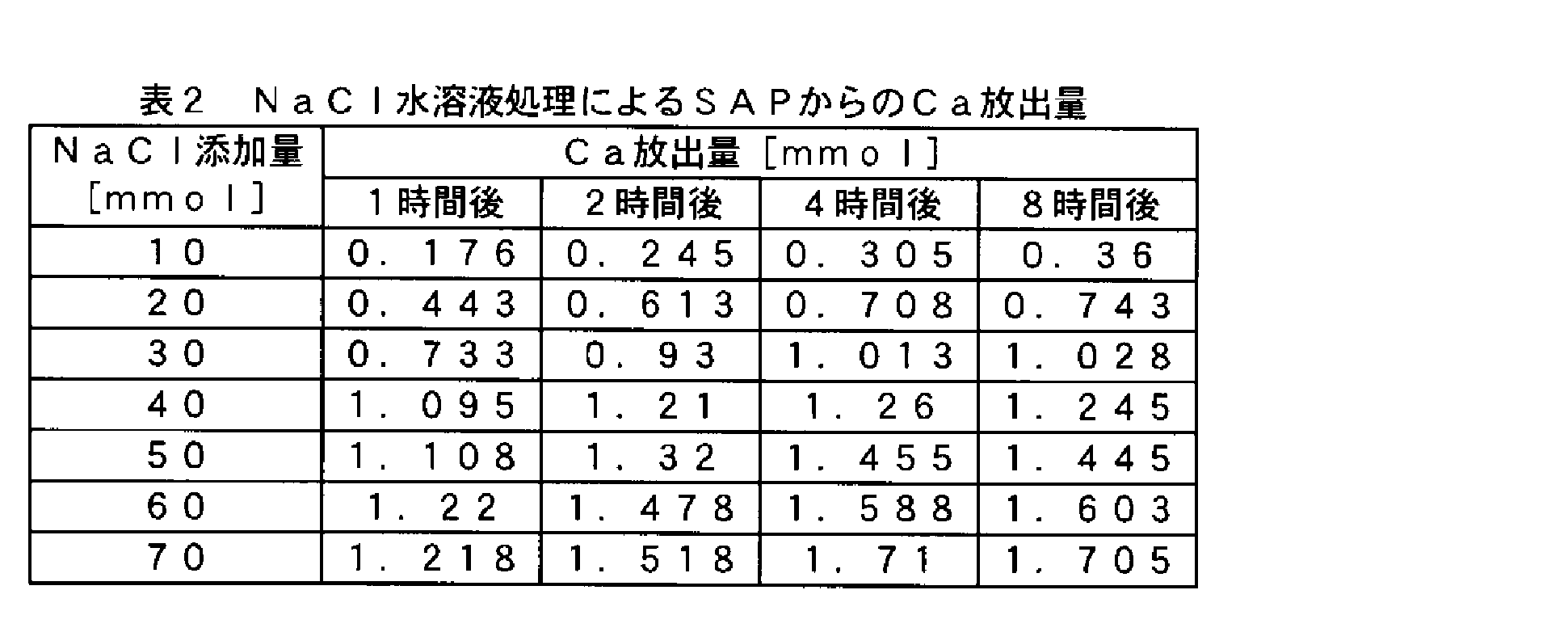
塩化ナトリウム水溶液処理によるSAPからのCa放出量を表2および図2に示す。
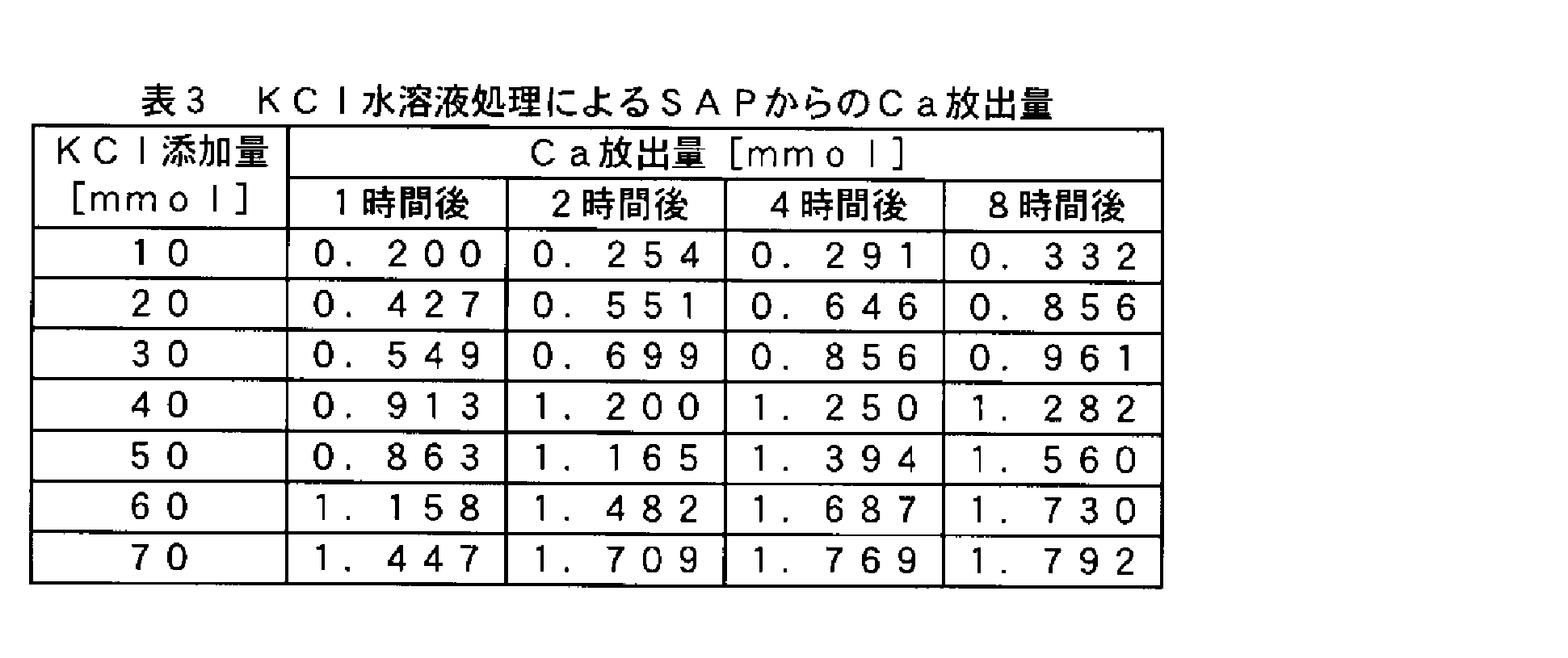
塩化カリウム水溶液処理によるSAPからのCa放出量を表3および図3に示す。
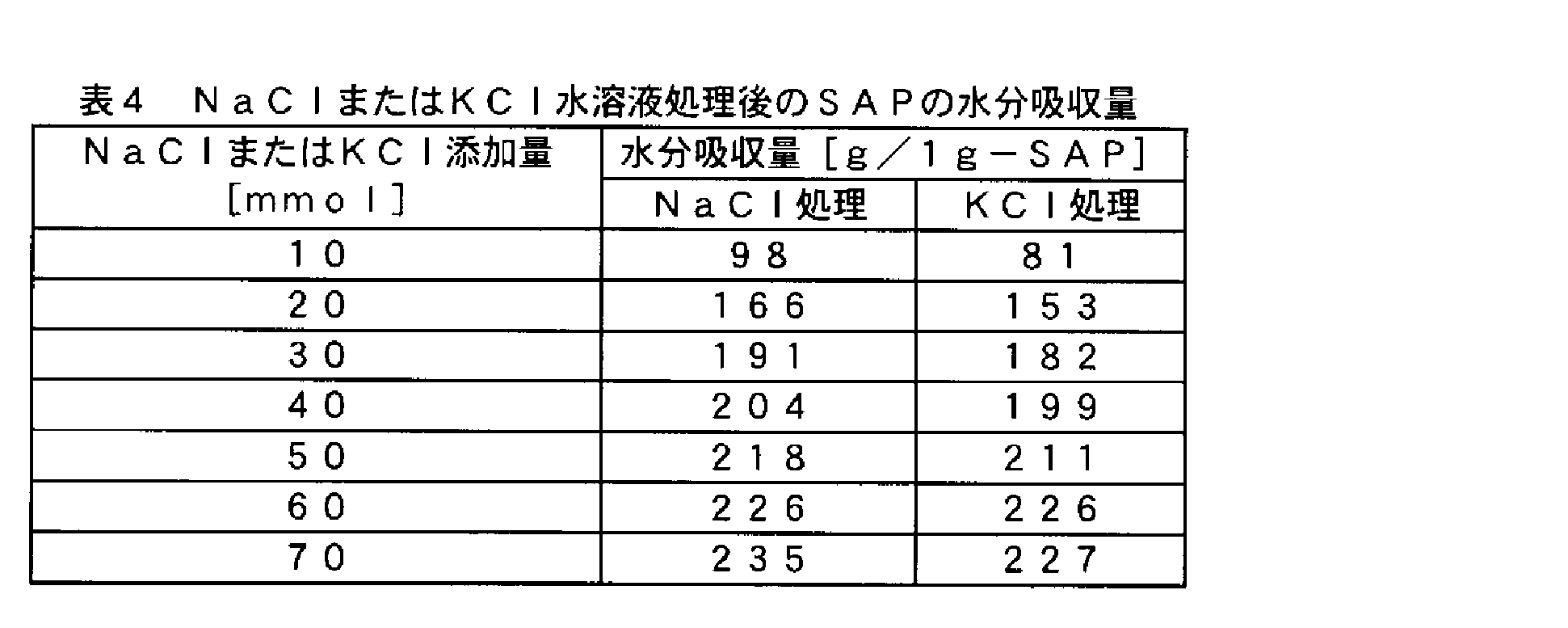
塩化ナトリウムまたは塩化カリウム水溶液処理後のSAPの水分吸収量を表4および図4に示す。
塩化ナトリウム、塩化カリウムのどちらを用いた場合も、中性条件下で添加するだけでCaの放出が見られた。Caの放出量は、加えたNaおよびKの量に応じて増加した。また、添加量とCa放出量の関係は、NaとKで違いはほとんど見られなかった。
塩化ナトリウム、塩化カリウムのどちらを用いた場合も、中性条件下で添加するだけで、SAPの水分吸収量は、加えたNaおよびKの量に応じて増加した。また、添加量とSAPの水分吸収量の関係は、NaとKで違いはほとんど見られなかった。添加量10ミリモルから20ミリモルにかけて急激に吸水量が増加した。20ミリモルから60ミリモルにかけて直線的に増加した。未使用のSAPの水分吸収量は280g/gなので、添加量70ミリモルでSAPの水分吸収量は元の約80%まで回復した。
蒸留水1Lに塩化ナトリウム(10、20、30、40、50、60、70ミリモル)、塩化カリウム(10、20、30、40、50、60、70ミリモル)をそれぞれ添加した水溶液に、前記の塩化カルシウム水溶液処理において6ミリモルの塩化カルシウムで処理した不活化SAPの乾燥質量1gが入ったメッシュケースを入れ、撹拌した。1、2、4、8時間後に、水溶液をサンプリングし、高周波誘導結合プラズマ発光分光分析法(IPC)を用いてCa量を測定した。8時間後、メッシュケースを取り出し、pH5.5の蒸留水1L中で1時間攪拌した。再度、pH5.5の蒸留水1L中で1時間攪拌した。メッシュケースを取り出し、10分間吊るし水切りを行った。その後、SAPの水分吸収量を測定した。
なお、水溶液中のカルシウムは、水溶液のサンプルを10倍希釈し、10規定のHClを100μL添加した後、高周波誘導結合プラズマ発光分光分析法(ICP-AES)を用いて分析した。
塩化ナトリウム水溶液処理によるSAPからのCa放出量を表2および図2に示す。
塩化カリウム水溶液処理によるSAPからのCa放出量を表3および図3に示す。
塩化ナトリウムまたは塩化カリウム水溶液処理後のSAPの水分吸収量を表4および図4に示す。
塩化ナトリウム、塩化カリウムのどちらを用いた場合も、中性条件下で添加するだけでCaの放出が見られた。Caの放出量は、加えたNaおよびKの量に応じて増加した。また、添加量とCa放出量の関係は、NaとKで違いはほとんど見られなかった。
塩化ナトリウム、塩化カリウムのどちらを用いた場合も、中性条件下で添加するだけで、SAPの水分吸収量は、加えたNaおよびKの量に応じて増加した。また、添加量とSAPの水分吸収量の関係は、NaとKで違いはほとんど見られなかった。添加量10ミリモルから20ミリモルにかけて急激に吸水量が増加した。20ミリモルから60ミリモルにかけて直線的に増加した。未使用のSAPの水分吸収量は280g/gなので、添加量70ミリモルでSAPの水分吸収量は元の約80%まで回復した。
[不活化SAPの酸処理(比較例)]
蒸留水1Lに塩酸を添加してpHを1.5、3、4.5、6に調整した酸性水溶液に、前記の塩化カルシウム水溶液処理において6ミリモルの塩化カルシウムで処理した不活化SAPの乾燥質量1gが入ったメッシュケースを入れ、撹拌した。1、2、4時間後に、水溶液をサンプリングし、高周波誘導結合プラズマ発光分光分析法(ICP-AES)を用いてCa量を測定した。4時間後、メッシュケースを取り出し、pH5.5の蒸留水1L中で1時間攪拌した。再度、pH5.5の蒸留水1L中で1時間攪拌した。メッシュケースを取り出し、10分間吊るし水切りを行った。その後、SAPの水分吸収量を測定した。
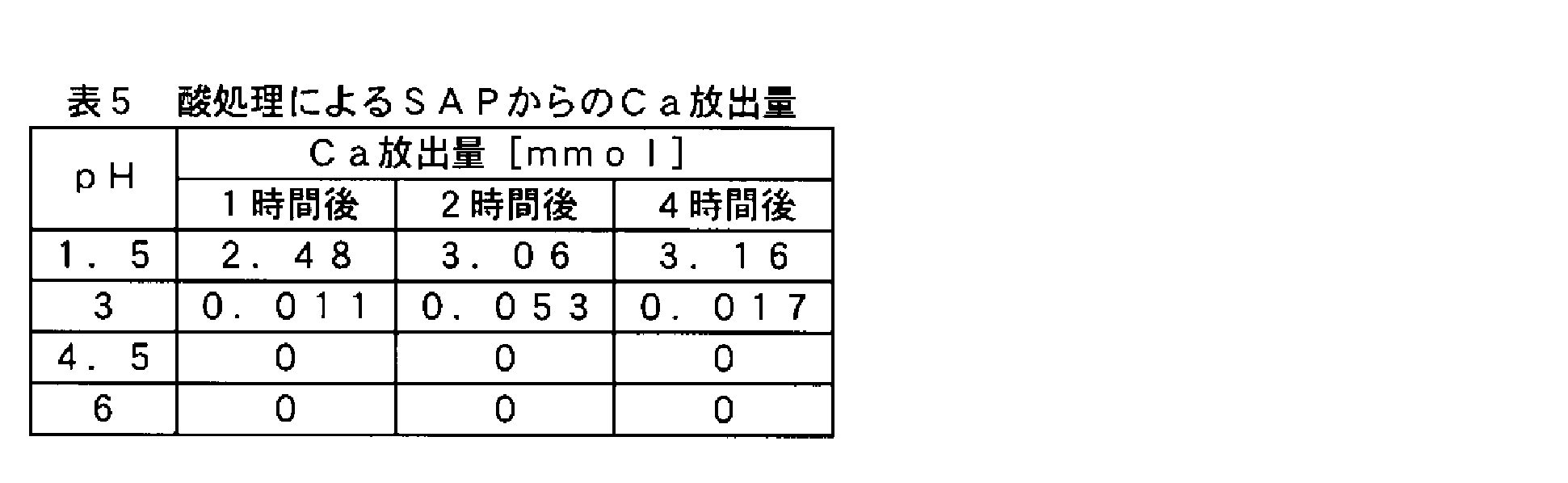
酸処理によるSAPからのCa放出量を表5および図5に示す。
酸処理後のSAPの水分吸収量を表6および図6に示す。
pH1.5の場合のみ、すなわち強酸性下のみにおいてSAP中のCaは放出された。この試験に使用した不活化SAPは、乾燥質量1gのSAPあたり3.6ミリモルのCaを含んでいたが、強酸性下で放出されたCaは3.3ミリモルであり、大半のCaが放出されたことが分かる。水分吸収量について見てみると、pH1.5においてpH3、4.5、6より、水分吸収量が多くなり、水分吸収能力の回復が見られた。しかしながら、大半のCaが放出されたことから本来のSAPの水分吸収量280g付近まで回復することが見込まれたが、水分吸収量は25g程度と、大幅な回復には至らなかった。以上より、Caを放出させるだけでは、SAPの水分吸収能力は回復しないことが分かる。
蒸留水1Lに塩酸を添加してpHを1.5、3、4.5、6に調整した酸性水溶液に、前記の塩化カルシウム水溶液処理において6ミリモルの塩化カルシウムで処理した不活化SAPの乾燥質量1gが入ったメッシュケースを入れ、撹拌した。1、2、4時間後に、水溶液をサンプリングし、高周波誘導結合プラズマ発光分光分析法(ICP-AES)を用いてCa量を測定した。4時間後、メッシュケースを取り出し、pH5.5の蒸留水1L中で1時間攪拌した。再度、pH5.5の蒸留水1L中で1時間攪拌した。メッシュケースを取り出し、10分間吊るし水切りを行った。その後、SAPの水分吸収量を測定した。
酸処理によるSAPからのCa放出量を表5および図5に示す。
酸処理後のSAPの水分吸収量を表6および図6に示す。
pH1.5の場合のみ、すなわち強酸性下のみにおいてSAP中のCaは放出された。この試験に使用した不活化SAPは、乾燥質量1gのSAPあたり3.6ミリモルのCaを含んでいたが、強酸性下で放出されたCaは3.3ミリモルであり、大半のCaが放出されたことが分かる。水分吸収量について見てみると、pH1.5においてpH3、4.5、6より、水分吸収量が多くなり、水分吸収能力の回復が見られた。しかしながら、大半のCaが放出されたことから本来のSAPの水分吸収量280g付近まで回復することが見込まれたが、水分吸収量は25g程度と、大幅な回復には至らなかった。以上より、Caを放出させるだけでは、SAPの水分吸収能力は回復しないことが分かる。
再生した高吸水性ポリマーは、吸収性物品の吸収体をはじめ、農園芸保水材、土木用止水材や光ケーブル用止水材等の産業用吸収性物品、メディカルシーツ等の医療材料、食品用鮮度保持材、食品用ドリップ吸収材等の種々の用途に利用することができる。
Claims (6)
- 使用済み高吸水性ポリマーの再生方法であって、使用済みの高吸水性ポリマーを多価金属塩水溶液で処理する工程および多価金属塩水溶液で処理した高吸水性ポリマーをアルカリ金属塩水溶液で処理する工程を含む方法。
- 多価金属塩がアルカリ土類金属塩であることを特徴とする請求項1に記載の方法。
- アルカリ土類金属塩水溶液が、乾燥質量1gの高吸水性ポリマーあたり、4.5~10ミリモルのアルカリ土類金属塩を含むことを特徴とする請求項2に記載の方法。
- アルカリ金属塩水溶液が、乾燥質量1gの高吸水性ポリマーあたり、30~150ミリモルのアルカリ金属塩を含むことを特徴とする請求項1~3のいずれか1項に記載の方法。
- アルカリ金属塩水溶液で処理した高吸水性ポリマーを水で洗浄する工程をさらに含む請求項1~4のいずれか1項に記載の方法。
- 使用済み吸収性物品から高吸水性ポリマーを回収再生する方法であって、使用済みの吸収性物品から高吸水性ポリマーを回収する工程、回収した高吸水性ポリマーを多価金属塩水溶液で処理する工程、多価金属塩水溶液で処理した高吸水性ポリマーをアルカリ金属塩水溶液で処理する工程、アルカリ金属塩水溶液で処理した高吸水性ポリマーを水で洗浄する工程、および水で洗浄した高吸水性ポリマーを乾燥する工程を含む方法。
Priority Applications (3)
| Application Number | Priority Date | Filing Date | Title |
|---|---|---|---|
| US14/386,910 US9777131B2 (en) | 2012-03-23 | 2013-03-22 | Method for reclaiming used superabsorbent polymer |
| EP13764449.8A EP2829320B1 (en) | 2012-03-23 | 2013-03-22 | Method for reclaiming used superabsorbent polymer |
| CN201380015510.XA CN104245119B (zh) | 2012-03-23 | 2013-03-22 | 使用后的高吸水性聚合物的再生方法 |
Applications Claiming Priority (2)
| Application Number | Priority Date | Filing Date | Title |
|---|---|---|---|
| JP2012068436A JP5996226B2 (ja) | 2012-03-23 | 2012-03-23 | 使用済み高吸水性ポリマーの再生方法 |
| JP2012-068436 | 2012-03-23 |
Publications (1)
| Publication Number | Publication Date |
|---|---|
| WO2013141357A1 true WO2013141357A1 (ja) | 2013-09-26 |
Family
ID=49222805
Family Applications (1)
| Application Number | Title | Priority Date | Filing Date |
|---|---|---|---|
| PCT/JP2013/058288 Ceased WO2013141357A1 (ja) | 2012-03-23 | 2013-03-22 | 使用済み高吸水性ポリマーの再生方法 |
Country Status (5)
| Country | Link |
|---|---|
| US (1) | US9777131B2 (ja) |
| EP (1) | EP2829320B1 (ja) |
| JP (1) | JP5996226B2 (ja) |
| CN (1) | CN104245119B (ja) |
| WO (1) | WO2013141357A1 (ja) |
Cited By (5)
| Publication number | Priority date | Publication date | Assignee | Title |
|---|---|---|---|---|
| CN110846919A (zh) * | 2014-10-15 | 2020-02-28 | 尤妮佳股份有限公司 | 由使用过的卫生用品制造再生浆粕的方法 |
| WO2020213298A1 (ja) * | 2019-04-16 | 2020-10-22 | 三洋化成工業株式会社 | 吸水性樹脂粒子の製造方法 |
| WO2020241025A1 (ja) * | 2019-05-30 | 2020-12-03 | ユニ・チャーム株式会社 | 使用済み吸収性物品由来の高吸水性ポリマーを再生する方法及び使用済み吸収性物品由来のリサイクル高吸水性ポリマー |
| WO2021205780A1 (ja) * | 2020-04-10 | 2021-10-14 | ユニ・チャーム株式会社 | 高吸水性リサイクルポリマーの製造方法、及び高吸水性リサイクルポリマー |
| WO2023149576A1 (ja) | 2022-02-04 | 2023-08-10 | 株式会社日本触媒 | リサイクル吸水性樹脂を含む吸水性樹脂の製造方法、およびその利用 |
Families Citing this family (29)
| Publication number | Priority date | Publication date | Assignee | Title |
|---|---|---|---|---|
| JP6452273B2 (ja) * | 2013-06-24 | 2019-01-16 | 株式会社リブドゥコーポレーション | 吸水性樹脂の処理方法 |
| WO2015006799A1 (en) * | 2013-07-15 | 2015-01-22 | Relivit Pty Ltd | Recovery of super absorbent polymers |
| JP6219711B2 (ja) * | 2013-12-24 | 2017-10-25 | 株式会社リブドゥコーポレーション | 吸水性樹脂の処理方法 |
| JP6324576B2 (ja) * | 2016-08-05 | 2018-05-16 | ユニ・チャーム株式会社 | 使用済み吸収性物品からパルプ繊維を回収する方法 |
| JP6698506B2 (ja) * | 2016-12-02 | 2020-05-27 | ユニ・チャーム株式会社 | 使用済み吸収性物品のリサイクル方法 |
| CN108262327A (zh) * | 2016-12-30 | 2018-07-10 | 清倍华再源技股份有限公司 | 吸收性物品回收方法、回收系统及水体存储系统 |
| JP6667575B2 (ja) * | 2017-11-01 | 2020-03-18 | ユニ・チャーム株式会社 | 有機酸の回収方法、及びリサイクルパルプの製造方法 |
| CN111556967B (zh) | 2017-12-20 | 2023-04-04 | 尤妮佳股份有限公司 | 再循环浆粕纤维的制造方法 |
| JP7115933B2 (ja) * | 2018-02-05 | 2022-08-09 | ユニ・チャーム株式会社 | 高吸水性ポリマーの再生方法、高吸水性リサイクルポリマーの製造方法、及びアルカリ金属イオン供給源の使用 |
| WO2019151538A1 (ja) * | 2018-02-05 | 2019-08-08 | ユニ・チャーム株式会社 | 高吸水性ポリマーの再生方法、高吸水性リサイクルポリマーの製造方法、及びアルカリ金属イオン供給源の使用 |
| JP7231522B2 (ja) | 2019-09-06 | 2023-03-01 | ユニ・チャーム株式会社 | 再生高吸水性ポリマーを製造する方法、再生高吸水性ポリマーを用いて高吸水性ポリマーを製造する方法、及び、再生高吸水性ポリマー |
| WO2021066340A1 (ko) | 2019-09-30 | 2021-04-08 | 주식회사 엘지화학 | 고흡수성 수지의 제조 방법 |
| JP7507168B2 (ja) | 2019-10-18 | 2024-06-27 | 住友精化株式会社 | 吸水性樹脂粒子の再生方法 |
| WO2021162082A1 (ja) | 2020-02-14 | 2021-08-19 | 株式会社日本触媒 | 吸水性樹脂をリサイクルする方法 |
| IT202000005995A1 (it) * | 2020-03-20 | 2021-09-20 | Fater Spa | Procedimento per quantificare il contenuto di polimeri super assorbenti in prodotti sanitari assorbenti post-consumo |
| IT202000009085A1 (it) * | 2020-04-27 | 2021-10-27 | Fater Spa | Procedimento per quantificare il contenuto di polimeri super assorbenti in prodotti sanitari assorbenti |
| JP7055164B2 (ja) * | 2020-04-28 | 2022-04-15 | ユニ・チャーム株式会社 | 使用済み吸収性物品のリサイクル方法 |
| JP2022025276A (ja) * | 2020-07-29 | 2022-02-10 | 株式会社フロム工業 | 使用済み衛生用品処理装置 |
| WO2022091975A1 (ja) * | 2020-10-30 | 2022-05-05 | 三洋化成工業株式会社 | 吸水性樹脂粒子の脱水処理方法 |
| CN116391011A (zh) | 2020-11-02 | 2023-07-04 | 宝洁公司 | 使用水热处理再循环用过的吸收性卫生产品或其组分 |
| CN112718810B (zh) * | 2021-01-07 | 2022-09-27 | 北京亿刻科技有限公司 | 一种膝关节支具挤压回收装置 |
| JP7582872B2 (ja) * | 2021-01-08 | 2024-11-13 | 株式会社日本触媒 | 吸水性樹脂及びその製造方法 |
| TWI760260B (zh) * | 2021-07-13 | 2022-04-01 | 臺灣塑膠工業股份有限公司 | 吸水性樹脂之再生方法及再生後吸水性樹脂 |
| JP7573817B2 (ja) * | 2021-07-30 | 2024-10-28 | ユニ・チャーム株式会社 | 高吸水性リサイクルポリマー用の2次脱水された高吸水性ポリマーを製造する方法、及び高吸水性リサイクルポリマーを製造する方法 |
| JP7742814B2 (ja) * | 2021-12-27 | 2025-09-22 | 株式会社トクヤマ | 使用済み衛生用品の脱水方法および脱水剤 |
| JP7850183B2 (ja) * | 2022-02-04 | 2026-04-22 | 株式会社日本触媒 | 吸水性樹脂のリサイクル方法、および吸水性樹脂の製造方法 |
| WO2023200594A1 (en) | 2022-04-13 | 2023-10-19 | The Procter & Gamble Company | Absorbent hygiene product comprising recycled material made from used absorbent hygiene product using hydrothermal treatment |
| EP4508124A1 (en) | 2022-04-13 | 2025-02-19 | The Procter & Gamble Company | Recycling a used absorbent hygiene product or its components using hydrothermal treatment |
| WO2024143213A1 (ja) | 2022-12-28 | 2024-07-04 | 株式会社日本触媒 | 再生吸水性樹脂の製造方法および当該製造方法における製造条件の判定方法 |
Citations (6)
| Publication number | Priority date | Publication date | Assignee | Title |
|---|---|---|---|---|
| JPS62238802A (ja) * | 1986-04-08 | 1987-10-19 | 三井東圧化学株式会社 | 尿の吸収・保持体 |
| JP2002058998A (ja) * | 2000-08-22 | 2002-02-26 | Sanyo Chem Ind Ltd | 土のう代替品の回収方法 |
| JP2002346333A (ja) * | 2001-05-28 | 2002-12-03 | Fumakilla Ltd | 除湿材 |
| JP2003225645A (ja) | 2002-02-05 | 2003-08-12 | Tomio Wada | 使用済み吸収性物品からのパルプ成分および吸水性ポリマーの分離回収法 |
| JP2003326161A (ja) * | 2002-03-06 | 2003-11-18 | Nippon Shokubai Co Ltd | 吸水性樹脂の再生方法および吸水剤 |
| JP2005270958A (ja) * | 2004-02-27 | 2005-10-06 | Fujio Abe | 調湿材とその調湿方法 |
Family Cites Families (6)
| Publication number | Priority date | Publication date | Assignee | Title |
|---|---|---|---|---|
| DE69133244T2 (de) * | 1990-10-29 | 2004-05-06 | Knowaste L.L.C. | Behandlung eines superabsorbierenden Polymers |
| DE19749039A1 (de) * | 1997-11-06 | 1999-07-29 | Loebbert Johannes | Verfahren und Vorrichtung zur Wertstoffgewinnung aus gebrauchten Wegwerfartikeln, insbesondere Inkontinenzartikeln |
| CN1946478A (zh) * | 2004-02-27 | 2007-04-11 | 阿部富士男 | 湿度调节剂以及使用该湿度调节剂调节湿度的方法 |
| US8318306B2 (en) | 2008-01-30 | 2012-11-27 | Evonik Stockhausen, Llc | Superabsorbent polymer compositions having a triggering composition |
| US7977530B2 (en) * | 2008-01-30 | 2011-07-12 | Kimberly-Clark Worldwide, Inc. | Absorbent articles comprising absorbent materials exhibiting deswell/reswell |
| EP2361740B1 (en) * | 2010-02-25 | 2013-12-18 | The Procter and Gamble Company | Method of separating suberabsorbent polymer particles from a solidified thermoplastic composition comprising polymers |
-
2012
- 2012-03-23 JP JP2012068436A patent/JP5996226B2/ja active Active
-
2013
- 2013-03-22 EP EP13764449.8A patent/EP2829320B1/en active Active
- 2013-03-22 CN CN201380015510.XA patent/CN104245119B/zh active Active
- 2013-03-22 WO PCT/JP2013/058288 patent/WO2013141357A1/ja not_active Ceased
- 2013-03-22 US US14/386,910 patent/US9777131B2/en active Active
Patent Citations (6)
| Publication number | Priority date | Publication date | Assignee | Title |
|---|---|---|---|---|
| JPS62238802A (ja) * | 1986-04-08 | 1987-10-19 | 三井東圧化学株式会社 | 尿の吸収・保持体 |
| JP2002058998A (ja) * | 2000-08-22 | 2002-02-26 | Sanyo Chem Ind Ltd | 土のう代替品の回収方法 |
| JP2002346333A (ja) * | 2001-05-28 | 2002-12-03 | Fumakilla Ltd | 除湿材 |
| JP2003225645A (ja) | 2002-02-05 | 2003-08-12 | Tomio Wada | 使用済み吸収性物品からのパルプ成分および吸水性ポリマーの分離回収法 |
| JP2003326161A (ja) * | 2002-03-06 | 2003-11-18 | Nippon Shokubai Co Ltd | 吸水性樹脂の再生方法および吸水剤 |
| JP2005270958A (ja) * | 2004-02-27 | 2005-10-06 | Fujio Abe | 調湿材とその調湿方法 |
Non-Patent Citations (1)
| Title |
|---|
| See also references of EP2829320A4 |
Cited By (13)
| Publication number | Priority date | Publication date | Assignee | Title |
|---|---|---|---|---|
| CN110846919B (zh) * | 2014-10-15 | 2022-06-10 | 尤妮佳股份有限公司 | 由使用过的卫生用品制造再生浆粕的方法 |
| CN110846919A (zh) * | 2014-10-15 | 2020-02-28 | 尤妮佳股份有限公司 | 由使用过的卫生用品制造再生浆粕的方法 |
| WO2020213298A1 (ja) * | 2019-04-16 | 2020-10-22 | 三洋化成工業株式会社 | 吸水性樹脂粒子の製造方法 |
| JPWO2020213298A1 (ja) * | 2019-04-16 | 2020-10-22 | ||
| US11358123B2 (en) | 2019-05-30 | 2022-06-14 | Unicharm Corporation | Method for recycling superabsorbent polymer derived from used absorbent article and recycled superabsorbent polymer derived from used absorbent article |
| JP2021000637A (ja) * | 2019-05-30 | 2021-01-07 | ユニ・チャーム株式会社 | 使用済み吸収性物品由来の高吸水性ポリマーを再生する方法及び使用済み吸収性物品由来のリサイクル高吸水性ポリマー |
| JP2020195994A (ja) * | 2019-05-30 | 2020-12-10 | ユニ・チャーム株式会社 | 使用済み吸収性物品由来の高吸水性ポリマーを再生する方法及び使用済み吸収性物品由来のリサイクル高吸水性ポリマー |
| WO2020241025A1 (ja) * | 2019-05-30 | 2020-12-03 | ユニ・チャーム株式会社 | 使用済み吸収性物品由来の高吸水性ポリマーを再生する方法及び使用済み吸収性物品由来のリサイクル高吸水性ポリマー |
| JP7378374B2 (ja) | 2019-05-30 | 2023-11-13 | ユニ・チャーム株式会社 | 使用済み吸収性物品由来の高吸水性ポリマーを再生する方法及び使用済み吸収性物品由来のリサイクル高吸水性ポリマー |
| WO2021205780A1 (ja) * | 2020-04-10 | 2021-10-14 | ユニ・チャーム株式会社 | 高吸水性リサイクルポリマーの製造方法、及び高吸水性リサイクルポリマー |
| JP2021166968A (ja) * | 2020-04-10 | 2021-10-21 | ユニ・チャーム株式会社 | 高吸水性リサイクルポリマーの製造方法、及び高吸水性リサイクルポリマー |
| JP7481151B2 (ja) | 2020-04-10 | 2024-05-10 | ユニ・チャーム株式会社 | 高吸水性リサイクルポリマーの製造方法、及び高吸水性リサイクルポリマー |
| WO2023149576A1 (ja) | 2022-02-04 | 2023-08-10 | 株式会社日本触媒 | リサイクル吸水性樹脂を含む吸水性樹脂の製造方法、およびその利用 |
Also Published As
| Publication number | Publication date |
|---|---|
| JP5996226B2 (ja) | 2016-09-21 |
| EP2829320A4 (en) | 2015-11-18 |
| JP2013198862A (ja) | 2013-10-03 |
| CN104245119A (zh) | 2014-12-24 |
| US20150045461A1 (en) | 2015-02-12 |
| US9777131B2 (en) | 2017-10-03 |
| EP2829320B1 (en) | 2019-05-08 |
| CN104245119B (zh) | 2017-12-01 |
| EP2829320A1 (en) | 2015-01-28 |
Similar Documents
| Publication | Publication Date | Title |
|---|---|---|
| JP5996226B2 (ja) | 使用済み高吸水性ポリマーの再生方法 | |
| JP6800998B2 (ja) | 吸水性樹脂粉末の製造方法、並びに粒子状含水ゲルの乾燥装置及び乾燥方法 | |
| US12187860B2 (en) | Water-absorbent resin powder and production method thereof | |
| KR101621702B1 (ko) | 유발 조성물을 포함하는 고흡수성 중합체 조성물 | |
| Elbarbary et al. | Phosphorylation of chitosan/HEMA interpenetrating polymer network prepared by γ-radiation for metal ions removal from aqueous solutions | |
| RU2338754C2 (ru) | Водопоглощающий агент в виде частиц неправильной формы после измельчения | |
| EP2340265B1 (en) | Process for production of superabsorbent polymer gel with recycled superabsorbent polymer fines | |
| Phetphaisit et al. | Polyacrylamido-2-methyl-1-propane sulfonic acid-grafted-natural rubber as bio-adsorbent for heavy metal removal from aqueous standard solution and industrial wastewater | |
| EP1878761A1 (en) | Water absorbent and process for producing the same | |
| US8252857B2 (en) | Process for producing odor-inhibiting water-absorbing polymer particles | |
| WO2021162082A1 (ja) | 吸水性樹脂をリサイクルする方法 | |
| CN110038511A (zh) | 一种载镧改性膨润土除磷材料的制备方法及其应用 | |
| KR20150000400A (ko) | 흡수성 수지의 처리방법 | |
| CN104478031B (zh) | 聚合氯化铝/羟基磷灰石共聚材料的制备方法 | |
| US20160074832A1 (en) | Aminopolycarboxylic acids useful as processing aids in the manufacture of superabsorbents | |
| WO2015072536A1 (ja) | ポリアクリル酸(塩)系吸水性樹脂の製造方法 | |
| JP2020116569A (ja) | 衛生用品の処理方法 | |
| EP4046706A1 (en) | Method for regenerating water-absorbing resin particles | |
| JP2017031299A (ja) | 発泡親水性架橋重合体およびその製造方法 | |
| WO2024143213A1 (ja) | 再生吸水性樹脂の製造方法および当該製造方法における製造条件の判定方法 | |
| JP6521668B2 (ja) | ポリアクリル酸(塩)系吸水性樹脂の製造方法 | |
| BR112019010340A2 (pt) | método de recuperação de sais nutrientes derivados da urina a partir de fraldas utilizadas e similares | |
| KR101236345B1 (ko) | 배설물 처리용 조성물 | |
| TWI760260B (zh) | 吸水性樹脂之再生方法及再生後吸水性樹脂 | |
| WO2021132167A1 (ja) | 吸水性樹脂粒子、吸収体及び吸収性物品 |
Legal Events
| Date | Code | Title | Description |
|---|---|---|---|
| 121 | Ep: the epo has been informed by wipo that ep was designated in this application |
Ref document number: 13764449 Country of ref document: EP Kind code of ref document: A1 |
|
| WWE | Wipo information: entry into national phase |
Ref document number: 14386910 Country of ref document: US Ref document number: 2013764449 Country of ref document: EP |
|
| NENP | Non-entry into the national phase |
Ref country code: DE |