WO2013145095A1 - Dispositif de contrôle de conduite de véhicule hybride - Google Patents
Dispositif de contrôle de conduite de véhicule hybride Download PDFInfo
- Publication number
- WO2013145095A1 WO2013145095A1 PCT/JP2012/057814 JP2012057814W WO2013145095A1 WO 2013145095 A1 WO2013145095 A1 WO 2013145095A1 JP 2012057814 W JP2012057814 W JP 2012057814W WO 2013145095 A1 WO2013145095 A1 WO 2013145095A1
- Authority
- WO
- WIPO (PCT)
- Prior art keywords
- electric motor
- clutch
- rotating element
- differential mechanism
- engine
- Prior art date
- Legal status (The legal status is an assumption and is not a legal conclusion. Google has not performed a legal analysis and makes no representation as to the accuracy of the status listed.)
- Ceased
Links
Images






Classifications
-
- B—PERFORMING OPERATIONS; TRANSPORTING
- B60—VEHICLES IN GENERAL
- B60W—CONJOINT CONTROL OF VEHICLE SUB-UNITS OF DIFFERENT TYPE OR DIFFERENT FUNCTION; CONTROL SYSTEMS SPECIALLY ADAPTED FOR HYBRID VEHICLES; ROAD VEHICLE DRIVE CONTROL SYSTEMS FOR PURPOSES NOT RELATED TO THE CONTROL OF A PARTICULAR SUB-UNIT
- B60W20/00—Control systems specially adapted for hybrid vehicles
-
- B—PERFORMING OPERATIONS; TRANSPORTING
- B60—VEHICLES IN GENERAL
- B60W—CONJOINT CONTROL OF VEHICLE SUB-UNITS OF DIFFERENT TYPE OR DIFFERENT FUNCTION; CONTROL SYSTEMS SPECIALLY ADAPTED FOR HYBRID VEHICLES; ROAD VEHICLE DRIVE CONTROL SYSTEMS FOR PURPOSES NOT RELATED TO THE CONTROL OF A PARTICULAR SUB-UNIT
- B60W10/00—Conjoint control of vehicle sub-units of different type or different function
- B60W10/10—Conjoint control of vehicle sub-units of different type or different function including control of change-speed gearings
-
- B—PERFORMING OPERATIONS; TRANSPORTING
- B60—VEHICLES IN GENERAL
- B60K—ARRANGEMENT OR MOUNTING OF PROPULSION UNITS OR OF TRANSMISSIONS IN VEHICLES; ARRANGEMENT OR MOUNTING OF PLURAL DIVERSE PRIME-MOVERS IN VEHICLES; AUXILIARY DRIVES FOR VEHICLES; INSTRUMENTATION OR DASHBOARDS FOR VEHICLES; ARRANGEMENTS IN CONNECTION WITH COOLING, AIR INTAKE, GAS EXHAUST OR FUEL SUPPLY OF PROPULSION UNITS IN VEHICLES
- B60K6/00—Arrangement or mounting of plural diverse prime-movers for mutual or common propulsion, e.g. hybrid propulsion systems comprising electric motors and internal combustion engines
- B60K6/20—Arrangement or mounting of plural diverse prime-movers for mutual or common propulsion, e.g. hybrid propulsion systems comprising electric motors and internal combustion engines the prime-movers consisting of electric motors and internal combustion engines, e.g. HEVs
- B60K6/22—Arrangement or mounting of plural diverse prime-movers for mutual or common propulsion, e.g. hybrid propulsion systems comprising electric motors and internal combustion engines the prime-movers consisting of electric motors and internal combustion engines, e.g. HEVs characterised by apparatus, components or means specially adapted for HEVs
- B60K6/38—Arrangement or mounting of plural diverse prime-movers for mutual or common propulsion, e.g. hybrid propulsion systems comprising electric motors and internal combustion engines the prime-movers consisting of electric motors and internal combustion engines, e.g. HEVs characterised by apparatus, components or means specially adapted for HEVs characterised by the driveline clutches
- B60K6/387—Actuated clutches, i.e. clutches engaged or disengaged by electric, hydraulic or mechanical actuating means
-
- B—PERFORMING OPERATIONS; TRANSPORTING
- B60—VEHICLES IN GENERAL
- B60K—ARRANGEMENT OR MOUNTING OF PROPULSION UNITS OR OF TRANSMISSIONS IN VEHICLES; ARRANGEMENT OR MOUNTING OF PLURAL DIVERSE PRIME-MOVERS IN VEHICLES; AUXILIARY DRIVES FOR VEHICLES; INSTRUMENTATION OR DASHBOARDS FOR VEHICLES; ARRANGEMENTS IN CONNECTION WITH COOLING, AIR INTAKE, GAS EXHAUST OR FUEL SUPPLY OF PROPULSION UNITS IN VEHICLES
- B60K6/00—Arrangement or mounting of plural diverse prime-movers for mutual or common propulsion, e.g. hybrid propulsion systems comprising electric motors and internal combustion engines
- B60K6/20—Arrangement or mounting of plural diverse prime-movers for mutual or common propulsion, e.g. hybrid propulsion systems comprising electric motors and internal combustion engines the prime-movers consisting of electric motors and internal combustion engines, e.g. HEVs
- B60K6/42—Arrangement or mounting of plural diverse prime-movers for mutual or common propulsion, e.g. hybrid propulsion systems comprising electric motors and internal combustion engines the prime-movers consisting of electric motors and internal combustion engines, e.g. HEVs characterised by the architecture of the hybrid electric vehicle
- B60K6/44—Series-parallel type
- B60K6/445—Differential gearing distribution type
-
- B—PERFORMING OPERATIONS; TRANSPORTING
- B60—VEHICLES IN GENERAL
- B60W—CONJOINT CONTROL OF VEHICLE SUB-UNITS OF DIFFERENT TYPE OR DIFFERENT FUNCTION; CONTROL SYSTEMS SPECIALLY ADAPTED FOR HYBRID VEHICLES; ROAD VEHICLE DRIVE CONTROL SYSTEMS FOR PURPOSES NOT RELATED TO THE CONTROL OF A PARTICULAR SUB-UNIT
- B60W10/00—Conjoint control of vehicle sub-units of different type or different function
- B60W10/02—Conjoint control of vehicle sub-units of different type or different function including control of driveline clutches
-
- B—PERFORMING OPERATIONS; TRANSPORTING
- B60—VEHICLES IN GENERAL
- B60W—CONJOINT CONTROL OF VEHICLE SUB-UNITS OF DIFFERENT TYPE OR DIFFERENT FUNCTION; CONTROL SYSTEMS SPECIALLY ADAPTED FOR HYBRID VEHICLES; ROAD VEHICLE DRIVE CONTROL SYSTEMS FOR PURPOSES NOT RELATED TO THE CONTROL OF A PARTICULAR SUB-UNIT
- B60W10/00—Conjoint control of vehicle sub-units of different type or different function
- B60W10/04—Conjoint control of vehicle sub-units of different type or different function including control of propulsion units
- B60W10/08—Conjoint control of vehicle sub-units of different type or different function including control of propulsion units including control of electric propulsion units, e.g. motors or generators
-
- B—PERFORMING OPERATIONS; TRANSPORTING
- B60—VEHICLES IN GENERAL
- B60W—CONJOINT CONTROL OF VEHICLE SUB-UNITS OF DIFFERENT TYPE OR DIFFERENT FUNCTION; CONTROL SYSTEMS SPECIALLY ADAPTED FOR HYBRID VEHICLES; ROAD VEHICLE DRIVE CONTROL SYSTEMS FOR PURPOSES NOT RELATED TO THE CONTROL OF A PARTICULAR SUB-UNIT
- B60W10/00—Conjoint control of vehicle sub-units of different type or different function
- B60W10/12—Conjoint control of vehicle sub-units of different type or different function including control of differentials
-
- B—PERFORMING OPERATIONS; TRANSPORTING
- B60—VEHICLES IN GENERAL
- B60W—CONJOINT CONTROL OF VEHICLE SUB-UNITS OF DIFFERENT TYPE OR DIFFERENT FUNCTION; CONTROL SYSTEMS SPECIALLY ADAPTED FOR HYBRID VEHICLES; ROAD VEHICLE DRIVE CONTROL SYSTEMS FOR PURPOSES NOT RELATED TO THE CONTROL OF A PARTICULAR SUB-UNIT
- B60W10/00—Conjoint control of vehicle sub-units of different type or different function
- B60W10/18—Conjoint control of vehicle sub-units of different type or different function including control of braking systems
- B60W10/196—Conjoint control of vehicle sub-units of different type or different function including control of braking systems acting within the driveline, e.g. retarders
-
- B—PERFORMING OPERATIONS; TRANSPORTING
- B60—VEHICLES IN GENERAL
- B60W—CONJOINT CONTROL OF VEHICLE SUB-UNITS OF DIFFERENT TYPE OR DIFFERENT FUNCTION; CONTROL SYSTEMS SPECIALLY ADAPTED FOR HYBRID VEHICLES; ROAD VEHICLE DRIVE CONTROL SYSTEMS FOR PURPOSES NOT RELATED TO THE CONTROL OF A PARTICULAR SUB-UNIT
- B60W20/00—Control systems specially adapted for hybrid vehicles
- B60W20/10—Controlling the power contribution of each of the prime movers to meet required power demand
- B60W20/13—Controlling the power contribution of each of the prime movers to meet required power demand in order to stay within battery power input or output limits; in order to prevent overcharging or battery depletion
-
- B—PERFORMING OPERATIONS; TRANSPORTING
- B60—VEHICLES IN GENERAL
- B60K—ARRANGEMENT OR MOUNTING OF PROPULSION UNITS OR OF TRANSMISSIONS IN VEHICLES; ARRANGEMENT OR MOUNTING OF PLURAL DIVERSE PRIME-MOVERS IN VEHICLES; AUXILIARY DRIVES FOR VEHICLES; INSTRUMENTATION OR DASHBOARDS FOR VEHICLES; ARRANGEMENTS IN CONNECTION WITH COOLING, AIR INTAKE, GAS EXHAUST OR FUEL SUPPLY OF PROPULSION UNITS IN VEHICLES
- B60K6/00—Arrangement or mounting of plural diverse prime-movers for mutual or common propulsion, e.g. hybrid propulsion systems comprising electric motors and internal combustion engines
- B60K6/20—Arrangement or mounting of plural diverse prime-movers for mutual or common propulsion, e.g. hybrid propulsion systems comprising electric motors and internal combustion engines the prime-movers consisting of electric motors and internal combustion engines, e.g. HEVs
- B60K6/22—Arrangement or mounting of plural diverse prime-movers for mutual or common propulsion, e.g. hybrid propulsion systems comprising electric motors and internal combustion engines the prime-movers consisting of electric motors and internal combustion engines, e.g. HEVs characterised by apparatus, components or means specially adapted for HEVs
- B60K6/38—Arrangement or mounting of plural diverse prime-movers for mutual or common propulsion, e.g. hybrid propulsion systems comprising electric motors and internal combustion engines the prime-movers consisting of electric motors and internal combustion engines, e.g. HEVs characterised by apparatus, components or means specially adapted for HEVs characterised by the driveline clutches
- B60K2006/381—Arrangement or mounting of plural diverse prime-movers for mutual or common propulsion, e.g. hybrid propulsion systems comprising electric motors and internal combustion engines the prime-movers consisting of electric motors and internal combustion engines, e.g. HEVs characterised by apparatus, components or means specially adapted for HEVs characterised by the driveline clutches characterized by driveline brakes
-
- B—PERFORMING OPERATIONS; TRANSPORTING
- B60—VEHICLES IN GENERAL
- B60W—CONJOINT CONTROL OF VEHICLE SUB-UNITS OF DIFFERENT TYPE OR DIFFERENT FUNCTION; CONTROL SYSTEMS SPECIALLY ADAPTED FOR HYBRID VEHICLES; ROAD VEHICLE DRIVE CONTROL SYSTEMS FOR PURPOSES NOT RELATED TO THE CONTROL OF A PARTICULAR SUB-UNIT
- B60W2710/00—Output or target parameters relating to a particular sub-units
- B60W2710/02—Clutches
- B60W2710/021—Clutch engagement state
-
- B—PERFORMING OPERATIONS; TRANSPORTING
- B60—VEHICLES IN GENERAL
- B60W—CONJOINT CONTROL OF VEHICLE SUB-UNITS OF DIFFERENT TYPE OR DIFFERENT FUNCTION; CONTROL SYSTEMS SPECIALLY ADAPTED FOR HYBRID VEHICLES; ROAD VEHICLE DRIVE CONTROL SYSTEMS FOR PURPOSES NOT RELATED TO THE CONTROL OF A PARTICULAR SUB-UNIT
- B60W2710/00—Output or target parameters relating to a particular sub-units
- B60W2710/06—Combustion engines, Gas turbines
-
- B—PERFORMING OPERATIONS; TRANSPORTING
- B60—VEHICLES IN GENERAL
- B60W—CONJOINT CONTROL OF VEHICLE SUB-UNITS OF DIFFERENT TYPE OR DIFFERENT FUNCTION; CONTROL SYSTEMS SPECIALLY ADAPTED FOR HYBRID VEHICLES; ROAD VEHICLE DRIVE CONTROL SYSTEMS FOR PURPOSES NOT RELATED TO THE CONTROL OF A PARTICULAR SUB-UNIT
- B60W2710/00—Output or target parameters relating to a particular sub-units
- B60W2710/08—Electric propulsion units
-
- B—PERFORMING OPERATIONS; TRANSPORTING
- B60—VEHICLES IN GENERAL
- B60W—CONJOINT CONTROL OF VEHICLE SUB-UNITS OF DIFFERENT TYPE OR DIFFERENT FUNCTION; CONTROL SYSTEMS SPECIALLY ADAPTED FOR HYBRID VEHICLES; ROAD VEHICLE DRIVE CONTROL SYSTEMS FOR PURPOSES NOT RELATED TO THE CONTROL OF A PARTICULAR SUB-UNIT
- B60W2710/00—Output or target parameters relating to a particular sub-units
- B60W2710/10—Change speed gearings
-
- B—PERFORMING OPERATIONS; TRANSPORTING
- B60—VEHICLES IN GENERAL
- B60W—CONJOINT CONTROL OF VEHICLE SUB-UNITS OF DIFFERENT TYPE OR DIFFERENT FUNCTION; CONTROL SYSTEMS SPECIALLY ADAPTED FOR HYBRID VEHICLES; ROAD VEHICLE DRIVE CONTROL SYSTEMS FOR PURPOSES NOT RELATED TO THE CONTROL OF A PARTICULAR SUB-UNIT
- B60W2710/00—Output or target parameters relating to a particular sub-units
- B60W2710/18—Braking system
-
- B—PERFORMING OPERATIONS; TRANSPORTING
- B60—VEHICLES IN GENERAL
- B60W—CONJOINT CONTROL OF VEHICLE SUB-UNITS OF DIFFERENT TYPE OR DIFFERENT FUNCTION; CONTROL SYSTEMS SPECIALLY ADAPTED FOR HYBRID VEHICLES; ROAD VEHICLE DRIVE CONTROL SYSTEMS FOR PURPOSES NOT RELATED TO THE CONTROL OF A PARTICULAR SUB-UNIT
- B60W2710/00—Output or target parameters relating to a particular sub-units
- B60W2710/24—Energy storage means
- B60W2710/242—Energy storage means for electrical energy
-
- Y—GENERAL TAGGING OF NEW TECHNOLOGICAL DEVELOPMENTS; GENERAL TAGGING OF CROSS-SECTIONAL TECHNOLOGIES SPANNING OVER SEVERAL SECTIONS OF THE IPC; TECHNICAL SUBJECTS COVERED BY FORMER USPC CROSS-REFERENCE ART COLLECTIONS [XRACs] AND DIGESTS
- Y02—TECHNOLOGIES OR APPLICATIONS FOR MITIGATION OR ADAPTATION AGAINST CLIMATE CHANGE
- Y02T—CLIMATE CHANGE MITIGATION TECHNOLOGIES RELATED TO TRANSPORTATION
- Y02T10/00—Road transport of goods or passengers
- Y02T10/60—Other road transportation technologies with climate change mitigation effect
- Y02T10/62—Hybrid vehicles
-
- Y—GENERAL TAGGING OF NEW TECHNOLOGICAL DEVELOPMENTS; GENERAL TAGGING OF CROSS-SECTIONAL TECHNOLOGIES SPANNING OVER SEVERAL SECTIONS OF THE IPC; TECHNICAL SUBJECTS COVERED BY FORMER USPC CROSS-REFERENCE ART COLLECTIONS [XRACs] AND DIGESTS
- Y10—TECHNICAL SUBJECTS COVERED BY FORMER USPC
- Y10S—TECHNICAL SUBJECTS COVERED BY FORMER USPC CROSS-REFERENCE ART COLLECTIONS [XRACs] AND DIGESTS
- Y10S903/00—Hybrid electric vehicles, HEVS
- Y10S903/902—Prime movers comprising electrical and internal combustion motors
- Y10S903/903—Prime movers comprising electrical and internal combustion motors having energy storing means, e.g. battery, capacitor
- Y10S903/93—Conjoint control of different elements
Definitions
- the present invention relates to an improvement of a drive control device for a hybrid vehicle.
- a hybrid vehicle including at least one electric motor that functions as a drive source is known.
- this is the vehicle described in Patent Document 1.
- the brake is provided to fix the output shaft of the internal combustion engine to the non-rotating member, and according to the traveling state of the vehicle. By controlling the engagement state of the brake, it is possible to improve the energy efficiency of the vehicle and to travel according to the driver's request.
- JP 2008-265600 A Japanese Patent No. 4038183
- the second electric motor is directly connected to the drive wheels, and thus there is a problem that power generation cannot be performed by the second electric motor when the vehicle is stopped, for example.
- the charging speed becomes a problem, but there is a limit to the improvement of the charging speed in the aspect of generating power only by the first electric motor.
- Such a problem has been newly found in the process in which the present inventors have intensively studied in order to improve the performance of a hybrid vehicle.
- the present invention has been made against the background of the above circumstances, and an object of the present invention is to provide a drive control device for a hybrid vehicle that realizes shortening of the charging time of the drive battery.
- the gist of the first aspect of the present invention is that a first differential mechanism and a second differential mechanism having four rotating elements as a whole, and these four rotating elements are respectively connected.
- An element is selectively connected via a clutch, and the rotating element of the first differential mechanism or the second differential mechanism to be engaged by the clutch is selected via a brake for a non-rotating member.
- the hybrid vehicle drive control device is characterized in that the clutch is engaged when power generation is performed by at least one of the first electric motor and the second electric motor. .
- the first differential mechanism and the second differential mechanism having four rotation elements as a whole, the engine, the first electric motor, Two electric motors and an output rotating member, and one of the four rotating elements is selected by selecting the rotating element of the first differential mechanism and the rotating element of the second differential mechanism via a clutch.
- the rotating element of the first differential mechanism or the second differential mechanism to be engaged by the clutch is selectively connected to the non-rotating member via a brake.
- the clutch is engaged. Therefore, the first motor and the second motor cooperate with each other. Work It is possible to perform electrodeposition, it is possible to increase the charging rate. That is, it is possible to provide a drive control device for a hybrid vehicle that realizes shortening of the charge time of the drive battery.
- the subject matter of the second invention which is dependent on the first invention, is that when power generation is performed by at least one of the first electric motor and the second electric motor while the vehicle is stopped or traveling at a reduced speed, the clutch And the brake is released. In this way, it becomes possible to generate power in cooperation with the first motor and the second motor while the vehicle is stopped or traveling at a reduced speed, and the charging speed of the drive battery can be increased in a practical manner. Can do.
- the gist of the third invention subordinate to the first invention is that when it is determined that warm-up is necessary, the clutch is engaged and the brake is released, and the driving force of the engine is used. Then, power is generated by at least one of the first electric motor and the second electric motor. If it does in this way, when warming-up is required, warming-up can be accelerated
- the gist of the fourth invention subordinate to the first invention is that when it is determined that warm-up is necessary and the vehicle is running, both the clutch and the brake are engaged, The first electric motor and the second electric motor are used as driving sources for traveling. In this way, when warm-up is required, warm-up can be promoted by performing rapid discharge.
- the gist of the fifth invention subordinate to the first invention, the second invention, the third invention, or the fourth invention is that the first differential mechanism is connected to the first motor in a first rotation.
- 1 rotation element, 2nd rotation element, and 3rd rotation element are provided, and any one of these 2nd rotation element and 3rd rotation element is connected with the 3rd rotation element in the said 1st differential mechanism.
- the clutch is coupled to the second rotating element in the first differential mechanism and the third rotating element in the first differential mechanism among the second rotating element and the third rotating element in the second differential mechanism. Which selectively engages the other rotating element.
- the brake is configured such that, of the second rotating element and the third rotating element in the second differential mechanism, the rotating element that is not connected to the third rotating element in the first differential mechanism is connected to the non-rotating member. Is selectively engaged. In this way, in a practical hybrid vehicle drive device, it is possible to reduce the charging time of the drive battery.
- FIG. 1 is a skeleton diagram illustrating a configuration of a hybrid vehicle drive device to which the present invention is preferably applied. It is a figure explaining the principal part of the control system provided in order to control the drive of the drive device of FIG.
- FIG. 2 is an engagement table showing clutch and brake engagement states in each of five types of travel modes established in the drive device of FIG. 1.
- FIG. 4 is a collinear diagram that can represent the relative relationship of the rotational speeds of the respective rotary elements on a straight line in the drive device of FIG. 1, and is a diagram corresponding to modes 1 and 3 of FIG. 3.
- FIG. 1 is a skeleton diagram illustrating a configuration of a hybrid vehicle drive device to which the present invention is preferably applied. It is a figure explaining the principal part of the control system provided in order to control the drive of the drive device of FIG.
- FIG. 2 is an engagement table showing clutch and brake engagement states in each of five types of travel modes established in the drive device of FIG. 1.
- FIG. 4 is a collinear diagram
- FIG. 4 is a collinear diagram that can represent the relative relationship of the rotation speeds of the respective rotary elements on a straight line in the drive device of FIG. 1, corresponding to mode 2 of FIG. 3.
- FIG. 4 is a collinear diagram that can represent the relative relationship of the rotational speeds of the respective rotary elements on a straight line in the drive device of FIG. 1, corresponding to mode 4 of FIG. 3.
- FIG. 4 is a collinear diagram that can represent the relative relationship of the rotational speeds of the respective rotary elements on a straight line in the drive device of FIG. 1, corresponding to mode 5 of FIG. 3. It is a functional block diagram explaining the principal part of the control function with which the electronic control apparatus of FIG. 2 was equipped.
- FIG. 4 is a collinear diagram that can represent the relative relationship of the rotation speeds of the respective rotary elements on a straight line in the drive device of FIG. 1, corresponding to mode 2 of FIG. 3.
- FIG. 2 is a collinear diagram that represents, on a straight line, the relative relationship between the rotational speeds of the rotating elements when power is generated by an electric motor in the drive device of FIG. 1. It is a flowchart explaining the principal part of an example of the battery charge control by the electronic controller of FIG. It is a skeleton diagram explaining the composition of the other hybrid vehicle drive device to which the present invention is applied suitably. It is a skeleton diagram explaining the composition of still another hybrid vehicle drive device to which the present invention is preferably applied. It is a skeleton diagram explaining the composition of still another hybrid vehicle drive device to which the present invention is preferably applied. It is a skeleton diagram explaining the composition of still another hybrid vehicle drive device to which the present invention is preferably applied. It is a skeleton diagram explaining the composition of still another hybrid vehicle drive device to which the present invention is preferably applied.
- FIG. 6 is a collinear diagram illustrating the configuration and operation of still another hybrid vehicle drive device to which the present invention is preferably applied.
- FIG. 6 is a collinear diagram illustrating the configuration and operation of still another hybrid vehicle drive device to which the present invention is preferably applied.
- FIG. 6 is a collinear diagram illustrating the configuration and operation of still another hybrid vehicle drive device to which the present invention is preferably applied.
- FIG. 6 is a collinear diagram illustrating the configuration and operation of still another hybrid vehicle drive device to which the present invention is preferably applied.
- the first differential mechanism and the second differential mechanism have four rotation elements as a whole when the clutch is engaged.
- the first differential mechanism and the second differential mechanism are: In the state in which the plurality of clutches are engaged, there are four rotating elements as a whole.
- the present invention relates to a first differential mechanism and a second differential mechanism that are represented as four rotating elements on the nomographic chart, an engine connected to each of the four rotating elements, a first electric motor, A second electric motor, and an output rotating member, wherein one of the four rotating elements includes a rotating element of the first differential mechanism and a rotating element of the second differential mechanism via a clutch.
- a hybrid vehicle that is selectively connected and a rotating element of the first differential mechanism or the second differential mechanism that is to be engaged by the clutch is selectively connected to a non-rotating member via a brake. It is suitably applied to the drive control apparatus.
- the clutch and the brake are preferably hydraulic engagement devices whose engagement state is controlled (engaged or released) according to the hydraulic pressure, for example, a wet multi-plate friction engagement device.
- a meshing engagement device that is, a so-called dog clutch (meshing clutch) may be used.
- the engagement state may be controlled (engaged or released) according to an electrical command, such as an electromagnetic clutch or a magnetic powder clutch.
- one of a plurality of travel modes is selectively established according to the engagement state of the clutch and the brake.
- the operation of the engine is stopped and the brake is engaged and the clutch is released in an EV traveling mode in which at least one of the first electric motor and the second electric motor is used as a driving source for traveling.
- mode 1 is established
- mode 2 is established by engaging both the brake and the clutch.
- the mode is set when the brake is engaged and the clutch is released.
- Mode 4 is established when the brake is released and the clutch is engaged
- mode 5 is established when both the brake and the clutch are released.
- each rotating element in each of the first differential mechanism and the second differential mechanism when the clutch is engaged and the brake is released.
- the arrangement order indicates the first rotation in the first differential mechanism when the rotation speeds corresponding to the second rotation element and the third rotation element in each of the first differential mechanism and the second differential mechanism are superimposed.
- FIG. 1 is a skeleton diagram illustrating the configuration of a hybrid vehicle drive device 10 (hereinafter simply referred to as drive device 10) to which the present invention is preferably applied.
- the drive device 10 of the present embodiment is a device for horizontal use that is preferably used in, for example, an FF (front engine front wheel drive) type vehicle and the like, and an engine 12, which is a main power source,
- the first electric motor MG1, the second electric motor MG2, the first planetary gear device 14 as a first differential mechanism, and the second planetary gear device 16 as a second differential mechanism are provided on a common central axis CE.
- the driving device 10 is configured substantially symmetrically with respect to the central axis CE, and the lower half of the central line is omitted in FIG. The same applies to each of the following embodiments.
- the engine 12 is, for example, an internal combustion engine such as a gasoline engine that generates driving force by combustion of fuel such as gasoline injected in a cylinder.
- the first electric motor MG1 and the second electric motor MG2 are preferably so-called motor generators each having a function as a motor (engine) for generating driving force and a generator (generator) for generating reaction force.
- Each stator (stator) 18, 22 is fixed to a housing (case) 26 that is a non-rotating member, and the rotor (rotor) 20, 24 is provided on the inner peripheral side of each stator 18, 22. Has been.
- the first planetary gear unit 14 is a single pinion type planetary gear unit having a gear ratio of ⁇ 1, and serves as a second rotating element that supports the sun gear S1 and the pinion gear P1 as the first rotating element so as to be capable of rotating and revolving.
- a ring gear R1 as a third rotating element that meshes with the sun gear S1 via the carrier C1 and the pinion gear P1 is provided as a rotating element (element).
- the second planetary gear device 16 is a single pinion type planetary gear device having a gear ratio of ⁇ 2, and serves as a second rotating element that supports the sun gear S2 and the pinion gear P2 as the first rotating element so as to be capable of rotating and revolving.
- a ring gear R2 as a third rotating element that meshes with the sun gear S2 via the carrier C2 and the pinion gear P2 is provided as a rotating element (element).
- the sun gear S1 of the first planetary gear unit 14 is connected to the rotor 20 of the first electric motor MG1.
- the carrier C1 of the first planetary gear unit 14 is connected to an input shaft 28 that is rotated integrally with the crankshaft of the engine 12.
- the input shaft 28 is centered on the central axis CE.
- the direction of the central axis of the central axis CE is referred to as an axial direction (axial direction) unless otherwise distinguished.
- the ring gear R1 of the first planetary gear device 14 is connected to an output gear 30 that is an output rotating member, and is also connected to the ring gear R2 of the second planetary gear device 16.
- the sun gear S2 of the second planetary gear device 16 is connected to the rotor 24 of the second electric motor MG2.
- the driving force output from the output gear 30 is transmitted to a pair of left and right driving wheels (not shown) via a differential gear device and an axle (not shown).
- torque input to the drive wheels from the road surface of the vehicle is transmitted (input) from the output gear 30 to the drive device 10 via the differential gear device and the axle.
- a mechanical oil pump 32 such as a vane pump is connected to an end portion of the input shaft 28 opposite to the engine 12, and an original pressure of a hydraulic control circuit 60 or the like to be described later when the engine 12 is driven.
- the hydraulic pressure is output.
- an electric oil pump driven by electric energy may be provided.
- the carrier C1 of the first planetary gear device 14 and the carrier C2 of the second planetary gear device 16 are selectively engaged between the carriers C1 and C2 (between the carriers C1 and C2).
- a clutch CL is provided.
- a brake BK for selectively engaging (fixing) the carrier C2 with respect to the housing 26 is provided between the carrier C2 of the second planetary gear device 16 and the housing 26 which is a non-rotating member.
- the clutch CL and the brake BK are preferably hydraulic engagement devices whose engagement states are controlled (engaged or released) according to the hydraulic pressure supplied from the hydraulic control circuit 60.
- a wet multi-plate friction engagement device or the like is preferably used, but a meshing engagement device, that is, a so-called dog clutch (meshing clutch) may be used.
- an engagement state may be controlled (engaged or released) according to an electrical command supplied from the electronic control device 40, such as an electromagnetic clutch or a magnetic powder clutch.
- the first planetary gear device 14 and the second planetary gear device 16 are arranged coaxially with the input shaft 28 (on the central axis CE), and , Are arranged at positions facing each other in the axial direction of the central axis CE. That is, with respect to the axial direction of the central axis CE, the first planetary gear device 14 is disposed on the engine 12 side with respect to the second planetary gear device 16. With respect to the axial direction of the central axis CE, the first electric motor MG1 is disposed on the engine 12 side with respect to the first planetary gear unit 14.
- the second electric motor MG1 is disposed on the opposite side of the engine 12 with respect to the second planetary gear device 16. That is, the first electric motor MG1 and the second electric motor MG2 are arranged at positions facing each other with the first planetary gear device 14 and the second planetary gear device 16 interposed therebetween with respect to the axial direction of the central axis CE. . That is, in the drive device 10, in the axial direction of the central axis CE, the first electric motor MG1, the first planetary gear device 14, the clutch CL, the second planetary gear device 16, the brake BK, Those components are arranged on the same axis in the order of the two electric motors MG2.
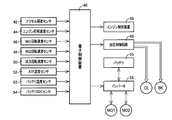
- FIG. 2 is a diagram for explaining a main part of a control system provided in the driving device 10 in order to control the driving of the driving device 10.
- the electronic control unit 40 shown in FIG. 2 includes a CPU, a ROM, a RAM, an input / output interface, and the like, and executes signal processing in accordance with a program stored in advance in the ROM while using a temporary storage function of the RAM.
- the microcomputer is a so-called microcomputer, and executes various controls related to driving of the drive device 10 including drive control of the engine 12 and hybrid drive control related to the first electric motor MG1 and the second electric motor MG2. That is, in this embodiment, the electronic control device 40 corresponds to a drive control device for a hybrid vehicle to which the drive device 10 is applied.
- the electronic control device 40 is configured as an individual control device for each control as required, such as for output control of the engine 12 and for operation control of the first electric motor MG1 and the second electric motor MG2.
- the electronic control device 40 is configured to be supplied with various signals from sensors, switches, and the like provided in each part of the driving device 10. That is, a signal representing an accelerator opening degree A CC which is an operation amount of an accelerator pedal (not shown) corresponding to a driver's output request amount by the accelerator opening sensor 42, and an engine which is the rotation speed of the engine 12 by the engine rotation speed sensor 44.
- a signal representing an accelerator opening degree A CC which is an operation amount of an accelerator pedal (not shown) corresponding to a driver's output request amount by the accelerator opening sensor 42
- an engine which is the rotation speed of the engine 12 by the engine rotation speed sensor 44.
- a signal representative of the rotational speed N E a signal indicative of the rotational speed N MG1 of the first electric motor MG1 by MG1 rotational speed sensor 46, a signal indicative of the rotational speed N MG2 of the second electric motor MG2 by MG2 rotational speed sensor 48, output rotation A signal indicating the rotational speed N OUT of the output gear 30 corresponding to the vehicle speed V by the speed sensor 50, and the ATF temperature that is the temperature of the working fluid (working oil or the like) supplied to each part of the driving device 10 by the ATF temperature sensor 52.
- a signal representing Th ATF a signal representing the temperature Th bat of the battery 55 by the battery temperature sensor 53, and
- the battery SOC sensor 54 supplies a signal indicating the charge capacity (charge state) SOC of the battery 55 to the electronic control unit 40.
- the electronic control device 40 is configured to output an operation command to each part of the driving device 10. That is, as an engine output control command for controlling the output of the engine 12, a fuel injection amount signal for controlling a fuel supply amount to an intake pipe or the like by the fuel injection device, and an ignition timing (ignition timing) of the engine 12 by the ignition device.
- An ignition signal to be commanded, an electronic throttle valve drive signal supplied to the throttle actuator for operating the throttle valve opening ⁇ TH of the electronic throttle valve, and the like are output to an engine control device 56 that controls the output of the engine 12.
- the A command signal for commanding the operation of the first motor MG1 and the second motor MG2 is output to the inverter 58, and electric energy corresponding to the command signal is transmitted from the battery 55 via the inverter 58 to the first motor MG1 and the second motor MG2.
- the two electric motors MG2 are supplied to control the outputs (torques) of the first electric motor MG1 and the second electric motor MG2. Electric energy generated by the first electric motor MG1 and the second electric motor MG2 is supplied to the battery 55 via the inverter 58 and stored in the battery 55. That is, in the driving device 10, the battery 55 corresponds to a driving battery.
- a command signal for controlling the engagement state of the clutch CL and the brake BK is supplied to an electromagnetic control valve such as a linear solenoid valve provided in the hydraulic control circuit 60, and the hydraulic pressure output from the electromagnetic control valve is controlled.
- an electromagnetic control valve such as a linear solenoid valve provided in the hydraulic control circuit 60
- the hydraulic pressure output from the electromagnetic control valve is controlled.
- the drive device 10 functions as an electric differential unit that controls the differential state between the input rotation speed and the output rotation speed by controlling the operation state via the first electric motor MG1 and the second electric motor MG2.
- the electric energy generated by the first electric motor MG1 is supplied to the battery 55 and the second electric motor MG2 via the inverter 58.
- the main part of the power of the engine 12 is mechanically transmitted to the output gear 30, while a part of the power is consumed for power generation of the first electric motor MG 1 and is converted into electric energy there.
- the electric energy is supplied to the second electric motor MG2 through the inverter 58.
- the second electric motor MG2 is driven, and the power output from the second electric motor MG2 is transmitted to the output gear 30.
- Electrical path from conversion of part of the power of the engine 12 into electrical energy and conversion of the electrical energy into mechanical energy by related equipment from the generation of the electrical energy to consumption by the second electric motor MG2. Is configured.
- FIG. 3 is an engagement table showing the engagement states of the clutch CL and the brake BK in each of the five types of travel modes established in the drive device 10, wherein the engagement is “ ⁇ ” and the release is blank. Show. In each of the travel modes “EV-1” and “EV-2” shown in FIG. 3, the operation of the engine 12 is stopped, and at least one of the first electric motor MG1 and the second electric motor MG2 is used for traveling. This is an EV travel mode used as a drive source.
- HV-1”, “HV-2”, and “HV-3” all drive the engine 12 as a driving source for traveling, for example, and the first motor MG1 and the second motor MG2 as required.
- This is a hybrid travel mode for driving or generating power.
- a reaction force may be generated by at least one of the first electric motor MG1 and the second electric motor MG2, or may be idled in an unloaded state.
- the operation of the engine 12 is stopped, and in the EV traveling mode in which at least one of the first electric motor MG ⁇ b> 1 and the second electric motor MG ⁇ b> 2 is used as a driving source for traveling.
- mode 1 travel mode 1
- 2 travel mode 2
- the brake BK is engaged.
- HV-1 which is mode 3 (travel mode 3) by releasing the clutch CL
- mode 4 travel mode 4
- HV-2 is established
- HV-3 which is mode 5 (travel mode 5) is established by releasing both the brake BK and the clutch CL.
- FIGS. 4 to 7 show the rotation elements of the driving device 10 (the first planetary gear device 14 and the second planetary gear device 16) that have different coupling states depending on the engagement states of the clutch CL and the brake BK.
- FIG. 2 shows a collinear chart that can represent the relative relationship of rotational speed on a straight line, showing the relative relationship of the gear ratio ⁇ of the first planetary gear device 14 and the second planetary gear device 16 in the horizontal axis direction, It is a two-dimensional coordinate which shows a relative rotational speed in an axial direction.
- the rotational speeds of the output gears 30 when the vehicle moves forward are represented as positive directions (positive rotations).
- a horizontal line X1 indicates zero rotation speed.
- the solid line Y1 indicates the sun gear S1 (first electric motor MG1) of the first planetary gear unit 14, the broken line Y2 indicates the sun gear S2 (second electric motor MG2) of the second planetary gear unit 16,
- the solid line Y3 is the carrier C1 (engine 12) of the first planetary gear unit 14, the broken line Y3 'is the carrier C2 of the second planetary gear unit 16, and the solid line Y4 is the ring gear R1 (output gear 30) of the first planetary gear unit 14.
- the broken line Y4 ′ indicates the relative rotational speed of each ring gear R2 of the second planetary gear unit 16.
- the relative rotational speeds of the three rotating elements in the first planetary gear device 14 are indicated by a solid line L1
- the relative rotational speeds of the three rotating elements in the second planetary gear device 16 are indicated by solid lines L1.
- Each is indicated by a broken line L2.
- the intervals between the vertical lines Y1 to Y4 (Y2 to Y4 ′) are determined according to the gear ratios ⁇ 1 and ⁇ 2 of the first planetary gear device 14 and the second planetary gear device 16. That is, regarding the vertical lines Y1, Y3, Y4 corresponding to the three rotating elements in the first planetary gear device 14, the space between the sun gear S1 and the carrier C1 corresponds to 1, and the carrier C1 and the ring gear R1 The interval corresponds to ⁇ 1.
- the gear ratio ⁇ 2 of the second planetary gear device 16 is preferably larger than the gear ratio ⁇ 1 of the first planetary gear device 14 ( ⁇ 2> ⁇ 1).
- EV-1 shown in FIG. 3 corresponds to mode 1 (travel mode 1) in the drive device 10, and preferably the operation of the engine 12 is stopped and the second electric motor MG2 is stopped. Is an EV traveling mode used as a driving source for traveling.
- FIG. 4 is a collinear diagram corresponding to this mode 1, and will be described using this collinear diagram.
- the clutch CL is released, the carrier C1 and the second planetary gear device 14 of the first planetary gear unit 14 are disengaged.
- the planetary gear device 16 can rotate relative to the carrier C2.
- Engagement of the brake BK causes the carrier C2 of the second planetary gear device 16 to be connected (fixed) to the housing 26, which is a non-rotating member, so that its rotational speed is zero.
- the rotation direction of the sun gear S2 and the rotation direction of the ring gear R2 are opposite to each other, and negative torque (torque in the negative direction) is generated by the second electric motor MG2.
- the torque causes the ring gear R2, that is, the output gear 30, to rotate in the positive direction. That is, by outputting negative torque by the second electric motor MG2, the hybrid vehicle to which the drive device 10 is applied can be caused to travel forward.
- the first electric motor MG1 is idled.
- the relative rotation of the carriers C1 and C2 is allowed, and EV travel control similar to EV travel in a vehicle equipped with a so-called THS (Toyota Hybrid System) in which the carrier C2 is connected to a non-rotating member. It can be performed.
- THS Toyota Hybrid System
- FIG. 3 corresponds to mode 2 (traveling mode 2) in the driving apparatus 10, and preferably the operation of the engine 12 is stopped and the first electric motor MG1 is stopped.
- this is an EV traveling mode in which at least one of the second electric motor MG2 is used as a driving source for traveling.
- FIG. 5 is a collinear diagram corresponding to this mode 2. If the collinear diagram is used to explain, the carrier C1 of the first planetary gear device 14 and the first planetary gear device 14 are engaged by engaging the clutch CL. The relative rotation of the two planetary gear unit 16 with the carrier C2 is disabled.
- the carrier C2 of the second planetary gear device 16 and the carrier C1 of the first planetary gear device 14 engaged with the carrier C2 are non-rotating members. Are connected (fixed) to each other and their rotational speed is zero.
- the rotation direction of the sun gear S1 is opposite to the rotation direction of the ring gear R1 in the first planetary gear device 14, and the rotation of the sun gear S2 is reversed in the second planetary gear device 16.
- the direction and the rotation direction of the ring gear R2 are opposite to each other.
- the hybrid vehicle to which the drive device 10 is applied can be caused to travel forward by outputting negative torque by at least one of the first electric motor MG1 and the second electric motor MG2.
- the mode 2 it is possible to establish a mode in which power generation is performed by at least one of the first electric motor MG1 and the second electric motor MG2.
- power generation by regeneration is not allowed, such as when the state of charge of the battery 55 is fully charged, it is possible to idle one or both of the first electric motor MG1 and the second electric motor MG2. That is, in the mode 2, it is possible to perform EV traveling under a wide range of traveling conditions, or to perform EV traveling continuously for a long time. Therefore, the mode 2 is suitably employed in a hybrid vehicle having a high EV traveling ratio such as a plug-in hybrid vehicle.
- HV-1 shown in FIG. 3 corresponds to mode 3 (traveling mode 3) in the driving device 10, and is preferably used as a driving source for traveling when the engine 12 is driven. This is a hybrid travel mode in which driving or power generation is performed by the first electric motor MG1 and the second electric motor MG2 as necessary.
- the collinear diagram of FIG. 4 also corresponds to this mode 3. If described using this collinear diagram, the carrier C1 of the first planetary gear device 14 and the carrier C1 are released by releasing the clutch CL. The second planetary gear device 16 can rotate relative to the carrier C2.
- “HV-2” shown in FIG. 3 corresponds to mode 4 (travel mode 4) in the drive device 10, and is preferably used as a drive source for travel when the engine 12 is driven.
- This is a hybrid travel mode in which driving or power generation is performed by the first electric motor MG1 and the second electric motor MG2 as necessary.
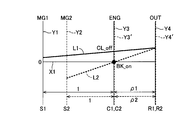
- FIG. 6 is a collinear diagram corresponding to the mode 4, and will be described using this collinear diagram.
- the ring gears R1 and R2 Since the ring gears R1 and R2 are connected to each other, the ring gears R1 and R2 operate as one rotating element that is rotated integrally. That is, in the mode 4, the rotating elements in the first planetary gear device 14 and the second planetary gear device 16 in the driving device 10 function as a differential mechanism including four rotating elements as a whole. That is, four gears in order from the left in FIG. 6 are the sun gear S1 (first electric motor MG1), the sun gear S2 (second electric motor MG2), the carriers C1 and C2 (engine 12) connected to each other, A composite split mode is obtained in which ring gears R1 and R2 (output gear 30) connected to each other are connected in this order.
- the arrangement order of the rotating elements in the first planetary gear device 14 and the second planetary gear device 16 in the alignment chart is a sun gear S1 indicated by a vertical line Y1.
- the sun gear S2 indicated by the vertical line Y2, the carriers C1 and C2 indicated by the vertical line Y3 (Y3 ′), and the ring gears R1 and R2 indicated by the vertical line Y4 (Y4 ′) are arranged in this order.
- the gear ratios ⁇ 1 and ⁇ 2 of the first planetary gear device 14 and the second planetary gear device 16 are respectively shown in FIG.
- the line Y2 is arranged in the above-described order, that is, the interval between the vertical line Y1 and the vertical line Y3 is wider than the interval between the vertical line Y2 and the vertical line Y3 ′.
- the sun gears S1 and S2 and the carriers C1 and C2 correspond to 1
- the carriers C1 and C2 and the ring gears R1 and R2 correspond to ⁇ 1 and ⁇ 2.
- the gear ratio ⁇ 2 of the second planetary gear device 16 is larger than the gear ratio ⁇ 1 of the first planetary gear device 14.
- the carrier C1 of the first planetary gear device 14 and the carrier C2 of the second planetary gear device 16 are connected, and the carriers C1 and C2 are connected to each other. It can be rotated integrally.
- the reaction force can be applied to the output of the engine 12 by either the first electric motor MG1 or the second electric motor MG2. That is, when the engine 12 is driven, the reaction force can be shared by one or both of the first electric motor MG1 and the second electric motor MG2, and the engine 12 can be operated at an efficient operating point, or the torque caused by heat. It is possible to run to ease restrictions such as restrictions.
- the efficiency can be improved by controlling the first motor MG1 and the second motor MG2 to receive the reaction force preferentially by the motor that can operate efficiently.
- the driving force is assisted by regeneration or output of an electric motor that is not torque limited, so that the engine 12 It is possible to ensure a reaction force necessary for driving.
- “HV-3” shown in FIG. 3 corresponds to mode 5 (traveling mode 5) in the driving device 10, and is preferably used as a driving source for traveling when the engine 12 is driven.
- This is a hybrid travel mode in which driving or power generation is performed by the first electric motor MG1 as necessary.
- FIG. 7 is a collinear diagram corresponding to this mode 5. If described with reference to this collinear diagram, the carrier C1 of the first planetary gear unit 14 and the second planetary gear device 14 are released by releasing the clutch CL.
- the planetary gear device 16 can rotate relative to the carrier C2.
- the carrier C2 of the second planetary gear device 16 can be rotated relative to the housing 26, which is a non-rotating member.
- the second electric motor MG2 can be disconnected from the drive system (power transmission path) and stopped.
- the second electric motor MG2 is always rotated with the rotation of the output gear 30 (ring gear R2) when the vehicle is traveling.
- the rotation speed of the second electric motor MG2 reaches a limit value (upper limit value), or the rotation speed of the ring gear R2 is increased and transmitted to the sun gear S2. Therefore, from the viewpoint of improving efficiency, it is not always preferable to always rotate the second electric motor MG2 at a relatively high vehicle speed.
- the second motor MG2 is driven by the engine 12 and the first motor MG1 by separating the second motor MG2 from the drive system at a relatively high vehicle speed, thereby driving the second motor MG2.
- the clutch CL and the brake BK are engaged or released in combination.
- Three modes of HV-1 (mode 3), HV-2 (mode 4), and HV-3 (mode 5) can be selectively established. Thereby, for example, by selectively establishing the mode with the highest transmission efficiency among these three modes according to the vehicle speed, the gear ratio, etc. of the vehicle, it is possible to improve the transmission efficiency and thus improve the fuel efficiency. it can.
- FIG. 8 is a functional block diagram for explaining the main part of the control function provided in the electronic control unit 40.
- the engine drive control unit 70 shown in FIG. 8 controls the drive of the engine 12 via the engine control device 56.
- the fuel supply amount to the intake pipe or the like by the fuel injection device of the engine 12 via the engine control device 56 the ignition timing (ignition timing) of the engine 12 by the ignition device, and the throttle valve opening of the electronic throttle valve
- ⁇ TH and the like the engine 12 is controlled so as to obtain a necessary output, that is, a target torque (target engine output).
- the accelerator opening degree A CC detected by the accelerator opening degree sensor 42 and the output rotation speed are detected.
- the required driving force to be output from the driving device 10 (output gear 30) is calculated, and the output torque of the engine 12 and the
- the operations of the first motor MG1 and the second motor MG2 are controlled via a motor operation control unit 72 described later so that the required driving force is realized by the output torque of the first motor MG1 and the second motor MG2.
- the drive of the engine 12 is controlled via the engine drive control unit 70.
- the electric motor operation control unit 72 controls the operation of the first electric motor MG1 and the second electric motor MG2 via the inverter 58. Specifically, by controlling the electric energy supplied from the battery 55 to the first electric motor MG1 and the second electric motor MG2 via the inverter 58, the required output by the first electric motor MG1 and the second electric motor MG2. That is, control is performed so that a target torque (target motor output) is obtained.
- a target torque target motor output
- the clutch engagement control unit 74 controls the engagement state of the clutch CL via the hydraulic control circuit 60. For example, by controlling the output pressure from the electromagnetic control valve corresponding to the clutch CL provided in the hydraulic pressure control circuit 60, control is performed to switch the engagement state of the clutch CL between engagement and release. .
- the brake engagement control unit 76 controls the engagement state of the brake BK via the hydraulic control circuit 60. For example, by controlling the output pressure from the electromagnetic control valve corresponding to the brake BK provided in the hydraulic control circuit 60, control is performed to switch the engagement state of the brake BK between engagement and release. .
- the clutch engagement control unit 74 and the brake engagement control unit 76 are basically engaged with the clutch CL and the brake BK so that the travel mode determined according to the travel state of the vehicle is established. To control. That is, for each of the modes 1 to 5, the engagement state is controlled so that the clutch CL and the brake BK are engaged or released in the combination shown in FIG.
- the battery charge control unit 78 performs control related to charging of the battery 55 that is a drive battery. For example, when the battery SOC detected by the battery SOC sensor 54 becomes less than a predetermined threshold value, at least one of the first electric motor MG1 and the second electric motor MG2 is used by using the driving force output from the engine 12. While generating electric power by one side, electric power generation control (charging control) which accumulate
- the vehicle travel state determination unit 80 determines the travel state of the hybrid vehicle to which the drive device 10 is applied. Preferably, it is determined whether or not the vehicle is in a stopped state (stopped). For example, it is determined whether or not the vehicle speed V corresponding to the output rotational speed N OUT detected by the output rotational speed sensor 50 is zero, and if the determination is affirmative, it is determined that the vehicle is in a stopped state. . Preferably, it is determined whether the vehicle is decelerating (decelerated traveling).
- the time change rate (vehicle acceleration) dV / dt of the vehicle speed V corresponding to the output rotational speed N OUT detected by the output rotational speed sensor 50 is a negative value, it is determined that the vehicle is decelerating. Preferably, it is determined whether or not the vehicle is running. For example, when the vehicle speed V corresponding to the output rotational speed N OUT detected by the output rotational speed sensor 50 is greater than a prescribed threshold value V bo (for example, zero), it is determined that the vehicle is traveling.
- V bo for example, zero
- the warm-up operation determination unit 82 determines whether or not the hybrid vehicle to which the drive device 10 is applied is in a state where the warm-up operation is necessary. Preferably, when the ATF temperature Th ATF detected by the ATF temperature sensor 52 is less than a predetermined threshold Th ATF_bo , it is determined that the hybrid vehicle is in a state that requires warm-up operation. Preferably, when the battery temperature Th bat detected by the battery temperature sensor 53 is less than a predetermined threshold Th bat_bo , it is determined that the hybrid vehicle is in a state that requires warm-up operation.
- the warm-up operation in the drive device 10 is realized by, for example, driving the engine 12, operating the first electric motor MG1 or the second electric motor MG2, charging / discharging the battery 55, and the like.
- the battery charge control unit 78 when generating power by at least one of the first motor MG1 and the second motor MG2, receives the clutch via the clutch engagement control unit 74 and the brake engagement control unit 76.
- the engagement state of CL and brake BK is controlled.
- the clutch CL is engaged via the clutch engagement control unit 74.
- the clutch engagement control unit 74 engages the clutch CL and the brake engagement control unit 76 releases the brake BK.
- the driving apparatus 10 is established in the above-described mode 4 (HV-2) shown in FIG.
- FIG. 9 is a collinear diagram that represents, on a straight line, the relative relationship between the rotational speeds of the rotating elements when power is generated by at least one of the first electric motor MG1 and the second electric motor MG2 when the vehicle is stopped.
- a state in which the clutch CL is engaged and the brake BK is released is illustrated.
- the torque applied to each rotating element is indicated by a white arrow.
- the rotational speed indicated by Y4 (Y4 ′) corresponding to the output gear 30 which is an output rotating member is zero (fixed state), and the engine 12 is driven.
- Y4 Y4 ′
- the clutch CL is engaged and the brake BK is released, the output of the engine 12 is absorbed by either the first electric motor MG1 or the second electric motor MG2 (used for power generation). And the first electric motor MG1 and the second electric motor MG2 can cooperate to generate electric power.
- the range in which the engine 12 can be output can be expanded, fuel efficiency can be improved, and the battery 55 can be operated more than in the mode in which power generation is performed by one of the first electric motor MG1 and the second electric motor MG2.
- the time required for charging can be shortened.
- the load applied to the first planetary gear unit 14 can be reduced by sharing the operation for charging by the second electric motor MG2 as compared with the aspect in which the charging is performed only by the first electric motor MG1.
- the noise level can be reduced when power generation must be performed at an operating point where gear noise is likely to occur.
- the battery charge control unit 78 preferably engages the clutch CL when power generation is performed by at least one of the first electric motor MG1 and the second electric motor MG2 while the vehicle is stopped or traveling at a reduced speed. And the brake BK is released, and power is generated by at least one of the first electric motor MG1 and the second electric motor MG2 using the driving force of the engine 12.
- the vehicle travel state determination unit 80 determines that the vehicle is in a stopped state (stopped) or when it is determined that the vehicle is decelerating (decelerated travel)
- the motor operation When power generation is performed by at least one of the first electric motor MG1 and the second electric motor MG2 via the control unit 72, the clutch CL is engaged via the clutch engagement control unit 74 and the brake engagement is performed.
- the brake BK is released through the control unit 76, the engine 12 is driven through the engine drive control unit 70, and the first electric motor MG1 and the second electric motor MG2 are operated through the electric motor operation control unit 72. Power is generated by at least one of the above.
- the driving device 10 establishes the mode 4 (HV-2), generates power by at least one of the first electric motor MG1 and the second electric motor MG2 based on the output of the engine 12, and charges the battery 55. I do.
- the battery charging control unit 78 preferably engages the clutch CL and releases the brake BK when it is determined that warm-up is necessary in the hybrid vehicle to which the driving device 10 is applied. Electric power is generated by at least one of the first electric motor MG1 and the second electric motor MG2 using the driving force of the engine 12. Specifically, when the warm-up operation determination unit 82 determines that the warm-up is necessary, the clutch CL is engaged through the clutch engagement control unit 74 and the brake engagement control unit The brake BK is released via 76, the engine 12 is driven via the engine drive control unit 70, and at least one of the first electric motor MG1 and the second electric motor MG2 via the electric motor operation control unit 72. One side generates electricity. In other words, the driving device 10 establishes the mode 4 (HV-2), generates power by at least one of the first electric motor MG1 and the second electric motor MG2 based on the output of the engine 12, and charges the battery 55. I do.
- HV-2 mode 4
- both the clutch CL and the brake BK are used. Engagement is performed, and traveling control using at least one of the first electric motor MG1 and the second electric motor MG2 as a driving source for traveling, that is, traveling control in the EV traveling mode is performed.
- the clutch engagement control unit The clutch CL is engaged by 74, the brake BK is engaged by the brake engagement control unit 76, and at least one of the first electric motor MG1 and the second electric motor MG2 travels exclusively by the electric motor operation control unit 72. Travel control is performed as a drive source for the vehicle. In such an embodiment, the engine 12 is not driven and is stopped. That is, when it is determined that warm-up is necessary in the hybrid vehicle to which the drive device 10 is applied and the vehicle is traveling, the above-described mode 2 (EV-2) shown in FIG. 3 is established. .
- EV-2 the above-described mode 2
- the mode shown in FIG. 3 described above is performed more than when it is not determined that warm-up is necessary (that is, during normal travel). 2 (EV-2) is enlarged (or the shift map is changed).
- FIG. 10 is a flowchart for explaining a main part of an example of battery charging control by the electronic control device 40, and is repeatedly executed at a predetermined cycle.
- step (hereinafter, step is omitted) S1 it is determined whether or not the hybrid vehicle to which the drive device 10 is applied is in a state that requires warm-up. For example, when the ATF temperature Th ATF detected by the ATF temperature sensor 52 is less than a prescribed threshold Th ATF_bo , or when the battery temperature Th bat detected by the battery temperature sensor 53 is less than a prescribed threshold Th bat_bo , S1 is affirmed. If the determination in S1 is negative, the processing from S6 is executed. If the determination in S1 is affirmative, it is determined in S2 whether the vehicle is stopped or decelerated. Is done.
- the determination in S2 is affirmed. If the determination in S2 is negative, the processing from S7 onward is executed. If the determination in S2 is positive, in S3, the clutch CL is engaged and the brake BK is released. Is done. Next, in S ⁇ b> 4, the engine 12 is driven (started) via the engine control device 56.
- the first electric motor MG1 and the second electric motor MG2 generate power using the output of the engine 12, and the battery 55 is charged via the inverter 58. Be terminated.
- it is determined whether or not a request for charging the battery 55 is output for example, when the battery SOC detected by the battery SOC sensor 54 is less than a predetermined threshold. If the determination at S6 is negative, the routine is terminated accordingly. If the determination at S6 is affirmative, the processing from S3 onward is executed. In S7, both the clutch CL and the brake BK are engaged.
- the mode 2 (EV-2) is established, and after the traveling control is performed using only the first electric motor MG1 and the second electric motor MG2 as a driving source for traveling, this routine is finished. Be made.
- S4 is the operation of the engine drive control unit 70
- S5 and S8 are the operation of the motor operation control unit 72
- S3 and S7 are the operation of the clutch engagement control unit 74
- S3 and S7 are In the operation of the brake engagement control unit 76
- S1 to S6 are the operation of the battery charge control unit 78
- S2 is the operation of the vehicle running state determination unit 80
- S1 is the operation of the warm-up operation determination unit 82.
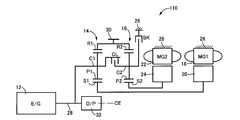
- the drive control device for a hybrid vehicle of the present invention like the drive device 100 shown in FIG. 11 and the drive device 110 shown in FIG. 12, has the first electric motor MG1, the first planetary gear device 14 and the second gear in the direction of the central axis CE.
- the present invention is also preferably applied to a configuration in which the arrangement (arrangement) of the electric motor MG2, the second planetary gear device 16, the clutch CL, and the brake BK is changed.
- the carrier C2 is allowed to rotate in one direction with respect to the housing 26 between the carrier C2 of the second planetary gear device 16 and the housing 26 which is a non-rotating member.
- the present invention is also preferably applied to a configuration in which a one-way clutch (one-way clutch) OWC that prevents reverse rotation is provided in parallel with the brake BK.
- a single-pinion type second planetary gear unit 16 such as a driving unit 130 shown in FIG. 14, a driving unit 140 shown in FIG. 15, and a driving unit 150 shown in FIG.
- the present invention is also preferably applied to a configuration including a pinion type second planetary gear device 16 '.
- the second planetary gear device 16 ' includes a sun gear S2' as a first rotation element, a carrier C2 'as a second rotation element that supports a plurality of pinion gears P2' meshed with each other so as to rotate and revolve, and a pinion gear.
- a ring gear R2 ′ as a third rotating element meshing with the sun gear S2 ′ via P2 ′ is provided as a rotating element (element).
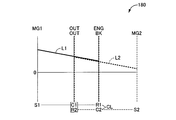
- FIGS. 17 to 19 are collinear diagrams illustrating configurations and operations of other hybrid vehicle drive devices 160, 170, and 180 to which the present invention is preferably applied as an alternative to the drive device 10.
- FIG. 17 to 19 the relative rotational speeds of the sun gear S1, the carrier C1, and the ring gear R1 in the first planetary gear device 14 are indicated by the solid line L1 in the same manner as in the collinear charts of FIGS.
- the relative rotational speeds of the sun gear S2, the carrier C2, and the ring gear R2 in the second planetary gear device 16 are indicated by broken lines L2.
- the sun gear S1, the carrier C1, and the ring gear R1 of the first planetary gear device 14 are connected to the first electric motor MG1, the engine 12, and the second electric motor MG2, respectively.
- the sun gear S2, the carrier C2, and the ring gear R2 of the second planetary gear device 16 are connected to the housing 26 via the second electric motor MG2, the output gear 30, and the brake BK, respectively.
- the sun gear S1 and the ring gear R2 are selectively connected via the clutch CL.
- the ring gear R1 and the sun gear S2 are connected to each other.
- the sun gear S1, the carrier C1, and the ring gear R1 of the first planetary gear device 14 are connected to the first electric motor MG1, the output gear 30, and the engine 12, respectively.
- the sun gear S2, the carrier C2, and the ring gear R2 of the second planetary gear device 16 are connected to the housing 26 via the second electric motor MG2, the output gear 30, and the brake BK, respectively.
- the sun gear S1 and the ring gear R2 are selectively connected via the clutch CL.
- the clutches C1 and C2 are connected to each other.
- the sun gear S1, the carrier C1, and the ring gear R1 of the first planetary gear device 14 are connected to the first electric motor MG1, the output gear 30, and the engine 12, respectively.
- the sun gear S2, the carrier C2, and the ring gear R2 of the second planetary gear device 16 are connected to the housing 26 and the output gear 30 through the second electric motor MG2 and the brake BK, respectively.
- the ring gear R1 and the carrier C2 are selectively connected via a clutch CL.
- the carrier C1 and the ring gear R2 are connected to each other.
- the drive control device for a hybrid vehicle of the present invention described above with reference to FIG. 8 and the like is also preferably applied to the configurations shown in FIGS. That is, when power generation is performed by at least one of the first electric motor MG1 and the second electric motor MG2, control for engaging the clutch CL is performed. Preferably, when power generation is performed by at least one of the first electric motor MG1 and the second electric motor MG2 while the vehicle is stopped or decelerated, the clutch CL is engaged and the brake BK is released. Then, control is performed such that power is generated by at least one of the first electric motor MG1 and the second electric motor MG2 using the driving force of the engine 12 and the battery 55 is charged. By such control, the driving devices 160, 170, 180, etc. can also achieve the effect of shortening the charging time of the driving battery.
- the first difference having four rotating elements (expressed as four rotating elements) on the collinear chart is the same as the embodiment shown in FIGS.
- the first planetary gear unit 14 as a moving mechanism and the second planetary gear units 16 and 16 'as a second differential mechanism, and a first electric motor MG1, a second electric motor MG2, and an engine connected to the four rotating elements, respectively. 12 and an output rotation member (output gear 30), one of the four rotation elements being the rotation element of the first planetary gear device 14 and the second planetary gear device 16, 16 '.
- a rotating element is selectively connected via a clutch CL, and the rotating element of the second planetary gear devices 16 and 16 'to be engaged by the clutch CL is braked against the housing 26 which is a non-rotating member.
- a clutch CL In that it is a drive control apparatus for a hybrid vehicle which is selectively connected, it is common.
- the clutch CL there are four rotating elements as a whole in a state in which the clutch CL is engaged (represented as four rotating elements on the collinear chart shown in FIGS. 4 to 7 and the like).
- the first planetary gear unit 14 that is the first differential mechanism and the second planetary gear units 16 and 16 'that are the second differential mechanism, and the engine 12 and the first electric motor MG1 that are respectively connected to these four rotating elements.
- a second electric motor MG2, and an output gear 30 that is an output rotation member, and one of the four rotation elements is a rotation element of the first differential mechanism and a rotation of the second differential mechanism.
- the rotating element of the first differential mechanism or the second differential mechanism to be engaged by the clutch CL is connected to the housing 26 which is a non-rotating member.
- the brake BK A drive control device for a hybrid vehicle that is selectively connected, wherein the clutch CL is engaged when power generation is performed by at least one of the first electric motor MG1 and the second electric motor MG2.
- the first electric motor MG1 and the second electric motor MG2 can cooperate to generate electric power, and the charging speed can be increased. That is, it is possible to provide the electronic control device 40 as a drive control device of a hybrid vehicle that realizes shortening of the charging time of the battery 55 that is a drive battery.
- the clutch CL When power generation is performed by at least one of the first electric motor MG1 and the second electric motor MG2 while the vehicle is stopped or decelerated, the clutch CL is engaged and the brake BK is released.
- the first electric motor MG1 and the second electric motor MG2 can cooperate to generate electric power, and the charging speed of the battery 55 can be increased in a practical manner.
- the clutch CL When it is determined that warm-up is necessary, the clutch CL is engaged and the brake BK is released, and at least one of the first electric motor MG1 and the second electric motor MG2 is used using the driving force of the engine 12. Therefore, when warm-up is required, warm-up can be promoted by rapidly charging the battery 55 while increasing the charging speed of the battery 55. Fuel consumption can be improved by reducing ATF loss.
- both the clutch CL and the brake BK are engaged, and the first electric motor MG1 and the second electric motor MG2 are exclusively used as a driving source for traveling. Therefore, when warm-up is required, warm-up can be promoted by rapid discharge, and power performance and fuel efficiency can be improved.
- the first planetary gear unit 14 is connected to a sun gear S1 as a first rotating element connected to the first electric motor MG1, a carrier C1 as a second rotating element connected to the engine 12, and the output gear 30.
- the second planetary gear unit 16 (16 ′) includes a sun gear S2 (S2 ′), a second rotation element connected to the second electric motor MG2, and a second gear R1.
- a carrier C2 (C2 ′) as a rotating element and a ring gear R2 (R2 ′) as a third rotating element are provided, and any one of the carrier C2 (C2 ′) and the ring gear R2 (R2 ′) is the first planet.
- the clutch CL is connected to the ring gear R1 of the gear device 14, and the clutch CL includes the carrier C1 in the first planetary gear device 14 and the carrier C2 ( 2 ′) and the ring gear R2 (R2 ′), which is selectively engaged with the rotating element not connected to the ring gear R1, the brake BK includes the carrier C2 (C2 ′) and the ring gear.
- R2 (R2 ′), which is not connected to the ring gear R1, is selectively engaged with the housing 26, which is a non-rotating member. In the device 10 or the like, the charging time of the battery 55 can be shortened.
Landscapes
- Engineering & Computer Science (AREA)
- Transportation (AREA)
- Mechanical Engineering (AREA)
- Chemical & Material Sciences (AREA)
- Combustion & Propulsion (AREA)
- Automation & Control Theory (AREA)
- Electric Propulsion And Braking For Vehicles (AREA)
- Hybrid Electric Vehicles (AREA)
Abstract
Priority Applications (5)
| Application Number | Priority Date | Filing Date | Title |
|---|---|---|---|
| PCT/JP2012/057814 WO2013145095A1 (fr) | 2012-03-26 | 2012-03-26 | Dispositif de contrôle de conduite de véhicule hybride |
| JP2014507066A JP6024740B2 (ja) | 2012-03-26 | 2012-03-26 | ハイブリッド車両の駆動制御装置 |
| CN201280071717.4A CN104245457B (zh) | 2012-03-26 | 2012-03-26 | 混合动力车辆的驱动控制装置 |
| EP12872743.5A EP2832613B1 (fr) | 2012-03-26 | 2012-03-26 | Dispositif de contrôle de conduite de véhicule hybride |
| US14/387,616 US9193349B2 (en) | 2012-03-26 | 2012-03-26 | Hybrid vehicle drive controller |
Applications Claiming Priority (1)
| Application Number | Priority Date | Filing Date | Title |
|---|---|---|---|
| PCT/JP2012/057814 WO2013145095A1 (fr) | 2012-03-26 | 2012-03-26 | Dispositif de contrôle de conduite de véhicule hybride |
Publications (1)
| Publication Number | Publication Date |
|---|---|
| WO2013145095A1 true WO2013145095A1 (fr) | 2013-10-03 |
Family
ID=49258465
Family Applications (1)
| Application Number | Title | Priority Date | Filing Date |
|---|---|---|---|
| PCT/JP2012/057814 Ceased WO2013145095A1 (fr) | 2012-03-26 | 2012-03-26 | Dispositif de contrôle de conduite de véhicule hybride |
Country Status (5)
| Country | Link |
|---|---|
| US (1) | US9193349B2 (fr) |
| EP (1) | EP2832613B1 (fr) |
| JP (1) | JP6024740B2 (fr) |
| CN (1) | CN104245457B (fr) |
| WO (1) | WO2013145095A1 (fr) |
Cited By (2)
| Publication number | Priority date | Publication date | Assignee | Title |
|---|---|---|---|---|
| JP2016078552A (ja) * | 2014-10-14 | 2016-05-16 | トヨタ自動車株式会社 | ハイブリッド車の駆動制御装置 |
| JP2016210224A (ja) * | 2015-04-30 | 2016-12-15 | トヨタ自動車株式会社 | 駆動装置の制御装置 |
Families Citing this family (6)
| Publication number | Priority date | Publication date | Assignee | Title |
|---|---|---|---|---|
| US11161403B2 (en) * | 2012-02-03 | 2021-11-02 | Ge Hybrid Technologies, Llc | Apparatus and method for delivering power in a hybrid vehicle |
| JP2015157545A (ja) * | 2014-02-24 | 2015-09-03 | トヨタ自動車株式会社 | ハイブリッド車両用駆動装置の制御装置 |
| JP6011560B2 (ja) * | 2014-02-24 | 2016-10-19 | トヨタ自動車株式会社 | ハイブリッド車両用駆動装置の制御装置 |
| CN106494215B (zh) * | 2016-10-21 | 2017-09-29 | 广州市新域动力技术有限公司 | 多模复合行星混合动力总成 |
| JP6844479B2 (ja) | 2017-09-21 | 2021-03-17 | トヨタ自動車株式会社 | 車両用動力伝達装置の制御装置 |
| JP6891748B2 (ja) * | 2017-09-21 | 2021-06-18 | トヨタ自動車株式会社 | 車両の制御装置 |
Citations (6)
| Publication number | Priority date | Publication date | Assignee | Title |
|---|---|---|---|---|
| JPH038183B2 (fr) | 1985-06-21 | 1991-02-05 | Kokichi Tanno | |
| JP2005081932A (ja) * | 2003-09-05 | 2005-03-31 | Toyota Motor Corp | 動力出力装置およびこれを搭載する自動車 |
| JP2005199942A (ja) * | 2004-01-19 | 2005-07-28 | Toyota Motor Corp | 動力出力装置およびこれを搭載する自動車並びに動力伝達装置 |
| JP2005329904A (ja) * | 2004-05-21 | 2005-12-02 | Toyota Motor Corp | 動力出力装置およびこれを搭載する自動車並びに動力伝達装置 |
| JP2008265600A (ja) | 2007-04-23 | 2008-11-06 | Toyota Motor Corp | 車両およびその制御方法 |
| JP2011098712A (ja) * | 2009-11-09 | 2011-05-19 | Hyundai Motor Co Ltd | ハイブリッド車両の変速機 |
Family Cites Families (18)
| Publication number | Priority date | Publication date | Assignee | Title |
|---|---|---|---|---|
| US6478705B1 (en) * | 2001-07-19 | 2002-11-12 | General Motors Corporation | Hybrid electric powertrain including a two-mode electrically variable transmission |
| JP4000529B2 (ja) * | 2003-12-10 | 2007-10-31 | アイシン・エィ・ダブリュ株式会社 | ハイブリッド駆動装置 |
| US7261659B2 (en) * | 2005-04-22 | 2007-08-28 | Gm Global Technology Operations, Inc. | Electrically variable transmission having two planetary gearsets |
| US7473199B2 (en) * | 2006-05-25 | 2009-01-06 | Gm Global Technology Operations, Inc. | Two-planetary electrically variable transmissions with multiple fixed ratios |
| JP2009023398A (ja) * | 2007-07-17 | 2009-02-05 | Toyota Motor Corp | ハイブリッド車両用動力伝達装置の制御装置 |
| JP2009035053A (ja) * | 2007-07-31 | 2009-02-19 | Toyota Motor Corp | ハイブリッド車両用動力伝達装置の制御装置 |
| KR101000139B1 (ko) * | 2008-06-12 | 2010-12-10 | 현대자동차주식회사 | 하이브리드 차량의 파워트레인 |
| KR101000172B1 (ko) | 2008-12-03 | 2010-12-10 | 현대자동차주식회사 | 하이브리드 차량의 파워트레인 |
| US7998016B2 (en) * | 2008-12-19 | 2011-08-16 | Caterpillar Inc. | Universal gear train |
| US8460142B2 (en) * | 2009-01-14 | 2013-06-11 | GM Global Technology Operations LLC | Electrically-variable transmission |
| US8226514B2 (en) * | 2009-02-16 | 2012-07-24 | GM Global Technology Operations LLC | Multi-speed transmission with axis transfer |
| US8342996B2 (en) * | 2009-07-22 | 2013-01-01 | GM Global Technology Operations LLC | Multi-speed transmission with multi-axis transfer |
| US8226515B2 (en) * | 2009-08-26 | 2012-07-24 | GM Global Technology Operations LLC | Two-mode hybrid powertrain with two motor/generators |
| RU2014102260A (ru) * | 2011-07-27 | 2015-09-10 | Тойота Дзидося Кабусики Кайся | Приводной механизм гибридного транспортного средства |
| DE112011105511T5 (de) * | 2011-08-10 | 2014-04-24 | Toyota Jidosha Kabushiki Kaisha | Hybridfahrzeugantriebsvorrichtung |
| DE112011105964T5 (de) * | 2011-12-16 | 2014-08-21 | Toyota Jidosha Kabushiki Kaisha | Antriebssteuervorrichtung für ein Hybridfahrzeug |
| CN104203618B (zh) * | 2012-03-21 | 2016-12-21 | 丰田自动车株式会社 | 混合动力车辆的驱动控制装置 |
| KR101427960B1 (ko) * | 2012-12-12 | 2014-08-11 | 현대자동차 주식회사 | 하이브리드 자동차의 동력전달장치 |
-
2012
- 2012-03-26 JP JP2014507066A patent/JP6024740B2/ja not_active Expired - Fee Related
- 2012-03-26 EP EP12872743.5A patent/EP2832613B1/fr not_active Not-in-force
- 2012-03-26 WO PCT/JP2012/057814 patent/WO2013145095A1/fr not_active Ceased
- 2012-03-26 US US14/387,616 patent/US9193349B2/en not_active Expired - Fee Related
- 2012-03-26 CN CN201280071717.4A patent/CN104245457B/zh not_active Expired - Fee Related
Patent Citations (6)
| Publication number | Priority date | Publication date | Assignee | Title |
|---|---|---|---|---|
| JPH038183B2 (fr) | 1985-06-21 | 1991-02-05 | Kokichi Tanno | |
| JP2005081932A (ja) * | 2003-09-05 | 2005-03-31 | Toyota Motor Corp | 動力出力装置およびこれを搭載する自動車 |
| JP2005199942A (ja) * | 2004-01-19 | 2005-07-28 | Toyota Motor Corp | 動力出力装置およびこれを搭載する自動車並びに動力伝達装置 |
| JP2005329904A (ja) * | 2004-05-21 | 2005-12-02 | Toyota Motor Corp | 動力出力装置およびこれを搭載する自動車並びに動力伝達装置 |
| JP2008265600A (ja) | 2007-04-23 | 2008-11-06 | Toyota Motor Corp | 車両およびその制御方法 |
| JP2011098712A (ja) * | 2009-11-09 | 2011-05-19 | Hyundai Motor Co Ltd | ハイブリッド車両の変速機 |
Cited By (2)
| Publication number | Priority date | Publication date | Assignee | Title |
|---|---|---|---|---|
| JP2016078552A (ja) * | 2014-10-14 | 2016-05-16 | トヨタ自動車株式会社 | ハイブリッド車の駆動制御装置 |
| JP2016210224A (ja) * | 2015-04-30 | 2016-12-15 | トヨタ自動車株式会社 | 駆動装置の制御装置 |
Also Published As
| Publication number | Publication date |
|---|---|
| CN104245457B (zh) | 2017-06-23 |
| JPWO2013145095A1 (ja) | 2015-08-03 |
| CN104245457A (zh) | 2014-12-24 |
| US9193349B2 (en) | 2015-11-24 |
| US20150094188A1 (en) | 2015-04-02 |
| EP2832613A1 (fr) | 2015-02-04 |
| EP2832613B1 (fr) | 2018-04-25 |
| JP6024740B2 (ja) | 2016-11-16 |
| EP2832613A4 (fr) | 2017-06-21 |
Similar Documents
| Publication | Publication Date | Title |
|---|---|---|
| JP5874814B2 (ja) | ハイブリッド車両の駆動制御装置 | |
| JP6114255B2 (ja) | ハイブリッド車両の駆動制御装置 | |
| JP6024691B2 (ja) | ハイブリッド車両用駆動装置の制御装置 | |
| JP5884897B2 (ja) | ハイブリッド車両の駆動制御装置 | |
| JP6011560B2 (ja) | ハイブリッド車両用駆動装置の制御装置 | |
| JP6024740B2 (ja) | ハイブリッド車両の駆動制御装置 | |
| JP5884896B2 (ja) | ハイブリッド車両の駆動制御装置 | |
| WO2013145100A1 (fr) | Dispositif de commande d'entraînement pour un véhicule hybride | |
| WO2013094005A1 (fr) | Dispositif de commande d'entraînement pour véhicule hybride | |
| JP5971330B2 (ja) | ハイブリッド車両の駆動制御装置 | |
| JPWO2013140541A1 (ja) | ハイブリッド車両の駆動制御装置 | |
| JP5884893B2 (ja) | ハイブリッド車両の駆動制御装置 | |
| JP5954408B2 (ja) | ハイブリッド車両の駆動制御装置 | |
| WO2013140545A1 (fr) | Dispositif de commande d'entraînement pour véhicule hybride | |
| WO2013145091A1 (fr) | Dispositif de commande d'entraînement de véhicule hybride | |
| CN104203696A (zh) | 混合动力车辆的驱动控制装置 | |
| WO2013140539A1 (fr) | Dispositif de commande d'entraînement pour véhicule hybride | |
| WO2013145098A1 (fr) | Dispositif de commande d'entraînement pour véhicule hybride | |
| JP5924402B2 (ja) | ハイブリッド車両の駆動制御装置 | |
| JP2013203387A (ja) | ハイブリッド車両の駆動制御装置 | |
| WO2013145096A1 (fr) | Dispositif de commande d'entraînement de véhicule hybride | |
| JPWO2013145098A1 (ja) | ハイブリッド車両の駆動制御装置 | |
| JPWO2013140539A1 (ja) | ハイブリッド車両の駆動制御装置 | |
| JP2015229389A (ja) | ハイブリッド車両用駆動装置の制御装置 | |
| JPWO2013145091A1 (ja) | ハイブリッド車両の駆動制御装置 |
Legal Events
| Date | Code | Title | Description |
|---|---|---|---|
| 121 | Ep: the epo has been informed by wipo that ep was designated in this application |
Ref document number: 12872743 Country of ref document: EP Kind code of ref document: A1 |
|
| ENP | Entry into the national phase |
Ref document number: 2014507066 Country of ref document: JP Kind code of ref document: A |
|
| WWE | Wipo information: entry into national phase |
Ref document number: 14387616 Country of ref document: US |
|
| NENP | Non-entry into the national phase |
Ref country code: DE |
|
| WWE | Wipo information: entry into national phase |
Ref document number: 2012872743 Country of ref document: EP |