WO2013146625A1 - 樹脂組成物 - Google Patents
樹脂組成物 Download PDFInfo
- Publication number
- WO2013146625A1 WO2013146625A1 PCT/JP2013/058463 JP2013058463W WO2013146625A1 WO 2013146625 A1 WO2013146625 A1 WO 2013146625A1 JP 2013058463 W JP2013058463 W JP 2013058463W WO 2013146625 A1 WO2013146625 A1 WO 2013146625A1
- Authority
- WO
- WIPO (PCT)
- Prior art keywords
- component
- resin composition
- compound
- acid
- aromatic polyester
- Prior art date
- Legal status (The legal status is an assumption and is not a legal conclusion. Google has not performed a legal analysis and makes no representation as to the accuracy of the status listed.)
- Ceased
Links
Classifications
-
- C—CHEMISTRY; METALLURGY
- C08—ORGANIC MACROMOLECULAR COMPOUNDS; THEIR PREPARATION OR CHEMICAL WORKING-UP; COMPOSITIONS BASED THEREON
- C08K—Use of inorganic or non-macromolecular organic substances as compounding ingredients
- C08K5/00—Use of organic ingredients
- C08K5/16—Nitrogen-containing compounds
- C08K5/34—Heterocyclic compounds having nitrogen in the ring
- C08K5/35—Heterocyclic compounds having nitrogen in the ring having also oxygen in the ring
-
- C—CHEMISTRY; METALLURGY
- C08—ORGANIC MACROMOLECULAR COMPOUNDS; THEIR PREPARATION OR CHEMICAL WORKING-UP; COMPOSITIONS BASED THEREON
- C08J—WORKING-UP; GENERAL PROCESSES OF COMPOUNDING; AFTER-TREATMENT NOT COVERED BY SUBCLASSES C08B, C08C, C08F, C08G or C08H
- C08J3/00—Processes of treating or compounding macromolecular substances
- C08J3/20—Compounding polymers with additives, e.g. colouring
- C08J3/201—Pre-melted polymers
-
- C—CHEMISTRY; METALLURGY
- C08—ORGANIC MACROMOLECULAR COMPOUNDS; THEIR PREPARATION OR CHEMICAL WORKING-UP; COMPOSITIONS BASED THEREON
- C08K—Use of inorganic or non-macromolecular organic substances as compounding ingredients
- C08K5/00—Use of organic ingredients
- C08K5/04—Oxygen-containing compounds
- C08K5/05—Alcohols; Metal alcoholates
- C08K5/053—Polyhydroxylic alcohols
-
- C—CHEMISTRY; METALLURGY
- C08—ORGANIC MACROMOLECULAR COMPOUNDS; THEIR PREPARATION OR CHEMICAL WORKING-UP; COMPOSITIONS BASED THEREON
- C08K—Use of inorganic or non-macromolecular organic substances as compounding ingredients
- C08K5/00—Use of organic ingredients
- C08K5/16—Nitrogen-containing compounds
- C08K5/29—Compounds containing one or more carbon-to-nitrogen double bonds
-
- C—CHEMISTRY; METALLURGY
- C08—ORGANIC MACROMOLECULAR COMPOUNDS; THEIR PREPARATION OR CHEMICAL WORKING-UP; COMPOSITIONS BASED THEREON
- C08J—WORKING-UP; GENERAL PROCESSES OF COMPOUNDING; AFTER-TREATMENT NOT COVERED BY SUBCLASSES C08B, C08C, C08F, C08G or C08H
- C08J2367/00—Characterised by the use of polyesters obtained by reactions forming a carboxylic ester link in the main chain; Derivatives of such polymers
- C08J2367/02—Polyesters derived from dicarboxylic acids and dihydroxy compounds
Definitions
- the present invention relates to a resin composition containing an aromatic polyester, excellent in hydrolysis resistance and fluidity, and having suppressed generation of isocyanate gas during molding.
- Aromatic polyester resins represented by polyethylene terephthalate, polybutylene terephthalate, etc. have excellent mechanical properties, electrical properties, heat resistance, weather resistance, water resistance, chemical resistance, solvent resistance and processability.
- As an engineering plastic it is widely used for various applications such as automobile parts, electric / electronic parts and the like.
- weight reduction of vehicle-mounted parts for the purpose of improving fuel efficiency as part of environmental measures, and resin parts are becoming thinner and lighter.
- the liquidity that can cope with the situation has become important.
- mechanical strength such as tensile strength and wet heat stability such as hydrolysis resistance.
- Aromatic polyester resins are often used for sheet and film applications.
- back sheet film back surface sealing film
- solar power generation solar cell
- hydrolysis resistance is required, such as weather resistance and hydrolysis resistance.
- Aromatic polyester resins are inferior in durability compared to fluorine-based resins and polyethylene-based resins, and various methods have been proposed for improving durability.
- Patent Documents 1 and 2 show that hydrolysis resistance is improved by adding polycarbodiimide to an aromatic polyester resin.
- Patent Document 3 it is known that when a polycarbodiimide compound is used as a terminal blocker for a polymer compound, a significant increase in viscosity is caused by a crosslinking reaction with polyester (Patent Document 3).
- thermoplastic aromatic polyester when a cyclic carbodiimide compound having at least two carbodiimide rings having only one carbodiimide group in one ring is selected as the thermoplastic aromatic polyester, water resistance Although the degree of improvement in decomposability is high, at the same time, a new problem that the melt viscosity increases as compared with the case where a conventionally known polycarbodiimide compound is applied has become apparent.
- JP-A-8-73719 International Publication WO2010 / 018662 Pamphlet
- An object of the present invention is to provide a resin composition that eliminates the problems that the above-mentioned prior art potentially has, contains an aromatic polyester resin, and has both high hydrolysis resistance and moldability. There is to do.
- the present inventors have studied the application of a cyclic carbodiimide compound having at least two carbodiimide rings having only one carbodiimide group in one ring.
- aromatic polyester resins, cyclic In addition to the carbodiimide compound, it has been found that a resin composition capable of achieving the above-mentioned purpose can be obtained by containing a specific polyhydric hydroxyl group-containing compound, and further intensive studies have been made to arrive at the present invention.
- Aromatic polyester resin having a terminal carboxyl group amount of 30 equivalents / ton or less (component A), a cyclic carbodiimide compound having at least two carbodiimide rings having only one carbodiimide group in one ring (component B), and hydroxyl value
- C component polyhydric hydroxyl group-containing compound
- X is a tetravalent group represented by the following formula (i-1).
- Ar 1 to Ar 4 are each independently an orthophenylene group which may be substituted with a substituent, or 1, 2-naphthalene-diyl group.) 5.
- An aromatic polyester resin having a terminal carboxyl group amount of 30 equivalents / ton or less (component A), a cyclic carbodiimide compound having at least two rings having only one carbodiimide group in one ring (component B), and a hydroxyl value of A method for producing a resin composition containing 200 or more polyvalent hydroxyl group-containing compounds (component C), (I) After the aromatic polyester resin (component A) and the polyhydric hydroxyl group-containing compound (component C) are melt-kneaded, a cyclic carbodiimide compound (component B) is added to the resulting mixture and melt-kneaded, or (ii) ) The above production method, wherein a cyclic carbodiimide compound (B component) and a polyvalent hydroxyl group-containing compound (C component) are simultaneously added to an aromatic polyester resin (component A) and melt-kneaded. 14 A molded article comprising the resin composition according to any one of 1 to 12 above.
- the resin composition of the present invention has a high level of hydrolysis resistance and moldability, and generates very little isocyanate gas during molding.
- the resin composition of the present invention can be suitably used as a material for parts exposed to the external environment for a long period of time, for example, a solar cell backsheet or a solar cell module.
- parts that require thin-walled fluidity in injection molding such as various housings, mechanical parts such as gears and gears, electrical and electronic parts such as connectors, construction parts, civil engineering parts, agricultural materials, automobile parts (interior and exterior parts, etc.) ) And materials for daily use.
- the aromatic polyester resin (component A) is a dicarboxylic acid component mainly composed of a dicarboxylic acid compound and / or an ester-forming derivative thereof, and a diol component mainly composed of a diol compound and / or an ester-forming derivative thereof.
- This is a thermoplastic polyester resin obtained by the above reaction, and contains an aromatic compound in at least one of a dicarboxylic acid component or a diol component.
- the dicarboxylic acid component include aliphatic dicarboxylic acids, alicyclic dicarboxylic acids, and aromatic dicarboxylic acids.
- Aliphatic dicarboxylic acids having 4 to 40 carbon atoms such as succinic acid, glutaric acid, adipic acid, pimelic acid, suberic acid, azelaic acid, sebacic acid, undecanedicarboxylic acid, dotecandicarboxylic acid, hexadecanedicarboxylic acid, dimer acid, etc.
- Examples thereof include aliphatic dicarboxylic acids, preferably aliphatic dicarboxylic acids having 4 to 14 carbon atoms.
- an alicyclic dicarboxylic acid having 4 to 40 carbon atoms such as hexahydrophthalic acid, hexahydroisophthalic acid, hexahydroterephthalic acid, and hymic acid, preferably an alicyclic dicarboxylic acid having 8 to 12 carbon atoms.
- examples include acids.
- aromatic dicarboxylic acids phthalic acid, isophthalic acid, terephthalic acid, methyl isophthalic acid, methyl terephthalic acid, naphthalenedicarboxylic acid such as 2,6-naphthalenedicarboxylic acid, 4,4′-biphenyldicarboxylic acid, 4,4′- Aromatic dicarboxylic acids having 8 to 16 carbon atoms such as diphenoxy ether dicarboxylic acid, 4,4′-dioxybenzoic acid, 4,4′-diphenylmethane dicarboxylic acid, 4,4′-diphenyl ketone dicarboxylic acid, or derivatives thereof Can be mentioned.
- Derivatives include derivatives capable of forming an ester such as lower alkyl esters, aryl esters, and acid anhydrides. These dicarboxylic acid components can be used alone or in combination of two or more. Preferred dicarboxylic acid components include aromatic dicarboxylic acids such as terephthalic acid, isophthalic acid and naphthalenedicarboxylic acid. In particular, terephthalic acid and 2,6-naphthalenedicarboxylic acid are preferable.
- the dicarboxylic acid component preferably contains, for example, 50 mol% or more, preferably 80 mol% or more, more preferably 90 mol% or more of aromatic dicarboxylic acid.
- polyvalent carboxylic acid such as trimellitic acid and a pyromellitic acid, or its ester formation derivative (alcohol ester etc.) etc.
- a branched thermoplastic polyester resin can also be obtained.
- the diol component include aliphatic diols, polyoxyalkylene glycols, and alicyclic diols.
- Fatty acids having 2 to 12 carbon atoms such as ethylene glycol, trimethylene glycol, propylene glycol, 1,4-butanediol, 1,3-butanediol, neopentyl glycol, hexanediol, octanediol, decanediol as aliphatic diol Diols, preferably aliphatic diols having 2 to 10 carbon atoms.
- the polyoxyalkylene glycol include a glycol having an alkylene group having about 2 to 4 carbon atoms and having a plurality of oxyalkylene units.
- Examples include diethylene glycol, dipropylene glycol, ditetramethylene glycol, triethylene glycol, tripropylene glycol, and polytetramethylene glycol.
- Examples of the alicyclic diol include 1,4-cyclohexanediol, 1,4-cyclohexanedimethanol, and hydrogenated bisphenol A.
- aromatic diols such as hydroquinone, resorcinol, bisphenol, 2,2-bis (4-hydroxyphenyl) propane, 2,2-bis- (4- (2-hydroxyethoxy) phenyl) propane, and xylylene glycol are used in combination. May be. These diol components can be used alone or in combination of two or more.
- Preferred diol components include alkylene glycols having 2 to 10 carbon atoms such as ethylene glycol, trimethylene glycol, propylene glycol, and 1,4-butanediol.
- the diol component preferably contains, for example, an alkylene glycol having 2 to 10 carbon atoms of 50 mol% or more, preferably 80 mol% or more, more preferably 90 mol% or more.
- a polyol such as glycerin, trimethylolpropane, trimethylolethane, pentaerythritol, or an ester-forming derivative thereof may be used in combination.
- a branched thermoplastic polyester resin can also be obtained.
- an aromatic polyester resin (component A)
- component A As a copolyester in which two or more of the above dicarboxylic acid components and diol components are combined, and other copolymerizable monomers (hereinafter sometimes referred to as copolymerizable monomers)
- a copolyester in which an oxycarboxylic acid component, a lactone component, or the like is combined can also be used.
- the oxycarboxylic acid include oxybenzoic acid, oxynaphthoic acid, hydroxyphenylacetic acid, glycolic acid, oxycaproic acid and other oxycarboxylic acids or derivatives thereof.
- the lactone includes lactones having 3 to 12 carbon atoms such as propiolactone, butyrolactone, valerolactone, caprolactone (eg, ⁇ -caprolactone).
- the proportion of the copolymerizable monomer can be selected, for example, from the range of about 0.01 mol% to about 30 mol%, and is usually about 1 mol% to about 30 mol%, preferably 3 mol%. It is about 25 mol% or less, more preferably about 5 mol% or more and 20 mol% or less.
- the proportion of the homopolyester and the copolyester is such that the proportion of the copolymerizable monomer is 0.1 mol% or more and 30 mol% or less with respect to the total monomers. (Preferably about 1 mol% or more and 25 mol% or less, more preferably about 5 mol% or more and about 25 mol% or less).
- the former / the latter 99/1 to 1/99 (mass ratio)
- it can be selected from the range of about 95/5 to 5/95 (mass ratio), more preferably about 90/10 to 10/90 (mass ratio).
- Preferred aromatic polyester resins include homopolyester or copolyester having an alkylene arylate unit such as alkylene terephthalate or alkylene naphthalate as a main component (for example, about 50 to 100 mol%, preferably about 75 to 100 mol%).
- alkylene arylate unit such as alkylene terephthalate or alkylene naphthalate
- polyester for example, about 50 to 100 mol%, preferably about 75 to 100 mol%).
- Examples of the polyalkylene terephthalate include polyethylene terephthalate (PET), polytrimethylene terephthalate (PTT), polybutylene terephthalate (PBT) and the like, polyalkylene terephthalate having 2 to 4 carbon atoms, 1,4-cyclohexanedimethylene terephthalate ( PCT).
- polyalkylene naphthalate examples include polyalkylene naphthalate having 2 to 4 carbon atoms in the alkylene portion, such as polyethylene naphthalate, polypropylene naphthalate, and polybutylene naphthalate. These can be used alone or in combination of two or more.
- a particularly preferred aromatic polyester resin (component A) is 80 mol% of alkylene arylate units having 2 to 4 carbon atoms in the alkylene moiety such as ethylene terephthalate, trimethylene terephthalate, tetramethylene terephthalate, and tetramethylene-2,6-naphthalate.
- the homopolyester resin or copolyester resin contained above (especially 90 mol% or more) is mentioned.
- polyethylene terephthalate resin, polytrimethylene terephthalate resin, polybutylene terephthalate resin, polytetramethylene-2,6-naphthalene dicarboxylate resin and the like can be mentioned.
- polyethylene terephthalate resin and polybutylene terephthalate resin are preferable, and polybutylene terephthalate resin is particularly preferable.
- the aromatic polyester resin (component A) preferably contains 50% by mass or more of polybutylene terephthalate.
- the terminal carboxyl group amount of the aromatic polyester resin (component A) is 30 equivalents / ton or less.
- a more preferable terminal carboxyl group amount is 25 equivalents / ton or less.
- a cyclic carbodiimide compound (component B) by using a cyclic carbodiimide compound (component B), the hydrolysis resistance of the resin composition can be enhanced.
- the amount of terminal carboxyl groups of the aromatic polyester resin (component A) is too large, the resin composition The hydrolysis resistance of the product is not sufficiently increased. Therefore, the amount of terminal carboxyl groups of the aromatic polyester resin (component A) needs to be 30 equivalents / ton or less.
- the intrinsic viscosity (IV) of the aromatic polyester resin (component A) is preferably 0.6 dL / g or more, and more preferably 0.7 dL / g or more.
- the intrinsic viscosity is preferably 1.3 dL / g or less, and more preferably 1.2 dL / g or less.
- aromatic polyester resins (component A) having different intrinsic viscosities for example, by blending aromatic polyester resins having intrinsic viscosities of 1.5 dL / g and 0.5 dL / g, 0.6-1.
- An intrinsic viscosity of 3 dL / g or less may be achieved.
- Intrinsic viscosity (IV) can be measured in o-chlorophenol or a mixed solvent of phenol / tetrachloroethane (mass ratio 60/40) at a temperature of 35 ° C.
- an aromatic polyester resin having an intrinsic viscosity in such a range When an aromatic polyester resin having an intrinsic viscosity in such a range is used, it is easy to efficiently achieve sufficient hydrolysis resistance and reduction in melt viscosity. If the intrinsic viscosity is too small, there is a possibility that sufficient effect of improving hydrolysis resistance may not be obtained. If the intrinsic viscosity is too large, the melt viscosity at the time of molding becomes high, and in some cases, the resin in the molding die There is a possibility of causing poor flow and poor filling. As the aromatic polyester resin (component A), a commercially available product may be used.
- a dicarboxylic acid component or a reactive derivative thereof, a diol component or a reactive derivative thereof, and a monomer that can be copolymerized, if necessary, are used in a conventional manner. You may use what was manufactured by copolymerization (polycondensation) by the method, for example, transesterification method, direct esterification method, etc.
- the resin composition of the present invention preferably has a terminal carboxyl group amount of 5 equivalents / ton or less. When it is in this range, it has particularly good hydrolysis resistance. Furthermore, the more preferable amount of terminal carboxyl groups is 3 equivalents / ton or less.
- the resin composition of the present invention desirably has a reduced viscosity retention of 50% or more after 100 hours in a pressure cooker test at 121 ° C. and 100% RH (0.2 MPa). If the reduced viscosity retention is 50% or more, the finally obtained film or molded product has sufficient hydrolysis resistance without significantly reducing the mechanical strength.
- the present invention relates to a polybutylene terephthalate resin composition in which polybutylene terephthalate accounts for 50% by mass or more based on the total mass of the aromatic polyester resin (component A), and has a melt viscosity of 300 Pa ⁇ s at a temperature of 260 ° C.
- a polybutylene terephthalate resin composition having a reduced viscosity retention after 100 hours of 80% or more in a pressure cooker test at 121 ° C. and 100% RH (0.2 MPa) is included.
- the polybutylene terephthalate resin composition of the present invention accounts for 50% by mass or more based on the total mass of the component A. In order to exhibit the characteristics of polybutylene terephthalate, it is preferably 90% by mass or more, particularly preferably 95% by mass or more, and most preferably 97.5% by mass or more.
- the resin composition of the present invention preferably has a melt viscosity at a temperature of 260 ° C.
- the resin composition of the present invention contains a cyclic carbodiimide compound (component B) having at least two carbodiimide rings having only one carbodiimide group in one ring with respect to the aromatic polyester resin (component A).
- the “carbodiimide ring” means a compound in which a plurality of atoms are bonded so as to have a ring structure, that is, a so-called cyclic compound, a ring in which only one carbodiimide group exists, and a cyclic carbodiimide compound (component B) )
- the compound having such a structure is particularly effective in improving the wet heat durability of the aromatic polyester resin (component A), and an isocyanate compound is not generated by the end-capping reaction.
- the number of atoms in the cyclic structure constituting the carbodiimide ring is preferably 8 to 50, more preferably 10 to 30, further preferably 10 to 20, and particularly preferably 10 to 15.
- the number of atoms in the ring structure means the number of atoms that directly constitute the ring structure, and is, for example, 8 for an 8-membered ring and 50 for a 50-membered ring. If the number of atoms in the cyclic structure is 8 or more, the cyclic carbodiimide compound (component B) has high stability and is easy to store and use.
- the cyclic carbodiimide compound (component B) having 50 or less atoms can be easily synthesized, so that the cost can be prevented from significantly increasing.
- the molecular weight of the cyclic carbodiimide compound (component B) is preferably 100 to 1,000. If it is 100 or more, the structural stability and volatility of the cyclic carbodiimide compound (component B) are advantageous. On the other hand, if it is 1,000 or less, synthesis in a diluting system is unnecessary for the production of cyclic carbodiimide, and the yield is hardly lowered, which is advantageous in terms of cost.
- the molecular weight of the cyclic carbodiimide compound (component B) refers to the weight average molecular weight when the cyclic carbodiimide compound (component B) has a molecular weight distribution.
- the component B is preferably a cyclic carbodiimide compound in which a plurality of carbodiimide rings are bonded through a spiro bond or a bonding group. In the case of taking such a structure, the effect of improving the wet heat durability of the aromatic polyester resin (component A) can be further enhanced.
- a compound represented by the following formula is preferable.
- X is a tetravalent group represented by the following formula (i-1).
- Ar. 1 ⁇ Ar 4 Each independently represents an orthophenylene group or a 1,2-naphthalene-diyl group which may be substituted with a substituent.
- Specific examples of the cyclic carbodiimide compound (component B) having at least two carbodiimide rings having only one carbodiimide group in one ring can be used in the present application. .
- n is the number of repeating units of the polymer.
- the content of the cyclic carbodiimide compound (component B) in the resin composition is preferably 0.1 to 3 parts by mass, more preferably 0.3 to 2 parts per 100 parts by mass of the aromatic polyester resin (component A). Part by mass, more preferably 0.5 to 1.5 parts by mass. If content of B component is said range, the effect of a carbodiimide can be acquired, without modifying the characteristic of a substrate.
- the polyvalent hydroxyl group-containing compound (component C) is a compound having two or more hydroxyl groups in one molecule.
- the polyvalent hydroxyl group-containing compound (component C) has a hydroxyl value of 200 or more, as will be described later.
- the polyhydric hydroxyl group-containing compound (C component) having a hydroxyl value of 200 or more can be used alone or in combination of two or more. This polyvalent hydroxyl group-containing compound (C component) enhances the fluidity of the resin composition. In general, when a component that enhances fluidity is added to an aromatic polyester resin, even if the fluidity can be improved, deterioration of properties such as mechanical strength and toughness of the aromatic polyester resin itself cannot be avoided.
- the fluidity at the time of melting of the resin composition can be efficiently improved while maintaining the characteristics of the aromatic polyester resin at a high level.
- the polyhydric hydroxyl group-containing compound (C component) having a hydroxyl value of 200 or more promotes the effect of improving the hydrolysis resistance of the resin composition by the B component in the resin composition containing the cyclic carbodiimide compound (B component). Also works as a hydrolysis resistance improver.
- the polyhydric hydroxyl group-containing compound (C component) having a hydroxyl value of 200 or more improves the melt-kneading property by suppressing an increase in the viscosity of the resin composition, and the aromatic polyester resin (A component)
- the polyhydric hydroxyl group-containing compound (C component) having a hydroxyl value of 200 or more is contained in the resin composition, while utilizing the characteristics of the aromatic polyester resin (A component), the fluidity of the resin composition is enhanced.
- the hydrolysis resistance of the resin composition can also be enhanced.
- the polyhydric hydroxyl group-containing compound (C component) having a hydroxyl value of 200 or more a compound produced by a conventionally known method may be used, or a commercially available product may be purchased and used.
- the hydroxyl value of the polyvalent hydroxyl group-containing compound (component C) is 200 or more.
- the preferred hydroxyl number is 250 or more. If the hydroxyl value is 200 or more, the effect of improving the fluidity tends to be further increased.
- the hydroxyl value of the polyvalent hydroxyl group-containing compound (component C) is preferably 1000 or less, more preferably 800 or less, still more preferably 600 or less, and particularly preferably 500 or less.
- the hydroxyl value means that measured by the Japan Oil Chemists 'Society method 2.3.6.2-1996 (pyridine / acetic anhydride method) (standard oil analysis test method established by the Japan Oil Chemists' Society). .
- polyhydric hydroxyl group-containing compound examples include polyhydric alcohols or partial esters thereof.
- the component C is preferably a partial ester of a polyhydric alcohol and a fatty acid having 12 or more carbon atoms.
- examples of the polyhydric alcohol include compounds having two or more hydroxymethyl groups in the same molecule.
- examples include erythritol, dipentaerythritol, tripentaerythritol, and various sorbitols. Those consisting of at least one selected from these can be preferably used, and only one can be used, or two or more can be used in combination.
- the fatty acid of the partial ester of the polyhydric alcohol those having 12 or more carbon atoms are preferable from the viewpoint of fluidity.
- the fatty acid having 12 or more carbon atoms include lauric acid, oleic acid, palmitic acid, stearic acid, 12-hydroxystearic acid, behenic acid, and montanic acid.
- Fatty acids having 12 to 32 carbon atoms are preferred, and fatty acids having 12 to 22 carbon atoms are particularly preferred.
- lauric acid, stearic acid, 12-hydroxystearic acid or behenic acid is particularly preferable. It is preferable to use a fatty acid having 12 or more carbon atoms because the heat resistance of the resin tends to be sufficiently maintained.
- a carbon number of 32 or less is preferable because the effect of improving the fluidity is high.
- a polyhydric hydroxyl group-containing compound (C component) from the viewpoint of imparting fluidity at the time of melting to the resin composition, and maintaining the obtained molded body without substantially reducing the physical properties of the aromatic polyester resin (A component).
- An ether obtained by addition polymerization of alkylene oxide to glycerin fatty acid ester or diglycerin is preferable.
- ethers obtained by addition polymerization of alkylene oxide to glycerin fatty acid ester and diglycerin will be described.
- the glycerin fatty acid ester is an ester composed of glycerin and / or a dehydration condensate thereof and a fatty acid.
- glycerin fatty acid esters those obtained using fatty acids having 12 or more carbon atoms are preferred.
- the fatty acid having 12 or more carbon atoms include lauric acid, oleic acid, palmitic acid, stearic acid, 12-hydroxystearic acid, behenic acid, and montanic acid.
- Fatty acids having 12 to 32 carbon atoms are preferred, and fatty acids having 12 to 22 carbon atoms are particularly preferred.
- Examples of preferred glycerin fatty acid esters include glycerin monostearate, glycerin monobehenate, diglycerin monostearate, triglycerin monostearate, triglycerin stearic acid partial ester, tetraglycerin stearic acid partial ester, decaglycerin lauric acid partial ester Glycerin mono-12-hydroxystearate and the like.
- the ether obtained by addition polymerization of alkylene oxide to diglycerin is obtained by, for example, polyoxypropylene diglyceryl ether obtained by addition polymerization of propylene oxide to diglycerin or addition polymerization of ethylene oxide to diglycerin.
- Polyoxyethylene diglyceryl ether is mentioned. In the present invention, among these ethers, use of polyoxyethylene diglyceryl ether is particularly preferable.
- the content of the polyvalent hydroxyl group-containing compound (component C) in the resin composition is preferably 0.05 to 5 parts by mass, more preferably 0.1 to 100 parts by mass of the aromatic polyester resin (component A). ⁇ 3 parts by mass, more preferably 0.5-2 parts by mass. If the content of the polyvalent hydroxyl group-containing compound is 0.05 parts by mass or more, the effect of improving the fluidity tends to be obtained sufficiently, and if it is 5 parts by mass or less, molding by gas generation during molding is preferable. This is preferable because there is almost no risk of appearance defects and mold contamination.
- the resin composition of the present invention can be produced by melt-kneading an aromatic polyester resin (component A), a cyclic carbodiimide compound (component B), and a polyvalent hydroxyl group-containing compound (component C).
- the addition time of the polyhydric hydroxyl group-containing compound (C component) into the system is important, and the hydroxyl value is 200 or more before adding the carbodiimide compound (B component) to the aromatic polyester resin (A component). If the polyhydric hydroxyl group-containing compound (C component) is not added, the thickening by the carbodiimide compound (B component) occurs before the thickening suppression effect by the C component addition is exhibited.
- a carbodiimide compound (B component) is added and melt-kneaded in the coexistence of an aromatic polyester resin (component A) and a polyvalent hydroxyl group-containing compound (component C), or
- a polyhydric hydroxyl group-containing compound (component C)) and a carbodiimide compound (component B) may be added simultaneously to the aromatic polyester resin (component A) and melt-kneaded.
- the component C is dispersed before the carbodiimide compound (component B) is added.
- kneading a kneading method in a molten state is preferable from the viewpoints of productivity and uniform kneading properties.
- the kneading apparatus is not particularly limited, and conventionally known vertical reaction vessels, mixing tanks, kneading tanks or horizontal uniaxial kneading apparatuses or multiaxial kneading apparatuses, such as uniaxial or multiaxial ruders, A kneader is exemplified.
- the melt kneading time is not particularly specified, and depends on the mixing apparatus and the mixing temperature, but is selected from 0.1 minute to 2 hours, preferably 0.2 minutes to 60 minutes, more preferably 0.2 minutes to 30 minutes.
- the sealing reaction of the carboxyl group of the aromatic polyester resin by the cyclic carbodiimide compound (component B) is possible at room temperature (25 ° C.) to about 300 ° C., but from the viewpoint of reaction efficiency, 50 ° C. to 280 ° C., The range of 100 ° C. to 280 ° C. is more preferable because it is more accelerated.
- the reaction of aromatic polyester resin (component A) is more likely to proceed at the melting temperature, but the reaction is performed at a temperature lower than 300 ° C.
- the sealing reaction proceeds sufficiently quickly without a catalyst, but a catalyst that promotes the sealing reaction can also be used.
- a catalyst the catalyst used when performing sealing reaction using the conventional linear carbodiimide compound is applicable. These can be used alone or in combination of two or more.
- the addition amount of the catalyst is not particularly limited, but is preferably 0.001 to 1 part by mass, and 0.01 to 0.1 part by mass with respect to 100 parts by mass in total of the thermoplastic aromatic polyester and the cyclic carbodiimide.
- the resin composition of the present invention can contain a stabilizer.
- a stabilizer what is used for the stabilizer of a normal thermoplastic resin can be used.
- an antioxidant, a light stabilizer, etc. can be mentioned. By blending these agents, a molded product having excellent mechanical properties, moldability, heat resistance and durability can be obtained.
- the antioxidant include hindered phenol compounds, hindered amine compounds, phosphorus compounds such as phosphite compounds, and thioether compounds.
- hindered phenol compounds examples include n-octadecyl-3- (3 ′, 5′-di-tert-butyl-4′-hydroxyphenyl) -propionate, n-octadecyl-3- (3′-methyl-5 ′).
- phosphite compound those in which at least one P—O bond is bonded to an aromatic group are preferable.
- tris (2,6-di-tert-butylphenyl) phosphite, 2,2-methylenebis (4,6-di-tert-butylphenyl) octyl phosphite, bis (2,6-di-tert-butyl) -4-Methylphenyl) pentaerythritol diphosphite, tetrakis (2,6-di-tert-butylphenyl) 4,4'-biphenylene phosphite and the like can be preferably used.
- thioether compounds include dilauryl thiodipropionate, ditridecyl thiodipropionate, dimyristyl thiodipropionate, distearyl thiodipropionate, pentaerythritol-tetrakis (3-lauryl thiopropionate), Pentaerythritol-tetrakis (3-dodecylthiopropionate), pentaerythritol-tetrakis (3-octadecylthiopropionate), pentaerythritol tetrakis (3-myristylthiopropionate), pentaerythritol-tetrakis (3-stearylthio) Propionate) and the like.
- the light stabilizer examples include benzophenone compounds, benzotriazole compounds, aromatic benzoate compounds, oxalic acid anilide compounds, cyanoacrylate compounds, hindered amine compounds, and the like.
- benzophenone compounds include benzophenone, 2,4-dihydroxybenzophenone, 2,2′-dihydroxybenzophenone, 2,2 ′, 4,4′-tetrahydroxybenzophenone, 2-hydroxy-4-methoxybenzophenone, 2,2 ′.
- benzotriazole compound examples include 2- (5-methyl-2-hydroxyphenyl) benzotriazole, 2- (3,5-di-tert-butyl-2-hydroxyphenyl) benzotriazole, 2- (3,5- Di-tert-amyl-2-hydroxyphenyl) benzotriazole, 2- (3 ′, 5′-di-tert-butyl-4′-methyl-2′-hydroxyphenyl) benzotriazole, 2- (3,5- Di-tert-amyl-2-hydroxyphenyl) -5-chlorobenzotriazole, 2- (5-tert-butyl-2-hydroxyphenyl) benzotriazole, 2- [2′-hydroxy-3 ′, 5′-bis ( ⁇ , ⁇ -Dimethylbenzyl) phenyl] benzotriazole, 2- [2′-hydroxy-3 ′, 5′-bis ( ⁇ , ⁇ -dimethylben ) Phenyl] -2H- benzotriazole, 2- (4'-oc
- aromatic benzoate compounds examples include alkylphenyl salicylates such as p-tert-butylphenyl salicylate and p-octylphenyl salicylate.
- oxalic acid anilide compounds examples include 2-ethoxy-2′-ethyloxalic acid bisanilide, 2-ethoxy-5-tert-butyl-2′-ethyloxalic acid bisanilide, and 2-ethoxy-3′-. Examples include dodecyl oxalic acid bisanilide.
- Examples of the cyanoacrylate compound include ethyl-2-cyano-3,3′-diphenyl acrylate and 2-ethylhexyl-cyano-3,3′-diphenyl acrylate.
- Examples of hindered amine compounds include 4-acetoxy-2,2,6,6-tetramethylpiperidine, 4-stearoyloxy-2,2,6,6-tetramethylpiperidine, 4-acryloyloxy-2,2,6, 6-tetramethylpiperidine, 4- (phenylacetoxy) -2,2,6,6-tetramethylpiperidine, 4-benzoyloxy-2,2,6,6-tetramethylpiperidine, 4-methoxy-2,2, 6,6-tetramethylpiperidine, 4-octadecyloxy-2,2,6,6-tetramethylpiperidine, 4-cyclohexyloxy-2,2,6,6-tetramethylpiperidine, 4-benzyloxy-2,2 , 6,6-tetramethylpiperidine, 4-
- a stabilizer component may be used by 1 type and may be used in combination of 2 or more type.
- a hindered phenol compound and / or a benzotriazole compound is preferable as the stabilizer component.
- the content of the stabilizer is preferably 0.01 to 3 parts by mass, more preferably 0.03 to 2 parts by mass, per 100 parts by mass of the aromatic polyester resin (component A).
- the resin composition of the present invention can contain an organic or inorganic crystallization accelerator. By containing the crystallization accelerator, a molded product having excellent mechanical properties, heat resistance, and moldability can be obtained.
- crystallization accelerator used in the present invention, those generally used as crystallization nucleating agents for crystalline resins can be used, and both inorganic crystallization nucleating agents and organic crystallization nucleating agents are used. be able to.
- inorganic crystallization nucleating agents talc, kaolin, silica, synthetic mica, clay, zeolite, graphite, carbon black, zinc oxide, magnesium oxide, titanium oxide, calcium carbonate, calcium sulfate, barium sulfate, calcium sulfide, boron nitride , Montmorillonite, neodymium oxide, aluminum oxide, phenylphosphonate metal salt and the like.
- These inorganic crystallization nucleating agents are treated with various dispersing aids in order to enhance the dispersibility in the composition and its effect, and are highly dispersed in a primary particle size of about 0.01 to 0.5 ⁇ m. Are preferred.
- Organic crystallization nucleating agents include calcium benzoate, sodium benzoate, lithium benzoate, potassium benzoate, magnesium benzoate, barium benzoate, calcium oxalate, disodium terephthalate, dilithium terephthalate, dipotassium terephthalate, Sodium laurate, potassium laurate, sodium myristate, potassium myristate, calcium myristate, barium myristate, sodium octacolate, calcium octacolate, sodium stearate, potassium stearate, lithium stearate, calcium stearate, magnesium stearate , Barium stearate, sodium montanate, calcium montanate, sodium toluate, sodium salicylate, potassium salicylate, salicy Organic carboxylic acid metal salts such as zinc acid, aluminum dibenzoate, ⁇ -naphthoic acid sodium, ⁇ -naphthoic acid potassium, sodium cyclohexanecarboxylic acid and the like
- organic carboxylic acid amides such as stearic acid amide, ethylenebislauric acid amide, palmitic acid amide, hydroxystearic acid amide, erucic acid amide, trimesic acid tris (tert-butylamide), low density polyethylene, high density polyethylene, polyiso Propylene, polybutene, poly-4-methylpentene, poly-3-methylbutene-1, polyvinylcycloalkane, polyvinyltrialkylsilane, high melting point polylactic acid, sodium salt of ethylene-acrylic acid copolymer, sodium of styrene-maleic anhydride copolymer Examples thereof include salts (so-called ionomers), benzylidene sorbitol and derivatives thereof such as dibenzylidene sorbitol.
- the resin composition of the present invention can contain an organic or inorganic filler. By containing the filler component, a molded product having excellent mechanical properties, heat resistance, and moldability can be obtained.
- Organic fillers such as rice husks, wood chips, okara, waste paper ground materials, clothing ground materials, cotton fibers, hemp fibers, bamboo fibers, wood fibers, kenaf fibers, jute fibers, banana fibers, coconut fibers
- Plant fibers such as pulp or cellulose fibers processed from these plant fibers and fibrous fibers such as animal fibers such as silk, wool, angora, cashmere and camel, synthetic fibers such as polyester fibers, nylon fibers and acrylic fibers , Paper powder, wood powder, cellulose powder, rice husk powder, fruit husk powder, chitin powder, chitosan powder, protein, starch and the like.
- powdery materials such as paper powder, wood powder, bamboo powder, cellulose powder, kenaf powder, rice husk powder, fruit husk powder, chitin powder, chitosan powder, protein powder, and starch are preferred. Powder, bamboo powder, cellulose powder and kenaf powder are preferred. Paper powder and wood powder are more preferable. Paper dust is particularly preferable.
- organic fillers may be those directly collected from natural products, but may also be those obtained by recycling waste materials such as waste paper, waste wood and old clothes.
- the wood is preferably a softwood material such as pine, cedar, oak or fir, or a hardwood material such as beech, shii or eucalyptus.
- Paper powder is an adhesive from the viewpoint of moldability, especially emulsion adhesives such as vinyl acetate resin emulsions and acrylic resin emulsions that are usually used when processing paper, polyvinyl alcohol adhesives, polyamide adhesives Those containing hot melt adhesives such as are preferably exemplified.
- the blending amount of the organic filler is not particularly limited, but from the viewpoint of moldability and heat resistance, preferably 100 to 300 parts by mass, more preferably 1 to 300 parts by mass per 100 parts by mass of the aromatic polyester resin (component A) The amount is preferably 5 to 200 parts by mass, more preferably 10 to 150 parts by mass, and particularly preferably 15 to 100 parts by mass.
- the composition of the present invention may contain an inorganic filler. By combining the inorganic filler, a composition having excellent mechanical properties, heat resistance, and moldability can be obtained.
- the inorganic filler used in the present invention a fibrous, plate-like, or powder-like material used for reinforcing ordinary thermoplastic resins can be used.
- layered silicates include smectite clay minerals such as montmorillonite, beidellite, nontronite, saponite, hectorite, and soconite, various clay minerals such as vermiculite, halosite, kanemite, and kenyanite, Li-type fluorine teniolite, Na And swellable mica such as Li-type fluorine teniolite, Li-type tetrasilicon fluorine mica and Na-type tetrasilicon fluorine mica. These may be natural or synthetic.
- smectite clay minerals such as montmorillonite and hectorite
- swellable synthetic mica such as Li type fluorine teniolite and Na type tetrasilicon fluorine mica
- fibrous or plate-like inorganic fillers are preferable, and glass fiber, wollastonite, aluminum borate whisker, potassium titanate whisker, mica, and kaolin, a cation-exchanged layered silicate. Is preferred.
- the aspect ratio of the fibrous filler is preferably 5 or more, more preferably 10 or more, and still more preferably 20 or more.
- Such a filler may be coated or converged with a thermoplastic resin such as an ethylene / vinyl acetate copolymer or a thermosetting resin such as an epoxy resin, or may be treated with a coupling agent such as aminosilane or epoxysilane. May be.
- the content of the inorganic filler is preferably 0.1 to 200 parts by weight, more preferably 0.5 to 100 parts by weight, and further preferably 1 to 50 parts by weight with respect to 100 parts by weight of the aromatic polyester resin (component A). Parts, particularly preferably 1 to 30 parts by mass, most preferably 1 to 20 parts by mass.
- the resin composition of the present invention can contain a release agent.
- the mold release agent used in the present invention those used for ordinary thermoplastic resins can be used.
- the release agent include fatty acid, fatty acid metal salt, oxy fatty acid, paraffin, low molecular weight polyolefin, fatty acid amide, alkylene bis fatty acid amide, aliphatic ketone, and modified silicone. By blending these, a molded product excellent in mechanical properties, moldability, and heat resistance can be obtained.
- a mold release agent may be used alone or in combination of two or more.
- the content of the release agent is preferably 0.01 to 3 parts by mass, more preferably 0.03 to 2 parts by mass with respect to 100 parts by mass of the aromatic polyester resin (component A).
- the resin composition of the present invention can contain an antistatic agent.
- the antistatic agent include quaternary ammonium salt compounds such as ( ⁇ -lauramidopropionyl) trimethylammonium sulfate and sodium dodecylbenzenesulfonate, sulfonate compounds, and alkyl phosphate compounds.
- the antistatic agent may be used alone or in combination of two or more.
- the content of the antistatic agent is preferably 0.05 to 5 parts by mass, more preferably 0.1 to 5 parts by mass with respect to 100 parts by mass of the aromatic polyester resin (component A).
- ⁇ Plasticizer> The resin composition of the present invention can contain a plasticizer.
- plasticizer generally known plasticizers can be used. Only one plasticizer may be used, or two or more plasticizers may be used in combination.
- the content of the plasticizer is preferably 0.01 to 30 parts by mass, more preferably 0.05 to 20 parts by mass, and further preferably 0.1 to 10 parts by mass per 100 parts by mass of the aromatic polyester resin (component A). Part.
- each of the crystallization accelerator and the plasticizer may be used alone, or more preferably used in combination.
- the resin composition of the present invention can contain an impact resistance improver.
- the impact resistance improver is one that can be used to improve the impact resistance of a thermoplastic resin, and is not particularly limited. For example, at least one selected from the following impact resistance improvers can be used.
- impact modifiers include ethylene-propylene copolymers, ethylene-propylene-nonconjugated diene copolymers, ethylene-butene-1 copolymers, various acrylic rubbers, ethylene-acrylic acid copolymers and their Alkali metal salts (so-called ionomers), ethylene-glycidyl (meth) acrylate copolymers, ethylene-acrylate copolymers (for example, ethylene-ethyl acrylate copolymers, ethylene-butyl acrylate copolymers), modified ethylene -Propylene copolymer, diene rubber (eg polybutadiene, polyisoprene, polychloroprene), diene and vinyl copolymer (eg styrene-butadiene random copolymer, styrene-butadiene block copolymer, styrene-butadiene-styrene block copolymer
- various micro structures such as those having a cis structure, a trans structure, etc., a core layer and one or more shell layers covering the core layer, and adjacent layers are composed of heterogeneous polymers.
- a so-called core-shell type multi-layered polymer can also be used.
- the various (co) polymers mentioned in the above specific examples may be any of random copolymers, block copolymers, block copolymers and the like, and can be used as the impact resistance improver of the present invention.
- the content of the impact resistance improver is preferably 1 to 30 parts by mass, more preferably 5 to 20 parts by mass, and still more preferably 10 to 20 parts by mass with respect to 100 parts by mass of the aromatic polyester resin (component A).
- the resin composition of the present invention may contain a thermosetting resin such as a phenol resin, a melamine resin, a silicone resin, and an epoxy resin within a range not departing from the spirit of the present invention.
- the resin composition of the present invention may contain a flame retardant such as bromine, phosphorus, silicone, antimony compound and the like within a range not departing from the spirit of the present invention.
- Colorants containing organic and inorganic dyes and pigments for example, oxides such as titanium dioxide, hydroxides such as alumina white, sulfides such as zinc sulfide, ferrocyanides such as bitumen, and chromium such as zinc chromate Contains acid salts, sulfates such as barium sulfate, carbonates such as calcium carbonate, silicates such as ultramarine, phosphates such as manganese violet, carbon such as carbon black, metal colorants such as bronze powder and aluminum powder, etc. You may let them.
- nitroso type such as naphthol green B, nitro type such as naphthol yellow S, azo type such as naphthol red and chromophthal yellow, phthalocyanine type such as phthalocyanine blue and fast sky blue, and condensed polycyclic color such as indanthrone blue
- An additive such as a slidability improving agent such as an agent, graphite, or a fluorine resin may be added. These additives can be used alone or in combination of two or more.
- a molded article made of the resin composition of the present invention can be molded by injection molding, extrusion molding, vacuum, pressure molding, blow molding or the like.
- the molded article examples include pellets, fibers, fabrics, fiber structures, films, sheets, and sheet nonwoven fabrics.
- the pellet made of the resin composition of the present invention is not limited in its melt molding method, and those produced by a known pellet production method can be suitably used. That is, a method of cutting a resin composition extruded into a strand or a plate shape in the air or in water after the resin is completely solidified or not completely solidified and still in a molten state Are conventionally known, but any of them can be suitably applied in the present invention.
- the cylinder temperature is 230 to 290 ° C.
- the mold temperature is preferably 30 to 120 ° C., more preferably 40 to 110 ° C., from the viewpoint of increasing the crystallization of the molded product and the molding cycle.
- These molded products include various housings, mechanical parts such as gears and gears, electrical and electronic parts such as connectors, building members, civil engineering members, agricultural materials, automobile parts (interior and exterior parts, etc.) and daily parts. Can be mentioned.
- the film and sheet of the present invention are formed by a conventionally known method. For example, in a film or sheet, a molding technique such as extrusion molding or cast molding can be used.
- an unstretched film is extruded using an extruder or the like equipped with a T die, a circular die or the like, and further stretched and heat-treated to form.
- the unstretched film can be used as it is as a sheet.
- a material obtained by melt-kneading the resin composition and the above-described various components in advance can be used, or it can be formed through melt-kneading during extrusion molding.
- an unstretched film with few surface defects can be obtained by blending an electrostatic adhesive such as a sulfonic acid quaternary phosphonium salt into the molten resin.
- an unstretched film can also be cast-molded by melt
- Unstretched film can be uniaxially stretched longitudinally in the direction of mechanical flow and transversely uniaxially stretched in the direction perpendicular to the direction of mechanical flow.
- the biaxial stretching method of roll stretching and tenter stretching, and simultaneous biaxial stretching by tenter stretching A biaxially stretched film can be produced by stretching by a biaxial stretching method using a method such as tubular stretching. Further, the film is usually subjected to a heat setting treatment after stretching in order to suppress heat shrinkability and the like.
- the stretched film thus obtained can be subjected to surface activation treatment such as plasma treatment, amine treatment, and corona treatment by a conventionally known method if desired.
- surface activation treatment such as plasma treatment, amine treatment, and corona treatment by a conventionally known method if desired.
- the film and sheet of the present invention can be used in combination with other types of films and sheets other than a single form. Examples of mixed use include various combinations with films and sheets made of other types of materials, such as lamination and lamination, and combinations with other types of forms such as injection molded articles and fiber structures.
- Measurement conditions were as follows: the temperature was 260 ° C., the shear rate was 1 s ⁇ 1 , the measurement atmosphere was nitrogen, the measurement time was 6 seconds, and the melt viscosity at that time was confirmed.
- Melt viscosity characteristics are obtained by drying a pellet-shaped sample of the resin composition at 140 ° C. for 3 hours and then using Capillograph 1B (manufactured by Toyo Seiki Seisakusho) in accordance with ISO 11443: 2005. Measurement was performed at ⁇ 1 mm ⁇ 20 mmL and a shear rate of 1000 sec ⁇ 1 .
- the numerator was obtained as a reduced viscosity after the sample treatment, and the denominator was obtained as a reduced viscosity before the sample treatment.
- (6) Presence or absence of generation of isocyanate odor When the resin composition was melt-kneaded at 250 ° C. for 5 minutes, it was determined by sensory evaluation whether the measurer felt an isocyanate odor. When no isocyanate odor was felt, “No” was assigned, and when an isocyanate odor was felt, “Yes”. 2.
- the reduced viscosity of the aromatic polyester resin (A1) was 0.84 dl / g (the intrinsic viscosity was 0.69 dL / g).
- Table 1 shows the carboxyl group concentration, melt viscosity, and reduced viscosity retention.
- Cyclic carbodiimide compound (component B) The cyclic carbodiimide compound (component B) was produced by the following method.
- an intermediate product (nitro compound) (0.1 mol), 5% palladium carbon (Pd / C) (2 g), and 400 ml of ethanol / dichloromethane (70/30) were charged into a reaction apparatus equipped with a stirrer.
- the reaction was carried out 5 times, and the reaction was carried out with hydrogen being constantly supplied at 25 ° C., and the reaction was terminated when there was no decrease in hydrogen.
- Pd / C was recovered, and the mixed solvent was removed to obtain an intermediate product (amine body).
- triphenylphosphine dibromide (0.11 mol) and 150 ml of 1,2-dichloroethane were charged and stirred in a reactor equipped with a stirrer, a heating device, and a dropping funnel in an N 2 atmosphere.
- dissolved the intermediate product (amine body) (0.025 mol) and triethylamine (0.25 mol) in 50 ml of 1, 2- dichloroethane was dripped there slowly at 25 degreeC there. After completion of dropping, the reaction was carried out at 70 ° C for 5 hours. Thereafter, the reaction solution was filtered, and the filtrate was separated 5 times with 100 ml of water.
- Polyhydric hydroxyl group-containing compound (C1): pentaerythritol manufactured by Tokyo Chemical Industry Co., Ltd., hydroxyl value 1648
- Polyhydric hydroxyl group-containing compound (C2): Trimethylolethane manufactured by Tokyo Chemical Industry Co., Ltd., hydroxyl value 1401
- Example 1 After 100 parts by mass of the aromatic polyester resin (A1) was vacuum-dried at 110 ° C. for 5 hours, 1 part by mass of the cyclic carbodiimide compound (B1) and 1 part by mass of the polyhydric hydroxyl group-containing compound (C1) having a hydroxyl value of 200 or more were added.
- Example 2 A resin composition (M2) was obtained in the same manner as in Example 1, except that the amount of the polyvalent hydroxyl group-containing compound (C1) was changed from 1 part by mass to 1.5 parts by mass. An isocyanate odor was not felt during the production of the resin composition.
- Table 1 shows the results of the carboxyl group concentration, melt viscosity, reduced viscosity retention ratio and the like of this composition.
- Comparative Example 1 A resin composition (M3) was obtained in the same manner as in Example 1, except that the polyvalent hydroxyl group-containing compound (C1) was not added. An isocyanate odor was not felt during the production of the resin composition.
- Table 1 shows the results of the carboxyl group concentration, melt viscosity, reduced viscosity retention ratio and the like of this composition.
- Example 3 In Example 1, the resin composition (M4) was obtained in the same manner except that (C2) was used instead of (C1) as the polyvalent hydroxyl group-containing compound. An isocyanate odor was not felt during the production of the resin composition.
- Table 1 shows the results of the carboxyl group concentration, melt viscosity, reduced viscosity retention ratio and the like of this composition.
- Comparative Example 2 In Comparative Example 1, the same procedure was performed except that the cyclic carbodiimide compound (B1) as the B component was changed to a polycarbodiimide Sb-P having a linear structure ("STABAXOL (registered trademark) P" manufactured by Rhein Chemie Japan). Thus, a resin composition (M5) was obtained. An isocyanate odor was felt during the production of the resin composition. Table 1 shows the results of the carboxyl group concentration, melt viscosity, reduced viscosity retention ratio and the like of this composition.
- Comparative Example 3 In Comparative Example 1, the same except that the cyclic carbodiimide compound (B1) as the B component was changed to polycarbodiimide LA-1 having a linear structure (“Carbodilite (registered trademark) LA-1” manufactured by Nisshinbo Chemical Co., Ltd.). Thus, a resin composition (M6) was obtained. An isocyanate odor was felt during production of the composition. Table 1 shows the results of the carboxyl group concentration, melt viscosity, reduced viscosity retention ratio and the like of this composition.
- Comparative Example 4 In Comparative Example 1, the same procedure was performed except that the cyclic carbodiimide compound (B1) as the B component was changed to a monocarbodiimide Sb-I having a linear structure (“STABAXOL (registered trademark) I” manufactured by Rhein Chemie Japan). Thus, a resin composition (M7) was obtained. An isocyanate odor was felt during production of the composition. Table 1 shows the results of the carboxyl group concentration, melt viscosity, reduced viscosity retention ratio and the like of this composition.
- Example 5 In Example 1, except that the stearyl alcohol manufactured by Wako Pure Chemical Industries, Ltd., which is a primary alcohol instead of the polyhydric alcohol (C1) as the polyhydric hydroxyl group-containing compound having a hydroxyl value of 200 or more, was used. Similarly, a resin composition (M8) was obtained. No isocyanate odor was felt during the production of the composition. Table 1 shows the results of the carboxyl group concentration, melt viscosity, reduced viscosity retention ratio and the like of this composition. Examples 4 to 13 and Comparative Examples 6 to 15 Hereinafter, the performance when the resin composition of the present application was formed into a molded product was confirmed. 1. Each value in the examples was determined by the following method.
- MV Melt viscosity characteristics
- Intrinsic viscosity Using a mixed solvent of phenol / tetrachloroethane (mass ratio 60/40) and using a Ubbelohde viscosity tube at 35 ° C. according to a conventional method.
- Isocyanate gas generation amount 30 mg of a pellet sample of the resin composition was heated at 280 ° C. for 10 minutes in a heating furnace under a constant air flow (100 ml / min), and the generated isocyanate gas was collected and subjected to gas chromatography. The amount of isocyanate gas generated was measured. The results are shown in Table 2.
- the isocyanate gas generation amount shown in Table 2 is a value per 1 g of the pellet-like sample.
- Aromatic polyester resin (component A) The same aromatic polyester resin (component A) as in Example 1 was used.
- Cyclic carbodiimide compound (component B) As the carbodiimide compound (component B), in addition to the above-described B1, as the B2, an aromatic carbodiimide compound line Chemie Japan Co., Ltd., “STABAXOL (registered trademark)” P400 was used.
- Polyhydric hydroxyl group-containing compound component The following compounds were used as the polyvalent hydroxyl group-containing compound (C component).
- C3 Glycerin mono 12-hydroxystearate (hydroxyl value 420, manufactured by Riken Vitamin Co., Ltd., “Riquemar (registered trademark)” HC-100)
- C4 Triglycerin stearic acid partial ester (hydroxyl value 280, manufactured by Riken Vitamin Co., Ltd., “Riquemar (registered trademark)” AF-70)
- C6 Decaglycerin monolaurate (hydroxyl value 600, manufactured by Riken Vitamin Co., Ltd., “Poem (registered trademark)” L-021)
- C7 Propylene glycol monobehenate (hydroxyl value 145, manufactured by Riken Vitamin Co., Ltd., “Riquemar (registered trademark)” PB-100) (4) Others The following compounds were used as antioxidants.
- E1 Phenolic antioxidant, “Irganox (registered trademark)” 1010 manufactured by BASF Japan Ltd.
- Aromatic polyester resin (A1), cyclic carbodiimide compound (component B), polyvalent hydroxyl group-containing compound (component C) and antioxidant (E1) are weighed in the composition shown in Table 2, then dry blended, and biaxial extrusion Machine (TEX-30 manufactured by Nippon Steel Works, Ltd.) with a cylinder temperature of 260 ° C., a screw speed of 130 rpm, and an extrusion rate of 12 kg / h, melt kneading and cooling the discharged strand-shaped molten resin
- the pellets of the resin composition were obtained by cutting with a pelletizer, and various evaluations were performed.
- Aromatic polyester resin (component A) Polyethylene terephthalate (FK-OM) manufactured by Teijin Ltd. was used as the aromatic polyester resin (component A) (hereinafter sometimes referred to as (A2)).
- the intrinsic viscosity of the aromatic polyester resin (A2) was 0.63 dL / g (reduced viscosity was 0.85 dl / g).
- the carboxyl group concentration was 15 eq / ton
- melt viscosity was implemented at 280 degreeC.
- C1 Pentaerythritol (hydroxyl number 1645, manufactured by Kanto Chemical Co., Inc.)
- C3 Glycerin mono 12-hydroxystearate (hydroxyl value 420, manufactured by Riken Vitamin Co., Ltd., “Riquemar (registered trademark)” HC-100)
- Aromatic polyester resin (A2), cyclic carbodiimide compound (B1), polyhydric hydroxyl group-containing compound (C component) are weighed in the composition shown in Table 3, and Lab Plast Mill (manufactured by Toyo Seiki Seisakusho Co., Ltd.) is used. It was used and melt-kneaded at a resin temperature of 280 ° C.
Landscapes
- Chemical & Material Sciences (AREA)
- Health & Medical Sciences (AREA)
- Chemical Kinetics & Catalysis (AREA)
- Medicinal Chemistry (AREA)
- Polymers & Plastics (AREA)
- Organic Chemistry (AREA)
- Compositions Of Macromolecular Compounds (AREA)
- Manufacture Of Macromolecular Shaped Articles (AREA)
Abstract
Description
一方、最近の自動車分野においては、環境対策の一環としての燃費向上目的で、車両搭載部品の軽量化が求められており、樹脂部品の薄肉化、軽量化が進行し、材料としては、薄肉部品に対応できる流動性が重要視されるようになってきた。また、部品の品質の面では、引張り強さ等の機械的強度や、耐加水分解性等の湿熱安定性のさらなる向上がより強く求められている。
近年、芳香族ポリエステル樹脂は、シートやフィルム用途で使用されることも多くなっている。特に、太陽光発電(太陽電池)用途において、裏面封止用フィルム(バックシートフィルム)として用いられる場合には、耐候性、耐加水分解性等、特に、長期にわたる耐加水分解性が要求される。
芳香族ポリエステル樹脂は、フッ素系樹脂やポリエチレン系樹脂に比べて耐久性に劣るため、耐久性向上のために種々の手法が提案されている。
例えば、特許文献1および2では、芳香族ポリエステル樹脂にポリカルボジイミドを添加することにより、耐加水分解性が向上することが示されている。
しかしながら、ポリカルボジイミド化合物を高分子化合物の末端封止剤として用いると、ポリエステルと架橋反応をすることで著しい粘度増加を起こすことが知られている(特許文献3)。
この粘度が増加したポリエステルを成形するためには成形温度を上げる必要があるが、単純に成形温度を上昇させると、得られる成形品に黄変が生じる、設定すべき温度が高すぎて成形自体困難となる、という問題があった。
また、カルボジイミド化合物を高分子化合物の末端封止剤として用いると、カルボジイミド化合物がポリエステルの末端に結合する反応に伴いイソシアネート基を有する化合物が遊離し、イソシアネート化合物の独特の臭いを発生し、作業環境を悪化させることが問題となっていた。
この課題を解決するため、イソシアネート化合物を遊離しない構造のカルボジイミドとして、一つの環の中にカルボジイミド基を一つだけ有するカルボジイミド環を有する新規化合物(以下、環状カルボジイミド化合物と称することがある。)を含有する樹脂組成物について提案されている(特許文献4)。本提案では、イソシアネートを遊離せず、耐加水分解性を高い水準で満足する樹脂組成物が得られている。
ところが、熱可塑性芳香族ポリエステルとして、上記提案されている化合物のうち、一つの環の中にカルボジイミド基を一つだけ有するカルボジイミド環を少なくとも2つ有する環状カルボジイミド化合物を選択した場合には、耐加水分解性の改善度は高いが、同時に、従来公知のポリカルボジイミド化合物を適用した場合と比べて、溶融粘度が増加するという、新たな問題が顕在化した。
本発明者らは、上記従来技術に鑑み、特に、一つの環の中にカルボジイミド基を一つだけ有するカルボジイミド環を少なくとも2つ有する環状カルボジイミド化合物の適用について検討した結果、芳香族ポリエステル樹脂、環状カルボジイミド化合物に加え、特定の多価水酸基含有化合物を含有させることで、上記目的を達成しうる樹脂組成物が得られることを見出し、更に鋭意検討を重ね、本発明に到達した。
すなわち本発明の目的は、以下の発明により達成される。
1. 末端カルボキシル基量が30当量/ton以下の芳香族ポリエステル樹脂(A成分)、一つの環の中にカルボジイミド基を一つだけ有するカルボジイミド環を少なくとも2つ有する環状カルボジイミド化合物(B成分)およびヒドロキシル価が200以上の多価水酸基含有化合物(C成分)を含有する樹脂組成物。
2. A成分は、ポリブチレンテレフタレートを50質量%以上含む上記1記載の樹脂組成物。
3. B成分は、複数のカルボジイミド環がスピロ結合または結合基を介して結合している環状カルボジイミド化合物である上記1記載の樹脂組成物。
4. B成分は、下記式で表される環状カルボジイミド化合物である上記1記載の樹脂組成物。

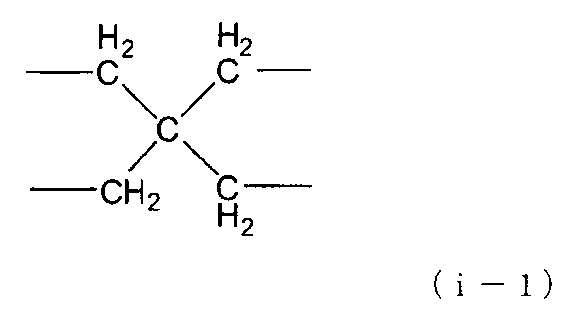
6. C成分は、多価アルコール若しくはその部分エステルである上記1に記載の樹脂組成物。
7. C成分のヒドロキシル価が1000以下である上記1に記載の樹脂組成物。
8. C成分は、多価アルコールと炭素数12以上の脂肪酸との部分エステルである、上記6に記載の樹脂組成物。
9. C成分の含有量は、A成分100質量部を基準として、0.05~5質量部である上記1に記載の樹脂組成物。
10. 末端カルボキシル基量が5当量/ton以下である上記1に記載の樹脂組成物。
11. 温度280℃での溶融粘度が300Pa・s以下、且つ121℃、100%RH(0.2MPa)のプレッシャクッカーテストにおいて、96時間保持後の還元粘度保持率が50%以上である上記1記載の樹脂組成物。
12. 温度260℃での溶融粘度が300Pa・s以下、且つ121℃、100%RH(0.2MPa)のプレッシャクッカーテストにおいて、100時間保持後の還元粘度保持率が80%以上である上記2記載の樹脂組成物。
13. 末端カルボキシル基量が30当量/ton以下の芳香族ポリエステル樹脂(A成分)、一つの環の中にカルボジイミド基を一つだけ有する環を少なくとも2つ有する環状カルボジイミド化合物(B成分)およびヒドロキシル価が200以上の多価水酸基含有化合物(C成分)を含有する樹脂組成物の製造方法であって、
(i)芳香族ポリエステル樹脂(A成分)および多価水酸基含有化合物(C成分)を溶融混練した後、得られた混合物に環状カルボジイミド化合物(B成分)を添加し溶融混練するか、または
(ii)芳香族ポリエステル樹脂(A成分)に、環状カルボジイミド化合物(B成分)および多価水酸基含有化合物(C成分)を同時に添加し溶融混練する、前記製造方法。
14. 上記1~12のいずれか一項に記載の樹脂組成物からなる成形品。
<芳香族ポリエステル樹脂(A成分)>
芳香族ポリエステル樹脂(A成分)とは、ジカルボン酸化合物及び/又はそのエステル形成性誘導体を主成分とするジカルボン酸成分と、ジオール化合物及び/又はそのエステル形成性誘導体を主成分とするジオール成分との反応により得られる熱可塑性ポリエステル樹脂であり、ジカルボン酸成分かジオール成分の少なくとも1種に芳香族化合物を含むものである。
ジカルボン酸成分としては、脂肪族ジカルボン酸、脂環族ジカルボン酸、芳香族ジカルボン酸が挙げられる。
脂肪族ジカルボン酸として、コハク酸、グルタル酸、アジピン酸、ピメリン酸、スベリン酸、アゼライン酸、セバシン酸、ウンデカンジカルボン酸、ドテカンジカルボン酸、ヘキサデカンジカルボン酸、ダイマー酸などの炭素数4~40の脂肪族ジカルボン酸、好ましくは炭素数4~14の脂肪族ジカルボン酸が挙げられる。
脂環族ジカルボン酸として、ヘキサヒドロフタル酸、ヘキサヒドロイソフタル酸、ヘキサヒドロテレフタル酸、ハイミック酸などの炭素数4~40の脂環族ジカルボン酸、好ましくは炭素数8~12の脂環族ジカルボン酸が挙げられる。
芳香族ジカルボン酸として、フタル酸、イソフタル酸、テレフタル酸、メチルイソフタル酸、メチルテレフタル酸、2,6−ナフタレンジカルボン酸などのナフタレンジカルボン酸、4,4’−ビフェニルジカルボン酸、4,4’−ジフェノキシエーテルジカルボン酸、4,4’−ジオキシ安息香酸、4,4’−ジフェニルメタンジカルボン酸、4,4’−ジフェニルケトンジカルボン酸などの炭素数8~16の芳香族ジカルボン酸又はこれらの誘導体が挙げられる。誘導体として低級アルキルエステル、アリールエステル、酸無水物などのエステル形成可能な誘導体が挙げられる。
これらのジカルボン酸成分は、単独又は二種以上組合せて使用できる。好ましいジカルボン酸成分には、テレフタル酸、イソフタル酸、ナフタレンジカルボン酸などの芳香族ジカルボン酸が挙げられる。特にテレフタル酸、2,6−ナフタレンジカルボン酸が好ましい。ジカルボン酸成分中には、例えば、50モル%以上、好ましくは80モル%以上、さらに好ましくは90モル%以上の芳香族ジカルボン酸が含まれているのが好ましい。さらに、必要に応じて、トリメリット酸、ピロメリット酸などの多価カルボン酸又はそのエステル形成誘導体(アルコールエステル等)等を併用してもよい。このような多官能性化合物を併用すると、分岐状の熱可塑性ポリエステル樹脂を得ることもできる。
ジオール成分として、脂肪族ジオール、ポリオキシアルキレングリコール、脂環族ジオールなどが挙げられる。
脂肪族ジオールとして、エチレングリコール、トリメチレングリコール、プロピレングリコール、1,4−ブタンジオール、1,3−ブタンジオール、ネオペンチルグリコール、ヘキサンジオール、オクタンジオール、デカンジオールなどの炭素数2~12の脂肪族ジオール、好ましくは炭素数2~10の脂肪族ジオールが挙げられる。
ポリオキシアルキレングリコールとして、アルキレン基の炭素数が2~4程度であり、複数のオキシアルキレン単位を有するグリコールが挙げられる。例えば、ジエチレングリコール、ジプロピレングリコール、ジテトラメチレングリコール、トリエチレングリコール、トリプロピレングリコール、ポリテトラメチレングリコールが挙げられる。
脂環族ジオールとして、1,4−シクロヘキサンジオール、1,4−シクロヘキサンジメタノール、水素化ビスフェノールAが挙げられる。
また、ハイドロキノン、レゾルシノール、ビスフェノール、2,2−ビス(4−ヒドロキシフェニル)プロパン、2,2−ビス−(4−(2−ヒドロキシエトキシ)フェニル)プロパン、キシリレングリコールなどの芳香族ジオールを併用してもよい。
これらのジオール成分は、単独又は二種以上組合せて使用できる。好ましいジオール成分は、エチレングリコール、トリメチレングリコール、プロピレングリコール、1,4−ブタンジオールなどの炭素数2~10のアルキレングリコールなどが挙げられる。
ジオール成分中には、例えば、50モル%以上、好ましくは80モル%以上、さらに好ましくは90モル%以上の炭素数2~10のアルキレングリコールが含まれているのが好ましい。さらに、必要に応じて、グリセリン、トリメチロールプロパン、トリメチロールエタン、ペンタエリスリトールなどのポリオール又はそのエステル形成性誘導体を併用してもよい。このような多官能性化合物を併用すると、分岐状の熱可塑性ポリエステル樹脂を得ることもできる。
芳香族ポリエステル樹脂(A成分)としては、上述のジカルボン酸成分とジオール成分を2種以上組み合せたコポリエステルや、さらに他の共重合可能なモノマー(以下、共重合性モノマーという場合がある)として、オキシカルボン酸成分、ラクトン成分等を組み合わせたコポリエステルも使用できる。
オキシカルボン酸には、例えば、オキシ安息香酸、オキシナフトエ酸、ヒドロキシフェニル酢酸、グリコール酸、オキシカプロン酸等のオキシカルボン酸又はこれらの誘導体等が含まれる。ラクトンには、プロピオラクトン、ブチロラクトン、バレロラクトン、カプロラクトン(例えば、ε−カプロラクトン等)等の炭素数3~12のラクトン等が含まれる。
なお、コポリエステルにおいて、共重合性モノマーの割合は、例えば、0.01モル%以上30モル%以下程度の範囲から選択でき、通常、1モル%以上30モル%以下程度、好ましくは3モル%以上25モル%以下程度、更に好ましくは5モル%以上20モル%以下程度である。また、ホモポリエステルとコポリエステルとを組み合わせて使用する場合、ホモポリエステルとコポリエステルとの割合は、共重合性モノマーの割合が、全単量体に対して0.1モル%以上30モル%以下(好ましくは1モル%以上25モル%以下程度、更に好ましくは5モル%以上25モル%以下程度)となる範囲であり、通常、前者/後者=99/1~1/99(質量比)、好ましくは95/5~5/95(質量比)、更に好ましくは90/10~10/90(質量比)程度の範囲から選択できる。
好ましい芳香族ポリエステル樹脂(A成分)には、アルキレンテレフタレート、アルキレンナフタレートなどのアルキレンアリレート単位を主成分(例えば、50~100モル%、好ましくは75~100モル%程度)とするホモポリエステル又はコポリエステルが挙げられる。
ポリアルキレンテレフタレートとして、ポリエチレンテレフタレート(PET)、ポリトリメチレンテレフタレート(PTT)、ポリブチレンテレフタレート(PBT)などのアルキレン部分の炭素数が2~4のポリアルキレンテレフタレート、1,4−シクロヘキサンジメチレンテレフタレート(PCT)が挙げられる。
ポリアルキレンナフタレートとして、ポリエチレンナフタレート、ポリプロピレンナフタレート、ポリブチレンナフタレートなどのアルキレン部分の炭素数が2~4のポリアルキレンナフタレートが挙げられる。これらを1種単独で又は2種以上組み合わせて使用できる。
特に好ましい芳香族ポリエステル樹脂(A成分)は、エチレンテレフタレート、トリメチレンテレフタレート、テトラメチレンテレフタレート、テトラメチレン−2,6−ナフタレートなどのアルキレン部分の炭素数が2~4のアルキレンアリレート単位を80モル%以上(特に90モル%以上)含むホモポリエステル樹脂又はコポリエステル樹脂が挙げられる。例えば、ポリエチレンテレフタレート樹脂、ポリトリメチレンテレフタレート樹脂、ポリブチレンテレフタレート樹脂、ポリテトラメチレン−2,6−ナフタレンジカルボキシレート樹脂などが挙げられる。これらの内、ポリエチレンテレフタレート樹脂、ポリブチレンテレフタレート樹脂が好ましく、特にポリブチレンテレフタレート樹脂が好ましい。
芳香族ポリエステル樹脂(A成分)は、ポリブチレンテレフタレートを50質量%以上含むことが好ましい。
芳香族ポリエステル樹脂(A成分)の末端カルボキシル基量は30当量/ton以下である。より好ましい末端カルボキシル基量は25当量/ton以下である。
本発明によれば、環状カルボジイミド化合物(B成分)の使用により、樹脂組成物の耐加水分解性を高められるが、芳香族ポリエステル樹脂(A成分)の末端カルボキシル基量が多すぎると、樹脂組成物の耐加水分解性は充分に高まらない。したがって、芳香族ポリエステル樹脂(A成分)の末端カルボキシル基量を30当量/ton以下にする必要がある。
芳香族ポリエステル樹脂(A成分)の固有粘度(IV)は、0.6dL/g以上であることが好ましく、更に好ましくは0.7dL/g以上であってもよい。また、上記固有粘度は1.3dL/g以下であることが好ましく、1.2dL/g以下であることがより好ましい。異なる固有粘度を有する芳香族ポリエステル樹脂(A成分)をブレンドすることによって、例えば固有粘度1.5dL/gと0.5dL/gの芳香族ポリエステル樹脂をブレンドすることによって、0.6~1.3dL/g以下の固有粘度を実現してもよい。固有粘度(IV)は、o−クロロフェノール中もしくはフェノール/テトラクロロエタン(質量比60/40)の混合溶媒、温度35℃の条件で測定できる。このような範囲の固有粘度を有する芳香族ポリエステル樹脂を使用すると、十分な耐加水分解性の付与と溶融粘度の低減とを効率よく実現しやすい。固有粘度が小さすぎると、十分な耐加水分解性の向上効果が得られない可能性があり、固有粘度が大きすぎると、成形時の溶融粘度が高くなり、場合により成形金型内で樹脂の流動不良、充填不良を起こす可能性がある。
芳香族ポリエステル樹脂(A成分)は、市販品を使用してもよく、ジカルボン酸成分又はその反応性誘導体と、ジオール成分又はその反応性誘導体と、必要により共重合可能なモノマーとを、慣用の方法、例えばエステル交換反応法や、直接エステル化法等により共重合(重縮合)することにより製造したものを使用してもよい。
本発明の樹脂組成物は、末端カルボキシル基量が5当量/ton以下であることが好ましい。この範囲にあるときには特に良好な耐加水分解性を有する。また、さらに好ましい末端カルボキシル基量は3当量/ton以下である。
本発明の樹脂組成物は、121℃、100%RH(0.2MPa)のプレッシャクッカーテストにおいて、100時間後の還元粘度保持率が50%以上であることが望ましい。還元粘度保持率が50%以上であれば、最終的に得られるフィルム、成形品は著しく機械強度を低下することなく、十分な耐加水分解性を有する。
本発明は、芳香族ポリエステル樹脂(A成分)の全質量を基準として、ポリブチレンテレフタレートが50質量%以上を占めるポリブチレンテレフタレート樹脂組成物であって、温度260℃での溶融粘度が300Pa・s以下、且つ121℃、100%RH(0.2MPa)のプレッシャクッカーテストにおいて、100時間後の還元粘度保持率が80%以上であるポリブチレンテレフタレート樹脂組成物を包含する。
本発明のポリブチレンテレフタレート樹脂組成物において、ポリブチレンテレフタレートは、A成分の全質量を基準として50質量%以上を占める。ポリブチレンテレフタレートの特性を発揮するためには好ましくは90質量%以上、特に好ましくは95質量%以上、最も好ましくは97.5質量%以上である。
本発明の樹脂組成物は、温度260℃での溶融粘度が1000Pa・s以下であることが好ましく、300Pa・s以下であることがより好ましい。260℃での溶融粘度が1000Pa・s以下、特に300Pa・s以下であれば、射出成形も容易であり、溶融製膜、溶融成形の際に黄変を生じることが無い。
<環状カルボジイミド化合物(B成分)>
本発明の樹脂組成物は、芳香族ポリエステル樹脂(A成分)に対して、一つの環の中にカルボジイミド基をひとつだけ有するカルボジイミド環を少なくとも2つ有する環状カルボジイミド化合物(B成分)を含有する。
本発明において、「カルボジイミド環」とは、複数の原子が環構造をとるように結合した化合物、いわゆる環式化合物において、カルボジイミド基が一つのみ存在する環を意味し、環状カルボジイミド化合物(B成分)全体としては、一分子中には、一つの環の中にカルボジイミド基(−N=C=N−)を一つだけ有するカルボジイミド環を、少なくとも2つ有する化合物である。このような構造を有する化合物は、特に、芳香族ポリエステル樹脂(A成分)の湿熱耐久性向上効果が著しく、また、末端封止反応により、イソシアネート化合物が発生しない。
カルボジイミド環を構成する環状構造中の原子数は、好ましくは8~50、より好ましくは10~30、さらに好ましくは10~20、特に好ましくは10~15である。
ここで、環状構造中の原子数とは、環構造を直接構成する原子の数を意味し、例えば、8員環であれば8、50員環であれば50である。環状構造中の原子数が8以上ならば、環状カルボジイミド化合物(B成分)の安定性が高いため、保管、使用がしやすい。また反応性の観点よりは環員数の上限値に関しては特別の制限はないが、50以下の原子数の環状カルボジイミド化合物(B成分)は合成が容易なため、コストが大きく上昇することを抑制できる。
環状カルボジイミド化合物(B成分)の分子量は、好ましくは100~1,000である。100以上ならば、環状カルボジイミド化合物(B成分)について構造の安定性や揮発性が有利となる。また1,000以下ならば、環状カルボジイミドの製造上、希釈系での合成が不要であり、収率も低下しにくいため、コスト面で有利となる。かかる観点より、より好ましくは100~750であり、さらに好ましくは250~750である。ここで、環状カルボジイミド化合物(B成分)の分子量とは、環状カルボジイミド化合物(B成分)が分子量分布を持つものである場合には、重量平均分子量を指す。
また、B成分としては、複数のカルボジイミド環がスピロ結合または結合基を介して結合している環状カルボジイミド化合物であることが好ましい。このような構造をとる場合には、さらに、芳香族ポリエステル樹脂(A成分)の湿熱耐久性向上効果を高めることができる。
特には、下記式で表される化合物であることが好ましい。
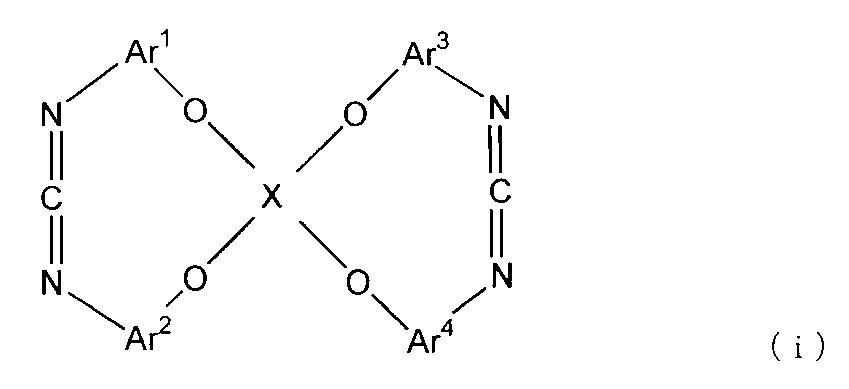

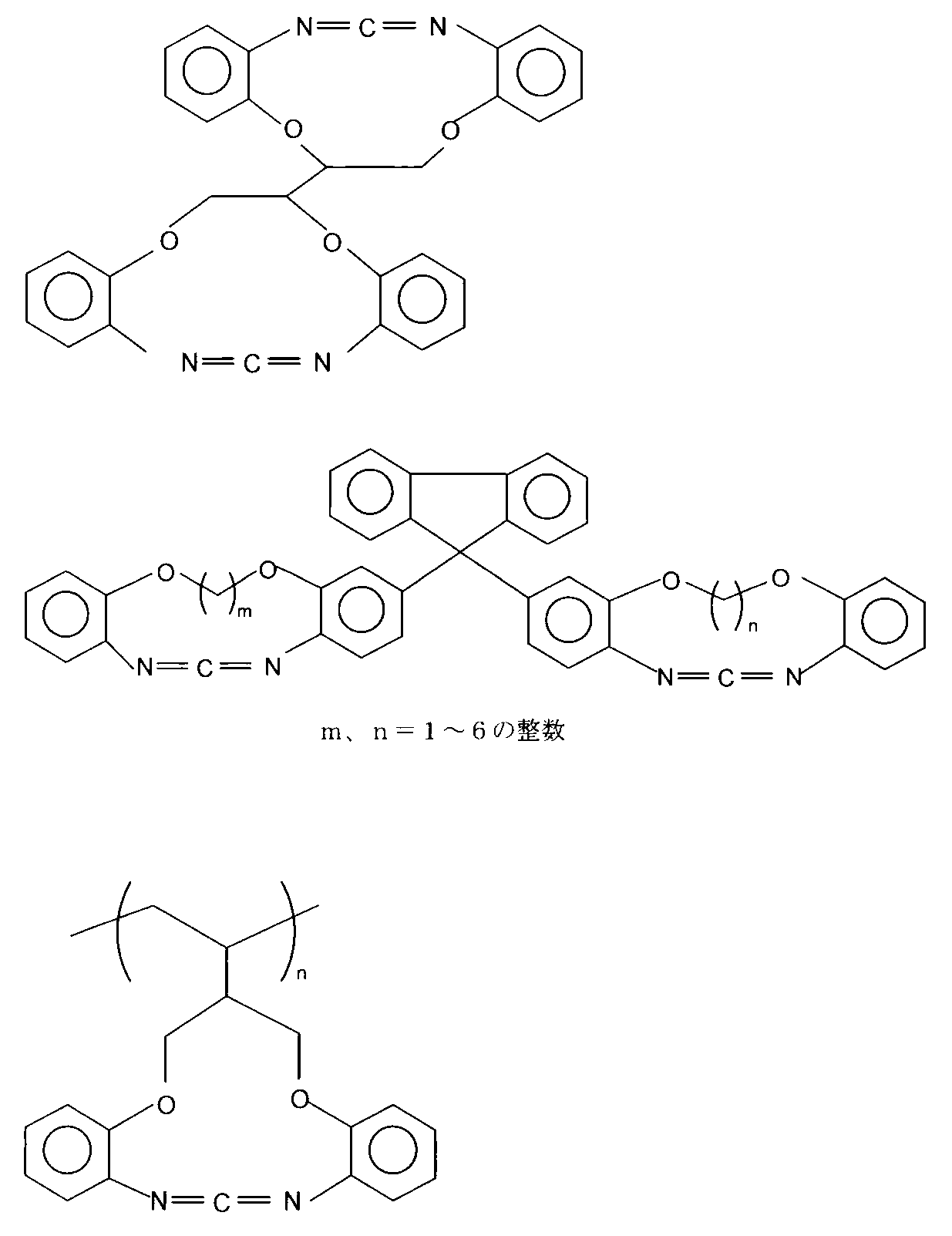


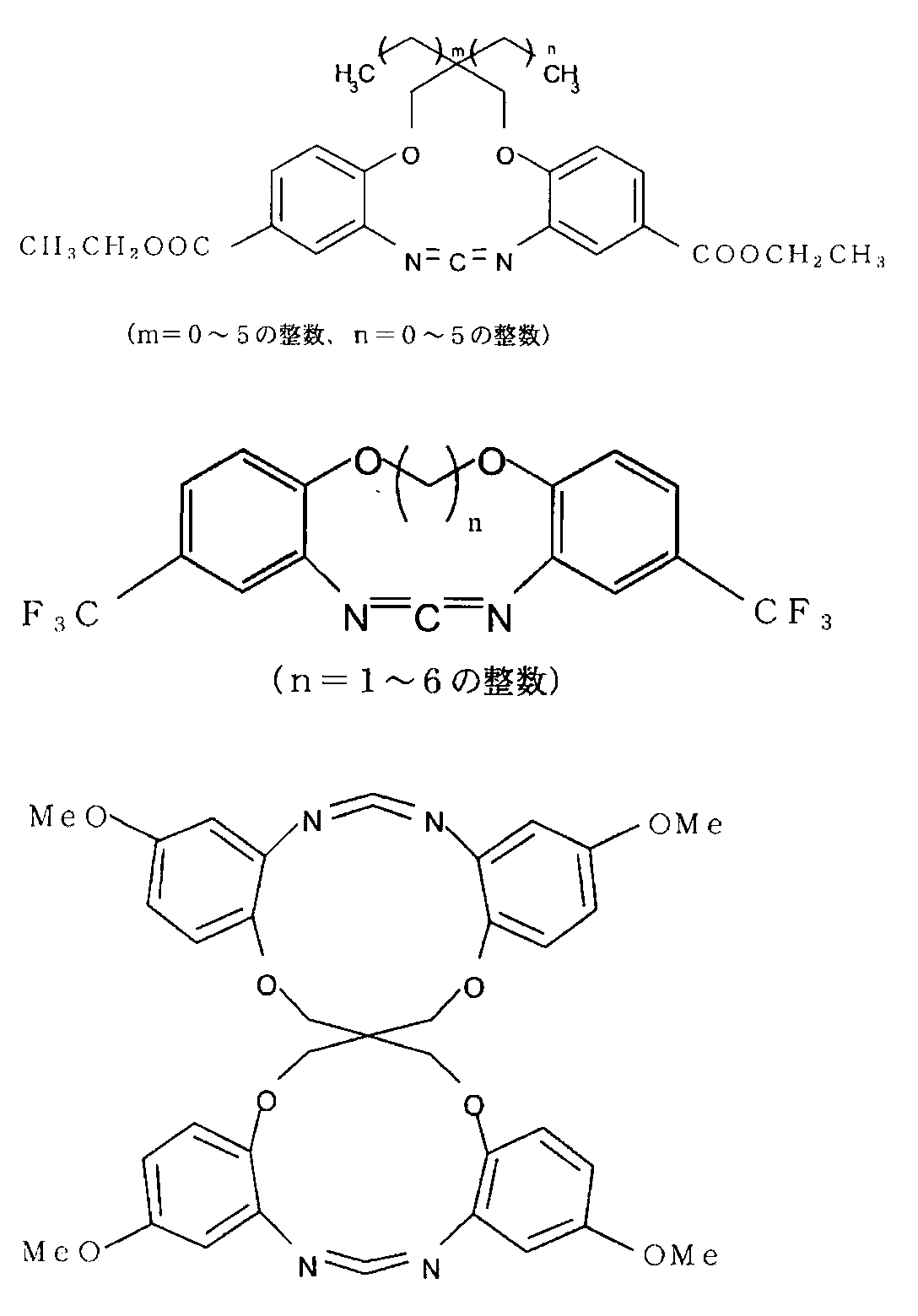
樹脂組成物中の環状カルボジイミド化合物(B成分)の含有量は、芳香族ポリエステル樹脂(A成分)100質量部に対して、好ましくは0.1~3質量部、より好ましくは0.3~2質量部、さらに好ましくは0.5~1.5質量部である。B成分の含有量が上記の範囲であれば、基質の特性を変性させることなく、カルボジイミドの効果を得ることができる。
<多価水酸基含有化合物(C成分)>
多価水酸基含有化合物(C成分)は、一分子中に水酸基を2個以上有する化合物である。また、多価水酸基含有化合物(C成分)は、後述する通り、ヒドロキシル価が200以上である。ヒドロキシル価が200以上の多価水酸基含有化合物(C成分)は、1種単独で又は2種以上組み合わせて使用できる。
この多価水酸基含有化合物(C成分)は、樹脂組成物の流動性を高める。通常、芳香族ポリエステル樹脂に流動性を高める成分を添加すると、流動性を向上できても、芳香族ポリエステル樹脂そのものが有する機械的強度や靱性等の特性の低下を避けることができない。しかし、ヒドロキシル価が200以上の多価水酸基含有化合物(C成分)を使用することにより、芳香族ポリエステル樹脂の特性を高いレベルで保持しつつ樹脂組成物の溶融時の流動性を効率よく向上できる。
また、ヒドロキシル価200以上の多価水酸基含有化合物(C成分)は、環状カルボジイミド化合物(B成分)が配合される樹脂組成物において、B成分による樹脂組成物の耐加水分解性向上効果を促進させる耐加水分解性向上助剤としても働く。この原因は定かではないが、ヒドロキシル価200以上の多価水酸基含有化合物(C成分)が、樹脂組成物の粘度上昇を抑制することで溶融混練性が向上し、芳香族ポリエステル樹脂(A成分)と環状カルボジイミド化合物(B成分)との反応が効率よく行われるためと考えられる。
したがって、ヒドロキシル価200以上の多価水酸基含有化合物(C成分)が、樹脂組成物に含まれることで、芳香族ポリエステル樹脂(A成分)の特性を活かすとともに、樹脂組成物の流動性を高めつつ、樹脂組成物の耐加水分解性も高めることができる。
ヒドロキシル価200以上の多価水酸基含有化合物(C成分)は、従来公知の方法で製造したものを使用してもよいし、市販品を購入して使用してもよい。
多価水酸基含有化合物(C成分)のヒドロキシル価は200以上である。また、好ましいヒドロキシル価は250以上である。上記ヒドロキシル価が200以上であれば、上記流動性向上の効果がより高まる傾向にある。
一方、多価水酸基含有化合物(C成分)のヒドロキシル価は、好ましくは1000以下、より好ましくは800以下、さらに好ましくは600以下、特に好ましくは500以下である。上記ヒドロキシル価が1000以下であると、得られる樹脂組成物の成形時にモールドデポジット(金型付着)が発生するのを効果的に抑制することができるという更なる効果を奏することができる。
加えて、多価水酸基含有化合物(C成分)と芳香族ポリエステル樹脂(A成分)との反応が過剰に進行することが抑制されるため、芳香族ポリエステル樹脂(A成分)の分子量が低下しにくく、機械特性や耐加水分解性、耐熱性、耐薬品性等の特性が維持されやすい。
なお、本願において、ヒドロキシル価とは、日本油化学会法2.3.6.2−1996(ピリジン・無水酢酸法)(日本油化学会制定 基準油脂分析試験法)により測定されたものをいう。
多価水酸基含有化合物(C成分)として、多価アルコール若しくはその部分エステルが挙げられる。C成分は、多価アルコールと炭素数12以上の脂肪酸との部分エステルが好ましい。
多価アルコールとしてヒドロキシメチル基を同一分子内に2つ以上有する化合物が挙げられる。具体的には、エチレングリコール、プロピレングリコール、1,3−プロパンジオール、1,4−ブタンジオール、1,6−ヘキサンジオール、ジエチレングリコール、ポリエチレングリコール、ポリプロピレングリコール、ポリテトラメチレングリコール、トリメチロールメタン、ペンタエリスリトール、ジペンタエリスリトール、トリペンタエリスリトール、各種ソルビトール類等が挙げられる。これらから選択された少なくとも1種よりなるものが好ましく使用でき、1種のみでも良くまた2種以上を併用することもできる。
多価アルコールの部分エステルの脂肪酸としては、炭素数12以上のものが流動性の観点で、好ましい。炭素数12以上の脂肪酸として、ラウリン酸、オレイン酸、パルミチン酸、ステアリン酸、12−ヒドロキシステアリン酸、ベヘニン酸、モンタン酸等が挙げられる。好ましくは炭素数12~32の脂肪酸であり、特に好ましくは炭素数12~22の脂肪酸である。具体的には、ラウリン酸、ステアリン酸、12−ヒドロキシステアリン酸又はベヘニン酸が特に好ましい。炭素数12以上の脂肪酸を用いることで、樹脂の耐熱性を充分に維持できる傾向にあるため好ましい。炭素数が32以下であれば、上記流動性改善の効果が高いため好ましい。
樹脂組成物に溶融時の流動性を付与する観点、得られる成形体が芳香族ポリエステル樹脂(A成分)の物性をほとんど低下させずに維持する観点から、多価水酸基含有化合物(C成分)として、グリセリン脂肪酸エステル又はジグリセリンに酸化アルキレンを付加重合して得られるエーテルが好ましい。
以下、グリセリン脂肪酸エステル、ジグリセリンに酸化アルキレンを付加重合して得られるエーテルを説明する。グリセリン脂肪酸エステルは、グリセリン及び/又はその脱水縮合物と脂肪酸とから構成されるエステルである。
グリセリン脂肪酸エステルの中でも、炭素数12以上の脂肪酸を用いて得られるものが好ましい。炭素数12以上の脂肪酸として、ラウリン酸、オレイン酸、パルミチン酸、ステアリン酸、12−ヒドロキシステアリン酸、ベヘニン酸、モンタン酸等が挙げられる。好ましくは炭素数12~32の脂肪酸であり、特に好ましくは炭素数12~22の脂肪酸である。
好ましいグリセリン脂肪酸エステルを例示すると、グリセリンモノステアレート、グリセリンモノベヘネート、ジグリセリンモノステアレート、トリグリセリンモノステアレート、トリグリセリンステアリン酸部分エステル、テトラグリセリンステアリン酸部分エステル、デカグリセリンラウリン酸部分エステル、グリセリンモノ12−ヒドロキシステアレート等が挙げられる。
ジグリセリンに酸化アルキレンを付加重合して得られるエーテルとは、例えば、ジグリセリンに酸化プロピレンを付加重合して得られるポリオキシプロピレンジグリセリルエーテルや、ジグリセリンに酸化エチレンを付加重合して得られるポリオキシエチレンジグリセリルエーテルが挙げられる。本発明においては、これらのエーテルの中でも、特に、ポリオキシエチレンジグリセリルエーテルの使用が好ましい。
樹脂組成物中の多価水酸基含有化合物(C成分)の含有量は、芳香族ポリエステル樹脂(A成分)100質量部に対して、好ましくは0.05~5質量部、より好ましくは0.1~3質量部、更に好ましくは0.5~2質量部である。多価水酸基含有化合物の含有量が0.05質量部以上であれば、流動性向上の効果が十分に得られる傾向にあるため好ましく、5質量部以下であれば、成形時のガス発生による成形品の外観不良や金型汚れを生じるおそれがほとんどないため好ましい。
<樹脂組成物の製造方法>
本発明の樹脂組成物は、芳香族ポリエステル樹脂(A成分)、環状カルボジイミド化合物(B成分)、多価水酸基含有化合物(C成分)を溶融混練して製造することができる。
ここで、多価水酸基含有化合物(C成分)の系内への添加時期は重要であり、芳香族ポリエステル樹脂(A成分)にカルボジイミド化合物(B成分)を添加する前にヒドロキシル価が200以上の多価水酸基含有化合物(C成分)を添加しないと、C成分添加による増粘抑制効果を発揮する前に、カルボジイミド化合物(B成分)による増粘が起こるため、B成分添加後に、C成分を後から添加したとしても本発明の樹脂組成物は得られ難い。
従って、
(I)芳香族ポリエステル樹脂(A成分)と多価水酸基含有化合物(C成分)との共存下にカルボジイミド化合物(B成分)を添加し溶融混練するか、または、
(II)芳香族ポリエステル樹脂(A成分)に対して多価水酸基含有化合物(C成分))とカルボジイミド化合物(B成分)とを同時に添加し溶融混練すればよい。
上記(I)において、芳香族ポリエステル樹脂(A成分)と多価水酸基含有化合物(C成分)とを共存させた場合には、カルボジイミド化合物(B成分)を添加する前に、C成分を分散させておくという観点から、予め溶融混練しておくことが好ましい。
混練に際しては、溶融状態での混練法が、生産性、均一混練性の観点より好ましい。混練装置としては、とくに限定なく、従来公知の縦型の反応容器、混合槽、混練槽あるいは横置き型の一軸式混練装置または多軸式の混練装置、例えば一軸式あるいは多軸式のルーダー、ニーダーなどが例示される。溶融混練時間は特に指定はなく、混合装置、混合温度にもよるが、0.1分間から2時間、好ましくは0.2分間から60分間、より好ましくは0.2分間から30分間が選択される。
環状カルボジイミド化合物(B成分)による、芳香族ポリエステル樹脂のカルボキシル基の封止反応は、室温(25℃)~300℃程度の温度で可能であるが、反応効率の観点より50℃~280℃、より好ましくは100℃~280℃の範囲ではより促進されるので好ましい。
芳香族ポリエステル樹脂(A成分)は、溶融している温度ではより反応が進行しやすいが、環状カルボジイミド化合物(B成分)の揮散、分解などを抑制するため、300℃より低い温度で反応させることが好ましい。また芳香族ポリエステル樹脂(A成分)の溶融温度を低下、攪拌効率を上げるためにも、溶媒を適用することは効果がある。
封止反応は無触媒で十分速やかに進行するが、封止反応を促進する触媒を使用することもできる。触媒としては、従来の線状カルボジイミド化合物を用いて封止反応を行う際に使用される触媒が適用できる。これらは1種または2種以上使用することができる。触媒の添加量は、特に限定されるものではないが、熱可塑性芳香族ポリエステルと環状カルボジイミドとの合計100質量部に対し、0.001~1質量部が好ましく、また0.01~0.1質量部がより好ましく、さらには0.02~0.1質量部が最も好ましい。
<安定剤>
本発明の樹脂組成物には、安定剤を含有することができる。安定剤としては通常の熱可塑性樹脂の安定剤に使用されるものを用いることができる。例えば酸化防止剤、光安定剤等を挙げることができる。これらの剤を配合することで機械的特性、成形性、耐熱性および耐久性に優れた成形品を得ることができる。
酸化防止剤としてはヒンダードフェノール系化合物、ヒンダードアミン系化合物、ホスファイト系化合物などのリン系化合物、チオエーテル系化合物等を挙げることができる。
ヒンダードフェノール系化合物としては、n−オクタデシル−3−(3’,5’−ジ−tert−ブチル−4’−ヒドロキシフェニル)−プロピオネート、n−オクタデシル−3−(3’−メチル−5’−tert−ブチル−4’−ヒドロキシフェニル)−プロピオネート、n−テトラデシル−3−(3’,5’−ジ−tert−ブチル−4’−ヒドロキシフェニル)−プロピオネート、1,6−ヘキサンジオール−ビス[3−(3,5−ジ−tert−ブチル−4−ヒドロキシフェニル)−プロピオネート]、1,4−ブタンジオール−ビス[3−(3,5−ジ−tert−ブチル−4−ヒドロキシフェニル)−プロピオネート]、2,2’−メチレン−ビス(4−メチル−tert−ブチルフェノール)、トリエチレングリコール−ビス[3−(3−tert−ブチル−5−メチル−4−ヒドロキシフェニル)−プロピオネート]、テトラキス[メチレン−3−(3’,5’−ジ−tert−ブチル−4−ヒドロキシフェニル)プロピオネート]メタン、3,9−ビス[2−{3−(3−tert−ブチル−4−ヒドロキシ−5−メチルフェニル)プロピオニルオキシ}−1,1−ジメチルエチル]2,4,8,10−テトラオキサスピロ(5,5)ウンデカン等が挙げられる。
ヒンダードアミン系化合物として、N,N’−ビス−3−(3’,5’−ジ−tert−ブチル−4’−ヒドロキシフェニル)プロピオニルヘキサメチレンジアミン、N,N’−テトラメチレン−ビス[3−(3’−メチル−5’−tert−ブチル−4’−ヒドロキシフェニル)プロピオニル]ジアミン、N,N’−ビス[3−(3,5−ジ−tert−ブチル−4−ヒドロキシフェニル)−プロピオニル]ヒドラジン、N−サリチロイル−N’−サリチリデンヒドラジン、3−(N−サリチロイル)アミノ−1,2,4−トリアゾール、N,N’−ビス[2−{3−(3,5−ジ−tert−ブチル−4−ヒドロキシフェニル)プロピオニルオキシ}エチル]オキシアミド等を挙げることができる。好ましくは、トリエチレングリコール−ビス[3−(3−tert−ブチル−5−メチル−4−ヒドロキシフェニル)−プロピオネート]、およびテトラキス[メチレン−3−(3’,5’−ジ−tert−ブチル−4−ヒドロキシフェニル)プロピオネート]メタン等が挙げられる。
ホスファイト系化合物としては、少なくとも1つのP−O結合が芳香族基に結合しているものが好ましく、具体的には、トリス(2,6−ジ−tert−ブチルフェニル)ホスファイト、テトラキス(2,6−ジ−tert−ブチルフェニル)4,4’−ビフェニレンホスファイト、ビス(2,6−ジ−tert−ブチル−4−メチルフェニル)ペンタエリスリトール−ジ−ホスファイト、2,2−メチレンビス(4,6−ジ−tert−ブチルフェニル)オクチルホスファイト、4,4’−ブチリデン−ビス(3−メチル−6−tert−ブチルフェニル−ジ−トリデシル)ホスファイト、1,1,3−トリス(2−メチル−4−ジトリデシルホスファイト−5−tert−ブチルフェニル)ブタン、トリス(ミックスドモノおよびジ−ノニルフェニル)ホスファイト、トリス(ノニルフェニル)ホスファイト、4,4’−イソプロピリデンビス(フェニル−ジアルキルホスファイト)等が挙げられる。
なかでもトリス(2,6−ジ−tert−ブチルフェニル)ホスファイト、2,2−メチレンビス(4,6−ジ−tert−ブチルフェニル)オクチルホスファイト、ビス(2,6−ジ−tert−ブチル−4−メチルフェニル)ペンタエリスリトール−ジホスファイト、テトラキス(2,6−ジ−tert−ブチルフェニル)4,4’−ビフェニレンホスファイト等が好ましく使用できる。
チオエーテル系化合物の具体例として、ジラウリルチオジプロピオネート、ジトリデシルチオジプロピオネート、ジミリスチルチオジプロピオネート、ジステアリルチオジプロピオネート、ペンタエリスリトール−テトラキス(3−ラウリルチオプロピオネート)、ペンタエリスリトール−テトラキス(3−ドデシルチオプロピオネート)、ペンタエリスリトール−テトラキス(3−オクタデシルチオプロピオネート)、ペンタエリスリトールテトラキス(3−ミリスチルチオプロピオネート)、ペンタエリスリトール−テトラキス(3−ステアリルチオプロピオネート)等が挙げられる。
光安定剤としては、具体的には例えば、ベンゾフェノン系化合物、ベンゾトリアゾール系化合物、芳香族ベンゾエート系化合物、蓚酸アニリド系化合物、シアノアクリレート系化合物およびヒンダードアミン系化合物等を挙げることができる。
ベンゾフェノン系化合物としては、ベンゾフェノン、2,4−ジヒドロキシベンゾフェノン、2,2’−ジヒドロキシベンゾフェノン、2,2’,4,4’−テトラヒドロキシベンゾフェノン、2−ヒドロキシ−4−メトキシベンゾフェノン、2,2’−ジヒドロキシ−4,4’−ジメトキシベンゾフェノン、2,2’−ジヒドロキシ−4,4’−ジメトキシ−5−スルホベンゾフェノン、2−ヒドロキシ−4−オクトキシベンゾフェノン、2−ヒドロキシ−4−ドデシロキシベンゾフェノン、2−ヒドロキシ−4−オクトキシベンゾフェノン、2−ヒドロキシ−4−メトキシ−5−スルホベンゾフェノン、5−クロロ−2−ヒドロキシベンゾフェノン、2−ヒドロキシ−4−オクトキシベンゾフェノン、2−ヒドロキシ−4−メトキシ−2’−カルボキシベンゾフェノン、2−ヒドロキシ−4−(2−ヒドロキシ−3−メチル−アクリロキシイソプロポキシ)ベンゾフェノン等が挙げられる。
ベンゾトリアゾール系化合物としては、2−(5−メチル−2−ヒドロキシフェニル)ベンゾトリアゾール、2−(3,5−ジ−tert−ブチル−2−ヒドロキシフェニル)ベンゾトリアゾール、2−(3,5−ジ−tert−アミル−2−ヒドロキシフェニル)ベンゾトリアゾール、2−(3’,5’−ジ−tert−ブチル−4’−メチル−2’−ヒドロキシフェニル)ベンゾトリアゾール、2−(3,5−ジ−tert−アミル−2−ヒドロキシフェニル)−5−クロロベンゾトリアゾール、2−(5−tert−ブチル−2−ヒドロキシフェニル)ベンゾトリアゾール、2−[2’−ヒドロキシ−3’,5’−ビス(α,α−ジメチルベンジル)フェニル]ベンゾトリアゾール、2−[2’−ヒドロキシ−3’,5’−ビス(α,α−ジメチルベンジル)フェニル]−2H−ベンゾトリアゾール、2−(4’−オクトキシ−2’−ヒドロキシフェニル)ベンゾトリアゾール等が挙げられる。
芳香族ベンゾエート系化合物としては、p−tert−ブチルフェニルサリシレート、p−オクチルフェニルサリシレート等のアルキルフェニルサリシレート類が挙げられる。
蓚酸アニリド系化合物としては、2−エトキシ−2’−エチルオキザリックアシッドビスアニリド、2−エトキシ−5−tert−ブチル−2’−エチルオキザリックアシッドビスアニリド、2−エトキシ−3’−ドデシルオキザリックアシッドビスアニリド等が挙げられる。
シアノアクリレート系化合物としては、エチル−2−シアノ−3,3’−ジフェニルアクリレート、2−エチルヘキシル−シアノ−3,3’−ジフェニルアクリレート等が挙げられる。
ヒンダードアミン系化合物としては、4−アセトキシ−2,2,6,6−テトラメチルピペリジン、4−ステアロイルオキシ−2,2,6,6−テトラメチルピペリジン、4−アクリロイルオキシ−2,2,6,6−テトラメチルピペリジン、4−(フェニルアセトキシ)−2,2,6,6−テトラメチルピペリジン、4−ベンゾイルオキシ−2,2,6,6−テトラメチルピペリジン、4−メトキシ−2,2,6,6−テトラメチルピペリジン、4−オクタデシルオキシ−2,2,6,6−テトラメチルピペリジン、4−シクロヘキシルオキシ−2,2,6,6−テトラメチルピペリジン、4−ベンジルオキシ−2,2,6,6−テトラメチルピペリジン、4−フェノキシ−2,2,6,6−テトラメチルピペリジン、4−(エチルカルバモイルオキシ)−2,2,6,6−テトラメチルピペリジン、4−(シクロヘキシルカルバモイルオキシ)−2,2,6,6−テトラメチルピペリジン、4−(フェニルカルバモイルオキシ)−2,2,6,6−テトラメチルピペリジン、ビス(2,2,6,6−テトラメチル−4−ピペリジル)カーボネート、ビス(2,2,6,6−テトラメチル−4−ピペリジル)オギザレート、ビス(2,2,6,6−テトラメチル−4−ピペリジル)マロネート、ビス(2,2,6,6−テトラメチル−4−ピペリジル)セバケート、ビス(2,2,6,6−テトラメチル−4−ピペリジル)アジペート、ビス(2,2,6,6−テトラメチル−4−ピペリジル)テレフタレート、1,2−ビス(2,2,6,6−テトラメチル−4−ピペリジルオキシ)−エタン、α,α’−ビス(2,2,6,6−テトラメチル−4−ピペリジルオキシ)−p−キシレン、ビス(2,2,6,6−テトラメチル−4−ピペリジル)−トリレン−2,4−ジカルバメート、ビス(2,2,6,6−テトラメチル−4−ピペリジル)−ヘキサメチレン−1,6−ジカルバメート、トリス(2,2,6,6−テトラメチル−4−ピペリジル)−ベンゼン−1,3,5−トリカルボキシレート、トリス(2,2,6,6−テトラメチル−4−ピペリジル)−ベンゼン−1,3,4−トリカルボキシレート、1−「2−{3−(3,5−ジ−tert−ブチル−4−ヒドロキシフェニル)プロピオニルオキシ}−2,2,6,6−テトラメチルピペリジン、1,2,3,4−ブタンテトラカルボン酸と1,2,2,6,6−ペンタメチル−4−ピペリジノールとβ,β,β’,β’−テトラメチル−3,9−[2,4,8,10−テトラオキサスピロ(5,5)ウンデカン]ジメタノールとの縮合物等を挙げることができる。本発明において安定剤成分は1種類で使用してもよいし2種以上を組み合わせて使用してもよい。また安定剤成分として、ヒンダードフェノール系化合物および/またはベンゾトリアゾール系化合物が好ましい。
安定剤の含有量は芳香族ポリエステル樹脂(A成分)100質量部当たり、好ましくは0.01~3質量部、より好ましくは0.03~2質量部である。
<結晶化促進剤>
本発明の樹脂組成物は、有機若しくは無機の結晶化促進剤を含有することができる。結晶化促進剤を含有することで、機械的特性、耐熱性、および成形性に優れた成形品を得ることができる。
即ち、結晶化促進剤の適用により、成形性、結晶性が向上し、通常の射出成形においても十分に結晶化し耐熱性、耐湿熱安定性に優れた成形品を得ることができる。加えて、成形品を製造する製造時間を大幅に短縮でき、その経済的効果は大きい。
本発明で使用する結晶化促進剤は一般に結晶性樹脂の結晶化核剤として用いられるものを用いることができ、無機系の結晶化核剤および有機系の結晶化核剤のいずれをも使用することができる。
無機系の結晶化核剤として、タルク、カオリン、シリカ、合成マイカ、クレイ、ゼオライト、グラファイト、カーボンブラック、酸化亜鉛、酸化マグネシウム、酸化チタン、炭酸カルシウム、硫酸カルシウム、硫酸バリウム、硫化カルシウム、窒化ホウ素、モンモリロナイト、酸化ネオジム、酸化アルミニウム、フェニルフォスフォネート金属塩等が挙げられる。これらの無機系の結晶化核剤は組成物中での分散性およびその効果を高めるために、各種分散助剤で処理され、一次粒子径が0.01~0.5μm程度の高度に分散状態にあるものが好ましい。
有機系の結晶化核剤としては、安息香酸カルシウム、安息香酸ナトリウム、安息香酸リチウム、安息香酸カリウム、安息香酸マグネシウム、安息香酸バリウム、蓚酸カルシウム、テレフタル酸ジナトリウム、テレフタル酸ジリチウム、テレフタル酸ジカリウム、ラウリン酸ナトリウム、ラウリン酸カリウム、ミリスチン酸ナトリウム、ミリスチン酸カリウム、ミリスチン酸カルシウム、ミリスチン酸バリウム、オクタコ酸ナトリウム、オクタコ酸カルシウム、ステアリン酸ナトリウム、ステアリン酸カリウム、ステアリン酸リチウム、ステアリン酸カルシウム、ステアリン酸マグネシウム、ステアリン酸バリウム、モンタン酸ナトリウム、モンタン酸カルシウム、トルイル酸ナトリウム、サリチル酸ナトリウム、サリチル酸カリウム、サリチル酸亜鉛、アルミニウムジベンゾエート、β−ナフトエ酸ナトリウム、β−ナフトエ酸カリウム、シクロヘキサンカルボン酸ナトリウム等の有機カルボン酸金属塩、p−トルエンスルホン酸ナトリウム、スルホイソフタル酸ナトリウム等の有機スルホン酸金属塩が挙げられる。
また、ステアリン酸アミド、エチレンビスラウリン酸アミド、パルミチン酸アミド、ヒドロキシステアリン酸アミド、エルカ酸アミド、トリメシン酸トリス(tert−ブチルアミド)等の有機カルボン酸アミド、低密度ポリエチレン、高密度ポリエチレン、ポリイソプロピレン、ポリブテン、ポリ−4−メチルペンテン、ポリ−3−メチルブテン−1、ポリビニルシクロアルカン、ポリビニルトリアルキルシラン、高融点ポリ乳酸、エチレン−アクリル酸コポマーのナトリウム塩、スチレン−無水マレイン酸コポリマーのナトリウム塩(いわゆるアイオノマー)、ベンジリデンソルビトールおよびその誘導体、例えばジベンジリデンソルビトール等が挙げられる。
これらのなかでタルク、および有機カルボン酸金属塩から選択された少なくとも1種が好ましく使用される。本発明で使用する結晶化促進剤は1種のみでもよく、2種以上を併用しても良い。
結晶化促進剤の含有量は、芳香族ポリエステル樹脂(A成分)100質量部当たり、好ましくは0.01~30質量部、より好ましくは0.05~20質量部である。
<充填剤>
本発明の樹脂組成物は、有機若しくは無機の充填剤を含有することができる。充填剤成分を含有することで、機械的特性、耐熱性、および金型成形性に優れた成形品を得ることができる。
有機充填剤として、籾殻、木材チップ、おから、古紙粉砕材、衣料粉砕材等のチップ状のもの、綿繊維、麻繊維、竹繊維、木材繊維、ケナフ繊維、ジュート繊維、バナナ繊維、ココナツ繊維等の植物繊維もしくはこれらの植物繊維から加工されたパルプやセルロース繊維および絹、羊毛、アンゴラ、カシミヤ、ラクダ等の動物繊維等の繊維状のもの、ポリエステル繊維、ナイロン繊維、アクリル繊維等の合成繊維、紙粉、木粉、セルロース粉末、籾殻粉末、果実殻粉末、キチン粉末、キトサン粉末、タンパク質、澱粉等の粉末状のものが挙げられる。成形性の観点から紙粉、木粉、竹粉、セルロース粉末、ケナフ粉末、籾殻粉末、果実殻粉末、キチン粉末、キトサン粉末、タンパク質粉末、澱粉等の粉末状のものが好ましく、紙粉、木粉、竹粉、セルロース粉末、ケナフ粉末が好ましい。紙粉、木粉がより好ましい。特に紙粉が好ましい。
これら有機充填剤は天然物から直接採取したものを使用してもよいが、古紙、廃材木および古衣等の廃材をリサイクルしたものを使用してもよい。
また木材として、松、杉、檜、もみ等の針葉樹材、ブナ、シイ、ユーカリ等の広葉樹材等が好ましい。
紙粉は成形性の観点から接着剤、とりわけ、紙を加工する際に通常使用される酢酸ビニル樹脂系エマルジョンやアクリル樹脂系エマルジョン等のエマルジョン系接着剤、ポリビニルアルコール系接着剤、ポリアミド系接着剤等のホットメルト接着剤等を含むものが好ましく例示される。
本発明において有機充填剤の配合量は特に限定されるものではないが、成形性および耐熱性の観点から、芳香族ポリエステル樹脂(A成分)100質量部当たり、好ましくは1~300質量部、より好ましくは5~200質量部、さらに好ましくは10~150質量部、特に好ましくは15~100質量部である。有機充填剤の配合量が1質量部未満であると、組成物の成形性向上効果が小さく、300質量部を超える場合には充填剤の均一分散が困難になり、あるいは成形性、耐熱性以外にも材料としての強度、外観が低下する可能性があるため好ましくない。
本発明の組成物は、無機充填剤を含有しても良い。無機充填剤合有により、機械特性、耐熱性、成形性の優れた組成物を得ることができる。本発明で使用する無機充填剤としては、通常の熱可塑性樹脂の強化に用いられる繊維状、板状、粉末状のものを用いることができる。
具体的には例えば、カーボンナノチューブ、ガラス繊維、アスベスト繊維、炭素繊維、グラファイト繊維、金属繊維、チタン酸カリウムウイスカー、ホウ酸アルミニウムウイスカー、マグネシウム系ウイスカー、珪素系ウイスカー、ワラストナイト、イモゴライト、セピオライト、アスベスト、スラグ繊維、ゾノライト、石膏繊維、シリカ繊維、シリカ・アルミナ繊維、ジルコニア繊維、窒化ホウ素繊維、窒化珪素繊維およびホウ素繊維等の繊維状無機充填剤、層状珪酸塩、有機オニウムイオンで交換された層状珪酸塩、ガラスフレーク、非膨潤性雲母、グラファイト、金属箔、セラミックビーズ、タルク、クレイ、マイカ、セリサイト、ゼオライト、ベントナイト、ドロマイト、カオリン、粉末珪酸、長石粉、チタン酸カリウム、シラスバルーン、炭酸カルシウム、炭酸マグネシウム、硫酸バリウム、酸化カルシクム、酸化アルミニウム、酸化チタン、珪酸アルミニウム、酸化ケイ素、石膏、ノバキュライト、ドーソナイトおよび白土フラーレンなどのカーボンナノ粒子等の板状や粒子状の無機充填剤が挙げられる。
層状珪酸塩の具体例としては、モンモリロナイト、バイデライト、ノントロナイト、サポナイト、ヘクトライト、ソーコナイト等のスメクタイト系粘土鉱物、バーミキュライト、ハロサイト、カネマイト、ケニヤイト等の各種粘土鉱物、Li型フッ素テニオライト、Na型フッ素テニオライト、Li型四珪素フッ素雲母、Na型四珪素フッ素雲母等の膨潤性雲母等が挙げられる。これらは天然のものであっても合成のものであって良い。これらのなかでモンモリロナイト、ヘクトライト等のスメクタイト系粘土鉱物やLi型フッ素テニオライト、Na型四珪素フッ素雲母等の膨潤性合成雲母が好ましい。
これらの無機充填剤のなかでは繊維状もしくは板状の無機充填剤が好ましく、特にガラス繊維、ワラステナイト、ホウ酸アルミニウムウイスカー、チタン酸カリウムウイスカー、マイカ、およびカオリン、陽イオン交換された層状珪酸塩が好ましい。また繊維状充填剤のアスペクト比は5以上であることが好ましく、10以上であることがより好ましく、20以上であることがさらに好ましい。
かかる充填剤はエチレン/酢酸ビニル共重合体等の熱可塑性樹脂やエポキシ樹脂等の熱硬化性樹脂で被覆または収束処理されていてもよく、またアミノシランやエポキシシラン等のカップリング剤で処理されていても良い。
無機充填剤の含有量は、芳香族ポリエステル樹脂(A成分)100質量部に対し、好ましくは0.1~200質量部、より好ましくは0.5~100質量部、さらに好ましくは1~50質量部、特に好ましくは1~30質量部、最も好ましくは1~20質量部である。
<離型剤>
本発明の樹脂組成物は、離型剤を含有することができる。本発明において使用する離型剤は通常の熱可塑性樹脂に用いられるものを使用することができる。
離型剤として具体的には、脂肪酸、脂肪酸金属塩、オキシ脂肪酸、パラフィン、低分子量のポリオレフィン、脂肪酸アミド、アルキレンビス脂肪酸アミド、脂肪族ケトン、変性シリコーン等を挙げることができる。これらを配合することで機械特性、成形性、耐熱性に優れた成形品を得ることができる。
離型剤は、1種類でも用いて2種以上を組合わせても良い。離型剤の含有量は、芳香族ポリエステル樹脂(A成分)100質量部に対し、好ましくは0.01~3質量部、より好ましくは0.03~2質量部である。
<帯電防止剤>
本発明の樹脂組成物は、帯電防止剤を含有することができる。帯電防止剤として、(β−ラウラミドプロピオニル)トリメチルアンモニウムスルフェート、ドデシルベンゼンスルホン酸ナトリウムなどの第4級アンモニウム塩系、スルホン酸塩系化合物、アルキルホスフェート系化合物等が挙げられる。本発明において帯電防止剤は1種類で用いても良いし2種以上を組み合わせて用いても良い
帯電防止剤の含有量は、芳香族ポリエステル樹脂(A成分)100質量部に対し、好ましくは0.05~5質量部、より好ましくは0.1~5質量部である。
<可塑剤>
本発明の樹脂組成物は、可塑剤を含有することができる。可塑剤としては一般に公知のものを使用することができる。可塑剤は、1種のみでも良くまた2種以上を併用することもできる。可塑剤の含有量は、芳香族ポリエステル樹脂(A成分)100質量部当たり、好ましくは0.01~30質量部、より好ましくは0.05~20質量部、さらに好ましくは0.1~10質量部である。本発明においては結晶化促進剤と可塑剤を各々単独で使用してもよいし、両者を併用して使用することがさらに好ましい。
<耐衝撃改良剤>
本発明の樹脂組成物は、耐衝撃改良剤を含有することができる。耐衝撃改良剤とは熱可塑性樹脂の耐衝撃性改良に用いることができるものであり、特に制限はない。例えば以下の耐衝撃改良剤の中から選択される少なくとも1種を用いることができる。
耐衝撃改良剤の具体例としては、エチレン−プロピレン共重合体、エチレン−プロピレン−非共役ジエン共重合体、エチレン−ブテン−1共重合体、各種アクリルゴム、エチレン−アクリル酸共重合体およびそのアルカリ金属塩(いわゆるアイオノマー)、エチレン−グリシジル(メタ)アクリレート共重合体、エチレン−アクリル酸エステル共重合体(例えばエチレン−アクリル酸エチル共重合体、エチレン−アクリル酸ブチル共重合体)、変性エチレン−プロピレン共重合体、ジエンゴム(例えばポリブタジエン、ポリイソプレン、ポリクロロプレン)、ジエンとビニル共重合体(例えばスチレン−ブタジエンランダム共重合体、スチレン−ブタジエンブロック共重合体、スチレン−ブタジエン−スチレンブロック共重合体、スチレン−イソプレンランダム共重合体、スチレン−イソプレンブロック共重合体、スチレン−イソプレン−スチレンブロック共重合体、ポリブタジエンにスチレンをグラフト共重合させたもの、ブタジエン−アクリロニトリル共重合体)、ポリイソブチレン、イソブチレンとブタジエンまたはイソプレンとの共重合体、天然ゴム、チオコールゴム、多硫化ゴム、ポリウレタンゴム、ポリエーテルゴム、エピクロロヒドリンゴム等が挙げられる。
さらに各種架橋度を有するものや各種ミクロ構造、例えばシス構造、トランス構造等を有するものやコア層とそれを覆う1以上のシェル層とから構成され、また隣接する層が異種重合体から構成されるいわゆるコアシェル型と呼ばれる多層構造重合体等も使用することができる。
さらに上記具体例に挙げた各種の(共)重合体はランダム共重合体、ブロック共重合体およびブロック共重合体等のいずれであっても、本発明の耐衝撃改良剤として用いることができる。
耐衝撃改良剤の含有量は、芳香族ポリエステル樹脂(A成分)100質量部に対して、好ましくは1~30質量部、より好ましくは5~20質量部、さらに好ましくは10~20質量部である。
<その他>
また本発明の樹脂組成物は、本発明の趣旨に反しない範囲において、フェノール樹脂、メラミン樹脂、シリコーン樹脂、エポキシ樹脂等の熱硬化性樹脂を含有させても良い。また本発明の樹脂組成物は、本発明の趣旨に反しない範囲において、臭素系、リン系、シリコーン系、アンチモン化合物等の難燃剤を含有させても良い。また有機、無機系の染料、顔料を含む着色剤、例えば、二酸化チタン等の酸化物、アルミナホワイト等の水酸化物、硫化亜鉛等の硫化物、紺青等のフェロシアン化物、ジンククロメート等のクロム酸塩、硫酸バリウム等の硫酸塩、炭酸カルシウム等の炭酸塩、群青等の珪酸塩、マンガンバイオレット等のリン酸塩、カーボンブラック等の炭素、ブロンズ粉やアルミニウム粉等の金属着色剤等を含有させても良い。また、ナフトールグリーンB等のニトロソ系、ナフトールイエローS等のニトロ系、ナフトールレッド、クロモフタルイエロー等のアゾ系、フタロシアニンブルーやファストスカイブルー等のフタロシアニン系、インダントロンブルー等の縮合多環系着色剤等、グラファイト、フッソ樹脂等の摺動性改良剤等の添加剤を含有させても良い。これらの添加剤は単独であるいは2種以上を併用することもできる。
<成形品>
本発明の樹脂組成物よりなる成形品は、射出成形、押し出し成形、真空、圧空成形およびブロー成形等により成形できる。成形品として、ペレット、繊維、布帛、繊維構造体、フィルム、シート、シート不織布などが挙げられる。
本発明の樹脂組成物よりなるペレットは、その溶融成形法は何ら限定されず、公知のペレット製造法により製造されたものが好適に使用できる。即ち、ストランド、あるいは板状に押し出された樹脂組成物を、樹脂が完全に固化した後、あるいは完全には固化されないで、いまだ溶融状態にあるとき、空気中、あるいは水中でカッティングする等の手法が従来公知であるが、本発明においてはいずれも好適に適用できる。
射出成形は、射出成形時、成形品の結晶化、成形サイクルを上げる観点から、シリンダー温度230~290℃、金型温度は好ましくは30~120℃、より好ましくは40~110℃である。
またこれらの成形品は、各種ハウジング、歯車、ギア等の機構部品、コネクタ等の電気・電子部品、建築部材、土木部材、農業資材、自動車部品(内装、外装部品等)および日用部品などを挙げることができる。
また、本発明のフィルム、シートは従来公知の方法により成形されたものである。例えばフィルム、シートにおいては、押し出し成形、キャスト成形等の成形手法を用いることができる。即ち、Tダイ、円形ダイ等が装着された押出機等を用いて、未延伸フィルムを押し出し、さらに延伸、熱処理して成形することができる。このとき、未延伸のフィルムはシートとしてそのまま実用に供することもできる。フィルム化に際し、事前に樹脂組成物および前述した各種成分を溶融混練した材料を用いることもできれば、押し出し成形時に溶融混練を経て成形することもできる。未延伸フィルムを押し出し時、溶融樹脂にスルホン酸四級ホスホニウム塩などの静電密着剤を配合し表面欠陥の少ない未延伸フィルムを得ることができる。
また、樹脂組成物および添加剤成分を共通溶媒、例えばクロロホルム、二塩化メチレン等の溶媒を用いて、溶解、キャスト、乾燥固化することにより未延伸フィルムをキャスト成形することもできる。
未延伸フィルムを機械的流れ方向に縦一軸延伸、機械的流れ方向に直交する方向に横一軸延伸することができ、またロール延伸とテンター延伸の逐次2軸延伸法、テンター延伸による同時2軸延伸法、チューブラー延伸による2軸延伸法等によって延伸することにより2軸延伸フィルムを製造することができる。さらに該フィルムは、熱収縮性などの抑制のため延伸後、通常熱固定処理を行う。かくして得られた延伸フィルムには、所望により従来公知の方法で、表面活性化処理、たとえばプラズマ処理、アミン処理、コロナ処理を施すことも可能である。
本発明のフィルム、シートは単一の形態である以外、他種類のフィルム、シートと混用することもできる。混用の態様としては、他種材料からなるフィルム、シートとの各種組み合わせ、例えば、積層、ラミネートなどのほか、他種形態たとえば射出成形品、繊維構造体などとの組み合わせが例示できる。
実施例1~3、比較例1~5
1.本実施例における各測定値は以下の方法に従って求めた。
(1)環状カルボジイミド構造のNMRによる同定
合成した環状カルボジイミド化合物(B成分)は1H−NMR、13C−NMRによって確認した。NMRは日本電子(株)製JNR−EX270を使用した。溶媒は重クロロホルムを用いた。
(2)環状カルボジイミド化合物(B成分)のカルボジイミド骨格のIRによる同定
合成した環状カルボジイミド化合物(B成分)のカルボジイミド骨格の有無は、FT−IRによりカルボジイミドに特徴的な2,100~2,200cm−1の確認を行った。FT−IRはサーモニコレー(株)製Magna−750を使用した。
(3)溶融粘度
樹脂組成物の溶融粘度はレオメーターにより確認した。レオメーターはTAインスルツメント社製レオメーターARESを使用した。測定条件は温度を260℃、剪断速度を1s−1、測定雰囲気を窒素、測定時間を6秒として測定を行い、その時の溶融粘度を確認した。
溶融粘度特性(MV)は樹脂組成物のペレット状サンプルを140℃で3時間乾燥後、ISO11443:2005に準拠し、キャピログラフ1B(東洋精機製作所社製)を用いて、炉体温度260℃、キャピラリーφ1mm×20mmL、剪断速度1000sec−1にて測定した。
(4)カルボキシル基濃度
樹脂組成物を精製o−クレゾールに窒素気流下溶解、ブロモクレゾールブルーを指示薬とし、0.05規定水酸化カリウムのエタノール溶液で滴定した。
(5)還元粘度保持率(加水分解に対する安定性):
樹脂組成物をプレッシャークッカー試験機にて、121℃、100%RH(0.2MPa)にて100時間処理したときの還元粘度保持率を評価した。
還元粘度(ηsp/c)の測定は試料40mgを〔テトラクロロエタン/フェノール=(1/1)混合溶媒〕10mlに溶解、35℃でウベローデ粘度管を使用して測定し、還元粘度保持率は、分子を試料処理後の還元粘度、分母を試料処理前の還元粘度とし百分率で求めた。
(6)イソシアネート臭の発生の有無
樹脂組成物において、250℃で5分間溶融混練したとき、官能評価により、測定者がイソシアネート臭を感じるかどうかで判定した。イソシアネート臭を感じないときを「無」、イソシアネート臭を感じるときを「有」とした。
2.A~C成分
(1)芳香族ポリエステル樹脂(A成分)
ウィンテックポリマー(株)製のポリブチレンテレフタレートを用いた(以下、(A1)として表記することがある。)。
芳香族ポリエステル樹脂(A1)の還元粘度は0.84dl/g(固有粘度は0.69dL/g)であった。また、カルボキシル基濃度、溶融粘度、還元粘度保持率を表1に示す。
(2)環状カルボジイミド化合物(B成分)
環状カルボジイミド化合物(B成分)は以下の方法で製造した。
o−ニトロフェノール(0.11mol)とペンタエリトリチルテトラブロミド(0.025mol)、炭酸カリウム(0.33mol)、N,N−ジメチルホルムアミド200mlを攪拌装置および加熱装置を設置した反応装置にN2雰囲気下仕込み、130℃で12時間反応後、DMFを減圧により除去し、得られた固形物をジクロロメタン200mlに溶かし、水100mlで3回分液を行った。有機層を硫酸ナトリウム5gで脱水し、ジクロロメタンを減圧により除去し、中間生成物(ニトロ体)を得た。
次に中間生成物(ニトロ体)(0.1mol)と5%パラジウムカーボン(Pd/C)(2g)、エタノール/ジクロロメタン(70/30)400mlを、攪拌装置を設置した反応装置に仕込み、水素置換を5回行い、25℃で水素を常に供給した状態で反応させ、水素の減少がなくなったら反応を終了した。Pd/Cを回収し、混合溶媒を除去して中間生成物(アミン体)を得た。
次に攪拌装置および加熱装置、滴下ロートを設置した反応装置に、N2雰囲気下、トリフェニルホスフィンジブロミド(0.11mol)と1,2−ジクロロエタン150mlを仕込み攪拌した。そこに中間生成物(アミン体)(0.025mol)とトリエチルアミン(0.25mol)を1,2−ジクロロエタン50mlに溶かした溶液を25℃で徐々に滴下した。滴下終了後、70℃で5時間反応させた。その後、反応溶液をろ過し、ろ液を水100mlで5回分液を行った。有機層を硫酸ナトリウム5gで脱水し、1,2−ジクロロエタンを減圧により除去し、中間生成物(トリフェニルホスフィン体)を得た。
次に、攪拌装置および滴下ロートを設置した反応装置に、N2雰囲気下、ジ−tert−ブチルジカーボネート(0.11mol)とN,N−ジメチル−4−アミノピリジン(0.055mol)、ジクロロメタン150mlを仕込み攪拌した。そこに、25℃で中間生成物(トリフェニルホスフィン体)(0.025mol)を溶かしたジクロロメタン100mlをゆっくりと滴下させた。滴下後、12時間反応させる。その後、ジクロロメタンを除去し得られた固形物を、精製することで、C成分としての、下記の一つの環の中にカルボジイミド基を一つだけ有するカルボジイミド環を2つ有する環状カルボジイミド化合物(B1:分子量=516)を得た。なお、この環状カルボジイミド化合物(B1)の構造はNMR、IRにより確認した。

C成分として、以下を用いた。
多価水酸基含有化合物(C1):東京化成工業(株)製のペンタエリスリトール、ヒドロキシル価=1648
多価水酸基含有化合物(C2):東京化成工業(株)製のトリメチロールエタン、ヒドロキシル価=1401
実施例1
芳香族ポリエステル樹脂(A1)100質量部を、110℃、5時間真空乾燥した後、環状カルボジイミド化合物(B1)1質量部とヒドロキシル価が200以上の多価水酸基含有化合物(C1)1質量部を加え、ラボプラストミル((株)東洋精機製作所製)を使用して、樹脂温度250℃で5分間溶融混練して、樹脂組成物(M1)を得た。樹脂組成物製造時にイソシアネート臭は感じられなかった。この組成物のカルボキシル基濃度、溶融粘度、還元粘度保持率等の結果を表1に示す。
実施例2
実施例1において、多価水酸基含有化合物(C1)の量を1質量部から1.5質量部に変更したこと以外は同様にして、樹脂組成物(M2)を得た。樹脂組成物製造時にイソシアネート臭は感じられなかった。この組成物のカルボキシル基濃度、溶融粘度、還元粘度保持率等の結果を表1に示す。
比較例1
実施例1において、多価水酸基含有化合物(C1)を加えなかったこと以外は同様にして、樹脂組成物(M3)を得た。樹脂組成物製造時にイソシアネート臭は感じられなかった。この組成物のカルボキシル基濃度、溶融粘度、還元粘度保持率等の結果を表1に示す。
実施例3
実施例1において、多価水酸基含有化合物として(C1)から代えて、(C2)を用いたこと以外は同様にして、樹脂組成物(M4)を得た。樹脂組成物製造時にイソシアネート臭は感じられなかった。この組成物のカルボキシル基濃度、溶融粘度、還元粘度保持率等の結果を表1に示す。
比較例2
比較例1において、B成分としての環状カルボジイミド化合物(B1)を線状構造のポリカルボジイミドSb−P(ラインケミージャパン(株)製「スタバクゾール(登録商標)」P)に変更したこと以外は同様にして、樹脂組成物(M5)を得た。樹脂組成物製造時イソシアネート臭を感じた。この組成物のカルボキシル基濃度、溶融粘度、還元粘度保持率等の結果を表1に示す。
比較例3
比較例1において、B成分としての環状カルボジイミド化合物(B1)を線状構造のポリカルボジイミドLA−1(日清紡ケミカル(株)製「カルボジライト(登録商標)」LA−1)に変更したこと以外は同様にして、樹脂組成物(M6)を得た。組成物製造時イソシアネート臭を感じた。この組成物のカルボキシル基濃度、溶融粘度、還元粘度保持率等の結果を表1に示す。
比較例4
比較例1において、B成分としての環状カルボジイミド化合物(B1)を線状構造のモノカルボジイミドSb−I(ラインケミージャパン(株)製「スタバクゾール(登録商標)」I)に変更したこと以外は同様にして、樹脂組成物(M7)を得た。組成物製造時イソシアネート臭を感じた。この組成物のカルボキシル基濃度、溶融粘度、還元粘度保持率等の結果を表1に示す。
比較例5
実施例1において、ヒドロキシル価が200以上の多価水酸基含有化合物としての多価アルコール(C1)から代えて1級アルコールである、和光純薬工業(株)製のステアリルアルコールを用いたこと以外は同様にして、樹脂組成物(M8)を得た。組成物製造時イソシアネート臭は感じなかった。この組成物のカルボキシル基濃度、溶融粘度、還元粘度保持率等の結果を表1に示す。

以下、本願の樹脂組成物を成形物にした際の性能を確認した。
1.実施例における各値は以下の方法により求めた。
(1)溶融粘度特性(MV)
樹脂組成物のペレット状サンプルを140℃で3時間乾燥後、ISO11443:2005に準拠し、キャピログラフ1B(東洋精機製作所社製)を用いて、炉体温度260℃、キャピラリーφ1mm×20mmL、剪断速度1000sec−1にて測定した。
(2)引張り強さ(TS)
樹脂組成物のペレット状サンプルを140℃で3時間乾燥後、樹脂温度260℃、金型温度80℃、射出時間15秒、冷却時間15秒で、ISO3167:2002引張り試験片を射出成形し、ISO527−1:1993、ISO527−2:1993に準拠し引張り強さを測定した。結果を表2に示す。
(3)プレッシャクッカーテスト(PCT)
引張り強さ試験に用いた試験片を、プレッシャークッカー試験機で121℃、100%RHの条件で48時間処理し、処理後の引張り強さを測定し、処理前後での強度保持率を求めた。試験結果を表2に示す。なお、表2中で、「不可」は、PCT後の試験片の劣化が激しく、引張り強さ測定時に測定装置に固定するために締め付ける時点で試験片を破壊してしまい、測定不可であったことを示す。
(4)固有粘度:
フェノール/テトラクロロエタン(質量比60/40)の混合溶媒を用い、常法に従って、35℃でウベローデ粘度管を使用して求めた。
(5)イソシアネートガス発生量
樹脂組成物のペレット状サンプル30mgを一定空気気流下(100ml/分)の加熱炉において280℃で10分間加熱し、発生したイソシアネートガスを捕集してガスクロマトグラフィーにてイソシアネートガス発生量を測定した。
結果を表2に示す。なお、表2に示すイソシアネートガス発生量は、ペレット状サンプル1g当たりの値である。
(6)モールドデポジット(MD)発生の有無
樹脂組成物のペレット状サンプルを140℃で3時間乾燥後、樹脂温度260℃、金型温度80℃、射出時間15秒、冷却時間15秒で、ISO3167:2002引張り試験片を100回連続整形し、金型へのMD発生の有無を目視で観察した。その際、下記の評価基準を用いた。結果を表2に示す。
○:100回以上の連続成形でも、MDが観察されなかった場合。
△:11回以上99回以下の連続成形で、MDが観察された場合。
×:10回以下の連続成形で、MDが観察された場合。
2.A~C成分
(1)芳香族ポリエステル樹脂(A成分)
芳香族ポリエステル樹脂(A成分)は、実施例1と同じものを用いた。
(2)環状カルボジイミド化合物(B成分)
カルボジイミド化合物(B成分)として、上述のB1の他に、B2として、芳香族カルボジイミド化合物ラインケミージャパン株式会社製、「スタバクゾール(登録商標)」P400を用いた。
(3)多価水酸基含有化合物(C成分)
多価水酸基含有化合物(C成分)として以下の化合物を用いた。
C3:グリセリンモノ12−ヒドロキシステアリン酸エステル(ヒドロキシル価420、理研ビタミン株式会社製、「リケマール(登録商標)」HC−100)
C4:トリグリセリンステアリン酸部分エステル(ヒドロキシル価280、理研ビタミン株式会社製、「リケマール(登録商標)」AF−70)
C6:デカグリセリンモノラウレート(ヒドロキシル価600、理研ビタミン株式会社製、「ポエム(登録商標)」L−021)
C7:プロピレングリコールモノベヘネート(ヒドロキシル価145、理研ビタミン株式会社製、「リケマール(登録商標)」PB−100)
(4)その他
酸化防止剤として以下の化合物を用いた。
E1:フェノール系酸化防止剤、BASFジャパン(株)製「イルガノックス(登録商標)」1010。
<樹脂組成物の調製>
芳香族ポリエステル樹脂(A1)、環状カルボジイミド化合物(B成分)、多価水酸基含有化合物(C成分)及び酸化防止剤(E1)を、表2に示す配合組成で秤量後ドライブレンドし、二軸押出機(株式会社日本製鋼所製TEX−30)にて、シリンダー温度を260℃、スクリュー回転数を130rpm、押出量を12kg/hとして、溶融混練を行い、吐出されたストランド状の溶融樹脂を冷却し、ペレタイザーによりカッティングすることにより、樹脂組成物のペレット状サンプルを得各種評価を行った。結果を表2に示す。
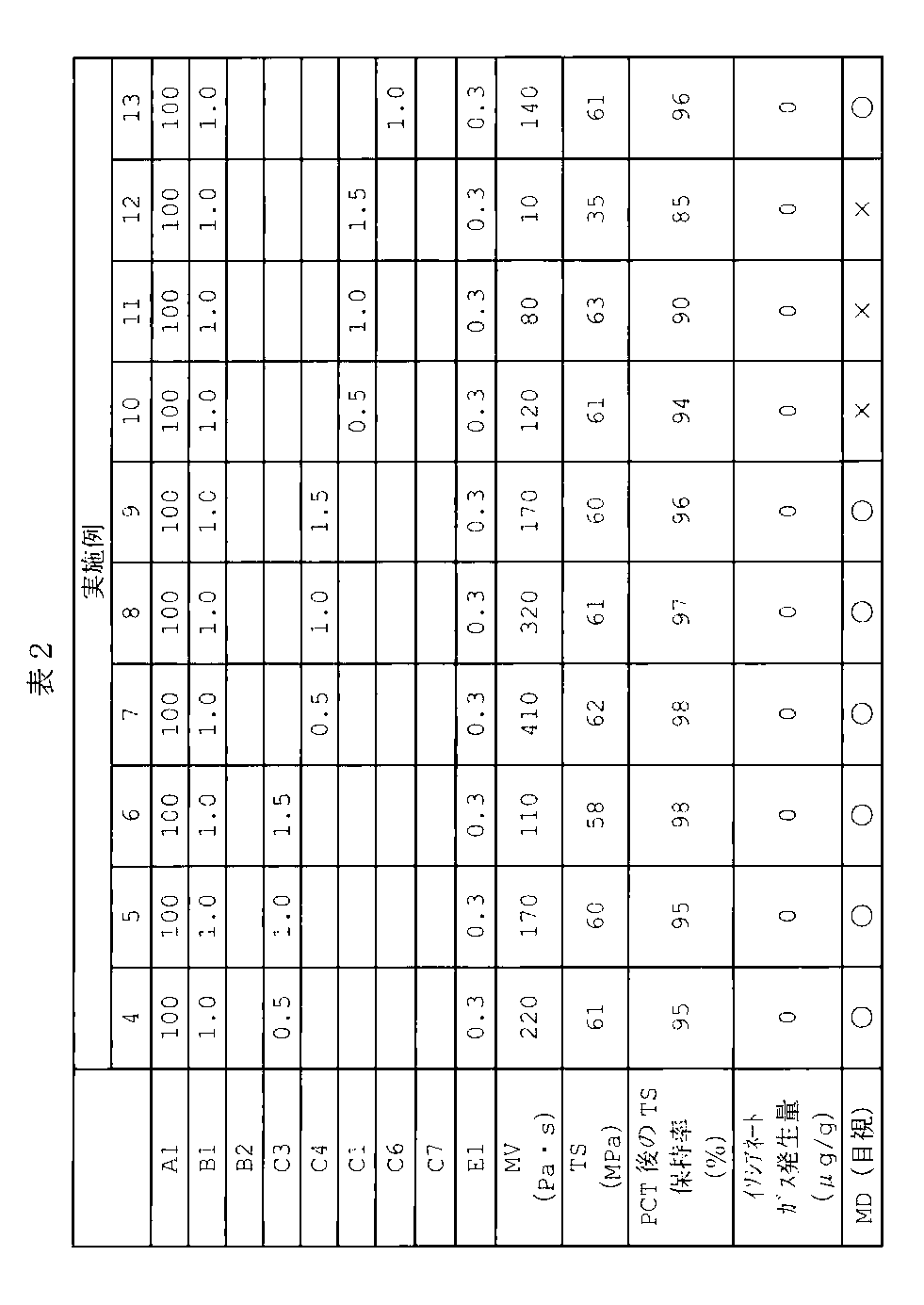

(1)芳香族ポリエステル樹脂(A成分)
芳香族ポリエステル樹脂(A成分)として、帝人(株)製のポリエチレンテレフタレート(FK−OM)を用いた(以下、(A2)として表記することがある。)。
芳香族ポリエステル樹脂(A2)の固有粘度は0.63dL/g(還元粘度は0.85dl/gであった。)また、カルボキシル基濃度は15eq/ton、溶融粘度、還元粘度保持率は表3に示す。なお、A成分としてA2を用いた際は、溶融粘度測定は280℃で実施した。
(2)環状カルボジイミド化合物(B成分)
カルボジイミド化合物(B成分)として、上述のB1を用いた。
(3)多価水酸基含有化合物(C成分)
多価水酸基含有化合物(C成分)として以下の化合物を用いた。
C1:ペンタエリスリトール(ヒドロキシル価1645、関東化学株式会社製)
C3:グリセリンモノ12−ヒドロキシステアリン酸エステル(ヒドロキシル価420、理研ビタミン株式会社製、「リケマール(登録商標)」HC−100)
<樹脂組成物の調製>
芳香族ポリエステル樹脂(A2)、環状カルボジイミド化合物(B1)、多価水酸基含有化合物(C成分)を表3に示す配合組成にて、秤量し、ラボプラストミル((株)東洋精機製作所製)を使用して、樹脂温度280℃で5分間溶融混練して、樹脂組成物(実施例14,15、比較例16)を得た。樹脂組成物製造時にイソシアネート臭は感じられなかった。この組成物のカルボキシル基濃度、溶融粘度、還元粘度保持率等の結果を表3に示す。
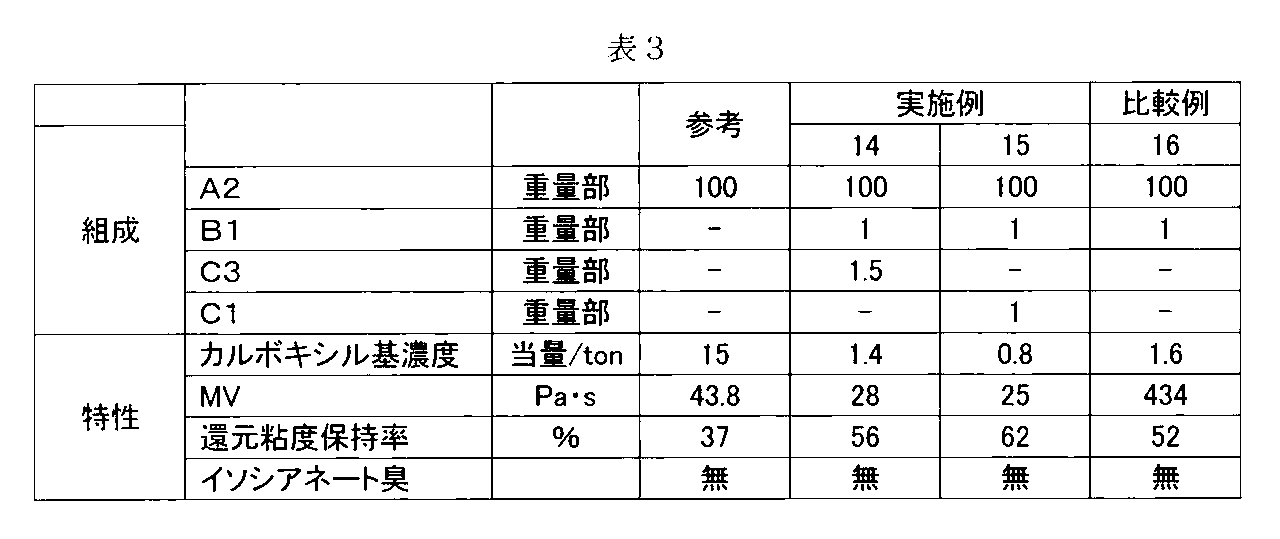
Claims (14)
- 末端カルボキシル基量が30当量/ton以下の芳香族ポリエステル樹脂(A成分)、一つの環の中にカルボジイミド基を一つだけ有するカルボジイミド環を少なくとも2つ有する環状カルボジイミド化合物(B成分)およびヒドロキシル価が200以上の多価水酸基含有化合物(C成分)を含有する樹脂組成物。
- A成分は、ポリブチレンテレフタレートを50質量%以上含む請求項1記載の樹脂組成物。
- B成分は、複数のカルボジイミド環がスピロ結合または結合基を介して結合している環状カルボジイミド化合物である請求項1記載の樹脂組成物。
- B成分は、下記式で表される環状カルボジイミド化合物である請求項1記載の樹脂組成物。
(式中Xは、下記式(i−1)で表される4価の基である。Ar1~Ar4は各々独立に、置換基で置換されていてもよい、オルトフェニレン基または1,2−ナフタレン−ジイル基である。)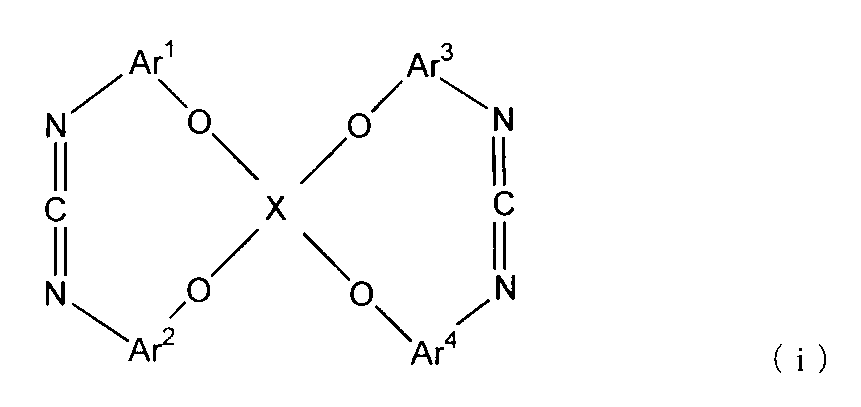

- B成分の含有量は、A成分100質量部を基準として、0.1~3質量部である請求項1に記載の樹脂組成物。
- C成分は、多価アルコール若しくはその部分エステルである請求項1に記載の樹脂組成物。
- C成分のヒドロキシル価が1000以下である請求項1に記載の樹脂組成物。
- C成分は、多価アルコールと炭素数12以上の脂肪酸との部分エステルである、請求項6に記載の樹脂組成物。
- C成分の含有量は、A成分100質量部を基準として、0.05~5質量部である請求項1に記載の樹脂組成物。
- 末端カルボキシル基量が5当量/ton以下である請求項1に記載の樹脂組成物。
- 温度280℃での溶融粘度が300Pa・s以下、且つ121℃、100%RH(0.2MPa)のプレッシャクッカーテストにおいて、100時間保持後の還元粘度保持率が50%以上である請求項1記載の樹脂組成物。
- 温度260℃での溶融粘度が300Pa・s以下、且つ121℃、100%RH(0.2MPa)のプレッシャクッカーテストにおいて、100時間保持後の還元粘度保持率が80%以上である請求項2記載の樹脂組成物。
- 末端カルボキシル基量が30当量/ton以下の芳香族ポリエステル樹脂(A成分)、一つの環の中にカルボジイミド基を一つだけ有する環を少なくとも2つ有する環状カルボジイミド化合物(B成分)およびヒドロキシル価が200以上の多価水酸基含有化合物(C成分)を含有する樹脂組成物の製造方法であって、
(i)芳香族ポリエステル樹脂(A成分)および多価水酸基含有化合物(C成分)を溶融混練した後、得られた混合物に環状カルボジイミド化合物(B成分)を添加し溶融混練するか、または
(ii)芳香族ポリエステル樹脂(A成分)に、環状カルボジイミド化合物(B成分)および多価水酸基含有化合物(C成分)を同時に添加し溶融混練する、前記製造方法。 - 請求項1~12のいずれか一項に記載の樹脂組成物からなる成形品。
Priority Applications (7)
| Application Number | Priority Date | Filing Date | Title |
|---|---|---|---|
| CN201380016864.6A CN104204091B (zh) | 2012-03-27 | 2013-03-15 | 树脂组合物 |
| IN7446DEN2014 IN2014DN07446A (ja) | 2012-03-27 | 2013-03-15 | |
| MX2014011121A MX369586B (es) | 2012-03-27 | 2013-03-15 | Composicion de resina. |
| KR1020147026601A KR101811098B1 (ko) | 2012-03-27 | 2013-03-15 | 수지 조성물 |
| US14/386,141 US9957375B2 (en) | 2012-03-27 | 2013-03-15 | Resin composition |
| JP2014507843A JP5838260B2 (ja) | 2012-03-27 | 2013-03-15 | 樹脂組成物の製造方法 |
| EP13768997.2A EP2832795B1 (en) | 2012-03-27 | 2013-03-15 | Resin composition |
Applications Claiming Priority (2)
| Application Number | Priority Date | Filing Date | Title |
|---|---|---|---|
| JP2012071626 | 2012-03-27 | ||
| JP2012-071626 | 2012-03-27 |
Publications (1)
| Publication Number | Publication Date |
|---|---|
| WO2013146625A1 true WO2013146625A1 (ja) | 2013-10-03 |
Family
ID=49259878
Family Applications (1)
| Application Number | Title | Priority Date | Filing Date |
|---|---|---|---|
| PCT/JP2013/058463 Ceased WO2013146625A1 (ja) | 2012-03-27 | 2013-03-15 | 樹脂組成物 |
Country Status (10)
| Country | Link |
|---|---|
| US (1) | US9957375B2 (ja) |
| EP (1) | EP2832795B1 (ja) |
| JP (1) | JP5838260B2 (ja) |
| KR (1) | KR101811098B1 (ja) |
| CN (1) | CN104204091B (ja) |
| IN (1) | IN2014DN07446A (ja) |
| MX (1) | MX369586B (ja) |
| MY (1) | MY167576A (ja) |
| TW (1) | TWI597304B (ja) |
| WO (1) | WO2013146625A1 (ja) |
Cited By (6)
| Publication number | Priority date | Publication date | Assignee | Title |
|---|---|---|---|---|
| CN104403282A (zh) * | 2014-11-12 | 2015-03-11 | 无锡中洁能源技术有限公司 | 太阳能电池背板用改性pet基材及其制备方法 |
| US9522987B2 (en) | 2012-05-31 | 2016-12-20 | Wintech Polymer Ltd. | Polybutylene terephthalate resin composition and hydrolysis resistance-improving agent |
| JP2018123239A (ja) * | 2017-02-01 | 2018-08-09 | 矢崎総業株式会社 | 自動車用高温耐油性成形部品 |
| JP2018154354A (ja) * | 2017-03-16 | 2018-10-04 | 大日本印刷株式会社 | 多層容器 |
| JP2020038820A (ja) * | 2018-09-04 | 2020-03-12 | エスケイシー・カンパニー・リミテッドSkc Co., Ltd. | 絶縁部を含むケーブルおよびケーブル絶縁部の製造方法 |
| WO2025047295A1 (ja) * | 2023-08-28 | 2025-03-06 | ポリプラスチックス株式会社 | ポリブチレンテレフタレート樹脂組成物の射出成形時のバリの発生を抑制する方法 |
Families Citing this family (9)
| Publication number | Priority date | Publication date | Assignee | Title |
|---|---|---|---|---|
| ES2534727B1 (es) * | 2013-10-24 | 2016-02-05 | Afinitica Technologies, S. L. | Composición de cianoacrilato |
| US20180282516A1 (en) * | 2015-10-01 | 2018-10-04 | Nisshinbo Chemical Inc. | Resin additive, and master batch and resin composition in which same is used |
| KR102291484B1 (ko) * | 2017-07-28 | 2021-08-20 | 현대모비스 주식회사 | 폴리에스테르 수지 조성물 및 이로부터 제조된 성형품 |
| CN109705540B (zh) * | 2017-10-25 | 2021-05-11 | 中国石油化工股份有限公司 | 含聚对苯二甲酸乙二醇酯的组合物和制备共混塑料的方法 |
| KR102706797B1 (ko) * | 2018-02-23 | 2024-09-19 | 닛신보 케미칼 가부시키가이샤 | 수지 조성물, 수지 재료 및 수지 가교체 |
| JP7312005B2 (ja) * | 2019-04-15 | 2023-07-20 | 日清紡ケミカル株式会社 | ポリエステル系樹脂組成物 |
| JP6864161B1 (ja) * | 2019-09-30 | 2021-04-28 | ポリプラスチックス株式会社 | ポリブチレンテレフタレート樹脂組成物 |
| CN110922603B (zh) * | 2019-12-20 | 2022-05-27 | 广州市嵩达新材料科技有限公司 | 一种不同链段改性的光固化树脂及其制备方法和应用 |
| JP7647065B2 (ja) * | 2020-11-02 | 2025-03-18 | セイコーエプソン株式会社 | インクジェット捺染方法 |
Citations (13)
| Publication number | Priority date | Publication date | Assignee | Title |
|---|---|---|---|---|
| JPH0873719A (ja) | 1994-09-01 | 1996-03-19 | Teijin Ltd | 熱可塑性樹脂組成物 |
| JP3618940B2 (ja) | 1996-12-02 | 2005-02-09 | 東レ株式会社 | ポリエステル組成物、モノフィラメントおよび工業用織物 |
| JP2009138179A (ja) * | 2007-11-12 | 2009-06-25 | Wintech Polymer Ltd | ポリブチレンテレフタレート樹脂組成物及び薄肉成形品 |
| JP2009155367A (ja) * | 2007-12-25 | 2009-07-16 | Wintech Polymer Ltd | ポリブチレンテレフタレート樹脂組成物及び薄肉成形品 |
| WO2010018662A1 (ja) | 2008-08-12 | 2010-02-18 | ウィンテックポリマー株式会社 | ポリブチレンテレフタレート樹脂混合物及びフィルム |
| WO2010071213A1 (ja) | 2008-12-15 | 2010-06-24 | 帝人株式会社 | 環状カルボジイミドを含有する樹脂組成物 |
| WO2010071211A1 (ja) | 2008-12-15 | 2010-06-24 | 帝人株式会社 | 環状カルボジイミド化合物 |
| JP2010285554A (ja) * | 2009-06-12 | 2010-12-24 | Teijin Ltd | ポリエステルおよびその製造方法 |
| JP2011127249A (ja) * | 2009-12-17 | 2011-06-30 | Teijin Ltd | 繊維構造体 |
| JP2011127248A (ja) * | 2009-12-17 | 2011-06-30 | Teijin Ltd | 繊維構造体 |
| JP2011225640A (ja) * | 2010-04-15 | 2011-11-10 | Teijin Ltd | 二軸延伸フィルム |
| JP2011241492A (ja) * | 2010-05-17 | 2011-12-01 | Teijin Ltd | 産業用資材 |
| JP2011256139A (ja) | 2010-06-10 | 2011-12-22 | Teijin Ltd | 環状カルボジイミド化合物 |
Family Cites Families (3)
| Publication number | Priority date | Publication date | Assignee | Title |
|---|---|---|---|---|
| DE102005004856A1 (de) * | 2005-02-01 | 2006-08-03 | Basf Ag | Fliessfähige Polyester mit Carbodilmid-Stabilisatoren |
| ES2537129T3 (es) | 2009-09-16 | 2015-06-02 | Teijin Limited | Fibra y estructura de fibra |
| EP2581368A4 (en) | 2010-06-10 | 2013-05-22 | Teijin Ltd | CYCLIC CARBODIIMIDE COMPOUND |
-
2013
- 2013-03-15 CN CN201380016864.6A patent/CN104204091B/zh active Active
- 2013-03-15 MY MYPI2014702636A patent/MY167576A/en unknown
- 2013-03-15 MX MX2014011121A patent/MX369586B/es active IP Right Grant
- 2013-03-15 EP EP13768997.2A patent/EP2832795B1/en active Active
- 2013-03-15 JP JP2014507843A patent/JP5838260B2/ja active Active
- 2013-03-15 WO PCT/JP2013/058463 patent/WO2013146625A1/ja not_active Ceased
- 2013-03-15 KR KR1020147026601A patent/KR101811098B1/ko not_active Expired - Fee Related
- 2013-03-15 IN IN7446DEN2014 patent/IN2014DN07446A/en unknown
- 2013-03-15 US US14/386,141 patent/US9957375B2/en active Active
- 2013-03-27 TW TW102110901A patent/TWI597304B/zh not_active IP Right Cessation
Patent Citations (13)
| Publication number | Priority date | Publication date | Assignee | Title |
|---|---|---|---|---|
| JPH0873719A (ja) | 1994-09-01 | 1996-03-19 | Teijin Ltd | 熱可塑性樹脂組成物 |
| JP3618940B2 (ja) | 1996-12-02 | 2005-02-09 | 東レ株式会社 | ポリエステル組成物、モノフィラメントおよび工業用織物 |
| JP2009138179A (ja) * | 2007-11-12 | 2009-06-25 | Wintech Polymer Ltd | ポリブチレンテレフタレート樹脂組成物及び薄肉成形品 |
| JP2009155367A (ja) * | 2007-12-25 | 2009-07-16 | Wintech Polymer Ltd | ポリブチレンテレフタレート樹脂組成物及び薄肉成形品 |
| WO2010018662A1 (ja) | 2008-08-12 | 2010-02-18 | ウィンテックポリマー株式会社 | ポリブチレンテレフタレート樹脂混合物及びフィルム |
| WO2010071213A1 (ja) | 2008-12-15 | 2010-06-24 | 帝人株式会社 | 環状カルボジイミドを含有する樹脂組成物 |
| WO2010071211A1 (ja) | 2008-12-15 | 2010-06-24 | 帝人株式会社 | 環状カルボジイミド化合物 |
| JP2010285554A (ja) * | 2009-06-12 | 2010-12-24 | Teijin Ltd | ポリエステルおよびその製造方法 |
| JP2011127249A (ja) * | 2009-12-17 | 2011-06-30 | Teijin Ltd | 繊維構造体 |
| JP2011127248A (ja) * | 2009-12-17 | 2011-06-30 | Teijin Ltd | 繊維構造体 |
| JP2011225640A (ja) * | 2010-04-15 | 2011-11-10 | Teijin Ltd | 二軸延伸フィルム |
| JP2011241492A (ja) * | 2010-05-17 | 2011-12-01 | Teijin Ltd | 産業用資材 |
| JP2011256139A (ja) | 2010-06-10 | 2011-12-22 | Teijin Ltd | 環状カルボジイミド化合物 |
Non-Patent Citations (1)
| Title |
|---|
| See also references of EP2832795A4 * |
Cited By (9)
| Publication number | Priority date | Publication date | Assignee | Title |
|---|---|---|---|---|
| US9522987B2 (en) | 2012-05-31 | 2016-12-20 | Wintech Polymer Ltd. | Polybutylene terephthalate resin composition and hydrolysis resistance-improving agent |
| CN104403282A (zh) * | 2014-11-12 | 2015-03-11 | 无锡中洁能源技术有限公司 | 太阳能电池背板用改性pet基材及其制备方法 |
| JP2018123239A (ja) * | 2017-02-01 | 2018-08-09 | 矢崎総業株式会社 | 自動車用高温耐油性成形部品 |
| JP2018154354A (ja) * | 2017-03-16 | 2018-10-04 | 大日本印刷株式会社 | 多層容器 |
| JP2020038820A (ja) * | 2018-09-04 | 2020-03-12 | エスケイシー・カンパニー・リミテッドSkc Co., Ltd. | 絶縁部を含むケーブルおよびケーブル絶縁部の製造方法 |
| US11315705B2 (en) | 2018-09-04 | 2022-04-26 | Skc Co., Ltd | Cable with insulating part and method of producing cable insulating part |
| WO2025047295A1 (ja) * | 2023-08-28 | 2025-03-06 | ポリプラスチックス株式会社 | ポリブチレンテレフタレート樹脂組成物の射出成形時のバリの発生を抑制する方法 |
| JP2025032697A (ja) * | 2023-08-28 | 2025-03-12 | ポリプラスチックス株式会社 | ポリブチレンテレフタレート樹脂組成物の射出成形時のバリの発生を抑制する方法 |
| JP7807416B2 (ja) | 2023-08-28 | 2026-01-27 | ポリプラスチックス株式会社 | ポリブチレンテレフタレート樹脂組成物の射出成形時のバリの発生を抑制する方法 |
Also Published As
| Publication number | Publication date |
|---|---|
| TWI597304B (zh) | 2017-09-01 |
| CN104204091A (zh) | 2014-12-10 |
| US20150051324A1 (en) | 2015-02-19 |
| KR101811098B1 (ko) | 2017-12-20 |
| EP2832795A4 (en) | 2015-04-29 |
| EP2832795A1 (en) | 2015-02-04 |
| MY167576A (en) | 2018-09-20 |
| KR20150005523A (ko) | 2015-01-14 |
| JP5838260B2 (ja) | 2016-01-06 |
| JPWO2013146625A1 (ja) | 2015-12-14 |
| CN104204091B (zh) | 2019-06-14 |
| MX369586B (es) | 2019-11-13 |
| MX2014011121A (es) | 2015-03-13 |
| US9957375B2 (en) | 2018-05-01 |
| TW201400521A (zh) | 2014-01-01 |
| IN2014DN07446A (ja) | 2015-04-24 |
| EP2832795B1 (en) | 2016-05-25 |
Similar Documents
| Publication | Publication Date | Title |
|---|---|---|
| JP5838260B2 (ja) | 樹脂組成物の製造方法 | |
| KR101693052B1 (ko) | 고리형 카르보디이미드를 함유하는 수지 조성물 | |
| US9745446B2 (en) | Resin composition | |
| WO2014003191A1 (ja) | 樹脂組成物 | |
| JP2015150781A (ja) | 3次元造形物の製造方法およびこれにより得られた3次元造形物 | |
| JP2010132871A (ja) | ポリ乳酸組成物およびその成形品 | |
| US20160251496A1 (en) | Resin composition | |
| JP2017078229A (ja) | 複合繊維 | |
| JP5612317B2 (ja) | ポリ乳酸樹脂組成物 | |
| JP2014051570A (ja) | 熱曲げ加工用樹脂組成物 | |
| JP5646889B2 (ja) | ポリ乳酸の共重合体、組成物およびそれからなる成形品 | |
| JP5232596B2 (ja) | ポリ乳酸組成物およびその成形品。 | |
| JP5173746B2 (ja) | ポリ乳酸組成物の製造方法 | |
| WO2015115633A1 (ja) | 繊維 | |
| JP2010174219A (ja) | ポリ乳酸組成物 | |
| JP2010168504A (ja) | ポリ乳酸組成物およびそれよりなる成形品 | |
| JP2010174218A (ja) | ポリ乳酸組成物およびその成形品 | |
| JP5662245B2 (ja) | ポリ乳酸樹脂組成物 | |
| JP2010168505A (ja) | ポリ乳酸組成物およびそれよりなる成形品 | |
| JP2010168507A (ja) | ポリ乳酸組成物およびそれよりなる成形品 |
Legal Events
| Date | Code | Title | Description |
|---|---|---|---|
| 121 | Ep: the epo has been informed by wipo that ep was designated in this application |
Ref document number: 13768997 Country of ref document: EP Kind code of ref document: A1 |
|
| ENP | Entry into the national phase |
Ref document number: 2014507843 Country of ref document: JP Kind code of ref document: A |
|
| WWE | Wipo information: entry into national phase |
Ref document number: MX/A/2014/011121 Country of ref document: MX |
|
| WWE | Wipo information: entry into national phase |
Ref document number: 14386141 Country of ref document: US |
|
| ENP | Entry into the national phase |
Ref document number: 20147026601 Country of ref document: KR Kind code of ref document: A |
|
| WWE | Wipo information: entry into national phase |
Ref document number: 2013768997 Country of ref document: EP |
|
| NENP | Non-entry into the national phase |
Ref country code: DE |