WO2013147162A1 - 潤滑油組成物 - Google Patents
潤滑油組成物 Download PDFInfo
- Publication number
- WO2013147162A1 WO2013147162A1 PCT/JP2013/059540 JP2013059540W WO2013147162A1 WO 2013147162 A1 WO2013147162 A1 WO 2013147162A1 JP 2013059540 W JP2013059540 W JP 2013059540W WO 2013147162 A1 WO2013147162 A1 WO 2013147162A1
- Authority
- WO
- WIPO (PCT)
- Prior art keywords
- component
- less
- lubricating oil
- oil composition
- viscosity
- Prior art date
- Legal status (The legal status is an assumption and is not a legal conclusion. Google has not performed a legal analysis and makes no representation as to the accuracy of the status listed.)
- Ceased
Links
Images
Classifications
-
- C—CHEMISTRY; METALLURGY
- C10—PETROLEUM, GAS OR COKE INDUSTRIES; TECHNICAL GASES CONTAINING CARBON MONOXIDE; FUELS; LUBRICANTS; PEAT
- C10M—LUBRICATING COMPOSITIONS; USE OF CHEMICAL SUBSTANCES EITHER ALONE OR AS LUBRICATING INGREDIENTS IN A LUBRICATING COMPOSITION
- C10M133/00—Lubricating compositions characterised by the additive being an organic non-macromolecular compound containing nitrogen
- C10M133/02—Lubricating compositions characterised by the additive being an organic non-macromolecular compound containing nitrogen having a carbon chain of less than 30 atoms
- C10M133/38—Heterocyclic nitrogen compounds
- C10M133/40—Six-membered ring containing nitrogen and carbon only
-
- C—CHEMISTRY; METALLURGY
- C10—PETROLEUM, GAS OR COKE INDUSTRIES; TECHNICAL GASES CONTAINING CARBON MONOXIDE; FUELS; LUBRICANTS; PEAT
- C10M—LUBRICATING COMPOSITIONS; USE OF CHEMICAL SUBSTANCES EITHER ALONE OR AS LUBRICATING INGREDIENTS IN A LUBRICATING COMPOSITION
- C10M169/00—Lubricating compositions characterised by containing as components a mixture of at least two types of ingredient selected from base-materials, thickeners or additives, covered by the preceding groups, each of these compounds being essential
- C10M169/04—Mixtures of base-materials and additives
- C10M169/041—Mixtures of base-materials and additives the additives being macromolecular compounds only
-
- C—CHEMISTRY; METALLURGY
- C10—PETROLEUM, GAS OR COKE INDUSTRIES; TECHNICAL GASES CONTAINING CARBON MONOXIDE; FUELS; LUBRICANTS; PEAT
- C10M—LUBRICATING COMPOSITIONS; USE OF CHEMICAL SUBSTANCES EITHER ALONE OR AS LUBRICATING INGREDIENTS IN A LUBRICATING COMPOSITION
- C10M171/00—Lubricating compositions characterised by purely physical criteria, e.g. containing as base-material, thickener or additive, ingredients which are characterised exclusively by their numerically specified physical properties, i.e. containing ingredients which are physically well-defined but for which the chemical nature is either unspecified or only very vaguely indicated
- C10M171/02—Specified values of viscosity or viscosity index
-
- C—CHEMISTRY; METALLURGY
- C10—PETROLEUM, GAS OR COKE INDUSTRIES; TECHNICAL GASES CONTAINING CARBON MONOXIDE; FUELS; LUBRICANTS; PEAT
- C10M—LUBRICATING COMPOSITIONS; USE OF CHEMICAL SUBSTANCES EITHER ALONE OR AS LUBRICATING INGREDIENTS IN A LUBRICATING COMPOSITION
- C10M2203/00—Organic non-macromolecular hydrocarbon compounds and hydrocarbon fractions as ingredients in lubricant compositions
- C10M2203/10—Petroleum or coal fractions, e.g. tars, solvents, bitumen
- C10M2203/102—Aliphatic fractions
- C10M2203/1025—Aliphatic fractions used as base material
-
- C—CHEMISTRY; METALLURGY
- C10—PETROLEUM, GAS OR COKE INDUSTRIES; TECHNICAL GASES CONTAINING CARBON MONOXIDE; FUELS; LUBRICANTS; PEAT
- C10M—LUBRICATING COMPOSITIONS; USE OF CHEMICAL SUBSTANCES EITHER ALONE OR AS LUBRICATING INGREDIENTS IN A LUBRICATING COMPOSITION
- C10M2205/00—Organic macromolecular hydrocarbon compounds or fractions, whether or not modified by oxidation as ingredients in lubricant compositions
- C10M2205/02—Organic macromolecular hydrocarbon compounds or fractions, whether or not modified by oxidation as ingredients in lubricant compositions containing acyclic monomers
- C10M2205/028—Organic macromolecular hydrocarbon compounds or fractions, whether or not modified by oxidation as ingredients in lubricant compositions containing acyclic monomers containing aliphatic monomers having more than four carbon atoms
-
- C—CHEMISTRY; METALLURGY
- C10—PETROLEUM, GAS OR COKE INDUSTRIES; TECHNICAL GASES CONTAINING CARBON MONOXIDE; FUELS; LUBRICANTS; PEAT
- C10M—LUBRICATING COMPOSITIONS; USE OF CHEMICAL SUBSTANCES EITHER ALONE OR AS LUBRICATING INGREDIENTS IN A LUBRICATING COMPOSITION
- C10M2207/00—Organic non-macromolecular hydrocarbon compounds containing hydrogen, carbon and oxygen as ingredients in lubricant compositions
- C10M2207/28—Esters
- C10M2207/287—Partial esters
- C10M2207/289—Partial esters containing free hydroxy groups
-
- C—CHEMISTRY; METALLURGY
- C10—PETROLEUM, GAS OR COKE INDUSTRIES; TECHNICAL GASES CONTAINING CARBON MONOXIDE; FUELS; LUBRICANTS; PEAT
- C10M—LUBRICATING COMPOSITIONS; USE OF CHEMICAL SUBSTANCES EITHER ALONE OR AS LUBRICATING INGREDIENTS IN A LUBRICATING COMPOSITION
- C10M2209/00—Organic macromolecular compounds containing oxygen as ingredients in lubricant compositions
- C10M2209/02—Macromolecular compounds obtained by reactions only involving carbon-to-carbon unsaturated bonds
- C10M2209/08—Macromolecular compounds obtained by reactions only involving carbon-to-carbon unsaturated bonds containing monomers having an unsaturated radical bound to a carboxyl radical, e.g. acrylate type
- C10M2209/084—Acrylate; Methacrylate
-
- C—CHEMISTRY; METALLURGY
- C10—PETROLEUM, GAS OR COKE INDUSTRIES; TECHNICAL GASES CONTAINING CARBON MONOXIDE; FUELS; LUBRICANTS; PEAT
- C10M—LUBRICATING COMPOSITIONS; USE OF CHEMICAL SUBSTANCES EITHER ALONE OR AS LUBRICATING INGREDIENTS IN A LUBRICATING COMPOSITION
- C10M2215/00—Organic non-macromolecular compounds containing nitrogen as ingredients in lubricant Compositions
- C10M2215/08—Amides [having hydrocarbon substituents containing less than thirty carbon atoms]
-
- C—CHEMISTRY; METALLURGY
- C10—PETROLEUM, GAS OR COKE INDUSTRIES; TECHNICAL GASES CONTAINING CARBON MONOXIDE; FUELS; LUBRICANTS; PEAT
- C10M—LUBRICATING COMPOSITIONS; USE OF CHEMICAL SUBSTANCES EITHER ALONE OR AS LUBRICATING INGREDIENTS IN A LUBRICATING COMPOSITION
- C10M2223/00—Organic non-macromolecular compounds containing phosphorus as ingredients in lubricant compositions
- C10M2223/02—Organic non-macromolecular compounds containing phosphorus as ingredients in lubricant compositions having no phosphorus-to-carbon bonds
- C10M2223/04—Phosphate esters
-
- C—CHEMISTRY; METALLURGY
- C10—PETROLEUM, GAS OR COKE INDUSTRIES; TECHNICAL GASES CONTAINING CARBON MONOXIDE; FUELS; LUBRICANTS; PEAT
- C10M—LUBRICATING COMPOSITIONS; USE OF CHEMICAL SUBSTANCES EITHER ALONE OR AS LUBRICATING INGREDIENTS IN A LUBRICATING COMPOSITION
- C10M2223/00—Organic non-macromolecular compounds containing phosphorus as ingredients in lubricant compositions
- C10M2223/02—Organic non-macromolecular compounds containing phosphorus as ingredients in lubricant compositions having no phosphorus-to-carbon bonds
- C10M2223/04—Phosphate esters
- C10M2223/045—Metal containing thio derivatives
-
- C—CHEMISTRY; METALLURGY
- C10—PETROLEUM, GAS OR COKE INDUSTRIES; TECHNICAL GASES CONTAINING CARBON MONOXIDE; FUELS; LUBRICANTS; PEAT
- C10N—INDEXING SCHEME ASSOCIATED WITH SUBCLASS C10M RELATING TO LUBRICATING COMPOSITIONS
- C10N2010/00—Metal present as such or in compounds
- C10N2010/04—Groups 2 or 12
-
- C—CHEMISTRY; METALLURGY
- C10—PETROLEUM, GAS OR COKE INDUSTRIES; TECHNICAL GASES CONTAINING CARBON MONOXIDE; FUELS; LUBRICANTS; PEAT
- C10N—INDEXING SCHEME ASSOCIATED WITH SUBCLASS C10M RELATING TO LUBRICATING COMPOSITIONS
- C10N2020/00—Specified physical or chemical properties or characteristics, i.e. function, of component of lubricating compositions
- C10N2020/01—Physico-chemical properties
- C10N2020/02—Viscosity; Viscosity index
-
- C—CHEMISTRY; METALLURGY
- C10—PETROLEUM, GAS OR COKE INDUSTRIES; TECHNICAL GASES CONTAINING CARBON MONOXIDE; FUELS; LUBRICANTS; PEAT
- C10N—INDEXING SCHEME ASSOCIATED WITH SUBCLASS C10M RELATING TO LUBRICATING COMPOSITIONS
- C10N2020/00—Specified physical or chemical properties or characteristics, i.e. function, of component of lubricating compositions
- C10N2020/01—Physico-chemical properties
- C10N2020/04—Molecular weight; Molecular weight distribution
-
- C—CHEMISTRY; METALLURGY
- C10—PETROLEUM, GAS OR COKE INDUSTRIES; TECHNICAL GASES CONTAINING CARBON MONOXIDE; FUELS; LUBRICANTS; PEAT
- C10N—INDEXING SCHEME ASSOCIATED WITH SUBCLASS C10M RELATING TO LUBRICATING COMPOSITIONS
- C10N2030/00—Specified physical or chemical properties which is improved by the additive characterising the lubricating composition, e.g. multifunctional additives
- C10N2030/06—Oiliness; Film-strength; Anti-wear; Resistance to extreme pressure
-
- C—CHEMISTRY; METALLURGY
- C10—PETROLEUM, GAS OR COKE INDUSTRIES; TECHNICAL GASES CONTAINING CARBON MONOXIDE; FUELS; LUBRICANTS; PEAT
- C10N—INDEXING SCHEME ASSOCIATED WITH SUBCLASS C10M RELATING TO LUBRICATING COMPOSITIONS
- C10N2030/00—Specified physical or chemical properties which is improved by the additive characterising the lubricating composition, e.g. multifunctional additives
- C10N2030/54—Fuel economy
-
- C—CHEMISTRY; METALLURGY
- C10—PETROLEUM, GAS OR COKE INDUSTRIES; TECHNICAL GASES CONTAINING CARBON MONOXIDE; FUELS; LUBRICANTS; PEAT
- C10N—INDEXING SCHEME ASSOCIATED WITH SUBCLASS C10M RELATING TO LUBRICATING COMPOSITIONS
- C10N2030/00—Specified physical or chemical properties which is improved by the additive characterising the lubricating composition, e.g. multifunctional additives
- C10N2030/68—Shear stability
-
- C—CHEMISTRY; METALLURGY
- C10—PETROLEUM, GAS OR COKE INDUSTRIES; TECHNICAL GASES CONTAINING CARBON MONOXIDE; FUELS; LUBRICANTS; PEAT
- C10N—INDEXING SCHEME ASSOCIATED WITH SUBCLASS C10M RELATING TO LUBRICATING COMPOSITIONS
- C10N2040/00—Specified use or application for which the lubricating composition is intended
- C10N2040/04—Oil-bath; Gear-boxes; Automatic transmissions; Traction drives
-
- C—CHEMISTRY; METALLURGY
- C10—PETROLEUM, GAS OR COKE INDUSTRIES; TECHNICAL GASES CONTAINING CARBON MONOXIDE; FUELS; LUBRICANTS; PEAT
- C10N—INDEXING SCHEME ASSOCIATED WITH SUBCLASS C10M RELATING TO LUBRICATING COMPOSITIONS
- C10N2040/00—Specified use or application for which the lubricating composition is intended
- C10N2040/04—Oil-bath; Gear-boxes; Automatic transmissions; Traction drives
- C10N2040/042—Oil-bath; Gear-boxes; Automatic transmissions; Traction drives for automatic transmissions
-
- C—CHEMISTRY; METALLURGY
- C10—PETROLEUM, GAS OR COKE INDUSTRIES; TECHNICAL GASES CONTAINING CARBON MONOXIDE; FUELS; LUBRICANTS; PEAT
- C10N—INDEXING SCHEME ASSOCIATED WITH SUBCLASS C10M RELATING TO LUBRICATING COMPOSITIONS
- C10N2040/00—Specified use or application for which the lubricating composition is intended
- C10N2040/04—Oil-bath; Gear-boxes; Automatic transmissions; Traction drives
- C10N2040/044—Oil-bath; Gear-boxes; Automatic transmissions; Traction drives for manual transmissions
-
- C—CHEMISTRY; METALLURGY
- C10—PETROLEUM, GAS OR COKE INDUSTRIES; TECHNICAL GASES CONTAINING CARBON MONOXIDE; FUELS; LUBRICANTS; PEAT
- C10N—INDEXING SCHEME ASSOCIATED WITH SUBCLASS C10M RELATING TO LUBRICATING COMPOSITIONS
- C10N2040/00—Specified use or application for which the lubricating composition is intended
- C10N2040/25—Internal-combustion engines
Definitions
- the present invention relates to a lubricating oil composition, and more particularly to a lubricating oil composition suitable for a manual or automatic transmission and / or a continuously variable transmission.
- various additives such as antioxidants, detergent dispersants, antiwear agents, friction modifiers, seal swelling agents, viscosity index improvers, antifoaming agents, and coloring agents are appropriately blended with such base oils.
- a lubricating oil composition is prepared.
- the viscosity characteristics of the lubricating oil composition are improved by using a base oil with a high viscosity or a base oil with good low-temperature characteristics. It has been proposed to do. It has also been proposed to improve the fatigue life of lubricating oil as well as lubricity by adding appropriate amounts of phosphorus-based extreme pressure agent, sulfur-based extreme pressure agent and the like (see Patent Documents 1 to 3).
- the present invention provides a lubricating oil composition that can exhibit better fuel economy and that has better shear stability.
- the present invention provides a lubricating oil composition particularly suitable for manual or automatic transmissions and / or continuously variable transmissions.
- the present invention includes (A) a mineral oil base oil having a kinematic viscosity at 100 ° C. of 5 mm 2 / s or less and a% CP of 90 or more, and (B) a polymer having a weight average molecular weight of 15,000 or less.
- % C N of the (A) mineral base oil is 15 or less.
- the component (B) is preferably a copolymer of an ⁇ -olefin and an ⁇ , ⁇ -ethylenically unsaturated dicarboxylic acid diester.
- the lubricating oil composition of the present invention preferably further comprises (D) an amide friction modifier.
- the “amide friction modifier” means a friction modifier which is a compound having an amide (> N—CO—) bond in the molecular structure, and is a friction modifier such as a urea compound or an imide compound. It is a concept that also includes
- the lubricating oil composition of the present invention can be preferably used as a lubricating oil for transmissions.
- the lubricating oil composition of the present invention since the (A) predetermined base oil and the (B) predetermined polymer are both contained, the traction coefficient is reduced to improve fuel economy, and shearing A lubricating oil composition with improved stability can be provided.
- the lubricating oil composition of the present invention has improved shear stability, the ability to maintain viscosity characteristics has been improved, so the ability to maintain lubricating performance is also enhanced.
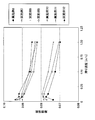
- FIG. 6 is a graph plotting the ring-on-disk test results of the lubricating oil compositions of Examples 6-12.
- the notation “A to B” in the numerical range means “A to B”.
- the unit is also applied to the numerical value A.
- the component (A) in the lubricating oil composition of the present invention is a mineral oil base oil having a kinematic viscosity at 100 ° C. of 5 mm 2 / s or less and a% CP of 90 or more.
- Component (A) is not more than 5 mm 2 / s, preferably not more than 4.5 mm 2 / s, more preferably not more than 4.2 mm 2 / s, more preferably 4 mm 2 / s or less, particularly preferably 3.5 mm 2 / s or less, and most preferably 3 mm 2 / s or less.
- Preferably it is 1.5 mm ⁇ 2 > / s or more, More preferably, it is 2 mm ⁇ 2 > / s or more, More preferably, it is 2.5 mm ⁇ 2 > / s or more.
- the viscosity temperature characteristic and the low temperature viscosity characteristic can be improved. Further, by setting the kinematic viscosity at 100 ° C. of the component (A) to be equal to or higher than the above lower limit value, it becomes possible to sufficiently form an oil film at the lubricated portion and to improve the metal fatigue prevention property and load resistance. Further, it is possible to reduce the evaporation loss of the lubricating base oil.
- the pour point of the component (A) is not particularly limited, but is preferably ⁇ 15 ° C. or less, more preferably ⁇ 17.5 ° C. or less, still more preferably ⁇ 20 ° C. or less, and particularly preferably It is ⁇ 25 ° C. or lower, and most preferably ⁇ 30 ° C. or lower.
- the lubricating oil composition excellent in the low temperature viscosity characteristic can be obtained. Further, from the viewpoint of low-temperature viscosity characteristics and economical efficiency in performing the dewaxing step, it is preferably ⁇ 45 ° C. or higher, more preferably ⁇ 40 ° C. or higher, further preferably ⁇ 37.5 ° C. or higher. is there.
- the viscosity index of component (A) is not particularly limited, but is preferably 100 or more, more preferably 110 or more, still more preferably 120 or more, and particularly preferably 125 or more. Moreover, although 160 or more may be sufficient as one aspect
- the lubricating oil composition excellent in a viscosity temperature characteristic and a low-temperature viscosity characteristic can be obtained by making the viscosity index of (A) component more than the said lower limit.
- (A) is% C P of the component is 90 or more. Thereby, the traction coefficient which contributes to the improvement of the fuel-saving property in this invention can be reduced significantly.
- % C P limit No particular limitation is imposed on the surface can be a 100 as one aspect of the present invention, preferred from the viewpoint of more excellent solubility of additives and sludge is 98 or less, more preferably 95 or less.
- the% C A of the component (A) is preferably 0 or more and 5 or less, and more preferably 3 or less in terms of enhancing thermal / oxidation stability and viscosity temperature characteristics. More preferably, it is 2 or less, particularly preferably 1 or less.
- % Of C N by the above-described upper limit or less it is possible to further reduce the contributing traction coefficient to the improvement of fuel economy of the present invention.
- % C A ,% C P and% C N are percentages of the total number of aromatic carbon atoms determined by a method (ndM ring analysis) based on ASTM D 3238, respectively. Mean the percentage of the total number of paraffin carbons and the percentage of the total number of naphthene carbons.
- the sulfur content of (A) component Preferably it is 0.1 mass% or less, More preferably, it is 0.05 mass% or less, More preferably, it is desirable that it is 0.01 mass% or less. .
- the nitrogen content of (A) component Preferably it is 5 mass ppm or less at the point which can obtain the composition which is more excellent in thermal and oxidation stability, More preferably, it is 3 mass ppm or less. is there.
- a component may be only 1 type of mineral oil, and the mixture of 2 or more types of mineral oil may be sufficient as it.
- the production method is not particularly limited.
- the base oils (1) to (8) shown below are used as raw materials, and the raw oils and / or the Examples of the base oil obtained by refining the lubricating oil fraction recovered from the raw material oil by a predetermined refining method and recovering the lubricating oil fraction.
- Distilled oil by atmospheric distillation of paraffinic crude oil and / or mixed crude oil (2) Distilled oil by vacuum distillation of atmospheric distillation residue of paraffinic crude oil and / or mixed crude oil (WVGO) (3) Wax (such as slack wax) obtained by the lubricant dewaxing process and / or synthetic wax (Fischer-Tropsch wax, GTL wax, etc.) obtained by the gas-liquid (GTL) process, etc.
- WVGO vacuum distillation of atmospheric distillation residue of paraffinic crude oil and / or mixed crude oil
- Wax such as slack wax obtained by the lubricant dewaxing process and / or synthetic wax (Fischer-Tropsch wax, GTL wax, etc.) obtained by the gas-liquid (GTL) process, etc.
- a mineral oil base oil obtained from the raw material (3) is particularly preferable.
- the above-mentioned predetermined purification methods include hydrorefining such as hydrocracking and hydrofinishing; solvent refining such as furfural solvent extraction; dewaxing such as solvent dewaxing and catalytic dewaxing; acid clay and activated clay White clay purification; chemical (acid or alkali) cleaning such as sulfuric acid cleaning and caustic soda cleaning is preferable.
- one of these purification methods may be performed alone, or two or more may be combined.
- the order in particular is not restrict
- the dewaxing step any of solvent dewaxing and contact dewaxing steps may be applied. However, the contact dewaxing step is particularly preferable because the low temperature viscosity characteristics can be further improved.
- the lubricating base oil according to the present invention can be obtained by subjecting a base oil selected from the above base oils (1) to (8) or a lubricating oil fraction recovered from the base oil to a predetermined treatment.
- the following base oil (9) or (10) is particularly preferred.
- the thermal / oxidative stability and low temperature viscosity characteristics can be further enhanced, and the fatigue prevention performance of the lubricating oil composition is further enhanced. It is particularly preferable to include a contact dewaxing step.
- a solvent refining treatment and / or a hydrofinishing treatment step may be further provided as necessary.
- the lubricating oil composition of the present invention contains, in addition to the component (A), a polymer having (B) a weight average molecular weight (hereinafter sometimes abbreviated as “Mw”) of 15,000 or less.
- Mw weight average molecular weight
- the polymer having a weight average molecular weight of 15,000 or less is not particularly limited as long as it is soluble in the above component (A).
- component (B) examples include copolymers of ethylene and propylene; polybutenes; poly ⁇ -olefins that are polymers of ⁇ -olefins having 8 to 14 carbon atoms; dispersed or non-dispersed poly (Meth) acrylate; polymer whose main chain is poly (meth) acrylate and whose side chain is a polymer of olefin; styrene-diene hydrogenated copolymer; styrene-maleic anhydride ester copolymer; polyalkylstyrene, Etc.
- “(meth) acrylate” means “acrylate or methacrylate”.
- ⁇ , ⁇ -ethylenically unsaturated dicarboxylic acid means that the ⁇ and ⁇ carbons are ethylenically unsaturated for both carboxy groups, such as maleic acid, fumaric acid, citraconic acid, and mesaconic acid. It is not limited to a compound having a bond and an ⁇ , ⁇ -ethylenically unsaturated bond present in the main chain. The ⁇ carbon and the ⁇ carbon are present only for one carboxy group such as glutaconic acid.
- Copolymers of ⁇ -olefin and ⁇ , ⁇ -ethylenically unsaturated dicarboxylic acid diester itself are known compounds.
- US Pat. No. 2,543,964 discloses a copolymer of an ⁇ -olefin having 8 to 18 carbon atoms and a maleic acid diester or a fumaric acid diester of a mixture of C12 alcohol, C14 alcohol or C10-18 alcohol.
- the alcohol forming the diester is a linear or branched alkyl alcohol having a chain length of 3 to 10 carbons and has a weight of 1300 to 3250.
- Japanese Patent Application Laid-Open No. 2008-308688 discloses a copolymer of an ⁇ -olefin having 12 to 18 carbon atoms and an ⁇ , ⁇ -ethylenically unsaturated dicarboxylic acid diester having a C3 to C7 linear or branched shape.
- An ⁇ , ⁇ -ethylenically unsaturated dicarboxylic acid diester obtained by esterifying an ⁇ , ⁇ -ethylenically unsaturated dicarboxylic acid with an alkyl alcohol, having a weight average molecular weight exceeding 3500 at 100 ° C.
- Copolymers with viscosities greater than 300 mm 2 / s are disclosed.
- the structure of the copolymer is particularly limited as long as the weight average molecular weight is 15,000 or less. Is not to be done. Further, the production method is not particularly limited, and those produced by a known method can be used.
- the weight average molecular weight of a component is 15,000 or less, More preferably, it is 11,000 or less. Moreover, it is preferably 1,000 or more, for example, 2,000 or more, or 4,000 or more.
- the weight average molecular weight referred to here is a series of two columns GMHHR-M (7.8 mm ID ⁇ 30 cm) manufactured by Tosoh Corporation in a 150-C ALC / GPC apparatus manufactured by Waters Corporation.
- Standard polystyrene conversion measured using a differential refractometer (RI) detector under conditions of a temperature of 23 ° C., a flow rate of 1 mL / min, a sample concentration of 1% by mass, and a sample injection amount of 75 ⁇ L, using tetrahydrofuran as a solvent.
- RI differential refractometer
- the kinematic viscosity at 100 ° C. of the component (B) is preferably 30 mm 2 / s or more, more preferably 50 mm 2 / s or more, further preferably 100 mm 2 / s or more, and particularly preferably 200 mm 2 / s. It is above, Especially preferably, it is 350 mm ⁇ 2 > / s or more, Most preferably, it is 500 mm ⁇ 2 > / s or more.
- kinematic viscosity is preferably 1500 mm 2 / s or less, more preferably 1200 mm 2 / s or less, further preferably 1000 mm 2 / s or less, particularly preferably 900 mm 2 / s or less, and most preferably 800 mm 2 / s. s or less.
- the viscosity index of (B) component Preferably it is 120 or more, More preferably, it is 140 or more, More preferably, it is 155 or more, Especially preferably, it is 180 or more, Especially preferably, 200 Or more, most preferably 250 or more.
- the lubricating oil composition excellent in the viscosity temperature characteristic and the low temperature viscosity characteristic can be obtained by setting the viscosity index of the component (B) to 120 or more.
- the content of the component (B) in the lubricating oil composition of the present invention is preferably 5% by mass or more, more preferably 7% by mass or more, and further preferably 10% by mass or more, based on the total amount of the composition. Yes, preferably 40% by mass or less, more preferably 35% by mass or less, and still more preferably 30% by mass or less.
- the lubricating oil composition of the present invention contains, in addition to the components (A) and (B), a synthetic base oil having a kinematic viscosity at 100 ° C. of 1 to 10 mm 2 / s as the component (C). Also good.
- the component (C) one type of synthetic base oil may be used alone, or two or more types of synthetic base oils may be used in combination.
- the kinematic viscosity at 100 ° C. of the component (C) is preferably 1.0 mm 2 / s or more, more preferably 1.5 mm 2 / s or more, further preferably 2.0 mm 2 / s or more, Particularly preferably, it is 2.3 mm 2 / s or more, and most preferably 2.5 mm 2 / s or more. Further, it is preferably 10 mm 2 / s or less, more preferably 5 mm 2 / s or less, further preferably 4 mm 2 / s or less, particularly preferably 3.5 mm 2 / s or less, most preferably 3.0 mm 2 / s or less.
- the oil film formation at the lubrication point is sufficiently increased, the load resistance is further increased, and the evaporation loss of the lubricating base oil is further reduced. Is possible. Moreover, it becomes possible to improve a viscosity temperature characteristic and a low-temperature viscosity characteristic more by making dynamic viscosity at 100 degrees C of (C) component below into the said upper limit.
- the viscosity index of (C) component Preferably it is 100 or more, More preferably, it is 120 or more, More preferably, it is 140 or more, Especially preferably, it is 160 or more, Especially preferably, 170 Above, most preferably 180 or more.
- the viscosity index of the component (C) By setting the viscosity index of the component (C) to be equal to or higher than the above lower limit value, it becomes possible to obtain a lubricating oil composition that is superior in viscosity temperature characteristics and low temperature viscosity characteristics.
- the present invention is preferably 300 or less, more preferably 250 or less, and still more preferably 230 or less, from the viewpoint of excellent solubility (compatibility) with the component (A). More preferably, it is 220 or less, particularly preferably 210 or less, particularly preferably 200 or less, and most preferably 195 or less.
- an ester base oil is preferable.
- the alcohol constituting the ester base oil may be a monohydric alcohol or a polyhydric alcohol
- the acid constituting the ester base oil may be a monobasic acid or a polybasic acid.
- the base oil containing a complex ester compound may be sufficient. However, it is preferably a monoester or a diester, and more preferably a monoester.
- the combination of the alcohol and the acid forming the ester base oil is arbitrary and is not particularly limited.
- Examples of the ester base oil that can be used in the present invention include the following esters (a) to (g). These esters may be used alone or in combination of two or more.
- the component (C) in the present invention is particularly preferably a monoester of the monohydric alcohol and the monobasic acid (the above (a)).
- the ester obtained when polyhydric alcohol is used as the alcohol component (above (b) and (d) to (g)) is a completely esterified hydroxyl group in the polyhydric alcohol. It may be an ester, or a partial ester in which a part of the hydroxyl group is not esterified and remains as a hydroxyl group.
- the organic acid ester obtained when a polybasic acid is used as the acid component (above (c) to (g)) may be a complete ester obtained by esterifying all the carboxy groups in the polybasic acid. A partial ester which is not esterified and remains as a carboxy group may be used.
- the ester base oil which is the component (C) used in the present invention may be composed of only one kind of the above-described ester compound, or may be composed of a mixture of two or more kinds. Also good.
- the viscosity index of ester base oil Preferably it is 170 or more, More preferably, it is 180 or more, More preferably, it is 190 or more. Further, from the viewpoint of improving the mixing stability and storage stability with the component (A), it is preferably 300 or less, more preferably 250 or less, still more preferably 230 or less, and particularly preferably 210 or less. It is.
- the content of the component (C) is based on the mixed base oil of the component (A) and the component (C) (100% by mass). It is necessary to be 60% by mass or less, preferably 55% by mass or less, and more preferably 50% by mass or less. Moreover, it is preferable that it is 5 mass% or more, More preferably, it is 10 mass% or more, More preferably, it is 20 mass% or more, More preferably, it is 30 mass% or more. Oxidation stability can be improved by setting the content of component (C) to 60% by mass or less, and fuel efficiency and lubricity can be improved by increasing the content of component (C). Can do. By making content of (C) component more than the said lower limit, it becomes possible to improve a viscosity temperature characteristic, a low temperature viscosity characteristic, and fatigue prevention property.
- the component (A), or the component (A) and the component (C) may be abbreviated as “(A) component (and (C) component”).
- (E) a mineral base oil and / or a synthetic base oil used for ordinary lubricating oils, and does not fall under either (A) component or (C) component
- a base oil hereinafter sometimes abbreviated as “(E) component” or “base oil (E)” can be used together with the (A) component (and (C) component).
- the content of the component (A) (and the component (C)) is preferably 50% by mass or more, more preferably 70% by mass or more, and still more preferably 85% based on the total amount of the lubricating base oil. It is at least mass%, preferably at most 99 mass%, more preferably at most 97 mass%, still more preferably at most 95 mass%.
- the lubricating base oil in the lubricating oil composition of the present invention is a mixed base oil comprising the (A) component and the (C) component, in addition to the mineral oil base oil corresponding to the (A) component, Alternatively, it may be a mixed base oil containing the component (E) in addition to the component (A) (and component (C)). No particular limitation is imposed on the kinematic viscosity at 100 ° C.
- These mixed base oil is preferably not more than 3.5 mm 2 / s, more preferably 3.2 mm 2 / s or less, more preferably 3.0 mm 2 / s or less, particularly preferably 2.9 mm 2 / s or less, most preferably 2.8 mm 2 / s or less, preferably 1 mm 2 / s or more, more preferably 2 mm 2 / s or more, and even more preferably 2.3 mm. 2 / s or more, particularly preferably 2.5 mm 2 / s or more.
- the lubricating base oil in the lubricating oil composition of the present invention is a mixed base oil comprising the component (C) and / or the component (E) in addition to the component (A), the mixed base oil
- the viscosity index is preferably 100 or more, more preferably 105 or more, still more preferably 110 or more, particularly preferably 115 or more, and most preferably 120 or more.
- 210 or more may be sufficient as one aspect
- the lubricating oil composition of the present invention preferably contains (D) an amide friction modifier.
- a fatty acid amide compound can be preferably used as the component (D).
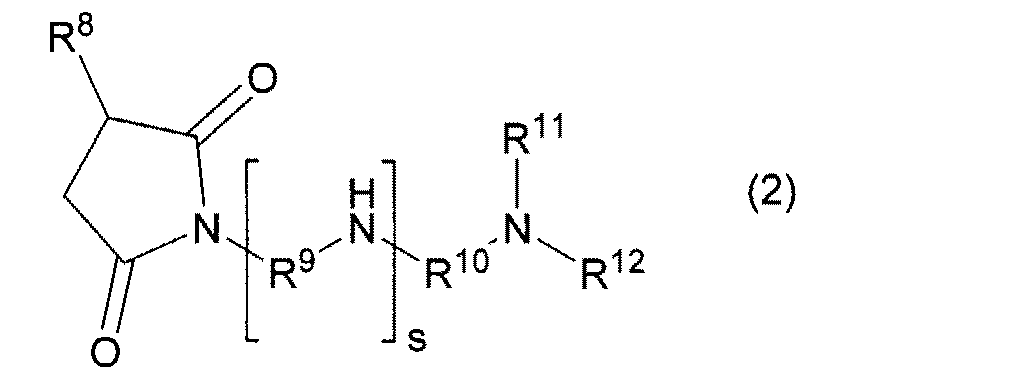
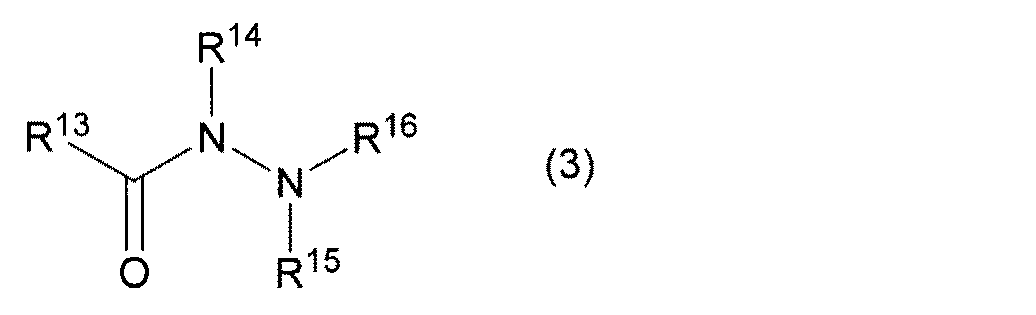
- fatty acid amide compounds preferred are aliphatic amides, aliphatic imides, aliphatic ureas, aliphatic hydrazides, and the like. Specific examples include those represented by the following general formulas (1) to (3).
- fatty acid amide compounds are a concept including an imide compound. Urea is a diamide of carbonic acid, but in the present specification, carbonic acid is also treated as being included in a fatty acid.
- R 1 is an alkyl or alkenyl group having 10 to 30 carbon atoms, preferably 12 to 24 carbon atoms, preferably linear or having one methyl group, and The balance is linear.
- R 2 , R 3 , and R 5 are each independently hydrogen or an alkyl group having 1 to 3 carbon atoms, and hydrogen is particularly preferable.
- R 4 is an alkylene group having 1 to 4 carbon atoms, preferably 2 carbon atoms.
- R 6 and R 7 are each independently hydrogen, an alkyl group having 1 to 30 carbon atoms, or a hydroxyalkyl group having 1 to 3 carbon atoms, and hydrogen is particularly preferable.
- k is an integer of 0 to 4, preferably an integer of 1 to 4.
- m is an integer of 0-2.
- N, p, and r are each independently 0 or 1. However, all of m, k, p, and r are not 0 at the same time.
- the amide compound of the general formula (1) has a structure having amide bonds at both ends of the main chain, and such a structure can also be preferably employed.
- R 8 is an alkyl or alkenyl group having 10 to 30 carbon atoms, preferably 12 to 24 carbon atoms, preferably linear or having one methyl group and the remainder. Is linear.
- R 9 and R 10 are each independently an alkylene group having 1 to 4 carbon atoms, preferably 2 carbon atoms.
- R 11 and R 12 are each independently hydrogen, an alkyl group having 1 to 3 carbon atoms, or a hydroxyalkyl group having 1 to 3 carbon atoms, and hydrogen is particularly preferable.
- s is an integer of 0 to 4, preferably an integer of 1 to 4.
- R 13 is an aliphatic hydrocarbon group having 1 to 30 carbon atoms or an aliphatic hydrocarbon group having functionality having 1 to 30 carbon atoms, preferably an aliphatic hydrocarbon group having 10 to 30 carbon atoms.
- R 14 , R 15 , and R 16 are each independently a hydrocarbon group having 1 to 30 carbon atoms, a hydrocarbon group having 1 to 30 carbon atoms, or hydrogen, preferably 1 to 10 carbon atoms. Or a hydrocarbon group having 1 to 10 carbon atoms or hydrogen, more preferably a hydrocarbon group having 1 to 4 carbon atoms or hydrogen, and still more preferably hydrogen.
- the alkyl group is preferably an alkyl group having 1 to 3 methyl groups from the viewpoint of solubility. More preferably, the number of methyl groups is one. The position of the methyl group is most preferably ⁇ -position.
- the “functional aliphatic hydrocarbon group” means that a hydrogen atom of a base aliphatic hydrocarbon group (preferably an alkyl group or an alkenyl group; hereinafter abbreviated as “matrix group”) is heterogeneous.
- An aliphatic organic group having a structure substituted with a functional group containing an atom is meant.
- the number of carbon atoms of the “functional hydrocarbon group” is the number of carbon atoms in the entire group including the functional group.
- the number of carbon atoms of the base group is within the range of the number of carbon atoms of the “functional aliphatic hydrocarbon group” described above.
- the base group has 10 to 30 carbon atoms in the “aliphatic hydrocarbon group having 10 to 30 carbon functionality”.
- the number of “functional groups containing a heteroatom” (hereinafter abbreviated as “the number of substitutions”) introduced into the base group is 1 or more, and is usually less than or equal to the carbon number of the base group. Less than or equal to 1 ⁇ 2 of the smallest integer, more typically less than or equal to 1 ⁇ 4 or less of the smallest carbon number of the base group, particularly typically less than or equal to 3, Typically 1 or 2.
- heteroatoms include oxygen, nitrogen, sulfur, phosphorus and the like.
- the “functional group containing a hetero atom” may have one or more aliphatic hydrocarbon groups (preferably an alkyl group or an alkenyl group).
- Preferred examples of the “functional group containing a hetero atom” include a hydroxy group, a carboxy group, an aliphatic hydrocarbyloxy group, an aliphatic hydrocarbyloxycarbonyl group, an aliphatic hydrocarbyloxy group, an N-aliphatic substituted or unsubstituted amino group.
- Examples thereof include a carbonyl group, an N-aliphatic hydrocarbon group-substituted or unsubstituted aliphatic hydrocarbylylamino group, and an N-aliphatic hydrocarbon group-substituted or unsubstituted amino group.
- the amide compound represented by the general formula (3) is specifically a hydrazide having a hydrocarbon group having 1 to 30 carbon atoms or a hydrocarbon group having 1 to 30 carbon atoms having functionality or a derivative thereof.
- R 13 is a hydrocarbon group having 1 to 30 carbon atoms or a functional hydrocarbon group having 1 to 30 carbon atoms
- R 14 , R 15 , and R 16 are hydrogen
- the amide compound is a hydrazide having a hydrocarbon group having 1 to 30 carbon atoms or a hydrocarbon group having 1 to 30 carbon atoms having functionality.
- R 14 to R 16 and R 13 is a hydrocarbon group having 1 to 30 carbon atoms or a functional hydrocarbon group having 1 to 30 carbon atoms, and the remainder of R 14 to R 16 is hydrogen
- the amide compound of the general formula (3) is an N or N′-substituted hydrazide having a hydrocarbon group having 1 to 30 carbon atoms or a hydrocarbon group having 1 to 30 carbon atoms having functionality.
- the lubricating oil composition of the present invention may contain a viscosity index improver.
- a so-called non-dispersed viscosity index improver which is a (co) polymer of one or more monomers of various methacrylates, or a polar monomer further containing nitrogen Examples thereof include so-called dispersed viscosity index improvers that are copolymerized.
- viscosity index improvers include non-dispersed or dispersed ethylene- ⁇ -olefin copolymers (the ⁇ -olefins include propylene, 1-butene, 1-pentene, etc.) or hydrogen thereof. And hydrogenated products thereof, styrene-diene hydrogenated copolymers, styrene-maleic anhydride ester copolymers, and polyalkylstyrenes.
- one or two or more compounds arbitrarily selected from these viscosity index improvers can be contained in any amount, but the low temperature viscosity characteristics and fatigue prevention performance are further improved.
- Non-dispersed or dispersed polymethacrylate is preferable, and non-dispersed polymethacrylate is particularly preferable.
- the weight average molecular weight (Mw) of the viscosity index improver is preferably more than 15,000, more preferably 20,000 or more, from the viewpoint of excellent viscosity temperature characteristics and low-temperature performance and capable of improving fuel economy. It is.
- the upper limit of the weight average molecular weight of the viscosity index improver is not particularly limited, but is preferably 70,000 or less, more preferably 50,000, from the viewpoint of further improving the shear stability. Hereinafter, it is more preferably 40,000 or less, particularly preferably 30,000 or less.
- a weight average molecular weight is calculated
- the content of the viscosity index improver in the lubricating oil composition of the present invention is preferably 0.01 to 20% by mass, more preferably 5 to 15% by mass, based on the total amount of the lubricating oil composition.
- the lubricating oil composition of the present invention can contain various additives as required as long as the excellent viscosity temperature characteristics and low temperature performance, fatigue resistance and load resistance are not impaired.
- Such an additive is not particularly limited, and any additive conventionally used in the field of lubricating oils can be blended.
- Specific examples of such lubricant additives include metal detergents, ashless dispersants, antioxidants, extreme pressure agents, antiwear agents, friction modifiers, pour point depressants, corrosion inhibitors, and rust inhibitors. , Demulsifiers, metal deactivators, antifoaming agents and the like. These additives may be used individually by 1 type, and may be used in combination of 2 or more type.
- Metal-based detergent examples include sulfonate detergents, salicylate detergents, phenate detergents, and the like, normal salts with alkali metals or Group 2 elements (broadly defined alkaline earth metals), basic ortho salts, Any of the overbased salts can be blended. In use, one kind or two or more kinds arbitrarily selected from these can be blended.
- a sulfonate detergent is preferred, and the metal is preferably a Group 2 element (broadly defined alkaline earth metal element), and particularly preferably magnesium.
- the preferred content is 0.05% by mass or more, more preferably 0.1% by mass or more, and preferably 0.5% by mass or less, more preferably 0.5% by mass or less as the metal amount based on the total amount of the composition. It is 3 mass% or less, More preferably, it is 0.2 mass% or less.
- Metallic detergent suppresses increase in acid value due to oxidation and improves wear resistance, especially in manual transmission, improved shift operability, improved friction characteristics of wet friction clutch in automatic transmission, continuously variable transmission Is effective in improving the friction coefficient between the belt and the pulley.
- the ashless dispersant any ashless dispersant used in lubricating oils can be used.
- the ashless dispersant may be a mono- or mono-chain having at least one linear or branched alkyl group or alkenyl group having 40 to 400 carbon atoms in the molecule.
- antioxidant examples include ashless antioxidants such as phenols and amines, and metal antioxidants such as copper and molybdenum.
- Extreme pressure agent / antiwear agent As the extreme pressure agent and the antiwear agent, any extreme pressure agent and antiwear agent used in lubricating oil can be used. For example, sulfur-based, phosphorus-based, sulfur-phosphorus extreme pressure agents and the like can be used.
- pour point depressant for example, a polymethacrylate polymer compatible with the lubricating base oil to be used can be used.
- corrosion inhibitor examples include benzotriazole, tolyltriazole, thiadiazole, and imidazole compounds.
- anti-rust examples include petroleum sulfonate, alkylbenzene sulfonate, dinonylnaphthalene sulfonate, alkenyl succinic acid ester, and polyhydric alcohol ester.
- Demulsifier examples include polyalkylene glycol nonionic surfactants such as polyoxyethylene alkyl ether, polyoxyethylene alkyl phenyl ether, and polyoxyethylene alkyl naphthyl ether.
- Metal deactivator examples include imidazoline, pyrimidine derivatives, alkylthiadiazoles, mercaptobenzothiazoles, benzotriazoles or derivatives thereof, 1,3,4-thiadiazole polysulfide, 1,3,4-thiadiazolyl-2,5-bis. Examples thereof include dialkyldithiocarbamate, 2- (alkyldithio) benzimidazole, and ⁇ - (o-carboxybenzylthio) propiononitrile.
- Defoamer for example, silicone oil of less than 100 mm 2 / s kinematic viscosity of 0.1 mm 2 / s or more at 25 ° C., alkenylsuccinic acid derivatives, esters of polyhydroxy aliphatic alcohols and long-chain fatty acids, methyl salicylate , O-hydroxybenzyl alcohol and the like.
- the content is preferably 0.1 to 20% by mass based on the total amount of the composition.
- it is 10.0 mm ⁇ 2 > / s or less, More preferably, it is 8 mm ⁇ 2 > / s or less, More preferably, it is 7 mm ⁇ 2 > / s or less. Particularly preferably, it is 6.5 mm 2 / s or less.
- kinematic viscosity is preferably 2 mm 2 / s or more, more preferably 3 mm 2 / s or more, further preferably 4 mm 2 / s or more, particularly preferably 5 mm 2 / s or more, and most preferably 5.5 mm 2 / s or more. is there.
- the viscosity index of the lubricating oil composition of the present invention is not particularly limited, but is preferably 150 or more, more preferably 160 or more, still more preferably 170 or more, and particularly preferably 175 or more. By setting the viscosity index to be equal to or higher than the lower limit, it becomes easy to improve fuel economy.
- the traction coefficient of the lubricating oil composition of this invention is 0.012 or less, More preferably, it is 0.010 or less, More preferably, it is 0.009 or less.
- the traction coefficient was measured under the conditions of a temperature of 40 ° C., an average speed of 3.0 m / s, a slip ratio of 10%, and a load of 0.4 GPa using an EHL tester (EHD2 manufactured by PCS). Value.
- the shear stability of the lubricating oil composition of the present invention is evaluated by the rate of decrease in kinematic viscosity at 100 ° C. after 20 hours of shearing according to the KRL test method, and the value is preferably 5% or less, more preferably 3%. Hereinafter, it is more preferably 2% or less, particularly preferably less than 1%.
- the KRL test is performed in accordance with CEC L-45-T-99 under conditions of a temperature of 40 ° C., a rotation speed of 1475 rpm, and a load of 5000 N.
- Examples 1 to 5 and Comparative Examples 1 to 3 As shown in Table 1, lubricating oil compositions of the present invention (Examples 1 to 5) and comparative lubricating oil compositions (Comparative Examples 1 to 3) were prepared, respectively.
- “inmass%” for the base oil represents the content based on the total base oil (100 mass%).
- “mass%” represents the content based on the total amount of the lubricating oil composition (100 mass%).
- base oils 1 and 2 correspond to component (A)
- base oil 3 corresponds to component (E)
- base oil 4 corresponds to component (C).
- Polymers 1 to 3 are polymers corresponding to component (B), but polymer 4 is a polymer not corresponding to component (B) because the weight average molecular weight exceeds 15,000.
- Shear Stability Test About each prepared said lubricating oil composition, shear stability was evaluated by the decreasing rate of kinematic viscosity in 100 degreeC after 20-hour shearing by the KRL test method.
- the KRL test was performed in accordance with CEC L-45-T-99, using a device manufactured by HANSA PRESS-und MASCHINENBAU GmbH under conditions of a temperature of 40 ° C., a rotation speed of 1475 rpm, and a load of 5000 N. The results are shown in Table 1. The lower the kinematic viscosity reduction rate, the higher the shear stability, which means that the ability to maintain lubricity is high.
- the lubricating oil compositions of Examples 1 to 5 all showed a low traction coefficient of 0.009 or less, and the viscosity was hardly lowered even after the KRL test. Further, the viscosity index was 160 or more, and it had good viscosity temperature characteristics.
- the lubricating oil composition of Comparative Example 1 which contained only the component (E) as the base oil without containing the component (A) showed a large traction coefficient of 0.015.
- the lubricating oil composition of Comparative Example 3 containing the diol was inferior in both traction coefficient and shear stability.
- Examples 6 to 12 As shown in Table 2, lubricating oil compositions (Examples 6 to 12) of the present invention were prepared.
- friction modifiers 1 to 3 are amide friction modifiers corresponding to component (D), and friction modifiers 4 to 6 are friction modifiers not corresponding to component (D).
- FIG. 1 is a graph plotting the coefficient of friction against the sliding speed for each lubricating oil composition based on the test results shown in Table 2.
- the lubricating oil compositions of Examples 6 to 8 containing the amide friction modifiers 1 to 3 corresponding to the component (D) in the present invention exhibited a friction coefficient of less than 0.08 at all sliding speeds.
- Examples 10 to 12 containing friction modifiers 4 to 6 that do not correspond to the component (D) show a significant difference from Example 9 containing no friction modifier. There wasn't.
- the lubricating oil composition of the present invention is excellent in fuel economy, and has excellent shear stability, so that the ability to maintain good viscosity temperature characteristics is also enhanced. Therefore, it is particularly suitable for manual and automatic transmissions and / or continuously variable transmissions of automobiles, construction machines, agricultural machines, etc., and for manual transmissions of automobiles, construction machines, agricultural machines, etc., and lubrication for differential gears. It can also be suitably used as an oil. In addition, it can also be preferably used as lubricating oil, turbine oil, compressor oil for industrial gear oil, automobiles such as two-wheeled vehicles and four-wheeled vehicles, power generation and marine gasoline engines, diesel engines, and gas engines.
Landscapes
- Chemical & Material Sciences (AREA)
- Chemical Kinetics & Catalysis (AREA)
- General Chemical & Material Sciences (AREA)
- Oil, Petroleum & Natural Gas (AREA)
- Organic Chemistry (AREA)
- Lubricants (AREA)
Abstract
Description
本発明の潤滑油組成物における(A)成分は、100℃における動粘度が5mm2/s以下であり、%CPが90以上である鉱油系基油である。
(A)成分の100℃における動粘度を上記上限値以下とすることにより、粘度温度特性及び低温粘度特性を向上させることができる。
また、(A)成分の100℃における動粘度を上記下限値以上とすることにより、潤滑箇所での油膜形成を十分にして金属疲労防止性及び耐荷重性を高めることが可能になる。また、潤滑油基油の蒸発損失を低減することが可能になる。
(1)パラフィン系原油及び/又は混合系原油の常圧蒸留による留出油
(2)パラフィン系原油及び/又は混合系原油の常圧蒸留残渣油の減圧蒸留による留出油(WVGO)
(3)潤滑油脱ろう工程により得られるワックス(スラックワックス等)及び/又はガストゥリキッド(GTL)プロセス等により得られる合成ワックス(フィッシャートロプシュワックス、GTLワックス等)
(4)基油(1)~(3)から選ばれる1種又は2種以上の混合油及び/又は当該混合油のマイルドハイドロクラッキング処理油
(5)基油(1)~(4)から選ばれる2種以上の混合油
(6)基油(1)、(2)、(3)、(4)又は(5)の脱れき油(DAO)
(7)基油(6)のマイルドハイドロクラッキング処理油(MHC)
(8)基油(1)~(7)から選ばれる2種以上の混合油
(9)上記基油(1)~(8)から選ばれる基油又は当該基油から回収された潤滑油留分を水素化分解し、その生成物又はその生成物から蒸留等により回収される潤滑油留分について溶剤脱ろうや接触脱ろうなどの脱ろう処理を行い、または当該脱ろう処理をした後に蒸留することによって得られる水素化分解鉱油
(10)上記基油(1)~(8)から選ばれる基油又は当該基油から回収された潤滑油留分を水素化異性化し、その生成物又はその生成物から蒸留等により回収される潤滑油留分について溶剤脱ろうや接触脱ろうなどの脱ろう処理を行い、または、当該脱ろう処理をしたあとに蒸留することによって得られる水素化異性化鉱油
また、上記(9)又は(10)の潤滑油基油を得るに際して、必要に応じて溶剤精製処理及び/又は水素化仕上げ処理工程を更に設けてもよい。
本発明の潤滑油組成物は、(A)成分に加えて(B)重量平均分子量(以下において「Mw」と略記することがある。)が15,000以下のポリマーを含有する。
(B)重量平均分子量が15,000以下のポリマーは、上記(A)成分に可溶であればよく、その構造は特に制限されるものではない。(B)成分の具体的な例としては、エチレンとプロピレンとの共重合体;ポリブテン;炭素数8~14のα-オレフィンの重合体であるポリα-オレフィン;分散型又は非分散型のポリ(メタ)アクリレート;主鎖がポリ(メタ)アクリレートであり、側鎖がオレフィンの重合体であるポリマー;スチレン-ジエン水素化共重合体;スチレン-無水マレイン酸エステル共重合体;ポリアルキルスチレン、等を挙げることができる。
なお、本発明において「(メタ)アクリレート」とは、「アクリレート又はメタクリレート」を意味する。
なお、本発明において「α,β-エチレン性不飽和ジカルボン酸」とは、不飽和ジカルボン酸であって、少なくとも一方のカルボキシ基のα炭素とβ炭素とがエチレン性不飽和結合(すなわちC=C二重結合)をなしている化合物を意味する。すなわち、「α,β-エチレン性不飽和ジカルボン酸」とは、マレイン酸、フマル酸、シトラコン酸、及びメサコン酸等のような、両方のカルボキシ基についてα炭素とβ炭素とがエチレン性不飽和結合をなしており且つα,β-エチレン性不飽和結合が主鎖中に存在する化合物に限定されるものではなく、グルタコン酸等のように一方のカルボキシ基のみについてα炭素とβ炭素とがエチレン性不飽和結合をなしている化合物をも包含する概念であり、また、イタコン酸等のようにα,β-エチレン性不飽和結合が側鎖に見出される化合物をも包含する概念である。
なお、ここでいう重量平均分子量とは、ウォーターズ社(Waters Corporation)製150-C ALC/GPC装置において東ソー株式会社(Tosoh Corporation)製のカラムGMHHR-M(7.8mmID×30cm)を2本直列に使用し、溶媒としてテトラヒドロフランを用い、温度23℃、流速1mL/分、試料濃度1質量%、試料注入量75μLの条件下、示差屈折率計(RI)検出器を用いて測定した標準ポリスチレン換算の重量平均分子量を意味する。
(B)成分の100℃における動粘度を上記下限値以上とすることにより、潤滑箇所での油膜形成を十分にして金属疲労防止性及び耐荷重性を高めることが可能になる。また、(B)成分の100℃における動粘度を上記上限値以下とすることにより、剪断安定性をより高めることが可能になる。
(B)成分の含有量を上記範囲内とすることにより、本発明の効果を一層高めることが可能になる。
本発明の潤滑油組成物は、上記(A)成分及び(B)成分に加えて、(C)成分として100℃における動粘度が1~10mm2/sである合成系基油を含有してもよい。
(C)成分の100℃における動粘度を上記下限値以上とすることにより、潤滑箇所での油膜形成を十分にして耐荷重性をより高め、また潤滑油基油の蒸発損失をより低減することが可能になる。また、(C)成分の100℃における動粘度を上記上限値以下とすることにより、粘度温度特性及び低温粘度特性をより向上させることが可能になる。
(a)一価アルコールと一塩基酸とのエステル
(b)多価アルコールと一塩基酸とのエステル
(c)一価アルコールと多塩基酸とのエステル
(d)多価アルコールと多塩基酸とのエステル
(e)一価アルコール及び多価アルコールの混合物と多塩基酸との混合エステル
(f)多価アルコールと一塩基酸及び多塩基酸の混合物との混合エステル
(g)一価アルコール及び多価アルコールの混合物と一塩基酸及び多塩基酸の混合物との混合エステル
(C)成分の含有量を60質量%以下とすることで、酸化安定性を向上することができ、(C)成分の含有量を多くすることで、省燃費性と潤滑性を向上することができる。(C)成分の含有量を上記下限値以上とすることにより、粘度温度特性、低温粘度特性および疲労防止性を向上させることが可能となる。
本発明の潤滑油組成物は、(D)アミド系摩擦調整剤を含有することが好ましい。

なお、上記においてアルキル基としてはメチル基を1~3個有するアルキル基が溶解性の面で好ましい。メチル基の数はより好ましくは1つである。またメチル基の位置はα位がもっとも好ましい。
ここで、「機能性を有する脂肪族炭化水素基」とは、母体となる脂肪族炭化水素基(好ましくはアルキル基又はアルケニル基。以下「母体基」と略記する。)の水素原子が、ヘテロ原子を含む官能基で置換された構造を有する脂肪族有機基を意味する。「機能性を有する炭化水素基」の炭素数は、官能基を含む基全体としての炭素数であるものとする。母体基の炭素数は上記した「機能性を有する脂肪族炭化水素基」の炭素数の範囲内である。すなわち、例えば「炭素数10~30の機能性を有する脂肪族炭化水素基」における母体基の炭素数は10~30である。母体基に導入されている「ヘテロ原子を含む官能基」の数(以下「置換数」と略記する。)は1以上であり、通常母体基の炭素数以下であり、典型的には母体基の炭素数の1/2以上の最小の整数以下であり、より典型的には母体基の炭素数の1/4以上の最小の整数以下であり、特に典型的には3以下であり、最も典型的には1又は2である。ヘテロ原子の例としては、酸素、窒素、硫黄、リン等が挙げられる。「ヘテロ原子を含む官能基」は、1個以上の脂肪族炭化水素基(好ましくはアルキル基又はアルケニル基)を有していてもよい。「ヘテロ原子を含む官能基」の好ましい例としては、ヒドロキシ基、カルボキシ基、脂肪族ヒドロカルビルオキシ基、脂肪族ヒドロカルビルオキシカルボニル基、脂肪族ヒドロカルビロイルオキシ基、N-脂肪族置換又は無置換アミノカルボニル基、N-脂肪族炭化水素基置換又は無置換脂肪族ヒドロカルビロイルアミノ基、及び、N-脂肪族炭化水素基置換又は無置換アミノ基等が挙げられる。
(粘度指数向上剤)
本発明の潤滑油組成物には、粘度指数向上剤を含有してもよい。粘度指数向上剤としては、具体的には、各種メタクリル酸エステルの1種又は2種以上のモノマーの(共)重合体であるいわゆる非分散型粘度指数向上剤、又はさらに窒素を含む極性モノマーを共重合させたいわゆる分散型粘度指数向上剤等が例示できる。他の粘度指数向上剤の具体例としては、非分散型又は分散型エチレン-α-オレフィン共重合体(α-オレフィンとしてはプロピレン、1-ブテン、1-ペンテン等が例示できる。)又はその水素化物、ポリイソブチレン又はその水素化物、スチレン-ジエン水素化共重合体、スチレン-無水マレイン酸エステル共重合体及びポリアルキルスチレン等を挙げることができる。本発明においては、これらの粘度指数向上剤の中から任意に選ばれた1種あるいは2種以上の化合物を任意の量で含有させることができるが、低温粘度特性と疲労防止性能をより高めることができる点で、非分散型又は分散型ポリメタクリレートが好ましく、特に非分散型のポリメタクリレートが好ましい。
金属系清浄剤としては、スルホネート系清浄剤、サリチレート系清浄剤およびフェネート系清浄剤等が挙げられ、アルカリ金属または第2族元素(広義のアルカリ土類金属)との正塩、塩基正塩、過塩基性塩のいずれをも配合することができる。使用に際してはこれらの中から任意に選ばれる1種類あるいは2種類以上を配合することができる。
無灰分散剤としては、潤滑油に用いられる任意の無灰分散剤が使用でき、例えば、炭素数40~400の直鎖又は分枝状のアルキル基又はアルケニル基を分子中に少なくとも1個有するモノ又はビスコハク酸イミド、炭素数40~400のアルキル基又はアルケニル基を分子中に少なくとも1個有するベンジルアミン、あるいは炭素数40~400のアルキル基又はアルケニル基を分子中に少なくとも1個有するポリアミン、あるいはこれらのホウ素化合物、カルボン酸、リン酸等による変成品等が挙げられる。使用に際してはこれらの中から任意に選ばれる1種類あるいは2種類以上を配合することができる。
酸化防止剤としては、フェノール系、アミン系等の無灰酸化防止剤、銅系、モリブデン系等の金属系酸化防止剤が挙げられる。
極圧剤、摩耗防止剤としては、潤滑油に用いられる任意の極圧剤及び摩耗防止剤が使用可能である。例えば、硫黄系、リン系、硫黄-リン系の極圧剤等が使用でき、具体的には、亜リン酸エステル類、チオ亜リン酸エステル類、ジチオ亜リン酸エステル類、トリチオ亜リン酸エステル類、リン酸エステル類、チオリン酸エステル類、ジチオリン酸エステル類、トリチオリン酸エステル類、これらのアミン塩、これらの金属塩、これらの誘導体、ジチオカーバメート、亜鉛ジチオカーバメート、モリブデンジチオカーバメート、ジサルファイド類、ポリサルファイド類、硫化オレフィン類、硫化油脂類等が挙げられる。
流動点降下剤としては、例えば、使用する潤滑油基油に適合するポリメタクリレート系のポリマー等が使用できる。
腐食防止剤としては、例えば、ベンゾトリアゾール系、トリルトリアゾール系、チアジアゾール系、及びイミダゾール系化合物等が挙げられる。
防錆剤としては、例えば、石油スルホネート、アルキルベンゼンスルホネート、ジノニルナフタレンスルホネート、アルケニルコハク酸エステル、及び多価アルコールエステル等が挙げられる。
抗乳化剤としては、例えば、ポリオキシエチレンアルキルエーテル、ポリオキシエチレンアルキルフェニルエーテル、及びポリオキシエチレンアルキルナフチルエーテル等のポリアルキレングリコール系非イオン系界面活性剤等が挙げられる。
金属不活性化剤としては、例えば、イミダゾリン、ピリミジン誘導体、アルキルチアジアゾール、メルカプトベンゾチアゾール、ベンゾトリアゾール又はその誘導体、1,3,4-チアジアゾールポリスルフィド、1,3,4-チアジアゾリル-2,5-ビスジアルキルジチオカーバメート、2-(アルキルジチオ)ベンゾイミダゾール、及びβ-(o-カルボキシベンジルチオ)プロピオンニトリル等が挙げられる。
消泡剤としては、例えば、25℃における動粘度が0.1mm2/s以上100mm2/s未満のシリコーンオイル、アルケニルコハク酸誘導体、ポリヒドロキシ脂肪族アルコールと長鎖脂肪酸とのエステル、メチルサリシレート、o-ヒドロキシベンジルアルコール等が挙げられる。
本発明の潤滑油組成物の100℃における動粘度については特に制限はないが、好ましくは10.0mm2/s以下であり、より好ましくは8mm2/s以下、さらに好ましくは7mm2/s以下、特に好ましくは6.5mm2/s以下である。また、好ましくは2mm2/s以上であり、より好ましくは3mm2/s以上、さらに好ましくは4mm2/s以上、特に好ましくは5mm2/s以上、最も好ましくは5.5mm2/s以上である。100℃における動粘度を上記下限値以上とすることにより、潤滑部位の油膜保持性および蒸発抑制能を高めることが容易になる。また、100℃における動粘度を上記上限値以下とすることにより、省燃費性を高めることが容易になる。
なお、本発明において、トラクション係数は、EHL試験機(PCS社製EHD2)を用いて、温度40℃、平均速度3.0m/s、すべり率10%、荷重0.4GPaの条件下で測定した値とする。
なおKRL試験は、CEC L-45-T-99に準拠し、温度40℃、回転数1475rpm、荷重5000Nの条件下で実施するものとする。
表1に示されるように、本発明の潤滑油組成物(実施例1~5)、比較用の潤滑油組成物(比較例1~3)をそれぞれ調製した。
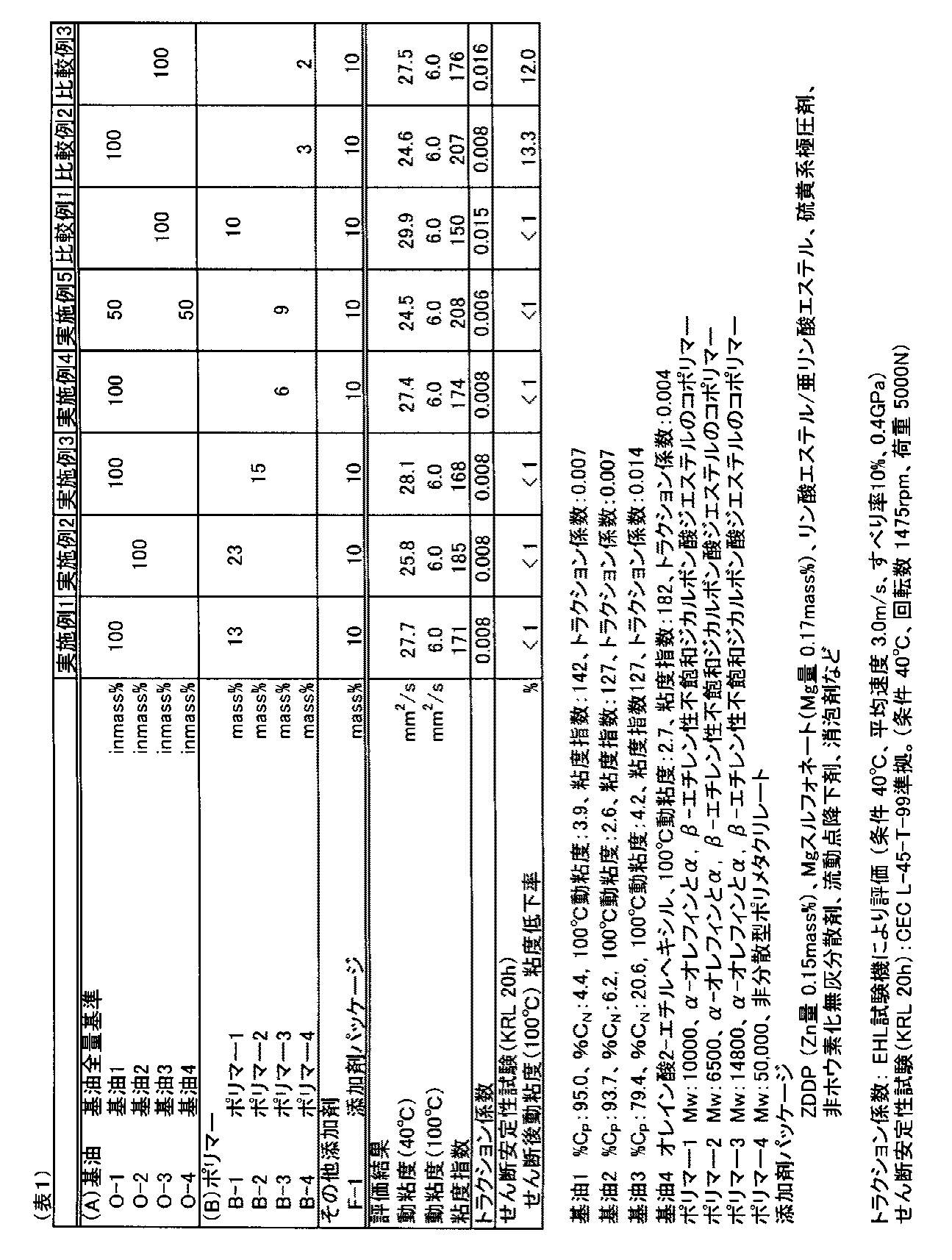
上記調製した各潤滑油組成物について、トラクション係数を測定した。トラクション係数の測定は上述の通り、EHL試験機(PCS社製EHD2)を用いて、温度40℃、平均速度3.0m/s、すべり率10%、荷重0.4GPaの条件下で測定した。結果を表1中に示している。トラクション係数が低いほど、当該潤滑油組成物の省燃費性が高いことを意味する。
上記調製した各潤滑油組成物について、KRL試験法による20時間の剪断後の100℃での動粘度の低下率によって剪断安定性を評価した。KRL試験は、CEC L-45-T-99に準拠し、HANSA PRESS- und MASCHINENBAU GmbH社製装置を用いて、温度40℃、回転数1475rpm、荷重5000Nの条件下で実施した。結果を表1中に示している。動粘度の低下率が低いほど剪断安定性が高く、そのため潤滑性を維持する能力が高いことを意味している。
上記調製した各潤滑油組成物について、JIS K2283に準拠して40℃での動粘度及び100℃での動粘度を測定し、粘度指数を算出した。
実施例1~5の潤滑油組成物は、いずれも0.009以下の低いトラクション係数を示し、かつ、KRL試験の後もほとんど粘度が低下しなかった。また、粘度指数が160以上となり、良好な粘度温度特性を有していた。
これに対し、(A)成分を含有させずに(E)成分のみを基油として含有させた比較例1の潤滑油組成物は、0.015という大きなトラクション係数を示した。
(B)成分を含有させず、代わりに高分子量(Mw=50,000)のポリマーを含有させた比較例2の潤滑油組成物は、剪断安定性に劣っていた。
(A)成分を含有させずに(E)成分のみを基油として含有させ、かつ、(B)成分を含有させず、(B)成分の代わりに高分子量(Mw=50,000)のポリマーを含有させた比較例3の潤滑油組成物は、トラクション係数と剪断安定性の両方で劣っていた。
表2に示されるように、本発明の潤滑油組成物(実施例6~12)をそれぞれ調製した。
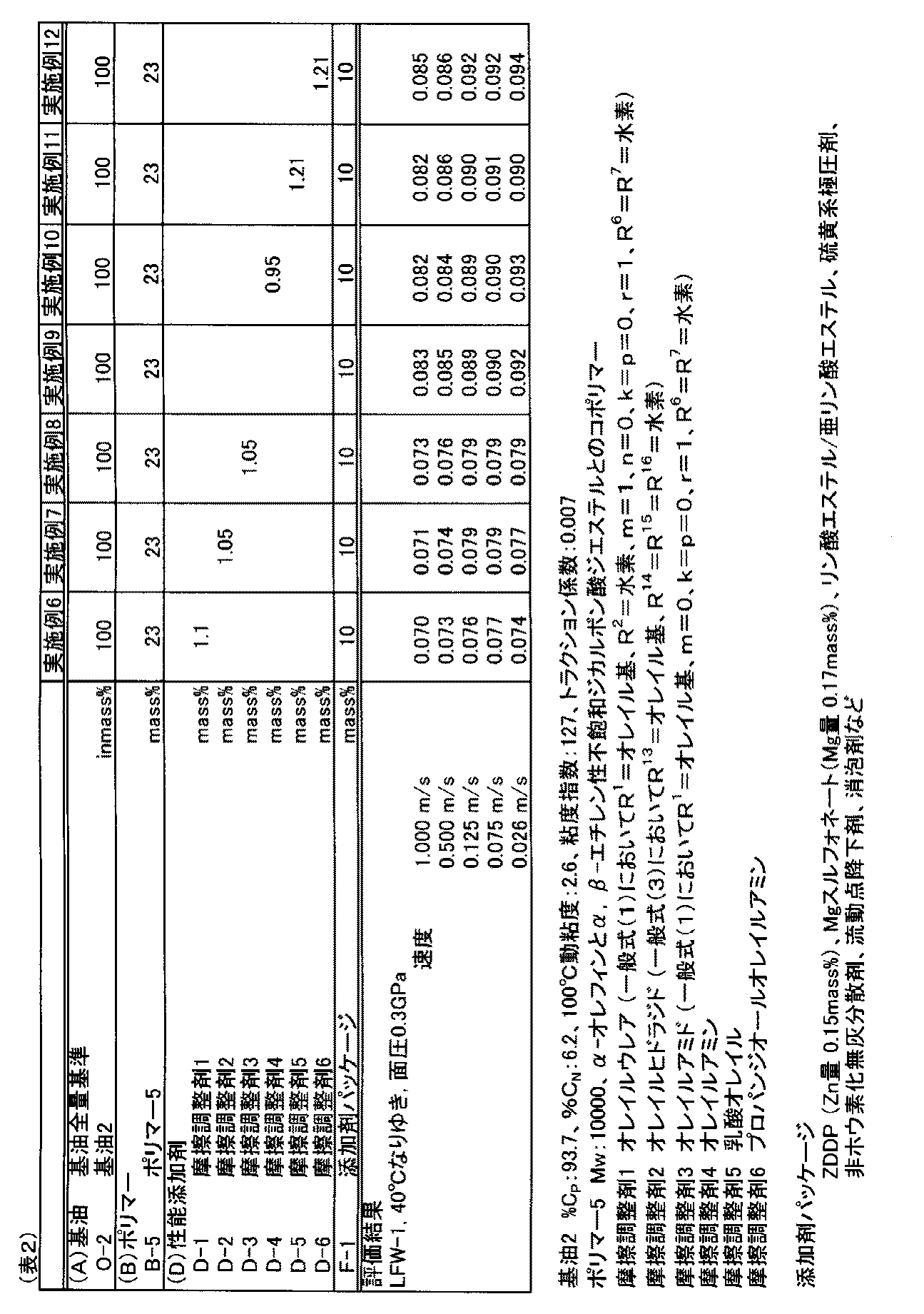
上記調製した各潤滑油組成物について、ブロックオンリング摩擦試験を行った。試験はFALEX社製LFW-1を用いて行った。測定条件は温度40℃、面圧0.3GPaとし、滑り速度を1.000m/s、0.500m/s、0.125m/s、0.075m/s、0.026m/sと順に減らしながら摩擦係数を測定した。結果を表2中に示している。
図1は、表2中に示した試験結果に基づき、各潤滑油組成物について滑り速度に対して摩擦係数をプロットしたグラフである。
本発明における(D)成分に該当するアミド系摩擦調整剤1~3を含有させた実施例6~8の潤滑油組成物は、全ての滑り速度において0.08を下回る摩擦係数を示した。
これに対して、(D)成分に該当しない摩擦調整剤4~6を含有させた実施例10~12は、摩擦調整剤を全く含有させなかった実施例9に対して有意な差が見られなかった。
Claims (5)
- (A)100℃における動粘度が5mm2/s以下であり、%CPが90以上である鉱油系基油と、
(B)重量平均分子量が15,000以下のポリマーと
を含んでなる、潤滑油組成物。 - 前記(A)鉱油系基油の%CNが15以下である、
請求項1に記載の潤滑油組成物。 - 前記(B)成分が、α-オレフィンとα,β-エチレン性不飽和ジカルボン酸ジエステルとのコポリマーである、
請求項1又は2に記載の潤滑油組成物。 - さらに(D)アミド系摩擦調整剤を含む、
請求項1~3のいずれか一項に記載の潤滑油組成物。 - 変速機用潤滑油である、請求項1~4のいずれか一項に記載の潤滑油組成物。
Priority Applications (4)
| Application Number | Priority Date | Filing Date | Title |
|---|---|---|---|
| CN201380016508.4A CN104204174B (zh) | 2012-03-29 | 2013-03-29 | 润滑油组合物 |
| EP13770125.6A EP2832839B1 (en) | 2012-03-29 | 2013-03-29 | Lubricating oil composition |
| JP2014508096A JP5959621B2 (ja) | 2012-03-29 | 2013-03-29 | 潤滑油組成物 |
| US14/388,036 US9359574B2 (en) | 2012-03-29 | 2013-03-29 | Lubricating oil composition |
Applications Claiming Priority (2)
| Application Number | Priority Date | Filing Date | Title |
|---|---|---|---|
| JP2012-077764 | 2012-03-29 | ||
| JP2012077764 | 2012-03-29 |
Publications (1)
| Publication Number | Publication Date |
|---|---|
| WO2013147162A1 true WO2013147162A1 (ja) | 2013-10-03 |
Family
ID=49260404
Family Applications (1)
| Application Number | Title | Priority Date | Filing Date |
|---|---|---|---|
| PCT/JP2013/059540 Ceased WO2013147162A1 (ja) | 2012-03-29 | 2013-03-29 | 潤滑油組成物 |
Country Status (5)
| Country | Link |
|---|---|
| US (1) | US9359574B2 (ja) |
| EP (1) | EP2832839B1 (ja) |
| JP (1) | JP5959621B2 (ja) |
| CN (1) | CN104204174B (ja) |
| WO (1) | WO2013147162A1 (ja) |
Cited By (5)
| Publication number | Priority date | Publication date | Assignee | Title |
|---|---|---|---|---|
| JP2015131906A (ja) * | 2014-01-14 | 2015-07-23 | Jx日鉱日石エネルギー株式会社 | ディファレンシャルギヤ装置用潤滑油組成物 |
| JP2016160312A (ja) * | 2015-02-27 | 2016-09-05 | Jxエネルギー株式会社 | ギヤ油用潤滑油組成物 |
| JP2021187925A (ja) * | 2020-05-28 | 2021-12-13 | Eneos株式会社 | 内燃機関用潤滑油組成物 |
| JP2022061863A (ja) * | 2020-10-07 | 2022-04-19 | Eneos株式会社 | 潤滑油組成物 |
| JP2022061864A (ja) * | 2020-10-07 | 2022-04-19 | Eneos株式会社 | 潤滑油組成物 |
Families Citing this family (3)
| Publication number | Priority date | Publication date | Assignee | Title |
|---|---|---|---|---|
| US10457817B2 (en) | 2016-05-02 | 2019-10-29 | Ecolab Usa Inc. | 2-mercaptobenzimidazole derivatives as corrosion inhibitors |
| JP2021076137A (ja) * | 2019-11-05 | 2021-05-20 | Ntn株式会社 | ハブベアリング |
| US20230002697A1 (en) | 2019-12-04 | 2023-01-05 | The Lubrizol Corporation | Use of ester base stocks to improve viscosity index and efficiency in driveline and industrial gear lubricating fluids |
Citations (10)
| Publication number | Priority date | Publication date | Assignee | Title |
|---|---|---|---|---|
| US2543964A (en) | 1947-07-09 | 1951-03-06 | Socony Vacuum Oil Co Inc | Mineral oil compositions containing copolymers of olefins and esters of alpha, beta-unsaturated polybasic acids |
| EP0075217A2 (de) | 1981-09-17 | 1983-03-30 | Akzo Patente GmbH | Copolymere aus Alpha-Beta-ungesättigten Dicarbonsäureestern, Verfahren zu deren Herstellung sowie deren Verwendung |
| JPH08508056A (ja) * | 1993-03-22 | 1996-08-27 | アクゾ ノーベル ナムローゼ フェンノートシャップ | 非極性のベース流体と相溶性の高粘度潤滑剤コポリマー |
| JPH11286696A (ja) | 1998-03-31 | 1999-10-19 | Nippon Mitsubishi Oil Corp | 内燃機関用潤滑油組成物 |
| JP2003514099A (ja) | 1999-11-09 | 2003-04-15 | エクソンモービル リサーチ アンド エンジニアリング カンパニー | 潤滑油基材油の省燃費性を最適化する方法 |
| JP2004262979A (ja) | 2003-02-21 | 2004-09-24 | Nippon Oil Corp | 変速機用潤滑油組成物 |
| JP2006198745A (ja) * | 2005-01-21 | 2006-08-03 | Nippon Oil Corp | 放電加工油組成物 |
| JP2008208212A (ja) * | 2007-02-26 | 2008-09-11 | Nippon Oil Corp | 潤滑油組成物 |
| JP2008308688A (ja) | 2007-06-13 | 2008-12-25 | Italmatch Chemicals Spa | 高粘度の潤滑材コポリマー |
| JP2011021056A (ja) * | 2009-07-13 | 2011-02-03 | Jx Nippon Oil & Energy Corp | 潤滑油組成物 |
Family Cites Families (9)
| Publication number | Priority date | Publication date | Assignee | Title |
|---|---|---|---|---|
| US4839074A (en) * | 1987-05-22 | 1989-06-13 | Exxon Chemical Patents Inc. | Specified C14 -carboxylate/vinyl ester polymer-containing compositions for lubricating oil flow improvement |
| US5691284A (en) * | 1990-08-11 | 1997-11-25 | Rohm Gmbh | Synthetic oligomeric oils |
| WO2001034735A1 (en) | 1999-11-09 | 2001-05-17 | Exxonmobil Research And Engineering Company | Method for optimizing fuel economy of lubricant basestocks |
| JP2001262176A (ja) * | 2000-03-21 | 2001-09-26 | Nippon Mitsubishi Oil Corp | 変速機用潤滑油組成物 |
| JP5207599B2 (ja) * | 2006-06-08 | 2013-06-12 | Jx日鉱日石エネルギー株式会社 | 潤滑油組成物 |
| JP5213215B2 (ja) | 2007-03-28 | 2013-06-19 | Jx日鉱日石エネルギー株式会社 | 潤滑剤組成物およびこれを用いた潤滑システム |
| US20090005481A1 (en) * | 2007-06-27 | 2009-01-01 | Sumitomo Rubber Industries, Ltd. | Rubber composition for tire, tire member and tire |
| JP5483662B2 (ja) | 2008-01-15 | 2014-05-07 | Jx日鉱日石エネルギー株式会社 | 潤滑油組成物 |
| JP5689592B2 (ja) * | 2009-09-01 | 2015-03-25 | Jx日鉱日石エネルギー株式会社 | 潤滑油組成物 |
-
2013
- 2013-03-29 WO PCT/JP2013/059540 patent/WO2013147162A1/ja not_active Ceased
- 2013-03-29 US US14/388,036 patent/US9359574B2/en active Active
- 2013-03-29 EP EP13770125.6A patent/EP2832839B1/en active Active
- 2013-03-29 JP JP2014508096A patent/JP5959621B2/ja active Active
- 2013-03-29 CN CN201380016508.4A patent/CN104204174B/zh active Active
Patent Citations (10)
| Publication number | Priority date | Publication date | Assignee | Title |
|---|---|---|---|---|
| US2543964A (en) | 1947-07-09 | 1951-03-06 | Socony Vacuum Oil Co Inc | Mineral oil compositions containing copolymers of olefins and esters of alpha, beta-unsaturated polybasic acids |
| EP0075217A2 (de) | 1981-09-17 | 1983-03-30 | Akzo Patente GmbH | Copolymere aus Alpha-Beta-ungesättigten Dicarbonsäureestern, Verfahren zu deren Herstellung sowie deren Verwendung |
| JPH08508056A (ja) * | 1993-03-22 | 1996-08-27 | アクゾ ノーベル ナムローゼ フェンノートシャップ | 非極性のベース流体と相溶性の高粘度潤滑剤コポリマー |
| JPH11286696A (ja) | 1998-03-31 | 1999-10-19 | Nippon Mitsubishi Oil Corp | 内燃機関用潤滑油組成物 |
| JP2003514099A (ja) | 1999-11-09 | 2003-04-15 | エクソンモービル リサーチ アンド エンジニアリング カンパニー | 潤滑油基材油の省燃費性を最適化する方法 |
| JP2004262979A (ja) | 2003-02-21 | 2004-09-24 | Nippon Oil Corp | 変速機用潤滑油組成物 |
| JP2006198745A (ja) * | 2005-01-21 | 2006-08-03 | Nippon Oil Corp | 放電加工油組成物 |
| JP2008208212A (ja) * | 2007-02-26 | 2008-09-11 | Nippon Oil Corp | 潤滑油組成物 |
| JP2008308688A (ja) | 2007-06-13 | 2008-12-25 | Italmatch Chemicals Spa | 高粘度の潤滑材コポリマー |
| JP2011021056A (ja) * | 2009-07-13 | 2011-02-03 | Jx Nippon Oil & Energy Corp | 潤滑油組成物 |
Non-Patent Citations (1)
| Title |
|---|
| See also references of EP2832839A4 |
Cited By (9)
| Publication number | Priority date | Publication date | Assignee | Title |
|---|---|---|---|---|
| JP2015131906A (ja) * | 2014-01-14 | 2015-07-23 | Jx日鉱日石エネルギー株式会社 | ディファレンシャルギヤ装置用潤滑油組成物 |
| WO2015107752A1 (ja) * | 2014-01-14 | 2015-07-23 | Jx日鉱日石エネルギー株式会社 | ディファレンシャルギヤ装置用潤滑油組成物 |
| JP2016160312A (ja) * | 2015-02-27 | 2016-09-05 | Jxエネルギー株式会社 | ギヤ油用潤滑油組成物 |
| US10443016B2 (en) | 2015-02-27 | 2019-10-15 | Jxtg Nippon Oil & Energy Corporation | Lubricating oil composition for gear oil |
| JP2021187925A (ja) * | 2020-05-28 | 2021-12-13 | Eneos株式会社 | 内燃機関用潤滑油組成物 |
| JP2022061863A (ja) * | 2020-10-07 | 2022-04-19 | Eneos株式会社 | 潤滑油組成物 |
| JP2022061864A (ja) * | 2020-10-07 | 2022-04-19 | Eneos株式会社 | 潤滑油組成物 |
| JP7492426B2 (ja) | 2020-10-07 | 2024-05-29 | Eneos株式会社 | 潤滑油組成物 |
| JP7492427B2 (ja) | 2020-10-07 | 2024-05-29 | Eneos株式会社 | 潤滑油組成物 |
Also Published As
| Publication number | Publication date |
|---|---|
| CN104204174B (zh) | 2016-03-30 |
| EP2832839A4 (en) | 2015-10-28 |
| EP2832839B1 (en) | 2018-10-03 |
| US9359574B2 (en) | 2016-06-07 |
| JPWO2013147162A1 (ja) | 2015-12-14 |
| JP5959621B2 (ja) | 2016-08-02 |
| CN104204174A (zh) | 2014-12-10 |
| EP2832839A1 (en) | 2015-02-04 |
| US20150051125A1 (en) | 2015-02-19 |
Similar Documents
| Publication | Publication Date | Title |
|---|---|---|
| JP5959621B2 (ja) | 潤滑油組成物 | |
| JP5829374B2 (ja) | 潤滑油組成物 | |
| JP5988891B2 (ja) | 変速機用潤滑油組成物 | |
| JP6247600B2 (ja) | 変速機用潤滑油組成物 | |
| JP5779376B2 (ja) | 潤滑油組成物 | |
| JP5689592B2 (ja) | 潤滑油組成物 | |
| JP6016692B2 (ja) | 自動変速機用潤滑油組成物 | |
| JP5841657B2 (ja) | 変速機用潤滑油組成物 | |
| WO2014017558A1 (ja) | ポリ(メタ)アクリレート系粘度指数向上剤、並びに該粘度指数向上剤を含有する潤滑油添加剤及び潤滑油組成物 | |
| JP5941530B2 (ja) | 潤滑油組成物 | |
| JP2008208212A (ja) | 潤滑油組成物 | |
| JP2016190918A (ja) | 潤滑油組成物 | |
| JP2011021056A (ja) | 潤滑油組成物 | |
| JP5564204B2 (ja) | 潤滑油組成物 | |
| JP5931250B2 (ja) | 潤滑油組成物 | |
| JP6444219B2 (ja) | ギヤ油用潤滑油組成物 | |
| JP6310798B2 (ja) | 潤滑油組成物 | |
| JP5756280B2 (ja) | 潤滑油組成物 | |
| JP2016190919A (ja) | 潤滑油組成物 | |
| JP5750218B2 (ja) | 潤滑油組成物 | |
| JP2010047735A (ja) | 作動油組成物 | |
| JP6382749B2 (ja) | 最終減速機用潤滑油組成物 | |
| JP6018981B2 (ja) | ポリ(メタ)アクリレート系粘度指数向上剤、並びに該粘度指数向上剤を含有する潤滑油添加剤及び潤滑油組成物 |
Legal Events
| Date | Code | Title | Description |
|---|---|---|---|
| WWE | Wipo information: entry into national phase |
Ref document number: 201380016508.4 Country of ref document: CN |
|
| 121 | Ep: the epo has been informed by wipo that ep was designated in this application |
Ref document number: 13770125 Country of ref document: EP Kind code of ref document: A1 |
|
| ENP | Entry into the national phase |
Ref document number: 2014508096 Country of ref document: JP Kind code of ref document: A |
|
| WWE | Wipo information: entry into national phase |
Ref document number: 14388036 Country of ref document: US |
|
| WWE | Wipo information: entry into national phase |
Ref document number: 2013770125 Country of ref document: EP |
|
| NENP | Non-entry into the national phase |
Ref country code: DE |