WO2013149790A1 - Mercaptosilan-russ-abmischung - Google Patents

Mercaptosilan-russ-abmischung Download PDF

Info

Publication number
WO2013149790A1
WO2013149790A1 PCT/EP2013/054847 EP2013054847W WO2013149790A1 WO 2013149790 A1 WO2013149790 A1 WO 2013149790A1 EP 2013054847 W EP2013054847 W EP 2013054847W WO 2013149790 A1 WO2013149790 A1 WO 2013149790A1
Authority
WO
WIPO (PCT)
Prior art keywords
eto
mercaptosilane
carbon black
mixture
rubber
Prior art date
Legal status (The legal status is an assumption and is not a legal conclusion. Google has not performed a legal analysis and makes no representation as to the accuracy of the status listed.)
Ceased
Application number
PCT/EP2013/054847
Other languages
English (en)
French (fr)
Other versions
WO2013149790A8 (de
Inventor
Anke Blume
Oliver Klockmann
Current Assignee (The listed assignees may be inaccurate. Google has not performed a legal analysis and makes no representation or warranty as to the accuracy of the list.)
Evonik Industries AG
Original Assignee
Evonik Industries AG
Priority date (The priority date is an assumption and is not a legal conclusion. Google has not performed a legal analysis and makes no representation as to the accuracy of the date listed.)
Filing date
Publication date
Priority to IN1730KON2014 priority Critical patent/IN2014KN01730A/en
Priority to PL13708446T priority patent/PL2834294T3/pl
Priority to SI201331193T priority patent/SI2834294T1/sl
Priority to MX2014011810A priority patent/MX361645B/es
Priority to CA2868667A priority patent/CA2868667C/en
Priority to BR112014022487-0A priority patent/BR112014022487B1/pt
Priority to JP2015503798A priority patent/JP6173429B2/ja
Priority to US14/390,770 priority patent/US9598562B2/en
Priority to RU2014144103A priority patent/RU2637024C2/ru
Priority to CN201380018572.6A priority patent/CN104245810B/zh
Priority to KR1020147027513A priority patent/KR102029759B1/ko
Priority to EP13708446.3A priority patent/EP2834294B1/de
Application filed by Evonik Industries AG filed Critical Evonik Industries AG
Priority to ES13708446.3T priority patent/ES2689808T3/es
Publication of WO2013149790A1 publication Critical patent/WO2013149790A1/de
Priority to UAA201411893A priority patent/UA112891C2/uk
Publication of WO2013149790A8 publication Critical patent/WO2013149790A8/de
Priority to IL234298A priority patent/IL234298B/en
Priority to ZA2014/07196A priority patent/ZA201407196B/en
Anticipated expiration legal-status Critical
Ceased legal-status Critical Current

Links

Classifications

    • CCHEMISTRY; METALLURGY
    • C08ORGANIC MACROMOLECULAR COMPOUNDS; THEIR PREPARATION OR CHEMICAL WORKING-UP; COMPOSITIONS BASED THEREON
    • C08LCOMPOSITIONS OF MACROMOLECULAR COMPOUNDS
    • C08L9/00Compositions of homopolymers or copolymers of conjugated diene hydrocarbons
    • C08L9/06Copolymers with styrene
    • CCHEMISTRY; METALLURGY
    • C08ORGANIC MACROMOLECULAR COMPOUNDS; THEIR PREPARATION OR CHEMICAL WORKING-UP; COMPOSITIONS BASED THEREON
    • C08KUse of inorganic or non-macromolecular organic substances as compounding ingredients
    • C08K13/00Use of mixtures of ingredients not covered by one single of the preceding main groups, each of these compounds being essential
    • CCHEMISTRY; METALLURGY
    • C08ORGANIC MACROMOLECULAR COMPOUNDS; THEIR PREPARATION OR CHEMICAL WORKING-UP; COMPOSITIONS BASED THEREON
    • C08KUse of inorganic or non-macromolecular organic substances as compounding ingredients
    • C08K3/00Use of inorganic substances as compounding ingredients
    • C08K3/02Elements
    • C08K3/04Carbon
    • CCHEMISTRY; METALLURGY
    • C08ORGANIC MACROMOLECULAR COMPOUNDS; THEIR PREPARATION OR CHEMICAL WORKING-UP; COMPOSITIONS BASED THEREON
    • C08KUse of inorganic or non-macromolecular organic substances as compounding ingredients
    • C08K5/00Use of organic ingredients
    • C08K5/54Silicon-containing compounds
    • C08K5/548Silicon-containing compounds containing sulfur
    • CCHEMISTRY; METALLURGY
    • C08ORGANIC MACROMOLECULAR COMPOUNDS; THEIR PREPARATION OR CHEMICAL WORKING-UP; COMPOSITIONS BASED THEREON
    • C08KUse of inorganic or non-macromolecular organic substances as compounding ingredients
    • C08K9/00Use of pretreated ingredients
    • C08K9/04Ingredients treated with organic substances
    • C08K9/06Ingredients treated with organic substances with silicon-containing compounds
    • CCHEMISTRY; METALLURGY
    • C09DYES; PAINTS; POLISHES; NATURAL RESINS; ADHESIVES; COMPOSITIONS NOT OTHERWISE PROVIDED FOR; APPLICATIONS OF MATERIALS NOT OTHERWISE PROVIDED FOR
    • C09CTREATMENT OF INORGANIC MATERIALS, OTHER THAN FIBROUS FILLERS, TO ENHANCE THEIR PIGMENTING OR FILLING PROPERTIES ; PREPARATION OF CARBON BLACK  ; PREPARATION OF INORGANIC MATERIALS WHICH ARE NO SINGLE CHEMICAL COMPOUNDS AND WHICH ARE MAINLY USED AS PIGMENTS OR FILLERS
    • C09C1/00Treatment of specific inorganic materials other than fibrous fillers; Preparation of carbon black
    • C09C1/44Carbon
    • C09C1/48Carbon black
    • CCHEMISTRY; METALLURGY
    • C09DYES; PAINTS; POLISHES; NATURAL RESINS; ADHESIVES; COMPOSITIONS NOT OTHERWISE PROVIDED FOR; APPLICATIONS OF MATERIALS NOT OTHERWISE PROVIDED FOR
    • C09CTREATMENT OF INORGANIC MATERIALS, OTHER THAN FIBROUS FILLERS, TO ENHANCE THEIR PIGMENTING OR FILLING PROPERTIES ; PREPARATION OF CARBON BLACK  ; PREPARATION OF INORGANIC MATERIALS WHICH ARE NO SINGLE CHEMICAL COMPOUNDS AND WHICH ARE MAINLY USED AS PIGMENTS OR FILLERS
    • C09C3/00Treatment in general of inorganic materials, other than fibrous fillers, to enhance their pigmenting or filling properties
    • C09C3/12Treatment with organosilicon compounds
    • CCHEMISTRY; METALLURGY
    • C07ORGANIC CHEMISTRY
    • C07FACYCLIC, CARBOCYCLIC OR HETEROCYCLIC COMPOUNDS CONTAINING ELEMENTS OTHER THAN CARBON, HYDROGEN, HALOGEN, OXYGEN, NITROGEN, SULFUR, SELENIUM OR TELLURIUM
    • C07F7/00Compounds containing elements of Groups 4 or 14 of the Periodic Table
    • C07F7/02Silicon compounds
    • C07F7/08Compounds having one or more C—Si linkages
    • CCHEMISTRY; METALLURGY
    • C08ORGANIC MACROMOLECULAR COMPOUNDS; THEIR PREPARATION OR CHEMICAL WORKING-UP; COMPOSITIONS BASED THEREON
    • C08LCOMPOSITIONS OF MACROMOLECULAR COMPOUNDS
    • C08L2205/00Polymer mixtures characterised by other features
    • C08L2205/02Polymer mixtures characterised by other features containing two or more polymers of the same C08L -group
    • CCHEMISTRY; METALLURGY
    • C09DYES; PAINTS; POLISHES; NATURAL RESINS; ADHESIVES; COMPOSITIONS NOT OTHERWISE PROVIDED FOR; APPLICATIONS OF MATERIALS NOT OTHERWISE PROVIDED FOR
    • C09CTREATMENT OF INORGANIC MATERIALS, OTHER THAN FIBROUS FILLERS, TO ENHANCE THEIR PIGMENTING OR FILLING PROPERTIES ; PREPARATION OF CARBON BLACK  ; PREPARATION OF INORGANIC MATERIALS WHICH ARE NO SINGLE CHEMICAL COMPOUNDS AND WHICH ARE MAINLY USED AS PIGMENTS OR FILLERS
    • C09C1/00Treatment of specific inorganic materials other than fibrous fillers; Preparation of carbon black
    • C09C1/44Carbon
    • C09C1/48Carbon black
    • C09C1/56Treatment of carbon black ; Purification

Definitions

  • the invention relates to mercaptosilane-carbon black blend
  • the object of the present invention is to provide blends of mercaptosilanes with carbon black which have improved storage stability.
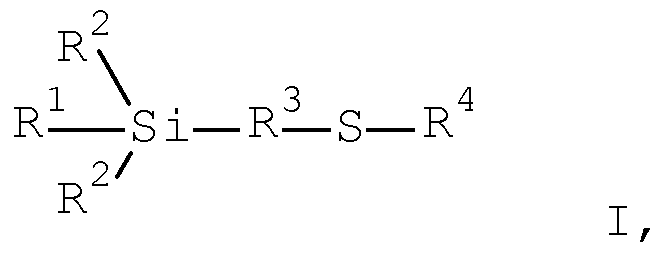
  • the invention relates to a mercaptosilane-carbon black mixture containing at least 20 wt .-%, preferably at least 25 wt .-%, particularly preferably at least 30 wt .-%, mercaptosilane of the general formula I.
  • R 1 is an alkylpolyether group -O- (R 5 -O) m -R 6 , where R 5 is identical or different, a branched or unbranched, saturated or unsaturated, aliphatic C 2 -C 30 divalent hydrocarbon group, preferably CH 2 -CH 2 , CH 2 - CH (CH 3 ), -CH (CH 3 ) -CH 2 - or CH 2 -CH 2 -CH 2 , m in the middle 1 to 30, preferably 2 to 20, more preferably 2 to 15, most preferably 3 to 10, most preferably 3.5 to 7.9, and R 6 is at least 1, preferably
  • R 2 is identical or different and is an R 1 , Cl-C 12 -alkyl or R 7 0-group, with R 7 is H, methyl, ethyl, propyl, C9-C30 branched or unbranched monovalent alkyl,
  • R 3 is a branched or unbranched, saturated or unsaturated, aliphatic, aromatic or mixed aliphatic / aromatic divalent C 1 -C 30, preferably C 1 -C 6, particularly preferably C 3 , hydrocarbon group and
  • the mercaptosilane-carbon black mixture has an iron content ⁇ 9 ppm, most preferably from 0.1-6 ppm.
  • the mercaptosilane-carbon black mixture may contain a mixture of different mercaptosilanes of the general formula I and / or their condensation products.
  • the carbon black in the mercaptosilane-carbon black mixture may have a sieve residue of -S 50 ppm, preferably ⁇ 40 ppm, more preferably ⁇ 35 ppm.
  • R 1 is an alkylpolyether group -O- (R 5 -O) m -R 6 where R 5 is the same or different, a
  • R 2 is the same and a C 1 -C 12 -alkyl or R 7 0-group, with R 7 is H, ethyl, propyl, C9-C30 branched or
  • Aralkyl group or (R 8 ) 3 Si group where R 8 is C1-C30 branched or unbranched alkyl or alkenyl group, R 3 is a branched or unbranched, saturated or unsaturated, aliphatic, aromatic or mixed aliphatic / aromatic double-bonded C1- C30
  • R 2 is different and an R 1 , Cl-C 12 -alkyl or R 7 0-group, with R 7 is H, methyl, ethyl, propyl, C9-C30 branched or unbranched monovalent alkyl, alkenyl, aryl, Aralkyl group or (R 8 ) 3 Si group, where R 8 is C1-C30 branched or unbranched alkyl or alkenyl Group,
  • R 3 is a branched or unbranched, saturated or unsaturated, aliphatic, aromatic or mixed aliphatic / aromatic divalent C 1 -C 30
  • R 2 is R 1 group
  • R 3 is a branched or unbranched, saturated or unsaturated, aliphatic, aromatic or mixed aliphatic / aromatic divalent C 1 -C 30
  • Preferred compounds of the formula I CN can be:
  • R 6 may be a -CnH 2 3, -Ci 2 H 2 5, -Ci 3 H 27 , -Ci 4 H 29 , -C 15 H 31 , -C 16 H 33 or -Ci 7 H 35 alkyl group.
  • R 6 may Cn to C 35, more preferably from Cn to C 30, most preferably C 12 to C 30, extraordinarily preferably C 3 to C 20, unsubstituted or substituted, branched or unbranched monovalent alkenyl preferable.
  • R 6 may be preferably Cn to Ci 4 and / or Ci 6 to C 30 , most preferably Cn to Ci 4 and / or Ci 6 to C 25 , most preferably C 12 to Ci 4 and / or Ci 6 to C 20 , unsubstituted or substituted, branched or unbranched monovalent aralkyl.
  • R 6 can be alkenyl C n H 21 , -Ci 2 H 23 , -Ci 3 H 25 , -C 14 H 21 , -Ci 5 H 29 , - Ci 6 H 3 i or -Ci 7 H 33 .
  • R 1 may be an alkoxylated castor oil (eg CAS 61791-12-6).
  • R 1 may be an alkoxylated oleylamine (eg CAS 26635-93-8).
  • the polyether group (R 5 0) m can be composed of ethylene and propylene oxide random units or polyether blocks
  • Polyethylene oxide and polypropylene oxide included.
  • the mercaptosilane-carbon black mixture may contain a mixture of different mercaptosilanes of the general formula I.
  • the mixture of different mercaptosilanes of the general formula I may have a molecular weight distribution of the polyether group.
  • the mixture of different mercaptosilanes of the general formula I may contain different mercaptosilanes of the general formula I, where R 6 is from
  • the mixture of different mercaptosilanes of the general formula I can contain different mercaptosilanes of the general formula I with R 4 equal to -CN or of their condensation products
  • the polyether group (R 5 -0) m may be preferred:
  • a is 1-50, preferably 2-30, more preferably 3-20, most preferably 4-15, most preferably 5-12,
  • b is 1-50, preferably 2-30, more preferably 3-20, most preferably 4-15, most preferably 5-12 and
  • c is 1-50, preferably 2-30, more preferably 3-20, most preferably 4-15, most preferably 5-12.
  • indices a, b and c are integers and denote the number of repeating units.
  • the alkylpolyether group (R 5 -O) m may be the same for R 4 - H is preferably ethylene oxide (CH 2 -CH 2 -O) a and propylene oxide (CH (CH 3 ) -CH 2 -O) a or (CH 2 -CH (CH 3 ) -0) a units randomly distributed or contained in blocks.
  • the group (R 5 -O) m may be preferred for R 4 equal to -H
  • Propylene oxide (CH (CH 3 ) -CH 2 -O) a or (CH 2 -CH (CH 3 ) -O) a - contain units.
  • the group R 5 may be substituted.
  • the group R 6 can be Ci 3 H 27 .
  • R 1 can be -O- (C 2 H 4 -O) 5 -CnH 23 , -O- (C 2 H 4 -O) 5 -C 12 H 25 , -O- (C 2 H 4 -O) 5 - C 13 H 27 , -O- (C 2 H 4 -O) 5 -C 14 H 29 , -O- (C 2 H 4 -O) 5 -C 15 H 31 , -O- (C 2 H 4 - 0) 3 - C 13 H 27 , -O- (C 2 H 4 -O) 4 -C 13 H 27 , -O- (C 2 H 4 -O) 6 -C 13 H 27 , -O- (C 2 H 4 -0) 7 - C 13 H 27 , -0- (CH 2 CH 2 -O) 5 - (CH 2 ) 10 CH 3 , -O- (CH 2 CH 2 -O) 5- (CH 2 ) 11 CH 3 , -
  • the average number of branches of the carbon chain R 6 may be 1 to 5, preferably 1.2 to 4.
  • Branch number is defined as the number of CH 3 groups-1.
  • R 3 may be CH 2 , CH 2 CH 2 , CH 2 CH 2 CH 2 , CH 2 CH 2 CH 2 CH 2 , CH (CH 3 ),
  • the mixture of different mercaptosilanes of the general formula I can be different mercaptosilanes of the general formula I with different R 1 and R 2
  • the mixture of different mercaptosilanes of the general formula I can be different mercaptosilanes of the general formula I with different R 2
  • the mixture of different mercaptosilanes of the general formula I can be different mercaptosilanes of the general formula I with different R 1 and R 2
  • R 6 has an alkyl chain length of 13 C-atoms, R 5 is ethylene and m is on average 5.
  • the mixture of different mercaptosilanes of the general formula I may contain different mercaptosilanes of the general formula I wherein R 2 is identical or different and is an ethoxy or alkyl polyether group (R 1 ), R 6 is an alkyl chain length of 13 C atoms, R 5 is ethylene and m is 5 on average, and R 2 is different.
  • the mixture of different mercaptosilanes of the general formula I may contain different mercaptosilanes of the general formula I, where R 1 and R 2 are alkoxy and alkyl polyether groups, and R 6 consists of different carbon atom chain lengths and a
  • the mixture of different mercaptosilanes of the general formula I may contain different mercaptosilanes of the general formula I wherein R 2 is identical or different and is an alkoxy or alkylpolyether group (R 1 ), and R 2 in the mixture is different, R 6 is different C Atomic chain lengths and has a molecular weight distribution.
  • Condensation products that is, oligo- and polysiloxanes are formed.
  • oligomeric or polymeric siloxanes of the compounds of formula I can be used as coupling reagents for the same applications as the monomeric compounds of formula I.
  • the mercaptosilane compounds may also be used as a mixture of the oligomeric or polymeric siloxanes of mercaptosilanes of the general formula I or as mixtures of
  • the carbon black may have an STSA surface area (measured according to ASTM D 6556) of 10-150 m 2 / g, preferably 15-90 m 2 / g.
  • the carbon black may have an OAN number (measured according to ASTM D2414) of 50-150 ml / 100g, preferably 70-140 ml / 100g.
  • the carbon black may have an STSA surface area of 20-70 m 2 / g and an OAN number of 100-135 ml / 100g.
  • the weight ratio of mercaptosilane of general formula I to carbon black may be 30:70 to 80:20, preferably 40:60 to 70:30.
  • Another object of the invention is a process for the preparation of the mercaptosilane-carbon black mixture according to the invention, which is characterized in that at least 20 wt .-%, preferably at least 25 wt .-%, particularly preferably at least 30 wt .-%, mercaptosilanes of the general formula I, based on the mercaptosilane-carbon black mixture, mixed with carbon black, wherein the carbon black a
  • the process according to the invention can be carried out continuously or batchwise.
  • the mercaptosilane of the general formula I can be used to carbon black in a weight ratio of 30:70 to 80:20, preferably 40:60 to 70:30.
  • the process according to the invention can be carried out at temperatures between 5 and 200.degree. C., preferably between 10 and 100.degree. more preferably between 15 and 60 ° C, perform. To avoid condensation reactions, it may be advantageous to carry out the reaction in an anhydrous environment,
  • the process according to the invention can be carried out at atmospheric pressure or reduced pressure.
  • the novel mercaptosilane-carbon black blend can be used as adhesion promoter between inorganic materials, for example glass fibers, metals, oxidic fillers, silicic acids, and organic polymers, for example thermosetting plastics, thermoplastics or elastomers or as crosslinking agents and surface modifiers.
  • the novel mercaptosilane-carbon black mixture can be used as a coupling reagent in
  • Rubber compounds such as tire treads can be used.
  • Another object of the invention is a
  • Synthetic rubbers are used. preferred.
  • Synthetic rubbers are described for example in W. Hofmann, rubber technology, Genter Verlag, Stuttgart 1980. You can, among other things
  • BR Polybutadiene
  • IR polyisoprene
  • Styrene / butadiene copolymers for example
  • Emulsion SBR Emulsion SBR
  • L-SBR solution SBR
  • styrene contents 1 to 60 wt.%, Particularly preferably 5 to 50 wt.% (SBR), chloroprene (CR)
  • Ethylene / propylene / diene copolymers have the abovementioned rubbers which additionally have functional groups, such as e.g. Carboxy, silanol or epoxy groups, for example epoxidized NR, carboxy-functionalized NBR or silanol (-SiOH) or
  • the rubbers may be sulfur vulcanizable.
  • the rubbers may in particular anionic
  • L-SBR rubbers solution SBR
  • L-SBR rubbers whose butadiene parts a
  • Vinyl content of over 20 wt .-% can be used. Very particular preference is given to using L-SBR rubbers whose butadiene parts have a vinyl content of more than 50% by weight.
  • fillers Preference is given to using mixtures of the abovementioned rubbers which have an L-SBR content of more than 50% by weight, particularly preferably more than 60% by weight.
  • the following fillers can be used for the rubber mixture according to the invention:
  • Carbon blacks The carbon blacks to be used in this case are prepared by the flame black, furnace, gas black or thermal process and have BET surface areas of from 20 to 200 m 2 / g.
  • the carbon blacks may also contain heteroatoms such as Si.
  • Amorphous silicic acids prepared, for example, by precipitation of solutions of silicates or
  • Silicas may optionally also be present as mixed oxides with other metal oxides, such as Al, Mg, Ca, Ba, Zn and titanium oxides.
  • Synthetic silicates such as aluminum silicate
  • Alkaline earth silicates such as magnesium silicate or
  • Calcium silicate with BET surface areas of 20 to 400 m 2 / g and primary particle diameters of 10 to 400 nm.
  • Natural silicates such as kaolin and other naturally occurring silicas.
  • Glass fiber and glass fiber products (mats, strands) or glass microspheres.
  • amorphous silicas prepared by precipitation of solutions of silicates having BET surface areas of 20 to 400 m 2 / g, more preferably 100 m 2 / g to 250 m 2 / g, in amounts of 5 to 150 parts by weight , in each case based on 100 parts of rubber used.
  • the fillers mentioned can be used alone or in a mixture.
  • the rubber mixture may contain from 5 to 150 parts by weight of filler (B) and from 0.1 to 35 parts by weight, preferably from 2 to 20 parts by weight, more preferably from 5 to 15 parts by weight,
  • the rubber mixture may additionally contain silicone oil and / or alkylsilane.
  • the rubber mixture according to the invention may contain further known rubber auxiliaries, such as, for example, crosslinkers, vulcanization accelerators, reaction accelerators, restrainers, anti-aging agents, stabilizers,
  • Processing aids plasticizers, waxes or
  • Triethanolamine polyethylene glycol or hexane triol.
  • the rubber auxiliaries can be used in customary amounts, which depend inter alia on the intended use. Usual amounts can be, for example
  • crosslinkers sulfur or organic
  • the rubber mixture according to the invention can further comprise
  • vulcanization accelerator Contain vulcanization accelerator.
  • mercaptobenzothiazoles, sulfenamides, guanidines, dithiocarbamates, thioureas, thiocarbonates, and their zinc salts e.g. Zinkdibutyldithiocarbamat be used.
  • the rubber mixture according to the invention may preferably additionally
  • weight ratio of accelerator (D) to nitrogen-containing co-activator (E) is equal to or greater than 1.
  • the rubber mixture according to the invention can (D)
  • Tetrabenzylthiuram disulfide or Tetramethylthiuramdisulfid with at least 0.25 parts by weight, based on 100
  • Sulfenamides may preferably be used together with guanidines and thiurams, more preferably cyclohexylsulfenamide or dicyclohexylsulfenamide together with diphenylguanidine and tetrabenzylthiuram disulfide or tetramethylthiuram disulfide.
  • the vulcanization accelerators and sulfur can be used in amounts of 0.1 to 10 wt .-%, preferably 0.1 to 5 wt .-%, based on the rubber used.
  • Sulfur and sulfenamides in amounts of from 1 to 4% by weight, thiurams in amounts of from 0.2 to 1% by weight, and guanidines in amounts of from 0% by weight to 0.5% by weight can particularly preferably be used ,
  • a further subject of the invention is a process for the preparation of the rubber mixture according to the invention which is characterized in that the rubber or the mixture of rubbers (A), the filler (B), at least one mercaptosilane-carbon black according to the invention Blend (C) and optionally further
  • Rubber additive mixed in a mixing unit Rubber additive mixed in a mixing unit.
  • Mixing units such as rollers, internal mixers and
  • Crosslinking chemicals are added and processed to form the so-called raw mixture for the subsequent process steps, such as molding and vulcanization.
  • the vulcanization of the rubber mixture according to the invention can be carried out at temperatures of 80 to 200 ° C, preferably 130 to 180 ° C, optionally under pressure of 10 to 200 bar.
  • the rubber mixture according to the invention can be used for the production of moldings, for example for the production of
  • Sealing rings and damping elements can be used.
  • Another object of the invention are molded articles obtainable from the rubber mixture according to the invention by vulcanization.
  • the mercaptosilane-carbon black mixtures according to the invention have the advantage that the mercaptosilane does not change to the same extent as in the case of the known mercapto / filler mixtures even after prolonged storage.
  • Approximately 200-300 mg of the mercaptosilane black blend is weighed to the nearest 0.1 mg into a quartz glass container.
  • the digestion is carried out with a double determination.
  • Plasma mass spectrometer measured with one calibration.
  • the 325 mesh screen residue is determined in ppm according to ASTM D1514.
  • the STSA is determined according to ASTM D 6556.
  • the determination of the OAN is carried out according to ASTM D 2414.
  • the acetonitrile extracts are analyzed on a GPC column.
  • an I-point calibration is carried out with the pure substance of the silane to be determined in each case.
  • HPLC system HPLC pump S2100, company SFD, Autosampler SIL10-AF, Shimadzu, RI detector 7515A, company ERC, controller CBM-20A, Shimadzu Class VP5 evaluation software, Shimadzu
  • Methyl ethyl ketone diluted and injected.
  • the peak area of the respective silane is evaluated in the HPLC chromatogram of the RI detector (no GPC molecular weight evaluation).
  • N 330 (iron content: 16 ppm) is used as reference carbon black and Purex HS 45 (iron content: 6 ppm) in the examples according to the invention (both
  • the measurement of the comparative mercaptosilane-soot mixture (a: N 330 / Si 363 11 ppm Fe) gives after storage 74% by weight of Si 363, based on the theoretical value.
  • the measurement of the mercaptosilane-carbon black mixture according to the invention (b: Purex 45 / Si 363 4 ppm Fe) gives after storage 85 wt .-% Si 363, based on the theoretical value.
  • the recipe used for the rubber compounds is given in Table 1 below.
  • the unit phr means parts by weight based on 100 parts of the raw rubber used.
  • the polymer VSL 5025-1 is a polymerized in solution SBR copolymer from Bayer AG, with a
  • the copolymer contains 37.5 phr of oil and has a Mooney viscosity (ML l + 4/100 ° C) of 50.
  • the polymer Buna CB 24 is a cis-1,4-polybutadiene (neodymium type) from Bayer AG, with a cis-1,4-content of at least 96% and a Mooney viscosity of 44 + 5.
  • Ultrasil 7000 GR is an easily dispersible silica from Evonik Industries AG and has a BET surface area of 170 m 2 / g.
  • Corax N330 is a carbon black of the Orion Engineered Carbons with a STSA surface area of 76 m 2 / g.
  • Naftolen ZD becomes Chemetall
  • vulkanox 4020 is 6PPD from Bayer AG and protector G3108 is an ozone protection wax from the Paramelt B.V .. Vulkacit D (DPG) and Vulkacit CZ (CBS) are commercial products of Bayer AG. Perkacit TBzTD
  • the rubber mixture is prepared in three stages in an internal mixer according to Table 2.
  • Table 4 shows the rubber technical data for
  • Rubber mixture the values of the in situ mixture (reference rubber mixture I) can be achieved.
  • the recipe used for the rubber compounds is given in Table 5 below. This means the Unit phr parts by weight based on 100 parts of the raw rubber used.
  • silane soot mixture X 50-S (Si 69 on N 330) used for the reference rubber mixtures is commercially available from Evonik Industries.
  • the polymer VSL 5025-1 is a polymerized in solution SBR copolymer from Bayer AG, with a
  • the copolymer contains 37.5 phr of oil and has a Mooney viscosity (ML l + 4/100 ° C) of 50.
  • the polymer Buna CB 24 is a cis-1,4-polybutadiene (neodymium type) from Bayer AG, with a cis-1,4-content of at least 96% and a Mooney viscosity of 44 + 5.
  • Ultrasil 7000 GR is an easily dispersible silica from Evonik Industries AG and has a BET surface area of 170 m 2 / g.
  • vulkanox 4020 is 6PPD from Bayer AG and protector G3108 is an ozone protection wax from the Paramelt B.V .. Vulkacit D (DPG) and Vulkacit CZ (CBS) are commercial products of Bayer AG. Perkacit TBzTD
  • the rubber mixture is prepared in three stages in an internal mixer according to Table 2.
  • Mercaptosilane-soot mixture according to Example 1b shows in comparison to the reference rubber mixture III better tensile strength, a higher elongation at break, a lower DIN abrasion (corresponds to a lower wear), a significantly higher tear propagation resistance, a very low tan5 60 ° C (which corresponds to a 20 % lowered value compared to the reference X50-S), which is an indication of a significantly improved rolling resistance.

Landscapes

  • Chemical & Material Sciences (AREA)
  • Organic Chemistry (AREA)
  • Health & Medical Sciences (AREA)
  • Chemical Kinetics & Catalysis (AREA)
  • Medicinal Chemistry (AREA)
  • Polymers & Plastics (AREA)
  • Compositions Of Macromolecular Compounds (AREA)
  • Pigments, Carbon Blacks, Or Wood Stains (AREA)
  • Tires In General (AREA)
  • Silver Salt Photography Or Processing Solution Therefor (AREA)
  • Silicon Polymers (AREA)

Description

Mercaptosilan-Ruß-Abmischung
Die Erfindung betrifft Mercaptosilan-Ruß-Abmischung,
Verfahren zu deren Herstellung, sowie deren Verwendung. Aus EP 1285926 und EP 1683801 sind Mercaptosilane mit
Polyethergruppen bekannt.
Ferner sind aus KR 850000081 Silan-/Füllstoffabmischungen bekannt .
Nachteil der bekannten Mercaptosilan-/Füllstoffabmischungen ist die schlechte Lagerstabilität.
Aufgabe der vorliegenden Erfindung ist es, Abmischungen von Mercaptosilanen mit Ruß zur Verfügung zu stellen, die eine verbesserte Lagerstabilität aufweisen.
Gegenstand der Erfindung ist eine Mercaptosilan-Ruß- Abmischung, enthaltend mindestens 20 Gew.-%, vorzugsweise mindestens 25 Gew.-%, besonders bevorzugt mindestens 30 Gew.-%, Mercaptosilan der allgemeinen Formel I
Figure imgf000002_0001
bezogen auf die Mercaptosilan-Ruß-Abmischung,
wobei R1 eine Alkylpolyethergruppe -0- (R5-0) m-R6 ist, mit R5 gleich oder verschieden, eine verzweigte oder unverzweigte, gesättigte oder ungesättigte, aliphatische zweibindige Cl- C30 Kohlenwasserstoffgruppe, vorzugsweise CH2-CH2 , CH2- CH(CH3), -CH (CH3) -CH2- oder CH2-CH2-CH2, m im Mittel 1 bis 30, bevorzugt 2 bis 20, besonders bevorzugt 2 bis 15, ganz besonders bevorzugt 3 bis 10, außerordentlich bevorzugt 3,5 bis 7,9, ist, und R6 aus mindestens 1, vorzugsweise
mindestens 11, besonders bevorzugt mindestens 12, C-Atomen besteht und eine unsubstituierte oder substituierte, verzweigte oder unverzweigte einbindige Alkyl-, Alkenyl, Aryl oder Aralkylgruppe ist,
R2 gleich oder verschieden und eine R1-, Cl-C12-Alkyl- oder R70-Gruppe ist, mit R7 gleich H, Methyl, Ethyl, Propyl, C9- C30 verzweigten oder unverzweigten einbindigen Alkyl-,
Alkenyl-, Aryl-, Aralkylgruppe oder (R8) 3Si-Gruppe, mit R8 gleich C1-C30 verzweigte oder unverzweigte Alkyl- oder Alkenyl-Gruppe,
R3 eine verzweigte oder unverzweigte, gesättigte oder ungesättigte, aliphatische, aromatische oder gemischt aliphatische /aromatische zweibindige C1-C30, vorzugsweise C1-C6, besonders bevorzugt C3, Kohlenwasserstoffgruppe und
R4 gleich H, CN oder (C=0) -R9 ist, mit R9 gleich einer verzweigten oder unverzweigten, gesättigten oder
ungesättigten, aliphatischen, aromatischen oder gemischt aliphatischen /aromatischen einbindigen C1-C30, bevorzugt C5 bis C30, besonders bevorzugt C5 bis C20, ganz besonders bevorzugt C7 bis C15, außerordentlich bevorzugt C7 bis Cll, Kohlenwasserstoffgruppe,
und Ruß,
welche dadurch gekennzeichnet ist, dass die Mercaptosilan- Ruß-Abmischung einen Eisengehalt < 9 ppm, ganz besonders bevorzugt von 0,1-6 ppm, aufweist.
Die Mercaptosilan-Ruß-Abmischung kann ein Gemisch aus unterschiedlichen Mercaptosilanen der allgemeinen Formel I und/oder deren Kondensationsprodukten enthalten. Der Ruß in der Mercaptosilan-Ruß-Abmischung kann einen Siebrückstand -S 50 ppm, vorzugsweise < 40 ppm, besonders bevorzugt < 35 ppm, aufweisen.
Die Mercaptosilane der allgemeinen Formel I können
Verbindungen sein, wobei R1 eine Alkylpolyethergruppe -0- (R5-0)m-R6 ist, mit R5 gleich oder verschieden, eine
verzweigte oder unverzweigte, gesättigte oder ungesättigte, aliphatische zweibindige C1-C30 Kohlenwasserstoffgruppe, m im Mittel 1 bis 30 ist, und R6 aus mindestens 11 C-Atomen besteht und eine unsubstituierte oder substituierte, verzweigte oder unverzweigte einbindige Alkyl-, Alkenyl, Aryl oder Aralkylgruppe ist,
R2 gleich und eine Cl-C12-Alkyl- oder R70-Gruppe ist, mit R7 gleich H, Ethyl, Propyl, C9-C30 verzweigten oder
unverzweigten einbindigen Alkyl-, Alkenyl-, Aryl-,
Aralkylgruppe oder (R8) 3Si-Gruppe, mit R8 gleich C1-C30 verzweigte oder unverzweigte Alkyl- oder Alkenyl-Gruppe, R3 eine verzweigte oder unverzweigte, gesättigte oder ungesättigte, aliphatische, aromatische oder gemischt aliphatische /aromatische zweibindige C1-C30
Kohlenwasserstoffgruppe und
R4 gleich H, CN oder (C=0) -R9 ist, mit R9 gleich einer verzweigten oder unverzweigten, gesättigten oder
ungesättigten, aliphatischen, aromatischen oder gemischt aliphatischen /aromatischen einbindigen C1-C30
Kohlenwasserstoffgruppe .
Die Mercaptosilane der allgemeinen Formel I können
Verbindungen sein, wobei R1 gleich
-0-(C2H4-0) 5-CiiH23, -0- (C2H4-0) 5-C12H25, -0- (C2H4-0) 5-C13H27, -0- (C2H4-0)5-C14H29, -0- (C2H4-0)5-C15H3i, -0- (C2H4-0) 3-C13H27, -0- (C2H4-0)4-C13H27, -0- (C2H4-0) 6-C13H27, -0- (C2H4-0) 7-C13H27, -0- (CH2CH2-0)5- (CH2)10CH3, -0- (CH2CH2-0)5- (CH2)nCH3, -0- (CH2CH2- 0)5- (CH2)12CH3, -0- (CH2CH2-0)5- (CH2)13CH3, -0- (CH2CH2-0) 5- (CH2) 14CH3, -0- (CH2CH2-0) 3- (CH2) i2CH3, -0- (CH2CH2-0) 4- (CH2) i2CH3, -0- (CH2CH2-0) 6- (CH2) 12CH3, -0- (CH2CH2-0) 7- (CH2) 12CH3,
CH3—(CH2)4—CH-(CH2)2—0-CH2—CH2-0
(CH2)2—CH3
Figure imgf000005_0001
Figure imgf000005_0002
Figure imgf000005_0003
Figure imgf000005_0004
ist,
R2 verschieden und eine R1-, Cl-C12-Alkyl- oder R70-Gruppe ist, mit R7 gleich H, Methyl, Ethyl, Propyl, C9-C30 verzweigten oder unverzweigten einbindigen Alkyl-, Alkenyl , Aryl-, Aralkylgruppe oder (R8) 3Si-Gruppe, mit R8 gleich C1-C30 verzweigte oder unverzweigte Alkyl- oder Alkenyl- Gruppe,
R3 eine verzweigte oder unverzweigte, gesättigte oder ungesättigte, aliphatische, aromatische oder gemischt aliphatische /aromatische zweibindige C1-C30
Kohlenwasserstoffgruppe und
R4 gleich H, CN oder (C=0) -R9 ist, mit R9 gleich einer verzweigten oder unverzweigten, gesättigten oder
ungesättigten, aliphatischen, aromatischen oder gemischt aliphatischen /aromatischen einbindigen C1-C30
Kohlenwasserstoffgruppe .
Die Mercaptosilane der allgemeinen Formel I können
Verbindungen sein, wobei R1 gleich
-0-(C2H4-0) 5-CiiH23, -0- (C2H4-0) 5-C12H25, -0- (C2H4-0) 5-C13H27, -0- (C2H4-0)5-C14H29, -0- (C2H4-0)5-C15H3i, -0- (C2H4-0) 3-C13H27, -0- (C2H4-0)4-C13H27, -0- (C2H4-0) 6-C13H27, -0- (C2H4-0) 7-C13H27, -0- (CH2CH2-0)5- (CH2)10CH3, -0- (CH2CH2-0)5- (CH2)nCH3, -0- (CH2CH2-
0)5- (CH2)12CH3, -0- (CH2CH2-0)5- (CH2)13CH3, -0- (CH2CH2-0) 5- (CH2) 14CH3, -0- (CH2CH2-0) 3- (CH2) 12CH3, -0- (CH2CH2-0) 4- (CH2) 12CH3,
-0- (CH2CH2-0) 6- (CH2) 12CH3, -0- (CH2CH2-0) 7- (CH2) 12CH3,
CH3—(CH2)4—CH-(CH2)2—0-CH2—CH2-0
(CH2)2—CH3
Figure imgf000006_0001
Figure imgf000006_0002
Figure imgf000007_0001
Figure imgf000007_0002
ist,
R2 gleich R1 -Gruppe ist,
R3 eine verzweigte oder unverzweigte, gesättigte oder ungesättigte, aliphatische, aromatische oder gemischt aliphatische /aromatische zweibindige C1-C30
Kohlenwasserstoffgruppe und
R4 gleich H, CN oder (C=0) -R9 ist, mit R9 gleich einer verzweigten oder unverzweigten, gesättigten oder
ungesättigten, aliphatischen, aromatischen oder gemischt aliphatischen /aromatischen einbindigen C1-C30
Kohlenwasserstoffgruppe .
Bevorzugte Verbindungen der Formel I mit R4 = H können sein :
[ (CnH230- (CH2 -CH20)2] (EtO) 2Si (CH2) 3SH,
[ (CnH230- (CH2 -CH20)3] (EtO) 2Si (CH2) 3SH,
[ (CnH230- (CH2 -CH20)4] (EtO) 2Si (CH2) 3SH,
[ (CnH230- (CH2 -CH20)5] (EtO) 2Si (CH2) 3SH,
[ (CnH230- (CH2 -CH20) 6] (EtO) 2Si (CH2) 3SH,
[ (C12H250- (CH2 -CH20)2] (EtO) 2Si (CH2) 3SH,
[ (C12H250- (CH2 -CH20)3] (EtO) 2Si (CH2) 3SH,
[ (C12H250- (CH2 -CH20)4] (EtO) 2Si (CH2) 3SH,
[ (C12H250- (CH2 -CH20)5] (EtO) 2Si (CH2) 3SH,
[ (C12H250- (CH2 -CH20) 6] (EtO) 2Si (CH2) 3SH, C13H270- (CH2-CH20)2] (EtO) 2S1 (CH2) 3SH,
C13H270- (CH2 -CH20)3] (EtO) 2Si (CH2) 3SH,
C13H270- (CH2 -CH20)4] (EtO) 2Si (CH2) 3SH,
C13H270- (CH2 -CH20)5] (EtO) 2Si (CH2) 3SH,
C13H270- (CH2 -CH20) 6] (EtO) 2Si (CH2) 3SH,
C14H290- (CH2 -CH20)2] (EtO) 2Si (CH2) 3SH,
C14H290- (CH2 -CH20)3] (EtO) 2Si (CH2) 3SH,
C14H290- (CH2 -CH20)4] (EtO) 2Si (CH2) 3SH,
C14H290- (CH2 -CH20)5] (EtO) 2Si (CH2) 3SH,
C14H290- (CH2 -CH20) 6] (EtO) 2Si (CH2) 3SH,
C15H310- (CH2 -CH20)2] (EtO) 2Si (CH2) 3SH,
C15H310- (CH2 -CH20)3] (EtO) 2Si (CH2) 3SH,
C15H310- (CH2 -CH20)4] (EtO) 2Si (CH2) 3SH,
C15H310- (CH2 -CH20)5] (EtO) 2Si (CH2) 3SH,
C15H310- (CH2 -CH20) 6] (EtO) 2Si (CH2) 3SH,
C16H330- (CH2 -CH20)2] (EtO) 2Si (CH2) 3SH,
C16H330- (CH2 -CH20)3] (EtO) 2Si (CH2) 3SH,
C16H330- (CH2 -CH20)4] (EtO) 2Si (CH2) 3SH,
C16H330- (CH2 -CH20)5] (EtO) 2Si (CH2) 3SH,
C16H330- (CH2 -CH2O) 6] (EtO) 2Si (CH2) 3SH,
C17H350- (CH2 -CH20)2] (EtO) 2Si (CH2) 3SH,
C17H350- (CH2 -CH20)3] (EtO) 2Si (CH2) 3SH,
C17H350- (CH2 -CH20)4] (EtO) 2Si (CH2) 3SH,
C17H350- (CH2 -CH20)5] (EtO) 2Si (CH2) 3SH,
C17H350- (CH2 -CH2O) 6] (EtO) 2Si (CH2) 3SH,
C11H230- (CH2 -CH20)2] 2 (EtO) Si (CH2) 3SH,
C11H230- (CH2 -CH20)3] 2 (EtO) Si (CH2) 3SH,
C11H230- (CH2 -CH20)4] 2 (EtO) Si (CH2) 3SH,
C11H230- (CH2 -CH20)5] 2 (EtO) Si (CH2) 3SH,
C11H230- (CH2 -CH2O) 6] 2 (EtO) Si (CH2) 3SH,
C12H250- (CH2 -CH20)2] 2 (EtO) Si (CH2) 3SH, (C12H250- (CH2 -CH20) 3 ] 2 (EtO) Si (CH2) 3SH,
(C12H250- (CH2 -CH20) 4 ] 2 (EtO) Si (CH2) 3SH,
(C12H250- (CH2 -CH20) 5 ] 2 (EtO) Si (CH2) 3SH,
(C12H250- (CH2 -CH20) 6 ] 2 (EtO) Si (CH2) 3SH,
(C13H270- (CH2 -CH20) 2 ] 2 (EtO) Si (CH2) 3SH,
(C13H270- (CH2 -CH20) 3 ] 2 (EtO) Si (CH2) 3SH,
(C13H270- (CH2 -CH20) 4 ] 2 (EtO) Si (CH2) 3SH,
(C13H270- (CH2 -CH20) 5 ] 2 (EtO) Si (CH2) 3SH,
(C13H270- (CH2 -CH20) 6 ] 2 (EtO) Si (CH2) 3SH,
( C14H290- (CH2 -CH20) 2 ] 2 (EtO) Si (CH2) 3SH,
( C14H290- (CH2 -CH20) 3 ] 2 (EtO) Si (CH2) 3SH,
( C14H290- (CH2 -CH20) 4 ] 2 (EtO) Si (CH2) 3SH,
( C14H290- (CH2 -CH20) 5 ] 2 (EtO) Si (CH2) 3SH,
( C14H290- (CH2 -CH20) 6 ] 2 (EtO) Si (CH2) 3SH,
(C15H3iO- (CH2 -CH20) 2 ] 2 (EtO) Si (CH2) 3SH,
(C15H3iO- (CH2 -CH20) 3 ] 2 (EtO) Si (CH2) 3SH,
(C15H3iO- (CH2 -CH20) 4 ] 2 (EtO) Si (CH2) 3SH,
(C15H3iO- (CH2 -CH20) 5 ] 2 (EtO) Si (CH2) 3SH,
(C15H3iO- (CH2 -CH20) 6 ] 2 (EtO) Si (CH2) 3SH,
(C16H33O- (CH2 -CH20) 2 ] 2 (EtO) Si (CH2) 3SH,
(C16H33O- (CH2 -CH20) 3 ] 2 (EtO) Si (CH2) 3SH,
(C16H33O- (CH2 -CH20) 4 ] 2 (EtO) Si (CH2) 3SH,
(C16H33O- (CH2 -CH20) 5 ] 2 (EtO) Si (CH2) 3SH,
(C16H33O- (CH2 -CH20) 6 ] 2 (EtO) Si (CH2) 3SH,
(C17H35O- (CH2 -CH20) 2 ] 2 (EtO) Si (CH2) 3SH,
(C17H35O- (CH2 -CH20) 3 ] 2 (EtO) Si (CH2) 3SH,
(C17H35O- (CH2 -CH20) 4 ] 2 (EtO) Si (CH2) 3SH,
(C17H35O- (CH2 -CH20) 5 ] 2 (EtO) Si (CH2) 3SH,
(C17H35O- (CH2 -CH20) 6 ] 2 (EtO) Si (CH2) 3SH,
(C11H23O- (CH2 -CH20) 2]3Si (CH2)3 SH,
(C11H23O- (CH2 -CH20) 3]3Si (CH2)3 SH, (C11H230- (CH2'-CH20)4 3Si (CH2 3SH,
(C11H230- (CH2' -CH20)5 3Si (CH2 3SH,
(C11H230- (CH2' -CH20) 6 3Si (CH2 3SH,
(C12H250- (CH2' -CH20)2 3Si (CH2 3SH,
(C12H250- (CH2' -CH20)3 3Si (CH2 3SH,
(C12H250- (CH2' -CH20)4 3Si (CH2 3SH,
(C12H250- (CH2' -CH20)5 3Si (CH2 3SH,
(C12H250- (CH2' -CH20) 6 3Si (CH2 3SH,
(Ci3H270- (CH2' -CH20)2 3Si (CH2 3SH,
(Ci3H270- (CH2' -CH20)3 3Si (CH2 3SH,
(Ci3H270- (CH2' -CH20)4 3Si (CH2 3SH,
(Ci3H270- (CH2' -CH20)5 3Si (CH2 3SH,
(Ci3H270- (CH2' -CH20) 6 3Si (CH2 3SH,
(Ci4H290- (CH2' -CH20)2 3Si (CH2 3SH,
(Ci4H290- (CH2' -CH20)3 3Si (CH2 3SH,
(Ci4H290- (CH2' -CH20)4 3Si (CH2 3SH,
(Ci4H290- (CH2' -CH20)5 3Si (CH2 3SH,
(Ci4H290- (CH2' -CH20) 6 3Si (CH2 3SH,
(C15H3iO- (CH2' -CH20)2 3Si (CH2 3SH,
[ (C15H31- (CH2-CH20)3] Si (CH2): SH, [ (C15H31O- (CH2-CH20)4 3Si (CH2 3SH, [ (C15H31O- (CH2-CH20)5 3Si (CH2 3SH, [ (C15H31O- (CH2-CH20) 6 3Si (CH2 3SH,
[ (C16H330- (CH2-CH20)2 3Si (CH2 3SH, [ (C16H33- (CH2-CH20)3] Si (CH2): SH, [ (C16H330- (CH2-CH20)4 3Si (CH2 3SH, [ (C16H330- (CH2-CH20)5 3Si (CH2 3SH, [ (C16H330- (CH2-CH20) 6 3Si (CH2 3SH,
[ (C17H350- (CH2-CH20)2 3Si (CH2 3SH, [ (C17H35- (CH2-CH20)3] Si (CH2): SH, [ (C17H350- (CH2-CH20)4 3Si (CH2 3SH, [ (C17H35O- (CH2-CH20)5] 3S1 (CH2)3SH,
[ (C17H35O- (CH2 -CH2O) 6] 3S1 (CH2)3 SH,
[ (C11H23O- (CH2 -CH20)2] (EtO) 2S1 -CH2 -CH (CH3) -CH2- SH,
[ (C11H23O- (CH2 -CH20)3] (EtO) 2Si -CH2 -CH (CH3) -CH2- SH,
[ (C11H23O- (CH2 -CH20)4] (EtO) 2Si -CH2 -CH (CH3) -CH2- SH,
[ (C11H23O- (CH2 -CH20)5] (EtO) 2Si -CH2 -CH (CH3) -CH2- SH,
[ (C11H23O- (CH2 -CH2O) 6] (EtO) 2Si -CH2 -CH (CH3) -CH2- SH,
[ (C12H25O- (CH2 -CH20)2] (EtO) 2Si -CH2 -CH (CH3) -CH2- SH,
[ (C12H25O- (CH2 -CH20)3] (EtO) 2Si -CH2 -CH (CH3) -CH2- SH,
[ (C12H25O- (CH2 -CH20)4] (EtO) 2Si -CH2 -CH (CH3) -CH2- SH,
[ (C12H25O- (CH2 -CH20)5] (EtO) 2Si -CH2 -CH (CH3) -CH2- SH,
[ (C12H25O- (CH2 -CH2O) 6] (EtO) 2Si -CH2 -CH (CH3) -CH2- SH,
[ ( C13H27O- (CH2 -CH20)2] (EtO) 2Si -CH2 -CH (CH3) -CH2- SH,
[ ( C13H27O- (CH2 -CH20)3] (EtO) 2Si -CH2 -CH (CH3) -CH2- SH,
[ ( C13H27O- (CH2 -CH20)4] (EtO) 2Si -CH2 -CH (CH3) -CH2- SH,
[ ( C13H27O- (CH2 -CH20)5] (EtO) 2Si -CH2 -CH (CH3) -CH2- SH,
[ ( C13H27O- (CH2 -CH2O) 6] (EtO) 2Si -CH2 -CH (CH3) -CH2- SH,
[ ( C14H29O- (CH2 -CH20)2] (EtO) 2Si -CH2 -CH (CH3) -CH2- SH,
[ ( C14H29O- (CH2 -CH20)3] (EtO) 2Si -CH2 -CH (CH3) -CH2- SH,
[ ( C14H29O- (CH2 -CH20)4] (EtO) 2Si -CH2 -CH (CH3) -CH2- SH,
[ ( C14H29O- (CH2 -CH20)5] (EtO) 2Si -CH2 -CH (CH3) -CH2- SH,
[ ( C14H29O- (CH2 -CH2O) 6] (EtO) 2Si -CH2 -CH (CH3) -CH2- SH,
[ (C15H3iO- (CH2 -CH20)2] (EtO) 2Si -CH2 -CH (CH3) -CH2- SH,
[ (C15H3iO- (CH2 -CH20)3] (EtO) 2Si -CH2 -CH (CH3) -CH2- SH,
[ (C15H3iO- (CH2 -CH20)4] (EtO) 2Si -CH2 -CH (CH3) -CH2- SH,
[ (C15H3iO- (CH2 -CH20)5] (EtO) 2Si -CH2 -CH (CH3) -CH2- SH,
[ (C15H3iO- (CH2 -CH2O) 6] (EtO) 2Si -CH2 -CH (CH3) -CH2- SH,
[ (C16H33O- (CH2 -CH20)2] (EtO) 2Si -CH2 -CH (CH3) -CH2- SH,
[ (C16H33O- (CH2 -CH20)3] (EtO) 2Si -CH2 -CH (CH3) -CH2- SH,
[ (C16H33O- (CH2 -CH20)4] (EtO) 2Si -CH2 -CH (CH3) -CH2- SH,
[ (C16H33O- (CH2 -CH20)5] (EtO) 2Si -CH2 -CH (CH3) -CH2- SH, (C16H330- (CH2 -CH20) 6] (EtO) 2S1 -CH2 -CH (CH3) -CH2 -SH,
(C17H350- (CH2 -CH20) 2] (EtO) 2S1 -CH2 -CH (CH3) -CH2 -SH,
(C17H350- (CH2 -CH20) 3] (EtO) 2Si -CH2 -CH (CH3) -CH2 -SH,
(C17H350- (CH2 -CH20) 4] (EtO) 2Si -CH2 -CH (CH3) -CH2 -SH,
(C17H350- (CH2 -CH20) 5] (EtO) 2Si -CH2 -CH (CH3) -CH2 -SH,
(C17H350- (CH2 -CH20) 6] (EtO) 2Si -CH2 -CH (CH3) -CH2 -SH,
(CiiH230- (CH2 -CH20) 2] 2 (EtO ) Si -CH2 -CH (CH3) -CH2 -SH,
(C11H23O- (CH2 -CH20) 3] 2 (EtO ) Si -CH2 -CH (CH3) -CH2 -SH,
(C11H23O- (CH2 -CH20) 4] 2 (EtO ) Si -CH2 -CH (CH3) -CH2 -SH,
(C11H23O- (CH2 -CH20) 5] 2 (EtO ) Si -CH2 -CH (CH3) -CH2 -SH,
(C11H23O- (CH2 -CH20) 6] 2 (EtO ) Si -CH2 -CH (CH3) -CH2 -SH,
(C12H250- (CH2 -CH20) 2] 2 (EtO ) Si -CH2 -CH (CH3) -CH2 -SH,
(C12H250- (CH2 -CH20) 3] 2 (EtO ) Si -CH2 -CH (CH3) -CH2 -SH,
(C12H250- (CH2 -CH20) 4] 2 (EtO ) Si -CH2 -CH (CH3) -CH2 -SH,
(C12H250- (CH2 -CH20) 5] 2 (EtO ) Si -CH2 -CH (CH3) -CH2 -SH,
(C12H250- (CH2 -CH20) 6] 2 (EtO ) Si -CH2 -CH (CH3) -CH2 -SH,
(Ci3H270- (CH2' -CH20) 2 ] 2 (EtO) Si -CH2' -CH (CH3) -CH2' -SH,
(Ci3H270- (CH2' -CH20) 3] 2 (EtO) Si -CH2' -CH (CH3) -CH2' -SH,
(Ci3H270- (CH2' -CH20) 4 ] 2 (EtO) Si -CH2' -CH (CH3) -CH2' -SH,
(Ci3H270- (CH2' -CH20) 5 ] 2 (EtO) Si -CH2' -CH (CH3) -CH2' -SH,
(Ci3H270- (CH2' -CH20) 6] 2 (EtO) Si -CH2' -CH (CH3) -CH2' -SH,
(C14H29O- (CH2' -CH20) 2 ] 2 (EtO) Si -CH2' -CH (CH3) -CH2' -SH,
(C14H29O- (CH2' -CH20) 3] 2 (EtO) Si -CH2' -CH (CH3) -CH2' -SH,
(C14H29O- (CH2' -CH20) 4 ] 2 (EtO) Si -CH2' -CH (CH3) -CH2' -SH,
(C14H29O- (CH2' -CH20) 5 ] 2 (EtO) Si -CH2' -CH (CH3) -CH2' -SH,
(C14H29O- (CH2' -CH20) 6] 2 (EtO) Si -CH2' -CH (CH3) -CH2' -SH,
(C15H310- (CH2' -CH20) 2 ] 2 (EtO) Si -CH2' -CH (CH3) -CH2' -SH,
(C15H310- (CH2' -CH20) 3] 2 (EtO) Si -CH2' -CH (CH3) -CH2' -SH,
(C15H310- (CH2' -CH20) 4 ] 2 (EtO) Si -CH2' -CH (CH3) -CH2' -SH,
(C15H310- (CH2' -CH20) 5 ] 2 (EtO) Si -CH2' -CH (CH3) -CH2' -SH,
(C15H310- (CH2' -CH20) 6] 2 (EtO) Si -CH2' -CH (CH3) -CH2' -SH, (C16H330- (CH2'-CH20) 2 ] 2 (EtO) Si'-CH2'-CH (CH3) -CH2'-SH,
(C16H330- (CH2' -CH20) 3 ] 2 (EtO) Si' -CH2' -CH (CH3) -CH2' -SH,
(C16H330- (CH2' -CH20) 4] 2 (EtO) Si' -CH2' -CH (CH3) -CH2' -SH,
(C16H330- (CH2' -CH20) 5.2 (EtO) Si' -CH2' -CH (CH3) -CH2' -SH,
(C16H330- (CH2' -CH20) 6] 2 (EtO) Si' -CH2' -CH (CH3) -CH2' -SH,
(C17H350- (CH2' -CH20) 2 ] 2 (EtO) Si' -CH2' -CH (CH3) -CH2' -SH,
(C17H350- (CH2' -CH20) 3 ] 2 (EtO) Si' -CH2' -CH (CH3) -CH2' -SH,
(C17H350- (CH2' -CH20) 4] 2 (EtO) Si' -CH2' -CH (CH3) -CH2' -SH,
(C17H350- (CH2' -CH20) 5.2 (EtO) Si' -CH2' -CH (CH3) -CH2' -SH,
(C17H350- (CH2' -CH20) 6] 2 (EtO) Si' -CH2' -CH (CH3) -CH2' -SH,
(C11H230- (CH2 -CH20) 2]3Si -CH2 -CH (CH3) -CH2- SH,
(C11H230- (CH2 -CH20) 3]3Si -CH2 -CH (CH3) -CH2- SH,
(C11H230- (CH2 -CH20) 4]3Si -CH2 -CH (CH3) -CH2- SH,
(C11H230- (CH2 -CH20) 5]3Si -CH2 -CH (CH3) -CH2- SH,
(C11H230- (CH2 -CH20) 6]3Si -CH2 -CH (CH3) -CH2- SH,
(C12H250- (CH2 -CH20) 2]3Si -CH2 -CH (CH3) -CH2- SH,
(C12H250- (CH2 -CH20) 3]3Si -CH2 -CH (CH3) -CH2- SH,
(C12H250- (CH2 -CH20) 4]3Si -CH2 -CH (CH3) -CH2- SH,
(C12H250- (CH2 -CH20) 5]3Si -CH2 -CH (CH3) -CH2- SH,
(C12H250- (CH2 -CH20) 6]3Si -CH2 -CH (CH3) -CH2- SH,
(Ci3H270- (CH2 -CH20) 2]3Si -CH2 -CH (CH3) -CH2- SH,
(Ci3H270- (CH2 -CH20) 3]3Si -CH2 -CH (CH3) -CH2- SH,
(Ci3H270- (CH2 -CH20) 4]3Si -CH2 -CH (CH3) -CH2- SH,
(Ci3H270- (CH2 -CH20) 5]3Si -CH2 -CH (CH3) -CH2- SH,
(Ci3H270- (CH2 -CH20) 6]3Si -CH2 -CH (CH3) -CH2- SH,
(C14H29O- (CH2 -CH20) 2]3Si -CH2 -CH (CH3) -CH2- SH,
(C14H29O- (CH2 -CH20) 3]3Si -CH2 -CH (CH3) -CH2- SH,
(C14H29O- (CH2 -CH20) 4]3Si -CH2 -CH (CH3) -CH2- SH,
(C14H29O- (CH2 -CH20) 5]3Si -CH2 -CH (CH3) -CH2- SH,
(C14H29O- (CH2 -CH20) 6]3Si -CH2 -CH (CH3) -CH2- SH. [ (C15H3iO- (CH2 -CH2O)2; 3Si-CH2 -CH(CH3) -CH2 -SH,
[ (C15H3iO- (CH2 -CH2O)3; 3Si -CH2 -CH(CH3) -CH2 -SH,
[ (C15H3iO- (CH2 -CH2O)4: 3Si -CH2 -CH(CH3) -CH2 -SH,
[ (C15H3iO- (CH2 -CH2O)5: 3Si -CH2 -CH(CH3) -CH2 -SH,
[ (C15H310- (CH2 -CH2O) 6; 3Si -CH2 -CH(CH3) -CH2 -SH,
[ (C16H330- (CH2 -CH2O)2; 3Si -CH2 -CH(CH3) -CH2 -SH,
[ (C16H330- (CH2 -CH2O)3; 3Si -CH2 -CH(CH3) -CH2 -SH,
[ (C16H330- (CH2 -CH2O)4: 3Si -CH2 -CH(CH3) -CH2 -SH,
[ (C16H330- (CH2 -CH2O)5: 3Si -CH2 -CH(CH3) -CH2 -SH,
[ (C16H330- (CH2 -CH2O) 6; 3Si -CH2 -CH(CH3) -CH2 -SH,
(C17H350- (CH2-CH20)2 3Si-CH2-CH (CH3) -CH2-SH,
(C17H350- (CH2-CH20)3 3Si-CH2-CH (CH3) -CH2-SH,
(C17H350- (CH2-CH20)4 3Si-CH2-CH (CH3) -CH2-SH,
(C17H350- (CH2-CH20)5 3Si-CH2-CH (CH3) -CH2-SH oder
(C17H350- (CH2-CH20) 3Si-CH2-CH (CH3) -CH2-SH, wobei R6 verzweigt oder unverzweigt sein kann.
Bevorzugte Verbindungen der Formel I CN können sein :
(CnH230- (CH2-CH20)2 (EtO)2Si (CH2)3SCN,
(CnH230- (CH2-CH20)3 (EtO)2Si (CH2)3SCN,
(CnH230- (CH2-CH20)4 (EtO)2Si (CH2)3SCN,
(CnH230- (CH2-CH20)5 (EtO)2Si (CH2)3SCN,
(CnH230- (CH2-CH20) 6 (EtO)2Si (CH2)3SCN,
[ (C12H250- (CH2' -CH20)2] (EtO) 2Si (CH2) i 3SCN,
[ (C12H250- (CH2 > -CH20)3] (EtO) 2Si (CH2) i 3SCN,
[ (C12H250- (CH2' -CH20)4] (EtO) 2Si (CH2) i 3SCN,
[ (C12H250- (CH2' -CH20)5] (EtO) 2Si (CH2) i 3SCN,
[ (C12H250- (CH2' -CH20) 6] (EtO) 2Si (CH2) i 3SCN,
[ (C13H270- (CH2' -CH20)2] (EtO) 2Si (CH2) i 3SCN,
[ (C13H270- (CH2 > -CH20)3] (EtO) 2Si (CH2) i 3SCN, [ (C13H27O- (CH2-CH20)4] (EtO)2Si (CH2) 3SCN,
[ (C13H27O- (CH2 -CH20)5] (EtO)2Si (CH2) 3SCN,
[ (C13H27O- (CH2 -CH2O) 6] (EtO)2Si (CH2) 3SCN,
[ (C14H29O- (CH2 -CH20)2] (EtO)2Si (CH2) 3SCN,
[ (C14H29O- (CH2 -CH20)3] (EtO)2Si (CH2) 3SCN,
[ (C14H29O- (CH2 -CH20)4] (EtO)2Si (CH2) 3SCN,
[ (C14H29O- (CH2 -CH20)5] (EtO)2Si (CH2) 3SCN,
[ (C14H29O- (CH2 -CH2O) 6] (EtO)2Si (CH2) 3SCN,
[ (C11H23O- (CH2 -CH20)2] 2 (EtO) Si (CH2) 3SCN,
[ (C11H23O- (CH2 -CH20)3] 2 (EtO) Si (CH2) 3SCN,
[ (C11H23O- (CH2 -CH20)4] 2 (EtO) Si (CH2) 3SCN,
[ (C11H23O- (CH2 -CH20)5] 2 (EtO) Si (CH2) 3SCN,
[ (C11H23O- (CH2 -CH2O) 6] 2 (EtO) Si (CH2) 3SCN,
[ (C12H25O- (CH2 -CH20)2] 2 (EtO) Si (CH2) 3SCN,
[ (C12H25O- (CH2 -CH20)3] 2 (EtO) Si (CH2) 3SCN,
[ (C12H25O- (CH2 -CH20)4] 2 (EtO) Si (CH2) 3SCN,
[ (C12H25O- (CH2 -CH20)5] 2 (EtO) Si (CH2) 3SCN,
[ (C12H25O- (CH2 -CH2O) 6] 2 (EtO) Si (CH2) 3SCN,
[ (C13H27O- (CH2 -CH20)2] 2 (EtO) Si (CH2) 3SCN,
[ (C13H27O- (CH2 -CH20)3] 2 (EtO) Si (CH2) 3SCN,
[ (C13H27O- (CH2 -CH20)4] 2 (EtO) Si (CH2) 3SCN,
[ (C13H27O- (CH2 -CH20)5] 2 (EtO) Si (CH2) 3SCN,
[ (C13H27O- (CH2 -CH2O) 6] 2 (EtO) Si (CH2) 3SCN,
[ (C14H29O- (CH2 -CH20)2] 2 (EtO) Si (CH2) 3SCN,
[ (C14H29O- (CH2 -CH20)3] 2 (EtO) Si (CH2) 3SCN,
[ (C14H29O- (CH2 -CH20)4] 2 (EtO) Si (CH2) 3SCN,
[ (C14H29O- (CH2 -CH20)5] 2 (EtO) Si (CH2) 3SCN,
[ (C14H29O- (CH2 -CH2O) 6] 2 (EtO) Si (CH2) 3SCN,
[ (C11H23O- (CH2 -CH20)2] 3S1 (CH2)3 SCN,
[ (C11H23O- (CH2 -CH20)3] 3S1 (CH2)3 SCN,
[ (C11H23O- (CH2 -CH20)4] 3S1 (CH2)3 SCN,
[ (C11H23O- (CH2 -CH20)5] 3S1 (CH2)3 SCN, [ (CnH230- (CH2-CH20) 6] 3Si (CH2) 3SCN,
[ (C12H250- (CH2 -CH20)2] 3Si (CH2) 3SCN,
[ (C12H250- (CH2 -CH20)3] 3Si (CH2) 3SCN,
[ (C12H250- (CH2 -CH20)4] 3Si (CH2) 3SCN,
[ (C12H250- (CH2 -CH20)5] 3Si (CH2) 3SCN,
[ (C12H250- (CH2 -CH20) 6] 3Si (CH2) 3SCN,
[ (Ci3H270- (CH2 -CH20)2] 3Si (CH2) 3SCN,
[ (Ci3H270- (CH2 -CH20)3] 3Si (CH2) 3SCN,
[ (Ci3H270- (CH2 -CH20)4] 3Si (CH2) 3SCN,
[ (Ci3H270- (CH2 -CH20)5] 3Si (CH2) 3SCN,
[ (Ci3H270- (CH2 -CH20) 6] 3Si (CH2) 3SCN,
[ (Ci4H290- (CH2 -CH20)2] 3Si (CH2) 3SCN,
[ (Ci4H290- (CH2 -CH20)3] 3Si (CH2) 3SCN,
[ (Ci4H290- (CH2 -CH20)4] 3Si (CH2) 3SCN,
[ (Ci4H290- (CH2 -CH20)5] 3Si (CH2) 3SCN
[ (Ci4H290- (CH2 -CH20) 6] 3Si (CH2) 3SCN,
unverzweigt sein kann.
Bevorzugte Verbindungen der Formel I mit R4 = -C (=0) -R9 und R9 = verzweigte oder unverzweigte -C5Hu, -C6Hi3, -C7Hi5, - CeHi7, -C9H19, -CioH2i, -CnH23, -Ci2H25, -Ci3H27, -Ci4H29, -C15H31, Ci6H33, -Ci7H35 und -C6H5 (Phenyl) können sein:
(C11H230- (CH2 -CH20)2] (EtO) 2S1 (CH2) 3 -C( =0) -R9,
(C11H230- (CH2 -CH20)3] (EtO) 2Si (CH2) 3 -c ( =0) -R9,
(C11H230- (CH2 -CH20)4] (EtO) 2Si (CH2) 3 -c ( =0) -R9,
(C11H230- (CH2 -CH20)5] (EtO) 2Si (CH2) 3 -c ( =0) -R9,
(C11H230- (CH2 -CH20) 6] (EtO) 2Si (CH2) 3 -c ( =0) -R9,
(C12H250- (CH2 -CH20)2] (EtO) 2Si (CH2) 3 -c ( =0) -R9,
(C12H250- (CH2 -CH20)3] (EtO) 2Si (CH2) 3 -c ( =0) -R9,
(C12H250- (CH2 -CH20)4] (EtO) 2Si (CH2) 3 -c ( =0) -R9,
(C12H250- (CH2 -CH20)5] (EtO) 2Si (CH2) 3 -c ( =0) -R9,
(C12H250- (CH2 -CH20) 6] (EtO) 2Si (CH2) 3 -c ( =0) -R9, [ ( C13H27O- (CH2-CH20) 2] (EtO) 2Si (CH2; 3-c (=0) -R9,
[ ( C13H27O- (CH2 -CH20) 3] (EtO) 2S1 (CH2; 3 -c (=0) -R9,
[ ( C13H27O- (CH2 -CH20) 4] (EtO) 2S1 (CH2; 3 -c (=0) -R9,
[ ( C13H27O- (CH2 -CH20) 5] (EtO) 2Si (CH2; 3 -c (=0) -R9,
[ ( C13H27O- (CH2 -CH20) 6] (EtO) 2Si (CH2; 3 -c (=0) -R9,
[ ( C14H29O- (CH2 -CH20) 2] (EtO) 2Si (CH2; 3 -c (=0) -R9,
[ ( C14H29O- (CH2 -CH20) 3] (EtO) 2Si (CH2; 3 -c (=0) -R9,
[ ( C14H29O- (CH2 -CH20) 4] (EtO) 2Si (CH2; 3 -c (=0) -R9,
[ ( C14H29O- (CH2 -CH20) 5] (EtO) 2Si (CH2; 3 -c (=0) -R9,
[ ( C14H29O- (CH2 -CH20) 6] (EtO) 2Si (CH2; 3 -c (=0) -R9,
[ ( C11H23O- (CH2 -CH20) 2] 2 (EtO ) Si (CH2; 3 -c (=0) -R9,
[ ( C11H23O- (CH2 -CH20) 3] 2 (EtO ) Si (CH2; 3 -c (=0) -R9,
[ ( C11H23O- (CH2 -CH20) 4] 2 (EtO ) Si (CH2; 3 -c (=0) -R9,
[ ( C11H23O- (CH2 -CH20) 5] 2 (EtO ) Si (CH2; 3 -c (=0) -R9,
[ ( C11H23O- (CH2 -CH20) 6] 2 (EtO ) Si (CH2; 3 -c (=0) -R9,
[ ( C12H25O- (CH2 -CH20) 2 ] 2 (EtO ) Si (CH2) 3 -c (=0) -R9,
[ (C12H25O- (CH2 -CH20) 3 ] 2 (EtO ) Si (CH2) 3 -c (=0) -R9,
[ (C12H25O- (CH2 -CH20) 4.2 (EtO ) Si (CH2) 3 -c (=0) -R9,
[ ( C12H25O- (CH2 -CH20) 5.2 (EtO ) Si (CH2) 3 -c (=0) -R9,
[ (C12H25O- (CH2 -CH20) 6 ] 2 (EtO ) Si (CH2) 3 -c (=0) -R9,
[ ( C13H27O- (CH2 -CH20) 2.2 (EtO ) Si (CH2) 3 -c (=0) -R9,
[ ( C13H27O- (CH2 -CH20) 3 ] 2 (EtO ) Si (CH2) 3 -c (=0) -R9,
[ ( C13H27O- (CH2 -CH20) 4 ] 2 (EtO ) Si (CH2) 3 -c (=0) -R9,
[ ( C13H27O- (CH2 -CH20) 5.2 (EtO ) Si (CH2) 3 -c (=0) -R9,
[ ( C13H27O- (CH2 -CH20) 6 ] 2 (EtO ) Si (CH2) 3 -c (=0) -R9,
[ ( C14H29O- (CH2 -CH20) 2 ] 2 (EtO ) Si (CH2) 3 -c (=0) -R9,
[ ( C14H29O- (CH2 -CH20) 3 ] 2 (EtO ) Si (CH2) 3 -c (=0) -R9,
[ ( C14H29O- (CH2 -CH20) 4.2 (EtO ) Si (CH2) 3 -c (=0) -R9,
[ ( C14H29O- (CH2 -CH20) 5 ] 2 (EtO ) Si (CH2) 3 -c (=0) -R9,
[ ( C14H29O- (CH2 -CH20) 6.2 (EtO ) Si (CH2) 3 -c (=0) -R9, [ ( CnH230- ( CH2 -CH2O)2; 3Si ( CH2 ) 3-c (=0) -R9
[ ( CnH230- ( CH2 -CH2O)3; 3Si ( CH2 ) 3 -c (=0) -R9
[ ( CnH230- (CH2 -CH2O)4: 3Si (CH2) 3 -c (=0) -R9
[ ( CnH230- (CH2 -CH2O)5: 3Si (CH2) 3 -c (=0) -R9
[ ( CnH230- ( CH2 -CH2O) 6; 3Si ( CH2 ) 3 -c (=0) -R9
[ (C12H250- (CH2 -CH2O)2; 3Si (CH2) 3 -c (=0) -R9
[ (C12H250- (CH2 -CH2O)3; 3Si (CH2) 3 -c (=0) -R9
[ (C12H250- (CH2 -CH2O)4: 3Si (CH2) 3 -c (=0) -R9
[ (C12H250- (CH2 -CH2O)5: 3Si (CH2) 3 -c (=0) -R9
[ (C12H250- (CH2 -CH2O) 6; 3Si (CH2) 3 -c (=0) -R9
[ ( Ci3H270- (CH2 -CH2O)2; 3Si (CH2) 3 -c (=0) -R9
[ ( Ci3H270- (CH2 -CH2O)3; 3Si (CH2) 3 -c (=0) -R9
[ ( Ci3H270- (CH2 -CH2O)4: 3Si (CH2) 3 -c (=0) -R9
[ ( Ci3H270- (CH2 -CH2O)5: 3Si (CH2) 3 -c (=0) -R9
[ ( Ci3H270- (CH2 -CH2O) 6; 3Si (CH2) 3 -c (=0) -R9
[ (Ci4H290- (CH2 -CH2O)2; 3Si (CH2) 3 -c (=0) -R9
[ (Ci4H290- (CH2 -CH2O)3; 3Si (CH2) 3 -c (=0) -R9
[ (Ci4H290- (CH2 -CH2O)4: 3Si (CH2) 3 -c (=0) -R9
[ (Ci4H290- (CH2 -CH2O)5: 3Si (CH2) 3 -c (=0) -R9
[ (Ci4H290- (CH2 -CH2O) 6; 3Si (CH2) 3 -c (=0) -R9 R6 kann bevorzugt C12 bis Ci 7 , ganz besonders bevorzugt C12 bis Ci6, außerordentlich bevorzugt C12 bis C14,
unsubstituiertes oder substituiertes, verzweigtes oder unverzweigtes einbindiges Alkyl sein.
R6 kann eine -CnH23, -Ci2H25, -Ci3H27, -Ci4H29, -C15H31, -C16H33 oder -Ci7H35 Alkylgruppe sein.
R6 kann bevorzugt Cn bis C35 , besonders bevorzugt Cn bis C30, ganz besonders bevorzugt C12 bis C30, außerordentlich bevorzugt Ci3 bis C20 , unsubstituiertes oder substituiertes, verzweigtes oder unverzweigtes einbindiges Alkenyl sein. R6 kann bevorzugt Cn bis Ci4 und/oder Ci6 bis C30, ganz besonders bevorzugt Cn bis Ci4 und/oder Ci6 bis C25, außerordentlich bevorzugt C12 bis Ci4 und/oder Ci6 bis C20, unsubstituiertes oder substituiertes, verzweigtes oder unverzweigtes einbindiges Aralkyl sein.
R6 kann als Alkenyl CnH21, -Ci2H23 , -Ci3H25 , -C14H21, -Ci5H29 , - Ci6H3i oder -Ci7H33 sein.
R1 kann ein alkoxyliertes Ricinusöl (z.B. CAS 61791-12-6) sein.
R1 kann ein alkoxyliertes Oleylamin (z.B. CAS 26635-93-8) sein .
Die Polyethergruppe (R50)m kann statistische Ethylen- und Propylenoxideinheiten oder Polyetherblöcke aus
Polyethylenoxid und Polypropylenoxid enthalten.
Die Mercaptosilan-Ruß-Abmischung kann ein Gemisch von unterschiedlichen Mercaptosilanen der allgemeinen Formel I enthalten.
Das Gemisch aus unterschiedlichen Mercaptosilanen der allgemeinen Formel I kann eine Molekulargewichtsverteilung der Polyethergruppe aufweisen.
Das Gemisch aus unterschiedlichen Mercaptosilanen der allgemeinen Formel I kann unterschiedliche Mercaptosilane der allgemeinen Formel I enthalten, wobei R6 aus
unterschiedlichen C-Atomkettenlängen besteht und eine Molekulargewichtsverteilung aufweist .
Das Gemisch aus unterschiedlichen Mercaptosilanen der allgemeinen Formel I kann unterschiedlichen Mercaptosilane der allgemeinen Formel I mit R4 gleich -CN oder von deren Kondensationsprodukten enthalten Das Gemisch aus unterschiedlichen Mercaptosilanen der allgemeinen Formel I kann unterschiedliche Mercaptosilane der allgemeinen Formel I mit R4 gleich (C=0) -R9 oder von deren Kondensationsprodukten enthalten.
Die Polyethergruppe (R5-0)m kann bevorzugt sein:
(-0-CH2-CH2 - ) a ,
(-0-CH(CH3) -CH2-)a,
(-0-CH2-CH(CH3) -)a,
(-0-CH2-CH2-)a(-0-CH(CH3) -CH2-) ,
(-0-CH2-CH2-) (-0-CH(CH3) -CH2-)a,
(-0-CH2-CH2-)a(-0-CH2-CH(CH3) -) ,
(-0-CH2-CH2-) (-0-CH2-CH(CH3) -)a,
(-0-CH(CH3) -CH2-)a(-0-CH2-CH(CH3) -) ,
(-0-CH(CH3) -CH2-) (-0-CH2-CH(CH3) -)a,
(-0-CH2-CH2-)a(-0-CH(CH3) -CH2-)b(-0-CH2-CH(CH3) -)c oder
Kombination miteinander,
wobei a, b und c voneinander unabhängig sind und
a gleich 1-50, bevorzugt 2-30, besonders bevorzugt 3-20, ganz besonders bevorzugt 4-15, außerordentlich bevorzugt 5- 12,
b gleich 1-50, bevorzugt 2-30, besonders bevorzugt 3-20, ganz besonders bevorzugt 4-15, außerordentlich bevorzugt 5- 12 und
c gleich 1-50, bevorzugt 2-30, besonders bevorzugt 3-20, ganz besonders bevorzugt 4-15, außerordentlich bevorzugt 5- 12 ist.
Die Indexe a, b und c sind ganze Zahlen und bezeichnen die Anzahl der Wiederholeinheiten.
Die Gruppe (R5-0)m kann für R4 gleich -H, -CN oder -C (=0) -R9 bevorzugt Ethylenoxid- (CH2-CH2-0)a oder Propylenoxid-
(CH (CH3) -CH2-0) a bzw. (CH2-CH (CH3) -0) a -Einheiten enthalten.
Die Gruppe (R5-0)m kann für R4 gleich -H, -CN oder -C (=0) -R9 bevorzugt Ethylenoxid- (CH2-CH2-0)a und Propylenoxid- (CH (CH3) -CH2-0) a bzw. (CH2-CH (CH3) -0) a -Einheiten statistisch verteilt oder in Blöcken enthalten.
Die Alkylpolyethergruppe Gruppe (R5-0)m kann für R4 gleich - H bevorzugt Ethylenoxid- (CH2-CH2-0)a und Propylenoxid- (CH (CH3) -CH2-O) a bzw. (CH2-CH (CH3) -0) a -Einheiten statistisch verteilt oder in Blöcken enthalten.
Die Gruppe (R5-0)m kann für R4 gleich -H bevorzugt
Propylenoxid- (CH (CH3) -CH2-0) a bzw. (CH2-CH (CH3) -0) a - Einheiten enthalten.
Die Alkylpolyethergruppe 0-(R5-0)m-R6 kann für R4 gleich -H, -CN oder -C (C=0) -R9 sein:
0- (CH2-CH20) 2-C11H23, 0- (CH2-CH20) 3-CnH23, 0- (CH2-CH20) 4-CnH23, 0- (CH2-CH20) 5-CnH23, 0- (CH2-CH20) 6-CnH23, 0- (CH2-CH20) 7-CnH23,
0- (CH(CH3) -CH20)2-CnH23, 0- (CH (CH3) -CH20) 3-CnH23, 0-(CH(CH3)- CH20) 4-C11H23, 0- (CH (CH3) -CH20) 5-CnH23, 0- (CH (CH3) -CH20) 6-CnH23, 0- (CH(CH3) -CH20)7-CnH23, 0- (CH2-CH20)2-C12H25, 0- (CH2-CH20) 3-C12H25, 0- (CH2-CH20) 4-C12H25, 0- (CH2-CH20) 5-C12H25, 0- (CH2-CH20) 6-C12H25, 0- (CH2-CH20) 7-C12H25,
0- (CH(CH3) -CH20)2-C12H25, 0- (CH (CH3) -CH20) 3-C12H25, 0-(CH(CH3)- CH20) 4-C12H25, 0- (CH (CH3) -CH20) 5-C12H25, 0- (CH (CH3) -CH20) 6-C12H25, 0- (CH(CH3) -CH20)7-C12H25,
0- (CH2-CH20) 2-C13H27, 0- (CH2-CH20) 3-C13H27, 0- (CH2-CH20) 4-C13H27, 0- (CH2-CH20) 5-C13H27, 0- (CH2-CH20) 6-C13H27, 0- (CH2-CH20) 7-C13H27, 0- (CH(CH3) -CH20)2-C13H27, 0- (CH (CH3) -CH20) 3-C13H27, 0-(CH(CH3)- CH20) 4-C13H27, 0- (CH (CH3) -CH20) 5-C13H27, 0- (CH (CH3) -CH20) 6-C13H27, 0- (CH(CH3) -CH20)7-C13H27,
0- (CH2-CH20) 2-C14H29, 0- (CH2-CH20) 3-C14H29, 0- (CH2-CH20) 4-C14H29, 0- (CH2-CH20) 5-C14H29, 0- (CH2-CH20) 6-C14H29, 0- (CH2-CH20) 7-C14H29,
0- (CH(CH3) -CH20)2-C14H29, 0- (CH (CH3) -CH20) 3-C14H29, 0-(CH(CH3)- CH20)4-C14H29, 0- (CH(CH3) -CH20)5-C14H29, 0- (CH (CH3) -CH20) 6- Ci4H29, 0- (CH (CH3) -CH20) 7~Ci4H29,
0- (CH2-CH20) 2-C15H31, 0- (CH2-CH20) 3-C15H31, 0- (CH2-CH20) 4-C15H31, 0- (CH2-CH20) 5-C15H31, 0- (CH2-CH20) 6-C15H31, 0- (CH2-CH20) 7-C15H31, 0- (CH(CH3) -CH20)2-C15H31, 0- (CH (CH3) -CH20) 3-C15H31, 0-(CH(CH3)- CH20) 4-C15H31, 0- (CH (CH3) -CH20) 5-C15H31, 0- (CH (CH3) -CH20) 6-C15H31, 0- (CH(CH3) -CH20)7-C15H31,
0- (CH2-CH20) 2-C16H33, 0- (CH2-CH20) 3-C16H33, 0- (CH2-CH20) 4-C16H33, 0- (CH2-CH20)5-C16H33, 0- (CH2-CH20) 6-C16H33, 0- (CH2-CH20) 7-C16H33,
0- (CH(CH3) -CH20)2-C16H33, 0- (CH (CH3) -CH20) 3-C16H33, 0-(CH(CH3)- CH20) 4-C16H33, 0- (CH (CH3) -CH20) 5-C16H33, 0- (CH (CH3) -CH20) 6-C16H33, 0- (CH(CH3) -CH20)7-C16H33,
0- (CH2-CH20) 2-C17H35, 0- (CH2-CH20) 3-C17H35, 0- (CH2-CH20) 4-C17H35, 0- (CH2-CH20) 5-C17H35, 0- (CH2-CH20) 6-C17H35, 0- (CH2-CH20) 7-C17H35,
0- (CH(CH3) -CH20)2-C17H35, 0- (CH (CH3) -CH20) 3-C17H35, 0-(CH(CH3)- CH20)4-C17H35, 0- (CH(CH3) -CH20)5-C17H35, 0- (CH (CH3) -CH20) 6-C17H35 oder 0- (CH (CH3) -CH20) 7-Ci7H35.
Die Gruppe R5 kann substituiert sein. Die Gruppe R6 kann Ci3H27 sein.
R1 kann -0- (C2H4-0) 5-CnH23, -0- (C2H4-0) 5-C12H25, -0- (C2H4-0) 5- C13H27, -0- (C2H4-0)5-C14H29, -0- (C2H4-0) 5-C15H31, -0- (C2H4-0) 3- C13H27, -0- (C2H4-0)4-C13H27, -0- (C2H4-0) 6-C13H27, -0- (C2H4-0) 7- C13H27, -0- (CH2CH2-0)5- (CH2)10CH3, -0- (CH2CH2-0) 5- (CH2) 11CH3, -0- (CH2CH2-0)5- (CH2)12CH3, -0- (CH2CH2-0)5- (CH2)13CH3, -0- (CH2CH2- 0)5- (CH2)14CH3, -0- (CH2CH2-0)3- (CH2)12CH3, -0- (CH2CH2-0) 4- (CH2) 12CH3, -0- (CH2CH2-0) 6- (CH2) 12CH3, -0- (CH2CH2-0) 7- (CH2) 12CH3,
Figure imgf000023_0001
Figure imgf000023_0002
Figure imgf000023_0003
Figure imgf000023_0004
Figure imgf000023_0005
sein
Die mittlere Verzweigungszahl der Kohlenstoffkette R6 kann 1 bis 5, vorzugsweise 1,2 bis 4, sein. Die mittlere
Verzweigungszahl ist dabei definiert als die Anzahl der CH3-Gruppen-1. R3 kann CH2, CH2CH2, CH2CH2CH2, CH2CH2CH2CH2 , CH(CH3),
CH2CH(CH3), CH(CH3)CH2, C(CH3)2, CH(C2H5), CH2CH2CH (CH3) , CH2CH(CH3)CH2 oder CH2—( >-CH2CH2 — bedeuten,
Das Gemisch aus unterschiedlichen Mercaptosilanen der allgemeinen Formel I kann unterschiedliche Mercaptosilane der allgemeinen Formel I mit verschiedenen R1 und R2
Gruppen, wobei die R1 und R2 Gruppen aus Alkoxy und
Alkylpolyethergruppen bestehen, enthalten.
Das Gemisch aus unterschiedlichen Mercaptosilanen der allgemeinen Formel I kann unterschiedliche Mercaptosilane der allgemeinen Formel I mit unterschiedlichem R2
enthalten .
Das Gemisch aus unterschiedlichen Mercaptosilanen der allgemeinen Formel I kann unterschiedliche Mercaptosilane der allgemeinen Formel I mit verschiedenen R1 und R2
Gruppen, wobei die R1 und R2 Gruppen aus Ethoxy und
Alkylpolyethergruppen bestehen und R6 eine Alkylkettenlänge von 13 C-Atomen besitzt, R5 Ethylen und m im Mittel 5 ist, enthalten .
Das Gemisch aus unterschiedlichen Mercaptosilanen der allgemeinen Formel I kann unterschiedliche Mercaptosilane der allgemeinen Formel I enthalten, wobei R2 gleich oder verschieden und eine Ethoxy- oder Alkylpolyethergruppe (R1) ist, R6 eine Alkylkettenlänge von 13 C-Atomen, R5 gleich Ethylen und m im Mittel 5 ist, und R2 unterschiedlich ist. Das Gemisch aus unterschiedlichen Mercaptosilanen der allgemeinen Formel I kann unterschiedliche Mercaptosilane der allgemeinen Formel I enthalten, wobei R1 und R2 Alkoxy und Alkylpolyethergruppen sind und R6 aus unterschiedlichen C-Atomkettenlängen besteht und eine
Molekulargewichtsverteilung aufweist .
Das Gemisch aus unterschiedlichen Mercaptosilanen der allgemeinen Formel I kann unterschiedliche Mercaptosilane der allgemeinen Formel I enthalten, wobei R2 gleich oder verschieden und eine Alkoxy- oder Alkylpolyethergruppe (R1) ist, und R2 in dem Gemisch unterschiedlich ist, R6 aus unterschiedlichen C-Atomkettenlängen besteht und eine Molekulargewichtsverteilung aufweist.
Das Gemisch aus unterschiedlichen Mercaptosilanen der allgemeinen Formel I kann bevorzugt
Figure imgf000025_0001
und/oder
Figure imgf000025_0002
und/oder Hydrolyse- und/oder Kondensationsprodukte der vorgenannten Verbindungen enthalten.
Aus den Mercaptosilanen der Formel I können durch
Wasserzugabe und ggf. Additivzugabe leicht
Kondensationsprodukte, das heisst Oligo- und Polysiloxane gebildet werden.
Diese oligomeren oder polymeren Siloxane der Verbindungen der Formel I können als Kopplungsreagenzien für dieselben Anwendungen wie die monomeren Verbindungen der Formel I verwendet werden. Die Mercaptosilanverbindungen können auch als Mischung der oligomeren oder polymeren Siloxane von Mercaptosilanen der allgemeinen Formel I oder als Mischungen von
Mercaptosilanen der allgemeinen Formel I mit Mischungen der oligomeren oder polymeren Siloxane von Mercaptosilanen der allgemeinen Formel I vorliegen.
Der Ruß kann eine STSA-Oberflache (gemessen nach ASTM D 6556) von 10-150 m2/g, vorzugsweise von 15-90 m2/g, aufweisen. Der Ruß kann eine OAN-Zahl (gemessen nach ASTM D 2414) von 50-150 ml/100g, vorzugsweise von 70-140 ml/100g aufweisen .
Besonders bevorzugt kann der Ruß eine STSA-Oberflache von 20-70 m2/g und eine OAN-Zahl von 100-135 ml/100g haben.
Das Gewichtsverhältnis von Mercaptosilan der allgemeinen Formel I zu Ruß kann 30:70 bis 80:20, vorzugsweise 40:60 bis 70:30, betragen.
Ein weiterer Gegenstand der Erfindung ist ein Verfahren zur Herstellung der erfindungsgemäßen Mercaptosilan-Ruß- Abmischung, welches dadurch gekennzeichnet ist, dass man mindestens 20 Gew.-%, vorzugsweise mindestens 25 Gew.-%, besonders bevorzugt mindestens 30 Gew.-%, Mercaptosilane der allgemeinen Formel I, bezogen auf die Mercaptosilan- Ruß-Abmischung, mit Ruß mischt, wobei der Ruß einen
Eisengehalt von < 9 ppm, ganz besonders bevorzugt von
0,1-6 ppm, aufweist.
Das erfindungsgemäße Verfahren kann kontinuierlich oder diskontinuierlich durchgeführt werden.
Das Mercaptosilan der allgemeinen Formel I kann zu Ruß in einem Gewichtsverhältnis von 30:70 bis 80:20, vorzugsweise 40:60 bis 70:30, eingesetzt werden.
Das erfindungsgemäße Verfahren kann man bei Temperaturen zwischen 5 und 200°C, vorzugsweise zwischen 10 und 100°C, besonders bevorzugt zwischen 15 und 60 °C, durchführen. Zur Vermeidung von Kondensationsreaktionen kann es vorteilhaft sein, die Reaktion in einer wasserfreien Umgebung,
idealerweise in einer Inertgasatmosphäre, durchzuführen. Das erfindungsgemäße Verfahren kann man bei Normaldruck oder reduziertem Druck durchführen.
Die erfindungsgemäße Mercaptosilan-Ruß-Abmischung kann als Haftvermittler zwischen anorganischen Materialien, zum Beispiel Glasfasern, Metallen, oxidischen Füllstoffen, Kieselsäuren, und organischen Polymeren, zum Beispiel Duroplasten, Thermoplasten oder Elastomeren beziehungsweise als Vernetzungsmittel und Oberflächenmodifizierungsmittel verwendet werden. Die erfindungsgemäße Mercaptosilan-Ruß- Abmischung kann als Kopplungsreagenz in
Kautschukmischungen, beispielsweise Reifenlaufflächen, verwendet werden.
Ein weiterer Gegenstand der Erfindung ist eine
Kautschukmischung, enthaltend
(A) einen Kautschuk oder eine Mischung von Kautschuken,
(B) einen Füllstoff, vorzugsweise gefällte Kieselsäure, und
(C) mindestens eine erfindungsgemäße Mercaptosilan-Ruß- Abmischung .
Als Kautschuk können Naturkautschuk und/oder
Synthesekautschuke verwendet werden. Bevorzugte
Synthesekautschuke sind beispielsweise bei W. Hofmann, Kautschuktechnologie, Genter Verlag, Stuttgart 1980, beschrieben. Sie können unter anderem
- Polybutadien (BR) , Polyisopren (IR), Styrol/Butadien-Copolymerisate, beispielsweise
Emulsions-SBR (E-SBR) oder Lösungs-SBR (L-SBR) , vorzugsweise mit Styrolgehalten von 1 bis 60 Gew.-%, besonders vorzugsweise 5 bis 50 Gew.-% (SBR) , - Chloropren (CR)
Isobutylen/Isopren-Copolymerisate (HR),
Butadien/Acrylnitril-Copolymere mit Acrylnitrilgehalten von 5 bis 60, vorzugsweise 10 bis 50 Gew.-% (NBR), teilhydrierter oder vollständig hydrierter NBR- Kautschuk (HNBR)
Ethylen/Propylen/Dien-Copolymerisate (EPDM) oben genannte Kautschuke, die zusätzlich funktionelle Gruppen besitzen, wie z.B. Carboxy- , Silanol- oder Epoxygruppen, beispielsweise Epoxidierter NR, Carboxy- funktionalisierter NBR oder Silanol- (-SiOH) bzw.
Siloxy-funktionalisierter (-Si-OR) SBR,
sowie Mischungen dieser Kautschuke sein.
In einer bevorzugten Ausführungsform können die Kautschuke schwefelvulkanisierbar sein. Für die Herstellung von PKW- Reifenlaufflächen können insbesondere anionisch
polymerisierte L-SBR-Kautschuke (Lösungs-SBR) mit einer Glastemperatur oberhalb von -50 °C sowie deren Mischungen mit Dienkautschuken eingesetzt werden. Besonders bevorzugt können L-SBR-Kautschuke, deren Butadienteile einen
Vinylanteil von über 20 Gew.-% aufweisen, eingesetzt werden. Ganz besonders bevorzugt können L-SBR-Kautschuke, deren Butadienteile einen Vinylanteil von über 50 Gew.-% aufweisen, eingesetzt werden.
Bevorzugt können Mischungen der oben genannten Kautschuke, die einen L-SBR-Anteil von über 50 Gew.-%, besonders bevorzugt über 60 Gew.-%, aufweisen, eingesetzt werden. Als Füllstoffe können für die erfindungsgemäße Kautschukmischung die folgenden Füllstoffe eingesetzt werden :
Ruße: Die hierbei zu verwendenden Ruße sind nach dem Flammruß-, Furnace-, Gasruß oder Thermal-Verfahren hergestellt und besitzen BET-Oberflachen von 20 bis 200 m2/g. Die Ruße können gegebenenfalls auch Heteroatome wie zum Beispiel Si enthalten.
Amorphe Kieselsäuren, hergestellt zum Beispiel durch Fällung von Lösungen von Silikaten oder
Flammenhydrolyse von Siliciumhalogeniden mit
spezifischen Oberflächen von 5 bis 1000 m2/g,
vorzugsweise 20 bis 400 m2/g (BET-Oberfläche) und mit Primärteilchengrößen von 10 bis 400 nm. Die
Kieselsäuren können gegebenenfalls auch als Mischoxide mit anderen Metalloxiden, wie AI-, Mg-, Ca-, Ba-, Zn- und Titanoxiden vorliegen.
Synthetische Silikate, wie Aluminiumsilikat,
Erdalkalisilikate, wie Magnesiumsilikat oder
Calciumsilikat, mit BET-Oberflächen von 20 bis 400 m2/g und Primärteilchendurchmessern von 10 bis 400 nm.
Synthetische oder natürliche Aluminium-oxide und - hydroxide
Natürliche Silikate, wie Kaolin und andere natürlich vorkommende Kieselsäuren.
Glasfaser und Glasfaserprodukte (Matten, Stränge) oder Mikroglaskugeln .
Bevorzugt können amorphe Kieselsäuren, hergestellt durch Fällung von Lösungen von Silikaten, mit BET-Oberflächen von 20 bis 400 m2/g, besonders bevorzugt 100 m2/g bis 250 m2/g, in Mengen von 5 bis 150 Gew. -Teilen, jeweils bezogen auf 100 Teile Kautschuk, eingesetzt werden. Die genannten Füllstoffe können alleine oder im Gemisch eingesetzt werden.
Die Kautschukmischung kann 5 bis 150 Gew. -Teile Füllstoff (B) und 0,1 bis 35 Gew. -Teile, bevorzugt 2 bis 20 Gew.- Teile, besonders bevorzugt 5 bis 15 Gew. -Teile,
erfindungsgemäße Mercaptosilan-Ruß-Abmischung (C) ,
enthalten, wobei die Gew. -Teile auf 100 Gew. -Teile
Kautschuk bezogen sind.
Die Kautschukmischung kann zusätzlich Silikonöl und/oder Alkylsilan enthalten.
Die erfindungsgemäße Kautschukmischung kann weitere bekannte Kautschukhilfsmittel, wie zum Beispiel Vernetzer, Vulkanisationsbeschleuniger, Reaktionsbeschleuniger, - verzögerer, Alterungsschutzmittel, Stabilisatoren,
Verarbeitungshilfsmittel, Weichmacher, Wachse oder
Metalloxide enthalten, sowie ggf. Aktivatoren, wie
Triethanolamin, Polyethylenglykol oder Hexantriol.
Die Kautschukhilfsmittel können in üblichen Mengen, die sich unter anderem nach dem Verwendungszweck richten, eingesetzt werden. Übliche Mengen können zum Beispiel
Mengen von 0,1 bis 50 Gew.-%, bezogen auf Kautschuk, sein.
Als Vernetzer können Schwefel oder organische
Schwefelspender eingesetzt werden.
Die erfindungsgemäße Kautschukmischung kann weitere
Vulkanisationsbeschleuniger enthalten. Beispielsweise können als geeignete Vulkanisationsbeschleuniger Mercapto- benzthiazole, Sulfenamide, Guanidine, Dithiocarbamate, Thioharnstoffe, Thiocarbonate sowie deren Zinksalze, wie z.B. Zinkdibutyldithiocarbamat , eingesetzt werden. Die erfindungsgemäße Kautschukmischung kann bevorzugt zusätzlich
(D) ein Thiuramsulfid- und/oder Carbamatbeschleuniger und/oder die entsprechenden Zinksalze,
(E) ein stickstoffhaltigen Co-Aktivator,
(F) gegebenenfalls weitere Kautschukhilfsmittel und
(G) gegebenenfalls weitere Beschleuniger
enthalten, wobei das Gewichtsverhältnis Beschleuniger (D) zu stickstoffhaltigem Co-Aktivator (E) gleich oder größer 1 ist .
Die erfindungsgemäße Kautschukmischung kann (D)
Tetrabenzylthiuramdisulfid oder Tetramethylthiuramdisulfid mit mindestens 0,25 Gewichtsteilen, bezogen auf 100
Gewichtsteile Kautschuk, (E) Diphenylguanidin mit maximal 0,25 Gewichtsteile, bezogen auf 100 Gewichtsteile
Kautschuk, und (G) Cyclohexyl- oder Dicyclohexylsulfenamid mit mehr Gewichtsteilen als (D) enthalten.
Bevorzugt können Sulfenamide zusammen mit Guanidinen und Thiuramen, besonders bevorzugt Cyclohexylsulfenamid oder Dicyclohexylsulfenamid zusammen mit Diphenylguanidin und Tetrabenzylthiuramdisulfid oder Tetramethylthiuramdisulfid, eingesetzt werden.
Die Vulkanisationsbeschleuniger und Schwefel können in Mengen von 0,1 bis 10 Gew.-%, bevorzugt 0,1 bis 5 Gew.-%, bezogen auf den eingesetzten Kautschuk, eingesetzt werden. Besonders bevorzugt können Schwefel und Sulfenamide in Mengen von 1 bis 4 Gew.-%, Thiurame in Mengen von 0,2 bis 1 Gew.-% und Guanidine in Mengen von 0 Gew.-% bis 0,5 Gew.-% eingesetzt werden.
Ein weiterer Gegenstand der Erfindung ist ein Verfahren zur Herstellung der erfindungsgemäßen Kautschukmischung, welches dadurch gekennzeichnet ist, dass man den Kautschuk oder die Mischung von Kautschuken (A) , den Füllstoff (B) , mindestens eine erfindungsgemäße Mercaptosilan-Ruß- Abmischung (C) und gegebenenfalls weitere
Kautschukhilfsmittel in einem Mischaggregat mischt.
Die Abmischung der Kautschuke mit dem Füllstoff,
gegebenenfalls Kautschukhilfsmitteln und der
erfindungsgemäßen Mercaptosilane kann in üblichen
Mischaggregaten, wie Walzen, Innenmischern und
Mischextrudern, durchgeführt werden. Üblicherweise können solche Kautschukmischungen in Innenmischern hergestellt werden, wobei zunächst in einer oder mehreren
aufeinanderfolgenden thermomechanischen Mischstufen die Kautschuke, der Füllstoff, die erfindungsgemäßen
Mercaptosilane und die Kautschukhilfsmittel bei 100 bis 170°C eingemischt werden. Dabei können sich die
Zugabereihenfolge und der Zugabezeitpunkt der
Einzelkomponenten entscheidend auf die erhaltenen
Mischungseigenschaften auswirken. Üblicherweise kann die so erhaltene Kautschukmischung in einem Innenmischer oder auf einer Walze bei 40 bis 110 °C mit den
Vernetzungschemikalien versetzt werden und zur sogenannten Rohmischung für die nachfolgenden Prozeßschritte, wie zum Beispiel Formgebung und Vulkanisation, verarbeitet werden.
Die Vulkanisation der erfindungsgemäßen Kautschukmischung kann bei Temperaturen von 80 bis 200 °C, bevorzugt 130 bis 180°C, gegebenenfalls unter Druck von 10 bis 200 bar erfolgen.
Die erfindungsgemäße Kautschukmischung kann zur Herstellung von Formkörpern, zum Beispiel für die Herstellung von
Luftreifen, Reifenlaufflächen, Kabelmänteln, Schläuchen, Treibriemen, Förderbändern, Walzenbelägen, Reifen,
Schuhsohlen, Dichtungselementen, wie zum Beispiel
Dichtungsringe und Dämpfungselemente, verwendet werden.
Ein weiterer Gegenstand der Erfindung sind Formkörper, erhältlich aus der erfindungsgemäßen Kautschukmischung durch Vulkanisation. Die erfindungsgemäßen Mercaptosilan-Ruß-Abmischungen haben den Vorteil, dass sich auch bei längerer Lagerzeit das Mercaptosilan nicht in dem Maße verändert, wie bei den bekannten Mercapto/Füllstoffabmischungen .
Beispiele :
Eisengehaltbestimmung von Mercaptosilan-Ruß-Abmischung
Gesamteisengehaltbestimmung nach Hochdruckveraschung mittels ICP-MS:
Ungefähr 200-300 mg der Mercaptosilan-Ruß-Abmischung wird auf 0,1 mg genau in ein Quarzglas-Behälter eingewogen.
10 mL HN03 (ungefähr 65 %-Gew., suprapur) werden zugegeben und die Probe wird komplett in einem Druckbehälter
aufgeschlossen bei einer Temperatur von min. 280°C bis maximal 500°C.
Danach wird der Aufschluss auf 50 mL mit Wasser (ultrapur) in einen Meßkolben (Plastik) aufgefüllt.
Der Aufschluss erfolgt mit einer Doppelbestimmung.
Von jedem Aufschluss wird 1 mL in ein Probenröhrchen gegeben und mit Wasser (ultrapur) auf 10 mL aufgefüllt.
Jede Lösung wird in einem induktiv gekoppelten
Plasmamassenspektrometer (ICP-MS) mit einer Kalibrierung gemessen .
Für die Kalibirierung werden vier Referenzlösungen und eine Blindwertlösung aus einer Standardlösung, basierend auf ein NIST-Referenzmaterial, hergestellt .
Entsprechende Chemikalienblindwerte werden zusammen mit den Probenlösungen gemessen. Ein interner Standard wird in alle Messlösungen in gleicher Konzentration zugegeben. Siebrückstandsbestimmung von Ruß
Der Siebrückstand 325 mesh wird nach ASTM D1514 in ppm bestimmt .
STSA-Oberflache
Die Bestimmung der STSA erfolgt nach ASTM D 6556.
OAN-Zahl
Die Bestimmung der OAN erfolgt nach ASTM D 2414.
Lagerstabilität, Bestimmung per GPC:
Durchführung :
Es werden die Acetonitril-Extrakte an einer GPC-Säule untersucht. Zur Quantifizierung der Silan-Gehalte wird eine I-Punkt-Kalibrierung mit der Reinsubstanz des jeweils zu bestimmenden Silans durchgeführt.
Geräteeinstellungen :
HPLC-System: HPLC-Pumpe S2100, Firma SFD, Autosampier SIL10-AF, Firma Shimadzu, RI-Detektor 7515A, Firma ERC, Controller CBM-20A, Firma Shimadzu Auswertesoftware Class VP5, Firma Shimadzu
Vorsäule: MZ-Gel SDplus 50Ä 5μ 50x8mm, Firma MZ- Analysentechnik
Analyt. Säule: MZ-Gel SDplus 50Ä 5μ 300x8mm, Firma MZ- Analysentechnik
Mobile Phase: 100% Methylethylketon (MEK)
Fluß : 1,0 ml/min
Dos . -Vol . : 30 μΐ
Analysentemperatur: Raumtemperatur 20 °C 10 g Produkt werden mit 180 ml Acetonitril versetzt und 2 h gerührt, anschließend abfiltriert und 1:1 mit
Methylethylketon verdünnt und injiziert.
Ausgewertet wird die Peakfläche des jeweiligen Silans im HPLC-Chromatogramm des RI-Detektors (keine GPC- Molmassenauswertung) .
In den Vergleichsbeispielen wird N 330 (Eisengehalt: 16 ppm) als Referenzruß und Purex HS 45 (Eisengehalt: 6 ppm) in den erfindungsgemäßen Beispielen eingesetzt (beides
Verkaufsprodukte der Firma Orion Engineered Carbons) . Als Mercaptosilan der Formel I wird Si 363 ( (R*0) 3Si (CH2) 3SH mit
(OC2H4) n und C2H5, mittlerer Gehalt an C2H5 = 33%, mittlere Anzahl n=5) der Firma Evonik Industries
eingesetzt.
Beispiel 1 :
In einem Henschelmischer wird 1 kg Ruß (a: N 330, b: Purex HS 45) vorgelegt. Bei einer Durchflußtemperatur von 20 °C wird einstufig bei einer Umdrehungsgeschwindigkeit von 1500 U/min mit 40 bar Druck und einem Düsendurchmesser von 0,5mm 462 g Mercaptosilan Si 363 zugegeben, bis eine
Mischungsendtemperatur von 62-65°C erreicht ist (Füllgrad: 45%) .
Zur Bestimmung der Lagerstabilität werden die
Mercaptosilan-Ruß-Abmischungen bei T=20°C, 60% Luftfeuchte für 18 Tage gelagert.
Die Messung der Vergleichs-Mercaptosilan-Ruß-Abmischung (a: N 330 / Si 363 11 ppm Fe) ergibt nach der Lagerung 74 Gew.- % Si 363, bezogen auf den theoretischen Wert. Die Messung der erfindungsgemäßen Mercaptosilan-Ruß-Abmischung (b: Purex 45 / Si 363 4 ppm Fe) ergibt nach der Lagerung 85 Gew.-% Si 363, bezogen auf den theoretischen Wert.
Beispiel 2
Die für die Kautschukmischungen verwendete Rezeptur ist in der folgenden Tabelle 1 angegeben. Dabei bedeutet die Einheit phr Gewichtsanteile bezogen auf 100 Teile des eingesetzten Rohkautschuks.
Tabelle 1
Figure imgf000037_0001
Bei dem Polymer VSL 5025-1 handelt es sich um ein in Lösung polymerisiertes SBR-Copolymer der Bayer AG, mit einem
Styrolgehalt von 25 Gew.-% und einem Butadiengehalt von
75 Gew.-%. Das Copolymer enthält 37,5 phr Öl und weist eine Mooney-Viskosität (ML l+4/100°C) von 50 auf.
Bei dem Polymer Buna CB 24 handelt es sich um ein cis-1,4- Polybutadien (Neodymtyp) der Bayer AG, mit cis-1, 4-Gehalt von mindestens 96 % und einer Mooney-Viskosität von 44+5. Ultrasil 7000 GR ist eine leicht dispergierbare Kieselsäure der Evonik Industries AG und besitzt eine BET-Oberfläche von 170 m2/g. Corax N330 ist ein Carbon Black der Orion Engineered Carbons mit einer STSA-Oberfläche von 76 m2/g. Als aromatisches Öl wird Naftolen ZD der Chemetall
verwendet, bei Vulkanox 4020 handelt es sich um 6PPD der Bayer AG und Protektor G3108 ist ein Ozonschutzwachs der Paramelt B.V.. Vulkacit D (DPG) und Vulkacit CZ (CBS) sind Handelsprodukte der Bayer AG. Perkacit TBzTD
(Tetrabenzylthiuramdisulfid) ist ein Produkt von
Flexsys N.V..
Die Kautschukmischung wird dreistufig in einem Innenmischer gemäß Tabelle 2 hergestellt.
Tabelle 2:
Figure imgf000038_0001
Stufe 2
Einstellungen
Mischaggregat wie in Stufe 1 bis auf:
Drehzahl 80 min"1
Mischvorgang
0 bis 2 min Batch Stufe 1 aufbrechen
2 bis 5 min Batchtemperatur 155°C durch
Drehzahlvariation halten
5 min ausfahren
Batch-Temp . 150-160°C
Lagerung 4 h bei 20°C
Stufe 3
Einstellungen
Mischaggregat wie in Stufe 1 bis auf
Drehzahl 40 min"1
Durchflußtemp . 50 °C
Mischvorgang
0 bis 0,5 min Batch Stufe 2
0,5 bis 2 min Beschleuniger und Schwefel
2 min ausfahren und auf Labormischwalzwerk Fell bilden
(Durchmesser 200 mm, Länge 450 mm,
Durchflußtemperatur 50 °C)
Homogenisieren :
5* links, 5* rechts einschneiden und umklappen sowie
3* bei engem Walzenspalt (3 mm) und
3* bei weitem Walzenspalt (6 mm)
stürzen und
anschließend ein Fell ausziehen
Batch-Temp . <110°C Das allgemeine Verfahren zur Herstellung von Kautschukmischungen und deren Vulkanisate ist in "Rubber Technology Handbook", W. Hofmann, Hanser Verlag 1994 beschrieben.
Die gummitechnische Prüfung erfolgt gemäß den in Tabelle 3 angegebenen Prüfmethoden .
Tabelle 3 :
Physikalische Testung Norm/ Bedingungen
ML 1+4, 100°C (3. Stufe) DIN 53523/3, ISO 667
Zugversuch am Ring, 23°C DIN 53504, ISO 37
Zugfestigkeit
Spannungswerte
Bruchdehnung
Shore-A-Härte, 23°C DIN 53 505
Ball-Rebound, 60°C DIN EN ISO 8307
Stahlkugel 19 mm, 28 g
DIN-Abrieb, 10 N Kraft DIN 53 516
Viskoelastische Eigenschaften DIN 53 513, ISO 2 856
0 und 60°C, 16 Hz, 50 N Vorkraft
und 25 N Amplitudenkraft
Komplexer Modul E* (MPa)
Verlustfaktor tan δ (-)
In der Tabelle 4 sind die gummitechnischen Daten für
Rohmischung und Vulkanisat angegeben.
Tabelle 4:
Figure imgf000041_0001
Es zeigt sich, dass nur bei der erfindungsgemäßen
Kautschukmischung die Werte der in-situ Mischung (Referenzkautschukmischung I) erreicht werden können. Die
Referenzkautschukmischung II, die einen Ruß mit einem
Eisenanteil größer als 9 ppm enthält, weist deutliche
Nachteile in der Viskosität und in den dynamischen Daten auf, was einem deutlich schlechteren Rollwiderstand
entspricht .
Beispiel 3:
Die für die Kautschukmischungen verwendete Rezeptur ist in der folgenden Tabelle 5 angegeben. Dabei bedeutet die Einheit phr Gewichtsanteile bezogen auf 100 Teile des eingesetzten Rohkautschuks.
Die für die Referenzkautschukmischungen verwendete Silan Ruß-Abmischung X 50-S (Si 69 auf N 330) ist kommerziell der Evonik Industries erhältlich.
Tabelle 5:
Figure imgf000042_0001
Schwefel 1,5 2,2
Bei dem Polymer VSL 5025-1 handelt es sich um ein in Lösung polymerisiertes SBR-Copolymer der Bayer AG, mit einem
Styrolgehalt von 25 Gew.-% und einem Butadiengehalt von 75 Gew.-%. Das Copolymer enthält 37,5 phr Öl und weist eine Mooney-Viskosität (ML l+4/100°C) von 50 auf.
Bei dem Polymer Buna CB 24 handelt es sich um ein cis-1,4- Polybutadien (Neodymtyp) der Bayer AG, mit cis-1, 4-Gehalt von mindestens 96 % und einer Mooney-Viskosität von 44+5.
Ultrasil 7000 GR ist eine leicht dispergierbare Kieselsäure der Evonik Industries AG und besitzt eine BET-Oberfläche von 170 m2/g.
Als aromatisches Öl wird Naftolen ZD der Chemetall
verwendet, bei Vulkanox 4020 handelt es sich um 6PPD der Bayer AG und Protektor G3108 ist ein Ozonschutzwachs der Paramelt B.V.. Vulkacit D (DPG) und Vulkacit CZ (CBS) sind Handelsprodukte der Bayer AG. Perkacit TBzTD
(Tetrabenzylthiuramdisulfid) ist ein Produkt von
Flexsys . V ..
Die Kautschukmischung wird dreistufig in einem Innenmischer gemäß Tabelle 2 hergestellt.
Das allgemeine Verfahren zur Herstellung von Kautschukmischungen und deren Vulkanisate ist in "Rubber Technology Handbook", W. Hofmann, Hanser Verlag 1994 beschrieben.
Die gummitechnische Prüfung erfolgt gemäß den in Tabelle 3 angegebenen Prüfmethoden .
In der Tabelle 6 sind die gummitechnischen Daten für
Rohmischung und Vulkanisat angegeben. Tabelle 6:
Figure imgf000044_0001
Die erfindungsgemäße Kautschukmischung enthaltend die
Mercaptosilan-Ruß-Abmischung gemäß Beispiel lb zeigt im Vergleich zur Referenzkautschukmischung III eine bessere Zugfestigkeit, eine höhere Bruchdehnung, einen niedrigeren DIN Abrieb (entspricht einem geringeren Verschleiß) , einen deutlich höheren Weiterreißwiderstand, einen sehr niedrigen tan5 60 °C (was einem um 20% erniedrigtem Wert gegenüber der Referenz X50-S entspricht) , was ein Indiz für einen signifikant verbesserten Rollwiderstand ist.

Claims

Patentansprüche :
1. Mercaptosilan-Ruß-Abmischung, enthaltend mindestens 20
-% Mercaptosilan der allgemeinen Formel I
Figure imgf000045_0001
bezogen auf die Mercaptosilan-Ruß-Abmischung,
wobei R1 eine Alkylpolyethergruppe -0- (R5-0) m-R6 ist, mit R5 gleich oder verschieden, eine verzweigte oder unverzweigte, gesättigte oder ungesättigte,
aliphatische zweibindige C1-C30
Kohlenwasserstoffgruppe, m im Mittel 1 bis 30 ist, und
R6 aus mindestens 1 C-Atomen besteht und eine
unsubstituierte oder substituierte, verzweigte oder unverzweigte einbindige Alkyl-, Alkenyl, Aryl oder Aralkylgruppe ist,
R2 gleich oder verschieden und eine R1-, Cl-C12-Alkyl- oder R70-Gruppe ist, mit R7 gleich H, Methyl, Ethyl, Propyl, C9-C30 verzweigten oder unverzweigten
einbindigen Alkyl-, Alkenyl-, Aryl-, Aralkylgruppe oder (R8) 3Si-Gruppe, mit R8 gleich C1-C30 verzweigte oder unverzweigte Alkyl- oder Alkenyl-Gruppe,
R3 eine verzweigte oder unverzweigte, gesättigte oder ungesättigte, aliphatische, aromatische oder gemischt aliphatische /aromatische zweibindige C1-C30
Kohlenwasserstoffgruppe und
R4 gleich H, CN oder (C=0) -R9 ist, mit R9 gleich einer verzweigten oder unverzweigten, gesättigten oder ungesättigten, aliphatischen, aromatischen oder gemischt aliphatischen /aromatischen einbindigen Cl- C30 Kohlenwasserstoffgruppe,
und Ruß,
dadurch gekennzeichnet, dass die Mercaptosilan-Ruß- Abmischung einen Eisengehalt von < 9 ppm aufweist.
2. Mercaptosilan-Ruß-Abmischung gemäß Anspruch 1, dadurch gekennzeichnet, dass diese ein Gemisch von
Mercaptosilanen der allgemeinen Formel I enthält.
3. Mercaptosilan-Ruß-Abmischung gemäß Anspruch 1 oder 2, dadurch gekennzeichnet, dass das Gemisch von
Mercaptosilanen der allgemeinen Formel I
Figure imgf000046_0001
und/oder
Figure imgf000046_0002
und/oder Hydrolyse- und/oder Kondensationsprodukte de vorgenannten Verbindungen enthält.
Verfahren zur Herstellung von Mercaptosilan-Ruß- Abmischung gemäß Anspruch 1, dadurch gekennzeichnet, dass man mindestens 20 Gew.-% Mercaptosilan der
allgemeinen Formel I, bezogen auf die Mercaptosilan-Ruß Abmischung, mit Ruß mischt, wobei der Ruß einen
Eisengehalt von < 9 ppm hat.
Verwendung der Mercaptosilan-Ruß-Abmischung gemäß Anspruch 1 zur Herstellung von Kautschukmischungen.
Kautschukmischung, dadurch gekennzeichnet, daß diese
(A) einen Kautschuk oder eine Mischung von Kautschuken,
(B) einen Füllstoff und
(C) mindestens eine Mercaptosilan-Ruß-Abmischung gemäß Anspruch 1
enthält .
7. Verfahren zur Herstellung der Kautschukmischung gemäß Anspruch 6, dadurch gekennzeichnet, daß man den Kautschuk oder die Mischung von Kautschuken, den
Füllstoff, gegebenenfalls weitere Kautschukhilfsmittel, sowie mindestens ein Mercaptosilan-Ruß-Abmischung gemäß Anspruch 1 mischt.
Verwendung von Mercaptosilan-Ruß-Abmischung gemäß Anspruch 1 zur Herstellung von Formkörpern.
Verwendung von Mercaptosilan-Ruß-Abmischung gemäß Anspruch 1 in Luftreifen, Reifenlaufflächen,
Kabelmänteln, Schläuchen, Treibriemen, Förderbändern, Walzenbelägen, Reifen, Schuhsohlen, Dichtungsringen und Dämpfungselementen .
PCT/EP2013/054847 2012-04-05 2013-03-11 Mercaptosilan-russ-abmischung Ceased WO2013149790A1 (de)

Priority Applications (16)

Application Number Priority Date Filing Date Title
KR1020147027513A KR102029759B1 (ko) 2012-04-05 2013-03-11 메르캅토실란-카본 블랙 블렌드
SI201331193T SI2834294T1 (sl) 2012-04-05 2013-03-11 Mešanica merkaptosilan-saje
MX2014011810A MX361645B (es) 2012-04-05 2013-03-11 Mezcla de mercaptosilano-negro de carbono.
CA2868667A CA2868667C (en) 2012-04-05 2013-03-11 Mercaptosilane-carbon black blend
BR112014022487-0A BR112014022487B1 (pt) 2012-04-05 2013-03-11 mistura de mercaptossilano-negro de fumo, seus usos, mistura de borrachas, e seu método de produção
JP2015503798A JP6173429B2 (ja) 2012-04-05 2013-03-11 メルカプトシラン−カーボンブラック配合物
US14/390,770 US9598562B2 (en) 2012-04-05 2013-03-11 Mercaptosilane-carbon black blend
RU2014144103A RU2637024C2 (ru) 2012-04-05 2013-03-11 Смесь меркаптосилана с сажей
CN201380018572.6A CN104245810B (zh) 2012-04-05 2013-03-11 巯基硅烷-炭黑掺合物
IN1730KON2014 IN2014KN01730A (de) 2012-04-05 2013-03-11
PL13708446T PL2834294T3 (pl) 2012-04-05 2013-03-11 Mieszanka merkaptosilanu i sadzy
EP13708446.3A EP2834294B1 (de) 2012-04-05 2013-03-11 Mercaptosilan-russ-abmischung
ES13708446.3T ES2689808T3 (es) 2012-04-05 2013-03-11 Mezcla de mercaptosilano-negro de carbono
UAA201411893A UA112891C2 (uk) 2012-04-05 2013-11-03 Суміш меркаптосилану із сажею
IL234298A IL234298B (en) 2012-04-05 2014-08-26 A black mixture of mercaptosilane-carbon
ZA2014/07196A ZA201407196B (en) 2012-04-05 2014-10-03 Mercaptosilane-carbon black blend

Applications Claiming Priority (2)

Application Number Priority Date Filing Date Title
DE102012205642A DE102012205642A1 (de) 2012-04-05 2012-04-05 Mercaptosilan-Ruß-Abmischung
DE102012205642.4 2012-04-05

Publications (2)

Publication Number Publication Date
WO2013149790A1 true WO2013149790A1 (de) 2013-10-10
WO2013149790A8 WO2013149790A8 (de) 2014-07-31

Family

ID=47844343

Family Applications (1)

Application Number Title Priority Date Filing Date
PCT/EP2013/054847 Ceased WO2013149790A1 (de) 2012-04-05 2013-03-11 Mercaptosilan-russ-abmischung

Country Status (20)

Country Link
US (1) US9598562B2 (de)
EP (1) EP2834294B1 (de)
JP (1) JP6173429B2 (de)
KR (1) KR102029759B1 (de)
CN (1) CN104245810B (de)
BR (1) BR112014022487B1 (de)
CA (1) CA2868667C (de)
DE (1) DE102012205642A1 (de)
ES (1) ES2689808T3 (de)
HU (1) HUE041396T2 (de)
IL (1) IL234298B (de)
IN (1) IN2014KN01730A (de)
MX (1) MX361645B (de)
PL (1) PL2834294T3 (de)
PT (1) PT2834294T (de)
RU (1) RU2637024C2 (de)
SI (1) SI2834294T1 (de)
UA (1) UA112891C2 (de)
WO (1) WO2013149790A1 (de)
ZA (1) ZA201407196B (de)

Cited By (1)

* Cited by examiner, † Cited by third party
Publication number Priority date Publication date Assignee Title
EP2985155A1 (de) 2014-08-14 2016-02-17 Evonik Degussa GmbH Kunststoff-ummantelte Mercaptosilan-Wachs-Abmischung

Families Citing this family (6)

* Cited by examiner, † Cited by third party
Publication number Priority date Publication date Assignee Title
DE102013203651A1 (de) 2013-03-04 2014-09-04 Evonik Degussa Gmbh Mercaptosilan-Polymer-Abmischung
DE102016201801A1 (de) 2015-11-21 2017-05-24 Suncoal Industries Gmbh Partikelförmiges Kohlenstoffmaterial herstellbar aus nachwachsenden Rohstoffen und Verfahren zu dessen Herstellung
DE102016223592A1 (de) * 2016-11-29 2018-05-30 Continental Reifen Deutschland Gmbh Fußbekleidung für ein Lebewesen
DE102017207715A1 (de) 2017-05-08 2018-11-08 Evonik Degussa Gmbh Benzthiazolhaltige Silane, Verfahren zu deren Herstellung und deren Verwendung
DE102017221259A1 (de) * 2017-11-28 2019-05-29 Evonik Degussa Gmbh Silanmischungen und Verfahren zu deren Herstellung
CN115368573A (zh) * 2021-11-22 2022-11-22 北京化工大学 含聚醚链段的硅烷聚合体、含有其的橡胶复合材料及其制法

Citations (5)

* Cited by examiner, † Cited by third party
Publication number Priority date Publication date Assignee Title
KR850000081B1 (ko) 1980-10-27 1985-02-18 데구사 아크티엔 게젤샤프트 실란/충진제 조성물의 제조방법
EP1285926A1 (de) 2001-08-06 2003-02-26 Degussa AG Organosiliciumverbindungen
EP1367059A2 (de) * 2002-05-28 2003-12-03 Degussa AG Organosiliciumverbindungen, Verfahren zu ihrer Herstellung und ihre Verwendung
EP1683801A2 (de) 2005-01-20 2006-07-26 Degussa GmbH Mercaptosilane
DE102009023915A1 (de) * 2009-05-27 2010-12-02 Rhein-Chemie Rheinau Gmbh Mischungen aus funktionalisierten Dienkautschuken mit Trimethylolpropan und Fettsäure, ein Verfahren zu deren Herstellung und deren Verwendung

Family Cites Families (13)

* Cited by examiner, † Cited by third party
Publication number Priority date Publication date Assignee Title
KR900006884B1 (ko) 1983-05-11 1990-09-24 엠. 에겐쉴러 앙드레 전자-광학 용접 렌즈 조립체
JPS62181346A (ja) * 1986-02-05 1987-08-08 Bridgestone Corp ゴム組成物
JP4502618B2 (ja) * 2003-10-10 2010-07-14 中部キレスト株式会社 高純度カーボンブラックの製法
DE102004061014A1 (de) * 2004-12-18 2006-06-29 Degussa Ag Kautschukmischungen
ZA200600547B (en) * 2005-01-20 2006-10-25 Degussa Mercaptosilanes
DE102005060122A1 (de) * 2005-12-16 2007-06-21 Degussa Gmbh Verfahren zur Herstellung von (Mercaptoorganyl)alkylpolyethersilanen
JP2009256576A (ja) * 2008-03-25 2009-11-05 Tokai Rubber Ind Ltd 防振ゴム組成物
CN102165022B (zh) * 2008-09-29 2013-08-21 狮王株式会社 高纯度炭黑的制造方法
DE102009003839A1 (de) * 2009-04-28 2010-11-04 Continental Reifen Deutschland Gmbh Kautschukmischung mit verbessertem Rollwiderstand und verbessertem Nassbremsen
JP5485711B2 (ja) * 2010-01-06 2014-05-07 住友ゴム工業株式会社 タイヤ用ゴム組成物及びスタッドレスタイヤ
JP2011148904A (ja) * 2010-01-21 2011-08-04 Sumitomo Rubber Ind Ltd クリンチエイペックス又はチェーファー用ゴム組成物及び空気入りタイヤ
JP5097803B2 (ja) * 2010-04-05 2012-12-12 住友ゴム工業株式会社 タイヤ用ゴム組成物及び空気入りタイヤ
JP5788916B2 (ja) * 2013-01-21 2015-10-07 住友ゴム工業株式会社 繊維コード被覆用ゴム組成物、及び空気入りタイヤ

Patent Citations (5)

* Cited by examiner, † Cited by third party
Publication number Priority date Publication date Assignee Title
KR850000081B1 (ko) 1980-10-27 1985-02-18 데구사 아크티엔 게젤샤프트 실란/충진제 조성물의 제조방법
EP1285926A1 (de) 2001-08-06 2003-02-26 Degussa AG Organosiliciumverbindungen
EP1367059A2 (de) * 2002-05-28 2003-12-03 Degussa AG Organosiliciumverbindungen, Verfahren zu ihrer Herstellung und ihre Verwendung
EP1683801A2 (de) 2005-01-20 2006-07-26 Degussa GmbH Mercaptosilane
DE102009023915A1 (de) * 2009-05-27 2010-12-02 Rhein-Chemie Rheinau Gmbh Mischungen aus funktionalisierten Dienkautschuken mit Trimethylolpropan und Fettsäure, ein Verfahren zu deren Herstellung und deren Verwendung

Non-Patent Citations (2)

* Cited by examiner, † Cited by third party
Title
W. HOFMANN: "Kautschuktechnologie", 1980, GENTER VERLAG
W. HOFMANN: "Rubber Technology Handbook", 1994, HANSER VERLAG

Cited By (5)

* Cited by examiner, † Cited by third party
Publication number Priority date Publication date Assignee Title
EP2985155A1 (de) 2014-08-14 2016-02-17 Evonik Degussa GmbH Kunststoff-ummantelte Mercaptosilan-Wachs-Abmischung
WO2016023645A1 (de) 2014-08-14 2016-02-18 Evonikdegussa Gmbh Kunststoff-ummantelte mercaptosilan-wachs-abmischung
CN106574121A (zh) * 2014-08-14 2017-04-19 赢创德固赛有限公司 被塑料覆盖的巯基硅烷/蜡混合物
CN106574121B (zh) * 2014-08-14 2020-04-07 赢创运营有限公司 被塑料覆盖的巯基硅烷/蜡混合物
US10669401B2 (en) 2014-08-14 2020-06-02 Evonik Operations Gmbh Plastic-coated mercaptosilane/wax mixture

Also Published As

Publication number Publication date
MX361645B (es) 2018-12-13
DE102012205642A1 (de) 2013-10-10
ES2689808T3 (es) 2018-11-15
KR20150095555A (ko) 2015-08-21
RU2014144103A (ru) 2016-05-27
IN2014KN01730A (de) 2015-10-23
HUE041396T2 (hu) 2019-05-28
CA2868667C (en) 2020-03-24
RU2637024C2 (ru) 2017-11-29
JP2015519417A (ja) 2015-07-09
PT2834294T (pt) 2018-10-30
US9598562B2 (en) 2017-03-21
US20150175782A1 (en) 2015-06-25
CN104245810B (zh) 2016-04-13
IL234298B (en) 2018-07-31
EP2834294A1 (de) 2015-02-11
ZA201407196B (en) 2015-11-25
SI2834294T1 (sl) 2018-11-30
CA2868667A1 (en) 2013-10-10
BR112014022487B1 (pt) 2021-02-09
JP6173429B2 (ja) 2017-08-02
KR102029759B1 (ko) 2019-10-08
CN104245810A (zh) 2014-12-24
PL2834294T3 (pl) 2019-02-28
MX2014011810A (es) 2014-12-05
EP2834294B1 (de) 2018-08-01
UA112891C2 (uk) 2016-11-10
WO2013149790A8 (de) 2014-07-31

Similar Documents

Publication Publication Date Title
EP1298163B1 (de) Geblockte Mercaptosilane, Verfahren zu deren Herstellung und die enthaltenden Kautschukmischungen
EP1829922B1 (de) Kautschukmischungen
EP1273634B1 (de) Silanmodifizierter oxidischer oder silikatischer Füllstoff, Verfahren zu dessen Herstellung und dessen Verwendung
EP1672017B1 (de) Kautschukmischungen
EP2834294B1 (de) Mercaptosilan-russ-abmischung
EP0992505A2 (de) Sulfanylsilane
DE102006004062A1 (de) Kautschukmischungen
EP0997489A2 (de) Schwefelfunktionelle Polyorganosiloxane
EP1273613A2 (de) Oligomere Organosilane, Verfahren zu deren Herstellung und deren Verwendung
EP3717276A1 (de) Schwefelvernetzbare kautschukmischung, vulkanisat der kautschukmischung und fahrzeugreifen
DE10163945C1 (de) Geblockte Mercaptosilane, ein Verfahren zu ihrer Herstellung sowie ihre Verwendung
WO2019105613A1 (de) Schwefelvernetzbare kautschukmischung, vulkanisat der kautschukmischung und fahrzeugreifen
WO2017097619A1 (de) Kautschukmischungen
EP4444791A1 (de) Schwefelvernetzbare kautschukmischung, vulkanisat der kautschukmischung und fahrzeugreifen
DE102006027235A1 (de) Kautschukmischungen
EP3094686B1 (de) Oligomere organosilane, deren herstellung und verwendung in kautschukmischungen
EP2964688B1 (de) Mercaptosilan-polymer-abmischung
DE102021203677A1 (de) Schwefelvernetzbare Kautschukmischung, Vulkanisat der Kautschukmischung und Fahrzeugreifen
EP3837310B1 (de) Kautschukmischungen
WO2016023645A1 (de) Kunststoff-ummantelte mercaptosilan-wachs-abmischung
EP4347705A1 (de) Schwefelvernetzbare kautschukmischung, vulkanisat der kautschukmischung und fahrzeugreifen

Legal Events

Date Code Title Description
121 Ep: the epo has been informed by wipo that ep was designated in this application

Ref document number: 13708446

Country of ref document: EP

Kind code of ref document: A1

WWE Wipo information: entry into national phase

Ref document number: 234298

Country of ref document: IL

ENP Entry into the national phase

Ref document number: 2868667

Country of ref document: CA

WWE Wipo information: entry into national phase

Ref document number: 2013708446

Country of ref document: EP

ENP Entry into the national phase

Ref document number: 20147027513

Country of ref document: KR

Kind code of ref document: A

WWE Wipo information: entry into national phase

Ref document number: MX/A/2014/011810

Country of ref document: MX

WWE Wipo information: entry into national phase

Ref document number: 14390770

Country of ref document: US

ENP Entry into the national phase

Ref document number: 2015503798

Country of ref document: JP

Kind code of ref document: A

NENP Non-entry into the national phase

Ref country code: DE

REG Reference to national code

Ref country code: BR

Ref legal event code: B01A

Ref document number: 112014022487

Country of ref document: BR

WWE Wipo information: entry into national phase

Ref document number: A201411893

Country of ref document: UA

ENP Entry into the national phase

Ref document number: 2014144103

Country of ref document: RU

Kind code of ref document: A

ENP Entry into the national phase

Ref document number: 112014022487

Country of ref document: BR

Kind code of ref document: A2

Effective date: 20140911