WO2013150988A1 - アルキル化芳香族アミド誘導体の製造方法 - Google Patents
アルキル化芳香族アミド誘導体の製造方法 Download PDFInfo
- Publication number
- WO2013150988A1 WO2013150988A1 PCT/JP2013/059695 JP2013059695W WO2013150988A1 WO 2013150988 A1 WO2013150988 A1 WO 2013150988A1 JP 2013059695 W JP2013059695 W JP 2013059695W WO 2013150988 A1 WO2013150988 A1 WO 2013150988A1
- Authority
- WO
- WIPO (PCT)
- Prior art keywords
- group
- general formula
- haloalkyl
- alkyl
- alkylamino
- Prior art date
- Legal status (The legal status is an assumption and is not a legal conclusion. Google has not performed a legal analysis and makes no representation as to the accuracy of the status listed.)
- Ceased
Links
Classifications
-
- C—CHEMISTRY; METALLURGY
- C07—ORGANIC CHEMISTRY
- C07C—ACYCLIC OR CARBOCYCLIC COMPOUNDS
- C07C231/00—Preparation of carboxylic acid amides
- C07C231/12—Preparation of carboxylic acid amides by reactions not involving the formation of carboxamide groups
-
- C—CHEMISTRY; METALLURGY
- C07—ORGANIC CHEMISTRY
- C07C—ACYCLIC OR CARBOCYCLIC COMPOUNDS
- C07C237/00—Carboxylic acid amides, the carbon skeleton of the acid part being further substituted by amino groups
- C07C237/28—Carboxylic acid amides, the carbon skeleton of the acid part being further substituted by amino groups having the carbon atom of at least one of the carboxamide groups bound to a carbon atom of a non-condensed six-membered aromatic ring of the carbon skeleton
- C07C237/42—Carboxylic acid amides, the carbon skeleton of the acid part being further substituted by amino groups having the carbon atom of at least one of the carboxamide groups bound to a carbon atom of a non-condensed six-membered aromatic ring of the carbon skeleton having nitrogen atoms of amino groups bound to the carbon skeleton of the acid part, further acylated
Definitions
- the present invention relates to a method for producing an alkylated aromatic amide derivative.
- amide derivatives having a pest control action various compounds are disclosed as amide derivatives having a pest control action. It is disclosed that amide derivatives having a perfluoroalkylated phenyl group are useful in the production.
- a method for producing an aniline having a perfluoroalkylated phenyl group a production method in which a perfluoroalkyl halogen compound is reacted in the presence of a reducing agent is known (see, for example, JP-A-2001-122836).
- Journal of Fluorine Chemistry 22, 541-556, 1983 is known as a method for producing an amide derivative having a perfluoroalkylated phenyl group.
- JP-A-2001-122836 only describes an example of aniline, and does not specifically disclose an amide compound.
- the present inventors tried perfluoroalkylation of an amide compound by the method described in JP-A-2001-122836, the reaction did not proceed.
- the present inventors have made a novel method for producing an aromatic amide derivative having an alkyl group (preferably a perfluoroalkyl group) and a novel method that can be used in the production method.
- the inventors have found useful intermediates, and further found that the useful intermediates can be selectively halogenated.
- a method for easily producing a novel insecticide having high insecticidal activity was found, and the present invention was completed. That is, the present invention is as follows.
- each X independently represents a hydrogen atom, a halogen atom, a nitro group, a cyano group, a C1-C4 alkoxy group, or a dimethylamino group.
- M represents an integer of 1 to 4; Represents an integer of 1 to 5.
- G 1 represents an oxygen atom or a sulfur atom.
- Y is independently a hydrogen atom, a halogen atom, a C1-C6 alkyl group, a C1-C6 haloalkyl group, a C2-C4 alkenyl group, a C2-C4 haloalkenyl group, a C2-C4 alkynyl group, a C2-C4 haloalkynyl group, C3-C6 cycloalkyl group, C3-C6 halocycloalkyl group, C1-C4 alkoxy group, C1-C4 haloalkoxy group, C1-C4 alkylthio group, C1-C4 haloalkylthio group, C1-C4 alkylsulfinyl group, C1- C4 haloalkylsulfinyl group, C1-C4 alkylsulfonyl group, C1-C4 haloalkylsulfonyl group, arylsul
- A is a hydrogen atom, C1-C6 alkyl group, C1-C6 haloalkyl group, C2-C4 alkenyl group, C2-C4 haloalkenyl group, C2-C4 alkynyl group, C2-C4 haloalkynyl group, C3-C6 cycloalkyl group, C3-C6 halocycloalkyl group, C1-C4 alkoxy group, C1-C4 haloalkoxy group, C1-C4 alkylthio group, C1-C4 haloalkylthio group, C1-C4 alkylsulfinyl group, C1-C4 haloalkylsulfinyl group, C1- C4 alkylsulfonyl group, C1-C4 haloalkylsulfonyl group, arylsulfonyl group, C1-C4 alkylamino group, di-C1
- G 2 represents an oxygen atom or a sulfur atom.
- R 1 represents a hydrogen atom, a C1-C6 alkyl group, or a C1-C6 haloalkyl group.
- Q 1 is a C1-C6 alkyl group, a C1-C6 haloalkyl group, Unsubstituted phenyl group, or halogen atom, C1-C6 alkyl group, C1-C6 haloalkyl group, C2-C4 alkenyl group, C2-C4 haloalkenyl group, C2-C4 alkynyl group, C2-C4 haloalkynyl group, C3- C6 cycloalkyl group, C3-C6 halocycloalkyl group, C1-C4 alkoxy group, C1-C4 haloalkoxy group, C1-C4 alkylthio group, C1-C4 haloalkylthio group, C
- the heterocyclic group includes pyridyl group, pyridine-N-oxide group, pyrimidinyl group, pyridazyl group, pyrazyl group, furyl group, thienyl group, oxazolyl group, isoxazolyl group, oxadiazolyl group, thiazolyl group, isothiazolyl group, imidazolyl group, triazolyl group Group, pyrrolyl group, pyrazolyl group or tetrazolyl group.
- an aromatic amide derivative represented by
- Z 1 represents a C1-C6 alkyl group or a C1-C6 haloalkyl group
- Xa represents an iodine atom or a bromine atom
- a haloalkyl compound represented by The following general formula (4) including the step of reacting in the presence of a base and a metal or metal salt
- n2 represents an integer of 1 to 4.
- Z 1 has the same meaning as Z 1 in general formula (3), and X, m, G 1 , Y, and A represent the above general formula. (It has the same meaning as X, m, G 1 , Y, and A in (1).)
- Y 1 , Y 2 , Y 3 and Y 4 are each independently a hydrogen atom, a halogen atom, a C1-C6 alkyl group, a C1-C6 haloalkyl group, a C1-C4 alkylthio group, C1 —C4 haloalkylthio group, C1-C4 alkylsulfinyl group, C1-C4 haloalkylsulfinyl group, C1-C4 alkylsulfonyl group, or C1-C4 haloalkylsulfonyl group, wherein X, m, G 1 , and A are the above-mentioned general formulas
- the alkylated aromatic amide derivative represented by the general formula (4) is represented by the following formula (4), and is the same as X, m, G 1 and A in (1):
- Z 1 has the same meaning as Z 1 in General Formula (3).
- Y 1 , Y 2 , Y 3 , Y 4 , X, m, G 1 , and A are the above general formulas.
- G 2, Q 1, and R 1 is G 2, Q 1 in the general formula (2), and R 1 to be the same meanings .
- X, m, G 1, Y 1, Y 2 , Y 3 , and Y 4 are the same as X, m, G 1 , Y 1 , Y 2 , Y 3 , and Y 4 in the general formula (5), respectively.
- the alkylated aromatic amide derivative represented by the general formula (6) is a derivative represented by the following general formula (8):
- Z 1 has the same meaning as Z 1 in General Formula (3).
- Y 1 , Y 2 , Y 3 , Y 4 , X, m, G 1 , G 2 , Q 1 , And R 1 have the same meanings as Y 1 , Y 2 , Y 3 , Y 4 , X, m, G 1 , G 2 , Q 1 , and R 1 in the general formula (7).
- the production method according to ⁇ 2> which is an alkylated aromatic amide derivative.
- each X independently represents a hydrogen atom, a halogen atom, a nitro group, a cyano group, a C1-C4 alkoxy group, or a dimethylamino group.
- M represents an integer of 1 to 4.
- G 1 and G 2 each independently represent an oxygen atom or a sulfur atom.
- Y 1 , Y 2 and Y 3 are each independently a hydrogen atom, halogen atom, C1-C6 alkyl group, C1-C6 haloalkyl group, C1-C4 alkylthio group, C1-C4 haloalkylthio group, C1-C4 alkylsulfinyl A C1-C4 haloalkylsulfinyl group, a C1-C4 alkylsulfonyl group, or a C1-C4 haloalkylsulfonyl group.
- R 1 represents a hydrogen atom, a C1-C6 alkyl group, or a C1-C6 haloalkyl group.
- Q 1 is a C1-C6 alkyl group, a C1-C6 haloalkyl group, Unsubstituted phenyl group, or halogen atom, C1-C6 alkyl group, C1-C6 haloalkyl group, C2-C4 alkenyl group, C2-C4 haloalkenyl group, C2-C4 alkynyl group, C2-C4 haloalkynyl group, C3- C6 cycloalkyl group, C3-C6 halocycloalkyl group, C1-C4 alkoxy group, C1-C4 haloalkoxy group, C1-C4 alkylthio group, C1-C4 haloalkylthio group, C1-C4 alkylsulfinyl group, C
- the heterocyclic group includes pyridyl group, pyridine-N-oxide group, pyrimidinyl group, pyridazyl group, pyrazyl group, furyl group, thienyl group, oxazolyl group, isoxazolyl group, oxadiazolyl group, thiazolyl group, isothiazolyl group, imidazolyl group, triazolyl group Group, pyrrolyl group, pyrazolyl group or tetrazolyl group.
- an aromatic amide derivative represented by the following general formula (3)
- Z 1 represents a C1-C6 alkyl group or a C1-C6 haloalkyl group
- Xa represents an iodine atom or a bromine atom
- a haloalkyl compound represented by The reaction is carried out in the presence of a base and a metal or a metal salt to give the following general formula (9)
- Z 1 has the same meaning as Z 1 in the general formula (3) .
- X, m, G 1, G 2, Q 1, R 1, Y 1, Y 2, and Y 3 An alkylated aromatic amide derivative represented by X, m, G 1 , G 2 , Q 1 , R 1 , Y 1 , Y 2 , and Y 3 in the general formula (7a). Obtaining a step; And a step of halogenating the alkylated aromatic amide derivative represented by the general formula (9) under basic conditions.
- Z 2 represents a halogen atom.
- X, m, G 1 , G 2 , Q 1 , R 1 , Y 1 , Y 2 , Y 3 , and Z 1 represent the general formula (9). And X, m, G 1 , G 2 , Q 1 , R 1 , Y 1 , Y 2 , Y 3 , and Z 1 , respectively.) .
- ⁇ 4B> Obtaining an alkylated aromatic amide derivative represented by the general formula (8) by the production method according to ⁇ 3>; And halogenating the alkylated aromatic amide derivative represented by the general formula (8) under basic conditions.
- Z 2 represents a halogen atom.
- X, m, G 1 , G 2 , Q 1 , R 1 , Y 1 , Y 2 , Y 3 , and Z 1 represent the general formula (8).
- X, m, G 1 , G 2 , Q 1 , R 1 , Y 1 , Y 2 , Y 3 , and Z 1 respectively.
- Y 4 is a hydrogen atom.
- each X independently represents a hydrogen atom, a halogen atom, a nitro group, a cyano group, a C1-C4 alkoxy group or a dimethylamino group.
- M represents an integer of 1 to 4.
- G 1 and G 2 each independently represent an oxygen atom or a sulfur atom.
- Y 1 , Y 2 , Y 3 , and Y 4 are each independently a hydrogen atom, a halogen atom, a C1-C6 alkyl group, a C1-C6 haloalkyl group, a C1-C4 alkylthio group, a C1-C4 haloalkylthio group, a C1- A C4 alkylsulfinyl group, a C1-C4 haloalkylsulfinyl group, a C1-C4 alkylsulfonyl group, or a C1-C4 haloalkylsulfonyl group is shown.
- R 1 represents a hydrogen atom, a C1-C6 alkyl group, or a C1-C6 haloalkyl group.
- Q 1 is a C1-C6 alkyl group, a C1-C6 haloalkyl group, Unsubstituted phenyl group, or halogen atom, C1-C6 alkyl group, C1-C6 haloalkyl group, C2-C4 alkenyl group, C2-C4 haloalkenyl group, C2-C4 alkynyl group, C2-C4 haloalkynyl group, C3- C6 cycloalkyl group, C3-C6 halocycloalkyl group, C1-C4 alkoxy group, C1-C4 haloalkoxy group, C1-C4 alkylthio group, C1-C4 haloalkylthio group, C1-C4 alkylsulfinyl group, C
- the heterocyclic group includes pyridyl group, pyridine-N-oxide group, pyrimidinyl group, pyridazyl group, pyrazyl group, furyl group, thienyl group, oxazolyl group, isoxazolyl group, oxadiazolyl group, thiazolyl group, isothiazolyl group, imidazolyl group, triazolyl group Group, pyrrolyl group, pyrazolyl group or tetrazolyl group.
- each X independently represents a hydrogen atom, a halogen atom, a nitro group, a cyano group, a C1-C4 alkoxy group, or a dimethylamino group.
- M represents an integer of 1 to 4.
- G 1 and G 2 each independently represent an oxygen atom or a sulfur atom.
- Y 1 , Y 2 and Y 3 are each independently a hydrogen atom, halogen atom, C1-C6 alkyl group, C1-C6 haloalkyl group, C1-C4 alkylthio group, C1-C4 haloalkylthio group, C1-C4 alkylsulfinyl A C1-C4 haloalkylsulfinyl group, a C1-C4 alkylsulfonyl group, or a C1-C4 haloalkylsulfonyl group.
- Z 1 represents a C1-C6 alkyl group or a C1-C6 haloalkyl group.
- R 1 represents a hydrogen atom, a C1-C6 alkyl group, or a C1-C6 haloalkyl group.
- Q 1 is a C1-C6 alkyl group, a C1-C6 haloalkyl group, Unsubstituted phenyl group, or halogen atom, C1-C6 alkyl group, C1-C6 haloalkyl group, C2-C4 alkenyl group, C2-C4 haloalkenyl group, C2-C4 alkynyl group, C2-C4 haloalkynyl group, C3- C6 cycloalkyl group, C3-C6 halocycloalkyl group, C1-C4 alkoxy group, C1-C4 haloalkoxy group, C1-C4 alkylthio group, C1-C4 haloalkylthio group, C1-C4 alkylsulfinyl group, C
- the heterocyclic group includes pyridyl group, pyridine-N-oxide group, pyrimidinyl group, pyridazyl group, pyrazyl group, furyl group, thienyl group, oxazolyl group, isoxazolyl group, oxadiazolyl group, thiazolyl group, isothiazolyl group, imidazolyl group, triazolyl group Group, pyrrolyl group, pyrazolyl group or tetrazolyl group.
- Y 1 is a C1-C2 haloalkyl group
- Y 2 and Y 3 are each a hydrogen atom
- Z 1 is a C1-C6 haloalkyl group
- X is a halogen atom.
- an aromatic amide derivative having an alkyl group can be provided in a short process and industrially usable production method.
- a production intermediate useful for the production method can be provided.
- process is not limited to an independent process, and is included in the term if the intended action of the process is achieved even when it cannot be clearly distinguished from other processes.
- the numerical range indicated by using “to” indicates a range including the numerical values described before and after “to” as the minimum value and the maximum value, respectively.
- the terms used in the general formulas in this specification have the meanings described below in their definitions.
- Halogen atom refers to a fluorine atom, a chlorine atom, a bromine atom or an iodine atom.
- N- means normal, “i-” means iso, “s-” means secondary, and “t-” means tertiary.
- Ca—Cb (a, b represents an integer of 1 or more)” means, for example, that “C1-C3” means 1 to 3 carbon atoms, and “C2-C6 "Means 2 to 6 carbon atoms, and” C1-C4 "means 1 to 4 carbon atoms.
- C1-C3 alkyl group refers to a linear or branched alkyl group having 1 to 3 carbon atoms such as methyl, ethyl, n-propyl, i-propyl, etc.
- C1-C4 “Alkyl group” means, for example, a linear or branched carbon atom having 1 to 4 carbon atoms such as n-butyl, s-butyl, i-butyl, t-butyl, etc.
- C1-C6 alkyl group means, for example, n-pentyl, 2-pentyl, 3-pentyl, neopentyl, n-hexyl, 2-hexyl, in addition to “C1-C4 alkyl group”.
- C1-C6 haloalkyl group means, for example, monofluoromethyl, difluoromethyl, trifluoromethyl, monochloromethyl, dichloromethyl, trichloromethyl, monobromomethyl, dibromomethyl, tribromomethyl, 1-fluoroethyl, 2-fluoro Ethyl, 2,2-difluoroethyl, 2,2,2-trifluoroethyl, 1-chloroethyl, 2-chloroethyl, 2,2-dichloroethyl, 2,2,2-trichloroethyl, 1-bromoethyl, 2-bromoethyl 2,2-dibromoethyl, 2,2,2-tribromoethyl, 2-iodoethyl, pentafluoroethyl, 3-fluoro-n-propyl, 3-chloro-n-propyl, 3-bromo-n-propyl, 1,3-d
- C2-C4 alkenyl group refers to an alkenyl group having 2 to 4 carbon atoms having a double bond in a carbon chain such as vinyl, allyl, 2-butenyl, 3-butenyl, etc.
- Examples of the “C4 haloalkenyl group” include 3,3-difluoro-2-propenyl, 3,3-dichloro-2-propenyl, 3,3-dibromo-2-propenyl, 2,3-dibromo-2-propenyl, 4 Straight chain having a double bond in a carbon chain substituted by one or more halogen atoms, which may be the same or different, such as 1,4-difluoro-3-butenyl, 3,4,4-tribromo-3-butenyl, etc. Or a branched alkenyl group having 2 to 4 carbon atoms.
- C2-C4 alkynyl group means, for example, linear or branched having a triple bond in a carbon chain such as propargyl, 1-butyn-3-yl, 1-butyn-3-methyl-3-yl, etc.
- An alkynyl group having 2 to 4 carbon atoms, and the “C2-C4 haloalkynyl group” is, for example, a triple bond in a carbon chain substituted by one or more halogen atoms which may be the same or different.
- a linear or branched alkenyl group having 2 to 4 carbon atoms is, for example, linear or branched having a triple bond in a carbon chain such as propargyl, 1-butyn-3-yl, 1-butyn-3-methyl-3-yl, etc.
- An alkynyl group having 2 to 4 carbon atoms, and the “C2-C4 haloalkynyl group” is, for example, a triple bond in a carbon chain substituted by one
- C3-C6 cycloalkyl group means, for example, a cycloalkyl group having 3 to 6 carbon atoms having a cyclic structure such as cyclopropyl, cyclobutyl, cyclopentyl, 2-methylcyclopentyl, 3-methylcyclopentyl, cyclohexyl, etc.
- C3-C6 halocycloalkyl group means, for example, one or more halogen atoms which may be the same or different, such as 2,2,3,3-tetrafluorocyclobutyl, 2-chlorocyclohexyl, 4-chlorocyclohexyl and the like.
- a cycloalkyl group having 3 to 6 carbon atoms having a substituted cyclic structure is shown.
- the “C1-C4 alkoxy group” is, for example, a linear or branched alkoxy group having 1 to 3 carbon atoms such as methoxy, ethoxy, n-propyloxy, isopropyloxy, n-butyloxy, i-butyloxy and the like.
- C1-C4 haloalkoxy group means, for example, trifluoromethoxy, 1,1,1,3,3,3-hexafluoro-2-propyloxy, 2,2,2-trifluoroethoxy, 2
- halogen atoms which may be the same or different, such as -chloroethoxy, 3-fluoro-n-propyloxy, 1,1,1,3,3,4,4,4-octafluoro-2-butyloxy
- C1-C4 alkylthio group examples include linear chains such as methylthio, ethylthio, n-propylthio, i-propylthio, cyclopropylthio, n-butylthio, i-butylthio, s-butylthio, t-butylthio, cyclopropylmethylthio, etc. Or a branched or cyclic alkylthio group having 1 to 4 carbon atoms.
- C1-C4 haloalkylthio group examples include trifluoromethylthio, pentafluoroethylthio, 2,2,2-trifluoroethylthio, heptafluoro-n-propylthio, heptafluoro-i-propylthio, nonafluoro-n- Linear or branched substituted with one or more halogen atoms, which may be the same or different, such as butylthio, nonafluoro-i-butylthio, nonafluoro-s-butylthio, 4,4,4-trifluoro-n-butylthio A chain-like alkylthio group having 1 to 4 carbon atoms is shown.
- C1-C4 alkylsulfinyl group means, for example, linear or branched chain such as methylsulfinyl, ethylsulfinyl, n-propylsulfinyl, i-propylsulfinyl, cyclopropylsulfinyl, n-butylsulfinyl, i-butylsulfinyl, etc.
- a cyclic alkylsulfinyl group having 1 to 4 carbon atoms and the “C1-C4 haloalkylsulfinyl group” includes, for example, trifluoromethylsulfinyl, pentafluoroethylsulfinyl, 2,2,2-trifluoroethylsulfinyl, Heptafluoro-n-propylsulfinyl, heptafluoro-i-propylsulfinyl, nonafluoro-n-butylsulfinyl, nonafluoro-i-butylsulfinyl, nonafluoro-s-butylsulfinyl, 4 A linear or branched alkylsulfinyl group having 1 to 4 carbon atoms substituted with one or more halogen atoms, which may be the same or different, such as 4,4-trifluoro-n-butylsulf
- C1-C4 alkylsulfonyl group means, for example, linear or branched chain such as methylsulfonyl, ethylsulfonyl, n-propylsulfonyl, i-propylsulfonyl, cyclopropylsulfonyl, n-butylsulfonyl, i-butylsulfonyl, etc.
- a cyclic alkylsulfonyl group having 1 to 4 carbon atoms and the “C1-C4 haloalkylsulfonyl group” includes, for example, trifluoromethylsulfonyl, pentafluoroethylsulfonyl, 2,2,2-trifluoroethylsulfonyl, Straight chain substituted by one or more halogen atoms, which may be the same or different, such as heptafluoro-n-propylsulfonyl, heptafluoro-i-propylsulfonyl, nonafluoro-n-butylsulfonyl, nonafluoro-s-butylsulfonyl, etc.
- Arylsulfonyl group means, for example, the number of carbon atoms having an aromatic ring such as phenylsulfonyl, p-toluenesulfonyl, 1-naphthylsulfonyl, 2-naphthylsulfonyl, anthrylsulfonyl, phenanthrylsulfonyl, acenaphthylenylsulfonyl, etc. 6 to 14 arylsulfonyl groups are shown.
- C1-C4 alkylamino group means, for example, a linear, branched or cyclic carbon atom such as methylamino, ethylamino, n-propylamino, i-propylamino, n-butylamino, cyclopropylamino, etc.
- the “di-C1-C4 alkylamino group” may be the same or different linear chain such as dimethylamino, diethylamino, N-ethyl-N-methylamino, etc.
- it represents an amino group substituted with two branched alkyl groups having 1 to 4 carbon atoms.
- C1-C4 alkylcarbonyl group means, for example, a linear, branched or cyclic alkylcarbonyl group having 1 to 4 carbon atoms such as formyl, acetyl, propionyl, isopropylcarbonyl, cyclopropylcarbonyl and the like.
- C1-C4 haloalkylcarbonyl group means, for example, fluoroacetyl, difluoroacetyl, trifluoroacetyl, chloroacetyl, dichloroacetyl, trichloroacetyl, bromoacetyl, iodoacetyl, 3,3,3-trifluoropropionyl, 2,2 , 3,3,3-pentafluoropropionyl and the like, a linear or branched alkylcarbonyl group having 1 to 4 carbon atoms substituted with one or more halogen atoms which may be the same or different.
- C1-C4 alkylcarbonyloxy group means a linear or branched alkylcarbonyloxy group having 1 to 4 carbon atoms such as acetoxy, propionyloxy, etc.
- C1-C4 alkoxycarbonyl group Represents, for example, a linear or branched alkoxycarbonyl group having 1 to 4 carbon atoms such as methoxycarbonyl, ethoxycarbonyl, isopropyloxycarbonyl and the like.
- C1-C6 perfluoroalkyl group examples include trifluoromethyl, pentafluoroethyl, heptafluoro-n-propyl, heptafluoro-i-propyl, nonafluoro-n-butyl, nonafluoro-2-butyl, nonafluoro-i -Represents a linear or branched alkyl group having 1 to 4 carbon atoms, all substituted with fluorine atoms such as butyl, perfluoro-n-pentyl, and perfluoro-n-hexyl.
- C1-C6 perfluoroalkyl thio group for example, trifluoromethylthio, pentafluoroethylthio, heptafluoro -n- propylthio, heptafluoro -i- propylthio, nonafluoro -n- butylthio, nonafluoro-2-butylthio, nonafluoro -
- C1-C6 perfluoroalkyl alkylsulfinyl group such as trifluoromethyl sulfinyl, pentafluoroethyl sulfinyl, heptafluoro -n- propyl sulfinyl, heptafluoro -i- propyl sulfinyl, nonafluoro -n- butylsulfinyl, nonafluoro -2 1 to 6 linear or branched carbon atoms, all substituted by fluorine atoms such as -butylsulfinyl, nonafluoro-i-butylsulfinyl, perfluoro-n-pentylsulfinyl, perfluoro-n-hexylsulfinyl, etc.
- alkylsulfinyl group examples include trifluoromethylsulfonyl, pentafluoroethylsulfonyl, heptafluoro-n-propylsulfonyl, heptafluoro-i-propylsulfonyl, nonafluoro-n-butylsulfonyl, nonafluoro-2 1 to 6 linear or branched carbon atoms, all substituted with fluorine atoms such as -butylsulfonyl, nonafluoro-i-butylsulfonyl, perfluoro-n-pentylsulfonyl, perfluoro-n-hexylsulfonyl, etc.
- the alkylsulfonyl group of is shown.
- the compounds represented by general formula (1) and general formula (3) in the present invention may contain one or more asymmetric carbon atoms or asymmetric centers in the structural formula, and two or more kinds thereof There may be optical isomers of The present invention includes all the optical isomers and mixtures containing them in an arbitrary ratio. Further, in the compounds represented by the general formula (1) and the general formula (3) in the present invention, two or more geometric isomers derived from a carbon-carbon double bond exist in the structural formula. There is also. The present invention encompasses all mixtures in which each geometric isomer is contained in an arbitrary ratio.
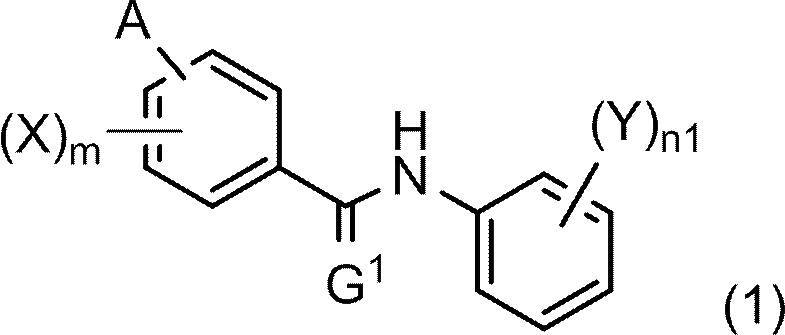
- the method for producing an alkylated aromatic amide derivative represented by the following general formula (4) of the present invention is represented by the following general formula (3) and the aromatic amide derivative represented by the following general formula (1). Reacting the haloalkyl compound in the presence of a base and a metal or metal salt. The manufacturing method may further include other steps as necessary.
- each X independently represents a hydrogen atom, a halogen atom, a nitro group, a cyano group, a C1-C4 alkoxy group, or a dimethylamino group.
- m represents an integer of 1 to 4
- n1 represents an integer of 1 to 5.
- G 1 represents an oxygen atom or a sulfur atom.
- Y is independently a hydrogen atom, a halogen atom, a C1-C6 alkyl group, a C1-C6 haloalkyl group, a C2-C4 alkenyl group, a C2-C4 haloalkenyl group, a C2-C4 alkynyl group, a C2-C4 haloalkynyl group, C3-C6 cycloalkyl group, C3-C6 halocycloalkyl group, C1-C4 alkoxy group, C1-C4 haloalkoxy group, C1-C4 alkylthio group, C1-C4 haloalkylthio group, C1-C4 alkylsulfinyl group, C1- C4 haloalkylsulfinyl group, C1-C4 alkylsulfonyl group, C1-C4 haloalkylsulfonyl group, arylsul
- A is a hydrogen atom, C1-C6 alkyl group, C1-C6 haloalkyl group, C2-C4 alkenyl group, C2-C4 haloalkenyl group, C2-C4 alkynyl group, C2-C4 haloalkynyl group, C3-C6 cycloalkyl group, C3-C6 halocycloalkyl group, C1-C4 alkoxy group, C1-C4 haloalkoxy group, C1-C4 alkylthio group, C1-C4 haloalkylthio group, C1-C4 alkylsulfinyl group, C1-C4 haloalkylsulfinyl group, C1- C4 alkylsulfonyl group, C1-C4 haloalkylsulfonyl group, arylsulfonyl group, C1-C4 alkylamino group, di-C1
- G 2 represents an oxygen atom or a sulfur atom.
- R 1 represents a hydrogen atom, a C1-C6 alkyl group, or a C1-C6 haloalkyl group.
- Q 1 is a C1-C6 alkyl group, a C1-C6 haloalkyl group, an unsubstituted phenyl group, or a halogen atom, a C1-C6 alkyl group, a C1-C6 haloalkyl group, a C2-C4 alkenyl group, a C2-C4 haloalkenyl group.
- the heterocyclic group in the general formula (1) is a pyridyl group, a pyridine-N-oxide group, a pyrimidinyl group, a pyridazyl group, a pyrazyl group, a furyl group, a thienyl group, an oxazolyl group, an isoxazolyl group, an oxadiazolyl group, a thiazolyl group, An isothiazolyl group, an imidazolyl group, a triazolyl group, a pyrrolyl group, a pyrazolyl group, or a tetrazolyl group;
- the aromatic amide derivative represented by the general formula (1) in the present invention is a production intermediate particularly useful for producing the compound represented by the general formula (10) useful as an insecticide.
- the substituent X in the general formula (1) is a hydrogen atom, a halogen atom, a nitro group, a cyano group, a C1-C4 alkoxy group, or a dimethylamino group, preferably a halogen atom, a nitro group, a cyano group, or dimethylamino. It is a group.
- m is an integer of 1 to 4, more preferably an integer of 1 to 3.
- Substituent A is a C1-C6 alkyl group, a C1-C6 haloalkyl group, a C1-C4 alkoxy group, a C1-C4 haloalkoxy group, a phenyl group having a substituent, a halogen atom, a nitro group, a cyano group, or the above general formula.
- a group represented by (2) is preferred.
- Substituents G 2 in the general formula (2) is an oxygen atom or a sulfur atom, preferably an oxygen atom.
- Substituent Q 1 is an unsubstituted phenyl group, a phenyl group having a substituent, or an unsubstituted heterocyclic group, a heterocyclic group having a substituent, a C1-C6 alkyl group, a C1-C6 haloalkyl group, a C1-C4 alkoxy group And a C1-C4 haloalkoxy group is preferred.
- the substituent R 1 is preferably a hydrogen atom, a C1-C6 alkyl group or a C1-C6 haloalkyl group.
- Substituent Y is a hydrogen atom, halogen atom, C1-C6 alkyl group, C1-C6 haloalkyl group, C1-C4 alkylthio group, C1-C4 haloalkylthio group, C1-C4 alkylsulfinyl group, C1-C4 haloalkylsulfinyl group, A C1-C4 alkylsulfonyl group or a C1-C4 haloalkylsulfonyl group is preferred.
- n1 is an integer of 1 to 5, more preferably an integer of 1 to 3.
- the aromatic amide derivative represented by the general formula (1) is preferably an aromatic amide derivative represented by the following general formula (5), and the aromatic amide derivative represented by the following general formula (7) It is more preferable that
- Y 1 , Y 2 , Y 3 , and Y 4 are each independently a hydrogen atom, a halogen atom, a C1-C6 alkyl group, a C1-C6 haloalkyl group, a C1-C4 alkylthio group, C1- A C4 haloalkylthio group, a C1-C4 alkylsulfinyl group, a C1-C4 haloalkylsulfinyl group, a C1-C4 alkylsulfonyl group, or a C1-C4 haloalkylsulfonyl group;
- X, m, G 1 and A is X, m, respectively G 1, and A synonymous in the general formula (1).
- Y 1 , Y 2 , Y 3 , and Y 4 in general formula (5) are each independently a hydrogen atom, a halogen atom, a C1-C6 haloalkyl group, a C1-C4 haloalkylthio group, a C1-C4 haloalkylsulfinyl group, or A C1-C4 haloalkylsulfonyl group is preferred.
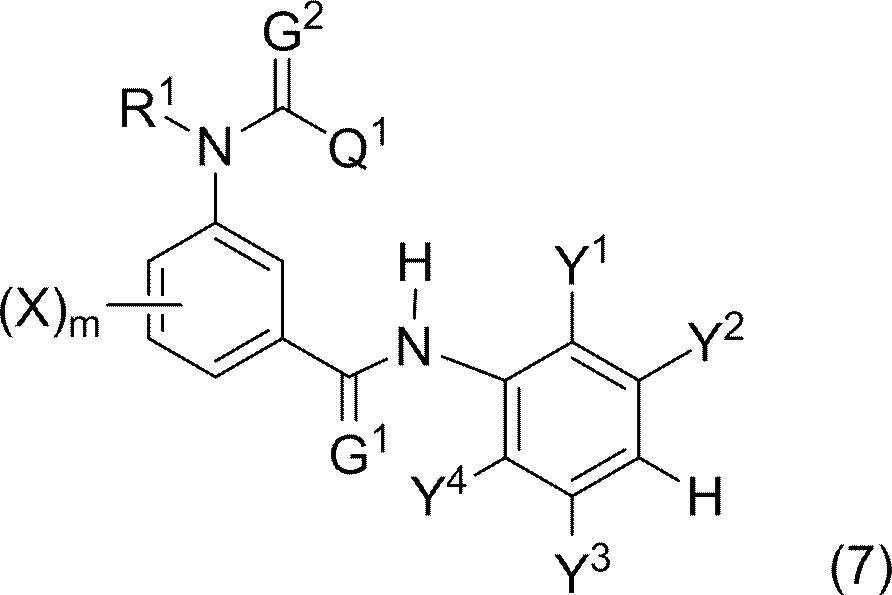
- G 2, Q 1 in the general formula (7), and R 1 is G 2, Q 1 in the general formula (2), and R 1 to be the same meanings.
- X, m, G 1, Y 1, Y 2, Y 3, and Y 4 X in the formula (5), m, G 1 , Y 1, Y 2, Y 3, and Y 4 and respectively synonymous is there.
- the compound represented by the general formula (7) is produced using, for example, 2-aminobenzotrifluoride and a benzoic acid derivative as raw materials.
- the benzoic acid derivative can be produced by the method described in WO2010 / 18857 using 2-chloro-3-nitrobenzoic acid as a raw material.
- Z 1 in the general formula (3) represents a C1-C6 alkyl group or a C1-C6 haloalkyl group.
- a C1-C6 haloalkyl group is preferable, and a C1-C6 perfluoroalkyl group is more preferable.
- Xa represents an iodine atom or a bromine atom.
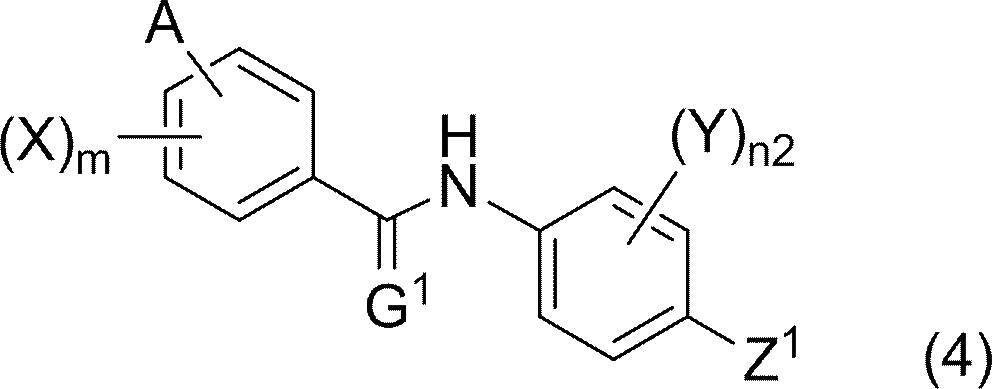
- N2 in the general formula (4) represents an integer of 1 to 4, and preferably an integer of 1 to 3.
- Z 1 has the same meaning as Z 1 in the general formula (3), and the preferred embodiment is also the same.
- X, m, G 1, Y, and A are X, m, respectively G 1, Y, and A synonymous in the general formula (1), a preferable embodiment thereof is also the same.
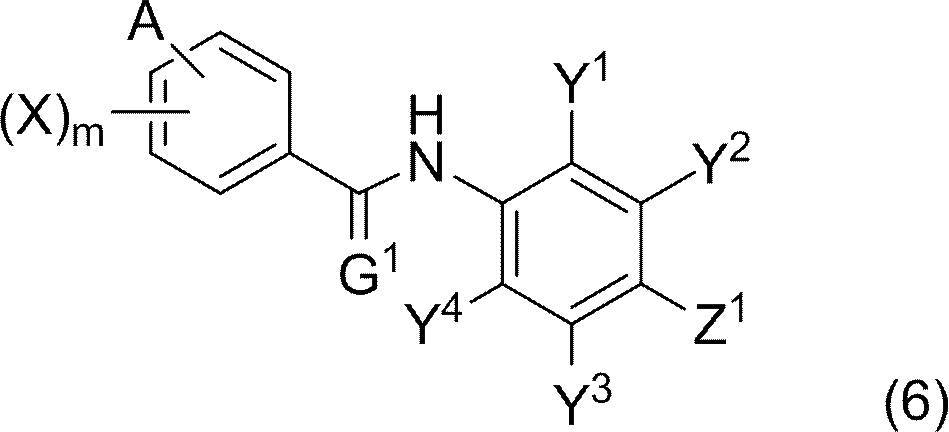
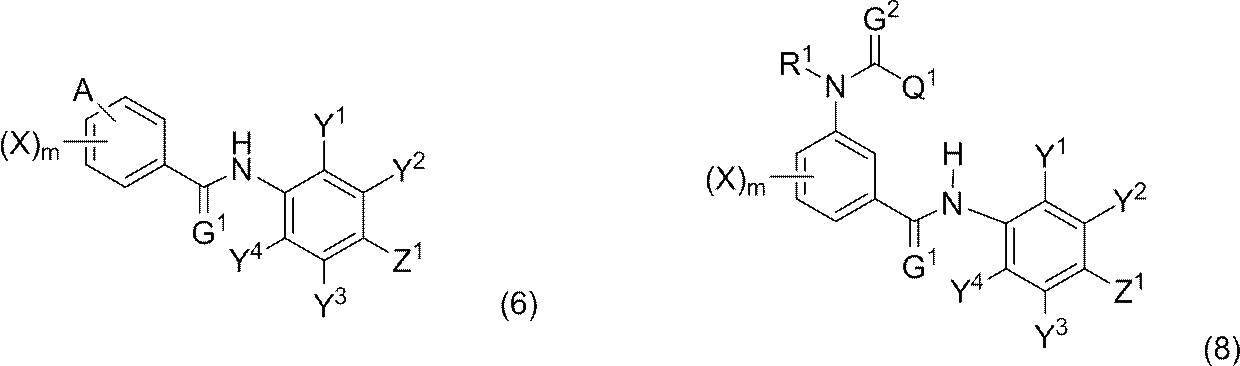
- the alkylated aromatic amide derivative represented by the general formula (4) is preferably an alkylated aromatic amide derivative represented by the following general formula (6), and is represented by the following general formula (8). More preferably, it is an alkylated aromatic amide derivative.
- Z 1 in the general formula (6) has the same meaning as Z 1 in the general formula (3), preferable embodiments thereof are also the same.
- Y 1, Y 2, Y 3 , Y 4, X, m, Y 1, Y 2, Y 3 in G 1, and A is the formula (5), Y 4, X , m, G 1, and A
- the preferred embodiments are also the same.
- Z 1 in the general formula (8) has the same meaning as Z 1 in the general formula (3), preferable embodiments thereof are also the same.
- Y 1 , Y 2 , Y 3 , Y 4 , X, m, G 1 , G 2 , Q 1 , and R 1 are Y 1 , Y 2 , Y 3 , Y 4 , X, R in the general formula (7). It is synonymous with m, G 1 , G 2 , Q 1 and R 1 , respectively, and the preferred embodiments are also the same.
- Examples of the metal used for the reaction of the aromatic amide derivative represented by the general formula (1) and the haloalkyl compound represented by the general formula (3) include lithium, sodium, calcium, magnesium, zinc, aluminum, manganese, Tungsten, tin, chromium, gold, platinum, silver, copper, iron, nickel, cobalt, lead, titanium, and alloys thereof can be exemplified. Among these, at least one selected from the group consisting of copper, iron, and zinc is preferable.
- a divalent iron metal salt specifically, iron (II) ammonium sulfate, iron (II) fluoride, iron (II) chloride, iron (II) bromide, Iron (II) iodide, iron (II) sulfate, iron (II) oxalate, potassium hexacyanoferrate (II), iron (II) gluconate n hydrate, tris (1,10-phenanthroline) iron sulfate ( II), ammonium iron (III) hexacyanoferrate (II), iron (II) stearate, ammonium hexacyanoferrate (II), iron (II) fumarate, iron (II) acetate, iron (II) naphthenate, Iron (II) tetrafluoroborate, iron (II) amidosulfate, iron (II) oxide titanium, iron (II) sulfur
- the above metals and metal salts may be used alone or in combination of two or more.
- the amount used is not particularly limited, but is usually in the range of 0.01-fold molar equivalent to 5-fold molar equivalent, preferably 1-fold, relative to the aromatic amide derivative represented by the general formula (1), which is a reaction raw material. What is necessary is just to select suitably in the range of molar equivalent-2 times molar equivalent.
- Examples of the base used in the above reaction include organic bases such as triethylamine, tri-n-butylamine, pyridine and 4-dimethylaminopyridine, alkali metal hydroxides such as sodium hydroxide and potassium hydroxide, sodium hydrogen carbonate, Carbonates such as potassium carbonate, phosphates such as dipotassium monohydrogen phosphate and trisodium phosphate, alkali metal hydrides such as sodium hydride, alkali metal alcoholates such as sodium methoxide and sodium ethoxide Can be mentioned. Among these, alkali metal hydroxides such as sodium hydroxide and potassium hydroxide can be particularly preferably used. These bases are suitably used in the range of 0.01-fold molar equivalent to 10-fold molar equivalent, preferably 5-fold molar equivalent to 10-fold molar equivalent, relative to the aromatic amide derivative represented by the general formula (1). Select and use.
- the above reaction may be performed without a solvent or in the presence of an inert solvent.
- the inert solvent used in the presence of an inert solvent is not particularly limited as long as it does not significantly inhibit the progress of this reaction.
- water aromatic hydrocarbons such as benzene, toluene, and xylene; halogenated hydrocarbons such as dichloromethane, chloroform, and carbon tetrachloride; a chain such as diethyl ether, dioxane, tetrahydrofuran, and 1,2-dimethoxyethane; Cyclic ethers; esters such as ethyl acetate and butyl acetate; alcohols such as methanol and ethanol; ketones such as acetone, methyl isobutyl ketone and cyclohexanone; N, N-dimethylformamide, N, N-dimethylacetamide, 1, Examples thereof include amides such as 3-dimethyl-2-imidazolid
- amides such as N, N-dimethylformamide, N, N-dimethylacetamide, 1,3-dimethyl-2-imidazolidinone, N-methyl-2-pyrrolidone, and dimethyl sulfoxide are particularly preferably used.
- the amount of these inert solvents used is appropriately selected within the range of 2 to 20 times, preferably 5 to 15 times the weight of the aromatic amide derivative represented by the general formula (1). And use it.
- the reaction temperature in the above reaction may be in the range of ⁇ 20 ° C. to 200 ° C., and when an inert solvent is used, it may be lower than the boiling point thereof.
- the reaction time may be appropriately selected from a range of several minutes to 96 hours.
- the alkylated aromatic amide derivative represented by the general formula (4) which is the target product, may be isolated from the reaction system according to a conventional method after the completion of the reaction. , Purification by recrystallization, column chromatography, distillation and the like.
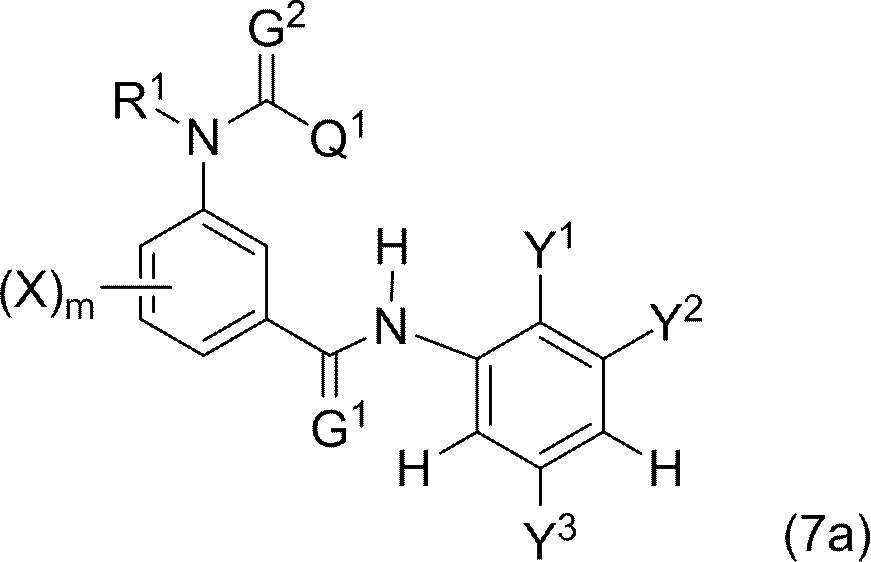
- the method for producing a halogenated aromatic amide derivative represented by the general formula (10) of the present invention includes an aromatic amide derivative represented by the following general formula (7a) and a haloalkyl represented by the following general formula (3).
- the manufacturing method may further include other steps as necessary.
- G 2, Q 1 in the general formula (7a), and R 1 is G 2, Q 1 in the general formula (2), and R 1 to be the same meanings.
- X, m, G 1, Y 1, Y 2, and Y 3 are the same meanings as the X in the general formula (5), m, G 1 , Y 1, Y 2, and Y 3.
- Z 1 in the general formula (9) has the same meaning as Z 1 in the general formula (3).
- X, m, G 1 , G 2 , Q 1 , R 1 , Y 1 , Y 2 , and Y 3 are X, m, G 1 , G 2 , Q 1 , R 1 , Y in the general formula (7a). 1 , Y 2 , and Y 3 have the same meanings.
- the details of the first step are the same as the method for producing the alkylated aromatic amide derivative represented by the general formula (4).
- the alkylated aromatic amide derivative represented by the general formula (9) is halogenated under basic conditions to obtain the halogenated aromatic amide derivative represented by the general formula (10).
- the alkylated aromatic amide derivative represented by the general formula (9) and the halogenating agent can be performed under basic conditions in an inert solvent or without a solvent.
- the halogenating agent is not particularly limited as long as it can convert a hydrogen atom into a chlorine atom, a bromine atom or an iodine atom.
- chlorine, bromine, iodine, sulfuryl chloride, N-chlorosuccinimide, N-bromosuccinimide, N-iodosuccinimide, iodine monochloride, 1,3-dibromo-5,5-dimethylhydantoin, 1,3- Diiodo-5,5-dimethylhydantoin and the like can be shown.
- the amount of the halogenating agent used in the above reaction is preferably 1.0-fold molar equivalent to 5-fold molar equivalent, preferably 1.01-fold molar equivalent to the alkylated aromatic amide derivative represented by the general formula (9). A 1.5-fold molar equivalent is more preferable.
- the inert solvent used in the above reaction is not particularly limited as long as it does not significantly inhibit the progress of this reaction.
- water aromatic hydrocarbons such as benzene, toluene, and xylene; halogenated hydrocarbons such as dichloromethane, chloroform, and carbon tetrachloride; a chain such as diethyl ether, dioxane, tetrahydrofuran, and 1,2-dimethoxyethane; Cyclic ethers; esters such as ethyl acetate and butyl acetate; alcohols such as methanol and ethanol; ketones such as acetone, methyl isobutyl ketone and cyclohexanone; N, N-dimethylformamide, N, N-dimethylacetamide, 1, Examples thereof include amides such as 3-dimethyl-2-imidazolidinone and N-methyl-2-pyrrolidone; nitriles such as acetonitrile
- solvents can be used alone or in combination of two or more.
- amides such as N, N-dimethylformamide, N, N-dimethylacetamide, 1,3-dimethyl-2-imidazolidinone and N-methyl-2-pyrrolidone; dimethyl sulfoxide can be particularly preferably used.
- the amount of these inert solvents used is in the range of 2 to 10 times, preferably 3 to 8 times the amount of the alkylated aromatic amide derivative represented by the general formula (9). What is necessary is just to select and use suitably.
- Examples of the base used in the above reaction include organic bases such as triethylamine, tri-n-butylamine, pyridine and 4-dimethylaminopyridine, alkali metal hydroxides such as sodium hydroxide and potassium hydroxide, hydrogen carbonate Carbonates such as sodium and potassium carbonate, phosphates such as dipotassium monohydrogen phosphate and trisodium phosphate, alkali metal hydrides such as sodium hydride, alkali metal alcoholates such as sodium methoxide and sodium ethoxide And so on.
- alkali metal hydrides such as sodium hydride and alkali metal hydroxides such as sodium hydroxide can be particularly preferably used.
- These bases are suitably used in the range of 0.01-fold molar equivalent to 5-fold molar equivalent, preferably 1-fold molar equivalent to 3-fold molar equivalent, relative to the aromatic amide derivative represented by the general formula (9). Select and use.
- the reaction temperature is, for example, in the range of ⁇ 20 ° C. to 200 ° C., and when an inert solvent is used, the reaction temperature may be lower than the boiling point.
- the reaction time may be appropriately selected from a range of several minutes to 96 hours.
- the target product may be isolated from the reaction system according to a conventional method after completion of the reaction, but may be purified by operations such as recrystallization, column chromatography, distillation, etc., if necessary. Can do.
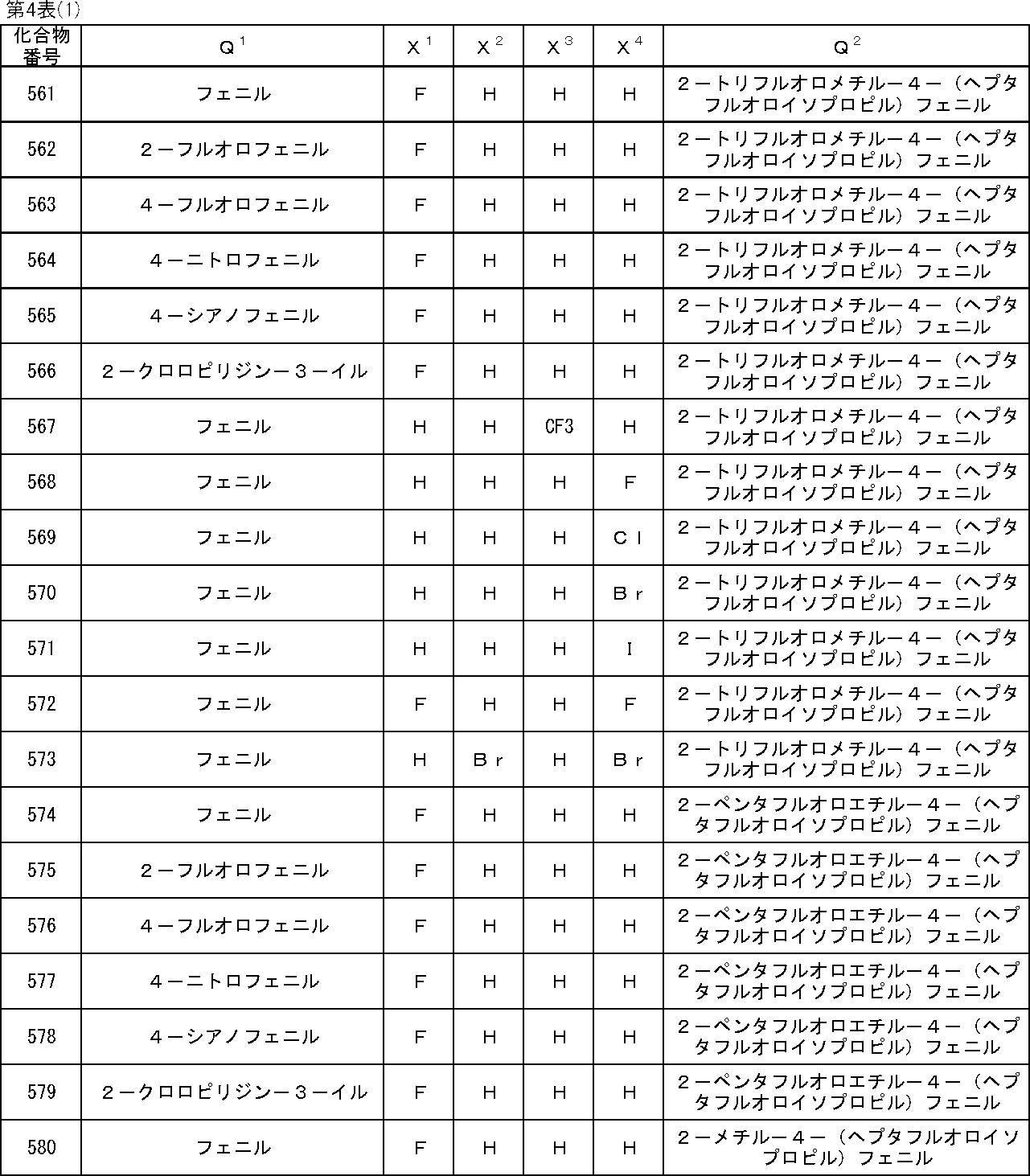
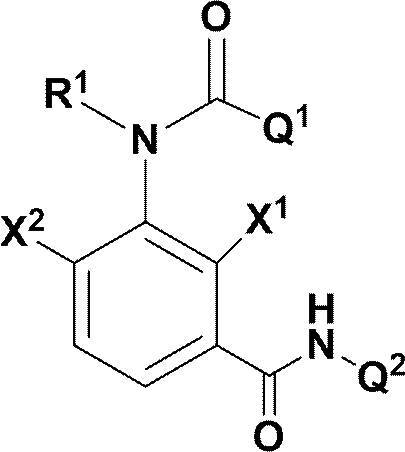
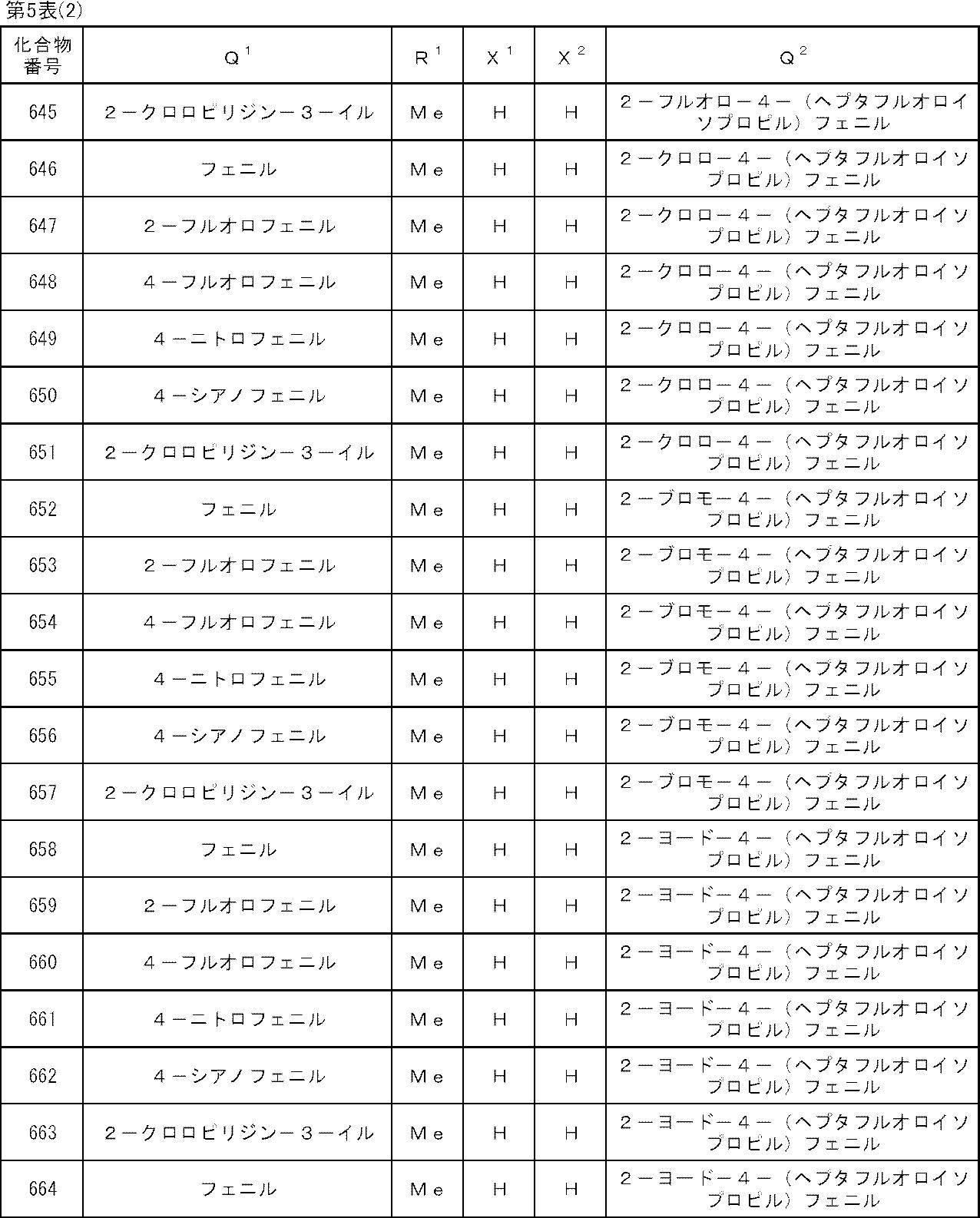
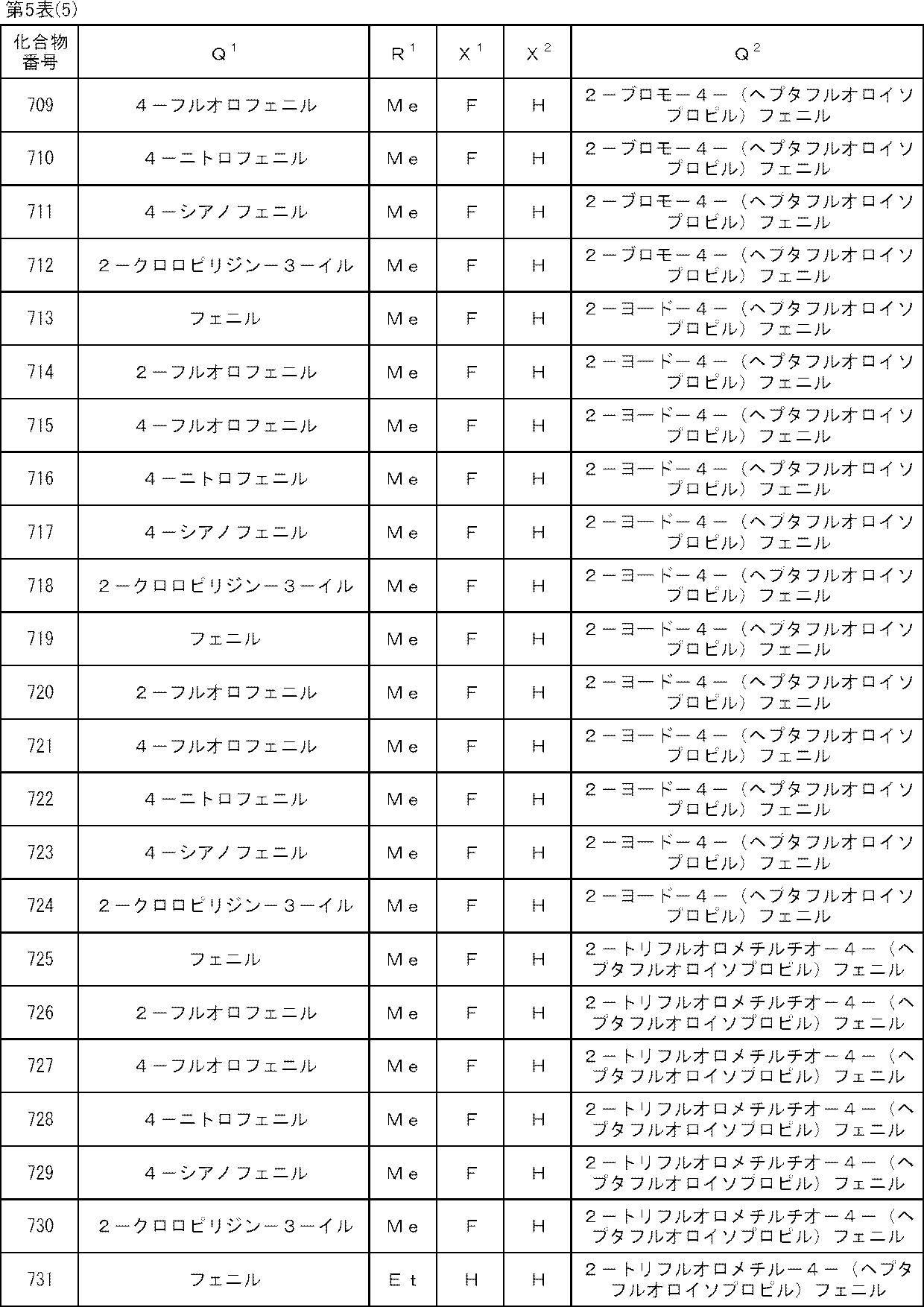
- Tables 1 to 3 show typical compounds represented by the general formula (7) which are effective intermediates of the present invention, but the present invention is not limited to these.
- “Me” represents a methyl group
- “Et” represents an ethyl group
- “H” represents a hydrogen atom
- “F” represents a fluorine atom
- “Cl” represents a chlorine atom
- “Br” represents bromine.
- "I” represents an iodine atom
- CF3 represents a trifluoromethyl group.
- Tables 4 to 5 show typical compounds represented by the general formula (9) which are effective intermediates of the present invention, but the present invention is not limited to these.
- “Me” represents a methyl group
- “Et” represents an ethyl group
- “H” represents a hydrogen atom
- “F” represents a fluorine atom
- “Cl” represents a chlorine atom
- “Br” represents bromine.
- "I” represents an iodine atom
- CF3 represents a trifluoromethyl group.
- the alkylated aromatic amide derivative represented by the general formula (4) obtained by the method for producing an alkylated aromatic amide derivative of the present invention is extremely useful in a method for producing an amide derivative that exhibits a pest control action. Production intermediate.
- the target alkylated aromatic amide derivative could be obtained in a short process by the method for producing an alkylated aromatic amide derivative of the present invention.
Landscapes
- Chemical & Material Sciences (AREA)
- Organic Chemistry (AREA)
- Chemical Kinetics & Catalysis (AREA)
- Organic Low-Molecular-Weight Compounds And Preparation Thereof (AREA)
- Pyridine Compounds (AREA)
- Low-Molecular Organic Synthesis Reactions Using Catalysts (AREA)
- Plural Heterocyclic Compounds (AREA)
Abstract
Description
パーフルオロアルキル化されたフェニル基を有するアニリンの製造方法として、パーフルオロアルキルハロゲン化合物を還元剤の存在下で反応させる製造方法が知られている(例えば、特開2001-122836号公報参照)。更に、パーフルオロアルキル化されたフェニル基を有するアミド誘導体の製造方法として、Journal of Fluorine Chemistry 22,541-556,1983が知られている。
すなわち、本発明は以下のとおりである。
無置換のフェニル基、もしくはハロゲン原子、C1-C6アルキル基、C1-C6ハロアルキル基、C2-C4アルケニル基、C2-C4ハロアルケニル基、C2-C4アルキニル基、C2-C4ハロアルキニル基、C3-C6シクロアルキル基、C3-C6ハロシクロアルキル基、C1-C4アルコキシ基、C1-C4ハロアルコキシ基、C1-C4アルキルチオ基、C1-C4ハロアルキルチオ基、C1-C4アルキルスルフィニル基、C1-C4ハロアルキルスルフィニル基、C1-C4アルキルスルホニル基、C1-C4ハロアルキルスルホニル基、アリールスルホニル基、C1-C4アルキルアミノ基、ジC1-C4アルキルアミノ基、シアノ基、ニトロ基、ヒドロキシ基、C1-C4アルキルカルボニル基、C1-C4ハロアルキルカルボニル基、C1-C4アルキルカルボニルオキシ基、C1-C4アルコキシカルボニル基、アセチルアミノ基、およびフェニル基からなる群より選択される1以上の同一または異なっていてもよい置換基を有するフェニル基、
無置換の複素環基、もしくはハロゲン原子、C1-C6アルキル基、C1-C6ハロアルキル基、C2-C4アルケニル基、C2-C4ハロアルケニル基、C2-C4アルキニル基、C2-C4ハロアルキニル基、C3-C6シクロアルキル基、C3-C6ハロシクロアルキル基、C1-C4アルコキシ基、C1-C4ハロアルコキシ基、C1-C4アルキルチオ基、C1-C4ハロアルキルチオ基、C1-C4アルキルスルフィニル基、C1-C4ハロアルキルスルフィニル基、C1-C4アルキルスルホニル基、C1-C4ハロアルキルスルホニル基、アリールスルホニル基、C1-C4アルキルアミノ基、ジC1-C4アルキルアミノ基、シアノ基、ニトロ基、ヒドロキシ基、C1-C4アルキルカルボニル基、C1-C4ハロアルキルカルボニル基、C1-C4アルキルカルボニルオキシ基、C1-C4アルコキシカルボニル基、アセチルアミノ基、およびフェニル基からなる群より選択される1以上の同一または異なっていてもよい置換基を有する複素環基、

R1は水素原子、C1-C6アルキル基、またはC1-C6ハロアルキル基を示す。
Q1はC1-C6のアルキル基、C1-C6ハロアルキル基、
無置換のフェニル基、もしくはハロゲン原子、C1-C6アルキル基、C1-C6ハロアルキル基、C2-C4アルケニル基、C2-C4ハロアルケニル基、C2-C4アルキニル基、C2-C4ハロアルキニル基、C3-C6シクロアルキル基、C3-C6ハロシクロアルキル基、C1-C4アルコキシ基、C1-C4ハロアルコキシ基、C1-C4アルキルチオ基、C1-C4ハロアルキルチオ基、C1-C4アルキルスルフィニル基、C1-C4ハロアルキルスルフィニル基、C1-C4アルキルスルホニル基、C1-C4ハロアルキルスルホニル基、アリールスルホニル基、C1-C4アルキルアミノ基、ジC1-C4アルキルアミノ基、シアノ基、ニトロ基、ヒドロキシ基、C1-C4アルキルカルボニル基、C1-C4ハロアルキルカルボニル基、C1-C4アルキルカルボニルオキシ基、C1-C4アルコキシカルボニル基、アセチルアミノ基、およびフェニル基からなる群より選択される1以上の同一または異なっていてもよい置換基を有するフェニル基、または、無置換の複素環基、もしくはハロゲン原子、C1-C6アルキル基、C1-C6ハロアルキル基、C2-C4アルケニル基、C2-C4ハロアルケニル基、C2-C4アルキニル基、C2-C4ハロアルキニル基、C3-C6シクロアルキル基、C3-C6ハロシクロアルキル基、C1-C4アルコキシ基、C1-C4ハロアルコキシ基、C1-C4アルキルチオ基、C1-C4ハロアルキルチオ基、C1-C4アルキルスルフィニル基、C1-C4ハロアルキルスルフィニル基、C1-C4アルキルスルホニル基、C1-C4ハロアルキルスルホニル基、アリールスルホニル基、C1-C4アルキルアミノ基、ジC1-C4アルキルアミノ基、シアノ基、ニトロ基、ヒドロキシ基、C1-C4アルキルカルボニル基、C1-C4ハロアルキルカルボニル基、C1-C4アルキルカルボニルオキシ基、C1-C4アルコキシカルボニル基、アセチルアミノ基、およびフェニル基からなる群より選択される1以上の同一または異なっていてもよい置換基を有する複素環基を示す。)で表される基を示す。
前記複素環基は、ピリジル基、ピリジン-N-オキシド基、ピリミジニル基、ピリダジル基、ピラジル基、フリル基、チエニル基、オキサゾリル基、イソキサゾリル基、オキサジアゾリル基、チアゾリル基、イソチアゾリル基、イミダゾリル基、トリアゾリル基、ピロリル基、ピラゾリル基、またはテトラゾリル基を示す。)で表される芳香族アミド誘導体と、

(一般式(3)中、Z1はC1-C6アルキル基、またはC1-C6ハロアルキル基を示す。Xaはヨウ素原子または臭素原子を示す。)で表されるハロアルキル化合物とを、
塩基、および金属または金属塩の存在下で反応させる工程を含む、下記一般式(4)
で表されるアルキル化芳香族アミド誘導体の製造方法。


G1およびG2はそれぞれ独立に、酸素原子、または硫黄原子を示す。
Y1、Y2、およびY3はそれぞれ独立に、水素原子、ハロゲン原子、C1-C6アルキル基、C1-C6ハロアルキル基、C1-C4アルキルチオ基、C1-C4ハロアルキルチオ基、C1-C4アルキルスルフィニル基、C1-C4ハロアルキルスルフィニル基、C1-C4アルキルスルホニル基、またはC1-C4ハロアルキルスルホニル基を示す。
Q1はC1-C6のアルキル基、C1-C6ハロアルキル基、
無置換のフェニル基、もしくはハロゲン原子、C1-C6アルキル基、C1-C6ハロアルキル基、C2-C4アルケニル基、C2-C4ハロアルケニル基、C2-C4アルキニル基、C2-C4ハロアルキニル基、C3-C6シクロアルキル基、C3-C6ハロシクロアルキル基、C1-C4アルコキシ基、C1-C4ハロアルコキシ基、C1-C4アルキルチオ基、C1-C4ハロアルキルチオ基、C1-C4アルキルスルフィニル基、C1-C4ハロアルキルスルフィニル基、C1-C4アルキルスルホニル基、C1-C4ハロアルキルスルホニル基、アリールスルホニル基、C1-C4アルキルアミノ基、ジC1-C4アルキルアミノ基、シアノ基、ニトロ基、ヒドロキシ基、C1-C4アルキルカルボニル基、C1-C4ハロアルキルカルボニル基、C1-C4アルキルカルボニルオキシ基、C1-C4アルコキシカルボニル基、アセチルアミノ基、およびフェニル基からなる群より選択される1以上の同一または異なっていてもよい置換基を有するフェニル基、または
無置換の複素環基、もしくはハロゲン原子、C1-C6アルキル基、C1-C6ハロアルキル基、C2-C4アルケニル基、C2-C4ハロアルケニル基、C2-C4アルキニル基、C2-C4ハロアルキニル基、C3-C6シクロアルキル基、C3-C6ハロシクロアルキル基、C1-C4アルコキシ基、C1-C4ハロアルコキシ基、C1-C4アルキルチオ基、C1-C4ハロアルキルチオ基、C1-C4アルキルスルフィニル基、C1-C4ハロアルキルスルフィニル基、C1-C4アルキルスルホニル基、C1-C4ハロアルキルスルホニル基、アリールスルホニル基、C1-C4アルキルアミノ基、ジC1-C4アルキルアミノ基、シアノ基、ニトロ基、ヒドロキシ基、C1-C4アルキルカルボニル基、C1-C4ハロアルキルカルボニル基、C1-C4アルキルカルボニルオキシ基、C1-C4アルコキシカルボニル基、アセチルアミノ基、およびフェニル基からなる群より選択される1以上の同一または異なっていてもよい置換基を有する複素環基を示す。

(一般式(3)中、Z1はC1-C6アルキル基、またはC1-C6ハロアルキル基を示す。Xaはヨウ素原子または臭素原子を示す。)で表されるハロアルキル化合物とを、
塩基、および金属または金属塩の存在下で反応させて下記一般式(9)

前記一般式(9)で表されるアルキル化芳香族アミド誘導体を塩基性条件下で、ハロゲン化する工程とを含む、下記一般式(10)

前記一般式(6)で表されるアルキル化芳香族アミド誘導体を塩基性条件下でハロゲン化する工程とを含む、下記一般式(10)
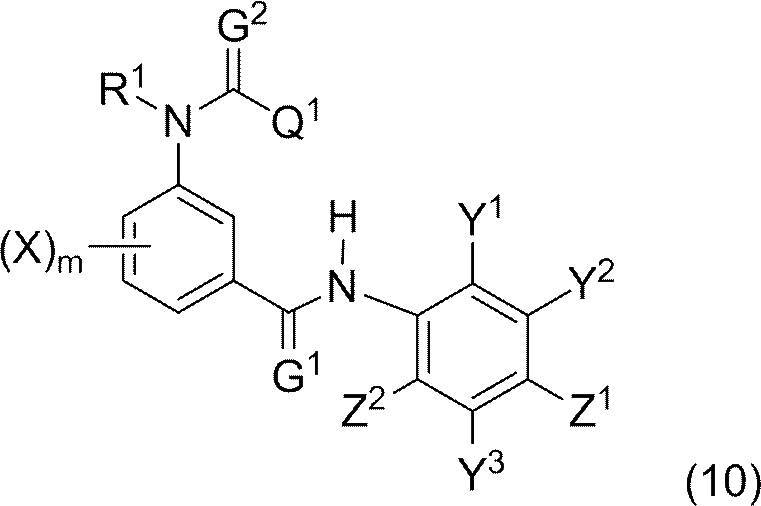
(一般式(10)中、Z2はハロゲン原子を示す。X、m、G1、Y1、Y2、Y3、およびZ1は前記一般式(6)におけるX、m、G1、G2、Q1、R1、Y1、Y2、Y3、およびZ1とそれぞれ同義であり、G2、Q1、およびR1は、前記一般式(2)におけるG2、Q1、およびR1とそれぞれ同義である。)で表されるハロゲン化芳香族アミド誘導体の製造方法であって、前記一般式(6)において、Aは前記一般式(2)で表され、Y4は水素原子である。
<4B> <3>に記載の製造方法により前記一般式(8)で表されるアルキル化芳香族アミド誘導体を得る工程と、
前記一般式(8)で表されるアルキル化芳香族アミド誘導体を塩基性条件下でハロゲン化する工程とを含む、下記一般式(10)

(一般式(10)中、Z2はハロゲン原子を示す。X、m、G1、G2、Q1、R1、Y1、Y2、Y3、およびZ1は前記一般式(8)におけるX、m、G1、G2、Q1、R1、Y1、Y2、Y3、およびZ1とそれぞれ同義である。)で表されるハロゲン化芳香族アミド誘導体の製造方法であって、前記一般式(8)において、Y4は水素原子である。

(一般式(7)中、Xはそれぞれ独立に、水素原子、ハロゲン原子、ニトロ基、シアノ基、C1-C4アルコキシ基、またはジメチルアミノ基を示す。mは1~4の整数を示す。
G1およびG2はそれぞれ独立に、酸素原子、または硫黄原子を示す。
Y1、Y2、Y3、およびY4はそれぞれ独立に、水素原子、ハロゲン原子、C1-C6アルキル基、C1-C6ハロアルキル基、C1-C4アルキルチオ基、C1-C4ハロアルキルチオ基、C1-C4アルキルスルフィニル基、C1-C4ハロアルキルスルフィニル基、C1-C4アルキルスルホニル基、またはC1-C4ハロアルキルスルホニル基を示す。
Q1はC1-C6のアルキル基、C1-C6ハロアルキル基、
無置換のフェニル基、もしくはハロゲン原子、C1-C6アルキル基、C1-C6ハロアルキル基、C2-C4アルケニル基、C2-C4ハロアルケニル基、C2-C4アルキニル基、C2-C4ハロアルキニル基、C3-C6シクロアルキル基、C3-C6ハロシクロアルキル基、C1-C4アルコキシ基、C1-C4ハロアルコキシ基、C1-C4アルキルチオ基、C1-C4ハロアルキルチオ基、C1-C4アルキルスルフィニル基、C1-C4ハロアルキルスルフィニル基、C1-C4アルキルスルホニル基、C1-C4ハロアルキルスルホニル基、C1-C4アルキルアミノ基、ジC1-C4アルキルアミノ基、シアノ基、ニトロ基、ヒドロキシ基、C1-C4アルキルカルボニル基、C1-C4ハロアルキルカルボニル基、C1-C4アルキルカルボニルオキシ基、C1-C4アルコキシカルボニル基、アセチルアミノ基、およびフェニル基からなる群より選択される1以上の同一または異なっていてもよい置換基を有するフェニル基、または
無置換の複素環基、もしくはハロゲン原子、C1-C6アルキル基、C1-C6ハロアルキル基、C2-C4アルケニル基、C2-C4ハロアルケニル基、C2-C4アルキニル基、C2-C4ハロアルキニル基、C3-C6シクロアルキル基、C3-C6ハロシクロアルキル基、C1-C4アルコキシ基、C1-C4ハロアルコキシ基、C1-C4アルキルチオ基、C1-C4ハロアルキルチオ基、C1-C4アルキルスルフィニル基、C1-C4ハロアルキルスルフィニル基、C1-C4アルキルスルホニル基、C1-C4ハロアルキルスルホニル基、アリールスルホニル基、C1-C4アルキルアミノ基、ジC1-C4アルキルアミノ基、シアノ基、ニトロ基、ヒドロキシ基、C1-C4アルキルカルボニル基、C1-C4ハロアルキルカルボニル基、C1-C4アルキルカルボニルオキシ基、C1-C4アルコキシカルボニル基、アセチルアミノ基、およびフェニル基からなる群より選択される1以上の同一または異なっていてもよい置換基を有する複素環基を示す。
前記複素環基は、ピリジル基、ピリジン-N-オキシド基、ピリミジニル基、ピリダジル基、ピラジル基、フリル基、チエニル基、オキサゾリル基、イソキサゾリル基、オキサジアゾリル基、チアゾリル基、イソチアゾリル基、イミダゾリル基、トリアゾリル基、ピロリル基、ピラゾリル基、またはテトラゾリル基を示す。)で表される芳香族アミド誘導体。
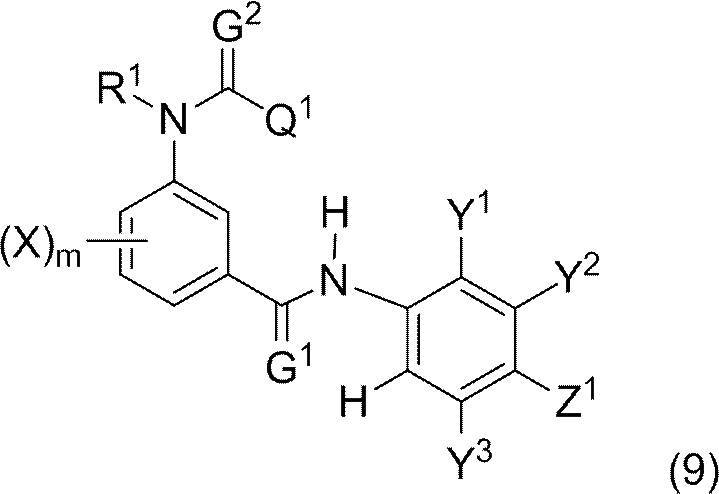
G1およびG2はそれぞれ独立に、酸素原子、または硫黄原子を示す。
Y1、Y2、およびY3はそれぞれ独立に、水素原子、ハロゲン原子、C1-C6アルキル基、C1-C6ハロアルキル基、C1-C4アルキルチオ基、C1-C4ハロアルキルチオ基、C1-C4アルキルスルフィニル基、C1-C4ハロアルキルスルフィニル基、C1-C4アルキルスルホニル基、またはC1-C4ハロアルキルスルホニル基を示す。
Z1はC1-C6アルキル基、またはC1-C6ハロアルキル基を示す。
Q1はC1-C6のアルキル基、C1-C6ハロアルキル基、
無置換のフェニル基、もしくはハロゲン原子、C1-C6アルキル基、C1-C6ハロアルキル基、C2-C4アルケニル基、C2-C4ハロアルケニル基、C2-C4アルキニル基、C2-C4ハロアルキニル基、C3-C6シクロアルキル基、C3-C6ハロシクロアルキル基、C1-C4アルコキシ基、C1-C4ハロアルコキシ基、C1-C4アルキルチオ基、C1-C4ハロアルキルチオ基、C1-C4アルキルスルフィニル基、C1-C4ハロアルキルスルフィニル基、C1-C4アルキルスルホニル基、C1-C4ハロアルキルスルホニル基、アリールスルホニル基、C1-C4アルキルアミノ基、ジC1-C4アルキルアミノ基、シアノ基、ニトロ基、ヒドロキシ基、C1-C4アルキルカルボニル基、C1-C4ハロアルキルカルボニル基、C1-C4アルキルカルボニルオキシ基、C1-C4アルコキシカルボニル基、アセチルアミノ基、およびフェニル基からなる群より選択される1以上の同一または異なっていてもよい置換基を有するフェニル基、または
無置換の複素環基、もしくはハロゲン原子、C1-C6アルキル基、C1-C6ハロアルキル基、C2-C4アルケニル基、C2-C4ハロアルケニル基、C2-C4アルキニル基、C2-C4ハロアルキニル基、C3-C6シクロアルキル基、C3-C6ハロシクロアルキル基、C1-C4アルコキシ基、C1-C4ハロアルコキシ基、C1-C4アルキルチオ基、C1-C4ハロアルキルチオ基、C1-C4アルキルスルフィニル基、C1-C4ハロアルキルスルフィニル基、C1-C4アルキルスルホニル基、C1-C4ハロアルキルスルホニル基、アリールスルホニル基、C1-C4アルキルアミノ基、ジC1-C4アルキルアミノ基、シアノ基、ニトロ基、ヒドロキシ基、C1-C4アルキルカルボニル基、C1-C4ハロアルキルカルボニル基、C1-C4アルキルカルボニルオキシ基、C1-C4アルコキシカルボニル基、アセチルアミノ基、およびフェニル基からなる群より選択される1以上の同一または異なっていてもよい置換基を有する複素環基を示す。
前記複素環基は、ピリジル基、ピリジン-N-オキシド基、ピリミジニル基、ピリダジル基、ピラジル基、フリル基、チエニル基、オキサゾリル基、イソキサゾリル基、オキサジアゾリル基、チアゾリル基、イソチアゾリル基、イミダゾリル基、トリアゾリル基、ピロリル基、ピラゾリル基、またはテトラゾリル基を示す。)で表されるアルキル化芳香族アミド誘導体。
また本明細書の一般式において使用される文言は、その定義においてそれぞれ以下に説明されるような意味を有する。
「ハロゲン原子」とは、フッ素原子、塩素原子、臭素原子またはヨウ素原子を示す。「n-」はノルマルを意味し、「i-」はイソを意味し、「s-」はセカンダリーを意味し、「t-」はターシャリーを意味する。
「Ca-Cb(a、bは1以上の整数を表す)」との表記は、例えば、「C1-C3」とは炭素原子数が1~3個であることを意味し、「C2-C6」とは炭素原子数が2~6個であることを意味し、「C1-C4」とは炭素原子数が1~4個であることを意味する。
「アリールスルホニル基」とは例えば、フェニルスルホニル、p-トルエンスルホニル、1-ナフチルスルホニル、2-ナフチルスルホニル、アントリルスルホニル、フェナントリルスルホニル、アセナフチレニルスルホニルなどの芳香環を有する炭素原子数6~14個のアリールスルホニル基を示す。
「C1-C6パーフルオロアルキルチオ基」とは例えば、トリフルオロメチルチオ、ペンタフルオロエチルチオ、ヘプタフルオロ-n-プロピルチオ、ヘプタフルオロ-i-プロピルチオ、ノナフルオロ-n-ブチルチオ、ノナフルオロ-2-ブチルチオ、ノナフルオロ-i-ブチルチオ、パーフルオロ-n-ペンチルチオ、パーフルオロ-n-ヘキシルチオなどのフッ素原子により全て置換された直鎖状または分岐鎖状の炭素原子数1~6個のアルキルチオ基を示す。
「C1-C6パーフルオロアルキルスルフィニル基」とは例えば、トリフルオロメチルスルフィニル、ペンタフルオロエチルスルフィニル、ヘプタフルオロ-n-プロピルスルフィニル、ヘプタフルオロ-i-プロピルスルフィニル、ノナフルオロ-n-ブチルスルフィニル、ノナフルオロ-2-ブチルスルフィニル、ノナフルオロ-i-ブチルスルフィニル、パーフルオロ-n-ペンチルスルフィニル、パーフルオロ-n-ヘキシルスルフィニルなどのフッ素原子により全て置換された直鎖状または分岐鎖状の炭素原子数1~6個のアルキルスルフィニル基を示す。
「C1-C6パーフルオロアルキルスルホニル基」とは例えば、トリフルオロメチルスルホニル、ペンタフルオロエチルスルホニル、ヘプタフルオロ-n-プロピルスルホニル、ヘプタフルオロ-i-プロピルスルホニル、ノナフルオロ-n-ブチルスルホニル、ノナフルオロ-2-ブチルスルホニル、ノナフルオロ-i-ブチルスルホニル、パーフルオロ-n-ペンチルスルホニル、パーフルオロ-n-ヘキシルスルホニルなどのフッ素原子により全て置換された直鎖状または分岐鎖状の炭素原子数1~6個のアルキルスルホニル基を示す。
また、本発明における一般式(1)および一般式(3)等で表される化合物は、その構造式中に、炭素-炭素二重結合に由来する2種以上の幾何異性体が存在する場合もある。本発明は各々の幾何異性体が任意の割合で含まれる混合物をも全て包含する。

G1は酸素原子、または硫黄原子を示す。
前記Yが複数存在する場合、それぞれのYは同一でも異なっていてもよい。

R1は水素原子、C1-C6アルキル基、またはC1-C6ハロアルキル基を示す。
Q1はC1-C6のアルキル基、C1-C6ハロアルキル基、無置換のフェニル基、もしくはハロゲン原子、C1-C6アルキル基、C1-C6ハロアルキル基、C2-C4アルケニル基、C2-C4ハロアルケニル基、C2-C4アルキニル基、C2-C4ハロアルキニル基、C3-C6シクロアルキル基、C3-C6ハロシクロアルキル基、C1-C4アルコキシ基、C1-C4ハロアルコキシ基、C1-C4アルキルチオ基、C1-C4ハロアルキルチオ基、C1-C4アルキルスルフィニル基、C1-C4ハロアルキルスルフィニル基、C1-C4アルキルスルホニル基、C1-C4ハロアルキルスルホニル基、アリールスルホニル基、C1-C4アルキルアミノ基、ジC1-C4アルキルアミノ基、シアノ基、ニトロ基、ヒドロキシ基、C1-C4アルキルカルボニル基、C1-C4ハロアルキルカルボニル基、C1-C4アルキルカルボニルオキシ基、C1-C4アルコキシカルボニル基、アセチルアミノ基、およびフェニル基からなる群より選択される1以上の同一または異なっていてもよい置換基を有するフェニル基、または、無置換の複素環基、もしくはハロゲン原子、C1-C6アルキル基、C1-C6ハロアルキル基、C2-C4アルケニル基、C2-C4ハロアルケニル基、C2-C4アルキニル基、C2-C4ハロアルキニル基、C3-C6シクロアルキル基、C3-C6ハロシクロアルキル基、C1-C4アルコキシ基、C1-C4ハロアルコキシ基、C1-C4アルキルチオ基、C1-C4ハロアルキルチオ基、C1-C4アルキルスルフィニル基、C1-C4ハロアルキルスルフィニル基、C1-C4アルキルスルホニル基、C1-C4ハロアルキルスルホニル基、アリールスルホニル基、C1-C4アルキルアミノ基、ジC1-C4アルキルアミノ基、シアノ基、ニトロ基、ヒドロキシ基、C1-C4アルキルカルボニル基、C1-C4アルキルカルボニル基、C1-C4アルキルカルボニルオキシ基、C1-C4アルコキシカルボニル基、アセチルアミノ基、およびフェニル基からなる群より選択される1以上の同一または異なっていてもよい置換基を有する複素環基を示す。
なお、一般式(1)における複素環基は、ピリジル基、ピリジン-N-オキシド基、ピリミジニル基、ピリダジル基、ピラジル基、フリル基、チエニル基、オキサゾリル基、イソキサゾリル基、オキサジアゾリル基、チアゾリル基、イソチアゾリル基、イミダゾリル基、トリアゾリル基、ピロリル基、ピラゾリル基、またはテトラゾリル基を示す。
一般式(1)における置換基Xは、水素原子、ハロゲン原子、ニトロ基、シアノ基、C1-C4アルコキシ基、またはジメチルアミノ基であり、好ましくはハロゲン原子、ニトロ基、シアノ基、またはジメチルアミノ基である。mは、1~4の整数であり、より好ましくは1~3の整数である。
一般式(2)中の置換基G2は酸素原子、または硫黄原子であり、好ましくは酸素原子である。
置換基Q1は無置換のフェニル基、置換基を有するフェニル基、または無置換の複素環基、置換基を有する複素環基、C1-C6アルキル基、C1-C6ハロアルキル基、C1-C4アルコキシ基、C1-C4ハロアルコキシ基であることが好ましい。
置換基R1は、水素原子、C1-C6アルキル基またはC1-C6ハロアルキル基であることが好ましい。

Xaはヨウ素原子または臭素原子を示す。
Z1は前記一般式(3)におけるZ1と同義であり、好ましい態様も同様である。
X、m、G1、Y、およびAは前記一般式(1)におけるX、m、G1、Y、およびAとそれぞれ同義であり、好ましい態様も同様である。
その中でも、水酸化ナトリウム、水酸化カリウムなどの水酸化アルカリ金属類が特に好適に使用できる。
これらの塩基は、一般式(1)で表される芳香族アミド誘導体に対して0.01倍モル当量~10倍モル当量の範囲、好ましくは5倍モル当量~10倍モル当量の範囲で適宜選択して使用すればよい。
不活性溶媒の存在下で行う場合の不活性溶媒としては、本反応の進行を著しく阻害しないものであれば特に制限されない。例えば、水;ベンゼン、トルエン、キシレン等の芳香族炭化水素類;ジクロロメタン、クロロホルム、四塩化炭素等のハロゲン化炭化水素類;ジエチルエーテル、ジオキサン、テトラヒドロフラン、1,2-ジメトキシエタン等の鎖状または環状エーテル類;酢酸エチル、酢酸ブチル等のエステル類;メタノール、エタノール等のアルコール類;アセトン、メチルイソブチルケトン、シクロヘキサノン等のケトン類;N,N-ジメチルホルムアミド、N,N-ジメチルアセトアミド、1,3-ジメチル-2-イミダゾリジノン、N-メチル-2-ピロリドン等のアミド類;アセトニトリル等のニトリル類;ジメチルスルホキシドなどの不活性溶媒を示すことができる。これらの溶媒は単独もしくは2種以上混合して使用することができる。
その中でも、N,N-ジメチルホルムアミド、N,N-ジメチルアセトアミド、1,3-ジメチル-2-イミダゾリジノン、N-メチル-2-ピロリドン等のアミド類、ジメチルスルホキシドが特に好適に使用できる。

その中でも、N,N-ジメチルホルムアミド、N,N-ジメチルアセトアミド、1,3-ジメチル-2-イミダゾリジノン、N-メチル-2-ピロリドン等のアミド類;ジメチルスルホキシドが特に好適に使用できる。
その中でも、水素化ナトリウムなどの水素化アルカリ金属塩類、水酸化ナトリウムなどの水酸化アルカリ金属類が特に好適に使用できる。
これらの塩基は、一般式(9)で表される芳香族アミド誘導体に対して0.01倍モル当量~5倍モル当量の範囲、好ましくは1倍モル当量~3倍モル当量の範囲で適宜選択して使用すればよい。
なお、表中、「Me」はメチル基を、「Et」はエチル基を、「H」は水素原子を、「F」はフッ素原子を、「Cl」は塩素原子を、「Br」は臭素原子を、「I」はヨウ素原子を、「CF3」はトリフルオロメチル基をそれぞれ表すものである。
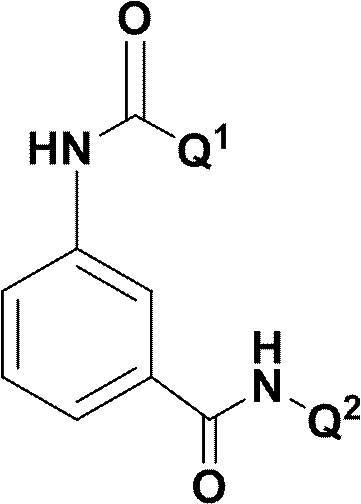

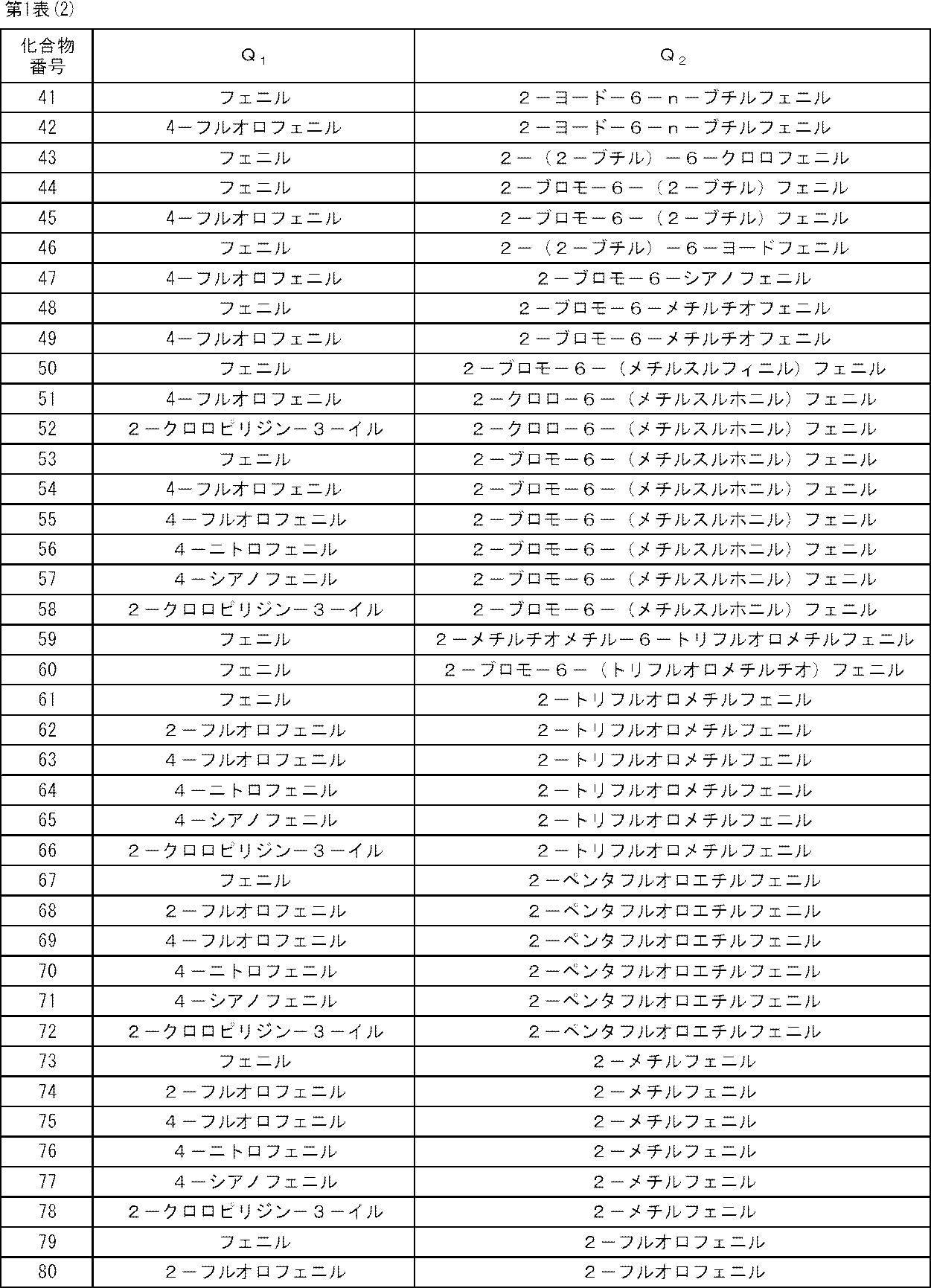


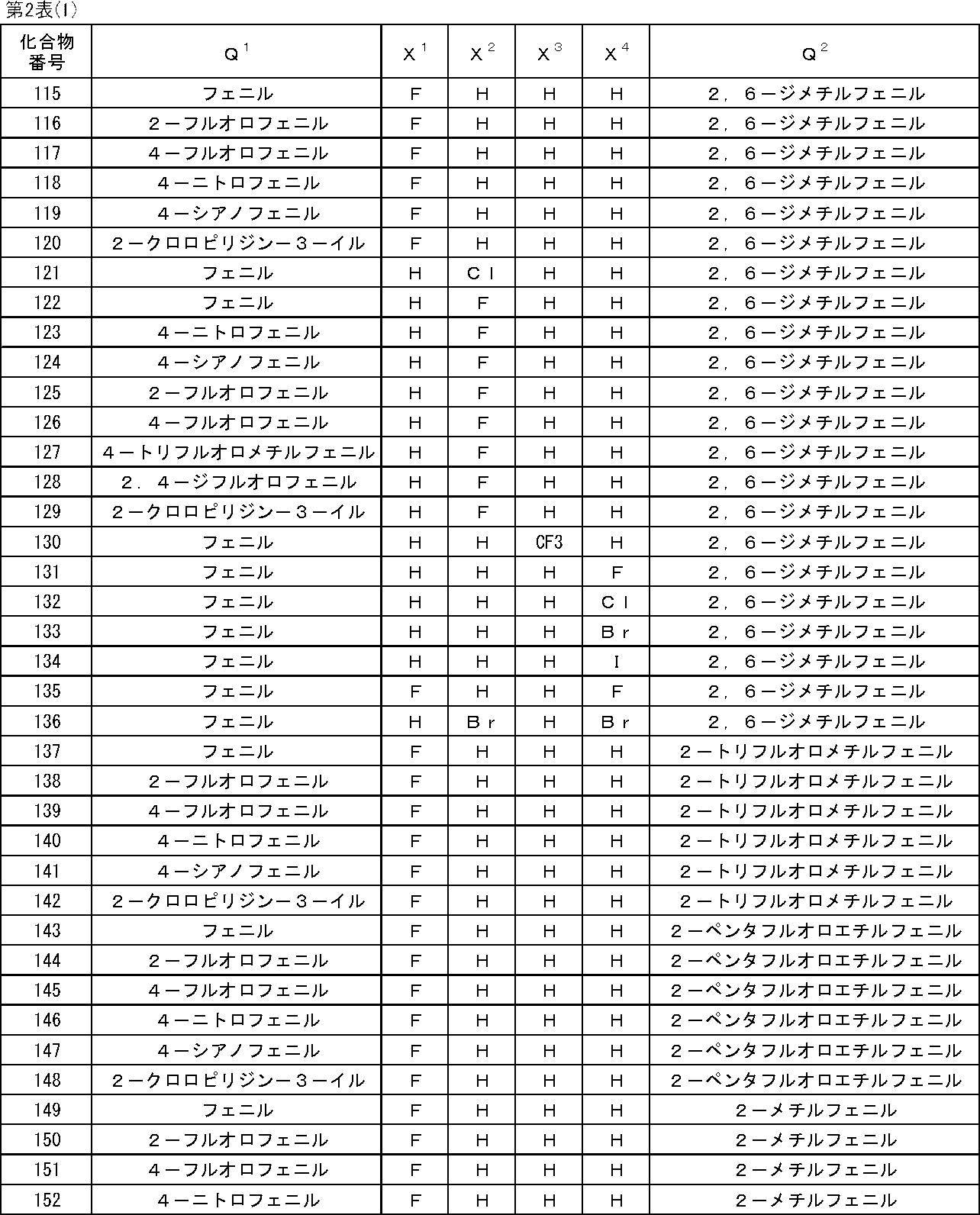

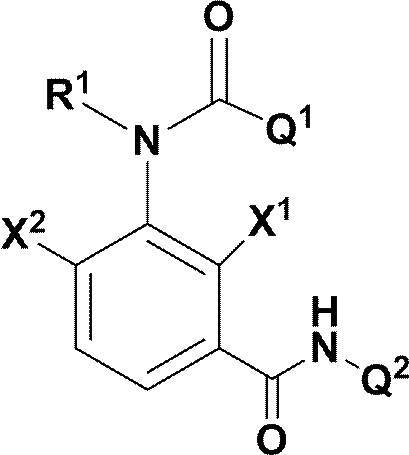
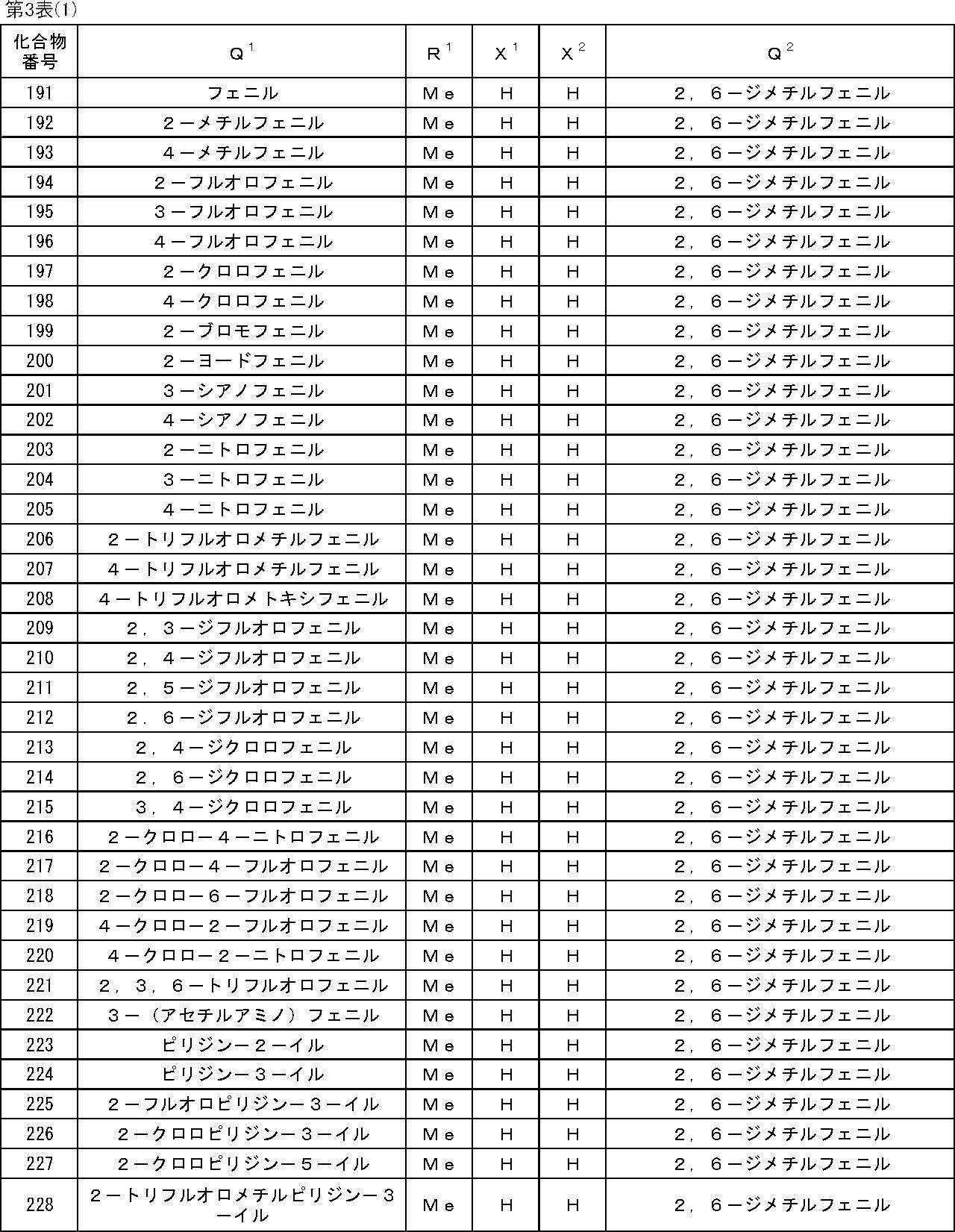


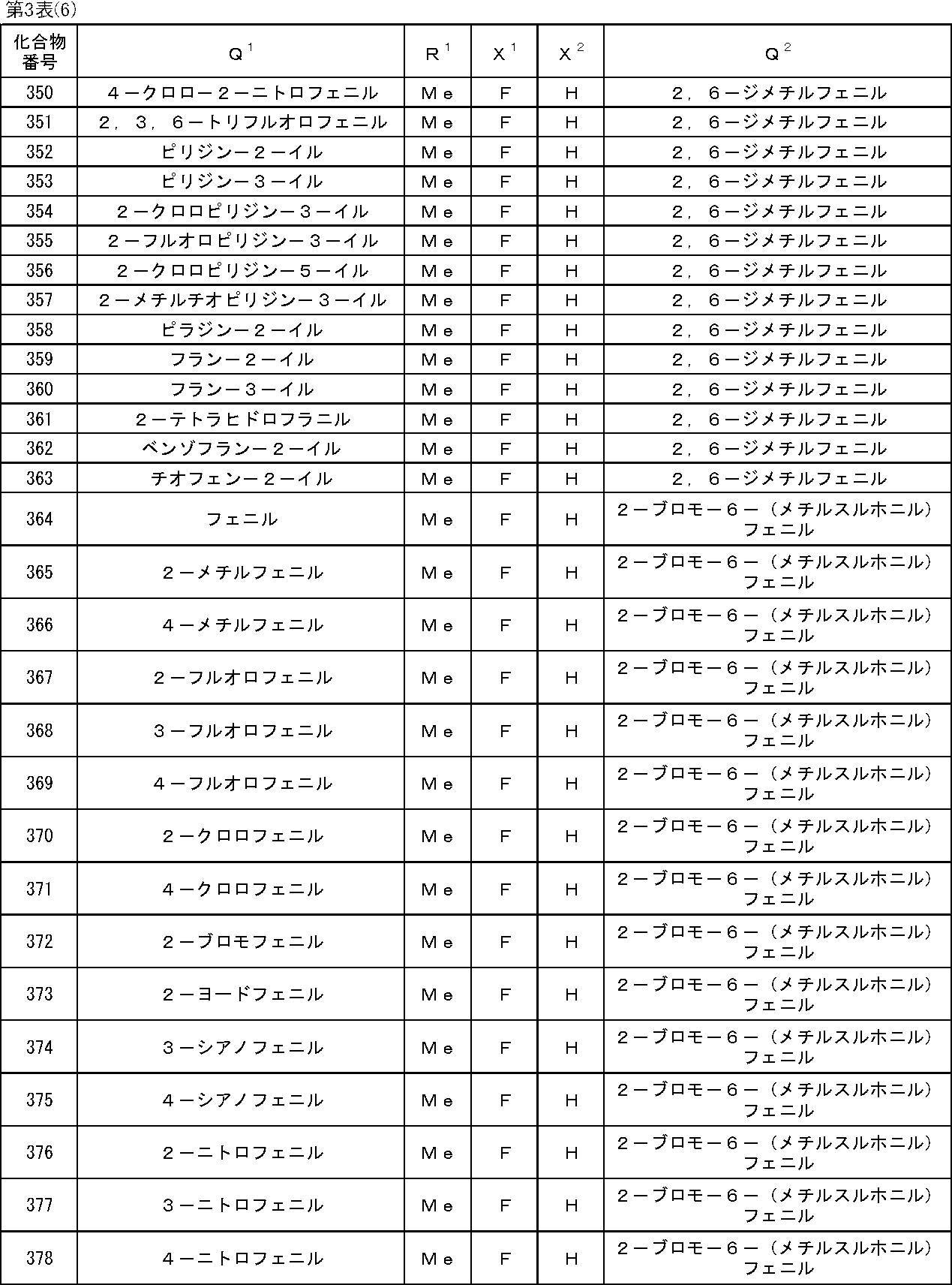
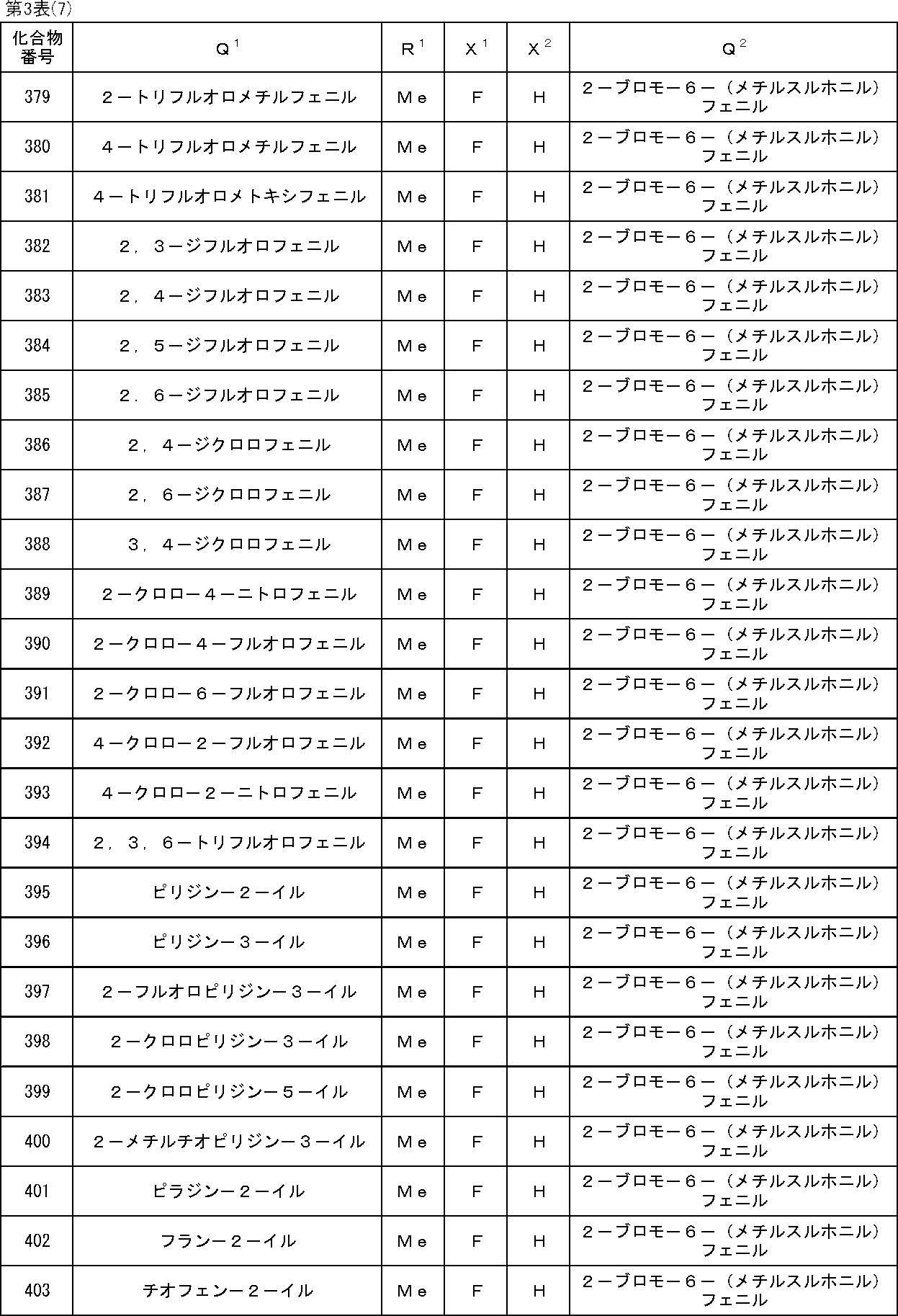

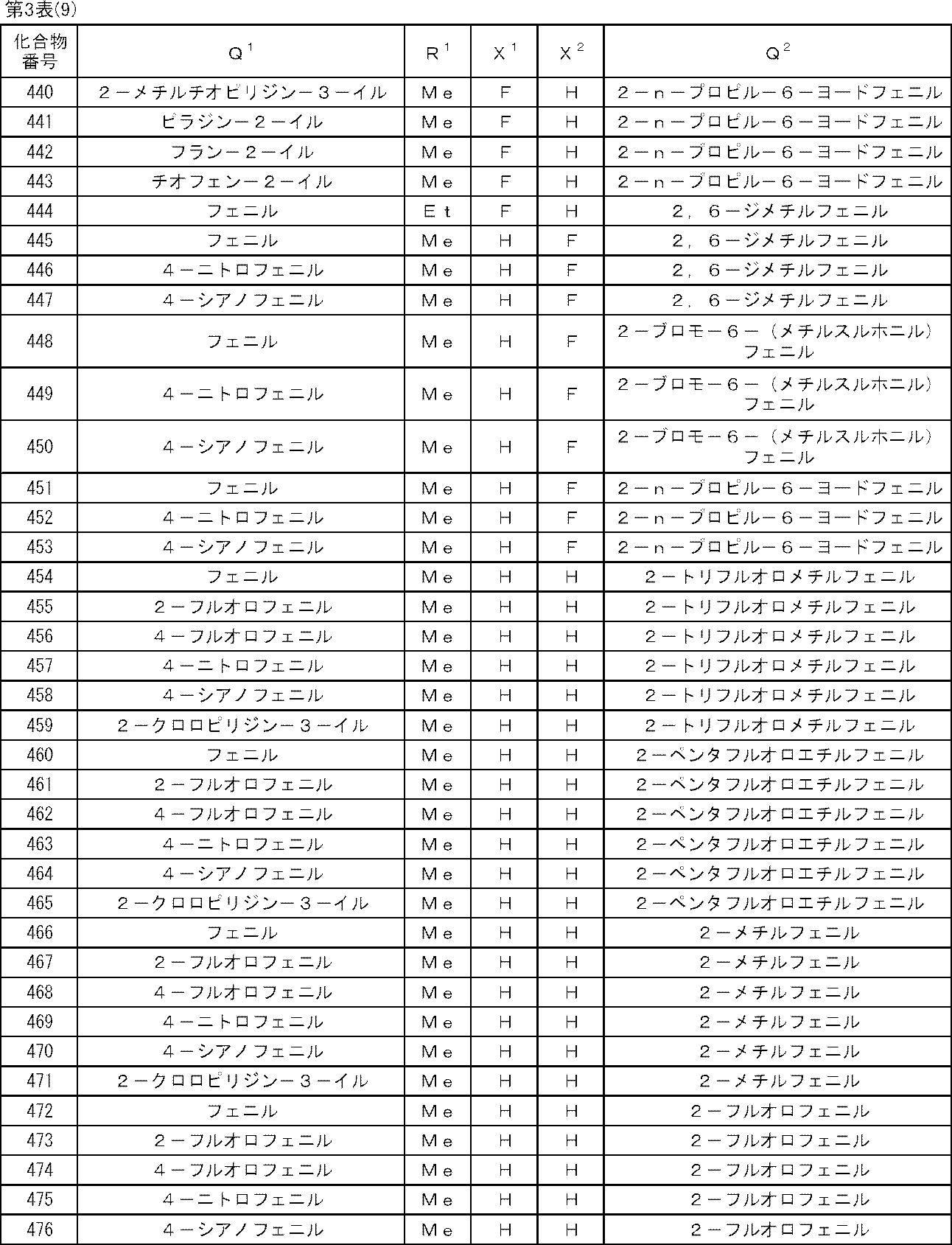
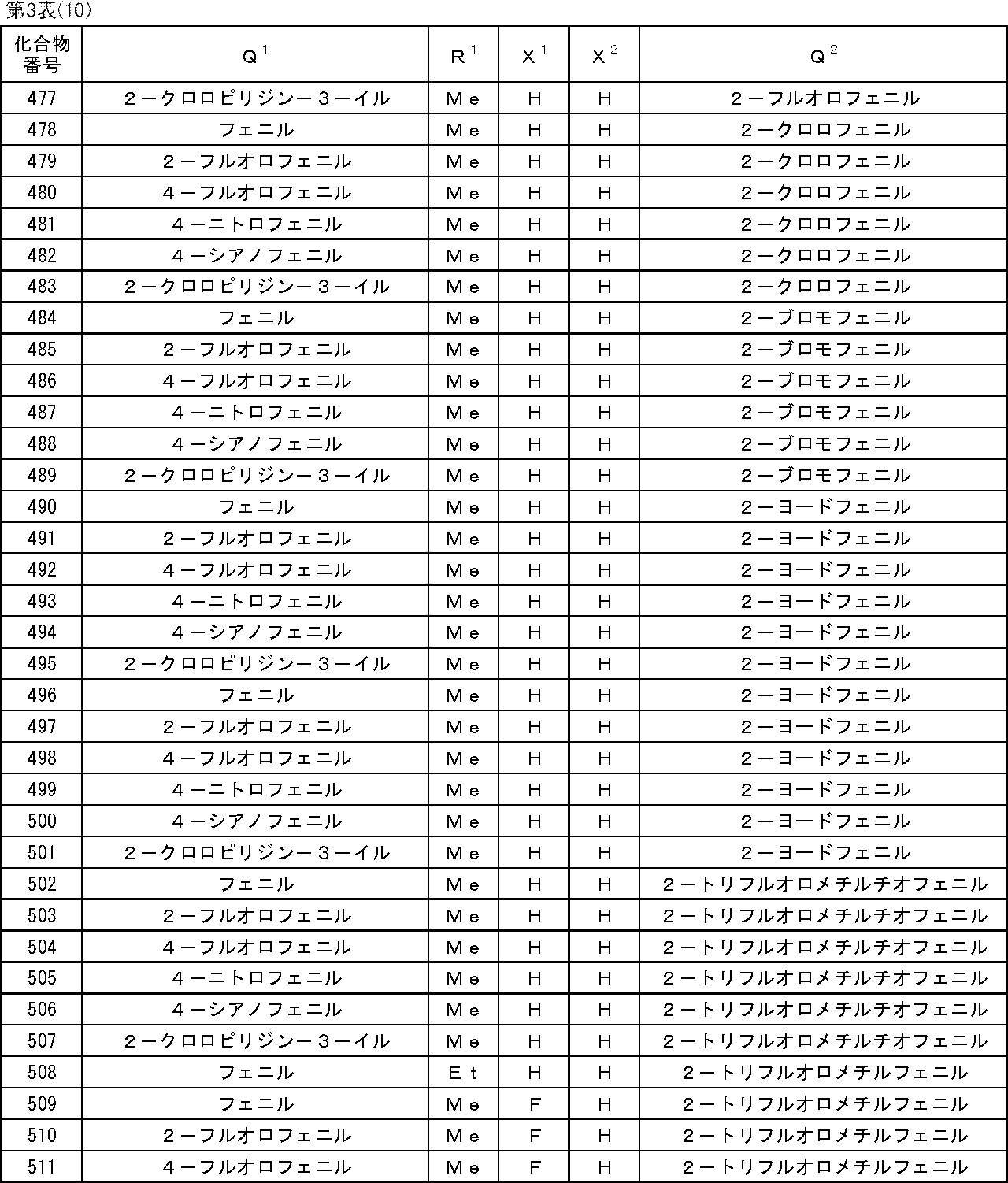
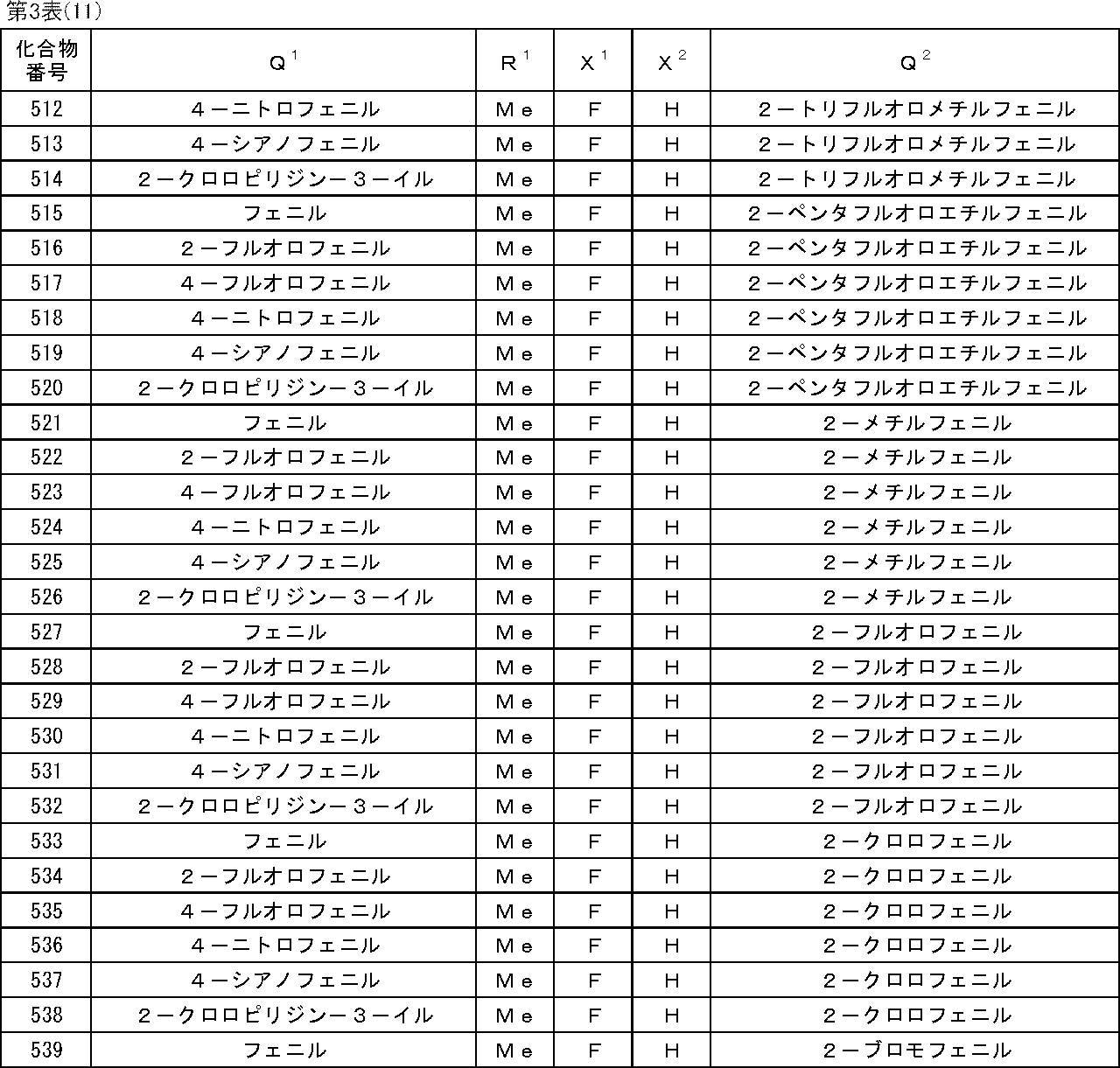
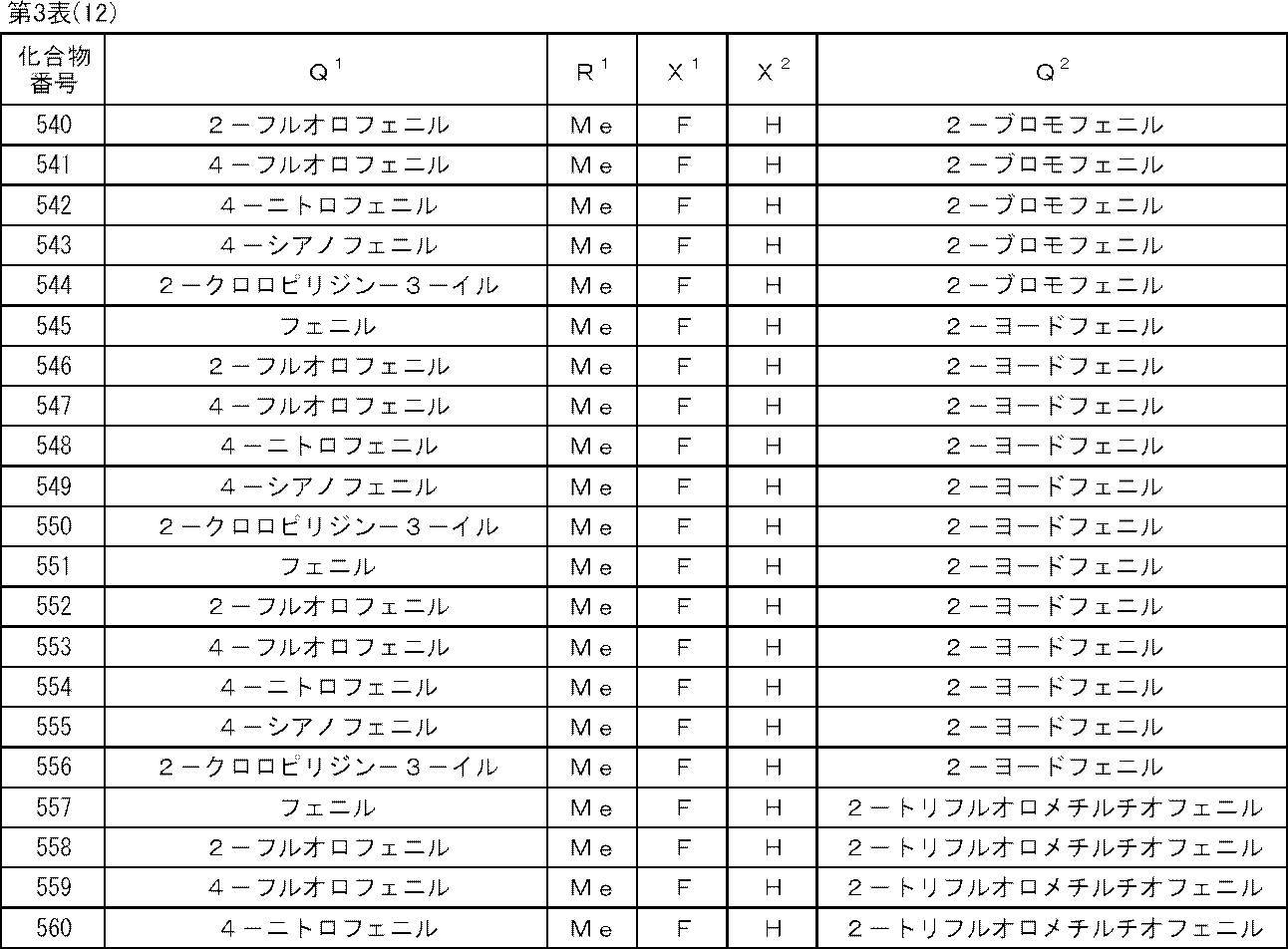
なお、表中、「Me」はメチル基を、「Et」はエチル基を、「H」は水素原子を、「F」はフッ素原子を、「Cl」は塩素原子を、「Br」は臭素原子を、「I」はヨウ素原子を、「CF3」はトリフルオロメチル基をそれぞれ表すものである。
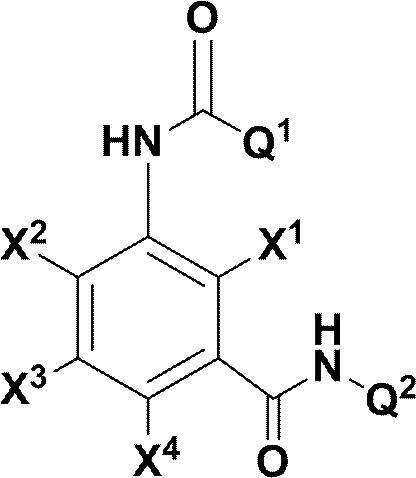







尚、1H-NMRの化学シフト値は、特に記載がない限り、テトラメチルシランを基準として低磁場側にppm単位で示される。また「s」は一重項を意味し、「d」は二重項を意味し、「t」は三重項を意味し、「m」は多重項を意味し、「brs」は幅の広い一重項を意味する。また、特記しない限り「%」は質量基準である。
[2―フルオロ―3―(N-メチルベンズアミド)-N-(2-(トリフルオロメチル)フェニル)ベンズアミドの製造]
2-(トリフルオロメチル)アニリン26.8g(166.3mmol)、トリエチルアミン37.0g(365.9mmol)および2-フルオロ-3-(N-メチルベンズアミド)ベンゾイルクロライド100.9g(365.9mmol)をテトラヒドロフラン(400mL)に加えて50℃にて3時間攪拌した。反応溶液をフィルター濾過した後、濾液に水酸化ナトリウム14.6g(365.9mmol)の水溶液(125mL)を加え、50℃にて30分攪拌した。減圧下、溶媒を留去した後、酢酸エチルで抽出して、炭酸カリウム水溶液および飽和食塩水で順次洗浄した。有機層を硫酸マグネシウムで乾燥させた後、硫酸マグネシウムを濾別し、減圧下溶媒を留去した。得られた固体をn-ヘキサンおよびイソプロピルエーテルで洗浄し、乾燥することにより表題化合物63.2g(収率91%)を白色固体として得た。
1H-NMR(DMSO-d6、70℃、δppm)9.81(1H,s),7.80-7.69(2H,m),7.62-7.49(4H,m),7.33-7.21(6H,m),3.33(3H,s).
[2―フルオロ―3―(N-メチルベンズアミド)-N-(2-(トリフルオロメチル)-4-(ヘプタフルオロイソプロピル)フェニル)ベンズアミドの製造]
粉状の水酸化ナトリウム0.8g(20mmol)と硫酸鉄(II)・七水和物0.93g(3.3mmol)を氷浴下、黒く変色するまで攪拌する。変色後直ちに、N,N-ジメチルホルムアミド5gを加え、2―フルオロ―3―(N-メチルベンズアミド)-N-(2-(トリフルオロメチル)フェニル)ベンズアミド1g(2.4mmol)およびヨウ化ヘプタフルオロイソプロピル1g(3.4mmol)のN,N-ジメチルホルムアミド5g溶液を加え、室温にて3時間攪拌した。得られた反応液をセライトろ過し、酢酸エチル50mLで洗浄した後、得られた反応液に水40gを加え、抽出後、有機層を硫酸マグネシウムで乾燥させた。硫酸マグネシウムを濾別し、減圧下溶媒を留去した後、濃縮残渣をシリカゲルクロマトグラフィーで精製することにより、表題化合物0.89g(収率63%)を白色固体として得た。
1H-NMR(CDCl3、δppm)8.86(1H,d,J=8.9Hz),8.68(1H,d,J=8.3Hz),8.01(1H,s),7.88-7.84(2H,m),7.36-7.29(7H,m),3.48(3H,s).
[2―フルオロ―3―(N-メチルベンズアミド)-N-(2-ブロモ-4-(ヘプタフルオロイソプロピル)-6-(トリフルオロメチル)フェニル)ベンズアミドの製造]
水素化ナトリウム(60%品)68.5mg(1.71mmol)にN,N-ジメチルホルムアミド4g、および上記で得られた2―フルオロ―3―(N-メチルベンズアミド)-N-(2-(トリフルオロメチル)-4-(ヘプタフルオロイソプロピル)フェニル)ベンズアミド1g(1.72mmol)を加え、氷浴下、10分間攪拌した。反応溶液にN-ブロモスクシンイミド0.31g(1.80mmol)を加え、室温にて2時間攪拌した。反応溶液に水を加え、酢酸エチルで抽出した後、有機層を硫酸マグネシウムで乾燥させた。硫酸マグネシウムを濾別し、減圧下溶媒を留去した後、濃縮残渣をシリカゲルクロマトグラフィーで精製することにより、表題化合物0.93g(収率82%)を白色固体として得た。
1H-NMR(CDCl3,ppm)δ 8.13(1H,s),7.97-8.06(2H,m),7.90(1H,s),7.43-7.45(1H,m),6.99-7.33(6H,m),3.50(3H,s).
[2―フルオロ―3―(N-メチルベンズアミド)-N-(2-ブロモ-4-(ヘプタフルオロイソプロピル)-6-(トリフルオロメチル)フェニル)ベンズアミドの製造]
水酸化ナトリウム140mg(3.42mmol)にN,N-ジメチルホルムアミド5g、および上記で得られた2―フルオロ―3―(N-メチルベンズアミド)-N-(2-(トリフルオロメチル)-4-(ヘプタフルオロイソプロピル)フェニル)ベンズアミド1g(1.72mmol)を加え、室温下、10分間攪拌した。反応溶液にN-ブロモスクシンイミド0.34g(1.90mmol)を加え、室温にて2時間攪拌した。反応溶液に水を加え、酢酸エチルで抽出した後、有機層を硫酸マグネシウムで乾燥させた。硫酸マグネシウムを濾別し、減圧下溶媒を留去した後、濃縮残渣をシリカゲルクロマトグラフィーで精製することにより、表題化合物0.64g(収率56%)を白色固体として得た。
[3-ニトロ-N-(2-(トリフルオロメチル)-4-(ヘプタフルオロイソプロピル)フェニル)ベンズアミドの製造]
粉状の水酸化ナトリウム1.1g(27mmol)と硫酸鉄(II)・七水和物1.2g(4.5mmol)を氷浴下、黒く変色するまで攪拌する。変色後直ちに、N,N-ジメチルホルムアミド5gを加え、3-ニトロ-N-(2-(トリフルオロメチル)フェニル)ベンズアミド1.0g(3.2mmol)およびヨウ化ヘプタフルオロイソプロピル1.3g(4.5mmol)のN,N-ジメチルホルムアミド5g溶液を加え、室温にて3時間攪拌した。得られた反応液をセライトろ過し、酢酸エチル50mLで洗浄した後、得られた反応液に水40gを加え、抽出後、有機層を硫酸マグネシウムで乾燥させた。硫酸マグネシウムを濾別し、減圧下溶媒を留去した後、濃縮残渣をシリカゲルクロマトグラフィーで精製することにより、表題化合物0.44g(収率28%)を赤色固体として得た。
1H-NMR(DMSO-d6,δppm)10.82(1H*4/5,brs),10.71(1H*1/5,brs),8.77(1H*4/5,t,J=1.8Hz),8.73(1H*1/5,t,J=2.0Hz),8.50-8.46(1H,m),8.37-8.34(1H,m),8.21-8.20(1*1/5H,m),8.14-8.12(1*4/5H,m),7.96-7.94(2H,m),7.90-7.85(1H,m).
[3-シアノ-N-(2-(トリフルオロメチル)-4-(ヘプタフルオロイソプロピル)フェニル)ベンズアミドの製造]
粉状の水酸化ナトリウム1.1g(29mmol)と硫酸鉄(II)・七水和物1.3g(4.8mmol)を氷浴下、黒く変色するまで攪拌する。変色後直ちに、N,N-ジメチルホルムアミド5gを加え、3-シアノ-N-(2-(トリフルオロメチル)フェニル)ベンズアミド1.0g(3.5mmol)およびヨウ化ヘプタフルオロイソプロピル1.4g(4.8mmol)のN,N-ジメチルホルムアミド5g溶液を加え、室温にて3時間攪拌した。得られた反応液をセライトろ過し、酢酸エチル50mLで洗浄した後、得られた反応液に水40gを加え、抽出後、有機層を硫酸マグネシウムで乾燥させた。硫酸マグネシウムを濾別し、減圧下溶媒を留去した後、濃縮残渣をシリカゲルクロマトグラフィーで精製することにより、表題化合物0.93g(収率59%)を白色固体として得た。
1H-NMR(DMSO-d6,δppm)10.64(1H*4/5,brs),10.51(1H*1/5,brs),8.36(1H*4/5,s),8.30(1H*1/5,s),8.23-8.20(1H,m),8.13-8.04(2H,m),7.94-7.89(2H,m),7.79-7.78(1H,m).
[2―フルオロ―3―(N-メチルベンズアミド)-N-(2-メチル-4-(ヘプタフルオロイソプロピル)フェニル)ベンズアミドの製造]
粉状の水酸化ナトリウム0.55g(14mmol)と硫酸鉄(II)・七水和物0.64g(2.3mmol)を氷浴下、黒く変色するまで攪拌する。変色後直ちに、N,N-ジメチルホルムアミド3gを加え、2―フルオロ―3―(N-メチルベンズアミド)-N-(2-メチル-フェニル)ベンズアミド0.60g(1.7mmol)およびヨウ化ヘプタフルオロイソプロピル0.68g(2.3mmol)のN,N-ジメチルホルムアミド3g溶液を加え、室温にて3時間攪拌した。得られた反応液をセライトろ過し、酢酸エチル50mLで洗浄した後、得られた反応液に水40gを加え、抽出後、有機層を硫酸マグネシウムで乾燥させた。硫酸マグネシウムを濾別し、減圧下溶媒を留去した後、濃縮残渣をシリカゲルクロマトグラフィーで精製することにより、表題化合物0.26g(収率30%)を白色固体として得た。
1H-NMR(CDCl3,δppm)8.35(1H,d,J=8.6Hz),8.03-8.01(1H,m),7.49(1H,d,J=9.2Hz),7.43-7.37(4H,m),7.26-7.22(5H,m),3.49(3H,s),2.34(3H,s).
[2―フルオロ―3―(N-メチルベンズアミド)-N-(2-ブロモ-4-(ヘプタフルオロイソプロピル)フェニル)ベンズアミドの製造]
粉状の水酸化ナトリウム0.47g(12mmol)と硫酸鉄(II)・七水和物0.54g(1.9mmol)を氷浴下、黒く変色するまで攪拌する。変色後直ちに、N,N-ジメチルホルムアミド3gを加え、2―フルオロ―3―(N-メチルベンズアミド)-N-(2-ブロモ-フェニル)ベンズアミド0.60g(1.4mmol)およびヨウ化ヘプタフルオロイソプロピル0.57g(1.9mmol)のN,N-ジメチルホルムアミド3g溶液を加え、室温にて3時間攪拌した。得られた反応液をセライトろ過し、酢酸エチル50mLで洗浄した後、得られた反応液に水40gを加え、抽出後、有機層を硫酸マグネシウムで乾燥させた。硫酸マグネシウムを濾別し、減圧下溶媒を留去した後、濃縮残渣をシリカゲルクロマトグラフィーで精製することにより、表題化合物0.092g(収率11%)を白色固体として得た。
1H-NMR(CDCl3,δppm)8.97(1H,brs),8.70(1H,d,J=8.9Hz),8.01(1H,t,J=6.9Hz),7.84(1H,d,J=1.8Hz),7.60-7.59(1H,m),7.40-7.36(3H,m),7.29-7.22(4H,m),3.50(3H,s).
本明細書に記載された全ての文献、特許出願、および技術規格は、個々の文献、特許出願、および技術規格が参照により取り込まれることが具体的かつ個々に記された場合と同程度に、本明細書に参照により取り込まれる。
Claims (7)
- 下記一般式(1)

(一般式(1)中、Xはそれぞれ独立に、水素原子、ハロゲン原子、ニトロ基、シアノ基、C1-C4アルコキシ基、またはジメチルアミノ基を示す。
mは1~4の整数を示し、n1は1~5の整数を示す。
G1は酸素原子、または硫黄原子を示す。
Yはそれぞれ独立に、水素原子、ハロゲン原子、C1-C6アルキル基、C1-C6ハロアルキル基、C2-C4アルケニル基、C2-C4ハロアルケニル基、C2-C4アルキニル基、C2-C4ハロアルキニル基、C3-C6シクロアルキル基、C3-C6ハロシクロアルキル基、C1-C4アルコキシ基、C1-C4ハロアルコキシ基、C1-C4アルキルチオ基、C1-C4ハロアルキルチオ基、C1-C4アルキルスルフィニル基、C1-C4ハロアルキルスルフィニル基、C1-C4アルキルスルホニル基、C1-C4ハロアルキルスルホニル基、アリールスルホニル基、C1-C4アルキルアミノ基、ジC1-C4アルキルアミノ基、シアノ基、ニトロ基、ヒドロキシ基、C1-C4アルキルカルボニル基、C1-C4ハロアルキルカルボニル基、C1-C4アルキルカルボニルオキシ基、C1-C4アルコキシカルボニル基、またはアセチルアミノ基を示す。
Aは水素原子、C1-C6アルキル基、C1-C6ハロアルキル基、C2-C4アルケニル基、C2-C4ハロアルケニル基、C2-C4アルキニル基、C2-C4ハロアルキニル基、C3-C6シクロアルキル基、C3-C6ハロシクロアルキル基、C1-C4アルコキシ基、C1-C4ハロアルコキシ基、C1-C4アルキルチオ基、C1-C4ハロアルキルチオ基、C1-C4アルキルスルフィニル基、C1-C4ハロアルキルスルフィニル基、C1-C4アルキルスルホニル基、C1-C4ハロアルキルスルホニル基、アリールスルホニル基、C1-C4アルキルアミノ基、ジC1-C4アルキルアミノ基、シアノ基、ニトロ基、ヒドロキシ基、C1-C4アルキルカルボニル基、C1-C4ハロアルキルカルボニル基、C1-C4アルキルカルボニルオキシ基、C1-C4アルコキシカルボニル基、C1-C4アルキルアミノカルボニル基、メチルスルフィニルC1-C4アルキルアミノカルボニル基、メチルスルホニルC1-C4アルキルアミノカルボニル基、アセチルアミノ基、
無置換のフェニル基、もしくはハロゲン原子、C1-C6アルキル基、C1-C6ハロアルキル基、C2-C4アルケニル基、C2-C4ハロアルケニル基、C2-C4アルキニル基、C2-C4ハロアルキニル基、C3-C6シクロアルキル基、C3-C6ハロシクロアルキル基、C1-C4アルコキシ基、C1-C4ハロアルコキシ基、C1-C4アルキルチオ基、C1-C4ハロアルキルチオ基、C1-C4アルキルスルフィニル基、C1-C4ハロアルキルスルフィニル基、C1-C4アルキルスルホニル基、C1-C4ハロアルキルスルホニル基、アリールスルホニル基、C1-C4アルキルアミノ基、ジC1-C4アルキルアミノ基、シアノ基、ニトロ基、ヒドロキシ基、C1-C4アルキルカルボニル基、C1-C4ハロアルキルカルボニル基、C1-C4アルキルカルボニルオキシ基、C1-C4アルコキシカルボニル基、アセチルアミノ基、およびフェニル基からなる群より選択される1以上の同一または異なっていてもよい置換基を有するフェニル基、
無置換の複素環基、もしくはハロゲン原子、C1-C6アルキル基、C1-C6ハロアルキル基、C2-C4アルケニル基、C2-C4ハロアルケニル基、C2-C4アルキニル基、C2-C4ハロアルキニル基、C3-C6シクロアルキル基、C3-C6ハロシクロアルキル基、C1-C4アルコキシ基、C1-C4ハロアルコキシ基、C1-C4アルキルチオ基、C1-C4ハロアルキルチオ基、C1-C4アルキルスルフィニル基、C1-C4ハロアルキルスルフィニル基、C1-C4アルキルスルホニル基、C1-C4ハロアルキルスルホニル基、アリールスルホニル基、C1-C4アルキルアミノ基、ジC1-C4アルキルアミノ基、シアノ基、ニトロ基、ヒドロキシ基、C1-C4アルキルカルボニル基、C1-C4ハロアルキルカルボニル基、C1-C4アルキルカルボニルオキシ基、C1-C4アルコキシカルボニル基、アセチルアミノ基、およびフェニル基からなる群より選択される1以上の同一または異なっていてもよい置換基を有する複素環基、または
下記一般式(2)

(一般式(2)中、G2は酸素原子、または硫黄原子を示す。
R1は水素原子、C1-C6アルキル基、またはC1-C6ハロアルキル基を示す。
Q1はC1-C6のアルキル基、C1-C6ハロアルキル基、
無置換のフェニル基、もしくはハロゲン原子、C1-C6アルキル基、C1-C6ハロアルキル基、C2-C4アルケニル基、C2-C4ハロアルケニル基、C2-C4アルキニル基、C2-C4ハロアルキニル基、C3-C6シクロアルキル基、C3-C6ハロシクロアルキル基、C1-C4アルコキシ基、C1-C4ハロアルコキシ基、C1-C4アルキルチオ基、C1-C4ハロアルキルチオ基、C1-C4アルキルスルフィニル基、C1-C4ハロアルキルスルフィニル基、C1-C4アルキルスルホニル基、C1-C4ハロアルキルスルホニル基、アリールスルホニル基、C1-C4アルキルアミノ基、ジC1-C4アルキルアミノ基、シアノ基、ニトロ基、ヒドロキシ基、C1-C4アルキルカルボニル基、C1-C4ハロアルキルカルボニル基、C1-C4アルキルカルボニルオキシ基、C1-C4アルコキシカルボニル基、アセチルアミノ基、およびフェニル基からなる群より選択される1以上の同一または異なっていてもよい置換基を有するフェニル基、または
無置換の複素環基、もしくはハロゲン原子、C1-C6アルキル基、C1-C6ハロアルキル基、C2-C4アルケニル基、C2-C4ハロアルケニル基、C2-C4アルキニル基、C2-C4ハロアルキニル基、C3-C6シクロアルキル基、C3-C6ハロシクロアルキル基、C1-C4アルコキシ基、C1-C4ハロアルコキシ基、C1-C4アルキルチオ基、C1-C4ハロアルキルチオ基、C1-C4アルキルスルフィニル基、C1-C4ハロアルキルスルフィニル基、C1-C4アルキルスルホニル基、C1-C4ハロアルキルスルホニル基、アリールスルホニル基、C1-C4アルキルアミノ基、ジC1-C4アルキルアミノ基、シアノ基、ニトロ基、ヒドロキシ基、C1-C4アルキルカルボニル基、C1-C4ハロアルキルカルボニル基、C1-C4アルキルカルボニルオキシ基、C1-C4アルコキシカルボニル基、アセチルアミノ基、およびフェニル基からなる群より選択される1以上の同一または異なっていてもよい置換基を有する複素環基を示す。)で表される基を示す。
前記複素環基は、ピリジル基、ピリジン-N-オキシド基、ピリミジニル基、ピリダジル基、ピラジル基、フリル基、チエニル基、オキサゾリル基、イソキサゾリル基、オキサジアゾリル基、チアゾリル基、イソチアゾリル基、イミダゾリル基、トリアゾリル基、ピロリル基、ピラゾリル基、またはテトラゾリル基を示す。)で表される芳香族アミド誘導体と、下記一般式(3)

(一般式(3)中、Z1はC1-C6アルキル基、またはC1-C6ハロアルキル基を示す。Xaはヨウ素原子または臭素原子を示す。)で表されるハロアルキル化合物とを、
塩基、および金属または金属塩の存在下で反応させる工程を含む、下記一般式(4)

(一般式(4)中、n2は1~4の整数を示す。Z1は前記一般式(3)におけるZ1と同義であり、X、m、G1、Y、およびAは前記一般式(1)におけるX、m、G1、Y、およびAとそれぞれ同義である。)
で表されるアルキル化芳香族アミド誘導体の製造方法。 - 前記一般式(1)で表される芳香族アミド誘導体が下記一般式(5)

(一般式(5)中、Y1、Y2、Y3、およびY4はそれぞれ独立に、水素原子、ハロゲン原子、C1-C6アルキル基、C1-C6ハロアルキル基、C1-C4アルキルチオ基、C1-C4ハロアルキルチオ基、C1-C4アルキルスルフィニル基、C1-C4ハロアルキルスルフィニル基、C1-C4アルキルスルホニル基、またはC1-C4ハロアルキルスルホニル基を示す。X、m、G1、およびAは前記一般式(1)におけるX、m、G1、およびAとそれぞれ同義である。)で表される芳香族アミド誘導体であり、前記一般式(4)で表されるアルキル化芳香族アミド誘導体が、下記一般式(6)
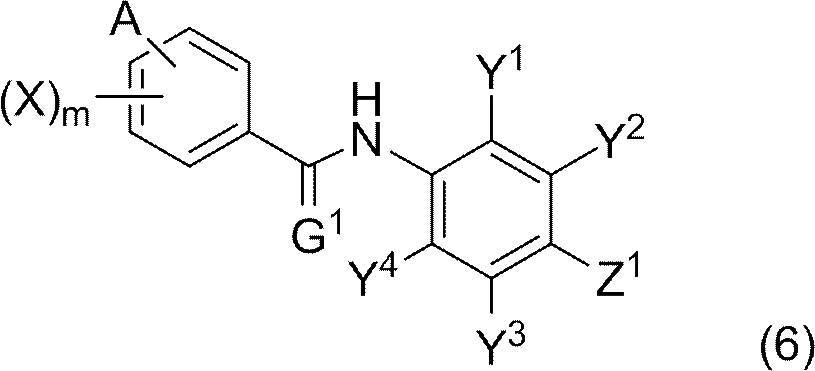
(一般式(6)中、Z1は前記一般式(3)におけるZ1と同義である。Y1、Y2、Y3、Y4、X、m、G1、およびAは前記一般式(5)におけるY1、Y2、Y3、Y4、X、m、G1、およびAとそれぞれ同義である。)で表されるアルキル化芳香族アミド誘導体である、請求項1に記載の製造方法。 - 前記一般式(5)で表される芳香族アミド誘導体が下記一般式(7)
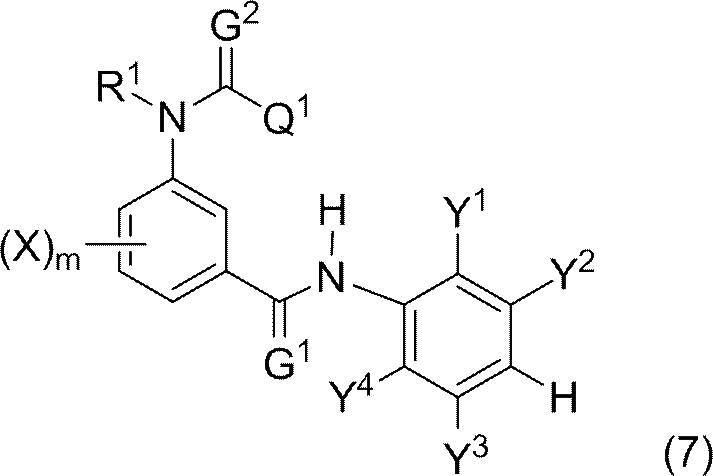
(一般式(7)中、G2、Q1、およびR1は前記一般式(2)におけるG2、Q1、およびR1とそれぞれ同義である。X、m、G1、Y1、Y2、Y3、およびY4は前記一般式(5)におけるX、m、G1、Y1、Y2、Y3、およびY4とそれぞれ同義である。)で表される芳香族アミド誘導体であり、前記一般式(6)で表されるアルキル化芳香族アミド誘導体が、下記一般式(8)

(一般式(8)中、Z1は前記一般式(3)におけるZ1と同義である。Y1、Y2、Y3、Y4、X、m、G1、G2、Q1、およびR1は前記一般式(7)におけるY1、Y2、Y3、Y4、X、m、G1、G2、Q1、およびR1とそれぞれ同義である。)で表されるアルキル化芳香族アミド誘導体である請求項2に記載の製造方法。 - 請求項3に記載の製造方法により前記一般式(8)で表されるアルキル化芳香族アミド誘導体を得る工程と、
前記一般式(8)で表されるアルキル化芳香族アミド誘導体を塩基性条件下でハロゲン化する工程とを含む、下記一般式(10)
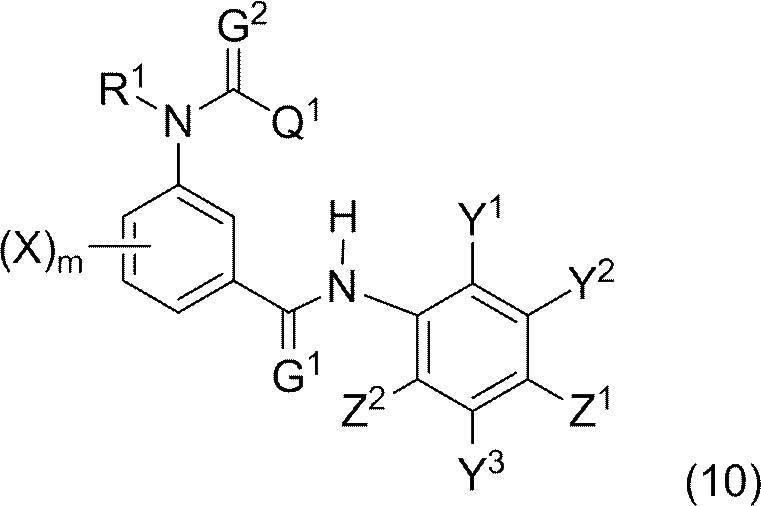
(一般式(10)中、Z2はハロゲン原子を示す。X、m、G1、G2、Q1、R1、Y1、Y2、Y3、およびZ1は前記一般式(8)におけるX、m、G1、G2、Q1、R1、Y1、Y2、Y3、およびZ1とそれぞれ同義である。)で表されるハロゲン化芳香族アミド誘導体の製造方法であって、前記一般式(8)において、Y4は水素原子である、ハロゲン化芳香族アミド誘導体の製造方法。 - 下記一般式(7)

(一般式(7)中、Xはそれぞれ独立に、水素原子、ハロゲン原子、ニトロ基、シアノ基、C1-C4アルコキシ基、またはジメチルアミノ基を示す。mは1~4の整数を示す。
G1およびG2はそれぞれ独立に、酸素原子、または硫黄原子を示す。
Y1、Y2、Y3、およびY4はそれぞれ独立に、水素原子、ハロゲン原子、C1-C6アルキル基、C1-C6ハロアルキル基、C1-C4アルキルチオ基、C1-C4ハロアルキルチオ基、C1-C4アルキルスルフィニル基、C1-C4ハロアルキルスルフィニル基、C1-C4アルキルスルホニル基、またはC1-C4ハロアルキルスルホニル基を示す。
R1は水素原子、C1-C6アルキル基、またはC1-C6ハロアルキル基を示す。
Q1はC1-C6のアルキル基、C1-C6ハロアルキル基、
無置換のフェニル基、もしくはハロゲン原子、C1-C6アルキル基、C1-C6ハロアルキル基、C2-C4アルケニル基、C2-C4ハロアルケニル基、C2-C4アルキニル基、C2-C4ハロアルキニル基、C3-C6シクロアルキル基、C3-C6ハロシクロアルキル基、C1-C4アルコキシ基、C1-C4ハロアルコキシ基、C1-C4アルキルチオ基、C1-C4ハロアルキルチオ基、C1-C4アルキルスルフィニル基、C1-C4ハロアルキルスルフィニル基、C1-C4アルキルスルホニル基、C1-C4ハロアルキルスルホニル基、アリールスルホニル基、C1-C4アルキルアミノ基、ジC1-C4アルキルアミノ基、シアノ基、ニトロ基、ヒドロキシ基、C1-C4アルキルカルボニル基、C1-C4ハロアルキルカルボニル基、C1-C4アルキルカルボニルオキシ基、C1-C4アルコキシカルボニル基、アセチルアミノ基、およびフェニル基からなる群より選択される1以上の同一または異なっていてもよい置換基を有するフェニル基、または
無置換の複素環基、もしくはハロゲン原子、C1-C6アルキル基、C1-C6ハロアルキル基、C2-C4アルケニル基、C2-C4ハロアルケニル基、C2-C4アルキニル基、C2-C4ハロアルキニル基、C3-C6シクロアルキル基、C3-C6ハロシクロアルキル基、C1-C4アルコキシ基、C1-C4ハロアルコキシ基、C1-C4アルキルチオ基、C1-C4ハロアルキルチオ基、C1-C4アルキルスルフィニル基、C1-C4ハロアルキルスルフィニル基、C1-C4アルキルスルホニル基、C1-C4ハロアルキルスルホニル基、アリールスルホニル基、C1-C4アルキルアミノ基、ジC1-C4アルキルアミノ基、シアノ基、ニトロ基、ヒドロキシ基、C1-C4アルキルカルボニル基、C1-C4ハロアルキルカルボニル基、C1-C4アルキルカルボニルオキシ基、C1-C4アルコキシカルボニル基、アセチルアミノ基、およびフェニル基からなる群より選択される1以上の同一または異なっていてもよい置換基を有する複素環基を示す。
前記複素環基は、ピリジル基、ピリジン-N-オキシド基、ピリミジニル基、ピリダジル基、ピラジル基、フリル基、チエニル基、オキサゾリル基、イソキサゾリル基、オキサジアゾリル基、チアゾリル基、イソチアゾリル基、イミダゾリル基、トリアゾリル基、ピロリル基、ピラゾリル基、またはテトラゾリル基を示す。)で表される芳香族アミド誘導体。 - 下記一般式(9)

(一般式(9)中、Xはそれぞれ独立に、水素原子、ハロゲン原子、ニトロ基、シアノ基、C1-C4アルコキシ基、またはジメチルアミノ基を示す。mは1~4の整数を示す。
G1およびG2はそれぞれ独立に、酸素原子、または硫黄原子を示す。
Y1、Y2、およびY3はそれぞれ独立に、水素原子、ハロゲン原子、C1-C6アルキル基、C1-C6ハロアルキル基、C1-C4アルキルチオ基、C1-C4ハロアルキルチオ基、C1-C4アルキルスルフィニル基、C1-C4ハロアルキルスルフィニル基、C1-C4アルキルスルホニル基、またはC1-C4ハロアルキルスルホニル基を示す。
Z1はC1-C6アルキル基、またはC1-C6ハロアルキル基を示す。
R1は水素原子、C1-C6アルキル基、またはC1-C6ハロアルキル基を示す。
Q1はC1-C6のアルキル基、C1-C6ハロアルキル基、
無置換のフェニル基、もしくはハロゲン原子、C1-C6アルキル基、C1-C6ハロアルキル基、C2-C4アルケニル基、C2-C4ハロアルケニル基、C2-C4アルキニル基、C2-C4ハロアルキニル基、C3-C6シクロアルキル基、C3-C6ハロシクロアルキル基、C1-C4アルコキシ基、C1-C4ハロアルコキシ基、C1-C4アルキルチオ基、C1-C4ハロアルキルチオ基、C1-C4アルキルスルフィニル基、C1-C4ハロアルキルスルフィニル基、C1-C4アルキルスルホニル基、C1-C4ハロアルキルスルホニル基、アリールスルホニル基、C1-C4アルキルアミノ基、ジC1-C4アルキルアミノ基、シアノ基、ニトロ基、ヒドロキシ基、C1-C4アルキルカルボニル基、C1-C4ハロアルキルカルボニル基、C1-C4アルキルカルボニルオキシ基、C1-C4アルコキシカルボニル基、アセチルアミノ基、およびフェニル基からなる群より選択される1以上の同一または異なっていてもよい置換基を有するフェニル基、または
無置換の複素環基、もしくはハロゲン原子、C1-C6アルキル基、C1-C6ハロアルキル基、C2-C4アルケニル基、C2-C4ハロアルケニル基、C2-C4アルキニル基、C2-C4ハロアルキニル基、C3-C6シクロアルキル基、C3-C6ハロシクロアルキル基、C1-C4アルコキシ基、C1-C4ハロアルコキシ基、C1-C4アルキルチオ基、C1-C4ハロアルキルチオ基、C1-C4アルキルスルフィニル基、C1-C4ハロアルキルスルフィニル基、C1-C4アルキルスルホニル基、C1-C4ハロアルキルスルホニル基、アリールスルホニル基、C1-C4アルキルアミノ基、ジC1-C4アルキルアミノ基、シアノ基、ニトロ基、ヒドロキシ基、C1-C4アルキルカルボニル基、C1-C4ハロアルキルカルボニル基、C1-C4アルキルカルボニルオキシ基、C1-C4アルコキシカルボニル基、アセチルアミノ基、およびフェニル基からなる群より選択される1以上の同一または異なっていてもよい置換基を有する複素環基を示す。
前記複素環基は、ピリジル基、ピリジン-N-オキシド基、ピリミジニル基、ピリダジル基、ピラジル基、フリル基、チエニル基、オキサゾリル基、イソキサゾリル基、オキサジアゾリル基、チアゾリル基、イソチアゾリル基、イミダゾリル基、トリアゾリル基、ピロリル基、ピラゾリル基、またはテトラゾリル基を示す。)で表されるアルキル化芳香族アミド誘導体。 - 前記一般式(9)におけるY1がC1-C2ハロアルキル基であり、Y2およびY3がそれぞれ水素原子であり、Z1がC1―C6ハロアルキル基であり、Xがハロゲン原子である請求項6に記載のアルキル化芳香族アミド誘導体。
Priority Applications (9)
| Application Number | Priority Date | Filing Date | Title |
|---|---|---|---|
| US14/389,934 US9353046B2 (en) | 2012-04-03 | 2013-03-29 | Method for producing alkylated aromatic amide derivative |
| KR1020147027560A KR102055466B1 (ko) | 2012-04-03 | 2013-03-29 | 알킬화 방향족 아미드 유도체의 제조방법 |
| JP2014509140A JP6161596B2 (ja) | 2012-04-03 | 2013-03-29 | アルキル化芳香族アミド誘導体の製造方法 |
| CN201380018859.9A CN104245665B (zh) | 2012-04-03 | 2013-03-29 | 烷基化芳香族酰胺衍生物的制造方法 |
| RU2014143719A RU2640302C2 (ru) | 2012-04-03 | 2013-03-29 | Способ получения алкилированного ароматического амидного производного |
| BR112014024625-4A BR112014024625B1 (pt) | 2012-04-03 | 2013-03-29 | Metodos para produqao de derivado de amida aromatica alquilada ou halogenada, e derivados de amida aromatica e de amida aromatica alquilada |
| EP13773111.3A EP2835366A4 (en) | 2012-04-03 | 2013-03-29 | PROCESS FOR PREPARING AN ALKYLATED AROMATIC AMID DERIVATIVE |
| IN8840DEN2014 IN2014DN08840A (ja) | 2012-04-03 | 2013-03-29 | |
| IL234871A IL234871A (en) | 2012-04-03 | 2014-09-29 | Method for making an aromatic amide derivative converted to alkyl |
Applications Claiming Priority (2)
| Application Number | Priority Date | Filing Date | Title |
|---|---|---|---|
| JP2012085053 | 2012-04-03 | ||
| JP2012-085053 | 2012-04-03 |
Publications (1)
| Publication Number | Publication Date |
|---|---|
| WO2013150988A1 true WO2013150988A1 (ja) | 2013-10-10 |
Family
ID=49300472
Family Applications (1)
| Application Number | Title | Priority Date | Filing Date |
|---|---|---|---|
| PCT/JP2013/059695 Ceased WO2013150988A1 (ja) | 2012-04-03 | 2013-03-29 | アルキル化芳香族アミド誘導体の製造方法 |
Country Status (11)
| Country | Link |
|---|---|
| US (1) | US9353046B2 (ja) |
| EP (1) | EP2835366A4 (ja) |
| JP (1) | JP6161596B2 (ja) |
| KR (1) | KR102055466B1 (ja) |
| CN (1) | CN104245665B (ja) |
| BR (1) | BR112014024625B1 (ja) |
| IL (1) | IL234871A (ja) |
| IN (1) | IN2014DN08840A (ja) |
| RU (1) | RU2640302C2 (ja) |
| TW (1) | TWI629256B (ja) |
| WO (1) | WO2013150988A1 (ja) |
Cited By (4)
| Publication number | Priority date | Publication date | Assignee | Title |
|---|---|---|---|---|
| US9249085B2 (en) | 2011-09-16 | 2016-02-02 | Fovea Pharmaceuticals | Aniline derivatives, their preparation and their therapeutic application |
| US10981861B1 (en) | 2019-10-25 | 2021-04-20 | Chang Sha Jia Qiao Biotech Co., Ltd. | Bromination method for m-diamide compounds |
| JP2021066723A (ja) * | 2019-10-25 | 2021-04-30 | 南通泰禾化工股▲フン▼有限公司 | m−ジアミド化合物の調製方法 |
| JP2022553416A (ja) * | 2019-10-25 | 2022-12-22 | 南通泰禾化工股▲フン▼有限公司 | 3-n-シクロプロピルメチル-2-フルオロベンズアミド系化合物、およびその調製方法と使用 |
Families Citing this family (4)
| Publication number | Priority date | Publication date | Assignee | Title |
|---|---|---|---|---|
| CN109206335B (zh) * | 2017-06-29 | 2020-10-30 | 沈阳中化农药化工研发有限公司 | 制备邻三氟甲基苯胺类化合物的方法及其中间体 |
| WO2019158408A1 (en) * | 2018-02-13 | 2019-08-22 | Basf Agrochemical Products B.V. | Crystalline forms of broflanilide |
| CN115073300B (zh) * | 2021-03-10 | 2024-04-05 | 江西天宇化工有限公司 | 一种4-(全氟丙烷-2-基)-2-三氟甲基苯胺及其制备方法和应用 |
| CN115974717B (zh) * | 2021-12-22 | 2025-03-14 | 浙江宇龙药业有限公司 | 一种含七氟异丙基的双酰胺类化合物及其中间体化合物,其制备方法与用途 |
Citations (11)
| Publication number | Priority date | Publication date | Assignee | Title |
|---|---|---|---|---|
| JP2001122836A (ja) | 1998-11-30 | 2001-05-08 | Nippon Nohyaku Co Ltd | アニリン誘導体及びその製造方法 |
| WO2003103654A1 (ja) * | 2002-06-10 | 2003-12-18 | 株式会社医薬分子設計研究所 | NF−κB活性化阻害剤 |
| JP2004502749A (ja) * | 2000-07-08 | 2004-01-29 | ベーリンガー インゲルハイム ファルマ ゲゼルシャフト ミット ベシュレンクテル ハフツング ウント コンパニー コマンディトゲゼルシャフト | ビフェニルカルボン酸アミド、これらの調製及び薬物としてのこれらの使用 |
| WO2005073165A1 (ja) | 2004-01-28 | 2005-08-11 | Mitsui Chemicals, Inc. | アミド誘導体及びその製造方法ならびにその殺虫剤としての使用方法 |
| WO2006137376A1 (ja) | 2005-06-21 | 2006-12-28 | Mitsui Chemicals, Inc. | アミド誘導体ならびに該化合物を含有する殺虫剤 |
| WO2010018857A1 (ja) | 2008-08-13 | 2010-02-18 | 三井化学アグロ株式会社 | アミド誘導体の製造方法 |
| WO2010018714A1 (ja) | 2008-08-13 | 2010-02-18 | 三井化学アグロ株式会社 | アミド誘導体、該アミド誘導体を含有する有害生物防除剤およびその使用方法 |
| JP2010072101A (ja) * | 2008-09-16 | 2010-04-02 | Ricoh Co Ltd | 静電荷潜像現像用トナー、これを用いた画像形成方法と装置及びプロセスカートリッジ |
| WO2011118759A1 (ja) * | 2010-03-25 | 2011-09-29 | 国立大学法人 岡山大学 | ベンズアニリド誘導体 |
| CN102206172A (zh) * | 2010-03-30 | 2011-10-05 | 中国医学科学院医药生物技术研究所 | 一组取代双芳基化合物及其制备方法和抗病毒应用 |
| JP2012085053A (ja) | 2010-10-08 | 2012-04-26 | Canon Inc | 画像処理装置および画像処理装置の制御方法 |
Family Cites Families (14)
| Publication number | Priority date | Publication date | Assignee | Title |
|---|---|---|---|---|
| FR2582301B1 (fr) * | 1985-05-22 | 1987-07-10 | Rhone Poulenc Spec Chim | Procede de preparation de (perfluoroalkylaryl)amines |
| EP0423070B1 (de) * | 1989-10-12 | 1995-08-30 | Ciba-Geigy Ag | Verfahren zur Herstellung substituierter Phenole |
| JPH11334352A (ja) * | 1998-05-26 | 1999-12-07 | Hitachi Constr Mach Co Ltd | 空調装置を備えた建設機械用キャブ |
| JP2003528806A (ja) * | 1999-07-20 | 2003-09-30 | ダウ・アグロサイエンス・エル・エル・シー | 殺菌・殺カビ性複素環式芳香族アミドおよびそれらの組成物、使用および製造方法 |
| BR0013469B1 (pt) * | 1999-08-20 | 2011-01-25 | amidas aromáticas heterocìclicas fungicidas, composição fungicida compreendendo as mesmas, bem como método para o controle ou a prevenção de infestação fúngica. | |
| US20020032238A1 (en) | 2000-07-08 | 2002-03-14 | Henning Priepke | Biphenylcarboxylic acid amides, the preparation thereof and the use thereof as medicaments |
| JP2003335735A (ja) * | 2002-05-16 | 2003-11-28 | Nippon Nohyaku Co Ltd | パーフルオロイソプロピルアニリン類の製造方法 |
| JP2006306771A (ja) | 2005-04-28 | 2006-11-09 | Mitsui Chemicals Inc | 農園芸用殺虫剤 |
| JP5106048B2 (ja) * | 2006-11-06 | 2012-12-26 | 東ソー株式会社 | パーフルオロアルキル基を有するベンゼン類の製造方法 |
| JP2010047478A (ja) | 2006-12-19 | 2010-03-04 | Mitsui Chemicals Inc | 有害生物防除組成物 |
| JP2010047480A (ja) | 2006-12-19 | 2010-03-04 | Mitsui Chemicals Inc | 虫害の予防方法 |
| US8138356B2 (en) * | 2007-10-16 | 2012-03-20 | Angiogeney, Inc. | Chemical inhibitors of inhibitors of differentiation |
| EP2253617A1 (de) | 2009-05-20 | 2010-11-24 | Bayer CropScience AG | Halogen-substituierte Verbindungen als Pestizide |
| JP2011153115A (ja) | 2010-01-28 | 2011-08-11 | Mitsui Chemicals Agro Inc | アニリン誘導体およびその製造方法 |
-
2013
- 2013-03-29 IN IN8840DEN2014 patent/IN2014DN08840A/en unknown
- 2013-03-29 WO PCT/JP2013/059695 patent/WO2013150988A1/ja not_active Ceased
- 2013-03-29 KR KR1020147027560A patent/KR102055466B1/ko active Active
- 2013-03-29 JP JP2014509140A patent/JP6161596B2/ja active Active
- 2013-03-29 RU RU2014143719A patent/RU2640302C2/ru active
- 2013-03-29 US US14/389,934 patent/US9353046B2/en active Active
- 2013-03-29 CN CN201380018859.9A patent/CN104245665B/zh active Active
- 2013-03-29 EP EP13773111.3A patent/EP2835366A4/en not_active Withdrawn
- 2013-03-29 BR BR112014024625-4A patent/BR112014024625B1/pt active IP Right Grant
- 2013-04-02 TW TW102111931A patent/TWI629256B/zh active
-
2014
- 2014-09-29 IL IL234871A patent/IL234871A/en active IP Right Grant
Patent Citations (11)
| Publication number | Priority date | Publication date | Assignee | Title |
|---|---|---|---|---|
| JP2001122836A (ja) | 1998-11-30 | 2001-05-08 | Nippon Nohyaku Co Ltd | アニリン誘導体及びその製造方法 |
| JP2004502749A (ja) * | 2000-07-08 | 2004-01-29 | ベーリンガー インゲルハイム ファルマ ゲゼルシャフト ミット ベシュレンクテル ハフツング ウント コンパニー コマンディトゲゼルシャフト | ビフェニルカルボン酸アミド、これらの調製及び薬物としてのこれらの使用 |
| WO2003103654A1 (ja) * | 2002-06-10 | 2003-12-18 | 株式会社医薬分子設計研究所 | NF−κB活性化阻害剤 |
| WO2005073165A1 (ja) | 2004-01-28 | 2005-08-11 | Mitsui Chemicals, Inc. | アミド誘導体及びその製造方法ならびにその殺虫剤としての使用方法 |
| WO2006137376A1 (ja) | 2005-06-21 | 2006-12-28 | Mitsui Chemicals, Inc. | アミド誘導体ならびに該化合物を含有する殺虫剤 |
| WO2010018857A1 (ja) | 2008-08-13 | 2010-02-18 | 三井化学アグロ株式会社 | アミド誘導体の製造方法 |
| WO2010018714A1 (ja) | 2008-08-13 | 2010-02-18 | 三井化学アグロ株式会社 | アミド誘導体、該アミド誘導体を含有する有害生物防除剤およびその使用方法 |
| JP2010072101A (ja) * | 2008-09-16 | 2010-04-02 | Ricoh Co Ltd | 静電荷潜像現像用トナー、これを用いた画像形成方法と装置及びプロセスカートリッジ |
| WO2011118759A1 (ja) * | 2010-03-25 | 2011-09-29 | 国立大学法人 岡山大学 | ベンズアニリド誘導体 |
| CN102206172A (zh) * | 2010-03-30 | 2011-10-05 | 中国医学科学院医药生物技术研究所 | 一组取代双芳基化合物及其制备方法和抗病毒应用 |
| JP2012085053A (ja) | 2010-10-08 | 2012-04-26 | Canon Inc | 画像処理装置および画像処理装置の制御方法 |
Non-Patent Citations (6)
| Title |
|---|
| "CSJ: The Chemical Society of Japan, Shin Jikken Kagaku Koza 14 Yuki Kagobutsu no Gosei to Hanno I", vol. 14, no. 1ST ED, 1977, pages 62, XP008175145 * |
| BIOORGANIC & MEDICINAL CHEMISTRY, vol. 15, no. 3, 2007, pages 1212 - 1228 |
| FUCHIKAMI T. ET AL.: "DIRECT PERFLUOROALKYLATION OF FUNCTIONALIZED BENZENES WITH PERFLUOROALKYL HALIDES AND COPPER BRONZE", JOURNAL OF FLUORINE CHEMISTRY, vol. 22, no. ISSUE, 1983, pages 541 - 556, XP001187569 * |
| GRAMMATICAKIS,P.: "Preparation and ultraviolet absorption of some m-(amino- and m-(acylaminobenzoyl)aryl amines, Comptes Rendus des Seances de l'Academie des Sciences, Serie C", SCIENCES CHIMIQUES, vol. 263, no. 21, 1966, pages 1306 - 1309, XP009137899 * |
| JOURNAL OF FLUORINE CHEMISTRY, vol. 22, 1983, pages 541 - 556 |
| See also references of EP2835366A4 |
Cited By (9)
| Publication number | Priority date | Publication date | Assignee | Title |
|---|---|---|---|---|
| US9249085B2 (en) | 2011-09-16 | 2016-02-02 | Fovea Pharmaceuticals | Aniline derivatives, their preparation and their therapeutic application |
| US9624159B2 (en) | 2011-09-16 | 2017-04-18 | Sanofi | Aniline derivatives, their preparation and their therapeutic application |
| US10981861B1 (en) | 2019-10-25 | 2021-04-20 | Chang Sha Jia Qiao Biotech Co., Ltd. | Bromination method for m-diamide compounds |
| JP2021066723A (ja) * | 2019-10-25 | 2021-04-30 | 南通泰禾化工股▲フン▼有限公司 | m−ジアミド化合物の調製方法 |
| JP2021066720A (ja) * | 2019-10-25 | 2021-04-30 | 長沙嘉橋生物科技有限公司 | m−ジアミド化合物の臭素化方法 |
| US11180443B2 (en) | 2019-10-25 | 2021-11-23 | Cac Nantong Chemical Co., Ltd | Preparation method for m-diamide compounds |
| JP2022553416A (ja) * | 2019-10-25 | 2022-12-22 | 南通泰禾化工股▲フン▼有限公司 | 3-n-シクロプロピルメチル-2-フルオロベンズアミド系化合物、およびその調製方法と使用 |
| JP7426481B2 (ja) | 2019-10-25 | 2024-02-01 | 南通泰禾化工股▲フン▼有限公司 | 3-n-シクロプロピルメチル-2-フルオロベンズアミド系化合物、およびその調製方法と使用 |
| US12497351B2 (en) | 2019-10-25 | 2025-12-16 | Cac Nantong Chemical Co., Ltd | 3-N-cyclopropylmethyl-2-fluorobenzamide compound, preparation method therefor and use thereof |
Also Published As
| Publication number | Publication date |
|---|---|
| KR102055466B1 (ko) | 2020-01-22 |
| KR20140142714A (ko) | 2014-12-12 |
| CN104245665A (zh) | 2014-12-24 |
| JPWO2013150988A1 (ja) | 2015-12-17 |
| IL234871A (en) | 2017-02-28 |
| RU2640302C2 (ru) | 2017-12-27 |
| CN104245665B (zh) | 2017-08-25 |
| US20150065721A1 (en) | 2015-03-05 |
| TW201345880A (zh) | 2013-11-16 |
| TWI629256B (zh) | 2018-07-11 |
| EP2835366A4 (en) | 2015-10-14 |
| JP6161596B2 (ja) | 2017-07-12 |
| IN2014DN08840A (ja) | 2015-05-22 |
| RU2014143719A (ru) | 2016-05-27 |
| BR112014024625B1 (pt) | 2020-11-24 |
| EP2835366A1 (en) | 2015-02-11 |
| US9353046B2 (en) | 2016-05-31 |
Similar Documents
| Publication | Publication Date | Title |
|---|---|---|
| JP6161596B2 (ja) | アルキル化芳香族アミド誘導体の製造方法 | |
| JP6535758B2 (ja) | 芳香族アミド誘導体の製造方法 | |
| JP4673748B2 (ja) | アミド誘導体及びその製造方法ならびにその殺虫剤としての使用方法 | |
| JPWO2006137395A1 (ja) | アミド誘導体、該化合物を含有する殺虫剤およびその使用方法 | |
| TWI389875B (zh) | 苯胺衍生物 | |
| WO2010007964A1 (ja) | 6-アリールオキシキノリン誘導体の製造方法およびその中間体 | |
| DE112020005146T5 (de) | 3-N-Cyclopropylmethyl-2-fluorbenzamid-Verbindung, Vorbereitungsverfahren für diese und Verwendung von dieser | |
| JP2017137283A (ja) | 5−アルキニルピリジン化合物及びその製造方法 | |
| CN101198593B (zh) | 制备甲酰胺的方法 | |
| JP2013028547A (ja) | ブロモアニリン誘導体の製造方法 | |
| JP2015508067A (ja) | N−ヒドロキシ−1−(1−アルキル−1h−テトラゾール−5−イル)−1−フェニルメタンイミン誘導体を調製する方法 | |
| JP2020117517A (ja) | 2−アミノ−1−(ピリジン−2−イル)エタノン化合物の製造方法 | |
| CN102007114B (zh) | 邻氨基苯甲酰胺系化合物的制造方法 | |
| JP2006028164A (ja) | 殺菌組成物 | |
| JP2006028163A (ja) | 殺菌組成物 | |
| JP2006028168A (ja) | 殺菌組成物 | |
| MX2007016241A (es) | Derivado de amida, insecticida que contiene dicho compuesto y uso de los mismos. | |
| JP2013035831A (ja) | イミド化合物及びその製造方法並びに殺虫剤としての使用 | |
| JP2006028167A (ja) | 殺菌組成物 | |
| JPWO2002076962A1 (ja) | 3−オキソ−2−(2−チアゾリル)プロパンニトリルの製造方法および中間体 | |
| JPWO2001000580A1 (ja) | 2−(無置換または置換)ベンゾイルアミノ−6−(無置換または置換)フェノキシピリジン誘導体、その製造方法および除草剤 |
Legal Events
| Date | Code | Title | Description |
|---|---|---|---|
| 121 | Ep: the epo has been informed by wipo that ep was designated in this application |
Ref document number: 13773111 Country of ref document: EP Kind code of ref document: A1 |
|
| ENP | Entry into the national phase |
Ref document number: 2014509140 Country of ref document: JP Kind code of ref document: A |
|
| ENP | Entry into the national phase |
Ref document number: 20147027560 Country of ref document: KR Kind code of ref document: A |
|
| WWE | Wipo information: entry into national phase |
Ref document number: 14389934 Country of ref document: US |
|
| NENP | Non-entry into the national phase |
Ref country code: DE |
|
| REG | Reference to national code |
Ref country code: BR Ref legal event code: B01A Ref document number: 112014024625 Country of ref document: BR |
|
| WWE | Wipo information: entry into national phase |
Ref document number: 2013773111 Country of ref document: EP |
|
| ENP | Entry into the national phase |
Ref document number: 2014143719 Country of ref document: RU Kind code of ref document: A |
|
| ENP | Entry into the national phase |
Ref document number: 112014024625 Country of ref document: BR Kind code of ref document: A2 Effective date: 20141002 |