WO2013164135A1 - Verfahren zur verbesserung der hydrolysestabilität in polyurethan(pu)-basierten systemen - Google Patents
Verfahren zur verbesserung der hydrolysestabilität in polyurethan(pu)-basierten systemen Download PDFInfo
- Publication number
- WO2013164135A1 WO2013164135A1 PCT/EP2013/056155 EP2013056155W WO2013164135A1 WO 2013164135 A1 WO2013164135 A1 WO 2013164135A1 EP 2013056155 W EP2013056155 W EP 2013056155W WO 2013164135 A1 WO2013164135 A1 WO 2013164135A1
- Authority
- WO
- WIPO (PCT)
- Prior art keywords
- methyl
- radical
- alkyl
- independently
- diisocyanate
- Prior art date
- Legal status (The legal status is an assumption and is not a legal conclusion. Google has not performed a legal analysis and makes no representation as to the accuracy of the status listed.)
- Ceased
Links
- 0 CCCC(C)(c1c(*)c(*)c(*)c(N=C=NC(C)(CC)c2c(*)c(*)c(*)c(*)c2*)c1*)N=C=Nc1c(*)c(*)c(*)c(*)c1* Chemical compound CCCC(C)(c1c(*)c(*)c(*)c(N=C=NC(C)(CC)c2c(*)c(*)c(*)c(*)c2*)c1*)N=C=Nc1c(*)c(*)c(*)c(*)c1* 0.000 description 1
Classifications
-
- C—CHEMISTRY; METALLURGY
- C08—ORGANIC MACROMOLECULAR COMPOUNDS; THEIR PREPARATION OR CHEMICAL WORKING-UP; COMPOSITIONS BASED THEREON
- C08G—MACROMOLECULAR COMPOUNDS OBTAINED OTHERWISE THAN BY REACTIONS ONLY INVOLVING UNSATURATED CARBON-TO-CARBON BONDS
- C08G18/00—Polymeric products of isocyanates or isothiocyanates
- C08G18/02—Polymeric products of isocyanates or isothiocyanates of isocyanates or isothiocyanates only
- C08G18/025—Polymeric products of isocyanates or isothiocyanates of isocyanates or isothiocyanates only the polymeric products containing carbodiimide groups
-
- C—CHEMISTRY; METALLURGY
- C08—ORGANIC MACROMOLECULAR COMPOUNDS; THEIR PREPARATION OR CHEMICAL WORKING-UP; COMPOSITIONS BASED THEREON
- C08G—MACROMOLECULAR COMPOUNDS OBTAINED OTHERWISE THAN BY REACTIONS ONLY INVOLVING UNSATURATED CARBON-TO-CARBON BONDS
- C08G18/00—Polymeric products of isocyanates or isothiocyanates
- C08G18/06—Polymeric products of isocyanates or isothiocyanates with compounds having active hydrogen
- C08G18/08—Processes
- C08G18/10—Prepolymer processes involving reaction of isocyanates or isothiocyanates with compounds having active hydrogen in a first reaction step
-
- C—CHEMISTRY; METALLURGY
- C08—ORGANIC MACROMOLECULAR COMPOUNDS; THEIR PREPARATION OR CHEMICAL WORKING-UP; COMPOSITIONS BASED THEREON
- C08G—MACROMOLECULAR COMPOUNDS OBTAINED OTHERWISE THAN BY REACTIONS ONLY INVOLVING UNSATURATED CARBON-TO-CARBON BONDS
- C08G18/00—Polymeric products of isocyanates or isothiocyanates
- C08G18/06—Polymeric products of isocyanates or isothiocyanates with compounds having active hydrogen
- C08G18/08—Processes
- C08G18/16—Catalysts
- C08G18/22—Catalysts containing metal compounds
- C08G18/24—Catalysts containing metal compounds of tin
- C08G18/242—Catalysts containing metal compounds of tin organometallic compounds containing tin-carbon bonds
-
- C—CHEMISTRY; METALLURGY
- C08—ORGANIC MACROMOLECULAR COMPOUNDS; THEIR PREPARATION OR CHEMICAL WORKING-UP; COMPOSITIONS BASED THEREON
- C08G—MACROMOLECULAR COMPOUNDS OBTAINED OTHERWISE THAN BY REACTIONS ONLY INVOLVING UNSATURATED CARBON-TO-CARBON BONDS
- C08G18/00—Polymeric products of isocyanates or isothiocyanates
- C08G18/06—Polymeric products of isocyanates or isothiocyanates with compounds having active hydrogen
- C08G18/28—Polymeric products of isocyanates or isothiocyanates with compounds having active hydrogen characterised by the compounds used containing active hydrogen
- C08G18/40—High-molecular-weight compounds
- C08G18/42—Polycondensates having carboxylic or carbonic ester groups in the main chain
-
- C—CHEMISTRY; METALLURGY
- C08—ORGANIC MACROMOLECULAR COMPOUNDS; THEIR PREPARATION OR CHEMICAL WORKING-UP; COMPOSITIONS BASED THEREON
- C08G—MACROMOLECULAR COMPOUNDS OBTAINED OTHERWISE THAN BY REACTIONS ONLY INVOLVING UNSATURATED CARBON-TO-CARBON BONDS
- C08G18/00—Polymeric products of isocyanates or isothiocyanates
- C08G18/06—Polymeric products of isocyanates or isothiocyanates with compounds having active hydrogen
- C08G18/28—Polymeric products of isocyanates or isothiocyanates with compounds having active hydrogen characterised by the compounds used containing active hydrogen
- C08G18/40—High-molecular-weight compounds
- C08G18/42—Polycondensates having carboxylic or carbonic ester groups in the main chain
- C08G18/4236—Polycondensates having carboxylic or carbonic ester groups in the main chain containing only aliphatic groups
- C08G18/4238—Polycondensates having carboxylic or carbonic ester groups in the main chain containing only aliphatic groups derived from dicarboxylic acids and dialcohols
-
- C—CHEMISTRY; METALLURGY
- C08—ORGANIC MACROMOLECULAR COMPOUNDS; THEIR PREPARATION OR CHEMICAL WORKING-UP; COMPOSITIONS BASED THEREON
- C08G—MACROMOLECULAR COMPOUNDS OBTAINED OTHERWISE THAN BY REACTIONS ONLY INVOLVING UNSATURATED CARBON-TO-CARBON BONDS
- C08G18/00—Polymeric products of isocyanates or isothiocyanates
- C08G18/06—Polymeric products of isocyanates or isothiocyanates with compounds having active hydrogen
- C08G18/28—Polymeric products of isocyanates or isothiocyanates with compounds having active hydrogen characterised by the compounds used containing active hydrogen
- C08G18/65—Low-molecular-weight compounds having active hydrogen with high-molecular-weight compounds having active hydrogen
- C08G18/66—Compounds of groups C08G18/42, C08G18/48, or C08G18/52
- C08G18/6633—Compounds of group C08G18/42
- C08G18/6637—Compounds of group C08G18/42 with compounds of group C08G18/32 or polyamines of C08G18/38
- C08G18/664—Compounds of group C08G18/42 with compounds of group C08G18/32 or polyamines of C08G18/38 with compounds of group C08G18/3203
-
- C—CHEMISTRY; METALLURGY
- C08—ORGANIC MACROMOLECULAR COMPOUNDS; THEIR PREPARATION OR CHEMICAL WORKING-UP; COMPOSITIONS BASED THEREON
- C08G—MACROMOLECULAR COMPOUNDS OBTAINED OTHERWISE THAN BY REACTIONS ONLY INVOLVING UNSATURATED CARBON-TO-CARBON BONDS
- C08G18/00—Polymeric products of isocyanates or isothiocyanates
- C08G18/06—Polymeric products of isocyanates or isothiocyanates with compounds having active hydrogen
- C08G18/70—Polymeric products of isocyanates or isothiocyanates with compounds having active hydrogen characterised by the isocyanates or isothiocyanates used
- C08G18/72—Polyisocyanates or polyisothiocyanates
- C08G18/74—Polyisocyanates or polyisothiocyanates cyclic
- C08G18/76—Polyisocyanates or polyisothiocyanates cyclic aromatic
- C08G18/7614—Polyisocyanates or polyisothiocyanates cyclic aromatic containing only one aromatic ring
- C08G18/7621—Polyisocyanates or polyisothiocyanates cyclic aromatic containing only one aromatic ring being toluene diisocyanate including isomer mixtures
-
- C—CHEMISTRY; METALLURGY
- C08—ORGANIC MACROMOLECULAR COMPOUNDS; THEIR PREPARATION OR CHEMICAL WORKING-UP; COMPOSITIONS BASED THEREON
- C08G—MACROMOLECULAR COMPOUNDS OBTAINED OTHERWISE THAN BY REACTIONS ONLY INVOLVING UNSATURATED CARBON-TO-CARBON BONDS
- C08G18/00—Polymeric products of isocyanates or isothiocyanates
- C08G18/06—Polymeric products of isocyanates or isothiocyanates with compounds having active hydrogen
- C08G18/70—Polymeric products of isocyanates or isothiocyanates with compounds having active hydrogen characterised by the isocyanates or isothiocyanates used
- C08G18/72—Polyisocyanates or polyisothiocyanates
- C08G18/74—Polyisocyanates or polyisothiocyanates cyclic
- C08G18/76—Polyisocyanates or polyisothiocyanates cyclic aromatic
- C08G18/7657—Polyisocyanates or polyisothiocyanates cyclic aromatic containing two or more aromatic rings
- C08G18/7664—Polyisocyanates or polyisothiocyanates cyclic aromatic containing two or more aromatic rings containing alkylene polyphenyl groups
- C08G18/7671—Polyisocyanates or polyisothiocyanates cyclic aromatic containing two or more aromatic rings containing alkylene polyphenyl groups containing only one alkylene bisphenyl group
-
- C—CHEMISTRY; METALLURGY
- C08—ORGANIC MACROMOLECULAR COMPOUNDS; THEIR PREPARATION OR CHEMICAL WORKING-UP; COMPOSITIONS BASED THEREON
- C08G—MACROMOLECULAR COMPOUNDS OBTAINED OTHERWISE THAN BY REACTIONS ONLY INVOLVING UNSATURATED CARBON-TO-CARBON BONDS
- C08G18/00—Polymeric products of isocyanates or isothiocyanates
- C08G18/06—Polymeric products of isocyanates or isothiocyanates with compounds having active hydrogen
- C08G18/70—Polymeric products of isocyanates or isothiocyanates with compounds having active hydrogen characterised by the isocyanates or isothiocyanates used
- C08G18/72—Polyisocyanates or polyisothiocyanates
- C08G18/77—Polyisocyanates or polyisothiocyanates having heteroatoms in addition to the isocyanate or isothiocyanate nitrogen and oxygen or sulfur
- C08G18/775—Polyisocyanates or polyisothiocyanates having heteroatoms in addition to the isocyanate or isothiocyanate nitrogen and oxygen or sulfur sulfur
-
- C—CHEMISTRY; METALLURGY
- C08—ORGANIC MACROMOLECULAR COMPOUNDS; THEIR PREPARATION OR CHEMICAL WORKING-UP; COMPOSITIONS BASED THEREON
- C08G—MACROMOLECULAR COMPOUNDS OBTAINED OTHERWISE THAN BY REACTIONS ONLY INVOLVING UNSATURATED CARBON-TO-CARBON BONDS
- C08G18/00—Polymeric products of isocyanates or isothiocyanates
- C08G18/06—Polymeric products of isocyanates or isothiocyanates with compounds having active hydrogen
- C08G18/70—Polymeric products of isocyanates or isothiocyanates with compounds having active hydrogen characterised by the isocyanates or isothiocyanates used
- C08G18/72—Polyisocyanates or polyisothiocyanates
- C08G18/77—Polyisocyanates or polyisothiocyanates having heteroatoms in addition to the isocyanate or isothiocyanate nitrogen and oxygen or sulfur
- C08G18/776—Polyisocyanates or polyisothiocyanates having heteroatoms in addition to the isocyanate or isothiocyanate nitrogen and oxygen or sulfur phosphorus
-
- C—CHEMISTRY; METALLURGY
- C08—ORGANIC MACROMOLECULAR COMPOUNDS; THEIR PREPARATION OR CHEMICAL WORKING-UP; COMPOSITIONS BASED THEREON
- C08G—MACROMOLECULAR COMPOUNDS OBTAINED OTHERWISE THAN BY REACTIONS ONLY INVOLVING UNSATURATED CARBON-TO-CARBON BONDS
- C08G18/00—Polymeric products of isocyanates or isothiocyanates
- C08G18/06—Polymeric products of isocyanates or isothiocyanates with compounds having active hydrogen
- C08G18/70—Polymeric products of isocyanates or isothiocyanates with compounds having active hydrogen characterised by the isocyanates or isothiocyanates used
- C08G18/72—Polyisocyanates or polyisothiocyanates
- C08G18/77—Polyisocyanates or polyisothiocyanates having heteroatoms in addition to the isocyanate or isothiocyanate nitrogen and oxygen or sulfur
- C08G18/78—Nitrogen
- C08G18/79—Nitrogen characterised by the polyisocyanates used, these having groups formed by oligomerisation of isocyanates or isothiocyanates
- C08G18/797—Nitrogen characterised by the polyisocyanates used, these having groups formed by oligomerisation of isocyanates or isothiocyanates containing carbodiimide and/or uretone-imine groups
-
- C—CHEMISTRY; METALLURGY
- C08—ORGANIC MACROMOLECULAR COMPOUNDS; THEIR PREPARATION OR CHEMICAL WORKING-UP; COMPOSITIONS BASED THEREON
- C08K—Use of inorganic or non-macromolecular organic substances as compounding ingredients
- C08K5/00—Use of organic ingredients
- C08K5/16—Nitrogen-containing compounds
- C08K5/29—Compounds containing one or more carbon-to-nitrogen double bonds
Definitions
- the invention relates to novel processes for improving the hydrolytic stability in polyurethane (PU) -based systems, preferably PU adhesives, PU casting resins, PU elastomers or PU foams.
- Polyurethanes are formed by polyaddition reaction of polyisocyanates with polyhydric alcohols, the polyols, almost quantitatively.
- the course of the reaction between diisocyanate and polyol depends on the molar ratio of the components. Intermediates with the desired average molecular weight and desired end groups can be obtained. These intermediates can then be reacted (chain-extended) with a diol or diamine at a later time to form the desired polyurethane or polyurethane-polyurea hybrid.
- the intermediates are generally referred to as prepolymers. Suitable polyols for the preparation of prepolymers are, in addition to the diols, also polyalkylene glycol ethers, polyether esters or polyesters having terminal hydroxyl groups (polyester polyols).
- polyester polyols are preferably used.
- the polyether esters or polyesters having terminal hydroxyl groups prepared by polycondensation of simple diols and carboxylic acids still contain free carboxylic acids. These catalyze the reaction between the ester groups contained in the polymer and water, resulting in low hydrolytic stability.
- the object of the present invention was therefore to provide processes for improving the hydrolytic stability of polyurethane (PU) -based systems, which are particularly suitable for the production of PU adhesives, PU casting resins, PU elastomers or PU foams, without thereby Materials are needed that are expensive and difficult to manufacture.
- PU polyurethane
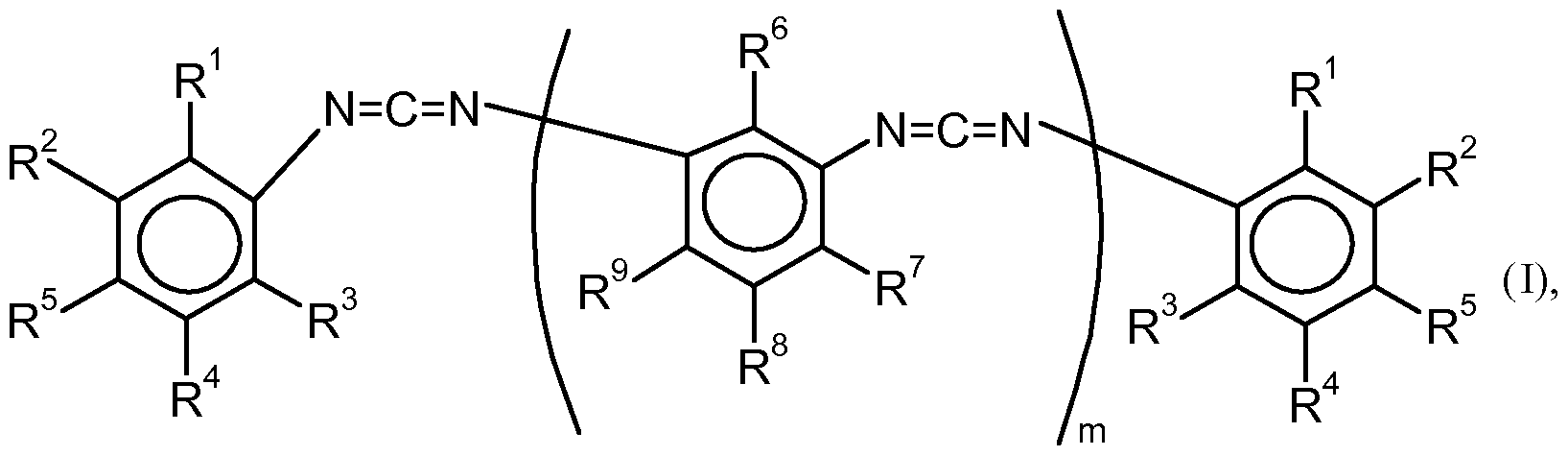
- the present invention therefore provides a process for improving the hydrolytic stability in polyurethane (PU) -based systems, in which in
- At least one polyol selected from the group of polyesterpolyols and / or polyetheresterpolyols,
- R 1 , R 3 and R 5 independently of one another denote H or methyl
- R 2 , R 4 independently of one another are H, methyl, a radical NH-C (O) -OR 10 , in which
- R 10 is C r C 4 alkyl, or for
- a radical is - (CH 2 ) h -O - [(CH 2 ) k -O] g -R 11 ,
- R 6 , R 7 , R 8 and R 9 are independently H or methyl
- R 1 , R 3 and R 5 are independently H or methyl
- R 2 , R 4 independently of one another are H, methyl or a radical -NH-C (O) -OR 10 , where R 10 is C 1 -C 4 -alkyl or a radical
- R 11 is H or C r C 4 -alkyl
- R 1 , R 3 , R 4 , R 5 are preferably H or methyl, very particularly preferably R 1 , R 3 , R 5 are methyl and R 4 is H, where
- R 2 is a radical -NH-C (O) -OR 10 wherein R 10 is -C r C 4 alkyl or a radical
- R 11 is H or C r C 4 alkyl.
- R 3 or R 5 is methyl or H
- R 2 is a radical -NH-C (O) -OR 10 , where R 10 is -C r C 4 -alkyl or a radical - (CH 2 ) h - (O- (CH 2 ) k -O) g -R u stands
- R 11 is H or C r C 4 alkyl
- R 1 and R 4 stand for H.
- R 11 is H or Ci-C 4 alkyl, wherein at least one of R 6 'R 7 , R 8 and R 9 independently
- R 1 , R 3 , R 4 , R 5 is H or methyl, more preferably R 1 , R 3 , R 5 is methyl and R 4 is H,
- R 2 , R 4 is H, methyl or a radical -NH-C (O) -OR 10 , where R 10 is C r C 4 -alkyl or a radical - (CH 2 ) h -O - [(CH 2 ) k -0] g -R u ,
- R 11 is H or C 1 -C 4 -alkyl, where at least one of the radicals R 6 R 7 , R 8 and R 9 is independently H Furthermore, it is preferred that R 1 , R 3 , R 4 , R 5 is H or methyl, particularly preferably methyl,
- R 2 has the meaning of -NH-C (0) -OR 10, wherein R 10 is -C r C 4 alkyl or a radical - (CH 2) h -0 - [(CH 2) k -0] g -R u stands,
- R 11 is H or C r C 4 alkyl
- R 6 , R 7 , R 8 and R 9 are independently H or methyl and more preferably at least one of R 6 , R 7 or R 9 is methyl.
- R 3 or R 5 has the meaning of methyl or H
- R 2 is a radical -NH-C (O) -OR 10 , wherein R 10 is C 1 -C 4 -alkyl or a radical
- R 11 denotes H or C r C 4 -alkyl
- R 1 , R 4 are H and
- R 6 'R 7 , R 8 and R 9 are independently H or methyl, preferably at least one of R 6 , R 7 or R 9 is methyl.
- At least one of R 7 or R 9 has the meaning of methyl.
- the compounds of the formula (I) is commercially available materials, for example from Rhein Chemie Rheinau GmbH, for example, are available under the trade name Stabaxol ®, Hycasyl ®.
- mixtures of several carbodiimides of which at least one of the formula (I) corresponds.
- the calculation of the mean value for m may also result in fractional numbers.
- Polyols according to the invention are selected from the group of polyester polyols and / or polyetheresterpolyols.
- the polyester polyols according to the invention are compounds which preferably have a molecular weight in (g / mol) of up to 2000, preferably in the range of 500 to 2000 and more preferably in the range of 500 to 1000.
- polyester polyols in the context of the invention encompasses both compounds having two or three hydroxyl groups per molecule and compounds having more than three hydroxyl groups per molecule.
- Preferred polyols are polyester polyols. It is advantageous if the polyesterpolyols and / or polyetheresterpolyols have an OH number of up to 200, preferably between 20 and 150 and more preferably between 50 and 15.
- polyester polyols which are reaction products of various diols with aromatic or aliphatic dicarboxylic acids and / or polymers of lactones.
- aromatic dicarboxylic acids which can be used to form suitable polyester polyols.
- Particularly preferred are terephthalic acid, Isophthalic acid, phthalic acid, phthalic anhydride and substituted dicarboxylic acid compounds with benzene nucleus.
- Preferred aliphatic dicarboxylic acids are those which can be used to form suitable polyester polyols, more preferably sebacic acid, adipic acid and glutaric acid.
- Preferred as polymers of lactones are those which can be used to form suitable polyester polyols, more preferably polycaprolactone.
- Both the dicarboxylic acids and the polymers of lactones are commercially available substances. Also particularly preferred are those diols which can be used to form suitable polyester polyols, most preferably ethylene glycol, butanediol, neopentyl glycol, hexanediol, propylene glycol, dipropylene glycol, diethylene glycol and cyclohexane dimethanol.
- At least one polyetherester polyol is used.
- the reaction products of various aforementioned polyols with aromatic or aliphatic dicarboxylic acids and / or polymers of lactones are preferred.
- polyester polyols and / or polyether ester polyols is commercially available compounds, which are available from Bayer MaterialScience AG under the trade name Baycoll ® or Desmophen ®.
- diisocyanates aromatic and aliphatic diisocyanates are preferred. Particular preference is given to toluene-2,4-diisocyanate, toluene-2,6-diisocyanate, phenylene diisocyanate, 4,4-diphenylmethane diisocyanate, methylene bis (4-phenylisocynate), naphthalene-1,6-diisocyanate, tetramethylene-1, Diisocyanate and / or hexamethylene-l, 6-diisocyanate, most preferably toluene-2,4-diisocyanate and toluene-2,6-diisocyanate.
- diisocyanate is commercially available compounds, which are available from Bayer MaterialScience AG under the trade name Desmodur ®.
- the composition additionally contains at least one diamine and / or diol.
- Diamines used for chain extension are 2-methylpropyl-3,5-diamino-4-chlorobenzoate, bis (4,4'-amino-3-chlorophenyl) -methane, 3,5-dimethylthio-2, 4-toluene diamine, 3,5-dimethylthio-2,4-toluene diamine, 3,5-diethyl-2,4-toluene diamine, 3,5-diethyl-2,6-toluene diamine, 4,4'-methylene bis ( 3-chloro-2,6-diethylaniline) and 1,3-propanediol bis (4-aminobenzoate).
- diols butanediol, neopentyl glycol, hexanediol, propylene glycol, dipropylene glycol, diethylene glycol and / or cyclohexanedimethanol are preferred. Particularly preferred are 1,3-butanediol or 1,6-hexanediol.
- chain extension diamines or diols is commercially available compounds which are available from Rhein Chemie Rheinau GmbH under the trade name Addolink ®.
- the catalysts used are preferably dibutyltin dilaurates or triethylenediamine in dipropylene glycol.
- the ratio of carbodiimide to polyol is preferably 0.1-5, more preferably 1-3 parts by weight per 100 parts by weight of polyol.
- the ratio of diisocyanate to polyol is preferably from 20 to 50 to 100 parts by weight, more preferably 30 to 100 parts by weight.
- the composition in addition to the polyester polyol and / or Polyetherestherpolyol and the carbodiimide and the diisocyanate additionally contains at least one diamine and / or diol
- the amount of catalyst is 0.01-1% by weight, based on the composition.
- the polyurethane (PU) -based systems produced by this process are characterized by increased hydrolytic stability.
- Baycoll AV ® 2113 a branched polyester polyol having an OH number of 110 mg KOH / g and an acid number of 0.83 mg KOH / g, from Bayer MaterialScience AG.
- Stabaxol ® P 200 a polymeric aromatic carbodiimide-based Tetramethylxylol- diisocyanate from Rhein Chemie Rheinau GmbH.
- Stabaxol ® I a monomeric carbodiimide based on 2,6-diisopropylphenyl Rhein Chemie Rheinau GmbH.
- Desmodur ® PU 0129 a 2.4 / 4.4 diphenylmethane diisocyanate isomer mixture.
- Addolink ® B a 1, 4-butanediol from Rheinchemie Rheinau GmbH as a diol component.
- Addocat ® 201 a dibutyltin Rhein Chemie Rheinau GmbH, as a catalyst.
- Carbodilite HMV-8 ® CA a polymeric aliphatic carbodiimide Nisshinbo Industries, INC.
- part of the formulation contains a molecular sieve for moisture adsorption.
- Desmocoll® ® 140 A largely linear hydroxyl with a hydroxyl content ⁇ 0.1 from Bayer Material Science AG..
- Baycoll ® AS 2060 a weakly branched polyester polyol having a hydroxyl number of 60 ⁇ 3 mg KOH / g and an acid number of ⁇ 2.0 mg KOH / g, available from Bayer Material Science AG.
- Desmodur ® RFE a solution of tris (p-isocyanatophenyl) thiophosphate in ethyl acetate, having an NCO content of 7.2 ⁇ 0.2% as isocyanate curing agent from Bayer Material Science AG.
- Example 1 Example 1:
- Composition C 100 g of the liquid at room temperature Baycoll AV ® 2113 was mixed with 0.6 g Stabaxol ® I and stored at 30 ° C for 24 h.
- Mixture D 100 g of the liquid at room temperature Baycoll AV ® 2113 was mixed with 0.6 g Stabaxol ® P 200 stored at 30 ° C for 24 h.
- the mixtures were processed according to the one-shot method, that is premixed with molecular sieve, Addocat ® 201 and Addolink ® B with the diisocyanate (Desmodur ® PU 0129) reacted.
- the still liquid after a few minutes to a solid elastomer-reacting mixture, was poured into a test mold heated to 30 ° C, demolded after lh and 16h at 100 ° C conditioned.
- test plates of mixtures I to IV thus prepared, standard test specimens were punched out after 7 days of storage at 22 ° C.
- the stamped standard specimens were stored under water at a temperature of 80 ° C for 4 days.
- the tensile strength of the specimens stored in water was measured every 24 hours.
- Table 3 shows percent relative tensile strength starting at day 0 at 100%.
- III (V) 100 90 80 70 60
- Mixture B2 (comparative): 14g of Desmocoll 140 ® were dissolved at 85 ° C in 75g of ethyl acetate. On cooling was added 7g Baycoll ® AS 2060th In the cooled mixture, 0.32 g of Stabaxol ® I was dissolved with stirring and stored at room temperature for five days.
- Mixture D2 (for the preparation of the mixture according to the invention): 14 g of Desmocoll® 140 were dissolved at 85 ° C. in 75 g of ethyl acetate. On cooling was added 7g Baycoll ® AS 2060th 0.31 g of the CDI 1 was dissolved in the cooled mixture with stirring and stored at room temperature for five days.
- the mixtures A2, B2, C2 and D2 were mixed at room temperature in each case with 4 g of the isocyanate hardener Desmodur ® RFE and mixed.
- the adhesives I, II, III and IV thus prepared were applied by hand with a wire-wound squeegee with ⁇ gap on a commercial, 23 ⁇ thick, not pretreated DIN A4-sized PET sheet, the top 50mm of the sheet due of a later to be removed protective strips were not provided with adhesive.
- the solvent of the adhesive ethyl acetate
- a commercial, 25 ⁇ thick, not pretreated aluminum foil was laminated by hand. The resulting laminate was pressed with a pressure of "
Landscapes
- Chemical & Material Sciences (AREA)
- Organic Chemistry (AREA)
- Health & Medical Sciences (AREA)
- Chemical Kinetics & Catalysis (AREA)
- Medicinal Chemistry (AREA)
- Polymers & Plastics (AREA)
- Inorganic Chemistry (AREA)
- Polyurethanes Or Polyureas (AREA)
- Compositions Of Macromolecular Compounds (AREA)
- Heterocyclic Carbon Compounds Containing A Hetero Ring Having Nitrogen And Oxygen As The Only Ring Hetero Atoms (AREA)
- Agricultural Chemicals And Associated Chemicals (AREA)
Description


Claims

Priority Applications (8)
| Application Number | Priority Date | Filing Date | Title |
|---|---|---|---|
| CA 2872090 CA2872090A1 (en) | 2012-05-03 | 2013-03-22 | Process for improving hydrolysis resistance in polyurethane (pu) based systems |
| RU2014148484A RU2014148484A (ru) | 2012-05-03 | 2013-03-22 | Способ улучшения устойчивости к гидролизу в системах на основе полиуретанов (пу) |
| JP2015509344A JP2015516491A (ja) | 2012-05-03 | 2013-03-22 | ポリウレタン(pu)ベース系の加水分解耐性を向上させる方法 |
| KR20147033516A KR20150003389A (ko) | 2012-05-03 | 2013-03-22 | 폴리우레탄 (pu)-기재 시스템에서 가수분해 내성을 개선하는 방법 |
| EP13715156.9A EP2844683A1 (de) | 2012-05-03 | 2013-03-22 | Verfahren zur verbesserung der hydrolysestabilität in polyurethan(pu)-basierten systemen |
| CN201380029639.6A CN104350077A (zh) | 2012-05-03 | 2013-03-22 | 用于改进聚氨酯(pu)基体系的耐水解性的方法 |
| US14/398,353 US20150133623A1 (en) | 2012-05-03 | 2013-03-22 | Methods for improving the resistance to hydrolysis in polyurethane (pu)-based systems |
| BR112014027441A BR112014027441A2 (pt) | 2012-05-03 | 2013-03-22 | processo para melhorar resistência à hidrólise em sistemas à base de poliuretano (pu) |
Applications Claiming Priority (2)
| Application Number | Priority Date | Filing Date | Title |
|---|---|---|---|
| EP20120166641 EP2660259A1 (de) | 2012-05-03 | 2012-05-03 | Neue Carbodiimid-haltige Zusammensetzungen, ein Verfahren zu deren Herstellung und deren Verwendung |
| EP12166641.6 | 2012-05-03 |
Publications (1)
| Publication Number | Publication Date |
|---|---|
| WO2013164135A1 true WO2013164135A1 (de) | 2013-11-07 |
Family
ID=47915276
Family Applications (2)
| Application Number | Title | Priority Date | Filing Date |
|---|---|---|---|
| PCT/EP2013/056155 Ceased WO2013164135A1 (de) | 2012-05-03 | 2013-03-22 | Verfahren zur verbesserung der hydrolysestabilität in polyurethan(pu)-basierten systemen |
| PCT/EP2013/056153 Ceased WO2013164134A1 (de) | 2012-05-03 | 2013-03-22 | Verfahren zur steuerung (verlängerung) der topfzeit in kettenverlängerten polyurethan(pu)-basierten systemen |
Family Applications After (1)
| Application Number | Title | Priority Date | Filing Date |
|---|---|---|---|
| PCT/EP2013/056153 Ceased WO2013164134A1 (de) | 2012-05-03 | 2013-03-22 | Verfahren zur steuerung (verlängerung) der topfzeit in kettenverlängerten polyurethan(pu)-basierten systemen |
Country Status (12)
| Country | Link |
|---|---|
| US (2) | US20150133623A1 (de) |
| EP (3) | EP2660259A1 (de) |
| JP (2) | JP2015516491A (de) |
| KR (2) | KR20150003389A (de) |
| CN (3) | CN104364284B (de) |
| BR (2) | BR112014027440A2 (de) |
| CA (2) | CA2872090A1 (de) |
| ES (1) | ES2588830T3 (de) |
| IN (1) | IN2014DN09041A (de) |
| MX (1) | MX368470B (de) |
| RU (2) | RU2014148484A (de) |
| WO (2) | WO2013164135A1 (de) |
Families Citing this family (4)
| Publication number | Priority date | Publication date | Assignee | Title |
|---|---|---|---|---|
| BR112015027977A2 (pt) | 2013-05-07 | 2017-07-25 | Rhein Chemie Rheinau Gmbh | método para a produção de formulações de óleo, formulações de óleo, e uso das formulações de óleo |
| CN109642009B (zh) * | 2016-08-09 | 2021-12-10 | 科思创德国股份有限公司 | 硅烷官能的聚合聚氨酯 |
| US12054576B2 (en) | 2019-03-07 | 2024-08-06 | Basf Se | Adhesives based on carbodimide chemistry |
| WO2023104708A1 (en) * | 2021-12-08 | 2023-06-15 | Covestro Deutschland Ag | Polyurethane elastomer with improved hydrolysis resistance |
Citations (11)
| Publication number | Priority date | Publication date | Assignee | Title |
|---|---|---|---|---|
| US3406198A (en) * | 1966-08-05 | 1968-10-15 | Upjohn Co | Triarylarsines as catalysts for converting isocyanates to carbodiimides |
| DE1620609A1 (de) * | 1964-08-12 | 1970-04-30 | Upjohn Co | Herstellung von phosphororganischen Verbindungen |
| DE1643127A1 (de) * | 1966-06-08 | 1971-05-13 | Upjohn Co | Verfahren zur Umwandlung von organischen Isocyanaten in Carbodiimide |
| DE2504400A1 (de) * | 1975-02-01 | 1976-08-05 | Bayer Ag | Lagerstabile, carbodiimidgruppen enthaltende polyisocyanate |
| DE2537685A1 (de) * | 1975-08-23 | 1977-03-03 | Bayer Ag | Verfahren zur teilweisen carbodiimidisierung der isocyanatgruppen von organischen isocyanaten |
| DE2941253A1 (de) * | 1979-10-11 | 1981-04-23 | Bayer Ag, 5090 Leverkusen | Verfahren zur herstellung von additionsverbindungen aus carbodiimiden und hydroxylgruppen aufweisenden verbindungen |
| EP0799843A1 (de) | 1996-04-02 | 1997-10-08 | Nisshinbo Industries, Inc. | Carbodiimide enthaltende Polyurethanharze |
| EP0850985A1 (de) * | 1996-12-24 | 1998-07-01 | Nisshinbo Industries, Inc. | Mittel zur Verbesserung der Resistenz von Estergruppen enthaltendem Harz gegen mikrobielle Schädigung, Methode zur Verbesserung besagter Resistenz, und Harzzusammensetzung mit Resistenz gegen mikrobielle Schädigung |
| EP0878496A1 (de) * | 1997-05-16 | 1998-11-18 | Nisshinbo Industries, Inc. | Carbodiimid-Vernetzungsmittel, Verfahren zu seiner Herstellung und Beschichtungsmaterial, dieses beinhaltend |
| DE19580248B4 (de) * | 1994-02-02 | 2006-05-11 | Toray Industries, Inc. | Polyesterzusammensetzungen, Polyester-Monofilamente und deren Verwendung |
| EP2040306A1 (de) * | 2006-06-21 | 2009-03-25 | Toppan Printing Co., Ltd. | Solarzellen-rückoberflächen-versiegelungsblatt |
Family Cites Families (10)
| Publication number | Priority date | Publication date | Assignee | Title |
|---|---|---|---|---|
| NL273087A (de) * | 1960-12-31 | |||
| US4306052A (en) * | 1980-09-25 | 1981-12-15 | The Upjohn Company | Thermoplastic polyester polyurethanes |
| DE4318979A1 (de) * | 1993-06-08 | 1994-12-15 | Basf Ag | Carbodiimide und/oder oligomere Polycarbodiimide auf Basis von 1,3-Bis-(1-methyl-1-isocyanato-ethyl)-benzol, ein Verfahren zu ihrer Herstellung und ihre Verwendung als Hydrolysestabilisator |
| US5574083A (en) * | 1993-06-11 | 1996-11-12 | Rohm And Haas Company | Aromatic polycarbodiimide crosslinkers |
| ATE293647T1 (de) * | 1996-05-21 | 2005-05-15 | Simula Inc | Extrudierbares, thermoplastisches, elastomeres, harnstoff-kettenverlängertes polyurethan |
| US6258917B1 (en) * | 1996-05-21 | 2001-07-10 | Simula, Inc. | Extrudable thermoplastic elastomeric urea-extended polyurethane |
| DE19809634A1 (de) * | 1998-03-06 | 1999-09-09 | Basf Ag | Carbodiimide und Verfahren zu deren Herstellung |
| DE19821666A1 (de) * | 1998-05-14 | 1999-11-25 | Basf Ag | Carbodiimide auf der Basis von 1,3-Bis-(1-methyl-1-isocyanatoethyl)-benzol |
| CN101679578B (zh) * | 2007-04-11 | 2012-06-27 | 陶氏环球技术有限责任公司 | 具有增强的耐水解性的聚氨酯弹性体 |
| CN101457018A (zh) * | 2007-12-14 | 2009-06-17 | 烟台万华新材料科技有限公司 | 具有水解稳定性的热塑性聚氨酯弹性体及其制备方法 |
-
2012
- 2012-05-03 EP EP20120166641 patent/EP2660259A1/de not_active Withdrawn
-
2013
- 2013-03-22 CN CN201380027748.4A patent/CN104364284B/zh not_active Expired - Fee Related
- 2013-03-22 CN CN201380029639.6A patent/CN104350077A/zh active Pending
- 2013-03-22 CA CA 2872090 patent/CA2872090A1/en not_active Abandoned
- 2013-03-22 US US14/398,353 patent/US20150133623A1/en not_active Abandoned
- 2013-03-22 MX MX2014013359A patent/MX368470B/es active IP Right Grant
- 2013-03-22 EP EP13715156.9A patent/EP2844683A1/de not_active Withdrawn
- 2013-03-22 IN IN9041DEN2014 patent/IN2014DN09041A/en unknown
- 2013-03-22 WO PCT/EP2013/056155 patent/WO2013164135A1/de not_active Ceased
- 2013-03-22 CA CA 2871712 patent/CA2871712A1/en not_active Abandoned
- 2013-03-22 BR BR112014027440A patent/BR112014027440A2/pt not_active IP Right Cessation
- 2013-03-22 ES ES13711438.5T patent/ES2588830T3/es active Active
- 2013-03-22 RU RU2014148484A patent/RU2014148484A/ru unknown
- 2013-03-22 CN CN201810201255.2A patent/CN108299622A/zh active Pending
- 2013-03-22 BR BR112014027441A patent/BR112014027441A2/pt not_active IP Right Cessation
- 2013-03-22 EP EP13711438.5A patent/EP2844681B1/de active Active
- 2013-03-22 US US14/398,372 patent/US9321879B2/en active Active
- 2013-03-22 WO PCT/EP2013/056153 patent/WO2013164134A1/de not_active Ceased
- 2013-03-22 KR KR20147033516A patent/KR20150003389A/ko not_active Ceased
- 2013-03-22 JP JP2015509344A patent/JP2015516491A/ja active Pending
- 2013-03-22 RU RU2014148485A patent/RU2014148485A/ru unknown
- 2013-03-22 KR KR1020147033515A patent/KR101993498B1/ko not_active Expired - Fee Related
- 2013-03-22 JP JP2015509343A patent/JP2015516003A/ja active Pending
Patent Citations (11)
| Publication number | Priority date | Publication date | Assignee | Title |
|---|---|---|---|---|
| DE1620609A1 (de) * | 1964-08-12 | 1970-04-30 | Upjohn Co | Herstellung von phosphororganischen Verbindungen |
| DE1643127A1 (de) * | 1966-06-08 | 1971-05-13 | Upjohn Co | Verfahren zur Umwandlung von organischen Isocyanaten in Carbodiimide |
| US3406198A (en) * | 1966-08-05 | 1968-10-15 | Upjohn Co | Triarylarsines as catalysts for converting isocyanates to carbodiimides |
| DE2504400A1 (de) * | 1975-02-01 | 1976-08-05 | Bayer Ag | Lagerstabile, carbodiimidgruppen enthaltende polyisocyanate |
| DE2537685A1 (de) * | 1975-08-23 | 1977-03-03 | Bayer Ag | Verfahren zur teilweisen carbodiimidisierung der isocyanatgruppen von organischen isocyanaten |
| DE2941253A1 (de) * | 1979-10-11 | 1981-04-23 | Bayer Ag, 5090 Leverkusen | Verfahren zur herstellung von additionsverbindungen aus carbodiimiden und hydroxylgruppen aufweisenden verbindungen |
| DE19580248B4 (de) * | 1994-02-02 | 2006-05-11 | Toray Industries, Inc. | Polyesterzusammensetzungen, Polyester-Monofilamente und deren Verwendung |
| EP0799843A1 (de) | 1996-04-02 | 1997-10-08 | Nisshinbo Industries, Inc. | Carbodiimide enthaltende Polyurethanharze |
| EP0850985A1 (de) * | 1996-12-24 | 1998-07-01 | Nisshinbo Industries, Inc. | Mittel zur Verbesserung der Resistenz von Estergruppen enthaltendem Harz gegen mikrobielle Schädigung, Methode zur Verbesserung besagter Resistenz, und Harzzusammensetzung mit Resistenz gegen mikrobielle Schädigung |
| EP0878496A1 (de) * | 1997-05-16 | 1998-11-18 | Nisshinbo Industries, Inc. | Carbodiimid-Vernetzungsmittel, Verfahren zu seiner Herstellung und Beschichtungsmaterial, dieses beinhaltend |
| EP2040306A1 (de) * | 2006-06-21 | 2009-03-25 | Toppan Printing Co., Ltd. | Solarzellen-rückoberflächen-versiegelungsblatt |
Also Published As
| Publication number | Publication date |
|---|---|
| JP2015516003A (ja) | 2015-06-04 |
| RU2014148485A (ru) | 2016-06-27 |
| KR20150003389A (ko) | 2015-01-08 |
| BR112014027441A2 (pt) | 2017-06-27 |
| MX368470B (es) | 2019-10-03 |
| US9321879B2 (en) | 2016-04-26 |
| US20150126688A1 (en) | 2015-05-07 |
| CA2871712A1 (en) | 2013-11-07 |
| MX2014013359A (es) | 2015-05-15 |
| BR112014027440A2 (pt) | 2017-06-27 |
| ES2588830T3 (es) | 2016-11-07 |
| US20150133623A1 (en) | 2015-05-14 |
| KR101993498B1 (ko) | 2019-06-26 |
| CN104350077A (zh) | 2015-02-11 |
| IN2014DN09041A (de) | 2015-05-22 |
| CA2872090A1 (en) | 2013-11-07 |
| JP2015516491A (ja) | 2015-06-11 |
| WO2013164134A1 (de) | 2013-11-07 |
| KR20150003388A (ko) | 2015-01-08 |
| EP2660259A1 (de) | 2013-11-06 |
| EP2844681A1 (de) | 2015-03-11 |
| RU2014148484A (ru) | 2016-06-20 |
| CN108299622A (zh) | 2018-07-20 |
| EP2844683A1 (de) | 2015-03-11 |
| CN104364284A (zh) | 2015-02-18 |
| CN104364284B (zh) | 2016-06-08 |
| EP2844681B1 (de) | 2016-07-13 |
Similar Documents
| Publication | Publication Date | Title |
|---|---|---|
| EP2331598B1 (de) | Polyurethane basierend auf polyesterdiolen mit verbessertem kristallisationsverhalten | |
| EP3307709B1 (de) | Verfahren zur herstellung von polymeren carbodiimiden unter zusatz von cäsiumsalzen, polymere carbodiimide und deren verwendung | |
| EP2392602B1 (de) | Thermoplastisch verarbeitbare polyurethane auf basis von bernsteinsäurepropionaten | |
| EP3394138B1 (de) | Tpu schrumpfmaterial | |
| WO2009065513A1 (de) | Polyurethan-/polyharnstoff-elastomers auf basis von 2,4'-diphenylmethandiisocyanat-prepolymeren und ihre herstellung | |
| WO2015000722A1 (de) | Polyurethan auf basis von nachwachsenden rohstoffen | |
| EP2952502B1 (de) | Bis[3 isopropenyl-alpha,alpha-dimethylbenzyl]carbodiimid, verfahren zur herstellung und dessen verwendung | |
| EP2844683A1 (de) | Verfahren zur verbesserung der hydrolysestabilität in polyurethan(pu)-basierten systemen | |
| EP2855573B1 (de) | Neuartige carbodiimid-haltige zusammensetzungen, ein verfahren zu deren herstellung und deren verwendung | |
| EP2844682B1 (de) | Verwendung von carbodiimid-haltigen zusammensetzungen zur steuerung der topfzeit | |
| EP2571915B1 (de) | Biobasierte carbodiimide, ein verfahren zu deren herstellung und deren verwendung | |
| WO2014128290A1 (de) | Verminderte verfärbung von thermoplastischen polyurethanen basierend auf polymerpolyolen durch einbau aliphatischer isocyanate | |
| EP3812410A1 (de) | Polyurethanpolymer mit einer härte von "kleiner oder gleich als" 60 shore a und guter abriebfestigkeit | |
| EP4430099A1 (de) | Verfahren zur herstellung von aromatischen polymeren carbodiimiden | |
| WO2025261850A1 (de) | Verfahren zur herstellung von tertiären araliphatischen carbodiimiden | |
| DE19706452A1 (de) | Verwendung von Fettsäuren zur Herstellung von Polyisocyanat-Polyadditionsprodukten | |
| EP2311891B1 (de) | Viskositätsstabilisator für Hot-Melts | |
| WO2011138275A1 (de) | Polyurethanelastomere, ein verfahren zu ihrer herstellung und ihre verwendung |
Legal Events
| Date | Code | Title | Description |
|---|---|---|---|
| 121 | Ep: the epo has been informed by wipo that ep was designated in this application |
Ref document number: 13715156 Country of ref document: EP Kind code of ref document: A1 |
|
| WWE | Wipo information: entry into national phase |
Ref document number: 2013715156 Country of ref document: EP |
|
| ENP | Entry into the national phase |
Ref document number: 2872090 Country of ref document: CA |
|
| ENP | Entry into the national phase |
Ref document number: 2015509344 Country of ref document: JP Kind code of ref document: A |
|
| WWE | Wipo information: entry into national phase |
Ref document number: 14398353 Country of ref document: US |
|
| NENP | Non-entry into the national phase |
Ref country code: DE |
|
| ENP | Entry into the national phase |
Ref document number: 20147033516 Country of ref document: KR Kind code of ref document: A |
|
| ENP | Entry into the national phase |
Ref document number: 2014148484 Country of ref document: RU Kind code of ref document: A |
|
| REG | Reference to national code |
Ref country code: BR Ref legal event code: B01A Ref document number: 112014027441 Country of ref document: BR |
|
| ENP | Entry into the national phase |
Ref document number: 112014027441 Country of ref document: BR Kind code of ref document: A2 Effective date: 20141103 |