WO2013169746A2 - N-ethyl-4-hydroxyl-1-methyl-5-(methyl(2,3,4,5,6-pentahydroxyhexyl) amino)-2-oxo-n-phenyl-1,2-dihydroquinoline-3-carboxamide - Google Patents
N-ethyl-4-hydroxyl-1-methyl-5-(methyl(2,3,4,5,6-pentahydroxyhexyl) amino)-2-oxo-n-phenyl-1,2-dihydroquinoline-3-carboxamide Download PDFInfo
- Publication number
- WO2013169746A2 WO2013169746A2 PCT/US2013/039911 US2013039911W WO2013169746A2 WO 2013169746 A2 WO2013169746 A2 WO 2013169746A2 US 2013039911 W US2013039911 W US 2013039911W WO 2013169746 A2 WO2013169746 A2 WO 2013169746A2
- Authority
- WO
- WIPO (PCT)
- Prior art keywords
- methyl
- laquinimod
- pharmaceutical composition
- carboxamide
- oxo
- Prior art date
- Legal status (The legal status is an assumption and is not a legal conclusion. Google has not performed a legal analysis and makes no representation as to the accuracy of the status listed.)
- Ceased
Links
- 0 CCN(C(C(C(C1C)=*)=C(C)c2c1cccc2N(C)CC(C(C(*)C(C*)N)N)O)=C)c1ccccc1 Chemical compound CCN(C(C(C(C1C)=*)=C(C)c2c1cccc2N(C)CC(C(C(*)C(C*)N)N)O)=C)c1ccccc1 0.000 description 2
Classifications
-
- C—CHEMISTRY; METALLURGY
- C07—ORGANIC CHEMISTRY
- C07D—HETEROCYCLIC COMPOUNDS
- C07D215/00—Heterocyclic compounds containing quinoline or hydrogenated quinoline ring systems
- C07D215/02—Heterocyclic compounds containing quinoline or hydrogenated quinoline ring systems having no bond between the ring nitrogen atom and a non-ring member or having only hydrogen atoms or carbon atoms directly attached to the ring nitrogen atom
- C07D215/16—Heterocyclic compounds containing quinoline or hydrogenated quinoline ring systems having no bond between the ring nitrogen atom and a non-ring member or having only hydrogen atoms or carbon atoms directly attached to the ring nitrogen atom with hetero atoms or with carbon atoms having three bonds to hetero atoms with at the most one bond to halogen, e.g. ester or nitrile radicals, directly attached to ring carbon atoms
- C07D215/48—Carbon atoms having three bonds to hetero atoms with at the most one bond to halogen
- C07D215/54—Carbon atoms having three bonds to hetero atoms with at the most one bond to halogen attached in position 3
- C07D215/56—Carbon atoms having three bonds to hetero atoms with at the most one bond to halogen attached in position 3 with oxygen atoms in position 4
-
- A—HUMAN NECESSITIES
- A61—MEDICAL OR VETERINARY SCIENCE; HYGIENE
- A61K—PREPARATIONS FOR MEDICAL, DENTAL OR TOILETRY PURPOSES
- A61K31/00—Medicinal preparations containing organic active ingredients
- A61K31/33—Heterocyclic compounds
- A61K31/395—Heterocyclic compounds having nitrogen as a ring hetero atom, e.g. guanethidine or rifamycins
- A61K31/435—Heterocyclic compounds having nitrogen as a ring hetero atom, e.g. guanethidine or rifamycins having six-membered rings with one nitrogen as the only ring hetero atom
- A61K31/47—Quinolines; Isoquinolines
- A61K31/4704—2-Quinolinones, e.g. carbostyril
-
- A—HUMAN NECESSITIES
- A61—MEDICAL OR VETERINARY SCIENCE; HYGIENE
- A61P—SPECIFIC THERAPEUTIC ACTIVITY OF CHEMICAL COMPOUNDS OR MEDICINAL PREPARATIONS
- A61P25/00—Drugs for disorders of the nervous system
-
- A—HUMAN NECESSITIES
- A61—MEDICAL OR VETERINARY SCIENCE; HYGIENE
- A61P—SPECIFIC THERAPEUTIC ACTIVITY OF CHEMICAL COMPOUNDS OR MEDICINAL PREPARATIONS
- A61P25/00—Drugs for disorders of the nervous system
- A61P25/28—Drugs for disorders of the nervous system for treating neurodegenerative disorders of the central nervous system, e.g. nootropic agents, cognition enhancers, drugs for treating Alzheimer's disease or other forms of dementia
-
- A—HUMAN NECESSITIES
- A61—MEDICAL OR VETERINARY SCIENCE; HYGIENE
- A61P—SPECIFIC THERAPEUTIC ACTIVITY OF CHEMICAL COMPOUNDS OR MEDICINAL PREPARATIONS
- A61P29/00—Non-central analgesic, antipyretic or antiinflammatory agents, e.g. antirheumatic agents; Non-steroidal antiinflammatory drugs [NSAID]
-
- A—HUMAN NECESSITIES
- A61—MEDICAL OR VETERINARY SCIENCE; HYGIENE
- A61P—SPECIFIC THERAPEUTIC ACTIVITY OF CHEMICAL COMPOUNDS OR MEDICINAL PREPARATIONS
- A61P37/00—Drugs for immunological or allergic disorders
- A61P37/02—Immunomodulators
Definitions
- Laquiniiuod is a compound which has been shown to be e fective in the acute experimental autoimmune encephalomyelitis (aEAE) model (U.S. Patent No. 6,077, 851) . Its chemical name is N-ethyl-N- phenyl-1 , 2-dihydro-4-hydroxy-5-chloro-l-methyl-2-oxoquinoline-3- carboxamide, and its Chemical Registry number is 248281-84-7.
- the processes of synthesis of laquinimod and the preparation of its sodium salt are disclosed in U.S. Patent No. 6,077,851.
- An additional process of synthesis of laquinimod is disclosed in U.S. Patent No. 6, 875, 869.
- Pharmaceutical compositions comprising laquinimod sodium are disclosed in PCT International Application Publication No. WO 2005/074899.
- Laquinimod sodium has high oral bioavailability and has been suggested as an oral formulation for the treatment of Multiple Sclerosis (MS).
- MS Multiple Sclerosis
- Studies have also shown that laquinimod can reduce development of active MRI lesions in relapsing MS. (Polman, C. et al., (2005) “Treatment with laquinimod reduces development of active MRI lesions in relapsing MS", Neurology. 64:987-991). Summary of the Invention
- the subject invention provides an isolated compound having the structure:
- the subject invention also provides a composition comprising a compound having the structure:
- the subject invention also provides a process for preparing N- ethyl-4-hydroxyl-l-methyl-5- (methyl (2,3,4,5,6- pentahydroxyhexyl) amino) -2-oxo-N-phenyl-l , 2-dihydroquinoline-3- carboxamide comprising the steps of: a) reacting laquinimod or a salt thereof with meglumine in an aqueous solution; b) adjusting the pH of the aqueous solution to less than 2; and c) isolating and obtaining N-ethyl-4-hydroxyl-l-methyl-5- (methyl (2 , 3 , 4 , 5, 6- pentahydroxyhexyl) amino) -2-oxo-N-phenyl-l , 2-dihydroquinoline-3- carboxamide from the reaction mixture.
- the subject invention also provides a process for preparing N- ethyl-4-hydroxyl-l-methyl-5- (methyl (2,3,4,5,6- pentahydrcxyhexyl ! amino) -2-oxo-N-phenyl-l , 2-dihydroquinoline-3- carboxamide comprising the steps of: a) dissolving 5-iodo- laquinimod, meglumine and Cul in Dimethylformamide (DMF) to form a mixture; b) removing DMF from the mixture of step a) to obtain an residue; c) dissolving the residue from step b) in methanol to obtain a mixture; d) adding silica gel to the mixture of step c) to obtain a suspension; e) evaporating the suspension of step d) to dryness; and f) isolating and obtaining N-ethyl-4-hydrcxyl-l- methyl-5- (methyl (2,3,4,5, 6-pentahydroxyhexy
- the subject invention also provides N-ethyl -4-hydroxyl-1-methyl -5- (methyl (2, 3, ,5, 6-pentahydroxyhexyl ) amino) -2-oxo-N-phenyl-l, 2- dihydrcquinol ine-3-carboxamide prepared the methods disclosed herein.
- the subject invention also provides a pharmaceutical composition
- a pharmaceutical composition comprising laquinimod or a pharmaceutically acceptable salt thereof, N-ethyl - -hydroxyl-l-methyl-5- (methyl (2,3,4,5,6- pentahydroxyhexyl) amino) -2-oxo-N-phenyl-l , 2-dihydroquinoline-3- carboxamide or a salt thereof, and at least one pharmaceutically acceptable carrier, wherein N-ethyl-4-hydroxyl-l-methyl-5- (methyl(2, 3,4,5, 6-pentahydroxyhexyl) amino) -2-oxo-N-phenyl-l , 2- dihydroquinoline-3-carboxamide is present in the pharmaceutical composition in an amount greater than about 0.1% w/w, relative to the amount of laquinimod, based on a determination by an HPLC method.
- the subject invention also provides a process for preparing a validated pharmaceutical composition comprising laquinimod or a pharmaceutically acceptable salt thereof, and at least one pharmaceutically acceptable carrier, comprising: a) obtaining a batch of laquinimod or a pharmaceutically acceptable salt thereof; b) determining the amount of N-ethyl-4-hydroxyl-l- methyl-5- (methyl (2 , 3,4,5, 6-pentahydroxyhexyl) amino) -2-oxo-N- phenyl-l , 2-dihydroquinoline-3-carboxamide in the batch using a suitable apparatus; and c) preparing the pharmaceutical composition from the batch only if the batch is determined to have not more than about 1.0% N-ethyl-4-hydroxyl-l-methyl-5- (methyl ⁇ 2 , 3,4,5, 6-pentahydroxyhexyl ) amino) -2-oxo-N-phenyl-l , 2- dihydroquinoline-3-carboxamide by weight relative to the amount of laquin
- the subject invention also provides a process for preparing a packaged pharmaceutical composition comprising laquinimod or a pharmaceutically acceptable salt thereof comprising: a) obtaining a pharmaceutical composition of laquinimod or a pharmaceutically acceptable salt thereof; b) analyzing the pharmaceutical composition for the presence of N-ethyl-4-hydroxyl-l-methyl-5- (methyl (2,3 ,4,5, 6-pentahydroxyhexyl ) amino) -2-oxo-N-phenyl-l, 2- dihydroquinoline-3-carboxamide; and c) packaging the pharmaceutical composition in a light-resistant packaging only if the content of N-ethyl-4-hydroxyl-l-methyl-5- (methyl (2, 3,4, 5, 6- pentahydroxyhexyl ) amino ) -2-oxo-N-phenyl-l , 2-dihydroquinoline-3- carboxamide is not more than about 1.0% by weight relative to the amount of laquinimod.
- the subject invention also provides a process of distributing a validated batch of a pharmaceutical composition comprising laquinimod or a pharmaceutically acceptable salt thereof and at least one pharmaceutically acceptable carrier, comprising: a) obtaining a batch of the pharmaceutical composition; b) performing stability testing with a sample of the batch; c) determining the total amount of N-ethyl-4-hyd oxy1-1 -methyl-5- (methyl (2, 3,4,5, 6-pentahydroxyhexyl) amino) -2-oxo-N-phenyl-l , 2- dihydroquinoline-3 -carboxamide in the sample of the batch by a suitable apparatus after stability testing; d) validating the batch for distribution only if the sample of the batch after stability testing is determined to have not more than about 1.0% by weight of N-ethyl-4-hydroxyl-l-methyl-5- (methyl (2 , 3 , 4, 5 , 6- pentahydroxyhexyl) amino) -2-oxo-N-phenyl-l,
- the subject invention also provides N-ethyl-4-hydroxyl-l-methyl-5- (methyl(2 , 3, 4,5, 6-pentahydroxyhexyl ) amino) -2-oxo-N-phenyl-l , 2- dihydroquinoline-3-carboxamide or a salt thereof for use as a reference standard to detect trace amounts of N-ethyl-4-hydroxyl- l-methyl-5- (methyl (2 , 3 , 4 , 5, 6-pentahydroxyhexyl) amino) -2-oxo-N- phenyl-l , 2-dihydroquinoline-3-carboxamide in a pharmaceutical composition comprising laquinimod or a pharmaceutically acceptable salt of laquinimod.
- the subject invention also provides a method for treating a patient afflicted with Multiple Sclerosis comprising administering to the patient an amount of the pharmaceutical composition described herein effective to treat Multiple Sclerosis in the patient.
- the subject invention also provides an isolated compound having the structure:
- the subject invention also provides a process for preparing a pharmaceutical composition comprising laquinimod or a pharmaceutically acceptable salt thereof comprising: a) a) obtaining a batch of laquinimod or a pharmaceutically acceptable salt thereof; b) performing stability testing with a sample from the batch; c) determining the total amount of N-ethyl-4-hydroxyl- l-methyl-5- (methyl (2,3,4,5, 6-pentahydroxyhexyl) amino) -2-oxo-N- phenyl-1 , 2-dihydroquinoline-3-carboxamide in the sample by a suitable apparatus after stability testing; and d) preparing the pharmaceutical composition from the batch only if the batch is determined to have not more than about 1.0% N-ethyl-4-hydroxyl-l- methyl-5- (methyl (2, 3 ,4,5, 6-pentahydroxyhexyl) amino) -2-oxo-N- phenyl-l,2-dihydroquinoline-3-carboxamide by weight relative
- the subject invention also provides a process for preparing a packaged pharmaceutical composition comprising laquinimod or a pharmaceutically acceptable salt thereof comprising: a) obtaining a batch of pharmaceutical composition comprising laquinimod or a pharmaceutically acceptable salt thereof; b) performing stability testing with a sample from the batch; c) determining the total amount of N-ethyl-4-hydroxyl-l-methyl-5- (methyl (2 , 3 , 4 , 5 , 6- pentahydroxyhexyl ) mino) -2-oxo-N-phenyl-l , 2-dihydroquinoline-3- carboxamide in the sample by a suitable apparatus after stability testing; and d) packaging the pharmaceutical composition in only if the content of N-ethyl - -hydroxyi-l -methyl -5-
- Laquinimod is a small molecule having the following chemical structure :
- EAE Experimental Autoimmune Encephalomyelitis
- MS Multiple Sclerosis
- DSS Dextran Sodium Solphate
- NOD Non-Obese Diabetic mice
- IDDM Type I Diabetes
- EAN Experimental A toimmune Neuritis
- SLE Systemic Lupus Erythematosus
- lupus nephri is, lupus arthritis, Crohn's Disease and Rheumatoid arthritis.
- the therapeutic activity of laquinimod in these models results from a variety of mechanistic effects, including reduction of leukocyte infiltration into target tissues by modulation of chemokine- mediated T-cell adhesion, modulation of cytokine balance, down regulation of MHC class II resulting in alteration of antigen presentation, and effects on dendritic cells subpopulations.
- this impurity is suspected to be formed via a substitution reaction in which the chlorine group of laquinimod is substituted as shown in the above MEG-LAQ structure.
- the subject invention provides an isolated compound having the structure:
- the isolated compound is in mono-hydrate form.
- the subject invention also provides a composition comprising a compound having the structure:
- composition is free of laquinimod or a salt thereof.
- t e compound is in mono-hydrate form.
- the subject invention also provides a process for preparing N- ethyl - -hydroxy1 - 1 -methyl- 5- (methyl (2,3,4,5,6- pentahydroxyhexyl) amino) -2-oxo-N-phenyl-l , 2-dihydroquinoline-3- carboxamide comprising the steps of: a) reacting laquinimod or a salt thereof with meglumine in an aqueous solution; b) adjusting the pH of the aqueous solution to less than 2; and c) isolating and obtaining N-ethyl-4 ⁇ hydroxyl-l -methyl-5- (methyl (2,3,4,5,6- pentahydroxyhexyl ) amino) -2-oxo-N-phenyl-l , 2-dihydroquinoline-3 - carboxamide from the reaction mixture.
- the laquinimod is a salt of laquinimod.
- the salt of laquinimod is a sodium salt.
- the subject invention also provides a process for preparing N- ethyl-4-hydroxyl-l ⁇ Hiethyl-5- (methyl (2.3,4,5,6- pentahydroxyhexyl ) mino) -2-oxo-N-phenyl-l , 2-dihydroquinoline-3- carboxamide comprising the steps of: a) dissolving 5-iodo- laquinimod, meglumine and Cul in Dimethylformamide (DMF) to form a mixture; b) removing DMF from the mixture of step a) to obtain an residue; c) dissolving the residue from step b) in methanol to obtain a mixture; d) adding silica gel to the mixture of step c) to obtain a suspension; e) evaporating the suspension of step d) to dryness; and f) iso
- step a) the mixture of step a) is stirred for 2 hours at 35-38 "C prior to step b) ,
- step b) is achieved by DMF distillation at 2 mbar vacuum.
- step f ) is achieved by flash column chromatography on silica gel.
- the subject invention also provides N-ethyl-4-hydroxyl-l-methyl-5- (methyl (2,3,4,5, 6-pentahydroxyhexyl ! mino) -2-oxo-N-phenyl-l , 2- dihydroquinoline-3-carboxamide prepared the methods disclosed herein.
- the subject invention also provides a pharmaceutical composition
- a pharmaceutical composition comprising laquinimod or a pharmaceutically acceptable salt thereof , N-ethyl-4 ⁇ hydroxyl-l-methyl-5- (methyl (2,3,4,5,6- pentahydroxyhexyl) amino) -2-oxo-N-phenyl-l , 2-dihydroquinoline-3- carboxamide or a salt thereof, and at least one pharmaceutically acceptable carrier, wherein N-ethyl-4-hydroxyl-l-methyl-5- (methyl ( , 3,4,5, 6-pentahydroxyhexyl) amino) -2-oxo-N-phenyl-l , 2- dihydroquinoline-3- car boxamide is present in the pharmaceutical composition in an amount greater than about 0.1% w/w, relative to the amount of laquinimod, based on a determination by an HPLC method.
- N-ethyl-4-hydroxy! -1 - methyl-5- (methyl (2,3,4,5, 6-pentahydroxyhexyl) amino) -2-oxo-N- phenyl-l , 2-dihydroquinoline-3-carboxamide is present in the pharmaceutical composition in an amount greater than about 0.2% w/w, relative to the amount of laquinimod, based on a determination by an HPLC method.
- N-ethyl- 4-hydroxyl-l-methyl-5 - (methyl (2,3,4,5, 6-pentahydroxyhexyl) amino) - 2-oxo-N-phenyl-l, 2-dihydroquinoline-3-carboxamide is present in the pharmaceutical composition in an amount not more than about 1.0%, by weight, relative to the amount of laquinimod, based on a determination by an HPLC method.
- the pharmaceutical composition is less than one week old, and the temperature during the less than one week did not exceed ambient temperature.
- the at least one pharmaceutically acceptable carrier is magnesium stearate.
- the pharmaceutical composition comprises a pharmaceutically acceptable salt of laquinimod.
- the pharmaceutically acceptable salt of laquinimod is a sodium salt.
- the pharmaceutical composition is in the form of a capsule .
- the pharmaceutical composition is in the form of a tablet .
- the subject invention also provides a process for preparing a validated pharmaceutical composition comprising laquinimod or a pharmaceutically acceptable salt thereof, and at least one pharmaceu ically acceptable carrier, comprising: a) obtaining a batch of laquinimod or a pharmaceu ically acceptable salt thereof; b) determining the amount of N-ethyl-4-hydroxyl-l- methyl-5- (methyl (2,3,4,5, 6-pentahydroxyhexyl) amino) -2-oxo-N- phenyl-l , 2-dihydroquinoline-3-carboxamide in the batch using a suitable apparatus; and c) preparing the pharmaceutical composition from the batch only if the batch is determined to have not more than about 1.0% N-ethyl-4-hydroxyl-l-methyl-5- (methyl (2 , 3,4,5, 6-pentahydroxyhexyl) amino) -2-oxo-N-phenyl-l, 2- dihydroquinoline-3-carboxamide by weight relative to the amount of
- the subject invention also provides a process for preparing a packaged pharmaceutical composition comprising laquinimod or a pharmaceutically acceptable salt thereof comprising: a) obtaining a pharmaceutical composition of laquinimod or a pharmaceutically acceptable salt thereof; b) analyzing the pharmaceutical composition for the presence of N-ethyl -4-hydroxyl-l-methyl-5- (methyl (2,3,4,5, 6-pentahydroxyhexyl ) amino) -2-oxo-N-phenyl-l , 2- dihydroquinoline-3-carboxamide; and c) packaging the pharmaceutical composition in a light-resistant packaging only if the content of N-ethyl - -hydroxyl-l-methyl-5- (methyl (2,3,4,5,6- pentahydroxyhexyl) amino) -2-oxo-N-phenyl-l , 2-dihydroquinoline-3- carboxamide is not more than about 1.0% by weight relative to the amount of laquinimod.
- the subject invention also provides a process of distributing a validated batch of a pharmaceutical composition comprising laquinimod or a pharmaceutically acceptable salt thereof and at least one pharmaceutically acceptable carrier, comprising: a) obtaining a batch of the pharmaceutical composition; b) performing stability testing with a sample of the batch; c) determining the total amount of N-ethyl-4-hydrcxyl-l-methyl-5- (methyl (2, 3,4, 5, 6-pentahydroxyhexyl) amino) -2-oxo-N-phenyl-l , 2- dihydroquinoline-3-carboxamide in the sample of the batch by a suitable apparatus after stability testing; d) validating the batch for distribution only if the sample of the batch after stability testing is determined to have not more than about 1.0% by weight of N-ethyl-4-hydroxyl-l -methyl -5- (methyl (2,3,4,5,6- pentahydroxyhexyl ) amino) -2-oxo-N-phenyl-l , 2-d
- the pharmaceu ical composition comprises the pharmaceutically acceptable salt of laquinimod which is a sodium
- the subject invention also provides N-ethyl-4-hydroxyl-l-methyl-5- (methyl (2, 3,4,5, 6-pentahydroxyhexyl) amino) -2-oxo-N-phenyl-l, 2- dihydroquinoline-3-carboxamide or a salt thereof for use, as a reference standard to detect trace amounts of N-ethyl-4-hydroxyl- l-methyl-5- (methyl (2 , 3,4,5, 6-pentahydroxyhexyl) amino) -2-oxo-N- phenyl-l , 2-dihydroquinoline-3-carboxamide in a pharmaceutical composition comprising laquinimod or a pharmaceutically acceptable salt of laquinimod.
- the subject invention also provides a method for treating a patient afflicted with Multiple Sclerosis comprising administering to the patient an amount of the pharmaceutical composition described herein effective to treat Multiple Sclerosis in the patient .
- the subject invention also provides an isolated compound having the structure:
- the subject inven ion also provides a process for preparing a pharmaceu ical composition comprising laquinimod or a pharmaceutically acceptable salt thereof comprising: a) a! obtaining a batch of laquinimod or a pharmaceutically acceptable salt thereof; b) performing stabili y testing with a sample from the batch; c) determining the total amount of N-ethyl-4-hydroxyl - l-methyl-5- (methyl (2 , 3,4,5, 6-pentahydroxyhexyl) amino) -2-oxo-N- phenyl-1 , 2-dihydroquinoline-3-carboxamide in the sample by a suitable apparatus after stability testing; and d) preparing the pharmaceutical composition from the batch only if the batch is determined to have not more than about 1.0% N-ethyl- -hydroxy1-1- methyl -5- (methyl (2, 3,4,5, 6 pentahydroxyhexyl ) amino) -2-oxo-N- phenyl
- the subject invention also provides a process for preparing a packaged pharmaceutical composition comprising laquinimod or a pharmaceutically acceptable salt thereof comprising: a) obtaining a batch of pharmaceutical composition comprising laquinimod or a pharmaceutically acceptable salt thereof; b) performing stability testing with a sample from the batch; c) determining the total amount of N-ethyl -4 -hydroxyl- l-methyl-5- (methyl (2,3,4,5,6- pentahydroxyhexyl) amino) -2-oxo-N-phenyl-l, 2-dihydroquinoline-3- carboxamide in the sample by a suitable apparatus after stability testing; and d) packaging the pharmaceutical composition in only if the content of N-ethyl- -hydroxyl-1-methyl-5-
- any range disclosed herein it is meant that all hundredth, tenth and integer unit amounts within the range are specifically disclosed as part of the invention.
- 0.01 mg to 50 mg means that 0.02, 0.03 ... 0.09; 0.1, 0.2 ... 0.9; and 1, 2 ... 49 mg unit amounts are included as embodiments of this invention.
- the subject inven ion is also intended to include all isotopes of atoms occurring on the compounds disclosed herein. Isotopes include those atoms having the same atomic number but different mass numbers.
- isotopes of hydrogen include tritium and deuterium.
- Isotopes of carbon include C-13 and C-1 .
- any notation of a carbon in structures throughout this application when used without further notation, are intended to represent all isotopes of carbon, such as 12 C, 13 C, or 14 C.
- any compounds containing U C or 11 C may specifically have the structure of any of the compounds disclosed herein .
- any notation of a hydrogen in structures throughout this application when used without further notation, are intended to represent all isotopes of hydrogen, such as 3 ⁇ 4, 2 H, or 'H.
- any compounds containing 2 H or 3 H may specifically have the structure of any of the compounds disclosed herein.
- Isotopically-labeled compounds can generally be prepared by conventional techniques known to those skilled in the art or by processes analogous to those described in the Examples disclosed herein using an appropriate isotopically-labeled reagents in place of the non-labeled reagents employed.
- a characteristic of a compound refers to any quality that a compound exhibits, e.g., peaks or retention times, as determined by 1H nuclear magnetic spectroscopy, mass spectroscopy, infrared, ultraviolet or fluorescence spectrophotometry, gas chromatography, thin layer chromatography, high performance liquid chromatography (HPLC) , elemental analysis, Ames test, dissolution, stability and any other quality that can be determined by an analytical method.
- the information can be used to, for example, screen or test for the presence of the compound in a sample.
- Quantity or weight percentage of a compound present in a sample can be determined by a suitable apparatus, for example, a HPLC.
- a “detection limit" for an analytical method used in screening or testing for the presence of a compound in a sample is a threshold under which the compound in a sample cannot be detected by the analytical method used.
- the detection limit of a HPLC method for MEG-LAQ in a sample containing laquinimod is 0.1% by weight relative to the amount of laquinimod.
- drug substance refers to the active ingredient in a drug produc , which provides pharmacological activity or other direct effect in the diagnosis, cure, mitigation, treatment, or prevention of disease, or to affect the structure or any function of the body of man or animals.
- drug product' refers to the fini hed dosage form containing the drug substance as well as at least one pharmaceutically acceptable carrier.
- an "isolated" compound is a compound isolated from the crude reaction mixture following an affirmative act of isolation.
- the act of isolation necessarily involves separating the compound from the other known components of the crude reaction mixture, with some impurities, unknown side products and residual amounts of the other known components of the crude reaction mixture permitted to remain. Purification is an example of an affirmative act of isolation.
- composition that is "free" of a chemical entity means that the composition contains, if at all, an amount of the chemical entity which cannot be avoided following an affirmative act intended to purify the composition by separating the chemical entity from the composition.
- a composition which is "free" of a laquinimod of a salt thereof, if present, as used herein, means that the laquinimod or a salt thereof is a minority component relative to the amount of MEG-LAQ, by weight.
- stability testing refers to tests conducted at specific time intervals and various environmental conditions (e.g., temperature and humidity) to see if and to what extent a drug product degrades over its designated shelf life time.
- the specific conditions and time of the tests are such that they accelerate the conditions the drug product is expected to encounter over its shelf life.
- detailed requirements of stability testing for finished pharmaceuticals are codified in 21 C.F.R ⁇ 211.166, the entire content of which is hereby incorporated by reference.
- a pharmaceutical composition wh ch is *X weeks old refers to the period of time, in this case one week, since the pharmaceu ical composition was made.
- ambient temperature refers a temperature of from about 20 a C to about 30°C.
- an amount effective to achieve an end means the quantity of a component that is sufficient to yield an indicated therapeutic response without undue adverse side effects (such as toxicity, irritation, or allergic response) commensurate with a reasonable benefit/risk ratio when used in the manner of this disclosure.
- an amount effective o treat multiple sclerosis .
- the specific effective amount will vary with such factors as the particular condition being treated, the physical condition of the patient, the type of mammal being treated, the duration of the treatment, the nature of concurrent therapy (if any) , and the specific formulations employed and the structure of the compounds or its derivatives.
- a dosage unit may comprise a single compound or mixtures of compounds thereof.
- a dosage unit can be prepared for oral dosage forms, such as tablets, capsules, pills, powders, and granules.
- a pharmaceutically acceptable salt of laquinimod includes lithium, sodium, potassium, magnesium, calcium, manganese. copper, zinc, aluminum and iron. Salt formulations of laquinimod and the process for preparing the same are described, e.g., in U.S. Patent Applica ion Publication No. 2005/0192315 and PCT International Application Publication No. WO 2005/074899, which are hereby incorporated by reference into this application.
- Laquinimod can be administered in admixture with suitable pharmaceutical diluents , extenders, excipients, or carriers (collectively referred to herein as a pharmaceutically acceptable carrier) suitably selected with respect to the intended form of administration and as consistent wi h conventional pharmaceutical practices.
- the unit will be in a form suitable for oral administration.
- Laquinimod can be administered alone but is generally mixed with a pharmaceutically acceptable carrier, and co-administered in the form of a tablet or capsule, liposome, or as an agglomerated powde .
- suitable solid carriers include lactose, sucrose, gelatin and agar. Capsule or tablets can be easily formulated and can be made easy to swallow or chew; other solid forms include granules, and bulk powders.
- Tablets may contain suitable binders, lubricants, disintegrating agents, coloring agents, flavoring agents, flow-inducing agents, and melting agents.
- the active drug component can be combined with an oral, non-toxic, pharmaceutically acceptable, inert carrier such as lactose, gelatin, agar, starch, sucrose, glucose, methyl cellulose, dicalcium phosphate, calcium sulfate, mannitol, sorbitol, microcrystalline cellulose and the like.
- Suitable binders include starch, gelatin, natural sugars such as glucose or beta-lactose, corn starch, natural and synthetic gums such as acacia, tragacanth, or sodium alginate, povidone, carboxymethylcellulose, polyethylene glycol, waxes, and the like.
- Lubricants used in these dosage forms include sodium oleate, sodium stearate, sodium benzoate, sodium acetate, sodium chloride, stearic acid, sodium stearyl fumarate, talc and the like.
- Disintegrators include, without limitation, starch, methyl cellulose, agar, bentonite, xanthan gum, croscarmellose sodium, sodium starch glycolate and the like.
- Amount of MEG-LAQ sufficient for characterization of its chemical structure was obtained by bubbling air through an aqueous solution of laquinimod sodium and meglumine under reflux conditions for about 1 month.
- the obtained solution was diluted twice with water and acidified with concentrated hydrochloric acid to pH 1-2.
- the aqueous solution was filtered followed by extraction with chloroform.
- a concentrated ammonium hydroxide solution w s added to the aqueous solution, up to neutralization.
- the solution was evaporated and the obtained brown syrup was washed with methanol .
- Meglumine was solidified and filtered followed by silica gel addition to the methanolic solution.
- Mass Spectrometry The mass spectrum of MEG-LAQ was obtained on a Q-TOF Micro-TM- MICROMASS (TOF) mass spectrometer, using electrospray ionization in positive ion mode (ES*) .
- TOF Q-TOF Micro-TM- MICROMASS
- ATR attenuated total reflectance
- MEG-LAQ may form under certain conditions when meglumine is used in LAQ formulation .
- MEG-LAQ is formed at 40 * C and 75% Relative Humidity (accelerated conditions) .
- MEG-LAQ is also formed at room temperature at ⁇ 0.1%.
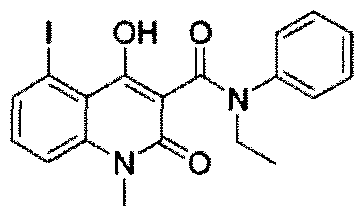
- MEG-LAQ was obtained from the reaction below:
- 5-iodo-laquinimod a new chemical entity, was prepared from 2- amino-6-iodobenzoic acid in a similar way that laquinimod was prepared from 2-amino-6-chlorobenzoic acid.
- laquinimod was prepared from 2-amino-6-chlorobenzoic acid.
- MEG-LAQ may be formed in large excess of meglumine, accelerated conditions and aqueous media as described in Example 1A.
- the substitution of the chloride atom by the secondary amine of meglumine is not favorable and therefore this chemical transition is slow (approximately 1 month) and the resulting MEG- LAQ can be accompanied by other degradation products of laquinimod.
- tedious purifications are needed in order to isolate MEG-LAQ from the reaction mixture.
- Example IB In comparison, the synthesis of MEG-LAQ according to Example IB is straight forward. Although this aromatic chloride nucleophilic substitution is uncommon, the use of catalytic amount of Cul facilitates a fast reaction under moderate conditions. Therefore the method of Example IB is advantageous over Example 1A.
- Example 2 Manufacture of formulations comprising laquinimod sodium
- Laquinimod capsules are manufactured according to the method as described in Example 2 of PCT International Application Publication No. WO 2007/146248, the entire content of which is hereby incorporated by reference. Steps of Example 2 of WO 2007/146248 are performed.
- the quantity of MEG-LAQ in the capsules prepared are below the detection limit by HPLC or not more than 1.0% by weight relative to the amount of laquinimod .
- Exam le 2 demonstrates that , in a commercial-scale production, pharmaceutical composition of laquinimod can be prepared with non-detectable level or a low level of MEG-LAQ (not more than 1 , 0% by weight ) .
Landscapes
- Health & Medical Sciences (AREA)
- Chemical & Material Sciences (AREA)
- Organic Chemistry (AREA)
- Pharmacology & Pharmacy (AREA)
- Veterinary Medicine (AREA)
- Public Health (AREA)
- General Health & Medical Sciences (AREA)
- Animal Behavior & Ethology (AREA)
- Medicinal Chemistry (AREA)
- Life Sciences & Earth Sciences (AREA)
- General Chemical & Material Sciences (AREA)
- Nuclear Medicine, Radiotherapy & Molecular Imaging (AREA)
- Chemical Kinetics & Catalysis (AREA)
- Bioinformatics & Cheminformatics (AREA)
- Engineering & Computer Science (AREA)
- Epidemiology (AREA)
- Neurosurgery (AREA)
- Neurology (AREA)
- Biomedical Technology (AREA)
- Immunology (AREA)
- Hospice & Palliative Care (AREA)
- Psychiatry (AREA)
- Pain & Pain Management (AREA)
- Rheumatology (AREA)
- Pharmaceuticals Containing Other Organic And Inorganic Compounds (AREA)
- Medicinal Preparation (AREA)
- Plural Heterocyclic Compounds (AREA)
Description




Claims


Priority Applications (14)
| Application Number | Priority Date | Filing Date | Title |
|---|---|---|---|
| AU2013259779A AU2013259779B2 (en) | 2012-05-08 | 2013-05-07 | N-ethyl-4-hydroxyl-1-methyl-5- (methyl(2,3,4,5,6-pentahydroxyhexyl) amino) -2-oxo-N-phenyl-1,2-dihydroquinoline-3-carboxamide |
| NZ630549A NZ630549A (en) | 2012-05-08 | 2013-05-07 | N-ethyl-4-hydroxyl-1-methyl-5- (methyl(2,3,4,5,6-pentahydroxyhexyl) amino) -2-oxo-n-phenyl-1,2-dihydroquinoline-3-carboxamide |
| CN201380029448.XA CN104395291B (en) | 2012-05-08 | 2013-05-07 | N‑ethyl‑4‑hydroxy‑1‑methyl‑5‑(methyl(2,3,4,5,6‑pentahydroxyhexyl)amino)‑2‑oxo‑N‑phenyl‑1,2 ‑Dihydroquinoline‑3‑carboxamide |
| EP13750833.9A EP2697201A4 (en) | 2012-05-08 | 2013-05-07 | N-ethyl-4-hydroxyl-1-methyl-5-(methyl(2,3,4,5,6-pentahydroxyhexyl) amino)-2-oxo-n-phenyl-1,2-dihydroquinoline-3-carboxamide |
| HK15107804.4A HK1207080A1 (en) | 2012-05-08 | 2013-05-07 | N-ethyl-4-hydroxyl-1-methyl-5- (methyl(2,3,4,5,6-pentahydroxyhexyl) amino) -2-oxo-n-phenyl-1,2-dihydroquinoline-3-carboxamide |
| BR112014028121A BR112014028121A2 (en) | 2012-05-08 | 2013-05-07 | n-ethyl-4-hydroxyl-1-methyl-5- (methyl (2,3,4,5,6-pentahydroxyhexyl) amino) -2-oxo-n-phenyl-1,2-dihydroquinoline-3-carboxamide |
| CA2873258A CA2873258A1 (en) | 2012-05-08 | 2013-05-07 | N-ethyl-4-hydroxyl-1-methyl-5-(methyl(2,3,4,5,6-pentahydroxyhexyl)amino)-2-oxo-n-phenyl-1,2-dihydroquinoline-3-carboxamide |
| IN2485MUN2014 IN2014MN02485A (en) | 2012-05-08 | 2013-05-07 | |
| SG11201407447XA SG11201407447XA (en) | 2012-05-08 | 2013-05-07 | N-ethyl-4-hydroxyl-1-methyl-5- (methyl(2,3,4,5,6-pentahydroxyhexyl) amino) -2-oxo-n-phenyl-1,2-dihydroquinoline-3-carboxamide |
| MX2014013664A MX2014013664A (en) | 2012-05-08 | 2013-05-07 | N-ethyl-4-hydroxyl-1-methyl-5- (methyl(2,3,4,5,6-pentahydroxyhexy l) amino) -2-oxo-n-phenyl-1,2-dihydroquinoline-3-carboxamide. |
| KR20147034461A KR20150022816A (en) | 2012-05-08 | 2013-05-07 | N-Ethyl-4-Hydroxyl-1-Methyl-5-(Methyl(2,3,4,5,6-Pentahydroxyhexyl)Amino)-2-Oxo-N-Phenyl-1,2-Dihydroquinoline-3-Carboxamide |
| EA201492029A EA201492029A1 (en) | 2012-05-08 | 2013-05-07 | N-ETHYL-4-HYDROXYL-1-METHYL-5- (METHYL (2,3,4,5,6-PENTAHYDROXYGEXYL) AMINO) -2-OXO-N-PHENYL-1,2-DIHYDROCHINOLIN-3-CARBOXAMIDE |
| IL235338A IL235338A0 (en) | 2012-05-08 | 2014-10-26 | N-ethyl-4-hydroxyl-1-methyl-5-(methyl(2,3,4,5,6-pentahydroxyhexyl)amino)-2-oxo-n-phenyl-1,2-dihydroquinoline-3-carboxamide |
| ZA2014/08825A ZA201408825B (en) | 2012-05-08 | 2014-12-02 | N-ethyl-4-hydroxyl-1-methyl-5- (methyl(2,3,4,5,6-pentahydroxyhexyl) amino) -2-oxo-n-phenyl-1,2-dihydroquinoline-3-carboxamide |
Applications Claiming Priority (2)
| Application Number | Priority Date | Filing Date | Title |
|---|---|---|---|
| US201261644054P | 2012-05-08 | 2012-05-08 | |
| US61/644,054 | 2012-05-08 |
Publications (2)
| Publication Number | Publication Date |
|---|---|
| WO2013169746A2 true WO2013169746A2 (en) | 2013-11-14 |
| WO2013169746A3 WO2013169746A3 (en) | 2013-12-05 |
Family
ID=49551433
Family Applications (1)
| Application Number | Title | Priority Date | Filing Date |
|---|---|---|---|
| PCT/US2013/039911 Ceased WO2013169746A2 (en) | 2012-05-08 | 2013-05-07 | N-ethyl-4-hydroxyl-1-methyl-5-(methyl(2,3,4,5,6-pentahydroxyhexyl) amino)-2-oxo-n-phenyl-1,2-dihydroquinoline-3-carboxamide |
Country Status (19)
| Country | Link |
|---|---|
| US (1) | US8809537B2 (en) |
| EP (1) | EP2697201A4 (en) |
| KR (1) | KR20150022816A (en) |
| CN (1) | CN104395291B (en) |
| AR (1) | AR090975A1 (en) |
| AU (1) | AU2013259779B2 (en) |
| BR (1) | BR112014028121A2 (en) |
| CA (1) | CA2873258A1 (en) |
| EA (1) | EA201492029A1 (en) |
| HK (1) | HK1207080A1 (en) |
| IL (1) | IL235338A0 (en) |
| IN (1) | IN2014MN02485A (en) |
| MX (1) | MX2014013664A (en) |
| NZ (1) | NZ630549A (en) |
| SG (1) | SG11201407447XA (en) |
| TW (1) | TW201350467A (en) |
| UY (1) | UY34791A (en) |
| WO (1) | WO2013169746A2 (en) |
| ZA (1) | ZA201408825B (en) |
Cited By (2)
| Publication number | Priority date | Publication date | Assignee | Title |
|---|---|---|---|---|
| WO2014074381A1 (en) * | 2012-11-07 | 2014-05-15 | Teva Pharmaceutical Industries Ltd. | Amine salts of laquinimod |
| WO2014153145A2 (en) | 2013-03-14 | 2014-09-25 | Teva Pharmaceutical Industries Ltd. | Crystals of laquinimod sodium and improved process for the manufacture thereof |
Families Citing this family (5)
| Publication number | Priority date | Publication date | Assignee | Title |
|---|---|---|---|---|
| WO2013116657A1 (en) | 2012-02-03 | 2013-08-08 | Teva Pharmaceutical Industries Ltd. | USE OF LAQUINIMOD FOR TREATING CROHN'S DISEASE PATIENTS WHO FAILED FIRST-LINE ANTI-TNFα THERAPY |
| MX2014009889A (en) | 2012-02-16 | 2014-11-13 | Teva Pharma | N-ethyl-n-phenyl-1,2-dihydro-4,5-di-hydroxy-1-methyl-2-oxo-3-qui noline carboxamide, preparation and uses thereof. |
| TW201400117A (en) | 2012-06-05 | 2014-01-01 | Teva Pharma | Treatment of ocular inflammation with laquinimod |
| TW201410244A (en) | 2012-08-13 | 2014-03-16 | Teva Pharma | Laquinimod for treatment of GABA mediated disorders |
| HK1231413A1 (en) | 2014-04-29 | 2017-12-22 | Teva Pharmaceutical Industries Ltd. | Laquinimod for the treatment of relapsing-remitting multiple sclerosis (rrms) patients with a high disability status |
Citations (5)
| Publication number | Priority date | Publication date | Assignee | Title |
|---|---|---|---|---|
| US6077851A (en) | 1998-04-27 | 2000-06-20 | Active Biotech Ab | Quinoline derivatives |
| US6875869B2 (en) | 2002-06-12 | 2005-04-05 | Active Biotech Ab | Process for the manufacture of quinoline derivatives |
| WO2005074899A2 (en) | 2004-02-06 | 2005-08-18 | Active Biotech Ab | New compositions containing quinoline compounds |
| WO2007047863A2 (en) | 2005-10-19 | 2007-04-26 | Teva Pharmaceutical Industries, Ltd. | Crystals of laquinimod sodium, and process for the manufacture thereof |
| WO2007146248A2 (en) | 2006-06-12 | 2007-12-21 | Teva Pharmaceutical Industries, Ltd. | Stable laquinimod preparations |
Family Cites Families (36)
| Publication number | Priority date | Publication date | Assignee | Title |
|---|---|---|---|---|
| US2159804A (en) * | 1937-11-23 | 1939-05-23 | Du Pont | N-nitroaryl polyhydroxy alkyl amino compounds and process of preparing the same |
| IE52670B1 (en) | 1981-03-03 | 1988-01-20 | Leo Ab | Heterocyclic carboxamides,compositions containing such compounds,and processes for their preparation |
| US4782155A (en) | 1986-03-19 | 1988-11-01 | Banyu Pharmaceutical Co., Ltd. | Cephalosporin derivatives, processes for their preparation and antibacterial agents |
| SE8902076D0 (en) | 1989-06-09 | 1989-06-09 | Pharmacia Ab | DERIVATIVES OF QUINOLINE-3-CARBOXANILIDE |
| US5139878A (en) | 1991-08-12 | 1992-08-18 | Allied-Signal Inc. | Multilayer film constructions |
| US6043006A (en) * | 1997-09-04 | 2000-03-28 | Fuji Photo Film Co., Ltd. | 4-(N,N-dialkylamino)aniline compound, photographic processing composition containing the same and color image-forming method |
| SE9801474D0 (en) | 1998-04-27 | 1998-04-27 | Active Biotech Ab | Quinoline Derivatives |
| US6121287A (en) | 1998-07-15 | 2000-09-19 | Active Biotech Ab | Quinoline derivatives |
| US6133285A (en) | 1998-07-15 | 2000-10-17 | Active Biotech Ab | Quinoline derivatives |
| SE9802549D0 (en) | 1998-07-15 | 1998-07-15 | Active Biotech Ab | Quinoline derivatives |
| SE9802550D0 (en) | 1998-07-15 | 1998-07-15 | Active Biotech Ab | Quinoline derivatives |
| EE200100660A (en) | 1999-06-07 | 2003-04-15 | Byk Gulden Lomberg Chemische Fabrik Gmbh | Formulation for acid-labile active substances, unit active ingredient, method of preparation and microsphere |
| SE0201778D0 (en) | 2002-06-12 | 2002-06-12 | Active Biotech Ab | Process for the manufacture of quinoline derivatives |
| US7560557B2 (en) | 2002-06-12 | 2009-07-14 | Active Biotech Ag | Process for the manufacture of quinoline derivatives |
| US8314124B2 (en) | 2004-02-06 | 2012-11-20 | Active Biotech Ab | Crystalline salts of quinoline compounds and methods for preparing them |
| US7514068B2 (en) | 2005-09-14 | 2009-04-07 | Concert Pharmaceuticals Inc. | Biphenyl-pyrazolecarboxamide compounds |
| US7528131B2 (en) | 2007-04-19 | 2009-05-05 | Concert Pharmaceuticals Inc. | Substituted morpholinyl compounds |
| WO2009082471A1 (en) * | 2007-12-20 | 2009-07-02 | Teva Pharmaceutical Industries, Ltd. | Stable laquinimod preparations |
| AU2009288108B2 (en) | 2008-09-03 | 2013-10-17 | Teva Pharmaceutical Industries, Ltd. | 2-oxo-1,2-dihydro-quinoline modulators of immune function |
| WO2010070449A2 (en) * | 2008-12-17 | 2010-06-24 | Actavis Group Ptc Ehf | Highly pure laquinimod or a pharmaceutically acceptable salt thereof |
| UY32427A (en) | 2009-02-13 | 2010-09-30 | Boheringer Ingelheim Internat Gmbh | PHARMACEUTICAL COMPOSITION, PHARMACEUTICAL FORM, PROCEDURE FOR PREPARATION, METHODS OF TREATMENT AND USES OF THE SAME |
| EP2228367A1 (en) * | 2009-03-13 | 2010-09-15 | Almirall, S.A. | Addition salts of amines containing hydroxyl and/or carboxylic groups with amino nicotinic acid derivatives as DHODH inhibitors |
| NZ597378A (en) | 2009-06-19 | 2014-08-29 | Teva Pharma | Treatment of multiple sclerosis with laquinimod |
| BR112012002124A2 (en) | 2009-07-30 | 2015-09-15 | Teva Pharma | treatment of crohn's disease with laquinimode. |
| WO2011019375A1 (en) | 2009-08-10 | 2011-02-17 | Teva Pharmaceutical Industries Ltd. | Treatment of bdnf-related disorders using laquinimod |
| EA201290860A1 (en) | 2010-03-03 | 2013-04-30 | Тева Фармасьютикал Индастриз Лтд. | TREATMENT OF RHEUMATOID ARTHRITIS BY COMBINATION OF LAKVINIMODA AND METHOREXAT |
| KR20130006640A (en) | 2010-03-03 | 2013-01-17 | 테바 파마슈티컬 인더스트리즈 리미티드 | Treatment of lupus nephritis using laquinimod |
| US20110217295A1 (en) | 2010-03-03 | 2011-09-08 | Asi Haviv | Treatment of lupus arthritis using laquinimod |
| JP5934202B2 (en) | 2010-07-09 | 2016-06-15 | テバ ファーマシューティカル インダストリーズ リミティド | 5-Chloro-4-hydroxy-1-methyl-2-oxo-N-phenyl-1,2-dihydroquinoline-3-carboxamide, its salts and uses thereof |
| AU2011274496B2 (en) | 2010-07-09 | 2016-03-10 | Teva Pharmaceutical Industries Ltd. | Deuterated N-ethyl-N-phenyl-1,2-dihydro-4-hydroxy-5-chloro-1-methyl-2-oxoquinoline-3-carboxamide, salts and uses thereof |
| JP2012047974A (en) * | 2010-08-26 | 2012-03-08 | Toshiba Corp | Image display apparatus and image display method |
| KR20130065728A (en) * | 2010-10-14 | 2013-06-19 | 임뮤나르 에이비 | 1,2-dihydro-4-hydroxy-2-oxo-quinoline-3-carboxanilides as ahr activators |
| PE20140872A1 (en) | 2010-12-07 | 2014-08-09 | Teva Pharma | USE OF LAQUINIMOD TO REDUCE FATIGUE, IMPROVE FUNCTIONAL STATUS AND IMPROVE QUALITY OF LIFE IN PATIENTS WITH MULTIPLE SCLEROSIS |
| HK1198278A1 (en) | 2011-07-28 | 2015-03-27 | Teva Pharmaceutical Industries Ltd. | Treatment of multiple sclerosis with combination of laquinimod and interferon-beta |
| SG10201606191PA (en) | 2011-07-28 | 2016-09-29 | Teva Pharma | Treatment of multiple sclerosis with combination of laquinimod and glatiramer acetate |
| SG11201401330YA (en) | 2011-10-12 | 2014-05-29 | Teva Pharma | Treatment of multiple sclerosis with combination of laquinimod and fingolimod |
-
2013
- 2013-05-02 TW TW102115767A patent/TW201350467A/en unknown
- 2013-05-07 HK HK15107804.4A patent/HK1207080A1/en unknown
- 2013-05-07 EA EA201492029A patent/EA201492029A1/en unknown
- 2013-05-07 UY UY0001034791A patent/UY34791A/en not_active Application Discontinuation
- 2013-05-07 US US13/888,709 patent/US8809537B2/en not_active Expired - Fee Related
- 2013-05-07 NZ NZ630549A patent/NZ630549A/en not_active IP Right Cessation
- 2013-05-07 BR BR112014028121A patent/BR112014028121A2/en not_active IP Right Cessation
- 2013-05-07 KR KR20147034461A patent/KR20150022816A/en not_active Withdrawn
- 2013-05-07 CA CA2873258A patent/CA2873258A1/en not_active Abandoned
- 2013-05-07 MX MX2014013664A patent/MX2014013664A/en unknown
- 2013-05-07 SG SG11201407447XA patent/SG11201407447XA/en unknown
- 2013-05-07 EP EP13750833.9A patent/EP2697201A4/en not_active Withdrawn
- 2013-05-07 WO PCT/US2013/039911 patent/WO2013169746A2/en not_active Ceased
- 2013-05-07 AU AU2013259779A patent/AU2013259779B2/en not_active Expired - Fee Related
- 2013-05-07 IN IN2485MUN2014 patent/IN2014MN02485A/en unknown
- 2013-05-07 AR ARP130101569A patent/AR090975A1/en unknown
- 2013-05-07 CN CN201380029448.XA patent/CN104395291B/en not_active Expired - Fee Related
-
2014
- 2014-10-26 IL IL235338A patent/IL235338A0/en unknown
- 2014-12-02 ZA ZA2014/08825A patent/ZA201408825B/en unknown
Patent Citations (7)
| Publication number | Priority date | Publication date | Assignee | Title |
|---|---|---|---|---|
| US6077851A (en) | 1998-04-27 | 2000-06-20 | Active Biotech Ab | Quinoline derivatives |
| US6875869B2 (en) | 2002-06-12 | 2005-04-05 | Active Biotech Ab | Process for the manufacture of quinoline derivatives |
| WO2005074899A2 (en) | 2004-02-06 | 2005-08-18 | Active Biotech Ab | New compositions containing quinoline compounds |
| US20050192315A1 (en) | 2004-02-06 | 2005-09-01 | Active Biotech Ab | New compositions containing quinoline compounds |
| US7589208B2 (en) | 2004-02-06 | 2009-09-15 | Active Biotech Ab | Compositions containing quinoline compounds |
| WO2007047863A2 (en) | 2005-10-19 | 2007-04-26 | Teva Pharmaceutical Industries, Ltd. | Crystals of laquinimod sodium, and process for the manufacture thereof |
| WO2007146248A2 (en) | 2006-06-12 | 2007-12-21 | Teva Pharmaceutical Industries, Ltd. | Stable laquinimod preparations |
Non-Patent Citations (14)
Cited By (3)
| Publication number | Priority date | Publication date | Assignee | Title |
|---|---|---|---|---|
| WO2014074381A1 (en) * | 2012-11-07 | 2014-05-15 | Teva Pharmaceutical Industries Ltd. | Amine salts of laquinimod |
| US8975279B2 (en) | 2012-11-07 | 2015-03-10 | Teva Pharmaceutical Industries, Ltd. | Amine salts of laquinimod |
| WO2014153145A2 (en) | 2013-03-14 | 2014-09-25 | Teva Pharmaceutical Industries Ltd. | Crystals of laquinimod sodium and improved process for the manufacture thereof |
Also Published As
| Publication number | Publication date |
|---|---|
| IN2014MN02485A (en) | 2015-07-17 |
| CN104395291A (en) | 2015-03-04 |
| EA201492029A1 (en) | 2015-06-30 |
| WO2013169746A3 (en) | 2013-12-05 |
| AR090975A1 (en) | 2014-12-17 |
| ZA201408825B (en) | 2016-07-27 |
| MX2014013664A (en) | 2015-04-17 |
| UY34791A (en) | 2013-11-29 |
| CA2873258A1 (en) | 2013-11-14 |
| AU2013259779A1 (en) | 2014-12-18 |
| IL235338A0 (en) | 2014-12-31 |
| SG11201407447XA (en) | 2015-02-27 |
| EP2697201A4 (en) | 2014-11-26 |
| BR112014028121A2 (en) | 2017-06-27 |
| AU2013259779B2 (en) | 2017-06-08 |
| US20130345256A1 (en) | 2013-12-26 |
| HK1207080A1 (en) | 2016-01-22 |
| KR20150022816A (en) | 2015-03-04 |
| TW201350467A (en) | 2013-12-16 |
| NZ630549A (en) | 2016-01-29 |
| US8809537B2 (en) | 2014-08-19 |
| EP2697201A2 (en) | 2014-02-19 |
| CN104395291B (en) | 2017-07-28 |
Similar Documents
| Publication | Publication Date | Title |
|---|---|---|
| US20180140592A1 (en) | 5-chloro-4-hydroxy-1-methyl-2-oxo-n-phenyl-1,2-dihydroquinoline-3-carboxamide, salts and uses thereof | |
| US8809537B2 (en) | N-ethyl-4-hydroxyl-1-methyl-5-(methyl(2,3,4,5,6-pentahydroxyhexyl)amino)-2-oxo-N-phenyl-1,2-dihydroquinoline-3-carboxamide | |
| AU2011274496B2 (en) | Deuterated N-ethyl-N-phenyl-1,2-dihydro-4-hydroxy-5-chloro-1-methyl-2-oxoquinoline-3-carboxamide, salts and uses thereof | |
| AU2022203369B2 (en) | Analogs of deutetrabenazine, their preparation and use | |
| EP2766004A1 (en) | R(+)-n-methyl-propargyl-aminoindan | |
| TWI724242B (en) | A non-solvated crystal and its preparation method and application | |
| DK2220027T3 (en) | Polymorphic form of N- [4- (trifluoromethyl) benzyl) -4-METHOXYBUTYRAMID |
Legal Events
| Date | Code | Title | Description |
|---|---|---|---|
| 121 | Ep: the epo has been informed by wipo that ep was designated in this application |
Ref document number: 13750833 Country of ref document: EP Kind code of ref document: A2 |
|
| ENP | Entry into the national phase |
Ref document number: 2873258 Country of ref document: CA |
|
| WWE | Wipo information: entry into national phase |
Ref document number: MX/A/2014/013664 Country of ref document: MX |
|
| WWE | Wipo information: entry into national phase |
Ref document number: 201492029 Country of ref document: EA |
|
| WWE | Wipo information: entry into national phase |
Ref document number: A201413041 Country of ref document: UA |
|
| ENP | Entry into the national phase |
Ref document number: 20147034461 Country of ref document: KR Kind code of ref document: A |
|
| REG | Reference to national code |
Ref country code: BR Ref legal event code: B01A Ref document number: 112014028121 Country of ref document: BR |
|
| ENP | Entry into the national phase |
Ref document number: 2013259779 Country of ref document: AU Date of ref document: 20130507 Kind code of ref document: A |
|
| ENP | Entry into the national phase |
Ref document number: 2015521611 Country of ref document: JP Kind code of ref document: A |
|
| NENP | Non-entry into the national phase |
Ref country code: JP |
|
| ENP | Entry into the national phase |
Ref document number: 112014028121 Country of ref document: BR Kind code of ref document: A2 Effective date: 20141110 |