WO2013172111A1 - 研磨用組成物並びにそれを用いた研磨方法及び基板の製造方法 - Google Patents
研磨用組成物並びにそれを用いた研磨方法及び基板の製造方法 Download PDFInfo
- Publication number
- WO2013172111A1 WO2013172111A1 PCT/JP2013/060347 JP2013060347W WO2013172111A1 WO 2013172111 A1 WO2013172111 A1 WO 2013172111A1 JP 2013060347 W JP2013060347 W JP 2013060347W WO 2013172111 A1 WO2013172111 A1 WO 2013172111A1
- Authority
- WO
- WIPO (PCT)
- Prior art keywords
- polishing
- layer
- polishing composition
- acid
- water
- Prior art date
- Legal status (The legal status is an assumption and is not a legal conclusion. Google has not performed a legal analysis and makes no representation as to the accuracy of the status listed.)
- Ceased
Links
Classifications
-
- C—CHEMISTRY; METALLURGY
- C09—DYES; PAINTS; POLISHES; NATURAL RESINS; ADHESIVES; COMPOSITIONS NOT OTHERWISE PROVIDED FOR; APPLICATIONS OF MATERIALS NOT OTHERWISE PROVIDED FOR
- C09K—MATERIALS FOR MISCELLANEOUS APPLICATIONS, NOT PROVIDED FOR ELSEWHERE
- C09K3/00—Materials not provided for elsewhere
- C09K3/14—Anti-slip materials; Abrasives
- C09K3/1454—Abrasive powders, suspensions and pastes for polishing
-
- C—CHEMISTRY; METALLURGY
- C09—DYES; PAINTS; POLISHES; NATURAL RESINS; ADHESIVES; COMPOSITIONS NOT OTHERWISE PROVIDED FOR; APPLICATIONS OF MATERIALS NOT OTHERWISE PROVIDED FOR
- C09G—POLISHING COMPOSITIONS; SKI WAXES
- C09G1/00—Polishing compositions
- C09G1/02—Polishing compositions containing abrasives or grinding agents
-
- B—PERFORMING OPERATIONS; TRANSPORTING
- B24—GRINDING; POLISHING
- B24B—MACHINES, DEVICES, OR PROCESSES FOR GRINDING OR POLISHING; DRESSING OR CONDITIONING OF ABRADING SURFACES; FEEDING OF GRINDING, POLISHING, OR LAPPING AGENTS
- B24B37/00—Lapping machines or devices; Accessories
- B24B37/04—Lapping machines or devices; Accessories designed for working plane surfaces
- B24B37/042—Lapping machines or devices; Accessories designed for working plane surfaces operating processes therefor
- B24B37/044—Lapping machines or devices; Accessories designed for working plane surfaces operating processes therefor characterised by the composition of the lapping agent
-
- C—CHEMISTRY; METALLURGY
- C09—DYES; PAINTS; POLISHES; NATURAL RESINS; ADHESIVES; COMPOSITIONS NOT OTHERWISE PROVIDED FOR; APPLICATIONS OF MATERIALS NOT OTHERWISE PROVIDED FOR
- C09K—MATERIALS FOR MISCELLANEOUS APPLICATIONS, NOT PROVIDED FOR ELSEWHERE
- C09K3/00—Materials not provided for elsewhere
- C09K3/14—Anti-slip materials; Abrasives
- C09K3/1436—Composite particles, e.g. coated particles
-
- C—CHEMISTRY; METALLURGY
- C09—DYES; PAINTS; POLISHES; NATURAL RESINS; ADHESIVES; COMPOSITIONS NOT OTHERWISE PROVIDED FOR; APPLICATIONS OF MATERIALS NOT OTHERWISE PROVIDED FOR
- C09K—MATERIALS FOR MISCELLANEOUS APPLICATIONS, NOT PROVIDED FOR ELSEWHERE
- C09K3/00—Materials not provided for elsewhere
- C09K3/14—Anti-slip materials; Abrasives
- C09K3/1454—Abrasive powders, suspensions and pastes for polishing
- C09K3/1463—Aqueous liquid suspensions
-
- H—ELECTRICITY
- H10—SEMICONDUCTOR DEVICES; ELECTRIC SOLID-STATE DEVICES NOT OTHERWISE PROVIDED FOR
- H10P—GENERIC PROCESSES OR APPARATUS FOR THE MANUFACTURE OR TREATMENT OF DEVICES COVERED BY CLASS H10
- H10P52/00—Grinding, lapping or polishing of wafers, substrates or parts of devices
- H10P52/40—Chemomechanical polishing [CMP]
- H10P52/402—Chemomechanical polishing [CMP] of semiconductor materials
-
- H—ELECTRICITY
- H10—SEMICONDUCTOR DEVICES; ELECTRIC SOLID-STATE DEVICES NOT OTHERWISE PROVIDED FOR
- H10P—GENERIC PROCESSES OR APPARATUS FOR THE MANUFACTURE OR TREATMENT OF DEVICES COVERED BY CLASS H10
- H10P95/00—Generic processes or apparatus for manufacture or treatments not covered by the other groups of this subclass
- H10P95/06—Planarisation of inorganic insulating materials
- H10P95/062—Planarisation of inorganic insulating materials involving a dielectric removal step
-
- H—ELECTRICITY
- H10—SEMICONDUCTOR DEVICES; ELECTRIC SOLID-STATE DEVICES NOT OTHERWISE PROVIDED FOR
- H10P—GENERIC PROCESSES OR APPARATUS FOR THE MANUFACTURE OR TREATMENT OF DEVICES COVERED BY CLASS H10
- H10P95/00—Generic processes or apparatus for manufacture or treatments not covered by the other groups of this subclass
- H10P95/06—Planarisation of inorganic insulating materials
- H10P95/062—Planarisation of inorganic insulating materials involving a dielectric removal step
- H10P95/064—Planarisation of inorganic insulating materials involving a dielectric removal step the removal being chemical etching
-
- H—ELECTRICITY
- H10—SEMICONDUCTOR DEVICES; ELECTRIC SOLID-STATE DEVICES NOT OTHERWISE PROVIDED FOR
- H10W—GENERIC PACKAGES, INTERCONNECTIONS, CONNECTORS OR OTHER CONSTRUCTIONAL DETAILS OF DEVICES COVERED BY CLASS H10
- H10W10/00—Isolation regions in semiconductor bodies between components of integrated devices
- H10W10/01—Manufacture or treatment
- H10W10/011—Manufacture or treatment of isolation regions comprising dielectric materials
- H10W10/014—Manufacture or treatment of isolation regions comprising dielectric materials using trench refilling with dielectric materials, e.g. shallow trench isolations
-
- H—ELECTRICITY
- H10—SEMICONDUCTOR DEVICES; ELECTRIC SOLID-STATE DEVICES NOT OTHERWISE PROVIDED FOR
- H10W—GENERIC PACKAGES, INTERCONNECTIONS, CONNECTORS OR OTHER CONSTRUCTIONAL DETAILS OF DEVICES COVERED BY CLASS H10
- H10W10/00—Isolation regions in semiconductor bodies between components of integrated devices
- H10W10/10—Isolation regions comprising dielectric materials
- H10W10/17—Isolation regions comprising dielectric materials formed using trench refilling with dielectric materials, e.g. shallow trench isolations
Definitions
- the present invention relates to a polishing composition used, for example, in an application for polishing a polishing object having a silicon nitride layer and a silicon oxide layer provided on the silicon nitride layer.
- the present invention also relates to a polishing method and a substrate manufacturing method using the polishing composition.
- the polishing process in semiconductor device manufacture is generally performed by chemical mechanical polishing (CMP).
- CMP is used in processes such as shallow trench isolation (STI), planarization of an interlayer insulating film (ILD film), formation of tungsten plugs, and formation of multilayer wiring composed of copper and a low dielectric constant film.
- STI shallow trench isolation
- ILD film interlayer insulating film
- tungsten plugs formation of tungsten plugs
- multilayer wiring composed of copper and a low dielectric constant film.
- STI the silicon oxide layer is generally polished and removed by CMP using the silicon nitride layer as a stopper.
- cerium oxide abrasive grains are suitable for use in such applications in that they have the ability to selectively polish and remove silicon oxide compared to silicon nitride.
- cerium oxide abrasive grains are generally expensive, and are also disadvantageous in that they are easily settled and have poor storage stability. Therefore, the request
- an object of the present invention is to provide a polishing composition that can be used as a substitute for a polishing composition containing cerium oxide abrasive grains for specific CMP applications such as STI, and to use the polishing composition.
- An object of the present invention is to provide a polishing method and a substrate manufacturing method.
- a first aspect of the present invention provides a polishing composition containing an anionic water-soluble polymer and abrasive grains.
- the water-soluble polymer has an acid dissociation constant pKa of 3 or less, and the abrasive grains show a negative zeta potential at pH 3.5 or less.
- the polishing composition preferably has a pH of 3.5 or less.
- the water-soluble polymer has, for example, a sulfo group.
- the abrasive grains are, for example, colloidal silica in which an organic acid is immobilized.
- the first layer has a first layer and a second layer provided on the first layer, and the first layer is a positive zeta at pH 3.5 or lower. While the electric potential is exhibited, the second layer is obtained by polishing an object to be polished formed of a material different from that of the first layer using the polishing composition of the first aspect. A polishing method is provided.
- the first layer has a first layer and a second layer provided on the first layer, and the first layer is a positive zeta at pH 3.5 or lower. While the second layer exhibits a potential, the substrate is obtained by polishing a polishing object formed of a material different from that of the first layer using the polishing composition of the first aspect.
- a method for manufacturing a substrate is provided.
- a polishing composition that can be used as an alternative to a polishing composition containing cerium oxide abrasive grains for specific CMP applications such as STI, a polishing method and a substrate using the polishing composition
- the manufacturing method is provided.
- the polishing composition of the present embodiment is prepared by mixing a water-soluble polymer and abrasive grains with water. Accordingly, the polishing composition contains a water-soluble polymer and abrasive grains.
- the polishing composition of the present embodiment is used for polishing a polishing object having a silicon nitride layer and a silicon oxide layer provided directly on the silicon nitride layer, and more specifically, the polishing object. Is used for the purpose of manufacturing a substrate by polishing.
- the silicon nitride layer exhibits a positive zeta potential at pH 3.5 or lower.
- the polishing composition of the present embodiment is not particularly intended for use in applications for polishing a metal as described above, the oxidizing agent or the metal anticorrosive agent usually contained in the metal polishing composition is used. Contains no ingredients.
- the water-soluble polymer contained in the polishing composition is an anionic compound having an acid dissociation constant pKa of 3 or less, and has an anionic group such as a sulfo group or a phosphonic group.
- anionic groups such as a sulfo group or a phosphonic group.
- Specific examples of such compounds include polyvinyl sulfonic acid, polystyrene sulfonic acid, polyallyl sulfonic acid, polyacrylic acid ethyl sulfonic acid, polyacrylic acid butyl sulfonic acid, poly (2-acrylamido-2-methylpropane sulfonic acid). , Polyisoprene sulfonic acid, and salts of these acids.
- the water-soluble polymer in the polishing composition is adsorbed on the surface of the silicon nitride layer generated after polishing and removal of the silicon oxide layer when the polishing composition is used for polishing the polishing object. Thereby, it functions to prevent the silicon nitride layer from being polished by the polishing composition.
- the content of the water-soluble polymer in the polishing composition is preferably 10 mass ppm or more, more preferably 50 mass ppm or more, and still more preferably 100 mass ppm or more. As the water-soluble polymer content increases, a sufficient amount of the water-soluble polymer is readily adsorbed on the surface of the silicon nitride layer to prevent polishing of the silicon nitride layer by the polishing composition.
- the content of the water-soluble polymer in the polishing composition is also preferably 100000 mass ppm or less, more preferably 50000 mass ppm or less, still more preferably 10,000 mass ppm or less. As the content of the water-soluble polymer decreases, aggregation of abrasive grains in the polishing composition is less likely to occur. Therefore, there is an advantageous effect that the storage stability of the polishing composition is improved.
- the molecular weight of the water-soluble polymer in the polishing composition is preferably 100 or more, more preferably 300 or more. As the molecular weight of the water-soluble polymer increases, a sufficient amount of the water-soluble polymer readily adsorbs on the surface of the silicon nitride layer to prevent polishing of the silicon nitride layer by the polishing composition.
- the molecular weight of the water-soluble polymer in the polishing composition is preferably 500,000 or less, more preferably 300,000 or less. As the molecular weight of the water-soluble polymer decreases, the aggregation of abrasive grains in the polishing composition is less likely to occur. Therefore, there is an advantageous effect that the storage stability of the polishing composition is improved.
- the water-soluble polymer preferably has a ratio of the number of monomer units having an anionic group among the monomer units in the water-soluble polymer of 10% or more. As this percentage increases, a sufficient amount of water-soluble polymer is readily adsorbed on the surface of the silicon nitride layer to prevent polishing of the silicon nitride layer with the polishing composition.
- the abrasive contained in the polishing composition exhibits a negative zeta potential at pH 3.5 or lower.
- the type of abrasive grains to be used is not particularly limited, but for example, surface-modified colloidal silica can be used.
- the surface modification of colloidal silica can be performed, for example, by mixing a metal such as aluminum, titanium or zirconium or an oxide thereof with colloidal silica and doping the surface of the silica particles.
- the functional group of the organic acid can be chemically bonded to the surface of the silica particles, that is, the organic acid can be immobilized.
- colloidal silica and the organic acid are simply allowed to coexist, the organic acid is not fixed to the colloidal silica.
- sulfonic acid which is a kind of organic acid
- colloidal silica for example, the method described in “Sulfonicacid-functionalized silica through of thiol groups”, Chem. Commun. 246-247 (2003) can be used. it can. Specifically, a silane coupling agent having a thiol group such as 3-mercaptopropyltrimethoxysilane is coupled to colloidal silica, and then the thiol group is oxidized with hydrogen peroxide to immobilize the sulfonic acid on the surface.
- colloidal silica thus obtained can be obtained.
- carboxylic acid is immobilized on colloidal silica, for example, “Novel Silane Coupling Agents Containing a Photolabile 2-Nitrobenzyl Ester for Introduction of a Carboxy Group on the Surface of Silica Gel”, Chemistry Letters, 3, 228-229 (2000).
- colloidal silica having a carboxylic acid immobilized on the surface can be obtained by irradiating light after coupling a silane coupling agent containing a photoreactive 2-nitrobenzyl ester to colloidal silica. .
- the content of abrasive grains in the polishing composition is preferably 0.1% by mass or more, more preferably 0.5% by mass or more, and further preferably 1% by mass or more. As the abrasive content increases, there is an advantageous effect that the polishing rate of the silicon oxide layer by the polishing composition is improved.
- the content of abrasive grains in the polishing composition is also preferably 20% by mass or less, more preferably 15% by mass or less, and still more preferably 10% by mass or less. As the content of the abrasive grains decreases, the material cost of the polishing composition can be reduced, and in addition, aggregation of the abrasive grains hardly occurs. In addition, a polished surface with few scratches can be easily obtained by polishing an object to be polished with the polishing composition.
- the average primary particle diameter of the abrasive grains is preferably 5 nm or more, more preferably 7 nm or more, and further preferably 10 nm or more. As the average primary particle diameter of the abrasive grains increases, there is an advantageous effect that the polishing rate of the silicon oxide layer by the polishing composition is improved. In addition, the value of the average primary particle diameter of an abrasive grain can be calculated based on the specific surface area of the abrasive grain measured by BET method, for example.
- the average primary particle diameter of the abrasive grains is also preferably 100 nm or less, more preferably 90 nm or less, and still more preferably 80 nm or less. As the average primary particle diameter of the abrasive grains decreases, a polished surface with less scratches can be easily obtained by polishing the object to be polished using the polishing composition.
- the average secondary particle diameter of the abrasive grains is preferably 150 nm or less, more preferably 120 nm or less, and still more preferably 100 nm or less.
- the value of the average secondary particle diameter of the abrasive grains can be measured by, for example, a laser light scattering method.
- the average degree of association of the abrasive grains obtained by dividing the value of the average secondary particle diameter of the abrasive grains by the value of the average primary particle diameter is preferably 1.2 or more, more preferably 1.5 or more. . As the average degree of association of the abrasive grains increases, there is an advantageous effect that the polishing rate of the silicon oxide layer by the polishing composition is improved.
- the average degree of association of the abrasive grains is also preferably 4 or less, more preferably 3 or less, and still more preferably 2 or less. As the average degree of association of the abrasive grains decreases, a polished surface with less scratches is easily obtained by polishing the object to be polished using the polishing composition.
- pH of polishing composition is 6.0 or less, More preferably, it is 4.0 or less, More preferably, it is 3.5 or less. As the pH of the polishing composition decreases, there is an advantageous effect of improving the polishing rate of the silicon oxide layer by the polishing composition.
- a pH adjuster may be used to adjust the pH of the polishing composition to a desired value.
- the pH adjuster to be used may be either acid or alkali, and may be any of inorganic and organic compounds.
- the polishing composition of this embodiment contains an anionic water-soluble polymer having an acid dissociation constant pKa of 3 or less. Therefore, when the polishing composition is used for polishing an object to be polished having a silicon nitride layer and a silicon oxide layer provided on the silicon nitride layer, the silicon oxide layer is removed by polishing.
- the water-soluble polymer is adsorbed on the surface of the silicon nitride layer that is formed later. This adsorption causes a steric hindrance on the surface of the silicon nitride layer that prevents the abrasive grains from approaching the surface of the silicon nitride layer, thereby preventing the polishing of the silicon nitride layer by the polishing composition. .
- the zeta potential on the surface of the silicon nitride layer changes from positive to negative, which causes electrostatic repulsion of the abrasive grains to the silicon nitride layer. This can hinder the polishing of the silicon nitride layer.
- the polishing rate of silicon nitride by the polishing composition is reduced.
- the water-soluble polymer is not adsorbed on the surface of the silicon oxide layer, and therefore the polishing rate of silicon oxide by the polishing composition does not decrease. As a result, the silicon oxide is selectively removed by polishing as compared with silicon nitride.
- the value obtained by dividing the polishing rate of silicon oxide by the polishing rate of silicon nitride is, for example, 5 or more, more specifically 10 It becomes possible to adjust to 20 or more. Therefore, it is possible to polish and remove the silicon oxide layer using the silicon nitride layer as a stopper, and the polishing composition of this embodiment is suitable for CMP applications such as STI having such steps. Can be used.
- the abrasive grains contained in the polishing composition are colloidal silica in which an organic acid is fixed, a polishing composition that is particularly excellent in storage stability can be obtained.
- colloidal silica in which an organic acid is immobilized tends to have a larger absolute value of zeta potential in the polishing composition than ordinary colloidal silica in which no organic acid is immobilized. .
- electrostatic repulsion between the silica particles increases, so that colloidal silica aggregation due to attractive force due to van der Waals force hardly occurs.
- the zeta potential of colloidal silica immobilized with an organic acid generally shows a negative value of ⁇ 15 mV or less, whereas the zeta potential of ordinary colloidal silica shows a value close to zero.
- the embodiment may be modified as follows.
- the polishing composition of the above embodiment may contain two or more water-soluble polymers.
- some water-soluble polymers may not be anionic compounds having an acid dissociation constant pKa of 3 or less.
- the polishing composition of the above embodiment may contain two or more kinds of abrasive grains. In this case, some abrasive grains may not exhibit a negative zeta potential at pH 3.5 or lower.
- the polishing composition of the above embodiment is formic acid, acetic acid, propionic acid, butyric acid, valeric acid, 2-methylbutyric acid, n-hexanoic acid, 3,3-dimethylbutyric acid, 2-ethylbutyric acid, 4-methylpentanoic acid N-heptanoic acid, 2-methylhexanoic acid, n-octanoic acid, 2-ethylhexanoic acid, benzoic acid, glycolic acid, salicylic acid, glyceric acid, oxalic acid, malonic acid, succinic acid, glutaric acid, adipic acid, pimelin
- You may contain the ammonium salt or alkali metal salt of organic acids, such as an acid, a maleic acid, a phthalic acid, malic acid, tartaric acid, a citric acid, and lactic acid.
- ammonium salt or alkali metal salt of inorganic acids such as a sulfuric acid, nitric acid, phosphoric acid, and boric acid.
- these ammonium salts or alkali metal salts serve as a polishing accelerator for improving the polishing rate of the silicon oxide layer by the polishing composition.
- the polishing composition of the above embodiment may further contain a known additive such as a preservative as necessary. Moreover, you may further contain an oxidizing agent and a metal anticorrosive.
- the polishing composition of the above embodiment may be a one-component type or a multi-component type including a two-component type.
- the polishing composition of the above embodiment may be prepared by diluting a stock solution of the polishing composition with water.
- the polishing composition of the above embodiment may be used for purposes other than polishing an object to be polished having a silicon nitride layer and a silicon oxide layer provided on the silicon nitride layer.
- a layer other than silicon oxide may be used for polishing an object to be polished provided on a silicon nitride layer.
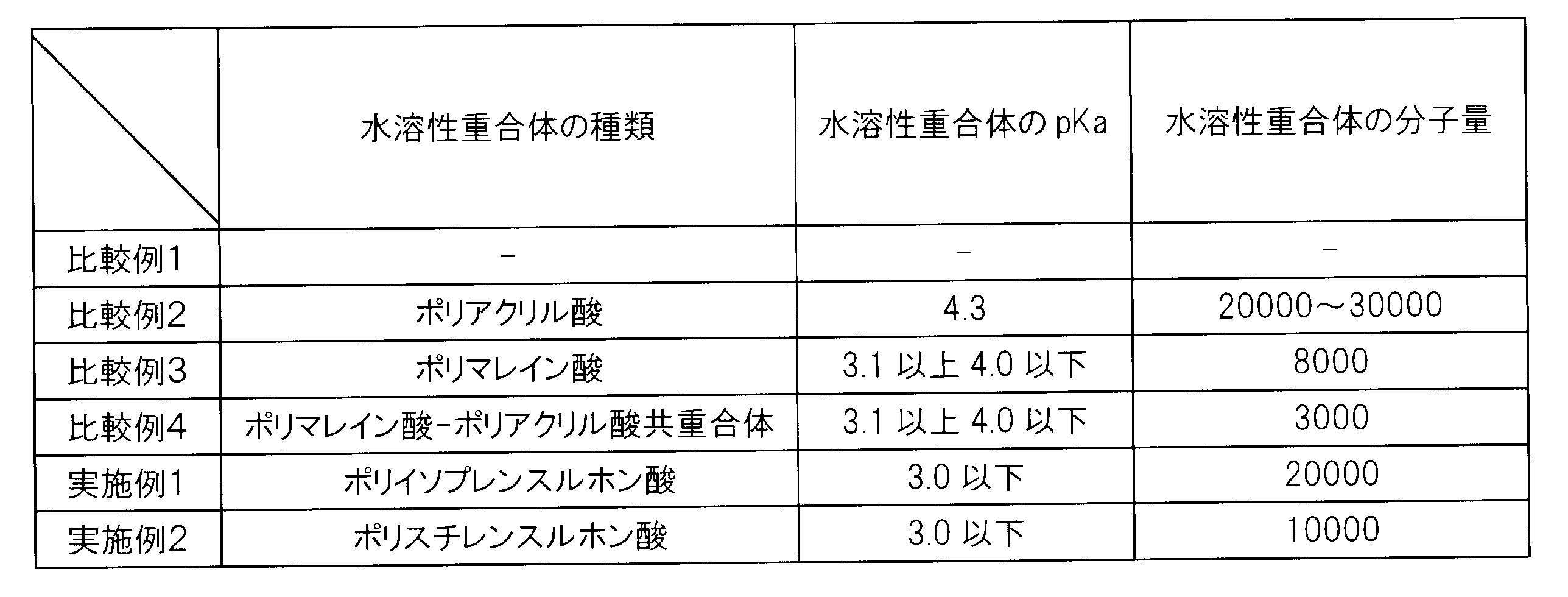
- the polishing composition of Comparative Example 1 was prepared by diluting the colloidal silica sol with water and adding an organic acid as a pH adjuster to adjust the pH value to 3.0.
- Examples 1 and 2 and Comparative Example 2 were prepared by diluting a colloidal silica sol with water, adding 1000 mass ppm of a water-soluble polymer thereto, and then adding an organic acid to adjust the pH value to 3.0. 4 polishing compositions were prepared. Details of the water-soluble polymer in each polishing composition are as shown in Table 1.
- polishing compositions of Examples 1 and 2 and Comparative Examples 1 to 4 were colloidal silica (average primary particle diameter 35 nm, average secondary The particle size is 70 nm, the average degree of association 2) is 5% by mass, and 0.5% by mass of an inorganic ammonium salt is contained as a polishing accelerator.
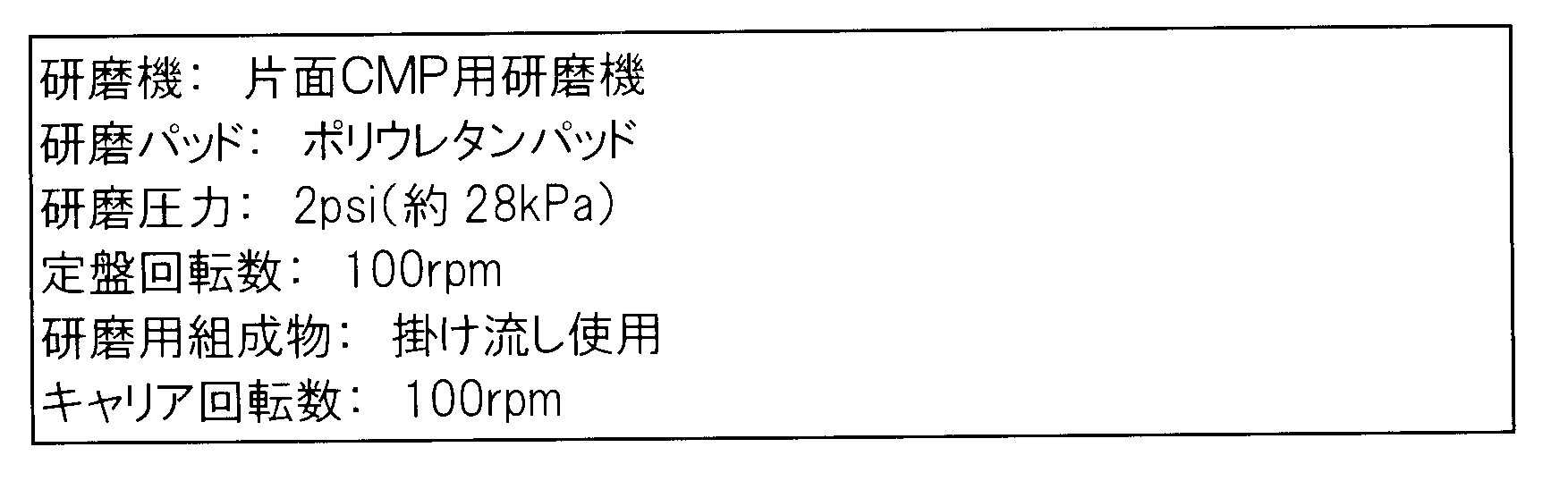
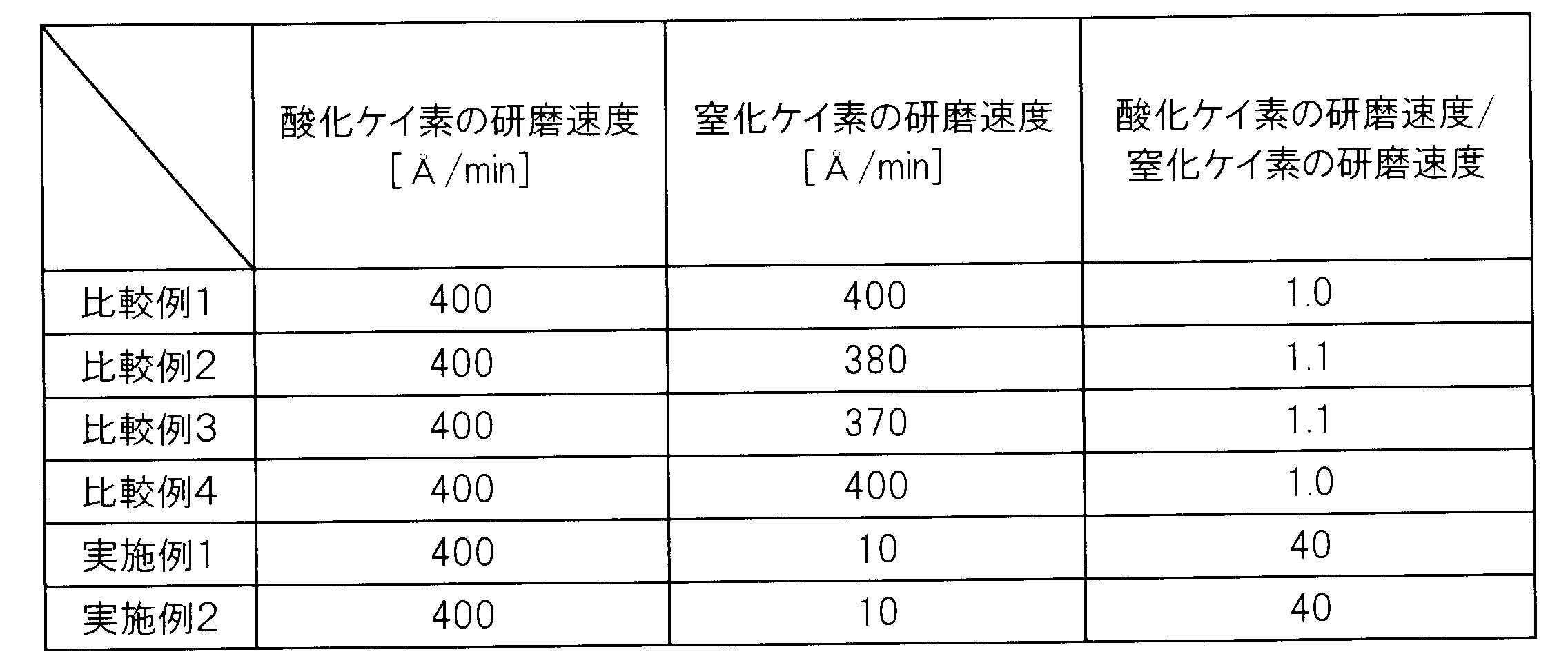
- polishing rate of silicon oxide when a silicon oxide film blanket wafer having a diameter of 200 mm is polished for 1 minute under the conditions shown in Table 2 using the polishing compositions of Examples 1 and 2 and Comparative Examples 1 to 4 is shown. 3, “Silicon oxide polishing rate” column.
- the value of the polishing rate of silicon oxide was determined by dividing the difference in thickness of each wafer before and after polishing measured using an optical interference type film thickness measuring apparatus by the polishing time.
- polishing rate of silicon nitride when a silicon nitride film blanket wafer having a diameter of 200 mm is polished for 1 minute under the conditions shown in Table 2 using the polishing compositions of Examples 1 and 2 and Comparative Examples 1 to 4 is shown. 3, “Silicon polishing rate of silicon nitride” column.
- the value of the silicon nitride polishing rate was determined by dividing the difference in thickness of each wafer before and after polishing measured by using an optical interference film thickness measuring apparatus by the polishing time.
- the polishing rate of silicon oxide is the polishing rate of silicon nitride. All of the divided values were as low as about 1, and a result that could be used satisfactorily for the purpose of selectively polishing and removing silicon oxide over silicon nitride was not obtained.
Landscapes
- Chemical & Material Sciences (AREA)
- Organic Chemistry (AREA)
- Engineering & Computer Science (AREA)
- Materials Engineering (AREA)
- Composite Materials (AREA)
- Mechanical Engineering (AREA)
- Mechanical Treatment Of Semiconductor (AREA)
- Finish Polishing, Edge Sharpening, And Grinding By Specific Grinding Devices (AREA)
- Chemical Kinetics & Catalysis (AREA)
- General Chemical & Material Sciences (AREA)
Abstract
Description
研磨用組成物中に含まれる水溶性重合体は、3以下の酸解離定数pKaを有するアニオン性の化合物であって、スルホ基やホスホン基などのアニオン基を有している。このような化合物の具体例としては、ポリビニルスルホン酸、ポリスチレンスルホン酸、ポリアリルスルホン酸、ポリアクリル酸エチルスルホン酸、ポリアクリル酸ブチルスルホン酸、ポリ(2-アクリルアミド-2-メチルプロパンスルホン酸)、ポリイソプレンスルホン酸、及びこれらの酸の塩が挙げられる。
研磨用組成物中に含まれる砥粒は、pH3.5以下において負のゼータ電位を示す。pH3.5以下において負のゼータ電位を示す限り、使用する砥粒の種類は特に限定されないが、例えば、表面修飾したコロイダルシリカの使用が可能である。コロイダルシリカの表面修飾は、例えば、アルミニウム、チタン又はジルコニウムなどの金属あるいはそれらの酸化物をコロイダルシリカと混合してシリカ粒子の表面にドープさせることにより行うことができる。あるいは、シリカ粒子の表面に有機酸の官能基を化学的に結合させること、すなわち有機酸の固定化により行うこともできる。コロイダルシリカと有機酸を単に共存させただけではコロイダルシリカへの有機酸の固定化は果たされない。有機酸の一種であるスルホン酸をコロイダルシリカに固定化するのであれば、例えば、“Sulfonicacid-functionalized silica through of thiol groups”, Chem. Commun. 246-247 (2003)に記載の方法で行うことができる。具体的には、3-メルカプトプロピルトリメトキシシランなどのチオール基を有するシランカップリング剤をコロイダルシリカにカップリングさせた後に過酸化水素でチオール基を酸化することにより、スルホン酸が表面に固定化されたコロイダルシリカを得ることができる。あるいは、カルボン酸をコロイダルシリカに固定化するのであれば、例えば、“Novel Silane Coupling Agents Containing a Photolabile 2-Nitrobenzyl Ester for Introduction of a CarboxyGroup on the Surface of Silica Gel”, Chemistry Letters, 3, 228-229 (2000)に記載の方法で行うことができる。具体的には、光反応性2-ニトロベンジルエステルを含むシランカップリング剤をコロイダルシリカにカップリングさせた後に光照射することにより、カルボン酸が表面に固定化されたコロイダルシリカを得ることができる。
研磨用組成物のpHは6.0以下であることが好ましく、より好ましくは4.0以下、さらに好ましくは3.5以下である。研磨用組成物のpHが小さくなるにつれて、研磨用組成物による酸化ケイ素の層の研磨速度が向上する有利な効果がある。
Claims (7)
- 第1の層及び第2の層を有する研磨対象物を研磨する用途で使用される研磨用組成物であって、
前記第1の層の上に前記第2の層は設けられており、
前記第1の層は、pH3.5以下において正のゼータ電位を示し、
前記第2の層は、前記第1の層とは別の材料から形成されており、
研磨用組成物は、アニオン性の水溶性重合体と、砥粒とを含有し、
前記水溶性重合体は、3以下の酸解離定数pKaを有し、
前記砥粒は、pH3.5以下において負のゼータ電位を示す
ことを特徴とする研磨用組成物。 - 3.5以下のpHを有する、請求項1に記載の研磨用組成物。
- 前記水溶性重合体はスルホ基を有する、請求項1又は2に記載の研磨用組成物。
- 前記砥粒は有機酸を固定化したコロイダルシリカである、請求項1~3のいずれか一項に記載の研磨用組成物。
- 前記第1の層が窒化ケイ素の層である、請求項1~4のいずれか一項に記載の研磨用組成物。
- 第1の層及び第2の層を有する研磨対象物を研磨する方法であって、
前記第1の層の上に前記第2の層は設けられており、
前記第1の層は、pH3.5以下において正のゼータ電位を示し、
前記第2の層は、前記第1の層とは別の材料から形成されており、
前記研磨対象物の研磨は、請求項1~5のいずれか一項に記載の研磨用組成物を用いて行われる
ことを特徴とする方法。 - 第1の層及び第2の層を有する研磨対象物を研磨する工程を有する基板の製造方法であって、
前記第1の層の上に前記第2の層は設けられており、
前記第1の層は、pH3.5以下において正のゼータ電位を示し、
前記第2の層は、前記第1の層とは別の材料から形成されており、
前記研磨対象物の研磨は、請求項1~5のいずれか一項に記載の研磨用組成物を用いて行われる
ことを特徴とする方法。
Priority Applications (5)
| Application Number | Priority Date | Filing Date | Title |
|---|---|---|---|
| SG11201407467YA SG11201407467YA (en) | 2012-05-18 | 2013-04-04 | Polishing composition, polishing method using same, and method for producing substrate |
| KR1020147035061A KR102073260B1 (ko) | 2012-05-18 | 2013-04-04 | 연마용 조성물 및 그것을 사용한 연마 방법 및 기판의 제조 방법 |
| EP13790468.6A EP2851937A4 (en) | 2012-05-18 | 2013-04-04 | POLISHING COMPOSITION, POLISHING METHOD THEREFOR AND METHOD FOR PRODUCING A SUBSTRATE |
| US14/400,646 US9422454B2 (en) | 2012-05-18 | 2013-04-04 | Polishing composition, polishing method using same, and method for producing substrate |
| CN201380025124.9A CN104285284B (zh) | 2012-05-18 | 2013-04-04 | 研磨用组合物以及使用其的研磨方法和基板的制造方法 |
Applications Claiming Priority (2)
| Application Number | Priority Date | Filing Date | Title |
|---|---|---|---|
| JP2012-114596 | 2012-05-18 | ||
| JP2012114596A JP5957292B2 (ja) | 2012-05-18 | 2012-05-18 | 研磨用組成物並びにそれを用いた研磨方法及び基板の製造方法 |
Publications (1)
| Publication Number | Publication Date |
|---|---|
| WO2013172111A1 true WO2013172111A1 (ja) | 2013-11-21 |
Family
ID=49583530
Family Applications (1)
| Application Number | Title | Priority Date | Filing Date |
|---|---|---|---|
| PCT/JP2013/060347 Ceased WO2013172111A1 (ja) | 2012-05-18 | 2013-04-04 | 研磨用組成物並びにそれを用いた研磨方法及び基板の製造方法 |
Country Status (8)
| Country | Link |
|---|---|
| US (1) | US9422454B2 (ja) |
| EP (1) | EP2851937A4 (ja) |
| JP (1) | JP5957292B2 (ja) |
| KR (1) | KR102073260B1 (ja) |
| CN (1) | CN104285284B (ja) |
| SG (1) | SG11201407467YA (ja) |
| TW (1) | TWI572702B (ja) |
| WO (1) | WO2013172111A1 (ja) |
Cited By (3)
| Publication number | Priority date | Publication date | Assignee | Title |
|---|---|---|---|---|
| CN106103640A (zh) * | 2014-03-20 | 2016-11-09 | 福吉米株式会社 | 研磨用组合物、研磨方法及基板的制造方法 |
| JP2019194329A (ja) * | 2014-03-28 | 2019-11-07 | 株式会社フジミインコーポレーテッド | 研磨用組成物およびそれを用いた研磨方法 |
| WO2023007938A1 (ja) * | 2021-07-30 | 2023-02-02 | Jsr株式会社 | 化学機械研磨用組成物および研磨方法 |
Families Citing this family (21)
| Publication number | Priority date | Publication date | Assignee | Title |
|---|---|---|---|---|
| KR20160010495A (ko) * | 2013-05-15 | 2016-01-27 | 바스프 에스이 | 폴리에틸렌 이민을 포함하는 화학-기계적 연마 조성물 |
| US9583359B2 (en) * | 2014-04-04 | 2017-02-28 | Fujifilm Planar Solutions, LLC | Polishing compositions and methods for selectively polishing silicon nitride over silicon oxide films |
| WO2016132952A1 (ja) * | 2015-02-20 | 2016-08-25 | 株式会社フジミインコーポレーテッド | 研磨用組成物 |
| KR101682085B1 (ko) * | 2015-07-09 | 2016-12-02 | 주식회사 케이씨텍 | 텅스텐 연마용 슬러리 조성물 |
| EP3388195B1 (en) * | 2015-12-09 | 2022-05-04 | Konica Minolta, Inc. | Method for regenerating abrasive slurry |
| WO2017163942A1 (ja) * | 2016-03-25 | 2017-09-28 | 株式会社フジミインコーポレーテッド | 金属を含む層を有する研磨対象物の研磨用組成物 |
| WO2017169808A1 (ja) * | 2016-03-30 | 2017-10-05 | 株式会社フジミインコーポレーテッド | 研磨用組成物 |
| CN109071238B (zh) | 2016-03-30 | 2023-04-04 | 福吉米株式会社 | 阳离子改性二氧化硅的制造方法和阳离子改性二氧化硅分散体 |
| KR102394104B1 (ko) * | 2016-09-28 | 2022-05-04 | 가부시키가이샤 후지미인코퍼레이티드 | 표면 처리 조성물 |
| JP6966458B2 (ja) * | 2016-09-30 | 2021-11-17 | 株式会社フジミインコーポレーテッド | カチオン変性シリカの製造方法およびカチオン変性シリカ分散体、ならびにカチオン変性シリカを用いた研磨用組成物の製造方法およびカチオン変性シリカを用いた研磨用組成物 |
| US10294399B2 (en) | 2017-01-05 | 2019-05-21 | Cabot Microelectronics Corporation | Composition and method for polishing silicon carbide |
| US11028340B2 (en) | 2017-03-06 | 2021-06-08 | Fujimi Incorporated | Composition for surface treatment, method for producing the same, surface treatment method using composition for surface treatment, and method for producing semiconductor substrate |
| US20200017719A1 (en) * | 2017-03-06 | 2020-01-16 | Fujimi Incorporated | Composition for surface treatment, method for producing the same, surface treatment method using composition for surface treatment, and method for producing semiconductor substrate |
| US10647887B2 (en) | 2018-01-08 | 2020-05-12 | Cabot Microelectronics Corporation | Tungsten buff polishing compositions with improved topography |
| KR20190106679A (ko) * | 2018-03-07 | 2019-09-18 | 가부시키가이샤 후지미인코퍼레이티드 | 연마용 조성물 |
| WO2019181399A1 (ja) * | 2018-03-23 | 2019-09-26 | 富士フイルム株式会社 | 研磨液および化学的機械的研磨方法 |
| US10815392B2 (en) * | 2018-05-03 | 2020-10-27 | Rohm and Haas Electronic CMP Holdings, Inc. | Chemical mechanical polishing method for tungsten |
| CN111378375B (zh) * | 2018-12-28 | 2022-05-13 | 安集微电子科技(上海)股份有限公司 | 一种化学机械抛光液 |
| CN113122140B (zh) * | 2019-12-30 | 2024-05-03 | 安集微电子科技(上海)股份有限公司 | 一种化学机械抛光液 |
| JP7467188B2 (ja) | 2020-03-24 | 2024-04-15 | キオクシア株式会社 | Cmp方法及びcmp用洗浄剤 |
| WO2023195338A1 (ja) * | 2022-04-08 | 2023-10-12 | 株式会社フジミインコーポレーテッド | 化学的機械研磨用組成物および該組成物を使用する方法 |
Citations (9)
| Publication number | Priority date | Publication date | Assignee | Title |
|---|---|---|---|---|
| JP2004031905A (ja) * | 2002-02-28 | 2004-01-29 | Samsung Electronics Co Ltd | 化学機械的ポリシングスラリー及びこれを用いた化学機械的研磨方法 |
| WO2004010487A1 (ja) | 2002-07-22 | 2004-01-29 | Seimi Chemical Co., Ltd. | 半導体用研磨剤、その製造方法及び研磨方法 |
| JP2006041252A (ja) * | 2004-07-28 | 2006-02-09 | Hitachi Chem Co Ltd | Cmp研磨剤、その製造方法及び基板の研磨方法 |
| WO2006035779A1 (ja) * | 2004-09-28 | 2006-04-06 | Hitachi Chemical Co., Ltd. | Cmp研磨剤及び基板の研磨方法 |
| JP2006318952A (ja) * | 2005-05-10 | 2006-11-24 | Hitachi Chem Co Ltd | Cmp研磨剤及び基板の研磨方法 |
| WO2008032681A1 (en) | 2006-09-13 | 2008-03-20 | Asahi Glass Co., Ltd. | Polishing agent for semiconductor integrated circuit device, polishing method, and method for manufacturing semiconductor integrated circuit device |
| WO2011093153A1 (ja) * | 2010-02-01 | 2011-08-04 | Jsr株式会社 | 化学機械研磨用水系分散体およびそれを用いた化学機械研磨方法 |
| JP2011181946A (ja) | 2004-09-27 | 2011-09-15 | Hitachi Chem Co Ltd | Cmp研磨剤及び基板の研磨方法 |
| JP2011181884A (ja) * | 2010-02-05 | 2011-09-15 | Hitachi Chem Co Ltd | Cmp研磨液及びこのcmp研磨液を用いた研磨方法 |
Family Cites Families (23)
| Publication number | Priority date | Publication date | Assignee | Title |
|---|---|---|---|---|
| JPH11186271A (ja) * | 1997-12-24 | 1999-07-09 | Oki Electric Ind Co Ltd | 半導体装置の平坦化方法 |
| JP3957924B2 (ja) * | 1999-06-28 | 2007-08-15 | 株式会社東芝 | Cmp研磨方法 |
| DE60025959T2 (de) * | 1999-11-22 | 2006-10-19 | Jsr Corp. | Verbundpartikel und wässrige Dispersionen für chemisch-mechanisches Polieren |
| JP4123685B2 (ja) * | 2000-05-18 | 2008-07-23 | Jsr株式会社 | 化学機械研磨用水系分散体 |
| US6821897B2 (en) * | 2001-12-05 | 2004-11-23 | Cabot Microelectronics Corporation | Method for copper CMP using polymeric complexing agents |
| US6776810B1 (en) * | 2002-02-11 | 2004-08-17 | Cabot Microelectronics Corporation | Anionic abrasive particles treated with positively charged polyelectrolytes for CMP |
| US7677956B2 (en) | 2002-05-10 | 2010-03-16 | Cabot Microelectronics Corporation | Compositions and methods for dielectric CMP |
| JP4095833B2 (ja) | 2002-05-30 | 2008-06-04 | 株式会社フジミインコーポレーテッド | 研磨用組成物 |
| US7005382B2 (en) * | 2002-10-31 | 2006-02-28 | Jsr Corporation | Aqueous dispersion for chemical mechanical polishing, chemical mechanical polishing process, production process of semiconductor device and material for preparing an aqueous dispersion for chemical mechanical polishing |
| US7553345B2 (en) * | 2002-12-26 | 2009-06-30 | Kao Corporation | Polishing composition |
| JP2006041552A (ja) * | 2003-02-28 | 2006-02-09 | Seiko Epson Corp | 半導体装置及びその製造方法 |
| US7044836B2 (en) * | 2003-04-21 | 2006-05-16 | Cabot Microelectronics Corporation | Coated metal oxide particles for CMP |
| JP2004349426A (ja) * | 2003-05-21 | 2004-12-09 | Jsr Corp | Sti用化学機械研磨方法 |
| US7427361B2 (en) * | 2003-10-10 | 2008-09-23 | Dupont Air Products Nanomaterials Llc | Particulate or particle-bound chelating agents |
| US20060096179A1 (en) | 2004-11-05 | 2006-05-11 | Cabot Microelectronics Corporation | CMP composition containing surface-modified abrasive particles |
| US20060213126A1 (en) * | 2005-03-28 | 2006-09-28 | Cho Yun J | Method for preparing a polishing slurry having high dispersion stability |
| KR100827591B1 (ko) * | 2006-11-27 | 2008-05-07 | 제일모직주식회사 | 화학적 기계적 연마용 슬러리 조성물 및 그 전구체 조성물 |
| US9343330B2 (en) | 2006-12-06 | 2016-05-17 | Cabot Microelectronics Corporation | Compositions for polishing aluminum/copper and titanium in damascene structures |
| JPWO2009031389A1 (ja) * | 2007-09-03 | 2010-12-09 | Jsr株式会社 | 化学機械研磨用水系分散体およびその調製方法、化学機械研磨用水系分散体を調製するためのキット、ならびに半導体装置の化学機械研磨方法 |
| WO2011058952A1 (ja) * | 2009-11-11 | 2011-05-19 | 株式会社クラレ | 化学的機械的研磨用スラリー並びにそれを用いる基板の研磨方法 |
| JP5760317B2 (ja) * | 2010-02-05 | 2015-08-05 | 日立化成株式会社 | Cmp研磨液及びこのcmp研磨液を用いた研磨方法 |
| JP5695367B2 (ja) * | 2010-08-23 | 2015-04-01 | 株式会社フジミインコーポレーテッド | 研磨用組成物及びそれを用いた研磨方法 |
| US8623766B2 (en) * | 2011-09-20 | 2014-01-07 | Cabot Microelectronics Corporation | Composition and method for polishing aluminum semiconductor substrates |
-
2012
- 2012-05-18 JP JP2012114596A patent/JP5957292B2/ja active Active
-
2013
- 2013-04-04 US US14/400,646 patent/US9422454B2/en active Active
- 2013-04-04 WO PCT/JP2013/060347 patent/WO2013172111A1/ja not_active Ceased
- 2013-04-04 CN CN201380025124.9A patent/CN104285284B/zh active Active
- 2013-04-04 KR KR1020147035061A patent/KR102073260B1/ko active Active
- 2013-04-04 EP EP13790468.6A patent/EP2851937A4/en not_active Withdrawn
- 2013-04-04 SG SG11201407467YA patent/SG11201407467YA/en unknown
- 2013-04-12 TW TW102113050A patent/TWI572702B/zh active
Patent Citations (9)
| Publication number | Priority date | Publication date | Assignee | Title |
|---|---|---|---|---|
| JP2004031905A (ja) * | 2002-02-28 | 2004-01-29 | Samsung Electronics Co Ltd | 化学機械的ポリシングスラリー及びこれを用いた化学機械的研磨方法 |
| WO2004010487A1 (ja) | 2002-07-22 | 2004-01-29 | Seimi Chemical Co., Ltd. | 半導体用研磨剤、その製造方法及び研磨方法 |
| JP2006041252A (ja) * | 2004-07-28 | 2006-02-09 | Hitachi Chem Co Ltd | Cmp研磨剤、その製造方法及び基板の研磨方法 |
| JP2011181946A (ja) | 2004-09-27 | 2011-09-15 | Hitachi Chem Co Ltd | Cmp研磨剤及び基板の研磨方法 |
| WO2006035779A1 (ja) * | 2004-09-28 | 2006-04-06 | Hitachi Chemical Co., Ltd. | Cmp研磨剤及び基板の研磨方法 |
| JP2006318952A (ja) * | 2005-05-10 | 2006-11-24 | Hitachi Chem Co Ltd | Cmp研磨剤及び基板の研磨方法 |
| WO2008032681A1 (en) | 2006-09-13 | 2008-03-20 | Asahi Glass Co., Ltd. | Polishing agent for semiconductor integrated circuit device, polishing method, and method for manufacturing semiconductor integrated circuit device |
| WO2011093153A1 (ja) * | 2010-02-01 | 2011-08-04 | Jsr株式会社 | 化学機械研磨用水系分散体およびそれを用いた化学機械研磨方法 |
| JP2011181884A (ja) * | 2010-02-05 | 2011-09-15 | Hitachi Chem Co Ltd | Cmp研磨液及びこのcmp研磨液を用いた研磨方法 |
Non-Patent Citations (3)
| Title |
|---|
| "Novel Silane Coupling Agents Containing a Photolabile 2-Nitrobenzyl Ester for Introduction of a Carboxy Group on the Surface of Silica Gel", CHEMISTRY LETTERS, vol. 3, 2000, pages 228 - 229 |
| "Sulfonicacid-functionalized silica through of thiol groups", CHEM. COMMUN., 2003, pages 246 - 247 |
| See also references of EP2851937A4 |
Cited By (5)
| Publication number | Priority date | Publication date | Assignee | Title |
|---|---|---|---|---|
| CN106103640A (zh) * | 2014-03-20 | 2016-11-09 | 福吉米株式会社 | 研磨用组合物、研磨方法及基板的制造方法 |
| EP3121239A4 (en) * | 2014-03-20 | 2017-03-15 | Fujimi Incorporated | Polishing composition, polishing method, and method for producing substrate |
| US10106704B2 (en) | 2014-03-20 | 2018-10-23 | Fujimi Incorporated | Polishing composition, polishing method, and method for producing substrate |
| JP2019194329A (ja) * | 2014-03-28 | 2019-11-07 | 株式会社フジミインコーポレーテッド | 研磨用組成物およびそれを用いた研磨方法 |
| WO2023007938A1 (ja) * | 2021-07-30 | 2023-02-02 | Jsr株式会社 | 化学機械研磨用組成物および研磨方法 |
Also Published As
| Publication number | Publication date |
|---|---|
| US20150132955A1 (en) | 2015-05-14 |
| KR20150014967A (ko) | 2015-02-09 |
| JP5957292B2 (ja) | 2016-07-27 |
| EP2851937A4 (en) | 2016-01-13 |
| EP2851937A1 (en) | 2015-03-25 |
| KR102073260B1 (ko) | 2020-02-04 |
| CN104285284A (zh) | 2015-01-14 |
| TW201404875A (zh) | 2014-02-01 |
| JP2013243208A (ja) | 2013-12-05 |
| US9422454B2 (en) | 2016-08-23 |
| CN104285284B (zh) | 2017-09-05 |
| SG11201407467YA (en) | 2014-12-30 |
| TWI572702B (zh) | 2017-03-01 |
Similar Documents
| Publication | Publication Date | Title |
|---|---|---|
| JP5957292B2 (ja) | 研磨用組成物並びにそれを用いた研磨方法及び基板の製造方法 | |
| JP6762390B2 (ja) | 研磨用組成物、研磨方法および基板の製造方法 | |
| CN109609035B (zh) | 包含带电磨料的抛光组合物 | |
| JP5472585B2 (ja) | 化学機械研磨用水系分散体および化学機械研磨方法 | |
| TWI780194B (zh) | 研磨液、研磨液套組及研磨方法 | |
| JP6790790B2 (ja) | 研磨液、研磨液セット及び基体の研磨方法 | |
| CN111566175A (zh) | 具有经改善的形貌的钨磨光抛光组合物 | |
| WO2009104517A1 (ja) | 化学機械研磨用水系分散体および化学機械研磨方法 | |
| WO2009098924A1 (ja) | 化学機械研磨用水系分散体および化学機械研磨方法 | |
| WO2009104465A1 (ja) | 化学機械研磨用水系分散体および化学機械研磨方法 | |
| CN102604541B (zh) | 用于抛光氮化硅的组合物及方法 | |
| WO2011093195A1 (ja) | 化学機械研磨用水系分散体およびそれを用いた化学機械研磨方法、ならびに化学機械研磨用水系分散体調製用キット | |
| TW202340406A (zh) | 研磨用組成物、研磨方法、及基板之製造方法 | |
| JP6279156B2 (ja) | 研磨用組成物 | |
| JP7557532B2 (ja) | 高い酸化物除去速度を有するシャロートレンチアイソレーション化学的機械平坦化組成物 | |
| JP6015931B2 (ja) | 化学機械研磨用水系分散体および化学機械研磨方法 | |
| TW201623556A (zh) | 一種氮唑類化合物在提高化學機械拋光液穩定性中的應用 | |
| TW201712083A (zh) | 拋光半導體基板的方法 | |
| JP5451144B2 (ja) | 化学機械研磨方法および化学機械研磨用水系分散体調製用キット | |
| JP5413571B2 (ja) | 化学機械研磨用水系分散体およびその製造方法、ならびに化学機械研磨方法 | |
| JP2025040403A (ja) | モリブデン化学的機械研磨化合物およびその使用方法 | |
| WO2026079146A1 (ja) | 砥粒の製造方法、化学機械研磨用組成物および研磨方法 | |
| JP2026506274A (ja) | 金属膜のcmpのための組成物及び方法 | |
| WO2023195338A1 (ja) | 化学的機械研磨用組成物および該組成物を使用する方法 | |
| JP2023506487A (ja) | 低酸化物トレンチディッシングシャロートレンチアイソレーション化学的機械平坦化研磨 |
Legal Events
| Date | Code | Title | Description |
|---|---|---|---|
| 121 | Ep: the epo has been informed by wipo that ep was designated in this application |
Ref document number: 13790468 Country of ref document: EP Kind code of ref document: A1 |
|
| WWE | Wipo information: entry into national phase |
Ref document number: 14400646 Country of ref document: US |
|
| NENP | Non-entry into the national phase |
Ref country code: DE |
|
| REEP | Request for entry into the european phase |
Ref document number: 2013790468 Country of ref document: EP |
|
| WWE | Wipo information: entry into national phase |
Ref document number: 2013790468 Country of ref document: EP |
|
| ENP | Entry into the national phase |
Ref document number: 20147035061 Country of ref document: KR Kind code of ref document: A |