WO2013175958A1 - 基板及びそれを用いたタッチパネル部材 - Google Patents
基板及びそれを用いたタッチパネル部材 Download PDFInfo
- Publication number
- WO2013175958A1 WO2013175958A1 PCT/JP2013/062899 JP2013062899W WO2013175958A1 WO 2013175958 A1 WO2013175958 A1 WO 2013175958A1 JP 2013062899 W JP2013062899 W JP 2013062899W WO 2013175958 A1 WO2013175958 A1 WO 2013175958A1
- Authority
- WO
- WIPO (PCT)
- Prior art keywords
- thin film
- acid
- organic thin
- group
- compound
- Prior art date
- Legal status (The legal status is an assumption and is not a legal conclusion. Google has not performed a legal analysis and makes no representation as to the accuracy of the status listed.)
- Ceased
Links
Images


Classifications
-
- C—CHEMISTRY; METALLURGY
- C03—GLASS; MINERAL OR SLAG WOOL
- C03C—CHEMICAL COMPOSITION OF GLASSES, GLAZES OR VITREOUS ENAMELS; SURFACE TREATMENT OF GLASS; SURFACE TREATMENT OF FIBRES OR FILAMENTS MADE FROM GLASS, MINERALS OR SLAGS; JOINING GLASS TO GLASS OR OTHER MATERIALS
- C03C17/00—Surface treatment of glass, not in the form of fibres or filaments, by coating
- C03C17/006—Surface treatment of glass, not in the form of fibres or filaments, by coating with materials of composite character
- C03C17/007—Surface treatment of glass, not in the form of fibres or filaments, by coating with materials of composite character containing a dispersed phase, e.g. particles, fibres or flakes, in a continuous phase
-
- G—PHYSICS
- G06—COMPUTING OR CALCULATING; COUNTING
- G06F—ELECTRIC DIGITAL DATA PROCESSING
- G06F3/00—Input arrangements for transferring data to be processed into a form capable of being handled by the computer; Output arrangements for transferring data from processing unit to output unit, e.g. interface arrangements
- G06F3/01—Input arrangements or combined input and output arrangements for interaction between user and computer
- G06F3/03—Arrangements for converting the position or the displacement of a member into a coded form
- G06F3/041—Digitisers, e.g. for touch screens or touch pads, characterised by the transducing means
-
- G—PHYSICS
- G06—COMPUTING OR CALCULATING; COUNTING
- G06F—ELECTRIC DIGITAL DATA PROCESSING
- G06F3/00—Input arrangements for transferring data to be processed into a form capable of being handled by the computer; Output arrangements for transferring data from processing unit to output unit, e.g. interface arrangements
- G06F3/01—Input arrangements or combined input and output arrangements for interaction between user and computer
- G06F3/03—Arrangements for converting the position or the displacement of a member into a coded form
- G06F3/041—Digitisers, e.g. for touch screens or touch pads, characterised by the transducing means
- G06F3/0412—Digitisers structurally integrated in a display
-
- C—CHEMISTRY; METALLURGY
- C03—GLASS; MINERAL OR SLAG WOOL
- C03C—CHEMICAL COMPOSITION OF GLASSES, GLAZES OR VITREOUS ENAMELS; SURFACE TREATMENT OF GLASS; SURFACE TREATMENT OF FIBRES OR FILAMENTS MADE FROM GLASS, MINERALS OR SLAGS; JOINING GLASS TO GLASS OR OTHER MATERIALS
- C03C17/00—Surface treatment of glass, not in the form of fibres or filaments, by coating
- C03C17/006—Surface treatment of glass, not in the form of fibres or filaments, by coating with materials of composite character
- C03C17/008—Surface treatment of glass, not in the form of fibres or filaments, by coating with materials of composite character comprising a mixture of materials covered by two or more of the groups C03C17/02, C03C17/06, C03C17/22 and C03C17/28
-
- C—CHEMISTRY; METALLURGY
- C03—GLASS; MINERAL OR SLAG WOOL
- C03C—CHEMICAL COMPOSITION OF GLASSES, GLAZES OR VITREOUS ENAMELS; SURFACE TREATMENT OF GLASS; SURFACE TREATMENT OF FIBRES OR FILAMENTS MADE FROM GLASS, MINERALS OR SLAGS; JOINING GLASS TO GLASS OR OTHER MATERIALS
- C03C17/00—Surface treatment of glass, not in the form of fibres or filaments, by coating
- C03C17/34—Surface treatment of glass, not in the form of fibres or filaments, by coating with at least two coatings having different compositions
- C03C17/42—Surface treatment of glass, not in the form of fibres or filaments, by coating with at least two coatings having different compositions at least one coating of an organic material and at least one non-metal coating
-
- G—PHYSICS
- G03—PHOTOGRAPHY; CINEMATOGRAPHY; ANALOGOUS TECHNIQUES USING WAVES OTHER THAN OPTICAL WAVES; ELECTROGRAPHY; HOLOGRAPHY
- G03F—PHOTOMECHANICAL PRODUCTION OF TEXTURED OR PATTERNED SURFACES, e.g. FOR PRINTING, FOR PROCESSING OF SEMICONDUCTOR DEVICES; MATERIALS THEREFOR; ORIGINALS THEREFOR; APPARATUS SPECIALLY ADAPTED THEREFOR
- G03F7/00—Photomechanical, e.g. photolithographic, production of textured or patterned surfaces, e.g. printing surfaces; Materials therefor, e.g. comprising photoresists; Apparatus specially adapted therefor
- G03F7/26—Processing photosensitive materials; Apparatus therefor
- G03F7/30—Imagewise removal using liquid means
-
- C—CHEMISTRY; METALLURGY
- C03—GLASS; MINERAL OR SLAG WOOL
- C03C—CHEMICAL COMPOSITION OF GLASSES, GLAZES OR VITREOUS ENAMELS; SURFACE TREATMENT OF GLASS; SURFACE TREATMENT OF FIBRES OR FILAMENTS MADE FROM GLASS, MINERALS OR SLAGS; JOINING GLASS TO GLASS OR OTHER MATERIALS
- C03C2217/00—Coatings on glass
- C03C2217/40—Coatings comprising at least one inhomogeneous layer
- C03C2217/43—Coatings comprising at least one inhomogeneous layer consisting of a dispersed phase in a continuous phase
- C03C2217/44—Coatings comprising at least one inhomogeneous layer consisting of a dispersed phase in a continuous phase characterized by the composition of the continuous phase
- C03C2217/445—Organic continuous phases
-
- C—CHEMISTRY; METALLURGY
- C03—GLASS; MINERAL OR SLAG WOOL
- C03C—CHEMICAL COMPOSITION OF GLASSES, GLAZES OR VITREOUS ENAMELS; SURFACE TREATMENT OF GLASS; SURFACE TREATMENT OF FIBRES OR FILAMENTS MADE FROM GLASS, MINERALS OR SLAGS; JOINING GLASS TO GLASS OR OTHER MATERIALS
- C03C2217/00—Coatings on glass
- C03C2217/40—Coatings comprising at least one inhomogeneous layer
- C03C2217/43—Coatings comprising at least one inhomogeneous layer consisting of a dispersed phase in a continuous phase
- C03C2217/46—Coatings comprising at least one inhomogeneous layer consisting of a dispersed phase in a continuous phase characterized by the dispersed phase
- C03C2217/47—Coatings comprising at least one inhomogeneous layer consisting of a dispersed phase in a continuous phase characterized by the dispersed phase consisting of a specific material
- C03C2217/475—Inorganic materials
-
- C—CHEMISTRY; METALLURGY
- C03—GLASS; MINERAL OR SLAG WOOL
- C03C—CHEMICAL COMPOSITION OF GLASSES, GLAZES OR VITREOUS ENAMELS; SURFACE TREATMENT OF GLASS; SURFACE TREATMENT OF FIBRES OR FILAMENTS MADE FROM GLASS, MINERALS OR SLAGS; JOINING GLASS TO GLASS OR OTHER MATERIALS
- C03C2217/00—Coatings on glass
- C03C2217/90—Other aspects of coatings
- C03C2217/94—Transparent conductive oxide layers [TCO] being part of a multilayer coating
- C03C2217/948—Layers comprising indium tin oxide [ITO]
-
- G—PHYSICS
- G06—COMPUTING OR CALCULATING; COUNTING
- G06F—ELECTRIC DIGITAL DATA PROCESSING
- G06F2203/00—Indexing scheme relating to G06F3/00 - G06F3/048
- G06F2203/041—Indexing scheme relating to G06F3/041 - G06F3/045
- G06F2203/04103—Manufacturing, i.e. details related to manufacturing processes specially suited for touch sensitive devices
-
- Y—GENERAL TAGGING OF NEW TECHNOLOGICAL DEVELOPMENTS; GENERAL TAGGING OF CROSS-SECTIONAL TECHNOLOGIES SPANNING OVER SEVERAL SECTIONS OF THE IPC; TECHNICAL SUBJECTS COVERED BY FORMER USPC CROSS-REFERENCE ART COLLECTIONS [XRACs] AND DIGESTS
- Y10—TECHNICAL SUBJECTS COVERED BY FORMER USPC
- Y10T—TECHNICAL SUBJECTS COVERED BY FORMER US CLASSIFICATION
- Y10T428/00—Stock material or miscellaneous articles
- Y10T428/24—Structurally defined web or sheet [e.g., overall dimension, etc.]
- Y10T428/24942—Structurally defined web or sheet [e.g., overall dimension, etc.] including components having same physical characteristic in differing degree
- Y10T428/2495—Thickness [relative or absolute]
- Y10T428/24967—Absolute thicknesses specified
- Y10T428/24975—No layer or component greater than 5 mils thick
Definitions
- the present invention relates to a substrate and a touch panel member using the substrate.
- ITO indium tin oxide
- Patent Document 1 a method of reducing the number of glasses by forming a sensor on the back side of a cover glass.
- the cover glass integrated type the distance from the outermost surface of the terminal to the ITO pattern is shorter than the conventional sensor glass / cover glass separation method, and the problem of ITO pattern visibility is more prominent. became.
- Patent Documents 2 to 4 As a typical technique for reducing the pattern visibility of ITO for liquid crystal display devices, a technique has been developed in which an insulating layer thin film is formed above or below ITO to reduce interface reflection (Patent Documents 2 to 4). ). Further, as a technique for reducing the pattern visibility of ITO for a touch panel, a technique of providing a thin film of Nb 2 O 3 and SiO 2 as an undercoat layer or a topcoat layer has been developed (Patent Documents 5 and 6).
- the conventional touch panel technology can surely reduce the pattern visibility of ITO, but has a high cost load because a plurality of layers must be formed by a vacuum process.
- an object of the present invention is to provide a substrate capable of suppressing the cost or process load during production while reducing the ITO pattern visibility of the touch panel.
- the ITO thin film (I) has a thickness of 0.01 to 0.4 ⁇ m and a refractive index of 1.58 from the upper surface of the transparent base substrate.
- the organic thin film (II) is ⁇ 1.85, and the thin film is laminated in the order of the organic thin film (III) having a film thickness of 0.7 to 20 ⁇ m and a refractive index of 1.46 to 1.56. It has been found that a substrate having a portion that has been made can remarkably improve the problem of ITO pattern visibility of a touch panel.
- the present invention provides an organic thin film (II) having an ITO thin film (I) having a thickness of 0.01 to 0.4 ⁇ m and a refractive index of 1.58 to 1.85 from the upper surface of the transparent base substrate. ), A substrate having a portion where thin films are laminated in the order of organic thin film (III) having a thickness of 0.7 to 20 ⁇ m and a refractive index of 1.46 to 1.56.
- the present invention provides a substrate having a portion where a transparent adhesive thin film (IV) having a refractive index of 1.46 to 1.52 is laminated on the upper surface of the organic thin film (III).
- the organic thin film (II) preferably contains metal oxide particles, and is composed of polyimide, cardo resin, acrylic resin, polysiloxane, polybenzoxazole, phenol resin, polyamideimide, polyethersulfone, polyurethane, and polyester. It is more preferable to contain a resin selected from the group, and it is more preferable to have an alkali-soluble group.
- the organic thin film (II) is preferably formed using a resin composition containing a precursor selected from the group consisting of a polyimide precursor, a polyamideimide precursor and a polybenzoxazole precursor.
- the material of the organic thin film (III) is preferably either an acrylic resin or polysiloxane.
- the present invention also provides a touch panel member using the above substrate. Furthermore, this invention provides the manufacturing method of a board
- the ITO pattern visibility on the touch panel can be significantly reduced, and the durability of the touch panel can be improved because the ITO is protected by the organic thin film. Further, the substrate of the present invention can be manufactured by a method with low cost or process load.
- the substrate of the present invention is an organic thin film (II) having an ITO thin film (I) having a thickness of 0.01 to 0.4 ⁇ m and a refractive index of 1.58 to 1.85 from the upper surface of the transparent base substrate. ), An organic thin film (III) having a film thickness of 0.7 to 20 ⁇ m and a refractive index of 1.46 to 1.56.
- the organic thin film (II) and the organic thin film (III) with different film thickness and refractive index can weaken the reflected light at the upper and lower interfaces of the ITO thin film (I) formed in the lower layer. It is possible to reduce the pattern visibility of ITO.
- the organic thin film refers to a thin film containing one or more organic components. In the present specification, all the ranges indicated by “to” are meant to include the numerical values at both boundaries.
- the film thickness and refractive index of the organic thin film (II) are 0.01 to 0.4 ⁇ m and 1.58 to 1.85, respectively, and the film thickness is 0.7 to 20 ⁇ m on the upper surface, and the refractive index is
- the organic thin film (III) that is 1.46 to 1.56
- the phase and intensity of the reflected light at the upper interface and the lower interface of the organic thin film (II) can be controlled, as described above.
- the reflected light at the upper interface and lower interface of the ITO thin film (I) can be weakened, and the ITO pattern visibility can be reduced.
- the film thickness of the organic thin film (II) is less than 0.01 ⁇ m or exceeds 0.4 ⁇ m, the phase is difficult to control, so that it is difficult to obtain the effect of reducing pattern visibility. If the refractive index of the organic thin film (II) is less than 1.58 or exceeds 1.85, the intensity of reflected light cannot be controlled, and the effect of reducing pattern visibility is difficult to obtain.
- the film thickness of the organic thin film (III) is 0.7 to 20 ⁇ m, the intensity of the reflected light at the lower interface (that is, the reflected light at the upper interface of the organic thin film (II)) can be controlled.
- the reliability of a touch panel can be improved in a touch panel use.
- the film thickness of the organic thin film (III) is less than 0.7 ⁇ m, the reflected light from the upper interface affects the pattern visibility, making it difficult to obtain the effect of reducing the pattern visibility, and further, the function of protecting the underlying metal cannot be obtained. If it exceeds 20 ⁇ m, the transmittance will be low, and the appearance of the touch panel will be impaired.
- the material of the transparent base substrate that is the base of the substrate of the present invention is not particularly limited as long as it has a function of transmitting light, but the total line transmittance per thickness of 0.1 mm (conforming to JIS K7361-1) Is preferably 80% or more, and examples thereof include glass, acrylic resin, polyester resin, polycarbonate, polyarylate, polyethersulfone, polypropylene, polyethylene, polyimide, and cycloolefin polymer.
- glass, acrylic resin, polyester resin, polycarbonate or cycloolefin polymer is preferable from the viewpoint of transparency, and glass is more preferable from the viewpoint of heat resistance and chemical resistance.
- the glass examples include alkali glass, non-alkali glass, heat tempered glass, and chemically tempered glass, but heat tempered glass or chemically tempered glass widely used as a cover glass for touch panels is preferable.
- acrylic resin polymethyl methacrylate is preferable.
- polyester resin polyethylene terephthalate, polyethylene naphthalate or polybutylene terephthalate is preferable.
- polycarbonate a resin obtained by polycondensation of bisphenol A and phosgene is preferable.
- the polyimide a resin having an aliphatic carboxylic dianhydride and / or an aliphatic diamine as a monomer is preferable from the viewpoint of transparency.
- cycloolefin polymer for example, those obtained by addition polymerization or ring-opening metathesis polymerization of cyclohexene, norbornene, or derivatives thereof are preferable.
- the substrate of the present invention has an ITO thin film (I) on the upper surface of a transparent base substrate.
- the ITO thin film is used as a transparent conductive film of a touch panel.
- a sputtering method is preferable because a thin film having low resistance can be easily obtained and the film thickness can be precisely controlled.
- the thickness of the ITO thin film (I) is preferably 1 to 200 nm.
- the ITO pattern interval is preferably 100 ⁇ m or less, more preferably 50 ⁇ m or less, and even more preferably 30 ⁇ m or less from the viewpoint of the visibility reduction effect.
- the organic thin film (II) and an organic thin film (III) are further laminated on the upper surface of the ITO thin film (I).
- the organic thin film (III) has a function as a protective film that protects the touch panel from scratches, moisture, and the like, and can improve yield and reliability.
- the thickness of the organic thin film (II) is preferably 0.05 to 0.2 ⁇ m, more preferably 0.07 to 0.12 ⁇ m.
- the refractive index of the organic thin film (II) is preferably 1.60 to 1.75, more preferably 1.63 to 1.70.
- the organic thin film (II) is preferably formed as a composite of a resin having a refractive index of 1.58 to 1.85, another resin and metal oxide particles.
- a method for forming the organic thin film (II) a method in which a resin composition is prepared and processed by coating or printing technique is preferable because of low cost and process load.
- a whole surface coating apparatus such as spin coating, dip coating, curtain flow coating, spray coating or slit coating, or printing such as screen printing, roll coating, micro gravure coating or ink jet. Apparatus.
- Examples of the resin used for forming the organic thin film (II) include polyimide, cardo resin, acrylic resin, polysiloxane, polybenzoxazole, melamine resin, phenol resin, polyamideimide, polyethersulfone, polyurethane, and polyester.
- polyimide, cardo resin, polybenzoxazole, polyamideimide, polyethersulfone or polyurethane is preferable because the refractive index can be easily adjusted to the range of 1.58 to 1.85 even with the resin component alone, and adhesion with ITO is preferable. Since polyimide is high, polyimide, polybenzoxazole or polyamideimide is more preferable. From the viewpoint of transmittance, acrylic resin or polysiloxane is preferable.
- a resin having an alkali-soluble group is also preferable.
- the base resin of the photosensitive resin composition can be used, and pattern processing can be easily performed.
- a carboxyl group, a silanol group, and a phenolic hydroxyl group are preferable from a viewpoint of easy introduction.
- the polyimide precursor When polyimide is used to form the organic thin film (II), the polyimide precursor is applied to the transparent base substrate having the ITO thin film (I), and then a polyimide thin film is formed by a dehydration ring closure reaction.
- the polyimide precursor include polyamic acid, polyamic acid ester, polyamic acid amide, and polyisoimide.
- a polyamic acid having a tetracarboxylic acid residue and a diamine residue is obtained by reacting tetracarboxylic acid or a corresponding tetracarboxylic dianhydride or tetracarboxylic diester dichloride with diamine or a corresponding diisocyanate compound or trimethylsilylated diamine.
- Polyimide can be obtained by dehydrating and ring-closing polyamic acid by heat treatment or chemical treatment with acid or base. More specifically, it may be heat-treated by adding a solvent azeotropic with water such as m-xylene, or may be heat-treated at a low temperature of 100 ° C. or less by adding a weakly acidic carboxylic acid compound. .
- the ring-closing catalyst used in the above chemical treatment include dehydration condensing agents such as carboxylic acid anhydride or dicyclohexylcarbodiimide, or bases such as triethyl
- the polybenzoxazole precursor is applied to the transparent base substrate having the ITO thin film (I), and then the polybenzoxazole thin film is formed by a dehydration cyclization reaction. It is preferable from the viewpoint of storage stability of the coating liquid, solubility of the resin, and ease of introduction of alkali-soluble groups.
- the polybenzoxazole precursor include polyhydroxyamide, polyaminoamide, polyamide, and polyamideimide, and polyhydroxyamide is preferable.
- a polyhydroxyamide having a dicarboxylic acid residue and a bisaminophenol residue can be obtained by reacting bisaminophenol with dicarboxylic acid or a corresponding dicarboxylic acid chloride or dicarboxylic acid active ester.
- Polybenzoxazole can be obtained by dehydrating and ring-closing polyhydroxyamide by heat treatment or chemical treatment. More specifically, a solvent that azeotropes with water, such as m-xylene, may be added for heat treatment, or an acidic compound may be added for heat treatment at a low temperature of 200 ° C. or lower.
- the ring-closing catalyst used in the chemical treatment include phosphoric anhydride, a base, and a carbodiimide compound.
- the polyamide imide precursor When polyamide imide is used for forming the organic thin film (II), the polyamide imide precursor may be applied to the transparent base substrate having the ITO thin film (I), and then the polyamide imide thin film may be formed by a dehydration cyclization reaction. From the viewpoint of storage stability of the coating liquid, solubility of the resin, and ease of introduction of alkali-soluble groups.
- the polyamideimide precursor having a tricarboxylic acid residue and a diamine residue can be obtained by polymerizing tricarboxylic acid or a derivative thereof and a diamine or a corresponding diisocyanate compound.
- Polyamideimide can be obtained in the same manner as polyimide is obtained from a polyimide precursor.
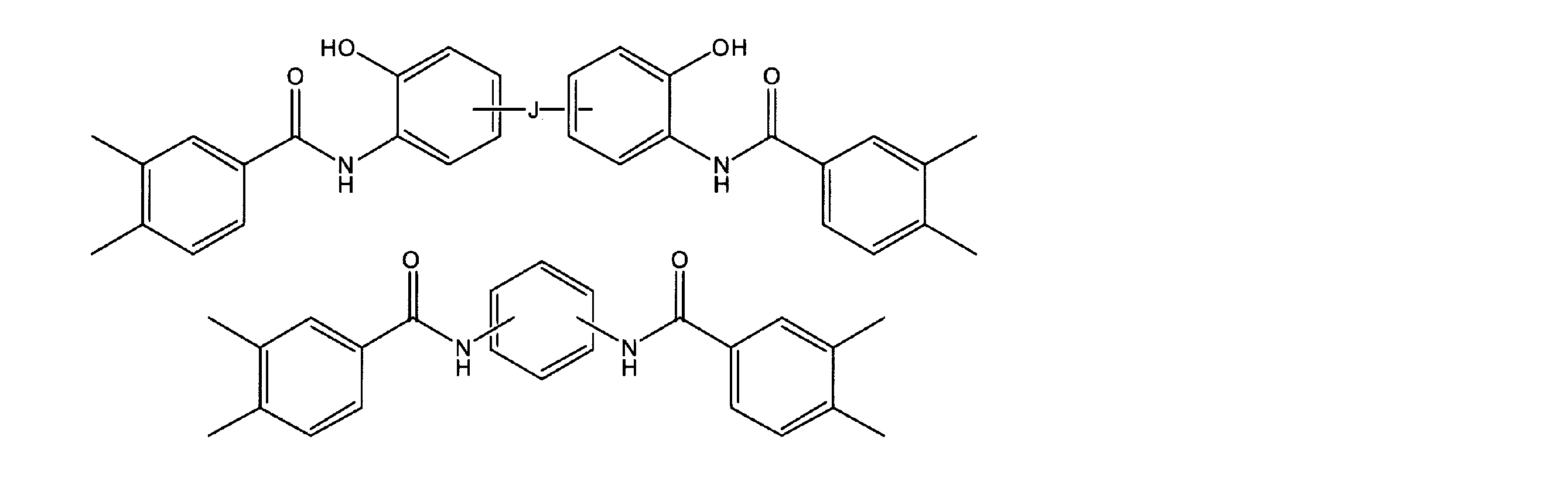
- the polyimide, polyimide precursor, polybenzoxazole, polybenzoxazole precursor, polyamideimide or polyamideimide precursor used for forming the organic thin film (II) is selected from the following general formulas (1) to (4) It is preferable to have a structural unit represented by the above formula. Moreover, you may contain 2 or more types of resin which has these structural units, and you may copolymerize 2 or more types of structural units.
- the polyimide, polyimide precursor, polybenzoxazole, polybenzoxazole precursor, polyamideimide or polyamideimide precursor used for forming the organic thin film (II) is one or more selected from the general formulas (1) to (4)
- the structural unit represented by the formula is preferably 50 mol% or more, more preferably 70 mol% or more, and still more preferably 90 mol% or more in the structural unit of the resin.
- a plurality of R 1 , R 2 and R 8 may be the same or different and each represents a divalent to octavalent organic group having 2 or more carbon atoms.
- a plurality of R 7 represent 4- to 8-valent organic groups having 2 or more carbon atoms.
- a plurality of R 3 and R 4 may be the same or different and each represents a phenolic hydroxyl group or a carboxyl group or a group in which they are alkylated.
- the plurality of R 5 , R 6 , R 9 and R 10 may be the same or different and are selected from a hydrogen atom, a phenolic hydroxyl group, a sulfonic acid group, a thiol group, and a monovalent organic group having 1 to 20 carbon atoms. It is a group.
- Y represents a terminal group.
- n is in the range of 10 to 10,000
- r, s and q are integers of 0 to 6
- p is an integer of 0 to 4
- m and l are integers of 0 to 4, respectively.
- R 1 represents a di-, tri- or tetra-carboxylic acid residue
- R 5 represents a tetracarboxylic acid residue (hereinafter collectively referred to as “acid residue”). ).
- acid residue represents a tetracarboxylic acid residue
- Examples of the acid component constituting R 1 (R 5 ) r (COOH) 2 and R 7 (R 9 ) p (COOH) 4 include terephthalic acid, isophthalic acid, diphenyl ether dicarboxylic acid, and bis (carboxyphenyl) hexafluoro.
- Dicarboxylic acid such as propane, biphenyl dicarboxylic acid, benzophenone dicarboxylic acid or triphenyl dicarboxylic acid
- tricarboxylic acid such as trimellitic acid, trimesic acid, diphenyl ether tricarboxylic acid or biphenyl tricarboxylic acid, or pyromellitic acid, 3,3 ′, 4,4 '-Biphenyltetracarboxylic acid, 2,3,3', 4'-biphenyltetracarboxylic acid, 2,2 ', 3,3'-biphenyltetracarboxylic acid, 3,3', 4,4'-benzophenonetetracarboxylic Acid, 2,2 ', 3,3'-benzophenone Tracarboxylic acid, 2,2-bis (3,4-dicarboxyphenyl) hexafluoropropane, 2,2-bis (2,3-dicarboxyphenyl) hexa
- Heptanetetracarboxylic acid bicyclo [3.3.1. ] Tetracarboxylic acid, bicyclo [3.1.1. ] Hept-2-enetetracarboxylic acid, bicyclo [2.2.2. ] Aliphatic tetracarboxylic acids such as octane tetracarboxylic acid or adamantane tetracarboxylic acid.
- the preferred structure of the acid residue includes, for example, the following structures, or 1 to 4 hydrogen atoms in these structures: an alkyl group having 1 to 20 carbon atoms, a fluoroalkyl group, an alkoxyl group, an ester group, a nitro group, And a structure substituted with a group, a cyano group, a fluorine atom or a chlorine atom.
- acids can be used as they are or as acid anhydrides, acid chlorides or active esters.
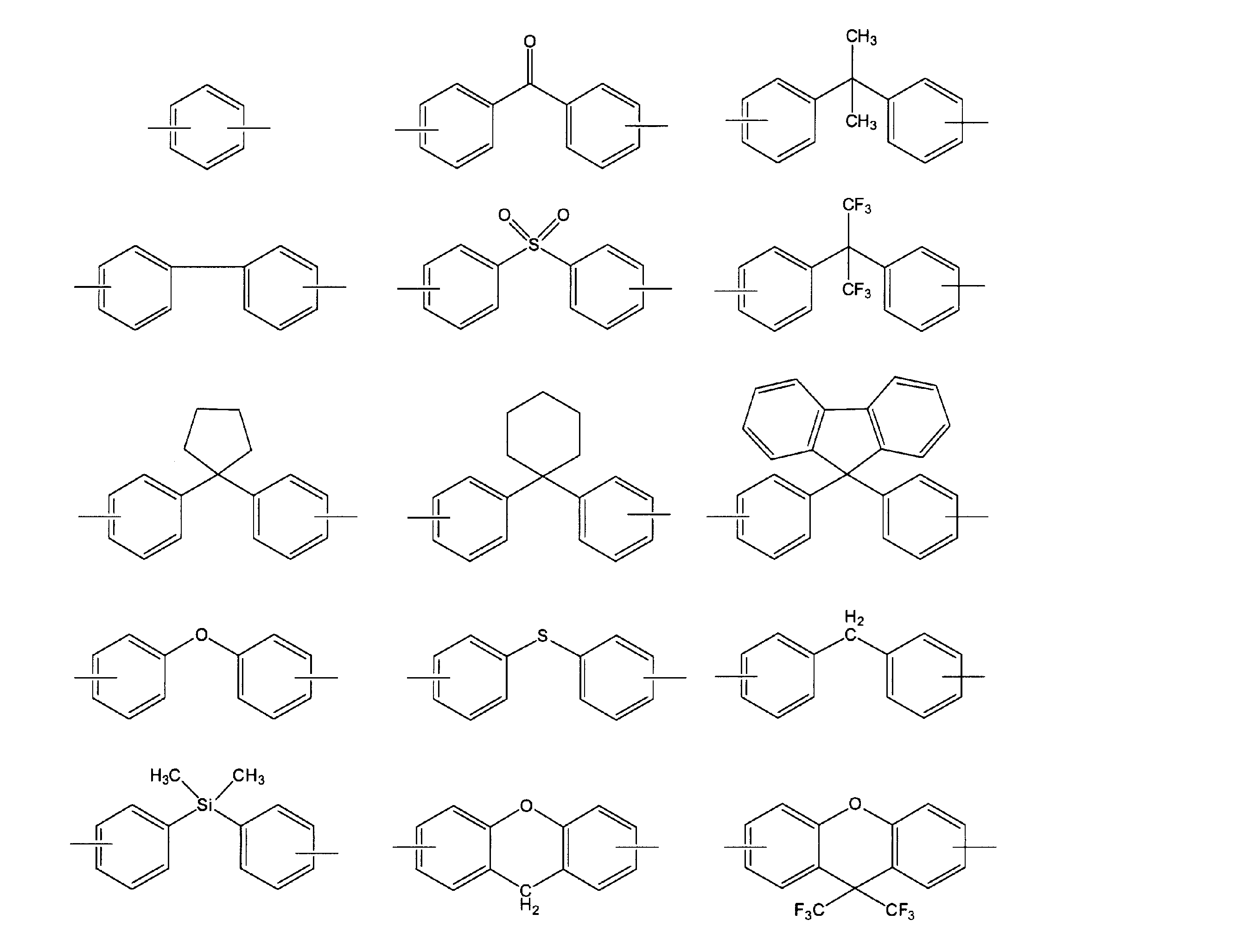
- J is a direct bond, —COO—, —CONH—, —CH 2 —, —C 2 H 4 —, —O—, —C 3 H 6 —, —SO 2 —, —S—, —Si ( CH 3 ) 2 —, —O—Si (CH 3 ) 2 —O—, —C 6 H 4 —, —C 6 H 4 —O—C 6 H 4 —, —C 6 H 4 —C 3 H 6 —C 6 H 4 — or —C 6 H 4 —C 3 F 6 —C 6 H 4 — is shown.
- silicon atom-containing tetracarboxylic acid such as dimethylsilanediphthalic acid or 1,3-bis (phthalic acid) tetramethyldisiloxane
- adhesion to the substrate oxygen plasma used for cleaning, etc.
- UV ozone Resistance to processing can be increased.
- silicon atom-containing dicarboxylic acids or tetracarboxylic acids are preferably used in an amount of 1 to 30 mol% of the total acid components.
- R 2 and R 8 represent a diamine residue or a bisaminophenol residue (hereinafter collectively referred to as “amine residue”).
- amine residue a diamine residue or a bisaminophenol residue
- diamine component and bisaminophenol component constituting R 2 (R 6 ) s (NH 2 ) 2 and R 8 (R 10 ) q (NH 2 ) 2
- diamine component bis (3-amino-4-hydroxyphenyl) hexafluoropropane, bis (3-amino-4-hydroxyphenyl) sulfone, bis (3-amino-4-hydroxyphenyl) propane, bis (3-amino- Hydroxyl group-containing diamines such as 4-hydroxyphenyl) methylene, bis (3-amino-4-hydroxyphenyl) ether, bis (3-amino-4-hydroxy) biphenyl or bis (3-amino-4-hydroxyphenyl) fluorene 3,5-diaminobenzoic acid or 3-
- these diamines include one or more alkyl groups having 1 to 10 carbon atoms such as a methyl group or an ethyl group, fluoroalkyl groups having 1 to 10 carbon atoms such as a trifluoromethyl group, one or more such as F, Cl, Br or I. It may be substituted with a group. In applications where heat resistance is required, it is preferable to use an aromatic diamine in an amount of 50 mol% or more of the total diamine component.
- the following structures or 1 to 4 hydrogen atoms in these structures are substituted with an alkyl group having 1 to 20 carbon atoms, a fluoroalkyl group, an alkoxyl group, an ester group, a nitro group, And a structure substituted with a group, a cyano group, a fluorine atom or a chlorine atom.
- diamines can be used as they are or as the corresponding diisocyanate compounds or trimethylsilylated diamines.
- J is a direct bond, —COO—, —CONH—, —CH 2 —, —C 2 H 4 —, —O—, —C 3 H 6 —, —SO 2 —, —S—, —Si ( CH 3 ) 2 —, —O—Si (CH 3 ) 2 —O—, —C 6 H 4 —, —C 6 H 4 —O—C 6 H 4 —, —C 6 H 4 —C 3 H 6 —C 6 H 4 — or —C 6 H 4 —C 3 F 6 —C 6 H 4 — is shown.
- silicon atom-containing diamine such as 1,3-bis (3-aminopropyl) tetramethyldisiloxane or 1,3-bis (4-anilino) tetramethyldisiloxane as the diamine component
- adhesion to the substrate is achieved.
- resistance to oxygen plasma and UV ozone treatment used for cleaning and the like can be increased.
- These silicon atom-containing diamines are preferably used in an amount of 1 to 30 mol% of the total diamine component.
- the main chain end is end-capped such as a monoamine, acid anhydride, monocarboxylic acid, monoacid chloride compound or monoactive ester compound. It is preferable to seal with a stopper.
- the introduction ratio of the monoamine used as the terminal blocking agent is preferably from 0.1 to 60 mol%, more preferably from 5 to 50 mol%, based on the total amine component.
- the introduction ratio of the acid anhydride, monocarboxylic acid, monoacid chloride compound or monoactive ester compound used as the end-capping agent is preferably 0.1 to 100 mol%, more preferably 5 to 90 mol% with respect to the diamine component. .
- Monoamines include aniline, 2-ethynylaniline, 3-ethynylaniline, 4-ethynylaniline, 5-amino-8-hydroxyquinoline, 1-hydroxy-7-aminonaphthalene, 1-hydroxy-6-aminonaphthalene, 1- Hydroxy-5-aminonaphthalene, 1-hydroxy-4-aminonaphthalene, 2-hydroxy-7-aminonaphthalene, 2-hydroxy-6-aminonaphthalene, 2-hydroxy-5-aminonaphthalene, 1-carboxy-7-amino Naphthalene, 1-carboxy-6-aminonaphthalene, 1-carboxy-5-aminonaphthalene, 2-carboxy-7-aminonaphthalene, 2-carboxy-6-aminonaphthalene, 2-carboxy-5-aminonaphthalene, 2-amino Benzoic acid, 3-aminobenzoic acid 4-aminobenzoic acid, 4-aminosalicylic acid, 5-aminos
- Examples of the acid anhydride, monocarboxylic acid, monoacid chloride compound or monoactive ester compound include acid anhydrides such as phthalic anhydride, maleic anhydride, nadic anhydride, cyclohexanedicarboxylic anhydride or 3-hydroxyphthalic anhydride.
- the end-capping agent introduced into the resin can be obtained, for example, by dissolving the resin into which the end-capping agent is introduced in an acidic solution and decomposing it into an amine component and an acid component, which are constituent units of the resin, and then performing gas chromatography. It can be easily detected by (GC) or NMR measurement. It can also be easily detected by detecting the resin into which the end-capping agent has been introduced by pyrolysis gas chromatograph (PGC), infrared spectrum or 13 CNMR spectrum measurement.
- PPC pyrolysis gas chromatograph
- the weight average molecular weight (hereinafter, “Mw”) of polyimide, polyimide precursor, polybenzoxazole, polybenzoxazole precursor, polyamideimide or polyamideimide precursor used for forming the organic thin film (II) is gel permeation chromatography. It is preferably 5000 to 200000 in terms of polystyrene measured by graphy (hereinafter referred to as “GPC”). By setting Mw within the above range, coating characteristics and solubility in a developing solution when forming a pattern are improved.
- the cardo resin used for forming the organic thin film (II) a cured product of an epoxy compound or an acrylic compound having a cardo structure or a polyester compound having a cardo structure is preferable.
- the epoxy compound having a cardo structure include 9,9-bis (4-glycidyloxyphenyl) fluorene or 9,9-bis [4- (2-glycidyloxyethoxy) phenyl] fluorene.
- acrylic compound having a cardo structure examples include 9,9-bis [4- (2-acryloyloxyethoxy) phenyl] fluorene, 9,9-bis [4- (2-methacryloyloxyethoxy) phenyl] fluorene, 9 , 9-bis [4- (3-acryloyloxy-2-hydroxypropoxy) phenyl] fluorene or 9,9-bis [4- (2- (3-acryloyloxy-2-hydroxypropoxy) ethoxy) phenyl] fluorene Can be mentioned.
- polyester compound having a cardo structure examples include CR-TR1, CR-TR2, CR-TR3, CR-TR4, and CR-TR5 (all manufactured by Osaka Gas Chemical).
- Examples of the polyethersulfone used for forming the organic thin film (II) include “Sumika Excel PES 3600P”, “Sumika Excel PES 3600P”, and “Sumika Excel PES 3600P” (all manufactured by Sumitomo Chemical).
- the phenol resin used for forming the organic thin film (II) can be obtained, for example, by reacting a phenol compound and an aldehyde compound in the presence of an alkaline catalyst and then alkoxylating a methylol group in a conventional manner under acidic conditions. it can.
- Phenol compounds include phenol, p-cresol, m-cresol, o-cresol, 2,3-dimethylphenol, 2,4-dimethylphenol, 2,5-dimethylphenol, 2,6-dimethylphenol, 3,4 -Dimethylphenol or 3,5-dimethylphenol is preferred.
- aldehyde compound examples include formalin, paraformaldehyde, acetaldehyde, benzaldehyde, hydroxybenzaldehyde, and chloroacetaldehyde, but two or more of these may be used.
- the polyurethane used for forming the organic thin film (II) is preferably one obtained by the reaction of a polyfunctional isocyanate and a polyol.
- the polyfunctional isocyanate include hexamethylene diisocyanate, 1,3-bis (isocyanatemethyl) benzene, 1,3-bis (isocyanatemethyl) cyclohexane, norbornene diisocyanate, naphthalene-1,5-disocyanate, and diphenylmethane-4,4.
- polyols examples include ethylene glycol, propylene glycol, pentaerythritol, dipentaerythritol, 1,4-bis (2-hydroxyethoxy) benzene, 1, diisocyanate and toluene-2,4-diisocyanate. 3-bis (2-hydroxyethoxy) benzene, 4,4′-bis (2-hydroxyethoxy) biphenyl, 2,2-bis (4- (2-hydroxyethoxy) phenyl) propane or bis (4- (2 Hydroxyethoxy) phenyl) methane, and the like, but may be used two or more of these.
- Examples of the melamine resin used for forming the organic thin film (II) include a resin obtained by a reaction between melamine and formaldehyde.
- the polyester used for forming the organic thin film (II) is obtained through, for example, a polyaddition reaction between a polyfunctional epoxy compound and a polyvalent carboxylic acid compound or a polyaddition reaction between a polyol compound and a dianhydride. Is preferable because it is easy to synthesize and has few side reactions.
- a polyol compound since it is easy to introduce a radical polymerizable group and an aromatic ring, those obtained by a reaction between a polyfunctional epoxy compound and a radical polymerizable group-containing monobasic acid compound are preferable.
- a polyfunctional epoxy compound is added in an amount of 1.01 to 2 equivalents relative to the polyvalent carboxylic acid compound for polymerization, and then a radical polymerizable group-containing monobasic acid compound is added to the terminal epoxy site, Examples include a method of adding an acid anhydride to the hydroxyl group to be generated.
- a polyol compound As a method of undergoing a polyaddition reaction between a polyol compound and a dianhydride, for example, in the presence of a catalyst, a polyol compound) a dianhydride is polymerized at an arbitrary ratio, and then a part of the generated carboxyl group
- the method of adding a radically polymerizable group containing epoxy compound is mentioned.
- a polyol compound has a radically polymerizable group, it does not need to add a radically polymerizable group containing epoxy compound.
- Examples of the catalyst used for the polyaddition reaction and the addition reaction include ammonium catalysts such as tetrabutylammonium acetate, amino catalysts such as 2,4,6-tris (dimethylaminomethyl) phenol or dimethylbenzylamine, and triphenylphosphine. And a phosphorus catalyst such as acetylacetonate chromium or chromium chloride.
- ammonium catalysts such as tetrabutylammonium acetate
- amino catalysts such as 2,4,6-tris (dimethylaminomethyl) phenol or dimethylbenzylamine
- triphenylphosphine triphenylphosphine
- a phosphorus catalyst such as acetylacetonate chromium or chromium chloride.
- the polyfunctional epoxy compound is preferably a compound represented by the following general formula (5) in order to adjust the refractive index of a cured film or the like and improve chemical resistance.
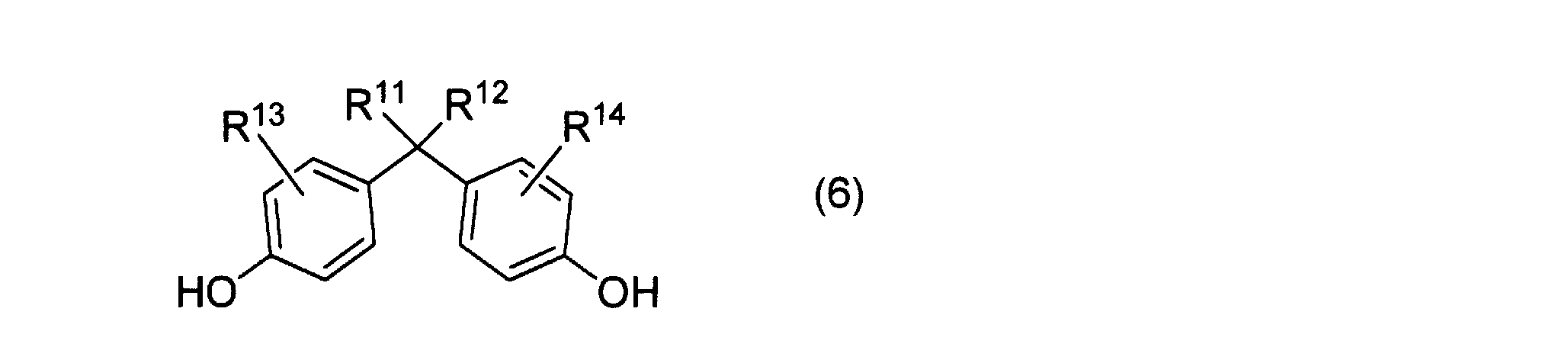
- R 11 and R 12 each independently represent hydrogen, an alkyl or cycloalkyl group having 1 to 12 carbon atoms, an aryl group having 6 to 20 carbon atoms, or a group in which they are substituted, or R 11 And R 12 together represent a cycloalkyl group having 2 to 12 carbon atoms, an aromatic ring having 5 to 12 carbon atoms, or a group in which they are substituted, R 13 and R 14 each independently represent hydrogen, A C 2-12 alkyl group, a C 6-20 aryl group, or a group in which they are substituted, m and l each independently represents an integer of 0-10.
- R 11 , R 12 , R 13 and R 14 are, for example, a methyl group, an ethyl group, a propyl group, a cyclopentyl group, a cyclohexyl group, a phenyl group, a naphthyl group, an o-tolyl group or a biphenyl group, or a substituent shown below. Is mentioned.
- R 11 and R 12 may form a cyclic structure, but the cyclic structure is preferably a 5- to 7-membered ring. Specific examples of the case where R 11 and R 12 form a cyclic structure include the following substituents.
- Examples of the polyfunctional epoxy compound include the following compounds.
- polyvalent carboxylic acid compound examples include succinic acid, maleic acid, fumaric acid, itaconic acid, phthalic acid, terephthalic acid, isophthalic acid, trimellitic acid, pyromellitic acid, 2,2′-biphenyldicarboxylic acid or 4, 4'-biphenyldicarboxylic acid is exemplified, but phthalic acid, terephthalic acid, isophthalic acid, trimellitic acid, pyromellitic acid, 2,2'-biphenyldicarboxylic acid are used to improve chemical resistance and insulation properties of cured films and the like. Acid or 4,4′-biphenyldicarboxylic acid is preferred.
- polyol compound examples include aliphatic alcohol compounds such as ethylene glycol, propylene glycol, butylene glycol, glycerin, trimethylolpropane and pentaerythritol, 9,9-bis [4- (2-hydroxyethoxy) phenyl] fluorene, A compound obtained by reaction of a functional epoxy compound and a radical polymerizable group-containing monobasic acid compound or a compound obtained by reaction of a bisphenol compound represented by the following general formula (6) and a radical polymerizable group-containing epoxy compound, etc.
- an aromatic alcohol compound is mentioned, an aromatic alcohol compound is preferable.
- R ⁇ 11 >, R ⁇ 12> , R ⁇ 13> and R ⁇ 14 > in General formula (6) are the same as General formula (5).
- dianhydride examples include pyromellitic dianhydride, 3,3 ′, 4,4′-biphenyltetracarboxylic dianhydride, 2,3,3 ′, 4′-biphenyltetracarboxylic acid Dianhydride, 2,2 ′, 3,3′-biphenyltetracarboxylic dianhydride, 3,3 ′, 4,4′-benzophenonetetracarboxylic dianhydride, 2,2 ′, 3 3'-benzophenonetetracarboxylic dianhydride, 2,2-bis (3,4-dicarboxyphenyl) hexafluoropropane dianhydride, 2,2-bis (2,3-dicarboxyphenyl) hexafluoro Propandioic anhydride, 1,1-bis (3,4-dicarboxyphenyl) ethanedioic anhydride, 1,1-bis (2,3-dicarboxyphenyl) e
- Heptanetetracarboxylic dianhydride bicyclo [3.3.1. ] Tetracarboxylic dianhydride, bicyclo [3.1.1. ] Hept-2-enetetracarboxylic dianhydride, bicyclo [2.2.2. ]
- Aliphatic tetracarboxylic dianhydrides such as octane tetracarboxylic dianhydride or adamantane tetracarboxylic dianhydride may be mentioned. In order to improve chemical resistance and insulation properties of cured films, etc.
- Is pyromellitic dianhydride, 3,3 ′, 4,4′-biphenyltetracarboxylic dianhydride, 2,3,3 ′, 4′-biphenyltetracarboxylic dianhydride, 2 ′, 3,3′-biphenyltetracarboxylic dianhydride is preferred, and in order to improve the transparency of the cured film, cyclobutanetetracarboxylic dianhydride, 1,2,3,4-cyclo Pentanetetracarboxylic dianhydride or cyclohexanetetracarboxylic dianhydride is preferred.
- Examples of the radically polymerizable group-containing monobasic acid compound include (meth) acrylic acid, succinic acid mono (2- (meth) acryloyloxyethyl), phthalic acid mono (2- (meth) acryloyloxyethyl), tetrahydrophthal Examples include acid mono (2- (meth) acryloyloxyethyl) or p-hydroxystyrene.
- radical polymerizable group-containing epoxy compound examples include glycidyl (meth) acrylate, ⁇ -ethylglycidyl (meth) acrylate, ⁇ -n-propyl glycidyl (meth) acrylate, and ⁇ -n- (meth) acrylate.
- acid anhydrides examples include succinic acid anhydride, maleic acid anhydride, itaconic acid anhydride, phthalic acid anhydride, trimellitic acid anhydride, pyromellitic acid monoanhydride, and 2,3-biphenyldicarboxylic acid anhydride. 3,4-biphenyldicarboxylic anhydride, hexahydrophthalic anhydride, glutaric anhydride, 3-methylphthalic anhydride, norbornene dicarboxylic anhydride, cyclohexene dicarboxylic anhydride or 3-trimethoxysilylpropyl succinic acid Anhydrides are mentioned.
- the acrylic resin used for forming the organic thin film (II) a carboxyl group-containing acrylic resin is preferable from the viewpoint of pattern processability, and at least a part of the ethylenically unsaturated double bond group is introduced and / or It is preferable in terms of hardness of the cured film to have a branch.
- a method for synthesizing the acrylic resin radical polymerization of a (meth) acrylic compound is exemplified.
- the (meth) acrylic compound include a carboxyl group and / or an acid anhydride group-containing (meth) acrylic compound or other (meth) acrylic acid ester.
- radical polymerization catalyst an azo compound such as azobisisobutyronitrile or an organic peroxide such as benzoyl peroxide is generally used.
- the conditions for radical polymerization may be set as appropriate.
- a carboxyl group and / or an acid anhydride group-containing (meth) acrylic compound, other (meth) acrylic acid ester and a radical polymerization catalyst are added, and bubbling or reduced pressure is added. It is preferable to carry out the reaction at 60 to 110 ° C. for 30 to 300 minutes after sufficiently purging the inside of the reaction vessel with nitrogen by degassing or the like.
- an acid anhydride group-containing (meth) acrylic compound When used, it is preferable to add a theoretical amount of water and react at 30 to 60 ° C. for 30 to 60 minutes. Moreover, you may use chain transfer agents, such as a thiol compound, as needed.
- Examples of (meth) acrylic compounds used in the synthesis of acrylic resins include (meth) acrylic acid, (meth) acrylic anhydride, itaconic acid, itaconic anhydride, succinic acid mono (2-acryloyloxyethyl), phthalate Acid mono (2-acryloyloxyethyl), tetrahydrophthalate mono (2-acryloyloxyethyl), methyl (meth) acrylate, ethyl (meth) acrylate, propyl (meth) acrylate, cyclopropyl (meth) acrylate , (Meth) acrylic acid cyclopentyl, (meth) acrylic acid cyclohexyl, (meth) acrylic acid cyclohexenyl, (meth) acrylic acid 4-methoxycyclohexyl, (meth) acrylic acid 2-cyclopropyloxycarbonylethyl, (meth) acrylic Acid 2-cyclopentyloxycarbo Ruethyl, 2-
- (Meth) acrylic acid is more preferable, and isobonyl (meth) acrylate, tricyclodecanyl (meth) acrylate or dicyclopentenyl (meth) acrylate is more preferable from the viewpoint of heat resistance.
- the acrylic resin may be a copolymer of a (meth) acrylic compound and other unsaturated double bond-containing monomer.
- unsaturated double bond-containing monomers include, for example, styrene, p-methylstyrene, o-methylstyrene, m-methylstyrene, ⁇ -methylstyrene, p-hydroxystyrene, maleic anhydride, norbornene, norbornene dicarboxylic acid , Norbornene dicarboxylic acid anhydride, cyclohexene, butyl vinyl ether, butyl allyl ether, 2-hydroxyethyl vinyl ether, 2-hydroxyethyl allyl ether, cyclohexane vinyl ether, cyclohexane allyl ether, 4-hydroxybutyl vinyl ether, 4-hydroxybutyl allyl ether, allyl Glycidyl ether, vinyl glycidyl ether,
- an acrylic resin having an ethylenically unsaturated bond a carboxyl group and / or an acid anhydride group-containing (meth) acrylic compound, (meth) acrylic acid ester and / or other unsaturated double bond-containing monomer was radically polymerized. Thereafter, those obtained by addition reaction of an epoxy compound having an ethylenically unsaturated double bond group are preferred.
- the catalyst used for the addition reaction include amino catalysts such as dimethylaniline, 2,4,6-tris (dimethylaminomethyl) phenol or dimethylbenzylamine, tin (II) 2-ethylhexanoate or dibutyltin laurate, etc.
- Tin catalysts titanium catalysts such as titanium (IV) 2-ethylhexanoate, phosphorus catalysts such as triphenylphosphine, and chromium catalysts such as acetylacetonate chromium or chromium chloride.
- Examples of the epoxy compound having an ethylenically unsaturated double bond group include glycidyl (meth) acrylate, ⁇ -ethylglycidyl (meth) acrylate, ⁇ -n-propylglycidyl (meth) acrylate, and (meth) acrylic.
- the branched acrylic resin can be obtained by using a compound having a plurality of ethylenically unsaturated double bond groups and / or thiol groups during polymerization.
- the compound having a plurality of ethylenically unsaturated double bond groups include glycerol diacrylate, glycerol dimethacrylate, glycerol acrylate methacrylate, glycerol triacrylate, glycerol trimethacrylate, glycerol diacrylate methacrylate, glycerol acrylate dimethacrylate, divinylbenzene, Examples thereof include vinylbenzene, diethylene glycol diacrylate, triethylene glycol diacrylate, trimethylolpropane diacrylate, trimethylolpropane triacrylate and the like.
- Examples of the compound having a plurality of thiol groups include pentaerythritol (tetrakis (3-mercaptobutyrate), trimethylolethane tris (3-mercaptobutyrate), 1,4-bis (3-mercaptobutyryloxy) butane, 1,3 , 5-tris (3-mercaptobutyloxyethyl) -1,3,5-triazine-2,4,6 (1H, 3H, 5H) -trione and the like.
- the Mw of the acrylic resin used for forming the organic thin film (II) is preferably 2000 to 200000 in terms of polystyrene measured by GPC. By setting Mw within the above range, coating characteristics and solubility in a developing solution when forming a pattern are improved.
- the polysiloxane used for forming the organic thin film (II) preferably has a phenyl group or a naphthyl group from the viewpoint of storage stability of the coating liquid, and has an epoxy group or an amino group from the viewpoint of chemical resistance.
- Those having a (meth) acrylic group or vinyl group are preferable from the viewpoint of curability, and those having a carboxyl group or a phenolic hydroxyl group are preferable from the viewpoint of pattern processability.
- a method for synthesizing polysiloxane a method of hydrolytic condensation of an organosilane compound is common.
- organosilane compound used for the synthesis of polysiloxane examples include methyltrimethoxysilane, methyltriethoxysilane, ethyltrimethoxysilane, ethyltriethoxysilane, hexyltrimethoxysilane, octadecyltrimethoxysilane, octadecyltriethoxysilane, and phenyl.
- the hydrolysis reaction conditions of the organosilane compound may be appropriately set. For example, after adding an acid catalyst and water to the organosilane compound in a solvent over 1 to 180 minutes, the reaction is performed at room temperature to 110 ° C. for 1 to 180 minutes. It is preferable to make it. By performing the hydrolysis reaction under such conditions, a rapid reaction can be suppressed.
- the reaction temperature is preferably 30 to 105 ° C.
- the hydrolysis reaction is preferably performed in the presence of an acid catalyst.
- the acid catalyst an acidic aqueous solution containing formic acid, acetic acid or phosphoric acid is preferable.
- the content of these acid catalysts is preferably 0.1 to 5 parts by weight with respect to 100 parts by weight of the total organosilane compound used during the hydrolysis reaction. By making content of an acid catalyst into the said range, it can control easily so that a hydrolysis reaction may progress sufficiently and necessary.
- As conditions for the condensation reaction it is preferable to obtain a silanol compound by hydrolysis of an organosilane compound, and then heat the reaction solution as it is at 50 ° C. to the boiling point of the solvent for 1 to 100 hours. In order to increase the degree of polymerization of the polysiloxane, reheating or a base catalyst may be added.
- an appropriate amount of the produced alcohol or the like may be distilled and removed by heating and / or decompression as necessary, and an optional solvent may be added thereafter.
- the Mw of the polysiloxane used for forming the organic thin film (II) is preferably 1000 to 100,000 in terms of polystyrene measured by GPC. By setting Mw within the above range, coating characteristics and solubility in a developing solution when forming a pattern are improved.
- the organic thin film (II) preferably contains metal oxide particles.
- the refractive index can be adjusted to a desired range.
- the number average particle diameter of the metal oxide particles is preferably 1 to 200 nm, and more preferably 1 to 70 nm in order to obtain a cured film having a high transmittance.
- the number average particle diameter of the metal oxide particles can be measured by a gas adsorption method, a dynamic light scattering method, an X-ray small angle scattering method, a transmission electron microscope, or a scanning electron microscope.
- the metal oxide particles those having a high refractive index by themselves are preferable, and more specifically, titanium oxide particles such as titanium oxide particles and barium titanate particles, or zirconium oxide particles such as zirconium oxide particles are preferable. .
- the metal oxide particles can be pulverized or dispersed using a disperser such as a bead mill by procuring appropriate nanoparticle powder.
- a disperser such as a bead mill by procuring appropriate nanoparticle powder.
- commercially available nanoparticle powders include T-BTO-020RF (barium titanate; manufactured by Toda Kogyo Co., Ltd.), UEP-100 (zirconium oxide; manufactured by Daiichi Rare Element Chemical Co., Ltd.) or STR-100N. (Titanium oxide; manufactured by Sakai Chemical Industry Co., Ltd.). It can also be procured as a dispersion.
- silicon oxide-titanium oxide particles examples include “OPTRAIK” (registered trademark) TR-502, “OPTRAIK” TR-503, “OPTRAIK” TR-504, “OPTRAIK” TR-513, “OPTRAIK” “TR-520", “Optlake” TR-527, “Optlake” TR-528, “Optlake” TR-529, “Optlake” TR-544 or “Optlake” TR-550 Kogyo Co., Ltd.).
- SZR-M or SZR-K both manufactured by Saka
- the content of the metal oxide particles is generally about 1 to 75% by weight in the solid content of the resin composition.
- the solid content concentration of the resin composition used for forming the organic thin film (II) is preferably 0.1 to 10 wt% because the film thickness can be easily controlled.
- the refractive index of the organic thin film (III) is preferably 1.48 to 1.54, more preferably 1.50 to 1.53.
- the film thickness of the organic thin film (III) is preferably 1.0 to 5 ⁇ m, more preferably 1.5 to 3.0 ⁇ m.
- the method of forming the organic thin film (III) is the same as the example of the organic thin film (II) described above.
- an acrylic resin, an epoxy resin, or a polysiloxane is preferable from the viewpoint of transparency, versatility, or refractive index, and an acrylic resin or polysiloxane is more preferable from the viewpoint of workability.
- Preferred examples of the acrylic resin and polysiloxane are the same as those in the organic thin film (II) described above.
- the solid content concentration of the resin composition forming the organic thin film (III) is preferably 5 to 80 wt% because the film thickness can be easily controlled.
- the resin composition for forming the organic thin film (II) and the organic thin film (III) may be a photosensitive resin composition, or may be either a positive type or a negative type.
- a quinonediazide compound is preferable as a component imparting photosensitivity.
- a mixture of a quinonediazide compound and an alkali-soluble resin forms a positive type by exposure and alkali development.
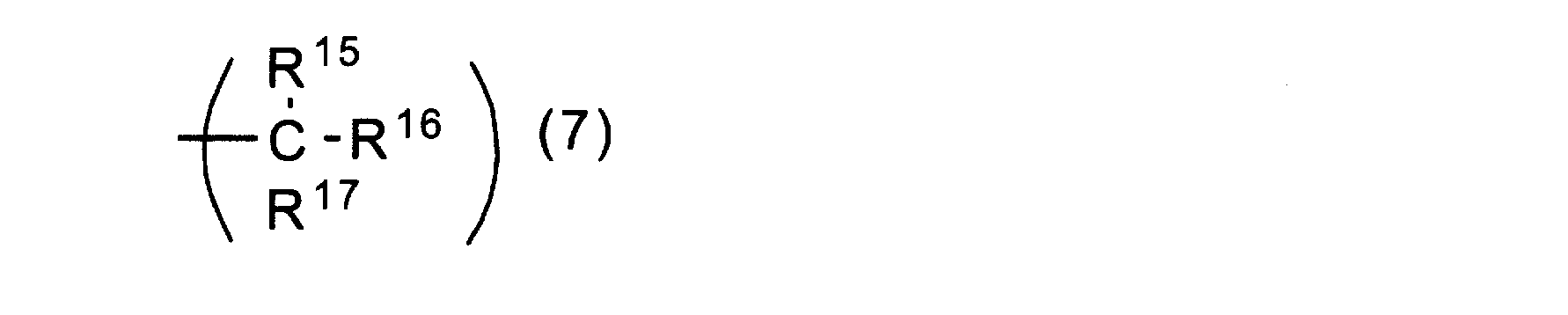
- the quinonediazide compound a compound in which naphthoquinonediazidesulfonic acid is ester-bonded to a compound having a phenolic hydroxyl group is preferable, and hydrogen or the following general formula (7) is independently present at the ortho-position and para-position of the phenolic hydroxyl group of the compound. The compound which has a substituent represented by these is used.
- R 15 to R 17 may be the same or different and each represents an alkyl group having 1 to 10 carbon atoms, a carboxyl group, a phenyl group or a substituted phenyl group, or R 15 and R 16 , R 15 And R 17 may form a ring with R 16 and R 17 .
- R 15 to R 17 may be the same or different and each is a substituted or unsubstituted alkyl group having 1 to 10 carbon atoms, a carboxyl group, a phenyl group, or a substituted phenyl group. Indicates one of the following. Examples of the alkyl group include methyl group, ethyl group, n-propyl group, isopropyl group, n-butyl group, isobutyl group, t-butyl group, n-hexyl group, cyclohexyl group, n-heptyl group, and n-octyl group.
- R 15 and R 16 , and R 15 and R 17 by R 16 and R 17 include a cyclopentane ring, a cyclohexane ring, an adamantane ring, and a fluorene ring.
- the quinonediazide compound can be synthesized by a known esterification reaction between a compound having a phenolic hydroxyl group and naphthoquinonediazidesulfonic acid chloride.
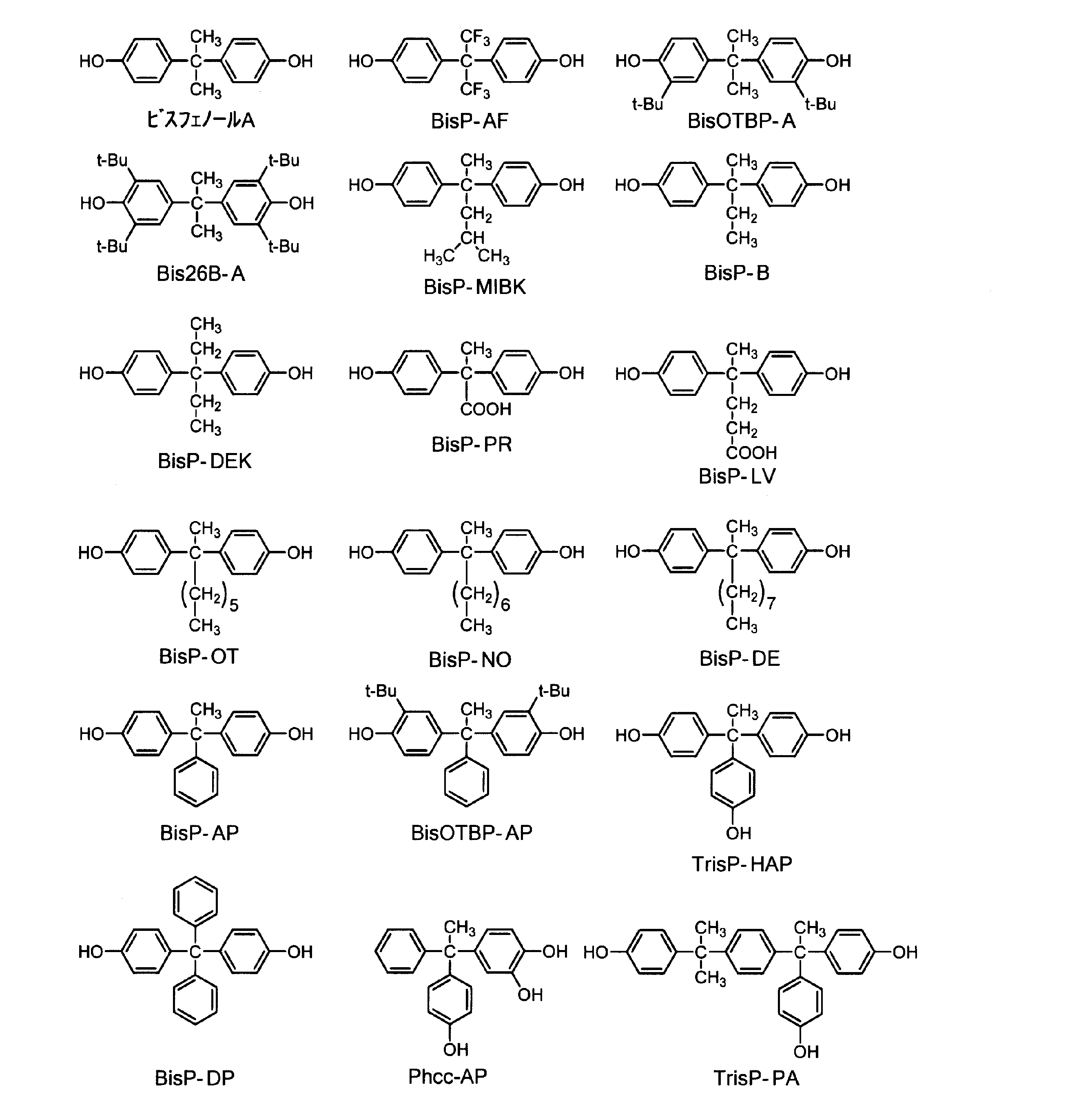
- Examples of the compound having a phenolic hydroxyl group include the following compounds (manufactured by Honshu Chemical Industry Co., Ltd.).
- naphthoquinone diazide sulfonic acid examples include 4-naphthoquinone diazide sulfonic acid and 5-naphthoquinone diazide sulfonic acid. Since 4-naphthoquinonediazide sulfonic acid ester compound has absorption in the i-line (wavelength 365 nm) region, it is suitable for i-line exposure. Further, the 5-naphthoquinonediazide sulfonic acid ester compound has absorption in a wide wavelength range and is therefore suitable for exposure in a wide wavelength range.
- a 4-naphthoquinone diazide sulfonic acid ester compound or a 5-naphthoquinone diazide sulfonic acid ester compound depending on the wavelength to be exposed.
- a mixture of 4-naphthoquinone diazide sulfonic acid ester compound and 5-naphthoquinone diazide sulfonic acid ester compound may be used.
- the molecular weight of the naphthoquinone diazide compound is preferably 300 to 1500, and more preferably 350 to 1200. If the molecular weight of the naphthoquinone diazide compound is greater than 1500, pattern formation may not be possible with an addition amount of 4 to 10% by weight. On the other hand, when the molecular weight of the naphthoquinone diazide compound is less than 300, the colorless transparency may be lowered.
- the photosensitive resin composition is a negative type
- a photopolymerization initiator and a polyfunctional monomer are preferable as the component imparting photosensitivity.
- the photopolymerization initiator that is a component imparting photosensitivity is preferably one that decomposes and / or reacts with light (including ultraviolet rays and electron beams) to generate radicals.
- Examples of the photopolymerization initiator that decomposes and / or reacts with light to generate radicals include 2-methyl- [4- (methylthio) phenyl] -2-morpholinopropan-1-one, 2-dimethylamino- 2- (4-Methylbenzyl) -1- (4-morpholin-4-yl-phenyl) -butan-1-one, 2-benzyl-2-dimethylamino-1- (4-morpholinophenyl) -butanone -1,2,4,6-trimethylbenzoylphenylphosphine oxide, bis (2,4,6-trimethylbenzoyl) -phenylphosphine oxide, bis (2,6-dimethoxybenzoyl)-(2,4,4-trimethyl Pentyl)
- ⁇ -aminoalkylphenone compounds acylphosphine oxide compounds, oxime ester compounds, benzophenone compounds having amino groups, or benzoic acid ester compounds having amino groups are preferred.
- Examples of the ⁇ -aminoalkylphenone compound include 2-methyl- [4- (methylthio) phenyl] -2-morpholinopropan-1-one, 2-dimethylamino-2- (4-methylbenzyl) -1- (4-morpholin-4-yl-phenyl) -butan-1-one or 2-benzyl-2-dimethylamino-1- (4-morpholinophenyl) -butanone-1.
- acylphosphine oxide compound examples include 2,4,6-trimethylbenzoylphenylphosphine oxide, bis (2,4,6-trimethylbenzoyl) -phenylphosphine oxide, or bis (2,6-dimethoxybenzoyl)-(2 , 4,4-trimethylpentyl) -phosphine oxide.
- oxime ester compounds include 1-phenyl-1,2-propanedione-2- (o-ethoxycarbonyl) oxime, 1,2-octanedione, 1- [4- (phenylthio) -2- (O— Benzoyloxime)], 1-phenyl-1,2-butadion-2- (o-methoxycarbonyl) oxime, 1,3-diphenylpropanetrione-2- (o-ethoxycarbonyl) oxime or ethanone, 1- [9- And ethyl-6- (2-methylbenzoyl) -9H-carbazol-3-yl]-, 1- (0-acetyloxime).
- benzophenone compound having an amino group examples include 4,4-bis (dimethylamino) benzophenone and 4,4-bis (diethylamino) benzophenone.
- benzoic acid ester compound having an amino group examples include ethyl p-dimethylaminobenzoate, 2-ethylhexyl-p-dimethylaminobenzoate, and ethyl p-diethylaminobenzoate.
- polyfunctional monomer that is a component imparting photosensitivity examples include diethylene glycol diacrylate, triethylene glycol diacrylate, tetraethylene glycol diacrylate, diethylene glycol dimethacrylate, triethylene glycol dimethacrylate, tetraethylene glycol dimethacrylate, and trimethylol.
- Dimethylol-tricyclodecane diacrylate, dimethylol-tricyclodecane dimethacrylate, ethoxylated bisphenol A diacrylate or 9,9-bis [4- (2-acryloyloxyethoxy) Phenyl] fluorene are preferred.
- polyfunctional monomers include, for example, epoxy (meth) acrylates obtained by reacting polyfunctional epoxy compounds with (meth) acrylic acid.
- examples of the polyfunctional epoxy compound include the following compounds.
- the organic thin film (II) and the organic thin film (III) are obtained by patterning all at once by one exposure and development because the number of processes can be reduced. More specifically, by applying a photosensitive resin composition for forming an organic thin film (III) on a pre-baked film of a resin composition for forming an organic thin film (II), exposing, developing, and curing. Pattern-processed organic thin film (II) and organic thin film (III) can be obtained.
- the resin used for forming the organic thin film (II) is a photosensitive resin for forming the organic thin film (III) in order to prevent turbidity between the organic thin film (II) and the organic thin film (III) or the cloudiness of the coating film.
- the resin used for forming the organic thin film (II) includes a polyimide precursor and polybenzoxazole. Precursors or polyamideimide precursors are preferred.
- the transparent adhesive thin film (IV) of the present invention refers to a thin film formed with a transparent adhesive.
- the transparent adhesive refers to a material that transmits light and has adhesiveness.
- the film thickness of the transparent adhesive thin film (IV) is preferably 1 to 200 ⁇ m from the viewpoint of adhesiveness and transparency.
- the adhesive strength of the transparent adhesive is preferably 3 to 100 N / 20 mm. Further, the transmittance of the transparent adhesive is preferably 90% or more in terms of the total line transmittance (based on JIS K7361-1) from the viewpoint of the appearance of the touch panel.
- the transparent adhesive examples include a thermosetting adhesive and a UV curable adhesive.
- the thermosetting transparent adhesive having a refractive index of 1.46 to 1.52 include an alkyl (meth) acrylate having 1 to 20 carbon atoms, a (meth) acrylate containing a hydroxyl group, and / or a carboxyl group.
- examples thereof include a copolymer having a (meth) acrylic acid derivative as a constituent monomer, or a thermosetting pressure-sensitive adhesive containing a polyfunctional isocyanate compound and / or a polyfunctional epoxy compound.
- UV curable transparent adhesive having a refractive index of 1.46 to 1.52 examples include, as a main component, a monofunctional or polyfunctional (meth) acrylate monomer and / or oligomer, and a photopolymerization initiator, A UV curable pressure sensitive adhesive may be mentioned.
- OCA Optical Cler Adhesive
- OCR Optical Cler Adhesive Resin
- UV curable type used for bonding various substrates together.
- the common name of the pressure-sensitive adhesive can be used.
- a transparent adhesive thin film (IV) formed from the above transparent adhesives the adhesive which commercial multifunctional films, such as a scattering prevention film, comprise can be used.
- Examples of commercially available OCA materials that can form the transparent adhesive thin film (IV) include 8171CL, 8172CL, 8146-1 or 8146-2 (all manufactured by Sumitomo 3M Limited), CS9622T, CS9621T, or CS9070. (All manufactured by Nitto Denko Corporation), TE-9000, TE-7000, TE-8500 or DA-5000H (Hitachi Chemical Co., Ltd.) or MO-3010 or MO-T010 (all of which are Lintec Corporation) )).
- Examples of commercially available OCR materials that can form a transparent adhesive thin film (IV) include XV-SV-B1 or XV-7811 (both manufactured by Panasonic Corporation), UVP-1003, UVP-1100, UVP-7100 or UVP-7000 (both manufactured by Toagosei Co., Ltd.).
- Examples of commercially available multifunctional films with a transparent adhesive that can be made into a transparent adhesive thin film (IV) include, for example, HA-110, HA-115, HA-116, or HA-, which are widely used as anti-scattering films. 203 (all manufactured by Lintec Corporation) or HC1100F-BP or HC2120F-BP (all manufactured by DIC Corporation).
- the substrate of the present invention includes, for example, a resistive touch panel, a capacitive touch panel, and a TFT substrate.
- a capacitive touch panel is preferably used for a capacitive touch panel, and is a cover glass integrated capacitive touch panel. More preferably, it is used.
- Synthesis Example 2 Synthesis of Polyimide (P1) 16.5 g (0.045 mol) of BAHF was dissolved in 250 g of N-methyl-2-pyrrolidone (hereinafter “NMP”) under a dry nitrogen stream. To this, 15.5 g (0.05 mol) of 3,3 ′, 4,4′-diphenyl ether tetracarboxylic dianhydride (manac Co., Ltd .; hereinafter referred to as “ODPA”) was added together with 50 g of NMP. Stir at 0 ° C. for 2 hours. Thereafter, 1.09 g (0.01 mol) of 3-aminophenol (manufactured by Tokyo Chemical Industry Co., Ltd.) was added, and stirring was continued at 40 ° C.
- NMP N-methyl-2-pyrrolidone
- ODPA 4,4′-diphenyl ether tetracarboxylic dianhydride
- Synthesis Example 3 Synthesis of Polyimide Precursor (P2) Under a dry nitrogen stream, 25.7 g (0.043 mol) of the hydroxyl group-containing diamine compound obtained in Synthesis Example 1 and 0.62 g (0.0025 mol) of 1 , 3-bis (3-aminopropyl) tetramethyldisiloxane (hereinafter “SiDA”) was dissolved in 200 g of NMP. 15.5 g (0.05 mol) of ODPA was added thereto together with 50 g of NMP, and the mixture was stirred at 40 ° C. for 2 hours.
- SiDA 3-bis (3-aminopropyl) tetramethyldisiloxane
- the resulting solution was added dropwise so that the internal temperature did not exceed 0 ° C. After completion of the dropwise addition, stirring was continued at ⁇ 15 ° C. for 6 hours. After completion of the reaction, the solution was poured into 2 L of water containing 10% by weight of methanol, and the polymer solid precipitate was collected by filtration. Further, it was washed with 2 L of water three times, and the collected polymer solid was dried with a vacuum dryer at 50 ° C. for 72 hours to obtain.
- Synthesis Example 5 Synthesis of Polyamideimide Precursor (P4) 19.22 g (96.0 mmol) of 4,4′-diaminodiphenyl ether (manufactured by Wakayama Seika Kogyo Co., Ltd.), 0.99 g (nitrogen-substituted atmosphere) 4.0 mmol) SiDA and 10.1 g (100.0 mmol) triethylamine (manufactured by Tokyo Chemical Industry Co., Ltd.) were dissolved in 200 g NMP.
- 20.63 g (98.0 mmol) of trimellitic anhydride chloride dissolved in 80 g of NMP was added dropwise. After completion of the dropwise addition, the liquid temperature was adjusted to 30 ° C. and stirred for 4 hours for reaction.
- the obtained polymerization solution was put into 2 L of ion exchange water, separated by filtration, and washed again with pure water to obtain a polyamideimide acid precursor (P4) powder.
- Synthesis Example 7 Synthesis of Acrylic Resin Solution (P6)
- AIBN 2,2′-azobis (isobutyronitrile)
- PGMEA propylene glycol methyl ether acetate
- TCDMA tricyclo [5.2.1.02,6] decan-8-yl methacrylate
- GMA glycidyl methacrylate
- dimethylbenzylamine 1 g
- PGMEA p-methoxyphenol
- 100 g of PGMEA 100 g
- Synthesis Example 8 Synthesis of Acrylic Resin Solution (P7) 1 g of AIBN and 150 g of PGMEA were charged into a 500 mL flask. Thereafter, 15.8 g methacrylic acid, 11.5 g styrene, 32.3 g TCDMA, 9.4 g t-butyl methacrylate, 15.6 g GMA and 23.3 g glycerol trimethacrylate were charged and stirred at room temperature for a while. Then, the inside of the flask was sufficiently purged with nitrogen by bubbling, and then heated and stirred at 70 ° C. for 5 hours.
- Synthesis Example 9 Synthesis of Polysiloxane Solution (P8) In a 500 mL flask, 47.67 g (0.35 mol) methyltrimethoxysilyl, 39.66 g (0.20 mol) phenyltrimethoxysilane, 82.04 g (0 .35 mol) of ⁇ -acryloylpropyltrimethoxysilane, 26.23 (0.1 mol) of 3-trimethoxysilylpropyl succinic anhydride and 195.6 g of diacetone alcohol (hereinafter “DAA”), An aqueous solution of phosphoric acid in which 0.39 g of phosphoric acid (0.2 parts by weight with respect to the charged monomer) was dissolved in 55.8 g of water (theoretical amount required for hydrolysis) was added dropwise while stirring in an oil bath.
- DAA diacetone alcohol
- Synthesis Example 10 Synthesis of Polysiloxane Solution (P9) Methyltrimethoxysilane, 76.39 g (0.35 mol) trifluoropropyltrimethoxysilane, 82.04 g in a 500 mL 27.24 g (0.20 mol) flask (0.35 mol) of ⁇ -acryloylpropyltrimethoxysilane, 26.23 (0.1 mol) of 3-trimethoxysilylpropyl succinic anhydride and 211.9 g of DAA were charged and immersed in an oil bath at 40 ° C. and stirred.
- P9 Polysiloxane Solution (P9) Methyltrimethoxysilane, 76.39 g (0.35 mol) trifluoropropyltrimethoxysilane, 82.04 g in a 500 mL 27.24 g (0.20 mol) flask (0.35 mol) of ⁇ -acryloy
- an aqueous phosphoric acid solution in which 0.39 g of phosphoric acid (0.2 parts by weight with respect to the charged monomer) was dissolved in 55.8 g of water (theoretical amount necessary for hydrolysis) was added with a dropping funnel over 10 minutes. .
- the oil bath temperature was set to 70 ° C. and stirred for 1 hour, and the oil bath was further heated to 115 ° C. over 30 minutes.
- the internal temperature of the solution reached 100 ° C., and was then heated and stirred for 2 hours (the internal temperature was 100 to 110 ° C.).
- Synthesis Example 11 Synthesis of Polysiloxane Solution (P10) In a 500 mL flask, 40.86 g (0.3 mol) of methyltrimethoxysilane, 99.15 g (0.50 mol) of phenyltrimethoxysilane, 49.28 g (0 .20 mol) 2- (3,4-epoxycyclohexyl) ethyltrimethoxysilane and 189.29 g DAA, soaked in an oil bath at 40 ° C.
- Preparation Example 14 Preparation of Resin Composition (H14) A positive photosensitive resin composition was prepared in the same manner as in Preparation Example 13 except that the polybenzoxazole precursor (P3) was used instead of the polyimide (P1). A product (H14) was obtained.
- Preparation Example 17 Preparation of Resin Composition (H17) A positive photosensitive resin composition (H17) was prepared in the same manner as in Preparation Example 13 except that polyester resin (P5) was used instead of polyimide (P1). )
- Preparation Example 20 Preparation of Resin Composition (H20) The same operation as in Preparation Example 18 was performed, except that the polyamideimide precursor (P4) was used instead of the polyimide precursor (P2), and a non-photosensitive resin composition. A product (H20) was obtained.
- Preparation Example 22 Preparation of Resin Composition (H22) 9.300 g of 0.5 g of 9,9-bis [4- (2-glycidyloxyethoxy) phenyl] fluorene (Osaka Gas Chemicals; EG-200) 0.02 g of SI-200 (manufactured by Sanshin Chemical Co., Ltd .; thermal acid generator) and BYK-333 in 1 wt% PGMEA solution (0.200 g) were added and stirred. Subsequently, it filtered with a 0.45 micrometer filter and obtained the resin composition (H22).
- Resin Composition (H22) 9.300 g of 0.5 g of 9,9-bis [4- (2-glycidyloxyethoxy) phenyl] fluorene (Osaka Gas Chemicals; EG-200) 0.02 g of SI-200 (manufactured by Sanshin Chemical Co., Ltd .; thermal acid generator) and BYK-333 in 1 w
- Preparation Example 25 Preparation of Resin Composition (M2) A negative photosensitive resin composition was prepared in the same manner as in Preparation Example 20, except that the acrylic resin solution (P7) was used instead of the acrylic resin solution (P6). A product (M2) was obtained.
- Preparation Example 26 Preparation of Resin Composition (M3) Under a yellow light, 0.900 g of TP5-280M was added, dissolved in 6.15 g of PGMEA and stirred. Thereto, 12.75 g of an acrylic resin solution (P6) and 0.2000 g of a PGMEA 1 wt% solution of BYK-333 were added and stirred. Subsequently, filtration was performed with a 0.45 ⁇ m filter to obtain a positive photosensitive resin composition (M3).
- Table 1 summarizes the compositions of the resin compositions obtained in Preparation Examples 1 to 31.
- Example 1 Fabrication of pattern ITO After sputtering a 50 nm thick ITO film on a 1.1 mm thick chemically strengthened glass substrate, a positive photoresist (OFPR-800; manufactured by Tokyo Ohka Kogyo Co., Ltd.) is applied to a spin coater ( After spin coating using 1H-360S (manufactured by Mikasa Co., Ltd.), it was prebaked at 100 ° C. for 2 minutes using a hot plate (SCW-636; manufactured by Dainippon Screen Mfg. Co., Ltd.). The obtained pre-baked film was exposed to 1000 J / m 2 with a gap of 100 ⁇ m through a mask using PLA as an ultrahigh pressure mercury lamp as a light source.
- a positive photoresist OFPR-800; manufactured by Tokyo Ohka Kogyo Co., Ltd.
- 1H-360S manufactured by Mikasa Co., Ltd.
- SCW-636 manufactured by Dainippon Screen Mfg. Co
- TMAH aqueous 2.38 wt% tetramethylammonium hydroxide
- the ITO is etched with an HCl-HNO 3 -based etching solution, the photoresist is removed with a stripping solution, and the first electrode and a portion of the second electrode perpendicular thereto are patterned (FIGS. 1 and 2).
- a glass substrate having the symbol 2) was prepared (corresponding to a in FIG. 1).
- the ITO pattern interval was designed to be 40 ⁇ m.
- ITO pattern visibility was evaluated in the following 10 stages. Six or more were accepted. 10: No pattern is seen by staring under white fluorescent lamp 5 cm 9: A slight pattern is seen by staring under white fluorescent lamp 5 cm 8: A little pattern can be seen by staring under a white fluorescent lamp 5 cm. 7: A clear pattern can be seen by staring under a white fluorescent lamp 5 cm. 6: A pattern is slightly visible with normal visual observation under a white fluorescent lamp 5 cm. 5: A little pattern is visible by normal visual observation under 5 cm of white fluorescent lamps. 4: A pattern can be clearly seen with normal visual observation under 5 cm of white fluorescent light. 3: A slight pattern is visible with normal visual inspection under room light. 2: A little pattern is visible with normal visual observation under room light. 1: A clear pattern can be seen with normal visual inspection under room light.
- Discolored area ratio of MAM under the cured film is 1 to 3%. No change in the appearance of the cured film itself. 8: MAM discoloration area ratio under the cured film is 4 to 6%. No change in the appearance of the cured film itself. 7: The MAM discoloration area ratio under the cured film is 7 to 9%. No change in the appearance of the cured film itself. 6: The MAM discolored area ratio under the cured film is 10 to 15%. No change in the appearance of the cured film itself. 5: Discolored area ratio of MAM under the cured film is 16 to 20%. No change in the appearance of the cured film itself. 4: The discolored area ratio of MAM under the cured film is 21 to 30%. No change in the appearance of the cured film itself.
- the ratio of the discolored area of MAM under the cured film is 31 to 50%. No change in the appearance of the cured film itself.
- 2 The MAM discolored area ratio under the cured film was 51 to 70%. No change in the appearance of the cured film itself.
- 1 The discolored area ratio of MAM under the cured film is 71 to 100%. No change in the appearance of the cured film itself.
- 0 100% of the discolored area ratio of MAM under the cured film. In addition, discoloration and cracks occur in the cured film itself.
- Examples 2 to 17 and Examples 25 to 50 With the configuration shown in Table 2 or Table 3, a substrate was produced by the same method as in Example 1 and evaluated. However, in the step of forming the organic thin film (II), in Example 9 and Examples 11 to 15, a 2.38 wt% TMAH aqueous solution was used as the developer.
- Example 18 In the step of forming the organic thin film (II), the resin composition was processed only up to pre-baking, and the evaluation was performed in the same manner as in Example 1 except that the process proceeded to the step of forming the organic thin film (III) layer. went.
- Example 21 A substrate was prepared and evaluated in the same manner as in Example 1 except that the formation of the organic thin film (II) containing no alkali-soluble group was performed according to the following procedure.
- Example 23 (1) Production of Pattern ITO Pattern ITO was produced on a polyethylene terephthalate (PET) substrate having a thickness of 0.2 mm by the same method as in Example 1. However, a bar coater was used for applying the photoresist, an oven was used for pre-baking, and a 5 wt% oxalic acid aqueous solution was used for the etchant.
- PET polyethylene terephthalate
- the resin composition (H2) or (H7) resin composition obtained in Preparation Example 2 or 7 is used as a bar coater. And prebaked at 90 ° C. for 10 minutes using an oven. The obtained pre-baked film was exposed to 2000 J / m 2 with a gap of 100 ⁇ m through a mask. Thereafter, shower development was performed for 90 seconds with a 0.4 wt% TMAH aqueous solution, followed by rinsing with water for 30 seconds. Next, curing was performed in air at 130 ° C. for 1 hour, and a cured film having a thickness of 0.10 ⁇ m corresponding to the layer (II) was produced.
- a part of the PET substrate obtained in (3) is coated with an adhesive and a PET film (HA-116; manufactured by Lintec Co., Ltd.) having a hard coat on the opposite side so that air does not get caught. Pasted together.
- the substrate of the present invention can be used for a resistive touch panel, a capacitive touch panel, and the like.
Landscapes
- Chemical & Material Sciences (AREA)
- Engineering & Computer Science (AREA)
- Materials Engineering (AREA)
- Life Sciences & Earth Sciences (AREA)
- Organic Chemistry (AREA)
- Geochemistry & Mineralogy (AREA)
- General Chemical & Material Sciences (AREA)
- Chemical Kinetics & Catalysis (AREA)
- General Engineering & Computer Science (AREA)
- Theoretical Computer Science (AREA)
- Composite Materials (AREA)
- Physics & Mathematics (AREA)
- General Physics & Mathematics (AREA)
- Human Computer Interaction (AREA)
- Dispersion Chemistry (AREA)
- Laminated Bodies (AREA)
- Position Input By Displaying (AREA)
- Physical Vapour Deposition (AREA)
Abstract
Description
上記有機系薄膜(III)の素材は、アクリル樹脂又はポリシロキサンのいずれかであることが好ましい。
さらに本発明は、上記有機系薄膜(II)と、上記有機系薄膜(III)とを、一回の露光及び現像により一括でパターン加工して得る、基板の製造方法を提供する。




R11、R12、R13及びR14としては、例えば、メチル基、エチル基、プロピル基、シクロペンチル基、シクロヘキシル基、フェニル基、ナフチル基、o-トリル基若しくはビフェニル基又は以下に示す置換基が挙げられる。


有機系薄膜(III)の屈折率は、1.48~1.54が好ましく、1.50~1.53がより好ましい。有機系薄膜(III)の膜厚は、1.0~5μmが好ましく、1.5~3.0μmがより好ましい。有機系薄膜(III)の形成方法は、上述の有機系薄膜(II)での例と同一である。
有機系薄膜(III)の素材としては、透明性、汎用性又は屈折率の観点から、アクリル樹脂、エポキシ樹脂又はポリシロキサンが好ましく、加工性の観点から、アクリル樹脂、ポリシロキサンがより好ましい。アクリル樹脂及びポリシロキサンの好ましい例は、上述の有機系薄膜(II)での例と同一である。有機系薄膜(III)を形成する樹脂組成物の固形分濃度は、膜厚が制御し易いことから、5~80wt%が好ましい。


18.3g(0.05mol)の2,2-ビス(3-アミノ-4-ヒドロキシフェニル)ヘキサフルオロプロパン(セントラル硝子(株)製;以下、「BAHF」)を100mLのアセトン及び17.4g(0.3mol)プロピレンオキシド(東京化成(株)製)に溶解させ、-15℃に冷却した。ここに20.4g(0.11mol)の3-ニトロベンゾイルクロリド(東京化成(株)製)を100mLのアセトンに溶解させた溶液を滴下した。滴下終了後、-15℃で4時間撹拌し、その後室温に戻した。析出した白色固体を濾別し、50℃で真空乾燥した。

乾燥窒素気流下、16.5g(0.045mol)のBAHFを250gのN-メチル-2-ピロリドン(以下、「NMP」)に溶解させた。ここに15.5g(0.05mol)の3,3’,4,4’-ジフェニルエーテルテトラカルボン酸二無水物(マナック(株)製;以下、「ODPA」)を50gのNMPとともに加えて、30℃で2時間撹拌した。その後、3-アミノフェノール(東京化成(株)製)1.09g(0.01mol)を加え、40℃で2時間撹拌を続けた。さらにピリジン(東京化成(株)製)2.5gをトルエン(東京化成(株)製)15gに希釈して、溶液に加え、冷却管を付け系外に水をトルエンとともに共沸で除去しながら溶液の温度を120℃にして2時間、さらに180℃で2時間反応させた。この溶液の温度を室温まで低下させ、水2Lに溶液を投入し、ポリマー固体の沈殿を濾過で集めた。さらに水2Lで3回洗浄を行い、集めたポリマー固体を50℃の真空乾燥機で72時間乾燥して、ポリイミド(P1)を得た。
乾燥窒素気流下、25.7g(0.043mol)の合成例1で得られたヒドロキシル基含有ジアミン化合物、0.62g(0.0025mol)の1,3-ビス(3-アミノプロピル)テトラメチルジシロキサン(以下、「SiDA」)を200gのNMPに溶解した。ここに15.5g(0.05mol)のODPAを50gのNMPとともに加えて、40℃で2時間撹拌した。その後、1.09g(0.01mol)の3-アミノフェノール(東京化成(株)製)を加え、40℃で2時間撹拌した。さらに、3.57g(0.03mol)のジメチルホルアミドジメチルアセタール(三菱レーヨン(株)製;以下、「DFA」)を5gのNMPで希釈した溶液を10分かけて滴下し、滴下後、40℃で2時間撹拌を続けた。撹拌終了後、溶液を2Lの水に投入して、ポリマー固体の沈殿を濾過で集めた。さらに2Lの水で3回洗浄を行い、集めたポリマー固体を50℃の真空乾燥機で72時間乾燥して、ポリイミド前駆体(P2)を得た。ポリイミド前駆体(P2)のMwは30000であった。
乾燥窒素気流下、16.5g(0.045mol)のBAHFを50gのNMP及び26.4gのグリシジルメチルエーテルに溶解させ、溶液の温度を-15℃まで冷却した。ここに7.4g(0.025mol)のジフェニルエーテルジカルボン酸ジクロリド(日本農薬(株)製)及び5.1g(0.025mol)のイソフタル酸ジクロリド(東京化成(株)製)を25gのGBLに溶解させた溶液を、内部の温度が0℃を越えないように滴下した。滴下終了後、-15℃で6時間撹拌を続けた。反応終了後、メタノールを10重量%含んだ2Lの水に溶液を投入し、ポリマー固体の沈殿を濾過で集めた。さらに2Lの水で3回洗浄し、集めたポリマー固体を50℃の真空乾燥機で72時間乾燥して、を得た。
窒素置換雰囲気下、19.22g(96.0mmol)の4,4’-ジアミノジフェニルエーテル(和歌山精化工業(株)製)、0.99g(4.0mmol)のSiDA及び10.1g(100.0mmol)のトリエチルアミン(東京化成(株)製)を、200gのNMPに溶解させた。ここに80gのNMPに溶解させた20.63g(98.0ミリmol)の無水トリメリット酸クロリドを滴下した。滴下終了後、液温を30℃に温調し4時間撹拌し反応させた。得られた重合溶液を2Lのイオン交換水中に入れ、濾過分別し、再度純水で洗浄して、ポリアミドイミド酸前駆体(P4)の粉末を得た。
148gの1,1-ビス(4-(2,3-エポキシプロピルオキシ)フェニル)-3-フェニルインダン、47gのアクリル酸、1gのテトラブチルアンモニウムアセテート(以下、「TBAA」)、2.0gのtert-ブチルカテコール及び244gのPGMEAを仕込み、120℃で5時間撹拌した。室温まで冷却した後、71gのビフェニルテトラカルボン酸二無水物及び1gのTBAAを加えて110℃で3時間撹拌した。室温まで冷却した後、9gのテトラヒドロフタル酸無水物を加えて120℃で5時間撹拌した。反応終了後、500gのPGMEAを加え、付加触媒を除去するために反応溶液を1規定ギ酸水溶液で分液抽出処理し、硫酸マグネシウムで乾燥後、固形分濃度が40wt%になるようにロータリーエバポレーターで濃縮し、ポリエステル樹脂P5を得た(Mw=5000(ポリスチレン換算))。
500mLのフラスコに1gの2,2’-アゾビス(イソブチロニトリル)(以下、「AIBN」)及び50gのプロピレングリコールメチルエーテルアセテート(以下、「PGMEA」)を仕込んだ。その後、26.5gメタクリル酸、21.3gのスチレン及び37.7gのトリシクロ[5.2.1.02,6]デカン-8-イルメタクリレート(以下、「TCDMA」)を仕込み、室温でしばらく撹拌してから、フラスコ内をバブリングによって十分に窒素置換した後、70℃で5時間加熱撹拌した。次に、得られた溶液に14.6gのメタクリル酸グリシジル(以下、「GMA」)、1gのジメチルベンジルアミン、0.2gのp-メトキシフェノール及び100gのPGMEA添加し、90℃で4時間加熱撹拌した。反応終了後、付加触媒を除去するために反応溶液を1規定ギ酸水溶液で分液抽出処理し、硫酸マグネシウムで乾燥後、固形分濃度が40wt%になるようにPGMEAを加え、アクリル樹脂溶液(P6)を得た(Mw=30000(ポリスチレン換算))。
500mLのフラスコに1gのAIBN及び150gのPGMEAを仕込んだ。その後、15.8gメタクリル酸、11.5gのスチレン、32.3gのTCDMA、9.4gのメタクリル酸t-ブチル、15.6gのGMA及び23.3gのグリセロールトリメタクリレートを仕込み、室温でしばらく撹拌してから、フラスコ内をバブリングによって十分に窒素置換した後、70℃で5時間加熱撹拌した。反応終了後、0.2gのp-メトキシフェノールを添加し、固形分濃度が40wt%になるようにPGMEAを加え、アクリル樹脂溶液(P7)を得たMw=15000(ポリスチレン換算))。
500mLのフラスコに47.67g(0.35mol)のメチルトリメトキシシリル、39.66g(0.20mol)のフェニルトリメトキシシラン、82.04g(0.35mol)のγ-アクリロイルプロピルトリメトキシシラン、26.23(0.1mol)の3-トリメトキシシリルプロピル無水コハク酸及び195.6gのダイアセトンアルコール(以下、「DAA」)を仕込み、40℃のオイルバスに漬けて撹拌しながら55.8gの水(加水分解に必要な理論量)に0.39gのリン酸(仕込みモノマーに対して0.2重量部)を溶かしたリン酸水溶液を滴下ロートで10分かけて添加した。40℃で1時間撹拌した後、オイルバス温度を70℃に設定して1時間撹拌し、さらにオイルバスを30分かけて115℃まで昇温した。昇温開始1時間後に溶液の内温が100℃に到達し、そこから2時間加熱撹拌した(内温は100~110℃)。反応中に副生成物であるメタノール、水が合計127g留出した。得られたポリシロキサンのDAA溶液に、ポリマー濃度が40wt%となるようにDAAを加え、ポリシロキサン溶液(P8)を得た(Mw=4500(ポリスチレン換算))。
500mLの27.24g(0.20mol)のフラスコにメチルトリメトキシシラン、76.39g(0.35mol)のトリフルオロプロピルトリメトキシシラン、82.04g(0.35mol)のγ-アクリロイルプロピルトリメトキシシラン、26.23(0.1mol)3-トリメトキシシリルプロピル無水コハク酸及び211.9gのDAAを仕込み、40℃のオイルバスに漬けて撹拌しながら55.8gの水(加水分解に必要な理論量)に0.39gのリン酸(仕込みモノマーに対して0.2重量部)を溶かしたリン酸水溶液を滴下ロートで10分かけて添加した。40℃で1時間撹拌した後、オイルバス温度を70℃に設定して1時間撹拌し、さらにオイルバスを30分かけて115℃まで昇温した。昇温開始1時間後に溶液の内温が100℃に到達し、そこから2時間加熱撹拌した(内温は100~110℃)。反応中に副生成物であるメタノール、水が合計12g留出した。得られたポリシロキサンのDAA溶液に、ポリマー濃度が40wt%となるようにDAAを加え、ポリシロキサン溶液(P9)を得た(Mw=3000(ポリスチレン換算))。
500mLのフラスコに40.86g(0.3mol)のメチルトリメトキシシラン、99.15g(0.50mol)のフェニルトリメトキシシラン、49.28g(0.20mol)の2-(3,4-エポキシシクロヘキシル)エチルトリメトキシシラン及び189.29gのDAAを仕込み、40℃のオイルバスに漬けて撹拌しながら54.0gの水(加水分解に必要な理論量)に0.39gのリン酸(仕込みモノマーに対して0.2重量部)を溶かしたリン酸水溶液を滴下ロートで10分かけて添加した。40℃で1時間撹拌した後、オイルバス温度を70℃に設定して1時間撹拌し、さらにオイルバスを30分かけて115℃まで昇温した。昇温開始1時間後に溶液の内温が100℃に到達し、そこから2時間加熱撹拌した(内温は100~110℃)。反応中に副生成物であるメタノール、水が合計120g留出した。得られたポリシロキサンのDAA溶液に、ポリマー濃度が40wt%となるようにDAAを加え、ポリシロキサン溶液(P10)を得た(Mw=4500(ポリスチレン換算))。
黄色灯下にて、1.364gのジルコニア分散体(1)(ジペンタエリスリトールヘキサアクリレート/ジルコニア=3/7(重量比)のPGMEA分散液;ジルコニア含量=35wt%)、0.0382gの0.0382gのイルガキュアOXE-02(BASF製;エタノン,1-[9-エチル-6-(2-メチルベンゾイル)-9H-カルバゾール-3-イル]-,1-(0-アセチルオキシム))及び0.0048gのハイドロキノンメチルエーテル(以下、「HQME」)を加え、9.50gのテトラヒドロフルフリルアルコール(以下、「THFA」)及び8.23gのPGMEAに溶解させ撹拌した。そこへ、“カヤラッド(登録商標)”DPHA(新日本化薬製;ジペンタエリスリトールヘキサアクリレート)の50wt%PGMEA溶液を0.068g、アクリル樹脂溶液(P6)を0.597g、シリコーン系界面活性剤である「BYK-333(ビックケミージャパン(株)製;シリコーン系界面活性剤)のPGMEA1wt%溶液を0.2000g(濃度100ppmに相当)、それぞれ加えて、撹拌した。次いで0.45μmのフィルターで濾過を行い、ネガ型感光性の樹脂組成物(H1)を得た。
黄色灯下にて、1.364gのジルコニア分散体(1)、0.0382gのイルガキュアOXE-02及び0.0048gのHQMEを加え、9.50gのTHFA及び8.347gのPGMEAに溶解させ撹拌した。そこへDPHAの50wt%PGMEA溶液を0.0682g、CR-TR5(大阪ガスケミカル製;アルカリ可溶性カルド樹脂の50wt%PGMEA溶液)を0.478g、BYK-333のPGMEA1wt%溶液を0.2000g、それぞれ加えて、撹拌した。次いで0.45μmのフィルターで濾過を行い、ネガ型感光性の樹脂組成物(H2)を得た。
CR-TR5の代わりにポリエステル樹脂(P5)を用いた以外は調製例2と同様の操作を行い、ネガ型感光性の樹脂組成物(H3)を得た。
(調製例4) 樹脂組成物(H4)の調製
黄色灯下にて、1.364gのジルコニア分散体(2)(ビニルトリメトキシシラン/2-メタクリロイルオキシエチルイソシアネート/ジルコニア=1/1/10(重量比)のメチルエチルケトン(以下、「MEK」)分散液;ジルコニア含量=30wt%)、0.0382gのイルガキュアOXE-02及び0.0048gのHQMEを加え、9.50gのTHFA及び8.347gのPGMEAに溶解させ撹拌した。そこへDPHAの50wt%PGMEA溶液を0.0682g、CR-TR5を0.478g、BYK-333のPGMEA1wt%溶液を0.2000g、それぞれ加えて、撹拌した。次いで0.45μmのフィルターで濾過を行い、ネガ型感光性の樹脂組成物(H4)を得た。
(調製例5) 樹脂組成物(H5)の調製
CR-TR5の代わりにポリエステル樹脂(P5)を用いた以外は調製例4と同様の操作を行い、ネガ型感光性の樹脂組成物(H5)を得た。
ジルコニア分散体(2)の代わりに「SZR-K」(堺化学(株)製、ジルコニアMEK分散液;ジルコニア含量=30wt%)を用いた以外は調製例4と同様の操作を行い、ネガ型感光性の樹脂組成物(H6)を得た。
(調製例7) 樹脂組成物(H7)の調製
ジルコニア分散体(2)の代わりに「SZR-K」を用いた以外は調製例5と同様の操作を行い、ネガ型感光性の樹脂組成物(H7)を得た。
黄色灯下にて、1.592gのTR-513(日揮触媒化成製;二酸化チタンγ-ブチロラクトン分散液;固形分濃度=30wt%)、0.0382gのイルガキュアOXE-02及び0.0048gのHQMEを加え、9.14gのDAA及び7.95gのγ-ブチロラクトン(以下、「GBL」)に溶解させ撹拌した。そこへ、DPHAの50wt%PGMEA溶液を0.478g、シロキサン溶液(P8)を0.597g、BYK-333のPGMEA1wt%溶液を0.2000g、それぞれ加えて、撹拌した。次いで0.45μmのフィルターで濾過を行い、ネガ型感光性の樹脂組成物(H8)を得た。
黄色灯下にて、1.663gのTR-513、5.70gの乳酸エチル(以下、「EL」)及び11.94gのGBLを加え撹拌した。そこへ、TP5-280M(東洋合成製;TrisP-PA(本州化学製)の5-ナフトキノンジアジドスルホン酸エステル化合物)を0.150g、ポリイミド前駆体(P2)を0.349g、BYK-333のPGMEA1wt%溶液を0.2000g、それぞれ加えて、溶解するまで撹拌した。次いで0.45μmのフィルターで濾過を行い、ポジ型感光性の樹脂組成物(H9)を得た
(調製例10) 樹脂組成物(H10)の調製
黄色灯下にて、0.0382gのイルガキュアOXE-02及び0.0048gのHQMEを加え、9.50gのTHFA及び8.35gのPGMEAに溶解させ撹拌した。そこへ、EA-0250P(大阪ガスケミカル製;9,9-ビス[4-(2-アクリロイルオキシエトキシ)フェニル]フルオレンの50wt%PGMEA溶液;固形分濃度=50wt%)を0.287g、DPHAの50wt%PGMEA溶液を0.669g、CR-TR5を0.995g、BYK-333のPGMEA1wt%溶液を0.2000g、それぞれ加えて、撹拌した。次いで0.45μmのフィルターで濾過を行い、ネガ型感光性の樹脂組成物(H10)を得た。
黄色灯下にて、0.0382gのイルガキュアOXE-02、0.0048gのHQME及び0.478gのポリイミド(P1)を加え、9.50gのGBL及び8.35gのPGMEAに溶解させ撹拌した。そこへ、EA-0250Pを0.287g、DPHAの50wt%PGMEA溶液を0.669g、BYK-333のPGMEA1wt%溶液を0.2000g、それぞれ加えて、撹拌した。次いで0.45μmのフィルターで濾過を行い、ネガ型感光性の樹脂組成物(H11)を得た。
黄色灯下にて、TP5-280Mを0.150g、ポリイミド(P1)を0.843g、ELを5.70g、GBLを13.10g、BYK-333のPGMEA1wt%溶液を0.2000g、それぞれ加えて、溶解するまで撹拌した。次いで0.45μmのフィルターで濾過を行い、ポジ型感光性の樹脂組成物(H12)を得た。
ポリイミド(P1)の代わりにポリイミド前駆体(P2)を用いた以外は調製例13と同様の操作を行い、ポジ型感光性の樹脂組成物(H13)を得た。
ポリイミド(P1)の代わりにポリベンゾオキサゾール前駆体(P3)を用いた以外は調製例13と同様の操作を行い、ポジ型感光性の樹脂組成物(H14)を得た。
ポリイミド(P1)の代わりにポリアミドイミド前駆体(P4)を用いた以外は調製例13と同様の操作を行い、ポジ型感光性の樹脂組成物(H15)を得た。
ポリイミド(P1)の代わりにCR-TR5を用いた以外は調製例13と同様の操作を行い、ポジ型感光性の樹脂組成物(H16)を得た。
ポリイミド(P1)の代わりにポリエステル樹脂(P5)を用いた以外は調製例13と同様の操作を行い、ポジ型感光性の樹脂組成物(H17)を得た。
ポリイミド前駆体(P2)を0.998g、ELを5.70g、GBLを13.10g、BYK-333のPGMEA1wt%溶液を0.2000g、それぞれ加えて、溶解するまで撹拌した。次いで0.45μmのフィルターで濾過を行い、非感光性の樹脂組成物(H18)を得た。
ポリイミド前駆体(P2)の代わりにポリベンゾオキサゾール前駆体(P3)を用いた以外は調製例18同様の操作を行い、非感光性の樹脂組成物(H17)を得た。
ポリイミド前駆体(P2)の代わりにポリアミドイミド前駆体(P4)を用いた以外は調製例18と同様の操作を行い、非感光性の樹脂組成物(H20)を得た。
0.5gのポリスチレン(和光純薬製;Mn=125000~200000)を9.300gのトルエンに溶解させ、BYK-333の1wt%トルエン溶液を0.200g加えて、撹拌した。次いで0.45μmのフィルターで濾過を行い、樹脂組成物(H21)を得た。
0.5gの9,9-ビス[4-(2-グリシジロキシエトキシ)フェニル]フルオレン(大阪ガスケミカル製;EG-200)を9.300gのPGMEAに溶解させ、0.02gのSI-200(三新化学(株)製;熱酸発生剤)、BYK-333の1wt%PGMEA溶液を0.200g、それぞれ加えて、撹拌した。次いで0.45μmのフィルターで濾過を行い、樹脂組成物(H22)を得た。
黄色灯下にて、8.200gのジルコニア分散体(1)、0.2296gのイルガキュアOXE-02及び0.0048gのHQMEを加え、7.00gのTHFA及び1.062gのPGMEAに溶解させ撹拌した。そこへ、DPHAの50wt%PGMEA溶液を0.4100g、CR-TR5を2.870g、BYK-333のPGMEA1wt%溶液を0.2000g、それぞれ加えて、撹拌した。次いで0.45μmのフィルターで濾過を行い、ネガ型感光性の樹脂組成物(H23)を得た。
黄色灯下にて、0.0382gのイルガキュアOXE-02及び0.0048gのHQMEを加え、9.50gのGBL及び8.10gのPGMEAに溶解させ撹拌した。そこへ、DPHAの50wt%PGMEA溶液を0.955g、アクリル樹脂溶液(P6)を1.194g、BYK-333のPGMEA1wt%溶液を0.2000g、それぞれ加えて、撹拌した。次いで0.45μmのフィルターで濾過を行い、ネガ型感光性の樹脂組成物(M1)を得た。
アクリル樹脂溶液(P6)の代わりにアクリル樹脂溶液(P7)を用いた以外は調製例20と同様の操作を行い、ネガ型感光性の樹脂組成物(M2)を得た。
(調製例26) 樹脂組成物(M3)の調製
黄色灯下にて、0.900gのTP5-280Mを加え、6.15gのPGMEAに溶解させ撹拌した。そこへ、アクリル樹脂溶液(P6)を12.75g、BYK-333のPGMEA1wt%溶液を0.2000g、それぞれ加えて、撹拌した。次いで0.45μmのフィルターで濾過を行い、ポジ型感光性の樹脂組成物(M3)を得た。
アクリル樹脂溶液(P6)の代わりにアクリル樹脂溶液(P7)を用いた以外は調製例22と同様の操作を行い、ポジ型感光性の樹脂組成物(M4)を得た。
黄色灯下にて、0.2843gのイルガキュアOXE-01及び0.0284gのHQMEを加え、2.74gのDAA及び3.96gのPGMEAに溶解させ撹拌した。そこへ、DPHAの50wt%PGMEA溶液を5.68g、ポリシロキサン溶液(P8)を7.106g、BYK-333のPGMEA1wt%溶液を0.2000g、それぞれ加えて、撹拌した。次いで0.45μmのフィルターで濾過を行い、ネガ型感光性の樹脂組成物(M5)を得た。
ポリシロキサン溶液(P8)の代わりにポリシロキサン溶液(P9)を用いた以外は調製例24と同様の操作を行い、ネガ型感光性の樹脂組成物(M6)を得た。
黄色灯下にて、0.900gのTP5-280Mを加え、0.7526gのDAA及び5.40gのPGMEAに溶解させ撹拌した。そこへ、ポリシロキサン溶液(P10)を12.75g、BYK-333のPGMEA1wt%溶液を0.2000g、それぞれ加えて、撹拌した。次いで0.45μmのフィルターで濾過を行い、ポジ型感光性の樹脂組成物(M7)を得た。
黄色灯下にて、調製例20で調製した樹脂組成物(M1)を3.333g、PGMEAを16.777g、それぞれ加えて、撹拌した。次いで0.45μmのフィルターで濾過を行い、ネガ型感光性の樹脂組成物(M8)を得た。
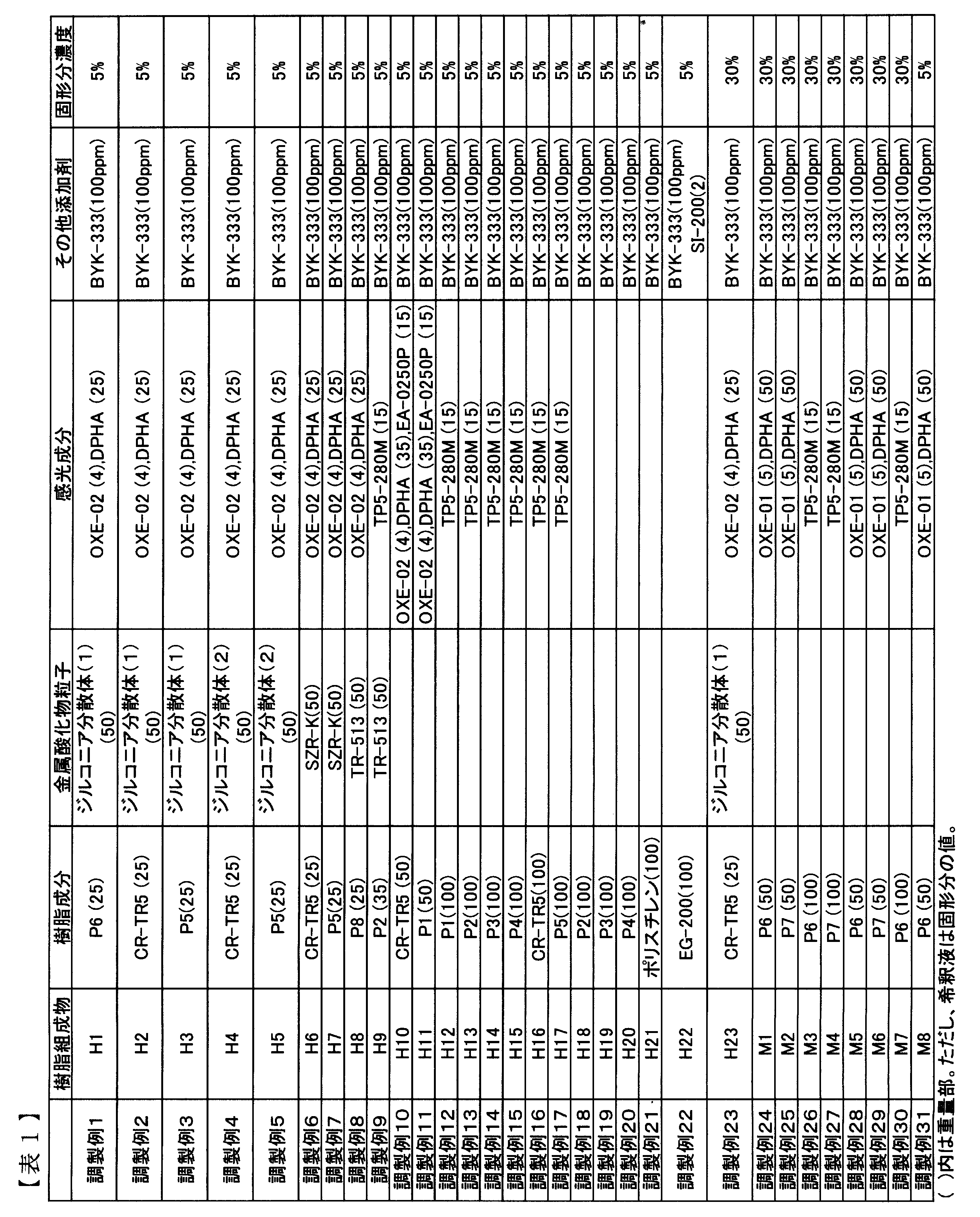
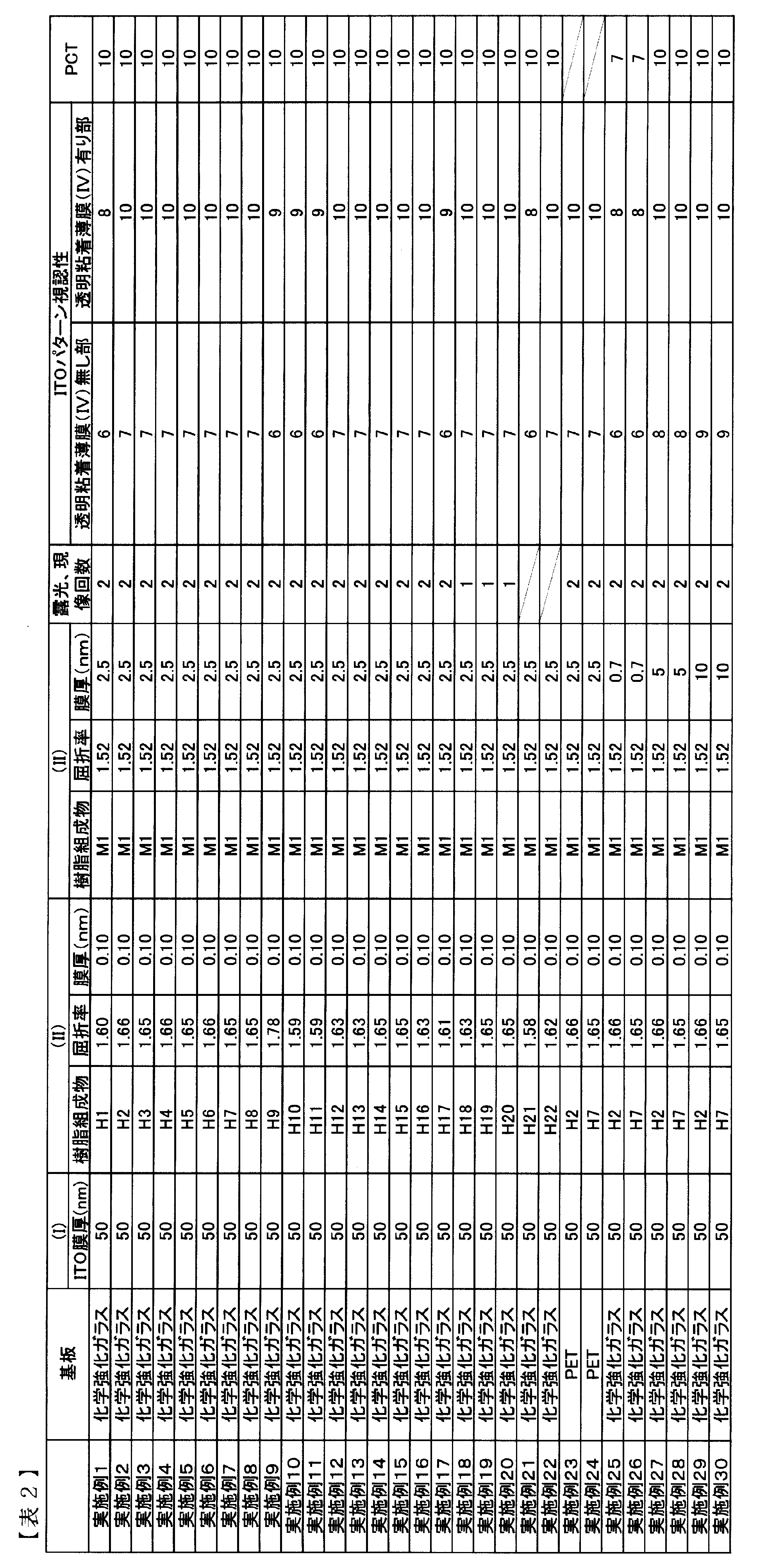
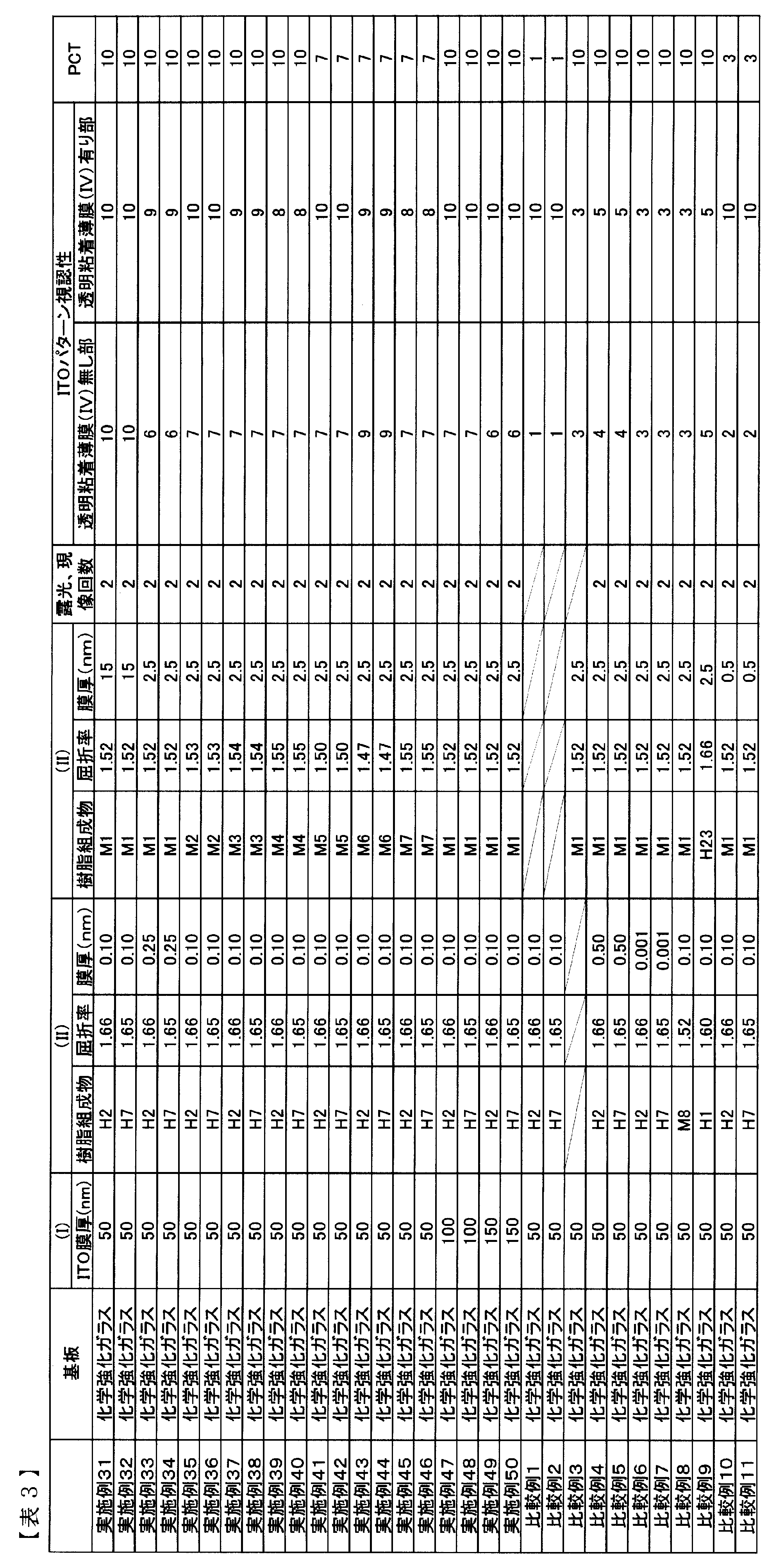
(1)パターンITOの作製
厚さ1.1mmの化学強化ガラス基板に、膜厚50nmのITOをスパッタリングした後、ポジ型フォトレジスト(OFPR-800;東京応化工業(株)製)をスピンコーター(1H-360S;ミカサ(株)製)を用いてスピンコートした後、ホットプレート(SCW-636;大日本スクリーン製造(株)製)を用いて100℃で2分間プリベークした。得られたプリベーク膜に、PLAを用いて超高圧水銀灯を光源として、マスクを介して100μmのギャップで1000J/m2露光した。その後、自動現像装置(AD-2000;滝沢産業(株)製)を用いて、2.38wt%水酸化テトラメチルアンモニウム(以下、「TMAH」)水溶液で90秒間シャワー現像し、次いで水で30秒間リンスし、パターン加工を施した。その後、HCl-HNO3系のエッチング液でITOをエッチングし、剥離液でフォトレジストを除去し、第一電極とそれと直交する第二電極の一部がパターン加工されたITO(図1及び図2の符号2)を有するガラス基板を作製した(図1のaに相当)。なお、ITOのパターン間隔は40μmとなるように設計した。
(1)で得られたガラス基板上にネガ型感光性樹脂組成物NS-E2000(東レ(株)製)をスピンコートした後、ホットプレートを用いて90℃で2分間プリベークした。得られたプリベーク膜に、マスクを介して100μmのギャップで2000J/m2露光した。その後、0.4wt%TMAH水溶液で90秒間シャワー現像し、次いで水で30秒間リンスした。次に、空気中230℃で1時間キュアを行い、膜厚1.5μmの透明絶縁膜(図1及び図2の符号3)を作製した(図1のbに相当)。
(2)で得られたガラス基板上に、ターゲットとしてモリブデン及びアルミニウムを用い、エッチング液としてH3PO4/HNO3/CH3COOH/H2O=65/3/5/27(重量比)混合溶液を用いる以外は、上記(1)と同様の手順によりMAM配線(図1及び図2の符号4)を作製した(図1のcに相当)。またMAMの膜厚は、250nmになるように調整した。
(3)で得られたガラス基板上に、調製例1で得られた樹脂組成物(H1)をスピンコートした後、ホットプレートを用いて90℃で2分間プリベークした。得られたプリベーク膜に、マスクを介して100μmのギャップで2000J/m2露光した。その後、0.4wt%TMAH水溶液で90秒間シャワー現像し、次いで水で30秒間リンスした。次に、空気中230℃で1時間キュアを行い、有機系薄膜(II)に相当する膜厚0.10μmの硬化膜(図2の符号5)を作製した。
(4)で得られたガラス基板上に、調製例20で得られた樹脂組成物(M1)をスピンコートした後、ホットプレートを用いて110℃で2分間プリベークした。得られたプリベーク膜に、マスクを介して100μmのギャップで2000J/m2露光した。その後、0.4wt%TMAH水溶液で90秒間シャワー現像し、次いで水で30秒間リンスした。次に、空気中230℃で1時間キュア用い、有機系薄膜(III)層に相当する膜厚2.50μmの硬化膜を作製した。
(6)透明粘着剤付きフィルムの貼りあわせ
(5)で得られたガラス基板上の一部に、粘着剤とその反対面にハードコートを具備するPETフィルム(HA-116;リンテック(株)製、粘着剤屈折率=1.47)を、空気が噛み込まないようにして貼り合わせた。
(6)で得られたガラス基板の裏面側からのITOのパターン視認性について、下記10段階で評価した。6以上を合格とした。
10 : 白色蛍光灯5cm下において凝視で全くパターンが見えない
9 : 白色蛍光灯5cm下において凝視でわずかにパターンが見える。
8 : 白色蛍光灯5cm下において凝視で少しパターンが見える。
7 : 白色蛍光灯5cm下において凝視ではっきりパターンが見える。
6 : 白色蛍光灯5cm下において通常の目視でわずかにパターンが見える。
5 : 白色蛍光灯5cm下において通常の目視で少しパターンが見える。
4 : 白色蛍光灯5cm下において通常の目視ではっきりパターンが見える。
3 : 室内灯下において通常の目視でわずかにパターンが見える。
2 : 室内灯下において通常の目視で少しパターンが見える。
1 : 室内灯下において通常の目視ではっきりパターンが見える。
下地金属として全面にMAMを具備するガラス上に、上記(4)及び(5)記載の方法で2層の硬化膜を作製した後、温度121℃、湿度100%、気圧=2atmのオーブン(HAST CHAMBERE EHS-221MD;エスペック株式会社製)内に20時間放置する試験を行った後、硬化膜下のMAMが腐食によって変色する欠点の占有面積割合を、目視によって下記11段階で評価した。7以上を合格とした。
10 : 硬化膜下のMAMの変色面積割合が0%。硬化膜自体の外観変化なし。
9 : 硬化膜下のMAMの変色面積割合が1~3%。硬化膜自体の外観変化なし。
8 : 硬化膜下のMAMの変色面積割合が4~6%。硬化膜自体の外観変化なし。
7 : 硬化膜下のMAMの変色面積割合が7~9%。硬化膜自体の外観変化なし。
6 : 硬化膜下のMAMの変色面積割合が10~15%。硬化膜自体の外観変化なし。
5 : 硬化膜下のMAMの変色面積割合が16~20%。硬化膜自体の外観変化なし。
4 : 硬化膜下のMAMの変色面積割合が21~30%。硬化膜自体の外観変化なし。
3 : 硬化膜下のMAMの変色面積割合が31~50%。硬化膜自体の外観変化なし。
2 : 硬化膜下のMAMの変色面積割合が51~70%。硬化膜自体の外観変化なし。
1 : 硬化膜下のMAMの変色面積割合が71~100%。硬化膜自体の外観変化なし。
0 : 硬化膜下のMAMの変色面積割合が100%。かつ、硬化膜自体に変色、クラック等が発生。
表2又は表3に示す構成で、実施例1と同様の手法により基板を作製し、評価を行った。ただし、有機系薄膜(II)を形成するステップにおいて、実施例9及び実施例11~15では、現像液として2.38wt%TMAH水溶液を用いた。
有機系薄膜(II)を形成するステップにおいて、樹脂組成物の加工をプリベークまでしか行わず、有機系薄膜(III)層を形成するステップへと進んだ以外は、実施例1と同様に評価を行った。
アルカリ可溶性基を含有しない有機系薄膜(II)の形成を、以下の手順で実施した以外は、実施例1と同様の手法により基板を作製し、評価を行った。
(3)で得られたガラス基板端部における、有機系薄膜(II)未形成部分に予めセロハンテープを貼付け、その後調製例14又は15で得られた樹脂組成物(H14)又は(H15)をスピンコートした後、ホットプレートを用いて90℃で2分間プリベークした。その後、セロハンテープを剥離した。次に、空気中230℃で1時間キュアを行い、有機系薄膜(II)に相当する膜厚0.10μmの硬化膜(図2の符号5)を作製した。
(1)パターンITOの作製
厚さ0.2mmのポリエチレンテレフタラート(PET)基板に、実施例1と同様の手法によりパターンITOを作製した。ただし、フォトレジストの塗布にはバーコーターを用い、プリベークにはオーブンを用い、エッチャントには5wt%のシュウ酸水溶液を用いた。
(1)で得られたPET基板上に、調製例2又は7で得られた樹脂組成物(H2)又は(H7)樹脂組成物を、バーコーターを用いて塗布し、オーブンを用いて90℃で10分間プリベークした。得られたプリベーク膜に、マスクを介して100μmのギャップで2000J/m2露光した。その後、0.4wt%TMAH水溶液で90秒間シャワー現像し、次いで水で30秒間リンスした。次に、空気中130℃で1時間キュアを行い、(II)層に該当する膜厚0.10μmの硬化膜を作製した。
(2)で得られたPET基板上に、調製例20で得られた樹脂組成物(M2)を、バーコーターを用いて塗布し、オーブンを用いて90℃で10分間プリベークした。得られたプリベーク膜に、マスクを介して100μmのギャップで2000J/m2露光した。その後、0.4wt%TMAH水溶液で90秒間シャワー現像し、次いで水で30秒間リンスした。次に、空気中130℃で1時間キュア用い、(III)層に該当する膜厚2.5μmの硬化膜を作製した。
(4)で得られたPET基板の裏面側からのパターン視認性について、実施例1と同様に評価を行った。
有機系薄膜(II)を形成するステップにおいて、樹脂組成物(H2)を用い、有機系薄膜(III)を形成するステップを行わなかった以外は、実施例1と同様に評価を行った。
(比較例2)
有機系薄膜(II)を形成するステップにおいて、樹脂組成物(H7)を用い、有機系薄膜(III)を形成するステップを行わなかった以外は、実施例1と同様に評価を行った。
有機系薄膜(II)を形成するステップを行わなかった以外は、実施例1と同様に評価を行った。
表3に示す構成で、実施例1と同様の手法により基板を作製し、評価を行った。
2 : ITO薄膜(I)
3 : 絶縁膜
4 : MAM配線
5 : 有機系薄膜(II)
6 : 有機系薄膜(III)
Claims (10)
- 透明下地基板の上面から、
酸化インジウムスズ薄膜(I)、
膜厚が0.01~0.4μmであり、屈折率が1.58~1.85である、有機系薄膜(II)、
膜厚が0.7~20μmであり、屈折率が1.46~1.56である、有機系薄膜(III)、の順に薄膜が積層されている部位を有する、基板。 - 前記有機系薄膜(III)の上面に、屈折率が1.46~1.52である、透明粘着薄膜(IV)が積層されている部位を有する、請求項1記載の基板。
- 前記有機系薄膜(II)は、金属酸化物粒子を含有する、請求項1又は2記載の基板。
- 前記有機系薄膜(II)は、ポリイミド、カルド樹脂、アクリル樹脂、ポリシロキサン、ポリベンゾオキサゾール、フェノール樹脂、ポリアミドイミド、ポリエーテルスルホン、ポリウレタン及びポリエステルからなる群から選択される樹脂を含有する、請求項1~3のいずれか一項記載の基板。
- 前記有機系薄膜(II)は、アルカリ可溶性基を有する、請求項1~4のいずれか一項記載の基板。
- 前記有機系薄膜(II)は、ポリイミド前駆体、ポリアミドイミド前駆体及びポリベンゾオキサゾール前駆体からなる群から選択される前駆体を含む樹脂組成物を用いて形成される、請求項1~5のいずれか一項記載の基板。
- 前記有機系薄膜(III)の素材が、アクリル樹脂又はポリシロキサンのいずれかである、請求項1~6のいずれか一項記載の基板。
- 前記透明下地基板は、強化ガラス基板である、請求項1~7のいずれか一項記載の基板。
- 請求項1~8のいずれか一項記載の基板を用いた、タッチパネル部材。
- 前記有機系薄膜(II)と、前記有機系薄膜(III)とを、一回の露光及び現像により一括でパターン加工して得る、請求項1~7のいずれか一項記載の基板の製造方法。
Priority Applications (6)
| Application Number | Priority Date | Filing Date | Title |
|---|---|---|---|
| US14/400,968 US20150125680A1 (en) | 2012-05-21 | 2013-05-08 | Substrate and touch panel member using same |
| SG11201407551SA SG11201407551SA (en) | 2012-05-21 | 2013-05-08 | Substrate and touch panel member using same |
| KR1020147026366A KR102083042B1 (ko) | 2012-05-21 | 2013-05-08 | 기판 및 그것을 이용한 터치 패널 부재 |
| EP13793713.2A EP2853386B1 (en) | 2012-05-21 | 2013-05-08 | Substrate and touch panel member using same |
| CN201380024045.6A CN104271345B (zh) | 2012-05-21 | 2013-05-08 | 基板和使用其的触控面板部件 |
| JP2013522414A JP5387801B1 (ja) | 2012-05-21 | 2013-05-08 | 基板及びそれを用いたタッチパネル部材 |
Applications Claiming Priority (4)
| Application Number | Priority Date | Filing Date | Title |
|---|---|---|---|
| JP2012-115367 | 2012-05-21 | ||
| JP2012115367 | 2012-05-21 | ||
| JP2013025294 | 2013-02-13 | ||
| JP2013-025294 | 2013-02-13 |
Publications (1)
| Publication Number | Publication Date |
|---|---|
| WO2013175958A1 true WO2013175958A1 (ja) | 2013-11-28 |
Family
ID=49623655
Family Applications (1)
| Application Number | Title | Priority Date | Filing Date |
|---|---|---|---|
| PCT/JP2013/062899 Ceased WO2013175958A1 (ja) | 2012-05-21 | 2013-05-08 | 基板及びそれを用いたタッチパネル部材 |
Country Status (8)
| Country | Link |
|---|---|
| US (1) | US20150125680A1 (ja) |
| EP (1) | EP2853386B1 (ja) |
| JP (1) | JP5387801B1 (ja) |
| KR (1) | KR102083042B1 (ja) |
| CN (1) | CN104271345B (ja) |
| SG (1) | SG11201407551SA (ja) |
| TW (1) | TWI635956B (ja) |
| WO (1) | WO2013175958A1 (ja) |
Cited By (6)
| Publication number | Priority date | Publication date | Assignee | Title |
|---|---|---|---|---|
| WO2014119372A1 (ja) * | 2013-01-29 | 2014-08-07 | 東レ株式会社 | 基板及びそれを用いたタッチパネル部材 |
| WO2014119371A1 (ja) * | 2013-01-29 | 2014-08-07 | 東レ株式会社 | 基板及びそれを用いたタッチパネル部材 |
| WO2016002026A1 (ja) * | 2014-07-02 | 2016-01-07 | 日立化成株式会社 | 転写形感光性屈折率調整フィルム |
| JP2016151829A (ja) * | 2015-02-16 | 2016-08-22 | 大日本印刷株式会社 | タッチパネル |
| WO2016132401A1 (ja) * | 2015-02-20 | 2016-08-25 | 日立化成株式会社 | 転写形感光性屈折率調整フィルム、屈折率調整パターンの形成方法及び電子部品 |
| JP2017177479A (ja) * | 2016-03-29 | 2017-10-05 | 三菱ケミカル株式会社 | 積層体 |
Families Citing this family (13)
| Publication number | Priority date | Publication date | Assignee | Title |
|---|---|---|---|---|
| JP5922008B2 (ja) * | 2012-11-30 | 2016-05-24 | 富士フイルム株式会社 | 転写フィルムおよび透明積層体、それらの製造方法、静電容量型入力装置ならびに画像表示装置 |
| US9205455B2 (en) * | 2014-01-09 | 2015-12-08 | Nano And Advanced Materials Institute Limited | Surface treatment of mirror finish |
| US9983619B2 (en) * | 2014-02-28 | 2018-05-29 | Fujitsu Ten Limited | Image display apparatus |
| TWI560242B (en) * | 2014-11-05 | 2016-12-01 | Chi Mei Corp | Liquid crystal alignment agent, liquid crystal alignment film, and liquid crystal display element |
| TWI560240B (en) * | 2014-11-05 | 2016-12-01 | Chi Mei Corp | Liquid crystal alignment agent, liquid crystal alignment film, and liquid crystal display element |
| US10664073B2 (en) | 2015-04-02 | 2020-05-26 | Jörg R. Bauer | Touchpad and system for detecting an object on a detection surface, and generating and outputting object-specific information |
| KR102630893B1 (ko) * | 2015-11-25 | 2024-01-31 | 롬엔드하스전자재료코리아유한회사 | 감광성 수지 조성물 및 이로부터 제조된 경화막 |
| CN114686137B (zh) | 2015-12-04 | 2025-04-15 | 雷恩哈德库兹基金两合公司 | 膜以及用于制造膜的方法 |
| DE102015121195B4 (de) * | 2015-12-04 | 2020-11-19 | Leonhard Kurz Stiftung & Co. Kg | Folie sowie Verfahren zur Herstellung einer Folie |
| WO2017159543A1 (ja) * | 2016-03-15 | 2017-09-21 | 東レ株式会社 | 感光性樹脂組成物、硬化膜、積層体、タッチパネル用部材及び硬化膜の製造方法 |
| KR101929281B1 (ko) | 2016-05-19 | 2019-03-15 | 삼성디스플레이 주식회사 | 전자 장치 |
| CN109943047B (zh) * | 2019-01-25 | 2022-02-08 | 苏州生益科技有限公司 | 一种热固性树脂组合物及应用其制备的半固化片和层压板 |
| CN114853362B (zh) * | 2022-06-08 | 2023-12-26 | 宜昌南玻显示器件有限公司 | 应用于玻璃面板的镀膜方法及玻璃面板 |
Citations (12)
| Publication number | Priority date | Publication date | Assignee | Title |
|---|---|---|---|---|
| JPH01205122A (ja) | 1988-02-12 | 1989-08-17 | Alps Electric Co Ltd | 液晶表示素子 |
| JPH0633000A (ja) | 1992-07-17 | 1994-02-08 | Nissan Chem Ind Ltd | 液晶表示素子用高屈折率絶縁被膜形成用塗布液 |
| JPH08240800A (ja) | 1995-03-03 | 1996-09-17 | Asahi Glass Co Ltd | 液晶ディスプレイ用樹脂基板 |
| JP2009301767A (ja) | 2008-06-11 | 2009-12-24 | Andes Intekku:Kk | タッチパネル、タッチパネル装置及びタッチパネルの製造方法 |
| JP2010086684A (ja) | 2008-09-30 | 2010-04-15 | Kuramoto Seisakusho Co Ltd | 透明導電配線膜付き光学薄膜 |
| JP2010152809A (ja) | 2008-12-26 | 2010-07-08 | Smk Corp | 透明なパネル体及びタッチパネル |
| WO2010114056A1 (ja) * | 2009-03-31 | 2010-10-07 | 帝人株式会社 | 透明導電性積層体及び透明タッチパネル |
| WO2010114084A1 (ja) * | 2009-03-30 | 2010-10-07 | リンテック株式会社 | 透明導電フィルム |
| JP2010269504A (ja) * | 2009-05-21 | 2010-12-02 | Toyobo Co Ltd | 透明導電性積層フィルム及び透明導電性積層シート並びにタッチパネル |
| WO2011093421A1 (ja) * | 2010-01-28 | 2011-08-04 | 富士フイルム株式会社 | 導電シート、導電シートの使用方法及び静電容量方式タッチパネル |
| JP2011194679A (ja) * | 2010-03-18 | 2011-10-06 | Toppan Printing Co Ltd | 透明導電性積層体およびその製造方法ならびにタッチパネル |
| JP2012081663A (ja) * | 2010-10-12 | 2012-04-26 | Sumitomo Metal Mining Co Ltd | 透明導電基材及びタッチパネル |
Family Cites Families (16)
| Publication number | Priority date | Publication date | Assignee | Title |
|---|---|---|---|---|
| DE4219287A1 (de) * | 1992-06-12 | 1993-12-16 | Merck Patent Gmbh | Anorganische Füllstoffe und organische Matrixmaterialien mit Brechungsindex-Anpassung |
| JP2763472B2 (ja) * | 1993-01-23 | 1998-06-11 | 日東電工株式会社 | 透明導電性積層体とタツチパネル |
| JPH1185396A (ja) * | 1997-09-10 | 1999-03-30 | Central Glass Co Ltd | タッチパネルの基板用低反射ガラス |
| WO2002029830A1 (en) * | 2000-09-29 | 2002-04-11 | Matsushita Electric Industrial Co., Ltd. | Transparent substrate with conductive multilayer anti reflection film, transparent touch panel using the transparent substrate with multilayer anti reflection film and electronic apparatus using the touch panel |
| JP2003025510A (ja) * | 2001-07-16 | 2003-01-29 | Shin Etsu Chem Co Ltd | 反射防止性及び耐擦傷性を有する多層積層体 |
| US7015640B2 (en) * | 2002-09-11 | 2006-03-21 | General Electric Company | Diffusion barrier coatings having graded compositions and devices incorporating the same |
| KR100548625B1 (ko) * | 2003-03-24 | 2006-01-31 | 주식회사 엘지화학 | 고내열성 투명 폴리이미드 전구체 및 이를 이용한 감광성수지 조성물 |
| US6842288B1 (en) * | 2003-10-30 | 2005-01-11 | 3M Innovative Properties Company | Multilayer optical adhesives and articles |
| WO2005106897A1 (ja) * | 2004-04-30 | 2005-11-10 | Nitto Denko Corporation | 透明導電性積層体およびタッチパネル |
| JP2006011523A (ja) * | 2004-06-22 | 2006-01-12 | Three M Innovative Properties Co | タッチパネルセンサー |
| US20060147614A1 (en) * | 2004-12-30 | 2006-07-06 | 3M Innovative Properties Company | Transferable antireflection material for use on optical display |
| JP5116004B2 (ja) * | 2006-08-03 | 2013-01-09 | 日東電工株式会社 | 透明導電性積層体及びそれを備えたタッチパネル |
| JP5171018B2 (ja) * | 2006-11-29 | 2013-03-27 | 大阪瓦斯株式会社 | 酸化ジルコニウム含有樹脂組成物及びその成形体 |
| JP4667471B2 (ja) * | 2007-01-18 | 2011-04-13 | 日東電工株式会社 | 透明導電性フィルム、その製造方法及びそれを備えたタッチパネル |
| JP4966924B2 (ja) * | 2008-07-16 | 2012-07-04 | 日東電工株式会社 | 透明導電性フィルム、透明導電性積層体及びタッチパネル、並びに透明導電性フィルムの製造方法 |
| JP4844692B2 (ja) * | 2009-10-19 | 2011-12-28 | 東洋紡績株式会社 | 透明導電性積層フィルム |
-
2013
- 2013-05-08 CN CN201380024045.6A patent/CN104271345B/zh active Active
- 2013-05-08 WO PCT/JP2013/062899 patent/WO2013175958A1/ja not_active Ceased
- 2013-05-08 KR KR1020147026366A patent/KR102083042B1/ko not_active Expired - Fee Related
- 2013-05-08 SG SG11201407551SA patent/SG11201407551SA/en unknown
- 2013-05-08 US US14/400,968 patent/US20150125680A1/en not_active Abandoned
- 2013-05-08 EP EP13793713.2A patent/EP2853386B1/en not_active Not-in-force
- 2013-05-08 JP JP2013522414A patent/JP5387801B1/ja active Active
- 2013-05-20 TW TW102117683A patent/TWI635956B/zh active
Patent Citations (12)
| Publication number | Priority date | Publication date | Assignee | Title |
|---|---|---|---|---|
| JPH01205122A (ja) | 1988-02-12 | 1989-08-17 | Alps Electric Co Ltd | 液晶表示素子 |
| JPH0633000A (ja) | 1992-07-17 | 1994-02-08 | Nissan Chem Ind Ltd | 液晶表示素子用高屈折率絶縁被膜形成用塗布液 |
| JPH08240800A (ja) | 1995-03-03 | 1996-09-17 | Asahi Glass Co Ltd | 液晶ディスプレイ用樹脂基板 |
| JP2009301767A (ja) | 2008-06-11 | 2009-12-24 | Andes Intekku:Kk | タッチパネル、タッチパネル装置及びタッチパネルの製造方法 |
| JP2010086684A (ja) | 2008-09-30 | 2010-04-15 | Kuramoto Seisakusho Co Ltd | 透明導電配線膜付き光学薄膜 |
| JP2010152809A (ja) | 2008-12-26 | 2010-07-08 | Smk Corp | 透明なパネル体及びタッチパネル |
| WO2010114084A1 (ja) * | 2009-03-30 | 2010-10-07 | リンテック株式会社 | 透明導電フィルム |
| WO2010114056A1 (ja) * | 2009-03-31 | 2010-10-07 | 帝人株式会社 | 透明導電性積層体及び透明タッチパネル |
| JP2010269504A (ja) * | 2009-05-21 | 2010-12-02 | Toyobo Co Ltd | 透明導電性積層フィルム及び透明導電性積層シート並びにタッチパネル |
| WO2011093421A1 (ja) * | 2010-01-28 | 2011-08-04 | 富士フイルム株式会社 | 導電シート、導電シートの使用方法及び静電容量方式タッチパネル |
| JP2011194679A (ja) * | 2010-03-18 | 2011-10-06 | Toppan Printing Co Ltd | 透明導電性積層体およびその製造方法ならびにタッチパネル |
| JP2012081663A (ja) * | 2010-10-12 | 2012-04-26 | Sumitomo Metal Mining Co Ltd | 透明導電基材及びタッチパネル |
Non-Patent Citations (1)
| Title |
|---|
| See also references of EP2853386A4 |
Cited By (11)
| Publication number | Priority date | Publication date | Assignee | Title |
|---|---|---|---|---|
| WO2014119372A1 (ja) * | 2013-01-29 | 2014-08-07 | 東レ株式会社 | 基板及びそれを用いたタッチパネル部材 |
| WO2014119371A1 (ja) * | 2013-01-29 | 2014-08-07 | 東レ株式会社 | 基板及びそれを用いたタッチパネル部材 |
| US9788420B2 (en) | 2013-01-29 | 2017-10-10 | Toray Industries, Inc. | Substrate and touch panel member using same |
| WO2016002026A1 (ja) * | 2014-07-02 | 2016-01-07 | 日立化成株式会社 | 転写形感光性屈折率調整フィルム |
| WO2016001955A1 (ja) * | 2014-07-02 | 2016-01-07 | 日立化成株式会社 | 転写形感光性屈折率調整フィルム |
| JPWO2016002026A1 (ja) * | 2014-07-02 | 2017-05-25 | 日立化成株式会社 | 転写形感光性屈折率調整フィルム |
| JP2016151829A (ja) * | 2015-02-16 | 2016-08-22 | 大日本印刷株式会社 | タッチパネル |
| WO2016132401A1 (ja) * | 2015-02-20 | 2016-08-25 | 日立化成株式会社 | 転写形感光性屈折率調整フィルム、屈折率調整パターンの形成方法及び電子部品 |
| JPWO2016132401A1 (ja) * | 2015-02-20 | 2017-11-30 | 日立化成株式会社 | 転写形感光性屈折率調整フィルム、屈折率調整パターンの形成方法及び電子部品 |
| CN107850846A (zh) * | 2015-02-20 | 2018-03-27 | 日立化成株式会社 | 转印型感光性折射率调整膜、折射率调整图案的形成方法及电子部件 |
| JP2017177479A (ja) * | 2016-03-29 | 2017-10-05 | 三菱ケミカル株式会社 | 積層体 |
Also Published As
| Publication number | Publication date |
|---|---|
| US20150125680A1 (en) | 2015-05-07 |
| CN104271345B (zh) | 2016-03-23 |
| JPWO2013175958A1 (ja) | 2016-01-12 |
| EP2853386B1 (en) | 2017-10-25 |
| TWI635956B (zh) | 2018-09-21 |
| TW201400281A (zh) | 2014-01-01 |
| KR102083042B1 (ko) | 2020-02-28 |
| JP5387801B1 (ja) | 2014-01-15 |
| EP2853386A4 (en) | 2015-11-04 |
| KR20150018498A (ko) | 2015-02-23 |
| SG11201407551SA (en) | 2015-01-29 |
| CN104271345A (zh) | 2015-01-07 |
| EP2853386A1 (en) | 2015-04-01 |
Similar Documents
| Publication | Publication Date | Title |
|---|---|---|
| JP5387801B1 (ja) | 基板及びそれを用いたタッチパネル部材 | |
| US10431753B2 (en) | Substrate for display, color filter using the same and method for the production thereof, organic EL element and method for the production thereof, and flexible organic EL display | |
| TWI721126B (zh) | 感光性樹脂組成物、硬化膜、積層體、觸控面板用構件及硬化膜之製造方法 | |
| JP6746888B2 (ja) | ディスプレイ用支持基板、それを用いたカラーフィルターおよびその製造方法、有機el素子およびその製造方法、ならびにフレキシブル有機elディスプレイ | |
| JPWO2013146130A1 (ja) | シランカップリング剤、感光性樹脂組成物、硬化膜及びタッチパネル部材 | |
| JP6003979B2 (ja) | 基板及びそれを用いたタッチパネル部材 | |
| JP6060968B2 (ja) | 基板及びそれを用いたタッチパネル部材 | |
| WO2016148176A1 (ja) | ポジ型感光性樹脂組成物、硬化膜、tft基板、層間絶縁膜、表示装置、およびその製造方法 |
Legal Events
| Date | Code | Title | Description |
|---|---|---|---|
| WWE | Wipo information: entry into national phase |
Ref document number: 201380024045.6 Country of ref document: CN |
|
| ENP | Entry into the national phase |
Ref document number: 2013522414 Country of ref document: JP Kind code of ref document: A |
|
| 121 | Ep: the epo has been informed by wipo that ep was designated in this application |
Ref document number: 13793713 Country of ref document: EP Kind code of ref document: A1 |
|
| ENP | Entry into the national phase |
Ref document number: 20147026366 Country of ref document: KR Kind code of ref document: A |
|
| REEP | Request for entry into the european phase |
Ref document number: 2013793713 Country of ref document: EP |
|
| WWE | Wipo information: entry into national phase |
Ref document number: 2013793713 Country of ref document: EP |
|
| WWE | Wipo information: entry into national phase |
Ref document number: 14400968 Country of ref document: US |
|
| NENP | Non-entry into the national phase |
Ref country code: DE |