WO2013176179A1 - シート状シール材及び積層シート状シール材 - Google Patents
シート状シール材及び積層シート状シール材 Download PDFInfo
- Publication number
- WO2013176179A1 WO2013176179A1 PCT/JP2013/064216 JP2013064216W WO2013176179A1 WO 2013176179 A1 WO2013176179 A1 WO 2013176179A1 JP 2013064216 W JP2013064216 W JP 2013064216W WO 2013176179 A1 WO2013176179 A1 WO 2013176179A1
- Authority
- WO
- WIPO (PCT)
- Prior art keywords
- sealing material
- sheet
- particles
- solar cell
- resin film
- Prior art date
- Legal status (The legal status is an assumption and is not a legal conclusion. Google has not performed a legal analysis and makes no representation as to the accuracy of the status listed.)
- Ceased
Links
Images


Classifications
-
- H—ELECTRICITY
- H10—SEMICONDUCTOR DEVICES; ELECTRIC SOLID-STATE DEVICES NOT OTHERWISE PROVIDED FOR
- H10F—INORGANIC SEMICONDUCTOR DEVICES SENSITIVE TO INFRARED RADIATION, LIGHT, ELECTROMAGNETIC RADIATION OF SHORTER WAVELENGTH OR CORPUSCULAR RADIATION
- H10F19/00—Integrated devices, or assemblies of multiple devices, comprising at least one photovoltaic cell covered by group H10F10/00, e.g. photovoltaic modules
- H10F19/80—Encapsulations or containers for integrated devices, or assemblies of multiple devices, having photovoltaic cells
- H10F19/804—Materials of encapsulations
-
- B—PERFORMING OPERATIONS; TRANSPORTING
- B32—LAYERED PRODUCTS
- B32B—LAYERED PRODUCTS, i.e. PRODUCTS BUILT-UP OF STRATA OF FLAT OR NON-FLAT, e.g. CELLULAR OR HONEYCOMB, FORM
- B32B27/00—Layered products comprising a layer of synthetic resin
- B32B27/06—Layered products comprising a layer of synthetic resin as the main or only constituent of a layer, which is next to another layer of the same or of a different material
- B32B27/08—Layered products comprising a layer of synthetic resin as the main or only constituent of a layer, which is next to another layer of the same or of a different material of synthetic resin
-
- B—PERFORMING OPERATIONS; TRANSPORTING
- B32—LAYERED PRODUCTS
- B32B—LAYERED PRODUCTS, i.e. PRODUCTS BUILT-UP OF STRATA OF FLAT OR NON-FLAT, e.g. CELLULAR OR HONEYCOMB, FORM
- B32B27/00—Layered products comprising a layer of synthetic resin
- B32B27/18—Layered products comprising a layer of synthetic resin characterised by the use of special additives
- B32B27/26—Layered products comprising a layer of synthetic resin characterised by the use of special additives using curing agents
-
- B—PERFORMING OPERATIONS; TRANSPORTING
- B32—LAYERED PRODUCTS
- B32B—LAYERED PRODUCTS, i.e. PRODUCTS BUILT-UP OF STRATA OF FLAT OR NON-FLAT, e.g. CELLULAR OR HONEYCOMB, FORM
- B32B27/00—Layered products comprising a layer of synthetic resin
- B32B27/28—Layered products comprising a layer of synthetic resin comprising synthetic resins not wholly covered by any one of the sub-groups B32B27/30 - B32B27/42
- B32B27/283—Layered products comprising a layer of synthetic resin comprising synthetic resins not wholly covered by any one of the sub-groups B32B27/30 - B32B27/42 comprising polysiloxanes
-
- B—PERFORMING OPERATIONS; TRANSPORTING
- B32—LAYERED PRODUCTS
- B32B—LAYERED PRODUCTS, i.e. PRODUCTS BUILT-UP OF STRATA OF FLAT OR NON-FLAT, e.g. CELLULAR OR HONEYCOMB, FORM
- B32B27/00—Layered products comprising a layer of synthetic resin
- B32B27/30—Layered products comprising a layer of synthetic resin comprising vinyl (co)polymers; comprising acrylic (co)polymers
- B32B27/306—Layered products comprising a layer of synthetic resin comprising vinyl (co)polymers; comprising acrylic (co)polymers comprising vinyl acetate or vinyl alcohol (co)polymers
-
- B—PERFORMING OPERATIONS; TRANSPORTING
- B32—LAYERED PRODUCTS
- B32B—LAYERED PRODUCTS, i.e. PRODUCTS BUILT-UP OF STRATA OF FLAT OR NON-FLAT, e.g. CELLULAR OR HONEYCOMB, FORM
- B32B27/00—Layered products comprising a layer of synthetic resin
- B32B27/32—Layered products comprising a layer of synthetic resin comprising polyolefins
-
- B—PERFORMING OPERATIONS; TRANSPORTING
- B32—LAYERED PRODUCTS
- B32B—LAYERED PRODUCTS, i.e. PRODUCTS BUILT-UP OF STRATA OF FLAT OR NON-FLAT, e.g. CELLULAR OR HONEYCOMB, FORM
- B32B27/00—Layered products comprising a layer of synthetic resin
- B32B27/36—Layered products comprising a layer of synthetic resin comprising polyesters
-
- C—CHEMISTRY; METALLURGY
- C08—ORGANIC MACROMOLECULAR COMPOUNDS; THEIR PREPARATION OR CHEMICAL WORKING-UP; COMPOSITIONS BASED THEREON
- C08J—WORKING-UP; GENERAL PROCESSES OF COMPOUNDING; AFTER-TREATMENT NOT COVERED BY SUBCLASSES C08B, C08C, C08F, C08G or C08H
- C08J5/00—Manufacture of articles or shaped materials containing macromolecular substances
- C08J5/18—Manufacture of films or sheets
-
- C—CHEMISTRY; METALLURGY
- C08—ORGANIC MACROMOLECULAR COMPOUNDS; THEIR PREPARATION OR CHEMICAL WORKING-UP; COMPOSITIONS BASED THEREON
- C08J—WORKING-UP; GENERAL PROCESSES OF COMPOUNDING; AFTER-TREATMENT NOT COVERED BY SUBCLASSES C08B, C08C, C08F, C08G or C08H
- C08J9/00—Working-up of macromolecular substances to porous or cellular articles or materials; After-treatment thereof
- C08J9/0061—Working-up of macromolecular substances to porous or cellular articles or materials; After-treatment thereof characterized by the use of several polymeric components
-
- C—CHEMISTRY; METALLURGY
- C08—ORGANIC MACROMOLECULAR COMPOUNDS; THEIR PREPARATION OR CHEMICAL WORKING-UP; COMPOSITIONS BASED THEREON
- C08J—WORKING-UP; GENERAL PROCESSES OF COMPOUNDING; AFTER-TREATMENT NOT COVERED BY SUBCLASSES C08B, C08C, C08F, C08G or C08H
- C08J9/00—Working-up of macromolecular substances to porous or cellular articles or materials; After-treatment thereof
- C08J9/32—Working-up of macromolecular substances to porous or cellular articles or materials; After-treatment thereof from compositions containing microballoons, e.g. syntactic foams
-
- C—CHEMISTRY; METALLURGY
- C09—DYES; PAINTS; POLISHES; NATURAL RESINS; ADHESIVES; COMPOSITIONS NOT OTHERWISE PROVIDED FOR; APPLICATIONS OF MATERIALS NOT OTHERWISE PROVIDED FOR
- C09K—MATERIALS FOR MISCELLANEOUS APPLICATIONS, NOT PROVIDED FOR ELSEWHERE
- C09K3/00—Materials not provided for elsewhere
- C09K3/10—Materials in mouldable or extrudable form for sealing or packing joints or covers
- C09K3/1006—Materials in mouldable or extrudable form for sealing or packing joints or covers characterised by the chemical nature of one of its constituents
- C09K3/1018—Macromolecular compounds having one or more carbon-to-silicon linkages
-
- F—MECHANICAL ENGINEERING; LIGHTING; HEATING; WEAPONS; BLASTING
- F24—HEATING; RANGES; VENTILATING
- F24S—SOLAR HEAT COLLECTORS; SOLAR HEAT SYSTEMS
- F24S80/00—Details, accessories or component parts of solar heat collectors not provided for in groups F24S10/00-F24S70/00
- F24S80/70—Sealing means
-
- H—ELECTRICITY
- H02—GENERATION; CONVERSION OR DISTRIBUTION OF ELECTRIC POWER
- H02S—GENERATION OF ELECTRIC POWER BY CONVERSION OF INFRARED RADIATION, VISIBLE LIGHT OR ULTRAVIOLET LIGHT, e.g. USING PHOTOVOLTAIC [PV] MODULES
- H02S30/00—Structural details of PV modules other than those related to light conversion
- H02S30/10—Frame structures
-
- H—ELECTRICITY
- H10—SEMICONDUCTOR DEVICES; ELECTRIC SOLID-STATE DEVICES NOT OTHERWISE PROVIDED FOR
- H10F—INORGANIC SEMICONDUCTOR DEVICES SENSITIVE TO INFRARED RADIATION, LIGHT, ELECTROMAGNETIC RADIATION OF SHORTER WAVELENGTH OR CORPUSCULAR RADIATION
- H10F19/00—Integrated devices, or assemblies of multiple devices, comprising at least one photovoltaic cell covered by group H10F10/00, e.g. photovoltaic modules
- H10F19/80—Encapsulations or containers for integrated devices, or assemblies of multiple devices, having photovoltaic cells
-
- B—PERFORMING OPERATIONS; TRANSPORTING
- B32—LAYERED PRODUCTS
- B32B—LAYERED PRODUCTS, i.e. PRODUCTS BUILT-UP OF STRATA OF FLAT OR NON-FLAT, e.g. CELLULAR OR HONEYCOMB, FORM
- B32B2264/00—Composition or properties of particles which form a particulate layer or are present as additives
- B32B2264/02—Synthetic macromolecular particles
-
- B—PERFORMING OPERATIONS; TRANSPORTING
- B32—LAYERED PRODUCTS
- B32B—LAYERED PRODUCTS, i.e. PRODUCTS BUILT-UP OF STRATA OF FLAT OR NON-FLAT, e.g. CELLULAR OR HONEYCOMB, FORM
- B32B2457/00—Electrical equipment
- B32B2457/12—Photovoltaic modules
-
- C—CHEMISTRY; METALLURGY
- C08—ORGANIC MACROMOLECULAR COMPOUNDS; THEIR PREPARATION OR CHEMICAL WORKING-UP; COMPOSITIONS BASED THEREON
- C08J—WORKING-UP; GENERAL PROCESSES OF COMPOUNDING; AFTER-TREATMENT NOT COVERED BY SUBCLASSES C08B, C08C, C08F, C08G or C08H
- C08J2203/00—Foams characterized by the expanding agent
- C08J2203/22—Expandable microspheres, e.g. Expancel®
-
- C—CHEMISTRY; METALLURGY
- C08—ORGANIC MACROMOLECULAR COMPOUNDS; THEIR PREPARATION OR CHEMICAL WORKING-UP; COMPOSITIONS BASED THEREON
- C08J—WORKING-UP; GENERAL PROCESSES OF COMPOUNDING; AFTER-TREATMENT NOT COVERED BY SUBCLASSES C08B, C08C, C08F, C08G or C08H
- C08J2383/00—Characterised by the use of macromolecular compounds obtained by reactions forming in the main chain of the macromolecule a linkage containing silicon with or without sulfur, nitrogen, oxygen, or carbon only; Derivatives of such polymers
- C08J2383/04—Polysiloxanes
-
- C—CHEMISTRY; METALLURGY
- C08—ORGANIC MACROMOLECULAR COMPOUNDS; THEIR PREPARATION OR CHEMICAL WORKING-UP; COMPOSITIONS BASED THEREON
- C08J—WORKING-UP; GENERAL PROCESSES OF COMPOUNDING; AFTER-TREATMENT NOT COVERED BY SUBCLASSES C08B, C08C, C08F, C08G or C08H
- C08J2383/00—Characterised by the use of macromolecular compounds obtained by reactions forming in the main chain of the macromolecule a linkage containing silicon with or without sulfur, nitrogen, oxygen, or carbon only; Derivatives of such polymers
- C08J2383/04—Polysiloxanes
- C08J2383/05—Polysiloxanes containing silicon bound to hydrogen
-
- C—CHEMISTRY; METALLURGY
- C08—ORGANIC MACROMOLECULAR COMPOUNDS; THEIR PREPARATION OR CHEMICAL WORKING-UP; COMPOSITIONS BASED THEREON
- C08J—WORKING-UP; GENERAL PROCESSES OF COMPOUNDING; AFTER-TREATMENT NOT COVERED BY SUBCLASSES C08B, C08C, C08F, C08G or C08H
- C08J2383/00—Characterised by the use of macromolecular compounds obtained by reactions forming in the main chain of the macromolecule a linkage containing silicon with or without sulfur, nitrogen, oxygen, or carbon only; Derivatives of such polymers
- C08J2383/04—Polysiloxanes
- C08J2383/07—Polysiloxanes containing silicon bound to unsaturated aliphatic groups
-
- C—CHEMISTRY; METALLURGY
- C08—ORGANIC MACROMOLECULAR COMPOUNDS; THEIR PREPARATION OR CHEMICAL WORKING-UP; COMPOSITIONS BASED THEREON
- C08J—WORKING-UP; GENERAL PROCESSES OF COMPOUNDING; AFTER-TREATMENT NOT COVERED BY SUBCLASSES C08B, C08C, C08F, C08G or C08H
- C08J2427/00—Characterised by the use of homopolymers or copolymers of compounds having one or more unsaturated aliphatic radicals, each having only one carbon-to-carbon double bond, and at least one being terminated by a halogen; Derivatives of such polymers
- C08J2427/02—Characterised by the use of homopolymers or copolymers of compounds having one or more unsaturated aliphatic radicals, each having only one carbon-to-carbon double bond, and at least one being terminated by a halogen; Derivatives of such polymers not modified by chemical after-treatment
- C08J2427/04—Characterised by the use of homopolymers or copolymers of compounds having one or more unsaturated aliphatic radicals, each having only one carbon-to-carbon double bond, and at least one being terminated by a halogen; Derivatives of such polymers not modified by chemical after-treatment containing chlorine atoms
- C08J2427/08—Homopolymers or copolymers of vinylidene chloride
-
- C—CHEMISTRY; METALLURGY
- C08—ORGANIC MACROMOLECULAR COMPOUNDS; THEIR PREPARATION OR CHEMICAL WORKING-UP; COMPOSITIONS BASED THEREON
- C08J—WORKING-UP; GENERAL PROCESSES OF COMPOUNDING; AFTER-TREATMENT NOT COVERED BY SUBCLASSES C08B, C08C, C08F, C08G or C08H
- C08J2433/00—Characterised by the use of homopolymers or copolymers of compounds having one or more unsaturated aliphatic radicals, each having only one carbon-to-carbon double bond, and only one being terminated by only one carboxyl radical, or of salts, anhydrides, esters, amides, imides, or nitriles thereof; Derivatives of such polymers
- C08J2433/18—Homopolymers or copolymers of nitriles
- C08J2433/20—Homopolymers or copolymers of acrylonitrile
-
- C—CHEMISTRY; METALLURGY
- C08—ORGANIC MACROMOLECULAR COMPOUNDS; THEIR PREPARATION OR CHEMICAL WORKING-UP; COMPOSITIONS BASED THEREON
- C08K—Use of inorganic or non-macromolecular organic substances as compounding ingredients
- C08K2201/00—Specific properties of additives
- C08K2201/002—Physical properties
- C08K2201/003—Additives being defined by their diameter
-
- Y—GENERAL TAGGING OF NEW TECHNOLOGICAL DEVELOPMENTS; GENERAL TAGGING OF CROSS-SECTIONAL TECHNOLOGIES SPANNING OVER SEVERAL SECTIONS OF THE IPC; TECHNICAL SUBJECTS COVERED BY FORMER USPC CROSS-REFERENCE ART COLLECTIONS [XRACs] AND DIGESTS
- Y02—TECHNOLOGIES OR APPLICATIONS FOR MITIGATION OR ADAPTATION AGAINST CLIMATE CHANGE
- Y02E—REDUCTION OF GREENHOUSE GAS [GHG] EMISSIONS, RELATED TO ENERGY GENERATION, TRANSMISSION OR DISTRIBUTION
- Y02E10/00—Energy generation through renewable energy sources
- Y02E10/40—Solar thermal energy, e.g. solar towers
-
- Y—GENERAL TAGGING OF NEW TECHNOLOGICAL DEVELOPMENTS; GENERAL TAGGING OF CROSS-SECTIONAL TECHNOLOGIES SPANNING OVER SEVERAL SECTIONS OF THE IPC; TECHNICAL SUBJECTS COVERED BY FORMER USPC CROSS-REFERENCE ART COLLECTIONS [XRACs] AND DIGESTS
- Y02—TECHNOLOGIES OR APPLICATIONS FOR MITIGATION OR ADAPTATION AGAINST CLIMATE CHANGE
- Y02E—REDUCTION OF GREENHOUSE GAS [GHG] EMISSIONS, RELATED TO ENERGY GENERATION, TRANSMISSION OR DISTRIBUTION
- Y02E10/00—Energy generation through renewable energy sources
- Y02E10/50—Photovoltaic [PV] energy
Definitions
- the present invention relates to a sheet-like sealing material and a laminated sheet-like sealing material formed of a silicone resin, and particularly to a sheet-like sealing material and a laminated sheet-like sealing material used for a solar cell panel.
- a sealing material composed of a foam is used in various fields such as solar cells and automobiles.
- the sealing material is disposed between the panel peripheral end portion and the support frame member, and water or the like enters the panel.
- foams obtained by foaming rubber such as EPDM with a foaming agent such as azodicarboxylic amide, acrylic foams, silicone foams, etc. are conventionally used (for example, patent documents). 1 to 4).
- the sealing material used for solar cells is desired to exhibit high shock absorption and sealing properties even when the thickness is small.
- the seal material since solar cells are used outdoors for a long period of time, the seal material has high cold and heat resistance so that the performance can be maintained even if temperature and humidity changes due to temperature differences between day and night and in the four seasons. And what has moisture resistance is desired.
- the sealing material is also required to have high light resistance.
- the above foam and silicone foam cannot sufficiently satisfy the required performance.
- a sealing material composed of a foam may be used as a sealing material as a gap filling between parts. It is used for waterproofing and dustproofing such automotive sealing materials, in particular, power sources such as engines and their surroundings, lamps such as front and rear. Sealing materials are exposed to high temperatures under the influence of heat generation such as solar radiation, engines, lamps, etc., and will be exposed to low temperatures if parked or stopped for a long time such as winter, sealing performance with heat resistance and cold resistance Is required. In addition, the sealing material is required to have a low cost and a small level difference in design, and a thin thickness is also desired.
- the sealing material for example, it is known that closed-cell sponge rubber obtained by crosslinking an uncrosslinked rubber in which a microballoon that has been thermally expanded in advance is mixed with a rubber compound is used (See Patent Document 5).
- the closed-cell sponge rubber disclosed in Patent Document 5 uses fluororubber as a rubber compound when used in a sealing material for automobiles.
- fluororubber when fluororubber is used as the sealing material, cold resistance and heat resistance are improved.
- the thickness is reduced, there is a problem that it is difficult to maintain high shock absorption and sealing properties.
- Patent Document 6 discloses a silicone foam containing a hollow filler such as a microballoon as a heat insulating sheet for electronic equipment.
- the heat insulating sheet is different from the sealing material in terms of the expansion ratio and the like due to the difference in function, and is not usually diverted to the sealing material.
- the present invention has been made in view of the above problems, and even when the thickness is reduced, a sheet-like sealing material excellent in shock absorption, sealing properties, cold heat resistance, and light resistance, and a laminated sheet shape It is an object to provide a sealing material.
- the present invention provides the following (1) to (17).
- the sheet-like sealing material according to (1) above having a thickness of 0.05 to 2.5 mm and an expansion ratio of 2 to 8 times.
- the sheet-like sealing material according to any one of the above (1) to (3) which is a sealing material for solar cell panels.
- a laminated sheet-shaped sealing material comprising the sheet-shaped sealing material according to any one of (1) to (4) above and a resin film laminated on one surface of the sheet-shaped sealing material.
- a solar cell module comprising a sealing material for a solar cell panel.
- the solar cell panel sealing material includes the laminated sheet-shaped sealing material, and in the laminated sheet-shaped sealing material, the sheet-shaped sealing material is disposed on the solar cell panel side.
- Solar cell module (14)
- a sealing material composition including a curable silicone resin composition and a plurality of particles having cavities therein is cured to obtain a sheet-shaped sealing material in which bubbles are formed by the cavities of the particles.
- a plurality of foamable particles are heated and foamed to obtain a plurality of foamed particles having a cavity therein, and the foamed particles and the curable silicone resin composition are mixed to form the sealing material composition.
- the manufacturing method of the sheet-like sealing material as described in said (14) which obtains a thing.
- the particles having foamability are heated and expanded to form foamed particles having a cavity therein.
- Method. (17) A sealing material composition including a curable silicone resin composition and a plurality of particles having cavities therein is cured in a state of being superimposed on a resin film, and bubbles are formed by the cavities of the particles.
- a method for producing a laminated sheet-shaped sealing material, wherein a laminated sheet-shaped sealing material in which the resin film is laminated on one side of the sheet-shaped sealing material thus formed is obtained.
- the present invention even if the thickness is reduced, it is possible to provide a sheet-like sealing material that is excellent in impact absorption, sealing properties, cold heat resistance, moisture resistance, and light resistance.
- the sheet-like sealing material according to the present invention has a silicone resin (A) and a plurality of particles (B) dispersed in the silicone resin (A) and having hollow portions therein.
- a sheet-like sealing material is formed by the silicone resin (A) having a plurality of bubbles inside, and the thickness is thin, but the impact absorption, sealing performance, cold heat resistance, A sheet-like sealing material excellent in light resistance and moisture resistance can be provided.
- the sheet-like sealing material according to the present invention is preferably a foam.
- the foam may be a cured product foamed when the sealing material composition is cured, but the foamed material should have been cured from the sealing material composition containing foamed foamed particles. preferable. Thereby, it becomes easy to make a sheet-like sealing material thin, maintaining various performances of a sheet-like sealing material satisfactorily.
- the sheet-like sealing material according to the present invention is different from what is called “coking” or “sealant”.
- a sealant or the like exhibits a sealing performance without giving a gap to the gap due to an adhesive performance. That is, when the sealant is in a state where the curing reaction and the crosslinking reaction are completed, the adhesiveness of the surface cannot be expressed and the sealing performance cannot be expressed.
- the sealant include silicone sealants such as SH780 manufactured by Toray Dow Corning Co., Ltd.
- the sheet-like sealing material according to the present invention has already completed the curing reaction and the crosslinking reaction, and does not exhibit surface adhesion, but can exhibit sealing performance.
- the silicone resin (A) is obtained by curing a curable silicone resin composition, and is preferably a two-component mixed liquid type addition reaction type silicone resin.
- a curable silicone resin composition has, for example, (A1) an organopolysiloxane having at least two alkenyl groups in one molecule and (A2) at least two silicon-bonded hydrogen atoms in one molecule. It contains an organohydrogenpolysiloxane and (A3) a platinum-based catalyst.
- the silicone resin (A) is different from a polyether having a silyl group at the end, which is called “modified silicone”.
- a typical example of the modified silicone is “MS polymer” manufactured by Kaneka Corporation.
- the organopolysiloxane of component (A1) constitutes the main component of the silicone resin and has at least two silicon-bonded alkenyl groups, and examples of the alkenyl groups include vinyl groups and allyl groups.
- examples of the organic group bonded to the silicon atom other than the alkenyl group include an alkyl group having 1 to 3 carbon atoms exemplified by a methyl group, an ethyl group and a propyl group; an aryl group exemplified by a phenyl group and a tolyl group; Examples thereof include substituted alkyl groups exemplified by 3,3,3-trifluoropropyl group and 3-chloropropyl group.
- the molecular structure of component (A1) may be either linear or branched.
- the molecular weight of the component (A1) is not particularly limited, but the viscosity at 23 ° C. is preferably 0.1 Pa ⁇ s or more, more preferably 0.3 to 15 Pa ⁇ s, and more preferably 0.5 to 10 Pa ⁇ s. More preferably, it is s.
- two or more of the above organopolysiloxanes may be used in combination.
- the (A2) component organohydrogenpolysiloxane constitutes a curing agent.
- the (A3) component platinum-based catalyst the (A2) component silicon atom-bonded hydrogen atoms are contained in the (A1) component. It is an addition reaction to the silicon atom-bonded alkenyl group of the organopolysiloxane to crosslink and cure the curable silicone resin composition.
- the component (A2) needs to have at least two silicon-bonded hydrogen atoms in one molecule.
- examples of the organic group bonded to the silicon atom include an alkyl group having 1 to 3 carbon atoms exemplified by a methyl group, an ethyl group and a propyl group; an aryl group exemplified by a phenyl group and a tolyl group; Examples thereof include halogen atom-substituted alkyl groups exemplified by 3,3,3-trifluoropropyl group and 3-chloropropyl group.
- the molecular structure of the component (A2) may be linear, branched, cyclic, or network.
- the molecular weight of the component (A2) is not particularly limited, but the viscosity at 23 ° C.
- component (A2) added is such that the molar ratio of silicon-bonded hydrogen atoms in this component to silicon-bonded alkenyl groups in component (A1) is (0.5: 1) to (20: 1).
- the amount is preferably in the range of (1: 1) to (3: 1). When this molar ratio is 0.5 or more, the curability is relatively good, and when it is 20 or less, the hardness of the sheet-shaped sealing material becomes an appropriate size.
- the platinum-based catalyst as the component (A3) is used for curing the curable silicone resin composition.
- Platinum catalyst includes platinum fine powder, platinum black, chloroplatinic acid, platinum tetrachloride, chloroplatinic acid olefin complex, chloroplatinic acid alcohol solution, complex compound of chloroplatinic acid and alkenylsiloxane, rhodium compound, palladium Examples thereof include compounds.
- it may be used as thermoplastic resin particles containing these platinum-based catalysts.
- the amount of platinum-based catalyst added is usually 0.1 to 500 parts by weight, preferably 1 to 50 parts by weight as platinum-based metal with respect to 1 million parts by weight of component (A1).
- the platinum-based catalyst By adding the platinum-based catalyst in an amount of 0.1 parts by weight or more, the addition reaction can appropriately proceed, and by setting it to 500 parts by weight or less, the present invention can be implemented economically.
- the platinum-based catalyst as the component (A3) is usually added in advance to either the main agent or the curing agent.
- examples of commercially available curable silicone resin compositions include two-component heat-curable liquid silicone rubber “TSE3032” manufactured by Momentive Performance Materials Japan GK.
- the average particle diameter of the particles (B) varies greatly depending on the thickness of the sheet-like sealing material to be produced, but is preferably 10 ⁇ m or more, more preferably 20 ⁇ m or more, still more preferably 40 ⁇ m or more, and preferably 300 ⁇ m or less, more preferably Is 200 ⁇ m or less, more preferably 150 ⁇ m or less.
- the average particle diameter can be made favorable by setting it as 10 micrometers or more.
- the plurality of particles (B) are dispersed in the silicone resin (A) and have cavities therein.
- the plurality of particles (B) may have a single particle size distribution or a different distribution. For example, it is preferable to show three types of particle size distributions. This is because more particles (B) can be contained than particles (B) having a single particle size distribution. “Showing different distributions” means that there are two or more peaks when, for example, a particle distribution graph is created by measuring the particle diameter of 100 particles (B) by the method described later. “Showing a single distribution” and “showing three kinds of particle size distributions” mean that there are one peak and three peaks, respectively.
- the shape of the particles (B) examples include a spherical shape, a plate shape, a needle shape, and an indefinite shape. From the viewpoint of further enhancing the packing properties and dispersibility of the particles (B), the particles (B) are preferably spherical.
- the aspect ratio of the spherical particles is 5 or less, preferably 2 or less, more preferably 1.2 or less.
- the average particle diameter means an average value of measured values when measuring the size of primary particles of 100 particles in the observed visual field using a scanning electron microscope, an optical microscope, or the like. It is.
- the average particle diameter means an average value of the diameter of the particles when the particles are spherical, and means an average value of the major diameter of the particles when the particles are non-spherical.
- the aspect ratio is represented by the ratio of the minor axis to the major axis (average value of major axis / average value of minor axis).
- the particles (B) are so-called hollow particles having an outer shell and having a hollow portion therein. In the present invention, by forming bubbles with hollow particles, it is possible to reduce the thickness while improving the compressive stress and the like of the sheet-shaped sealing material.
- the particles (B) preferably have one cavity inside.
- the particles (B) are preferably organic particles, that is, the material of the outer shell of the particles (B) is preferably an organic compound.
- the porosity of the particles (B) is preferably 50% or more, more preferably 80% or more, still more preferably 90% or more, preferably 98% or less, more preferably 97% or less, still more preferably 96% or less. .
- the porosity When the porosity is 50% or more, the impact resistance, sealability and flexibility of the sealing material are increased, and when it is 80% or more or 90% or more, it is further increased. When the porosity is 98% or less, the strength of the particles (B) is increased and cracks are hardly generated in the outer shell, and when 97% or less or 96% or less, the strength is further increased.
- the porosity means the volume ratio which represented the volume of the space
- Porosity (volume%) ((hole portion long diameter + hole portion short diameter) / (outer diameter long diameter + outer diameter short diameter)) 3 ⁇ 100
- the particles (B) are preferably expanded particles that have been expanded so as to form cavities therein.
- the expanded particles are preferably expanded particles obtained by expanding thermally expandable particles, and more preferably expanded particles obtained by thermally expanding thermally expandable microcapsules.
- Thermally expandable microcapsules are those in which a volatile substance such as a low boiling point solvent is encapsulated inside the outer shell resin, and the outer shell resin is softened by heating, and the encapsulated volatile substance volatilizes or expands. The outer shell expands by the pressure to increase the particle diameter, resulting in foamed particles.
- the temperature at which the thermally expandable microcapsules are expanded is not particularly limited, but is preferably higher than the expansion start temperature described later and lower than the maximum expansion temperature.
- the outer shell of the thermally expandable microcapsule is preferably formed from a thermoplastic resin.
- Thermoplastic resins include vinyl polymers such as ethylene, styrene, vinyl acetate, vinyl chloride, vinylidene chloride, acrylonitrile, butadiene, chloroprene, and copolymers thereof; polyamides such as nylon 6 and nylon 66; and polyesters such as polyethylene terephthalate.
- vinyl polymers such as ethylene, styrene, vinyl acetate, vinyl chloride, vinylidene chloride, acrylonitrile, butadiene, chloroprene, and copolymers thereof; polyamides such as nylon 6 and nylon 66; and polyesters such as polyethylene terephthalate.
- One kind or two or more kinds selected can be used, but an acrylonitrile copolymer is preferable from the viewpoint that the encapsulated volatile substance hardly penetrates.
- Volatile substances encapsulated in the thermally expandable microcapsule include propane, propylene, butene, normal butane, isobutane, isopentane, neopentane, normal pentane, hexane, heptane and other hydrocarbons having 3 to 7 carbon atoms; petroleum Ether; methane halide such as methyl chloride and methylene chloride; chlorofluorocarbon such as CCl 3 F and CCl 2 F 2 ; one or two selected from tetraalkylsilane such as tetramethylsilane and trimethylethylsilane More than a seed low boiling liquid is used.
- the heat-expandable microcapsule include a microcapsule in which a copolymer of acrylonitrile and vinylidene chloride is used as an outer shell resin and a hydrocarbon having 3 to 7 carbon atoms such as isobutane is encapsulated.
- the thermally expandable microcapsule before foaming has an average particle diameter of preferably 1 ⁇ m or more, more preferably 4 ⁇ m or more, and preferably less than 50 ⁇ m, more preferably less than 40 ⁇ m.
- the average particle diameter By setting the average particle diameter to be equal to or larger than the above lower limit value, it is difficult for the particles to aggregate and it is easy to uniformly disperse the thermally expandable microcapsules in the resin.
- it becomes a foam by setting it as an upper limit or less it can prevent that the number of bubbles of a thickness direction decreases or an bubble becomes large, and can stabilize quality, such as a mechanical property.
- the thermally expandable microcapsules preferably expand to become the above-mentioned expanded particles so that the average particle diameter is preferably 2 times or more, preferably 10 times or less.
- the expansion start temperature of the thermally expandable microcapsule is preferably 95 to 150 ° C., more preferably 105 to 140 ° C.
- the maximum expansion temperature is preferably 120 to 200 ° C., more preferably 135 to 180 ° C.
- Examples of commercially available thermal expandable microcapsules include “EXPANCEL” manufactured by Nippon Philite Co., Ltd., “Advancel” manufactured by Sekisui Chemical Co., Ltd., “Matsumoto Microsphere” manufactured by Matsumoto Yushi Seiyaku Co., Ltd., “ Microsphere "etc. are mentioned.
- the sheet-like sealing material in the present invention may further contain particles (C) dispersed in the silicone resin (A) and having no hollow portion in addition to the particles (B).
- the particles (C) may be any of inorganic particles, organic particles, and organic-inorganic composite particles.
- the particles (C) for example, one kind selected from alumina, synthetic magnesite, silica, boron nitride, aluminum nitride, silicon nitride, silicon carbide, zinc oxide, magnesium oxide, talc, mica, and hydrotalcite or Examples include inorganic particles composed of two or more inorganic compounds, and both inorganic particles and organic particles may be used.
- the expanded particles (unexpanded) for forming the particles (B) are preferably 100% by weight or more, more preferably 0.1% by weight or more, more preferably 100% by weight of the sealing material composition for forming the sheet-like sealing material. Is blended in an amount of 1% by weight or more, preferably 30% by weight or less, more preferably 10% by weight or less.
- the content of the particles (B) and the curable silicone resin composition is not less than the above lower limit and not more than the above upper limit, the sealability and impact absorbability of the sheet-shaped sealing material and the strength of the sheet are improved in a well-balanced manner.
- a coupling agent In the sealing material composition for forming the sheet-shaped sealing material, a coupling agent, a dispersant, an antioxidant, an antifoaming agent, a colorant, a modifier, a viscosity modifier, a light diffusing agent, if necessary, Various additives such as a curing inhibitor and a flame retardant may be further contained.
- the colorant include pigments.
- the viscosity modifier include silicone oil.
- the thickness of the sheet-like sealing material is preferably 0.05 mm or more, and preferably 2.5 m or less.
- the solar cell panel described later can be made thinner or the internal combustion Various vehicle parts such as the engine or the internal combustion engine can be reduced in size and weight, and the cost effectiveness is improved.
- the solar cell module is prevented from becoming unnecessarily thick with respect to the designed gap between the solar cell panel and the supporting frame material, and the sealing material is attached. Can be easily inserted into the support frame member.
- the thickness is more preferably 0.1 mm or more, and particularly preferably 0.5 mm or more.
- the thickness is more preferably 2 mm or less, and particularly preferably 1 mm or less.
- the expansion ratio of the sheet-shaped sealing material is preferably 2 times or more, more preferably 2.5 times or more, and preferably 8 times or less, more preferably 7 times or less.
- the expansion ratio is equal to or higher than the above lower limit value, impact absorbability, sealing performance, and flexibility can be increased, and for example, compression is facilitated even in a portion where sheet-like sealing materials are overlapped.
- strength of a sheet-like sealing material becomes high and it becomes possible to improve impact resistance etc.
- the sheet-like sealing material of the present invention preferably has a closed cell ratio of 70% or more and a 20% compressive stress at 20 ° C. of 0.05 to 0.7 MPa.
- the sheet-like sealing material has a closed cell ratio and compressive stress in a certain range as described above, and as described later, even when a resin film is laminated, the sealing performance and compression characteristics are good, and sufficient waterproofness is achieved. ⁇ Dustproof and shockproof performance can be secured. More specifically, when the closed cell ratio is 70% or more, it becomes difficult for moisture to enter the bubbles inside the sheet-shaped sealing material, and it becomes easy to ensure high sealing performance.
- the closed cell ratio is preferably 80% or more, more preferably 90% or more, and further preferably 95% or more.
- each of the hollow portions of the particles (B) usually becomes closed cells, and the closed cell rate is easily increased.
- the sheet-shaped sealing material has a 20% compressive stress at 20 ° C. of 0.05 MPa or more, so that when the sheet-shaped sealing material is used in a solar cell panel, the solar cell panel is exposed to wind and rain, and is washed. Even if cleaning is performed by a machine, moisture can be prevented from entering the panel. Further, the strength of the sheet-like sealing material can be improved. In addition, the sheet-like sealing material has a 20% compressive stress at 20 ° C. of 0.7 MPa or less, so that the flexibility becomes good and sufficient shock absorption is obtained, and the solar cell panel or the like is damaged by the impact. Is prevented.
- the resistance when a solar cell panel to which a sheet-like sealing material or a laminated sheet-like sealing material described later is attached is inserted into the support frame material is lowered, and workability is improved.
- the compressive stress is in the above range, sufficient water tightness can be obtained without using an adhesive to improve the adhesion between the solar cell panel and the support frame. For this reason, it is prevented that workability
- the compressive stress of the silicone resin foam (A) which concerns on embodiment of this invention is calculated
- the closed cell ratio is measured, for example, in the following manner.
- a flat square test piece having a side of 5 cm is cut out from the sheet-like sealing material.
- the thickness of the test piece is measured, the apparent volume V 1 of the test piece is calculated, and the weight W 1 of the test piece is measured.
- the apparent volume V 2 occupied by the bubbles is calculated based on the following formula.
- the density of the resin constituting the test piece is ⁇ g / cm 3 .
- Apparent volume occupied by bubbles V 2 V 1 ⁇ W 1 / ⁇
- the test piece is submerged in distilled water at 23 ° C. to a depth of 100 mm from the water surface, and a pressure of 15 kPa is applied to the test piece over 3 minutes.
- Open cell ratio F 1 (%) 100 ⁇ (W 2 ⁇ W 1 ) / V 2
- Closed cell ratio F 2 (%) 100 ⁇ F 1
- the sheet-like sealing material of the present invention may be used as a sealing material by itself, but may be used with another layer provided on one side or both sides of the sheet-like sealing material.
- it is preferably used as a laminated sheet-shaped sealing material comprising a sheet-shaped sealing material and a resin film laminated on one side of the sheet-shaped sealing material.
- the sheet-like sealing material may be provided with an adhesive layer on one side.
- the pressure-sensitive adhesive layer may be directly laminated on the sheet-shaped sealing material, or may be laminated via another layer such as a primer.
- the pressure-sensitive adhesive layer is formed, for example, by applying a pressure-sensitive adhesive to one side of a sheet-like sealing material, and as the pressure-sensitive adhesive, an acrylic pressure-sensitive adhesive, a urethane-based pressure-sensitive adhesive, a rubber-based pressure-sensitive adhesive, a silicone pressure-sensitive adhesive, or the like is used. An acrylic pressure-sensitive adhesive is preferred.
- the pressure-sensitive adhesive layer can be re-peeled, and for example, can be peeled off from the adherend even after it is once bonded to the adherend.
- a primer which comprises a primer layer
- the adhesion promoter for improving the adhesiveness of an adhesive layer or a resin film, and a sheet-like sealing material can be used. Specific examples of commercially available adhesion promoters include Dow Corning P5200 and Momentive XP80-A5363.
- a laminated sheet-like sealing material comprises the above-mentioned sheet-like sealing material and a resin film laminated on one side of the sheet-like sealing material.
- a laminated sheet-like sealing material is particularly suitably used for a solar cell panel sealing material.
- the laminated sheet-like sealing material is a resin film integrated with the sheet-like sealing material, and the resin film and the sheet-like sealing material may be bonded or fused, but are not necessarily bonded or fused.
- the resin film may be laminated to such an extent that the resin film can be easily peeled off from the sheet-like sealing material.
- the silicone resin composition before the curing reaction is thermally cured after being spread on the resin film.
- the resin film and the sheet-shaped sealing material are used as a sealing material by integrating them.
- the resin film may be directly laminated on the sheet-like sealing material, but may be bonded or fused to the sheet-like sealing material via a primer layer or an adhesive layer. Examples of the primer layer include those described above.
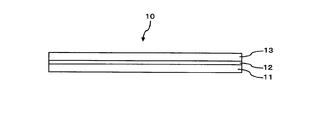
- FIG. 1 shows an example of a laminated sheet-like sealing material 10, and shows the laminated sheet-like sealing material 10 in which a resin film 13 is laminated on one side of a sheet-like sealing material 11 via a primer layer 12.
- a laminated sheet-like sealing material 10 has high compressibility and impact even when a resin film having poor compression properties is laminated because the sheet-like sealing material 11 has the compression stress described above and has excellent compression characteristics. Absorption performance can be secured.
- the laminated sheet-like sealing material of the present invention is provided with a resin film, so that bubbles are formed by the particles (B) and the closed cell ratio is in the above range, so that moisture can be further infiltrated. It can be prevented appropriately.
- the laminated sheet-like sealing material 10 may be provided with an adhesive layer on the surface opposite to the surface on which the resin film 13 of the sheet-like sealing material 11 is provided.
- the pressure-sensitive adhesive layer is the same as described above, and may be laminated on the sheet-shaped sealing material via a primer layer, for example.
- the laminated sheet-like sealing material of the present invention can exhibit high sealing performance without laminating an adhesive layer on the sheet-like sealing material.
- ⁇ Resin film> As the resin film, it is preferable to use a resin excellent in breaking strength and dielectric breakdown voltage.
- resins that can be used for the resin film include ethylene-vinyl alcohol copolymer (EVOH) resins, polyethylene (PE) resins, olefin resins such as polypropylene (PP) resins, and polyethylene terephthalate (PET).
- EVOH ethylene-vinyl alcohol copolymer
- PE polyethylene
- olefin resins such as polypropylene (PP) resins
- PET polyethylene terephthalate
- Polyester resins such as polybutylene terephthalate (PBT), polystyrene (PS) resins, polycarbonate (PC) resins, polyacetal (POM) resins, polyurethane (PU) resins, polyethersulfone (PES) resins Resin, polytetrafluoroethylene (PTFE) resin, polyimide resin, silicone resin, phenol resin, epoxy resin, ABS resin, polyphenylene sulfide (PPS) resin, liquid crystal polymer (LCP) resin, etc. It is done. Moreover, you may laminate
- stack coextrusion, lamination
- resin films using olefin-based resins, EVOH-based resins, and silicone-based resins can be bonded and integrated with sheet-like sealing materials without using the primer layer or the adhesive layer as described above. it can.
- polyester resins such as polyethylene terephthalate, PC resins, PTFE resins, PS resins, POM resins, PU resins, PPS resins, LCP resins, PES resins, PTFE resins, ABS resins
- Resin films using phenolic resins, polyimide resins, and epoxy resins have low adhesion to sheet-like sealing materials and are easy to peel off, so they are bonded and integrated via a primer layer and an adhesive layer, Alternatively, as will be described later, it is preferable to add or apply a coupling agent to the sealing material composition and / or the resin film.
- a sheet-like sealing material can be reinforced by using the said resin.
- the sheet-like sealing material is a foam having bubbles
- the dielectric breakdown strength and moisture permeability may be inferior, but the laminated sheet-like sealing material is insulated by providing these resin films. Breaking strength and moisture permeability can be improved.
- the thickness and expansion ratio of the sheet-shaped sealing material and the thickness of the resin film are important factors. From this point of view, it is preferable that the thickness of the resin film is 0.01 to 0.25 mm while the sheet-shaped sealing material and the expansion ratio are within the above-described ranges.
- the thickness of the resin film is more preferably 0.02 to 0.15 mm.
- the laminated sheet-like sealing material of the present invention has a dielectric breakdown, for example, by setting the thickness of the sheet-like sealing material to 0.1 mm or more and the foaming ratio to 8 times or less and the resin film thickness to 0.01 mm or more. Since the voltage can be set to an appropriate level and the moisture permeability can be reduced, it is suitable as a sealing material for solar cell panels. Moreover, desired performance can be obtained while preventing the material cost from increasing by setting the thickness of the resin film to 0.25 mm or less. Moreover, the rigidity of the laminated sheet-like sealing material is prevented from becoming too high by setting the thickness of the resin film to 0.25 mm or less. For example, when it is wound into a roll shape, curling occurs. This problem is less likely to occur.
- the thickness of the resin film is 0.15 mm or less, the followability to the uneven surface is improved, and the performance as a sealing material can be further enhanced. Moreover, you may mix
- EVOH resin films polyester resin films such as PET and PBT are preferable because of their excellent water vapor barrier properties.
- olefin resin films such as polyethylene films are suitable from the viewpoint of excellent water vapor barrier properties, weather resistance, and light resistance, and PE resin films formulated with ultraviolet degradation inhibitors such as ultraviolet absorbers are also included.
- PE resin films formulated with ultraviolet degradation inhibitors such as ultraviolet absorbers are also included.
- olefin-based, particularly PE or PP-based resin films are desirable. If a resin film with stretchability is used, when a sheet-like sealing material is applied to the periphery of solar cells, etc., it can be adhered while applying tension, thereby increasing the adhesion with solar cell panels, etc. As a result, water tightness can be improved. From these viewpoints, when the laminated sheet-like sealing material is used for solar cell panel applications, EVOH-based resin films and olefin-based resin films are suitable for the resin film.
- the moisture vapor permeability (moisture permeability) in the moisture vapor permeability test defined in JIS Z 0208 of the resin film is desirably 30 g / m 2 ⁇ day or less.
- the moisture permeability is 30 g / m 2 ⁇ day or less
- the solar cell panel due to the ingress of moisture when used for a solar cell panel sealing material, combined with the thickness of the resin film being in the above range Can prevent performance degradation.
- a preferable range of moisture permeability is 10 g / m 2 ⁇ day or less, and more preferably 5 g / m 2 ⁇ day or less.
- an olefin resin film such as an EVOH resin film, a polyethylene film or a polypropylene film, a polyester resin film such as PET or PBT, or the like should be used.
- the ethylene-vinyl alcohol copolymer constituting the EVOH resin film having low moisture permeability is, for example, a copolymer of ethylene and vinyl alcohol, and ethylene is 24 to 48 mol%, preferably 38 to 44. Examples include those having a relatively high ethylene content.
- an ethylene-vinyl alcohol copolymer for example, “Eval” manufactured by Kuraray Co., Ltd., “Soarnol” manufactured by Nippon Synthetic Chemical Industry Co., Ltd. and the like can be used. Further, if the film is obtained by biaxially stretching an ethylene-vinyl alcohol copolymer, the moisture permeability can be lowered even if the ethylene content is 24 to 32 mol%.
- an EVOH resin film for example, “EVAL EF-XL” manufactured by Kuraray Co., Ltd. can be used.
- Examples of the polyethylene constituting the polyethylene film include low density polyethylene, linear low density polyethylene, high density polyethylene, and mixtures thereof.
- an ethylene-vinyl acetate copolymer may be mixed as described above.
- examples of the polypropylene constituting the polypropylene film include a homopolymer type, a copolymer type, a block polymer type, and an ethylene-propylene terpolymer. Furthermore, you may mix the said polyethylene and EVA.
- polyester resin films such as PET and PBT include “Max Barrier # 12” manufactured by Mitsui Chemicals, Inc., “OT Film” manufactured by Sekisui Chemical Co., Ltd., and the like.
- the elongation at break in the machine direction (MD direction) in the tensile test at 20 ° C. of the resin film is desirably 70% or more. If this value is 70% or more, there is no deterioration in the handleability during production due to the above-described curl, and the adhesion can be improved by allowing the laminated sheet-like sealing material to follow the surface of the solar cell module.
- the resin film having an elongation at break of 70% or more include EVOH-based resin films, olefin-based resin films, polyester-based resin films, PU-based resins, PTFE-based resins, and polyimide-based resins among the above-described resin films. .
- the elongation at break is maintained even after 1000 hours based on the UV exposure test conditions defined in UL746C of the resin film. That is, even after the above test, the breaking elongation in the vertical direction is preferably 70% or more.
- a resin having a high elongation at break even after UV exposure a resin in which an ultraviolet degradation inhibitor is blended is used.
- UV degradation inhibitors hindered amine light stabilizers, benzotriazole ultraviolet absorbers, hindered phenol antioxidants, light-shielding pigments based on titanium oxide and / or carbon black, and mixtures thereof are used. it can.
- the moisture permeability is 30 g / m 2 ⁇ day or less, and the elongation at break after 1000 hours of UV exposure test conditions has elapsed. Is preferably 70% or more.
- the above-mentioned EVOH-based resin film or polyolefin-based resin film is preferably blended with an ultraviolet degradation inhibitor. Specifically, Vegitalon Super Kirinashi (product name, Sekisui Film Co., Ltd.) Company-made), Hanano Hikaru UV Long (product name, manufactured by Sekisui Film Co., Ltd.) and the like.
- the sheet-like sealing material of the present invention is made of foamed silicone and has a low tear strength, a balance with the tensile strength of the resin film is important.
- the tension at the time of 5% extension of the sheet-shaped sealing material is preferably 15 to 50% of the tension at the time of 5% extension of the resin film. By setting it as 15% or more, the tension becomes large and the adhesiveness with the sheet-shaped sealing material becomes good. Further, by setting it to 50% or less, it is possible to prevent the sheet-like sealing material from being torn when being drawn out from the wound body and closely attached to the mounted body.
- the sheet-like sealing material can be brought into close contact with a body to be attached (for example, a solar cell panel) or the like with an appropriate tension, and is particularly effective when being brought into close contact using an automation device.
- the tension at the time of 5% extension means the tension when a sample having a width of 25 mm ⁇ measured length of 100 mm is extended by 5% in the length direction with a tensile tester.
- a direction parallel to the MD direction of the resin film in the sealing material is defined as an extension direction.
- the laminated sheet-like sealing material of the present invention preferably has the following compression set, dielectric breakdown voltage, and moisture permeability.
- compression set A large compression set means that the repulsion force (compression stress) in the long-term compression state is reduced.
- impact performance and gap followability are deteriorated, that is, a gap is formed and water (including water vapor) enters, and therefore, a small compression set is an important factor.
- the laminated sheet-like sealing material of the present invention preferably has a compression set of 15% or less, more preferably 10% or less.
- the sealing property is improved and it is not necessary to make a so-called double-sided tape in which an adhesive layer is provided on both sides, for example, in order to prevent gaps.
- the adhesive layer By not providing the adhesive layer on one side (preferably on either side), it is not necessary to lower the impact performance in order to exert the adhesive effect of the adhesive, and the sealing material has higher impact resistance performance. Can provide.
- the adhesive layer disposed on the outside is omitted, so that extra frictional resistance due to the adhesive is eliminated, and a sheet-like seal corresponding to the core material The material is not deformed.
- the dielectric breakdown voltage is preferably 4 kV or more, more preferably 5 kV or more.
- the laminated sheet-like sealing material is used as a solar cell panel sealing material, it is necessary to insulate it from a metal frame (typically made of aluminum). This is because if the electricity charged in the metal frame flows to the solar cell panel through the solar panel sealing material, the power generation capacity of the cell is reduced (deteriorated).
- the dielectric breakdown voltage is 4 kV or more, the sheet-like sealing material or the laminated sheet-like sealing material and the metal frame can be substantially insulated.
- the moisture permeability is preferably 30 g / m 2 ⁇ day or less, more preferably 10 g / m 2 ⁇ day or less. It is. By setting the moisture permeability to the upper limit value or less, water (including water vapor) can be prevented from entering the solar battery panel, and a decrease in the power generation capacity of the cell can be prevented.
- the sheet-like sealing material of the present invention is preferably obtained by curing a sealing material composition containing a curable silicone resin composition as a main component and a plurality of particles having a cavity inside. At this time, a plurality of unfoamed particles having expandability such as expandable microcapsules are preliminarily heated and expanded to form a plurality of foamed particles, and the foamed particles are mixed with the curable silicone resin composition to obtain a sealing material composition. It is preferable to obtain Here, the expandable particles such as expandable microcapsules may be preliminarily heated and expanded alone without being mixed with other components.
- a part of the curable silicone resin composition for example, a part of the main agent, is mixed with a plurality of unfoamed particles having foamability, and the mixture is preheated to expand the foamable particles. It is set as expanded particle
- the foamable particles are expanded in advance before molding and curing, the bubble diameter can be easily controlled and the sealing performance can be easily improved.
- the sealing material composition containing the curable silicone resin composition and the particle
- the foamable particles are blended in the sealing material composition in an unexpanded state, and when the sealing material composition is heat-cured, it is thermally expanded simultaneously with the heating to form a cavity inside, It becomes foamed particles.
- the sealing material composition may contain both expanded particles that have been heated and expanded in advance and unexpanded (unexpanded) expandable particles. The unfoamed and expandable particles may be expanded at the time of curing or may not be expanded.
- the sealing material composition has a thickness that the sheet-like sealing material has (for example, a thickness of 0.05 mm or more) by a press method, a roll transfer method, a roll cast method, a die cast method, a die extrusion method, or the like. 2.5 mm or less) It is preferable to control to form a sheet, and to cure in that state to form a sheet-shaped sealing material.
- seat is performed collectively. And what was obtained by the hardening becomes said thin sheet-like sealing material (for example, thickness 0.05 mm or more and 2.5 mm or less).
- the sheet-like sealing material obtained by this manufacturing method is not obtained by slicing, for example, a thick sealing material in parallel to the main plane, and therefore, a sheet-like sealing material having high sealing performance can be stably obtained.
- the sealing material composition is preferably cured by heating, and the heating temperature at the time of curing is not limited as long as it is a temperature capable of curing the curable silicone resin composition, but the particle (B) It is preferable that the temperature is lower than the melting temperature of the outer shell, and when the particles (B) are already expanded, the temperature is preferably lower than the temperature when the particles are expanded. Thereby, it is prevented that the shape and particle diameter of particle
- a specific heating temperature is, for example, 80 to 180 ° C., preferably 100 to 160 ° C.
- the laminated sheet-like sealing material of the present invention is obtained by superposing a sealing material composition and a resin film which are formed into a sheet shape by the same method as described above, and then curing the sealing material composition. It is preferable to adhere to the sheet-like sealing material by this curing. Curing is preferably performed by heating at the heating temperature described above.
- a method for increasing the adhesive strength between the silicone resin foam (A) and the film (B) a method in which a coupling agent is previously added to either or both of the sealing material composition and the resin film, the sealing material composition, A method of applying a primer such as a coupling agent to the bonding surface with the resin film, and a pressure-sensitive adhesive on the bonding surface between the sealing material composition and the resin film as long as the thickness and properties of the sealing material composition and the resin film are not impaired.
- positioning etc. are mentioned.
- the sheet-like sealing material of the present invention is used, for example, as a solar cell panel sealing material.
- the solar cell panel sealing material may be used alone as a sheet-shaped sealing material, but as described above, the other surface may be provided on one or both sides of the sheet-shaped sealing material, A laminated sheet-like sealing material is preferably used.
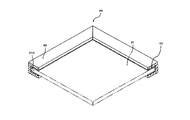
- the solar cell module 20 includes a solar cell panel 21, a frame 22 as a fixing member that fixes the peripheral end 21 ⁇ / b> C of the solar cell panel 21, and between the peripheral end 21 ⁇ / b> C and the frame 22. And a solar cell panel sealing material arranged in the above.
- the solar cell panel sealing material shows an example in the case of using the laminated sheet-like sealing material 10 in which the resin film 13 is laminated on one surface of the sheet-like sealing material 11.
- the solar cell panel 21 has a substantially rectangular flat plate shape, and a known solar cell panel such as a crystal system, a thin film system, and a CI (G) S system is used.
- the solar cell panel 21 is sequentially formed on a power generation layer, both surfaces thereof, that is, a glass substrate (not shown) formed on a light receiving side surface 21A that receives sunlight, and a back surface (a side surface opposite to the light receiving side surface) 21B. It is comprised from the resin layer (not shown) and the protective layer (not shown).
- the solar cell panel 21 has a terminal cable (not shown) for taking out electricity from the power generation layer and a terminal box (not shown) for housing the terminal cable on the back surface 21B. Is provided.
- the thickness of the solar cell panel 21 is, for example, 2 to 10 mm, preferably 3 to 6 mm.
- the frame 22 is provided along each side of the solar cell panel 21 as shown in FIGS.
- the frame 22 is formed in a substantially U-shaped cross section that opens inward, and includes a flat side wall 23, a flat light-receiving surface side wall 24 that extends inward from the top of the side wall 23, and a lower part of the side wall 23. And a flat plate-like back side wall 25 extending inward from the inside.
- the frame 22 is made of, for example, a metal material such as aluminum or a resin material, and is preferably made of aluminum.
- the frame 22 is assembled so that the ends in the longitudinal direction along each side of the solar cell panel 21 are joined together to form four corners and form a frame shape in plan view.
- the laminated sheet-like sealing material (solar cell panel sealing material) 10 is substantially U-shaped in cross section in contact with the side surface 21D, the light receiving side surface 21A, and the back surface 21B of the panel 21 at the peripheral end 21C of each side of the solar cell panel 21. It is bent into a shape.
- the sealing material 10 for solar cell panels is a solar cell panel so that the surface (sheet-like sealing material itself) on the opposite side to the surface in which the resin film 13 was provided may contact each surface of the peripheral edge part 21C. 21 is closely attached to the peripheral end portion 21C and attached to the peripheral end portion 21C.
- the resin film 13 is disposed outside (the frame 22 side) in the U-shaped laminated sheet-like sealing material 10, and the sheet-like sealing material 11 is arranged inside (the solar cell panel 21 side). ).
- the inner side of the laminated sheet-like sealing material 10 may be light-guided through the glass or resin of the solar cell panel 21 and indirectly irradiated with sunlight.
- the sheet-like sealing material 10 is formed of a silicone resin having excellent light resistance. Since the sealing material 11 is on the inner side, the resin film 13 is prevented from being deteriorated by sunlight, and the durability of the laminated sheet-like sealing material 10 is improved.
- the portion is overlapped.
- the overlapped portion has a doubled substantial thickness.
- the peripheral end portion 21 ⁇ / b> C to which the solar cell panel sealing material 10 is attached is press-fitted into the U shape of the frame 22 and attached to the frame 22.
- the frame 22 supports the solar cell panel 21 by further sandwiching the peripheral end portion 21 ⁇ / b> C of the solar cell panel 21 sandwiched by the solar cell panel sealing material 10.
- the solar panel sealing material 10 is compressed and disposed between the light receiving side surface 21A and the light receiving surface side wall 24, between the side surface side wall 23 and the side surface 21D, and between the back surface 21B and the back surface side wall 25. Seal the gap.
- the laminated sheet-like sealing material (solar cell panel sealing material) 10 is preferably arranged in a compressed state at a compression rate of 20 to 50% at 20 ° C. Due to individual differences between the solar cell panel and the frame, there is usually a variation in the size of the gap between the panel 21 and the frame 22.
- the compression stress and the expansion ratio of the sheet-shaped sealing material 11 are within the above-described ranges, and the compression rate is within this range, so that even if the gap size varies, the laminated sheet-shaped sealing material 10 The gap between the solar cell panel 21 and the frame 22 can be sufficiently filled.
- the solar cell panel sealing material 10 seals the peripheral end portion 21 ⁇ / b> C of the solar cell panel 21, and prevents, for example, water from entering the solar cell panel 21.
- the sheet-shaped sealing material 11 a silicone resin in which a plurality of particles having cavities are dispersed is used. Therefore, the waterproof performance and shock absorption performance of the solar panel sealing material 10 are high. It will be a thing.
- the sealing material for solar cell panels of another structure The same applies when using.
- the pressure-sensitive adhesive layer is provided on the surface opposite to the surface on which the resin film is provided, the pressure-sensitive adhesive layer adheres to the peripheral end portion 21C, so that the solar cell panel sealing material 10 is attached to the panel.
- the configuration is the same as the above-described configuration except that it is attached.
- the solar cell panel sealing material uses a sheet-shaped sealing material in which a plurality of particles having hollow portions are dispersed in a silicone resin. The sealing property between the solar cell panels 21 is sufficiently ensured.
- the sheet-like sealing material and the laminated sheet-like sealing material of the present invention are used as a sealing material for vehicles such as automobiles and motorcycles.
- automobiles may be used in a wide range of temperatures, such as high temperatures in midsummer and low temperatures in extremely cold temperatures. Therefore, automotive sealing materials must be able to be used even in harsh usage environments with large temperature changes. It has been.
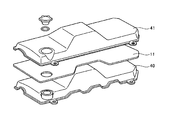
- As a sealing material for vehicles for example, it is used as various sealing materials for each component used for a power source of a vehicle such as an internal combustion engine (gasoline engine, diesel engine, etc.) or an electric motor, and a high-temperature portion around the power source. For example, as shown in FIG.
- the sheet-shaped sealing material 11 is disposed between the engine main body 40 and the engine cover 41, and is used as a sealing material that seals between these and the fitting portion.
- the vehicle sealant may be used, for example, in an automobile or the like at a joint part of unit parts such as a lamp, an air conditioner, a mirror, and a sunroof typified by the front and rear.
- it is used to seal gaps formed between the components constituting these and other unit components.
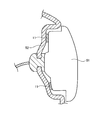
- the sheet-shaped sealing material 11 is disposed between the rear lamp 51 and the holding member 52 that holds the rear lamp 51, and ensures sealing performance between them. Further, as shown in FIG.
- the sheet-shaped sealing material 11 is disposed between a panel holding member 61 that holds the sunroof panel and a bracket 62 that assembles the panel holding member 61 on the vehicle body side. Ensure sealing performance. Further, the vehicle sealing material is used to seal a gap generated in the panel, for example, a gap generated in the panel itself, or a gap generated between the panel and other parts in the exterior panel and the dash panel for automobiles. May be. In the example shown in FIGS. 4 to 6, the vehicle sealing material is an example of the sheet-shaped sealing material 11 alone, but a laminated sheet-shaped sealing material may be used.
- the sheet-like sealing material and the laminated sheet-like sealing material of the present invention can be used for applications other than the above-mentioned applications, and are particularly suitable for applications that are used in harsh usage environments with large temperature changes. . Specifically, it is used for interior materials in transportation means other than vehicles such as fuel cells, household fuel cell cogeneration systems (commonly known as ENE-FARM), gas turbines, aircraft, etc., as well as power sources and the surrounding high-temperature parts. You may use for the various sealing materials of each component.
- ⁇ Compressive stress> Based on JIS K6767, the 20% compressive stress of the sheet-like sealing material was measured.
- the measurement was performed by stacking a plurality of sheet-like sealing materials so that the total thickness becomes 10 mm.
- ⁇ Closed cell ratio> This was performed by the method described in the specification.
- ⁇ Cycle test> According to IEC61215, ultraviolet irradiation, a temperature cycle, and a condensation freezing cycle test were sequentially performed on the sheet-like sealing material or the laminated sheet-like sealing material. Specifically, after UV irradiation of 15 kWh ⁇ m -2 in the UV pretreatment test, the temperature cycle test [-40 to 85 ° C x 50 cycles] and then the condensation freezing cycle test [-40 to 85 ° C x 85% RH The state after [ ⁇ 10 cycles] was observed. Those in which the state did not change were described as ⁇ in the table, and those in which the state had changed were described in the table.
- ⁇ Ultraviolet irradiation test> According to UL746C, the ultraviolet irradiation test of the resin film used for the laminated sheet-like sealing material was carried out. Specifically, the elongation at break after irradiation for 1,000 hours at a black panel (BP) temperature of 63 ° C. was measured.
- ⁇ Compression set> The compression set of the sheet-like sealing material or the laminated sheet-like sealing material was measured according to JIS K 6767. In the present invention, a plurality of sheet-shaped sealing materials or laminated sheet-shaped sealing materials are stacked so that the total thickness is 10 mm, and the temperature is set to 70 ° C., the compression rate is 50%, that is, the thickness is distorted to 5 mm. Measurement was performed in accordance with JIS except for the conditions.
- ⁇ Moisture permeability> It measured according to JIS Z 0208.
- Example 1 Preparation of particles (B) 5 parts by weight of thermally expandable microcapsules (average particle size 16 ⁇ m, spherical, expansion start temperature 122 ° C., maximum expansion temperature 167 ° C., “Advancel EML101” manufactured by Sekisui Chemical Co., Ltd.), Momentive Performance Materials Japan 10 parts by weight of “TSE3032A” (viscosity (23 ° C.): 4.2 Pa ⁇ s), which is the main component of a silicone resin (two-component heat-curable liquid silicone rubber) manufactured by Godo Kaisha, was mixed to obtain a mixture. Next, the mixture was placed on a PET film and heated at 155 ° C. for 4 minutes to expand the thermally expandable microcapsules, thereby obtaining a mixture containing particles (B) having cavities inside.
- thermally expandable microcapsules average particle size 16 ⁇ m, spherical, expansion start temperature 122 ° C., maximum expansion temperature 167 ° C., “
- the sealing material composition is quantitatively continuously supplied between two rolls having a clearance of 0.6 mm, and spread between two PET films (Toray Co., Ltd., Lumirror S10, thickness 0.05 mm), Heated continuously at 120 ° C. for 5 minutes. At this point, it is considered that the curing reaction was not completed, but heating was stopped because there was no problem in subsequent handling. After leaving at room temperature (23 ° C.) for 1 day, any PET film was peeled off to obtain a sheet-shaped sealing material. When the thickness and specific gravity were measured, they were 0.5 mm and 0.21 g / cc, respectively. In the sheet-like sealing material, the average particle diameter of the particles (B) was 80 ⁇ m, which was 5 times that of the thermally expandable microcapsules before foaming. The porosity of the particles (B) was 90.1%.
- Example 2 Preparation of particles (B) 5.5 parts by weight of thermally expandable microcapsules (average particle size 16 ⁇ m, spherical, expansion start temperature 122 ° C., maximum expansion temperature 167 ° C., “ADVANCEL EML101” manufactured by Sekisui Chemical Co., Ltd.) and Momentive Performance Materials ⁇ Mixed uniformly with 15 parts by weight of “TSE3032A” (viscosity (23 ° C.): 4.2 Pa ⁇ s), which is the main ingredient of Japan Godo Kaisha's silicone resin (two-component heat-curable liquid silicone rubber) to obtain a mixture It was. Next, the mixture was placed on a PET film and heated at 155 ° C. for 4 minutes to expand the thermally expandable microcapsules, thereby obtaining a mixture containing particles (B) having cavities inside.
- TSE3032A viscosity (23 ° C.): 4.2 Pa ⁇ s
- the sealing material composition was quantitatively continuously supplied between two rolls having a clearance of 0.2 mm and spread between PET films (Toray Co., Ltd., Lumirror S10, thickness 0.05 mm). Heated continuously for 4 minutes. At this point, it is considered that the curing reaction was not completed, but heating was stopped because there was no problem in subsequent handling. After leaving at room temperature for 1 day, any PET film was peeled off to obtain a sheet-like sealing material. When the thickness and specific gravity of this sheet-like sealing material were measured, they were 0.1 mm and 0.39 g / cc, respectively. Furthermore, each test whose result is shown in Table 1 was also carried out. In the sheet-like sealing material, the average particle diameter of the particles (B) was 45 ⁇ m, which was 2.8 times that of the thermally expandable microcapsule before foaming. Moreover, the porosity of the particles (B) was 92.0%.
- Example 3 Preparation of particles (B) 5 parts by weight of thermally expandable microcapsules (average particle size 40 ⁇ m, spherical, expansion start temperature 118 ° C., maximum expansion temperature 172 ° C., “ADVANCEL EMH204” manufactured by Sekisui Chemical Co., Ltd.), Momentive Performance Materials Japan 10 parts by weight of “TSE3032A” (viscosity (23 ° C.): 4.2 Pa ⁇ s), which is the main component of a silicone resin (two-component heat-curable liquid silicone rubber) manufactured by Godo Kaisha, was mixed to obtain a mixture. Next, the mixture was placed on a PET film and heated at 160 ° C. for 5 minutes to expand the thermally expandable microcapsules, thereby obtaining a mixture containing particles (B) having cavities therein.
- TSE3032A viscosity (23 ° C.): 4.2 Pa ⁇ s
- a sealing material composition is quantitatively continuously supplied between two rolls having a clearance of 1.97 mm, and a PET film on one side (Lumilar S10, manufactured by Toray Industries, Inc., thickness 0.05 mm), a polyethylene film on the opposite side ( Made by Sekisui Film Co., Ltd., product name: Vegetalon Super Kirinashi, thickness 0.12 mm, moisture permeability 15 g / m 2 ⁇ day, elongation at break (before UV exposure) 200% or more, 1000 hours after UV exposure test defined in UL746C And the film was continuously heated at 120 ° C. for 5 minutes.
- the curing reaction is considered to be incomplete, but heating was stopped because there were no problems in subsequent handling.
- This laminated sheet-shaped sealing material was subjected to a cycle test, an ultraviolet irradiation test, a compression set, and a moisture permeability test. The results are shown in Table 1.
- the average particle diameter of the particles (B) was 150 ⁇ m, which was 3.75 times that of the thermally expandable microcapsule before foaming. Further, the porosity of the particles (B) was 94.9%.
- Example 4 (Production of laminated sheet-like sealing material) Polyethylene film as a resin film (manufactured by Sekisui Film Co., Ltd., product name: Vegitalon Super Kirinashi, thickness 0.12 mm, moisture permeability 15 g / m 2 ⁇ day, elongation at break (before UV exposure) 200% or more, determined by UL746C The elongation at break after 1000 hours of UV exposure test was 200% or more). Further, a rectangular frame member having a stainless steel plate having a thickness of 3 mm and an opening having a thickness of 0.5 mm and a length of 18 cm and a width of 18 cm was prepared.
- the opening of the frame member was filled with 10 g of the same sheet-shaped sealing material composition as in Example 1.
- a stainless steel plate and the above polyethylene film are arranged on one side of the frame member, and a stainless steel plate and a PET film (product name: Teijin Tetron Film HB, thickness 50 ⁇ m, manufactured by Teijin DuPont Co., Ltd.) are arranged on the opposite side.
- the sealing material composition was cured by heating at a pressure of 10 MPa and 145 ° C. for 20 minutes. After curing, the PET film was peeled off to obtain a laminated sheet-like sealing material comprising a sheet-like sealing material in which closed cells were formed by the hollow portions of the particles (C) and a polyethylene film.
- the average particle diameter of the particles (B) was 77 ⁇ m, and the porosity was 86.8%.
- the sheet-like sealing material composition which protruded from the frame member at the time of pressing was removed.
- a sheet-like sealing material without a film was prepared and used in the same manner as in Example 3.
- the resin film is a polyethylene film (manufactured by Sekisui Film Co., Ltd., product name: Kato Hanano Tough UV Long, thickness 0.17 mm, moisture permeability 14 g / m 2 ⁇ day, elongation at break (before UV exposure test) is 200% or more, UL746C
- the laminated sheet-like sealing material of Example 5 was obtained in the same manner as in Example 4 except that the elongation at break after 1000 hours of the UV exposure test defined in (2) was 200% or more.
- a sheet-like sealing material without a film was prepared and used in the same manner as in Example 3.
- the average particle diameter of the particles (B) was 77 ⁇ m, and the porosity was 86.8%.
- Example 6 (Production of sheet-like sealing material) A rectangular frame member having a stainless steel plate having a thickness of 3 mm and an opening having a thickness of 2.3 mm and a length of 18 cm and a width of 18 cm was prepared. In order to measure the thickness and specific gravity of the sheet-shaped sealing material, 13 g of the same sheet-shaped sealing material composition as in Example 1 was filled in the opening of the frame member. A stainless steel plate and a PET film (product name: Teijin Tetron film HB, manufactured by Teijin DuPont Co., Ltd., thickness 50 ⁇ m) are arranged on both sides of the frame member, and heated at a pressure of 0.1 MPa and 145 ° C. for 20 minutes with a press machine. Then, the sealing material composition was cured. After curing, the PET film was peeled off to obtain a sheet-like sealing material.
- a PET film product name: Teijin Tetron film HB, manufactured by Teijin DuPont Co., Ltd., thickness 50 ⁇ m
- Example 7 The thickness of the square frame member having an opening is 0.7 mm, the same sheet-like sealing material composition as in Example 1 is 4 g, and the resin film is “PBT film” manufactured by Kansai Chemical Industry Co., Ltd. There is a sheet-like sealing material and a laminated sheet-like sealing material in the same manner as in Example 6 except that the sealing material composition is brought into contact with the surface coated with 0.5 ⁇ m of “XP80-A5363” manufactured by Momentive in advance. Got.
- Example 8 Using the same sheet-like sealing material composition as in Example 1, a laminated sheet-like sealing material was produced by the same method for producing a laminated sheet-like sealing material as in Example 3. However, the roll clearance was 0.21 mm.
- the resin film used was “Max Barrier” manufactured by Mitsui Chemicals Tosero Co., Ltd., and the sealing material composition was spread on a surface on which 0.5 ⁇ m of “XP80-A5363” manufactured by Momentive was previously applied.
- a sheet-like sealing material was prepared by the same method for producing the sheet-like sealing material as in Example 3.
- Example 9 The roll clearance was 0.13 mm, the resin film used was “Soarnol AT4403” (ethylene content 44 mol%) manufactured by Nippon Synthetic Chemical Industry Co., Ltd., and “XP80-A5363” manufactured by Momentive was not applied in advance. A laminated sheet-like sealing material was prepared in the same manner as in Example 8.
- Example 10 A laminated sheet-like sealing material was prepared in the same manner as in Example 8 except that the roll clearance was 1.15 mm and the resin film used was “Soarnol AT4403” (ethylene content 44 mol%) manufactured by Nippon Synthetic Chemical Industry Co., Ltd. .
- Comparative Example 1 As the sheet-like sealing material of Comparative Example 1, an acrylic foam “PB80, manufactured by 3M Co.” having a thickness of 0.8 mm was used.
- Silicone sealant (manufactured by Dow Corning Toray Co., Ltd., SH780) was poured into a mold having a depth of 0.5 mm to produce a sheet-like sealing material having a thickness of 0.5 mm.
- a laminated sheet-like sealing material was prepared in the same manner as in the preparation of the sealing material composition except that one of the PET films was changed to the same film as in Example 3.
- Table 1 summarizes the conditions of each example and comparative example.
- Table 2 shows the measurement results and evaluation results of each member of each example and comparative example.
- Examples 1 to 10 were satisfactory in various test results and could be sufficiently used as solar cell panel sealing materials.
- the strength decreases due to ultraviolet irradiation, shrinks and hardens, and cannot function sufficiently as a solar cell panel sealing material. Further, since the compression set is large, the buffering performance is also lowered.
- Comparative Examples 2 and 4 the foamed particles are not blended and the sealing performance is insufficient, and the moisture permeability is increased. When used as a solar cell panel sealing material, water vapor is transmitted into the solar cell panel. It is presumed to be. In Comparative Example 3, the compression set was good, but the moisture permeability was large, which was unsuitable as a solar cell panel sealing material.
Landscapes
- Chemical & Material Sciences (AREA)
- Engineering & Computer Science (AREA)
- Materials Engineering (AREA)
- Organic Chemistry (AREA)
- Health & Medical Sciences (AREA)
- Chemical Kinetics & Catalysis (AREA)
- Medicinal Chemistry (AREA)
- Polymers & Plastics (AREA)
- Manufacturing & Machinery (AREA)
- Life Sciences & Earth Sciences (AREA)
- Physics & Mathematics (AREA)
- Sustainable Development (AREA)
- Sustainable Energy (AREA)
- Thermal Sciences (AREA)
- Combustion & Propulsion (AREA)
- Mechanical Engineering (AREA)
- General Engineering & Computer Science (AREA)
- Sealing Material Composition (AREA)
- Laminated Bodies (AREA)
- Photovoltaic Devices (AREA)
- Compositions Of Macromolecular Compounds (AREA)
Abstract
Description
すなわち、本発明は、以下の(1)~(17)を提供するものである。
(1)シリコーン樹脂(A)と、前記シリコーン樹脂(A)中に分散され、内部に空洞部を有する複数の粒子(B)とを有するシート状シール材。
(2)厚みが0.05~2.5mmであるとともに、発泡倍率が2~8倍である上記(1)に記載のシート状シール材。
(3)前記複数の粒子(B)が、膨張された発泡粒子を含み、かつ平均粒子径が、40~200μmである上記(1)又は(2)に記載のシート状シール材。
(4)太陽電池パネル用シール材である上記(1)~(3)のいずれかに記載のシート状シール材。
(5)上記(1)~(4)のいずれかに記載のシート状シール材と、前記シート状シール材の片面に積層された樹脂フィルムとを備える積層シート状シール材。
(6)前記シート状シール材が独立気泡率70%以上であり、前記シート状シール材の20℃における20%圧縮応力が0.05~0.7MPaである上記(5)に記載の積層シート状シール材。
(7)前記樹脂フィルムのJIS Z 0208に定められる水蒸気透湿性試験における透湿度が30g/m2・day以下であり、かつ前記樹脂フィルムの厚みが0.01~0.25mmある上記(5)又は(6)に記載の積層シート状シール材。
(8)前記樹脂フィルムのUL746Cに定められるUV暴露試験条件に基づく1000時間経過後の破断伸びが70%以上である上記(5)~(7)のいずれかに記載の積層シート状シール材。
(9)前記樹脂フィルムが、オレフィン系樹脂フィルム、ポリエステル系樹脂フィルム又はエチレン-ビニルアルコール共重合体系樹脂フィルムである上記(5)~(8)のいずれかに記載の積層シート状シール材。
(10)前記シート状シール材の5%伸張時の張力が、前記樹脂フィルムの5%伸張時の張力の15~50%である上記(5)~(9)のいずれかに記載の積層シート状シール材。
(11)太陽電池パネル用シール材である上記(5)~(10)のいずれかに記載の積層シート状シール材。
(12)太陽電池パネルと、前記太陽電池パネルの周端部を固定する固定部材と、前記固 定部材と前記太陽電池パネルの間に配置された、上記(4)又は(11)に記載の太陽 電池パネル用シール材とを備える太陽電池モジュール。
(13)前記太陽電池パネル用シール材が前記積層シート状シール材からなり、前記積層シート状シール材において、前記シート状シール材が太陽電池パネル側に配置されている上記(12)に記載の太陽電池モジュール。
(14)硬化性シリコーン樹脂組成物と、内部に空洞部を有する複数の粒子とを含むシール材組成物を硬化して、前記粒子の空洞部により気泡が形成されてなるシート状シール材を得るシート状シール材の製造方法。
(15)複数の発泡性を有する粒子を加熱発泡させて、内部に空洞部を有する複数の発泡粒子を得て、その発泡粒子と前記硬化性シリコーン樹脂組成物とを混合して前記シール材組成物を得る上記(14)に記載のシート状シール材の製造方法。
(16)前記硬化性シリコーン樹脂組成物の主剤の一部と、複数の発泡性を有する粒子とを混合した後、前記発泡性を有する粒子を加熱膨張させ、内部に空洞部を有する発泡粒子とし、複数の発泡粒子と前記硬化性シリコーン樹脂組成物の主剤の一部とを含む混合物を得る工程と、前記混合物に前記硬化性シリコーン樹脂組成物の主剤の残りおよび硬化剤を少なくとも混合してシール材組成物を得る工程と、前記シール材組成物をシート状にし、加熱硬化させ前記シート状シール材を得る工程と、を含む上記(14)又は(15)に記載のシート状シール材の製造方法。
(17)硬化性シリコーン樹脂組成物と、内部に空洞部を有する複数の粒子とを含むシール材組成物を、樹脂フィルムに重ね合わせた状態で硬化して、前記粒子の空洞部により気泡が形成されてなるシート状シール材の片面に前記樹脂フィルムが積層された積層シート状シール材を得る積層シート状シール材の製造方法。
[シート状シール材]
本発明に係るシート状シール材は、シリコーン樹脂(A)と、シリコーン樹脂(A)中に分散され、内部に空洞部を有する複数の粒子(B)とを有するものである。本発明では、このような構成により、内部に複数の気泡を有するシリコーン樹脂(A)によりシート状シール材が形成されこととなり、厚みが薄くありながら、衝撃吸収性、シール性、耐寒耐熱性、耐光性、及び耐湿性に優れたシート状シール材を提供することができる。
また、本発明に係るシート状シール材は、発泡体であることが好ましい。発泡体は、後述するように、シール材組成物を硬化させる際に発泡させた硬化物であってもよいが、発泡させた発泡粒子を含むシール材組成物を硬化させたものであったほうが好ましい。これにより、シート状シール材の各種性能を良好に維持したまま、シート状シール材を薄厚にしやすくなる。
また、本発明に係るシート状シール材は、「コーキング」、「シーラント」と呼ばれるものとは異なる。シーラント等は接着性能により空隙部に隙間を与えずにシール性能を発現させるものである。すなわち、シーラントは、硬化反応、架橋反応が完了した状態にすれば、表面の接着性は発現できず、シール性能を発現できない。シーラントの代表例としては、東レ・ダウコーニング株式会社製、SH780等のシリコーンシーラントが挙げられる。
それに対して、本発明に係るシート状シール材は、既に硬化反応、架橋反応が完了したものであり、表面の接着性は発現しないが、シール性能を発現できる。
本発明に係るシリコーン樹脂(A)は、硬化性シリコーン樹脂組成物を硬化して得られるものであり、かつ二液混合型液状タイプの付加反応型シリコーン樹脂であることが好ましい。そのような硬化性シリコーン樹脂組成物は、例えば(A1)1分子中に少なくとも2個のアルケニル基を有するオルガノポリシロキサンと、(A2)1分子中に少なくとも2個のケイ素原子結合水素原子を有するオルガノハイドロジェンポリシロキサンと、(A3)白金系触媒とを含むものである。
シリコーン樹脂(A)は、「変成シリコーン」と呼ばれる、シリル基を末端に持つポリエーテルとは異なるものである。変成シリコーンの代表例としては、株式会社カネカ製「MSポリマー」が挙げられる。
(A1)成分の分子量は特に限定はないが、23℃における粘度が0.1Pa・s以上であることが好ましく、0.3~15Pa・sであることがより好ましく、0.5~10Pa・sであることが更に好ましい。本発明においては上記オルガノポリシロキサンを2種以上組み合わせて使用してもよい。
(A2)成分の分子量は特に限定されないが、23℃における粘度が0.005~8Pa・sであることが好ましく、0.01~4Pa・sであることがより好ましい。
(A2)成分の添加量は、本成分中のケイ素原子結合水素原子と(A1)成分中のケイ素原子結合アルケニル基のモル比が(0.5:1)~(20:1)となるような量であり、好ましくは(1:1)~(3:1)の範囲である。このモル比が0.5以上になると硬化性が比較的良好になるとともに、20以下となるとシート状シール材の硬度が適切な大きさになる。
この白金系触媒の添加量は、通常、(A1)成分100万重量部に対して白金系金属として0.1~500重量部であり、好ましくは1~50重量部の範囲内である。白金系触媒の添加量を0.1重量部以上とすることで付加反応が適切に進行させることができ、500重量部以下とすることにより経済的に本発明を実施できる。(A3)成分の白金系触媒は、二液硬化型においては、通常主剤又は硬化剤のいずれかに予め加えられているものである。
硬化性シリコーン樹脂組成物の市販品例としては、モメンティブ・パフォーマンス・マテリアルズ・ジャパン合同会社製の2成分加熱硬化型液状シリコーンゴム「TSE3032」等が挙げられる。
粒子(B)の平均粒子径は作製するシート状シール材の厚みによって大きく異なるが、好ましくは10μm以上、より好ましくは20μm以上、更に好ましくは40μm以上であり、また、好ましくは300μm以下、より好ましくは200μm以下、更に好ましくは150μm以下である。平均粒子径を300μm以下とすることで、シート状シール材が極めて薄くなっても、粒子(B)により独立気泡が形成され、シール材として機能することが可能になる。また、10μm以上とすることで、耐衝撃性やシール性を良好にすることができる。
複数の粒子(B)は、シリコーン樹脂(A)中に分散され、内部に空洞部を有する。複数の粒子(B)は、その粒子径が、単一分布を示してもよいが、異なる分布を示してもよい。例えば3種類の粒子径分布を示すことが好ましい。単一の粒子径分布の粒子(B)に比べて、より数多く粒子(B)を内在することが出来るからである。
なお、「異なる分布を示す」とは、後述する方法で例えば100個の粒子(B)の粒子径を測定して粒子分布のグラフを作成したときに、2つ以上のピークがあることを意味し、「単一分布を示す」及び「3種類の粒子径分布を示す」とは、それぞれ1つのピーク、3つのピークがあることを意味する。
粒子(B)の形状としては、球状、板状、針状及び不定形状等が挙げられる。粒子(B)の充填性及び分散性をより一層高める観点からは、粒子(B)は球状であることが好ましい。なお、球状の粒子のアスペクト比は5以下であり、好ましくは2以下、より好ましくは1.2以下である。
なお、本明細書において平均粒子径とは、走査型電子顕微鏡、光学顕微鏡等を用いて、観察した視野中の100個の粒子の一次粒子の大きさをそれぞれ測定したときの測定値の平均値である。平均粒子径は、上記粒子が球形である場合には粒子の直径の平均値を意味し、非球形である場合には粒子の長径の平均値を意味する。また、アスペクト比とは短径と長径の比(長径の平均値/短径の平均値)で表されるものとする。
粒子(B)の空隙率は、好ましくは50%以上、より好ましくは80%以上、更に好ましくは90%以上、好ましくは98%以下、より好ましくは97%以下、更に好ましくは96%以下である。上記空隙率が50%以上であると、シール材の耐衝撃吸収性、シール性及び柔軟性が高くなり、80%以上又は90%以上とすると、より一層高くなる。上記空隙率が98%以下であると、粒子(B)の強度が高くなり、外殻に割れが生じ難くなり、97%以下又は96%以下とすると強度がより一層高くなる。
なお、本明細書において空隙率は、上記粒子(B)全体積中に占める空隙部分の体積を百分率(%)で表した体積比を意味する。具体的には、例えば、マイクロスコープで撮影した写真より任意に粒子を100個抽出し、粒子外径の長径と短径、粒子空孔部の長径と短径を計測する。そして、下記式により各々の粒子の空隙率を算出し、粒子100個の空隙率の平均値を、粒子(B)の空隙率とする。
空隙率(体積%)=((空孔部長径+空孔部短径)/(外径の長径+外径の短径))3×100
上記発泡粒子は、熱発泡性を有する粒子を膨張させた発泡粒子であることが好ましく、熱膨張性マイクロカプセルを熱膨張させた発泡粒子であることがより好ましい。熱膨張性マイクロカプセルは、外殻樹脂の内部に低沸点溶剤等の揮発性物質が内包されたものであり、加熱により外殻樹脂が軟化し、内包された揮発性物質が揮発ないし膨張するため、その圧力で外殻が膨張して粒子径が大きくなり、発泡粒子となるものである。なお、熱膨張性マイクロカプセルを膨張させる温度は、特に限定されないが、後述する膨張開始温度より大きく、最大膨張温度未満であることが好ましい。
熱膨張性マイクロカプセルの好適例としては、アクリロニトリルと塩化ビニリデンの共重合体を外殻樹脂とし、イソブタン等の炭素数3~7の炭化水素を内包したマイクロカプセルが挙げられる。
また、熱膨張性マイクロカプセルは、平均粒子径が好ましくは2倍以上、好ましくは10倍以下大きくなるように膨張して、上記発泡粒子となることが好ましい。また、熱膨張性マイクロカプセルの膨張開始温度は、95~150℃が好ましく、105~140℃であることがさらに好ましい。また、最大膨張温度は、120~200℃が好ましく、135~180℃がさらに好ましい。
熱膨張性マイクロカプセルの市販品例としては、日本フィライト株式会社製「EXPANCEL」、積水化学工業株式会社製「アドバンセル」、松本油脂製薬株式会社製「マツモトマイクロスフェアー」、株式会社クレハ製「マイクロスフェアー」等が挙げられる。
粒子(B)や硬化性シリコーン樹脂組成物の含有量を上記下限以上及び上記上限以下とすると、シート状シール材のシール性及び衝撃吸収性と、シートの強度とがバランスよく高くなる。
シート状シール材を形成するためのシール材組成物には、必要に応じて、カップリング剤、分散剤、酸化防止剤、消泡剤、着色剤、変性剤、粘度調整剤、光拡散剤、硬化抑制剤、難燃剤等の各種添加剤をさらに含んでいてもよい。上記着色剤としては、顔料が挙げられる。上記粘度調整剤としては、シリコーンオイル等が挙げられる。
シート状シール材は、その厚みが0.05mm以上であることが好ましく、2.5m以下であることが好ましい。本発明では、厚みを0.05mm以上とすることで、高い衝撃吸収性能、シール性を確保することができるとともに、2.5m以下とすることで、後述する太陽電池パネルの薄型化や、内燃機関又は内燃機関回り等の各種車両用部品の小型化、軽量化等が可能になり、費用対効果が良好になる。また、太陽電池パネル用シール材として使用する場合、太陽電池パネルと支持枠材との間の設計された隙間に対して必要以上に厚くなることが防止され、シール材が取付けられた太陽電池モジュールを支持枠材に挿入するのが容易となる。これら観点から、厚みはより好ましくは0.1mm以上であり特に好ましくは0.5mm以上である。また厚みはより好ましくは2mm以下、特に好ましくは1mm以下である。
本発明において、シート状シール材の発泡倍率は、好ましくは2倍以上、より好ましくは2.5倍以上であり、また、好ましくは8倍以下、より好ましくは7倍以下である。発泡倍率が上記下限値以上となることで、衝撃吸収性、シール性、柔軟性を高いものとすることができ、例えば、シート状シール材を重ね合わせた部分でも圧縮が容易となる。また、上記上限値以下となることで、シート状シール材の強度が高くなり耐衝撃性等を高めることが可能になる。
本発明のシート状シール材は、その独立気泡率が70%以上であり、かつ20℃における20%圧縮応力が0.05~0.7MPaであることが好ましい。シート状シール材は、このように独立気泡率と圧縮応力を一定の範囲とすることで、後述するように、樹脂フィルムが積層された場合でもシール性や圧縮特性が良好となり、十分な防水性・防塵性と耐衝撃性能を確保できる。
より具体的に説明すると、独立気泡率が70%以上となることで、シート状シール材の内部の気泡に水分が浸入しにくくなり、高いシール性を確保しやすくなる。また、70%以上であることで、気泡内の空気が外部に漏れにくくなり、圧縮応力の範囲を上記の範囲としやすくなる。これら観点から、独立気泡率は80%以上であることが好ましく、90%以上であることがより好ましく、95%以上であることがさらに好ましい。
本発明のシート状シール材は、粒子(B)の空洞部それぞれが、通常、独立気泡となるものであり、独立気泡率は容易に高くなる。
また、シート状シール材は、20℃における20%圧縮応力が0.7MPa以下となることで、柔軟性が良好となり、十分な衝撃吸収性が得られ、衝撃により太陽電池パネル等が破損することが防止される。さらには、シート状シール材又は後述する積層シート状シール材が取付けられた太陽電池パネルを支持枠材に挿入する際の抵抗が低くなり、作業性が良好となる。また、圧縮応力が上記範囲であると、太陽電池パネル及び支持枠体との密着性を高めるために粘着剤を使用しなくとも、十分な水密性を得ることができる。このため、粘着剤の粘着性によって作業性が低下するのが防止される。
なお、本発明の実施形態に係るシリコーン樹脂発泡体(A)の圧縮応力は、JIS K 6767に基づいて求められる。
シート状シール材から一辺が5cmの平面正方形状の試験片を切り出す。試験片の厚みを測定し、試験片の見掛け体積V1を算出するとともに試験片の重量W1を測定する。次に、気泡の占める見掛け体積V2を下記式に基づいて算出する。なお、試験片を構成している樹脂の密度は、ρg/cm3とする。
気泡の占める見掛け体積V2=V1-W1/ρ
続いて、試験片を23℃の蒸留水中に水面から100mmの深さに沈めて、試験片に15kPaの圧力を3分間に亘って加える。水中で圧力を解放後、試験片を水中から取り出して試験片の表面に付着した水分を除去し、試験片の重量W2を測定し、下記式に基づいて連続気泡率F1及び独立気泡率F2を算出する。
連続気泡率F1(%)=100×(W2-W1)/V2
独立気泡率F2(%)=100-F1
さらに、シート状シール材は、片面に粘着剤層が設けられたものであってもよい。この場合、粘着剤層は、シート状シール材に直接積層されてもよいが、プライマー等の他の層を介して積層されてもよい。
粘着剤層は、例えばシート状シール材の片面に粘着剤が塗工されて形成され、その粘着剤としては、アクリル系粘着剤、ウレタン系粘着剤、ゴム系粘着剤、シリコーン粘着剤等を用いることができるが、アクリル系粘着剤が好ましい。粘着剤層は、再剥離可能であり、例えば、被着体に一旦接着された後でもその被着体等から剥離可能である。
プライマー層を構成するプライマーとしては、粘着剤層や樹脂フィルムとシート状シール材との接着性を高めるための接着促進剤等を用いることができる。接着促進剤の具体的な市販品としては、ダウコーニング社のP5200、モメンティブ社のXP80-A5363等が挙げられる。
以下、本発明の積層シート状シール材の構成についてさらに詳細に説明する。
積層シート状シール材は、上記シート状シール材と、該シート状シール材の片面に積層された樹脂フィルムとを備えるものである。このような積層シート状シール材は、太陽電池パネル用シール材に特に好適に使用されるものである。
ここで、積層シート状シール材は、樹脂フィルムがシート状シール材と一体化されたものであり、樹脂フィルムとシート状シール材は接着、融着されたものでもよいが、必ずしも接着、融着する必要はなく、樹脂フィルムをシート状シール材から容易に引き剥がされる程度に積層されていてもよい。ただし、硬化反応前のシリコーン樹脂組成物を樹脂フィルム上に延展した後に熱硬化させることが好ましい。硬化反応後のシート状シール材をプライマー等の事前処理なしに樹脂フィルムに一体化することは事実上困難だからである。樹脂フィルムとシート状シール材は、これらが一体となってシール材として使用されるものである。積層シート状シール材は、樹脂フィルムを備えることにより、耐候性、絶縁性、耐透湿性能を高めることが可能になる。
なお、樹脂フィルムは、シート状シール材に直接積層されてもよいが、プライマー層や粘着剤層を介してシート状シール材に接着、融着等されていてもよい。プライマー層としては、例えば上記したものが挙げられる。
このような積層シート状シール材10は、シート状シール材11が上記した圧縮応力を有し、優れた圧縮特性を有するため、圧縮特性に乏しい樹脂フィルムが積層されても、高いシール性と衝撃吸収性能を確保することができる。また、本発明の積層シート状シール材は、樹脂フィルムが設けられることで、気泡が粒子(B)によって形成され、独立気泡率が上記範囲であることと相俟って、水分の浸入をより適切に防止することができる。
積層シート状シール材10は、シート状シール材11の樹脂フィルム13が設けられた面とは反対側の面に粘着剤層が設けられてもよい。この場合、粘着剤層は、上記と同様であり、例えば、プライマー層を介してシート状シール材に積層されてもよい。ただし、本発明の積層シート状シール材は、シート状シール材に粘着剤層を積層しなくても高いシール性を発現できる。
上記樹脂フィルムとしては、破壊強度及び絶縁破壊電圧に優れる樹脂を使用することが好ましい。具体的に樹脂フィルムに用いることのできる樹脂としては、エチレン-ビニルアルコール共重合体(EVOH)系樹脂、ポリエチレン(PE)系樹脂、ポリプロピレン(PP)系樹脂等のオレフィン系樹脂、ポリエチレンテレフタレート(PET)、ポリブチレンテレフタレート(PBT)等のポリエステル系樹脂、ポリスチレン(PS)系樹脂、ポリカーボネート(PC)系樹脂、ポリアセタール(POM)系樹脂、ポリウレタン(PU)系樹脂、ポリエーテルサルホン(PES)系樹脂、ポリテトラフルオロエチレン(PTFE)系樹脂、ポリイミド系樹脂、シリコーン系樹脂、フェノール系樹脂、エポキシ系樹脂、ABS系樹脂、ポリフェニレンサルファイド(PPS)系樹脂、液晶ポリマー(LCP)系樹脂等が挙げられる。また、複数の上記樹脂を積層(共押出、ラミネート)しても構わない。
これらのうち、オレフィン系樹脂、EVOH系樹脂、シリコーン系樹脂を使用した樹脂フィルムは、上記したようなプライマー層や粘着剤層を介さなくてもシート状シール材に接着し、一体化することができる。一方、ポリエチレンテレフタレート等のポリエステル系樹脂、PC系樹脂、PTFE系樹脂、PS系樹脂、POM系樹脂、PU系樹脂、PPS系樹脂、LCP系樹脂、PES系樹脂、PTFE系樹脂、ABS系樹脂、フェノール系樹脂、ポリイミド系樹脂、エポキシ系樹脂を使用した樹脂フィルムは、シート状シール材に対して接着性が低く剥離しやすいので、プライマー層や粘着剤層を介して接着して一体化して、または、後述するように、カップリング剤をシール材組成物及び/又は樹脂フィルムに配合または塗布するほうが好ましい。
また、本発明では、シート状シール材が、気泡を有する発泡体であるため、絶縁破壊強度及び透湿度が劣ることがあるが、積層シート状シール材は、これら樹脂フィルムを設けることで、絶縁破壊強度及び透湿度を良好にできる。
また、絶縁破壊強度を特に良好にする観点からすると、シート状シール材の厚さと発泡倍率、及び樹脂フィルムの厚さが重要な要素となる。この観点からすると、シート状シール材及び発泡倍率は上記した範囲にする一方で、樹脂フィルムの厚みは、0.01~0.25mmとするのが好適である。樹脂フィルムの厚みは、より好ましくは0.02~0.15mmである。
本発明の積層シート状シール材は、例えばシート状シール材の厚みを0.1mm以上にし、かつその発泡倍率を8倍以下としつつ、樹脂フィルムの厚みを0.01mm以上とすることで絶縁破壊電圧を適切な大きさにできるとともに、透湿度も小さくできるため、太陽電池パネル用シール材として好適である。また、樹脂フィルムの厚みを0.25mm以下とすることで材料費が嵩むことを防止しつつ所望の性能を得ることができる。また、樹脂フィルムの厚みを0.25mm以下とすることで積層シート状シール材の剛性が高くなり過ぎるのを防止し、例えば、ロール状に巻回された形態としたとき、巻き癖が生じる等の問題が生じにくくなる。さらに、樹脂フィルムの厚みを0.15mm以下とすることで凹凸面への追従性が良好となり、シール材としての性能をさらに高めることができる。
また、樹脂フィルムには、耐光性の観点から紫外線吸収剤等の紫外線劣化防止剤を配合してもよい。
また、樹脂フィルムの伸張性の観点からは、オレフィン系、特にPE、PP系樹脂フィルムであるものが望ましい。樹脂フィルムとして伸張性があるものを使用すると、シート状シール材を太陽電池等の周辺に施工する場合、張力をかけながら密着することができ、それにより、太陽電池パネル等との密着性を上げ、結果として水密性を向上できる。
これら観点から、積層シート状シール材が太陽電池パネル用途で使用される場合、樹脂フィルムには、EVOH系樹脂フィルム及びオレフィン系樹脂フィルムが好適である。
透湿度が30g/m2・day以下であれば、樹脂フィルムの厚みが上記範囲であることと相俟って、太陽電池パネル用シール材に使用された場合に、水分の浸入による太陽電池パネルの性能低下を防ぐことができる。上記観点から、透湿度の好ましい範囲は、10g/m2・day以下であり、より好ましくは、5g/m2・day以下である。
透湿度が低いEVOH系樹脂フィルムを構成するエチレン-ビニルアルコール共重合体としては、例えば、エチレンと、ビニルアルコールの共重合体からなるもので、エチレンが24~48モル%、好ましくは38~44モル%とされ、エチレン含量が比較的高いものが挙げられる。
そのようなエチレン-ビニルアルコール共重合体としては、例えば、株式会社クラレ製「エバール」、日本合成化学工業株式会社製「ソアノール」等を使用することができる。
また、エチレン-ビニルアルコール共重合体を2軸延伸したフィルムであればエチレンが24~32モル%のものでも透湿度を低くできる。そのようなEVOH系樹脂フィルムとしては、例えば、株式会社クラレ製「エバールEF-XL」等を使用することができる。
また、ポリエチレン系フィルムを構成するポリエチレンとしては、例えば低密度ポリエチレン、直鎖低密度ポリエチレン、高密度ポリエチレン、およびそれらの混合物が挙げられる。さらにはエチレン-酢酸ビニル共重合体(EVA)を上記に混合してもよい。
さらに、ポリプロピレン系フィルムを構成するポリプロピレンは、例えばホモポリマータイプ、コポリマータイプ、ブロックポリマータイプ、エチレン-プロピレン3元共重合体が挙げられる。さらには上記ポリエチレン、EVAを混合してもよい。
PET、PBT等のポリエステル系樹脂フィルムの例としては三井化学東セロ株式会社製「マックスバリア#12」、積水化学工業株式会社製「OTフィルム」等が挙げられる。
上記破断伸びが70%以上となる樹脂フィルムとしては、上記樹脂フィルムのうち、EVOH系樹脂フィルム、オレフィン系樹脂フィルム、ポリエステル系樹脂フィルム、PU系樹脂、PTFE系樹脂、ポリイミド系樹脂等が挙げられる。
さらに、積層シート状シール材の耐光性の観点から、樹脂フィルムのUL746Cに定められるUV暴露試験条件に基づく1000時間経過後にも上記破断伸びが維持されていることが好ましい。すなわち、上記試験後であっても、縦方向の破断伸びが70%以上であることが好ましい。
このように、UV暴露後においても、高い破断伸びを有する樹脂としては、樹脂に紫外線劣化防止剤が配合されたものが使用される。紫外線劣化防止剤としては、ヒンダードアミン系光安定剤、ベンゾトリアゾール系紫外線吸収剤、ヒンダードフェノール系酸化防止剤、酸化チタンおよび/またはカーボンブラックをベースとした遮光性顔料、およびそれらの混合物等が使用できる。
また、本発明では、積層シート状シール材を太陽電池パネル用シール材として使用する場合には、透湿度が30g/m2・day以下で、かつUV暴露試験条件1000時間経過後における上記破断伸びが70%以上のものが好ましい。そのような樹脂フィルムとしては、上記したEVOH系樹脂フィルムや、ポリオレフィン系樹脂フィルムに、紫外線劣化防止剤を配合したものが好ましく、具体的には、ベジタロンスーパーキリナシ(製品名、積水フィルム株式会社製)、花野果強靭UVロング(製品名、積水フィルム株式会社製)等が挙げられる。
なお、本明細書において、5%伸張時の張力とは、幅25mm×測定長さ100mmのサンプルを引張試験機にて長さ方向に5%伸張させたときの張力をいい、太陽電池パネル用シール材において樹脂フィルムのMD方向に平行となる方向を伸張方向とする。
<圧縮永久歪み>
圧縮永久歪みが大きいことは、長期圧縮状態での反発力(圧縮応力)が低下することを意味する。シール材としては、衝撃性能、隙間追従性が低下すること、すなわち、隙間が生じて水(水蒸気を含む)が浸入することとなり、したがって、圧縮永久歪みが小さいことは重要な要素である。
本発明の積層シート状シール材は、圧縮永久歪みが15%以下であることが望ましく、更には10%以下であることが望ましい。
圧縮永久歪みが15%以下とすることで、そのシール性が良好となり、隙間を生じなくするために、例えば両面に粘着剤層を設けた、いわゆる両面テープにする必要がない。粘着剤層を一方の面に(好ましくはいずれの面にも)設けないことで、粘着剤の粘着効果を発揮させるために衝撃性能を低下させる必要はなく、より高い耐衝撃性能を有するシール材を提供できる。また、太陽電池パネル用シール材として使用し、フレームに挿入するとき、外側に配置された粘着剤層を省略することで、粘着剤による余分な摩擦抵抗がなくなり、芯材に相当するシート状シール材を変形させることがない。
本発明の積層シート状シール材は、太陽電池パネル用シール材として使用する場合、絶縁破壊電圧が4kV以上であることが望ましく、更に望ましくは5kV以上である。
積層シート状シール材は、太陽電池パネル用シール材として使用する場合、金属製フレーム(代表例としてはアルミニウム製)との絶縁を行なう必要がある。金属製フレームに帯電した電気が太陽電池パネル用シール材を通じて太陽電池パネルに流れると、セルの発電能力を低下(劣化)させるからである。絶縁破壊電圧が4kV以上とすると、シート状シール材又は積層シート状シール材と、金属製フレームとを実質的に絶縁することができる。
本発明の積層シート状シール材は、後述する太陽電池パネル用シール材として使用する場合、その透湿度が30g/m2・day以下であることが望ましく、更に望ましくは10g/m2・day以下である。透湿度を上記上限値以下とすることで、水(水蒸気を含む)が太陽電池パネルに浸入することを防止し、セルの発電能力の低下を防止することができる。
本発明のシート状シール材は、主成分としての硬化性シリコーン樹脂組成物と、内部に空洞部を有する複数の粒子とを含むシール材組成物を、硬化して得ることが好ましい。このとき、膨張性マイクロカプセル等の未発泡の複数の発泡性を有する粒子を、予め加熱膨張させ複数の発泡粒子とし、その発泡粒子を硬化性シリコーン樹脂組成物に混合して、シール材組成物を得ることが好ましい。ここで、膨張性マイクロカプセル等の発泡性を有する粒子は、他の成分と混合させずに単独で予め加熱膨張させてもよい。また、硬化性シリコーン樹脂組成物の一部、例えば主剤の一部に、未発泡の複数の発泡性を有する粒子を混合し、その混合物を予め加熱することにより発泡性を有する粒子を膨張させて発泡粒子とし、その後、さらにその混合物に硬化性シリコーン樹脂組成物の主剤の残りと硬化剤等を混合し、シール材組成物を得てもよい。このように、発泡性を有する粒子が、成形・硬化前に予め膨張されていると、気泡の直径の制御が容易となり、シール性を高めやすくなる。
また、シール材組成物は、予め加熱膨張された発泡粒子と、未発泡(未膨張)の発泡性を有する粒子の両方を含んでいてもよい。未発泡の発泡性を有する粒子は、硬化時に膨張されてもよいし、膨張されなくてもよい。
このように、本発明の製造方法では、シール材組成物をシート状に成型し、かつそのシートを硬化する工程が一括して行われる。そして、その硬化で得られたものが、上記の薄厚のシート状シール材(例えば、厚み0.05mm以上2.5mm以下)となる。すなわち、本製造方法により得られるシート状シール材は、例えば肉厚なシール材を主平面に平行にスライスして得られるものではなく、そのため、高いシール性を有するシート状シール材を安定して製造できる。
また、本発明においては、シール材組成物は加熱により硬化されることが好ましく、硬化時の加熱温度は、硬化性シリコーン樹脂組成物を硬化できる温度であれば限定されないが、粒子(B)の外殻の溶融温度未満であることが好ましく、また、粒子(B)が既に膨張しているときには、その粒子を膨張させたときの温度未満であることが好ましい。これにより、硬化時の加熱によって、粒子(B)の形状や粒子径が変化することが防止される。具体的な加熱温度は、例えば80~180℃、好ましくは100~160℃である。
シリコーン樹脂発泡体(A)とフィルム(B)の接着強度を高める方法として、カップリング剤をシール材組成物又は樹脂フィルムのいずれか、または両方に予め添加しておく方法、シール材組成物と樹脂フィルムとの接合面にカップリング剤等のプライマーを塗布する方法、シール材組成物と樹脂フィルムの厚み及び性状を損なわない範囲で、シール材組成物と樹脂フィルムとの接合面に粘着剤を配置する方法などが挙げられる。
本発明のシート状シール材は、例えば太陽電池パネル用シール材として使用されるものである。太陽電池パネル用シール材は、シート状シール材単体で使用されてもよいが、上記したようにシート状シール材の一方の面又は両面に他の層が設けられたものであってもよく、好ましくは積層シート状シール材が使用される。
図2、3は、本発明の太陽電池パネル用シール材を使用した太陽電池モジュールを示す。
図2、3に示すように、太陽電池モジュール20は、太陽電池パネル21と、太陽電池パネル21の周端部21Cを固定する固定部材としてのフレーム22と、周端部21Cとフレーム22の間に配置された、太陽電池パネル用シール材とを備える。なお、本説明では、太陽電池パネル用シール材は、シート状シール材11の一方の面に樹脂フィルム13が積層された積層シート状シール材10を使用する場合の例を示す。
積層シート状シール材10の内側は、太陽電池パネル21のガラス又は樹脂を光導波して太陽光が間接的に照射されることがあるが、耐光性に優れたシリコーン樹脂から形成されるシート状シール材11が内側にあるので、樹脂フィルム13の太陽光による劣化が防止され、積層シート状シール材10の耐久性は良好となる。
また、太陽電池パネル用シール材10が太陽電池パネル21の各辺の周端部21Cを一周して取り付け、取り付け開始位置に戻ってくると、その部分は重ねあわされることとなる。このように重ねあわせることで、シール材10の端部間から水(水蒸気を含む)が浸入することが防止される。重ねあわされた部位は実質厚みが2倍になっている。
このとき、積層シート状シール材(太陽電池パネル用シール材)10は、20℃の下で圧縮率20~50%で圧縮された状態で配置されることが好ましい。太陽電池パネルとフレームの個体差によって、通常、パネル21とフレーム22間の隙間の大きさにはバラツキが生じる。本発明では、シート状シール材11の圧縮応力及び発泡倍率を上記した範囲としつつ、圧縮率をこの範囲とすることで、隙間の大きさにバラツキが生じても、積層シート状シール材10により太陽電池パネル21とフレーム22の隙間を十分埋めることができる。
また、圧縮率が上記範囲であると、風雨や洗浄機を用いた洗浄の際に、水分が太陽電池パネル21の周縁部21Cとフレーム22との間に侵入することを防止できる。また、圧縮率を50%以下とすることで、太陽電池パネル21をフレーム22に嵌め込む作業の効率が良くなる。
本発明のシート状シール材及び積層シート状シール材は、例えば自動車、自動二輪車等の車両用シール材として使用されるものである。特に自動車は、真夏の高温下や極寒の低温下等の広い温度範囲で使用される可能性があるため、車両用シール材としては、大きな温度変化を伴う過酷な使用環境下でも使用できることが求められている。
車両用シール材としては、例えば、内燃機関(ガソリンエンジン、ディーゼルエンジン等)や電動モーター等の車両の動力源、及びその周辺の高温部分に使用される各部品の各種シール材として使用される。シート状シール材11は、例えば図4に示すように、エンジン本体40と、エンジンカバー41の間に配置され、これらの間や嵌合部等をシールするシール材として使用される。
また、車両用シール材は、例えば自動車等において、フロントやリアに代表されるランプ、エアコン、ミラー、サンルーフ等のユニット部品の接合部位に用いられてもよく、例えばこれらを構成する部品同士の隙間やこれらを構成する部品と他のユニット部品との間に生じる隙間をシールするために用いられる。具体的には、図5に示すように、シート状シール材11は、リヤランプ51と、そのリヤランプ51を保持する保持部材52の間に配置され、それらの間のシール性を確保する。また、シート状シール材11は、図6に示すように、サンルーフのパネルを保持するパネル保持部材61と、そのパネル保持部材61を車体側に組み付けるブラケット62の間に配置され、これらの間のシール性を確保する。
さらに、車両用シール材は、自動車用の外装パネルおよびダッシュパネルにおいて、そのパネルに生じる隙間、例えばこれらパネル自体に生じる隙間、あるいはこれらパネルと他の部品の間に生じる隙間をシールするために用いられてもよい。
なお、図4~6に示した例では、車両用シール材は、シート状シール材11単体からなる例を示したが、積層シート状シール材を使用してもよい。
本発明のシート状シール材及び積層シート状シール材は、上記用途以外に使用することも可能であり、特に、大きな温度変化を伴う過酷な使用環境下で使用される用途に好適に使用される。具体的には、燃料電池、家庭用燃料電池コージェネレーションシステム(通称:エネファーム)、ガスタービン、航空機等の車両以外の輸送手段における内装材や、動力源及びその周辺の高温部分に使用される各部品の各種シール材に使用されてもよい。
各物性及び性能について、以下に示す通りの方法で評価した。
<平均粒子径・空隙率>
マイクロスコープ(株式会社キーエンス製、型式VH-Zシリーズ)を用いて明細書記載の方法により算出した。
<膨張開始温度、最大膨張温度>
熱機械分析装置(TMA)(TMA2940、TA instruments社製)を用い、膨張開始温度(Ts)及び最大膨張温度(Tmax)を測定した。具体的には、試料25μgを直径7mm、深さ1mmのアルミ製容器に入れ、上から0.1Nの力を加えた状態で、5℃/minの昇温速度で80℃から220℃まで加熱し、測定端子の垂直方向における変位を測定し、変位が上がり始める温度を膨張開始温度、その変位の最大値を最大変位量とし、最大変位量における温度を最大膨張温度とした。
<厚み>
ダイヤルゲージで計測した。
<シート状シール材の比重及び発泡倍率>
シート状シール材の比重の測定は、JIS K6767に準拠して行った。
また、発泡倍率は、シール材組成物の比重を、シート状シール材の比重で除したものである。ただし、このときのシール材組成物は、粒子(B)が膨張する前の状態にある。
<圧縮応力>
JIS K6767に準拠して、シート状シール材の20%圧縮応力を測定した。なお、本発明においては、シート状シール材を合計厚みが10mmになるように複数枚重ねて測定を行った。
<独立気泡率>
明細書中記載の方法で行った。
<引張強さ及び破断伸び>
引張強さ測定及び破断伸びの測定は、JIS K6767に準拠して行った。引張強さ及び破断伸びは、破断時の強度及び伸びのことである。なお、本実施例においては、20mm幅の試験片を用いて、チャック間を50mmとして測定を行った。また、MD方向を引っ張り方向に設定した。なお、積層シート状シール材の場合、樹脂フィルム及びシート状シール材のMD方向は揃うようにサンプルを作製した。
IEC61215に準じてシート状シール材又は積層シート状シール材に対して、紫外線照射、温度サイクル、及び結露凍結サイクル試験を順に実施した。具体的には紫外線前処理試験により紫外線15kWh・m-2照射後に、温度サイクル試験[-40~85℃×50サイクル]、更にその後に、結露凍結サイクル試験[-40~85℃×85%RH×10サイクル]を行なった後の状態を観察した。状態に変化がなかったものを表中に○と記載し、状態の変化があったものは、その状態変化を表中に記載した。
<紫外線照射試験>
UL746Cに準じて積層シート状シール材に用いた樹脂フィルムの紫外線照射試験を実施した。具体的には、ブラックパネル(BP)温度63℃において、1,000時間照射後の破断伸びを測定した。
<圧縮永久歪み>
JIS K 6767に準じてシート状シール材又は積層シート状シール材の圧縮永久歪みを測定した。なお、本発明においては、シート状シール材又は積層シート状シール材を合計厚みが10mmになるように複数枚重ね、且つ温度を70℃、圧縮率を50%、つまり5mmの厚みまで歪ませた条件とし、それ以外はJISに準拠して測定を行った。
<絶縁破壊電圧>
IEC 60243-1に準拠して測定した。
<透湿度>
JIS Z 0208に準じて測定した。
(粒子(B)の作製)
熱膨張性マイクロカプセル(平均粒子径16μm、球状、膨張開始温度122℃、最大膨張温度167℃、積水化学工業株式会社製「アドバンセルEML101」)5重量部と、モメンティブ・パフォーマンス・マテリアルズ・ジャパン合同会社製シリコーン樹脂(2成分加熱硬化型液状シリコーンゴム)の主剤である「TSE3032A」(粘度(23℃):4.2Pa・s)10重量部とを混ぜて均一にして混合物を得た。次いで、PETフィルム上にその混合物を載せて155℃で4分間加熱し、熱膨張性マイクロカプセルを膨張させて、内部に空洞部を有する粒子(B)を含有する混合物を得た。
次に、上記で得た粒子(B)を含有する混合物2.1重量部、モメンティブ・パフォーマンス・マテリアルズ・ジャパン合同会社製シリコーン樹脂の主剤である「TSE3032A」10.6重量部と、硬化剤である「TSE3032B」(粘度(23℃):0.7Pa・s)1.2重量部とを常温(23℃)にて混合して、シート状シール材組成物を得た。
シール材組成物を定量的連続的に0.6mmのクリアランスの2本ロールの間に供給して2枚のPETフィルム(東レ株式会社製、ルミラーS10、厚み0.05mm)の間に延展し、120℃で5分間連続的に加熱した。この時点では硬化反応は完了していないと考えられるが、その後の取り扱いにおいて不具合が生じないので、加熱をとめた。常温(23℃)で1日放置した後にいずれのPETフィルムも剥がして、シート状シール材を得た。その厚みと比重を計測したところ、それぞれ0.5mm、0.21g/ccであった。また、シート状シール材において粒子(B)の平均粒子径は80μmとなり、発泡前の熱膨張性マイクロカプセルの5倍となった。また、粒子(B)の空隙率は90.1%であった。
(粒子(B)の作製)
熱膨張性マイクロカプセル(平均粒子径16μm、球状、膨張開始温度122℃、最大膨張温度167℃、積水化学工業株式会社製「アドバンセルEML101」)5.5重量部と、モメンティブ・パフォーマンス・マテリアルズ・ジャパン合同会社製シリコーン樹脂(2成分加熱硬化型液状シリコーンゴム)の主剤である「TSE3032A」(粘度(23℃):4.2Pa・s)15重量部とを混ぜて均一にして混合物を得た。次いで、PETフィルム上にその混合物を載せて155℃で4分間加熱し、熱膨張性マイクロカプセルを膨張させて、内部に空洞部を有する粒子(B)を含有する混合物を得た。
次に、上記で得た粒子(B)を含有する混合物2.6重量部、モメンティブ・パフォーマンス・マテリアルズ・ジャパン合同会社製シリコーン樹脂の主剤である「TSE3032A」10.1重量部と、硬化剤である「TSE3032B」(粘度(23℃):0.7Pa・s)1.2重量部とを常温(23℃)にて混合して、シート状シール材組成物を得た。
シール材組成物を定量的連続的に0.2mmのクリアランスの2本ロールの間に供給してPETフィルム(東レ株式会社製、ルミラーS10、厚み0.05mm)の間に延展し、155℃で4分間連続的に加熱した。この時点では硬化反応は完了していないと考えられるが、その後の取り扱いにおいて不具合が生じないので、加熱をとめた。常温で1日放置した後にいずれのPETフィルムも剥がして、シート状シール材を得た。このシート状シール材について厚みと比重を計測したところ、それぞれ0.1mm、0.39g/ccであった。さらに、表1に結果を示す各試験も実施した。なお、シート状シール材において粒子(B)の平均粒子径は45μmとなり、発泡前の熱膨張性マイクロカプセルの2.8倍となった。また、粒子(B)の空隙率は92.0%であった。
(粒子(B)の作製)
熱膨張性マイクロカプセル(平均粒子径40μm、球状、膨張開始温度118℃、最大膨張温度172℃、積水化学工業株式会社製「アドバンセルEMH204」)5重量部と、モメンティブ・パフォーマンス・マテリアルズ・ジャパン合同会社製シリコーン樹脂(2成分加熱硬化型液状シリコーンゴム)の主剤である「TSE3032A」(粘度(23℃):4.2Pa・s)10重量部とを混ぜて均一にして混合物を得た。次いで、PETフィルム上にその混合物を載せて160℃で5分間加熱し、熱膨張性マイクロカプセルを膨張させて、内部に空洞部を有する粒子(B)を含有する混合物を得た。
次に、上記で得た粒子(B)を含有する混合物2.1重量部、モメンティブ・パフォーマンス・マテリアルズ・ジャパン合同会社製シリコーン樹脂の主剤である「TSE3032A」10.6重量部と、硬化剤である「TSE3032B」(粘度(23℃):0.7Pa・s)1.2重量部とを常温(23℃)にて混合して、シール材組成物を得た。
シール材組成物を定量的連続的に1.97mmのクリアランスの2本ロールの間に供給して片側のPETフィルム(東レ株式会社製、ルミラーS10、厚み0.05mm)、反対側のポリエチレンフィルム(積水フィルム株式会社製、製品名:ベジタロンスーパーキリナシ、厚み0.12mm、透湿度15g/m2・day、破断伸び(UV暴露前)200%以上、UL746Cに定められるUV暴露試験1000時間後の破断伸びが200%以上)の間に延展し、120℃で5分間連続的に加熱した。この時点では硬化反応は完了していないと考えられるが、その後の取り扱いにおいて不具合が生じないので加熱をとめた。常温で1日放置した後に片側のPETフィルムのみを剥がして、シート状シール材にPEフィルムが積層してなる積層シート状シール材を得た。この積層シート状シール材について、サイクル試験、紫外線照射試験、圧縮永久歪み、及び透湿度の試験を行った。結果を表1に示す。なお、積層シート状シール材において粒子(B)の平均粒子径は150μmとなり、発泡前の熱膨張性マイクロカプセルの3.75倍となった。また、粒子(B)の空隙率94.9%であった。
また、実施例3における積層シート状シール材におけるシート状シール材の厚みと比重を測定するために、シール材組成物を、PETフィルムとPEフィルムの間に延展する代わりに、2枚のPETフィルム間に延展し、かつ、片側のPETフィルムのみを剥がす代わりに、2枚のPETフィルムをともに剥がした点を除いて、積層シート状シール材の作製と同様に実施して、シート状シール材を作製した。そのシート状シール材の厚みと比重を計測したところ、それぞれ1.8mm、0.14g/ccであった。
(積層シート状シール材の作製)
樹脂フィルムとしてポリエチレンフィルム(積水フィルム株式会社製、製品名:ベジタロンスーパーキリナシ、厚み0.12mm、透湿度15g/m2・day、破断伸び(UV暴露前)200%以上、UL746Cに定められるUV暴露試験1000時間後の破断伸びが200%以上)を用意した。また、厚み3mmのステンレス板と、厚み0.5mm、縦18cm×横18cmの開口部を有する四角形の枠部材を用意した。枠部材の開口部に、実施例1と同様のシート状シール材組成物10gを充填した。枠部材の一面側にはステンレス板と上記ポリエチレンフィルムが、反対面側にはステンレス板とPETフィルム(帝人・デュポン株式会社製 製品名テイジンテトロンフィルムHB、厚み50μm)が配置されており、プレス機で、圧力10MPa、145℃で20分間加熱して、シール材組成物を硬化させた。硬化後にPETフィルムを剥がし、粒子(C)の空洞部により独立気泡を形成したシート状シール材とポリエチレンフィルムからなる積層シート状シール材を得た。積層シート状シール材において、粒子(B)の平均粒子径は77μm、空隙率は86.8%であった。なお、プレス時に枠部材からはみ出たシート状シール材組成物は除去した。また、シート状シール材単体の評価には、実施例3と同様にしてフィルムの付いていないシート状シール材を作成して用いた。
樹脂フィルムを、ポリエチレンフィルム(積水フィルム株式会社製、製品名:花野果強靭UVロング、厚み0.17mm、透湿度14g/m2・day、破断伸び(UV暴露試験前)が200%以上、UL746Cに定められるUV暴露試験1000時間後の破断伸びが200%以上)としたこと以外は、実施例4と同様にして実施例5の積層シート状シール材を得た。なお、シート状シール材単体の評価には、実施例3と同様にしてフィルムの付いていないシート状シール材を作成して用いた。積層シート状シール材において、粒子(B)の平均粒子径は77μm、空隙率は86.8%であった。
(シート状シール材の作製)
厚み3mmのステンレス板と、厚み2.3mm、縦18cm×横18cmの開口部を有する四角形の枠部材を用意した。シート状シール材の厚みと比重を測定するために、枠部材の開口部に、実施例1と同様のシート状シール材組成物13gを充填した。枠部材の両面側にはステンレス板とPETフィルム(帝人・デュポン株式会社製 製品名テイジンテトロンフィルムHB、厚み50μm)が配置されており、プレス機で、圧力0.1MPa、145℃で20分間加熱して、シール材組成物を硬化させた。硬化後にPETフィルムを剥がし、シート状シール材を得た。
片面側のPETフィルムを積水化学工業株式会社製「OTフィルム」に変更し、事前にモメンティブ社製「XP80-A5363」を0.5μm塗布した面にシール材組成物を接触するようにした以外は、上記シート状シール材の作製と同様にして積層シート状シール材を得た。
開口部を有する四角形の枠部材の厚みが0.7mmであり、充填した実施例1と同様のシート状シール材組成物が4gであり、樹脂フィルムが関西化学工業株式会社製「PBTフィルム」であり、事前にモメンティブ社製「XP80-A5363」を0.5μm塗布した面にシール材組成物を接触するようにした以外は、実施例6と同様にしてシート状シール材および積層シート状シール材を得た。
実施例1と同様のシート状シール材組成物を用いて、実施例3と同様の積層シート状シール材の作製方法にて積層シート状シール材を作成した。ただし、ロールクリアランスは0.21mmとした。用いた樹脂フィルムは三井化学東セロ株式会社製「マックスバリヤ」であり、事前にモメンティブ社製「XP80-A5363」を0.5μm塗布した面にシール材組成物を延展した。
シート状シール材の厚みと比重を測定するために、実施例3と同様のシート状シール材の作製方法にてシート状シール材を作成した。
ロールクリアランスを0.13mmとし、用いた樹脂フィルムを日本合成化学工業株式会社製「ソアノールAT4403」(エチレン含有率44mol%)とし、事前にモメンティブ社製「XP80-A5363」を塗布しなかった以外は実施例8と同様にして積層シート状シール材を作成した。
ロールクリアランスを1.15mmとし、用いた樹脂フィルムを日本合成化学工業株式会社製「ソアノールAT4403」(エチレン含有率44mol%)とした以外は実施例8と同様にして積層シート状シール材を作成した。
比較例1のシート状シール材として、厚み0.8mmのアクリルフォーム「PB80、スリーエム社製」を使用した。
シリコーンシーラント(東レ・ダウコーニング株式会社製、SH780)を深さ0.5mmの型枠に流し込み、厚み0.5mmのシート状シール材を作製した。
(シール材組成物の作製)
シート状シール材の厚みと比重を測定するために、モメンティブ・パフォーマンス・マテリアルズ・ジャパン合同会社製のシリコーン樹脂の主剤であるトスフォーム5700(A)100重量部、硬化剤であるトスフォーム5700(B)12重量部を均一に混合し、定量的連続的に0.6mmのクリアランスの2本ロールの間に供給して2枚のPETフィルム(東レ株式会社製、ルミラーS10、厚み0.05mm)の間に延展し、50℃で2分間連続的に加熱し、発泡させながら硬化させた。この時点では硬化反応は完了していないと考えられるが、その後の取り扱いにおいて不具合が生じないので、加熱をとめた。直後に2枚のPETフィルムを剥がして、シート状シール材を得た。1日 常温で放置後にその厚みと比重を計測したところ、3.3mm、0.17g/ccであった。
PETフィルムの内1枚を実施例3と同じフィルムに変更した以外は、上記シール材組成物の作製と同様にして、積層シート状シール材を作成した。
シリコーン樹脂の主剤(TSE3032A)10重量部と、シリコーン樹脂の硬化剤(TSE3032B)1重量部を均一に混ぜて、定量的連続的に0.4mmのクリアランスの2本ロールの間に供給して2枚のPETフィルム(東レ株式会社製、ルミラーS10、厚み0.05mm)の間に延展し、50℃2分連続的に加熱した。この時点では硬化反応は完了していないと考えられるが、その後の取り扱いにおいて不具合が生じないので、加熱をとめた。直後に2枚のPETフィルムをいずれも剥がして、シート状シール材を得た。1日常温で放置後に厚みと比重を計測したところ、0.3mm、1.1g/ccであった。
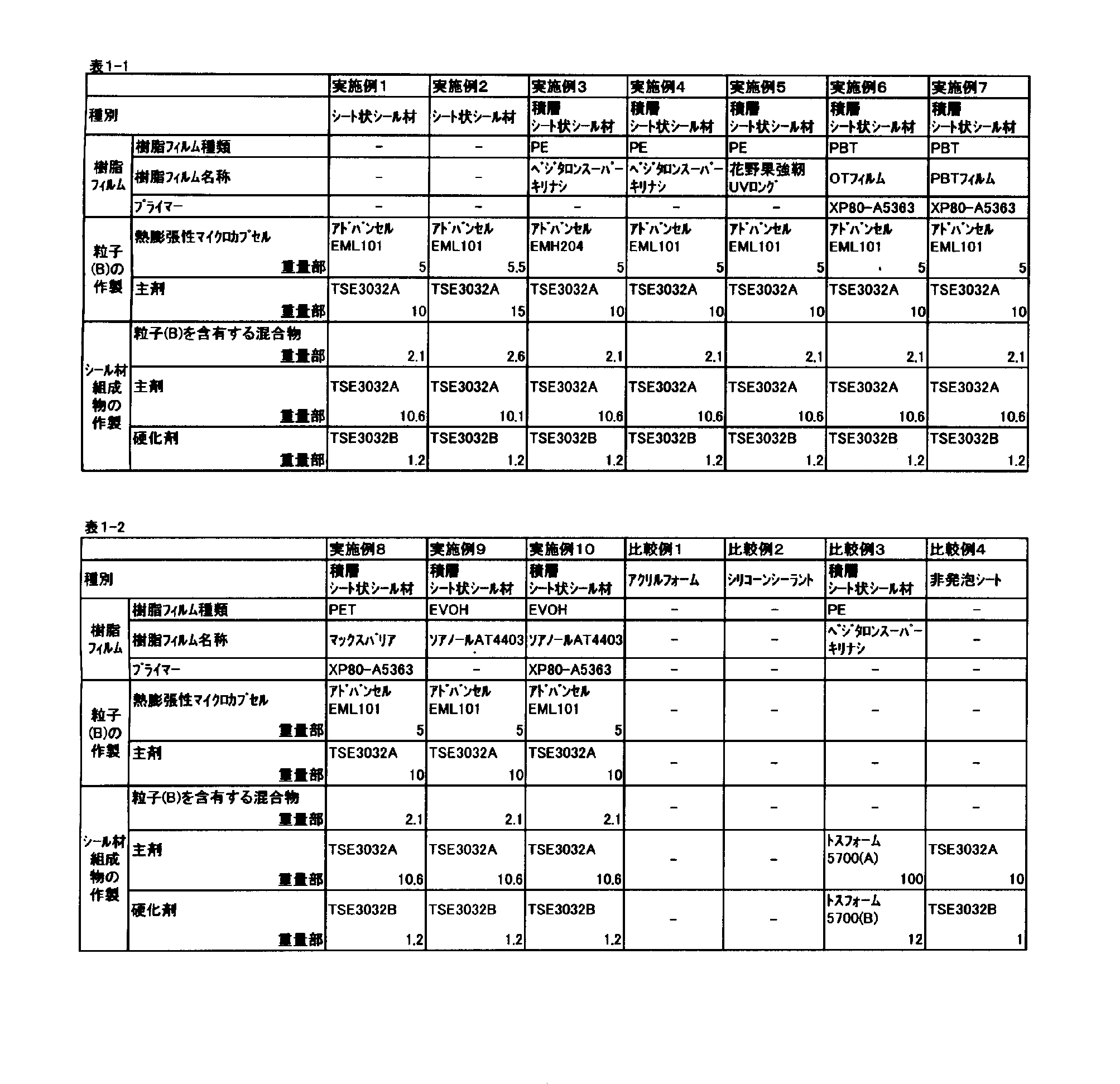
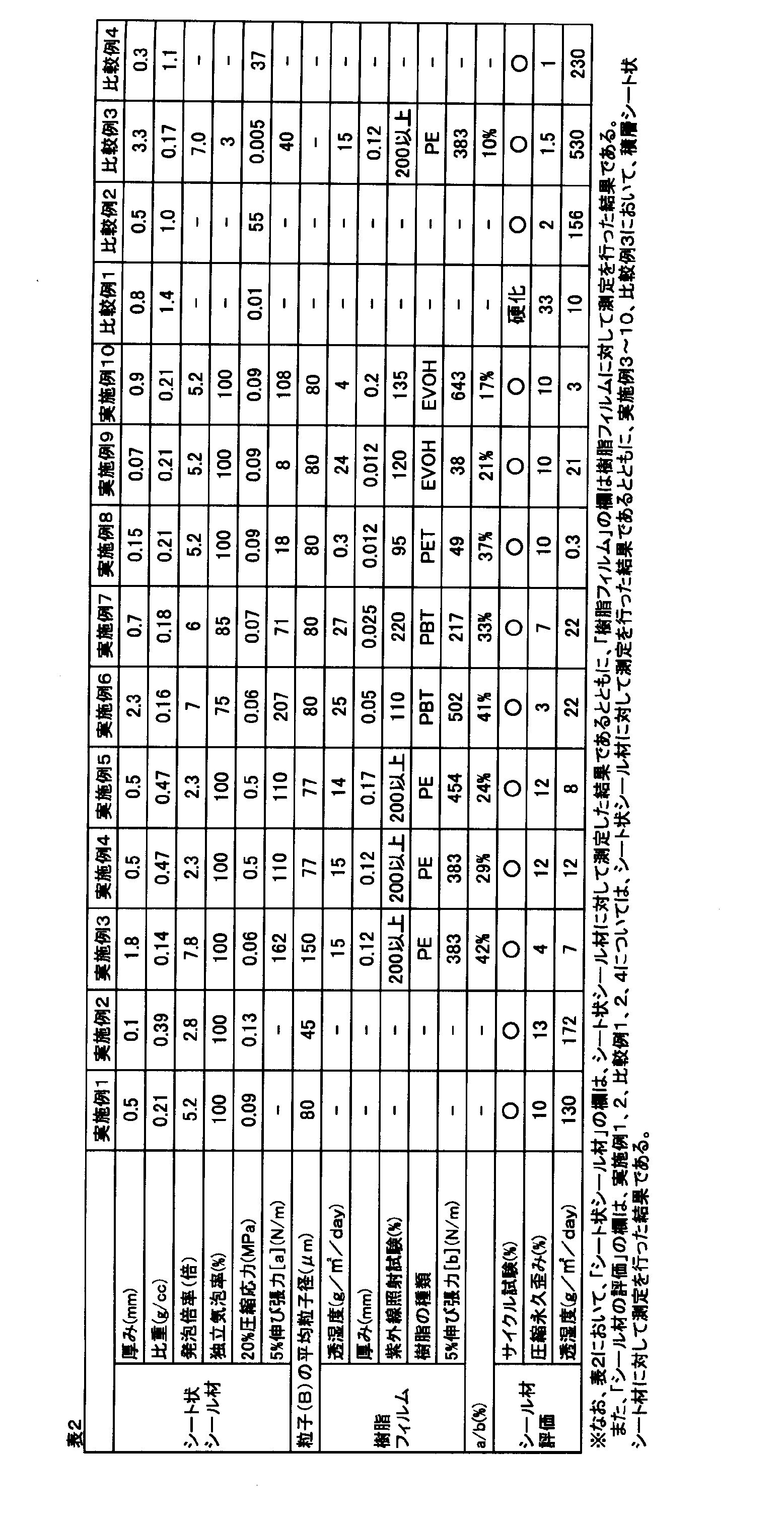
比較例1は、紫外線照射により強度が低下して、収縮、硬化してしまい、太陽電池パネル用シール材としては十分に機能することができない。また、圧縮永久歪みが大きいので緩衝性能も低下していた。一方、比較例2、4は、発泡粒子が配合されずにシール性が不十分であるとともに、透湿度が大きくなって、太陽電池パネル用シール材として使用すると、水蒸気を太陽電池パネル内に透過するものであると推測される。また、比較例3は、圧縮永久歪が良好であったが、透湿度が大きく、太陽電池パネル用シール材としては不適であった。
11 シート状シール材
13 樹脂フィルム
20 太陽電池モジュール
21 太陽電池パネル(被取付体)
22 フレーム(固定部材)
Claims (17)
- シリコーン樹脂(A)と、前記シリコーン樹脂(A)中に分散され、内部に空洞部を有する複数の粒子(B)とを有するシート状シール材。
- 厚みが0.05~2.5mmであるとともに、発泡倍率が2~8倍である請求項1に記載のシート状シール材。
- 前記複数の粒子(B)が、膨張された発泡粒子を含み、かつ平均粒子径が、40~200μmである請求項1又は2に記載のシート状シール材。
- 太陽電池パネル用シール材である請求項1~3のいずれかに記載のシート状シール材。
- 請求項1~4のいずれかに記載のシート状シール材と、前記シート状シール材の片面に積層された樹脂フィルムとを備える積層シート状シール材。
- 前記シート状シール材が独立気泡率70%以上であり、前記シート状シール材の20℃における20%圧縮応力が0.05~0.7MPaである請求項5に記載の積層シート状シール材。
- 前記樹脂フィルムのJIS Z 0208に定められる水蒸気透湿性試験における透湿度が30g/m2・day以下であり、かつ前記樹脂フィルムの厚みが0.01~0.25mmある請求項5又は6に記載の積層シート状シール材。
- 前記樹脂フィルムのUL746Cに定められるUV暴露試験条件に基づく1000時間経過後の破断伸びが70%以上である請求項5~7のいずれかに記載の積層シート状シール材。
- 前記樹脂フィルムが、オレフィン系樹脂フィルム、ポリエステル系樹脂フィルム又はエチレン-ビニルアルコール共重合体系樹脂フィルムである請求項5~8のいずれかに記載の積層シート状シール材。
- 前記シート状シール材の5%伸張時の張力が、前記樹脂フィルムの5%伸張時の張力の15~50%である請求項5~9のいずれかに記載の積層シート状シール材。
- 太陽電池パネル用シール材である請求項5~10のいずれかに記載の積層シート状シール材。
- 太陽電池パネルと、前記太陽電池パネルの周端部を固定する固定部材と、前記固定部材と前記太陽電池パネルの間に配置された、請求項4又は11に記載の太陽電池パネル用シール材とを備える太陽電池モジュール。
- 前記太陽電池パネル用シール材が前記積層シート状シール材からなり、前記積層シート状シール材において、前記シート状シール材が太陽電池パネル側に配置されている請求項12に記載の太陽電池モジュール。
- 硬化性シリコーン樹脂組成物と、内部に空洞部を有する複数の粒子とを含むシール材組成物を硬化して、前記粒子の空洞部により気泡が形成されてなるシート状シール材を得るシート状シール材の製造方法。
- 複数の発泡性を有する粒子を加熱発泡させて、内部に空洞部を有する複数の発泡粒子を得て、その発泡粒子と前記硬化性シリコーン樹脂組成物とを混合して前記シール材組成物を得る請求項14に記載のシート状シール材の製造方法。
- 前記硬化性シリコーン樹脂組成物の主剤の一部と、複数の発泡性を有する粒子とを混合した後、前記発泡性を有する粒子を加熱膨張させ、内部に空洞部を有する発泡粒子とし、複数の発泡粒子と前記硬化性シリコーン樹脂組成物の主剤の一部とを含む混合物を得る工程と、前記混合物に前記硬化性シリコーン樹脂組成物の主剤の残りおよび硬化剤を少なくとも混合してシール材組成物を得る工程と、前記シール材組成物をシート状にし、加熱硬化させ前記シート状シール材を得る工程と、を含む請求項14又は15に記載のシート状シール材の製造方法。
- 硬化性シリコーン樹脂組成物と、内部に空洞部を有する複数の粒子とを含むシール材組成物を、樹脂フィルムに重ね合わせた状態で硬化して、前記粒子の空洞部により気泡が形成されてなるシート状シール材の片面に前記樹脂フィルムが積層された積層シート状シール材を得る積層シート状シール材の製造方法。
Priority Applications (5)
| Application Number | Priority Date | Filing Date | Title |
|---|---|---|---|
| EP13793058.2A EP2853574A4 (en) | 2012-05-22 | 2013-05-22 | SHEET SEALING ELEMENT AND HISTORED SHEET SEALING ELEMENT |
| CN201380026352.8A CN104334673B (zh) | 2012-05-22 | 2013-05-22 | 片状密封材料及层叠片状密封材料 |
| US14/402,420 US20150107669A1 (en) | 2012-05-22 | 2013-05-22 | Sheet-shaped seal member, and layered sheet-shaped seal member |
| JP2013545564A JP5444514B1 (ja) | 2012-05-22 | 2013-05-22 | シート状シール材及び積層シート状シール材 |
| US15/332,258 US20170040478A1 (en) | 2012-05-22 | 2016-10-24 | Sheet-shaped seal member, and layered sheet-shaped seal member |
Applications Claiming Priority (4)
| Application Number | Priority Date | Filing Date | Title |
|---|---|---|---|
| JP2012-116335 | 2012-05-22 | ||
| JP2012116335 | 2012-05-22 | ||
| JP2013056853 | 2013-03-19 | ||
| JP2013-056853 | 2013-03-19 |
Related Child Applications (2)
| Application Number | Title | Priority Date | Filing Date |
|---|---|---|---|
| US14/402,420 A-371-Of-International US20150107669A1 (en) | 2012-05-22 | 2013-05-22 | Sheet-shaped seal member, and layered sheet-shaped seal member |
| US15/332,258 Division US20170040478A1 (en) | 2012-05-22 | 2016-10-24 | Sheet-shaped seal member, and layered sheet-shaped seal member |
Publications (1)
| Publication Number | Publication Date |
|---|---|
| WO2013176179A1 true WO2013176179A1 (ja) | 2013-11-28 |
Family
ID=49623864
Family Applications (1)
| Application Number | Title | Priority Date | Filing Date |
|---|---|---|---|
| PCT/JP2013/064216 Ceased WO2013176179A1 (ja) | 2012-05-22 | 2013-05-22 | シート状シール材及び積層シート状シール材 |
Country Status (6)
| Country | Link |
|---|---|
| US (2) | US20150107669A1 (ja) |
| EP (1) | EP2853574A4 (ja) |
| JP (1) | JP5444514B1 (ja) |
| CN (1) | CN104334673B (ja) |
| TW (1) | TWI569959B (ja) |
| WO (1) | WO2013176179A1 (ja) |
Cited By (7)
| Publication number | Priority date | Publication date | Assignee | Title |
|---|---|---|---|---|
| WO2014157428A1 (ja) * | 2013-03-27 | 2014-10-02 | 積水化学工業株式会社 | シリコーン樹脂発泡体およびシール材 |
| JP2017105903A (ja) * | 2015-12-08 | 2017-06-15 | タイガースポリマー株式会社 | 発泡ゴムシートの製造方法 |
| JP2018095833A (ja) * | 2016-12-09 | 2018-06-21 | テーザ・ソシエタス・ヨーロピア | 感圧接着ストリップ |
| WO2018185998A1 (ja) * | 2017-04-05 | 2018-10-11 | 日東電工株式会社 | 吸着仮固定シートおよびその製造方法 |
| CN109206863A (zh) * | 2018-09-29 | 2019-01-15 | 安徽兆拓新能源科技有限公司 | 一种太阳能板用防腐高透散热膜的制备方法 |
| JP2020529488A (ja) * | 2017-07-31 | 2020-10-08 | ダウ シリコーンズ コーポレーション | 仮接合接着剤用シリコーン組成物、その硬化体を含む電子物品、及びその製造方法 |
| JP2023524939A (ja) * | 2020-04-14 | 2023-06-14 | サン-ゴバン パフォーマンス プラスティックス コーポレイション | 複合フィルム |
Families Citing this family (14)
| Publication number | Priority date | Publication date | Assignee | Title |
|---|---|---|---|---|
| JP2016089810A (ja) * | 2014-11-11 | 2016-05-23 | 株式会社デンソー | 燃料供給装置 |
| FR3040708A1 (fr) * | 2015-09-08 | 2017-03-10 | Airbus Operations (S A S) | Base de mastic chargee |
| EP3395872B1 (en) * | 2015-12-25 | 2021-03-03 | Nitto Denko Corporation | Silicone foam sheet and method of producing the same |
| USD808897S1 (en) * | 2016-06-19 | 2018-01-30 | Ob Realty, Llc | Mount body for a solar panel |
| USD806013S1 (en) * | 2016-06-19 | 2017-12-26 | Ob Realty, Llc | Mount body for a solar panel |
| KR102167635B1 (ko) * | 2017-09-28 | 2020-10-19 | 세키스이가가쿠 고교가부시키가이샤 | 충격 흡수 시트 |
| US11670490B2 (en) | 2017-09-29 | 2023-06-06 | Taiwan Semiconductor Manufacturing Co., Ltd. | Integrated circuit fabrication system with adjustable gas injector |
| CN108079803B (zh) * | 2017-11-21 | 2024-05-31 | 浙江科赛新材料科技有限公司 | 一种聚四氟乙烯微孔膜 |
| CN111934610A (zh) * | 2020-08-05 | 2020-11-13 | 湖州守真新材料科技有限公司 | 一种快速插接的复合材料拉挤型材及其应用 |
| JPWO2022138590A1 (ja) * | 2020-12-22 | 2022-06-30 | ||
| JP2024545394A (ja) * | 2021-11-01 | 2024-12-06 | ロジャーズ・コーポレイション | 充填シリコーンフォーム層、組成物及びそれらの製造方法、並びに充填シリコーンフォーム層を含む物品 |
| CN116504859A (zh) * | 2023-04-24 | 2023-07-28 | 安姆科科技研发有限公司 | 光伏组件用复合承载膜、复合承载膜制备方法及光伏组件 |
| WO2025149443A1 (en) * | 2024-01-09 | 2025-07-17 | Swiss Pv Ag | Photovoltaic module |
| US20250327557A1 (en) * | 2024-04-23 | 2025-10-23 | Valeo Vision | Light System Including A Lens And Housing That Are Removably Resealable |
Citations (9)
| Publication number | Priority date | Publication date | Assignee | Title |
|---|---|---|---|---|
| JPS59133280A (ja) * | 1983-01-19 | 1984-07-31 | Adachi Shin Sangyo Kk | シ−ル材およびシ−ル材成形方法 |
| JP2000226909A (ja) | 1999-02-08 | 2000-08-15 | Sekisui Chem Co Ltd | 太陽電池付き屋根瓦 |
| JP2002012696A (ja) * | 2000-06-29 | 2002-01-15 | Shin Etsu Chem Co Ltd | 中空フィラー含有シリコーンゴム及びその製造方法 |
| JP3274071B2 (ja) | 1996-08-19 | 2002-04-15 | 株式会社金陽社 | 独立気泡スポンジゴムの製造方法 |
| JP2003049156A (ja) * | 2001-08-06 | 2003-02-21 | Bridgestone Corp | シール材 |
| JP4114050B2 (ja) | 2002-10-15 | 2008-07-09 | 信越化学工業株式会社 | 電子機器用シリコーン断熱シート及びこれを用いた断熱方法 |
| JP2009071233A (ja) | 2007-09-18 | 2009-04-02 | Nitto Denko Corp | 太陽電池パネル用シール材および太陽電池モジュール |
| DE102009011164A1 (de) | 2009-03-04 | 2010-09-09 | Tesa Se | Klebeband, insbesondere zur Verklebung von Photovoltaiklaminaten |
| JP2012001707A (ja) | 2010-06-17 | 2012-01-05 | Dengiken:Kk | 電気絶縁材料粘着テープ |
Family Cites Families (11)
| Publication number | Priority date | Publication date | Assignee | Title |
|---|---|---|---|---|
| DE19540886A1 (de) * | 1995-11-02 | 1997-05-07 | Wacker Chemie Gmbh | Kompressibler Siliconkautschuk |
| JPH10112549A (ja) * | 1996-10-08 | 1998-04-28 | Canon Inc | 太陽電池モジュール |
| US6274648B1 (en) * | 1998-10-15 | 2001-08-14 | Shin-Etsu Chemical Co., Ltd. | Hollow filler-containing silicone rubber composition |
| US20080041434A1 (en) * | 2006-08-18 | 2008-02-21 | Nanosolar, Inc. | Methods and devices for large-scale solar installations |
| US20080185033A1 (en) * | 2007-02-06 | 2008-08-07 | Kalejs Juris P | Solar electric module |
| WO2009029952A2 (en) * | 2007-09-02 | 2009-03-05 | Robert Stancel | Slidable mounting system for solar modules |
| WO2009148716A2 (en) * | 2008-06-02 | 2009-12-10 | 3M Innovative Properties Company | Adhesive encapsulating composition and electronic devices made therewith |
| US20100151180A1 (en) * | 2008-10-13 | 2010-06-17 | Bravet David J | Multi-layer fluoropolymer film |
| JP2010202728A (ja) * | 2009-03-02 | 2010-09-16 | Shin-Etsu Chemical Co Ltd | シリコーンゴム組成物及び定着ロール |
| JP2011091346A (ja) * | 2009-10-21 | 2011-05-06 | Dengiken:Kk | 太陽電池用バックシート及びそれを用いた太陽電池モジュール |
| DE102009044299A1 (de) * | 2009-10-21 | 2011-05-05 | Contitech Elastomer-Beschichtungen Gmbh | Verfahren zur Herstellung von Flächenprodukten aus Silikongummi |
-
2013
- 2013-05-22 US US14/402,420 patent/US20150107669A1/en not_active Abandoned
- 2013-05-22 CN CN201380026352.8A patent/CN104334673B/zh not_active Expired - Fee Related
- 2013-05-22 WO PCT/JP2013/064216 patent/WO2013176179A1/ja not_active Ceased
- 2013-05-22 JP JP2013545564A patent/JP5444514B1/ja active Active
- 2013-05-22 EP EP13793058.2A patent/EP2853574A4/en not_active Withdrawn
- 2013-05-22 TW TW102118171A patent/TWI569959B/zh active
-
2016
- 2016-10-24 US US15/332,258 patent/US20170040478A1/en not_active Abandoned
Patent Citations (9)
| Publication number | Priority date | Publication date | Assignee | Title |
|---|---|---|---|---|
| JPS59133280A (ja) * | 1983-01-19 | 1984-07-31 | Adachi Shin Sangyo Kk | シ−ル材およびシ−ル材成形方法 |
| JP3274071B2 (ja) | 1996-08-19 | 2002-04-15 | 株式会社金陽社 | 独立気泡スポンジゴムの製造方法 |
| JP2000226909A (ja) | 1999-02-08 | 2000-08-15 | Sekisui Chem Co Ltd | 太陽電池付き屋根瓦 |
| JP2002012696A (ja) * | 2000-06-29 | 2002-01-15 | Shin Etsu Chem Co Ltd | 中空フィラー含有シリコーンゴム及びその製造方法 |
| JP2003049156A (ja) * | 2001-08-06 | 2003-02-21 | Bridgestone Corp | シール材 |
| JP4114050B2 (ja) | 2002-10-15 | 2008-07-09 | 信越化学工業株式会社 | 電子機器用シリコーン断熱シート及びこれを用いた断熱方法 |
| JP2009071233A (ja) | 2007-09-18 | 2009-04-02 | Nitto Denko Corp | 太陽電池パネル用シール材および太陽電池モジュール |
| DE102009011164A1 (de) | 2009-03-04 | 2010-09-09 | Tesa Se | Klebeband, insbesondere zur Verklebung von Photovoltaiklaminaten |
| JP2012001707A (ja) | 2010-06-17 | 2012-01-05 | Dengiken:Kk | 電気絶縁材料粘着テープ |
Non-Patent Citations (1)
| Title |
|---|
| See also references of EP2853574A4 |
Cited By (11)
| Publication number | Priority date | Publication date | Assignee | Title |
|---|---|---|---|---|
| WO2014157428A1 (ja) * | 2013-03-27 | 2014-10-02 | 積水化学工業株式会社 | シリコーン樹脂発泡体およびシール材 |
| JP5702899B2 (ja) * | 2013-03-27 | 2015-04-15 | 積水化学工業株式会社 | シリコーン樹脂発泡体およびシール材 |
| JP2017105903A (ja) * | 2015-12-08 | 2017-06-15 | タイガースポリマー株式会社 | 発泡ゴムシートの製造方法 |
| JP2018095833A (ja) * | 2016-12-09 | 2018-06-21 | テーザ・ソシエタス・ヨーロピア | 感圧接着ストリップ |
| WO2018185998A1 (ja) * | 2017-04-05 | 2018-10-11 | 日東電工株式会社 | 吸着仮固定シートおよびその製造方法 |
| JP2018177878A (ja) * | 2017-04-05 | 2018-11-15 | 日東電工株式会社 | 吸着仮固定シートおよびその製造方法 |
| US11565238B2 (en) | 2017-04-05 | 2023-01-31 | Nitto Denko Corporation | Adsorptive temporary fixing sheet and method for manufacturing same |
| JP2020529488A (ja) * | 2017-07-31 | 2020-10-08 | ダウ シリコーンズ コーポレーション | 仮接合接着剤用シリコーン組成物、その硬化体を含む電子物品、及びその製造方法 |
| JP7248648B2 (ja) | 2017-07-31 | 2023-03-29 | ダウ シリコーンズ コーポレーション | 仮接合接着剤用シリコーン組成物、その硬化体を含む電子物品、及びその製造方法 |
| CN109206863A (zh) * | 2018-09-29 | 2019-01-15 | 安徽兆拓新能源科技有限公司 | 一种太阳能板用防腐高透散热膜的制备方法 |
| JP2023524939A (ja) * | 2020-04-14 | 2023-06-14 | サン-ゴバン パフォーマンス プラスティックス コーポレイション | 複合フィルム |
Also Published As
| Publication number | Publication date |
|---|---|
| CN104334673B (zh) | 2017-08-01 |
| TWI569959B (zh) | 2017-02-11 |
| CN104334673A (zh) | 2015-02-04 |
| TW201400280A (zh) | 2014-01-01 |
| US20150107669A1 (en) | 2015-04-23 |
| JPWO2013176179A1 (ja) | 2016-01-14 |
| US20170040478A1 (en) | 2017-02-09 |
| JP5444514B1 (ja) | 2014-03-19 |
| EP2853574A1 (en) | 2015-04-01 |
| EP2853574A4 (en) | 2016-03-02 |
Similar Documents
| Publication | Publication Date | Title |
|---|---|---|
| JP5444514B1 (ja) | シート状シール材及び積層シート状シール材 | |
| JP5702899B2 (ja) | シリコーン樹脂発泡体およびシール材 | |
| CN101831250B (zh) | 特别是用于粘结光电元件的胶带 | |
| CN101679833B (zh) | 粘性硅橡胶组合物和用于燃料电池的隔板密封材料 | |
| CN101866980B (zh) | 特别用于结合光伏模块的胶带 | |
| US10293366B2 (en) | Waterproof tape for automobile battery and manufacturing method thereof | |
| JP5374656B1 (ja) | 太陽電池モジュール | |
| US20170043553A1 (en) | Heat-storage, thermally conductive sheet | |
| JP2015019574A (ja) | 枠付き装置、封止材およびその製造方法 | |
| JP7412581B2 (ja) | 循環経済に有用であって、剥離可能でありかつ綺麗に剥離可能な特性を有するシリコーンエラストマーを含む、物品 | |
| US20120070620A1 (en) | Self-adhesive frame | |
| JP2004137308A (ja) | シリコーン断熱シート | |
| CN118974172A (zh) | 导热组合物和使用该组合物的导热组件的生产方法 | |
| JP2015214622A (ja) | シート状シール材 | |
| WO2018066645A1 (ja) | セル外装体用積層シート | |
| JP2015153977A (ja) | 太陽電池用シール材及び太陽電池用積層シール材 | |
| CN217099255U (zh) | 导热石墨片用离型膜 | |
| US20240425660A1 (en) | Compressible silicone foam and method for the manufacture thereof | |
| CN109648941B (zh) | 一种汽车挡风玻璃及其制作方法 | |
| CN121779764A (zh) | 一种气体阻隔膜及其制备方法、光伏组件 |
Legal Events
| Date | Code | Title | Description |
|---|---|---|---|
| ENP | Entry into the national phase |
Ref document number: 2013545564 Country of ref document: JP Kind code of ref document: A |
|
| 121 | Ep: the epo has been informed by wipo that ep was designated in this application |
Ref document number: 13793058 Country of ref document: EP Kind code of ref document: A1 |
|
| WWE | Wipo information: entry into national phase |
Ref document number: 14402420 Country of ref document: US Ref document number: 2013793058 Country of ref document: EP |
|
| NENP | Non-entry into the national phase |
Ref country code: DE |