WO2013179722A1 - イソプレンシンターゼおよびそれをコードするポリヌクレオチド、ならびにイソプレンモノマーの製造方法 - Google Patents
イソプレンシンターゼおよびそれをコードするポリヌクレオチド、ならびにイソプレンモノマーの製造方法 Download PDFInfo
- Publication number
- WO2013179722A1 WO2013179722A1 PCT/JP2013/056866 JP2013056866W WO2013179722A1 WO 2013179722 A1 WO2013179722 A1 WO 2013179722A1 JP 2013056866 W JP2013056866 W JP 2013056866W WO 2013179722 A1 WO2013179722 A1 WO 2013179722A1
- Authority
- WO
- WIPO (PCT)
- Prior art keywords
- isoprene
- strain
- ptac
- protein
- pstv28
- Prior art date
- Legal status (The legal status is an assumption and is not a legal conclusion. Google has not performed a legal analysis and makes no representation as to the accuracy of the status listed.)
- Ceased
Links
Images


Classifications
-
- C—CHEMISTRY; METALLURGY
- C08—ORGANIC MACROMOLECULAR COMPOUNDS; THEIR PREPARATION OR CHEMICAL WORKING-UP; COMPOSITIONS BASED THEREON
- C08F—MACROMOLECULAR COMPOUNDS OBTAINED BY REACTIONS ONLY INVOLVING CARBON-TO-CARBON UNSATURATED BONDS
- C08F36/00—Homopolymers and copolymers of compounds having one or more unsaturated aliphatic radicals, at least one having two or more carbon-to-carbon double bonds
- C08F36/02—Homopolymers and copolymers of compounds having one or more unsaturated aliphatic radicals, at least one having two or more carbon-to-carbon double bonds the radical having only two carbon-to-carbon double bonds
- C08F36/04—Homopolymers and copolymers of compounds having one or more unsaturated aliphatic radicals, at least one having two or more carbon-to-carbon double bonds the radical having only two carbon-to-carbon double bonds conjugated
- C08F36/08—Isoprene
-
- C—CHEMISTRY; METALLURGY
- C12—BIOCHEMISTRY; BEER; SPIRITS; WINE; VINEGAR; MICROBIOLOGY; ENZYMOLOGY; MUTATION OR GENETIC ENGINEERING
- C12N—MICROORGANISMS OR ENZYMES; COMPOSITIONS THEREOF; PROPAGATING, PRESERVING, OR MAINTAINING MICROORGANISMS; MUTATION OR GENETIC ENGINEERING; CULTURE MEDIA
- C12N15/00—Mutation or genetic engineering; DNA or RNA concerning genetic engineering, vectors, e.g. plasmids, or their isolation, preparation or purification; Use of hosts therefor
- C12N15/09—Recombinant DNA-technology
-
- C—CHEMISTRY; METALLURGY
- C12—BIOCHEMISTRY; BEER; SPIRITS; WINE; VINEGAR; MICROBIOLOGY; ENZYMOLOGY; MUTATION OR GENETIC ENGINEERING
- C12N—MICROORGANISMS OR ENZYMES; COMPOSITIONS THEREOF; PROPAGATING, PRESERVING, OR MAINTAINING MICROORGANISMS; MUTATION OR GENETIC ENGINEERING; CULTURE MEDIA
- C12N9/00—Enzymes; Proenzymes; Compositions thereof; Processes for preparing, activating, inhibiting, separating or purifying enzymes
- C12N9/88—Lyases (4.)
-
- C—CHEMISTRY; METALLURGY
- C12—BIOCHEMISTRY; BEER; SPIRITS; WINE; VINEGAR; MICROBIOLOGY; ENZYMOLOGY; MUTATION OR GENETIC ENGINEERING
- C12P—FERMENTATION OR ENZYME-USING PROCESSES TO SYNTHESISE A DESIRED CHEMICAL COMPOUND OR COMPOSITION OR TO SEPARATE OPTICAL ISOMERS FROM A RACEMIC MIXTURE
- C12P5/00—Preparation of hydrocarbons or halogenated hydrocarbons
- C12P5/007—Preparation of hydrocarbons or halogenated hydrocarbons containing one or more isoprene units, i.e. terpenes
-
- C—CHEMISTRY; METALLURGY
- C12—BIOCHEMISTRY; BEER; SPIRITS; WINE; VINEGAR; MICROBIOLOGY; ENZYMOLOGY; MUTATION OR GENETIC ENGINEERING
- C12Y—ENZYMES
- C12Y402/00—Carbon-oxygen lyases (4.2)
- C12Y402/03—Carbon-oxygen lyases (4.2) acting on phosphates (4.2.3)
- C12Y402/03027—Isoprene synthase (4.2.3.27)
Definitions
- the present invention relates to isoprene synthase and a polynucleotide encoding the same.
- Natural rubber is a very important raw material in the tire industry and rubber industry. As demand increases in the future due to motorization centering on emerging countries, it is difficult to expand farms due to deforestation regulations and competition with palms, so it is difficult to expect an increase in the yield of natural rubber, and the supply-demand balance becomes tight. It is expected to go.
- Synthetic polyisoprene is an alternative material to natural rubber, but the raw material monomer (isoprene (2-methyl-1,3-butadiene)) is obtained mainly by extraction from the C5 fraction obtained by cracking naphtha. It is done.
- the production of isoprene has been decreasing with the lightening of the cracker feed, and there is concern about the supply. In recent years, it is strongly affected by fluctuations in oil prices, and in order to stably secure isoprene monomers, establishment of a system for producing isoprene at low cost from non-petroleum resources is desired.
- the present invention has been made in view of the above circumstances, and an object thereof is to provide a useful means for establishing an excellent isoprene monomer production system.
- the present invention is as follows.
- [4] An expression vector comprising the polynucleotide of [1] or [2] or the polynucleotide encoding the protein of [3].
- [5] A transformant produced by introducing the expression vector of [4] into a host.
- the transformant according to [6], wherein the host is Escherichia coli.
- a method for producing an isoprene polymer comprising the following (I) and (II): (I) producing an isoprene monomer by any of the methods [11] to [13]; (II) polymerizing isoprene monomers to produce isoprene polymers.
- an excellent isoprene monomer production system can be established.
- FIG. 1 is a diagram showing the amount of isoprene generated per unit weight of dried leaves of various plants.
- FIG. 2 is a diagram showing the amount of isoprene generated per total amount of protein extracted from leaves of various plants.
- FIG. 3 is a diagram showing an overview of the downstream of the mevalonate pathway immobilized on the chromosome and the surrounding region.
- FIG. 4 is a diagram showing an outline of the downstream of the mevalonate pathway controlled by the tac promoter in the chromosome and the surrounding region.
- the present invention provides a polynucleotide encoding isoprene synthase.
- Isoprene synthase is an enzyme that converts dimethylallyl diphosphate to isoprene.
- the inventors first evaluated isoprene-producing ability in various plants under the same high-temperature conditions. As a result, it was found that the ability of Mucuna to produce isoprene was several to several tens of times higher than that of kuzu and poplar reported in Patent Documents 1 and 2.
- the present inventors partially purified isoprene synthase from Mucuna and kuzu leaves by ammonium sulfate fractionation, and examined the specific activity of the crude extract. As a result, it was found that the specific activity of isoprene synthase of Mucuna was several to several tens of times higher than the specific activity of isoprene synthase of Kuzu. It was also revealed that the measured isoprene synthase specific activity of Mucuna was several to several tens of times higher than the isoprene synthase specific activity value of the crude poplar enzyme reported in Patent Documents 1 and 2. From the above, it was suggested that Mucuna may have a highly functional isoprene synthase.
- RNA was double-stranded and then fragmented, and only the base sequence of the fragment having a polyA sequence at the 3 ′ end was analyzed using a high-speed sequencer.
- overlapping sequences were linked to obtain a plurality of contig sequences.
- BLAST search was performed on these contig sequences, contig sequences having homology (base sequence identity) with known kuzu and poplar isoprene synthase gene sequences were extracted, and Mucuna derived isoprene synthase A partial sequence of the gene was obtained.
- 5 ′ RACE Rapid Amplification of cDNA Ends
- SEQ ID NO: 1 the full-length base sequence of the Mucuna-derived isoprene synthase gene represented by SEQ ID NO: 1 was analyzed.
- This Mucuna-derived isoprene synthase cDNA is obtained by RT-PCR using, for example, a primer designed based on the analyzed nucleotide sequence information of the Mucuna-derived isoprene synthase gene and the total RNA obtained using the above method as a template. can get.
- the polynucleotide of the present invention comprises (i) the nucleotide sequence represented by SEQ ID NO: 1, or (ii) nucleotide residues 133 to 1785 in the nucleotide sequence represented by SEQ ID NO: 1.
- the base sequence represented by SEQ ID NO: 1 encodes the amino acid sequence represented by SEQ ID NO: 2
- the base sequence consisting of nucleotide residues 1 to 132 encodes a putative chloroplast translocation signal
- the base sequence consisting of nucleotide residues 133 to 1785 can encode the amino acid sequence of mature isoprene synthase.
- the polynucleotide of the present invention contains a nucleotide sequence having 90% or more identity with the nucleotide sequence of (i) or (ii) above and encodes a protein having isoprene synthase activity It is.
- the percent identity with the base sequence may be 91%, 92%, 93%, 94%, 95%, 96%, 97%, 98% or 99% or more.
- the isoprene synthase activity refers to the activity of producing isoprene from dimethylallyl diphosphate (DMAPP) (the same applies hereinafter).
- the percent identity of the base sequence and the percent identity of the amino acid sequence as described below are, for example, the algorithm BLAST by Karlin and Altschul (Pro. Natl. Acad. Sci. USA, 90, 5873 (1993)), FASTA by Pearson (Methods Enzymol). , 183, 63 (1990)). Based on this algorithm BLAST, programs called BLASTP and BLASTN have been developed (see http://www.ncbi.nlm.nih.gov). The% amino acid sequence identity may be calculated.
- the polynucleotide of the present invention hybridizes with a polynucleotide comprising a base sequence complementary to the above base sequence (i) or (ii) under stringent conditions, and has an isoprene synthase activity.
- “Stringent conditions” refers to conditions under which so-called specific hybrids are formed and non-specific hybrids are not formed. Although it is difficult to quantify such conditions clearly, for example, substantially identical polynucleotides having high identity, for example, polynucleotides having the above-mentioned% identity hybridize. However, this is a condition in which polynucleotides having lower homology do not hybridize with each other. Specifically, such conditions include hybridization at about 45 ° C. in 6 ⁇ SSC (sodium chloride / sodium citrate), followed by 50 ⁇ 0.2 ⁇ SSC in 0.1% SDS. One or more washings at ⁇ 65 ° C. may be mentioned.
- SSC sodium chloride / sodium citrate
- the polynucleotide of the present invention may be DNA or RNA, but is preferably DNA.
- the polynucleotide of the present invention can be derived from Mucuna.
- the polynucleotide of the present invention may also encode the protein of the present invention described later.
- the present invention also provides a protein having isoprene synthase activity.
- the isoprene synthase activity is as described above.
- the protein of the present invention comprises (i ′) the full-length amino acid sequence represented by SEQ ID NO: 2 or (ii ′) amino acid residues 45 to 594 in the amino acid sequence represented by SEQ ID NO: 2.
- a protein comprising an amino acid sequence consisting of The amino acid sequence consisting of amino acid residues 1 to 44 in the amino acid sequence represented by SEQ ID NO: 2 encodes a putative chloroplast transfer signal, and the amino acid sequence consisting of amino acid residues 45 to 594 is May encode mature isoprene synthase.
- the protein of the present invention comprises an amino acid sequence having 90% or more identity with any one of the above amino acids (i ′) or (ii ′), and has isoprene synthase activity It is.
- the percent identity with the amino acid sequence may be 91%, 92%, 93%, 94%, 95%, 96%, 97%, 98% or 99% or more.
- the protein of the present invention comprises an amino acid sequence in which one or several amino acid residues are mutated in the amino acid sequence of (i ′) or (ii ′), and isoprene synthase activity It is protein which has.
- amino acid residue mutations include deletion, substitution, addition and insertion of amino acid residues.
- the mutation of one or several amino acid residues may be introduced into one region in the amino acid sequence, but may be introduced into a plurality of different regions.
- the term “one or several” indicates a range in which the three-dimensional structure and activity of the protein are not significantly impaired.
- the number “1 or several” indicates, for example, 1 to 100, preferably 1 to 80, more preferably 1 to 50, 1 to 30, 1 to 20, 1 to 10 or 1 to 5.
- the protein of the present invention may have a purification tag such as a histidine tag.
- the isoprene synthase activity of the protein of the present invention when measured under the same conditions, is 50% or more, 60% or more of the isoprene synthase activity of the protein containing any one amino acid sequence of (i ′) or (ii ′) above. 70% or more, 80% or more, 90% or more, or preferably 95% or more.
- the protein of the present invention is stored in a predetermined buffer (eg, 50 mM Tris-HCl (pH 8.0), 0.15 mM MgCl 2 solution) at 4 ° C. for 48 hours.
- the residual activity is preferably 30% or more, 40% or more, 50% or more, 60% or more, or 65% or more.
- the protein of the present invention may be introduced with mutations at sites in the catalytic domain and at sites other than the catalytic domain as long as the target activity can be maintained.
- mutations at sites in the catalytic domain and at sites other than the catalytic domain as long as the target activity can be maintained.
- Those skilled in the art will know the positions of amino acid residues to which mutations can be introduced, which can retain the desired activity.
- a person skilled in the art compares 1) the amino acid sequences of a plurality of proteins having the same activity (for example, the amino acid sequence represented by SEQ ID NO: 2 and the amino acid sequences of other isoprene synthases), and 2) Identify relatively conserved and relatively non-conserved areas, then 3) from relatively conserved and relatively non-conserved areas, respectively, important to function Regions that can play important roles and regions that cannot play important roles in functions can be predicted, so that the correlation between structure and function can be recognized. Therefore, those skilled in the art can specify the position of an amino acid residue to which a mutation may be introduced in the amino acid sequence of isoprene synthase.
- amino acid residue substitution may be a conservative substitution.
- conservative substitution refers to the replacement of a given amino acid residue with an amino acid residue having a similar side chain. Families of amino acid residues with similar side chains are well known in the art.
- such families include amino acids having basic side chains (eg, lysine, arginine, histidine), amino acids having acidic side chains (eg, aspartic acid, glutamic acid), amino acids having uncharged polar side chains (Eg, asparagine, glutamine, serine, threonine, tyrosine, cysteine), amino acids with non-polar side chains (eg, glycine, alanine, valine, leucine, isoleucine, proline, phenylalanine, methionine, tryptophan), ⁇ -branched side chain Amino acids (eg, threonine, valine, isoleucine), amino acids having aromatic side chains (eg, tyrosine, phenylalanine, tryptophan, histidine), amino acids having side groups containing hydroxyl groups (eg, alcoholic, phenolic) ( Example, serine, thread Nin, tyrosine), and amino acids (e.g.
- the conservative substitution of amino acids is a substitution between aspartic acid and glutamic acid, a substitution between arginine and lysine and histidine, a substitution between tryptophan and phenylalanine, and between phenylalanine and valine.
- substitution, leucine, isoleucine and alanine substitution, and glycine and alanine substitution are substitutions.
- the present invention provides an expression vector.
- the expression vector of the present invention comprises the polynucleotide of the present invention or the polynucleotide encoding the protein of the present invention.
- Examples of the expression vector of the present invention include a cell-based vector for expressing a protein in a host and a cell-free vector utilizing a protein translation system.
- the expression vector may also be a plasmid or an integrative vector.
- the expression vector may further be a DNA vector or an RNA vector.
- As the cell-based vector a known expression vector suitable for the host is used. Examples of Escherichia coli include ColE-type plasmids typified by pBR322 derivatives, pACYC-type plasmids having a p15A origin, pSC-type plasmids, and Bac-type F factor-derived mini-F plasmids.
- expression vectors having tryptophan promoters such as trc and tac, lac promoter, T7 promoter, T5 promoter, T3 promoter, SP6 promoter, arabinose-inducible promoter, cold shock promoter, tetracycline-inducible promoter and the like can also be mentioned.
- the cell-free vector include an expression vector having a T7 promoter and an expression vector having a T3 promoter mentioned in the cell-based vector; a vector for wheat cell-free protein synthesis such as a pEU-based plasmid having an SP6 promoter or a T7 promoter. It is done.
- cDNA of a target protein is transcribed using a transcription system to synthesize mRNA.
- transcription systems include conventionally known ones that are transcribed with RNA polymerase.
- the RNA polymerase include T7 RNA polymerase.
- cell-free protein synthesis system which is a translation system, mRNA is translated and a protein is synthesized.
- This system contains elements necessary for translation, such as ribosomes, translation initiation factors, translation elongation factors, dissociation factors, and aminoacyl-tRNA synthetases.
- protein translation systems include Escherichia coli extract, rabbit reticulocyte extract, and wheat germ extract.
- Protein synthesis using a cell-based vector will be described later in ⁇ Transformant>.
- Proteins synthesized using cell-based vectors or cell-free vectors may be purified. Examples of the purification method include salting out methods and methods using various chromatographies. If the expression vector is designed to express a tag sequence such as a histidine tag at the N-terminus or C-terminus of the target protein, use an affinity column that uses a substance having affinity for this tag, such as nickel or cobalt. A purification method is mentioned.
- the purity of the protein of the present invention can be increased by purifying it by appropriately combining ion exchange chromatography or gel filtration chromatography.
- the present invention provides a transformant comprising the expression vector of the present invention.
- the transformant of the present invention is obtained by introducing the expression vector of the present invention into a host. Bacteria or fungi are preferred as the host used in the present invention.
- the bacterium may be a gram positive bacterium or a gram negative bacterium.
- Gram-positive bacteria examples include Bacillus bacteria, Listeria bacteria, Staphylococcus bacteria, Streptococcus bacteria, Enterococcus bacteria, Clostridium bacteria, Clostridium bacteria, and Clostridium bacteria.
- Examples include bacteria belonging to the genus Corynebacterium and Streptomyces, and bacteria belonging to the genus Bacillus and bacteria belonging to the genus Corynebacterium are preferred.
- Examples of Bacillus bacteria include Bacillus subtilis, Bacillus anthracis, Bacillus cereus, and the like, and Bacillus subtilis is more preferable.
- bacteria belonging to the genus Corynebacterium include Corynebacterium glutamicum, Corynebacterium efficiens, Corynebacterium, and Corynebacterium. Is more preferable.
- Examples of the gram-negative bacteria include Escherichia bacteria, Pantoea bacteria, Salmonella bacteria, Vibrio bacteria, Serratia bacteria, Enterobacter bacteria, and the like. Among them, Escherichia bacteria, Pantoea bacteria, Enterobacter bacteria are preferable. Escherichia is preferred as the bacterium belonging to the genus Escherichia. Examples of the genus Pantoea include Pantoea ananatis, Pantoea stewartii, Pantoea agglomerans, Pantoea citrea, and Pantoea citrea Pantoea ananatis) and Pantoea citrea are preferred.
- Pantoea bacterium strains exemplified in European Patent Application Publication No. 09522121 may be used.
- Representative strains of the genus Pantoea include, for example, Pantoea ananatis AJ13355 (FERM BP-6614) and Pantoea ananatis AJ13356 (FERM BP-6615) disclosed in European Patent Application No. 0952212.
- Enterobacter bacteria include Enterobacter agglomerans, Enterobacter aerogenes, and the like, with Enterobacter aerogenes being preferred.
- the Enterobacter bacterium a strain exemplified in European Patent Application Publication No. 09522121 may be used.
- Enterobacter bacteria include, for example, Enterobacter agglomerans ATCC 12287 strain, Enterobacter aerogenes ATCC 13048 strain, Enterobacter aerogenes NBRC 12010 strain (Biotechnol Bioeng. 2007 Mar 27; 98 (2): 340-348). ), Enterobacter aerogenes AJ11037 (FERM BP-10955) strain, and the like.
- Enterobacter aerogenes AJ11037 strain was entrusted to the National Institute of Advanced Industrial Science and Technology, Patent Biological Deposit Center on August 22, 2007 (1-6 Higashi 1-chome, Tsukuba City, Ibaraki, Japan 305-8586, Japan) Deposited as FERM P-21348, transferred to an international deposit under the Budapest Treaty on March 13, 2008, and given the receipt number of FERM BP-10955.
- fungi examples include the genus Saccharomyces, the genus Schizosaccharomyces, the genus Yarrowia, the genus Trichoderma, the genus Aspergillus, the genus Aspergillus, Preferred are microorganisms of the genus Saccharomyces, the genus Schizosaccharomyces, the genus Yarrowia, or the genus Trichoderma.
- Saccharomyces The Saccharomyces (Saccharomyces) microorganisms of the genus, Saccharomyces carlsbergensis (Saccharomyces carlsbergensis), Saccharomyces cerevisiae (Saccharomyces cerevisiae), Saccharomyces Deer statics (Saccharomyces diastaticus), Saccharomyces Dougurashi (Saccharomyces douglasii), Saccharomyces Kuruibera (Saccharomyces reteyveri), Saccharomyces norbensis, Saccharomyces obiformis, and Saccharomyces s. -Saccharomyces cerevisiae is preferred.
- Schizosaccharomyces As a microorganism belonging to the genus Schizosaccharomyces, Schizosaccharomyces pombe is preferable. As a microorganism belonging to the genus Yarrowia, Yarrowia lipolytica is preferable.
- Trichoderma The Trichoderma (Trichoderma) microorganisms of the genus, Trichoderma Harujianumu (Ttichoderma harzianum), Trichoderma Koningi (Trichoderma koningii), Trichoderma Rongifurakiamu (Trichoderma longibrachiatum), Trichoderma reesei (Trichoderma reesei), Trichoderma viride (Trichoderma viride) are And Trichoderma reesei is preferred.
- the host used in the present invention includes dimethylallyl diphosphate by the mevalonate (MVA) pathway and / or methylerythritol phosphate (MEP) pathway involved in the synthesis of dimethylallyl diphosphate which is a substrate for isoprene synthase. It is not particularly limited as long as it has the ability to synthesize (DMAPP), and may be an insect cell, an animal cell, a plant cell, or the like.
- the pathway for synthesizing dimethylallyl diphosphate (DMAPP), which is a substrate for isoprene synthase may be further enhanced.
- an isopentenyl diphosphate delta isomerase expression vector having the ability to convert isopentenyl diphosphate (IPP) to dimethylallyl diphosphate (DMAPP) was introduced into the transformant of the present invention. May be.
- an expression vector for one or more enzymes involved in the mevalonate pathway and / or methylerythritol phosphate pathway associated with the production of IPP and / or DMAPP may be introduced into the transformant of the present invention.
- Such enzyme expression vectors may be plasmids or integrative vectors.
- Such enzyme expression vectors may also be DNA vectors or RNA vectors.
- Such an enzyme expression vector further expresses a plurality of enzymes (eg, 1, 2, 3 or 4 or more) involved in the mevalonate pathway and / or the methylerythritol phosphate pathway.
- a plurality of enzymes eg, 1, 2, 3 or 4 or more
- it may be an expression vector for polycistronic mRNA.
- the origin of one or more enzymes involved in the mevalonate pathway and / or the methylerythritol phosphate pathway may be homologous or heterologous to the host.
- the host is a bacterium as described above (eg, E. coli), and the mevalonate pathway
- the enzyme involved may be derived from a fungus (eg, Saccharomyces cerevisiae).
- the expression vector introduced into the host may express an enzyme involved in the mevalonate pathway.
- Idi1p ACCESSION ID NP_015208
- AT3G02780 ACCESSION ID NP_186927
- AT5G16440 ACCESSION ID NP_197165N, ID_197165N, P_197165
- Examples of enzymes involved in the mevalonate (MVA) pathway include mevalonate kinase (EC: 2.7.1.36; Example 1, Erg12p, ACCESSION ID NP — 013935; Example 2, AT5G27450, ACCESSION ID NP — 001190411), phosphomevalonic acid Kinase (EC: 2.7.4.2; Example 1, Erg8p, ACCESSION ID NP_013947; Example 2, AT1G31910, ACCESSION ID NP_001185124), diphosphomevalonate decarboxylase (EC: 4.1.1.33; Example 1, Mvd1p , ACCESSION ID NP_014441; Example 2, AT2G38700, ACCESSION ID NP_181404; Example 3, AT3G54250, A CESSION ID NP_566995), acetyl-CoA-C-acetyltransferase (EC: 2.3.1.9; Example 1, Erg10p, ACCESSION
- Examples of enzymes involved in the methylerythritol phosphate (MEP) pathway include 1-deoxy-D-xylulose-5-phosphate synthase (EC: 2.2.1.7, Example 1, Dxs, ACCESSION ID NP_414954; Example 2, AT3G21500, ACCESSION ID NP_566686; Example 3, AT4G15560, ACCESSION ID NP_193291; Example 4, AT5G11380, ACCESSION ID NP_001078570), 1-deoxy-D-xylulose-5-phosphate reductoisomerase (EC: 1.1.
- Example 1 Dxr, ACCESSION ID NP_414715; Example 2, AT5G62790, ACCESSION ID NP_001190600), 4 Diphosphocytidyl-2-C-methyl-D-erythritol synthase (EC: 2.7.7.60; Example 1, IspD, ACCESSION ID NP_417227; Example 2, AT2G02500, ACCESSION ID NP_565286), 4-diphosphocytidyl-2-C- Methyl-D-erythritol kinase (EC: 2.7.1.148; Example 1, IspE, ACCESSION ID NP_415726; Example 2, AT2G26930, ACCESSION ID NP_180261), 2-C-methyl-D-erythritol-2,4- Cycloniphosphate synthase (EC: 4.6.1.12; Example 1, IspF, ACCESSION ID NP_417226;
- the introduction (transformation) of an expression vector into which a gene has been incorporated into a host can be performed using a conventionally known method.
- a competent cell method using microbial cells treated with calcium, an electroporation method, and the like can be mentioned.
- a phage vector may be used to infect and introduce into a microbial cell.
- a gene encoding a mevalonate pathway or methylerythritol phosphate pathway enzyme that synthesizes dimethylallyl diphosphate, which is a substrate for isoprene synthase may be introduced.
- Such enzymes include: 1-deoxy-D-xylose-5-phosphate synthase that converts pyruvate and D-glyceraldehyde-3-phosphate to 1-deoxy-D-xylose-5-phosphate; isopentenyl diphosphorus Examples include isopentyl diphosphate isomerase that converts acid to dimethylallyl diphosphate.
- the protein of the present invention may be extracted and purified from the transformant of the present invention, and isoprene may be produced by culturing the transformant expressing the protein of the present invention.
- the present invention provides a process for producing isoprene monomers.
- the method for producing the isoprene monomer of the present invention includes producing the isoprene monomer from dimethylallyl diphosphate in the presence of the protein of the present invention.
- the production method of the isoprene monomer of the present invention is not particularly limited as long as it is performed in the presence of the protein of the present invention.
- using an enzyme reaction system using the protein of the present invention itself (eg, purified protein), or It can be carried out by culturing the transformant of the present invention that produces the protein of the present invention.
- it is carried out by culturing the transformant of the present invention.
- dimethylallyl diphosphate as a raw material of the isoprene monomer is efficiently supplied from the carbon source in the medium by the transformant of the present invention. Is done.
- the transformant of the present invention produces isoprene monomer mainly as outgas from a carbon source in the medium
- the isoprene monomer is recovered by collecting the gas generated from the transformant.
- Dimethylallyl diphosphate which is a substrate for isoprene synthase, is synthesized by the mevalonate pathway or the methyl erythritol phosphate pathway in the host, with the carbon source in the medium as the basis.
- the medium for culturing the transformant of the present invention preferably contains a carbon source for conversion to isoprene.
- Examples of the carbon source include carbohydrates such as monosaccharides, disaccharides, oligosaccharides and polysaccharides; invert sugar obtained by hydrolyzing sucrose; glycerol; 1 carbon number such as methanol, formaldehyde, formate, carbon monoxide and carbon dioxide Compounds (hereinafter referred to as C1 compounds); oils such as corn oil, palm oil and soybean oil; acetates; animal fats and oils; animal oils; fatty acids such as saturated fatty acids and unsaturated fatty acids; lipids; phospholipids; glycerolipids; Glycerin fatty acid esters such as glyceride, diglyceride and triglyceride; polypeptides such as microbial protein and vegetable protein; renewable carbon sources such as hydrolyzed biomass carbon source; yeast extract; or a combination thereof.
- carbohydrates such as monosaccharides, disaccharides, oligosaccharides and polysaccharides
- inorganic ammonium salts such as ammonium sulfate, ammonium chloride, and ammonium phosphate
- organic nitrogen such as soybean hydrolysate, ammonia gas, aqueous ammonia, and the like
- an organic trace nutrient source it is desirable to contain an appropriate amount of a required substance such as vitamin B1, L-homoserine or yeast extract.
- potassium phosphate, magnesium sulfate, iron ions, manganese ions and the like are added as necessary.
- the medium used in the present invention may be a natural medium or a synthetic medium as long as it contains a carbon source, a nitrogen source, inorganic ions, and other organic trace components as required.
- monosaccharides include trioses such as ketotriose (dihydroxyacetone) and aldtriose (glyceraldehyde); tetroses such as ketetetrose (erythrulose) and aldetetrose (erythrose and threose); ketopentose (ribulose and xylulose) Pentose such as ribose, arabinose, xylose, lyxose), deoxy sugar (deoxyribose); ketohexose (psicose, fructose, sorbose, tagatose), aldohexose (allose, altrose, glucose, mannose, gulose, idose, galactose, talose ), Deoxy sugars (fucose, fucose, rhamnose) and other hexoses; Scan, galactose, C6 sugars such as glucose; xylose, carbohydrates C
- Examples of the disaccharide include sucrose, lactose, maltose, trehalose, tunulose, and cellobiose, and sucrose and lactose are preferable.
- Examples of oligosaccharides include trisaccharides such as raffinose, melezitose, and maltotriose; tetrasaccharides such as acarbose and stachyose; other oligosaccharides such as fructooligosaccharide (FOS), galactooligosaccharide (GOS), and mannan oligosaccharide (MOS).
- Examples of the polysaccharide include glycogen, starch (amylose, amylopectin), cellulose, dextrin, and glucan ( ⁇ 1,3-glucan), and starch and cellulose are preferable.
- Microbial proteins include polypeptides derived from yeast or bacteria.
- plant proteins include polypeptides derived from soybean, corn, canola, jatropha, palm, peanut, sunflower, coconut, mustard, cottonseed, palm kernel oil, olive, safflower, sesame and flaxseed.
- lipids include substances containing one or more saturated or unsaturated fatty acids of C4 or higher.
- the oil contains one or more saturated or unsaturated fatty acids of C4 or higher, and is preferably a lipid that is liquid at room temperature.
- Examples of the fatty acid include compounds represented by the formula RCOOH (“R” represents a hydrocarbon group).
- the unsaturated fatty acid is a compound having at least one carbon-carbon double bond in “R”, and examples thereof include oleic acid, vaccenic acid, linoleic acid, palmitate acid, and arachidonic acid.
- the saturated fatty acid is a compound in which “R” is a saturated aliphatic group, and examples thereof include docosanoic acid, icosanoic acid, octadecanoic acid, hexadecanoic acid, tetradecanoic acid, and dodecanoic acid.
- fatty acids containing one or more C2 to C22 fatty acids are preferred, and those containing C12 fatty acids, C14 fatty acids, C16 fatty acids, C18 fatty acids, C20 fatty acids and C22 fatty acids are more preferred.
- the carbon source include salts of these fatty acids, derivatives, and salts of derivatives.
- the salt include lithium salt, potassium salt, sodium salt and the like.
- examples of the carbon source include lipids, oils, fats and oils, fatty acids, combinations of glycerin fatty acid esters and carbohydrates such as glucose.
- Biomass carbon sources include cellulosic substrates such as wood, paper, and pulp waste, foliate plants, and pulp; parts of plants such as stalks, grains, roots, and tubers.
- Examples of plants used as biomass carbon sources include corn, wheat, rye, sorghum, triticate, rice, millet, barley, cassava, peas and other legumes, potatoes, sweet potatoes, bananas, sugar cane, tapioca and the like.
- pretreatment is preferably performed.
- the pretreatment include enzymatic pretreatment, chemical pretreatment, and a combination of enzymatic pretreatment and chemical pretreatment. It is preferred to hydrolyze all or part of the renewable carbon source before adding it to the cell culture medium.
- examples of the carbon source include yeast extract or a combination of yeast extract and another carbon source such as glucose, and a combination of yeast extract and C1 compound such as carbon dioxide or methanol is preferable.
- cells are preferably cultured in a standard medium containing physiological saline and a nutrient source.
- the culture medium is not particularly limited, and examples thereof include commercially available conventional culture media such as Luria Bertani (LB) broth, Sabouraud Dextrose (SD) broth, and Yeast medium (YM) broth.
- LB Luria Bertani
- SD Sabouraud Dextrose
- YM Yeast medium
- the cell culture medium includes suitable minerals, salts, cofactors, buffers, and ingredients known to those skilled in the art to be suitable for culture or to promote isoprene production. It is desirable.
- the transformant of the present invention in order to maintain the expression of the protein of the present invention, it is preferable to add sugar, metal salt, antibacterial substance and the like to the medium.
- the culture conditions for the transformant of the present invention are not particularly limited as long as the protein of the present invention can be expressed, and standard cell culture conditions can be used.
- the culture temperature is preferably 20 ° C. to 37 ° C.
- the gas composition is preferably a CO 2 concentration of about 6% to about 84%, and a pH of about 5 to about 9.
- Examples of the culture method include a method of culturing the transformant using a known fermentation method such as a batch culture method, a fed-batch culture method, or a continuous culture method.
- the batch culture method is a method in which a transformant is cultured while charging a medium composition at the start of fermentation, inoculating a host into the medium, and controlling pH, oxygen concentration, and the like.
- the transformant passes from a gentle induction phase to a logarithmic growth phase, and finally reaches a stationary phase where the growth rate decreases or stops. Isoprene is produced by transformants in the logarithmic growth phase or stationary phase.
- the fed-batch culture method is a method in which a carbon source is gradually added as the fermentation process proceeds in addition to the batch method described above.
- the fed-batch culture method is effective when the metabolism of the transformant tends to be suppressed by catabolite suppression and it is preferable to limit the amount of the carbon source in the medium.
- the fed-batch culture method can be performed using a limited or excessive amount of a carbon source such as glucose.
- the continuous culture method is a culture method in which a predetermined amount of culture medium is continuously supplied to a bioreactor at a constant rate, and at the same time, the same amount of culture solution is withdrawn.
- the culture can be kept at a constant high density, and the transformant in the culture solution is mainly in the logarithmic growth phase.
- the promoter possessed by the expression vector of the present invention includes a constitutive promoter and an inducible promoter.
- an inducible promoter such as lac promoter
- IPTG isopropyl- ⁇ -thiogalactopyranoside
- Examples of a method for evaluating the production amount of isoprene monomer obtained by culturing the transformant of the present invention include a method in which a gas phase is collected by a headspace method and the gas phase is analyzed by a gas chromatography method. Specifically, the isoprene monomer in the head space when the culture medium containing the transformant is cultured while shaking in a sealed vial is analyzed using standard gas chromatography. Next, using the calibration curve, the area obtained from the gas chromatography measurement curve is converted into the amount of isoprene monomer produced by the transformant.
- gas stripping As a method for recovering the isoprene monomer obtained by culturing the transformant of the present invention, gas stripping, fractional distillation, or desorption of the isoprene monomer adsorbed on the solid phase from the solid phase by heat or vacuum, or Examples include extraction with a solvent.
- isoprene gas is continuously removed from the outgas.
- Such isoprene gas can be removed by various methods, such as adsorption to a solid phase, separation into a liquid phase, or a method of directly condensing isoprene gas.
- the recovery of isoprene monomer can be performed in one stage or in multiple stages.
- the separation of the isoprene monomer from the outgas and the conversion of the isoprene monomer into a liquid phase are performed simultaneously.
- Isoprene monomer can also be condensed directly from the outgas into a liquid phase.
- the separation of the isoprene monomer from the off-gas and the conversion of the isoprene monomer into a liquid phase are sequentially performed.
- a method in which isoprene monomer is adsorbed on a solid phase and extracted from the solid phase with a solvent can be mentioned.
- the method for recovering the isoprene monomer may include a step of purifying the isoprene monomer.
- the purification step include separation from a liquid phase extract by distillation and various chromatographies.
- the isoprene monomer can be efficiently produced using the transformant expressing the protein of the present invention.
- the present invention also provides a method for producing an isoprene polymer.
- the method for producing the isoprene polymer of the present invention includes the following (I) and (II): (I) producing an isoprene monomer by the method of the present invention; (II) polymerizing isoprene monomers to produce isoprene polymers.
- Step (I) can be performed in the same manner as the above-described method for producing the isoprene monomer of the present invention.
- the polymerization of the isoprene monomer in the step (II) can be performed by any method known in the art.
- Example 1 Examination of isoprene production ability in plants 1-1) Measurement of amount of isoprene produced per unit weight of dried leaf product First, in order to examine isoprene production ability in plants, isoprene production per gram of dry leaf weight in plants The amount was measured. As a plant, Mucuna, willow (weeping willow), Momijibahu, Ginkgo biloba, and kuzu were used. To measure the amount of isoprene generated, a gas exchange desiccator (trade name: vacuum desiccator, manufactured by ASONE) is housed in an incubator (product name: growth chamber, manufactured by MLR-351 HSANYO) and installed in the gas exchange desiccator.
- an incubator product name: growth chamber, manufactured by MLR-351 HSANYO
- the incubator was set to a high temperature induction condition (40 ° C. at an illuminance of 100 ⁇ mol E / m 2 / s) while operating the gas stirring fan and stirring the atmosphere in the space of the gas exchange desiccator.
- a high temperature induction condition 40 ° C. at an illuminance of 100 ⁇ mol E / m 2 / s
- the gas exchange desiccator was kept in a sealed state for 3 hours.
- the gas component released by Mucuna was sucked from the space in the gas exchange desiccator through a silicon tube, an adsorption tube, and a gas sampling tube by a suction pump.
- the amount of isoprene generated per gram of dry leaf weight in the plant was determined by dividing the amount of isoprene generated from the whole Mucuna plant by the estimated dry weight of the leaves of the whole plant. As a result, it became clear that Mucuna was excellent in the amount of isoprene generated per unit weight of the dried leaf (FIG. 1).
- a buffer solution 50 mM Tris-HCl, 20 mM MgCl, 5% Glycerol, 0.02% Triton-X100, pH 8.0
- Benzamidine-HCl was added to 1 mM (each final concentration) and used as a protein extraction buffer.
- the total (ammonium sulfate fraction) protein amount was determined by measuring the ammonium sulfate fraction by the Bradford method.
- a calibration curve was prepared for the protein amount with respect to the absorbance at a wavelength of 595 nm measured with a spectrophotometer by reacting with Bradford reagent.
- the absorbance at a wavelength of 595 nm was measured in the same manner for a 50-fold diluted ammonium sulfate fraction, and the total (ammonium sulfate fraction) protein amount was estimated from a standard protein calibration curve.
- the amount of isoprene produced is 100 ⁇ l of crude extract or crude enzyme solution boiled at 100 ° C.
- the amount generated after 0.5 hour, 1 hour and 2 hours with the crude enzyme was determined by subtracting the measured value of the crude enzyme solution boiled at 100 ° C. from the measured value. Enzyme activity (specific activity) per 1 mg of total protein was determined from the amount of isoprene generated per hour. The amount of isoprene generated was measured with a constant amount of DMAPP, which is a substrate for isoprene synthase. As a result, it became clear that Mucuna was excellent in the amount of isoprene generated per total protein (FIG. 2, Table 1). From the above, it was shown that Mucuna is excellent in isoprene-producing ability.
- Example 2 Cloning of Mucuna-derived isoprene synthase gene 2-1) Examination of sampling time The isoprene gas released from Mucuna leaves irradiated for 1, 2, 3, and 5 hours at a temperature of 40 ° C. was sampled and will be described later. When the amount of isoprene produced was quantified by gas chromatography, production of 4,8,12,10 ⁇ g isoprene / g DW leaf isoprene was confirmed, and the optimum light irradiation time was confirmed to be 3 hours. .
- RNA lysate was extracted from Mucuna leaves by the following procedure. (1) Mucuna leaves irradiated for 3 hours at a temperature of 40 ° C. were sampled. (2) After pulverizing 100 mg of leaf tissue in a mortar while quickly freezing with liquid nitrogen, the liquid nitrogen was dispensed into an RNase-free 2 ml Eppendorf tube to vaporize liquid nitrogen. (3) 450 ⁇ l of lysis buffer RLT (containing 2-mercaptoethanol) attached to RNeasy Plant Kit (Qiagen) was added to this Eppendorf tube and vigorously mixed by vortex to obtain a leaf tissue lysate.
- lysis buffer RLT containing 2-mercaptoethanol
- RNeasy Plant Kit Qiagen
- This RNeasy spin column was set in a 2 ml collection tube attached to the RNeasy Plant Kit, centrifuged at 15000 rpm for 1 minute, and the filtrate was discarded.
- This RNeasy spin column was set in a 1.5 ml collection tube attached to the RNeasy Plant Kit.
- RNA lysis solution was checked for RNA quality using a bioanalyzer (Agilent Technologies) RNA nanochip, It was confirmed that there was no contamination with genomic DNA and RNA in the lysate was not degraded.
- the total RNA was double-stranded using reverse transcriptase and then fragmented using a nebulizer.
- the base sequence of 198179 fragments having a polyA sequence at the 3 ′ end was analyzed using a 454 Titanium FLX high-speed sequencer (Roche Applied Science). In the obtained fragment sequence, overlapping sequences were linked to obtain 13485 contig sequences.
- Example 3 Preparation of isoprene synthase expression plasmid derived from each plant species 3-1) Pueraria montana var. Chemical synthesis of Llobata-derived isoprene synthase montana var. The base sequence and amino acid sequence of isoprene synthase from Lobata are already known (ACCESSION: AAQ84170: P. montana var. lobata (kudzu) isoprene synthase (IspS)). P. The amino acid sequence of the Montana-derived IspS protein and the base sequence of the gene are shown in SEQ ID NO: 3 and SEQ ID NO: 4, respectively. The IspS gene was transformed into E. coli. E.
- IspS gene was designed that was optimized for E. coli codon usage, and further cleaved from the chloroplast translocation signal, and was named IspSK.
- the base sequence of IspSK is shown in SEQ ID NO: 5.
- the IspSK gene was chemically synthesized and then cloned into pUC57 (GenScript), and the resulting plasmid was named pUC57-IspSK.
- IspSP coli codon usage and further cleaved from the chloroplast translocation signal was designed and named IspSP.
- the base sequence of IspSP is shown in SEQ ID NO: 8.
- the IspSP gene was chemically synthesized and then cloned into pUC57 (GenScript), and the resulting plasmid was named pUC57-IspSP.
- the IspSM gene and the IspSM (L) gene were chemically synthesized and then cloned into pUC57 (GenScript), and the resulting plasmids were named pUC57-IspSM and pUC57-IspSM (L).
- Ptac-Ttrp A DNA fragment having a BamHI site at the 3 ′ end (Ptac-Ttrp) was chemically synthesized (the base sequence of Ptac-Ttrp is shown in SEQ ID NO: 11).
- the obtained Ptac-Ttrp DNA fragment was digested with KpnI and BamHI, and similarly ligated with pSTV28 (manufactured by Takara Bio Inc.) digested with KpnI and BamHI by a ligation reaction with DNA ligase.
- the resulting plasmid was named pSTV28-Ptac-Ttrp (the base sequence is shown in SEQ ID NO: 12). This plasmid can be used to amplify the expression of the IspS gene by cloning the IspS gene downstream of Ptac.
- IspS gene expression plasmid derived from each plant species Plasmids for expressing the IspSK gene, IspSP gene, IspSM gene, and IspSM (L) gene in E. coli were constructed by the following procedure.
- PCR was performed using Prime Star polymerase (manufactured by Takara Bio Inc.).
- the reaction solution was prepared according to the composition attached to the kit, and 40 cycles of reaction at 98 ° C. for 10 seconds, 54 ° C. for 20 seconds, and 68 ° C. for 120 seconds were performed.
- a PCR product containing an IspSK gene, an IspSP gene, an IspSM gene, and an IspSM (L) gene was obtained.
- pSTV28-Ptac-Ttrp was subjected to PCR using Prime Star polymerase (manufactured by Takara Bio Inc.) using a synthetic oligonucleotide consisting of the nucleotide sequences of SEQ ID NO: 21 and SEQ ID NO: 22 as a primer.
- the reaction solution was prepared according to the composition attached to the kit, and 40 cycles of reaction at 98 ° C. for 10 seconds, 54 ° C. for 20 seconds, and 68 ° C. for 210 seconds were performed. As a result, a PCR product containing pSTV28-Ptac-Ttrp was obtained. Thereafter, the purified IspSK gene, IspSP gene, IspSM gene, and IspSM (L) gene fragment and the PCR product of pSTV28-Ptac-Ttrp were ligated using In-Fusion HD Cloning Kit (Clontech). .
- the resulting IspSK gene expression plasmid was pSTV28-Ptac-IspSK
- the IspSP gene expression plasmid was pSTV28-Ptac-IspSP
- the IspSM gene expression plasmid was pSTV28-Ptac-IspSM
- the IspSM (L) gene expression plasmid was pSTV28- It was named Ptac-IspSM (L).
- Example 4 E.I. Measurement of enzyme activity of isoprene synthase derived from each plant species using crude enzyme extract from E. coli 4-1) E. coli having isoprene-producing ability E. coli MG1655 strain construction After preparing competent cells of E. coli MG1655 strain (ATCC7000092), pSTV28-Ptac-Ttrp, pSTV28-Ptac-IspSK, pSTV28-Ptac-IspSP, pSTV28-Ptac-IspSM (pSTV28-Ptac-IspSM) were further prepared by electroporation.
- coli MG1655 strain is a MG1655 / pSTV28-Ptac-Ttp strain
- a strain in which pSTV28-Ptac-IspSK is introduced is a strain MG1655 / pSTV28-Ptac-IspSK, pSTVsp-SPac-SPac-SPt
- the introduced strain was MG1655 / pSTV28-Ptac-IspSP strain
- the strain into which pSTV28-Ptac-IspSM was introduced was the MG1655 / pSTV28-Ptac-IspSM strain
- the strain into which pSTV28-Ptac-IspSM (L) was introduced was MG1655.
- PSTV28-Ptac-IspSM (L) strain was introduced.
- the cells of 1/6 plate were inoculated into a Sakaguchi flask filled with 20 ml of LB containing 60 (mg / L) chloramphenicol and cultured at 37 ° C. for 6 hours.
- the bacterial cells are centrifuged from the culture solution at 5000 rpm, 4 ° C. for 5 minutes, and washed twice with ice-cooled isoprene synthase buffer (50 mM Tris-HCl (pH 8.0), 20 mM MgCl 2.5 % glycerol). did.
- the washed cells were suspended in 1.8 ml of the same buffer.
- Headspace Sampler (Turbo Matrix 40 manufactured by Perkin Elmer) Vial insulation temperature 40 ° C Vial incubation time 30 min Pressurization time 3.0min Injection time 0.02min Needle temperature 70 °C Transfer temperature 80 °C Carrier gas pressure (high purity helium) 124kPa
- Reagent isoprene (specific gravity 0.681) was diluted 10, 100, 1000, 10000, and 100,000 times with cooled methanol to prepare a standard solution for addition. Thereafter, 1 ⁇ L of each standard solution for addition was added to a headspace vial containing 1 mL of water to prepare a standard sample.
- Table 3 shows the amount of isoprene produced after 2 hours of reaction of each strain.
- the isoprene production amounts are MG1655 / pSTV28-Ptac-IspSM strain MG1655 / pSTV28-Ptac-IspSM (L) strain, MG1655 / pSTV28-Ptac-IspSK strain in descending order, and MG1655 / pSTV28-Ptac-IspSP.
- the MG1655 strain and the MG1655 / pSTV28-Ptac-TTrp strain had almost the same value. From the above results, the crude enzyme extract of the strain introduced with Mucuna-derived isoprene synthase showed the highest isoprene production activity.
- Example 5 E.I. Effect of introduction of isoprene synthase from each plant species in E. coli MG1655 strain From the result of the crude enzyme activity in Example 4, the highest activity was confirmed in the isoprene synthase derived from Mucuna lacking the chloroplast translocation signal. Therefore, the isoprene-producing ability from glucose was compared for all isoprene synthase-introduced strains lacking the chloroplast translocation signal.
- MG1655 / pSTV28-Ptac-Ttrp strain MG1655 / pSTV28-Ptac-IspSK strain, MG1655 / pSTV28-Ptac-IspSP strain, and MG1655 / pSTV28-Ptac-IspSM strain, 60 mg / L of chloramphenicol The resulting mixture was uniformly applied to the LB plate and cultured at 37 ° C. for 18 hours.
- the isoprene concentration in the head space of the vial was measured by gas chromatography.
- the OD value was measured at 600 nm with a spectrophotometer (HITACHI U-2900).
- Table 5 shows the isoprene concentration and OD value at the end of the culture of each strain.
- the isoprene production amount was in descending order of MG1655 / pSTV28-Ptac-IspSM strain, MG1655 / pSTV28-Ptac-IspSK strain, MG1655 / pSTV28-Ptac-IspSP strain, and MG1655 / pSTV28-Ptac-Ttrp strain. became. From the above results, in the wild strain, the strain into which Mucuna-derived isoprene synthase was introduced showed the highest isoprene-producing ability.
- Example 6 E. coli enhanced MEP (methyl erythritol) pathway Effect of introduction of isoprene synthase derived from each plant species in E. coli MG1655 strain 6-1) Construction of dxs gene expression plasmid (pMW219-dxs) It has already been reported that when the expression of the dxs gene (1-deoxy-D-xylose-5-phosphate synthase) constituting the MEP pathway in E. coli is enhanced, the amount of isoprene produced is improved (Appl. Microbiol. Biotechnol. , (2011) 90, 1915-1922).
- a synthetic oligonucleotide consisting of the base sequences of SEQ ID NO: 23 and SEQ ID NO: 24 was synthesized. Thereafter, E.E. PCR was performed using Prime Star polymerase (manufactured by Takara Bio Inc.) using the genome of E. coli MG1655 strain as a template and a synthetic oligonucleotide consisting of the nucleotide sequences of SEQ ID NO: 23 and SEQ ID NO: 24 as primers.
- the reaction solution was prepared according to the composition attached to the kit, and 40 cycles of reaction at 98 ° C.
- PCR was performed using Prime Star polymerase (manufactured by Takara Bio Inc.) using pMW219 as a template and a synthetic oligonucleotide consisting of the nucleotide sequences of SEQ ID NO: 25 and SEQ ID NO: 26 as primers.
- the reaction solution was prepared according to the composition attached to the kit, and 40 cycles of reaction at 98 ° C. for 10 seconds, 54 ° C. for 20 seconds, and 68 ° C. for 240 seconds were performed.
- a PCR product containing pMW219 was obtained. Thereafter, the purified dxs gene fragment and the PCR product of pMW219 were ligated using In-Fusion HD Cloning Kit (Clontech). The resulting plasmid for expressing the dxs gene was named pMW219-dxs.
- the resulting LB plate was uniformly applied and cultured at 37 ° C. for 18 hours. From the obtained plate, a transformant having resistance to chloramphenicol and kanamycin was obtained.
- E. coli with enhanced expression of DXS Effects of introduction of isoprene synthase from each plant species in E. coli MG1655 strain
- the isoprene production amounts are in descending order of MG1655 / pSTV28-Ptac-IspSM / pMW219-dxs strain, MG1655 / pSTV28-Ptac-IspSK / pMW219-dxs strain, MG1655 / pSTV28-Ptac-IspSP / dx219- And the strain MG1655 / pSTV28-Ptac-Ttrp / pMW219-dxs. From the above results, among the MEP pathway-enhanced strains, the strain into which Mucuna-derived isoprene synthase was introduced showed the highest isoprene-producing ability.
- Example 7 E. coli introduced MVA (mevalonic acid) pathway Effect of introduction of isoprene synthase derived from each plant species in E. coli MG1655 strain 7-1) Cloning of mevalonate pathway downstream gene derived from yeast The downstream region of the mevalonate pathway was obtained from Saccharomyces cerevisiae (WO2009076666, Saccharomyces Genomebasep: www.yeastgenome.org/# Nucleic Acids Res., Jan 2012; 40: D700-D705).
- MVA mevalonic acid
- ERG12 gene encoding mevalonate kinase
- ERG8 gene encoding phosphomevalonate kinase
- ERG19 gene encoding diphosphomevalonate decarboxylase
- IDI1 gene encoding isopentenyl diphosphate delta isomerase Amplification was performed by PCR reaction using the indicated primers (Table 8).
- PrimeSTAR MAX Premix sold by Takara Bio Inc. is used as a PCR enzyme, 98 ° C., 2 minutes, (98 ° C., 10 seconds, 55 ° C., 5 seconds, 72 ° C., 5 seconds / kb) ⁇ 30 cycles. The reaction was conducted under conditions.
- the PCR fragment was inserted into the pSTV28-Ptac-Ttrp vector (SEQ ID NO: 12) treated with the restriction enzyme SmaI by the in-fusion cloning method, and cloning and expression vector construction were performed.
- E. E. coli DH5 ⁇ was transformed, and clones having the expected sequence length of each gene were selected, followed by plasmid extraction according to a conventional method to confirm the sequence.
- the base sequences of these amplified genes and the amino acid sequences of the enzymes encoded by the genes are described in Saccharomyces Genome database http: // www. yeastgenome. org / #.
- PCR enzyme KOD plus sold by Toyobo is used, 94 ° C., 2 minutes, (94 ° C., 15 seconds, 45 ° C., 30 seconds, 68 ° C., 1 minute / kb) ⁇ 30 cycles, 68 ° C., The reaction was carried out under conditions of 10 minutes.
- the PCR fragment was inserted into the pUC118 vector treated with the restriction enzyme SmaI by the in-fusion cloning method, and cloning and expression vector construction were performed.
- E. E. coli JM109 was transformed, and clones having the expected sequence length of each gene were selected, followed by plasmid extraction according to a conventional method to confirm the sequence.
- the prepared plasmid was named pUC-mvk-pmk.
- the nucleotide sequence of pUC-mvk-pmk is shown in SEQ ID NO: 35.
- the PCR enzyme used is KOD plus sold by Toyobo, 94 ° C, 2 minutes, (94 ° C, 15 seconds, 45 ° C, 30 seconds, 68 ° C, 1 minute / kb) x 30 cycles, 68 ° C, The reaction was performed for 10 minutes.
- the PCR fragment was inserted into the pTWV228 vector treated with the restriction enzyme SmaI by the in-fusion cloning method, and cloning and expression vector construction were performed.
- E. E. coli DH5 ⁇ was transformed, and clones having the expected sequence length of each gene were selected, followed by plasmid extraction according to a conventional method to confirm the sequence.
- the prepared plasmid was named pTWV-dmd-yidi.
- the base sequence of pTWV-dmd-yidi is shown in SEQ ID NO: 40.
- the Tn7 downstream region in the chromosome fixed region was amplified by PCR using the E. coli genome as a template.
- PrimeSTAR HS DNA polymerase sold by Takara Bio Inc. is used as a PCR enzyme, 98 ° C., 2 minutes, (98 ° C., 10 seconds, 52 ° C., 5 seconds, 72 ° C., 1 minute / kb) ⁇ 30 cycles The reaction was carried out at 72 ° C. for 10 minutes.
- the cat gene region containing the ⁇ phage attachment site was amplified by PCR using the pMW118-attL-Cm-attR plasmid as a template (WO2010-027022).
- PrimeSTAR HS DNA polymerase sold by Takara Bio Inc. is used as the PCR enzyme, 95 ° C., 3 minutes, (95 ° C., 1 minute, 34 ° C., 30 seconds, 72 ° C., 40 seconds) ⁇ 2 cycles, The reaction was conducted under the conditions of 95 ° C., 30 seconds, 50 ° C., 30 seconds, 72 ° C., 40 seconds) ⁇ 25 cycles, 72 ° C., 5 minutes.
- KKDyI mevalonate pathway downstream sequence
- pTrc-KKDyI pTrc-KKDyI
- PrimeSTAR HS DNA polymerase sold by Takara Bio Inc. is used as a PCR enzyme, 98 ° C., 2 minutes, (98 ° C., 10 seconds, 52 ° C., 5 seconds, 72 ° C., 1 minute / kb) ⁇ 30 cycles The reaction was carried out at 72 ° C. for 10 minutes.
- pMW219-KKDyI-TaspA The base sequence of pMW219-KKDyI-TaspA is shown in SEQ ID NO: 50.
- the Tn7 upstream region was amplified in the chromosome fixed region by PCR using the E. coli genome as a template.
- PrimeSTAR HS DNA polymerase sold by Takara Bio Inc. is used, 98 ° C., 2 minutes, (98 ° C., 10 seconds, 52 ° C., 5 seconds, 72 ° C., 1 minute / kb) ⁇ 30 cycles. The reaction was carried out at 72 ° C. for 10 minutes.
- a vector was constructed by the In-Fusion cloning method using the PCR product and pMW219-KKDyI-TaspA treated with the restriction enzyme SalI. E. E.
- coli JM109 was transformed and a clone having the target sequence length was selected, followed by plasmid extraction according to a conventional method to confirm the sequence.
- the resulting plasmid was named pMW-Tn7-Pgi-KKDyI-TaspA-Tn7.
- the sequence of the constructed plasmid is shown in SEQ ID NO: 51.
- the chloramphenicol resistance gene, the glucose isomerase promoter, the mevalonate downstream operon, and the aspA gene transcription termination region were subjected to chromosome fixation.
- the chromosome fixing fragment was prepared by extracting the plasmid pMW-Tn7-Pgi-KKDyI-TaspA-Tn7, treating it with restriction enzymes PvuI and SalI, and then purifying it.
- E. coli MG1655 contains a plasmid pKD46 having a temperature-sensitive replication ability.
- Plasmid pKD46 [Proc. Natl. Acad. Sci. USA, 2000, vol. 97, no. 12, p6640-6645] is a 2154-base DNA fragment (GenBank / EMBL accession number J02459, No. 2) of ⁇ phage containing ⁇ Red system genes ( ⁇ , ⁇ , exo genes) controlled by the arabinose-inducible ParaB promoter. 31088th to 33241th). After electroporation, colonies that acquired chloramphenicol resistance were obtained.
- genomic DNA was extracted, and it was confirmed that the target region was fixed to the chromosome by PCR using the primers shown in Table 14. Furthermore, the sequence of the target region was confirmed by confirming the sequence of the PCR fragment.
- the base sequence of the downstream of the mevalonic acid pathway fixed on the chromosome and the surrounding region is shown in SEQ ID NO: 52, and the outline of the construction is shown in FIG.
- the obtained mutant was named MG1655 cat-Pgi-KKDyI.
- the drug marker of MG1655 cat-Pgi-KKDyI was removed by the following procedure. After creating competent cells of MG1655 cat-Pgi-KKDyI, pMW-int-xis was introduced. pMW-int-xis is a plasmid carrying a gene encoding lambda phage integrase (Int) and gene encoding exonase (Xis) and having temperature-sensitive replication ability (WO2007 / 037460, specially Open 2005-058827).
- the chloramphenicol resistance gene located in the region sandwiched between attL and attR, which are attachment sites of ⁇ phage is dropped from the chromosome.
- the host is known to lose chloramphenicol resistance. Therefore, a chloramphenicol sensitive strain was obtained from the obtained colonies. Thereafter, the cells were cultured at 42 degrees for 6 hours in the LB medium, and then applied to the LB plate medium to allow colonies to appear. Drug resistance was removed by selecting clones that lost ampicillin resistance from these.
- the mutant thus obtained was named MG1655 Pgi-KKDyI.
- the PCR enzyme uses LA-Taq polymerase sold by Takara Bio Inc., 92 ° C, 1 minute, (92 ° C, 10 seconds, 50 ° C, 20 seconds, 72 ° C, 1 minute / kb) x 40 cycles The reaction was carried out at 72 ° C. for 7 minutes.
- the PCR product was purified and used to electroporate MG1655 Pgi-KKDyI (hereinafter referred to as MG1655 Pgi-KKDyI / pKD46) containing the plasmid pKD46 having temperature-sensitive replication ability. Plasmid pKD46 [Proc. Natl. Acad. Sci. USA, 2000, vol. 97, no.
- p6640-6645 is a DNA fragment (GenBank / EMBL accession number J02459) of ⁇ phage containing ⁇ Red system genes ( ⁇ , ⁇ , exo genes) controlled by the arabinose-inducible ParaB promoter (GenBank / EMBL accession number J02459). 31088th to 33241th). Plasmid pKD46 is required to incorporate the PCR product into MG1655 Pgi-KKDyI.
- a competent cell for electroporation was prepared as follows. MG1655 Pgi-KKDyI / pKD46 cultured overnight at 30 ° C. in LB medium containing 100 mg / L ampicillin was diluted 100-fold with 5 mL of LB medium containing ampicillin and L-arabinose (1 mM). The obtained dilution was allowed to grow until the OD600 was about 0.6 while aerated at 30 ° C., and then washed three times with an ice-cooled 10% glycerol solution so that it could be used for electroporation. Electroporation was performed using 50 ⁇ L of competent cells and approximately 100 ng of PCR product.
- the cell after electroporation was 1 mL of SOC medium [Molecular Cloning: Laboratory Manual, Second Edition, Sambrook, J. et al. In addition, Cold Spring Harbor Press (1989)] was added and cultured at 37 ° C. for 1 hour, and then plated on LB agar medium at 37 ° C. to select a chloramphenicol resistant recombinant.
- SOC medium Molecular Cloning: Laboratory Manual, Second Edition, Sambrook, J. et al. In addition, Cold Spring Harbor Press (1989)] was added and cultured at 37 ° C. for 1 hour, and then plated on LB agar medium at 37 ° C. to select a chloramphenicol resistant recombinant.
- SOC medium Molecular Cloning: Laboratory Manual, Second Edition, Sambrook, J. et al. In addition, Cold Spring Harbor Press (1989)
- pKD46 plasmid it was subcultured on an LB agar medium containing tetracycline at 37
- pMW-int-xis is a plasmid carrying a gene encoding lambda phage integrase (Int) and gene encoding exonase (Xis) and having temperature-sensitive replication ability (WO2007 / 037460, specially Open 2005-058827).
- pMW-int-xis the tetracycline resistance gene in the region sandwiched between attL and attR, which are attachment sites of ⁇ phage, is dropped from the chromosome.
- a tetracycline sensitive strain was obtained from the obtained colony. Thereafter, the cells were cultured at 42 ° C. for 6 hours in LB medium, and then applied to LB plate medium to allow colonies to appear. Drug resistance was removed by selecting clones that lost ampicillin resistance from these.
- the obtained mutant was named MG1655 Ptac-KKDyI.
- SEQ ID NO: 64 The nucleotide sequence downstream of the mevalonate pathway controlled by the tac promoter on the chromosome and the surrounding region are shown in SEQ ID NO: 64, and the outline is shown in FIG.
- a strain in which pSTV28-Ptac-Ttrp was introduced into the MG1655 Ptac-KKDyI strain was designated as MG1655 Ptac-KKDyI / pSTV28-Ptac-Ttrp strain, and a strain in which pSTV28-Ptac-IspSK was introduced into MG1655 Ptac-KKDySpKSTyPp / STKD-STP
- the strain introduced with pSTV28-Ptac-IspSM was named MG1655 Ptac-KKDyI / pSTV28-Ptac-IspSM strain
- the strain introduced with pSTV28-Ptac-IspSP was named MG1655 Ptac-KKDyI / pSTV28-Ptac-IspSP strain .
- Example 8 Measurement of enzyme activity of isoprene synthase derived from each plant species using a crude enzyme extract derived from Corynebacterium glutamicum 1) Construction of plasmid for expression of IspS gene derived from each plant species C. as a coryneform bacterium glutamicum 2256 strain (ATCC 13869) was used (Okumura et al., 1962, Santamaria et al., 1984, Tsuchida et al., 1986). C. Plasmids for expressing the IspSK gene, IspSP gene, and IspSM gene in glutamicum were constructed by the following procedure.
- PCR was performed using the chromosomal DNA of glutamicum 2256 strain as a template.
- P 0480 using a synthetic nucleotide shown in SEQ ID NO: 73 and SEQ ID NO: 74 as primers for PCR.
- the sequence information of P0480 is shown in SEQ ID NO: 77. Subsequently, C.I. glutamicum and E. coli. E. coli shuttle vector pVK9 was digested with restriction enzyme XbaI (manufactured by Takara Bio Inc.) (Miwa et al., 1985). The sequence information of pVK9 is shown in SEQ ID NO: 78. IspSK gene, IspSP gene purified, and the IspSM gene gene fragment, PCR product of P 0480, the pVK9 purified following digestion with XbaI, and ligated using In-Fusion HD Cloning Kit (Clontech, Inc.).
- the resulting IspSK gene expression plasmid was named pVK9-P 0480 -IspSK
- the IspSP gene expression plasmid was named pVK9-P 0480 -IspSP
- the IspSM gene expression plasmid was named pVK9-P 0480 -IspSM. They are shown in SEQ ID NOs: 79, 80 and 81, respectively.
- C. having isoprene-producing ability Construction of glutamicum 2256 strain C.I. glutamicum 2256 strain was inoculated into a test tube containing 4 ml of CM-Dex medium and cultured at 30 ° C. and 120 rpm until the logarithmic growth phase. The cells were collected, washed with ice-cooled 10% glycerol 2 to 3 times, and concentrated to about 100 to 200 times to be competent cells. Competent cells and plasmid DNAs of pVK9, pVK9-P 0480 -IspSK, pVK9-P 0480 -IspSP, and pVK9-P 0480 -IspSM were mixed well and pulsed.
- the pulse application was performed under the conditions of 1.8 kV, 25 ⁇ F, and 200 ⁇ using a BIORAD GenePulserXCell. After application of pulse, recovery culture was performed in CM-Dex medium for about 1 to 2 hours, and then applied to CM-Dex plate medium containing 50 ⁇ g / ml of Km and cultured at 30 ° C. for 18 to 24 hours. A transformant showing kanamycin resistance was obtained from the cultured plate. The composition of CM-Dex medium is shown in Table 18. C.
- the strain in glutamicum 2256 strain pVK9 was introduced 2256 / pVK9 share, pVK9-P 0480 -IspSK is introduced strain 2256 / pVK9-P 0480 -IspSK strain, a strain that is pVK9-P 0480 -IspSP has been introduced.
- the strains into which 2256 / pVK9-P 0480 -IspSP and pVK9-P 0480 -IspSM were introduced were named 2256 / pVK9-P 0480 -IspSM strain.
- kanamycin was added to a final concentration of 50 (mg / L). In the case of plates, 20 g / L agar was added.
- the cells were separated from the culture solution by centrifugation at 5000 rpm for 5 minutes, and washed twice with isoprene synthase buffer (50 mM Tris-HCl (pH 8.0) ⁇ 20 mM MgCl 2 ⁇ 5% glycerol). The washed cells were suspended in 1.8 ml of the same buffer.
- isoprene synthase buffer 50 mM Tris-HCl (pH 8.0) ⁇ 20 mM MgCl 2 ⁇ 5% glycerol.
- the total protein amount of 2 mg of crude enzyme extract and isoprene buffer were combined to prepare 0.5 ml, which was put into a headspace vial, and then 0.025 ml of 0.5 M MgCl 2 solution and 0.2 M DMAPP ( Cayman, Catlog No. 63180) solution (0.01 ml) was added and the mixture was lightly stirred, then immediately sealed and reacted at 37 ° C. for 2 hours. After the reaction, the concentration of isoprene in the head space of the vial was measured by gas chromatography.
- a Perkin Elmer 22 mL CLEAR CLIMP TOP Vial cat # B0104236 was used, and as a cap for a cap stopper, a Perkin Elmer headspace vial cap butyl rubber septum with a butyl rubber septum was used. Table 19 shows the amount of isoprene produced after 2 hours of reaction of each strain.
- Example 9 Effect of introduction of isoprene synthase derived from each plant species in Corynebacterium glutamicum 2256 strain 1) C.I. in glutamicum 2256 strain Benefits 2256 / pVK9 strain of each plant species derived isoprene synthase, 2256 / pVK9-P 0480 -IspSK strain, 2256 / pVK9-P 0480 -IspSP strain, and a 2256 / pVK9-P 0480 -IspSM strain , 50-mg / L kanamycin-containing CM-Dex plates were evenly spread and cultured at 30 ° C. for 18-24 hours.
- kanamycin was added to a final concentration of 50 (mg / L). After preparation to 1 L, filter sterilization was performed.
- the concentration of isoprene in the head space of the vial was measured by gas chromatography.
- the OD value was measured at 660 nm with a spectrophotometer (HITACHI U-2900).
- Table 21 shows the isoprene concentration at the end of the culture of each strain.
- Example 10 P.I. Measurement of enzyme activity of isoprene synthase derived from each plant species using a crude enzyme extract derived from ananatis 1) Construction of ananatis AJ13355 strain After preparing competent cells of ananatis AJ13355 strain, pSTV28-Ptac-Ttrp, pSTV28-Ptac-IspSK, pSTV28-Ptac-IspSP, and pSTV28-Ptac-IspSM were introduced by electroporation, and 60 (mg / L) was uniformly applied to an LB plate containing chloramphenicol and cultured at 30 ° C. for 18 hours.
- the strain in which pSTV28-Ptac-Ttrp was introduced into the ananatis AJ13355 strain was designated as AJ13355 / pSTV28-Ptac-Ttrp
- tpSTV28SP The introduced strain was named AJ13355 / pSTV28-Ptac-IspSP strain
- the strain into which pSTV28-Ptac-IspSM was introduced was named AJ13355 / pSTV28-Ptac-IspSM strain.
- the cells of 1/6 plate were inoculated into a Sakaguchi flask filled with 20 ml of LB containing 60 (mg / L) chloramphenicol and cultured at 34 ° C. for 6 hours.
- the cells are centrifuged from the culture at 6000 rpm, 4 ° C. for 5 minutes, and washed twice with ice-cooled isoprene synthase buffer (50 mM Tris-HCl (pH 8.0), 20 mM MgCl 2.5 % glycerol). did.
- the washed cells were suspended in 1.8 ml of the same buffer.
- 0.5M MgCl 2 solution 0.025ml and 0.2 M DMAPP (cayman Ltd., Catlog No.63180) was gently stirred with a solution 0.01 ml, immediately header Sealed in the space vial cap butyl rubber with a septum (Perkin Elmer Co., Ltd. CRIMPS cat ⁇ B0104240), and incubated for 2 hours at 37 °C. After completion of the reaction, the concentration of isoprene in the head space of the vial was measured by gas chromatography.
- the isoprene production amounts were AJ13355 / pSTV28-Ptac-IspSM strain, AJ13355 / pSTV28-Ptac-IspSK strain, AJ13355 / pSTV28-Ptac-IspSP strain, AJ13355 / pSTV28-Ptac-Ttp strain in descending order. became. From the above results, the crude enzyme extract of the strain introduced with Mucuna-derived isoprene synthase showed the highest isoprene production activity.
- Example 11 P.I. Effect of introduction of isoprene synthase from each plant species in Ananatis AJ13355 strain Also in the ananatis AJ13355 strain, the isoprene synthase-introduced strains lacking the chloroplast translocation signal were compared for the ability to produce isoprene from glucose.
- AJ13355 / pSTV28-Ptac-Ttrp strain AJ13355 / pSTV28-Ptac-IspSK strain, AJ13355 / pSTV28-Ptac-IspSP strain, and AJ13355 / pSTV28-Ptac-IspSM strain, 60 (mg / L) of chloramphenicol
- the LB plate was uniformly applied and cultured at 30 ° C. for 18 hours.
- Example 12 E.M. Measurement of enzyme activity of isoprene synthase derived from each plant species using a crude enzyme extract derived from Aerogenes AJ11037 1) E. coli having ability to produce isoprene. Construction of aerogenes AJ11037 strain After preparing competent cells of aerogenes AJ11037 strain, pSTV28-Ptac-Ttrp, pSTV28-Ptac-IspSK, pSTV28-Ptac-IspSP, and pSTV28-Ptac-IspSM were introduced by electroporation, and 60 (mg / L) was uniformly applied to an LB plate containing chloramphenicol and cultured at 37 ° C.
- the strain in which pSTV28-Ptac-Ttrp was introduced into the aerogenes AJ11037 strain is the AJ11037 / pSTV28-Ptac-Ttp strain
- the strain in which pSTV28-Ptac-IspSK is introduced is the AJ11037 / pSTV28-Ptac-IspSK-psp28 strain
- the introduced strain was named AJ11037 / pSTV28-Ptac-IspSP strain
- the strain into which pSTV28-Ptac-IspSM was introduced was named AJ11037 / pSTV28-Ptac-IspSM strain.
- the cells of 1/6 plate were inoculated into a Sakaguchi flask filled with 20 ml of LB containing 60 (mg / L) chloramphenicol and cultured at 37 ° C. for 4 hours.
- the cells are centrifuged from the culture at 8000 rpm, 4 ° C. for 10 minutes, and washed twice with ice-cooled isoprene synthase buffer (50 mM Tris-HCl (pH 8.0), 20 mM MgCl 2.5 % glycerol). did.
- the washed cells were suspended in 1.8 ml of the same buffer.
- the isoprene production amount was in descending order of AJ11037 / pSTV28-Ptac-IspSM strain, AJ110737 / pSTV28-Ptac-IspSK strain, AJ1103737 / pSTV28-Ptac-IspSP strain, and AJ11037 / pSTV28-Ptac-Ttp strain. became. From the above results, the crude enzyme extract of the strain introduced with Mucuna-derived isoprene synthase showed the highest isoprene production activity.
- Example 13 E.I. Effect of introduction of isoprene synthase derived from each plant species in Aerogenes AJ11037 strain Also in the aerogenes AJ11037 strain, the isoprene-producing ability from glucose was compared for all isoprene synthase-introduced strains lacking the chloroplast translocation signal.
- AJ1103737 / pSTV28-Ptac-Ttrp strain AJ1101037 / pSTV28-Ptac-IspSK strain, AJ1103737 / pSTV28-Ptac-IspSP strain, and AJ1103737 / pSTV28-Ptac-IspSM strain were added to 60 (mg / L) of chloramphenicol.
- the LB plate was uniformly applied and cultured at 30 ° C. for 18 hours.
- Example 14 Measurement of enzyme activity of isoprene synthase derived from each plant species using crude enzyme extract derived from Saccharomyces cerevisiae 1) Construction of plasmid for expression of IspS gene derived from each plant species Plasmids for expressing the IspSK gene, the IspSP gene, and the IspSM gene in cerevisiae were constructed by the following procedure.
- the obtained plasmid for expressing the IspSK gene was named pYES2-IspSK.
- a PCR fragment containing the purified IspSP gene and pYES2 purified after digestion with KpnI were ligated using In-Fusion HD Cloning Kit (Clontech).
- the obtained plasmid for expressing the IspSP gene was named pYES2-IspSP.
- the PCR fragment containing the purified IspSM gene and pYES2 purified after digestion with KpnI were ligated using In-Fusion HD Cloning Kit (Clontech).
- the obtained plasmid for expressing the IspSM gene was named pYES2-IspSM.
- cerevisiae S288C strain construction cerevisiae S288C strain competent cells were prepared using Frozen-EZ Yeast Transformation Kit II (ZYMO RESEARCH, Cat. no. T2001). In accordance with the protocol of the kit, pYES2, pYES2-IspSK, pYES2-IspSP, and pYES2-IspSM were added to S.P.
- the cerevisiae strain S288C was introduced into a competent cell, uniformly applied to an SD-Ura plate, and cultured at 30 ° C. for 2 days. Thereafter, a transformant in which Ura requirement disappeared was obtained from the obtained plate.
- the composition of the SD-Ura medium is as shown in Table 26.
- S. cerevisiae strain S288C introduced with pYES2 is strain S288C / pYES2
- strains with pYES2-IspSK introduced are strains S288C / pYES2-IspSK
- strains with pYES2-IspSP introduced are strains S288C / pYES2-IspSP
- pYES2- The strain into which IspSM was introduced was named S288C / pYES2-IspSM strain.
- Table 27 shows the composition of SD-Ura Galactose medium.
- the cells were centrifuged from the culture at 3000 rpm for 5 minutes and washed twice with isoprene synthase buffer (50 mM Tris-HCl (pH 8.0) ⁇ 20 mM MgCl 2 ⁇ 5% glycerol). The washed cells were suspended in 1.8 ml of the same buffer.
- a total protein amount of 0.4 mg of the crude enzyme extract and isoprene buffer were combined to prepare 0.25 ml, which was put into a headspace vial, and 0.0125 ml of a 0.5 M MgCl 2 solution and 0.2 M DMAPP ( After adding 0.005 ml of the solution (Cayman, Catlog No. 63180) solution and stirring gently, immediately seal with a cap butyl rubber septum for headspace vials (CRIMPS cat # B0104240, manufactured by Perkin Elmer) at 37 ° C. for 2 hours. The reaction was performed under the following conditions. After the reaction, the concentration of isoprene in the head space of the vial was measured by gas chromatography.
- a Perkin Elmer 22 mL CLEAR CLIMP TOP Vial cat # B0104236 was used, and as a cap for a cap stopper, a Perkin Elmer headspace vial cap butyl rubber septum with a butyl rubber septum was used. Table 28 shows the amount of isoprene produced after 2 hours of reaction of each strain.
- Example 15 Effect of introduction of isoprene synthase derived from each plant species in Saccharomyces cerevisiae S288C strain 1) C. cerevisiae S288C introduction effect of isoprene synthase derived from each plant species S288C / pYES2 strain, S288C / pYES2-IspSK strain, S288C / pYES2-IspSP strain, and S288C / pYES2-IspSM strain were evenly applied to the YPD plate, 30 Culturing was carried out at 18 ° C. for 18-24 hours.
- the concentration of isoprene in the head space of the vial was measured by gas chromatography.
- the OD value was measured at 600 nm with a spectrophotometer (HITACHI U-2900).
- Table 31 shows the isoprene concentration at the end of the culture of each strain.
- the isoprene production amounts were S288C / pYES2-IspSM strain and S288C / pYES2-IspSK strain in descending order. No isoprene was detected from the S288C / pYES2 strain and the S288C / pYES2-IspSP strain. From the above results, in the wild strain, the strain into which Mucuna-derived isoprene synthase was introduced showed the highest isoprene-producing ability.
- Example 16 Stability comparison of isoprene synthase 1
- Construction of expression plasmid A plasmid for mass expression of Mucuna-derived isoprene synthase was constructed according to the following procedure. The vector portion was subjected to PCR using pCold-TF (TaKaRa, # 3365, sequence information GenBank / EMBL / DDBJ accession ID AB213654) as a template and the synthetic oligonucleotides shown in SEQ ID NO: 88 and SEQ ID NO: 89 as primers. It was.
- the insert was subjected to PCR using pUC57-ispSM as a template and the synthetic oligonucleotides shown in SEQ ID NO: 90 and SEQ ID NO: 91 as primers.
- the polymerase used in the PCR method is PrimeSTAR HS (TaKaRa), and the reaction solution is prepared according to the composition attached to the kit.
- the reaction conditions are 95 ° C. for 10 seconds, 55 ° C. for 5 seconds, and 72 ° C. 6 minutes was taken as a series of cycles and repeated 30 times.
- the obtained DNA fragments were ligated using In-Fusion HD Cloning Kit (Clontech).
- the constructed plasmid was named pCold-TF-IspSM.
- the base sequence of pCold-TF-IspSM is shown in SEQ ID NO: 92.
- Construction of a plasmid for mass expression of poplar-derived isoprene synthase was performed by the following procedure.
- the vector portion was subjected to PCR using pCold-TF as a template and the synthetic oligonucleotides shown in SEQ ID NO: 88 and SEQ ID NO: 89 as primers.
- the insert was subjected to PCR using pUC57-ispSP as a template and the synthetic oligonucleotides shown in SEQ ID NO: 93 and SEQ ID NO: 94 as primers.
- the polymerase used in the PCR method is PrimeSTAR HS (TaKaRa), and the reaction solution is prepared according to the composition attached to the kit.
- the reaction conditions are 95 ° C. for 10 seconds, 55 ° C. for 5 seconds, and 72 ° C. 6 minutes was taken as a series of cycles and repeated 30 times.
- the obtained DNA fragments were ligated using In-Fusion HD Cloning Kit (Clontech).
- the constructed plasmid was named pCold-TF-IspSP.
- the base sequence of pCold-TF-IspSP is shown in SEQ ID NO: 95. Construction of a plasmid for mass expression of kuzu-derived isoprene synthase was performed by the following procedure.
- the vector portion was subjected to PCR using pCold-TF as a template and the synthetic oligonucleotides shown in SEQ ID NO: 88 and SEQ ID NO: 89 as primers.
- the insert was subjected to PCR using pUC57-ispSK as a template and the synthetic oligonucleotides shown in SEQ ID NO: 96 and SEQ ID NO: 97 as primers.
- the polymerase used in the PCR method is PrimeSTAR HS (TaKaRa), and the reaction solution is prepared according to the composition attached to the kit.
- the reaction conditions are 95 ° C. for 10 seconds, 55 ° C. for 5 seconds, and 72 ° C. 6 minutes was taken as a series of cycles and repeated 30 times.
- the obtained DNA fragments were ligated using In-Fusion HD Cloning Kit (Clontech).
- the constructed plasmid was named pCold-TF-IspSK.
- the base sequence of pCold-TF-IspSK is shown in SEQ ID NO: 98.
- isoprene synthase was designed to be expressed as a protein fused with a trigger factor (TF) at the N-terminus.
- TF-IspS The fusion protein of TF and isoprene synthase.
- TF-IspSM The fusion protein of Mucuna-derived isoprene synthase was named TF-IspSM
- TF-IspSP the fusion protein of poplar-derived isoprene synthase was named TF-IspSP
- TF-IspSK the fusion protein of kuzu-derived isoprene synthase was named TF-IspSK.
- pCold-TF-IspSM, pCold-TF-IspSP, and pCold-TF-IspSK E. coli BL21 (DE3) competent cells (one shot BL21 (DE3), manufactured by Life Technologies) were transformed by the heat shock method. After heat shock at 42 ° C. for 30 seconds, recovery culture using an SOC medium was performed at 37 ° C. for 1 hour at 120 rpm. Thereafter, the entire amount was inoculated on an LB plate containing 100 mg / L of ampicillin, and statically cultured at 37
- IPTG isopropyl- ⁇ -thiogalactopyranoside
- a polyprep column (manufactured by BioRad) was applied with His-select Nickel affinity gel (manufactured by Sigma) corresponding to a bed volume of 2 mL and filled by a gravity method.
- 10 mL of crushing buffer was applied, and equilibration was performed by a gravity method.
- the whole amount of the crushed supernatant after ultrasonic pulverization was applied to this column, and TF-IspS was adsorbed onto the column. After confirming that all of the applied disruption supernatant had passed through the column, the column was washed with 10 mL of disruption buffer.
- the column was additionally washed with 10 mL of an activity measurement buffer comprising 50 mM tris-HCl (pH 8.0) and 15 mM MgCl 2 . Thereafter, 4 mL of a washing solution consisting of 50 mM tris-HCl (pH 8.0), 15 mM MgCl 2 and 10 mM imidazole was applied to the column, and the passing solution was discarded. Finally, an eluate composed of 50 mM tris-HCl (pH 8.0), 15 mM MgCl 2 and 200 mM imidazole was applied to a 4 mL column to elute TF-IspS.
- an activity measurement buffer comprising 50 mM tris-HCl (pH 8.0) and 15 mM MgCl 2 .
- 4 mL of a washing solution consisting of 50 mM tris-HCl (pH 8.0), 15 mM MgCl 2 and 10 mM imidazole was
- the TF-IspS after elution was concentrated with a gel filtration column (Amicon ultra MWCO 100k (Millipore)). Subsequently, the fusion part of the TF-IspS fusion protein was cleaved. For the cutting, Factor Xa (manufactured by Novagen) was used.
- the reaction buffer consisted of 50 mM tris-HCl (pH 8.0), 100 mM NaCl, 5 mM CaCl 2 , 26 U Factor Xa was added, and the reaction was performed at 4 ° C. for 14 hours.
- TF was removed from the reaction solution using the fact that only TF was adsorbed on the His-Select Nickel Affinity gel.
- IspS was concentrated using a gel filtration column (Amicon ultra MWCO 50k, Millipore). The resulting concentrated solution was developed with NuPAGE 4-12% (manufactured by Life Technologies), and a purity test was performed. As a result of CBB staining of the developed gel, no band derived from impurities other than IspS was observed, so the purity was estimated to be about 99%.
- the IspSM solution and IspSK solution thus obtained were stored in a freezer at ⁇ 80 ° C. until the final concentration of 5% glycerol was added to the activity measurement buffer and used for activity measurement.
- the IspSP solution was added with a final concentration of 5% PEG600 and stored in a ⁇ 80 ° C. freezer until the activity was measured.
- this tube was put into a 22 mL vial (manufactured by PerkinElmer) filled with 450 ⁇ L of pure water, and immediately sealed with a cap butyl rubber septum (manufactured by PerkinElmer) for headspace vial.
- the isoprene formation reaction was performed at 40 ° C. for 238 hours.
- the generated isoprene was quantified according to the methods described in 4-2) and 4-3). The results are shown in Table 32. As shown in the results, it was revealed that Mucuna-derived isoprene synthase has an isoprene-producing ability about 10 times higher than that of kuzu-derived isoprene synthase.
Landscapes
- Chemical & Material Sciences (AREA)
- Organic Chemistry (AREA)
- Health & Medical Sciences (AREA)
- Life Sciences & Earth Sciences (AREA)
- Engineering & Computer Science (AREA)
- Zoology (AREA)
- Wood Science & Technology (AREA)
- Genetics & Genomics (AREA)
- Bioinformatics & Cheminformatics (AREA)
- General Engineering & Computer Science (AREA)
- General Health & Medical Sciences (AREA)
- Biochemistry (AREA)
- Biotechnology (AREA)
- Microbiology (AREA)
- Biomedical Technology (AREA)
- Medicinal Chemistry (AREA)
- Chemical Kinetics & Catalysis (AREA)
- Molecular Biology (AREA)
- General Chemical & Material Sciences (AREA)
- Polymers & Plastics (AREA)
- Physics & Mathematics (AREA)
- Biophysics (AREA)
- Plant Pathology (AREA)
- Preparation Of Compounds By Using Micro-Organisms (AREA)
- Micro-Organisms Or Cultivation Processes Thereof (AREA)
- Addition Polymer Or Copolymer, Post-Treatments, Or Chemical Modifications (AREA)
- Enzymes And Modification Thereof (AREA)
Description
〔1〕以下(a)、(b)または(c)のポリヌクレオチド:
(a)(i)配列番号1で表される塩基配列、もしくは(ii)配列番号1で表される塩基配列中の133~1785番目のヌクレオチド残基からなる塩基配列を含むポリヌクレオチド;
(b)前記(i)もしくは(ii)の塩基配列と90%以上の同一性を有する塩基配列を含み、かつイソプレンシンターゼ活性を有するタンパク質をコードするポリヌクレオチド;または
(c)前記(i)もしくは(ii)の塩基配列と相補的な塩基配列からなるポリヌクレオチドとストリンジェントな条件下でハイブリダイズし、かつイソプレンシンターゼ活性を有するタンパク質をコードするポリヌクレオチド。
〔2〕前記ポリヌクレオチドがムクナに由来する、〔1〕のポリヌクレオチド。
〔3〕以下(A)、(B)または(C)のタンパク質:
(A)(i’)配列番号2で表される全長アミノ酸配列、もしくは(ii’)配列番号2で表されるアミノ酸配列中の45~594番目のアミノ酸残基からなるアミノ酸配列を含むタンパク質;
(B)前記(i’)もしくは(ii’)のアミノ酸配列と90%以上の同一性を有するアミノ酸配列を含み、かつイソプレンシンターゼ活性を有するタンパク質;または
(C)前記(i’)もしくは(ii’)のアミノ酸配列において1個もしくは数個のアミノ酸が欠失、置換、付加もしくは挿入されているアミノ酸配列を含み、かつイソプレンシンターゼ活性を有するタンパク質。
〔4〕〔1〕もしくは〔2〕のポリヌクレオチド、または〔3〕のタンパク質をコードするポリヌクレオチドを含む発現ベクター。
〔5〕〔4〕の発現ベクターが宿主に導入されることにより作製された形質転換体。
〔6〕前記宿主が、メチルエリスリトールリン酸経路によるジメチルアリル二リン酸の合成能を有する、〔5〕の形質転換体。
〔7〕前記宿主が大腸菌である、〔6〕の形質転換体。
〔8〕前記形質転換体が、メバロン酸経路およびメチルエリスリトールリン酸経路の双方によるジメチルアリル二リン酸の合成能を有する、〔5〕~〔7〕のいずれかの形質転換体。
〔9〕宿主が、コリネバクテリウム属、パントエア属、エンテロバクター属、またはサッカロミセス属に属する微生物である、〔5〕の形質転換体。
〔10〕〔5〕~〔9〕のいずれかの形質転換体を用いて、〔3〕のタンパク質を生成することを含む、〔3〕のタンパク質の製造方法。
〔11〕〔3〕のタンパク質の存在下において、ジメチルアリル二リン酸からイソプレンモノマーを生成することを含む、イソプレンモノマーの製造方法。
〔12〕〔5〕~〔9〕のいずれかの形質転換体の培養によりイソプレンモノマーが生成される、〔11〕の方法。
〔13〕前記形質転換体の培養により培地中の炭素源からジメチルアリル二リン酸が供給される、〔12〕の方法。
〔14〕以下(I)および(II)を含む、イソプレンポリマーの製造方法:
(I)〔11〕~〔13〕のいずれかの方法によりイソプレンモノマーを生成すること;
(II)イソプレンモノマーを重合してイソプレンポリマーを生成すること。
本発明は、イソプレンシンターゼをコードするポリヌクレオチドを提供する。
イソプレンシンターゼは、ジメチルアリルジホスフェートをイソプレンに転換する酵素である。本発明者らは、まず、同一の高温条件下での、種々の植物におけるイソプレン生産能を評価した。この結果、ムクナのイソプレン生産能が、特許文献1および2において報告されている葛及びポプラのイソプレン生産能よりも、数倍から数十倍高いことが見出された。しかしながら、この高イソプレン生産能が当該植物の高いジメチルアリルジホスフェート生産能によるのか、当該植物がイソプレンシンターゼを高生産することによるのか、あるいは当該植物が保有するイソプレンシンターゼの酵素比活性が高いことによるのかは明らかになっていなかった。特にムクナについては、非特許文献2および3でMonsonらおよびKuzmaらにより硫安分画により部分精製された酵素を用いて、イソプレンシンターゼ活性のpH依存性などが調べられていたが、ムクナ比活性が葛及びポプラと比べて高いかどうかは明らかになっていなかった。そこで、本発明者らは、ムクナおよび葛の葉から硫安分画によりイソプレンシンターゼを部分精製し、粗抽出液の比活性を調べた。この結果、ムクナのイソプレンシンターゼ比活性が葛のイソプレンシンターゼ比活性よりも、数倍から数十倍高いことが見出された。測定されたムクナのイソプレンシンターゼ比活性は特許文献1および2において報告されているポプラ粗酵素のイソプレンシンターゼ比活性値よりも、数倍から数十倍高いことも明らかとなった。以上のことから、ムクナが高機能イソプレンシンターゼを有している可能性が示唆された。
植物において、イソプレンシンターゼは葉のみで発現していること、並びに、強光下及び高温下でその発現量は上昇することが知られている。そのため、先ず、光照射下且つ40℃の温度下で、イソプレンシンターゼのmRNAを転写誘導したムクナの葉からTotal RNAを抽出した。抽出したTotal RNAについて、分解していないこと、又はゲノムDNAが混入していないことを確認した。次いで、このTotal RNAを二本鎖化後断片化し、3’末端にpolyA配列を有する断片の塩基配列のみを高速シークエンサーを用いて解析した。得られた断片配列において、重複する配列を連結し、複数のコンティグ配列を得た。これらコンティグ配列に対して、BLAST検索を行ったところ、登録されている既知の葛及びポプラのイソプレンシンターゼ遺伝子配列と相同性(塩基配列の同一性)を有するコンティグ配列が抽出され、ムクナ由来イソプレンシンターゼ遺伝子の部分配列が得られた。この部分配列に基づき、定法により5’RACE(Rapid Amplification of cDNA Ends)を行い、配列番号1で表されるムクナ由来イソプレンシンターゼ遺伝子の完全長の塩基配列を解析した。
このムクナ由来イソプレンシンターゼのcDNAは、例えば、解析されたムクナ由来イソプレンシンターゼ遺伝子の塩基配列情報に基づいて設計したプライマーと、上述した方法を用いて得られたTotal RNAを鋳型として、RT-PCRにより得られる。
本発明はまた、イソプレンシンターゼ活性を有するタンパク質を提供する。イソプレンシンターゼ活性は、上述したとおりである。
本発明は、発現ベクターを提供する。本発明の発現ベクターは、本発明のポリヌクレオチド、または本発明のタンパク質をコードするポリヌクレオチドを含む。
細胞系ベクターとしては、宿主に適した公知の発現ベクターが用いられる。例えば、大腸菌においてはpBR322誘導体に代表されるColE系プラスミド、p15Aオリジンを持つpACYC系プラスミド、pSC系プラスミド、Bac系等のF因子由来ミニFプラスミドが挙げられる。その他、trcやtac等のトリプトファンプロモーター、lacプロモーター、T7プロモーター、T5プロモーター、T3プロモーター、SP6プロモーター、アラビノース誘導プロモーター、コールドショックプロモーター、テトラサイクリン誘導性プロモーター等を有する発現ベクターも挙げられる。
無細胞系ベクターとしては、細胞系ベクターにおいて挙げられたT7プロモーターを有する発現ベクターやT3プロモーターを有する発現ベクター;SP6プロモーター又はT7プロモーターを有するpEU系プラスミド等の小麦無細胞タンパク質合成用ベクター等が挙げられる。
次いで、翻訳系である無細胞タンパク質合成系を用いて、mRNAを翻訳し、タンパク質を合成する。この系にはリボゾーム、翻訳開始因子、翻訳伸長因子、解離因子、アミノアシルtRNA合成酵素等、翻訳に必要な要素が含まれている。このようなタンパク質翻訳系として、大腸菌抽出液、ウサギ網状赤血球抽出液、小麦胚芽抽出液等が挙げられる。
更に、上記翻訳に必要な要素が独立に精製された因子のみからなる再構成型無細胞タンパク質合成系が挙げられる。
尚、細胞系ベクターを用いたタンパク質合成については、<形質転換体>において後述する。
細胞系ベクター又は無細胞系ベクターを用いて合成されたタンパク質を精製してもよい。精製方法としては、塩析法や各種クロマトグラフィーを用いた方法が挙げられる。発現ベクターが目的タンパク質のN末端又はC末端にヒスチジンタグ等のタグ配列を発現するように設計されている場合には、ニッケルやコバルト等、このタグに親和性を有する物質を用いたアフィニティーカラムによる精製方法が挙げられる。その他、イオン交換クロマトグラフィーやゲルろ過クロマトグラフィー等、適宜組み合わせて精製することにより、本発明のタンパク質の純度を高めることができる。
本発明は、本発明の発現ベクターを含む形質転換体を提供する。本発明の形質転換体は、本発明の発現ベクターが宿主に導入されたものである。本発明に用いられる宿主としては、細菌又は真菌が好ましい。細菌としては、グラム陽性菌であってもグラム陰性菌であってもよい。
バシラス(Bacillus)属細菌としては、枯草菌(Bacillus subtilis)、炭疽菌(Bacillus anthracis)、セレウス菌(Bacillus cereus)等が挙げられ、枯草菌(Bacillus subtilis)がより好ましい。
コリネバクテリウム(Corynebacterium)属細菌としては、コリネバクテリウム・グルタミカム(Corynebacterium glutamicum)、コリネバクテリウム・エフィシエンス(Corynebacterium efficiens)、コリネバクテリウム・カルナエ(Corynebacterium callunae)等が挙げられ、コリネバクテリウム・グルタミカムがより好ましい。
エシェリキア(Escherichia)属細菌としては、大腸菌(Escherichia coli)が好ましい。
パントエア(Pantoea)属細菌としては、パントエア・アナナティス(Pantoea ananatis)、パントエア・スチューアルティ(Pantoea stewartii)、パントエア・アグロメランス(Pantoea agglomerans)、パントエア・シトレア(Pantoea citrea)等が挙げられ、パントエア・アナナティス(Pantoea ananatis)、パントエア・シトレア(Pantoea citrea)が好ましい。また、パントエア属細菌としては、欧州特許出願公開0952221号に例示された株を使用してもよい。パントエア属細菌の代表的な株としては、例えば、欧州特許出願公開0952221号に開示されるパントエア・アナナティスAJ13355株(FERM BP-6614)およびパントエア・アナナティスAJ13356株(FERM BP-6615)が挙げられる。
エンテロバクター(Enterobacter)属細菌としては、エンテロバクター・アグロメランス(Enterobacter agglomerans)、エンテロバクター・アエロゲネス(Enterobacter aerogenes)等が挙げられ、エンテロバクター・アエロゲネス(Engerobacter aerogenes)が好ましい。また、エンテロバクター属細菌としては、欧州特許出願公開0952221号に例示された菌株を使用してもよい。エンテロバクター属細菌の代表的な株としては、例えば、エンテロバクター・アグロメランスATCC12287株、エンテロバクター・アエロゲネスATCC13048株、エンテロバクター・アエロゲネスNBRC12010株(Biotechnol Bioeng. 2007 Mar 27;98(2):340-348)、エンテロバクター・アエロゲネスAJ110637(FERM BP-10955)株等が挙げられる。エンテロバクター・アエロゲネスAJ110637株は、2007年8月22日付で独立行政法人 産業技術総合研究所 特許生物寄託センター(〒305-8566 日本国茨城県つくば市東1丁目1番地1 中央第6)に受託番号FERM P-21348として寄託され、2008年3月13日にブダペスト条約に基づく国際寄託に移管され、FERM BP-10955の受領番号が付与されている。
サッカロミセス(Saccharomyces)属の微生物としては、サッカロミセス・カールスベルゲンシス(Saccharomyces carlsbergensis)、サッカロミセス・セレビシエー(Saccharomyces cerevisiae)、サッカロミセス・ディアスタティクス(Saccharomyces diastaticus)、サッカロミセス・ドウグラシー(Saccharomyces douglasii)、サッカロミセス・クルイベラ(Saccharomyces kluyveri)、サッカロミセス・ノルベンシス(Saccharomyces norbensis)、サッカロミセス・オビフォルミス(Saccharomyces oviformis)が挙げられ、サッカロミセス・セレビシエー(Saccharomyces cerevisiae)が好ましい。
シゾサッカロミセス(Schizosaccharomyces)属の微生物としては、シゾサッカロミセス・ポンベ(Schizosaccharomyces pombe)が好ましい。
ヤロウイア(Yarrowia)属の微生物としては、ヤロウィア・リポリティカ(Yarrowia lipolytica)が好ましい。
トリコデルマ(Trichoderma)属の微生物としては、トリコデルマ・ハルジアヌム(Ttichoderma harzianum)、トリコデルマ・コニンギー(Trichoderma koningii)、トリコデルマ・ロンギフラキアム(Trichoderma longibrachiatum)、トリコデルマ・リーゼイ(Trichoderma reesei)、トリコデルマ・ビリデ(Trichoderma viride)が挙げられ、トリコデルマ・リーゼイ(Trichoderma reesei)が好ましい。
その他、本発明に用いられる宿主としては、イソプレンシンターゼの基質であるジメチルアリル二リン酸の合成に関与するメバロン酸(MVA)経路および/またはメチルエリスリトールリン酸(MEP)経路によるジメチルアリル二リン酸(DMAPP)の合成能を備えていれば特に限定されず、昆虫細胞、動物細胞、植物細胞等であってもよい。
係る酵素としては、ピルビン酸塩とD-グリセルアルデヒド-3-ホスフェートを1-デオキシ-D-キシロース-5-ホスフェートに転換する1-デオキシ-D-キシロース-5-ホスフェートシンターゼ;イソペンテニル二リン酸をジメチルアリル二リン酸に転換するイソペンチルジホスフェートイソメラーゼ等が挙げられる。
本発明は、イソプレンモノマーの製造方法を提供する。本発明のイソプレンモノマーの製造方法は、本発明のタンパク質の存在下において、ジメチルアリル二リン酸からイソプレンモノマーを生成することを含む。
本発明の形質転換体を培養する培地としては、イソプレンに転換されるための炭素源を含むことが好ましい。炭素源としては、単糖類、二糖類、オリゴ糖類、多糖類等の炭水化物;ショ糖を加水分解した転化糖;グリセロール;メタノール、ホルムアルデヒド、ギ酸塩、一酸化炭素、二酸化炭素等の炭素数が1の化合物(以下、C1化合物という。);コーン油、パーム油、大豆油等のオイル;アセテート;動物油脂;動物オイル;飽和脂肪酸、不飽和脂肪酸等の脂肪酸;脂質;リン脂質;グリセロ脂質;モノグリセライド、ジグリセライド、トリグリセライド等のグリセリン脂肪酸エステル;微生物性タンパク質、植物性タンパク質等のポリペプチド;加水分解されたバイオマス炭素源等の再生可能な炭素源;酵母エキス;又はこれらを組み合わせたものが挙げられる。窒素源としては、硫酸アンモニウム、塩化アンモニウム、リン酸アンモニウム等の無機アンモニウム塩、大豆加水分解物などの有機窒素、アンモニアガス、アンモニア水等を用いることができる。有機微量栄養源としては、ビタミンB1、L-ホモセリンなどの要求物質または酵母エキス等を適量含有させることが望ましい。これらの他に、必要に応じて、リン酸カリウム、硫酸マグネシウム、鉄イオン、マンガンイオン等が少量添加される。なお、本発明で用いる培地は、炭素源、窒素源、無機イオン及び必要に応じてその他の有機微量成分を含む培地であれば、天然培地、合成培地のいずれでもよい。
二糖類としては、スクロース、ラクトース、マルトース、トレハロース、ツラノース、セロビオース等が挙げられ、スクロース、ラクトースが好ましい。
オリゴ糖類としては、ラフィノース、メレジトース、マルトトリオース等の三糖類;アカルボース、スタキオース等の四糖類;フラクトオリゴ糖(FOS)、ガラクトオリゴ糖(GOS)、マンナンオリゴ糖(MOS)等のその他のオリゴ糖類が挙げられる。
多糖類としては、グリコーゲン、デンプン(アミロース、アミロペクチン)、セルロース、デキストリン、グルカン(β1,3-グルカン)が挙げられ、デンプン、セルロースが好ましい。
植物性タンパク質としては、大豆、コーン、キャノーラ、ジャトロファ、パーム、ピーナッツ、ヒマワリ、ココナッツ、マスタード、綿実、パーム核油、オリーブ、紅花、ゴマ、亜麻仁由来のポリペプチドが挙げられる。
不飽和脂肪酸は、「R」に少なくとも1の炭素-炭素二重結合を有する化合物であり、オレイン酸、バクセン酸、リノール酸、パルミテライジン酸、アラキドン酸等が挙げられる。
飽和脂肪酸は、「R」が飽和脂肪族基である化合物であり、ドコサン酸、イコサン酸、オクタデカン酸、ヘキサデカン酸、テトラデカン酸、ドデカン酸等が挙げられる。
中でも、脂肪酸としては、1以上のC2からC22の脂肪酸が含まれるものが好ましく、C12脂肪酸、C14脂肪酸、C16脂肪酸、C18脂肪酸、C20脂肪酸、C22脂肪酸が含まれるものがより好ましい。
また、炭素源としては、これら脂肪酸の塩、誘導体、誘導体の塩も挙げられる。塩としては、リチウム塩、カリウム塩、ナトリウム塩等が挙げられる。
バイオマス炭素源としては、木、紙、及びパルプの廃材、葉状植物、果肉等のセルロース系基質;柄、穀粒、根、塊茎等の植物の一部分が挙げられる。
バイオマス炭素源として用いられる植物としては、コーン、小麦、ライ麦、ソルガム、トリティケイト、コメ、アワ、大麦、キャッサバ、エンドウマメ等のマメ科植物、ジャガイモ、サツマイモ、バナナ、サトウキビ、タピオカ等が挙げられる。
再生可能な炭素源を細胞培地に添加する前に、その全部または一部を加水分解することが好ましい。
培養培地としては、特に限定されず、Luria Bertani(LB)ブロス、Sabouraud Dextrose(SD)ブロス、Yeast medium(YM)ブロス等の一般的に市販されている既成の培地が挙げられる。特定の宿主の培養に適した培地を適宜選択して用いることができる。
本発明の形質転換体において、本発明のタンパク質の発現を維持するために、糖、金属塩、抗菌物質等を培地に添加しておくことが好ましい。
培養温度としては、20℃~37℃が好ましく、ガス組成としては、CO2濃度が約6%~約84%であることが好ましく、pHが、約5~約9であることが好ましい。
また、宿主の性質に応じて好気性、無酸素性、又は嫌気性条件下で培養を行うことが好ましい。
バッチ培養法は、発酵開始時に培地組成物に仕込み、宿主を培地に植菌し、pHや酸素濃度等の制御を行いながら形質転換体の培養を行う方法である。
バッチ培養法による形質転換体の培養において、形質転換体は、穏やかな誘導期から対数増殖期を経て最終的に成長速度が減少または停止する定常期に至る。イソプレンは、対数増殖期や定常期の形質転換体によって産出される。
適宜、培地の一部または全部を入れ換えることにより、栄養素の補給を行うことができ、形質転換体の生育に悪影響を及ぼす可能性のある代謝副産物、及び死細胞の蓄積を防ぐことができる。
詳細には、密封したバイアル中で形質転換体を含む培養液を振蕩しながら培養したときのヘッドスペース中のイソプレンモノマーを、標準的なガスクロマトグラフィーを用いて分析する。次いで、検量線を用いて、ガスクロマトグラフィー測定カーブから得られる面積を、形質転換体のイソプレンモノマー生産量に換算する。
ガスストリッピングでは、アウトガスから連続的にイソプレンガスを除去する。このようなイソプレンガスの除去は種々の方法で行うことができ、固相への吸着、液相への分離、又はイソプレンガスを直接凝縮させる方法が挙げられる。
(I)本発明の方法によりイソプレンモノマーを生成すること;
(II)イソプレンモノマーを重合してイソプレンポリマーを生成すること。
1-1)葉乾燥物の単位重量あたりのイソプレン発生量の測定
先ず、植物におけるイソプレン生産能を検討するため、植物における葉乾燥重量1gあたりのイソプレン発生量を測定した。植物としては、ムクナ、ヤナギ(シダレヤナギ)、モミジバフウ、ギンコウバイ、葛を用いた。
イソプレン発生量測定には、ガス交換式デシケーター(商品名:真空デシケーター、アズワン社製)を、インキュベーター(商品名:グロースチェンバーMLR-351HSANYO社製製)内に収容し、ガス交換式デシケーター内に設置した気体攪拌用ファンを作動させガス交換式デシケーターの空間内の雰囲気を攪拌させつつ、インキュベーターを高温誘導条件(照度100μmolE/m2/sで40℃)に設定した。ガス交換式デシケーター内の雰囲気の温度が40℃になった後、プランターに植えられたムクナ植物体を収容し、ガス交換式デシケーターを密閉した状態で3時間保持した。次いで、吸引ポンプにより、シリコンチューブ、吸着管および気体採取管を介して、ガス交換式デシケーター内の空間から、ムクナが放出したガス成分を吸引した。これにより、吸着管において、ムクナが放出したガス成分に含まれる水蒸気(水分)を吸着、分離するとともに、水蒸気が分離されたガス成分を気体採取管に導き、気体採取管において、そのガス成分を採取した。次いで、ガスクロマトグラフ(商品名:GC-FID6890、Agilent社製)を用いて、気体採取管に採取されたガス成分に含まれるイソプレンを定量分析した。
植物の葉乾燥重量は、新鮮個葉の葉面積と、80℃の乾熱器によって新鮮個葉を8時間乾燥させたときの乾燥重には非常に良い正の相関関係が成り立つので、葉面積からの乾燥重換算式を導いておき、イソプレン発生量測定に用いたムクナ植物体の全葉面積から乾燥重を推定した。
植物における葉乾燥重量1gあたりのイソプレン発生量はムクナ植物体全体からのイソプレン発生量を植物体全体の葉の乾燥重量推定値で割ることにより求めた。
その結果、ムクナが葉乾燥物の単位重量あたりのイソプレン発生量に優れることが明らかとなった(図1)。
次いで、種々の植物の葉から抽出された総タンパク質量あたりのイソプレン発生量を測定した。植物としては、ムクナ(サンプル1、2)、ヤナギ(シダレヤナギ)、モミジバフウ、ギンコウバイ、クズを用いた。
タンパク質抽出には、バッファー液(50mM Tris-HCl, 20mM MgCl, 5% Glycerol, 0.02% Triton-X100, pH8.0)を作成し、使用直前にPolyclar AT 10%、DTT 20mM、Protease Complete tablet (1tablet/50ml)Benzamidine-HCl 1mM(それぞれ終濃度)となるように加え蛋白抽出バッファーとして用いた。5gサンプルに対してタンパク抽出バッファー50ml加えて、氷上で冷やしておいた乳鉢でよく摩砕した後、2重に重ねたMiraclothで摩砕液を濾過し、濾液を12000Gで20分、40000Gで40分遠心分離した上清を取得し粗抽出液とした。
次いで、この粗抽出液について硫安分画を行った。硫安の終濃度40%から55%の範囲で析出する蛋白を40000Gで40分遠心分離し、得られた沈殿を蛋白抽出バッファーに再溶解させて硫安画分を得た。
総(硫安画分)タンパク質量は、ブラッドフォード法で硫安画分を測定することで求めた。標準蛋白Bovine serum albuminについて、ブラッドフォード試薬を反応させ分光光度計で測定した波長595nmの吸光度に対する蛋白量の検量線を作成した。50倍希釈した硫安画分液について同様に波長595nmの吸光度を測定し、標準蛋白の検量線から総(硫安画分)蛋白量を推定した。
イソプレン発生量は、4mlガラスバイアルに粗抽出液ないしは100℃で煮沸処理した粗酵素液を100μl入れ、次いで0.5M MgCl2溶液を2μl、0.2M DMAPP溶液を5μl加え、セプタム付きスクリューキャップをしっかり締めたあと、ゆるやかに振とう撹拌し40℃恒温漕にセットした。0.5時間、1時間、2時間後に、ガスタイトシリンジでHeadspace気層を0.5~2mlサンプリングしガスクロマトグラフ(商品名:GC-FID6890、Agilent社製)を用いてイソプレン発生量を測定した。粗酵素での0.5時間、1時間、2時間後の発生量は、それぞれの測定値から100℃で煮沸処理した粗酵素液の測定値を引いて求めた。1時間あたりのイソプレン発生量からTotal蛋白1mgあたりの酵素活性(比活性)を求めた。なお、イソプレン発生量の測定は、イソプレンシンターゼの基質であるDMAPPの量を一定にして行った。
その結果、ムクナが総タンパク質量あたりのイソプレン発生量に優れることが明らかとなった(図2、表1)。以上より、ムクナがイソプレン生産能に優れることが示された。

2-1)サンプリング時間の検討
40℃の温度下で1,2,3,5時間光照射したムクナの葉が放出するイソプレンガスをサンプリングし、後述するガスクロマトグラフィーにてイソプレン生産量を定量したところ、それぞれ4,8,12,10μg isoprene/g DW leafのイソプレンの生産が確認され、最適な光照射時間は、3時間であることが確認された。
以下の手順でムクナの葉からTotal RNA溶解液を抽出した。
(1)40℃の温度下で3時間光照射したムクナの葉をサンプリングした。
(2)葉組織100mgを液体窒素ですばやく凍結しながら乳鉢で粉砕した後、RNaseフリーの2mlエッペンドルフチューブに液体窒素ごと分注し、液体窒素を気化させた。
(3)このエッペンドルフチューブに、RNeasy Plant Kit(キアゲン社製)に備え付けの溶解バッファーRLT(2-メルカプトエタノール含有)を450μl添加し、ボルッテックスで激しく混和し、葉組織溶解物を得た。
(4)この葉組織溶解物をRNeasy Plant Kitに備え付けのQIAshredderスピンカラムにかけ、15000rpm、2分間、遠心分離を行った。
(5)カラム濾液の上清のみを、RNaseフリーの新たな2mlエッペンドルフチューブに分注した後、このカラム濾液上清の1/2容量の特級エタノールを添加し、ピペッティングにより混和し、約650μlの溶液を得た。
(6)この溶液をRNeasy Plant Kitに備え付けのRNeasyスピンカラムにかけ、10000rpm、15秒間、遠心分離を行い、濾液を捨てた。
(7)このRNeasyスピンカラムに、RNeasy Plant Kitに備え付けのRW1バッファー700μlを添加し、10000rpm、15秒間、遠心分離を行い、濾液を捨てた。
(8)このRNeasyスピンカラムに、RNeasy Plant Kitに備え付けのBPEバッファー500μlを添加し、10000rpm、15秒間、遠心分離を行い、濾液を捨てた。
(9)このRNeasyスピンカラムに、再度、BPEバッファー500μlを添加し、10000rpm、2分間、遠心分離を行い、濾液を捨てた。
(10)このRNeasyスピンカラムを、RNeasy Plant Kitに備え付けの2ml回収用チューブにセットし、15000rpm、1分間、遠心分離を行い、濾液を捨てた。
(11)このRNeasyスピンカラムを、RNeasy Plant Kitに備え付けの1.5ml回収用チューブにセットした。
(12)ピペットマンを用いて、このRNeasyスピンカラムに、RNeasy Plant Kitに備え付けのRNaseフリーの蒸留水を、RNeasyスピンカラムの膜に直接添加し、10000rpm、1分間、遠心分離を行い、Total RNAを回収した。このステップを2回繰り返し、約100μlのTotal RNAを得た。
抽出したTotal RNA溶解液について、バイオアナライザ(アジレント・テクノロジー社)のRNA用nanoチップを用いて、RNAの品質チェックを行い、溶解液中にゲノムDNAの混入がなく、溶解液中のRNAが分解していないことを確認した。
このTotal RNAを、逆転写酵素を用いて二本鎖化した後、ネブライザーを用いて断片化した。3’末端にpolyA配列を有する198179個の断片の塩基配列を、454 Titanium FLX高速シークエンサー(ロッシュアプライドサイエンス社製)を用いて解析した。得られた断片配列において、重複する配列を連結し、13485個のコンティグ配列を得た。これらコンティグ配列に対して、BLAST検索を行ったところ、登録されている既知の葛及びポプラのイソプレンシンターゼ遺伝子配列と相同性(塩基配列の同一性)を有する6個のコンティグ配列が抽出された。更に配列を詳細に解析したところ、この6個のコンティグ配列のうち3個は、同一の遺伝子由来のものであることが分かり、ムクナ由来イソプレンシンターゼ遺伝子の部分配列が得られた。この部分配列に基づき、5’RACEを行い、配列番号1で表されるムクナ由来イソプレンシンターゼ遺伝子の完全長の塩基配列を得た。
3-1)Pueraria montana var.lobata(葛)由来イソプレンシンターゼの化学合成
P.montana var.lobata由来、イソプレンシンターゼの塩基配列、及びアミノ酸配列は既に知られている(ACCESSION: AAQ84170:P.montana var.lobata(葛) isoprene synthase(IspS))。P.montana由来IspSタンパク質のアミノ酸配列、及び遺伝子の塩基配列を配列番号3、及び配列番号4にそれぞれ示す。IspS遺伝子を、E.coliで効率的に発現させる為にE.coliのコドン使用頻度に最適化し、更に葉緑体移行シグナルが切断されたIspS遺伝子を設計し、これをIspSKと名付けた。IspSKの塩基配列を配列番号5に示す。IspSK遺伝子は化学合成された後、pUC57(GenScript社製)にクローニングされ、得られたプラスミドをpUC57-IspSKと名付けた。
P.alba x P.tremula由来、イソプレンシンターゼの塩基配列、及びアミノ酸配列は既に知られている(ACCESSION: CAC35696:P.alba x P. tremula (ポプラ)isoprene synthase)。P.alba x P.tremula由来IspSタンパク質のアミノ酸配列、及び遺伝子の塩基配列を配列番号6、及び配列番号7にそれぞれ示す。この塩基配列を基に、前記と同様に、E.coliのコドン使用頻度に最適化し、更に葉緑体移行シグナルが切断されたIspS遺伝子を設計し、これをIspSPと名付けた。IspSPの塩基配列を配列番号8に示す。IspSP遺伝子は化学合成された後、pUC57(GenScript社製)にクローニングされ、得られたプラスミドをpUC57-IspSPと名付けた。
M.pururiens由来イソプレンシンターゼの塩基配列を基に、前記と同様に、E. coliのコドン使用頻度に最適化されたIspS遺伝子を設計し、葉緑体移行シグナルが付与されたものをIspSM(L)と名付け、葉緑体移行シグナルを切断したものをIspSMと名付けた。IspSM(L)の塩基配列を配列番号9に、IspSMの塩基配列を配列番号10に示す。IspSM遺伝子とIspSM(L)遺伝子は、それぞれ化学合成された後、pUC57(GenScript社製)にクローニングされ、得られたプラスミドをpUC57-IspSMとpUC57-IspSM(L)と名付けた。
E.coliで各植物種由来IspSを発現させる為の発現用プラスミドpSTV28-Ptac-Ttrpを構築した。始めに、tacプロモーター(同意語:Ptac)領域(deBoer,et al.,(1983) Proc.Natl.Acad.Sci.U.S.A.,80,21-25)及びE.coli由来トリプトファンオペロンのターミネーター(同意語Ttrp)領域(Wu et al.,(1978) Proc.Natl.Acad.Sci.U.S.A.,75,5442-5446)を含み、5’末端にKpnIサイト、3’末端にBamHIサイトを有するDNA断片(Ptac-Ttrp)を化学合成した(Ptac-Ttrpの塩基配列を配列番号11に示す)。得られたPtac-TtrpのDNA断片をKpnI、及びBamHIにて消化処理し、同様にKpnI、及びBamHIで消化処理したpSTV28(タカラバイオ社製)とをDNA Ligaseによるライゲーション反応によって連結した。得られたプラスミドをpSTV28-Ptac-Ttrpと名付けた(塩基配列を配列番号12に示す)。本プラスミドは、Ptac下流にIspS遺伝子をクローニングすることで、IspS遺伝子の発現増幅が可能となる。
E.coliでIspSK遺伝子、IspSP遺伝子、IspSM遺伝子、及びIspSM(L)遺伝子を発現させる為のプラスミドは次の手順で構築した。pUC57-IspSKを鋳型として、配列番号13と配列番号14の塩基配列からなる合成オリゴヌクレオチド、pUC57-IspSPを鋳型として、配列番号15と配列番号16の塩基配列からなる合成オリゴヌクレオチド、pUC57-IspSMを鋳型として、配列番号17と配列番号18の塩基配列からなる合成オリゴヌクレオチド、更にはpUC57-IspSM(L)を鋳型として、配列番号19と配列番号20の塩基配列からなる合成オリゴヌクレオチドをプライマーとして、Prime Starポリメラーゼ(タカラバイオ社製)を用いてPCRを行った。反応溶液はキットに添付された組成に従って調整し、98℃にて10秒、54℃にて20秒、68℃にて120秒の反応を40サイクル行った。その結果、IspSK遺伝子、IspSP遺伝子、IspSM遺伝子、及びIspSM(L)遺伝子を含む、PCR産物を取得した。同様に、pSTV28-Ptac-Ttrpを、配列番号21と配列番号22の塩基配列からなる合成オリゴヌクレオチドをプライマーとして、Prime Starポリメラーゼ(タカラバイオ社製)を用いてPCRを行った。反応溶液はキットに添付された組成に従って調整し、98℃にて10秒、54℃にて20秒、68℃にて210秒の反応を40サイクル行った。その結果、pSTV28-Ptac-Ttrpを含む、PCR産物を取得した。その後、精製されたIspSK遺伝子、IspSP遺伝子、IspSM遺伝子、及びIspSM(L)遺伝子遺伝子断片と、pSTV28-Ptac-TtrpのPCR産物を、In-Fusion HD Cloning Kit(Clontech社製)を用いて連結した。得られたIspSK遺伝子発現用プラスミドをpSTV28-Ptac-IspSK、IspSP遺伝子発現用プラスミドをpSTV28-Ptac-IspSP、IspSM遺伝子発現用プラスミドをpSTV28-Ptac-IspSM、IspSM(L)遺伝子発現用プラスミドをpSTV28-Ptac-IspSM(L)と命名した。

4-1)イソプレン生産能を有するE.coli MG1655株の構築
E.coli MG1655株(ATCC700926)のコンピテントセルを調整後、エレクトロポレーション法によりpSTV28-Ptac-Ttrp、pSTV28-Ptac-IspSK、pSTV28-Ptac-IspSP、pSTV28-Ptac-IspSM、更にpSTV28-Ptac-IspSM(L)を導入し、60(mg/L)のクロラムフェニコールを含むLBプレートに均一に塗布し、37℃にて18時間培養した。その後、得られたプレートから、クロラムフェニコール耐性を示す形質転換体を取得した。E.coli MG1655株にpSTV28-Ptac-Ttrpが導入された株をMG1655/pSTV28-Ptac-Ttrp株、pSTV28-Ptac-IspSKが導入された株をMG1655/pSTV28-Ptac-IspSK株、pSTV28-Ptac-IspSPが導入された株をMG1655/pSTV28-Ptac-IspSP株、pSTV28-Ptac-IspSMが導入された株をMG1655/pSTV28-Ptac-IspSM株、更にpSTV28-Ptac-IspSM(L)が導入された株をMG1655/pSTV28-Ptac-IspSM(L)株と命名した。
MG1655/pSTV28-Ptac-Ttrp株、MG1655/pSTV28-Ptac-IspSK株、MG1655/pSTV28-Ptac-IspSP株、MG1655/pSTV28-Ptac-IspSM株、及びMG1655/pSTV28-Ptac-IspSM(L)株を、60(mg/L)のクロラムフェニコールを含むLBプレートに均一に塗布し、37℃にて18時間培養した。得られたプレートから、1/6プレート分の菌体を60(mg/L)のクロラムフェニコールを含むLB20mlを張り込んだ坂口フラスコに接種し、37℃にて6時間培養した。培養液より菌体を5000rpm、4℃、5分の条件で遠心分離し、氷冷したイソプレンシンターゼバッファー(50mM Tris-HCl(pH8.0)・20mM MgCl2・5%グリセロール)にて2回洗浄した。洗浄菌体を同バッファー1.8mlに懸濁した。2ml容のマルチビーズショッカー専用チューブに約0.9mlの破砕用ビーズ(YBG01,直径0.1mm)と菌体懸濁液0.9mlを入れ、安井器械製マルチビーズショッカー(MB701(S)型)にて2500rpm、4℃、30秒ON・30秒OFFを3サイクルの条件で菌体を破砕した。破砕後チューブを20000g、4℃、20分の条件で遠心し、上清を粗酵素抽出液とした。
MG1655/pSTV28-Ptac-Ttrp株、MG1655/pSTV28-Ptac-IspSK株、MG1655/pSTV28-Ptac-IspSP株、MG1655/pSTV28-Ptac-IspSM株、MG1655/pSTV28-Ptac-IspSM(L)株の粗酵素抽出液(総タンパク量として2mgを含む量)とイソプレンバッファーを合わせて0.5mlをヘッドスペースバイアル(Perkin Elmer社製 22mL CLEAR CRIMP TOP VIAL cat♯B0104236)に入れ、0.5M MgCl2溶液0.025mlと0.2M DMAPP(cayman製,Catlog No.63180)溶液0.01mlを加えて軽く攪拌した後、すぐにヘッドスペースバイアル用キャップブチルゴムセプタム付(Perkin Elmer社製CRIMPS cat♯B0104240)にて密栓、37℃にて2時間保温した。
反応終了後、バイアルのヘッドスペース中のイソプレン濃度をガスクロマトグラフィーにより測定した。以下にガスクロマトグラフィーの分析条件を記載する。
バイアル保温温度 40℃
バイアル保温時間 30min
加圧時間 3.0min
注入時間 0.02min
ニードル温度 70℃
トランスファー温度 80℃
キャリアガス圧力(高純度ヘリウム) 124kPa
カラム(Rxi(登録商標)-1ms: 長さ30m、内径0.53mm、液相膜厚1.5μm cat♯13370)
カラム温度 37℃
圧力 24.8kPa
カラム流量 5mL/min
流入方法 スプリット 1:0(実測1:18)
トランスファー流量 90mL
GC注入量 1.8mL(トランスファー流量×注入時間)
カラムへの試料注入量 0.1mL
注入口温度 250℃
検出機 FID(水素 40mL/min、空気 400mL/min、メイクアップガス ヘリウム 30mL/min)
検出器温度 250℃
試薬イソプレン(比重0.681)を冷却したメタノールで10、100、1000、10000、100000倍希釈し、添加用標準溶液を調整した。その後、水1mLを入れたヘッドスペースバイアルに各添加用標準溶液を、それぞれ1μL添加し、標準試料とした。
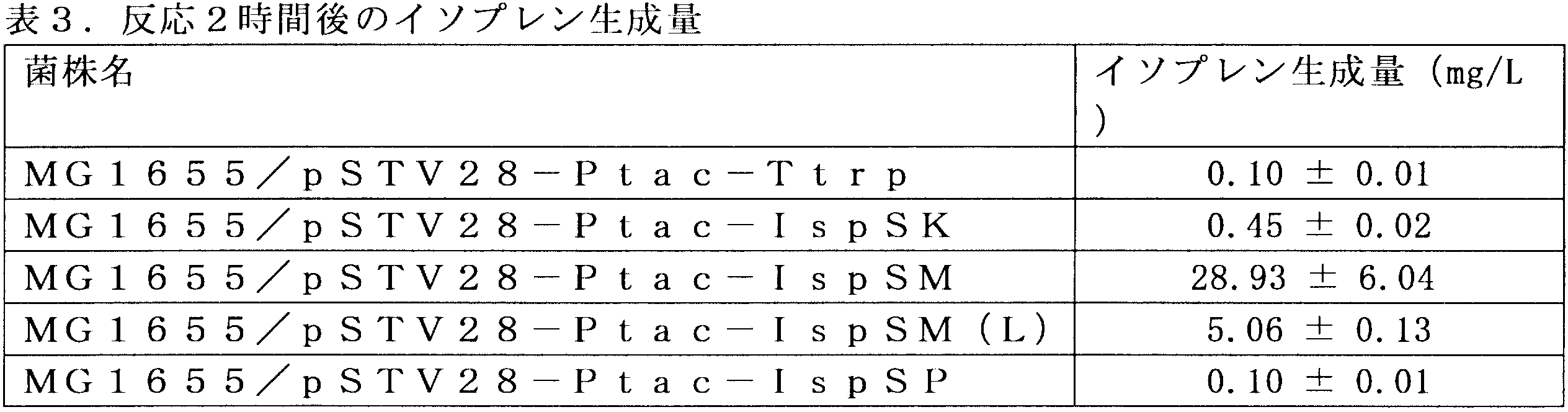
実施例4の粗酵素活性の結果から、葉緑体移行シグナルを欠失したムクナ由来のイソプレンシンターゼで最も高い活性が確認された。その為、葉緑体移行シグナルを欠失した全てのイソプレンシンターゼ導入株について、グルコースからのイソプレン生産能を比較した。MG1655/pSTV28-Ptac-Ttrp株、MG1655/pSTV28-Ptac-IspSK株、MG1655/pSTV28-Ptac-IspSP株、及びMG1655/pSTV28-Ptac-IspSM株を、60(mg/L)のクロラムフェニコールを含むLBプレートに均一に塗布し、37℃にて18時間培養した。得られたプレートから、1白金耳分の菌体を、ヘッドスペースバイアル中のM9グルコース培地1mLに接種し、ヘッドスペースバイアル用キャップブチルゴムセプタム付(Perkin Elmer社製CRIMPS cat♯B0104240)で密栓後、往復振とう培養装置(120rpm)で、30℃にて24時間培養を行った。M9グルコース培地の組成は表4に記載のとおりである。


6-1)dxs遺伝子発現用プラスミド(pMW219-dxs)の構築
イソプレンシンターゼを導入したE.coliでMEP経路を構成するdxs遺伝子(1-deoxy-D-xylulose-5-phosphate synthase)の発現強化を行うと、イソプレン生成量が向上する事が既に報告されている(Appl.Microbiol.Biotechnol.,(2011)90,1915-1922)。そこで、dxs遺伝子の発現を強化した株においても、イソプレンシンターゼの由来の違いで、イソプレン生産能に相違が生じるかを確認した。E.coli K-12株のゲノムの全塩基配列(Genbank Accession No.U00096)は既に明らかにされている(Science,(1997)277,1453-1474)。遺伝子増幅を行うためにpMW219(ニッポンジーン社製)を用いた。本プラスミドは、マルチクローニングサイトに目的遺伝子を導入する事で、イソプロピル-β-チオガラクトピラノシド(IPTG)を添加時に目的遺伝子の発現量を増加させる事が出来る。E.coliのゲノム配列のdxs遺伝子の塩基配列(Gene ID:945060 Locus tag b0420)に基づいて、配列番号23と配列番号24の塩基配列からなる合成オリゴヌクレオチドを合成した。その後、E.coli MG1655株のゲノムを鋳型として、配列番号23と配列番号24の塩基配列からなる合成オリゴヌクレオチドをプライマーとして、Prime Starポリメラーゼ(タカラバイオ社製)を用いてPCRを行った。反応溶液はキットに添付された組成に従って調整し、98℃にて10秒、54℃にて20秒、68℃にて120秒の反応を40サイクル行った。その結果、dxs遺伝子を含む、PCR産物を取得した。同様に、pMW219を鋳型として、配列番号25と配列番号26の塩基配列からなる合成オリゴヌクレオチドをプライマーとして、Prime Starポリメラーゼ(タカラバイオ社製)を用いてPCRを行った。反応溶液はキットに添付された組成に従って調整し、98℃にて10秒、54℃にて20秒、68℃にて240秒の反応を40サイクル行った。その結果、pMW219を含む、PCR産物を取得した。その後、精製されたdxs遺伝子断片と、pMW219のPCR産物を、In-Fusion HD Cloning Kit(Clontech社製)を用いて連結した。得られたdxs遺伝子発現用プラスミドをpMW219-dxsと命名した。

MG1655/pSTV28-Ptac-Ttrp株、MG1655/pSTV28-Ptac-IspSK株、MG1655/pSTV28-Ptac-IspSM株、更にMG1655/pSTV28-Ptac-IspSP株のコンピテントセルを調整後、エレクトロポレーション法によりpMW219-dxsを導入し、60(mg/L)のクロラムフェニコールと50(mg/L)のカナマイシン塩酸塩を含むLBプレートに均一に塗布し、37℃にて18時間培養した。得られたプレートから、クロラムフェニコールとカナマイシンに耐性を示す形質転換体を取得した。MG1655/pSTV28-Ptac-Ttrp株、MG1655/pSTV28-Ptac-IspSK株、MG1655/pSTV28-Ptac-IspSM株、更にMG1655/pSTV28-Ptac-IspSP株にpMW219-dxsがそれぞれ導入された株をMG1655/pSTV28-Ptac-Ttrp/pMW219-dxs株、MG1655/pSTV28-Ptac-IspSK/pMW219-dxs株、MG1655/pSTV28-Ptac-IspSM/pMW219-dxs、更にMG1655/pSTV28-Ptac-IspSP/pMW219-dxsと命名した。
MG1655/pSTV28-Ptac-Ttrp/pMW219-dxs株、MG1655/pSTV28-Ptac-IspSK/pMW219-dxs株、MG1655/pSTV28-Ptac-IspSM/pMW219-dxs株、更にMG1655/pSTV28-Ptac-IspSP/pMW219-dxs株を、60(mg/L)のクロラムフェニコールと50(mg/L)のカナマイシン塩酸塩を含むLBプレートに均一に塗布し、37℃にて18時間培養した。その後、実施例5に記載したヘッドスペースバイアルでの培養評価を実施した。培養終了時のイソプレン生産量(μg/L)とOD値を表7に記載した。

7-1)酵母由来のメバロン酸経路下流遺伝子のクローニング
メバロン酸経路の下流領域はSaccharomyces cerevisiaeより取得した(WO2009076676,Saccharomyces Genome database http://www.yeastgenome.org/# Nucleic Acids Res.,Jan 2012;40:D700-D705)S.cerevisiaeのゲノムDNAを鋳型とし、メバロン酸キナーゼをコードするERG12遺伝子、ホスホメバロン酸キナーゼをコードするERG8遺伝子、ジホスホメバロン酸デカルボキシラーゼをコードするERG19遺伝子、イソペンテニルニリン酸デルタイソメラーゼをコードするIDI1遺伝子を次に示すプライマーを用いたPCR反応により増幅した(表8)。PCR酵素にはタカラバイオ社より販売されているPrimeSTAR MAX Premixを利用し、98℃、2分、(98℃、10秒、55℃、5秒、72℃、5秒/kb)×30サイクルの条件で反応を行った。PCR断片は制限酵素SmaIで処理したpSTV28-Ptac-Ttrpベクター(配列番号12)にin-fusionクローニング法にて挿入し、クローニングと発現ベクター構築を行った。E.coli DH5αに形質転換を行い、各遺伝子の想定配列長を有するクローンを選抜した後、定法に従いプラスミド抽出を行い、シーケンスを確認した。これら増幅した遺伝子の塩基配列、およびその遺伝子がコードする酵素のアミノ酸配列はSaccharomyces Genome database http://www.yeastgenome.org/#にて取得可能である。

メバロン酸キナーゼとホスホメバロン酸キナーゼを直鎖状に並べた配列の構築を、In-fusionクローニング法にて行った。Saccharomyces cerevisiaeのゲノムDNAを鋳型とし、メバロン酸キナーゼをコードするERG12遺伝子、ホスホメバロン酸キナーゼをコードするERG8遺伝子を表9に示すプライマーを用いたPCR法により増幅した。PCR酵素には東洋紡より販売されているKOD plusを利用し、94℃、2分、(94℃、15秒、45℃、30秒、68℃、1分/kb)×30サイクル、68℃、10分の条件で反応を行った。PCR断片は制限酵素SmaIで処理したpUC118ベクターにin-fusionクローニング法にて挿入し、クローニングと発現ベクター構築を行った。E.coli JM109に形質転換を行い、各遺伝子の想定配列長を有するクローンを選抜した後、定法に従いプラスミド抽出を行い、シーケンスを確認した。作成したプラスミドをpUC-mvk-pmkと名付けた。pUC-mvk-pmkの塩基配列を配列番号35に示す。


メバロン酸キナーゼ、ホスホメバロン酸キナーゼ、ジホスホメバロン酸デカルボキシラーゼとイソペンテニルニリン酸デルタイソメラーゼを直鎖状に並べた配列を染色体上で発現させる事とした。遺伝子の発現にはグルコースイソメラーゼプロモーターを利用し、転写終結にはE.coliのaspA遺伝子の転写終結領域を利用した(WO2010031062)。染色体固定部位としてTn7の転移部位を用いた(Mol Gen Genet.1981;183(2):380-7)。染色体固定後の薬剤マーカーとしてはcat遺伝子を利用した。表12に示すプライマーを利用して、E.coliのゲノムを鋳型としたPCRにより染色体固定領域の内、Tn7下流領域の増幅を行った。PCR酵素にはタカラバイオ社より販売されているPrimeSTAR HS DNAポリメラーゼを利用し、98℃、2分、(98℃、10秒、52℃、5秒、72℃、1分/kb)×30サイクル、72℃、10分の条件で反応を行った。表12に示すプライマーを利用して、pMW118-attL-Cm-attRプラスミドを鋳型としたPCRによりλファージアッタチメント部位を含むcat遺伝子領域の増幅を行った(WO2010-027022)。PCR酵素にはタカラバイオ社より販売されているPrimeSTAR HS DNAポリメラーゼを利用し、95℃、3分、(95℃、1分、34℃、30秒、72℃、40秒)×2サイクル、(95℃、30秒、50℃、30秒、72℃、40秒)×25サイクル、72℃、5分の条件で反応を行った。表12に示すプライマーを利用して、pTrc-KKDyI(β)を鋳型としたPCRによりプロモータと転写終結領域を付与したメバロン酸経路下流配列(以下KKDyIと略す)の増幅を行った。PCR酵素にはタカラバイオ社より販売されているPrimeSTAR HS DNAポリメラーゼを利用し、98℃、2分、(98℃、10秒、52℃、5秒、72℃、1分/kb)×30サイクル、72℃、10分の条件で反応を行った。これらのPCR産物と、制限酵素SmaIで処理したpMW219を用い、In-Fusionクローニング法によりベクター構築を行った。E.coli JM109に形質転換を行い、目的配列長を有するクローンを選抜した後、定法に従いプラスミド抽出を行い、シーケンスを確認した。得られたプラスミドをpMW219-KKDyI-TaspAと名づけた。pMW219-KKDyI-TaspAの塩基配列を配列番号50に示す。
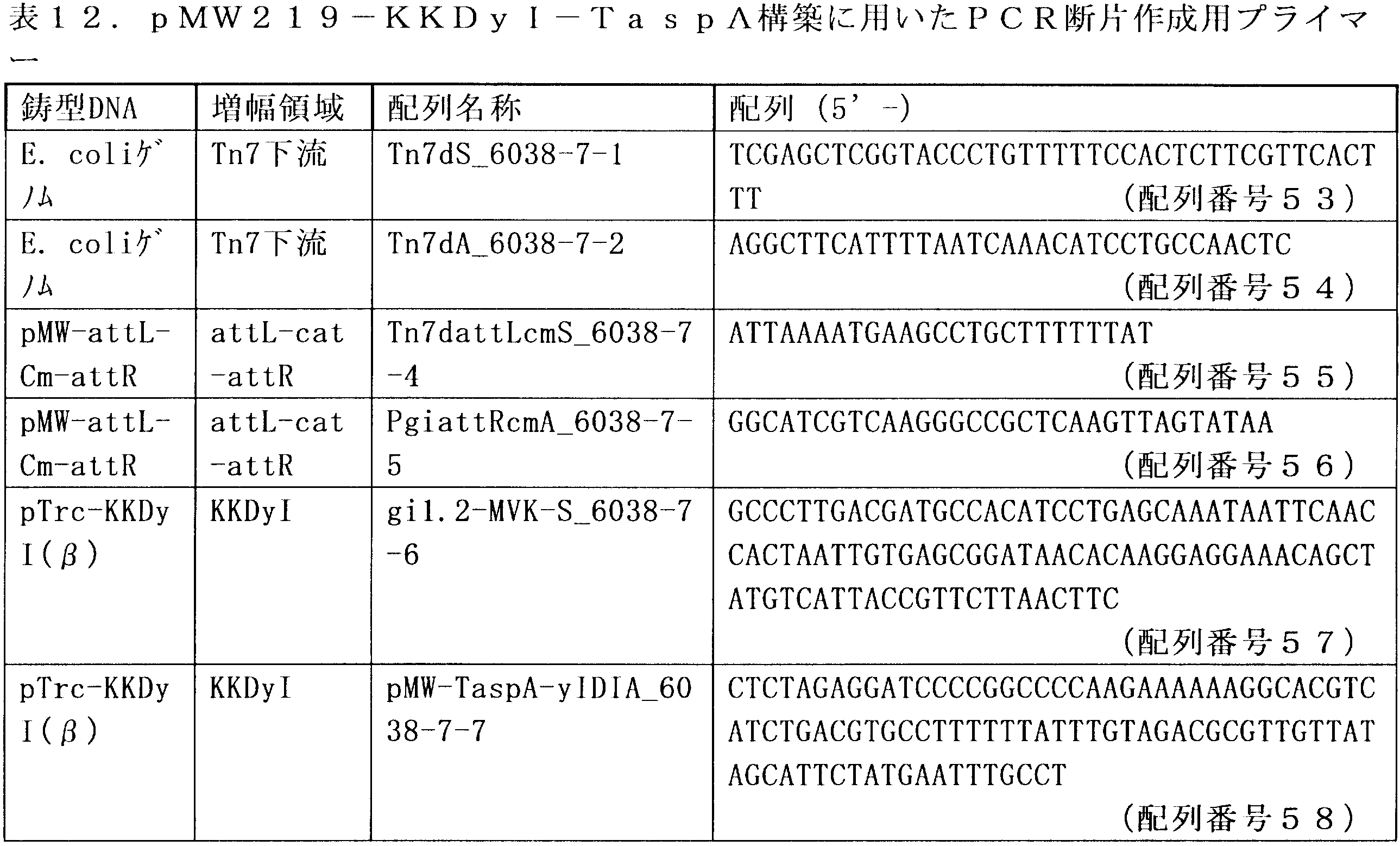
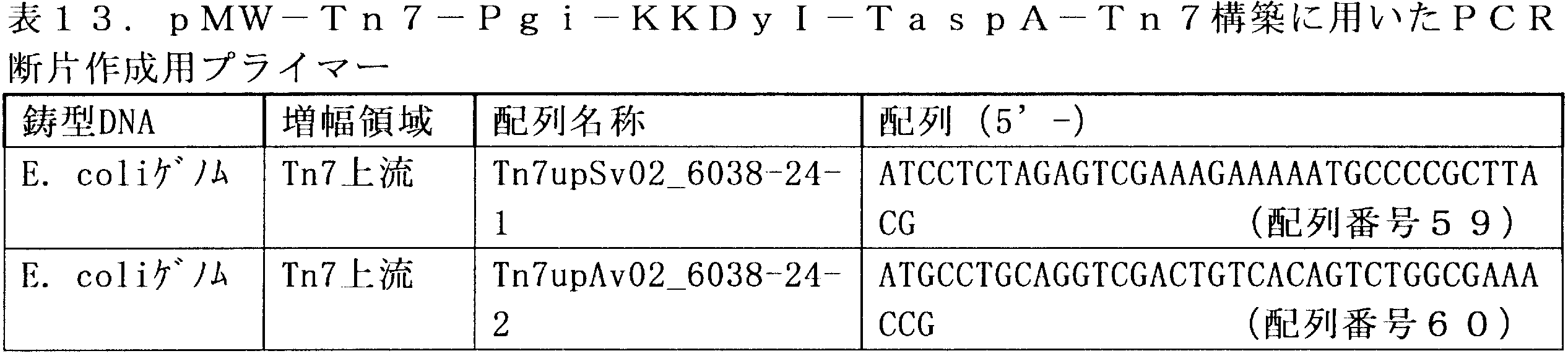

染色体上のメバロン酸経路下流オペロンのプロモーターをλ-red法により置換した。PCRの鋳型として、attL-Tet-attR-Ptacを有するゲノム断片を使用した。これは、tacプロモーターとテトラサイクリン耐性薬剤マーカー及びλファージのアタッチメントサイトであるattL及びattRが並ぶものである。これらの配列を配列番号63に示す。表15に示すプロモーターを用いてPCR断片を調整した。PCR酵素にはタカラバイオ社より販売されているLA-Taqポリメラーゼを利用し、92℃、1分、(92℃、10秒、50℃、20秒、72℃、1分/kb)×40サイクル、72℃、7分の条件で反応を行った。PCR産物を精製し、温度感受性の複製能を有するプラスミドpKD46を含むMG1655 Pgi-KKDyI(以下MG1655 Pgi-KKDyI/pKD46と表記する)をエレクトロポレーションするために用いた。プラスミドpKD46[Proc.Natl.Acad.Sci.USA,2000,vol.97,No.12,p6640-6645]は、アラビノース誘導性ParaBプロモーターに制御されるλRedシステムの遺伝子(λ、β、exo遺伝子)を含むλファージの合計2154塩基のDNAフラグメント(GenBank/EMBL アクセッション番号 J02459,第31088番目~33241番目)を含む。プラスミドpKD46はPCR産物をMG1655 Pgi-KKDyIに組み込むために必要である。

MG1655 Ptac-KKDyI株のコンピテントセルを調整後、エレクトロポレーション法によりpSTV28-Ptac-Ttrp、pSTV28-Ptac-IspSK、pSTV28-Ptac-IspSM、更にpSTV28-Ptac-IspSPを導入し、60 (mg/L)のクロラムフェニコールを含むLBプレートに均一に塗布し、37℃にて18時間培養した。得られたプレートから、クロラムフェニコール耐性を示す形質転換体を取得した。MG1655 Ptac-KKDyI株にpSTV28-Ptac-Ttrpが導入された株をMG1655 Ptac-KKDyI/pSTV28-Ptac-Ttrp株、pSTV28-Ptac-IspSKが導入された株をMG1655 Ptac-KKDyI/pSTV28-Ptac-IspSK株、pSTV28-Ptac-IspSMが導入された株をMG1655 Ptac-KKDyI/pSTV28-Ptac-IspSM株、pSTV28-Ptac-IspSPが導入された株をMG1655 Ptac-KKDyI/pSTV28-Ptac-IspSP株と命名した。
MG1655 Ptac-KKDyI/pSTV28-Ptac-Ttrp株、MG1655 Ptac-KKDyI/pSTV28-Ptac-IspSK株、MG1655 Ptac-KKDyI/pSTV28-Ptac-IspSM株、更にMG1655 Ptac-KKDyI/pSTV28-Ptac-IspSP株を、60(mg/L)のクロラムフェニコールを含むLBプレートに均一に塗布し、37℃にて18時間培養した。得られたプレートから、1白金耳分の菌体を、ヘッドスペースバイアル中(Perkin Elmer社製 22 mL CLEAR CRIMP TOP VIAL cat♯B0104236)のM9グルコース(メバロン酸含有)培地1mLに接種し、その後、実施例2に記載した方法に従って、培養評価を実施した。M9グルコース(メバロン酸含有)培地の組成を表16に記載した。培養終了時のイソプレン生産量とOD値を表17に記載した。
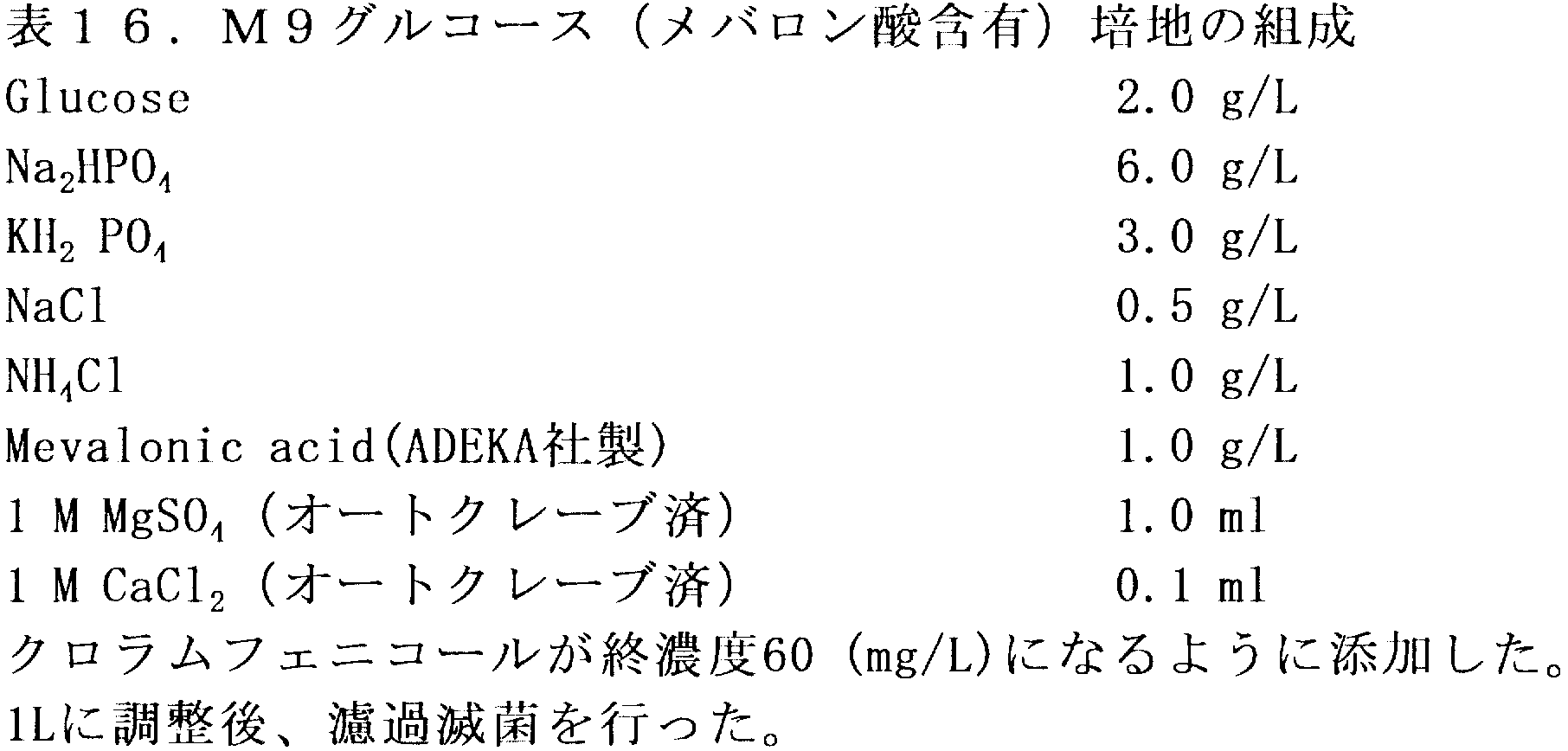

1)各植物種由来IspS遺伝子発現用プラスミドの構築
コリネ型細菌としてC.glutamicum 2256株(ATCC13869)を利用した(Okumura et al.,1962,Santamaria et al.,1984,Tsuchida et al.,1986)。C.glutamicumでIspSK遺伝子、IspSP遺伝子、及びIspSM遺伝子を発現させる為のプラスミドは次の手順で構築した。pUC57-IspSKを鋳型として、配列番号67と配列番号68に示す合成オリゴヌクレオチド、pUC57-IspSPを鋳型として、配列番号69と配列番号70に示す合成オリゴヌクレオチド、更にはpUC57-IspSMを鋳型として、配列番号71と配列番号72に示す合成オリゴヌクレオチドをプライマーとして、Prime Starポリメラーゼ(タカラバイオ社製)を用いてPCRを行った。反応溶液はキットに添付された組成に従って調製し、98℃にて10秒、55℃にて5秒、72℃にて120秒の反応を30サイクル行った。その結果、IspSK遺伝子、IspSP遺伝子、及びIspSM遺伝子を含む、PCR産物を取得した。次にElongation Factor Tuのプロモーター配列(以下、P0480)を取得する目的でC.glutamicum 2256株の染色体DNAを鋳型としたPCRを行った。IspSK遺伝子とP0480を組み合わせる目的で、PCRのプライマーとして配列番号73と配列番号74に示す合成ヌクレオチドを利用した。また、IspSP遺伝子とP0480を組み合わせる目的で、PCRのプライマーとして配列番号73と配列番号75に示す合成ヌクレオチドを利用した。また、IspSM遺伝子とP0480を組み合わせる目的で、PCRのプライマーとして配列番号73と配列番号76に示す合成オリゴヌクレオチドを利用した。PCRにはPrime Starポリメラーゼ(タカラバイオ社製)を用いた。反応溶液はキットに添付された組成に従って調製し、98℃にて10秒、55℃にて5秒、72℃にて30秒の反応を30サイクル行った。その結果、P0480を含むPCR産物を取得した。P0480の配列情報を配列番号77に示す。続いてC.glutamicumとE.coliのシャトルベクター・pVK9を制限酵素XbaI(タカラバイオ社製)にて消化した(Miwa et al.,1985)。pVK9の配列情報を配列番号78に示す。精製したIspSK遺伝子、IspSP遺伝子、及びIspSM遺伝子遺伝子断片と、P0480のPCR産物、XbaIにて消化後精製したpVK9を、In-Fusion HD Cloning Kit(Clontech社製)を用いて連結した。得られたIspSK遺伝子発現用プラスミドをpVK9-P0480-IspSK、IspSP遺伝子発現用プラスミドをpVK9-P0480-IspSP、IspSM遺伝子発現用プラスミドをpVK9-P0480-IspSMと命名し、これらの配列情報をそれぞれ配列番号79、80、81に示した。
C.glutamicum 2256株をCM-Dex培地4mlを容れた試験管に植菌し、30℃、120rpmにて対数増殖期まで培養した。この菌体を集菌し、氷冷した10%グリセロールにて2~3回洗浄後、100~200倍程度に濃縮したものをコンピテントセルとした。コンピテントセルとpVK9、pVK9-P0480-IspSK、pVK9-P0480-IspSP、pVK9-P0480-IspSMの各プラスミドDNAとを良く混合し、パルス印加を行った。バルス印加は、BIORAD社・GenePulserXCellを使用し、1.8kV、25μF、200Ωの条件で実施した。バルス印加後、CM-Dex培地にて約1~2時間回復培養を行い、その後、Km50μg/mlを含むCM-Dexプレート培地に塗布し、30℃にて18~24時間培養した。培養後のプレートから、カナマイシン耐性を示す形質転換体を取得した。CM-Dex培地の組成を表18に示す。C.glutamicum 2256株にpVK9が導入された株を2256/pVK9株、pVK9-P0480-IspSKが導入された株を2256/pVK9-P0480-IspSK株、pVK9-P0480-IspSPが導入された株を2256/pVK9-P0480-IspSP株、pVK9-P0480-IspSMが導入された株を2256/pVK9-P0480-IspSM株と命名した。
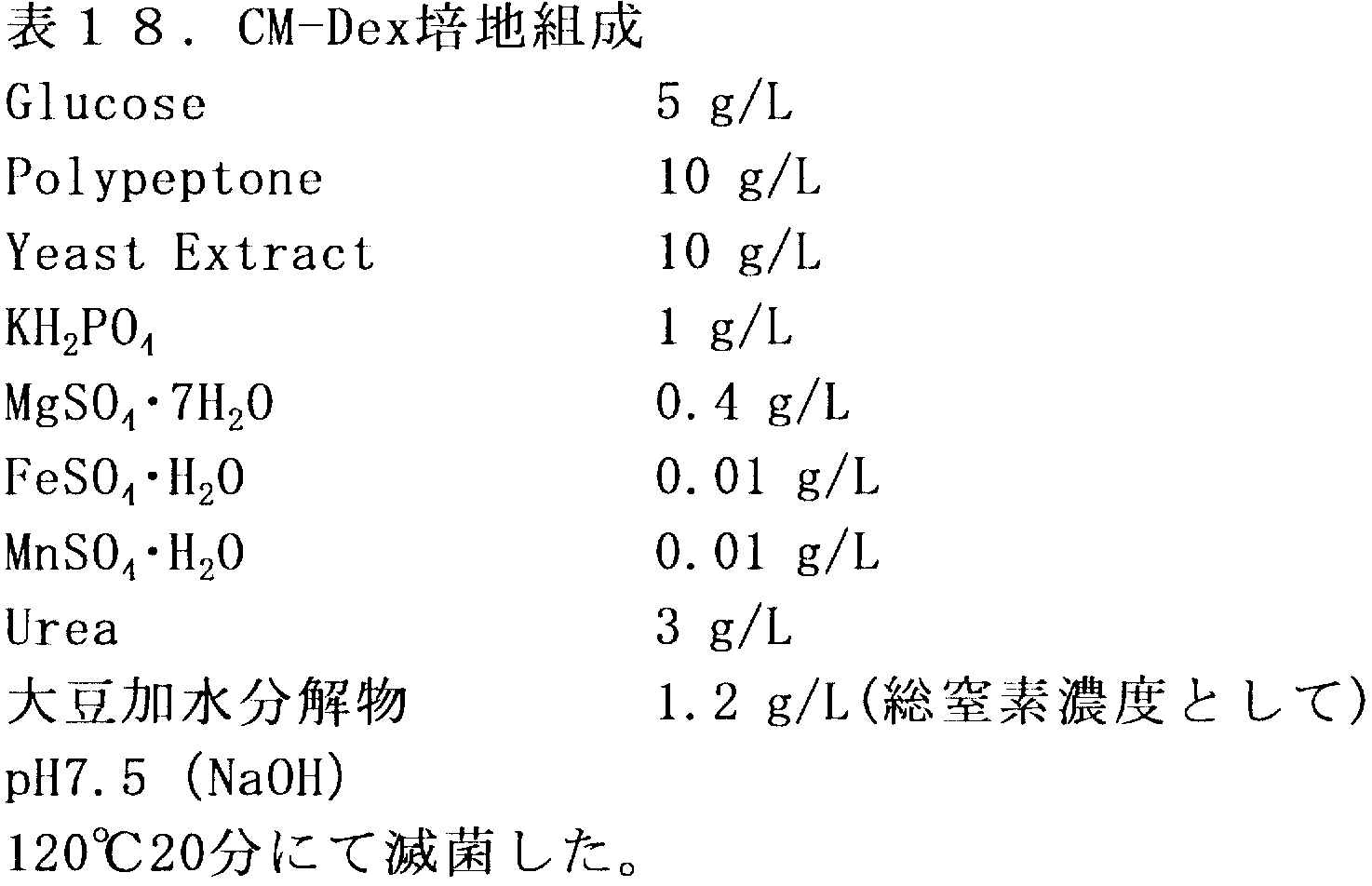
プレートの場合、寒天20g/Lを添加した。
2256/pVK9株、2256/pVK9-P0480-IspSK株、2256/pVK9-P0480-IspSP株、及び2256/pVK9-P0480-IspSM株を、50(mg/L)のカナマイシンを含むCM-Dexプレートに均一に塗布し、30℃にて18時間培養した。培養後のプレートから、1/6プレート分の菌体を50(mg/L)のカナマイシンを含むCM-Dex培地20mlを張り込んだ坂口フラスコに接種し、30℃にて6時間培養した。培養液より菌体を5000rpm、5分の条件で遠心操作により分離し、イソプレンシンターゼバッファー(50mM Tris-HCl(pH8.0)・20mM MgCl2・5%グリセロール)にて2回洗浄した。洗浄後の菌体を同バッファー1.8mlに懸濁した。2ml容積のマルチビーズショッカー専用チューブに約0.9mlの破砕用ビーズ(YBG01,直径0.1mm)と菌体懸濁液0.9mlを入れ、安井器械製マルチビーズショッカー(MB701(S)型)にて2500rpm、60秒ON・60秒OFFを6サイクルの条件で菌体を破砕した。菌体破砕操作後、チューブを20000g、20分の条件の遠心操作により上清画分を得て、これを粗酵素抽出液とした。
2256/pVK9株、2256/pVK9-P0480-IspSK株、2256/pVK9-P0480-IspSP株、及び2256/pVK9-P0480-IspSM株の粗酵素抽出液のタンパク質濃度をビシンコニン酸法(BCA法)により測定した。測定試薬として、BCA Protein Assay Reagent Kit(サーモサイエンティフィック社、Cat.#23227)を用いた。総タンパク量として2mgの粗酵素抽出液とイソプレンバッファーを合わせて0.5mlとなるよう調製し、これをヘッドスペースバイアルに入れ、その後、0.5M MgCl2溶液0.025mlと0.2M DMAPP(cayman製,Catlog No.63180)溶液0.01mlを加えて軽く攪拌した後、すぐに密栓し37℃、2時間の条件で反応を行った。反応後、バイアルのヘッドスペース中のイソプレン濃度をガスクロマトグラフィーにより測定した。ヘッドスペースバイアルとして、Perkin Elmer社製 22mL CLEAR CRIMP TOP VIAL cat♯B0104236を、密栓用のキャップとして、Perkin Elmer社製ヘッドスペースバイアル用キャップブチルゴムセプタム付cat♯B0104240を利用した。
表19に各菌株の反応2時間後のイソプレン生成量を記載した。
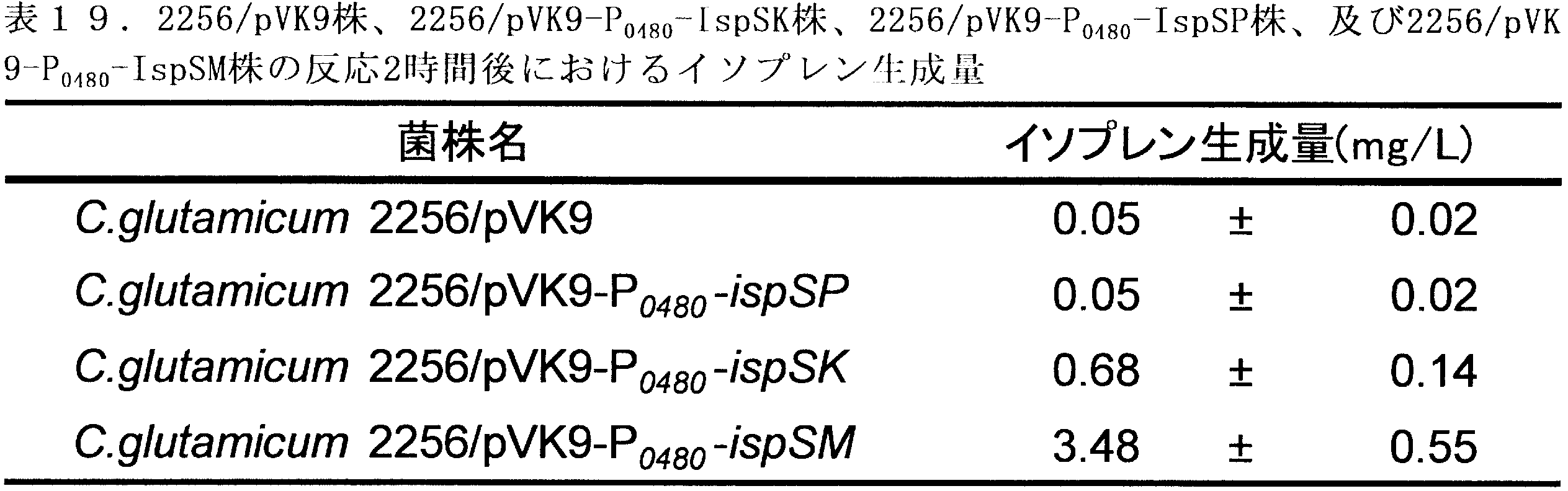
1)C.glutamicum 2256株における、各植物種由来イソプレンシンターゼの導入効果
2256/pVK9株、2256/pVK9-P0480-IspSK株、2256/pVK9-P0480-IspSP株、及び2256/pVK9-P0480-IspSM株を、50(mg/L)のカナマイシンを含むCM-Dexプレートに均一に塗布し、30℃にて18~24時間培養した。得られたプレートから、1白金耳分の菌体を、ヘッドスペースバイアル内のMM-グルコース培地1mLに接種し、密栓後、往復振とう培養装置で、30℃にて120rpm、24時間の培養を行った。ヘッドスペースバイアルとしてPerkin Elmer社製 22mL CLEAR CRIMP TOP VIAL cat♯B0104236を、密栓用のキャップとしてPerkin Elmer社製ヘッドスペースバイアル用キャップブチルゴムセプタム付cat♯B0104240を利用した。
MM-グルコース培地の組成は表20に記載のとおりである。
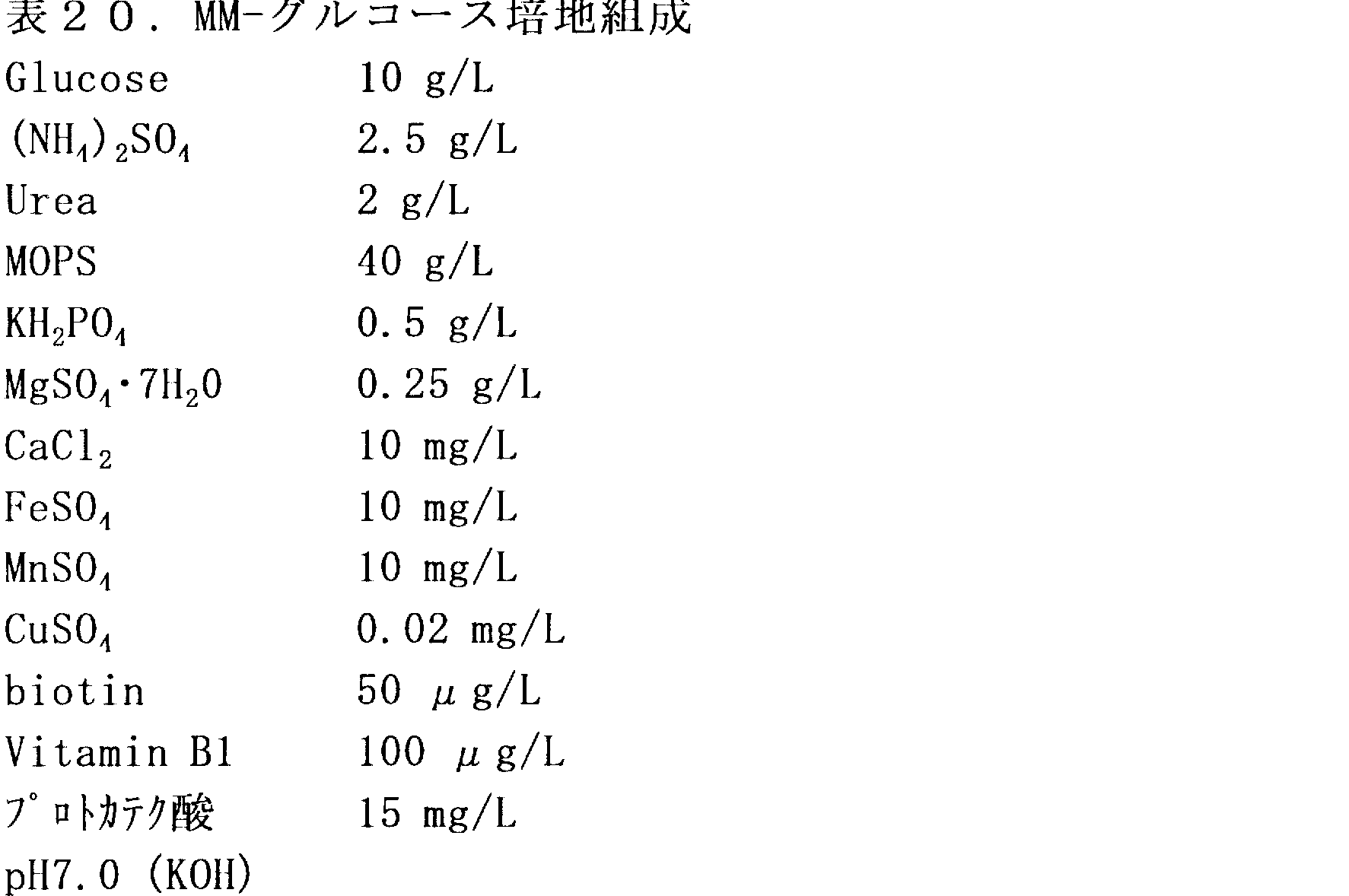
1Lに調製後、濾過滅菌を行った。
表21に各菌株の培養終了時のイソプレン濃度を記載した。

1)イソプレン生産能を有するP.ananatis AJ13355株の構築
P.ananatis AJ13355株のコンピテントセルを調製後、エレクトロポレーション法によりpSTV28-Ptac-Ttrp、pSTV28-Ptac-IspSK、pSTV28-Ptac-IspSP、更にpSTV28-Ptac-IspSMを導入し、60(mg/L)のクロラムフェニコールを含むLBプレートに均一に塗布し、30℃にて18時間培養した。その後、得られたプレートから、クロラムフェニコール耐性を示す形質転換体を取得した。P.ananatis AJ13355株にpSTV28-Ptac-Ttrpが導入された株をAJ13355/pSTV28-Ptac-Ttrp株、pSTV28-Ptac-IspSKが導入された株をAJ13355/pSTV28-Ptac-IspSK株、pSTV28-Ptac-IspSPが導入された株をAJ13355/pSTV28-Ptac-IspSP株、pSTV28-Ptac-IspSMが導入された株をAJ13355/pSTV28-Ptac-IspSM株と命名した。
実施例4に記載してある方法に順じて、粗酵素活性を測定した。AJ13355/pSTV28-Ptac-Ttrp株、AJ13355/pSTV28-Ptac-IspSK株、AJ13355/pSTV28-Ptac-IspSP株、及びAJ13355/pSTV28-Ptac-IspSM株を、60(mg/L)のクロラムフェニコールを含むLBプレートに均一に塗布し、30℃にて18時間培養した。得られたプレートから、1/6プレート分の菌体を60(mg/L)のクロラムフェニコールを含むLB20mlを張り込んだ坂口フラスコに接種し、34℃にて6時間培養した。培養液より菌体を6000rpm、4℃、5分の条件で遠心分離し、氷冷したイソプレンシンターゼバッファー(50mM Tris-HCl(pH8.0)・20mM MgCl2・5%グリセロール)にて2回洗浄した。洗浄菌体を同バッファー1.8mlに懸濁した。2ml容のマルチビーズショッカー専用チューブに約0.9mlの破砕用ビーズ(YBG01,直径0.1mm)と菌体懸濁液0.9mlを入れ、安井器械製マルチビーズショッカー(MB701(S)型)にて2500rpm、4℃、30秒ON・30秒OFFを3サイクルの条件で菌体を破砕した。破砕後チューブを20000g、4℃、20分の条件で遠心し、上清を粗酵素抽出液とした。
AJ13355/pSTV28-Ptac-Ttrp株、AJ13355/pSTV28-Ptac-IspSK株、AJ13355/pSTV28-Ptac-IspSP株、及びAJ13355/pSTV28-Ptac-IspSM株の粗酵素抽出液(ブラッドフォード法にて総タンパク量として2mgになるように定量した)とイソプレンバッファーを合わせて0.5mlをヘッドスペースバイアル(Perkin Elmer社製 22mL CLEAR CRIMP TOP VIAL cat♯B0104236)に入れ、0.5M MgCl2溶液0.025mlと0.2M DMAPP(cayman製,Catlog No.63180)溶液0.01mlを加えて軽く攪拌した後、すぐにヘッドスペースバイアル用キャップブチルゴムセプタム付(Perkin Elmer社製CRIMPS cat♯B0104240)にて密栓、37℃にて2時間保温した。
反応終了後、バイアルのヘッドスペース中のイソプレン濃度をガスクロマトグラフィーにより測定した。
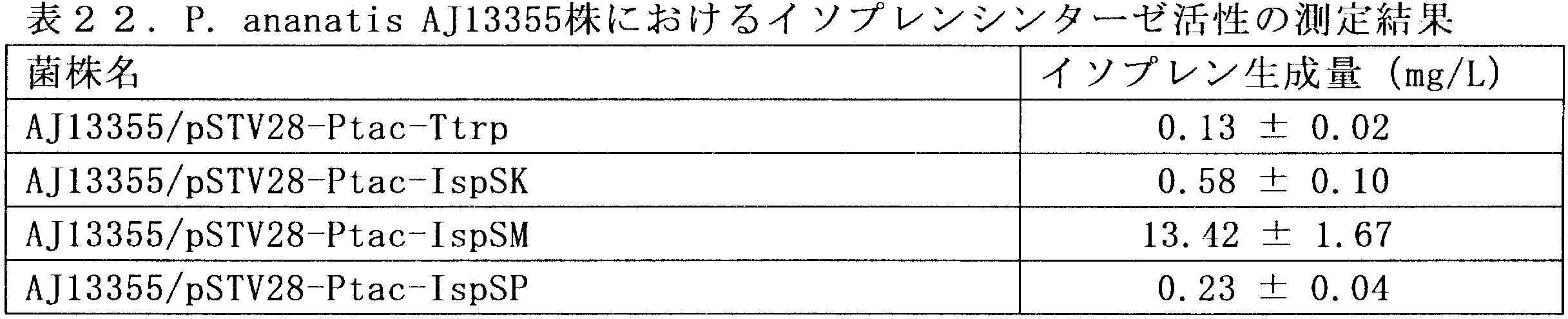
P.ananatis AJ13355株においても、葉緑体移行シグナルを欠失した全てのイソプレンシンターゼ導入株について、グルコースからのイソプレン生産能を比較した。AJ13355/pSTV28-Ptac-Ttrp株、AJ13355/pSTV28-Ptac-IspSK株、AJ13355/pSTV28-Ptac-IspSP株、及びAJ13355/pSTV28-Ptac-IspSM株を、60(mg/L)のクロラムフェニコールを含むLBプレートに均一に塗布し、30℃にて18時間培養した。得られたプレートから、1白金耳分の菌体を、ヘッドスペースバイアル中のM9グルコース培地1mLに接種し、ヘッドスペースバイアル用キャップブチルゴムセプタム付(Perkin Elmer社製CRIMPS cat♯B0104240)で密栓後、往復振とう培養装置(120rpm)で、30℃にて24時間培養を行った。培養終了後、バイアルのヘッドスペース中のイソプレン濃度をガスクロマトグラフィーにより測定し、OD値は分光光度計(HITACHI U-2900)によって600nmで測定した。表23に各菌株の培養終了時のイソプレン濃度とOD値を記載した。

1)イソプレン生産能を有するE.aerogenes AJ110637株の構築
E.aerogenes AJ110637株のコンピテントセルを調製後、エレクトロポレーション法によりpSTV28-Ptac-Ttrp、pSTV28-Ptac-IspSK、pSTV28-Ptac-IspSP、更にpSTV28-Ptac-IspSMを導入し、60(mg/L)のクロラムフェニコールを含むLBプレートに均一に塗布し、37℃にて18時間培養した。その後、得られたプレートから、クロラムフェニコール耐性を示す形質転換体を取得した。E.aerogenes AJ110637株にpSTV28-Ptac-Ttrpが導入された株をAJ110637/pSTV28-Ptac-Ttrp株、pSTV28-Ptac-IspSKが導入された株をAJ110637/pSTV28-Ptac-IspSK株、pSTV28-Ptac-IspSPが導入された株をAJ110637/pSTV28-Ptac-IspSP株、pSTV28-Ptac-IspSMが導入された株をAJ110637/pSTV28-Ptac-IspSM株と命名した。
実施例4に記載してある方法に順じて、粗酵素活性を測定した。AJ110637/pSTV28-Ptac-Ttrp株、AJ110637/pSTV28-Ptac-IspSK株、AJ110637/pSTV28-Ptac-IspSP株、及びAJ110637/pSTV28-Ptac-IspSM株を、60(mg/L)のクロラムフェニコールを含むLBプレートに均一に塗布し、37℃にて18時間培養した。得られたプレートから、1/6プレート分の菌体を60(mg/L)のクロラムフェニコールを含むLB20mlを張り込んだ坂口フラスコに接種し、37℃にて4時間培養した。培養液より菌体を8000rpm、4℃、10分の条件で遠心分離し、氷冷したイソプレンシンターゼバッファー(50mM Tris-HCl(pH8.0)・20mM MgCl2・5%グリセロール)にて2回洗浄した。洗浄菌体を同バッファー1.8mlに懸濁した。2ml容のマルチビーズショッカー専用チューブに約0.9mlの破砕用ビーズ(YBG01,直径0.1mm)と菌体懸濁液0.9mlを入れ、安井器械製マルチビーズショッカー(MB701(S)型)にて2500rpm、4℃、30秒ON・30秒OFFを3サイクルの条件で菌体を破砕した。破砕後チューブを20000g、4℃、20分の条件で遠心し、上清を粗酵素抽出液とした。
AJ110637/pSTV28-Ptac-Ttrp株、AJ110637/pSTV28-Ptac-IspSK株、AJ110637/pSTV28-Ptac-IspSP株、及びAJ110637/pSTV28-Ptac-IspSM株の粗酵素抽出液(ブラッドフォード法にて総タンパク量として2mgになるように定量した)とイソプレンバッファーを合わせて0.5mlをヘッドスペースバイアル(Perkin Elmer社製 22mL CLEAR CRIMP TOP IAL cat♯B0104236)に入れ、0.5M MgCl2溶液0.025mlと0.2M DMAPP(cayman製,Catlog No.63180)溶液0.01mlを加えて軽く攪拌した後、すぐにヘッドスペースバイアル用キャップブチルゴムセプタム付(Perkin Elmer社製CRIMPS cat♯B0104240)にて密栓、37℃にて2時間保温した。
反応終了後、バイアルのヘッドスペース中のイソプレン濃度をガスクロマトグラフィー
により測定した。
表24に各菌株の反応2時間後のイソプレン生成量を記載した。

E.aerogenes AJ110637株においても、葉緑体移行シグナルを欠失した全てのイソプレンシンターゼ導入株について、グルコースからのイソプレン生産能を比較した。AJ110637/pSTV28-Ptac-Ttrp株、AJ110637/pSTV28-Ptac-IspSK株、AJ110637/pSTV28-Ptac-IspSP株、及びAJ110637/pSTV28-Ptac-IspSM株を、60(mg/L)のクロラムフェニコールを含むLBプレートに均一に塗布し、30℃にて18時間培養した。得られたプレートから、1白金耳分の菌体を、ヘッドスペースバイアル中のM9グルコース培地1mLに接種し、ヘッドスペースバイアル用キャップブチルゴムセプタム付(Perkin Elmer社製CRIMPS cat♯B0104240)で密栓後、往復振とう培養装置(120rpm)で、30℃にて24時間培養を行った。培養終了後、バイアルのヘッドスペース中のイソプレン濃度をガスクロマトグラフィーにより測定し、OD値は分光光度計(HITACHI U-2900)によって600nmで測定した。表25に各菌株の培養終了時のイソプレン濃度とOD値を記載した。

1)各植物種由来IspS遺伝子発現用プラスミドの構築
S.cerevisiaeでIspSK遺伝子、IspSP遺伝子、及びIspSM遺伝子を発現させる為のプラスミドは次の手順で構築した。pUC57-IspSKを鋳型として、配列番号82と配列番号83に示す合成オリゴヌクレオチド、pUC57-IspSPを鋳型として、配列番号84と配列番号85に示す合成オリゴヌクレオチド、更にはpUC57-IspSMを鋳型として、配列番号86と配列番号87に示す合成オリゴヌクレオチドをプライマーとして、Prime Starポリメラーゼ(Takara社製)を用いてPCRを行った。反応溶液はキットに添付された組成に従って調製し、98℃にて10秒、55℃にて5秒、72℃にて120秒の反応を30サイクル行った。その結果、IspSK遺伝子、IspSP遺伝子、及びIspSM遺伝子を含む、PCR産物を取得した。一方、S.cerevisiaeとE.coliのシャトルベクター・pYES2(インビトロジェン社Cat.no.V825-20)を制限酵素KpnI(タカラバイオ社製)にて消化した。その後、精製されたIspSK遺伝子を含むPCR断片とKpnIにて消化後精製したpYES2を、In-Fusion HD Cloning Kit(Clontech社製)を用いて連結した。得られたIspSK遺伝子発現用プラスミドをpYES2-IspSKと命名した。同様に、精製されたIspSP遺伝子を含むPCR断片とKpnIにて消化後精製したpYES2を、In-Fusion HD Cloning Kit(Clontech社製)を用いて連結した。得られたIspSP遺伝子発現用プラスミドをpYES2-IspSPと命名した。同様に、精製されたIspSM遺伝子を含むPCR断片とKpnIにて消化後精製したpYES2を、In-Fusion HD Cloning Kit(Clontech社製)を用いて連結した。得られたIspSM遺伝子発現用プラスミドをpYES2-IspSMと命名した。
S.cerevisiae S288C株のコンピテントセルをFrozen-EZ Yeast Transformation KitII(ZYMO RESEARCH社,Cat.no.T2001)を用いて調製した。同キットのプロトコールに従って、pYES2、pYES2-IspSK、pYES2-IspSP、更にpYES2-IspSMをS.cerevisiae S288C株のコンピテントセルに導入し、SD-Uraプレートに均一に塗布し、30℃にて2日間培養した。その後、得られたプレートから、Ura要求性が消失した形質転換体を取得した。SD-Ura培地の組成は表26に記載のとおりである。S.cerevisiae S288C株にpYES2が導入された株をS288C/pYES2株、pYES2-IspSKが導入された株をS288C/pYES2-IspSK株、pYES2-IspSPが導入された株をS288C/pYES2-IspSP株、pYES2-IspSMが導入された株をS288C/pYES2-IspSM株と命名した。

S288C/pYES2株、S288C/pYES2-IspSK株、S288C/pYES2-IspSP株、及びS288C/pYES2-IspSM株を、SD-Uraプレートに均一に塗布し、30℃にて24時間培養した。得られたプレートから、1/4プレート分の菌体をSD-Ura Galactose(SD-Ura培地のGlucoseをGalactoseに換えた培地)培地50mlを張り込んだ坂口フラスコに接種し、30℃にて16時間培養した。SD-Ura Galactose培地の組成を表27に示す。培養液より菌体を3000rpm、5分の条件で遠心分離し、イソプレンシンターゼバッファー(50mM Tris-HCl(pH8.0)・20mM MgCl2・5%グリセロール)にて2回洗浄した。洗浄菌体を同バッファー1.8mlに懸濁した。2ml容のマルチビーズショッカー専用チューブに約0.9mlの破砕用ビーズ(YBG05,直径0.5mm)と菌体懸濁液0.9mlを入れ、安井器械製マルチビーズショッカー(MB701(S)型)にて2500rpm、60秒ON・60秒OFFを12サイクルの条件で菌体を破砕した。破砕後チューブを20000g、20分の条件で遠心し、上清を粗酵素抽出液とした。

S288C/pYES2株、S288C/pYES2-IspSK株、S288C/pYES2-IspSP株、及びS288C/pYES2-IspSM株の粗酵素抽出液の粗酵素抽出液のタンパク質濃度をビシンコニン酸法(BCA法)により測定した。測定試薬として、BCA Protein Assay Reagent Kit(サーモサイエンティフィック社、Cat.#23227)を用いた。総タンパク量として0.4mgの粗酵素抽出液とイソプレンバッファーを合わせて0.25mlとなるよう調製し、これをヘッドスペースバイアルに入れ、0.5M MgCl2溶液0.0125mlと0.2M DMAPP(cayman製,Catlog No.63180)溶液0.005mlを加えて軽く攪拌した後、すぐにヘッドスペースバイアル用キャップブチルゴムセプタム付(Perkin Elmer社製CRIMPS cat♯B0104240)にて密栓、37℃にて2時間の条件で反応を行った。反応後、バイアルのヘッドスペース中のイソプレン濃度をガスクロマトグラフィーにより測定した。ヘッドスペースバイアルとして、Perkin Elmer社製 22mL CLEAR CRIMP TOP VIAL cat♯B0104236を、密栓用のキャップとして、Perkin Elmer社製ヘッドスペースバイアル用キャップブチルゴムセプタム付cat♯B0104240を利用した。
表28に各菌株の反応2時間後のイソプレン生成量を記載した。

1)S.cerevisiae S288Cにおける、各植物種由来イソプレンシンターゼの導入効果
S288C/pYES2株、S288C/pYES2-IspSK株、S288C/pYES2-IspSP株、及びS288C/pYES2-IspSM株を、YPDプレートに均一に塗布し、30℃にて18~24時間培養した。得られたプレートから、1白金耳分の菌体を、ヘッドスペースバイアル中(Perkin Elmer社製 22mL CLEAR CRIMP TOP VIAL cat♯B0104236)のSD-Ura2培地(グルコース,ガラクトース各1g/Lを含む)1 mLに接種し、ヘッドスペースバイアル用キャップブチルゴムセプタム付(Perkin Elmer社製CRIMPS cat♯B0104240)で密栓後、往復振とう培養装置にて、30℃120rpmの条件で24時間培養を行った。YPD培地の組成を表29に、SD-Ura2培地の組成は表30に記す。
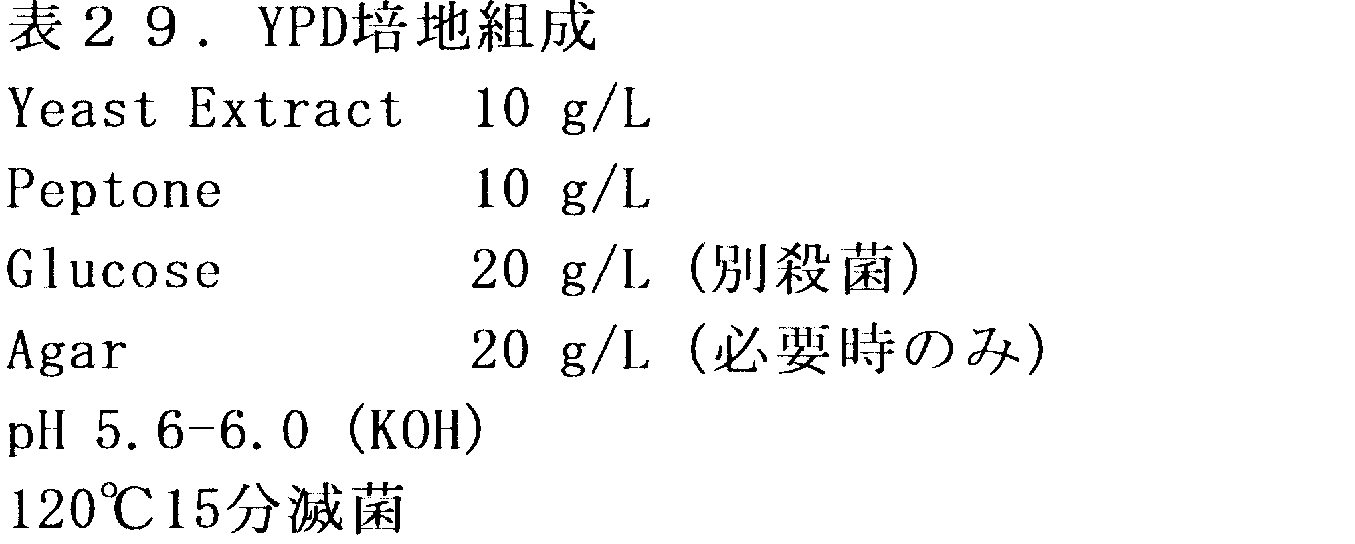
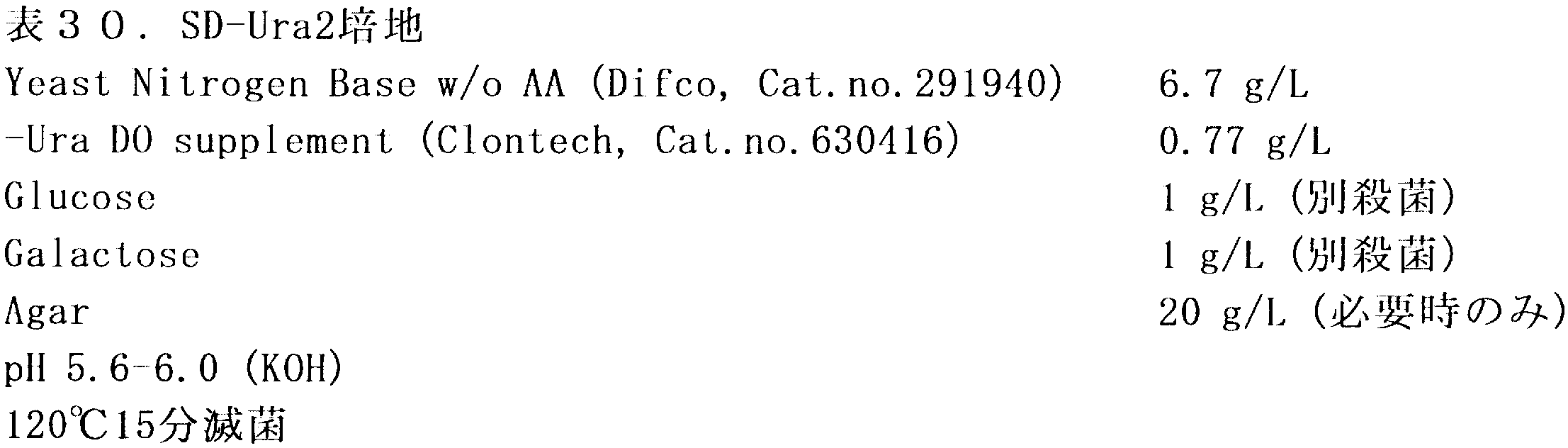
また、OD値は分光光度計(HITACHI U-2900)によって600nmで測定した。表31に各菌株の培養終了時のイソプレン濃度を記載した。
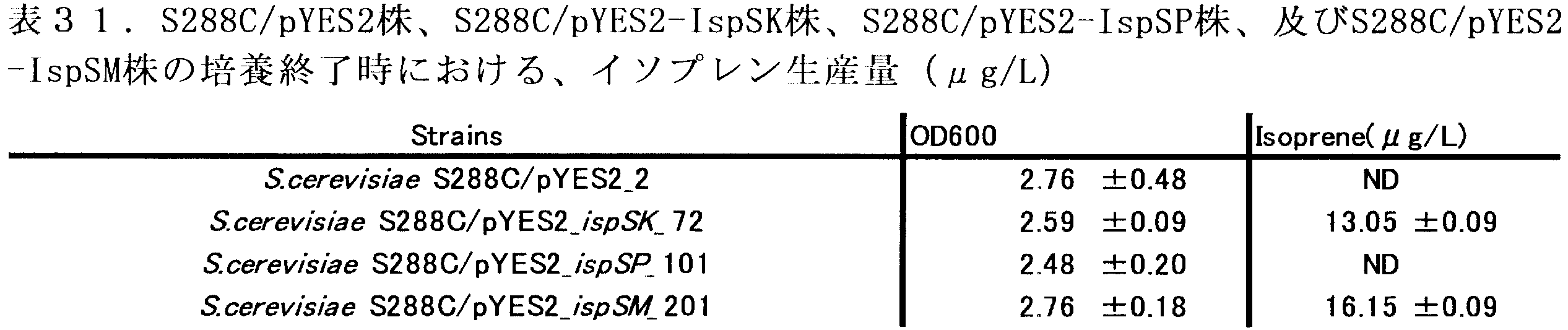
1)発現用プラスミドの構築
ムクナ由来イソプレンシンターゼの大量発現用プラスミドの構築を次の手順で行った。ベクター部分について、pCold-TF(TaKaRa社製、#3365、配列情報はGenBank/EMBL/DDBJ accession ID AB213654)を鋳型とし、配列番号88と配列番号89に示す合成オリゴヌクレオチドをプライマーとしたPCRを行った。インサートについてはpUC57-ispSMを鋳型とし、配列番号90と配列番号91に示す合成オリゴヌクレオチドをプライマーとしたPCRを行った。PCR法のポリメラーゼはPrimeSTAR HS(TaKaRa社製)を利用し、反応溶液はキットに添付された組成に従って調製し、反応条件は95℃にて10秒、55℃にて5秒、72℃にて6分間を一連のサイクルとし、30回繰り返した。得られたこれらのDNA断片をIn-Fusion HD Cloning Kit(Clontech社製)を用いて連結した。構築したプラスミドをpCold-TF-IspSMと名付けた。pCold-TF-IspSMの塩基配列を配列番号92に示す。
ポプラ由来イソプレンシンターゼの大量発現用プラスミドの構築を次の手順で行った。ベクター部分について、pCold-TFを鋳型とし、配列番号88と配列番号89に示す合成オリゴヌクレオチドをプライマーとしたPCRを行った。インサートについてはpUC57-ispSPを鋳型とし、配列番号93と配列番号94に示す合成オリゴヌクレオチドをプライマーとしたPCRを行った。PCR法のポリメラーゼはPrimeSTAR HS(TaKaRa社製)を利用し、反応溶液はキットに添付された組成に従って調製し、反応条件は95℃にて10秒、55℃にて5秒、72℃にて6分間を一連のサイクルとし、30回繰り返した。得られたこれらのDNA断片をIn-Fusion HD Cloning Kit(Clontech社製)を用いて連結した。構築したプラスミドをpCold-TF-IspSPと名付けた。pCold-TF-IspSPの塩基配列を配列番号95に示す。
クズ由来イソプレンシンターゼの大量発現用プラスミドの構築を次の手順で行った。ベクター部分について、pCold-TFを鋳型とし、配列番号88と配列番号89に示す合成オリゴヌクレオチドをプライマーとしたPCRを行った。インサートについてはpUC57-ispSKを鋳型とし、配列番号96と配列番号97に示す合成オリゴヌクレオチドをプライマーとしたPCRを行った。PCR法のポリメラーゼはPrimeSTAR HS(TaKaRa社製)を利用し、反応溶液はキットに添付された組成に従って調製し、反応条件は95℃にて10秒、55℃にて5秒、72℃にて6分間を一連のサイクルとし、30回繰り返した。得られたこれらのDNA断片をIn-Fusion HD Cloning Kit(Clontech社製)を用いて連結した。構築したプラスミドをpCold-TF-IspSKと名付けた。pCold-TF-IspSKの塩基配列を配列番号98に示す。
これらの発現ベクターの構築においてイソプレンシンターゼはtrigger factor(TF)をN末端に融合した蛋白質として発現するよう設計した。TFとイソプレンシンターゼの融合タンパク質をTF-IspSと命名した。ムクナ由来イソプレンシンターゼの融合タンパク質をTF-IspSM、ポプラ由来イソプレンシンターゼの融合タンパク質をTF-IspSP、葛由来イソプレンシンターゼの融合タンパク質をTF-IspSKと名付けた。
pCold-TF-IspSM,pCold-TF-IspSP,pCold-TF-IspSKそれぞれをE.coli BL21 (DE3)のコンピテントセル(one shot BL 21(DE3)、LifeTechnologies社製)にヒートショック法により形質転換を行った。42℃、30秒のヒートショックの後、SOC培地を用いた回復培養を37℃、1時間、120rpmの条件で実施した。その後、アンピシリン100mg/Lを含むLBプレートに全量播種し、37℃、14時間静置培養した。
形成されたコロニーをピックし、アンピシリン100mg/Lを含む5mL LB培地に植菌した後、OD600=1.0になるまで37℃、200rpmで培養した。当該OD値に到達したことを確認した後、アンピシリン100mg/Lを含むLB培地100mlを張り込んだ500mL容量の坂口フラスコに全量を植菌し、OD600=1.0に到達するまで37℃、120rpmで培養した。その後、1Mイソプロピル-β-チオガラクトピラノシド(IPTG)を終濃度1mMになるよう添加し、15℃、100rpmで終夜培養した。培養終了後、8000×g、10分で遠心分離して菌体を回収し、精製操作を行うまで-20℃にて保存した。
イソプレンシンターゼの精製はHis-tagカラムを利用して行った。培養終了後のブロス100mLより得られた菌体を50mM リン酸バッファー(pH8)、500mM NaClからなる破砕バッファー240mLに懸濁し、超音波破砕機(Sonifier 250、Baransan社製)を用いて、duty cycle 50%、output control 6の条件にて、8分間、氷上にて超音波破砕を実施した。超音波破砕後、14000×g、20分の遠心分離操作により破砕上清を得た。以下の精製操作は全て4℃にて実施した。polyprep column(BioRad社製)にHis-select Nickel affinity gel(Sigma社製)を、ベッドボリューム2mL相当をアプライし、重力法により充填した。次に破砕バッファー10mLをアプライし、重力法で平衡化を実施した。このカラムに対し超音波破砕後の破砕上清を全量アプライし、TF-IspSをカラムに吸着させた。
アプライした破砕上清の全量がカラムを通過したことを確認した後、破砕バッファー10mLでカラムを洗浄した。更に、50mM tris-HCl(pH8.0)、15mM MgCl2からなる活性測定用バッファー10mLでカラムを追加洗浄した。その後、50mM tris-HCl(pH8.0)、15mM MgCl2、10mM imidazoleからなる洗浄液をカラムに4mLアプライし、通過液を廃棄した。最後に、50mM tris-HCl(pH8.0)、15mM MgCl2、200mM imidazoleからなる溶出液を4mLカラムにアプライし、TF-IspSの溶出を行った。溶出後のTF-IspSをゲル濾過カラム(amicon ultra MWCO100k(Millipore社))で濃縮した。
続いて、TF-IspS融合タンパク質の融合部分を切断した。切断には、Factor Xa(Novagen社製)を利用した。反応バッファーは、50mM tris-HCl(pH8.0)、100mM NaCl、5mM CaCl2からなり、26U Factor Xaを添加し、4℃にて、14時間反応を行った。反応終了後の反応液を、His-Select Nickel Affinity gelに通過させることにより、TFのみがHis-Select Nickel Affinity gelに吸着する事を利用して、反応液中からTFを除去した。続いてゲル濾過カラム(amicon ultra MWCO50k、Millipore社)を用いてIspSを濃縮した。得られた濃縮液をNuPAGE 4-12%(Life Technlogies社製)で展開し、純度検定を実施した。展開したゲルをCBB染色した結果、IspS以外の不純物由来のバンドが観測されなかったことから、純度は99%程度と推定した。
このようにして得られたIspSM溶液とIspSK溶液は、活性測定用バッファーに対して終濃度5% glycerolを添加して活性測定に供するまで-80℃冷凍庫で保存した。また、IspSP溶液は終濃度5% PEG600を添加して、活性測定に供するまで-80℃冷凍庫で保存した。
IspSM、IspSK、IspSPを氷上で解凍し、バッファー交換によりglycerolやPEG600を除去した。また、SDS-PAGE上の比色定量によりタンパク質濃度を統一した。イソプレン反応液50μLは、50mM tris-HCl,pH8.0,15mM MgCl2,4mM DMAPP,1μg IspSから構成される。このイソプレン反応液50μlを0.2ml容積のPCR tube(日本ジェネティクス社製)に入れ、蓋に穴を穿った。次に、このチューブを450μLの純水を張り込んだ22mL バイアル(PerkinElmer社製)に入れ、直ちにヘッドスペースバイアル用キャップブチルゴムセプタム付(PerkinElmer社製)で密栓した。イソプレン生成反応は40℃にて238時間行った。発生したイソプレンの定量は、4-2)および4-3)に記載の方法に従った。結果を表32に示す。結果に示す通り、ムクナ由来イソプレンシンターゼはクズ由来イソプレンシンターゼと比較し10倍程度高いイソプレン生産能を有することが明らかとなった。

上記の方法で精製した各IspSを、50mM tris-HCl,pH8.0,15mM MgCl2溶液中にて、4℃、48時間保存した。上で述べた方法に従って、保存前後の各種イソプレンシンターゼが酵素反応により産出するイソプレン生産量をガスクロマトグラフィーにて解析した。保存前のイソプレン生産量で、保存後の生産量を割り返して比較した。その結果、ムクナ由来イソプレンシンターゼは、葛由来イソプレンシンターゼ、ポプラ由来イソプレンシンターゼと比べ、優れた安定性を持つことが明らかになった。
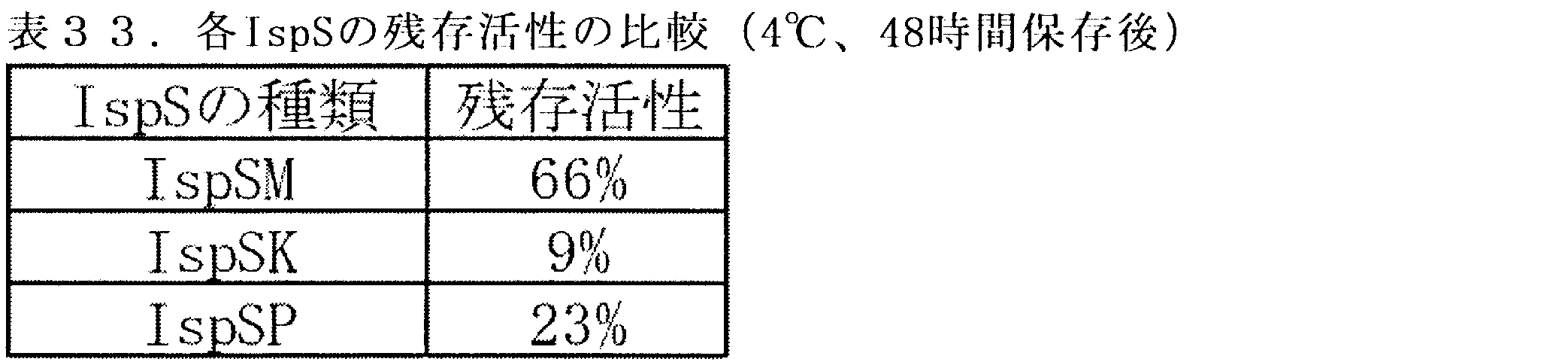
Claims (14)
- 以下(a)、(b)または(c)のポリヌクレオチド:
(a)(i)配列番号1で表される塩基配列、もしくは(ii)配列番号1で表される塩基配列中の133~1785番目のヌクレオチド残基からなる塩基配列を含むポリヌクレオチド;
(b)前記(i)もしくは(ii)の塩基配列と90%以上の同一性を有する塩基配列を含み、かつイソプレンシンターゼ活性を有するタンパク質をコードするポリヌクレオチド;または
(c)前記(i)もしくは(ii)の塩基配列と相補的な塩基配列からなるポリヌクレオチドとストリンジェントな条件下でハイブリダイズし、かつイソプレンシンターゼ活性を有するタンパク質をコードするポリヌクレオチド。 - 前記ポリヌクレオチドがムクナに由来する、請求項1記載のポリヌクレオチド。
- 以下(A)、(B)または(C)のタンパク質:
(A)(i’)配列番号2で表される全長アミノ酸配列、もしくは(ii’)配列番号2で表されるアミノ酸配列中の45~594番目のアミノ酸残基からなるアミノ酸配列を含むタンパク質;
(B)前記(i’)もしくは(ii’)のアミノ酸配列と90%以上の同一性を有するアミノ酸配列を含み、かつイソプレンシンターゼ活性を有するタンパク質;または
(C)前記(i’)もしくは(ii’)のアミノ酸配列において1個もしくは数個のアミノ酸が欠失、置換、付加もしくは挿入されているアミノ酸配列を含み、かつイソプレンシンターゼ活性を有するタンパク質。 - 請求項1もしくは2記載のポリヌクレオチド、または請求項3記載のタンパク質をコードするポリヌクレオチドを含む発現ベクター。
- 請求項4記載の発現ベクターが宿主に導入されることにより作製された形質転換体。
- 前記宿主が、メチルエリスリトールリン酸経路によるジメチルアリル二リン酸の合成能を有する、請求項5記載の形質転換体。
- 前記宿主が大腸菌である、請求項6記載の形質転換体。
- 前記形質転換体が、メバロン酸経路およびメチルエリスリトールリン酸経路の双方によるジメチルアリル二リン酸の合成能を有する、請求項5~7のいずれか一項記載の形質転換体。
- 宿主が、コリネバクテリウム属、パントエア属、エンテロバクター属、またはサッカロミセス属に属する微生物である、請求項5記載の形質転換体。
- 請求項5~9のいずれか一項記載の形質転換体を用いて、請求項3記載のタンパク質を生成することを含む、タンパク質の製造方法。
- 請求項3記載のタンパク質の存在下において、ジメチルアリル二リン酸からイソプレンモノマーを生成することを含む、イソプレンモノマーの製造方法。
- 請求項5~9のいずれか一項記載の形質転換体の培養によりイソプレンモノマーが生成される、請求項11記載の方法。
- 前記形質転換体の培養により培地中の炭素源からジメチルアリル二リン酸が供給される、請求項12記載の方法。
- 以下(I)および(II)を含む、イソプレンポリマーの製造方法:
(I)請求項11~13のいずれか一項記載の方法によりイソプレンモノマーを生成すること;
(II)イソプレンモノマーを重合してイソプレンポリマーを生成すること。
Priority Applications (5)
| Application Number | Priority Date | Filing Date | Title |
|---|---|---|---|
| JP2014518305A JP6169073B2 (ja) | 2012-05-30 | 2013-03-12 | イソプレンシンターゼおよびそれをコードするポリヌクレオチド、ならびにイソプレンモノマーの製造方法 |
| BR112014029548-4A BR112014029548B1 (pt) | 2012-05-30 | 2013-03-12 | Polinucleotídeo, proteína, vetor de expressão, célula transformada, e, métodos para produzir um monômero de isopreno e um polímero de isopreno |
| CN201380028453.9A CN104471061B (zh) | 2012-05-30 | 2013-03-12 | 异戊二烯合酶和其编码基因以及用于产生异戊二烯单体的方法 |
| EP13796298.1A EP2857509B1 (en) | 2012-05-30 | 2013-03-12 | Isoprene synthase and polynucleotide encoding same, and method for producing isoprene monomer |
| RU2014153638A RU2612916C2 (ru) | 2012-05-30 | 2013-03-12 | Изопренсинтаза и кодирующий ее ген, способ получения мономера изопрена |
Applications Claiming Priority (4)
| Application Number | Priority Date | Filing Date | Title |
|---|---|---|---|
| JP2012123728 | 2012-05-30 | ||
| JP2012-123728 | 2012-05-30 | ||
| JP2012123724 | 2012-05-30 | ||
| JP2012-123724 | 2012-05-30 |
Publications (1)
| Publication Number | Publication Date |
|---|---|
| WO2013179722A1 true WO2013179722A1 (ja) | 2013-12-05 |
Family
ID=49672930
Family Applications (1)
| Application Number | Title | Priority Date | Filing Date |
|---|---|---|---|
| PCT/JP2013/056866 Ceased WO2013179722A1 (ja) | 2012-05-30 | 2013-03-12 | イソプレンシンターゼおよびそれをコードするポリヌクレオチド、ならびにイソプレンモノマーの製造方法 |
Country Status (6)
| Country | Link |
|---|---|
| EP (1) | EP2857509B1 (ja) |
| JP (2) | JP6169073B2 (ja) |
| CN (1) | CN104471061B (ja) |
| BR (1) | BR112014029548B1 (ja) |
| RU (1) | RU2612916C2 (ja) |
| WO (1) | WO2013179722A1 (ja) |
Cited By (9)
| Publication number | Priority date | Publication date | Assignee | Title |
|---|---|---|---|---|
| WO2015005406A1 (ja) | 2013-07-09 | 2015-01-15 | 味の素株式会社 | 有用物質の製造方法 |
| WO2015056813A1 (en) | 2013-10-17 | 2015-04-23 | Ajinomoto Co., Inc. | Method for producing isoprene using bacterium |
| WO2015076392A1 (ja) * | 2013-11-22 | 2015-05-28 | 味の素株式会社 | 改変イソプレンシンターゼ |
| WO2015080273A1 (ja) * | 2013-11-28 | 2015-06-04 | 味の素株式会社 | イソプレンモノマーの製造方法 |
| WO2015147341A2 (en) | 2014-03-28 | 2015-10-01 | Ajinomoto Co., Inc. | Method of producing isoprene monomer |
| WO2016129637A1 (ja) * | 2015-02-13 | 2016-08-18 | 積水化学工業株式会社 | 核酸、融合タンパク質、組換え細胞、並びに、イソプレン又は環式テルペンの生産方法 |
| WO2016174875A1 (ja) * | 2015-04-30 | 2016-11-03 | 株式会社ブリヂストン | ポリイソプレンの製造方法 |
| US9499465B2 (en) | 2013-03-15 | 2016-11-22 | Board Of Trustees Of Michigan State University | Synthesis of biobased and substituted terephthalic acids and isophthalic acids |
| WO2017022856A1 (ja) * | 2015-08-05 | 2017-02-09 | 味の素株式会社 | イソプレンモノマーの製造方法 |
Families Citing this family (6)
| Publication number | Priority date | Publication date | Assignee | Title |
|---|---|---|---|---|
| WO2017029549A2 (en) * | 2015-08-17 | 2017-02-23 | Conradie Alex Van Eck | Methods, hosts, and reagents related thereto for production of unsaturated pentahydrocarbons, derivatives and intermediates thereof |
| WO2017051930A1 (en) * | 2015-09-25 | 2017-03-30 | Ajinomoto Co., Inc. | Method of producing isoprenoid compound |
| WO2018157072A1 (en) | 2017-02-27 | 2018-08-30 | Life Technologies Corporation | Expansion of populations of t cells by the use of modified serum free media |
| US11634733B2 (en) | 2017-06-30 | 2023-04-25 | Inv Nylon Chemicals Americas, Llc | Methods, materials, synthetic hosts and reagents for the biosynthesis of hydrocarbons and derivatives thereof |
| US11505809B2 (en) | 2017-09-28 | 2022-11-22 | Inv Nylon Chemicals Americas Llc | Organisms and biosynthetic processes for hydrocarbon synthesis |
| WO2019142832A1 (ja) * | 2018-01-22 | 2019-07-25 | 味の素株式会社 | 目的成分の抽出方法、抽出装置、製造方法及び製造装置 |
Citations (7)
| Publication number | Priority date | Publication date | Assignee | Title |
|---|---|---|---|---|
| EP0952221A2 (en) | 1998-03-18 | 1999-10-27 | Ajinomoto Co., Ltd. | L-Glutamic acid-producing bacterium and method for producing L-glutamic acid |
| JP2005058827A (ja) | 2003-08-15 | 2005-03-10 | Asano Koji Kk | 有機性汚水の処理方法 |
| WO2007037460A1 (en) | 2005-09-27 | 2007-04-05 | Ajinomoto Co., Inc. | An l-amino acid-producing bacterium and a method for producing l-amino acids |
| WO2009076676A2 (en) | 2007-12-13 | 2009-06-18 | Danisco Us Inc. | Compositions and methods for producing isoprene |
| WO2010027022A1 (ja) | 2008-09-05 | 2010-03-11 | 味の素株式会社 | L-アミノ酸生産菌及びl-アミノ酸の製造法 |
| WO2010031062A1 (en) | 2008-09-15 | 2010-03-18 | Danisco Us Inc. | Increased isoprene production using the archaeal lower mevalonate pathway |
| JP2011518564A (ja) | 2008-04-23 | 2011-06-30 | ダニスコ・ユーエス・インク | 改良された微生物によるイソプレン産出用のイソプレンシンターゼ変異体 |
Family Cites Families (2)
| Publication number | Priority date | Publication date | Assignee | Title |
|---|---|---|---|---|
| WO2009100231A2 (en) * | 2008-02-06 | 2009-08-13 | The Regents Of The University Of California | Short chain volatile isoprene hydrocarbon production using the mevalonic acid pathway in genetically engineered yeast and fungi |
| US8895277B2 (en) * | 2012-05-02 | 2014-11-25 | Danisco Us Inc. | Legume isoprene synthase for production of isoprene |
-
2013
- 2013-03-12 EP EP13796298.1A patent/EP2857509B1/en active Active
- 2013-03-12 RU RU2014153638A patent/RU2612916C2/ru active
- 2013-03-12 JP JP2014518305A patent/JP6169073B2/ja active Active
- 2013-03-12 BR BR112014029548-4A patent/BR112014029548B1/pt active IP Right Grant
- 2013-03-12 WO PCT/JP2013/056866 patent/WO2013179722A1/ja not_active Ceased
- 2013-03-12 CN CN201380028453.9A patent/CN104471061B/zh active Active
-
2017
- 2017-02-20 JP JP2017029476A patent/JP6254728B2/ja active Active
Patent Citations (8)
| Publication number | Priority date | Publication date | Assignee | Title |
|---|---|---|---|---|
| EP0952221A2 (en) | 1998-03-18 | 1999-10-27 | Ajinomoto Co., Ltd. | L-Glutamic acid-producing bacterium and method for producing L-glutamic acid |
| JP2005058827A (ja) | 2003-08-15 | 2005-03-10 | Asano Koji Kk | 有機性汚水の処理方法 |
| WO2007037460A1 (en) | 2005-09-27 | 2007-04-05 | Ajinomoto Co., Inc. | An l-amino acid-producing bacterium and a method for producing l-amino acids |
| WO2009076676A2 (en) | 2007-12-13 | 2009-06-18 | Danisco Us Inc. | Compositions and methods for producing isoprene |
| JP2011505841A (ja) | 2007-12-13 | 2011-03-03 | ダニスコ・ユーエス・インク | イソプレンを産出する組成物及び方法 |
| JP2011518564A (ja) | 2008-04-23 | 2011-06-30 | ダニスコ・ユーエス・インク | 改良された微生物によるイソプレン産出用のイソプレンシンターゼ変異体 |
| WO2010027022A1 (ja) | 2008-09-05 | 2010-03-11 | 味の素株式会社 | L-アミノ酸生産菌及びl-アミノ酸の製造法 |
| WO2010031062A1 (en) | 2008-09-15 | 2010-03-18 | Danisco Us Inc. | Increased isoprene production using the archaeal lower mevalonate pathway |
Non-Patent Citations (16)
| Title |
|---|
| APPL. MICROBIOL. BIOTECHNOL., vol. 90, 2011, pages 1915 - 1922 |
| BIOTECHNOL. BIOENG., vol. 98, no. 2, 27 March 2007 (2007-03-27), pages 340 - 348 |
| DEBOER ET AL., PROC. NATL. ACAD. SCI. U.S.A., vol. 80, 1983, pages 21 - 25 |
| KARLIN; ALTSCHUL, FASTA (METHODS ENZYMOL., vol. 183, 1990, pages 63 |
| KESSELMEIER J. ET AL., JOURNAL OF ATMOSPHERIC CHEMISTRY, vol. 33, 1999, pages 23 - 88 |
| KUZMA J ET AL.: "Leaf Isoprene Emission Rate Is Dependent on Leaf Development and the Level of Isoprene Synthase", PLANT PHYSIOL., vol. 101, no. 2, 1993, pages 435 - 440, XP055180041 * |
| KUZMA J. ET AL., PLANT PHYSIOL., vol. 101, 1993, pages 435 - 440 |
| MOL GEN GENET., vol. 183, no. 2, 1981, pages 380 - 7 |
| MONSON R. K. ET AL., PLANT PHYSIOL., vol. 98, 1992, pages 1175 - 1180 |
| MONSON RK ET AL.: "Relationships among Isoprene Emission Rate, Photosynthesis, and Isoprene Synthase Activity as Influenced by Temperature", PLANT PHYSIOL., vol. 98, no. 3, 1992, pages 1175 - 1180, XP055180049 * |
| PRO. NATL. ACAD. SCI. USA, vol. 90, 1993, pages 5873 |
| PROC. NATL. ACAD. SCI. USA, vol. 97, no. 12, 2000, pages 6640 - 6645 |
| SAMBROOK, J. ET AL.: "Molecular Cloning: Laboratory Manuals", 1989, COLD SPRING HARBOR LABORATORY PRESS |
| SCIENCE, vol. 277, 1997, pages 1453 - 1474 |
| WU ET AL., PROC. NATL. ACAD. SCI. U.S.A., vol. 75, 1978, pages 442 - 5446 |
| ZHAO Y ET AL.: "Biosynthesis of isoprene in Escherichia coli via methylerythritol phosphate (MEP) pathway", APPL. MICROBIOL. BIOTECHNOL., vol. 90, no. 6, June 2011 (2011-06-01), pages 1915 - 1922, XP019908970 * |
Cited By (12)
| Publication number | Priority date | Publication date | Assignee | Title |
|---|---|---|---|---|
| US9499465B2 (en) | 2013-03-15 | 2016-11-22 | Board Of Trustees Of Michigan State University | Synthesis of biobased and substituted terephthalic acids and isophthalic acids |
| WO2015005406A1 (ja) | 2013-07-09 | 2015-01-15 | 味の素株式会社 | 有用物質の製造方法 |
| EP3521433A1 (en) | 2013-07-09 | 2019-08-07 | Ajinomoto Co., Inc. | Process for producing l-glutamic acid |
| WO2015056813A1 (en) | 2013-10-17 | 2015-04-23 | Ajinomoto Co., Inc. | Method for producing isoprene using bacterium |
| WO2015076392A1 (ja) * | 2013-11-22 | 2015-05-28 | 味の素株式会社 | 改変イソプレンシンターゼ |
| US9890373B2 (en) | 2013-11-22 | 2018-02-13 | Ajinomoto Co., Inc. | Modified isoprene synthase |
| WO2015080273A1 (ja) * | 2013-11-28 | 2015-06-04 | 味の素株式会社 | イソプレンモノマーの製造方法 |
| WO2015147341A2 (en) | 2014-03-28 | 2015-10-01 | Ajinomoto Co., Inc. | Method of producing isoprene monomer |
| WO2016129637A1 (ja) * | 2015-02-13 | 2016-08-18 | 積水化学工業株式会社 | 核酸、融合タンパク質、組換え細胞、並びに、イソプレン又は環式テルペンの生産方法 |
| WO2016174875A1 (ja) * | 2015-04-30 | 2016-11-03 | 株式会社ブリヂストン | ポリイソプレンの製造方法 |
| JPWO2016174875A1 (ja) * | 2015-04-30 | 2018-02-22 | 株式会社ブリヂストン | ポリイソプレンの製造方法 |
| WO2017022856A1 (ja) * | 2015-08-05 | 2017-02-09 | 味の素株式会社 | イソプレンモノマーの製造方法 |
Also Published As
| Publication number | Publication date |
|---|---|
| EP2857509B1 (en) | 2019-01-09 |
| BR112014029548B1 (pt) | 2022-06-07 |
| JP6254728B2 (ja) | 2017-12-27 |
| BR112014029548A2 (ja) | 2017-08-15 |
| JPWO2013179722A1 (ja) | 2016-01-18 |
| EP2857509A1 (en) | 2015-04-08 |
| JP2017121247A (ja) | 2017-07-13 |
| RU2612916C2 (ru) | 2017-03-13 |
| CN104471061A (zh) | 2015-03-25 |
| CN104471061B (zh) | 2018-06-22 |
| RU2014153638A (ru) | 2016-07-27 |
| JP6169073B2 (ja) | 2017-07-26 |
| EP2857509A4 (en) | 2016-03-02 |
Similar Documents
| Publication | Publication Date | Title |
|---|---|---|
| JP6254728B2 (ja) | イソプレンシンターゼおよびそれをコードするポリヌクレオチド、ならびにイソプレンモノマーの製造方法 | |
| JP6750629B2 (ja) | リナロールの製造方法 | |
| US10941420B2 (en) | Linalool composition and method of producing therefor | |
| US20210403954A1 (en) | Method of producing isoprenoid compound | |
| US8962296B2 (en) | Isoprene synthase and gene encoding the same, and method for producing isoprene monomer | |
| JP2025122013A (ja) | 中鎖脂肪酸誘導体の生産のための改良された活性を有するチオエステラーゼ変種 | |
| US10184137B2 (en) | Method of producing isoprene monomer | |
| WO2017051930A1 (en) | Method of producing isoprenoid compound | |
| US9890373B2 (en) | Modified isoprene synthase | |
| WO2015080273A1 (ja) | イソプレンモノマーの製造方法 | |
| WO2018147446A1 (ja) | イソプレノイド化合物の製造方法 | |
| JP7216396B2 (ja) | 新規メバロン酸経路を有する非古細菌生物 | |
| WO2017022856A1 (ja) | イソプレンモノマーの製造方法 |
Legal Events
| Date | Code | Title | Description |
|---|---|---|---|
| 121 | Ep: the epo has been informed by wipo that ep was designated in this application |
Ref document number: 13796298 Country of ref document: EP Kind code of ref document: A1 |
|
| ENP | Entry into the national phase |
Ref document number: 2014518305 Country of ref document: JP Kind code of ref document: A |
|
| NENP | Non-entry into the national phase |
Ref country code: DE |
|
| WWE | Wipo information: entry into national phase |
Ref document number: IDP00201407964 Country of ref document: ID |
|
| WWE | Wipo information: entry into national phase |
Ref document number: 2013796298 Country of ref document: EP |
|
| ENP | Entry into the national phase |
Ref document number: 2014153638 Country of ref document: RU Kind code of ref document: A |
|
| REG | Reference to national code |
Ref country code: BR Ref legal event code: B01A Ref document number: 112014029548 Country of ref document: BR |
|
| ENP | Entry into the national phase |
Ref document number: 112014029548 Country of ref document: BR Kind code of ref document: A2 Effective date: 20141126 |