WO2013181155A1 - Amphiphilic cyclobutenes and cyclobutanes - Google Patents

Amphiphilic cyclobutenes and cyclobutanes Download PDF

Info

Publication number
WO2013181155A1
WO2013181155A1 PCT/US2013/042897 US2013042897W WO2013181155A1 WO 2013181155 A1 WO2013181155 A1 WO 2013181155A1 US 2013042897 W US2013042897 W US 2013042897W WO 2013181155 A1 WO2013181155 A1 WO 2013181155A1
Authority
WO
WIPO (PCT)
Prior art keywords
alkyl
compound
group
amphiphilic
fatty acid
Prior art date
Legal status (The legal status is an assumption and is not a legal conclusion. Google has not performed a legal analysis and makes no representation as to the accuracy of the status listed.)
Ceased
Application number
PCT/US2013/042897
Other languages
French (fr)
Inventor
Wantanee SITTIWONG
Patrick H. Dussault
Raul BARLETTA
Robert Powers
Current Assignee (The listed assignees may be inaccurate. Google has not performed a legal analysis and makes no representation or warranty as to the accuracy of the list.)
NuTech Ventures Inc
Original Assignee
NuTech Ventures Inc
Priority date (The priority date is an assumption and is not a legal conclusion. Google has not performed a legal analysis and makes no representation as to the accuracy of the date listed.)
Filing date
Publication date
Application filed by NuTech Ventures Inc filed Critical NuTech Ventures Inc
Priority to IN10229DEN2014 priority Critical patent/IN2014DN10229A/en
Priority to NZ702154A priority patent/NZ702154A/en
Priority to AU2013267594A priority patent/AU2013267594A1/en
Priority to EP13797179.2A priority patent/EP2855415A4/en
Priority to US14/403,763 priority patent/US10538475B2/en
Priority to BR112014029295-7A priority patent/BR112014029295B1/en
Publication of WO2013181155A1 publication Critical patent/WO2013181155A1/en
Anticipated expiration legal-status Critical
Ceased legal-status Critical Current

Links

Classifications

    • C—CHEMISTRY; METALLURGY
    • C07—ORGANIC CHEMISTRY
    • C07C—ACYCLIC OR CARBOCYCLIC COMPOUNDS
    • C07C59/00—Compounds having carboxyl groups bound to acyclic carbon atoms and containing any of the groups OH, O—metal, —CHO, keto, ether, groups, groups, or groups
    • C07C59/185—Saturated compounds having only one carboxyl group and containing keto groups
    • C07C59/21—Saturated compounds having only one carboxyl group and containing keto groups containing halogen
    • A—HUMAN NECESSITIES
    • A61—MEDICAL OR VETERINARY SCIENCE; HYGIENE
    • A61P—SPECIFIC THERAPEUTIC ACTIVITY OF CHEMICAL COMPOUNDS OR MEDICINAL PREPARATIONS
    • A61P31/00—Antiinfectives, i.e. antibiotics, antiseptics, chemotherapeutics
    • A61P31/04—Antibacterial agents
    • C—CHEMISTRY; METALLURGY
    • C07—ORGANIC CHEMISTRY
    • C07C—ACYCLIC OR CARBOCYCLIC COMPOUNDS
    • C07C51/00—Preparation of carboxylic acids or their salts, halides or anhydrides
    • C07C51/09—Preparation of carboxylic acids or their salts, halides or anhydrides from carboxylic acid esters or lactones
    • C—CHEMISTRY; METALLURGY
    • C07—ORGANIC CHEMISTRY
    • C07C—ACYCLIC OR CARBOCYCLIC COMPOUNDS
    • C07C53/00—Saturated compounds having only one carboxyl group bound to an acyclic carbon atom or hydrogen
    • C07C53/132—Saturated compounds having only one carboxyl group bound to an acyclic carbon atom or hydrogen containing rings
    • C07C53/134—Saturated compounds having only one carboxyl group bound to an acyclic carbon atom or hydrogen containing rings monocyclic
    • C—CHEMISTRY; METALLURGY
    • C07—ORGANIC CHEMISTRY
    • C07C—ACYCLIC OR CARBOCYCLIC COMPOUNDS
    • C07C57/00—Unsaturated compounds having carboxyl groups bound to acyclic carbon atoms
    • C07C57/26—Unsaturated compounds having carboxyl groups bound to acyclic carbon atoms containing rings other than six-membered aromatic rings
    • C—CHEMISTRY; METALLURGY
    • C07—ORGANIC CHEMISTRY
    • C07C—ACYCLIC OR CARBOCYCLIC COMPOUNDS
    • C07C59/00—Compounds having carboxyl groups bound to acyclic carbon atoms and containing any of the groups OH, O—metal, —CHO, keto, ether, groups, groups, or groups
    • C07C59/01—Saturated compounds having only one carboxyl group and containing hydroxy or O-metal groups
    • C07C59/11—Saturated compounds having only one carboxyl group and containing hydroxy or O-metal groups containing rings
    • C—CHEMISTRY; METALLURGY
    • C07—ORGANIC CHEMISTRY
    • C07C—ACYCLIC OR CARBOCYCLIC COMPOUNDS
    • C07C59/00—Compounds having carboxyl groups bound to acyclic carbon atoms and containing any of the groups OH, O—metal, —CHO, keto, ether, groups, groups, or groups
    • C07C59/185—Saturated compounds having only one carboxyl group and containing keto groups
    • C07C59/205—Saturated compounds having only one carboxyl group and containing keto groups containing rings
    • C—CHEMISTRY; METALLURGY
    • C07—ORGANIC CHEMISTRY
    • C07C—ACYCLIC OR CARBOCYCLIC COMPOUNDS
    • C07C67/00—Preparation of carboxylic acid esters
    • C07C67/30—Preparation of carboxylic acid esters by modifying the acid moiety of the ester, such modification not being an introduction of an ester group
    • C07C67/313—Preparation of carboxylic acid esters by modifying the acid moiety of the ester, such modification not being an introduction of an ester group by introduction of doubly bound oxygen containing functional groups, e.g. carboxyl groups
    • C—CHEMISTRY; METALLURGY
    • C08—ORGANIC MACROMOLECULAR COMPOUNDS; THEIR PREPARATION OR CHEMICAL WORKING-UP; COMPOSITIONS BASED THEREON
    • C08F—MACROMOLECULAR COMPOUNDS OBTAINED BY REACTIONS ONLY INVOLVING CARBON-TO-CARBON UNSATURATED BONDS
    • C08F132/00—Homopolymers of cyclic compounds containing no unsaturated aliphatic radicals in a side chain, and having one or more carbon-to-carbon double bonds in a carbocyclic ring system
    • C08F132/02—Homopolymers of cyclic compounds containing no unsaturated aliphatic radicals in a side chain, and having one or more carbon-to-carbon double bonds in a carbocyclic ring system having no condensed rings
    • C08F132/04—Homopolymers of cyclic compounds containing no unsaturated aliphatic radicals in a side chain, and having one or more carbon-to-carbon double bonds in a carbocyclic ring system having no condensed rings having one carbon-to-carbon double bond
    • C—CHEMISTRY; METALLURGY
    • C08—ORGANIC MACROMOLECULAR COMPOUNDS; THEIR PREPARATION OR CHEMICAL WORKING-UP; COMPOSITIONS BASED THEREON
    • C08F—MACROMOLECULAR COMPOUNDS OBTAINED BY REACTIONS ONLY INVOLVING CARBON-TO-CARBON UNSATURATED BONDS
    • C08F212/00—Copolymers of compounds having one or more unsaturated aliphatic radicals, each having only one carbon-to-carbon double bond, and at least one being terminated by an aromatic carbocyclic ring
    • C08F212/02—Monomers containing only one unsaturated aliphatic radical
    • C08F212/04—Monomers containing only one unsaturated aliphatic radical containing one ring
    • C08F212/06—Hydrocarbons
    • C08F212/08—Styrene
    • C—CHEMISTRY; METALLURGY
    • C08—ORGANIC MACROMOLECULAR COMPOUNDS; THEIR PREPARATION OR CHEMICAL WORKING-UP; COMPOSITIONS BASED THEREON
    • C08F—MACROMOLECULAR COMPOUNDS OBTAINED BY REACTIONS ONLY INVOLVING CARBON-TO-CARBON UNSATURATED BONDS
    • C08F216/00—Copolymers of compounds having one or more unsaturated aliphatic radicals, each having only one carbon-to-carbon double bond, and at least one being terminated by an alcohol, ether, aldehydo, ketonic, acetal or ketal radical
    • C08F216/12—Copolymers of compounds having one or more unsaturated aliphatic radicals, each having only one carbon-to-carbon double bond, and at least one being terminated by an alcohol, ether, aldehydo, ketonic, acetal or ketal radical by an ether radical
    • C08F216/14—Monomers containing only one unsaturated aliphatic radical
    • C08F216/16—Monomers containing no hetero atoms other than the ether oxygen
    • C08F216/165—Carbocyclic compounds
    • C—CHEMISTRY; METALLURGY
    • C08—ORGANIC MACROMOLECULAR COMPOUNDS; THEIR PREPARATION OR CHEMICAL WORKING-UP; COMPOSITIONS BASED THEREON
    • C08F—MACROMOLECULAR COMPOUNDS OBTAINED BY REACTIONS ONLY INVOLVING CARBON-TO-CARBON UNSATURATED BONDS
    • C08F232/00—Copolymers of cyclic compounds containing no unsaturated aliphatic radicals in a side chain, and having one or more carbon-to-carbon double bonds in a carbocyclic ring system
    • C08F232/02—Copolymers of cyclic compounds containing no unsaturated aliphatic radicals in a side chain, and having one or more carbon-to-carbon double bonds in a carbocyclic ring system having no condensed rings
    • C08F232/04—Copolymers of cyclic compounds containing no unsaturated aliphatic radicals in a side chain, and having one or more carbon-to-carbon double bonds in a carbocyclic ring system having no condensed rings having one carbon-to-carbon double bond
    • C—CHEMISTRY; METALLURGY
    • C07—ORGANIC CHEMISTRY
    • C07C—ACYCLIC OR CARBOCYCLIC COMPOUNDS
    • C07C2601/00—Systems containing only non-condensed rings
    • C07C2601/04—Systems containing only non-condensed rings with a four-membered ring

Definitions

  • This disclosure relates to amphiphilic compounds containing a cyclobutene or cyclobutane moiety.
  • the compounds are useful for treating infection by mycobacterium such as Mycobacterium tuberculosis.
  • Cyclobutene containing compounds are also useful as monomers in the preparation of amphiphilic polymers.
  • Tuberculosis resulting from infection by Mycobacterium tuberculosis poses a significant disease threat. Based on skin test reactivity, it is estimated that one- third of the world's population has been exposed, resulting annually in approximately nine million cases and 1.4 million deaths (2010 data) (see Raviglione, M. et al. Lancet 2012, 379, 1902-1913).
  • the current vaccine, M. bovis BCG yields inconsistent protection and can interfere with diagnostic skin tests. Although numerous candidate vaccines are being tested, their overall safety and efficacy has not been established.
  • current treatment regimens require patients to take multiple drugs over a period of months. This, combined with significant drug side effects, commonly results in patient noncompliance leading to relapses and the emergence of drug resistance; 3 a high fraction of active cases involve multi-drug resistant (MDR, XDR) strains.
  • MDR multi-drug resistant
  • mycobacteria incorporate C 16 and C 18 fatty acids as biosynthetic feedstocks. The compounds provided herein mimic these feedstocks and the uptake of these specifically functionalized fatty acids is thought to inhibit downstream mycolic acid biosynthesis, leading to virulence-attenuating or even lethal alterations in the
  • R is absent or is an optionally substituted Cr- C 40 alkyl
  • R 4 is H or an optionally substituted Ci-C4o alkyl
  • Z is selected from the group consisting of: qOR 6 , C0 2 R 6 , NHC(0)NR 6 R 7 , CONR 6 ,
  • R 5 is H or Ci-C 6 alkyl
  • R 6 and R 7 are independently H or Ci-C alkyl
  • hydrocarbon backbone formed by R 4 and R 3 -Z is amphiphilic
  • the compound provided herein can be used in a method for treating a mycobacterial infection in a patient, the method comprising administering to the patient a therapeutically effective amount of a compound of Formula (I) or a pharmaceutically acceptable salt thereof.
  • a compound provided herein can be used to treat a mycobacterial infection such as M. tuberculosis.
  • R 3 is absent or is an optionally substituted C 1 -C 40 alkyl
  • R 4 is H or an optionally substituted Ci-C4o alkyl
  • Z is selected from the group consisting of: COR 6 , C0 2 R 6 , NHC(0)NR 6 R 7 , CONR 6 ,
  • R 5 is H or Ci-C 6 alkyl
  • R 6 and R 7 are independently H or Ci-C 6 alkyl
  • hydrocarbon backbone formed by R 4 and R 3 -Z is amphophilic.
  • a compound of Formula (IV) can be prepared by reacting an unsaturated fatty acid or derivative thereof having a backbone comprising at least one carbon-carbon double bond with dihaloketene to achieve a stereospeciiic cycloaddition across the at least one carbon-carbon double bond, thereby yielding a cycloketone- containing fatty acid derivative comprising a cycloketone along the backbone, wherein the cycloketone comprises at least four carbon atoms, with at least two of the at least four carbon atoms being part of the backbone of the cycloketone-containing fatty acid derivative; reducing the cycloketone-containing fatty acid derivative to yield an amphiphilic cycloalkene-containing fatty acid derivative having a hydrophobic end, a hydrophilic end, and a backbone therebetween comprising a cycloalkene, wherein the cycloalkene comprises at least four carbon atoms, with at least two of the four carbon atoms being part of
  • a multiplicity of compounds of Formula (IV) can be polymerized to yield a polymer comprising carbon-carbon double bonds.
  • the polymerization can further include hydrogenating the carbon-carbon double bonds of the polymer; cleaving at least some of the carbon-carbon double bonds in the polymer via oxidation to yield monomeric products; cross-linking the amphiphilic cycloalkene-containing fatty acid derivatives via the carbon-carbon double bond in the cycloalkene; ring-opening metathesis reactions; aligning the backbones of the multiplicity of the amphiphilic cycloalkene-containing fatty acid derivatives before polymerizing the multiplicity of the amphiphilic cycloalkene-containing fatty acid derivatives; polymerizing via click-chemistry; and mixtures thereof.
  • FIG. 1 illustrates the thermal stability of cyclobutene 1.
  • y axis is weight in mg for the lower line and heat flow endo down in mW for top line.
  • FIG. 2 shows ID 1H NMR spectra of compounds (A) 1 and (B) 8 that were inspected for evidence of micelle formation (peak broadening) by comparing peak widths relative to TMSP (standard). Peak widths for compound lexhibited potential micelle formation or aggregation over the range of tested concentrations (highlighted region). No micelle formation was observed for compound 8 over the concentrations of 100 ⁇ , 500 ⁇ , 750 ⁇ , and 1000 ⁇ .
  • FIG. 3 shows the minimum inhibitory concentrations (MICs) of eleven analogs against M. smeg. (mc2155) and tb (CDC1551 and H37Rv).
  • FIG. 4 illustrates the cytotoxicity of 1 measured in RAW 264.7 cells.
  • alkyl includes straight-chain alkyl groups (e.g., methyl, ethyl, propyl, butyl, pentyl, hexyl, heptyl, octyl, nonyl, decyl, etc.) and branched-chain alkyl groups (e.g., isopropyl, tert-butyl, isobutyl, etc.).
  • a straight chain or branched chain alkyl has twelve or fewer carbon atoms in its backbone (e.g., Ci-C 12 for straight chain; C 3 -C 12 for branched chain).
  • Ci-C 12 includes alkyl groups containing 1 to 12 carbon atoms.
  • alkenyl includes aliphatic groups that may or may not be substituted, as described above for alkyls, containing at least one double bond and at least two carbon atoms.
  • alkenyl includes straight-chain alkenyl groups (e.g., ethenyl, propenyl, butenyl, pentenyl, hexenyl, heptenyl, octenyl, nonenyl, and decenyl) and branched-chain alkenyl groups.
  • a straight chain or branched chain alkenyl group has twelve or fewer carbon atoms in its backbone (e.g., C 2 -C 12 for straight chain; C 3 -C 12 for branched chain).
  • the term C 2 -C 12 includes alkenyl groups containing 2 to 12 carbon atoms.
  • alkynyl includes unsaturated aliphatic groups analogous in length and possible substitution to the alkyls described above, but which contain at least one triple bond and two carbon atoms.
  • alkynyl includes straight-chain alkynyl groups (e.g., ethynyl, propynyl, butynyl, pentynyl, hexynyl, heptynyl, octynyl, nonynyl, and decynyl) and branched-chain alkynyl groups.
  • a straight chain or branched chain alkynyl group has twelve or fewer carbon atoms in its backbone (e.g., C 2 -C 12 for straight chain; C 3 -C i 2 for branched chain).
  • the term C 2 -C i 2 includes alkynyl groups containing 2 to 12 carbon atoms.
  • alkoxy is used in its conventional sense, and refers to alkyl groups linked to molecules via an oxygen atom.
  • an alkoxy has twelve or fewer carbon atoms in its backbone (e.g., a Ci-C 12 alkoxy).
  • Ci-C io, C ⁇ -C 8 , Ci-C 6, Ci-C 4, Ci-C 3, or Ci-C 2 Non-limiting examples of an alkoxy group include methoxy, ethoxy, propoxy, butoxy, and hexoxy.
  • halo or halogen, used alone or in combination with other terms, refers to fluoro, chloro, bromo and iodo.
  • haloalkyl refers to an alkyl group in which one or more of the hydrogen atoms has been replaced by a halogen atom.
  • C Intel-C m haloalkyl refers to a C n -C m alkyl group having n to m carbon atoms, and from at least one up to ⁇ 2(n to m)+l ⁇ halogen atoms, which may either be the same or different.
  • the halogen atoms are fluoro atoms.
  • the haloalkyl group has 1 to 6 or 1 to 4 carbon atoms.
  • Example haloalkyl groups include CF 3 , C2F 5 , CHF 2 , CCI3, CHC1 2 , C 2 CI 5 and the like.
  • the haloalkyl group is a fluoroalkyl group.
  • haloalkoxy refers to a group of formula -O-haloalkyl, wherein the haloalkyl group is as defined above.
  • C n -C m haloalkoxy refers to a haloalkoxy group, the haloalkyl group of which has n to m carbons.
  • Example haloalkoxy groups include trifluoromethoxy and the like. In some embodiments, the haloalkoxy group has 1 to 6, 1 to 4, or 1 to 3 carbon atoms.
  • amino refers to a group of formula -NH 2 .
  • oxo refers to oxygen as a divalent substituent, forming a carbonyl group, or attached to a heteroatom forming a sulfoxide or sulfone group, or an N-oxide group.
  • aromatic refers to a carbocycle or heterocycle having one or more polyunsaturated rings having aromatic character (i.e. , having (4n + 2) delocalized ⁇ (pi) electrons where n is an integer).
  • carbocyclyl includes a cyclic aliphatic group which may be saturated or unsaturated.
  • carbocyclyl groups include cyclopropyl, cyclopentyl, cyclohexyl, cycloheptyl, and cyclooctyl.
  • carbocyclyls have from 3-8 carbon atoms in their ring structure, for example, they can have 3, 4, 5 or 6 carbons in the ring structure.
  • aryl includes groups, including 5- and 6-membered single- ring aromatic groups, such as benzene and phenyl.
  • aryl includes multicyclic aryl groups, e.g., tricyclic, bicyclic, such as naphthalene and anthracene.
  • heteroaryl includes groups, including 5- and 6- membered single-ring aromatic groups, that have from one to four heteroatoms, for example, pyrrole, furan, thiophene, thiazole, isothiaozole, imidazole, triazole, tetrazole, pyrazole, oxazole, isooxazole, pyridine, pyrazine, pyridazine, and pyrimidine, and the like.
  • heteroaryl includes multicyclic heteroaryl groups, e.g., tricyclic, bicyclic, such as benzoxazole, benzodioxazole, benzothiazole, benzoimidazole, benzothiophene, methylenedioxyphenyl, quinoline, isoquinoline, napthyridine, indole, benzofuran, purine, benzofuran, quinazoline, deazapurine, indazole, or indolizine.
  • heteroaryl groups e.g., tricyclic, bicyclic, such as benzoxazole, benzodioxazole, benzothiazole, benzoimidazole, benzothiophene, methylenedioxyphenyl, quinoline, isoquinoline, napthyridine, indole, benzofuran, purine, benzofuran, quinazoline, deazapurine, indazole, or indolizine.
  • heterocyclyl includes non-aromatic groups, including but not limited to, 3- to 10-membered single or multiple non-aromatic rings having one to five heteroatoms, for example, oxetane, piperazine, pyrrolidine, piperidine, or
  • substituted means that an atom or group of atoms replaces hydrogen as a "substituent" attached to another group.
  • substituted refers to any level of substitution, namely mono, di, tri, tetra, or penta substitution, where such substitution is permitted.
  • the substituents are independently selected, and substitution may be at any chemically accessible position. In some cases, two sites of substitution may come together to form a 3-10 membered carbocyclyl or heterocyclyl ring.
  • each R al , R bl , R cl , R dl is independently selected from H, C 1-6 alkyl, C 1-4 haloalkyl, C 2-6 alkenyl, C 2-6 alkynyl, C6 -10 aryl, C 3- i 0 carbocyclyl, 5-10 membered heteroaryl, 4-10 membered heterocyclyl, C6-io aryl-C 1 _4 alkyl, C 3-10 carbocyclyl-Ci -4 alkyl, (5-10 membered heteroaryl)-Ci.4 alkyl or (4-10 membered heterocyclyl)-Ci -4 alkyl, wherein said C 1-6 alkyl, C 2-6 alkenyl, C 2 -6 alkynyl, C 6-1 o aryl, C 3- io carbocyclyl, 5-10 membered heteroaryl, 4-10 membered heterocyclyl, C 6-1 o aryl-C 1-4 alkyl
  • each R a4 , R b4 , R c4 and R d4 is independently selected from H, C alkyl, C 1-4 haloalkyl, C 2-4 alkenyl and C 2-4 alkynyl, wherein said C 1-4 alkyl, C 2-4 alkenyl, and C 2-4 alkynyl, is optionally substituted with 1, 2, or 3 substituents independently selected from OH, CN, amino, halo, C 1-4 alkyl, Ci -4 alkoxy, Ci -4 alkylthio, C 1-4 alkylamino, di(C 1-4 alkyl)amino, C 1-4 haloalkyl, and C 1-4 haloalkoxy.
  • substituent groups are specified by their conventional chemical formulas, written from left to right, they equally encompass the chemically identical substituents that would result from writing the structure from right to left, for example,— CH 2 0— is equivalent to— OCH 2 — .
  • one or more substituents can be a group reactive with a biologically active molecule or a detectable agent.
  • stereochemistry of the stereocenter(s) present in the chemical structure As used herein, bonds symbolized by a simple line do not indicate a stereo-preference.
  • chemical structures, which include one or more stereocenters, illustrated herein without indicating absolute or relative stereochemistry encompass all possible stereoisomeric forms of the compound (e.g., diastereomers, enantiomers) and mixtures thereof (e.g., racemic mixtures). Structures with a single bold or dashed line, and at least one additional simple line, encompass a single enantiomeric series of all possible diastereomers.
  • An exemplary method includes fractional recrystallization using a chiral resolving acid which is an optically active, salt-forming organic acid.
  • Suitable resolving agents for fractional recrystallization methods are, for example, optically active acids, such as the D and L forms of tartaric acid, diacetyltartaric acid, dibenzoyltartaric acid, mandelic acid, malic acid, lactic acid, or the various optically active camphorsulfonic acids such as camphorsulfonic acid.
  • resolving agents suitable for fractional crystallization methods include stereoisomerically pure forms of methylbenzylamine (e.g., S and R forms, or diastereomerically pure forms), 2- phenylglycinol, norephedrine, ephedrine, N-methylephedrine, cyclohexylethylamine, 1 ,2- diaminocyclohexane, and the like.
  • Resolution of racemic mixtures can also be carried out by elution on a column packed with an optically active resolving agent (e.g., dinitrobenzoylphenylglycine).
  • an optically active resolving agent e.g., dinitrobenzoylphenylglycine
  • Suitable elution solvent compositions can be determined by one skilled in the art.
  • phrases "pharmaceutically acceptable” is employed herein to refer to those compounds, materials, compositions, and/or dosage forms which are, within the scope of sound medical judgment, suitable for use in contact with the tissues of human beings and animals without excessive toxicity, irritation, allergic response, or other problem or complication, commensurate with a reasonable benefit/risk ratio.
  • salt includes any ionic form of a compound and one or more counter- ionic species (cations and/or anions). Salts also include zwitterionic compounds (i.e., a molecule containing one more cationic and anionic species, e.g., zwitterionic amino acids). Counter ions present in a salt can include any cationic, anionic, or zwitterionic species.
  • Exemplary anions include, but are not limited to: chloride, bromide, iodide, nitrate, sulfate, bisulfate, sulfite, bisulfite, phosphate, acid phosphate, perchlorate, chlorate, chlorite, hypochlorite, periodate, iodate, iodite, hypoiodite, carbonate, bicarbonate, isonicotinate, acetate, trichloroacetate, trifluoroacetate, lactate, salicylate, citrate, tartrate, pantothenate, bitartrate, ascorbate, succinate, maleate, gentisinate, fumarate, gluconate, glucaronate, saccharate, formate, benzoate, glutamate,
  • exemplary cations include, but are not limited to: monovalent alkali metal cations, such as lithium, sodium, potassium, and cesium, and divalent alkaline earth metals, such as beryllium, magnesium, calcium, strontium, and barium. Also included are transition metal cations, such as gold, silver, copper and zinc, as well as non-metal cations, such as ammonium salts.
  • pharmaceutically acceptable salts refers to derivatives of the disclosed compounds wherein the parent compound is modified by converting an existing acid or base moiety to its salt.
  • pharmaceutically acceptable salts include, but are not limited to, mineral or organic acid salts of basic residues such as amines; alkali or organic salts of acidic residues such as carboxylic acids; and the like.
  • the pharmaceutically acceptable salts of the compounds provided herein include the conventional non-toxic salts of the parent compound formed, for example, from nontoxic inorganic or organic acids.
  • the pharmaceutically acceptable salts of the compounds provided herein can be synthesized from the parent compound which contains a basic or acidic moiety by conventional chemical methods.
  • such salts can be prepared by reacting the free acid or base forms of these compounds with a stoichiometric amount of the appropriate base or acid in water or in an organic solvent, or in a mixture of the two; in some embodiments, a non-aqueous media like ether, ethyl acetate, alcohols (e.g., methanol, ethanol, iso-propanol, or butanol) or acetonitrile (ACN) can be used.
  • a non-aqueous media like ether, ethyl acetate, alcohols (e.g., methanol, ethanol, iso-propanol, or butanol) or acetonitrile (ACN)
  • suitable salts are found in Remington's Pharmaceutical Sciences, 17th ed., Mack
  • essentially pure refers to chemical purity of a compound provided herein that may be substantially or essentially free of other components which normally accompany or interact with the compound prior to purification.
  • a compound may be “essentially pure” when the preparation of the compound contains less than about 30%, less than about 25%, less than about 20%), less than about 15%, less than about 10%, less than about 5%, less than about 4%, less than about 3%, less than about 2%, or less than about 1% (by dry weight) of contaminating components.
  • an "essentially pure” compound may have a purity level of about 70%, about 75%, about 80%, about 85%, about 90%, about 95%, about 96%, about 97%, about 98%, about 99% or greater.
  • preparations of functionalized polymers or conjugates differing only in the length of their polymer chain are considered to be essentially pure.
  • An essentially pure compound may be obtained using chromatographic purification methods.
  • amphiphilic refers to a chemical compound possessing regions of very different properties in terms of preferred solvation or association with a liquid interface or a solid surface.
  • the most common examples of amphiphiles possess both hydrophilic (water-loving, polar) and lipid (fat-loving, non- polar) properties.
  • amphiphilic compounds herein have a polar region on one half or terminal portion of the compound and a non-polar region at the opposite half or tenninal portion of the compound.
  • Fatty acids, triglycerides, and derivatives thereof are examples of amphiphilic compounds.
  • An example of another class of amphiphiles are molecules containing either a hydrophobic or hydrophiic region on one half or terminal portion of the molecule and a thiol or similar functional group possessing high affinity for a metal on the other half or terminus.
  • fatty acid derivatives refer to compounds having a fatty acid hydrocarbon backbone, but which may be optionally substituted as provided herein.
  • a fatty acid derivative may have the carboxylic acid functional group replaced with another reactive group, for example, a hydroxyl group, an ester group, an aldehyde group, a carboxyl group, a sulfhydryl group, an amine group, an amide group, a carbamide group, or a phosphate group.
  • a “therapeutically effective amount” of a compound with respect to the subject method of treatment refers to an amount of the compound(s) in a preparation which, when administered as part of a desired dosage regimen (to a patient, e.g., a human) alleviates a symptom, ameliorates a condition, or slows the onset of disease conditions according to clinically acceptable standards for the disorder or condition to be treated or the cosmetic purpose, e.g., at a reasonable benefit/risk ratio applicable to any medical treatment.
  • the term “treating” or “treatment” includes reversing, reducing, or arresting the symptoms, clinical signs, and underlying pathology of a condition in manner to improve or stabilize a patient's condition.
  • amphiphilic compounds containing a cyclobutane or cyclobutene moiety are amphiphilic compounds containing a cyclobutane or cyclobutene moiety.
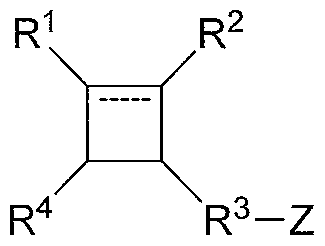
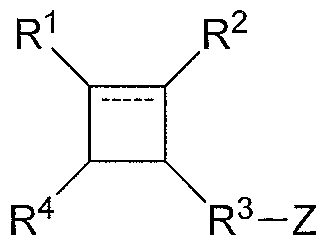
  • a compound provided herein can include a compound of Formula (I):
  • R 4 is H or an optionally substituted Ci-C4o alkyl
  • Z is selected from the group consisting of: COR 6 , C0 2 R 6 , NHC(0)NR 6 R 7 , CONR 6 ,
  • R 5 is H or d-C 6 alkyl
  • R° and R' are independently H or Ci-C ⁇ alkyl
  • hydrocarbon backbone formed by R 4 and R 3 -Z is amphiphilic.
  • the compound of Formula (I) is not:
  • R 3 or R 4 is a C1-C40 alkyl.
  • R 3 is a C 1 -C 40 alkyl (e.g., C 5 -C 20 alkyl, Ci 0 -C 30 alkyl, and C 2 -C 8 alkyl), or if R 3 is absent, then R 4 is C
  • R is a C ⁇ -C ⁇ alkyl.
  • R can be a C 7 alkyl.
  • R 4 is a C1-C10 alkyl.
  • R 4 can be a C 8 alkyl.
  • R 4 is H.
  • R 3 and R 4 can be independently optionally substituted.
  • each R al , R bl , R cl , R dl is independently selected from H, C 1-6 alkyl, C 1-4 haloalkyl, C 2- alkenyl, C 2-6 alkynyl, C 6- io ryl, C 3-1 o carbocyclyl, 5-10 membered heteroaryl, 4-10 membered heterocyclyl, C 6- io ryl-C 1-4 alkyl, C 3- io carbocyclyl-Ci -4 alkyl, (5-10 membered heteroaryl)-Ci -4 alkyl or (4-10 membered heterocyclyl)-C 1-4 alkyl, wherein said C 1-6 alkyl, C 2-6 alkenyl, C 2-6 alkynyl, C 6-1 o aryl, C 3- i 0 carbocyclyl, 5-10 membered heteroaryl, 4-10 membered heterocyclyl, C 6 .
  • each R a4 , R M , R c4 and R d4 is independently selected from H, C 1-4 alkyl, C 1-4 haloalkyl, C 2-4 alkenyl and C 2-4 alkynyl, wherein said C 1-4 alkyl, C2 -4 alkenyl, and C 2-4 alkynyl, is optionally substituted with 1, 2, or 3 substituents independently selected from OH, CN, amino, halo, Ci -4 alkyl, C 1-4 alkoxy, C 1-4 alkylthio, C 1-4 alkylamino, di(C 1-4 alkyl)amino, C 1-4 haloalkyl, and C 1-4 haloalkoxy.
  • the substituents can be selected from the group consisting of an alkyl, a halogen, a hydroxyl, an alkoxyl, a carbonyl (such as a carboxyl, an alkoxycarbonyl, a formyl, or an acyl), a thiocarbonyl (such as a thioester, a thioacetate, or a thioformate), an alkoxyl, a phosphoryl, a phosphate, a phosphonate, a phosphinate, an amino, an amido, an amidine, an imine, a cyano, a nitro, an azido, a sulfhydryl, an alkylthio, a sulfate, a sulfonate, a sulfamoyl, a sulfonamido, a sulfonyl, a carbocyclyl, a heterocyclyl
  • Z is C0 2 R 6 .
  • a compound provided herein can be selected from the group consisting of: or a pharmaceutically acceptable salt thereof, wherein R 3 , R 4 and Z are as described previously.
  • a compound provided herein is a compound of Formula
  • a compound provided herein is a compound of Formula (III):
  • R 1 , R 2 , R 3 , R 4 and Z are as described previously.
  • Non-limiting examples of a compound provided herein includes:
  • a compound provided herein can be selected from the group consisting of:
  • compositions When employed as pharmaceuticals, the compounds provided herein can be administered in the form of pharmaceutical compositions. These compositions can be prepared in a manner well known in the pharmaceutical art, and can be administered by a variety of routes, depending upon whether local or systemic treatment is desired and upon the area to be treated. Administration may be topical (including transdermal, epidennal, ophthalmic and to mucous membranes including intranasal, vaginal and rectal delivery), pulmonary ⁇ e.g., by inhalation or insufflation of powders or aerosols, including by nebulizer; intratracheal or intranasal), oral or parenteral.
  • topical including transdermal, epidennal, ophthalmic and to mucous membranes including intranasal, vaginal and rectal delivery
  • oral or parenteral
  • Parenteral administration includes intravenous, intraarterial, subcutaneous, intraperitoneal, intramuscular or injection or infusion; or intracranial, e.g., intrathecal or intraventricular, administration.
  • Parenteral administration can be in the form of a single bolus dose, or may be, for example, by a continuous perfusion pump.
  • formulations for topical administration may include transdermal patches, ointments, lotions, creams, gels, drops, suppositories, sprays, liquids and powders.
  • Conventional pharmaceutical carriers, aqueous, powder or oily bases, thickeners and the like may be necessary or desirable.
  • compositions which contain, as the active ingredient, a compound provided herein or a pharmaceutically acceptable salt thereof, in combination with one or more pharmaceutically acceptable carriers
  • composition is suitable for topical
  • the active ingredient is typically mixed with an excipient, diluted by an excipient or enclosed within such a carrier in the form of, for example, a capsule, sachet, paper, or other container.
  • an excipient serves as a diluent, it can be a solid, semi-solid, or liquid material, which acts as a vehicle, carrier or medium for the active ingredient.
  • compositions can be in the form of tablets, pills, powders, lozenges, sachets, cachets, elixirs, suspensions, emulsions, solutions, syrups, aerosols (as a solid or in a liquid medium), ointments containing, for example, up to 10% by weight of the active compound, soft and hard gelatin capsules, suppositories, sterile injectable solutions, and sterile packaged powders.
  • an active compound in preparing a formulation, can be milled to provide the appropriate particle size prior to combining with the other ingredients. If an active compound is substantially insoluble, it can be milled to a particle size of less than 200 mesh. If an active compound is substantially water soluble, the particle size can be adjusted by milling to provide a substantially uniform distribution in the formulation, e.g. about 40 mesh.
  • the compounds provided herein may be milled using known milling procedures such as wet milling to obtain a particle size appropriate for tablet formation and for other formulation types.
  • Finely divided (nanoparticulate) preparations of the compounds provided herein can be prepared by processes known in the art, e.g., see International App. No. WO 2002/000196.
  • suitable excipients include lactose, dextrose, sucrose, sorbitol, mannitoi, starches, gum acacia, calcium phosphate, alginates, tragacanth, gelatin, calcium silicate, microcrystalline cellulose, polyvinylpyrrolidone, cellulose, water, syrup, and methyl cellulose.
  • the formulations can additionally include: lubricating agents such as talc, magnesium stearate, and mineral oil; wetting agents; emulsifying and suspending agents; preserving agents such as methyl- and propylhydroxy-benzoates; sweetening agents; and flavoring agents.
  • lubricating agents such as talc, magnesium stearate, and mineral oil
  • wetting agents such as talc, magnesium stearate, and mineral oil
  • emulsifying and suspending agents such as methyl- and propylhydroxy-benzoates
  • preserving agents such as methyl- and propylhydroxy-benzoates
  • sweetening agents and flavoring agents.
  • the principal active ingredient is mixed with a pharmaceutical excipient to form a solid preformulation composition containing a homogeneous mixture of a compound provided herein.
  • a solid preformulation composition containing a homogeneous mixture of a compound provided herein.
  • the active ingredient is typically dispersed evenly throughout the composition so that the composition can be readily subdivided into equally effective unit dosage forms such as tablets, pills and capsules.
  • This solid preformulation is then subdivided into unit dosage forms of the type described above containing from, for example, about 0.1 to about 1000 mg of the active ingredient provided herein.
  • the tablets or pills provided herein can be coated or otherwise compounded to provide a dosage form affording the advantage of prolonged action.
  • the tablet or pill can comprise an inner dosage and an outer dosage component, the latter being in the form of an envelope over the former.
  • the two components can be separated by an enteric layer which serves to resist disintegration in the stomach and permit the inner component to pass intact into the duodenum or to be delayed in release.
  • enteric layers or coatings such materials including a number of polymeric acids and mixtures of polymeric acids with such materials as shellac, cetyl alcohol, and cellulose acetate.
  • liquid forms in which the compounds and compositions provided herein can be incorporated for administration orally or by injection include aqueous solutions, suitably flavored syrups, aqueous or oil suspensions, and flavored emulsions with edible oils such as cottonseed oil, sesame oil, coconut oil, or peanut oil, as well as elixirs and similar pharmaceutical vehicles.
  • the compounds provided herein are formulated for intravenous administration.
  • Pharmaceutical compositions suitable for injectable use can include sterile aqueous solutions (where water soluble) or dispersions and sterile powders for the extemporaneous preparation of sterile injectable solutions or dispersion.
  • suitable earners include physiological saline, bacteriostatic water, Cremophor ELTM (BASF, Parsippany, NJ) or phosphate buffered saline (PBS).
  • the composition must be sterile and should be fluid to the extent that easy syringability exists. It should be stable under the conditions of manufacture and storage and must be preserved against the contaminating action of microorganisms such as bacteria and fungi.
  • the carrier can be a solvent or dispersion medium containing, for example, water, ethanol, polyol (for example, glycerol, propylene glycol, and liquid polyethylene glycol, and the like), and suitable mixtures thereof.
  • the proper fluidity can be maintained, for example, by the use of a coating such as lecithin, by the maintenance of the required particle size in the case of dispersion and by the use of surfactants.
  • Prevention of the action of microorganisms can be achieved by various antibacterial and antifungal agents, for example, parabens, chlorobutanol, phenol, ascorbic acid, thimerosal, and the like.
  • isotonic agents for example, sugars, polyalcohols such as mannitol, sorbitol, sodium chloride in the composition.
  • Prolonged absorption of the injectable compositions can be brought about by including in the composition an agent that delays absorption, for example, aluminum monostearate and gelatin.
  • Sterile injectable solutions can be prepared by incorporating the active compound in the required amount in an appropriate solvent with one or a combination of ingredients enumerated above, as required, followed by filter sterilization.
  • dispersions are prepared by incorporating the active compound into a sterile vehicle, which contains a basic dispersion medium and the required other ingredients from those enumerated above.
  • the preferred methods of preparation are vacuum drying and freeze-drying, which yield a powder of the active ingredient plus any additional desired ingredient from a previously sterile-filtered solution thereof.
  • compositions for inhalation or insufflation include solutions and suspensions in pharmaceutically acceptable, aqueous or organic solvents, or mixtures thereof, and powders.
  • the liquid or solid compositions may contain suitable pharmaceutically acceptable excipients as described supra.
  • the compositions are administered by the oral or nasal respiratory route for local or systemic effect.
  • compositions can be nebulized by use of inert gases. Nebulized solutions may be breathed directly from the nebulizing device or the nebulizing device can be attached to a face mask, tent, or intermittent positive pressure breathing machine. Solution, suspension, or powder compositions can be administered orally or nasally from devices which deliver the formulation in an appropriate manner.
  • Topical formulations can contain one or more conventional carriers.
  • ointments can contain water and one or more hydrophobic carriers selected from, for example, liquid paraffin, polyoxyethylene alkyl ether, propylene glycol, white Vaseline, and the like.
  • Carrier compositions of creams can be based on water in combination with glycerol and one or more other components, e.g.
  • topical formulations contain at least about 0.1, at least about 0.25, at least about 0.5, at least about 1, at least about 2, or at least about 5 wt % of the compound provided herein.
  • the topical formulations can be suitably packaged in tubes of, for example, 100 g which are optionally associated with instructions for the treatment of the select indication.
  • the compounds provided herein are prepared with carriers that will protect the compounds against rapid elimination from the body, such as a controlled release formulation, including implants and microencapsulated delivery systems.
  • a controlled release formulation including implants and microencapsulated delivery systems.
  • Biodegradable, biocompatible polymers can be used, such as ethylene vinyl acetate, polyanhydrides, polyglycolic acid, collagen, polyorthoesters, and polylactic acid.
  • Such formulations can be prepared using standard techniques, or obtained commercially, e.g., from Alza Corporation and Nova Pharmaceuticals, Inc.
  • Liposomal suspensions (including liposomes targeted to selected cells with monoclonal antibodies to cellular antigens) can also be used as pharmaceutically acceptable carriers. These can be prepared according to methods known to those skilled in the art, for example, as described in U.S. Patent No. 4,522,811.
  • compositions administered to a patient can be in the form of pharmaceutical compositions described above. These compositions can be sterilized by conventional sterilization techniques, or may be sterile filtered. Aqueous solutions can be packaged for use as is, or lyophilized, the lyophilized preparation being combined with a sterile aqueous carrier prior to administration.
  • the pH of the compound preparations typically will be between 3 and 11, more preferably from 5 to 9 and most preferably from 7 to 8. It will be understood that use of certain of the foregoing excipients, carriers, or stabilizers will result in the formation of pharmaceutical salts.
  • compositions can be formulated in a unit dosage form, each dosage containing from about 5 to about 1000 mg (1 g), more usually about 100 to about 500 mg, of the active ingredient.
  • unit dosage forms refers to physically discrete units suitable as unitary dosages for human subjects and other mammals, each unit containing a predetermined quantity of active material calculated to produce the desired therapeutic effect, in association with a suitable pharmaceutical excipient.
  • compositions provided herein contain from about 5 to about 50 mg of the active ingredient.
  • One havmg ordinary skill in the art will appreciate that this embodies compositions containing about 5 to about 10, about 10 to about 15, about 15 to about 20, about 20 to about 25, about 25 to about 30, about 30 to about 35, about 35 to about 40, about 40 to about 45, or about 45 to about 50 mg of the active ingredient.
  • compositions provided herein contain from about 50 to about 500 mg of the active ingredient.
  • compositions containing about 50 to about 100, about 100 to about 150, about 150 to about 200, about 200 to about 250, about 250 to about 300, about 350 to about 400, or about 450 to about 500 mg of the active ingredient.
  • compositions provided herein contain from about 500 to about 1000 mg of the active ingredient.
  • compositions containing about 500 to about 550, about 550 to about 600, about 600 to about 650, about 650 to about 700, about 700 to about 750, about 750 to about 800, about 800 to about 850, about 850 to about 900, about 900 to about 950, or about 950 to about 1000 mg of the active ingredient.
  • the active compound can be effective over a wide dosage range and is generally administered in a pharmaceutically effective amount. It will be understood, however, that the amount of the compound actually administered will usually be determined by a physician, according to the relevant circumstances, including the condition to be treated, the chosen route of administration, the actual compound administered, the age, weight, and response of the individual patient, the severity of the patient's symptoms, and the like.
  • compositions can be administered to a patient already suffering from a disease in an amount sufficient to cure or at least partially arrest the symptoms of the disease and its complications. Effective doses will depend on the disease condition being treated as well as by the judgment of the attending clinician depending upon factors such as the severity of the disease, the age, weight and general condition of the patient, and the like.
  • the therapeutic dosage of a compound provided herein can vary according to, for example, the particular use for which the treatment is made, the manner of administration of the compound, the health and condition of the patient, and the judgment of the prescribing physician.
  • the proportion or concentration of a compound provided herein in a pharmaceutical composition can vary depending upon a number of factors including dosage, chemical characteristics (e.g., hydrophobicity), and the route of administration.
  • the compounds provided herein can be provided in an aqueous
  • physiological buffer solution containing about 0.1 to about 10% w/v of the compound for parenteral administration.
  • Some typical dose ranges are from about 1 mg/kg to about 1 g/kg of body weight per day. In some embodiments, the dose range is from about 0.01 mg kg to about 100 mg/kg of body weight per day.
  • the dosage is likely to depend on such variables as the type and extent of progression of the disease or disorder, the overall health status of the particular patient, the relative biological efficacy of the compound selected, foraiulation of the excipient, and its route of administration. Effective doses can be extrapolated from dose-response curves derived from in vitro or animal model test systems.
  • the compounds provided herein can be used as antibacterial agents, in particular, antimycobacterial agents.
  • the bacterial infection is a Gram- positive organism that either uptakes mycolic acid, uses mycolic acid in a biosynthetic process, synthesizes mycolic acid, or requires mycolic acid as a nutritional supplement.
  • the compounds provided herein can used to treat a patient infected with a mycobacterium.
  • the compounds provided herein can inhibit the growth of a mycobacterium (e.g., Mycobacterium tuberculosis). Accordingly, provided herein is a method for treating a mycobacterial infection in a mammal comprising administering a therapeutically effective amount of a compound provided herein.
  • the compounds provided herein are thought to function through selective inhibition or activation of biological processes that would normally process fatty acids, esters, alcohols.
  • the compounds may function as competitive or irreversible inhibitors based upon their inclusion of, for example, a strained four-membered ring moiety.
  • mycolic acids are found in the cell wall of M. tuberculosis; in particular, a-mycolic acid, which incorporates two cyclopropane rings. The presence of cyclopropanes are thought to contribute to the structural integrity of the cell wall and protect the vacillus from oxidative stress inside macrophages.
  • Mycolic acids are assembled in mycobacteria from shorter-chain fatty acid feedstocks.
  • the compounds provided herein can be taken up into the bacteria my mimicking these feed stocks and can, for example, disrupt mycolic acid biosynthesis through the presence of their strained four-membered ring moieties.
  • Mycobacterium include, for example, bacteria which are members of the groups including Mycobacterium tuberculosis complex (MTBC), Mycobacterium avium complex (MAC), Mycobacterium gordonae clade, Mycobacterium kansasii clade, Mycobacterium nonchromogenicum/terrae clade, Mycolactone-producing mycobacteria, Mycobacterium simiae clade, Mycobacterium chelonae clade, Mycobacterium fortuitum clade, Mycobacterium fortuitum clade, Mycobacterium parafortuitum clade,
  • MTBC Mycobacterium tuberculosis complex
  • MAC Mycobacterium avium complex
  • Mycobacterium gordonae clade Mycobacterium kansasii clade
  • Mycobacterium nonchromogenicum/terrae clade Mycolactone-producing mycobacteria
  • each of the groups include the following bacteria as members: Mycobacterium tuberculosis complex (MTBC) include, for example, M.
  • MTBC Mycobacterium tuberculosis complex
  • tuberculosis M. bovis, M. bovis BCG, M. africanum, M. canetti, M. caprae, M. microti, and M. pinnipedii;
  • Mycobacterium avium complex include, for example, M. avium, M. avium paratuberculosis, M. avium silvaticum, M. avium "hominissuis", M. colombiense, and indicus pranii,
  • Mycobacterium gordonae clade include, for example, M. asiaticumm and M. gordonae;
  • Mycobacterium kansasii clade include, for example, M. gastri and M. kansasii;
  • Mycobacterium nonchromogenicum/terrae clade include, for example, M.
  • Mycobacterium simiae clade include, for example, M. triplex, M. genavense, M. florentinum, M. lentiflavum, M. palustre, M. kubicae, M. parascrofulaceum, M.
  • Mycobacterium chelonae clade include, for example, M. abscessus, M. chelonae, and M bolletii;
  • Mycobacterium fortuitum clade include, for example, M. fortuitum, M. fortuitum, M. boenickei, M. peregrinum, M. porcinum, M. senegalense, M. septicum, M.
  • Mycobacterium parafortuitum clade include, for example, M. parafortuitum, M. austroafricanum, M. diernhoferi, M. hodleri, M. neoaurum, and M. frederiksbergense;
  • Mycobacterium vaccae clade include, for example, M. aurum and vaccae; CF include, for example, M. chitae and M. fallax.
  • mycobacterium include, for example, M. branderi, M. cookie, M. celatum, M. bohemicum, M. haemophilum, M. malmoense, M. szulgai, M. leprae, M. lepraemurium, M. lepromatosis, M. africanum, M. botniense, M. chimaera, M. conspicuum, M. doricum, M. farcinogenes, M. homeeshornense, M. intracellular , M. acus, M. marinum, M. monacense, M. montefiorense, M. murale, M. nebraskense, M. saskatchewanense, M.
  • M. komossense M. obuense, M. sphagni, M. agri, M. aichiense, M. alvei, M. arupense, M. brumae, M. canariasense, M. chubuense, M. conceptionense, M. duvalii, M. elephantis, M. gilvum, M. hassiacum, M. holsaticum, M. immunogenum, M. massiliense, M.
  • the mycobacterium is a member of MTBC.
  • M. tuberculosis the major cause of human tuberculosis, M. bovis, M. bovis BCG, M. avium.
  • the mycobacterium is M. tuberculosis.
  • the mycobacterium is M. bovis.
  • the mycobacterium is M. tuberculosis.
  • the mycobacterium is M. bovis.
  • mycobacterium is M. avium subspecies paratuberculosis.
  • one or more compounds provided herein are administered with another antibiotic useful for treating mycobacterial infections.
  • additional antibiotics may include: ethambutol, isoniazid, pyrazinamide, members of the rifamycin class (including, for example, rifampicin), aminoglycosides (for example, amikacin or kanamycin), polypeptides (for example, capreomycin, viomycin, or enviomycin), fluoroquinolones (for example ciprofloxacin levofloxacin, or moxifloxacin), ethionamide, prothionamide, cycloserine, any other antibiotic employed as part of a therapeutic treatment for mycocaterial infections, and any combination of the antibiotics listed above.
  • the additional antibiotic can be administered before, after, or simultaneously with a compound as provided herein.
  • Certain of the compounds provided herein are can be used as monomers to produce amphiphilic polymers. Such reactions can prepare a variety of polymers such as those shown in Scheme 1.
  • a compound of Formula (IV) can be used to prepare polymers using any number of known polymerization reactions.
  • a compound of Formula (IV) includes: or a pharmaceutically acceptable salt thereof,
  • R 3 is absent or is an optionally substituted C]-C 4 o alkyl
  • R 4 is H or an optionally substituted C 1 -C 4 o alkyl
  • Z is selected from the group consisting of: COR 6 , C0 2 R 6 , NHC(0)NR 6 R 7 , CONR 6 ,
  • R 5 is H or d-C 6 alkyl
  • R 6 and R 7 are independently H or C ⁇ -C alkyl
  • hydrocarbon backbone formed by R 4 and R 3 -Z is amphiphilic.
  • the compound of Formula (I) is not:
  • R J or R" is a Q-C40 alkyl.
  • R 3 is a Q-C40 alkyl (e.g., C 5 -C 20 alkyl, C 10 -C 30 alkyl, and C 2 -C 8 alkyl), or if R 3 is absent, then R 4 is Ct-C/ ⁇ ) alkyl (e.g., C 5 -C 2 o alkyl, C 10 -C 3 o alkyl, and C 2 -C 8 alkyl).
  • R 3 is a Ci-Cio alkyl.
  • R 3 is a Cj-Cio alkyl.
  • R 3 can be a C alkyl.
  • R 4 is a C ⁇ Qo alkyl.
  • R 4 can be a Cg alkyl.
  • R 4 is H.
  • R 3 and R 4 can be independently optionally substituted.
  • each R al , R bl , R cl , R dl is independently selected from H, C 1-6 alkyl, C 1-4 haloalkyl, C 2-6 alkenyl, C 2-6 alkynyl, C 6-10 aryl, C 3-10 carbocyclyl, 5-10 membered heteroaryl, 4-10 membered heterocyclyl, C6-io ryl-Ci -4 alkyl, C 3-1 o carbocyclyl-C 1-4 alkyl, (5-10 membered heteroaryl)-Ci -4 alkyl or (4-10 membered heterocyclyl)-Ci -4 alkyl, wherein said C 1-6 alkyl, C 2- 6 alkenyl, C 2- alkynyl, C -1 o aryl, C 3-1 o carbocyclyl, 5-10 membered heteroaryl, 4-10 membered heterocyclyl, C 6- io aryl-C 1-4 alkyl, C 3- io
  • -4 alkyl is optionally substituted with 1, 2, 3, 4, or 5 substituents independently selected from C 1-4 alkyl, C 1-4 haloalkyl, halo, CN, OR a4 , SR a4 , C(0)R b4 , C(0)NR c4 R d4 , C(0)OR a4 , OC(0)R M , OC(0)NR c V 4 , NR c4 R d4 , NR c4 C(0)R b4 ,
  • each R a4 , R b4 , R c4 and R d4 is independently selected from H, C M alkyl, C haloalkyl, C 2-4 alkenyl and C 2-4 alkynyl, wherein said Ci -4 alkyl, C 2- alkenyl, and C 2-4 alkynyl, is optionally substituted with 1, 2, or 3 substituents independently selected from OH, CN, amino, halo, Cj -4 alkyl, C 1-4 alkoxy, Ci -4 alkylthio, C 1-4 alkylamino, di(C 1-4 alkyl)amino, Ci -4 haloalkyl, and C 1-4 haloalkoxy.
  • the substituents can be selected from the group consisting of an alkyl, a halogen, a hydroxyl, an alkoxyl, a carbonyl (such as a carboxyl, an alkoxycarbonyl, a formyl, or an acyl), a thiocarbonyl (such as a thioester, a thioacetate, or a thioformate), an alkoxyl, a phosphoryl, a phosphate, a phosphonate, a phosphinate, an amino, an amido, an amidine, an imine, a cyano, a nitro, an azido, a sulfhydryl, an alkylthio, a sulfate, a sulfonate, a sulfamoyl, a sulfonamido, a sulfonyl, a carbocyclyl, a heterocyclyl
  • the hydrocarbon backbone formed by R 3 and R 4 is a fatty acid or a derivative thereof which contains a cyclobutene moiety.
  • R 3 and R 4 together with the cyclobutene moiety form a hydrocarbon chain with a reactive group at one terminus (e.g., carboxylic acid or a Z moiety as defined above).
  • the hydrocarbon chain ranges from 10 to 30 carbon atoms and may be substituted or unsubstituted.
  • Non-l niting examples include myristoleic acid, pamitoleic acid, sapienic acid, oleic acid, linoleic acid, linolenic acid, arachadonic acid, elaidic acid, and vaccenic acid.
  • Z is C0 2 R 6 .
  • any known method of polymerization for alkenes may be used with the monomers described herein.
  • a monomer as provided herein can undergo metathesis with other alkenes. In the absence of a thermodynamic driving force, these exchange reactions typically produce mixtures of the starting and product alkenes.
  • the metathesis reaction is driven forward by relief of strain to result in rapid and typically irreversible ring-opening metathesis polymerization (ROMP). As shown in Scheme 2 for a ROMP process with a generic cycloalkane.
  • one or more monomers as provided herein can be reacted with other alkenes, either monomeric alkenes or alkene-containing polymers, through cross metathesis (CM) wherein two alkenes can undergo transalkylidenation under release of ethane in the presence of a ruthenium carbenoid (e.g., Grubbs' Catalyst).
  • CM cross metathesis
  • these exchange reactions typically produce mixtures of the starting and product alkenes.
  • the cross metathesis reaction is driven forward by relief of strain. Two exemplary reactions with monomeric alkenes are shown in Scheme 4.
  • a polymer can be prepared as follows. Under an inert atmosphere, a solution of catalyst (Grubbs' I or II) in THF was added to a vigorously stirred solution of 0.2 M monomer in THF. The reaction mixture is then stirred for about 30 min. at room temperature after which the reaction is terminated by addition of a small amount of ethyl vinyl ether. The mixture is allowed to stir at room temperature for 30 min. and poured into methanol to precipitate the polymer. The polymer is then resolubilized in dry THF and the solutions dried with typical agents (magnesium sulfate, sodium sulfate) before further purification reprecipitation using dry methanol (2x). The polymer can be analyzed by gel permeation chromatography (GPC) in THF or by proton 1H NM as a solution in CDC1 3 .
  • GPC gel permeation chromatography
  • radical polymerization methods may be used to prepare a polymer as provided herein.
  • Free radical polymerization is a method of polymerization by which a polymer forms by the successive addition of free radical building blocks. Free radicals can be formed via a number of different mechanisms usually involving separate initiator molecules. Following its generation, the initiating free radical adds (nonradical) monomer units, thereby growing the polymer chain. Any reasonable initiator may be used in these polymerization reactions. An example of such a reaction is shown in Scheme 5.
  • cyclobutene compounds provided herein are also useful in bioorthogonal "click” chemistries.
  • Bioorthogonal reactions for coupling materials in the presence of complex biological milieu are of great interest in biology and medicine. Such reactions have become key components in a variety of applications including protein engineering, immunoassay development, and cell surface modification.
  • Bioorthogonal "click” chemistries are widely used in chemical biology for a myriad of applications such as activity based protein profiling, crosslinking of proteins, monitoring cell proliferation, generation of novel enzyme inhibitors, monitoring the synthesis of newly formed proteins, protein target identification, and studying glycan processing.
  • the ligand e.g., an antibody, small molecule or other biomolecule
  • the ligand can be physically attached to the dienophile.
  • the ligand carries a functional group such as an amine, alcohol, carboxylic acid or ester, or other group of atoms on the ligand that can undergo a chemical reaction allowing attachment to the dienophile.
  • heterodienophile e.g., a cyclobutene compound as provided herein
  • a reactive functional group for attachment to the ligand e.g., Z
  • the reactive functional group on the ligand and/or dienophile undergoes a chemical reaction to form a link between the two.
  • the diene can be a substituted tetrazine or other
  • the diene is linked to the payload (which can be, e.g., a therapeutic agent, fluorescence dye, or other detectable agent).
  • the diene possesses a reactive group such as an amine, alcohol, carboxylic acid or ester, or other group that can undergo a chemical reaction with the reactive moiety on the payload to form a link between the two.
  • Dienes useful in the present disclosure include but are not limited to aromatic ring systems that contain two adjacent nitrogen atoms, for example, tetrazines, pyridazines, substituted or unsubstituted 1,2-diazines.
  • Other 1,2-diazines can include 1,2-diazines annelated to a second ⁇ -electron-deficient aromatic ring such as pyrido[3,4-d]pyridazines, pyridazino[4,5-d]pyridazines, and 1,2,4-triazines.
  • Pyridazines can also be fused with a five-membered heterocycle such as imidazo[4,5-d]pyridazines and l,2,3-triazolo[4,5- d]pyridazines.
  • the diene is an asymmetrical tetrazine as described herein, e.g., 3-(p-Benzylamino)-l, 2, 4, 5-tetrazine:
  • an amphiphilic polymer formed by polymerizing a compound as provided herein (e.g., a compound of Formula (IV) or an amphiphilic cycloalkene-containing fatty acid derivative), each having a hydrophobic end, a hydrophilic end, and a backbone there between comprising a cycloalkene, wherein the cycloalkene comprises at least four carbon atoms, with at least two of the four carbon atoms being part of the backbone of the amphiphilic cycloalkene-containing fatty acid derivatives.
  • the polymer comprises amphiphilic fatty acid derivatives cross-linked via an unsaturated hydrocarbon chain formed by cleavage of the cycloalkene.
  • the polymer is ordered in two or three dimensions.
  • R 1 is hydrophobic and comprises a substituted or unsubstituted alkyl group having at least one carbon atom or a substituted or unsubstituted alkenyl group having at least two carbon atoms, and
  • R 2 is hydrophilic and comprises a substituted alkyl group having at least one carbon atom or a substituted alkenyl group having at least two carbon atoms.
  • R 2 comprises a hydroxyl group, an ester group, an aldehyde group, a carboxyl group, a sulfhydryl group, an amine group, an amide group, a carbamide group, or a phosphate group.
  • the polymers provided herein may be used in a number of applications.
  • the polymers may undergo further manipulation such as cleavage, stabilization, and/or cross-linking.
  • the carbon-carbon double bonds introduced through certain polymerization reactions e.g., ROMP polymerization
  • the carbon-carbon double bonds which provide the cross- linking element can be saturated (hydrogenated) to form highly stable alkane linkages, making the polymer much less susceptible to oxidative cleavage.
  • the carbon-carbon double bonds which provide the cross-linking element can be cross- linked by the same methods used for latex of butadiene rubbers, allowing the
  • polymers provided herein can form two-dimensional or three-dimensional ordered polymers or coatings. For example, see Scheme 7.
  • amphiphile interactions between the amphiphile and inorganic or organometallic colloids such as quantum dots.
  • cyclobutenes onto a chromatographic support such as silica to create a remarkably stable reverse-phase chromatographic layer capable of displaying any desired functional group that can be incorporated into the cyclobutene precursors.
  • a chromatographic support such as silica
  • commercial reverse phase chromatography columns are prepared by chemical bonding of C 8 or C 18 alkylsilanes to a silica surface via siloxane bonds. The resulting siloxanes are only stable within a fairly modest pH range.
  • a reverse-phase chromatography column was instead prepared using a cyclobutene-substituted monomer (for example, with a terminal siloxane grafted onto or in place of the carboxylic acid), treatment with a ROMP catalyst could provide a new chromatographic support maintaining the same fundamental features of existing supports yet possessing far greater hydrolytic stability.
  • a targeted protein or agent would be functionalized with one or more alkene units (in the form of allyl ethers, allyl esters, or allyl amides) and then subjected with cross-metathesis with a cyclobutene fatty acid to create a protein "decorated” with fatty acids, fatty acid esters, phospholipids, or triglycerides.
  • the compounds provided herein, including salts thereof, can be prepared using known organic synthesis techniques and can be synthesized according to any of numerous possible synthetic routes.
  • the reactions for preparing the compounds provided herein can be carried out in suitable solvents which can be readily selected by one of skill in the art of organic synthesis.
  • suitable solvents can be substantially non-reactive with the starting materials (reactants), the intermediates, or products at the temperatures at which the reactions are carried out, e.g., temperatures which can range from the solvent's freezing temperature to the solvent's boiling temperature.
  • a given reaction can be carried out in one solvent or a mixture of more than one solvent.
  • suitable solvents for a particular reaction step can be selected by the skilled artisan.
  • Preparation of the compounds provided herein can involve the protection and deprotection of various chemical groups.
  • the need for protection and deprotection, and the selection of appropriate protecting groups, can be readily determined by one skilled in the art.
  • the chemistry of protecting groups can be found, for example, in Protecting Group Chemistry, 1 st Ed., Oxford University Press, 2000; March 's Advanced Organic Chemistry: Reactions, Mechanisms, and Structure, 5 th Ed., Wiley-Interscience
  • Reactions can be monitored according to any suitable method known in the art.
  • product formation can be monitored by spectroscopic means, such as nuclear magnetic resonance spectroscopy ⁇ e.g., l Yi or 13 C), infrared spectroscopy, spectrophotometry ⁇ e.g., UV-visible), mass spectrometry, or by chromatographic methods such as high performance liquid chromatography (HPLC), liquid
  • LCMS chiOmatography-mass spectroscopy
  • TLC thin layer chromatography
  • Compounds can be purified by those skilled in the art by a variety of methods, including high performance liquid chromatography (HPLC) ⁇ 'Preparative LC-MS Purification: Improved Compound Specific Method Optimization " K.F. Blom, et al., J. Combi. Chem. 6(6), 874 (2004) and normal phase silica chromatography.
  • the compounds provided herein can be prepared as described in the Examples provided herein and as illustrated in Scheme 8:
  • cyclobutene compounds as provided herein can occur using the following procedures.
  • the benzyl ester of oleic acid undergoes cycloaddition with dichloroketene to afford a mixture of regioisomeric
  • dichlorocyclobutanones possessed limited stability and are directly reduced with sodium borohydride to furnish a mixture of regioisomeric 2,2-dichloro-l-cyclobutanols.
  • a mixture of regioisomeric monochlorocyclobutanones (e.g., 5) can be prepared by partial reduction of the dichlorocyclobutanone with 1.1 equiv of Zn or Zn(Cu) in acetic acid.
  • the final step can include removal of the benzyl ester by Pd- mediated hydrogenolysis.
  • Compound having shorter chains can be prepared analogously from 9- decenoic acid, furnishing comparably functionalized substrates with lower log P.
  • the trara-stereoisomers of cyclobutenes (e.g., 2) and monochlorocyclobutanones (e.g., 7) can be prepared using a similar route based upon elaidic acid (Scheme 9).
  • the cycloaddition step can be conducted only in the presence of activated Zn or Zn/Cu.
  • a method comprisinj reacting an unsaturated fatty acid or derivative thereof having a backbone comprising at least one carbon-carbon double bond with dihaloketene (e.g., dichloroketene or dibromoketene) to achieve a stereospecific cycloaddition across the at least one carbon-carbon double bond, thereby yielding a cycloketone-containing fatty acid derivative comprising a cycloketone along the backbone, wherein the cycloketone comprises at least four carbon atoms, with at least two of the at least four carbon atoms being part of the backbone of the cycloketone-containing fatty acid derivative;
  • dihaloketene e.g., dichloroketene or dibromoketene
  • cycloalkene-containing fatty acid derivative having a hydrophobic end, a hydrophilic end, and a backbone therebetween comprising a cycloalkene, wherein the cycloalkene comprises at least four carbon atoms, with at least two of the four carbon atoms being part of the backbone of the amphiphilic cycloalkene- containing fatty acid derivative.
  • the method further comprises polymerizing a multiplicity of the amphiphilic cycloalkene-containing fatty acid derivatives to yield a polymer comprising carbon-carbon double bonds.
  • polymerization can include cross-linking the amphiphilic cycloalkene-containing fatty acid derivatives via the carbon-carbon double bond in the cycloalkene.
  • polymerizing the multiplicity of the amphiphilic cycloalkene-containing fatty acid derivatives comprises ring-opening metathesis reactions.
  • polymerizing the multiplicity of the amphiphilic cycloalkane-containing fatty acid derivatives comprises click-chemistry. For example, the amphiphilic cycloalkane-containing fatty acid derivative can be reacted with a substituted or unsubstituted tetrazine.
  • the method further comprises hydrogenating the carbon- carbon double bonds of the polymer. In some embodiments, the method further comprises cleaving at least some of the carbon-carbon double bonds in the polymer via oxidation to yield monomelic products.
  • the backbones of the multiplicity of the amphiphilic cycloalkene-containing fatty acid derivatives can be aligned before polymerizing the multiplicity of the amphiphilic cycloalkene-containing fatty acid derivatives.
  • l-(Octanoic acid, 8-yl)-2-octylcyclobutene (1) was prepared from the unpurified dichloromethanesulfonate using a reported procedure (see Baldwin, J. D. and Belfield, K. D. J. Org. Chem. 1987, 52, 4772-4776; and Powers, D. C. et al. J. Org. Chem. 2007, 72, 187-194).
  • NH 3 (- 15 mL, liquid) was condensed into a 100-mL three-necked round bottom flask fitted with a dry ice/acetone condenser.
  • Sodium 0.1127 g, 4.90 mmol, sliced under Hex was added in small pieces.
  • Benzyl 9-decenoate was prepared by a known procedure. Thionyl chloride (36.9 mL, 51 mmol) was added to a stirred solution of 9-decenoic acid DA (8.67 g, 51 minol) and catalytic dimethylformamide (DMF, 0.12 mL, 1.5 mmol) in toluene (400 mL). The reaction was stirred at rt until the starting material was consumed (TLC, ⁇ 24 h).
  • reaction was concentrated and the residue redissolved in toluene (400 mL) and triethylamine (8.5 mL). The solution was stirred for 24 h and washed with water. The aqueous layer was then extracted with ether. The combined organic solution were combined, dried with Na 2 S0 4 , and concentrated under vacuum.
  • methanesulfonate ester DA4 was prepared similarly to compound OA4 from reaction of methanesulfonyl chloride (20 mL, 29.4 mmol), cyclobutanol DA3 (5.50 g, 14.7 mmol), and triethylamine (9.2 mL, 66.3 mmol) in CH 2 CI 2 (70 mL).
  • 8-(2-Cyclobuten-l-yl)-octanoic acid (8) was prepared by a similar procedure as 1 from reaction of Na metal (2.8 g, 120 mmol) with a solution of 5.4 g (12 mmol) of the mixture of dichloro mesylate DA4 in THF (30 mL) and NH 3 (- 250 mL).
  • One-dimensional (ID) ⁇ -NMR spectroscopy was used to verify the chemical purity, aqueous stability, and concentration dependent micelle formation of eleven fatty acid analogs.
  • Each compound was dissolved in deuterated dimethyl sulfoxide (DMSO-i 6 ) to obtain a stock concentration of 20 mM.
  • DMSO-i 6 deuterated dimethyl sulfoxide
  • Four different concentrations were prepared from the stock solutions for NMR analysis: 1.00 mM, 750 ⁇ , 500 ⁇ , 100 ⁇ .
  • All NMR samples consisted of 600 ⁇ , of a deuterated 50 mM potassium phosphate buffer at pH 7.2 with 50 ⁇ of 3 (trimethylsilyl) propionic-2, 2, 3, 3-i3 ⁇ 4 acid sodium salt (TMSP).
  • TMSP trimethylsilyl
  • Each 600 i NMR sample contains 30 ⁇ . (5%) of DMSO- ⁇ i 6 and was transferred to a 5 mm NMR tube for analysis.
  • a Bruker Avance DRX 500-MHz spectrometer equipped with a 5 mm triple- resonance cryoprobe (1H, 13 C, 15 N) with a z-axis gradient was utilized for all ID 1H NMR experiments. Acquisition of NMR spectra was automated using a BACS-120 sample changer and Icon NMR software. All spectra were acquired at 298.15 K with 16 dummy scans, 64 scans, 32K data points, a spectral width of 5482.46 Hz, and a relaxation delay of 1.5 s. The NMR spectra were processed and analyzed using ACD/1D NMR Manager (Advanced Chemistry Development). The resulting ID ⁇ NMR spectra were visually inspected for evidence of micelle formation (peak broadening), or chemical
  • the results demonstrate the analogs to be stable in aqueous buffer.
  • Example 3 Measurement of nonspecific cytotoxicity
  • RAW 264.7 macrophages were incubated with 0-100 ⁇ of oleic acid or the CI 8 cyclobutene fatty acid 1, each delivered as bovine serum albumin complexes. After 24 h, cell viability was relative to untreated controls was assessed using an IN CTYOTOX- CVDE Crystal violet Dye Elution Kit.
  • the cyclobutene analogue 1 showed little toxicity at 50 ⁇ and only modest toxicity at 100 ⁇ ; most naturally occurring fatty acids, represented here by oleate, display some toxicity this cell line at concentrations > 200 ⁇ (Russell, D.G. et al., Science 2010, 328: 852-856; and McShane, H., Trans. R. Soc. B 2011, 366, 2782-2789).
  • the low toxicity against a mammalian cell line supports the potential investigations into the modified fatty acids as potential antimicrobials.
  • Example 4 Bacterial strains and culture conditions
  • Bacterial strains used in this study are M. smeg (mc2155) and two strains of M. tb (CDC 1551 and H37Rv). Bacterial cells were grown with shaking at 37°C in complete Middlebrook 7H9 broth supplemented with 0.05% v/v Tween 80 to an OD600 of 0.6-1.2.
  • each fatty acid analog compound was suspended in 100% DMSO-i3 ⁇ 4 at either 100 mM (M smeg) or 100 mg/ml (M. smeg and M. tb).
  • An equivalent concentration DMSO-i 6 was tested separately.
  • MICs were determined by a 96-well microplate twofold dilution method. Bacteria were harvested, washed 2x with minimal media, and inoculated to an initial concentration of approximately 1.0 x 10⁵ colony forming units (CFU) per well.
  • CFU colony forming units
  • the initial inoculum was plated to verify retrospectively the desired CFU/ml for each strain. Plates were incubated at 37 °C for 3-4 day ( smeg) or 5-7 weeks (M. tb). MIC values were determined by the consistent results of three biological and three technical replicates. The MIC was defined by taking the mode of three independent cultures where the MIC did not differ by more than one doubling dilution, discarding any results that are two doubling dilutions away from the mode.
  • MICs were initially determined against M. smeg (mc 155), a non-pathogenic mycobacteria used as a model for M. tb to analyze processes that are likely to be conserved in the genus, and against two M. tb strains (CDC1551 and H37Rv).
  • DSC a clinically used TB drug, was employed as a control since MIC determinations for this compound have been standardized numerous times under different conditions in our laboratories.
  • the analogs were added to wells as solutions in DMSO-d 6 ; the deuterated solvent was chosen for convenience to enable consistency with planned NMR-based metabolomics studies. Importantly, the DMSO-d 6 had no apparent effect on the growth of M.
  • M. smeg was in general more resistant than M. tb to these analogs and DCS.
  • the best MIC values against M. smeg were observed for 2, the Ci 8 -cyclobutanone (3), 8, and the C 10 - cyclobutanol 11, and were similar to the MIC for DCS (313 ⁇ ).
  • four of the eleven molecules have MIC values ⁇ 100 ⁇ for both M. tb strains: these include the C 18 cyclobutane (2), the C 10 cyclobutene (8), the C 10 cyclobutane (9), and the C 18
  • the MIC results demonstrate promising levels of inhibition with a variety of four- membered ring carbocycles (cyclobutanol, cyclobutanone, cyclobutene, and
  • cyclobutane The measured MICs vary more than a hundred fold against M. tb H37Rv and more than thirty fold against strain CDC 1551 ; a much smaller range is observed against M. smeg. Moreover, the nature of the functionality clearly has an impact on activity. The different influences of functionality within the CI 8 and CIO series are also notable; for example, the short-chain cyclobutanone (10) and cyclobutanol (11) are less potent toward mycobacteria than the corresponding long-chain analogs (3 and 4), while the opposite trend is observed with the cyclobutenes ( 8 vs. 1 or 6) or cyclobutanes (9 vs. 2 or 7).

Landscapes

  • Chemical & Material Sciences (AREA)
  • Organic Chemistry (AREA)
  • Health & Medical Sciences (AREA)
  • Chemical Kinetics & Catalysis (AREA)
  • Medicinal Chemistry (AREA)
  • Polymers & Plastics (AREA)
  • Oil, Petroleum & Natural Gas (AREA)
  • Engineering & Computer Science (AREA)
  • Pharmacology & Pharmacy (AREA)
  • Nuclear Medicine, Radiotherapy & Molecular Imaging (AREA)
  • General Chemical & Material Sciences (AREA)
  • Life Sciences & Earth Sciences (AREA)
  • Animal Behavior & Ethology (AREA)
  • General Health & Medical Sciences (AREA)
  • Public Health (AREA)
  • Veterinary Medicine (AREA)
  • Oncology (AREA)
  • Communicable Diseases (AREA)
  • Pharmaceuticals Containing Other Organic And Inorganic Compounds (AREA)
  • Organic Low-Molecular-Weight Compounds And Preparation Thereof (AREA)
  • Acyclic And Carbocyclic Compounds In Medicinal Compositions (AREA)

Abstract

This disclosure relates to amphiphilic compounds containing a cyclobutene or cyclobutane moiety. In some embodiments, the compounds are useful for treating infection by Mycobacterium such as Mycobacterium tuberculosis. Cyclobutene containing compounds are also useful as monomers in the preparation of amphiphilic polymers.

Description

Amphiphilic Cyclobutenes and Cyclobutanes
CROSS-REFERENCE TO RELATED APPLICATIONS
This application claims priority to U.S. Application Serial Nos. 61/651,752, filed on May 25, 2012, and 61/702,782, filed September 19, 2012, both of which are incorporated by reference in their entireties herein.
TECHNICAL FIELD
This disclosure relates to amphiphilic compounds containing a cyclobutene or cyclobutane moiety. In some embodiments, the compounds are useful for treating infection by mycobacterium such as Mycobacterium tuberculosis. Cyclobutene containing compounds are also useful as monomers in the preparation of amphiphilic polymers.
BACKGROUND
Tuberculosis resulting from infection by Mycobacterium tuberculosis (M. tb) poses a significant disease threat. Based on skin test reactivity, it is estimated that one- third of the world's population has been exposed, resulting annually in approximately nine million cases and 1.4 million deaths (2010 data) (see Raviglione, M. et al. Lancet 2012, 379, 1902-1913). The current vaccine, M. bovis BCG, yields inconsistent protection and can interfere with diagnostic skin tests. Although numerous candidate vaccines are being tested, their overall safety and efficacy has not been established. Although a number of therapeutic agents have been developed, current treatment regimens require patients to take multiple drugs over a period of months. This, combined with significant drug side effects, commonly results in patient noncompliance leading to relapses and the emergence of drug resistance;3 a high fraction of active cases involve multi-drug resistant (MDR, XDR) strains.
SUMMARY
It is believed that much of the hardiness and drug resistance of mycobacteria are due to an unusually thick lipid cell wall containing a significant proportion of mycolic acids, a unique class of C54-C63 branched-chain fatty acids. A number of existing treatments for M. tb, exemplified by isoniazid and ethionamide, inhibit mycolic acid biosynthesis. Mycobacteria incorporate C16 and C18 fatty acids as biosynthetic feedstocks. The compounds provided herein mimic these feedstocks and the uptake of these specifically functionalized fatty acids is thought to inhibit downstream mycolic acid biosynthesis, leading to virulence-attenuating or even lethal alterations in the
mycobacterial cell wall structure.
Provided herein are compounds of Formula I):
Figure imgf000004_0001
or a pharmaceutically acceptable salt thereof,
wherein:
represents an optionally present double bond;
R1 and R2 are independently selected from the group consisting of: H, halo, OR5, and =0;
R is absent or is an optionally substituted Cr- C40 alkyl;
R4 is H or an optionally substituted Ci-C4o alkyl; and
Z is selected from the group consisting of: qOR6, C02R6, NHC(0)NR6R7, CONR6,
OCOR6, OR6, SR6, NR6R7, and OPO3R6;
R5 is H or Ci-C6 alkyl;
R6 and R7 are independently H or Ci-C alkyl;
wherein the hydrocarbon backbone formed by R4 and R3-Z is amphiphilic,
with the proviso that the compound of Formula (I) is not:
Figure imgf000005_0001
In some embodiments, the compound provided herein can be used in a method for treating a mycobacterial infection in a patient, the method comprising administering to the patient a therapeutically effective amount of a compound of Formula (I) or a pharmaceutically acceptable salt thereof. For example, a compound provided herein can be used to treat a mycobacterial infection such as M. tuberculosis.
Further provided herein are polymers prepared from a compound of Formula
(IV):
Figure imgf000005_0002
or a pharmaceutically acceptable salt thereof,
wherein:
R3 is absent or is an optionally substituted C1-C40 alkyl;
R4 is H or an optionally substituted Ci-C4o alkyl; and
Z is selected from the group consisting of: COR6, C02R6, NHC(0)NR6R7, CONR6,
OCOR6, OR6, SR6, NR6R7, and OPO3R6;
R5 is H or Ci-C6 alkyl;
R6 and R7 are independently H or Ci-C6 alkyl;
wherein the hydrocarbon backbone formed by R4 and R3-Z is amphophilic.
For example, a compound of Formula (IV) can be prepared by reacting an unsaturated fatty acid or derivative thereof having a backbone comprising at least one carbon-carbon double bond with dihaloketene to achieve a stereospeciiic cycloaddition across the at least one carbon-carbon double bond, thereby yielding a cycloketone- containing fatty acid derivative comprising a cycloketone along the backbone, wherein the cycloketone comprises at least four carbon atoms, with at least two of the at least four carbon atoms being part of the backbone of the cycloketone-containing fatty acid derivative; reducing the cycloketone-containing fatty acid derivative to yield an amphiphilic cycloalkene-containing fatty acid derivative having a hydrophobic end, a hydrophilic end, and a backbone therebetween comprising a cycloalkene, wherein the cycloalkene comprises at least four carbon atoms, with at least two of the four carbon atoms being part of the backbone of the amphiphilic cycloalkene-containing fatty acid derivative.
In some embodiments, a multiplicity of compounds of Formula (IV) can be polymerized to yield a polymer comprising carbon-carbon double bonds. In some such embodiments, the polymerization can further include hydrogenating the carbon-carbon double bonds of the polymer; cleaving at least some of the carbon-carbon double bonds in the polymer via oxidation to yield monomeric products; cross-linking the amphiphilic cycloalkene-containing fatty acid derivatives via the carbon-carbon double bond in the cycloalkene; ring-opening metathesis reactions; aligning the backbones of the multiplicity of the amphiphilic cycloalkene-containing fatty acid derivatives before polymerizing the multiplicity of the amphiphilic cycloalkene-containing fatty acid derivatives; polymerizing via click-chemistry; and mixtures thereof.
Unless otherwise defined, all technical and scientific terms used herein have the same meaning as commonly understood by one of ordinary skill in the art to which this invention belongs. Methods and materials are described herein for use in the present invention; other, suitable methods and materials known in the art can also be used. The materials, methods, and examples are illustrative only and not intended to be limiting. All publications, patent applications, patents, sequences, database entries, and other references mentioned herein are incorporated by reference in their entirety. In case of conflict, the present specification, including definitions, will control.
Other features and advantages of the invention will be apparent from the following detailed description and figures, and from the claims. DESCRIPTION OF DRAWINGS
FIG. 1 illustrates the thermal stability of cyclobutene 1. y axis is weight in mg for the lower line and heat flow endo down in mW for top line.
FIG. 2 shows ID 1H NMR spectra of compounds (A) 1 and (B) 8 that were inspected for evidence of micelle formation (peak broadening) by comparing peak widths relative to TMSP (standard). Peak widths for compound lexhibited potential micelle formation or aggregation over the range of tested concentrations (highlighted region). No micelle formation was observed for compound 8 over the concentrations of 100 μΜ, 500 μΜ, 750 μΜ, and 1000 μΜ.
FIG. 3 shows the minimum inhibitory concentrations (MICs) of eleven analogs against M. smeg. (mc2155) and tb (CDC1551 and H37Rv).
FIG. 4 illustrates the cytotoxicity of 1 measured in RAW 264.7 cells.
DETAILED DESCRIPTION
Definitions
For the terms "for example" and "such as," and grammatical equivalences thereof, the phrase "and without limitation" is understood to follow unless explicitly stated otherwise. As used herein, the term "about" is meant to account for variations due to experimental error. All measurements reported herein are understood to be modified by the term "about", whether or not the term is explicitly used, unless explicitly stated otherwise. As used herein, the singular forms "a," "an," and "the" include plural referents unless the context clearly dictates otherwise.
The term "alkyl" includes straight-chain alkyl groups (e.g., methyl, ethyl, propyl, butyl, pentyl, hexyl, heptyl, octyl, nonyl, decyl, etc.) and branched-chain alkyl groups (e.g., isopropyl, tert-butyl, isobutyl, etc.). In certain embodiments, a straight chain or branched chain alkyl has twelve or fewer carbon atoms in its backbone (e.g., Ci-C 12 for straight chain; C3-C 12 for branched chain). The term Ci-C 12 includes alkyl groups containing 1 to 12 carbon atoms.
The term "alkenyl" includes aliphatic groups that may or may not be substituted, as described above for alkyls, containing at least one double bond and at least two carbon atoms. For example, the term "alkenyl" includes straight-chain alkenyl groups (e.g., ethenyl, propenyl, butenyl, pentenyl, hexenyl, heptenyl, octenyl, nonenyl, and decenyl) and branched-chain alkenyl groups. In certain embodiments, a straight chain or branched chain alkenyl group has twelve or fewer carbon atoms in its backbone (e.g., C2-C12 for straight chain; C3-C 12 for branched chain). The term C2-C 12 includes alkenyl groups containing 2 to 12 carbon atoms.
The term "alkynyl" includes unsaturated aliphatic groups analogous in length and possible substitution to the alkyls described above, but which contain at least one triple bond and two carbon atoms. For example, the term "alkynyl" includes straight-chain alkynyl groups (e.g., ethynyl, propynyl, butynyl, pentynyl, hexynyl, heptynyl, octynyl, nonynyl, and decynyl) and branched-chain alkynyl groups. In certain embodiments, a straight chain or branched chain alkynyl group has twelve or fewer carbon atoms in its backbone (e.g., C2-C 12 for straight chain; C3-C i2 for branched chain). The term C2-C i2 includes alkynyl groups containing 2 to 12 carbon atoms.
The term "alkoxy" is used in its conventional sense, and refers to alkyl groups linked to molecules via an oxygen atom. In some embodiments, an alkoxy has twelve or fewer carbon atoms in its backbone (e.g., a Ci-C 12 alkoxy). For example, Ci-C io, C\-C 8, Ci-C 6, Ci-C 4, Ci-C 3, or Ci-C 2. Non-limiting examples of an alkoxy group include methoxy, ethoxy, propoxy, butoxy, and hexoxy.
The terms "halo" or "halogen", used alone or in combination with other terms, refers to fluoro, chloro, bromo and iodo.
The term "haloalkyl" refers to an alkyl group in which one or more of the hydrogen atoms has been replaced by a halogen atom. The term "C„-Cm haloalkyl" refers to a Cn-C m alkyl group having n to m carbon atoms, and from at least one up to {2(n to m)+l } halogen atoms, which may either be the same or different. In some embodiments, the halogen atoms are fluoro atoms. In some embodiments, the haloalkyl group has 1 to 6 or 1 to 4 carbon atoms. Example haloalkyl groups include CF3, C2F5, CHF2, CCI3, CHC12, C2CI5 and the like. In some embodiments, the haloalkyl group is a fluoroalkyl group.
The term "haloalkoxy", employed alone or in combination with other terms, refers to a group of formula -O-haloalkyl, wherein the haloalkyl group is as defined above. The term "Cn-C m haloalkoxy" refers to a haloalkoxy group, the haloalkyl group of which has n to m carbons. Example haloalkoxy groups include trifluoromethoxy and the like. In some embodiments, the haloalkoxy group has 1 to 6, 1 to 4, or 1 to 3 carbon atoms.
The term "amino" refers to a group of formula -NH2.
The term "carbamyl" refers to a group of formula -C(0)NH2.
The term "carbonyl", employed alone or in combination with other terms, refers to a -C(=0)- group, which also may be written as C(O).
The term "oxo" refers to oxygen as a divalent substituent, forming a carbonyl group, or attached to a heteroatom forming a sulfoxide or sulfone group, or an N-oxide group.
The term "aromatic" refers to a carbocycle or heterocycle having one or more polyunsaturated rings having aromatic character (i.e. , having (4n + 2) delocalized π (pi) electrons where n is an integer).
The term "carbocyclyl" includes a cyclic aliphatic group which may be saturated or unsaturated. For example, carbocyclyl groups include cyclopropyl, cyclopentyl, cyclohexyl, cycloheptyl, and cyclooctyl. In some embodiments, carbocyclyls have from 3-8 carbon atoms in their ring structure, for example, they can have 3, 4, 5 or 6 carbons in the ring structure.
In general, the term "aryl" includes groups, including 5- and 6-membered single- ring aromatic groups, such as benzene and phenyl. Furthermore, the term "aryl" includes multicyclic aryl groups, e.g., tricyclic, bicyclic, such as naphthalene and anthracene.
The term "heteroaryl" includes groups, including 5- and 6- membered single-ring aromatic groups, that have from one to four heteroatoms, for example, pyrrole, furan, thiophene, thiazole, isothiaozole, imidazole, triazole, tetrazole, pyrazole, oxazole, isooxazole, pyridine, pyrazine, pyridazine, and pyrimidine, and the like. Furthermore, the term "heteroaryl" includes multicyclic heteroaryl groups, e.g., tricyclic, bicyclic, such as benzoxazole, benzodioxazole, benzothiazole, benzoimidazole, benzothiophene, methylenedioxyphenyl, quinoline, isoquinoline, napthyridine, indole, benzofuran, purine, benzofuran, quinazoline, deazapurine, indazole, or indolizine. The term "heterocyclyl" includes non-aromatic groups, including but not limited to, 3- to 10-membered single or multiple non-aromatic rings having one to five heteroatoms, for example, oxetane, piperazine, pyrrolidine, piperidine, or
homopiperazine.
The term "substituted" means that an atom or group of atoms replaces hydrogen as a "substituent" attached to another group. For aryl and heteroaryl groups, the term "substituted", unless otherwise indicated, refers to any level of substitution, namely mono, di, tri, tetra, or penta substitution, where such substitution is permitted. The substituents are independently selected, and substitution may be at any chemically accessible position. In some cases, two sites of substitution may come together to form a 3-10 membered carbocyclyl or heterocyclyl ring.
Substituents include, but are not limited to, Cy1, C1-6 alkyl, C2-6 alkenyl, C2-6 alkynyl, halo, C1-6 haloalkyl, CN, N02, ORaI, SRal, C(0)Rbl, C(0)NRclRdl, C(0)ORal, OC(0)Rbl, OC(0) RclRdl, C(=NRel)NRclRdl, NRclC(=NRel)NRclRdl, NRclRdl, NRclC(0)Rbl, NRclC(0)ORal, NRclC(0)NRclRdl, NRclS(0)RbI, NRclS(0)2Rbl,
NRclS(0)2NRclRdl, S(0)Rbl, S(0)NRclRdl, S(0)2Rbl and S(0)2NRclRdl;
each Cy1 is independently C6-10 aryl, C3-io carbocyclyl, 5-10 membered heteroaryl or 4-10 membered heterocyclyl, each of which is unsubstituted or substituted by 1, 2, 3, 4 or 5 substituents independently selected from C1-6 alkyl, C2-6 alkenyl, C2-6 alkynyl, halo, CN, N02, ORal, SRal, C(0)Rbl, C(0)NRclRdl, C(0)ORal, OC(0)Rbl, OC(0)NRclRdl, C(=NRel)NRclRdl, NRclC(=NRel)NRclRdl, NRc,Rdl, NRclC(0)Rbl, NRclC(0)ORal, NR0lC(O)NRclRdl, NR0lS(O)R l, NRclS(0)2Rbl, NRclS(0)2NRclRdl, S(0)Rbl,
S(0)NRclRdl, S(0)2Rbl, S(0)2NRclRdl and oxo;
each Ral, Rbl, Rcl, Rdl, is independently selected from H, C1-6 alkyl, C1-4 haloalkyl, C2-6 alkenyl, C2-6 alkynyl, C6-10aryl, C3-i0 carbocyclyl, 5-10 membered heteroaryl, 4-10 membered heterocyclyl, C6-io aryl-C1_4 alkyl, C3-10 carbocyclyl-Ci-4 alkyl, (5-10 membered heteroaryl)-Ci.4 alkyl or (4-10 membered heterocyclyl)-Ci-4 alkyl, wherein said C1-6 alkyl, C2-6 alkenyl, C2-6 alkynyl, C6-1o aryl, C3-io carbocyclyl, 5-10 membered heteroaryl, 4-10 membered heterocyclyl, C6-1o aryl-C1-4 alkyl, C3-10 carbocyclyl-C]-4 alkyl, (5-10 membered heteroaryl)-C1-4 alkyl and (4-10 membered heterocyclyl)-C1-4 alkyl is optionally substituted with 1, 2, 3, 4, or 5 substituents independently selected from CM alkyl, C haloalkyl, halo, CN, ORa4, SRa4, C(0)RM, C(0)NRc4Rd4, C(0)ORa4, OC(0)Rb4, OC(0)NRc4Rd4, NRc4Rd4, NRc4C(0)Rb4,
NRc4C(0)NRc4Rd4, NRc4C(0)ORa4, C(=NRe4)NRc4Rd4, NRc4C(=NRe4)NRc4Rd4, S(0)RM, S(0)NRc4Rd4, S(0)2Rb4, NRc4S(0)2Rb4, NR^O^NR1^4 and S(0)2NRc4Rd4;
each Ra4, Rb4, Rc4 and Rd4 is independently selected from H, C alkyl, C1-4 haloalkyl, C2-4 alkenyl and C2-4 alkynyl, wherein said C1-4 alkyl, C2-4 alkenyl, and C2-4 alkynyl, is optionally substituted with 1, 2, or 3 substituents independently selected from OH, CN, amino, halo, C1-4 alkyl, Ci-4 alkoxy, Ci-4 alkylthio, C1-4 alkylamino, di(C1-4 alkyl)amino, C1-4 haloalkyl, and C1-4 haloalkoxy.
Where substituent groups are specified by their conventional chemical formulas, written from left to right, they equally encompass the chemically identical substituents that would result from writing the structure from right to left, for example,— CH20— is equivalent to— OCH2— . In some embodiments, one or more substituents can be a group reactive with a biologically active molecule or a detectable agent.
As used herein, chemical structures which contain one or more stereocenters depicted with dashed and bold bonds (i.e., - I ) are meant to indicate absolute
stereochemistry of the stereocenter(s) present in the chemical structure. As used herein, bonds symbolized by a simple line do not indicate a stereo-preference. Unless otherwise indicated, chemical structures, which include one or more stereocenters, illustrated herein without indicating absolute or relative stereochemistry encompass all possible stereoisomeric forms of the compound (e.g., diastereomers, enantiomers) and mixtures thereof (e.g., racemic mixtures). Structures with a single bold or dashed line, and at least one additional simple line, encompass a single enantiomeric series of all possible diastereomers.
Resolution of racemic mixtures of compounds can be carried out by any of numerous methods known in the art. An exemplary method includes fractional recrystallization using a chiral resolving acid which is an optically active, salt-forming organic acid. Suitable resolving agents for fractional recrystallization methods are, for example, optically active acids, such as the D and L forms of tartaric acid, diacetyltartaric acid, dibenzoyltartaric acid, mandelic acid, malic acid, lactic acid, or the various optically active camphorsulfonic acids such as camphorsulfonic acid. Other resolving agents suitable for fractional crystallization methods include stereoisomerically pure forms of methylbenzylamine (e.g., S and R forms, or diastereomerically pure forms), 2- phenylglycinol, norephedrine, ephedrine, N-methylephedrine, cyclohexylethylamine, 1 ,2- diaminocyclohexane, and the like.
Resolution of racemic mixtures can also be carried out by elution on a column packed with an optically active resolving agent (e.g., dinitrobenzoylphenylglycine). Suitable elution solvent compositions can be determined by one skilled in the art.
The phrase "pharmaceutically acceptable" is employed herein to refer to those compounds, materials, compositions, and/or dosage forms which are, within the scope of sound medical judgment, suitable for use in contact with the tissues of human beings and animals without excessive toxicity, irritation, allergic response, or other problem or complication, commensurate with a reasonable benefit/risk ratio.
The term "salt" includes any ionic form of a compound and one or more counter- ionic species (cations and/or anions). Salts also include zwitterionic compounds (i.e., a molecule containing one more cationic and anionic species, e.g., zwitterionic amino acids). Counter ions present in a salt can include any cationic, anionic, or zwitterionic species. Exemplary anions include, but are not limited to: chloride, bromide, iodide, nitrate, sulfate, bisulfate, sulfite, bisulfite, phosphate, acid phosphate, perchlorate, chlorate, chlorite, hypochlorite, periodate, iodate, iodite, hypoiodite, carbonate, bicarbonate, isonicotinate, acetate, trichloroacetate, trifluoroacetate, lactate, salicylate, citrate, tartrate, pantothenate, bitartrate, ascorbate, succinate, maleate, gentisinate, fumarate, gluconate, glucaronate, saccharate, formate, benzoate, glutamate,
methanesulfonate, trifluoromethanesulfonate, ethanesulfonate, benzenesulfonate, toluenesulfonate, /^-trifluoromethylbenzenesulfonate, hydroxide, aluminates, and borates. Exemplary cations include, but are not limited to: monovalent alkali metal cations, such as lithium, sodium, potassium, and cesium, and divalent alkaline earth metals, such as beryllium, magnesium, calcium, strontium, and barium. Also included are transition metal cations, such as gold, silver, copper and zinc, as well as non-metal cations, such as ammonium salts.
Also provided herein are pharmaceutically acceptable salts of the compounds described herein. As used herein, "pharmaceutically acceptable salts" refers to derivatives of the disclosed compounds wherein the parent compound is modified by converting an existing acid or base moiety to its salt. Examples of pharmaceutically acceptable salts include, but are not limited to, mineral or organic acid salts of basic residues such as amines; alkali or organic salts of acidic residues such as carboxylic acids; and the like. The pharmaceutically acceptable salts of the compounds provided herein include the conventional non-toxic salts of the parent compound formed, for example, from nontoxic inorganic or organic acids. The pharmaceutically acceptable salts of the compounds provided herein can be synthesized from the parent compound which contains a basic or acidic moiety by conventional chemical methods. Generally, such salts can be prepared by reacting the free acid or base forms of these compounds with a stoichiometric amount of the appropriate base or acid in water or in an organic solvent, or in a mixture of the two; in some embodiments, a non-aqueous media like ether, ethyl acetate, alcohols (e.g., methanol, ethanol, iso-propanol, or butanol) or acetonitrile (ACN) can be used. Lists of suitable salts are found in Remington's Pharmaceutical Sciences, 17th ed., Mack
Publishing Company, Easton, Pa., 1985, p. 1418 and Journal of Pharmaceutical Science, 66, 2 (1977). Conventional methods for preparing salts are described, for example, in Handbook of Pharmaceutical Salts: Properties, Selection, and Use, Wiley- VCH, 2002.
The term "essentially pure" refers to chemical purity of a compound provided herein that may be substantially or essentially free of other components which normally accompany or interact with the compound prior to purification. By way of example only, a compound may be "essentially pure" when the preparation of the compound contains less than about 30%, less than about 25%, less than about 20%), less than about 15%, less than about 10%, less than about 5%, less than about 4%, less than about 3%, less than about 2%, or less than about 1% (by dry weight) of contaminating components. Thus, an "essentially pure" compound may have a purity level of about 70%, about 75%, about 80%, about 85%, about 90%, about 95%, about 96%, about 97%, about 98%, about 99% or greater. For the purposes of this document, preparations of functionalized polymers or conjugates differing only in the length of their polymer chain are considered to be essentially pure. An essentially pure compound may be obtained using chromatographic purification methods.
As used herein, "amphiphilic" or "amphiphile" refers to a chemical compound possessing regions of very different properties in terms of preferred solvation or association with a liquid interface or a solid surface. The most common examples of amphiphiles possess both hydrophilic (water-loving, polar) and lipid (fat-loving, non- polar) properties. Generally, amphiphilic compounds herein have a polar region on one half or terminal portion of the compound and a non-polar region at the opposite half or tenninal portion of the compound. Fatty acids, triglycerides, and derivatives thereof are examples of amphiphilic compounds. An example of another class of amphiphiles are molecules containing either a hydrophobic or hydrophiic region on one half or terminal portion of the molecule and a thiol or similar functional group possessing high affinity for a metal on the other half or terminus.
"Fatty acid derivatives" as used herein refer to compounds having a fatty acid hydrocarbon backbone, but which may be optionally substituted as provided herein. In addition, a fatty acid derivative may have the carboxylic acid functional group replaced with another reactive group, for example, a hydroxyl group, an ester group, an aldehyde group, a carboxyl group, a sulfhydryl group, an amine group, an amide group, a carbamide group, or a phosphate group.
A "therapeutically effective amount" of a compound with respect to the subject method of treatment, refers to an amount of the compound(s) in a preparation which, when administered as part of a desired dosage regimen (to a patient, e.g., a human) alleviates a symptom, ameliorates a condition, or slows the onset of disease conditions according to clinically acceptable standards for the disorder or condition to be treated or the cosmetic purpose, e.g., at a reasonable benefit/risk ratio applicable to any medical treatment. As used herein, the term "treating" or "treatment" includes reversing, reducing, or arresting the symptoms, clinical signs, and underlying pathology of a condition in manner to improve or stabilize a patient's condition.
Antimicrobial Agents
Provided herein are amphiphilic compounds containing a cyclobutane or cyclobutene moiety. For example, amphiphilic acids, alcohols, esters, thiols, amides, or related groups incorporating within their backbone a four-membered ring carbocycle (cyclobutane, cyclobutene, cyclobutanone, or substituted derivatives).
A compound provided herein can include a compound of Formula (I):
Figure imgf000015_0001
or a pharmaceutically acceptable salt thereof,
wherein:
represents an optionally present double bond;
R1 and R2 are independently selected from the group consisting of: H, halo, OR5, and =0; R is absent or is an optionally substituted C1-C40 alkyl;
R4 is H or an optionally substituted Ci-C4o alkyl; and
Z is selected from the group consisting of: COR6, C02R6, NHC(0)NR6R7, CONR6,
OCOR6, OR6, SR6, NR6R7, and OPO3R6;
R5 is H or d-C6 alkyl;
R° and R' are independently H or Ci-C^ alkyl;
wherein the hydrocarbon backbone formed by R4 and R3-Z is amphiphilic.
In some embodiments, the compound of Formula (I) is not:
Figure imgf000016_0001
1 2
In some embodiments, R and R are independently selected from the group consisting of: H, halo, OH and =0.
In some embodiments, at least one of R3 or R4 is a C1-C40 alkyl. For example, if R4 is H, then R3 is a C1-C40 alkyl (e.g., C5-C20 alkyl, Ci0-C30 alkyl, and C2-C8 alkyl), or if R3 is absent, then R4 is C|-C40 alkyl (e.g., C5-C20 alkyl, C10-C30 alkyl, and C2-C8
3 3
alkyl). In some embodiments, R is a C\-C\ alkyl. For example, R can be a C7 alkyl. In some embodiments, R4 is a C1-C10 alkyl. For example, R4 can be a C8 alkyl. In some embodiments, R4 is H. R3 and R4 can be independently optionally substituted. For example, substituents include, but are not limited to, Cy1, C1-6 alkyl, C2-6 alkenyl, C2-6 alkynyl, halo, Ci-6 haloalkyl, CN, N02, ORal, SRal, C(0)Rbl, C(0)NRclRdl, C(0)ORal, OC(0)Rbl, OC(0)NRclRdl, C(=NRel)NRclRdl, NRclC(=NRel)NRclRdl, NRclRdl, NRclC(0)Rbl, NRclC(0)0Ral, NRclC(0)NRclRdl, NRclS(0)Rbl, NRclS(0)2Rbl,
NRclS(0)2NRclRdl, S(0)Rbl, S(0) RclRdl, S(0)2Rbl and S(0)2NRclRdl;
each Cy! is independently C6-io aryl, C3-io carbocyclyl, 5-10 membered heteroaryl or 4-10 membered heterocyclyl, each of which is unsubstituted or substituted by 1 , 2, 3, 4 or 5 substituents independently selected from C1-6 alkyl, C2-6 alkenyl, C2-6 alkynyl, halo, CN, N02, ORal, SRal, C(0)Rbl, C(0)NRclRdl, C(0)ORal, OC(0)Rbl, OC(0)NRclRdl, C(=NRel)NRclRdl, NRclC(=NRel)NRclRdl, NRclRdl, NRclC(0)Rbl, NRclC(0)ORal, NRclC(0)NRclRdl, NRclS(0)Rb l, NRclS(0)2RbI, NRcIS(0)2NRc,RdI, S(0)Rbl,
S(0)NRclRdl, S(0)2Rbl, S(0)2NRclRdl and oxo;
each Ral, Rbl, Rcl, Rdl, is independently selected from H, C1-6 alkyl, C1-4 haloalkyl, C2- alkenyl, C2-6 alkynyl, C6-io ryl, C3-1o carbocyclyl, 5-10 membered heteroaryl, 4-10 membered heterocyclyl, C6-io ryl-C1-4 alkyl, C3-io carbocyclyl-Ci-4 alkyl, (5-10 membered heteroaryl)-Ci-4 alkyl or (4-10 membered heterocyclyl)-C1-4 alkyl, wherein said C1-6 alkyl, C2-6 alkenyl, C2-6 alkynyl, C6-1o aryl, C3-i0 carbocyclyl, 5-10 membered heteroaryl, 4-10 membered heterocyclyl, C6.10 aryl-C1-4 alkyl, C3-1o carbocyclyl-C1-4 alkyl, (5-10 membered heteroaryl)-Ci.4 alkyl and (4-10 membered heterocyclyl)-C1-4 alkyl is optionally substituted with 1, 2, 3, 4, or 5 substituents independently selected from CM alkyl, C1-4haloalkyl, halo, CN, ORa4, SRa4, C(0)Rb4, C(0)NRc4Rd4, C(0)ORa4, OC(0)Rb4, OC(0)NRc4Rd4, Rc4Rd4, NRc4C(0)RM,
NRc4C(0)NRc4Rd4, NRc4C(0)ORa4, C(=NRe4)NRo4Rd4, NRc4C(=NRe4)NRc4Rd4, S(0)Rb4, S(0)NRc4Rd4, S(0)2Rb4, NRc4S(0)2Rb4, NRc4S(0)2NRc4Rd4 and S(0)2NRc4Rd4;
each Ra4, RM, Rc4 and Rd4 is independently selected from H, C1-4 alkyl, C1-4 haloalkyl, C2-4 alkenyl and C2-4 alkynyl, wherein said C1-4 alkyl, C2-4 alkenyl, and C2-4 alkynyl, is optionally substituted with 1, 2, or 3 substituents independently selected from OH, CN, amino, halo, Ci-4 alkyl, C1-4 alkoxy, C1-4 alkylthio, C1-4 alkylamino, di(C1-4 alkyl)amino, C1-4 haloalkyl, and C1-4haloalkoxy.
In some embodiments, the substituents can be selected from the group consisting of an alkyl, a halogen, a hydroxyl, an alkoxyl, a carbonyl (such as a carboxyl, an alkoxycarbonyl, a formyl, or an acyl), a thiocarbonyl (such as a thioester, a thioacetate, or a thioformate), an alkoxyl, a phosphoryl, a phosphate, a phosphonate, a phosphinate, an amino, an amido, an amidine, an imine, a cyano, a nitro, an azido, a sulfhydryl, an alkylthio, a sulfate, a sulfonate, a sulfamoyl, a sulfonamido, a sulfonyl, a carbocyclyl, a heterocyclyl, an aralkyl, a heteroaralkyl, or an aromatic or heteroaromatic moiety.
In some embodiments, Z is C02R6.
A compound provided herein can be selected from the group consisting of:
Figure imgf000017_0001
Figure imgf000017_0002
or a pharmaceutically acceptable salt thereof, wherein R3, R4 and Z are as described previously.
In some embodiments, a compound provided herein is a compound of Formula
(II):
Figure imgf000018_0001
or a pharmaceutically acceptable salt thereof, wherein R1, R2, R3, R4 and Z are as described previously. In some embodiments, a compound provided herein is a compound of Formula (III):
Figure imgf000018_0002
or a pharmaceutically acceptable salt thereof, wherein R1, R2, R3, R4 and Z are as described previously.
Non-limiting examples of a compound provided herein includes:
Figure imgf000018_0003
or a pharmaceutically acceptable salt thereof. In some embodiments, a compound provided herein can be selected from the group consisting of:
C8H ° CH2)7C02H C« 8Hn18 *(CH2)7C02H C8H18^ >(CH2)7C02H
Figure imgf000019_0001
or a pharmaceutically acceptable salt thereof.
Pharmaceutical Compositions and Dosage Forms
When employed as pharmaceuticals, the compounds provided herein can be administered in the form of pharmaceutical compositions. These compositions can be prepared in a manner well known in the pharmaceutical art, and can be administered by a variety of routes, depending upon whether local or systemic treatment is desired and upon the area to be treated. Administration may be topical (including transdermal, epidennal, ophthalmic and to mucous membranes including intranasal, vaginal and rectal delivery), pulmonary {e.g., by inhalation or insufflation of powders or aerosols, including by nebulizer; intratracheal or intranasal), oral or parenteral. Parenteral administration includes intravenous, intraarterial, subcutaneous, intraperitoneal, intramuscular or injection or infusion; or intracranial, e.g., intrathecal or intraventricular, administration. Parenteral administration can be in the form of a single bolus dose, or may be, for example, by a continuous perfusion pump. Pharmaceutical compositions and
formulations for topical administration may include transdermal patches, ointments, lotions, creams, gels, drops, suppositories, sprays, liquids and powders. Conventional pharmaceutical carriers, aqueous, powder or oily bases, thickeners and the like may be necessary or desirable.
This disclosure also provides pharmaceutical compositions which contain, as the active ingredient, a compound provided herein or a pharmaceutically acceptable salt thereof, in combination with one or more pharmaceutically acceptable carriers
(excipients). In some embodiments, the composition is suitable for topical
administration. In making the compositions provided herein, the active ingredient is typically mixed with an excipient, diluted by an excipient or enclosed within such a carrier in the form of, for example, a capsule, sachet, paper, or other container. When the excipient serves as a diluent, it can be a solid, semi-solid, or liquid material, which acts as a vehicle, carrier or medium for the active ingredient. Thus, the compositions can be in the form of tablets, pills, powders, lozenges, sachets, cachets, elixirs, suspensions, emulsions, solutions, syrups, aerosols (as a solid or in a liquid medium), ointments containing, for example, up to 10% by weight of the active compound, soft and hard gelatin capsules, suppositories, sterile injectable solutions, and sterile packaged powders.
In preparing a formulation, an active compound can be milled to provide the appropriate particle size prior to combining with the other ingredients. If an active compound is substantially insoluble, it can be milled to a particle size of less than 200 mesh. If an active compound is substantially water soluble, the particle size can be adjusted by milling to provide a substantially uniform distribution in the formulation, e.g. about 40 mesh.
The compounds provided herein may be milled using known milling procedures such as wet milling to obtain a particle size appropriate for tablet formation and for other formulation types. Finely divided (nanoparticulate) preparations of the compounds provided herein can be prepared by processes known in the art, e.g., see International App. No. WO 2002/000196. Some examples of suitable excipients include lactose, dextrose, sucrose, sorbitol, mannitoi, starches, gum acacia, calcium phosphate, alginates, tragacanth, gelatin, calcium silicate, microcrystalline cellulose, polyvinylpyrrolidone, cellulose, water, syrup, and methyl cellulose. The formulations can additionally include: lubricating agents such as talc, magnesium stearate, and mineral oil; wetting agents; emulsifying and suspending agents; preserving agents such as methyl- and propylhydroxy-benzoates; sweetening agents; and flavoring agents. The compositions provided herein can be formulated so as to provide quick, sustained or delayed release of the active ingredient after administration to the patient by employing procedures known in the art.
For preparing solid compositions such as tablets, the principal active ingredient is mixed with a pharmaceutical excipient to form a solid preformulation composition containing a homogeneous mixture of a compound provided herein. When referring to these preformulation compositions as homogeneous, the active ingredient is typically dispersed evenly throughout the composition so that the composition can be readily subdivided into equally effective unit dosage forms such as tablets, pills and capsules. This solid preformulation is then subdivided into unit dosage forms of the type described above containing from, for example, about 0.1 to about 1000 mg of the active ingredient provided herein.
The tablets or pills provided herein can be coated or otherwise compounded to provide a dosage form affording the advantage of prolonged action. For example, the tablet or pill can comprise an inner dosage and an outer dosage component, the latter being in the form of an envelope over the former. The two components can be separated by an enteric layer which serves to resist disintegration in the stomach and permit the inner component to pass intact into the duodenum or to be delayed in release. A variety of materials can be used for such enteric layers or coatings, such materials including a number of polymeric acids and mixtures of polymeric acids with such materials as shellac, cetyl alcohol, and cellulose acetate.
The liquid forms in which the compounds and compositions provided herein can be incorporated for administration orally or by injection include aqueous solutions, suitably flavored syrups, aqueous or oil suspensions, and flavored emulsions with edible oils such as cottonseed oil, sesame oil, coconut oil, or peanut oil, as well as elixirs and similar pharmaceutical vehicles.
In some embodiments, the compounds provided herein are formulated for intravenous administration. Pharmaceutical compositions suitable for injectable use can include sterile aqueous solutions (where water soluble) or dispersions and sterile powders for the extemporaneous preparation of sterile injectable solutions or dispersion. For intravenous administration, suitable earners include physiological saline, bacteriostatic water, Cremophor EL™ (BASF, Parsippany, NJ) or phosphate buffered saline (PBS). In all cases, the composition must be sterile and should be fluid to the extent that easy syringability exists. It should be stable under the conditions of manufacture and storage and must be preserved against the contaminating action of microorganisms such as bacteria and fungi. The carrier can be a solvent or dispersion medium containing, for example, water, ethanol, polyol (for example, glycerol, propylene glycol, and liquid polyethylene glycol, and the like), and suitable mixtures thereof. The proper fluidity can be maintained, for example, by the use of a coating such as lecithin, by the maintenance of the required particle size in the case of dispersion and by the use of surfactants.
Prevention of the action of microorganisms can be achieved by various antibacterial and antifungal agents, for example, parabens, chlorobutanol, phenol, ascorbic acid, thimerosal, and the like. In many cases, it will be preferable to include isotonic agents, for example, sugars, polyalcohols such as mannitol, sorbitol, sodium chloride in the composition. Prolonged absorption of the injectable compositions can be brought about by including in the composition an agent that delays absorption, for example, aluminum monostearate and gelatin.
Sterile injectable solutions can be prepared by incorporating the active compound in the required amount in an appropriate solvent with one or a combination of ingredients enumerated above, as required, followed by filter sterilization. Generally, dispersions are prepared by incorporating the active compound into a sterile vehicle, which contains a basic dispersion medium and the required other ingredients from those enumerated above. In the case of sterile powders for the preparation of sterile injectable solutions, the preferred methods of preparation are vacuum drying and freeze-drying, which yield a powder of the active ingredient plus any additional desired ingredient from a previously sterile-filtered solution thereof.
Compositions for inhalation or insufflation include solutions and suspensions in pharmaceutically acceptable, aqueous or organic solvents, or mixtures thereof, and powders. The liquid or solid compositions may contain suitable pharmaceutically acceptable excipients as described supra. In some embodiments, the compositions are administered by the oral or nasal respiratory route for local or systemic effect.
Compositions can be nebulized by use of inert gases. Nebulized solutions may be breathed directly from the nebulizing device or the nebulizing device can be attached to a face mask, tent, or intermittent positive pressure breathing machine. Solution, suspension, or powder compositions can be administered orally or nasally from devices which deliver the formulation in an appropriate manner.
Topical formulations can contain one or more conventional carriers. In some embodiments, ointments can contain water and one or more hydrophobic carriers selected from, for example, liquid paraffin, polyoxyethylene alkyl ether, propylene glycol, white Vaseline, and the like. Carrier compositions of creams can be based on water in combination with glycerol and one or more other components, e.g.
glycerinemonostearate, PEG-glycerinemonostearate and cetylstearyl alcohol. Gels can be formulated using isopropyl alcohol and water, suitably in combination with other components such as, for example, glycerol, hydroxyethyl cellulose, and the like. In some embodiments, topical formulations contain at least about 0.1, at least about 0.25, at least about 0.5, at least about 1, at least about 2, or at least about 5 wt % of the compound provided herein. The topical formulations can be suitably packaged in tubes of, for example, 100 g which are optionally associated with instructions for the treatment of the select indication.
In one embodiment, the compounds provided herein are prepared with carriers that will protect the compounds against rapid elimination from the body, such as a controlled release formulation, including implants and microencapsulated delivery systems. Biodegradable, biocompatible polymers can be used, such as ethylene vinyl acetate, polyanhydrides, polyglycolic acid, collagen, polyorthoesters, and polylactic acid. Such formulations can be prepared using standard techniques, or obtained commercially, e.g., from Alza Corporation and Nova Pharmaceuticals, Inc. Liposomal suspensions (including liposomes targeted to selected cells with monoclonal antibodies to cellular antigens) can also be used as pharmaceutically acceptable carriers. These can be prepared according to methods known to those skilled in the art, for example, as described in U.S. Patent No. 4,522,811.
The compositions administered to a patient can be in the form of pharmaceutical compositions described above. These compositions can be sterilized by conventional sterilization techniques, or may be sterile filtered. Aqueous solutions can be packaged for use as is, or lyophilized, the lyophilized preparation being combined with a sterile aqueous carrier prior to administration. The pH of the compound preparations typically will be between 3 and 11, more preferably from 5 to 9 and most preferably from 7 to 8. It will be understood that use of certain of the foregoing excipients, carriers, or stabilizers will result in the formation of pharmaceutical salts.
The compositions can be formulated in a unit dosage form, each dosage containing from about 5 to about 1000 mg (1 g), more usually about 100 to about 500 mg, of the active ingredient. The term "unit dosage forms"" refers to physically discrete units suitable as unitary dosages for human subjects and other mammals, each unit containing a predetermined quantity of active material calculated to produce the desired therapeutic effect, in association with a suitable pharmaceutical excipient.
In some embodiments, the compositions provided herein contain from about 5 to about 50 mg of the active ingredient. One havmg ordinary skill in the art will appreciate that this embodies compositions containing about 5 to about 10, about 10 to about 15, about 15 to about 20, about 20 to about 25, about 25 to about 30, about 30 to about 35, about 35 to about 40, about 40 to about 45, or about 45 to about 50 mg of the active ingredient.
In some embodiments, the compositions provided herein contain from about 50 to about 500 mg of the active ingredient. One having ordinary skill in the art will appreciate that this embodies compositions containing about 50 to about 100, about 100 to about 150, about 150 to about 200, about 200 to about 250, about 250 to about 300, about 350 to about 400, or about 450 to about 500 mg of the active ingredient.
In some embodiments, the compositions provided herein contain from about 500 to about 1000 mg of the active ingredient. One having ordinary skill in the art will appreciate that this embodies compositions containing about 500 to about 550, about 550 to about 600, about 600 to about 650, about 650 to about 700, about 700 to about 750, about 750 to about 800, about 800 to about 850, about 850 to about 900, about 900 to about 950, or about 950 to about 1000 mg of the active ingredient.
Similar dosages may be used of the compounds described herein in the methods and uses provided herein.
The active compound can be effective over a wide dosage range and is generally administered in a pharmaceutically effective amount. It will be understood, however, that the amount of the compound actually administered will usually be determined by a physician, according to the relevant circumstances, including the condition to be treated, the chosen route of administration, the actual compound administered, the age, weight, and response of the individual patient, the severity of the patient's symptoms, and the like.
The amount of compound or composition administered to a patient will vary depending upon what is being administered, the purpose of the administration, such as prophylaxis or therapy, the state of the patient, the manner of administration, and the like. In therapeutic applications, compositions can be administered to a patient already suffering from a disease in an amount sufficient to cure or at least partially arrest the symptoms of the disease and its complications. Effective doses will depend on the disease condition being treated as well as by the judgment of the attending clinician depending upon factors such as the severity of the disease, the age, weight and general condition of the patient, and the like.
The therapeutic dosage of a compound provided herein can vary according to, for example, the particular use for which the treatment is made, the manner of administration of the compound, the health and condition of the patient, and the judgment of the prescribing physician. The proportion or concentration of a compound provided herein in a pharmaceutical composition can vary depending upon a number of factors including dosage, chemical characteristics (e.g., hydrophobicity), and the route of administration. For example, the compounds provided herein can be provided in an aqueous
physiological buffer solution containing about 0.1 to about 10% w/v of the compound for parenteral administration. Some typical dose ranges are from about 1 mg/kg to about 1 g/kg of body weight per day. In some embodiments, the dose range is from about 0.01 mg kg to about 100 mg/kg of body weight per day. The dosage is likely to depend on such variables as the type and extent of progression of the disease or disorder, the overall health status of the particular patient, the relative biological efficacy of the compound selected, foraiulation of the excipient, and its route of administration. Effective doses can be extrapolated from dose-response curves derived from in vitro or animal model test systems.
Methods of Use
The compounds provided herein can be used as antibacterial agents, in particular, antimycobacterial agents. In some embodiments, the bacterial infection is a Gram- positive organism that either uptakes mycolic acid, uses mycolic acid in a biosynthetic process, synthesizes mycolic acid, or requires mycolic acid as a nutritional supplement. For example, the compounds provided herein can used to treat a patient infected with a mycobacterium. In some embodiments, the compounds provided herein can inhibit the growth of a mycobacterium (e.g., Mycobacterium tuberculosis). Accordingly, provided herein is a method for treating a mycobacterial infection in a mammal comprising administering a therapeutically effective amount of a compound provided herein.
Without being bound by any theory, the compounds provided herein are thought to function through selective inhibition or activation of biological processes that would normally process fatty acids, esters, alcohols. In some embodiments, the compounds may function as competitive or irreversible inhibitors based upon their inclusion of, for example, a strained four-membered ring moiety. By way of example, certain mycolic acids are found in the cell wall of M. tuberculosis; in particular, a-mycolic acid, which incorporates two cyclopropane rings. The presence of cyclopropanes are thought to contribute to the structural integrity of the cell wall and protect the vacillus from oxidative stress inside macrophages. Mycolic acids are assembled in mycobacteria from shorter-chain fatty acid feedstocks. The compounds provided herein can be taken up into the bacteria my mimicking these feed stocks and can, for example, disrupt mycolic acid biosynthesis through the presence of their strained four-membered ring moieties.
Mycobacterium include, for example, bacteria which are members of the groups including Mycobacterium tuberculosis complex (MTBC), Mycobacterium avium complex (MAC), Mycobacterium gordonae clade, Mycobacterium kansasii clade, Mycobacterium nonchromogenicum/terrae clade, Mycolactone-producing mycobacteria, Mycobacterium simiae clade, Mycobacterium chelonae clade, Mycobacterium fortuitum clade, Mycobacterium fortuitum clade, Mycobacterium parafortuitum clade,
Mycobacterium vaccae clade, and CF.
For example, each of the groups include the following bacteria as members: Mycobacterium tuberculosis complex (MTBC) include, for example, M.
tuberculosis, M. bovis, M. bovis BCG, M. africanum, M. canetti, M. caprae, M. microti, and M. pinnipedii;
Mycobacterium avium complex (MAC) include, for example, M. avium, M. avium paratuberculosis, M. avium silvaticum, M. avium "hominissuis", M. colombiense, and indicus pranii,
Mycobacterium gordonae clade include, for example, M. asiaticumm and M. gordonae;
Mycobacterium kansasii clade include, for example, M. gastri and M. kansasii;
Mycobacterium nonchromogenicum/terrae clade include, for example, M.
hiberniae, M. nonchromogenicum, M. terrae, M. triviale, and Mycolactone-producing mycobacteria;
Mycobacterium simiae clade include, for example, M. triplex, M. genavense, M. florentinum, M. lentiflavum, M. palustre, M. kubicae, M. parascrofulaceum, M.
heidelbergense, M. interjectum, and M. simiae;
Mycobacterium chelonae clade include, for example, M. abscessus, M. chelonae, and M bolletii; Mycobacterium fortuitum clade include, for example, M. fortuitum, M. fortuitum, M. boenickei, M. peregrinum, M. porcinum, M. senegalense, M. septicum, M.
mworleansense, M. houstonense, M. mucogenicum, M. mageritense, M. brisbanense, and M. cosmeticum;
Mycobacterium parafortuitum clade include, for example, M. parafortuitum, M. austroafricanum, M. diernhoferi, M. hodleri, M. neoaurum, and M. frederiksbergense;
Mycobacterium vaccae clade include, for example, M. aurum and vaccae; CF include, for example, M. chitae and M. fallax.
Additional examples of mycobacterium include, for example, M. branderi, M. cookie, M. celatum, M. bohemicum, M. haemophilum, M. malmoense, M. szulgai, M. leprae, M. lepraemurium, M. lepromatosis, M. africanum, M. botniense, M. chimaera, M. conspicuum, M. doricum, M. farcinogenes, M. heckeshornense, M. intracellular , M. acus, M. marinum, M. monacense, M. montefiorense, M. murale, M. nebraskense, M. saskatchewanense, M. scrofulaceum, M. shimoidei, M. tusciae, M. xenopi, M. ulcerans, M. pseudoshottsii, M. shottsii, M. confluentis, M. flavescens, M. madagascariense, M. phlei, M. smegmatis, M. goodii, M. wolinskyi, M. thermoresistibile, M. gadium, M.
komossense, M. obuense, M. sphagni, M. agri, M. aichiense, M. alvei, M. arupense, M. brumae, M. canariasense, M. chubuense, M. conceptionense, M. duvalii, M. elephantis, M. gilvum, M. hassiacum, M. holsaticum, M. immunogenum, M. massiliense, M.
moriokaense, M. psychrotolerans, M. pyrenivorans, M. vanbaalenii, M. pulveris, M. arosiense, M. aubagnense, M. caprae, M. chlorophenolicum, M. fluoroanthenivorans, M. kumamotonense, M. novocastrense, M. parmense, M. phocaicum, M. poriferae, M.
rhodesiae, M. seoulense, M. tokaiense, and M. intermedium.
In some embodiments, the mycobacterium is a member of MTBC. For example, M. tuberculosis, the major cause of human tuberculosis, M. bovis, M. bovis BCG, M. avium.. In some embodiments, the mycobacterium is M. tuberculosis. In some embodiments, the mycobacterium is M. bovis. In some embodiments, the
mycobacterium is M. avium subspecies paratuberculosis.
In some embodiments, one or more compounds provided herein are administered with another antibiotic useful for treating mycobacterial infections. These additional antibiotics may include: ethambutol, isoniazid, pyrazinamide, members of the rifamycin class (including, for example, rifampicin), aminoglycosides (for example, amikacin or kanamycin), polypeptides (for example, capreomycin, viomycin, or enviomycin), fluoroquinolones (for example ciprofloxacin levofloxacin, or moxifloxacin), ethionamide, prothionamide, cycloserine, any other antibiotic employed as part of a therapeutic treatment for mycocaterial infections, and any combination of the antibiotics listed above. The additional antibiotic can be administered before, after, or simultaneously with a compound as provided herein.
Amphiphilic Polymers
Certain of the compounds provided herein are can be used as monomers to produce amphiphilic polymers. Such reactions can prepare a variety of polymers such as those shown in Scheme 1.
Figure imgf000029_0001
Compounds of Formula (IV) can be used to prepare polymers using any number of known polymerization reactions. A compound of Formula (IV) includes:
Figure imgf000030_0001
or a pharmaceutically acceptable salt thereof,
wherein:
R3 is absent or is an optionally substituted C]-C4o alkyl;
R4 is H or an optionally substituted C1-C4o alkyl; and
Z is selected from the group consisting of: COR6, C02R6, NHC(0)NR6R7, CONR6,
OCOR6, OR6, SR6, NR6R7, and OPO3R6;
R5 is H or d-C6 alkyl;
R6 and R7 are independently H or C\-C alkyl;
wherein the hydrocarbon backbone formed by R4 and R3-Z is amphiphilic.
In some embodiments, the compound of Formula (I) is not:
Figure imgf000030_0002
3 4
In some embodiments, at least one of RJ or R" is a Q-C40 alkyl. For example, if R4 is H, then R3 is a Q-C40 alkyl (e.g., C5-C20 alkyl, C10-C30 alkyl, and C2-C8 alkyl), or if R3 is absent, then R4 is Ct-C/κ) alkyl (e.g., C5-C2o alkyl, C10-C3o alkyl, and C2-C8 alkyl). In some embodiments, R3 is a Ci-Cio alkyl. In some embodiments, R3 is a Cj-Cio alkyl. For example, R3 can be a C alkyl. In some embodiments, R4 is a C^Qo alkyl. For example, R4 can be a Cg alkyl. In some embodiments, R4 is H. R3 and R4 can be independently optionally substituted. For example, substituents include, but are not limited to, Cy1, C1-6 alkyl, C2-6 alkenyl, C2-6 alkynyl, halo, C1-6 haloalkyl, CN, N02, ORal, SRal, C(0)Rbl, C(0)NRclRdl, C(0)ORal, OC(0)Rbl, OC(0)NRclRdl, C(=NRel)NRclRdl, NRclC(=NRel)NRclRdl, NRclRdl, NRclC(0)Rbl, NRclC(0)ORal, NRclC(0)NRclRdl, NRclS(O)Rbl, NRclS(O)2Rbl, NRclS(O)2NR0lRdl, S(0)Rbl, S(0) RclRdI, S(0)2Rbl and S(0)2NRclRdl;
each Cy1 is independently C -i0 aryl, C3-i0 carbocyclyl, 5-10 membered heteroaryl or 4-10 membered heterocyclyl, each of which is unsubstituted or substituted by 1, 2, 3, 4 or 5 substituents independently selected from C1-6 alkyl, C2-6 alkenyl, C2-6 alkynyl, halo, CN, N02, ORal, SRal, C(0)Rbl, C(0)NRclRdl, C(0)ORal, OC(0)Rbl, OC(0)NRclRdl, C(=NRel)NRclRdl, NRclC(=NRel)NRclRdl, NRclRdl, NRclC(0)Rbl, NRclC(0)ORal, NRclC(0)NRclRdl, NRclS(0)Rbl, NRclS(0)2Rbl, NRclS(0)2NRclRdl, S(0)Rbl,
S(0)NRclRdl, S(0)2Rbl, S(0)2NRclRdl and oxo;
each Ral, Rbl, Rcl, Rdl, is independently selected from H, C1-6 alkyl, C1-4 haloalkyl, C2-6 alkenyl, C2-6 alkynyl, C6-10 aryl, C3-10 carbocyclyl, 5-10 membered heteroaryl, 4-10 membered heterocyclyl, C6-io ryl-Ci-4 alkyl, C3-1o carbocyclyl-C1-4 alkyl, (5-10 membered heteroaryl)-Ci-4 alkyl or (4-10 membered heterocyclyl)-Ci-4 alkyl, wherein said C1-6 alkyl, C2-6 alkenyl, C2- alkynyl, C -1o aryl, C3-1o carbocyclyl, 5-10 membered heteroaryl, 4-10 membered heterocyclyl, C6-io aryl-C1-4 alkyl, C3-io
carbocyclyl-Ci_4 alkyl, (5-10 membered heteroaryl)-C1-4 alkyl and (4-10 membered heterocyclyl)-C|-4 alkyl is optionally substituted with 1, 2, 3, 4, or 5 substituents independently selected from C1-4 alkyl, C1-4 haloalkyl, halo, CN, ORa4, SRa4, C(0)Rb4, C(0)NRc4Rd4, C(0)ORa4, OC(0)RM, OC(0)NRcV4, NRc4Rd4, NRc4C(0)Rb4,
NRc4C(0)NRc4Rd4, NRc4C(0)ORa4, C(=NRe4)NRc4Rd4, NRc4C(=NRe4)NRc4Rd4, S(0)RM, S(0)NRc4Rd4, S(0)2Rb4, NRc4S(0)2Rb4, NRc4S(0)2NRc4Rd4 and S(0)2NRc4Rd4;
each Ra4, Rb4, Rc4 and Rd4 is independently selected from H, CM alkyl, C haloalkyl, C2-4 alkenyl and C2-4 alkynyl, wherein said Ci-4 alkyl, C2- alkenyl, and C2-4 alkynyl, is optionally substituted with 1, 2, or 3 substituents independently selected from OH, CN, amino, halo, Cj-4 alkyl, C1-4 alkoxy, Ci-4 alkylthio, C1-4 alkylamino, di(C1-4 alkyl)amino, Ci-4 haloalkyl, and C1-4 haloalkoxy.
In some embodiments, the substituents can be selected from the group consisting of an alkyl, a halogen, a hydroxyl, an alkoxyl, a carbonyl (such as a carboxyl, an alkoxycarbonyl, a formyl, or an acyl), a thiocarbonyl (such as a thioester, a thioacetate, or a thioformate), an alkoxyl, a phosphoryl, a phosphate, a phosphonate, a phosphinate, an amino, an amido, an amidine, an imine, a cyano, a nitro, an azido, a sulfhydryl, an alkylthio, a sulfate, a sulfonate, a sulfamoyl, a sulfonamido, a sulfonyl, a carbocyclyl, a heterocyclyl, an aralkyl, a heteroaralkyl, or an aromatic or heteroaromafic moiety.
In some embodiments, the hydrocarbon backbone formed by R3 and R4 is a fatty acid or a derivative thereof which contains a cyclobutene moiety. In some embodiments, R3 and R4 together with the cyclobutene moiety form a hydrocarbon chain with a reactive group at one terminus (e.g., carboxylic acid or a Z moiety as defined above). In some embodiments, the hydrocarbon chain ranges from 10 to 30 carbon atoms and may be substituted or unsubstituted. Non-l niting examples include myristoleic acid, pamitoleic acid, sapienic acid, oleic acid, linoleic acid, linolenic acid, arachadonic acid, elaidic acid, and vaccenic acid.
In some embodiments, Z is C02R6.
As noted above, any known method of polymerization for alkenes may be used with the monomers described herein. For example, in the presence of selected transition metal catalysts, a monomer as provided herein can undergo metathesis with other alkenes. In the absence of a thermodynamic driving force, these exchange reactions typically produce mixtures of the starting and product alkenes. For the monomers provided herein, however, the metathesis reaction is driven forward by relief of strain to result in rapid and typically irreversible ring-opening metathesis polymerization (ROMP). As shown in Scheme 2 for a ROMP process with a generic cycloalkane.
Scheme 2
Figure imgf000032_0001
See, for example, Bielawski, Christopher W.; and Grubbs, Robert H., Progress in
Polymer Science (2007), 32(1), 1-29. Publisher: Elsevier Ltd.; Trimmel, Gregor, et al. Advances in Polymer Science (2005), 176(Metathesis Polymerization), 43-87. Publisher: Springer GmbH; Slugovc, Christian, Macromolecular Rapid Communications (2004), 25(14), 1283-1297; Grubbs, Robert H. and Khosravi, Ezat. Materials Science and Technology (1999),20 (Synthesis of Polymers), 65-104 Publisher: Wiley-VCH;
Buchmeiser, Michael R. Chemical Reviews (Washington, D. C.) (2000), 100(4), 1565- 1604; Madan, Rajni, et al, Progress in Polymer Science (1998), 23(4), 621-663.
With a monomer as provided herein, an example reaction is as shown in Scheme
3.
Scheme 3
Figure imgf000033_0001
61% tacky dark-purple solid
In some embodiments, one or more monomers as provided herein can be reacted with other alkenes, either monomeric alkenes or alkene-containing polymers, through cross metathesis (CM) wherein two alkenes can undergo transalkylidenation under release of ethane in the presence of a ruthenium carbenoid (e.g., Grubbs' Catalyst). In the absence of a thermodynamic driving force, these exchange reactions typically produce mixtures of the starting and product alkenes. For the cyclobutene-containing monomers provided herein, however, the cross metathesis reaction is driven forward by relief of strain. Two exemplary reactions with monomeric alkenes are shown in Scheme 4.
Scheme 4
Figure imgf000033_0002
For example, a polymer can be prepared as follows. Under an inert atmosphere, a solution of catalyst (Grubbs' I or II) in THF was added to a vigorously stirred solution of 0.2 M monomer in THF. The reaction mixture is then stirred for about 30 min. at room temperature after which the reaction is terminated by addition of a small amount of ethyl vinyl ether. The mixture is allowed to stir at room temperature for 30 min. and poured into methanol to precipitate the polymer. The polymer is then resolubilized in dry THF and the solutions dried with typical agents (magnesium sulfate, sodium sulfate) before further purification reprecipitation using dry methanol (2x). The polymer can be analyzed by gel permeation chromatography (GPC) in THF or by proton 1H NM as a solution in CDC13.
In some embodiments, radical polymerization methods may be used to prepare a polymer as provided herein. Free radical polymerization is a method of polymerization by which a polymer forms by the successive addition of free radical building blocks. Free radicals can be formed via a number of different mechanisms usually involving separate initiator molecules. Following its generation, the initiating free radical adds (nonradical) monomer units, thereby growing the polymer chain. Any reasonable initiator may be used in these polymerization reactions. An example of such a reaction is shown in Scheme 5.
Scheme 5
Figure imgf000034_0001
The cyclobutene compounds provided herein are also useful in bioorthogonal "click" chemistries. Bioorthogonal reactions for coupling materials in the presence of complex biological milieu are of great interest in biology and medicine. Such reactions have become key components in a variety of applications including protein engineering, immunoassay development, and cell surface modification. (Link JA et al., 2003, Curr Opin Biotechnol 14:603-609; Wang Q et al, 2003, J Am Chem Soc 12:3192-3193;
Dimandis EP et al., 1991, Clin Chem 37:625-636; Baskin JM et al., 2007, Proc Natl Acad Sc. USA 104:16793-16797; Link JA et al., 2003, J Am Chem Soc 125: 11164-11165). Presently, a few types of bioorthogonal reactions have been reported, the most popular bemg the Staudinger ligation and the [3+2] cycloaddition "click" reaction between azides and alkynes. (Prescher JA et al., 2004, Nature 430(7002):873-877; Rostovtsev VV et al., 2002, Angew Chem to £ 41(14):2596-2599).
Bioorthogonal "click" chemistries are widely used in chemical biology for a myriad of applications such as activity based protein profiling, crosslinking of proteins, monitoring cell proliferation, generation of novel enzyme inhibitors, monitoring the synthesis of newly formed proteins, protein target identification, and studying glycan processing. Perhaps the most fascinating applications involve using these bioorthogonal chemistries to assemble molecules in the presence of living systems such as live cells or even whole organisms (Baskin et al., 2007, Proc Natl Acad Sci USA, 104, 16793-7; Laughlin et al., 2008, Science, 320, 664-7; Prescher and Bertozzi, 2005, Nat Chem Biol, 1, 13-21; Neef and Schultz, 2009, Angew Chem Int EdEngl, 48, 1498-500; Ning et al., 2008, Angewandte Chemie-International Edition, 47, 2253-2255). These latter applications require that the chemistry be non-toxic and possess kinetics that allow fast reaction to occur with micromolar concentrations of reagents in a time span of minutes to hours.
Bioconjugation methods using inverse electron demand Diels-Alder
cycloadditions between tetrazines and highly strained dienophiles such as norbornene and tram-cyclooctene are known in the literature, however the tetrazine used has limited stability to aqueous media. (Blackman et al., 2008, J Am Chem Soc, 130, 13518-9;
Devaraj et al., 2009, Angew Chem Int Ed Engl, 48, 7013-6; Devaraj et al., 2008,
Bioconjug Chem, 19, 2297-9; Pipkom et al., 2009, JPept Sci, 15, 235-41). To improve upon the stability of the tetrazine, a novel asymmetric tetrazine was employed that demonstrated superior stability in water and serum and can react with fr-a7M-cyclooctene at rates of approximately 103 M^sec"1 at 37 °C (Devaraj et al., 2009, Angew Chem Int Ed Engl, 48, 7013-6). This extremely fast rate constant allows for the labeling of
extracellular targets at low nanomolar concentrations of tetrazine labeling agent, concentrations that are sufficiently low to allow for real-time imaging of probe accummulation.
In some embodiments, the ligand, e.g., an antibody, small molecule or other biomolecule, can be physically attached to the dienophile. In some embodiments, the ligand carries a functional group such as an amine, alcohol, carboxylic acid or ester, or other group of atoms on the ligand that can undergo a chemical reaction allowing attachment to the dienophile. Alternatively or in addition, the dienophile or
heterodienophile (e.g., a cyclobutene compound as provided herein) possesses a reactive functional group for attachment to the ligand (e.g., Z). Thus, the reactive functional group on the ligand and/or dienophile undergoes a chemical reaction to form a link between the two.
In some embodiments, the diene can be a substituted tetrazine or other
heteroaromatic ring system with at least two nitrogens adjacent to each other and which is a highly reactive participant in the inverse electron demand Diels-Alder reaction. The diene is linked to the payload (which can be, e.g., a therapeutic agent, fluorescence dye, or other detectable agent). In these embodiments, the diene possesses a reactive group such as an amine, alcohol, carboxylic acid or ester, or other group that can undergo a chemical reaction with the reactive moiety on the payload to form a link between the two.
Dienes
Dienes useful in the present disclosure include but are not limited to aromatic ring systems that contain two adjacent nitrogen atoms, for example, tetrazines, pyridazines, substituted or unsubstituted 1,2-diazines. Other 1,2-diazines can include 1,2-diazines annelated to a second π-electron-deficient aromatic ring such as pyrido[3,4-d]pyridazines, pyridazino[4,5-d]pyridazines, and 1,2,4-triazines. Pyridazines can also be fused with a five-membered heterocycle such as imidazo[4,5-d]pyridazines and l,2,3-triazolo[4,5- d]pyridazines. In some preferred embodiments, the diene is an asymmetrical tetrazine as described herein, e.g., 3-(p-Benzylamino)-l, 2, 4, 5-tetrazine:
Figure imgf000037_0001
Two non-limiting examples of such a "click" chemistry reaction is shown in Scheme 6.
Scheme 6
3 6-di(2-pyridyl)-tetrazine
Figure imgf000037_0002
About 75 %conversion
With 53% yield
1 hr. 30 min.
Figure imgf000037_0003
3,6-di(2-pyridyl)-tetrazine
Figure imgf000037_0004
Accordingly, provided herein is an amphiphilic polymer formed by polymerizing a compound as provided herein (e.g., a compound of Formula (IV) or an amphiphilic cycloalkene-containing fatty acid derivative), each having a hydrophobic end, a hydrophilic end, and a backbone there between comprising a cycloalkene, wherein the cycloalkene comprises at least four carbon atoms, with at least two of the four carbon atoms being part of the backbone of the amphiphilic cycloalkene-containing fatty acid derivatives. In some embodiments, the polymer comprises amphiphilic fatty acid derivatives cross-linked via an unsaturated hydrocarbon chain formed by cleavage of the cycloalkene. In some embodiments, the polymer is ordered in two or three dimensions.
Further provided herein is a polymer comprising a repeating unit having the structure
=(=C— CR1— C 2— C=)=,
where:
R1 is hydrophobic and comprises a substituted or unsubstituted alkyl group having at least one carbon atom or a substituted or unsubstituted alkenyl group having at least two carbon atoms, and
R2 is hydrophilic and comprises a substituted alkyl group having at least one carbon atom or a substituted alkenyl group having at least two carbon atoms.
In some embodiments, the substituted alkyl group or substituted alkenyl group of
R2 comprises a hydroxyl group, an ester group, an aldehyde group, a carboxyl group, a sulfhydryl group, an amine group, an amide group, a carbamide group, or a phosphate group.
The polymers provided herein may be used in a number of applications. For example, the polymers may undergo further manipulation such as cleavage, stabilization, and/or cross-linking. For example, the carbon-carbon double bonds introduced through certain polymerization reactions (e.g., ROMP polymerization) can be cleaved by oxone or a similar oxidant, thus providing a means of breaking the polymer back to monomeric components. In some cases, the carbon-carbon double bonds which provide the cross- linking element can be saturated (hydrogenated) to form highly stable alkane linkages, making the polymer much less susceptible to oxidative cleavage. In some embodiments, the carbon-carbon double bonds which provide the cross-linking element can be cross- linked by the same methods used for latex of butadiene rubbers, allowing the
incorporation of a two-dimensional crosslink within a coating or layer. The polymers provided herein can form two-dimensional or three-dimensional ordered polymers or coatings. For example, see Scheme 7.
Scheme 7
Monomer
Figure imgf000039_0001
Examples of applications of such polymers or coatings include:
1) Polymerization of monolayer or multilayer films derived from Langmuir- Blodgett techniques (either directly on a Langmuir trough or after transfer of a monolayer or multi layers to a substrate by dipping).
2) Polymerization of monolayer or multilayer films derived from polar
interactions between the amphiphile and inorganic or organometallic colloids such as quantum dots.
3) Polymerization within micelles, bilayers, liquid crystals, and liposomes. These aggregates may be composed solely of the amphiphilic cyclobutenes or else mixtures of the amphiphilic cyclobutenes with other amphiphilic components.
4) Polymerization of monolayer or multilayer films of the amphiphilic
cyclobutenes onto a chromatographic support such as silica to create a remarkably stable reverse-phase chromatographic layer capable of displaying any desired functional group that can be incorporated into the cyclobutene precursors. By way of comparison, commercial reverse phase chromatography columns are prepared by chemical bonding of C 8 or C 18 alkylsilanes to a silica surface via siloxane bonds. The resulting siloxanes are only stable within a fairly modest pH range. If a reverse-phase chromatography column was instead prepared using a cyclobutene-substituted monomer (for example, with a terminal siloxane grafted onto or in place of the carboxylic acid), treatment with a ROMP catalyst could provide a new chromatographic support maintaining the same fundamental features of existing supports yet possessing far greater hydrolytic stability.
5) The ability to prepare cyclobutenes having a close structural analogy to
natural fatty acids, combined with the facility of achieving cross-metathesis of the cyclobutenes with other alkenes, will enable the use of the cyclobutene fatty acid as a means of stabilizing or solubilizing proteins or chemical reagents within biological membranes. A targeted protein or agent would be functionalized with one or more alkene units (in the form of allyl ethers, allyl esters, or allyl amides) and then subjected with cross-metathesis with a cyclobutene fatty acid to create a protein "decorated" with fatty acids, fatty acid esters, phospholipids, or triglycerides.
6) Polymerization or cross-metathesis of cyclobutene-containing fatty acids, or their conjugates with proteins, after absorption within the skin, hair, or nail, would result in a new class of remarkably durable cosmetic and therapeutic agents. The ability to polymerize the absorbed fatty acid under conditions that selectively target the cyclobutene would create strong and biomimetic coatings, with potential applications for cosmetics, skin protective or tanning agents, hair thickeners, and wound coatings.
Synthesis
The compounds provided herein, including salts thereof, can be prepared using known organic synthesis techniques and can be synthesized according to any of numerous possible synthetic routes.
The reactions for preparing the compounds provided herein can be carried out in suitable solvents which can be readily selected by one of skill in the art of organic synthesis. Suitable solvents can be substantially non-reactive with the starting materials (reactants), the intermediates, or products at the temperatures at which the reactions are carried out, e.g., temperatures which can range from the solvent's freezing temperature to the solvent's boiling temperature. A given reaction can be carried out in one solvent or a mixture of more than one solvent. Depending on the particular reaction step, suitable solvents for a particular reaction step can be selected by the skilled artisan.
Preparation of the compounds provided herein can involve the protection and deprotection of various chemical groups. The need for protection and deprotection, and the selection of appropriate protecting groups, can be readily determined by one skilled in the art. The chemistry of protecting groups can be found, for example, in Protecting Group Chemistry, 1st Ed., Oxford University Press, 2000; March 's Advanced Organic Chemistry: Reactions, Mechanisms, and Structure, 5th Ed., Wiley-Interscience
Publication, 2001; and Peturssion, S. et ah, "Protecting Groups in Carbohydrate Chemistry;' J. Chem. Educ, 74(11), 1297 (1997).
Reactions can be monitored according to any suitable method known in the art. For example, product formation can be monitored by spectroscopic means, such as nuclear magnetic resonance spectroscopy {e.g., lYi or 13C), infrared spectroscopy, spectrophotometry {e.g., UV-visible), mass spectrometry, or by chromatographic methods such as high performance liquid chromatography (HPLC), liquid
chiOmatography-mass spectroscopy (LCMS), or thin layer chromatography (TLC). Compounds can be purified by those skilled in the art by a variety of methods, including high performance liquid chromatography (HPLC) {^'Preparative LC-MS Purification: Improved Compound Specific Method Optimization " K.F. Blom, et al., J. Combi. Chem. 6(6), 874 (2004) and normal phase silica chromatography.
In some embodiments, the compounds provided herein can be prepared as described in the Examples provided herein and as illustrated in Scheme 8:
Scheme 8
Figure imgf000042_0001
a) DMAP, DCC, BnOH, 85% (OAl), 99% (DAI); bl) Zn dust (5 equiv), Cl3CCOCl (2.5 equiv) rt, ether, 85% for OA2 and 80% for DA2; b2) Zn(Cu) (5 equiv), CI3CCOCI (2.5 equiv), rt, ether 63%; c) NaBH4, 2-propanol, 55% (OA3), 57% (DA3); d) MsCl, Et3N, 92% (OA4 and DA4); e) Na NH3, -78 to -33 °C, 87% (1), 52% (8); fj H2, Pd/C EtOAc, 96% (2), 89% (9), 87% (3), 90% (10), 81% (4), 54% (11), 70% (5); g) Zn (5 equiv), AcOH 87% (OA5) and 59% (DAI); h) ΝαΒ¾ MeOH, -IO C, 99% for OA6 and 76% for DA6; i) Zn, (1.1 equiv), AcOH, 97% for OA5 and 70% for EA5.
As shown above, the preparation of cyclobutene compounds as provided herein (e.g., 1) can occur using the following procedures. The benzyl ester of oleic acid undergoes cycloaddition with dichloroketene to afford a mixture of regioisomeric
dichlorocyclobutanones, each predominantly as the cis stereoisomer. The
dichlorocyclobutanones possessed limited stability and are directly reduced with sodium borohydride to furnish a mixture of regioisomeric 2,2-dichloro-l-cyclobutanols.
Conversion to the corresponding methanesulfonate (mesylate) esters is followed by reaction with sodium in ammonia, resulting in simultaneous deprotection of the benzyl ester and fragmentation/reduction of the β-chloromethanesulfonate, generating cyclobutene 1 in quantities of up to several hundred milligrams. Hydrogenation of the compound can provide the corresponding cyclobutane (e.g., 2). A cyclobutanone (e.g., 3) and cyclobutanol (e.g., 4) analogs can be prepared through a variation of the above in which the initial dichlorocyclobutanone is dehalogenated, for example, with excess zinc in acetic acid. A mixture of regioisomeric monochlorocyclobutanones (e.g., 5) can be prepared by partial reduction of the dichlorocyclobutanone with 1.1 equiv of Zn or Zn(Cu) in acetic acid. For the preparation of cyclobutanone, cyclobutanol and monochlorocyclobutanones, the final step can include removal of the benzyl ester by Pd- mediated hydrogenolysis.
Compound having shorter chains (e.g., 8-11) can be prepared analogously from 9- decenoic acid, furnishing comparably functionalized substrates with lower log P. The trara-stereoisomers of cyclobutenes (e.g., 2) and monochlorocyclobutanones (e.g., 7) can be prepared using a similar route based upon elaidic acid (Scheme 9). In some cases, the cycloaddition step can be conducted only in the presence of activated Zn or Zn/Cu.
Scheme 9
Figure imgf000043_0001
EA5
a) DMAP, DCC, BnOH, 95% (EA1); b2) Zn(Cu) (5 equiv), Cl3CCOCl (2.5 equiv), rt, ether 63%; c) NaBH4, 2-propanol, 85% (EA3); d) MsCl, Et3N, 86% (EA4); e) Na/NH3, - 78 to -33 °C, 46% (6); f) ¾, Pd/C EtOAc, 54% (7).
Accordingly, provided herein is a method comprisinj reacting an unsaturated fatty acid or derivative thereof having a backbone comprising at least one carbon-carbon double bond with dihaloketene (e.g., dichloroketene or dibromoketene) to achieve a stereospecific cycloaddition across the at least one carbon-carbon double bond, thereby yielding a cycloketone-containing fatty acid derivative comprising a cycloketone along the backbone, wherein the cycloketone comprises at least four carbon atoms, with at least two of the at least four carbon atoms being part of the backbone of the cycloketone-containing fatty acid derivative;
reducing the cycloketone-containing fatty acid derivative to yield an amphiphilic
cycloalkene-containing fatty acid derivative having a hydrophobic end, a hydrophilic end, and a backbone therebetween comprising a cycloalkene, wherein the cycloalkene comprises at least four carbon atoms, with at least two of the four carbon atoms being part of the backbone of the amphiphilic cycloalkene- containing fatty acid derivative.
In some embodiments, the method further comprises polymerizing a multiplicity of the amphiphilic cycloalkene-containing fatty acid derivatives to yield a polymer comprising carbon-carbon double bonds. In some such embodiments, polymerization can include cross-linking the amphiphilic cycloalkene-containing fatty acid derivatives via the carbon-carbon double bond in the cycloalkene. In some embodiments, polymerizing the multiplicity of the amphiphilic cycloalkene-containing fatty acid derivatives comprises ring-opening metathesis reactions. In some embodiments, polymerizing the multiplicity of the amphiphilic cycloalkane-containing fatty acid derivatives comprises click-chemistry. For example, the amphiphilic cycloalkane-containing fatty acid derivative can be reacted with a substituted or unsubstituted tetrazine.
In some embodiments, the method further comprises hydrogenating the carbon- carbon double bonds of the polymer. In some embodiments, the method further comprises cleaving at least some of the carbon-carbon double bonds in the polymer via oxidation to yield monomelic products. The backbones of the multiplicity of the amphiphilic cycloalkene-containing fatty acid derivatives can be aligned before polymerizing the multiplicity of the amphiphilic cycloalkene-containing fatty acid derivatives.
EXAMPLES
The invention is further described in the following examples, which do not limit the scope of the invention described in the claims.
General procedures
All reagents and solvents were used as purchased except for pyridine and CH2C12 (distilled from Ca¾ and kept under N2) and THF (distilled from Na/benzophenone under N2). Thin-layer chromatography (TLC) was performed on 0.25 mm hard-layer silica G plates; developed plates were visualized with a hand-held UV lamp or by staining: 1% Ce(S04)2 and 10% (NH4)2Mo0 in 10% aq. H2S04 (general stain, after heating); 1% aq. KMn04 (for unsaturated compounds); 3% vanillin in 3% H2S04 in EtOH (general stain, after heating). Unless otherwise noted, NMR (spectra were recorded at 400 MHz (1H) or 100 MHz (13C) in CDC13; peaks are reported as: chemical shift (multiplicity, J couplings in Hz, number of protons); "app" and "br" refer to apparent and broad signals, respectively. I spectra were recorded as neat films (ZnSe, ATR mode) with selected absorbances reported in wavenumbers (cm-1). Flash chromatography was performed on 32-60 μιη silica gel. Preparative HPLC was performed on a 21 x 250 mm normal phase Si (8 micron) column at 10 mL/min of the indicated solvent unless otherwise noted. Analytical purity of compounds was checked using an analytical column (250 mm x 4.6 mm; Microsorb) at lmL/min of 20% EtOAc/Hexane; detection was accomplished using a differential refractometer interfaced with a data module. All compounds tested for biological activity showed >97% purity by HPLC analysis except for 5 and 7. Melting points are uncorrected. Mass spectral analyses were carried out by HRFAB on 3- nitrobenzyl alcohol (3 -NBA) or glycerol matrices at the Nebraska Center for Mass Spectrometry. Example 1 - Preparation of Compounds
(Z)-9-Octadecenoate, benzyl ester (benzyl oleate, OA1) was prepared by a variation of a known procedure (Raviglione, M. et al. Lancet 2012, 379: 1902-1913). Benzyl alcohol (3.83 g, 35.4 mmol) was added to a stirred solution of oleic acid (5.136 g, 18.1 mmol) and DMAP (43.7 mg, 3.57 mmol) in CH2C12 (40 mL). The solution was cooled to 0 °C and DCC (4.211 g, 20.4 mmol) was added. The mixture was allowed to warm to room temperature and was stirred for 2.5 hours. The resulting suspension was filtered through a cotton plug and the precipitate was washed with CH2C12. The CH2C12 solution was washed with water and dried over Na2S04. Evaporation of the organic solvent and flash chromatography of the residue over silica gel, using 5% EtO Ac/Hex, gave benzyl oleate OA1 (5.73 g, 85 %) as a colorless oil: Rf= 0.83 (10% EtOAc/Hex); IR (ZnSe, cm"1) 2924, 2853, 1738, 1456, 1162, 696 cm"1; 1H NMR: δ 7.38-7.31 (5H), 5.41-5.31 (2H), 5.13 (s, 2H), 2.37 (t, J= 7.6 Hz, 2H), 2.05-2.00 (4H), 1.70-1.62 (m, 2H), 1.40-1.29 (20H), 0.90 (t, J= 6.8 Hz, 3H); 13C NMR δ 173.6, 136.12, 129.9, 129.7, 128.5 (two overlapping signals), 128.11, 128.09, 66.0, 34.3, 31.9, 29.7, 29.6, 29.50, 29.3, 29.1, 29.1, 27.2, 27.1, 24.9, 22.7, 14.1.
2,2-Dichloro-4-(octanoic acid benzyl ester, 8-yl) 3-octylcyclobutanone-; 2,2- Dichloro-3-(octanoic acid benzyl ester, 8-yl) 4-octylcyclobutanone (OA2); was prepared by a modification of a known procedure (Raviglione, M. et al. Lancet 2012, 379: 1902-1913). To a mixture of zinc dust (0.879 g, 13.4 mmol) and benzyl oleate OA1 (1.019 g, 2.73 mmol) in 20 mL of anhydrous ether was slowly added a solution of trichloroacetyl chloride (0.75 mL, 6.8 mmol) in 7 mL of diethyl ether via dropping funnel over a period of 45 min. The reaction was stirred until judged complete by the absence of starting material (4 h, TLC). The reaction mixture was filtered through a plug of Celite and the residue was washed with ether (2 x 75 mL). The organic solution was stirred a minimum with 50% aq. NaHC03 and the separated aqueous layer back-extracted with ether (2 x 20 mL). The combined organic layers were dried over Na2S04 and
concentrated under vacuum to give 1.3041 g of the product (99%) as a yellow oil. The unpurified material was generally used directly for the next reaction because of a tendency to decompose during chromatography. However, small quantities could be purified by rapid flash chromatography (5% EtO Ac/Hex) to afford a 1 : 1 mixture of regioisomeric dichlorocyclobutanones OA2 as a colorless oil: R/= 0.53 (10%
EtOAc/Hex); IR (ZnSe, cm-1) 2926, 2855, 1800, 1735, 1456, 1162, 696 cm"1; 'H NMR: δ 7.36-7.32 (5H), 5.120/5.116 (overlapping s, 2H), 3.55-3.49 (m, 1H) 2.97-2.93 (m, 1H), 2.37/2.35 (overlapping t, J= 7.6 Hz, 2H), 1.74-1.62 (m, 4H), 1.66-1.48 (m, 4H), 1.45- 1.27 (br m, 18H), 0.89/0.88 (overlapping triplets, J= 6.9 Hz, total 3H); 13C NMR δ 197.5, 173.5, 136.1, 128.5, 128.1, 88.1, 66.0, 58.0, 57.9, 49.4, 49.4, 34.2, 31.8, 31.80, 29.60, 29.3, 29.3, 29.2, 29.18, 29.15, 29.12, 29.0, 28.9, 28.9, 28.04, 27.96, 26.72, 26.68, 26.3; HRFAB-MS (3-NBA+Li matrix): calcd. for C27H4o03Cl2Li [M+Li]+:489.2515; Found: 489.2499.
2,2-Dichloro-4-(octanoic acid benzyl ester, 8-yI) 3-octylcyclobutanol-; 2,2- Dichloro-3-(octanoic acid benzyl ester, 8-yl) 4-octylcyclobutanol (OA3). Reduction of the dichlorocylobutanone OA2 was achieved using a known procedure (Raviglione, M. et al. Lancet 2012, 379: 1902-1913). To a 0 °C solution of the mixture of
regioisomeric dichlorocyclobutanones OA2 (1.5 g, 3.1 mmol) in z'PrOH (45 mL) was added NaBH4 (0.176 g, 4.65 mmol). The reaction was allowed to slowly warm to rt and stirred only until the starting material had disappeared (TLC, ~ 2.5h; byproducts tended to accumulate upon prolonged reaction). The reaction was then cooled to 0 °C and quenched with IN HC1 (40 ml). The solution was stirred for an additional 30 min and then extracted with EtO Ac (3 x 100 mL). The organic layer was washed sequentially with water / sat. NaHCC^ /brine and then dried over Na2S04. Evaporation of the organic solvent and flash chromatography of the residue on silica gel, using a step gradient of 5%/10% EtO Ac/Hex, gave 0.8212 g (55% yield) of a 1 :1 mixture of regioisomeric cyclobutanols S2 as a colorless oil. The products were predominantly a regioisomeric mixture of the cis, cis diastereomers based on 1H NMR, HSQC, 2D-COSY and 2D- NOESY analysis: i? (10% EtO Ac/Hex) = 0.33 (major, OH is cis to backbone ) 0.28 (minor, OH is trans to backbone), 0.2 (major, OH is cis to backbone) and 0.15 (minor, OH is trans to backbone); IR (ZnSe, cm"1) 3473, 3036, 2924, 2854, 1733, 1456, 1168, 696 cm"1; 1H NMR: <5 7.36-7.32 (m, 5H), 5.116/5.112 (app s, total 2H), 4.55 (dd, J= 10.8, 8.8 Hz, 0.92H, CH-OH, cis to the backbone assigned based on 2D-NOESY analysis and 4Jdiagonai H = 0), 3.99 (br t, J= 10 Hz, 0.08H), 2.75-2.69 (m, 1H), 2.64/2.62 (overlapping d, J= 10.8 Hz, total 1H, -OH proton assigned based on the disappearance of this peak upon D20 addition), 2.60-2.55 (m, 1Η), 2.36/2.35 (overlapping t, J= 7.6 Hz, total 2H), 1.67- 1.62 (bm, 3H), 1.52-1.19 (24H), 0.89/0.88 (overlapping t, J= 6.8 Hz, total 3H). Small quantities of the individual isomers could be isolated by semipreparative HPLC (10% EtO Ac/Hex, RI detection):
first-eluting cis: Rf= 0.33; IR (ZnSe, cm"1) 3457, 2924, 2854, 1736, 1456, 1170, 697 cm'1; 1H NMR: δ 7.37-7.32 (m, 5H), 5.12 (s, 2H), 4.55 (dd, J= 10.8, 8.8 Hz, 1H, CH-OH, cis to the backbone assigned based on 2D-NOESY analysis and 4Jdiag0nai H = 0), 2.72 (dt, J= 9.2, 5.6 Hz, 1H), 2.59 (d, J= 10.8 Hz, 1H, -OH), 2.55 (app dq, J= 9.2, 5.6 Hz, 1H), 2.36 (t, J= 7.6 Hz, 2H), 1.67-1.51 (br m, 3H), 1.52-1.13 (m, 24H), 0.88 (app t, J = 6.8 Hz, 3H); 13C NMR δ 173.6, 136.1, 128.5 (two overlapping signals), 128.2 (two overlapping signals), 93.5, 77.2, 66.1, 49.5, 40.9, 34.3, 31.8, 29.9, 29.4, 29.4, 29.3, 29.2,
29.0, 27.0, 25.7, 24.9, 23.2, 22.7, 14.1; HRFAB-MS (3 -NBA matrix): calcd. for
C27H4303Cl2:485.2589 [M+H]+; Found: 485.2572.
first-eluting trans: Rf= 0.28; IR (ZnSe, cm"1) 3449, 3028, 2920, 2850, 1736, 1456, 1157, 696 cm"1; 1H NMR: δ 7.37-7.32 (5H), 5.12 (s, 2H), 3.99 (ddd, J= 10.0, 8.4, 1.2 Hz, 1H, CH-OH, trans to the backbone assigned based on 2D-NOESY analysis and diagonai H = 1-2 Hz), 2.68-2.64 (m, 1H), 2.52 (d, J- 10.0 Hz, 1H, -OH), 2.34 (t, J= 7.6 Hz, 1H), 2.29-2.20 (m, 1H), 1.67-1.26 (br m, 27H), 0.88 (app t, J= 6.8 Hz, 3H); 13C NMR δ 173.6, 136.1, 128.5 (two overlapping signals), 128.2 (two overlapping signals),
91.1, 82.6, 66.1, 50.3, 44.4, 34.3, 31.9, 29.7, 29.5, 29.2, 29.04, 29.02, 28.4, 28.23, 28.15, 27.7, 24.9, 22.7, 14.1; ESI-MS: calcd. for C27H4203Cl2Na: [M+Na]+ 507.2409; Found: 507.2422.
Second-eluting cis: Rf= 0.20; IR (ZnSe, cm"1) 3464, 2924, 2854, 1736,1456, 1169, 696 cm"1; 1H NMR: 7.37-7.32 (m, 5H), 5.11 (s, 2H), 4.55 (dd, J= 10.8, 8.8 Hz, 1H CH-OH, cis to the backbone assigned based on 2D-NOESY analysis and 4Jdiag0nai H = 0), 2.72 (dt, J= 9.2, 5.6 Hz, 1H), 2.65 (d, J= 10.8 H z, 1H, -OH), 2.54 (app dq, J= 9.2, 5.6 Hz, 1H), 2.35 (t, J= 7.2 Hz, 2H), 1.68-1.60 (bm, 3H), 1.52-1.13 (m, 24H), 0.89 (app t, J= 6.8 Hz, 3H); °C NMR δ 173.7, 136.1, 128.5 (two overlapping signals), 128.2 (two overlapping signals), 93.5, 77.2, 66.1, 49.5, 40.9, 34.3, 31.8, 29.6, 29.4, 29.2, 29.1, 29.04,
29.00, 27.0, 25.8, 24.8, 23.2, 22.7, 14.1; HRFAB-MS (3 -NBA matrix): calcd. for C27H4303Cl2:485.2589 [M+H]+; Found: 485.2581
Second-eluting trans: Rf= 0.15; IR (ZnSe, cm"1) 3464, 3033, 2925, 2854, 1738, 1498, 1160, 697 cm"1; 1H NMR: δ 7.37-7.32 (m, 5H), 5.11 (s, 2H), 3.99 (ddd, J= 10.0, 8.4, 1.2 Hz, 1H, CH-OH, trans to the backbone assigned based on 2D-NOESY analysis and 4Jdiagonal H = 1.2 Hz), 2.69-2.64 (m, 1H), 2.56 (d, J= 10.0 Hz, 1H, -OH), 2.35 (t, J= 7.6 Hz, 2H), 2.26-2.22 (m, 1H), 1.66-1.26 (m, 27H), 0.88 (app t, J= 6.8 Hz, 3H); 13C NMR <5 173.7, 136.1, 128.5 (two overlapping signals), 128.2 (two overlapping signals),
91.1, 82.6, 66.1, 50.3, 44.3, 34.3, 31.8, 29.7, 29.4, 29.2, 29.04, 28.97, 28.5, 28.21, 28.18, 27.5, 24.8, 22.7, 14.1; ESI-MS: calcd. for C27H4203Cl2Na: [M+Na]+ 507.2409; Found: 507.2426.
2,2-Dichloro-4-(octanoic acid benzyl ester, 8-yl) 3-octylcyclobutanol, methanesulfonate ester; 2,2-Dichloro~3-(octanoic acid benzyl ester, 8-yl) 4- octylcyclobutanol, methanesulfonate ester (OA4) was prepared by a variant of published procedures (see Baldwin, J. D. and Belfield, K. D. J Org. Chem. 1987, 52, 4772-4776; and Powers, D. C. et al. J. Org. Chem. 2007, 72, 187-194): Methanesulfonyl chloride (62 μΐ, 0.80 rnrnol) was slowly added to a stirred 0 °C solution of a
regioisomeric mixture of cyclobutanols OA3 (0.193 g, 0.398 mmol) and triethylamine (0.25 mL, 8 mmol) in CH2Ci2 (2 mL) over 15 min. The reaction was allowed to slowly warm to rt and was stirred for 17 h or until no starting material remained (TLC). The reaction was diluted with 75 mL of CH2CI2 and washed sequentially with IN HCl (2 x 25 mL), sat aq. NaHC03 (2 x 25 mL) and water (2 x 25 mL). The organic solution was then dried with Na2S04 and concentrated under reduced pressure. The residue was purified by flash chromatography using 10% EtO Ac/Hex to give a light yellow oil (0.2061 g, 92 %) consisting of a 1 :1 mixture of regioisomers, each a 92:8 mixture of cis/trans
stereoisomers based upon !H NMR: Rf (l0% EtO Ac/Hex) = 0.31 (first trans), 0.26(first cis/second trans), 0.21(second cis); IR (ZnSe, cm"1) 3032, 2925, 2855, 1735, 1458, 1 180, 696 cm"1; Ή NMR: δ 7.36-7.33 (m, 5H), 5.33 (d, J= 9.6 Hz, 0.92H), 5.114/5.109 (two s, total 2H), 4.84 (d, J= 7.6 Hz, 0.08H), 3.208/3.205 (two s, total 3H), 2.76-2.74 (m, 2H), 2.36/2.34 (two overlapping t, J= 7.6 Hz, total 2H), 1.66-1.60 (m, 4H), 1.46-1.26 (m, 22H), 0.88/0.87 (overlapping t, J= 6.8 Hz, total 3H).
Small quantities of individual isomers could be separated for analysis by HPLC using 10% EtO Ac/Hex. The stereochemical assignments were confirmed by 2D-NMR experiments and by preparation of individual methanesulfonates from individual samples of alchols described in the previous step.
First eluting trans: Rf= 0.31; IR (ZnSe, cm"1) 3032, 2926, 2855, 1737, 1733, 1456, 1180, 697 cm-1; JH NMR: δ 7.37-7.32 (5H), 5.12 (s, 2H), 4.84 (d, J = 7.6 Hz, 1H), 3.20 (s, 3H), 2.74-2.68 (m, 2H), 2.36 (t, J= 7.6 Hz, 2H), 1.67-1.32 (br m, 26H), 0.88 (t, J = 6.8 Hz, 3H); 13C NMR <5 173.6, 136.1, 128.5 (two overlapping signals), 128.2 (two overlapping signals), 86.4, 85.8, 66.1, 50.5, 41.1, 39.5, 34.3, 31.8, 29.5, 29.4, 29.3, 29.2, 29.01, 28.98, 28.3, 28.1, 27.6, 27.1, 24.9, 22.6, 14.1; ESI-MS: calcd. for C28H4405C12S: [M+Na]+ 585.2184; Found: 585.2188.
Second-eluting trans: Rf= 0.26; IR (ZnSe, cm"1) 3040, 2927, 2855, 1734, 1456, 1179, 697 cm"1; 1H NMR: δ 7.37-7.32 (m, 5H), 5.11 (s, 2H), 4.84 (dd, J= 8.4, 0.8 Hz, 1H), 3.19 (s, 3H), 2.76-2.65 (m, 2H), 2.35 (t, J= 7.6 Hz, 2H), 1.67-1.32 (26H), 0.89 (t, J = 6.8 Hz, 3H); 13C NMR δ 173.6, 136.1, 128.5 (two overlapping signal), 128.2 (two overlapping signal), 86.4, 85.7, 66.1, 50.5, 41.1, 39.5, 34.3, 31.8, 29.6, 29.31, 29.25, 29.2, 29.0, 28.3, 28.1, 27.6, 27.0, 24.9, 22.7, 14.1 : ESI-MS; calcd. for C28H4405Cl2S: [M+Na]+ 585.2184; Found: 585.2205.
First-eluting cis: Rf= 0.26; IR (ZnSe, cm"1) 2926, 2855, 1736, 1456, 1182, 697 cm"1; 1H NMR: δ 7.37-7.32 (m, 5H), 5.33 (app d, J= 9.6 Hz, 1H), 5.11 (s, 2H), 3.19 (s, 3H), 2.80-2.72 (bm, 2H), 2.36 (app t, J= 7.6 Hz, 2H), 1.70-1.63 (m, 4H), 0.87 (t, J= 6.8 Hz, 3H); 13C NMR δ 173.6, 136.0, 128.5 (two overlapping signal), 128.1 (two
overlapping signal), 88.9, 80.7, 66.0, 49.5, 40.2, 39.2, 34.2, 31.8, 29.7, 29.3, 29.3, 29.2, 29.0, 28.8, 26.7, 25.7, 24.8, 23.7, 22.6, 14.1 : HRFAB-MS (3 -NBA matrix): calcd. for C28H4505C12S: [M+H]+ 563.2365; Found: 563.2349.
Second-eluting cis: Rf= 0.21; IR (ZnSe, cm"1) 2925, 2855, 1735, 1457, 1181, 697 cm"1; 1H NMR: δ 7 '.36-7.32 (m, 5H), 5.33 (app d, J= 9.6 Hz, 1H), 5.11 (s, 2H), 3.20 (s, 3H), 2.80-2.69 (bm, 2H), 2.34 (app t, J= 7.6 Hz, 2H), 1.74-1.60 (4H), 1.50-1.19 (22H); 13C NMR δ 173.6, 136.1, 128.5 (two overlapping signal), 128.1 (two overlapping signal), 89.0, 80.7, 66.0, 49.5, 40.2, 39.3, 34.2, 31.8, 29.5, 29.5, 29.3, 29.2, 28.9, 28.9, 28.7, 26.8, 25.7, 24.8, 23.7, 22.6, 14.1; HRFAB-MS (3 -NBA matrix): calcd. for C28H45O5CI2S :
[M+H]+ 563.2365; Found: 563.2360.
l-(Octanoic acid, 8-yl)-2-octylcyclobutene (1) was prepared from the unpurified dichloromethanesulfonate using a reported procedure (see Baldwin, J. D. and Belfield, K. D. J. Org. Chem. 1987, 52, 4772-4776; and Powers, D. C. et al. J. Org. Chem. 2007, 72, 187-194). NH3 (- 15 mL, liquid) was condensed into a 100-mL three-necked round bottom flask fitted with a dry ice/acetone condenser. Sodium (0.1127 g, 4.90 mmol, sliced under Hex) was added in small pieces. The resulting deep blue solution was stirred for 20 min. A solution of 0.2761 g (0.49 mmol) of the mixture of regioisomeric methanesulfonates S3 in anhydrous THF (1.5 mL) was added over 10 min. The reaction was removed from the dry ice bath and allowed to stir at -35 °C (refluxing NH3) 5-30 min (depending on the scale of preparation). The reaction was then recooled to -78 °C (dry ice/acetone) and stirred for 2 h or until the starting material was consumed by TLC.
Saturated aq. NH4CI was slowly added until the blue color was no longer visible. The condenser was removed and the reaction mixture was slowly allowed to warm to 0 °C with evaporation of N¾. The remaining reaction mixture was diluted with 30 mL of water and the suspension was extracted with CH2CI2 (3 x 50 mL). The organic layers were combined and washed sequentially with IN aq. HCl/water/saturated aq.
NaHC03/water/brine. The organic solution was then dried with NaS04, and concentrated under reduced pressure. The residue was purified by flash column chromatography using 10% EtO Ac/Hex to afford the cyclobutene carboxylic acid (0.1312 g, 87%) as a low- melting white solid: Rf= 0.50 (80:20:1 of Hex:EtOAc:AcOH); mp = 33-35 °C; IR (ZnSe, cm"1) 3493, 3036, 2923, 2853, 1708,1467, 1275, 728 cm"1; 1H NMR: δ 10.94 (br s, 1H, COOH), 6.17-6.15 (br m, 2H), 2.83-2.75 (br s, 2H), 2.35 (t, J= 7.6 Hz, 2H), 1.68- 1.60 (br m, 2H), 1.52-1.40 (br m, 2H), 1.35-1.20 (23H), 0.88 (t, J= 6.8 Hz, 3H); 13C NMR (found 18 carbons) δ 180.6, 140.0, 139.9, 46.8, 46.7, 34.1, 31.9, 29.9, 29.8, 29.8, 29.7, 29.6, 29.5, 29.3, 29.3, 29.2, 29.0, 28.3, 28.2, 24.6, 22.7, 14.1; HRFAB-MS (Gly matrix): calcd. for C20H35O2 307.2637;s Found [M-H]": 307.2636. Purity >99 % by HPLC (retention time, 4.63 min).
c s-9,10-Ethanooctadecanoic acid (2). A solution of cyclobutene 1 (0.031 g, 0.1 mmol) and 10% Pd/C (0.02 g, 0.02 mmol) in EtOAc (1 mL) was placed in a vial under an atmosphere of H2 and stirred at rt overnight (16 h). The mixture was then filtered through a plug of Celite and the plug was washed with approximately 10 mL of EtOAc. The solution was then evaporated under vacuum to afford 0.0297 g of the unprotected acid 2 (96%) as a colorless oil which was pure enough to use without chromatography: R = 0.50 (80:20:1 of Hex:EtOAc:AcOH); IR (ZnSe, cm"1): 3051 (br), 2921, 2852, 1708 cm"1; 1H NMR: δ 10.93 (br s, 1H, COOH), 2.35 (t, J= 7.3, 2H), 2.24 (br s, 2H), 2.00-1.90 (br m, 1H), 1.64 (quintet J = 7.3, 2H), 1.60-1.50 (m, 2H), 1.45-1.10 (br m, 24H), 0.88 (br t, J= 7.0 Hz, 3H); 13C NMR: δ 180.2, 37.7, 37.6, 34.1, 31.9, 30.11, 30.05, 29.9, 29.7, 29.7, 29.4, 29.3, 29.1, 27.64, 27.55, 24.8, 24.7, 22.7, 14.1 ; HRCI-MS: calcd. for C20H38O2: [M+H]+ 31 1.2950; Found: 311.2949. Purity 100% by HPLC (retention time, 4.56 min).
2-(Octanoic acid benzyl ester, 8-yl) 3-octylcyclobutanone and 3-(Octanoic acid benzyl ester, 8-yl) 2-octylcyclobutanone (OA5) was prepared by a modification of a known procedure (see Powers, D. C. et al. J Org. Chem. 2007, 72, 187-194). To a solution of the regioisomeric dichloroketones OA2 (0.67 g, 1.4 mmol) in glacial acetic acid (3 mL) was added Zn(Cu) (0.45 g, 6.9 mmol). The mixture was stirred at rt under N2 until TLC showed complete disappearance of stating material (~5 h). The reaction mixture was then filtered tlirough a plug of Celite and washed with ether. The filtrate was washed sequentially with saturated aq. NaHC03 and water, and dried over Na2S04. The residue obtained upon concentration was purified by flash chromatography on silica gel (5% EtOAc in Hex) to afford 0.388 g (87%) of a mixture of regioisomeric
cyclobutanones OA5 as a colorless oil: R/= 0.41 (10% EtOAc/Hex); IR (ZnSe, cm"1) 3034, 2923, 2853, 1774, 1735, 1161, 696 cm"1; 1H NMR: <5 7.36-7.26 (br m, 5H), 5.115 (s, 2H), 3.28-3.17 (br m, 1H), 3.15-3.05 (br m, 1H), 2.51-2.43 (m, 1H), 2.42-2.32 (br m, 1H), 2.35/2.34 (overlapping t, J = 7.53 Hz, 2H), 1.70-1.50 (br m, 4H), 1.45-1.14 (br m, 22H), 0.88/0.87 (overlapping t, J= 7.19 Hz, 3H); 13C NMR δ 212.0, 173.6, 136.1, 128.5, 128.1, 66.0 (br s), 61.9/61.8 (two app s), 50.1/50.1 (two app s), 34.2, 31.8, 30.1, 30.0, 29.6, 29.6, 29.5, 29.4, 29.4, 29.23, 29.17, 29.0, 28.2, 28.08, 28.05, 27.98, 27.6, 24.9, 24.3, 24.3, 22.6, 14.1 ; HREI-MS: calcd. for C27H4103Na 437.3032; Found [M+Na]+: 437.3029.
2-(Octanoic acid, 8-yl) 3-octylcyclobutanone and 3-(octanoic acid, 8-yl) 2- octylcyclobutanone (3). A solution of the cyclobutanone OA5 (0.0391 g, 0.09 mmol) and 10% Pd/C (0.020 g, 0.18 mmol) in anhydrous MeOH (1 mL) in a vial was placed under an atmosphere of H2 and stirred at rt overnight (16 h). The mixture was then concentrated under vacuum. The residue was resuspended in EtO Ac (~ 20 mL) and filtered through a plug of Celite. The residue obtained upon concentration was purified by flash column chromatography on silica gel (10%/25% EtO Ac/Hex) to afford 0.0267 g of the carboxylic acid 3 (87%) as a colorless oil: Rf= 0.16 (25% EtO Ac/Hex); I (ZnSe, cm"1) 3322 (br), 2926, 2856, 1776, 1709, 913, 749 cm"1; 1H NMR: δ 3.28-3.18 (br m, 1H), 3.13/3.09 (overlapping dd, J= 9.6, 3.1 and 9.0, 3.5, 0.56H/0.44H), 2.50/2.46 (two app abnormal-shape quintets, 0.55H/0.52H), 2.42 (br dd, J= 9.6, 4.5 Hz, 1H), 2.35/2.34 (two app t, J= 7.45 Hz, 2H), 1.63-1.54 (br m, 4H), 1.43-1.18 (br m, 22H), 0.88/0.87 (overlapping br t, J= 7.0 Hz, 3H); 13C NMR: δ 212.1, 179.9, 62.0/61.9 (two app s), 50.20/50.17 (two app s), 34.0, 31.9, 30.1, 30.1, 29.7, 29.6, 29.6, 29.4, 29.3, 29.2, 29.02, 28.98, 28.2, 28.1, 28.0, 27.6, 24.6, 24.3, 24.3, 22.7, 14.1; HREI-MS: calcd. for
C20H36O3Na 347.2557; Found [M+Na]+: 347.2557. Purity >97% by HPLC (retention time, 6.82 min).
2-(Octanoic acid benzyl ester, 8-yl) 3-octylcyclobutanol and 3-(Octanoic acid benzyl ester, 8-yl) 2-octylcyclobutanol (OA6). To a -10 C (ice/NaCl bath) solution of the cyclobutanone OA5 (0.037 g, 0.07 mmol) in anhydrous MeOH (1.5 mL) was added NaBH4 (0.005 g, 0.15 mmol) under N2. The reaction mixture was stirred at -10 C until no starting material remained on TLC (~ 20 min). The reaction was diluted with about 5 mL CH2CI2 and quenched with 2 mL sat. NaHC03. The mixture was stirred for 10 min. The organic layer was removed and the aqueous layer was extracted with CH2CI2 (3 x 5 mL). The organic layers were combined, dried over with Na2S04, and evaporated to afford the alcohol as a colorless oil (0.029 g, 99%). Although the crude product appears pure by 1H NMR, it is actually a mixture of two regioisomers, each a 70:30 mixture of the 1,2,3- cis/cis and the \,2-trans-2,3-cis isomers (isomer identities established through 2D-NMR). The individual isomers can be detected by TLC in 20% EtO Ac/Hex: Rf= 0.50 (major, all cis), 0.45 (major, all cis), 0.39 (minor, OH is trans to backbone), and 0.37 (minor, OH is trans to backbone); IR (ZnSe, cm"1) 3396 (br), 2922, 2852, 1737, 1156, 732, 696 cm"1; 1H NMR: δ 7.39-7.28 (br m, 5H), 5.14 (s, 2H), 4.23 br q, J= 7.3, 0.7H), 3.93 (br q, J= 7.3, 0.3H), 2.42-2.36 (overlapping signal, 1H), 2.37 (t, J= 7.6, 2H), 2.15- 1.95 (br m, 1H), 1.90-1.78 (br m, 1H,), 1.70-1.60 (br m, 2H), 1.60-1.48 br m, 2H), 1.45- 1.20 (br m, 22H), 0.90 (br t, J= 7.6, 2H); 13C NMR: δ 173.68/173.65 (overlapping), 136.1 , 128.5, 128.1, 72.2, 66.09/66.06 (two overlapping s), 66.0, 43.97/43.95
(overlapping), 37.3, 34.3, 31.9, 30.7, 30.6, 30.2, 29.94, 29.87, 29.8, 29.7, 29.62, 29.58, 29.5, 29.33, 29.29, 29.2, 29.14, 29.08, 29.0, 27.7, 27.6, 24.90, 24.88, 23.4, 23.3, 22.7, 14.1 ; HRESI-MS: calcd. for C27H4403Na 439.3188; Found [M+Na]+: 439.3174.
2-(Octanoic acid, 8-yI) 3-octylcycIobutanol and 3-(Octanoic acid, 8-yl) 2- octylcyclobutanol (4) were prepared as a mixture (0.0158 g, 81%>) from benzyl ester(s) OA6 (0.0247 g, 0.06 mmol), 10% Pd/C (0.0126 g, 0.012 mmol) and EtOAc (0.6 mL) using a similar procedure as described for compound 2. Although the product, which is a colorless oil, is assumed to be a similar mixture of regio- and stereoisomers as was present in the benzyl ester precursor, the individual isomers are not separable: R = 0.32 (4:6:0.05 of EtOAc:Hex:AcOH); IR (ZnSe, cm"1) 3309 (br), 2922, 2853, 1709 cm"1; 1H NMR: δ 4.22 (q, J= 7.6, 0.7H, assumed -OH is cis to backbone from the characterization of starting material), 3.92 (q, J= 7.6, 0.3H, assumed OH is trans to backbone), 2.43-2.33 (br m, 1H), 2.34 (t, J= 7.3, 2H), 2.18-1.92 (m), 1.84 (br septet, J= 8.0, 1H), 1.68-1.58 (br quintet, J= 7.0, 2H), 1.58-1.48 (br m, 2H), 1.43-1.18 (br m, 22H), 0.88 (br t, J= 7.0 Hz, 3H); 13C NMR: δ 179.50/179.46 (two app s), 72.28, 66.16/66.12 (two app s), 48.87/48.79 (two app s), 43.97, 37.26, 35.06, 33.98, 31.89, 30.69/30.62, 30.24, 30.18, 29.90, 29.87, 29.79, 29.74, 29.63, 29.60, 29.51, 29.46, 29.34, 29.31, 29.21, 29.1 1, 29.06, 29.01 , 28.99, 28.97, 28.67, 28.60, 28.05, 27.95, 27.92, 27.73, 27.60, 24.66/24.63, 23.38/23.34, 22.67, 14.10; HRESI-MS: calcd. for C2oH3803Na 349.2719; Found
[M+Na]+: 349.2715. Purity >99 % by HPLC (retention time, 11.8 and 15.9 min).
2-ChIoro-4-(octanoic acid benzyl ester, 8-yI)-3-octylcyclobutanone; 2-Chloro- 3-(octanoic acid benzyl ester, 8-yl) 4-octylcyclobutanone (OA7) was prepared based on a modification of a known procedure. To a solution of dichloroketone OA2 (0.9917 g, 2.1 mmol) in 4 mL of glacial acetic acid was added Zn dust (0.1475 g, 2.3 mmol). [Note: The amount of Zn required depended upon the purity of the dichlorocyclobutanone. In most cases, it was necessary to add a second equivalent after approximately 12 h of reaction.] The mixture was stirred at rt under N2 until complete disappearance of the starting material was observed (16 h, TLG). The reaction mixture Was then cooled in an ice bath and diluted with water (20 mL). The resulting solution was extracted with EtOAc (3 x 50 mL) and the combined organic layers were washed sequentially with water (2 x 100 mL) and saturated NaHCCb solution (2 x 50 mL). The resulting organic layer was dried over a2S04 and concentrated under reduced pressure to furnish a colorless oil (0.8948 g, 97% crude yield) as a 1 : 1 mixture of regioisomers* each a 9: 1 mixture of cis trans stereoisomers(Ή NMR); the mixture was used directly in the next step.
Analysis of theΉ NMR indicated that the expected product was accompanied by recovered starting material OA2 (approximately 14%) and the cyclobutanone OAS (overreduction product, approximately 10%). These byproducts could not be removed by flash chromatography. Rf= 0.58/0.53 (major), 0.48/0.43 (minor) (10% EtOAc in Hex); TR (ZnSe, cm 1) 3036, 2925, 2854, 1789, 1735, 1456, 1162, 696 cm"1; Ή NMR: 67.36- 7.25 (m, 5H), 5.12/5.11 (overlapping s, 2H), 4.97 (dd,J= 2.6, 9.5, 0.1H), 4.51 (dd,J = 2.8, 7.6 Hz, 0.9H), 3.35-3.20 (m, 1.1H), 2.75-2.65 (m, 0.1H), 2.53-2.40 (to, 0.9H), 2.36/2.35 (overlapping t, J= 7.2 Hz, 2H), 1.75- 1.20 (m, 26H), 0.92-0.85 (m> 3H); °C NMR δ 203.48/203.45, 173.5, 136.1, 128.5, 128.1, 66.0, 65.7, .58:3, 58.2, 40.74/40.72, 34.18, 31.77/31.75, 29.5, 29.3, 29.24, 29.16, 29.14, 29.13, 29.02, 8.97, 8.90, 28.86, 28.02, 27.96, 27.92, 27.87, 25.64/25.57, 24.80/24.78, 22.59/22.58, 14.0; HRESI-MS: calcd. for C27H4i03ClNa 471.2642; Found [M+Na]+: 471.2635.
2-Chloro-4-(octanoic acid, 8-yl) 3-octyIcycJobutanone-; 2-Chloro-3-(octanoic acid, 8-yl) 4-octylcyclobutanone (5) was prepared in a similar manner as compound 2. The benzyl ester OA7 (0.085g, 0.19 mmol), 10% Pd C (0.040g, 0.038 mmol) and EtOAc (1.9 mL) were used to afford 0.0478 g of the unprotected acid 5 (70%) as a colorless oil after purification by flash column chromatography (20% EtOAc/Hex). The product also contain approximately 5% of an inseparable trans-chlorocyclobutanone 7 byproduct (1H NMR signal at δ 4.37) probably arising from the epimerization of cis- chlorocyclobutanone 5: Rf= 0.19 (4:1 Hex:EtOAc); IR (ZnSe, cm"1) 3036, 2924, 2854, 1788, 1706, 1461 cm"1; 1H NMR: δ 10.74 (br s, 1H, COOH), 4.96 (dd, J= 9.4, 2.6, 0.05H), 4.50 (dd, J= 7.6, 2.8, 0.95H), 3.35-3.20 (m, 1.05H), 2.46 (quintet, J= 8.1, 0.95H), 2.74-2.62 (m, 0.05H), 2.35/2.33 (overlapping t, J= 7.3, 2H), 1.80-1.15 (m, 22H), 0.88/0.87 (overlapping t, J= 6.9, 3H); 13C NMR δ 203.62/203.56, 180.1, 65.7,
58.30/58.26, 401.8, 34.0, 31.8, 29.5, 29.4, 29.3, 29.18/29.15, 29.04/29.00, 28.9,
28.04/27.98, 27.95/27.90, 25.67/25.59, 24.5, 22.6, 14.1 ; HRESI-MS: calcd. for
C2oH3503ClNa 381.2172; Found [M+Na]+: 381.2191.
(£)-9-octadecenoic acid, benzyl ester (benzyl elaidate) was prepared from the reaction of elaidic acid (0.9836, 3.5 mmol), DCC (0.79 g, 3.8 mmol), DMAP (0.087 g, 0.7 mmol), and benzyl alcohol (0.73 mL, 7 mmol) in CH2C12 (10 mL) by a similar procedure as employed for benzyl oleate. The product was purified by flash column chromatography on silica gel (2.5% / 5% EtOAc/Hex) to afford 1.2280 g (95%) of benzyl elaidate as a colorless oil: Rf= 0.57 (10% EtO Ac/Hex). IR (ZnSe, cm"1) 2922, 2852, 2737, 1160, 966, 696 cm"1; 'H NMR: δ 7.38-7.34 (m, 5H), 5.41-5.38 (m, 2H), 5.13 (s, 2H), 2.37 (t, J= 7.2 Hz, 2H), 1.98 (br s, 4H), 1.68-1.63 (m, 2H), 1.38-1.18 (br m, 20H), 0.90 (t, J= 7.2 Hz, 3H); 13C NMR δ 173.6, 136.1, 130.4, 130.2, 128.5, 128.1, 66.0, 34.3, 32.57, 32.52, 31.9, 29.6, 29.52, 29.46, 29.3, 29.2, 29.1, 29.0, 28.9, 24.9, 22.7, 14.1.
2,2-Dichloro-4-(octanoic acid benzyl ester, 8-yl) 3-octylcyclobutanone-; 2,2- Dichloro-3-(octanoic acid benzyl ester, 8-yl) 4-octylcyclobutanone (EA2) was prepared based on a known procedure.Error! Bookmark not defined. Tq a Ώήχϊακ 0f Zn(Cu) (1.8443, 28 mmol) and benzyl elaidate EA1 (2.073g, 5.6 mmol) in 11 mL of anhydrous ether was added over 2 h (syringe pump) trichloroacetyl chloride (2.0 mL, 18 mmol). The reaction mixture was stirred at rt for 5 h (or until the starting material is consumed by TLC) and filtered through a plug of Celite. The residue was washed with ether (20 mL). The combined ether layers were transferred to a round bottom flask and cooled over ice. The black solution was then diluted with 40 mL of water and 40 mL of sat. NaHC03. The mixture was allowed to warm to rt and stirred overnight. The aqueous layer was extracted with ether (3 x 50 mL) and the combined organic layers were dried over Na2S04 and evaporated to dryness. The residue obtained upon concentration could be used for the next step without further purification or, alternatively, could be purified by rapid flash column chromatography through a short plug of silica (2.5% / 5% EtO Ac/Hex) to afford 1.6856 g (63%) of a yellow oil consisting of a 1 :1 mixture of regioisomers: R/= 0.63 (20% EtOAc/Hex); IR (ZnSe, cm"1) 2926, 2855, 1802, 1735, 1456, 1162, 696 cm"1; 1H NMR: δ 7.47-7.23 (m, 5H), 5.120/5.117 (overlapping s, 2H), 3.158/3.126 (overlapping dt, J= 7.2, 1.5 Hz, 1H), 2.56-2.46 (m, 1H), 2.37/2.34 (overlapping t, J= 7.6 Hz, 2H), 1.96-1.18 (m, 26H), 0.90/0.87 (overlapping t, J= 7.2 Hz, 3H); 13C NMR, 75 MHz: δ 196.3, 173.5, 136.0, 128.4, 128.1, 87.1, 66.0, 60.7, 60.6, 52.3, 34.2, 34.1, 31.8, 31.7, 31.37, 31.36, 29.42, 29.40, 29.3, 29.23, 29.20, 29.14, 29.12, 29.08, 28.93, 28.90, 28.85, 27.5, 27.4, 27.12, 27.05, 24.80, 24.78, 22.59, 22.57, 14.04, 14.03; HRESI-MS: calcd. for C27H4o03Cl2Na [M+Na]+: 505.2252 Found: 505.2248.
2,2-Dichloro-4-(octanoic acid benzyl ester, 8-yl) 3-octylcyclobutanoI; 2,2- Dichloro-3-(octanoic acid benzyl ester, 8-yl) 4-octylcyclobutanol (EA3) was prepared by a similar procedure as OA3. Dichlorocyclobutanone EA2 (0.2100 g, 0.4 mmol), NaBH4 (0.055 g, 1.5 mmol), and z'PrOH 6 mL was obtained the product purified by flash column chromatography with 5% EtO Ac/Hex to afford the mixture of 1:1 regioisomer EA3 0.1659 g (85%) as a colorless oil: Rf=
0.66(minor)/0.61(major)/0.56(minor)/0.51(major) (10% EtOAc/Hex). IR (ZnSe, cm"1): 3459 (br), 2924, 2853, 1736, 1456, 1161, 734, 696 cm"1; 'H NMR: δ 7.36-7.31 (m, 5H), 5.12 (s, 2H), 4.37 (br d, J= 6.4 Hz, 0.4H), 3.91 (br d, J= 8.0 Hz, 0.6H), 2.80-2.45 (br m, 2H), 2.37/2.36 (overlapping t, J= 7.6 Hz, 2H), 1.80-1.05 (br m, 26H), 0.89/0.88
(overlapping t, J= 6.7 Hz, 3H). Small quantities of individual isomers could be separated for analysis by flash column chromatography using 10% EtOAc/Hex. The stereochemical assignments were assigned by 2D-NMR experiments including COSY, NOESY, and HSQC.
first-eluting Hi-H3 trans: Rf=0.66; IR (ZnSe, cm"1): 3463 (br), 2927, 2855, 1738, 1453, 1158 cm"1; lR NMR: <57.37-7.31 (m, 5H), 5.12 (s, 2H), 4.38 (ddd, 3Jm,H4 = 6.8 Hz, 3Jm,o = 5.1 Hz, 4JHi,H3(trans) = 1.3 Hz, 1H, CH-OH), 2.62-2.55 (m, 1H, CH-CC12), 2.44 (d, 3JHi,o// = 5.1 Hz, -OH), 2.36 (t, J= 7.6 Hz, 2H), 2.18-2.08 (m, 1H, CH-CHOH), 1.80- 1.10 (br m, 26H), 0.89 (t, J = 6.7 Hz, 3H); 13C MR: δ 173.6, 136.1, 128.5, 128.2, 90.2, 78.5, 66.1, 57.0, 42.0, 34.3, 31.9, 31.3, 29.7, 29.5, 29.4, 29.3, 29.0, 27.7, 27.5, 26.6, 24.9, 22.7, 14.1; HRESIMS: calcd. for C27H4o03Cl2: [M+Na]+ 507.2409; Found: 507.2409. first-eluting H]-H3 cis: Rf=0.6\; IR (ZnSe, cm"1): 3448 (br), 2925, 2854, 1737, 1456, 1163, 734, 697 cm"1; 1H NMR: <57.37-7.31 (m, 5H), 5.12 (s, 2H), 3.91 (dd, 3JHi,o// = 10.8 Hz, 3JHi,H4(trans) = 8.0 Hz, 4JHi,H3(cis) = 0 Hz, 1H, CH-OH), 2.46 (d, J= 10.8 Hz, 2H, OH), 2.36 (t, J= 7.6 Hz, 2H), 2.11-2.04 (m, 1H, CH-CC12), 1.75-1.18 (m, 27H), 0.88 (t, J= 6.8 Hz, 3H); 13C MR, 75 MHz: δ 173.6, 136.1, 128.5, 128.2, 91.0, 81.6, 66.1, 51.9, 48.1, 34.3, 33.0, 31.8, 30.0, 29.6, 29.41, 29.38, 29.2, 29.0, 27.3, 26.8, 24.9, 22.6, 14.1; HRESIMS: calcd. for C27H4o03Cl2: [M+Na]+ 507.2409; Found: 507.2415.
Second-eluting H-Hs trans: Rf= 0.56; IR (ZnSe, cm"1): 3463 (br), 2925, 2854, 1736, 1456, 1163, 696 cm"1; 1H NMR: i57.36-7.31 (m, 5H), 5.11 (s, 2H), 4.40-4.34 (m, 1H), 2.64-2.55 (m, 1H, CH-OH), 2.64-2.55 (m, 1H, CH-CC12), 2.46 (d, J= 4.8 Hz, 1H, OH), 2.35 (t, J= 7.6 Hz, 2H), 2.20-2.03 (m, 1H, CH-CHOH), 1.80-1.10 (br m, 26H), 0.88 (t, J= 6.4 Hz, 3H); 13C NMR, 75 MHz: S 173.7, 136.1, 128.5, 128.2, 90.2, 78.4, 66.1, 57.0, 42.0, 34.3, 31.9, 31.3, 29.6, 29.5, 29.41, 29.39, 29.2, 29.1, 29.0, 27.6, 27.5, 26.7, 24.9, 22.7, 14.1 ; HRESIMS: calcd. for C27H4o03Cl2: [M+Na]+ 507.2409; Found: 507.2398.
Second-eluting Hi-Hi ds: Rf= 0.51; IR (ZnSe, cm"1): 3444 (br), 2924, 2854, 1734, 1162, 734, 696 cm"1; 1H NMR: (57.37-7.31 (m, 5H), 5.11 (s, 2H), 3.90 (dd, 3Jm,OH = 10.8 Hz, m-H-Ktrans) = 8-0 Hz, 4JH1,H3(ciS) = 0 Hz, 1H, CH-OH), 2.52 (OH, d, J= 10.8 Hz, 2H), 2.35 (t, J- 7.6 Hz, 2H), 2.13-2.02 (m, 1H, CH-CC12), 1.75-1.18 (m, 27Η), 0.89 (t, J= 6.8 Hz, 3H); 13C NMR, 75 MHz: δ 173.7, 136.1, 128.5, 128.1, 91.0, 81.6, 66.1, 51.9, 48.0, 34.2, 33.0, 31.8, 30.0, 29.6, 29.4, 29.3, 29.2, 29.02, 28.97, 28.9, 27.2, 26.8, 24.9, 24.8, 22.6, 14.1; HRESIMS: calcd. for C^H^O^: [M+Na]+ 507.2409;
Found:507.2409.
2,2-Dichloro-4-(octanoic acid benzyl ester, 8-yl) 3-octyIcyclobutanoI, methanesulfonate ester; 2,2-Dichloro-3-(octanoic acid benzyl ester, 8-yl) 4- octylcyclobutanol, methanesulfonate ester (EA4) was prepared similarly to OA4 from reaction of methanesulfonyl chloride (0.05 mL, 0.7 mmol), cyclobutanol EA3 (0.1659 g, 0.3 mmol), and triethylamine (0.20 mL, 1.7 mmol) in C¾C12 (2 mL). The crude product was purified by flash chromatography (5% EtO Ac/Hex) to provide dichloro mesylate EA4 as a light yellow oil (0.1456 g, 86 %) which included several inseparable isomers: Rf = 0.40/0.38 (20% EtOAc/Hex); IR (ZnSe, cm"1): 2925, 2851, 1734, 1368, 1180, 964, 697 cm"1; 1H NMR: δ 7.38-7.30 (m, 5H), 5.20 (dd, J= 7.1, 1.2 Hz, 0.4H), 5.115/5.112 (two overlapping s, total 2H), 4.84 (d, J= 8.8 Hz, 0.6H), 3.202/3.199 (two overlapping s, 1.8H), 3.166/3.163 (two overlapping s, total 1.2H), 2.66-2.58 (m, 0.4H), 2.40-2.30 (m, 2H), 2.21-2.12 (m, 0.6H), 2.10-1.98 (m 0.6H), 1.80-1.15 (m, 26.4H), 0.91-0.86 (m, 3H); 13C MR 173.6, 136.10/136.08, 128.5/128.1, 86.45/86.38, 84.09,
83.86/83.82,66.03/66.01, 57.18, 51.81/51.80, 44.51/44.50, 41.71, 39.5, 39.0, 34.2, 32.21/32.18, 31.78/31.77, 31.41/31.36, 30.1, 29.49 29.46, 29.42, 29.34, 29.32, 29.27, 29.22, 29.16, 28.95, 28.90, 28.2, 27.0, 26.9, 26.8, 26.7, 26.6, 26.5, 26.4, 26.3, 24.8, 22.6, 14.1; HRESI-MS: CisHwOsCfeSNa: [M+Na]+ 585.2184; Found: 585.2186.
1- (Octanoic acid, 8-yl)-2-octylcyclobutene (6) was prepared similarly to compound 1 from reductive fragmentation and deprotection of dichloromethansulfonate EA4 (0.1430, 0.25 mmol) in THF (1 mL), NH3 (~ 10 mL), Na (~ 0.09 g, 4.1 mmol). The crude product was purified by flash chromatography (10% EtO Ac/Hex) to afford the acid 6 (0.0352 g, 46%) as a colorless oil: Rf= 0.35 (60:40 of Hex:EtOAc); IR (ZnSe, cm"1) 3124, 2923, 2852, 1708, 910, 736 cm"1; 1H NMR: δ 6.12 (br s, 2H), 2.35 (t, J= 7.2 Hz, 2H), 2.26 (t, J= 7.2 Hz, 2H), 1.64 (quintet, J= 7.2 Hz, 2H), 1.44 (br m, 4H), 1.35-1.20 (23H), 0.88 (t, J= 6.8 Hz, 3H); 13C NMR δ 179.7, 139.2, 139.1, 50.4, 50.3, 34.02, 33.97, 31.9, 29.9, 29.6, 29.3, 29.2, 29.0, 28.4, 28.3, 24.7, 22.7, 14.1 ; HRFAB-MS (3 -NBA matrix): calcd. for C20H35O2L12 321.2957; Found [M-H+2Li]+: 321.2969. Purity 100% by HPLC (retention time, 4.73 mm).
2- Chloro-4-(octanoic acid benzyl ester, 8-yl) 3-octylcyclobutanone-; 2- Chloro-3-(octanoic acid benzyl ester, 8-yl) 4-octylcyclobutanone EA5 was prepared similarly to the procedure described for compound OA7. Reaction of benzyl ester EA2 (0.50 g, 1.0 mmol), Zn(Cu) (0.0744 g, 1.1 mmol) and glacial acetic acid (2 mL) furnished, after flash chromatography (5% EtO Ac/Hex), ira/w-monochlorocyclobutanone EA5 (0.3126 g, 70%) as a colorless oil which included an equal mix of the 2-chloro-4- octyl and 2-chloro-3-octyl regioisomers, each of which included both epimers at the chloride-bearing carbon: R/= 0.42/0.39 (minor) and 0.33 (major) (10% EtO Ac/Hex).
The amount of Zn dust varied from 1.1-2.2 equiv; generally, a second equivalent of zinc dust was added to the incomplete reaction mixture after stirring for approximately 12 h. The residual dichlorocyclobutanone was easily removed by flash column chromatography. However, the cyclobutanone product of overreduction was formed in significant amounts (28% based upon !H NMR and was nearly inseparable by flash column chromatography: IR (ZnSe, cm"1) 2924, 2854, 1788, 1735, 1457, 1161, 733, 696 cm"1; 1H NMR: δ 7.40-7.32 (m, 5H), 5.113/5.110 (overlapping s, 2H), 4.95 (dd, J= 3.1, 9.4, 0.3H), 4.37 (dt, J= 2.7, 7.8 Hz, 0.7H), 2.97-2.90 (m, 0.3H), 2.84-2.74 (m, 0.7H), 2.40-2.30 (overlapping m, 2.3H), 2.08-1.97 (m, 0.7H), 1.85-1.10 (m, 26H), 0.92-0.84 (m, 3H); 13C NMR δ 204.6, 202.0, 173.5, 136.1, 128.5, 128.1, 66.0, 65.52/65.46, 63.98, 63.78/63.75, 63.57/63.52, 60.74/60.69, 49.8, 43.7, 37.4, 36.63/36.59, 35.12/35.10, 34.2, 31.8, 31.3, 30.3, 30.1, 29.5, 29.42, 29.38,29.32, 29.25, 29.19, 29.03, 29.00, 28.96, 28.93, 28.88, 28.2, 27.67, 27.60, 27.55, 27.48, 27.38, 27.3, 27.2, 27.1, 24.83/24.80, 22.6, 14.0; HRESI-MS: calcd. for C27H4103ClNa 471.2642; Found [M+Na]+: 471.2630.
2-ChIoro-4-(octanoic acid, 8-yl) 3-octyIcycIobutanone-; 2-ChIoro-3-(octanoic acid, 8-yl) 4-octylcyclobutanone (7) was prepared similarly to compound 2. Reaction of benzyl ester EA5 (0.0337 g, 0.11 mmol), with 10% Pd/C (0.0236 g, 0.022 mmol) and EtO Ac (1 mL) afforded 0.0127 g of the unprotected acid (54%) as a white solid: Rf= 0.24 (6:4:0.05 of Hex:EtOAc:AcOH); mp. = 74-75 °C; IR (ZnSe, cm"1) 3062, 2924, 2854, 1789, 1708, 1464 cm"1; 1H NMR: δ 8.70 (br s, 1H), 4.95 (dd, J= 2.9, 9.2, 0.3H), 4.37 (ddd, J= 7.8, 2.5, 1.3, 0.7H), 2.97-2.91 (m, 0.3H), 2.85-2.73 (m, 0.7H), 2.40-2.22 (m, 22H), 2.11-2.98 (m 0.7H), 1.85-1.10 (m 26H), 0.92-0.82 (m, 3H); 13C NMR δ 211.7, 204.7, 202.2, 179.9, 65.6/65.5, 64.0, 63.85/63.82, 63.64/63.58, 60.82/60.77, 49.81, 43.8, 37.5, 36.69/36.65, 35.2, 34.0, 31.8, 31.3, 30.4, 30.2, 29.55, 29.48, 29.44, 29.38, 29.31, 29.25, 29.2, 29.06, 29.06, 28.9, 28.3, 28.2, 27.73, 27.67, 27.62, 27.44, 27.37, 27.26, 27.20, 27.17, 24.63/24.60, 22.7, 14.1; HRESI-MS: calcd. for C2oH3503ClNa 381.2172; Found [M+Na]+: 381.2170. Benzyl 9-decenoate (DAI) was prepared by a known procedure. Thionyl chloride (36.9 mL, 51 mmol) was added to a stirred solution of 9-decenoic acid DA (8.67 g, 51 minol) and catalytic dimethylformamide (DMF, 0.12 mL, 1.5 mmol) in toluene (400 mL). The reaction was stirred at rt until the starting material was consumed (TLC, ~ 24 h). The reaction was concentrated and the residue redissolved in toluene (400 mL) and triethylamine (8.5 mL). The solution was stirred for 24 h and washed with water. The aqueous layer was then extracted with ether. The combined organic solution were combined, dried with Na2S04, and concentrated under vacuum. The residue was purified by flash column chromatography on silica gel (5-10% EtOAc in Hex) to give benzyl 9- decenoate DAI (13.1 g, 99%) as a colorless oil: Rf= 0.40 (10% EtOAc/ Hex); IR (ZnSe, cm"1): 3072, 2927, 2855, 1734, 1161, 908, 730 cm"1; 1H NMR: δ 7.38-7.32 (m, 5H), 5.83 (ddt, J= 17, 10.2, 6.6 Hz, 1H), 5.14 (s, 2H), 5.02 (ddd, J= 7.6 Hz, 2H), 5.00 (dq, , J=
17.0, 1.7 Hz, 1H), 4.96 (d of quintet, J= 10.2, 1.2 Hz, 1H), 2.37 (t, J= 7.3 Hz, 2H), 2.10- 2.02 (br q, J = 7.3 Hz, 2H), 1.70-1.63 (br m, 2H), 1.41-1.48 (m, 10H); 13C NMR: δ 173.5, 138.9, 136.1, 128.4, 128.1, 128.0, 114.1, 65.9, 34.2, 33.7, 28.99, 28.97, 28.8, 28.7, 24.8, 22.6, 14.0; HRESI-MS: calcd. for C17H2402Na: [M+Na]+ 283.1674; Found: 283.1671.
3-(Octanoic acid, 8-yl, benzyl ester) 2,2-dichlorocyclobutanone DA2 was prepared similarly to compound OA2 and afforded (13.78 g, 80%) as a brown oil from benzyl 9-decenoate DAI (12.36g, 48 mmol), trichloroacetyl chloride (10.7 mL, 95 mmol), and Zn(Cu) (15.55 g, 238 mmol) in ether 0.1 M (340 mL). (Consistent with a previous report, only one isomer was observed. The assignment was confirmed by presence of geminal hydrogens adjacent to the ketone alpha ketone position at δ 3.33 and 2.94 by 1H-NMR and by the observation of eleven rather than twelve carbons
(symmetry) upon dechlorination to cyclobutanone 10): R/= 0.34 (10% EtOAc/ Hex); IR (ZnSe, cm"1): 2935, 2852, 1814, 1730, 905, 725 cm"1; 1H NMR: δ 7.39-129 (m 5H), 5.12 (s, 2H), 3.33 (dd, J= 9.4, 17.2, Hz, 1H), 2.94 (dd, J= 9.0, 17.2 Hz, 1H), 2.88-2.81 (m, 1H), 2.37/2.36 (overlapping t, J= 7.5 Hz, 2H), 1.94-1.84 (m, 1H), 1.70-1.72 (m, 3H), 1.46-1.28 (m, 8H); 13C NMR <5 192.8,173.4, 136.0, 128.4, 128.0, 88.8, 65.9, 47.7, 45.8,
34.1, 31.2, 29.0, 28.9, 28.8, 27.2, 24.7; HREI-MS: calcd. for C19H2503C12: [M+H]+ 371.1181 ; Found: 371.1188. 3-(Octanoic acid, 8-yl, benzyl ester) 2,2-dichlorocyclobutanol DA3 was prepared similarly to compound OA3 from the previous dichloroketone DA2 (10.0 g, 26.9 mmol), NaB¾ (1.528 g, 40.4 mmol), and zPrOH (350 mL). The crude product was purified by flash column chromatography with 10% EtO Ac/Hex to furnish the
dichlorobutanol DA3 (5.76g, 57%) as a colorless oil: Rf= 0.39 (20% EtOAc/Hex); IR (ZnSe, cm'1): 3440 (br), 2927, 2854, 1733, 1164, 960, 697 cm"1; 1H NMR: δ 7.40-7.30 (m 5H), 5.12 (s, 2H), 4.73-4.64 (m, 0.1H) 4.34-4.27 (m, 0.9H), 2.97 (d, J= 8.2 Hz, 0.1H, OH is trans to backbone), 2.87 (d, J= 10.3 Ηζ, 0.9H, OH is cis to backbone), 2.48-2.34 (m, 1Η), 2.36 (t, J= 7.6 Hz, 2H), 1.78-1.60 (m, 3H), 1.53-1.28 (m, 1 1H); 13C NMR <5 173.7, 136.0, 128.5, 128.1, 92.9, 75.4, 66.1, 45.6, 34.5, 34.2, 29.8, 29.2, 29.0, 28.9, 26.5, 24.8; HRESIMS: calcd. for C19H2303Cl2: [M+Na]+ 395.1157; Found: 395.1151.
3-(Octanoic acid, 8-yl, benzyl ester) 2,2-dichlorocyclobutanol,
methanesulfonate ester DA4 was prepared similarly to compound OA4 from reaction of methanesulfonyl chloride (20 mL, 29.4 mmol), cyclobutanol DA3 (5.50 g, 14.7 mmol), and triethylamine (9.2 mL, 66.3 mmol) in CH2CI2 (70 mL). The crude product was purified by flash chromatography (10%> EtO Ac/Hex) to afford DA4 as a light yellow oil (6.1340 g, 92%): 0.36 (20% EtOAc/Hex); IR (ZnSe, cm"1): 2927, 2858, 1731, 1364, 1179, 952 cm"1; 1H NMR: δ 7.36-7.31 (m 5H), 5.11 (s, 2H), 5.13-5.09 (m, 1H), 3.18 (s, 3H), 2.56-2.50 (m, 2H), 2.35 (t, J= 7.6 Hz, 2H), 1.93-1.28 (m, 13H); 13C NMR <5 173.5, 136.0, 128.4, 128.1, 88.4, 78.3, 66.0, 45.8, 39.3, 34.1, 31.6, 29.8, 29.1, 28.87, 28.85, 26.2, 24.8; HRESI-MS: calcd. for C2oH2805Cl2SNa: [M+Na]+ 473.0932; Found: 473.0930.
8-(2-Cyclobuten-l-yl)-octanoic acid (8) was prepared by a similar procedure as 1 from reaction of Na metal (2.8 g, 120 mmol) with a solution of 5.4 g (12 mmol) of the mixture of dichloro mesylate DA4 in THF (30 mL) and NH3 (- 250 mL). The crude product was purified by flash column chromatography (2% EtOAc/Hex) to afford 9,10- ethenooctadecanoic acid (1.6367 g, 52 %) as a low-melting white solid: R/= 0.47
(6:4:0.05 of Hex:EtOAc:AcOH); m.p. = 20-21 °C; IR (ZnSe, cm"1) 3112 (br), 3043, 2920, 2853, 1705, 697 cm"1; 1H NMR: δ 10.27 (br s,lH, COOH), 6.11 (br d, J= 2.4 Hz, 1H), 6.04 (br dd, J= 0.8, 2.0 Hz, 1H), 2.77 (m, 1H), 2.66 (ddd, J= 0.8, 4, 13.2 Hz, 1H), 2.35 (t, J= 7.2 Hz, 2H), 2.04 (d, J= 13.2 Hz, 1H), 1.64 (quintet, J= 7.2 Hz, 2H), 1.51-1.38 (br m, 2H), 1.38-1.23 (br m, 8H); C MR c> 180.0, 141.1, 135.1, 44.2, 36.9, 34.6, 34.0, 29.5, 29.2, 29.0, 27.9, 24.7; HRESI-MS: calcd. for Ci2H20O2Na [M+Na]+: 219.1361; Found: 219.1355. Purity 100% by HPLC (retention time, 5.01 min).
8-Cyclobutyloctanoic acid (9) was prepared by a similar procedure as for 2 from the hydrogenation of cyclobutene 8 (0.0339, 0.17 mmol), over 10% Pd/C (0.0367 g, 0.03 mmol) in EtO Ac (1.7 niL) to afford 0.0301 g of the unprotected acid 9 (89%) as a low- melting white solid: Rf= 0.47 (6:4:0.05 of Hex:EtOAc:AcOH); m.p. = 28-30 °C; IR (ZnSe, cm"1): 3035 (br), 2916, 2849, 1695, 909, 733 cm-1; 1H NMR: £ 11.34 (br s, 1H, COOH), 2.37 (t, J= 7.2, 2H), 2.25 (septet, J= 7.2, 1H), 2.10-1.98 (m, 2H), 1.90-1.75 (m, 2H), 1.70-1.52 (m, 2H), 1.40-1.12 (br m, 10H); 13C NMR: δ 180.3, 37.0, 36.2, 34.1, 29.4, 29.2, 29.0, 28.4, 27.1, 24.7, 18.5; HRCI-MS: calcd. for C12H2202: [M+H]+ 199.1698; Found: 199.1695. Purity > 99% by HPLC (retention time, 4.92 min).
3-(Octanoic acid benzyl ester, 8-yl) cyclobutanone (DA5) was prepared similarly to oleate series. Dichloroketone DA2 (1.05 g, 2.69 mmol), 6 mL of glacial acetic acid, and Zn(Cu) (1.76g, 26.9 mmol) were used and the product was purified by flash chromatography (10% EtO Ac/Hex) to afford colorless oil 0.4859 g (59%) as a mixture of isomers: Rf= 0.55 (20% EtOAc/Hex). IR (ZnSe, cm"1) 2923, 2854, 2780, 2732, 1163, 730, 697 cm"1; 1H NMR: δ 7.35-7.28 (br m, 5H), 5.09 (s, 2H), 3.13-3.03 (m, 2H), 2.65-2.57 (m, 2H), 2.33 (t, J= 7.2, 2H), 2.33-2.26 (m, 1H), 1.68-1.58 (br quintet, J = 6.4, 2H), 1.58-1.48 (br q, J= 7.2, 2H), 1.29 (br s, 8H); 13C NMR: δ 208.2, 173.3, 134.0, 128.3, 127.9, 65.8, 52.3, 36.1, 34.0, 28.9, 28.8, 28.0, 24.7, 23.6; HRESI-MS: calcd. for C19H2603Na [M+Na]+: 325.1780; Found: 325.1775.
3-(Octanoic acid, 8-yl) cyclobutanone (10) was prepared similarly to compound 2: The benzyl ester DA5 (0.0346, 0.1 mmol), 10% Pd/C (0.020 g, 0.02 mmol) and EtO Ac 1 mL were used and the product was purified by flash column chromatography on silica gel (step gradient of 20% to 40% EtO Ac/Hex) to afford 0.0189 g of the unprotected acid 10 (90%) as low-melting white solid: Rf= 0.3 (6:4:0.05 of Hex:EtOAc:AcOH); m.p. = 35-37 °C; IR (ZnSe, cm"1) 3094 (br), 2923, 2853, 1780, 1705 cm"1; 1H NMR: δ 10.61 (br s, 1H, COOH), 3.17-3.08 (m, 2Η), 2.69-2.61 (m, 2Η), 2.35 (br t, J= 7.6, 2Η), 2.39-2.31 (br, 1Η), 1.69-1.53 (br m, 4Η), 1.32 (br s, 8H); 13C MR: δ 208.8, 179.9, 52.5, 36.3, 34.0, 29.2, 29.1, 28.9, 28.2, 24.6, 23.8; HRCI-MS: calcd. for Ci2H2o03Na 213.1491; Found [M+Na]+: 213.1490. Purity > 97% by HPLC (retention time, 10.75 min).
3-(Octanoic acid benzyl ester) cyclobutanol (DA6) was prepared similarly to reduction of compound OA6: the mixed cyclobutanone DA5 (0.0509 g, 0.17 mmol) in anhydrous MeOH (2.5 mL) and NaB¾ (0.0127 g, 0.34 mmol) were used to afford 0.0395 g (76%) of S15 (a mixture of 9:1 of the stereoisomer, predominantly as the cis diastereomer based on previously assigned for cyclobutanol 4) as a low-melting white solid: Rf= 0.29 (20% EtOAc/Hex); m.p. = 30-31°C; IR (ZnSe, cm"1) 3356 (br), 2922, 1734, 1154, 735, 696 cm"1; 1H NMR: δ 7.40-7.30 (m, 5H), 5.11 (s, 2H), 4.42-4.34 (br m, 0.1H), 4.14-4.03 (br m, 0.9H), 2.48-2.40 (m, 0.18H), 2.35 (t, J- 7.2, 0.18H), 2.16-2.04 (m, 0.2H), 1.95 (t, J= 6.6, 0.2H), 1.70-1.56 (br m, 3H), 1.48-1.13 (br m, 12H); 13C NMR: δ 173.6, 136.0, 128.4, 128.1, 66.0, 63.7, 39.7, 37.0, 34.2, 29.2, 29.1, 29.0, 27.3, 25.4, 24.82; HRCI-MS: calcd. for C19H2903Na [M+Na]+: 305.2117; Found: 305.2116.
3-(Octanoic acid) cyclobutanol (11) was prepared similarly to compound 2. Benzyl ester DA6 (0.0337g, 0.11 mmol), 10% Pd/C (0.0236g, 0.022 mmol) and EtOAc (1 mL) were used to afford 0.0127 g of the unprotected acid 11 (54%) as a white solid: Rf = 0.24 (6:4:0.05 of Hex:EtOAc:AcOH); m.p. = 74-75 °C; IR (ZnSe, cm"1) 3341 (br), 2916, 2849, 1695, 1064 cm"1; 1H NMR (MeOD): S 4.30 (quintet, J= 6.8, 0.1H), 4.01 (quintet, J= 6.4, 0.9H), 2.45-2.35 (br m, 2H), 2.29 (t, J= 7.2, 2H), 1.75-1.55 (br m, 3H), 1.50-1.15 (br m, 12H); 13C NMR(MeOD): δ 176.3, 62.8, 38.9, 36.9, 36.8, 33.6, 29.1, 29.0, 28.8, 27.1, 25.4, 24.7; HRESI-MS: calcd. for Ci2H2203Na [M+Na]+: 237.1467 Found: 237.1460. Purity > 97% by HPLC (retention time, 9.65 and 11.36 min).
Example 2 - Determination of inhibitor aqueous stability and solubility
Although cyclobutenes are known to undergo thermally induced electrocyclic ring-opening, assessment of the thermal stability of cyclobutene using differential scanning calorimetry (DSC) and thermal gravimetric analysis (TGA) found no decomposition occurred at temperatures below 150 °C (FIG. 1).
One-dimensional (ID) ^-NMR spectroscopy was used to verify the chemical purity, aqueous stability, and concentration dependent micelle formation of eleven fatty acid analogs. Each compound was dissolved in deuterated dimethyl sulfoxide (DMSO-i 6) to obtain a stock concentration of 20 mM. Four different concentrations were prepared from the stock solutions for NMR analysis: 1.00 mM, 750 μΜ, 500 μΜ, 100 μΜ. All NMR samples consisted of 600 μΐ, of a deuterated 50 mM potassium phosphate buffer at pH 7.2 with 50 μΜ of 3 (trimethylsilyl) propionic-2, 2, 3, 3-i¾ acid sodium salt (TMSP). Each 600 i NMR sample contains 30 μΐ. (5%) of DMSO-<i6 and was transferred to a 5 mm NMR tube for analysis.
A Bruker Avance DRX 500-MHz spectrometer equipped with a 5 mm triple- resonance cryoprobe (1H, 13C, 15N) with a z-axis gradient was utilized for all ID 1H NMR experiments. Acquisition of NMR spectra was automated using a BACS-120 sample changer and Icon NMR software. All spectra were acquired at 298.15 K with 16 dummy scans, 64 scans, 32K data points, a spectral width of 5482.46 Hz, and a relaxation delay of 1.5 s. The NMR spectra were processed and analyzed using ACD/1D NMR Manager (Advanced Chemistry Development). The resulting ID Ή NMR spectra were visually inspected for evidence of micelle formation (peak broadening), or chemical
instability/impurities (additional peaks).
As exemplified in Figure 2, the results demonstrate the analogs to be stable in aqueous buffer. The analogs based upon an octadecanoic acid (1, 2, 3, 4, 5, 6, and 7) scaffold aggregate at concentrations as low as 100 μΜ. The analogs based upon a decanoic acid backbone (8, 9, 10, and 11) do not form micelles or other aggregates at concentrations below 1 mM, the measured MICs (vida infra).
Table 1. critical micellar coefficient (CMC) of analogs under assay conditions3
CMC > 1000 μΜ <100 μΜ
Analogs 1,2,3,4,5,6,7 8,9,10,11
'Indicated concentration or range indicates onset of aggregation observed by
H NMR of buffer solutions; see experimental
Example 3 - Measurement of nonspecific cytotoxicity RAW 264.7 macrophages were incubated with 0-100 μΜ of oleic acid or the CI 8 cyclobutene fatty acid 1, each delivered as bovine serum albumin complexes. After 24 h, cell viability was relative to untreated controls was assessed using an IN CTYOTOX- CVDE Crystal violet Dye Elution Kit.
As illustrated in Figure 4, the cyclobutene analogue 1 showed little toxicity at 50 μΜ and only modest toxicity at 100 μΜ; most naturally occurring fatty acids, represented here by oleate, display some toxicity this cell line at concentrations > 200 μΜ (Russell, D.G. et al., Science 2010, 328: 852-856; and McShane, H., Trans. R. Soc. B 2011, 366, 2782-2789). The low toxicity against a mammalian cell line supports the potential investigations into the modified fatty acids as potential antimicrobials.
Example 4 - Bacterial strains and culture conditions
Bacterial strains used in this study are M. smeg (mc2155) and two strains of M. tb (CDC 1551 and H37Rv). Bacterial cells were grown with shaking at 37°C in complete Middlebrook 7H9 broth supplemented with 0.05% v/v Tween 80 to an OD600 of 0.6-1.2. For MIC determinations, cells were inoculated into a modified previously reported minimal medium (Chacon et al 2002 REF) with components and final concentrations as follows: 22 mM dibasic potassium phosphate, 16 mM monobasic potassium phosphate, 2.8 x 10⁻⁵ mM ferric chloride, 8.7 x 10⁻³ mM zinc sulfate, 8.4 x 10⁻⁴ mM cobalt(II) chloride, 1.0 x 10⁻² mM manganese chloride, 6.8 x 10⁻² mM calcium chloride, 2.4 mM magnesium sulfate, 5.0 mM ammonium chloride, 25 mM glycerol, and 0.02% v/v Tyloxapol. The use of minimal media was dictated by preliminary experiments indicating that standard complete Middlebrook 7H9 media components may interfere with the MIC assay for some of these lipid analog compounds.
Example 5 - Drug susceptibility assays
For MIC testing, each fatty acid analog compound was suspended in 100% DMSO-i¾ at either 100 mM (M smeg) or 100 mg/ml (M. smeg and M. tb). An equivalent concentration DMSO-i 6was tested separately. The concentration gradients, expressed in μg/ml (compound) and % DMSO-i¾, were generated usmg a power-2 series and varied between experiments. MICs were determined by a 96-well microplate twofold dilution method. Bacteria were harvested, washed 2x with minimal media, and inoculated to an initial concentration of approximately 1.0 x 10⁵ colony forming units (CFU) per well. The initial inoculum was plated to verify retrospectively the desired CFU/ml for each strain. Plates were incubated at 37 °C for 3-4 day ( smeg) or 5-7 weeks (M. tb). MIC values were determined by the consistent results of three biological and three technical replicates. The MIC was defined by taking the mode of three independent cultures where the MIC did not differ by more than one doubling dilution, discarding any results that are two doubling dilutions away from the mode.
MICs were initially determined against M. smeg (mc 155), a non-pathogenic mycobacteria used as a model for M. tb to analyze processes that are likely to be conserved in the genus, and against two M. tb strains (CDC1551 and H37Rv). DSC, a clinically used TB drug, was employed as a control since MIC determinations for this compound have been standardized numerous times under different conditions in our laboratories. The analogs were added to wells as solutions in DMSO-d6; the deuterated solvent was chosen for convenience to enable consistency with planned NMR-based metabolomics studies. Importantly, the DMSO-d6 had no apparent effect on the growth of M. smeg, and contamination was not evident in the compound stock control wells or the media control wells. For M. tb, the combined analysis of 12 replicates for each of three independent cultures indicated no significant inhibition by DMSO-d6 for either M. tb strain. Results for the fatty acid analogs are shown in Table 2 and Figure 3. M. smeg was in general more resistant than M. tb to these analogs and DCS. The best MIC values against M. smeg were observed for 2, the Ci8-cyclobutanone (3), 8, and the C10- cyclobutanol 11, and were similar to the MIC for DCS (313 μΜ). Notably, four of the eleven molecules have MIC values < 100 μΜ for both M. tb strains: these include the C18 cyclobutane (2), the C10 cyclobutene (8), the C10 cyclobutane (9), and the C18
cyclobutanol (4). These MIC values were lower than that measured (122 μΜ) for the second line antituberculosis drug D-cycloserine (DCS). Four other analogs yielded lower MICs compared with DCS in M. tb H37Rv; three others yielded higher MIC values than DCS.
Table 2. MIC values against M. smeg and M. tb
Figure imgf000068_0001
Utilized 3 biological replicates and 3 technical replicates; All stocks are in 100% hexadeutero dimethyl sulfoxide (DMSO-d^); 3 The highest concentration tested was 1024 μg/ml; 4The highest concentration tested was 256 μg/ml
The MIC results demonstrate promising levels of inhibition with a variety of four- membered ring carbocycles (cyclobutanol, cyclobutanone, cyclobutene, and
cyclobutane). The measured MICs vary more than a hundred fold against M. tb H37Rv and more than thirty fold against strain CDC 1551 ; a much smaller range is observed against M. smeg. Moreover, the nature of the functionality clearly has an impact on activity. The different influences of functionality within the CI 8 and CIO series are also notable; for example, the short-chain cyclobutanone (10) and cyclobutanol (11) are less potent toward mycobacteria than the corresponding long-chain analogs (3 and 4), while the opposite trend is observed with the cyclobutenes ( 8 vs. 1 or 6) or cyclobutanes (9 vs. 2 or 7). The cis/trans configuration of the four-membered carbocycle (monochlorocyclobutanones 5 vs. 7) appears to have a substantial influence on MICs for M, t&.(H37Rv); however, no different is observed for cyclobutenes 1 and 6.
Most of our analogs (8 out of 11) show lower MIC values in M. tb than M. smeg. The five to ten fold differences between MICs for M. smeg and M. tb with some analogs (2, 4, 6, 8 and 9) may result from a mechanism of action specific to M. tb. Isoniazid, for example, demonstrates 100-fold more potent inhibition of M tb compared with M. smeg and possesses no toxicity toward other mycobacteria and prokaryotic pathogens. The influence of the analogs may be specific to a metabolic pathway only found in M. tb such as at the final elongation step. It is also possible that our four-membered ring analogs are converted into analogs of mycolic acids and that the physical properties of these unnatural cell wall constituents results in cell death.
OTHER EMBODIMENTS
It is to be understood that while the invention has been described in conjunction with the detailed description thereof, the foregoing description is intended to illustrate and not limit the scope of the invention, which is defined by the scope of the appended claims. Other aspects, advantages, and modifications are within the scope of the following claims.

Claims

WHAT IS CLAIMED IS:
1. A compound of Formula (I) :
Figure imgf000070_0001
or a pharmaceutically acceptable salt thereof,
wherein:
represents an optionally present double bond;
R 1 and R2" are independently selected from the group consisting of: H, halo, OR 5 , and =0;
R is absent or is an optionally substituted Q-C40 alkyl;
R is H or an optionally substituted Ci-C4o alkyl; and
Z is selected from the group consisting of: COR0, C02R°, NHC(0)NR6R7, CONR0,
OCOR6, OR6, SR6, NR6R7, and OP03R6;
R5 is H or Ci-C6 alkyl;
R° and R' are independently H or Ci-C6 alkyl;
wherein the hydrocarbon backbone formed by R4 and R3-Z is amphiphilic, with the proviso that the compound of Formula (I) is not:
Figure imgf000070_0002
1 7
2. The compound of claim 1, wherein R and R are independently selected from the group consisting of: H, halo, OH and =0.
3. The compound of claim 1, wherein the compound is selected from the group consisting of:
Figure imgf000071_0001
Figure imgf000071_0002
or a pharmaceutically acceptable salt thereof.
4. The compound of claim 1 , wherein R3 is a Ci-Cto alkyl.
5. The compound of claim 3, wherein R3 is a C7 alkyl.
6. The compound of claim 1, wherein R4 is a Ci-C10 alkyl.
7. The compound of claim 1, wherein R4 is a Cg alkyl.
8. The compound of claim 1 , wherein R4 is H.
9. The compound of claim 1, wherein Z is C02R6.
10. The compound of claim 1, wherein the compound is a compound of Formula (II):
Figure imgf000071_0003
or a pharmaceutically acceptable salt thereof.
11. The compound of claim 1 , wherein the compound is a compound of Formula (III):
Figure imgf000072_0001
or a pharmaceutically acceptable salt thereof.
12. The compound of claim 1, wherein the compound is selected from the group consisting of:
Figure imgf000072_0002
or a pharmaceutically acceptable salt thereof.
13. The compound of claim 12, wherein the compound is selected from the group consisting of:
C8H18^ ^(CH2)7C02H C8H1fT CH2)7C02H C8H18 ° >(CH2)7C02H
Figure imgf000072_0003
CgHig *(CH2)7C02H *(CH2)7C02H C8H18" *(CH2)7C02H
*(CH2)7C02H *(CH2)7C02H *(CH2)7C02H
Figure imgf000073_0001
or a pharmaceutically acceptable salt thereof.
14. A pharmaceutical composition comprising a compound of Formula (I)
Figure imgf000073_0002
or a pharmaceutically acceptable salt thereof,
wherein:
represents an optionally present double bond;
1 2 5
R and R" are independently selected from the group consisting of: H, halo, OR , and
R is absent or is an optionally substituted C1-C40 alkyl;
R4 is H or an optionally substituted Ci-C4o alkyl; and
Z is selected from the group consisting of: COR6, C02R6, CONR6, OCOR6, OR6,
SR6, NR6R7, and OPO3R6;
R5 is H or d-C6 alkyl;
7
R° and R' are independently H or Ci-C6 alkyl;
wherein the hydrocarbon backbone formed by R4 and R3-Z is amphiphilic;
and a pharmaceutically acceptable carrier.
83 15. A method for treating a mycobacterial infection in a patient, the method comprising
84 administering to the patient a therapeutically effective amount of a compound of Formula
85 I):
Figure imgf000074_0001
87 or a pharmaceutically acceptable salt thereof,
88 wherein:
89 represents an optionally present double bond;
1 2 · 5
90 R and R are independently selected from the group consisting of: H, halo, OR , and
91 =0;
92 R is absent or is an optionally substituted C1-C40 alkyl;
93 R4 is H or an optionally substituted Ci-C4o alkyl; and
94 Z is selected from the group consisting of: COR6, C02R6, CONR6, OCOR6, OR6,
95 SR6, NR6R7, and OPO3R6;
96 R5 is H or Ci-C6 alkyl;
97 R° and R' are independently H or C\-C alkyl;
98 wherein the backbone formed by R4 and R3-Z is amphiphilic.
99
00 16. The method of claim 15, wherein the mycobacterial infection is a member of a group01 selected from: Mycobacterium tuberculosis complex (MTBC), Mycobacterium avium02 complex (MAC), Mycobacterium gordonae clade, Mycobacterium kansasii clade,03 Mycobacterium nonchromogenicum/terrae clade, Mycolactone-producing
04 mycobacteria, Mycobacterium simiae clade, Mycobacterium chelonae clade,
05 Mycobacterium fortuitum clade, Mycobacterium parafortuitum clade, Mycobacterium06 vaccae clade, and CF.
07
08 17. The method of claim 15, wherein the mycobacterial infection is M. tuberculosis.09
10 18. A method comprising: 111 reacting an unsaturated fatty acid or derivative thereof having a backbone comprising
1 2 at least one carbon-carbon double bond with dihaloketene to achieve a
113 stereospecific cycloaddition across the at least one carbon-carbon double bond,
114 thereby yielding a cycloketone-containing fatty acid derivative comprising a
115 cycloketone along the backbone, wherein the cycloketone comprises at least four
1 16 carbon atoms, with at least two of the at least four carbon atoms being part of the
117 backbone of the cycloketone-containing fatty acid derivative;
18 reducing the cycloketone-containing fatty acid derivative to yield an amphiphilic
119 cycloalkene-containing fatty acid derivative having a hydrophobic end, a
120 hydrophilic end, and a backbone therebetween comprising a cycloalkene, wherein
121 the cycloalkene comprises at least four carbon atoms, with at least two of the four
122 carbon atoms being part of the backbone of the amphiphilic cycloalkene-
123 containing fatty acid derivative.
124
125 19. The method of claim 18, further comprising polymerizing a multiplicity of the
126 amphiphilic cycloalkene-containing fatty acid derivatives to yield a polymer
127 comprising carbon-carbon double bonds.
128
129 20. The method of claim 19, further comprising hydrogenating the carbon-carbon double
130 bonds of the polymer.
131
132 21. The method of claim 19, further comprising cleaving at least some of the carbon-
133 carbon double bonds in the polymer via oxidation to yield monomeric products. 134
135 22. The method of claim 19, wherein polymerizing the multiplicity of the amphiphilic
136 cycloalkene-containing fatty acid derivatives comprises cross-linking the amphiphilic
137 cycloalkene-containing fatty acid derivatives via the carbon-carbon double bond in
138 the cycloalkene.
139
140 23. The method of claim 19, wherein polymerizing the multiplicity of the amphiphilic
141 cycloalkene-containing fatty acid derivatives comprises ring-opening metathesis
142 reactions.
143
144 24. The method of claim 19, further comprising aligning the backbones of the
145 multiplicity of the amphiphilic cycloalkene-containing fatty acid derivatives before
146 polymerizing the multiplicity of the amphiphilic cycloalkene-containing fatty acid
147 derivatives.
148
149 25. The method of claim 19, wherein polymerizing the multiplicity of the amphiphilic
150 cycloalkane-containing fatty acid derivatives comprising click-chemistry.
151
152 26. The method of claim 25, wherein the click-chemistry further comprises reacting the
153 amphiphilic cycloalkane-containing fatty acid derivatives with a substituted or
154 unsubstituted tetrazine.
155
156 27. A polymer formed by polymerizing amphiphilic cycloalkene-containing fatty acid
157 derivatives, each having a hydrophobic end, a hydrophilic end, and a backbone
158 therebetween comprising a cycloalkene, wherein the cycloalkene comprises at least
159 four carbon atoms, with at least two of the four carbon atoms being part of the
160 backbone of the amphiphilic cycloalkene-containing fatty acid derivatives.
161
162 28. The polymer of claim 27, wherein the polymer comprises amphiphilic fatty acid
163 derivatives cross-linked via an unsaturated hydrocarbon chain formed by cleavage of
164 the cycloalkene.
165
166 29. The polymer of claim 27, wherein the polymer is amphiphilic.
167
168 30. The polymer of claim 27, wherein the polymer is ordered in two or three dimensions. 169
170 31. The polymer of claim 27, wherein the polymer is in the form of a monolayer or
171 multilayer film.
172
73 32. A polymer comprising a repeating unit having the structure
174 =(=C— CR1— CR2— C=)=
175 where:
176 R1 is hydrophobic and comprises a substituted or unsubstituted alkyl group having at
177 least one carbon atom or a substituted or unsubstituted alkenyl group having at
178 least two carbon atoms, and
179 R2 is hydrophilic and comprises a substituted alkyl group having at least one carbon
180 atom or a substituted alkenyl group having at least two carbon atoms.
181
182 33. The polymer of claim 32, wherein the substituted alkyl group or substituted alkenyl
183 group of R2 comprises a hydroxyl group, an ester group, an aldehyde group, a
184 carboxyl group, a sulfhydryl group, an amine group, an amide group, a carbamide
185 group, or a phosphate group.
186 34. A method comprising polymerizing a multiplicity of amphiphilic cycloalkane-
187 containing fatty acid derivatives to yield a polymer comprising carbon-carbon double-
188 bonds.
PCT/US2013/042897 2012-05-25 2013-05-28 Amphiphilic cyclobutenes and cyclobutanes Ceased WO2013181155A1 (en)

Priority Applications (6)

Application Number Priority Date Filing Date Title
IN10229DEN2014 IN2014DN10229A (en) 2012-05-25 2013-05-28
NZ702154A NZ702154A (en) 2012-05-25 2013-05-28 Amphiphilic cyclobutenes and cyclobutanes
AU2013267594A AU2013267594A1 (en) 2012-05-25 2013-05-28 Amphiphilic cyclobutenes and cyclobutanes
EP13797179.2A EP2855415A4 (en) 2012-05-25 2013-05-28 AMPHIPHILIC CYCLOBUTENES AND CYCLOBUTANES
US14/403,763 US10538475B2 (en) 2012-05-25 2013-05-28 Amphiphilic cyclobutenes and cylobutanes
BR112014029295-7A BR112014029295B1 (en) 2012-05-25 2013-05-28 AMPHYPHYLIC CYCLEBUTENES AND CYCLEBUTANS AND PHARMACEUTICAL COMPOSITION THAT UNDERSTANDS THEM

Applications Claiming Priority (4)

Application Number Priority Date Filing Date Title
US201261651752P 2012-05-25 2012-05-25
US61/651,752 2012-05-25
US201261702782P 2012-09-19 2012-09-19
US61/702,782 2012-09-19

Publications (1)

Publication Number Publication Date
WO2013181155A1 true WO2013181155A1 (en) 2013-12-05

Family

ID=49673853

Family Applications (1)

Application Number Title Priority Date Filing Date
PCT/US2013/042897 Ceased WO2013181155A1 (en) 2012-05-25 2013-05-28 Amphiphilic cyclobutenes and cyclobutanes

Country Status (7)

Country Link
US (1) US10538475B2 (en)
EP (1) EP2855415A4 (en)
AU (1) AU2013267594A1 (en)
BR (1) BR112014029295B1 (en)
IN (1) IN2014DN10229A (en)
NZ (1) NZ702154A (en)
WO (1) WO2013181155A1 (en)

Families Citing this family (2)

* Cited by examiner, † Cited by third party
Publication number Priority date Publication date Assignee Title
CN112759549B (en) * 2019-11-05 2023-07-28 中国医学科学院药物研究所 3-substituted amino-4- ((substituted pyridinyl) amino) cyclobut-3-ene-1, 2-dione compounds
US12245589B2 (en) 2022-04-12 2025-03-11 The United States Of America, As Represented By The Secretary Of Agriculture Omega-alicyclic tunicamycins and analogs

Citations (2)

* Cited by examiner, † Cited by third party
Publication number Priority date Publication date Assignee Title
JPH06116198A (en) * 1992-10-02 1994-04-26 Nippon Kayaku Co Ltd Optical purification of optically active cyclobutane derivative
WO1999012881A1 (en) * 1997-09-05 1999-03-18 Kyowa Yuka Co., Ltd. Process for producing 3,4-dihydroxy-3-cyclobutene-1,2-dione

Family Cites Families (10)

* Cited by examiner, † Cited by third party
Publication number Priority date Publication date Assignee Title
DE1618050A1 (en) 1966-04-08 1970-01-02 Asahi Chemical Ind Process for producing 1,2-diaminocyclobutane
DE2715336A1 (en) 1977-04-06 1978-10-19 Bayer Ag METHOD FOR PRODUCING FOUR-PIECE CYCLIC KETONES
US4522811A (en) 1982-07-08 1985-06-11 Syntex (U.S.A.) Inc. Serial injection of muramyldipeptides and liposomes enhances the anti-infective activity of muramyldipeptides
US6642398B2 (en) * 1999-06-10 2003-11-04 Warner-Lambert Company Mono-and disubstituted 3-propyl gamma-aminobutyric acids
US6888004B2 (en) 2001-01-26 2005-05-03 Bristol-Myers Squibb Company Imidazolyl derivatives as corticotropin releasing factor inhibitors
WO2004024159A1 (en) 2002-09-10 2004-03-25 Scios Inc. INHIBITORS OF TFGβ
US8604055B2 (en) 2004-12-31 2013-12-10 Dr. Reddy's Laboratories Ltd. Substituted benzylamino quinolines as cholesterol ester-transfer protein inhibitors
US7964624B1 (en) 2005-08-26 2011-06-21 Vertex Pharmaceuticals Incorporated Inhibitors of serine proteases
PL2207775T3 (en) 2007-11-05 2012-08-31 Novartis Ag 4-benzylamino-1-carboxyacyl-piperidine derivatives as cetp inhibitors useful for the treatment of diseases such as hyperlipidemia or arteriosclerosis
CN102143965A (en) 2008-09-08 2011-08-03 贝林格尔.英格海姆国际有限公司 Pyrazolopyrimidines and their use for the treatment of CNS disorders

Patent Citations (2)

* Cited by examiner, † Cited by third party
Publication number Priority date Publication date Assignee Title
JPH06116198A (en) * 1992-10-02 1994-04-26 Nippon Kayaku Co Ltd Optical purification of optically active cyclobutane derivative
WO1999012881A1 (en) * 1997-09-05 1999-03-18 Kyowa Yuka Co., Ltd. Process for producing 3,4-dihydroxy-3-cyclobutene-1,2-dione

Non-Patent Citations (2)

* Cited by examiner, † Cited by third party
Title
B.B.DAMASKIN: "Adsorption Parameters of Cyclobutane Carboxylic Acid at the I nterface of a Mercury Electrode with Aqueous Solutions of 0.4M Na2S04 + 0.1M H2S04", RUSSIAN JOURNAL OF ELECTROCHEMISTRY, vol. 42, no. 9, 2006, pages 990 - 994, XP019407232 *
See also references of EP2855415A4 *

Also Published As

Publication number Publication date
EP2855415A1 (en) 2015-04-08
NZ702154A (en) 2016-12-23
EP2855415A4 (en) 2016-05-18
IN2014DN10229A (en) 2015-08-07
BR112014029295B1 (en) 2021-04-27
AU2013267594A1 (en) 2014-12-18
US20150175519A1 (en) 2015-06-25
BR112014029295A2 (en) 2021-01-19
US10538475B2 (en) 2020-01-21

Similar Documents

Publication Publication Date Title
US12617762B2 (en) Carboxy derivatives with antiinflamatory properties
JP5976322B2 (en) Tetrahydro-imidazo [1,5-a] pyrazine derivative salt, production method thereof and pharmaceutical use
US10745413B2 (en) Commercially viable synthesis of cantharidin and bioactive cantharidin derivatives
EP3279188B1 (en) Axially chiral isomers, and preparation methods therefor and pharmaceutical uses thereof
EP2649045A2 (en) Substituted 1-benzylcycloalkylcarboxlic acids and use thereof
JP2012519193A5 (en)
JPH06505241A (en) Aliphatic propargylamines as selective MAO-B inhibitors and neuroprotective agents
JP2025523949A (en) Process and intermediates for preparing 2-[(4-{6-[(4-cyano-2-fluorobenzyl)oxy]pyridin-2-yl}piperidin-1-yl)methyl]-1-[(2S)-oxetan-2-ylmethyl]-1H-benzimidazole-6-carboxylic acid, 1,3-dihydroxy-2-(hydroxymethyl)propan-2-amine salt
EP4074699A1 (en) Compound as cyclin-dependent kinase 9 inhibitor and use thereof
US10383848B2 (en) Indole-based therapeutics
WO2020046335A1 (en) Compounds useful as chaperone-mediated autophagy modulators
US10538475B2 (en) Amphiphilic cyclobutenes and cylobutanes
JP6983161B2 (en) Fencanfamin prodrug
Sittiwong et al. Amphiphilic Cyclobutenes and Cylobutanes
AU2024205480A1 (en) Novel aromatic compounds
FI84816C (en) FORM OF THERAPEUTIC ACTIVATION OF ACTIVE THERAPEUTIC GEM-DIFLUOR-1,8-DIAMINO-4-AZAOCTANDERIVAT.
MX2015001963A (en) PHARMACEUTICAL FORMULATIONS CONTAINING DERIVATIVES WITH 3- (4-CINAMIL-1-PIPERAZINIL) -AMINO OF 3-FORMILRIFAMICINES SV AND 3-FORMILRIFAMYCIN S AND A PROCESS FOR THEIR PREPARATION.
FR2590574A1 (en) CARBAPENEMS SUBSTITUTED IN POSITION 2 BY A GROUP HETEROTHIOALKYLTHIO QUATERNIZED
JP7071969B2 (en) Heteroaryltrifluoroborate compounds for the treatment of mycobacterial infections
EP2909169A1 (en) Crystalline phase of (3s.3s&#39;) 4,4&#39;-disulfanediylbis(3-aminobutane 1 -sulfonic acid) with l-lysine
DE2243143C3 (en) 3- (4-p-Chlorophenyl-1,2,3,6-tetrahydropyridino) propylbenzoate, process for its preparation and medicaments containing the ester
TWI522358B (en) Tetrahydro-imidazo(1,5-a)pyrazine derivatives salts, preparation process and pharmaceutical use thereof
US8912356B2 (en) DCC mediated coupling for halofenate manufacture
AU2013374358B2 (en) DCC mediated coupling for halofenate manufacture
JP2021028300A (en) Itch suppressant

Legal Events

Date Code Title Description
121 Ep: the epo has been informed by wipo that ep was designated in this application

Ref document number: 13797179

Country of ref document: EP

Kind code of ref document: A1

NENP Non-entry into the national phase

Ref country code: DE

WWE Wipo information: entry into national phase

Ref document number: 14403763

Country of ref document: US

REEP Request for entry into the european phase

Ref document number: 2013797179

Country of ref document: EP

WWE Wipo information: entry into national phase

Ref document number: 2013797179

Country of ref document: EP

ENP Entry into the national phase

Ref document number: 2013267594

Country of ref document: AU

Date of ref document: 20130528

Kind code of ref document: A

REG Reference to national code

Ref country code: BR

Ref legal event code: B01A

Ref document number: 112014029295

Country of ref document: BR

ENP Entry into the national phase

Ref document number: 112014029295

Country of ref document: BR

Kind code of ref document: A2

Effective date: 20141124

ENPC Correction to former announcement of entry into national phase, pct application did not enter into the national phase

Ref document number: 112014029295

Country of ref document: BR

Kind code of ref document: A2

Free format text: ANULADA A PUBLICACAO CODIGO 1.3 NA RPI NO 2425 DE 27/06/2017 POR TER SIDO INDEVIDA.

REG Reference to national code

Ref country code: BR

Ref legal event code: B01E

Ref document number: 112014029295

Country of ref document: BR

Kind code of ref document: A2

Free format text: 1) APRESENTAR, EM ATE 60 (SESSENTA) DIAS, DOCUMENTOS COMPROBATORIOS QUE EXPLIQUEM E REGULARIZEM A DIVERGENCIA NO NOME DO INVENTOR CONSTANTE NA PUBLICACAO INTERNACIONAL WO/2013/181155 DE 06/12/2013 COMO ROBERT POWERS E O CONSTANTE NO FORMULARIO DA PETICAO INICIAL NO 860140196056 DE 24/11/2014 COMO ROBERT POWER UMA VEZ QUE NAO HOUVE ENVIO DE DOCUMENTO COMPROVANDO QUE OS NOME CORRETO DO INVENTOR E O DECLARADO NA ENTRADA NACIONAL.2) APRESENTAR, EM ATE 60 (SESSENTA) DIAS, DOCUMENTO DE CESSAO ESPECIFICO PARA A PRIORIDADE US 61/651,752 DE 25/05/2012, UMA VEZ QUE O DOCUMENTO ENVIADO NA PETICAO NO 870200032797 DE 11/03/2020 NAO POSSUI A ASSINATURA DE TODOS OS INVENTORES, FALTANDO A ASSINATURA CORRESP

ENP Entry into the national phase

Ref document number: 112014029295

Country of ref document: BR

Kind code of ref document: A2

Effective date: 20141124

WWW Wipo information: withdrawn in national office

Ref document number: 702154

Country of ref document: NZ