WO2013183626A1 - 無アルカリガラスおよびその製造方法 - Google Patents
無アルカリガラスおよびその製造方法 Download PDFInfo
- Publication number
- WO2013183626A1 WO2013183626A1 PCT/JP2013/065451 JP2013065451W WO2013183626A1 WO 2013183626 A1 WO2013183626 A1 WO 2013183626A1 JP 2013065451 W JP2013065451 W JP 2013065451W WO 2013183626 A1 WO2013183626 A1 WO 2013183626A1
- Authority
- WO
- WIPO (PCT)
- Prior art keywords
- less
- glass
- cao
- mgo
- sro
- Prior art date
- Legal status (The legal status is an assumption and is not a legal conclusion. Google has not performed a legal analysis and makes no representation as to the accuracy of the status listed.)
- Ceased
Links
Classifications
-
- C—CHEMISTRY; METALLURGY
- C03—GLASS; MINERAL OR SLAG WOOL
- C03C—CHEMICAL COMPOSITION OF GLASSES, GLAZES OR VITREOUS ENAMELS; SURFACE TREATMENT OF GLASS; SURFACE TREATMENT OF FIBRES OR FILAMENTS MADE FROM GLASS, MINERALS OR SLAGS; JOINING GLASS TO GLASS OR OTHER MATERIALS
- C03C3/00—Glass compositions
- C03C3/04—Glass compositions containing silica
- C03C3/076—Glass compositions containing silica with 40% to 90% silica, by weight
- C03C3/089—Glass compositions containing silica with 40% to 90% silica, by weight containing boron
- C03C3/091—Glass compositions containing silica with 40% to 90% silica, by weight containing boron containing aluminium
- C03C3/093—Glass compositions containing silica with 40% to 90% silica, by weight containing boron containing aluminium containing zinc or zirconium
-
- C—CHEMISTRY; METALLURGY
- C03—GLASS; MINERAL OR SLAG WOOL
- C03C—CHEMICAL COMPOSITION OF GLASSES, GLAZES OR VITREOUS ENAMELS; SURFACE TREATMENT OF GLASS; SURFACE TREATMENT OF FIBRES OR FILAMENTS MADE FROM GLASS, MINERALS OR SLAGS; JOINING GLASS TO GLASS OR OTHER MATERIALS
- C03C3/00—Glass compositions
- C03C3/04—Glass compositions containing silica
- C03C3/076—Glass compositions containing silica with 40% to 90% silica, by weight
- C03C3/089—Glass compositions containing silica with 40% to 90% silica, by weight containing boron
- C03C3/091—Glass compositions containing silica with 40% to 90% silica, by weight containing boron containing aluminium
Definitions
- the present invention relates to an alkali-free glass which is suitable for various display substrate glasses and photomask substrate glasses and which is substantially free of alkali metal oxides and can be float-molded.
- the following characteristics have been required for various display substrate glasses, particularly those in which a metal or oxide thin film is formed on the surface.
- alkali metal oxide When an alkali metal oxide is contained, alkali metal ions diffuse into the thin film and deteriorate the film characteristics, so that the alkali metal ions are not substantially contained.
- the strain point When exposed to a high temperature in the thin film forming process, the strain point is high so that the deformation (thermal shrinkage) associated with glass deformation and glass structural stabilization can be minimized.
- BHF buffered hydrofluoric acid
- ITO various acids used for etching metal electrodes
- ITO various acids used for etching metal electrodes
- resistant to alkali of resist stripping solution Resistant to alkali of resist stripping solution.
- a-Si amorphous silicon
- p-Si polycrystalline silicon
- a glass having a small average thermal expansion coefficient is required to increase productivity and thermal shock resistance by increasing the temperature raising / lowering rate of the heat treatment for producing a liquid crystal display.
- Patent Document 1 discloses a glass containing 0 to 3% by weight of B 2 O 3 , but the strain point of Examples is 690 ° C. or lower.
- Patent Document 2 discloses a glass containing 0 to 5 mol% of B 2 O 3 , but the average coefficient of thermal expansion at 50 to 350 ° C. exceeds 50 ⁇ 10 ⁇ 7 / ° C.
- an alkali-free glass described in Patent Document 3 has been proposed.
- the alkali-free glass described in Patent Document 3 has a high strain point, can be molded by a float process, and is suitable for uses such as a display substrate and a photomask substrate.
- the glass viscosity especially the temperature T 4 at which the glass viscosity becomes 10 4 dPa ⁇ s and the devitrification temperature should be lowered, and the strain point should not be raised excessively. Is required.
- alkali-free glass used as various display substrate glasses and photomask substrate glasses is required to have a higher strain point.
- the strain point is too high, the following points become a problem during glass production. -The temperature in the float bath and the float bath outlet becomes high, which may affect the life of the metal member located in the float bath and on the downstream side of the float bath. ⁇
- the heater used for heating will be loaded and the life of the heater will be shortened. May have an effect. Further, although becoming weaker demand for BHF resistance, not disappeared completely, the composition in which the B 2 O 3 and 0, manifested haze problem after treatment with BHF.
- the object of the present invention is to solve the above-mentioned drawbacks, hardly cause problems due to BHF, have a high strain point and a low viscosity, particularly a low temperature T 4 at which the glass viscosity is 10 4 dPa ⁇ s, and easy float forming. Is to provide a non-alkali glass.
- the present invention has a strain point of 680 to 735 ° C., an average coefficient of thermal expansion at 50 to 350 ° C. of 30 ⁇ 10 ⁇ 7 to 43 ⁇ 10 ⁇ 7 / ° C., and a glass viscosity of 10 2 dPa ⁇ the temperature T 2 at which s is 1710 ° C. or lower, the temperature T 4 at which the glass viscosity is 10 4 dPa ⁇ s is 1310 ° C.
- MgO + CaO + SrO + BaO 2 is 15.5-21, MgO / (MgO + CaO + SrO + BaO) is 0.35 or more, CaO / (MgO + CaO + SrO + BaO) is 0.50 or less, An alkali-free glass in which SrO / (MgO + CaO + SrO + BaO) is 0.50 or less is provided.
- the strain point is 680 to 735 ° C.
- the average thermal expansion coefficient at 50 to 350 ° C. is 30 ⁇ 10 ⁇ 7 to 43 ⁇ 10 ⁇ 7 / ° C.
- the glass viscosity is 10 2.
- the temperature T 2 at which dPa ⁇ s is reached is 1710 ° C. or lower
- the temperature T 4 at which the glass viscosity is 10 4 dPa ⁇ s is 1310 ° C. or lower
- SiO 2 63-74 in terms of mol% based on oxide.
- the alkali-free glass of the present invention is particularly suitable for display substrates for high strain points, photomask substrates and the like, and is glass that is easy to float.
- the alkali-free glass of the present invention can also be used as a glass substrate for a magnetic disk.
- the composition range of each component will be described. If the SiO 2 content is less than 63% (mol%, the same unless otherwise specified), the strain point is not sufficiently increased, the thermal expansion coefficient is increased, and the density is increased. It is preferably 64% or more, more preferably 65% or more, further preferably 66% or more, and particularly preferably 66.5% or more. In 74 percent, the solubility decreases, the temperature T 4 which is a temperature T 2 and 10 4 dPa ⁇ s glass viscosity becomes 10 2 dPa ⁇ s is increased, the liquidus temperature rises. 70% or less is preferable, 69% or less is more preferable, and 68% or less is more preferable.
- Al 2 O 3 suppresses the phase separation of glass, lowers the thermal expansion coefficient and raises the strain point, but if it is less than 11.5%, this effect does not appear, and other components that increase the expansion increase. As a result, thermal expansion increases. It is preferably 12% or more, 12.5% or more, and more preferably 13% or more. If it exceeds 16%, the solubility of the glass may be deteriorated, or the devitrification temperature may be increased. It is preferably 15% or less, more preferably 14% or less, and further preferably 13.5% or less.
- B 2 O 3 improves the melting reactivity of the glass, lowers the devitrification temperature, and improves the BHF resistance, but this effect is not sufficiently exhibited at 1.5% or less, and the strain point is excessive. It tends to increase or become a haze problem after treatment with BHF. It is preferably 2% or more, more preferably 2.5% or more, and further preferably 3% or more. However, if it exceeds 5%, the strain point becomes low and the Young's modulus becomes small. 4.5% or less is preferable and 4% or less is more preferable.
- MgO has the feature of increasing the Young's modulus while keeping the density low while keeping the density low in alkaline earths, and improves the solubility. However, if it is less than 5.5%, this effect appears sufficiently.
- the density increases because the ratio of other alkaline earths increases. 6% or more, more preferably 7% or more, 7.5% or more, 8% or more, more preferably more than 8%, more preferably 8.1% or more, more preferably 8.3% or more, and particularly preferably 8.5% or more preferable. If it exceeds 13%, the devitrification temperature rises. It is preferably 12% or less, more preferably 11% or less, and particularly preferably 10% or less.
- CaO has the characteristics of increasing the Young's modulus while maintaining the low density without increasing the expansion in alkaline earth following MgO, and also improves the solubility. If it is less than 1.5%, the above-described effect due to the addition of CaO is not sufficiently exhibited. It is preferably 2% or more, more preferably 3% or more, further preferably 3.5% or more, and particularly preferably 4% or more. However, if it exceeds 12%, the devitrification temperature may increase, or a large amount of phosphorus, which is an impurity in limestone (CaCO 3 ), which is a CaO raw material, may be mixed. It is preferably 10% or less, more preferably 9% or less, further preferably 8% or less, and particularly preferably 7% or less.
- SrO improves the solubility without increasing the devitrification temperature of the glass, but if it is less than 1.5%, this effect does not appear sufficiently. 2% or more is preferable, 2.5% or more is more preferable, and 3% or more is more preferable. However, if it exceeds 9%, the expansion coefficient may increase. It is preferably 7% or less, more preferably 6% or less and 5% or less.
- BaO is not essential, but can be contained to improve solubility. However, if it is too much, the expansion and density of the glass are excessively increased, so the content is made 1% or less. 0.5% or less is preferable, 0.3% or less is more preferable, 0.1% or less is further preferable, and it is particularly preferable that it is not substantially contained. “Substantially not contained” means not containing any inevitable impurities.
- ZrO 2 may be contained up to 2% in order to lower the glass melting temperature or to promote crystal precipitation during firing. If it exceeds 2%, the glass becomes unstable or the relative dielectric constant ⁇ of the glass increases. 1.5% or less is preferable, 1% or less is more preferable, 0.5% or less is further preferable, and it is particularly preferable not to contain substantially.
- MgO / (MgO + CaO + SrO + BaO) is 0.35 or more, preferably 0.37 or more, and more preferably 0.4 or more.
- CaO / (MgO + CaO + SrO + BaO) is 0.50 or less, preferably 0.48 or less, and more preferably 0.45 or less.
- SrO / (MgO + CaO + SrO + BaO) is 0.50 or less, preferably 0.40 or less, more preferably 0.30 or less, more preferably 0.27 or less, and further preferably 0.25 or less.
- Al 2 O 3 ⁇ (MgO / (MgO + CaO + SrO + BaO)) is preferably 4.3 or more because the Young's modulus can be increased. 4.5 or more is preferable, 4.7 or more is more preferable, and 5.0 or more is further more preferable.
- the glass of the present invention does not contain an alkali metal oxide in excess of the impurity level (ie substantially) in order not to cause deterioration of the characteristics of the metal or oxide thin film provided on the glass surface during panel production.
- PbO, As 2 O 3 Sb 2 O 3 is preferably not substantially contained.
- the amount of impurities as impurities is preferably 23 mol ppm or less, more preferably 18 mol ppm or less, further preferably 11 mol ppm or less, and particularly preferably 5 mol ppm or less.
- the alkali-free glass of the present invention improves the solubility, clarity, and formability (float formability) of the glass, so ZnO, Fe 2 O 3 , SO 3 , F, Cl, and SnO 2 are added in total amounts. 5% or less can be added.
- the alkali-free glass of the present invention has a strain point of 680 ° C. or higher and 735 ° C. or lower. Since the alkali-free glass of the present invention has a strain point of 680 ° C. or higher, thermal shrinkage during panel production can be suppressed. Further, a laser annealing method can be applied as a method for manufacturing the p-Si TFT. 685 degreeC or more is more preferable, and 690 degreeC or more is further more preferable. Since the alkali-free glass of the present invention has a strain point of 680 ° C.
- high strain points for example, for organic EL having a plate thickness of 0.7 mm or less, preferably 0.5 mm or less, more preferably 0.3 mm or less.
- the strain point is 735 ° C. or lower, it is not necessary to raise the temperature of the float bath and the exit of the float bath so much that it affects the life of the metal member located in the float bath and on the downstream side of the float bath. Few. 725 ° C or lower is more preferable, 715 ° C or lower is further preferable, and 710 ° C or lower is particularly preferable. Moreover, in order to improve the plane strain of the glass, it is necessary to increase the temperature at the portion entering the annealing furnace from the float bath outlet, but it is not necessary to increase the temperature at this time. For this reason, a load is not applied to the heater used for heating, and the life of the heater is hardly affected.
- the alkali-free glass of the present invention has a glass transition point of preferably 730 ° C. or higher, more preferably 740 ° C. or higher, and further preferably 750 ° C. or higher for the same reason as the strain point. Moreover, 780 degrees C or less is preferable, 775 degrees C or less is more preferable, and 770 degrees C or less is especially preferable.
- the alkali-free glass of the present invention has an average coefficient of thermal expansion at 50 to 350 ° C. of 30 ⁇ 10 ⁇ 7 to 43 ⁇ 10 ⁇ 7 / ° C., has high thermal shock resistance, and has high productivity during panel production. it can.
- the average thermal expansion coefficient at 50 to 350 ° C. is preferably 35 ⁇ 10 ⁇ 7 or more.
- the average thermal expansion coefficient at 50 to 350 ° C. is preferably 42 ⁇ 10 ⁇ 7 / ° C. or less, more preferably 41 ⁇ 10 ⁇ 7 / ° C. or less, and further preferably 40 ⁇ 10 ⁇ 7 / ° C. or less.
- the alkali-free glass of the present invention has a specific gravity of preferably 2.62 or less, more preferably 2.60 or less, and further preferably 2.58 or less.
- the temperature T 2 at which the viscosity ⁇ becomes 10 2 poise is 1710 ° C. or less, more preferably 1700 ° C. or less, still more preferably 1690 ° C. or less, particularly preferably Since it is 1680 ° C. or lower and 1670 ° C. or lower, dissolution is relatively easy.
- the alkali-free glass of the present invention has a temperature T 4 at which the viscosity ⁇ becomes 10 4 poise is 1310 ° C. or less, preferably 1305 ° C. or less, more preferably 1300 ° C. or less, still more preferably less than 1300 ° C., 1295 ° C. or less, 1290 It is below °C and is suitable for float forming.
- the alkali-free glass of the present invention preferably has a devitrification temperature of 1315 ° C. or lower because molding by the float method is easy. Preferably they are 1300 degrees C or less, 1300 degrees C or less, 1290 degrees C or less, More preferably, it is 1280 degrees C or less.
- the difference between the temperature T 4 (temperature at which the glass viscosity ⁇ becomes 10 4 poise, unit: ° C.) and the devitrification temperature (T 4 ⁇ devitrification temperature), which is a standard of float moldability and fusion moldability, is preferably Is ⁇ 20 ° C. or higher, ⁇ 10 ° C. or higher, further 0 ° C. or higher, more preferably 10 ° C. or higher, still more preferably 20 ° C. or higher, and particularly preferably 30 ° C. or higher.
- the devitrification temperature is obtained by putting crushed glass particles in a platinum dish and performing heat treatment for 17 hours in an electric furnace controlled at a constant temperature. It is an average value of the maximum temperature at which crystals are deposited inside and the minimum temperature at which crystals are not deposited.
- the alkali-free glass of the present invention has a Young's modulus of preferably 78 GPa or more, 79 GPa or more, 80 GPa or more, more preferably 81 GPa or more, and further preferably 82 GPa or more.
- the alkali-free glass of the present invention preferably has a photoelastic constant of 31 nm / MPa / cm or less. Due to the birefringence of the glass substrate due to stress generated during the manufacturing process of the liquid crystal display panel and the liquid crystal display device, a phenomenon in which the black display becomes gray and the contrast of the liquid crystal display decreases may be observed. By setting the photoelastic constant to 31 nm / MPa / cm or less, this phenomenon can be suppressed small.
- the alkali-free glass of the present invention has a photoelastic constant of preferably 23 nm / MPa / cm or more, more preferably 25 nm / MPa / cm or more, considering the ease of securing other physical properties.
- the photoelastic constant can be measured by a disk compression method at a measurement wavelength of 546 nm.
- the alkali-free glass of the present invention preferably has a small shrinkage during heat treatment.
- the heat treatment process is different between the array side and the color filter side. Therefore, particularly in a high-definition panel, when the thermal shrinkage rate of glass is large, there is a problem in that dot displacement occurs during fitting.
- the evaluation of the heat shrinkage rate can be measured by the following procedure. The sample is held at a temperature of glass transition point + 100 ° C. for 10 minutes and then cooled to room temperature at 40 ° C. per minute. Here, the total length of the sample is measured.
- the heat shrinkage rate is preferably 100 ppm or less, more preferably 80 ppm or less, further preferably 60 ppm or less, further 55 ppm or less, and particularly preferably 50 ppm or less.
- the alkali-free glass of the present invention can be produced, for example, by the following method.
- the raw materials for each component that are normally used are blended so as to become target components, which are continuously charged into a melting furnace and heated to 1500 to 1800 ° C. for melting.
- the molten glass is formed into a predetermined plate thickness by the float method, and the plate glass can be obtained by slow cooling and cutting. Since the glass of the present invention has relatively low solubility, it is preferable to use the following as a raw material for each component.
- Silica sand can be used as the silicon source of the SiO 2 raw material.
- the median particle size D 50 is 20 ⁇ m to 27 ⁇ m, the proportion of particles having a particle size of 2 ⁇ m or less is 0.3% by volume or less, and particles having a particle size of 100 ⁇ m or more are used.
- silica sand with a ratio of 2.5% by volume or less it is possible to melt the silica sand by suppressing the aggregation of the silica sand, so that the silica sand can be easily melted, there are few bubbles, and the alkali-free glass has high homogeneity and flatness. Is preferable.
- particle size in this specification is the equivalent sphere diameter of silica sand (meaning the primary particle size in the present invention), and specifically, in the particle size distribution of the powder measured by the laser diffraction / scattering method.
- particle size D 50 means that the volume frequency of particles larger than a certain particle size is 50% of the total powder in the particle size distribution of the powder measured by the laser diffraction method.
- the particle diameter occupied In other words, it refers to the particle diameter when the cumulative frequency is 50% in the particle size distribution of the powder measured by the laser diffraction method.
- ratio of particles having a particle diameter of 2 ⁇ m or less and “ratio of particles having a particle diameter of 100 ⁇ m or more” in this specification are measured by measuring the particle size distribution by a laser diffraction / scattering method, for example.
- the median particle diameter D 50 of the silica sand is 25 ⁇ m or less, because the melting of silica sand becomes easier, more preferably. Further, the ratio of particles having a particle diameter of 100 ⁇ m or more in the silica sand is particularly preferably 0% because the silica sand can be easily melted.
- Alkaline earth metal source An alkaline earth metal compound can be used as the alkaline earth metal source.
- Specific examples of the alkaline earth metal compound include carbonates such as MgCO 3 , CaCO 3 , BaCO 3 , SrCO 3 , (Mg, Ca) CO 3 (dolomite), MgO, CaO, BaO, SrO and the like.
- Oxides and hydroxides such as Mg (OH) 2 , Ca (OH) 2 , Ba (OH) 2 , and Sr (OH) 2 can be exemplified. It is preferable to contain a metal hydroxide because the unmelted amount of the SiO 2 component at the time of melting the glass raw material is reduced.
- the unmelted amount of the SiO 2 component contained in the silica sand increases, the unmelted SiO 2 is taken into the bubbles when the bubbles are generated in the glass melt and gathers near the surface of the glass melt.
- a difference in the composition ratio of SiO 2 occurs between the surface layer and the surface layer other than the portion of the glass melt, homogeneity of the glass is also reduced flatness with reduced.
- the alkaline earth metal hydroxide content is preferably 15 to 100 mol% (MO conversion) out of 100 mol% of alkaline earth metal source (MO conversion, where M is an alkaline earth metal element). ), More preferably 30 to 100 mol% (in terms of MO), and even more preferably 60 to 100 mol% (in terms of MO), the unmelted amount of the SiO 2 component at the time of melting the glass raw material is reduced. It is more preferable. As the molar ratio of the hydroxide in the alkaline earth metal source increases, the unmelted amount of the SiO 2 component at the time of melting the glass raw material decreases, so the higher the molar ratio of the hydroxide, the better.
- the alkaline earth metal source a mixture of an alkaline earth metal hydroxide and a carbonate, an alkaline earth metal hydroxide alone, or the like can be used.
- the carbonate it is preferable to use at least one of MgCO 3 , CaCO 3 and (Mg, Ca) (CO 3 ) 2 (dolomite).
- the alkaline earth metal hydroxide it is preferable to use at least one of Mg (OH) 2 and Ca (OH) 2 , and it is particularly preferable to use Mg (OH) 2 .
- the alkali-free glass contains B 2 O 3, as the boron source B 2 O 3, can be used boron compound.
- specific examples of the boron compound include orthoboric acid (H 3 BO 3 ), metaboric acid (HBO 2 ), tetraboric acid (H 2 B 4 O 7 ), and anhydrous boric acid (B 2 O 3 ). It is done. In the production of ordinary alkali-free glass, orthoboric acid is used because it is inexpensive and easily available.
- boric anhydride containing 10 to 100% by mass (in terms of B 2 O 3 ) out of 100% by mass of boron source (in terms of B 2 O 3 ).
- the boric anhydride is more preferably 20 to 100% by mass, and further preferably 40 to 100% by mass.
- orthoboric acid is preferable because it is inexpensive and easily available.
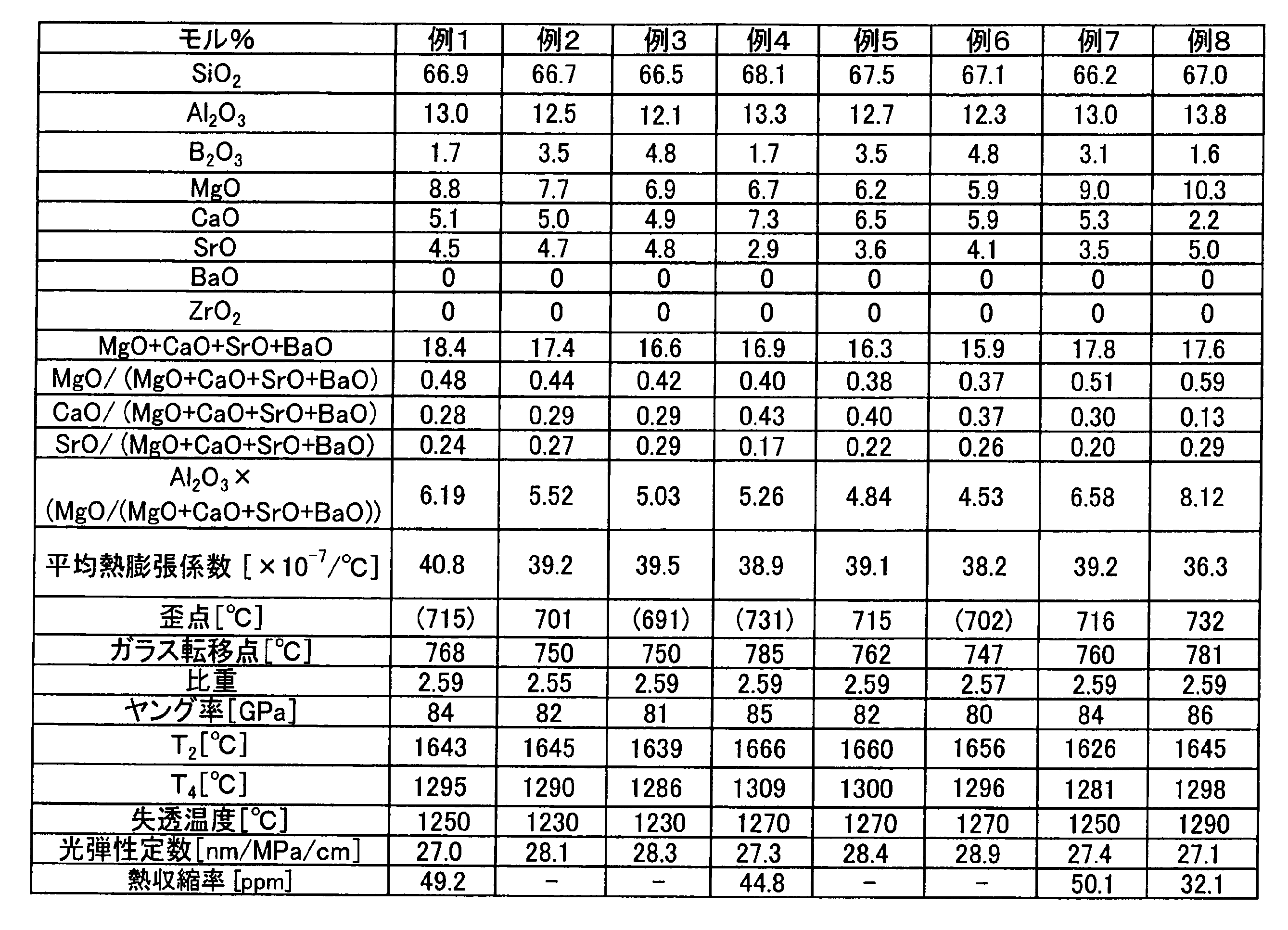
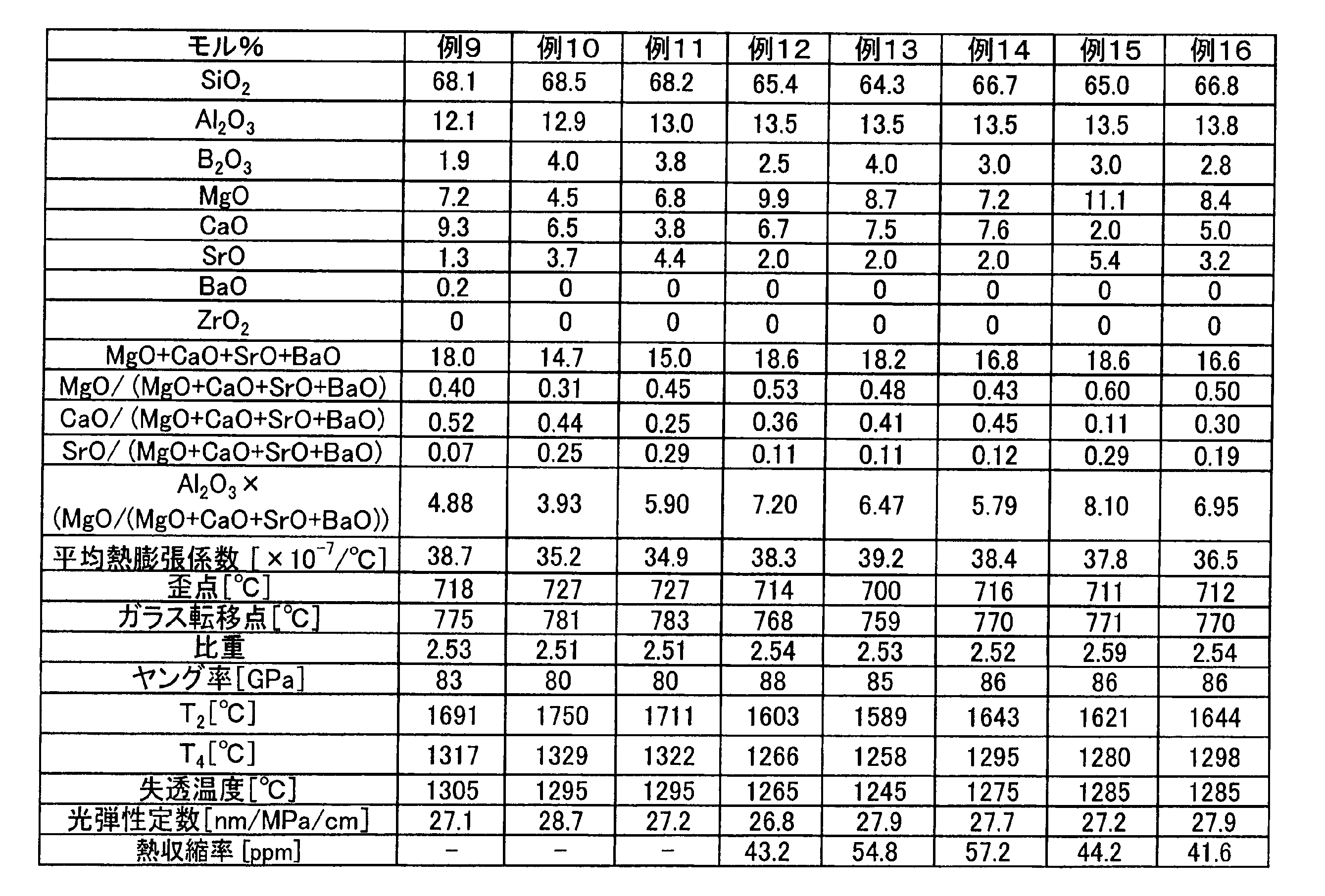
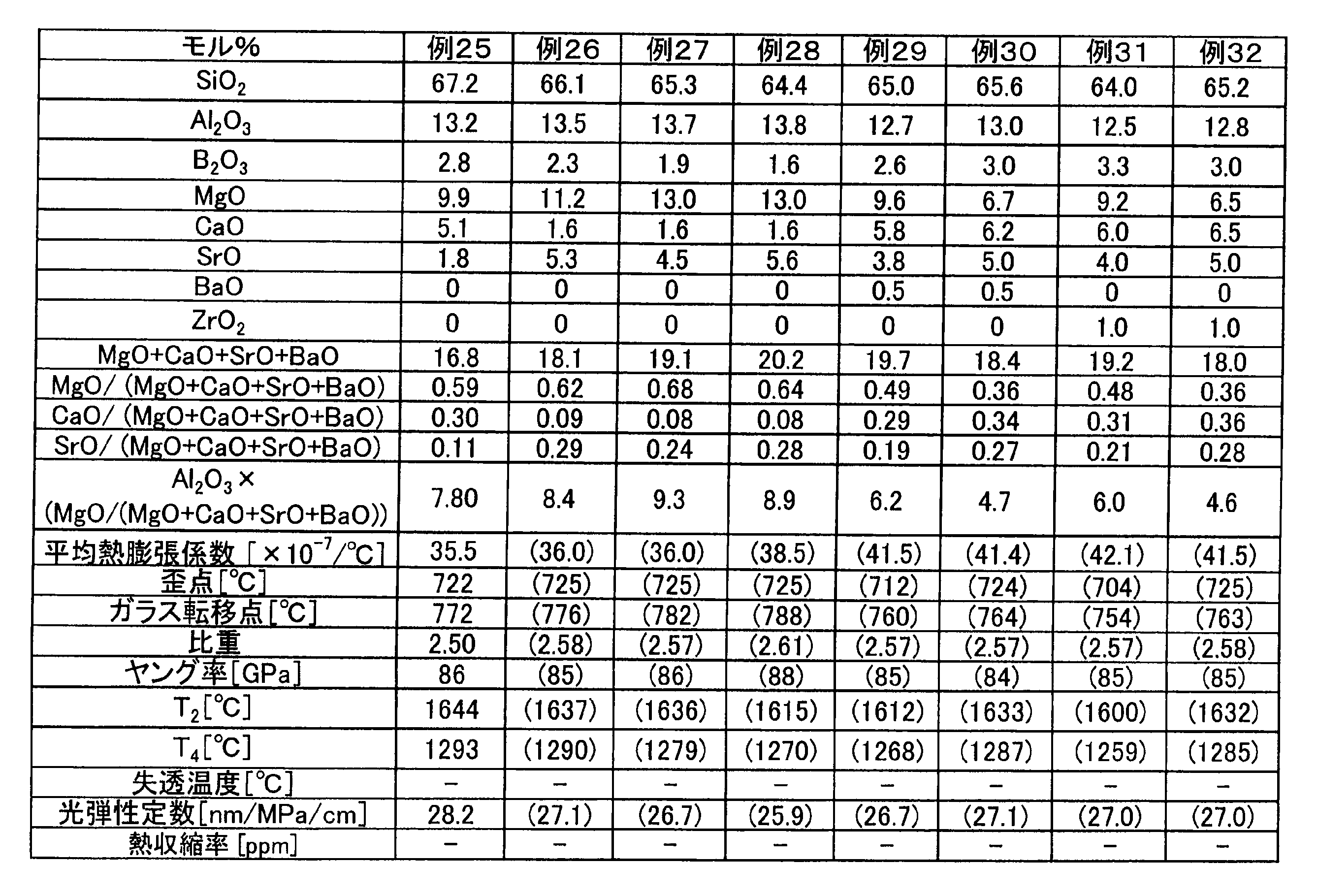
- Examples 1 to 8, Examples 12 to 32 are Examples, and Examples 9 to 11 are Comparative Examples.
- the raw materials of each component were prepared so as to have a target composition, and were melted at a temperature of 1550 to 1650 ° C. using a platinum crucible.
- the particle size of silica sand in the raw material was median particle size D 50 of 26 ⁇ m, the proportion of particles having a particle size of 2 ⁇ m or less was less than 0.1 volume%, and the proportion of particles having a particle diameter of 100 ⁇ m or more was less than 0.1 volume%.
- the mixture was stirred using a platinum stirrer to homogenize the glass. Subsequently, the molten glass was poured out, formed into a plate shape, and then slowly cooled.
- Tables 1 to 4 show the glass composition (unit: mol%), the coefficient of thermal expansion at 50 to 350 ° C. (unit: ⁇ 10 ⁇ 7 / ° C.), the strain point (unit: ° C.), and the glass transition point (unit: ° C.).
- the sample is held at a temperature of glass transition point + 100 ° C. for 10 minutes and then cooled to room temperature at 40 ° C. per minute. Here, the total length of the sample is measured. Then, it heats to 600 degreeC at 100 degreeC / min, hold
- the ratio between the amount of shrinkage of the sample before and after heat treatment at 600 ° C. and the total length of the sample before heat treatment at 600 ° C. was defined as the heat shrinkage rate.
- Tables 1 to 4 the values shown in parentheses are calculated values.
- the thermal expansion coefficient is as low as 30 ⁇ 10 ⁇ 7 to 43 ⁇ 10 ⁇ 7 / ° C., and the temperature T 2 at which the glass viscosity becomes 10 2 dPa ⁇ s is 1710 ° C. Since the temperature T 4 at which the glass viscosity is 10 4 dPa ⁇ s is less than 1310 ° C., the glass has excellent solubility and is located in the float bath and on the downstream side of the float bath. It has little effect on the life of the metal member and the heater used in the part that enters the annealing furnace from the float bath outlet.
- the devitrification temperature is 1310 ° C. or less, and it is considered that there is no trouble such as the generation of devitrification during float forming.
- the alkali-free glass of the present invention has a high strain point and can be formed by a float process, and is suitable for uses such as a display substrate and a photomask substrate. Moreover, it is suitable also for uses, such as a substrate for information recording media and a substrate for solar cells.
Landscapes
- Chemical & Material Sciences (AREA)
- Life Sciences & Earth Sciences (AREA)
- Engineering & Computer Science (AREA)
- Chemical Kinetics & Catalysis (AREA)
- General Chemical & Material Sciences (AREA)
- Geochemistry & Mineralogy (AREA)
- Materials Engineering (AREA)
- Organic Chemistry (AREA)
- Glass Compositions (AREA)
Abstract
Description
(1)アルカリ金属酸化物を含有していると、アルカリ金属イオンが薄膜中に拡散して膜特性を劣化させるため、実質的にアルカリ金属イオンを含まないこと。
(2)薄膜形成工程で高温にさらされる際に、ガラスの変形およびガラスの構造安定化に伴う収縮(熱収縮)を最小限に抑えうるように、歪点が高いこと。
(4)内部および表面に欠点(泡、脈理、インクルージョン、ピット、キズ等)がないこと。
(5)ディスプレイの軽量化が要求され、ガラス自身も密度の小さいガラスが望まれる。
(6)ディスプレイの軽量化が要求され、基板ガラスの薄板化が望まれる。
(8)液晶ディスプレイ作製熱処理の昇降温速度を速くして、生産性を上げたり耐熱衝撃性を上げるために、ガラスの平均熱膨張係数の小さいガラスが求められる。
一方、ガラス製造プロセス、特にフロート成形における要請から、ガラスの粘性、特にガラス粘度が104dPa・sとなる温度T4と失透温度を低くすること、さらに歪点を過度に上げ過ぎないことが求められている。
しかしながら、歪点が高過ぎると、ガラス製造時に以下の点が問題となる。
・フロートバス内及びフロートバス出口の温度が高くなり、フロートバス内及びフロートバス下流側に位置する金属部材の寿命に影響を及ぼす場合がある。
・ガラスの平面歪が改善するため、フロートバス出口から徐冷炉に入る部分で温度を高くする必要があるが、この際の温度が高すぎると加熱に使用するヒータに負荷がかかり、ヒータの寿命に影響を及ぼす場合がある。
また、耐BHF性に対する要求が弱くなってきているが、完全になくなったわけではなく、B2O3を0とした組成では、BHFによる処理後にヘイズの問題が顕在化する。
SiO2 63~74、
Al2O3 11.5~16、
B2O3 1.5超5以下、
MgO 5.5~13、
CaO 1.5~12、
SrO 1.5~9、
BaO 0~1、
ZrO2 0~2を含有し
MgO+CaO+SrO+BaO が15.5~21であり、
MgO/(MgO+CaO+SrO+BaO)が0.35以上であり、
CaO/(MgO+CaO+SrO+BaO)が0.50以下であり、
SrO/(MgO+CaO+SrO+BaO)が0.50以下である、無アルカリガラスを提供する。
SiO2 63~74、
Al2O3 11.5~14、
B2O3 1.5超5以下、
MgO 5.5~13、
CaO 1.5~12、
SrO 1.5~9、
BaO 0~1、
ZrO2 0~2を含有し
MgO+CaO+SrO+BaO が15.5~21であり、
MgO/(MgO+CaO+SrO+BaO)が0.35以上であり、
CaO/(MgO+CaO+SrO+BaO)が0.50以下であり、
SrO/(MgO+CaO+SrO+BaO)が0.30以下である、無アルカリガラスを提供する。
MgO/(MgO+CaO+SrO+BaO)が0.35以上であり、0.37以上が好ましく、0.4以上がより好ましい。
CaO/(MgO+CaO+SrO+BaO)が0.50以下であり、0.48以下が好ましく、0.45以下がより好ましい。
SrO/(MgO+CaO+SrO+BaO)が0.50以下であり、0.40以下が好ましく、0.30以下がより好ましく、0.27以下がより好ましく、0.25以下がさらに好ましい。
本発明の無アルカリガラスは、歪点が680℃以上であるため、パネル製造時の熱収縮を抑えられる。また、p-Si TFTの製造方法としてレーザーアニールによる方法を適用することができる。685℃以上がより好ましく、690℃以上がさらに好ましい。
本発明の無アルカリガラスは、歪点が680℃以上であるため、高歪点用途(例えば、板厚0.7mm以下、好ましくは0.5mm以下、より好ましくは0.3mm以下の有機EL用のディスプレイ用基板または照明用基板、あるいは板厚0.3mm以下、好ましくは0.1mm以下の薄板のディスプレイ用基板または照明用基板)に適している。
板厚0.7mm以下、さらには0.5mm以下、さらには0.3mm以下、さらには0.1mm以下の板ガラスの成形では、成形時の引き出し速度が速くなる傾向があるため、ガラスの仮想温度が上昇し、ガラスのコンパクションが増大しやすい。この場合、高歪点ガラスであると、コンパクションを抑制することができる。
一方、歪点が735℃以下であるため、フロートバス内及びフロートバス出口の温度をあまり高くする必要が無く、フロートバス内及びフロートバス下流側に位置する金属部材の寿命に影響を及ぼすことが少ない。725℃以下がより好ましく、715℃以下がさらに好ましく、710℃以下が特に好ましい。
また、ガラスの平面歪が改善するため、フロートバス出口から徐冷炉に入る部分で温度を高くする必要があるが、この際の温度をあまり高くする必要がない。このため、加熱に使用するヒータに負荷がかかることがなく、ヒータの寿命に影響を及ぼすことが少ない。
また、本発明の無アルカリガラスは失透温度が、1315℃以下であることがフロート法による成形が容易となることから好ましい。好ましくは1300℃以下、1300℃未満、1290℃以下、より好ましくは1280℃以下である。また、フロート成形性やフュージョン成形性の目安となる温度T4(ガラス粘度ηが104ポイズとなる温度、単位:℃)と失透温度との差(T4-失透温度)は、好ましくは-20℃以上、-10℃以上、さらには0℃以上、より好ましくは10℃以上、さらに好ましくは20℃以上、特に好ましくは30℃以上である。
本明細書における失透温度は、白金製の皿に粉砕されたガラス粒子を入れ、一定温度に制御された電気炉中で17時間熱処理を行い、熱処理後の光学顕微鏡観察によって、ガラスの表面及び内部に結晶が析出する最高温度と結晶が析出しない最低温度との平均値である。
液晶ディスプレイパネル製造工程や液晶ディスプレイ装置使用時に発生した応力によってガラス基板が複屈折性を有することにより、黒の表示がグレーになり、液晶ディスプレイのコントラストが低下する現象が認められることがある。光弾性定数を31nm/MPa/cm以下とすることにより、この現象を小さく抑えることができる。好ましくは30nm/MPa/cm以下、より好ましくは29nm/MPa/cm以下、さらに好ましくは28.5nm/MPa/cm以下、特に好ましくは28nm/MPa/cm以下である。
また、本発明の無アルカリガラスは、他の物性確保の容易性を考慮すると、光弾性定数が好ましくは23nm/MPa/cm以上、より好ましくは25nm/MPa/cm以上である。
なお、光弾性定数は円盤圧縮法により測定波長546nmにて測定できる。
本発明のガラスは、比較的溶解性が低いため、各成分の原料として下記を用いることが好ましい。
SiO2原料の珪素源としては珪砂を用いることができるが、メディアン粒径D50が20μm~27μm、粒径2μm以下の粒子の割合が0.3体積%以下、かつ粒径100μm以上の粒子の割合が2.5体積%以下の珪砂を用いることが、珪砂の凝集を抑えて溶融させることができるので、珪砂の溶融が容易になり、泡が少なく、均質性、平坦度が高い無アルカリガラスが得られることから好ましい。
また、本明細書における「メディアン粒径D50」とは、レーザー回折法によって計測された粉体の粒度分布において、ある粒径より大きい粒子の体積頻度が、全粉体のそれの50%を占める粒子径をいう。言い換えると、レーザー回折法によって計測された粉体の粒度分布において、累積頻度が50%のときの粒子径をいう。
また、本明細書における「粒径2μm以下の粒子の割合」及び「粒径100μm以上の粒子の割合」は、例えば、レーザー回折/散乱法によって粒度分布を計測することにより測定される。
また、珪砂における粒径100μm以上の粒子の割合は、0%であることが珪砂の溶融がより容易になるので特に好ましい。
アルカリ土類金属源としては、アルカリ土類金属化合物を用いることができる。ここでアルカリ土類金属化合物の具体例としては、MgCO3、CaCO3、BaCO3、SrCO3、(Mg,Ca)CO3(ドロマイト)等の炭酸塩や、MgO、CaO、BaO、SrO等の酸化物や、Mg(OH)2、Ca(OH)2、Ba(OH)2、Sr(OH)2等の水酸化物を例示できるが、アルカリ土類金属源の一部または全部にアルカリ土類金属の水酸化物を含有させることが、ガラス原料の融解時のSiO2成分の未融解量が低下するので好ましい。珪砂中に含まれるSiO2成分の未融解量が増大すると、この未融解のSiO2が、ガラス融液中に泡が発生した際にこの泡に取り込まれてガラス融液の表層近くに集まる。これにより、ガラス融液の表層と表層以外の部分との間においてSiO2の組成比に差が生じて、ガラスの均質性が低下するとともに平坦性も低下する。
アルカリ土類金属源中の水酸化物のモル比が増加するにつれて、ガラス原料の融解時のSiO2成分の未融解量が低下するので、上記水酸化物のモル比は高ければ高いほどよい。
無アルカリガラスがB2O3を含有する場合、B2O3のホウ素源としては、ホウ素化合物を用いることができる。ここでホウ素化合物の具体例としては、オルトホウ酸(H3BO3)、メタホウ酸(HBO2)、四ホウ酸(H2B4O7)、無水ホウ酸(B2O3)等が挙げられる。通常の無アルカリガラスの製造においては、安価で、入手しやすい点から、オルトホウ酸が用いられる。
無水ホウ酸以外のホウ素化合物としては、安価で、入手しやすい点から、オルトホウ酸が好ましい。
なお、表1~4中、括弧書で示した値は計算値である。

本出願は、2012年6月5日出願の日本特許出願2012-128248、及び2012年11月2日出願の日本特許出願2012-242783に基づくものであり、その内容はここに参照として取り込まれる。
Claims (3)
- 歪点が680~735℃であって、50~350℃での平均熱膨張係数が30×10-7~43×10-7/℃であって、ガラス粘度が102dPa・sとなる温度T2が1710℃以下であって、ガラス粘度が104dPa・sとなる温度T4が1310℃以下であって、酸化物基準のモル%表示で
SiO2 63~74、
Al2O3 11.5~16、
B2O3 1.5超5以下、
MgO 5.5~13、
CaO 1.5~12、
SrO 1.5~9、
BaO 0~1、
ZrO2 0~2を含有し
MgO+CaO+SrO+BaO が15.5~21であり、
MgO/(MgO+CaO+SrO+BaO)が0.35以上であり、
CaO/(MgO+CaO+SrO+BaO)が0.50以下であり、
SrO/(MgO+CaO+SrO+BaO)が0.50以下である、無アルカリガラス。 - 歪点が680~735℃であって、50~350℃での平均熱膨張係数が30×10-7~43×10-7/℃であって、ガラス粘度が102dPa・sとなる温度T2が1710℃以下であって、ガラス粘度が104dPa・sとなる温度T4が1310℃以下であって、酸化物基準のモル%表示で
SiO2 63~74、
Al2O3 11.5~14、
B2O3 1.5超5以下、
MgO 5.5~13、
CaO 1.5~12、
SrO 1.5~9、
BaO 0~1、
ZrO2 0~2を含有し
MgO+CaO+SrO+BaO が15.5~21であり、
MgO/(MgO+CaO+SrO+BaO)が0.35以上であり、
CaO/(MgO+CaO+SrO+BaO)が0.50以下であり、
SrO/(MgO+CaO+SrO+BaO)が0.30以下である、無アルカリガラス。 - 失透温度が1315℃以下である請求項1または2に記載の無アルカリガラス。
Priority Applications (8)
| Application Number | Priority Date | Filing Date | Title |
|---|---|---|---|
| EP13801109.3A EP2857366A1 (en) | 2012-06-05 | 2013-06-04 | Alkali-free glass and method for producing same |
| JP2014519998A JP6107823B2 (ja) | 2012-06-05 | 2013-06-04 | 無アルカリガラスおよびその製造方法 |
| KR20147034147A KR20150029633A (ko) | 2012-06-05 | 2013-06-04 | 무알칼리 유리 및 그 제조 방법 |
| KR1020197038668A KR20200003272A (ko) | 2012-06-05 | 2013-06-04 | 무알칼리 유리 및 그 제조 방법 |
| CN201380029520.9A CN104364214B (zh) | 2012-06-05 | 2013-06-04 | 无碱玻璃及其制造方法 |
| KR1020227019914A KR102618754B1 (ko) | 2012-06-05 | 2013-06-04 | 무알칼리 유리 및 그 제조 방법 |
| KR1020217023147A KR102410236B1 (ko) | 2012-06-05 | 2013-06-04 | 무알칼리 유리 및 그 제조 방법 |
| US14/561,399 US20150087495A1 (en) | 2012-06-05 | 2014-12-05 | Alkali-free glass and method for producing same |
Applications Claiming Priority (4)
| Application Number | Priority Date | Filing Date | Title |
|---|---|---|---|
| JP2012-128248 | 2012-06-05 | ||
| JP2012128248 | 2012-06-05 | ||
| JP2012-242783 | 2012-11-02 | ||
| JP2012242783 | 2012-11-02 |
Related Child Applications (1)
| Application Number | Title | Priority Date | Filing Date |
|---|---|---|---|
| US14/561,399 Continuation US20150087495A1 (en) | 2012-06-05 | 2014-12-05 | Alkali-free glass and method for producing same |
Publications (1)
| Publication Number | Publication Date |
|---|---|
| WO2013183626A1 true WO2013183626A1 (ja) | 2013-12-12 |
Family
ID=49712017
Family Applications (1)
| Application Number | Title | Priority Date | Filing Date |
|---|---|---|---|
| PCT/JP2013/065451 Ceased WO2013183626A1 (ja) | 2012-06-05 | 2013-06-04 | 無アルカリガラスおよびその製造方法 |
Country Status (7)
| Country | Link |
|---|---|
| US (1) | US20150087495A1 (ja) |
| EP (1) | EP2857366A1 (ja) |
| JP (1) | JP6107823B2 (ja) |
| KR (4) | KR20150029633A (ja) |
| CN (1) | CN104364214B (ja) |
| TW (1) | TWI613173B (ja) |
| WO (1) | WO2013183626A1 (ja) |
Cited By (17)
| Publication number | Priority date | Publication date | Assignee | Title |
|---|---|---|---|---|
| KR20160010350A (ko) * | 2014-07-18 | 2016-01-27 | 아사히 가라스 가부시키가이샤 | 무알칼리 유리 |
| KR20180136443A (ko) | 2016-04-27 | 2018-12-24 | 에이지씨 가부시키가이샤 | 무알칼리 유리 |
| JPWO2017204224A1 (ja) * | 2016-05-27 | 2019-03-28 | Agc株式会社 | 磁気記録媒体用ガラス、磁気記録媒体用ガラス基板および磁気ディスク |
| WO2019177069A1 (ja) * | 2018-03-14 | 2019-09-19 | Agc株式会社 | 無アルカリガラス |
| WO2019177070A1 (ja) * | 2018-03-14 | 2019-09-19 | Agc株式会社 | ガラス |
| TWI702196B (zh) * | 2014-10-23 | 2020-08-21 | 日商Agc股份有限公司 | 無鹼玻璃 |
| JP2020172423A (ja) * | 2018-10-15 | 2020-10-22 | 日本電気硝子株式会社 | 無アルカリガラス板 |
| KR20210049943A (ko) * | 2018-09-25 | 2021-05-06 | 코닝 인코포레이티드 | 치수적으로 안정한 유리 |
| JPWO2021117897A1 (ja) * | 2019-12-13 | 2021-06-17 | ||
| JP2021130604A (ja) * | 2014-11-28 | 2021-09-09 | Agc株式会社 | 液晶ディスプレイパネル |
| KR20210119419A (ko) | 2019-02-07 | 2021-10-05 | 에이지씨 가부시키가이샤 | 무알칼리 유리 |
| KR20210121074A (ko) | 2019-02-07 | 2021-10-07 | 에이지씨 가부시키가이샤 | 무알칼리 유리 |
| KR20210124242A (ko) | 2019-02-07 | 2021-10-14 | 에이지씨 가부시키가이샤 | 무알칼리 유리 |
| US20210380469A1 (en) * | 2018-10-17 | 2021-12-09 | Nippon Electric Glass Co., Ltd. | Alkali-free glass plate |
| JPWO2021261445A1 (ja) * | 2020-06-23 | 2021-12-30 | ||
| US11718553B2 (en) | 2019-03-19 | 2023-08-08 | AGC Inc. | Alkali-free glass substrate |
| WO2025134864A1 (ja) * | 2023-12-21 | 2025-06-26 | 日本電気硝子株式会社 | 無アルカリガラス板 |
Families Citing this family (9)
| Publication number | Priority date | Publication date | Assignee | Title |
|---|---|---|---|---|
| KR102077212B1 (ko) * | 2012-12-05 | 2020-02-13 | 에이지씨 가부시키가이샤 | 무알칼리 유리 기판 |
| WO2014175215A1 (ja) | 2013-04-23 | 2014-10-30 | 旭硝子株式会社 | 無アルカリガラス基板およびその製造方法 |
| CN113045197A (zh) * | 2015-04-03 | 2021-06-29 | 日本电气硝子株式会社 | 玻璃 |
| JP6673354B2 (ja) | 2015-07-03 | 2020-03-25 | Agc株式会社 | キャリア基板、積層体、電子デバイスの製造方法 |
| JP6315011B2 (ja) * | 2016-03-15 | 2018-04-25 | 旭硝子株式会社 | 無アルカリガラス基板、および無アルカリガラス基板の製造方法 |
| CN109153596A (zh) * | 2016-05-25 | 2019-01-04 | Agc株式会社 | 无碱玻璃基板、层叠基板和玻璃基板的制造方法 |
| JP6983377B2 (ja) * | 2016-12-19 | 2021-12-17 | 日本電気硝子株式会社 | ガラス |
| WO2018116731A1 (ja) * | 2016-12-19 | 2018-06-28 | 日本電気硝子株式会社 | ガラス |
| JP7698241B2 (ja) * | 2020-06-02 | 2025-06-25 | 日本電気硝子株式会社 | 磁気記録媒体用ガラスディスク及びそれを用いた磁気記録装置 |
Citations (7)
| Publication number | Priority date | Publication date | Assignee | Title |
|---|---|---|---|---|
| JPH04325435A (ja) | 1991-04-26 | 1992-11-13 | Asahi Glass Co Ltd | 無アルカリガラス |
| JPH05232458A (ja) | 1991-08-12 | 1993-09-10 | Corning Inc | フラットパネルディスプレー装置 |
| JPH09263421A (ja) | 1996-03-28 | 1997-10-07 | Asahi Glass Co Ltd | 無アルカリガラスおよびフラットディスプレイパネル |
| JP2001348247A (ja) * | 2000-05-31 | 2001-12-18 | Asahi Glass Co Ltd | 無アルカリガラス |
| JP2005330176A (ja) * | 2003-12-26 | 2005-12-02 | Asahi Glass Co Ltd | 無アルカリガラスおよび液晶ディスプレイパネル |
| JP2009286689A (ja) * | 2008-05-30 | 2009-12-10 | Corning Inc | ボロアルミノシリケートガラス |
| WO2011001920A1 (ja) * | 2009-07-02 | 2011-01-06 | 旭硝子株式会社 | 無アルカリガラスおよびその製造方法 |
Family Cites Families (2)
| Publication number | Priority date | Publication date | Assignee | Title |
|---|---|---|---|---|
| JP2002003240A (ja) * | 2000-06-19 | 2002-01-09 | Nippon Electric Glass Co Ltd | 液晶ディスプレイ用ガラス基板 |
| DE10114581C2 (de) * | 2001-03-24 | 2003-03-27 | Schott Glas | Alkalifreies Aluminoborosilicatglas und Verwendungen |
-
2013
- 2013-06-04 EP EP13801109.3A patent/EP2857366A1/en not_active Withdrawn
- 2013-06-04 JP JP2014519998A patent/JP6107823B2/ja active Active
- 2013-06-04 CN CN201380029520.9A patent/CN104364214B/zh active Active
- 2013-06-04 KR KR20147034147A patent/KR20150029633A/ko not_active Ceased
- 2013-06-04 KR KR1020197038668A patent/KR20200003272A/ko not_active Ceased
- 2013-06-04 WO PCT/JP2013/065451 patent/WO2013183626A1/ja not_active Ceased
- 2013-06-04 KR KR1020217023147A patent/KR102410236B1/ko active Active
- 2013-06-04 KR KR1020227019914A patent/KR102618754B1/ko active Active
- 2013-06-05 TW TW102119993A patent/TWI613173B/zh active
-
2014
- 2014-12-05 US US14/561,399 patent/US20150087495A1/en not_active Abandoned
Patent Citations (7)
| Publication number | Priority date | Publication date | Assignee | Title |
|---|---|---|---|---|
| JPH04325435A (ja) | 1991-04-26 | 1992-11-13 | Asahi Glass Co Ltd | 無アルカリガラス |
| JPH05232458A (ja) | 1991-08-12 | 1993-09-10 | Corning Inc | フラットパネルディスプレー装置 |
| JPH09263421A (ja) | 1996-03-28 | 1997-10-07 | Asahi Glass Co Ltd | 無アルカリガラスおよびフラットディスプレイパネル |
| JP2001348247A (ja) * | 2000-05-31 | 2001-12-18 | Asahi Glass Co Ltd | 無アルカリガラス |
| JP2005330176A (ja) * | 2003-12-26 | 2005-12-02 | Asahi Glass Co Ltd | 無アルカリガラスおよび液晶ディスプレイパネル |
| JP2009286689A (ja) * | 2008-05-30 | 2009-12-10 | Corning Inc | ボロアルミノシリケートガラス |
| WO2011001920A1 (ja) * | 2009-07-02 | 2011-01-06 | 旭硝子株式会社 | 無アルカリガラスおよびその製造方法 |
Cited By (88)
| Publication number | Priority date | Publication date | Assignee | Title |
|---|---|---|---|---|
| KR20210156824A (ko) * | 2014-07-18 | 2021-12-27 | 에이지씨 가부시키가이샤 | 무알칼리 유리 |
| CN105271722A (zh) * | 2014-07-18 | 2016-01-27 | 旭硝子株式会社 | 无碱玻璃 |
| JP2016029001A (ja) * | 2014-07-18 | 2016-03-03 | 旭硝子株式会社 | 無アルカリガラス |
| KR102345199B1 (ko) * | 2014-07-18 | 2021-12-30 | 에이지씨 가부시키가이샤 | 무알칼리 유리 |
| KR102371999B1 (ko) | 2014-07-18 | 2022-03-08 | 에이지씨 가부시키가이샤 | 무알칼리 유리 |
| KR20160010350A (ko) * | 2014-07-18 | 2016-01-27 | 아사히 가라스 가부시키가이샤 | 무알칼리 유리 |
| CN113135654A (zh) * | 2014-07-18 | 2021-07-20 | Agc株式会社 | 无碱玻璃 |
| JP2019167293A (ja) * | 2014-07-18 | 2019-10-03 | Agc株式会社 | 無アルカリガラス |
| CN110436774A (zh) * | 2014-07-18 | 2019-11-12 | Agc株式会社 | 无碱玻璃 |
| JP2024028521A (ja) * | 2014-10-23 | 2024-03-04 | Agc株式会社 | 無アルカリガラス |
| JP7160139B2 (ja) | 2014-10-23 | 2022-10-25 | Agc株式会社 | 無アルカリガラス |
| JP7673845B2 (ja) | 2014-10-23 | 2025-05-09 | Agc株式会社 | 無アルカリガラス |
| TWI702196B (zh) * | 2014-10-23 | 2020-08-21 | 日商Agc股份有限公司 | 無鹼玻璃 |
| JP2021138612A (ja) * | 2014-10-23 | 2021-09-16 | Agc株式会社 | 無アルカリガラス |
| JP7511116B2 (ja) | 2014-10-23 | 2024-07-05 | Agc株式会社 | 無アルカリガラス |
| JP2022186759A (ja) * | 2014-10-23 | 2022-12-15 | Agc株式会社 | 無アルカリガラス |
| US11586084B2 (en) | 2014-11-28 | 2023-02-21 | AGC Inc. | Liquid crystal display panel |
| JP7188487B2 (ja) | 2014-11-28 | 2022-12-13 | Agc株式会社 | 液晶ディスプレイパネル及び無アルカリガラスの基板 |
| JP7786495B2 (ja) | 2014-11-28 | 2025-12-16 | Agc株式会社 | 液晶ディスプレイパネル及び無アルカリガラスの基板 |
| JP7496051B2 (ja) | 2014-11-28 | 2024-06-06 | Agc株式会社 | 液晶ディスプレイパネル及び無アルカリガラスの基板 |
| JP2021130604A (ja) * | 2014-11-28 | 2021-09-09 | Agc株式会社 | 液晶ディスプレイパネル |
| JP2023036599A (ja) * | 2014-11-28 | 2023-03-14 | Agc株式会社 | 液晶ディスプレイパネル及び無アルカリガラスの基板 |
| JP2024112881A (ja) * | 2014-11-28 | 2024-08-21 | Agc株式会社 | 液晶ディスプレイパネル及び無アルカリガラスの基板 |
| KR20220084427A (ko) | 2016-04-27 | 2022-06-21 | 에이지씨 가부시키가이샤 | 무알칼리 유리 |
| KR20180136443A (ko) | 2016-04-27 | 2018-12-24 | 에이지씨 가부시키가이샤 | 무알칼리 유리 |
| JP7103219B2 (ja) | 2016-05-27 | 2022-07-20 | Agc株式会社 | 磁気記録媒体用ガラス、磁気記録媒体用ガラス基板および磁気ディスク |
| JPWO2017204224A1 (ja) * | 2016-05-27 | 2019-03-28 | Agc株式会社 | 磁気記録媒体用ガラス、磁気記録媒体用ガラス基板および磁気ディスク |
| JP7786540B2 (ja) | 2018-03-14 | 2025-12-16 | Agc株式会社 | ガラス |
| KR102815028B1 (ko) | 2018-03-14 | 2025-06-04 | 에이지씨 가부시키가이샤 | 유리 |
| KR20250095758A (ko) | 2018-03-14 | 2025-06-26 | 에이지씨 가부시키가이샤 | 무알칼리 유리 |
| KR102825089B1 (ko) * | 2018-03-14 | 2025-06-26 | 에이지씨 가부시키가이샤 | 무알칼리 유리 |
| JP7605280B2 (ja) | 2018-03-14 | 2024-12-24 | Agc株式会社 | ガラス |
| US12122713B2 (en) | 2018-03-14 | 2024-10-22 | AGC Inc. | Glass |
| JP7747082B2 (ja) | 2018-03-14 | 2025-10-01 | Agc株式会社 | 無アルカリガラス |
| WO2019177069A1 (ja) * | 2018-03-14 | 2019-09-19 | Agc株式会社 | 無アルカリガラス |
| JP7107361B2 (ja) | 2018-03-14 | 2022-07-27 | Agc株式会社 | 無アルカリガラス |
| US11414339B2 (en) | 2018-03-14 | 2022-08-16 | AGC Inc. | Alkali-free glass |
| JP7136189B2 (ja) | 2018-03-14 | 2022-09-13 | Agc株式会社 | ガラス |
| JP2022159280A (ja) * | 2018-03-14 | 2022-10-17 | Agc株式会社 | 無アルカリガラス |
| KR20240112946A (ko) | 2018-03-14 | 2024-07-19 | 에이지씨 가부시키가이샤 | 유리 |
| JP2022171721A (ja) * | 2018-03-14 | 2022-11-11 | Agc株式会社 | ガラス |
| JP2025023323A (ja) * | 2018-03-14 | 2025-02-14 | Agc株式会社 | ガラス |
| KR20240108544A (ko) | 2018-03-14 | 2024-07-09 | 에이지씨 가부시키가이샤 | 무알칼리 유리 |
| JPWO2019177069A1 (ja) * | 2018-03-14 | 2021-03-25 | Agc株式会社 | 無アルカリガラス |
| JPWO2019177070A1 (ja) * | 2018-03-14 | 2021-02-25 | Agc株式会社 | ガラス |
| KR20250083239A (ko) | 2018-03-14 | 2025-06-09 | 에이지씨 가부시키가이샤 | 유리 |
| WO2019177070A1 (ja) * | 2018-03-14 | 2019-09-19 | Agc株式会社 | ガラス |
| KR102680019B1 (ko) * | 2018-03-14 | 2024-07-02 | 에이지씨 가부시키가이샤 | 무알칼리 유리 |
| KR20200132866A (ko) | 2018-03-14 | 2020-11-25 | 에이지씨 가부시키가이샤 | 무알칼리 유리 |
| JP7396413B2 (ja) | 2018-03-14 | 2023-12-12 | Agc株式会社 | ガラス |
| JP2024009237A (ja) * | 2018-03-14 | 2024-01-19 | Agc株式会社 | ガラス |
| US11897812B2 (en) | 2018-03-14 | 2024-02-13 | AGC Inc. | Alkali-free glass |
| JP2024028446A (ja) * | 2018-03-14 | 2024-03-04 | Agc株式会社 | 無アルカリガラス |
| KR20200132865A (ko) | 2018-03-14 | 2020-11-25 | 에이지씨 가부시키가이샤 | 유리 |
| JP7452582B2 (ja) | 2018-03-14 | 2024-03-19 | Agc株式会社 | 無アルカリガラス |
| KR20210049943A (ko) * | 2018-09-25 | 2021-05-06 | 코닝 인코포레이티드 | 치수적으로 안정한 유리 |
| KR102801860B1 (ko) * | 2018-09-25 | 2025-05-02 | 코닝 인코포레이티드 | 치수적으로 안정한 유리 |
| JP7389400B2 (ja) | 2018-10-15 | 2023-11-30 | 日本電気硝子株式会社 | 無アルカリガラス板 |
| JP2020172423A (ja) * | 2018-10-15 | 2020-10-22 | 日本電気硝子株式会社 | 無アルカリガラス板 |
| KR102806643B1 (ko) | 2018-10-15 | 2025-05-13 | 니폰 덴키 가라스 가부시키가이샤 | 무알칼리 유리판 |
| US20210380465A1 (en) * | 2018-10-15 | 2021-12-09 | Nippon Electric Glass Co., Ltd. | Alkali-free glass plate |
| KR20210073560A (ko) * | 2018-10-15 | 2021-06-18 | 니폰 덴키 가라스 가부시키가이샤 | 무알칼리 유리판 |
| US12441653B2 (en) | 2018-10-15 | 2025-10-14 | Nippon Electric Glass Co., Ltd. | Alkali-free glass plate |
| JP2024074996A (ja) * | 2018-10-17 | 2024-05-31 | 日本電気硝子株式会社 | 無アルカリガラス板 |
| US12122715B2 (en) * | 2018-10-17 | 2024-10-22 | Nippon Electric Glass Co., Ltd. | Alkali-free glass plate |
| JP7712605B2 (ja) | 2018-10-17 | 2025-07-24 | 日本電気硝子株式会社 | 無アルカリガラス板 |
| US20210380469A1 (en) * | 2018-10-17 | 2021-12-09 | Nippon Electric Glass Co., Ltd. | Alkali-free glass plate |
| KR20210119419A (ko) | 2019-02-07 | 2021-10-05 | 에이지씨 가부시키가이샤 | 무알칼리 유리 |
| JPWO2020162605A1 (ja) * | 2019-02-07 | 2021-12-09 | Agc株式会社 | 無アルカリガラス |
| JP7593109B2 (ja) | 2019-02-07 | 2024-12-03 | Agc株式会社 | 無アルカリガラス |
| US12540096B2 (en) | 2019-02-07 | 2026-02-03 | AGC Inc. | Alkali-free glass |
| US12448320B2 (en) | 2019-02-07 | 2025-10-21 | AGC Inc. | Alkali-free glass |
| US12448319B2 (en) | 2019-02-07 | 2025-10-21 | AGC Inc. | Alkali-free glass |
| KR20210121074A (ko) | 2019-02-07 | 2021-10-07 | 에이지씨 가부시키가이샤 | 무알칼리 유리 |
| KR20250084982A (ko) | 2019-02-07 | 2025-06-11 | 에이지씨 가부시키가이샤 | 무알칼리 유리 |
| KR20210124242A (ko) | 2019-02-07 | 2021-10-14 | 에이지씨 가부시키가이샤 | 무알칼리 유리 |
| US11718553B2 (en) | 2019-03-19 | 2023-08-08 | AGC Inc. | Alkali-free glass substrate |
| JP7621437B2 (ja) | 2019-12-13 | 2025-01-24 | Hoya株式会社 | 磁気記録媒体基板用または磁気記録再生装置用ガラススペーサ用のガラス、磁気記録媒体基板、磁気記録媒体、磁気記録再生装置用ガラススペーサおよび磁気記録再生装置 |
| JP7383050B2 (ja) | 2019-12-13 | 2023-11-17 | Hoya株式会社 | 磁気記録媒体基板用または磁気記録再生装置用ガラススペーサ用のガラス、磁気記録媒体基板、磁気記録媒体、磁気記録再生装置用ガラススペーサおよび磁気記録再生装置 |
| JP2023166439A (ja) * | 2019-12-13 | 2023-11-21 | Hoya株式会社 | 磁気記録媒体基板用または磁気記録再生装置用ガラススペーサ用のガラス、磁気記録媒体基板、磁気記録媒体、磁気記録再生装置用ガラススペーサおよび磁気記録再生装置 |
| US12473225B2 (en) | 2019-12-13 | 2025-11-18 | Hoya Corporation | Glass for magnetic recording medium substrate or for glass spacer to be used in magnetic recording/reproducing device, magnetic recording medium substrate, magnetic recording medium, and magnetic recording/reproducing apparatus |
| WO2021117897A1 (ja) * | 2019-12-13 | 2021-06-17 | Hoya株式会社 | 磁気記録媒体基板用または磁気記録再生装置用ガラススペーサ用のガラス、磁気記録媒体基板、磁気記録媒体、磁気記録再生装置用ガラススペーサおよび磁気記録再生装置 |
| JPWO2021117897A1 (ja) * | 2019-12-13 | 2021-06-17 | ||
| US11999652B2 (en) | 2019-12-13 | 2024-06-04 | Hoya Corporation | Glass for magnetic recording medium substrate or for glass spacer to be used in magnetic recording/reproducing device, magnetic recording medium substrate, magnetic recording medium, glass spacer to be used in magnetic recording/reproducing device, and magnetic recording/reproducing device |
| JPWO2021261445A1 (ja) * | 2020-06-23 | 2021-12-30 | ||
| WO2021261445A1 (ja) * | 2020-06-23 | 2021-12-30 | 日本電気硝子株式会社 | 無アルカリガラス板 |
| JP7820705B2 (ja) | 2020-06-23 | 2026-02-26 | 日本電気硝子株式会社 | 無アルカリガラス板 |
| WO2025134864A1 (ja) * | 2023-12-21 | 2025-06-26 | 日本電気硝子株式会社 | 無アルカリガラス板 |
Also Published As
| Publication number | Publication date |
|---|---|
| KR102410236B1 (ko) | 2022-06-22 |
| JP6107823B2 (ja) | 2017-04-05 |
| TW201404755A (zh) | 2014-02-01 |
| US20150087495A1 (en) | 2015-03-26 |
| JPWO2013183626A1 (ja) | 2016-02-01 |
| KR20150029633A (ko) | 2015-03-18 |
| TWI613173B (zh) | 2018-02-01 |
| CN104364214A (zh) | 2015-02-18 |
| KR102618754B1 (ko) | 2023-12-29 |
| KR20210095223A (ko) | 2021-07-30 |
| KR20220086705A (ko) | 2022-06-23 |
| EP2857366A1 (en) | 2015-04-08 |
| CN104364214B (zh) | 2017-04-26 |
| KR20200003272A (ko) | 2020-01-08 |
Similar Documents
| Publication | Publication Date | Title |
|---|---|---|
| JP6107823B2 (ja) | 無アルカリガラスおよびその製造方法 | |
| JP5702888B2 (ja) | 無アルカリガラスおよびその製造方法 | |
| US8431503B2 (en) | Alkali-free glass and method for producing same | |
| JP5849965B2 (ja) | 無アルカリガラスおよび無アルカリガラスの製造方法 | |
| JP6578774B2 (ja) | 無アルカリガラス | |
| JP6187475B2 (ja) | 無アルカリガラス基板 | |
| JP5817737B2 (ja) | 無アルカリガラスおよび無アルカリガラスの製造方法 | |
| WO2013172307A1 (ja) | 板ガラスの製造方法 | |
| WO2015030013A1 (ja) | 無アルカリガラス | |
| JP2017007870A (ja) | 板ガラスの製造方法 |
Legal Events
| Date | Code | Title | Description |
|---|---|---|---|
| 121 | Ep: the epo has been informed by wipo that ep was designated in this application |
Ref document number: 13801109 Country of ref document: EP Kind code of ref document: A1 |
|
| ENP | Entry into the national phase |
Ref document number: 2014519998 Country of ref document: JP Kind code of ref document: A |
|
| ENP | Entry into the national phase |
Ref document number: 20147034147 Country of ref document: KR Kind code of ref document: A |
|
| NENP | Non-entry into the national phase |
Ref country code: DE |
|
| WWE | Wipo information: entry into national phase |
Ref document number: 2013801109 Country of ref document: EP |