WO2013187385A1 - 糖液の製造方法 - Google Patents
糖液の製造方法 Download PDFInfo
- Publication number
- WO2013187385A1 WO2013187385A1 PCT/JP2013/066014 JP2013066014W WO2013187385A1 WO 2013187385 A1 WO2013187385 A1 WO 2013187385A1 JP 2013066014 W JP2013066014 W JP 2013066014W WO 2013187385 A1 WO2013187385 A1 WO 2013187385A1
- Authority
- WO
- WIPO (PCT)
- Prior art keywords
- sulfuric acid
- cellulose
- solution
- membrane
- dilute sulfuric
- Prior art date
- Legal status (The legal status is an assumption and is not a legal conclusion. Google has not performed a legal analysis and makes no representation as to the accuracy of the status listed.)
- Ceased
Links
Classifications
-
- C—CHEMISTRY; METALLURGY
- C12—BIOCHEMISTRY; BEER; SPIRITS; WINE; VINEGAR; MICROBIOLOGY; ENZYMOLOGY; MUTATION OR GENETIC ENGINEERING
- C12P—FERMENTATION OR ENZYME-USING PROCESSES TO SYNTHESISE A DESIRED CHEMICAL COMPOUND OR COMPOSITION OR TO SEPARATE OPTICAL ISOMERS FROM A RACEMIC MIXTURE
- C12P19/00—Preparation of compounds containing saccharide radicals
- C12P19/14—Preparation of compounds containing saccharide radicals produced by the action of a carbohydrase (EC 3.2.x), e.g. by alpha-amylase, e.g. by cellulase, hemicellulase
-
- C—CHEMISTRY; METALLURGY
- C12—BIOCHEMISTRY; BEER; SPIRITS; WINE; VINEGAR; MICROBIOLOGY; ENZYMOLOGY; MUTATION OR GENETIC ENGINEERING
- C12P—FERMENTATION OR ENZYME-USING PROCESSES TO SYNTHESISE A DESIRED CHEMICAL COMPOUND OR COMPOSITION OR TO SEPARATE OPTICAL ISOMERS FROM A RACEMIC MIXTURE
- C12P19/00—Preparation of compounds containing saccharide radicals
- C12P19/02—Monosaccharides
-
- C—CHEMISTRY; METALLURGY
- C12—BIOCHEMISTRY; BEER; SPIRITS; WINE; VINEGAR; MICROBIOLOGY; ENZYMOLOGY; MUTATION OR GENETIC ENGINEERING
- C12P—FERMENTATION OR ENZYME-USING PROCESSES TO SYNTHESISE A DESIRED CHEMICAL COMPOUND OR COMPOSITION OR TO SEPARATE OPTICAL ISOMERS FROM A RACEMIC MIXTURE
- C12P7/00—Preparation of oxygen-containing organic compounds
- C12P7/02—Preparation of oxygen-containing organic compounds containing a hydroxy group
- C12P7/04—Preparation of oxygen-containing organic compounds containing a hydroxy group acyclic
- C12P7/06—Ethanol, i.e. non-beverage
- C12P7/08—Ethanol, i.e. non-beverage produced as by-product or from waste or cellulosic material substrate
- C12P7/10—Ethanol, i.e. non-beverage produced as by-product or from waste or cellulosic material substrate substrate containing cellulosic material
-
- C—CHEMISTRY; METALLURGY
- C12—BIOCHEMISTRY; BEER; SPIRITS; WINE; VINEGAR; MICROBIOLOGY; ENZYMOLOGY; MUTATION OR GENETIC ENGINEERING
- C12P—FERMENTATION OR ENZYME-USING PROCESSES TO SYNTHESISE A DESIRED CHEMICAL COMPOUND OR COMPOSITION OR TO SEPARATE OPTICAL ISOMERS FROM A RACEMIC MIXTURE
- C12P7/00—Preparation of oxygen-containing organic compounds
- C12P7/02—Preparation of oxygen-containing organic compounds containing a hydroxy group
- C12P7/04—Preparation of oxygen-containing organic compounds containing a hydroxy group acyclic
- C12P7/06—Ethanol, i.e. non-beverage
- C12P7/14—Multiple stages of fermentation; Multiple types of microorganisms or re-use of microorganisms
-
- C—CHEMISTRY; METALLURGY
- C12—BIOCHEMISTRY; BEER; SPIRITS; WINE; VINEGAR; MICROBIOLOGY; ENZYMOLOGY; MUTATION OR GENETIC ENGINEERING
- C12P—FERMENTATION OR ENZYME-USING PROCESSES TO SYNTHESISE A DESIRED CHEMICAL COMPOUND OR COMPOSITION OR TO SEPARATE OPTICAL ISOMERS FROM A RACEMIC MIXTURE
- C12P7/00—Preparation of oxygen-containing organic compounds
- C12P7/40—Preparation of oxygen-containing organic compounds containing a carboxyl group including Peroxycarboxylic acids
- C12P7/56—Lactic acid
-
- C—CHEMISTRY; METALLURGY
- C13—SUGAR INDUSTRY
- C13K—SACCHARIDES OBTAINED FROM NATURAL SOURCES OR BY HYDROLYSIS OF NATURALLY OCCURRING DISACCHARIDES, OLIGOSACCHARIDES OR POLYSACCHARIDES
- C13K1/00—Glucose; Glucose-containing syrups
- C13K1/02—Glucose; Glucose-containing syrups obtained by saccharification of cellulosic materials
-
- C—CHEMISTRY; METALLURGY
- C13—SUGAR INDUSTRY
- C13K—SACCHARIDES OBTAINED FROM NATURAL SOURCES OR BY HYDROLYSIS OF NATURALLY OCCURRING DISACCHARIDES, OLIGOSACCHARIDES OR POLYSACCHARIDES
- C13K1/00—Glucose; Glucose-containing syrups
- C13K1/02—Glucose; Glucose-containing syrups obtained by saccharification of cellulosic materials
- C13K1/04—Purifying
-
- C—CHEMISTRY; METALLURGY
- C13—SUGAR INDUSTRY
- C13K—SACCHARIDES OBTAINED FROM NATURAL SOURCES OR BY HYDROLYSIS OF NATURALLY OCCURRING DISACCHARIDES, OLIGOSACCHARIDES OR POLYSACCHARIDES
- C13K13/00—Sugars not otherwise provided for in this class
- C13K13/002—Xylose
-
- C—CHEMISTRY; METALLURGY
- C12—BIOCHEMISTRY; BEER; SPIRITS; WINE; VINEGAR; MICROBIOLOGY; ENZYMOLOGY; MUTATION OR GENETIC ENGINEERING
- C12P—FERMENTATION OR ENZYME-USING PROCESSES TO SYNTHESISE A DESIRED CHEMICAL COMPOUND OR COMPOSITION OR TO SEPARATE OPTICAL ISOMERS FROM A RACEMIC MIXTURE
- C12P2201/00—Pretreatment of cellulosic or lignocellulosic material for subsequent enzymatic treatment or hydrolysis
-
- Y—GENERAL TAGGING OF NEW TECHNOLOGICAL DEVELOPMENTS; GENERAL TAGGING OF CROSS-SECTIONAL TECHNOLOGIES SPANNING OVER SEVERAL SECTIONS OF THE IPC; TECHNICAL SUBJECTS COVERED BY FORMER USPC CROSS-REFERENCE ART COLLECTIONS [XRACs] AND DIGESTS
- Y02—TECHNOLOGIES OR APPLICATIONS FOR MITIGATION OR ADAPTATION AGAINST CLIMATE CHANGE
- Y02E—REDUCTION OF GREENHOUSE GAS [GHG] EMISSIONS, RELATED TO ENERGY GENERATION, TRANSMISSION OR DISTRIBUTION
- Y02E50/00—Technologies for the production of fuel of non-fossil origin
- Y02E50/10—Biofuels, e.g. bio-diesel
Definitions
- the present invention relates to a method for producing a sugar solution including a step of recovering and reusing sulfuric acid with a separation membrane in the production of a sugar solution from cellulose-containing biomass.
- the fermentation production process of chemicals using sugar as a raw material is used for the production of various industrial raw materials.
- sugar derived from edible raw materials such as sugar cane and sugar beet is used industrially as sugar for this fermentation raw material, but the price of edible raw materials will rise due to the future increase in the world population, or it will compete with edible foods.
- Cellulose-containing biomass mainly consists of cellulose and hemicellulose, which are polymers of lignin and monosaccharides of aromatic polymers.
- an acid treatment of cellulose-containing biomass with dilute sulfuric acid is a method of separating a dilute sulfuric acid treatment liquid containing xylose, which is a pentose sugar, and a cellulose fraction, and further subjecting the cellulose fraction to enzyme treatment to obtain glucose, which is a hexose sugar (Non-Patent Document 1). Scale-up is progressing, and it is said that this method is close to practical use.
- an object of the present invention is to efficiently recover sulfuric acid from a sugar solution production process by dilute sulfuric acid treatment of cellulose-containing biomass.
- the present inventors have conducted intensive research.
- the sulfuric acid used for dilute sulfuric acid treatment is obtained by filtering the dilute sulfuric acid treatment liquid obtained by dilute sulfuric acid treatment of the biomass containing cellulose through a nanofiltration membrane. Has been found to be efficiently recovered.
- the present invention includes the following [1] to [5].
- [1] A method for producing a sugar solution from cellulose-containing biomass, comprising the following steps (1) to (4).
- Step (1) A step of subjecting the cellulose-containing biomass to a dilute sulfuric acid treatment and separating it into a dilute sulfuric acid treatment solution and a cellulose-containing solid content.
- Step (2) A step of obtaining a sugar solution by adding cellulase to the cellulose-containing solid content and hydrolyzing it.
- Step (3) A step of filtering the dilute sulfuric acid treatment solution through a nanofiltration membrane at a pH of 2.5 or less, separating a sugar concentrate as a non-permeate, and recovering a sulfuric acid aqueous solution as a permeate.
- Step (4) A step of reusing all or part of the sulfuric acid aqueous solution obtained in step (3) in the dilute sulfuric acid treatment in step (1).
- Method. [3] The method for producing a sugar liquid according to [1] or [2], wherein the nanofiltration membrane in the step (3) has a molecular weight cut-off of 300 or less.
- [5] A process for producing a sugar liquid obtained by the method for producing a sugar liquid according to any one of [1] to [4], and an ability to produce a chemical using the sugar liquid obtained by the step as a fermentation raw material
- sulfuric acid can be recovered from the dilute sulfuric acid treatment liquid of cellulose-containing biomass, and the recovered sulfuric acid is reused for dilute sulfuric acid treatment of cellulose-containing biomass.
- the sulfuric acid recovered by the present invention is used. Is reused for the dilute sulfuric acid treatment of cellulose-containing biomass, a higher saccharification effect can be obtained than in the usual dilute sulfuric acid treatment.
- the cellulose-containing biomass used in the method for producing a sugar solution of the present invention includes herbaceous biomass such as bagasse, switchgrass, corn stover, corn cob, rice straw, wheat straw, and woody biomass such as trees and waste building materials.
- herbaceous biomass such as bagasse, switchgrass, corn stover, corn cob, rice straw, wheat straw, and woody biomass such as trees and waste building materials.
- woody biomass such as trees and waste building materials.
- These cellulose-containing biomass contains cellulose or hemicellulose which is a polysaccharide obtained by dehydrating and condensing saccharides, and it is possible to produce a saccharified solution that can be used as a fermentation raw material by hydrolyzing such a polysaccharide.
- the sugar solution in the present invention refers to a saccharified solution obtained by hydrolysis of cellulose-containing biomass.
- sugars are classified according to the degree of polymerization of monosaccharides, such as monosaccharides such as glucose and xylose, oligosaccharides obtained by dehydration condensation of 2 to 9 monosaccharides, and polysaccharides obtained by dehydration condensation of 10 or more monosaccharides. Classified as a saccharide.
- the sugar solution of the present invention refers to a sugar solution containing a monosaccharide as a main component, and specifically includes glucose or xylose as a main component.
- oligosaccharides such as cellobiose and monosaccharides such as arabinose and mannose, although in small amounts.
- the main component being a monosaccharide means that 80% by weight or more of the total weight of monosaccharide, oligosaccharide and polysaccharide saccharide dissolved in water is a monosaccharide.
- HPLC can be used for quantification by comparison with a standard product.
- Step (1) A step of subjecting cellulose-containing biomass to dilute sulfuric acid treatment to separate into dilute sulfuric acid treatment solution and cellulose fraction]
- the cellulose-containing biomass may be subjected to the dilute sulfuric acid treatment as it is, but by performing a known pretreatment such as pulverization, explosion, and hot water before the dilute sulfuric acid treatment, the dilute sulfuric acid is provided.
- the treatment can be carried out efficiently, and when the cellulose fraction is enzymatically treated with cellulase, the pretreatment improves the efficiency of the hydrolysis reaction with cellulase.
- the hot water treatment is a pretreatment that elutes some components of cellulose-containing biomass by boiling in hot water at 50 ° C. or more and 200 ° C. or less, and easily decomposes inorganic ions derived from cellulose-containing biomass. Since it can be removed, it is preferably employed.
- Hydrolysis of cellulose-containing biomass by dilute sulfuric acid treatment is generally characterized in that hydrolysis occurs from a hemicellulose component having low crystallinity and then a cellulose component having high crystallinity is decomposed. Therefore, in the hydrolysis by dilute sulfuric acid treatment, a liquid containing a large amount of xylose derived from hemicellulose can be obtained.
- the concentration of the dilute sulfuric acid during the dilute sulfuric acid treatment is not particularly limited, but is 0.01 to 20% by weight, preferably 0.1 to 10% by weight.
- the reaction temperature of the dilute sulfuric acid treatment is set in the range of 100 to 300 ° C., preferably 120 to 250 ° C., and the reaction time is set in the range of 1 second to 60 minutes.
- the number of times of the dilute sulfuric acid treatment is not particularly limited, and it may be performed once or twice or more. When the dilute sulfuric acid treatment is performed twice or more, the first treatment and the second and subsequent treatments may be performed under different conditions.
- the dilute sulfuric acid treatment liquid obtained by the dilute sulfuric acid treatment of the cellulose-containing biomass is a liquid component obtained by separating the slurry-like liquid after the dilute sulfuric acid treatment of the cellulose-containing biomass into a liquid component and a cellulose-containing solid content, A liquid mainly composed of xylose derived from hemicellulose.
- a liquid mainly composed of xylose derived from hemicellulose when performing a dilute sulfuric acid process twice or more, what is necessary is just to collect
- the dilute sulfuric acid treatment liquid contains an organic acid, a furan compound, and an aromatic compound that are by-produced along with hydrolysis of the cellulose-containing biomass.
- the ratio of xylose and glucose contained in the dilute sulfuric acid treatment solution is not particularly limited because it varies depending on the treatment conditions such as heat / pressure and treatment time.
- Step (2) Step of obtaining a sugar solution by adding cellulase to the cellulose-containing solid and hydrolyzing it
- Cellulose-containing solid content obtained by dilute sulfuric acid treatment of cellulose-containing biomass is a solid content obtained by separating a slurry-like liquid after cellulose-containing biomass is treated with dilute sulfuric acid into a liquid component and a solid content.
- some hemicelluloses and lignin, organic acids that are by-produced along with hydrolysis of cellulose-containing biomass, furan compounds, and some aromatic compounds are included. Since the cellulose-containing solid content is used as a fermentation raw material, it is hydrolyzed by cellulase, which is an enzyme, into a sugar solution.
- Cellulose hydrolyzed by the enzyme cellulase is decomposed into monosaccharides or oligosaccharides such as glucose and oligosaccharides.
- the sugar thus obtained is used as a fermentation raw material.
- the cellulase may be any enzyme having cellulosic or hemicellulose degrading activity, and may include hemicellulase and xylanase that degrade hemicellulose in addition to general cellulase that degrades cellulose.
- it is an exo-type cellulase having an activity of degrading crystalline cellulose, or a cellulase comprising an endo-type cellulase.
- a cellulase produced by a filamentous fungus such as Trichoderma bacterium or Acremonium genus is preferable.
- Trichoderma genus and Acremonium genus are microorganisms classified as filamentous fungi, and are microorganisms that secrete a large amount of various cellulases extracellularly.
- the cellulase used in the present invention is preferably a Trichoderma cellulase.
- ⁇ -glucosidase which is an oligosaccharide degrading enzyme of cellobiose, may be added in order to improve the production efficiency of glucose, and it is used for hydrolysis together with the above-mentioned cellulase. May be.
- the ⁇ -glucosidase is not particularly limited, but is preferably derived from Aspergillus, and may be produced by, for example, a microorganism of the genus Trichoderma or Acremonium by genetic recombination.
- the hydrolysis reaction using such an enzyme is preferably performed in the vicinity of pH 3 to 7, more preferably in the vicinity of pH 5.
- the reaction temperature is preferably 40 to 70 ° C.
- Step (3) A step of filtering the dilute sulfuric acid treatment solution through a nanofiltration membrane at pH 2.5 or less, separating a sugar concentrate as a non-permeate, and separating and recovering a sulfuric acid aqueous solution as a permeate.
- sugar (non-permeate side of the membrane) and sulfuric acid (permeate side of the membrane) are separated by the nanofiltration membrane.
- the sulfuric acid aqueous solution which is the permeated liquid of the nanofiltration membrane, contains organic acids, furan compounds, and aromatic compounds simultaneously generated by the acid treatment by permeating the membrane.
- the nanofiltration membrane used in the present invention is also called a nanofilter (nanofiltration membrane, NF membrane), and is generally defined as “a membrane that transmits monovalent ions and blocks divalent ions”. It is a film to be made. It is a membrane that is considered to have a minute gap of about several nanometers, and is mainly used to block minute particles, molecules, ions, salts, and the like in water.
- a polymer material such as cellulose acetate polymer, polyamide, polyester, polyimide, vinyl polymer, or ceramics can be used. It is not limited to the film
- the membrane structure has a dense layer on at least one side of the membrane, and on the asymmetric membrane having fine pores gradually increasing from the dense layer to the inside of the membrane or the other side, or on the dense layer of the asymmetric membrane. Either a composite film having a very thin functional layer formed of another material may be used.
- the composite membrane for example, a composite membrane described in JP-A No. 62-201606 in which a nanofilter composed of a polyamide functional layer is formed on a support membrane made of polysulfone as a membrane material can be used.
- nanofiltration membrane module examples include HS5205A, CM10 manufactured by Toyobo Co., Ltd., NTR-729HF, NTR-7250, NTR-7450, NTR-7450, NTR-7410 manufactured by Nitto Denko Corporation, SU610, SU- manufactured by Toray Industries, Inc.
- the module form of the nanofiltration membrane is not particularly limited.
- the filtration pressure is preferably in the range of 0.1 to 8 MPa. If the filtration pressure is lower than 0.1 MPa, the membrane permeation rate decreases, and if it is higher than 8 MPa, the membrane may be damaged. Further, when the filtration pressure is in the range of 0.5 to 7 MPa, the membrane permeation flux is high, so that the sugar solution can be efficiently permeated.
- the nanofiltration membrane preferably has a molecular weight cut-off of 300 or less, and within this range, sugar and sulfuric acid can be more efficiently separated.
- the acid to be used is not particularly limited, but organic acids such as sulfuric acid, hydrochloric acid, nitric acid, formic acid, and acetic acid are exemplified.
- the alkali to be used is not particularly limited, but preferably, monovalent alkali reagents such as ammonia, sodium hydroxide, and potassium hydroxide are exemplified.
- the dilute sulfuric acid treatment solution used for the nanofiltration membrane contains a divalent alkali salt
- the salt will not permeate through the nanofiltration membrane, and the salt will precipitate in the solution as the solution is concentrated, causing fouling of the membrane. May be a factor.
- precipitates are generated during neutralization, the acid of the precipitates cannot be recovered. Therefore, when a divalent or higher alkali reagent is used, a mechanism is required to reduce the amount of acid and alkali so that salt precipitation does not occur during step (3), or to exclude precipitates during step (3).
- calcium hydroxide is preferable from the viewpoint of cost.
- the inorganic ion component it is preferable to remove the inorganic ion component from the dilute sulfuric acid treatment solution used for the nanofiltration membrane. It is because the permeability of the nanofiltration membrane of sulfuric acid is improved by removing the inorganic ion component from the dilute sulfuric acid treatment solution.
- a method for removing the inorganic ion component it may be in the previous step of supplying the dilute sulfuric acid treatment liquid to the nanofiltration membrane in the step (3).
- the method of processing is mentioned, Preferably it is the method of hydrothermally treating before a process (1). This is because this method can be achieved at a lower cost, and at the same time, when the solid content, which is the cellulose-containing solid content obtained in the step (1), is saccharified, the concentration ratio for concentrating the liquid into a membrane can be further improved.
- the dilute sulfuric acid treatment solution is preferably filtered through a microfiltration membrane and / or an ultrafiltration membrane and then provided to a nanofiltration membrane. This is because the fouling property of the nanofiltration membrane is improved by the fine particles in the dilute sulfuric acid treatment solution by performing the filtration treatment with the microfiltration membrane and / or the ultrafiltration membrane before being used for the nanofiltration membrane. Furthermore, when adjusting the pH of the dilute sulfuric acid treatment solution with an acid or an alkali, it is preferable to perform filtration using the microfiltration membrane and / or ultrafiltration membrane after pH adjustment.
- the microfiltration membrane is a membrane having an average pore diameter of 0.01 ⁇ m to 5 mm, and is abbreviated as microfiltration, MF membrane or the like.
- the ultrafiltration membrane here is a membrane having a molecular weight cut-off of about 1,000 to 200,000, and is abbreviated as ultrafiltration, UF membrane or the like.
- the ultrafiltration membrane is too small to measure the pore diameter on the membrane surface with an electron microscope or the like, and instead of the average pore diameter, the value of the fractional molecular weight is used as an index of the pore diameter. It is supposed to be.
- the molecular weight cut-off is based on the Membrane Society of Japan edited by the Membrane Science Experiment Series Volume III Artificial Membrane Editor / ist Kimura, Shinichi Nakao, Haruhiko Ohya, Tsutomu Nakagawa (1993, Kyoritsu Shuppan) P92, A plot of data with the rejection rate on the vertical axis is called a fractional molecular weight curve.
- the molecular weight at which the blocking rate is 90% is called the fractional molecular weight of the membrane. ”Is well known to those skilled in the art as an index representing the membrane performance of the ultrafiltration membrane.
- microfiltration membranes or ultrafiltration membranes is not particularly limited as long as the object of the present invention of removing the fine particles described above can be achieved.
- Cellulose, cellulose ester, polysulfone, polyether examples thereof include organic materials such as sulfone, chlorinated polyethylene, polypropylene, polyolefin, polyvinyl alcohol, polymethyl methacrylate, polyvinylidene fluoride, and polytetrafluoroethylene, metals such as stainless steel, and inorganic materials such as ceramic.
- the material of the microfiltration membrane or ultrafiltration membrane may be appropriately selected in view of the properties of the hydrolyzate or running cost, but is preferably an organic material, such as chlorinated polyethylene, polypropylene, polyvinylidene fluoride, polysulfone. Polyether sulfone is preferred.
- a solid-liquid separation means such as a filtration method or a centrifugal method capable of removing much of the solid content
- a filtration method include a filter press, a belt filter, a belt press, a screw press, and a centrifugal method.
- the method include a screw decanter, a DeLaval centrifuge, and a cylindrical ultracentrifuge.
- Step (4) Step of reusing all or part of the sulfuric acid aqueous solution obtained in step (3) in the dilute sulfuric acid treatment in step (1)
- the sulfuric acid aqueous solution which is a permeate obtained by passing the dilute sulfuric acid treatment solution through the nanofiltration membrane, is reused for the dilute sulfuric acid treatment in step (1).
- the sulfuric acid aqueous solution contains biomass-derived decomposition products such as organic acids, furan compounds and aromatic compounds generated in the dilute sulfuric acid treatment of step (1) in addition to sulfuric acid. Even if the acid concentration is the same with the same dilute sulfuric acid treatment, the hydrolysis efficiency of the cellulose fraction improves, so the organic acid, furan compound, and aromatic compound contained in the sulfuric acid aqueous solution It is thought to improve.
- organic acid contained in the sulfuric acid aqueous solution examples include formic acid, acetic acid, propionic acid, and butyric acid.
- furan compounds in the sulfuric acid aqueous solution include furfural and hydroxymethylfurfural (HMF).
- HMF hydroxymethylfurfural
- the phenolic compounds contained in the sulfuric acid aqueous solution include vanillin, acetovanillin, ferulic acid, coumaric acid, vanillic acid, syringic acid, gallic acid, coniferyl aldehyde, dihydroconiphenyl alcohol, hydroquinone, catechol, acetogicon, homovanillic acid
- Specific examples include 4-hydroxybenzoic acid, 4-hydroxy-3-methoxyphenyl derivatives (Hibbert's ketones), and these compounds are derived from lignin or lignin precursors.
- the sulfuric acid aqueous solution reused in the step (1) is concentrated before the reuse. Since the concentration of sulfuric acid in the sulfuric acid aqueous solution, which is the permeated liquid obtained with the nanofiltration membrane, is in principle lower than the sulfuric acid concentration in the dilute sulfuric acid treatment solution, the permeate of the nanofiltration membrane is treated with dilute sulfuric acid as it is. When it is reused, it is necessary to add additional dilute sulfuric acid.
- Examples of the method for concentrating the sulfuric acid aqueous solution include a distillation method and a reverse osmosis membrane method, but concentration by a reverse osmosis membrane, that is, a method of concentrating sulfuric acid on the non-permeate side by filtering the sulfuric acid aqueous solution through the reverse osmosis membrane. Is preferred. Concentration with a reverse osmosis membrane is preferable because the energy required for concentration is smaller than that of the distillation method, and the permeate of the reverse osmosis membrane of sulfuric acid aqueous solution can be reused as industrial water. Water usage at can be greatly reduced.
- a reverse osmosis membrane is also called an RO membrane, and is a membrane generally defined as “a membrane having a desalting function including monovalent ions”. It is an ultrafine membrane of several angstroms to several nanometers. It is a membrane that is considered to have voids, and is mainly used for removing ionic components such as seawater desalination and ultrapure water production.
- Transmittance (%) (concentration of target compound on transmission side / target compound concentration of non-permeate) ⁇ 100 (Equation 1).
- the concentration of the target compound in Formula 1 is not limited as long as it is an analytical technique that can be measured with high accuracy and reproducibility, but high-performance liquid chromatography, gas chromatography, or the like can be preferably used.
- the reverse osmosis membrane used in the present invention preferably has a lower permeability when the target compound is sulfuric acid.
- the reverse osmosis membrane used in the present invention is preferably a membrane having a sodium chloride removal rate of 95% or more. This is because the amount of sulfuric acid lost to the permeation side of the reverse osmosis membrane increases when the membrane is less than 95%.
- a composite membrane using a cellulose acetate-based polymer as a functional layer (hereinafter also referred to as a cellulose acetate-based reverse osmosis membrane) or a composite membrane using a polyamide as a functional layer (hereinafter referred to as a polyamide-based reverse osmosis) Also referred to as a membrane).
- a cellulose acetate-based polymer organic acid esters of cellulose such as cellulose acetate, cellulose diacetate, cellulose triacetate, cellulose propionate, cellulose butyrate and the like, or a mixture thereof and those using mixed esters can be mentioned. It is done.
- the polyamide includes a linear polymer or a crosslinked polymer having an aliphatic and / or aromatic diamine as a monomer.
- reverse osmosis membrane used in the present invention include, for example, ultra-low pressure type SUL-G10, SUL-G20, low pressure type SU-710, SU-, which are polyamide-based reverse osmosis membrane modules manufactured by Toray Industries, Inc.
- SU-720F SU-710L, SU-720L, SU-720LF, SU-720R, SU-710P, SU-720P, high-pressure type SU-810, SU-820 including UTC80 as a reverse osmosis membrane, SU-820L, SU-820FA, the company's cellulose acetate reverse osmosis membrane SC-L100R, SC-L200R, SC-1100, SC-1200, SC-2100, SC-2200, SC-3100, SC-3200, SC-8100 , SC-8200, NTR-759HR, NTR-729HF, NT made by Nitto Denko Corporation -70 SWC, ES10-D, ES20-D, ES20-U, ES15-D, ES15-U, LF10-D, Alfa Laval RO98pHt, RO99, HR98PP, CE4040C-30D, GE GE Sepa, Filmtec BW30-4040 TW30-4040, X
- a reverse osmosis membrane having a polyamide material is preferably used. This is because when a cellulose acetate membrane is used for a long time, a part of an enzyme used in the previous step, particularly a cellulase component, may permeate to decompose cellulose as a membrane material.
- the membrane form of the reverse osmosis membrane an appropriate form such as a flat membrane type, a spiral type and a hollow fiber type can be used.
- the filtration with a reverse osmosis membrane may be applied with a pressure, and the filtration pressure is preferably in the range of 0.1 to 8 MPa. If the filtration pressure is lower than 0.1 MPa, the membrane permeation rate decreases, and if it is higher than 8 MPa, the membrane may be damaged. Further, when the filtration pressure is in the range of 0.5 to 7 MPa, the membrane permeation flux is high, so that the filtrate can be efficiently permeated from the sulfuric acid aqueous solution.
- a method for producing a chemical product using the purified sugar solution obtained by the method for producing a sugar solution of the present invention as a fermentation raw material will be described.
- the purified sugar solution obtained in the present invention contains glucose and / or xylose, which are carbon sources for the growth of microorganisms or cultured cells, as the main component, while fermenting furan compounds, organic acids, aromatic compounds and the like. Since the content of the inhibitor is extremely small, it can be used effectively as a fermentation raw material, particularly as a carbon source.
- the microorganisms or cultured cells used in the method for producing a chemical product of the present invention include, for example, yeasts such as baker's yeast often used in the fermentation industry, bacteria such as Escherichia coli and coryneform bacteria, filamentous fungi, actinomycetes, and animal cells. Insect cells and the like.
- yeasts such as baker's yeast often used in the fermentation industry
- bacteria such as Escherichia coli and coryneform bacteria
- filamentous fungi filamentous fungi, actinomycetes, and animal cells.
- Insect cells and the like The microorganisms and cells used may be those isolated from the natural environment, or may be those whose properties have been partially modified by mutation or genetic recombination.
- pentose such as xylose
- microorganisms with enhanced pentose metabolic pathway can be preferably used.
- the medium used in the method for producing a chemical product of the present invention is preferably a liquid medium containing, in addition to a purified sugar solution, a nitrogen source, inorganic salts, and if necessary, organic micronutrients such as amino acids and vitamins. used.
- the purified sugar liquid of the present invention contains monosaccharides that can be used by microorganisms, such as glucose and xylose, as a carbon source. In some cases, glucose, sucrose, fructose, galactose, lactose, etc.
- Saccharides starch saccharified solution containing these saccharides, sweet potato molasses, sugar beet molasses, high test molasses, organic acids such as acetic acid, alcohols such as ethanol, glycerin and the like may be added and used as a fermentation raw material.
- Nitrogen sources include ammonia gas, aqueous ammonia, ammonium salts, urea, nitrates, and other supplementary organic nitrogen sources such as oil cakes, soybean hydrolysates, casein degradation products, other amino acids, vitamins, Corn steep liquor, yeast or yeast extract, meat extract, peptides such as peptone, various fermented cells and hydrolysates thereof are used.
- inorganic salts phosphates, magnesium salts, calcium salts, iron salts, manganese salts, and the like can be appropriately added.
- the nutrient may be added as a preparation or a natural product containing it. Moreover, you may use an antifoamer as needed.
- Microorganism is usually cultured in the range of pH 4-8 and temperature 20-40 ° C.
- the pH of the culture solution is usually adjusted to a predetermined value within a pH range of 4 to 8 with an inorganic or organic acid, an alkaline substance, urea, calcium carbonate, ammonia gas, or the like. If it is necessary to increase the oxygen supply rate, means such as adding oxygen to the air to keep the oxygen concentration at 21% or higher, pressurizing the culture, increasing the stirring rate, or increasing the aeration rate can be used.
- a fermentation culture method known to those skilled in the art can be employed. From the viewpoint of productivity, WO2007 The continuous culture method disclosed in Japanese Patent Application No. 097260 is preferably employed.
- the chemical product produced by the method for producing a chemical product of the present invention is not limited as long as it is a substance produced by the microorganism or cell in the culture solution.
- Specific examples of the chemical product produced in the present invention include substances that are mass-produced in the fermentation industry, such as alcohols, organic acids, amino acids, and nucleic acids.
- alcohols include ethanol, 1,3-propanediol, 1,4-butanediol, and glycerol.
- Organic acids include acetic acid, lactic acid, pyruvic acid, succinic acid, malic acid, itaconic acid, citric acid, and nucleic acid.
- nucleosides such as inosine and guanosine
- nucleotides such as inosinic acid and guanylic acid
- diamine compounds such as cadaverine.
- the present invention can also be applied to the production of substances such as enzymes, antibiotics, and recombinant proteins.
- the moisture content is determined by using an infrared moisture meter (FD-720, manufactured by Kett Science Laboratory), keeping the sample at a temperature of 120 ° C, and a stable value and an initial value after evaporation. The value obtained from the difference was measured. Thereafter, the obtained dried sample was ignited at a temperature of 600 ° C. to determine the ash content.
- FD-720 infrared moisture meter
- the sample was transferred to a stainless steel bat and air-dried in a laboratory atmosphere until the equilibrium was approximately reached.
- the sample was pulverized by a Willet mill, and the particle size was adjusted to about 200 to 500 ⁇ m by sieving.
- the sample after this condition adjustment was vacuum-dried at a temperature of 60 ° C., and the content of each component on an absolute dry basis was calculated by correcting the absolute dry mass.
- 0.3 g of this analytical sample was weighed into a beaker using a balance, 3 mL of 72% sulfuric acid was added thereto, and the mixture was allowed to stand at 30 ° C. with occasional stirring for 1 hour.
- This reaction solution was completely transferred to a pressure-resistant bottle with 84 mL of purified water, and then thermally decomposed at 120 ° C. for 1 hour in an autoclave. After the thermal decomposition, the decomposition solution and the residue were separated by filtration, and in addition to the filtrate and residue battles, a constant volume of 100 mL was used as a test solution. In addition, an addition recovery test using a monosaccharide was performed in parallel to correct the excessive decomposition of the sugar during the thermal decomposition. Monosaccharides (xylose, arabinose, mannose, glucose, galactose) in the test solution were quantified by high performance liquid chromatography (GL-7400, fluorescence detection manufactured by GL Science). The constituent sugar amount in the sample was calculated from the monosaccharide concentration of the obtained decomposition solution and the sample decomposition amount.
- GL-7400 high performance liquid chromatography
- the amount of constituent sugar was determined from a monosaccharide addition recovery test.
- the amount of constituent sugar was corrected using a sugar hyperdegradation correction coefficient (Sf: survival factor) at the time of thermal decomposition.
- Sf sugar hyperdegradation correction coefficient
- Example 1 Rice straw was used as the cellulose-containing biomass.
- the composition analysis of rice straw was analyzed by the method of Reference Example 5 and the results shown in Table 1 were obtained.
- the rice straw was pulverized with a rotary cutter mill RCM-400 (manufactured by Nara Machinery Co., Ltd.) with a screen mesh diameter of 3 mm rotated at 420 rpm.
- 0.15 kg (dry weight) of the pulverized rice straw was immersed in 1.5 L of a 1% sulfuric acid aqueous solution as a dilute sulfuric acid treatment, and autoclaved (manufactured by Nitto Koatsu Co., Ltd.) at 150 ° C. for 10 minutes.
- Nanofiltration membrane 1 MPS-34 (fractionated molecular weight: 200) manufactured by KOCH
- Nanofiltration membrane 2 UTC60 (fractionated molecular weight: 300) manufactured by Toray Industries, Inc.
- Nanofiltration membrane 3 NTR-7410 (manufactured by Nitto Denko Corporation) Fractionated molecular weight: 700)
- Filtration with a nanofiltration membrane is performed by cutting the nanofiltration membrane into a flat membrane so that it can be attached to “SEPA CF II” (effective membrane area: 140 cm 2 ) manufactured by GE Osmonics, supply rate: 2 L / min, filtration rate: 5 Filtration was performed for 1.5 L each so as to be 0.0 mL / min.
- SEPA CF II effective membrane area: 140 cm 2
- filtration rate 5 Filtration was performed for 1.5 L each so as to be 0.0 mL / min.
- the compositions of the permeate (aqueous sulfuric acid solution) and the non-permeate (sugar concentrate) are shown in Tables 3 and 4.
- Example 2 The pH of the dilute sulfuric acid-treated MF solution of Example 1 was adjusted to pH 1.5, 2.0, and 2.5 using ammonia, and 1.5 L was applied to 2 L of each solution using the nanofiltration membranes 1 to 3.
- the compositions of the permeate obtained by filtration are shown in Tables 7-9.
- Comparative Example 1 The pH of the diluted sulfuric acid MF solution of Example 1 was adjusted to pH 3.0 and 5.0 using ammonia, and 1.5 L was filtered through nanofiltration membranes 1 to 3 with respect to 2 L of each solution. The compositions of the permeated liquid are shown in Tables 10-12.
- Comparative Example 1 as compared with Example 2, the permeability of the nanofiltration membrane of sulfuric acid was remarkably reduced, so that sulfuric acid could not be recovered, and the sugar blocking rate was also reduced.
- Example 2 The dilute sulfuric acid-treated MF solution (pH 1.0) of Example 1 was fractionated into 2 L each, and 1 was obtained with a GE ultrafiltration membrane GE series having a molecular weight cut off of 1,000 or a reverse osmosis membrane UTC80 manufactured by Toray Industries, Inc. Tables 13 to 14 show the compositions of the non-permeate obtained by filtering 5 L.
- a GE ultrafiltration membrane GE series having a molecular weight cut off of 1,000 or a reverse osmosis membrane UTC80 manufactured by Toray Industries, Inc.
- Tables 13 to 14 show the compositions of the non-permeate obtained by filtering 5 L.
- an ultrafiltration membrane When an ultrafiltration membrane is used, a large amount of sugar permeates to the permeate side.
- a reverse osmosis membrane sugar can be blocked to the non-permeate side but sulfuric acid is also blocked. The sulfuric acid could not be separated and the aqueous sulfuric acid solution could not be recovered.
- Example 4 Regarding the step of hydrolyzing the cellulose-containing biomass in the step (1), after removing the inorganic salt derived from the cellulose-containing biomass by hydrothermal treatment as a pretreatment, 0.1 to 10% by weight of dilute sulfuric acid treatment and cellulase The case where the cellulose containing biomass which uses this is hydrolyzed will be described.
- Rice straw was used as the cellulose-containing biomass, and the rice straw was pulverized with a rotary cutter mill RCM-400 (manufactured by Nara Machinery Co., Ltd.) with a screen mesh diameter of 3 mm rotated at 420 rpm. Next, 0.15 kg (dry weight) of crushed rice straw was immersed in 1.5 L of water, and autoclaved (manufactured by Nitto Koatsu Co., Ltd.) at 150 ° C. for 10 minutes. After the treatment, solid-liquid separation was performed to separate into steamed water which is a liquid component and hot water-treated cellulose corresponding to a solid content. Table 15 shows the composition of the monosaccharide, organic acid, furan compound, aromatic compound and salt concentration of the steamed water.
- composition of monosaccharides, organic acids, furan compounds, aromatic compounds, and salt concentrations contained in the saccharified solution D is as shown in Table 16, and the sugar concentration is improved by hydrothermal treatment as a pretreatment for dilute sulfuric acid treatment. At the same time, the inorganic salt concentration decreased.
- the saccharified solution D was filtered through a microfiltration membrane having a pore diameter of 0.22 ⁇ m, and the obtained permeate 2L was filtered through a nanofiltration membrane 1 (MPS-34 manufactured by KOCH).
- Filtration of the nanofiltration membrane was performed by cutting the nanofiltration membrane into a flat membrane so that the nanofiltration membrane could be attached to “SEPA CF II” (membrane effective area: 140 cm 2 ) manufactured by GE Osmonics, supply rate: 2 L / min, filtration rate: 5 Filtration was carried out for 1.5 L so as to be 0.0 mL / min.
- the composition of the permeated liquid of the obtained nanofiltration membrane is as shown in Table 15, and it was found that the hot water treatment as a pretreatment of the dilute sulfuric acid treatment improves the removability of sulfuric acid. It was speculated that this was because the concentration of inorganic ions contained in the treatment liquid decreased.
- Example 5 Prepare 2 L permeate of the nanofiltration membrane 1 obtained in Example 1 and use a flat membrane of reverse osmosis membrane SW2540 manufactured by Filmtec so that the feed rate is 2 L / min and the filtration rate is 5.0 mL / min. Then, filtration for 1.0 L was performed.
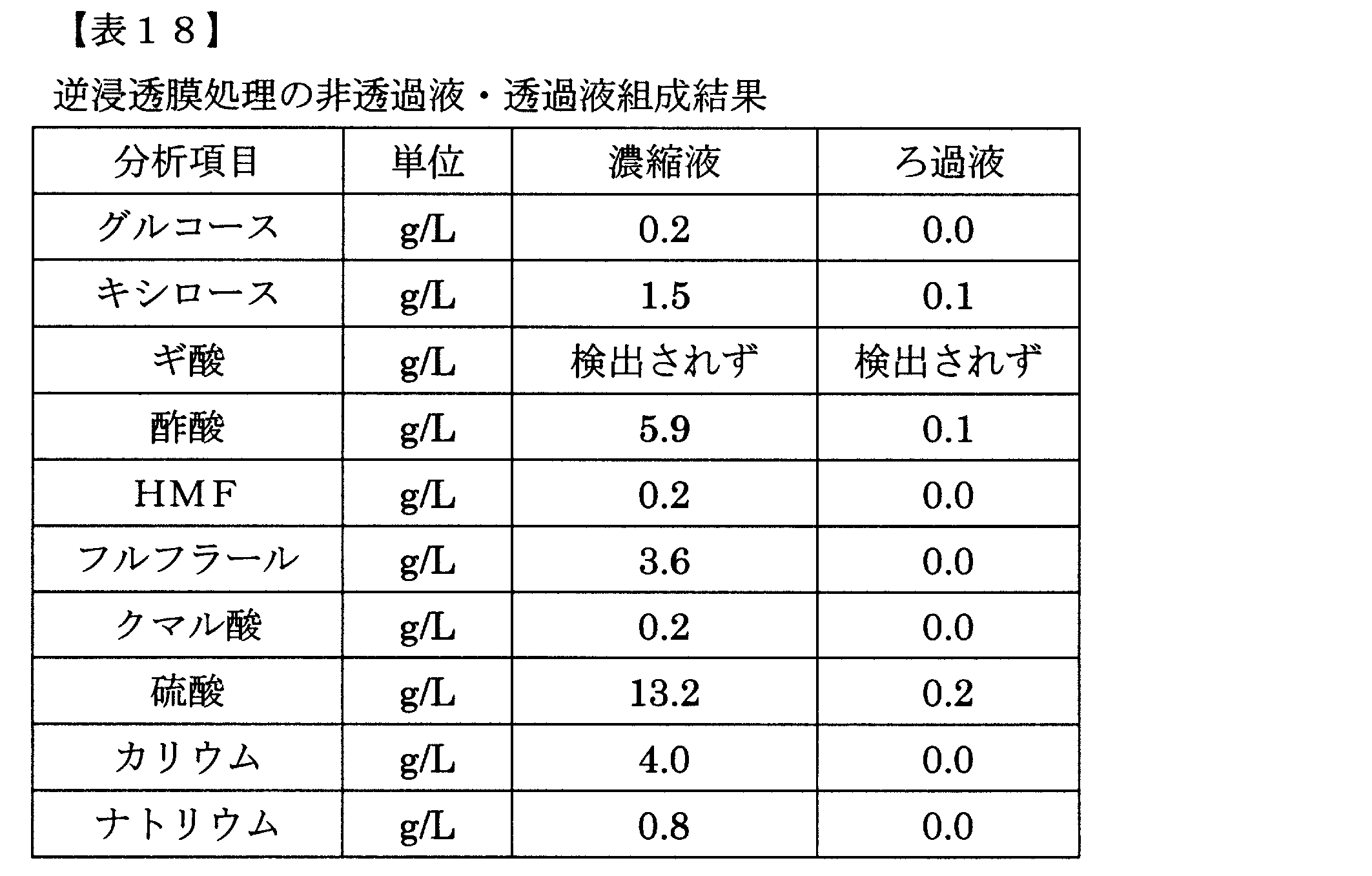
- the compositions of 1.0 L of non-permeate and 1.0 L of permeate were as shown in Table 16, and the sulfuric acid could be concentrated with almost no loss.
- the non-permeate of the reverse osmosis membrane is diluted with RO water so that the sulfuric acid concentration becomes 1.0% to 1.5 L, 0.15 kg (dry weight) of pulverized rice straw is added, and autoclaved at 150 ° C. for 10 minutes. Processed (manufactured by Nitto High Pressure Co., Ltd.). After the treatment, solid-liquid separation was performed to separate the cellulose-containing solid content. Next, aqueous ammonia was added to the cellulose-containing solid content to adjust the pH to around 5 and the solid content concentration to 10%.
- saccharified solution E was obtained.
- the composition of sulfate ion, monosaccharide, organic acid, furan compound and aromatic compound contained in saccharified solution E is as shown in Table 17, and by carrying out dilute sulfuric acid treatment using a reverse osmosis membrane concentrated solution of sulfuric acid aqueous solution.
- the rate of saccharification into glucose and xylose was improved.
- the structural analysis of the cellulose containing solid content after the reuse dilute sulfuric acid process by the method of Reference Example 5 it turned out that the ratio of glucose which comprises a cellulose increases especially.
- Example 6 Ethanol fermentation by genetically modified Escherichia coli (KO11 strain, ATCC55124) was carried out using the sugar solution of Example 1 as a fermentation raw material.
- the sugar solution used was a sugar concentrate (hereinafter, saccharified solution F) of the nanofiltration membrane 1 of Example 1, and a mixed solution (hereinafter, saccharified solution G) of 4 L of saccharified solution B and 1 L of saccharified solution F. .
- the liquid composition of the saccharified liquid G was as shown in Table 21.
- the genetically modified Escherichia coli was transferred to a YPDX medium (1% glucose, 1% xylose, 1% yeast extract (Bacto Yeast Extract, manufactured by BD), 2% polypeptone (manufactured by Nippon Pharmaceutical Co., Ltd.) at 32 ° C. for 1 day.
- a YPDX medium 1% glucose, 1% xylose, 1% yeast extract (Bacto Yeast Extract, manufactured by BD), 2% polypeptone (manufactured by Nippon Pharmaceutical Co., Ltd.) at 32 ° C. for 1 day.
- the saccharified solution F and the saccharified solution G were adjusted with calcium hydroxide (manufactured by Wako Pure Chemical Industries, Ltd.) so as to have a pH of 6.0, and then the obtained culture solution was 10%.
- the cells were incubated for 2 days at 32 ° C.
- the ethanol accumulation concentration contained in the culture medium obtained by this operation was quantified by gas chromatography: Shimadzu GC-2010 Capillary GC TC -1 (GL science) 15 meter L. * 0.53mm ID, df1.5 ⁇ m As a result, it was confirmed that 20.1 g / L ethanol was obtained from the saccharified solution F and 12.9 g / L ethanol was obtained from the saccharified solution G. That is, it was confirmed that ethanol as a chemical product can be produced using the sugar solution obtained in the present invention as a fermentation raw material.
- Example 7 L-lactic acid fermentation with Lactococcus lactis JCM7638 strain was performed using saccharified solution F and saccharified solution G as fermentation raw materials. Lactococcus lactis JCM7638 strain was statically cultured at a temperature of 37 ° C. for 24 hours, and the concentration of L-lactic acid contained in the culture solution was analyzed under the following conditions. The aforementioned microorganisms were precultured at 37 ° C. for 1 day in a YPDX medium (1% glucose, 1% xylose, 1% yeast extract (Bacto Yeast Extract / BD), 2% polypeptone (manufactured by Nippon Pharmaceutical).
- a YPDX medium 1% glucose, 1% xylose, 1% yeast extract (Bacto Yeast Extract / BD), 2% polypeptone (manufactured by Nippon Pharmaceutical).
- the saccharified solution F and the saccharified solution G were adjusted with calcium hydroxide (manufactured by Wako Pure Chemical Industries, Ltd.) so as to have a pH of 6.0, and the obtained culture solution was added at a volume of 10%.
- the cells were incubated for 2 days at 37 ° C.
- the concentration of lactic acid contained in the culture solution obtained by this operation was analyzed by the method of Reference Example 4.
- L-lactic acid was converted from saccharified solution F. 47.8 g / L, 30.5 g / L from saccharified solution G was confirmed, and L-lactic acid, a chemical product, was produced using the sugar solution obtained in the present invention as a fermentation raw material. It is certain that It could be.
- the sugar solution obtained by the method for producing a sugar solution of the present invention can be used as a fermentation raw material for various chemical products.
Landscapes
- Chemical & Material Sciences (AREA)
- Organic Chemistry (AREA)
- Life Sciences & Earth Sciences (AREA)
- Engineering & Computer Science (AREA)
- Wood Science & Technology (AREA)
- Zoology (AREA)
- Biochemistry (AREA)
- General Health & Medical Sciences (AREA)
- Health & Medical Sciences (AREA)
- Biotechnology (AREA)
- Microbiology (AREA)
- General Chemical & Material Sciences (AREA)
- Bioinformatics & Cheminformatics (AREA)
- General Engineering & Computer Science (AREA)
- Chemical Kinetics & Catalysis (AREA)
- Genetics & Genomics (AREA)
- Emergency Medicine (AREA)
- Separation Using Semi-Permeable Membranes (AREA)
- Preparation Of Compounds By Using Micro-Organisms (AREA)
- Polysaccharides And Polysaccharide Derivatives (AREA)
Abstract
Description
[1]セルロース含有バイオマスから糖液を製造する方法であって、以下の工程(1)~(4)を含むことを特徴とする、糖液の製造方法。
工程(1):セルロース含有バイオマスに対して希硫酸処理を行い、希硫酸処理液とセルロース含有固形分に分離する工程。
工程(2):前記セルロース含有固形分にセルラーゼを添加して加水分解することで糖液を得る工程。
工程(3):前記希硫酸処理液をpH2.5以下でナノ濾過膜に通じて濾過し、非透過液として糖濃縮液を分離し、透過液として硫酸水溶液を回収する工程。
工程(4):工程(3)で得られた硫酸水溶液の全量または一部を工程(1)の希硫酸処理で再利用する工程。
[2]工程(3)で得られた回収した硫酸水溶液を逆浸透膜に通じて濾過して、非透過液として硫酸を濃縮することを特徴とする、請求項1に記載の糖液の製造方法。
[3]工程(3)のナノ濾過膜の分画分子量が300以下であることを特徴とする、[1]または[2]に記載の糖液の製造方法。
[4]前記硫酸水溶液が、有機酸、フラン系化合物および芳香族化合物からなる群から選択される1種または2種以上の化合物を含むことを特徴とする、[1]から[3]のいずれかに記載の糖液の製造方法。
[5][1]から[4]のいずれかに記載の糖液の製造方法によって得られる糖液を製造する工程および該工程により得られた糖液を発酵原料として化学品を生産する能力を有する微生物を培養する工程を含む、化学品の製造方法。
セルロース含有バイオマスの希硫酸処理に際しては、セルロース含有バイオマスをそのまま希硫酸処理に供してもよいが、希硫酸処理の前に粉砕、爆砕、熱水などの公知の前処理を施すことによって、希硫酸処理を効率よく実施すること可能であり、また、セルロース画分をセルラーゼで酵素処理する場合は前処理によってセルラーゼによる加水分解反応の効率が向上する。前処理の中でも、熱水処理は50℃以上200℃以下の熱水で煮ることによりセルロース含有バイオマスの成分を一部溶出させて分解しやすくする前処理であり、セルロース含有バイオマス由来の無機イオンを除去することができるため、好ましく採用される。
セルロース含有バイオマスの希硫酸処理により得られるセルロース含有固形分とは、セルロース含有バイオマスを希硫酸処理した後のスラリー状の液を液成分と固形分に分離した固形分であり、セルロースを主成分とし、一部のヘミセルロースとリグニン、セルロース含有バイオマスの加水分解に伴って副生する有機酸、フラン系化合物、芳香族化合物の一部を含む。セルロース含有固形分は発酵原料とするため、酵素であるセルラーゼにより加水分解して糖液にする。酵素であるセルラーゼにより加水分解されたセルロースなどはグルコースやオリゴ糖などの単糖またはオリゴ糖に分解される。こうして得られた糖を発酵原料として使用する。なお、セルロース含有固形分の一部を紙パルプ、濾過助剤などセルロースとして工業用原料として使用しても構わない。
工程(3)では、ナノ濾過膜により糖(膜の非透過側)と硫酸(膜の透過側)を分離する。ナノ濾過膜の透過液である硫酸水溶液には、酸処理で同時に生成した有機酸やフラン系化合物、芳香族系化合物も膜を透過することで含有される。一方、ナノ濾過膜の非透過側から回収される糖濃縮液には硫酸、有機酸やフラン系化合物、芳香族系化合物がナノ濾過膜を透過することによってその比率が低減して発酵原料としての品質が高まる。さらに工程(4)で詳述するが、分離回収された硫酸水溶液を工程(1)で再利用することで硫酸使用量を低減することができることに加えて、セルロース含有バイオマスの加水分解効率を向上させることが可能になる。
希硫酸処理液をナノ濾過膜に通じて得られた透過液である硫酸水溶液は、その全量または一部を工程(1)の希硫酸処理に再利用する。実施例において示されるように、工程(1)の希硫酸処理に再利用した場合には得られる糖の収率が著しく向上する。硫酸水溶液は、硫酸の他に工程(1)の希硫酸処理において発生する有機酸やフラン系化合物、芳香族化合物といったバイオマス由来の分解物を含んでいるが、こうした硫酸水溶液を希硫酸処理に使用することで同じ希硫酸処理で酸濃度が同じであっても、セルロース画分の加水分解効率が向上するため、硫酸水溶液に含有される有機酸やフラン系化合物、芳香族系化合物が加水分解効率を向上させると考えられる。
透過率(%)=(透過側の対象化合物濃度/非透過液の対象化合物濃度)×100・・・(式1)。
カチオンおよびアニオン濃度は、下記に示すHPLC条件で、標品との比較により定量した。硫酸イオンはこのアニオン分析により定量した。
カラム:Ion Pac AS22(DIONEX社製)
移動相:4.5mM Na2CO3/1.4mM NaHCO3(流速1.0mL/分)
反応液:なし
検出方法:電気伝導度(サプレッサ使用)
温度:30℃。
カラム:Ion Pac CS12A(DIONEX社製)
移動相:20mMメタンスルホン酸(流速1.0mL/分)
反応液:なし
検出方法:電気伝導度(サプレッサ使用)
温度:30℃。
得られた液に含まれる単糖濃度は、下記に示すHPLC条件で、標品との比較により定量した。
カラム:Luna NH2(Phenomenex社製)
移動相:超純水:アセトニトリル=25:75(流速0.6mL/min)
反応液:なし
検出方法:RI(示差屈折率)
温度:30℃。
液に含まれるフラン系化合物(HMF、フルフラール)、およびフェノール系化合物(バニリン、クマル酸、フェルラ酸)は下記に示すHPLC条件で、標品との比較により定量した。
カラム:Synergi HidroRP 4.6mm×250mm(Phenomenex製)
移動相:アセトニトリル-0.1% H3PO4(流速1.0mL/min)
検出方法:UV(283nm)
温度:40℃。
液に含まれる有機酸(酢酸、ギ酸)は下記に示すHPLC条件で、標品との比較により定量した。
カラム:Shim-Pack SPR-HとShim-Pack SCR101H(株式会社島津製作所製)の直列
移動相:5mM p-トルエンスルホン酸(流速0.8mL/min)
反応液:5mM p-トルエンスルホン酸、20mM
ビストリス、0.1mM EDTA・2Na(流速0.8mL/min)
検出方法:電気伝導度
温度:45℃。
NRELが発表しているLAP法(“Determination of Structural Carbohydrates and Lignin in Biomass, Laboratory Analytical Procedure(LAP)”)を参考に、次に示す方法で組成を分析した。
セルロース含有バイオマスとして、稲藁を使用した。稲藁の構成分析は参考例5の方法で分析したところ表1の結果であった。稲藁をロータリーカッターミルRCM-400型(奈良機械製作所製)にてスクリーンメッシュ径3mmの状態で420rpmで回転させて粉砕した。次に粉砕した稲藁0.15kg(乾燥重量)について、希硫酸処理として1% 硫酸水溶液1.5Lに浸し、150℃で10分オートクレーブ処理(日東高圧株式会社製)した。希硫酸処理後、固液分離を行い、液成分である希硫酸処理液(以下、糖化液A)とセルロース含有固形分に分離した。糖化液AのpHは1.0であり、セルロース含有固形分の構成分析は表1の結果であった。


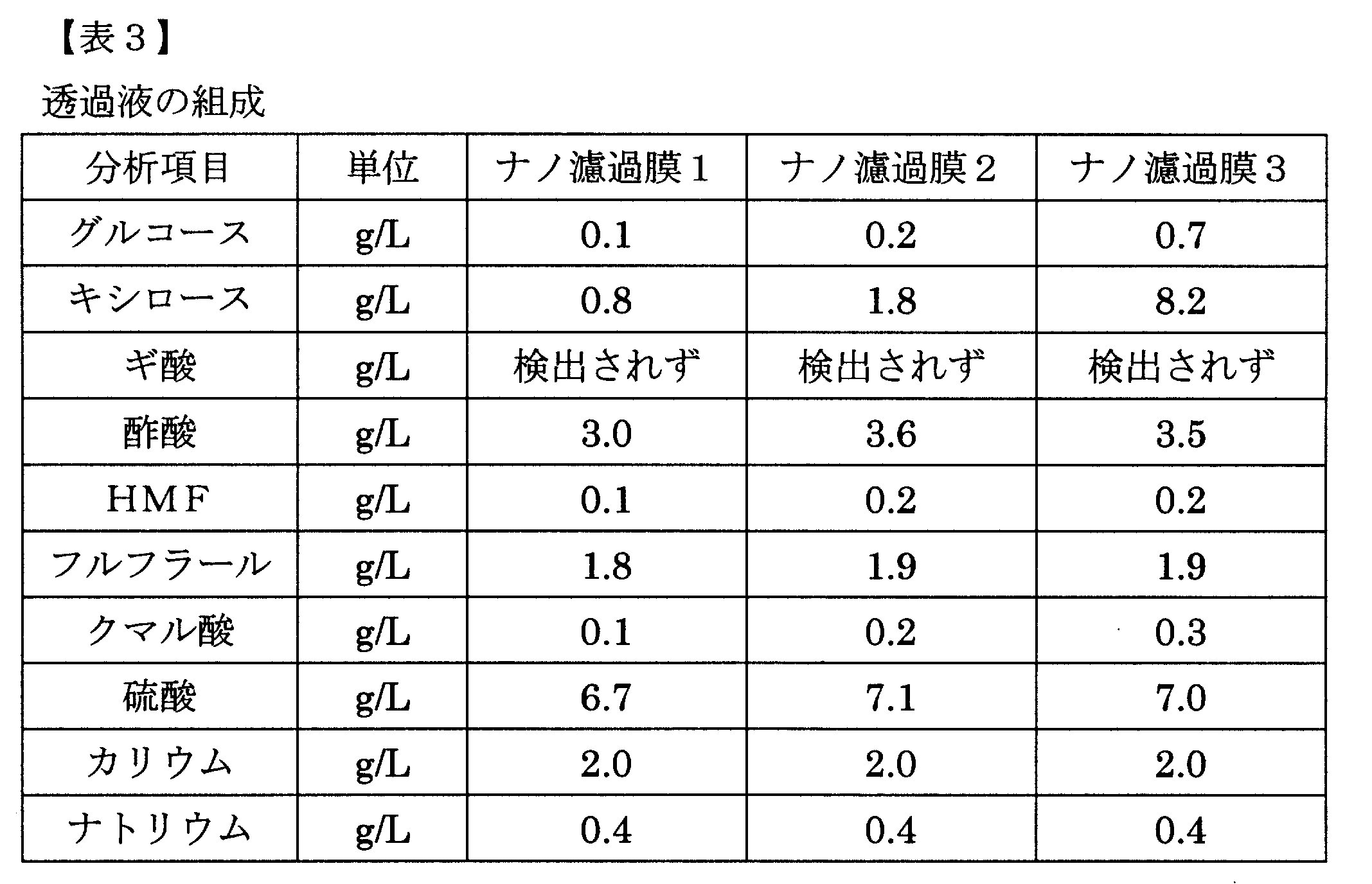


実施例1の希硫酸処理MF液のpHをアンモニアを用いてpH1.5、2.0、2.5に調整し、それぞれの液2Lに対してナノ濾過膜1~3で1.5L分を濾過して得られた透過液の組成を表7~9に示す。


実施例1の希硫酸MF液のpHをアンモニアを用いてpH3.0、5.0に調整し、それぞれの液2Lに対してナノ濾過膜1~3で1.5L分を濾過して得られた透過液の組成を表10~12に示す。比較例1では実施例2と比較して硫酸のナノ濾過膜の透過性が格段に低下してしまい硫酸を回収することができず、さらに糖の阻止率も低下した。


実施例1の希硫酸処理MF液(pH1.0)をそれぞれ2Lに分取し、GE製の分画分子量1,000の限外濾過膜GEシリーズまたは東レ株式会社製の逆浸透膜UTC80で1.5L分を濾過して得られた非透過液の組成を表13~14に示す。限外濾過膜を用いた場合では透過液側に多くの糖が透過してしまい、一方、逆浸透膜を用いた場合は糖を非透過液側に阻止できるが硫酸も阻止してしまい糖と硫酸を分離できず硫酸水溶液を回収することができなかった。


工程(1)のセルロース含有バイオマスを加水分解する工程に関し、前処理として熱水処理をしてセルロース含有バイオマス由来の無機塩物を除去した後、0.1~10重量%の希硫酸処理およびセルラーゼを使用するセルロース含有バイオマスの加水分解した場合について説明する。
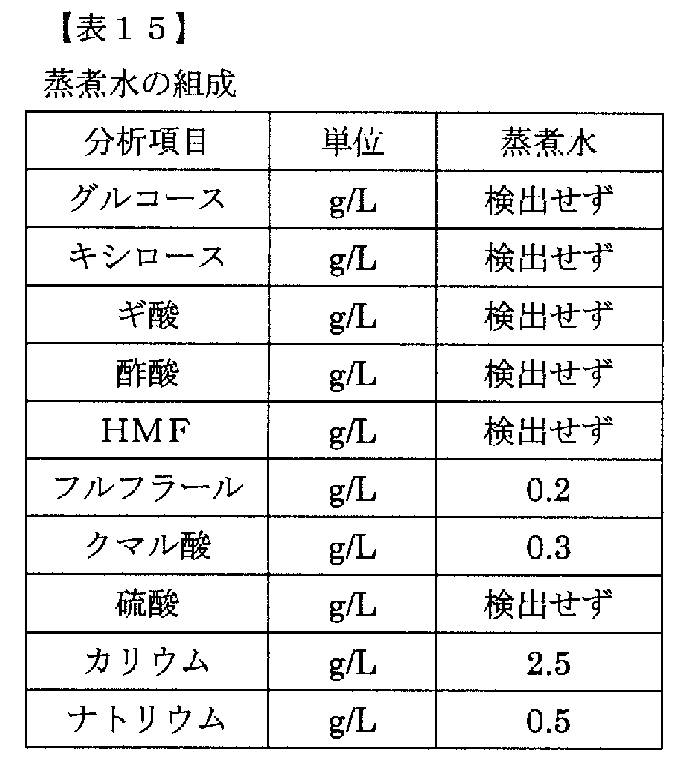

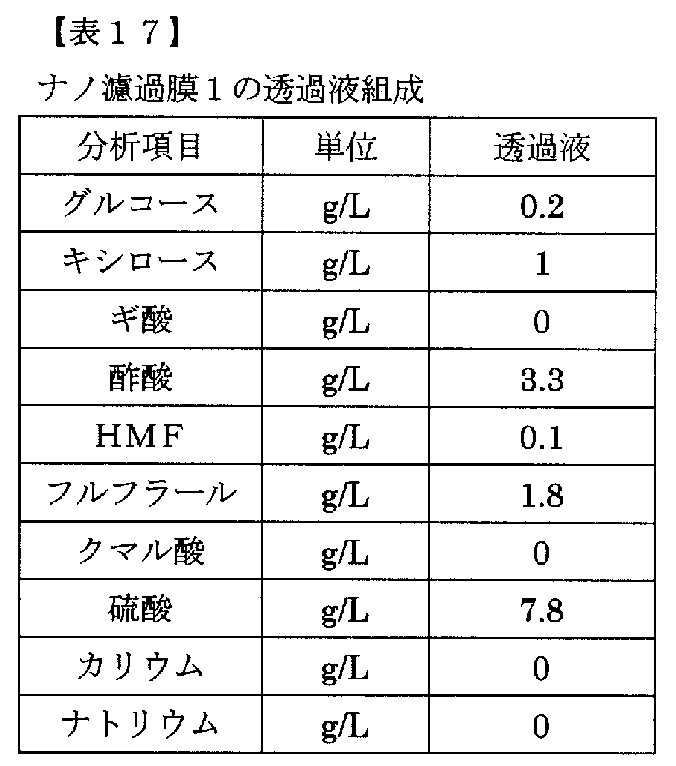
実施例1で得られたナノ濾過膜1の透過液2L分を用意し、Filmtec製の逆浸透膜SW2540の平膜で、供給速度:2L/分、濾過速度:5.0mL/分となるようにして、1.0L分の濾過を行った。1.0Lの非透過液および1.0Lの透過液の組成は表16の通りであり、硫酸がほぼ損失することなく濃縮できた。


実施例1の糖液を発酵原料として使用して、遺伝子組換え大腸菌(KO11株、ATCC55124)によるエタノール発酵を実施した。糖液は、実施例1のナノ濾過膜1の糖濃縮液(以下、糖化液F)、糖化液Bが4Lに対して糖化液Fが1Lの混合液(以下、糖化液G)を利用した。なお、糖化液Gの液組成は表21の通りであった。

糖化液Fと糖化液Gを発酵原料として使用して、ラクトコッカス・ラクティスJCM7638株によるL-乳酸発酵を実施した。ラクトコッカス・ラクティスJCM7638株を24時間、37℃の温度で静置培養して培養液に含まれるL-乳酸濃度を以下条件で分析した。前述微生物をYPDX培地(1% グルコース、1% キシロース、1% 酵母エキス(Bacto Yeast Extract/BD社)、2% ポリペプトン(日本製薬株式会社製)にて、1日間37℃で前培養を行った。次に、糖化液Fと糖化液GをpH6.0になるように水酸化カルシウム(和光純薬工業株式会社製)で調整下の後、得られた培養液を10%容量で添加した。微生物を添加後、37℃で2日間インキュベートした。この操作で得られた培養液に含まれる乳酸蓄積濃度は参考例4の方法にて分析した。分析の結果、L-乳酸が糖化液Fからは47.8g/L、糖化液Gからは30.5g/L蓄積していることが確認され、本発明で得られた糖液を発酵原料として、化学品であるL-乳酸を生産することが可能であることが確認できた。
Claims (5)
- セルロース含有バイオマスから糖液を製造する方法であって、以下の工程(1)~(4)を含むことを特徴とする、糖液の製造方法。
工程(1):セルロース含有バイオマスに対して希硫酸処理を行い、希硫酸処理液とセルロース含有固形分に分離する工程。
工程(2):前記セルロース含有固形分にセルラーゼを添加して加水分解することで糖液を得る工程。
工程(3):前記希硫酸処理液をpH2.5以下でナノ濾過膜に通じて濾過し、非透過液として糖濃縮液を分離し、透過液として硫酸水溶液を回収する工程。
工程(4):工程(3)で得られた硫酸水溶液の全量または一部を工程(1)の希硫酸処理で再利用する工程。 - 工程(3)で得られた硫酸水溶液を逆浸透膜に通じて濾過して、非透過液として硫酸を濃縮する工程を含むことを特徴とする、請求項1に記載の糖液の製造方法。
- 工程(3)のナノ濾過膜の分画分子量が300以下であることを特徴とする、請求項1または2に記載の糖液の製造方法。
- 前記硫酸水溶液が、有機酸、フラン系化合物および芳香族化合物からなる群から選択される1種または2種以上の化合物を含むことを特徴とする、請求項1から3のいずれかに記載の糖液の製造方法。
- 請求項1から4のいずれかに記載の糖液の製造方法によって得られる糖液を製造する工程および該工程により得られた糖液を発酵原料として化学品を生産する能力を有する微生物を培養する工程を含む、化学品の製造方法。
Priority Applications (6)
| Application Number | Priority Date | Filing Date | Title |
|---|---|---|---|
| CA2876114A CA2876114C (en) | 2012-06-12 | 2013-06-11 | Method for producing sugar liquid |
| US14/406,841 US9670516B2 (en) | 2012-06-12 | 2013-06-11 | Method of producing sugar liquid |
| EP13804556.2A EP2860258A4 (en) | 2012-06-12 | 2013-06-11 | METHOD FOR PRODUCING A SUGAR SOLUTION |
| BR112014031038-6A BR112014031038B1 (pt) | 2012-06-12 | 2013-06-11 | Métodos para produzir um líquido de açúcar e para produzir uma substância química |
| AU2013275309A AU2013275309B2 (en) | 2012-06-12 | 2013-06-11 | Method for producing sugar solution |
| JP2013535973A JP6167902B2 (ja) | 2012-06-12 | 2013-06-11 | 糖液の製造方法 |
Applications Claiming Priority (2)
| Application Number | Priority Date | Filing Date | Title |
|---|---|---|---|
| JP2012132729 | 2012-06-12 | ||
| JP2012-132729 | 2012-06-12 |
Publications (1)
| Publication Number | Publication Date |
|---|---|
| WO2013187385A1 true WO2013187385A1 (ja) | 2013-12-19 |
Family
ID=49758207
Family Applications (1)
| Application Number | Title | Priority Date | Filing Date |
|---|---|---|---|
| PCT/JP2013/066014 Ceased WO2013187385A1 (ja) | 2012-06-12 | 2013-06-11 | 糖液の製造方法 |
Country Status (8)
| Country | Link |
|---|---|
| US (1) | US9670516B2 (ja) |
| EP (1) | EP2860258A4 (ja) |
| JP (1) | JP6167902B2 (ja) |
| AU (1) | AU2013275309B2 (ja) |
| BR (1) | BR112014031038B1 (ja) |
| CA (1) | CA2876114C (ja) |
| MY (1) | MY170053A (ja) |
| WO (1) | WO2013187385A1 (ja) |
Cited By (3)
| Publication number | Priority date | Publication date | Assignee | Title |
|---|---|---|---|---|
| WO2014103185A1 (ja) * | 2012-12-28 | 2014-07-03 | 川崎重工業株式会社 | 濃縮糖化液製造方法 |
| JP2016079169A (ja) * | 2014-10-09 | 2016-05-16 | 三菱化学株式会社 | 糖アルコールの製造方法および糖液 |
| WO2017110975A1 (ja) * | 2015-12-25 | 2017-06-29 | 東レ株式会社 | キシロオリゴ糖組成物の製造方法 |
Families Citing this family (6)
| Publication number | Priority date | Publication date | Assignee | Title |
|---|---|---|---|---|
| FR3027821B1 (fr) * | 2014-10-31 | 2018-11-16 | Centralesupelec | Procede de purification d'oses. |
| WO2016207144A1 (en) * | 2015-06-22 | 2016-12-29 | Dsm Ip Assets B.V. | Process for enzymatic hydrolysis of lignocellulosic material and fermentation of sugars |
| EP3530743A1 (en) | 2018-02-21 | 2019-08-28 | Cambridge Glycoscience Ltd | Method of production |
| EP3836802A1 (en) | 2018-08-15 | 2021-06-23 | Cambridge Glycoscience Ltd | Novel compositions, their use, and methods for their formation |
| JP7672391B2 (ja) | 2019-08-16 | 2025-05-07 | ケンブリッジ グリコサイエンス エルティーディー | バイオマスを処理してオリゴ糖および関連組成物を生成する方法 |
| EP4072318A2 (en) | 2019-12-12 | 2022-10-19 | Cambridge Glycoscience Ltd | Low sugar multiphase foodstuffs |
Citations (10)
| Publication number | Priority date | Publication date | Assignee | Title |
|---|---|---|---|---|
| JPS62201606A (ja) | 1985-09-20 | 1987-09-05 | Toray Ind Inc | 複合半透膜及びその製造方法 |
| JPH0558601A (ja) | 1991-08-30 | 1993-03-09 | Tokuyama Soda Co Ltd | 硫酸塩の再生方法 |
| EP1306442A2 (en) * | 2001-10-25 | 2003-05-02 | Danisco Sweeteners Oy | A process for the simultaneous production of xylitol and ethanol |
| WO2007097260A1 (ja) | 2006-02-24 | 2007-08-30 | Toray Industries, Inc. | 化学品の製造方法、および、連続発酵装置 |
| JP2008529946A (ja) | 2005-02-11 | 2008-08-07 | ネーデルランドセ オルガニサティエ フォール トエゲパストナトールヴェテンシャッペリク オンデルゾエク ティエヌオー | 硫酸の回収 |
| US20090173339A1 (en) * | 2005-10-28 | 2009-07-09 | Danisco A/S | Separation process |
| WO2010067785A1 (ja) * | 2008-12-09 | 2010-06-17 | 東レ株式会社 | 糖液の製造方法 |
| JP2011223975A (ja) * | 2010-03-30 | 2011-11-10 | Toray Ind Inc | 糖液の製造方法及び製造装置 |
| WO2012077698A1 (ja) * | 2010-12-09 | 2012-06-14 | 東レ株式会社 | 濃縮糖水溶液の製造法 |
| WO2012100187A1 (en) * | 2011-01-21 | 2012-07-26 | Poet Research, Inc. | Systems and methods for improving fermentation |
Family Cites Families (1)
| Publication number | Priority date | Publication date | Assignee | Title |
|---|---|---|---|---|
| JP2005229822A (ja) * | 2004-02-17 | 2005-09-02 | Jgc Corp | バイオマスから単糖を製造する方法及び単糖製造装置 |
-
2013
- 2013-06-11 US US14/406,841 patent/US9670516B2/en not_active Expired - Fee Related
- 2013-06-11 WO PCT/JP2013/066014 patent/WO2013187385A1/ja not_active Ceased
- 2013-06-11 CA CA2876114A patent/CA2876114C/en not_active Expired - Fee Related
- 2013-06-11 BR BR112014031038-6A patent/BR112014031038B1/pt not_active IP Right Cessation
- 2013-06-11 JP JP2013535973A patent/JP6167902B2/ja not_active Expired - Fee Related
- 2013-06-11 AU AU2013275309A patent/AU2013275309B2/en not_active Ceased
- 2013-06-11 MY MYPI2014703711A patent/MY170053A/en unknown
- 2013-06-11 EP EP13804556.2A patent/EP2860258A4/en not_active Withdrawn
Patent Citations (10)
| Publication number | Priority date | Publication date | Assignee | Title |
|---|---|---|---|---|
| JPS62201606A (ja) | 1985-09-20 | 1987-09-05 | Toray Ind Inc | 複合半透膜及びその製造方法 |
| JPH0558601A (ja) | 1991-08-30 | 1993-03-09 | Tokuyama Soda Co Ltd | 硫酸塩の再生方法 |
| EP1306442A2 (en) * | 2001-10-25 | 2003-05-02 | Danisco Sweeteners Oy | A process for the simultaneous production of xylitol and ethanol |
| JP2008529946A (ja) | 2005-02-11 | 2008-08-07 | ネーデルランドセ オルガニサティエ フォール トエゲパストナトールヴェテンシャッペリク オンデルゾエク ティエヌオー | 硫酸の回収 |
| US20090173339A1 (en) * | 2005-10-28 | 2009-07-09 | Danisco A/S | Separation process |
| WO2007097260A1 (ja) | 2006-02-24 | 2007-08-30 | Toray Industries, Inc. | 化学品の製造方法、および、連続発酵装置 |
| WO2010067785A1 (ja) * | 2008-12-09 | 2010-06-17 | 東レ株式会社 | 糖液の製造方法 |
| JP2011223975A (ja) * | 2010-03-30 | 2011-11-10 | Toray Ind Inc | 糖液の製造方法及び製造装置 |
| WO2012077698A1 (ja) * | 2010-12-09 | 2012-06-14 | 東レ株式会社 | 濃縮糖水溶液の製造法 |
| WO2012100187A1 (en) * | 2011-01-21 | 2012-07-26 | Poet Research, Inc. | Systems and methods for improving fermentation |
Non-Patent Citations (6)
| Title |
|---|
| AIST TODAY, July 2009 (2009-07-01) |
| FURUICHI M. ET AL.: "Studies on enzymic saccharification, enzyme recovery by UF and sugar concentration by RO membranes", WORLD CONGRESS 3 OF CHEMICAL ENGINEERING, 1986, pages 255 - 257, XP008167958 * |
| JOURNAL OF JAPAN SOCIETY OF ENERGY AND RESOURCES, vol. 30, no. 5 |
| RESTOLHO ET AL.: "Sugars and lignosulphonates recovery from eucalyptus spent sulphite liquor by membrane processes", BIOMASS AND BIOENERGY, vol. 33, 2009, pages 1558 - 1566, XP026682543 * |
| See also references of EP2860258A4 |
| SHOJI KIMURA, SHIN-ICHI NAKAO, HARUHIKO OHYA, AND TSUTOMU NAKAGAWA: "The Membrane Society of Japan ed., Membrane Experiment Series, Vol. , Artificial Membrane", 1993, KYORITSU SHUPPAN CO., LTD., pages: 92 |
Cited By (4)
| Publication number | Priority date | Publication date | Assignee | Title |
|---|---|---|---|---|
| WO2014103185A1 (ja) * | 2012-12-28 | 2014-07-03 | 川崎重工業株式会社 | 濃縮糖化液製造方法 |
| JP2016079169A (ja) * | 2014-10-09 | 2016-05-16 | 三菱化学株式会社 | 糖アルコールの製造方法および糖液 |
| WO2017110975A1 (ja) * | 2015-12-25 | 2017-06-29 | 東レ株式会社 | キシロオリゴ糖組成物の製造方法 |
| JPWO2017110975A1 (ja) * | 2015-12-25 | 2018-10-11 | 東レ株式会社 | キシロオリゴ糖組成物の製造方法 |
Also Published As
| Publication number | Publication date |
|---|---|
| US20150140606A1 (en) | 2015-05-21 |
| EP2860258A4 (en) | 2016-01-27 |
| MY170053A (en) | 2019-07-01 |
| AU2013275309A1 (en) | 2015-01-22 |
| CA2876114A1 (en) | 2013-12-19 |
| EP2860258A1 (en) | 2015-04-15 |
| AU2013275309B2 (en) | 2016-11-24 |
| CA2876114C (en) | 2020-08-18 |
| US9670516B2 (en) | 2017-06-06 |
| BR112014031038A2 (pt) | 2017-06-27 |
| JPWO2013187385A1 (ja) | 2016-02-04 |
| BR112014031038B1 (pt) | 2021-08-24 |
| JP6167902B2 (ja) | 2017-07-26 |
Similar Documents
| Publication | Publication Date | Title |
|---|---|---|
| JP6167902B2 (ja) | 糖液の製造方法 | |
| EP2840150B1 (en) | Method for producing sugar liquid | |
| JP6007791B2 (ja) | 糖液の製造方法 | |
| EP2650384A1 (en) | Method for producing concentrated aqueous sugar solution | |
| EP2860269B1 (en) | Method for producing a sugar solution | |
| US10815501B2 (en) | Method of producing sugar liquid | |
| WO2011111451A1 (ja) | 精製糖水溶液の製造方法および化学品の製造方法 | |
| WO2012118171A1 (ja) | 糖液の製造方法 | |
| WO2014065364A1 (ja) | 有機酸またはその塩の製造方法 | |
| JP2013255457A (ja) | 濃縮糖水溶液およびエタノールの製造方法 |
Legal Events
| Date | Code | Title | Description |
|---|---|---|---|
| ENP | Entry into the national phase |
Ref document number: 2013535973 Country of ref document: JP Kind code of ref document: A |
|
| 121 | Ep: the epo has been informed by wipo that ep was designated in this application |
Ref document number: 13804556 Country of ref document: EP Kind code of ref document: A1 |
|
| ENP | Entry into the national phase |
Ref document number: 2876114 Country of ref document: CA |
|
| WWE | Wipo information: entry into national phase |
Ref document number: 14406841 Country of ref document: US Ref document number: 2013804556 Country of ref document: EP |
|
| NENP | Non-entry into the national phase |
Ref country code: DE |
|
| WWE | Wipo information: entry into national phase |
Ref document number: IDP00201500104 Country of ref document: ID |
|
| ENP | Entry into the national phase |
Ref document number: 2013275309 Country of ref document: AU Date of ref document: 20130611 Kind code of ref document: A |
|
| REG | Reference to national code |
Ref country code: BR Ref legal event code: B01A Ref document number: 112014031038 Country of ref document: BR |
|
| ENP | Entry into the national phase |
Ref document number: 112014031038 Country of ref document: BR Kind code of ref document: A2 Effective date: 20141211 |