WO2013187632A1 - 담체 공극 매몰형 scr 촉매 구조체 - Google Patents
담체 공극 매몰형 scr 촉매 구조체 Download PDFInfo
- Publication number
- WO2013187632A1 WO2013187632A1 PCT/KR2013/005002 KR2013005002W WO2013187632A1 WO 2013187632 A1 WO2013187632 A1 WO 2013187632A1 KR 2013005002 W KR2013005002 W KR 2013005002W WO 2013187632 A1 WO2013187632 A1 WO 2013187632A1
- Authority
- WO
- WIPO (PCT)
- Prior art keywords
- carrier
- scr catalyst
- catalytically active
- catalyst
- active material
- Prior art date
- Legal status (The legal status is an assumption and is not a legal conclusion. Google has not performed a legal analysis and makes no representation as to the accuracy of the status listed.)
- Ceased
Links
Images



Classifications
-
- B—PERFORMING OPERATIONS; TRANSPORTING
- B01—PHYSICAL OR CHEMICAL PROCESSES OR APPARATUS IN GENERAL
- B01J—CHEMICAL OR PHYSICAL PROCESSES, e.g. CATALYSIS OR COLLOID CHEMISTRY; THEIR RELEVANT APPARATUS
- B01J23/00—Catalysts comprising metals or metal oxides or hydroxides, not provided for in group B01J21/00
- B01J23/16—Catalysts comprising metals or metal oxides or hydroxides, not provided for in group B01J21/00 of arsenic, antimony, bismuth, vanadium, niobium, tantalum, polonium, chromium, molybdenum, tungsten, manganese, technetium or rhenium
- B01J23/24—Chromium, molybdenum or tungsten
-
- B—PERFORMING OPERATIONS; TRANSPORTING
- B01—PHYSICAL OR CHEMICAL PROCESSES OR APPARATUS IN GENERAL
- B01J—CHEMICAL OR PHYSICAL PROCESSES, e.g. CATALYSIS OR COLLOID CHEMISTRY; THEIR RELEVANT APPARATUS
- B01J37/00—Processes, in general, for preparing catalysts; Processes, in general, for activation of catalysts
- B01J37/02—Impregnation, coating or precipitation
-
- B—PERFORMING OPERATIONS; TRANSPORTING
- B01—PHYSICAL OR CHEMICAL PROCESSES OR APPARATUS IN GENERAL
- B01D—SEPARATION
- B01D53/00—Separation of gases or vapours; Recovering vapours of volatile solvents from gases; Chemical or biological purification of waste gases, e.g. engine exhaust gases, smoke, fumes, flue gases, aerosols
- B01D53/34—Chemical or biological purification of waste gases
- B01D53/46—Removing components of defined structure
- B01D53/54—Nitrogen compounds
- B01D53/56—Nitrogen oxides
-
- B—PERFORMING OPERATIONS; TRANSPORTING
- B01—PHYSICAL OR CHEMICAL PROCESSES OR APPARATUS IN GENERAL
- B01D—SEPARATION
- B01D53/00—Separation of gases or vapours; Recovering vapours of volatile solvents from gases; Chemical or biological purification of waste gases, e.g. engine exhaust gases, smoke, fumes, flue gases, aerosols
- B01D53/34—Chemical or biological purification of waste gases
- B01D53/74—General processes for purification of waste gases; Apparatus or devices specially adapted therefor
- B01D53/86—Catalytic processes
- B01D53/8621—Removing nitrogen compounds
- B01D53/8625—Nitrogen oxides
- B01D53/8628—Processes characterised by a specific catalyst
-
- B—PERFORMING OPERATIONS; TRANSPORTING
- B01—PHYSICAL OR CHEMICAL PROCESSES OR APPARATUS IN GENERAL
- B01D—SEPARATION
- B01D53/00—Separation of gases or vapours; Recovering vapours of volatile solvents from gases; Chemical or biological purification of waste gases, e.g. engine exhaust gases, smoke, fumes, flue gases, aerosols
- B01D53/34—Chemical or biological purification of waste gases
- B01D53/92—Chemical or biological purification of waste gases of engine exhaust gases
- B01D53/94—Chemical or biological purification of waste gases of engine exhaust gases by catalytic processes
- B01D53/9404—Removing only nitrogen compounds
- B01D53/9409—Nitrogen oxides
- B01D53/9413—Processes characterised by a specific catalyst
- B01D53/9418—Processes characterised by a specific catalyst for removing nitrogen oxides by selective catalytic reduction [SCR] using a reducing agent in a lean exhaust gas
-
- B—PERFORMING OPERATIONS; TRANSPORTING
- B01—PHYSICAL OR CHEMICAL PROCESSES OR APPARATUS IN GENERAL
- B01J—CHEMICAL OR PHYSICAL PROCESSES, e.g. CATALYSIS OR COLLOID CHEMISTRY; THEIR RELEVANT APPARATUS
- B01J21/00—Catalysts comprising the elements, oxides, or hydroxides of magnesium, boron, aluminium, carbon, silicon, titanium, zirconium, or hafnium
- B01J21/06—Silicon, titanium, zirconium or hafnium; Oxides or hydroxides thereof
- B01J21/063—Titanium; Oxides or hydroxides thereof
-
- B—PERFORMING OPERATIONS; TRANSPORTING
- B01—PHYSICAL OR CHEMICAL PROCESSES OR APPARATUS IN GENERAL
- B01J—CHEMICAL OR PHYSICAL PROCESSES, e.g. CATALYSIS OR COLLOID CHEMISTRY; THEIR RELEVANT APPARATUS
- B01J23/00—Catalysts comprising metals or metal oxides or hydroxides, not provided for in group B01J21/00
- B01J23/16—Catalysts comprising metals or metal oxides or hydroxides, not provided for in group B01J21/00 of arsenic, antimony, bismuth, vanadium, niobium, tantalum, polonium, chromium, molybdenum, tungsten, manganese, technetium or rhenium
- B01J23/20—Vanadium, niobium or tantalum
-
- B—PERFORMING OPERATIONS; TRANSPORTING
- B01—PHYSICAL OR CHEMICAL PROCESSES OR APPARATUS IN GENERAL
- B01J—CHEMICAL OR PHYSICAL PROCESSES, e.g. CATALYSIS OR COLLOID CHEMISTRY; THEIR RELEVANT APPARATUS
- B01J35/00—Catalysts, in general, characterised by their form or physical properties
- B01J35/50—Catalysts, in general, characterised by their form or physical properties characterised by their shape or configuration
- B01J35/56—Foraminous structures having flow-through passages or channels, e.g. grids or three-dimensional [3D] monoliths
-
- F—MECHANICAL ENGINEERING; LIGHTING; HEATING; WEAPONS; BLASTING
- F01—MACHINES OR ENGINES IN GENERAL; ENGINE PLANTS IN GENERAL; STEAM ENGINES
- F01N—GAS-FLOW SILENCERS OR EXHAUST APPARATUS FOR MACHINES OR ENGINES IN GENERAL; GAS-FLOW SILENCERS OR EXHAUST APPARATUS FOR INTERNAL-COMBUSTION ENGINES
- F01N3/00—Exhaust or silencing apparatus having means for purifying, rendering innocuous, or otherwise treating exhaust
- F01N3/08—Exhaust or silencing apparatus having means for purifying, rendering innocuous, or otherwise treating exhaust for rendering innocuous
- F01N3/10—Exhaust or silencing apparatus having means for purifying, rendering innocuous, or otherwise treating exhaust for rendering innocuous by thermal or catalytic conversion of noxious components of exhaust
- F01N3/18—Exhaust or silencing apparatus having means for purifying, rendering innocuous, or otherwise treating exhaust for rendering innocuous by thermal or catalytic conversion of noxious components of exhaust characterised by methods of operation; Control
- F01N3/20—Exhaust or silencing apparatus having means for purifying, rendering innocuous, or otherwise treating exhaust for rendering innocuous by thermal or catalytic conversion of noxious components of exhaust characterised by methods of operation; Control specially adapted for catalytic conversion
-
- F—MECHANICAL ENGINEERING; LIGHTING; HEATING; WEAPONS; BLASTING
- F01—MACHINES OR ENGINES IN GENERAL; ENGINE PLANTS IN GENERAL; STEAM ENGINES
- F01N—GAS-FLOW SILENCERS OR EXHAUST APPARATUS FOR MACHINES OR ENGINES IN GENERAL; GAS-FLOW SILENCERS OR EXHAUST APPARATUS FOR INTERNAL-COMBUSTION ENGINES
- F01N3/00—Exhaust or silencing apparatus having means for purifying, rendering innocuous, or otherwise treating exhaust
- F01N3/08—Exhaust or silencing apparatus having means for purifying, rendering innocuous, or otherwise treating exhaust for rendering innocuous
- F01N3/10—Exhaust or silencing apparatus having means for purifying, rendering innocuous, or otherwise treating exhaust for rendering innocuous by thermal or catalytic conversion of noxious components of exhaust
- F01N3/18—Exhaust or silencing apparatus having means for purifying, rendering innocuous, or otherwise treating exhaust for rendering innocuous by thermal or catalytic conversion of noxious components of exhaust characterised by methods of operation; Control
- F01N3/20—Exhaust or silencing apparatus having means for purifying, rendering innocuous, or otherwise treating exhaust for rendering innocuous by thermal or catalytic conversion of noxious components of exhaust characterised by methods of operation; Control specially adapted for catalytic conversion
- F01N3/206—Adding periodically or continuously substances to exhaust gases for promoting purification, e.g. catalytic material in liquid form, NOx reducing agents
- F01N3/2066—Selective catalytic reduction [SCR]
-
- B—PERFORMING OPERATIONS; TRANSPORTING
- B01—PHYSICAL OR CHEMICAL PROCESSES OR APPARATUS IN GENERAL
- B01D—SEPARATION
- B01D2255/00—Catalysts
- B01D2255/20—Metals or compounds thereof
- B01D2255/207—Transition metals
- B01D2255/20707—Titanium
-
- B—PERFORMING OPERATIONS; TRANSPORTING
- B01—PHYSICAL OR CHEMICAL PROCESSES OR APPARATUS IN GENERAL
- B01D—SEPARATION
- B01D2255/00—Catalysts
- B01D2255/20—Metals or compounds thereof
- B01D2255/207—Transition metals
- B01D2255/20723—Vanadium
-
- B—PERFORMING OPERATIONS; TRANSPORTING
- B01—PHYSICAL OR CHEMICAL PROCESSES OR APPARATUS IN GENERAL
- B01D—SEPARATION
- B01D2255/00—Catalysts
- B01D2255/20—Metals or compounds thereof
- B01D2255/207—Transition metals
- B01D2255/20769—Molybdenum
-
- B—PERFORMING OPERATIONS; TRANSPORTING
- B01—PHYSICAL OR CHEMICAL PROCESSES OR APPARATUS IN GENERAL
- B01D—SEPARATION
- B01D2255/00—Catalysts
- B01D2255/20—Metals or compounds thereof
- B01D2255/207—Transition metals
- B01D2255/20776—Tungsten
-
- B—PERFORMING OPERATIONS; TRANSPORTING
- B01—PHYSICAL OR CHEMICAL PROCESSES OR APPARATUS IN GENERAL
- B01D—SEPARATION
- B01D2255/00—Catalysts
- B01D2255/50—Zeolites
-
- B—PERFORMING OPERATIONS; TRANSPORTING
- B01—PHYSICAL OR CHEMICAL PROCESSES OR APPARATUS IN GENERAL
- B01D—SEPARATION
- B01D2255/00—Catalysts
- B01D2255/90—Physical characteristics of catalysts
-
- B—PERFORMING OPERATIONS; TRANSPORTING
- B01—PHYSICAL OR CHEMICAL PROCESSES OR APPARATUS IN GENERAL
- B01D—SEPARATION
- B01D2257/00—Components to be removed
- B01D2257/40—Nitrogen compounds
- B01D2257/404—Nitrogen oxides other than dinitrogen oxide
-
- B—PERFORMING OPERATIONS; TRANSPORTING
- B01—PHYSICAL OR CHEMICAL PROCESSES OR APPARATUS IN GENERAL
- B01J—CHEMICAL OR PHYSICAL PROCESSES, e.g. CATALYSIS OR COLLOID CHEMISTRY; THEIR RELEVANT APPARATUS
- B01J35/00—Catalysts, in general, characterised by their form or physical properties
- B01J35/30—Catalysts, in general, characterised by their form or physical properties characterised by their physical properties
- B01J35/34—Mechanical properties
- B01J35/36—Mechanical strength
-
- F—MECHANICAL ENGINEERING; LIGHTING; HEATING; WEAPONS; BLASTING
- F01—MACHINES OR ENGINES IN GENERAL; ENGINE PLANTS IN GENERAL; STEAM ENGINES
- F01N—GAS-FLOW SILENCERS OR EXHAUST APPARATUS FOR MACHINES OR ENGINES IN GENERAL; GAS-FLOW SILENCERS OR EXHAUST APPARATUS FOR INTERNAL-COMBUSTION ENGINES
- F01N2370/00—Selection of materials for exhaust purification
- F01N2370/02—Selection of materials for exhaust purification used in catalytic reactors
- F01N2370/04—Zeolitic material
-
- F—MECHANICAL ENGINEERING; LIGHTING; HEATING; WEAPONS; BLASTING
- F01—MACHINES OR ENGINES IN GENERAL; ENGINE PLANTS IN GENERAL; STEAM ENGINES
- F01N—GAS-FLOW SILENCERS OR EXHAUST APPARATUS FOR MACHINES OR ENGINES IN GENERAL; GAS-FLOW SILENCERS OR EXHAUST APPARATUS FOR INTERNAL-COMBUSTION ENGINES
- F01N2510/00—Surface coverings
- F01N2510/06—Surface coverings for exhaust purification, e.g. catalytic reaction
- F01N2510/068—Surface coverings for exhaust purification, e.g. catalytic reaction characterised by the distribution of the catalytic coatings
-
- F—MECHANICAL ENGINEERING; LIGHTING; HEATING; WEAPONS; BLASTING
- F01—MACHINES OR ENGINES IN GENERAL; ENGINE PLANTS IN GENERAL; STEAM ENGINES
- F01N—GAS-FLOW SILENCERS OR EXHAUST APPARATUS FOR MACHINES OR ENGINES IN GENERAL; GAS-FLOW SILENCERS OR EXHAUST APPARATUS FOR INTERNAL-COMBUSTION ENGINES
- F01N3/00—Exhaust or silencing apparatus having means for purifying, rendering innocuous, or otherwise treating exhaust
- F01N3/08—Exhaust or silencing apparatus having means for purifying, rendering innocuous, or otherwise treating exhaust for rendering innocuous
- F01N3/10—Exhaust or silencing apparatus having means for purifying, rendering innocuous, or otherwise treating exhaust for rendering innocuous by thermal or catalytic conversion of noxious components of exhaust
- F01N3/24—Exhaust or silencing apparatus having means for purifying, rendering innocuous, or otherwise treating exhaust for rendering innocuous by thermal or catalytic conversion of noxious components of exhaust characterised by constructional aspects of converting apparatus
- F01N3/28—Construction of catalytic reactors
- F01N3/2803—Construction of catalytic reactors characterised by structure, by material or by manufacturing of catalyst support
- F01N3/2825—Ceramics
- F01N3/2828—Ceramic multi-channel monoliths, e.g. honeycombs
-
- Y—GENERAL TAGGING OF NEW TECHNOLOGICAL DEVELOPMENTS; GENERAL TAGGING OF CROSS-SECTIONAL TECHNOLOGIES SPANNING OVER SEVERAL SECTIONS OF THE IPC; TECHNICAL SUBJECTS COVERED BY FORMER USPC CROSS-REFERENCE ART COLLECTIONS [XRACs] AND DIGESTS
- Y02—TECHNOLOGIES OR APPLICATIONS FOR MITIGATION OR ADAPTATION AGAINST CLIMATE CHANGE
- Y02T—CLIMATE CHANGE MITIGATION TECHNOLOGIES RELATED TO TRANSPORTATION
- Y02T10/00—Road transport of goods or passengers
- Y02T10/10—Internal combustion engine [ICE] based vehicles
- Y02T10/12—Improving ICE efficiencies
Definitions
- the present invention relates to a carrier pore-embedded SCR catalyst structure, and more particularly, to an SCR catalyst which can be applied in high sulfur content exhaust gas treatment, a catalytically active material is deposited inside a carrier, and the catalyst inner wall is substantially catalytically active.
- SCR selective catalytic reduction
- SCR systems are used to reduce the emissions of nitrogen oxides from the exhaust of boilers, engines and furnaces.
- ammonia is injected into the exhaust stream of the boiler with the catalyst.
- Ammonia is converted into water and nitrogen by reducing a large amount of nitrogen oxides from the exhaust gas.
- the denitrogen oxide catalyst used in the SCR system is expensive, it is desirable to be able to control the stoichiometry of the exhaust gas / ammonia / catalyst reaction.
- Catalytically active substances such as denitrogen oxides are supported on a carrier of refractory inorganic material or metal material.
- the catalyst used in the SCR system can be roughly divided into an extruded SCR catalyst and a coated SCR catalyst depending on the preparation method.
- the extrusion type is a structure in which the active material and the carrier constituent material are prepared in the form of a slurry, and then extruded using an extruder, in which the structure is usually manufactured in a honeycomb structure in order to prevent the exhaust gas pressure drop due to the catalyst.
- the coating type is a catalyst having an active material coated on a carrier in a honeycomb form of ceramic or metal material. More specifically, monolithic carriers in the form of fine parallel gas flow passages extending therefrom from the carrier inlet or outlet side of the honeycomb structure can be used, which passages are open so that fluid flows through them.
- the passageway which is a substantially straight path from the fluid inlet to the fluid outlet, is then defined by the inner wall where the catalytically active material is coated as a washcoat so that the exhaust gas flowing through the passages contacts the catalytic material.
- the flow path of the monolithic carrier may be of any suitable cross-sectional shape and size, such as trapezoidal, rectangular, square, sinusoidal, hexagonal, elliptical, circular, etc., and has a thin inner wall structure. Such structures may have from about 60 to about 900 or more gas inlet openings (ie, cells) per square inch of cross section.
- Extruded SCR catalysts are usually applied to power plants and ships.
- the vanadium pentoxide extrusion type catalyst is a fire-resistant supporting material such as titanium dioxide and denitrification active material as vanadium pentoxide as a main raw material.
- a honeycomb extruded catalyst is used that is extruded after the binder additive is added.
- catalysts used in high dust generation such as ships or power plants require considerable mechanical strength, but bunker C oil, which is a fuel for ship diesel engines or coal-fired power plants, contains more than 2% of sulfur. When exposed to sulfur for a long period of time there is a problem that the mechanical strength drops sharply.
- the present invention is proposed to solve the problems of the conventional extruded or coated SCR catalyst applied in the treatment of high sulfur content exhaust gas, and relates to a pore-deposited or buried SCR catalyst structure, and more particularly to a catalytically active material.
- the present invention relates to a deposited SCR catalyst structure which is deposited inside the support and substantially free of catalytically active material on the inner wall of the support.
- the carrier has a honeycomb structure of 20% to 80% porosity, cordierite, silicon carbide, cordierite- ⁇ -alumina, silicon nitride , Zircon mullite, spodumene, alumina-silica-magnesia, zircony silicate, silicate, magnesium silicate, zircon, petalite, ⁇ -alumina, aluminosilicate, and the like, preferably made of cordierite.
- the catalytically active material deposited inside the carrier is a vanadium series in which titanium oxide (TiO 2 ), tungsten oxide (WO 3 ), or molybdenum oxide (MoO 3 ) is added to vanadium, It may be a zeolite-based or base metal oxide, but is not limited thereto.
- the deposited or buried SCR catalyst according to the present invention maintains almost the same compressive strength as new products even after exposure to high sulfur containing exhaust gas, thereby overcoming the mechanical weakness as in conventional extruded structures over time.
- the deposition type SCR catalyst according to the present invention is such that the catalytically active material is deposited in the carrier pores, and thus the catalytically active material is retained even after prolonged exposure to the high sulfur-containing exhaust gas, thereby deviating from the inner wall of the carrier as in the conventional coating structure. The physical loss can be prevented, and the back pressure applied to the catalyst can be lowered because the carrier channel space is relatively wider than the conventional coated structure.
- Figure 2 is a graph showing the results of the evaluation of the compressive strength effect by the sulfur component for the conventional extruded and coated SCR catalyst.
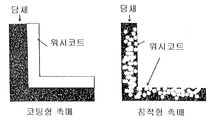
- FIG 3 is a schematic cross-sectional view of a conventional coated SCR catalyst and a deposited SCR catalyst according to the present invention.
- Figure 4 is a photograph of the catalytic active material distribution in the deposition type SCR catalyst according to the present invention.
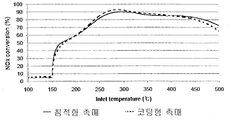
- FIG. 5 is a graph comparing the activity of the conventional SCR catalyst and the deposited SCR catalyst according to the present invention.
- the buried type SCR catalyst structure according to the present invention relates to a deposited type SCR catalyst structure in which a catalytically active material is deposited inside a carrier and substantially no catalytically active material is present on the inner wall of the carrier.
- deposit or “burying” means that the catalytically active material penetrates into the pores formed in the carrier and is supported in the pores, and the catalytically active material is not substantially coated on the inner wall of the carrier.
- the porosity of the pore charge volume in the total volume of the carrier is preferably 20% to 80%. If the porosity is 20% or less, it is not possible to provide sufficient catalytic function for the SCR reaction, and if it is 80% or more, the mechanical strength is lowered, and thus, a carrier having a porosity of 40 to 70%, more preferably 65% is preferable. .
- the carrier is preferably configured in a honeycomb form so that the pressure drop is minimized while the exhaust gas from the power plant or marine diesel engine passes through the catalyst.
- Honeycomb or honeycomb-shaped structures are obvious to those skilled in the art, but outlined, have parallel gas flow passages extending at the carrier inlet front or outlet back, which passages open at the front and rear, and at the gas inlet front. It has open passageways, ie channels, which are substantially straight paths to the discharge backside, which are formed by thin inner walls.
- the carrier according to the present invention is made of a ceramic material capable of providing the above-described high porosity, cordierite, silicon carbide, cordierite- ⁇ -alumina, silicon nitride, alumina-silica-magnesia, zircon silicate, silicate, It may be made of magnesium silicate, zircon, petalite, ⁇ -alumina, aluminosilicate and the like, and preferably made of cordierite.
- the catalytically active material is deposited in a plurality of pores formed in the carrier.
- the material deposited inside the carrier may be a vanadium-based, zeolite-based or base metal oxide in which titanium oxide (TiO 2 ), tungsten oxide (WO 3 ), or molybdenum oxide (MoO 3 ) is added to vanadium, but It is not limited.
- the immersion or buried SCR catalyst production method is quantified so that the catalytically active material does not exist on the inner wall of the carrier so that substantially all catalytically active material is deposited inside the carrier and the catalytically active material does not exist on the inner wall surface. It is manufactured so as not to be different from the conventional method for producing a coated SCR catalyst. That is, the conventional coated SCR catalyst quantifies the catalytically active slurry so that a thick coating layer is formed on the inner wall of the carrier, but the deposited SCR catalyst according to the present invention substantially catalyzes the catalytically active slurry so that all catalytically active materials penetrate into the carrier pores.
- the porous carrier is immersed in a slurry and then fired.
- the deposited SCR catalyst of the present invention (a) measuring the porosity of the carrier, (b) determining the amount of catalytically active slurry that can be deposited entirely in the carrier pores, (c) catalytically active slurry to the carrier It can easily be prepared by the step of depositing, and (d) calcining the catalyst obtained from step (c).
- the method for quantitative deposition in step (c) may be achieved by Korean Patent Application No. 10-2011-0098682 (catalytic support quantitative coating apparatus and method) filed on Sep. 29, 2011 by the present applicant, and the prior application. Is incorporated herein by reference.
- the extruded catalyst used in this evaluation was a honeycomb extruded catalyst structure (diameter 1 inch, length 2 inch, 50) whose main material was TiO 2 and WO 3 as refractory support material and V 2 O 5 as the denitrification oxide active material. cpi).
- the coating catalyst is a structure in which the refractory carrier is coated with the same catalytically active material (V 2 O 5 -TiO 2 -WO 3 ) on the inner wall of a cordierite honeycomb carrier (diameter 1 inch, length 2 inches, 50 cpi). to be.
- FIG. 1 shows the results of the structural change when the extruded and coated catalysts were contacted with water after exposure to sulfuric acid gas (24 hours).
- the catalyst structure gradually melts and almost collapses, whereas in the case of the coated catalyst, the carrier structure is maintained even when exposed to sulfuric acid gas, but the catalytically active material coated on the inner wall of the carrier is lost. It became.
- the conventional extruded or coated catalyst is not suitable for the ship diesel engine and the power plant exhaust gas treatment containing a large amount of sulfur.
- Figure 2 is a graph showing the results of the evaluation of the compressive strength effect by the sulfur component for the conventional extruded and coated SCR catalyst.
- the compressive strength was Measured.
- the extrusion type of the new product itself compared to the coating type, but the compressive strength is reduced significantly after the SO2 gas treatment or sulfuric acid gas treatment will ultimately collapse the catalyst structure.
- coating type there is no change in strength even in SO 2 gas treatment or sulfuric acid gas treatment, but as shown in the results of FIG. The mold needed to improve its structure.
- FIG. 3 is a schematic cross-sectional view of a coated SCR catalyst and a deposited SCR catalyst according to the present invention.
- the carrier applied in the present invention is a highly porous carrier capable of depositing substantially all catalytically active ingredients. Accordingly, as illustrated in FIG. 3, in the deposition type catalyst, the washcoat (catalytically active ingredient) is all deposited inside the carrier, and thus the washcoat is substantially not present on the inner wall of the carrier.
- the conventional coating catalyst uses a conventional refractory ceramic carrier so that the washcoat is applied to the inner wall of the carrier to a certain thickness. Therefore, the catalytically active component is deposited into the carrier pores to solve the problem of adhesion caused by the problem in the conventional coating catalyst. Furthermore, since the volume of exhaust gas flowing in the carrier channel is relatively increased compared to the coating catalyst, the back pressure is reduced, thereby improving the fuel efficiency of the engine.
- Figure 4 is a photograph of the catalytic active material distribution in the deposition type SCR catalyst according to the present invention when applying a cordierite carrier having a 65% porosity. From the left picture to the right picture, 100 g / L, 135 g / L and 212 g / L were applied as dry gain (D / G). In other words, when 100 g / L or 135 g / L of catalytically active component is applied to a cordierite carrier having a 65% porosity, most of the catalytic components substantially penetrate into the carrier pores so that there is substantially no catalytic component contributing to the activity on the surface. .
- the method for preparing a catalyst according to the present invention primarily comprises the steps of (a) measuring the porosity of the carrier, (b) determining the amount of catalytically active slurry that can be deposited entirely in the carrier pores, and (c) the catalytically active slurry as a carrier. By dipping in, and (d) calcining the catalyst obtained from step (c).
- the catalytically active component is 3% V 2 O 5 / TiO 2
- dry gain of 100g / L is deposited inside the carrier (300 cpsi) made of cordierite material having a porosity of 65%
- the catalytically active component is 2.5% V 2 O 5 / TiO 2
- the dry gain of 139.8 g / L is coated on the inner wall of the carrier (400 cpsi) made of cordierite material having a porosity of 35%.
- the activity evaluation conditions of both catalysts were space velocity (SV): 50,000 1 / hr, feed gas component: 500 ppm NO, 500 ppm NH 3 , 10% O 2 , 5% H 2 O, N 2 balance.
- SV space velocity
- feed gas component 500 ppm NO, 500 ppm NH 3 , 10% O 2 , 5% H 2 O, N 2 balance.
Landscapes
- Chemical & Material Sciences (AREA)
- Engineering & Computer Science (AREA)
- Chemical Kinetics & Catalysis (AREA)
- Materials Engineering (AREA)
- Organic Chemistry (AREA)
- Health & Medical Sciences (AREA)
- Environmental & Geological Engineering (AREA)
- Analytical Chemistry (AREA)
- Biomedical Technology (AREA)
- Combustion & Propulsion (AREA)
- General Chemical & Material Sciences (AREA)
- Oil, Petroleum & Natural Gas (AREA)
- Mechanical Engineering (AREA)
- General Engineering & Computer Science (AREA)
- Toxicology (AREA)
- Catalysts (AREA)
- Exhaust Gas Treatment By Means Of Catalyst (AREA)
Abstract
Description
Claims (5)
- 담체 및 촉매활성물질로 구성되는 고황 함유 배기가스의 질소산화물 처리용 촉매구조체에 있어서, 촉매활성물질이 담체 내부 공극에만 침적되고, 담체 내벽에는 실질적으로 촉매활성물질이 존재하지 않도록 구성되는, 담체 공극 매몰형 SCR 촉매 구조체.
- 제1항에 있어서, 상기 담체의 다공도는 20% 내지 80%의 범위인 것을 특징으로 하는, 담체 공극 매몰형 SCR 촉매 구조체.
- 제1항에 있어서, 상기 담체는 벌집형 구조인 것을 특징으로 하는, 담체 공극 매몰형 SCR 촉매 구조체.
- 제1항 내지 제3항 중 어느 하나의 항에 있어서, 상기 담체는 코디어라이트, 탄화규소, 코디어라이트-α-알루미나, 질화규소, 지르콘 뮬라이트, 스포듀민, 알루미나-실리카-마그네시아, 규산 지르콘, 규선석, 규산 마그네슘, 지르콘, 페타라이트, α-알루미나, 및 알루미노실리케이트로 이루어진 세라믹 재질에서 선택되는 것을 특징으로 하는, 담체 공극 매몰형 SCR 촉매 구조체.
- 제1항에 있어서, 상기 촉매활성물질은 티타늄산화물(TiO2), 텅스텐산화물(WO3), 또는 몰리브덴산화물(MoO3)이 바나듐에 첨가된 바나듐계열, 제올라이트 계열 및 비금속 (base metal)산화물로 이루어진 군에서 선택되는 것을 특징으로 하는, 담체 공극 매몰형 SCR 촉매 구조체.
Priority Applications (3)
| Application Number | Priority Date | Filing Date | Title |
|---|---|---|---|
| EP13803774.2A EP2859944A4 (en) | 2012-06-12 | 2013-06-07 | EMBEDDED SCR CATALYST STRUCTURE WITH CATALYST EMBEDDED INTO THE PORES OF A CARRIER |
| CN201380035836.9A CN104411403A (zh) | 2012-06-12 | 2013-06-07 | 载体空隙埋没型scr催化剂结构 |
| JP2015517173A JP2015519199A (ja) | 2012-06-12 | 2013-06-07 | 担体空隙埋没型scr触媒構造体 |
Applications Claiming Priority (2)
| Application Number | Priority Date | Filing Date | Title |
|---|---|---|---|
| KR20120062412A KR101336597B1 (ko) | 2012-06-12 | 2012-06-12 | 담체 공극 매몰형 scr 촉매 구조체 |
| KR10-2012-0062412 | 2012-06-12 |
Publications (1)
| Publication Number | Publication Date |
|---|---|
| WO2013187632A1 true WO2013187632A1 (ko) | 2013-12-19 |
Family
ID=49758410
Family Applications (1)
| Application Number | Title | Priority Date | Filing Date |
|---|---|---|---|
| PCT/KR2013/005002 Ceased WO2013187632A1 (ko) | 2012-06-12 | 2013-06-07 | 담체 공극 매몰형 scr 촉매 구조체 |
Country Status (5)
| Country | Link |
|---|---|
| EP (1) | EP2859944A4 (ko) |
| JP (1) | JP2015519199A (ko) |
| KR (1) | KR101336597B1 (ko) |
| CN (1) | CN104411403A (ko) |
| WO (1) | WO2013187632A1 (ko) |
Cited By (2)
| Publication number | Priority date | Publication date | Assignee | Title |
|---|---|---|---|---|
| CN111036192A (zh) * | 2019-12-23 | 2020-04-21 | 中国科学院过程工程研究所 | 一种涂覆型耐磨钒系脱硝催化剂及其制备方法与应用 |
| JP2021000631A (ja) * | 2014-07-31 | 2021-01-07 | ジョンソン、マッセイ、パブリック、リミテッド、カンパニーJohnson Matthey Public Limited Company | 触媒を製造するための方法及び触媒物品 |
Families Citing this family (3)
| Publication number | Priority date | Publication date | Assignee | Title |
|---|---|---|---|---|
| EP3310477A1 (en) * | 2015-06-18 | 2018-04-25 | Johnson Matthey Public Limited Company | Single or dual layer ammonia slip catalyst |
| KR101765767B1 (ko) * | 2015-11-02 | 2017-08-07 | 희성촉매 주식회사 | 담체 계면 공극 집중 매몰형 scr 촉매 구조체 |
| WO2021041201A2 (en) * | 2019-08-23 | 2021-03-04 | Basf Corp. | Catalyst compositions and methods of preparation and use thereof |
Citations (6)
| Publication number | Priority date | Publication date | Assignee | Title |
|---|---|---|---|---|
| JP2001286767A (ja) * | 2000-04-07 | 2001-10-16 | Nissan Motor Co Ltd | 触媒構造体及びその製造方法 |
| JP2006116431A (ja) * | 2004-10-21 | 2006-05-11 | Toyota Motor Corp | 排気浄化触媒および排気浄化触媒の製造方法 |
| JP2007209898A (ja) * | 2006-02-09 | 2007-08-23 | Toyota Motor Corp | 排ガス浄化触媒 |
| JP2007268527A (ja) * | 2006-03-10 | 2007-10-18 | Nippon Shokubai Co Ltd | 排水処理用触媒及び該触媒を用いた排水の処理方法 |
| KR20090108109A (ko) * | 2007-01-31 | 2009-10-14 | 바스프 카탈리스트 엘엘씨 | 다공벽 벌집을 포함하는 기체 촉매 |
| KR20110098682A (ko) | 2010-02-26 | 2011-09-01 | 엔이씨 커뮤니케이션 시스템즈, 리미티드 | 발광 구동 조정 방법 및 시스템과 가시광 통신 장치 |
Family Cites Families (4)
| Publication number | Priority date | Publication date | Assignee | Title |
|---|---|---|---|---|
| EP0704241A1 (en) * | 1994-09-29 | 1996-04-03 | Corning Incorporated | Catalyst structure comprizing a cellular substrate and a layer of catalytically active material |
| DE102005062317B4 (de) * | 2005-12-24 | 2008-08-21 | Umicore Ag & Co. Kg | Verfahren zur katalytischen Beschichtung von keramischen Wabenkörpern |
| DE102007012928B4 (de) * | 2007-03-19 | 2009-09-03 | Umicore Ag & Co. Kg | Verfahren zur Einbringung einer katalytischen Beschichtung in die Poren eines keramischen Durchfluß-Wabenkörpers |
| JP2013043138A (ja) * | 2011-08-25 | 2013-03-04 | Denso Corp | 触媒担持体及びその製造方法 |
-
2012
- 2012-06-12 KR KR20120062412A patent/KR101336597B1/ko active Active
-
2013
- 2013-06-07 CN CN201380035836.9A patent/CN104411403A/zh active Pending
- 2013-06-07 JP JP2015517173A patent/JP2015519199A/ja not_active Abandoned
- 2013-06-07 EP EP13803774.2A patent/EP2859944A4/en not_active Withdrawn
- 2013-06-07 WO PCT/KR2013/005002 patent/WO2013187632A1/ko not_active Ceased
Patent Citations (6)
| Publication number | Priority date | Publication date | Assignee | Title |
|---|---|---|---|---|
| JP2001286767A (ja) * | 2000-04-07 | 2001-10-16 | Nissan Motor Co Ltd | 触媒構造体及びその製造方法 |
| JP2006116431A (ja) * | 2004-10-21 | 2006-05-11 | Toyota Motor Corp | 排気浄化触媒および排気浄化触媒の製造方法 |
| JP2007209898A (ja) * | 2006-02-09 | 2007-08-23 | Toyota Motor Corp | 排ガス浄化触媒 |
| JP2007268527A (ja) * | 2006-03-10 | 2007-10-18 | Nippon Shokubai Co Ltd | 排水処理用触媒及び該触媒を用いた排水の処理方法 |
| KR20090108109A (ko) * | 2007-01-31 | 2009-10-14 | 바스프 카탈리스트 엘엘씨 | 다공벽 벌집을 포함하는 기체 촉매 |
| KR20110098682A (ko) | 2010-02-26 | 2011-09-01 | 엔이씨 커뮤니케이션 시스템즈, 리미티드 | 발광 구동 조정 방법 및 시스템과 가시광 통신 장치 |
Non-Patent Citations (1)
| Title |
|---|
| See also references of EP2859944A4 |
Cited By (3)
| Publication number | Priority date | Publication date | Assignee | Title |
|---|---|---|---|---|
| JP2021000631A (ja) * | 2014-07-31 | 2021-01-07 | ジョンソン、マッセイ、パブリック、リミテッド、カンパニーJohnson Matthey Public Limited Company | 触媒を製造するための方法及び触媒物品 |
| CN111036192A (zh) * | 2019-12-23 | 2020-04-21 | 中国科学院过程工程研究所 | 一种涂覆型耐磨钒系脱硝催化剂及其制备方法与应用 |
| CN111036192B (zh) * | 2019-12-23 | 2021-08-06 | 中国科学院过程工程研究所 | 一种涂覆型耐磨钒系脱硝催化剂及其制备方法与应用 |
Also Published As
| Publication number | Publication date |
|---|---|
| CN104411403A (zh) | 2015-03-11 |
| EP2859944A4 (en) | 2016-03-30 |
| JP2015519199A (ja) | 2015-07-09 |
| KR101336597B1 (ko) | 2013-12-16 |
| EP2859944A1 (en) | 2015-04-15 |
Similar Documents
| Publication | Publication Date | Title |
|---|---|---|
| US8591820B2 (en) | Honeycomb filters for reducing NOx and particulate matter in diesel engine exhaust | |
| JP7422199B2 (ja) | 膜を有する触媒ウォールフロー型フィルター | |
| US20090118121A1 (en) | Exhaust Emission Control Catalyst and Exhaust Emission Control System | |
| KR101336597B1 (ko) | 담체 공극 매몰형 scr 촉매 구조체 | |
| KR101859786B1 (ko) | 개선된 nh3 형성 활성을 갖는 가솔린 린번 엔진용 촉매 | |
| KR20150023543A (ko) | 바나데이트를 포함하는 선택적 촉매 환원 벽유동형 필터 | |
| JPWO2007094379A1 (ja) | ハニカム構造体及びハニカム触媒体 | |
| KR101765767B1 (ko) | 담체 계면 공극 집중 매몰형 scr 촉매 구조체 | |
| KR20150111979A (ko) | 암모니아 산화 촉매 | |
| US12569839B2 (en) | Emission control catalyst article with enriched PGM zone, method and apparatus to produce the same | |
| US20190314791A1 (en) | Diesel oxidizing catalytic converter | |
| CN111148890B (zh) | 微粒过滤器上的scr催化涂层 | |
| US10702855B2 (en) | Method of preparation of a monilithic catalyst for selective catalytic reduction of nitrogen oxides | |
| EP2889463B1 (en) | High performance scr catalyst system | |
| RU2693135C2 (ru) | Способ нанесения покрытия на корпус-подложку | |
| KR20180088864A (ko) | 질소 산화물의 선택적 촉매 환원을 위한 모노리스 촉매의 제조방법 | |
| KR20220025717A (ko) | 촉매 물품 및 촉매 물품의 제조 방법 |
Legal Events
| Date | Code | Title | Description |
|---|---|---|---|
| 121 | Ep: the epo has been informed by wipo that ep was designated in this application |
Ref document number: 13803774 Country of ref document: EP Kind code of ref document: A1 |
|
| ENP | Entry into the national phase |
Ref document number: 2015517173 Country of ref document: JP Kind code of ref document: A |
|
| NENP | Non-entry into the national phase |
Ref country code: DE |
|
| REEP | Request for entry into the european phase |
Ref document number: 2013803774 Country of ref document: EP |
|
| WWE | Wipo information: entry into national phase |
Ref document number: 2013803774 Country of ref document: EP |