WO2013189288A1 - 数据传输方法及装置 - Google Patents
数据传输方法及装置 Download PDFInfo
- Publication number
- WO2013189288A1 WO2013189288A1 PCT/CN2013/077476 CN2013077476W WO2013189288A1 WO 2013189288 A1 WO2013189288 A1 WO 2013189288A1 CN 2013077476 W CN2013077476 W CN 2013077476W WO 2013189288 A1 WO2013189288 A1 WO 2013189288A1
- Authority
- WO
- WIPO (PCT)
- Prior art keywords
- tti bundling
- mod
- frequency hopping
- frequency
- determined
- Prior art date
- Legal status (The legal status is an assumption and is not a legal conclusion. Google has not performed a legal analysis and makes no representation as to the accuracy of the status listed.)
- Ceased
Links
Classifications
-
- H—ELECTRICITY
- H04—ELECTRIC COMMUNICATION TECHNIQUE
- H04L—TRANSMISSION OF DIGITAL INFORMATION, e.g. TELEGRAPHIC COMMUNICATION
- H04L5/00—Arrangements affording multiple use of the transmission path
- H04L5/0001—Arrangements for dividing the transmission path
- H04L5/0003—Two-dimensional division
- H04L5/0005—Time-frequency
- H04L5/0007—Time-frequency the frequencies being orthogonal, e.g. OFDM(A) or DMT
-
- H—ELECTRICITY
- H04—ELECTRIC COMMUNICATION TECHNIQUE
- H04B—TRANSMISSION
- H04B1/00—Details of transmission systems, not covered by a single one of groups H04B3/00 - H04B13/00; Details of transmission systems not characterised by the medium used for transmission
- H04B1/69—Spread spectrum techniques
- H04B1/713—Spread spectrum techniques using frequency hopping
-
- H—ELECTRICITY
- H04—ELECTRIC COMMUNICATION TECHNIQUE
- H04B—TRANSMISSION
- H04B1/00—Details of transmission systems, not covered by a single one of groups H04B3/00 - H04B13/00; Details of transmission systems not characterised by the medium used for transmission
- H04B1/69—Spread spectrum techniques
- H04B1/713—Spread spectrum techniques using frequency hopping
- H04B1/7136—Arrangements for generation of hop frequencies, e.g. using a bank of frequency sources, using continuous tuning or using a transform
-
- H—ELECTRICITY
- H04—ELECTRIC COMMUNICATION TECHNIQUE
- H04L—TRANSMISSION OF DIGITAL INFORMATION, e.g. TELEGRAPHIC COMMUNICATION
- H04L5/00—Arrangements affording multiple use of the transmission path
- H04L5/0001—Arrangements for dividing the transmission path
- H04L5/0003—Two-dimensional division
- H04L5/0005—Time-frequency
- H04L5/0007—Time-frequency the frequencies being orthogonal, e.g. OFDM(A) or DMT
- H04L5/0012—Hopping in multicarrier systems
-
- H—ELECTRICITY
- H04—ELECTRIC COMMUNICATION TECHNIQUE
- H04L—TRANSMISSION OF DIGITAL INFORMATION, e.g. TELEGRAPHIC COMMUNICATION
- H04L5/00—Arrangements affording multiple use of the transmission path
- H04L5/003—Arrangements for allocating sub-channels of the transmission path
- H04L5/0053—Allocation of signalling, i.e. of overhead other than pilot signals
- H04L5/0055—Physical resource allocation for ACK/NACK
-
- H—ELECTRICITY
- H04—ELECTRIC COMMUNICATION TECHNIQUE
- H04W—WIRELESS COMMUNICATION NETWORKS
- H04W72/00—Local resource management
- H04W72/04—Wireless resource allocation
- H04W72/044—Wireless resource allocation based on the type of the allocated resource
- H04W72/0446—Resources in time domain, e.g. slots or frames
Definitions
- the present invention relates to the field of communications, and in particular to a data transmission method and apparatus.
- BACKGROUND OF THE INVENTION Capacity and coverage are two important performance indicators in a wireless communication system.
- the same frequency mode is generally used.
- the same frequency mode networking increases inter-cell interference, resulting in a decrease in coverage performance.
- the downlink uses Orthogonal Frequency Division Multiple Access (OFDMA) technology
- the uplink uses multiple carrier-frequency division.
- Inter-Cell Interference (ICI) is significantly increased due to the use of the same-frequency mode (SC-FDMA).
- LTE adopts some anti-interference technologies, for example, Inter-Cell Interference Cancellation (ICIC).
- the downlink ICIC technology implements the downlink interference pre-alert function by the method of the relative narrow-band transmit power (RNTP) limitation of the evolved Node B (eNodeB), and enhances the physical downlink service channel (Physical). Coverage performance of the Downlink Shared Channel (referred to as PDSCH);
- the uplink (High Interference Indication/Overload Indication, ⁇ / ⁇ ) based ICIC technology enhances the coverage of the Physical Uplink Shared Channel (PUSCH). performance.
- MIMO technology can improve the coverage performance and capacity performance of LTE systems through spatial diversity, spatial multiplexing and beamforming technologies, especially based on Coordinated Multiple Point (CoMP) technology developed by MIMO technology.
- CoMP Coordinated Multiple Point
- MIMO technology and CoMP technology rely heavily on the measurement and feedback of channel state information. The measurement and feedback of the wireless channel by the user equipment (User Equipment, UE for short) with very low signal-to-noise ratio in the current and future time. It is still a bottleneck. On the one hand, the more complete and accurate the feedback, the larger the feedback, the challenge to capacity and coverage distance.
- Open-loop MIMO technology is generally combined with resource frequency hopping because resource hopping is a quasi-open-loop resource allocation technique. The subsequent resource allocation is determined by the frequency hopping mode and the initial resource allocation, thereby saving resource allocation overhead and feedback overhead.
- the VoIP Voice over IP
- ⁇ Bundling technology forms different redundancy versions for the entire data packet by channel coding. Different redundancy versions are transmitted in consecutive multiple ,, instead of continuous multiple ⁇ transmissions are also evaluated, TTl Bundling technology passes It takes more transmission resources and obtains coding gain and diversity gain to obtain higher receiving energy and link signal-to-noise ratio, thereby improving the coverage capability of the LTE system. Since TTl Bundling technology is used to reduce coverage efficiency in exchange for performance, it is mainly used for terminals with very low signal-to-noise ratio. In general, UEs with very low signal-to-noise ratio can improve coverage performance through diversity techniques, such as frequency diversity technology.
- TTl Bundling and frequency diversity can be used simultaneously, but the existing TTl Bundling technology combined with the existing frequency diversity technology limits the acquisition and control overhead of frequency diversity gain to some extent.
- FIG. 1 The first VoIP packet from the UE performs the first transmission on the transmission time interval 4 to 7 of the physical uplink shared channel PUSCH, and the consecutive 4 TTIs in 4 to 7 are referred to as one transmission.
- the TTI Bundling of the TTI Bundling Size is 4, and the control information of the TTI Bundling (for example, the resource location, etc.) is indicated by the physical downlink control channel PDCCH in the first TTI (TTI 4) corresponding to the TTI Bundling.
- the receiving end After receiving the TTI Bundling, the receiving end (for example, the eNodeB) indicates a positive/negative ACK of the hybrid automatic repeat request (HARQ entity) on the downlink physical HARQ indication channel (PHICH) of the transmission time interval 12 NACK response message, if the corresponding response is a negative NACK response, the second transmission of the first VoIP packet (ie, the first retransmission of the TTI Bundling) will be on the physical uplink shared channel PUSCH of the transmission time interval 21-24.
- HARQ entity hybrid automatic repeat request
- PHICH downlink physical HARQ indication channel
- HARQ Hybrid Automatic Repeat Request
- ACK/NAC K Hybrid Automatic Repeat Request
- the resource block type allocated to the TTI Bundling is a centralized resource block, that is, the resource block physical bits of two slots (slots) within one TTI
- the physical locations of multiple resource blocks in a TTI Bundling are identical, and in order to save control overhead under Semi-Persistent Scheduling (SPS), the resource blocks in consecutive TTI Bundling The physical locations are identical, which severely limits the gain of the frequency diversity gain.
- SPS Semi-Persistent Scheduling
- the physical location of the TTI Bundling resource block can be changed by increasing the transmission of the PDCCH, it is obvious that the control overhead is significantly increased, and the physical positions of the resource blocks of multiple TTIs in one TTI Bundling are identical; when assigned to TTI Bundling
- the resource block type is a centralized resource block, that is, the physical positions of the resource blocks of two slots (slots) within one frame are different, and the two channel slots within one frame cannot use joint channel estimation, and the channel estimation accuracy is degraded. , will also reduce system performance.
- an enhanced TTI Bundling technique is proposed, for example, as shown in FIG.
- the interval between two TTI Bundlings is 4, and the first transmission and the retransmission can use one HARQ process or multiple (for example, two) HARQ processes. Similarly, the interval between two TTI Bundlings is eight.
- the first transmission and the retransmission may use one HARQ process or multiple (for example, two) HARQ processes, but the principle of enhancement is to increase the maximum number of ⁇ of a VoIP packet from 12 or 16 for the first transmission and retransmission. Up to 20, thereby increasing the accumulated transmission power or increasing the redundancy version of the HARQ, but still has the same mechanism as the LTE R8 in the resource allocation of the TTI Bundling, which severely limits the acquisition of the frequency diversity gain.
- the present invention provides a data transmission method and apparatus to at least solve the problem.
- a data transmission method including: determining, by using a frequency hopping manner, a frequency domain location of a physical resource block in a time slot for transmitting a TTI Bundling according to a TTI Bundling parameter, where the frequency hopping mode
- the TTI Bundling parameter is a positive integer, and is determined according to the number m - M ⁇ - ⁇ ? of the transmission time interval TTI bundled in the TTI Bundling.
- the frequency domain location of the physical resource block in the time slot for transmitting the TTI Bundling is determined by using a frequency hopping manner according to the BTI bundled TTI Bundling parameter. The frequency domain location is determined according to the TTI Bundling frequency hopping variable i by the following formula: "
- ⁇ +" r ⁇ 7h ⁇ o ⁇ p (0 ⁇ AC + (( - 1) - 2 mod AC )) .
- f m nA corpse m 11 o U d U (, J V* ⁇ N s ) pRB (" ⁇ ) physical resource block index offset, virtual resource block offset index hopping bias "for the ⁇ ⁇ ⁇ Rounding up operation, ⁇ ' ⁇ of subband hopping function, ⁇ ⁇ resources within a sub-band
- the number of blocks is a mirrored frequency hopping function, mod is a modulo operation, ⁇ ⁇ is the number of subbands, which is a slot number.
- the «corresponding formula is determined by one of the following ways: a radio resource control (RRC) layer message indication; a resource grant message indication; a predefined.
- RRC radio resource control
- ⁇ ⁇ is determined by the following formula: Wherein, the total number of resource blocks in a time slot for the uplink bandwidth to the female is a frequency hopping offset, and ⁇ " is a rounding operation for y.
- the formula corresponding to the TTI Bundling frequency hopping variable is determined by one of the following manners: a radio resource control (RRC) layer message indication; a resource grant message indication; a predefined.
- a data transmission apparatus including: a determining module, configured to determine a frequency of a physical resource block in a time slot for transmitting a TTI Bundling by using a frequency hopping manner according to a BTI bundle parameter according to a transmission time interval.
- the TTI Bundling parameter is a positive integer, and is determined according to the number of transmission time intervals ⁇ bundled in the TTI Bundling ⁇ / ⁇ - ⁇ .
- the determining module is configured to determine a frequency domain position according to the TTI Bundling frequency hopping variable i by the following formula: > 1
- a frequency domain position of a physical resource block in a time slot for transmitting a TT1 Bundling is determined by a frequency hopping method according to a TT1 Bundling parameter, where i is a predetermined mode or a combination thereof, and then corresponds to the frequency domain location.
- the data transmission is performed on the time-frequency resource, and the data transmission is performed on the physical resource determined by the frequency hopping method when the und Bundling is adopted, and the transmission time interval bundling technique in the related art is solved, and the data transmission is caused due to the relatively low frequency diversity gain.
- the problem of small coverage is achieved, and the frequency diversity gain of the data in the TTI Bundling transmission mode is improved, and the coverage of the data transmission is improved.
- FIG. 1 is a schematic diagram of a related art LTE R8 implementing VoIP transmission based on a transmission time interval bundling technique
- FIG. 2 is a schematic diagram of an enhanced transmission time interval bundling technique of the related art to implement VoIP transmission
- FIG. 3 is a schematic diagram of a VoIP transmission according to the present invention
- FIG. 4 is a block diagram showing the structure of a data transmission apparatus according to an embodiment of the present invention
- FIG. 5 is a schematic diagram of resource allocation according to a transmission time interval bundling technique according to an embodiment of the present invention
- FIG. 2 is a schematic diagram of resource allocation of a transmission time interval bundling technique according to an embodiment of the present invention.
- BEST MODE FOR CARRYING OUT THE INVENTION hereinafter, the present invention will be described in detail with reference to the accompanying drawings. It should be noted that the embodiments in the present application and the features in the embodiments may be combined with each other without conflict.
- This embodiment provides a data transmission method.
- FIG. 3 is a flowchart of a data transmission method according to an embodiment of the present invention. As shown in FIG. 3, the method includes the following steps S302 and S304.
- Step S302 Binding the TTI Bundling parameter according to the transmission time interval to determine the frequency domain location of the physical resource block in the time slot for transmitting the TTI Bundling by using a frequency hopping method, where the frequency hopping frequency hopping variable is based on
- Step S304 Transmit data on the time-frequency resource corresponding to the frequency domain position of the physical resource block in the determined time slot of the TTI Bundling.
- the TTI Bundling parameter is a positive integer and can be determined by parameters associated with TTI Bundling or based on the relevant parameters.
- the TTI Bundling parameter may be a value determined according to the number TTI_BUNDLING_SIZE of the transmission time interval TTI bundled in the TTI Bundling, for example: 777 _ BUNDLING _ SIZE itself or a value obtained by the 777 _ BUNDLING _ SIZE operation .
- This method enables flexible determination of TTI Bundling parameters.
- the frequency domain position may be determined according to the frequency hopping variable i by the following formula:
- ⁇ is the number of subbands
- k is the sequence number of the random sequence
- k is a non-negative integer
- mod is a modulo function.
- mod is the modulo function
- eURRENT - TX - NB is the current The number of times sent
- q is a positive integer.
- the «corresponding formula is determined by one of the following ways: Radio Resource Control (RRC) layer message indication
- ⁇ Resource grant message indication t is preferably determined by the following formula:
- W ra is a frequency hopping offset, and preferably, O ⁇ A ⁇ A ′ is a rounding operation for y.
- This preferred embodiment is determined using prior art techniques and reduces development costs.
- the formula corresponding to the TTI Bundling frequency hopping variable can be determined by one of the following methods: Mode 1: Radio Resource Control (RRC) layer indication. Method 2: The resource grant message indication. Method 3: Predefined.
- RRC Radio Resource Control
- a data transmission software for performing the technical solutions described in the above embodiments and preferred embodiments.
- a storage medium is also provided, wherein the data transfer software is stored in the storage medium, and the storage medium includes, but is not limited to, an optical disk, a floppy disk, a hard disk, a rewritable memory, and the like.
- the embodiment of the present invention further provides a data transmission device, which can be used to implement the above data transmission method and a preferred implementation manner, which have been described, and will not be described again.
- the module is explained.
- the term "module” as used below may implement a combination of software and/or hardware of a predetermined function. Although the systems and methods described in the following embodiments are preferably implemented in software, hardware, or a combination of software and hardware, is also possible and contemplated.
- 4 is a block diagram showing the structure of a data transmission apparatus according to an embodiment of the present invention. As shown in FIG. 4, the apparatus includes: a determination module 42 and a transmission module 44, which will be described in detail below.
- the determining module 42 is configured to determine, by using a frequency hopping manner, a frequency domain location of a physical resource block in a time slot for transmitting a TTI Bundling according to a BTI bundled TTI Bundling parameter, where the frequency hopping frequency hopping variable is according to the
- the TTI Bundling parameter is a positive integer and is determined according to the number m - ⁇ /MJ-S/Z ? of the transmission time interval TTI bundled in the TTI Bundling.
- the TTI Bundling parameter can be 777_BUNDLING_SIZE.
- the TTI Bundling frequency hopping variable i determines the frequency domain position "TM: N sb > l by the following formula;
- TTI_BUNDLING_SIZE is the number of TTIs included in the transmission time interval bundle, and the number of sub-bands is configured by RRC layer signaling.
- the sub-band Hopping function /h . p ( z ') is determined as follows: 1] dW sb N sb >2
- the number of resource blocks within a subband is determined by:
- the resource block can be indicated by the upper link grant (UL Grant) signaling.
- UL Grant upper link grant
- the physical resource block " ⁇ is determined by the following formula: "PRB(" S ) :
- the resource hopping method based on the transmission time interval bundling provided by the preferred embodiment can ensure that the TTI Bundling technology can obtain more frequency diversity gains without increasing the control overhead.
- Preferred Embodiment 2 This embodiment provides a TTI Bundling data transmission method.
- FIG. 5 is a schematic diagram of resource allocation of an enhanced transmission time interval bundling technique according to an embodiment of the present invention.
- VoIP adopts TTI Bundling.
- Retransmission and first pass use the same The HARQ process, but the resource locations are not identical, depending on the frequency hopping mode and the parameters indicated by the signaling.
- the PDCCH corresponding to the first transmission of the TTI Bundling carries a resource allocation or resource grant information, and obtains the location and quantity information of the physical resource block according to the resource allocation information and the frequency hopping manner.
- the frequency hopping mode can be determined by the following formula: + ⁇ 0 ⁇ (' ⁇ ) ⁇ +(( - 1) - 2( « VRB mod N ⁇ s ))-f m (' ⁇ )) mod(W;
- the parameters of the above formula are as follows :
- i floor(3 ⁇ 4/(2*TTI_BUNDLING_SIZE))+mod(floor(n s /2),2)
- c ow sb i
- / m ( ) ''mod2.
- the random sequence used in this embodiment is a random sequence of length 500, and the random sequence is as follows:
- the random sequence is only used for the schematic description of the preferred embodiment, and is not intended to limit the present application.
- a random sequence of a predetermined manner may be generated according to requirements and a predetermined length may be selected.
- the UL Grant indicates "[2, 3], according to the above predefined frequency hopping mode, when the period is 20 slots, that is, 10 TTIs are cycles, then the physical resource blocks of slots 0-19 Index (frequency domain location)
- TM Scheduling table of physical resource block index of time slot 0 ⁇ 19
- the physical resource block index (frequency domain location) of the 20 Slots in the next 10 TTIs is the same as Table 1.
- the physical resource block index (frequency domain position) of the 20 Slots in the next 10 TTIs is the same as that of Table 2.
- Table 1 Become
- FIG. 7 is a second schematic diagram of resource allocation of an enhanced transmission time interval bundling technique according to an embodiment of the present invention.
- VoIP is transmitted using TTI Bundling technology
- TTI Bundling Size 4, which is 4 TTIs.
- the retransmission and the first transmission use the same HARQ process, but the resource locations are not identical, depending on the frequency hopping mode and the parameters indicated by the signaling.
- the PDCCH corresponding to the first transmission of the TTI Bundling carries a resource allocation or resource grant information, and obtains the location and quantity information of the physical resource block according to the resource allocation information and the predefined frequency hopping manner.
- the frequency hopping mode can be determined by the following formula. :
- PRB ("VRB + ⁇ ⁇ (' ⁇ ) . + (( - 1) - 2( « VRB modTV* )) / m (i)) mod( . NJ
- PRB "VRB + ⁇ ⁇ (' ⁇ ) . + (( - 1) - 2( « VRB modTV* )) / m (i)) mod( . NJ
- TTI Bundling frequency hopping variable i floor(n s /(TTI_BUNDLING_SIZE))+mod(floor(n s /2), 2).
- Ow sb i
- n s is an integer sequence from 0 to 19.
- the second and third embodiments may be combined into different schemes, for example, different schemes are used on different times or different carriers, and details are not described herein.
- the foregoing embodiments are exemplified by taking the number of slots 20 and 40 as an example. Depending on the specific system configuration implemented, the number of slots may be any number of slots configured according to a specific system.
- the frequency domain location may be determined according to the method provided in the foregoing preferred embodiment, and is not described herein again.
- the frequency hopping position of a physical resource block in a time slot for transmitting a TTI Bundling is determined according to a parameter of a TTI Bundling, and the frequency diversity of the TTI Bundling data is improved. Gain, which increases the coverage of data transmission.
- the invention is not limited to any specific combination of hardware and software.
- the above is only the preferred embodiment of the present invention, and is not intended to limit the present invention, and various modifications and changes can be made to the present invention. Any modifications, equivalent substitutions, improvements, etc. made within the spirit and scope of the present invention are intended to be included within the scope of the present invention.
Landscapes
- Engineering & Computer Science (AREA)
- Signal Processing (AREA)
- Computer Networks & Wireless Communication (AREA)
- Mobile Radio Communication Systems (AREA)
Abstract
本发明公开了一种数据传输方法及装置,该方法包括:根据TTI Bundling参数通过跳频方式确定用于发送TTI Bundling的时隙中物理资源块的频域位置,其中,跳频方式的跳频变量 i 根据TTI Bundling参数通过以下预定方式或其组合确定,mod为取模操作,floor为向下取整操作,ns为时隙序号:在确定的TTI Bundling的时隙中的物理资源块的频域位置所对应的时频资源上传输数据。通过本发明,提高了TTI Bundling数据传输的覆盖范围。
Description
数据传输方法及装置
技术领域 本发明涉及通信领域, 具体而言, 涉及一种数据传输方法及装置。 背景技术 在无线通信系统中容量和覆盖是两个重要的性能指标, 为了增加容量, 一般采用 同频方式组网, 但同频方式组网增加了小区间干扰, 从而导致覆盖性能下降。 例如, 在长期演进 (Long Term Evolution, 简称为 LTE) 系统中, 下行采用了正 交频分多址接入 (Orthogonal Frequency Division Multiple Access, 简称为 OFDMA)技 术, 上行采用了单载波-频分多址接入 (Single Carrier- Frequency Division Multiple Access,简称为 SC-FDMA)技术,但由于一般采用同频方式组网,小区间干扰(Inter-Cell Interference, 简称为 ICI) 增加明显。 为了降低 ICI, LTE采用了一些抗干扰技术, 例 如,下行小区间干扰消除(Inter-Cell Interference Cancellation,简称为 ICIC)。下行 ICIC 技术基于演进的节点 B(evolved Node B,简称为 eNodeB)的相对窄带发射功率(Relative Narrowband TX Power, 简称为 RNTP) 限制的方法实现下行干扰预先提醒功能, 增强 了物理下行业务信道 (Physical Downlink Shared Channel, 简称为 PDSCH) 的覆盖性 能; 上行基于(High Interference Indication/Overload Indication,简称为 ΗΠ/ΟΙ)的 ICIC 技术, 增强了物理上行业务信道(Physical Uplink Shared Channel, 简称为 PUSCH) 的 覆盖性能。 另夕卜, 信道编码 (Channel Coding) 技术和多输入多输出 ( Multiple Input Multiple Output, 简称为 MIMO) 技术在改善链路传输性能上具有重要贡献, 使得数据能够抵 抗信道的各种衰落。 其中, MIMO技术通过空间分集, 空间复用和波束成形技术也能 改善 LTE 系统的覆盖性能和容量性能, 尤其基于 MIMO 技术发展起来的协作多点 (Coordinated Multiple Point, 简称为 CoMP) 技术。 但是, MIMO技术和 CoMP技术 严重依赖于信道状态信息的测量和反馈, 无线系统在当前和未来一段时间内, 信噪比 非常低的终端 (User Equipment, 简称为 UE) 对无线信道的测量和反馈仍然是瓶颈, 一方面反馈越完整准确, 反馈量越大, 对容量和覆盖距离是个挑战, 另一方面对于快 变信道, 反馈时延和准确度很难保障。 所以, 对于覆盖受限的 UE, 闭环 MIMO技术 和 CoMP技术很难获得应有的增益, 而往往采用简单实用的开环 MIMO技术。 开环 MIMO技术一般与资源跳频相结合, 因为资源跳频属于一种准开环的资源分配技术,
通过跳频方式和初始资源分配确定后续的资源分配, 从而节省资源分配开销和反馈开 销。 尽管 LTE系统中存在多种技术能够改善系统的传输性能, 尤其是覆盖性能, 但通 过实验网络测试和仿真发现, 中等数据速率的 PUSCH, 高数据速率的 PDSCH以及 IP 语音 (Voice over IP, 简称为 VoIP) 业务仍然是 LTE系统中各个信道中覆盖性能受限 的信道。其中主要原因在于: UE的发送功率有限导致中等数据速率的 PUSCH和 VoIP 受限, 而基站间的 ICI导致高数据速率的 PDSCH受限。 这对 LTE系统的覆盖性能提 升提出了需求, 为此 LTE系统引入了传输时间间隔 (Transmission Time Interval, 简称 为 ΤΉ)捆绑(Bundling)技术。 ΤΉ Bundling 技术对整个数据包通过信道编码形成不 同的冗余版本, 不同的冗余版本分别在连续的多个 ΤΉ中传输, 而非连续的多个 ΤΉ 中传输也在评估中, TTl Bundling 技术通过占用更多的传输资源, 获得编码增益和分 集增益, 以获得更高的接收能量和链路信噪比, 从而改善 LTE系统的覆盖能力。 由 于 TTl Bundling技术是通过降低频谱效率换取覆盖性能, 主要用于信噪比非常低的终 端, 一般情况下, 对于信噪比非常低的 UE还可以通过分集技术改善覆盖性能, 例如 频率分集技术, 在现有的 LTE标准技术中, TTl Bundling与频率分集是可以同时使用 的, 但现有 TTl Bundling技术与现有的频率分集技术相结合时, 一定程度上限制了频 率分集增益的获得和控制开销的增加, 因为现有的频率分集技术并不是专门为 ΤΉ Bundling而设计。 例如, 如图 1所示: 来自 UE的第一个 VoIP包在物理上行共享信道 PUSCH的传 输时间间隔 4至 7上进行第 1次传输, 4至 7中连续的 4个 TTI被称为一个传输时间 间隔捆绑长度(TTI Bundling Size)为 4的 TTI Bundling, TTI Bundling的控制信息(例 如, 资源位置等) 通过 TTI Bundling中第一个 TTI (TTI 4) 对应的 ΤΉ 0中物理下行 控制信道 PDCCH指示, 接收端 (例如 eNodeB)收到该 TTI Bundling后, 在传输时间 间隔 12的下行物理 HARQ指示信道(Physical HARQ Indication Channel,简称为 PHICH) 上指示混合自动重传请求 HARQ实体的肯定 /否定 ACK/NACK应答信息,如果相应应 答为否定的 NACK应答, 第一个 VoIP包的第 2次传输 (即该 TTI Bundling的第一次 重传) 将在传输时间间隔 21至 24的物理上行共享信道 PUSCH上被执行, 相应的混 合自动重传请求 (HybridAutomatic Repeat Request, 简称为 HARQ) 实体的肯定 /否定 ( Acknowledge/Non- Acknowledge , 简称为 ACK/NACK)应答在传输时间间隔 28的下 行 PHICH上被发送; 以此类推, 直到相应应答为肯定 ACK应答, 或者达到了允许的 最大尝试传输次数 (例如, 4次), 第一个 VoIP包传输终止。 类似地, 第 n个 VoIP包 的传输与第一个 VoIP包传输原理相同。从图 1所示的传输可见,当分配给 TTI Bundling 的资源块类型是集中式资源块时, 即 1个 TTI内的两个时隙 (Slot) 的资源块物理位
置相同, 一个 TTI Bundling中的多个 ΤΉ的资源块的物理位置完全相同, 而且在半静 态调度 (Semi-Persistent Scheduling, 简称为 SPS) 下为了节省控制开销, 连续的 TTI Bundling中的资源块的物理位置完全相同, 这将严重限制频率分集增益的获得。 虽然 可以通过增加 PDCCH的发送, 来改变 TTI Bundling的资源块的物理位置, 但显然控 制开销明显增加, 且一个 TTI Bundling中的多个 TTI的资源块的物理位置完全相同; 当分配给 TTI Bundling的资源块类型是集中式资源块时,即 1个 ΤΉ内的两个时隙 ( Slot) 的资源块物理位置不同, 1个 ΤΉ内的两个时隙不能采用联合信道估计, 信道估计准 确性下降, 也会降低系统性能。 尽管,在 LTE R8的 TTI Bundling技术基础上,提出了增强的 TTI Bundling技术, 例如, 如图 2所示。 两个 TTI Bundling之间的间隔为 4个 ΤΉ, 首传和重传可以采用 一个 HARQ进程或多个 (例如, 2个) HARQ进程, 类似的, 两个 TTI Bundling之间 的间隔为 8个 ΤΉ, 首传和重传可以采用一个 HARQ进程或多个(例如, 2个) HARQ 进程, 但其增强的原理均是将一个 VoIP包首传和重传一共最多占用的 ΤΉ数目从 12 或 16提高到 20, 从而提高累积的发送功率或者增加 HARQ 的冗余版本, 但在 TTI Bundling的资源分配方面仍与 LTE R8的机制相同,严重限制了频率分集增益的获得。 综上, 针对相关技术中的传输时间间隔捆绑技术, 由于频率分集增益比较低导致 数据传输的覆盖范围比较小的问题, 目前尚未提出有效的解决方案。 发明内容 针对相关技术中的传输时间间隔捆绑技术, 由于频率分集增益比较低导致数据传 输的覆盖范围比较小的问题, 本发明提供了一种数据传输方法及装置, 以至少解决该 问题。 根据本发明的一个方面, 提供了一种数据传输方法, 包括: 根据 TTI Bundling参 数通过跳频方式确定用于发送 TTI Bundling的时隙中物理资源块的频域位置, 其中, 所述跳频方式的跳频变量 根据所述 TTI Bundling参数通过以下方式之一或其组合确 定, mod为取模操作, floor为向下取整操作, 为时隙序号: i =floor(ns/(2*TTI Bundling参数)) +mod(floor(ns/2),2); i =floor(ns/(TTI Bundling参数)) +mod(floor(ns/2),2); 在确定的所述 TTI Bundling的时隙中的物理资源块的频域位置所对应的时频资源 上传输数据。
优选地, 所述 TTI Bundling参数为正整数, 并且根据 TTI Bundling中捆绑的传输 时间间隔 TTI的个数 m- M^^-^?确定。 优选地,根据传输时间间隔捆绑 TTI Bundling参数通过跳频方式确定用于发送 TTI Bundling的时隙中物理资源块的频域位置包括: 根据所述 TTI Bundling跳频变量 i通过以下公式确定频域位置 "
Nsb =l

中 +"r Λ7hοoΡp (0 · AC + (( - 1) - 2 mod AC )) . fmnA ( 尸 m 11oUdU(、JV* · Ns ) pRB ("ς ) 为物理资源块偏置索引, 为虚拟资源块偏置索引, 为跳频偏置, 「^Ί为对 χ向 上取整操作, υ'λ为子带跳频函数, Λ ^为子带内的资源块数目, 为镜像跳频函 数, mod为取模操作, Λ ^为子带数, 为时隙序号。 优选地, 所述 Λ。ρ(ζ')通过如下公式确定: 0 wsb=i

∑ c(k)x2 3d(Wsb-l) 1 wdWsb Nsb>2 其中, mod为取模函数, b为子带数, c为随机序列, k为随机序列的序号, 且 k为非负整数。 优选地, 所述 «通过如下公式确定: ('') = '' mod 2; 或, fm(i) = c[((imod2) + CURRENT _TX _NB) . q] 其中, mod为取模函数, eURRENT-TX-NB为当前发送次数, q为正整数。
优选地, «对应的公式过如下方式之一确定: 无线资源控制 (RRC) 层消息指 示; 资源授予消息指示; 预定义。 优选地, Λ ^通过如下公式确定:
 ,其中, 为上行带宽对雌一个时隙 中资源块的总数, 为跳频偏置, ^」为对 y向下取整操作。 优选地,所述 TTI Bundling跳频变量 对应的公式通过如下方式之一确定:无线资 源控制 (RRC) 层消息指示; 资源授予消息指示; 预定义。 根据本发明的另一方面, 提供了一种数据传输装置, 包括: 确定模块, 设置为根 据传输时间间隔捆绑 TTI Bundling参数通过跳频方式确定用于发送 TTI Bundling的时 隙中物理资源块的频域位置, 其中, 所述跳频方式的跳频变量 根据所述 TTI Bundling 参数通过以下方式之一或其组合确定, mod为取模操作, floor为向下取整操作, 为 时隙序号: i =floor(ns/(2*TTI Bundling参数)) +mod(floor(ns/2),2);
i =floor(ns/(TTI Bundling参数)) +mod(floor(ns/2),2); 传输模块, 设置为在确定的所述时隙中的所述物理资源块的频域位置所对应的时 频资源上传输数据。 优选地, 所述 TTI Bundling参数为正整数, 并且根据 TTI Bundling中捆绑的传输 时间间隔 ΤΉ的个数 ^-^Α^/ΜΪ-ϋί确定。 优选地, 所述确定模块设置为根据所述 TTI Bundling跳频变量 i通过以下公式确 定频域位置" > 1

其中 ) = (" + Λορ ('■) . + {{N^s -l) - 2(«VRB mod A )) . fm ( jmod( V* . Nsb ) - ^ ( ) 为物理资源块偏置索引, ^« 为虚拟资源块偏置索引, 为跳频偏置, 「^Ί为对 χ向
上取整操作, ^'')为子带跳频函数, ^为子带内的资源块数目, /m«为镜像跳频函 数, mod为取模操作, b为子带数, 为时隙序号。 通过本发明,采用根据 TTl Bundling参数通过跳频方式确定用于发送 TTl Bundling 的时隙中物理资源块的频域位置, 其中, i为预定方式或其组合, 然后在该频域位置所 对应的时频资源上进行数据传输, 实现了采用 ΤΉ Bundling时, 在通过跳频方式确定 的物理资源上进行数据传输, 解决了相关技术中的传输时间间隔捆绑技术, 由于频率 分集增益比较低导致数据传输的覆盖范围比较小的问题, 进而达到了提高 TTI Bundling传输方式下的数据的频率分集增益,以及提高了数据传输的覆盖范围的效果。 附图说明 此处所说明的附图用来提供对本发明的进一步理解, 构成本申请的一部分, 本发 明的示意性实施例及其说明用于解释本发明, 并不构成对本发明的不当限定。 在附图 中- 图 1是相关技术的 LTE R8基于传输时间间隔捆绑技术实现 VoIP传输的示意图; 图 2是相关技术的增强的传输时间间隔捆绑技术实现 VoIP传输的示意图; 图 3是根据本发明实施例的数据传输方法的流程图; 图 4是根据本发明实施例的数据传输装置的结构框图; 图 5是根据本发明实施例的传输时间间隔捆绑技术的资源分配示意图一; 以及 图 6是根据本发明实施例的传输时间间隔捆绑技术的资源分配示意图二。 具体实施方式 下文中将参考附图并结合实施例来详细说明本发明。 需要说明的是, 在不冲突的 情况下, 本申请中的实施例及实施例中的特征可以相互组合。 本实施例提供了一种数据传输方法, 图 3是根据本发明实施例的数据传输方法的 流程图, 如图 3所示, 该方法包括如下的步骤 S302和步骤 S304。 步骤 S302:根据传输时间间隔捆绑 TTI Bundling参数通过跳频方式确定用于发送 TTI Bundling 的时隙中物理资源块的频域位置, 其中, 该跳频方式的跳频变量 根据
TTI Bundling参数通过以下方式之一或其组合确定, mod为取模操作, floor为向下取 整操作, 为时隙序号- i =floor(ns/(2*TTI Bundling参数)) +mod(floor(ns/2),2); i =floor(ns/(TTI Bundling参数)) +mod(floor(ns/2),2)。 步骤 S304:在确定的 TTI Bundling的时隙中的物理资源块的频域位置所对应的时 频资源上传输数据。 通过上述步骤, 采用根据 TTI Bundling 的参数通过跳频方式确定用于发送 TTI Bundling的时隙中物理资源块的频域位置, 然后在确定的频域位置所对应的时频资源 上传输数据, 实现了采用 TTI Bundling时, 在通过跳频方式确定的物理资源上进行数 据传输, 解决了相关技术中的传输时间间隔捆绑技术, 由于频率分集增益比较低导致 数据传输的覆盖范围比较小的问题, 从而提高了 TTI Bundling传输方式下的数据的频 率分集增益, 进而提高了数据传输的覆盖范围。 在实施时, TTI Bundling参数是正整数, 并且可以为与 TTI Bundling相关的参数 或者根据该相关参数确定。 比较优的, 该 TTI Bundling参数可以为根据 TTI Bundling 中捆绑的传输时间间隔 TTI 的个数 TTI—BUNDLING— SIZE确定的值, 例如: 777 _ BUNDLING _ SIZE本身或者 777 _ BUNDLING _ SIZE运算得到的值。 该方式实现了灵活 确定 TTI Bundling参数。 优选地, 上述步骤中可以根据跳频变量 i通过如下公式确定频域位置
,

mod Nsh Nsh = 2
1)Vod(Vsb -1)1 + 1 odNsh Nsb>2


偏置, 比较优的, 0≤Λ^≤Λ^, 「X,为对 X向上取整操作。 该优选方式中根据 Nsb的不 同取值来确定 , 提高了确定 R的灵活性。
为了提高确定跳频变量的灵活性, TTI Bundling跳频变量 对应的公式可以通过如 下方式之一确定: 方式一: 无线资源控制 (RRC) 层指示。 方式二: 资源授予消息指示。 方式三: 预定义。 需要说明的是, 在附图的流程图示出的步骤可以在诸如一组计算机可执行指令的 计算机系统中执行, 并且, 虽然在流程图中示出了逻辑顺序, 但是在某些情况下, 可 以以不同于此处的顺序执行所示出或描述的步骤实现相同的逻辑功能。 在另外一个实施例中, 还提供了一种数据传输软件, 该软件用于执行上述实施例 及优选实施例中描述的技术方案。 在另外一个实施例中, 还提供了一种存储介质, 该存储介质中存储有上述数据传 输软件, 该存储介质包括但不限于: 光盘、 软盘、 硬盘、 可擦写存储器等。 本发明实施例还提供了一种数据传输装置, 该数据传输装置可以用于实现上述数 据传输方法及优选实施方式, 已经进行过说明的, 不再赘述, 下面对该数据传输装置 中涉及到的模块进行说明。 如以下所使用的术语"模块"可以实现预定功能的软件和 /或 硬件的组合。 尽管以下实施例所描述的系统和方法较佳地以软件来实现, 但是硬件, 或者软件和硬件的组合的实现也是可能并被构想的。 图 4是根据本发明实施例的数据传输装置的结构框图,如图 4所示,该装置包括: 确定模块 42和传输模块 44, 下面对上述装置进行详细说明。 确定模块 42, 设置为根据传输时间间隔捆绑 TTI Bundling参数通过跳频方式确定 用于发送 TTI Bundling的时隙中物理资源块的频域位置, 其中, 所述跳频方式的跳频 变量 根据所述 TTI Bundling参数通过以下方式之一或其组合确定, mod为取模操作, floor为向下取整操作, 为时隙序号: i =floor(ns/(2*TTI Bundling参数)) +mod(floor(ns/2),2); i =floor(ns/(TTI Bundling参数)) +mod(floor(ns/2),2); 传输模块 44, 连接至确定模块 42, 设置为在确定模块 42确定的时隙中的物理资 源块的频域位置所对应的时频资源上传输数据。
优选地, TTI Bundling参数为正整数, 并且根据 TTI Bundling中捆绑的传输时间 间隔 TTI 的个数 m -^^ /MJ-S/Z ?确定。 比较优的, 该 TTI Bundling参数可以为 777 _ BUNDLING _ SIZE 优选地,确 TTI Bundling跳频变量 i通过以下公式确定 频域位置"™: Nsb > l ;

(增强的)传输时间间隔捆绑和跳频开启时, 时隙 中用于上行发送的 TTI Bundling的 物理资源块根据如下公式确定:
 - N ; 其中, i可以通过如下方法之一或其组合确定: i =floor(ns/(2*TTI_BUNDLING_SIZE))+mod(floor(ns/2),2); i =floor(ns/(TTI_BUNDLING_SIZE))+mod(floor(ns/2),2);
TTI_BUNDLING_SIZE为传输时间间隔捆绑中包含的 TTI的个数,子带(sub-band) 数^通过 RRC层信令配置。 优选地, 子带间 Hopping函数 /h。p (z')通过如下方式确定:
1 〕dWsb Nsb >2

UL
sb RB Nsh =l
^L - - mod2 /Wsb」 Wsb > 1
优选地, " 通过如下公式确定: , 其中, " 为虚拟

资源块, 可以通过上层链路授权 (UL Grant) 信令指示。

优选地, 物理资源块" ^通过下式确定: "PRB("S):
«PRB(«S)+ ν-/2 Nsb >\。
优选地, 在本实施例中, RRC层可以配置 i为如下之一: i=floor(ns/(2*TTI_BUNDLING_SIZE))+mod(floor(ns/2),2); i =floor(ns/(TTI_BUNDLING_SIZE))+mod(floor(ns/2),2)。 通过本优选实施例提供的基于传输时间间隔捆绑的资源跳频方法, 可以保证 TTI Bundling技术能够获得更多的频率分集增益, 并且并不增加控制开销。 优选实施例二 本实施例提供了一种 TTI Bundling的数据传输方法, 图 5是根据本发明实施例的 增强的传输时间间隔捆绑技术的资源分配示意图一, 如图 5 所示, VoIP 采用 TTI Bundling技术进行传输, TTI_Bundling_Size =4, 即 4个 TTI。 重传和首传采用相同的
HARQ进程, 但是资源位置不完全相同, 取决于跳频方式及信令指示的参数。 其中, TTI Bundling首传对应的 PDCCH中携带一个资源分配或者资源授予 (Grant) 信息, 根据资源分配信息和跳频方式得到物理资源块的位置和数量信息, 跳频方式可以通过 如下公式确定: 漏 + Λ0Ρ ('·)· +(( - 1) - 2(«VRB mod N^s ))-fm ('■)) mod(W; 在本实施例中, 上述公式的参数取值如下: 优选地, TTI Bundling跳频变量:
i =floor(¾/(2*TTI_BUNDLING_SIZE))+mod(floor(ns/2),2) c o wsb = i
X c(k) x 2*-(M0+1) I mod NA NA = 2
优选地, Λ。»
'y c(k) x -1)1 + 1 odNs Ns >2


" - /2] Nsb>\ 优选地,

TTI BUNDLING SIZE = 4;
Nsh =1 =0
为从 0到 19的整数序列,
本实施例中使用的随机序列为长度 500的随机序列, 该随机序列如下:
0 1 1 0 0 0 1 1 0 0
1 1 0
0 1 0 0 0
1 1 0
1 1 0 0 1
0 0 1 1 0
1 1 0 1 0
1 1 0 0 0 0
1 0 1 0 0 0
1 1 1 1
1 1 1 1 0 0
0 0 0 1
1 1 1 0
0 1 1 1
1 1 1 1
1 1 1 1
1 0 0 1
1 1 0 0
1 0 1 1
1 1 0 1
to
o o O O O O O O O O O O O O
O O o
O O O O O O O o o o o o o o
o o o o o
o o o o o o o o
o o o o o o o o
o o o o o
o o o o o o o
1 1 1 1 1 1 1 0 1 1 0
1 1 1 1 1 需要说明的是, 该随机序列仅用于本优选实施例的示意说明, 并不用于对本申请 的限制, 在实施中, 可以根据需求生成预定方式的随机序列并选取预定长度。 在本实施例中, UL Grant指示" [2, 3], 则根据上述预定义跳频方式, 当 周 期为 20个 Slot, 即以 10个 TTI为周期, 则时隙 0~19的物理资源块索引 (频域位置)
"™如下表 1所示: 表 1时隙 0~19的物理资源块索引"™的示意表 1
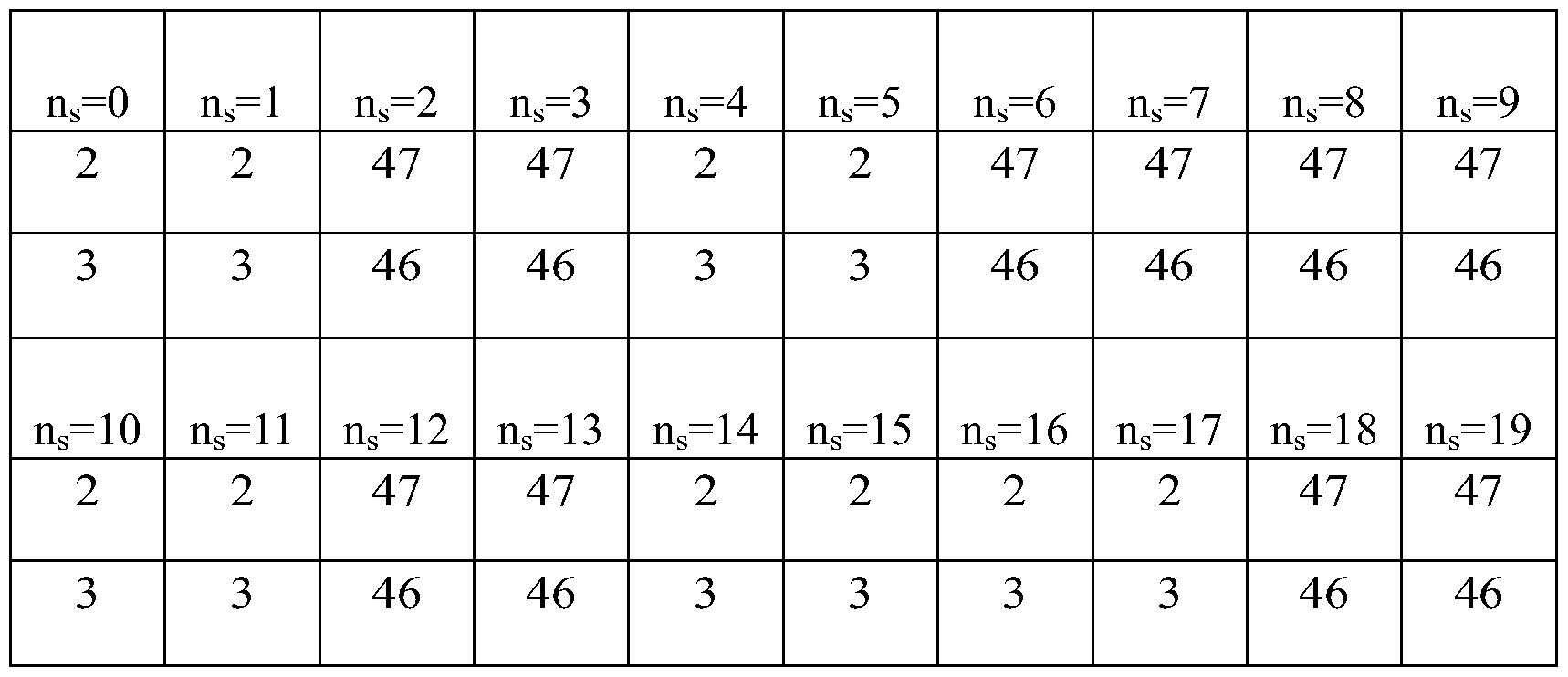
接下来的 10个 TTI中 20个 Slot的物理资源块索引(频域位置) "™与表 1相同。

如果 Nsb=4, =2, 时隙 0~19的物理资源块索引"™的如表 2所示。
表 2时隙 0~19的物理资源块索引"™的示意表 2

接下来的 10个 TTI中 20个 Slot的物理资源块索引(频域位置) "™与表 2相同。 在本实施例中, 当 ns周期为 40个 Slot, 即为 0~39时, 表 1变为

表 2变为
 38 38 35 35 38 38 35 35 35 35
39 39 34 34 39 39 34 34 34 34 ns=10 ns=l l ns=12 ns=13 ns=14 ns=15 ns=16 ns=17 ns=18 ns=19
14 14 35 35 14 14 14 14 47 47
15 15 34 34 15 15 15 15 46 46 ns=20 ns=21 ns=22 ns=23 ns=24 ns=25 ns=26 ns=27 ns=28 ns=29
14 14 47 47 47 47 38 38 47 47
15 15 46 46 46 46 39 39 46 46 ns=30 ns=31 ns=32 ns=33 ns=34 ns=35 ns=36 ns=37 ns=38 ns=39
38 38 38 38 47 47 38 38 47 47
39 39 39 39 46 46 39 39 46 46 优选实施例三 本实施例提供了一种 TTI Bundling的数据传输方法, 图 7是根据本发明实施例的 增强的传输时间间隔捆绑技术的资源分配示意图二, 如图 6 所示, VoIP 采用 TTI Bundling技术进行传输, TTI Bundling Size =4, 即 4个 TTI。 重传和首传采用相同的 HARQ进程, 但是资源位置不完全相同, 取决于跳频方式及信令指示的参数。 其中, TTI Bundling首传对应的 PDCCH中携带一个资源分配或者资源授予 (Grant) 信息, 根据资源分配信息和预定义跳频方式得到物理资源块的位置和数量信息, 跳频方式可 以通过如下公式确定:
"PRB ) = ("VRB + ΛοΡ ('·) . + (( - 1) - 2(«VRB modTV* )) . /m(i))mod( . NJ 在本实施例中, 上述公式的参数取值如下:
TTI Bundling跳频变量 i =floor(ns/(TTI_BUNDLING_SIZE))+mod(floor(ns/2), 2)。
o wsb=i
c(k) x 2*-(M0+1) I mod Nsb Nsb = 2
优选地, Λ。» J
'Ψ c(k) x 2*-(M0+1) ] mod(Wsb -1)1 + 1 〕dWsb Nsb >2 优选地, ('·) = '· mod 2。 优选地, N
优选地, «v

«PRB(«S)
优选地, 《PRB(«J:

TTI BUNDLING SIZE = 4;
Nsh = 1
=0
ns为从 0到 19的整数序列。 本优选实施例中采用与优选实施例 在本实施例中, UL Grant指示 " = [2, 3],则根据上述预定义跳频 Pattern的方法, 当 周期为 20个 Slot, 即以 10个 TTI为周期, 则时隙 0~19的物理资源块索引 (或 频域位置) "™如下表 3所示: 表 3时隙 0~19的物理资源块索引"™的示意表 3
 3 3 46 46 46 46 3 3 3 3 ns=10 ns=l l ns=12 ns=13 ns=14 ns=15 ns=16 ns=17 ns=18 ns=19
47 47 47 47 2 2 2 2 47 47
46 46 46 46 3 3 3 3 46 46 接下来的 10个 TTI中 20个 Slot的物理资源块索引(频域位置) "™与表 1相同。

如果 Nsb=4, = 2, 时隙 0~19的物理资源块索引"™的如表 4所示。
表 4时隙 0~19的物理资源块索引"™的示意表 4

当 ns周期为 40个 Slot, 即为 0~39时, 表 1变为
 3 3 44 44 44 44 3 3 3 3 ns=10 ns=l l ns=12 ns=13 ns=14 ns=15 ns=16 ns=17 ns=18 ns=19
45 45 45 45 2 2 2 2 45 45
44 44 44 44 3 3 3 3 44 44 ns=20 ns=21 ns=22 ns=23 ns=24 ns=25 ns=26 ns=27 ns=28 ns=29
45 45 2 2 2 2 45 45 45 45
44 44 3 3 3 3 44 44 44 44 ns=30 ns=31 ns=32 ns=33 ns=34 ns=35 ns=36 ns=37 ns=38 ns=39
2 2 2 2 45 45 45 45 2 2
3 3 3 3 44 44 44 44 3 3 表 2变为

Claims
权 利 要 求 书
1. 一种数据传输方法, 包括:
根据传输时间间隔捆绑 TTI Bundling参数通过跳频方式确定用于发送 TTI Bundling的时隙中物理资源块的频域位置,其中,所述跳频方式的跳频变量 ί根 据所述 TTI Bundling参数通过以下方式之一或其组合确定, mod为取模操作, floor为向下取整操作, 为时隙序号:
i =floor(¾/(2*TTI Bundling参数)) +mod(floor(ns/2),2);
i =floor(ns/(TTI Bundling参数)) +mod(floor(ns/2),2);
在确定的所述 TTI Bundling的时隙中的物理资源块的频域位置所对应的时 频资源上传输数据。
2. 根据权利要求 1所述的方法, 其中, 所述 TTI Bundling参数为正整数, 并且根 据 TTI Bundling中捆绑的传输时间间隔 TTI的个数 Γ77_β[/ ^/ 7_ /Ζ 确定。
3. 根据权利要求 1所述的方法, 其中, 根据传输时间间隔捆绑 TTI Bundling参数 通过跳频方式确定用于发送 TTI Bundling的时隙中物理资源块的频域位置包括: 根据所述 TTI Bundling跳频变量 i通过以下公式确定频域位置 ^: ,

4. 根据权利要求 3中所述的方法, 其中, 所述 ρ (ζ·)通过如下公式确定:
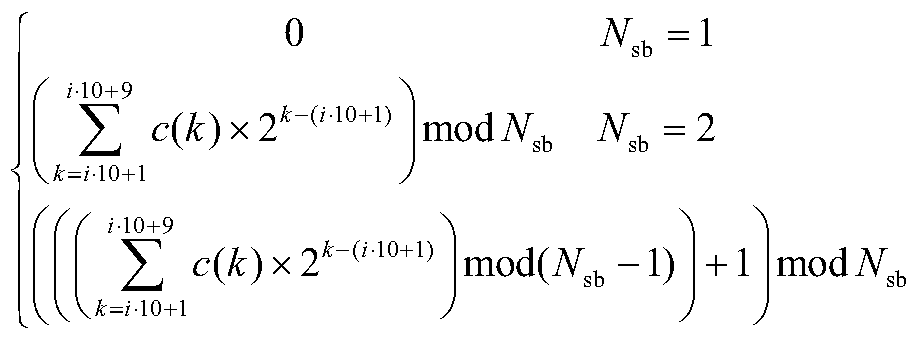
5. 根据权利要求 3所述的方法, 其中, 所述 (0通过如下公式确定:
m ( = /mod 2 ; 或,
fm(i) = c[((imod2) + CURRENT _TX _NB) . q]
其中, mod为取模函数, CURRENT_TX_NB为当前发送次数, g为正整数。
6. 根据权利要求 5所述的方法, 其中, (0对应的公式通过如下方式之一确定: 无线资源控制 RRC层消息指示;
资源授予消息指示;
预定义。
7. 根据权利要求 3所述的方法, 其中, 通过如下公式确定:

其中, 为上行带宽对应的一个时隙中资源块的总数,
」为对 y向下取整操作。 根据权利要求 3所述的方法, 其中, VRB通过如下公式确定: .

9. 根据权利要求 3至 8中任一项所述的方法,其中,所述 TTI Bundling跳频变量 z' 对应的公式通过如下方式之一确定:
无线资源控制 RRC层消息指示;
资源授予消息指示;
预定义。
10. 一种数据传输装置, 包括:
确定模块, 设置为根据传输时间间隔捆绑 TTI Bundling参数通过跳频方式 确定用于发送 TTI Bundling的时隙中物理资源块的频域位置, 其中, 所述跳频 方式的跳频变量 i根据所述 TTI Bundling参数通过以下方式之一或其组合确定, mod为取模操作, floor为向下取整操作, 为时隙序号:
i =floor(¾/(2*TTI Bundling参数)) +mod(floor(ns/2),2);
i =floor(ns/(TTI Bundling参数)) +mod(floor(ns/2),2); 传输模块, 设置为在确定的所述时隙中的所述物理资源块的频域位置所对 应的时频资源上传输数据。
11. 根据权利要求 10所述的装置, 其中, 所述 TTI Bundling参数为正整数, 并且根 据 TTI Bundling中捆绑的传输时间间隔 TTI的个数 Γ77_β[/ ^/ 7_ /Ζ 确定。
12. 根据权利要求 10所述的装置,其中,所述确定模块设置为根据所述 TTI Bundling 跳频变量 i通过以下公式确定频域位置
 其中, ) = ("νκΒ + Λ„ρ ('■) · + ((Ν^ - 1) - 2( mod A )) . fm ( )mod( V*■ N ,
("J为物理资源块偏置索引, ^ 为虚拟资源块偏置索引, 为跳频偏置, 「x,为对 X向上取整操作, ρ (ζ·)为子带跳频函数, 为子带内的资源块数目, 《为镜像跳频函数, mod为取模操作, Wsb为子带数, 为时隙序号。
Priority Applications (2)
| Application Number | Priority Date | Filing Date | Title |
|---|---|---|---|
| US14/408,278 US9425928B2 (en) | 2012-06-19 | 2013-06-19 | Data transmission method and device |
| EP13806943.0A EP2863550B1 (en) | 2012-06-19 | 2013-06-19 | Data transmission method and device |
Applications Claiming Priority (2)
| Application Number | Priority Date | Filing Date | Title |
|---|---|---|---|
| CN201210203377.8 | 2012-06-19 | ||
| CN201210203377.8A CN103516493B (zh) | 2012-06-19 | 2012-06-19 | 数据传输方法及装置 |
Publications (1)
| Publication Number | Publication Date |
|---|---|
| WO2013189288A1 true WO2013189288A1 (zh) | 2013-12-27 |
Family
ID=49768118
Family Applications (1)
| Application Number | Title | Priority Date | Filing Date |
|---|---|---|---|
| PCT/CN2013/077476 Ceased WO2013189288A1 (zh) | 2012-06-19 | 2013-06-19 | 数据传输方法及装置 |
Country Status (4)
| Country | Link |
|---|---|
| US (1) | US9425928B2 (zh) |
| EP (1) | EP2863550B1 (zh) |
| CN (1) | CN103516493B (zh) |
| WO (1) | WO2013189288A1 (zh) |
Families Citing this family (15)
| Publication number | Priority date | Publication date | Assignee | Title |
|---|---|---|---|---|
| US11064329B2 (en) * | 2013-04-17 | 2021-07-13 | Qualcomm Incorporated | Control-less operation for coverage limited machine-type-communications |
| CN105493417B (zh) | 2013-07-26 | 2018-11-09 | Lg 电子株式会社 | 发送用于mtc的信号的方法及其设备 |
| EP2986070B1 (en) | 2014-06-09 | 2018-03-07 | Huawei Technologies Co., Ltd. | Signal transmission method and user equipment |
| WO2016019552A1 (zh) * | 2014-08-07 | 2016-02-11 | 华为技术有限公司 | 传输数据的方法、设备及系统 |
| US10868591B2 (en) * | 2015-01-21 | 2020-12-15 | Qualcomm Incorporated | Spatial and frequency diversity design for machine type communications (MTC) |
| WO2016183726A1 (zh) * | 2015-05-15 | 2016-11-24 | 华为技术有限公司 | 一种在使用TTI Bundling技术的TDD网络中传输数据的方法和在TDD网络中支持TTI Bundling技术的用户设备 |
| CN107534971B (zh) * | 2015-05-15 | 2020-07-10 | 诸暨市元畅信息技术咨询服务部 | 一种频率资源确定方法和装置 |
| WO2017196400A1 (en) * | 2016-05-12 | 2017-11-16 | Intel IP Corporation | Systems, methods and devices for non-adaptive retransmission using semi-persistent scheduling resources |
| US10819475B2 (en) * | 2016-08-12 | 2020-10-27 | Qualcomm Incorporated | Uplink semi-persistent scheduling for low latency communications |
| US10524257B2 (en) * | 2016-10-09 | 2019-12-31 | Qualcomm Incorporated | TTI bundling for URLLC UL/DL transmissions |
| US11601820B2 (en) | 2017-01-27 | 2023-03-07 | Qualcomm Incorporated | Broadcast control channel for shared spectrum |
| WO2018141213A1 (en) | 2017-02-03 | 2018-08-09 | Telefonaktiebolaget Lm Ericsson (Publ) | Method and device for performing uplink transmission |
| US11032844B2 (en) * | 2017-06-22 | 2021-06-08 | Qualcomm Incorporated | Physical shared channel transmission to acknowledgement delay optimization |
| CN109309558B (zh) * | 2017-07-28 | 2021-10-08 | 株式会社Kt | 用于发送和接收上行链路信道的设备和方法 |
| CN111988849B (zh) * | 2019-05-22 | 2022-09-06 | 成都鼎桥通信技术有限公司 | 数据传输方法、装置、系统、设备以及存储介质 |
Citations (5)
| Publication number | Priority date | Publication date | Assignee | Title |
|---|---|---|---|---|
| EP1848115A2 (en) * | 2006-04-21 | 2007-10-24 | Samsung Electronics Co.,Ltd. | Frequency hopping method and apparatus in a wireless communication system |
| TW201004209A (en) * | 2008-04-11 | 2010-01-16 | Interdigital Patent Holdings | Methods for transmission time interval bundling in the uplink |
| CN101841918A (zh) * | 2010-04-21 | 2010-09-22 | 华为技术有限公司 | 测量参考信号的带宽资源分配方法及装置 |
| CN102045789A (zh) * | 2009-10-16 | 2011-05-04 | 中兴通讯股份有限公司 | 基于跳频的频率物理资源调度方法及系统 |
| CN102365827A (zh) * | 2009-02-02 | 2012-02-29 | 株式会社Ntt都科摩 | 移动通信系统中的基站装置和方法 |
Family Cites Families (7)
| Publication number | Priority date | Publication date | Assignee | Title |
|---|---|---|---|---|
| WO2009132204A2 (en) * | 2008-04-24 | 2009-10-29 | Interdigital Patent Holdings, Inc. | Method and apparatus for harq autonomous retransmissions |
| CN101778475A (zh) * | 2009-01-12 | 2010-07-14 | 华为技术有限公司 | 跳频资源分配方法及装置 |
| CN104254995B (zh) * | 2012-01-24 | 2018-05-11 | 交互数字专利控股公司 | 用于改善的上行链路覆盖的系统和方法 |
| US9295056B2 (en) * | 2012-03-23 | 2016-03-22 | Qualcomm Incorporated | Systems and methods for signaling and determining transmission time interval bundling parameters |
| EP2832024A1 (en) * | 2012-03-26 | 2015-02-04 | Telefonaktiebolaget LM Ericsson (PUBL) | Dynamic bundling in lte using explicit signalling |
| CN103379635A (zh) * | 2012-04-25 | 2013-10-30 | 中兴通讯股份有限公司 | 数据传输方法及装置 |
| US9806873B2 (en) * | 2012-05-09 | 2017-10-31 | Samsung Electronics Co., Ltd. | Method and apparatus for controlling discontinuous reception in mobile communication system |
-
2012
- 2012-06-19 CN CN201210203377.8A patent/CN103516493B/zh active Active
-
2013
- 2013-06-19 WO PCT/CN2013/077476 patent/WO2013189288A1/zh not_active Ceased
- 2013-06-19 US US14/408,278 patent/US9425928B2/en active Active
- 2013-06-19 EP EP13806943.0A patent/EP2863550B1/en not_active Not-in-force
Patent Citations (5)
| Publication number | Priority date | Publication date | Assignee | Title |
|---|---|---|---|---|
| EP1848115A2 (en) * | 2006-04-21 | 2007-10-24 | Samsung Electronics Co.,Ltd. | Frequency hopping method and apparatus in a wireless communication system |
| TW201004209A (en) * | 2008-04-11 | 2010-01-16 | Interdigital Patent Holdings | Methods for transmission time interval bundling in the uplink |
| CN102365827A (zh) * | 2009-02-02 | 2012-02-29 | 株式会社Ntt都科摩 | 移动通信系统中的基站装置和方法 |
| CN102045789A (zh) * | 2009-10-16 | 2011-05-04 | 中兴通讯股份有限公司 | 基于跳频的频率物理资源调度方法及系统 |
| CN101841918A (zh) * | 2010-04-21 | 2010-09-22 | 华为技术有限公司 | 测量参考信号的带宽资源分配方法及装置 |
Non-Patent Citations (1)
| Title |
|---|
| See also references of EP2863550A4 * |
Also Published As
| Publication number | Publication date |
|---|---|
| US9425928B2 (en) | 2016-08-23 |
| CN103516493B (zh) | 2018-07-06 |
| CN103516493A (zh) | 2014-01-15 |
| US20150180621A1 (en) | 2015-06-25 |
| EP2863550A1 (en) | 2015-04-22 |
| EP2863550A4 (en) | 2015-08-05 |
| EP2863550B1 (en) | 2017-11-01 |
Similar Documents
| Publication | Publication Date | Title |
|---|---|---|
| WO2013189288A1 (zh) | 数据传输方法及装置 | |
| JP7333413B2 (ja) | 複数の送信/受信ポイント(trp)上でトランスポートブロック(tb)を繰り返す方法 | |
| US10645730B2 (en) | Flexible grant-free resource configuration signaling | |
| CN103379628B (zh) | 基于传输时间间隔捆绑的资源分配方法及移动终端 | |
| CN109548409B (zh) | 无线通信系统中的上行链路传输的方法及其设备 | |
| CN109845180B (zh) | 无线通信系统中用于支持短传输时间间隔的终端发送或者接收上行链路信号的方法及其装置 | |
| TWI620431B (zh) | 以fdd模式操作的網路中支援hd-fdd操作的方法及裝置 | |
| CN113261225B (zh) | 无线通信系统中用于反馈发送和接收的方法和装置 | |
| JP2023536093A (ja) | Csi報告を送信するための方法及び装置 | |
| CN103379635A (zh) | 数据传输方法及装置 | |
| KR20200015284A (ko) | 무선 통신 시스템에서 채널 점유 시간 지시 방법 및 장치 | |
| JP7221866B2 (ja) | 伝送方法及び装置 | |
| CN109997327A (zh) | 在无线通信系统中发送上行链路信号的方法及其装置 | |
| TW200952428A (en) | Method for mapping physical hybrid automatic repeat request indicator channel | |
| CN107615858A (zh) | 用于虚拟(基带)载波聚合宽带lte的设备、网络和方法 | |
| CN110402559A (zh) | 在无线通信系统中支持多个发送时间间隔、多个子载波间隔或多个处理时间间隔的方法及其设备 | |
| CN103428775A (zh) | 基于传输时间间隔捆绑的资源配置方法及发送装置 | |
| WO2017008562A1 (zh) | 在上行控制信道上发送信号的方法和装置 | |
| WO2014008855A1 (zh) | 数据传输方法及装置 | |
| CN109803393B (zh) | 信息发送方法及装置 | |
| JP7461893B2 (ja) | ユーザ機器及び方法 | |
| CN115362647A (zh) | Sr和harq-ack之间的优先化 | |
| WO2014008847A1 (zh) | 数据传输方法及装置 | |
| CN103546253B (zh) | 一种数据传输方法及系统 | |
| US20180248659A1 (en) | Method and apparatus for processing hybrid automatic repeat request process in communication system |
Legal Events
| Date | Code | Title | Description |
|---|---|---|---|
| 121 | Ep: the epo has been informed by wipo that ep was designated in this application |
Ref document number: 13806943 Country of ref document: EP Kind code of ref document: A1 |
|
| WWE | Wipo information: entry into national phase |
Ref document number: 14408278 Country of ref document: US |
|
| REEP | Request for entry into the european phase |
Ref document number: 2013806943 Country of ref document: EP |
|
| NENP | Non-entry into the national phase |
Ref country code: DE |