WO2014009025A1 - Methods for synthesizing amatoxin building block and amatoxins - Google Patents

Methods for synthesizing amatoxin building block and amatoxins Download PDF

Info

Publication number
WO2014009025A1
WO2014009025A1 PCT/EP2013/002084 EP2013002084W WO2014009025A1 WO 2014009025 A1 WO2014009025 A1 WO 2014009025A1 EP 2013002084 W EP2013002084 W EP 2013002084W WO 2014009025 A1 WO2014009025 A1 WO 2014009025A1
Authority
WO
WIPO (PCT)
Prior art keywords
compound
fmoc
create
resin
protected
Prior art date
Legal status (The legal status is an assumption and is not a legal conclusion. Google has not performed a legal analysis and makes no representation as to the accuracy of the status listed.)
Ceased
Application number
PCT/EP2013/002084
Other languages
French (fr)
Inventor
Christian Lutz
Christoph Mueller
Werner Simon
Current Assignee (The listed assignees may be inaccurate. Google has not performed a legal analysis and makes no representation or warranty as to the accuracy of the list.)
Heidelberg Pharma Research GmbH
Original Assignee
Heidelberg Pharma GmbH
Priority date (The priority date is an assumption and is not a legal conclusion. Google has not performed a legal analysis and makes no representation as to the accuracy of the date listed.)
Filing date
Publication date
Priority to CN201380037459.2A priority Critical patent/CN104470891B/en
Priority to KR1020157003282A priority patent/KR102122575B1/en
Priority to NZ702752A priority patent/NZ702752A/en
Priority to AU2013289555A priority patent/AU2013289555B2/en
Priority to HK15110372.0A priority patent/HK1209723B/en
Priority to EP13737145.6A priority patent/EP2872479B1/en
Priority to MX2015000479A priority patent/MX361116B/en
Priority to DK13737145.6T priority patent/DK2872479T3/en
Priority to JP2015520852A priority patent/JP2015528799A/en
Priority to US14/414,143 priority patent/US9676702B2/en
Priority to RU2015104802A priority patent/RU2637924C2/en
Priority to ES13737145.6T priority patent/ES2589306T3/en
Priority to HRP20160984TT priority patent/HRP20160984T1/en
Priority to UAA201501155A priority patent/UA116991C2/en
Application filed by Heidelberg Pharma GmbH filed Critical Heidelberg Pharma GmbH
Priority to SG11201500225WA priority patent/SG11201500225WA/en
Priority to SI201330268A priority patent/SI2872479T1/en
Priority to BR112015000232-3A priority patent/BR112015000232B1/en
Priority to CA2878081A priority patent/CA2878081C/en
Publication of WO2014009025A1 publication Critical patent/WO2014009025A1/en
Priority to IL236129A priority patent/IL236129A/en
Priority to ZA2014/09384A priority patent/ZA201409384B/en
Anticipated expiration legal-status Critical
Priority to CY20161100827T priority patent/CY1117950T1/en
Ceased legal-status Critical Current

Links

Classifications

    • AHUMAN NECESSITIES
    • A61MEDICAL OR VETERINARY SCIENCE; HYGIENE
    • A61PSPECIFIC THERAPEUTIC ACTIVITY OF CHEMICAL COMPOUNDS OR MEDICINAL PREPARATIONS
    • A61P35/00Antineoplastic agents
    • CCHEMISTRY; METALLURGY
    • C07ORGANIC CHEMISTRY
    • C07CACYCLIC OR CARBOCYCLIC COMPOUNDS
    • C07C227/00Preparation of compounds containing amino and carboxyl groups bound to the same carbon skeleton
    • C07C227/14Preparation of compounds containing amino and carboxyl groups bound to the same carbon skeleton from compounds containing already amino and carboxyl groups or derivatives thereof
    • C07C227/16Preparation of compounds containing amino and carboxyl groups bound to the same carbon skeleton from compounds containing already amino and carboxyl groups or derivatives thereof by reactions not involving the amino or carboxyl groups
    • CCHEMISTRY; METALLURGY
    • C07ORGANIC CHEMISTRY
    • C07CACYCLIC OR CARBOCYCLIC COMPOUNDS
    • C07C229/00Compounds containing amino and carboxyl groups bound to the same carbon skeleton
    • C07C229/02Compounds containing amino and carboxyl groups bound to the same carbon skeleton having amino and carboxyl groups bound to acyclic carbon atoms of the same carbon skeleton
    • C07C229/04Compounds containing amino and carboxyl groups bound to the same carbon skeleton having amino and carboxyl groups bound to acyclic carbon atoms of the same carbon skeleton the carbon skeleton being acyclic and saturated
    • C07C229/22Compounds containing amino and carboxyl groups bound to the same carbon skeleton having amino and carboxyl groups bound to acyclic carbon atoms of the same carbon skeleton the carbon skeleton being acyclic and saturated the carbon skeleton being further substituted by oxygen atoms
    • CCHEMISTRY; METALLURGY
    • C07ORGANIC CHEMISTRY
    • C07KPEPTIDES
    • C07K1/00General methods for the preparation of peptides, i.e. processes for the organic chemical preparation of peptides or proteins of any length
    • C07K1/06General methods for the preparation of peptides, i.e. processes for the organic chemical preparation of peptides or proteins of any length using protecting groups or activating agents
    • C07K1/061General methods for the preparation of peptides, i.e. processes for the organic chemical preparation of peptides or proteins of any length using protecting groups or activating agents using protecting groups
    • C07K1/065General methods for the preparation of peptides, i.e. processes for the organic chemical preparation of peptides or proteins of any length using protecting groups or activating agents using protecting groups for hydroxy functions, not being part of carboxy functions
    • CCHEMISTRY; METALLURGY
    • C07ORGANIC CHEMISTRY
    • C07KPEPTIDES
    • C07K1/00General methods for the preparation of peptides, i.e. processes for the organic chemical preparation of peptides or proteins of any length
    • C07K1/10General methods for the preparation of peptides, i.e. processes for the organic chemical preparation of peptides or proteins of any length using coupling agents
    • CCHEMISTRY; METALLURGY
    • C07ORGANIC CHEMISTRY
    • C07DHETEROCYCLIC COMPOUNDS
    • C07D207/00Heterocyclic compounds containing five-membered rings not condensed with other rings, with one nitrogen atom as the only ring hetero atom
    • C07D207/02Heterocyclic compounds containing five-membered rings not condensed with other rings, with one nitrogen atom as the only ring hetero atom with only hydrogen or carbon atoms directly attached to the ring nitrogen atom
    • C07D207/04Heterocyclic compounds containing five-membered rings not condensed with other rings, with one nitrogen atom as the only ring hetero atom with only hydrogen or carbon atoms directly attached to the ring nitrogen atom having no double bonds between ring members or between ring members and non-ring members
    • C07D207/10Heterocyclic compounds containing five-membered rings not condensed with other rings, with one nitrogen atom as the only ring hetero atom with only hydrogen or carbon atoms directly attached to the ring nitrogen atom having no double bonds between ring members or between ring members and non-ring members with hetero atoms or with carbon atoms having three bonds to hetero atoms with at the most one bond to halogen, e.g. ester or nitrile radicals, directly attached to ring carbon atoms
    • C07D207/16Carbon atoms having three bonds to hetero atoms with at the most one bond to halogen, e.g. ester or nitrile radicals
    • YGENERAL TAGGING OF NEW TECHNOLOGICAL DEVELOPMENTS; GENERAL TAGGING OF CROSS-SECTIONAL TECHNOLOGIES SPANNING OVER SEVERAL SECTIONS OF THE IPC; TECHNICAL SUBJECTS COVERED BY FORMER USPC CROSS-REFERENCE ART COLLECTIONS [XRACs] AND DIGESTS
    • Y02TECHNOLOGIES OR APPLICATIONS FOR MITIGATION OR ADAPTATION AGAINST CLIMATE CHANGE
    • Y02PCLIMATE CHANGE MITIGATION TECHNOLOGIES IN THE PRODUCTION OR PROCESSING OF GOODS
    • Y02P20/00Technologies relating to chemical industry
    • Y02P20/50Improvements relating to the production of bulk chemicals
    • Y02P20/55Design of synthesis routes, e.g. reducing the use of auxiliary or protecting groups

Definitions

  • the invention relates to novel methods for synthesizing a synthon for ⁇ , ⁇ - dihydroxyisoleucine 1 (CAS No. 55399-94-5] as building block for the synthesis of amatoxins, and for novel methods for s nthesizing amatoxins using such building block.
  • Patent application EP 1 859 81 1 A1 (published November 28, 2007) described conjugates, in which the ⁇ C-atom of amatoxin amino acid 1 of ⁇ -amanitin was directly coupled, i.e. without a linker structure, to albumin or to monoclonal antibody HEA125, OKT3, or PA-1. Furthermore, the inhibitory effect of these conjugates on the proliferation of breast cancer cells (MCF-7), Burkitt's lymphoma cells (Raji), and T- lymphoma cells (Jurkat) was shown.
  • MCF-7 breast cancer cells
  • Raj Burkitt's lymphoma cells
  • Jurkat T- lymphoma cells
  • linkers including linkers comprising elements such as amide, ester, ether, thioether, disulfide, urea, thiourea, hydrocarbon moieties and the like, but no such constructs were actually shown, and no more details, such as attachment sites on the amatoxins, were provided.
  • Patent applications WO 2010/115629 and WO 2010/115630 (both published October 14, 2010) describe conjugates, where antibodies, such as anti- EpCAM antibodies such as humanized antibody huHEA125, are coupled to amatoxins via (i) the ⁇ C-atom of amatoxin amino acid 1 , (ii) the 6' C-atom of amatoxin amino acid 4, or (iii) via the ⁇ C-atom of amatoxin amino acid 3, in each case either directly or via a linker between the antibody and the amatoxins.
  • the suggested linkers comprise elements such as amide, ester, ether, thioether, disulfide, urea, thiourea, hydrocarbon moieties and the like.
  • the inhibitory effects of these conjugates on the proliferation of breast cancer cells (cell line MCF-7), pancreatic carcinoma (cell line Capan-1 ), colon cancer (cell line Colo205), and cholangiocarcinoma (cell line OZ) were shown.
  • Amatoxins can be isolated from collected Amanita phalloides mushrooms fruit bodies, or from pure cultures (Zhang P, Chen Z, Hu J, Wei B, Zhang Z, and Hu W, Production and characterization of Amanitin toxins from a pure culture of Amanita exitialis, FEMS Microbiol Lett. 2005 Nov 15;252(2):223-8. Epub 2005 Sep 15).
  • the amounts of amatoxins that can be obtained are rather low (in the range of about 0.3 - 3 mg/g dry matter from natural fruit bodies, and about 10% thereof from pure culture) and the flexibility for further modifying the naturally occurring amatoxin variants is limited (see references discussed in [003]-[005] and references cited therein).
  • amatoxins can be obtained from fermentation using a basidiomycete (Muraoka S, and Shinozawa T., Effective production of amanitins by two- step cultivation of the basidiomycete, Galerina fasciculata GF-060, J Biosci Bioeng. 2000;89(1 ):73-6; the reported yield was about 5 mg/l culture) or A. fissa (Guo XW, Wang GL, and Gong JH, Culture conditions and analysis of amanitins on Amanita spissa, Wei Sheng Wu Xue Bao. 2006 Jun;46(3):373-8; the reported yield was about 30 pg/l culture). Again, yields are low, and flexibility for further modifying the naturally occurring amatoxin variants is limited as well.
  • amatoxins have been prepared by partial or total synthesis (e.g.
  • Zanotti G, Mohringer C, and Wieland T. Synthesis of analogues of amaninamide, an amatoxin from the white Amanita virosa mushroom, Int J Pept Protein Res. 1987 Oct;30(4):450-9; Zanotti G, Wieland T, Benedetti E, Di Blasio B, Pavone V, and Pedone C, Structure-toxicity relationships in the amatoxin series. Synthesis of S- deoxy[gamma(R)-hydroxy-lle3]-amaninamide, its crystal and molecular structure and inhibitory efficiency, Int J Pept Protein Res.
  • the present invention is based on the unexpected observation that ⁇ , ⁇ - dihydroxyisoleucine 1 , or a synthon therefore, can be obtained in a multi-step process, wherein the regioselective methylation of an appropriately protected aspartic acid derivative is the key step.
  • the present invention relates to a method for the synthesis of ⁇ , ⁇ -dihydroxyisoleucine 1 , or of a synthon for compound 1 , comprising the step of methylating compound 3, particularly with methyl iodide in the presence of lithium bis(trimethylsilyl)amide (LHMDS).
  • LHMDS lithium bis(trimethylsilyl)amide
  • the present invention relates to a method for the synthesis of ⁇ , ⁇ -dihydroxyisoleucine 1 , or of a synthon for compound 1 , comprising the step of methylating compound 3* (having a second benzyl protection group at the nitrogen atom instead of the phenyl fluorenyl group in compound 3), particularly with methyl iodide in the presence of lithium bis(trimethylsilyl)amide (LHMDS).
  • LHMDS lithium bis(trimethylsilyl)amide
  • the present invention relates to compound 6.
  • the present invention relates to a kit comprising compound 6, and at least one additional reagent for the synthesis of amatoxins or precursors thereof.
  • the present invention relates to a method for synthesizing an amatoxin, or precursor molecule therefor, comprising the step of coupling compound 6 to hydroxyproline, particularly by reacting compound 6 with a hydroxyproline-preloaded resin (PS) L.
  • PS hydroxyproline-preloaded resin
  • Fig. 1 shows the structural formulae of different amatoxins.
  • the numbers in bold type (1 to 8) designate the standard numbering of the eight amino acids forming the amatoxin.
  • the standard designations of the atoms in amino acids 1 , 3 and 4 are also shown (Greek letters a to ⁇ , Greek letters a to ⁇ , and numbers from 1 " to 7', respectively).
  • Fig. 2 shows 1 H- and 13 C-NMR spectra, displaying a diastereomeric ratio of 70 : 30 of compound 6.
  • FIG. 3 shows a general synthetic scheme of the synthesis of amatoxins.
  • the terms used herein are defined as described in "A multilingual glossary of biotechnological terms: (lUPAC Recommendations)", Leuenberger, H.G.W, Nagel, B. and Kolbl, H. eds. (1995), Helvetica Chimica Acta, CH- 4010 Basel, Switzerland).
  • the present invention relates to a method for the synthesis of ⁇ , ⁇ -dihydroxyisoleucine 1 , or of a synthon for compound 1 , comprising the step of methylating compound 3, particularly with methyl iodide in the presence of lithium bis(trimethylsilyl)amide (LHMDS).
  • LHMDS lithium bis(trimethylsilyl)amide
  • the present invention relates to a method for the synthesis of ⁇ , ⁇ -dihydroxyisoleucine 1 , or of a synthon for compound 1 , comprising the step of methylating compound 3* (having a second benzyl protection group at the nitrogen atom instead of the phenyl fluorenyl group in compound 3), particularly with methyl iodide in the presence of lithium bis(trimethylsilyl)amide (LHMDS).
  • LHMDS lithium bis(trimethylsilyl)amide
  • the term “synthon” refers to a compound that is, or can be used as, a synthetic equivalent for a particular compound of interest in a chemical reaction.
  • This definition includes compounds, where a moiety of the compound of interest that would be labile or reactive under the conditions to be used in said chemical reaction is protected or masked by an appropriate protection group that can be cleaved off after said chemical reaction.
  • the reaction is performed at a temperature between about -10°C and about -80°C in an ether for between about 12 and about 20 hours, particularly for about 16 hours. In a particular embodiment, the reaction is performed at -20 °C and in tetrahydrofuran as solvent. In particular embodiments, a diastereomeric purity of greater than 30 : 1 , particularly greater than 40 : 1 , particularly about 50 : 1 is obtained.
  • the method further comprises one or more of the following steps for synthesizing compound 3:
  • the method further comprises one or more of the following steps for synthesizing compound 3*:
  • the method further comprises one or more of the following steps:
  • the method further comprises one or more of the following steps:
  • the method further comprises the step of isolating and purifying compound 6.
  • compound 6 is purified using precipitation as hydrochloride and/or chromatographic purification.
  • the present invention relates to compound 6.
  • compound 6 has a purity greater than 90%, particularly greater than 95%.
  • the term "purity" refers to the total amount of compound 6 and of its diastereoisomers being present.
  • a purity of greater than 90%, for example, means that in 1 g of a composition comprising compound 6, there are more than 90%, i.e. more than 900 mg, of compound 6 and/or its stereoisomers.
  • the remaining part, i.e. the impurities may include unreacted starting material and other reactants, solvents, cleavage products and/or side products.
  • a composition comprising compound 6 with a purity greater than 90% comprises more than 100 mg of compound 6.
  • compound 6 has a diastereomeric purity greater than 70:30.
  • diastereomeric purity refers to the ratio of the amount of compound 6 being present in a composition comprising compound 6 to the amounts of its diastereoisomers being present in said composition.
  • a diastereomeric purity of greater than 70 : 30, for example, means that more than 70% of the total amount of protected dihydroxyisoleucines in a composition comprising compound 6 and of its diastereomers is compound 6, whereas the total amount of all diastereoisomers of compound 6 is correspondingly less than 30%.
  • a composition comprising compound 6 with a diastereomeric purity greater than 70 : 30 comprises more than 100 mg of compound 6.
  • the present invention relates to a kit comprising compound 6, particularly a kit comprising at least 100 mg of compound 6,and at least one additional reagent for the synthesis of amatoxins or precursors thereof.
  • compound 6 in the kit has a purity greater than
  • said at least one additional reagent is selected from the list of:
  • a resin particularly a resin selected from the group of: a Merrifield resin; a Rink-Amid resin; and a THP-resin;
  • a protected isoleucine particularly Fmoc-protected isoleucine (Fmoclle);
  • a peptide coupling reagent particularly a peptide coupling reagent selected from the group of: 0-(benzotriazol-1-yl)-N,N,N',N'-tetramethyluronium tetrafluoroborate (TBTU); benzotriazol-1 -yl-oxytripyrrolidinophosphonium hexafluorophosphate (PyBOP); and o-(7-azabenzotriazol-1-yl)-N,N,N',N'- tetramethyluronium hexafluorophosphate (HATU); and
  • a tertiary amine particularly ⁇ , ⁇ -diisopropylethylamine (DiPEA).
  • the present invention relates to a method for synthesizing an amatoxin, or precursor molecule therefor, comprising the step of (a) coupling compound 6 to hydroxyproline, particularly by reacting compound 6 with a hydroxyproline-preloaded resin, particularly by coupling compound 6 to the free C- terminus of FmocHypOH immobilized on a resin L, for example a tetrahydropyranyl (THP) resin.
  • a resin L for example a tetrahydropyranyl (THP) resin.
  • the remaining amino acids are then coupled by a N-terminal synthetic strategy.
  • the method of the present invention additionally comprises one or more of the following steps:
  • the present invention relates to a method for synthesizing an amatoxin, or precursor molecule therefor, in solution.
  • such method comprises one or more of the following steps: [0049]
  • the present invention relates to a method for synthesizing an amatoxin, or precursor molecule therefor, in solution, comprising the step of coupling compound 6 to hydroxyproline, particularly by reacting compound 6 with a hydroxyproline, particularly by coupling compound 6 to the free C-terminus of Fmoc (O'Bu) HypOH.
  • the amatoxin is an amatoxin with a dihydroxyisoleucine moiety as amino acid 3 (see Fig. 1 ).
  • amatoxin includes all cyclic peptides composed of 8 amino acids as isolated from the genus Amanita and described in Wieland, T. and Faulstich H. (Wieland T, Faulstich H., CRC Crit Rev Biochem.
  • amatoxins are defined as peptides or depsipeptides that inhibit mammalian RNA polymerase II.
  • Preferred amatoxins are those with a functional group (e.g. a carboxylic group, an amino group, a hydroxy group, a thiol or a thiol- capturing group) that can be reacted with linker molecules or target-binding moieties as defined above.
  • Amatoxins which are particularly suitable for the conjugates of the present invention are a-amanitin, ⁇ -amanitin, y-amanitin, ⁇ -amanitin, amanin, amaninamide, amanullin, and amanullinic acid as shown in Fig.
  • amatoxins for use in the present invention are a-amanitin, ⁇ - amanitin, and amaninamide.
  • a “chemical derivative” (or short: a “derivative”) of a compound refers to a species having a chemical structure that is similar to the compound, yet containing at least one chemical group not present in the compound and/or deficient of at least one chemical group that is present in the compound.
  • the compound to which the derivative is compared is known as the "parent” compound.
  • a “derivative” may be produced from the parent compound in one or more chemical reaction steps.
  • reaction vessel was charged with 179 mg, 0.6 mmol of 6, dissolved in 1.5 ml dimethylformamide, 1.5 ml of a 1 mM solution of hydroxybenzothiazole in dimethylformamide, 1.5 ml of a 1 mM solution of (benzotriazol- 1-yloxy)tripyrrolidinophosphonium hexafluorophosphate in dimethylformamide and 259 ⁇ of diisoppropylethylamine. After homogenisation with a glass bar the reaction was heated microwave assisted to 70°C for 4.0 minutes and finally washed with dimethylformamide (3 times) and dichloromethane (2 times).
  • Resin I was 2-N0 2 -phenylsulfonyl- deprotected and finally cleaved from resin 2-N0 2 -phenylsulfonyl-N-deprotection:
  • the resin was repeatedly (3 times) treated with 500 ⁇ mercaptoethanol and 500 ⁇ diazabicycloundecene in 4 ml dimethylformamide for 2 hours. The resin was then washed intensely with dimethylfomamide, dichloromethane, acetonitrile and t- butylmethylether.
  • compound 6 can be synthesized from compound 2* via intermediate compounds D*, E*. 4*, F* and 5* (in each having a second benzyl protection group at the nitrogen atom instead of the phenyl fluorenyl group in the corresponding compound D, E, 4, F and 5, respectively).

Landscapes

  • Chemical & Material Sciences (AREA)
  • Organic Chemistry (AREA)
  • Health & Medical Sciences (AREA)
  • General Health & Medical Sciences (AREA)
  • Medicinal Chemistry (AREA)
  • Life Sciences & Earth Sciences (AREA)
  • Proteomics, Peptides & Aminoacids (AREA)
  • Analytical Chemistry (AREA)
  • Molecular Biology (AREA)
  • Genetics & Genomics (AREA)
  • Biophysics (AREA)
  • Biochemistry (AREA)
  • Chemical Kinetics & Catalysis (AREA)
  • Public Health (AREA)
  • Veterinary Medicine (AREA)
  • Pharmacology & Pharmacy (AREA)
  • General Chemical & Material Sciences (AREA)
  • Animal Behavior & Ethology (AREA)
  • Nuclear Medicine, Radiotherapy & Molecular Imaging (AREA)
  • Organic Low-Molecular-Weight Compounds And Preparation Thereof (AREA)
  • Heterocyclic Carbon Compounds Containing A Hetero Ring Having Oxygen Or Sulfur (AREA)
  • Peptides Or Proteins (AREA)
  • Low-Molecular Organic Synthesis Reactions Using Catalysts (AREA)
  • Medicines That Contain Protein Lipid Enzymes And Other Medicines (AREA)

Description

METHODS FOR SYNTHESIZING AMATOXIN BUILDING BLOCK AND
AMATOXINS
FIELD OF THE INVENTION
[001] The invention relates to novel methods for synthesizing a synthon for γ,δ- dihydroxyisoleucine 1 (CAS No. 55399-94-5] as building block for the synthesis of amatoxins, and for novel methods for s nthesizing amatoxins using such building block.
Figure imgf000003_0001
1
[55399-94-5]
BACKGROUND OF THE INVENTION
[002] Amatoxins are cyclic peptides composed of 8 amino acids, that are found in Amanita phalloides mushrooms (see Fig. 1). Amatoxins specifically inhibit the DNA- dependent RNA polymerase II of mammalian cells, and thereby also the transcription and protein biosynthesis of the affected cells. Inhibition of transcription in a cell causes stop of growth and proliferation. Though not covalently bound, the complex between amanitin and RNA-polymerase II is very tight (« = 3 nM). Dissociation of amanitin from the enzyme is a very slow process, thus making recovery of an affected cell unlikely. When the inhibition of transcription lasts too long, the cell will undergo programmed cell death (apoptosis).
[003] The use of amatoxins as cytotoxic moieties for tumour therapy had already been explored in 1981 by coupling an anti-Thy 1.2 antibody to a-amanitin using a linker attached to the indole ring of Trp (amino acid 4; see Fig. 1) via diazotation (Davis & Preston, Science 1981 , 213, 1385-1388). Davis & Preston identified the site of attachment as position 7'. Morris & Venton demonstrated as well that substitution at position 7' results in a derivative, which maintains cytotoxic activity (Morris & Venton, Int. J. Peptide Protein Res. 1983, 21 419-430). [004] Patent application EP 1 859 81 1 A1 (published November 28, 2007) described conjugates, in which the γ C-atom of amatoxin amino acid 1 of β-amanitin was directly coupled, i.e. without a linker structure, to albumin or to monoclonal antibody HEA125, OKT3, or PA-1. Furthermore, the inhibitory effect of these conjugates on the proliferation of breast cancer cells (MCF-7), Burkitt's lymphoma cells (Raji), and T- lymphoma cells (Jurkat) was shown. The use of linkers was suggested, including linkers comprising elements such as amide, ester, ether, thioether, disulfide, urea, thiourea, hydrocarbon moieties and the like, but no such constructs were actually shown, and no more details, such as attachment sites on the amatoxins, were provided.
[005] Patent applications WO 2010/115629 and WO 2010/115630 (both published October 14, 2010) describe conjugates, where antibodies, such as anti- EpCAM antibodies such as humanized antibody huHEA125, are coupled to amatoxins via (i) the γ C-atom of amatoxin amino acid 1 , (ii) the 6' C-atom of amatoxin amino acid 4, or (iii) via the δ C-atom of amatoxin amino acid 3, in each case either directly or via a linker between the antibody and the amatoxins. The suggested linkers comprise elements such as amide, ester, ether, thioether, disulfide, urea, thiourea, hydrocarbon moieties and the like. Furthermore, the inhibitory effects of these conjugates on the proliferation of breast cancer cells (cell line MCF-7), pancreatic carcinoma (cell line Capan-1 ), colon cancer (cell line Colo205), and cholangiocarcinoma (cell line OZ) were shown.
[006] Amatoxins can be isolated from collected Amanita phalloides mushrooms fruit bodies, or from pure cultures (Zhang P, Chen Z, Hu J, Wei B, Zhang Z, and Hu W, Production and characterization of Amanitin toxins from a pure culture of Amanita exitialis, FEMS Microbiol Lett. 2005 Nov 15;252(2):223-8. Epub 2005 Sep 15). However, the amounts of amatoxins that can be obtained are rather low (in the range of about 0.3 - 3 mg/g dry matter from natural fruit bodies, and about 10% thereof from pure culture) and the flexibility for further modifying the naturally occurring amatoxin variants is limited (see references discussed in [003]-[005] and references cited therein).
[007] Alternatively, amatoxins can be obtained from fermentation using a basidiomycete (Muraoka S, and Shinozawa T., Effective production of amanitins by two- step cultivation of the basidiomycete, Galerina fasciculata GF-060, J Biosci Bioeng. 2000;89(1 ):73-6; the reported yield was about 5 mg/l culture) or A. fissa (Guo XW, Wang GL, and Gong JH, Culture conditions and analysis of amanitins on Amanita spissa, Wei Sheng Wu Xue Bao. 2006 Jun;46(3):373-8; the reported yield was about 30 pg/l culture). Again, yields are low, and flexibility for further modifying the naturally occurring amatoxin variants is limited as well.
[008] Finally, amatoxins have been prepared by partial or total synthesis (e.g.
Zanotti G, Mohringer C, and Wieland T., Synthesis of analogues of amaninamide, an amatoxin from the white Amanita virosa mushroom, Int J Pept Protein Res. 1987 Oct;30(4):450-9; Zanotti G, Wieland T, Benedetti E, Di Blasio B, Pavone V, and Pedone C, Structure-toxicity relationships in the amatoxin series. Synthesis of S- deoxy[gamma(R)-hydroxy-lle3]-amaninamide, its crystal and molecular structure and inhibitory efficiency, Int J Pept Protein Res. 1989 Sep;34(3):222-8; Zanotti G, Petersen G, and Wieland T., Structure-toxicity relationships in the amatoxin series. Structural variations of side chain 3 and inhibition of RNA polymerase II, Int J Pept Protein Res. 1992 Dec;40(6):551-8).
[009] While the use of fully-synthetic routes to amatoxins may offer the supply of larger quantities of amatoxins required for therapeutic uses, and may offer the construction of a variety of novel amatoxin variants by using appropriate starting materials as building blocks, no fully-synthetic approach to the most relevant amatoxins, a-amanitin and β-amanitin, as well as amanin and amaninamide, has been reported so far. This may, at least in part, be attributable to the fact that an essential building block, γ,δ-dihydroxyisoleucine 1 or a synthon therefor, was not yet available so far as pure diastereomer.
OBJECT OF THE INVENTION
[0010] Thus, there was a high need in the prior art for obtaining γ,δ- dihydroxyisoleucine 1, or a synthon therefore, as building block for the synthesis of amatoxins, and to identify a method for the production of 1 , or of a synthon therefor. Furthermore, there was a high need in the prior art to identify an alternative method for synthesizing amatoxins. SUMMARY OF THE INVENTION
[0011] The present invention is based on the unexpected observation that γ,δ- dihydroxyisoleucine 1 , or a synthon therefore, can be obtained in a multi-step process, wherein the regioselective methylation of an appropriately protected aspartic acid derivative is the key step.
[0012] Thus, in one aspect the present invention relates to a method for the synthesis of γ,δ-dihydroxyisoleucine 1 , or of a synthon for compound 1 , comprising the step of methylating compound 3, particularly with methyl iodide in the presence of lithium bis(trimethylsilyl)amide (LHMDS).
Figure imgf000006_0001
[0013] In an alternative aspect, the present invention relates to a method for the synthesis of γ,δ-dihydroxyisoleucine 1 , or of a synthon for compound 1 , comprising the step of methylating compound 3* (having a second benzyl protection group at the nitrogen atom instead of the phenyl fluorenyl group in compound 3), particularly with methyl iodide in the presence of lithium bis(trimethylsilyl)amide (LHMDS).
Figure imgf000006_0002
[0014] In a second aspect, the present invention relates to compound 6.
Figure imgf000007_0001
[0015] In a third aspect, the present invention relates to a kit comprising compound 6, and at least one additional reagent for the synthesis of amatoxins or precursors thereof.
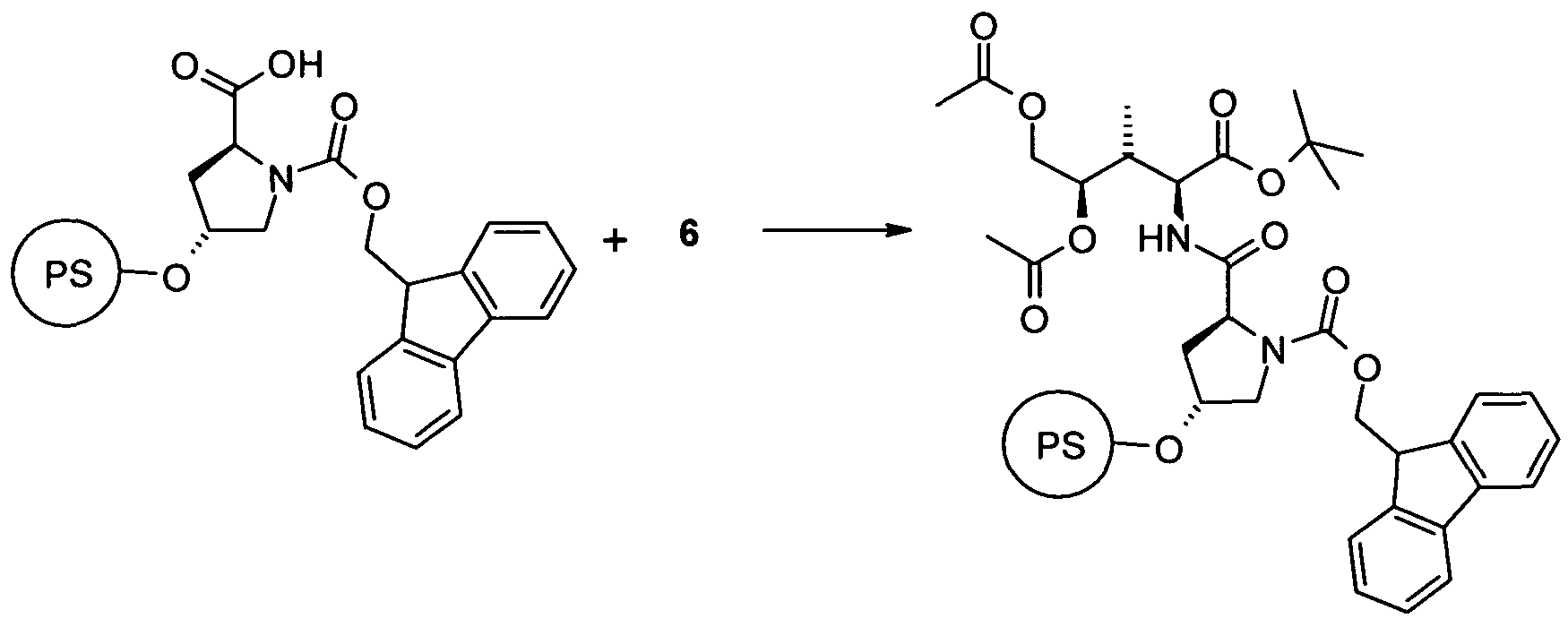
[0016] In yet another aspect, the present invention relates to a method for synthesizing an amatoxin, or precursor molecule therefor, comprising the step of coupling compound 6 to hydroxyproline, particularly by reacting compound 6 with a hydroxyproline-preloaded resin (PS) L.
Figure imgf000007_0002
L G
BRIEF DESCRIPTION OF THE DRAWING
[0017] Fig. 1 shows the structural formulae of different amatoxins. The numbers in bold type (1 to 8) designate the standard numbering of the eight amino acids forming the amatoxin. The standard designations of the atoms in amino acids 1 , 3 and 4 are also shown (Greek letters a to γ, Greek letters a to δ, and numbers from 1 " to 7', respectively). [0018] Fig. 2 shows 1H- and 13C-NMR spectra, displaying a diastereomeric ratio of 70 : 30 of compound 6.
[0019] Fig. 3 shows a general synthetic scheme of the synthesis of amatoxins.
DETAILED DESCRIPTION OF THE INVENTION
[0020] Before the present invention is described in detail below, it is to be understood that this invention is not limited to the particular methodology, protocols and reagents described herein as these may vary. It is also to be understood that the terminology used herein is for the purpose of describing particular embodiments only, and is not intended to limit the scope of the present invention which will be limited only by the appended claims. Unless defined otherwise, all technical and scientific terms used herein have the same meanings as commonly understood by one of ordinary skill in the art.
[0021 ] Preferably, the terms used herein are defined as described in "A multilingual glossary of biotechnological terms: (lUPAC Recommendations)", Leuenberger, H.G.W, Nagel, B. and Kolbl, H. eds. (1995), Helvetica Chimica Acta, CH- 4010 Basel, Switzerland).
[0022] Throughout this specification and the claims which follow, unless the context requires otherwise, the word "comprise", and variations such as "comprises" and "comprising", will be understood to imply the inclusion of a stated integer, composition or step or group of integers or steps, while any additional integer, composition or step or group of integers, compositions or steps may optionally be present as well, including embodiments, where no additional integer, composition or step or group of integers, compositions or steps are present . In such latter embodiments, the term "comprising" is used coterminous with "consisting of.
[0023] Several documents are cited throughout the text of this specification. Each of the documents cited herein (including all patents, patent applications, scientific publications, manufacturer's specifications, instructions, GenBank Accession Number sequence submissions etc.), whether supra or infra, is hereby incorporated by reference in its entirety to the extent possible under the respective patent law. Nothing herein is to be construed as an admission that the invention is not entitled to antedate such disclosure by virtue of prior invention.
[0024] The present invention will now be further described. In the following passages different aspects of the invention are defined in more detail. Each aspect so defined may be combined with any other aspect or aspects unless clearly indicated to the contrary. In particular, any feature indicated as being preferred or advantageous may be combined with any other feature or features indicated as being preferred or advantageous.
[0025] Thus, in one aspect the present invention relates to a method for the synthesis of γ,δ-dihydroxyisoleucine 1 , or of a synthon for compound 1 , comprising the step of methylating compound 3, particularly with methyl iodide in the presence of lithium bis(trimethylsilyl)amide (LHMDS).
Figure imgf000009_0001
[0026] In an alternative aspect, the present invention relates to a method for the synthesis of γ,δ-dihydroxyisoleucine 1 , or of a synthon for compound 1 , comprising the step of methylating compound 3* (having a second benzyl protection group at the nitrogen atom instead of the phenyl fluorenyl group in compound 3), particularly with methyl iodide in the presence of lithium bis(trimethylsilyl)amide (LHMDS).
Figure imgf000009_0002
2 [0027] In the context of the present invention, the term "synthon" refers to a compound that is, or can be used as, a synthetic equivalent for a particular compound of interest in a chemical reaction. This definition includes compounds, where a moiety of the compound of interest that would be labile or reactive under the conditions to be used in said chemical reaction is protected or masked by an appropriate protection group that can be cleaved off after said chemical reaction.
[0028] In a particular embodiment, the reaction is performed at a temperature between about -10°C and about -80°C in an ether for between about 12 and about 20 hours, particularly for about 16 hours. In a particular embodiment, the reaction is performed at -20 °C and in tetrahydrofuran as solvent. In particular embodiments, a diastereomeric purity of greater than 30 : 1 , particularly greater than 40 : 1 , particularly about 50 : 1 is obtained.
[0029] In the context of the present invention, the term "about" or "approximately" means between 90% and 1 10% of a given value or range.
[0030] In a particular embodiment, the method further comprises one or more of the following steps for synthesizing compound 3:
(a) reaction of L-aspartic acid, monomethyl ester A with 2-methyl propene to create compound B;
Figure imgf000010_0001
A B
reaction of B with benzaldehyde to create compound C;
Figure imgf000010_0002
B C reaction of C with phenyl fluorene bromide to create compound 3.
Figure imgf000011_0001
[0031] In an embodiment of the alternative aspect, the method further comprises one or more of the following steps for synthesizing compound 3*:
(a) reaction of L-aspartic acid, monomethyl ester A with 2-methyl propene to create compound B;
(b) reaction of B with benzaldehyde to create compound C;
(c) reaction of C with benzyl bromide to create compound 3*.
[0032] In a particular embodiment, the method further comprises one or more of the following steps:
(a) reduction of compound 2, particularly with diisobutylaluminium hydride DiBAI-H) to create compound D;
Figure imgf000011_0002
2 D (b) oxidation of hydroxy compound D, particularly using a Swern oxidation, to create compound E;
Figure imgf000012_0001
D E
(c) conversion of E, particularly under conditions of a Wittig reaction, to create com ound 4;
Figure imgf000012_0002
E 4
(d) conversion of 4, particularly under conditions of a Sharpless oxidation, to create compound F;
Figure imgf000012_0003
Figure imgf000013_0001
and
(f) N-deprotection of 5, particularly using palladium-catalyzed hydrogenation, to create compound 6.
Figure imgf000013_0002
5 6
[0033] In a particular embodiment of the alternative aspect, the method further comprises one or more of the following steps:
(a) reduction of compound 2*, particularly with diisobutylaluminium hydride (DiBAI-H) to create compound D* (having a second benzyl protection group at the nitrogen atom instead of the phenyl fluorenyl group in compound D);
(b) oxidation of hydroxy compound D*, particularly using a Swern oxidation, to create compound E* (having a second benzyl protection group at the nitrogen atom instead of the phenyl fluorenyl group in compound E); (c) conversion of E*, particularly under conditions of a Wittig reaction, to create compound 4* (having a second benzyl protection group at the nitrogen atom instead of the phenyl fluorenyl group in compound 4);
(d) conversion of 4*. particularly under conditions of a Sharpless oxidation, to create compound F* (having a second benzyl protection group at the nitrogen atom instead of the phenyl fluorenyl group in compound F);
(e) conversion of F*, particularly under catalytic esterification conditions, to create compound 5* (having a second benzyl protection group at the nitrogen atom instead of the phenyl fluorenyl group in compound 5);
and
(f) N-deprotection of 5*, particularly using palladium-catalyzed hydrogenation, to create compound 6.
[0034] In a particular embodiment, the method further comprises the step of isolating and purifying compound 6. In a particular embodiment, compound 6 is purified using precipitation as hydrochloride and/or chromatographic purification.
[0035] In a second aspect, the present invention relates to compound 6.
O I
Figure imgf000014_0001
[0036] In a particular embodiment, compound 6 has a purity greater than 90%, particularly greater than 95%.
[0037] In the context of the present invention, the term "purity" refers to the total amount of compound 6 and of its diastereoisomers being present. A purity of greater than 90%, for example, means that in 1 g of a composition comprising compound 6, there are more than 90%, i.e. more than 900 mg, of compound 6 and/or its stereoisomers. The remaining part, i.e. the impurities may include unreacted starting material and other reactants, solvents, cleavage products and/or side products.
[0038] In a particular embodiment, a composition comprising compound 6 with a purity greater than 90% comprises more than 100 mg of compound 6. [0039] In a particular embodiment, compound 6 has a diastereomeric purity greater than 70:30.
[0040] In the context of the present invention, the term "diastereomeric purity" refers to the ratio of the amount of compound 6 being present in a composition comprising compound 6 to the amounts of its diastereoisomers being present in said composition. A diastereomeric purity of greater than 70 : 30, for example, means that more than 70% of the total amount of protected dihydroxyisoleucines in a composition comprising compound 6 and of its diastereomers is compound 6, whereas the total amount of all diastereoisomers of compound 6 is correspondingly less than 30%.
[0041 ] In a particular embodiment, a composition comprising compound 6 with a diastereomeric purity greater than 70 : 30 comprises more than 100 mg of compound 6.
[0042] In a third aspect, the present invention relates to a kit comprising compound 6, particularly a kit comprising at least 100 mg of compound 6,and at least one additional reagent for the synthesis of amatoxins or precursors thereof.
[0043] In particular embodiments, compound 6 in the kit has a purity greater than
90%, particularly greater than 95%, and/or a diastereomeric purity greater than 70:30.
[0044] In particular embodiments, said at least one additional reagent is selected from the list of:
(i) a resin, particularly a resin selected from the group of: a Merrifield resin; a Rink-Amid resin; and a THP-resin;
(ii) a protected hydroxyproline, particularly fluorenylmethyloxycarbonyl- (Fmoc-)-protected O-allyl hydroxyproline (FmocHypOAII);
(iii) a protected asparagine, particularly Fmoc-protected N-trityl asparagine (Fmoc(N-Tri)AsnOH);
(iv) a protected Cys-Trp dipeptide, particularly Fmoc-protected Cys-Trp dipeptide with -SH and -OH protection groups (FmocCys(S-2-((o-NO2Ph)SO2Trp- O-Allyl))]OH);
(v) a protected glycine, particularly Fmoc-protected glycine (FmocGly);
(vi) a protected isoleucine, particularly Fmoc-protected isoleucine (Fmoclle); (vii) a peptide coupling reagent, particularly a peptide coupling reagent selected from the group of: 0-(benzotriazol-1-yl)-N,N,N',N'-tetramethyluronium tetrafluoroborate (TBTU); benzotriazol-1 -yl-oxytripyrrolidinophosphonium hexafluorophosphate (PyBOP); and o-(7-azabenzotriazol-1-yl)-N,N,N',N'- tetramethyluronium hexafluorophosphate (HATU); and
(viii) a tertiary amine, particularly Ν,Ν-diisopropylethylamine (DiPEA).
[0045] In yet another aspect, the present invention relates to a method for synthesizing an amatoxin, or precursor molecule therefor, comprising the step of (a) coupling compound 6 to hydroxyproline, particularly by reacting compound 6 with a hydroxyproline-preloaded resin, particularly by coupling compound 6 to the free C- terminus of FmocHypOH immobilized on a resin L, for example a tetrahydropyranyl (THP) resin.
Figure imgf000016_0001
L 6
[0046] In particular embodiments, the remaining amino acids are then coupled by a N-terminal synthetic strategy. In particular such embodiments, the method of the present invention additionally comprises one or more of the following steps:
(b) iterative Fmoc N-deprotection and coupling of G with Fmoc-(N-Tri)Asn OH; FmocCys(S-2-((o-NO2Ph)SO2Trp-O-Allyl))]OH, Fmoc-Gly OH, Fmoc-lle OH, Fmoc-Gly OH to create compound H:
Figure imgf000017_0001
(c) O-allyl- and N-Fmoc deprotection of H followed by cyclisation to create compound I (B-ring closure):
Figure imgf000017_0002
H I (d) 2-nitro aryl sulfonamide N-deprotection and secession of I from resin to create compound J:
Figure imgf000018_0001
I J
(e) solution phase cyclisation of J creating Amanitin derivative K:
Figure imgf000018_0002
J K
[0047] In yet another aspect, the present invention relates to a method for synthesizing an amatoxin, or precursor molecule therefor, in solution.
[0048] In certain embodiments, such method comprises one or more of the following steps: [0049]
(a) coupling compound 6 to hydroxyproline, particularly by reacting compound 6 with a hydroxyproline, particularly by coupling compound 6 to the free C-terminus of Fmoc (O'Bu) HypOH;
Figure imgf000019_0001
L
(b) iterative Fmoc N-deprotection and coupling of M with Fmoc-(N-Tri)Asn OH; Fmoc-(S-Tri)Cys OH, Fmoc-Gly OH, Fmoc-lle OH, Fmoc-Gly OH and N-Boc-HPI OH to create compound N;
Figure imgf000019_0002
(c) acidic deprotection of N- and S-trityl, O-tert-butyl and N- tertbutyloxycarbonyl protection groups and in situ ring closure by a Savige-Fontana reaction (Savige & Fontana, Int J Pept Protein Res. 15 (1980) 102-12) yielding compound J. [0050] In yet another aspect, the present invention relates to a method for synthesizing an amatoxin, or precursor molecule therefor, in solution, comprising the step of coupling compound 6 to hydroxyproline, particularly by reacting compound 6 with a hydroxyproline, particularly by coupling compound 6 to the free C-terminus of Fmoc (O'Bu) HypOH.
[0051] In particular embodiments, the amatoxin is an amatoxin with a dihydroxyisoleucine moiety as amino acid 3 (see Fig. 1 ).
[0052] In the context of the present invention, the term "amatoxin" includes all cyclic peptides composed of 8 amino acids as isolated from the genus Amanita and described in Wieland, T. and Faulstich H. (Wieland T, Faulstich H., CRC Crit Rev Biochem. 1978 Dec;5(3): 185-260), and furthermore includes all chemical derivatives thereof; further all semisynthetic analogues thereof; further all synthetic analogues thereof built from building blocks according to the master structure of the natural compounds (cyclic, 8 amino acids), further all synthetic or semisynthetic analogues containing non-hydroxylated amino acids instead of the hydroxylated amino acids, further all synthetic or semisynthetic analogues, in which the thioether sulfoxide moiety is replaced by a sulfide, sulfone, or by atoms different from sulfur, e.g. a carbon atom as in a carbaanalogue of amanitin, in each case wherein any such derivative or analogue is functionally active by inhibiting mammalian RNA polymerase II.
[0053] Functionally, amatoxins are defined as peptides or depsipeptides that inhibit mammalian RNA polymerase II. Preferred amatoxins are those with a functional group (e.g. a carboxylic group, an amino group, a hydroxy group, a thiol or a thiol- capturing group) that can be reacted with linker molecules or target-binding moieties as defined above. Amatoxins which are particularly suitable for the conjugates of the present invention are a-amanitin, β-amanitin, y-amanitin, ε-amanitin, amanin, amaninamide, amanullin, and amanullinic acid as shown in Fig. 1 as well as salts, chemical derivatives, semisynthetic analogues, and synthetic analogues thereof. Particularly preferred amatoxins for use in the present invention are a-amanitin, β- amanitin, and amaninamide.
[0054] As used herein, a "chemical derivative" (or short: a "derivative") of a compound refers to a species having a chemical structure that is similar to the compound, yet containing at least one chemical group not present in the compound and/or deficient of at least one chemical group that is present in the compound. The compound to which the derivative is compared is known as the "parent" compound. Typically, a "derivative" may be produced from the parent compound in one or more chemical reaction steps.
EXAMPLES
[0055] In the following, the invention is explained in more detail by non-limiting examples:
Example 1
Mannich Reaction Using Propionic Aldehyde and N-PMP Glyoxal
Figure imgf000021_0001
[0056] One of the key structural features of 1 is the 2S.3R conformation of the amino and methyl group. An easy access for the construction of the adjacent stereocenters is the Mannich reaction. However both stereocenters presume an anti- Mannich type reaction with high diastereo- and enantiocontrol. This premise is described by use of a designed organocatalyst readily described in J. Am. Chem. Soc, 2006, 128, 1040-1041. However, different approaches to remove the PMP-group failed and gave reaction mixtures, so that this approach was finally discarded. It is known in literature that removal can be quite tedious and unsuccessful, though the PMP-group is necessary for the reaction.
Example 2
Alkylation of Aspartic Acid Derivative
2.1 Introduction
[0057] An alternative approach for synthesizing a γ,δ-dihydroxyisoleucine synthon with correct stereo configuration (2S,3R,4R) started with aspartic acid derivative 3. Similar approaches have been described in the literature (see Yoshida et al., A large scale production of (3S,4S)-3-(tert-Butoxycarbonyl)amino-4-methylpyrrolidine and its analogs from L-Aspartic acid, Chem Pharm Bull (1996), 44, 1128 - 1131 ; Wolf and Rapoport, Conformationally constrained Peptides. Chirospecific Synthesis of 4-Alkyl- Substituted g-Lactam-Bridged Dipeptides from L-Aspartic Acid', J Org Chem (1989), 54, 3164-3173). It turned out that is was critically important to (i) use a combination of either (ia) a benzyl and a phenyl fluorenyl group, or (ib) two benzyl groups, for protecting the free amino group, and (ii) to use Lithium hexamethyldisilazane (LHMDS) instead of the corresponding potassium salt. Potassium hexamethyldisilazane (KHMDS) led to the opposite configuration.
2.2 Synthesis of Compound 2
Figure imgf000022_0001
3 2
[0058] A three necked round bottom flask with magnetic stirring bar, dropping funnel and low temperature thermometer was charged with 16.3 mmol, 8.7 g of compound 3 (see Example 3), dissolved in 150 ml dry tetrahydrofuran, and cooled to - 20°C. Lithium hexamethyl disilazide, 40 ml of a 1.0 M solution in Hexane was added drop wise within 15 minutes. The reaction was kept at -20°C for 2 hours before cooling to - 80°C. Finally 12.2 ml, 19,6 mmol, 1.2 eq. methyl iodide was added. The reaction was allowed to warm slowly and kept for further 4 hours at -20°C. The reaction was finally quenched by addition of 10 ml methanol, allowed to warm to room temperature and poured into 150 ml water. The aqueous phase was extracted with t-butylmethylether, dried over MgS04 and concentrated in vacuum. Crude product: 9.0 g. 1 H-NMR of crude product revealed a diastereoselective purity of better than 5:1. Yield 7.2 g, 81%.
[0059] The crude product was purified by flash chromatography, 330 g Silica, n- hexane/t-butylmethyl ether gradient from 0% to 50%. [0060] 1H-NMR: d 0.72 (d, 3 H, J = 5.6 Hz), 1.03 (s, 9 H), 2.64 (dt, 1 H, J = 5.6,
8.4 Hz), 3.55 (s, 3 H), 3.85 (d, 1 H, J = 8.4 Hz), 4.31 (d, 1 H, J = 11.2 Hz), 4.65 (d, 1 H, J = 11.2 Hz), 7.15 - 7.94 (m, 18 H).
2.3 Synthesis of Compound 2*
[0061] Analogous to Example 2.2, compound 2* can be synthesized from 3*.
Example 3
Synthesis of Compound 3
3.1 Introduction
[0062] Compound 3 was synthesized in accordance with the protocol described by Dunn et al. (Dunn et al., Stereoselective synthesis of 2,3-diamino acids. 2,3-Diamino- 4-phenylbutanoic acid, J. Org. Chem. 55 (1990) 5017-25.
3.2 Synthesis of compound B
Figure imgf000023_0001
A B
[0063] In a round-bottomed glass cylinder with screw cap and stirring bar was placed 25 g, 136 mmol 4-methyl-L-aspartate hydrochloride. The mono ester A was suspended in 100 ml dioxane/tetrahydrofuran (1 :1 , v/v) and 25 ml of sulfuric acid and cooled to -30°C (cryostat). 2-methylpropene, 200 g, 3.56 mol, was condensed into. The cylinder was closed and allowed to warm to room temperature. The reaction mixture was poured onto 1000 ml saturated sodium bicarbonate solution and extracted with ethyl acetate (5 times 400 ml). The combined organic phase was dried over MgS04 and concentrated in vacuum. Yield: 17.88 g, 64.6%. 3.3 Synthesis of compound C
Figure imgf000024_0001
B C
[0064] A round-bottomed flask with thermometer and stirring bar was charged with B, 17.9 g, 87.9 mmol, dissolved in 500 ml methanol and 150 ml acetic acid. Benzaldehyde, 16.0 ml, 158 mmol, was added dropwise. The reaction was kept at room temperature for 2 hours and finally cooled to 0°C. Sodium cyano borohydride, 10.0 g, 159 mmol was added within 45 min and stirred for further 15 min at 0°C. The reaction mixture was finally poured into 1000 ml sodium bicarbonate and stirred for 10 minutes. After dichloromethane extraction (5 times 250 ml) the combined organic phases were dried over MgS04 and concentrated in vacuum. Crude product: 35 g. Yield 14.3 g, 55.4%.
[0065] Flash chromatographic purification, 330 g Si02, n-hexane/ethylacetate gradient 0 to 50%.
[0066] 1H-NMR: d 1.42 (s, 9 H), 2.29 (s, 1 H), 2.62 (t, 2 H, J = 9.2 Hz), 2.50 (t, 1
H, J = 8 Hz), 3.62 (s, 3 H), 3.67 (d, 1 H, 17.6 Hz), 3.83 (d, 1 H, J = 17.2 Hz), 7.19 - 7.30 (m, 5 H). 3.4 Synthesis of compound 3
Figure imgf000025_0001
C 3
[0067] A round-bottomed flask with stirring bar was charged with C, 21.3 g, 51.6 mmol, in 500 ml acetonitrile. 9-bromo-9-phenyl fluorene, 25.0 g, 77.8 mmol, 20.0 g, 60.3 mmol lead nitrate, 31.7 g, 149.3 mmol K3P04 were added. The reaction mixture was kept at room temperature for 2.0 h. After completion, the reaction was diluted with 500 ml dichloromethane, dried over Na2S04 and filtered over Celite. The product was concentrated in vacuum. Yield: 16.2 g, 41.7%.
[0068] Flash chromatographic purification, 330 g Si02, n-hexane/ t- butylmethylether, gradient 0 to 50%.
[0069] 1H-NMR: d 1.14 (s, 9 H), 1.92 (dd, 1 H, J = 2.8, 16 Hz), 2.54 (dd, 1 H, 10.8,
15.8 Hz), 3.40 (s, 3 H), 3.86 (d, 1 H, J = 13.6 Hz), 4.21 (d, 1 H, J = 14 Hz), 7.17 - 7.83 (m, 18 H).
Example 4
Synthesis of Compound 6
4.1 Synthesis of com ound D
Figure imgf000026_0001
[0070] A round bottom flask equipped with stirring bar, thermometer and dropping funnel was charged with 2, 16.4 g, 29.9 mmol dissolved in 150 ml dry tetrahydrofuran and cooled to -30°C. A 1.0 M solution (150 ml) diisobutyl aluminium hydride was added under an inert atmosphere (argon) within 1.0 hour and stirred for additional 16 hours. The reaction was hydrolysed with Na2S04 decahydrate and allowed to warm to room temperature. The precipitation was filtered off and washed extensively with t- butylmethylether. The organic phase was concentrated in vacuum. Yield: 14.3 g, 92%.
[0071] Flash chromatographic purification, 330 g Si02, n-hexane/ethylacetate gradient 0 to 50%.
[0072] 1H-NMR: d 0.45 (d, 3 H, J = 6.8 Hz), 1.02 (s, 9 H), 3.09 (d, 1 H, J = 10.8
Hz), 3.34 (dq, 1 H, J = 7.2 Hz, J = 14.8 Hz), 4.00 (d, 2 H, J = 10.8 Hz), 4.36 (d, 1 H, 13.6 Hz), 4.73 (d, 1 H, J = 13.6 Hz), 7.20 - 7.76 (m, 18 H).
Figure imgf000027_0001
D E
[0073] A round bottom flask equipped with stirring bar, thermometer, dropping funnel and argon inlet was charged with oxalylchloride 3.28 ml, 35.5 mmol in dichloromethane and cooled to -80 °C. Dry dimethylsulfoxide 5.47 ml, 71.1 mmol diluted with 20 ml dichloromethane was slowly added. Compound D 13.67 g, 25.9 mmol, dissolved in 30 ml dichloromethane, was added over a period of 15 minutes. After additional 15 min at -80°C, triethylamine was added and the reaction allowed to warm to room temperature. Both layers were separated and the aqueous extracted with dichloromethane (4 times 150 ml). The combined organic phases were dried over MgS04, and concentrated in vacuum. Crude product: 16.9 g. The crude product was directly converted to the olefin.
4.3 Synthesis of compound 4
Figure imgf000027_0002
E 4
[0074] A round bottom flask with stirring bar, thermometer and argon inlet was charged with Sodium hydride 2.32 g, 57.9 mmol suspended in 120 ml dimethylsulfoxide. The suspension was warmed to 50 °C for 30 minutes and cooled to room temperature. Solid methyltriphenyl phosphonium bromide was added then and stirred for 15 minutes. The crude product E, dissolved in 20 ml dimethylsulfoxide was added and stirred for additional 16 hours. After hydrolyses (300 ml water), ethyl acetate extraction (4 times 150 ml), extensive washing of the combined organic phase with water (3 times 150 ml) and brine, the solution was dried with MgS0 and concentrated in vacuum. Yield: 13.3 g, 99.2% (2 steps).
[0075] Flash chromatographic purification, 330 g Si02, n-hexane/ethylacetate gradient 0 to 80%.
[0076] 1H-NMR: d 0.51 (d, 3 H, J = 1.6 Hz), 1.05 (s, 9 H), 2.14 (hept, 1 H, J = 0.8
Hz), 3.15 (d, 1 H, 10.8 Hz), 4.30 (d, 1 H, J = 14 Hz), 4.49 (dd, 1 H, J = 1.2, 17.6 Hz), 4.57 (d, 1 H, 13.6 Hz), 5.03 (d, 1 H, J = 0.8, 10.8 Hz), 5.95 (m, 1 H), 7.26 - 7.60 (m, 18 H).
4.4 Synthesis of compound F
Figure imgf000028_0001
[0077] A round-bottomed flask was charged with 100 g AD-mix (beta, commercial source) and dissolved in 60 ml t-butanol/water (1 :1 , v/v). Compound 5, 3.75 g, 7.3 mmol, dissolved in 17 ml dioxane was added in one portion. The reaction was stirred at room temperature for 4 days until completion of the reaction. The reaction was quenched by addition of Na2S03 and extracted with ethyl acetate (4 times 50 ml), washed with saturated NH4CI and brine, dried over MgS0 and concentrated in vacuum. Yield: 1.19 g, 29%.
[0078] Flash chromatographic purification, 330 g Si02, dichloromethane/t-butyl methyl ether gradient 0 to 80%.
[0079] 1H-NMR: d 0.38 (D, 3 H, J = 6.8 Hz), 1.03 (s, 9 H), 1.84 (s + m, 2 H, J = 8.8
Hz), 3.24 (dd, 1 H, J = 4.8, 1 1.4 Hz), 3.38 (d, 2 H, J = 10.9 Hz), 3.76 (m, 1 H), 4.40 (d, 1 H, J = 13.3 Hz), 4.95 (d, 1 H, J = 13.3 Hz), 5.55 (s, 1 H), 7.26 - 7.91 (m, 18 H). 4.4 Synthesis of compound 5
Figure imgf000029_0001
[0080] A round-bottomed flask with magnetic stirring bar was charged with F, 2.1 g, 3.64 mmol, dissolved in 75 ml dichloromethane. Excess acetic acid anhydride, 5.0 ml, 52.3 mmol and catalytic quantities of dimethyiaminopyridine were added. The reaction was allowed to stir at room temperature overnight. Yield: 1.83 g, 81 %.
[0081] Flash chromatographic purification, 330 g Si02, hexane/t-butylmethyl ether gradient 0 to 20%.
[0082] 1H-NMR: d 0.49 (d, 3 H, J = 7.2 Hz), 1.05 (s, 9 H), 1.74 (m, 1 H, J = 2.90
Hz), 1.88 (s, 3 H), 2.1 1 (s, 3 H), 3.18 (d, 1 H, J = 10.5 Hz), 3.60 (dd, 1 H, J = 2.3, 12.2 Hz), 4.32 (d, 1 H, J = 13.9 Hz), 4.74 (d, 1 H, J = 13.9 Hz), 5.98 (dd, 1 H, J = 2.4, 84 Hz), 7.10 - 7.73 (m, 18 H).
4.4 Synthesis of compound 6
Figure imgf000029_0002
5 6 [0083] A round-bottomed flask equipped with an argon inlet and vacuum manifold was charged with 5, 2.0 g, 3.1 mmol dissolved in 50 ml 0.1 M hydrochloric acid in ethanol and 200 mg 10% Palladium on charcoal. After flushing the flask with hydrogen, the reaction was allowed to stir for 16 hours at room temperature. The flak was flushed with Argon, filtered and the filtrate concentrated in vacuum. The clear oil was treated with n- hexane (3 times) to get rid of phenylfluorene. A hydrochloric salt of 6 was obtained as white solid. Yield: 0.92 g, 98%.
[0084] Purification by precipitation or chromatography.
[0085] 1H-NMR: (major isomer) d 1.16 (d, 3 H, J = 6.8 Hz), 1.47 (S, 9 H), 2.06 (s,
3 H), 2.09 (s, 3 H), 2.78 (m, 1 H, J = 7.7 Hz), 4.04 (dd, 1 H, J = 3.9, 12.5 Hz), 4.15 (s, 1 H), 4.52 (dd, 2 H, J = 2.08, 12.6 Hz), 5.02 (m, 2 H), 8.86 (s, 2 H).
[0086] 13C-NMR: (major isomer) d 1 1.5, 20.8, 21.7, 35.0, 53.9, 62.4, 72.2, 84.9,
166.2, 169.9, 170.7.
Example 5
Synthesis of a-Amatoxin
5.1 Synthesis of compound G
[0087] An open vessel polypropylene reaction tube equipped with a frit and drain valve was charged with 0.5 g, 0.5 mmol FmocHypOH tetrahydropyranyl polystyrene and allowed to swell in 3.0 ml dimethylformamide for 20 minutes. After removal of solvent through the drain valve, the reaction vessel was charged with 179 mg, 0.6 mmol of 6, dissolved in 1.5 ml dimethylformamide, 1.5 ml of a 1 mM solution of hydroxybenzothiazole in dimethylformamide, 1.5 ml of a 1 mM solution of (benzotriazol- 1-yloxy)tripyrrolidinophosphonium hexafluorophosphate in dimethylformamide and 259 μΙ of diisoppropylethylamine. After homogenisation with a glass bar the reaction was heated microwave assisted to 70°C for 4.0 minutes and finally washed with dimethylformamide (3 times) and dichloromethane (2 times).
[0088] An aliquot, approx. 20 mg of the polymer was cleaved off with trifluoroacetic acid/water/triethylsilane (8:2:10; v/v/v) for mass spectroscopic analysis. [0089] MS: 582.92; [M-'Bu+H]+; Fmoc-Hyp-bisiO-acety dihydroxy-lle-O'Bu
5.2 Synthesis of compound H
[0090] Compound G was then iteratively Fmoc deprotected and coupled with the remaining 6 amino acids as follows:
Fmoc-N-deprotection:
[0091 ] The resin was twice treated with 4.5 ml of a 20% piperidine solution in dimethylformamide and heated to 70°C for 3 minutes microwave assisted. The resin was then washed with dimethylformamide (3 times).
Amino acid coupling:
[0092] Deprotected resin bound peptide in 1 .5 ml dimethylformamide was successively reacted with amino acids (see list) dissolved in 1.5 ml dimethylformamide, 1.5 ml of a 1 mM solution of hydroxybenzothiazole in dimethylformamide, 1 .5 ml of a 1 mM solution of (benzotriazol-l -yloxy)tripyrrolidinophosphonium hexafluorophosphate in dimethylformamide and 259 μΙ of diisopropylethylamine. After homogenisation with a glass bar the reaction was heated microwave assisted to 70°C for 4.0 minutes and finally washed with dimethylformamide (3 times) and dichloromethane (2 times).
[0093] An aliquot, approx. 20 mg of the polymer was cleaved off with
trifluoroacetic acid/water/triethylsilane (8:2:10; v/v/v) for mass spectroscopic analysis.
Amino acids to be coupled:
1 . Fmoc-(N-Tri)Asn OH
2. Fmoc-Cys(S-2-((o-N02Ph)S02Trp-0-Allyl))]OH
3. Fmoc-Gly OH
4. Fmoc-lle OH
5. Fmoc-Gly OH
[0094] MS: 1227.14; [M-lBu+H]+; 1283.00; [M+H]+; FmocCys(S-2-((o-
NOzPhJSOzTrp-O-Ally il-Asn-Hyp-bisiO-acety dihydroxy-lle-O'Bu. [0095] MS: 1453.98; [M-'Bu+H]+; [M+Hf; FmocGly-lle-Gly-Cys(S-2-((o-
NOzPhJSOzTrp-O-Ally Jl-Asn-Hyp-bisiO-acety dihydroxy-lle-O'Bu
5.3 Synthesis of compound I; B-ring closure
[0096] Resin H was successively allyl- and Fmoc- deprotected before B-ring cyclisation:
Allyl-O-deprotection
[0097] The resin was shaken over night at room temperature with 874 mg, 5.6 mmol Ν,Ν-dimethylbarbituric acid, 258 mg, 0.224 mmol Pd(PPh3)4 in dichloromethane. After 16 hours the resin was washed with dichloromethane; dimethylformamide;
acetonitrile; and t-butylmethyl ether.
Fmoc-N-deprotection:
[0098] The resin was twice treated with 4.5 ml of a 20% piperidine solution in dimethylformamide and heated to 70°C for 3 minutes microwave assisted. The resin was then washed with dimethylformamide (3 times).
B-ring formation
[0099] Deprotected resin bound peptide in 3.0 ml dimethylformamide was reacted with 1 .5 ml of a 1 mM solution of hydroxybenzothiazole in dimethylformamide, 1.5 ml of a 1 mM solution of (benzotriazol-l-yloxy)tripyrrolidinophosphonium hexafluorophosphate in dimethylformamide and 259 μΙ of diisopropylethylamine. After homogenisation with a glass bar the reaction was heated microwave assisted to 70°C for 4.0 minutes and finally washed with dimethylformamide (3 times) and dichloromethane (2 times).
[00100] An aliquot, approx. 20 mg of the polymer was cleaved off with
trifluoroacetic acid/water/triethylsilane (8:2:10; v/v/v) for mass spectroscopic analysis.
[00101] MS: 1174.08; [M-'Bu+Hf; 1229.96; [M+H]+; [Gly-lle-Gly-Cys(S-2-
((o-NOzPhJSOzTrpJ^ring-Asn-Hyp-bisiO-acety dihydroxy-lle-O'Bu
5.42-N02-phenylsulfonyl-N-deprotection and resin secession, compound J
[00102] Resin I was 2-N02-phenylsulfonyl- deprotected and finally cleaved from resin 2-N02-phenylsulfonyl-N-deprotection:
[00103] The resin was repeatedly (3 times) treated with 500 μΙ mercaptoethanol and 500 μΙ diazabicycloundecene in 4 ml dimethylformamide for 2 hours. The resin was then washed intensely with dimethylfomamide, dichloromethane, acetonitrile and t- butylmethylether.
Resin secession:
[00104] The resin was then treated with 6 ml of trifluoroacetic
acid/water/triethylsilane (8:2:10; v/v/v) at room temperature over night and the crude protein concentrated in vacuum.
[00105] MS: 989.18; [M-'Bu+Hf; [Gly-lle-Gly-Cys(S-2-(Trp))]ring-Asn-Hyp- bisiO-acetylJdihydroxy-lle-O'Bu
5.5 Synthesis of compound K; A-ring formation
[00106] In a reaction flask with stirring bar crude product J was dissolved in 25 ml dimethylformamide. To the solution was added 85 μΙ, 2.5 mmol diisopropylethylamine and 135 μΙ, 2.5 mmol diphenylphsophazide. The reaction mixture was allowed to stir over night at room temperature. The solution was finally concentrated in vacuum, dissolved in 0.5 ml Methanol and purified. Yield: 4.9 mg
[00107] The crude reaction mixture was purified by preparative column
chromatography.
[00108] MS: 858.94; [M+H]+
Example 6
Synthesis of Compound 3*
[00109] Analogous to Example 3.4, compound 3* can be synthesized from compound C by using benzyl bromide instead of 9-bromo-9-phenyl fluorene for N- protection. Example 7
Alternative Synthesis of Compound 6
[00110] Analogous to Example 4, compound 6 can be synthesized from compound 2* via intermediate compounds D*, E*. 4*, F* and 5* (in each having a second benzyl protection group at the nitrogen atom instead of the phenyl fluorenyl group in the corresponding compound D, E, 4, F and 5, respectively).

Claims

1. A method for the synthesis of γ,δ-dihydroxyisoleucine 1 , or of a synthon for compound 1 , comprising the step of methylating compound 3 or 3* with methyl iodide in the presence of lithium bis(trimethylsilyl)amide (LHMDS).
Figure imgf000035_0001
3 2
2. The method of claim 1 , wherein the reaction is performed at a temperature between about -10°C and about -80°C in an ether for between about 12 and about 20 hours.
3. The method of claim 1 or 2, further comprising one or more of the following steps:
(a) reaction of L-aspartic acid, monomethyl ester A with 2-methyl propene to create compound B;
Figure imgf000035_0002
A B
(b) reaction of B with benzaldehyde to create compound C;
Figure imgf000035_0003
B C (c) reaction of C with phenyl fluorenyl bromide to create compound 3, or with benzyl bromide to create compound 3*.
Figure imgf000036_0001
C 3
4. The method of any one of claims 1 to 3, further comprising one or more of the following steps:
(a) reduction of compound 2 or compound 2*, particularly with diisobutylaluminium hydride to create compound D or D*, respectively;
Figure imgf000036_0002
2 D
(b) oxidation of hydroxy compound D or D*, particularly using a Swern oxidation, to create compound E or E*, respectively;
Figure imgf000036_0003
D E (c) conversion of E or E*, particularly under conditions of a Wittig reaction, to create compound 4 or 4*, respectively;
Figure imgf000037_0001
(d) conversion of 4 or 4*, particularly under conditions of a Sharpless oxidation, to create compound F or F*, respectively;
Figure imgf000037_0002
and (f) N-deprotection of 5 or 5*, particularly using Palladium-catalyzed hydrogenation, to create compound 6.
Figure imgf000038_0001
The method of any one of claims 1 to 4, further comprising the step of isolating and purifying compound 6, particularly wherein compound 6 is purified using precipitation as hydrochloride and/or chromatographic purification.
6. A compound of structure 6:
Figure imgf000038_0002
The compound of claim 6, wherein the compound has a purity greater than 90%, particularly greater than 95%.
The compound of claim 6, wherein the compound 6 a diastereomeric purity greater than 70 : 30.
9. A kit comprising compound 6, particularly comprising at least 100 mg of compound 6, and one or more additional reagents for the synthesis of amatoxins or precursors thereof.
10. The kit of claim 9, wherein said one or more additional reagents are selected from the list of:
(i) a resin, particularly a resin selected from the group of: a Merrifield resin; a Rink-Amid resin; and a THP-resin;
(ii) a protected hydroxyproline, particularly fluorenylmethyloxycarbonyl- (Fmoc-)-protected O-allyl hydroxyproline (FmocHypOAII);
(iii) a protected asparagine, particularly Fmoc-protected N-trityl asparagine (Fmoc(N-Tri)AsnOH);
(iv) a protected Cys-Trp dipeptide, particularly Fmoc-protected Cys-Trp dipeptide with -SH and -OH protection groups (FmocCys(S-2-((o-NO2Ph)SO2Trp- 0-Allyl))]OH);
(v) a protected glycine, particularly Fmoc-protected glycine (FmocGly);
(vi) a protected isoleucine, particularly Fmoc-protected isoleucine (Fmoclle);
(vii) a peptide coupling reagent, particularly a peptide coupling reagent selected from the group of: O-(benzotriazol-1-yl)-N,N,N',N'-tetramethyluronium tetrafluoroborate (TBTU); benzotriazol-1 -yl-oxytripyrrolidinophosphonium hexafluorophosphate (PyBOP); and o-(7-azabenzotriazol-1-yl)-N,N,N',N'- tetramethyluronium hexafluorophosphate (HATU); and
(viii) a tertiary amine, particularly Ν,Ν-diisopropylethylamine (DiPEA).
11. A method for synthesizing an amatoxin, or precursor molecule therefor, comprising the step of (a) coupling compound 6 to hydroxyproline, particularly by reacting compound 6 with a hydroxyproline-preloaded resin, particularly by coupling compound 6 to the free C-terminus of FmocHypOH immobilized on a resin L, particularly a tetrahydropyranyl (THP) resin.
Figure imgf000039_0001
L G
12. The method of claim 11 , wherein the remaining amino acids are then coupled by a N-terminal synthetic strategy.
13. The method of claim 12, additionally comprising one or more of the following steps:
(b) iterative Fmoc-N-deprotection and coupling of G with Fmoc-(N-Tri)Asn OH; FmocCys(S-2-((o-NO2Ph)SO2Trp-O-Allyl))]OH, Fmoc-Gly OH, Fmoc-lle OH, Fmoc-Gly OH to create compound H:
Figure imgf000040_0001
H
O-allyl- and Fmoc-N-deprotection of H followed by cyclisation to create pound I (B-ring closure):
Figure imgf000040_0002
(d) 2-nitro aryl sulfonamide-N-deprotection and secession of I from resin to create compound J:
Figure imgf000041_0001
solution phase cyclisation of J creating Amanitin derivative K:
Figure imgf000041_0002
14. The method of claim 11 , wherein the amatoxin is an amatoxin with a dihydroxyisoleucine moiety as amino acid 3.
PCT/EP2013/002084 2012-07-13 2013-07-12 Methods for synthesizing amatoxin building block and amatoxins Ceased WO2014009025A1 (en)

Priority Applications (21)

Application Number Priority Date Filing Date Title
HRP20160984TT HRP20160984T1 (en) 2012-07-13 2013-07-12 PROCEDURES FOR THE SYNTHESIS OF AMATOXIN AND AMATOXIN BUILDING BLOCKS
NZ702752A NZ702752A (en) 2012-07-13 2013-07-12 Methods for synthesizing amatoxin building block and amatoxins
AU2013289555A AU2013289555B2 (en) 2012-07-13 2013-07-12 Methods for synthesizing amatoxin building block and amatoxins
HK15110372.0A HK1209723B (en) 2012-07-13 2013-07-12 Methods for synthesizing amatoxin building block and amatoxins
EP13737145.6A EP2872479B1 (en) 2012-07-13 2013-07-12 Methods for synthesizing amatoxin building block and amatoxins
MX2015000479A MX361116B (en) 2012-07-13 2013-07-12 Methods for synthesizing amatoxin building block and amatoxins.
DK13737145.6T DK2872479T3 (en) 2012-07-13 2013-07-12 PROCEDURES FOR SYNTHETIZING AMATOXIN BUILDING AND AMATOXIN
JP2015520852A JP2015528799A (en) 2012-07-13 2013-07-12 Amatoxin building block and method for synthesizing amatoxin
KR1020157003282A KR102122575B1 (en) 2012-07-13 2013-07-12 Methods for synthesizing amatoxin building block and amatoxins
RU2015104802A RU2637924C2 (en) 2012-07-13 2013-07-12 Synthesis methods of amatoxin structural block and amatoxins
ES13737145.6T ES2589306T3 (en) 2012-07-13 2013-07-12 Methods to synthesize a structural element of amatoxins and amatoxins
CN201380037459.2A CN104470891B (en) 2012-07-13 2013-07-12 Method for synthesizing amanitin structural unit and amanitin
US14/414,143 US9676702B2 (en) 2012-07-13 2013-07-12 Methods for synthesizing amatoxin building block and amatoxins
UAA201501155A UA116991C2 (en) 2012-07-13 2013-07-12 Methods for synthesizing amatoxin building block and amatoxins
SG11201500225WA SG11201500225WA (en) 2012-07-13 2013-07-12 Methods for synthesizing amatoxin building block and amatoxins
SI201330268A SI2872479T1 (en) 2012-07-13 2013-07-12 Methods for synthesizing amatoxin building block and amatoxins
BR112015000232-3A BR112015000232B1 (en) 2012-07-13 2013-07-12 METHOD FOR SYNTHESIS OF GAMMA, DELTA-DIHYDROXY-ISOLEUCINE, COMPOUND, KIT AND METHOD TO SYNTHESIS AN AMATOXIN
CA2878081A CA2878081C (en) 2012-07-13 2013-07-12 Methods for synthesizing amatoxin building block and amatoxins
IL236129A IL236129A (en) 2012-07-13 2014-12-08 Methods for synthesizing amatoxin building block and amatoxins
ZA2014/09384A ZA201409384B (en) 2012-07-13 2014-12-19 Methods for synthesizing amatoxin building block and amatoxins
CY20161100827T CY1117950T1 (en) 2012-07-13 2016-08-22 METHODS FOR COMPOSITION OF AMATOXINS AND STRUCTURES OF AMATOXINS

Applications Claiming Priority (2)

Application Number Priority Date Filing Date Title
EP12005173.5A EP2684865A1 (en) 2012-07-13 2012-07-13 Methods for synthesizing amatoxin building block and amatoxins
EP12005173.5 2012-07-13

Publications (1)

Publication Number Publication Date
WO2014009025A1 true WO2014009025A1 (en) 2014-01-16

Family

ID=48793164

Family Applications (1)

Application Number Title Priority Date Filing Date
PCT/EP2013/002084 Ceased WO2014009025A1 (en) 2012-07-13 2013-07-12 Methods for synthesizing amatoxin building block and amatoxins

Country Status (24)

Country Link
US (1) US9676702B2 (en)
EP (2) EP2684865A1 (en)
JP (2) JP2015528799A (en)
KR (1) KR102122575B1 (en)
CN (1) CN104470891B (en)
AU (1) AU2013289555B2 (en)
BR (1) BR112015000232B1 (en)
CA (1) CA2878081C (en)
CY (1) CY1117950T1 (en)
DK (1) DK2872479T3 (en)
ES (1) ES2589306T3 (en)
HR (1) HRP20160984T1 (en)
HU (1) HUE029538T2 (en)
IL (1) IL236129A (en)
MX (1) MX361116B (en)
NZ (1) NZ702752A (en)
PL (1) PL2872479T3 (en)
PT (1) PT2872479T (en)
RU (1) RU2637924C2 (en)
SG (1) SG11201500225WA (en)
SI (1) SI2872479T1 (en)
UA (1) UA116991C2 (en)
WO (1) WO2014009025A1 (en)
ZA (1) ZA201409384B (en)

Cited By (13)

* Cited by examiner, † Cited by third party
Publication number Priority date Publication date Assignee Title
WO2017089607A1 (en) 2015-11-27 2017-06-01 Heidelberg Pharma Gmbh Derivatives of gamma-amanitin
WO2017149077A1 (en) 2016-03-03 2017-09-08 Heidelberg Pharma Gmbh Amanitin conjugates
US9938323B2 (en) 2014-11-06 2018-04-10 Novartis Ag Amatoxin derivatives and conjugates thereof as inhibitors of RNA polymerase
WO2018115466A1 (en) 2016-12-23 2018-06-28 Heidelberg Pharma Research Gmbh Amanitin antibody conjugates
US10111966B2 (en) 2016-06-17 2018-10-30 Magenta Therapeutics, Inc. Methods for the depletion of CD117+ cells
WO2019030173A1 (en) 2017-08-07 2019-02-14 Heidelberg Pharma Gmbh Novel method for synthesizing amanitins
WO2019030171A1 (en) 2017-08-07 2019-02-14 Heidelberg Pharma Gmbh Novel method for synthesizing amanitins
US10434185B2 (en) 2017-01-20 2019-10-08 Magenta Therapeutics, Inc. Compositions and methods for the depletion of CD137+ cells
US10464969B2 (en) 2016-05-05 2019-11-05 Novartis Ag Amatoxin derivatives and conjugates thereof as inhibitors of RNA polymerase
WO2020216947A1 (en) 2019-04-24 2020-10-29 Heidelberg Pharma Research Gmbh Amatoxin antibody-drug conjugates and uses thereof
CN112552196A (en) * 2020-11-23 2021-03-26 蚌埠丰原医药科技发展有限公司 Method for preparing aspirin-lysine
US12209145B2 (en) 2018-06-21 2025-01-28 Merck Sharp & Dohme Llc PCSK9 antagonist compounds
US12577259B2 (en) 2019-12-20 2026-03-17 Merck Sharp & Dohme Llc PCSK9 antagonist compounds

Families Citing this family (16)

* Cited by examiner, † Cited by third party
Publication number Priority date Publication date Assignee Title
KR20230082055A (en) 2016-06-17 2023-06-08 마젠타 테라퓨틱스 인코포레이티드 Compositions and methods for the depletion of cells
AU2018317611B2 (en) * 2017-08-18 2022-03-10 Systimmune, Inc. Non-natural amatoxin-type antibody conjugate
CN109464654B (en) * 2017-09-08 2021-11-12 四川百利药业有限责任公司 Amatoxin antibody conjugates
KR20190043031A (en) * 2017-10-17 2019-04-25 한국화학연구원 Amatoxin derivatives and methods for their preparation
US10882915B2 (en) 2017-10-24 2021-01-05 Magenta Therapeutics, Inc. Compositions and methods for the depletion of CD117+ cells
CN119857155A (en) 2017-11-29 2025-04-22 海德堡医药研究有限责任公司 Compositions and methods for depleting CD5+ cells
EP3546447A1 (en) 2018-03-29 2019-10-02 Heidelberg Pharma GmbH Synthesis of (2s,3r,4r)-4,5-dihydroxyisoleucine and derivatives
CN112739340B (en) 2018-07-23 2025-05-13 海德堡医药研究有限责任公司 Use of anti-CD5 antibody drug conjugates (ADCs) in allogeneic cell therapy
EP3792250A1 (en) * 2019-09-13 2021-03-17 Pure Bioorganics SIA Synthesis of alpha-amanitin and its derivatives
WO2021004973A1 (en) * 2019-07-05 2021-01-14 Pure Bioorganics Sia Synthesis of a-amanitin and its derivatives
KR102092817B1 (en) * 2019-08-22 2020-03-24 한국화학연구원 Amatoxin derivatives and methods for their preparation
WO2021122744A1 (en) * 2019-12-16 2021-06-24 Heidelberg Pharma Research Gmbh Synthesis of amanin and its derivatives
WO2024121632A1 (en) 2022-12-09 2024-06-13 Crispr Therapeutics Ag Use of anti-cd117 antibody drug conjugate (adc)
WO2025119223A1 (en) * 2023-12-04 2025-06-12 上海皓元生物医药科技有限公司 Method for synthesizing amanitin and derivative thereof
CN117623959A (en) * 2023-12-25 2024-03-01 吉尔多肽生物制药(大连市)有限公司 Synthesis method of threo-3-fluoro-N-9-phenyl-9-fluorene-L-tert-butyl aspartate
CN118459554B (en) * 2024-03-07 2025-01-17 内蒙古大学 Preparation method, intermediates and application of cyclic peptide toxin α-Amanitin and/or Amaninamide

Citations (3)

* Cited by examiner, † Cited by third party
Publication number Priority date Publication date Assignee Title
EP1859811A1 (en) 2006-05-27 2007-11-28 Faulstich, Heinz, Dr. Use of conjugates of amatoxins or phallotoxins with macromolecules for tumor and inflammation therapy
WO2010115629A2 (en) 2009-04-08 2010-10-14 Deutsches Krebsforschungszentrum Amatoxin-armed therapeutic cell surface binding components designed for tumour therapy
WO2010115630A1 (en) 2009-04-08 2010-10-14 Deutsches Krebsforschungszentrum Amatoxin-armed target-binding moieties for the treatment of cancer

Family Cites Families (8)

* Cited by examiner, † Cited by third party
Publication number Priority date Publication date Assignee Title
GB1585076A (en) 1976-07-13 1981-02-25 Roche Products Ltd Peptides of phosphonic and phosphinic acids
DE4104024A1 (en) 1991-02-09 1992-08-13 Merck Patent Gmbh AMINOSAEUREDERIVATE
JPH0959228A (en) 1995-08-17 1997-03-04 Hokuriku Seiyaku Co Ltd Optically active amino alcohol and method for producing the same
DE69720494T2 (en) * 1996-09-13 2004-02-05 Nippon Kayaku K.K. OPTICALLY ACTIVE ERYTHRO-3-AMINO-2-HYDROXY-BUTTERIC ACID ESTERS AND METHOD FOR PRODUCING THE SAME ESTERS
JPH11137291A (en) 1997-11-12 1999-05-25 Mori Sangyo Kk Production of amanitin
WO1999061466A1 (en) 1998-05-22 1999-12-02 Abbott Laboratories Antiangiogenic drug to treat cancer, arthritis and retinopathy
CN1481377A (en) * 2000-03-17 2004-03-10 ����˹�ж�-����˹˹����ҩƷ��˾ Cyclic β-amino acid derivatives as inhibitors of matrix metalloproteinases and TNF-α
BR0109968A (en) 2000-04-18 2003-05-27 Lilly Co Eli Process for the preparation of lipid ii

Patent Citations (3)

* Cited by examiner, † Cited by third party
Publication number Priority date Publication date Assignee Title
EP1859811A1 (en) 2006-05-27 2007-11-28 Faulstich, Heinz, Dr. Use of conjugates of amatoxins or phallotoxins with macromolecules for tumor and inflammation therapy
WO2010115629A2 (en) 2009-04-08 2010-10-14 Deutsches Krebsforschungszentrum Amatoxin-armed therapeutic cell surface binding components designed for tumour therapy
WO2010115630A1 (en) 2009-04-08 2010-10-14 Deutsches Krebsforschungszentrum Amatoxin-armed target-binding moieties for the treatment of cancer

Non-Patent Citations (17)

* Cited by examiner, † Cited by third party
Title
"IUPAC Recommendations", 1995, HELVETICA CHIMICA ACTA, article "A multilingual glossary of biotechnological terms"
DAVIS; PRESTON, SCIENCE, vol. 213, 1981, pages 1385 - 1388
DUNN ET AL.: "Stereoselective synthesis of 2,3-diamino acids. 2,3-Diamino- 4-phenylbutanoic acid", J. ORG. CHEM., vol. 55, 1990, pages 5017 - 25
GIANCARLO ZANOTTI ET AL: "Synthesis of analogues of amaninamide, an amatoxin from the white Arnanita virosa mushroom", IN!. J. PEPTIDE PROTEIN RES., 1 January 1987 (1987-01-01), pages 450 - 459, XP055049085, Retrieved from the Internet <URL:http://onlinelibrary.wiley.com/store/10.1111/j.1399-3011.1987.tb03353.x/asset/j.1399-3011.1987.tb03353.x.pdf?v=1&t=hbqmzxhw&s=e7ca8c2241e1f127b9244a68048514b441becafd> [retrieved on 20130109] *
GUO XW; WANG GL; GONG JH: "Culture conditions and analysis of amanitins on Amanita spissa", WEI SHENG WU XUE BAO., vol. 46, no. 3, June 2006 (2006-06-01), pages 373 - 8
J. AM. CHEM. SOC., vol. 128, 2006, pages 1040 - 1041
MORRIS; VENTON, INT. J. PEPTIDE PROTEIN RES., vol. 21, 1983, pages 419 - 430
MURAOKA S; SHINOZAWA T.: "Effective production of amanitins by two- step cultivation of the basidiomycete, Galerina fasciculata GF-060", J BIOSCI BIOENG., vol. 89, no. 1, 2000, pages 73 - 6
SAVIGE; FONTANA, INT J PEPT PROTEIN RES., vol. 15, 1980, pages 102 - 12
TH. WIELAND ET AL: "Die absoluten Konfigurationen der in den Phytotoxinen enthaltenen gamma-Hydroxyaminosäuren und der gamma-Hydroxynorvaline", LIEBIGS ANN. CHEM., vol. 717, 1968, pages 205 - 214, XP009166068 *
WIELAND T; FAULSTICH H., CRC CRIT REV BIOCHEM., vol. 5, no. 3, December 1978 (1978-12-01), pages 185 - 260
WOLF; RAPOPORT: "Conformationally constrained Peptides. Chirospecific Synthesis of 4-Alkyl- Substituted g-Lactam-Bridged Dipeptides from L-Aspartic Acid", J ORG CHEM, vol. 54, 1989, pages 3164 - 3173
YOSHIDA ET AL.: "A large scale production of (3S,4S)-3-(tert-Butoxycarbonyl)amino-4-methylpyrrolidine and its analogs from L-Aspartic acid", CHEM PHARM BULL, vol. 44, 1996, pages 1128 - 1131
ZANOTTI G; MOHRINGER C; WIELAND T.: "Synthesis of analogues of amaninamide, an amatoxin from the white Amanita virosa mushroom", INT J PEPT PROTEIN RES., vol. 30, no. 4, October 1987 (1987-10-01), pages 450 - 9
ZANOTTI G; PETERSEN G; WIELAND T.: "Structure-toxicity relationships in the amatoxin series. Structural variations of side chain 3 and inhibition of RNA polymerase II", INT J PEPT PROTEIN RES., vol. 40, no. 6, December 1992 (1992-12-01), pages 551 - 8
ZANOTTI G; WIELAND T; BENEDETTI E; DI BLASIO B; PAVONE V; PEDONE C.: "Structure-toxicity relationships in the amatoxin series. Synthesis of S- deoxy[gamma(R)-hydroxy-Ile3]-amaninamide, its crystal and molecular structure and inhibitory efficiency", INT J PEPT PROTEIN RES., vol. 34, no. 3, September 1989 (1989-09-01), pages 222 - 8
ZHANG P; CHEN Z; HU J; WEI B; ZHANG Z; HU W: "Production and characterization of Amanitin toxins from a pure culture of Amanita exitialis", FEMS MICROBIOL LETT., vol. 252, no. 2, 15 September 2005 (2005-09-15), pages 223 - 8

Cited By (24)

* Cited by examiner, † Cited by third party
Publication number Priority date Publication date Assignee Title
US9938323B2 (en) 2014-11-06 2018-04-10 Novartis Ag Amatoxin derivatives and conjugates thereof as inhibitors of RNA polymerase
WO2017089607A1 (en) 2015-11-27 2017-06-01 Heidelberg Pharma Gmbh Derivatives of gamma-amanitin
US10723766B2 (en) * 2015-11-27 2020-07-28 Heidelberg Pharma Research Gmbh Derivatives of gamma-amanitin
WO2017149077A1 (en) 2016-03-03 2017-09-08 Heidelberg Pharma Gmbh Amanitin conjugates
EP3222292A1 (en) 2016-03-03 2017-09-27 Heidelberg Pharma GmbH Amanitin conjugates
RU2753416C2 (en) * 2016-03-03 2021-08-16 Хайдельберг Фарма Рисеч Гмбх New conjugates of amanitine
US10464969B2 (en) 2016-05-05 2019-11-05 Novartis Ag Amatoxin derivatives and conjugates thereof as inhibitors of RNA polymerase
US10604547B2 (en) 2016-05-05 2020-03-31 Novartis Ag Amatoxin derivatives and conjugates thereof as inhibitors of RNA polymerase
US10111966B2 (en) 2016-06-17 2018-10-30 Magenta Therapeutics, Inc. Methods for the depletion of CD117+ cells
US11446388B2 (en) 2016-12-23 2022-09-20 Heidelberg Pharma Research Gmbh Amanitin antibody conjugates
WO2018115466A1 (en) 2016-12-23 2018-06-28 Heidelberg Pharma Research Gmbh Amanitin antibody conjugates
US10434185B2 (en) 2017-01-20 2019-10-08 Magenta Therapeutics, Inc. Compositions and methods for the depletion of CD137+ cells
US10576161B2 (en) 2017-01-20 2020-03-03 Magenta Therapeutics, Inc. Compositions and methods for the depletion of CD137+ cells
US11702451B2 (en) 2017-08-07 2023-07-18 Heidelberg Pharma Research Gmbh Method for synthesizing amanitins
US10961277B2 (en) 2017-08-07 2021-03-30 Heidelberg Pharma Research Gmbh Method for synthesizing amanitins
WO2019030173A1 (en) 2017-08-07 2019-02-14 Heidelberg Pharma Gmbh Novel method for synthesizing amanitins
US11420971B2 (en) 2017-08-07 2022-08-23 Heidelberg Pharma Research Gmbh Method for synthesizing amanitins
WO2019030171A1 (en) 2017-08-07 2019-02-14 Heidelberg Pharma Gmbh Novel method for synthesizing amanitins
US11926631B2 (en) 2017-08-07 2024-03-12 Heidelberg Pharma Research Gmbh Method of treating cancer using amanitin derivatives
US12209145B2 (en) 2018-06-21 2025-01-28 Merck Sharp & Dohme Llc PCSK9 antagonist compounds
WO2020216947A1 (en) 2019-04-24 2020-10-29 Heidelberg Pharma Research Gmbh Amatoxin antibody-drug conjugates and uses thereof
US12577259B2 (en) 2019-12-20 2026-03-17 Merck Sharp & Dohme Llc PCSK9 antagonist compounds
CN112552196A (en) * 2020-11-23 2021-03-26 蚌埠丰原医药科技发展有限公司 Method for preparing aspirin-lysine
CN112552196B (en) * 2020-11-23 2024-02-02 蚌埠丰原医药科技发展有限公司 Method for preparing lysine-piprolin

Also Published As

Publication number Publication date
RU2015104802A (en) 2016-08-27
JP6560382B2 (en) 2019-08-14
HK1209723A1 (en) 2016-04-08
IL236129A (en) 2017-10-31
SI2872479T1 (en) 2016-11-30
IL236129A0 (en) 2015-02-01
JP2018090610A (en) 2018-06-14
KR20150036444A (en) 2015-04-07
MX2015000479A (en) 2015-04-08
AU2013289555B2 (en) 2017-10-05
SG11201500225WA (en) 2015-02-27
RU2637924C2 (en) 2017-12-08
HUE029538T2 (en) 2017-03-28
DK2872479T3 (en) 2016-09-05
ES2589306T3 (en) 2016-11-11
PT2872479T (en) 2016-08-23
BR112015000232A8 (en) 2022-08-23
UA116991C2 (en) 2018-06-11
EP2872479B1 (en) 2016-06-08
PL2872479T3 (en) 2016-12-30
AU2013289555A1 (en) 2015-01-22
CN104470891A (en) 2015-03-25
HRP20160984T1 (en) 2016-10-21
CY1117950T1 (en) 2017-05-17
MX361116B (en) 2018-11-28
US20150210628A1 (en) 2015-07-30
CA2878081C (en) 2021-01-26
KR102122575B1 (en) 2020-06-12
EP2684865A1 (en) 2014-01-15
JP2015528799A (en) 2015-10-01
EP2872479A1 (en) 2015-05-20
CN104470891B (en) 2016-10-12
CA2878081A1 (en) 2014-01-16
BR112015000232B1 (en) 2022-09-06
US9676702B2 (en) 2017-06-13
ZA201409384B (en) 2015-12-23
NZ702752A (en) 2017-04-28
BR112015000232A2 (en) 2017-06-27

Similar Documents

Publication Publication Date Title
EP2872479B1 (en) Methods for synthesizing amatoxin building block and amatoxins
CA3131774A1 (en) Method for producing peptide compound, protecting group-forming reagent, and aromatic heterocyclic compound
CA3131772A1 (en) Method for producing peptide compound, protecting group-forming reagent, and condensed polycyclic aromatic hydrocarbon compound
US9175053B2 (en) Chemical preparation of ubiquitin thioesters and modifications thereof
JP2017036322A (en) Manufacturing method of peptide
JP7301965B2 (en) Method for producing peptide compound, protective group forming reagent, and condensed polycyclic compound
WO2023106356A1 (en) Method for producing peptide compound, reagent for forming protective group, and substituted benzyl compound
US20250179018A1 (en) Synthesis of (s)-6-hydroxytryptophan and derivatives thereof
US20220298204A1 (en) Synthesis of a-amanitin and its derivatives
HK1209723B (en) Methods for synthesizing amatoxin building block and amatoxins
RU2810786C2 (en) Synthesis of (s)-6-hydroxytryptophane and its derivatives
US8076299B2 (en) Method for producing peptide thioester
WO2025154779A1 (en) Method for producing peptide, compound, and peptide synthesis reagent
WO2025063265A1 (en) Method for producing peptide compound, reagent for protective group formation use, and dinaphthylmethyl compound

Legal Events

Date Code Title Description
121 Ep: the epo has been informed by wipo that ep was designated in this application

Ref document number: 13737145

Country of ref document: EP

Kind code of ref document: A1

ENP Entry into the national phase

Ref document number: 2878081

Country of ref document: CA

WWE Wipo information: entry into national phase

Ref document number: 14414143

Country of ref document: US

Ref document number: MX/A/2015/000479

Country of ref document: MX

ENP Entry into the national phase

Ref document number: 2015520852

Country of ref document: JP

Kind code of ref document: A

NENP Non-entry into the national phase

Ref country code: DE

ENP Entry into the national phase

Ref document number: 2013289555

Country of ref document: AU

Date of ref document: 20130712

Kind code of ref document: A

ENP Entry into the national phase

Ref document number: 20157003282

Country of ref document: KR

Kind code of ref document: A

WWE Wipo information: entry into national phase

Ref document number: 2013737145

Country of ref document: EP

WWE Wipo information: entry into national phase

Ref document number: A201501155

Country of ref document: UA

ENP Entry into the national phase

Ref document number: 2015104802

Country of ref document: RU

Kind code of ref document: A

REG Reference to national code

Ref country code: BR

Ref legal event code: B01A

Ref document number: 112015000232

Country of ref document: BR

ENP Entry into the national phase

Ref document number: 112015000232

Country of ref document: BR

Kind code of ref document: A2

Effective date: 20150106

ENPC Correction to former announcement of entry into national phase, pct application did not enter into the national phase

Ref document number: 112015000232

Country of ref document: BR

Kind code of ref document: A2

Free format text: ANULADA A PUBLICACAO CODIGO 1.3 NA RPI NO 2425 DE 27/06/2017 POR TER SIDO INDEVIDA.

REG Reference to national code

Ref country code: BR

Ref legal event code: B01E

Ref document number: 112015000232

Country of ref document: BR

Kind code of ref document: A2

Free format text: APRESENTAR, EM ATE 60 (SESSENTA) DIAS, DOCUMENTOS COMPROBATORIOS QUE EXPLIQUEM E REGULARIZEM A DIVERGENCIA NO NOME DO INVENTOR CONSTANTE NA PUBLICACAO INTERNACIONAL WO/2014/009025 DE 16/01/2014 COMO CHRISTOPH MUELLER E O CONSTANTE NO FORMULARIO DA PETICAO INICIAL NO 020150000147 DE 06/01/2015 COMO CHRISTOPH MUELLER UMA VEZ QUE NAO HOUVE ENVIO DE DOCUMENTO COMPROVANDO QUE OS NOME CORRETO DO INVENTOR E O DECLARADO NA ENTRADA NACIONAL.

ENP Entry into the national phase

Ref document number: 112015000232

Country of ref document: BR

Kind code of ref document: A2

Effective date: 20150106