WO2014015388A1 - A method for polishing albumin - Google Patents
A method for polishing albumin Download PDFInfo
- Publication number
- WO2014015388A1 WO2014015388A1 PCT/AU2013/000836 AU2013000836W WO2014015388A1 WO 2014015388 A1 WO2014015388 A1 WO 2014015388A1 AU 2013000836 W AU2013000836 W AU 2013000836W WO 2014015388 A1 WO2014015388 A1 WO 2014015388A1
- Authority
- WO
- WIPO (PCT)
- Prior art keywords
- albumin
- less
- solution
- igg
- chromatography
- Prior art date
- Legal status (The legal status is an assumption and is not a legal conclusion. Google has not performed a legal analysis and makes no representation as to the accuracy of the status listed.)
- Ceased
Links
Classifications
-
- C—CHEMISTRY; METALLURGY
- C07—ORGANIC CHEMISTRY
- C07K—PEPTIDES
- C07K14/00—Peptides having more than 20 amino acids; Gastrins; Somatostatins; Melanotropins; Derivatives thereof
- C07K14/435—Peptides having more than 20 amino acids; Gastrins; Somatostatins; Melanotropins; Derivatives thereof from animals; from humans
- C07K14/76—Albumins
-
- C—CHEMISTRY; METALLURGY
- C07—ORGANIC CHEMISTRY
- C07K—PEPTIDES
- C07K14/00—Peptides having more than 20 amino acids; Gastrins; Somatostatins; Melanotropins; Derivatives thereof
- C07K14/435—Peptides having more than 20 amino acids; Gastrins; Somatostatins; Melanotropins; Derivatives thereof from animals; from humans
- C07K14/76—Albumins
- C07K14/765—Serum albumin, e.g. HSA
-
- C—CHEMISTRY; METALLURGY
- C07—ORGANIC CHEMISTRY
- C07K—PEPTIDES
- C07K1/00—General methods for the preparation of peptides, i.e. processes for the organic chemical preparation of peptides or proteins of any length
- C07K1/14—Extraction; Separation; Purification
- C07K1/16—Extraction; Separation; Purification by chromatography
- C07K1/18—Ion-exchange chromatography
-
- C—CHEMISTRY; METALLURGY
- C07—ORGANIC CHEMISTRY
- C07K—PEPTIDES
- C07K1/00—General methods for the preparation of peptides, i.e. processes for the organic chemical preparation of peptides or proteins of any length
- C07K1/14—Extraction; Separation; Purification
- C07K1/16—Extraction; Separation; Purification by chromatography
- C07K1/20—Partition-, reverse-phase or hydrophobic interaction chromatography
-
- C—CHEMISTRY; METALLURGY
- C07—ORGANIC CHEMISTRY
- C07K—PEPTIDES
- C07K1/00—General methods for the preparation of peptides, i.e. processes for the organic chemical preparation of peptides or proteins of any length
- C07K1/14—Extraction; Separation; Purification
- C07K1/34—Extraction; Separation; Purification by filtration, ultrafiltration or reverse osmosis
-
- C—CHEMISTRY; METALLURGY
- C07—ORGANIC CHEMISTRY
- C07K—PEPTIDES
- C07K1/00—General methods for the preparation of peptides, i.e. processes for the organic chemical preparation of peptides or proteins of any length
- C07K1/14—Extraction; Separation; Purification
- C07K1/36—Extraction; Separation; Purification by a combination of two or more processes of different types
Definitions
- the present invention relates generally to a method of purifying albumin from solution. More specifically, to a method of polishing an albumin enriched solution through a hydrophobic charge-induction chromatographic resin.
- HSA human serum albumin
- the present invention solves, or at least partly alleviates, the problems in the art by providing a more efficient method for polishing an albumin enriched solution.
- a method of polishing albumin to remove contaminants comprising passing an albumin enriched solution through a hydrophobic charge-induction chromatographic resin and recovering the albumin solution which passes through the resin.
- the hydrophobic charge-induction chromatographic resin comprises 4-mercaptoethylpyridine.
- the albumin enriched solution is selected from Cohn Supernatant I, Cohn Supernatant II+III, Supernatant or Filtrate from Kistler-Nitschmann, Cohn Supernatant IV and Cohn Fraction V.
- the albumin enriched solution is a diafiltered Cohn Supernatant I.
- the Supernatant or Filtrate from Kistler-Nitschmann Nitschmann is Supernatant/Filtrate A or B.
- the albumin enriched solution is a flow through solution recovered when plasma or diafiltered Cohn Supernatant I is passed through an expanded bed adsorption resin in negative mode with respect to albumin.
- the albumin enriched solution is delipidated and euglobulin depleted.
- the method prior to passing the albumin enriched solution through the hydrophobic charge-induction chromatographic resin, the method comprises the steps of (a) passing the solution through an anion-exchange resin in negative mode with respect to albumin and (b) passing the solution through a cation exchange resin in negative mode with respect to albumin.
- the method comprises passing the flow through fraction from the anion-exchange resin of step (a) through the cation-exchange resin in step (b).
- the method comprises passing the flow through fraction from the cation-exchange resin of step (b) through the anion-exchange resin in step (a).
- the method comprises pasteurizing the polished albumin solution.
- composition comprising a polished albumin solution and having a turbidity of less than 5 NTU.
- the composition comprises:
- a polished albumin solution comprising at least 19% w/v total protein and any one or more of the following:
- PKA prekallikrein activator
- Figure 1 shows the impurity break through profile for a2-macroglobulin during MEP Hypercel purification of pH adjusted CM eluate. The results show the amount of impurity (ot2-macroglobulin) detected in the flow-through, explored over a sample volume of up to 1000 mL.
- Figure 2 shows the impurity break through profile for IgG during MEP Hypercel purification of pH adjusted CM eluate. The results show the amount of impurity (IgG) detected in the flow-through, explored over a sample volume of up to 1000 mL.
- Figure 3 shows the impurity break through profile for IgA during MEP Hypercel purification of pH adjusted CM eluate. The results show the amount of impurity (IgA) detected in the flow-through, explored over a sample volume of up to 1000 mL.
- Figure 4 shows the impurity break through profile for IgM during MEP Hypercel purification of pH adjusted CM eluate. The results show the amount of impurity (IgM) detected in the flow-through, explored over a sample volume of up to 1000 mL.
- Albumin and IgG are two of the most commercially important products extracted from plasma.
- Cohn process under specific conditions of ethanol concentrations, temperature, conductivity and pH, an intermediate fraction (Supernatant I) is generated that is enriched in IgG and albumin.
- Fraction II + III and Supernatant II + III are then generated, which are enriched in IgG and albumin, respectively. Further purification is then achieved by manipulating the above parameters.
- a major disadvantage of the Cohn purification process is the use of ethanol and the requirement of the procedures to be performed at temperatures less than 0°C.
- the purification of albumin in particular requires high concentrations of ethanol (up to 40% w/v for Cohn Fractions IV and V).
- the present invention is predicated, in part, on the finding that passing an albumin enriched solution through a hydrophobic charge-induction chromatographic resin in negative mode with respect to albumin and recovering the albumin solution which passes through the resin is an efficient alternative to existing chromatographic processes for polishing (purifying) albumin in solution, the resulting polished albumin solution having greater purity than is available using existing chromatographic processes. It has also been found that, by combining an ion exchange chromatographic step prior to polishing through a hydrophobic charge-induction chromatographic resin, the method of the present invention can provide an albumin solution with an even higher level of purity than existing processes. When combined with the fact that these chromatography steps can be incorporated into existing downstream industrial processes for the purification of albumin, it offers the plasma fractionation industry an efficient separation technique that complements the other fractionation steps.
- a method of polishing albumin to remove high molecular weight contaminants comprising passing an albumin enriched solution through a hydrophobic charge-induction chromatographic resin and recovering the albumin solution which passes through the resin.
- Suitable solid supports would be familiar to persons skilled in the art and the choice will invariably depend on the type of product to be purified.
- suitable solid supports include inorganic carriers, such as glass and silica gel, organic, synthetic or naturally occurring carriers, such as agarose, * cellulose, dextran, polyamide, polyacrylamides, vinyl copolymers of bifunctional acrylates, and various hydroxylated monomers, and the like.
- the chromatography steps will generally be carried out under non-denaturing conditions and at convenient temperatures in the range of about -10°C to +30°C, more usually at about ambient temperatures.
- the chromatographic steps may be performed batch-wise or continuously, as convenient. Any convenient method of separation may be employed, such as centrifugation, filtration, decanting, or the like.
- HCIC Hydrophobic Charge Induction Chromatography
- binding moieties attached to a solid support, wherein the binding moieties have specificity for the analyte that, in accordance with the methods of the present invention, are high molecular weight impurities (e.g., immunoglobulin).
- HCIC differs from other types of affinity chromatography, such as Hydrophobic Interaction Chromatography (HIC), which offers selectivity to separate plasma proteins based on differences in the surface hydrophobicity of the proteins [Goheen & Matson, 1985; Ramos-Clamont et al, 2006].
- HIC Hydrophobic Interaction Chromatography
- HIC selectivity afforded by HIC has enabled it to be used successfully for the purification of albumin from human plasma [Rucheton et al, 1997], human placenta [Cabrera-Crespo et al, 2000] and for recombinant HSA derived from Pichia pastoris [Ohmura et al., 1995].
- HIC offering an orthogonal mode of separation to the ion exchange steps used for chromatographic purification of albumin, these matrices or resins are not used by any of the commercial plasma fractionators.
- a contributing factor that limits adoption of HIC at large-scale is the fact that these methods require use of significant amounts of lyotropic salts in order to achieve the appropriate separation conditions [Burton & Harding, 1998].
- the hydrophobic charge-induction chromatographic resin comprises 4- mercaptoethylpyridine (MEP) (e.g., MEP Hypercel).
- MEP 4- mercaptoethylpyridine
- MEP ligand has an advantage in that it permits separation based on the surface hydrophobicity of proteins, but does not require the addition of lyotropic salts often seen in other processes for the purification of albumin [Burton & Harding, 1998; Schwartz et al., 2001].
- MEP Hypercel has been shown to have a high selectivity for immunoglobulins and, for this reason, there has been a major focus on the use of this media for the isolation of monoclonal antibodies [Schwartz et al., 2001; Ghose et al, 2006; Arakawa et al, 2010; Pezzini et al, 2011].
- MEP Hypercel has proven to be effective for the separation of penicillin acylase [Coulon et al, 2004] and Fc-fusion proteins [Arakawa et al, 2009].
- HCIC is controlled on the basis of pH, rather than salt concentration.
- MEP Hypercel resin is composed of cellulose matrix to which 4-Mercapto- Ethyl- Pyridine (4-MEP) is linked.
- the cellulose bead confers high porosity, chemical stability, and low non-specific interaction.
- the bead size of MEP Hypercel is about 80-100 um to allow a good compromise between capacity and flow property.
- MEP also displays high selectivity and capacity for high molecular weight immunoglobulin impurities, and has a pKa of about 4.8. It contains a hydrophobic tail and an ionizable headgroup. At physiological pH, the aromatic pyridine ring is uncharged and hydrophobic. Additional contributions to binding are provided by the aliphatic spacer arm.
- Binding to immunoglobulin is further enhanced by interaction with the other group.
- Both ligand structure and ligand density are designed to provide effective binding in the absence of lyotropic or other salts.
- pH of the mobile phase is adjusted to values below 4.8 (typically pH 4.0)
- the ligand takes on a distinct positive charge.
- immunoglobulins also carry a positive charge. Electrostatic repulsion is induced and the immunoglobulins are desorbed.
- the pH-dependent behaviour of the ionisable MEP ligand confers a dual-mode property, which permits proteins to interact through hydrophobic interactions and elution to occur through electrostatic repulsion.
- Traditional hydrophobic interaction media are based on alkyl groups that are non- ionisable.
- MEP Hypercel can therefore be used as a polishing step in the manufacture of albumin.
- the method can be applied to the polishing of albumin initially purified by ion exchange chromatography.
- Integrated laboratory-scale batches can therefore be manufactured using MEP Hypercel, with the resultant albumin having a greater purity than the existing process utilising resins, such as Sephacryl S200HR.
- MEP Hypercel resin provides high binding capacity and high flow rates, ideal for small- and large-scale antibody purification applications.
- the albumin enriched solution is selected from Cohn Supernatant I, Cohn Supernatant II+III, Supernatant Filtrate A, Cohn Supernatant IV and Fraction V.
- the albumin enriched solution is a diafiltered Cohn Supernatant I.
- the albumin enriched solution is a flow through solution recovered when plasma or diafiltered Cohn Supernatant I is passed through an expanded bed adsorption resin in negative mode with respect to albumin.
- the albumin enriched solution is delipidated and euglobulin depleted.
- albumin enriched solution is used interchangeably with expressions such as "crude albumin fraction” to denote a solution comprising albumin and high molecular weight impurities, such as immunoglobulins.
- the method prior to passing the albumin enriched solution through the hydrophobic charge-induction chromatographic resin, the method comprises the steps of (a) passing the solution through an anion exchange resin in negative mode with respect to albumin and (b) passing the solution through a cation exchange resin in negative mode with respect to albumin.
- Ion exchange (anion or cation exchange) chromatography would be familiar to persons skilled in the art and represents one of the most common methods for the purification of proteins and other charged molecules from solution.
- cation exchange chromatography positively charged molecules are attracted to a negatively charged solid support.
- anion exchange chromatography negatively charged molecules are attracted to a positively charged solid support.
- a negatively charged solid support (as used in cation exchange chromatography) and a positively charged solid support (as used in anion exchange chromatography) can be prepared by any means known to persons skilled in the art and usually involves the covalent attachment of a charged functional group onto the solid support.
- Suitable charged functional groups would be familiar to persons skilled in the art and the type of functional group that is employed will invariably depend on the molecule to be separated from solution.
- suitable cation exchange resins are ones comprising a functional sulfonic group (S or SP) or a functional carboxymethyl group (CM).
- anion exchange resins are ones comprising a functional quaternary amine group (Q) and/or a tertiary amine group (DEAE), or a diethylaminopropyl group (ANX).
- the anion- exchange matrix comprises diethylaminoethanol covalently linked to a polysaccharide polymer.
- the cation-exchange matrix comprises carboxymethyl groups covalently linked to a polysaccharide polymer.
- the conditions for performing the ion exchange chromatography step will favour the removal of impurities from the albumin solution, such as immunoglobulins (e.g., IgG, IgA and IgM).
- impurities e.g., IgG, IgA and IgM.
- the albumin solution will generally be of low to medium conductivity (i.e., have a low to medium salt concentration).
- the adsorption of the charged impurities in the albumin solution to the solid support will be driven by the ionic interaction between the oppositely charged ionic groups in the impurities and the functional ligand on the support.
- the strength of the interaction is determined by the number and location of the charges on the impurities and on the functional group.
- the molecules with the weakest ionic interactions i.e., albumin
- the molecules with the weakest ionic interactions i.e., albumin
- Molecules that have a stronger ionic interaction require a higher salt concentration and elute later in the gradient.
- the binding capacities of ion exchange resins are generally quite high. This is of major importance in industrial-scale chromatography, but is less critical for analytical-scale applications.
- the pH of the mobile phase buffer can be between the pi (isoelectric point) or pKa (acid dissociation constant) of the charged molecule and the pKa of the charged group on the solid support.
- pKa acid dissociation constant
- a sample molecule with a pi of 8.2 may be run in a mobile phase buffer of pH 6.0.
- anion exchange chromatography a molecule with a pi of 6.8 may be run in a mobile phase buffer at pH 8.0 when the pKa of the solid support is 10.3.
- a gradient of linearly increasing salt concentration can also be applied to elute the bound components (i.e., impurities) from the solid support after the albumin enriched solution has been recovered, if necessary .
- An alternative to using a linear gradient is to use a step gradient. This requires less complicated equipment and can be very effective to elute different fractions if the appropriate concentrations of salt are known, usually from linear gradient experiments.
- the chromatography steps according to the present invention are performed in negative mode with respect to albumin, where impurities in the starting albumin solution are retained on the charged solid support and the albumin is recovered in the flow through fraction.
- the impurities are retained on the stationary phase (i.e., solid support) and can be subsequently eluted, if necessary, by increasing the concentration of a similarly charged species that will displace the impurity ions from the stationary phase.
- the positively charged impurity could be displaced by the addition of positively charged sodium ions.
- Chromatography can be performed using either axial flow columns, such as those available from GE Healthcare, Pall Corporation and Bio-Rad, or using radial flow columns, such as those available from Proxcys. Chromatography can also be conducted using expanded bed technologies.
- the method of the present invention may also employ the use of multiple ion exchange chromatography steps to improve the purification of albumin.
- the use of multiple ion exchange chromatography steps may employ more than one anion exchange resin or more than one cation exchange resin.
- the method may also employ multiple anion and cation exchange resins (i.e., more than one anion exchange resin and more than one cation exchange resin).
- the flow through fraction from the anion exchange resin of step (a) is passed through the cation exchange resin of step (b).
- the flow through fraction froni the cation exchange resin of step (b) is passed through an anion exchange resin of step (a).
- the albumin enriched flow through fractions from steps (a) and/or (b) can be collected and stored indefinitely for subsequent fractionation (purification) in accordance with the methods of the present invention.
- the albumin enriched flow through fraction recovered from steps (a) and (b) is passed directly through the hydrophobic charge induction resin in accordance with the methods of the present invention.
- chromatography steps according to the present invention are to be performed in negative mode with respect to albumin, it would be understood by persons skilled in the art that the conditions for the ion exchange chromatographic steps according to the present invention will favour the retention of impurities to the solid support, allowing the albumin to the recovered in the flow through fraction. Given that the albumin purity in plasma is initially about 60-70%, chromatography steps that bind the lower abundant impurity proteins are significantly more efficient than those that capture albumin. Typical protein loads for albumin capture on ion exchange resins such as DEAE Sepharose-FF are 50 - 65 g/L and 50 - 100 g/L for albumin capture on ion exchange resins such as CM Sepharose-FF.
- the use of negative mode chromatography for the anion and cation exchange chromatography steps may permit loadings of > 500 g/L.
- the methods do not comprise an intervening chromatographic step in positive mode with respect to the albumin between step (a) and step (b).
- the methods of the present invention may comprise additional steps performed in positive mode with respect to albumin, where those additional steps are not performed between ion exchange chromatographic steps (a) or (b).
- Capto DEAE resin can be used in positive mode (i.e., to capture albumin) in order to separate the crude IgG fraction in the flow through, then elute the albumin from the Capto DEAE resin for subsequent purification by the methods according to the present invention.
- the method further comprises pasteurizing the polished albumin solution. It has been found that the methods of the present invention result is a polished albumin solution that has less turbidity when pasteurized in comparison to the turbidity level (as measure by Nephelometric Turbidity Units; NTU) found in purified albumin solutions prepared by existing chromatographic processes.
- the level of turbidity is a measure of the presence of high molecular weight impurities in the albumin solution (e.g., immunoglobulin).
- the pasteurized albumin solution has a turbidity of less than 5 NTU.
- the composition or polished albumin solution of the present invention comprises at least 4% w/v purified albumin. In some embodiments, the composition or polished albumin solution of the present invention comprises from 4% to 5% w/v purified albumin. In some embodiments, the composition or polished albumin solution of the present invention comprises greater than 19% w/v purified albumin. In some embodiments, the composition or polished albumin solution of the present invention comprises from 20% to 25% w/v purified albumin.
- composition comprising a pasteurized albumin solution and having a turbidity of less than 5 NTU.
- the composition comprises:
- a polished albumin solution comprising at least 19% w/v total protein and any one or more of the following:
- PKA prekallikrein activator
- Protein solutions Purified human serum albumin (HSA) and purified human immunoglobulin G (IgG) was obtained from CSL Biotherapies (Broadmeadows, Victoria, Australia). Process intermediates including Cohn Supernatant I (SNI) depleted of lipids and euglobulins, albumin eluate from CM Sepharose-FF chromatography and purified albumin from Sephacryl S200HR chromatography were obtained from CSL Biotherapies (Broadmeadows, Victoria, Australia). All protein solutions were filtered through a 0.22 ⁇ membrane (Durapore ® , Millipore Corporation, Bedford, MA, USA) prior to chromatography.
- SNI Cohn Supernatant I
- Antibodies and ELISA reagents Antibodies against the human plasma proteins of transferrin, (X2-macrogIobulin, ⁇ -glycoprotein, a t -antitrypsin, inter a trypsin inhibitor, haptoglobin, apolipoprotein Al, apolipoprotein B and ceruloplasmin, which were used for Immunoelectrophoresis, were obtained from The Binding Site (Birmingham, England), Siemens Healthcare Diagnostics, Inc. (New York, USA) and Dako Denmark A/S (Glostrup, Denmark). ELISA kits for IgG, IgM, AMG were obtained from Bethyl Laboratories Inc. (Texas, USA).
- Antibodies and IgA standard for the IgA ELISA were obtained from Dako Denmark (Glostrup, Denmark). Antibodies against the human plasma proteins of albumin, IgG, IgA and IgM, which were used for nephelometry analysis, were obtained from (Beckman-Coulter Inc. (Fullerton, CA, USA).
- Chromatographic resins MEP Hypercel resin was obtained from Pall Life Sciences (East Hills, NY, USA).
- DEAE Sepharose-FF, Capto DEAE, CM Sepharose-FF and Sephacryl S200HR resins were obtained from GE Healthcare Biosciences AB (Uppsala, Sweden).
- the current Sephacryl S200HR polishing step was fully characterised to identify the major contaminant proteins present in the albumin intermediate and understand the effectiveness of the Sephacryl S200HR at removing these contaminants.
- the albumin intermediates before and after Sephacryl S200HR chromatography were characterised using nephelometry (IMMAGE Immunochemistry system, Beckman-Coulter Inc., Fullerton, CA, USA) to determine the levels of albumin, IgG, IgA and IgM, and Immunoelectrophoresis to determine the levels of transferrin, ot2-macroglobulin, ⁇ -glycoprotein, oti -antitrypsin, inter a trypsin inhibitor, haptoglobin, apolipoprotein Al, apolipoprotein B and ceruloplasmin.
- the concentrated ion exchange albumin intermediate which is loaded on to the Sephacryl S200HR contained 1.42% impurity proteins, of which a 2 - macroglobulin, IgG and IgA were the predominant proteins (Table 1). These major impurity proteins all have molecular weights significantly higher than that of albumin, thus making the Sephacryl S200HR gel filtration media well suited to the removal of these contaminants.
- the Sephacryl S200HR chromatography step was effective at removing the high molecular weight impurities, with clearance rates of greater than 94% observed for a.2- macroglobulin, IgA and IgM, and 74.0% clearance of IgG. Following Sephacryl S200HR chromatography the total impurity content was reduced to 0.19%, with IgG being the most abundant impurity protein present.
- Apolipoprotein B ⁇ 0.057 - NT - -
- the purified IgG and purified albumin samples were prepared in the appropriate equilibration buffer at a concentration of approximately 5-10 mg/mL and filtered through a 0.22 ⁇ membrane (Durapore ® , Millipore Corporation, Bedford, MA, USA) prior to chromatography.
- the samples were loaded on to an equilibrated MEP Hypercel column (17.5 cm x 1.6 cm ID; GE Healthcare Biosciences AB, Uppsala, Sweden) at 20 g per litre of resin.
- the unbound protein was recovered during the sample loading period and during the subsequent post-sample wash using equilibration buffer.
- the bound protein was eluted using sodium acetate buffer at pH 3.0.
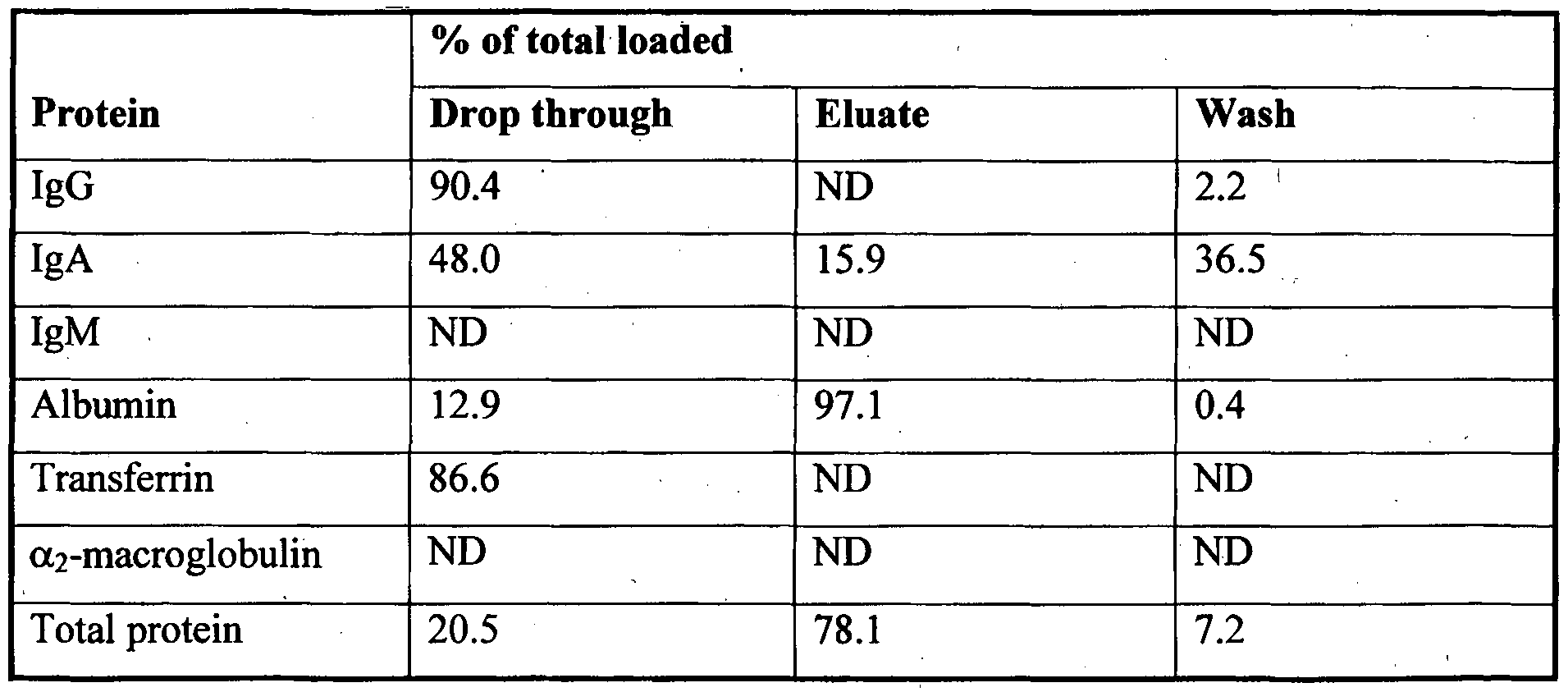
- the sodium phosphate buffer at pH 7.0 was effective at binding IgG, with undetectable levels of IgG being recovered in the flow through fraction (Table 3). Under the same conditions, only minor amounts of albumin bound to the MEP Hypercel, and greater than 85% of the albumin recovered in the flow through fraction. Equilibration of the MEP Hypercel with the sodium acetate buffer at pH 5.5 resulted in conditions where approximately half of both the IgG and albumin bound to the resin.
- the addition of sodium chloride to the sodium acetate buffer (pH 5.5) improved IgG binding, with undetectable IgG levels being recovered in the flow through fraction (Table 3).
- the addition of sodium chloride also improved albumin recovery in the drop through fraction. However despite this improvement, approximately 15-20% of the albumin was recovered in the eluate fraction, which was significantly higher than the recovery obtained when the MEP Hypercel was equilibrated using the sodium phosphate buffer at pH 7.0.
- albumin is eluted from the CM Sepharose-FF column using a 110 mM sodium acetate buffer (pH 5.5).
- a 110 mM sodium acetate buffer pH 7,0 this buffer was selected for further evaluation.
- the albumin eluted from the CM Sepharose column would only require a pH adjustment step prior to loading on to the MEP Hypercel column.
- Example 4 Purification of ion exchange purified albumin using MEP Hypercel
- the albumin sample (1000 mL) was loaded on to the MEP Hypercel column (17.5 cm x 1.6 cm ID), which had been equilibrated with 110 raM Sodium acetate (pH 7.0), followed by a 110 mM Sodium acetate (pH 7.0) post-sample wash to recover unbound protein and bound protein was removed by washing with 100 mM Sodium acetate (pH 3.0) and 1 M NaOH.
- the flow through fraction was collected at 10 mL intervals and assessed for the levels of the major impurity proteins of IgG, IgA, IgM and a 2 - macroglobulin by ELIS A.
- the MEP Hypercel was further evaluated by assessing its ability to purify the albumin eluate from the CM Sepharose-FF column.
- the albumin prior to Sephacryl S200HR chromatography which contains the same composition as the eluate from the CM Sepharose-FF column, contained other impurity proteins including a 2 -macroglobulin, IgA and IgM in addition to IgG. These four impurity proteins were used as purity markers for the evaluation of MEP Hypercel to evaluate the selectivity of the MEP Hypercel to the major impurities present in the chromatographic albumin.
- cc 2 - macroglobulin is the most abundant impurity protein in the albumin eluate derived from CM Sepharose-FF and the MEP Hypercel has the weakest affinity for this protein, it indicates that a 2 -macroglobulin will be the key impurity marker for subsequent decisions on the amount of sample that can be loaded on to the MEP Hypercel column.
- Table 5 Percentage recovery of proteins in flow through fraction derived from MEP Hypercel chromatography conducted using sample loadings ranging from 100 to 500 mL
- Capto DEAE resin can be used as an alternative to the DEAE Sepharose-FF, and because of its higher capacity, it enables protein loadings to be increased by approximately 50%. Despite the separation characteristics of the DEAE Sepharose-FF and Capto DEAE being similar, some differences were observed.
- the albumin eluate from the CM Sepharose-FF, which was initially derived from DEAE Sepharose-FF, and the Capto DEAE flow through fraction were initially characterised by nephelometry and ELIS A analysis.
- the two albumin samples were adjusted to pH 7.0 ⁇ 0.1 and clarified by passage through a 0.22 ⁇ membrane (Durapore).
- the samples were loaded on to a MEP Hypercel column, which had been equilibrated with 110 mM Sodium acetate (pH 7.0), at sample volumes of 100, 200 and 300 mL.
- the flow through and post-sample wash was collected as a bulk fraction along with the pH 3.0 eluate.
- the bulk fractions were assessed for levels of albumin by nephelometry and the major impurity proteins of IgG, IgA, IgM and a2-macroglobulin by ELISA.
- the albumin derived from the Capto DEAE process had two-fold higher levels of IgA compared to the albumin derived from the DEAE Sepharose-FF process and two-fold lower levels of a2-macrpglobulin.
- the MEP purified albumin derived from the Capto DEAE process had undetectable levels a2-macroglobulin for all sample loadings, resulting in significantly lower total impurity contents compared to the albumin derived from the DEAE Sepharose- FF process.
- the results suggest that the significantly lower a 2 -macroglobulin levels in the ion exchange purified albumin derived from the Capto DEAE process had a beneficial impact on the MEP Hypercel chromatography, thus permitting higher sample loadings.
- the MEP Hypercel column can be loaded with significantly higher amounts of sample and can be operated at flow rates over three times faster than the Sephacryl S200HR (Table 10). This means that a 198 L MEP Hypercel column can process the albumin in approximately half the time required than the Sephacryl S200HR. If an MEP Hypercel column with a similar size as the Sephacryl S200HR is used (5 individual 17.5 x 120 cm ID columns), the 10 ton batch of albumin can be processed in 558 min, which represents an 88% saving compared to the actual processing time required for the Sephacryl S200HR.
- the amount of buffer required for the MEP Hypercel chromatography is marginally higher than the Sephacryl S200HR largely as a result of the MEP Hypercel requiring cleaning and regeneration after each cycle compared to the Sephacryl S200HR, which only requires cleaning and regeneration to be conducted at the end of a batch.
- a further benefit of the MEP Hypercel is the streamlining of the overall purification process.
- the ion exchange eluate requires concentrating from approximately 25 mg mL to approximately 135 mg/mL via ultrafiltration in order to maximise the efficiency of the Sephacryl S200HR chromatography step.
- this ultrafiltration step is not required prior to MEP Hypercel chromatography.
- the ion exchange eluate only requires pH adjustment to 7.0 prior to loading on to the MEP Hypercel column.
- Table 10 Comparison of efficiency of polishing chromatographically purified albumin using Sephacryl S200HR (90 cm x 120 cm internal diameter; ID) and MEP Hypercel (17.5 cm x 120 cm ID or 87.5 cm x 120 cm ID) for a 10 tonne batch of albumin
- Example 8 Characterization of albumin fractionated chromatographically from delipidated and euglobulin depleted Cohn Supernatant I incorporating Capto DEAE chromatography (in positive mode with respect to albumin)
- the first elution which contains albumin, occurs by washing with 3 column volumes of 25 mM Sodium acetate (pH 4.5). The remainder of the bound protein was eluted by washing with 2 column volumes of 1 M NaCl and 2 column volumes of 1 M NaOH.
- a glass column (1374 mL) filled with CM Sepharose FF resin was equilibrated with 25 mM Sodium acetate (pH 4.5).
- the entire albumin eluate from the Capto DEAE was loaded on to the CM Sepharose FF column at a flow rate of 100 cm/h.
- the column was washed with 2 column volumes of 25 mM Sodium acetate (pH 4.5).
- the bound protein was selectively eluted.
- the remainder of the bound protein was eluted by washing with 2 column volumes of 1 M NaCl and 2 column volumes of 1 M NaOH.
- the albumin eluate from CM Sepharose FF was adjusted to pH 7.0 using 1 M NaOH and 1 M Acetic acid.
- a glass column (1343 mL) filled with MEP Hypercel resin was equilibrated with 110 mM Sodium acetate (pH 7.0).
- the pH adjusted CM eluate was loaded at 571% of a column volume at a flow rate of 100 cm/h.
- the column was washed with 2 column volumes of 110 mM sodium acetate (pH 7.0).
- the protein eluted during the sample loading and post sample wash was retained for further processing.
- the bound protein was eluted from the MEP Hypercel by washing with 2 column volumes of 100 mM Sodium acetate (pH 3.0) and 2 column volumes of 1 M NaOH.
- the purified albumin was processed according to the procedure for Albumin 2VI.
- albumin (20% solution) derived from the above process was characterised using the batch release testing and a range of additional tests to assess product purity. The data was compared to control batches, which were manufactured using the current process (Table 11).
- the albumin derived from the new process contained lower levels of impurities including IgG ( ⁇ 0.009 mg/mL), apolipoprotein Al ( ⁇ 0.0032 mg/mL), IgA (1.7 ⁇ g/mL) and ai-proteinase inhibitor (0.039 mg/mL) compared to the albumin control (Table 11).
- the lower impurity content of the albumin derived from the new process also resulted in lower levels of aggregates (0.6%) and turbidity levels (2.0 NTU).
- Table 11 Characterisation albumin solution recovered by this method
- albumin eluate derived from Capto DEAE or DEAE Sepharose FF chromatography was adjusted to pH 5.4 and a conductivity of 5.0 mS/cm using 1 M NaOH and 1 M Acetic acid.
- a glass column filled with CM Sepharose FF resin was equilibrated with Sodium acetate (pH 5.4, conductivity 5.0 mS/cm).
- the adjusted DEAE eluate sample was loaded at a protein loading of 500 g/L and a flow rate of 100 cm/h.
- the column was washed with 2 column volumes of Sodium acetate (pH 5.4, conductivity 5.0 mS/cm).
- the unbound protein collected during sample application and post sample wash was retained for further processing.
- the bound protein was eluted by washing with 2 column volumes of 1 M NaCl and 2 column volumes of 1 M NaOH.
- the albumin sample was adjusted to pH 7.0 using 1 M NaOH and 1 M Acetic acid.
- a glass column filled with MEP Hypercel resin was equilibrated with Sodium acetate (pH 7.0, conductivity 5.0 mS/cm).
- the pH adjusted albumin was loaded at a protein loading of 150 g/L and a flow rate of 75 cm h. After loading, the column was washed with 2 column volumes of sodium acetate (pH 7.0, conductivity 5.0 mS/cm). The protein eluted during sample loading and post-sample wash was retained for further processing.
- the bound protein was eluted from the MEP Hypercel by washing with 2 column volumes of 100 mM Sodium acetate (pH 3.0).
- Example 10 Characterization of chromatographically fractionated albumin from Cohn Supernatant ⁇ + ⁇ or Filtrate A incorporating Capto DEAE chromatography
- SN II + III or Filtrate A was concentrated by ultrafiltration then diafiltered against 5 volumes of PFW to reduce ethanol and salt levels.
- the diafiltered SN II + III or Fraction A was adjusted to pH 4.5 and a conductivity of 2.0 mS/cm using 1 M NaOH and 1 M Acetic acid.
- Aerosil 380 was added at 160 g/kg protein to bind lipoproteins.
- Diacel was added at 400 g/kg protein to facilitate clarification using a filter press.
- the filter press may be recovered using 25 mM Sodium acetate (pH 4.5, conductivity 2.0 mS/cm).
- a glass column filled with Capto DEAE resin was equilibrated with 25 mM Sodium acetate (pH 4.5, conductivity 2.0 mS/cm).
- the Delipidated and Diafiltered SN II + III sample was loaded at a protein loading of 1000 g/L and a flow rate of 100 cm/h.
- the column is washed with 2 column volumes of 25 mM Sodium acetate (pH 4.5, conductivity 2.0 mS/cm).
- the unbound protein collected during sample application and post sample wash was retained for further processing.
- the bound protein was eluted by washing with 2 column volumes of 1 M NaCl and 2 column volumes of 1 M NaOH.
- the albumin sample was adjusted to pH 5.4 and a conductivity of 5.0 mS/cm using 1 M NaOH and 1 M Acetic acid.
- the procedure for the subsequent CM Sepharose- FF and MEP Hypercel steps are identical to those outlined in Example 10.
- the Capto DEAE (negative-mode) purification of SN II + III was compared to Capto DEAE conducted in positive-mode (Tables 13 and 14). The results show that the proteins recovered in the drop through fraction from the negative-mode Capto DEAE (Table 14) are the sum of the proteins recovered in the drop through and eluate fractions from the positive-mode Capto DEAE (Table 13).
- wash fraction (1 M NaCl) for both the positive and negative-mode Capto DEAE purification of SN II + III had similar total protein recoveries.
- This wash fraction typically contains proteins including IgA, haptoglobin, ceruloplasmin and a i -glycoprotein, most of which were not measured in this study.
- Example 11 Characterisation of albumin fractionated chromatographically from Delipidated Cohn Supernatant II + III utilising ANX Sepharose, CM Sepharose and MEPHypercel in negative mode
- Delipidated Cohn Supernatant II + III was used as the starting material and adjusted to pH 4.7 and a conductivity of 1.8 mS/cm. The solution was clarified using a 0.22 ⁇ filter. A glass column (35 mL) filled with ANX Sepharose-FF resin was equilibrated with Sodium acetate (pH 4.7, conductivity 1.8 mS/cm). The adjusted Delipidated SN II + III was loaded at a protein loading of 300 g/L and a flow rate of 100 cm/h. At the end of sample loading, the column was washed with 3 column volumes of Sodium acetate (pH 4.7, conductivity 1.8 mS/cm). The unbound protein collected during sample application and post sample wash was collected and retained for albumin processing. The bound protein was eluted by washing with 2 column volumes of 1 M NaCl and 2 column volumes of 1 M NaOH.
- a glass column (35 mL) filled with CM Sepharose FF resin was equilibrated with Sodium acetate (pH 5.4, conductivity 5.0 mS/cm).
- the albumin flow through from the ANX Sepharose-FF was adjusted to pH 5.4 and a conductivity of 5.0 mS/cm and clarified using a 0.22 ⁇ filter.
- the adjusted ANX flow through was loaded on to the CM Sepharose FF column loading of 300 g/L and at a flow rate of 100 cm/h.
- the column was washed with 2 column volumes of Sodium acetate (pH 5.4, conductivity 5.0 mS/cm).
- the unbound protein eluted during sample application and post sample wash was collected and retained for albumin processing and characterisation testing.
- the bound protein was eluted by washing with 2 column volumes of 1 M NaCl and 2 column volumes of 1 M NaOH.
- CM Sepharose FF The albumin flow through from CM Sepharose FF was adjusted to pH 7.0 using 1 M NaOH and 1 M Acetic acid.
- a glass column (35 mL) filled with MEP Hypercel resin was equilibrated with 110 mM Sodium acetate (pH 7.0).
- the pH adjusted CM flow through was loaded at 150 g/L and at a flow rate of 75 cm/h. After loading, the column was washed with 2 column volumes of 110 mM sodium acetate (pH 7.0).
- the unbound protein eluted during the sample loading and post sample wash was retained for characterisation testing.
- the bound protein was eluted from the MEP Hypercel by washing with 2 column volumes of 100 mM Sodium acetate (pH 3.0) and 2 column volumes of 1 M NaOH.
- the albumin intermediate obtained after loading Delipidated SN II + HI on to the ANX Sepharose-FF and CM Sepharose-FF operated in negative mode had a higher purity (99.16%) that the equivalent albumin intermediate derived from the current process (98.41%) (Table 16). This difference was mainly attributed to significantly lower levels of a2-macroglobulin and a i -antitrypsin.
- the albumin derived from the negative mode ANX Sepharose and CM Sepharose did however contain more IgG (0.46%) than the albumin derived from the current process (0.28%).
- the albumin derived from MEP Hypercel had a high purity (99.96%) above that observed for albumin derived from the current process (99.90%) (Table 17).
- the albumin purified using MEP Hypercel contained low IgG levels (0.01%).
- Table 17 Protein composition of Albumin monomer (derived from Sephacryl S200HR) and albumin derived from negative mode ANX Sepharose-FF, CM Sepharose-FF and MEP Hypercel chromatography.
- the data support the use of a chromatographic step (in negative mode with respect to albumin) employing an affinity matrix such as MEP Hypercel for the polishing of albumin derived from different sources (e.g., SNI, II+III or Filtrate A) and different conditions for the preceding ion exchange chromatographic steps.
- an affinity matrix such as MEP Hypercel for the polishing of albumin derived from different sources (e.g., SNI, II+III or Filtrate A) and different conditions for the preceding ion exchange chromatographic steps.
- the ion-exchange chromatography steps used in existing industrial scale processes are very effective for the purification of human serum albumin.
- the delipidated and euglobulin depleted Cohn SNI intermediate, which is loaded on to the initial DEAE Sepharose-FF column, has a purity of approximately 70% and increases to over 98% after processing through the two ion exchange columns. This ion exchange process selects proteins with pi values between 4.5 and 5.2. Prin et al.
- MEP Hypercel for a 2 - macroglobulin is that it has a higher solubility than the gamma globulins (IgG, IgA, and IgM) in ethanol, with the a-globulins being isolated in Cohn Fraction IV [Cohn et at., 1946].
- the MEP Hypercel appears to have broader selectivity for the impurities in the chromatographically purified albumin. Not only can the MEP Hypercel remove the high molecular weight impurities, but it can also remove significant amounts of apolipoprotein Al.
- the Sephacryl S200HR used in many existing methods for the chromatographic purification (polishing) of albumin does not remove any apolipoprotein Al from albumin as its molecular mass (28 kDa) is smaller than albumin and therefore co-elutes with the albumin monomer fraction.
- MEP Hypercel An additional benefit to the significant increase in process efficiency afforded by the MEP Hypercel is that the purified albumin product no longer requires concentrating following elution from the CM Sepharose-FF (ion exchange) column. Omission of this step also results in significant time savings and considerable ongoing cost savings associated with no longer requiring to maintain the ultrafiltration equipment.
- One of the major attractions to the use of MEP Hypercel as a media for separation based on the hydrophobicity of proteins is its ability to separate without the requirement to add lyotropic salts. Based on the process efficiency calculations for a 10 tonne batch of albumin and assuming that an HIC separation would require an ammonium transfer concentration of 1M in the sample and equilibration buffer, over 3 tonnes of ammonium sulphate would be required.
- MEP Hypercel will offer a method of polishing human serum albumin derived from other purification schemes, particularly those that do not precipitate Fraction V. This method will be particularly relevant to the smaller plasma fractionators who already have chromatographic purification processes similar to, for example, the Albumex 20 process. It should also prove appealing to smaller companies and countries that are planning to establish their own plasma fractionation processes, for which chromatographic purification processes are well suited.
- the present invention offers significant improvements in process efficiency compared to the existing gel filtration chromatography and can be seamlessly integrated into an existing albumin manufacturing process as the desired separation can be achieved using the sodium acetate buffers that are already used at the preceding steps and does not require the addition of lyotropic salts.
- This polishing method has immediate benefit for the smaller volume plasma fractionators who employ chromatographic methods, however the significant efficiency gains afforded by the MEP Hypercel could make the chromatographic purification of albumin more attractive for medium to large volume commercial plasma fractionators.
Landscapes
- Chemical & Material Sciences (AREA)
- Health & Medical Sciences (AREA)
- Organic Chemistry (AREA)
- Life Sciences & Earth Sciences (AREA)
- Proteomics, Peptides & Aminoacids (AREA)
- Molecular Biology (AREA)
- Biochemistry (AREA)
- Biophysics (AREA)
- General Health & Medical Sciences (AREA)
- Genetics & Genomics (AREA)
- Medicinal Chemistry (AREA)
- Gastroenterology & Hepatology (AREA)
- Zoology (AREA)
- Toxicology (AREA)
- Analytical Chemistry (AREA)
- Engineering & Computer Science (AREA)
- Water Supply & Treatment (AREA)
- Peptides Or Proteins (AREA)
Description




Claims
Priority Applications (10)
| Application Number | Priority Date | Filing Date | Title |
|---|---|---|---|
| CA2880234A CA2880234A1 (en) | 2012-07-27 | 2013-07-26 | A method for polishing albumin |
| RU2015106691A RU2015106691A (en) | 2012-07-27 | 2013-07-26 | METHOD FOR THIN CLEANING OF ALBUMINE |
| HK15111245.3A HK1210480B (en) | 2012-07-27 | 2013-07-26 | A method for polishing albumin |
| ES13823892.8T ES2655205T3 (en) | 2012-07-27 | 2013-07-26 | A method to refine albumin |
| JP2015523347A JP6309005B2 (en) | 2012-07-27 | 2013-07-26 | Method for purifying albumin |
| EP13823892.8A EP2877484B1 (en) | 2012-07-27 | 2013-07-26 | A method for polishing albumin |
| SG11201408817SA SG11201408817SA (en) | 2012-07-27 | 2013-07-26 | A method for polishing albumin |
| CN201380039793.1A CN104507954B (en) | 2012-07-27 | 2013-07-26 | The method for polishing albumin |
| BR112015001383A BR112015001383A2 (en) | 2012-07-27 | 2013-07-26 | albumin polishing method |
| KR20157005077A KR20150033739A (en) | 2012-07-27 | 2013-07-26 | A method for polishing albumin |
Applications Claiming Priority (8)
| Application Number | Priority Date | Filing Date | Title |
|---|---|---|---|
| US201261676799P | 2012-07-27 | 2012-07-27 | |
| US61/676,799 | 2012-07-27 | ||
| EP12181515 | 2012-08-23 | ||
| EP12181515.3 | 2012-08-23 | ||
| US13/826,500 US20140031527A1 (en) | 2012-07-27 | 2013-03-14 | Method for polishing albumin |
| US13/826,500 | 2013-03-14 | ||
| AU2013203968 | 2013-04-11 | ||
| AU2013203968A AU2013203968B2 (en) | 2012-07-27 | 2013-04-11 | A method for polishing albumin |
Publications (1)
| Publication Number | Publication Date |
|---|---|
| WO2014015388A1 true WO2014015388A1 (en) | 2014-01-30 |
Family
ID=46939493
Family Applications (1)
| Application Number | Title | Priority Date | Filing Date |
|---|---|---|---|
| PCT/AU2013/000836 Ceased WO2014015388A1 (en) | 2012-07-27 | 2013-07-26 | A method for polishing albumin |
Country Status (13)
| Country | Link |
|---|---|
| US (3) | US20140031527A1 (en) |
| EP (1) | EP2877484B1 (en) |
| JP (1) | JP6309005B2 (en) |
| KR (1) | KR20150033739A (en) |
| CN (1) | CN104507954B (en) |
| AU (1) | AU2013203968B2 (en) |
| BR (1) | BR112015001383A2 (en) |
| CA (1) | CA2880234A1 (en) |
| ES (1) | ES2655205T3 (en) |
| MY (1) | MY166857A (en) |
| RU (1) | RU2015106691A (en) |
| SG (1) | SG11201408817SA (en) |
| WO (1) | WO2014015388A1 (en) |
Cited By (2)
| Publication number | Priority date | Publication date | Assignee | Title |
|---|---|---|---|---|
| WO2023200908A1 (en) * | 2022-04-14 | 2023-10-19 | Csl Behring Llc | Methods of preparing albumin preparations |
| WO2025040552A1 (en) * | 2023-08-18 | 2025-02-27 | Csl Behring Ag | Method for sterile filtration of aqueous solutions containing albumin |
Families Citing this family (5)
| Publication number | Priority date | Publication date | Assignee | Title |
|---|---|---|---|---|
| WO2017025965A1 (en) | 2015-08-13 | 2017-02-16 | Kamada Ltd. | Compositions derived from cohn fraction paste and use thereof |
| FR3040882A1 (en) * | 2015-09-10 | 2017-03-17 | Lab Francais Du Fractionnement | LIQUID COMPOSITION OF HUMAN ALBUMIN FOR THERAPEUTIC USE |
| EP3696260A1 (en) * | 2019-02-15 | 2020-08-19 | Grifols Worldwide Operations Limited | Composition for improving the culture and implantation of mammalian embryos, preparation method and use thereof |
| CN112375137B (en) * | 2020-11-30 | 2022-07-26 | 广西冠峰生物制品有限公司 | Preparation method of human serum albumin capable of effectively reducing PKA content |
| CN113831405B (en) * | 2021-11-17 | 2024-04-30 | 华兰生物工程重庆有限公司 | Purification method of human serum albumin |
Citations (1)
| Publication number | Priority date | Publication date | Assignee | Title |
|---|---|---|---|---|
| US20060234907A1 (en) * | 2004-02-13 | 2006-10-19 | Werner Gehringer | Albumin solution and process for the production thereof |
Family Cites Families (12)
| Publication number | Priority date | Publication date | Assignee | Title |
|---|---|---|---|---|
| US4228154A (en) * | 1979-02-26 | 1980-10-14 | Armour Pharmaceutical Company | Purification of plasma albumin by ion exchange chromatography |
| FR2543448A1 (en) * | 1983-04-01 | 1984-10-05 | Rhone Poulenc Spec Chim | PROCESS FOR FRACTIONING PLASMA |
| JPH03209396A (en) * | 1990-01-10 | 1991-09-12 | Kurita Water Ind Ltd | Separation method of albumin and globulin |
| JPH04234326A (en) * | 1990-12-27 | 1992-08-24 | Green Cross Corp:The | Albumin preparation and production thereof |
| FR2672604B1 (en) * | 1991-02-07 | 1995-05-05 | Pasteur Merieux Serums Vacc | PROCESS FOR ISOLATING HUMAN ALBUMIN FROM SURNANTANT IV, PARTICULARLY IV-4, OR FRACTION V OF COHN OR OF A SURNANTANT OR THE LIKE FRACTION. |
| EP0933083A1 (en) * | 1991-07-12 | 1999-08-04 | Dsm N.V. | Process for the purification of serum albumin |
| US5728553A (en) * | 1992-09-23 | 1998-03-17 | Delta Biotechnology Limited | High purity albumin and method of producing |
| JP3702474B2 (en) * | 1994-06-01 | 2005-10-05 | 三菱ウェルファーマ株式会社 | Method for producing serum albumin preparation |
| JP3840674B2 (en) * | 1994-08-31 | 2006-11-01 | 三菱ウェルファーマ株式会社 | Purification method of human serum albumin derived from genetic manipulation |
| CN1296951A (en) * | 1999-11-22 | 2001-05-30 | 上海中路生物工程有限公司 | Affinity preparing process of albumin and antibody |
| WO2003102132A2 (en) * | 2002-04-26 | 2003-12-11 | Genetech, Inc. | Non-affinity purification of proteins |
| WO2005121163A2 (en) * | 2004-06-07 | 2005-12-22 | Upfront Chromatography A/S | Isolation of plasma or serum proteins |
-
2013
- 2013-03-14 US US13/826,500 patent/US20140031527A1/en not_active Abandoned
- 2013-04-11 AU AU2013203968A patent/AU2013203968B2/en active Active
- 2013-07-26 KR KR20157005077A patent/KR20150033739A/en not_active Withdrawn
- 2013-07-26 ES ES13823892.8T patent/ES2655205T3/en active Active
- 2013-07-26 WO PCT/AU2013/000836 patent/WO2014015388A1/en not_active Ceased
- 2013-07-26 CA CA2880234A patent/CA2880234A1/en not_active Abandoned
- 2013-07-26 CN CN201380039793.1A patent/CN104507954B/en active Active
- 2013-07-26 BR BR112015001383A patent/BR112015001383A2/en not_active IP Right Cessation
- 2013-07-26 SG SG11201408817SA patent/SG11201408817SA/en unknown
- 2013-07-26 RU RU2015106691A patent/RU2015106691A/en not_active Application Discontinuation
- 2013-07-26 EP EP13823892.8A patent/EP2877484B1/en active Active
- 2013-07-26 MY MYPI2014003635A patent/MY166857A/en unknown
- 2013-07-26 JP JP2015523347A patent/JP6309005B2/en not_active Expired - Fee Related
-
2019
- 2019-10-03 US US16/592,732 patent/US20200239546A1/en not_active Abandoned
-
2022
- 2022-10-13 US US18/046,371 patent/US20230159621A1/en not_active Abandoned
Patent Citations (1)
| Publication number | Priority date | Publication date | Assignee | Title |
|---|---|---|---|---|
| US20060234907A1 (en) * | 2004-02-13 | 2006-10-19 | Werner Gehringer | Albumin solution and process for the production thereof |
Non-Patent Citations (3)
| Title |
|---|
| See also references of EP2877484A4 * |
| TANAKA, K. ET AL.: "Purification of human albumin by the combination of the method of Cohn with liquid chromatography", BRAZILIAN JOURNAL OF MEDICAL AND BIOLOGICAL RESEARCH, vol. 31, no. 11, November 1998 (1998-11-01), pages 1383 - 1388, XP055175157 * |
| TONG, H.-F. ET AL.: "Enhancing IgG purification from serum albumin containing feedstock with hydrophobic charge-induction chromatography", JOURNAL OF CHROMATOGRAPHY A, vol. 1244, June 2012 (2012-06-01), pages 116 - 122, XP055048519 * |
Cited By (2)
| Publication number | Priority date | Publication date | Assignee | Title |
|---|---|---|---|---|
| WO2023200908A1 (en) * | 2022-04-14 | 2023-10-19 | Csl Behring Llc | Methods of preparing albumin preparations |
| WO2025040552A1 (en) * | 2023-08-18 | 2025-02-27 | Csl Behring Ag | Method for sterile filtration of aqueous solutions containing albumin |
Also Published As
| Publication number | Publication date |
|---|---|
| AU2013203968B2 (en) | 2016-02-04 |
| CN104507954B (en) | 2017-09-08 |
| US20140031527A1 (en) | 2014-01-30 |
| EP2877484B1 (en) | 2017-10-11 |
| CN104507954A (en) | 2015-04-08 |
| HK1210480A1 (en) | 2016-04-22 |
| CA2880234A1 (en) | 2014-01-30 |
| US20230159621A1 (en) | 2023-05-25 |
| EP2877484A4 (en) | 2016-04-06 |
| BR112015001383A2 (en) | 2017-07-04 |
| US20200239546A1 (en) | 2020-07-30 |
| JP6309005B2 (en) | 2018-04-11 |
| ES2655205T3 (en) | 2018-02-19 |
| RU2015106691A (en) | 2016-09-20 |
| KR20150033739A (en) | 2015-04-01 |
| EP2877484A1 (en) | 2015-06-03 |
| JP2015524416A (en) | 2015-08-24 |
| SG11201408817SA (en) | 2015-02-27 |
| AU2013203968A1 (en) | 2014-02-06 |
| MY166857A (en) | 2018-07-24 |
Similar Documents
| Publication | Publication Date | Title |
|---|---|---|
| US20230159621A1 (en) | Method for polishing albumin | |
| EP0746398B1 (en) | Antibody purification | |
| Maria et al. | Purification process of recombinant monoclonal antibodies with mixed mode chromatography | |
| O’Connor et al. | Monoclonal antibody fragment removal mediated by mixed mode resins | |
| US20110237781A1 (en) | Method of preparing alpha-1 proteinase inhibitor | |
| CA2552823A1 (en) | Antibody purification | |
| CN105555795A (en) | Novel antibody purification method and antibody obtained therefrom, and novel antibody purification method using cation exchanger and antibody obtained therefrom | |
| EP2326658A1 (en) | Enhanced protein aggregate removal with multimodal anion exchangers in the presence of protein-excluded zwitterions | |
| WO2023007516A1 (en) | Method to control high molecular weight aggregates in an antibody composition | |
| EP4396195A1 (en) | Method to obtain a purified antibody composition | |
| WO2023012828A1 (en) | Method to purify an antibody composition using cation exchange chromatography | |
| AU2012269240B2 (en) | Single unit chromatography antibody purification | |
| HK1210480B (en) | A method for polishing albumin | |
| McCann et al. | Use of mep HyperCel for polishing of human serum albumin | |
| JP2023549938A (en) | Buffers and methods for purifying proteins | |
| US20090264630A1 (en) | Method of separating monomeric protein(s) | |
| Gagnon et al. | Recent advances in the purification of IgM monoclonal antibodies | |
| WO2023187826A1 (en) | Method to purify an antibody composition | |
| WO2021176311A1 (en) | An improved purification process for ranibizumab | |
| HK1013806B (en) | Antibody purification |
Legal Events
| Date | Code | Title | Description |
|---|---|---|---|
| 121 | Ep: the epo has been informed by wipo that ep was designated in this application |
Ref document number: 13823892 Country of ref document: EP Kind code of ref document: A1 |
|
| ENP | Entry into the national phase |
Ref document number: 2880234 Country of ref document: CA Ref document number: 2015523347 Country of ref document: JP Kind code of ref document: A |
|
| NENP | Non-entry into the national phase |
Ref country code: DE |
|
| ENP | Entry into the national phase |
Ref document number: 20157005077 Country of ref document: KR Kind code of ref document: A |
|
| ENP | Entry into the national phase |
Ref document number: 2015106691 Country of ref document: RU Kind code of ref document: A |
|
| REEP | Request for entry into the european phase |
Ref document number: 2013823892 Country of ref document: EP |
|
| WWE | Wipo information: entry into national phase |
Ref document number: 2013823892 Country of ref document: EP |
|
| REG | Reference to national code |
Ref country code: BR Ref legal event code: B01A Ref document number: 112015001383 Country of ref document: BR |
|
| ENP | Entry into the national phase |
Ref document number: 112015001383 Country of ref document: BR Kind code of ref document: A2 Effective date: 20150122 |