WO2014017362A1 - 転動疲労特性に優れた軸受用鋼材および軸受部品 - Google Patents
転動疲労特性に優れた軸受用鋼材および軸受部品 Download PDFInfo
- Publication number
- WO2014017362A1 WO2014017362A1 PCT/JP2013/069445 JP2013069445W WO2014017362A1 WO 2014017362 A1 WO2014017362 A1 WO 2014017362A1 JP 2013069445 W JP2013069445 W JP 2013069445W WO 2014017362 A1 WO2014017362 A1 WO 2014017362A1
- Authority
- WO
- WIPO (PCT)
- Prior art keywords
- steel
- oxide
- less
- content
- rolling fatigue
- Prior art date
- Legal status (The legal status is an assumption and is not a legal conclusion. Google has not performed a legal analysis and makes no representation as to the accuracy of the status listed.)
- Ceased
Links
Classifications
-
- C—CHEMISTRY; METALLURGY
- C22—METALLURGY; FERROUS OR NON-FERROUS ALLOYS; TREATMENT OF ALLOYS OR NON-FERROUS METALS
- C22C—ALLOYS
- C22C38/00—Ferrous alloys, e.g. steel alloys
- C22C38/002—Ferrous alloys, e.g. steel alloys containing In, Mg, or other elements not provided for in one single group C22C38/001 - C22C38/60
-
- C—CHEMISTRY; METALLURGY
- C22—METALLURGY; FERROUS OR NON-FERROUS ALLOYS; TREATMENT OF ALLOYS OR NON-FERROUS METALS
- C22C—ALLOYS
- C22C38/00—Ferrous alloys, e.g. steel alloys
- C22C38/18—Ferrous alloys, e.g. steel alloys containing chromium
- C22C38/28—Ferrous alloys, e.g. steel alloys containing chromium with titanium or zirconium
-
- C—CHEMISTRY; METALLURGY
- C21—METALLURGY OF IRON
- C21D—MODIFYING THE PHYSICAL STRUCTURE OF FERROUS METALS; GENERAL DEVICES FOR HEAT TREATMENT OF FERROUS OR NON-FERROUS METALS OR ALLOYS; MAKING METAL MALLEABLE, e.g. BY DECARBURISATION OR TEMPERING
- C21D9/00—Heat treatment, e.g. annealing, hardening, quenching or tempering, adapted for particular articles; Furnaces therefor
- C21D9/36—Heat treatment, e.g. annealing, hardening, quenching or tempering, adapted for particular articles; Furnaces therefor for balls; for rollers
-
- C—CHEMISTRY; METALLURGY
- C21—METALLURGY OF IRON
- C21D—MODIFYING THE PHYSICAL STRUCTURE OF FERROUS METALS; GENERAL DEVICES FOR HEAT TREATMENT OF FERROUS OR NON-FERROUS METALS OR ALLOYS; MAKING METAL MALLEABLE, e.g. BY DECARBURISATION OR TEMPERING
- C21D9/00—Heat treatment, e.g. annealing, hardening, quenching or tempering, adapted for particular articles; Furnaces therefor
- C21D9/38—Heat treatment, e.g. annealing, hardening, quenching or tempering, adapted for particular articles; Furnaces therefor for roll bodies
-
- C—CHEMISTRY; METALLURGY
- C21—METALLURGY OF IRON
- C21D—MODIFYING THE PHYSICAL STRUCTURE OF FERROUS METALS; GENERAL DEVICES FOR HEAT TREATMENT OF FERROUS OR NON-FERROUS METALS OR ALLOYS; MAKING METAL MALLEABLE, e.g. BY DECARBURISATION OR TEMPERING
- C21D9/00—Heat treatment, e.g. annealing, hardening, quenching or tempering, adapted for particular articles; Furnaces therefor
- C21D9/40—Heat treatment, e.g. annealing, hardening, quenching or tempering, adapted for particular articles; Furnaces therefor for rings; for bearing races
-
- C—CHEMISTRY; METALLURGY
- C22—METALLURGY; FERROUS OR NON-FERROUS ALLOYS; TREATMENT OF ALLOYS OR NON-FERROUS METALS
- C22C—ALLOYS
- C22C29/00—Alloys based on carbides, oxides, nitrides, borides, or silicides, e.g. cermets, or other metal compounds, e.g. oxynitrides, sulfides
- C22C29/12—Alloys based on carbides, oxides, nitrides, borides, or silicides, e.g. cermets, or other metal compounds, e.g. oxynitrides, sulfides based on oxides
-
- C—CHEMISTRY; METALLURGY
- C22—METALLURGY; FERROUS OR NON-FERROUS ALLOYS; TREATMENT OF ALLOYS OR NON-FERROUS METALS
- C22C—ALLOYS
- C22C38/00—Ferrous alloys, e.g. steel alloys
-
- C—CHEMISTRY; METALLURGY
- C22—METALLURGY; FERROUS OR NON-FERROUS ALLOYS; TREATMENT OF ALLOYS OR NON-FERROUS METALS
- C22C—ALLOYS
- C22C38/00—Ferrous alloys, e.g. steel alloys
- C22C38/001—Ferrous alloys, e.g. steel alloys containing N
-
- C—CHEMISTRY; METALLURGY
- C22—METALLURGY; FERROUS OR NON-FERROUS ALLOYS; TREATMENT OF ALLOYS OR NON-FERROUS METALS
- C22C—ALLOYS
- C22C38/00—Ferrous alloys, e.g. steel alloys
- C22C38/02—Ferrous alloys, e.g. steel alloys containing silicon
-
- C—CHEMISTRY; METALLURGY
- C22—METALLURGY; FERROUS OR NON-FERROUS ALLOYS; TREATMENT OF ALLOYS OR NON-FERROUS METALS
- C22C—ALLOYS
- C22C38/00—Ferrous alloys, e.g. steel alloys
- C22C38/04—Ferrous alloys, e.g. steel alloys containing manganese
-
- C—CHEMISTRY; METALLURGY
- C22—METALLURGY; FERROUS OR NON-FERROUS ALLOYS; TREATMENT OF ALLOYS OR NON-FERROUS METALS
- C22C—ALLOYS
- C22C38/00—Ferrous alloys, e.g. steel alloys
- C22C38/06—Ferrous alloys, e.g. steel alloys containing aluminium
-
- C—CHEMISTRY; METALLURGY
- C22—METALLURGY; FERROUS OR NON-FERROUS ALLOYS; TREATMENT OF ALLOYS OR NON-FERROUS METALS
- C22C—ALLOYS
- C22C38/00—Ferrous alloys, e.g. steel alloys
- C22C38/14—Ferrous alloys, e.g. steel alloys containing titanium or zirconium
-
- C—CHEMISTRY; METALLURGY
- C22—METALLURGY; FERROUS OR NON-FERROUS ALLOYS; TREATMENT OF ALLOYS OR NON-FERROUS METALS
- C22C—ALLOYS
- C22C38/00—Ferrous alloys, e.g. steel alloys
- C22C38/18—Ferrous alloys, e.g. steel alloys containing chromium
-
- C—CHEMISTRY; METALLURGY
- C22—METALLURGY; FERROUS OR NON-FERROUS ALLOYS; TREATMENT OF ALLOYS OR NON-FERROUS METALS
- C22C—ALLOYS
- C22C38/00—Ferrous alloys, e.g. steel alloys
- C22C38/60—Ferrous alloys, e.g. steel alloys containing lead, selenium, tellurium, or antimony, or more than 0.04% by weight of sulfur
-
- F—MECHANICAL ENGINEERING; LIGHTING; HEATING; WEAPONS; BLASTING
- F16—ENGINEERING ELEMENTS AND UNITS; GENERAL MEASURES FOR PRODUCING AND MAINTAINING EFFECTIVE FUNCTIONING OF MACHINES OR INSTALLATIONS; THERMAL INSULATION IN GENERAL
- F16C—SHAFTS; FLEXIBLE SHAFTS; ELEMENTS OR CRANKSHAFT MECHANISMS; ROTARY BODIES OTHER THAN GEARING ELEMENTS; BEARINGS
- F16C33/00—Parts of bearings; Special methods for making bearings or parts thereof
- F16C33/30—Parts of ball or roller bearings
-
- F—MECHANICAL ENGINEERING; LIGHTING; HEATING; WEAPONS; BLASTING
- F16—ENGINEERING ELEMENTS AND UNITS; GENERAL MEASURES FOR PRODUCING AND MAINTAINING EFFECTIVE FUNCTIONING OF MACHINES OR INSTALLATIONS; THERMAL INSULATION IN GENERAL
- F16C—SHAFTS; FLEXIBLE SHAFTS; ELEMENTS OR CRANKSHAFT MECHANISMS; ROTARY BODIES OTHER THAN GEARING ELEMENTS; BEARINGS
- F16C33/00—Parts of bearings; Special methods for making bearings or parts thereof
- F16C33/30—Parts of ball or roller bearings
- F16C33/32—Balls
-
- F—MECHANICAL ENGINEERING; LIGHTING; HEATING; WEAPONS; BLASTING
- F16—ENGINEERING ELEMENTS AND UNITS; GENERAL MEASURES FOR PRODUCING AND MAINTAINING EFFECTIVE FUNCTIONING OF MACHINES OR INSTALLATIONS; THERMAL INSULATION IN GENERAL
- F16C—SHAFTS; FLEXIBLE SHAFTS; ELEMENTS OR CRANKSHAFT MECHANISMS; ROTARY BODIES OTHER THAN GEARING ELEMENTS; BEARINGS
- F16C33/00—Parts of bearings; Special methods for making bearings or parts thereof
- F16C33/30—Parts of ball or roller bearings
- F16C33/34—Rollers; Needles
-
- F—MECHANICAL ENGINEERING; LIGHTING; HEATING; WEAPONS; BLASTING
- F16—ENGINEERING ELEMENTS AND UNITS; GENERAL MEASURES FOR PRODUCING AND MAINTAINING EFFECTIVE FUNCTIONING OF MACHINES OR INSTALLATIONS; THERMAL INSULATION IN GENERAL
- F16C—SHAFTS; FLEXIBLE SHAFTS; ELEMENTS OR CRANKSHAFT MECHANISMS; ROTARY BODIES OTHER THAN GEARING ELEMENTS; BEARINGS
- F16C33/00—Parts of bearings; Special methods for making bearings or parts thereof
- F16C33/30—Parts of ball or roller bearings
- F16C33/58—Raceways; Race rings
- F16C33/62—Selection of substances
-
- C—CHEMISTRY; METALLURGY
- C21—METALLURGY OF IRON
- C21D—MODIFYING THE PHYSICAL STRUCTURE OF FERROUS METALS; GENERAL DEVICES FOR HEAT TREATMENT OF FERROUS OR NON-FERROUS METALS OR ALLOYS; MAKING METAL MALLEABLE, e.g. BY DECARBURISATION OR TEMPERING
- C21D2211/00—Microstructure comprising significant phases
- C21D2211/004—Dispersions; Precipitations
Definitions
- the present invention relates to a bearing steel material that exhibits excellent rolling fatigue characteristics when used as a rolling element (roller, needle, ball, race, etc.) for bearings used in various industrial machines and automobiles, and the like.
- the present invention relates to a bearing component obtained from such a bearing steel material.
- Rolling elements for bearings used in various industrial machines and automobiles are subjected to high repeated stress from the radial direction (perpendicular to the axis of the rotating body). .
- rolling elements for bearings are required to have excellent rolling fatigue characteristics.
- the requirements for rolling fatigue characteristics are becoming stricter year by year in response to the higher performance and lighter weight of industrial machinery.
- the steel materials for bearings are even more demanding. Good rolling fatigue characteristics are required.
- the rolling fatigue characteristics are hard oxide inclusions such as Al 2 O 3 produced mainly when using Al deoxidized steel among oxide inclusions produced in steel. It was thought that rolling fatigue characteristics were improved by reducing the number density of the hard oxide inclusions. Therefore, attempts have been made to improve the rolling fatigue characteristics by reducing the oxygen content in the steel in the steelmaking process.
- the composition of the oxide produced is mainly Al 2 O 3 Control to a composition mainly composed of SiO 2 , CaO, etc., thereby reducing the size of the nonmetallic inclusions by extending and dividing the nonmetallic inclusions in the rolling process and improving the rolling fatigue characteristics.
- a method has been proposed.
- Patent Document 1 by mass% Average composition of oxides, CaO: 10 ⁇ 60%, Al 2 O 3: 20% or less, MnO: 50% or less and MgO: 15% or less in balance SiO 2 and impurities
- the arithmetic average value of the maximum thickness of oxides and the arithmetic average value of the maximum thickness of sulfide existing in 10 areas of 100 mm 2 in the longitudinal section of the steel material in the longitudinal direction are 8 respectively.
- a bearing steel material having a diameter of 5 ⁇ m or less has been proposed.
- As a method for producing such bearing steel it is difficult to strictly control the main components of slag in the process of secondary smelting, refine oxides, and to be stretched and divided by ordinary rolling.
- For sulfides a method is disclosed in which not only oxides but also sulfides are stretched and divided by reducing the amount of S and appropriately controlling reduction conditions such as reduction ratio and processing temperature.
- Patent Document 2 discloses a high cleanliness Si deoxidized steel material in which the oxide inclusions described in Patent Document 1 contain a predetermined amount of ZrO 2 as an unprecedented oxide component. According to the above-mentioned Patent Document 2, “this ZrO 2 contributes to the maintenance of the amorphous phase of the oxide inclusions in a small amount, and when a crystal phase containing ZrO 2 is formed, As a result, the oxide inclusions remaining in the hot rolling and cold forgeability rolling processes are more reliably divided and refined than before, and the formation of coarse inclusions is suppressed. Is described.
- Patent Document 3 is cited as a technique that focuses on the separation of the interface between the parent phase steel and the nonmetallic inclusion.
- Patent Document 3 proposes a technique for improving rolling fatigue characteristics by controlling the difference between the Young's modulus of steel and the Young's modulus of inclusions to be small.
- Patent Document 3 states that “the amount of Al in steel produced by the conventional Al deoxidation process is about 0.015 to 0.025%, and as a result, inclusions containing a large amount of Al are steel (matrix). ), The Young's modulus is very high, and cavities are likely to be formed at the interface between the parent phase and inclusions. After the formation of these cavities, tensile stress acts on the periphery of the cavities and cracks easily.
- Patent Document 1 only evaluates that a good rolling fatigue life can be obtained when a thrust type rolling fatigue tester is used. Even if the rolling fatigue characteristics in the same direction as the body axis are improved, there is a concern that the rolling fatigue life may be reduced when a load in the radial direction (perpendicular to the axis of the rotating body) is applied. The As a result, there is a problem that the rolling fatigue characteristics cannot be stably improved depending on the direction in which the load is applied. Furthermore, with respect to the cavity at the interface between the steel and the oxide inclusions, it cannot be said that sufficient rolling fatigue characteristics are obtained because no attempt is made to suppress the cavity.
- Patent Document 2 also has no description of cavities generated by the separation of the interface and cavities generated inside oxide inclusions. In the first place, this technique focuses only on the miniaturization of the entire non-metallic inclusion, and in the evaluation of the examples, it is only evaluated by the arithmetic average value of the C-based inclusion score of the ASTM E45 method. Therefore, the steel material manufactured in this way does not necessarily exhibit excellent rolling fatigue characteristics.
- the oxide inclusions obtained by Si deoxidation are: It has been found that a part of the material is crystallized in a high temperature region such as hot working to become a polycrystal or a mixed phase containing a plurality of crystals and an amorphous phase. Oxide inclusions that have become polycrystalline bodies tend to generate cavities at the interface between the parent phase steel and oxide inclusions during hot working or cold working. In addition, inside the oxide oxide inclusions which are polycrystals, cavities are likely to be generated at the interface between the crystal and the crystal, and the interface between the crystal and the amorphous body. descend.
- Patent Document 1 a method for controlling only the maximum thickness (so-called maximum minor axis) of nonmetallic inclusions (Patent Document 1) and a method for controlling the ratio of the amorphous phase of nonmetallic inclusions (Patent Document 2)
- the rolling fatigue characteristics are not sufficiently improved.
- the load in the radial direction is applied, the rolling fatigue characteristics are not sufficiently improved.
- the maximum major axis of the nonmetallic inclusion is rather coarsened, and the rolling fatigue characteristics are improved. It was found that there is a risk of anisotropy.
- the present invention has been made in view of the above circumstances, and an object of the present invention is to provide a novel bearing steel material that is extremely excellent in rolling fatigue characteristics and can suppress early peeling.
- Steel for bearings according to the present invention has C: 0.8 to 1.1% (% means mass%, hereinafter the same unless otherwise specified), Si: 0.15 to 0.8%, Mn: 0.1 to 1.0%, Cr: 1.3 to 1.8%, P: 0.05% or less (not including 0%), S: 0.015% or less (not including 0%), Al: 0.0002 to 0.005%, Ca: 0.0002 to 0.0020%, Ti: 0.0005 to 0.010%, N: 0.0080% or less (excluding 0%), O: 0.0025% or less (not including 0%), the balance is made of iron and inevitable impurities, the average composition of oxide inclusions contained in the steel material is mass%, CaO: 20 to 50% , Al 2 O 3: 20 ⁇ 50%, SiO 2: 20 ⁇ 70%, TiO 2: contains 3-10%, the balance needed at consisting of impurities And it has a.
- the average aspect ratio (major axis / minor axis) of the oxide inclusions present on the surface cut in parallel to the longitudinal direction of the steel material is suppressed to 3.0 or less. is there. In a preferred embodiment of the present invention, the average aspect ratio (major axis / minor axis) is 1.0 or more.
- bearing parts obtained by using the above-described bearing steel are also included in the scope of the present invention.
- the rolling fatigue characteristics are extremely excellent, and early peeling is suppressed. It was possible to provide a bearing steel material that can be used.
- a steel material for bearings is not only useful as a material for bearing parts such as rollers, needles, balls, etc., in which radial loads are repeatedly applied, but is also repeatedly applied in struts, such as races. It is also useful as a material for bearing parts, and the rolling fatigue characteristics can be stably improved regardless of the direction in which the load is applied.
- the present inventors can stably improve the rolling fatigue characteristics regardless of the direction in which the load is applied without performing the deoxidation treatment with Al, and remove Si for bearings that can suppress early peeling. In order to provide acid steel materials, studies have been repeated.
- the oxide inclusions obtained by Si deoxidation are crystallized in a high temperature region such as hot working to become a polycrystalline body. Since deformation resistance is higher than steel as a phase, voids are likely to be generated at the interface between the steel (matrix phase) and oxide inclusions during hot working or cold working. Therefore, the present inventors diligently studied a method for suppressing crystallization by controlling the oxide inclusion composition obtained by Si deoxidation, and suppressing generation of voids by forming an amorphous body. . As a result, it became clear that crystallization can be suppressed by including TiO 2 that has not been conventionally contained in the oxide inclusions obtained by Si deoxidation. Specifically, if a Si deoxidized steel material containing Ti within a predetermined range as a component in steel and TiO 2 within a predetermined range as an oxide inclusion is used, the intended purpose can be achieved. The present invention has been completed.
- SiO 2 -containing oxide inclusions obtained by Si deoxidation contain TiO 2, they are separated into two phases of TiO 2 concentrated phase (A phase) and SiO 2 concentrated phase (B phase). To do.
- the reason for separating into two phases is considered that TiO 2 has a property of separating into two liquid phases with SiO 2 at the molten steel stage.
- SiO 2 is SiO 2 concentration in the concentrated phase (B phase) increases, gehlenite was easy to occur in the Si-deoxidized steel (Gehlenite), spinel (Spinel, MgO ⁇ Al 2 O 3) crystalline, such as Is suppressed.
- the TiO 2 concentrated phase (A phase)
- the liquidus temperature also decreases, and the above-described crystallization of gehlenite, spinel, etc. is suppressed.
- cavities generated at the interface between the parent phase steel and the oxide inclusions can be suppressed.
- the SiO 2 concentrated phase (B phase) has a high SiO 2 concentration, it is amorphous but has high deformation resistance during hot working. Therefore, the extension of inclusions during hot working can be suppressed while maintaining an amorphous state. As a result, the aspect ratio (major axis / minor axis) can be kept low, so that the rolling fatigue characteristics can be stably improved regardless of the direction in which the load is applied, and early peeling can be suppressed. it can.
- Patent Documents 1 to 3 described above do not disclose the technical idea of the present invention in which rolling fatigue characteristics are improved by addition of Ti and generation of TiO 2 as in the present invention.
- the Ti content in the steel is small, and a predetermined TiO 2 concentration cannot be obtained in the oxide.
- it occurs at the interface between the parent phase steel and oxide inclusions, at the interface between the crystal and crystal inside the oxide inclusion, or at the interface between the crystal and amorphous.
- the cavity cannot be suppressed.
- the bearing steel material having excellent rolling fatigue characteristics according to the present invention has C: 0.8 to 1.1% (% means mass%, hereinafter the same unless otherwise specified), Si: 0.15 to 0.8%, Mn: 0.1 to 1.0%, Cr: 1.3 to 1.8%, P: 0.05% or less (excluding 0%), S: 0.0.
- C 0.8 to 1.1%
- C is an essential element for increasing the quenching hardness and maintaining the strength at room temperature and high temperature to impart wear resistance. In order to exert such effects, it is necessary to contain C at least 0.8% or more. However, if the C content exceeds 1.1% and becomes excessive, giant carbides are easily generated in the core of the bearing, which adversely affects rolling fatigue characteristics.
- the C content is preferably 0.85% or more (more preferably 0.90% or more), and is preferably 1.05% or less (more preferably 1.0% or less).
- Si 0.15 to 0.8%
- Si has an effect of increasing hardness by increasing resistance to quenching and tempering.
- the Si content needs to be 0.15% or more.
- the Si content is preferably 0.20% or more (more preferably 0.25% or more), and preferably 0.7% or less (more preferably 0.6% or less).
- Mn is an element that improves the solid solution strengthening and hardenability of the steel matrix. When the Mn content is less than 0.1%, the effect is not exhibited. When the Mn content is more than 1.0%, the content of MnO, which is a lower oxide, is increased and the rolling fatigue characteristics are deteriorated. Machinability is significantly reduced.
- the Mn content is preferably 0.2% or more (more preferably 0.3% or more), and preferably 0.8% or less (more preferably 0.6% or less).
- Cr 1.3-1.8%
- Cr is an element effective in improving rolling fatigue characteristics by improving strength and wear resistance by improving hardenability and forming stable carbides.
- the Cr content needs to be 1.3% or more.
- the Cr content is preferably 1.4% or more (more preferably 1.5% or more), and is preferably 1.7% or less (more preferably 1.6% or less).
- P 0.05% or less (excluding 0%)
- P is an impurity element that segregates at the grain boundaries and adversely affects the rolling fatigue characteristics.
- the P content exceeds 0.05%, the rolling fatigue characteristics are significantly deteriorated. Therefore, it is necessary to suppress the P content to 0.05% or less.
- it is 0.03% or less, more preferably 0.02% or less.
- P is an impurity inevitably contained in the steel material, and it is difficult to make the amount 0% in industrial production.
- S 0.015% or less (excluding 0%)
- S is an element that forms sulfides. If the content exceeds 0.015%, coarse sulfides remain, and therefore rolling fatigue characteristics deteriorate. Therefore, it is necessary to suppress the S content to 0.015% or less. From the viewpoint of improving rolling fatigue characteristics, the lower the S content, the more desirable, preferably 0.007% or less, and more preferably 0.005% or less. In addition, S is an impurity inevitably contained in the steel material, and it is difficult to make the amount 0% in industrial production.
- Al 0.0002 to 0.005%
- Al is an undesirable element, and in the steel material of the present invention, it is necessary to reduce Al as much as possible. Therefore, deoxidation treatment by addition of Al after oxidative refining is not performed.
- the Al content increases, especially when it exceeds 0.005%, the amount of hard oxides mainly composed of Al 2 O 3 increases, and even after being reduced, it remains as a coarse oxide. , Rolling fatigue characteristics deteriorate. Therefore, the Al content is set to 0.005% or less. Note that the Al content is preferably 0.002% or less, and more preferably 0.0015% or less.
- the Al content is less than 0.0002%, the Al 2 O 3 content in the oxide becomes too small, and a crystal phase containing a large amount of SiO 2 is generated. Further, in order to control the Al 2 O 3 content to less than 0.0002%, it is necessary to reduce not only the components in the steel but also the Al 2 O 3 content in the flux in order to suppress the mixing of Al. However, in a bearing steel which is a high carbon steel, a flux having a low Al 2 O 3 content is very expensive and not economical. Therefore, the Al content is 0.0002% or more (preferably 0.0005% or more).
- Ca 0.0002 to 0.0020%
- Ca is effective in controlling the CaO content in the oxide, suppressing crystallization of oxide inclusions, and improving rolling fatigue characteristics.
- the Ca content is set to 0.0002% or more.
- the Ca content is set to 0.0020% or less.
- the Ca content is preferably 0.0003% or more (more preferably 0.0005% or more), and preferably 0.001% or less (more preferably 0.0008% or less).
- Ti is an element that characterizes the present invention.
- the predetermined amount of Ti effectively works to reduce the aspect ratio, and thereby rolling fatigue characteristics are further improved.
- the Ti content needs to be 0.0005% or more.
- the Ti content is preferably 0.0008% or more (more preferably 0.0011% or more), and preferably 0.0050% or less (more preferably 0.0030% or less).
- N 0.0080% or less (excluding 0%)
- N generates TiN and deteriorates rolling fatigue characteristics. Therefore, it is recommended that N be reduced as much as possible, and the upper limit of N content is 0.0080% or less.
- the N content is preferably 0.007% or less, and more preferably 0.006% or less.
- O is an undesirable impurity element.
- the O content is preferably 0.0023% or less (more preferably 0.0020% or less).
- the contained elements specified in the present invention are as described above, and the balance is iron and inevitable impurities, and the elements (for example, As, H, N) that are brought in depending on the situation of raw materials, materials, manufacturing equipment, etc. as the inevitable impurities Etc.) can be allowed to be mixed.
- the average composition of the oxides is the ratio (mass%) to the total oxides: CaO: 20 to 50%, Al 2 O 3 : 20 to 50 %, SiO 2 : 20 to 70%, TiO 2 : 3 to 10%, with the balance being made of impurities.
- CaO 20-50%
- Ca is a basic oxide, and when it is contained in SiO 2 that is an acidic oxide, the liquidus temperature of the oxide is lowered, and there is an effect of suppressing crystallization of the oxide. It plays an important role in reducing the aspect ratio of oxide inclusions. Such an effect is obtained by controlling the CaO content in the average composition of the oxide to 20% or more. However, if the CaO content is too high, the oxide will crystallize, so it is necessary to make it 50% or less.
- the CaO content in the oxide is preferably 22% or more (more preferably 25% or more), and preferably 43% or less (more preferably 41% or less).
- Al 2 O 3 is an amphoteric oxide, and when it is contained in SiO 2 that is an acidic oxide, the liquidus temperature of the oxide is lowered, and there is an effect of suppressing crystallization of the oxide. Such an effect can be obtained by controlling the Al 2 O 3 content in the average composition of the oxide to 20% or more. On the other hand, if the content of the oxide in the average composition exceeds 50%, an Al 2 O 3 (corundum) crystal phase is crystallized in the molten steel and in the solidification process, or MgO ⁇ Al 2 O 3 (spinel) crystal phase together with MgO. Crystallizes out. Alternatively, these crystal phases are generated in the rolling temperature range.
- the Al 2 O 3 content in the average composition of the oxide needs to be 50% or less.
- the Al 2 O 3 content in the oxide is preferably 22% or more (more preferably 25% or more), and preferably 43% or less (more preferably 41% or less).
- SiO 2 is an acidic oxide and is an indispensable component for amorphizing oxide inclusions. In order to exhibit such an effect effectively, it is necessary to contain 20% or more of SiO 2 in the oxide. However, if the SiO 2 content exceeds 70%, a crystal phase containing a large amount of SiO 2 is generated and cavities are formed, so that the rolling fatigue characteristics are deteriorated.
- the SiO 2 content in the oxide is preferably 25% or more (more preferably 30% or more), and preferably 50% or less (more preferably 45% or less).
- TiO 2 is an oxide component that characterizes the present invention.
- SiO 2 that is an acidic oxide
- TiO 2 is separated into a TiO 2 concentrated phase (A phase) and a SiO 2 concentrated phase (B phase). Both phases can suppress crystallization.
- a phase TiO 2 concentrated phase
- B phase SiO 2 concentrated phase
- Both phases can suppress crystallization.
- suppression of crystallization during hot working of SiO 2 -containing oxide inclusions obtained from Si deoxidized steel suppression of cavities generated at the interface between the parent phase steel and oxide inclusions, It is possible to suppress the cavities generated in the oxide inclusions that are the crystalline bodies, and the rolling fatigue characteristics are further improved.
- the aspect ratio can be reduced. Such an effect can be obtained by controlling the TiO 2 content in the average composition of the oxide to 3% or more.
- the TiO 2 content in the oxide is preferably 4% or more (more preferably 5% or more), and preferably 8% or less (more preferably 7% or less).
- the oxide contained in the steel of the present invention is composed of CaO, Al 2 O 3 , SiO 2 , and TiO 2 , and the balance is impurities.
- impurities include impurities inevitably included in the manufacturing process. Impurities do not adversely affect the crystallization state and aspect ratio of oxide inclusions and can be included as long as desired characteristics can be obtained.
- the total impurities (total amount) are generally controlled to 20% or less. It is preferable that Specifically, for example, ZrO 2 can be contained in a range of about 1% or less, MgO is about 8% or less, Na 2 O is about 5% or less, and Cr 2 O 3 is contained in a range of about 5% or less. Further, MnO is an oxide having a relatively wide allowable width, and can be contained in a range of up to about 15%.
- the average aspect ratio (major axis / minor axis) of oxide inclusions present in the longitudinal cross section of the steel material is controlled by appropriately controlling the steel components and oxide composition as described above. (Hereinafter, simply referred to as an aspect ratio) is reduced to 3.0 or less. As a result, the rolling fatigue characteristics can be stably improved regardless of the direction in which the load is applied.
- the aspect ratio is preferably 2.5 or less, and more preferably 2.0 or less.
- the aspect ratio is 1.0 or more, preferably 1.1 or more.
- a preferable melting method for obtaining the oxide composition is as follows.
- control method of TiO 2 is not particularly limited, and the Ti content contained in the steel at the time of melting is 0.0005 to 0.010% as described above based on a method usually used in the technical field. Ti may be added so as to be controlled within the range.
- the method of adding Ti is not particularly limited, and for example, it may be adjusted by adding an iron-based alloy containing Ti, or the Ti concentration in the molten steel may be controlled by controlling the slag composition.
- SiO 2 is obtained by controlling other oxides as described above.
- the steel material controlled to the chemical composition as described above is subjected to hot working or cold working after rolling and spheroidizing annealing according to a conventional method.
- the shape of the steel material stage includes both a linear shape and a rod shape applicable to such production, and the size can be appropriately determined according to the final product.
- bearing parts examples include rollers, needles, balls, and races.
- test steels having various chemical composition compositions shown in Table 1 below were melted to produce slabs ( ⁇ 245 mm ⁇ 480 mm).
- Table 1 the balance is iron and inevitable impurities
- Ti ⁇ Ca were added in this order to control Ti content and Ca content.
- Ni—Ca alloy was used as Ca added to the molten steel
- Fe—Ti alloy was used as the Ti source.
- Table 1 The chemical composition of the slab thus obtained is shown in Table 1.
- the obtained slab was heated to 1100 to 1300 ° C. in a heating furnace and then subjected to ingot rolling at 900 to 1200 ° C. Thereafter, it was rolled at 830 to 1100 ° C. and hot rolled to a predetermined diameter ( ⁇ 65 mm).
- the above hot-rolled material is heated in the temperature range of 760 to 800 ° C. for 2 to 8 hours, then cooled to a temperature of (Ar 1 transformation point ⁇ 60 ° C.) at a cooling rate of 10 to 15 ° C./hour, and then released into the atmosphere.
- a spheroidizing annealing material in which spheroidizing cementite was dispersed was obtained.
- a test piece having a diameter of 60 mm and a thickness of 6 mm was cut out from the spheroidized annealing material, heated at 840 ° C. for 30 minutes, then oil-quenched, and tempered at 160 ° C. for 120 minutes. Finally, finish polishing was performed to prepare a thrust rolling fatigue test piece having a surface roughness of 0.04 ⁇ mRa or less.
- test pieces were used for measuring the aspect ratio of the oxide composition (average composition), the base material (steel material), and the oxide inclusions.
- a test piece having a diameter of 60 mm and a thickness of 30 mm was cut out from the spheroidized annealing material obtained as described above, heated at 840 ° C. for 30 minutes, and then oil-quenched, and tempered at 160 ° C. for 120 minutes.
- One piece was cut out and the cross section was polished.
- the average composition of the oxide inclusions was observed using an electron probe X-ray Micro Analyzer (EPMA trade name “JXA-8500F”) manufactured by JEOL Datum, and the minor axis was The component composition was quantitatively analyzed for oxide inclusions of 1 ⁇ m or more. At this time, the observation area was set to 100 mm 2 (polished surface), and the component composition at the center of the inclusion was quantitatively analyzed by wavelength dispersion spectroscopy of characteristic X-rays.
- the analysis target elements are Ca, Al, Si, Ti, Mn, Mg, Na, Cr, Zr, and O (oxygen), and the relationship between the X-ray intensity and the element concentration of each element using a known substance as a calibration curve in advance.
- the average inclusion composition was determined by quantifying the amount of elements contained in each sample from the X-ray intensity obtained from the inclusions to be analyzed and the calibration curve, and arithmetically averaging the results. .
- any oxide inclusions having a minor axis of 1 ⁇ m or more (analysis target elements are Ca, Al, Si, Ti, 100 Mn, Mg, Na, Cr, Zr, O (oxygen)) were selected, the major axis and the minor axis were measured, and the aspect ratio of each oxide inclusion was calculated.
- the average aspect ratio of the oxide inclusions was obtained by arithmetically averaging the results.
- L 10 As a rolling fatigue life scale, fatigue life L 10 (the number of stress repetitions until fatigue failure at a cumulative failure probability of 10%, hereinafter may be referred to as “L 10 ”) is usually used. Specifically, L 10 means the number of repetitions until fatigue failure with a cumulative failure probability of 10% obtained by plotting the test results on Weibull probability paper (“Bearing”, Iwanami Zensho and Nobunori Hamada reference).
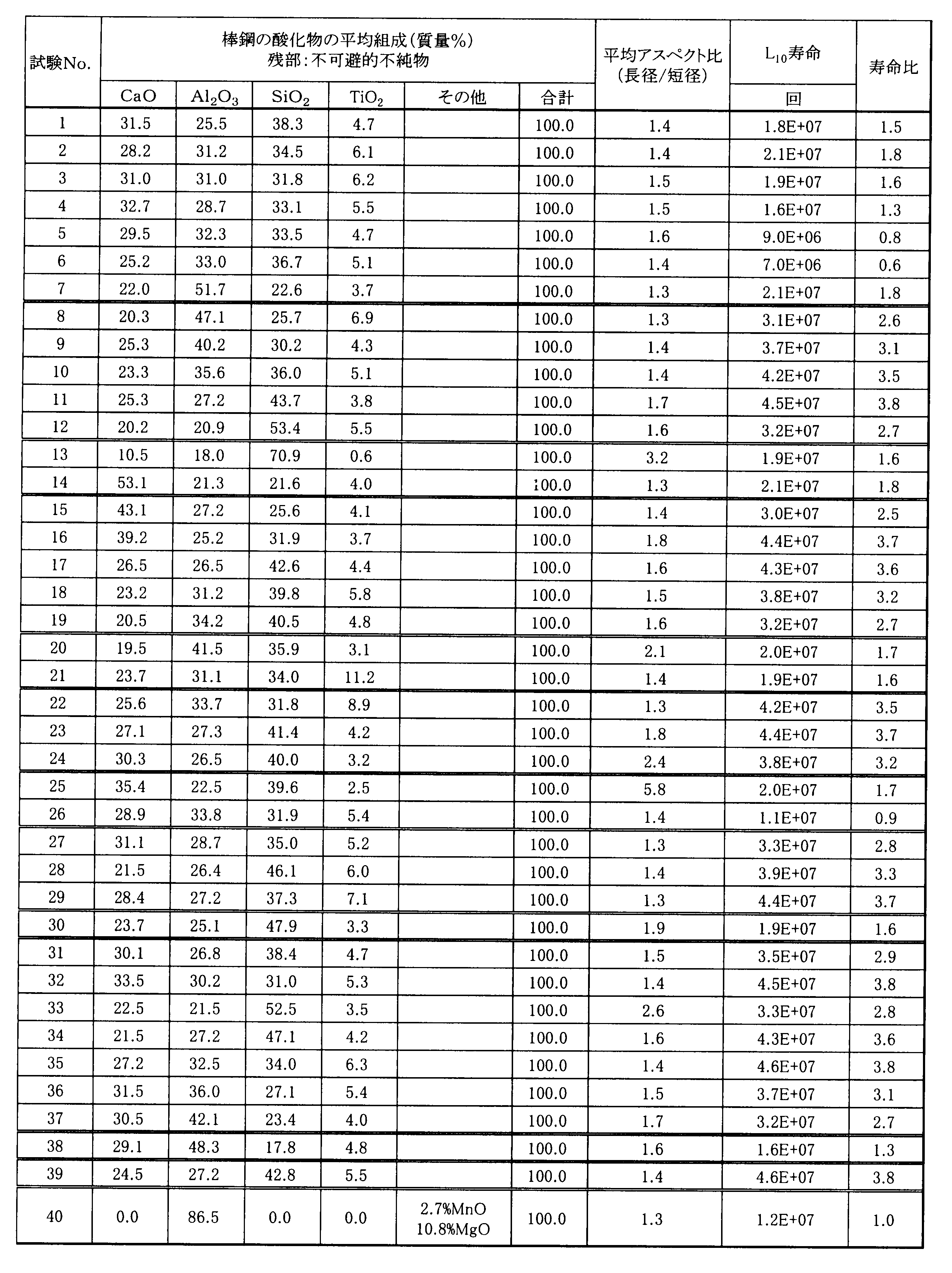
- life ratio is 2.5 times or more in L 10 life (L 10 life in those of the equivalent) to more than 30 million times and evaluated as "excellent rolling contact fatigue life”
- Test No. in Table 2 Is steel No. in Table 1. Is used. In the column of L 10 life of Table 2, the "E + 07” means “ ⁇ 10 7". For example, test No. “1.8E + 07” described in the above column 1 means “1.8 ⁇ 10 7 ”.
- test no. 8-12, 15-19, 22-24, 27-29, 31-37, 39 all satisfy the chemical composition (the chemical composition and oxide composition of the steel material) defined in the present invention. It can be seen that the aspect ratio of the oxide inclusions is also appropriately controlled, so that the rolling fatigue life is excellent.
- the rolling fatigue characteristics in the thrust direction are measured.
- the steel material of the present invention has a small aspect ratio, it is presumed that the rolling fatigue characteristics in the radial direction are also good.
- Test No. No. 1 is steel No. 1 in Table 1 with a large amount of C in steel.
- No. 1 example no. No. 2 shows the steel No. in Table 1 with a large amount of Mn in steel.
- Example No. 2 shows the steel No. in Table 1 with a large amount of Mn in steel.
- Example No. 3 is a steel No. of Table 1 with a large amount of Cr in the steel.
- Example No. 3 is a steel No. of Table 1 with a large amount of Cr in the steel.
- test no. No. 4 is a steel No. in Table 1 with a small amount of Cr in the steel.
- Example No. 4 shows the steel No. in Table 1 with a large amount of P in steel.
- Example No. 5 test no. No. 6 is a steel No. in Table 1 with a large amount of S in steel. No. 6 was used, and in all cases, the rolling fatigue characteristics decreased.
- Test No. 7 is an example using a steel type having an excessive Al content (steel material No. 7 in Table 1), and the Al 2 O 3 content in the oxide was increased, and the rolling fatigue characteristics were lowered.
- test no. 13 is an example using a steel type (steel material No. 13 in Table 1) in which the Al content is insufficient, and all the oxides are outside the range defined in the present invention, and the aspect of oxide inclusions The ratio also deviated and the rolling fatigue characteristics decreased.
- Test No. No. 14 is an example using a steel type having a high Ca content (steel material No. 14 in Table 1), in which the CaO content in the oxide was high, and the rolling fatigue characteristics were reduced.
- test no. No. 20 is an example using a steel type with a low Ca content (steel material No. 20 in Table 1), and the CaO content in the oxide was low, and the rolling fatigue characteristics were reduced.
- Test No. No. 21 is an example using a steel type having a high Ti content (steel material No. 21 in Table 1), in which the TiO 2 content in the oxide was high and the rolling fatigue characteristics were lowered.
- test no. 25 is an example using a steel type with a small Ti content (steel material No. 25 in Table 1), the TiO 2 content in the oxide is small, and the aspect ratio of the oxide inclusions is large, Rolling fatigue characteristics decreased.
- Test No. No. 26 is an example using a steel type with a high N content (steel material No. 26 in Table 1), and the rolling fatigue characteristics deteriorated.
- Test No. 30 is an example using a steel type (steel material No. 30 in Table 1) with a large O content, and the rolling fatigue characteristics were lowered.
- Test No. No. 38 has a relatively high Al concentration and a long melting time. Therefore, the oxidation-reduction reaction of Al in the molten steel and SiO 2 in the oxide inclusions proceeds, and the SiO 2 content is insufficient. The dynamic fatigue characteristics decreased.
- Test No. 40 is an example using a steel type obtained by Al deoxidation treatment (steel material No. 40: conventional aluminum killed steel in Table 1), and the Al content becomes excessive and the Al 2 O 3 content in the oxide is contained. Since the amount is very high and the desired TiO 2 or the like is not generated at all, the rolling fatigue characteristics are lowered.
- the rolling fatigue characteristics are extremely excellent, and early peeling is suppressed. It was possible to provide a bearing steel material that can be used.
- a steel material for bearings is not only useful as a material for bearing parts such as rollers, needles, balls, etc., in which radial loads are repeatedly applied, but is also repeatedly applied in struts, such as races. It is also useful as a material for bearing parts, and the rolling fatigue characteristics can be stably improved regardless of the direction in which the load is applied.
Landscapes
- Chemical & Material Sciences (AREA)
- Engineering & Computer Science (AREA)
- Mechanical Engineering (AREA)
- Organic Chemistry (AREA)
- Materials Engineering (AREA)
- Metallurgy (AREA)
- General Engineering & Computer Science (AREA)
- Physics & Mathematics (AREA)
- Thermal Sciences (AREA)
- Crystallography & Structural Chemistry (AREA)
- Rolling Contact Bearings (AREA)
- Treatment Of Steel In Its Molten State (AREA)
- Heat Treatment Of Articles (AREA)
- Heat Treatment Of Steel (AREA)
Description
また、本発明の好ましい実施形態において、前記アスペクト比(長径/短径)の平均は1.0以上である。
Cは、焼入硬さを増大させ、室温、高温における強度を維持して耐磨耗性を付与するための必須の元素である。こうした効果を発揮させるためには、Cは少なくとも、0.8%以上含有させる必要がある。しかしながら、C含有量が1.1%を超えて過剰になると、軸受の芯部に巨大炭化物が生成し易くなり、転動疲労特性に悪影響を及ぼすようになる。C含有量は、好ましくは0.85%以上(より好ましくは0.90%以上)であり、また、好ましくは1.05%以下(より好ましくは1.0%以下)である。
Siは、脱酸元素として有効に作用する他、焼入れ・焼戻し軟化抵抗を高めて硬さを高める作用を有している。こうした効果を有効に発揮させるためには、Si含有量は、0.15%以上とする必要がある。しかしながら、Si含有量が過剰になって0.8%を超えると、鍛造時に金型寿命が低下するばかりか、コスト増加を招くことになる。Si含有量は、好ましくは0.20%以上(より好ましくは0.25%以上)であり、また、好ましくは0.7%以下(より好ましくは0.6%以下)である。
Mnは、鋼材マトリックスの固溶強化および焼入れ性を向上させる元素である。Mn含有量が0.1%を下回るとその効果が発揮されず、1.0%を上回ると低級酸化物であるMnO含有量が増加し、転動疲労特性を悪化させる他、加工性や被削性が著しく低下する。Mn含有量は、好ましくは0.2%以上(より好ましくは0.3%以上)であり、また、好ましくは0.8%以下(より好ましくは0.6%以下)である。
Crは、焼入れ性の向上と安定な炭化物の形成によって、強度および耐磨耗性を向上させ、これによって転動疲労特性の改善に有効な元素である。こうした効果を発揮させるためには、Cr含有量は、1.3%以上とする必要がある。しかしながら、Cr含有量が過剰になって1.8%を超えると、炭化物が粗大化して、転動疲労特性および切削性を低下させる。Cr含有量は、好ましくは1.4%以上(より好ましくは1.5%以上)であり、また、好ましくは1.7%以下(より好ましくは1.6%以下)である。
Pは、結晶粒界に偏析して転動疲労特性に悪影響を及ぼす不純物元素である。特に、P含有量が0.05%を超えると、転動疲労特性の低下が著しくなる。従って、P含有量は0.05%以下に抑制する必要がある。好ましくは0.03%以下、より好ましくは0.02%以下とするのが良い。尚、Pは鋼材に不可避的に含まれる不純物であり、その量を0%にすることは、工業生産上、困難である。
Sは、硫化物を形成する元素であり、その含有量が0.015%を超えると、粗大な硫化物が残存するため、転動疲労特性が劣化する。従って、Sの含有量は0.015%以下に抑制する必要がある。転動疲労特性の向上という観点からは、S含有量は低ければ低いほど望ましく、好ましくは0.007%以下、より好ましくは0.005%以下とするのが良い。尚、Sは鋼材に不可避的に含まれる不純物であり、その量を0%にすることは、工業生産上、困難である。
Alは、好ましくない元素であり、本発明の鋼材においては、Alは極力少なくする必要がある。従って、酸化精錬後のAl添加による脱酸処理は行わない。Al含有量が多くなり、特に0.005%を超えてしまうと、Al2O3を主体とする硬質な酸化物の生成量が多くなり、しかも圧下した後も粗大な酸化物として残存するので、転動疲労特性が劣化する。従って、Alの含有量を0.005%以下とした。尚、Al含有量は、0.002%以下とすることが好ましく、より好ましくは0.0015%以下である。但し、Al含有量を0.0002%未満にすると、酸化物中のAl2O3含有量が少なくなり過ぎ、SiO2を多く含む結晶相が生成する。また、Al2O3含有量を0.0002%未満に制御するためには、Alの混入を抑制するために、鋼中成分のみならず、フラックス中のAl2O3含有量も少なくする必要があるが、高炭素鋼である軸受鋼においてAl2O3含有量の少ないフラックスは非常に高価であり、経済的でない。従って、Al含有量は0.0002%以上(好ましくは0.0005%以上)である。
Caは、酸化物中のCaO含有量を制御し、酸化物系介在物の結晶化を抑制して、転動疲労特性を改善するのに有効である。このような効果を発揮させるため、Ca含有量は0.0002%以上とする。しかしながら、Ca含有量が過剰になって0.0020%を超えると、酸化物組成におけるCaOの割合が高くなり過ぎて、酸化物が結晶化してしまう。従って、Ca含有量は0.0020%以下とした。Ca含有量は、好ましくは0.0003%以上(より好ましくは0.0005%以上)であり、また、好ましくは0.001%以下(より好ましくは0.0008%以下)である。
Tiは、本発明を特徴付ける元素である。所定量のTiを添加し、酸化物中のTiO2含有量を適切に制御することにより、これまで解決が困難であった問題(Si脱酸鋼で得られるSiO2含有酸化物系介在物の熱間加工時における結晶化、母相の鋼と酸化物系介在物の界面に発生する空洞、多結晶体である酸化物系介在物内部に発生する空洞)を解決することができ、転動疲労特性が一層向上する。更に所定量のTiは、アスペクト比の低減化にも有効に作用し、これにより、転動疲労特性が更に向上する。このような効果を得るためには、Ti含有量は0.0005%以上とする必要がある。ただし、Tiの含有量が多くなり、0.010%を超えると、TiO2系酸化物が結晶相として単独で生成してしまう。従って、Ti含有量は0.010%以下とした。Ti含有量は、好ましくは0.0008%以上(より好ましくは0.0011%以上)であり、また、好ましくは0.0050%以下(より好ましくは0.0030%以下)である。
Nは、TiNを生成し、転動疲労特性を悪化させるため、できる限り低減することが推奨され、N含有量の上限を0.0080%以下とする。N含有量は、好ましくは0.007%以下であり、より好ましくは0.006%以下である。
Oは、好ましくない不純物元素である。Oの含有量が多くなって、特に0.0025%を超えると、粗大な酸化物が生成し易くなり、熱間圧延および冷間圧延後においても粗大な酸化物として残存し、転動疲労特性に悪影響を及ぼすため、0.0025%以下とする。O含有量は、好ましくは0.0023%以下(より好ましくは0.0020%以下)である。
Caは塩基性酸化物であり、酸性酸化物であるSiO2に含まれると、酸化物の液相線温度が下がり、酸化物の結晶化を抑制する効果がある。酸化物系介在物のアスペクト比低減に重要な役割を果たす。このような効果は、酸化物の平均組成におけるCaO含有量を20%以上に制御することによって得られる。しかしながら、CaO含有量が高すぎると、酸化物が結晶化してしまうため、50%以下とする必要がある。酸化物中におけるCaO含有量は、好ましくは22%以上(より好ましくは25%以上)であり、また、好ましくは43%以下(より好ましくは41%以下)である。
Al2O3は両性酸化物であり、酸性酸化物であるSiO2に含まれると、酸化物の液相線温度が下がり、酸化物の結晶化を抑制する効果がある。このような効果は、酸化物の平均組成におけるAl2O3含有量を20%以上に制御することによって得られる。一方、酸化物の平均組成における含有量が50%を超えると、溶鋼中および凝固過程でAl2O3(コランダム)結晶相が晶出したり、MgOとともにMgO・Al2O3(スピネル)結晶相が晶出する。あるいは、圧延温度域でこれらの結晶相が生成する。これらの固相は硬質であり、粗大な介在物として存在し、加工中に空洞が生成しやすくなり、転動疲労特性を悪化させる。こうした観点から、酸化物の平均組成におけるAl2O3含有量は50%以下とする必要がある。酸化物におけるAl2O3含有量は、好ましくは22%以上(より好ましくは25%以上)であり、また、好ましくは43%以下(より好ましくは41%以下)である。
SiO2は酸性酸化物であり、酸化物系介在物を非晶質化させるために不可欠の成分である。このような効果を有効に発揮させるためには、酸化物中にSiO2を20%以上含有させる必要がある。しかしながら、SiO2含有量が70%を超えると、SiO2を多く含む結晶相が生成し空洞が形成されるため、転動疲労特性が悪化する。酸化物中におけるSiO2含有量は、好ましくは25%以上(より好ましくは30%以上)であり、また、好ましくは50%以下(より好ましくは45%以下)である。
TiO2は、本発明を特徴付ける酸化物成分であり、酸性酸化物であるSiO2に含まれると、TiO2濃化相(A相)とSiO2濃化相(B相)の2相に分離でき、両相とも結晶質化を抑制することができる。その結果、Si脱酸鋼で得られるSiO2含有酸化物系介在物の熱間加工時の結晶化の抑制、母相の鋼と酸化物系介在物との界面に発生する空洞の抑制、多結晶体である酸化物系介在物内部にも発生する空洞の抑制を実現でき、転動疲労特性が一層を向上する。更には、アスペクト比も低減することができる。このような効果は、酸化物の平均組成におけるTiO2含有量を3%以上に制御することによって得られる。しかしながら、TiO2含有量が高すぎると、TiO2系酸化物が結晶相として単独で生成し、空洞が形成され、転動疲労特性が低下するため、10%以下とする。酸化物中におけるTiO2含有量は、好ましくは4%以上(より好ましくは5%以上)であり、また、好ましくは8%以下(より好ましくは7%以下)である。

非金属介在物のアスペクト比を測定するため、上述した酸化物の平均組成測定方法において、短径が1μm以上の任意の酸化物系介在物(分析対象元素は、Ca、Al、Si、Ti、Mn、Mg、Na、Cr、Zr、O(酸素))を100個選び、各々の長径と短径を測定し、各々の酸化物系介在物のアスペクト比を算出した。その結果を算術平均することで酸化物系介在物の平均のアスペクト比を求めた。
上記で得られたスラスト転動疲労試験片を用い、スラスト疲労試験機(スラスト型転動疲労試験機(FJ-5T)、富士試験機製作所製)にて、負荷速度:1200rpm、鋼球数3個、面圧:5.24GPa、中止回数:2億回の条件でスラスト転動疲労試験を実施した。
本出願は、2012年7月24日出願の日本特許出願(特願2012-163623)に基づくものであり、その内容はここに参照として取り込まれる。
Claims (6)
- C :0.8~1.1質量%、
Si:0.15~0.8質量%、
Mn:0.1~1.0質量%、
Cr:1.3~1.8質量%、
P :0質量%より大きく0.05質量%以下、
S :0質量%より大きく0.015質量%以下、
Al:0.0002~0.005質量%、
Ca:0.0002~0.0020質量%、
Ti:0.0005~0.010質量%、
N :0質量%より大きく0.0080質量%以下、
O :0質量%より大きく0.0025質量%以下
を含有し、残部は鉄及び不可避的不純物からなり、
鋼材中に含まれる酸化物系介在物の平均組成が質量%で、
CaO:20~50%、Al2O3:20~50%、SiO2:20~70%、TiO2:3~10%を含有し、残部は不純物からなることを特徴とする軸受用鋼材。 - 前記鋼材の長手方向に平行に切断した面に存在する前記酸化物系介在物のアスペクト比(長径/短径)の平均が3.0以下に抑制されたものである請求項1に記載の軸受用鋼材。
- 前記アスペクト比(長径/短径)の平均が1.0以上である請求項2に記載の軸受用鋼材。
- 請求項1に記載の軸受用鋼材からなる軸受部品。
- 請求項2に記載の軸受用鋼材からなる軸受部品。
- 請求項3に記載の軸受用鋼材からなる軸受部品。
Priority Applications (6)
| Application Number | Priority Date | Filing Date | Title |
|---|---|---|---|
| EP13823320.0A EP2878694A4 (en) | 2012-07-24 | 2013-07-17 | STEEL MATERIAL FOR BEARINGS HAVING EXCELLENT ROLLING FATIGUE PROPERTY AND BEARING PART |
| KR1020167016390A KR20160074684A (ko) | 2012-07-24 | 2013-07-17 | 구름 이동 피로 특성이 우수한 베어링용 강재 및 베어링 부품 |
| BR112015001389A BR112015001389A2 (pt) | 2012-07-24 | 2013-07-17 | material de aço para mancais com excelente propriedade de fadiga na laminação e peça de mancal |
| US14/406,347 US9359661B2 (en) | 2012-07-24 | 2013-07-17 | Bearing steel material with excellent rolling fatigue property and bearing part |
| KR1020157001628A KR20150023841A (ko) | 2012-07-24 | 2013-07-17 | 구름 이동 피로 특성이 우수한 베어링용 강재 및 베어링 부품 |
| US15/074,164 US20160201173A1 (en) | 2012-07-24 | 2016-03-18 | Bearing steel material with excellent rolling fatigue property and bearing part |
Applications Claiming Priority (2)
| Application Number | Priority Date | Filing Date | Title |
|---|---|---|---|
| JP2012-163623 | 2012-07-24 | ||
| JP2012163623A JP5833984B2 (ja) | 2012-07-24 | 2012-07-24 | 転動疲労特性に優れた軸受用鋼材および軸受部品 |
Related Child Applications (2)
| Application Number | Title | Priority Date | Filing Date |
|---|---|---|---|
| US14/406,347 A-371-Of-International US9359661B2 (en) | 2012-07-24 | 2013-07-17 | Bearing steel material with excellent rolling fatigue property and bearing part |
| US15/074,164 Continuation US20160201173A1 (en) | 2012-07-24 | 2016-03-18 | Bearing steel material with excellent rolling fatigue property and bearing part |
Publications (1)
| Publication Number | Publication Date |
|---|---|
| WO2014017362A1 true WO2014017362A1 (ja) | 2014-01-30 |
Family
ID=49997176
Family Applications (1)
| Application Number | Title | Priority Date | Filing Date |
|---|---|---|---|
| PCT/JP2013/069445 Ceased WO2014017362A1 (ja) | 2012-07-24 | 2013-07-17 | 転動疲労特性に優れた軸受用鋼材および軸受部品 |
Country Status (7)
| Country | Link |
|---|---|
| US (2) | US9359661B2 (ja) |
| EP (1) | EP2878694A4 (ja) |
| JP (1) | JP5833984B2 (ja) |
| KR (2) | KR20160074684A (ja) |
| BR (1) | BR112015001389A2 (ja) |
| TW (1) | TWI491743B (ja) |
| WO (1) | WO2014017362A1 (ja) |
Cited By (1)
| Publication number | Priority date | Publication date | Assignee | Title |
|---|---|---|---|---|
| WO2017154652A1 (ja) * | 2016-03-07 | 2017-09-14 | 株式会社神戸製鋼所 | 転動疲労特性に優れた軸受用鋼材、その製造方法及び軸受部品 |
Families Citing this family (3)
| Publication number | Priority date | Publication date | Assignee | Title |
|---|---|---|---|---|
| JP6214493B2 (ja) * | 2014-08-21 | 2017-10-18 | 株式会社神戸製鋼所 | 鋼中Ti濃度の制御方法 |
| JP6462376B2 (ja) * | 2015-01-23 | 2019-01-30 | 株式会社神戸製鋼所 | 転動疲労特性に優れた軸受用鋼材および軸受部品 |
| JP2016172916A (ja) * | 2015-03-18 | 2016-09-29 | 株式会社神戸製鋼所 | 転動疲労特性および冷間鍛造性に優れた軸受用鋼材、および軸受部品 |
Citations (8)
| Publication number | Priority date | Publication date | Assignee | Title |
|---|---|---|---|---|
| JPS62130258A (ja) * | 1985-11-29 | 1987-06-12 | Nippon Steel Corp | 伸線性及び伸線後の耐疲労性に優れた高炭素鋼線材 |
| JP2002194497A (ja) * | 2000-12-21 | 2002-07-10 | Sumitomo Metal Ind Ltd | Si脱酸鋼とその製造方法 |
| JP2009007643A (ja) * | 2007-06-28 | 2009-01-15 | Kobe Steel Ltd | 被削性に優れた機械構造用鋼 |
| JP2009030145A (ja) | 2007-07-05 | 2009-02-12 | Sumitomo Metal Ind Ltd | 軸受鋼鋼材及びその製造方法 |
| JP2009052111A (ja) | 2007-08-29 | 2009-03-12 | Sanyo Special Steel Co Ltd | 転がり疲労寿命に優れた鋼 |
| JP2009174033A (ja) * | 2008-01-28 | 2009-08-06 | Kobe Steel Ltd | 被削性に優れた機械構造用鋼 |
| JP2010007092A (ja) * | 2008-06-24 | 2010-01-14 | Sumitomo Metal Ind Ltd | 軸受鋼鋼材およびその製造方法 |
| JP2010202905A (ja) | 2009-03-02 | 2010-09-16 | Sumitomo Metal Ind Ltd | 高清浄度Si脱酸鋼およびその製造方法 |
Family Cites Families (2)
| Publication number | Priority date | Publication date | Assignee | Title |
|---|---|---|---|---|
| JP4256701B2 (ja) * | 2003-03-13 | 2009-04-22 | 新日本製鐵株式会社 | 疲労寿命に優れた介在物微細分散鋼 |
| JP4630075B2 (ja) * | 2005-01-24 | 2011-02-09 | 新日本製鐵株式会社 | 高炭素クロム軸受鋼およびその製造方法 |
-
2012
- 2012-07-24 JP JP2012163623A patent/JP5833984B2/ja not_active Expired - Fee Related
-
2013
- 2013-07-17 KR KR1020167016390A patent/KR20160074684A/ko not_active Abandoned
- 2013-07-17 BR BR112015001389A patent/BR112015001389A2/pt not_active Application Discontinuation
- 2013-07-17 EP EP13823320.0A patent/EP2878694A4/en not_active Withdrawn
- 2013-07-17 WO PCT/JP2013/069445 patent/WO2014017362A1/ja not_active Ceased
- 2013-07-17 KR KR1020157001628A patent/KR20150023841A/ko not_active Ceased
- 2013-07-17 US US14/406,347 patent/US9359661B2/en not_active Expired - Fee Related
- 2013-07-23 TW TW102126293A patent/TWI491743B/zh not_active IP Right Cessation
-
2016
- 2016-03-18 US US15/074,164 patent/US20160201173A1/en not_active Abandoned
Patent Citations (8)
| Publication number | Priority date | Publication date | Assignee | Title |
|---|---|---|---|---|
| JPS62130258A (ja) * | 1985-11-29 | 1987-06-12 | Nippon Steel Corp | 伸線性及び伸線後の耐疲労性に優れた高炭素鋼線材 |
| JP2002194497A (ja) * | 2000-12-21 | 2002-07-10 | Sumitomo Metal Ind Ltd | Si脱酸鋼とその製造方法 |
| JP2009007643A (ja) * | 2007-06-28 | 2009-01-15 | Kobe Steel Ltd | 被削性に優れた機械構造用鋼 |
| JP2009030145A (ja) | 2007-07-05 | 2009-02-12 | Sumitomo Metal Ind Ltd | 軸受鋼鋼材及びその製造方法 |
| JP2009052111A (ja) | 2007-08-29 | 2009-03-12 | Sanyo Special Steel Co Ltd | 転がり疲労寿命に優れた鋼 |
| JP2009174033A (ja) * | 2008-01-28 | 2009-08-06 | Kobe Steel Ltd | 被削性に優れた機械構造用鋼 |
| JP2010007092A (ja) * | 2008-06-24 | 2010-01-14 | Sumitomo Metal Ind Ltd | 軸受鋼鋼材およびその製造方法 |
| JP2010202905A (ja) | 2009-03-02 | 2010-09-16 | Sumitomo Metal Ind Ltd | 高清浄度Si脱酸鋼およびその製造方法 |
Non-Patent Citations (1)
| Title |
|---|
| See also references of EP2878694A4 * |
Cited By (1)
| Publication number | Priority date | Publication date | Assignee | Title |
|---|---|---|---|---|
| WO2017154652A1 (ja) * | 2016-03-07 | 2017-09-14 | 株式会社神戸製鋼所 | 転動疲労特性に優れた軸受用鋼材、その製造方法及び軸受部品 |
Also Published As
| Publication number | Publication date |
|---|---|
| US20150147223A1 (en) | 2015-05-28 |
| US9359661B2 (en) | 2016-06-07 |
| EP2878694A4 (en) | 2016-03-16 |
| JP5833984B2 (ja) | 2015-12-16 |
| US20160201173A1 (en) | 2016-07-14 |
| KR20160074684A (ko) | 2016-06-28 |
| BR112015001389A2 (pt) | 2017-07-04 |
| TW201425600A (zh) | 2014-07-01 |
| JP2014025083A (ja) | 2014-02-06 |
| KR20150023841A (ko) | 2015-03-05 |
| EP2878694A1 (en) | 2015-06-03 |
| TWI491743B (zh) | 2015-07-11 |
Similar Documents
| Publication | Publication Date | Title |
|---|---|---|
| JP6248026B2 (ja) | 転動疲労特性に優れた軸受用鋼材および軸受部品 | |
| KR101815410B1 (ko) | 피로 특성이 우수한 스프링용 강선재 및 스프링 | |
| JP2009030145A (ja) | 軸受鋼鋼材及びその製造方法 | |
| JP2012036434A (ja) | 軸受鋼鋼材 | |
| JP2016204752A (ja) | 肌焼鋼および肌焼鋼の製造方法 | |
| KR20190045314A (ko) | 표면 경화강 및 그 제조 방법 그리고 기어 부품의 제조 방법 | |
| JP5035137B2 (ja) | 軸受鋼鋼材およびその製造方法 | |
| JP5833984B2 (ja) | 転動疲労特性に優れた軸受用鋼材および軸受部品 | |
| JP2012214832A (ja) | 機械構造用鋼およびその製造方法 | |
| JP5605912B2 (ja) | 転動疲労特性に優れた軸受用鋼材および軸受部品 | |
| JP5976584B2 (ja) | 転動疲労特性と切削加工性に優れた軸受用鋼材、および軸受部品 | |
| JP6462376B2 (ja) | 転動疲労特性に優れた軸受用鋼材および軸受部品 | |
| JP5873405B2 (ja) | 転動疲労特性に優れた軸受用鋼材および軸受部品 | |
| JP2016172916A (ja) | 転動疲労特性および冷間鍛造性に優れた軸受用鋼材、および軸受部品 | |
| JP6073200B2 (ja) | 転動疲労特性に優れた軸受用鋼材および軸受部品 | |
| WO2018212196A1 (ja) | 鋼及び部品 | |
| WO2017154652A1 (ja) | 転動疲労特性に優れた軸受用鋼材、その製造方法及び軸受部品 | |
| JP2024101924A (ja) | 軸受用鋼 | |
| JP2002212667A (ja) | 機械構造用鋼およびその製造方法 |
Legal Events
| Date | Code | Title | Description |
|---|---|---|---|
| 121 | Ep: the epo has been informed by wipo that ep was designated in this application |
Ref document number: 13823320 Country of ref document: EP Kind code of ref document: A1 |
|
| WWE | Wipo information: entry into national phase |
Ref document number: 14406347 Country of ref document: US |
|
| ENP | Entry into the national phase |
Ref document number: 20157001628 Country of ref document: KR Kind code of ref document: A |
|
| NENP | Non-entry into the national phase |
Ref country code: DE |
|
| WWE | Wipo information: entry into national phase |
Ref document number: 2013823320 Country of ref document: EP |
|
| REG | Reference to national code |
Ref country code: BR Ref legal event code: B01A Ref document number: 112015001389 Country of ref document: BR |
|
| ENP | Entry into the national phase |
Ref document number: 112015001389 Country of ref document: BR Kind code of ref document: A2 Effective date: 20150122 |