WO2014018397A1 - Herbicidal compositions comprising 4-amino-3-chloro-5-fluoro-6-(4-chloro-2-fluoro-3-methoxphenyl) pyridine-2-carboxylic acid or a derivative thereof and vlcfa synthesis and fatty acid/lipid synthesis inhibiting herbicides - Google Patents
Herbicidal compositions comprising 4-amino-3-chloro-5-fluoro-6-(4-chloro-2-fluoro-3-methoxphenyl) pyridine-2-carboxylic acid or a derivative thereof and vlcfa synthesis and fatty acid/lipid synthesis inhibiting herbicides Download PDFInfo
- Publication number
- WO2014018397A1 WO2014018397A1 PCT/US2013/051302 US2013051302W WO2014018397A1 WO 2014018397 A1 WO2014018397 A1 WO 2014018397A1 US 2013051302 W US2013051302 W US 2013051302W WO 2014018397 A1 WO2014018397 A1 WO 2014018397A1
- Authority
- WO
- WIPO (PCT)
- Prior art keywords
- compound
- ester
- formula
- gai
- salt
- Prior art date
- Legal status (The legal status is an assumption and is not a legal conclusion. Google has not performed a legal analysis and makes no representation as to the accuracy of the status listed.)
- Ceased
Links
- JLYFCTQDENRSOL-UHFFFAOYSA-N CC(COC)N(C(CCl)=O)c1c(C)[s]cc1C Chemical compound CC(COC)N(C(CCl)=O)c1c(C)[s]cc1C JLYFCTQDENRSOL-UHFFFAOYSA-N 0.000 description 1
- QHTQREMOGMZHJV-UHFFFAOYSA-N CCN(CC)C(SCc(cc1)ccc1Cl)=O Chemical compound CCN(CC)C(SCc(cc1)ccc1Cl)=O QHTQREMOGMZHJV-UHFFFAOYSA-N 0.000 description 1
Classifications
-
- E—FIXED CONSTRUCTIONS
- E21—EARTH OR ROCK DRILLING; MINING
- E21B—EARTH OR ROCK DRILLING; OBTAINING OIL, GAS, WATER, SOLUBLE OR MELTABLE MATERIALS OR A SLURRY OF MINERALS FROM WELLS
- E21B44/00—Automatic control systems specially adapted for drilling operations, i.e. self-operating systems which function to carry out or modify a drilling operation without intervention of a human operator, e.g. computer-controlled drilling systems; Systems specially adapted for monitoring a plurality of drilling variables or conditions
-
- A—HUMAN NECESSITIES
- A01—AGRICULTURE; FORESTRY; ANIMAL HUSBANDRY; HUNTING; TRAPPING; FISHING
- A01N—PRESERVATION OF BODIES OF HUMANS OR ANIMALS OR PLANTS OR PARTS THEREOF; BIOCIDES, e.g. AS DISINFECTANTS, AS PESTICIDES OR AS HERBICIDES; PEST REPELLANTS OR ATTRACTANTS; PLANT GROWTH REGULATORS
- A01N43/00—Biocides, pest repellants or attractants, or plant growth regulators containing heterocyclic compounds
- A01N43/34—Biocides, pest repellants or attractants, or plant growth regulators containing heterocyclic compounds having rings with one nitrogen atom as the only ring hetero atom
- A01N43/40—Biocides, pest repellants or attractants, or plant growth regulators containing heterocyclic compounds having rings with one nitrogen atom as the only ring hetero atom six-membered rings
-
- A—HUMAN NECESSITIES
- A01—AGRICULTURE; FORESTRY; ANIMAL HUSBANDRY; HUNTING; TRAPPING; FISHING
- A01N—PRESERVATION OF BODIES OF HUMANS OR ANIMALS OR PLANTS OR PARTS THEREOF; BIOCIDES, e.g. AS DISINFECTANTS, AS PESTICIDES OR AS HERBICIDES; PEST REPELLANTS OR ATTRACTANTS; PLANT GROWTH REGULATORS
- A01N37/00—Biocides, pest repellants or attractants, or plant growth regulators containing organic compounds containing a carbon atom having three bonds to hetero atoms with at the most two bonds to halogen, e.g. carboxylic acids
- A01N37/18—Biocides, pest repellants or attractants, or plant growth regulators containing organic compounds containing a carbon atom having three bonds to hetero atoms with at the most two bonds to halogen, e.g. carboxylic acids containing the group —CO—N<, e.g. carboxylic acid amides or imides; Thio analogues thereof
- A01N37/20—Biocides, pest repellants or attractants, or plant growth regulators containing organic compounds containing a carbon atom having three bonds to hetero atoms with at the most two bonds to halogen, e.g. carboxylic acids containing the group —CO—N<, e.g. carboxylic acid amides or imides; Thio analogues thereof containing the group, wherein Cn means a carbon skeleton not containing a ring; Thio analogues thereof
-
- A—HUMAN NECESSITIES
- A01—AGRICULTURE; FORESTRY; ANIMAL HUSBANDRY; HUNTING; TRAPPING; FISHING
- A01N—PRESERVATION OF BODIES OF HUMANS OR ANIMALS OR PLANTS OR PARTS THEREOF; BIOCIDES, e.g. AS DISINFECTANTS, AS PESTICIDES OR AS HERBICIDES; PEST REPELLANTS OR ATTRACTANTS; PLANT GROWTH REGULATORS
- A01N37/00—Biocides, pest repellants or attractants, or plant growth regulators containing organic compounds containing a carbon atom having three bonds to hetero atoms with at the most two bonds to halogen, e.g. carboxylic acids
- A01N37/18—Biocides, pest repellants or attractants, or plant growth regulators containing organic compounds containing a carbon atom having three bonds to hetero atoms with at the most two bonds to halogen, e.g. carboxylic acids containing the group —CO—N<, e.g. carboxylic acid amides or imides; Thio analogues thereof
- A01N37/26—Biocides, pest repellants or attractants, or plant growth regulators containing organic compounds containing a carbon atom having three bonds to hetero atoms with at the most two bonds to halogen, e.g. carboxylic acids containing the group —CO—N<, e.g. carboxylic acid amides or imides; Thio analogues thereof containing the group; Thio analogues thereof
-
- A—HUMAN NECESSITIES
- A01—AGRICULTURE; FORESTRY; ANIMAL HUSBANDRY; HUNTING; TRAPPING; FISHING
- A01N—PRESERVATION OF BODIES OF HUMANS OR ANIMALS OR PLANTS OR PARTS THEREOF; BIOCIDES, e.g. AS DISINFECTANTS, AS PESTICIDES OR AS HERBICIDES; PEST REPELLANTS OR ATTRACTANTS; PLANT GROWTH REGULATORS
- A01N43/00—Biocides, pest repellants or attractants, or plant growth regulators containing heterocyclic compounds
- A01N43/02—Biocides, pest repellants or attractants, or plant growth regulators containing heterocyclic compounds having rings with one or more oxygen or sulfur atoms as the only ring hetero atoms
- A01N43/04—Biocides, pest repellants or attractants, or plant growth regulators containing heterocyclic compounds having rings with one or more oxygen or sulfur atoms as the only ring hetero atoms with one hetero atom
- A01N43/06—Biocides, pest repellants or attractants, or plant growth regulators containing heterocyclic compounds having rings with one or more oxygen or sulfur atoms as the only ring hetero atoms with one hetero atom five-membered rings
- A01N43/10—Biocides, pest repellants or attractants, or plant growth regulators containing heterocyclic compounds having rings with one or more oxygen or sulfur atoms as the only ring hetero atoms with one hetero atom five-membered rings with sulfur as the ring hetero atom
-
- A—HUMAN NECESSITIES
- A01—AGRICULTURE; FORESTRY; ANIMAL HUSBANDRY; HUNTING; TRAPPING; FISHING
- A01N—PRESERVATION OF BODIES OF HUMANS OR ANIMALS OR PLANTS OR PARTS THEREOF; BIOCIDES, e.g. AS DISINFECTANTS, AS PESTICIDES OR AS HERBICIDES; PEST REPELLANTS OR ATTRACTANTS; PLANT GROWTH REGULATORS
- A01N43/00—Biocides, pest repellants or attractants, or plant growth regulators containing heterocyclic compounds
- A01N43/02—Biocides, pest repellants or attractants, or plant growth regulators containing heterocyclic compounds having rings with one or more oxygen or sulfur atoms as the only ring hetero atoms
- A01N43/04—Biocides, pest repellants or attractants, or plant growth regulators containing heterocyclic compounds having rings with one or more oxygen or sulfur atoms as the only ring hetero atoms with one hetero atom
- A01N43/06—Biocides, pest repellants or attractants, or plant growth regulators containing heterocyclic compounds having rings with one or more oxygen or sulfur atoms as the only ring hetero atoms with one hetero atom five-membered rings
- A01N43/12—Biocides, pest repellants or attractants, or plant growth regulators containing heterocyclic compounds having rings with one or more oxygen or sulfur atoms as the only ring hetero atoms with one hetero atom five-membered rings condensed with a carbocyclic ring
-
- A—HUMAN NECESSITIES
- A01—AGRICULTURE; FORESTRY; ANIMAL HUSBANDRY; HUNTING; TRAPPING; FISHING
- A01N—PRESERVATION OF BODIES OF HUMANS OR ANIMALS OR PLANTS OR PARTS THEREOF; BIOCIDES, e.g. AS DISINFECTANTS, AS PESTICIDES OR AS HERBICIDES; PEST REPELLANTS OR ATTRACTANTS; PLANT GROWTH REGULATORS
- A01N43/00—Biocides, pest repellants or attractants, or plant growth regulators containing heterocyclic compounds
- A01N43/02—Biocides, pest repellants or attractants, or plant growth regulators containing heterocyclic compounds having rings with one or more oxygen or sulfur atoms as the only ring hetero atoms
- A01N43/04—Biocides, pest repellants or attractants, or plant growth regulators containing heterocyclic compounds having rings with one or more oxygen or sulfur atoms as the only ring hetero atoms with one hetero atom
- A01N43/20—Biocides, pest repellants or attractants, or plant growth regulators containing heterocyclic compounds having rings with one or more oxygen or sulfur atoms as the only ring hetero atoms with one hetero atom three- or four-membered rings
-
- A—HUMAN NECESSITIES
- A01—AGRICULTURE; FORESTRY; ANIMAL HUSBANDRY; HUNTING; TRAPPING; FISHING
- A01N—PRESERVATION OF BODIES OF HUMANS OR ANIMALS OR PLANTS OR PARTS THEREOF; BIOCIDES, e.g. AS DISINFECTANTS, AS PESTICIDES OR AS HERBICIDES; PEST REPELLANTS OR ATTRACTANTS; PLANT GROWTH REGULATORS
- A01N43/00—Biocides, pest repellants or attractants, or plant growth regulators containing heterocyclic compounds
- A01N43/64—Biocides, pest repellants or attractants, or plant growth regulators containing heterocyclic compounds having rings with three nitrogen atoms as the only ring hetero atoms
- A01N43/647—Triazoles; Hydrogenated triazoles
- A01N43/653—1,2,4-Triazoles; Hydrogenated 1,2,4-triazoles
-
- A—HUMAN NECESSITIES
- A01—AGRICULTURE; FORESTRY; ANIMAL HUSBANDRY; HUNTING; TRAPPING; FISHING
- A01N—PRESERVATION OF BODIES OF HUMANS OR ANIMALS OR PLANTS OR PARTS THEREOF; BIOCIDES, e.g. AS DISINFECTANTS, AS PESTICIDES OR AS HERBICIDES; PEST REPELLANTS OR ATTRACTANTS; PLANT GROWTH REGULATORS
- A01N43/00—Biocides, pest repellants or attractants, or plant growth regulators containing heterocyclic compounds
- A01N43/713—Biocides, pest repellants or attractants, or plant growth regulators containing heterocyclic compounds having rings with four or more nitrogen atoms as the only ring hetero atoms
-
- A—HUMAN NECESSITIES
- A01—AGRICULTURE; FORESTRY; ANIMAL HUSBANDRY; HUNTING; TRAPPING; FISHING
- A01N—PRESERVATION OF BODIES OF HUMANS OR ANIMALS OR PLANTS OR PARTS THEREOF; BIOCIDES, e.g. AS DISINFECTANTS, AS PESTICIDES OR AS HERBICIDES; PEST REPELLANTS OR ATTRACTANTS; PLANT GROWTH REGULATORS
- A01N43/00—Biocides, pest repellants or attractants, or plant growth regulators containing heterocyclic compounds
- A01N43/72—Biocides, pest repellants or attractants, or plant growth regulators containing heterocyclic compounds having rings with nitrogen atoms and oxygen or sulfur atoms as ring hetero atoms
- A01N43/74—Biocides, pest repellants or attractants, or plant growth regulators containing heterocyclic compounds having rings with nitrogen atoms and oxygen or sulfur atoms as ring hetero atoms five-membered rings with one nitrogen atom and either one oxygen atom or one sulfur atom in positions 1,3
- A01N43/78—1,3-Thiazoles; Hydrogenated 1,3-thiazoles
-
- A—HUMAN NECESSITIES
- A01—AGRICULTURE; FORESTRY; ANIMAL HUSBANDRY; HUNTING; TRAPPING; FISHING
- A01N—PRESERVATION OF BODIES OF HUMANS OR ANIMALS OR PLANTS OR PARTS THEREOF; BIOCIDES, e.g. AS DISINFECTANTS, AS PESTICIDES OR AS HERBICIDES; PEST REPELLANTS OR ATTRACTANTS; PLANT GROWTH REGULATORS
- A01N43/00—Biocides, pest repellants or attractants, or plant growth regulators containing heterocyclic compounds
- A01N43/72—Biocides, pest repellants or attractants, or plant growth regulators containing heterocyclic compounds having rings with nitrogen atoms and oxygen or sulfur atoms as ring hetero atoms
- A01N43/82—Biocides, pest repellants or attractants, or plant growth regulators containing heterocyclic compounds having rings with nitrogen atoms and oxygen or sulfur atoms as ring hetero atoms five-membered rings with three ring hetero atoms
-
- A—HUMAN NECESSITIES
- A01—AGRICULTURE; FORESTRY; ANIMAL HUSBANDRY; HUNTING; TRAPPING; FISHING
- A01N—PRESERVATION OF BODIES OF HUMANS OR ANIMALS OR PLANTS OR PARTS THEREOF; BIOCIDES, e.g. AS DISINFECTANTS, AS PESTICIDES OR AS HERBICIDES; PEST REPELLANTS OR ATTRACTANTS; PLANT GROWTH REGULATORS
- A01N57/00—Biocides, pest repellants or attractants, or plant growth regulators containing organic phosphorus compounds
- A01N57/10—Biocides, pest repellants or attractants, or plant growth regulators containing organic phosphorus compounds having phosphorus-to-oxygen bonds or phosphorus-to-sulfur bonds
- A01N57/14—Biocides, pest repellants or attractants, or plant growth regulators containing organic phosphorus compounds having phosphorus-to-oxygen bonds or phosphorus-to-sulfur bonds containing aromatic radicals
Definitions
- herbicidal compositions comprising (a) 4-amino-3-chloro-5- fluoro-6-(4-chloro-2-fluoro-3-methoxyphenyl)pyridine-2-carboxylic acid or an agriculturally acceptable ester or salt thereof and (b) very long chain fatty acid (VLCFA) synthesis- inhibiting herbicides and fatty acid/lipid synthesis inhibiting herbicides.
- VLCFA very long chain fatty acid
- the ratio of compound (a) to compound (b) can be expressed in terms of weight to weight (g to g), gae/ha to gae/ha, gae/ha to gai/ha, or gai/ha to gai/ha.
- a synergistic herbicidal composition comprising a herbicidally effective amount of (a) a compound of the formula (I)
- composition of embodiment 1 wherein (a) is the compound of formula (I) or an agriculturally acceptable benzyl ester and (b) is fenoxasulfone. 13. The composition of embodiment I, wherein (a) is the compound of formula (I) or an agriculturally acceptable benzyl ester and (b) is fentrazamide.
- composition of embodiment I wherein (a) is the compound of formula (I) or an agriculturally acceptable benzyl ester and (b) indanofan.
- composition of any of embodiments 1-24, further comprising a herbicide safener comprising any of embodiments 1-24, further comprising a herbicide safener.
- composition of embodiment 5, wherein the weight ratio of compound of formula (I) or agriculturally acceptable salt or ester thereof to acetochlor or agriculturally acceptable salt or ester thereof is from about 1 : 1680 to about 6: 1.
- composition of embodiment 5 wherein the weight ratio of the compound of formula (I) or agriculturally acceptable salt or ester thereof to alachlor or agriculturally acceptable salt or ester thereof is from about 1 :3350 to about 2: 1.
- weight ratio of the compound of formula (I) or agriculturally acceptable salt or ester thereof to anilofos or agriculturally acceptable salt or ester thereof is from about 1 :250 to about 6: 1.
- composition of embodiment 5, wherein the weight ratio of the compound of formula (I) or agriculturally acceptable salt or ester thereof to benfuresate or agriculturally acceptable salt or ester thereof is from about 1 :300 to about 6: 1.
- composition of embodiment 5, wherein the weight ratio of the compound of formula (I) or agriculturally acceptable salt or ester thereof to cafenstrole or agriculturally acceptable salt or ester thereof is from about 1 : 150 to about 12: 1.
- composition of embodiment 5, wherein the weight ratio of the compound of formula (I) or agriculturally acceptable salt or ester thereof to dimethenamid-P or agriculturally acceptable salt or ester thereof is from about 1 :850 to about 1 : 1.
- composition of embodiment 5, wherein the weight ratio of the compound of formula (I) or agriculturally acceptable salt or ester thereof to fenoxasulfone or agriculturally acceptable salt or ester thereof is from about 1 :250 to about 6: 1.
- composition of embodiment 5, wherein the weight ratio of the compound of formula (I) or agriculturally acceptable salt or ester thereof to fentrazamide or agriculturally acceptable salt or ester thereof is from about 1 : 150 to about 19: 1.
- composition of embodiment 5, wherein the weight ratio of the compound of formula (I) or agriculturally acceptable salt or ester thereof to indanofan or agriculturally acceptable salt or ester thereof is from about 1 : 150 to about 12: 1.
- composition of embodiment 5, wherein the weight ratio of the compound of formula (I) or agriculturally acceptable salt or ester thereof to flufenacet or agriculturally acceptable salt or ester thereof is from about 1 :625 to about 12: 1.
- composition of embodiment 5, wherein the weight ratio of the compound of formula (I) or agriculturally acceptable salt or ester thereof to mefenacet or agriculturally acceptable salt or ester thereof is from about 1 :800 to about 1 : 1.
- composition of embodiment 5 wherein the weight ratio of the compound of formula (I) or agriculturally acceptable salt or ester thereof to s-metolachlor or agriculturally acceptable salt or ester thereof is from about 1 : 1500 to about 4: 1. 38. The composition of embodiment 5, wherein the weight ratio of the compound of formula (I) or agriculturally acceptable salt or ester thereof to molinate or agriculturally acceptable salt or ester thereof is from about 1 :2780 to about 1 : 1.
- composition of embodiment 5, wherein the weight ratio of the compound of formula (I) or agriculturally acceptable salt or ester thereof to pethoxamid or agriculturally acceptable salt or ester thereof is from about 1 :625 to about 1.5: 1.
- composition of embodiment 5, wherein the weight ratio of the compound of formula (I) or agriculturally acceptable salt or ester thereof to pretilachlor or agriculturally acceptable salt or ester thereof is from about 1 :375 to about 8: 1.
- composition of embodiment 5, wherein the weight ratio of the compound of formula (I) or agriculturally acceptable salt or ester thereof to prosulfocarb or agriculturally acceptable salt or ester thereof is from about 1 :2000 to about 1 : 1.5.
- composition of embodiment 5, wherein the weight ratio of the compound of formula (I) or agriculturally acceptable salt or ester thereof to pyroxasulfone or agriculturally acceptable salt or ester thereof is from about 1 :200 to about 12: 1.
- composition of embodiment 5, wherein the weight ratio of the compound of formula (I) or agriculturally acceptable salt or ester thereof to thenylchlor or agriculturally acceptable salt or ester thereof is from about 1 :375 to about 4: 1.
- composition of embodiment 5, wherein the weight ratio of the compound of formula (I) or agriculturally acceptable salt or ester thereof to thiobencarb or agriculturally acceptable salt or ester thereof is from about 1 :2250 to about 1 :2.
- composition of any of embodiments 1-44 further comprising an agriculturally acceptable adjuvant or carrier.
- a method of controlling undesirable vegetation which comprises contacting the vegetation or the locus thereof with or applying to the soil or water to prevent the emergence or growth of vegetation the composition of any of embodiments 1-46.
- a method of controlling undesirable vegetation which comprises contacting the vegetation or the locus thereof with or applying to the soil or water to prevent the emergence or growth of vegetation a herbicidally effective amount of (a) a compound of the formula (I)
- sulfonylaminocarbonyltriazolinone- acetolactate synthase (ALS) or acetohydroxy acid synthase (AHAS) inhibitor-, 4-hydroxyphenyl-pyruvate dioxygenase (HPPD) inhibitor-, phytoene desaturase inhibitor-, carotenoid biosynthesis inhibitor-, protoporphyrinogen oxidase (PPO) inhibitor-, cellulose biosynthesis inhibitor-, mitosis inhibitor-, microtubule inhibitor-, very long chain fatty acid inhibitor-, fatty acid and lipid biosynthesis inhibitor-, photosystem I inhibitor-, photosystem II inhibitor-, triazine-, or bromoxynil- tolerant crops.
- HPPD 4-hydroxyphenyl-pyruvate dioxygenase
- HPPD 4-hydroxyphenyl-pyruvate dioxygenase
- HPPD phytoene desaturase inhibitor-
- carotenoid biosynthesis inhibitor- carotenoid biosynthesis inhibitor-
- resistant or tolerant weed is a biotype with resistance or tolerance to multiple herbicides, multiple chemical classes, multiple herbicide modes-of-action or via multiple resistance mechanisms.
- the resistant or tolerant weed is a biotype resistant or tolerant to acetolactate synthase (ALS) or acetohydroxy acid synthase (AHAS) inhibitors, photosystem II inhibitors, acetyl CoA carboxylase (ACCase) inhibitors, synthetic auxins, auxin transport inhibitors, photosystem I inhibitors, 5-enolpyruvylshikimate-3- phosphate (EPSP) synthase inhibitors, microtubule assembly inhibitors, fatty acid and lipid synthesis inhibitors, protoporphyrinogen oxidase (PPO) inhibitors, carotenoid biosynthesis inhibitors, very long chain fatty acid (VLCFA) synthesis inhibitors, phytoene desaturase (PDS) inhibitors, glutamine synthetase inhibitors, 4-hydroxyphenyl-pyruvate-dioxygenase (HPPD) inhibitors, mitosis inhibitors, cellulose biosynthesis inhibitors,
- ALS acetolactate syntha
- composition of any of embodiments 1-5 wherein the weight ratio of the compound of formula (I) or agriculturally acceptable salt or ester thereof to alachlor or agriculturally acceptable salt or ester thereof is from about 1 :3350 to about 2: 1.
- composition of any of embodiments 1-5 wherein the weight ratio of the compound of formula (I) or agriculturally acceptable salt or ester thereof to anilofos or agriculturally acceptable salt or ester thereof is from about 1 :250 to about 6: 1.
- composition of any of embodiments 1-5, wherein the weight ratio of the compound of formula (I) or agriculturally acceptable salt or ester thereof to benfuresate or agriculturally acceptable salt or ester thereof is from about 1 :300 to about 6: 1.
- composition of any of embodiments 1-5, wherein the weight ratio of the compound of formula (I) or agriculturally acceptable salt or ester thereof to cafenstrole or agriculturally acceptable salt or ester thereof is from about 1 : 150 to about 12: 1.
- composition of any of embodiments 1-5, wherein the weight ratio of the compound of formula (I) or agriculturally acceptable salt or ester thereof to dimethenamid-P or agriculturally acceptable salt or ester thereof is from about 1 :850 to about 1 : 1.
- composition of any of embodiments 1-5, wherein the weight ratio of the compound of formula (I) or agriculturally acceptable salt or ester thereof to fenoxasulfone or agriculturally acceptable salt or ester thereof is from about 1 :250 to about 6: 1.
- composition of any of embodiments 1-5, wherein the weight ratio of the compound of formula (I) or agriculturally acceptable salt or ester thereof to fentrazamide or agriculturally acceptable salt or ester thereof is from about 1 : 150 to about 19: 1.
- composition of any of embodiments 1-5, wherein the weight ratio of the compound of formula (I) or agriculturally acceptable salt or ester thereof to indanofan or agriculturally acceptable salt or ester thereof is from about 1 : 150 to about 12: 1.
- composition of any of embodiments 1-5 wherein the weight ratio of the compound of formula (I) or agriculturally acceptable salt or ester thereof to flufenacet or agriculturally acceptable salt or ester thereof is from about 1 :625 to about 12: 1.
- weight ratio of the compound of formula (I) or agriculturally acceptable salt or ester thereof to mefenacet or agriculturally acceptable salt or ester thereof is from about 1 :800 to about 1 : 1.
- composition of any of embodiments 1 -5, wherein the weight ratio of the compound of formula (I) or agriculturally acceptable salt or ester thereof to s-metolachlor or agriculturally acceptable salt or ester thereof is from about 1 : 1500 to about 4: 1.
- composition of any of embodiments 1-5, wherein the weight ratio of the compound of formula (I) or agriculturally acceptable salt or ester thereof to molinate or agriculturally acceptable salt or ester thereof is from about 1 :2780 to about 1 : 1.
- composition of any of embodiments 1-5, wherein the weight ratio of the compound of formula (I) or agriculturally acceptable salt or ester thereof to pethoxamid or agriculturally acceptable salt or ester thereof is from about 1 :625 to about 1.5: 1.
- composition of any of embodiments 1-5, wherein the weight ratio of the compound of formula (I) or agriculturally acceptable salt or ester thereof to pretilachlor or agriculturally acceptable salt or ester thereof is from about 1 :375 to about 8: 1.
- composition of any of embodiments 1-5, wherein the weight ratio of the compound of formula (I) or agriculturally acceptable salt or ester thereof to prosulfocarb or agriculturally acceptable salt or ester thereof is from about 1 :2000 to about 1 : 1.5.
- composition of any of embodiments 1-5, wherein the weight ratio of the compound of formula (I) or agriculturally acceptable salt or ester thereof to pyroxasulfone or agriculturally acceptable salt or ester thereof is from about 1 :200 to about 12: 1.
- composition of any of embodiments 1-5, wherein the weight ratio of the compound of formula (I) or agriculturally acceptable salt or ester thereof to thenylchlor or agriculturally acceptable salt or ester thereof is from about 1 :375 to about 4: 1.
- composition of any of embodiments 1-5, wherein the weight ratio of the compound of formula (I) or agriculturally acceptable salt or ester thereof to thiobencarb or agriculturally acceptable salt or ester thereof is from about 1 :2250 to about 1 :2.
- composition of any of embodiments 1-48 or 60-98 further comprising an agriculturally acceptable adjuvant or carrier.
- compositions comprising a herbicidally effective amount of (a) a compound of the formula (I)
- inhibiting herbicides include, but are not limited to, acetochlor, alachlor, anilofos, benfuresate, cafenstrole, dimethenamid-P, fenoxasulfone, fentrazamide, indanofan, flufenacet, mefenacet, s-metolachlor, molinate, pethoxamid, pretilachlor, prosulfocarb, pyroxasulfone, thenylchlor and thiobencarb, or acceptable salts and esters thereof.
- the compositions may also contain an agriculturally acceptable adjuvant or carrier.
- a compound of formula (I) or an agriculturally acceptable ester or salt thereof and (b) VLCFA and fatty acid/lipid synthesis inhibiting herbicides .
- the compound of formula (I) can be identified by the name 4-amino-3-chloro-6-(4-chloro-2- fluoro-3-methoxyphenyl)-5-fluoropyridine-2-carboxylic acid and has been described in U.S. Patent 7,314,849 (B2), which is incorporated herein by reference in its entirety.
- Exemplary uses of the compound of the formula (I) include controlling undesirable vegetation, including grass, broadleaf and sedge weeds, in multiple non-crop and cropping situations.
- VLCFA and fatty acid/lipid synthesis inhibiting herbicides include the chemical classes of acetamides, chloroacetamides, oxyacetamides, tetrazolinones, benzofuranes, thiocarbamates, and phosphorodithioates. Without being limited to any theory, their herbicidal activity is attributed to inhibition of very-long-chain fatty acid (VLCFA, fatty acids, e.g., >C18) synthesis or fatty acid/lipid synthesis.
- VLCFA very-long-chain fatty acid
- VLCFA and fatty acid/lipid synthesis inhibiting herbicides include, but are not limited to acetochlor, alachlor, anilofos, butachlor, benfuresate, cafenstrole, dimethenamid-P, fenoxasulfone, fentrazamide, indanofan, flufenacet, mefenacet, s-metolachlor, molinate, pethoxamid, pretilachlor, prosulfocarb, pyroxasulfone, thenylchlor and thiobencarb, or salts thereof.
- acetochlor is 2-chloro-N-(ethoxymethyl)-N-(2-ethyl-6- methylphenyl)acetamide and possesses the following structure:
- acetochlor includes its use for pre- emergence or pre-plant control of grasses, certain broadleaf weeds and yellow nutsedge, e.g. in maize, soybeans, peanuts, cotton, potatoes and sugar cane.
- alachlor is 2-chloro-N-(2,6-diethylphenyl)-N- (methoxymethyl)acetamide and possesses the following structure:
- alachlor S-[2-[(4-chlorophenyl)(l-methylethyl)amino]-2- oxoethyl] 0, 0-dimethyl phosphorodithioate and possesses the following structure:
- anilofos include, e.g., its use for control of annual grassy weeds and sedges, e.g., in transplanted rice.
- benfuresate is 2,3-dihydro-3,3-dimethyl-5-benzofuranyl
- herbicidal activity is exemplified in The Pesticide Manual, Fifteenth Edition, 2009.
- Exemplary uses of benfuresate include its use for post-emergence control of grass and broadleaf weeds, e.g., in paddy rice, fruit, beans, maize, sugar cane and perennial crops.
- butachlor is N-(butoxymethyl)-2-chloro-N-(2,6- diethylphenyl)acetamide and possesses the following structure:
- cafenstrole is N,N-diethyl-3-[(2,4,6-trimethylphenyl)sulfonyl]-lH- 1,2,4-triazole-l-carboxamide and possesses the following structure:
- Echinochloa oryzicola, Cyperus dijformis and other weeds e.g., in paddy rice.
- dimethenamid is (RS)-2-chloro-N-(2,4-dimethyl-3-thienyl)-N-(2- methoxy-l-methylethyl)acetamide and possesses the following structure:
- the S isomer i.e., (S) 2-chloro-N-(2,4-dimethyl-3-thienyl)-N-(2-methoxy-l- methylethyl)acetamide has also been used as a herbicide.
- dimethenamid is exemplified in Tomlin, C, ed. A World Compendium The Pesticide Manual. 15 th ed. Alton: BCPC Publications, 2009 (hereafter "The Pesticide Manual, Fifteenth Edition, 2009.”).
- exemplary uses of dimethenamid include its use for pre- or early post-emergence control of annual grass and broadleaf weeds, e.g., in maize, soybeans, sugar beet, potatoes, dry beans and other crops.
- fenoxasulfone is 3-[(2,5-dichoro-4-ethoxybenzyl)sulfonyl]-4,5- dihydro-5,5-dimethyl-l,2-oxazole and possesses the following structure:
- fenoxasulfone Exemplary uses include its use in rice for control of barnyardgrass, annual broadleaf weeds, and needle spike rush.
- fentrazamide is 4-(2-chlorophenyl)-N-cyclohexyl-N-ethyl-4,5- dihydro-5-oxo-lH-tetrazole-l-carboxamide and possesses the following structure:
- fentrazamide has herbicidal activity as herbicidal activity. Its herbicidal activity is exemplified in The Pesticide Manual, Fifteenth Edition, 2009. Exemplary uses of fentrazamide include its use for control of barnyard grass (Echinochloa spp.) and annual sedges, from weed pre-emergence, e.g., in rice.
- flufenacet is N-(4-fluorophenyl)-N-(l-methylethyl)-2-[[5- (trifluoromethyl)-l,3,4-thiadiazol-2-yl]oxy]acetamide and possesses the following structure:
- indanofan is (RS)-2-[[2-(3-chlorophenyl)oxiranyl]methyl]-2-ethyl- lH-indene-l,3(2H)-dione and possesses the following structure:
- indanofan Its herbicidal activity is exemplified in The Pesticide Manual, Fifteenth Edition, 2009. Exemplary uses of indanofan include its use for pre-emergence and post-emergence weed control, e.g., in transplanted rice, and pre-emergence weed control in turf.
- mefenacet is 2-(2-benzothiazolyloxy)-N-methyl-N-phenylacetamide and possesses the following structure:
- S-metolachlor is a mixture of 2-chloro-N-(2-ethyl-6-methylphenyl)- N-[(15)-2-methoxy-l-methylethyl]acetamide and 2-chloro-N-(2-ethyl-6-methylphenyl)-N- [(lR)-2-methoxy-l-methylethyl]acetamide, wherein the mixture contains predominantly S- isomer, e.g., 80-100%.
- Metolachlor has the following formula:
- S-metolachlor includes its use for control of annual grasses and broadleaf weeds, e.g., in maize, sorghum, cotton, sugar beet, fodder beet, sugar cane, potatoes, peanuts, soybeans, safflowers, sunflowers, various vegetables, fruit and nut trees, and woody ornamentals.
- molinate is S-ethyl hexahydro-lH-azepine-l-carbothioate and possesses the following structure: Its herbicidal activity is exemplified in The Pesticide Manual, Fifteenth Edition, 2009. Exemplary uses of molinate include its use for control of germinating broadleaf and grass weeds, e.g., in rice.
- pethoxamid is 2 -Chloro-N-(2-ethoxyethyl)-N-(2 -methyl- 1 -phenyl- 1- propen-l-yl)acetamide and possesses the following structure:
- pethoxamid a monocotyledonous and annual broadleaf weeds, e.g., in corn/maize, oilseed rape and soybeans.
- pretilachlor is 2-chloro-N-(2,6-diethylphenyl)-N-(2- propoxyethyl)acetamide and possesses the following structure:
- pretilachlor Its herbicidal activity is exemplified in The Pesticide Manual, Fifteenth Edition, 2009. Exemplary uses of pretilachlor include its use for control of annual grasses, broadleaf weeds and sedges, e.g., in transplanted and seeded rice.
- prosulfocarb is ⁇ -(phenylmethyl) dipropylcarbamothioate and possesses the following structure:
- prosulfocarb Its herbicidal activity is exemplified in The Pesticide Manual, Fifteenth Edition, 2009. Exemplary uses of prosulfocarb include its use for pre- and early post-emergence control of grass and broadleaf weeds, e.g., in winter wheat, winter barley and rye.
- pyroxasulfone is 3-[[[5-(difluoromethoxy)-l-methyl-3- (trifluoromethyl)- lH-pyrazol-4-yl]methyl]sulfonyl]-4,5-dihydro-5,5-dimethylisoxazole and possesses the following structure:
- thenylchlor is 2-chloro-N-(2,6-dimethylphenyl)-N-[(3-methoxy-2- thienyl)methyl]acetamide and possesses the following structure:
- herbicidal activity is exemplified in The Pesticide Manual, Fifteenth Edition, 2009.
- exemplary uses of thenylchlor include its use for pre-emergence control of annual grass and broadleaf weeds, e.g., in paddy rice.
- thiobencarb is 5'-[(4-chlorophenyl)methyl] N,N-diethylcarbamothioate and possesses the following structure:
- thiobencarb has herbicidal activity as herbicidal activity. Its herbicidal activity is exemplified in The Pesticide Manual, Fifteenth Edition, 2009. Exemplary uses of thiobencarb include its use for pre-emergence to early post-emergence control of Echinochloa, Leptochloa and Cyperus spp., and other monocotyledonous and annual broadleaf weeds, e.g., in direct-seeded and transplanted rice.
- herbicide means a compound, e.g., active ingredient that kills, controls or otherwise adversely modifies the growth of plants.
- a herbicidally effective or vegetation controlling amount is an amount of active ingredient which causes an adversely modifying effect to the vegetation e.g., causing deviations from natural development, killing, effecting regulation, causing desiccation, causing retardation, and the like.
- controlling undesirable vegetation means preventing, reducing, killing, or otherwise adversely modifying the development of plants and vegetation.
- Methods of application include, but are not limited to applications to the vegetation or locus thereof, e.g., application to the area adjacent to the vegetation, as well as pre-emergence, post-emergence, foliar (broadcast, directed, banded, spot, mechanical, over-the-top, or rescue), and in-water applications (emerged and submerged vegetation, broadcast, spot, mechanical, water- injected, granular broadcast, granular spot, shaker bottle, or stream spray) via hand, backpack, machine, tractor, or aerial (airplane and helicopter) application methods.
- plants and vegetation include, but are not limited to, germinant seeds, emerging seedlings, plants emerging from vegetative propagules, immature vegetation, and established vegetation.
- agriculturally acceptable salts and esters refer to salts and esters that exhibit herbicidal activity, or that are or can be converted in plants, water, or soil to the referenced herbicide.
- exemplary agriculturally acceptable esters are those that are or can be hydrolyzed, oxidized, metabolized, or otherwise converted, e.g., in plants, water, or soil, to the corresponding carboxylic acid which, depending on the pH, may be in the dissociated or undissociated form.
- Exemplary salts include those derived from alkali or alkaline earth metals and those derived from ammonia and amines.
- Exemplary cations include sodium, potassium, magnesium, and aminium cations of the formula: R 1 R 2 R 3 R 4 N +
- R 1 , R 2 , R 3 and R 4 each, independently represents hydrogen or d-C 12 alkyl, C3-C12 alkenyl or C3-C12 alkynyl, each of which is optionally substituted by one or more hydroxy, C1-C4 alkoxy, C 1 -C 4 alkylthio or phenyl groups, provided that R 1 , R 2 , R 3 and R 4 are sterically compatible. Additionally, any two of R 1 , R 2 , R 3 and R 4 together may represent an aliphatic difunctional moiety containing one to twelve carbon atoms and up to two oxygen or sulfur atoms.
- Salts can be prepared by treatment with a metal hydroxide, such as sodium hydroxide, with an amine, such as ammonia, trimethylamine, diethanolamine, 2-methylthiopropylamine, bisallylamine, 2-butoxyethylamine, morpholine, cyclododecylamine, or benzylamine or with a tetraalkylammonium hydroxide, such as tetramethylammonium hydroxide or choline hydroxide.
- a metal hydroxide such as sodium hydroxide
- an amine such as ammonia, trimethylamine, diethanolamine, 2-methylthiopropylamine, bisallylamine, 2-butoxyethylamine, morpholine, cyclododecylamine, or benzylamine
- a tetraalkylammonium hydroxide such as tetramethylammonium hydroxide or choline hydroxide.
- esters include those derived from C1-C12 alkyl, C3-C12 alkenyl, C3-C12 alkynyl or C7-C1 0 aryl-substituted alkyl alcohols, such as methyl alcohol, isopropyl alcohol, 1-butanol, 2-ethylhexanol, butoxyethanol, methoxypropanol, allyl alcohol, propargyl alcohol, cyclohexanol or unsubstituted or substituted benzyl alcohols.
- Benzyl alcohols may be substituted with from 1-3 substituents independently selected from halogen, C 1 -C 4 alkyl or C1-C4 alkoxy.
- Esters can be prepared by coupling of the acids with the alcohol using any number of suitable activating agents such as those used for peptide couplings such as dicyclohexylcarbodiimide (DCC) or carbonyl diimidazole (CDI); by reacting the acids with alkylating agents such as alkylhalides or alkylsulfonates in the presence of a base such as triethylamine or lithium carbonate; by reacting the corresponding acid chloride of an acid with an appropriate alcohol; by reacting the corresponding acid with an appropriate alcohol in the presence of an acid catalyst or by transesterification.
- suitable activating agents such as those used for peptide couplings such as dicyclohexylcarbodiimide (DCC) or carbonyl diimidazole (CDI)
- alkylating agents such as alkylhalides or alkylsulfonates in the presence of a base such as triethylamine or lithium carbonate
- alkylating agents such as alky
- herbicidal compositions comprising a herbicidally effective amount of (a) a compound of the formula (I)
- the VLCFA or fatty acid/lipid synthesis inhibiting herbicide is acetochlor, alachlor, anilofos, butachlor, benfuresate, cafenstrole, dimethenamid, fenoxasulfone, fentrazamide, indanofan, flufenacet, mefenacet, s- metolachlor, molinate, pethoxamid, pretilachlor, prosulfocarb, pyroxasulfone, thenylchlor and thiobencarb, or a salt thereof.
- kits for controlling undesirable vegetation comprising contacting the vegetation or the locus thereof, i.e., the area adjacent to the vegetation with or applying to the soil or water to prevent the emergence or growth of vegetation a herbicidally effective amount of the compound of formula (I) or salt of ester thereof and (b) VLCFA or fatty acid/lipid synthesis inhibiting herbicides.
- the methods employ the compositions described herein.
- the herbicidal active ingredients are more effective in combination than when applied individually.
- Synergism has been defined as "an interaction of two or more factors such that the effect when combined is greater than the predicted effect based on the response of each factor applied separately.”
- the compositions exhibit synergy as determined by the Colby's equation. Colby, S.R. 1967. Calculation of the synergistic and antagonistic response of herbicide combinations. Weeds 15:20-22.
- the compound of formula (I), i.e., the carboxylic acid is employed.
- a carboxylate salt of the compound of formula (I) is employed.
- an aralkyl or alkyl ester is employed.
- a benzyl, substituted benzyl, or Ci-4 alkyl, e.g., n-butyl ester is employed.
- the benzyl ester is employed.
- the compound of formula (I) or salt or ester thereof and acetochlor, alachlor, anilofos, butachlor, benfuresate, cafenstrole, dimethenamid, fenoxasulfone, fentrazamide, indanofan, flufenacet, mefenacet, s-metolachlor, molinate, pethoxamid, pretilachlor, prosulfocarb, pyroxasulfone, thenylchlor and thiobencarb, or an agriculturally acceptable salt thereof are formulated in one composition, tank mixed, applied simultaneously, or applied sequentially.
- Herbicidal activity is exhibited by the compounds when they are applied directly to the plant or to the locus of the plant at any stage of growth. The effect observed depends upon the plant species to be controlled, the stage of growth of the plant, the application parameters of dilution and spray drop size, the particle size of solid components, the environmental conditions at the time of use, the specific compound employed, the specific adjuvants and carriers employed, the soil type, and the like, as well as the amount of chemical applied. These and other factors can be adjusted to promote non-selective or selective herbicidal action.
- compositions described herein are applied as a post-emergence application, pre-emergence application, or in-water application to flooded paddy rice or water bodies (e.g., ponds, lakes and streams), to relatively immature undesirable vegetation to achieve the maximum control of weeds.
- compositions and methods provided herein are utilized to control weeds in crops, including but not limited to direct-seeded, water-seeded and transplanted rice, cereals, wheat, barley, oats, rye, sorghum, corn/maize, sugarcane, sunflower, oilseed rape, canola, sugar beet, soybean, cotton, pineapple, pastures, grasslands, rangelands, fallowland, turf, tree and vine orchards, aquatics, plantation crops, vegetables, industrial vegetation management (IVM) and rights-of-way (ROW).
- crops including but not limited to direct-seeded, water-seeded and transplanted rice, cereals, wheat, barley, oats, rye, sorghum, corn/maize, sugarcane, sunflower, oilseed rape, canola, sugar beet, soybean, cotton, pineapple, pastures, grasslands, rangelands, fallowland, turf, tree and vine orchards, aquatics, plantation crops,
- compositions and methods provided herein are utilized to control weeds in rice.
- the rice is direct-seeded, water-seeded, or transplanted rice.
- compositions and methods described herein may be used to control undesirable vegetation in glyphosate-tolerant-, 5 -enolpyruvylshikimate-3 -phosphate (EPSP) synthase inhibitor-tolerant-, glufosinate-tolerant-, glutamine synthetase inhibitor-tolerant-, dicamba- tolerant-, phenoxy auxin-tolerant-, pyridyloxy auxin-tolerant-, auxin-tolerant-, auxin transport inhibitor-tolerant-, aryloxyphenoxypropionate-tolerant-, cyclohexanedione-tolerant-, phenylpyrazoline-tolerant-, acetyl CoA carboxylase (ACCase) inhibitor-tolerant-, imidazolinone-tolerant-, sulfonylurea-tolerant-, pyrimidinylthiobenzoate-tolerant-, triazolopyrimidine-tolerant-, sulfonylaminocarbonyltriazolinone-tolerant-, aceto
- phenylpyrazolines ACCase inhibitors, imidazolinones, sulfonylureas,
- compositions and methods may be used in controlling undesirable vegetation in crops possessing multiple or stacked traits conferring tolerance to multiple chemistries and/or inhibitors of multiple modes of action.
- the compound of formula (I) or salt or ester thereof and complementary herbicide or salt or ester thereof are used in combination with herbicides that are selective for the crop being treated and which complement the spectrum of weeds controlled by these compounds at the application rate employed.
- complementary herbicides are applied at the same time, either as a combination formulation, as a tank mix, or sequentially.
- compositions and methods may be used in controlling undesirable vegetation in crops possessing agronomic stress tolerance (including but not limited to drought, cold, heat, salt, water, nutrient, fertility, pH), pest tolerance (including but not limited to insects, fungi and pathogens) and crop improvement traits (including but not limited to yield; protein, carbohydrate, or oil content; protein, carbohydrate, or oil composition; plant stature and plant architecture).
- agronomic stress tolerance including but not limited to drought, cold, heat, salt, water, nutrient, fertility, pH
- pest tolerance including but not limited to insects, fungi and pathogens
- crop improvement traits including but not limited to yield; protein, carbohydrate, or oil content; protein, carbohydrate, or oil composition; plant stature and plant architecture.
- Undesirable vegetation includes, but is not limited to, undesirable vegetation that occurs in direct-seeded, water-seeded, and transplanted rice, cereals, wheat, barley, oats, rye, sorghum, corn/maize, sugarcane, sunflower, oilseed rape, canola, sugar beet, soybean, cotton, pineapple, pastures, grasslands, rangelands, fallowland, turf, tree and vine orchards, ornamental species, aquatics, plantation crops, vegetables, industrial vegetation management (rVM) and rights of way (ROW).
- rVM industrial vegetation management
- ROW rights of way
- the methods provided herein are utilized to control undesirable vegetation in rice.
- the undesirable vegetation is Brachiaria platyphylla (Groseb.) Nash or Urochloa platyphylla (Nash) R.D. Webster (broadleaf signalgrass, BRAPP), Digitaria sanguinalis (L.) Scop, (large crabgrass, DIGSA),
- Echinochloa species Echinochloa species (ECHSS), Echinochloa crus-galli (L.) P. Beauv. (barnyardgrass,
- ECHCG Echinochloa crus-pavonis
- Schult. gulf cockspur, ECHCV
- Echinochloa colonum L.
- LINK junglerice, ECHCO
- Echinochloa oryzoides Ard.) Fritsch (early watergrass, ECHOR), Echinochloa oryzicola (Vasinger) Vasinger (late watergrass, ECHPH), Echinochloa phyllopogon (Stapf) Koso-Pol. (rice barnyardgrass, ECHPH), Echinochloa polystachya (Kunth) Hitchc. (creeping river grass, ECHPO), Ischaemum rugosum Salisb.
- MOOKA Monochoria vaginalis
- the methods provided herein are utilized to control undesirable vegetation in cereals.
- the undesirable vegetation is Alopecurus myosuroides Huds. (blackgrass, ALOMY), Apera spica-venti (L.) Beauv. (windgrass, APESV), Avena fatua L. (wild oat, AVEFA), Bromus tectorum L. (downy brome, BROTE), Lolium multiflorum Lam. (Italian ryegrass, LOLMU), Phalaris minor Retz. (littleseed canarygrass, PHAMI), Poa annua L. (annual bluegrass, POA ), Setaria pumila (Poir.) Roemer & J.A.
- the methods provided herein are utilized to control undesirable vegetation in range and pasture, fallowland, IVM and ROW.
- the undesirable vegetation is Ambrosia artemisiifolia L. (common ragweed, AMBEL), Cassia obtusifolia (sickle pod, CASOB), Centaurea maculosa auct. non Lam. (spotted knapweed, CENMA), Cirsium arvense (L.) Scop. (Canada thistle, CIRAR), Convolvulus arvensis L. (field bindweed, CONAR), Daucus carota L. (wild carrot, DAUCA), Euphorbia esula L.
- RUMOB Sida spinosa L. (prickly sida, SIDSP), Sinapis arvensis L. (wild mustard, SINAR), Sonchus arvensis L. (perennial sowthistle, SONAR), Solidago species (goldenrod, SOOSS), Taraxacum officinale G.H. Weber ex Wiggers (dandelion, TAROF), Trifolium repens L. (white clover, TRFRE), or Urtica dioica L. (common nettle, URTDI).
- the methods provided herein are utilized to control undesirable vegetation found in row crops, tree and vine crops and perennial crops.
- the methods provided herein are utilized to control undesirable vegetation found in row crops, tree and vine crops and perennial crops.
- the undesirable vegetation is Alopecurus myosuroides Huds. (blackgrass, ALOMY), Avena fatua L. (wild oat, AVEFA), Brachiaria decumbens Stapf. or Urochloa decumbens (Stapf) R.D. Webster (Surinam grass, BRADC), Brachiaria brizantha (Hochst. ex A. Rich.) Stapf. or Urochloa brizantha (Hochst. ex A. Rich.) R.D. (beard grass, BRABR), Brachiaria platyphylla (Groseb.) Nash or Urochloa platyphylla (Nash) R.D.
- Webster (broadleaf signalgrass, BRAPP), Brachiaria plantaginea (Link) Hitchc. or Urochloa plantaginea (Link) R.D. Webster (alexandergrass, BRAPL), Cenchrus echinatus L. (southern sandbur, CENEC), Digitaria horizontalis Willd. (Jamaican crabgrass, DIGHO), Digitaria insularis (L.) Mez ex Ekman (sourgrass, TRCIN), Digitaria sanguinalis (L.) Scop, (large crabgrass, DIGSA), Echinochloa crus-galli (L.) P. Beauv. (barnyardgrass, ECHCG), Echinochloa colonum (L.) Link (junglerice, ECHCO), Eleusine indica (L.) Gaertn.
- the methods provided herein are utilized to control undesirable vegetation in turf.
- the undesirable vegetation is Bellis perennis L. (English daisy, BELPE), Cyperus esculentus L. (yellow nutsedge, CYPES), Cyperus species (CYPSS), Digitaria sanguinalis (L.) Scop, (large crabgrass, DIGSA), Diodia virginiana L. (Virginia buttonweed, DIQVI), Euphorbia species (spurge, EPHSS), Glechoma hederacea L. (ground ivy, GLEHE), Hydrocotyle umbellata L.
- PLALA Phyllanthus urinaria L. (chamberbitter, PYLTE), Rumex obtusifolius L. (broadleaf dock, RUMOB), Stachys floridana Shuttlew. (Florida betony, STAFL), Stellaria media (L.) Vill. (common chickweed, STEME), Taraxacum officinale G.H. Weber ex Wiggers
- Trifolium repens L. white clover, TRFRE
- Viola species wild violet, VIOSS
- compositions and methods provided herein are utilized to control undesirable vegetation consisting of grass, broadleaf and sedge weeds.
- the compositions and methods provided herein are utilized to control undesirable vegetation including Brachiaria, Brassica, Chenopodium, Cirsium, Cyperus, Digitaria, Echinochloa, Fimbristylis, Galium, Ipomoea, Ischaemum, Kochia, Leptochloa, Papaver, Polygonum, Salsola, Schoenoplectus, Sinapis, Stellaria and Xanthium.
- the combination of compound (I) or agriculturally acceptable ester or salt thereof and VLCFA and fatty acid/lipid synthesis inhibiting herbicides or agriculturally acceptable salt or ester thereof is used to control Brachiaria platyphylla (Griseb.) Nash or Urochloa platyphylla (Nash) R.D. Webster (broadleaf signalgrass, BRAPP), Brassica napus L. (winter oilseed rape, BRSNW), Cyperus esculentus L. (yellow nutsedge, CYPES), Cyperus iria L. (rice flatsedge, CYPIR), Cyperus rotundus L.
- Brachiaria platyphylla Griseb.
- Nash or Urochloa platyphylla Nash
- R.D. Webster broadleaf signalgrass, BRAPP
- Brassica napus L. winter oilseed rape, BRSNW
- Cyperus esculentus L. yellow nutsedge, CY
- Salisb. saramollagrass, ISCRU
- Kochia scoparia L.
- Schrad. kochia, KCHSC
- Leptochloa chinensis L.
- Nees Choinese sprangletop, LEFCH
- Papaver rhoeas L. common poppy, PAPRH
- Polygonum hydropiperoides Michx. POLHP, mild smartweed
- Salsola tragus L. Russian thistle, SASKR
- Schoenoplectus juncoides Rosapis arvensis L. (wild mustard, SINAR)
- Stellaria media L.
- Vill. common chickweed, STEME
- Xanthium strumarium L. common cocklebur, XANST
- the compounds of formula I or agriculturally acceptable salt or ester thereof may be used to control herbicide resistant or tolerant weeds.
- the methods employing the combination of a compound of formula I or agriculturally acceptable salt or ester thereof and the compositions described herein may also be employed to control herbicide resistant or tolerant weeds.
- Exemplary resistant or tolerant weeds include, but are not limited to, biotypes resistant or tolerant to acetolactate synthase (ALS) or acetohydroxy acid synthase (AHAS) inhibitors (e.g., imidazolinones, sulfonylureas, pyrimidinylthiobenzoates, triazolopyrimidines, sulfonylaminocarbonyltriazolinones), photosystem II inhibitors (e.g., phenylcarbamates, pyridazinones, triazines, triazinones, uracils, amides, ureas,
- ALS acetolactate synthase
- AHAS acetohydroxy acid synthase
- inhibitors e.g., imidazolinones, sulfonylureas, pyrimidinylthiobenzoates, triazolopyrimidines, sulfonylamin
- benzothiadiazinones nitriles, phenylpyridazines), acetyl CoA carboxylase (ACCase) inhibitors (e.g., aryloxyphenoxypropionates, cyclohexanediones, phenylpyrazolines),, synthetic auxins, (e.g., benzoic acids, phenoxycarboxylic acids, pyridine carboxylic acids, quinoline carboxylic acids), auxin transport inhibitors (e.g., phthalamates, semicarbazones), photosystem I inhibitors (e.g., bipyridyliums), 5 -enolpyruvylshikimate-3 -phosphate (EPSP) synthase inhibitors (e.g., glyphosate), glutamine synthetase inhibitors (e.g., glufosinate, bialafos), microtubule assembly inhibitors (e.g., benzamides, benzo
- Exemplary resistant or tolerant weeds include, but are not limited to, biotypes with resistance or tolerance to multiple herbicides, biotypes with resistance or tolerance to multiple chemical classes, biotypes with resistance or tolerance to multiple herbicide modes-of-action, and biotypes with multiple resistance or tolerance mechanisms (e.g., target site resistance or metabolic resistance).
- an agriculturally acceptable ester or salt of compound (I) is employed.
- an agriculturally acceptable ester is employed.
- the ester is a Ci_ 4 alkyl ester.
- the ester is a benzyl ester.
- compound (I), which is a carboxylic acid, is employed.
- an agriculturally acceptable salt of acetochlor, alachlor, anilofos, butachlor, benfuresate, cafenstrole, dimethenamid-P, fentrazamide, indanofan, flufenacet, mefenacet, s-metolachlor, molinate, pethoxamid, pretilachlor, prosulfocarb, pyroxasulfone, thenylchlor and thiobencarb is employed in the methods or compositions described herein.
- the compound of formula (I) or salt or ester thereof is used in combination with acetochlor.
- the weight ratio of the compound of formula (I) or salt or ester thereof to acetochlor is within the range of from about 1 : 1680 to about 6: 1. In certain embodiments, the weight ratio of the compound of formula (I) or salt or ester thereof to acetochlor is within the range of from about 1 :46 to about 1 : 1. In certain embodiments, the weight ratio of the compound of formula (I) or salt or ester thereof to acetochlor is within the range of from about 1 :90 to about 1 :2.
- the weight ratio of the compound of formula (I) or salt or ester thereof to acetochlor is within the range of from about 1 :46 to about 1 :5.5.
- the compositions provided herein comprise the compound of formula (I) or its benzyl ester and acetochlor.
- the composition comprises the compound of formula (I) and acetochlor, wherein the weight ratio of the compound of formula (I) to acetochlor is about 1 :46 to about 1 :5.5.
- the composition comprises the benzyl ester of the compound of formula (I) and acetochlor, wherein the weight ratio of the benzyl ester of the compound of formula (I) to acetochlor is about 1 :23 to about 1 :5.5.
- the methods comprise contacting the undesirable vegetation or locus thereof or applying to the soil or water to prevent the emergence or growth of vegetation a composition described herein.
- the composition is applied at an application rate of from about 52 grams active ingredient per hectare (gai/ha) to about 3,660 gai/ha based on the total amount of active ingredients in the composition.
- the composition is applied at an application rate of from about 54 grams active ingredient per hectare (gai/ha) to about 235 gai/ha based on the total amount of active ingredients in the composition.
- the methods comprise contacting the undesirable vegetation or locus thereof or applying to the soil or water to prevent the emergence or growth of vegetation with a compound of formula (I) or salt or ester thereof and acetochlor, e.g., sequentially or simultaneously.
- the acetochlor is applied at a rate from about 50 gai/ha to about 3360 gai/ha and the compound of formula (I) of salt or ester thereof is applied at a rate from about 2 grams acid equivalent per hectare (gae/ha) to about 300 gae/ha. In some embodiments, the acetochlor is applied at a rate from about 50 gai/ha to about 400 gai/ha and the compound of formula (I) of salt or ester thereof is applied at a rate from about 2 g acid equivalent per hectare (gae/ha) to about 45 gae/ha.
- the acetochlor is applied at a rate from about 100 gai/ha to about 200 gai/ha and the compound of formula (I) of salt or ester thereof is applied at a rate from about 4.38 g acid equivalent per hectare (gae/ha) to about 17.5 gae/ha.
- the methods utilize the compound of formula (I), or its benzyl ester and acetochlor.
- the methods utilize the compound of formula (I) and acetochlor, wherein the compound of formula (I) is applied at a rate of from about 4.38 g acid equivalent per hectare (gae/ha) to about 35 gae/ha, and acetochlor is applied at a rate of about 50 gai/ha to about 200 gai/ha.
- the methods utilize the benzyl ester of the compound of formula (I) and acetochlor, wherein the benzyl ester of the compound of formula (I) is applied at a rate of from about 4.38 g acid equivalent per hectare (gae/ha) to about 35 gae/ha, and acetochlor is applied at a rate of about 50 gai/ha to about 200 gai/ha.
- the methods and compositions utilizing the compound of formula (I) or salt or ester thereof in combination with acetochlor are used to control BRAPP, DIGSA, ECHCG, ECHOR, CYPRO, LEFCH or FIMMI.
- the compound of formula (I) or salt or ester thereof is used in combination with alachlor.
- the weight ratio of the compound of formula (I) or salt or ester thereof to alachlor is within the range of from about 1 :3350 to about 2: 1.
- the weight ratio of the compound of formula (I) or salt or ester thereof to alachlor or salt or ester thereof is within the range of from about 1 : 1000 to about 1 :3.
- the weight ratio of the compound of formula (I) or salt or ester thereof to alachlor or salt or ester thereof is within the range of from about 1 :39 to about 1 :78.
- the compositions comprise the compound of formula (I) or its benzyl or n-butyl ester and alachlor.
- the methods comprise contacting the undesirable vegetation or locus thereof or applying to the soil or water to prevent the emergence or growth of vegetation a composition described herein.
- the composition is applied at an application rate of from about 172 grams active ingredient per hectare (gai/ha) to about 7000 gai/ha based on the total amount of active ingredients in the composition.
- the composition is applied at an application rate of from about 174 grams active ingredient per hectare (gai/ha) to about 2290 gai/ha based on the total amount of active ingredients in the composition.
- the composition is applied at an application rate of from about 1272 grams active ingredient per hectare (gai/ha) to about 2512 gai/ha based on the total amount of active ingredients in the composition.
- the methods comprise contacting the undesirable vegetation or locus thereof or applying to the soil or water to prevent the emergence or growth of vegetation with a compound of formula (I) or salt or ester thereof and alachlor, e.g., sequentially or simultaneously.
- the alachlor is applied at a rate from about 170 gai/ha to about 6700 gai/ha and the compound of formula (I) of salt or ester thereof is applied at a rate from about 2 gae/ha to about 300 gae/ha.
- the methods utilize the compound of formula (I) or its benzyl or n-butyl ester and alachlor. In certain embodiments, the methods and compositions utilizing the compound of formula (I) or salt or ester thereof in combination with alachlor are used to control IPOHE.
- the compound of formula (I) or salt or ester thereof is used in combination with anilofos.
- the weight ratio of the compound of formula (I) or salt or ester thereof to anilofos or salt or ester thereof is within the range of from about 1 :250 to about 6: 1.
- the weight ratio of the compound of formula (I) or salt or ester thereof to anilofos is within the range of from about 1 :45 to about 1 : 1.
- the weight ratio of the compound of formula (I) or salt or ester thereof to anilofos is within the range of from about 1 :50 to about 1 :3.
- the compositions comprise the compound of formula (I) or its benzyl or n- butyl ester and anilofos.
- the methods comprise contacting the undesirable vegetation or locus thereof or applying to the soil or water to prevent the emergence or growth of vegetation a composition described herein.
- the composition is applied at an application rate of from about 52 grams active ingredient per hectare (gai/ha) to about 750 gai/ha based on the total amount of active ingredients in the composition.
- the composition is applied at an application rate of from about 54 grams active ingredient per hectare (gai/ha) to about 235 gai/ha based on the total amount of active ingredients in the composition.
- the methods comprise contacting the undesirable vegetation or locus thereof or applying to the soil or water to prevent the emergence or growth of vegetation with a compound of formula (I) or salt or ester thereof and anilofos, e.g., sequentially or simultaneously.
- the anilofos is applied at a rate from about 50 gai/ha to about 450 gai/ha and the compound of formula (I) of salt or ester thereof is applied at a rate from about 2 gae/ha to about 300 gae/ha.
- the anilofos is applied at a rate from about 100 gai/ha to about 400 gai/ha and the compound of formula (I) of salt or ester thereof is applied at a rate from about 8 gae/ha to about 32 gae/ha.
- the methods utilize the compound of formula (I) or its benzyl or n-butyl ester and anilofos.
- the methods and compositions utilizing the compound of formula (I) or salt or ester thereof in combination with anilofos are used to control ECHCG, ECHOR, CYPRO or FIMMI.
- the compound of formula (I) or salt or ester thereof is used in combination with benfuresate.
- the weight ratio of the compound of formula (I) or salt or ester thereof to benfuresate is within the range of from about 1 :300 to about 6: 1. In certain embodiments, the weight ratio of the compound of formula (I) or salt or ester thereof to benfuresate is within the range of from about 1 : 1 13 to about 1.33: 1. In certain embodiments, the weight ratio of the compound of formula (I) or salt or ester thereof to benfuresate is within the range of from about 1 :70 to about 1 : 1. In certain embodiments, the weight ratio of the compound of formula (I) or salt or ester thereof to benfuresate is within the range of from about 1 : 70 to about 1 : 1.
- the weight ratio of the compound of formula (I) or salt or ester thereof to benfuresate is within the range of from about 1 :57 to about 1 : 1.8.
- the compositions provided herein comprise the compound of formula (I) or its benzyl ester and benfuresate.
- the composition comprises the compound of formula (I) and benfuresate, wherein the weight ratio of the compound of formula (I) to benfuresate is about 1 :57 to about 1 : 1.8.
- the composition comprises the benzyl ester of the compound of formula (I) and benfuresate, wherein the weight ratio of the benzyl ester of the compound of formula (I) to benfuresate is about 1 :69 to about 1 :4.
- the methods comprise contacting the undesirable vegetation or locus thereof or applying to the soil or water to prevent the emergence or growth of vegetation a composition described herein.
- the composition is applied at an application rate of from about 52 grams active ingredient per hectare (gai/ha) to about 600 gai/ha based on the total amount of active ingredients in the composition.
- the composition is applied at an application rate of from about 55 grams active ingredient per hectare (gai/ha) to about 242 gai/ha based on the total amount of active ingredients in the composition.
- the methods comprise contacting the undesirable vegetation or locus thereof or applying to the soil or water to prevent the emergence or growth of vegetation with a compound of formula (I) or salt or ester thereof and benfuresate or salt or ester thereof, e.g., sequentially or simultaneously.
- benfuresate is applied at a rate from about 50 gai/ha to about 300 gai/ha and the compound of formula (I) of salt or ester thereof is applied at a rate from about 2 gae/ha to about 300 gae/ha.
- the benfuresate is applied at a rate from about 25 gai/ha to about 1200 gai/ha and the compound of formula (I) of salt or ester thereof is applied at a rate from about 2 g acid equivalent per hectare (gae/ha) to about 200 gae/ha. In some embodiments, the benfuresate is applied at a rate from about 50 gai/ha to about 600 gai/ha and the compound of formula (I) of salt or ester thereof is applied at a rate from about 5.3 g acid equivalent per hectare (gae/ha) to about 100 gae/ha. In certain embodiments, the methods utilize the compound of formula (I), or its benzyl ester and benfuresate.
- the methods utilize the compound of formula (I) and benfuresate, wherein the compound of formula (I) is applied at a rate of from about 5.3 g acid equivalent per hectare (gae/ha) to about 42.4 gae/ha, and benfuresate is applied at a rate of about 75 gai/ha to about 300 gai/ha.
- the methods utilize the benzyl ester of the compound of formula (I) and benfuresate, wherein the benzyl ester of the compound of formula (I) is applied at a rate of from about 5.3 g acid equivalent per hectare (gae/ha) to about 100 gae/ha, and benfuresate is applied at a rate of about 75 gai/ha to about 600 gai/ha.
- the methods and compositions utilizing the compound of formula (I) or salt or ester thereof in combination with benfuresate are used to control ECHCG, ECHCO, LEFCH, CYPIR, POLHP, SCPJU or ECHOR.
- the compound of formula (I) or salt or ester thereof is used in combination with butachlor.
- the weight ratio of the compound of formula (I) or salt or ester thereof to butachlor is within the range of from about 1 :750 to about 3 : 1.
- the weight ratio of the compound of formula (I) or salt or ester thereof to butachlor is within the range of from about 1 : 103 to about 1 :6.
- the weight ratio of the compound of formula (I) or salt or ester thereof to butachlor is within the range of from about 1 :200 to about 1 :3.
- the weight ratio of the compound of formula (I) or salt or ester thereof to butachlor is within the range of from about 1 : 102 to about 1 :6.
- the compositions provided herein comprise the compound of formula (I) or its benzyl or w-butyl ester and butachlor.
- the composition comprises the compound of formula (I) and butachlor, wherein the weight ratio of the compound of formula (I) to butachlor is about 1 : 102 to about 1 :6.
- the composition comprises the benzyl ester of the compound of formula (I) and butachlor, wherein the weight ratio of the benzyl ester of the compound of formula (I) to butachlor is about 1 : 102 to about 1 :6.
- the methods comprise contacting the undesirable vegetation or locus thereof or applying to the soil or water to prevent the emergence or growth of vegetation a composition described herein.
- the composition is applied at an application rate of from about 115 grams active ingredient per hectare (gai/ha) to about 1800 gai/ha based on the total amount of active ingredients in the composition.
- the composition is applied at an application rate of from about 117 grams acid active ingredient per hectare (gai/ha) to about 468 gai/ha based on the total amount of active ingredients in the composition.
- the methods comprise contacting the undesirable vegetation or locus thereof or applying to the soil or water to prevent the emergence or growth of vegetation with a compound of formula (I) or salt or ester thereof and butachlor, e.g., sequentially or simultaneously.
- the butachlor is applied at a rate from about 113 gai/ha to about 1500 gai/ha and the compound of formula (I) of salt or ester thereof is applied at a rate from about 2 gae/ha to about 300 gae/ha.
- the butachlor or salt or ester thereof is applied at a rate from about 50 gai/ha to about 900 gai/ha and the compound of formula (I) of salt or ester thereof is applied at a rate from about 2 g acid equivalent per hectare (gae/ha) to about 45 gae/ha. In some embodiments, the butachlor or salt or ester thereof is applied at a rate from about 112.5 gai/ha to about 450 gai/ha and the compound of formula (I) of salt or ester thereof is applied at a rate from about 4.38 g acid equivalent per hectare (gae/ha) to about 35 gae/ha.
- the methods utilize the compound of formula (I), or its benzyl or w-butyl ester and butachlor. In one embodiment, the methods utilize the compound of formula (I) and butachlor, wherein the compound of formula (I) is applied at a rate of from about 4.38 g acid equivalent per hectare (gae/ha) to about 35 gae/ha, and butachlor is applied at a rate of about 112.5 gai/ha to about 450 gai/ha.
- the methods utilize the benzyl ester of the compound of formula (I) and butachlor, wherein the benzyl ester of the compound of formula (I) is applied at a rate of from about 4.38 g acid equivalent per hectare (gae/ha) to about 17.5 gae/ha, and butachlor is applied at a rate of about 1 12.5 gai/ha to about 450 gai/ha.
- gae/ha g acid equivalent per hectare
- butachlor is applied at a rate of about 1 12.5 gai/ha to about 450 gai/ha.
- the methods and compositions utilizing the compound of formula (I) or salt or ester thereof in combination with butachlor are used to control ECHCO, LEFCH, BRAPP, IPOHE, ECHCG, ECHOR, or CYPRO.
- the compound of formula (I) or salt or ester thereof is used in combination with cafenstrole.
- the weight ratio of the compound of formula (I) or salt or ester thereof to cafenstrole is within the range of from about 1 : 150 to about 12: 1. In certain embodiments, the weight ratio of the compound of formula (I) or salt or ester thereof to cafenstrole is within the range of from about 1 : 24 to about 1 : 1. In certain embodiments, the weight ratio of the compound of formula (I) or salt or ester thereof to cafenstrole is within the range of from about 1 :50 to about 2: 1.
- the weight ratio of the compound of formula (I) or salt or ester thereof to cafenstrole is within the range of from about 1 :24 to about 1 : 1.5.
- the compositions provided herein comprise the compound of formula (I) or its benzyl ester and cafenstrole.
- the composition comprises the compound of formula (I) and cafenstrole, wherein the weight ratio of the compound of formula (I) to cafenstrole is about 1 :24 to about 1 : 1.5.
- the composition comprises the benzyl ester of the compound of formula (I) and cafenstrole, wherein the weight ratio of the benzyl ester of the compound of formula (I) to cafenstrole is about 1 :24 to about 1 : 1.5. In one embodiment, the composition comprises the benzyl ester of the compound of formula (I) and cafenstrole, wherein the weight ratio of the benzyl ester of the compound of formula (I) to cafenstrole is about 1 :47 to about 2.7: 1. With respect to the methods, in certain embodiments, the methods comprise contacting the undesirable vegetation or locus thereof or applying to the soil or water to prevent the emergence or growth of vegetation a composition described herein.
- the composition is applied at an application rate of from about 28 grams active ingredient per hectare (gai/ha) to about 600 gai/ha based on the total amount of active ingredients in the composition. In certain embodiments, the composition is applied at an application rate of from about 30 grams active ingredient per hectare (gai/ha) to about 150 gai/ha based on the total amount of active ingredients in the composition.
- the methods comprise contacting the undesirable vegetation or locus thereof or applying to the soil or water to prevent the emergence or growth of vegetation with a compound of formula (I) or salt or ester thereof and cafenstrole, e.g., sequentially or simultaneously.
- the cafenstrole is applied at a rate from about 26 gai/ha to about 300 gai/ha and the compound of formula (I) of salt or ester thereof is applied at a rate from about 2 gae/ha to about 300 gae/ha. In some embodiments, the cafenstrole is applied at a rate from about 10 gai/ha to about 200 gai/ha and the compound of formula (I) of salt or ester thereof is applied at a rate from about 2 g acid equivalent per hectare (gae/ha) to about 45 gae/ha.
- the cafenstrole is applied at a rate from about 26.3 gai/ha to about 105 gai/ha and the compound of formula (I) of salt or ester thereof is applied at a rate from about 4.38 g acid equivalent per hectare (gae/ha) to about 17.5 gae/ha.
- the methods utilize the compound of formula (I), or its benzyl ester and cafenstrole.
- the methods utilize the compound of formula (I) and cafenstrole, wherein the compound of formula (I) is applied at a rate of from about 4.38 g acid equivalent per hectare (gae/ha) to about 17.5 gae/ha, and cafenstrole is applied at a rate of about 26.3 gai/ha to about 105 gai/ha.
- the methods utilize the benzyl ester of the compound of formula (I) and cafenstrole, wherein the benzyl ester of the compound of formula (I) is applied at a rate of from about 4.38 g acid equivalent per hectare (gae/ha) to about 17.5 gae/ha, and cafenstrole is applied at a rate of about 26.3 gai/ha to about 105 gai/ha.
- the methods utilize the benzyl ester of the compound of formula (I) and cafenstrole, wherein the benzyl ester of the compound of formula (I) is applied at a rate of from about 4.38 g acid equivalent per hectare (gae/ha) to about 70 gae/ha, and cafenstrole is applied at a rate of about 26.3 gai/ha to about 210 gai/ha.
- the methods and compositions utilizing the compound of formula (I) or salt or ester thereof in combination with cafenstrole are used to control BRAPP, ECHCG, ECHCO, LEFCH, IPOHE, CYPIR, ECHOR, SCPJU or CYPRO.
- the compound of formula (I) or salt or ester thereof is used in combination with dimethenamid-P.
- the weight ratio of the compound of formula (I) or salt or ester thereof to dimethenamid-P is within the range of from about 1 :850 to about 1 : 1.
- the weight ratio of the compound of formula (I) or salt or ester thereof to dimethenamid-P is within the range of from about 1 :205 to about 1 :8.
- the compositions comprise the compound of formula (I) or its benzyl or n-butyl ester and dimethenamid-P.
- the methods comprise contacting the undesirable vegetation or locus thereof or applying to the soil or water to prevent the emergence or growth of vegetation a composition described herein.
- the composition is applied at an application rate of from about 282 grams active ingredient per hectare (gai/ha) to about 2,000 gai/ha based on the total amount of active ingredients in the composition.
- the composition is applied at an application rate of from about 283 grams active ingredient per hectare (gai/ha) to about 1,670 gai/ha based on the total amount of active ingredients in the composition.
- the methods comprise contacting the undesirable vegetation or locus thereof or applying to the soil or water to prevent the emergence or growth of vegetation with a compound of formula (I) or salt or ester thereof and dimethenamid-P, e.g., sequentially or simultaneously.
- the dimethenamid-P is applied at a rate from about 280 gai/ha to about 1,700 gai/ha and the compound of formula (I) of salt or ester thereof is applied at a rate from about 2 gae/ha to about 300 gae/ha.
- the dimethenamid-P is applied at a rate from about 275 gai/ha to about 1,640 gai/ha and the compound of formula (I) of salt or ester thereof is applied at a rate from about 8 gae/ha to about 32 gae/ha.
- the methods utilize the compound of formula (I) or its benzyl or n-butyl ester and dimethenamid-P are used to control ECHCO, CYPES, and XANST.
- the compound of formula (I) or salt or ester thereof is used in combination with fenoxasulfone.
- the weight ratio of the compound of formula (I) or salt or ester thereof to fenoxasulfone is within the range of from about 1 :250 to about 6: 1.
- the weight ratio of the compound of formula (I) or salt or ester thereof to fenoxasulfone is within the range of from about 1 :46 to about 1 : 1.
- the compositions comprise the compound of formula (I) or its benzyl or n- butyl ester and fenoxasulfone.
- the methods comprise contacting the undesirable vegetation or locus thereof or applying to the soil or water to prevent the emergence or growth of vegetation a composition described herein.
- the composition is applied at an application rate of from about 52 grams active ingredient per hectare (gai/ha) to about 800 gai/ha based on the total amount of active ingredients in the composition.
- the composition is applied at an application rate of from about 53 grams acid active ingredient per hectare (gai/ha) to about 500 gai/ha based on the total amount of active ingredients in the composition.
- the methods comprise contacting the undesirable vegetation or locus thereof or applying to the soil or water to prevent the emergence or growth of vegetation with a compound of formula (I) or salt or ester thereof and fenoxasulfone, e.g., sequentially or simultaneously.
- the fenoxasulfone is applied at a rate from about 50 gai/ha to about 500 gai/ha and the compound of formula (I) of salt or ester thereof is applied at a rate from about 2 gae/ha to about 300 gae/ha.
- the fenoxasulfone is applied at a rate from about 50 gai/ha to about 500 gai/ha and the compound of formula (I) of salt or ester thereof is applied at a rate from about 8 gae/ha to about 32 gae/ha.
- the methods utilize the compound of formula (I) or its benzyl or n-butyl ester and fenoxasulfone.
- the compound of formula (I) or salt or ester thereof is used in combination with fentrazamide.
- the weight ratio of the compound of formula (I) or salt or ester thereof to fentrazamide is within the range of from about 1 : 150 to about 19: 1. In certain embodiments, the weight ratio of the compound of formula (I) or salt or ester thereof to fentrazamide is within the range of from about 1 : 15 to about 1 : 1. In certain embodiments, the weight ratio of the compound of formula (I) or salt or ester thereof to fentrazamide is within the range of from about 1 :68 to about 2: 1.
- the weight ratio of the compound of formula (I) or salt or ester thereof to fentrazamide is within the range of from about 1 :32 to about 2: 1. In certain embodiments, the weight ratio of the compound of formula (I) or salt or ester thereof to fentrazamide is within the range of from about 1 : 16 to about 1 : 1.5. In certain embodiments, the compositions provided herein comprise the compound of formula (I) or its benzyl ester and fentrazamide. In one embodiment, the composition comprises the compound of formula (I) and fentrazamide, wherein the weight ratio of the compound of formula (I) to fentrazamide is about 1 : 16 to about 1 : 1.5.
- the composition comprises the benzyl ester of the compound of formula (I) and fentrazamide, wherein the weight ratio of the benzyl ester of the compound of formula (I) to fentrazamide is about 1 : 19 to about 1 :2.
- the methods comprise contacting the undesirable vegetation or locus thereof or applying to the soil or water to prevent the emergence or growth of vegetation a composition described herein.
- the composition is applied at an application rate of from about 18 grams active ingredient per hectare (gai/ha) to about 600 gai/ha based on the total amount of active ingredients in the composition.
- the composition is applied at an application rate of from about 20 grams active ingredient per hectare (gai/ha) to about 150 gai/ha based on the total amount of active ingredients in the composition.
- the methods comprise contacting the undesirable vegetation or locus thereof or applying to the soil or water to prevent the emergence or growth of vegetation with a compound of formula (I) or salt or ester thereof and fentrazamide, e.g. , sequentially or simultaneously.
- fentrazamide is applied at a rate from about 16 gai/ha to about 300 gai/ha and the compound of formula (I) of salt or ester thereof is applied at a rate from about 2 gae/ha to about 300 gae/ha.
- the fentrazamide is applied at a rate from about 7 gai/ha to about 140 gai/ha and the compound of formula (I) of salt or ester thereof is applied at a rate from about 2 g acid equivalent per hectare (gae/ha) to about 45 gae/ha.
- the compound of formula (I) of salt or ester thereof is applied at a rate from about 2 g acid equivalent per hectare (gae/ha) to about 45 gae/ha.
- the fentrazamide is applied at a rate from about 16.9 gai/ha to about 67.5 gai/ha and the compound of formula (I) of salt or ester thereof is applied at a rate from about 4.38 g acid equivalent per hectare (gae/ha) to about 17.5 gae/ha.
- the methods utilize the compound of formula (I), or its benzyl ester and fentrazamide.
- the methods utilize the compound of formula (I) and fentrazamide, wherein the compound of formula (I) is applied at a rate of from about 4.38 g acid equivalent per hectare (gae/ha) to about 17.5 gae/ha, and fentrazamide is applied at a rate of about 16.9 gai/ha to about 67.5 gai/ha.
- the methods utilize the benzyl ester of the compound of formula (I) and fentrazamide, wherein the benzyl ester of the compound of formula (I) is applied at a rate of from about 4.38 g acid equivalent per hectare (gae/ha) to about 35 gae/ha, and fentrazamide is applied at a rate of about 33.8 gai/ha to about 300 gai/ha.
- the methods and compositions utilizing the compound of formula (I) or salt or ester thereof in combination with fentrazamide are used to control BRAPP, ECHCG, ECHCO, LEFCH, DIGSA, or ECHOR.
- the compound of formula (I) or salt or ester thereof is used in combination with flufenacet.
- the weight ratio of the compound of formula (I) or salt or ester thereof to flufenacet is within the range of from about 1 :625 to about 12: 1. In certain embodiments, the weight ratio of the compound of formula (I) or salt or ester thereof to flufenacet is within the range of from about 1 :68 to about 6: 1. In certain embodiments, the weight ratio of the compound of formula (I) or salt or ester thereof to flufenacet is within the range of from about 1 :300 to about 1 :2.
- the compositions comprise the compound of formula (I) or its benzyl or n-butyl ester and flufenacet.
- the methods comprise contacting the undesirable vegetation or locus thereof or applying to the soil or water to prevent the emergence or growth of vegetation a composition described herein.
- the composition is applied at an application rate of from about 27 grams active ingredient per hectare (gai/ha) to about 1550 gai/ha based on the total amount of active ingredients in the composition.
- the composition is applied at an application rate of from about 62 grams active ingredient per hectare (gai/ha) to about 800 gai/ha based on the total amount of active ingredients in the composition.
- the composition is applied at an application rate of from about 28 grams active ingredient per hectare (gai/ha) to about 300 gai/ha based on the total amount of active ingredients in the composition.
- the methods comprise contacting the undesirable vegetation or locus thereof or applying to the soil or water to prevent the emergence or growth of vegetation with a compound of formula (I) or salt or ester thereof and flufenacet, e.g., sequentially or simultaneously.
- the flufenacet is applied at a rate from about 25 gai/ha to about 1,250 gai/ha and the compound of formula (I) of salt or ester thereof is applied at a rate from about 2 gae/ha to about 300 gae/ha.
- the flufenacet is applied at a rate from about 60 gai/ha to about 750 gai/ha and the compound of formula (I) of salt or ester thereof is applied at a rate from about 2 gae/ha to about 32 gae/ha.
- the methods utilize the compound of formula (I) or its benzyl or n-butyl ester and flufenacet.
- the methods and compositions utilizing the compound of formula (I) or salt or ester thereof in combination with flufenacet are used to control BRAPP, CIRAR, CHEAL, KCHSC, PAPRH, SASKR, SINAR and STEME
- the compound of formula (I) or salt or ester thereof is used in combination with indanofan.
- the weight ratio of the compound of formula (I) or salt or ester thereof to indanofan is within the range of from about 1 : 150 to about 12: 1.
- the weight ratio of the compound of formula (I) or salt or ester thereof to indanofan is within the range of from about 1 : 136 to about 6: 1.
- the compositions comprise the compound of formula (I) or its benzyl or n- butyl ester and indanofan.
- the methods comprise contacting the undesirable vegetation or locus thereof or applying to the soil or water to prevent the emergence or growth of vegetation a composition described herein.
- the composition is applied at an application rate of from about 27 grams active ingredient per hectare (gai/ha) to about 600 gai/ha based on the total amount of active ingredients in the composition.
- the composition is applied at an application rate of from about 30 grams acid active ingredient per hectare (gai/ha) to about 450 gai/ha based on the total amount of active ingredients in the composition.
- the methods comprise contacting the undesirable vegetation or locus thereof or applying to the soil or water to prevent the emergence or growth of vegetation with a compound of formula (I) or salt or ester thereof and indanofan, e.g., sequentially or simultaneously.
- the indanofan is applied at a rate from about 25 gai/ha to about 300 gai/ha and the compound of formula (I) of salt or ester thereof is applied at a rate from about 2 gae/ha to about 300 gae/ha.
- the indanofan is applied at a rate from about 37.5 gai/ha to about 150 gai/ha and the compound of formula (I) of salt or ester thereof is applied at a rate from about 8 gae/ha to about 32 gae/ha.
- the methods utilize the compound of formula (I) or its benzyl or n-butyl ester and indanofan.
- the methods and compositions utilizing the compound of formula (I) or salt or ester thereof in combination with indanofan are used to control ECHCO and LEFCH.
- the compound of formula (I) or salt or ester thereof is used in combination with mefenacet.
- the weight ratio of the compound of formula (I) or salt or ester thereof to mefenacet is within the range of from about 1 :800 to about 1 : 1. In certain embodiments, the weight ratio of the compound of formula (I) or salt or ester thereof to mefenacet is within the range of from about 1 :727 to about 1 :2. In certain embodiments, the weight ratio of the compound of formula (I) or salt or ester thereof to mefenacet is within the range of from about 1 : 150 to about 1 :2.
- the compositions comprise the compound of formula (I) or its benzyl or n-butyl ester and mefenacet.
- the methods comprise contacting the undesirable vegetation or locus thereof or applying to the soil or water to prevent the emergence or growth of vegetation a composition described herein.
- the composition is applied at an application rate of from about 252 grams active ingredient per hectare (gai/ha) to about 1900 gai/ha based on the total amount of active ingredients in the composition.
- the composition is applied at an application rate of from about 255 grams acid active ingredient per hectare (gai/ha) to about 1750 gai/ha based on the total amount of active ingredients in the composition.
- the methods comprise contacting the undesirable vegetation or locus thereof or applying to the soil or water to prevent the emergence or growth of vegetation with a compound of formula (I) or salt or ester thereof and mefenacet or salt thereof, e.g., sequentially or simultaneously.
- the mefenacet is applied at a rate from about 250 gai/ha to about 1600 gai/ha and the compound of formula (I) of salt or ester thereof is applied at a rate from about 2 gae/ha to about 300 gae/ha.
- the mefenacet is applied at a rate from about 50 gai/ha to about 1200 gai/ha and the compound of formula (I) of salt or ester thereof is applied at a rate from about 8 gae/ha to about 32 gae/ha.
- the methods utilize the compound of formula (I) or its benzyl or n- butyl ester and mefenacet.
- the methods and compositions utilizing the compound of formula (I) or salt or ester thereof in combination with mefenacet are used to control BRAPP, LEFCH, CYPIR or ECHOR.
- the compound of formula (I) or salt or ester thereof is used in combination with s-metolachlor.
- the weight ratio of the compound of formula (I) or salt or ester thereof to s-metolachlor is within the range of from about 1 : 1500 to about 4: 1.
- the weight ratio of the compound of formula (I) or salt or ester thereof to s-metolachlor is within the range of from about 1 : 1000 to about 1 : 1.
- the weight ratio of the compound of formula (I) or salt or ester thereof to s-metolachlor is within the range of from about 1 : 194 to about 1 : 12.
- the compositions comprise the compound of formula (I) or its benzyl or n- butyl ester and s-metolachlor.
- the methods comprise contacting the undesirable vegetation or locus thereof or applying to the soil or water to prevent the emergence or growth of vegetation a composition described herein.
- the composition is applied at an application rate of from about 72 grams active ingredient per hectare (gai/ha) to about 3300 gai/ha based on the total amount of active ingredients in the composition.
- the composition is applied at an application rate of from about 73 grams active ingredient per hectare (gai/ha) to about 2290 gai/ha based on the total amount of active ingredients in the composition.
- the methods comprise contacting the undesirable vegetation or locus thereof or applying to the soil or water to prevent the emergence or growth of vegetation with a compound of formula (I) or salt or ester thereof and s-metolachlor, e.g., sequentially or simultaneously.
- the s-metolachlor is applied at a rate from about 70 gai/ha to about 3000 gai/ha and the compound of formula (I) of salt or ester thereof is applied at a rate from about 2 gae/ha to about 300 gae/ha.
- the s-metolachlor is applied at a rate from about 387 gai/ha to about 1550 gai/ha and the compound of formula (I) of salt or ester thereof is applied at a rate from about 8 gae/ha to about 32 gae/ha.
- the methods utilize the compound of formula (I) or its benzyl or n-butyl ester and s-metolachlor.
- the methods and compositions utilizing the compound of formula (I) or salt or ester thereof in combination with s-metolachlor are used to control ECHCG or IPOHE.
- the compound of formula (I) or salt or ester thereof is used in combination with molinate.
- the weight ratio of the compound of formula (I) or salt or ester thereof to molinate is within the range of from about 1 :2780 to about 1 : 1. In certain embodiments, the weight ratio of the compound of formula (I) or salt or ester thereof to molinate is within the range of from about 1 :255 to about 1 :8. In certain embodiments, the weight ratio of the compound of formula (I) or salt or ester thereof to molinate is within the range of from about 1 : 194 to about 1 :44.
- the compositions comprise the compound of formula (I) or its benzyl or n-butyl ester and molinate.
- the methods comprise contacting the undesirable vegetation or locus thereof or applying to the soil or water to prevent the emergence or growth of vegetation a composition described herein.
- the composition is applied at an application rate of from about 282 grams active ingredient per hectare (gai/ha) to about 5860 gai/ha based on the total amount of active ingredients in the composition.
- the composition is applied at an application rate of from about 284 grams active ingredient per hectare (gai/ha) to about 1155 gai/ha based on the total amount of active ingredients in the composition.
- the composition is applied at an application rate of from about 1408 grams active ingredient per hectare (gai/ha) to about 2832 gai/ha based on the total amount of active ingredients in the composition.
- the methods comprise contacting the undesirable vegetation or locus thereof or applying to the soil or water to prevent the emergence or growth of vegetation with a compound of formula (I) or salt or ester thereof and molinate, e.g., sequentially or simultaneously.
- the molinate is applied at a rate from about 280 gai/ha to about 5560 gai/ha and the compound of formula (I) of salt or ester thereof is applied at a rate from about 2 gae/ha to about 300 gae/ha.
- the molinate is applied at a rate from about 1400 gai/ha to about 2800 gai/ha and the compound of formula (I) of salt or ester thereof is applied at a rate from about 8 gae/ha to about 32 gae/ha.
- the methods utilize the compound of formula (I) or its benzyl or n-butyl ester and molinate.
- the methods and compositions utilizing the compound of formula (I) or salt or ester thereof in combination with s-molinate are used to control ECHOR.
- the compound of formula (I) or salt or ester thereof is used in combination with pethoxamid.
- the weight ratio of the compound of formula (I) or salt or ester thereof to pethoxamid is within the range of from about 1 :625 to about 1.5: 1. In certain embodiments, the weight ratio of the compound of formula (I) or salt or ester thereof to pethoxamid is within the range of from about 1 : 150 to about 1 : 10. In certain embodiments, the compositions comprise the compound of formula (I) or its benzyl or n-butyl ester and pethoxamid. With respect to the methods, in certain embodiments, the methods comprise contacting the undesirable vegetation or locus thereof or applying to the soil or water to prevent the emergence or growth of vegetation a composition described herein.
- the composition is applied at an application rate of from about 202 grams active ingredient per hectare (gai/ha) to about 1,550 gai/ha based on the total amount of active ingredients in the composition. In certain embodiments, the composition is applied at an application rate of from about 313 grams acid active ingredient per hectare (gai/ha) to about 1,252 gai/ha based on the total amount of active ingredients in the composition.
- the methods comprise contacting the undesirable vegetation or locus thereof or applying to the soil or water to prevent the emergence or growth of vegetation with a compound of formula (I) or salt or ester thereof and pethoxamid, e.g., sequentially or simultaneously.
- the pethoxamid is applied at a rate from about 200 gai/ha to about 1,250 gai/ha and the compound of formula (I) of salt or ester thereof is applied at a rate from about 2 gae/ha to about 300 gae/ha. In some embodiments, the pethoxamid is applied at a rate from about 305 gai/ha to about 1,220 gai/ha and the compound of formula (I) of salt or ester thereof is applied at a rate from about 8 gae/ha to about 32 gae/ha. In certain embodiments, the methods utilize the compound of formula (I) or its benzyl or n-butyl ester in combination with pethoxamid are used to control IPOHE, LEFCH, CYPES or CYPIR.
- the compound of formula (I) or salt or ester thereof is used in combination with pretilachlor.
- the weight ratio of the compound of formula (I) or salt or ester thereof to pretilachlor is within the range of from about 1 :375 to about 8: 1. In certain embodiments, the weight ratio of the compound of formula (I) or salt or ester thereof to pretilachlor is within the range of from about 1 :34 to about 1 : 1. In certain embodiments, the weight ratio of the compound of formula (I) or salt or ester thereof to pretilachlor is within the range of from about 1 : 64 to about 1 : 1.
- the weight ratio of the compound of formula (I) or salt or ester thereof to pretilachlor is within the range of from about 1 :32 to about 1 :2. In certain embodiments, the weight ratio of the compound of formula (I) or salt or ester thereof to pretilachlor is within the range of from about 1 :91 to about 2.7: 1. In certain embodiments, the compositions provided herein comprise the compound of formula (I) or its benzyl ester and pretilachlor. In one embodiment, the composition comprises the compound of formula (I) and pretilachlor, wherein the weight ratio of the compound of formula (I) to pretilachlor is about 1 :34 to about 1 :2.
- the composition comprises the benzyl ester of the compound of formula (I) and pretilachlor, wherein the weight ratio of the benzyl ester of the compound of formula (I) to pretilachlor is about 1 :32 to about 1 :4. In one embodiment, the composition comprises the benzyl ester of the compound of formula (I) and pretilachlor, wherein the weight ratio of the benzyl ester of the compound of formula (I) to pretilachlor is about 1 :91 to about 2.7: 1. With respect to the methods, in certain embodiments, the methods comprise contacting the undesirable vegetation or locus thereof or applying to the soil or water to prevent the emergence or growth of vegetation a composition described herein.
- the composition is applied at an application rate of from about 40 grams active ingredient per hectare (gai/ha) to about 1050 gai/ha based on the total amount of active ingredients in the composition. In certain embodiments, the composition is applied at an application rate of from about 43 grams active ingredient per hectare (gai/ha) to about 500 gai/ha based on the total amount of active ingredients in the composition.
- the methods comprise contacting the undesirable vegetation or locus thereof or applying to the soil or water to prevent the emergence or growth of vegetation with a compound of formula (I) or salt or ester thereof and pretilachlor, e.g., sequentially or simultaneously.
- the pretilachlor is applied at a rate from about 38 gai/ha to about 750 gai/ha and the compound of formula (I) of salt or ester thereof is applied at a rate from about 2 gae/ha to about 300 gae/ha. In some embodiments, the pretilachlor is applied at a rate from about 18 gai/ha to about 300 gai/ha and the compound of formula (I) of salt or ester thereof is applied at a rate from about 2 g acid equivalent per hectare (gae/ha) to about 45 gae/ha.
- the pretilachlor is applied at a rate from about 37.5 gai/ha to about 150 gai/ha and the compound of formula (I) of salt or ester thereof is applied at a rate from about 4.38 g acid equivalent per hectare (gae/ha) to about 17.5 gae/ha. In some embodiments, the pretilachlor is applied at a rate from about 37.5 gai/ha to about 400 gai/ha and the compound of formula (I) of salt or ester thereof is applied at a rate from about 4.38 g acid equivalent per hectare (gae/ha) to about 100 gae/ha. In certain embodiments, the methods utilize the compound of formula (I), or its benzyl ester and pretilachlor.
- the methods utilize the compound of formula (I) and pretilachlor, wherein the compound of formula (I) is applied at a rate of from about 4.38 g acid equivalent per hectare (gae/ha) to about 17.5 gae/ha, and pretilachlor is applied at a rate of about 37.5 gai/ha to about 150 gai/ha.
- the methods utilize the benzyl ester of the compound of formula (I) and pretilachlor, wherein the benzyl ester of the compound of formula (I) is applied at a rate of from about 4.38 g acid equivalent per hectare (gae/ha) to about 100 gae/ha, and pretilachlor is applied at a rate of about 37.5 gai/ha to about 400 gai/ha.
- the methods and compositions utilizing the compound of formula (I) or salt or ester thereof in combination with pretilachlor are used to control BRAPP, ECHCO, DIGSA, CYPIR, ECHCG, ECHOR, CYPRO, FIMMI, or SCPJU.
- the compound of formula (I) or salt or ester thereof is used in combination with prosulfocarb.
- the weight ratio of the compound of formula (I) or salt or ester thereof to prosulfocarb is within the range of from about 1 :2000 to about 1 : 1.5. In certain embodiments, the weight ratio of the compound of formula (I) or salt or ester thereof to prosulfocarb is within the range of from about 1 : 1818 to about 1 : 10. In certain embodiments, the weight ratio of the compound of formula (I) or salt or ester thereof to prosulfocarb is within the range of from about 1 : 1600 to about 1 : 100.
- the compositions comprise the compound of formula (I) or its benzyl or n- butyl ester and prosulfocarb.
- the methods comprise contacting the undesirable vegetation or locus thereof or applying to the soil or water to prevent the emergence or growth of vegetation a composition described herein.
- the composition is applied at an application rate of from about 502 grams active ingredient per hectare (gai/ha) to about 4300 gai/ha based on the total amount of active ingredients in the composition.
- the composition is applied at an application rate of from about 510 grams acid active ingredient per hectare (gai/ha) to about 4050 gai/ha based on the total amount of active ingredients in the composition.
- the composition is applied at an application rate of from about 1,002 grams acid active ingredient per hectare (gai/ha) to about 4010 gai/ha based on the total amount of active ingredients in the composition.
- the methods comprise contacting the undesirable vegetation or locus thereof or applying to the soil or water to prevent the emergence or growth of vegetation with a compound of formula (I) or salt or ester thereof and prosulfocarb, e.g., sequentially or simultaneously.
- the prosulfocarb is applied at a rate from about 500 gai/ha to about 4000 gai/ha and the compound of formula (I) of salt or ester thereof is applied at a rate from about 2 gae/ha to about 300 gae/ha.
- the prosulfocarb is applied at a rate from about 1 ,000 gai/ha to about 4,000 gai/ha and the compound of formula (I) of salt or ester thereof is applied at a rate from about 2.0 gae/ha to about 100 gae/ha. In some embodiments, the prosulfocarb is applied at a rate from about 1,000 gai/ha to about 4,000 gai/ha and the compound of formula (I) of salt or ester thereof is applied at a rate from about 2.5 gae/ha to about 10 gae/ha. In certain embodiments, the methods utilize the compound of formula (I) or its benzyl or n-butyl ester and prosulfocarb.
- the methods and compositions utilizing the compound of formula (I) or salt or ester thereof in combination with prosulfocarb are used to control BRSNW, CHEAL, GALAP, KCHSC, PAPRH, SASKR, SINAR and STEME.
- the compound of formula (I) or salt or ester thereof is used in combination with pyroxasulfone.
- the weight ratio of the compound of formula (I) or salt or ester thereof to pyroxasulfone is within the range of from about 1 :200 to about 12: 1.
- the weight ratio of the compound of formula (I) or salt or ester thereof to pyroxasulfone is within the range of from about 1 : 15 to about 1 : 1.
- the compositions comprise the compound of formula (I) or its benzyl or n-butyl ester and pyroxasulfone.
- the methods comprise contacting the undesirable vegetation or locus thereof or applying to the soil or water to prevent the emergence or growth of vegetation a composition described herein.
- the composition is applied at an application rate of from about 27 grams active ingredient per hectare (gai/ha) to about 700 gai/ha based on the total amount of active ingredients in the composition.
- the composition is applied at an application rate of from about 37 grams acid active ingredient per hectare (gai/ha) to about 150 gai/ha based on the total amount of active ingredients in the composition.
- the methods comprise contacting the undesirable vegetation or locus thereof or applying to the soil or water to prevent the emergence or growth of vegetation with a compound of formula (I) or salt or ester thereof and pyroxasulfone, e.g., sequentially or simultaneously.
- the pyroxasulfone is applied at a rate from about 25 gai/ha to about 400 gai/ha and the compound of formula (I) of salt or ester thereof is applied at a rate from about 2 gae/ha to about 300 gae/ha.
- the pyroxasulfone is applied at a rate from about 30 gai/ha to about 120 gai/ha and the compound of formula (I) of salt or ester thereof is applied at a rate from about 8 gae/ha to about 32 gae/ha.
- the methods utilize the compound of formula (I) or its benzyl or n-butyl ester and pyroxasulfone.
- the methods and compositions utilizing the compound of formula (I) or salt or ester thereof in combination with pyroxasulfone are used to control ECHCG or BRAPP.
- the compound of formula (I) or salt or ester thereof is used in combination with thenylchlor.
- the weight ratio of the compound of formula (I) or salt or ester thereof to thenylchlor is within the range of from about 1 :375 to about 4: 1. In certain embodiments, the weight ratio of the compound of formula (I) or salt or ester thereof to thenylchlor is within the range of from about 1 :341 to about 1 : 1. In certain embodiments, the weight ratio of the compound of formula (I) or salt or ester thereof to thenylchlor is within the range of from about 1 :34 to about 1 : 1.
- the compositions comprise the compound of formula (I) or its benzyl or n-butyl ester and thenylchlor.
- the methods comprise contacting the undesirable vegetation or locus thereof or applying to the soil or water to prevent the emergence or growth of vegetation a composition described herein.
- the composition is applied at an application rate of from about 77 grams active ingredient per hectare (gai/ha) to about 1050 gai/ha based on the total amount of active ingredients in the composition.
- the composition is applied at an application rate of from about 79 grams acid active ingredient per hectare (gai/ha) to about 800 gai/ha based on the total amount of active ingredients in the composition.
- the composition is applied at an application rate of from about 143 grams acid active ingredient per hectare (gai/ha) to about 302 gai/ha based on the total amount of active ingredients in the composition.
- the methods comprise contacting the undesirable vegetation or locus thereof or applying to the soil or water to prevent the emergence or growth of vegetation with a compound of formula (I) or salt or ester thereof and thenylchlor, e.g., sequentially or simultaneously.
- the thenylchlor is applied at a rate from about 75 gai/ha to about 750 gai/ha and the compound of formula (I) of salt or ester thereof is applied at a rate from about 2 gae/ha to about 300 gae/ha.
- the thenylchlor is applied at a rate from about 135 gai/ha to about 270 gai/ha and the compound of formula (I) of salt or ester thereof is applied at a rate from about 8 gae/ha to about 32 gae/ha.
- the methods utilize the compound of formula (I) or its benzyl or n-butyl ester and thenylchlor.
- the methods and compositions utilizing the compound of formula (I) or salt or ester thereof in combination with thenychlor or salt or ester thereof are used to control ECHOR and LEFCH.
- the compound of formula (I) or salt or ester thereof is used in combination with thiobencarb.
- the weight ratio of the compound of formula (I) or salt or ester thereof to thiobencarb is within the range of from about 1 :2250 to about 1 :2. In certain embodiments, the weight ratio of the compound of formula (I) or salt or ester thereof to thiobencarb is within the range of from about 1 :51 1 to about 1 :32. In certain embodiments, the weight ratio of the compound of formula (I) or salt or ester thereof to thiobencarb is within the range of from about 1 :510 to about 1 : 17.
- the weight ratio of the compound of formula (I) or salt or ester thereof to thiobencarb is within the range of from about 1 : 1000 to about 1 : 16. In certain embodiments, the weight ratio of the compound of formula (I) or salt or ester thereof to thiobencarb is within the range of from about 1 :511 to about 1 :32. In certain embodiments, the compositions provided herein comprise the compound of formula (I) or its benzyl ester and thiobencarb.
- the composition comprises the benzyl ester of the compound of formula (I) and thiobencarb, wherein the weight ratio of the benzyl ester of the compound of formula (I) to thiobencarb is about 1 :511 to about 1 : 16. In one embodiment, the composition comprises the compound of formula (I) and thiobencarb, wherein the weight ratio of the compound of formula (I) to thiobencarb is about 1 :511 to about 1 :32.
- the composition comprises the benzyl ester of the compound of formula (I) and thiobencarb, wherein the weight ratio of the benzyl ester of the compound of formula (I) to thiobencarb is about 1 :511 to about 1 :64.
- the methods comprise contacting the undesirable vegetation or locus thereof or applying to the soil or water to prevent the emergence or growth of vegetation a composition described herein.
- the composition is applied at an application rate of from about 562 grams active ingredient per hectare (gai/ha) to about 4,800 gai/ha based on the total amount of active ingredients in the composition.
- the composition is applied at an application rate of from about 564 grams active ingredient per hectare (gai/ha) to about 2275 gai/ha based on the total amount of active ingredients in the composition.
- the methods comprise contacting the undesirable vegetation or locus thereof or applying to the soil or water to prevent the emergence or growth of vegetation with a compound of formula (I) or salt or ester thereof and thiobencarb, e.g., sequentially or simultaneously.
- the thiobencarb is applied at a rate from about 560 gai/ha to about 4500 gai/ha and the compound of formula (I) of salt or ester thereof is applied at a rate from about 2 gae/ha to about 300 gae/ha.
- the thiobencarb is applied at a rate from about 280 gai/ha to about 5000 gai/ha and the compound of formula (I) of salt or ester thereof is applied at a rate from about 2 g acid equivalent per hectare (gae/ha) to about 45 gae/ha. In some embodiments, the thiobencarb is applied at a rate from about 560 gai/ha to about 2240 gai/ha and the compound of formula (I) of salt or ester thereof is applied at a rate from about 4.38 g acid equivalent per hectare (gae/ha) to about 17.5 gae/ha.
- the methods utilize the compound of formula (I), or its benzyl ester and thiobencarb. In one embodiment, the methods utilize the compound of formula (I) and thiobencarb, wherein the compound of formula (I) is applied at a rate of from about 4.38 g acid equivalent per hectare (gae/ha) to about 17.5 gae/ha, and thiobencarb is applied at a rate of about 560 gai/ha to about 2240 gai/ha.
- the methods utilize the compound of formula (I) and thiobencarb, wherein the compound of formula (I) is applied at a rate of from about 4.38 g acid equivalent per hectare (gae/ha) to about 35 gae/ha, and thiobencarb is applied at a rate of about 560 gai/ha to about 2240 gai/ha.
- the methods utilize the benzyl ester of the compound of formula (I) and thiobencarb, wherein the benzyl ester of the compound of formula (I) is applied at a rate of from about 4.83 g acid equivalent per hectare (gae/ha) to about 35 gae/ha, and thiobencarb is applied at a rate of about 560 gai/ha to about 2240 gai/ha.
- compositions utilizing the compound of formula (I) or salt or ester thereof in combination with thiobencarb or salt or ester thereof are used to control ECHOR, CYPRO, DIGSA, CYPIR, ISCRU or ECHCO.
- the components of the mixtures described herein can be applied either separately or as part of a multipart herbicidal system.
- the mixtures described herein can be applied in conjunction with one or more other herbicides to control a wider variety of undesirable vegetation.
- the composition can be formulated with the other herbicide or herbicides, tank mixed with the other herbicide or herbicides or applied sequentially with the other herbicide or herbicides.
- herbicides that can be employed in conjunction with the compositions and methods described herein include, but are not limited to: 4-CPA; 4-CPB; 4-CPP; 2,4-D; 2,4-D choline salt, 2,4-D esters and amines, 2,4-DB; 3,4-DA; 3,4-DB; 2,4-DEB; 2,4-DEP; 3,4-DP; 2,3,6-TBA; 2,4,5-T; 2,4,5-TB; acifluorfen, aclonifen, acrolein, alachlor, allidochlor, alloxydim, allyl alcohol, alorac, ametridione, ametryn, amibuzin, amicarbazone, amidosulfuron, aminocyclopyrachlor, aminopyralid, amiprofos-methyl, amitrole, ammonium sulfamate, anisuron, asulam, atraton, atrazine, azafenidin, azimsulfuron, aziprotry
- bicyclopyrone bifenox, bilanafos, bispyribac-sodium, borax, bromacil, bromobonil, bromobutide, bromofenoxim, bromoxynil, brompyrazon, butafenacil, butamifos, butenachlor, buthidazole, buthiuron, butralin, butroxydim, buturon, butylate, cacodylic acid, calcium chlorate, calcium cyanamide, cambendichlor, carbasulam, carbetamide, carboxazole chlorprocarb, carfentrazone-ethyl, CDEA, CEPC, chlomethoxyfen, chloramben,
- compositions and methods described herein can further be used in conjunction with glyphosate, 5 -enolpyruvylshikimate-3 -phosphate (EPSP) synthase inhibitors, glufosinate, glutamine synthetase inhibitors, dicamba, phenoxy auxins, pyridyloxy auxins, synthetic auxins, auxin transport inhibitors, aryloxyphenoxypropionates, cyclohexanediones, phenylpyrazolines, acetyl CoA carboxylase (ACCase) inhibitors, imidazolinones, sulfonylureas, pyrimidinylthiobenzoates, triazolopyrimidines,
- EPP 5 -enolpyruvylshikimate-3 -phosphate
- sulfonylaminocarbonyltriazolinones acetolactate synthase (ALS) or acetohydroxy acid synthase (AHAS) inhibitors, 4-hydroxyphenyl-pyruvate dioxygenase (HPPD) inhibitors, phytoene desaturase inhibitors, carotenoid biosynthesis inhibitors, protoporphyrinogen oxidase (PPO) inhibitors, cellulose biosynthesis inhibitors, mitosis inhibitors, microtubule inhibitors, very long chain fatty acid inhibitors, fatty acid and lipid biosynthesis inhibitors, photosystem I inhibitors, photosystem II inhibitors, triazines, and bromoxynil on glyphosate- tolerant, EPSP synthase inhibitor-tolerant, glufosinate-tolerant, glutamine synthetase inhibitor-tolerant, dicamba-tolerant, phenoxy auxin-tolerant, pyridyloxy auxin-tolerant, auxin-tolerant, auxin transport inhibitor-tolerant, aryl
- the compound of formula (I) or salt or ester thereof and complementary herbicide or salt or ester thereof are used in combination with herbicides that are selective for the crop being treated and which complement the spectrum of weeds controlled by these compounds at the application rate employed.
- complementary herbicides are applied at the same time, either as a combination formulation, as a tank mix, or as a sequential application.
- compositions described herein are employed in combination with one or more herbicide safeners, such as AD-67 (MON 4660), benoxacor, benthiocarb, brassinolide, cloquintocet (mexyl), cyometrinil, daimuron, dichlormid, dicyclonon, dimepiperate, disulfoton, fenchlorazole-ethyl, fenclorim, flurazole, fluxofenim, furilazole, harpin proteins, isoxadifen-ethyl, jiecaowan, jiecaoxi, mefenpyr-diethyl, mephenate, naphthalic anhydride (NA), oxabetrinil, R29148 and N-phenyl-sulfonylbenzoic acid amides, to enhance their selectivity.
- herbicide safeners such as AD-67 (MON 4660), benoxacor, benthiocarb, brassinolide
- the safeners are employed in rice, cereal, corn, or maize settings.
- the safener is cloquintocet or an ester or salt thereof.
- cloquintocet is utilized to antagonize harmful effects of the compositions on rice and cereals.
- the safener is cloquintocet (mexyl).
- compositions described herein are employed in combination with one or more plant growth regulators, such as 2,3,5-tri-iodobenzoic acid, IAA, IBA, naphthaleneacetamide, a-naphthaleneacetic acids, benzyladenine, 4- hydroxyphenethyl alcohol, kinetin, zeatin, endothal, ethephon, pentachlorophenol, thidiazuron, tribufos, aviglycine, maleic hydrazide, gibberellins, gibberellic acid, abscisic acid, ancymidol, fosamine, glyphosine, isopyrimol, jasmonic acid, maleic hydrazide, mepiquat, 2,3,5-tri-iodobenzoic acid, morphactins, dichlorflurenol, flurprimidol, mefluidide, paclobutrazol, tetcyclacis, unic
- the plant growth regulators are employed in one or more crops or settings, such as rice, cereal crops, corn, maize, broadleaf crops, oilseed rape/canola, turf, pineapple, sugarcane, sunflower, pastures, grasslands, rangelands, fallowland, turf, tree and vine orchards, plantation crops, vegetables, and non-crop (ornamentals) settings.
- the plant growth regulator is mixed with the compound of formula (I), or mixed with the compound of formula (I) and VLCFA inhibitors or fatty acid/lipid synthesis inhibitors to cause a preferentially advantageous effect on plants.
- compositions provided herein further comprise at least one agriculturally acceptable adjuvant or carrier.
- Suitable adjuvants or carriers should not be phytotoxic to valuable crops, particularly at the concentrations employed in applying the compositions for selective weed control in the presence of crops, and should not react chemically with herbicidal components or other composition ingredients.
- Such mixtures can be designed for application directly to weeds or their locus or can be concentrates or formulations that are normally diluted with additional carriers and adjuvants before application. They can be solids, such as, for example, dusts, granules, water-dispersible granules, or wettable powders, or liquids, such as, for example, emulsifiable concentrates, solutions, emulsions or suspensions. They can also be provided as a pre-mix or tank mixed.
- Suitable agricultural adjuvants and carriers include, but are not limited to, crop oil concentrate; nonylphenol ethoxylate; benzylcocoalkyldimethyl quaternary ammonium salt; blend of petroleum hydrocarbon, alkyl esters, organic acid, and anionic surfactant; Cg-Cn alkylpolyglycoside; phosphated alcohol ethoxylate; natural primary alcohol (Cu-Cw) ethoxylate; di-sec-butylphenol EO-PO block copolymer; polysiloxane-methyl cap;
- Liquid carriers that can be employed include water and organic solvents.
- the organic solvents include, but are not limited to, petroleum fractions or hydrocarbons such as mineral oil, aromatic solvents, paraffinic oils, and the like; vegetable oils such as soybean oil, rapeseed oil, olive oil, castor oil, sunflower seed oil, coconut oil, corn oil, cottonseed oil, linseed oil, palm oil, peanut oil, safflower oil, sesame oil, tung oil and the like; esters of the above vegetable oils; esters of monoalcohols or dihydric, trihydric, or other lower polyalcohols (4-6 hydroxy containing), such as 2-ethyl hexyl stearate, w-butyl oleate, isopropyl myristate, propylene glycol dioleate, di-octyl succinate, di-butyl adipate, di-octyl phthalate and the like; esters of mono, di and polycarbox
- organic solvents include, but are not limited to toluene, xylene, petroleum naphtha, crop oil, acetone, methyl ethyl ketone, cyclohexanone, trichloroethylene, perchloroethylene, ethyl acetate, amyl acetate, butyl acetate, propylene glycol monomethyl ether and diethylene glycol monomethyl ether, methyl alcohol, ethyl alcohol, isopropyl alcohol, amyl alcohol, ethylene glycol, propylene glycol, glycerine, N-methyl-2-pyrrolidinone, N,N-dimethyl alkylamides, dimethyl sulfoxide, liquid fertilizers and the like.
- Water is the carrier for the dilution of concentrates.
- Suitable solid carriers include but are not limited to talc, pyrophyllite clay, silica, attapulgus clay, kaolin clay, kieselguhr, chalk, diatomaceous earth, lime, calcium carbonate, bentonite clay, Fuller's earth, cottonseed hulls, wheat flour, soybean flour, pumice, wood flour, walnut shell flour, lignin, cellulose, and the like.
- compositions described herein further comprise one or more surface-active agents.
- surface-active agents are employed in both solid and liquid compositions, and in certain embodiments those designed to be diluted with carrier before application.
- the surface-active agents can be anionic, cationic or nonionic in character and can be employed as emulsifying agents, wetting agents, suspending agents, or for other purposes.
- Surfactants which may also be used in the present formulations are described, inter alia, in "McCutcheon's Detergents and Emulsifiers Annual," MC Publishing Corp., Ridgewood, New Jersey, 1998 and in “Encyclopedia of Surfactants," Vol. I-III, Chemical Publishing Co., New York, 1980-81.
- Surface-active agents include, but are not limited to salts of alkyl sulfates, such as diethanolammonium lauryl sulfate;
- alkylarylsulfonate salts such as calcium dodecylbenzenesulfonate; alkylphenol-alkylene oxide addition products, such as nonylphenol-Cis ethoxylate; alcohol-alkylene oxide addition products, such as tridecyl alcohol-Ci 6 ethoxylate; soaps, such as sodium stearate; alkyl- naphthalene-sulfonate salts, such as sodium dibutylnaphthalenesulfonate; dialkyl esters of sulfosuccinate salts, such as sodium di(2-ethylhexyl) sulfosuccinate; sorbitol esters, such as sorbitol oleate; quaternary amines, such as lauryl trimethylammonium chloride; polyethylene glycol esters of fatty acids, such as polyethylene glycol stearate; block copolymers of ethylene oxide and propylene oxide; salts of mono and
- these materials can be used interchangeably as an agricultural adjuvant, as a liquid carrier or as a surface active agent.
- compositions provided herein include but are not limited to compatibilizing agents, antifoam agents, sequestering agents, neutralizing agents and buffers, corrosion inhibitors, dyes, odorants, spreading agents, penetration aids, sticking agents, dispersing agents, thickening agents, freezing point depressants,
- compositions may also contain other compatible components, for example, other herbicides, plant growth regulants, fungicides, insecticides, and the like and can be formulated with liquid fertilizers or solid, particulate fertilizer carriers such as ammonium nitrate, urea and the like.
- the concentration of the active ingredients in the compositions described herein is from about 0.0005 to 98 percent by weight. In some embodiments, the concentration is from about 0.0006 to 90 percent by weight.
- the active ingredients in certain embodiments, are present in a concentration from about 0.1 to 98 weight percent, and in certain embodiment's about 0.5 to 90 weight percent.
- Such compositions are, in certain embodiments, diluted with an inert carrier, such as water, before application.
- the diluted compositions usually applied to weeds or the locus of weeds contain, in certain embodiments, about 0.0006 to 10.0 weight percent active ingredient and in certain embodiments contain about 0.01 to 7.0 weight percent.
- compositions can be applied to weeds or their locus by the use of conventional ground or aerial dusters, sprayers, and granule applicators, by addition to irrigation or paddy water, and by other conventional means known to those skilled in the art.
- Results in Examples I, II, III, and IV are greenhouse trial results.
- Seeds or nutlets of the desired test plant species were planted in a soil matrix prepared by mixing a loam or sandy loam soil (e.g., 28.6 percent silt, 18.8 percent clay, and 52.6 percent sand, with a pH of about 5.8 and an organic matter content of about 1.8 percent) and calcareous grit in an 80 to 20 ratio.
- the soil matrix was contained in plastic pots with a volume of 1 quart and a surface area of 83.6 square centimeters (cm 2 ). When required to ensure good germination and healthy plants, a fungicide treatment and/or other chemical or physical treatment was applied.
- the plants were grown for 8-22 days in a greenhouse with an approximate 14 hr photoperiod which was maintained at about 29° C during the day and 26° C during the night.
- Nutrients Pigters Excel ® 15-5-15 5-Ca 2-Mg and iron chelate were applied in the irrigation solution as needed and water was added on a regular basis.
- Supplemental lighting was provided with overhead metal halide 1000- Watt lamps as necessary. The plants were employed for testing when they reached the first through fourth true leaf stage.
- Treatments consisted of the acid or esters of 4-amino-3-chloro-5-fluoro-6-(4-chloro-2- fluoro-3-methoxy-phenyl)pyridine-2-carboxylic acid (Compound A), each formulated as an SC (suspension concentrate), and various herbicidal components alone and in combination. Forms of compound A were applied on an acid equivalent basis.
- VLCFA very long chain fatty acid
- acetochlor (technical grade material)
- acetochlor + dichlormid formulated as Topnotch ®
- pretilachlor technical grade material
- Butachlor butachlor formulated as Butachlor EC
- fentrazamide formulated as Fentrazamide EC
- thiobencarb formulated as Bolero ® 8EC
- cafenstrole formulated as Himeadow ® WP or Lapost ® Flowable
- benfuresate formulated as Full Shot ®
- indanofan (technical grade material)
- flufenacet formulated as Define ® DF
- mefenacet (technical grade material)
- S-metolachlor formulated as Dual ® II Magnum, pethoxamid formulated as Successor ® 600
- Treatment requirements were calculated based upon the rates being tested, the concentration of active ingredient or acid equivalent in the formulation, and a 12 mL application volume at a rate of 187 L/ha.
- weighed amounts can be placed individually in 25 mL glass vials and dissolved in a volume of 97:3 v/v acetone/DMSO to obtain 12X stock solutions. If a test compound does not dissolve readily, the mixture can be warmed and/or sonicated.
- Application solutions can be prepared by adding an appropriate amount of each stock solution (e.g. , 1 mL) and diluted to the appropriate final concentrations with the addition of 10 mL of an aqueous mixture of 1.5% (v/v) crop oil concentrate so that the final spray solutions contain 1.25% (v/v) crop oil concentrate.
- the concentrated stock solutions can be added to the spray solutions so that the final acetone and DMSO concentrations of the application solutions are 16.2% and 0.5%, respectively.
- weighed amounts of the technical materials were placed individually in 25 mL glass vials and dissolved in a volume of 97:3 v/v acetone/DMSO to obtain 12X stock solutions, and measured amounts of the formulated compounds were placed individually in 25 mL glass vials and diluted in a volume of 1.5% (v/v) crop oil concentrate or water to obtain 12X stock solutions. If a test compound did not dissolve readily, the mixture was warmed and/or sonicated.
- Application solutions were prepared by adding an appropriate amount of each stock solution (e.g., 1 mL) and diluted to the appropriate final concentrations with the addition of an appropriate amount of an aqueous mixture of 1.5% (v/v) crop oil concentrate so that the final spray solutions contained 1.25% (v/v) crop oil concentrate.
- additional water and/or 97:3 v/v acetone/DMSO was added to individual application solutions so that the final acetone and DMSO concentrations of the application solutions being compared were 8.1% and 0.25%, respectively.
- Spray solutions were applied to the plant material with an overhead Mandel track sprayer equipped with a 8002E nozzles calibrated to deliver 187 L/ha over an application area of 0.503 m 2 at a spray height of 18 to 20 inches (46 to 50 cm) above average plant canopy height. Control plants were sprayed in the same manner with the solvent blank.
- the treated plants and control plants were placed in a greenhouse as described above and watered by sub-irrigation to prevent wash-off of the test compounds.
- gai/ha refers to active ingredient of acetachlor.
- gai/ha refers to active ingredient of acetachlor.
- compositions on Weed Control in a Rice Cropping System Compositions on Weed Control in a Rice Cropping System.
- Herbicidal Compositions on Weed Control in a Rice Cropping System are Herbicidal Compositions on Weed Control in a Rice Cropping System.
- Brachiaria platyphylla (Griseb.) Nash signalgrass, broadleaf CYPIR Cyperus iria L. flatsedge, rice
- gae/ha grams acid equivalent per hectare
- gai/ha j grams active ingredient per hectare
- mud puddled soil
- mud puddled soil
- the prepared mud was dispensed in 365 mL aliquots into 16-ounce (oz.) non-perforated plastic pots with a surface area of 86.59 square centimeters (cm 2 ) leaving a headspace of 3 centimeters (cm) in each pot.
- Mud was allowed to dry overnight prior to planting or transplanting.
- Gro MetroMix® 306 planting mixture which typically has a pH of 6.0 to 6.8 and an organic matter content of about 30 percent, in plastic plug trays. Seedlings at the second or third leaf stage of growth were transplanted into 840 mL of mud contained in 32-oz. non-perforated plastic pots with a surface area of 86.59 cm 2 4 days prior to herbicide application. The paddy was created by filling the headspace of the pots with 2.5 to 3 cm of water. When required to ensure good germination and healthy plants, a fungicide treatment and/or other chemical or physical treatment was applied. The plants were grown for 4-22 days in a greenhouse with an approximate 14 hr photoperiod which was maintained at about 29 C during the day and 26°C during the night.
- Nutrients were added as Osmocote ® (19:6: 12, N:P:K + minor nutrients) at 2 g per 16-oz. pot and 4 g per 32-oz. pot. Water was added on a regular basis to maintain the paddy flood, and supplemental lighting was provided with overhead metal halide 1000-Watt lamps as necessary. The plants were employed for testing when they reached the first through fourth true leaf stage.
- Treatments consisted of the acid or esters of 4-amino-3-chloro-5-fluoro-6-(4-chloro-2- fluoro-3-methoxy-phenyl)pyridine-2-carboxylic acid (compound A) each formulated as an SC (suspension concentrate) and various herbicidal components alone and in combination. Forms of compound A were applied on an acid equivalent basis.
- the herbicidal components were applied on an active ingredient basis and included very long chain fatty acid (VLCFA) synthesis-inhibiting and fatty acid/lipid synthesis-inhibiting herbicides acetochlor (technical grade material), acetochlor + dichlormid formulateded as Topnotch ® , pretilachlor (technical grade material), butachlor formulated as Butachlor EC, fentrazamide formulated as Fentrazamide EC, thiobencarb formulated as Bolero ® 8EC, cafenstrole formulated as Himeadow ® WP or Lapost ® Flowable, benfuresate formulated as Full Shot ® , anilofos (technical grade material), mefenacet (technical grade material), molinate (technical grade material), and thenylchlor (technical grade material). Treatment requirements for each compound or herbicidal component were calculated based upon the rates being tested, the concentration of active ingredient or acid equivalent in the formulation, an
- test compound 200 mL glass vial and was dissolved in a volume of 1.25% (v/v) Agri-Dex ® crop oil concentrate to obtain application solutions. If the test compound did not dissolve readily, the mixture was warmed and/or sonicated.
- a weighed amount was placed in an individual 100 to 200 mL glass vial and was dissolved in a volume of acetone to obtain concentrated stock solutions. If the test compound did not dissolve readily, the mixture was warmed and/or sonicated.
- the concentrated stock solutions obtained were diluted with an equivalent volume of an aqueous mixture containing 2.5% (v/v) crop oil concentrate so that the final application solutions contained 1.25% (v/v) crop oil concentrate.
- Applications were made by injecting with a pipetter appropriate amounts of the application solutions, individually and sequentially, into the aqueous layer of the paddy. Control plants were treated in the same manner with the solvent blank. Applications were made so that all treated plant material received the same concentrations of acetone and crop oil concentrate.
- the treated plants and control plants were placed in a greenhouse as described above and water was added as needed to maintain a paddy flood. After approximately 3 weeks the condition of the test plants as compared with that of the untreated plants was determined visually and scored on a scale of 0 to 100 percent where 0 corresponds to no injury or growth inhibition and 100 corresponds to complete kill.
- A observed efficacy of active ingredient A at the same concentration as used in the mixture.
- B observed efficacy of active ingredient B at the same concentration as used in the mixture.
- Table 28 Synergistic Activity of In- Water Applications of Compound A Acid and Acetochlor + Dichlormid Herbicidal Compositions on Control of Weeds Common to Rice Cropping Systems.
- *gai/ha refers to active ingredient of acetachlor.
- gai/ha refers to active ingredient of acetachlor.
- Table 30 Synergistic Activity of In- Water Applications of Compound A Acid and Pretilachlor Herbicidal Compositions on Weed Control in a Rice Cropping System.
- Table 31 Synergistic Activity of In- Water Applications of Compound A Benzyl Ester and Pretilachlor Herbicidal Compositions on Weed Control in a Rice Cropping System.
- Herbicidal Compositions on Weed Control in a Rice Cropping System are Herbicidal Compositions on Weed Control in a Rice Cropping System.
- Table 33 Synergistic Activity of In- Water Applications of Compound A Benzyl Ester and Butachlor Herbicidal Compositions on Weed Control in a Rice Cropping System.
- Table 34 Synergistic Activity of In- Water Applications of Compound A Acid and Fentrazamide Herbicidal Compositions on Weed Control in a Rice Cropping System.
- Table 36 Synergistic Activity of In- Water Applications of Compound A Acid and Thiobencarb Herbicidal Compositions on Weed Control in a Rice Cropping System.
- Table 40 Synergistic Activity of In- Water Applications of Compound A Acid and cafenstrole (Lapost ® Flowable) Herbicidal Compositions on Weed Control in a Rice Cropping System.
- Table 45 Synergistic Activity of In- Water Applications of Compound A Benzyl Ester and Indanofan Herbicidal Compositions on Weed Control in a Rice Cropping System.
- Table 48 Synergistic Activity of In- Water Applications of Compound A Benzyl Ester and Thenylchlor Herbicidal Compositions on Weed Control in a Rice Cropping System.
- gae/ha grams acid equivalent per hectare
- gai/ha ⁇ jrams active ingredient per hectare
- Example III Evaluation of Post-emergence Foliar- Applied Herbicidal Mixtures for Weed Control in Cereal Crops in the Greenhouse.
- Seeds of the desired test plant species were planted in Sun Gro MetroMix® 306 planting mixture, which typically has a pH of 6.0 to 6.8 and an organic matter content of about 30 percent, in plastic pots with a surface area of 103.2 square centimeters (cm 2 ).
- a fungicide treatment and/or other chemical or physical treatment was applied.
- the plants were grown for 7-36 days in a greenhouse with an approximate 14 hour photoperiod which was maintained at about 18° C during the day and 17° C during the night.
- Nutrients and water were added on a regular basis and supplemental lighting was provided with overhead metal halide 1000- Watt lamps as necessary. The plants were employed for testing when they reached the second or third true leaf stage.
- Treatments consisted of the benzyl ester of 4-amino-3-chloro-5-fluoro-6-(4-chloro-2- fluoro-3-methoxy-phenyl)pyridine-2-carboxylic acid (Compound A), formulated as an SC (suspension concentrate), and a second cereal herbicide alone and in combination.
- Compound A 4-amino-3-chloro-5-fluoro-6-(4-chloro-2- fluoro-3-methoxy-phenyl)pyridine-2-carboxylic acid
- SC suspension concentrate
- Spray solutions of the second cereal herbicide and experimental compound mixtures were prepared by adding the stock solutions to the appropriate amount of dilution solution to form 12 mL spray solution with active ingredients in two- and three-way combinations.
- Formulated compounds were applied to the plant material with an overhead Mandel track sprayer equipped with an 8002E nozzle calibrated to deliver 187 L/ha over an application area of 0.503 square meters (m 2 ) at a spray height of 18 inches (46 cm) above average plant canopy. Control plants were sprayed in the same manner with the solvent blank.
- the treated plants and control plants were placed in a greenhouse as described above and watered by sub-irrigation to prevent wash-off of the test compounds. After 20-22 days, the condition of the test plants as compared with that of the control plants was determined visually and scored on a scale of 0 to 100 percent where 0 corresponds to no injury and 100 corresponds to complete kill.
- Herbicidal Compositions on Weed Control in a Cereal Cropping System Herbicidal Compositions on Weed Control in a Cereal Cropping System.
- Herbicidal Compositions on Weed Control in a Cereal Cropping System Herbicidal Compositions on Weed Control in a Cereal Cropping System.
- Seeds or nutlets of the desired test plant species were planted in a soil matrix prepared by mixing a loam soil (32 percent silt, 23 percent clay, and 45 percent sand, with a pH of about 6.5 and an organic matter content of about 1.9 percent) and calcareous grit in an 80 to
- the soil matrix was contained in plastic pots with a volume of 1 quart and a surface area of 83.6 square centimeters (cm 2 ).
- Treatments consisted of the benzyl ester of 4-amino-3-chloro-5-fluoro-6-(4-chloro-2- fluoro-3-methoxy-phenyl)pyridine-2-carboxylic acid (compound A) formulated as an SC
- herbicidal components alone and in combination.
- VLCFA very long chain fatty acid
- Treatment requirements were calculated based upon the rates being tested, the concentration of active ingredient or acid equivalent in the formulation, and a 12 mL application volume at a rate of 187 L/ha.
- weighed amounts can be placed individually in 25 mL glass vials and dissolved in a volume of 97:3 (v/v) acetone/DMSO to obtain 12X stock solutions. If a test compound does not dissolve readily, the mixture can be warmed and/or sonicated.
- Application solutions can be prepared by adding an appropriate amount of each stock solution (e.g., 1 mL) and diluted to the appropriate final concentrations with the addition of 10 mL of an aqueous mixture of 1.5% (v/v) COC so that the final spray solutions contain 1.25% (v/v) COC.
- the concentrated stock solutions can be added to the spray solutions so that the final acetone and DMSO concentrations of the application solutions are 16.2% and 0.5%, respectively.
- weighed amounts of the technical materials were placed individually in 25 mL glass vials and dissolved in a volume of 97:3 (v/v) acetone/DMSO to obtain 12X stock solutions, and measured amounts of the formulated compounds were placed individually in 25 mL glass vials and diluted in a volume of 1.5% (v/v) COC or water to obtain 12X stock solutions. If a test compound did not dissolve readily, the mixture was warmed and/or sonicated.
- Application solutions were prepared by adding an appropriate amount of each stock solution (e.g., 1 mL) and diluted to the appropriate final concentrations with the addition of an appropriate amount of an aqueous mixture of 1.5% (v/v) COC so that the final spray solutions contained 1.25% (v/v) COC.
- additional water and/or 97:3 (v/v) acetone/DMSO was added to individual application solutions so that the final acetone and DMSO concentrations of the application solutions being compared were 8.1% and 0.25%, respectively.
- Spray solutions were applied to the soil with an overhead Mandel track sprayer equipped with a 8002E nozzles calibrated to deliver 187 L/ha over an application area of 0.503 m 2 at a spray height of 18 inches (46 cm) above average pot height. Control pots were sprayed in the same manner with the solvent blank.
- the treated and control pots were placed in a greenhouse and top watered as needed. When required to ensure good germination and healthy plants, a fungicide treatment and/or other chemical or physical treatment was applied. The pots were maintained in a greenhouse with an approximate 14 hr photoperiod which was maintained at about 29° C during the day and 26° C during the night. Nutrients (Peters ® Excel 15-5-15 5-Ca 2-Mg) were applied in the irrigation solution as needed and water was added on a regular basis. Supplemental lighting was provided with overhead metal halide 1000-Watt lamps as necessary. After
- test plants were determined visually and scored on a scale of 0 to 100 percent where 0 corresponds to no injury or growth inhibition and 100 corresponds to complete kill.
- gae/ha grams acid equivalent per hectare
- gai/ha grams active ingredient per hectare
- Treatments consisted of the benzyl ester of 4-amino-3-chloro-5-fluoro-6-(4-chloro-2- fluoro-3-methoxyphenyl)pyridine-2-carboxylic acid (Compound A) formulated as an SC (suspension concentrate) and various herbicidal components alone and in combination.
- Compound A 4-amino-3-chloro-5-fluoro-6-(4-chloro-2- fluoro-3-methoxyphenyl)pyridine-2-carboxylic acid
- SC suspension concentrate
- VLCFA very long chain fatty acid
- Compound A benzyl ester SC was once diluted in 100 mL water in the 200 mL bottle/plot to achieve the desired rates and applied by water injection. Water injection applications were made by hand as evenly as possible. Pretilachlor was applied by hand, and benfuresate was applied using a pipette to achieve the desired rates. Each compound in mixture treatments was applied separately and successively. Water depth was 3 cm at application. Treatments were rated at 25 and 40 days after application (DAA) for post and pre-emergence trials respectively as compared to the untreated control plants. Visual weed control was scored on a scale of 0 to 100 percent where 0 corresponds to no injury and 100 corresponds to complete kill.
- DAA application
- weed spectrum included, but was not limited to, common barnyardgrass (Echinochloa crus-galli, ECHCG), monochoria (Monochoria vaginalis, MOOVA), Japanese bulrush (Scirpus juncoides,SCPKS), kuroguwai (Eieocharis kuroguwai, ELOKU), common falsepimpernel (Lindernia pyxidaria, LIDPY), Souchet tardif (Cyperus serotinus, CYPSE), small-flower flatsedge (Cyperus difformis, CYPDI), American waterwort (Elatine triandra, ELTTR), and swamp smartweed (Polygonum hydropiperoides, POLHP).
- gai/ha grams active ingredient per hectare
Landscapes
- Life Sciences & Earth Sciences (AREA)
- Engineering & Computer Science (AREA)
- Environmental Sciences (AREA)
- Plant Pathology (AREA)
- Health & Medical Sciences (AREA)
- Pest Control & Pesticides (AREA)
- Dentistry (AREA)
- General Health & Medical Sciences (AREA)
- Wood Science & Technology (AREA)
- Zoology (AREA)
- Agronomy & Crop Science (AREA)
- Mining & Mineral Resources (AREA)
- Geology (AREA)
- Environmental & Geological Engineering (AREA)
- Fluid Mechanics (AREA)
- Physics & Mathematics (AREA)
- General Life Sciences & Earth Sciences (AREA)
- Geochemistry & Mineralogy (AREA)
- Agricultural Chemicals And Associated Chemicals (AREA)
- Mechanical Engineering (AREA)
Abstract
Description


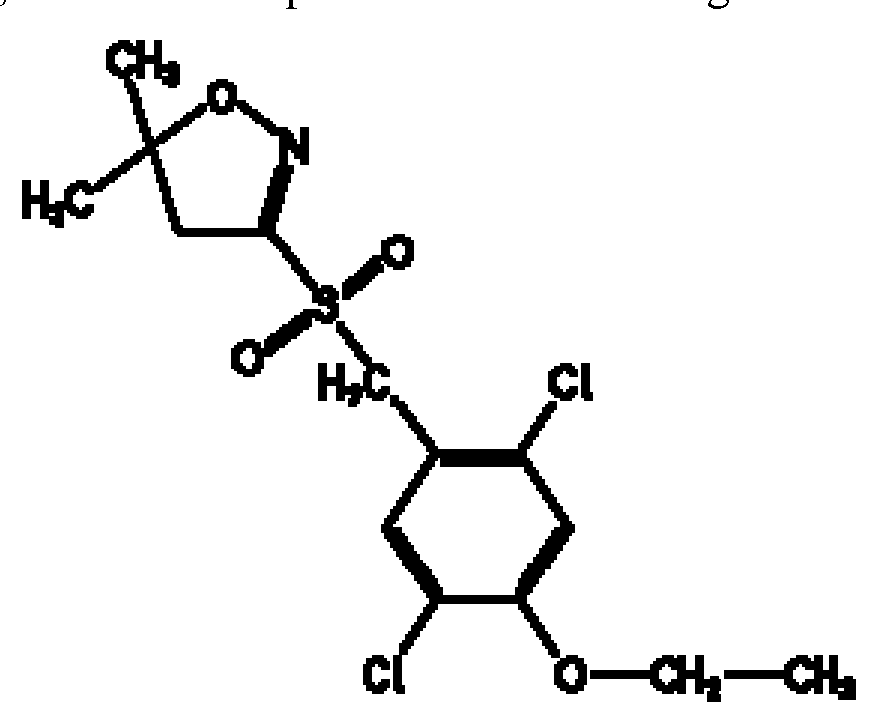


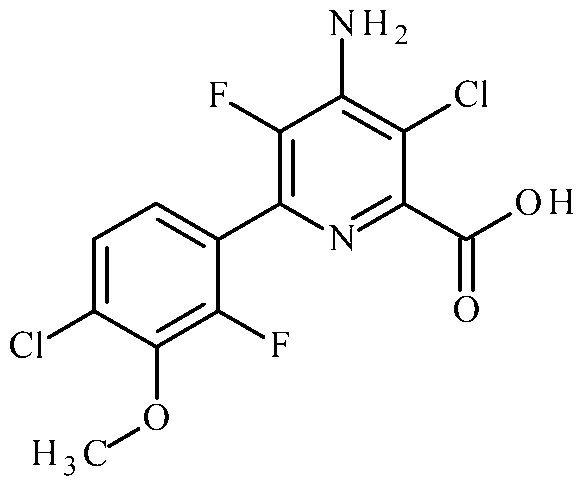


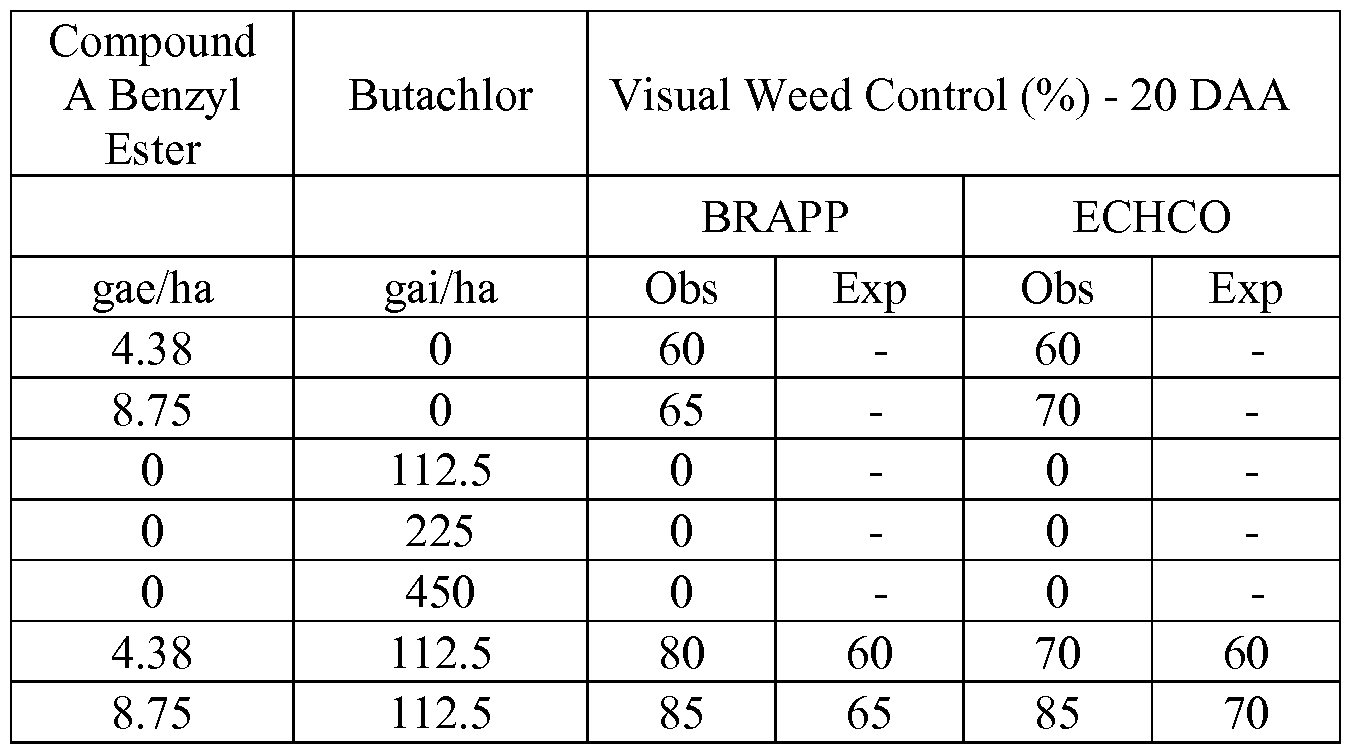


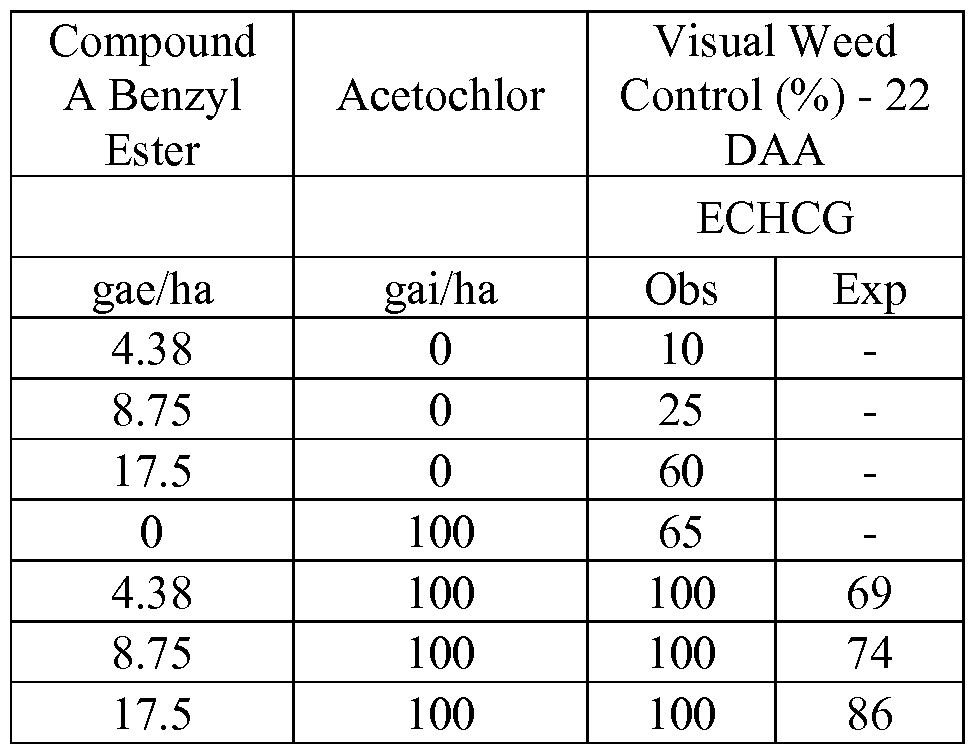


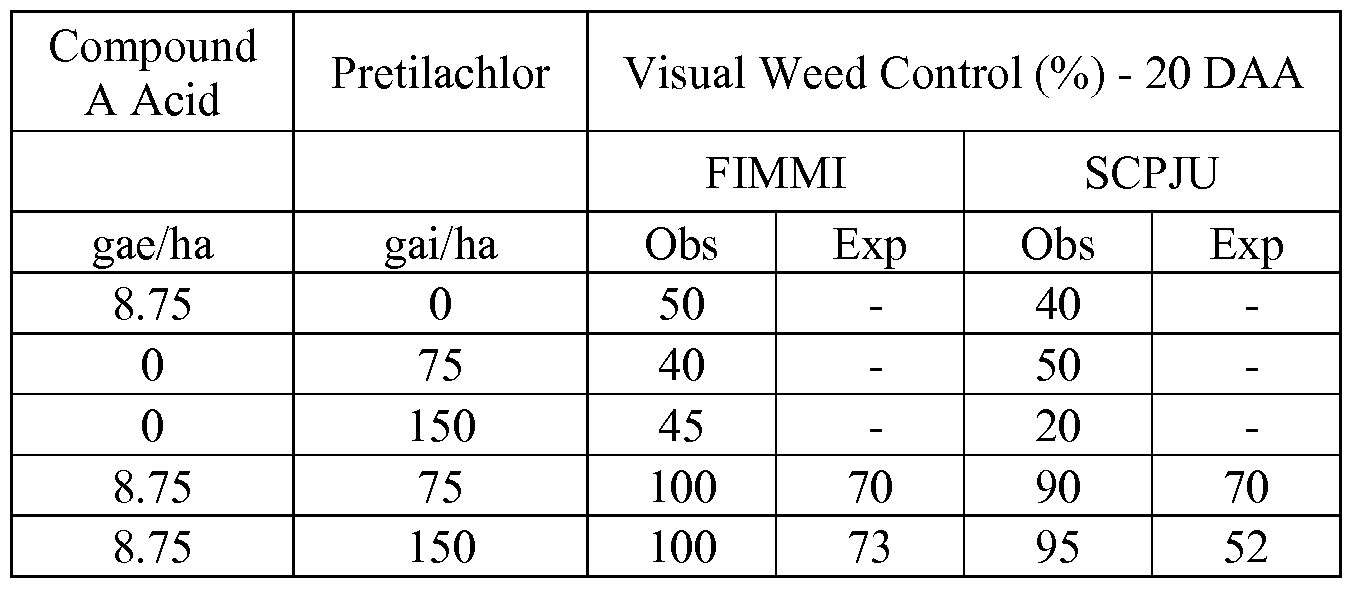


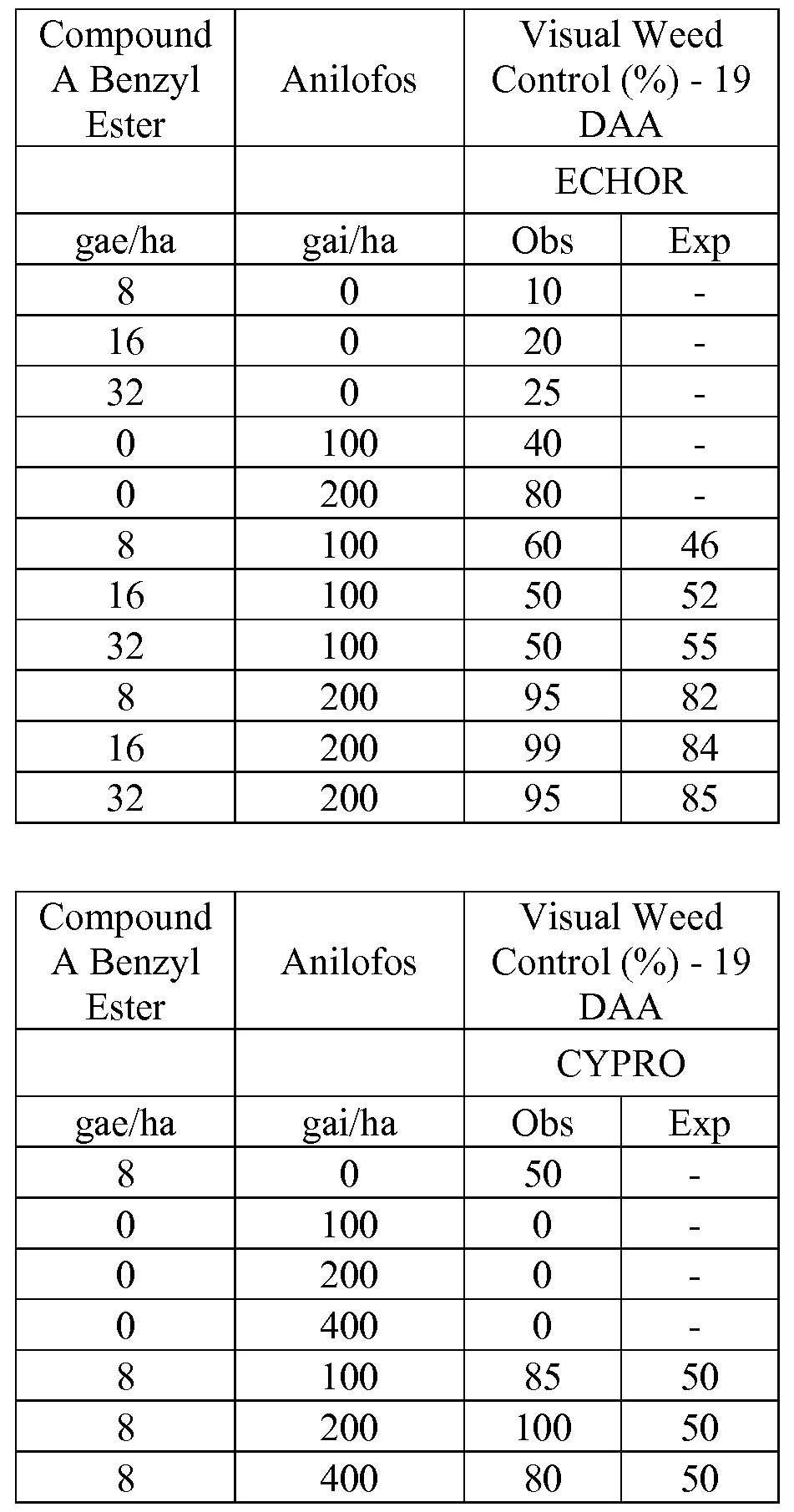


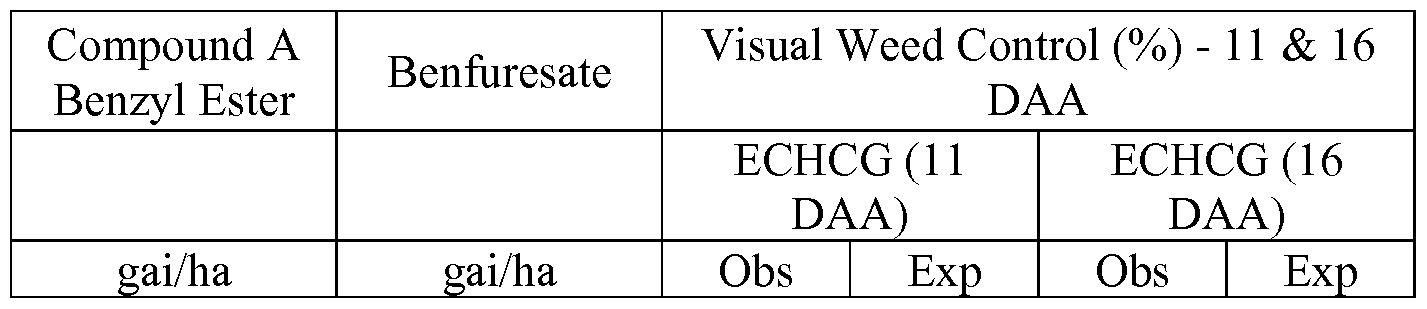

Claims


Priority Applications (18)
| Application Number | Priority Date | Filing Date | Title |
|---|---|---|---|
| RU2015106020A RU2632972C2 (en) | 2012-07-24 | 2013-07-19 | Herbicidal compositions containing 4-amino-3-chloro-5-fluorine-6-(4-chloro-2-fluoro-3-methoxyphenyl)pyridine-2-carboxylic acid or its derivatives and herbicides, inhibiting vlcfa synthesis and fatty acids/ lipids synthesis |
| EP13822431.6A EP2877008B1 (en) | 2012-07-24 | 2013-07-19 | Herbicidal compositions comprising 4-amino-3-chloro-5-fluoro-6-(4-chloro-2-fluoro-3-methoxphenyl) pyridine-2-carboxylic acid or a derivative thereof and vlcfa synthesis and fatty acid/lipid synthesis inhibiting herbicides |
| CA2879989A CA2879989A1 (en) | 2012-07-24 | 2013-07-19 | Herbicidal compositions comprising 4-amino-3-chloro-5-fluoro-6-(4-chloro-2-fluoro-3-methoxphenyl) pyridine-2-carboxylic acid or a derivative thereof and vlcfa synthesis and fattyacid/lipid synthesis inhibiting herbicides |
| CN201380048742.5A CN104640447B (en) | 2012-07-24 | 2013-07-19 | Herbicidal combinations comprising carboxylic acid of 4 amino, 3 chlorine 5 fluorine 6 (methoxyphenyl of 4 chlorine, 2 fluorine 3) pyridine 2 or derivatives thereof and the herbicide for suppressing VLCFA synthesis and aliphatic acid/lipid synthesis |
| HK15110412.2A HK1209589A1 (en) | 2012-07-24 | 2013-07-19 | Herbicidal compositions comprising 4-amino-3-chloro-5-fluoro-6-(4-chloro-2-fluoro-3-methoxphenyl) pyridine-2-carboxylic acid or a derivative thereof and vlcfa synthesis and fatty acid/lipid synthesis inhibiting herbicides |
| UAA201501448A UA115990C2 (en) | 2012-07-24 | 2013-07-19 | HERBICID COMPOSITIONS THAT CONTAIN 4-AMINO-3-CHLORINE ACID / LIPID |
| MX2015001150A MX2015001150A (en) | 2012-07-24 | 2013-07-19 | HERBICIDE COMPOSITIONS CONTAINING 4-AMINO-3-CHLORO-5-FLU OR-6- (4-CHLORO-2-FLUOR-3-METOXY-PHENYL) PIRIDINE-2-CARBOXYLIC OR A DERIVATIVE OF THE SAME AND THE HERBICIDES THAT INHIBIT OF THE SYNTHESIS OF THE VERY LONG CHAIN FATTY ACIDS AND THE SYNTHESIS OF THE FAT / LIPID ACIDS. |
| JP2015524342A JP6220874B2 (en) | 2012-07-24 | 2013-07-19 | 4-amino-3-chloro-5-fluoro-6- (4-chloro-2-fluoro-3-methoxyphenyl) pyridine-2-carboxylic acid or a derivative thereof and a herbicide that inhibits VLCFA synthesis and fatty acid / lipid synthesis Herbicidal composition containing |
| PL13822431T PL2877008T3 (en) | 2012-07-24 | 2013-07-19 | Herbicidal compositions comprising 4-amino-3-chloro-5-fluoro-6-(4-chloro-2-fluoro-3-methoxphenyl) pyridine-2-carboxylic acid or a derivative thereof and vlcfa synthesis and fatty acid/lipid synthesis inhibiting herbicides |
| AU2013293310A AU2013293310B2 (en) | 2012-07-24 | 2013-07-19 | Herbicidal compositions comprising 4-amino-3-chloro-5-fluoro-6-(4-chloro-2-fluoro-3-methoxyphenyl) pyridine-2-carboxylic acid or a derivative thereof and VLCFA synthesis and fatty acid/lipid synthesis inhibiting herbicides |
| ES13822431T ES2717283T3 (en) | 2012-07-24 | 2013-07-19 | Herbicidal compositions comprising 4-amino-3-chloro-5-fluoro-6- (4-chloro-2-fluoro-3-methoxyphenyl) pyridine-2-carboxylic acid or a derivative thereof and herbicides inhibitors of VLCFA synthesis and synthesis of fatty acids / lipids |
| KR1020157004648A KR102118567B1 (en) | 2012-07-24 | 2013-07-19 | Herbicidal compositions comprising 4-amino-3-chloro-5-fluoro-6-(4-chloro-2-fluoro-3-methoxphenyl)pyridine-2-carboxylic acid or a derivative thereof and vlcfa synthesis and fatty acid/lipid synthesis inhibiting herbicides |
| IN1385DEN2015 IN2015DN01385A (en) | 2012-07-24 | 2013-07-19 | |
| SG11201500530RA SG11201500530RA (en) | 2012-07-24 | 2013-07-19 | Herbicidal compositions comprising 4-amino-3-chloro-5-fluoro-6-(4-chloro-2-fluoro-3-methoxphenyl) pyridine-2-carboxylic acid or a derivative thereof and vlcfa synthesis and fatty acid/lipid synthesis |
| MYPI2015700193A MY181721A (en) | 2012-07-24 | 2013-07-19 | Herbicidal compositions comprising 4-amino-3-chloro-5-fluoro-6-(4-chloro-2-fluoro-3-methoxyphenyl) pyridine-2-carboxylic acid or a derivative thereof and vlcfa synthesis and fatty acid/lipid synthesis inhibiting herbicides |
| IL236854A IL236854B (en) | 2012-07-24 | 2015-01-22 | Herbicidal preparations containing 4-amino-3-chloro-5-fluoro-6-(4-chloro-2-fluoro-3-methoxyphenyl)pyridine-2-carboxylic acid or its derivative and herbicides that inhibit vlcfa synthesis and fatty acid/lipid synthesis |
| PH12015500147A PH12015500147B1 (en) | 2012-07-24 | 2015-01-23 | Herbicidal compositions comprising 4-amino-3-chloro-5-fluoro-6-(4-chloro-2-fluoro-3-methoxyphenyl) pyridine-2-carboxylic acid or a derivative thereof and vlcfa synthesis and fatty acid/lipid synthesis inhibiting herbicides |
| ZA2015/01145A ZA201501145B (en) | 2012-07-24 | 2015-02-19 | Herbicidal compositions comprising 4-amino-3-chloro-5-fluoro-6-(4-chloro-2-fluoro-3-methoxphenyl) pyridine-2-carboxylic acid or a derivative thereof and vlcfa synthesis and fatty acid/lipid synthesis inhibiting herbicides |
Applications Claiming Priority (4)
| Application Number | Priority Date | Filing Date | Title |
|---|---|---|---|
| US201261675105P | 2012-07-24 | 2012-07-24 | |
| US61/675,105 | 2012-07-24 | ||
| US13/840,306 US9644469B2 (en) | 2012-07-24 | 2013-03-15 | Herbicidal compositions comprising 4-amino-3-chloro-5-fluoro-6-(4-chloro-2-fluoro-3-methoxyphenyl) pyridine-2-carboxylic acid or a derivative thereof and VLCFA and lipid synthesis inhibiting herbicides |
| US13/840,306 | 2013-03-15 |
Publications (1)
| Publication Number | Publication Date |
|---|---|
| WO2014018397A1 true WO2014018397A1 (en) | 2014-01-30 |
Family
ID=49921616
Family Applications (1)
| Application Number | Title | Priority Date | Filing Date |
|---|---|---|---|
| PCT/US2013/051302 Ceased WO2014018397A1 (en) | 2012-07-24 | 2013-07-19 | Herbicidal compositions comprising 4-amino-3-chloro-5-fluoro-6-(4-chloro-2-fluoro-3-methoxphenyl) pyridine-2-carboxylic acid or a derivative thereof and vlcfa synthesis and fatty acid/lipid synthesis inhibiting herbicides |
Country Status (28)
| Country | Link |
|---|---|
| US (1) | US9644469B2 (en) |
| EP (1) | EP2877008B1 (en) |
| JP (1) | JP6220874B2 (en) |
| KR (1) | KR102118567B1 (en) |
| CN (1) | CN104640447B (en) |
| AR (1) | AR091900A1 (en) |
| AU (1) | AU2013293310B2 (en) |
| BR (1) | BR102013018473B8 (en) |
| CA (1) | CA2879989A1 (en) |
| CL (1) | CL2015000182A1 (en) |
| CO (1) | CO7200283A2 (en) |
| ES (1) | ES2717283T3 (en) |
| HK (1) | HK1209589A1 (en) |
| IL (1) | IL236854B (en) |
| IN (1) | IN2015DN01385A (en) |
| MX (1) | MX2015001150A (en) |
| MY (1) | MY181721A (en) |
| PE (1) | PE20150906A1 (en) |
| PH (1) | PH12015500147B1 (en) |
| PL (1) | PL2877008T3 (en) |
| PY (1) | PY1333255A (en) |
| RU (1) | RU2632972C2 (en) |
| SG (1) | SG11201500530RA (en) |
| TW (1) | TWI655905B (en) |
| UA (1) | UA115990C2 (en) |
| UY (1) | UY34940A (en) |
| WO (1) | WO2014018397A1 (en) |
| ZA (1) | ZA201501145B (en) |
Cited By (5)
| Publication number | Priority date | Publication date | Assignee | Title |
|---|---|---|---|---|
| EP2877016A4 (en) * | 2012-07-24 | 2016-03-16 | Dow Agrosciences Llc | HERBICIDE COMPOSITIONS CONTAINING 4-AMINO-3-CHLORO-5-FLUORO-6- (4-CHLORO -2-FLUORO-3-METHOXYPHENYL) PYRIDINE -2-CARBOXYLIC ACID OR A DERIVATIVE THEREOF AND HERBICIDES INHIBITING MICROTUBULE |
| EP2934141A4 (en) * | 2012-12-21 | 2016-08-17 | Dow Agrosciences Llc | HERBICIDAL COMPOSITIONS COMPRISING 4-AMINO-3-CHLORO-6- (4-CHLORO-2-FLUORO-3-METHOXYPHENYL) -5-FLUOROPYRIDINE-2-CARBOXYLIC ACID OR A DERIVATIVE THEREOF AND FLURTAMONE, DIFLUFENICAN OR PICOLINAFEN |
| JP2018520171A (en) * | 2015-07-10 | 2018-07-26 | ビーエーエスエフ アグロ ベー.ブイ. | A herbicidal composition comprising cinmethylin and pyroxasulfone |
| JP2018522004A (en) * | 2015-07-10 | 2018-08-09 | ビーエーエスエフ アグロ ベー.ブイ. | Herbicidal composition comprising cinmethylin and acetochlor or pretilachlor |
| EP3679794A1 (en) | 2019-11-27 | 2020-07-15 | Bayer AG | Herbicidal compositions |
Families Citing this family (36)
| Publication number | Priority date | Publication date | Assignee | Title |
|---|---|---|---|---|
| BRPI0816172B8 (en) | 2007-08-27 | 2022-06-28 | Dow Agrosciences Llc | SYNERGIC HERBICIDAL MIXTURE AND METHOD TO CONTROL UNDESIRABLE VEGETATION |
| US8906826B2 (en) | 2012-07-24 | 2014-12-09 | Dow Agrosciences, Llc. | Herbicidal compositions comprising 4-amino-3-chloro-5-fluoro-6-(4-chloro-2-fluoro-3-methoxyphenyl) pyridine-2-carboxylic acid or a derivative thereof and imidazolinones |
| US8895470B2 (en) | 2012-07-24 | 2014-11-25 | Dow Agrosciences, Llc. | Herbicidal compositions comprising 4-amino-3-chloro-5-fluoro-6-(4-chloro-2-fluoro-3-methoxyphenyl) pyridine-2-carboxylic acid or a derivative thereof and glyphosate or glufosinate |
| US8889591B2 (en) | 2012-07-24 | 2014-11-18 | Dow Agrosciences, Llc. | Herbicidal compositions comprising 4-amino-3-chloro-5-fluoro-6-(4-chloro-2-fluoro-3-methoxyphenyl)pyridine-2-carboxylic acid or a derivative thereof and bromobutide, daimuron, oxaziclomefone or pyributicarb |
| US8916499B2 (en) | 2012-07-24 | 2014-12-23 | Dow Agrosciences, Llc. | Herbicidal compositions comprising 4-amino-3-chloro-5-fluoro-6-(4-chloro-2-fluoro-3-methoxyphenyl) pyridine-2-carboxylic acid or a derivative thereof and a protoporphyrinogen oxidase inhibitor |
| US8809232B2 (en) * | 2012-07-24 | 2014-08-19 | Dow Agroscience Llc | Herbicidal compositions comprising 4-amino-3-chloro-5-fluoro-6-(4-chloro-2-fluoro-3-methoxyphenyl) pyridine-2-carboxylic acid or a derivative thereof and halosulfuron, pyrazosulfuron and esprocarb |
| US8906825B2 (en) | 2012-07-24 | 2014-12-09 | Dow Agrosciences, Llc. | Herbicidal compositions comprising 4-amino-3-chloro-5-fluoro-6-(4-chloro-2-fluoro-3-methoxyphenyl) pyridine-2-carboxylic acid or a derivative thereof and triazolopyrimidine sulfonamides |
| US8901035B2 (en) | 2012-07-24 | 2014-12-02 | Dow Agrosciences, Llc. | Herbicidal compositions comprising 4-amino-3-chloro-5-fluoro-6-(4-chloro-2-fluoro-3-methoxyphenyl) pyridine-2-carboxylic acid or a derivative thereof and cellulose biosynthesis inhibitor herbicides |
| US8871680B2 (en) * | 2012-07-24 | 2014-10-28 | Dow Agrosciences, Llc. | Herbicidal compositions comprising 4-amino-3-chloro-5-fluoro-6-(4-chloro-2-fluoro-3-methoxyphenyl) pyridine-2-carboxylic acid or a derivative thereof and a di-methoxy-pyrimidine and derivatives thereof |
| US8871681B2 (en) * | 2012-07-24 | 2014-10-28 | Dow Agrosciences Llc | Herbicidal compositions comprising 4-amino-3-chloro-5-fluoro-6-(4-chloro-2-fluoro-3-methoxyphenyl) pyridine-2-carboxylic acid or a derivative thereof and certain sulfonylureas |
| US8912120B2 (en) | 2012-07-24 | 2014-12-16 | Dow Agrosciences, Llc. | Herbicidal compositions comprising 4-amino-3-chloro-5-fluoro-6-(4-chloro-2-fluoro-3-methoxyphenyl) pyridine-2-carboxylic acid or a derivative thereof and synthetic auxin herbicides |
| US8883682B2 (en) | 2012-07-24 | 2014-11-11 | Dow Agrosciences, Llc. | Herbicidal compositions comprising 4-amino-3-chloro-5-fluoro-6-(4-chloro-2-fluoro-3-methoxyphenyl)pyridine-2-carboxylic acid or a derivative thereof and auxin transport inhibitors |
| US8912121B2 (en) | 2012-07-24 | 2014-12-16 | Dow Agrosciences, Llc. | Herbicidal compositions comprising 4-amino-3-chloro-5-fluoro-6-(4-chloro-2-fluoro-3-methoxyphenyl)pyridine-2-carboxylic acid or a derivative thereof and certain PS II inhibitors |
| US8841233B2 (en) * | 2012-07-24 | 2014-09-23 | Dow Agrosciences Llc | Herbicidal compositions comprising 4-amino-3-chloro-5-fluoro-6-(4-chloro-2-fluoro-3-methoxyphenyl) pyridine-2-carboxylic acid or a derivative thereof and 4-hydroxyphenyl-pyruvate dioxygenase (HPPD) inhibitors |
| US8796177B2 (en) * | 2012-07-24 | 2014-08-05 | Dow Agrosciences Llc | Herbicidal compositions comprising 4-amino-3-chloro-5-fluoro-6-(4-chloro-2-fluoro-3-methoxyphenyl)pyridine-2-carboxylic acid or a derivative thereof and acetyl-CoA carboxylase (ACCase) inhibitors |
| US8791048B2 (en) * | 2012-07-24 | 2014-07-29 | Dow Agrosciences Llc | Herbicidal compositions comprising 4-amino-3-chloro-5-fluoro-6-(4-chloro-2-fluoro-3-methoxyphenyl) pyridine-2-carboxylic acid or a derivative thereof and clomazone |
| PT2934140T (en) * | 2012-12-21 | 2019-05-27 | Dow Agrosciences Llc | HERBICIDE COMPOSITIONS UNDERSTANDING 4-AMINO-3-CHLOR-6- (4-CHLOR-2-FLUOR-3-METOXYPHENYL) PYRIDINE-2-CARBOXYLIC ACID OR ITS DERIVATIVE AND FLUFENACET |
| US9730445B2 (en) | 2013-03-15 | 2017-08-15 | Dow Agrosciences Llc | Herbicidal compositions comprising 4-amino-3-chloro-5-fluoro-6-(4-chloro-2-fluoro-3-methoxyphenyl) pyridine-2-carboxylic acid or a derivative thereof and fungicides |
| AU2014235649B2 (en) | 2013-03-15 | 2017-09-07 | Corteva Agriscience Llc | Safened herbicidal compositions including pyridine-2-carboxylic acid derivatives for use in corn (maize) |
| US8841234B1 (en) * | 2013-03-15 | 2014-09-23 | Dow Agrosciences, Llc. | Herbicidal compositions comprising 4-amino-3-chloro-5-fluoro-6-(4-chloro-2-fluoro-3-methoxyphenyl) pyridine-2-carboxylic acid or a derivative thereof and fungicides |
| MX2016007655A (en) * | 2013-12-12 | 2016-10-04 | Dow Agrosciences Llc | Selective weed control with halauxifen. |
| WO2015094886A1 (en) * | 2013-12-20 | 2015-06-25 | Dow Agrosciences Llc | Herbicidal compositions containing imazapic, aminopyralid and optionally metsulfuron |
| IL256842B2 (en) * | 2015-07-17 | 2024-01-01 | Corteva Agriscience Llc | Control of aquatic weeds using combinations of halauxifen, florpyrauxifen and other aquatic herbicides |
| US9854800B2 (en) * | 2015-07-24 | 2018-01-02 | Dow Agrosciences Llc | Herbicidal compositions comprising 4-amino-3-chloro-6-(4-chloro-2-fluoro-3-methoxyphenyl)-5-fluoropyridine-2-carboxylic acid or a derivative thereof and chlormequat chloride |
| CN106106463A (en) * | 2016-06-21 | 2016-11-16 | 广东中迅农科股份有限公司 | A kind of composition pesticide containing fluorine ketone sulphur grass amine |
| CN106857596A (en) * | 2017-02-28 | 2017-06-20 | 佛山市普尔玛农化有限公司 | A kind of herbicidal composition |
| CN107318847B (en) * | 2017-08-01 | 2019-11-12 | 江苏绿利来股份有限公司 | A kind of herbicidal composition containing fluorine chloropyridine ester and Acetochlor |
| CN107242236A (en) * | 2017-08-01 | 2017-10-13 | 江苏绿利来股份有限公司 | A kind of Herbicidal combinations containing chlorine fluorine pyridine ester and butachlor |
| RU2022104349A (en) * | 2017-08-10 | 2022-04-22 | ДАУ АГРОСАЙЕНСИЗ ЭлЭлСи | HERBICIDE COMPOSITIONS CONTAINING 4-AMINO-3-CHLORO-5-FLUORO-6-(4-CHLORO-2-FLUORO-3-METHOXYPHENYL)PYRIDINE-2-CARBOXY ACID OR ITS DERIVATIVE AND TEMBOTRION AND/OR TOPRAMESONE |
| CA3118422A1 (en) * | 2018-11-02 | 2020-05-07 | Dow Agrosciences Llc | Compositions comprising halauxifen and other herbicides and methods thereof |
| CN109122712A (en) * | 2018-11-14 | 2019-01-04 | 佛山市盈辉作物科学有限公司 | A kind of composition pesticide of containing chlorine fluorine pyridine ester and anilofos |
| CN111820228A (en) * | 2019-04-19 | 2020-10-27 | 江苏省农垦生物化学有限公司 | Combined herbicide and production method thereof |
| AR121018A1 (en) * | 2020-01-15 | 2022-04-06 | Adama Agan Ltd | SOLID STATE FORM OF PYROXASULFONE |
| CN113647403A (en) * | 2021-09-29 | 2021-11-16 | 上海市农业科学院 | A kind of herbicidal composition containing chlorfenapyr and chlorfenapyr |
| WO2023192088A1 (en) * | 2022-03-29 | 2023-10-05 | Corteva Agriscience Llc | A method of weed control in sugar beet |
| CN115735930B (en) * | 2022-12-28 | 2024-01-30 | 安徽众邦生物工程有限公司 | Weeding composition containing flurbiproflumilast, penoxsulam and clomazone |
Citations (3)
| Publication number | Priority date | Publication date | Assignee | Title |
|---|---|---|---|---|
| WO2009029518A2 (en) * | 2007-08-27 | 2009-03-05 | Dow Agrosciences Llc | Synergistic herbicidal composition containing certain pyridine or pyrimidine carboxylic acids and certain cereal and rice herbicides |
| US20100137137A1 (en) * | 2008-11-29 | 2010-06-03 | Bayer Cropscience Ag | Herbicide/safener combination |
| US20120115727A1 (en) * | 2010-11-05 | 2012-05-10 | Dow Agrosciences Llc | Control of phenoxyalkanoic acid herbicide-resistant weeds with 4-amino-3-chloro-6-(4-chloro-2-fluoro-3-methoxyphenyl)pyridine-2-carboxylic acid and its salts or esters |
Family Cites Families (25)
| Publication number | Priority date | Publication date | Assignee | Title |
|---|---|---|---|---|
| BRPI0615087A2 (en) | 2005-08-24 | 2011-05-03 | Pioneer Hi Bred Int | methods and compositions for the expression of a polynucleotide of interest |
| MY143535A (en) | 2006-01-13 | 2011-05-31 | Dow Agrosciences Llc | 6-(poly-substituted aryl)-4-aminopicolinates and their use as herbicides |
| CN102316728A (en) | 2008-11-24 | 2012-01-11 | 陶氏益农公司 | Safener against herbicide damage of 6-(trisubstituted phenyl)-4-aminopyridine-2-carboxylic acid compounds to direct-seeded rice and transplanted rice |
| WO2011043876A1 (en) | 2009-10-07 | 2011-04-14 | Dow Agrosciences Llc | Synergistic fungicidal composition containing 5-fluorocytosine for fungal control in cereals |
| ES2460716T3 (en) | 2010-02-19 | 2014-05-14 | Dow Agrosciences Llc | Synergistic herbicide / fungicide composition containing 4-amino-3-chloro-6- (4-chloro-2-fluoro-3-methoxyphenyl) pyridine-2-carboxylic acid and a fungicide |
| TWI596088B (en) | 2011-01-25 | 2017-08-21 | 陶氏農業科學公司 | 4-Amino-6-(substituted phenyl)pyridinecarboxylate and arylalkyl ester of 6-amino-2-(substituted phenyl)-4-pyrimidinecarboxylate and the like as herbicides Use |
| BR102012027933A2 (en) | 2011-11-01 | 2015-11-17 | Dow Agrosciences Llc | stable pesticide compositions |
| US8883682B2 (en) | 2012-07-24 | 2014-11-11 | Dow Agrosciences, Llc. | Herbicidal compositions comprising 4-amino-3-chloro-5-fluoro-6-(4-chloro-2-fluoro-3-methoxyphenyl)pyridine-2-carboxylic acid or a derivative thereof and auxin transport inhibitors |
| US8809232B2 (en) | 2012-07-24 | 2014-08-19 | Dow Agroscience Llc | Herbicidal compositions comprising 4-amino-3-chloro-5-fluoro-6-(4-chloro-2-fluoro-3-methoxyphenyl) pyridine-2-carboxylic acid or a derivative thereof and halosulfuron, pyrazosulfuron and esprocarb |
| US8889591B2 (en) | 2012-07-24 | 2014-11-18 | Dow Agrosciences, Llc. | Herbicidal compositions comprising 4-amino-3-chloro-5-fluoro-6-(4-chloro-2-fluoro-3-methoxyphenyl)pyridine-2-carboxylic acid or a derivative thereof and bromobutide, daimuron, oxaziclomefone or pyributicarb |
| US8841233B2 (en) | 2012-07-24 | 2014-09-23 | Dow Agrosciences Llc | Herbicidal compositions comprising 4-amino-3-chloro-5-fluoro-6-(4-chloro-2-fluoro-3-methoxyphenyl) pyridine-2-carboxylic acid or a derivative thereof and 4-hydroxyphenyl-pyruvate dioxygenase (HPPD) inhibitors |
| US8846570B2 (en) | 2012-07-24 | 2014-09-30 | Dow Agrosciences, Llc. | Herbicidal compositions comprising 4-amino-3-chloro-5-fluoro-6-(4-chloro-2-fluoro-3-methoxyphenyl)pyridine-2-carboxylic acid or a derivative thereof and microtubule inhibiting herbicides |
| US8906825B2 (en) | 2012-07-24 | 2014-12-09 | Dow Agrosciences, Llc. | Herbicidal compositions comprising 4-amino-3-chloro-5-fluoro-6-(4-chloro-2-fluoro-3-methoxyphenyl) pyridine-2-carboxylic acid or a derivative thereof and triazolopyrimidine sulfonamides |
| US8912121B2 (en) | 2012-07-24 | 2014-12-16 | Dow Agrosciences, Llc. | Herbicidal compositions comprising 4-amino-3-chloro-5-fluoro-6-(4-chloro-2-fluoro-3-methoxyphenyl)pyridine-2-carboxylic acid or a derivative thereof and certain PS II inhibitors |
| US8912120B2 (en) | 2012-07-24 | 2014-12-16 | Dow Agrosciences, Llc. | Herbicidal compositions comprising 4-amino-3-chloro-5-fluoro-6-(4-chloro-2-fluoro-3-methoxyphenyl) pyridine-2-carboxylic acid or a derivative thereof and synthetic auxin herbicides |
| US8791048B2 (en) | 2012-07-24 | 2014-07-29 | Dow Agrosciences Llc | Herbicidal compositions comprising 4-amino-3-chloro-5-fluoro-6-(4-chloro-2-fluoro-3-methoxyphenyl) pyridine-2-carboxylic acid or a derivative thereof and clomazone |
| US8906826B2 (en) | 2012-07-24 | 2014-12-09 | Dow Agrosciences, Llc. | Herbicidal compositions comprising 4-amino-3-chloro-5-fluoro-6-(4-chloro-2-fluoro-3-methoxyphenyl) pyridine-2-carboxylic acid or a derivative thereof and imidazolinones |
| US8796177B2 (en) | 2012-07-24 | 2014-08-05 | Dow Agrosciences Llc | Herbicidal compositions comprising 4-amino-3-chloro-5-fluoro-6-(4-chloro-2-fluoro-3-methoxyphenyl)pyridine-2-carboxylic acid or a derivative thereof and acetyl-CoA carboxylase (ACCase) inhibitors |
| US8895470B2 (en) | 2012-07-24 | 2014-11-25 | Dow Agrosciences, Llc. | Herbicidal compositions comprising 4-amino-3-chloro-5-fluoro-6-(4-chloro-2-fluoro-3-methoxyphenyl) pyridine-2-carboxylic acid or a derivative thereof and glyphosate or glufosinate |
| US8871680B2 (en) | 2012-07-24 | 2014-10-28 | Dow Agrosciences, Llc. | Herbicidal compositions comprising 4-amino-3-chloro-5-fluoro-6-(4-chloro-2-fluoro-3-methoxyphenyl) pyridine-2-carboxylic acid or a derivative thereof and a di-methoxy-pyrimidine and derivatives thereof |
| US20140031224A1 (en) | 2012-07-24 | 2014-01-30 | Dow Agrosciences Llc | Safened herbicidal compositions including 4-amino-3-chloro-5-fluoro-6-(4-chloro-2-fluoro-3-methoxyphenyl)pyridine-2-carboxylic acid or a derivative thereof for use in rice |
| US8871681B2 (en) | 2012-07-24 | 2014-10-28 | Dow Agrosciences Llc | Herbicidal compositions comprising 4-amino-3-chloro-5-fluoro-6-(4-chloro-2-fluoro-3-methoxyphenyl) pyridine-2-carboxylic acid or a derivative thereof and certain sulfonylureas |
| US8916499B2 (en) | 2012-07-24 | 2014-12-23 | Dow Agrosciences, Llc. | Herbicidal compositions comprising 4-amino-3-chloro-5-fluoro-6-(4-chloro-2-fluoro-3-methoxyphenyl) pyridine-2-carboxylic acid or a derivative thereof and a protoporphyrinogen oxidase inhibitor |
| US8901035B2 (en) | 2012-07-24 | 2014-12-02 | Dow Agrosciences, Llc. | Herbicidal compositions comprising 4-amino-3-chloro-5-fluoro-6-(4-chloro-2-fluoro-3-methoxyphenyl) pyridine-2-carboxylic acid or a derivative thereof and cellulose biosynthesis inhibitor herbicides |
| PT2934140T (en) * | 2012-12-21 | 2019-05-27 | Dow Agrosciences Llc | HERBICIDE COMPOSITIONS UNDERSTANDING 4-AMINO-3-CHLOR-6- (4-CHLOR-2-FLUOR-3-METOXYPHENYL) PYRIDINE-2-CARBOXYLIC ACID OR ITS DERIVATIVE AND FLUFENACET |
-
2013
- 2013-03-15 US US13/840,306 patent/US9644469B2/en active Active
- 2013-07-19 PE PE2015000077A patent/PE20150906A1/en not_active Application Discontinuation
- 2013-07-19 ES ES13822431T patent/ES2717283T3/en active Active
- 2013-07-19 CA CA2879989A patent/CA2879989A1/en not_active Abandoned
- 2013-07-19 BR BR102013018473A patent/BR102013018473B8/en active IP Right Grant
- 2013-07-19 AU AU2013293310A patent/AU2013293310B2/en active Active
- 2013-07-19 MX MX2015001150A patent/MX2015001150A/en unknown
- 2013-07-19 JP JP2015524342A patent/JP6220874B2/en active Active
- 2013-07-19 UA UAA201501448A patent/UA115990C2/en unknown
- 2013-07-19 CN CN201380048742.5A patent/CN104640447B/en active Active
- 2013-07-19 EP EP13822431.6A patent/EP2877008B1/en active Active
- 2013-07-19 WO PCT/US2013/051302 patent/WO2014018397A1/en not_active Ceased
- 2013-07-19 SG SG11201500530RA patent/SG11201500530RA/en unknown
- 2013-07-19 RU RU2015106020A patent/RU2632972C2/en active
- 2013-07-19 HK HK15110412.2A patent/HK1209589A1/en unknown
- 2013-07-19 KR KR1020157004648A patent/KR102118567B1/en active Active
- 2013-07-19 IN IN1385DEN2015 patent/IN2015DN01385A/en unknown
- 2013-07-19 MY MYPI2015700193A patent/MY181721A/en unknown
- 2013-07-19 PL PL13822431T patent/PL2877008T3/en unknown
- 2013-07-23 UY UY0001034940A patent/UY34940A/en active IP Right Grant
- 2013-07-23 TW TW102126275A patent/TWI655905B/en active
- 2013-07-23 PY PY201301333255A patent/PY1333255A/en unknown
- 2013-07-24 AR ARP130102646A patent/AR091900A1/en unknown
-
2015
- 2015-01-22 IL IL236854A patent/IL236854B/en active IP Right Grant
- 2015-01-23 PH PH12015500147A patent/PH12015500147B1/en unknown
- 2015-01-23 CL CL2015000182A patent/CL2015000182A1/en unknown
- 2015-02-16 CO CO15033380A patent/CO7200283A2/en unknown
- 2015-02-19 ZA ZA2015/01145A patent/ZA201501145B/en unknown
Patent Citations (3)
| Publication number | Priority date | Publication date | Assignee | Title |
|---|---|---|---|---|
| WO2009029518A2 (en) * | 2007-08-27 | 2009-03-05 | Dow Agrosciences Llc | Synergistic herbicidal composition containing certain pyridine or pyrimidine carboxylic acids and certain cereal and rice herbicides |
| US20100137137A1 (en) * | 2008-11-29 | 2010-06-03 | Bayer Cropscience Ag | Herbicide/safener combination |
| US20120115727A1 (en) * | 2010-11-05 | 2012-05-10 | Dow Agrosciences Llc | Control of phenoxyalkanoic acid herbicide-resistant weeds with 4-amino-3-chloro-6-(4-chloro-2-fluoro-3-methoxyphenyl)pyridine-2-carboxylic acid and its salts or esters |
Non-Patent Citations (1)
| Title |
|---|
| See also references of EP2877008A4 * |
Cited By (5)
| Publication number | Priority date | Publication date | Assignee | Title |
|---|---|---|---|---|
| EP2877016A4 (en) * | 2012-07-24 | 2016-03-16 | Dow Agrosciences Llc | HERBICIDE COMPOSITIONS CONTAINING 4-AMINO-3-CHLORO-5-FLUORO-6- (4-CHLORO -2-FLUORO-3-METHOXYPHENYL) PYRIDINE -2-CARBOXYLIC ACID OR A DERIVATIVE THEREOF AND HERBICIDES INHIBITING MICROTUBULE |
| EP2934141A4 (en) * | 2012-12-21 | 2016-08-17 | Dow Agrosciences Llc | HERBICIDAL COMPOSITIONS COMPRISING 4-AMINO-3-CHLORO-6- (4-CHLORO-2-FLUORO-3-METHOXYPHENYL) -5-FLUOROPYRIDINE-2-CARBOXYLIC ACID OR A DERIVATIVE THEREOF AND FLURTAMONE, DIFLUFENICAN OR PICOLINAFEN |
| JP2018520171A (en) * | 2015-07-10 | 2018-07-26 | ビーエーエスエフ アグロ ベー.ブイ. | A herbicidal composition comprising cinmethylin and pyroxasulfone |
| JP2018522004A (en) * | 2015-07-10 | 2018-08-09 | ビーエーエスエフ アグロ ベー.ブイ. | Herbicidal composition comprising cinmethylin and acetochlor or pretilachlor |
| EP3679794A1 (en) | 2019-11-27 | 2020-07-15 | Bayer AG | Herbicidal compositions |
Also Published As
Similar Documents
| Publication | Publication Date | Title |
|---|---|---|
| US9644469B2 (en) | Herbicidal compositions comprising 4-amino-3-chloro-5-fluoro-6-(4-chloro-2-fluoro-3-methoxyphenyl) pyridine-2-carboxylic acid or a derivative thereof and VLCFA and lipid synthesis inhibiting herbicides | |
| US9119397B2 (en) | Herbicidal compositions comprising 4-amino-3-chloro-5-fluoro-6-(4-chloro-2-fluoro-3-methoxyphenyl)pyridine-2-carboxylic acid or a derivative thereof and microtubule inhibiting herbicides | |
| EP2877015B1 (en) | Herbicidal compositions comprising 4-amino-3-chloro-5-fluoro-6-(4-chloro-2-fluoro-3-methoxyphenyl) pyridine-2-carboxylic acid | |
| AU2013293303B2 (en) | Herbicidal compositions comprising 4-amino-3-chloro-5-fluoro-6-(4-chloro-2-fluoro-3-methoxyphenyl) pyridine-2-carboxylic acid | |
| US8901035B2 (en) | Herbicidal compositions comprising 4-amino-3-chloro-5-fluoro-6-(4-chloro-2-fluoro-3-methoxyphenyl) pyridine-2-carboxylic acid or a derivative thereof and cellulose biosynthesis inhibitor herbicides | |
| EP2877009B1 (en) | Herbicidal compositions comprising 4-amino-3-chloro-5-fluoro-6-(4-chloro-2-fluoro-3-methoxyphenyl) pyridine-2-carboxylic acid | |
| AU2013293252B2 (en) | Herbicidal compositions comprising 4-amino-3-chloro-5-fluoro-6-(4-chloro-2-fluoro-3-methoxyphenyl) pyridine-2-carboxylic acid | |
| EP2877020A1 (en) | Herbicidal compositions comprising 4-amino-3-chloro-5-fluoro-6-(4-chloro-2-fluoro-3-methoxyphenyl) pyridine-2-carboxylic acid | |
| WO2014018402A1 (en) | Herbicidal compositions comprising 4-amino-3-chloro-5-fluoro-6-(4-chloro-2-fluoro-3-methoxyphenyl) pyridine-2-carboxylic acid | |
| WO2014018409A9 (en) | Herbicidal compositions comprising 4-amino-3-chloro-5-fluoro-6-(4-chloro-2-fluoro-3-methoxyphenyl) pyridine-2-carboxylic acid | |
| WO2014018392A2 (en) | Herbicidal compostions comprising 4-amino-3-chloro-5-fluoro-6-(4-chloro-2-fluoro-3-methoxyphenyl) pyridine-2-carboxylic acid or a derivative thereof and bromobutide, daimuron, oxaziclomefone or pyributicarb | |
| WO2014018391A1 (en) | Herbicidal compositions comprising 4-amino-3-chloro-5-fluoro-6-(4-chloro-2-fluoro-3-methoxyphenyl) pyridine-2-carboxylic acid | |
| OA17278A (en) | Herbicidal compositions comprising 4-amino3-chloro-5-fluoro-6-(4-chloro-2 fIuoro-3methoxyphenyl) pyridine-2-carboxylic acid. |
Legal Events
| Date | Code | Title | Description |
|---|---|---|---|
| 121 | Ep: the epo has been informed by wipo that ep was designated in this application |
Ref document number: 13822431 Country of ref document: EP Kind code of ref document: A1 |
|
| WWE | Wipo information: entry into national phase |
Ref document number: 236854 Country of ref document: IL |
|
| ENP | Entry into the national phase |
Ref document number: 2879989 Country of ref document: CA Ref document number: 2015524342 Country of ref document: JP Kind code of ref document: A |
|
| WWE | Wipo information: entry into national phase |
Ref document number: 2015000182 Country of ref document: CL Ref document number: 000077-2015 Country of ref document: PE Ref document number: MX/A/2015/001150 Country of ref document: MX Ref document number: 12015500147 Country of ref document: PH |
|
| NENP | Non-entry into the national phase |
Ref country code: DE |
|
| WWE | Wipo information: entry into national phase |
Ref document number: 15033380 Country of ref document: CO |
|
| WWE | Wipo information: entry into national phase |
Ref document number: A201501448 Country of ref document: UA |
|
| WWE | Wipo information: entry into national phase |
Ref document number: 2013822431 Country of ref document: EP |
|
| WWE | Wipo information: entry into national phase |
Ref document number: IDP00201501051 Country of ref document: ID |
|
| ENP | Entry into the national phase |
Ref document number: 20157004648 Country of ref document: KR Kind code of ref document: A Ref document number: 2015106020 Country of ref document: RU Kind code of ref document: A |
|
| ENP | Entry into the national phase |
Ref document number: 2013293310 Country of ref document: AU Date of ref document: 20130719 Kind code of ref document: A |