WO2014018672A1 - Non-halogenated flame retardant polycarbonate compounds - Google Patents
Non-halogenated flame retardant polycarbonate compounds Download PDFInfo
- Publication number
- WO2014018672A1 WO2014018672A1 PCT/US2013/051887 US2013051887W WO2014018672A1 WO 2014018672 A1 WO2014018672 A1 WO 2014018672A1 US 2013051887 W US2013051887 W US 2013051887W WO 2014018672 A1 WO2014018672 A1 WO 2014018672A1
- Authority
- WO
- WIPO (PCT)
- Prior art keywords
- compound
- polycarbonate
- source
- group
- ingredients
- Prior art date
- Legal status (The legal status is an assumption and is not a legal conclusion. Google has not performed a legal analysis and makes no representation as to the accuracy of the status listed.)
- Ceased
Links
Classifications
-
- C—CHEMISTRY; METALLURGY
- C08—ORGANIC MACROMOLECULAR COMPOUNDS; THEIR PREPARATION OR CHEMICAL WORKING-UP; COMPOSITIONS BASED THEREON
- C08L—COMPOSITIONS OF MACROMOLECULAR COMPOUNDS
- C08L69/00—Compositions of polycarbonates; Compositions of derivatives of polycarbonates
-
- C—CHEMISTRY; METALLURGY
- C08—ORGANIC MACROMOLECULAR COMPOUNDS; THEIR PREPARATION OR CHEMICAL WORKING-UP; COMPOSITIONS BASED THEREON
- C08K—Use of inorganic or non-macromolecular organic substances as compounding ingredients
- C08K3/00—Use of inorganic substances as compounding ingredients
- C08K3/34—Silicon-containing compounds
-
- C—CHEMISTRY; METALLURGY
- C08—ORGANIC MACROMOLECULAR COMPOUNDS; THEIR PREPARATION OR CHEMICAL WORKING-UP; COMPOSITIONS BASED THEREON
- C08K—Use of inorganic or non-macromolecular organic substances as compounding ingredients
- C08K5/00—Use of organic ingredients
- C08K5/0008—Organic ingredients according to more than one of the "one dot" groups of C08K5/01 - C08K5/59
- C08K5/005—Stabilisers against oxidation, heat, light, ozone
-
- C—CHEMISTRY; METALLURGY
- C08—ORGANIC MACROMOLECULAR COMPOUNDS; THEIR PREPARATION OR CHEMICAL WORKING-UP; COMPOSITIONS BASED THEREON
- C08K—Use of inorganic or non-macromolecular organic substances as compounding ingredients
- C08K5/00—Use of organic ingredients
- C08K5/0008—Organic ingredients according to more than one of the "one dot" groups of C08K5/01 - C08K5/59
- C08K5/0066—Flame-proofing or flame-retarding additives
-
- C—CHEMISTRY; METALLURGY
- C08—ORGANIC MACROMOLECULAR COMPOUNDS; THEIR PREPARATION OR CHEMICAL WORKING-UP; COMPOSITIONS BASED THEREON
- C08K—Use of inorganic or non-macromolecular organic substances as compounding ingredients
- C08K5/00—Use of organic ingredients
- C08K5/36—Sulfur-, selenium-, or tellurium-containing compounds
- C08K5/41—Compounds containing sulfur bound to oxygen
- C08K5/42—Sulfonic acids; Derivatives thereof
-
- C—CHEMISTRY; METALLURGY
- C08—ORGANIC MACROMOLECULAR COMPOUNDS; THEIR PREPARATION OR CHEMICAL WORKING-UP; COMPOSITIONS BASED THEREON
- C08K—Use of inorganic or non-macromolecular organic substances as compounding ingredients
- C08K5/00—Use of organic ingredients
- C08K5/49—Phosphorus-containing compounds
- C08K5/51—Phosphorus bound to oxygen
- C08K5/52—Phosphorus bound to oxygen only
- C08K5/521—Esters of phosphoric acids, e.g. of H3PO4
- C08K5/523—Esters of phosphoric acids, e.g. of H3PO4 with hydroxyaryl compounds
-
- C—CHEMISTRY; METALLURGY
- C08—ORGANIC MACROMOLECULAR COMPOUNDS; THEIR PREPARATION OR CHEMICAL WORKING-UP; COMPOSITIONS BASED THEREON
- C08K—Use of inorganic or non-macromolecular organic substances as compounding ingredients
- C08K5/00—Use of organic ingredients
- C08K5/49—Phosphorus-containing compounds
- C08K5/51—Phosphorus bound to oxygen
- C08K5/52—Phosphorus bound to oxygen only
- C08K5/527—Cyclic esters
-
- C—CHEMISTRY; METALLURGY
- C08—ORGANIC MACROMOLECULAR COMPOUNDS; THEIR PREPARATION OR CHEMICAL WORKING-UP; COMPOSITIONS BASED THEREON
- C08K—Use of inorganic or non-macromolecular organic substances as compounding ingredients
- C08K5/00—Use of organic ingredients
- C08K5/49—Phosphorus-containing compounds
- C08K5/5399—Phosphorus bound to nitrogen
-
- C—CHEMISTRY; METALLURGY
- C08—ORGANIC MACROMOLECULAR COMPOUNDS; THEIR PREPARATION OR CHEMICAL WORKING-UP; COMPOSITIONS BASED THEREON
- C08L—COMPOSITIONS OF MACROMOLECULAR COMPOUNDS
- C08L27/00—Compositions of homopolymers or copolymers of compounds having one or more unsaturated aliphatic radicals, each having only one carbon-to-carbon double bond, and at least one being terminated by a halogen; Compositions of derivatives of such polymers
- C08L27/02—Compositions of homopolymers or copolymers of compounds having one or more unsaturated aliphatic radicals, each having only one carbon-to-carbon double bond, and at least one being terminated by a halogen; Compositions of derivatives of such polymers not modified by chemical after-treatment
- C08L27/12—Compositions of homopolymers or copolymers of compounds having one or more unsaturated aliphatic radicals, each having only one carbon-to-carbon double bond, and at least one being terminated by a halogen; Compositions of derivatives of such polymers not modified by chemical after-treatment containing fluorine atoms
- C08L27/18—Homopolymers or copolymers or tetrafluoroethene
-
- C—CHEMISTRY; METALLURGY
- C09—DYES; PAINTS; POLISHES; NATURAL RESINS; ADHESIVES; COMPOSITIONS NOT OTHERWISE PROVIDED FOR; APPLICATIONS OF MATERIALS NOT OTHERWISE PROVIDED FOR
- C09K—MATERIALS FOR MISCELLANEOUS APPLICATIONS, NOT PROVIDED FOR ELSEWHERE
- C09K21/00—Fireproofing materials
- C09K21/06—Organic materials
- C09K21/12—Organic materials containing phosphorus
-
- C—CHEMISTRY; METALLURGY
- C09—DYES; PAINTS; POLISHES; NATURAL RESINS; ADHESIVES; COMPOSITIONS NOT OTHERWISE PROVIDED FOR; APPLICATIONS OF MATERIALS NOT OTHERWISE PROVIDED FOR
- C09K—MATERIALS FOR MISCELLANEOUS APPLICATIONS, NOT PROVIDED FOR ELSEWHERE
- C09K21/00—Fireproofing materials
- C09K21/14—Macromolecular materials
-
- C—CHEMISTRY; METALLURGY
- C08—ORGANIC MACROMOLECULAR COMPOUNDS; THEIR PREPARATION OR CHEMICAL WORKING-UP; COMPOSITIONS BASED THEREON
- C08K—Use of inorganic or non-macromolecular organic substances as compounding ingredients
- C08K5/00—Use of organic ingredients
- C08K5/04—Oxygen-containing compounds
- C08K5/13—Phenols; Phenolates
- C08K5/134—Phenols containing ester groups
- C08K5/1345—Carboxylic esters of phenolcarboxylic acids
-
- C—CHEMISTRY; METALLURGY
- C08—ORGANIC MACROMOLECULAR COMPOUNDS; THEIR PREPARATION OR CHEMICAL WORKING-UP; COMPOSITIONS BASED THEREON
- C08L—COMPOSITIONS OF MACROMOLECULAR COMPOUNDS
- C08L2201/00—Properties
- C08L2201/02—Flame or fire retardant/resistant
-
- C—CHEMISTRY; METALLURGY
- C08—ORGANIC MACROMOLECULAR COMPOUNDS; THEIR PREPARATION OR CHEMICAL WORKING-UP; COMPOSITIONS BASED THEREON
- C08L—COMPOSITIONS OF MACROMOLECULAR COMPOUNDS
- C08L2205/00—Polymer mixtures characterised by other features
- C08L2205/03—Polymer mixtures characterised by other features containing three or more polymers in a blend
-
- C—CHEMISTRY; METALLURGY
- C08—ORGANIC MACROMOLECULAR COMPOUNDS; THEIR PREPARATION OR CHEMICAL WORKING-UP; COMPOSITIONS BASED THEREON
- C08L—COMPOSITIONS OF MACROMOLECULAR COMPOUNDS
- C08L2205/00—Polymer mixtures characterised by other features
- C08L2205/03—Polymer mixtures characterised by other features containing three or more polymers in a blend
- C08L2205/035—Polymer mixtures characterised by other features containing three or more polymers in a blend containing four or more polymers in a blend
Definitions
- This invention concerns thermoplastic polymer compounds which are flame retardant using non-halogenated ingredients.
- thermoplastic compounds unlike wood, metal, or glass, do not rot, rust, or shatter. For that reason, the world in the past seventy years has seen a revolution in material science arising from the combination of a thermoplastic resin and one or more functional additives to provide specific properties to the resin.
- thermoplastic resin can melt. Its processing versatility benefits from its capacity to mix with the functional additives while in a molten state.
- Flame retardants, drip suppressants, mineral fillers, and char formers are functional additives which can be used to help the thermoplastic compound to retard the effects of heat or flame from melting or even burning. Flame retardant thermoplastic compounds are particular needed when the plastic article is used in any confined space where persons might be present during any condition, planned or emergency, which might expose the plastic article to such excessive heat or flame.
- Non-halogenated flame retardants have recently become popular because they minimize the release of halogenated chemicals if the plastic article would begin to degrade, melt, or burn.
- the present invention has found a particular combination of known ingredients which, together, achieve a V-0 rating in a UL 94 test, at thicknesses ranging from about 0.4 mm to 0.7 mm, less than the thickness of one American dime ($0.10) coin, a task very difficult and unpredictable to achieve.
- thermoplastic resin chosen for its physical properties
- a non-halogenated flame retardant is combined with other functional ingredients to achieve that wished V-0 rating.
- One aspect of the present invention is a flame retardant polycarbonate compound, comprising polycarbonate, bisphosphate ester, talc, and acrylic modified polytetrafluoroethylene, wherein the bisphosphate ester is present in the compound at a weight percent from 7 to about 15, and wherein the compound injected molded and tested at a thickness of 0.75 mm has a UL 94 rating of V-0.
- Polycarbonate Any polycarbonate is a candidate for use in the compound, whether obtained from petrochemical or bio-derived sources, whether virginal or recycled.
- Polycarbonates can be branched or linear, a mixture of them being preferred in this invention.
- Polycarbonates can be aliphatic or aromatic, with the latter being preferred in this invention.
- Bisphosphate esters as candidates for use in this invention contain no halogen atoms, which characterizes them as non-halogenated.
- One reason for using non-halogenated bisphosphate esters is that they are more economical as compared with other non-halogenated phosphorus-containing flame retardants.
- Bisphosphate esters are commercially available and known as non-halogenated flame retardants. Specific examples of commercially available bisphosphate esters have the following structures and CAS Numbers:
- non-halogenated bisphosphate esters can be used either alone or in combination. Of those examples listed above, all are pale yellow liquids except the second one, CAS No. 139189-30-3 and the last one, CAS No. 1003300-73-9, which are white granules. Granules are preferred for melt compounding because of easier solid material handling and processing. But liquid-based bisphosphate esters can also be used in the invention if suitable liquid material handling equipment such as dosing equipment is available for batch or continuous melt mixing with the
- bisphosphate esters can be purchased from Adeka Palmarole of Saint Louis, France or Zhejiang Wangsheng Co., Ltd of Linhai City, Zhejiang Province, China.
- WSFR-PX220 bisphosphate ester from Zhejiang Wangsheng Co. Ltd, because it is a white solid in granule form and has a melting point greater than 90°C; a water content of less than 0.1 weight percent; and good compatibility with polycarbonate.
- Talc is used in thermoplastic compounds as a mineral filler.
- talc can assist in flame retardance by being a barrier to oxygen and increasing viscosity of the molten polymer matrix during combustion.
- Talc can have a particle size ranging about 0.5 ⁇ to about
- Talc is commercially available from a number of manufacturers.
- Ultra Talc 609 from Specialty Minerals Company, which has a particle size of from about 0.5 ⁇ m to about 0.9 ⁇ m.
- Polytetrafluoroethylene is known to be useful as a drip suppressant because it tends fibrillate and elongate during injection molding. Fibrils shrink upon exposure to heat from a flame and hence retard dripping of the matrix in which the fibrils reside.
- PTFE can have a particle size ranging from about 5 ⁇ to about
- PTFE is commercially available from a number of
- PTFE also can be supplied with modification, such as an acrylic- modified PTFE which is advertised to improve dispersibility of the PTFE into the thermoplastic compound.
- an acrylic-modified PTFE which is advertised to improve dispersibility of the PTFE into the thermoplastic compound.
- Metablen A-3800 acrylic-modified PTFE is commercially available from Mitsubishi Rayon America, Inc. and is presently preferred because of that improved dispersibility.
- PTFE is fluorinated
- its presence in the compound is not regarded by those having skill in the art of flame retardant compounds as compromising the non-halogenated characteristics of the flame retardant itself because the amount of PTFE present is very minor. Therefore, the use of a fluorinated drip suppressant in the amounts identified in this invention does not disqualify the compound from being considered a non-halogenated flame retarded thermoplastic compound according to the course of conduct in the thermoplastic compound industry.
- thermoplastic compounds of the invention because polyphosphazene flame retardants have excellent hydrolytic stability, better than bisphosphate esters.
- R 1 groups are the same or different and each represents a phenyl group substituted with at least one group selected from the class consisting of alkyl groups having 1 to 6 carbon atoms and an allyl group or an unsubstituted phenyl group.
- n is an integer of 3 to 1000
- R 1 is as defined above
- Y represents group— P(OR 1 ) 4 or a group— P(O)(OR 1 ) 2 .
- A is a group— SO 2 — , a group— S— , a group— O— or a group— C(CH 3 ) 2 — , each of said crosslinking groups being interposed between the two oxygen atoms left after the elimination of group R 1 from the phosphazene (1) or (2), and the number of the R 1 groups in the crosslinked phosphazene being 50 to 99.9% based on the total number of R 1 groups in the phosphazene prior to the crosslinking.
- R 2 is a cyano-substituted phenyl group
- R 3 is an alkyl group having 1 to 18 carbon atoms or an aryl group having 6 to 10 carbon atoms; these groups may be substituted with at least one group selected from alkyl groups having 1 to 10 carbon atoms, allyl group and aryl groups; when two or more R 3 groups exist, the R 3 groups may be the same or different
- r is an integer of 3 to 25, and a straight-chain polyphosphazene represented by the formula (4)
- polyphosphazenes can be used either alone or in combination.
- cyclic polyphosphazene (1) and the straight-chain polyphosphazene (2) include a mixture of phosphazenes in which phenoxy groups and/or alkoxy groups are introduced as substituents and which are obtainable from a mixture of cyclic and straight-chain chlorophosphazenes, e.g., hexachlorocyclotriphosphazene, octachlorocyclotetra-phosphazene and the like, prepared by reacting ammonium chloride and phosphorus pentachloride at about 120 to about 130° C; and hexaphenoxycyclotriphosphazene,
- decaalkoxycyclopenta-phosphazene and like cyclic phosphazenes obtained by isolating, from the above mixture of chlorophosphazenes,
- decachlorocyclopenta-phosphazene or like single substances followed by substitution with a phenoxy group and/or an alkoxy group.
- straight-chain polyphosphazenes (2) include those obtained by heating (at 220 to 250° C.)
- hexachlorocyclotriphosphazene for ring-opening polymerization to give dichlorophosphazene, followed by substitution with a phenoxy group and/or an alkoxy group.
- crosslinked polyphosphazenes (3) are phenoxyphosphazene having 4,4'-sulfonyldiphenylene(bisphenol-S residue) group-crosslinked structure, phenoxyphosphazene having 2,2-(4,4'- diphenylene)isopropylidene group-crosslinked structure, phenoxyphosphazene having 4,4'-oxydiphenylene group-crosslinked structure, phenoxyphoshazene having 4,4'-thiodiphenylene group-crosslinked structure, phenoxyphosphazene having 4,4'-diphenylene group-crosslinked structure, etc.
- cyclotetraphosphazenes cyclopentaphosphazenes having both cyanophenoxy and phenoxy groups as substituents; and like cyclic phosphazenes; and straight- chain phosphazenes having both cyanophenoxy and phenoxy groups as substituents.
- polyphenoxyphosphazenes which have phenoxy groups as substituents and which are obtainable from a mixture of cyclic and straight-chain
- chlorophosphazenes phenoxyphosphazene having 4,4'-sulfonyldiphenylene- crosslinked structure
- phenoxyphosphazene having 2,2-(4,4'-diphenylene)- isopropylidene group-crosslinked structure
- polyphosphazenes having both cyanophenoxy and phenoxy groups as substituents.
- polyphosphazenes can be purchased from Otsuka Chemical Co., Ltd. of Osaka, Japan.
- Presently preferred as an optional second flame retardant is SPB 100 polyphosphazene from Otsuka.
- Flame retardant thermoplastic compounds can benefit from the presence of char formers, chemicals which assist in the retention of the original shape of the plastic article by the formation of char from the compound.
- One known char former is perfluorobutane sulfonic acid, potassium salt, which is sold as neat powder or as pellets of a masterbatch, with the latter being preferred for processing efficiency.
- the char former is considered optional for use in the compound of this invention because, as the Examples demonstrated, the compound does not need this particular functional additive to achieve a UL 94 V-0 rating.
- Perfluorobutane sulfonic acid, potassium salt is commercially available as Bayowet C4 MB masterbatch (6% salt (CAS No. 029420-49-3) in polycarbonate pellets) or Bayowet C4 powder (CAS No. 029420-49-3) from Lanxess GmbH.
- the compound of the present invention can include conventional plastics additives in an amount that is sufficient to obtain a desired processing or performance property for the compound.
- the amount should not be wasteful of the additive nor detrimental to the processing or performance of the compound.
- Those skilled in the art of thermoplastics compounding without undue experimentation but with reference to such treatises as Plastics Additives Database (2004) from Plastics Design Library (www.elsevier.com), can select from many different types of additives for inclusion into the compounds of the present invention.
- Non-limiting examples of optional additives include adhesion promoters; biocides (antibacterials, fungicides, and mildewcides), anti-fogging agents; anti-static agents; bonding, blowing and foaming agents; dispersants; fillers and extenders; smoke suppressants; impact modifiers; initiators;
- lubricants such as core/shell impact modifiers; processing aids; release agents; silanes, titanates and zirconates; slip and anti-blocking agents; stabilizers; stearates; ultraviolet light absorbers; viscosity regulators; waxes; catalyst deactivators, and combinations of them.
- Table 1 shows the acceptable, desirable, and preferred amounts of each of the ingredients discussed above, recognizing that the optional ingredients need not be present at all.
- the compound can comprise the ingredients, consist essentially of the ingredients, or consist of the ingredients. All amounts are expressed in weight percent of the total compound.
- All ingredients other than the polycarbonate matrix can be added individually to the matrix or any two or more of them can be added together.
- the preparation of compounds of the present invention is uncomplicated.
- the compound of the present can be made in batch or continuous operations.
- Mixing in a continuous process typically occurs in a single or twin screw extruder that is elevated to a temperature that is sufficient to melt the polymer matrix with addition of other ingredients either at the head of the extruder or downstream in the extruder.
- Extruder speeds can range from about 50 to about 500 revolutions per minute (rpm), and preferably from about 350 to about 450 rpm.
- the output from the extruder is pelletized for later extrusion or molding into polymeric articles.
- Thermoplastic compounds can be shaped by extrusion, molding, calendering, thermoforming, or other means of shaping into any plastic article usable in an interior or confined space where fire can cause personal injury or property damage.
- the compounds resist melting and dripping.
- any plastic article useful in a human-occupied space such as a building, a vehicle, or a tunnel can benefit from the flame retardancy of this polycarbonate compound.
- any plastic article which is currently made from a polycarbonate compound can now be made from the non-halogenated flame retardant compound of this invention.
- Polycarbonate itself has superior flame retardant properties when compared to other polymer resins, such as polyolefins.
- the inherent flame retardant properties of polycarbonate assisted in achieving the UL 94 V-0 rating at very thin dimensions after the addition of the bisphosphate ester, the talc, the acrylic modified PTFE, and optionally, the polyphosphazene and/or the sulfonic acid salt char former.
- a plastic article having any larger thickness will also achieve a UL 94 V-0 rating.
- Thermoplastic articles are sold into the following markets: appliance, building and construction, consumer, electrical and electronic, healthcare, industrial, packaging, textiles, transportation, and wire and cable. Compounds of this invention can be used in any of those markets regardless of thickness above 0.4 mm, 40% of the thickness of a United States dime ($0.10) coin.
- Underwriters' Laboratories Test No. UL 94 serves as the litmus test for flame retardant thermoplastic compounds. As seen in Table 2, the V-0 rating is distinguished from V-1 and V-2 ratings, which are less acceptable if one is seeking the best flame retardance rating. For certain uses, V-1 is acceptable.
- Table 3 shows the ingredients chosen for Examples 1-4 and
- Table 4 shows the mixing conditions in a Leistritz ZSE-18HP
- the extrudate was pelletized, while in a water bath, for later injection or compression molding.
- Table 5 shows the settings used to mold test bars of each Example and Comparative Example having a thickness of 0.75 mm.
- Samples of all Examples and Comparative Examples were also subjected to extrusion into films of about 0.4 mm thickness.
- the materials were extruded in a single-screw extruder (model: C.W.Brabender 2503 No. 1914) with L/D of 3: 1 and diameter of 0.5", and passed through a die with 4" die width and 1.4 mm die slit to form a tape.
- the extruder barrel temperature was 260 - 270 °C for zone 1, zone 2, zone 3 and die.
- the extruded tapes were pulled off by a C.W. Brabender Univex Take-Off Roll (Model SFR-100-B. No.468).
- the thickness of films ranged from 0.43 to 0.35 mm.
- the thickness was adjusted by extruder rpm and the speed of the take-off roll.
- the extruder rpm was about 60 - 70 rpm.
- the speed ranging from 0 to 100 of the DC motor of the take-off roll was set about 12 to 30. From the films, an Arbor fitted with a flexural die cut a flame bar sample shape out of the film for UL 94 testing.
- Table 6 shows the flame performance tested for each Example and Comparative Example.
- Comparative Examples C-E demonstrate that, in order to achieve a UL 94 V-0 rating for either the 0.75 thickness (injection molded article such as Examples 1-4) or the 0.4-0.5 thickness (extruded film such as Example 1), both PTFE and talc are required in the compound.
- Comparative Examples A and B demonstrated that even with both PTFE and talc present in the same amounts as in Examples 1-4, the UL 94 V-0 rating for either the 0.75 thickness (injection molded article) or the 0.4-0.5 thickness (extruded film) required at least 7 weight percent of bisphosphate ester. Five and six weight percent of bisphosphate ester were inadequate.
- Examples 1-4 the use of branched or linear polycarbonate demonstrated that a combination of both branched and linear polycarbonate (Examples 1 and 2) had a better flame test result than either one or the other (Examples 3 and 4). And of Examples 1 and 2, the use of a superior amount of branched polycarbonate and an inferior amount of linear polycarbonate
- Example 1 had better flame test performance than equal amounts (Example 2). Therefore, the formulation of Example 1 is preferred.
- the ratio of branched polycarbonate to linear polycarbonate can range from about 1.2: 1 to about 3.6: 1 and preferably from about 3.0: 1 to about 3.4: 1.
Landscapes
- Chemical & Material Sciences (AREA)
- Organic Chemistry (AREA)
- Health & Medical Sciences (AREA)
- Chemical Kinetics & Catalysis (AREA)
- Medicinal Chemistry (AREA)
- Polymers & Plastics (AREA)
- Engineering & Computer Science (AREA)
- Materials Engineering (AREA)
- Compositions Of Macromolecular Compounds (AREA)
Description
NON-HALOGENATED FLAME RETARD ANT
POLYCARBONATE COMPOUNDS
CLAIM OF PRIORITY
[0001] This application claims priority from U.S. Provisional Patent
Application Serial Number 61/675,545 bearing Attorney Docket Number 12012011 and filed on July 25, 2012, which is incorporated by reference.
FIELD OF THE INVENTION
[0002] This invention concerns thermoplastic polymer compounds which are flame retardant using non-halogenated ingredients.
BACKGROUND OF THE INVENTION
[0003] Thermoplastic compounds, unlike wood, metal, or glass, do not rot, rust, or shatter. For that reason, the world in the past seventy years has seen a revolution in material science arising from the combination of a thermoplastic resin and one or more functional additives to provide specific properties to the resin.
[0004] Unlike wood but like metal and glass, at a given temperature, a thermoplastic resin can melt. Its processing versatility benefits from its capacity to mix with the functional additives while in a molten state.
[0005] But in use, the exposure of a fully formed thermoplastic article to excessive heat or flame can be quite detrimental to property and person.
[0006] Flame retardants, drip suppressants, mineral fillers, and char formers are functional additives which can be used to help the thermoplastic compound to retard the effects of heat or flame from melting or even burning. Flame retardant thermoplastic compounds are particular needed when the plastic article is used in any confined space where persons might be present during any condition, planned or emergency, which might expose the plastic article to such excessive heat or flame.
[0007] Non-halogenated flame retardants have recently become popular because they minimize the release of halogenated chemicals if the plastic article would begin to degrade, melt, or burn.
SUMMARY OF THE INVENTION
[0008] What the art needs is a non-halogenated thermoplastic compound capable of passing the Underwriters' Laboratories Test No. 94 (UL 94 test) by achieving a V-0 rating.
[0009] Even with the variety of functional additives commercially available, it is not a predictable pathway for a person having ordinary skill in the art to find a particular combination of ingredients which, together, can achieve a V-0 rating in a UL 94 test.
[00010] The present invention has found a particular combination of known ingredients which, together, achieve a V-0 rating in a UL 94 test, at thicknesses ranging from about 0.4 mm to 0.7 mm, less than the thickness of one American dime ($0.10) coin, a task very difficult and unpredictable to achieve.
[00011] Starting with polycarbonate as the thermoplastic resin chosen for its physical properties, a non-halogenated flame retardant is combined with other functional ingredients to achieve that coveted V-0 rating.
[00012] One aspect of the present invention is a flame retardant polycarbonate compound, comprising polycarbonate, bisphosphate ester, talc, and acrylic modified polytetrafluoroethylene, wherein the bisphosphate ester is present in the compound at a weight percent from 7 to about 15, and wherein the compound injected molded and tested at a thickness of 0.75 mm has a UL 94 rating of V-0.
[00013] Features of the invention will be explored below.
EMBODIMENTS OF THE INVENTION
[00014] Polycarbonate
[00015] Any polycarbonate is a candidate for use in the compound, whether obtained from petrochemical or bio-derived sources, whether virginal or recycled.
[00016] Polycarbonates can be branched or linear, a mixture of them being preferred in this invention. Polycarbonates can be aliphatic or aromatic, with the latter being preferred in this invention. Without undue
experimentation, one of ordinary skill in the art can select a polycarbonate matrix based on considerations of cost, manufacturing technique, physical properties, chemical properties, etc.
[00017] Unpredictably, it has been found that a combination of branched and linear polycarbonate in compounds of the present invention performs better than only either branched polycarbonate or linear polycarbonate. Linear polycarbonate has a higher melt flow index than branched polycarbonate, and it is believed that the linear polycarbonate assists in the melt processing of the compound while the branched polycarbonate assists in the flame retardant performance.
[00018] Commercial manufacturers of polycarbonate are Sabic, Bayer,
Teijin, Dow, and others.
[00019] Non-Halo genated Bisphosphate Esters
[00020] Bisphosphate esters as candidates for use in this invention contain no halogen atoms, which characterizes them as non-halogenated. One reason for using non-halogenated bisphosphate esters is that they are more economical as compared with other non-halogenated phosphorus-containing flame retardants.
[00021] Bisphosphate esters are commercially available and known as non-halogenated flame retardants. Specific examples of commercially available bisphosphate esters have the following structures and CAS Numbers:


[00022] The foregoing examples of the non-halogenated bisphosphate esters can be used either alone or in combination. Of those examples listed above, all are pale yellow liquids except the second one, CAS No. 139189-30-3 and the last one, CAS No. 1003300-73-9, which are white granules. Granules are preferred for melt compounding because of easier solid material handling and processing. But liquid-based bisphosphate esters can also be used in the invention if suitable liquid material handling equipment such as dosing equipment is available for batch or continuous melt mixing with the
polycarbonate and other solid ingredients.
[00023] Commercially available bisphosphate esters can be purchased from Adeka Palmarole of Saint Louis, France or Zhejiang Wangsheng Co., Ltd of Linhai City, Zhejiang Province, China. Presently preferred is WSFR-PX220 bisphosphate ester from Zhejiang Wangsheng Co. Ltd, because it is a white solid in granule form and has a melting point greater than 90°C; a water content of less than 0.1 weight percent; and good compatibility with polycarbonate.
[00024] Talc
[00025] Talc is used in thermoplastic compounds as a mineral filler. In flame retardant thermoplastic compounds, talc can assist in flame retardance by being a barrier to oxygen and increasing viscosity of the molten polymer matrix during combustion.
[00026] Talc can have a particle size ranging about 0.5 μιη to about
ΙΟμιη and preferably from about 0.5 μιη to about 0.9 μιη.
[00027] Talc is commercially available from a number of manufacturers.
Presently preferred is Ultra Talc 609 from Specialty Minerals Company, which has a particle size of from about 0.5 μm to about 0.9 μm.
[00028] PTFE
[00029] Polytetrafluoroethylene is known to be useful as a drip suppressant because it tends fibrillate and elongate during injection molding. Fibrils shrink upon exposure to heat from a flame and hence retard dripping of the matrix in which the fibrils reside.
[00030] PTFE can have a particle size ranging from about 5 μιη to about
25μιη with the possibility of aggregration and agglomeration.
[00031] PTFE is commercially available from a number of
manufacturers, but the best known is Teflon™ brand from DuPont which invented the polymer.
[00032] PTFE also can be supplied with modification, such as an acrylic- modified PTFE which is advertised to improve dispersibility of the PTFE into the thermoplastic compound. Metablen A-3800 acrylic-modified PTFE is commercially available from Mitsubishi Rayon America, Inc. and is presently preferred because of that improved dispersibility.
[00033] Though PTFE is fluorinated, its presence in the compound is not regarded by those having skill in the art of flame retardant compounds as compromising the non-halogenated characteristics of the flame retardant itself because the amount of PTFE present is very minor. Therefore, the use of a fluorinated drip suppressant in the amounts identified in this invention does not disqualify the compound from being considered a non-halogenated flame retarded thermoplastic compound according to the course of conduct in the thermoplastic compound industry.
[00034] Optional Polyphosphazene
[00035] In the event that a second type of non-halogenated flame retardant is desired, one can include polyphosphazene flame retardants in the
thermoplastic compounds of the invention because polyphosphazene flame retardants have excellent hydrolytic stability, better than bisphosphate esters.
[00036] U.S. Pat. No. 6,518,336 (Yabuhara et al.) and U.S. Pat. No.
6,743,841 (Shimizu et al.), both of which are incorporated by reference herein, disclose non-halogenated polyphosphazenes which are candidates for use in this invention. Briefly, U.S. Pat. No. 6,518,336 discloses four types of
polyphosphazenes.
[00037] (1) Cyclic polyphosphazenes represented by the Formula (1)
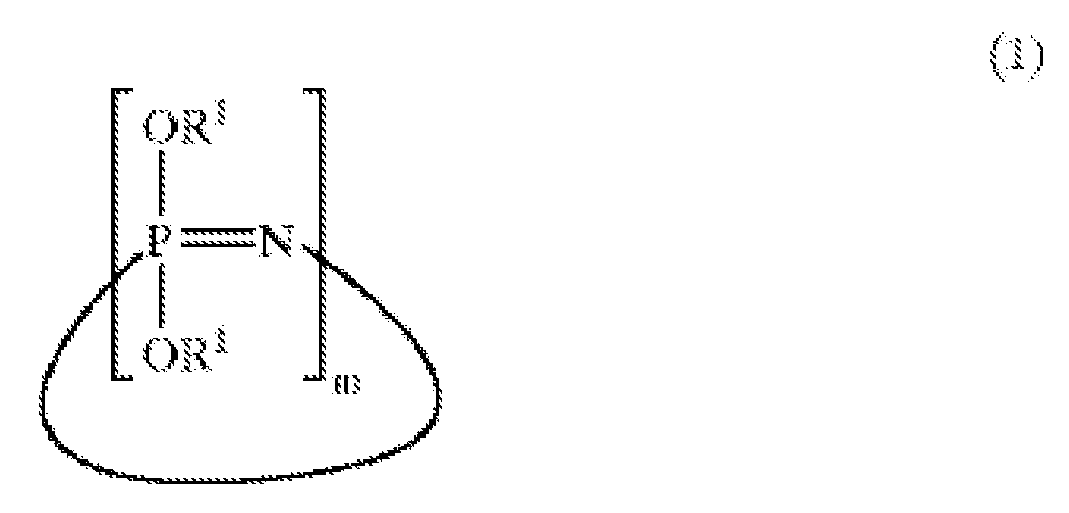
[00038] wherein m is an integer of 3 to 25, two R1 groups are the same or different and each represents a phenyl group substituted with at least one group selected from the class consisting of alkyl groups having 1 to 6 carbon atoms and an allyl group or an unsubstituted phenyl group.
[00039] (2) Straight-chain polyphosphazenes represented by the Formula
(2)

[00041] (3) Crosslinked polyphosphazenes wherein at least one of the foregoing phosphazenes (1) and (2) is crosslinked with at least one crosslinkin group selected from the group consisting of o-phenylene, m-phenylene, p- phen lene, biphenylene, and a group represented by

[00042] wherein A is a group— SO2— , a group— S— , a group— O— or a group— C(CH3)2— , each of said crosslinking groups being interposed between the two oxygen atoms left after the elimination of group R1 from the phosphazene (1) or (2), and the number of the R1 groups in the crosslinked phosphazene being 50 to 99.9% based on the total number of R1 groups in the phosphazene prior to the crosslinking.
[00043] (4) At least one polyphosphazene selected from the group consisting of cyclic polyphosphazenes represented by formula (3)

[00044] wherein R2 is a cyano-substituted phenyl group; R3 is an alkyl group having 1 to 18 carbon atoms or an aryl group having 6 to 10 carbon atoms; these groups may be substituted with at least one group selected from alkyl groups having 1 to 10 carbon atoms, allyl group and aryl groups; when two or more R 3 groups exist, the R 3 groups may be the same or different; p and q
are numbers which fulfill the requirements that p>0, q. 0, and p+q=2; and r is an integer of 3 to 25, and a straight-chain polyphosphazene represented by the formula (4)

[00045] wherein R2, R3, p and q are as defined above; s is an integer of 3 to 1000; X' is a group— P(OR )41 a group— P(OR2)3(OR3), a group—
P(OR2)2(OR3)2, a group— P(OR2)(OR3)3, a group— P(OR3)4, a group— P(O)(OR2)2, a group— P(O)(OR2)(OR3), or a group— P(O)(OR3)2; and Y' is a group— N=P(OR2)3, a group— N=P(OR2)2(OR3), a group—
N=P(OR2)(OR3)2, a group— N=P(OR3)3, a group— N=P(O)OR2 or a group— N=P(O)OR3.
[00046] The foregoing examples of the non-halogenated
polyphosphazenes can be used either alone or in combination.
[00047] Specific examples of the cyclic polyphosphazene (1) and the straight-chain polyphosphazene (2) include a mixture of phosphazenes in which phenoxy groups and/or alkoxy groups are introduced as substituents and which are obtainable from a mixture of cyclic and straight-chain chlorophosphazenes, e.g., hexachlorocyclotriphosphazene, octachlorocyclotetra-phosphazene and the like, prepared by reacting ammonium chloride and phosphorus pentachloride at about 120 to about 130° C; and hexaphenoxycyclotriphosphazene,
octaphenoxycyclotetraphosphazene, decaphenoxycyclo-pentaphosphazene, hexaalkoxycyclotriphosphazene, octaalkoxycyclotetraphosphazene,
decaalkoxycyclopenta-phosphazene and like cyclic phosphazenes obtained by isolating, from the above mixture of chlorophosphazenes,
hexachlorocyclotriphosphazene, octachlorocyclotetraphosphazene,
decachlorocyclopenta-phosphazene or like single substances, followed by substitution with a phenoxy group and/or an alkoxy group.
[00048] Specific examples of the straight-chain polyphosphazenes (2) include those obtained by heating (at 220 to 250° C.)
hexachlorocyclotriphosphazene for ring-opening polymerization to give dichlorophosphazene, followed by substitution with a phenoxy group and/or an alkoxy group.
[00049] Specific examples of the crosslinked polyphosphazenes (3) are phenoxyphosphazene having 4,4'-sulfonyldiphenylene(bisphenol-S residue) group-crosslinked structure, phenoxyphosphazene having 2,2-(4,4'- diphenylene)isopropylidene group-crosslinked structure, phenoxyphosphazene having 4,4'-oxydiphenylene group-crosslinked structure, phenoxyphoshazene having 4,4'-thiodiphenylene group-crosslinked structure, phenoxyphosphazene having 4,4'-diphenylene group-crosslinked structure, etc.
[00050] Specific examples of the polyphosphazenes (4) are
monocyanophenoxypentaphenoxycyclotriphosphazene,
dicyanophenoxytetraphenoxycyclotriphosphazene,
tricyanophenoxytriphenoxycyclotriphosphazene,
tetracyanophenoxydiphenoxycyclotriphosphazene,
pentacyanophenoxymonophenoxycyclotriphosphazene and like
cyclotriphosphazene compounds; monocyanophenoxyhepta- phenoxycyclotetraphosphazene,
dicyanophenoxyhexaphenoxycyclotetraphosphazene,
tricyanophenoxypentaphenoxy-cyclotetraphosphazene,
tetracyanophenoxytetraphenoxy-cyclotetraphosphazene,
pentacyanophenoxytriphenoxycyclotetraphosphazene,
hexacyanophenoxydiphenoxy-cyclotetraphosphazene,
heptacyanophenoxymonophenoxy-cyclotetraphosphazene and like
cyclotetraphosphazenes; cyclopentaphosphazenes having both cyanophenoxy and phenoxy groups as substituents; and like cyclic phosphazenes; and straight- chain phosphazenes having both cyanophenoxy and phenoxy groups as substituents.
[00051] Among these polymers, preferred are a mixture of
polyphenoxyphosphazenes which have phenoxy groups as substituents and which are obtainable from a mixture of cyclic and straight-chain
chlorophosphazenes, phenoxyphosphazene having 4,4'-sulfonyldiphenylene- crosslinked structure; phenoxyphosphazene having 2,2-(4,4'-diphenylene)- isopropylidene group-crosslinked structure; and polyphosphazenes having both cyanophenoxy and phenoxy groups as substituents.
[00052] Commercially available polyphosphazenes can be purchased from Otsuka Chemical Co., Ltd. of Osaka, Japan. Presently preferred as an optional second flame retardant is SPB 100 polyphosphazene from Otsuka.
[00053] Optional Char Former
[00054] Flame retardant thermoplastic compounds can benefit from the presence of char formers, chemicals which assist in the retention of the original shape of the plastic article by the formation of char from the compound.
[00055] One known char former is perfluorobutane sulfonic acid, potassium salt, which is sold as neat powder or as pellets of a masterbatch, with the latter being preferred for processing efficiency. The char former is considered optional for use in the compound of this invention because, as the Examples demonstrated, the compound does not need this particular functional additive to achieve a UL 94 V-0 rating.
[00056] Perfluorobutane sulfonic acid, potassium salt is commercially available as Bayowet C4 MB masterbatch (6% salt (CAS No. 029420-49-3) in polycarbonate pellets) or Bayowet C4 powder (CAS No. 029420-49-3) from Lanxess Deutschland GmbH.
[00057] Optional Other Additives
[00058] The compound of the present invention can include conventional plastics additives in an amount that is sufficient to obtain a desired processing or performance property for the compound. The amount should not be wasteful of the additive nor detrimental to the processing or performance of the
compound. Those skilled in the art of thermoplastics compounding, without undue experimentation but with reference to such treatises as Plastics Additives Database (2004) from Plastics Design Library (www.elsevier.com), can select from many different types of additives for inclusion into the compounds of the present invention.
[00059] Non-limiting examples of optional additives include adhesion promoters; biocides (antibacterials, fungicides, and mildewcides), anti-fogging agents; anti-static agents; bonding, blowing and foaming agents; dispersants; fillers and extenders; smoke suppressants; impact modifiers; initiators;
lubricants; micas; pigments, colorants and dyes; plasticizers, such as core/shell impact modifiers; processing aids; release agents; silanes, titanates and zirconates; slip and anti-blocking agents; stabilizers; stearates; ultraviolet light absorbers; viscosity regulators; waxes; catalyst deactivators, and combinations of them.
[00060] Ingredients
[00061] Table 1 shows the acceptable, desirable, and preferred amounts of each of the ingredients discussed above, recognizing that the optional ingredients need not be present at all. The compound can comprise the ingredients, consist essentially of the ingredients, or consist of the ingredients. All amounts are expressed in weight percent of the total compound.
[00062] All ingredients other than the polycarbonate matrix can be added individually to the matrix or any two or more of them can be added together.

[00063] Processing
[00064] The preparation of compounds of the present invention is uncomplicated. The compound of the present can be made in batch or continuous operations.
[00065] Mixing in a continuous process typically occurs in a single or twin screw extruder that is elevated to a temperature that is sufficient to melt the polymer matrix with addition of other ingredients either at the head of the extruder or downstream in the extruder. Extruder speeds can range from about 50 to about 500 revolutions per minute (rpm), and preferably from about 350 to about 450 rpm. Typically, the output from the extruder is pelletized for later extrusion or molding into polymeric articles.
[00066] Mixing in a batch process typically occurs in a Banbury mixer that is capable of operating at a temperature that is sufficient to melt the polymer matrix to permit addition of the solid ingredient additives. The mixing speeds range from 60 to 1000 rpm. Also, the output from the mixer is chopped into smaller sizes for later extrusion or molding into polymeric articles.
[00067] Subsequent extrusion or molding techniques are well known to those skilled in the art of thermoplastics polymer engineering. Without undue experimentation but with such references as "Extrusion, The Definitive Processing Guide and Handbook"; "Handbook of Molded Part Shrinkage and Warpage"; "Specialized Molding Techniques"; "Rotational Molding
Technology"; and "Handbook of Mold, Tool and Die Repair Welding", all published by Plastics Design Library (www.elsevier.com), one can make articles of any conceivable shape and appearance using compounds of the present invention.
USEFULNESS OF THE INVENTION
[00068] Thermoplastic compounds can be shaped by extrusion, molding, calendering, thermoforming, or other means of shaping into any plastic article usable in an interior or confined space where fire can cause personal injury or property damage. The compounds resist melting and dripping.
[00069] Literally any plastic article useful in a human-occupied space such as a building, a vehicle, or a tunnel can benefit from the flame retardancy of this polycarbonate compound.
[00070] Because the physical properties of polycarbonate compounds are known, which are believed to not be deleteriously affected by the addition of the bisphosphate ester, the talc, and the acrylic modified PTFE, and optionally the polyphosphazene and/or the sulfonic acid salt char former, any plastic article which is currently made from a polycarbonate compound can now be made from the non-halogenated flame retardant compound of this invention.
[00071] Polycarbonate itself has superior flame retardant properties when compared to other polymer resins, such as polyolefins. The inherent flame retardant properties of polycarbonate assisted in achieving the UL 94 V-0 rating at very thin dimensions after the addition of the bisphosphate ester, the talc, the acrylic modified PTFE, and optionally, the polyphosphazene and/or the sulfonic acid salt char former.
[00072] By achieving a UL 94 V-0 rating at a thickness as thin as 0.4 mm, it is known that a plastic article having any larger thickness will also achieve a UL 94 V-0 rating.
[00073] Thermoplastic articles are sold into the following markets: appliance, building and construction, consumer, electrical and electronic, healthcare, industrial, packaging, textiles, transportation, and wire and cable. Compounds of this invention can be used in any of those markets regardless of thickness above 0.4 mm, 40% of the thickness of a United States dime ($0.10) coin.
[00074] As stated repeatedly, Underwriters' Laboratories Test No. UL 94 serves as the litmus test for flame retardant thermoplastic compounds. As seen in Table 2, the V-0 rating is distinguished from V-1 and V-2 ratings, which are less acceptable if one is seeking the best flame retardance rating. For certain uses, V-1 is acceptable.

Examples provide data for evaluation of the unpredictability of
EXAMPLES
[00076] Table 3 shows the ingredients chosen for Examples 1-4 and
Comparative Examples A-E.

[00077] Table 4 shows the mixing conditions in a Leistritz ZSE-18HP
(L/D=41) twin screw extruder with all raw materials in pellet form being pre- mixed and then fed at throat at Barrel 1 and with all raw materials in powder form being pre-mixed and also fed at the throat at Barrel 1. The temperature in all zones was set at 270°C, with the values reported as measured.
[00078] The extrudate was pelletized, while in a water bath, for later injection or compression molding.


[00079] The extrudate was pelletized for later molding.
[00080] Before molding, the pellets were dried for more than 4 hours at
120°C to reduce moisture content to less than 0.02%.
[00081] Using a DeMag molding machine, Table 5 shows the settings used to mold test bars of each Example and Comparative Example having a thickness of 0.75 mm.

[00082] Samples of all Examples and Comparative Examples were also subjected to compression molding into films of 0.4 ~ 0.5 mm thickness. About 30 to 40 g of the material was placed between two Teflon™ coated trays, inserted into a PHI 40000 ton manual hydraulic press (model: P2150) preheated at 221°C (430 °F), then started slowly increasing pressure to 4.13-6.2 MPa (600-900 psi) over 2 minutes. After that, remove the plates from the press and cooled for 3-5 minutes to take out film with a thickness of about 0.4 ~ 0.5 mm. From those films, an Arbor fitted with a flexural die cut a flame bar sample shape out of the film for UL 94 testing.
[00083] Samples of all Examples and Comparative Examples were also subjected to extrusion into films of about 0.4 mm thickness. The materials were
extruded in a single-screw extruder (model: C.W.Brabender 2503 No. 1914) with L/D of 3: 1 and diameter of 0.5", and passed through a die with 4" die width and 1.4 mm die slit to form a tape. The extruder barrel temperature was 260 - 270 °C for zone 1, zone 2, zone 3 and die. The extruded tapes were pulled off by a C.W. Brabender Univex Take-Off Roll (Model SFR-100-B. No.468). The thickness of films ranged from 0.43 to 0.35 mm. The thickness was adjusted by extruder rpm and the speed of the take-off roll. The extruder rpm was about 60 - 70 rpm. The speed ranging from 0 to 100 of the DC motor of the take-off roll was set about 12 to 30. From the films, an Arbor fitted with a flexural die cut a flame bar sample shape out of the film for UL 94 testing.
[00084] Table 6 shows the flame performance tested for each Example and Comparative Example.


[00085] To the required ingredients of polycarbonate and bisphosphate ester flame retardant, two functional additives were evaluated, in of the three possible combinations because of the unpredictability of achieving a UL 94 V-0 test rating: polytetrafluoroethylene (PTFE) drip suppressant and talc mineral filler which serves as a viscosity enhancer.
[00086] Comparative Examples C-E demonstrate that, in order to achieve a UL 94 V-0 rating for either the 0.75 thickness (injection molded article such as Examples 1-4) or the 0.4-0.5 thickness (extruded film such as Example 1), both PTFE and talc are required in the compound.
[00087] Comparative Examples A and B demonstrated that even with both PTFE and talc present in the same amounts as in Examples 1-4, the UL 94 V-0 rating for either the 0.75 thickness (injection molded article) or the 0.4-0.5 thickness (extruded film) required at least 7 weight percent of bisphosphate ester. Five and six weight percent of bisphosphate ester were inadequate.
[00088] Of Examples 1-4, the use of branched or linear polycarbonate demonstrated that a combination of both branched and linear polycarbonate (Examples 1 and 2) had a better flame test result than either one or the other (Examples 3 and 4). And of Examples 1 and 2, the use of a superior amount of branched polycarbonate and an inferior amount of linear polycarbonate
(Example 1) had better flame test performance than equal amounts (Example 2). Therefore, the formulation of Example 1 is preferred. Thus, the ratio of branched polycarbonate to linear polycarbonate can range from about 1.2: 1 to about 3.6: 1 and preferably from about 3.0: 1 to about 3.4: 1.
[00089] The invention is not limited to the above embodiments. The claims follow.
Claims
1. A flame retardant polycarbonate compound, comprising:
(a) polycarbonate,
(b) bisphosphate ester,
(c) talc, and
(d) acrylic modified polytetrafluoroethylene,
wherein the bisphosphate ester is present in the compound at a weight percent from 7 to about 15,
and wherein the compound injection molded and tested at a thickness of 0.75 mm has a UL 94 rating of V-0.
2. The compound of Claim 1, further comprising the potassium salt of perfluorobutane sulfonic acid.
3. The compound of Claim 1, further comprising polyphosphazene.
4. The compound of Claim 1 or Claim 2 or Claim 3, wherein the polycarbonate is a mixture of a branched polycarbonate of virginal source, recycled source, or both, and a linear polycarbonate of virginal source, recycled source, or both.
5. The compound of Claim 4, further comprising an additive selected from the group consisting of adhesion promoters; biocides; anti-fogging agents; antistatic agents; anti-oxidants; bonding, blowing and foaming agents; dispersants; fillers and extenders; smoke suppressants; impact modifiers; initiators;
lubricants; micas; pigments, colorants and dyes; plasticizers; processing aids; release agents; silanes, titanates and zirconates; slip and anti-blocking agents; stabilizers; stearates; ultraviolet light absorbers; viscosity regulators; waxes; catalyst deactivators, and combinations of them.
6. The compound of any one of the above claims, wherein the compound has ingredients in amounts expressed in weight percent:

7. The compound of any one of the above claims, wherein the compound has ingredients in amounts expressed in weight percent:

8. The compound of any one of the above claims, wherein the compound has ingredients in amounts expressed in weight percent:

9. A molded article made from the compound of any one of Claims 1-8.
10. An extruded article made from the compound of any one of Claims 1-8.
11. A calendered article made from the compound of any one of Claims 1-8.
12. A thermoformed article made from the compound of any one of
Claims 1-8.
13. A method of using the compound of Claim 1, comprising the step of shaping the compound into an article designed to resist combustion or molten dripping in the presence of flame.
14. The method of Claim 13, wherein the polycarbonate of the compound is a mixture of a branched polycarbonate of virginal source, recycled source, or both and a linear polycarbonate of virginal source, recycled source, or both.
15. The method of Claim 13, wherein the shaping comprises extruding, molding, calendering, or thermoforming.
Priority Applications (2)
| Application Number | Priority Date | Filing Date | Title |
|---|---|---|---|
| CN201380039365.9A CN104487512B (en) | 2012-07-25 | 2013-07-24 | Non-halogenated fire retardant polycarbonate compound |
| US14/416,415 US20150166787A1 (en) | 2012-07-25 | 2013-07-24 | Non-halogenated flame retardant polycarbonate compounds |
Applications Claiming Priority (2)
| Application Number | Priority Date | Filing Date | Title |
|---|---|---|---|
| US201261675545P | 2012-07-25 | 2012-07-25 | |
| US61/675,545 | 2012-07-25 |
Publications (1)
| Publication Number | Publication Date |
|---|---|
| WO2014018672A1 true WO2014018672A1 (en) | 2014-01-30 |
Family
ID=49997816
Family Applications (1)
| Application Number | Title | Priority Date | Filing Date |
|---|---|---|---|
| PCT/US2013/051887 Ceased WO2014018672A1 (en) | 2012-07-25 | 2013-07-24 | Non-halogenated flame retardant polycarbonate compounds |
Country Status (4)
| Country | Link |
|---|---|
| US (1) | US20150166787A1 (en) |
| CN (1) | CN104487512B (en) |
| TW (1) | TW201406941A (en) |
| WO (1) | WO2014018672A1 (en) |
Cited By (5)
| Publication number | Priority date | Publication date | Assignee | Title |
|---|---|---|---|---|
| US10522264B2 (en) | 2013-03-15 | 2019-12-31 | General Cable Technologies Corporation | Foamed polymer separator for cabling |
| WO2021043654A1 (en) | 2019-09-04 | 2021-03-11 | Covestro Intellectual Property Gmbh & Co. Kg | Polyphosphazene and molding compound containing the polyphosphazene |
| US11107607B2 (en) | 2014-06-06 | 2021-08-31 | General Cable Technologies Corporation | Foamed polycarbonate separators and cables thereof |
| EP4092070A1 (en) * | 2021-05-17 | 2022-11-23 | Covestro Deutschland AG | Reduction of the content of specific salts of sulfonic acid, sulfonamide or sulfonimide derivatives in wastewater |
| EP4177301A1 (en) | 2021-11-03 | 2023-05-10 | Covestro Deutschland AG | Polyphosphazene and moulding composition containing same |
Families Citing this family (2)
| Publication number | Priority date | Publication date | Assignee | Title |
|---|---|---|---|---|
| KR20140054061A (en) | 2011-07-14 | 2014-05-08 | 폴리원 코포레이션 | Non-halogenated flame retardant polycarbonate compounds |
| CN113512295A (en) * | 2021-04-21 | 2021-10-19 | 山东航橡新材料有限公司 | Polyphosphazene system-based low-heat-release flame-retardant thermoplastic material and preparation method thereof |
Citations (6)
| Publication number | Priority date | Publication date | Assignee | Title |
|---|---|---|---|---|
| US5952408A (en) * | 1994-12-01 | 1999-09-14 | Cheil Industries, Inc. | Flameproof thermoplastic resin compositions |
| WO2001081470A1 (en) * | 2000-04-19 | 2001-11-01 | General Electric Company | Flame retardant polyester compositions |
| US20100010128A1 (en) * | 2006-01-06 | 2010-01-14 | Levchik Sergei V | Halogen-Free Flame Retardant Compositions, Thermoplastic Compositions Comprising the Same and Methods of Producing the Compositions |
| US20110052895A1 (en) * | 2009-08-25 | 2011-03-03 | Sabic Innovative Plastics, Ip B.V. | Flame retardant thermoplastic polycarbonate compositions and films made therefrom |
| US20110124781A1 (en) * | 2007-12-28 | 2011-05-26 | Lg Chem, Ltd. | Polycarbonate resin composition with excellent flame retardancy |
| US7985788B2 (en) * | 2009-11-27 | 2011-07-26 | Canon Kabushiki Kaisha | Flame retardant resin composition and molded article thereof |
Family Cites Families (17)
| Publication number | Priority date | Publication date | Assignee | Title |
|---|---|---|---|---|
| US5158999A (en) * | 1990-08-13 | 1992-10-27 | Minnesota Mining And Manufacturing Company | Flame retardants |
| WO2001072900A1 (en) * | 2000-03-28 | 2001-10-04 | Teijin Chemicals, Ltd. | Reclaimed resin composition |
| DE10109224A1 (en) * | 2001-02-26 | 2002-09-05 | Bayer Ag | Flame retardant polycarbonate compositions with increased chemical resistance |
| US6613824B2 (en) * | 2001-11-12 | 2003-09-02 | General Electric Company | Flame retardant resinous compositions and method |
| DE10235754A1 (en) * | 2002-08-05 | 2004-02-19 | Bayer Ag | Polycarbonate molding material, useful for production of shaped parts and where contact with specific media is involved, e.g. solvents, lubricants and cleaning agents, is modified with graft polymerizate containing phosphorus compounds |
| JP4225459B2 (en) * | 2002-08-06 | 2009-02-18 | 住友ダウ株式会社 | Flame retardant polycarbonate resin composition |
| US7232854B2 (en) * | 2004-02-03 | 2007-06-19 | General Electric Company | Polycarbonate compositions with thin-wall flame retardance |
| JP2005320469A (en) * | 2004-05-11 | 2005-11-17 | Idemitsu Kosan Co Ltd | Polycarbonate resin composition and molded product |
| JP2006028389A (en) * | 2004-07-20 | 2006-02-02 | Teijin Chem Ltd | Aromatic polycarbonate resin composition |
| CN101942182B (en) * | 2004-09-17 | 2012-05-23 | 东丽株式会社 | Resin composition and molding comprising the same |
| US20070072961A1 (en) * | 2005-09-28 | 2007-03-29 | General Electric Company | Thermoplastic polycarbonate compositions, method of manufacture, and method of use thereof |
| US7531615B2 (en) * | 2006-01-04 | 2009-05-12 | Sabic Innovative Platics Ip B.V. | Thermally stable polycarbonates, thermoplastic compositions thereof, and articles formed therefrom |
| US20090088514A1 (en) * | 2007-09-27 | 2009-04-02 | Sabic Innovative Plastics Ip Bv | Polycarbonate composition having improved impact, flammability and surface appearance, method of making, and articles prepared therefrom |
| KR101020047B1 (en) * | 2007-12-05 | 2011-03-09 | 주식회사 엘지화학 | Flame Retardant Thermoplastic Composition |
| JP5398843B2 (en) * | 2008-12-08 | 2014-01-29 | サビック・イノベーティブ・プラスチックス・アイピー・ベスローテン・フェンノートシャップ | Flame retardant polycarbonate composition, method for producing the same, and article thereof |
| US7994248B2 (en) * | 2008-12-11 | 2011-08-09 | Sabic Innovative Plastics Ip B.V. | Flame retardant thermoplastic polycarbonate compositions |
| US9394483B2 (en) * | 2012-05-24 | 2016-07-19 | Sabic Global Technologies B.V. | Flame retardant polycarbonate compositions, methods of manufacture thereof and articles comprising the same |
-
2013
- 2013-07-24 CN CN201380039365.9A patent/CN104487512B/en active Active
- 2013-07-24 US US14/416,415 patent/US20150166787A1/en not_active Abandoned
- 2013-07-24 WO PCT/US2013/051887 patent/WO2014018672A1/en not_active Ceased
- 2013-07-25 TW TW102126751A patent/TW201406941A/en unknown
Patent Citations (6)
| Publication number | Priority date | Publication date | Assignee | Title |
|---|---|---|---|---|
| US5952408A (en) * | 1994-12-01 | 1999-09-14 | Cheil Industries, Inc. | Flameproof thermoplastic resin compositions |
| WO2001081470A1 (en) * | 2000-04-19 | 2001-11-01 | General Electric Company | Flame retardant polyester compositions |
| US20100010128A1 (en) * | 2006-01-06 | 2010-01-14 | Levchik Sergei V | Halogen-Free Flame Retardant Compositions, Thermoplastic Compositions Comprising the Same and Methods of Producing the Compositions |
| US20110124781A1 (en) * | 2007-12-28 | 2011-05-26 | Lg Chem, Ltd. | Polycarbonate resin composition with excellent flame retardancy |
| US20110052895A1 (en) * | 2009-08-25 | 2011-03-03 | Sabic Innovative Plastics, Ip B.V. | Flame retardant thermoplastic polycarbonate compositions and films made therefrom |
| US7985788B2 (en) * | 2009-11-27 | 2011-07-26 | Canon Kabushiki Kaisha | Flame retardant resin composition and molded article thereof |
Cited By (6)
| Publication number | Priority date | Publication date | Assignee | Title |
|---|---|---|---|---|
| US10522264B2 (en) | 2013-03-15 | 2019-12-31 | General Cable Technologies Corporation | Foamed polymer separator for cabling |
| US11107607B2 (en) | 2014-06-06 | 2021-08-31 | General Cable Technologies Corporation | Foamed polycarbonate separators and cables thereof |
| WO2021043654A1 (en) | 2019-09-04 | 2021-03-11 | Covestro Intellectual Property Gmbh & Co. Kg | Polyphosphazene and molding compound containing the polyphosphazene |
| EP4092070A1 (en) * | 2021-05-17 | 2022-11-23 | Covestro Deutschland AG | Reduction of the content of specific salts of sulfonic acid, sulfonamide or sulfonimide derivatives in wastewater |
| WO2022243221A1 (en) | 2021-05-17 | 2022-11-24 | Covestro Deutschland Ag | Reducing the content of specific salts of sulfonic acid derivatives, sulfonamide derivatives or sulfonimide derivatives in wastewater |
| EP4177301A1 (en) | 2021-11-03 | 2023-05-10 | Covestro Deutschland AG | Polyphosphazene and moulding composition containing same |
Also Published As
| Publication number | Publication date |
|---|---|
| CN104487512B (en) | 2016-10-12 |
| TW201406941A (en) | 2014-02-16 |
| CN104487512A (en) | 2015-04-01 |
| US20150166787A1 (en) | 2015-06-18 |
Similar Documents
| Publication | Publication Date | Title |
|---|---|---|
| US9732218B2 (en) | Non-halogenated flame retardant polycarbonate compounds | |
| WO2014018672A1 (en) | Non-halogenated flame retardant polycarbonate compounds | |
| US9884961B2 (en) | Phosphazene flame retardant polycarbonate compounds | |
| KR100995718B1 (en) | Halogen-free flame retardant polycarbonate composition | |
| EP3008128A1 (en) | Completely non-halogenated flame retardant polycarbonate compounds | |
| US20150111986A1 (en) | Polyolefin intumescent phosphorous flame retardant system | |
| CN104334622A (en) | Antimony-free flame-retarded styrenic thermoplastic polymer composition, article containing same and method of making same | |
| US20150274966A1 (en) | Flame retardant polylactic acid compounds | |
| JP6687771B2 (en) | Method for producing thermoplastic resin composition | |
| WO2001034704A1 (en) | Flame-retardant aromatic polyamide resin composition and molded object | |
| TW201723055A (en) | Flame-retardant polycarbonate resin composition, sheet and film each using same, and method for producing said sheet or film | |
| US9944795B2 (en) | Hydrolytically stable functionalized polyphosphonate flame retardant | |
| JP6482755B2 (en) | Method for producing thermoplastic resin composition | |
| JP6713272B2 (en) | Polycarbonate-based resin composition, product, housing-forming resin, method of using polycarbonate-based resin composition as housing-forming resin, and method of manufacturing polycarbonate-based resin composition | |
| JP6924823B2 (en) | Flame-retardant transparent polycarbonate composition | |
| CN115715309A (en) | Polyphosphonate resin composition and molded article made therefrom | |
| KR102007099B1 (en) | Thermoplastic resin composition and article produced therefrom | |
| KR101374429B1 (en) | Polycarbonate resin composition with high transparency and flame retardancy and product by using the same | |
| JP6483193B2 (en) | Method for producing thermoplastic resin composition | |
| CN101747612B (en) | Non-halogen flameproof polycarbonate resin composition | |
| JP6386652B2 (en) | Method for producing thermoplastic resin composition | |
| JP6483230B2 (en) | Method for producing thermoplastic resin composition | |
| JP6483229B2 (en) | Method for producing thermoplastic resin composition | |
| US10800903B2 (en) | Flame-retarded transparent polycarbonate compositions | |
| CN104672792A (en) | Flame-retardancy-modified PBT/PET (polybutylene terephthalate/polyethylene terephthalate) blend alloy material |
Legal Events
| Date | Code | Title | Description |
|---|---|---|---|
| 121 | Ep: the epo has been informed by wipo that ep was designated in this application |
Ref document number: 13822827 Country of ref document: EP Kind code of ref document: A1 |
|
| WWE | Wipo information: entry into national phase |
Ref document number: 14416415 Country of ref document: US |
|
| NENP | Non-entry into the national phase |
Ref country code: DE |
|
| 122 | Ep: pct application non-entry in european phase |
Ref document number: 13822827 Country of ref document: EP Kind code of ref document: A1 |